


Abstract
The escalating prevalence of metabolic disorders in children and adults is increasingly linked to adverse conditions during intrauterine life. A poor maternal nutritional environment can program pregnancy outcomes and fetal health, thereby increasing future disease susceptibility. While the need for effective pregnancy interventions is urgent, current strategies are often hindered by limited safety, inadequate efficacy, and poor compliance. In this context, identifying safe and potent nutritional compounds that support maternal health and guide proper fetal development is of paramount importance. Curcumin, the primary natural and bioactive polyphenol derived from turmeric, possesses a well-documented profile of anti-inflammatory, antioxidant, and insulin-sensitizing properties. These pleiotropic effects position it as an exceptionally promising candidate for modulating pregnancy health. However, despite its therapeutic potential, the role of maternal dietary curcumin supplementation in promoting positive pregnancy outcomes and ensuring long-term offspring health has been largely overlooked. This review addresses whether maternal curcumin intake during pregnancy influences offspring health, and what the mechanistic, translational, and safety limits of the current evidence are, with particular attention to its anti-inflammatory and antioxidant mechanisms in counteracting the detrimental effects of maternal metabolic disturbances and oxidative stress.
1. Introduction
The global prevalence of metabolic diseases, including obesity, type 2 diabetes, and cardiovascular diseases, has been escalating at an alarming rate, posing a major threat to public health worldwide [1,2]. Traditional perspectives have long attributed the rising incidence of metabolic diseases to genetic predisposition and unfavorable lifestyle factors. However, the dramatic and rapid surge in metabolic disease prevalence cannot be adequately explained by genetic and lifestyle factors alone, pointing to the existence of additional, yet-to-be-identified contributors [3]. Accumulating evidence has unequivocally demonstrated that exposure to a suboptimal intrauterine environment significantly increases the offspring’s risk of developing metabolic disorders [4,5]. This concept, known as “fetal programming” posits that adverse intrauterine conditions can induce persistent structural and functional alterations in developing tissues and organ systems, thereby programming long-term susceptibility to chronic diseases [6,7]. Strikingly, these detrimental effects are not confined to the first generation; they can be transmitted to subsequent generations [8]. This underscores the urgent need for intervention during pregnancy. Waiting until after birth risks missing the window when the metabolic path is still being shaped.
The fetal period represents a critical window of opportunity for early intervention. During this stage, the developing organism exhibits remarkable plasticity and is exquisitely sensitive to intrauterine environmental factors, which can profoundly shape its health and disease trajectory across the lifespan [3]. This plasticity implies that timely and targeted interventions during pregnancy have the unique potential to redirect an adverse developmental trajectory toward a healthier one, offering a powerful opportunity for primordial prevention [9,10]. Thus, developing targeted preventive strategies during the critical window of pregnancy—such as nutritional supplementation, lifestyle optimization, or novel bioactive compounds—can ultimately break the vicious cycle of metabolic disease transmission across generations. Investing in maternal health extends beyond the well-being of a single individual, and it also represents a foundational approach to securing the long-term health of future generations.
This review was informed by a structured literature search, with the search strategy and selection criteria described below. We searched PubMed, Web of Science, and Scopus for English-language articles published up to March 2026. In PubMed, both controlled vocabulary and free-text terms were used. The search strategy combined terms related to maternal nutrition, curcumin, pregnancy, and offspring development. Representative terms included “Curcumin” [MeSH], “Turmeric extract” [MeSH], “Pregnancy” [MeSH], “Fetal Development” [MeSH], “Developmental Origins of Health”, maternal, gestational, pregnancy, curcumin, turmeric, curcuma, curcuminoid, offspring, fetal, neonatal, developmental programming, metabolic programming, and pregnancy complications. Search syntax was adapted for each database. Records were screened first by title and abstract and then by full-text review for relevance. We prioritized original studies examining maternal curcumin administration in relation to pregnancy outcomes and offspring health, including both animal models and human studies, as well as mechanistic studies addressing the signaling pathways and biological activities through which curcumin may act. Studies were excluded if curcumin was administered directly to offspring after birth or to isolated cells without any maternal or in utero context. Such studies are clearly identified and discussed separately in the text and tables. Review articles were additionally consulted for background context and for identifying relevant primary studies through reference screening.
Although several reviews have previously addressed the pharmacological actions of curcumin in pregnancy-related complications, including gestational diabetes, preeclampsia, and fetal growth restriction [11,12,13], our present review is not intended to duplicate these pharmacological overviews. Rather, it is organized around the concept of developmental programming and asks a distinct question: whether maternal curcumin intake during pregnancy influences offspring health, and what the mechanistic, translational, and safety limits of the current evidence are. Thus, we deliberately emphasize offspring health beyond the pregnancy complications.
2. Improving Metabolic Health During Pregnancy: An Interventional Challenge
The escalating prevalence of metabolic disturbances during pregnancy—including maternal overweight, obesity, and gestational diabetes mellitus (GDM)—has imposed a significant and growing burden on both individual well-being and public healthcare systems [14]. However, the arsenal of effective interventions remains strikingly limited [15]. Lifestyle modifications, encompassing dietary adjustments and physical activity, represent the first-line approach [9,16,17]. However, their real-world efficacy is often disappointing. These strategies are plagued by poor patient compliance and inconsistent outcomes. Several meta-analysis studies confirmed that while lifestyle interventions can curb excessive gestational weight gain, this does not consistently translate into improvements in core maternal or neonatal outcomes [18,19].
The UPBEAT (Effect of a Behavioural Intervention in Obese Pregnant Women) study has reinforced this notion, showing that behavioral interventions in obese mothers fail to reduce the incidence of fetal macrosomia or prevent GDM [20]. Furthermore, the lack of consensus on optimal dietary advice and the significant methodological heterogeneity across studies hinder the development of robust, evidence-based clinical guidelines, limiting the practical applicability of these approaches [21,22]. When lifestyle measures prove insufficient, the pharmacological options present their own set of challenges. Drug interventions, such as insulin or oral hypoglycemics used for GDM management, are often associated with high costs, require rigorous monitoring, and carry potential side effects for both the mother and the fetus [23]. Collectively, these significant limitations—the inconsistency of lifestyle changes and the risks and burdens of pharmacotherapy—underscore a critical and unmet need. There is an urgent demand for safe, accessible, and effective alternative interventions that can seamlessly integrate into prenatal care to improve pregnancy health and optimize fetal programming.
3. Curcumin: Harnessing Nature’s Bioactivity for Metabolic Protection
In recent decades, the accelerating pace of bioactive compound discovery has unveiled an even broader therapeutic landscape [24,25]. Beyond their historical roles, these natural molecules exhibit a remarkable spectrum of pharmacological activities. Curcumin, the principal bioactive polyphenol derived from the rhizome of Curcuma longa (turmeric), has emerged as a compelling candidate for health protection [26,27,28,29]. For centuries, turmeric—a rhizomatous herb belonging to the ginger family—has served as a cornerstone of traditional medicine, a component of cosmetic formulations, and a valued dietary supplement. In recent years, as the principal bioactive constituent of turmeric, dietary curcumin exhibits a remarkable spectrum of pharmacological activities, including anti-inflammatory [28,30,31], antioxidant [32,33], anti-apoptotic [34,35], and metabolic regulatory properties [36,37]. Because these terms are often used interchangeably in the literature, a clear distinction should be noted: turmeric refers to the rhizome or powder of Curcuma longa (~2–5% curcuminoids plus essential oils and other constituents), curcuminoids to the extract (~70–95% curcumin with demethoxycurcumin and bisdemethoxycurcumin), pure curcumin to the isolated compound, and bioavailability-enhanced formulations to piperine co-administration, nanoparticles, liposomes, phytosomes, amorphous solid dispersions, and micelles. Accordingly, the specific effects observed must be interpreted in relation to the specific constituents and dose administered.
The metabolic protective effects of curcumin are attributed to its unique chemical structure: two o-methoxyphenolic rings, a central methylene bridge, and an α,β-unsaturated β-diketone moiety. The β-diketone enables keto–enol tautomerism and metal chelation, the α,β-unsaturated carbonyl acts as a Michael acceptor toward cysteine thiols, and the phenolic hydroxyls scavenge radicals—explaining both its multi-target activity and the non-selectivity of many interactions. Notably, curcumin is chemically unstable at physiological pH, degrading to vanillin, ferulic acid, and feruloylmethane, and is well documented to interfere with common readouts such as fluorescence quenching, colorimetric assays, and thiol reactivity [38]. Thus, we consider it possible that some of the effects attributed to curcumin reflect direct covalent or non-covalent interactions with defined targets, whereas others may arise indirectly from nuclear factor erythroid 2-related factor 2 (Nrf2) activation, redox modulation, or membrane perturbation, and still others may represent artefacts of assay interference.
Curcumin exerts potent anti-inflammatory effects by inhibiting key signaling pathways such as nuclear factor-κB (NF-κB) [39,40,41]. It showed that curcumin reverses diabetic nephropathy in streptozotocin-induced diabetes in rats by activation of forkhead box O-3a (FOXO-3a) [42], thereby suppressing the chronic low-grade inflammation that underpins obesity, insulin resistance, and type 2 diabetes. Its robust antioxidant capacity, mediated through direct free radical scavenging and activation of Nrf2-driven antioxidant enzymes, helps counteract oxidative stress—a common denominator in metabolic dysfunction [43,44,45]. In addition, curcumin enhances mitophagy through Nrf2- PTEN-induced putative kinase 1 (PINK1)-mediated Parkin-dependent ubiquitination, thereby inhibiting ferroptosis [46]. Furthermore, curcumin enhances mitochondrial function and alleviates oxidative stress, thereby contributing to improved lipid metabolism [47]. However, although existing evidence supports protective effects of curcumin on human health, information about its effects on pregnancy health and fetal programming is limited. In this review, we aim to highlight the potential of such novel bioactive compound interventions during pregnancy to improve maternal health and favorably influence fetal programming.
4. Clinical Evidence on Curcumin in Pregnancy: Scope and Limitations
The metabolic benefits of curcumin supplementation are widely recognized in the general population. Human studies have shown that curcumin can be absorbed and rapidly metabolized after consumption, with no pronounced toxicity observed in the treatment of multiple chronic diseases [48,49,50,51,52]. However, its potential role during pregnancy remains underexplored. A double-blind, randomized clinical trial conducted at North Sumatra University examined the effects of curcumin supplementation in pregnant women with preeclampsia. The study found that daily curcumin intake (100 mg/day) did not alter circulating levels of the anti-inflammatory markers interleukin-10 (IL-10) and cyclooxygenase-2 (COX-2) [53]. However, studies on pregnant women are very limited, and the safety profile of curcumin during pregnancy remains unclear. Key questions—such as the optimal dose, the timing of exposure, and the potential for interactions with maternal physiology—have not been adequately addressed. To date, no human study has yet evaluated curcumin for fetal programming or for the prevention of pregnancy complications with offspring follow-up.
5. Preclinical Studies of Curcumin and Its Effects on Pregnancy Health and Fetal Programming
5.1. Curcumin and Its Beneficial Effects on Intrauterine Growth Restriction (IUGR) and Offspring Health
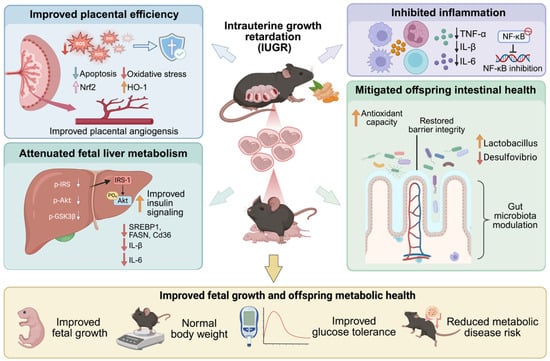
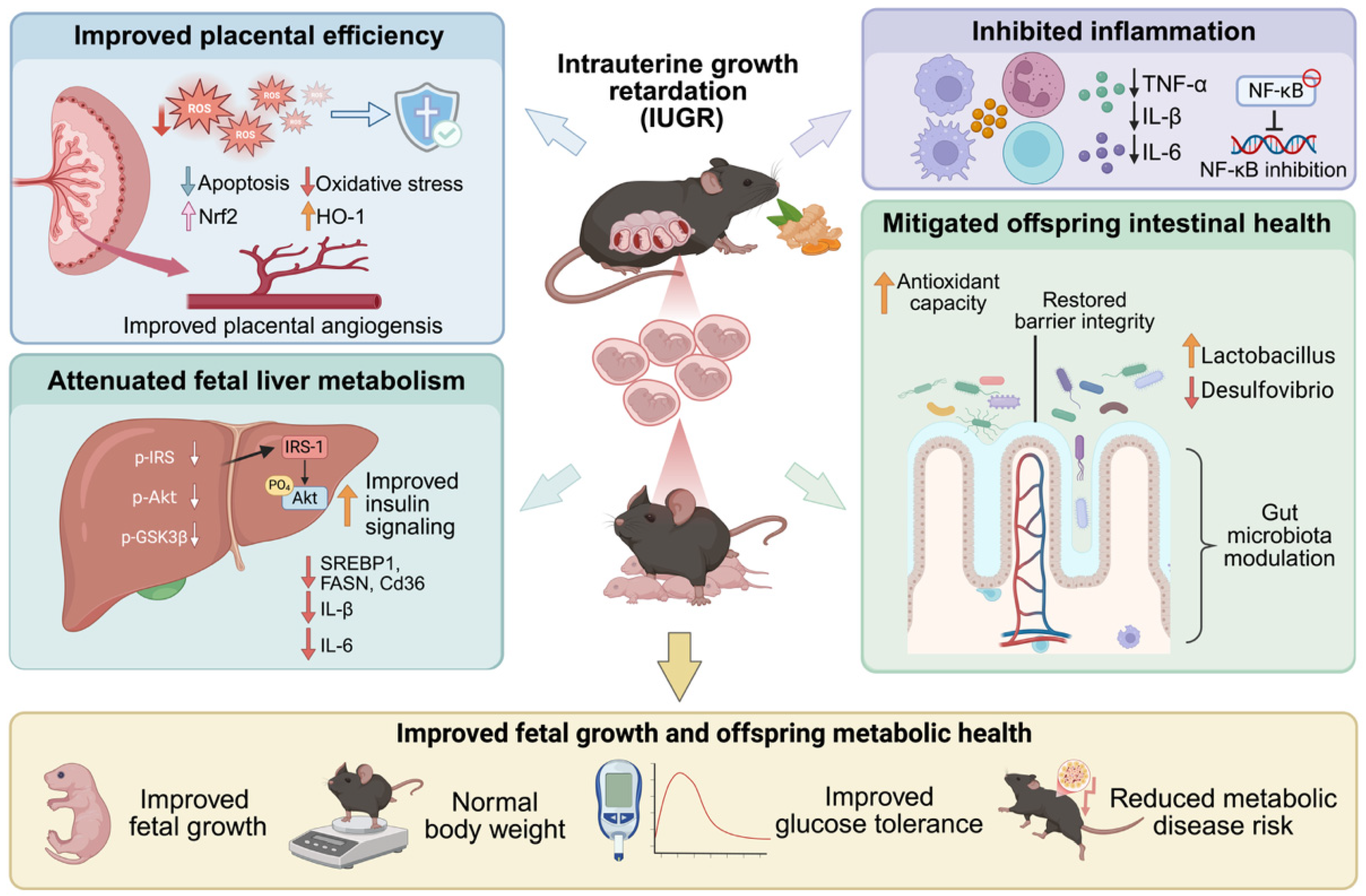
IUGR occurs when a fetus fails to reach its genetic growth potential, often due to maternal factors or placental insufficiency [54,55]. According to the Developmental Origins of Health and Disease (DOHaD) hypothesis, adverse intrauterine environments can program long-term health trajectories, rendering IUGR-exposed offspring significantly more susceptible to metabolic and cardiovascular disorders in adulthood, including obesity [56], T2DM [57], and cardiovascular diseases [58,59,60] in adulthood. The pathogenesis of IUGR is complex and involves multiple interconnected mechanistic pathways, particularly impaired placental angiogenesis, chronic inflammation, and oxidative stress [61,62,63,64]. In the context of these pathophysiological challenges, emerging evidence has highlighted the therapeutic potential of maternal dietary interventions. Preclinical evidence has demonstrated that maternal curcumin supplementation can ameliorate IUGR-related outcomes through various mechanisms (Figure 1).
Figure 1.
Curcumin mitigates intrauterine growth retardation (IUGR). IUGR typically stems from placental insufficiency, leaving offspring vulnerable to adult-onset metabolic disorders. Maternal curcumin supplementation alleviates IUGR through enhanced placental efficiency, reduced fetal liver metabolic disturbances, and suppressed inflammation. Daily curcumin administration during pregnancy improved placental efficiency, restored placental redox balance, reduced apoptosis, and normalized antioxidant gene expression, including Nrf2 and heme oxygenase-1 (HO-1) in placenta. In addition, maternal curcumin supplementation increased vascular endothelial growth factor (VEGF) expression in the placenta, which may improve placental angiogenesis. Within the fetus, curcumin corrects hepatic insulin signaling and limits de novo lipogenesis. Maternal curcumin attenuated placental inflammation by inhibiting the NF-κB signaling pathway, Postnatally, these benefits extend to the offspring’s gut by reshaping the microbiome and repairing intestinal barrier integrity. This combination of placental, hepatic, and intestinal improvements ensures normal birth weight and lowers future metabolic disease risks. Akt, protein kinase B; Cd36, cluster of differentiation 36; FASN, fatty acid synthase; GSK3β, glycogen synthase kinase-3 beta; HO-1, heme oxygenase-1; IL, interleukin; IRS, insulin receptor substrate; NF-κB, nuclear factor kappa B; Nrf2, nuclear factor erythroid 2-related factor 2; ROS, reactive oxygen species; SREBP1, sterol regulatory element-binding protein 1; TNF-α, tumor necrosis factor-α. Created in BioRender. Yinmin, Z. (2026) https://BioRender.com/jkfnmzu (accessed on 20 September 2026).
Additional studies revealed that dietary curcumin supplementation (100 mg/kg curcumin) during pregnancy normalized the low protein diet-induced decrease of placental weight, blood sinusoid area, and proliferating cell nuclear antigen (PCNA) protein expression levels. It also attenuated placental inflammation in IUGR rats by inhibiting the NF-κB signaling pathway, reducing pro-inflammatory cytokines such as TNF-α, IL-1β, and IL-6 [65]. Qi et al. demonstrated that maternal curcumin supplementation (600 mg/kg curcumin) during pregnancy and lactation improved intestinal health in IUGR offspring by enhancing antioxidant capacity, restoring barrier integrity, and modulating gut microbiota (restoring beneficial bacteria Lactobacillus and suppressing harmful bacteria Desulfovibrio) [66]. These findings highlight curcumin as a potential strategy to mitigate IUGR-induced health abnormalities (Table 1).
5.2. Curcumin and Its Beneficial Effects on Hyperglycemia in Pregnancy (HIP)
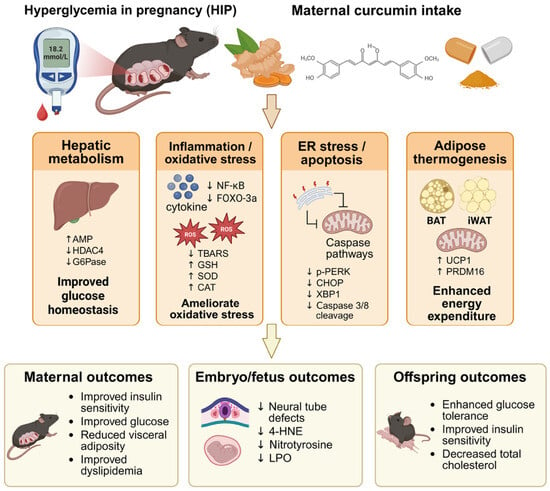
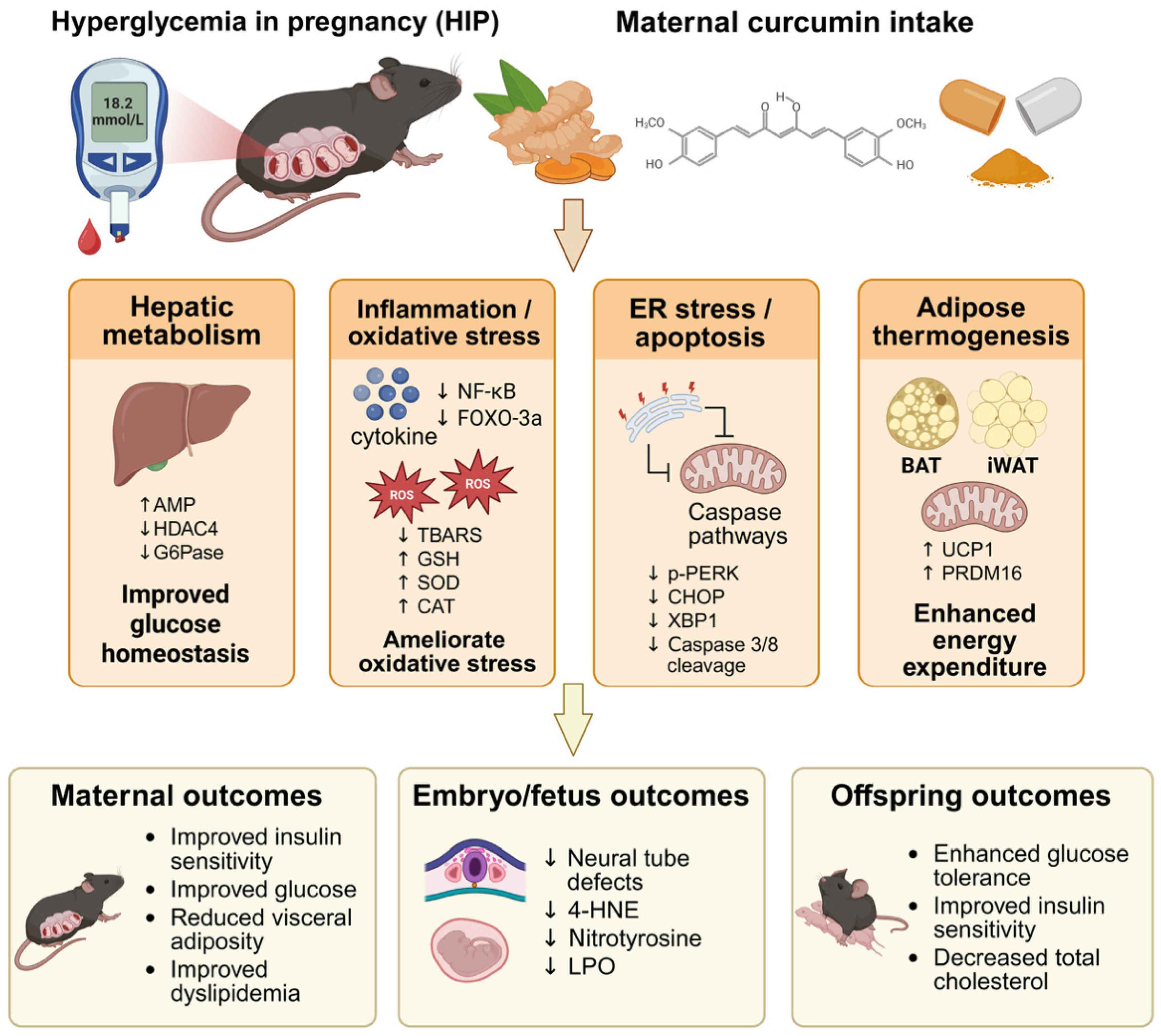
The global prevalence of HIP is rising, largely due to increases in obesity and diabetes. The International Diabetes Federation estimates that HIP affected 19.7% of live births in 2024, with the majority being cases of gestational diabetes mellitus [67,68]. This condition is associated with significant complications for both mother and child, including long-term health risks [69,70]. Growing evidence, including both human and animal studies demonstrates that curcumin exerts beneficial effects on glycemic control and insulin sensitivity, positioning it as a promising adjunctive therapy for metabolic disease, including type 2 diabetes mellitus (T2DM) [29,71,72]. Given the current limited intervention options for managing hyperglycemia specifically during pregnancy, where pharmacological choices are often restricted due to safety concerns for both the mother and fetus, the exploration of safe, natural and effective adjunctive therapies is of particular importance. Animal models of HIP have revealed the therapeutic potential of curcumin in improving maternal glucose homeostasis and pregnancy outcomes (Figure 2).
Figure 2.
Maternal curcumin intake counteracts hyperglycemia in pregnancy (HIP) and protects fetal development. HIP severely compromises maternal metabolic stability and fetal growth. As illustrated, curcumin acts on multiple target organs to reverse these adverse effects. In the maternal liver, activating AMPK and suppressing gluconeogenesis improves systemic glucose homeostasis. Moreover, curcumin drives thermogenesis in adipose depots to boost energy expenditure. Beyond tissue-specific metabolic shifts, this intervention broadly limits oxidative damage, NF-κB-mediated inflammation, and ER stress-induced apoptosis. Together, these maternal cellular adaptations relieve the hostile intrauterine environment, reducing embryonic neural tube defects and ensuring better offspring health. AMPK, adenosine monophosphate-activated protein kinase; BAT, brown adipose tissue; CAT, catalase; CHOP, C/EBP homologous protein; ER, endoplasmic reticulum; FOXO-3a, forkhead box O3a; G6Pase, glucose-6-phosphatase; GSH, glutathione; HDAC4, histone deacetylase 4; 4-HNE, 4-hydroxynonenal; iWAT, inguinal white adipose tissue; LPO, lipid hydroperoxide; NF-κB, nuclear factor kappa B; p-PERK, phosphorylated protein kinase RNA-like ER kinase; PRDM16, PR domain containing 16; ROS, reactive oxygen species; SOD, superoxide dismutase; TBARS, thiobarbituric acid reactive substances; UCP1, uncoupling protein 1; XBP1, X-box binding protein 1. Created in BioRender. Yinmin, Z. (2026) https://BioRender.com/jkfnmzu (accessed on 20 September 2026).
Diabetic pregnant C57 BL/KsJ mice that received curcumin supplementation (100 mg/kg/day) exhibited significantly ameliorated glucose intolerance and insulin resistance, along with complete restoration of litter size and body weight [73]. The author further found that curcumin supplementation during pregnancy could improve oxidative stress, as evidenced by reduced thiobarbituric acid reactive substance (TBARS) and increased glutathione (GSH) levels, superoxide dismutase (SOD), and catalase (CAT) activities. These changes were accompanied by enhanced AMPK activation, and decreased histone deacetylases 4 (HDAC4) and glucose-6-phosphatase (G6Pase) expression in the livers on gestational day 20 [73]. In dams fed a hyperglycemic diet, Santos et al. found that curcumin supplementation (400 mg/kg/day) throughout pregnancy and lactation attenuated maternal weight gain, visceral adiposity, and dyslipidemia, while also improving glucose homeostasis. Offspring of curcumin-treated dams exhibited reduced weight gain, enhanced glucose tolerance and insulin sensitivity, and lower total cholesterol. Mechanistically, curcumin upregulated the thermogenic markers uncoupling protein 1 (UCP1) and PR domain-containing 16 (PRDM16) in brown and inguinal white adipose tissue, suggesting enhanced energy expenditure as a potential underlying mechanism [74]. Thus, curcumin exerts protective effects against hyperglycemia in pregnancy by enhancing insulin sensitivity, reducing oxidative and ER stress, and improving maternal and fetal outcomes (Table 1).
5.3. Curcumin and Its Beneficial Effects on Preeclampsia
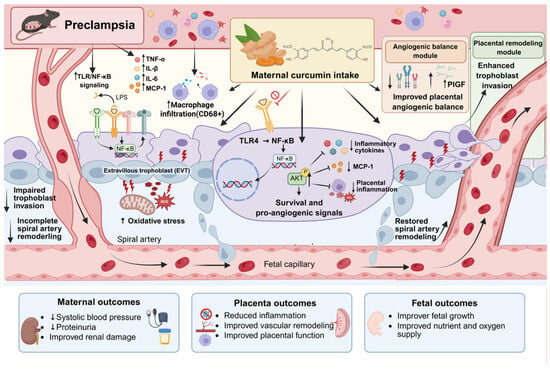
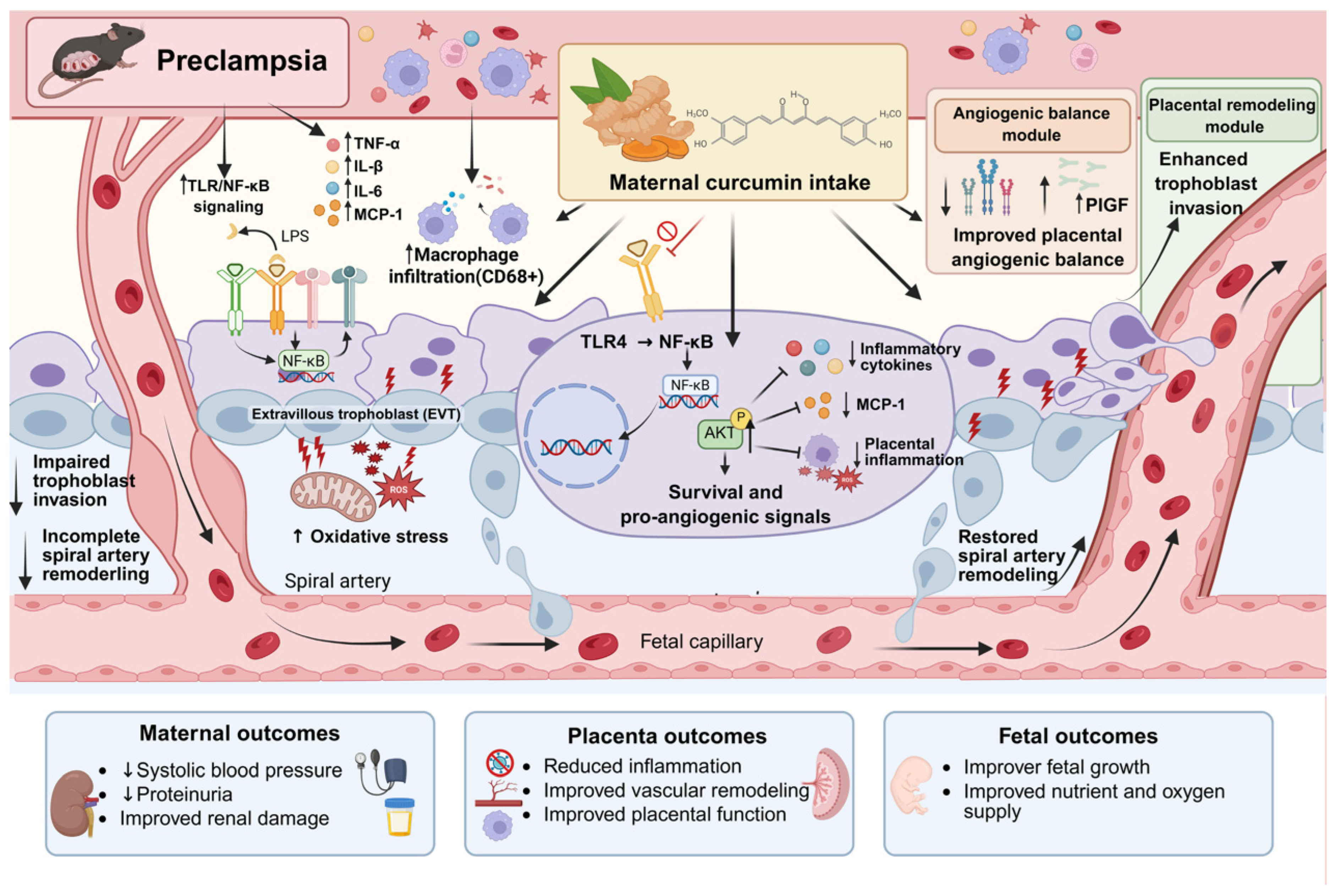
Preeclampsia is a serious pregnancy complication characterized by hypertension and proteinuria after 20 weeks of gestation, associated with significant risks to both maternal and fetal health, yet current therapeutic options are limited. Defective placental development, particularly impaired spiral artery remodeling and subsequent placental dysfunction, is widely recognized as the primary pathology underlying the onset of this syndrome [75,76,77]. Emerging preclinical evidence suggests that nutritional interventions targeting placental health may offer therapeutic benefits. Notably, maternal curcumin supplementation has been shown to attenuate placental insufficiency-induced adverse outcomes in preeclampsia through multiple mechanisms (Figure 3).
Figure 3.
Curcumin alleviates preeclampsia (PE) by restoring placental angiogenesis and spiral artery remodeling. The onset of PE involves poor extravillous trophoblast invasion and incomplete spiral artery remodeling. Environmental triggers like lipopolysaccharide provoke local oxidative stress and drive macrophage infiltration via TLR4/NF-κB signaling, flooding the maternal–fetal interface with inflammatory cytokines. Curcumin intervention breaks this pathological loop. By actively repressing the TLR4/NF-κB axis, curcumin blunts cytokine release and macrophage recruitment. Simultaneously, it upregulates AKT phosphorylation to promote cell survival and PlGF-mediated angiogenic balance. This shifts the placental environment to favor extravillous trophoblast invasion and proper vascular remodeling. Clinically, these cellular corrections relieve maternal hypertension and proteinuria while ensuring adequate blood and nutrient supply to the fetus. AKT, protein kinase B; EVT, extravillous trophoblast; LPS, lipopolysaccharide; IL, interleukin; LPS, lipopolysaccharide; MCP-1, monocyte chemoattractant protein-1; NF-κB, nuclear factor kappa B; PE, preeclampsia; PlGF, placental growth factor; ROS, reactive oxygen species; TLR4, toll-like receptor 4; TNF-α, tumor necrosis factor-α. Created in BioRender. Yinmin, Z. (2026) https://BioRender.com/jkfnmzu (accessed on 20 September 2026).
In a lipopolysaccharide (LPS)-induced preeclampsia-like Sprague-Dawley rat model, one study indicated that curcumin treatment (0.36 mg/kg/day, tail-vein injection) improved hypertension, proteinuria, and renal damage, as well as ameliorated inadequate trophoblast invasion and spiral artery remodeling—two key histopathological features of preeclampsia. Furthermore, curcumin administration significantly decreased IL-6 and MCP-1 expressions systemically and locally in LPS-treated rat placenta, accompanied by inhibition of the toll-like receptor 4 (TLR4)/NF-κB signaling pathway [78]. Zhou et al. also demonstrated that curcumin treatment (100 μg/kg/day, oral gavage) decreased systolic blood pressure and proteinuria, with downregulated tumor necrosis factor-α (TNF-α), interleukin-1β (IL-1β), and interleukin-6 (IL-6) expressions in placenta. These changes were accompanied by decreased monocyte chemoattractant protein-1 (MCP-1), macrophage inflammatory protein-1 (MIP-1) and placental CD68+ macrophage infiltration, effects mainly linked to the upregulation of phosphorylated activation protein kinase B (Akt) [79]. Similarly, Ju et al. reported that combined treatment with curcumin (0.36 mg/kg, tail vein injection) and aspirin from gestational day 4 to gestational day 18 exerted superior protective effects in a rat model of preeclampsia. Compared to untreated preeclampsia rats or those receiving either monotherapy, the combination significantly reduced serum soluble FMS-like tyrosine kinase-1 (sFlt-1) levels, increased placental growth factor (PlGF), and alleviated oxidative stress in both maternal blood and placental tissues. Furthermore, the combined treatment markedly suppressed inflammatory cytokine secretion and downregulated TLR4 and NF-κB p65 expression in placental tissue, effects not observed with single-agent treatment [80]. Thus, preclinical evidence indicates that curcumin improves preeclampsia outcomes through the modulation of key pathogenic processes, including inflammation, oxidative stress, and placental dysfunction (Table 1).
5.4. Curcumin and Its Protection Against Neurological Dysfunction
Maternal or intrauterine infection or inflammation is one of the major factors underlying perinatal brain damage. One recent study also found that maternal curcumin consumption from gestational day 6 until weaning at 21 days post-delivery prevented imidacloprid-induced suppression of hippocampal neurogenesis and mitigated apoptotic changes in the dentate gyrus in offspring rats [81]. Abu-Taweel et al. also showed that curcumin treatment started from day one of pregnancy and continued until post-natal day 15 improved growth and developmental landmarks and restored dopamine (DA), serotonin (5-HT), and acetylcholinesterase (AChE), with increased thiobarbituric acid reactive substances and glutathione (GSH) levels in offspring forebrain [82]. Thus, maternal curcumin supplementation promotes neurological health in offspring (Table 1).
Notably, the studies reviewed here differ fundamentally in route, dose, duration, and formulation and are therefore not interchangeable. Oral curcumin has low aqueous solubility, undergoes rapid glucuronidation and sulfation, and has a short plasma half-life, yielding low systemic free curcumin concentrations; intravenous administration bypasses these constraints, and formulation strategies can markedly increase exposure. The doses used across these studies vary widely—from 100 µg/kg/day by oral gavage to 100 mg/kg/day by gavage, and to 0.36 mg/kg by tail-vein injection—and, because oral bioavailability is low and variable, these regimens cannot be converted into equivalent systemic exposures. Consequently, the concentrations achieved by intravenous or direct micromolar exposure are unlikely to be attained through oral supplementation at doses acceptable in pregnancy. Fetal exposure is even less well characterized, as data on placental transfer and fetal concentrations of curcumin and its conjugates remain very limited.
In addition, cross-species extrapolation warrants caution. Curcumin metabolism, placental development, and gestation length differ substantially between rodents and humans, and animal models only partially reproduce human pathologies; LPS- or L-NAME-induced preeclampsia models, for example, capture selected features but not the full pathogenesis of the human disease. Furthermore, the effect of curcumin may depend on gestational stage. No study has specifically compared its effects across different stages of pregnancy, as the available animal studies almost uniformly begin supplementation before or around implantation and continue throughout gestation. Based on its known anti-angiogenic, metal-chelating, and potential antiproliferative properties, curcumin may act differently during early pregnancy (implantation and organogenesis) and later pregnancy (placental and fetal growth, maternal metabolic adaptation). The first trimester, as the period of organogenesis and greatest teratogenic concern, warrants particular caution, and stage-specific studies are needed before any conclusion on safety at different gestational ages can be drawn.
Table 1.
Preclinical studies about curcumin and its beneficial effects on IUGR, HIP, preeclampsia, neurological dysfunction.
6. Limitations and Challenges
Although accumulating preclinical evidence has revealed the favorable metabolic-regulating, anti-inflammatory and antioxidant properties of curcumin, multiple unresolved issues still hinder its translation from experimental findings to routine prenatal nutritional intervention [12]. Major limitations and translational challenges regarding literature evidence, safety profiles, transplacental transport, action mechanisms and existing research gaps should be considered. A fundamental concern is the potential for adverse effects during embryogenesis and fetal development, a period of heightened vulnerability to xenobiotics. While curcumin is widely recognized for its favorable safety profile in adult chronic disease populations, this does not automatically translate to safety during pregnancy. Notably, Magan et al. demonstrated that curcumin exhibits cytotoxicity in cardiomyocyte micromass cultures at concentrations of 10–20 μM, significantly reducing cell activity and total protein, with findings suggesting potential teratogenicity at high concentrations [83]. However, Tossetta et al. reviewed that potential role of curcumin in counteracting the effects of cytotoxic and teratogenic agents on fetal development ameliorating pregnancy outcome in animal models [11].
A further safety concern is the metal-chelating property of curcumin. Its β-diketone moiety chelates Fe3+ and other transition metals, contributing to its antioxidant activity by suppressing Fenton chemistry but potentially reducing iron bioavailability. This is relevant in pregnancy, when iron requirements rise from approximately 0.8 mg/day in the first trimester to 7.5 mg/day in the third trimester and iron deficiency is common. Curcumin may therefore theoretically reduce intestinal iron absorption when co-administered with iron supplements and interfere with erythropoiesis and fetal iron accretion, although direct human evidence is lacking. This does not imply that dietary turmeric causes iron deficiency, but it raises questions about long-term high-dose supplementation: whether the antioxidant benefits of curcumin could, under certain conditions, be offset by adverse effects on iron availability, particularly in women with low iron stores, remains unresolved and warrants dedicated pharmacokinetic–nutritional interaction studies.
In addition, inflammation and oxidative stress are central to the pathogenesis of preterm birth, one of the most serious pregnancy complications, and curcumin has therefore been examined in this context. In human gestational tissues, Lim et al. showed that curcumin, together with naringenin and apigenin, reduced infection-induced inflammatory and contractile pathways in placenta, fetal membranes, and myometrium, providing direct human ex vivo evidence for an anti-inflammatory action relevant to preterm labor [84]. In a mouse model of infection-associated preterm birth, curcumin modulated placental NF-κB p65, TNF-α, and IL-8 expression [85]. These findings complement the animal and clinical evidence discussed above and support the view that curcumin may influence infection-driven inflammatory pathways at the maternal–fetal interface. We also note that curcumin has been reported to reduce alcohol-induced fetal cardiac apoptosis through inhibition of histone acetylation [35] and that adverse effects of curcumin on oocyte maturation, fertilization, and preimplantation development have been described under certain experimental conditions [86]. Collectively, these findings indicate that curcumin may influence infection-driven inflammatory pathways at the maternal–fetal interface, while its developmental effects warrant caution.
Curcumin has well-documented anti-angiogenic properties in other contexts, including inhibition of VEGF signaling, endothelial proliferation, and tube formation, whereas normal placentation requires extensive angiogenesis and spiral artery remodeling. However, the currently available evidence is insufficient to determine whether, and under what conditions, curcumin may adversely affect placental angiogenesis. Although the preclinical studies reviewed here generally report improved placental VEGF expression and vascularization in IUGR and preeclampsia models, these findings were obtained at specific doses, routes, and exposure windows, and none were designed to assess anti-angiogenic risk. The net effect of curcumin on placental angiogenesis is therefore likely to be dose-, timing-, and context-dependent, and the exposure range over which angiogenesis is promoted rather than inhibited remains undefined. Dedicated studies are needed to define this range before the safety of curcumin in pregnancy can be adequately assessed.
Furthermore, direct evidence that curcumin or its metabolites cross the human placenta is currently lacking. Human pharmacokinetic data indicate that oral curcumin undergoes extensive glucuronidation and sulfation, with parent curcumin often undetectable in plasma, and whether its conjugates reach the fetal compartment remains unknown. The fetal effects reported in animal studies therefore cannot be confidently attributed to direct fetal exposure rather than to indirect effects mediated by improved maternal metabolism or placental function. Dedicated placental perfusion and fetal pharmacokinetic studies are needed to resolve this question. Whether maternal curcumin intake truly programs offspring metabolism remains to be established. Some offspring outcomes were assessed after supplementation ended, consistent with a programming-like effect, but these were single-time-point measurements mostly made shortly after weaning, and persistence across the lifespan has not been examined. Notably, no study has directly examined epigenetic modifications in offspring following maternal curcumin intake, so their contribution remains unknown and hypothetical and represents a priority for future research.
Taken together, these limitations indicate that curcumin should be viewed as a promising research candidate warranting rigorous clinical investigation—including safety, pharmacokinetic, and dose-finding studies in pregnant populations. Future research must prioritize developmental toxicity assessments, placental transfer studies, and well-designed randomized controlled trials before any clinical recommendations can be made.
7. Conclusions
In summary, the prenatal stage is a critical developmental window, and maternal nutrition profoundly determines offspring health and their risk of developing adult-onset metabolic disorders. Currently, available intervention approaches for pregnancy-related metabolic issues are hampered by safety concerns, suboptimal efficacy and low patient compliance, leaving a great need for improved solutions. This review discusses curcumin, a naturally occurring bioactive compound, as a potential intervention targeting maternal and offspring metabolic health. Cumulative preclinical evidence has demonstrated that maternal curcumin supplementation during pregnancy confers metabolic benefits to both mothers and progeny. Nevertheless, it should be emphasized that curcumin remains a promising research target at present, rather than a mature clinical intervention. Further rigorous clinical investigations are therefore urgently required to validate its actual value and safety. Exploring its therapeutic potential may provide new ideas for protecting maternal health and optimizing early life development of offspring.
Author Contributions
J.Z. conceived the paper. S.Z., Y.Z. and Q.F. wrote the original draft. Y.Z. and H.L. prepared tables and figures. S.Z., Q.F. and X.J. provided critical input in drafting and revising the manuscript. Y.Z., Q.F. and S.Z. contributed to the final revision and editing of this manuscript. All authors have read and agreed to the published version of the manuscript.
Funding
This study was funded by National Science and Technology Major Project (2024ZD0530204), National Natural Science Foundation of China (No. 82571043), Jiangxi Province Ganpo Talents Project (No. gpjc20260067), Research Foundation for Talented Scholars of Gannan Medical University (No. QD202567), Beijing Municipal Natural Science Foundation (No. 7184252), Beijing Physician-Scientist Training Program (No. BJPSTP-2025-18), National High Level Hospital Clinical Research Funding (Interdisciplinary Research Project of Peking University First Hospital) (2024IR36), Chinese Cardiovascular Association-Natural lipid-lowering drugs fund (2023-CCA-NLD-899). The funders had no role in study design, data collection and analysis, or preparation of the manuscript.
Institutional Review Board Statement
Not applicable.
Informed Consent Statement
Not applicable.
Data Availability Statement
No new data were created or analyzed in this study. Data sharing is not applicable to this article.
Acknowledgments
All figures were created with BioRender.com, in accordance with the terms of our academic license.
Conflicts of Interest
The authors declare no conflicts of interest.
References
- Phelps, N.H.; Singleton, R.K.; Zhou, B.; Heap, R.A.; Mishra, A.; Bennett, J.E.; Paciorek, C.J.; Lhoste, V.P.F.; Carrillo-Larco, R.M.; Stevens, G.A.; et al. Worldwide trends in underweight and obesity from 1990 to 2022: A pooled analysis of 3663 population-representative studies with 222 million children, adolescents, and adults. Lancet 2024, 403, 1027–1050. [Google Scholar] [CrossRef] [Scilit] [PubMed]
- Stark, B.A.; DeCleene, N.K.; Desai, E.C.; Hsu, J.M.; Johnson, C.O.; Lara-Castor, L.; LeGrand, K.E.; Amenah, M.A. Global, Regional, and National Burden of Cardiovascular Diseases and Risk Factors in 204 Countries and Territories, 1990–2023. J. Am. Coll. Cardiol. 2025, 86, 2167–2243. [Google Scholar] [CrossRef] [Scilit] [PubMed]
- Gao, Y.; Yu, X.; Wang, Y.; Wang, H.; Wang, Y.L.; Shyh-Chang, N. Metabolic control of feto-placental development and pregnancy outcomes. Nat. Rev. Endocrinol. 2026, 22, 153–165. [Google Scholar] [CrossRef] [Scilit] [PubMed]
- Chen, B.; Du, Y.R.; Zhu, H.; Sun, M.L.; Wang, C.; Cheng, Y.; Pang, H.; Ding, G.; Gao, J.; Tan, Y.; et al. Maternal inheritance of glucose intolerance via oocyte TET3 insufficiency. Nature 2022, 605, 761–766. [Google Scholar] [CrossRef] [Scilit] [PubMed]
- Huang, S.; Liu, S.; Huang, M.; He, J.R.; Wang, C.; Wang, T.; Feng, X.; Kuang, Y.; Lu, J.; Gu, Y.; et al. The Born in Guangzhou Cohort Study enables generational genetic discoveries. Nature 2024, 626, 565–573. [Google Scholar] [CrossRef] [Scilit] [PubMed]
- Nichols, A.R.; Chavarro, J.E.; Oken, E. Reproductive risk factors across the female lifecourse and later metabolic health. Cell Metab. 2024, 36, 240–262. [Google Scholar] [CrossRef] [Scilit] [PubMed]
- Kumaran, K.; Birken, C.; Baillargeon, J.P.; Dennis, C.L.; Fraser, W.D.; Huang, H.; Fan, J.; Lye, S.; Matthews, S.G.; Norris, S.A. An intergenerational life-course approach to address early childhood obesity and adiposity: The Healthy Life Trajectories Initiative (HeLTI). Lancet Glob. Health 2023, 11, S15. [Google Scholar] [CrossRef] [Scilit] [PubMed]
- Alves-Wagner, A.B.; Jahan, F.; Kusuyama, J.; Nigro, P.; Hirshman, M.F.; Goodyear, L.J. Grandmaternal exercise improves the metabolic health of second-generation offspring generated from F1 females. J. Sport Health Sci. 2025, 15, 101096. [Google Scholar] [CrossRef] [Scilit] [PubMed]
- Félix-Soriano, E.; Stanford, K.I. Parental exercise mediates fetal metabolic and cardiac programming. Nat. Rev. Endocrinol. 2025, 22, 262–273. [Google Scholar] [CrossRef] [Scilit] [PubMed]
- Zagorianakou, N.; Makrydimas, S.; Moustakli, E.; Mitrogiannis, I.; Vitale, E.; Makrydimas, G. Physical Activity During Pregnancy and Gestational Weight Gain: Implications for Maternal-Fetal Epigenetic Programming and Long-Term Health. Genes 2025, 16, 1173. [Google Scholar] [CrossRef] [Scilit] [PubMed]
- Tossetta, G.; Fantone, S.; Giannubilo, S.R.; Marzioni, D. The Multifaced Actions of Curcumin in Pregnancy Outcome. Antioxidants 2021, 10, 126. [Google Scholar] [CrossRef] [Scilit] [PubMed]
- Filardi, T.; Varì, R.; Ferretti, E.; Zicari, A.; Morano, S.; Santangelo, C. Curcumin: Could This Compound Be Useful in Pregnancy and Pregnancy-Related Complications? Nutrients 2020, 12, 3179. [Google Scholar] [CrossRef] [Scilit] [PubMed]
- Ghaneifar, Z.; Yousefi, Z.; Tajik, F.; Nikfar, B.; Ghalibafan, F.; Abdollahi, E.; Momtazi-Borojeni, A.A. The potential therapeutic effects of curcumin on pregnancy complications: Novel insights into reproductive medicine. IUBMB Life 2020, 72, 2572–2583. [Google Scholar] [CrossRef] [Scilit] [PubMed]
- Stevens, G.A.; Singh, G.M.; Lu, Y.; Danaei, G.; Lin, J.K.; Finucane, M.M.; Bahalim, A.N.; McIntire, R.K.; Gutierrez, H.R.; Cowan, M.; et al. National, regional, and global trends in adult overweight and obesity prevalences. Popul. Health Metr. 2012, 10, 22. [Google Scholar] [CrossRef] [Scilit] [PubMed]
- Ohno, M.S.; Sparks, T.N.; Cheng, Y.W.; Caughey, A.B. Treating mild gestational diabetes mellitus: A cost-effectiveness analysis. Am. J. Obstet. Gynecol. 2011, 205, 282.e1–282.e7. [Google Scholar] [CrossRef] [Scilit] [PubMed]
- Chuang, C.H.; Weisman, C.S.; Hillemeier, M.M.; Schwarz, E.B.; Camacho, F.T.; Dyer, A.M. Pregnancy intention and health behaviors: Results from the Central Pennsylvania Women’s Health Study cohort. Matern. Child Health J. 2010, 14, 501–510. [Google Scholar] [CrossRef] [Scilit] [PubMed]
- Murphy, R.M.; Febbraio, M.A. The biochemical and metabolic adaptations underpinning the health benefits of exercise. J. Sport Health Sci. 2025, 15, 101114. [Google Scholar] [CrossRef] [Scilit] [PubMed]
- Rogozinska, E.; Marlin, N.; Jackson, L.; Rayanagoudar, G.; Ruifrok, A.E.; Dodds, J.; Molyneaux, E.; van Poppel, M.N.; Poston, L.; Vinter, C.A.; et al. Effects of antenatal diet and physical activity on maternal and fetal outcomes: Individual patient data meta-analysis and health economic evaluation. Health Technol. Assess. 2017, 21, 1–158. [Google Scholar] [CrossRef] [Scilit] [PubMed]
- Allotey, J.; Coomar, D.; Ensor, J.; Ruiz-Calvo, G.; Boath, A.; Ogwulu, C.O.; Monahan, M.; Kabeya, V.; Zheng, M.; McNeill, R.; et al. Effects of lifestyle interventions in pregnancy on gestational diabetes: Individual participant data and network meta-analysis. BMJ 2026, 392, e084159. [Google Scholar] [CrossRef] [Scilit] [PubMed]
- Poston, L.; Bell, R.; Croker, H.; Flynn, A.C.; Godfrey, K.M.; Goff, L.; Hayes, L.; Khazaezadeh, N.; Nelson, S.M.; Oteng-Ntim, E.; et al. Effect of a behavioural intervention in obese pregnant women (the UPBEAT study): A multicentre, randomised controlled trial. Lancet Diabetes Endocrinol. 2015, 3, 767–777. [Google Scholar] [CrossRef] [Scilit] [PubMed]
- Han, S.; Middleton, P.; Shepherd, E.; Van Ryswyk, E.; Crowther, C.A. Different types of dietary advice for women with gestational diabetes mellitus. Cochrane Database Syst. Rev. 2017, 2, Cd009275. [Google Scholar] [CrossRef] [Scilit] [PubMed]
- Flynn, A.C.; Dalrymple, K.; Barr, S.; Poston, L.; Goff, L.M.; Rogozinska, E.; van Poppel, M.N.; Rayanagoudar, G.; Yeo, S.; Barakat Carballo, R.; et al. Dietary interventions in overweight and obese pregnant women: A systematic review of the content, delivery, and outcomes of randomized controlled trials. Nutr. Rev. 2016, 74, 312–328. [Google Scholar] [CrossRef] [Scilit] [PubMed]
- Barrett, H.L.; Dekker Nitert, M.; Conwell, L.S.; Callaway, L.K. Probiotics for preventing gestational diabetes. Cochrane Database Syst. Rev. 2014, 2014, Cd009951. [Google Scholar] [CrossRef] [Scilit] [PubMed]
- Martel, J.; Ojcius, D.M.; Chang, C.J.; Lin, C.S.; Lu, C.C.; Ko, Y.F.; Tseng, S.F.; Lai, H.C.; Young, J.D. Anti-obesogenic and antidiabetic effects of plants and mushrooms. Nat. Rev. Endocrinol. 2017, 13, 149–160. [Google Scholar] [CrossRef] [Scilit] [PubMed]
- Song, J.; Ye, J.; Sheng, N.; Xu, S.; Wang, H.; Yang, Y.; Chen, S.; Zhang, J.; Tang, Y.; Xiao, X.; et al. Ramulus Mori (Sangzhi) Alkaloids (SZ-A) exert a renoprotective effect by activating PGC-1α to mediate fatty acid oxidation and mitochondrial homeostasis. Phytomedicine 2026, 150, 157743. [Google Scholar] [CrossRef] [Scilit] [PubMed]
- Wu, N.; Zhang, Y.; Cui, C.; Sun, C.; Cui, Z.; Li, H.; Jin, J.; Zhao, M.; Yin, X.; Jin, L.; et al. Research progress of curcumin and its derivatives as anti-inflammatory agents: From molecular mechanism to clinical application. Eur. J. Med. Chem. 2026, 306, 118584. [Google Scholar] [CrossRef] [Scilit] [PubMed]
- Zhou, L.; Wang, X.; Meng, C.; Li, T.; Wang, Q.; Zhang, M.; Wu, M. Exploring the role of curcumin in anti-atherosclerosis: Mechanisms and pathways of action. Phytomed. Int. J. Phyther. Phytopharm. 2026, 152, 157809. [Google Scholar] [CrossRef] [Scilit] [PubMed]
- Zafar, A.; Lahori, D.; Namit, A.F.; Paxton, Z.; Ratna, N.; Thornton, D.; Ramana, K.V. Curcumin in Inflammatory Complications: Therapeutic Applications and Clinical Evidence. Int. J. Mol. Sci. 2025, 26, 9366. [Google Scholar] [CrossRef] [Scilit] [PubMed]
- Sun, D.; Wang, J.; Li, X.; Peng, J.; Wang, S. Advances and Perspectives in Curcumin Regulation of Systemic Metabolism: A Focus on Multi-Organ Mechanisms. Antioxidants 2026, 15, 109. [Google Scholar] [CrossRef] [Scilit] [PubMed]
- Koeberle, A.; Werz, O. Multi-target approach for natural products in inflammation. Drug Discov. Today 2014, 19, 1871–1882. [Google Scholar] [CrossRef] [Scilit] [PubMed]
- Sikora, E.; Scapagnini, G.; Barbagallo, M. Curcumin, inflammation, ageing and age-related diseases. Immun. Ageing I A 2010, 7, 1. [Google Scholar] [CrossRef] [Scilit] [PubMed]
- Nakmareong, S.; Kukongviriyapan, U.; Pakdeechote, P.; Donpunha, W.; Kukongviriyapan, V.; Kongyingyoes, B.; Sompamit, K.; Phisalaphong, C. Antioxidant and vascular protective effects of curcumin and tetrahydrocurcumin in rats with L-NAME-induced hypertension. Naunyn-Schmiedeberg’s Arch. Pharmacol. 2011, 383, 519–529. [Google Scholar] [CrossRef] [Scilit] [PubMed]
- Patel, S.S.; Acharya, A.; Ray, R.S.; Agrawal, R.; Raghuwanshi, R.; Jain, P. Cellular and molecular mechanisms of curcumin in prevention and treatment of disease. Crit. Rev. Food Sci. Nutr. 2020, 60, 887–939. [Google Scholar] [CrossRef] [Scilit] [PubMed]
- Topcu-Tarladacalisir, Y.; Akpolat, M.; Uz, Y.H.; Kizilay, G.; Sapmaz-Metin, M.; Cerkezkayabekir, A.; Omurlu, I.K. Effects of curcumin on apoptosis and oxidoinflammatory regulation in a rat model of acetic acid-induced colitis: The roles of c-Jun N-terminal kinase and p38 mitogen-activated protein kinase. J. Med. Food 2013, 16, 296–305. [Google Scholar] [CrossRef] [Scilit] [PubMed]
- Yan, X.; Pan, B.; Lv, T.; Liu, L.; Zhu, J.; Shen, W.; Huang, X.; Tian, J. Inhibition of histone acetylation by curcumin reduces alcohol-induced fetal cardiac apoptosis. J. BioMed Sci. 2017, 24, 1. [Google Scholar] [CrossRef] [Scilit] [PubMed]
- Chuengsamarn, S.; Rattanamongkolgul, S.; Luechapudiporn, R.; Phisalaphong, C.; Jirawatnotai, S. Curcumin extract for prevention of type 2 diabetes. Diabetes Care 2012, 35, 2121–2127. [Google Scholar] [CrossRef] [Scilit] [PubMed]
- Chuengsamarn, S.; Rattanamongkolgul, S.; Phonrat, B.; Tungtrongchitr, R.; Jirawatnotai, S. Reduction of atherogenic risk in patients with type 2 diabetes by curcuminoid extract: A randomized controlled trial. J. Nutr. Biochem. 2014, 25, 144–150. [Google Scholar] [CrossRef] [Scilit] [PubMed]
- Nelson, K.M.; Dahlin, J.L.; Bisson, J.; Graham, J.; Pauli, G.F.; Walters, M.A. The Essential Medicinal Chemistry of Curcumin. J. Med. Chem. 2017, 60, 1620–1637. [Google Scholar] [CrossRef] [Scilit] [PubMed]
- Rungseesantivanon, S.; Thengchaisri, N.; Ruangvejvorachai, P.; Patumraj, S. Curcumin improves prostanoid ratio in diabetic mesenteric arteries associated with cyclooxygenase-2 and NF-κB suppression. Diabetes Metab. Syndr. Obes. 2010, 3, 421–429. [Google Scholar] [CrossRef] [Scilit] [PubMed]
- Sahin, K.; Pala, R.; Tuzcu, M.; Ozdemir, O.; Orhan, C.; Sahin, N.; Juturu, V. Curcumin prevents muscle damage by regulating NF-κB and Nrf2 pathways and improves performance: An in vivo model. J. Inflamm. Res. 2016, 9, 147–154. [Google Scholar] [CrossRef] [Scilit] [PubMed]
- Zhong, G.; Liu, Q.; Zhang, Q.; Yin, W.; Luo, Z.; Lai, Y.; Tao, S.; Zhao, Z.; Liu, P.; Li, C.; et al. Sparstolonin B and Curcumin alleviate atherogenesis by modulating T helper 17-stromal cell interactions associated with interleukin-17 receptor A (IL-17RA)—Transforming growth factor-β-activated kinase 1 (TAK1)—Nuclear factor-kappa B (NF-κB) signaling. Phytomedicine 2025, 149, 157578. [Google Scholar] [CrossRef] [Scilit] [PubMed]
- Jz, A.L.; AlFaris, N.A.; Al-Farga, A.M.; Alshammari, G.M.; BinMowyna, M.N.; Yahya, M.A. Curcumin reverses diabetic nephropathy in streptozotocin-induced diabetes in rats by inhibition of PKCβ/p(66)Shc axis and activation of FOXO-3a. J. Nutr. Biochem. 2021, 87, 108515. [Google Scholar] [CrossRef] [Scilit] [PubMed]
- Corbi, G.; Conti, V.; Davinelli, S.; Scapagnini, G.; Filippelli, A.; Ferrara, N. Dietary Phytochemicals in Neuroimmunoaging: A New Therapeutic Possibility for Humans? Front. Pharmacol. 2016, 7, 364. [Google Scholar] [CrossRef] [Scilit] [PubMed]
- Receno, C.N.; Liang, C.; Korol, D.L.; Atalay, M.; Heffernan, K.S.; Brutsaert, T.D.; DeRuisseau, K.C. Effects of Prolonged Dietary Curcumin Exposure on Skeletal Muscle Biochemical and Functional Responses of Aged Male Rats. Int. J. Mol. Sci. 2019, 20, 1178. [Google Scholar] [CrossRef] [Scilit] [PubMed]
- He, H.J.; Wang, G.Y.; Gao, Y.; Ling, W.H.; Yu, Z.W.; Jin, T.R. Curcumin attenuates Nrf2 signaling defect, oxidative stress in muscle and glucose intolerance in high fat diet-fed mice. World J. Diabetes 2012, 3, 94–104. [Google Scholar] [CrossRef] [Scilit] [PubMed]
- Li, Z.; Xu, W.; Ren, S.; Zheng, Q.; Xing, J. Curcumin augments mitophagy via Nrf2-PINK1-mediated, Parkin-dependent ubiquitination to suppress ferroptosis in post-cardiac arrest brain injury. Phytomedicine 2026, 154, 158035. [Google Scholar] [CrossRef] [Scilit] [PubMed]
- Jabczyk, M.; Nowak, J.; Hudzik, B.; Zubelewicz-Szkodzińska, B. Curcumin in Metabolic Health and Disease. Nutrients 2021, 13, 4440. [Google Scholar] [CrossRef] [Scilit] [PubMed]
- Vázquez-Fresno, R.; Rosana, A.R.R.; Sajed, T.; Onookome-Okome, T.; Wishart, N.A.; Wishart, D.S. Herbs and Spices- Biomarkers of Intake Based on Human Intervention Studies—A Systematic Review. Genes Nutr. 2019, 14, 18. [Google Scholar] [CrossRef] [Scilit] [PubMed]
- Panknin, T.M.; Howe, C.L.; Hauer, M.; Bucchireddigari, B.; Rossi, A.M.; Funk, J.L. Curcumin Supplementation and Human Disease: A Scoping Review of Clinical Trials. Int. J. Mol. Sci. 2023, 24, 4476. [Google Scholar] [CrossRef] [Scilit] [PubMed]
- Kunnumakkara, A.B.; Hegde, M.; Parama, D.; Girisa, S.; Kumar, A.; Daimary, U.D.; Garodia, P.; Yenisetti, S.C.; Oommen, O.V.; Aggarwal, B.B. Role of Turmeric and Curcumin in Prevention and Treatment of Chronic Diseases: Lessons Learned from Clinical Trials. ACS Pharmacol. Transl. Sci. 2023, 6, 447–518. [Google Scholar] [CrossRef] [Scilit] [PubMed]
- Nguyen, P.Y.; Sanderson, B.; Makama, M.; Mills, K.; Ammerdorffer, A.; Gülmezoglu, A.M.; Vogel, J.P.; McDougall, A.R.A. Polyphenols for the Prevention or Management of Preeclampsia: A Systematic Review and Meta-Analysis. BJOG 2025, 132, 867–879. [Google Scholar] [CrossRef] [Scilit] [PubMed]
- Sargazi-Taghazi, M.; Ghaznavi, H.; Sheervalilou, R.; Razavi, M.; Sepidarkish, M. Add-on effect of curcumin to dienogest in patients with endometriosis: A randomized, double-blind, controlled trial. Phytomedicine 2025, 141, 156715. [Google Scholar] [CrossRef] [Scilit] [PubMed]
- Fadinie, W.; Lelo, A.; Wijaya, D.W.; Lumbanraja, S.N. Curcumin’s Effect on COX-2 and IL-10 Serum in Preeclampsia’s Patient Undergo Sectio Caesarea with Spinal Anesthesia. Open Access Maced. J. Med. Sci. 2019, 7, 3376–3379. [Google Scholar] [CrossRef] [Scilit] [PubMed]
- Sharma, D.; Shastri, S.; Sharma, P. Intrauterine Growth Restriction: Antenatal and Postnatal Aspects. Clin. Med. Insights Pediatr. 2016, 10, 67–83. [Google Scholar] [CrossRef] [Scilit] [PubMed]
- Beune, I.M.; Bloomfield, F.H.; Ganzevoort, W.; Embleton, N.D.; Rozance, P.J.; van Wassenaer-Leemhuis, A.G.; Wynia, K.; Gordijn, S.J. Consensus Based Definition of Growth Restriction in the Newborn. J. Pediatr. 2018, 196, 71–76.e1. [Google Scholar] [CrossRef] [Scilit] [PubMed]
- Kemp, M.W.; Kallapur, S.G.; Jobe, A.H.; Newnham, J.P. Obesity and the developmental origins of health and disease. J. Paediatr. Child Health 2012, 48, 86–90. [Google Scholar] [CrossRef] [Scilit] [PubMed]
- Vaiserman, A.; Lushchak, O. Developmental origins of type 2 diabetes: Focus on epigenetics. Ageing Res. Rev. 2019, 55, 100957. [Google Scholar] [CrossRef] [Scilit] [PubMed]
- Minhas, A.S.; Ying, W.; Ogunwole, S.M.; Miller, M.; Zakaria, S.; Vaught, A.J.; Hays, A.G.; Creanga, A.A.; Cedars, A.; Michos, E.D.; et al. The Association of Adverse Pregnancy Outcomes and Cardiovascular Disease: Current Knowledge and Future Directions. Curr. Treat. Options Cardiovasc. Med. 2020, 22, 61. [Google Scholar] [CrossRef] [Scilit] [PubMed]
- Ficial, B.; Gottin, L.; Maffeis, C. Cardio-Metabolic Risk in Adults Born Preterm: A Narrative Review. J. Clin. Med. 2025, 15, 256. [Google Scholar] [CrossRef] [Scilit] [PubMed]
- Osei-Safo, E.K.; McIntosh, J.; Onwuka, S.; Torkel, S.; McGowan, M.; Cocotis, K.; Angel, C.; Varatharaj, S.; Teede, H.; Melder, A.; et al. What Is My Risk? A Mixed-Methods Systematic Review of Risk Perception for Cardiometabolic Pregnancy Complications and Future Cardiometabolic Disease Development. Obes. Rev. 2025, 26, e13967. [Google Scholar] [CrossRef] [Scilit] [PubMed]
- Majewska, M.; Lipka, A.; Paukszto, L.; Jastrzebski, J.P.; Szeszko, K.; Gowkielewicz, M.; Lepiarczyk, E.; Jozwik, M.; Majewski, M.K. Placenta Transcriptome Profiling in Intrauterine Growth Restriction (IUGR). Int. J. Mol. Sci. 2019, 20, 1510. [Google Scholar] [CrossRef] [Scilit] [PubMed]
- Chatterjee, S.; Zeng, X.; Ouidir, M.; Tesfaye, M.; Zhang, C.; Tekola-Ayele, F. Sex-specific placental gene expression signatures of small for gestational age at birth. Placenta 2022, 121, 82–90. [Google Scholar] [CrossRef] [Scilit] [PubMed]
- Jin, H.; Wang, X.; Li, L.; Rui, C.; Gan, H.; Wang, Q.; Tao, F.; Zhu, Y. Integrated proteomic and transcriptomic landscape of human placenta in small for gestational age infants. iScience 2024, 27, 111423. [Google Scholar] [CrossRef] [Scilit] [PubMed]
- Esposito, M.; Paulesu, L.; Mandalà, M. The role of placental hormones and metabolites in modulating uterine circulation in physiological and pathological pregnancies. Front. Endocrinol. 2025, 16, 1637570. [Google Scholar] [CrossRef] [Scilit] [PubMed]
- Qi, L.; Jiang, J.; Yu, G.; Zhang, X.; Qi, X.; Zhang, J.; Zhang, L.; Wang, T. Dietary curcumin supplementation ameliorates placental inflammation in rats with intra-uterine growth retardation by inhibiting the NF-κB signaling pathway. J. Nutr. Biochem. 2022, 104, 108973. [Google Scholar] [CrossRef] [Scilit] [PubMed]
- Qi, L.; Jiang, J.; Zhang, J.; Zhang, L.; Wang, T. Effect of maternal curcumin supplementation on intestinal damage and the gut microbiota in male mice offspring with intra-uterine growth retardation. Eur. J. Nutr. 2022, 61, 1875–1892. [Google Scholar] [CrossRef] [Scilit] [PubMed]
- IDF. IDF Diabetes Atlas, 11th ed.; International Diabetes Federation: Brussels, Belgium, 2025; Available online: http://www.diabetesatlas.org (accessed on 1 March 2026).
- Sweeting, A.; Hannah, W.; Backman, H.; Catalano, P.; Feghali, M.; Herman, W.H.; Hivert, M.F.; Immanuel, J.; Meek, C.; Oppermann, M.L.; et al. Epidemiology and management of gestational diabetes. Lancet 2024, 404, 175–192. [Google Scholar] [CrossRef] [Scilit] [PubMed]
- Yuen, L.; Hannah, W.; Hare, M.; Simmons, D. Hyperglycaemia in pregnancy: The role of ethnicity and geography in risk and outcomes. Diabetologia 2025, 68, 2340–2361. [Google Scholar] [CrossRef] [Scilit] [PubMed]
- Ji, H.; Wu, Y.; Wu, S.; Sun, X.; Yu, Y.; Hou, L.; Zhao, R.; Wang, C.; Yu, Y.; Ge, Y.; et al. Impact of metformin use during pregnancy on fetal congenital malformations across 11 organ systems: A meta-analysis and drug-target Mendelian randomization study. Diabetes Res. Clin. Pract. 2026, 233, 113118. [Google Scholar] [CrossRef] [Scilit] [PubMed]
- Pivari, F.; Mingione, A.; Brasacchio, C.; Soldati, L. Curcumin and Type 2 Diabetes Mellitus: Prevention and Treatment. Nutrients 2019, 11, 1837. [Google Scholar] [CrossRef] [Scilit] [PubMed]
- Bajaj, M.; McCoy, R.G.; Balapattabi, K.; Bannuru, R.R.; Bellini, N.J.; Bennett, A.K.; Beverly, E.A.; Briggs Early, K.; Brown, F.M.; ChallaSivaKanaka, S.; et al. Management of Diabetes in Pregnancy: Standards of Care in Diabetes-2026. Diabetes Care 2026, 49, S321–S338. [Google Scholar] [CrossRef] [Scilit] [PubMed]
- Lu, X.; Wu, F.; Jiang, M.; Sun, X.; Tian, G. Curcumin ameliorates gestational diabetes in mice partly through activating AMPK. Pharm. Biol. 2019, 57, 250–254. [Google Scholar] [CrossRef] [Scilit] [PubMed]
- Santos, A.C.C.; Amaro, L.B.R.; Batista Jorge, A.H.; Lelis, S.F.; Lelis, D.F.; Guimarães, A.L.S.; Santos, S.H.S.; Andrade, J.M.O. Curcumin improves metabolic response and increases expression of thermogenesis-associated markers in adipose tissue of male offspring from obese dams. Mol. Cell. Endocrinol. 2023, 563, 111840. [Google Scholar] [CrossRef] [Scilit] [PubMed]
- Yang, Y.; Zhang, S.; Fang, X.; Shao, T.; Shao, X.; Wang, Y.L. Placental Steroid Hormones in Preeclampsia: Multilayered Regulation of Endocrine Pathogenesis. Endocr. Rev. 2026, 47, 244–263. [Google Scholar] [CrossRef] [Scilit] [PubMed]
- Hu, M.; Li, J.; Baker, P.N.; Tong, C. Revisiting preeclampsia: A metabolic disorder of the placenta. FEBS J. 2022, 289, 336–354. [Google Scholar] [CrossRef] [Scilit] [PubMed]
- Fato, B.R.; de Alwis, N.; Hannan, N.J. Exploring placental dysfunction: Models of extracellular vesicle action in preeclampsia. Reproduction 2026, 171, 736–743. [Google Scholar] [CrossRef] [Scilit] [PubMed]
- Gong, P.; Liu, M.; Hong, G.; Li, Y.; Xue, P.; Zheng, M.; Wu, M.; Shen, L.; Yang, M.; Diao, Z.; et al. Curcumin improves LPS-induced preeclampsia-like phenotype in rat by inhibiting the TLR4 signaling pathway. Placenta 2016, 41, 45–52. [Google Scholar] [CrossRef] [Scilit] [PubMed]
- Zhou, J.; Miao, H.; Li, X.; Hu, Y.; Sun, H.; Hou, Y. Curcumin inhibits placental inflammation to ameliorate LPS-induced adverse pregnancy outcomes in mice via upregulation of phosphorylated Akt. Inflamm. Res. 2017, 66, 177–185. [Google Scholar] [CrossRef] [Scilit] [PubMed]
- Ju, Y.; Feng, Y.; Yang, Y.; Hou, X.; Zhang, X.; Zhu, X.; Wang, Y.; Yang, M. Combining curcumin and aspirin ameliorates preeclampsia-like symptoms by inhibiting the placental TLR4/NF-κB signaling pathway in rats. J. Obstet. Gynaecol. Res. 2023, 49, 128–140. [Google Scholar] [CrossRef] [Scilit] [PubMed]
- Ebizuka, Y.; Zou, X.; Watanabe, N.; Hirata, M.; Yamashita, S.; Kigata, T.; Tang, Q.; Nakao, T.; Koyanagi, M.; Shibutani, M. Ameliorating Effect of Continuous Treatment With an Amorphous Formula of Curcumin on Maternal Imidacloprid Exposure-Induced Suppression of Hippocampal Neurogenesis in Rats. Environ. Toxicol. 2026, 49, S321–S338. [Google Scholar] [CrossRef] [Scilit] [PubMed]
- Abu-Taweel, G.M. Neurobehavioral protective properties of curcumin against the mercury chloride treated mice offspring. Saudi J. Biol. Sci. 2019, 26, 736–743. [Google Scholar] [CrossRef] [Scilit] [PubMed]
- Magan, P.; Pratten, M. Effects of the Herbal Product Curcumin on Cardiomyocytes in Micromass Culture and the Potential Role It May Play in Pregnancy and Development. Cureus 2023, 15, e51132. [Google Scholar] [CrossRef] [Scilit] [PubMed]
- Lim, R.; Barker, G.; Wall, C.A.; Lappas, M. Dietary phytophenols curcumin, naringenin and apigenin reduce infection-induced inflammatory and contractile pathways in human placenta, foetal membranes and myometrium. Mol. Hum. Reprod. 2013, 19, 451–462. [Google Scholar] [CrossRef] [Scilit] [PubMed]
- Guo, Y.Z.; He, P.; Feng, A.M. Effect of curcumin on expressions of NF-κBp65, TNF-α and IL-8 in placental tissue of premature birth of infected mice. Asian Pac. J. Trop. Med. 2017, 10, 175–178. [Google Scholar] [CrossRef] [Scilit] [PubMed]
- Chen, C.C.; Chan, W.H. Injurious effects of curcumin on maturation of mouse oocytes, fertilization and fetal development via apoptosis. Int. J. Mol. Sci. 2012, 13, 4655–4672. [Google Scholar] [CrossRef] [Scilit] [PubMed]
Disclaimer/Publisher’s Note: The statements, opinions and data contained in all publications are solely those of the individual author(s) and contributor(s) and not of MDPI and/or the editor(s). MDPI and/or the editor(s) disclaim responsibility for any injury to people or property resulting from any ideas, methods, instructions or products referred to in the content. |
© 2026 by the authors. Licensee MDPI, Basel, Switzerland. This article is an open access article distributed under the terms and conditions of the Creative Commons Attribution (CC BY) license.