


Abstract
Maternal antioxidant status has long been proposed to shape childhood respiratory outcomes, yet trials of prenatal supplementation continue to return inconsistent results. This narrative review examines five antioxidant micronutrients—vitamin D, zinc, selenium, carotenoids and long-chain n-3 polyunsaturated fatty acids—against a common developmental timeline and asks whether exposure timing rather than dose accounts for this inconsistency. The Keap1–Nrf2 axis operating in placenta, foetal lung, and neonatal immune cells provide a shared, nutritionally modifiable mechanism, but the five nutrients do not converge on a single window. Vitamin D and retinoic acid signalling act through nuclear receptors during branching morphogenesis, which is complete by around week 17; n-3 polyunsaturated fatty acid supplementation that began at 24 weeks nonetheless produced the largest effect size in the literature, and carotenoids only showed benefit only against a background of maternal smoking. We propose a distinction between structural windows, locked to morphogenesis, and capacity windows, in which benefit scales with the oxidative burden to be offset. Zinc and selenium cannot yet be assigned to either. The two halves of the distinction are refuted by different observations—the structural claim by a trial randomising exposure timing at a constant dose, and the capacity claim by the failure of benefit to track oxidative burden—and a rival account, in which benefit accrues in those starting as deficient, irrespective of when the exposure arrives, and this remains at least as parsimonious on the present evidence. The distinction is nonetheless testable and specifies the trial design required to separate the two: the randomisation of exposure timing at a constant dose, as stratified by baseline status and genotype. Until such a trial exists, the clinically supported pattern is repletion in deficient women rather than population-wide supplementation.
1. Introduction
The foetal lung is not born ready to withstand oxidative challenge. Endogenous antioxidant defences—superoxide dismutase, catalase, and glutathione peroxidase—mature preferentially during the final weeks of gestation in anticipation of the abrupt rise in arterial oxygen tension at birth [1]. Pulmonary antioxidant defences mature markedly during the third trimester in parallel with the surfactant system and the transplacental transfer of non-enzymatic antioxidants, while the foetal lung develops at an arterial oxygen tension far below that encountered after birth [2,3]. This late maturation is therefore best read as preparation for a transition rather than as defence against a present threat; airway branching, by contrast, is largely complete far earlier, during the embryonic and pseudoglandular phases when this protective capacity is still rudimentary. Antenatal interventions that target the redox balance directly illustrate this point: in a chronically hypoxic ovine model, maternal vitamin C treatment normalised pro-oxidant markers and increased endogenous antioxidant expression in the offspring lung, an effect measurable in early adulthood and long after the hypoxic insult itself had resolved [4]. If a single antioxidant micronutrient administered in late gestation can leave a persistent molecular signature on the lung, the developmental window during which such exposures act and not just their dose becomes a variable worth interrogating.
We have made a comparable argument for vitamin D specifically. In a recent analysis of periconceptional vitamin D exposure, we showed that the two pivotal trials of prenatal supplementation and childhood wheeze both began after airway branching morphogenesis was largely complete, and we proposed that redox-sensitive programming of the developing lung may already be underway by the time conventional trial protocols start recruiting [5]. This argument, however, was built around one micronutrient. Vitamin D operates within a wider antioxidant network—zinc, selenium, carotenoids and long-chain n-3 polyunsaturated fatty acids intersect through distinct but overlapping mechanisms and with the same redox-sensitive pathways implicated in airway programming [1,6]—and whether a comparable timing principle generalises across this group has not, to our knowledge, been examined systematically. We have argued elsewhere that these micronutrients are complementary rather than interchangeable, acting through distinct pathways in distinct windows, and that pooling them in a single analysis risks conflating these pathways [5]. The framework developed here is intended to operationalise that argument rather than to set it aside; the question is not whether the five behave alike but rather which of them is locked to a structural window and which is not.
The phenotypes at issue are the common ones. Childhood asthma alone accounted for an estimated 95.7 million prevalent cases worldwide in 2021, of which 25.4 million were in low sociodemographic index regions [7]. Recurrent wheeze, asthma and bronchopulmonary dysplasia are conditions in which oxidative stress is directly implicated in epithelial injury and corticosteroid responsiveness [6], yet they have not been examined as a group defined by antioxidant exposure, let alone against a shared developmental timeline.
This review addresses that gap. We synthesise mechanistic and clinical evidence on five antioxidant micronutrients—vitamin D, zinc, selenium, carotenoids and n-3 polyunsaturated fatty acids—and examine, for each, the biological rationale for their role in airway redox programming, the epidemiological evidence linking maternal status or supplementation to offspring respiratory outcomes, and whether exposure timing has been considered as an effect modifier. We close by asking whether a shared susceptibility window can be defined across these micronutrients, or whether the periconceptional specificity we described for vitamin D is idiosyncratic to its endocrine mode of action.
2. Mechanistic Foundation
The Keap1–Nrf2–ARE axis functions as the principal redox sensor governing the lung’s cytoprotective response. Under basal conditions, Keap1 retains Nrf2 in the cytoplasm and targets it for proteasomal degradation; oxidative or electrophilic stress disrupts this interaction, allowing Nrf2 to translocate to the nucleus, bind the antioxidant response element, and transactivate a battery of cytoprotective genes, including superoxide dismutase, catalase, glutathione peroxidase, and NAD(P)H quinone oxidoreductase 1 [8]. In the foetal and neonatal lung, this axis is not merely reactive; its constitutive activity appears calibrated to gestational stage, and disrupting it has direct structural consequences.
These consequences are best documented in the preterm lung exposed to postnatal hyperoxia. Newborn mice exposed to high ambient oxygen develop hypoalveolarisation that phenocopies human bronchopulmonary dysplasia; genetic augmentation of Nrf2 activity, achieved by disrupting Keap1, protects against this phenotype, while Nrf2 deficiency worsens it [9]. In foetal rat lung, the cytosolic Cu/Zn- and mitochondrial Mn-superoxide dismutases, glutathione peroxidase, and catalase rise in stepwise fashion between day 18 and day 22 of gestation [10,11]—across the final days before term. Preterm birth interrupts that trajectory, producing the mismatch between oxidant exposure and antioxidant capacity that underlies the free-radical diseases of prematurity [12]. A lung that enters the extrauterine, comparatively hyperoxic environment before its endogenous Keap1–Nrf2 response has matured is structurally vulnerable in a manner that antenatal antioxidant status could plausibly modify, independently of any subsequent postnatal exposure.
How far these rodent findings transfer requires care, because the stage at which the two species are born is not the same. Mice and rats are delivered during the saccular stage and carry out classical alveolarisation entirely after birth, between the fourth and twenty-first postnatal days, whereas human alveolarisation begins at around week 36 of gestation, so that the lung of a term infant is already in its early alveolar stage [13]. Two consequences follow. The murine hyperoxia model superimposes an oxidant challenge on a lung whose human counterpart lies in the late third trimester rather than in infancy, which is why it reproduces the bronchopulmonary dysplasia of the preterm infant so faithfully and why it says comparatively little about the branching period. And the enzyme ontogeny measured in the foetal rat spans the approach of birth, describing the preparation for oxygen transition rather than the redox environment in which branching morphogenesis occurs; it should not be read as evidence regarding the early window that Section 3 and Section 8 concern. Rodent data constrain the late end of this timeline considerably better than the early end, an asymmetry that belongs to the mechanistic literature itself and not just to its interpretation here.
Pulmonary antioxidant capacity is, separately, not fixed once development is complete. Disrupting the light–dark cycle in the adult rat alters the expression of the Cu/Zn-, Mn-, and extracellular superoxide dismutase isoenzymes in lung tissue [14], establishing that antioxidant gene expression in the mature organ remains responsive to the timing of an environmental input. The observation speaks to the stability of antioxidant capacity rather than to its ontogeny, and it is offered here in that narrower sense alone.
Redox status also shapes the immune and not just the structural trajectory of the developing airway. The Keap1–Nrf2 axis has been shown to constrain type 2 immune activation in the lung, including the interleukin-5- and interleukin-13-driven eosinophilic inflammation characteristic of allergic asthma, and its pharmacological activation is being explored as a corticosteroid-sparing strategy in steroid-resistant disease [15]. In children with established asthma, redox-sensitive biomarkers—exhaled 8-isoprostane, hydrogen peroxide, fractional exhaled nitric oxide—track disease activity, and antioxidant-gene polymorphisms in GSTP1 and CAT contribute to individual susceptibility [6]. The best characterised of these, fractional exhaled nitric oxide, arises when interleukin-4 and interleukin-13 activate JAK/STAT-6 signalling and upregulate inducible nitric oxide synthase transcription in bronchial epithelium; it therefore indexes type 2 activation specifically rather than airway inflammation in general [16].
Upstream of the foetal lung itself, the placenta constitutes a further redox interface capable of shaping the entire trajectory. Trophoblast invasion under physiologically low oxygen tension is itself an oxidative process, and its exaggeration—through maternal hypoxia, nutrient restriction or metabolic disease—elevates placental markers of lipid and DNA oxidation, including malondialdehyde, 8-isoprostane and 8-hydroxy-2′-deoxyguanosine, while compensatory antioxidant enzyme activity is progressively overwhelmed [17]. Because placental oxidative stress interacts with epigenetic and endoplasmic-reticulum stress pathways to impair trophoblast function [17], maternal antioxidant status may condition foetal lung development indirectly through placental performance and directly through foetal tissue exposure.
Redox chemistry is not the only route by which early nutritional exposure reaches the developing airway. Microbial fermentation of non-digestible dietary and milk glycans yields short-chain fatty acids that induce regulatory T cells and attenuate type 2 airway inflammation along the gut–lung axis, with a parallel, tryptophan–aryl hydrocarbon receptor pathway constraining the Th17 responses characteristic of non-type 2 disease [18]. The substrate for this system is itself developmentally staged, since milk oligosaccharides select for the bifidobacterial taxa equipped to ferment them before complementary feeding broadens the available carbohydrate pool [19]. Short-chain fatty acids derived from this fermentation increase tight junction protein expression in lung epithelial models, and a combination of 2′-fucosyllactose and 6′-sialyllactose reduced innate lymphoid cell-mediated allergic airway inflammation in mice through precisely this route [20]. Milk oligosaccharides have also been detected in infant plasma and urine, as well as in amniotic fluid, raising the possibility of direct foetal lung exposure rather than purely microbiota-mediated signalling [20]. Whether the antioxidant micronutrient status modifies these glycan-dependent pathways has not been examined, and the two need not be independent since maternal diet shapes both simultaneously. The pathway bears on the question this review asks for a structural reason rather than an incidental one; the glycan supply is itself bounded in time. Oligosaccharide delivery is confined to the period of milk feeding, and the bifidobacterial consortium it selects is displaced once complementary foods broaden the available substrate [19]—an exposure with an opening and a closing set by developmental stage rather than by the quantity delivered within it. That is the same logic this review applies to micronutrients, operating on a different substrate and in the postnatal rather than the prenatal interval. It is introduced here as a structural analogy and as an uncontrolled parallel pathway but not as evidence for any redox mechanism; Section 9 returns to it among the confounders that single-nutrient attribution cannot resolve.
Taken together, these mechanisms converge on a single argument: the Keap1–Nrf2 axis operating in placenta, foetal lung, and neonatal immune cells is antioxidant-substrate-dependent, and its activity is therefore, at least in principle, nutritionally modifiable. The sections that follow examine, micronutrient by micronutrient, how directly this principle has been tested.
3. Vitamin D
Vitamin D differs from the other micronutrients considered here in operating through a nuclear hormone receptor rather than direct radical scavenging. Calcitriol, the hormonally active metabolite, binds the vitamin D receptor (VDR) and, in bronchial epithelial cells challenged with particulate matter, this binding upregulates mitochondrial bioenergetic capacity and downregulates hypoxia-inducible factor 1-alpha signalling, reducing reactive oxygen species generation and restoring redox homeostasis [21]. The mechanism is therefore genomic and comparatively slow relative to the direct enzymatic antioxidant systems discussed above, a distinction with direct bearing on the timing argument that follows.
We have argued elsewhere that this timing matters more than has generally been assumed. Airway branching morphogenesis in the human foetus is largely complete by the close of the pseudoglandular stage, around week 17 of gestation, yet the two pivotal randomised trials of prenatal vitamin D and childhood respiratory outcomes, VDAART and COPSAC2010, initiated supplementation at 10–18 weeks and 24 weeks, respectively—after, not before, this structural window [5]. Effect modification by the baseline 25(OH)D status, vitamin D-binding protein and maternal 17q21 genotype further indicated that any true periconceptional signal would have been diluted and not merely absent in unselected mid-gestation cohorts [5].
Animal work supports a direct developmental role rather than a purely immunological one. A systematic review of vitamin D and foetal and neonatal lung maturation found consistent effects across rodent models on alveolar type II cell proliferation and differentiation, on surfactant synthesis, and on epithelial integrity [22]. The fifteen-year account of VDAART reports that the reduction in offspring asthma at ages 3 and 6 years emerged in analyses stratified by maternal baseline status and by genotype rather than in the intention-to-treat comparison [23]. A signal visible only after stratification is what a diluted window effect would look like; it is equally what a subgroup finding in a null trial looks like, and nothing in the VDAART data distinguishes between the two. The stratified result is therefore grounds for designing a trial around baseline status and not evidence that a window was missed.
Evidence gathered since that analysis has not resolved the question so much as reproduced its central tension. A 2025 Cochrane review pooled 18 trials and 10,611 participants, but its wheeze finding rests on a narrower base: in the comparison of high against low or standard dose in pregnant or breastfeeding women, four studies contributed, of which three yielded a reduced risk of childhood wheeze (RR 0.79, 95% CI 0.64–0.98), with moderate-certainty evidence indicating little to no effect on a formal asthma diagnosis [24]. A contemporaneous meta-analysis restricted to respiratory and allergy outcomes reached the more conservative conclusion that prenatal supplementation has minimal or no significant effect on either wheeze or eczema [25]. Neither review incorporated exposure timing as a moderator, so the discrepancy between them may reflect an outcome definition as much as biology.
A Danish population-based cohort adds an unexpected, and arguably supportive, data point. Neonatal 25(OH)D concentration—necessarily a marker of late gestation and early postnatal status and not periconceptional exposure—showed no association with asthma risk after age 5 years, nor did polygenic scores for vitamin D or its binding protein [26]. A null result at the developmental stage our hypothesis identifies as too late is compatible with a window that has already closed. It is equally compatible with vitamin D having no effect on this outcome at any gestational age, and with neonatal 25(OH)D being too noisy a proxy for cumulative foetal exposure for an effect to be detected. Absence of evidence at one timepoint is not positive evidence of action at another, and we do not read it as such; the cohort removes action late in gestation from contention without adjudicating among the alternatives that remain.
Vitamin D therefore illustrates, more than resolves, the question this review sets out to ask: whether exposure timing and not just micronutrient status determines respiratory programming. Whether the remaining antioxidant micronutrients show a comparable temporal specificity, or act instead across a broader gestational window, is considered next, beginning with zinc.
4. Zinc
Zinc’s antioxidant function is structural rather than catalytic in the strict sense. As the metal cofactor of cytosolic Cu/Zn-superoxide dismutase, zinc stabilises the enzyme’s active-site geometry without itself undergoing redox cycling, and more than 300 zinc-dependent metalloenzymes depend on comparable structural stabilisation for antioxidant, anti-inflammatory, and immune functions [27]. In the asthmatic airway, this dependency is not merely theoretical, as bronchial epithelial Cu/Zn-SOD activity is measurably reduced in patients not receiving inhaled corticosteroids, and activity is restored with treatment, tracking disease-related change in a zinc-dependent enzyme rather than in zinc supply itself [28].
A distinct, transporter-mediated pool of labile zinc further concentrates in the apical cytoplasm of airway epithelial cells, maintained by the vesicular transporter ZnT4 and visibly protective against oxidants and inhaled irritants. In a murine model of allergic airway inflammation, both apical labile zinc and ZnT4 protein were substantially depleted, a loss proposed to increase epithelial vulnerability during the inflammatory process itself rather than simply reflecting pre-existing deficiency [29]. Whether an analogous depletion occurs, or is prevented by adequate maternal zinc status, during foetal airway development has not been directly tested. Experimental support for a maternal redox effect comes largely from animal models. In an avian embryo model, marginal maternal zinc deficiency raised the malondialdehyde and superoxide anion content and reduced metallothionein and Cu/Zn-SOD activity in embryonic liver, with embryonic mortality correlating positively with the degree of lipid peroxidation; the examined tissue was hepatic rather than pulmonary, so the inference to the airway is by analogy [30]. Zinc’s antioxidant contribution to the embryo is thus doubly mediated, through metallothionein and through Cu/Zn-SOD, which may partly explain why circulating zinc is an unreliable index of functional status.
The clinical evidence linking maternal zinc status specifically as distinct from vitamin E or C to offspring respiratory outcomes rests on a smaller literature than for vitamin D. In a longitudinal cohort of 1861 children followed to age 5 years, maternal zinc intake during pregnancy was inversely associated with asthma ever diagnosed (OR 0.83 per intake quintile) and with active asthma (0.72, 95% CI 0.59–0.89), alongside the parallel and better-replicated association with maternal vitamin E intake [31]. Symptom and food-frequency data were available for fewer children than were originally recruited, and exposure was captured by questionnaire rather than by a circulating biomarker; since zinc intake correlates with several other nutrients in a typical Western diet, residual confounding by co-consumed antioxidants cannot be excluded.
Intervention evidence is, as for selenium, unsupportive. The most recent Cochrane review pooled 25 randomised trials and more than 18,000 women, and concluded that zinc supplementation in pregnancy may make little or no difference to preterm birth (RR 0.87, 95% CI 0.74–1.03; 21 studies, 9851 participants), to stillbirth or to perinatal death, all on low-certainty evidence [32]. No trial within that body of work measured an offspring respiratory outcome, so the absence of benefit says nothing directly about the airway. The reviewers’ own recommendation—that future work should address overall nutritional status rather than zinc in isolation—states, for this one micronutrient, the confounding problem that Section 9 addresses for the class as a whole.
Zinc, in short, offers a mechanistically plausible but epidemiologically thin counterpart to the vitamin D literature: a structural antioxidant role well-established in adult airway disease; a single substantial pregnancy cohort suggesting a protective association; and no trial evidence, randomised or otherwise, addressing whether gestational timing modifies any such effect. Selenium, considered next, offers a narrower but more specific mechanism, as well as a somewhat richer epidemiological record.
5. Selenium
Selenium’s role differs from zinc’s in being genuinely catalytic rather than purely structural. Incorporated as selenocysteine into the active site of glutathione peroxidase 4 (GPX4), selenium enables the direct reduction in phospholipid hydroperoxides to their corresponding alcohols using reduced glutathione as an electron donor, protecting cell membranes from peroxidative damage in a reaction that no sulphur-based analogue performs with comparable efficiency [33]. GPX4 additionally intersects with lipoxygenase-dependent leukotriene synthesis, a pathway of direct relevance to the eicosanoid-driven inflammation of asthma [34].
Three lines of clinical evidence bear on prenatal selenium status specifically. In the ALSPAC birth cohort, umbilical cord tissue selenium concentration was inversely associated with wheezing risk in early childhood, although the authors cautioned that, given the number of comparisons performed and the p-values obtained, some or all of their findings could have arisen by chance [35]. A separate Aberdeen cohort found that maternal and cord plasma selenium were inversely associated with wheeze and with medically attended wheeze in the second year of life, though the association had attenuated by age 5 years [36]. Most informatively, a gene-by-nutrient interaction analysis within ALSPAC found that the inverse association between maternal blood selenium and childhood asthma was confined to children carrying the T allele of the GPX4 rs713041 polymorphism, which is thought to impair selenocysteine incorporation into GPX4 under conditions of limited selenium supply [34].
Direct developmental evidence comes from a murine model restricting selenium intake in the dam through pregnancy and lactation. Deficient pups weighed less and showed impaired alveolar development by postnatal day 7, with reduced pulmonary glutathione peroxidase and thioredoxin reductase activity at both the saccular and early alveolar stages, and with selenoprotein N—an endoplasmic reticulum protein implicated in alveolar formation—reduced at both timepoints [37]. Nrf2-dependent gene expression and the non-selenium antioxidant enzymes were unaffected, which locates the lesion in selenoprotein supply specifically rather than in the general redox response described in Section 2.
Two quantitative anchors frame these observations. Whole-blood selenium of approximately 100 µg/L is required to saturate glutathione peroxidase activity in adults; among the ALSPAC mothers the median was 110 µg/L and the twentieth centile 96 µg/L, so a substantial minority sat below that threshold [34]. Selenium status is therefore not uniformly adequate even in high-income settings, and a gene–nutrient interaction of the kind described would be detectable only where supply is limiting. Experimental work supports a specific immunological role rather than a generic antioxidant one, since dietary selenium and selenoprotein expression modulate allergic airway inflammation in mice [38]; however, reviews of the field have long noted that reduced circulating selenium and lowered glutathione peroxidase activity accompany asthma without establishing the direction of causation [39,40].
Intervention evidence in established disease is discouraging and worth stating plainly, as it bounds what prenatal supplementation could reasonably be expected to achieve. A Cochrane review identified a single eligible randomised trial of 24 patients with intrinsic asthma in which the reported clinical improvement was not corroborated by lung function or airway responsiveness [41,42]. A larger trial subsequently randomised 197 adults with asthma to 100 µg daily of high-selenium yeast or to placebo for 24 weeks; plasma selenium rose by 48%, yet the between-arm difference in quality-of-life score was negligible (−0.05, 95% CI −0.19 to 0.09) and no secondary outcome improved [43]. Raising selenium status in established disease does not appear to modify it. Whether that bears on developmental timing is doubtful: failure to alter the course of constituted airway disease in adults would be expected equally if selenium acts only during development and if it does not affect asthma by any route. The trial bounds what supplementation can achieve therapeutically and carries no information about windows, and we do not treat it as if it did.
Selenium therefore offers what neither vitamin D nor zinc can: a specific, testable gene-environment mechanism rather than a plausible pathway inferred from adult airway biology. Yet its epidemiological signal, like vitamin D’s, appears to weaken with the child’s age rather than strengthen [36], a pattern consistent with an effect concentrated early and subsequently diluted—although, as before, no study has tested exposure timing directly rather than inferring it from an outcome’s attrition over follow-up.
Carotenoids, considered next, return to a broader and more heterogeneous evidence base, which is closer in character to vitamin D than to the comparatively narrow selenium literature.
6. Carotenoids
Carotenoids act through two mechanistically distinct routes, a distinction the epidemiological literature rarely separates. As direct antioxidants, the extended polyene chain of β-carotene, lycopene and related pigments quenches singlet oxygen and terminates lipid peroxidation chain reactions independently of any conversion step [44]. A subset—β-carotene, α-carotene, and β-cryptoxanthin but not lycopene or the xanthophylls lutein and zeaxanthin—additionally serves as provitamin A, requiring enzymatic cleavage to retinal and oxidation to retinoic acid before it can act as a nuclear-receptor ligand governing lung specification, branching morphogenesis, and alveolarisation [45].
This second pathway is tightly time-restricted: retinoic acid signalling must be high during early bud formation and then actively degraded via CYP26-mediated catabolism for branching to proceed normally, and experimentally sustained RA activity produces an immature lung phenotype [45]. The distinction between the antioxidant and the provitamin A route has direct clinical consequence. In a Nepalese birth cohort, maternal supplementation with preformed vitamin A, albeit not with β-carotene at an equivalent retinol-activity dose, was associated with higher childhood FEV1 and FVC—implying that whatever the source of the effect, it did not depend on β-carotene’s antioxidant capacity alone, and that conversion efficiency to retinoic acid may be the limiting step [46].
Placental transfer imposes a constraint on any maternal effect, and one that is quantifiable. Across 370 mother–infant dyads, plasma concentrations of all six major carotenoids were markedly lower in cord than in maternal blood, and the maternal-to-cord ratio itself varied with gestational age at delivery [47]. Maternal and cord concentrations correlate only moderately—for lycopene, Spearman coefficients were near 0.30 [48]—so maternal status is an imperfect proxy for foetal exposure, and any cohort that measures one while inferring the other will attenuate whatever association exists.
The direction of association is not always the expected one either. In that same cohort, maternal cis-lycopene was lower in women whose infants went on to develop respiratory distress syndrome, yet cord trans-lycopene was higher in those same infants [48]. A result of this shape resists reading as straightforward antioxidant protection, but it does not single out an explanation. Redistribution or consumption of the antioxidant under oxidative load is one candidate; isomer-specific placental transfer, which would produce a maternal–cord divergence carrying no implication for disease, is another; and reverse causation, in which the pathophysiology preceding respiratory distress alters carotenoid handling, is a third. A single cohort cannot separate them, and the reading we find most plausible should be taken as no more than that. The caution applies to cord-blood measurement generally, including the selenium data considered above.
More recent evidence from a US cohort adds a further layer of nuance instead of resolving it. In 677 mother–child dyads from the CANDLE study, second-trimester maternal plasma carotenoids showed no clear association with lung function at ages 8 to 9 years in the cohort as a whole; a protective association with FEV1 emerged among children whose mothers had smoked during pregnancy, consistent with an antioxidant effect that becomes detectable only under conditions of elevated oxidative burden [49]. That subgroup is small—roughly one woman in twelve reported smoking in pregnancy—so the finding is better read as hypothesis-generating than as an established interaction. The association is in any case not confined to the perinatal period: in the CARDIA cohort, serum β-cryptoxanthin, α- and β-carotene, lutein with zeaxanthin, and lycopene predicted the subsequent evolution of forced expiratory volume in one second across two decades of adult follow-up [50]. Whether that reflects a persisting antioxidant contribution to lung maintenance or the same dietary pattern operating throughout life cannot be settled observationally, but it does argue against treating carotenoid effects as confined to any single developmental interval.
Carotenoids, in other words, may matter most exactly where oxidative stress is already high—a pattern that sits awkwardly with a single-timing-window hypothesis and points instead toward exposure-by-exposure interaction as the more relevant variable. Whether n-3 polyunsaturated fatty acids, considered next, show a comparable dependence on co-exposure rather than timing alone remains to be examined.
7. n-3 Polyunsaturated Fatty Acids
Long-chain n-3 polyunsaturated fatty acids occupy an anomalous position in this review: eicosapentaenoic and docosahexaenoic acids are not radical scavengers but substrates for oxidation, and their high degree of unsaturation makes membrane phospholipids enriched in them intrinsically more, not less, susceptible to peroxidative damage [51]. The antioxidant effect attributed to n-3 PUFA supplementation appears to arise indirectly, through specific oxidised derivatives rather than through the parent fatty acids themselves. 4-Hydroxy hexenal, an end-product of docosahexaenoic acid peroxidation, activates the Keap1–Nrf2 pathway described in Section 2 and increases expression of heme oxygenase-1 in a strictly Nrf2-dependent manner, a mechanism absent in Nrf2-knockout mice fed the same fish-oil diet [52].
A second and better characterised route runs through enzymatic conversion rather than peroxidation. Eicosapentaenoic and docosahexaenoic acids are substrates for lipoxygenase-mediated synthesis of specialised pro-resolving mediators—the E- and D-series resolvins, the protectins and the maresins—which signal through receptors including ALX/FPR2 and GPR32 to rebalance Th1/Th17 and type 2 cytokine responses, redirect macrophage polarisation and curtail granulocyte recruitment in the airway [53]. Resolution on this account is an active, ligand-driven programme rather than a passive decay of inflammation. The distinction bears directly on the developmental argument: a nutrient supplying the substrate for resolution would be expected to matter whenever inflammation occurs and not just within a fixed morphogenetic interval—which is the mechanistic reason to expect n-3 PUFA to behave differently from vitamin D.
Clinically, n-3 PUFA supplementation carries the strongest single-trial evidence of any micronutrient considered in this review. In the COPSAC2010 trial, 736 pregnant women randomised at 24 weeks of gestation to 2.4 g per day of fish oil or olive oil produced offspring with a 30.7% relative reduction in persistent wheeze or asthma by age 3 years (16.9% versus 23.7%; adjusted hazard ratio 0.69, 95% CI 0.49–0.97), the effect being strongest among women in the lowest baseline eicosapentaenoic and docosahexaenoic acid tertile (hazard ratio 0.46, 95% CI 0.25–0.83) [54]. That baseline-dependent pattern echoes the GPX4-genotype interaction described for selenium: benefit accrues to those starting furthest from sufficiency rather than uniformly across the population.
The trial’s timing sits awkwardly with the periconceptional argument developed for vitamin D. Supplementation began at 24 weeks, comparable to or later than the vitamin D trials this review has criticised for missing an early structural window, yet produced one of the largest effect sizes in the prenatal nutrition literature—suggesting that this n-3 PUFA mechanism, plausibly immune modulatory and postnatal in its consequences rather than structural and prenatal, may simply operate on a different, later-closing window than vitamin D’s. A subsequent dose–response meta-analysis pooling eight randomised trials and 3037 mother–infant pairs found the protective association considerably less consistent once trials with different doses, gestational starting points, and populations were combined [55].
Taken across five micronutrients, no single timing rule has emerged; if anything, each nutrient appears to trace its own developmental window, as defined by its own mechanism. Section 8 attempts to draw these separate threads into a single framework.
8. Windows of Vulnerability and Exposure Timing
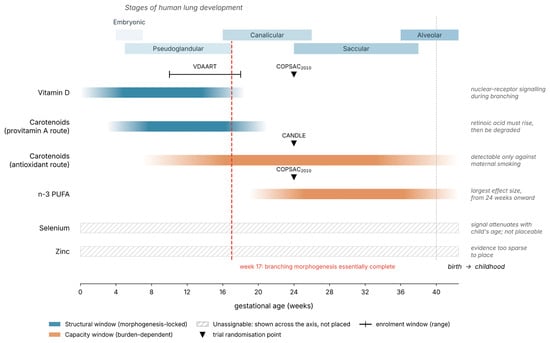
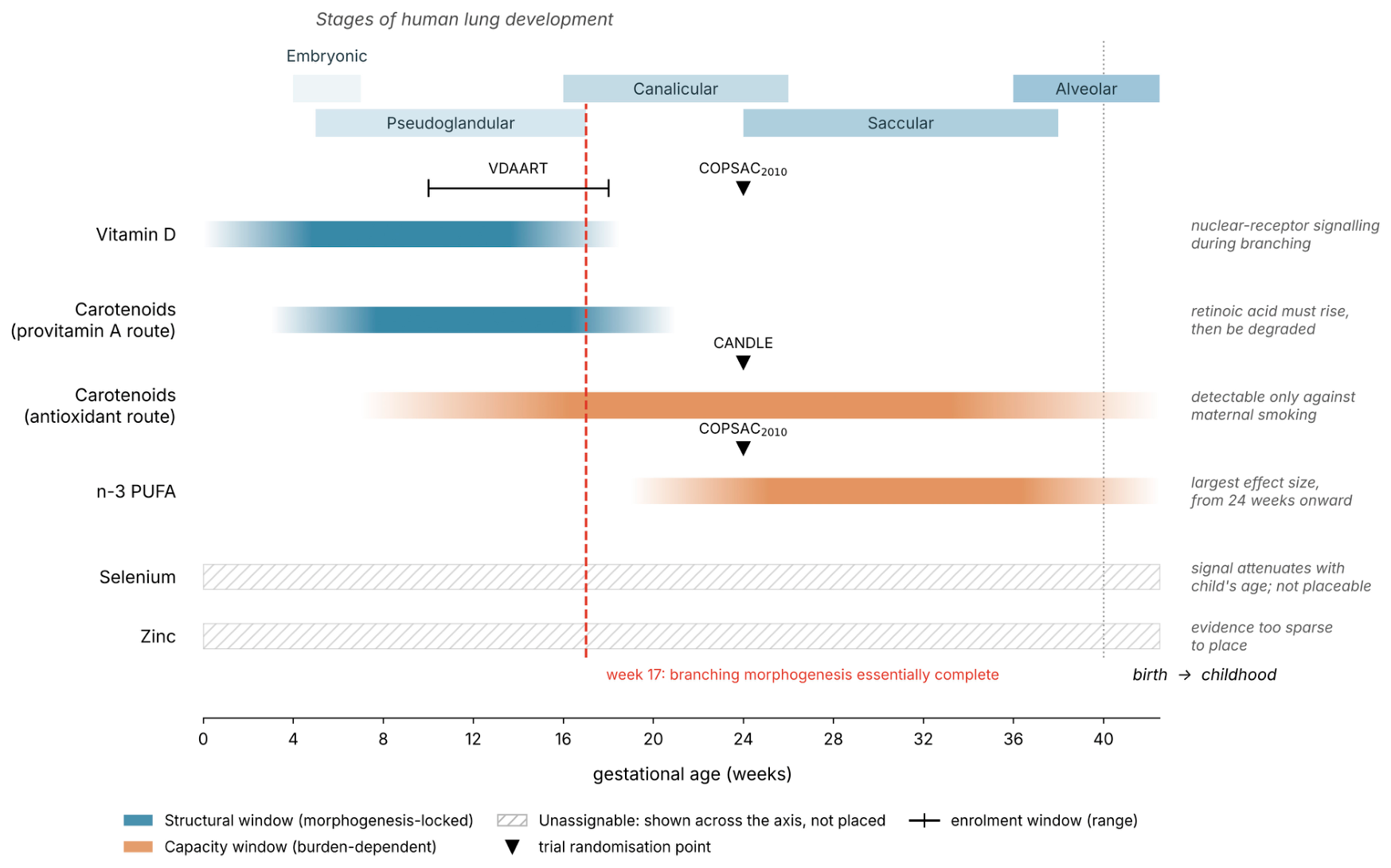
Placed against a common developmental timeline, the evidence reviewed above resists a single rule. Human lung development proceeds through five overlapping stages: embryonic (weeks 4–7), pseudoglandular (weeks 5–17), canalicular (weeks 16–26), saccular (weeks 24–38) and alveolar, with the last continuing well into childhood [13]. Branching morphogenesis, the process most directly implicated in the vitamin D argument developed in Section 3, is essentially complete by the pseudoglandular-to-canalicular transition—yet the five micronutrients considered here appear to act, when they act at all, at markedly different points along this timeline (Figure 1).
Figure 1.
Proposed windows of micronutrient action mapped against the stages of human lung development. Developmental staging follows the work of Schittny [13]. Bars denote the gestational interval over which each micronutrient is proposed to act and are faded at both edges, since no study cited establishes when within an interval a nutrient begins or ceases to act; hatched bars mark exposures that cannot be confidently assigned on present evidence and are shown for completeness of the comparison, not as placements. Markers show the gestational age at which the principal trials randomised participants, either as a point or, where enrolment spanned a range, as a capped interval. Window assignments are inferred from the pattern of published findings and not from any trial that manipulated exposure timing directly, and bar widths carry no quantitative information. The red dashed line marks week 17, by which branching morphogenesis is essentially complete, and the grey dotted line marks term birth at 40 weeks; the arrow at the right of the time axis indicates continuation into postnatal life and childhood.
Two pathways align most plausibly with an early, narrow structural window. Vitamin D and retinoic acid both signal through nuclear receptors that govern gene expression during branching morphogenesis itself, and the data reviewed above are consistent with—without directly proving—a window closing around, or shortly after, the pseudoglandular stage; the null association between neonatal vitamin D status and later asthma [26], and the strict requirement for declining retinoic acid signalling as branching proceeds [45], both point toward a structural window that mid-to-late gestational exposure can no longer address. If this window exists, it is defined by morphogenesis and not by an arbitrary trimester boundary, and would in principle be identical for any exposure acting through the same receptor systems.
The remaining three micronutrients fit this structural model poorly. Zinc’s evidence base is too thin to place on any timeline. Selenium’s association attenuates with the child’s age rather than disappearing outright [36], compatible with an early effect diluted by subsequent exposures rather than with a hard closing window. Carotenoids showed no timing signal at all in the cohort examined and instead had only a co-exposure signal, where protection was detectable exclusively against a background of maternal smoking [49]. n-3 PUFA supplementation begun well into the third trimester produced the largest effect size in this review [54], directly contradicting a model in which the relevant window closes by mid-gestation. A single unifying developmental window, calibrated to lung morphogenesis, cannot accommodate all five exposures without discarding at least one clean result.
One study comes closer than any other to testing this idea directly. In an urban pregnancy cohort of 530 women, a composite antioxidant index derived from β-carotene; vitamins A, C, and E; zinc; magnesium; and selenium was combined with satellite-derived weekly estimates of fine-particulate exposure across gestation, and Bayesian distributed lag interaction models were used to locate any sensitive period. A susceptible window emerged at 33 to 40 weeks (OR 1.74 per µg/m3, 95% CI 1.19–2.54), but only among boys born to mothers whose antioxidant index was low, while a higher index was itself associated with less repeated wheeze (OR 0.37, 95% CI 0.19–0.73) [56]. The design is observational and the subgroup structure invites caution, yet the shape of the result is what a burden-dependent window predicts: it opens where oxidative exposure is high and antioxidant supply is not, and it sits late rather than early in gestation.
A more parsimonious account may separate structural windows, narrow and morphogenesis-locked, from what might be termed capacity windows: periods, potentially extending across gestation and into the postnatal period, during which an antioxidant or immunomodulatory exposure matters only in proportion to the oxidative or inflammatory burden it must offset. Vitamin D and retinoic acid signalling plausibly belong to the first category, whereas n-3 PUFA, and carotenoids under conditions of maternal smoking, plausibly belong to the second. Zinc and selenium cannot be confidently assigned to either on the present evidence.
A distinction of this kind earns nothing unless each half can be refuted, and the two halves are not symmetrical in that respect. The structural claim is falsified by timing: if supplementation begun before conception and the same dose begun at 24 weeks produce indistinguishable respiratory outcomes in a trial powered to separate them, no structural window exists for that nutrient. The capacity claim cannot be tested that way since it makes no prediction about when the exposure arrives—a category defined only by what it declines to predict would be unfalsifiable by construction, which is an objection that applies with full force to the formulation given above. What the capacity claim does predict is a gradient. Benefit should scale with the oxidative or inflammatory burden present while the exposure is in place and should be absent where that burden is low; the claim is therefore refuted when stratification on burden—maternal smoking, measured particulate exposure, an oxidative or inflammatory biomarker—fails to separate the treatment effect while stratification on baseline nutrient status does. Two further observations would count against it specifically: a capacity-assigned nutrient whose benefit depends on gestational age at initiation once burden is accounted for, and one whose benefit is uniform across the whole burden distribution. Neither has been sought in the trials reviewed here, which is a remark about the literature rather than a defence of the category.
One rival explanation accounts for much of the same pattern without invoking timing at all. The COPSAC2010 effect was concentrated in the lowest baseline eicosapentaenoic and docosahexaenoic acid tertile (hazard ratio 0.46, 95% CI 0.25–0.83) [54]; the VDAART signal appeared only after stratification by baseline 25(OH)D and genotype [23]; the selenium association was confined to carriers of a variant that impairs selenocysteine incorporation when supply is limiting [34]; and the carotenoid signal emerged only where maternal smoking raised the oxidative load [49]. Read together, these indicate that benefit accrues to whoever begins furthest from sufficiency whenever the exposure happens to arrive. On present evidence, that account is at least as parsimonious as the one proposed here, and it has the advantage of requiring no developmental premise whatever. However, the two are not equivalent: baseline-dependence predicts that an early and a late exposure behave alike once baseline status is matched, whereas a structural window predicts they do not. They diverge precisely at the design set out in Section 10, which is the principal reason to prefer that design over further cohort analysis.
What the framework currently rests on should be stated plainly. Of the five micronutrients, two cannot be assigned at all, and carotenoids fall into both categories at once because their antioxidant and provitamin A routes are mechanistically separate but have not been separated in any available cohort analysis. The structural category is thus supported by vitamin D and the capacity category by n-3 PUFA—one nutrient each—and the n-3 PUFA assignment is the contested one, having been made to accommodate a result that a single-window model could not absorb. A framework erected on two instances, one of them fitted after the fact, is a proposal about where to look next rather than a description of how these nutrients work. Table 1 sets the five micronutrients side by side based on their mechanisms, strongest available evidence, proposed windows, and principal limitations.
Table 1.
Antioxidant micronutrients and early-life respiratory programming, with their mechanisms, evidence, and proposed windows of action.
This distinction is an organising hypothesis generated by the asymmetries in the literature reviewed here, not a finding independently established by any single study: no trial has randomised the timing of a micronutrient exposure while holding dose constant, and every timing argument in this review, including our own for vitamin D, is inferred retrospectively from when existing trials happened to intervene. Section 9 considers this and other methodological limits explicitly before Section 10 draws out what, if anything, the distinction implies for clinical practice.
9. Limitations and Methodological Heterogeneity
A first source of heterogeneity is definitional rather than biological. ‘Wheeze’ in early childhood resolves into at least four distinct trajectories—never, transient early, late-onset and persistent—that differ in pathophysiology, in atopic association and in prognosis, a distinction established three decades ago and repeatedly confirmed since [57]. Few of the studies reviewed above specify which trajectory their outcome captures, and follow-up ages range from two years [36] to school age [26,49]; the apparent inconsistency between, for instance, the Cochrane finding on wheeze and the null finding on asthma diagnosis [24,25] may reflect this definitional mismatch as much as any true absence of effect. The problem is not confined to trials. In a Romanian cohort of more than a thousand former small-for-gestational-age children, respiratory infections and allergies were ascertained by parental telephone interview without reference to medical records, and the authors themselves noted that differences in healthcare-seeking behaviours could plausibly account for the null respiratory finding [58].
Outcome heterogeneity extends below the level of diagnosis. Childhood asthma is not a single inflammatory entity: fractional exhaled nitric oxide, the most widely used non-invasive index of airway inflammation, is elevated only in type 2-high disease and remains low in the neutrophilic and paucigranulocytic phenotypes that characterise obesity-related asthma in children [16]. In two Copenhagen birth cohorts, exhaled nitric oxide was associated with asthma only among aeroallergen-sensitised children; among non-sensitised children the association ran in the opposite direction [16]. If maternal antioxidant status acts principally on redox-sensitive type 2 pathways, its effect would be diluted in any cohort that pools inflammatory phenotypes—which is to say, in every cohort reviewed here.
A second source lies in how exposure itself was captured. Only vitamin D and n-3 PUFA statuses were established by randomised supplementation [5,24,54]; zinc, selenium and carotenoid statuses were inferred from food-frequency questionnaires, single-timepoint plasma measurements or cord-tissue concentrations at delivery [31,35,36,49], each carrying a different, generally uncharacterised degree of measurement error relative to true gestational exposure. A dietary questionnaire administered once in pregnancy cannot distinguish a mother whose intake was low throughout gestation from one whose intake fell only in the trimester surveyed, collapsing precisely the timing information this review has argued is mechanistically important.
Confounding by overall dietary pattern compounds this problem. Maternal zinc and vitamin E intake were associated with asthma in the same cohort [31], and diets adequate in one antioxidant micronutrient are, in free-living populations, disproportionately likely to be adequate in several others simultaneously. None of the observational studies reviewed here reported a composite dietary quality score, so any single-nutrient association may partly represent an unmeasured healthy-diet effect rather than a specific biological action of the nutrient named. The point has been made directly for this nutrient class: antioxidant intake shows inconsistent associations with paediatric asthma when analysed independently of dietary pattern, because polyphenol-rich diets co-deliver fibre and n-3 fatty acids, rendering independent attribution largely intractable [18]. The glycan-dependent pathway described in Section 2 is a further instance of the same difficulty: maternal and infant diet determine oligosaccharide and micronutrient supply together, no study reviewed here measured both, and a redox attribution is therefore not observationally separable from a microbiota-mediated one.
Genetic heterogeneity across the populations studied constitutes a further limitation. The selenium-asthma association was detectable only in GPX4 rs713041 T-allele carriers [34], and the vitamin D timing argument rested partly on maternal 17q21 genotype [5]; allele frequencies at both loci vary appreciably across the Danish, British, Nepalese, and North American cohorts drawn on in this review, yet genotypes were reported in only a minority of the studies cited. A gene–nutrient interaction invisible in one population for purely allelic reasons is not evidence against the mechanism, but neither is its absence evidence for a universal main effect.
Child sex is a further axis along which these effects may be structured, and one this review cannot resolve. The single analysis that located a susceptible window directly found it only among boys, and only where the maternal antioxidant index was low [56]—a sex-restricted result in the one design built to detect timing, which is either a clue or an artefact of the subgroup structure and cannot be told apart at present. None of the trials reviewed here reported treatment effects by child sex in a form permitting comparison across cohorts, and we have not assumed one. Any trial following the design proposed in Section 10 should pre-specify child sex as a stratification variable rather than leave it to post hoc subgroup analysis.
Finally, and as argued in Section 8, exposure timing itself has nowhere been manipulated experimentally; every temporal inference in this review, including the periconceptional argument for vitamin D, rests on the incidental timing of existing trials rather than on a trial designed to test timing directly. Any framework proposed here should be read as hypothesis-generating rather than confirmed.
10. Clinical Implications and Future Directions
None of the evidence assembled here supports a recommendation for population-wide antioxidant micronutrient supplementation in pregnancy for the prevention of childhood respiratory disease. The two interventions with randomised evidence behave differently: high-dose prenatal vitamin D likely reduces childhood wheeze while leaving asthma diagnosis unaffected [24], and fish oil supplementation reduced persistent wheeze or asthma substantially, although almost exclusively among women in the lowest baseline eicosapentaenoic and docosahexaenoic acid tertile [54]. The clinically actionable pattern is therefore one of repletion rather than supplementation: benefit accrues to those starting as deficient, and the case for treating an already-replete population remains unmade.
In paediatric practice, this distinction matters most in populations where baseline insufficiency is common rather than exceptional. Northern European latitudes, restricted winter sun exposure, and dietary patterns low in oily fish all plausibly generate the low-baseline conditions under which the COPSAC2010 effect was concentrated—conditions that also characterise substantial parts of Central and Eastern Europe, where prenatal micronutrient status is inconsistently assessed and where a case can be made for measurement before, rather than instead of, intervention. Whether such measurement is feasible at scale is a question about institutional practice rather than about biology, and perinatal nutritional practice does change; in a Romanian tertiary centre, exclusive breastfeeding rose from 35.5% to 59.1% across a single decade, with obesity at three years falling from 32.7% to 20.7% over the same interval [58]. That is a precedent for altering a nutritional practice within one service, not evidence about micronutrient assessment, and it is offered only as the former.
The framework proposed in Section 8 generates one directly testable prediction. If vitamin D acts through a structural window closing near the pseudoglandular–canalicular transition, then a trial randomising supplementation before conception against the same dose begun at 24 weeks should separate on respiratory outcomes; if it acts through a capacity window, the two arms should converge. No such trial exists, and its logistical demands—preconceptional recruitment, prolonged follow-up, and stratification by baseline status and by 17q21 and GPX4 genotypes—are considerable. Stratifying both arms by their baseline status would additionally separate the rival account set out in Section 8: if benefit tracks baseline status identically whenever supplementation begins, timing is not the operative variable. Its absence is nonetheless the single largest gap in the literature, and no amount of further observational cohort analysis will close it.
Two narrower priorities follow. Zinc and selenium require pregnancy cohorts with serial biomarker measurement rather than single-timepoint or delivery sampling, sufficient to distinguish sustained from transient insufficiency; and outcome definitions across this field should be harmonised to the wheeze trajectories established three decades ago [57], as much of the apparent inconsistency reviewed above may prove definitional rather than biological. Until these are addressed, the honest position is that maternal antioxidant status plausibly shapes the developing airway, and when it does so, is probably nutrient-specific, and that clinical practice should await evidence designed to answer the timing question rather than evidence that merely happens to bear on it.
Author Contributions
Writing—original draft preparation, O.-R.T., A.L., A.M., A.M.M., O.N., Ș.-M.M., P.P. and F.T.; writing—review and editing, V.V.L., B.N., E.A., R.Ș., R.-M.P. and M.Ș. All authors have read and agreed to the published version of the manuscript.
Funding
This research received no external funding.
Institutional Review Board Statement
Not applicable.
Informed Consent Statement
Not applicable.
Data Availability Statement
No new data were created or analyzed in this study.
Acknowledgments
During the preparation of this manuscript, the authors used Claude (Anthropic) for drafting and language editing of the text, for assistance in locating and organising the cited literature, and for generating Figure 1 in Python 3.13 (Matplotlib 3.11). The authors verified all cited sources against the primary publications and have reviewed and edited the output; they take full responsibility for the content of this publication.
Conflicts of Interest
The authors declare no conflicts of interest.
References
- Ferrante, G.; Carota, G.; Li Volti, G.; Giuffrè, M. Biomarkers of Oxidative Stress for Neonatal Lung Disease. Front. Pediatr. 2021, 9, 618867. [Google Scholar] [CrossRef] [Scilit] [PubMed]
- Berkelhamer, S.K.; Farrow, K.N. Developmental Regulation of Antioxidant Enzymes and Their Impact on Neonatal Lung Disease. Antioxid. Redox Signal. 2014, 21, 1837–1848. [Google Scholar] [CrossRef] [Scilit] [PubMed]
- Torres-Cuevas, I.; Parra-Llorca, A.; Sánchez-Illana, A.; Nuñez-Ramiro, A.; Kuligowski, J.; Cháfer-Pericás, C.; Cernada, M.; Escobar, J.; Vento, M. Oxygen and Oxidative Stress in the Perinatal Period. Redox Biol. 2017, 12, 674–681. [Google Scholar] [CrossRef] [Scilit] [PubMed]
- McGillick, E.V.; Orgeig, S.; Allison, B.J.; Brain, K.L.; Bertossa, M.R.; Holman, S.L.; Meakin, A.S.; Wiese, M.D.; Niu, Y.; Itani, N.; et al. Chronic Fetal Hypoxia and Antenatal Vitamin C Exposure Differentially Regulate Molecular Signalling in the Lung of Female Lambs in Early Adulthood. Front. Physiol. 2025, 15, 1488152. [Google Scholar] [CrossRef] [Scilit] [PubMed]
- Temneanu, O.-R.; Mihai, A.; Avasiloaiei, A.-L.; Murgu, A.; Lupu, V.V.; Lupu, A.; Trofin, F.; Ioniuc, I.; Anton, E.; Pohaci-Antonesei, L.-S.; et al. Timing over Dose: Maternal Vitamin D, Periconceptional Window, and Early-Life Respiratory Programming. Nutrients 2026, 18, 2333. [Google Scholar] [CrossRef] [Scilit] [PubMed]
- Koumpagioti, D.; Dimitroglou, M.; Mpoutopoulou, B.; Moriki, D.; Douros, K. The Role of Oxidative Stress in the Pathogenesis of Childhood Asthma: A Comprehensive Review. Children 2025, 12, 1110. [Google Scholar] [CrossRef] [Scilit] [PubMed]
- Zheng, J.; Jin, Y.J.; Wang, C.H.; Feng, C.; Lai, X.Y.; Hua, S.Q.; Tai, J.H. Global, Regional, and National Epidemiology of Allergic Diseases in Children from 1990 to 2021: Findings from the Global Burden of Disease Study 2021. BMC Pulm. Med. 2025, 25, 54. [Google Scholar] [CrossRef] [Scilit] [PubMed]
- Lee, J.; Jang, J.; Park, S.-M.; Yang, S.-R. An Update on the Role of Nrf2 in Respiratory Disease: Molecular Mechanisms and Therapeutic Approaches. Int. J. Mol. Sci. 2021, 22, 8406. [Google Scholar] [CrossRef] [Scilit] [PubMed]
- Tamatam, C.M.; Reddy, N.M.; Potteti, H.R.; Ankireddy, A.; Noone, P.M.; Yamamoto, M.; Kensler, T.W.; Reddy, S.P. Preconditioning the Immature Lung with Enhanced Nrf2 Activity Protects against Oxidant-Induced Hypoalveolarization in Mice. Sci. Rep. 2020, 10, 19034. [Google Scholar] [CrossRef] [Scilit] [PubMed]
- Hayashibe, H.; Asayama, K.; Dobashi, K.; Kato, K. Prenatal Development of Antioxidant Enzymes in Rat Lung, Kidney, and Heart: Marked Increase in Immunoreactive Superoxide Dismutases, Glutathione Peroxidase, and Catalase in the Kidney. Pediatr. Res. 1990, 27, 472–475. [Google Scholar] [CrossRef] [Scilit] [PubMed]
- Frank, L.; Price, L.T.; Whitney, P.L. Possible Mechanism for Late Gestational Development of the Antioxidant Enzymes in the Fetal Rat Lung. Biol. Neonate 1996, 70, 116–127. [Google Scholar] [CrossRef] [Scilit] [PubMed]
- Perrone, S.; Santacroce, A.; Longini, M.; Proietti, F.; Bazzini, F.; Buonocore, G. The Free Radical Diseases of Prematurity: From Cellular Mechanisms to Bedside. Oxid. Med. Cell. Longev. 2018, 2018, 7483062. [Google Scholar] [CrossRef] [Scilit] [PubMed]
- Schittny, J.C. Development of the Lung. Cell Tissue Res. 2017, 367, 427–444. [Google Scholar] [CrossRef] [Scilit] [PubMed]
- Temneanu, R.O.; Motoc, A.; Zugun, F.E.; Folescu, R.; Lupușoru, C.E.; Zamfir, C.L. The Relevance of Circadian Rhythms Disruption on Pulmonary SOD Expression in Rat. Rom. J. Morphol. Embryol. 2012, 53, 789–793. [Google Scholar] [PubMed]
- Audousset, C.; McGovern, T.; Martin, J.G. Role of Nrf2 in Disease: Novel Molecular Mechanisms and Therapeutic Approaches—Pulmonary Disease/Asthma. Front. Physiol. 2021, 12, 727806. [Google Scholar] [CrossRef] [Scilit] [PubMed]
- Mihai, A.; Ioniuc, I.K.; Murgu, A.M.; Lupu, A.; Frăsinariu, O.E.; Spoială, E.-L.; Rosu, E.V.; Revenco, N.; Gavrilovici, C. Breathing Out the Truth: What Fractional Exhaled Nitric Oxide Really Tells Us About Pediatric Asthma. Diagnostics 2026, 16, 1612. [Google Scholar] [CrossRef] [Scilit] [PubMed]
- Vornic, I.; Buciu, V.; Furau, C.G.; Gaje, P.N.; Ceausu, R.A.; Dumitru, C.S.; Barb, A.C.; Novacescu, D.; Cumpanas, A.A.; Latcu, S.C.; et al. Oxidative Stress and Placental Pathogenesis: A Contemporary Overview of Potential Biomarkers and Emerging Therapeutics. Int. J. Mol. Sci. 2024, 25, 12195. [Google Scholar] [CrossRef] [Scilit] [PubMed]
- Temneanu, O.-R.; Mihai, A.; Olariu, R.; Oros, M.; Ioniuc, I.; Lupu, V.V.; Lupu, A.; Grudnicki, A.; Roșu, M.F.; Șerban, R.; et al. From Diet to Dysbiosis: How Nutritional Factors Shape Gut Microbiota and Drive Airway Inflammation in Pediatric Asthma. Nutrients 2026, 18, 2496. [Google Scholar] [CrossRef] [Scilit] [PubMed]
- Yin, J.; Wang, Z.; Ding, Y. Dynamic Succession of the Early-Life Gut Microbiota and the Regulatory Role of Human Milk Oligosaccharides. Nutrients 2026, 18, 2621. [Google Scholar] [CrossRef] [Scilit] [PubMed]
- Temneanu, O.-R.; Novac, O.; Mihai, A.; Trofin, F.; Frăsinariu, O.E.; Popovici, P.; Șerban, R.; Grudnicki, A.N.; Ioniuc, I.K.; Barbacariu, C.L.; et al. Human Milk Oligosaccharides: Shaping the Anti-Infective Status in Infancy. Microorganisms 2026, 14, 1261. [Google Scholar] [CrossRef] [Scilit] [PubMed]
- Chatsirisupachai, A.; Muanjumpon, P.; Jeayeng, S.; Onkoksong, T.; Pluempreecha, M.; Soingam, T.; Panich, U. Calcitriol/Vitamin D Receptor System Alleviates PM2.5-Induced Human Bronchial Epithelial Damage through Upregulating Mitochondrial Bioenergetics in Association with Regulation of HIF-1α/PGC-1α Signaling. Environ. Toxicol. Pharmacol. 2024, 111, 104568. [Google Scholar] [CrossRef] [Scilit] [PubMed]
- Lykkedegn, S.; Sorensen, G.L.; Beck-Nielsen, S.S.; Christesen, H.T. The Impact of Vitamin D on Fetal and Neonatal Lung Maturation. A Systematic Review. Am. J. Physiol. Lung Cell. Mol. Physiol. 2015, 308, L587–L602. [Google Scholar] [CrossRef] [Scilit] [PubMed]
- Weiss, S.T.; Mirzakhani, H.; Carey, V.J.; O’Connor, G.T.; Zeiger, R.S.; Bacharier, L.B.; Stokes, J.; Litonjua, A.A. Prenatal Vitamin D Supplementation to Prevent Childhood Asthma: 15-Year Results from the Vitamin D Antenatal Asthma Reduction Trial (VDAART). J. Allergy Clin. Immunol. 2024, 153, 378–388. [Google Scholar] [CrossRef] [Scilit] [PubMed]
- Patchen, B.K.; Best, C.M.; Boiteau, J.; Solvik, B.S.; Vonderschmidt, A.; Xu, J.; Cohen, R.T.; Cassano, P.A. Vitamin D Supplementation in Pregnant or Breastfeeding Women or Young Children for Preventing Asthma. Cochrane Database Syst. Rev. 2025, 8, CD013396. [Google Scholar] [CrossRef] [Scilit] [PubMed]
- Li, Q.; Xu, X.; Liu, Y.; Yin, S.; Hu, Q.; Ji, Q.; Zhong, Y.; Zhu, F. The Effects of Prenatal Vitamin D Supplementation on Respiratory and Allergy-Related Outcomes in Children: A Systematic Review and Meta-Analysis of Randomized Controlled Trials. World Allergy Organ. J. 2025, 18, 101075. [Google Scholar] [CrossRef] [Scilit] [PubMed]
- Liu, X.; Zhu, Z.; Chawes, B.; Bønnelykke, K.; Horsdal, H.T.; Agerbo, E.; Boelt, S.G.; Borbye-Lorenzen, N.; Melgaard, L.; Pedersen, C.B.; et al. Neonatal Vitamin D Status and Asthma Risk after Age 5 Years: A Danish Population-Based Cohort Study. Pediatr. Allergy Immunol. 2026, 37, e70299. [Google Scholar] [CrossRef] [Scilit] [PubMed]
- Cheng, Y.; Chen, H. Aberrance of Zinc Metalloenzymes-Induced Human Diseases and Its Potential Mechanisms. Nutrients 2021, 13, 4456. [Google Scholar] [CrossRef] [Scilit] [PubMed]
- De Raeve, H.R.; Thunnissen, F.B.; Kaneko, F.T.; Guo, F.H.; Lewis, M.; Kavuru, M.S.; Secic, M.; Thomassen, M.J.; Erzurum, S.C. Decreased Cu/Zn-SOD Activity in Asthmatic Airway Epithelium: Correction by Inhaled Corticosteroid in Vivo. Am. J. Physiol. 1997, 272, L148–L154. [Google Scholar] [CrossRef] [Scilit] [PubMed]
- Murgia, C.; Grosser, D.; Truong-Tran, A.Q.; Roscioli, E.; Michalczyk, A.; Ackland, M.L.; Stoltenberg, M.; Danscher, G.; Lang, C.; Knight, D.; et al. Apical Localization of Zinc Transporter ZnT4 in Human Airway Epithelial Cells and Its Loss in a Murine Model of Allergic Airway Inflammation. Nutrients 2011, 3, 910–928. [Google Scholar] [CrossRef] [Scilit] [PubMed]
- Gao, W.; Huang, L.; Zhang, X.; Ma, X.; Wang, W.; Zheng, Y.; Geng, W.; Liu, C.; Wei, S.; Yang, L.; et al. Effect of Maternal Marginal Zinc Deficiency on Development, Redox Status, and Gene Expression Related to Oxidation and Apoptosis in an Avian Embryo Model. Oxid. Med. Cell. Longev. 2021, 2021, 9013280. [Google Scholar] [CrossRef] [Scilit] [PubMed]
- Devereux, G.; Turner, S.W.; Craig, L.C.A.; McNeill, G.; Martindale, S.; Harbour, P.J.; Helms, P.J.; Seaton, A. Low Maternal Vitamin E Intake during Pregnancy Is Associated with Asthma in 5-Year-Old Children. Am. J. Respir. Crit. Care Med. 2006, 174, 499–507. [Google Scholar] [CrossRef] [Scilit] [PubMed]
- Carducci, B.; Keats, E.C.; Bhutta, Z.A. Zinc Supplementation for Improving Pregnancy and Infant Outcome. Cochrane Database Syst. Rev. 2021, 3, CD000230. [Google Scholar] [CrossRef] [Scilit] [PubMed]
- Weaver, K.; Skouta, R. The Selenoprotein Glutathione Peroxidase 4: From Molecular Mechanisms to Novel Therapeutic Opportunities. Biomedicines 2022, 10, 891. [Google Scholar] [CrossRef] [Scilit] [PubMed]
- Shaheen, S.O.; Rutterford, C.M.; Lewis, S.J.; Ring, S.M.; Holloway, J.W.; Golding, J.; Henderson, A.J. Maternal Selenium Status in Pregnancy, Offspring Glutathione Peroxidase 4 Genotype, and Childhood Asthma. J. Allergy Clin. Immunol. 2015, 135, 1083–1085.e3. [Google Scholar] [CrossRef] [Scilit] [PubMed]
- Shaheen, S.O.; Newson, R.B.; Henderson, A.J.; Emmett, P.M.; Sherriff, A.; Cooke, M. Umbilical Cord Trace Elements and Minerals and Risk of Early Childhood Wheezing and Eczema. Eur. Respir. J. 2004, 24, 292–297. [Google Scholar] [CrossRef] [Scilit] [PubMed]
- Devereux, G.; McNeill, G.; Newman, G.; Turner, S.; Craig, L.; Martindale, S.; Helms, P.; Seaton, A. Early Childhood Wheezing Symptoms in Relation to Plasma Selenium in Pregnant Mothers and Neonates. Clin. Exp. Allergy 2007, 37, 1000–1008. [Google Scholar] [CrossRef] [Scilit] [PubMed]
- Sherlock, L.G.; McCarthy, W.C.; Grayck, M.R.; Solar, M.; Hernandez, A.; Zheng, L.; Delaney, C.; Tipple, T.E.; Wright, C.J.; Nozik, E.S. Neonatal Selenium Deficiency Decreases Selenoproteins in the Lung and Impairs Pulmonary Alveolar Development. Antioxidants 2022, 11, 2417. [Google Scholar] [CrossRef] [Scilit] [PubMed]
- Hoffmann, P.R.; Jourdan-Le Saux, C.; Hoffmann, F.W.; Chang, P.S.; Bollt, O.; He, Q.; Tam, E.K.; Berry, M.J. A Role for Dietary Selenium and Selenoproteins in Allergic Airway Inflammation. J. Immunol. 2007, 179, 3258–3267. [Google Scholar] [CrossRef] [Scilit] [PubMed]
- Beasley, R.; Thomson, C.; Pearce, N. Selenium, Glutathione Peroxidase and Asthma. Clin. Exp. Allergy 1991, 21, 157–159. [Google Scholar] [CrossRef] [Scilit] [PubMed]
- Norton, R.L.; Hoffmann, P.R. Selenium and Asthma. Mol. Asp. Med. 2012, 33, 98–106. [Google Scholar] [CrossRef] [Scilit] [PubMed]
- Allam, M.F.; Lucena, R.A. Selenium Supplementation for Asthma. Cochrane Database Syst. Rev. 2004, 2, CD003538. [Google Scholar] [CrossRef] [Scilit] [PubMed]
- Hasselmark, L.; Malmgren, R.; Zetterström, O.; Unge, G. Selenium Supplementation in Intrinsic Asthma. Allergy 1993, 48, 30–36. [Google Scholar] [CrossRef] [Scilit] [PubMed]
- Shaheen, S.O.; Newson, R.B.; Rayman, M.P.; Wong, A.P.-L.; Tumilty, M.K.; Phillips, J.M.; Potts, J.F.; Kelly, F.J.; White, P.T.; Burney, P.G.J. Randomised, Double Blind, Placebo-Controlled Trial of Selenium Supplementation in Adult Asthma. Thorax 2007, 62, 483–490. [Google Scholar] [CrossRef] [Scilit] [PubMed]
- Vašková, J.; Stupák, M.; Vidová Ugurbaş, M.; Židzik, J.; Mičková, H. Therapeutic Uses of Retinol and Retinoid-Related Antioxidants. Molecules 2025, 30, 2191. [Google Scholar] [CrossRef] [Scilit] [PubMed]
- Fernandes-Silva, H.; Araújo-Silva, H.; Correia-Pinto, J.; Moura, R.S. Retinoic Acid: A Key Regulator of Lung Development. Biomolecules 2020, 10, 152. [Google Scholar] [CrossRef] [Scilit] [PubMed]
- Checkley, W.; West, K.P., Jr.; Wise, R.A.; Baldwin, M.R.; Wu, L.; LeClerq, S.C.; Christian, P.; Katz, J.; Tielsch, J.M.; Khatry, S.K.; et al. Maternal Vitamin A Supplementation and Lung Function in Offspring. N. Engl. J. Med. 2010, 362, 1784–1794. [Google Scholar] [CrossRef] [Scilit] [PubMed]
- McConnell, C.; Thoene, M.; Van Ormer, M.; Furtado, J.D.; Korade, Z.; Genaro-Mattos, T.C.; Hanson, C.; Anderson-Berry, A. Plasma Concentrations and Maternal-Umbilical Cord Plasma Ratios of the Six Most Prevalent Carotenoids across Five Groups of Birth Gestational Age. Antioxidants 2021, 10, 1409. [Google Scholar] [CrossRef] [Scilit] [PubMed]
- Hanson, C.; Lyden, E.; Furtado, J.; Van Ormer, M.; White, K.; Overby, N.; Anderson-Berry, A. Serum Lycopene Concentrations and Associations with Clinical Outcomes in a Cohort of Maternal-Infant Dyads. Nutrients 2018, 10, 204. [Google Scholar] [CrossRef] [Scilit] [PubMed]
- Zhang, X.; Hartman, T.J.; Adgent, M.; Moore, P.; Gebretsadik, T.; Nickelberry, M.; LeWinn, K.Z.; Zhao, Q.; Carroll, K.N.; Wright, R.J. Maternal Prenatal Carotenoids and Child Lung Function: Exploration of Modifying Factors. Thorax 2025, 80, 748–755. [Google Scholar] [CrossRef] [Scilit] [PubMed]
- Thyagarajan, B.; Meyer, K.A.; Smith, L.J.; Beckett, W.S.; Williams, O.D.; Gross, M.D.; Jacobs, D.R., Jr. Serum Carotenoid Concentrations Predict Lung Function Evolution in Young Adults: The Coronary Artery Risk Development in Young Adults (CARDIA) Study. Am. J. Clin. Nutr. 2011, 94, 1211–1218. [Google Scholar] [CrossRef] [Scilit] [PubMed]
- Oppedisano, F.; Macrì, R.; Gliozzi, M.; Musolino, V.; Carresi, C.; Maiuolo, J.; Bosco, F.; Nucera, S.; Zito, M.C.; Guarnieri, L.; et al. The Anti-Inflammatory and Antioxidant Properties of n-3 PUFAs: Their Role in Cardiovascular Protection. Biomedicines 2020, 8, 306. [Google Scholar] [CrossRef] [Scilit] [PubMed]
- Ishikado, A.; Morino, K.; Nishio, Y.; Nakagawa, F.; Mukose, A.; Sono, Y.; Yoshioka, N.; Kondo, K.; Sekine, O.; Yoshizaki, T.; et al. 4-Hydroxy Hexenal Derived from Docosahexaenoic Acid Protects Endothelial Cells via Nrf2 Activation. PLoS ONE 2013, 8, e69415. [Google Scholar] [CrossRef] [Scilit] [PubMed]
- Tian, Y.; Sun, J.; Jiao, D.; Zhang, W. The Potential Role of n-3 Fatty Acids and Their Lipid Mediators on Asthmatic Airway Inflammation. Front. Immunol. 2024, 15, 1488570. [Google Scholar] [CrossRef] [Scilit] [PubMed]
- Bisgaard, H.; Stokholm, J.; Chawes, B.L.; Vissing, N.H.; Bjarnadóttir, E.; Schoos, A.M.; Wolsk, H.M.; Pedersen, T.M.; Vinding, R.K.; Thorsteinsdóttir, S.; et al. Fish Oil-Derived Fatty Acids in Pregnancy and Wheeze and Asthma in Offspring. N. Engl. J. Med. 2016, 375, 2530–2539. [Google Scholar] [CrossRef] [Scilit] [PubMed]
- Jia, Y.; Huang, Y.; Wang, H.; Jiang, H. A Dose-Response Meta-Analysis of the Association between the Maternal Omega-3 Long-Chain Polyunsaturated Fatty Acids Supplement and Risk of Asthma/Wheeze in Offspring. BMC Pediatr. 2022, 22, 422. [Google Scholar] [CrossRef] [Scilit] [PubMed]
- Chiu, Y.-H.M.; Carroll, K.N.; Coull, B.A.; Kannan, S.; Wilson, A.; Wright, R.J. Prenatal Fine Particulate Matter, Maternal Micronutrient Antioxidant Intake, and Early Childhood Repeated Wheeze: Effect Modification by Race/Ethnicity and Sex. Antioxidants 2022, 11, 366. [Google Scholar] [CrossRef] [Scilit] [PubMed]
- Martinez, F.D.; Wright, A.L.; Taussig, L.M.; Holberg, C.J.; Halonen, M.; Morgan, W.J. Asthma and Wheezing in the First Six Years of Life. N. Engl. J. Med. 1995, 332, 133–138. [Google Scholar] [CrossRef] [Scilit] [PubMed]
- Bucur-Grosu, M.-L.; Avasiloaiei, A.L.; Popa, I.V.; Burlacu, A.; Păduraru, L.; Cărăuleanu, A.; Temneanu, O.-R.; Socolov, D.G. Optimizing Feeding Practices Improves Outcomes During Early Childhood in Former Small for Gestational Age (SGA) Infants. Nutrients 2026, 18, 2296. [Google Scholar] [CrossRef] [Scilit] [PubMed]

Disclaimer/Publisher’s Note: The statements, opinions and data contained in all publications are solely those of the individual author(s) and contributor(s) and not of MDPI and/or the editor(s). MDPI and/or the editor(s) disclaim responsibility for any injury to people or property resulting from any ideas, methods, instructions or products referred to in the content. |
© 2026 by the authors. Licensee MDPI, Basel, Switzerland. This article is an open access article distributed under the terms and conditions of the Creative Commons Attribution (CC BY) license.