


Highlights
What are the main findings?
- Self-reported state anger decreased from pre-provocation to post-intervention in both the virtual reality (VR) and relaxation exercise groups and increased in the control group.
- After adjustment for pre-induction baseline electrodermal activity (EDA), the VR group had lower EDA than the muscle relaxation and breathing exercises (MRBEs) and control groups during the five minutes immediately after the assigned condition ended.
What are the implications of the main findings?
- The EDA difference between groups concerns physiological arousal during the five-minute post-intervention period.
- An immediate post-provocation anger assessment would help quantify subjective recovery, and follow-up would help assess whether changes in trait anger questionnaire scores persist.
Abstract
Background/Objectives: This study compared a virtual reality (VR)-based intervention with standard muscle relaxation and breathing exercises (MRBEs) and a headset control condition for short-term state anger regulation. Methods: Sixty-one university students selected for elevated trait anger and state-based difficulties in emotion regulation (37 women; mean age = 21.57 years, SD = 3.77) were randomly assigned to VR (n = 23), control (n = 20), or MRBE (n = 18) groups. Psychological questionnaires were administered before and after the assigned condition. Electrodermal activity (EDA) and heart rate (HR) were assessed at baseline, during anger induction, and during the five minutes immediately after completion of the assigned intervention or control condition. Results: State anger decreased in both active groups but increased in the control group. The EDA group × time interaction was significant using Pillai’s trace (p = 0.0141); the heart-rate interaction was not significant (p = 0.524). The baseline-adjusted EDA group test remained significant with HC3 inference (p = 0.0168). Adjusted post-intervention EDA was lower in VR than in the control (difference = −7.678 µS; 95% CI [−13.117, −2.238]; Holm p = 0.0130) and MRBE (−6.512 µS; 95% CI [−11.692, −1.332]; Holm p = 0.0147) groups. Induction-to-post-intervention change analyses gave consistent comparisons. Conclusions: State anger ratings decreased from pre-provocation to posttest in both active groups. After adjustment for pre-induction baseline EDA, the VR group had lower EDA than the MRBE and control groups during the five minutes immediately after the assigned condition ended.
1. Introduction
Emotions can be conceptualized as dynamic biopsychosocial processes that emerge from interactions among biological mechanisms, cognitive appraisals, subjective experience, physiological responses, and the sociocultural context. While contemporary appraisal-based accounts particularly emphasize that emotional responses arise from individuals’ evaluations of events in relation to their needs, goals, and concerns [1], anthropological and historical perspectives highlight the role of culturally constructed meanings and social norms in shaping how emotions are experienced, interpreted, and expressed [2,3].
Individual differences in emotional experience can be influenced by biological, psychological, and social factors. At the biological level, genetic variation and neurochemical systems involved in affective processing have been associated with individual differences in emotional reactivity and regulation. For instance, variation in serotonergic function has been linked to neural systems underlying emotional behavior, while dopaminergic and limbic mechanisms have been implicated in the generation of positive affect [4,5]. At the psychological level, processes such as intolerance of uncertainty and attentional allocation can influence the way emotional information is perceived and evaluated [6,7,8]. Emotional experiences are also embedded within a social context, and interpersonal relationships, social norms, and group processes can influence both the elicitation and expression of emotions [9].
Emotions may be described using different, complementary conceptual frameworks. From a dimensional perspective, emotional experiences can be characterized according to their affective valence, broadly distinguishing positively and negatively valenced states. Positive emotions such as happiness, interest, and love have been associated with broadened cognitive and behavioral repertoires and the development of enduring personal resources [10]. Alternatively, discrete-emotion theories propose that certain emotions constitute relatively distinct emotion categories with characteristic antecedents and response patterns [11,12]. Basic-emotion approaches have traditionally emphasized cross-cultural regularities in emotions such as happiness, anger, fear, sadness, disgust, and surprise, although contemporary research also recognizes that culture can influence the interpretation, experience, and expression of emotions. Thus, dimensional, discrete, biological, and sociocultural approaches should be regarded as complementary rather than mutually exclusive accounts of emotional experience.
Emotional processing broadly encompasses the processes through which individuals attend to emotionally relevant information, experience and interpret their emotional responses, attribute meaning to these responses, and integrate them into subsequent cognition and behavior. Emotional stimuli can interact with attentional, perceptual, learning, memory, and higher-order cognitive processes, thereby influencing both the emergence and subsequent regulation of emotional responses [7]. Within emotion-focused approaches, emotional processing similarly involves becoming aware of emotional experience, making sense of it, regulating it when necessary, and using emotional information adaptively [13].
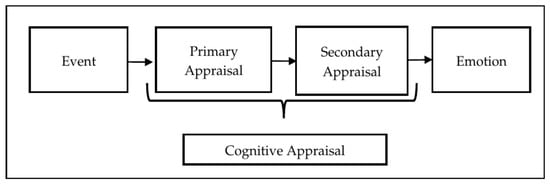
Numerous theoretical models have been proposed to explain how emotional responses arise. One of the most influential appraisal-based frameworks is Lazarus’s cognitive–motivational–relational theory of emotion [14]. According to this framework, emotional responses depend not simply on the objective characteristics of an event, but also on the meaning that the individual attributes to the event in relation to personal goals and well-being. Lazarus distinguishes between primary and secondary appraisal processes. Primary appraisal concerns the personal significance of an encounter, including whether it is relevant to the individual’s goals and whether it represents benefit, harm or loss, threat, or challenge. Secondary appraisal concerns the individual’s perceived capacity to respond to the encounter, including available coping options, perceived control, responsibility, and expectations regarding its future course [14].
The combination of these appraisal processes contributes to the specific emotional meaning assigned to an event. Consequently, different individuals may experience different emotions in response to objectively similar circumstances, and alterations in appraisal may be accompanied by corresponding changes in emotional experience. Evidence from daily-life studies supports systematic relationships between momentary appraisals and specific emotional experiences [15]. Importantly, however, particular emotions cannot be attributed solely to the availability or absence of coping resources. In Lazarus’s framework, emotions emerge from broader patterns of appraisal, or “core relational themes.” For example, anger is associated with the appraisal of a demeaning offense against oneself or one’s concerns, whereas fear is associated with the appraisal of immediate and overwhelming danger [14]. Thus, emotional experience reflects the integrated meaning assigned to an encounter rather than a single appraisal dimension. The principal components of this appraisal process and their proposed contribution to emotional experience are summarized in Figure 1.
Figure 1.
The Process of Emotional Experience According to Lazarus’ Cognitive Appraisal Theory.
Anger is commonly conceptualized as an emotional state that can vary in intensity from mild irritation to intense rage and is frequently elicited when individuals perceive that their goals have been obstructed, that they have been treated unfairly, or that personally significant interests have been threatened [14,16]. In addition to its affective component, anger is associated with an approach-oriented motivational tendency that can prepare individuals to confront perceived obstacles or transgressions [17]. Spielberger et al. [16] distinguished between state and trait anger. State anger refers to a transient emotional condition characterized by subjective feelings that may range from irritation or annoyance to intense anger, whereas trait anger reflects a relatively stable disposition to experience anger more frequently and intensely across situations. Although anger is generally experienced as an unpleasant emotion and has traditionally been classified among the basic emotions [12], its functional significance cannot be understood solely in terms of negative valence. Anger may serve adaptive functions by mobilizing individuals to respond to perceived injustice, overcome obstacles, or protect personally relevant goals [14,17]. Conversely, anger may become maladaptive when it is excessively intense, frequent, prolonged, or expressed in ways that are inappropriate to the situational context [18]. Thus, dysfunctional outcomes associated with anger may depend not simply on the occurrence of the emotion itself but also on how effectively the emotional response is regulated and expressed.
Emotion regulation refers broadly to the processes through which emotional reactions are monitored, evaluated, and modified in accordance with individual goals [19,20]. These processes can influence the intensity, duration, expression, and temporal dynamics of emotional responses. Building on this conceptual foundation, Gross [21] proposed the process model of emotion regulation, according to which emotions can be regulated at different stages of the emotion-generative process. The model identifies five broad families of emotion regulation strategies: situation selection, situation modification, attentional deployment, cognitive change, and response modulation [21]. Situation selection involves approaching or avoiding situations on the basis of their anticipated emotional consequences, whereas situation modification involves altering relevant features of an existing situation in order to influence its emotional impact. Attentional deployment refers to directing attention toward or away from the emotionally salient aspects of a situation; distraction represents one specific form of this strategy and can reduce emotional responding by shifting attention away from affectively salient stimuli [22]. Cognitive change involves modifying the interpretation or meaning assigned to an emotion-eliciting event. Cognitive reappraisal, one of the most widely studied forms of cognitive change, aims to alter the emotional impact of an event by construing it from a different perspective [23]. Finally, response modulation involves directly influencing experiential, behavioral, or physiological components of an emotional response after it has been elicited [21].
Emotion regulation can also be considered at different temporal and contextual levels. Dispositional, or trait-like, emotion regulation refers to relatively stable patterns in the strategies individuals tend to employ across situations and over time [24]. In contrast, state-based emotion regulation concerns the regulatory processes and difficulties that occur at a particular moment or within a specific emotional context [25]. This distinction is particularly important because emotion regulation is responsive to situational demands and the broader social and environmental context in which an emotional response occurs [26].
Accordingly, the present study focuses primarily on state-based, or situational, emotion regulation and examines individuals’ ability to regulate anger within a specific experimentally induced emotional context.
Difficulties in regulating anger may have important consequences across multiple domains of functioning. Maladaptive patterns of anger and anger expression have been associated with difficulties in intimate and interpersonal relationships [27,28], aggressive behavior in occupational settings [29], and adverse physical-health outcomes, including an increased risk of coronary heart disease [30]. Moreover, individuals characterized by elevated or maladaptive anger differ substantially in their use of emotion regulation strategies, suggesting that difficulties in emotion regulation constitute an important target for anger-focused interventions [18].
Against this background, the present study aimed to evaluate the effectiveness of a virtual reality-based psychological intervention designed to facilitate the regulation of state anger. The effectiveness of the intervention was examined by comparing outcomes of participants assigned to the virtual reality intervention, a conventional progressive muscle relaxation and breathing exercise condition, and a control condition. Outcomes included physiological indices of emotional arousal, specifically electrodermal activity (EDA) and heart rate (HR), and psychological measures of state anger, trait anger, and state-based difficulties in emotion regulation.
The intervention was informed by Gross’s [21] process model of emotion regulation. Progressive muscle relaxation [31] and controlled breathing [32] target physiological aspects of emotional responding, while a calming virtual environment may support attentional redirection [33] and a sense of safety. Cognitive reappraisal [34] and safe-place imagery [35] provide a related theoretical context; however, neither was delivered as a separate structured exercise. The VR environment was intended to support a safe-place experience while participants performed the same breathing and muscle relaxation exercises as the MRBE group.
2. Materials and Methods
2.1. Participants
An a priori power analysis was conducted using G*Power (version 3.1.9.7) for a 3 (group: VR, MRBE, control) × 3 (phase: baseline, anger induction, post-intervention) mixed-design repeated-measures ANOVA. With f = 0.25, α = 0.05, and power = 0.80, the reported minimum total sample size was 36. Physiological outcomes had three time points, whereas psychological outcomes had two assessments.
The final sample consisted of 61 university students (37 women; mean age = 21.57 years, SD = 3.77). All participants met the following inclusion criteria: (1) provide written informed consent; (2) be at least 18 years old; (3) score > 39 on S-DERS; (4) score > 21 on the Trait Anger subscale [36]; and (5) have no visual impairment, such as cataracts, that would interfere with the procedure. Participants with any psychiatric or neurological disorder that impaired their ability to assess reality, those with a fear of enclosed spaces (claustrophobia), those with uncorrected vision problems such as color blindness, those with a diagnosis of addiction, those taking psychiatric medication, or those under the age of 18 were excluded from the study. All participants included in the study were informed that they should not come to the laboratory session hungry or sleep-deprived. The study was conducted in accordance with the principles of the Declaration of Helsinki and was approved by the Ethics Committee of Aydın Adnan Menderes University for Social and Human Sciences Research (Approval No: 31906847/050.04.04/09; Decision No: 09/02). Participants included in the study were randomly assigned to three groups: VR, control (C), and muscle relaxation and breathing exercises (MRBE). The demographic information of all participants is summarized in Table 1.
Table 1.
Comparison of groups in terms of demographic information.
Eligibility screening took place before the laboratory session, in a single classroom session at Tokat Gaziosmanpaşa University, with permission from the course instructor. Students completed informed consent, sociodemographic information, State Anger, Trait Anger and S-DERS forms; screening lasted approximately 20 min. Of the 239 students screened, 64 were eligible and were scheduled for a laboratory visit within 10 days of screening. During the laboratory procedure, two participants were found to have an undisclosed psychiatric diagnosis and one fell asleep; their data were not included, leaving a final analytic sample of 61. Data were collected from December 2023 to May 2024. The Trait Anger > 21 and S-DERS > 39 thresholds were based on reference-sample means of 21.30 and 39.21, respectively, reported in the Turkish adaptation studies. These were study-specific recruitment criteria, not validated diagnostic cutoffs. Laboratory pretest questionnaires were administered separately from classroom screening.
Baseline comparability across groups was examined using one-way ANOVA for the dependent variables. A significant between-group difference was observed only for baseline EDA (p = 0.02), whereas no significant baseline differences were found for heart rate, state anger, trait anger, or state-based difficulties in emotion regulation. The relevant results are summarized in Table 2.
Table 2.
Results of the first measurement comparisons between groups in terms of dependent variables.
2.2. Experimental Procedure
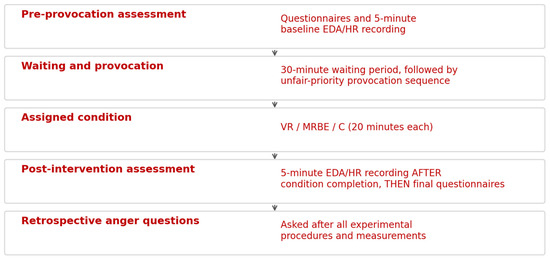
Participants were randomly assigned to VR, C or MRBE and underwent a frustration–provocation sequence for anger induction [37]. At the laboratory visit, participants first completed the State Anger, Trait Anger and S-DERS questionnaires, followed by a five-minute baseline EDA and HR recording. They had been told that they would be first in line for the experiment after this initial recording. Contrary to this expectation, each participant was left alone for 30 min without an explanation. The participant was then told that another person, a confederate, would be tested first. Physiological measurements were obtained from the confederate using separate sensors for five minutes while the participant waited and their own EDA and HR continued to be recorded. This unfair-priority sequence constituted the provocation phase. After the confederate left, participants completed their assigned 20-min condition. Immediately afterward, a five-minute EDA and HR recording was obtained, followed by the psychological posttest questionnaires. Physiological comparisons used three five-minute windows: the initial pre-induction baseline, the provocation phase, and the period immediately after condition completion. No state anger questionnaire was administered immediately after provocation and before the assigned condition. After all experimental procedures and measurements were completed, participants retrospectively reported whether they had felt anger during waiting and rated its intensity on a five-point Likert-type scale. These retrospective reports were not contemporaneous measures of anger at intervention onset. The complete laboratory procedure lasted approximately 1.5 h per participant. Figure 2 summarizes the sequence.
Figure 2.
Experimental sequence. VR = Virtual Reality Intervention Group; C = Control Group; MRBE = Muscle Relaxation and Breathing Exercises Group. Each assigned condition lasted 20 min. The final five-minute EDA/HR recording immediately followed condition completion and preceded the psychological posttest questionnaires. Retrospective waiting-period anger questions were asked after all experimental procedures and measurements.
The VR condition used a Meta Quest 2 headset. During classroom screening, participants viewed two-dimensional images of four virtual environments and selected the one in which they expected to feel most comfortable and safe. The environments depicted a tropical seaside pavilion, a warm-toned domed interior with a rocky coastal view, a wood-lined room overlooking a forest, and a snowy landscape beneath an aurora. Before the study, three experts in computer engineering and computer education and instructional technology assessed visual and auditory realism, motion congruence, image quality, avoidance of negative emotions, and suitability for promoting safety, calmness and relaxation, and judged the environments suitable. During the VR session, participants followed prerecorded audio instructions in their selected environment. There was no avatar, virtual therapist, interactive scenario, object interaction or additional structured psychological exercise.
The VR and MRBE groups received the same studio-recorded instructions, narrated by an adult woman, and performed the same exercises for 20 min. MRBE participants listened through headphones without VR. The sequence began with diaphragmatic breathing and continued with progressive muscle relaxation based on Jacobson [31]. Participants placed one hand on their chest and the other on their abdomen, aiming for abdominal movement with relatively little chest movement, and were guided to inhale through the nose, hold their breath and exhale through the mouth for approximately three seconds per phase. They then sequentially contracted and relaxed muscles of the feet, calves, thighs, buttocks, abdomen, chest, back, arms, hands, shoulders, neck and face, counting to ten during the contraction and taking a slow breath between muscle groups. Thus, the active conditions were matched for exercise content, prerecorded guidance and duration; the principal difference was delivery within a selected virtual environment.
The control group viewed a static book image, selected as an emotionally neutral stimulus [38], through a Meta Quest 2 headset for 20 min and was instructed to examine it. No breathing exercises, muscle relaxation or structured emotion regulation instructions were provided. This condition matched the VR group for headset exposure and all groups for condition duration, but did not match the active conditions for therapeutic instructions or engagement.
2.3. Measures
2.3.1. State-Trait Anger Scale
The State-Trait Anger Scale [16] comprises two 10-item subscales, each rated on a four-point Likert-type scale. The Turkish Trait Anger adaptation was conducted by Özer [36], who reported a reference-sample mean of 21.3; the Turkish State Anger adaptation was conducted by Kalay [39]. Higher scores indicate greater anger on the relevant subscale. The Trait Anger subscale, not the State Anger subscale, was used for eligibility: scores > 21 at classroom screening were required. This study-defined threshold was based on the reference-sample mean rather than a clinical cutoff. Both subscales were administered at the laboratory pretest, before baseline physiological recording and provocation, and at posttest, after the five-minute post-intervention physiological recording. Immediate changes in trait anger questionnaire scores are considered exploratory and are not interpreted as changes in a stable anger disposition.
2.3.2. State Difficulties in Emotion Regulation Scale, S-DERS
The State Difficulties in Emotion Regulation Scale (S-DERS) [25] was used to assess the difficulties participants encountered in regulating their emotions in response to emotional situations. The Turkish adaptation of the scale, consisting of 21 items each rated on a five-point Likert scale, was conducted by [40]. High scores on the scale indicate greater difficulty in regulating emotions in response to situations. In the Turkish adaptation study, the sample mean for the scale was reported as 39.21. A score > 39 at classroom screening was required; this study-defined recruitment threshold was based on the reference-sample mean, not a diagnostic cutoff.
2.3.3. Electrodermal Activity and Heart Rate
EDA and HR were recorded throughout the procedure to characterize physiological responses before induction, during provocation and after the assigned condition. The electrophysiological recording of biological signals was performed using a multi-channel data acquisition system (PowerLab; AD Instruments, Castle Hill, Australia). A pulse transducer (TN1012/ST, AD Instruments, Castle Hill, Australia) was used for pulse recording, and silver/silver chloride GSR electrodes (MLT117F, AD Instruments, Castle Hill, Australia) were used for EDA recording. The electrodes used for EDA signals were connected to the main recording device via amplifiers (Dual BioAmp and GSR Amp; AD Instruments, Castle Hill, Australia). The signals obtained from the electrodes were amplified and then digitized at a rate of 1024 Hz and recorded using software (LabChart v8.0; AD Instruments, Australia). A pulse transducer was attached to the participant’s left thumb, and GSR electrodes were attached to the index and ring fingers. EDA was recorded in microsiemens (µS). EDA and pulse were recorded on separate channels using the PowerLab system and LabChart software. The pre-induction baseline, anger provocation, and post-intervention windows were identified by time markers on the same continuous EDA recording. The GSR amplifier range was set to 0–40 µS. A digital notch filter centered at 50 Hz was applied to reduce power-line interference.
Subject Zero was applied once at the start of each participant’s recording to establish the acquisition reference. The same reference was used throughout the recording. No additional offline baseline subtraction was performed. The mean EDA over the five-minute pre-induction window was entered as the ANCOVA covariate. This mean could differ from zero because it summarized conductance over an interval following the initial zeroing procedure.
Participants were instructed in advance to remain seated and avoid movement during the physiological measurements. They remained seated without overt movement during these periods, and movement-related artifacts were very limited. Recordings were visually inspected for artifacts. Following conversion of the recordings into numerical data, artifact-contaminated samples were excluded from the calculation of the interval means.
EDA was summarized over three five-minute windows comprising the pre-induction baseline, anger provocation, and the five minutes immediately after completion of the assigned condition. Each one-minute EDA value was calculated as the arithmetic mean of the remaining valid samples within that interval. Each five-minute phase value was then calculated as the arithmetic mean of the five one-minute values.
The same acquisition settings, initial zeroing procedure, digital filtering, visual artifact assessment, and summary calculation were applied across the VR, MRBE, and control groups and across all three phases. Negative EDA summaries indicate that mean conductance during the corresponding window was below the participant’s Subject Zero reference. The pre-induction mean used as the ANCOVA covariate was calculated relative to this same acquisition reference.
2.3.4. Statistical Analysis
The analyses used IBM SPSS 27.0, with two-sided α = 0.05. Distributional characteristics were examined using skewness, kurtosis and normality tests; variance and covariance assumptions were assessed with Levene’s and Box’s tests, and sphericity with Mauchly’s test. For the EDA analysis, the group × timing effect is reported using Pillai’s trace [41], consistent with concerns about covariance assumptions; the Greenhouse–Geisser-corrected univariate interaction [42] is reported as a sensitivity analysis. Heart-rate omnibus results were recalculated using the univariate repeated-measures model. The additional physiological analyses were performed in Python with NumPy, SciPy and statsmodels (version 0.15.0).
Additional analyses compared post-intervention EDA across groups using ANCOVA with pre-induction baseline EDA as a covariate. All 61 participants in the final analytic sample were retained; no further observations were excluded. Baseline overlap and group-specific baseline–outcome relationships were examined, and a group × baseline interaction was evaluated. Conventional ANCOVA was accompanied by heteroskedasticity-consistent type 3 (HC3) standard errors and robust F tests. Two direct contrasts compared the VR group with the control and MRBE groups separately; Holm correction was applied within these two comparisons in each model. Individual 95% confidence intervals were calculated for each contrast without multiplicity adjustment; p values were adjusted using Holm’s procedure. Sensitivity analyses examined post-intervention-minus-baseline change, post-intervention-minus-induction change, and an endpoint model including both baseline and induction covariates. Because induction was measured after randomization, the model including induction represents an additional conditional comparison. These analyses were added during review and were not prespecified primary analyses.
Distributional assessment included medians, quartiles, sample skewness, the 1.5 × IQR outlier criterion, residual plots and Shapiro–Wilk tests. Cook’s distance and leverage were examined, and each participant was omitted in turn to assess sensitivity to individual records. No observations from the final analytic sample of 61 were excluded from the main analyses.
3. Results
3.1. Demographic Similarities Between Groups
No significant between-group differences were observed for gender, employment status, income level, or previous VR experience. Among the baseline dependent variables, only EDA differed significantly between groups (p = 0.02); the remaining baseline variables did not differ significantly (all p > 0.05).
3.2. Differences Between Groups in Terms of Psychological and Physiological Measurements
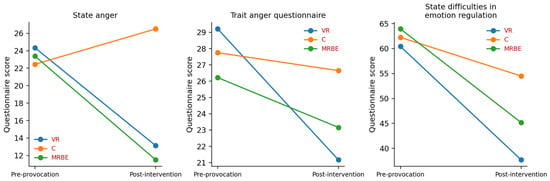
The repeated-measures ANOVA for state anger indicated a significant main effect of group (F(2, 58) = 16.02, p < 0.001, partial η2 = 0.35), that the main effect of time was significant (F(1, 58) = 47.63, p < 0.001, partial η2 = 0.45), and that the time × group interaction was also significant (F(2, 58) = 31.86, p < 0.001, partial η2 = 0.52). According to the Bonferroni-corrected comparison results for the group effect, which yielded significant results, state anger scores differed between the VR group (M = 18.73, SE = 0.86) and the control group (M = 24.47, SE = 0.92) and between the MRBE group (M = 17.44, SE = 0.97) and the control group (M = 24.47, SE = 0.92) in terms of the state anger variable (p < 0.01). According to the Bonferroni-corrected comparison results regarding the time effect, where significant results were again obtained, a statistically significant difference was found in the state anger variable between the pre-test measurement time (M = 23.39, SE = 0.89) and the post-test measurement time (M = 17.04, SE = 0.43) (p < 0.01). Furthermore, according to the Bonferroni-corrected simple effects analysis results, the state anger scores of the VR intervention group and the MRBE group decreased significantly at the post-test measurement time, while the control group’s measurement scores increased significantly (p < 0.05).
The main effect of group on Trait Anger was not significant (F(2, 58) = 2.14, p = 0.12, partial η2 = 0.07), but the main effect of time (F(1, 58) = 36.80, p < 0.001, partial η2 = 0.38) and the time × group interaction were significant (F(2, 58) = 10.23, p < 0.001, partial η2 = 0.26). According to the Bonferroni-corrected comparison results for the time effect, where significant results were obtained, a statistically significant difference was found between the pre-test measurement time (M = 27.73, SE = 0.53) and the post-test measurement time (M = 23.66, SE = 0.68) in terms of the trait anger variable (p < 0.01). However, according to the Bonferroni-corrected simple effects analysis result, while the VR intervention group and the MRBE group showed a significant decrease in trait anger scores at the post-test measurement time (p < 0.05), no significant change was observed in the control group (p > 0.05).
For state-based difficulties in emotion regulation, the main effect of group (F(2, 58) = 4.24, p = 0.01, partial η2 = 0.13), the main effect of time (F(1, 58) = 70.81, p < 0.001, partial η2 = 0.55), and the time × group interaction were found to be significant (F(2, 58) = 5.47, p = 0.007, partial η2 = 0.15). According to the Bonferroni-corrected comparison results for the group effect, where significant results were obtained, statistically significant differences were found only between the VR group (M = 49.06, SE = 2.20) and the control group (M = 58.37, SE = 2.35) in terms of the variable of difficulty in regulating situational emotions (p < 0.05). Again, according to the Bonferroni-corrected comparison results obtained for the time effect, a statistically significant difference was found in the variable of difficulty in situational emotion regulation between the pre-test measurement time (M = 62.21, SE = 1.80) and the post-test measurement time (M = 45.78, SE = 1.52) in terms of the difficulty variable in situational emotion regulation (p < 0.01). However, according to the Bonferroni-corrected simple effects analysis results, a significant decrease was observed in the difficulty scores of situational emotion regulation for all groups at the post-test measurement time (p < 0.05). The results of the relevant analyses are summarized in Table 3 and Figure 3.
Table 3.
Repeated Measures ANOVA Findings Related to Psychological Variables.
Figure 3.
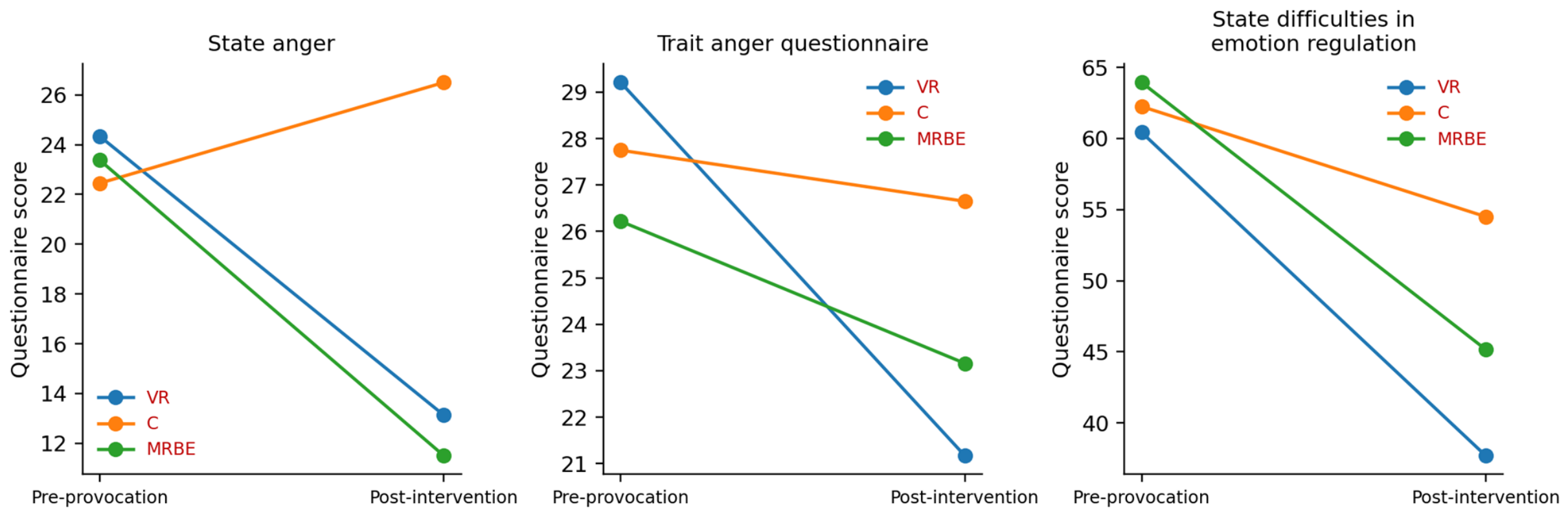
Mean psychological questionnaire scores before provocation and after the assigned condition. VR = Virtual Reality Intervention Group; C = Control Group; MRBE = Muscle Relaxation and Breathing Exercises Group. Trait anger questionnaire changes are immediate score changes, not evidence of durable dispositional change.
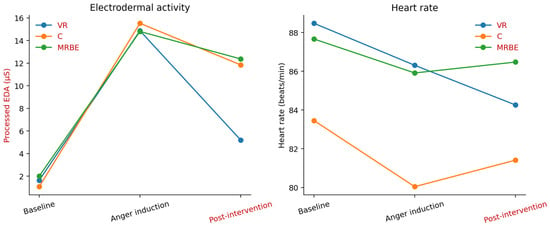
Analysis of EDA summaries showed a significant group × timing effect using Pillai’s trace, V = 0.2024, F(4,116) = 3.266, p = 0.0141. The Greenhouse–Geisser-corrected univariate interaction was also significant, F(3.514,101.897) = 4.692, p = 0.0025, partial η2 = 0.139. The VR mean decreased from 14.866 µS during induction to 5.192 µS during the five-minute post-intervention recording; corresponding means were 15.526 to 11.843 µS in the control and 14.802 to 12.370 µS in the MRBE group. These summary statistics are shown in Table 4 and Figure 4. The absence of a significant VR baseline-versus-post-intervention comparison should not be interpreted as evidence that the two levels are equivalent.
Table 4.
Physiological phase summaries. Values are means (SD); inferential results are reported in Section 3.2.
Figure 4.
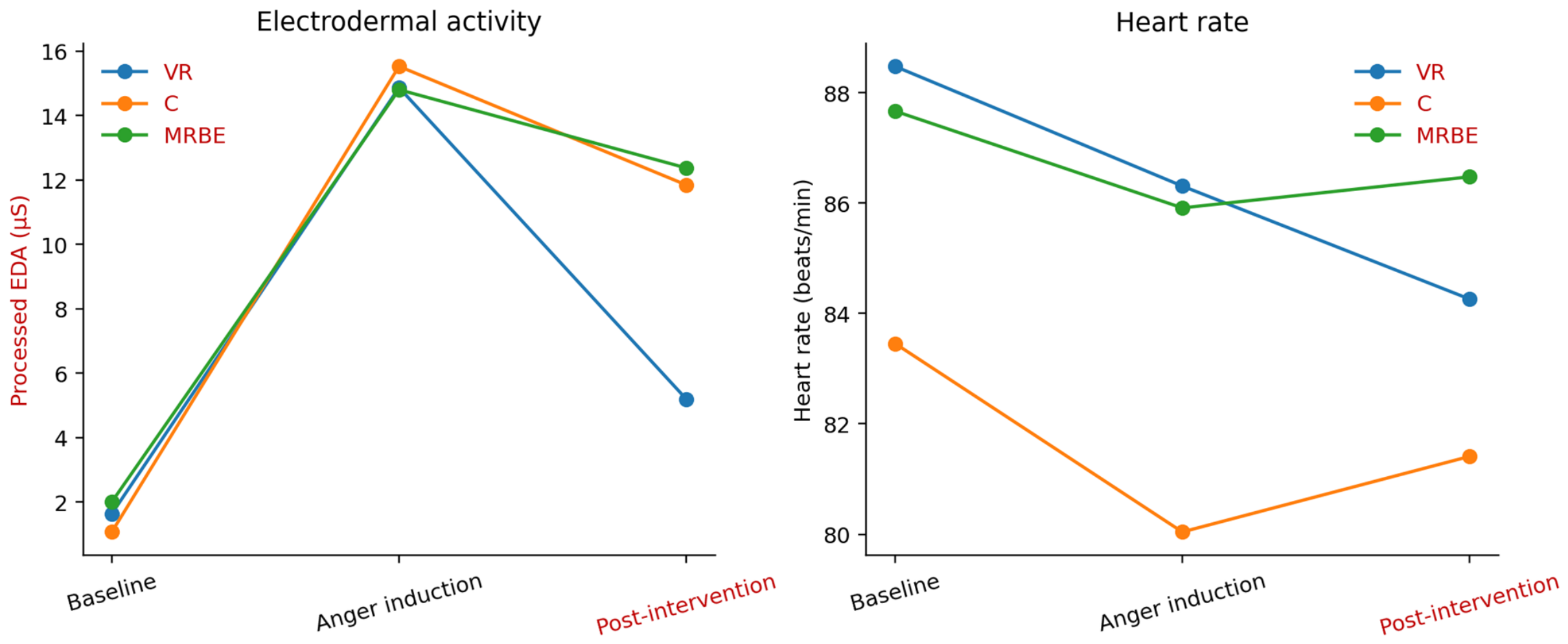
Mean EDA and heart rate at baseline, during anger induction, and during the five-minute post-intervention recording. The final point represents post-intervention physiology, not arousal during the exercises. VR = Virtual Reality Intervention Group; C = Control Group; MRBE = Muscle Relaxation and Breathing Exercises Group. Connecting lines link phase summaries and do not represent continuously sampled trajectories or equal elapsed intervals.
In the baseline-adjusted endpoint ANCOVA, the group effect was significant, F(2,57) = 5.896, p = 0.0047, partial η2 = 0.171, and remained supported using HC3 inference, F(2,57) = 4.393, p = 0.0168. Adjusted post-intervention means at the pooled baseline value of 1.552 µS were 5.052 µS for VR, 12.729 µS for the control and 11.564 µS for MRBE. The VR–control difference was −7.678 µS (HC3 95% CI [−13.117, −2.238]; Holm p = 0.0130), and the VR–MRBE difference was −6.512 µS (95% CI [−11.692, −1.332]; Holm p = 0.0147). The group × baseline interaction was not significant, F(2,55) = 1.702, p = 0.1918 (HC3 p = 0.2751); this does not establish identical slopes. Direct endpoint contrasts are summarized in Table 5.
Table 5.
Baseline-adjusted comparisons of EDA in the five-minute post-intervention recording.
For post-intervention-minus-baseline change, mean changes were 3.563 µS (SD = 9.634) in VR, 10.778 µS (SD = 6.548) in the control and 10.374 µS (SD = 6.535) in the MRBE group. The two VR contrasts remained significant with HC3 inference and Holm adjustment (both adjusted p = 0.0126). For induction-to-post-intervention change, corresponding means were −9.674 µS (SD = 8.449), −3.683 µS (SD = 7.834), and −2.431 µS (SD = 4.555). The VR–control difference in this change was −5.991 µS (95% CI [−11.085, −0.898]; Holm p = 0.0220), and the VR–MRBE difference was −7.243 µS (95% CI [−11.473, −3.013]; Holm p = 0.0023). Adjusting the endpoint for both baseline and induction also supported both comparisons (HC3 Holm p = 0.0173 and 0.0041, respectively).
The VR post-intervention distribution had a median of 4.625 µS, quartiles of −3.319 and 12.025 µS, and a range of −8.723 to 24.624 µS. Negative EDA summaries indicate that mean conductance during the corresponding window was below the participant’s Subject Zero reference. Sample skewness was 0.436, and no post-intervention VR value met the 1.5 × IQR outlier criterion. Removing one VR record at a time left the post-intervention SD between 8.919 and 9.916 µS. Across all 61 single-record leave-one-out ANCOVAs, both VR contrasts retained the same direction and Holm-adjusted p < 0.05. Thus, the group differences were not attributable to one participant.
For heart rate, the group effect was not significant, F(2,58) = 2.025, p = 0.141, partial η2 = 0.065; the timing effect was significant, F(2,116) = 4.700, p = 0.0109, partial η2 = 0.075; and the group × timing interaction was not significant, F(4,116) = 0.806, p = 0.524, partial η2 = 0.027. Heart rate decreased descriptively from baseline to induction in all three groups. Physiological summaries are presented in Table 4 and Figure 4.
4. Discussion
In this study, the effectiveness of a virtual-reality-based intervention on regulating anger was examined by comparing physiological and psychological parameter measurements with those of participants in the standard muscle relaxation-breathing exercise group and the control group.
State anger questionnaire scores decreased from the pre-provocation assessment to the post-intervention assessment in both VR and MRBE groups and increased in the control group. These findings support an association between the active conditions and lower final self-reported anger scores. However, the pre–post interval includes provocation, elapsed time and the assigned condition. Because no state anger questionnaire was obtained immediately after provocation, the self-reported anger scores do not directly quantify recovery from an individually measured subjective anger peak. Attentional redirection toward a calming environment or relaxation-related bodily sensations represents a possible, untested explanation rather than a demonstrated mechanism.
Trait anger questionnaire scores decreased immediately from pretest to posttest in both the VR and MRBE groups. However, these short-term score changes are treated as exploratory and should not be interpreted as modification of a stable anger disposition. Participants may have answered trait items in light of their current affective state, and repeated administration, response expectations or changes in item interpretation may also have contributed. Follow-up over a longer interval is required to assess durable dispositional change.
State-based difficulties in emotion regulation decreased in all groups, including the control group. Redirecting attention away from the provocative context is one possible explanation for the control-group decrease, but this mechanism was not tested. The control condition involved viewing a static book image through a headset and did not match the active groups for structured coping instructions, engagement, or necessarily expectancy and visual comfort. Boredom, frustration or headset discomfort could have contributed to the increase in control-group state anger, but these experiences were not measured and their role cannot be established. Future studies should include a comparator matched for engagement and expectancy as well as duration, and direct measurements of boredom and discomfort.
The additional analyses indicate lower EDA in the VR group during the five-minute post-intervention recording than in MRBE and control groups after adjustment for pre-induction baseline EDA. The induction-to-post-intervention change comparisons support a larger EDA reduction in the VR group. Under the fitted model and the assumption that the supplied summaries are valid and comparable across different timings and groups, the observed resting imbalance in EDA values across the groups does not explain the endpoint differences on its own. Nevertheless, a nonsignificant VR post-intervention-versus-baseline comparison should not be treated as equivalence or complete return to resting levels. EDA reflects electrodermal arousal and does not uniquely identify anger. The EDA comparisons favor VR for this post-intervention physiological endpoint, but do not establish superior regulation of subjective anger or durable changes in trait anger.
The comparatively large VR post-intervention SD reflects a broad distribution rather than one isolated extreme observation. The sample showed modest skewness and no values outside the 1.5 × IQR limits; single-record omission did not eliminate either adjusted VR contrast. Variation in individual responses may contribute to this spread, but its physiological and processing-related sources cannot be separated from phase summaries alone.
The HR findings do not provide clear evidence of statistically significant differential change between conditions. HR declined from baseline to induction in all groups, whereas EDA increased (Figure 4). Lower HR sensitivity alone does not explain this direction of change. Possible contributors may include habituation to the laboratory, prolonged seated waiting, reduced activity, fatigue or boredom, and differences between the timing of the provocative event and the averaging window. These explanations were not directly tested. Physiological measures reflect partially different aspects of responding and need not change in parallel; the absence of a significant HR interaction neither proves no effect nor supports a generalized autonomic benefit of VR.
Both active conditions were associated with reductions in self-reported state anger. VR additionally showed lower baseline-adjusted EDA in the post-intervention recording. This finding is specific to the EDA endpoint and does not establish a general advantage across subjective and physiological outcomes. Retrospective reports collected after all procedures indicated that participants had experienced anger during waiting, but could not reconstruct their momentary anger at intervention onset. Exercise content, prerecorded instructions and duration were matched between VR and MRBE. This supports interpreting the EDA difference in relation to the delivery context, but does not isolate immersion, perceived safety, attention or expectancy as its causal mechanism.
The study was limited to a single session in a relatively small university-student sample and did not include follow-up; generalizability and durability remain uncertain. Trait anger score changes cannot establish dispositional change over this interval. No contemporaneous subjective anger rating was obtained immediately after provocation, and the end-of-study retrospective questions do not replace that assessment. The static-image control may differ from active conditions in engagement, expectancy and comfort. Although exercise content and duration were matched between active conditions, immersion, attention and expectancy were not independently manipulated. Baseline EDA differed between groups; the additional adjusted analyses depend on model assumptions and the validity and comparability of the summaries. Distributional and leave-one-out checks cannot exclude systematic preprocessing effects. Future studies should retain matched exercise content, measure engagement and expectancy, obtain immediate post-provocation anger ratings, document physiological preprocessing, and include follow-up.
5. Conclusions
State anger ratings decreased from pre-provocation to posttest in both active groups. After adjustment for pre-induction baseline EDA, the VR group had lower EDA than the MRBE and control groups during the five minutes immediately after the assigned condition ended. Induction-to-post-intervention change analyses were consistent with the EDA finding. Trait anger questionnaire scores were reassessed within the same session. Follow-up would be needed to assess whether the observed score changes persisted.
Author Contributions
A.Ç. and M.Ş. conceptualized and designed the study and oversaw all data handling. A.Ç., M.A. and U.B. collected behavioral and physiological data, performed preprocessing, and coded observational inputs. A.Ç. and S.B.E. conducted physiological data analysis and statistical analyses. A.Ç., S.B.E. and M.Ş. drafted the manuscript and prepared the figures. All authors have read and agreed to the published version of the manuscript.
Funding
This research received no external funding.
Institutional Review Board Statement
The study was conducted in accordance with the Declaration of Helsinki and approved by the Ethics Committee of Aydın Adnan Menderes University for Social and Human Sciences Research (Approval No. 31906847/050.04.04/09; Decision No. 09/02, dated 1 December 2023).
Informed Consent Statement
Informed consent was obtained from all subjects involved in the study.
Data Availability Statement
The data are not publicly available because of participant confidentiality restrictions. Requests for access may be directed to the corresponding author and will be considered subject to the applicable ethical and consent restrictions.
Conflicts of Interest
The authors declare no conflicts of interest.
References
- Scherer, K.R. The dynamic architecture of emotion: Evidence for the component process model. Cogn. Emot. 2009, 23, 1307–1351. [Google Scholar] [CrossRef] [Scilit]
- Stearns, P.; Stearns, C. Emotionology: Clarifying the history of emotions and emotional standards. Am. Hist. Rev. 1985, 90, 813–836. [Google Scholar] [CrossRef] [Scilit]
- Leavitt, J. Meaning and feeling in the anthropology of emotions. Am. Ethnol. 1996, 23, 514–539. [Google Scholar] [CrossRef] [Scilit]
- Hariri, A.; Holmes, A. Genetics of emotional regulation: The role of the serotonin transporter in neural function. Trends Cogn. Sci. 2006, 10, 182–191. [Google Scholar] [CrossRef] [Scilit] [PubMed]
- Burgdorf, J.; Panksepp, J. The neurobiology of positive emotions. Neurosci. Biobehav. Rev. 2006, 30, 173–187. [Google Scholar] [CrossRef] [Scilit] [PubMed]
- Boelen, P.; Reijntjes, A. Intolerance of uncertainty and social anxiety. J. Anxiety Disord. 2009, 23, 130–135. [Google Scholar] [CrossRef] [Scilit] [PubMed]
- Dolcos, F.; Katsumi, Y.; Moore, M.; Berggren, N.; Dolcos, S. Neural correlates of emotion-attention interactions: From perception, learning, and memory to social cognition, individual differences, and training interventions. Neurosci. Biobehav. Rev. 2020, 108, 559–601. [Google Scholar] [CrossRef] [Scilit] [PubMed]
- Zhuo, L.; Wu, Q.; Le, H.; Li, H.; Zheng, L.; Tao, G. COVID-19-Related Intolerance of Uncertainty and Mental Health among Back-To-School Students in Wuhan: The Moderation Effect of Social Support. Int. J. Environ. Res. Public Health 2021, 18, 981. [Google Scholar] [CrossRef] [Scilit] [PubMed]
- Fischer, A.; Manstead, A.; Zaalberg, R. Social influences on the emotion process. Eur. Rev. Soc. Psychol. 2003, 14, 171–201. [Google Scholar] [CrossRef] [Scilit]
- Fredrickson, B.L. The role of positive emotions in positive psychology: The broaden and-build theory of positive emotions. Am. Psychol. 2001, 56, 218–226. [Google Scholar] [CrossRef] [PubMed]
- Ekman, P. Emotions Revealed: Understanding Faces and Feelings; Weidenfeld & Nicolson: London, UK, 1992. [Google Scholar]
- Izard, C.E. Basic emotions, natural kinds, emotion schemas, and a new paradigm. Perspect. Psychol. Sci. 2007, 2, 260–280. [Google Scholar] [CrossRef] [Scilit] [PubMed]
- Greenberg, L.S. Emotion-Focused Therapy: An Overview. Turk. Psychol. Couns. Guid. J. 2010, 4, 1–12. Available online: https://dergipark.org.tr/en/pub/tpdrd/article/229828 (accessed on 18 November 2026).
- Lazarus, R.S. Progress on a cognitive-motivational-relational theory of emotion. Am. Psychol. 1991, 46, 819–834. [Google Scholar] [CrossRef] [PubMed]
- Nezlek, J.; Vansteelandt, K.; Van Mechelen, I.; Kuppens, P. Appraisal-emotion relationships in daily life. Emotion 2008, 8, 145–150. [Google Scholar] [CrossRef] [Scilit] [PubMed]
- Spielberger, C.D.; Jacobs, G.; Russell, S.; Crane, R.S. Assessment of anger: The state-trait anger scale. In Advances in Personality Assessment; Butcher, J.N., Spielberger, C.D., Eds.; Lawrence Erlbaum Associates: Hillsdale, NJ, USA, 1983; Volume 2, pp. 159–187. [Google Scholar]
- Carver, C.S.; Harmon-Jones, E. Anger is an approach-related affect: Evidence and implications. Psychol. Bull. 2009, 135, 183–204. [Google Scholar] [CrossRef] [Scilit] [PubMed]
- Larsson, J.; Bjureberg, J.; Hesser, H. Anger profiles among individuals seeking treatment for maladaptive anger: Associations with emotion regulation. Clin. Psychol. Psychother. 2023, 30, 599–610. [Google Scholar] [CrossRef] [Scilit] [PubMed]
- Thompson, R.A. Emotional regulation and emotional development. Educ. Psychol. Rev. 1991, 3, 269–307. [Google Scholar] [CrossRef] [Scilit]
- Thompson, R.A. Emotional regulation: A theme in search of definition. Monogr. Soc. Res. Child Dev. 1994, 59, 25–52. [Google Scholar] [CrossRef] [Scilit] [PubMed]
- Gross, J.J. The emerging field of emotion regulation: An integrative review. Rev. General. Psychol. 1998, 2, 271–299. [Google Scholar] [CrossRef]
- Li, P.; Wang, W.; Fan, C.; Zhu, C.-B.; Li, S.; Zhang, Z.; Qi, Z.; Luo, W. Distraction and expressive suppression strategies in regulation of high- and low-intensity negative emotions. Sci. Rep. 2017, 7, 12983. [Google Scholar] [CrossRef] [Scilit] [PubMed]
- Wu, X.; Guo, T.; Tan, T.; Zhang, W.; Qin, S.; Fan, J.; Luo, J. Superior emotional regulating effects of creative cognitive reappraisal. NeuroImage 2019, 200, 540–551. [Google Scholar] [CrossRef] [Scilit] [PubMed]
- Aldao, A.; Nolen-Hoeksema, S.; Schweizer, S. Emotion-regulation strategies across psychopathology: A meta-analytic review. Clin. Psychol. Rev. 2010, 30, 217–237. [Google Scholar] [CrossRef] [Scilit] [PubMed]
- Lavender, J.; Tull, M.; DiLillo, D.; Messman-Moore, T.L.; Gratz, K.L. Development and validation of a state-based measure of emotion dysregulation: The State Difficulties in Emotion Regulation Scale (S-DERS). Assessment 2017, 24, 197–209. [Google Scholar] [CrossRef] [Scilit] [PubMed]
- Koole, S.L.; Veenstra, L. Does emotion regulation occur only inside people’s heads? Toward a situated cognition analysis of emotion-regulatory dynamics. Psychol. Inq. 2015, 26, 61–68. [Google Scholar] [CrossRef] [Scilit]
- Norlander, B.; Eckhardt, C. Anger, hostility, and male perpetrators of intimate partner violence: A meta-analytic review. Clin. Psychol. Rev. 2005, 25, 119–152. [Google Scholar] [CrossRef] [Scilit] [PubMed]
- Baron, K.G.; Smith, T.W.; Butner, J.; Nealey-Moore, J.; Hawkins, M.W.; Uchino, B.N. Hostility, Anger, and Marital Adjustment: Concurrent and Prospective Associations with Psychosocial Vulnerability. J. Behav. Med. 2007, 30, 1–10. [Google Scholar] [CrossRef] [Scilit] [PubMed]
- Hershcovis, M.S.; Turner, N.; Barling, J.; Arnold, K.A.; Dupré, K.E.; Inness, M.; LeBlanc, M.M.; Sivanathan, N. Predicting workplace aggression: A meta-analysis. J. Appl. Psychol. 2007, 92, 228–238. [Google Scholar] [CrossRef] [Scilit] [PubMed]
- Chida, Y.; Steptoe, A. The association of anger and hostility with future coronary heart disease: A meta-analytic review of prospective evidence. J. Am. Coll. Cardiol. 2009, 53, 936–946. [Google Scholar] [PubMed]
- Jacobson, E. Progressive relaxation. Am. J. Psychol. 1987, 100, 522–537. [Google Scholar] [CrossRef] [Scilit] [PubMed]
- Zaccaro, A.; Piarulli, A.; Laurino, M.; Garbella, E.; Menicucci, D.; Neri, B.; Gemignani, A. How Breath-Control Can Change Your Life: A Systematic Review on Psycho Physiological Correlates of Slow Breathing. Front. Hum. Neurosci. 2018, 12, 353. [Google Scholar] [CrossRef] [Scilit] [PubMed]
- Genuth, A.; Drake, J.E. The benefits of drawing to regulate sadness and anger: Distraction versus expression. Psychol. Aesthet. Creat. Arts 2021, 15, 91–99. [Google Scholar] [CrossRef] [Scilit]
- Beames, J.; O’Dean, S.M.; Grisham, J.; Moulds, M.; Denson, T. Anger regulation in interpersonal contexts: Anger experience, aggressive behavior, and cardiovascular reactivity. J. Soc. Personal. Relatsh. 2019, 36, 1441–1458. [Google Scholar] [CrossRef] [Scilit]
- Seebauer, L.; Froß, S.; Dubaschny, L.; Schönberger, M.; Jacob, G. Is it dangerous to fantasize revenge in imagery exercises? J. Behav. Ther. Exp. Psychiatry 2014, 45, 20–25. [Google Scholar] [CrossRef] [Scilit] [PubMed]
- Özer, A.K. Preliminary study of the Trait Anger and Anger Expression Style Scales. Turk. J. Psychol. 1994, 9, 26–35. [Google Scholar]
- Dollard, J.; Doob, L.W.; Miller, N.E.; Mowrer, O.H.; Sears, R.R. Frustration and Aggression; Yale University Press: New Haven, CT, USA, 1939. [Google Scholar]
- Paradiso, S.; Johnson, D.L.; Andreasen, N.C.; O’Leary, D.S.; Watkins, G.L.; Boles Ponto, L.L.; Hichwa, R.D. Cerebral blood flow changes associated with attribution of emotional valence to pleasant, unpleasant, and neutral visual stimuli in a PET study of normal subjects. Am. J. Psychiatry 1999, 156, 1618–1629. [Google Scholar] [CrossRef] [Scilit] [PubMed]
- Kalay, T. Adaptation and Validity Study of Spielberger’s State Anger Scale into Turkish. Master’s Thesis, Bahçeşehir University, Istanbul, Türkiye, 2015. [Google Scholar]
- Gökdağ, C.; Günay, G.; Demir, G. State-based measurement of emotion regulation: The Turkish versions of SERI and S-DERS. Curr. Psychol. 2023, 42, 7182–7196. [Google Scholar] [CrossRef] [Scilit]
- Geisser, S.; Greenhouse, S.W. An extension of Box’s results on the use of the F distribution in multivariate analysis. Ann. Math. Stat. 1958, 29, 885–891. [Google Scholar] [CrossRef] [Scilit]
- Huynh, H.; Feldt, L.S. Estimation of the box correction for degrees of freedom from sample data in the randomized block and split-plot designs. J. Educ. Stat. 1976, 1, 69–82. [Google Scholar] [CrossRef] [Scilit]

Disclaimer/Publisher’s Note: The statements, opinions and data contained in all publications are solely those of the individual author(s) and contributor(s) and not of MDPI and/or the editor(s). MDPI and/or the editor(s) disclaim responsibility for any injury to people or property resulting from any ideas, methods, instructions or products referred to in the content. |
© 2026 by the authors. Licensee MDPI, Basel, Switzerland. This article is an open access article distributed under the terms and conditions of the Creative Commons Attribution (CC BY) license.