


Abstract
Background/Objectives: MR-guided focused ultrasound (MRgFUS) Vim thalamotomy targets medication-refractory tremor in essential tremor (ET) and tremor-dominant Parkinson’s disease (PD). We examined longitudinal patient-reported outcomes alongside early motor changes. Methods: This retrospective cohort included 30 patients (12 ET, 18 PD). PDQ-39, PDQ-8, and EQ-VAS were analyzed using random-intercept mixed models. Multiplicity correction covered 16 visit contrasts, including four contrasts for a secondary. A sensitivity analysis included 11 participants with confirmed pretreatment W1 dates and numeric patient-reported data. Results: The paired motor analysis showed a median 12-point TRS reduction and median individual tremor improvement of 64.7% (n = 23; p < 0.001). Median original UPDRS Part III reductions in PD were 5 points OFF (p = 0.010) and 9 points ON medication (p = 0.004). Patient-reported outcomes were available for 25, 21, and 10 participants at W1, W2, and W3. No categorical-visit contrast met the corrected significance threshold in either the full-cohort or restricted analysis. Conclusions: MRgFUS was followed by substantial early tremor reduction and PD motor-score reductions compatible with clinically meaningful improvement against external benchmarks. This post hoc interpretation provides clinical context for motor change; the patient-reported analyses did not establish a consistent or durable quality-of-life benefit. Safety outcomes were not evaluated in this study.
1. Introduction
Essential tremor (ET) and Parkinson’s disease (PD) are common movement disorders in which tremor may substantially impair eating, drinking, writing, communication, social participation, and other activities of daily living. Contemporary diagnostic frameworks distinguish ET from parkinsonian tremor while recognizing the clinical heterogeneity of both conditions [1,2]. The effect of tremor on patients’ lives is not fully represented by clinician-rated motor severity alone; patient-reported outcome measures are therefore important for treatment selection and shared decision-making.
Disease-specific quality-of-life instruments include the Quality of Life in Essential Tremor Questionnaire (QUEST) for ET and the Parkinson’s Disease Questionnaire (PDQ-39 and PDQ-8) for PD [3,4,5,6]. In PD, health-related quality of life is additionally shaped by bradykinesia, rigidity, gait and axial dysfunction, cognition, mood, sleep, autonomic symptoms, and other non-motor features [7,8]. Consequently, a tremor-focused intervention may produce a different patient-reported trajectory in PD than in ET, even when the magnitude of tremor reduction is comparable.
For medication-refractory tremor, deep brain stimulation and lesioning procedures can both provide clinically meaningful benefit, with different trade-offs regarding invasiveness, adjustability, implanted hardware, and adverse effects [9]. MR-guided focused ultrasound (MRgFUS) has re-established thalamotomy as an incisionless procedure that combines stereotactic targeting, incremental sonication, repeated neurological assessment, and real-time MR thermometry [10,11]. Randomized and prospective studies in ET have demonstrated marked tremor reduction, with follow-up reports extending to five years [11,12,13,14,15]. Sensory symptoms and gait imbalance can persist in a minority of patients, and staged bilateral treatment requires particularly careful safety assessment [16,17].
In tremor-dominant PD, randomized and observational evidence also supports tremor reduction after Vim MRgFUS thalamotomy [18,19], although pooled studies show substantial clinical heterogeneity [20]. Because Vim thalamotomy primarily targets tremor circuitry, it is not expected to address the full spectrum of progressive PD manifestations; alternative focused-ultrasound targets have therefore been studied for broader motor features [21].
Outcome instruments such as EQ-5D and EQ-VAS permit cross-disease descriptions of health status [22,23], but real-world data are complicated by variable assessment schedules and incomplete follow-up. Longitudinal patient-reported outcomes beyond the first post-treatment year remain comparatively under-described in mixed ET and PD clinical programs. The primary objective of this study was therefore to characterize patient-reported outcome trajectories in patients treated with unilateral Vim MRgFUS, using the first recorded patient-reported assessment as the longitudinal reference. A secondary objective was to summarize early changes in tremor and PD motor severity.
2. Materials and Methods
2.1. Study Design and Reporting
This was a retrospective, single-center observational cohort study of consecutive patients treated with unilateral Vim MRgFUS thalamotomy (Model 4000; INSIGHTEC Ltd., Tirat Carmel, Israel)for medication-refractory tremor. All data were generated during routine clinical care and subsequently analyzed in de-identified form. Reporting was prepared in accordance with the Strengthening the Reporting of Observational Studies in Epidemiology (STROBE) statement for cohort studies [24].
2.2. Participants and MRgFUS Procedure
Adults with functionally disabling tremor that remained insufficiently controlled despite pharmacological treatment were eligible if they had a clinical diagnosis of ET or tremor-dominant PD and had relevant routine-care outcome data available. ET was diagnosed by movement-disorder specialists according to the contemporary tremor classification framework [1] and PD according to the Movement Disorder Society clinical diagnostic criteria [2]. Standard clinical contraindications to MRI and MRgFUS were applied.
Patients underwent unilateral MRgFUS Vim thalamotomy under stereotactic MR guidance. Target verification used low-energy test sonications followed by incremental therapeutic sonications, with repeated intra-procedural neurological examinations and real-time MR thermometry to guide lesion creation and limit off-target effects [10,11]. The present analysis did not include imaging-derived lesion location or connectivity metrics.
2.3. Outcomes and Assessment Schedule
Patient-reported outcomes were available at three routine-care visits labeled W1, W2, and W3, with W1 used as the reference for longitudinal analyses. These labels identify visit order rather than uniform intervals from treatment. The motor analysis separately used W0 for the pre-treatment assessment and W1 for the early post-treatment examination; motor W1 and patient-reported W1 therefore denote different assessment schedules. Complete W1-visit and procedure dates were available for 15 participants, in all of whom W1 preceded the procedure by a median of 51 days (IQR 23.5–80.5; range 15–116); 11 of these visits contained at least one numeric patient-reported outcome. Treatment-relative and between-visit timing, with available-data denominators, are reported in Supplementary Table S1.
The main patient-reported analyses focus on PDQ-39, PDQ-8, and EQ-VAS. PDQ scores were analyzed in recorded units, with higher values indicating greater disease-related burden [4,5,6]; their use in ET is exploratory. EQ-VAS ranges from 0 to 100, with higher values indicating better perceived health [22,23]. The recorded QoL/satisfaction sum is retained as a secondary exploratory field in the Supplementary Materials. Its database label refers to EQ-5D, but does not identify a specific questionnaire, item count, or scoring range. The separate EQ-5D-labelled field was extracted unchanged, without summation, recoding, or application of a value set, and is described as the recorded EQ-5D database score. The notation 0–2 in its header does not establish the underlying computation or a verified 0–10 sum. Accordingly, this field is presented descriptively only, without utility interpretation or inferential testing.
The motor analysis used recorded Fahn–Tolosa–Marin Tremor Rating Scale (TRS) scores at W0 and the early post-treatment motor W1 in ET and PD [25]. In PD, original Unified Parkinson’s Disease Rating Scale (UPDRS) part III motor-examination scores (not MDS-UPDRS scores) were summarized in OFF- and ON-medication states [26]. The clinical protocol specified at least 12 h without levodopa and at least 24 h without dopamine agonists and other antiparkinsonian medication before OFF assessment. These intervals describe the clinical OFF protocol; they do not imply complete pharmacological washout of every drug. Baseline dopaminergic treatment was summarized as levodopa equivalent daily dose (LEDD) using established conversion factors [27]. Exact motor-assessment dates, dose-to-ON timing, TRS component/laterality details, and serial medication changes were not available for harmonized reanalysis.
Routine-care fields included categorical cognitive status and total Hospital Anxiety and Depression Scale (HADS) and Apathy Evaluation Scale (AES) entries. HADS and AES totals were available for 22 participants at W1, 21 at W2, and 10 at W3.
2.4. Statistical Analysis
Continuous variables are summarized as median and interquartile range (IQR) or mean and standard deviation (SD), as appropriate; categorical variables are reported as number and percentage. For paired motor outcomes, improvement was defined as baseline minus post-treatment score, so positive values indicate improvement. W0-to-W1 changes in TRS and original UPDRS Part III were evaluated with Wilcoxon signed-rank tests.
Longitudinal patient-reported outcomes were analyzed using linear mixed-effects models with a participant-specific random intercept and fixed effects for visit (W1, W2, W3), diagnosis (ET versus PD), and visit-by-diagnosis interaction, estimated by maximum likelihood [28]. The reanalysis used numeric entries for the 30 coded participants at W1–W3; blanks and nonnumeric markers were treated as missing, while zeros were retained. No source scores were altered or imputed. Within-diagnosis contrasts compared W2 and W3 with W1. After excluding EQ-5D from inference, Benjamini–Hochberg FDR correction was applied jointly across 16 contrasts: four outcomes, two diagnoses, and two follow-up comparisons [29]. This family includes the 12 PDQ-39, PDQ-8, and EQ-VAS contrasts in Table 4 and the four secondary satisfaction-score contrasts in Supplementary Table S12. This reporting change was made during review; Table S12 also gives the previous 20-comparison q-values. Confidence intervals and p-values use asymptotic Wald inference without a small-sample correction; confidence intervals are not multiplicity-adjusted. Diagnostics and interaction estimates appear in Supplementary Tables S5 and S6, and the data reconciliation is documented in Table S11.
Participants with and without W3 outcomes were compared descriptively using available initial characteristics and W1 values. Continuous-time sensitivity models replaced categorical visit with elapsed time from the patient-reported W1 date, including a time-by-diagnosis interaction; slopes are expressed per year. One scenario used complete stored dates; another assigned day 15 to explicit month–year entries. FDR correction covered eight diagnosis-specific slopes within each scenario. The requested pretreatment sensitivity analysis used the categorical-visit model in participants with a complete W1 date preceding a complete procedure date and at least one numeric W1 patient-reported outcome. No dates were imputed for eligibility, and the same 16-contrast FDR family was used. Outcome-specific counts distinguish available observations from complete pairs. Available-case mixed models assume data are missing at random conditional on the model; the sensitivity analyses cannot establish this assumption. Deterministic missing-W3 scenarios for the secondary satisfaction field are described in the Supplementary Materials. Analyses used Python 3.13.5, NumPy 2.3.5, pandas 2.2.3, and SciPy 1.17.0; implementation details and versions are reported in the Supplementary Materials. Tests were two-sided.
Post hoc complete-pair analyses described W1–W2 and W1–W3 changes in the four retained outcomes in ET, PD, and the pooled cohort. Favorable numerical change was defined as follow-up minus W1 for EQ-VAS and the recorded satisfaction score, and W1 minus follow-up for PDQ scores. Paired mean changes with unadjusted t-based 95% confidence intervals, medians and IQRs, and directional proportions with exact binomial intervals were reported. Two-sided signed-rank p-values used the exact sign-permutation distribution of nonzero absolute-change midranks, retaining ties; the test assumes symmetry under the null. FDR correction covered 24 comparisons (four outcomes × three groups × two intervals), separately from the categorical-visit family. Pooled and subgroup results overlap and are exploratory. Any favorable numerical change was not treated as a validated clinically important response.
3. Results
3.1. Cohort Characteristics and Follow-Up
The cohort comprised 30 patients: 12 with ET and 18 with tremor-dominant PD. Median age was 68.0 years (IQR 61.0–74.0), 11 participants (36.7%) were female, and median disease duration was 10.0 years (IQR 5.0–20.8). Baseline characteristics are summarized in Table 1.
Table 1.
Baseline characteristics of the study cohort.
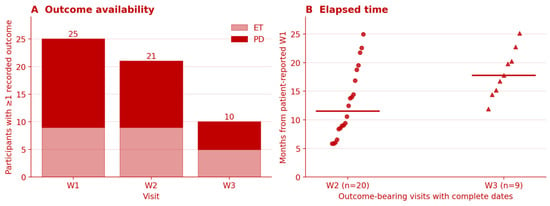
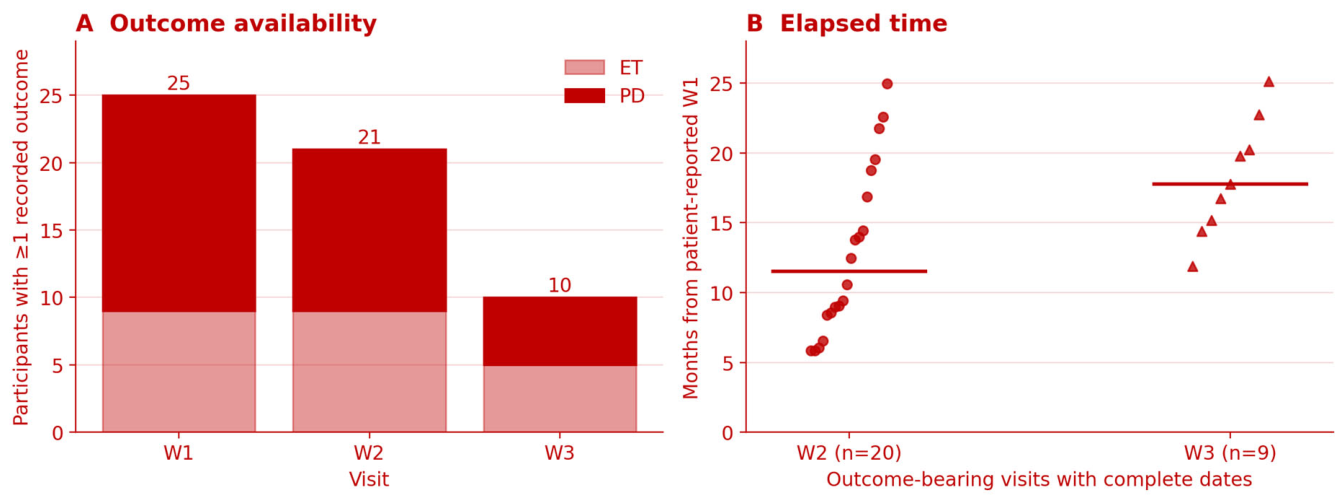
At least one of PDQ-39, PDQ-8, or EQ-VAS was available for 25 participants at W1 (9 ET, 16 PD), 21 at W2 (9 ET, 12 PD), and 10 at W3 (5 ET, 5 PD) (Figure 1A). Outcome-specific denominators are provided in Table 3. Among visits with an outcome and complete reference/follow-up dates, the median W1-to-W2 interval was 11.5 months (IQR 8.5–17.4; range 5.8–25.0; n = 20), and the median W1-to-W3 interval was 17.8 months (IQR 15.2–20.2; range 11.9–25.1; n = 9) (Figure 1B).
Figure 1.
Patient-reported data availability and elapsed assessment time. (A) Participants with at least one of PDQ-39, PDQ-8, or EQ-VAS at each visit, stratified by diagnosis. (B) Time from the patient-reported W1 reference to W2 or W3 among visits with an observed outcome and complete dates for both visits (n = 20 and n = 9, respectively). Time is relative to W1. Explicit month-only dates are excluded from (B).
3.2. Tremor and Motor Outcomes
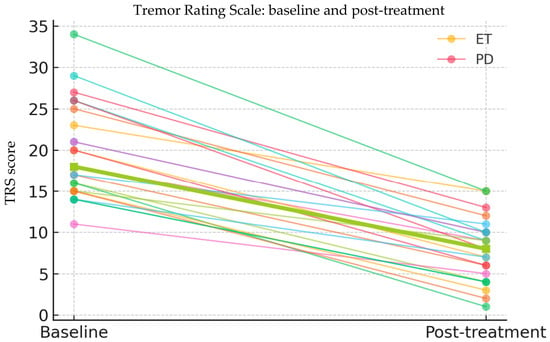
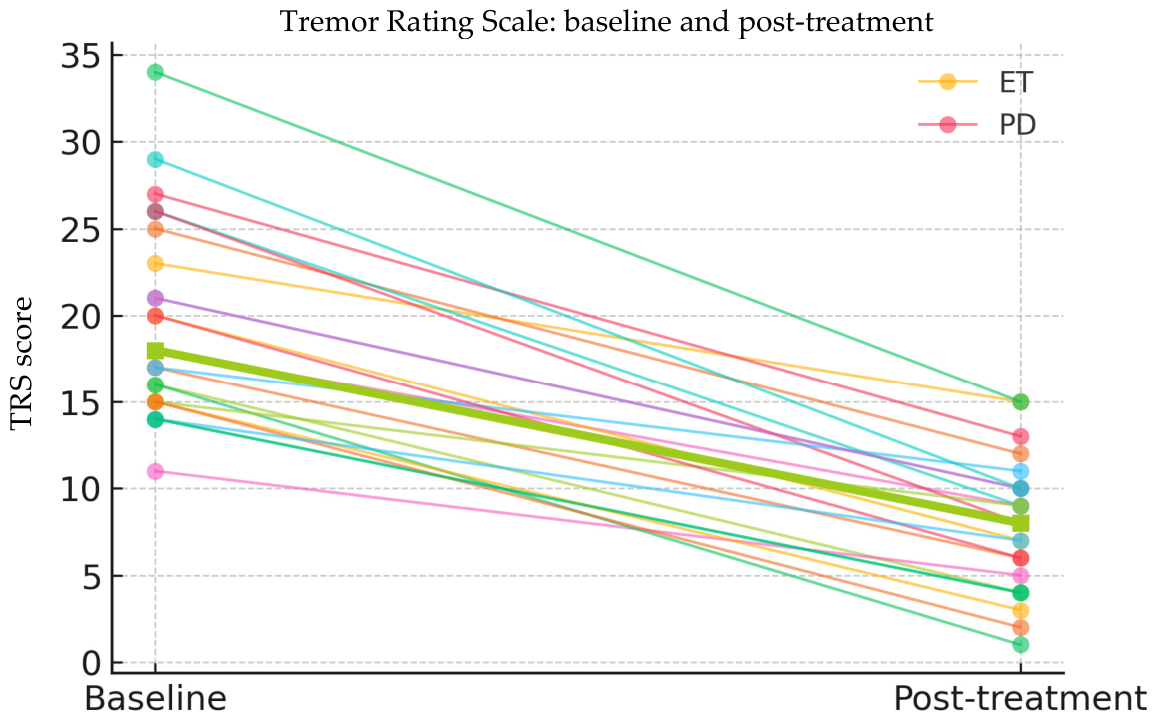
Paired TRS data were available for 23 participants. Overall, the median TRS score decreased from 18.0 (IQR 15.0–24.0) at W0 to 8.0 (IQR 4.5–10.0) at W1, corresponding to a median 64.7% improvement (p < 0.001). Improvement was observed in both ET and PD (Table 2; Figure 2).
Table 2.
Paired clinician-rated outcomes from pre-treatment (W0) to early post-treatment assessment (W1).
Figure 2.
Tremor Rating Scale scores before and after MRgFUS in the motor analysis. Lines connect paired W0 and motor W1 observations; the thick line summarizes the overall median.
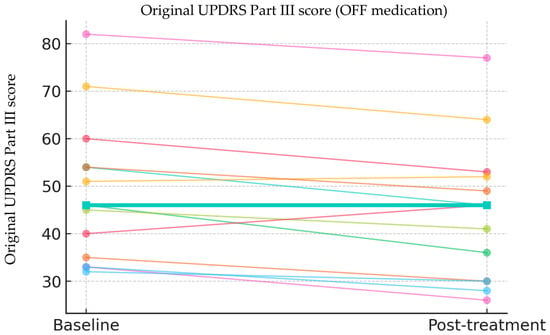
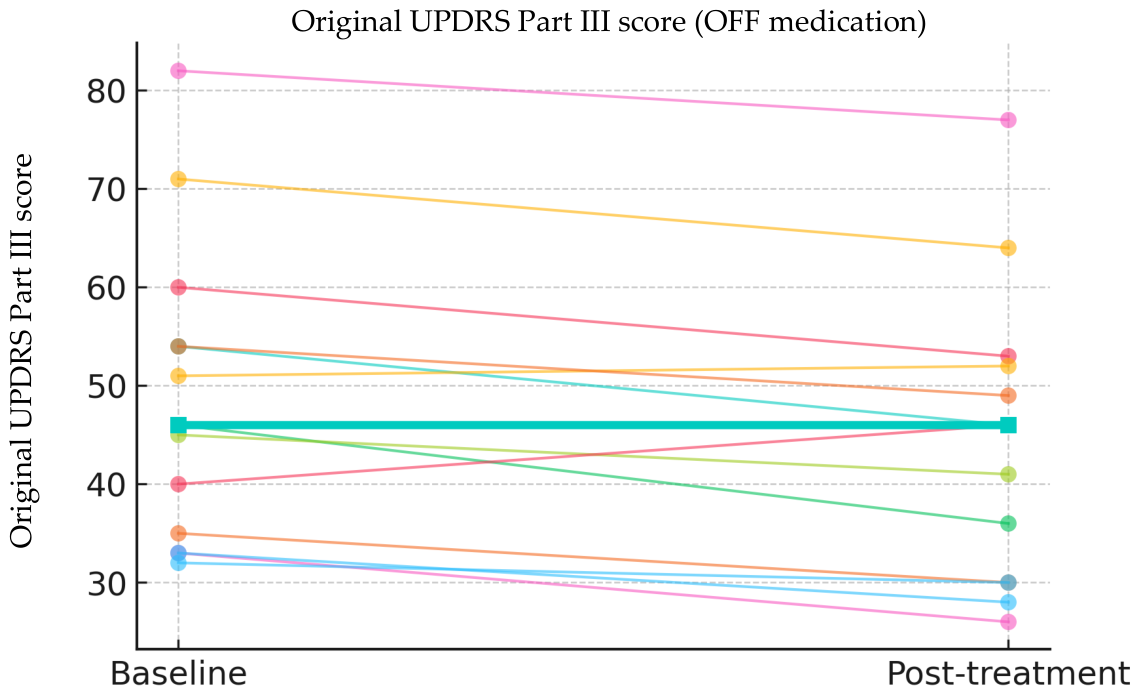
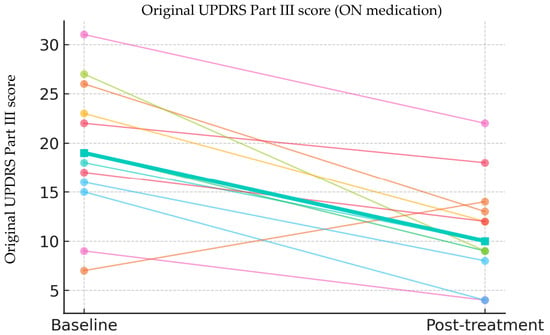
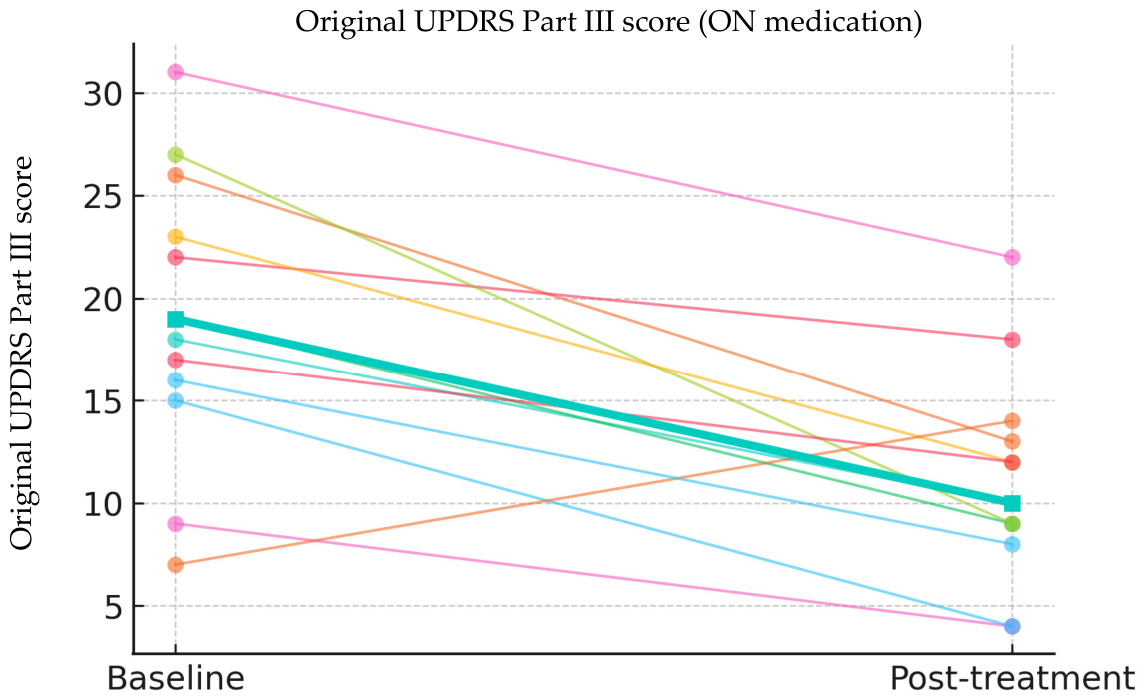
In the PD subgroup with paired original UPDRS Part III data (n = 13), the median within-person improvement was 5.0 points in the OFF-medication state (p = 0.010) and 9.0 points in the ON-medication state (p = 0.004) (Table 2; Figure 3 and Figure 4). Although the group medians for original UPDRS Part III OFF were both 46.0, the positive paired median improvement reflects within-person changes and the distribution of paired differences rather than a difference between unpaired group summaries.
Figure 3.
Original UPDRS Part III motor-examination scores in the OFF-medication state before and after MRgFUS in the PD subgroup. Lines connect paired observations from the same participant.
Figure 4.
Original UPDRS Part III motor-examination scores in the ON-medication state before and after MRgFUS in the PD subgroup. Lines connect paired observations from the same participant.
3.3. Descriptive Patient-Reported Outcomes
PDQ-39, PDQ-8, and EQ-VAS showed heterogeneous visit-specific patterns (Table 3). These summaries involve different available participants and are not estimates of within-person change. Five participants in each diagnostic group contributed W3 outcomes. Table 3 also includes the descriptive EQ-5D database score; the secondary satisfaction-score summaries appear in Supplementary Table S12.
Table 3.
Descriptive patient-reported outcomes by visit and diagnosis.
3.4. Longitudinal Mixed-Effects Models
None of the 16 categorical-visit contrasts met the FDR threshold (all q ≥ 0.098). Table 4 presents the 12 PDQ-39, PDQ-8, and EQ-VAS contrasts (all q ≥ 0.148); Supplementary Table S12 presents the four secondary satisfaction-score contrasts using the same joint correction.
Table 4.
Within-diagnosis contrasts from linear mixed-effects models.
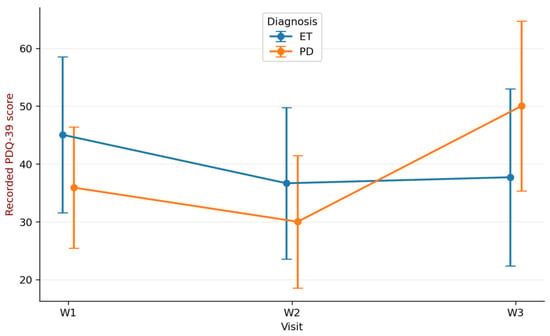
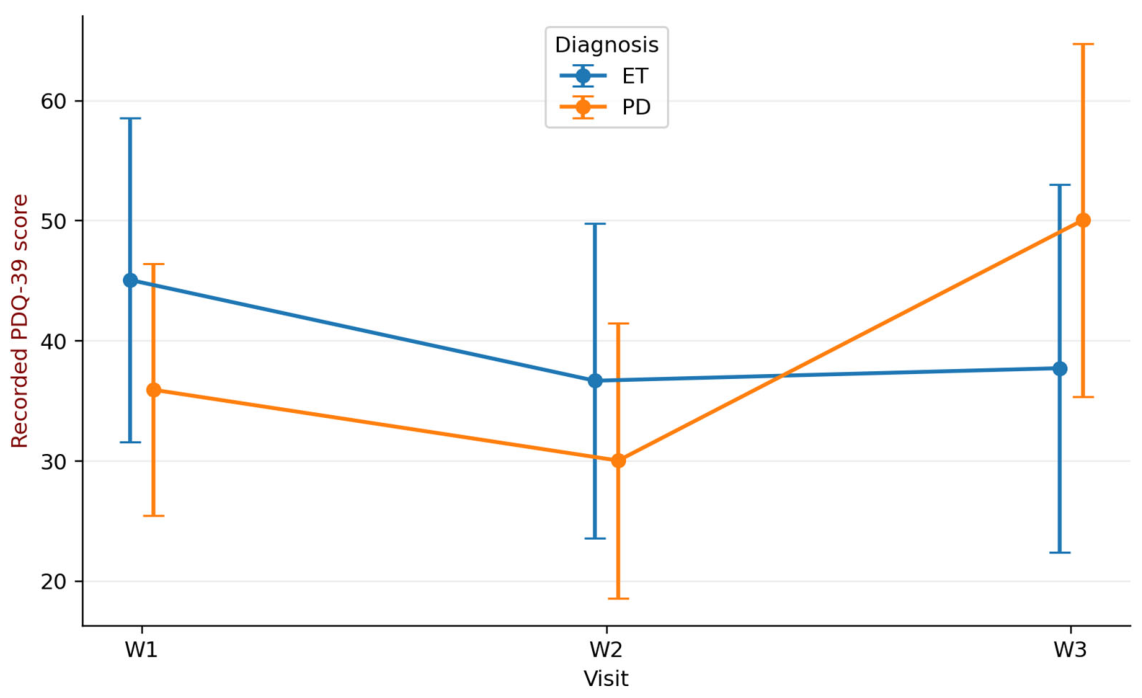
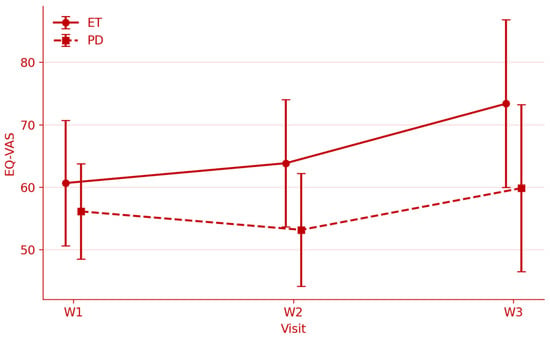
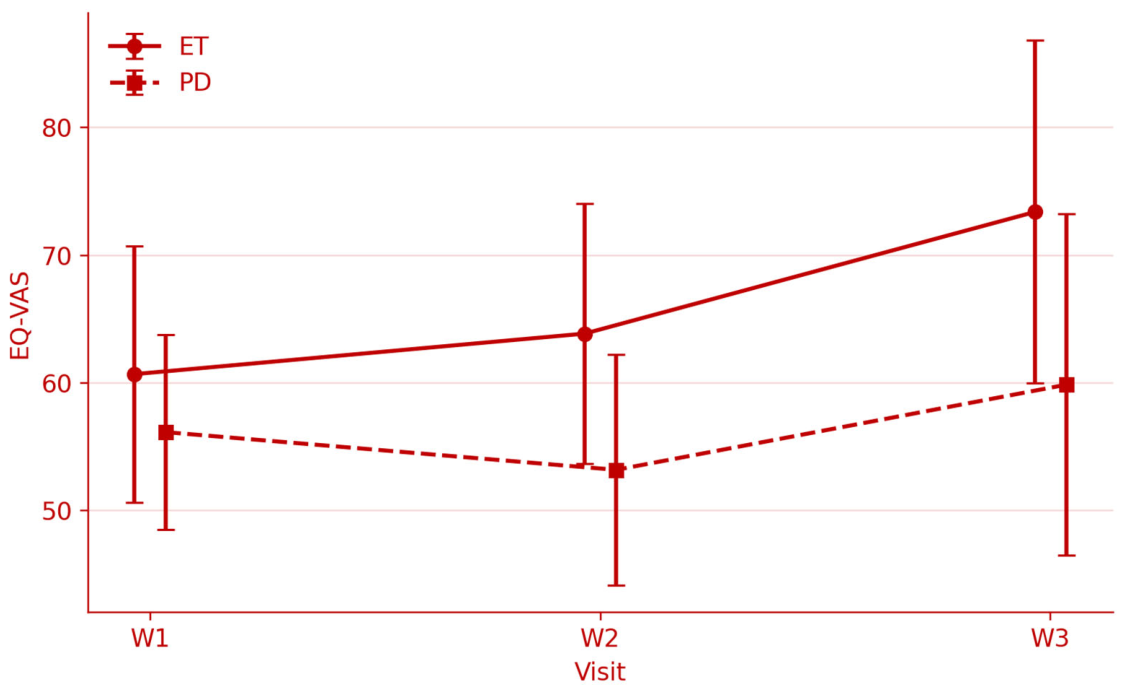
Estimates varied across diagnosis and visit. The PD PDQ-39 W3 estimate was +14.13 recorded units (95% CI 1.06 to 27.19; q = 0.148), indicating greater recorded burden, but did not meet the corrected significance threshold. Joint visit-by-diagnosis tests did not identify an interaction at the nominal 0.05 level. Estimated marginal means for PDQ-39 and EQ-VAS appear in Figure 5 and Figure 6; full interaction estimates and diagnostics are provided in Supplementary Tables S5 and S6.
Figure 5.
Model-estimated marginal means for recorded PDQ-39 scores across W1–W3, with unadjusted asymptotic 95% confidence intervals. Higher values indicate greater burden.
Figure 6.
Model-estimated marginal means for EQ-VAS across W1–W3, with unadjusted asymptotic 95% confidence intervals. Higher values indicate better perceived health.
3.5. Assessment Timing and Sensitivity Analyses
The confirmed-pretreatment analysis included 11 participants (3 ET, 8 PD) with numeric W1 patient-reported data. Available follow-up visits in this subset occurred after treatment. No contrast met the 16-comparison FDR threshold. PDQ estimate directions were preserved; the ET EQ-VAS W3 estimate changed from +12.70 to −4.64 recorded units. Satisfaction-score estimates remained positive, but their magnitudes were not uniformly preserved: ET W2 attenuated from +9.21 to +1.56 units, whereas ET W3 and PD W2/W3 estimates were +13.05, +6.27, and +5.50 units, respectively. All four restricted satisfaction-score confidence intervals included zero, and only one ET participant contributed W3 data. Supplementary Table S10 presents the full and restricted estimates, confidence intervals, and outcome-specific counts.
Participants with W3 outcomes (n = 10) were descriptively younger than those without W3 outcomes (median 64.0 versus 71.0 years) and had longer disease duration (17.5 versus 7.5 years; Supplementary Table S2). No continuous-time PDQ or EQ-VAS slope met the corrected threshold in either dating scenario. The secondary satisfaction result in ET depended on date assumptions: q = 0.067 using complete stored dates and q = 0.021 when explicit month–year entries were assigned day 15. Both scenarios are reported in Supplementary Tables S3 and S4. Missing-W3 scenarios and complete-pair descriptions appear in Supplementary Tables S7–S9.
4. Discussion
4.1. Principal Findings
This real-world cohort showed substantial early tremor reduction after unilateral Vim MRgFUS. Median individual TRS improvement was 64.7%, and median original UPDRS Part III reductions in PD were 5 points OFF and 9 points ON medication. These magnitudes are compatible with clinically meaningful motor improvement in the context of published benchmarks. The categorical-visit patient-reported analyses did not meet the FDR threshold, and the pretreatment-restricted estimates were imprecise. The motor and patient-reported measures capture different outcomes over different assessment schedules; their findings do not establish a motor–quality-of-life dissociation.
4.2. Motor Outcomes in the Context of Previous Evidence
The magnitude and direction of TRS change are consistent with randomized and prospective studies demonstrating substantial tremor reduction after unilateral MRgFUS thalamotomy in ET [11,12]. Longer-term cohorts show that benefit can persist for several years, although some attenuation and persistent sensory or gait adverse effects have been reported [13,14,15,16]. The comparable reduction observed in the PD subgroup is also consistent with randomized and observational evidence in tremor-dominant PD [18,19,20].
In a post hoc comparison, median reductions of 5 points OFF and 9 points ON medication meet or exceed the 5-point change proposed for the original UPDRS Part III motor examination by Schrag et al. in de novo PD [30]. Shulman et al. estimated motor-score differences of 2.5 points for minimal and 5.2 points for moderate clinical importance for the same original Part III scale [31]. These benchmarks provide context for the magnitude of the observed motor changes, rather than an individual responder classification. A benchmark-based interpretation of ON-state motor change was also used in the randomized trial by Bond et al. [18]. The median individual TRS reduction was substantial; no component-specific TRS responder threshold is assigned here.
Vim lesioning acts on a tremor-related node within cerebello-thalamo-cortical circuitry rather than on the full pathophysiology of PD. This target specificity helps explain why tremor reduction may coexist with continued burden from bradykinesia, rigidity, axial dysfunction, and non-motor symptoms. Studies of focused-ultrasound subthalamotomy similarly underscore that the clinical scope of benefit depends on the selected target [21].
4.3. Interpretation of Patient-Reported Outcomes
The secondary satisfaction-score estimates were positive in both diagnostic groups, including after restriction to confirmed pretreatment assessments. Their magnitude varied, particularly for ET at W2, and the restricted confidence intervals included zero. These exploratory observations complement the main patient-reported analyses and warrant further evaluation with clearly specified instruments and synchronized assessments.
PDQ instruments summarize dimensions of PD that are not directly targeted by Vim thalamotomy, and quality of life in PD is influenced by non-tremor motor and non-motor burden [7,8]. A targeted tremor benefit need not produce parallel changes across every broad health-status instrument. This is a plausible clinical explanation, not a mechanism demonstrated by the present cohort. PDQ findings in ET remain exploratory, and the absence of QUEST limits ET-specific quality-of-life interpretation [3,4,5,6].
Non-motor symptoms warrant consideration when interpreting patient-reported trajectories. Longitudinal PD research links sleep/fatigue, mood/apathy, and attention/memory symptoms with changes in quality of life [8]. Following focused ultrasound thalamotomy in tremor-dominant PD, Sperling et al. found that non-motor symptoms and activities of daily living were more closely associated with quality of life than tremor severity [32]. Exploratory resting-state MRI work by Alfano et al. identified depression-associated differences involving default-mode and prefrontal connectivity in PD and frontotemporal dementia [33]. These observations support systematic mood and cognitive assessment in future cohorts; they do not establish a Vim-specific mechanism or show that these factors explain the present findings, because corresponding explanatory analyses and connectivity measurements were unavailable.
The confirmed-pretreatment analysis addresses uncertainty in the patient-reported reference within the 11 eligible participants. For the full cohort, W2–W1 and W3–W1 remain changes from the first recorded assessment; documented pretreatment timing in the subset does not establish that timing for the remaining participants. Future studies should obtain patient-reported and clinician-rated outcomes at the same pretreatment baseline and predefined follow-up intervals.
4.4. Scope of Motor and Network Interpretation
The motor findings concern early tremor and motor-score improvement. Exact ON-assessment conditions and serial medication exposure could not be harmonized from the export, so medication-related contributions to the ON-state changes cannot be separated fully. Motor and patient-reported change intervals also could not be consistently linked for correlation analysis. The reported clinical OFF protocol is described in Section 2.3.
Lesion location and connectivity influence both tremor benefit and adverse effects after MRgFUS [34]. Functional-network studies indicate that thalamotomy can reorganize distributed tremor circuitry [35], and large lesion-mapping datasets have refined candidate efficacy and avoidance zones [36]. Imaging-derived lesion and connectivity measures were unavailable in the present cohort, precluding analysis of whether network engagement explained variation in motor or patient-reported outcomes.
4.5. Strengths and Limitations
Strengths include the inclusion of consecutive patients from routine practice, parallel ET and tremor-dominant PD cohorts, longitudinal observation extending to approximately two years in a subset, reported paired clinician-rated outcomes, mixed-effects models using available patient-reported observations, and multiplicity correction. Additional analyses provide outcome-specific denominators, documented assessment timing, W3-availability comparisons, a confirmed-pretreatment sensitivity analysis, and assessments of elapsed time and missingness assumptions.
The retrospective, uncontrolled, unblinded design limits causal attribution and cannot exclude expectation effects. Interpretation against external original UPDRS Part III benchmarks was post hoc and not prespecified; these thresholds derive from different PD populations and are not MRgFUS-specific responder criteria. W3 observations were sparse, follow-up may be selective, and variable visit intervals complicate longitudinal interpretation. The confirmed-pretreatment subset contained 11 participants, with one ET W3 observation, and model inference used asymptotic Wald estimates. Measurement considerations include exploratory PDQ use in ET, analysis in recorded PDQ units rather than verified standardized indices, and the secondary or descriptive status assigned to the satisfaction and EQ-5D fields. The provenance account distinguishes the reproduced patient-reported analyses from the reported motor summaries (Supplementary Table S11). Medication-related and imaging explanations were outside the harmonized analysis. Safety outcomes were not evaluated; absence of systematic safety records must not be interpreted as absence of complications.
4.6. Implications for Future Studies
Prospective registries and controlled studies should combine a synchronized pre-treatment baseline with prespecified short-, medium-, and long-term visits; use QUEST in ET and PDQ-39 or PDQ-8 together with validated non-motor measures in PD; report preference-weighted EQ-5D values when health-economic interpretation is intended; systematically capture adverse events and medication changes; and integrate lesion localization and connectomic measures. Prespecified clinically important differences and retention strategies will be essential for translating statistical trajectories into patient-centered counseling.
5. Conclusions
Unilateral Vim MRgFUS thalamotomy was followed by substantial early tremor reduction and original UPDRS Part III score reductions in PD. The observed motor changes are compatible with clinically meaningful improvement against external benchmarks, interpreted post hoc. Patient-reported analyses did not establish a consistent or durable quality-of-life benefit. Safety outcomes were not evaluated in this study. Prospective studies using validated instruments, synchronized assessments, and complete follow-up are needed to establish the extent and persistence of patient-reported benefit.
Supplementary Materials
The following supporting information can be downloaded at https://www.mdpi.com/article/10.3390/brainsci16111210/s1, Tables S1–S12 provide assessment timing, W3-availability comparisons, continuous-time analyses, model diagnostics and interaction estimates, missingness scenarios, complete-pair changes and directional proportions, the confirmed-pretreatment sensitivity analysis, data-provenance documentation, and secondary satisfaction-score results with comparison of multiplicity corrections.
Author Contributions
Conceptualization, S.S., M.Z. and D.K.; methodology, S.S., O.S., M.Z. and D.K.; investigation, S.S., O.S., M.R., P.G., A.K., M.B., Ł.M. and M.F.; resources, M.Z. and D.K.; data curation, O.S., A.K., M.B., Ł.M. and M.F.; formal analysis, S.S. and O.S.; visualization, S.S. and O.S.; writing—original draft preparation, S.S. and O.S.; writing—review and editing, all authors; supervision, M.Z. and D.K.; project administration, S.S. All authors have read and agreed to the published version of the manuscript.
Funding
This research received no external funding.
Institutional Review Board Statement
The Bioethics Committee at the Medical University of Warsaw acknowledged the information concerning this retrospective study on 8 June 2026 (statement No. AKBE/198/2026). The Committee stated that the study did not constitute a medical experiment under Article 21(1) of the Polish Act of 5 December 1996 on the Professions of Physician and Dentist and therefore did not require an opinion of the Bioethics Committee pursuant to Article 29 of that Act.
Informed Consent Statement
This retrospective analysis used de-identified data collected during routine clinical care and involved no research-specific procedures. Additional study-specific written informed consent was not required.
Data Availability Statement
The participant-level dataset is not publicly available because it derives from clinical medical records and contains sensitive health information subject to institutional governance and applicable data-protection requirements. A suitably de-identified dataset may be made available by the corresponding author upon reasonable scientific request, subject to approval by the institutional data controller and, where applicable, execution of an appropriate data-use agreement.
Conflicts of Interest
The authors declare no conflicts of interest.
References
- Bhatia, K.P.; Bain, P.; Bajaj, N.; Elble, R.J.; Hallett, M.; Louis, E.D.; Raethjen, J.; Stamelou, M.; Testa, C.M.; Deuschl, G.; et al. Consensus Statement on the Classification of Tremors, from the Task Force on Tremor of the International Parkinson and Movement Disorder Society. Mov. Disord. 2018, 33, 75–87. [Google Scholar] [CrossRef] [Scilit] [PubMed]
- Postuma, R.B.; Berg, D.; Stern, M.; Poewe, W.; Olanow, C.W.; Oertel, W.; Obeso, J.; Marek, K.; Litvan, I.; Lang, A.E.; et al. MDS Clinical Diagnostic Criteria for Parkinson’s Disease. Mov. Disord. 2015, 30, 1591–1601. [Google Scholar] [CrossRef] [Scilit] [PubMed]
- Tröster, A.I.; Pahwa, R.; Fields, J.A.; Tanner, C.M.; Lyons, K.E. Quality of Life in Essential Tremor Questionnaire (QUEST): Development and Initial Validation. Park. Relat. Disord. 2005, 11, 367–373. [Google Scholar] [CrossRef] [Scilit] [PubMed]
- Peto, V.; Jenkinson, C.; Fitzpatrick, R.; Greenhall, R. The Development and Validation of a Short Measure of Functioning and Well Being for Individuals with Parkinson’s Disease. Qual. Life Res. 1995, 4, 241–248. [Google Scholar] [CrossRef] [Scilit] [PubMed]
- Jenkinson, C.; Fitzpatrick, R.; Peto, V.; Greenhall, R.; Hyman, N. The Parkinson’s Disease Questionnaire (PDQ-39): Development and Validation of a Parkinson’s disease Summary Index Score. Age Ageing 1997, 26, 353–357. [Google Scholar] [CrossRef] [Scilit] [PubMed]
- Jenkinson, C.; Fitzpatrick, R.; Peto, V.; Greenhall, R.; Hyman, N. The PDQ-8: Development and Validation of a Short-Form Parkinson’s Disease Questionnaire. Psychol. Health 1997, 12, 805–814. [Google Scholar] [CrossRef] [Scilit]
- Martinez-Martin, P.; Rodriguez-Blazquez, C.; Kurtis, M.M.; Chaudhuri, K.R.; NMSS Validation Group. The Impact of Non-Motor Symptoms on Health-Related Quality of Life of Patients with Parkinson’s Disease. Mov. Disord. 2011, 26, 399–406. [Google Scholar] [CrossRef] [Scilit] [PubMed]
- Prakash, K.M.; Nadkarni, N.V.; Lye, W.-K.; Yong, M.-H.; Tan, E.-K. The Impact of Non-Motor Symptoms on the Quality of Life of Parkinson’s Disease Patients: A Longitudinal Study. Eur. J. Neurol. 2016, 23, 854–860. [Google Scholar] [CrossRef] [Scilit] [PubMed]
- Schuurman, P.R.; Bosch, D.A.; Bossuyt, P.M.; Bonsel, G.J.; van Someren, E.J.; de Bie, R.M.; Merkus, M.P.; Speelman, J.D. A Comparison of Continuous Thalamic Stimulation and Thalamotomy for Suppression of Severe Tremor. N. Engl. J. Med. 2000, 342, 461–468. [Google Scholar] [CrossRef] [Scilit] [PubMed]
- Lipsman, N.; Schwartz, M.L.; Huang, Y.; Lee, L.; Sankar, T.; Chapman, M.; Hynynen, K.; Lozano, A.M. MR-Guided Focused Ultrasound Thalamotomy for Essential Tremor: A Proof-of-Concept Study. Lancet Neurol. 2013, 12, 462–468. [Google Scholar] [CrossRef] [Scilit] [PubMed]
- Elias, W.J.; Lipsman, N.; Ondo, W.G.; Ghanouni, P.; Kim, Y.G.; Lee, W.; Schwartz, M.; Hynynen, K.; Lozano, A.M.; Shah, B.B.; et al. A Randomized Trial of Focused Ultrasound Thalamotomy for Essential Tremor. N. Engl. J. Med. 2016, 375, 730–739. [Google Scholar] [CrossRef] [Scilit] [PubMed]
- Chang, J.W.; Park, C.K.; Lipsman, N.; Schwartz, M.L.; Ghanouni, P.; Henderson, J.M.; Gwinn, R.; Witt, J.; Tierney, T.S.; Cosgrove, G.R.; et al. A Prospective Trial of Magnetic Resonance-Guided Focused Ultrasound Thalamotomy for Essential Tremor: Results at the 2-Year Follow-Up. Ann. Neurol. 2018, 83, 107–114. [Google Scholar] [CrossRef] [Scilit] [PubMed]
- Halpern, C.H.; Santini, V.; Lipsman, N.; Lozano, A.M.; Schwartz, M.L.; Shah, B.B.; Elias, W.J.; Cosgrove, G.R.; Hayes, M.T.; McDannold, N.; et al. Three-Year Follow-Up of Prospective Trial of Focused Ultrasound Thalamotomy for Essential Tremor. Neurology 2019, 93, e2284–e2293. [Google Scholar] [CrossRef] [Scilit] [PubMed]
- Park, Y.-S.; Jung, N.Y.; Na, Y.C.; Chang, J.W. Four-Year Follow-Up Results of Magnetic Resonance-Guided Focused Ultrasound Thalamotomy for Essential Tremor. Mov. Disord. 2019, 34, 727–734. [Google Scholar] [CrossRef] [Scilit] [PubMed]
- Cosgrove, G.R.; Lipsman, N.; Lozano, A.M.; Chang, J.W.; Halpern, C.; Ghanouni, P.; Eisenberg, H.; Fishman, P.; Taira, T.; Schwartz, M.L.; et al. Magnetic Resonance Imaging-Guided Focused Ultrasound Thalamotomy for Essential Tremor: 5-Year Follow-Up Results. J. Neurosurg. 2023, 138, 1028–1033. [Google Scholar] [CrossRef] [Scilit] [PubMed]
- Fishman, P.S.; Elias, W.J.; Ghanouni, P.; Gwinn, R.; Lipsman, N.; Schwartz, M.; Chang, J.W.; Taira, T.; Krishna, V.; Rezai, A.; et al. Neurological Adverse Event Profile of Magnetic Resonance Imaging-Guided Focused Ultrasound Thalamotomy for Essential Tremor. Mov. Disord. 2018, 33, 843–847. [Google Scholar] [CrossRef] [Scilit] [PubMed]
- Kaplitt, M.G.; Krishna, V.; Eisenberg, H.M.; Elias, W.J.; Ghanouni, P.; Baltuch, G.H.; Rezai, A.; Halpern, C.H.; Dalm, B.; Fishman, P.S.; et al. Safety and Efficacy of Staged, Bilateral Focused Ultrasound Thalamotomy in Essential Tremor: An Open-Label Clinical Trial. JAMA Neurol. 2024, 81, 939–946. [Google Scholar] [CrossRef] [Scilit] [PubMed]
- Bond, A.E.; Shah, B.B.; Huss, D.S.; Dallapiazza, R.F.; Warren, A.; Harrison, M.B.; Sperling, S.A.; Wang, X.-Q.; Gwinn, R.; Witt, J.; et al. Safety and Efficacy of Focused Ultrasound Thalamotomy for Patients with Medication-Refractory, Tremor-Dominant Parkinson Disease: A Randomized Clinical Trial. JAMA Neurol. 2017, 74, 1412–1418. [Google Scholar] [CrossRef] [Scilit] [PubMed]
- Sinai, A.; Nassar, M.; Sprecher, E.; Constantinescu, M.; Zaaroor, M.; Schlesinger, I. Focused Ultrasound Thalamotomy in Tremor-Dominant Parkinson’s Disease: Long-Term Results. J. Park. Dis. 2022, 12, 199–206. [Google Scholar] [CrossRef] [Scilit] [PubMed]
- Tian, X.; Hu, R.; He, P.; Ye, J. Efficacy and safety of magnetic resonance-guided focused ultrasound for Parkinson’s disease: A systematic review and meta-analysis. Front. Neurol. 2023, 14, 1301240. [Google Scholar] [CrossRef] [Scilit] [PubMed]
- Martínez-Fernández, R.; Máñez-Miró, J.U.; Rodríguez-Rojas, R.; del Álamo, M.; Shah, B.B.; Hernández-Fernández, F.; Pineda-Pardo, J.A.; Monje, M.H.G.; Fernández-Rodríguez, B.; Sperling, S.A.; et al. Randomized Trial of Focused Ultrasound Subthalamotomy for Parkinson’s Disease. N. Engl. J. Med. 2020, 383, 2501–2513. [Google Scholar] [CrossRef] [Scilit] [PubMed]
- The EuroQol Group. EuroQol—A New Facility for the Measurement of Health-Related Quality of Life. Health Policy 1990, 16, 199–208. [Google Scholar] [CrossRef] [Scilit] [PubMed]
- Devlin, N.J.; Brooks, R. EQ-5D and the EuroQol Group: Past, Present and Future. Appl. Health Econ. Health Policy 2017, 15, 127–137. [Google Scholar] [CrossRef] [Scilit] [PubMed]
- von Elm, E.; Altman, D.G.; Egger, M.; Pocock, S.J.; Gøtzsche, P.C.; Vandenbroucke, J.P.; STROBE Initiative. The Strengthening the Reporting of Observational Studies in Epidemiology (STROBE) Statement: Guidelines for Reporting Observational Studies. PLoS Med. 2007, 4, e296. [Google Scholar] [CrossRef] [Scilit] [PubMed]
- Fahn, S.; Tolosa, E.; Marín, C. Clinical Rating Scale for Tremor. In Parkinson’s Disease and Movement Disorders; Jankovic, J., Tolosa, E., Eds.; Williams & Wilkins: Baltimore, MD, USA, 1993; pp. 271–280. [Google Scholar]
- Fahn, S.; Elton, R.L.; Members of the UPDRS Development Committee. Unified Parkinson’s Disease Rating Scale. In Recent Developments in Parkinson’s Disease; Fahn, S., Marsden, C.D., Calne, D.B., Goldstein, M., Eds.; Macmillan Healthcare Information: Florham Park, NJ, USA, 1987; Volume 2, pp. 153–163. [Google Scholar]
- Tomlinson, C.L.; Stowe, R.; Patel, S.; Rick, C.; Gray, R.; Clarke, C.E. Systematic Review of Levodopa Dose Equivalency Reporting in Parkinson’s Disease. Mov. Disord. 2010, 25, 2649–2653. [Google Scholar] [CrossRef] [Scilit] [PubMed]
- Laird, N.M.; Ware, J.H. Random-Effects Models for Longitudinal Data. Biometrics 1982, 38, 963–974. [Google Scholar] [CrossRef] [Scilit]
- Benjamini, Y.; Hochberg, Y. Controlling the False Discovery Rate: A Practical and Powerful Approach to Multiple Testing. J. R. Stat. Soc. Ser. B 1995, 57, 289–300. [Google Scholar] [CrossRef] [Scilit]
- Schrag, A.; Sampaio, C.; Counsell, N.; Poewe, W. Minimal Clinically Important Change on the Unified Parkinson’s Disease Rating Scale. Mov. Disord. 2006, 21, 1200–1207. [Google Scholar] [CrossRef] [Scilit] [PubMed]
- Shulman, L.M.; Gruber-Baldini, A.L.; Anderson, K.E.; Fishman, P.S.; Reich, S.G.; Weiner, W.J. The Clinically Important Difference on the Unified Parkinson’s Disease Rating Scale. Arch. Neurol. 2010, 67, 64–70. [Google Scholar] [CrossRef] [Scilit] [PubMed]
- Sperling, S.A.; Shah, B.B.; Barrett, M.J.; Bond, A.E.; Huss, D.S.; Gonzalez Mejia, J.A.; Elias, W.J. Focused Ultrasound Thalamotomy in Parkinson Disease: Nonmotor Outcomes and Quality of Life. Neurology 2018, 91, e1275–e1284. [Google Scholar] [CrossRef] [Scilit] [PubMed]
- Alfano, V.; Federico, G.; Mele, G.; Garramone, F.; Esposito, M.; Aiello, M.; Salvatore, M.; Cavaliere, C. Brain Networks Involved in Depression in Patients with Frontotemporal Dementia and Parkinson’s Disease: An Exploratory Resting-State Functional Connectivity MRI Study. Diagnostics 2022, 12, 959. [Google Scholar] [CrossRef] [Scilit] [PubMed]
- Boutet, A.; Ranjan, M.; Zhong, J.; Germann, J.; Xu, D.; Schwartz, M.L.; Lipsman, N.; Hynynen, K.; Devenyi, G.A.; Chakravarty, M.M.; et al. Focused Ultrasound Thalamotomy Location Determines Clinical Benefits in Patients with Essential Tremor. Brain 2018, 141, 3405–3414. [Google Scholar] [CrossRef] [Scilit] [PubMed]
- Dahmani, L.; Bai, Y.; Li, M.; Ren, J.; Shen, L.; Ma, J.; Li, H.; Wei, W.; Li, P.; Wang, D.; et al. Focused ultrasound thalamotomy for tremor treatment impacts the cerebello-thalamo-cortical network. npj Park. Dis. 2023, 9, 90. [Google Scholar] [CrossRef] [Scilit] [PubMed]
- Chua, M.M.J.; Pinzon, A.M.; Neudorfer, C.; Ng, P.R.; Blitz, S.E.; Meyer, G.M.; Butenko, K.; Dembek, T.A.; Boutet, A.; Yang, A.Z.; et al. Optimal Focused Ultrasound Lesion Location in Essential Tremor. Sci. Adv. 2025, 11, eadp0532. [Google Scholar] [CrossRef] [Scilit] [PubMed]

Disclaimer/Publisher’s Note: The statements, opinions and data contained in all publications are solely those of the individual author(s) and contributor(s) and not of MDPI and/or the editor(s). MDPI and/or the editor(s) disclaim responsibility for any injury to people or property resulting from any ideas, methods, instructions or products referred to in the content. |
© 2026 by the authors. Licensee MDPI, Basel, Switzerland. This article is an open access article distributed under the terms and conditions of the Creative Commons Attribution (CC BY) license.