


Highlights
What are the main findings?
- HAST-PL provided preliminary support for a one-factor structure, with acceptable internal consistency and good overall discrimination between participants with and without aphasia.
- The provisional screen-positive rule of ≤16 points yielded 97.7% specificity and 66.2% sensitivity; the neighbouring rule of ≤17 points yielded 86.0% specificity and 77.7% sensitivity.
What are the implications of the main findings?
- A positive HAST-PL result provides a clear indication for comprehensive language assessment, whereas a negative result does not exclude aphasia.
- Bootstrap internal validation showed uncertainty between the neighbouring ≤16 and ≤17 screening rules; both require independent external validation.
Abstract
Background/Objectives: This study developed a Polish adaptation of the Hungarian Aphasia Screening Test (HAST-PL) and evaluated its internal structure, internal consistency, and screening accuracy. Methods: Following translation and expert-led adaptation, 173 stroke survivors (130 with clinically confirmed aphasia and 43 without aphasia) were analysed. Clinical status was established before HAST-PL through neurological and speech-language assessment supplemented by medical records. Analyses included ordinal confirmatory factor analysis (CFA), internal consistency, group comparisons, ROC analysis, and 20,000 stratified bootstrap resamples with repeated cut-off selection. CFA was also performed in the aphasia group. Results: The one-factor model yielded CFI = 0.991, TLI = 0.981, RMSEA = 0.086, and SRMR = 0.051; the aphasia-only analysis showed a similar pattern. Internal consistency was acceptable (α = 0.805; ω = 0.834). All five tasks differentiated the groups (p ≤ 0.028). AUC was 0.88 (95% CI [0.83, 0.93]). Screen-positive scores ≤16 yielded 66.2% sensitivity and 97.7% specificity; ≤17 yielded 77.7% and 86.0%, respectively. The apparent maximum Youden index of 0.6383 decreased to 0.6141 after bootstrap correction. The ≤16 and ≤17 rules were selected in 51.265% and 47.950% of resamples, respectively. Conclusions: HAST-PL shows initial promise for aphasia screening. Internal validation supports evaluating both neighbouring thresholds rather than adopting either as a definitive clinical rule. Negative results cannot exclude clinically suspected aphasia, and independent external validation remains necessary.
1. Introduction
Stroke remains a major cause of death and long-term disability worldwide [1]. The Global Burden of Disease 2021 study estimated 11.9 million incident strokes and 93.8 million people living after stroke in 2021 [1]. Aphasia is an acquired language disorder that may affect auditory comprehension, spoken production, naming, repetition, reading, and writing [2]. It occurs in approximately one-third of people with stroke, although estimates vary by setting and time since onset [2]. Recovery trajectories vary considerably, and aphasia is associated with greater disability and increased rehabilitation needs [2].
Speech and language therapy can improve functional communication and selected language outcomes after stroke [3,4]. Early recognition matters because aphasia can affect clinical communication, assessment, treatment planning, and access to rehabilitation [5,6,7]. Even mild aphasia may adversely affect functional outcomes, mood, quality of life, social participation, and return to work [7]. Failure to detect aphasia may delay referral for specialist assessment [5,6]. Because many cognitive measures also rely on language, unrecognized aphasia may complicate interpretation of a patient’s cognitive and functional status [8].
Screening and diagnosis serve different purposes. An aphasia screener is intended to identify people who are likely to have a language disorder and require further assessment; it is not designed to provide a detailed language profile, classify an aphasia syndrome, or establish a differential diagnosis on its own [5,6,7]. In multidisciplinary practice, detailed language assessment is typically led by speech-language pathologists, including neurologopedists [7]. Clinical neuropsychologists may contribute by interpreting language findings within the broader cognitive profile and supporting differential diagnosis when non-language cognitive impairment is suspected [8].
Available instruments vary substantially in breadth, purpose, and administration time. More extensive batteries, such as the Western Aphasia Battery–Revised, Boston Diagnostic Aphasia Examination, Aachen Aphasia Test, and Comprehensive Aphasia Test, assess several language domains and support a more detailed description of severity and impairment profile [6,7]. Screening instruments instead prioritize rapid case identification and referral [5,6]. Representative examples include the Frenchay Aphasia Screening Test (FAST), Language Screening Test (LAST), ScreeLing, Sheffield Screening Test, Mississippi Aphasia Screening Test, Korean Mobile Aphasia Screening Test, and Ullevaal Aphasia Screening Test [5,6,9,10]. Single-domain measures, such as the Boston Naming Test and verbal-fluency tasks, may inform assessment of particular language processes but do not constitute stand-alone aphasia screeners [6,7]. These measures are not interchangeable: they sample different language processes, use different reference standards and threshold-setting procedures, and vary in the extent and quality of their psychometric evaluation [5,6]. A short bedside screen cannot provide the same information as a specialist battery, while a lengthy assessment may be impractical during acute stroke care [5,6,7]. Instrument selection should therefore reflect the clinical question, the patient’s condition, the setting, and the evidence available for the instrument in question [5,6].
The Polish context reflects this heterogeneity. A Polish study of aphasia assessment in acute stroke examined the clinical usefulness of the Aphasia Dynamics Assessment Scale (Skala Oceny Dynamiki Afazji; SODA), the Łucki task set, the Token Test, FAS verbal fluency, and FAST [11]. These procedures differ substantially in purpose, scope, and degree of standardization [6,11]. Individual naming or fluency tasks assess selected language processes, whereas standardized aphasia screeners are designed to support rapid case identification using predefined administration, scoring, and interpretation procedures [6,7]. A later scoping review described the Polish evidence base as fragmented and emphasized the need for assessment grounded in Polish linguistic and psycholinguistic data [12]. Taken together, these findings indicate that the relevant gap is not the absence of clinical materials but the limited availability of brief Polish-language screeners with published psychometric and diagnostic evidence [11,12].
The performance of an aphasia test is partly determined by the language in which it is administered. Lexical frequency, imageability, animacy, phonological and syllabic complexity, sentence structure, semantic and phonological relations between targets and distractors, cultural familiarity, and picture name agreement may all influence item difficulty [13,14,15]. Adaptation therefore cannot be reduced to literal translation. Items used for naming, repetition, verbal fluency, or sentence comprehension should preserve the intended cognitive-linguistic demands of the source task, even when wording or stimuli must change [13,14,15].
Adaptations of the Comprehensive Aphasia Test (CAT) illustrate this principle. Croatian, Hungarian, and Cantonese versions required language-specific changes to stimuli and scoring, together with empirical evaluation in the target populations [15,16,17,18,19]. Recommendations derived from a decade of CAT adaptations emphasize transparent documentation of item selection, expert and committee review, psycholinguistic control, piloting, and validation [15]. Such work demonstrates that psychometric properties belong to a particular language version and cannot simply be carried over from the source instrument [13,14,15].
Comparable work has been conducted on shorter measures. Language-specific screening tests or adapted brief batteries have been developed or evaluated in Azeri, Serbian, European Portuguese, Thai, Mandarin Chinese, Moroccan Arabic, Cyprus Greek, and Turkish [20,21,22,23,24,25,26,27,28]. These studies differ in task composition, samples, reference standards, and the psychometric indices reported. Across this literature, language adaptation was followed by at least some empirical evaluation of group discrimination, reliability, validity, or diagnostic accuracy, although the scope of evaluation varied [20,21,22,23,24,25,26,27,28]. Their findings provide useful methodological comparators for HAST-PL, but they cannot serve as Polish norms.
The Hungarian Aphasia Screening Test (HAST) was developed for rapid identification of post-stroke aphasia [29,30]. It comprises five equally weighted subtests: Word Comprehension, Sentence Comprehension, Repetition, Naming, and Word Fluency. Each subtest contributes 0–4 points to a maximum total score of 20, and administration usually takes 5–10 min [29,30]. HAST assesses receptive and expressive spoken language, uses simple black-and-white visual material, and was designed for bedside administration. It does not assess reading or writing and is therefore a focused spoken-language screener rather than a comprehensive aphasia battery [29,30]. Stimuli in the source version were selected with reference to lexical frequency, imageability, animacy, word and sentence length, syntactic complexity, distractor relationships, discriminability, and picture name agreement [29].
The preliminary Hungarian validation included 40 stroke patients with aphasia, 26 stroke patients without aphasia, and 51 healthy control participants [29]. Using the Hungarian adaptation of the Western Aphasia Battery as the reference measure, a cut-off score of 17 yielded sensitivity of 92.5%, specificity of 88.5%, and an area under the receiver operating characteristic curve of 0.95 (95% CI: 0.89–1.00) [29]. The HAST total score correlated strongly with the Western Aphasia Battery Aphasia Quotient (Spearman rank correlation = 0.86). Principal component analysis in the aphasia group identified a single component explaining 65% of the variance. Internal consistency varied across the five subtests, with Cronbach’s alpha coefficients ranging from 0.58 for Sentence Comprehension to 0.84 for Naming [29]. These findings provided preliminary support for HAST as a brief method for identifying patients who may require more comprehensive language assessment [29].
The source study was explicitly preliminary. Inter-rater reliability, test–retest reliability, and responsiveness to clinically meaningful change were not established [29]. The factor analysis was based on only 40 participants and on subtest scores with a restricted 0–4 range [29]. In addition, the Hungarian Western Aphasia Battery used as the reference measure had been adapted but not fully standardized, and most participants were assessed in the subacute or chronic rather than acute phase of stroke [29]. These limitations are important when interpreting the original validation and also identify areas that remain relevant for further evaluation of HAST-PL.
HAST-PL retains the five-task structure and 0–20 scoring framework of the source instrument [29,30]. The Polish adaptation preserves the intended receptive and expressive language domains while allowing language-specific lexical, phonological, syntactic, and picture–word modifications where required. Screening thresholds cannot be assumed to transfer unchanged between language versions and therefore required evaluation in the Polish sample.
The present study therefore aimed to translate and culturally and linguistically adapt the HAST for Polish-speaking adults and to evaluate the internal structure, internal consistency, and screening accuracy of HAST-PL. Specifically, we examined differences in total and task scores between participants with clinically confirmed post-stroke aphasia and participants without aphasia and evaluated the ability of the total score to distinguish these groups. A sample-derived screening threshold and neighbouring alternative thresholds were examined to describe the sensitivity–specificity trade-off. The study focused on screening accuracy rather than establishing clinical severity categories.
2. Materials and Methods
2.1. Participants
Data collection was planned before the clinical reference assessments and HAST-PL administration. Participants included in the post-stroke analytical sample were recruited using convenience sampling from patients receiving care in the participating neurology departments and rehabilitation centre. Eligibility was assessed according to the criteria described below. Aphasia status was established through the clinical reference assessment described in Section 2.2, before HAST-PL administration and without using HAST-PL scores.
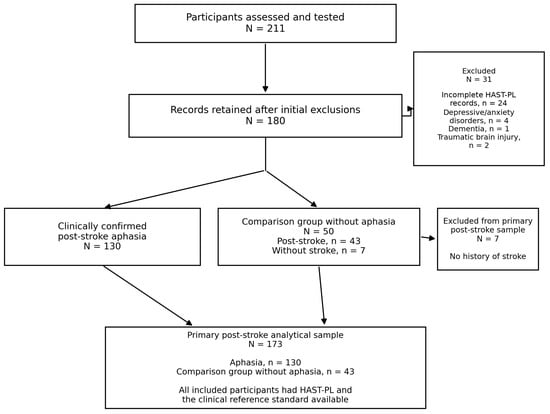
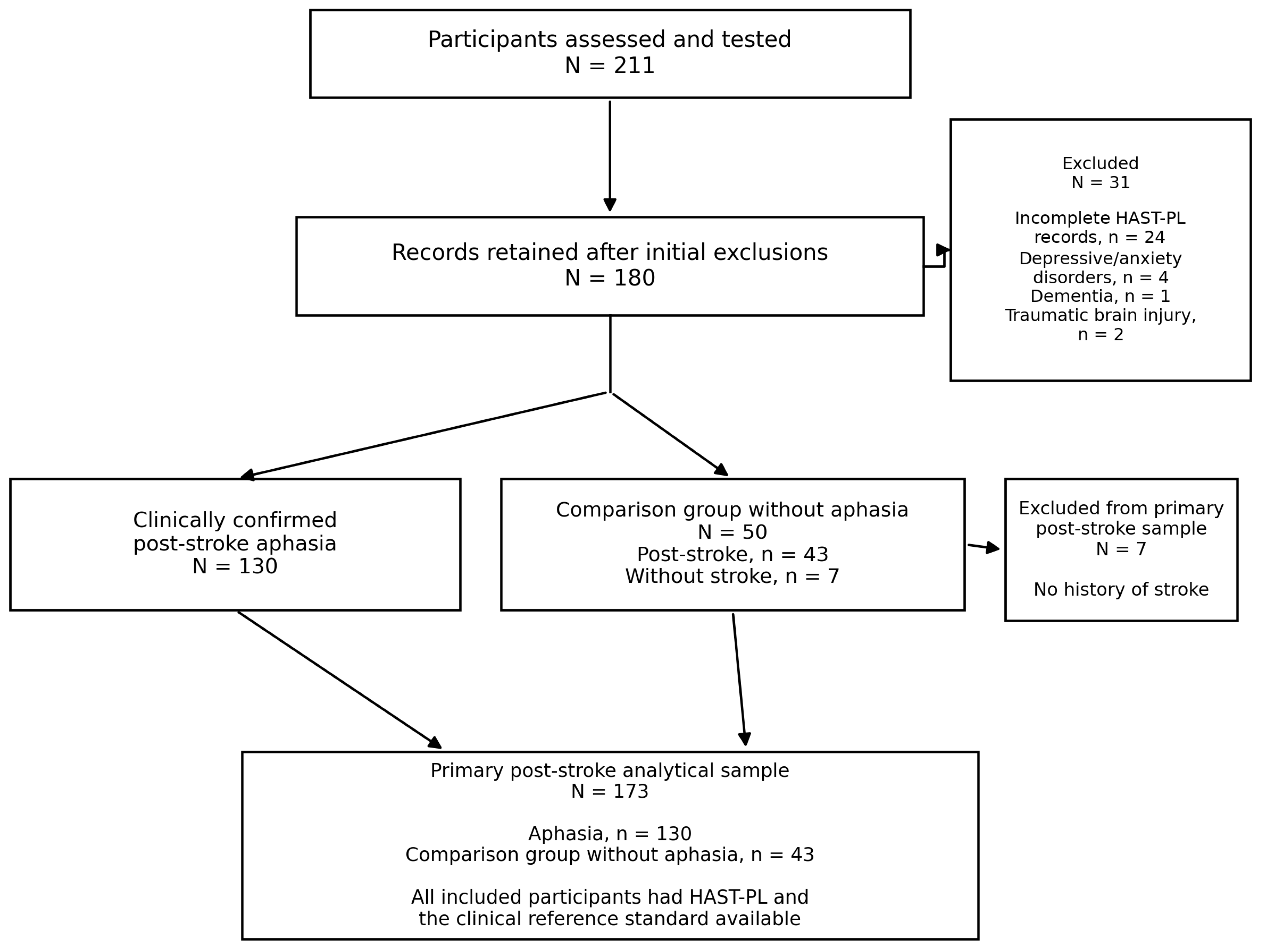
Of the 211 individuals assessed, 31 records were excluded: four because of depressive and/or anxiety disorders, one because of dementia, two because of traumatic brain injury, and 24 because of incomplete HAST-PL records. The latter records lacked required task responses or scores because parts of the assessment had not been completed or documented. A complete five-task profile and total score could therefore not be established from these records, and they were excluded from the complete-case analyses.
The initial comparison group included participants with and without a history of stroke. To evaluate HAST-PL within its intended post-stroke population, the analytical sample was restricted to stroke survivors. This restriction was an analytical decision made after recruitment, not an original eligibility criterion. Seven participants without a history of stroke were therefore excluded from the analyses. The final analytical sample comprised 173 participants recruited at four clinical centres in Poland: 130 patients with clinically confirmed post-stroke aphasia and 43 stroke survivors without aphasia. Participants after either a first or recurrent stroke were retained; elapsed time since the stroke was described rather than used to restrict the analytical sample.
Patient recruitment was conducted between January 2025 and April 2026 at four clinical centres. The final analytical sample included participants from the Department of Neurology, University Clinical Hospital No. 1 in Szczecin (n = 54); the Wielkopolska Rehabilitation Centre, Provincial Hospital in Poznań (n = 35); the Department of Neurology, University Clinical Hospital in Poznań (n = 40); and the Department of Neurology with a Stroke Unit, Prof. K. Gibiński University Clinical Center of the Medical University of Silesia in Katowice (n = 44). Aphasia was diagnosed based on clinical assessment. All four participating clinical centres followed the same standardized recruitment and assessment procedures, including uniform inclusion and exclusion criteria, clinical classification of aphasia, and HAST-PL administration and scoring protocols, to ensure methodological consistency and comparability of data across centres.
Patients in the aphasia group were eligible for inclusion if they met the following criteria:
- Polish as their native language;
- Age ≥ 18 years;
- A clinical diagnosis of aphasia established by an experienced neurologist and subsequently confirmed by a speech-language pathologist specializing in neurological communication disorders;
- Aphasia resulting from a first or recurrent stroke.
Patients were excluded from the study if they had:
- A history of traumatic brain injury or a brain tumour;
- Severe or active psychiatric disorders that could significantly affect cognitive or language functioning or the ability to cooperate during testing;
- Severe depressive disorders, particularly when accompanied by marked psychomotor slowing, apathy, or reduced ability to participate in the assessment;
- Severe anxiety disorders that substantially interfered with the assessment procedure;
- Delirium or other acute disturbances of consciousness;
- Current alcohol- or substance-related disorders if these could affect the results of language or cognitive assessment.
Pre-stroke cognitive functioning was not formally assessed as part of the study, and systematic data on pre-existing cognitive impairment were not available for analysis.
2.2. Clinical Reference Standard for Aphasia Diagnosis
Clinical aphasia status was established through a two-stage clinical assessment procedure. In the first stage, a specialist in neurology assessed aphasia status based on a neurological examination, a review of medical records, and the patient’s clinical condition. Subsequently, the classification was confirmed by a speech-language pathologist specializing in neurological communication disorders, based on a clinical assessment of language functions.
The speech-language assessment included the evaluation of spontaneous speech, auditory comprehension, naming and repetition abilities, as well as reading and writing skills, where permitted by the patient’s clinical condition. The assessment also considered overall functional communication abilities and characteristic manifestations of language impairment, including word-finding difficulties, paraphasias, reduced speech fluency, and impaired language comprehension.
The clinical assessment used to establish the diagnosis of aphasia was conducted prior to the administration of HAST-PL, and the classification of patients into the respective diagnostic groups was not based on the results of this screening tool. Therefore, HAST-PL results did not influence either the initial diagnosis of aphasia or its subsequent confirmation by the speech-language pathologist.
Inclusion in the aphasia group required a clinical diagnosis of aphasia by a neurologist followed by confirmation by a speech-language pathologist. Data on initial diagnostic disagreements between the two clinicians were not systematically collected; therefore, their number cannot be reported. After completion of the clinical reference assessment, no participants in the analytical sample had indeterminate aphasia status.
For patients with a previously established diagnosis of aphasia, including those with a history of neurological events, additional information was obtained from medical records, particularly hospital discharge summaries (epicrises). These records provided information on the previous diagnosis of aphasia, its clinical course, and the severity of language impairment. This information was used to determine the previously documented severity of aphasia and to complement the patient’s current clinical assessment. This approach enabled consideration of both the history of language impairment and the patient’s current clinical presentation.
Given the limited availability of Polish-language aphasia screening instruments with established psychometric properties [11,12], a multidisciplinary clinical assessment was selected as the reference standard. Classification was based on neurological and speech-language assessments supplemented by available medical documentation. It was established before HAST-PL administration and did not use HAST-PL scores. No separate standardized aphasia battery was administered as an independent reference test. The clinical nature of the reference standard should be considered when interpreting the screening-accuracy estimates.
Five speech-language pathologists conducted the assessments across the four centres: one at each of the three centres in Szczecin and Poznań and two at the Katowice centre. The two Katowice examiners assessed 19 and 25 participants in the analytical sample, respectively. All examiners followed the same HAST-PL administration and scoring protocol. Participant counts by centre and examiner are provided in Supplementary Table S8.
The clinical classification of aphasia was established before HAST-PL administration, and HAST-PL scores were not used to determine or modify it. However, the speech-language pathologists administering HAST-PL were aware of participants’ clinical classifications; administration and scoring were not blinded.
The nonverbal response requirements of HAST-PL include pointing to pictures and performing a multistep action command in the Sentence Comprehension subtest. Participants with visual or hearing impairments were allowed to use their usual corrective aids, such as glasses or hearing aids, during the assessment. The ability to adequately perceive the presented stimuli and provide the required responses was considered when determining eligibility for testing.
No motor limitations preventing participants from performing the required HAST-PL responses were recorded.
2.3. Description of the Comparison Group
Participants were eligible for the comparison group if they were adult native Polish speakers, showed no clinical evidence of aphasia at the time of enrolment, and were able to complete the assessment procedure. A history of stroke was not required for recruitment to the original comparison group; the post-recruitment analytical restriction is described in Section 2.1. The absence of aphasia was established before HAST-PL administration on the basis of clinical language assessment. The exclusion criteria listed above were applied to both groups.
For the present analyses, the non-aphasia comparison group was restricted to 43 stroke survivors without clinically established aphasia. This comparison reflects the intended application of HAST-PL to identifying aphasia in a post-stroke population, rather than distinguishing stroke survivors from healthy individuals.
2.4. Translation and Cultural Adaptation of HAST
The HAST was translated into Polish based on the English-language version of the test materials provided by Lilla Zakariás, the first author of the original HAST. The translation process was carried out independently by three translators representing different clinical disciplines: Karolina Sempruch-Machowska, MD, PhD, a specialist in neurology; Agnieszka Wasilczyk-Kryger, MSc, a specialist in neurological speech and language therapy; and Weronika Żmuda, MSc, a psychologist.
The three independently prepared translations were subsequently reviewed by an expert panel. The panel consisted of Wioletta Pawlukowska, MD, PhD, Associate Professor at Pomeranian Medical University; Monika Mak, PhD, a specialist in clinical psychology; Tatiana Lewicka, MSc, a specialist in neurological speech and language therapy and a psychologist; and Krzysztof Wietrzyński, MSc, a psychologist. The expert panel evaluated the translations with respect to their consistency with the source version as well as their linguistic and cultural appropriateness for the Polish-speaking population.
All modifications introduced during the adaptation process were discussed with the author of the test, Dr Lilla Zakariás. The aim of the adaptation was to preserve the structure, diagnostic assumptions, and level of difficulty of the original instrument while adjusting the linguistic and pictorial materials to the specific characteristics of the Polish language.
- Modifications Introduced in the Polish Version of the HAST:
- Subtest 1—Word Comprehension
This subtest consists of an auditory word-to-picture matching task that includes semantic, phonological, and visual distractors. In the Polish adaptation, the target words were selected so as to preserve, as closely as possible, the structure and psycholinguistic parameters of the original version. The pictorial material was also modified and adapted to correspond to the selected Polish lexical items while maintaining the characteristics of the respective distractor categories.
- Subtest 5—Word Fluency
A modification was introduced in the letter fluency task with regard to the initial letter. In the original version, the letter “M” is used, whereas in the Polish adaptation it was replaced with the letter “K”. The change was intended to use a letter appropriate for phonemic fluency assessment in Polish.
This choice was informed by published recommendations for Polish phonemic fluency assessment. Letter-based fluency tasks may differ in difficulty depending on the initial letter and the availability and frequency of suitable words. Zając-Lamparska et al. describe the recommendation to use “K” when Polish phonemic fluency is assessed with a single letter [31]. This literature provides a rationale for selecting a linguistically appropriate stimulus but does not establish that “K” in Polish and “M” in Hungarian are equally difficult. The choice was therefore treated as a language-specific adaptation, not as evidence of psycholinguistic equivalence between the two versions.
The remaining tasks were retained in accordance with the source version of the HAST and were translated into Polish without introducing changes to their structure or administration procedures.
No separate pilot study was conducted prior to the main validation study. The linguistic and cultural adaptation of HAST-PL was based on three independent translations, multidisciplinary expert review, and consultation with the author of the original instrument. The adaptation process focused on preserving the intended linguistic and cognitive demands of the original tasks while ensuring their appropriateness for Polish-speaking individuals. The psychometric properties of the resulting Polish version were subsequently evaluated in the main study sample.
2.5. HAST-PL
The HAST-PL is a brief screening measure of spoken receptive and expressive language comprising five subtests: Word Comprehension, Sentence Comprehension, Repetition, Naming, and Word Fluency. Each subtest contributes 0–4 points, yielding a total score ranging from 0 to 20, with higher scores indicating better language performance.
Word Comprehension consists of four spoken word–picture matching trials. For each item, the participant selects the target from a visual array containing the target and visual, phonological, or semantic distractors. Sentence Comprehension comprises three spoken sentence–picture matching trials and one multistep verbal command. Repetition includes a real word, a pseudoword, a phrase, and a sentence; one point is awarded only for a fully correct repetition. Naming requires the participant to name four line drawings without assistance. Articulatory errors attributable to dysarthria or other speech-sound impairment are not scored as incorrect when the intended lexical response is otherwise identifiable.
Word Fluency consists of two 30 s trials: semantic fluency for names of fruits and phonemic fluency for words beginning with the letter “K”. The numbers of correct responses from both trials are summed and converted to a 0–4 subtest score: 0 words = 0 points, 1–4 words = 1 point, 5–8 words = 2 points, 9–15 words = 3 points, and ≥16 words = 4 points. Visual materials are used for Word Comprehension, Sentence Comprehension, and Naming, and a stopwatch or clock is required for Word Fluency. At the participant’s request, the examiner may repeat the target word, sentence, or other verbal stimulus once in Subtests 1–3.
The Polish version preserves the five-subtest structure and 0–20 scoring framework of the original HAST. The present analyses evaluate screening thresholds for HAST-PL rather than assigning clinical severity labels to score intervals.
2.6. Study Procedure
Clinical aphasia status was established before HAST-PL administration through a two-stage clinical assessment procedure at each participating centre. Initially, an experienced neurologist assessed the patient’s neurological condition and assessed clinical aphasia status. Subsequently, the classification was confirmed by an experienced speech-language pathologist specializing in neurological communication disorders, based on a comprehensive clinical assessment of language functions. This clinical classification served as the reference criterion for the screening-accuracy analyses. The exact interval between the clinical reference assessment and HAST-PL administration was not measured.
HAST-PL was subsequently administered individually by the same speech-language pathologists who had confirmed the clinical diagnosis and were therefore aware of the participants’ clinical classification. The test was administered according to the standardized HAST-PL instructions, using the corresponding visual materials for Word Comprehension, Sentence Comprehension, and Naming, and timed 30 s trials for Word Fluency. In Subtests 1–3, the verbal stimulus could be repeated once at the participant’s request. Responses were scored according to the predefined HAST-PL scoring rules.
The assessment was conducted at the patient’s bedside in a clinical setting, and all participants retained in the analytical sample completed the entire HAST-PL assessment during a single session. The overall assessment duration was estimated at approximately 15 min, including both test administration and preparatory activities, such as explaining the procedure and allowing participants to put on glasses or hearing aids when necessary. This may partly explain the longer overall assessment time compared with the original HAST.
When necessary, patients were allowed to use corrective glasses and/or hearing aids. Among participants retained in the analytical sample, none required a break during testing and no assessment had to be discontinued before completion. Adverse events associated with either the clinical reference assessment or HAST-PL were not systematically recorded.
2.7. Statistical Analysis
Statistical analyses were performed using jamovi (version 2.7.37) and JASP (version 0.98.8). CFA and the reported internal-consistency coefficients were obtained in JASP; PCA, ROC analysis, descriptive statistics, and primary group comparisons were obtained in jamovi. Additional descriptive and correlation calculations used Python (version 3.13.5) and SciPy (version 1.17.0). Analyses used complete cases, without missing-data imputation. All 173 participants had complete HAST-PL task scores and clinical reference classifications. The verified data also contained age, sex, time since stroke, and first-versus-recurrent stroke status for all participants. Continuous variables are presented as means and standard deviations (SD), and categorical variables as frequencies and percentages. Total scores and time since stroke were additionally described by medians, quartiles, and ranges. Welch’s two-sample t-test was used to compare means in the original score units while accommodating unequal variances and group sizes [32]. Mean differences are reported with 95% confidence intervals (CI). Categorical variables were compared using Pearson’s chi-square test or Fisher’s exact test, as appropriate.
The internal structure of HAST-PL was evaluated using CFA, with a one-factor model specified a priori for the five task scores. Scores were declared ordinal, and the model was estimated using weighted least squares mean- and variance-adjusted (WLSMV) estimation, with freely estimated category thresholds, the latent mean fixed at zero, and the latent variance fixed at one for identification. Model fit was evaluated jointly using the scaled chi-square test, Comparative Fit Index (CFI), Tucker–Lewis Index (TLI), Root Mean Square Error of Approximation (RMSEA) with its 90% CI, and Standardized Root Mean Square Residual (SRMR). Equivalence-based T-size indices for CFI and RMSEA, together with their poor–fair and fair–close limits, provided a supplementary assessment [33]. The same CFA specification was repeated in the aphasia group alone (n = 130) as a supplementary analysis. PCA of the Pearson correlation matrix was used as a complementary description of the concentration of variance across tasks and not as an independent confirmation of the latent-factor model. The Kaiser–Meyer–Olkin (KMO) measure and Bartlett’s test of sphericity were examined for PCA; component retention was evaluated using eigenvalues, the scree plot, and parallel analysis.
Internal consistency of the unit-weighted sum of the five task scores was evaluated using Cronbach’s alpha and McDonald’s omega from the JASP CFA module. Alpha was calculated from the covariance matrix of the observed task scores. Omega was derived from the ordinal one-factor model and expressed on the observed ordinal-score scale using the Green–Yang approach [34], rather than on the continuous latent-response scale. Corrected task–total correlations, defined as Pearson correlations between each task and the sum of the remaining tasks, were additionally examined in jamovi. Reliability coefficients were also reported descriptively for the aphasia-only analysis.
Screening accuracy was assessed using ROC analysis, with the clinically established aphasia classification as the reference criterion. Lower HAST-PL scores indicated a positive screen. The main threshold maximized Youden’s index (sensitivity + specificity − 1). AUC, sensitivity, and specificity were reported with 95% CIs, together with positive predictive value (PPV), negative predictive value (NPV), and overall accuracy (ACC). Neighbouring integer-score rules were compared descriptively using sensitivity, specificity, PPV, NPV, and Youden’s index. Every threshold was expressed as an explicit rule: scores at or below the stated integer were screen-positive. Predictive values and ACC were interpreted in relation to the proportion of aphasia cases in this sample. Threshold selection and apparent performance evaluation used the same sample. Bootstrap internal validation was performed as described below; independent external validation was not performed, and threshold-specific estimates remained provisional.
The discriminative properties of individual task scores were evaluated using Welch’s two-sample t-test. The 16 dichotomously scored items from Tasks 1–4 were compared using Fisher’s exact test, whereas the two raw Word Fluency scores were compared using Welch’s t-test. Exploratory comparisons of task and total scores by sex also used Welch’s t-test. Spearman rank correlations were calculated between age or days since stroke and each task score and the total score in the pooled analytical sample. Item-level, sex, and correlation analyses were exploratory; p values were not adjusted for multiple comparisons, and nominal significance was not treated as confirmatory evidence. All tests were two-sided, with the significance level set at p < 0.05.
Sample-size planning was based on the planned between-group comparison of mean scores. A two-sided independent-samples t-test assuming equal group sizes and a common population variance, Cohen’s d = 0.50, α = 0.05, and 80% power required 64 participants per group [35]. The final sample comprised 130 participants with aphasia and 43 without aphasia; the planned comparison-group size was therefore not attained. This calculation was not designed to establish the precision of diagnostic-accuracy estimates, which was evaluated using the reported 95% confidence intervals for sensitivity and specificity.
Internal validation used 20,000 nonparametric bootstrap resamples stratified by clinical aphasia status, with 130 participants with aphasia and 43 without aphasia sampled with replacement in each resample. In every resample, the integer cut-off maximizing Youden’s index was selected anew across all possible score thresholds (screen-positive if score ≤ c, for c = 0, …, 20). The lowest maximizing cut-off was specified as the tie-breaking rule. Optimism in Youden’s index was estimated as the mean difference between performance at the selected cut-off in the bootstrap resample and performance at that same cut-off in the original sample; this estimate was subtracted from the original apparent maximum. The general bootstrap optimism-correction algorithm described by Iba et al. [36] was applied here to data-driven cut-off selection, rather than to the estimation of a multivariable prediction model. Selection frequencies were recorded for each cut-off. The procedure resampled participants within clinical groups, not centres, and used the original sample for performance evaluation rather than an out-of-bag-only approach.
The empirical AUC was calculated from the unchanged HAST-PL total score, with half credit assigned to tied scores, and a bootstrap percentile 95% confidence interval was obtained. For completeness, the bootstrap-minus-original performance difference was also calculated for AUC. Because no score weights or other ranking parameters were fitted and AUC is threshold-independent, the expected optimism correction for this fixed-score AUC is zero; small deviations reflect Monte Carlo variation. No confidence interval was calculated for the optimism-corrected Youden index.
Positive and negative likelihood ratios (LR+ and LR−) for the ≤16 and ≤17 rules were calculated as sensitivity/(1 − specificity) and (1 − sensitivity)/specificity, respectively, with approximate log-scale 95% confidence intervals [37]. No continuity correction was applied to the classification counts. These intervals treat the cut-offs as fixed and do not adjust for threshold-selection uncertainty. The bootstrap and likelihood-ratio computations used Python 3.13.5, NumPy 2.3.5, and SciPy 1.17.0; resampling used the PCG64 generator with random seed 20261026.
3. Results
3.1. Sample Characteristics
The final sample comprised 173 stroke survivors: 130 in the aphasia group and 43 in the comparison group (Table 1). Participants with aphasia were older on average (69.6 versus 65.2 years; mean difference = 4.4 years; p = 0.045). No significant between-group differences were observed in sex distribution, years of education, educational level, reported hearing or sight difficulties, or stroke type (all p ≥ 0.076). Participant flow is shown in Figure 1.
Table 1.
Demographic and clinical characteristics of the study sample.
Figure 1.
Flow diagram of participant selection for the primary post-stroke analytical sample. A total of 211 participants were assessed and tested. After exclusion of 31 records due to incomplete HAST-PL records (n = 24), depressive/anxiety disorders (n = 4), dementia (n = 1), or traumatic brain injury (n = 2), 180 participants remained. Seven comparison participants without a history of stroke were then excluded from the primary post-stroke analytical sample, yielding a final sample of 173 stroke survivors (130 with aphasia and 43 without aphasia).
The index event was a first stroke in 126/130 participants with aphasia (96.9%) and 41/43 comparison participants (95.3%); the remaining four and two participants, respectively, had a recurrent stroke. The median time from stroke to assessment was one day in both groups, with Q1–Q3 of 1–3 days in the aphasia group and 1–3.5 days in the comparison group. Means were 3.5 (SD = 11.7) and 10.2 (SD = 21.3) days, respectively, reflecting right-skewed distributions (ranges: 0–106 and 0–98 days). Overall, 158/173 participants (91.3%) were assessed within seven days and 164/173 (94.8%) within 30 days. First-versus-recurrent stroke status did not differ significantly between groups (p = 0.639); the comparison of mean days since stroke yielded p = 0.054.
Median total scores were 15 (Q1–Q3: 10–17; range: 5–20) in the aphasia group and 19 (Q1–Q3: 18–20; range: 15–20) in the comparison group. Exploratory comparisons of the five task scores by sex did not reach nominal significance (all p ≥ 0.209). The total score also did not differ significantly between women and men (mean difference = 0.03 points, 95% CI [−1.23, 1.30]; p = 0.957; Supplementary Table S1).
In exploratory analyses of the pooled sample, age had a small negative association with the total score (Spearman’s ρ = −0.213, p = 0.005). Task-level age correlations ranged from −0.082 to −0.164; those for Sentence Comprehension, Repetition, and Word Fluency reached nominal significance (p = 0.032, 0.032, and 0.037, respectively). Days since stroke were not significantly correlated with the total score (ρ = 0.016, p = 0.836) or any task score (ρ from −0.108 to 0.062; all p ≥ 0.158). Complete coefficients are presented in Supplementary Table S5.
3.2. Internal Structure and Reliability
In the full sample (N = 173), the ordinal one-factor CFA yielded scaled χ2(5) = 11.290, p = 0.046; CFI = 0.991; TLI = 0.981; RMSEA = 0.086, 90% CI [0.011, 0.153]; and SRMR = 0.051. CFI, TLI, and SRMR were favourable, whereas the RMSEA estimate and its wide confidence interval indicated less precise support for close fit. All standardized factor loadings were significant (p < 0.001), ranging from 0.428 for Word Comprehension to 0.870 for Word Fluency (Table 2).
Table 2.
Standardized CFA loadings for the one-factor HAST-PL model in the full sample (N = 173).
The supplementary T-size CFI estimate was 0.960, exceeding the poor–fair (0.759) and fair–close (0.848) limits. The T-size RMSEA estimate was 0.153, slightly above the poor–fair limit of 0.150 and above the fair–close limit of 0.124. Thus, the CFI-based assessment supported close fit, whereas the RMSEA-based assessment did not provide comparable evidence for close fit.
PCA provided complementary descriptive evidence of a dominant first component. Bartlett’s test was significant, χ2(10) = 295.03, p < 0.001, and the overall KMO was 0.79. The first component had an eigenvalue of 2.84 and accounted for 56.76% of the total variance; component loadings ranged from 0.47 to 0.86. All remaining eigenvalues were below 1.0 (0.88, 0.60, 0.36, and 0.33), and parallel analysis supported retention of one component.
Internal consistency of the observed five-task total score was acceptable (Cronbach’s α = 0.805; McDonald’s ω = 0.834). Corrected task–total correlations ranged from 0.32 for Word Comprehension to 0.73 for Naming.
The supplementary CFA restricted to participants with aphasia (n = 130) yielded scaled χ2(5) = 9.259, p = 0.099; CFI = 0.988; TLI = 0.975; RMSEA = 0.081, 90% CI [0.000, 0.162]; and SRMR = 0.059. Standardized loadings ranged from 0.517 to 0.817 (all p < 0.001). This pattern was consistent with the full-sample findings, although the RMSEA confidence interval remained wide. Within the aphasia group, α was 0.767 and ω was 0.799. Detailed loadings, confidence intervals, and supplementary fit information are provided in Supplementary Table S2.
3.3. Screening Accuracy
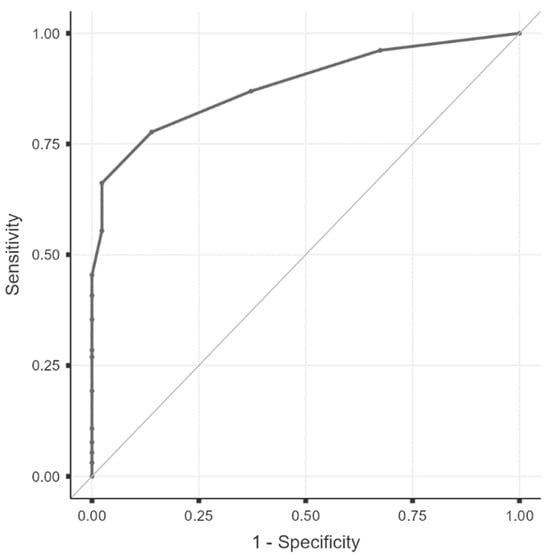
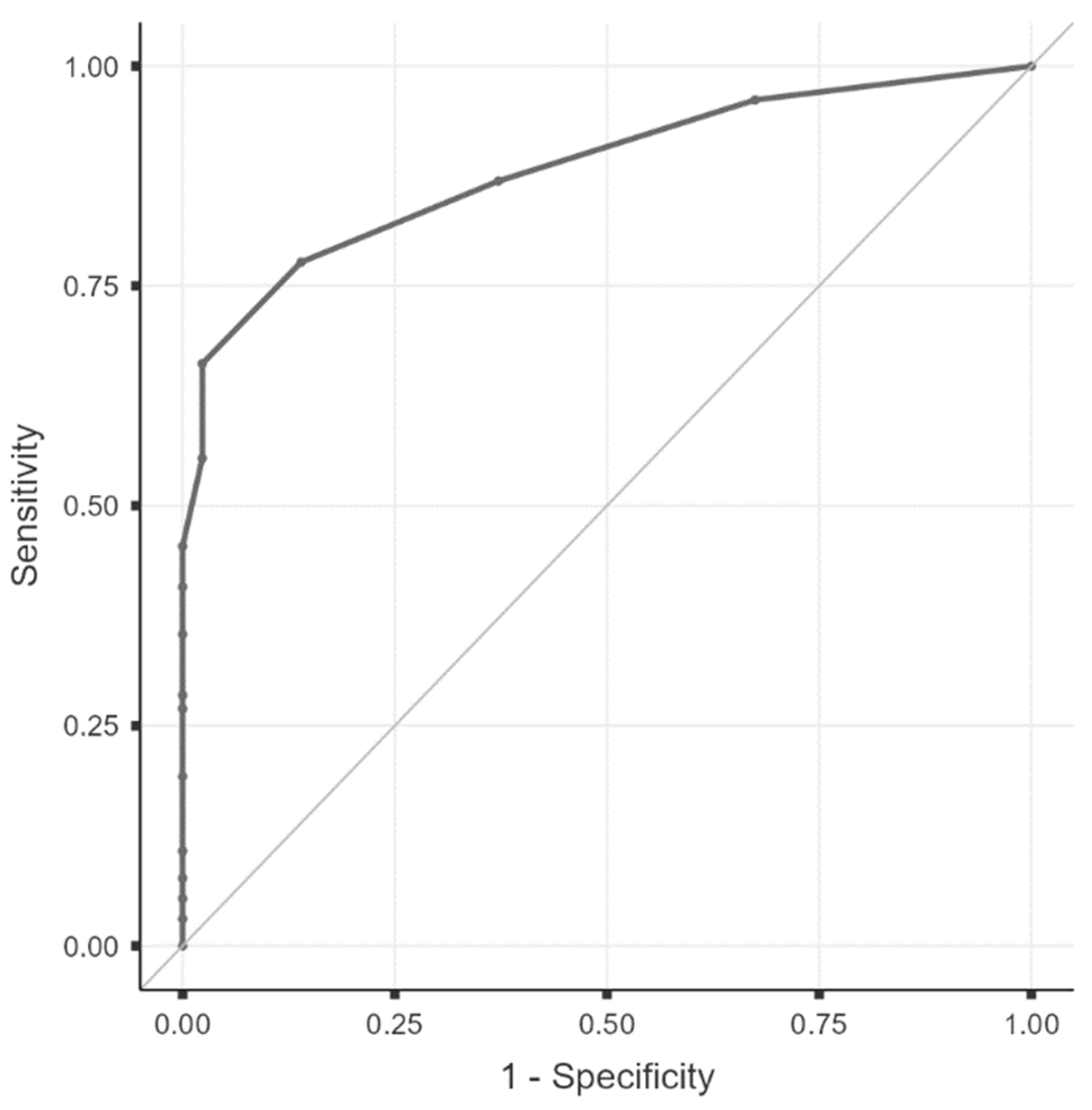
The HAST-PL total score distinguished participants with and without clinically confirmed post-stroke aphasia with an AUC of 0.88 (95% CI [0.83, 0.93], p < 0.001; Figure 2). The highest Youden index was obtained for a screen-positive rule of ≤16 points (J = 0.6383); scores of ≥17 were screen-negative under this rule.
Figure 2.
Receiver operating characteristic curve for the HAST-PL total score (N = 173).
At the ≤16 threshold, sensitivity was 66.15% (95% CI [57.34%, 74.22%]) and specificity was 97.67% (95% CI [87.71%, 99.94%]). PPV was 98.85%, NPV was 48.84%, and ACC was 73.99%. The classification counts were 86 true positives, one false positive, 44 false negatives, and 42 true negatives (Table 3).
Table 3.
Classification matrix for the main HAST-PL screening rule (N = 173).
The neighbouring rule of ≤17 points yielded a nearly identical Youden index (0.6374), with a sensitivity of 77.69% and specificity of 86.05% (Table 4). Compared with ≤16, it identified 15 additional participants with aphasia while producing five additional false-positive results. PPV decreased to 94.39%, whereas NPV increased to 56.06%. The full set of nontrivial integer-score thresholds corresponding to the ROC coordinates is presented in Supplementary Table S3.
Table 4.
Screening performance at selected alternative HAST-PL thresholds (N = 173).
Internal validation with 20,000 bootstrap resamples estimated optimism in the maximum Youden index at 0.0242, yielding an optimism-corrected value of 0.6141 compared with an apparent value of 0.6383. The ≤16 rule was selected in 10,253 resamples (51.265%), the ≤17 rule in 9590 (47.950%), and the ≤18 rule in 157 (0.785%); no other cut-off was selected and no tied maxima occurred. Thus, 99.215% of resamples selected either ≤16 or ≤17. Supplementary Table S6 reports the bootstrap results. The correction applies to the threshold-selection procedure, not to independent validation of either individual cut-off.
The full-score AUC was 0.8828 (bootstrap percentile 95% CI [0.8321, 0.9279]). The mean bootstrap-minus-original AUC difference was 0.000215, giving a formal adjusted value of 0.8826. For this fixed score, the negligible change reflects Monte Carlo variation rather than a correction for cut-off selection.
For the ≤16 rule, LR+ was 28.45 (95% CI [4.08, 198.14]) and LR− was 0.347 (95% CI [0.271, 0.443]). For the ≤17 rule, LR+ was 5.57 (95% CI [2.64, 11.76]) and LR− was 0.259 (95% CI [0.184, 0.365]; Supplementary Table S7). The wide interval for LR+ at ≤16 reflects the single false-positive observation in the comparison group.
3.4. Discriminative Properties of Individual Tasks
Participants with aphasia obtained lower mean scores on all five HAST-PL tasks than those in the comparison group (all p ≤ 0.028). The largest mean differences were observed for Naming (−1.38 points) and Word Fluency (−1.34 points), followed by Repetition (−0.98 points) and Sentence Comprehension (−0.94 points). Word Comprehension showed the smallest difference (−0.19 points). The total-score mean difference was −4.82 points (95% CI [−5.62, −4.03]). Detailed comparisons are presented in Table 5.
Table 5.
Between-group differences in HAST-PL task and total scores (N = 173).
3.5. Exploratory Item-Level Analyses
Twelve of the 16 dichotomously scored items showed between-group differences at the nominal p < 0.05 level, all in the expected direction of fewer correct responses in the aphasia group. The four non-significant comparisons concerned Word Comprehension Items 1, 3, and 4 and Sentence Comprehension Item 1. Both raw Word Fluency subtasks also differed between groups (p < 0.001).
Sentence Comprehension Item 1 was answered correctly by 123/130 participants with aphasia (94.6%) and 41/43 comparison participants (95.3%; p > 0.999). Item 2 was answered correctly by 89/130 (68.5%) and 38/43 (88.4%), respectively (p = 0.010). Detailed results are presented in Supplementary Table S4.
4. Discussion
The present study examined the internal structure, internal consistency, and screening accuracy of the Polish version of the Hungarian Aphasia Screening Test. The findings provide preliminary support for HAST-PL as a brief measure of spoken receptive and expressive language. The proposed one-factor model showed favourable CFI, TLI, and SRMR values in both the full sample and the aphasia group, although RMSEA estimates were less conclusive. Internal consistency was acceptable, and the total score and all five tasks differentiated the study groups. ROC analysis showed good overall discrimination. At the Youden-optimal threshold, very high specificity was accompanied by moderate sensitivity; a neighbouring threshold increased sensitivity at the expense of specificity. HAST-PL should therefore support referral for fuller language assessment, not serve as a stand-alone method for excluding aphasia or grading its severity.
4.1. Internal Structure and Internal Consistency
The CFA findings provide preliminary support for the proposed one-factor structure, while PCA provides complementary descriptive evidence of a dominant component. All five tasks had significant loadings. The first principal component accounted for 56.76% of the variance in the full sample, compared with 65% in the smaller aphasia sample of the original Hungarian study [29,30]. These values should not be treated as directly interchangeable because the samples differ. PCA summarizes total variance and was not used as an independent confirmation of the latent-factor model.
Model fit was not uniformly strong across all indices. CFI, TLI, and SRMR were favourable, but the full-sample RMSEA was 0.086 and its 90% confidence interval extended to 0.153. The T-size CFI assessment supported close fit, whereas the T-size RMSEA estimate was slightly above the poor–fair boundary rather than below the fair–close boundary. The aphasia-only CFA showed a similar pattern, including a wide RMSEA interval. The latter analysis indicates that support for the model is not confined to the combined aphasia/comparison sample, but it is an analysis of a nested subgroup, not an independent replication or a test of measurement invariance.
Word Comprehension had the weakest standardized loading in both the full sample (0.428) and the aphasia group (0.517). High proportions of correct responses on several Word Comprehension items suggest limited differentiation at the easier end of the task. This is a plausible explanation to investigate, not a demonstrated cause of the lower loading. Word Fluency had the largest loading in the full sample, while Naming and Word Fluency had similar loadings in the aphasia-only analysis. These differences do not make the tasks interchangeable or justify removing Word Comprehension: receptive language is part of the intended content of HAST-PL. The original authors also noted the limitations of restricted 0–4 task scores [29,30].
Internal consistency of the observed total score was acceptable, with α = 0.805 and model-based ω = 0.834 in the full sample. Alpha summarizes the covariance of the observed task scores; omega uses the ordinal CFA parameters while referring to the observed score scale [34]. The aphasia-only estimates were somewhat lower (α = 0.767; ω = 0.799), which underlines the importance of reporting the population underlying each coefficient. Direct comparison with the original Hungarian subtest-level alpha coefficients is inappropriate because those were calculated separately within subtests [29,30].
4.2. Screening Accuracy and Comparison with the Original HAST
The HAST-PL total score showed good overall discrimination (AUC = 0.88), but threshold selection depends on the intended screening purpose. Youden’s index gives equal weight to sensitivity and specificity without directly accounting for the clinical consequences of missed cases and false-positive referrals. Although ≤16 maximized this index, raising the screen-positive threshold to ≤17 increased sensitivity from 66.15% to 77.69% and reduced false-negative results from 44 to 29, while specificity decreased from 97.67% to 86.05% and false-positive results increased from one to six. Among these two rules, ≤17 may therefore be preferable when the priority is to limit missed aphasia cases and additional referrals for comprehensive assessment are acceptable. Nevertheless, this rule still missed 29 of 130 participants with aphasia, so a negative result should not override clinical evidence of language impairment.
Predictive values must be interpreted in relation to the sample composition. At ≤16, PPV was 98.85% and NPV was 48.84%; at ≤17, the corresponding values were 94.39% and 56.06%. Aphasia was present in 75.14% of participants, so these predictive values cannot be directly generalized to screening populations with different case proportions. Their pattern reflects both the operating characteristics of the selected threshold and the composition of the study sample.
The confidence intervals also indicate uncertainty in the diagnostic-accuracy estimates. At ≤16, sensitivity was 66.15% (95% CI [57.34%, 74.22%]) and specificity was 97.67% (95% CI [87.71%, 99.94%]). Specificity was estimated from only 43 participants without aphasia, with one false-positive result. The resulting LR+ of 28.45 had a wide 95% CI [4.08, 198.14], and its magnitude should not be regarded as precisely established. The lower LR− at ≤17 is consistent with its greater sensitivity but does not make a negative result sufficient to exclude aphasia.
Sensitivity was lower than the 92.5% reported for the original Hungarian HAST, including when the ≤17 rule was applied [29,30]. However, this is not a direct comparison of the two language versions under equivalent conditions. The studies differed in clinical spectrum, comparison groups, reference assessments, and threshold-selection methods: the original study used the Liu method, whereas the present study used Youden’s index. The contribution of linguistic adaptation cannot be separated from these design differences [13,14,15].
Bootstrap internal validation reduced the apparent maximum Youden index from 0.6383 to 0.6141. The similar selection frequencies of ≤16 and ≤17 indicate uncertainty in choosing between these neighbouring rules. These findings support prospective external evaluation of both thresholds, with the screening priority and acceptable consequences of false-positive and false-negative results specified in advance.
4.3. Task and Item Performance
All five task scores differentiated the study groups, with the largest mean differences in Naming and Word Fluency and the smallest in Word Comprehension. Sentence Comprehension and Repetition showed comparable mean differences. At the item level, twelve of sixteen dichotomous items differed at the nominal significance level. The non-significant items comprised Word Comprehension Items 1, 3, and 4 and Sentence Comprehension Item 1. The latter was answered correctly by approximately 95% of each group, suggesting limited discrimination in the present sample. Both raw Word Fluency subtasks also differentiated the groups. These exploratory findings should be assessed alongside item content and administration requirements and not interpreted as a uniform validation of all items. Multiple unadjusted comparisons increase the risk of chance findings; non-significant results do not establish equivalent performance.
The exploratory demographic and timing analyses provided no statistical evidence of sex differences in task or total scores, while age showed small negative correlations with several scores. This pattern does not establish measurement invariance or justify concluding that age is irrelevant, particularly because the aphasia group was older. Days since stroke were not associated with the total score or individual task scores in the pooled sample. However, these were cross-sectional, unadjusted comparisons, and most assessments occurred within the first few days after stroke. The findings therefore do not demonstrate an absence of language recovery, longitudinal stability, or equal screening accuracy at different post-stroke stages.
4.4. Strengths and Limitations
The study has several strengths. It was conducted across four clinical centres and included a larger sample than the original HAST validation. The comparison group consisted entirely of people with a history of stroke but without aphasia, providing a clinically relevant test of discrimination. The analyses addressed several complementary aspects of HAST-PL performance, including the prespecified factor structure, internal consistency, screening accuracy, subtest-level discrimination, and exploratory item-level performance.
Several limitations should be considered. Recruitment used convenience sampling. Bootstrap correction addressed optimism associated with threshold selection but did not correct selection bias, possible reference-standard misclassification, or examiner effects; clustering by centre was not modelled. Participants with aphasia were older on average, and the unadjusted analyses do not separate age-related differences from clinical-group differences. Aphasia status was established clinically without a separate standardized reference battery, and HAST-PL administration and scoring were not blinded to that classification. The exact interval between the reference assessment and HAST-PL was not measured, so possible changes in language performance between the assessments could not be evaluated. Initial diagnostic disagreements between clinicians were not systematically documented, so agreement at that stage could not be quantified.
The exclusion of 24 incomplete HAST-PL records also limits interpretation. Incomplete recording and non-completion are reported as an aggregate data-completeness category, without a numerical breakdown by specific cause. Their exclusion may have affected the clinical spectrum represented in the analytical sample, and missingness cannot be assumed to have been unrelated to language impairment.
An additional limitation is the absence of a separate pilot study prior to the main validation. Although the Polish adaptation underwent multidisciplinary expert review and consultation with the original test author, the comprehensibility, acceptability, and relative difficulty of the adapted items were not independently evaluated in a preliminary sample. Consequently, potential language-specific differences in item performance cannot be excluded. Future studies should include pilot testing and further psycholinguistic evaluation of the Polish stimuli, particularly items showing weak or unexpected discrimination between participants with and without aphasia.
No independent continuous measure of aphasia severity was available, so convergent validity and the relationship of HAST-PL scores to externally measured severity were not established. Accordingly, this study does not propose severity categories or interval-based clinical labels. Internal consistency was assessed, but inter-rater reliability, test–retest reliability, and responsiveness to change were not established. The study provides no estimate of the reproducibility of patient scoring across examiners. Item-level, sex, and correlation analyses were exploratory and used unadjusted p values. Finally, HAST-PL assesses spoken comprehension and production but does not assess reading or writing [29,30]. A high total score therefore cannot exclude selective written-language impairment or replace comprehensive aphasia assessment.
The sample predominantly comprised patients assessed soon after stroke: 158/173 (91.3%) were examined within seven days and 164/173 (94.8%) within 30 days. Most had experienced their first stroke (167/173, 96.5%). Thus, inclusion of some later and recurrent-stroke cases does not establish representativeness across post-stroke phases or recurrent strokes. The distribution was too uneven to support broad conclusions about differences in screening performance across these clinical subgroups. The absence of a cross-sectional correlation between total score and elapsed time should not be interpreted as evidence of temporal stability or absence of recovery.
4.5. Clinical Implications and Future Research
HAST-PL may offer a practical first step in assessing Polish-speaking adults after stroke when a full language battery cannot be completed immediately. A positive screen should prompt more detailed language assessment. A negative screen should be interpreted cautiously when the patient, family, or clinical team reports communication difficulties. The alternative threshold analysis illustrates that a higher positive-screen threshold can improve case detection while increasing false positives. Neither the main threshold nor its alternative is sufficient to replace comprehensive clinical assessment.
Further studies should examine the factor structure and the ≤16 and ≤17 screening rules in independent samples, preferably with a clearly defined standardized reference assessment and blinded examiners. Validation across clinical settings and post-stroke phases is needed. Potential effects of clinical severity and sensory or motor impairments should also be examined. Inter-rater and test–retest reliability require dedicated designs, and longitudinal studies are needed before HAST-PL is used to monitor change. Further item-level work should focus particularly on tasks with limited variability or weak discrimination, alongside psycholinguistic evaluation of the Polish stimuli.
5. Conclusions
This study provides initial evidence for the internal structure, internal consistency, and screening accuracy of HAST-PL in Polish-speaking stroke survivors. Although ≤16 maximized Youden’s index, ≤17 may be preferable among these two neighbouring rules when screening prioritizes avoiding missed cases, at the expense of lower specificity. Negative results should not override clinical indications for further assessment. Prospective external validation is required before either threshold is adopted for routine clinical use.
Supplementary Materials
The following supporting information can be downloaded at https://www.mdpi.com/article/10.3390/brainsci16111211/s1. Table S1: Exploratory comparisons of task and total scores by sex. Table S2: Ordinal CFA in participants with aphasia. Table S3: Operating characteristics across integer-score thresholds. Table S4: Exploratory item-level comparisons between the aphasia and comparison groups. Table S5: Exploratory Spearman correlations of task and total scores with age and days since stroke. Table S6: Bootstrap optimism estimates and cut-off selection frequencies. Table S7: Likelihood ratios for the ≤16 and ≤17 screening rules. Table S8: Participant counts by clinical centre and examiner.
Author Contributions
Conceptualization, W.P. and L.Z.; methodology, K.W.; software, K.W.; validation, W.P., T.L., M.M. (Marta Masztalewicz), A.W.-K., E.M., L.Z. and D.W.-K.; formal analysis, K.W.; investigation, W.P. and M.M. (Marta Masztalewicz); resources, K.S.-M., W.Ż., and A.W.-K.; data curation, K.W. and M.M. (Monika Mak); writing—original draft preparation, W.P. and M.M. (Monika Mak); writing—review and editing, M.M. (Marta Masztalewicz); visualization, K.W.; supervision, M.M. (Marta Masztalewicz); project administration, M.M. (Marta Masztalewicz) All authors have read and agreed to the published version of the manuscript.
Funding
This research received no external funding.
Institutional Review Board Statement
The study was non-interventional and involved structured interviews and aphasia screening without additional medical procedures or exposure of participants to additional risks. Before initiating the study, the investigators consulted the Bioethics Committee of Pomeranian Medical University in Szczecin by telephone and were informed that prior ethical approval was not required. This was subsequently confirmed in an official letter dated 7 September 2026 (ref. KB.008.234.2026), stating that the study did not require an opinion from the Bioethics Committee. In a further written clarification dated 26 October 2026 (ref. KB-266/2026), the Chair of the Bioethics Committee confirmed that the research had been conducted in accordance with applicable ethical principles and that prior Bioethics Committee approval was not required. These documents confirm that prior ethical approval was not required and do not constitute retrospective ethical approval.
Informed Consent Statement
Written informed consent was obtained directly from participants who were able to provide it or, where participants lacked the capacity to provide informed consent, from their legally authorized representatives. Participation in the study was voluntary, and the principles of patient autonomy and informed consent were respected throughout the research process. No identifiable participant information is presented in this article.
Data Availability Statement
The data supporting the findings of this study are not publicly available due to privacy and ethical restrictions related to sensitive clinical information. The data are securely stored at the Department of Neurology, Pomeranian Medical University in Szczecin, University Clinical Hospital No. 1 in Szczecin. Further information regarding the dataset may be obtained from the corresponding author, subject to applicable institutional and ethical requirements.
Acknowledgments
The authors thank all participants and the staff of the participating clinical centres for their contribution to the study. During the preparation of this manuscript, the authors used ChatGPT (OpenAI, GPT-5.6 Thinking; accessed on 26 July 2026) to assist with English translation, language revision, manuscript structuring, and the preliminary drafting of selected passages. Consensus (Consensus.app; https://consensus.app; accessed on July 2026) was used to support literature discovery and the preliminary organization of sources. No generative artificial intelligence tool was used to collect or generate participant data. The authors performed the primary analyses in jamovi 28.11.0 and JASP 0.98. AI-assisted code also supported numerical verification, additional descriptive and correlation calculations, and the final-design power calculation. All cited publications were retrieved and reviewed by the authors. Any AI-assisted suggestions concerning the interpretation or presentation of the findings were critically evaluated against the original statistical outputs and source literature. The authors reviewed and edited all generated content and take full responsibility for the content of this publication.
Conflicts of Interest
The authors declare no conflicts of interest.
Abbreviations
| CAT | Comprehensive Aphasia Test |
| CAT-H | Comprehensive Aphasia Test–Hungarian |
| CI | Confidence interval |
| FAS | Phonemic verbal fluency task using the letters F, A, and S |
| FAST | Frenchay Aphasia Screening Test |
| HAST | Hungarian Aphasia Screening Test |
| HAST-PL | Polish version of the Hungarian Aphasia Screening Test |
| LAST | Language Screening Test |
| SODA | Skala Oceny Dynamiki Afazji |
| ACC | Overall classification accuracy |
| AUC | Area under the receiver operating characteristic curve |
| CFA | Confirmatory factor analysis |
| CFI | Comparative Fit Index |
| KMO | Kaiser–Meyer–Olkin measure |
| LR+ | Positive likelihood ratio |
| LR− | Negative likelihood ratio |
| NPV | Negative predictive value |
| PCA | Principal component analysis |
| PPV | Positive predictive value |
| RMSEA | Root Mean Square Error of Approximation |
| ROC | Receiver operating characteristic |
| SRMR | Standardized Root Mean Square Residual |
| TLI | Tucker–Lewis Index |
| WLSMV | Weighted least squares mean- and variance-adjusted estimation |
References
- GBD 2021 Stroke Risk Factor Collaborators. Global, regional, and national burden of stroke and its risk factors, 1990–2021: A systematic analysis for the Global Burden of Disease Study 2021. Lancet Neurol. 2024, 23, 973–1003. [Google Scholar] [CrossRef] [Scilit] [PubMed]
- Flowers, H.L.; Skoretz, S.A.; Silver, F.L.; Rochon, E.; Fang, J.; Flamand-Roze, C.; Martino, R. Poststroke aphasia frequency, recovery, and outcomes: A systematic review and meta-analysis. Arch. Phys. Med. Rehabil. 2016, 97, 2188–2201.e8. [Google Scholar] [CrossRef] [Scilit] [PubMed]
- Brady, M.C.; Kelly, H.; Godwin, J.; Enderby, P.; Campbell, P. Speech and language therapy for aphasia following stroke. Cochrane Database Syst. Rev. 2016, 2016, CD000425. [Google Scholar] [CrossRef] [Scilit] [PubMed]
- Brady, M.C.; Mills, C.; Prag Øra, H.; Novaes, N.; Becker, F.; Constantinidou, F.; Flöel, A.; Sunnerhagen, K.S.; Isaksen, J.; Jagoe, C.; et al. European Stroke Organisation guideline on aphasia rehabilitation. Eur. Stroke J. 2025, 10, 1189–1220. [Google Scholar] [CrossRef] [Scilit] [PubMed]
- El Hachioui, H.; Visch-Brink, E.G.; de Lau, L.M.L.; van de Sandt-Koenderman, M.W.M.E.; Nouwens, F.; Koudstaal, P.J.; Dippel, D.W.J. Screening tests for aphasia in patients with stroke: A systematic review. J. Neurol. 2017, 264, 211–220. [Google Scholar] [CrossRef] [Scilit] [PubMed]
- Rohde, A.; Worrall, L.; Godecke, E.; O’Halloran, R.; Farrell, A.; Massey, M. Diagnosis of aphasia in stroke populations: A systematic review of language tests. PLoS ONE 2018, 13, e0194143. [Google Scholar] [CrossRef] [Scilit] [PubMed]
- Sheppard, S.M.; Sebastian, R. Diagnosing and managing post-stroke aphasia. Expert Rev. Neurother. 2021, 21, 221–234. [Google Scholar] [CrossRef] [Scilit] [PubMed]
- Tessaro, B.; Brownsett, S.L.E.; Hameau, S.; Simic, T.; Nickels, L.A.; Gilmore, N.; Peñaloza, C.; Robson, H.; Salis, C. Assessment of cognition in aphasia: Perspectives from clinicians and researchers. Neuropsychol. Rehabil. 2026, 36, 278–317. [Google Scholar] [CrossRef] [Scilit] [PubMed]
- Enderby, P.M.; Wood, V.A.; Wade, D.T.; Hewer, R.L. The Frenchay Aphasia Screening Test: A short, simple test for aphasia appropriate for non-specialists. Int. Rehabil. Med. 1987, 8, 166–170. [Google Scholar] [CrossRef] [Scilit] [PubMed]
- Flamand-Roze, C.; Falissard, B.; Roze, E.; Maintigneux, L.; Beziz, J.; Chacon, A.; Join-Lambert, C.; Adams, D.; Denier, C.; Dupont, S.; et al. Validation of a new language screening tool for patients with acute stroke: The Language Screening Test (LAST). Stroke 2011, 42, 1224–1229. [Google Scholar] [CrossRef] [Scilit] [PubMed]
- Puchowska-Florek, M.; Książkiewicz, B.; Nowaczewska, M. Ocena przydatności wybranych skal i testów do oceny afazji u pacjentów w ostrym okresie udaru mózgu. Udar Mózgu 2005, 7, 39–47. [Google Scholar]
- Dębski, R.; Wójcik-Topór, P.; Knapek, M. Polish language of aphasia: A scoping review in the era of the International Classification of Functioning, Disability and Health. Linguist. Silesiana 2021, 42, 261–280. [Google Scholar] [CrossRef] [Scilit]
- Ivanova, M.V.; Hallowell, B. A tutorial on aphasia test development in any language: Key substantive and psychometric considerations. Aphasiology 2013, 27, 891–920. [Google Scholar] [CrossRef] [Scilit] [PubMed]
- Fyndanis, V.; Lind, M.; Varlokosta, S.; Kambanaros, M.; Soroli, E.; Ceder, K.; Grohmann, K.K.; Rofes, A.; Simonsen, H.G.; Bjekić, J.; et al. Cross-linguistic adaptations of the Comprehensive Aphasia Test: Challenges and solutions. Clin. Linguist. Phon. 2017, 31, 697–710. [Google Scholar] [CrossRef] [Scilit] [PubMed]
- Martínez-Ferreiro, S.; Arslan, S.; Fyndanis, V.; Howard, D.; Kuvač Kraljević, J.; Matić Škorić, A.; Munarriz-Ibarrola, A.; Norvik, M.; Peñaloza, C.; Pourquié, M.; et al. Guidelines and recommendations for cross-linguistic aphasia assessment: A review of 10 years of Comprehensive Aphasia Test adaptations. Aphasiology 2026, 40, 215–239. [Google Scholar] [CrossRef] [Scilit]
- Kuvač Kraljević, J.; Matić, A.; Lice, K. Putting the CAT-HR out: Key properties and specificities. Aphasiology 2020, 34, 820–839. [Google Scholar] [CrossRef] [Scilit]
- Zakariás, L.; Lukács, Á. The Comprehensive Aphasia Test–Hungarian: Adaptation and psychometric properties. Aphasiology 2022, 36, 1127–1145. [Google Scholar] [CrossRef] [Scilit]
- Zakariás, L.; Rózsa, S.; Lukács, Á. The Comprehensive Aphasia Test in Hungarian. Ideggyogy. Sz. 2020, 73, 405–416. [Google Scholar] [CrossRef] [Scilit] [PubMed]
- Kong, A.P.-H. An update on validating the Hong Kong Cantonese version of the Comprehensive Aphasia Test (Cant-CAT). Aphasiology 2026, 40, 278–300. [Google Scholar] [CrossRef] [Scilit]
- Salehi, S.; Jahan, A.; Mousavi, N.; Hashemilar, M.; Razaghi, Z.; Moghadam-Salimi, M. Developing Azeri aphasia screening test and preliminary validity and reliability. Iran. J. Neurol. 2016, 15, 183–188. [Google Scholar] [PubMed]
- Vuković, M.; Drljan, B.; Vuković, I. Validation of aphasia screening test for Serbian speakers. Spec. Edukac. Rehabil. 2014, 13, 73–86. [Google Scholar] [CrossRef] [Scilit]
- Vuković, M.; Milovanović, T.; Teovanović, P.; Stojanovik, V. Evaluation of reliability and validity of the Serbian Aphasia Screening Test. PLoS ONE 2024, 19, e0304565. [Google Scholar] [CrossRef] [Scilit] [PubMed]
- Fonseca, J.; Miranda, F.; Stein, B.; Maruta, C. Aphasia Screening Test (TeRAp): Construction and validation for European Portuguese. Acta Med. Port. 2024, 37, 831–837. [Google Scholar] [CrossRef] [Scilit] [PubMed]
- Ruangsuk, A.; Chinchai, S. The development and psychometric properties of the Chiang Mai Aphasia Screening Test for stroke. J. Assoc. Med. Sci. 2024, 57, 75–82. [Google Scholar] [CrossRef] [Scilit]
- Zhu, D.; Qi, Z.; Wang, A.; Zhang, Y.; Yu, H. Emerging validation for the adapted Chinese version of Quick Aphasia Battery. J. Multidiscip. Healthc. 2023, 16, 2557–2566. [Google Scholar] [CrossRef] [Scilit] [PubMed]
- El Ouardi, L.; Yeou, M.; Rami, Y.; Belahsen, M.F. The Moroccan Arabic Bedside Western Aphasia Battery–Revised: Linguistic and psychometric properties. J. Speech Lang. Hear. Res. 2023, 66, 2376–2389. [Google Scholar] [CrossRef] [Scilit] [PubMed]
- Charalambous, M.; Phylactou, P.; Kambanaros, M. Development and psychometric validation of the Cyprus Aphasia Screening Test (CAST). Brain Sci. 2026, 16, 32. [Google Scholar] [CrossRef] [Scilit] [PubMed]
- Kavakci, M.; Koyuncu, E.; Tanriverdi, M.; Adiguzel, E.; Yasar, E. The inter-rater reliability of the Turkish version of Aphasia Rapid Test for stroke. Top. Stroke Rehabil. 2022, 29, 272–279. [Google Scholar] [CrossRef] [Scilit] [PubMed]
- Zakariás, L.; Lukács, Á. The first aphasia screening test in Hungarian: A preliminary study on validity and diagnostic accuracy. PLoS ONE 2023, 18, e0290153. [Google Scholar] [CrossRef] [Scilit] [PubMed]
- Zakariás, L.; Lukács, Á. Hungarian Aphasia Screening Test: A new rapid screening tool for detecting aphasia in stroke patients. Orv. Hetil. 2022, 163, 2000–2008. [Google Scholar] [CrossRef] [Scilit] [PubMed]
- Zając-Lamparska, L.; Wiłkość, M.; Markowska, A.; Laskowska-Levy, I.; Wróbel, M.; Małkowski, B. Verbal fluency in research conducted with PET technique under conditions of extended cognitive activation with the use of 18F-fluorodeoxyglucose (FDG) tracer. Psychiatr. Pol. 2017, 51, 687–703. [Google Scholar] [CrossRef] [Scilit] [PubMed]
- Delacre, M.; Lakens, D.; Leys, C. Why Psychologists Should by Default Use Welch’s t-test Instead of Student’s t-test. Int. Rev. Soc. Psychol. 2017, 30, 92–101, Correction in Int. Rev. Soc. Psychol. 2022, 35, 21.. [Google Scholar] [CrossRef] [Scilit]
- Yuan, K.H.; Chan, W.; Marcoulides, G.A.; Bentler, P.M. Assessing Structural Equation Models by Equivalence Testing with Adjusted Fit Indexes. Struct. Equ. Model. 2016, 23, 319–330. [Google Scholar] [CrossRef] [Scilit]
- Green, S.B.; Yang, Y. Reliability of Summed Item Scores Using Structural Equation Modeling: An Alternative to Coefficient Alpha. Psychometrika 2009, 74, 155–167. [Google Scholar] [CrossRef] [Scilit]
- Giner-Sorolla, R.; Montoya, A.K.; Reifman, A.; Carpenter, T.; Lewis, N.A., Jr.; Aberson, C.L.; Bostyn, D.H.; Conrique, B.G.; Ng, B.W.; Schoemann, A.M.; et al. Power to Detect What? Considerations for Planning and Evaluating Sample Size. Pers. Soc. Psychol. Rev. 2024, 28, 276–301. [Google Scholar] [CrossRef] [Scilit] [PubMed]
- Iba, K.; Shinozaki, T.; Maruo, K.; Noma, H. Re-evaluation of the comparative effectiveness of bootstrap-based optimism correction methods in the development of multivariable clinical prediction models. BMC Med. Res. Methodol. 2021, 21, 9. [Google Scholar] [CrossRef] [Scilit] [PubMed]
- Simel, D.L.; Samsa, G.P.; Matchar, D.B. Likelihood ratios with confidence: Sample size estimation for diagnostic test studies. J. Clin. Epidemiol. 1991, 44, 763–770. [Google Scholar] [CrossRef] [Scilit] [PubMed]

Disclaimer/Publisher’s Note: The statements, opinions and data contained in all publications are solely those of the individual author(s) and contributor(s) and not of MDPI and/or the editor(s). MDPI and/or the editor(s) disclaim responsibility for any injury to people or property resulting from any ideas, methods, instructions or products referred to in the content. |
© 2026 by the authors. Licensee MDPI, Basel, Switzerland. This article is an open access article distributed under the terms and conditions of the Creative Commons Attribution (CC BY) license.