1. Introduction
The transition toward circular economy principles is redefining the construction sector, shifting from linear consumption models toward strategies aimed at extending material lifecycles, reducing waste, and preserving resource value over time [
1,
2]. Within this paradigm, the built environment is increasingly interpreted as a dynamic repository of material stocks, where buildings function not only as physical assets but also as material banks that can be selectively deconstructed, reused, and reintegrated into new construction cycles [
3,
4].
In this context, digitalization plays a crucial enabling role by supporting the transition from static documentation practices to data-driven lifecycle management. Over the last decade, the integration of Building Information Modelling (BIM), Material Passport (MP), and Digital Twin (DT) has emerged as a foundational framework for enabling circularity in the built environment [
5,
6,
7,
8,
9]. Material Passports, in particular, have gained increasing attention as tools for documenting material composition, environmental performance, and reuse potential [
10,
11,
12,
13], while recent regulatory developments—such as the Digital Product Passport (DPP) introduced under the Ecodesign for Sustainable Products Regulation—are reinforcing their role as standardized digital carriers of product information [
14,
15,
16]. Recent studies further highlight the role of DPP in enabling data transparency and traceability within circular value chains, although their application remains primarily oriented toward standardized industrial products [
17,
18].
Despite these advances, current MP and DPP frameworks are primarily designed for industrial construction products characterized by predictable performance and relatively short lifecycles [
5,
17]. Such approaches remain inadequate when applied to heritage buildings, where materials are inherently heterogeneous, stratified, and shaped by long-term processes of transformation, reuse, and adaptation [
19,
20,
21]. In these contexts, material value extends beyond technical and environmental performance to include historical, cultural, and identity-related dimensions [
20,
22], which are often qualitative, context-dependent, and difficult to formalize within conventional data structures [
7,
17].
Parallel research efforts in heritage digitalization, including Heritage Building Information Modelling (HBIM) and DT, have enabled the integration of constructive, historical, and diagnostic information within digital environments [
23,
24,
25,
26]. Recent studies have also explored the integration of MCDM methods with HBIM-based approaches to support heritage preservation strategies [
25]. While these approaches represent an important step toward linking digital environments and decision models, they remain primarily focused on the building scale and do not provide explicit operational mechanisms for translating evaluation outcomes into material-level intervention strategies.
At the same time, studies on circularity assessment and Life Cycle Assessment (LCA) continue to privilege environmental performance metrics, with limited capacity to incorporate cultural value and historical significance into evaluation processes [
27,
28]. As a result, a fragmentation persists between data environments, evaluation methods, and decision-making processes, particularly in heritage contexts.
To address the multidimensional nature of heritage materials, Multi-Criteria Decision-Making (MCDM) methods have been increasingly adopted in the construction sector. Techniques such as the Analytic Hierarchy Process (AHP) and its fuzzy extensions (FAHP) provide structured approaches for integrating quantitative and qualitative criteria under conditions of uncertainty [
29,
30,
31]. Applications in heritage contexts have been explored in adaptive reuse and conservation decision-making [
32,
33,
34,
35], while more recent studies highlight the growing adoption of hybrid multi-criteria approaches combining weighting and ranking methods [
36]. In addition, systematic reviews confirm the increasing relevance of MCDM methods in construction and material selection processes [
37]. However, these approaches are typically applied to isolated decision problems and remain poorly integrated with digital material data systems.
This separation between data environments and decision-making models represents a critical limitation in the operationalization of circular economy principles in heritage contexts. Evaluation processes often remain disconnected from structured data, and decision outcomes are rarely formalized in a transparent and reproducible manner.
Existing approaches address different aspects of the problem separately. MP and DPP frameworks focus on data structuring and traceability [
5,
7,
21,
22], while BIM- and DT-based approaches support data integration at the building scale [
8,
9,
23,
24]. Attempts to integrate MCDM methods within HBIM environments [
25] remain largely conceptual and do not provide operational mechanisms for translating evaluation outcomes into intervention strategies. Similarly, LCA-based tools neglect cultural and historical dimensions [
27,
28], while MCDM applications in heritage contexts lack integration with structured data environments and explicit decision rules [
29,
30,
31,
32,
33,
34,
35,
36,
37]. This fragmentation reveals three main limitations in the current state of the art:
The lack of integration between digital material data structures and multi-criteria evaluation models;
The absence of explicit decision mechanisms capable of translating evaluation results into actionable intervention strategies;
The limited formalization of heritage-specific dimensions within quantitative and reproducible assessment frameworks.
To address these limitations, this study proposes a Building Heritage Material Passport (BHMP)-based multi-criteria decision-support framework that explicitly connects material data, evaluation criteria, and intervention strategies within a unified methodological structure. Unlike existing approaches, which treat material documentation, evaluation, and decision-making as separate processes, the proposed framework establishes an explicit operational link between these components by introducing a threshold-based decision mechanism that directly translates evaluation outcomes into conservation or reuse strategies.
The originality of the proposed approach lies in the integration of BHMP-based data structuring, FAHP-based multi-criteria evaluation, and decision-making within a single coherent framework explicitly operating at the material level, as opposed to conventional approaches that focus on the building scale. The methodology addresses the identified limitations by linking material-level data to evaluation processes, translating results into operational intervention strategies through a formally defined threshold-based mechanism, and incorporating heritage-specific dimensions within a quantitative and reproducible assessment system.
2. Materials and Methods
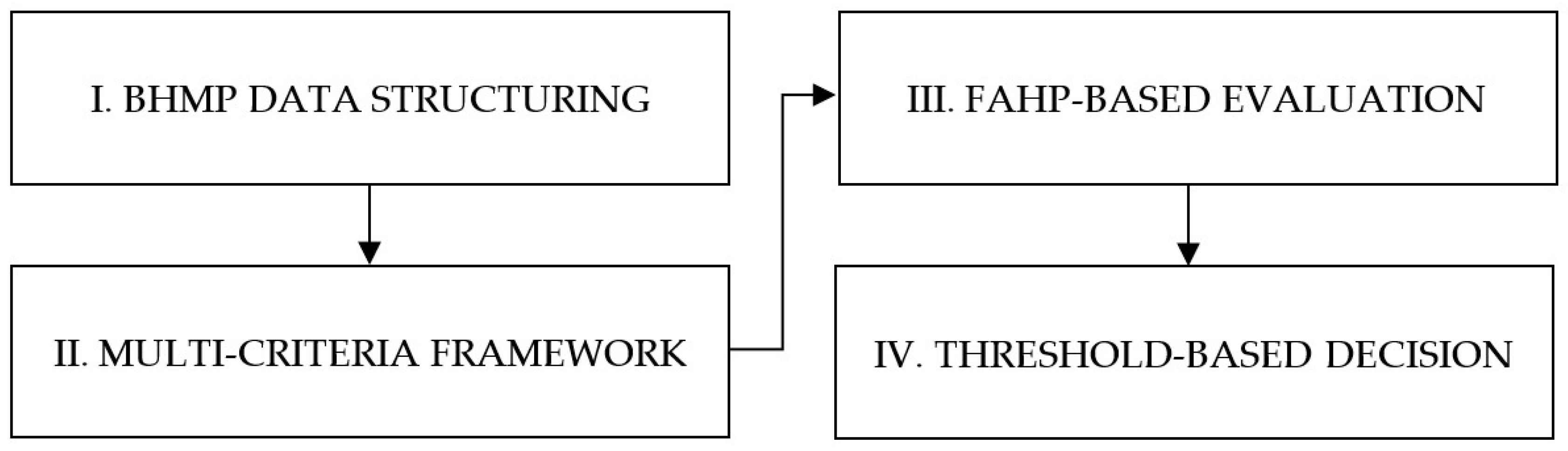
The research develops a structured methodological framework aimed at supporting the evaluation of heritage materials through the integration of BHMPs and MCDM techniques. The approach is conceived as a sequential process that ensures consistency between the definition of material descriptors, the construction of the evaluation model, and its application in real contexts. The overall structure of the methodology is illustrated in
Figure 1.
The methodology is grounded on the definition of the BHMP as a structured information framework designed to organize the heterogeneous characteristics of heritage materials. In this study, the BHMP is not only conceived as a data repository, but also as a methodological component that defines the data structuring phase of the framework. Within this structure, the complexity of materials is not directly assessed but first formalized through a system of indicators that enables the consistent representation of both measurable properties and context-dependent attributes. The indicator system is defined by distinguishing two main categories: technical indicators and heritage-driven indicators. Technical indicators describe physical, mechanical, and performance-related properties of materials, while heritage-driven indicators capture cultural, historical, and contextual dimensions, including aspects such as authenticity, traceability, and transformation processes. This distinction reflects the dual nature of heritage materials, whose evaluation cannot be reduced to purely technical criteria. The indicators are subsequently structured within a hierarchical framework that organizes criteria and sub-criteria according to the different dimensions of analysis, ensuring coherence between data representation and the evaluation process.
The evaluation model is developed through the combined application of the Analytic Hierarchy Process (AHP) and fuzzy logic within a unified FAHP framework. The AHP component is used to determine the relative importance of criteria through pairwise comparisons, while fuzzy logic enables the formalization of qualitative assessments and the management of uncertainty inherent in expert-based evaluations. The integration of these approaches is performed jointly, ensuring consistency between weighting procedures and the treatment of qualitative information.
The aggregation of indicators is performed through a multiplicative formulation of the overall score. This choice is motivated by the need to account for the interdependence between criteria and to limit compensatory effects, which are not appropriate in heritage evaluation contexts where critical deficiencies in specific dimensions should not be offset by high performance in others. The resulting composite score is subsequently used within a threshold-based decision mechanism, which enables the translation of evaluation outcomes into operational intervention strategies.
Finally, the methodology is applied to a limited number of case studies characterized by similar conditions in terms of material typology and conservation context. This application is intended to verify the operability and internal coherence of the proposed framework in real-world conditions. Given the controlled and homogeneous nature of the selected cases, the validation does not aim at statistical generalization, but rather at assessing the consistency and applicability of the methodological approach.
3. BHMP-Based Multi-Criteria Evaluation System
3.1. Indicators Definitions and Evaluation Criteria
The BHMP indicator system is designed as a core component of the proposed multi-criteria decision-support framework, enabling the evaluation of circularity in historic built environments through the integration of technical performance and heritage-driven criteria. This dual-domain approach addresses the limitations of conventional circular economy assessment tools, which are primarily performance-based and assume standardized, interchangeable materials with predictable lifecycles. In contrast, historic materials are heterogeneous, stratified, and embedded in long-term cultural processes, with values extending beyond technical performance to include traceability, historical knowledge, and cultural significance.
Within the BHMP framework, indicators are not treated as independent variables but are structured as an integral part of the data–evaluation linkage established in the methodological workflow. The system distinguishes two main categories: Technical Indicators and Heritage-Driven Indicators. Technical indicators assess the physical, chemical, and mechanical properties of materials, with particular attention to compatibility and long-term performance within existing building systems. Compatibility (C) evaluates the interaction between materials, considering environmental behavior and potential degradation processes, while Durability (D) measures resistance to mechanical decay, environmental stressors, and aging, with a focus on residual performance and reuse potential.
Heritage-Driven Indicators capture the cultural, historical, and contextual dimensions of materials, reflecting their role in heritage conservation. Traceability (T) addresses the availability and reliability of information regarding material origin, transformations, and past interventions, supporting the reconstruction of the material biography. Cultural Value (CV) represents the historical, architectural, symbolic, and identity-related significance of materials, including their contribution to the character of the built environment and their relevance within specific construction traditions.
The indicators are organized within a hierarchical structure that ensures coherence between the BHMP data model and the multi-criteria evaluation process. This alignment enables the direct translation of structured material data into evaluation inputs, supporting a consistent and reproducible analytical framework.
Each indicator is evaluated using a multi-criteria scoring system designed to integrate quantitative performance measures with qualitative and context-dependent assessments [
29,
30,
31]. The scoring is based on a discrete fuzzy scale ranging from 1 to 5, where score 1 represents critical conditions and score 5 corresponds to optimal performance. Intermediate scores capture partial fulfillment of evaluation criteria, reflecting the inherent uncertainty and heterogeneity of historic materials [
31]. The fuzzy scoring system is summarized in
Table 1, which defines both the score interpretation and the evaluation basis, including direct observation, archival documentation, bibliographic sources, and multi-source validation [
5,
7,
25].
For indicators characterized by a high degree of epistemic uncertainty, such as Cultural Value (CV), score attribution can be supported by structured expert elicitation procedures. Delphi-based approaches are employed to iteratively converge expert judgments toward a consensus [
38,
39,
40,
41,
42]. This process allows qualitative expert knowledge to be systematically integrated into the evaluation model, ensuring consistency and reducing subjectivity.
Recent studies have highlighted the increasing application of MCDM methods, including hybrid approaches, in construction and heritage decision-making [
36,
37]. However, these applications often remain disconnected from structured data environments and lack explicit integration with material-level information systems. By directly linking the BHMP data structure to the indicator system and evaluation process, the proposed framework establishes a coherent workflow from data collection to decision support, enabling transparent, reproducible, and context-aware decision-making in historic built environments.
3.2. Composite Scoring by Context-Sensitive Weighting
The BHMP framework implements a multi-criteria decision-support structure by integrating fuzzy-based evaluation with context-sensitive weighting derived through the Analytic Hierarchy Process (AHP) [
29,
30,
31]. The procedure is applied to the four BHMP indicators, whose individual scores are defined according to the fuzzy scale reported in
Table 1. By combining technical and heritage-driven indicators, the framework enables the integration of material performance and cultural significance within a unified evaluation model.
The AHP begins with the construction of a pairwise comparison matrix
, in which both rows and columns represent the ordered set of indicators
. Each element
expresses the relative importance of indicator
with respect to indicator
, according to the Saaty fundamental scale (1–9) [
29]. The matrix is reciprocal, such that
and
.
In heritage conservation contexts, the relative importance of indicators depends on project objectives and cultural priorities. In particular, Cultural Value (CV) and Compatibility (C) often play a dominant role, as materials with high historical significance must be preserved and interventions must ensure compatibility with existing structures. To reflect a conservation-oriented scenario, the following relative importance values are adopted:
,
,
, and
. Based on these assumptions, the pairwise comparison matrix is defined as:
The matrix is normalized column-wise according to:
yielding the normalized matrix:
The weight vector is computed as the average of each row:
resulting in:
These results indicate that Compatibility (C) and Cultural Value (CV) exert the highest influence on the overall evaluation, while Traceability (T) has an intermediate contribution and Durability (D) a lower impact in the scenario considered.
The consistency of the pairwise comparison matrix is verified by computing the weighted sum vector
, from which the maximum eigenvalue
is estimated:
yielding
.
The Consistency Index (CI) and Consistency Ratio (CR) are then computed as:
where
for
[
29]. The resulting value
confirms that the matrix satisfies the consistency requirement. The final BHMP score is computed as:
where
represents the fuzzy score of each indicator. This formulation enables the integration of qualitative and quantitative information within a consistent analytical framework.
It is important to emphasize that the weighting structure is inherently context-dependent. The AHP methodology allows the relative importance of the indicators to be calibrated according to specific project objectives and stakeholder priorities. While the present configuration reflects a conservation-oriented scenario, alternative contexts may lead to different weight distributions, enhancing the flexibility and applicability of the proposed framework.
To ensure that the framework operates as a decision-support tool rather than a purely descriptive model, a threshold-based decision rule is introduced to map the composite score onto alternative intervention strategies:
Conservation strategy: (in situ preservation, minimal intervention).
Reuse strategy: (selective dismantling, reuse, or relocation).
This mechanism establishes a direct and explicit link between evaluation results and operational decision-making.
3.3. Determination of the Decision Threshold
In the proposed BHMP framework, the decision threshold () is defined as a methodological component of the evaluation model rather than an empirically calibrated parameter. Its role is to identify the transition between two decision domains—conservation and reuse—based on the composite score obtained from the weighted aggregation of the evaluation indicators.
Since individual indicators are assessed using a discrete fuzzy scale ranging from 1 to 5, the resulting BHMP score is bound within the same interval. Within this scale, three performance regimes can be identified: low performance (<3), moderate performance (≈3), and high performance (≥4). Consequently, the transition between moderate and high performance occurs within the interval [
3,
4], which defines the admissible domain for the threshold value.
Within this interval, the threshold is set at , corresponding to the midpoint between moderate and high-performance levels. This choice defines a neutral decision boundary, ensuring that conservation strategies are assigned only when the aggregated evaluation reflects consistently positive performance across the considered indicators. Conversely, materials characterized by partial, uncertain, or uneven performance are directed toward reuse strategies.
From a methodological perspective, this choice is consistent with the structure of the evaluation model. Given the adopted weighting scheme (, , , ), the threshold value implies that high scores in dominant indicators, Compatibility (C) and Cultural Value (CV), are necessary but not sufficient on their own to ensure classification toward conservation. This prevents single-criterion dominance and enforces a balanced multi-criteria evaluation.
Therefore, the threshold can be interpreted as:
The central value of the transition domain between moderate and high performance;
A structurally consistent cutoff within the weighted aggregation model;
A non-arbitrary decision boundary derived from the internal properties of the evaluation system.
This formulation ensures that the decision mechanism remains transparent, reproducible, and fully integrated within the overall methodological framework.
4. Application and Validation of Multi-Criteria Evaluation System in Real Environment
The multi-criteria evaluation system was applied to two representative heritage buildings located in the Valle dell’Agri, within the Appennino Lucano Regional Park (Basilicata, Southern Italy), an area characterized by a high density of historic buildings affected by advanced decay. The selected case studies were chosen due to their pronounced material degradation and partial structural collapse, providing a suitable context to evaluate the operational reliability and decision-support capabilities of the proposed BHMP framework.
This application also addresses the challenges typical of marginal historic settlements in inland Basilicata, characterized by long-term depopulation, abandoned building stock, and heterogeneous documentation. These conditions allow testing the robustness of the framework under real-world scenarios involving incomplete data, material deterioration, and complex cultural stratification.
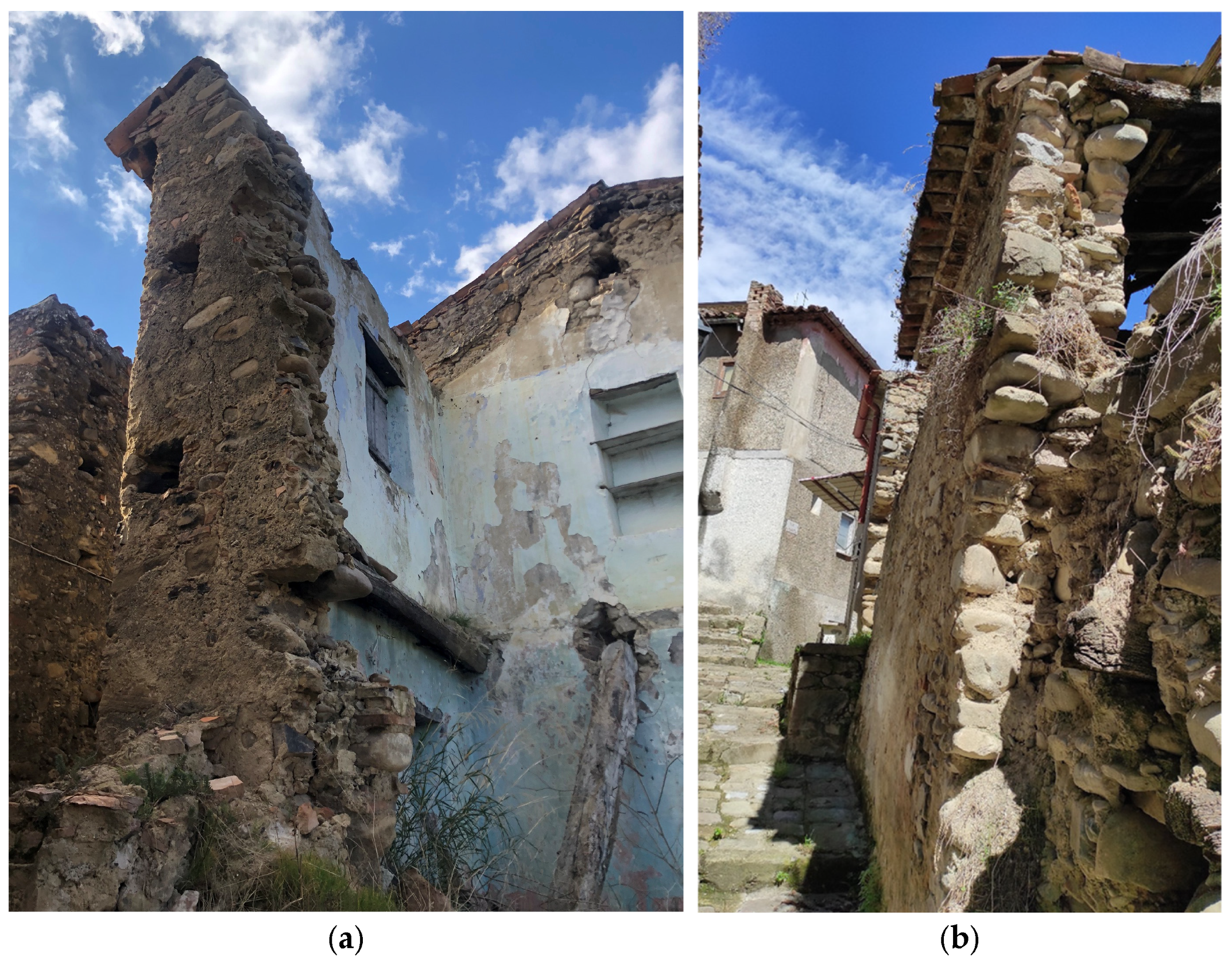
The first case study is located in the historic center of Gallicchio, a compact medieval settlement developed along sloping terrain in the Val d’Agri. The urban fabric is dense and continuous, with buildings arranged in interconnected masonry aggregates adapted to the topography. Construction techniques are based on load-bearing stone masonry using locally sourced materials, combined with timber floors and pitched roofs covered with clay tiles (coppi). The selected building exhibits widespread degradation, localized collapses, and discontinuities in the structural system (
Figure 2a). Archival and historical documentation is limited, resulting in low traceability for most material components.
The second case study is in the ancient village of Casale di Armento, a dispersed settlement of medieval origin characterized by a strong relationship between built structures and the surrounding landscape (
Figure 2b). The site includes residential units, agricultural structures, and terraced areas historically used for cultivation. Construction techniques are like those observed in Gallicchio, with load-bearing stone masonry and timber floor systems. Despite its advanced state of abandonment, the settlement retains high structural legibility. In contrast to the first case study, the availability of archival sources and on-site evidence allows a more reliable reconstruction of material histories, resulting in higher levels of traceability and cultural significance.
For both case studies, three main material categories were selected for evaluation: stone masonry, timber floors, and roofing systems composed traditional curved clay roof tiles (coppi). Each material was assessed according to the four BHMP indicators—Compatibility (C), Durability (D), Traceability (T), and Cultural Value (CV)—using the fuzzy scoring scale defined in
Table 1. The results are summarized in
Table 2, which reports the individual indicator scores, the weighted composite BHMP score, and the resulting intervention strategies based on the decision rule defined in
Section 3.
In the Gallicchio case study, the results highlight the combined effect of limited traceability and moderate cultural significance. Although stone masonry and roofing systems exhibit satisfactory technical performance, their relatively low Cultural Value results in composite scores below the threshold, leading to reuse-oriented strategies. Timber floors, characterized by both low traceability and limited heritage significance, show the lowest scores and are consistently assigned to reuse pathways. These results reflect a context in which technical adequacy alone is insufficient to justify conservation.
In contrast, the Casale di Armento case study demonstrates the strong influence of heritage-driven indicators. Stone masonry and roofing systems achieve higher composite scores due to elevated Traceability and Cultural Value, resulting in conservation-oriented decisions despite moderate technical performance. Timber floors, with lower structural performance and a composite score of 2.87, remain below the threshold and are assigned to reuse strategies. This outcome confirms that the framework balances technical and cultural criteria without overemphasizing heritage value when insufficient for preservation.
A key outcome of the application is the ability of the framework to assign different intervention strategies to materials within the same building, reflecting their specific technical and heritage-related characteristics. This differentiation enables optimized material management, allowing high-value materials to be preserved while directing lower-value or degraded materials toward reuse or upcycling in accordance with circular economy principles.
The results demonstrate that the BHMP integrates technical and heritage-driven indicators into a reproducible, evidence-based decision framework. By applying fuzzy scoring combined with AHP-derived weights and a deterministic threshold (score ≥ 3.5 → conservation; <3.5 → reuse), ambiguous intermediate scenarios are eliminated. Consequently, materials with high heritage significance are systematically directed to conservation, while less significant materials are routed to reuse or upcycling strategies. This operationalization confirms the robustness and applicability of the BHMP in real degraded heritage buildings, providing transparent and actionable guidance for preservation and circularity decisions.
Sensitivity Analysis of the Decision Threshold
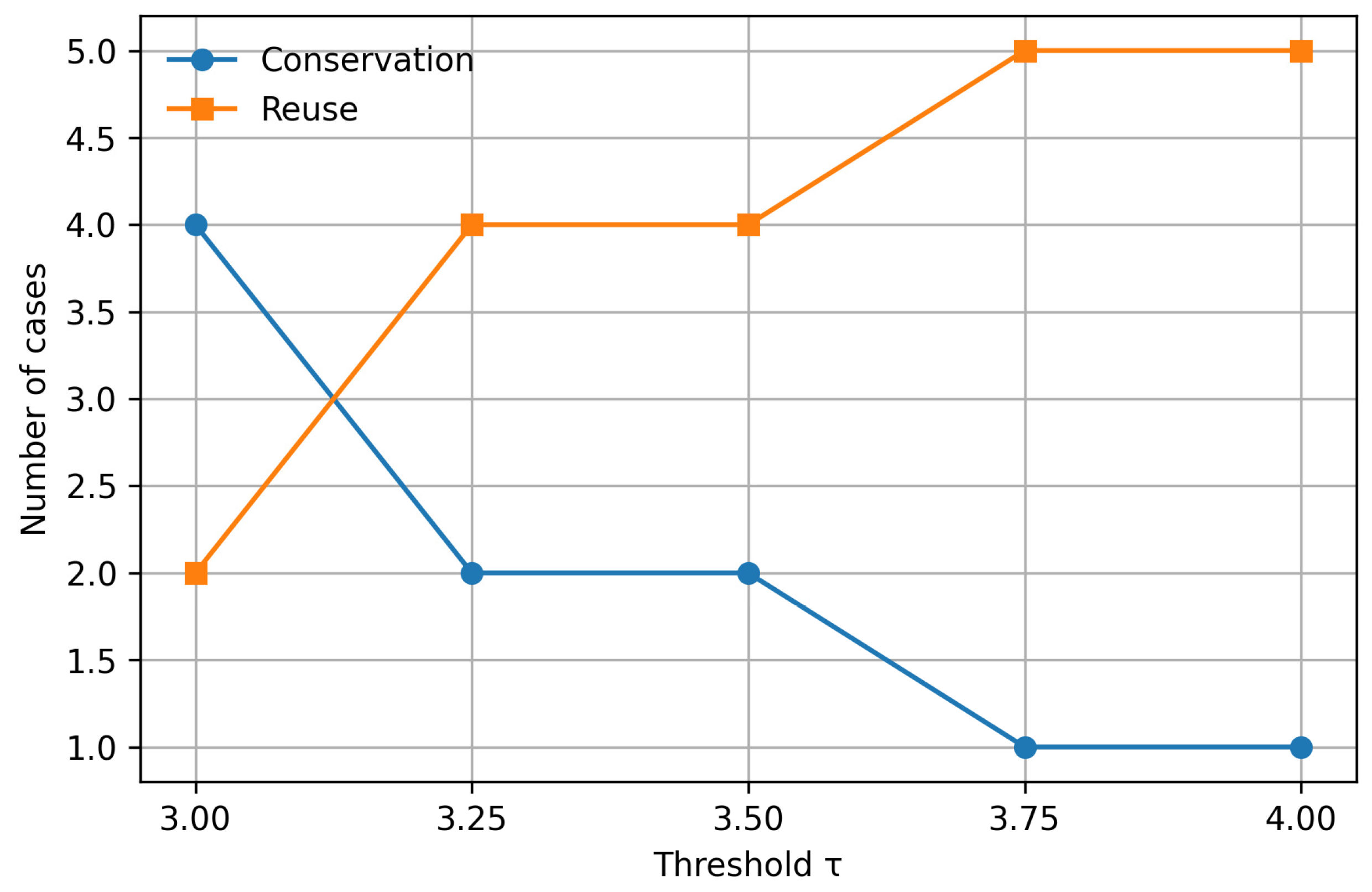
To evaluate the robustness of the decision model with respect to the selection of the threshold parameter τ, a sensitivity analysis was performed on the results obtained from the case studies. The analysis considers a discrete set of threshold values within the admissible interval τ ∈ [3.0, 4.0], with an increment of 0.25. For each value of τ, the classification rule defined in
Section 3.3 was applied to the six evaluated material instances, and the resulting allocation between conservation and reuse strategies was recorded.
The variation in classification outcomes as a function of the threshold value is illustrated in
Figure 3. The results show a monotonic relationship between τ and the classification outcomes: as the threshold increases, the number of materials assigned to conservation decreases, reflecting a progressively more selective decision criterion.
At lower threshold values (τ ≈ 3.0), the model exhibits permissive behavior, assigning conservation also to materials characterized by moderate composite scores. This results in an expansion of the conservation domain and a reduction in the discriminative capacity of the model. Conversely, at higher threshold values (τ ≥ 3.75), the classification becomes more restrictive, assigning conservation only to materials with consistently high scores across all indicators. In this configuration, materials with significant cultural value but moderate technical performance may be excluded.
The intermediate range τ ∈ [3.25, 3.50] provides a more balanced distribution of outcomes. In particular, the reference value τ = 3.50 ensures consistency with the interpretation of the scoring system, associating conservation with performance levels above the moderate threshold while avoiding excessive selectivity.
Furthermore, classification changes occur primarily for materials with composite scores close to the decision boundary, while materials characterized by clearly high or low scores remain stable across all tested configurations. This behavior indicates that the model exhibits limited sensitivity to small variations in the threshold parameter.
Overall, the sensitivity analysis confirms the robustness of the proposed threshold and supports its use as a stable and consistent decision parameter within the BHMP framework.
5. Discussion
The results of the case studies provide an empirical basis for assessing the behavior of the proposed BHMP framework; however, their relevance extends beyond the specific application contexts and concerns the methodological structure of the approach.
A central outcome of this study is the demonstration that the integration of data structuring, multi-criteria evaluation, and decision-making within a single framework enables a coherent and operational interpretation of heritage material value. In contrast to conventional approaches, which tend to address these components separately, the BHMP framework establishes a direct relationship between material data, evaluation criteria, and intervention strategies.
This integration has important implications for the role of evaluation in heritage conservation. Existing tools based on material passports or circularity assessment primarily focus on data organization and performance indicators [
5,
7,
21], while MCDM applications are often limited to supporting isolated decision problems [
32,
33,
34,
35]. As a result, evaluation processes frequently remain descriptive and do not explicitly inform decision-making. The proposed framework addresses this limitation by introducing a structured transition from evaluation to action, in which the composite score is directly associated with conservation or reuse strategies.
The application to the case studies confirms that this structure allows the model to capture the multidimensional nature of heritage materials. The results show that decision outcomes are not driven by a single dominant criterion but emerge from the interaction between technical and heritage-driven indicators. This is particularly evident in the contrasting behavior observed in the two case studies, where variations in traceability and cultural value significantly influence the final classification. These findings indicate that the framework can adapt to context-specific conditions while maintaining internal coherence.
A further methodological implication concerns the level of analysis. While recent studies integrating MCDM within HBIM environments operate primarily at the building scale [
25], the BHMP framework introduces a material-level perspective, enabling differentiated decisions within the same building. This aspect is particularly relevant for circular economy applications, where selective reuse and targeted conservation require fine-grained evaluation of individual components rather than aggregated building-level assessments.
The weighting system represents another key aspect of the framework. By adopting a context-sensitive AHP structure, the model allows the explicit incorporation of conservation priorities into the evaluation process. This flexibility reflects the inherently situated nature of heritage decision-making, where values and priorities vary according to cultural, technical, and project-specific conditions. At the same time, the explicit formulation of weights contributes to the transparency and reproducibility of the evaluation process.
The definition of the decision threshold τ constitutes a central methodological contribution. Unlike conventional approaches, where thresholds are often implicitly assumed or empirically defined, the proposed framework derives the threshold from the internal structure of the evaluation model. The identification of the interval [
3,
4] as the transition domain between moderate and high performance, and the selection of τ = 3.5, ensure consistency between the scoring system and the classification rule.
The sensitivity analysis further supports this interpretation. The observed monotonic relationship between the threshold value and classification outcomes demonstrates that the model behaves in a stable and predictable manner. Classification changes are limited to materials located near the decision boundary, while materials with clearly high or low scores remain unaffected. This indicates that the model exhibits controlled sensitivity and that the threshold provides a balanced trade-off between permissiveness and selectivity.
Overall, the proposed framework should be interpreted as a structured decision-support system rather than a prescriptive tool. Its strength lies in its ability to organize heterogeneous information, make evaluation criteria explicit, and provide a transparent link between assessment and intervention strategies. In this sense, the BHMP approach contributes to advancing the operationalization of circular economy principles in heritage contexts by enabling more informed, context-aware, and reproducible decision-making processes.
6. Conclusions
This study presents a BHMP-based multi-criteria decision-support framework for the evaluation of heritage building materials within a circular economy perspective. The proposed methodology integrates structured material data, multi-criteria evaluation, and a threshold-based decision mechanism within a coherent analytical workflow.
The framework enables the systematic assessment of heritage materials by combining technical performance with cultural and historical significance, providing a consistent basis for distinguishing between conservation and reuse strategies. The introduction of a threshold-based decision rule allows the direct translation of evaluation results into operational actions, supporting a more structured and transparent decision-making process.
The application to real case studies confirms the practical applicability of the approach and its capacity to operate under conditions of incomplete information and material degradation. The results highlight the potential of the framework to support context-aware decisions at the material level, contributing to more efficient and selective resource management in heritage environments.
The proposed methodology is inherently adaptable, as both the weighting structure and the decision threshold can be calibrated according to specific project conditions and conservation objectives. This flexibility makes the framework suitable for a wide range of heritage contexts while maintaining methodological consistency.
Future research should focus on extending the application of the framework to additional case studies and integrating the methodology within digital environments, including BIM-based systems and interoperable material databases, in order to enhance scalability and support real-time decision-making.