1. Introduction
Generative AI (GenAI) is rapidly reshaping language learning and teaching by enabling text, image, and other multimodal composition while reconfiguring how learners plan, draft, evaluate, revise, and disclose their work [
1,
2,
3,
4,
5]. For this reason, the central challenge for the field is no longer whether GenAI should appear in language classrooms, but how it can be pedagogically integrated into learning designs that preserve learner agency and promote responsible human–AI collaboration. Within this Special Issue’s focus on pedagogical integration of AI, AI-augmented teaching, and human–AI interaction, prompting becomes a consequential literacy practice because the quality of learning increasingly depends on how learners specify goals, constraints, evidence expectations, and evaluative criteria in their interaction with probabilistic systems, while remaining accountable for what they ultimately accept, reject, revise, and submit [
1,
2,
3,
4,
5,
6,
7,
8].
In parallel, research on AI literacy and critical GenAI literacy has emphasized that effective classroom integration requires far more than technical access or functional familiarity. Learners need guided routines for evaluating outputs, managing bias and hallucination risks, negotiating authorship, and making principled decisions about disclosure and responsibility [
6,
7,
8]. Prompt literacy is therefore best treated not as a decontextualized set of prompt-engineering tricks, but as an interactional competence that can be taught, observed, assessed, and studied through process traces such as prompt logs, revision histories, evaluation notes, and disclosure records [
6,
7,
8]. This framing aligns with calls for AI-augmented teaching in which instructors do not merely permit AI use, but deliberately shape the conditions under which learners engage with GenAI critically, strategically, and responsibly [
6,
7].
A persistent problem, however, is that prompt literacy is often framed too narrowly. In some discussions, it is reduced to a set of optimization techniques for eliciting better outputs; in others, it becomes a vague label for knowing how to communicate with systems such as ChatGPT. Both tendencies are limiting. The former privileges perishable technique over durable literacy practice, while the latter leaves the construct theoretically diffuse. What remains underexplained is how prompting, output evaluation, revision, disclosure, and accountability become part of a coherent learning process in GenAI-mediated writing. This gap suggests the need for a framework that treats prompt literacy not as isolated prompt skill, but as an interaction-first competence embedded in genre, judgment, and responsibility [
9].
Despite the clear importance of prompt literacy, much existing research has focused more heavily on the outputs of AI—such as the quality of AI-generated texts—than on the process of learner–AI interaction itself [
10,
11,
12]. This output-centric view obscures how learners formulate prompts, interpret and evaluate AI responses, revise their prompts, and decide what to take up, reject, or disclose in their writing. Yet recent work suggests that the educational value of GenAI depends substantially on the quality of these human–AI interactions, not simply on the sophistication of the tool [
6,
7,
8,
13]. Even a technically advanced GenAI system may contribute little to learning if students do not know how to engage with it critically and purposefully. There is therefore an urgent need to conceptualize prompt literacy in a way that captures not only prompt design, but also iterative interaction, evaluative judgment, and accountable writing practice [
7,
8,
11,
13].
This paper addresses that need by reconceptualizing fine-tuned prompt literacy (FTPL) as an interaction-first learning-and-accountability framework for GenAI-mediated L2 writing. Rather than asking only whether GenAI improves writing quality, we ask how learners engage in iterative cycles of constraint-setting, output interrogation, revision, and accountable uptake across multimodal and institutional writing contexts. The aim is not simply to propose another broad literacy label, but to explain how prompt-mediated human–AI interaction can function as a teachable, analyzable, and assessable writing process. To that end, the paper (a) differentiates FTPL from related AI literacy, critical GenAI literacy, and prompt literacy frameworks, (b) identifies an explanatory gap in existing discussions, (c) models how learning occurs through iterative human–AI writing interaction, (d) defines four dimensions of FTPL with clearer analytical boundaries, and (e) outlines implications for operationalization, assessment, and institutional accountability.
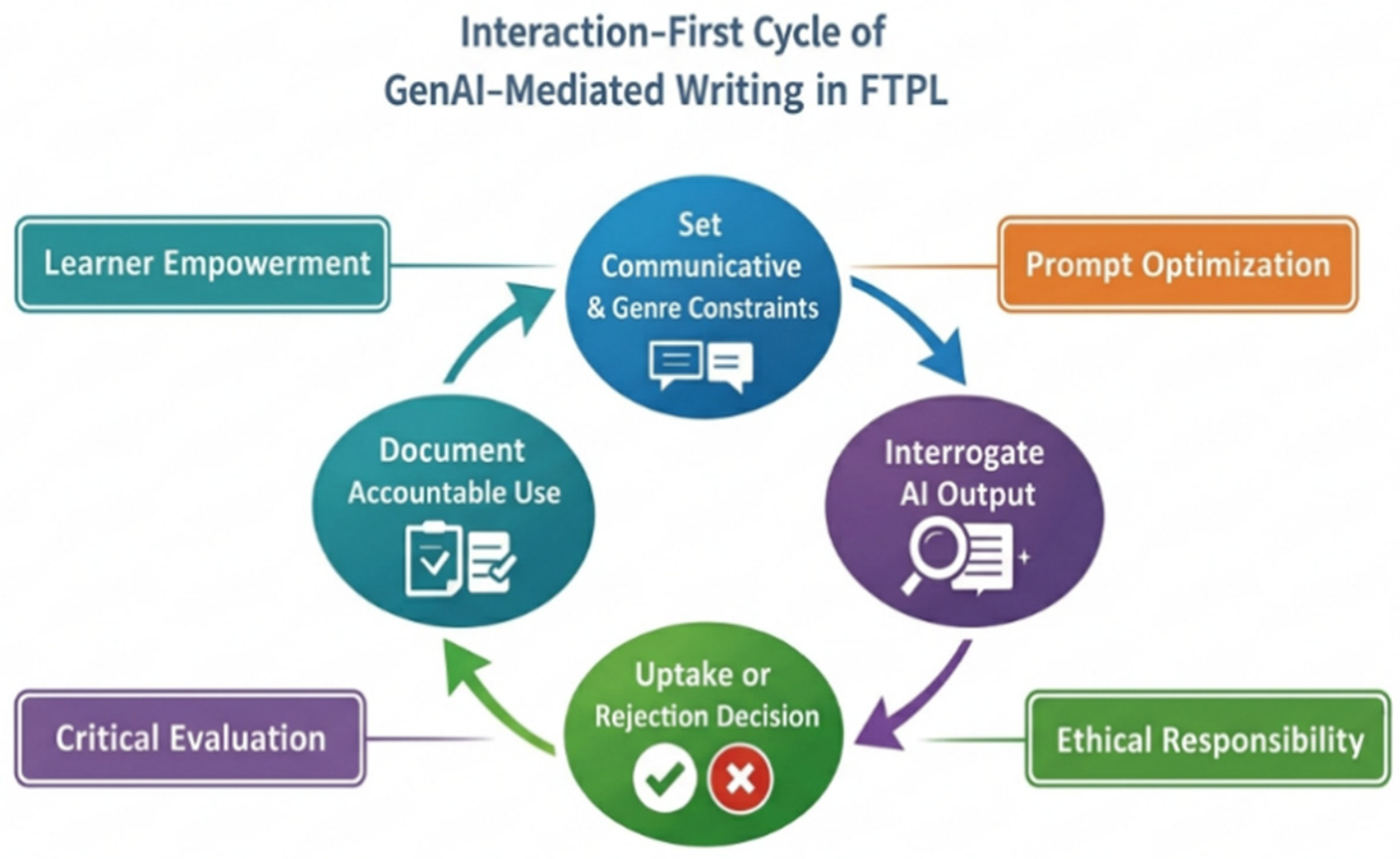
Figure 1 presents the interaction-first cycle underlying the framework. By doing so, the article contributes a more focused conceptual basis for understanding GenAI-mediated writing beyond product improvement alone.
The FTPL framework conceptualizes learning as an iterative process in which writers set communicative and genre constraints, interrogate provisional AI outputs, revise prompts and texts, make uptake or rejection decisions, and document accountable use across repeated cycles. The four dimensions of FTPL—learner empowerment, prompt optimization, critical evaluation, and ethical responsibility—support and shape this cycle.
2. AI Literacy and Prompt Literacy: Emerging Frameworks
2.1. AI Literacy in Language Education
As AI technologies enter education, scholars have called for expanding digital literacy frameworks to include AI-related competencies. AI literacy generally refers to the knowledge and skills needed to use artificial intelligence tools effectively, understand their outputs, and recognize their limitations [
6]. In L2 writing and learning, AI literacy includes abilities such as interacting productively with AI systems, evaluating AI-generated content, and integrating AI feedback into one’s own writing processes [
7,
12]. Warschauer et al. [
12], for example, highlight that writers of English as a second or foreign language require explicit guidance in working with AI-generated text because the affordances of such systems are accompanied by contradictions, including overreliance and false confidence. Similarly, critical AI literacy frameworks emphasize that learners must not only know how to use AI, but also when to trust it, how to question it, and how to use it ethically [
7,
13,
14].
This shift is especially important in language education because the apparent fluency of GenAI outputs can obscure the need for critical judgment. A polished response may still be inaccurate, weakly evidenced, overly generic, or rhetorically misaligned with a writing task. As Darvin [
13] argues, GenAI-mediated L2 writing requires forms of critical digital literacy that foreground learner agency, identity, and responsibility rather than treating AI as a neutral productivity tool. In this sense, AI literacy in language education is not simply a matter of access or technical competence; it increasingly concerns how learners participate in human–AI writing processes in ways that remain purposeful, critical, and accountable.
2.2. Prompt Literacy and Human–AI Interaction in L2 Writing
Alongside broader AI literacy discussions, researchers have begun to identify prompt literacy as a more specific set of capabilities related to interacting with GenAI. Early work suggests that learners do not automatically know how to formulate prompts productively and that such abilities develop through practice, feedback, and experimentation [
15,
16]. Hwang et al. [
15], for instance, observed that language learners gradually developed prompt-crafting skills through trial-and-error interaction with an AI writing assistant. Dillon [
16] similarly found that Korean university students who received prompt-literacy training with ChatGPT developed a more diverse range of prompting strategies and stronger self-regulated learning behaviors.
These findings suggest that prompt literacy is not simply an incidental by-product of AI access. It can be taught, scaffolded, and strengthened through formal instruction. Tour and Zadorozhnyy [
17] likewise argue that prompt literacy should be conceptualized and operationalized in ways that allow educators to identify specific prompting practices rather than assuming that successful prompting reflects a single, undifferentiated skill. In L2 writing contexts, this matters because the effectiveness of AI assistance often depends on whether learners can articulate task constraints, ask for appropriate forms of help, and revise their requests in response to emerging outputs.
At the same time, prompt literacy cannot be reduced to prompt optimization alone. If it is defined only as producing better prompts for better outputs, it risks becoming conceptually thin and pedagogically fragile. What matters educationally is not only whether learners can elicit fluent responses, but whether they can manage the human–AI interaction in ways that support learning, reflection, and accountable decision-making.
2.3. Critical GenAI Literacy, Ethics, and Accountability
Recent applied linguistics work increasingly distinguishes general AI literacy from critical GenAI literacy, a distinction that matters because GenAI outputs can be fluent yet unreliable, biased, or difficult to attribute [
8,
13,
14]. Ou et al. [
8], for example, conceptualize Critical GenAI Literacy in doctoral academic writing as a self-regulated capacity to evaluate GenAI suggestions, negotiate ownership, and respond to the broader implications of AI use in academic discourse. Wang and Wang’s APSE model [
14] similarly details dimensions of critical AI literacy such as awareness, positionality, strategy, and evaluation that are directly relevant to writing with AI support.
These frameworks help foreground the ethical and epistemic dimensions of GenAI use, including authorship, attribution, disclosure, and the reliability of AI-mediated textual production. In applied linguistics and L2 writing, such issues are especially salient because GenAI does not simply offer content; it participates in meaning-making, revision, and stance formation. As a result, writers must do more than use AI efficiently. They must decide how to evaluate, adapt, disclose, and justify the role of GenAI within their own writing processes [
7,
8,
13].
This perspective also has institutional implications. If GenAI-mediated writing is becoming part of educational practice, then accountability cannot be treated as a matter of after-the-fact policing alone. It must also be considered in relation to pedagogy, assessment, and process visibility. This is where the move toward FTPL becomes especially necessary.
2.4. The Explanatory Gap in Existing Frameworks
The preceding literature makes clear that AI-mediated writing requires far more than technical access or general digital competence. AI literacy frameworks identify broad areas of understanding and use; critical GenAI literacy foregrounds epistemic vigilance, evaluation, and ethical judgment; and prompt literacy research usefully emphasizes strategic interaction with GenAI tools [
6,
7,
8,
14,
15,
16,
17]. However, these strands do not yet fully explain how writers move through iterative cycles of prompting, interrogating, revising, disclosing, and documenting AI-supported decisions in situated writing tasks. Nor do they consistently connect genre-sensitive prompting to accountable uptake and process-based assessment.
More specifically, AI literacy frameworks tend to describe what learners should broadly know about AI, but often remain too general to explain how task-level interaction unfolds during actual composing. Critical GenAI literacy frameworks sharpen attention to evaluation, ownership, and ethics, yet they do not always specify how those concerns become visible within prompt-by-prompt writing activity. Prompt literacy studies, meanwhile, have helped identify strategic prompting practices, but often remain closer to skill description than to a fuller explanation of how prompting, revision, judgment, and accountability interact across extended writing processes. What remains underdeveloped is an account of how these elements become integrated into a coherent, analyzable, and assessable learning process in GenAI-mediated writing.
This is the explanatory gap addressed by FTPL. In the present article, FTPL is proposed not as a replacement for surrounding frameworks, but as a more focused interaction-first model for understanding how human–AI writing becomes a learning process that is simultaneously rhetorical, evaluative, ethical, and institutionally accountable. More specifically, FTPL seeks to explain how learners set communicative and genre constraints, interpret provisional AI outputs, evaluate their credibility and usefulness, revise both prompts and texts iteratively, and justify their uptake decisions in ways that remain visible for pedagogy, assessment, and institutional accountability [
7,
8,
9,
13,
14].
Figure 1 visualizes this process as a recurring interaction cycle.
In this sense, FTPL differs from surrounding frameworks not because it introduces entirely unrelated competencies, but because it reorganizes them around a distinct analytical problem: how GenAI-mediated writing becomes an accountable interaction process rather than a mere output event. This shift from output optimization to interaction-first accountability clarifies why prompt literacy should be studied not simply as efficient prompting, but as a genre-sensitive and judgment-intensive practice embedded in writing development. It also helps explain why process traces—such as prompt logs, revision histories, verification notes, and disclosure statements—should be treated as meaningful evidence of learning rather than peripheral documentation [
7,
8,
13,
14].
3. Toward Fine-Tuned Prompt Literacy as an Interaction-First Framework
3.1. FTPL as an Interaction-First Framework
Building on the preceding discussion, this paper defines fine-tuned prompt literacy (FTPL) as an interaction-first competence through which learners manage communication with generative AI under rhetorical, evidential, institutional, and ethical constraints. The framework is “fine-tuned” not because it promotes more efficient prompt engineering alone, but because it attends to how learners iteratively calibrate prompts, interrogate AI outputs, and justify uptake decisions in relation to disciplinary, task-specific, and accountability demands. In this sense, FTPL is both genre-sensitive and judgment-intensive: it concerns not only what learners ask AI to do, but how they evaluate what AI produces, what they retain or reject, how they revise in response, and how they document that process [
7,
8,
9,
13,
14,
17].
FTPL therefore treats prompt literacy as more than a technical capacity to generate better responses. It reframes prompting as part of a broader interactional and educational process in which communicative purpose, genre expectations, evaluation routines, and ethical reasoning are inseparable. From this perspective, GenAI is not merely an output engine, but a pedagogical mediator whose value depends on how learners direct, constrain, interrogate, and account for the interaction. This is why prompt literacy should be theorized not only as a functional skill, but as an accountable writing competence that can be observed through interactional traces and assessed through process-informed evidence [
7,
8,
13,
14].
3.2. How Learning Occurs in GenAI-Mediated Writing
Conceptually, GenAI-mediated writing can be understood as an iterative interaction cycle. First, the learner specifies communicative purpose, audience, genre, and other task constraints. Second, the AI generates a provisional output. Third, the learner interrogates that output for rhetorical fit, factual credibility, evidential support, bias, tone, and usefulness for the writing task. Fourth, the learner revises the prompt, the emerging text, or both. Fifth, the learner decides whether to adopt, reject, transform, or disclose the AI contribution. Across repeated cycles, these interactional moves generate process traces—such as prompt logs, revision histories, evaluation notes, and disclosure records—that make learning and accountability visible [
7,
8,
13,
14].
Seen in this way, learning does not occur because AI produces text for the learner, but because the learner engages in repeated acts of constraint-setting, interpretation, evaluation, repair, and accountable uptake. The educational value of GenAI-mediated writing therefore lies not primarily in product enhancement alone, but in how writers learn to interrogate the interaction itself. This point is important because output quality by itself cannot reveal whether learners understood why a response was useful, how they judged its reliability, or on what basis they revised and disclosed AI-assisted changes. A process account is therefore necessary not only for pedagogical reasons, but also for theoretical explanation: it is what allows FTPL to describe how learning is mediated through interaction rather than merely inferred from final textual improvement.
Analytically, these cycles can be described through observable interactional moves such as constraining, re-specifying, challenging, auditing, repairing, and documenting. FTPL is proposed as the set of interlocking capacities that enables this cycle to function productively rather than superficially.
3.3. The Dimensions of FTPL
In this article, FTPL consists of four analytically distinct yet mutually reinforcing dimensions: learner empowerment, prompt optimization, critical evaluation, and ethical responsibility. These dimensions should not be understood as isolated traits or a linear developmental checklist. Rather, they function together to support the iterative cycle of GenAI-mediated writing described above.
Learner empowerment concerns agency, ownership, and interactional control in directing the role of AI in the writing process. Prompt optimization concerns the strategic design and iterative refinement of prompts in response to task demands, emerging outputs, and rhetorical goals. Critical evaluation concerns the interrogation of AI-generated content for credibility, relevance, evidential sufficiency, bias, and rhetorical fit. Ethical responsibility concerns accountable use, including disclosure, authorship, privacy, attribution, and the legitimacy of AI support within instructional and institutional settings [
7,
8,
13,
14]. As summarized in
Table 1, these dimensions can be operationalized through observable indicators and process-based evidence rather than treated only as abstract dispositions.
Taken together, these four dimensions explain how human–AI writing can become both a learning process and an accountable educational practice. Learner empowerment prevents passive dependence by positioning the writer as the primary decision-maker. Prompt optimization structures the interaction so that AI participation is aligned with task-specific goals. Critical evaluation guards against superficial uptake by requiring epistemic vigilance. Ethical responsibility ensures that decisions about AI assistance remain legitimate, transparent, and accountable.
Table 1 summarizes these four dimensions through their operational definitions, observable indicators, and evidence sources.
4. Fine-Tuned Prompt Literacy Framework
The four dimensions of FTPL are best understood not as isolated traits or a developmental checklist, but as analytically distinct yet mutually reinforcing capacities that support the interaction cycle described above. Learner empowerment concerns agency and ownership in directing AI-mediated writing activity. Prompt optimization concerns the strategic design and iterative refinement of prompts in response to task demands and emerging outputs. Critical evaluation concerns the interrogation of AI-generated content for credibility, fit, and bias. Ethical responsibility concerns accountable use, including disclosure, authorship, privacy, and justified uptake. Together, these dimensions explain how human–AI writing can become both a learning process and an accountable institutional practice [
7,
8,
9,
13,
14]. The following subsections elaborate each dimension in greater detail.
4.1. Learner Empowerment
Learner empowerment refers to the cultivation of agency, ownership, and interactional control in AI-mediated writing. In FTPL, an empowered learner does not approach GenAI as an all-knowing source of solutions or as a hidden shortcut, but as a configurable and contestable participant in the writing process. Empowerment therefore involves more than confidence with technology. It includes the ability to define what role AI should play in a given task, what kinds of support are legitimate, and when AI suggestions should be ignored, revised, or refused. In this sense, empowerment is not merely affective; it is interactional and decision-based [
10,
18,
19,
20,
21,
22].
Existing studies suggest that learners often experience AI use in ambivalent ways, simultaneously reporting convenience, increased confidence, uncertainty, and concerns about dependence or authenticity [
10,
18,
19,
20,
21,
22]. These tensions matter because empowerment cannot be assumed simply from access to a tool. Rather, it must be cultivated through practices that position learners as active decision-makers who direct the interaction, evaluate the usefulness of AI support, and retain ownership over rhetorical and ethical choices. In this way, learner empowerment supports FTPL by ensuring that GenAI participation remains subordinate to the learner’s communicative purposes rather than the reverse [
13,
19,
22].
From an analytical perspective, learner empowerment may be observed in how writers initiate and govern AI participation in the composing process. Relevant indicators include whether learners specify task-relevant goals, actively reshape prompts when outputs are unsatisfactory, articulate reasons for accepting or rejecting suggestions, and maintain a sense of authorship across revision cycles. Empowerment therefore functions as the dimension that prevents prompt literacy from collapsing into passive dependence. In FTPL, it is the capacity that keeps the writer at the center of the interaction by framing AI participation as directed, limited, and accountable support rather than automatic authority.
4.2. Prompt Optimization
Prompt optimization concerns the strategic design and iterative refinement of prompts in relation to rhetorical goals, task constraints, and emerging AI outputs. In narrower accounts, prompting is often understood primarily as a matter of wording efficiency or technique. FTPL expands this view by treating prompts as interactional instruments through which writers encode audience expectations, genre constraints, evidential demands, stance preferences, and revision goals. Prompt optimization thus does not refer only to eliciting stronger outputs; it refers to structuring the human–AI interaction so that it serves the writing task in meaningful and accountable ways [
9,
12,
15,
16,
17].
This dimension includes several related practices: specifying context and communicative purpose clearly, decomposing complex tasks into manageable sub-prompts, revising prompts in response to unsatisfactory outputs, and adjusting prompting strategies across modalities where necessary. In L2 writing contexts, such practices are especially important because the usefulness of AI output often depends on whether writers can articulate not only content needs, but also tone, genre, organization, audience, and evidence requirements. Prompt optimization in this sense is closer to rhetorical calibration than to mere command input. It is part of how writers translate writing knowledge into interactional control [
12,
15,
16,
17].
Importantly, FTPL defines prompt optimization in relation to iteration rather than one-shot success. Prompt quality is rarely demonstrated by a single “good” request; it becomes visible through cycles of re-specification, clarification, repair, and refinement. This is why prompt optimization must be understood as a dynamic process rather than a static skill. In educational terms, it reflects the learner’s ability to make prompting responsive to rhetorical purpose and emerging evidence rather than merely maximizing fluency or convenience [
14,
15].
4.3. Critical Evaluation
Critical evaluation concerns the analytical interrogation of AI-generated content for credibility, relevance, evidential sufficiency, bias, and rhetorical appropriateness. This dimension is essential because GenAI outputs often appear fluent and authoritative even when they are inaccurate, weakly supported, fabricated, or poorly aligned with the task. In FTPL, critical evaluation therefore operates as a safeguard against superficial uptake. It requires writers to treat AI-generated content as provisional and contestable rather than automatically trustworthy [
7,
8,
13,
14,
23].
In practical terms, this dimension includes checking claims against reliable sources, identifying fabricated or misleading citations, evaluating the adequacy of evidence, detecting bias or overgeneralization, and assessing whether the output is rhetorically appropriate for the intended audience, genre, and stance. Such work is central to responsible L2 writing because the challenge is not only whether an AI-generated sentence sounds polished, but whether it is valid, appropriate, and defensible within the discourse context [
7,
8,
17,
24]. Critical evaluation thus connects directly to epistemic vigilance: the writer must learn to interrogate not only the content of the AI response, but also the assumptions and risks embedded in accepting it.
This evaluative work is also where FTPL most clearly resists the false sense of mastery that GenAI can induce. A writer may receive a fluent and seemingly sophisticated response without gaining any deeper understanding of why the output is plausible, what its weaknesses are, or how it should be revised for a particular context. Critical evaluation is therefore not simply a defensive skill for catching errors. It is a constructive dimension of writing development because it requires learners to compare alternatives, justify revisions, and refine their own standards of evidence, rhetorical fit, and claim-making. In this sense, it links GenAI-mediated interaction to broader goals of academic judgment rather than mere textual polish.
Within FTPL, critical evaluation is analytically distinct from prompt optimization and ethical responsibility, although it interacts with both. Prompt optimization concerns how the interaction is designed; critical evaluation concerns how the output is judged; ethical responsibility concerns whether the resulting use of GenAI is legitimate, accountable, and transparent. This distinction is important because one may produce a rhetorically efficient prompt without adequately evaluating the response, just as one may identify inaccuracies without fully addressing the ethical implications of disclosure or authorship. FTPL therefore treats critical evaluation as the dimension that ensures GenAI participation remains epistemically defensible rather than merely convenient [
7,
8,
13,
14].
4.4. Ethical Responsibility and Process Documentation
Ethical responsibility in FTPL is not a final compliance step appended after writing; it is part of the interaction itself. As learners decide what to accept, modify, reject, or disclose, they also make consequential judgments about authorship, attribution, privacy, delegation, and institutional legitimacy. For this reason, FTPL treats accountability as integral to prompt literacy rather than external to it. Process documentation—such as disclosure notes, revision rationales, AI-use statements, and records of verification—functions not only as evidence of compliance but also as evidence of reflective and accountable writing practice. In this sense, ethical responsibility extends beyond rule-following: it is a dimension of interactional competence through which learners justify why and how AI contributions enter, shape, or are excluded from their final texts [
7,
8,
9,
13,
14].
This dimension is especially important because GenAI-mediated writing takes place within evolving and often ambiguous policy environments. In many educational contexts, the relevant issue is not simply whether AI is allowed, but what kinds of assistance count as legitimate for a given task, how such assistance should be disclosed, and what evidence of independent judgment should accompany AI-supported work. Ethical responsibility therefore requires learners to navigate institutional expectations while also preserving voice, accountability, and fairness. From this perspective, authorship is not a binary status secured merely by final ownership of the text; it is a process shaped by decisions about delegation, revision, transformation, and disclosure [
13,
14].
Process documentation plays a critical role here because it makes otherwise invisible decisions legible. Prompt logs, revision histories, source-checking notes, and reflective explanations can reveal whether learners are outsourcing judgment or actively engaging in accountable uptake. Such traces are pedagogically valuable because they support discussion, reflection, and feedback, but they are also analytically important because they allow researchers and institutions to study how AI use affects writing development, authorship, and assessment practices. They also make it possible to distinguish between superficial disclosure and substantively accountable use, since documentation can show not only that AI was involved, but how it was involved, where human judgment intervened, and on what grounds decisions were made. FTPL thus positions ethical responsibility not as a peripheral implication but as a core dimension through which human–AI writing becomes institutionally and educationally accountable [
7,
8,
13,
14].
5. Pedagogical and Assessment Implications
The pedagogical value of FTPL lies not in treating prompting as a stand-alone digital skill, but in embedding GenAI-mediated interaction within writing instruction, evaluation routines, and accountability structures. If GenAI-mediated writing is understood as an iterative cycle of constraint-setting, interrogation, revision, and disclosure, then instruction should aim not merely to improve prompt efficiency, but to cultivate the writer’s ability to manage this cycle critically and responsibly. From this perspective, pedagogy should make interaction visible, teachable, and discussable rather than leaving GenAI use hidden, intuitive, or procedurally unexamined [
6,
7,
8,
14,
23].
This interaction-first account of FTPL both aligns with and extends existing research on AI literacy, critical GenAI literacy, and GenAI-supported writing pedagogy. Like Ngo and Hastie [
7], the present framework emphasizes that responsible AI integration requires explicit instructional design rather than mere tool access. It also resonates with Ou et al. [
8] and Wang and Wang [
14], who foreground evaluation, ownership, and ethical judgment in AI-mediated writing. At the same time, the present framework extends these studies by explaining how such concerns become visible within iterative writing activity through prompt sequences, uptake decisions, revision trails, and process documentation. In this sense, FTPL is not only compatible with prior work on critical literacies and AI-supported writing, but also offers a more process-oriented model for connecting interaction, assessment, and accountability in GenAI-mediated L2 writing.
5.1. Interactional Routines for FTPL Development
One implication of FTPL is that prompting should be taught through repeated interactional routines rather than isolated demonstrations of “good prompts.” Learners need opportunities to practice how prompts change when audience, genre, purpose, evidence, and rhetorical stance are varied. They also need structured occasions to compare weak and strong prompts, to revise under-specified requests, and to reflect on why a given prompt sequence did or did not support the writing goal. In this sense, prompt literacy instruction should be anchored in writing tasks rather than detached from them. The issue is not simply how to ask GenAI for something, but how to ask in ways that make rhetorical and evaluative expectations visible [
7,
8,
16,
17].
This suggests that classroom routines should repeatedly surface questions such as the following: What is the genre expectation here? What counts as evidence? What should be verified independently? What part of the AI response is usable, contestable, or irrelevant? Such routines help learners internalize prompting as part of writing judgment rather than as a shortcut to fluent text. They also provide a clearer pedagogical basis for integrating multimodal and GenAI-supported tasks without allowing AI use to remain purely instrumental [
1,
5,
25].
5.2. Process Evidence and Assessment Design
A key implication of FTPL is that assessment should not rely exclusively on final text quality. If GenAI-mediated writing is interactional and iterative, then evaluation should also attend to process evidence, including prompt sequences, revision trails, source verification notes, AI-use disclosures, and reflective justifications of uptake or rejection. Such materials do not merely document compliance; they provide insight into learner judgment, agency, and accountability. In this respect, FTPL supports a shift from product-only assessment toward process-informed evaluation [
7,
8,
13,
14].
This does not mean that every assignment must require extensive documentation. Rather, it suggests that when GenAI is part of the composing environment, some forms of process visibility become pedagogically and analytically valuable. Rubrics, for example, might include criteria related to strategic prompting, critical evaluation of AI outputs, and transparency of AI use in addition to conventional measures of rhetorical and linguistic quality. As
Table 1 indicates, these forms of evidence can be aligned with specific FTPL dimensions rather than treated as generic compliance materials. Such an approach aligns assessment more closely with the actual demands of AI-mediated composing and reduces the mismatch between what learners are asked to do and what institutions formally evaluate.
More importantly, process evidence matters because it captures dimensions of writing competence that final products alone cannot reveal. A polished final text may conceal whether the writer critically examined AI suggestions, revised misleading content, verified evidence, or simply accepted fluent but weak output. By contrast, prompt sequences, annotations, and disclosure records can reveal the quality of learner judgment and the degree to which GenAI support was managed reflectively rather than passively. In this sense, assessment informed by FTPL does not simply add more documentation; it better aligns evaluation with the actual interactional demands of AI-mediated writing.
In educational practice, this means that FTPL can be applied not only as a conceptual lens but also as a framework for designing classroom routines, assignments, and assessment criteria. For example, instructors may use the four FTPL dimensions to design prompt logs, reflection prompts, peer-review checklists, or rubric categories that make learners’ interaction with GenAI more visible and assessable. Rather than evaluating only the final written product, teachers can examine how students formulated prompts, revised AI-supported text, verified claims, and justified their uptake decisions. Such uses are especially relevant in L2 and EAP contexts, where the pedagogical goal is not simply to improve textual polish, but to develop learners’ rhetorical judgment, critical use of evidence, and accountable authorship.
5.3. Institutional Accountability and Disclosure
At the institutional level, FTPL also has implications for how educational programs define legitimate assistance, authorship, and accountability. Rather than relying only on prohibition or broad permission, institutions may need clearer criteria for acceptable AI use, disclosure expectations, and evidence of independent judgment. FTPL offers one way to connect these concerns by treating accountability as part of writing competence itself rather than as an external policy add-on. This perspective is particularly important in contexts where local integrity policies remain evolving or ambiguous, because it encourages assessment designs that value visible decision trails rather than forcing AI use into either covert dependence or blanket prohibition [
13,
14,
23].
Institutional accountability is especially relevant in multilingual and unequal educational contexts. If GenAI support is unevenly understood or strategically used, then a prompt divide may emerge in which some learners benefit from more advanced interactional knowledge while others remain excluded from effective and ethical use. For this reason, FTPL should not be viewed only as an individual learner competence. It also has institutional significance as a framework for designing policies, support systems, and assessment practices that make responsible GenAI-mediated writing more equitable and more transparent [
14,
25].
From an educational standpoint, FTPL may also serve as a practical framework for teacher education, curriculum design, and institutional policy development. Teacher educators can use the framework to prepare future instructors to guide students’ GenAI use beyond prohibition-or-permission approaches, while curriculum designers can align learning outcomes, classroom activities, and assessment tasks with the four FTPL dimensions. At the institutional level, the framework may support the development of clearer guidance on acceptable AI use, disclosure practices, and process-based evidence, thereby helping schools and universities move toward more transparent and pedagogically meaningful forms of GenAI integration.
7. Conclusions
The emergence of generative AI in language education demands more than a simple expansion of digital skills. It requires a clearer account of how writers interact with GenAI, how they evaluate and revise its contributions, and how they remain accountable for what enters the final text. This article has argued that fine-tuned prompt literacy (FTPL) offers one such account by reframing prompt literacy as an interaction-first learning-and-accountability framework for GenAI-mediated L2 writing.
FTPL was proposed not merely as a new label for responsible prompting, but as a way of clarifying an explanatory gap in existing discussions of AI literacy, critical GenAI literacy, and prompt literacy. In doing so, it builds on prior work in AI literacy, critical GenAI literacy, and GenAI-supported L2 writing while offering a more explicit process-oriented account of how interaction, judgment, and accountability unfold in writing. The framework highlights four interlocking dimensions—learner empowerment, prompt optimization, critical evaluation, and ethical responsibility—and explains how these dimensions support iterative cycles of constraint-setting, output interrogation, revision, disclosure, and documented uptake. From this perspective, the significance of prompt literacy lies not in generating better outputs alone, but in shaping human–AI writing into a rhetorically informed, evaluatively rigorous, and institutionally accountable process.
In conclusion, the value of FTPL lies not in naming another general AI-related literacy, but in clarifying how GenAI-mediated writing becomes a process of interaction, judgment, revision, and accountability. By reframing prompt literacy as an interaction-first competence shaped by genre, evaluation, and ethical responsibility, this article offers a more focused conceptual basis for studying and designing human–AI writing practices in L2 contexts. The broader challenge is therefore not simply whether learners should use GenAI, but how educational systems can support forms of AI-mediated writing that remain analytically visible, pedagogically meaningful, and institutionally accountable.