


Abstract
Aircraft wake vortices pose significant threats to following aircraft during takeoff and landing phases. Coherent Doppler lidar provides an effective remote sensing technique for wake vortex monitoring through radial velocity measurements. However, reliable identification of wake vortices from lidar observations remains challenging due to noise and the complex multi-scale evolution of vortex structures. In this study, we propose a physics-guided multi-scale deep network (HMNet) for aircraft wake vortex identification. First, we propose a denoising module (DE) to suppress noise in radial velocity fields. Subsequently, we design a hybrid multi-scale backbone network containing a hybrid multi-scale feature extraction module (HMFE) to capture vortex structures at different spatial scales. Furthermore, we propose a feature gradient guidance module (FGGM) to incorporate physically meaningful gradient cues and enhance vortex-sensitive features. HMNet is evaluated and tested on 1401 radial velocity field data samples collected on the runway at Shenzhen Bao’an Airport. The experimental results show that HMNet achieves 97.15% accuracy, 95.83% recall, and 96.84% F1 score. Compared with the baseline VGG16 and Random Forest, HMNet improves accuracy by 6.18% and 11.88%, respectively. These results demonstrate that HMNet provides an effective solution for lidar-based wake vortex identification and can support the development of intelligent air traffic management.
1. Introduction
Aircraft wake vortices are intense aerodynamic structures generated by the pressure difference at the wingtips when an aircraft produces lift. During high-speed flight, the pressure difference between the upper and lower surfaces of the wing causes airflow at the wingtips to move from the high-pressure region to the low-pressure region, forming a pair of large counter-rotating vortex. These wingtip vortices extend continuously behind the aircraft, with induced velocities reaching several meters per second or even tens of meters per second. The vortex core structure is stable and dissipates slowly, capable of propagating several kilometers downstream [1]. During low-altitude flight phases, particularly during takeoff and landing, wake vortex pose a significant threat to following aircraft. If a trailing aircraft enters the wake vortices region of a preceding aircraft, its wings will be subjected to strong disturbances from vertically rotating air masses, generating significant rolling moments and causing substantial deviations in aircraft attitude. In severe cases, this may even lead to temporary loss of control and trigger flight accidents [2].
To reduce the risks brought by aircraft wake vortex in airport terminal areas, the International Civil Aviation Organization (ICAO) has established strict aircraft separation standards for takeoffs and landings [3,4]. However, although this conservative strategy effectively improves flight safety, it also significantly limits airport capacity. Particularly at busy international airports (such as Shenzhen Bao’an International Airport in China, with a maximum capacity of 65 aircraft movements per hour), this leads to reduced runway utilization and increased flight delays. With the continuous growth of global aviation transport demand, how to optimize aircraft separation while ensuring safety and improving airport capacity has become a key issue of concern in the aviation transport field.
As a critical factor affecting separation control, aircraft wake evolution characteristics and detection technologies have been widely studied. For example, Breitsamter [1] summarized the mechanical characteristics of wake vortex and their near-field and far-field evolution processes. Chigier and Corsiglia [5] used three-wire hot-wire anemometers to conduct velocity measurements and studied the wake vortex characteristics of rectangular and square wingtips of NACA 0015 airfoil sections. Recently, Zhou et al. [6] developed adaptive mesh methods to attempt numerical simulation of aircraft wake vortex evolution and wake vortex encounters. However, due to the influence of environmental factors such as atmospheric turbulence and crosswinds on actual wake vortex behavior, traditional theoretical models have difficulty accurately simulating the dynamic evolution of wake vortex in real airport environments. Particularly in near-ground low-altitude areas, the applicability and accuracy of simulation methods show clear limitations.
Meanwhile, several sensing technologies have been developed for wake vortex detection, including radar, optical systems, and lidar-based remote sensing technologies. Among these, coherent Doppler lidar has received widespread attention due to its ability to measure wind velocity fields with high spatial and temporal resolution. By scanning the surrounding airspace, coherent Doppler lidar can obtain two-dimensional radial velocity maps containing important information about wake vortex structures. Köpp et al. [7] developed a 2 μm lidar system, opening new directions for remote detection of wake vortex. Holzäpfel et al. [8] compared multiple lidar-based wake vortex circulation estimation methods and revealed their applicable ranges and error characteristics. Liu et al. [9] conducted wake vortex positioning research using radial velocity and spectral width features. Rojas et al. [10] developed the CGM tool, providing a new solution for radar data-based wake vortex parameter estimation. Recently, Michel et al. [11] further improved the spatial resolution of lidar, enabling it to capture more detailed vortex core structure characteristics.
In recent years, deep learning techniques have demonstrated strong capability in feature extraction and pattern recognition tasks [12,13,14]. Convolutional neural networks (CNNs) have been widely applied in various remote sensing and atmospheric observation problems [15,16,17]. By learning hierarchical feature representations from large datasets, deep learning models can automatically capture complex spatial structures that are difficult to describe using handcrafted features. Several studies have explored the use of deep neural networks for vortex detection or flow pattern recognition. For example, Pan et al. [18] employed an improved VGG16 to classify the Wind3D-6000 dataset, achieving high accuracy. Further, Xu and Wu [19] enhanced the robustness of wake vortex detection by introducing a multi-receptive field fusion structure. Additionally, Shen et al. [20] utilized YOLOv5s to achieve single vortex localization in wake vortex images. Ma et al. [21] further improved performance by combining EfficientNetV2 with the CBAM attention mechanism. Recently, Zhiqiang et al. [22] achieved wake vortex parameter identification under various meteorological conditions using coherent Doppler lidar data. However, applying deep learning to lidar-based wake vortex identification still faces several challenges. First, wake vortices experience evolution across multiple spatial scales during their lifecycle. Early vortex structures are compact with significant velocity gradients, while later-stage vortices become diffuse and spread to larger areas. Second, coherent Doppler lidar measurements are often affected by noise, atmospheric turbulence, and background wind field interference. These factors may mask vortex characteristics. More importantly, existing deep-learning studies are still not fully aligned with the specific difficulties of airport-deployed radial velocity fields. Some methods mainly rely on generic image backbones originally developed for natural-image recognition, which do not explicitly address the physical gradient patterns and paired-vortex structures in RVF data. Other studies emphasize localization, grading, or parameter estimation, but do not focus on robust binary identification under noisy lidar observations.
To address these challenges, we propose a physics-guided multi-scale deep network (HMNet) for aircraft wake vortex identification from lidar radial velocity fields (RVF). HMNet addresses the problems of insufficient noise suppression, inadequate utilization of wake vortex structures, and weak representation capability for scale-varying vortex evolution in previous research. Specifically, a denoising module (DE) is proposed to suppress noise problems in RVF. Subsequently, to capture wake vortex structures at different spatial scales, we design a backbone network that combines a hybrid multi-scale feature extraction module (HMFE). Moreover, we propose a radial velocity gradient guidance module (FGGM). This module incorporates wake gradient information to guide the network to focus on vortex-sensitive regions.
The main contributions of this paper are summarized as follows:
- 1.
- We propose a hybrid multi-scale deep network (HMNet) for aircraft wake vortex identification on radial velocity fields obtained by lidar.
- 2.
- We design a denoising module that aims to suppress noise while preserving important vortex structures.
- 3.
- We introduce a feature gradient guidance module to incorporate physically meaningful gradient cues and enhance feature learning capabilities that are sensitive to vortex.
- 4.
- We propose a hybrid multi-scale feature extraction module to capture wake vortex structures across multiple spatial scales.
The rest of this paper is organized as follows: Section 2 introduces the principles of wake vortex generation and provides a detailed explanation of the principles of wake vortex data collection. Section 3 proposes a wake vortex identification method based on HMNet. Section 4 presents the experimental results and compares the performance with traditional methods. Section 5 summarizes the entire paper.
2. Materials
2.1. Wake Vortex Generation Mechanism
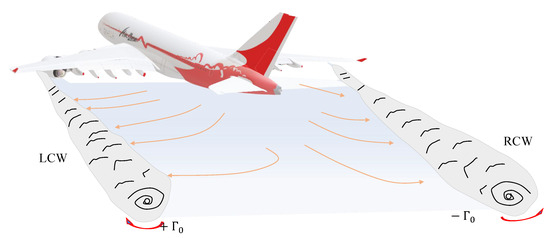
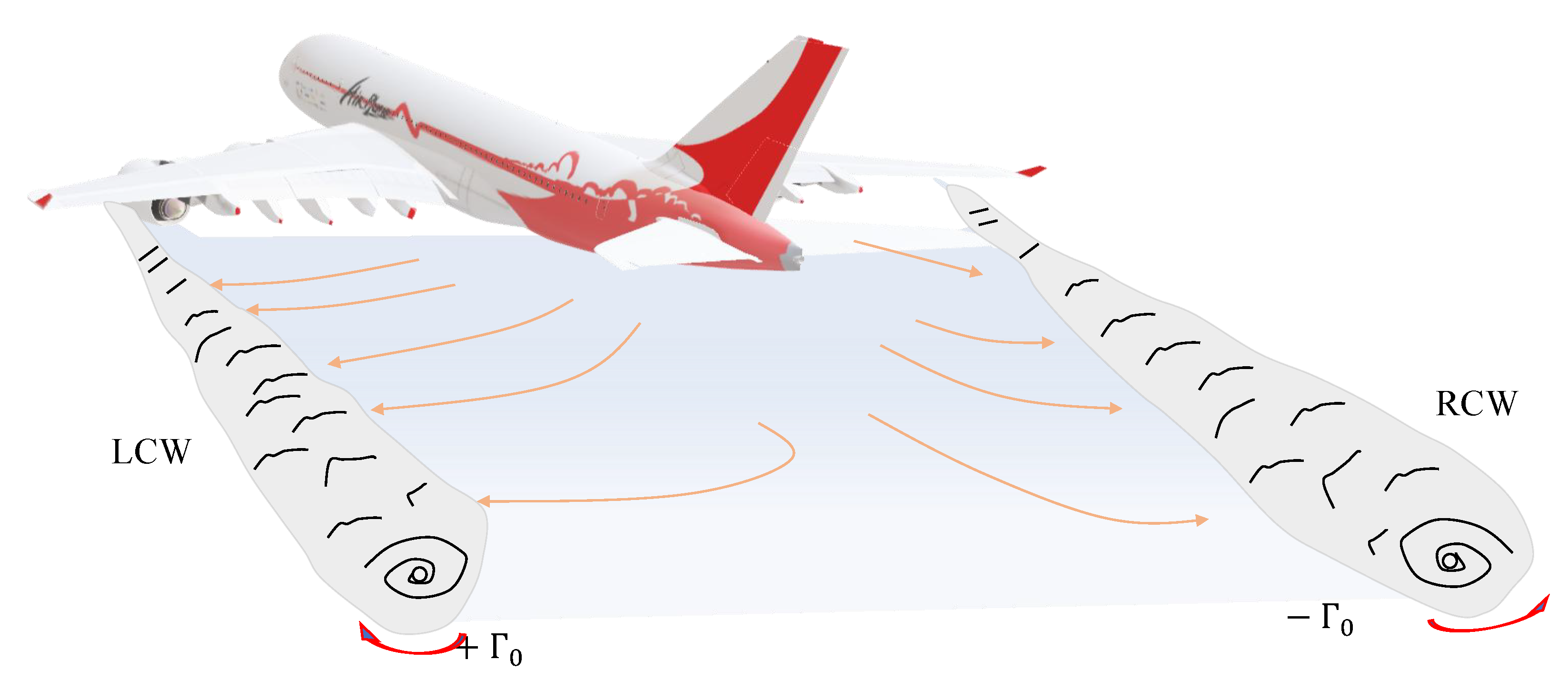
Aircraft wake vortex is an inevitable aerodynamic phenomenon during lift generation [23,24,25]. When an aircraft moves forward, air flows from the high-pressure region below the wing to the low-pressure region above the wing, forming a shear layer near the wingtips that rolls up into a pair of counter-rotating vortices. As shown in Figure 1, the vortex generated by the left wing rotates counterclockwise (LCW) with circulation , while the vortex generated by the right wing rotates clockwise (RCW) with circulation . These two vortices form a tightly coupled vortex pair that maintains its rotational structure while propagating downstream. Wake vortices have characteristics of high rotational velocity, concentrated energy, and long duration. These characteristics pose potential threats to following aircraft during takeoff and landing phases. The evolution of wake vortices typically includes two stages. In the initial stage (approximately 0–10 s after generation), the vortex cores maintain compact structures and exhibit strong circulation, which is the most hazardous stage. In the subsequent stage (10–20 s), viscous diffusion and atmospheric disturbances trigger Kelvin-Helmholtz [26] instabilities, leading to the formation of secondary small-scale structures and gradually dissipating vortex energy.
Figure 1.
Schematic diagram of aircraft wake vortex generation. During the lift generation process, a pair of counter-rotating vortices is generated at the wingtips. The left vortex rotates counterclockwise (LCW) with circulation , while the right vortex rotates clockwise (RCW) with circulation .
2.2. Wake Vortex Dataset
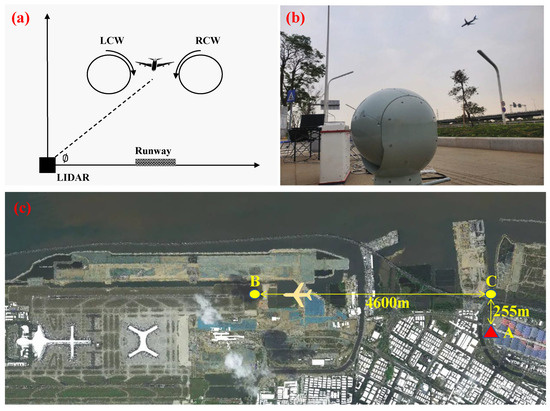
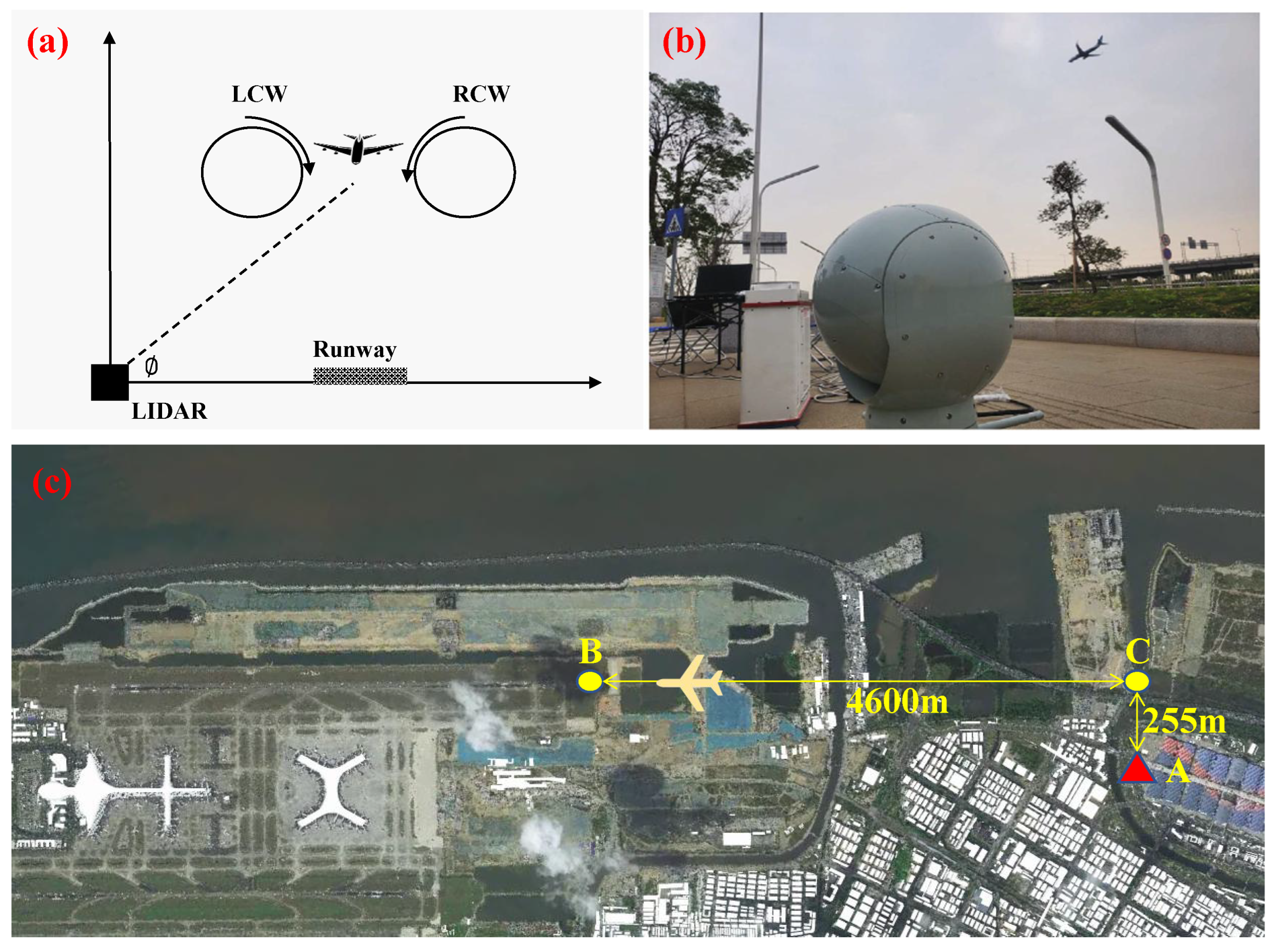
To obtain wake vortex observation data under real airport conditions, a field measurement activity was conducted on 16 March 2021 at Shenzhen Bao’an International Airport (ICAO: ZGSZ) in China. We deployed a coherent Doppler lidar system only near the entrance of Runway 16 to monitor the surrounding airflow during aircraft takeoff and landing operations. The deployment configuration is shown in Figure 2, where point A represents the lidar equipment location and point C corresponds to the runway entrance. The Range Height Indicator (RHI) scanning plane intersects with the extension line between A and C at point B. The horizontal distance between A and B is approximately 255 m, and the distance from B to C is approximately 4600 m. When aircraft cross the RHI scanning plane, their induced counter-rotating vortex appears as typical dual-core structures in the radial velocity field. The lidar retrieves radial wind velocity by measuring the Doppler frequency shift of aerosol backscattering signals. The system performs RHI scans with an angular scanning speed of /s, covering an elevation angle range from to . A complete RHI scan takes approximately 20 s, enabling continuous observation of wake vortex formation, descent, and dissipation processes. The main system parameters of the lidar are summarized in Table 1.
Figure 2.
Lidar deployment configuration at Shenzhen Bao’an International Airport. (a) Schematic diagram of the RHI scanning geometry (c) Satellite view of the experimental site showing the relative positions and distances between the lidar and the runway, showing the lidar position (A), scanning plane intersection (B), and runway threshold (C); (b) photograph of the deployed Wind3D 6000 coherent Doppler lidar system. Note that in the current study, observation activities are limited to a single deployment geometry configuration on Runway 16 at Shenzhen Bao’an Airport.
Table 1.
Wind3D 6000 lidar parameter configuration.
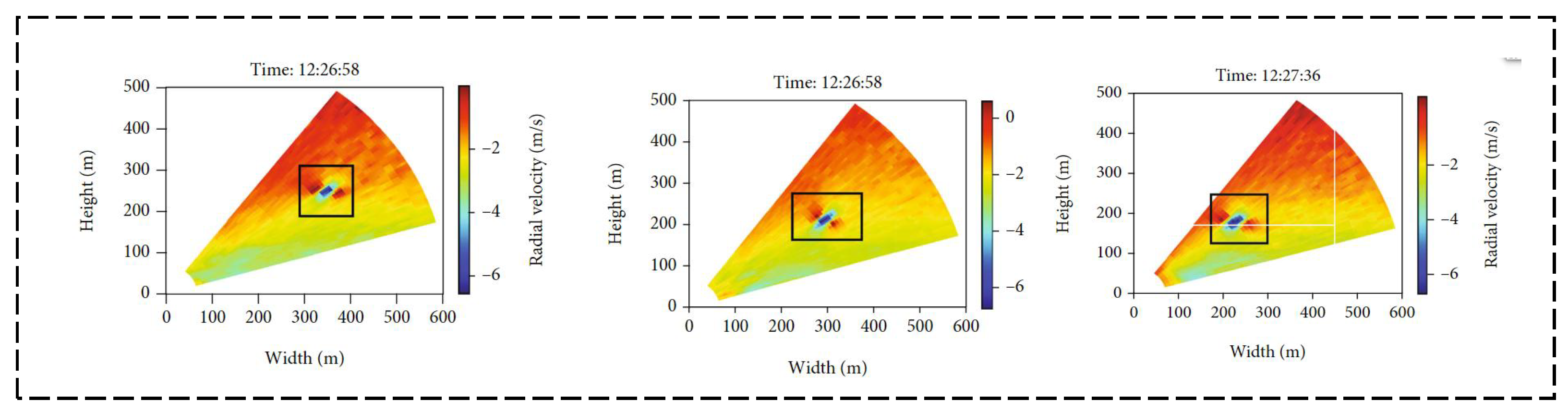
Wake vortex pairs appear as distinctive dual-core structures in radial velocity maps and undergo various stages, including formation, descent, and gradual dissipation. Figure 3 shows a typical example of RVF when aircraft pass through the RHI scanning plane.
Figure 3.
Visualization of RVF samples.
3. Methodology
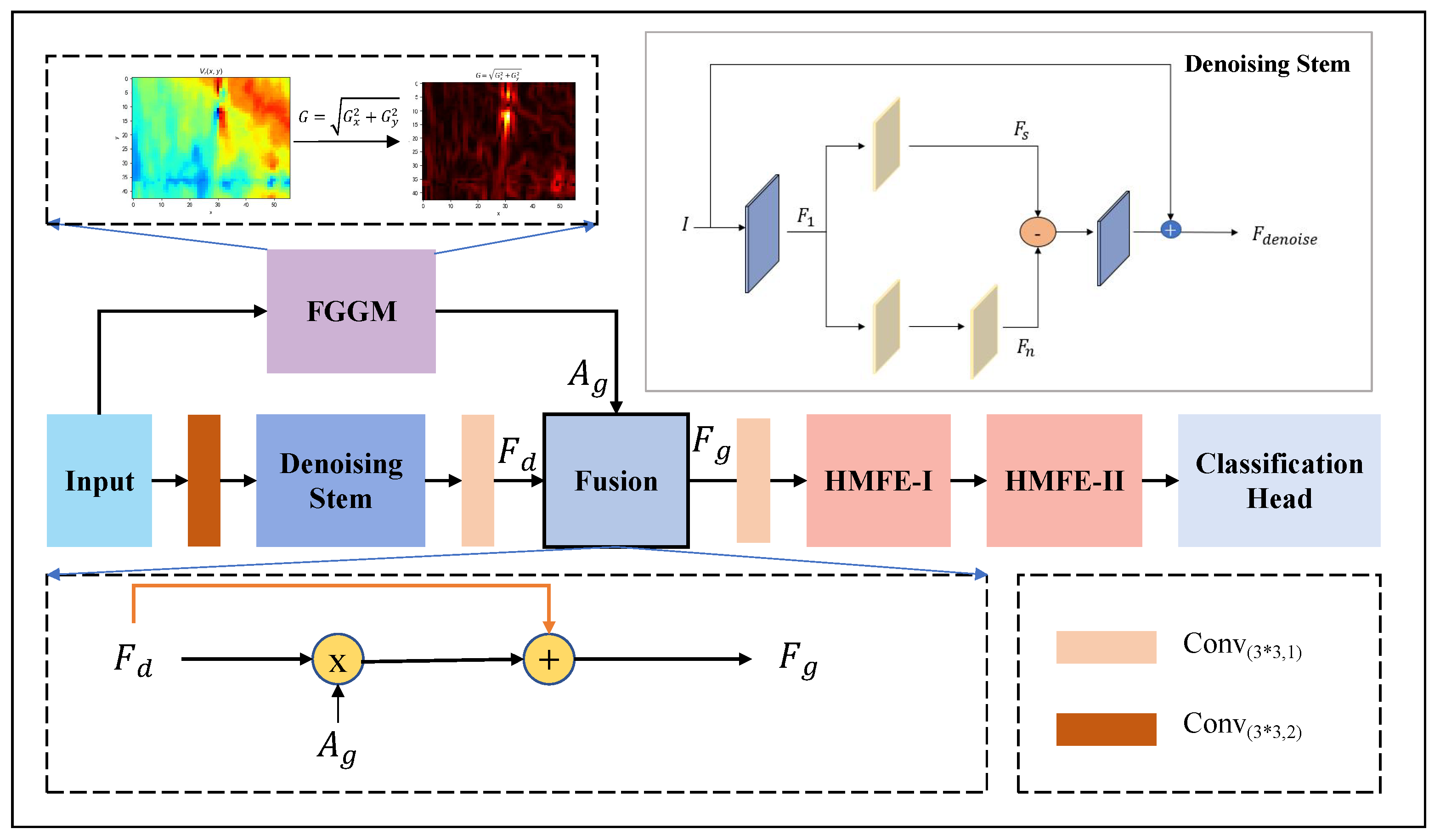
In this paper, we propose a hybrid multi-scale deep network (HMNet) for identifying aircraft wake vortex from lidar radial velocity fields. The overall architecture of HMNet is shown in Figure 4. Given input RVF , the network first applies a denoising backbone to suppress noise while preserving important vortex structures. Meanwhile, the feature gradient guidance module extracts structural gradient information from the RVF and generates an attention map to highlight regions with dramatic velocity changes. Subsequently, the denoised features are integrated with gradient guidance information through guided feature fusion operations, thereby enhancing vortex-sensitive regions and suppressing background interference. The fused features are then processed by two stacked hybrid multi-scale feature extraction modules (HMFE-I and HMFE-II), which progressively capture wake vortex structures from local patterns to larger-scale wake disturbances. Finally, the extracted feature maps are converted to compact representations through global average pooling (GAP), followed by a fully connected classification head that outputs the probability of wake vortex presence.
Figure 4.
Overall architecture of HMNet. The RVF first enters the denoising module to obtain cleaner low-level representations, while the gradient branch extracts physically meaningful velocity-gradient cues from the same input and converts them into guidance information. After feature fusion, two stacked HMFE blocks progressively learn fine-scale vortex cores and broader wake structures before GAP and the classifier output the wake-vortex recognition result.
3.1. Denoising Module
This section mainly introduces the structure of the denoising module. The radial velocity field measured by coherent Doppler lidar is affected by noise, atmospheric turbulence, and background wind field fluctuations. These disturbances may blur the weak velocity characteristics of wake vortex, particularly at vortex boundaries and low-intensity regions, thereby reducing the distinguishability of input data in subsequent feature learning. Therefore, we introduce a denoising module in the early stage of HMNet to suppress noise interference.
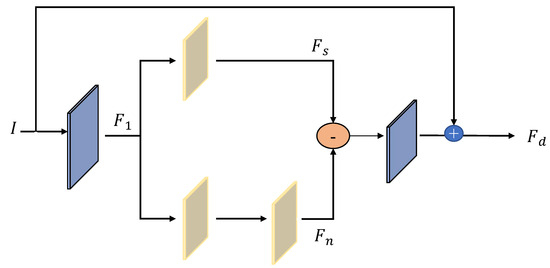
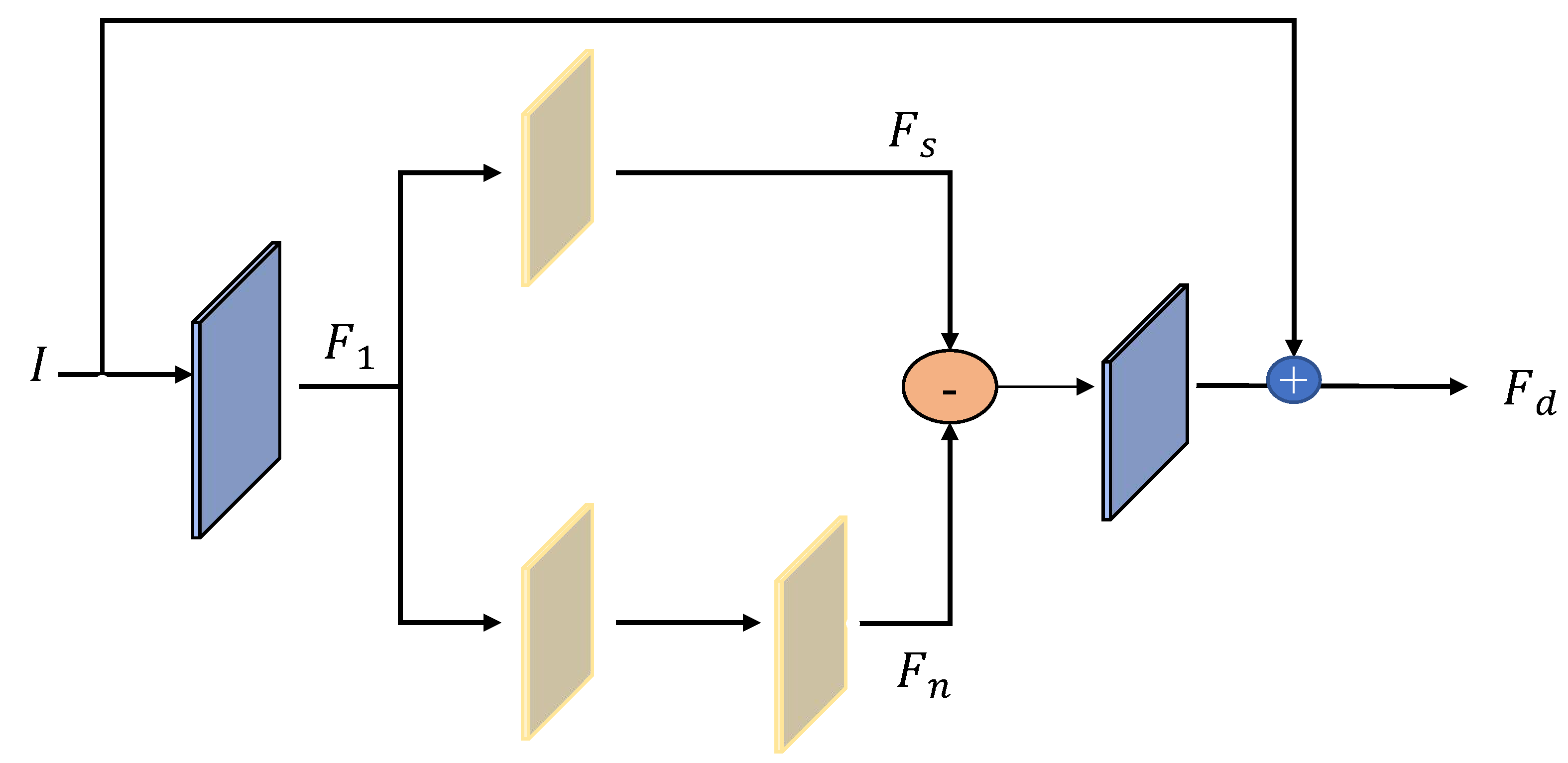
The structure of the denoising module is shown in Figure 5. Given the input RVF , the denoising module first applies convolution to extract local spatial representations. This operation serves a dual purpose. First, local convolution aggregates neighboring velocity values and converts the original single-channel input into a more expressive feature space. Second, the receptive field is small enough to capture short-range spatial continuity in the RVF while preserving local vortex structures. In this way, the initial representation obtained by the network is more suitable for subsequent signal-noise decomposition than the original input itself.
where, denotes the initial low-level feature map extracted from the input RVF I.
Figure 5.
Structure of the denoising module.
Then, two parallel convolutional branches are constructed based on . The first branch, , is used to preserve the main local structures. Since this branch contains only one additional convolutional layer, it mainly focuses on maintaining the primary spatial patterns in the original feature distribution, such as coherent vortex contours and local velocity variations. The second branch adopts deeper transformations to model background fluctuations and noise components. This branch, , uses additional convolutional operations, which expands the effective receptive field and enhances feature smoothing. Therefore, it is more sensitive to diffusive, unstructured, and background-related responses, including random measurement disturbances and slowly varying interference patterns. In other words, the shallow branch tends to preserve local structural details, while the deep branch tends to capture noise components.
where, represents the structure-aware feature map, and denotes the estimated noise-related feature map.
Inspired by residual learning and residual denoising strategies in deep visual models. Residual formulations have been proven to simplify the optimization process and preserve useful identity information through shortcut paths. In image denoising, residual learning is also widely used for noise perturbation separation, thereby improving robustness [27,28]. After obtaining the two feature maps, residual subtraction is performed to suppress noise-related responses. The basic principle of this method is that wake vortex structures are expected to exhibit relatively stable and spatially ordered patterns, while noise and background interference are more likely to manifest in deeper and smoother branches. By subtracting from , this module enhances discriminative structural information and weakens irrelevant responses, prompting the network to focus on the most informative vortex-related regions.
Finally, the intermediate residual feature is projected through a convolution and fused with the input through a residual connection to form the final denoised feature representation . The introduction of residual addition with the original input preserves the original low-order velocity information and prevents excessive removal of useful weak vortex cues during the denoising process. On the other hand, the residual pathway facilitates gradient propagation and stabilizes network optimization.
3.2. Feature Gradient Guidance Module (FGGM)
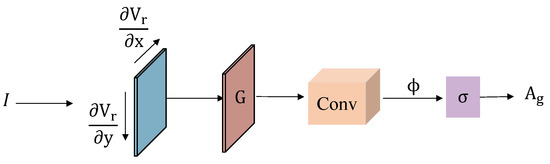
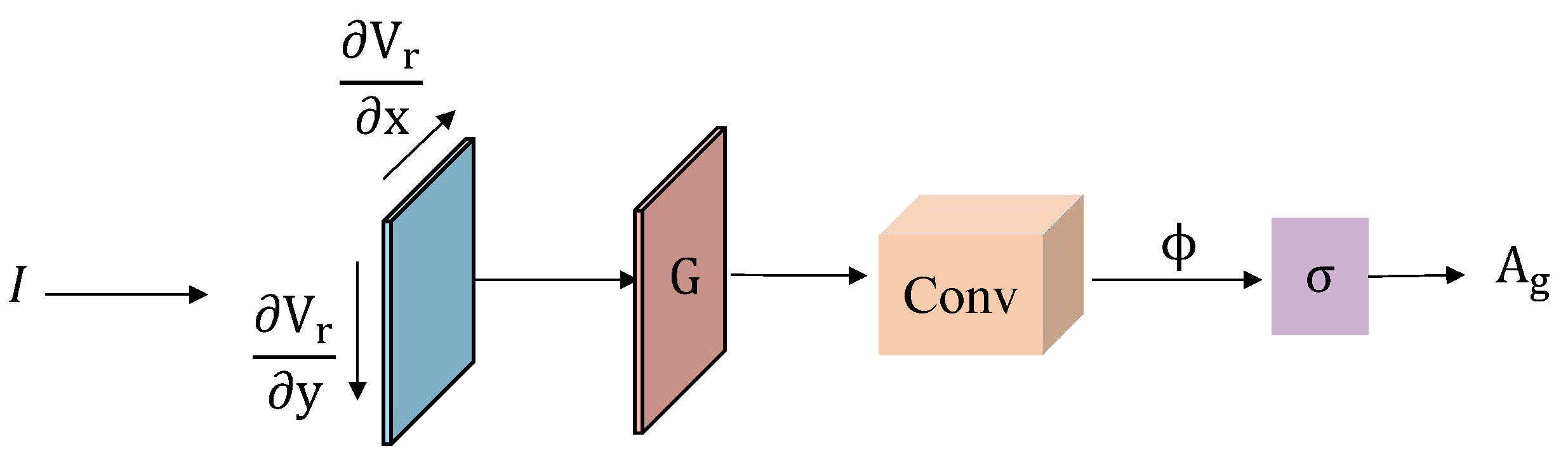
Aircraft wake vortices typically appear as paired velocity structures with one positive and one negative component in the radial velocity field measured by coherent Doppler lidar. These structures generate strong spatial velocity gradients near the vortex cores and surrounding shear layers. This gradient pattern provides important physical clues for identifying vortex-related regions. To explicitly incorporate this information into the deep feature learning process, a Feature Gradient Guidance Module (FGGM) is introduced, with its structure shown in Figure 6.
Figure 6.
Structure of feature gradient guidance module (FGGM).
To extract gradient-based structural clues, the spatial gradient calculation of the original RVF is shown in Equation (6). In actual computation, spatial derivatives are approximated through discrete convolution operators. These operators capture local changes in the velocity field and highlight regions where velocity changes rapidly.
where and denote the horizontal and vertical gradient components of the input RVF I, respectively.
The gradient map obtained through Equation (7) enhances locations with significant velocity changes, which typically correspond to vortex cores and shear layers. To integrate this structural information into the network, the gradient map is converted into learnable attention maps through convolutional mappings. Similar to attention mechanisms, spatial and channel attention modules, such as CBAM [29] and ECA [30], have demonstrated that attention can improve representation quality by emphasizing task-relevant regions or channels. The mechanism of this module similarly uses information priors to adaptively reweight intermediate features.
where, represents the convolution transformation, and represents the sigmoid activation function. The convolution layer learns the adaptive mapping from gradient intensity to attention weights, while the sigmoid function normalizes the output to the range. Since the gradient map is derived from the original velocity field, its spatial resolution remains consistent with the input. Therefore, when needed, the attention map is resized or projected to match the spatial dimensions of the denoised feature map . Finally, the gradient attention map recalibrates the feature representation through element-wise modulation.
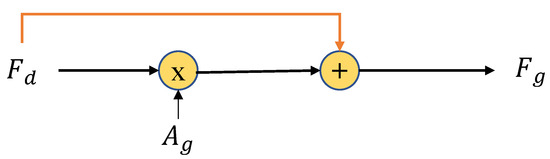
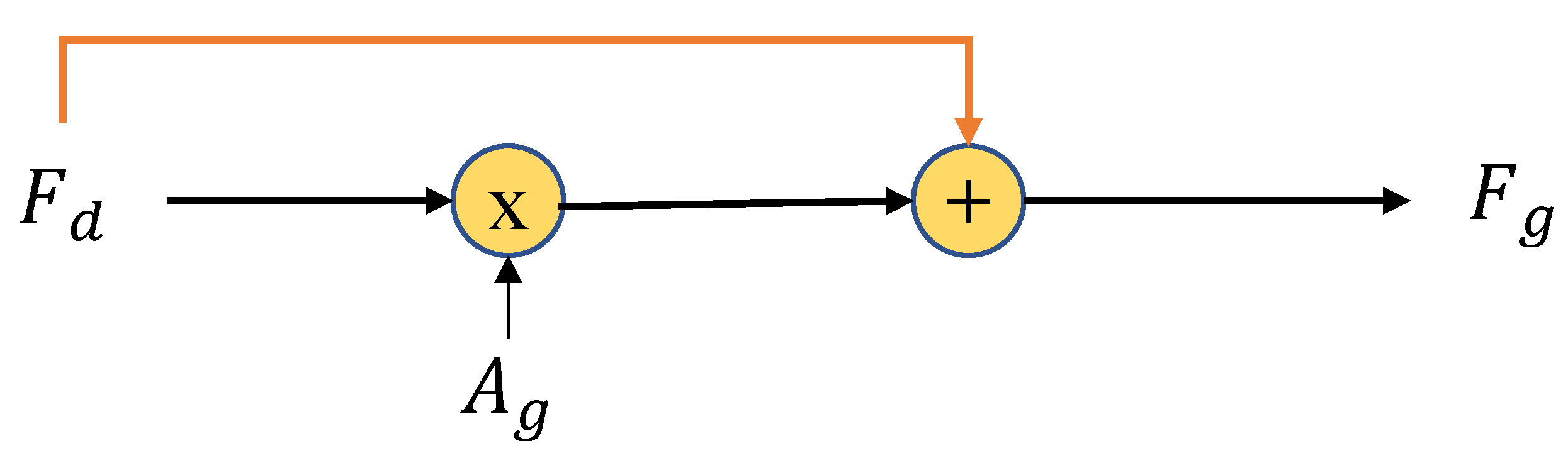
where ⊙ denotes element-wise multiplication. This formulation acts as a residual attention mechanism. The multiplicative term enhances gradient-sensitive regions, such as vortex cores and shear layers, while the residual connection preserves the original feature information and stabilizes network optimization. Feature fusion structure is shown in Figure 7.
Figure 7.
Feature fusion structure. The black arrows denote the main feature-flow path. The gray upward arrow denotes the input of the gradient attention map to the element-wise multiplication node. The orange arrow denotes the residual shortcut that directly passes to the element-wise addition node. The symbol × denotes element-wise multiplication, and + denotes element-wise addition.
Through this gradient-guided modulation process, the network becomes more sensitive to the structural characteristics of the wake vortex. Consequently, the subsequent feature extraction modules can focus on the most informative spatial regions, improving the discriminative capability of the proposed HMNet.
3.3. Hybrid Multi-Scale Feature Extraction (HMFE)
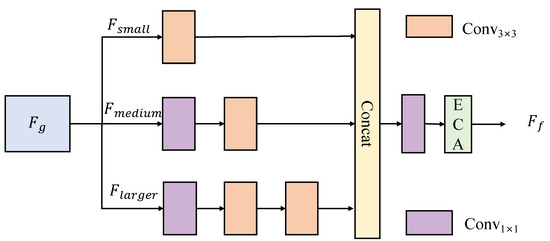
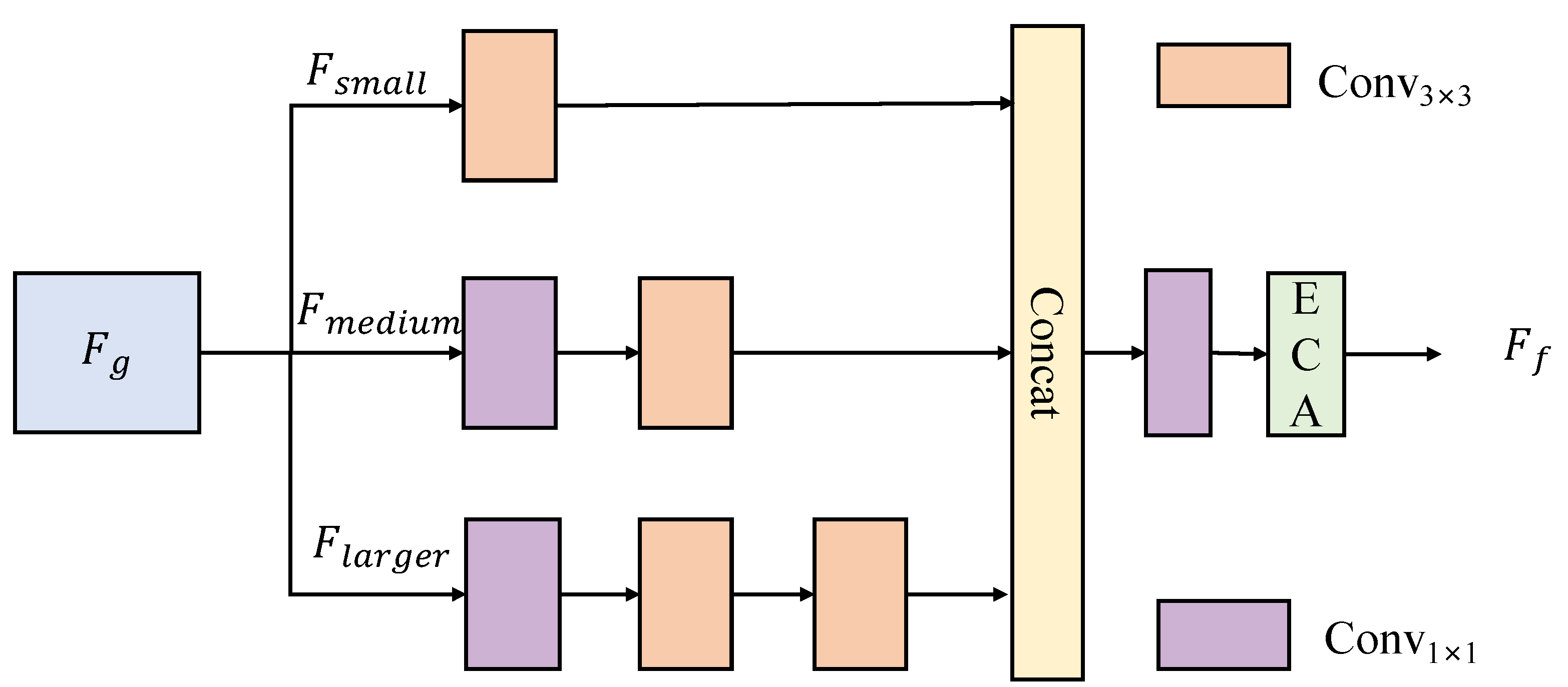
Aircraft wake vortices exhibit complex spatial structures and evolve across multiple spatial scales during their lifecycle. In the early stages, vortices typically present as compact dipole structures with strong velocity gradients, while in later stages they gradually diffuse and expand into broader wake disturbances. To effectively capture these scale-dependent features, we propose a Hybrid Multi-scale Feature Extraction (HMFE) module, whose structure is shown in Figure 8. Let the input feature map of this module be denoted as , where H, W, and C denote the spatial height, spatial width, and channel number, respectively. The HMFE module employs three parallel convolutional branches to capture wake vortex structures at different spatial scales.
Figure 8.
Structure of the hybrid multi-scale feature extraction module (HMFE).
The first branch, , uses standard convolution to focus on fine-scale vortex structures. This branch preserves local spatial details and is particularly effective in capturing tight vortex cores and sharp velocity transitions.
The second branch expands the receptive field through channel reduction followed by spatial convolution. This branch aims to capture medium-scale vortex patterns, such as the dipole structure of vortex pairs. The convolution first reduces channel redundancy and performs cross-channel feature interaction, while the subsequent convolution extracts spatial features through a moderately expanded receptive field.
The third branch further increases the receptive field through a deeper convolutional path. The deeper convolutional structure enables the network to aggregate information from larger spatial neighborhoods, making this branch more sensitive to broader wake disturbances and diffusion vortex structures.
Subsequently, the outputs of the three branches are concatenated along the channel dimension to form a multi-scale representation. Simultaneously, convolution operations are utilized to fuse the extracted multi-scale features and reduce channel redundancy.
Finally, we introduce the Efficient Channel Attention (ECA) mechanism [30] to adaptively enhance information-rich feature channels. The calculation is shown in Equation (15), where ⊙ represents element-wise multiplication. The ECA mechanism learns channel importance weights with minimal computational overhead, enabling the network to focus on the most discriminative vortex-related features.
In HMNet, two HMFE modules are stacked sequentially to progressively capture wake vortex patterns from local structures to broader wake regions. The first HMFE module (HMFE-I) focuses on extracting fine- and medium-scale vortex features, while the second module (HMFE-II) operates on higher-level representations with a larger effective receptive field. This hierarchical design enables the network to model wake vortex structures at multiple spatial scales.
3.4. Training and Optimization
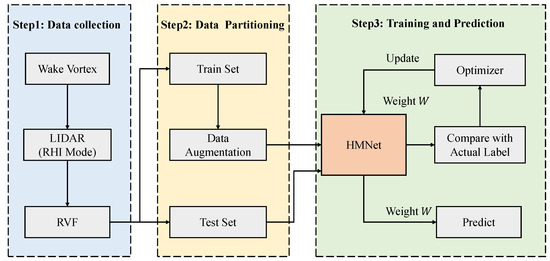
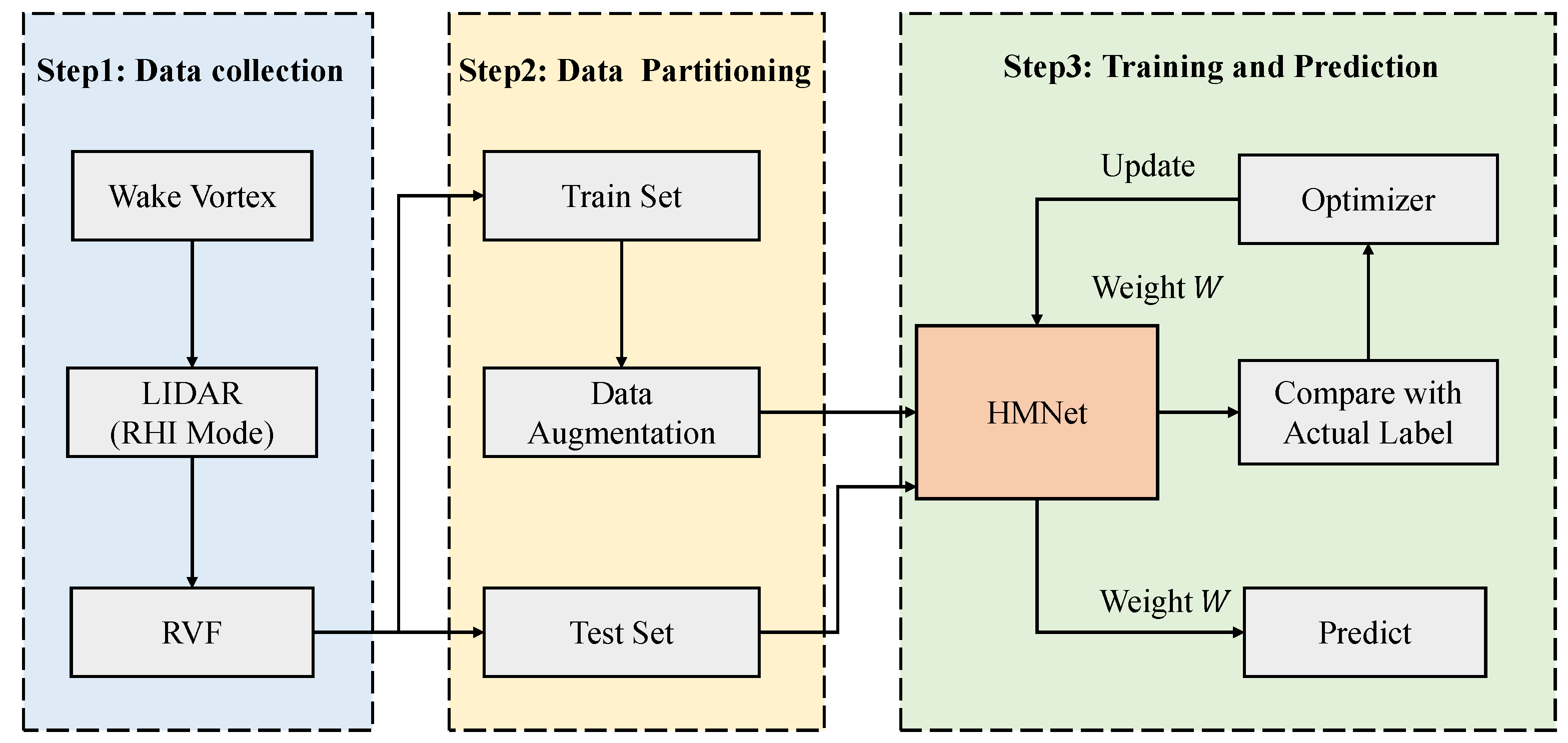
In this section, we present the training framework of the proposed HMNet, as shown in Figure 9. The workflow consists of three main stages, namely data collection, data partitioning, and training and prediction. In the first stage, wake vortex data are collected using a LIDAR system operating in the Range Height Indicator (RHI) scanning mode. The acquired measurements are then processed to generate the Radial Velocity Field (RVF), which serves as the input data for the subsequent learning model. In the second stage, the collected dataset is divided into a training set and a test set. To enhance the diversity and robustness of the training data, data augmentation techniques (mirror flipping) are applied to the training set. In the final stage, the processed data are fed into the proposed HMNet model for training and prediction. During training, the predicted outputs are compared with the corresponding ground truth labels, and the optimizer updates the model weights iteratively to minimize the prediction error. Once the model is trained, the learned weights are used to perform wake vortex prediction on the test set.
Figure 9.
Training and Prediction Framework of HMNet. The first block corresponds to field acquisition and RVF generation, the second block to dataset splitting and augmentation, and the third block to network training and wake-vortex prediction. This workflow clarifies that the model operates on processed RVF samples rather than directly on raw lidar spectra.
To provide a clearer description of the proposed HMNet, the detailed layer-by-layer configuration of the network is summarized in Table 2. The network input is a single-channel lidar radial velocity field with a spatial resolution of . Due to the relatively small input size, the proposed network maintains a structure while still preserving the key wake vortex patterns contained in the radial velocity field. The input data are first processed by an initial convolutional layer to extract low-level representations. The generated feature maps are then optimized by the Denoising Module (DM), which aims to suppress measurement noise and improve the robustness of feature representations. Subsequently, the Feature-Guided Gradient Module (FGGM) enhances the boundary and structural information of the wake vortex by incorporating gradient-aware cues into the feature maps. Afterward, the enhanced features are fed into the Hybrid Multi-scale Feature Extraction (HMFE) module to capture discriminative wake vortex features at different spatial scales. Two downsampling operations are employed to gradually reduce the spatial resolution from to , then to , while increasing the channel dimensions to improve representation capability. Finally, Global Average Pooling (GAP) is adopted to aggregate high-level feature maps into compact feature vectors, which are then passed to fully connected layers, followed by a Softmax classifier to determine the presence of wake vortex.
Table 2.
Layer architecture of the proposed HMNet.
Given that the input data consists of single-channel radial velocity fields obtained from coherent Doppler lidar, the input layer of HMNet adopts a single-channel convolutional structure rather than a traditional RGB configuration, enabling the network to effectively capture velocity gradients and spatial patterns associated with vortex. During training, the binary cross-entropy loss function is used to measure the difference between predicted probability distributions and ground truth labels. For the binary classification task of identifying wake vortex, the cross-entropy loss is defined as in Equation (16)
where, represents the true label of the n-th sample (0 or 1), is the positive class probability predicted by the model, and is the total number of samples. The lower the value of , the higher the matching degree between the predicted distribution and the true distribution, indicating better fitting performance of the network.
4. Experiments and Results
4.1. Experimental Setup
In this study, all model training and testing experiments are conducted under the Windows 10 operating system. Python 3.11.8 is used as the programming language, while PyTorch 2.10.0 serves as the deep learning framework. The computing platform consists of a Dell T640 workstation (Dell Technologies, Round Rock, TX, USA) equipped with an ntel Xeon Gold 5218 processor (Intel Corporation, Santa Clara, CA, USA) and 32 GB memory.
The dataset used in the experiments comes from a coherent Doppler lidar wake vortex observation experiment conducted at Shenzhen Bao’an International Airport on 16 March 2021. A coherent Doppler lidar was deployed near the approach of Runway 16, and multiple observations were performed during aircraft takeoff and landing operations. Through continuous wind field scanning, a total of 1401 radial velocity samples were obtained. All samples used in this study were collected from this single-airport, single-runway observation campaign. Vortices in the data samples that pose potential hazards to subsequent aircraft are labeled as positive cases (T), while samples with no wake vortex are labeled as negative cases (F). The dataset is randomly divided into training, validation, and testing subsets, with the detailed distribution shown in Table 3.
Table 3.
Dataset distribution.
During model training, the binary wake classification task is optimized using the cross-entropy loss function. The optimizer adopts the Kingma and Ba [31] method with an initial learning rate set to . A cosine annealing learning rate scheduling strategy is applied to gradually reduce the learning rate during training epochs, which improves convergence performance in later stages and alleviates local minimum problems. The batch size is set to 32, and training is conducted for 150 epochs (see Table 4).
Table 4.
Experimental setup: hardware, software, and training hyperparameters.
The performance of HMNet is evaluated through accuracy, precision, recall, and F1 score, with their formulas defined as follows in Equations (17)–(20):
where, represents true positives (correctly identified wake samples), represents true negatives (correctly identified non-wake samples), represents false positives (non-wake samples incorrectly classified as wake), and represents false negatives (wake samples incorrectly classified as non-wake).
4.2. Ablation Study
To evaluate the effectiveness of the proposed components in HMNet, we conducted ablation experiments. Starting from the baseline backbone network, we gradually introduced the key modules of the proposed architecture, including the denoising module (DM), feature gradient guidance module (FGGM), and hybrid multi-scale feature extraction module (HMFE). All variants were trained and tested under the same experimental settings to ensure a fair comparison. The baseline model adopts a conventional convolutional backbone without the proposed denoising mechanism, gradient guidance, or multi-scale feature extraction (Baseline). In the second configuration (Baseline + DM), the denoising module is introduced to suppress measurement noise and background disturbances in the RVF. In the third configuration (Baseline + DM + FGGM), the feature gradient guidance module is added to incorporate physically meaningful gradient cues and enhance vortex-sensitive regions. Finally, the hybrid multi-scale feature extraction module is integrated to capture wake vortex structures across multiple spatial scales.
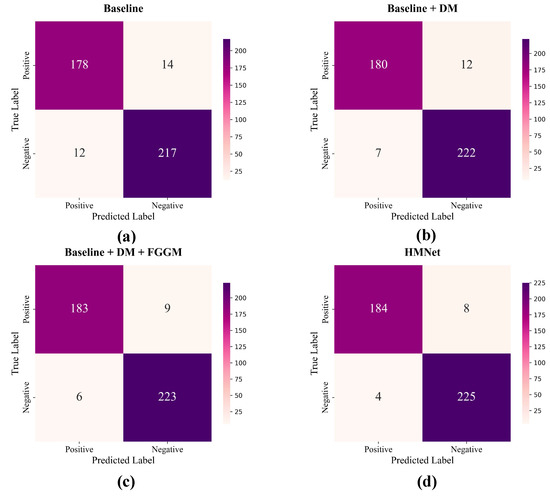
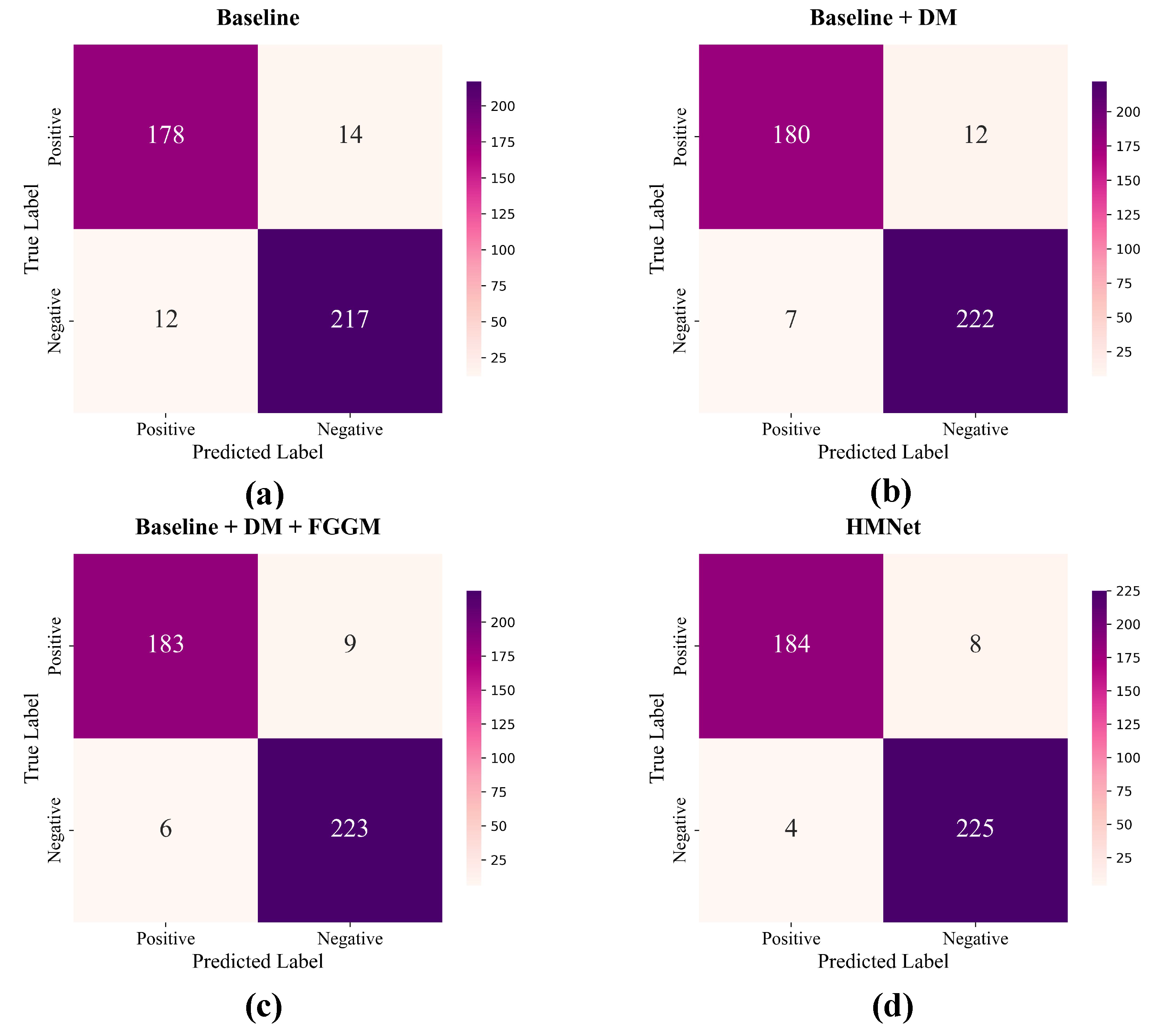
The confusion matrix and experimental results of the ablation study are summarized in Figure 10 and Table 5. The experimental results show that HMNet improves overall classification performance by introducing the denoising module, indicating that suppressing LiDAR measurement noise helps reveal clearer vortex structures. After adding the gradient guidance module, HMNet achieves further improvements in both recall and F1 score, which proves that gradient-based structural cues can effectively guide the network to focus on vortex-sensitive regions. Moreover, when the hybrid multi-scale feature extraction module is incorporated, the model achieves the best comprehensive performance. This improvement confirms that capturing multi-scale spatial patterns plays a key role in identifying wake vortices at different evolution stages.
Figure 10.
Comparison of confusion matrices across different modules. Specifically, (a) shows the confusion matrix of the Baseline model, (b) shows the confusion matrix of Baseline + DM, (c) shows the confusion matrix of Baseline + DM + FGGM, and (d) shows the confusion matrix of HMNet (DM + FGGM + HMFE).
Table 5.
Ablation study results on the test set. DM denotes the denoising module, FGGM denotes the feature gradient guidance module, and HMFE denotes the hybrid multi-scale feature extraction module.
4.3. Performance Comparison
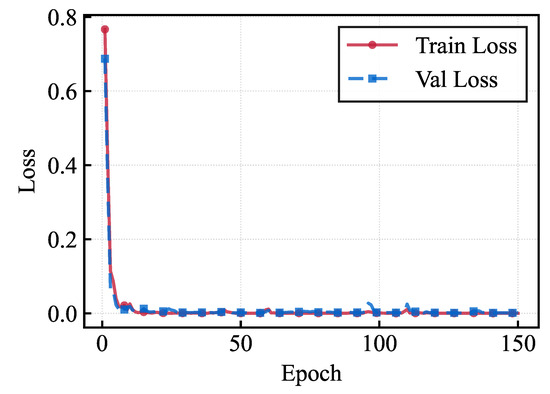
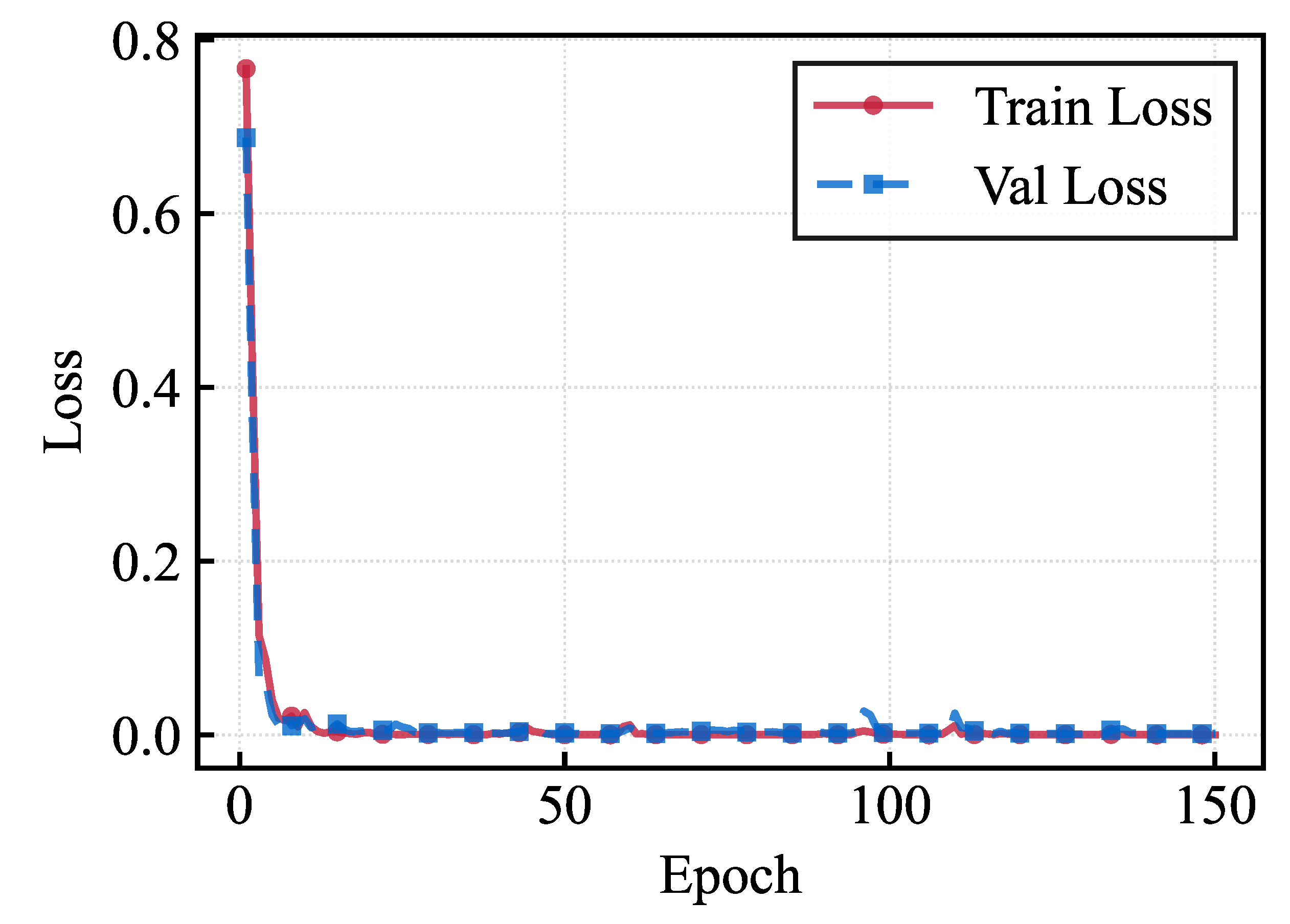
In this experiment, we further compare HMNet with several traditional machine learning algorithms and multiple representative deep convolutional architectures to evaluate its overall effectiveness in wake vortex identification. Traditional methods include Support Vector Machine (SVM), k-Nearest Neighbors (KNN), and Random Forest (RF), while the deep learning baselines include VGG16 [32], ResNet [27], and EfficientNet [33]. Because these generic vision backbones were originally designed for RGB image classification tasks, their first convolutional layers were modified to accept single-channel LiDAR radial velocity fields for fair comparison. All models use the same dataset split and the same evaluation metrics for training and evaluation, including accuracy, precision, recall, and F1 score. Figure 11 shows the training loss curve of HMNet. As shown in the figure, the loss decreases rapidly in the early stages of training and gradually converges after several epochs. This indicates that the proposed network can be effectively optimized. The smooth convergence trend also demonstrates the stability of the training process.
Figure 11.
Training loss curve of HMNet.
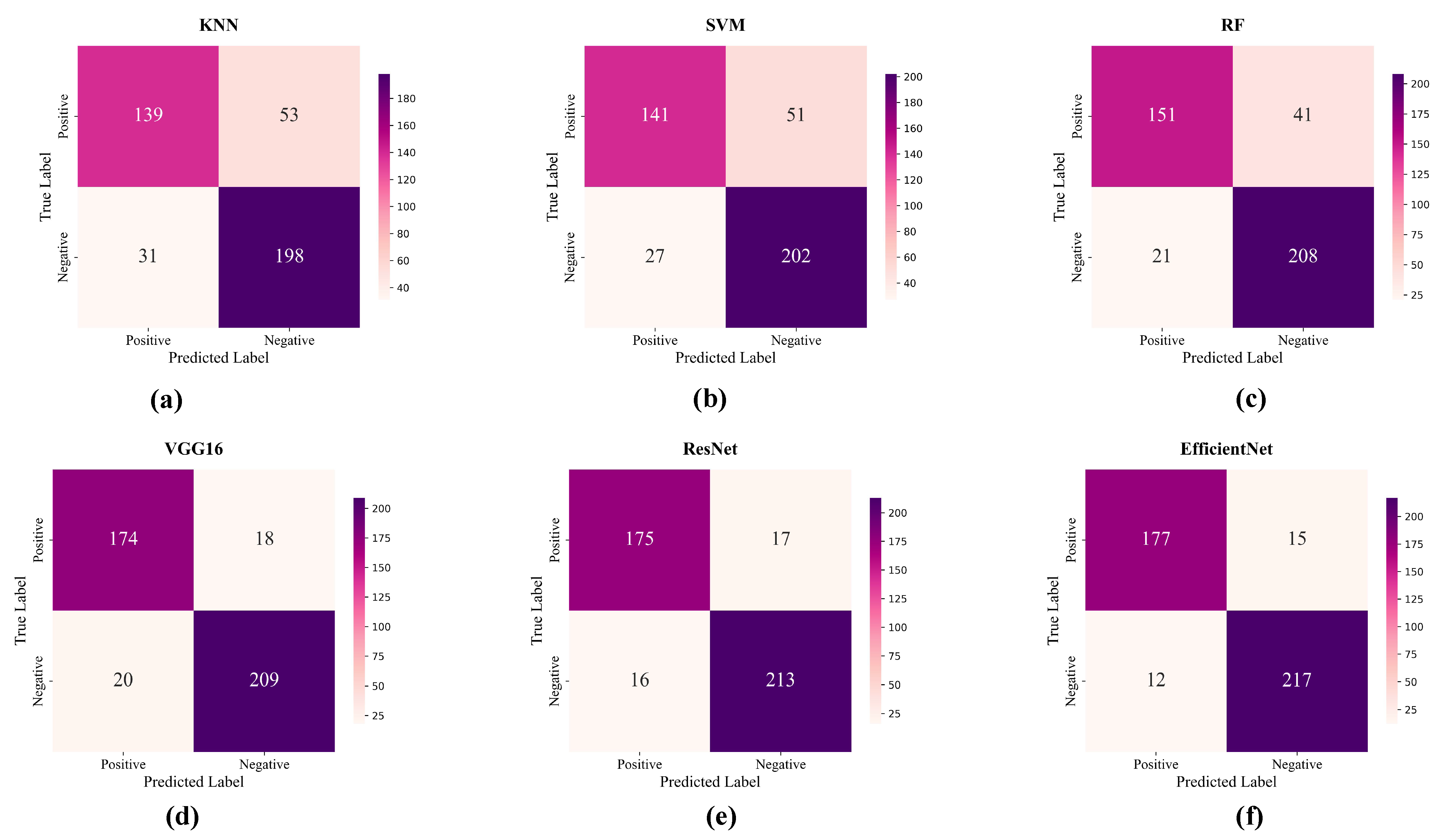
To further evaluate the classification behavior of the proposed model, Figure 12 shows the confusion matrix of HMNet on the test set. Compared with deep learning methods that use hand-crafted features and fail to utilize the properties of radial velocity fields acquired by radar, HMNet correctly identifies most wake vortex samples, while only very few samples are misclassified. This indicates that HMNet maintains both high detection and sensitivity.
Figure 12.
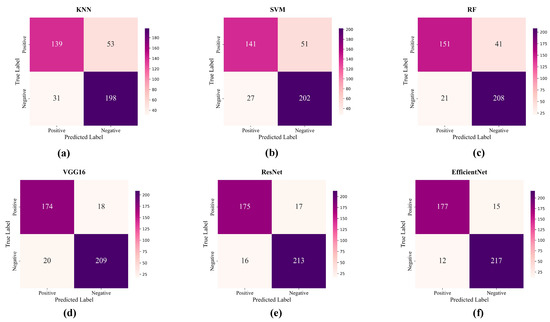
Comparison of confusion matrices of representative baseline methods on the test set. (a) KNN confusion matrix, (b) SVM confusion matrix, (c) RF confusion matrix, (d) VGG16 confusion matrix, (e) ResNet confusion matrix, and (f) EfficientNet confusion matrix.
Table 6 summarizes the quantitative performance comparison of different methods. Among traditional machine learning methods, RF achieved the best performance with an accuracy of 85.27% and an F1 score of 82.97%. However, these methods still heavily rely on manually designed features and therefore have limited capability in capturing the complex spatial structures of wake vortices. Compared with EfficientNet, which is the strongest general deep learning baseline method in this comparison and features a multi-layer network structure, HMNet achieves improvements of 3.56 and 3.93 percentage points in accuracy and F1 score, respectively. Compared with ResNet, the corresponding improvements are 4.99 and 5.46 percentage points. These results demonstrate the effectiveness of the proposed denoising, gradient guidance, and multi-scale feature extraction modules for LiDAR-based wake vortex recognition. Moreover, HMNet achieved a recognition speed of 150 fps, which meets the requirements for practical applications.
Table 6.
Performance comparison of different methods.
This study focuses on robust binary identification in radial velocity fields deployed under noisy airport environments. This differs from recent learning-based aircraft wake analysis methods, which are expanding from simple identification to more detailed tasks such as vortex localization, classification, and parameter inversion [22,34,35]. These studies confirm the broad applicability of learning-based models in wake vortex monitoring, which typically requires a robust backbone network. Our results show that reliable wake vortex identification can provide a practical foundation for subsequent localization, classification, and parameter inversion studies.
5. Conclusions
This study proposes a multi-scale hybrid deep network for identifying aircraft wake vortices acquired by Doppler lidar. The proposed HMNet integrates a denoising module, gradient-guided feature learning mechanism, and hybrid multi-scale feature extraction architecture, which can effectively capture multi-scale wake vortex structures. Experiments based on real datasets show that HMNet outperforms traditional machine learning methods (support vector machine, K-nearest neighbor, and random forest) and general convolutional backbone networks, including VGG16, ResNet, and EfficientNet, in recognition performance. These results indicate that HMNet achieves higher recognition accuracy and demonstrates good robustness on the dataset under the studied airport environment compared to traditional handcrafted features.
Although HMNet achieves relatively good results under current experimental conditions, the current research is still limited by dataset scale and the limited range of environmental and meteorological variations. These limitations provide several directions for future work. First, the dataset should be expanded to other airports with different operational environments, including more operational periods and more diverse weather conditions. Through this process, the dataset will gradually cover broader background wind fields, turbulence and meteorological conditions, and aircraft categories, thereby enabling more extensive validation of model generalization capability. Second, the current single-frame classification will be extended to temporal modeling, introducing spatiotemporal convolution or sequence-based networks to analyze continuous scans and predict wake vortex trends. This extension supports practical deployment by providing earlier trend information and supporting latency-oriented evaluation. Third, more efficient and lightweight backbone networks will be studied to achieve a trade-off between accuracy and efficiency.
Author Contributions
Conceptualization, X.W., S.L., X.D., Y.L. and W.P.; methodology, X.W., S.L., X.D., Y.L. and W.P.; validation, X.W., S.L., X.D. and W.P.; writing—original draft preparation, X.W., S.L., X.D. and W.P.; writing—review and editing, X.W., S.L., X.D., Y.L. and W.P. All authors have read and agreed to the published version of the manuscript.
Funding
This research was supported by Civil Aviation Flight University of China, Sichuan Flight Engineering Technology Research Center, Grant Number GY2024-06B; and supported by the Funds for CAAC the Key Laboratory of Flight Techniques and Flight Safety, grant number FZ2025ZX11.
Institutional Review Board Statement
Not applicable.
Informed Consent Statement
Not applicable.
Data Availability Statement
The authors confirm that the data supporting the findings of this study are available within the article.
Conflicts of Interest
The authors declare no conflicts of interest.
References
- Breitsamter, C. Wake vortex characteristics of transport aircraft. Prog. Aerosp. Sci. 2011, 47, 89–134. [Google Scholar] [CrossRef] [Scilit]
- Gharbia, Y.; Derakhshandeh, J.F.; Alam, M.M.; Amer, A. Developments in wingtip vorticity mitigation techniques: A comprehensive review. Aerospace 2023, 11, 36. [Google Scholar] [CrossRef] [Scilit]
- Lang, S.; Tittsworth, J.; Bryant, W.; Wilson, P.; Lepadatu, C.; Delisi, D.; Lai, D.; Greene, G. Progress on an ICAO wake turbulence re-categorization effort. In Proceedings of the AIAA Atmospheric and Space Environments Conference; AIAA: Reston, VA, USA, 2010; p. 7682. [Google Scholar]
- Campos, L.; Marques, J. On an analytical model of wake vortex separation of aircraft. Aeronaut. J. 2016, 120, 1534–1565. [Google Scholar] [CrossRef] [Scilit]
- Chigier, N.; Corsiglia, V. Wind-tunnel studies of wing wake turbulence. J. Aircr. 1972, 9, 820–825. [Google Scholar] [CrossRef] [Scilit]
- Zhou, J.; Chen, Y.; Li, D.; Zhang, Z.; Pan, W. Numerical simulation of aircraft wake vortex evolution and wake encounters based on adaptive mesh method. Eng. Appl. Comput. Fluid Mech. 2020, 14, 1445–1457. [Google Scholar] [CrossRef] [Scilit]
- Köpp, F.; Rahm, S.; Smalikho, I. Characterization of aircraft wake vortices by 2-μm pulsed Doppler lidar. J. Atmos. Ocean. Technol. 2004, 21, 194–206. [Google Scholar] [CrossRef] [Scilit]
- Holzäpfel, F.; Gerz, T.; Köpp, F.; Stumpf, E.; Harris, M.; Young, R.I.; Dolfi-Bouteyre, A. Strategies for circulation evaluation of aircraft wake vortices measured by lidar. J. Atmos. Ocean. Technol. 2003, 20, 1183–1195. [Google Scholar] [CrossRef] [Scilit]
- Liu, X.; Zhang, X.; Zhai, X.; Zhang, H.; Liu, B.; Wu, S. Observation of aircraft wake vortex evolution under crosswind conditions by pulsed coherent Doppler lidar. Atmosphere 2020, 12, 49. [Google Scholar] [CrossRef] [Scilit]
- Rojas, J.I.; Melgosa, M.; Prats, X. Sensitivity analysis of maximum circulation of wake vortex encountered by en-route aircraft. Aerospace 2021, 8, 194. [Google Scholar] [CrossRef] [Scilit]
- Michel, D.T.; Dolfi-Bouteyre, A.; Goular, D.; Augère, B.; Planchat, C.; Fleury, D.; Lombard, L.; Valla, M.; Besson, C. Onboard wake vortex localization with a coherent 1.5 μm Doppler LIDAR for aircraft in formation flight configuration. Opt. Express 2020, 28, 14374–14385. [Google Scholar] [CrossRef] [Scilit]
- Ahmed, S.F.; Alam, M.S.B.; Hassan, M.; Rozbu, M.R.; Ishtiak, T.; Rafa, N.; Mofijur, M.; Shawkat Ali, A.; Gandomi, A.H. Deep learning modelling techniques: Current progress, applications, advantages, and challenges. Artif. Intell. Rev. 2023, 56, 13521–13617. [Google Scholar] [CrossRef] [Scilit]
- Manakitsa, N.; Maraslidis, G.S.; Moysis, L.; Fragulis, G.F. A review of machine learning and deep learning for object detection, semantic segmentation, and human action recognition in machine and robotic vision. Technologies 2024, 12, 15. [Google Scholar] [CrossRef] [Scilit]
- Liu, Z.; Zhou, J.; Zeng, X.; Wang, X.; Jiao, W.; Xu, M.; Wu, A. Runoff prediction using hydro-meteorological variables and a new hybrid ANFIS-GPR model. J. Water Clim. Change 2023, 14, 1515–1531. [Google Scholar] [CrossRef] [Scilit]
- Deng, L.; Pan, W.; Wang, Y.; Luan, T.; Leng, Y. Aircraft wake evolution prediction based on parallel hybrid neural network model. Aerospace 2024, 11, 489. [Google Scholar] [CrossRef] [Scilit]
- Pan, W.; Wang, Y.; Deng, L.; Jiang, Y.; Leng, Y. Aircraft wake vortex recognition method based on improved Inception-VGG16 hybrid network. Sensors 2025, 25, 2909. [Google Scholar] [CrossRef] [Scilit]
- Szegedy, C.; Ioffe, S.; Vanhoucke, V.; Alemi, A. Inception-v4, inception-resnet and the impact of residual connections on learning. In Proceedings of the AAAI Conference on Artificial Intelligence; AIAA: Reston, VA, USA, 2017. [Google Scholar]
- Pan, W.; Leng, Y.; Yin, H.; Zhang, X. Identification of aircraft wake vortex based on VGGNet. Wirel. Commun. Mob. Comput. 2022, 2022, 1487854. [Google Scholar] [CrossRef] [Scilit]
- Xu, D.; Wu, Y. MRFF-YOLO: A multi-receptive fields fusion network for remote sensing target detection. Remote Sens. 2020, 12, 3118. [Google Scholar] [CrossRef] [Scilit]
- Shen, C.; Tang, W.; Gao, H.; Wang, X.; Chan, P.W.; Hon, K.K.; Li, J. Aircraft wake recognition and strength classification based on deep learning. IEEE J. Sel. Top. Appl. Earth Obs. Remote Sens. 2023, 16, 2237–2249. [Google Scholar] [CrossRef] [Scilit]
- Ma, Y.; Tang, X.; Shi, Y.; Chan, P.W. YOLOv8n–CBAM–EfficientNetV2 Model for Aircraft Wake Recognition. Appl. Sci. 2024, 14, 7754. [Google Scholar] [CrossRef] [Scilit]
- Zhiqiang, W.; Tong, L.; Runping, G.; Fei, L. DBN-GABP model for estimation of aircraft wake vortex parameters using lidar data. Chin. J. Aeronaut. 2024, 37, 347–368. [Google Scholar] [CrossRef] [Scilit]
- Hallock, J.N.; Holzäpfel, F. A review of recent wake vortex research for increasing airport capacity. Prog. Aerosp. Sci. 2018, 98, 27–36. [Google Scholar] [CrossRef] [Scilit]
- Wu, S.; Zhai, X.; Liu, B. Aircraft wake vortex and turbulence measurement under near-ground effect using coherent Doppler lidar. Opt. Express 2019, 27, 1142–1163. [Google Scholar] [CrossRef] [Scilit]
- Chu, N.; Ng, K.K.H.; Liu, Y.; Hon, K.K.; Chan, P.W.; Li, J.; Zhang, X. Assessment of approach separation with probabilistic aircraft wake vortex recognition via deep learning. Transp. Res. Part E Logist. Transp. Rev. 2024, 181, 103387. [Google Scholar] [CrossRef] [Scilit]
- Drazin, P. Kelvin–Helmholtz instability of finite amplitude. J. Fluid Mech. 1970, 42, 321–335. [Google Scholar] [CrossRef] [Scilit]
- He, K.; Zhang, X.; Ren, S.; Sun, J. Deep residual learning for image recognition. In Proceedings of the 2016 IEEE Conference on Computer Vision and Pattern Recognition, CVPR 2016, Las Vegas, NV, USA, 27–30 June 2016; IEEE: Piscataway, NJ, USA, 2016; pp. 770–778. [Google Scholar]
- Zhang, K.; Zuo, W.; Chen, Y.; Meng, D.; Zhang, L. Beyond a Gaussian denoiser: Residual learning of deep CNN for image denoising. IEEE Trans. Image Process. 2017, 26, 3142–3155. [Google Scholar] [CrossRef] [Scilit] [PubMed]
- Woo, S.; Park, J.; Lee, J.-Y.; Kweon, I.S. CBAM: Convolutional block attention module. In Proceedings of the European Conference on Computer Vision (ECCV); Springer: Berlin/Heidelberg, Germany, 2018; pp. 3–19. [Google Scholar]
- Wang, Q.; Wu, B.; Zhu, P.; Li, P.; Zuo, W.; Hu, Q. ECA-Net: Efficient Channel Attention for Deep Convolutional Neural Networks. In Proceedings of the 2020 IEEE/CVF Conference on Computer Vision and Pattern Recognition, CVPR 2020, Seattle, WA, USA, 13–19 June 2020; Computer Vision Foundation/IEEE: Piscataway, NJ, USA, 2020; pp. 11531–11539. [Google Scholar]
- Kingma, D.P.; Ba, J. Adam: A method for stochastic optimization. arXiv 2014, arXiv:1412.6980. [Google Scholar]
- Simonyan, K.; Zisserman, A. Very deep convolutional networks for large-scale image recognition. arXiv 2014, arXiv:1409.1556. [Google Scholar]
- Tan, M.; Le, Q.V. EfficientNet: Rethinking model scaling for convolutional neural networks. arXiv 2019, arXiv:1905.11946. [Google Scholar]
- Zhang, X.; Zhang, H.; Wang, Q.; Liu, X.; Liu, S.; Zhang, R.; Li, R.; Wu, S. Locating and grading of lidar-observed aircraft wake vortex based on convolutional neural networks. Remote Sens. 2024, 16, 1463. [Google Scholar] [CrossRef] [Scilit]
- Felton, M.A.; Kumar, P.; Catuche, J.; James, D.; Ligon, D.A. Characterizing wake vortex pairs using nonsupervised machine learning. Opt. Express 2025, 33, 37795–37813. [Google Scholar] [CrossRef] [Scilit]

Disclaimer/Publisher’s Note: The statements, opinions and data contained in all publications are solely those of the individual author(s) and contributor(s) and not of MDPI and/or the editor(s). MDPI and/or the editor(s) disclaim responsibility for any injury to people or property resulting from any ideas, methods, instructions or products referred to in the content. |
© 2026 by the authors. Licensee MDPI, Basel, Switzerland. This article is an open access article distributed under the terms and conditions of the Creative Commons Attribution (CC BY) license.