Article

Biological Activity and Physical Properties of Pullulan Films and Coatings Supplemented with Urban Propolis Extract


1
Department of Food Biotechnology and Microbiology, Institute of Food Sciences, Warsaw University of Life Sciences WULS-SGGW, 159C Nowoursynowska Street, 02-776 Warsaw, Poland
2
Department of Food Engineering and Process Management, Institute of Food Sciences, Warsaw University of Life Sciences WULS-SGGW, 159C Nowoursynowska Street, 02-776 Warsaw, Poland
*
Authors to whom correspondence should be addressed.
Appl. Sci. 2026, 16(9), 4122; https://doi.org/10.3390/app16094122
Submission received: 25 February 2026 / Revised: 18 April 2026 / Accepted: 22 April 2026 / Published: 23 April 2026
(This article belongs to the Special Issue Bioactive Analysis and Applications of Honey and Other Bee Products)

Abstract

Propolis has long been recognized for its biological properties, but its availability is increasingly threatened by apiary losses in agricultural areas. One response to this problem is the development of urban apiaries, located in urbanized environments and often established for educational and promotional purposes. In this study, edible pullulan films were prepared with the addition of 10, 20, and 30% propolis extract obtained from an urban apiary located in Toruń, Poland. The effect of these coatings applied to cherries on fruit spoilage, the growth inhibition of Aspergillus niger and Penicillium chrysogenum, and changes in pH, titratable acidity, soluble solids content, and fruit color were evaluated. The films showed both antimicrobial and antioxidant properties. The biological evaluation demonstrated dose-dependent antimicrobial activity, with inhibition zones ranging from 7.27 to 17.23 mm for fungi and from 7.09 to 16.22 mm for bacteria, with the strongest effects observed against L. monocytogenes, C. krusei, and P. chrysogenum. Antioxidant activity, determined using the DPPH radical scavenging assay, increased with propolis concentration and reached 29.44% for films containing 30% urban propolis extract. Moreover, pullulan coatings enriched with propolis reduced mold counts on cherries after 96 h of storage to 2.82 log CFU/g for P. chrysogenum and 2.72 log CFU/g for A. niger, compared with 7.02 and 7.17 log CFU/g, respectively, in uncoated fruit. The influence of urban propolis extract on the thickness and color of the obtained films was also demonstrated. It was found that pullulan coatings with urban propolis extract applied on cherries showed fungistatic properties against P. chrysogenum and A. niger. The developed films and coatings show potential for use in food technology to support the preservation of perishable raw materials; however, further studies are needed to confirm their effectiveness under broader storage conditions.

1. Introduction

Propolis is a natural mixture of resinous substances that has a waxy appearance and is collected by honey bees (Apis mellifera) from the leaves, buds and exudates of various plants, partially digested by β-glycosidase from the bees’ saliva, and then mixed with beeswax. Various studies have already proven that the chemical composition of propolis is very complex, and the basic biologically active compounds are flavonoids, terpenes, aromatic acids and their esters. However, its composition is highly variable and depends on various factors such as geographical origin, types of plant sources, harvest time, season and climatic characteristics of the place. Despite differences in composition, propolis from all regions, including the temperate and tropical zones, shows similar biological properties [1,2,3].
Poplar-type propolis is one of the most comprehensively studied and best-characterized types of propolis from both chemical and pharmacological points of view. Currently, it is generally accepted that poplar-type propolis is characteristic of the temperate zone and comes mainly from Populus sp. (P. nigra, P. alba, P. tremula), with a small share of secondary sources such as oak, horse chestnut, elm, spruce, ash, silver birch, white willow and pine [2,4]. Urban propolis found in Poland is also classified as poplar propolis [5]. Propolis enjoys a global reputation as a natural product that has gained wide acceptance in many countries over the past several decades as a dietary supplement to support health and prevent disease. In general, propolis has a beneficial effect on human health. The health-promoting properties of propolis result from its chemical composition, which determines its comprehensive pharmacological effects—including antibacterial, antifungal and antiviral properties, antioxidant, antiseptic, antimutagenic, hepatoprotective, anticancer and antidiabetic properties. Additionally, it is also anti-inflammatory, cytostatic and immunostimulating. It also has a positive effect on the healing of wounds and burns. The abundance of bioactive ingredients determines its use in medicine and dentistry, as well as in the pharmaceutical, cosmetic and food industries [4,6,7].
Urban propolis may differ functionally from propolis collected in rural environments because its chemical profile is shaped by the specific conditions of the urban habitat. A study on propolis from Polish urban apiaries showed clear differences in the content and distribution of phenolic acids and flavonoids among cities, indicating that urban botanical diversity can directly influence the composition and antioxidant potential of propolis. In turn, research on urban propolis from San Juan (Argentina) demonstrated that its biological activity was associated with a distinct set of bioactive compounds linked to local urban vegetation, confirming that the surrounding city flora may determine its functional properties. Moreover, urban propolis produced by honey bees in Riyadh was shown to contain organic tracers derived from asphalt, suggesting that, in addition to botanical origin, urban environmental exposure may also affect its composition. Therefore, urban propolis should be considered a specific type of raw material whose functional properties may reflect both the heterogeneity of urban plant sources and the particular anthropogenic conditions of the city environment [5,8,9].
Cherries belong to the family Rosaceae, genus Prunus, subgenus Cerasus, and section Eucerasus. Three principal cherry fruit species are recognized: sweet cherries (P. avium), sour cherries (P. cerasus), and dwarf cherries (P. fruticosa Pall.) [10]. Cherries are often referred to as a fruit of Western Europe, as the largest cultivation areas are located in this region of the continent [11,12]. European harvests account for as much as 66.1% of global production. Cherries can be readily marketed in both small and large retail outlets; however, a significant challenge remains their short harvest period, high perishability, and relatively rapid spoilage. This deterioration results from progressive fruit softening, water loss, pedicel browning, mechanical damage, high susceptibility to diseases, and microbiological contamination caused, for example, by mold infections [10,13,14,15].
Food packaging systems perform a variety of functions, including information, protection and marketing. Their main function is to separate food from the surrounding environment, reduce interactions with food spoilage factors (such as microorganisms, water vapor, oxygen and flavors) and avoid losses of desired compounds (e.g., volatile flavor compounds), which extends the shelf life of food [16]. A particularly promising solution is the use of biopolymers for the development of edible films and coatings. In short, these are packaging originally made from edible ingredients. It is possible to directly apply a thin layer of edible packaging to food by coating, dipping and spraying. Also, previously formed foil can be used as food packaging without changing the technological coating method and materials used [17]. Active packaging films and edible coatings based on propolis extract can affect the physical, biochemical and sensory properties of food (e.g., fruits, vegetables, meat and fish) during storage [18].
Polysaccharides, proteins, and lipids are the main raw materials used for the development of edible food packaging systems. Among them, polysaccharides are particularly attractive because of their good film-forming ability, opacity, and gas barrier properties. Pullulan is considered a promising packaging biopolymer due to its ability to form clear, odorless, and tasteless films with very good oxygen barrier performance. However, because polysaccharide-based films usually show limited antimicrobial activity, they are often combined with natural bioactive substances such as propolis extract to obtain active packaging materials with antioxidant and antimicrobial functions [18,19,20].
The aim of this study was to develop pullulan-based edible films supplemented with urban propolis collected from an apiary located in the urban area of Toruń, Poland, and to evaluate their biological and selected physicochemical properties. We hypothesized that increasing the concentration of urban propolis extract in the pullulan matrix would enhance the antimicrobial and antioxidant activity of the films due to the higher content of bioactive compounds, while also affecting their thickness, optical properties, and color. In addition, the applicability of the obtained film-forming solutions as cherry coatings was assessed in order to determine their potential to improve the microbiological stability and preserve the selected quality attributes of the fruit during storage. This study addresses the existing knowledge gap regarding the use of urban propolis as a bioactive component of pullulan-based edible films and coatings for food packaging applications. Although the present study focuses on the biological activity and selected physicochemical properties of pullulan films and coatings enriched with urban propolis extract, it does not include microscopy-based microstructural characterization or release-kinetics analysis of active compounds. Therefore, the study was designed primarily to evaluate functional performance rather than to provide a full description of the film/coating system.

2. Materials and Methods

2.1. Urban Propolis Extract

The propolis for this research came from the city apiary in Toruń and was collected in 2019. The hives are located in a 2-story building. The extract was prepared according to a previously developed methodology [5]. Crude propolis samples were extracted with a tenfold volume of 70% (v/v) ethanol. Extraction was performed by orbital shaking at 200 rpm and 28 °C for 24 h using an Innova 44R incubator shaker (Eppendorf, Hamburg, Germany). The suspensions were subsequently sonicated using an Omni Ruptor 4000 sonicator equipped with a 3.8 mm titanium microtip (OMNI International, Kennesaw, GA, USA) for 20 min at 210 W and 20 kHz in an ice-water bath. The extracts were then filtered by gravity through Whatman No. 4 filter paper and concentrated under reduced pressure at 40 °C using a Rotavapor R-215 (Büchi, Flawil, Switzerland). The obtained urban propolis extracts were stored at 4 °C until further use.

2.2. Preparation of the Pullulan Films with Urban Propolis Extract

Film-forming aqueous pullulan solutions containing urban propolis extract at concentrations of 10, 20, and 30% (v/v, relative to the total volume of the film-forming solution) were prepared using the solution casting method. The solution of 10 g of pullulan (Hayashibara, Okoyama, Japan) and 1 g of glycerol (Chempur, Piekary Śląskie, Poland) (as a plasticizer) in 90, 80 and 70 mL of distilled water was heated at 80 ± 2 °C. After that, the solutions were cooled to room temperature, propolis extracts were added and the ingredients were dissolved by stirring for 15 min. The defoaming of film-forming solutions was made by using an MDK-3 ultrasonic cleaner (MKD Ultrasonic, Stary Konik, Poland). The control pullulan film-forming solution did not contain propolis extract. The film-forming solutions of 10 mL were poured into 90 mm Petri dishes, which were allowed to reach room temperature for 24 h. After drying, the films were conditioned at 25 °C at relative humidity (RH) 55 ± 2% for 48 h. All films were tested in air-conditioned laboratories at 22–23 °C and RH = 55 ± 2% [21].

2.3. Antimicrobial Activity Assay of the Pullulan Films with Urban Propolis Extract

The following strains were used in the research: Candida albicans ATCC 10231, C. krusei ATCC 14243, Saccharomyces cerevisiae ATCC 9763, Aspergillus niger ATCC 9142, Penicillium chrysogenum ATCC 10136, Staphylococcus aureus ATCC 25923, Listeria monocytogenes ATCC 7644, Salmonella enterica subs. enterica ser. Enteritidis ATCC 13076, Pseudomonas aeruginosa ATCC 27853, Escherichia coli ATCC 700728. Cultures were provided by the Department of Food Biotechnology and Microbiology (WULS-SGGW, Warsaw, Poland). A sterile physiological solution (0.85% NaCl, Chempur, Piekary Śląskie, Poland) was used to prepare fungal suspensions at a concentration of 1 × 10⁶ spores/mL. Yeast cells and spores were counted using a hemocytometer. A sterile physiological solution (0.85% NaCl) was used to prepare bacterial suspensions at a concentration of 1 × 10⁸ CFU/mL in Densimat.
Inocula of strains were applied to the surface of the Sabouraud Agar (SA, Biomaxima, Lublin, Poland) for fungi and Mueller-Hinton Agar (MHA, Biomaxima, Lublin, Poland) for bacteria and left for 10 min at room temperature. Discs with a diameter of 6 mm were cut from the films using a circular knife. Then, 3 film discs were placed on the plate with medium. The plates were incubated at 28 °C for 72 h for fungi and 37 °C for bacteria. The diameters of the zones of growth inhibition of the test strains were measured with a caliper (without subtracting the diameter of the disc). The result is given in mm [21].

2.4. Antioxidant Activity Assay of the Pullulan Films with Urban Propolis Extract

4 mL of a DPPH (2,2-diphenyl-1-picrylhydrazyl) (Sigma-Aldrich, St. Louis, MO, USA) solution (0.1 mM in methanol) was mixed with pieces of 1 × 1 cm2 of the pullulan films. The mixture was kept in the dark at room temperature for 2 h. The mixture was centrifuged at 10,000 rpm for 15 min at room temperature. Then, the absorbances were measured at 517 nm against methanol (Sigma-Aldrich, St. Louis, MO, USA) as a blank. The mixture of the DPPH solution was used as the control sample. The antioxidant activity of the biocomposite films was calculated using the following equation:
%Inhibition = (AcontrolAsample)/Acontrol × 100,
where Acontrol is the absorbance of the control, and Asample is the absorbance of the samples (films) [22,23].

2.5. Determination of the Thickness of Pullulan–Urban Propolis Films

The prepared strips of pullulan–propolis films were used for thickness measurements using an Ultramed AB 400 layer meter (Metrison, Mościska, Poland). Ten measurements were made for one strip by applying the head of the layer meter.

2.6. Determination of Light Opacity of Pullulan–Urban Propolis Films

The prepared film strips were placed in the measuring cell of a spectrophotometer (V-1200, VWR, Gdańsk, Poland) and the absorbance was measured at a fixed wavelength of λ = 600 nm. Two repetitions of measurements were made for one strip. The light opacity of the film was calculated using the formula:
O = A 600 e
O—opacity [A * mm−1];
A600—absorbance at a wavelength of 600 nm;
e—sample thickness [mm].

2.7. Color Determination of Pullulan–Urban Propolis Films

Color determinations of the films were made using the reflectance method using a Minolta Chroma Meter CR-200 colorimeter (Minolta, Tokyo, Japan). The measurement was performed by placing the colorimeter head on the film and reading the results given on the screen for the color parameters L*, a* and b*. Ten measurements were performed for each film. The films were placed on a white pattern whose parameters were as follows L* = 92.01, a* = +1.42, b* = −4.73.

2.8. FTIR-ATR Analysis

FTIR-ATR analysis was performed using an Agilent Cary 630 FTIR spectrometer (Agilent Technologies, Santa Clara, CA, USA) equipped with an attenuated total reflectance (ATR) accessory and a diamond crystal. A small amount of sample was placed directly onto the ATR crystal and pressed to ensure adequate contact with the measurement surface. Spectra were recorded over the range of 4000–650 cm−1 using 64 scans at a spectral resolution of 4 cm−1. Before each measurement, a background spectrum was collected, and the ATR crystal was cleaned to avoid cross-contamination between samples. Spectral acquisition and preliminary data processing were carried out using MicroLab FTIR software version 1.1.13 (Agilent Technologies Inc., Santa Clara, CA, USA). Each sample was analyzed in three replicates, and the averaged spectrum was used for further interpretation [24].

2.9. Preparation of Cherries

Cherries were purchased at a local marketplace at the same stage of ripeness. The fruits were first washed in a 0.05% sodium hypochlorite (Chempur, Piekary Śląskie, Poland) solution for 1 min, then rinsed with distilled water and left to dry in a laminar airflow chamber. The fruits were divided into a non-inoculated group for physicochemical analyses and an inoculated group for microbiological studies.

2.10. Microbiological Analysis

Inoculation was performed by placing 10 µL of inoculum containing a spore suspension at a concentration of 1 × 10⁶ of the molds A. niger and P. chrysogenum into the pedicel scar of each cherry, followed by drying in a laminar airflow chamber (Alpina, Konin, Poland).
For the treatment samples, the film-forming solutions containing urban propolis extract at concentrations of 10, 20, and 30% (v/v) were applied with a brush. The coating was applied manually with a brush under standardized conditions for all samples in order to ensure the most uniform possible distribution of the film-forming solution on the fruit surface. Fruits in the coating control group were treated with a pullulan-based film-forming solution, whereas fruits in the negative control group were treated with sterile distilled water. The thoroughly coated plant material was left to dry completely.
After drying, cherries were packed into plastic food containers (approx. 10 g per package). All sample packages were stored in a thermostatic chamber for 96 h at 22 ± 2 °C and relative air humidity (RH) of 53%. Mold counts on cherries were determined at 0 h and after 96 h. For each time variant and for each mold, 3 independent replicates were prepared.
A 10 g fruit sample was pitted and homogenized with 90 mL of physiological saline using a homogenizer (Stomacher® 400 Circulator, Seward, London, UK). Serial dilutions were then prepared and deep-plated onto sterile plastic Petri dishes, which were flooded with previously prepared SA. Plates were incubated for 72 h at 28 °C. After incubation, grown colonies were counted. Results were expressed as CFU/g and reported in log CFU/g.

2.11. Physicochemical Studies of Cherries Coated with Pullulan–Urban Propolis Films

Cherries were prepared and coated in the same manner as for microbiological analyses. pH measurements were performed after 0, 24, 48, 72, and 96 h of incubation. For each time variant, 3 independent replicates of 100 g of cherries were prepared.
Fifty grams of fruit from each group were pitted and blended (Esperanza blender, Ożarów Mazowiecki, Poland) into a homogeneous mass. Soluble solid content was determined using the refractometric (Atago, Saitama, Japan) method.

2.12. Determination of Titratable Acidity

To 25 g of blended cherry mass, 100 mL of distilled water was added and transferred into Erlenmeyer flasks. The contents were brought to a boil and then cooled. The cooled mass was transferred to volumetric flasks and filled up to the mark with distilled water. The flasks were left for 15 min to equilibrate concentrations in the tested samples.
Subsequently, the contents were filtered through fluted filter paper into a clean vessel. A 50 mL aliquot of the obtained filtrate from each sample was collected, and an electrode and magnetic stirrer were immersed in the solution. Titration was carried out with standardized 0.1 M NaOH until pH 8.1 was reached. Determinations were performed in triplicate.
The amount of NaOH used was converted to malic acid content and calculated according to the formula:
X = (V × n × k × 100)/g
where X—titratable acidity [g/100 g], V—volume of NaOH used [mL], n—molarity of NaOH, k—malic acid conversion factor (0.067), g—mass of sample material [g].

2.13. Statistical Analysis of Results

To statistically analyze the results, the Statistica 13.3 program was used and a one-way ANOVA was performed using the Tukey test. Before performing one-way ANOVA, the normality of data distribution and the homogeneity of variance were verified to confirm that the assumptions of the test were met.

3. Results

3.1. Antimicrobial Properties of Pullulan–Urban Propolis Films

Table 1 shows the diameters of the growth inhibition zones of the tested fungi by pullulan–urban propolis films, and Table 2 shows the diameters of the growth inhibition zones of the tested bacteria by pullulan–propolis films. The propolis added to pullulan films has been characterized in detail in our previous studies [5]. All tested films with the addition of urban propolis extract inhibited the growth of fungi; the designated growth inhibition zones were in the range of 7.27 to 17.23 mm. The antibacterial effect of the tested films was weaker; the film with the addition of 10% urban propolis extract did not inhibit the growth of E. coli, while other bacteria were inhibited in the range of 7.60 to 16.22 mm.
When comparing the results of antifungal and antibacterial tests, it was noticed that the higher the concentration of urban propolis extract in the pullulan film, the stronger the antifungal and antibacterial effect was. In turn, the most sensitive fungal strains to pullulan films containing urban propolis extracts were C. krusei and P. chrysogenum, and the most resistant strains were C. albicans and A. niger. In turn, the most sensitive bacterial strain to the tested pullulan films containing urban propolis extracts was L. monocytogenes, and the most resistant strain was E. coli.
It should be noted that the disc diffusion method has inherent limitations when applied to antimicrobial films, because the size of the inhibition zone depends not only on the antimicrobial potency of the active compounds, but also on their ability to diffuse from the film matrix into the agar medium. In film-based systems, the migration of active substances may be restricted by polymer composition, intermolecular interactions, and the physicochemical properties of the incorporated compounds; therefore, agar diffusion assays may underestimate the activity of poorly diffusing agents and should be interpreted primarily as a comparative screening method rather than a fully quantitative measure of antimicrobial performance. Accordingly, the inhibition zones observed for the pullulan–propolis films in the present study reflect both the biological activity of propolis-derived compounds and their release from the pullulan matrix [25,26,27].
The lower susceptibility of Gram-negative bacteria observed in the present study may be explained by the structural features of their cell envelope. In particular, the outer membrane containing lipopolysaccharides constitutes an additional permeability barrier that limits the penetration of many antimicrobial compounds, which is why Gram-negative bacteria are often less sensitive to propolis-derived phenolics than Gram-positive bacteria. At the same time, the inhibition zones obtained for active films should be interpreted with caution, because in agar diffusion assays the antimicrobial response depends not only on the intrinsic activity of the incorporated compounds, but also on their release and diffusion from the polymer matrix into the surrounding medium. Consequently, the weaker response observed for some microorganisms, especially E. coli, may reflect both their higher intrinsic resistance and diffusion limitations of active compounds from the pullulan film [28,29,30,31].
The antimicrobial activity observed for pullulan films enriched with urban propolis extract is consistent with the broader evidence that pullulan is an effective carrier of natural antimicrobial agents in active packaging systems. Previous studies have shown that the incorporation of plant-derived compounds into pullulan matrices markedly improves their inhibitory potential against foodborne microorganisms. For example, pullulan films containing meadowsweet flower extracts exhibited clear antimicrobial effects and reduced natural microflora and fungal spoilage on apples, confirming that pullulan can successfully deliver phenolic-rich bioactives to the food surface. Likewise, pullulan-based composite antimicrobial films supplemented with nisin, thymol, and lauric arginate were effective against Listeria monocytogenes, Salmonella spp., and Shiga toxin-producing E. coli, demonstrating that the antimicrobial performance of pullulan systems may be further enhanced by the nature and combination of active compounds. Similar observations were reported for pullulan films containing rockrose essential oil, which showed antibacterial, antibiofilm, and quorum-sensing inhibitory activity, particularly against Gram-positive bacteria. More recently, pullulan-based coatings enriched with Auricularia auricular extracts also showed improved antimicrobial performance and effectively limited microbial growth on fresh-cut potatoes during storage. Against this background, the strong activity of the pullulan–urban propolis films obtained in the present study, especially against L. monocytogenes, C. krusei, and P. chrysogenum, confirms that pullulan is a suitable matrix for the incorporation of natural antimicrobial substances and supports its application in active edible packaging designed to improve the microbiological stability of perishable foods [32,33,34,35].
Other studies have also demonstrated the effectiveness of the use of propolis extracts in increasing the antimicrobial properties of edible films. Films with starch and cassava with the addition of propolis extract showed antimicrobial activity [36,37,38]. Additionally, it was observed that with the increase in the concentration of propolis extract in the films, the content of phenolic compounds, which are believed to have antimicrobial activity, increased [36]. The antifungal effectiveness of gelatin films with the addition of propolis extracts was demonstrated by Moreno et al. [39]. Previous studies on pullulan films with Polish propolis extracts also showed possible antimicrobial properties of these films [21,40].

3.2. Antioxidant Properties of Pullulan–Urban Propolis Films

Due to the increasing emphasis on ecology, there is an ongoing search for natural antioxidants that can be used to improve health by scavenging free radicals. Urban propolis extracts have been shown to have strong antioxidant properties [5], so an attempt was made to incorporate them into edible films to increase the biological properties of these films. The lack of antioxidant properties of the control film was demonstrated, while the addition of urban propolis extracts significantly influenced the DPPH radical scavenging assays; additionally, as the concentration of the extract in the film matrix increased, stronger antioxidant properties were observed (Table 3).
Previous reports have also shown strong antioxidant effects of packaging films containing propolis extracts [22,23,41]. Packaging films with the addition of propolis extracts with strong antioxidant activity can be used to protect oxidation-sensitive foods in order to maintain the quality and durability of packaged foods. The antioxidant activity of the pullulan–propolis films can be attributed primarily to phenolic acids and flavonoids present in propolis, which are considered the main compounds responsible for its radical-scavenging capacity. Thus, the increase in DPPH scavenging observed with increasing propolis concentration is consistent with the higher contribution of phenolic constituents incorporated into the pullulan matrix. At the same time, antioxidant activity determined by an in vitro assay such as DPPH should be interpreted as an indicator of the potential functionality of the films rather than direct evidence of food protection. In real food systems, the effectiveness of antioxidant packaging depends not only on radical-scavenging capacity itself, but also on the release kinetics of active compounds, their interactions with the polymer matrix and food components, and the nature of the packaged product and its oxidation pathways. Therefore, although the obtained results support the potential of the developed films for active packaging applications, confirmation of their real protective effect would require dedicated storage studies focused on oxidation-sensitive foods [42,43,44,45].

3.3. Physical and Optical Properties of Pullulan–Urban Propolis Films

The physical and optical properties of the pullulan film with additions of 10%, 20% and 30% of urban propolis extract were tested, i.e., thickness, opacity and color (Table 4).
Thickness is one of the parameters determining the quality of edible films and the possibility of their use. The thickness of the control sample, i.e., the pullulan film (without additives), was 68 µm. The film thickness of the pullulan–urban propolis film varied greatly depending on the extract concentration, i.e., in the range from 76.60 to 120.18 µm. A significant increase in the thickness of pullulan films was observed with an increase in the concentration of urban propolis extract in the film. The observed increase in film thickness was statistically significant; however, from an application perspective, the obtained films still remained within the range typical for edible and biodegradable packaging materials.
Opacity is an optical parameter of packaging materials used to determine the ability to absorb or reflect light, which depends on the thickness [17]. Table 4 shows the average opacity of pullulan films containing urban propolis extract. The opacity of the control film was 0.79. The addition of urban propolis extract to the pullulan film changed this property of the film. The opacity values of pullulan films containing urban propolis extract ranged from 4.16 to 5.02; however, no statistically significant differences were found among the tested propolis concentrations (p > 0.05). The addition of urban propolis extract to pullulan films increased their opacity.
In a study by Trinett et al. [46], the thickness of pullulan films with the addition of glycerin (Gly), xanthan gum (Xa) and carob (Lb) was measured, and each of them was added to the film at 5 different concentrations. It was shown that Gly was the main factor influencing the thickness of pullulan films. As the Gly concentration increased, the pullulan film thickness increased. In a study conducted by Zavareze et al. [47], the thickness of the films increased with increasing starch concentration. The film prepared using 3% oxidized potato starch had the lowest thickness (0.073 mm), and the film prepared using 5% native potato starch had the highest thickness (0.168 mm). The thickness of polylactide (PLA) films containing various concentrations of propolis in powdered form (PWP), i.e., 5, 8.5 and 13%, and ethanol extract (EEP) was studied by Ulloa et al. [48]. They showed that each addition of propolis to the film had a significant effect on the thickness. The thickness of films with different concentrations of PLA/PWP and PLA/EEP increased by approximately 21.5 and 52.5%, respectively, compared to the control film. Moreover, the addition of propolis with a higher dry matter content resulted in the formation of films of greater thickness. This confirms the results obtained in this study.
Suriyatem et al. [49] tested the opacity of films made of rice starch and carboxymethyl chitosan (RS/CMCh) with the addition of propolis extract at 3 concentrations, i.e., 2.5, 5 and 10%. It was found that the opacity results of the active films were not significantly different compared to the control film. In the present study, the opacity values of films containing urban propolis extract ranged from 4.16 to 5.02; however, no statistically significant differences were found among the tested propolis concentrations (p > 0.05). Moreover, in a study conducted by Ulloa et al. [48], the opacity of polylactide (PLA) films containing different concentrations (5, 8.5, and 13%) of propolis in powder form (PWP) and ethanol extract of propolis (EEP) was measured. Higher film opacity values were observed for films with higher propolis concentrations, opacity increased from 2.24 ± 0.03 in the control PLA film to 9.62 ± 0.27 in PLA/PWP films and to 14.85 ± 1.78 in PLA/EEP films containing the highest propolis concentration, which was attributed to a reduction in the amount of light passing through the active films. Thus, the addition of propolis reduced the opacity and increased the opacity of the active films. However, this new feature may help prevent oxidative degradation of packaged foods caused by exposure to visible and UV light, which leads to nutrient loss, discoloration and taste disturbances [48,50].
The observed increase in film thickness with increasing propolis concentration may be explained by the higher amount of solids incorporated into the film-forming solution and by structural rearrangements occurring in the pullulan matrix after addition of extract constituents. Similar tendencies have been reported for other bioactive films containing propolis, where increasing extract content modified film structure and, at higher concentrations, increased thickness. The higher opacity of the active films can in turn be attributed to lower light transmission and greater light scattering caused by the presence of dispersed propolis components in the polymer network. From a practical point of view, this change may be beneficial when the films are intended for foods susceptible to light-induced deterioration, since reduced opacity may improve protection against photooxidation; however, excessive opacity may also be a limitation when product visibility is important for consumer acceptance. Therefore, the increase in opacity should be considered both as a functional advantage and as a potential visual limitation, depending on the intended food application [49,51].
The reflection method and measurements in the CIEL*a*b system were chosen to determine the color of the tested pullulan–propolis films. CIEL color parameters identify color using three attributes: L*, a*, b*. The L* parameter is the brightness parameter, where the value of 100 identifies the white color and 0 the black color. The a* parameter determines the color transition from green (negative values) to red (positive values), while b* determines the color transition from blue (negative values) to yellow (positive values) [17,47].
It was observed that the color parameter L* value of the control film was 91.13. The brightness of pullulan films with urban propolis extracts ranged from 73.44 to 84.93. The films darkened as the concentration of propolis extract in the matrix increased. The value of the color parameter a* of the control film was positive and amounted to 1.31, while that of the pullulan–urban propolis films ranged from −2.43 to 4.57. The film with the addition of 10% propolis extract showed a color inclination towards green, while the remaining films had a color inclination towards red. The value of the b* color parameter of the control film was negative and amounted to −4.48. Pullulan films with urban propolis extracts had positive values of the b* parameter and ranged from 22.71 to 45.21, and an increase in the intensity of the yellow color was observed with an increase in the concentration of urban propolis extract in the film matrix.
Color parameters are important measures of film appearance that influence consumer acceptance. The study conducted by Siripatrawan and Vitchayakitti [52] showed the influence of 2.5–20% propolis extract on all color parameters of chitosan films. The L* values of the films decreased, while the a* and b* values increased with the increase in the concentration of propolis extract. Increasing the concentration of propolis extract led to films with a deeper orange color compared to the light yellow control films. This is due to the presence of colored substances in propolis [53]. In a study conducted by Suriyatem et al. [52], rice starch/carboxymethyl chitosan (RS/CMCh) films with the addition of propolis extract were examined and it was shown that all color parameters were influenced by the content of propolis extract. The control film was characterized by a higher L* value and lower a* and b* values compared to active films. With the increase in the propolis extract content, the L* value decreased significantly, and the values of parameters a* and b* increased significantly. The research results indicate that the addition of propolis extract increases the redness and yellowness and reduces the brightness of the tested films. These color changes can be attributed to the influence of the primary yellow pigmentation of the propolis extract. In this research, high concentrations of propolis extract were used in the pullulan matrix; previous studies on propolis-pullulan films, where up to 10% of the extract were added, showed a smaller impact of the extracts on changes in the color of the films [21].
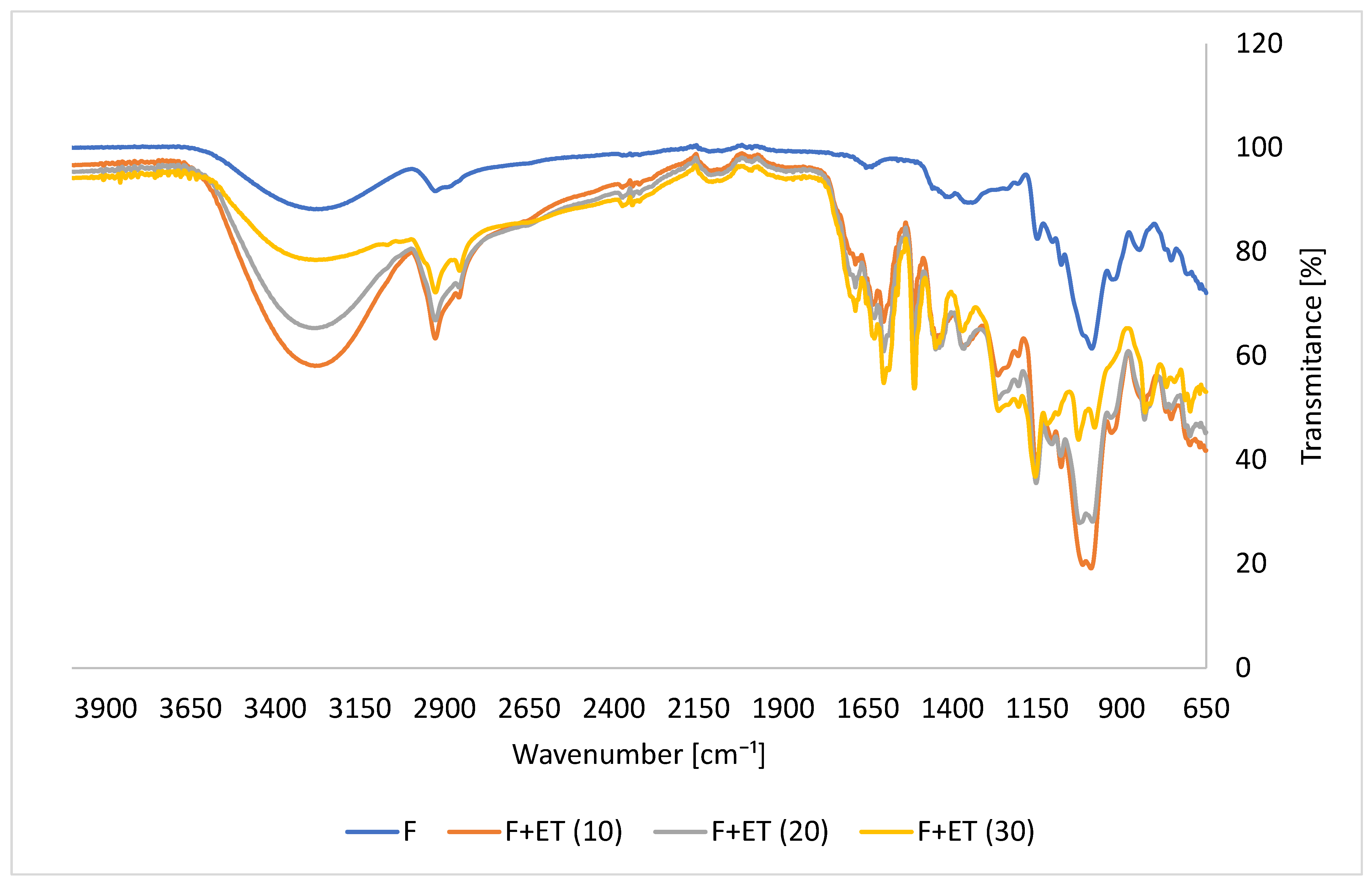
FTIR spectroscopy was applied to confirm the incorporation of urban propolis extract into the pullulan matrix (Figure 1). The control pullulan film showed a broad band at approximately 3284 cm−1 attributed to O–H stretching vibrations, a band near 2928 cm−1 corresponding to C–H stretching, and characteristic signals in the 1155–980 cm−1 region related to C–O–C and C–O vibrations of the polysaccharide structure [18,19,20,46].
In films containing urban propolis extract, the characteristic pullulan bands were preserved, although clear changes in band intensity were observed. In particular, spectral changes around 1603 cm−1, 1513 cm−1, 1450 cm−1, and 1263–1265 cm−1 were consistent with the presence of propolis-derived aromatic and phenolic constituents in the pullulan matrix. Considering that urban propolis contains phenolic acids and flavonoids [5], these results support the incorporation of the extract into the films, although additional structural characterization would be needed for a more detailed description of film organization.
No distinct new bands were observed in the spectra of propolis-containing films, suggesting that the addition of the extract did not lead to the formation of new covalent bonds and that the interactions between pullulan and propolis constituents were mainly physical, probably involving hydrogen bonding and intermolecular associations. Similar effects of propolis incorporation on the structure and physicochemical behavior of polymeric films have been reported previously [48,49,52].

3.4. Assessment of the Effect of Coating Cherries with a Pullulan Film Containing Urban Propolis Extract on Mold Counts

Table 5 presents changes in the counts of P. chrysogenum and A. niger on coated and uncoated cherries treated with pullulan coatings containing urban propolis extract at day 0 and after 96 h of storage.
The application of pullulan-based coatings enriched with ethanolic propolis extract significantly affected the growth of the tested molds on sweet cherry fruits during 96 h of storage. In the control sample, intensive development of both P. chrysogenum (increase from 5.46 to 7.02 log CFU/g) and A. niger (from 5.56 to 7.17 log CFU/g) was observed, confirming the high susceptibility of uncoated fruits to fungal contamination. The use of the pullulan coating alone (F) resulted only in a slight limitation of microbial counts, maintaining them after 96 h at approximately 5.39 log CFU/g for both molds, which indicates a primarily barrier-type rather than antimicrobial mode of action.
The incorporation of urban propolis markedly enhanced the antifungal effectiveness of the coatings. In the F + ET (10) variant, the populations of P. chrysogenum and A. niger decreased to 2.98 and 3.15 log CFU/g, respectively, after 96 h of storage, while at the 20% concentration, they reached 2.96 and 3.11 log CFU/g, respectively. The strongest antifungal activity was demonstrated by the coating containing 30% extract, for which the final counts after 96 h of storage were 2.82 log CFU/g for P. chrysogenum and 2.72 log CFU/g for A. niger. This corresponds to a reduction exceeding 2 log units relative to the initial level and over 4 log units compared with the control. This effect may be related not only to the higher concentration of propolis-derived antifungal compounds, but also to the physical characteristics of the coatings. As discussed above, films containing higher amounts of urban propolis extract were thicker and more opaque, which may indicate the formation of a more compact and functionally enriched coating layer on the fruit surface, potentially enhancing both the barrier effect and the retention of active compounds at the cherry surface. Nevertheless, the increased content of bioactive propolis constituents should be considered the main factor responsible for the improved antifungal performance. Statistical analysis confirmed significant differences between the control and all propolis-enriched treatments, with no significant differences in initial counts.
Overall, the obtained results indicate that pullulan–urban propolis coatings, particularly at the highest extract concentration, constitute an effective strategy for inhibiting the growth of P. chrysogenum and A. niger on sweet cherry fruits under the tested conditions.
Since quality losses begin immediately after cherry harvest and continue until consumption, their shelf life is relatively short. For this reason, research on extending the postharvest life of cherries has become increasingly important. Appropriate packaging and storage are essential for maintaining cherry quality. To preserve quality and prolong postharvest shelf life, several technologies have been applied, such as cold storage [54], controlled atmosphere storage [55], modified atmosphere packaging [56], and the application of edible coatings [57].
The use of propolis in food packaging may serve as an alternative to its direct incorporation into foods. Direct application remains limited due to its strong and characteristic odor, which may alter the sensory properties of food [58]. Incorporating propolis into food films or coatings facilitates the implementation of its antimicrobial properties on food surfaces, where microorganisms are abundant and proliferate rapidly [59].
Biopolymer coatings combined with PE (propolis extract) may exhibit synergistic effects in controlling postharvest fungal diseases of fruits and vegetables. Infections caused by C. capsici and C. gloeosporioides were reduced in inoculated papaya fruit coated with an arabic gum layer containing 1.5% EEP (ethanolic extract of propolis) during storage at 13 °C for 28 days, as well as in fruit coated with a chitosan coating containing 5% Colombian EEP and stored at 25 °C for 9 days [60,61,62].
In chili peppers, improved protection against the development of C. capsici was observed for coatings formulated from arabic gum containing 5% EEP and 0.1% cinnamon oil. After 14 days of storage, no growth of C. capsici was detected on the surface of coated chili peppers, in contrast to peppers coated with arabic gum alone or arabic gum with cinnamon oil. Similarly, the application of a hydroxypropyl methylcellulose (HPMC) coating supplemented with 1.5% Spanish EEP on table grape cultivars showed greater inhibitory effects on aerobic mesophilic bacteria as well as yeast and mold counts than pure HPMC coating during storage at 1–2 °C for 22 days.
The results obtained for coated cherries are important from a practical point of view, because cherries are a highly perishable fruit that rapidly loses quality during postharvest handling, transport, and short-term retail distribution. In this context, the observed suppression of mold growth and the limited changes in selected chemical parameters suggest that pullulan–urban propolis coatings may be useful as a short-term protective strategy in fresh-fruit supply chains, especially during the marketing period immediately after harvest. Comparable benefits have been reported for other cherry coating systems, including plant-extract-based coatings, which reduced weight loss, delayed ripening, and maintained sensory quality during cold storage and shelf life, as well as chitosan- and polysaccharide-based coatings that improved postharvest stability over longer storage periods. Moreover, other preservation technologies such as modified atmosphere packaging have also been shown to reduce decay and better maintain firmness and quality attributes of cherries, indicating that the effects observed in the present study are consistent with broader postharvest preservation trends. At the same time, the present results should be interpreted with caution, because the storage period investigated here was limited to 96 h, which is shorter than in many postharvest studies on cherries, and no sensory evaluation was performed. Therefore, although the developed coatings showed clear promise for improving microbiological stability, further studies should verify their performance during longer storage and distribution periods and should include sensory acceptance to assess their practical applicability under real market conditions [40,63,64,65,66].

3.5. Effect of Pullulan–Urban Propolis Coatings on the Chemical Properties of Cherries

During the 96 h storage period, changes in selected chemical parameters of sweet cherry fruits were observed; however, the application of pullulan-based coatings enriched with ethanolic propolis extract did not adversely affect the overall chemical quality of the raw material (Table 6). The pH value showed a slight increase in all experimental variants. In the control sample, it rose from 3.50 to 3.82, whereas in coated fruits it ranged from 3.86 to 3.91 after 96 h. The highest pH was recorded for the F + ET (10) treatment (3.91), although the differences among coated samples were minor and statistically limited, indicating that the applied coatings did not substantially disturb the acid–base balance of the fruits.
Titratable acidity, expressed as malic acid content, exhibited a decreasing trend during storage regardless of the coating applied. In the control sample, titratable acidity declined from 5.35 to 5.17 mg/kg, whereas in coated samples the final values ranged from 5.06 to 5.13 mg/kg. These changes are typical of postharvest metabolic processes and are associated with the utilization of organic acids in respiration. The absence of significant differences among most treatments indicates that pullulan coatings, including those enriched with propolis, did not markedly affect the rate of organic acid metabolism.
The soluble solids content (SSC) increased in all samples during storage. In the control, SSC rose from 16.69 to 17.06 °Brix, reaching the highest value among the tested variants. In coated fruits, SSC after 96 h ranged from 16.75 to 16.87 °Brix. The slightly lower increase in SSC observed in coated treatments, particularly in coatings without or with lower propolis concentrations, may indicate a partial limitation of ripening processes and transpiration due to the barrier properties of the coatings.
In summary, the application of pullulan–propolis coatings did not induce detrimental changes in the chemical parameters of sweet cherry fruits. The slight increase in pH, decrease in titratable acidity, and increase in soluble solids content remained within the typical range of postharvest changes, with a tendency toward a milder progression in coated fruits, confirming the protective effect of the applied coatings.
Coating fruits with ethanolic extracts of propolis may act as an adjuvant, thereby reducing the need for synthetic packaging and other more costly storage methods, such as low-temperature storage and controlled or modified atmosphere conditions [67]. Immersion of products in propolis extracts leads to the formation of films that can enhance gas permeability barriers [68].
The application of propolis extracts delays fruit ripening during storage, as reflected by a higher membrane stability index (MSI), firmness, and titratable acidity (TA), as well as lower total soluble solids (TSS) content and pH compared with control samples [69].
A propolis coating on the fruit surface likely modifies the internal atmosphere and reduces respiration rate and metabolic activity, while also decreasing transpiration and maintaining cell turgor and fruit firmness. Soaking in ethanolic propolis extract solutions reduces weight and firmness losses in various fruits and vegetables during storage. Moreover, propolis is regarded as a promising substance for limiting decay during long-term storage of fruits and vegetables [68].
The slight changes observed in pH, titratable acidity, and soluble solids content may be associated with the barrier properties of the pullulan-based coatings, which can partially limit O2 uptake and CO2 release at the fruit surface and thus reduce respiration intensity and the rate of postharvest metabolic processes. Edible coatings are generally considered semipermeable barriers that modify gas exchange and may delay ripening-related metabolism, while in sweet cherries and other fruits, lower SSC values and better retention of acidity have often been associated with treatments that reduce respiration or create a modified internal atmosphere. In this context, the slightly lower increase in SSC observed in coated cherries may reflect a moderate reduction in metabolic activity and substrate turnover during storage, whereas the small differences in titratable acidity suggest only limited slowing of organic acid consumption. However, these effects were not pronounced in the present study, and therefore they should be interpreted cautiously as evidence of a modest protective tendency rather than a substantial inhibition of postharvest biochemical changes [66,70,71].
From the literature, it is known that the sensory impact of propolis-containing coatings may depend strongly on formulation and concentration, because propolis has a characteristic aroma and taste; at the same time, some studies report acceptable or even improved sensory scores when the formulation is properly optimized. For example, red propolis-containing edible coatings applied to grapes achieved sensory acceptability indices above 78%, whereas the uncoated control showed markedly lower acceptance. Similarly, chitosan/propolis coatings applied to figs were reported to maintain acceptable sensory quality among panelists. These findings suggest that consumer acceptance cannot be inferred solely from antimicrobial performance and should be verified experimentally for each food–coating system [72,73].
Economic feasibility is also an important consideration. Pullulan is recognized as a promising packaging biopolymer, but its broader commercial use is still limited by its relatively high cost; one review reported a pullulan price range of approximately 25–30 USD/kg, which is higher than that of many other polysaccharide- and protein-based biopolymers. More generally, recent reviews on bio-based and edible packaging emphasize that scale-up, raw material cost, and processing efficiency remain important barriers to industrial implementation, even when these materials offer functional and environmental advantages. Therefore, although the developed films showed promising protective properties, a full techno-economic assessment would be necessary before practical commercialization [19,74,75]. Accordingly, a complete evaluation of the proposed system should, in future studies, include sensory analysis, consumer acceptance testing, and economic assessment, in addition to storage and functional performance [74,75].
The present study has several limitations that should be acknowledged. First, although FTIR analysis confirmed the incorporation of urban propolis extract into the pullulan matrix, no microscopy-based observations were performed; therefore, the microstructure, homogeneity, and surface morphology of the films and coatings could not be directly assessed. Second, the release kinetics of propolis-derived active compounds from the pullulan matrix were not determined, and thus the mechanisms governing the migration of bioactive constituents to the food surface or culture medium remain to be clarified. Consequently, the present findings should be interpreted as evidence of functional potential under the tested conditions rather than as a complete characterization of the developed packaging system.

4. Conclusions

Pullulan films supplemented with urban propolis extract showed clear concentration-dependent biological and physicochemical changes. The addition of urban propolis extract increased the antimicrobial activity of the films against both fungi and bacteria, with the strongest effects observed for C. krusei, P. chrysogenum, and L. monocytogenes. The antioxidant activity of the films also increased with extract concentration, reaching the highest value for films containing 30% propolis extract. At the same time, the incorporation of urban propolis affected the physical properties of the films, leading to increased thickness, higher opacity, and noticeable changes in color parameters.
When applied as coatings on cherries, pullulan–propolis formulations effectively limited the growth of P. chrysogenum and A. niger during storage, particularly at higher extract concentrations. The coatings also did not adversely affect the main chemical quality parameters of the fruit, as only slight changes in pH, titratable acidity, and soluble solids content were observed. These results indicate that urban propolis can be incorporated into pullulan matrices to obtain active films and coatings with promising potential for the protection of perishable food products under the conditions tested in this study.
Nevertheless, the present conclusions should be interpreted within the scope of the performed analyses. Since microscopy-based characterization and release-kinetics studies were not included, the structural organization of the films/coatings and the migration behavior of active compounds were not fully elucidated. Therefore, future studies should include microstructural analyses, release studies, and validation under longer storage conditions and in additional food systems in order to confirm the broader applicability of the developed materials.

Author Contributions

Conceptualization, K.P. and M.G.; methodology, K.P.; validation, K.P.; formal analysis, K.P.; investigation, K.P., K.R. and A.M.K.; resources, K.P.; data curation, K.P.; writing—original draft preparation, K.P., M.G., K.R. and A.M.K.; writing—review and editing, K.P. and M.G.; visualization, K.P.; supervision, M.G.; project administration, K.P.; funding acquisition, K.P. All authors have read and agreed to the published version of the manuscript.

Funding

The work was created as a result of the research project PRELUDIUM No. UMO-2018/31/N/NZ9/00956 financed by the National Science Center.

Institutional Review Board Statement

Not applicable.

Informed Consent Statement

Not applicable.

Data Availability Statement

Requests for the original contributions can be directed to the corresponding authors.

Acknowledgments

Research equipment was purchased as part of the “Food and Nutrition Centre—modernisation of the WULS campus to create a Food and Nutrition Research and Development Centre (CŻiŻ)” project co-financed by the European Union from the European Regional Development Fund under the Regional Operational Programme of the Mazowieckie Voivodeship for 2014–2020 (Project No. RPMA.01.01.00-14-8276/17). The authors would like to thank beekeepers from urban apiary in Toruń for providing propolis samples for research and Małgorzata Igielska and Piotr Włodarczyk for help in research. During the preparation of this manuscript, the authors used ChatGPT, version 5.2, for the purposes of improving language and readability. The authors have reviewed and edited the output and take full responsibility for the content of this publication.

Conflicts of Interest

The authors declare no conflicts of interest.

References

  1. Machado, B.A.S.; Silva, R.P.D.; Barreto, G.D.A.; Costa, S.S.; Da Silva, D.F.; Brandão, H.N.; Da Rocha, J.L.C.; Dellagostin, O.A.; Henriques, J.A.P.; Umsza-Guez, M.A.; et al. Chemical Composition and Biological Activity of Extracts Obtained by Supercritical Extraction and Ethanolic Extraction of Brown, Green and Red Propolis Derived from Different Geographic Regions in Brazil. PLoS ONE 2016, 11, e0145954. [Google Scholar] [CrossRef] [PubMed]
  2. Ristivojević, P.; Trifković, J.; Andrić, F.; Milojković-Opsenica, D. Poplar-Type Propolis: Chemical Composition, Botanical Origin and Biological Activity. Nat. Prod. Commun. 2015, 10, 1869–1876. [Google Scholar] [CrossRef]
  3. Bankova, V. Chemical Diversity of Propolis and the Problem of Standardization. J. Ethnopharmacol. 2005, 100, 114–117. [Google Scholar] [CrossRef]
  4. Shahinozzaman, M.; Obanda, D.N.; Tawata, S. Chemical Composition and Pharmacological Properties of Macaranga-Type Pacific Propolis: A Review. Phytother. Res. 2021, 35, 207–222. [Google Scholar] [CrossRef]
  5. Pobiega, K.; Kot, A.M.; Przybył, J.L.; Synowiec, A.; Gniewosz, M. Comparison of the Chemical Composition and Antioxidant Properties of Propolis from Urban Apiaries. Molecules 2023, 28, 6744. [Google Scholar] [CrossRef]
  6. Vengoji, R.; Macha, M.A.; Batra, S.K.; Shonka, N.A.; Vengoji, R.; Macha, M.A.; Batra, S.K.; Shonka, N.A. Natural Products: A Hope for Glioblastoma Patients. Oncotarget 2018, 9, 22194–22219. [Google Scholar] [CrossRef]
  7. Sforcin, J.M. Biological Properties and Therapeutic Applications of Propolis. Phytother. Res. 2016, 30, 894–905. [Google Scholar] [CrossRef]
  8. Agüero, M.B.; Svetaz, L.; Baroni, V.; Lima, B.; Luna, L.; Zacchino, S.; Saavedra, P.; Wunderlin, D.; Feresin, G.E.; Tapia, A. Urban Propolis from San Juan Province (Argentina): Ethnopharmacological Uses and Antifungal Activity against Candida and Dermatophytes. Ind. Crops Prod. 2014, 57, 166–173. [Google Scholar] [CrossRef]
  9. Alqarni, A.S.; Rushdi, A.I.; Owayss, A.A.; Raweh, H.S.; El-Mubarak, A.H.; Simoneit, B.R.T. Organic Tracers from Asphalt in Propolis Produced by Urban Honey Bees, Apis mellifera Linn. PLoS ONE 2015, 10, e0128311. [Google Scholar] [CrossRef]
  10. Chockchaisawasdee, S.; Golding, J.B.; Vuong, Q.V.; Papoutsis, K.; Stathopoulos, C.E. Sweet Cherry: Composition, Postharvest Preservation, Processing and Trends for Its Future Use. Trends Food Sci. Technol. 2016, 55, 72–83. [Google Scholar] [CrossRef]
  11. Kviklys, D.; Bujdoso, G.; Kappel, N.; Narandži’c, T.N.; Ljubojevi’c, M.L. Autochthonous Cherry Rootstock Germplasm in the Context of Sustainable Sweet Cherry Production. Horticulturae 2022, 9, 37. [Google Scholar] [CrossRef]
  12. Bujdosó, G.; Magyar, L.; Hrotkó, K. Long Term Evaluation of Growth and Cropping of Sweet Cherry (Prunus avium L.) Varieties on Different Rootstocks under Hungarian Soil and Climatic Conditions. Sci. Hortic. 2019, 256, 108613. [Google Scholar] [CrossRef]
  13. Aglar, E.; Yildiz, K.; Long, L.E. The Effects of Rootstocks and Training Systems on the Early Performance of ‘0900 Ziraat’ Sweet Cherry. Not. Bot. Horti Agrobot. Cluj-Napoca 2016, 44, 573–578. [Google Scholar] [CrossRef]
  14. Fuentealba, C.; Ejsmentewicz, T.; Campos-Vargas, R.; Saa, S.; Aliaga, O.; Chirinos, R.; Campos, D.; Pedreschi, R. Cell Wall and Metabolite Composition of Sweet Cherry Fruits from Two Cultivars with Contrasting Susceptibility to Surface Pitting during Storage. Food Chem. 2021, 342, 128307. [Google Scholar] [CrossRef]
  15. Zhang, W.; Zhu, D.; Mao, J.; Du, H.; Qin, H.; Wang, J.; Zhu, C.; Yan, M.; Bai, B. Insight into Flavor Difference of Cherry (Prunus avium L.) Grown in Facility Environment and Outdoors through Metabolomics and Correlation Analysis. Food Chem. X 2024, 24, 101802. [Google Scholar] [CrossRef]
  16. Otoni, C.G.; Avena-Bustillos, R.J.; Azeredo, H.M.C.; Lorevice, M.V.; Moura, M.R.; Mattoso, L.H.C.; McHugh, T.H. Recent Advances on Edible Films Based on Fruits and Vegetables—A Review. Compr. Rev. Food Sci. Food Saf. 2017, 16, 1151–1169. [Google Scholar] [CrossRef]
  17. Galus, S.; Kadzińska, J. Food Applications of Emulsion-Based Edible Films and Coatings. Trends Food Sci. Technol. 2015, 45, 273–283. [Google Scholar] [CrossRef]
  18. Yong, H.; Liu, J. Active Packaging Films and Edible Coatings Based on Polyphenol-Rich Propolis Extract: A Review. Compr. Rev. Food Sci. Food Saf. 2021, 20, 2106–2145. [Google Scholar] [CrossRef]
  19. Farris, S.; Unalan, I.U.; Introzzi, L.; Fuentes-Alventosa, J.M.; Cozzolino, C.A. Pullulan-Based Films and Coatings for Food Packaging: Present Applications, Emerging Opportunities, and Future Challenges. J. Appl. Polym. Sci. 2014, 131, 40539. [Google Scholar] [CrossRef]
  20. Hassan, B.; Chatha, S.A.S.; Hussain, A.I.; Zia, K.M.; Akhtar, N. Recent Advances on Polysaccharides, Lipids and Protein Based Edible Films and Coatings: A Review. Int. J. Biol. Macromol. 2018, 109, 1095–1107. [Google Scholar] [CrossRef] [PubMed]
  21. Gniewosz, M.; Pobiega, K.; Kraśniewska, K.; Synowiec, A.; Chaberek, M.; Galus, S. Characterization and Antifungal Activity of Pullulan Edible Films Enriched with Propolis Extract for Active Packaging. Foods 2022, 11, 2319. [Google Scholar] [CrossRef]
  22. Silva, N.H.C.S.; Vilela, C.; Almeida, A.; Marrucho, I.M.; Freire, C.S.R. Pullulan-Based Nanocomposite Films for Functional Food Packaging: Exploiting Lysozyme Nanofibers as Antibacterial and Antioxidant Reinforcing Additives. Food Hydrocoll. 2018, 77, 921–930. [Google Scholar] [CrossRef]
  23. Luís, Â.; Ramos, A.; Domingues, F. Pullulan–Apple Fiber Biocomposite Films: Optical, Mechanical, Barrier, Antioxidant and Antibacterial Properties. Polymers 2021, 13, 870. [Google Scholar] [CrossRef] [PubMed]
  24. Wen, Q.; Wei, W.; Li, Y.; Chen, D.; Zhang, J.; Li, Z.; Guo, D.A. Combination ATR-FTIR with Multiple Classification Algorithms for Authentication of the Four Medicinal Plants from Curcuma L. in Rhizomes and Tuberous Roots. Sensors 2025, 25, 50. [Google Scholar] [CrossRef] [PubMed]
  25. Abdollahzadeh, E.; Nematollahi, A.; Hosseini, H. Composition of Antimicrobial Edible Films and Methods for Assessing Their Antimicrobial Activity: A Review. Trends Food Sci. Technol. 2021, 110, 291–303. [Google Scholar] [CrossRef]
  26. Rawdkuen, S. Edible Films Incorporated with Active Compounds: Their Properties and Application. In Active Antimicrobial Food Packaging; IntechOpen: London, UK, 2018. [Google Scholar] [CrossRef]
  27. Hossain, T.J.; Hossain, T.J. Methods for Screening and Evaluation of Antimicrobial Activity: A Review of Protocols, Advantages, and Limitations. Eur. J. Microbiol. Immunol. 2024, 14, 97–115. [Google Scholar] [CrossRef]
  28. Vásconez, M.B.; Flores, S.K.; Campos, C.A.; Alvarado, J.; Gerschenson, L.N. Antimicrobial Activity and Physical Properties of Chitosan–Tapioca Starch Based Edible Films and Coatings. Food Res. Int. 2009, 42, 762–769. [Google Scholar] [CrossRef]
  29. Kemme, M.; Heinzel-Wieland, R. Quantitative Assessment of Antimicrobial Activity of PLGA Films Loaded with 4-Hexylresorcinol. J. Funct. Biomater. 2018, 9, 4. [Google Scholar] [CrossRef]
  30. Breijyeh, Z.; Jubeh, B.; Karaman, R. Resistance of Gram-Negative Bacteria to Current Antibacterial Agents and Approaches to Resolve It. Molecules 2020, 25, 1340. [Google Scholar] [CrossRef]
  31. Przybyłek, I.; Karpiński, T.M. Antibacterial Properties of Propolis. Molecules 2019, 24, 2047. [Google Scholar] [CrossRef]
  32. An, Z.; Yuan, M.; Xu, X.; Huang, Z.; Zhu, L.; Cai, Z.; Shen, Y. Active Pullulan-Based Coatings Incorporated with Auricularia auricular Extracts for Preserving Potato Fresh-Cuts. Food Sci. Biotechnol. 2024, 33, 1147–1161. [Google Scholar] [CrossRef]
  33. Luís, Â.; Ramos, A.; Domingues, F. Pullulan Films Containing Rockrose Essential Oil for Potential Food Packaging Applications. Antibiotics 2020, 9, 681. [Google Scholar] [CrossRef] [PubMed]
  34. Hassan, A.H.A.; Cutter, C.N. Development and Evaluation of Pullulan-Based Composite Antimicrobial Films (CAF) Incorporated with Nisin, Thymol and Lauric Arginate to Reduce Foodborne Pathogens Associated with Muscle Foods. Int. J. Food Microbiol. 2020, 320, 108519. [Google Scholar] [CrossRef] [PubMed]
  35. Gniewosz, M.; Synowiec, A.; Kraśniewska, K.; Przybył, J.L.; Baczek, K.; Weglarz, Z. The Antimicrobial Activity of Pullulan Film Incorporated with Meadowsweet Flower Extracts (Filipendulae ulmariae Flos) on Postharvest Quality of Apples. Food Control 2014, 37, 351–361. [Google Scholar] [CrossRef]
  36. De Araújo, G.K.P.; De Souza, S.J.; Da Silva, M.V.; Yamashita, F.; Gonçalves, O.H.; Leimann, F.V.; Shirai, M.A. Physical, Antimicrobial and Antioxidant Properties of Starch-Based Film Containing Ethanolic Propolis Extract. Int. J. Food Sci. Technol. 2015, 50, 2080–2087. [Google Scholar] [CrossRef]
  37. Pérez-Vergara, L.D.; Cifuentes, M.T.; Franco, A.P.; Pérez-Cervera, C.E.; Andrade-Pizarro, R.D. Development and Characterization of Edible Films Based on Native Cassava Starch, Beeswax, and Propolis. NFS J. 2020, 21, 39–49. [Google Scholar] [CrossRef]
  38. Betancur-D’Ambrosio, M.C.; Pérez-Cervera, C.E.; Barrera-Martinez, C.; Andrade-Pizarro, R. Antimicrobial Activity, Mechanical and Thermal Properties of Cassava Starch Films Incorporated with Beeswax and Propolis. J. Food Sci. Technol. 2023, 61, 782–789. [Google Scholar] [CrossRef]
  39. Moreno, M.A.; Vallejo, A.M.; Ballester, A.R.; Zampini, C.; Isla, M.I.; López-Rubio, A.; Fabra, M.J. Antifungal Edible Coatings Containing Argentinian Propolis Extract and Their Application in Raspberries. Food Hydrocoll. 2020, 107, 105973. [Google Scholar] [CrossRef]
  40. Pobiega, K.; Przybył, J.L.; Żubernik, J.; Gniewosz, M. Prolonging the Shelf Life of Cherry Tomatoes by Pullulan Coating with Ethanol Extract of Propolis During Refrigerated Storage. Food Bioprocess Technol. 2020, 13, 1447–1461. [Google Scholar] [CrossRef]
  41. Roy, S.; Min, S.J.; Biswas, D.; Rhim, J.W. Pullulan/Chitosan-Based Functional Film Incorporated with Curcumin-Integrated Chitosan Nanoparticles. Colloids Surf. A Physicochem. Eng. Asp. 2023, 660, 130898. [Google Scholar] [CrossRef]
  42. Kola, V.; Carvalho, I.S. Plant Extracts as Additives in Biodegradable Films and Coatings in Active Food Packaging. Food Biosci. 2023, 54, 102860. [Google Scholar] [CrossRef]
  43. Lai, W.F. Design of Polymeric Films for Antioxidant Active Food Packaging. Int. J. Mol. Sci. 2021, 23, 12. [Google Scholar] [CrossRef] [PubMed]
  44. Segueni, N.; Boutaghane, N.; Asma, S.T.; Tas, N.; Acaroz, U.; Arslan-Acaroz, D.; Shah, S.R.A.; Abdellatieff, H.A.; Akkal, S.; Peñalver, R.; et al. Review on Propolis Applications in Food Preservation and Active Packaging. Plants 2023, 12, 1654. [Google Scholar] [CrossRef] [PubMed]
  45. Irigoiti, Y.; Navarro, A.; Yamul, D.; Libonatti, C.; Tabera, A.; Basualdo, M. The Use of Propolis as a Functional Food Ingredient: A Review. Trends Food Sci. Technol. 2021, 115, 297–306. [Google Scholar] [CrossRef]
  46. Trinetta, V.; Cutter, C.N.; Floros, J.D. Effects of Ingredient Composition on Optical and Mechanical Properties of Pullulan Film for Food-Packaging Applications. LWT—Food Sci. Technol. 2011, 44, 2296–2301. [Google Scholar] [CrossRef]
  47. Zavareze, E.D.R.; Pinto, V.Z.; Klein, B.; El Halal, S.L.M.; Elias, M.C.; Prentice-Hernández, C.; Dias, A.R.G. Development of Oxidised and Heat–Moisture Treated Potato Starch Film. Food Chem. 2012, 132, 344–350. [Google Scholar] [CrossRef]
  48. Ulloa, P.A.; Vidal, J.; Lopéz de Dicastillo, C.; Rodriguez, F.; Guarda, A.; Cruz, R.M.S.; Galotto, M.J. Development of Poly(Lactic Acid) Films with Propolis as a Source of Active Compounds: Biodegradability, Physical, and Functional Properties. J. Appl. Polym. Sci. 2019, 136, 47090. [Google Scholar] [CrossRef]
  49. Suriyatem, R.; Auras, R.A.; Rachtanapun, C.; Rachtanapun, P. Biodegradable Rice Starch/Carboxymethyl Chitosan Films with Added Propolis Extract for Potential Use as Active Food Packaging. Polymers 2018, 10, 954. [Google Scholar] [CrossRef]
  50. Olewnik-Kruszkowska, E.; Gierszewska, M.; Wrona, M.; Nerin, C.; Grabska-Zielińska, S. Polylactide-Based Films with the Addition of Poly(ethylene glycol) and Extract of Propolis—Physico-Chemical and Storage Properties. Foods 2022, 11, 1488. [Google Scholar] [CrossRef]
  51. Culqui-Arce, C.; Paucar-Menacho, L.M.; Castro-Alayo, E.M.; Mori-Mestanza, D.; Medina-Mendoza, M.; Mori-Zabarburú, R.C.; Cruzalegui, R.J.; Vergara, A.J.; Vera, W.; Samaniego-Rafaele, C.; et al. Polymeric Biocoatings for Postharvest Fruit Preservation: Advances, Challenges, and Future Perspectives. Polysaccharides 2026, 7, 12. [Google Scholar] [CrossRef]
  52. Siripatrawan, U.; Vitchayakitti, W. Improving Functional Properties of Chitosan Films as Active Food Packaging by Incorporating with Propolis. Food Hydrocoll. 2016, 61, 695–702. [Google Scholar] [CrossRef]
  53. Pastor, C.; Sánchez-González, L.; Cháfer, M.; Chiralt, A.; González-Martínez, C. Physical and Antifungal Properties of Hydroxypropylmethylcellulose Based Films Containing Propolis as Affected by Moisture Content. Carbohydr. Polym. 2010, 82, 1174–1183. [Google Scholar] [CrossRef]
  54. Esti, M.; Cinquanta, L.; Sinesio, F.; Moneta, E.; Di Matteo, M. Physicochemical and Sensory Fruit Characteristics of Two Sweet Cherry Cultivars after Cool Storage. Food Chem. 2002, 76, 399–405. [Google Scholar] [CrossRef]
  55. Tian, S.P.; Jiang, A.L.; Xu, Y.; Wang, Y.S. Responses of Physiology and Quality of Sweet Cherry Fruit to Different Atmospheres in Storage. Food Chem. 2004, 87, 43–49. [Google Scholar] [CrossRef]
  56. Cui, J.; Jia, X.; Wang, W.; Fan, L.; Zhao, W.; He, L.; Xu, H. Effects of Modified Atmosphere Packaging on Postharvest Physiology and Quality of ‘Meizao’ Sweet Cherry (Prunus avium L.). Agronomy 2025, 15, 1774. [Google Scholar] [CrossRef]
  57. Petriccione, M.; De Sanctis, F.; Pasquariello, M.S.; Mastrobuoni, F.; Rega, P.; Scortichini, M.; Mencarelli, F. The Effect of Chitosan Coating on the Quality and Nutraceutical Traits of Sweet Cherry During Postharvest Life. Food Bioprocess Technol. 2014, 8, 394–408. [Google Scholar] [CrossRef]
  58. Bodini, R.B.; Sobral, P.J.A.; Favaro-Trindade, C.S.; Carvalho, R.A. Properties of Gelatin-Based Films with Added Ethanol–Propolis Extract. LWT—Food Sci. Technol. 2013, 51, 104–110. [Google Scholar] [CrossRef]
  59. Mascheroni, E.; Guillard, V.; Nalin, F.; Mora, L.; Piergiovanni, L. Diffusivity of Propolis Compounds in Polylactic Acid Polymer for the Development of Anti-Microbial Packaging Films. J. Food Eng. 2010, 98, 294–301. [Google Scholar] [CrossRef]
  60. Silva-Castro, I.; Diez, J.J.; Martín-Ramos, P.; Pinto, G.; Alves, A.; Martín-Gil, J.; Martín-García, J. Application of Bioactive Coatings Based on Chitosan and Propolis for Pinus spp. Protection Against Fusarium circinatum. Forests 2018, 9, 685. [Google Scholar] [CrossRef]
  61. Barrera, E.; Gil, J.; Restrepo, A.; Mosquera, K.; Durango, D. A Coating of Chitosan and Propolis Extract for the Postharvest Treatment of Papaya (Carica papaya L. Cv. Hawaiiana). Rev. Fac. Nac. Agron. Medellín 2015, 68, 7667–7678. [Google Scholar] [CrossRef]
  62. Ali, A.; Chow, W.L.; Zahid, N.; Ong, M.K. Efficacy of Propolis and Cinnamon Oil Coating in Controlling Post-Harvest Anthracnose and Quality of Chilli (Capsicum annuum L.) during Cold Storage. Food Bioprocess Technol. 2013, 7, 2742–2748. [Google Scholar] [CrossRef]
  63. Zhang, Y.L.; Cui, Q.L.; Wang, Y.; Shi, F.; Fan, H.; Zhang, Y.Q.; Lai, S.T.; Li, Z.H.; Li, L.; Sun, Y.K. Effect of Edible Carboxymethyl Chitosan-Gelatin Based Coating on the Quality and Nutritional Properties of Different Sweet Cherry Cultivars during Postharvest Storage. Coatings 2021, 11, 396. [Google Scholar] [CrossRef]
  64. Mujtaba, M.; Ali, Q.; Yilmaz, B.A.; Seckin Kurubas, M.; Ustun, H.; Erkan, M.; Kaya, M.; Cicek, M.; Oner, E.T. Understanding the Effects of Chitosan, Chia Mucilage, Levan Based Composite Coatings on the Shelf Life of Sweet Cherry. Food Chem. 2023, 416, 135816. [Google Scholar] [CrossRef] [PubMed]
  65. Afonso, S.; Oliveira, I.; Ribeiro, C.; Vilela, A.; Meyer, A.S.; Gonçalves, B. Innovative Edible Coatings for Postharvest Storage of Sweet Cherries. Sci. Hortic. 2023, 310, 111738. [Google Scholar] [CrossRef]
  66. Aglar, E.; Ozturk, B.; Guler, S.K.; Karakaya, O.; Uzun, S.; Saracoglu, O. Effect of Modified Atmosphere Packaging and ‘Parka’ Treatments on Fruit Quality Characteristics of Sweet Cherry Fruits (Prunus avium L. ‘0900 Ziraat’) during Cold Storage and Shelf Life. Sci. Hortic. 2017, 222, 162–168. [Google Scholar] [CrossRef]
  67. Passos, F.R.; Mendes, F.Q.; da Cunha, M.C.; Pigozzi, M.T.; de Carvalho, A.M.X. Propolis extract in postharvest conservation Banana ‘PRATA’. Rev. Bras. Frutic. 2016, 38, e-931. [Google Scholar] [CrossRef][Green Version]
  68. Pobiega, K.; Kraśniewska, K.; Gniewosz, M. Application of Propolis in Antimicrobial and Antioxidative Protection of Food Quality—A Review. Trends Food Sci. Technol. 2019, 83, 53–62. [Google Scholar] [CrossRef]
  69. Al-Qurashi, A.D.; Awad, M.A. Postharvest Ethanolic Extract of Propolis Treatment Affects Quality and Biochemical Changes of ‘Hindi-Besennara’ Mangos during Shelf Life. Sci. Hortic. 2018, 233, 520–525. [Google Scholar] [CrossRef]
  70. Odetayo, T.; Tesfay, S.; Ngobese, N.Z. Nanotechnology-Enhanced Edible Coating Application on Climacteric Fruits. Food Sci. Nutr. 2022, 10, 2149–2167. [Google Scholar] [CrossRef]
  71. Zhang, C.; Gong, H.; Liu, Y. Effects of Postharvest Coating Using Chitosan Combined with Natamycin on Physicochemical and Microbial Properties of Sweet Cherry during Cold Storage. Int. J. Biol. Macromol. 2022, 214, 1–9. [Google Scholar] [CrossRef]
  72. Aparicio-García, P.F.; Ventura-Aguilar, R.I.; Del Río-García, J.C.; Hernández-López, M.; Guillén-Sánchez, D.; Salazar-Piña, D.A.; Ramos-García, M.d.L.; Bautista-Baños, S. Edible Chitosan/Propolis Coatings and Their Effect on Ripening, Development of Aspergillus Flavus, and Sensory Quality in Fig Fruit, during Controlled Storage. Plants 2021, 10, 112. [Google Scholar] [CrossRef]
  73. Filgueiras, C.T.; Fakhouri, F.M.; Garcia, V.A.d.S.; Velasco, J.I.; Nogueira, G.F.; Ramos da Silva, L.; Oliveira, R.A. de Effect of Adding Red Propolis to Edible Biodegradable Protein Films for Coating Grapes: Shelf Life and Sensory Analysis. Polymers 2024, 16, 888. [Google Scholar] [CrossRef]
  74. Oliveira, I.; Pinto, T.; Afonso, S.; Karaś, M.; Szymanowska, U.; Gonçalves, B.; Vilela, A. Sustainability in Bio-Based Edible Films, Coatings, and Packaging for Small Fruits. Appl. Sci. 2025, 15, 1462. [Google Scholar] [CrossRef]
  75. Sampaio, A.P.C.; Müller-Carneiro, J.; Pereira, A.L.S.; Rosa, M.d.F.; Mattos, A.L.A.; Azeredo, H.M.C.d.; Freire, F.; Figueirêdo, M.C.B.d. Ecodesign of Bio-Based Films for Food Packaging: Challenges and Recommendations. Environ. Dev. 2023, 48, 100926. [Google Scholar] [CrossRef]
Figure 1. FTIR spectra of control pullulan film and pullulan films enriched with urban propolis extract at different concentrations.
Applsci 16 04122 g001
Table 1. Zones of inhibition of fungal growth by pullulan–urban propolis films.
Tested FungiControl FilmFilms with Urban Propolis Extracts
F + ET (10) *F + ET (20)F + ET (30)
Zones of Inhibition [mm]
C. krusei ATCC 142430.00 ± 0.008.02 ± 0.12 Aa12.74 ± 1.19 Bc17.23 ± 0.55 Cc
C. albicans ATCC 102310.00 ± 0.008.29 ± 0.97 Aa9.56 ± 0.63 Bb10.27 ± 0.11 Ca
S. cerevisiae ATCC 97630.00 ± 0.0011.83 ± 0.93 Ab14.74 ± 0.94 Bd14.12 ± 0.57 Bb
P. chrysogenum ATCC 91420.00 ± 0.007.76 ± 0.98 Aa15.31 ± 0.67 Bd17.03 ± 1.35 Cc
A. niger ATCC 91420.00 ± 0.007.27 ± 0.80 Aa8.14 ± 0.71 Aa13.86 ± 0.48 Bb
* film designations: pullulan film with urban propolis extract (F + ET); 10, 20, 30—concentration of propolis extract added to the film, control film—film without propolis. Different lowercase letters (a–d) mean that the mean values in the columns are statistically significantly different (p < 0.05), different capital letters (A–C) mean that the mean values in the rows are statistically significantly different (p < 0.05).
Table 2. Zones of inhibition of bacterial growth by pullulan–urban propolis films.
Tested BacteriaControl FilmFilms with Urban Propolis Extracts
F + ET (10) *F + ET (20)F + ET (30)
Zones of Inhibition [mm]
L. monocytogenes ATCC 76440.00 ± 0.007.60 ± 1.13 Aa15.56 ± 1.14 Bd16.22 ± 0.77 Bd
S. aureus ATCC 259230.00 ± 0.008.05 ± 0.82 Aa10.37 ± 0.67 Bb12.06 ± 0.61 Cb
E. coli ATCC 7007280.00 ± 0.000.00 ± 0.007.09 ± 0.56 Aa9.16 ± 0.71 Ba
P. aeruginosa ATCC 278530.00 ± 0.0011.49 ± 0.80 Ab11.35 ± 1.15 Ab13.69 ± 0.54 Bc
S. enteritidis ATCC 130760.00 ± 0.0013.01 ± 0.40 Ac12.42 ± 0.94 Abc13.94 ± 0.25 Bc
* film designations: pullulan film with urban propolis extract (F + ET); 10, 20, 30—concentration of propolis extract added to the film, control film—film without propolis. Different lowercase letters (a–d) mean that the mean values in the columns are statistically significantly different (p < 0.05), different capital letters (A–C) mean that the mean values in the rows are statistically significantly different (p < 0.05).
Table 3. Antioxidant properties of pullulan–urban propolis films.
FilmAntioxidant Activity (%)
Control0.10 ± 0.01 a
F + ET (10)13.17 ± 2.11 b
F + ET (20)21.85 ± 1.93 c
F + ET (30)29.44 ± 3.52 d
Different lowercase letters (a–d) mean statistically significantly different means (p < 0.05).
Table 4. Physical and color properties of pullulan–urban propolis films.
FilmThickness (µm)Opacity (A/mm)L*a*b*
F68.22 ± 5.17 a0.79 ± 0.14 a91.13 ± 0.75 d1.31 ± 0.05 b−4.48 ± 0.05 a
F + ET (10)76.60 ± 7.74 a4.16 ± 0.30 b84.93 ± 0.74 c−2.43 ± 0.24 a22.71 ± 0.68 b
F + ET (20)96.10 ± 10.33 b4.77 ± 0.42 b78.83 ± 1.48 b0.52 ± 0.98 b36.58 ± 2.41 c
F + ET (30)120.18 ± 13.72 c5.02 ± 0.53 b73.44 ± 1.60 a4.57 ± 1.30 c45.21 ± 0.99 d
Different lowercase letters (a–d) mean statistically significantly different means (p < 0.05).
Table 5. Effect of coating cherries with a pullulan–urban propolis extract on mold counts.
CoatingP. chrysogenumA. niger
0 h96 h0 h96 h
[log CFU/g ± SD]
Control (uncoated)5.46 ± 0.06 Aa7.02 ± 0.07 Eb5.56 ± 0.03 Aa7.17 ± 0.15 Fb
F5.48 ± 0.03 Aab5.39 ± 0.07 Da5.56 ± 0.02 Ab5.39 ± 0.06 Ea
F + ET (10)5.45 ± 0.01 Ab2.98 ± 0.02 Aa5.52 ± 0.05 ACb3.15 ± 0.12 Aa
F + ET (20)5.39 ± 0.06 ABCb2.96 ± 0.03 Ab5.33 ± 0.01 Ba3.11 ± 0.03 Ac
F + ET (30)5.27 ± 0.09 Bb2.82 ± 0.04 Aa5.31 ± 0.08 BDb2.72 ± 0.05 BCa
Different lowercase letters (a–c) mean statistically significantly different means when examining the same mold and the same coating before and after storage, whereas uppercase letters (A–F) denote statistically significant differences at the same time point among different coatings. (p < 0.05).
Table 6. Effect of coating cherries with pullulan–urban propolis coatings on the chemical properties of sweet cherries during storage.
Coating0 h96 h0 h96 h0 h96 h
pH ± SDTitratable Acidity
(g Malic Acid/100 g) ± SD
Soluble Solids Content
(°Brix ± SD)
Control
(uncoated)
3.50 ± 0.06 Aa3.82 ± 0.06 Ab5.35 ± 0.12 Aa5.17 ± 0.05 Aa16.69 ± 0.06 BCa17.06 ± 0.03 Ab
F3.63 ± 0.18 Aa3.86 ± 0.06 Aa5.32 ± 0.15 Aa5.08 ± 0.08 Aa16.39 ± 0.06 Aa16.76 ± 0.15 Bb
F + ET (10)3.55 ± 0.10 Aa3.91 ± 0.09 Ab5.36 ± 0.09 Ab5.13 ± 0.06 Aa16.33 ± 0.09 Aa16.75 ± 0.14 Bb
F + ET (20)3.58 ± 0.04 Aa3.87 ± 0.08 Ab5.31 ± 0.17 Aa5.09 ± 0.11 Aa16.39 ± 0.08 Aa16.82 ± 0.09 ABb
F + ET (30)3.46 ± 0.10 Aa3.89 ± 0.06 Ab5.36 ± 0.12 Aa5.06 ± 0.06 Aa16.71 ± 0.09 BCa16.87 ± 0.07 ABb
Different lowercase letters (a,b) mean statistically significantly different means when examining the same analysis (pH/TA/SSC) and the same coating before and after storage, whereas uppercase letters (A–C) denote statistically significant differences at the same time point among different coatings. (p < 0.05).
Disclaimer/Publisher’s Note: The statements, opinions and data contained in all publications are solely those of the individual author(s) and contributor(s) and not of MDPI and/or the editor(s). MDPI and/or the editor(s) disclaim responsibility for any injury to people or property resulting from any ideas, methods, instructions or products referred to in the content.