


Abstract
A first study analyzed the effect of the presence of a highly frequented tourist trail on the size and reproductive capacity of Globularia alypum, a Mediterranean shrub of conservation interest. In Sardinia, this species is a typical example of a plant with Extremely Small Populations (PSESPs), restricted to a natural area embedded within an urban matrix, which makes it particularly vulnerable to ecological pressures. In this second contribution, the investigation expands to the entire population of the species distributed across different habitats. The possible correlations between vegetative and reproductive traits of the plant are examined, along with the influence exerted by both habitat type and varying levels of human disturbance. To evaluate potential drivers of its persistence, morphological (H, diameter and plant volume) and reproductive traits (number of flowers, number of fruits and number of seed per plant) were recorded at the individual level. Additionally, to assess human disturbance (consisting mainly of trampling), the presence of trails was used as a proxy and, accordingly, each plant was categorized following its relative position to the nearest path according to three categories: Near Trail (NT), Mid-Trail Distance (MTD), or Far from Trail (FT). A total of 114 individuals distributed across four habitat types were measured. Statistical analyses revealed only marginal associations between habitat type and vegetative or reproductive traits. While trail proximity did not influence flower and fruit production, plant volume tended to be greater in individuals located farther from trails, suggesting a potential, albeit limited, effect of reduced human pressure on plant growth. These findings highlight the importance of understanding subtle ecological interactions that shape the persistence of PSESPs in urban close to nature area and provide valuable insights for developing targeted conservation and management strategies.
1. Introduction
Urban close to nature area, often referred to as “green infrastructures or green skeletons”, serve as the backbone in cities because they promote biological diversity, play a vital role in maintaining urban ecosystem functioning, and enhance the health, well-being, and quality of life of city residents (e.g., [1,2,3,4,5]). These areas have garnered significant attention in ecological research, with numerous studies examining their role as critical components of biodiversity conservation and in supporting various taxonomic groups and individual species [6,7,8,9,10]. Urban environments can support biodiversity conservation by incorporating a diverse mosaic of semi-natural and human-made habitats that host unique assemblies of native, introduced, and endemic species, many of which rely on these green areas as refugia [11]. However, semi-natural areas within urban landscapes are often characterized by fragmentation and spatial isolation, creating distinct ecological conditions and functioning as habitat isolates or ecological “islands” embedded within highly modified urban matrices. In conditions of isolation and limited population size, species must adapt to restricted resources, increased competition, and heightened vulnerability to external disturbances [12].
In such characteristic environments, the unique adaptations and ecological roles of certain species become especially valuable. An example are Plants with Extremely Small Populations (PSESPs), whose presence represents a distinctive feature of the Mediterranean Basin. These plants persist in small, isolated populations located on the margins of natural habitats [13], frequently near urban areas. Because their isolation and restriction to marginal habitats make them particularly vulnerable and prone to local extinction [14,15,16], these populations represent a critical resource for biodiversity and should be integrated into conservation programs [17,18,19].
Although PSESPs are not necessarily globally threatened, their occurrence in urban ecosystems requires particular attention, as their persistence may be rapidly affected by site-specific disturbances associated with increasing human presence, land-use transformation, infrastructure development, and intensive recreational use of natural areas. Urban environments, defined by a combination and mix of natural and anthropogenic factors, can increase the vulnerability even of otherwise common species through habitat fragmentation, pollution, invasive species, and human disturbance [20,21,22]. As a result, PSESPs in urban close to nature area are not only indicators of ecological integrity but also serve as focal species for understanding biodiversity dynamics in complex socio-ecological systems [23,24]. In these areas, habitat quality reflects soil conditions, degree of isolation, and human pressure, with larger, structurally complex sites supporting higher species richness [1,10,25].
Within this context, understanding how habitat types interact with anthropogenic factors, particularly those related to human access and disturbance, is essential for developing effective conservation strategies. Anthropogenic pressures can directly or indirectly alter habitat conditions, affecting species’ composition, distribution, and resilience. Areas near trails, for example, often experience trampling, soil compaction, and invasive species introduction (e.g., Carpobrotus spp.), which can threaten native plant communities. In contrast, buffered and structurally complex habitats may mitigate these impacts by providing lower-disturbance microrefugia that support native biodiversity [26,27,28,29,30].
This study arises from the need to better understand the interaction between habitat types and anthropogenic disturbance on PSESPs within urban close to nature area characterized by heterogeneous ecological structures.
This study investigates how the Mediterranean habitats and human disturbance influence the vegetative and reproductive traits of Globularia alypum L. (Plantaginaceae) a PSESPs of high conservation value in Mediterranean ecosystems and builds upon a previous study that had investigated the effect of the presence of a highly frequented tourist trail on the same plant. Although widely distributed across the Mediterranean, G. alypum populations in urban and peri-urban areas are particularly vulnerable, as local human-driven changes can compromise population stability and long-term persistence. In Sardinia, this phytogeographically significant species [24] is restricted to the Capo Sant’Elia promontory, a natural and recreational site within the city of Cagliari (Sardinia). The urban context and ecological relevance of this site make G. alypum an ideal case study for assessing the combined effects of habitat type and anthropogenic pressures on a PSESP species. The area, widely used for mountain biking, hiking, and free climbing, has experienced substantial urban expansion over the past 50 years, which has substantially affected these natural habitats. Nevertheless, parts of the hills retain relatively high ecological integrity with remnant patches of native vegetation functioning as local biodiversity hotspots [24].
Under natural conditions, vegetative and reproductive traits of plants are influenced by species-specific adaptations, interspecific competition, and habitat quality Plant volume can be considered a proxy for vegetative vigor, growth rate, and resource allocation, while flower and fruit production are widely recognized indicators of reproductive success and long-term population viability [31,32]. These traits are known to be influenced by abiotic factors, as well as biotic pressures including herbivory and interspecific competition [33]. In Mediterranean environments, where G. alypum is typically found, variations in these traits can signal adaptive responses to stress and may reflect the species’ long-term ability to persist under changing environmental conditions. Prior studies on Mediterranean shrub species suggest that reduced reproductive output is often associated with habitat degradation and human disturbances (e.g., [34,35,36,37]), emphasizing the importance of monitoring these functional traits to assess the ecological health of populations in both natural and urban contexts. For this reason, quantifying these variables under different habitat conditions and degrees of human disturbance is essential to understanding how urban pressures shape the ecological dynamics and conservation status of G. alypum populations.
Building upon the abovementioned study conducted in 2024, which focused on fine-scale trampling effects along a heavily visited trail and quantified impacts on plant structural traits, the present research expands the spatial and ecological scope of investigation. In contrast to the earlier study, which assessed fine-scale trampling impacts within a restricted spatial domain, this work examines sites located in a distinct area and relies on a different set of monitored individuals, thereby allowing the evaluation of broader ecological and reproductive responses. The aim of this study was to evaluate the effects of habitat type and distance from the trail, used as a proxy of human disturbance, on the vegetative and reproductive performance of G. alypum. In particular, we analyzed variations in plant volume as an indicator of vegetative growth, and in the number of flowers and fruits as indicators of reproductive output across different habitat conditions and levels of disturbance.
2. Materials and Methods
2.1. Study Species and Study Area
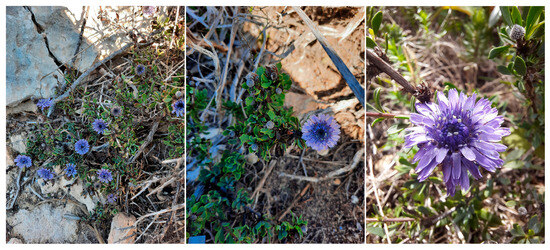
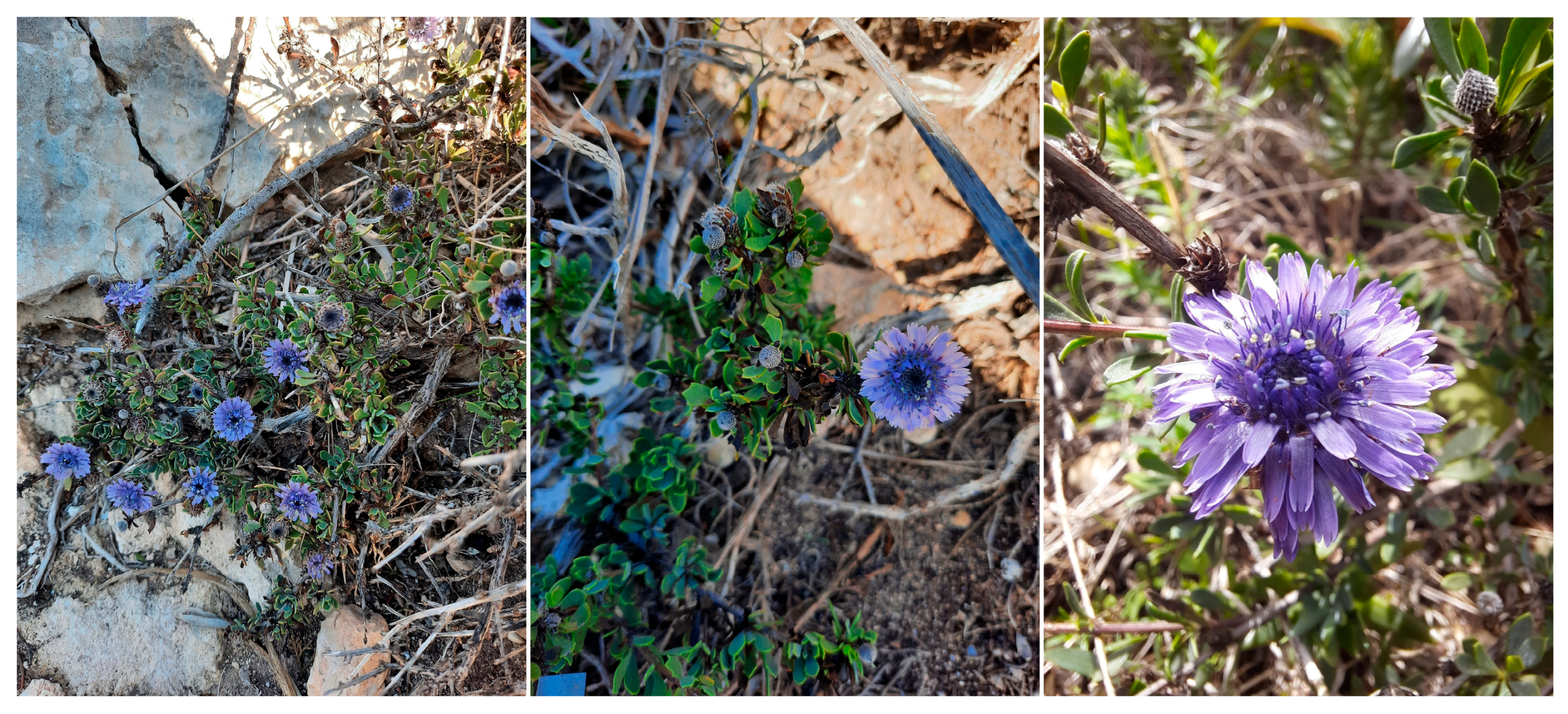
G. alypum is a nanophanerophyte shrub reaching 0.3–1 m in height. It has sclerophyllous, perennial leaves arranged alternately along the stem. The plant produces small hermaphroditic flowers in hemispherical inflorescences (2–3 cm in diameter), and its fruit is a nutlet containing seeds (1–2 mm). Little is known about its reproductive mechanisms and seed dispersal strategies. Flowering occurs from autumn (October–November) to spring (March–May) [38] (Figure 1).
Figure 1.
Globularia alypum L. details.
Adapted to calcareous soils, G. alypum mainly thrives in thermophilous shrublands and is heliophilous and xerophilous. It is primarily distributed across the eastern Mediterranean Basin, including Crete, Cyprus, Greece, Israel, Italy, Jordan, Lebanon, Libya, Palestine, and Turkey. In Italy, it is found in Sicily, Sardinia, and the islands of Elba, Egadi, and Lampedusa, growing from sea level up to 600 m a.s.l. in western Liguria and Tuscany [38]; for a distribution map of the species in Italy, see the Portal to the Flora of Italy at https://dryades.units.it/floritaly/index.php?procedure=taxon_page&tipo=all&id=5076, (accessed on 14 April 2026). Its westernmost, highly isolated population is on the Capo Sant’Elia promontory (Sardinia), first recorded by Moris in 1827 [39]. Capo S. Elia, a limestone outcrop in southeastern Sardinia, is a biodiversity hotspot within the calcareous hills of the southern Campidano plain [40]. This promontory, covering 200 hectares and reaching 136 m a.s.l., is near Cagliari (39°11′ N, 9°10′ E), Sardinia’s largest city. It hosts endemic species and plants of significant biogeographic interest, including Sarcopoterium spinosum (L.) Spach and G. alypum, which are exclusive to this promontory in Sardinia [24,41].
2.2. Sampling and Statistical Analysis
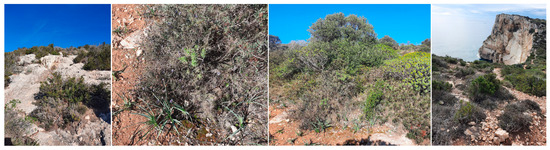
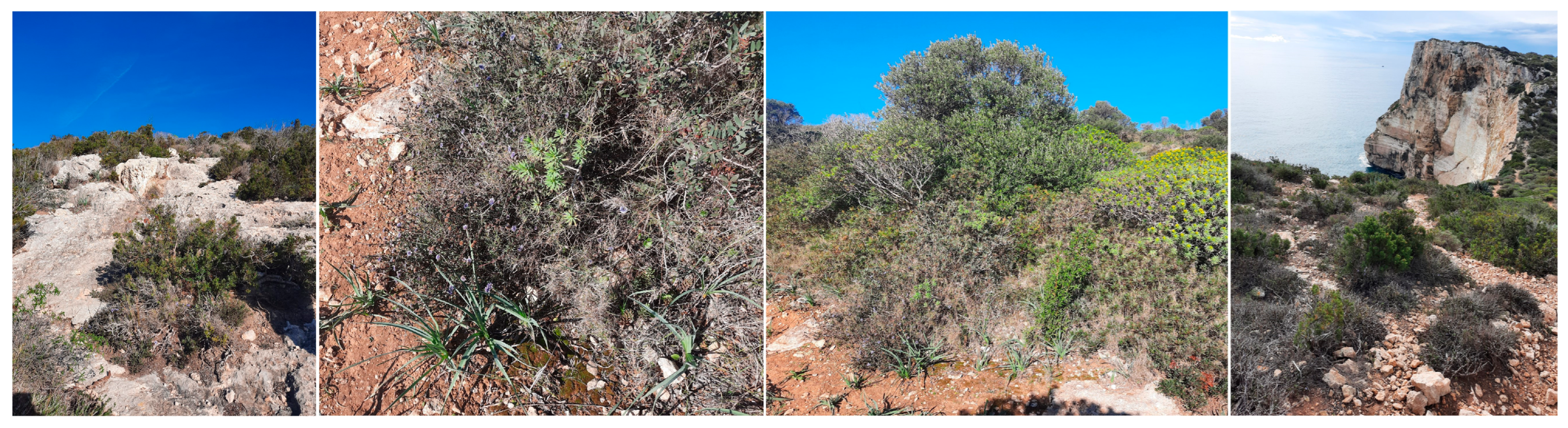
The number of flowers, the number of fruits, and plant volume were recorded for 114 sampled G. alypum individuals in relation to two main factors: habitat type and distance from trails. Sampling was conducted across four habitat types within a Mediterranean landscape: Shrubland, dominated by Pistacia lentiscus L. (18 plants); Garrigues, representing open garrigue shrubland (12 plants); Micro-forest, dominated by Juniperus spp. *(34 plants); and Grassland, mainly dominated by herbaceous plants (open areas, 50 plants) (Figure 2). Individuals were also classified according to distance from trails: Near Trail (28 plants), Mid-Trail Distance (38 plants), and Far from Trail (48 plants). The selection of plants within each habitat and distance category was performed randomly based on the presence of individuals and their accessibility, ensuring a representative sample of the local population structure.
Figure 2.
Characteristic habitats where the species grows.
Field surveys were conducted in February, during the reproductive period of G. alypum, when flowers and fruits were simultaneously present on the plants. For each individual, all open flowers and developed fruits were counted to provide a complete census of reproductive output. Plant height (h) was measured from ground level to the highest vegetative point using a measuring tape, while the major crown diameter was measured at the widest horizontal extent of the canopy. The radius (r) was calculated as half of the major diameter, and plant volume (V, expressed in cm3), understood as the smallest solid containing the entire individual, was estimated using the formula
where r indicates the “radius”, calculated as half of the major diameter, and h the “plant height” (cm) of a single plant.
(V = π × r2 × h)
Flower and fruit counts served as proxies for reproductive success, while plant volume provided an estimate of vegetative growth. As a poxy of the human disturbance the distance to the nearest trail was considered.
The distance of each plant from trails was classified into three levels: “Near Trail” (hereafter NT, positioned at a distance ≤ 1.5 m from the trail), “Mid-Trail Distance” (hereafter MTD, positioned at a distance > 1.5 m and ≤3.5 m from the trail), and “Far from Trail” (hereafter FT, positioned at a distance > 3.5 m from the trail).
Before analysis, the assumptions of normality of variances were evaluated using the Shapiro–Wilk. These measurements were analyzed using a non-parametric Kruskal–Wallis test, suitable for data that do not meet the assumptions of normality, and multiple comparisons among the groups were conducted post hoc to identify differences between specific habitat types and trail proximity categories. The test was performed using the software package “Statistica” (8.0 software [42]).
3. Results
3.1. Effect of Habitat Type on Vegetative and Reproductive Traits of G. alypum
The Kruskal–Wallis test indicated a marginally non-significant variation in flower numbers across habitat types (p > 0.05). Although mean ranks differed among habitats, these differences were not statistically significant (Table 1). Mean ranks for the number of flowers were highest in Garrigues, followed by Shrubland, Micro-forest, and Grassland (Table 1). Fruit production did not vary significantly among habitat types (p = 0.556). Mean rank differences among habitats should therefore be interpreted as descriptive only (Table 1). Mean ranks were 64.21 in Garrigues, 62.41 in Micro-forest, 54.05 in Grassland, and 53.33 in Shrubland (Table 1). Plant volume showed no significant variation across habitat types (p > 0.05) (Table 1). Despite variation in mean ranks, no statistically supported differences among habitat types were detected. The highest mean rank for plant volume was recorded in Micro-forest, followed by Garrigues, Grassland, and Shrubland. (Table 1).
Table 1.
Results of the Kruskal–Wallis one-way analysis of variance on ranks for morphological and reproductive traits of Globularia alypum across habitat types. Sample size (n) is reported for each habitat. The significance level was set at p = 0.05. p-values in bold indicate statistically significant overall Kruskal–Wallis tests. Pairwise z′ values represent post hoc comparisons and are reported for descriptive purposes; they were not interpreted when the overall Kruskal–Wallis test was non-significant.
3.2. Effect of Distance from Trail on Vegetative and Reproductive Traits of G. alypum
No significant differences were detected in flower numbers based on trail proximity (p > 0.05) (Table 2). Observed differences in mean ranks among distance classes were not statistically significant. Plants in NT had a mean rank of 63.65, those in MTD had a mean rank of 58.70, and those in FT had a mean rank of 51.94 (Table 2).
Table 2.
Results of the Kruskal–Wallis one-way analysis of variance on ranks for morphological and reproductive traits of Globularia alypum at different distances from the trail. The significance level was set at p = 0.05. p-values in bold indicate statistically significant overall Kruskal–Wallis tests. Pairwise z′ values represent post hoc comparisons and are provided for descriptive purposes only; they were not interpreted when the overall Kruskal–Wallis test was non-significant.
Similarly, no significant relationship was found between fruit production and trail proximity (p > 0.05) and mean rank differences should be considered descriptive only (Table 2). Mean ranks for fruit production were highest in NT, followed by FT and MTD (Table 2).
Plant volume approached significance in relation to trail distance (Table 2). Although plants located farther from the trail showed higher mean ranks, pairwise comparisons were not interpreted because the overall Kruskal–Wallis test was not statistically significant. Plants in FT exhibited the highest mean rank in volume, followed by plants in NT and in MTD (Table 2).
4. Discussion
The findings of this study revealed new insights into the responses of the highly isolated population of Globularia alypum in Sardinia, a typical example of PSESPs, to specific ecological and anthropogenic pressures. Although urban close to nature area frequently experience considerable disturbances due to human activity and recreational use, our results indicate that G. alypum shows only limited and non-significant associations between habitat type or trail proximity and its vegetative and reproductive traits highlighting the complexity of plant responses in urban ecological contexts.
Habitat type appears to exert a marginal influence on the reproductive performance. of G. alypum, and, despite plants in Garigue habitats tending to produce more flowers and fruits compared to those in other habitats, this trend did not show statistical significance. Garigue habitat is a semi-arid Mediterranean shrub ecosystem [43] characterized by high light exposure, high dryness, and low nutrient levels, conditions that generally favor stress-tolerant species such as G. alypum [44]. The observed marginal increase in flower and fruit production in the Garigue may be associated with the ecological characteristics of this habitat; however, further analyses including environmental variables such as light availability, soil properties, and moisture would be necessary to better explain the processes underlying this pattern. The lack of a significant difference across habitats suggests that G. alypum is broadly adaptable to heterogeneous environmental conditions, potentially due to physiological or morphological traits that buffer against resource limitations. Indeed, drought resistance is a survival strategy of this particular species especially in Mediterranean ecosystems where this strategy is very common among plants [24,44,45].
The timing of flowering and fruiting in G. alypum during autumn and early spring reflects a potential adaptation to Mediterranean environmental conditions, which are characterized by hot, dry summers and mild, wetter winters. By concentrating reproductive activity in these transitional seasons, the species may optimize resource use in response to seasonal variability [24]. As extensively demonstrated by numerous studies on other plant species (e.g., [46,47,48]), this reproductive timing is consistent with the phenological pattern described for the species in Mediterranean environments and may contribute to its persistence under seasonal climatic variability, as the species aligns its reproductive timing with periods of greater resource availability, such as higher soil moisture and moderate temperatures [49].
Although phenology was not directly investigated in the present study, this seasonal reproductive timing may contribute to the ecological persistence of the species under Mediterranean climatic conditions, as suggested for other taxa.
Importantly, the lack of statistically significant differences among habitats should be interpreted cautiously. Our results suggest that, within the range of environmental conditions examined, vegetative and reproductive traits remained relatively stable. Further studies explicitly addressing phenological responses and environmental drivers would be necessary to clarify the mechanisms underlying this pattern.
Regarding human disturbance, our findings show no significant effect on flower or fruit production and only a weak, non-significant trend of larger plant volume with increasing distance from trails. These results demonstedthe limited impact of trail proximity, used here as an indirect proxy of disturbance intensity, on reproductive traits that remain robust under trampling stress [24,50]. The non-significant trend observed in which plants farther from trails exhibited greater volume, may suggest an influence of trail-associated disturbances on vegetative growth, but the lack of statistical significance implies that these effects are relatively context-dependent. Indeed, in the previous study [24], which investigated a frequently used path crossing the core population of the species, it had emerged that trampling caused significant reductions in plant size, underscoring the vulnerability of the species’ morphological traits to mechanical disturbances. By contrast, the present study reveals that when disturbance is considered as a gradient of trail proximity, rather than direct trampling, its effects are far less pronounced and statistically undetectable. This highlights the importance of disturbance intensity: while heavy trampling severely impacts plant morphology, lower-intensity disturbances associated with trail edges do not necessarily translate into measurable effects on growth or reproduction.
This study shows that G. alypum The absence of statistically supported differences in reproductive traits across the disturbance categories considered suggests that reproductive output remained relatively consistent under the conditions examined, indicating that the species was able to maintain reproductive performance across the disturbance gradient considered in this study. In fact, its reproductive capacity appears remarkably resilient, even when individual plants are physically damaged or reduced in size, ensuring population continuity even when vegetative growth is compromised. These characteristics are critical for the persistence of the species in human-impacted landscapes such as urban natural areas. Nevertheless, the previously observed susceptibility of morphological traits to direct trampling [24] underscores the need to carefully regulate human activities in areas where small and isolated populations are concentrated.
5. Conclusions
This study provides a population-level assessment of the vegetative and reproductive performance of Globularia alypum within an urban Mediterranean natural area, expanding previous fine-scale research that focused on the effects of direct trampling along a single heavily frequented trail. By analyzing individuals distributed across multiple habitat types and along a gradient of trail proximity used as a proxy of disturbance intensity, this work contributes new information on the broader ecological responses of a plant species with an Extremely Small Population occurring in a heterogeneous urban natural context. Our results indicate that neither habitat type nor trail proximity significantly affected reproductive output or plant volume under the conditions examined. These findings suggest that, at the spatial scale considered here and under moderate levels of disturbance, the species maintains relatively stable vegetative and reproductive performance across different microhabitat conditions. At the same time, comparison with a previous study of significant size reduction under direct trampling highlights the importance of disturbance intensity in shaping plant responses in small and isolated populations. Although the study was designed to explore the potential role of both habitat variability and human disturbance, it did not formally test their interaction. Nevertheless, the results provide useful baseline information on how a peripheral and spatially restricted population responds to environmental heterogeneity within an urban natural area. Hence, it is important to emphasize the conservation relevance of small and isolated plant populations embedded in urban landscapes, which can persist even under moderate anthropogenic pressure but remain vulnerable to localized high-intensity disturbance. From this conservationist perspective, management measures aimed at limiting direct trampling in core population areas, while maintaining the ecological functionality of urban natural sites as refugia for plant species with extremely small populations, are therefore relevant. Long-term monitoring too, will be essential to detect future changes in population performance and to guide adaptive conservation strategies in urban Mediterranean environments.
Author Contributions
D.C.: Conceptualization, Methodology, Investigation, Validation, Data Curation, Formal Analysis, Writing—Original Draft Preparation. G.F.: Conceptualization, Data Curation—Review and Editing. All authors have read and agreed to the published version of the manuscript.
Funding
This research received no external funding.
Institutional Review Board Statement
Not applicable.
Informed Consent Statement
Not applicable.
Data Availability Statement
The data presented in this study are available on request from the corresponding author. The data are not publicly available due to privacy.
Conflicts of Interest
The authors declare no conflicts of interest.
References
- Werner, P. The ecology of urban areas and their functions for species diversity. Landsc. Ecol. Eng. 2011, 7, 231–240. [Google Scholar] [CrossRef] [Scilit]
- Guilherme, F.; Vicente, J.R.; Carretero, M.A.; Farinha-Marques, P. Mapping multigroup responses to land cover legacy for urban biodiversity conservation. Biol. Conserv. 2024, 291, 110508. [Google Scholar] [CrossRef] [Scilit]
- Dearborn, D.C.; Kark, S. Motivations for conserving urban biodiversity. Conserv. Biol. 2010, 24, 432–440. [Google Scholar] [CrossRef] [Scilit] [PubMed]
- Pickett, S.T.A.; Cadenasso, M.L.; Grove, J.M.; Nilon, C.H.; Pouyat, R.V.; Zipperer, W.C.; Costanza, R. Urban ecological systems: Linking terrestrial ecological, physical, and socioeconomic components of metropolitan areas. Ann. Rev. Ecolog. Syst. 2001, 32, 127–157. [Google Scholar] [CrossRef] [Scilit]
- Pickett, S.T.A.; Cadenasso, M.L.; Grove, J.M. Resilient cities: Meaning, models, and metaphor for integrating the ecological, socio-economic, and planning realms. Landsc. Urban Plan. 2004, 69, 369–384. [Google Scholar] [CrossRef] [Scilit]
- Marzluff, J.M.; Bowman, R.; Donnelly, R. (Eds.) Avian Ecology and Conservation in An Urbanizing World, 1st ed.; Springer Science & Business Media: New York, NY, USA, 2012. [Google Scholar]
- Kelcey, J.G.; Rheinwald, G. Birds in European Cities; Ginster Verlag: St. Katharinen, Germany, 2005. [Google Scholar]
- Werner, P.; Zahner, R. Biodiversity and Cities: A Review and Bibliography; BfN-Skripten, 245; Bundesamt fur Naturschutz: Leipzig, Germany, 2009. [Google Scholar]
- Muller, N.; Werner, P.; Kelcey, J.G. (Eds.) Urban Biodiversity and Design; John Wiley & Sons: Hoboken, NJ, USA, 2010. [Google Scholar]
- Cornelis, J.; Hermy, M. Biodiversity relationships in urban and suburban parks in Flanders. Landsc. Urban Plan. 2004, 69, 385–401. [Google Scholar] [CrossRef] [Scilit]
- Gentili, R.; Quaglini, L.A.; Galasso, G.; Montagnani, C.; Caronni, S.; Cardarelli, E.; Citterio, S. Urban refugia sheltering biodiversity across world cities. Urban Ecosyst. 2024, 27, 219–230. [Google Scholar] [CrossRef] [Scilit]
- Giménez-Benavides, L.; Escudero, A.; García-Camacho, R.; García-Fernández, A.; Iriondo, J.M.; Lara-Romero, C.; Morente-López, J. How does climate change affect regeneration of Mediterranean high-mountain plants? An integration and synthesis of current knowledge. Plant Biol. 2018, 20, 50–62. [Google Scholar] [CrossRef] [Scilit]
- Chen, Y.; Yang, X.; Yang, Q.; Li, D.; Long, W.; Luo, W. Factors affecting the distribution pattern of wild plants with extremely small populations in Hainan Island, China. PLoS ONE 2014, 9, e97751. [Google Scholar] [CrossRef] [Scilit]
- Clark-Tapia, R.; González-Adame, G.; Campos, J.E.; Aguirre-Hidalgo, V.; Pacheco-Cruz, N.; Von Thaden Ugalde, J.J.; Campista-Leon, S.; Peinado-Guevara, L.I.; Alfonso-Corrado, C. Effects of habitat loss on the ecology of Pachyphytum caesium (Crassulaceae), a specialized cliff-dwelling endemic species in Central Mexico. Diversity 2021, 13, 421. [Google Scholar] [CrossRef] [Scilit]
- Villellas, J.; Ehrlén, J.; Olesen, J.M.; Braza, R.; García, M.B. Plant performance in central and northern peripheral populations of the widespread Plantago coronopus. Ecography 2013, 36, 136–145. [Google Scholar] [CrossRef] [Scilit]
- Villellas, J.; Morris, W.F.; García, M.B. Variation in stochastic demography between and within central and peripheral regions in a widespread short-livedherb. Ecology 2013, 94, 1378–1388. [Google Scholar] [CrossRef] [Scilit] [PubMed]
- Vucetich, J.A.; Waite, T.A. Spatial patterns of demography and genetic processes across the species’ range: Null hypotheses for landscape conservation genetics. Conserv. Genet. 2003, 4, 639–645. [Google Scholar] [CrossRef] [Scilit]
- Millar, C.I.; Libby, W.J. Strategies for conserving clinal, ecotypic, and disjunct population diversity in widespread species. In Genetics and Conservation of Rare Plants; Falk, D.A., Holsinger, K.E., Eds.; Oxford University Press: Oxford, UK, 1991; pp. 149–170. [Google Scholar]
- Lesica, P.; Allendorf, F.W. When are peripheral populations valuable for conservation. Conserv. Biol. 1995, 9, 753–760. [Google Scholar] [CrossRef] [Scilit]
- Monz, C.A.; Cole, D.N.; Leung, Y.F.; Marion, J.L. Sustaining Visitor Use in Protected Areas: Future Opportunities in Recreation Ecology Research Based on the USA Experience. Environ. Manag. 2010, 45, 551–562. [Google Scholar] [CrossRef] [Scilit]
- Monz, C.A.; Marion, J.L.; Goonan, K.A.; Manning, R.E.; Wimpey, J.; Carr, C. Assessment and Monitoring of Recreation Impacts and Resource Conditions on Mountain Summits: Examples from the Northern Forest, USA. Mt. Res. Dev. 2010, 30, 332–343. [Google Scholar] [CrossRef] [Scilit]
- Ballantyne, M.; Pickering, C.M. Tourism and recreation: A common threat to IUCN red-listed vascular plants in Europe. Biodivers. Conserv. 2013, 22, 3027–3044. [Google Scholar] [CrossRef] [Scilit]
- Fenu, G.; Bacchetta, G.; Giacanelli, V.; Gargano, D.; Montagnani, C.; Orsenigo, S.; Cogoni, D.; Rossi, G.; Conti, F.; Santangelo, A.; et al. Conserving plant diversity in Europe: Outcomes, criticisms and perspectives of the Habitats Directive application in Italy. Biodivers. Conserv. 2017, 26, 309–328. [Google Scholar] [CrossRef] [Scilit]
- Cogoni, D.; Calderisi, G.; Collu, D.; Fenu, G. Tourist Trampling on a Peripheral Plant Population Restricted to an Urban Natural Area in the Capo Sant’Elia Promontory (Sardinia, W-Mediterranean Basin). Plants 2024, 13, 881. [Google Scholar] [CrossRef] [Scilit]
- Angold, P.G.; Sadler, J.P.; Hill, M.O.; Pullin, A.; Rushton, S.; Austin, K.; Small, E.; Wood, B.; Wadsworth, R.; Sanderson, R.; et al. Biodiversity in urban habitat patches. Sci. Total Environ. 2006, 360, 196–204. [Google Scholar] [CrossRef] [Scilit]
- Barros, A.; Gonnet, J.; Pickering, C. Impacts of informal trails on vegetation and soils in the highest protected area in the Southern Hemisphere. J. Environ. Manag. 2013, 127, 50–60. [Google Scholar] [CrossRef] [Scilit]
- Cole, D.N. Impacts of hiking and camping on soils and vegetation: A review. In Environmental Impacts of Ecotourism; Buckley, R., Ed.; CABI Publishing: New York, NY, USA, 2004; pp. 41–60. [Google Scholar]
- Pickering, C.M.; Growcock, A.J. Impacts of experimental trampling on tall alpine herbfields and subalpine grasslands in the Australian Alps. J. Environ. Manag. 2009, 91, 532–540. [Google Scholar] [CrossRef] [Scilit] [PubMed]
- Scott, J.J.; Kirkpatrick, J.B. Effects of human trampling on the sub-Antarctic vegetation of Macquarie Island. Polar Rec. 1994, 30, 207–220. [Google Scholar] [CrossRef] [Scilit]
- Anna, E.; Tölgyesi, C.; Vojtkó, A.; Farkas, T.; Erdős, L.; Li, G.; Lőrincz, A.; Bátori, Z. Topographic complexity drives trait composition as well as functional and phylogenetic diversity of understory plant communities in microrefugia: New insights for conservation. Forest Ecosyst. 2025, 12, 100278. [Google Scholar]
- Han, T.; Lu, H.; Ren, H.; Wang, J.; Song, G.; Hui, D.; Guo, Q.; Zhu, S. Are reproductive traits of dominant species associated with specific resource allocation strategies during forest succession in southern China? Ecol. Indic. 2019, 102, 538–546. [Google Scholar] [CrossRef] [Scilit]
- Cogoni, D.; Sulis, E.; Bacchetta, G.; Fenu, G. The unpredictable fate of the single population of a threatened narrow endemic Mediterranean plant. Biodivers. Conserv. 2019, 28, 1799–1813. [Google Scholar] [CrossRef] [Scilit]
- Fenu, G.; Cogoni, D.; Navarro, F.; Concas, E.; Bacchetta, G. The importance of the Cisto-Lavanduletalia coastal habitat on population persistence of the narrow endemic Dianthus morisianus (Caryophyllaceae). Plant Species Biol. 2017, 32, 156–168. [Google Scholar] [CrossRef] [Scilit]
- Hobbs, R.J.; Yates, C.J. Impacts of ecosystem fragmentation on plant populations: Generalising the idiosyncratic. Aust. J. Bot. 2003, 51, 471–488. [Google Scholar] [CrossRef] [Scilit]
- Ghazoul, J. Pollen and seed dispersal among dispersed plants. Biol. Rev. 2005, 80, 413–443. [Google Scholar] [CrossRef] [Scilit]
- Rathcke, B.J.; Jules, E.S. Habitat fragmentation and plant-pollinator interactions. Curr. Sci. 1993, 65, 273–277. [Google Scholar]
- Médail, F.; Diadema, K. Glacial refugia influence plant diversity patterns in the Mediterranean Basin. J. Biogeogr. 2009, 36, 1333–1345. [Google Scholar] [CrossRef] [Scilit]
- Pignatti, S. Flora d’Italia, 2nd ed.; Edagricole: Bologna, Italy, 2017. [Google Scholar]
- Martinoli, G. La Flora E La Vegetazione Del Capo S. Elia (Sardegna Meridionale). G. Bot. Ital. 1950, 57, 57–148. [Google Scholar] [CrossRef] [Scilit]
- Biondi, E.; Mossa, L. Studio Fitosociologico del Promontorio di Capo S. Elia e dei Colli di Cagliari (Sardegna). Doc. Phytosociol. 1992, 14, 1–44. [Google Scholar]
- Bocchieri, E.; Iiriti, G. Contribution to knowledge of the endemic vascular flora of the capes and promontories of Sardinia (Italy). Bocconea 2009, 23, 353. [Google Scholar]
- StatSoft, Inc. STATISTICA, version 8.0; StatSoft, Inc.: Tulsa, OK, USA, 2007.
- de Dato, G.D.; De Angelis, P.; Sirca, C.; Beier, C. Impact of drought and increasing temperatures on soil CO2 emissions in a Mediterranean shrubland (gariga). Plant Soil 2010, 327, 153–166. [Google Scholar] [CrossRef] [Scilit]
- Prieto, P.; Peñuelas, J.; Ogaya, R.; Estiarte, M. Precipitation-dependent flowering of Globularia alypum and Erica multiflora in Mediterranean shrubland under experimental drought and warming, and its inter-annual variability. Ann. Bot. 2008, 102, 275–285. [Google Scholar] [CrossRef] [Scilit]
- Llorens, L.; Peñuelas, J.; Estiarte, M. Ecophysiological responses of two Mediterranean shrubs, Erica multiflora and Globularia alypum, to experimentally drier and warmer conditions. Physiol. Plantarum 2003, 119, 231–243. [Google Scholar] [CrossRef] [Scilit]
- Bongers, F.J.; Olmo, M.; Lopez-Iglesias, B.; Anten, N.P.R.; Villar, R.J.P.B. Drought responses, phenotypic plasticity and survival of Mediterranean species in two different microclimatic sites. Plant Biol. 2017, 19, 386–395. [Google Scholar] [CrossRef] [Scilit]
- Gratani, L. Plant phenotypic plasticity in response to environmental factors. Adv. Bot. 2014, 2014, 208747. [Google Scholar] [CrossRef] [Scilit]
- Stotz, G.C.; Salgado-Luarte, C.; Escobedo, V.M.; Valladares, F.; Gianoli, E. Global trends in phenotypic plasticity of plants. Ecol. Lett. 2021, 24, 2267–2281. [Google Scholar] [CrossRef] [Scilit]
- Cogoni, D.; Fenu, G.; Bacchetta, G. Reproductive biology of the narrow endemic Anchusa littorea Moris (Boraginaceae), an endangered coastal Mediterranean plant. Turk. J. Bot. 2015, 39, 642–652. [Google Scholar] [CrossRef] [Scilit]
- Chardon, N.I.; Stone, P.; Hilbert, C.; Maclachlan, T.; Ragsdale, B.; Zhao, A.; Goodwin, K.; Collins, C.G.; Hewitt, N.; Elphinstone, C. Species-Specific Responses to Human Trampling Indicate Alpine Plant Size Is More Sensitive than Reproduction to Disturbance. Plants 2023, 12, 3040. [Google Scholar] [CrossRef] [Scilit]

Disclaimer/Publisher’s Note: The statements, opinions and data contained in all publications are solely those of the individual author(s) and contributor(s) and not of MDPI and/or the editor(s). MDPI and/or the editor(s) disclaim responsibility for any injury to people or property resulting from any ideas, methods, instructions or products referred to in the content. |
© 2026 by the authors. Licensee MDPI, Basel, Switzerland. This article is an open access article distributed under the terms and conditions of the Creative Commons Attribution (CC BY) license.