


Featured Application
The findings from this study can be used to inform future LCA tool development and assist innovators of carbon-storing materials to produce low-carbon materials and building designs, helping support global decarbonization efforts.
Abstract
Novel carbon-storing construction materials have the potential to reduce greenhouse gas emissions by removing carbon dioxide from the atmosphere and storing it in long-lived building products. In order to understand the full benefits and shortcomings of carbon-storing materials, life cycle assessments (LCAs) must be performed. However, material innovators who are looking to perform LCAs of their products during early-stage research and development (R&D) face many challenges. While these challenges have been reported in the literature, this information has been fragmented and required a more comprehensive investigation. We explored these LCA challenges by holding an in-person workshop with sixteen R&D teams who were developing carbon-storing materials and building designs. From the data collected in this workshop, we found that the R&D teams struggled with data availability, biogenic carbon, and uncertainty, which confirmed our findings from the literature. They also struggled with various other LCA topics. Since current LCA tools lack functions that would be useful for this user group, we also proposed a list of tool ideas that could address their LCA needs, which can inform future LCA tool development.
1. Introduction
Greenhouse gas emissions (GHGs) contribute to climate change, causing widespread environmental and human health impacts [1]. For this reason, reducing greenhouse gases in the atmosphere—especially carbon dioxide—is an international priority, per the 2015 Paris Agreement [2,3]. The Paris Climate Agreement calls for global emissions to be reduced by 45% by 2030 and to reach net zero by 2050 in order to prevent global temperatures from rising more than 1.5 °C [3]. As much as 37% of global energy-related GHG emissions can be attributed to the building and construction sector [4,5], which makes this sector a prime target for emissions reduction.
Various efforts are under way to reduce the environmental impacts of buildings. Increasing attention is being directed towards the emissions associated with construction materials. An emerging strategy to decrease the net global warming potential (GWP) impact of construction materials is to remove carbon dioxide from the atmosphere and store it within the material. This process of capturing carbon dioxide from the atmosphere and storing it—either underground or somewhere on Earth’s surface—is known as carbon sequestration [6]. Carbon sequestration can occur through (1) a biological route, where organisms convert atmospheric carbon dioxide into biomass [7], which can later be used as a construction material, or (2) a mineral route, also known as mineral carbonation, where carbon dioxide reacts with an alkaline substance to form a solid mineral [8]. Carbon-storing building materials include cementitious materials that integrate mineral carbonation, bio-based materials, and composite materials that integrate the carbon-storing feedstock into the final product.
In most cases, the longer the carbon is stored, the greater the potential climate benefits are [9,10,11]. Therefore, long-lived building products containing stored carbon are seen as opportunities to incentivize a market for carbon-removal technologies [12]. If used on a large scale, carbon-storing materials could reduce the overall carbon footprint of the building industry [11,13,14,15] though the exact reduction potential on a global scale is uncertain [16].
1.1. Problem Statement
When surveying the end-users of low-carbon products, researchers in the United Kingdom found the construction sector desired better-quality information about low-carbon construction materials, and noted the “lack of design guides and tools” as a barrier to their use [17]. This indicates that more work needs to be done to bridge knowledge, data, and software gaps between producers of low-carbon materials and end-users of these materials. Furthermore, this begs the question: What kind of tools are needed and what issues need to be addressed? We can speculate on some of the major challenges facing innovators and end-users of low-carbon construction materials, four of which are described below.
The first challenge is the lack of guidelines for performing life cycle assessments (LCAs) on emerging technologies [18,19]. LCA is the standard method for calculating the environmental impacts of a product or process [20]. LCAs are usually performed on products or processes that have been in commercial use for a long time and for which supporting information is readily available; this is known as ex-post LCA [21]. In contrast, ex-ante LCAs are performed on a new technology that is still under development and not released into the market. Due to the global urgency to reduce greenhouse gas emissions, innovators of carbon-storing materials are increasingly interested in performing ex-ante LCAs of their technologies during early-stage research and development (R&D) to help them make design decisions. Since R&D teams are naturally focused on optimizing their products for commercial success, performing ex-ante LCAs could also help them minimize the environmental impacts of their products while also optimizing other metrics such as cost. However, there are currently no structured guidelines to perform ex-ante LCAs in accordance with ISO standards, particularly on issues such as comparability, scale-up, data availability, and uncertainty [18,22,23].
If the emerging technology contains biogenic materials, there are additional challenges associated with biogenic carbon accounting. Currently, there are a myriad of ways to quantify the carbon storage value of bio-based materials. This is partly because there are many factors to consider, such as temporal dynamics, species, land-use change, agriculture and forestry practices, end-of-life treatments, and more [24,25,26,27]. The complexity of biogenic carbon accounting makes it difficult to calculate carbon storage accurately and consistently. Additionally, traditional or static LCA approaches fail to account for the GWP benefit of temporarily storing biogenic carbon (or delaying emissions) because all removals and emissions are characterized at the start of the time horizon. Although various discounting approaches to credit temporary biogenic carbon storage in static LCA have been proposed, these approaches are not approved per ISO 21930 and EN 15804+A2 LCA standards [9,28,29]. Incorporating time-dependent emission profiles enables a dynamic radiative forcing LCA approach, which more accurately accounts for the GWP benefit of temporary carbon storage and the timing of biogenic carbon sequestration and emissions, significantly affecting the results. Modeling assumptions such as the timing of sequestration, reference service life, end-of-life degradation rate, and overall time horizon vary between methods and may produce conflicting conclusions [30]. As interest in carbon-storing materials has grown in recent years, various static and dynamic LCA approaches have been applied at both the material and building scales to account for biogenic carbon storage [31]. For example, the most recent updates to the ISO 21930 and EN 15804 standards for construction product environmental product declarations (EPDs) both include updated biogenic carbon accounting and reporting rules, however are not harmonized in scope and reporting requirement for biogenic carbon [28,29]. Other studies have noted inconsistencies in biogenic carbon accounting methods across international standards [32]. Especially relevant for durable materials containing biogenic carbon, dynamic LCA methods enable calculation of climate change benefits of temporary carbon storage (i.e., delayed emissions); however, these methods currently lack standardization [9,33,34]. Despite this, there is no consensus on the most accurate or appropriate methodology to apply to different materials, regions, and scenarios. Thus, LCA practitioners must use their best judgement to accurately model biogenic carbon impacts. In order to compare novel carbon-storing materials fairly with respect to biogenic carbon, a consistent method for biogenic carbon accounting must be used in all cases.
As for mineral carbonation, accounting for carbon dioxide removal via mineral carbonation presents several complexities in LCA studies. While standard calculation methods are available for modelling carbonation in ordinary portland cement concrete [35], alternative cementitious materials lack standardized methods for carbonation calculations [36]. In addition, accounting for temporal aspects of mineral carbonation requires dynamic radiative forcing analyses to evaluate the relative climate change effects of carbonation scenarios with different timing and rate [31,37].
Another major challenge is data availability. Obtaining reliable and representative data is already a challenge for LCAs of traditional materials [22,38], but this challenge is exacerbated for innovators of non-traditional construction materials who frequently utilize newer products or chemicals not commonly found in LCA databases or literature. Additionally, representative information about processes, future technological landscape, and market-scale data for new technologies is scarce [22]. When performing an ex-ante LCA, one must decide if they should spend the time and resources to produce the data that most accurately represents their project, or if they should use proxy data as a substitute, which could lead to less accurate results and require further sensitivity and uncertainty analyses to verify the credibility of the LCA model [18].
Uncertainty, which refers to how much a data point might differ from the true value due to lack of knowledge, measurement error, randomness, etc. [39], is another major challenge for LCAs. However, there are additional uncertainties for ex-ante LCAs. For instance, the Collingridge Dilemma posits that the impacts of a technology cannot be easily predicted until the technology is well-developed and widely used, but once it reaches that point, it is too late to make significant changes to that technology [40,41]. This poses an intrinsic uncertainty, which is challenging to quantify, for innovators of carbon-storing materials who rely on LCA to inform the decision-making during the early R&D stage [18]. Therefore, quantifying uncertainty for LCAs of emerging technologies that are still in the R&D stage is very challenging.
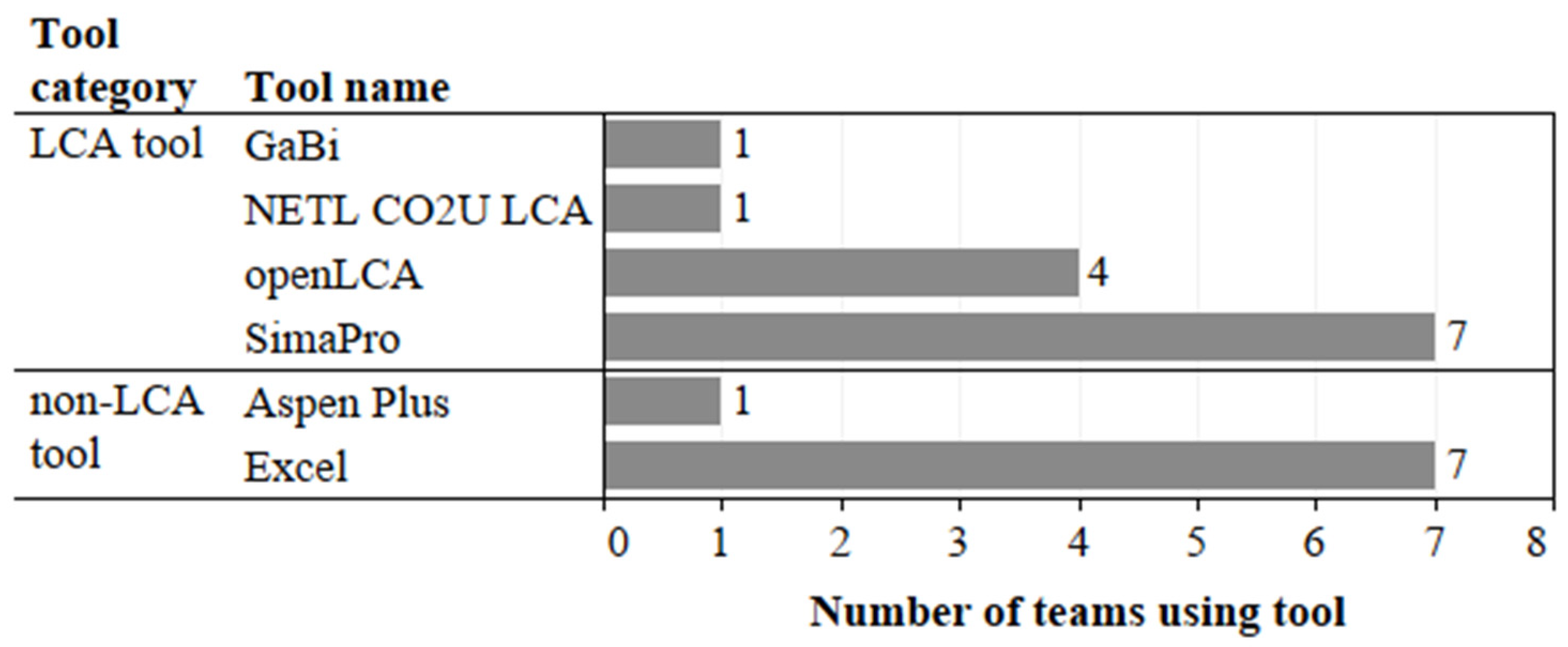
In addition to all of these methodological challenges, there are currently few software tools aimed at addressing these LCA issues in R&D of carbon-storing materials. Well-established tools that perform sophisticated life cycle assessments such as SimaPro [42], Sphera’s LCA for Experts (previously known as GaBi) [43], and openLCA [44] are well-suited for ex-post LCAs, where the product, technological landscape, and market-scale data are well-established. However, these LCA modeling tools are not well-suited for ex-ante LCAs because they do not allow users to easily compare multiple design decisions and evaluate uncertainty that is intrinsic to the R&D phase. On the other hand, screening-type tools, i.e., tools that perform a brief assessment at the early stage of a project to determine risks or hotspots, would be better-suited for ex-ante applications. Examples of existing screening-level resource include LiSET, a methodological framework guiding screening-level LCAs for emerging technologies at low-readiness levels [45], the World Wildlife Federation’s Biogenic Carbon Footprint Calculator for Harvested Wood Products that focuses only on wood products through a spreadsheet calculator [46], and other tools targeting at the building scale LCAs [47]. Unfortunately, currently there are no screening-type LCA tools that consider the special issues in ex-ante LCAs—especially for carbon-storing materials—such as carbon storage (biogenic or mineral), uncertainty, and choice comparison. In a preliminary survey that we conducted prior to this study, we found that a not-insignificant portion of the study subjects were using Excel instead of professional LCA tools to perform LCAs of their carbon-storing materials, indicating that there is a gap in LCA tool resources. These preliminary survey results are shown in Appendix A.
The challenges stated above demonstrate the urgent need for methodological solutions and appropriate calculation tools to improve the LCAs of carbon-storing construction materials in the R&D stage.
1.2. Research Gap and Objective
The literature review above did not uncover any studies that explored the LCA challenges in early-stage R&D innovation of carbon-storing construction materials. Most LCA studies of early-stage material innovation focused on the results, not the challenges. Only one case study was found that focused on the challenges, but the product was not a carbon-storing material [48]. This case study noted the following issues during early-stage R&D: data availability for rare materials, uncertainty about future production scenarios, scale-up (which would result in efficiency changes), sensitivity of confidential information, and identifying energy-intensive hotspots. These issues confirm the general challenges of ex-ante LCA, while first-hand insights and practical resolutions would be particularly valuable, especially for carbon-storing materials involving complex carbon accounting.
Thus, we collected the perspectives of a group of R&D teams about the LCA challenges they were facing when developing carbon-storing construction materials. We used the results to propose potential tool ideas that could address the R&D teams’ LCA needs. We hope that documenting these challenges and sharing our tool ideas can serve as a future reference for anyone who is developing tools for early R&D material innovators, especially for those who are creating carbon-storing materials.
2. Materials and Methods
Previous studies have commented that, “While an increase of building LCA tool development can be seen in the literature, there is a lack of integration of user requirements into the tool development process” [49]. To characterize the needs of those who are performing ex-ante LCAs for carbon-storing materials in R&D, we engaged directly with sixteen R&D teams who were a part of a federal research program based on the idea of turning buildings into carbon sinks using novel carbon-storing materials [50]. The R&D teams were all in the early stages of developing novel carbon-storing building materials and systems, and our project—the Parametric Open Data for Life Cycle Assessment (POD|LCA) Project [51]—was focused on creating a suite of methods and tools for this user group. See Appendix A for additional details about the R&D teams.
Through an in-person workshop, we collected information about specific LCA challenges faced by the R&D teams. The objective of this workshop was to identify common LCA challenges encountered during the R&D phase across various projects. We focused on the stages of development when LCA challenges would occur, as well as the data and tools available to R&D teams in those stages, and the ideal software functionalities and outputs which would help teams overcome those challenges.
In the first half of the workshop, we asked the R&D teams to draw diagrams of their design processes on an 11″ × 17″ sheet of paper and use sticky notes to indicate (1) their LCA questions, and (2) at which point in their design process they needed to use LCA to help them make decisions in their projects. The purpose of this activity was to (1) understand how the R&D teams developed their products, i.e., understanding their design processes, (2) understand when LCA should ideally be implemented in the R&D process in order to inform design decisions. A sample of the original diagrams drawn by the R&D teams are presented in Appendix A, representing a handful of teams who granted us permission to publish their drawings.
In the second half of the workshop, we gathered the R&D teams into a few larger groups to discuss common questions and challenges. The purpose of this activity was to discuss the observations from all of the R&D teams, highlight common interests, and provoke new ideas through dynamic interpersonal interactions. Notes were taken during this discussion session, which would later be analyzed as another source of data. Approximately ten pages of discussion notes were collected, with over 100 distinct observations and comments from research teams noted.
See Appendix A for additional details about the workshop activities.
Data Analysis
In order to analyze the information in the diagrams drawn by the R&D teams—that is, to identify common themes in the various diagrams using data visualization—the diagrams needed to be converted into a form that could be quantitatively analyzed. We did this by coding the LCA questions contained in the diagrams into an Excel spreadsheet, which is included in the Supplementary Materials. There were 60 LCA questions from the eleven Material R&D teams and 15 questions from the five Building R&D teams. We classified the LCA questions into the following three indices of categorization:
- Question category;
- Potential tool function;
- Topic.
The first index (Question category) characterized each question based on the general topic of the question. We developed the list of possible options for this index by reviewing all of the LCA questions and creating a list of common types of questions. We categorized all of the LCA questions into the following question categories:
- Analysis;
- Assumptions/scenarios;
- Data;
- Methods;
- Tool idea.
The second index (Potential tool function) characterized each question based on our assessment of the type of tool that could answer the LCA question. In the end, we categorized all of the LCA questions into the following tool function categories:
- Life cycle inventory (LCI) library;
- LCA guideline;
- LCA calculation;
- LCA result analysis;
- Optimization;
- Data integration.
The third index (Topic) characterized the question based on specific issues in LCA, such as methodological issues, material-specific calculations, and challenges specific to early-stage R&D. The resulting list of topics is shown below:
- Allocation;
- Avoided emissions;
- Biogenic materials;
- Building design;
- Carbon performance;
- Carbonation;
- Dynamic LCA;
- End-of-life;
- Energy;
- Hotspot analysis;
- Impact category selection;
- Impact reduction;
- Impact result;
- Interface with Excel;
- LCI;
- Material selection;
- Non-biogenic materials;
- Optimization;
- Processes;
- Reference building;
- Scale-up;
- Structural design;
- Trade-offs;
- Transportation.
The results of this categorization work are shown in the spreadsheet included in the Supplementary Materials.
From the discussion session notes, we collected 99 tool ideas, 59 of which were from Material R&D teams and 40 of which were from the Building R&D Teams. To analyze these tool ideas, we applied the classification indices and data visualization to help characterize the tool ideas. Most of the classification indices were taken from the analysis for the R&D team diagrams, described above, and a few more were added, as defined below. The categorization indices used for the discussion notes were as follows:
- Who: This identified the person who voiced the idea. This could have been a particular R&D team, multiple R&D teams, or a POD|LCA Team member.
- Source: This identified whose notes document contained the idea.
- Question category (defined above).
- Topic: This identified the key topic discussed in each question. Each question was reviewed and the key LCA or materials R&D topics were identified. Discussion topics did not align exactly with topics identified from diagram analysis because unique issues were brought up in the group discussions. Discussion topics similar to each other were grouped for further analysis.
- R&D stage (defined above).
- Potential tool function (defined above).
- Key words: This identified the key words related to LCA or materials R&D topics in the question. Judgement was used to identify one to nine key LCA- and material-related terms which best characterized each question. Similar keywords were grouped for further analysis.
The results of this categorization work are shown in the spreadsheet included in the Supplementary Materials.
After classifying the data from the diagrams drawn by the R&D teams and the discussion notes, we used data visualization to analyze the frequency and correlations between categories. The results are shown in the following section.
3. Results and Discussion
The diagrams that the R&D teams drew varied greatly in clarity, complexity, and style. Some diagrams were relatively straightforward with few LCA questions, while other diagrams were very complex, circuitous, difficult to understand, or had many LCA questions. Some diagrams identified the LCA tools (e.g., Tally, OpenLCA, GaBi) and data sources (e.g., ecoinvent) that the team used to perform their LCAs, but some did not. Due to the potential data privacy concerns about the projects in the HESTIA Program, no example diagrams are provided here.
After characterizing the data using the classification indices described in the Methodology section, we used data visualization techniques to determine the importance and prevalence of the LCA challenges described in the diagrams and the discussion notes. Note that since the source data was subjective and qualitative, a more sophisticated analysis, such as a statistical analysis, was not performed because it could have been misleading. Note, also, that although the project teams had been categorized by ARPA-E into different project types (“bio-based insulation”, “cementitious”, and “new wood and other”), we did not analyze the data using this index because (1) we believed that the distinction between the project types was ambiguous (for example, the ‘bio-based insulation’ projects could have been categorized under the ‘new wood and other’ category), therefore drawing conclusions based on debatable distinctions could be misleading, (2) there were only 3–4 teams per project type, which we believed were too small a sample size to be drawing conclusions from, and (3) we believed that a tool designed for R&D teams should not distinguish between project types, i.e., a tool for this user group should work for all types of carbon-storing materials. Although we did do some preliminary explorations of the results based on project type, we chose not to include them here due to space constraints.
This section describes (1) how the diagrams were analyzed, (2) how the discussion notes were analyzed, (3) how the results led to the development of potential tool ideas, and (4) how the tool ideas were prioritized using a feedback survey filled out by the R&D teams. This section also discusses (5) the novelty of this work, (6) the limitations, and (7) ideas for future work.
3.1. Analysis of Diagrams
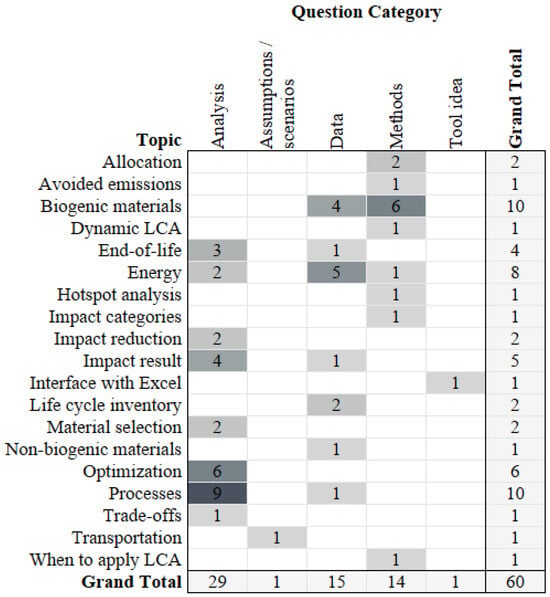
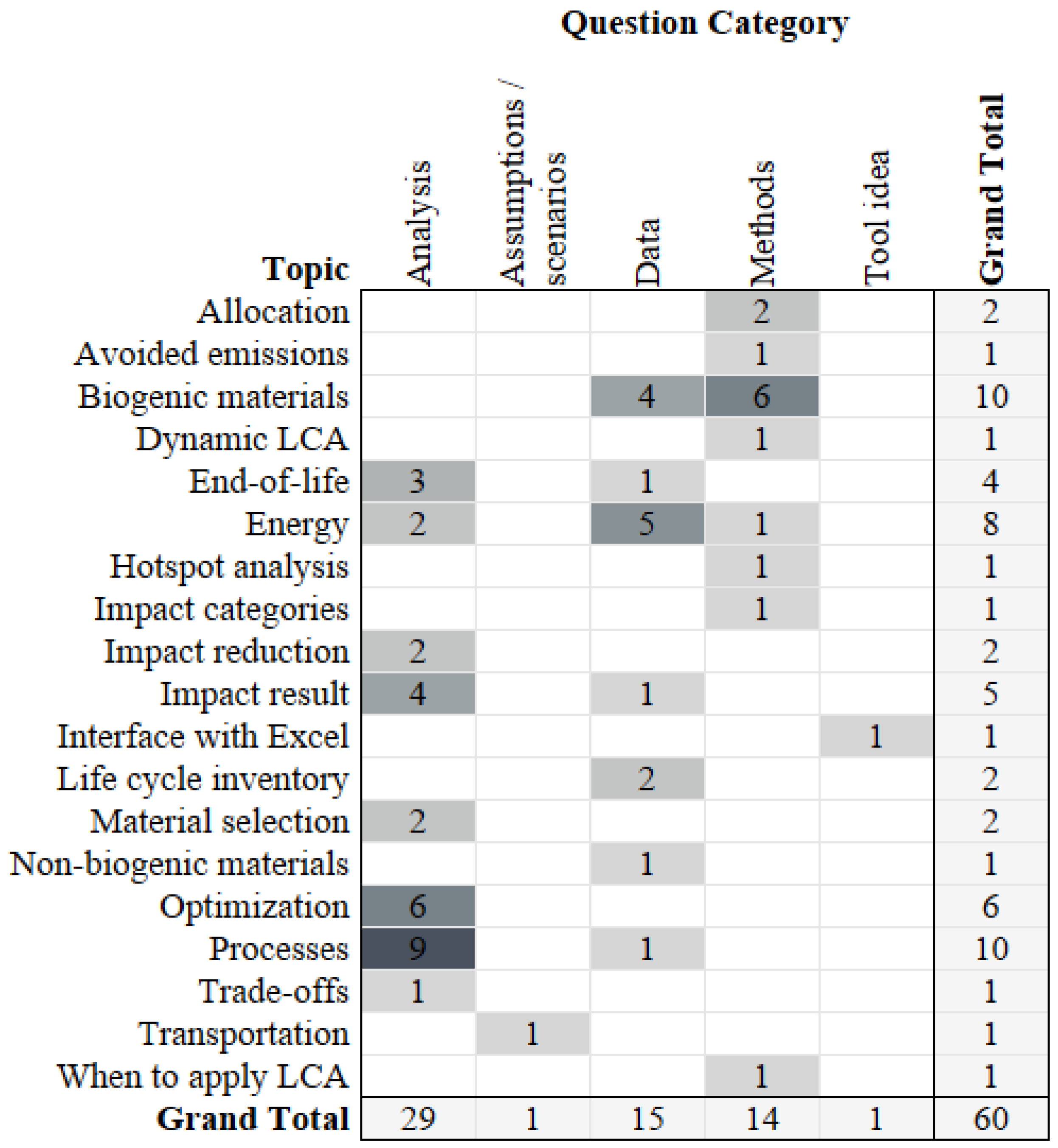
To understand which topics were correlated with which types of questions (which will later lead to potential tool ideas) we created a heat map of Topic vs. Question Category. This heat map is presented in Figure 1.
Figure 1.
Heat map of the number of LCA questions from HESTIA Workshop diagrams, showing Topic vs. Question Category (Material R&D teams only).
The most significant hotspot in the Figure 1 heatmap was the Processes + Analysis square (representing 9 questions, or 15% of all questions). To better understand this hotspot, we reviewed the actual questions from the R&D teams. Shown below are some of their original LCA questions:
- “How do fabrication processes affect GWP”
- “Which material pre-treatment process should we pick based on the LCA result, energy use?”
- “Which machinery (scale-up manufacturing) method to [use] considering the size, energy?”
- “What [are] the pros and cons of centralized vs. modular production plants? in terms of energy use, shipping, size, marketability, reusability”
- “What is the climate change impact of the alternative process for the co-product (chemicals) as well as the market value?”
- “Which combo of processing yields the most carbon-negative AND most economically favorable output?”
- “[How to] identify opportunities for energy recovery?”
- “[How to] explore trade-offs for the entire process or unit process (cost vs. GHG)?”
These LCA questions show that the R&D teams were interested in understanding how their processes affected the overall environmental performance of their products, understanding trade-offs, and making decisions with the eventual goal of optimizing their product for environmental performance and cost. Most of these LCA questions about processes were specifically about manufacturing processes (e.g., “fabrication processes”, “material pre-treatment process”, “machinery (scale-up manufacturing)”, “centralized vs. modular production plants”, “opportunities for energy recovery”, etc.). It makes sense that this was a hotspot (and thus a hot topic for the R&D teams), since optimizing product design and manufacturing processes bolsters a product’s eventual success in the market.
Other hotspots from Figure 1 included the following:
- Optimization + Analysis (6 questions, or 10% of questions): Based on prior conversations with the R&D teams that occurred before the HESTIA Workshop, we assumed that acquiring LCI data would be the primary challenge for the R&D teams. However, the fact that the biggest hotspot was not about data but instead about optimization and analysis indicates that the R&D teams were very keen on optimizing and understanding the impacts of their products. The original LCA questions from the R&D teams confirmed this sentiment. We can surmise that once the R&D teams overcome the challenge of acquiring data, their ultimate goal is to optimize their products.
- Biogenic materials + Methods (6 questions, or 10% of questions): This hotspot suggests that the R&D teams had many questions about the methodology surrounding biogenic materials, which confirms the issues that we identified in the literature around biogenic carbon. Reviewing the original questions from the R&D teams showed that they wanted to know how to calculate biogenic carbon storage, how to account for land-use change, how to compare different biogenic materials, how to calculate actual vs. theoretical carbon uptake, and if there were any accounting benefits to using wood from trees killed by disease. This hotspot highlights the special needs of accounting biogenic materials with appropriate methodologies for carbon-storing materials.
- Energy + Data (5 questions, or 8% of questions): This hotspot was somewhat surprising because there is an abundance of free and accessible LCA data for energy, both for fuels and electricity. However, after diving into the original LCA questions from the R&D teams, we saw that they wanted to know how to decide on which electricity grid mix to use, especially if the location of the manufacturing facility was not yet known, and they also wanted to know how to determine the energy impacts of their processes. The literature review had not identified electricity as a common issue for ex-ante LCAs, but after reviewing the R&D teams’ specific LCA questions, it makes sense why this was a challenge—R&D teams did not necessarily know what their final electricity consumption would be or where their product would be manufactured once their products were in the market and produced at scale.
Surprisingly, despite the abundance of open-access energy data for fuels and electricity, the primary challenge lies in the lack of guidance on selecting appropriate data for LCA. Questions such as how to decide on which electricity grid mix to use prior to the determination of manufacturing locations exemplify the common issue in ex-ante LCA. This highlights a broader challenge in early-stage R&D LCA: R&D teams often struggle with predicting their final energy consumption and production conditions at scale.
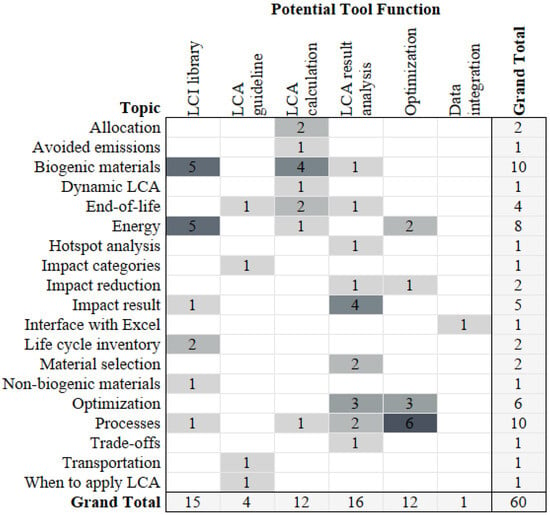
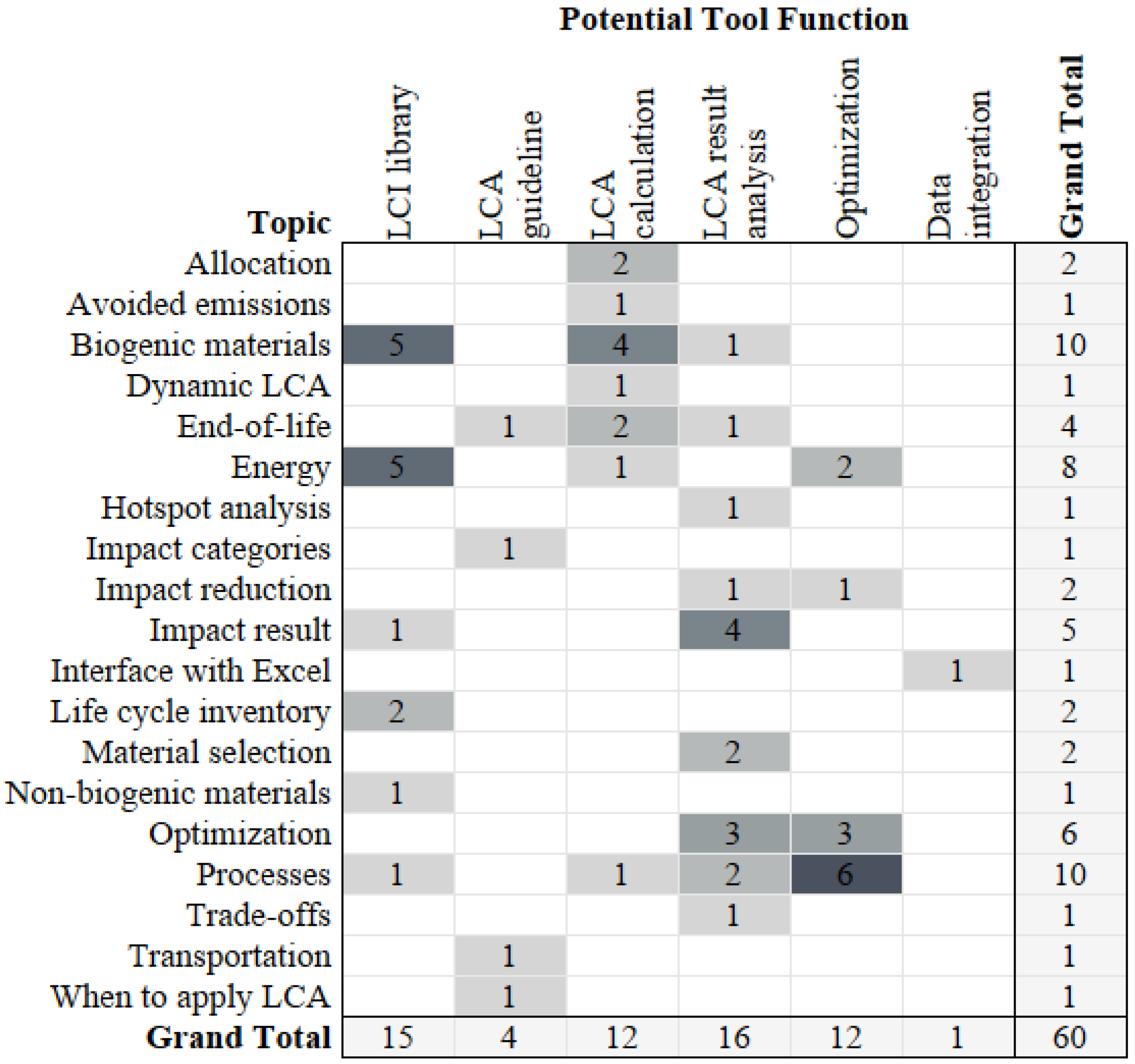
To identify the demands of potential tool functions corresponding to specific LCA topics, Figure 2 presents a heat map of the number of LCA questions by Topic vs. Potential Tool Function. This figure helped us identify which types of potential tool functions were most popular for which topics. We found that the following combinations stood out as hotspots, which aligned with the hotspots identified previously in Figure 1 (likely because there is some logical follow-through from a question category to a potential tool function):
Figure 2.
Heat map of the number of LCA questions from HESTIA Workshop diagrams, showing Topic vs. Potential Tool Function (Material R&D teams only).
- Optimization + Processes (6 questions, or 10% of LCA questions): This hotspot suggests that it would be helpful to have a tool that helps the user optimize their production processes—perhaps a tool that finds the optimal combination of parameters, such as material and energy quantities. This is a logical interest from the R&D teams because, as mentioned before, material innovators should be interested in optimizing their production in order to ensure market success.
- LCI library + Biogenic materials (5 questions, or 8% of LCA questions): This hotspot suggests that it would be helpful to have a tool that provides LCI data for biogenic materials. In our literature review, we did not find any indication that finding LCA data for biogenic materials was a challenge, but it makes sense that this challenge exists. Most of the literature focused on methodological challenges, which is necessary for developing LCA data for biogenic materials. The lack of methodological consensus would explain why the current state of biogenic data is insufficient for material innovators who are using biogenic materials.
- LCI library + Energy (5 questions, or 8% of LCA questions): This hotspot suggests that it would be helpful to have a tool that provides LCI data for energy, which is consistent with the Energy + Data observation from Figure 1. Incorporating the original questions regarding the data curation for ex-ante LCA, this finding suggests that R&D teams would find it helpful to have a tool that simplifies the process of selecting energy data.
3.2. Analysis of Discussion Session Notes
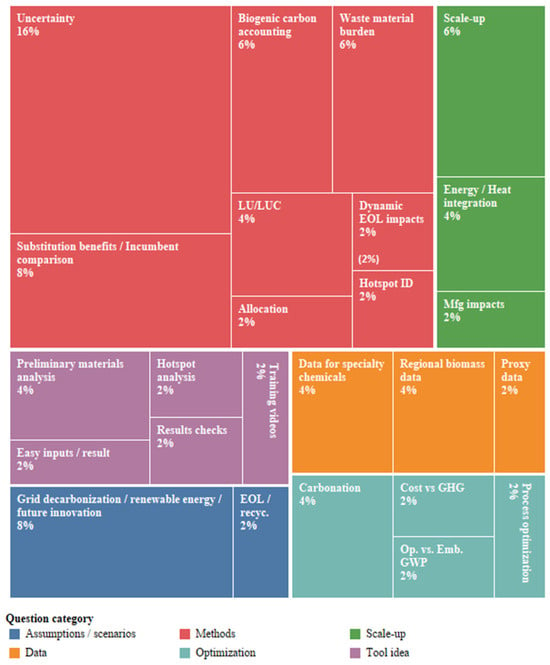
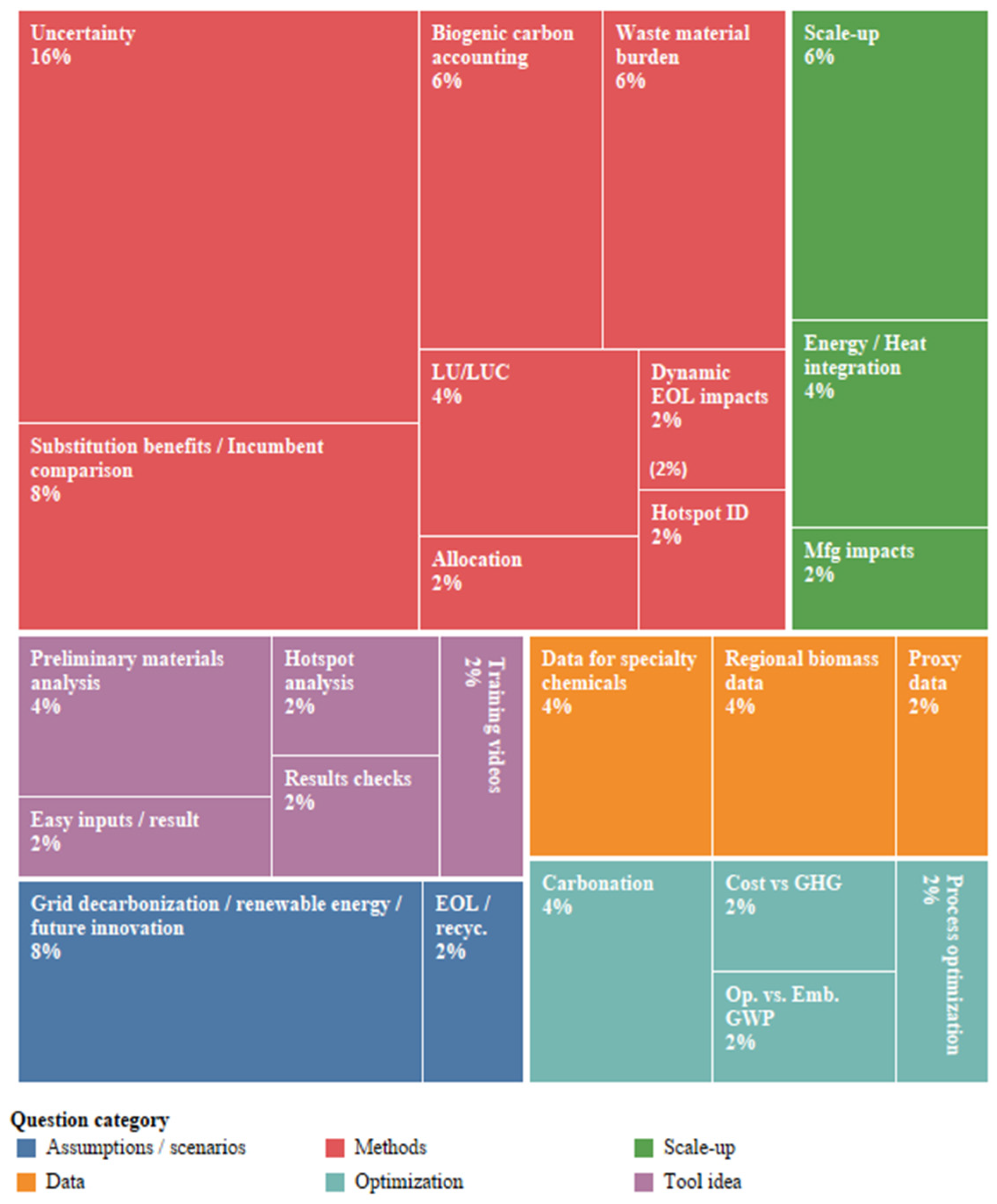
As for the notes taken during the discussion session, many ideas elaborated on specific details of an LCA challenge faced by a team, such as missing data or incorporating uncertainty into calculations. Other comments addressed software features or characteristics that were of particular interest, such as user-friendliness. A small number of comments emphasized the inability of current LCA methods and tools to account for all the favorable aspects of their material or building design, such as low cost or improved impacts on human health. To capture the themes in the discussion session of the HESTIA Workshop, Figure 3 presents a tree map depicting the relative frequency of discussion topics for the Material R&D teams. “Relative frequency” refers to the number of times a discussion topic appeared in the notes relative to other discussion topics, expressed as a percentage. This tree map diagram shows the relative importance of each broad category while also providing details about the specific topics discussed within each broad category. This figure shows that the R&D teams were concerned primarily with the following:
Figure 3.
Tree map showing the relative frequency of discussion topics (Material R&D teams only). Abbreviations: LULUC = land use and land-use change; EOL = end-of-life; ID = identification; Mfg = manufacturing; Recyc. = recycling; Op. vs. Emb GWP = operating vs. embodied global warming potential.
- Methodological issues (46% of topic mentions);
- Issues about scale-up (12%);
- Tool ideas (12%);
- Assumptions/scenarios (10%);
- Data (10%);
- Optimization (10%).
The key words “uncertainty” and “biogenic carbon” were topics that had come up in the literature review, so these issues were expected. However, many other key words had not appeared in the literature review, such as: substitution benefits, incumbent material comparison, waste material burden, land use and land-use change (LULUC), scale-up, future grid decarbonization, mineral carbonation, and data for specialty chemicals. Therefore, this study uncovered additional topics that innovators of carbon-storing materials were grappling with, on top of the more well-known challenges like uncertainty and biogenic carbon. These additional topics underscores the special needs of this user group targeting decarbonization with alternative materials while considering a holistic LCA for carbon accounting comparing novel materials to conventional product development.
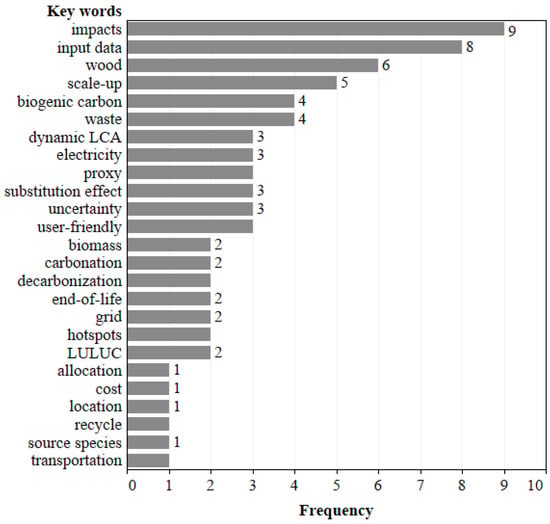
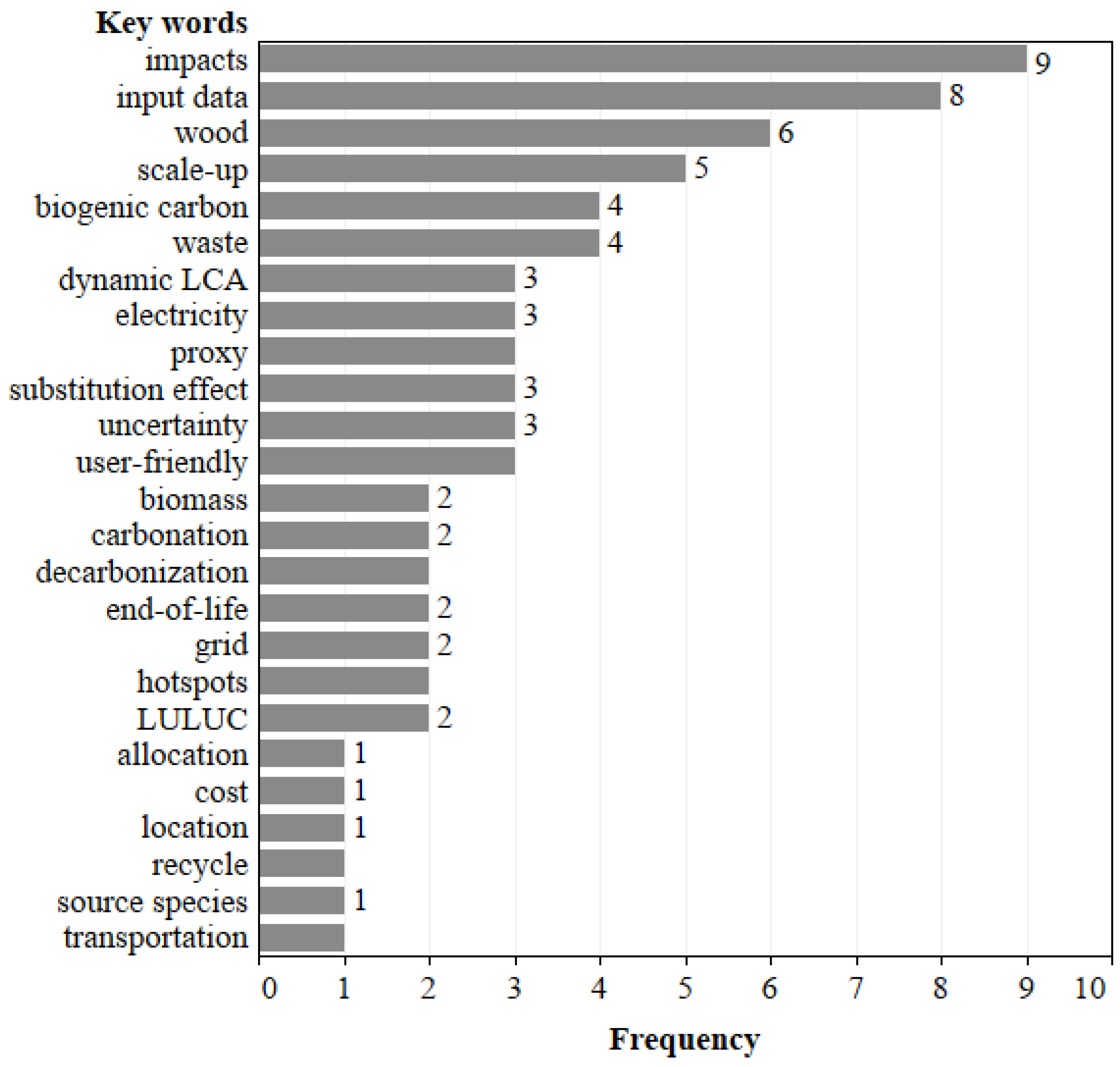
Figure 4 presents the number of times the top 30 key words appeared in the discussion notes. In this figure, we observed that the key words that appeared more than twice in the discussion session notes were (in descending order of frequency): impacts, input data, wood, scale-up, biogenic carbon, waste, dynamic LCA, electricity, proxy, substitution effect, uncertainty, and user-friendly. These key words provide a bit more specificity about the issues that the R&D teams were grappling with.
Figure 4.
Bar chart of the number of times the top 30 key words were used in discussion notes from the HESTIA Workshop discussion session (Material R&D teams only).
3.3. Development of Tool Ideas
After processing the results from the HESTIA Workshop, we used our observations from the analysis to generate tool ideas for innovators who aim to develop screening-type LCA tools that focus on carbon-storing materials. We started by asking all members of POD|LCA team (16 people) to review the findings from the workshops and brainstorm tool ideas. Tool ideas could fall under the following categories:
- A function, which is a service of the tool that accomplishes a goal (for example: performing a calculation).
- A feature, which is how a user interacts with a tool (for example: a button or a visualization).
- Any kind of big-picture idea for how the tool would be structured.
We focused on developing tool functions, since functions were the core calculations in a tool and would require more time to develop and test. By the end of this process, we had a list of 29 ideas for tool functions. The tool functions naturally fell into following categories, aligning with the basic steps of life cycle assessment as outlined by ISO 14044 [52]:
- Provide LCA data;
- Perform calculations;
- Analyze and interpret results.
This preliminary list of tool function ideas is shown in Table 1.
Table 1.
Preliminary list of tool functions organized by tool category.
After brainstorming the list of tool ideas in Table 1, we came back to the questions of (1) how could we create a tool that meets the needs of the target user, and (2) how could we fill a gap in the industry? Since the R&D teams were interested in a tool that would make it easier and quicker for them to perform LCA calculations, we decided to organize tool functions into smaller, topic-focused groups that would help the user accomplish separate goals. If a user only needed calculation assistance for one particular LCA topic (e.g., carbon storage), they would only have to fill in the fields needed to resolve their questions for that LCA topic. Compartmentalizing the tool modules this way would also help reduce the time-cost of LCA—both (1) the initial time investment required for a new user to learn how to use the LCA tool, and (2) the time investment required for a skilled user to develop a full LCA model from scratch.
We developed a list of the core LCA calculation topics by taking into consideration (1) the scope of the project, (2) the needs of the R&D teams (including the Building R&D teams, not just the Material R&D teams), and (3) our knowledge about the LCA needs of the building industry. The resulting list of the core LCA calculation topics is shown below:
- Impact data;
- Energy;
- Transportation;
- Construction;
- Carbon storage;
- End-of-life;
- Dynamic LCA;
- Building scenarios and baselines;
- Analysis of results;
- Uncertainty;
- Refrigerants;
- Blowing agents.
We then distributed the tool functions from Table 1 to each of the core LCA topics. If a tool function could be useful for that core LCA topic, then it was assigned to it. If a tool function could be useful for multiple core LCA topics, then that tool function was assigned to all relevant topics. After that, we reconceptualized the LCA topics as tool modules. We created an objective for each tool module to clarify its purpose (for example, helping a user calculate the carbon storage of their product) so that it could stand alone as an independent tool.
Table 2 displays the final list of tool modules, their objectives, and their assigned functions.
Table 2.
List of tool modules, objectives, and functions.
Another reason why we organized these tool functions into topic-focused modules was to allow for flexibility. Organizing these tool functions by LCA topic will allow (1) existing LCA software to incorporate just the modules that they want (without having to download all of the other modules), and (2) developers of one module to update it without breaking the other modules. For example, if an LCA software developer wanted to add dynamic radiative forcing as a feature in their tool, they could just download the code for Dynamic Radiative Forcing module or use the accompanying application programming interface (API) in their tool. We envision this code being open-source and open-access; hosted on GitHub; and accompanied by user documentation for end-users along with code documentation for software developers.
3.4. Feedback Survey
A few months after the data collection workshop, we sent out a follow-up survey to the R&D teams to help us prioritize which tool modules to develop moving forward. We presented our proposed tool modules in a webinar, then asked the R&D teams to fill out a survey afterwards. The survey asked them two questions about proposed tool modules:
- For each tool module: How influential would this tool module be for your project? In other words, does this tool module have the potential to significantly influence the direction of your project? To help the R&D teams answer this question in a quantitative way, we asked them to rate each tool module on a scale of 1–7, where
- 1 = not influential on their project;
- 7 = highly influential for their project.
- For each tool module: How significant is the gap addressed by this tool module? In other words, how hard has it been for your team to find resources to resolve this topic for your project? To help the R&D teams answer this question in a quantitative way, we asked them to rate each tool module on a scale of 1–7, where
- 1 = insignificant gap (they were easily able to fill in this gap, no tool needed);
- 7 = highly significant gap (they have not been able to resolve this issue).
The first question focused on how the tool modules would affect the R&D teams’ individual projects, while the second question focused more on the need for these tool modules in the industry. There may have been some conceptual overlap between these two questions in that “influence” and “significance” are both synonyms for “importance,” but the first question was focused on the individual team while the second question was focused on the industry.
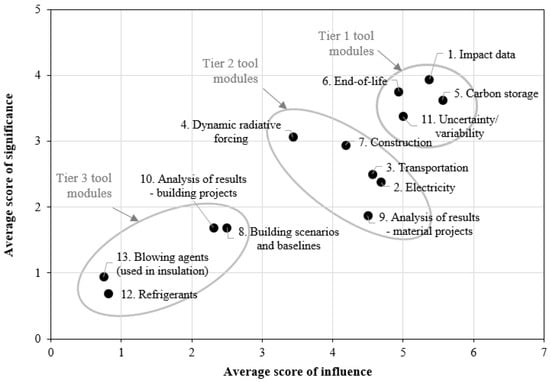
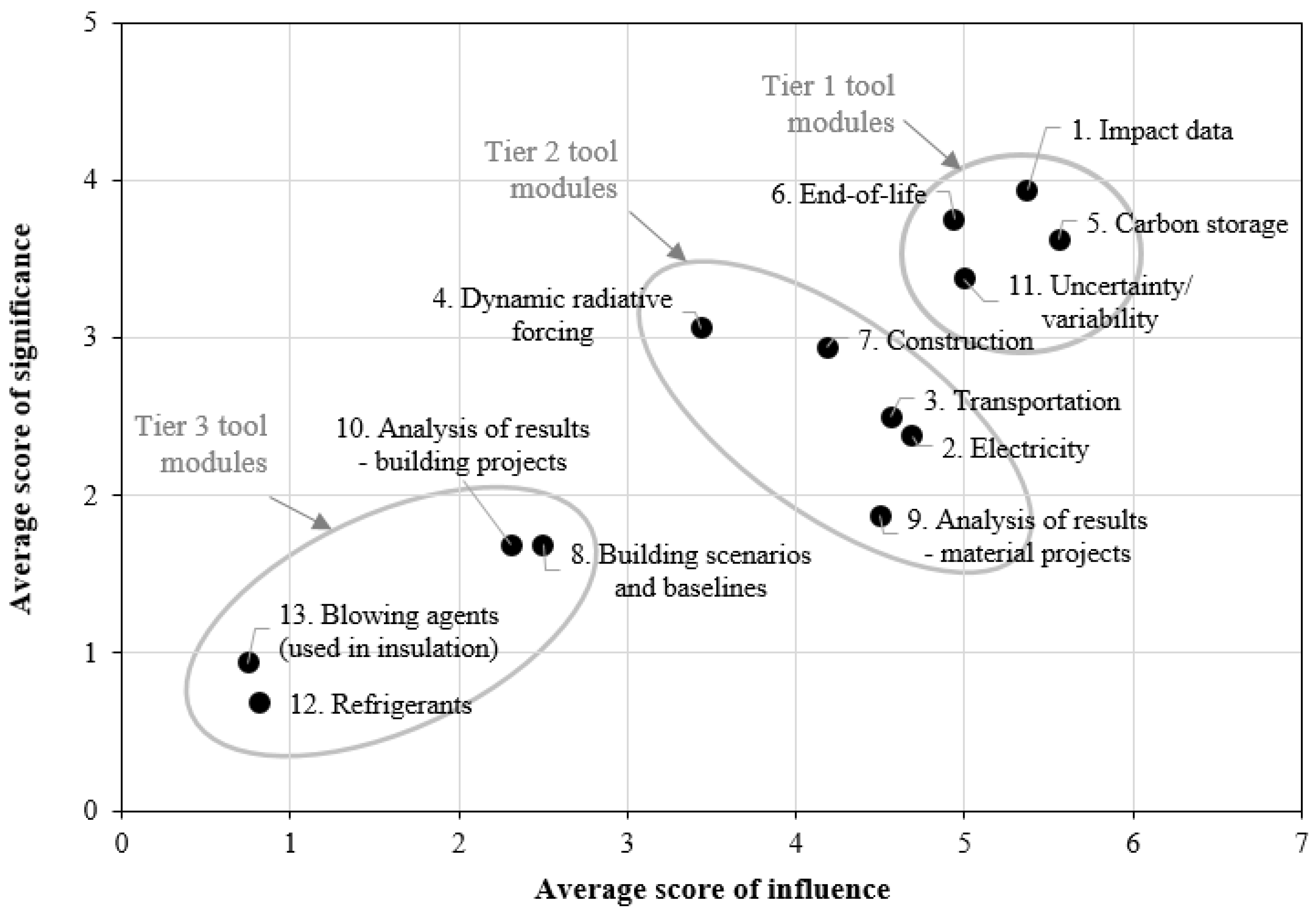
Figure 5 presents a scatterplot of the average scores of the R&D teams’ responses to the first and the second questions for each tool module. In this figure, we observed three clusters of points, representing three tiers of tool modules:
Figure 5.
Scatterplot of the average score of influence for the individual projects of the R&D teams (x-axis) vs. average score of significance on the overall industry (y-axis). Three tiers of tool modules are circled, indicating three levels of importance ascribed to the tool modules.
- Tier 1 tool modules: These tool modules received generally high scores from the R&D teams, indicating high importance or urgency on these topics. These modules were impact data, carbon storage, end-of-life, and uncertainty/variability. The emphasis on impact data for materials, fuels, and carbon storage highlights the need for reliable LCI sources for low-carbon materials. Meanwhile, the focus on end-of-life scenarios and comparisons reflects the growing demand to assess the full life cycle of carbon storage. Addressing uncertainty and variability will enhance the accuracy and neutrality of LCA, strengthening R&D optimization. Generally, this group of tool modules point to the special needs of carbon-storing R&D teams. The fact that these points are clustered together on the plot suggest that these modules are closely related and serve overlapping needs of multiple R&D teams.
- Tier 2 tool modules: These tool modules received generally medium-level scores from the R&D teams. These modules were: construction, dynamic radiative forcing, transportation, electricity, and analysis of results—material projects. These points are more scattered than the Tier 1 tool modules, suggesting that these tool modules varied more widely in types of importance. If a module had a higher score of significance, then this reflected the higher importance of this tool module for individual teams, whereas if a module had a higher score of influence, then this reflected the higher importance of this tool module for the overall industry. For example, module 9 (Analysis of results—material projects) focuses on the goal of optimization and comparison, which is individual to each team, while module 7 (Dynamic radiative forcing) is a broad methodological change that would likely affect the whole industry if implemented.
- Tier 3 tool modules: These tool modules received the lowest scores from the R&D teams, indicating low importance or urgency on these topics. These modules were analysis of results, building projects, building scenarios and baselines, blowing agents, and refrigerants.
It should also be noted that the overall trendline of the data points in Figure 5 is (1) positive, indicating that tool modules that are important for individual projects are also important for the overall industry, and (2) the slope of the trendline is relatively shallow (slope = 0.6, which is shallower than the 1:1 line), or closer to the horizontal axis than the vertical axis, which means that these tool modules are generally useful to the R&D teams. These two observations indicate that we have accomplished the goals of this study to propose potential tool ideas that would be useful to the R&D teams and the wider industry for performing LCAs on carbon-storing construction materials.
3.5. Novelty
To the best of our knowledge, no prior studies have systematically examined the challenges faced by multiple R&D teams conducting LCAs of carbon-storing materials during the early-stage development process. This paper not only addresses this gap, but also provides a comprehensive analysis of the specific LCA challenges encountered by material innovators. By gathering diverse perspectives from a relatively large group (n = 16) of active R&D teams working on various carbon-storing construction materials, we systematically identified key obstacles to the implementation of LCA in this field.
In this study, we confirmed a few major LCA issues that we expected would be challenging for the R&D teams (data availability, biogenic carbon calculation methodology, and ex-ante uncertainty), but we also uncovered a plethora of other LCA challenges that the R&D teams struggled with, such as: substitution benefits; incumbent material comparison; waste material burden; land use and land use change (LULUC); scale-up; future grid decarbonization; mineral carbonation; and data for specialty chemicals. These issues may not be unique to the R&D teams, since they are complex topics, but this finding suggests that LCA tool developers should (1) incorporate these topics into the development of a screening LCA tool for this user group, and (2) consider the possible intersections of these topics with the LCA topics that are more unique to carbon-storing innovators, such as data availability, biogenic carbon calculations, and ex-ante uncertainty. We also discovered that R&D teams needed additional guidance for making assumptions about energy consumption and electricity grid mix (which was often unknown during early-stage R&D), and that they were very interested in using LCA to help optimize their processes and formulations, as could be expected of R&D teams.
Another novelty of this work is that we transformed the LCA questions and discussion notes into a list of tool functions that could serve the needs of the R&D teams. We compartmentalized the functions into thirteen tool modules so that each module could be developed separately, which would allow the users to employ the modules separately on an as-needed basis. We hope that this list of tool ideas can serve as a roadmap for others to develop additional tools for innovators of carbon-storing materials in the future.
Finally, we compared the desired tool functions and modules from Table 2 with some existing commercial LCA tools. The most notable differences were that (1) no prominent LCA tools, especially those used by the building industry, currently have the ability to perform dynamic radiative forcing analysis to model the time-varying effects of emissions (such as operational energy or future end-of-life emissions) over time, and (2) no tools capture the time-related effects of biogenic and mineral carbon storage and emissions at different points in the building life cycle. Note that there are tools for calculating dynamic radiative forcing (Temporalis [56], dynCO2 [57], and the Temporal Climate Impacts Tool [58]) but these only calculate dynamic radiative forcing and are not integrated with other LCA software. Also, there are currently no building LCA modelling tools that address the effects of refrigerants and blowing agents, which we are proposing.
3.6. Limitations
The diagrams produced by the R&D teams during the HESTIA Workshop varied greatly in clarity, complexity, and style. These variations posed challenges to interpretation and analysis, but they offered the opportunity to explore different perspectives. It should be noted that the conclusions drawn from them were inherently influenced by our subjective interpretation. Regardless, we believe we captured the significant aspects of the R&D teams’ questions and core challenges, which was the goal of the analysis.
It should be noted that the sixteen R&D teams consulted in this paper do not represent all R&D teams working on carbon-storing construction materials. Although the R&D teams in the HESTIA Program had a wide variety of interesting projects and LCA backgrounds, we do not have enough information to know if they are representative of all R&D teams in this field.
Finally, all of these R&D teams were based in the United States, and the tool brainstorming was focused on the United States. This geographic constraint limits the ability of this study to capture LCA challenges that may be specific to other regions, and it limits the potential applicability of the proposed tool ideas for other global regions. For the purposes of tool development, we can note several differences between LCA standards and data in the United States compared to other parts of the world. The first difference is the impact characterization method. The United States uses an impact characterization method call TRACI (Tool for the Reduction and Assessment of Chemical and other environmental Impacts), which uses characterization factors that were developed specifically for the United States [59], while other parts of the world may use EF (Environmental Footprint), CML, ReCiPe, or others, which use different characterization factors according to region-specific standards and data. The second main difference lies in the emissions data or LCI data. Different regions of the world have different technologies, production practices, raw materials, and trends in technological development. For example, different parts of the world have different types of wood species (raw materials); or different energy generation mixes and different grid system arrangements (electricity); or different types of vehicles and distance assumptions (transportation); or they have different waste handling practices (end-of-life). These differences are reflected in the region-specific LCI data. Finally, biogenic and mineral carbon storage may be calculated and reported differently depending on the region. For example, to quantify mineral carbon storage in construction material environmental production declarations (EPDs), EN 15804 [29] (which is what Europe follows) combines mineral carbonation with GWP-fossil, but ISO 21930 [28] (which is what the United States follows) requires reporting it as a separate indicator. Ideally, the developed tools would be flexible enough to accommodate different impact characterization methods, LCIs, and reporting methods, but for now, the proposed tool modules will be using US datasets and assumptions.
3.7. Future Work
To improve the findings of this paper and future similar studies, it would be beneficial to collect information about the LCA proficiency of each R&D team. This background information could have helped contextualize some of the LCA questions from the R&D teams. It would also have been beneficial to put more constraints on the drawings done by the R&D teams, i.e., ask them to draw their diagrams following a sequence of steps and using a limited vocabulary. This could reduce the level of complexity and allow for a more rigorous analysis, which could improve the objectivity of the analysis. Finally, in the future it would be beneficial to survey R&D teams again regarding whether developed LCA tools meet their needs.
4. Conclusions
Innovators of carbon-storing materials are interested in using LCA to help them make design choices so that they can minimize the environmental impacts of their projects. However, traditional LCA modeling tools are not set up to do that easily, and there are currently no screening LCA software tools that perform ex-ante LCA calculations for innovators of carbon-storing construction materials. This paper aims to fill that gap. By conducting an in-person workshop with R&D teams from the ARPA-E HESTIA Program, we collected their perspectives on the challenges they were facing in using LCA, and analyzed that data to (1) understand the nature and prevalence of their LCA challenges, and (2) propose a list of useful tool ideas for R&D teams of carbon-storing construction materials.
From this study, we found that data availability, biogenic carbon, and uncertainty were all major LCA challenges for R&D teams of carbon-storing materials, which confirmed our findings from the literature. Moreover, we uncovered additional topics that the R&D teams found challenging, which involved the following topics: substitution benefits; incumbent material comparison; waste material burden; land use and land-use change (LULUC); scale-up; future grid decarbonization; mineral carbonation; and data for specialty chemicals. These topics are challenging not just for R&D teams developing carbon-storing materials but also for LCA practitioners and tool developers, adding to the overarching challenges of data availability, biogenic carbon, and uncertainty.
Using the information collected from the R&D teams, we developed a list of tool ideas for innovators of carbon-storing materials who are actively in the R&D stage. Our list consisted of thirteen LCA modules, with each module focused on a core LCA topic with calculation functions aimed at resolving LCA challenges. We are actively developing these modules for the POD|LCA Project. The beta version of the POD|LCA Framework, including the tools, background data, and methods, will be available to the R&D teams who participated in this study. As part of the beta testing, we will conduct surveys and selected interviews to better understand if the tools and resources adequately address key user needs identified in this study. The POD|LCA Tool will be released as open-source by the end of 2026.
We hope that the information collected from the sixteen R&D teams and our resulting tool plan can provide the industry with a roadmap of the LCA needs for the innovation of carbon-storing materials.
Supplementary Materials
The following supporting information can be downloaded at: https://www.mdpi.com/article/10.3390/app16084040/s1. A spreadsheet of the data is included as an Excel spreadsheet.
Author Contributions
Conceptualization, T.M.E. and K.S.; methodology, M.H., T.M.E. and K.S.; data analysis, M.H., E.E. and M.-Y.L.; writing—original draft preparation, M.H.; writing—review and editing, M.H., E.E., M.-Y.L., T.M.E. and K.S.; visualization, M.H., E.E. and M.-Y.L.; supervision, K.S.; project administration, T.M.E. and K.S.; funding acquisition, T.M.E. and K.S. All authors have read and agreed to the published version of the manuscript.
Funding
The information, data, and work presented in this paper was funded by the Advanced Research Projects Agency-Energy (ARPA-E), United States Department of Energy, under Award Number DE-AR0001624 and Program Number DE-FOA-0001953 (Topic V: Life Cycle Assessment for Carbon Negative Buildings). The views and opinions of authors expressed herein do not necessarily state or reflect those of the United States Government or any agency thereof.
Institutional Review Board Statement
Not applicable.
Informed Consent Statement
Not applicable.
Data Availability Statement
Data about the HESTIA Projects were collected under a Data Transfer and Use Agreement (DTUA). Data are not available due to the confidentiality requirements in the DTUAs signed with all of the HESTIA Teams.
Acknowledgments
The authors would like to thank the rest of the POD|LCA Team for their contributions to this project. For the work presented in this paper, we would like to thank the following team members for helping lead and facilitate the HESTIA Workshop: Francesca Pierobon and Anber Rana. We would also like to thank Mahsa Torabi for her help in reviewing the tool ideas. We would also like to thank the R&D Teams in the HESTIA Program for providing their responses to our many questions, which formed the work presented in this paper.
Conflicts of Interest
The authors declare no conflicts of interest.
Abbreviations
The following abbreviations are used in this manuscript:
| API | Application programming interface |
| ARPA-E | Advanced Research Projects Agency-Energy |
| EN | European Standard (Europäische Norm) |
| EOL | End-of-life |
| EPD | Environmental product declaration |
| GHG | Greenhouse gas |
| GWP | Global warming potential |
| HESTIA | Harnessing Emissions into Structures Taking Inputs from the Atmosphere |
| ID | Identification |
| ISO | International Organization for Standardization |
| LCA | Life cycle assessment |
| LCI | Life cycle inventory |
| LULUC | Land use and land-use change |
| POD|LCA | Parametric Open Data for Life Cycle Assessment (Project) |
| R&D | Research and development |
| TRACI | Tool for the Reduction and Assessment of Chemical and other environmental Impacts |
Appendix A
Figure A1 presents the results of a preliminary survey of the R&D Teams (performed outside of the study presented in this paper), asking which kinds of software tools they used to perform preliminary LCAs of their innovative materials.
Figure A1.
Results of a preliminary survey of the R&D teams, asking which kind of software tools they used to perform preliminary LCAs of their innovative materials.
The R&D Teams were part of a program named Harnessing Emissions into Structures Taking Inputs from the Atmosphere (HESTIA), which was funded by the U.S. Department of Energy’s Advanced Research Projects Agency-Energy (ARPA-E). The background of the R&D teams is shown in Table A1. The team categories and project categories were determined by ARPA-E.
Table A1.
Description of R&D teams and projects.
In the first half of the workshop, the R&D teams had 75 min in total to draw the diagrams. In the first 30 min, teams were instructed to draw the flow of their design processes, not including any LCA-related activities. In the next 25 min, teams were instructed to brainstorm the questions they wanted to answer with LCA. In the last 20 min, teams placed their LCA questions onto their design process diagrams near the relevant design steps. Teams were also instructed to connect their LCA questions into their design process diagram with arrows, adding details to indicate the software or programming language used to exchange data.
In the second half of the workshop, three discussion groups were formed, with one group composed of Building R&D teams and two groups composed of Material R&D teams. Each discussion group consisted of one to two facilitators and five to six R&D teams, with each team represented by one or two people, resulting in discussion groups of eight to twelve people. Each team had approximately 10 min to present their design process diagram and discuss their LCA questions in their group. Each facilitator took notes during the discussion session, and these notes would later be used as a source of data to be analyzed.
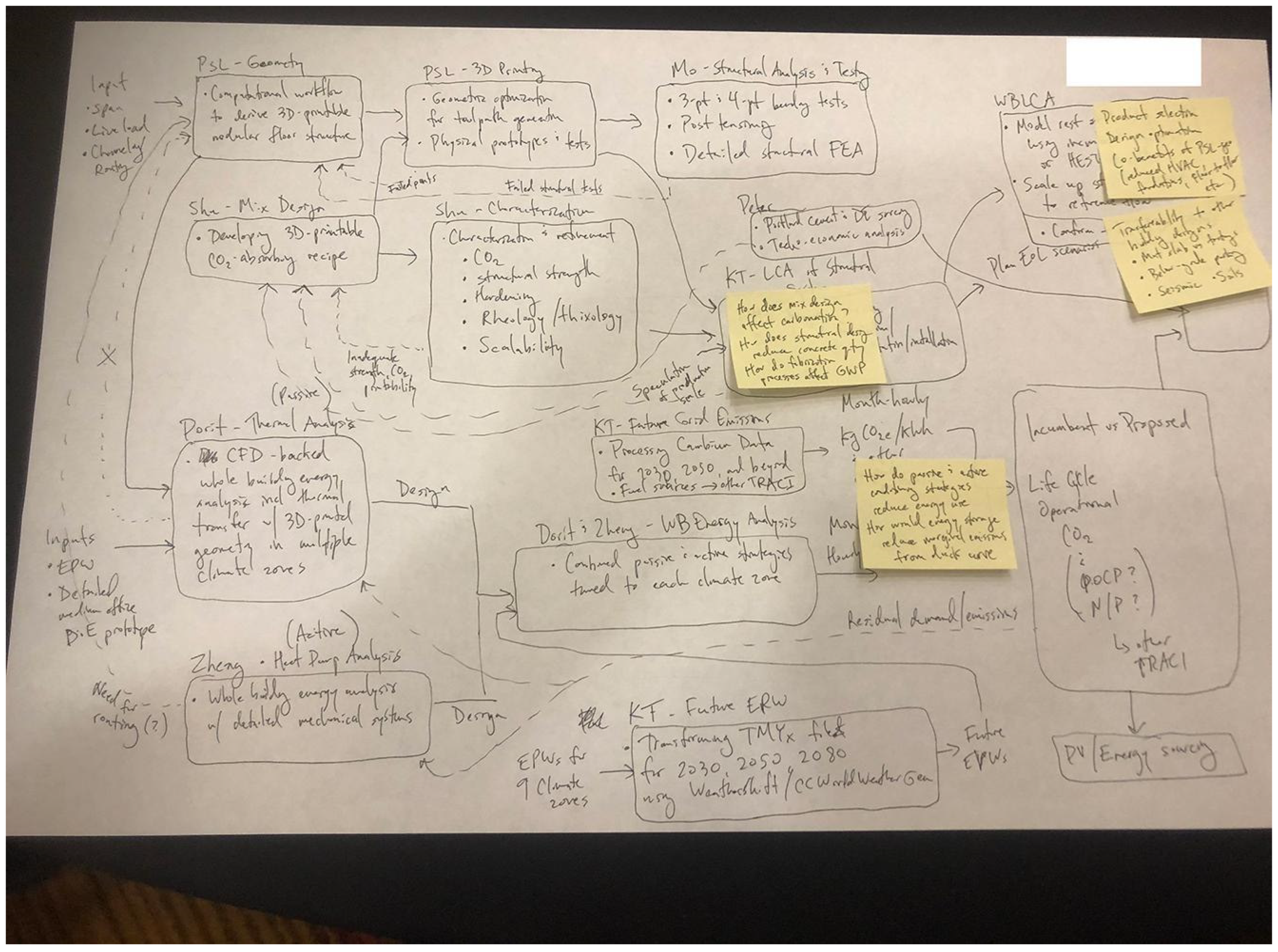
Figure A2, Figure A3 and Figure A4 present some of the original diagrams drawn by the R&D teams, shared with permission.
Figure A2.
An original diagram drawn by one of the R&D teams during the in-person workshop. Permission to publish this image was granted by the R&D team, of which the name has been redacted from the drawing.
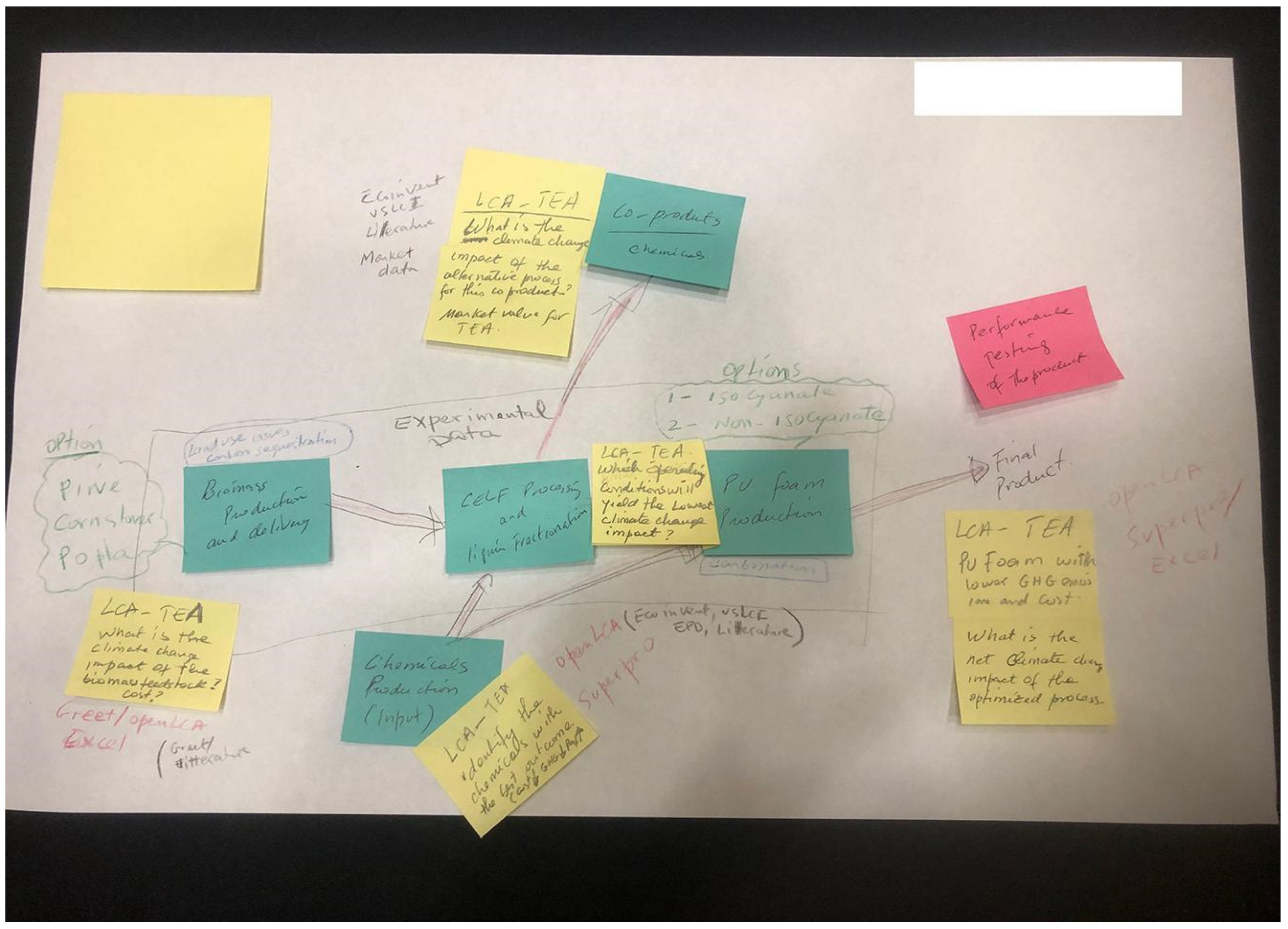
Figure A3.
An original diagram drawn by one of the R&D teams during the in-person workshop. Permission to publish this image was granted by the R&D team, of which the name has been redacted from the drawing.
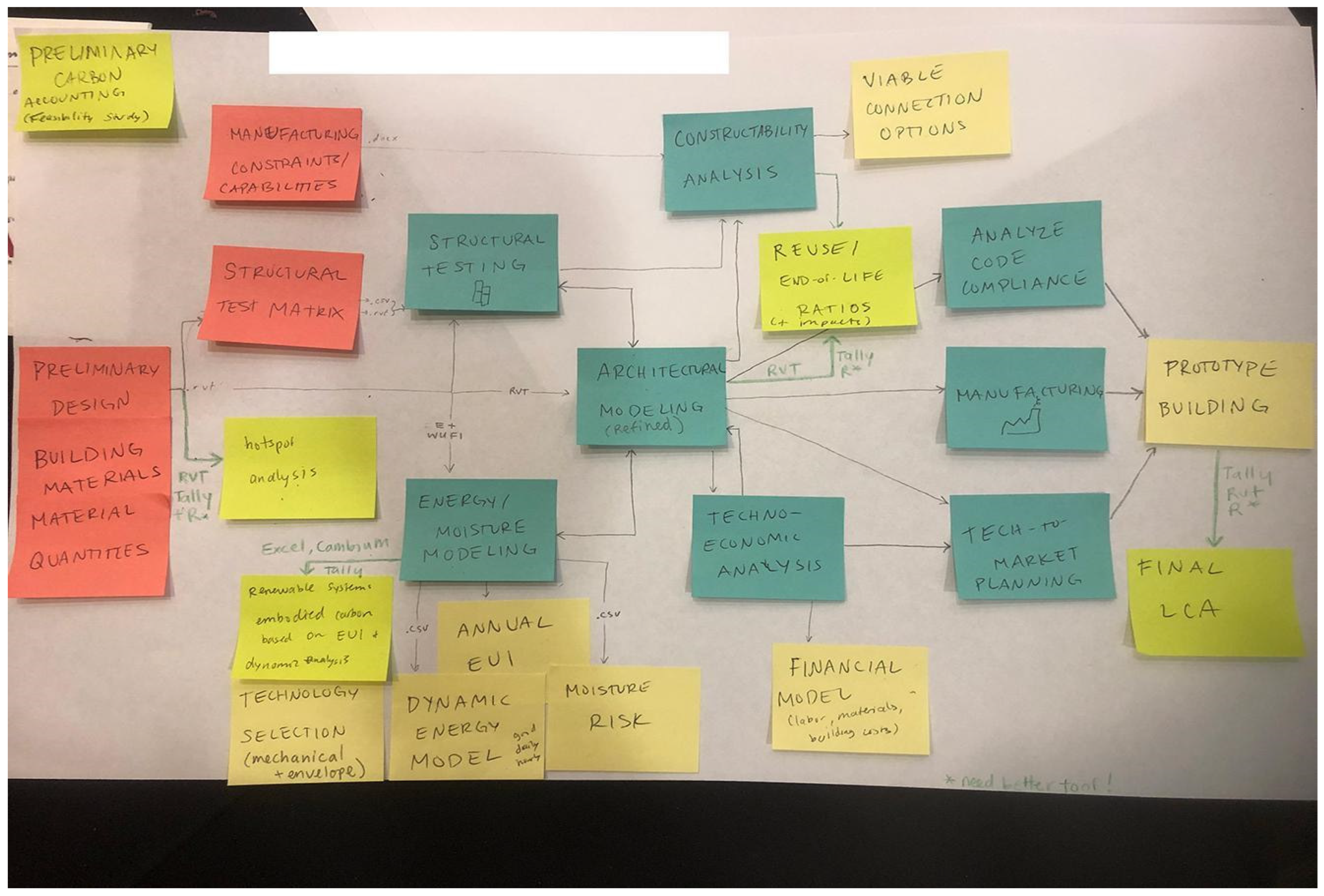
Figure A4.
An original diagram drawn by one of the R&D teams during the in-person workshop. Permission to publish this image was granted by the R&D team, of which the name has been redacted from the drawing.
References
- IPCC. Climate Change 2023: Synthesis Report. Contribution of Working Groups I, II and III to the Sixth Assessment Report of the Intergovernmental Panel on Climate Change; Summary for Policymakers; IPCC: Geneva, Switzerland, 2023; pp. 1–34. Available online: https://www.ipcc.ch/report/ar6/syr/downloads/report/IPCC_AR6_SYR_SPM.pdf (accessed on 23 March 2026).
- IPCC. Climate Change 2021: The Physical Science Basis (Contribution of Working Group I to the Sixth Assessment Report of the Intergovernmental Panel on Climate Change); Cambridge University Press: Cambridge, UK; New York, NY, USA, 2021; Available online: https://www.ipcc.ch/report/ar6/wg1/#FullReport (accessed on 23 March 2026).
- UNFCCC. Paris Agreement on Climate Change (UNFCCC). 2015. Available online: https://unfccc.int/files/meetings/paris_nov_2015/application/pdf/paris_agreement_english_.pdf (accessed on 23 March 2026).
- United Nations Environment Programme. 2022 Global Status Report for Buildings and Construction: Towards a Zero-Emission, Efficient and Resilient Buildings and Construction Sector. 2022. Available online: https://www.unep.org/resources/publication/2022-global-status-report-buildings-and-construction (accessed on 23 March 2026).
- World Resources Institute. World Greenhouse Gas Emissions: 2019. 2022. Available online: https://www.wri.org/data/world-greenhouse-gas-emissions-2019 (accessed on 23 March 2026).
- USGS. Fact Sheet: Carbon Sequestration to Mitigate Climate Change. 2008. Available online: https://pubs.usgs.gov/fs/2008/3097/pdf/CarbonFS.pdf (accessed on 23 March 2026).
- USGS. Biological Carbon Sequestration|U.S. Geological Survey. 2022. Available online: https://www.usgs.gov/media/images/biological-carbon-sequestration (accessed on 23 March 2026).
- Woodall, C.M.; McQueen, N.; Pilorgé, H.; Wilcox, J. Utilization of mineral carbonation products: Current state and potential. Greenh. Gases Sci. Technol. 2019, 9, 1096–1113. [Google Scholar] [CrossRef] [Scilit]
- Guest, G.; Cherubini, F.; Strømman, A.H. Global Warming Potential of Carbon Dioxide Emissions from Biomass Stored in the Anthroposphere and Used for Bioenergy at End of Life. J. Ind. Ecol. 2012, 17, 20–30. [Google Scholar] [CrossRef] [Scilit]
- Ganguly, I.; Pierobon, F.; Hall, E.S. Global Warming Mitigating Role of Wood Products from Washington State’s Private Forests. Forests 2020, 11, 194. [Google Scholar] [CrossRef] [Scilit]
- Churkina, G.; Alan, O.; Reyer, C.P.O.; Ruff, A.; Vinke, K.; Liu, Z.; Reck, B.K.; Graedel, T.E.; Schellnhuber, H.J. Buildings as a global carbon sink. Nat. Sustain. 2020, 3, 269–276. [Google Scholar] [CrossRef] [Scilit]
- Hepburn, C.; Adlen, E.; Beddington, J.; Carter, E.A.; Fuss, S.; Dowell, N.M.; Minx, J.C.; Smith, P.; Williams, C.K. The technological and economic prospects for CO2 utilization and removal. Nature 2019, 575, 87–97. [Google Scholar] [CrossRef] [Scilit]
- World Green Building Council (WGBC). Bringing Embodied Carbon Upfront. 2019, p. 35. Available online: https://worldgbc.s3.eu-west-2.amazonaws.com/wp-content/uploads/2022/09/22123951/WorldGBC_Bringing_Embodied_Carbon_Upfront.pdf (accessed on 23 March 2026).
- Roijen, E.V.; Miller, S.A.; Davis, S.J. Building materials could store more than 16 billion tonnes of CO2 annually. Science 2025, 387, 176–182. [Google Scholar] [CrossRef] [Scilit]
- Miller, S.A.; Roijen, E.V.; Cunningham, P.R.; Kim, A. Opportunities and challenges for engineering construction materials as carbon sinks. RILEM Tech. Lett. 2021, 6, 105–118. [Google Scholar] [CrossRef] [Scilit]
- Pomponi, F.; Hart, J.; Arehart, J.H.; D’Amico, B. Buildings as a Global Carbon Sink? A Reality Check on Feasibility Limits. One Earth 2020, 3, 157–161. [Google Scholar] [CrossRef] [Scilit]
- Giesekam, J.; Barrett, J.R.; Taylor, P. Construction sector views on low carbon building materials. Build. Res. Inf. 2016, 44, 423–444. [Google Scholar] [CrossRef] [Scilit]
- Hetherington, A.C.; Borrion, A.L.; Griffiths, O.G.; McManus, M.C. Use of LCA as a development tool within early research: Challenges and issues across different sectors. Int. J. Life Cycle Assess. 2014, 19, 130–143. [Google Scholar] [CrossRef] [Scilit]
- Woods-Robinson, R.; Carbajales-Dale, M.; Cheng, A.; Cooney, G.; Kirchofer, A.; Liddell, H.P.H.; Peterson, L.; Posen, I.D.; Moni, S.; Sleep, S.; et al. Controversy and consensus: Common ground and best practices for life cycle assessment of emerging technologies. arXiv 2024, arXiv:2501.10382. [Google Scholar] [CrossRef] [Scilit]
- ISO 14040:2006; Environmental Management—Life Cycle Assessment—Principles and Framework. ISO: Geneva, Switzerland, 2006. Available online: https://www.iso.org/standard/37456.html (accessed on 23 March 2026).
- Cucurachi, S.; Giesen, C.; van der Guinée, J. Ex-ante LCA of Emerging Technologies. Procedia CIRP 2018, 69, 463–468. [Google Scholar] [CrossRef] [Scilit]
- van der Giesen, C.; Cucurachi, S.; Guinée, J.; Kramer, G.J.; Tukker, A. A critical view on the current application of LCA for new technologies and recommendations for improved practice. J. Clean. Prod. 2020, 259, 120904. [Google Scholar] [CrossRef] [Scilit]
- Göswein, V.; Rodrigues, C.; Silvestre, J.D.; Freire, F.; Habert, G.; König, J. Using anticipatory life cycle assessment to enable future sustainable construction. J. Ind. Ecol. 2020, 24, 178–192. [Google Scholar] [CrossRef] [Scilit]
- Arehart, J.H.; Hart, J.; Pomponi, F.; D’Amico, B. Carbon Sequestration and Storage in the Built Environment. Sustain. Prod. Consum. 2021, 27, 1047–1063. [Google Scholar] [CrossRef] [Scilit]
- Hart, J.; Pomponi, F. More Timber in Construction: Unanswered Questions and Future Challenges. Sustainability 2020, 12, 3473. [Google Scholar] [CrossRef] [Scilit]
- Hoxha, E.; Passer, A.; Saade, M.R.M.; Trigaux, D.; Shuttleworth, A.; Pittau, F.; Allacker, K.; Habert, G. Biogenic carbon in buildings: A critical overview of LCA methods. Build. Cities 2020, 1, 504–524. [Google Scholar] [CrossRef] [Scilit]
- Pawelzik, P.; Carus, M.; Hotchkiss, J.; Narayan, R.; Selke, S.; Wellisch, M.; Weiss, M.; Wicke, B.; Patel, M.K. Critical aspects in the life cycle assessment (LCA) of bio-based materials—Reviewing methodologies and deriving recommendations. Resour. Conserv. Recycl. 2013, 73, 211–228. [Google Scholar] [CrossRef] [Scilit]
- ISO 21930:2017; Sustainability in Buildings and Civil Engineering Works—Core Rules for Environmental Product Declarations of Construction Products and Services. ISO: Geneva, Switzerland, 2017. Available online: https://www.iso.org/obp/ui/#iso:std:iso:21930:ed-2:v1:en (accessed on 23 March 2026).
- EN 15804:2012+A2:2019; Sustainability of Construction Works—Environmental Product Declarations—Core Rules for the Product Category of Construction Products. European Committee for Standardization (CEN): Brussels, Belgium, 2019. Available online: https://www.en-standard.eu/bs-en-15804-2012-a2-2019-sustainability-of-construction-works-environmental-product-declarations-core-rules-for-the-product-category-of-construction-products/ (accessed on 23 March 2026).
- Levasseur, A.; Lesage, P.; Margni, M.; Samson, R. Biogenic Carbon and Temporary Storage Addressed with Dynamic Life Cycle Assessment. J. Ind. Ecol. 2012, 17, 117–128. [Google Scholar] [CrossRef] [Scilit]
- Resch, E.; Andresen, I.; Cherubini, F.; Brattebø, H. Estimating dynamic climate change effects of material use in buildings—Timing, uncertainty, and emission sources. Build. Environ. 2021, 187, 107399. [Google Scholar] [CrossRef] [Scilit]
- Lei, H.; Yang, W.; Zhang, K.; Li, C.-Q. Anatomy of methods for measuring life cycle carbon emission of built environment. J. Build. Eng. 2025, 105, 112506. [Google Scholar] [CrossRef] [Scilit]
- Breton, C.; Blanchet, P.; Amor, B.; Beauregard, R.; Chang, W.-S. Assessing the Climate Change Impacts of Biogenic Carbon in Buildings: A Critical Review of Two Main Dynamic Approaches. Sustainability 2018, 10, 2020. [Google Scholar] [CrossRef] [Scilit]
- Levasseur, A.; Lesage, P.; Margni, M.; Deschênes, L.; Samson, R. Considering Time in LCA: Dynamic LCA and Its Application to Global Warming Impact Assessments. Environ. Sci. Technol. 2010, 44, 3169–3174. [Google Scholar] [CrossRef] [Scilit]
- EN 16757:2022; Product Category Rules for Concrete and Concrete Elements. CEN: Brussels, Belgium, 2022. Available online: https://standards.iteh.ai/catalog/standards/cen/50f0d48d-b47c-4efd-8e44-80b114f50c63/en-16757-2022 (accessed on 23 March 2026).
- Nielsen, P.; Quaghebeur, M. Determination of the CO2 Uptake of Construction Products Manufactured by Mineral Carbonation. Minerals 2023, 13, 1079. [Google Scholar] [CrossRef] [Scilit]
- Saade, M.R.M.; Yahia, A.; Amor, B. Is crushed concrete carbonation significant enough to be considered as a carbon mitigation strategy? Environ. Res. Lett. 2022, 17, 104049. [Google Scholar] [CrossRef] [Scilit]
- Barbhuiya, S.; Das, B.B. Life Cycle Assessment of construction materials: Methodologies, applications and future directions for sustainable decision-making. Case Stud. Constr. Mater. 2023, 19, e02326. [Google Scholar] [CrossRef] [Scilit]
- Office for National Statistics. Uncertainty and How We Measure It for Our Surveys—Office for National Statistics. 2021. Available online: https://www.ons.gov.uk/methodology/methodologytopicsandstatisticalconcepts/uncertaintyandhowwemeasureit#:~:text=Uncertainty%20relates%20to%20how%20the,coefficient%20of%20variation (accessed on 23 March 2026).
- Collingridge, D. The Social Control of Technology; St. Martin’s Press: New York, NY, USA, 1982. [Google Scholar]
- Arvidsson, R.; Tillman, A.; Sandén, B.A.; Janssen, M.; Nordelöf, A.; Kushnir, D.; Molander, S. Environmental Assessment of Emerging Technologies: Recommendations for Prospective LCA. J. Ind. Ecol. 2017, 22, 1286–1294. [Google Scholar] [CrossRef] [Scilit]
- PRé Sustainability. SimaPro. 2024. Available online: https://simapro.com/ (accessed on 23 March 2026).
- Sphera. LCA for Experts. 2024. Available online: https://sphera.com/solutions/product-stewardship/life-cycle-assessment-software-and-data/lca-for-experts/ (accessed on 23 March 2026).
- GreenDelta. openLCA. 2024. Available online: https://www.openlca.org/ (accessed on 23 March 2026).
- Hung, C.R.; Ellingsen, L.A.; Majeau-Bettez, G. LiSET: A Framework for Early-Stage Life Cycle Screening of Emerging Technologies. J. Ind. Ecol. 2020, 24, 26–37. [Google Scholar] [CrossRef] [Scilit]
- Quantis. Biogenic Carbon Footprint Calculator for Harvested Wood Products. World Wildlife Fund. 2020. Available online: https://www.worldwildlife.org/projects/biogenic-carbon-footprint-calculator-for-harvested-wood-products (accessed on 23 March 2026).
- Budig, M.; Heckmann, O.; Hudert, M.; Ng, A.Q.B.; Conti, Z.X.; Lork, C.J.H. Computational screening-LCA tools for early design stages. Int. J. Archit. Comput. 2021, 19, 6–22. [Google Scholar] [CrossRef] [Scilit]
- ARPA-E. HESTIA Program Kick-Off Meeting. 2022. Available online: https://arpa-e.energy.gov/hestia-program-kick-meeting (accessed on 1 September 2024).
- Hollberg, A.; Tjäder, M.; Ingelhag, G.; Wallbaum, H. A Framework for User Centric LCA Tool Development for Early Planning Stages of Buildings. Front. Built Environ. 2022, 8, 744946. [Google Scholar] [CrossRef] [Scilit]
- ARPA-E. Press Release|ARPA-e.Energy.gov. 2022. Available online: https://arpa-e.energy.gov/news-and-media/press-releases/us-department-energy-announces-39-million-research-development (accessed on 1 September 2024).
- ARPA-E. Parametric Open Data for Life Cycle Assessment|ARPA-E. 2022. Available online: https://arpa-e.energy.gov/programs-and-initiatives/search-all-projects/parametric-open-data-life-cycle-assessment (accessed on 1 September 2024).
- ISO 14044:2006; Environmental Management—Life Cycle Assessment—Requirements and Guidelines. ISO: Geneva, Switzerland, 2006. Available online: https://www.iso.org/standard/38498.html (accessed on 23 March 2026).
- Kane, S.; Miller, S.A. Mass, enthalpy, and chemical-derived emission flows in mineral processing. J. Ind. Ecol. 2024, 28, 469–481. [Google Scholar] [CrossRef] [Scilit]
- Roijen, E.V.; Miller, S.A. Towards the production of net-negative greenhouse gas emission bio-based plastics from 2nd and 3rd generation feedstocks. J. Clean. Prod. 2024, 445, 141203. [Google Scholar] [CrossRef] [Scilit]
- Thaneya, A.B.; Gursel, A.P.; Kane, S.; Miller, S.A.; Horvath, A. Assessing uncertainty in building material emissions using scenario-aware Monte Carlo simulation. Environ. Res. Infrastruct. Sustain. 2024, 4, 025003. [Google Scholar] [CrossRef] [Scilit]
- Cardellini, G.; Mutel, C.L.; Vial, E.; Muys, B. Temporalis, a generic method and tool for dynamic Life Cycle Assessment. Sci. Total Environ. 2018, 645, 585–595. [Google Scholar] [CrossRef] [Scilit] [PubMed]
- CIRAIG. DynCo2: Dynamic Carbon Footprinter. 2010. Available online: https://ciraig.org/index.php/project/dynco2-dynamic-carbon-footprinter/ (accessed on 23 March 2026).
- Cooper, S. Temporal Climate Impacts; University of Bath Research Data Archive: Bath, UK, 2020. [Google Scholar] [CrossRef]
- Bare, J.C. Tool for the Reduction and Assessment of Chemical and Other Environmental Impacts (TRACI) TRACI Version 2.1: User’s Guide. US EPA. 2012. Available online: https://www.epa.gov/chemical-research/tool-reduction-and-assessment-chemicals-and-other-environmental-impacts-traci (accessed on 23 March 2026).

Disclaimer/Publisher’s Note: The statements, opinions and data contained in all publications are solely those of the individual author(s) and contributor(s) and not of MDPI and/or the editor(s). MDPI and/or the editor(s) disclaim responsibility for any injury to people or property resulting from any ideas, methods, instructions or products referred to in the content. |
© 2026 by the authors. Licensee MDPI, Basel, Switzerland. This article is an open access article distributed under the terms and conditions of the Creative Commons Attribution (CC BY) license.