Review

Development of Amorphous Metallic Surfaces for Energy Storage Applications
by
Oscar Sotelo-Mazón
1,
John Henao
2,*,
Victor Zezatti
3,
Hugo Rojas
1,
Diego Espinosa-Arbeláez
4,
Guillermo C. Mondragón-Rodríguez
4,5 and
Carlos A. Poblano-Salas
6
1
Instituto de Ciencias Físicas, Universidad Nacional Autónoma de México (UNAM), Cuernavaca 62210, Morelos, Mexico
2
SECIHTI-CIATEQ A.C., Av. Manantiales 23-A, El Marqués 76246, Querétaro, Mexico
3
Centro de Investigaciones en Ingeniería y Ciencias Aplicadas, Universidad Autónoma del Estado de Morelos, Av. Universidad N° 1001, Chamilpa, Cuernavaca 62210, Morelos, Mexico
4
CIDESI, Av. Pie de la Cuesta, El Marqués 76246, Queretaro, Mexico
5
SECIHTI-CIDESI, Secretaría de Ciencia, Tecnología, Humanidades e Innovación, Av. Insurgentes Sur 1582, Col. Crédito Constructor, Demarcación Territorial Benito Juárez, Ciudad de México 03940, Mexico
6
CIATEQ A.C., Av. Manantiales 23-A, El Marqués 76246, Querétaro, Mexico
*
Author to whom correspondence should be addressed.
Appl. Sci. 2026, 16(8), 4039; https://doi.org/10.3390/app16084039
Submission received: 6 March 2026 / Revised: 3 April 2026 / Accepted: 17 April 2026 / Published: 21 April 2026
(This article belongs to the Section Energy Science and Technology)

Abstract

Amorphous metallic materials have emerged as a promising class of functional materials for energy storage and conversion owing to their disordered atomic structure and unique interfacial properties. This review focuses on amorphous metals and alloys, including metallic glasses and high-entropy amorphous systems, with particular emphasis on their surface- and interface-driven behavior in electrochemical environments. This review analyzes how structural disorder influences key properties such as electronic structure, ion transport, catalytic activity, and mechanical compliance and how these factors govern performance in batteries, supercapacitors, electrolyzers, and fuel cells. Special attention is given to interfacial phenomena, including charge-transfer kinetics, corrosion and passivation processes, and structural evolution during long-term operation. In addition, recent advances in fabrication strategies such as rapid solidification, thin-film deposition, mechanical alloying, thermoplastic forming, and electrodeposition are discussed in relation to their ability to tailor amorphous structures and interfaces. This review also highlights critical failure mechanisms and discusses some strategies to mitigate these effects. Overall, this work provides a focused perspective on the role of amorphous metallic surfaces and interfaces in electrochemical systems, identifying current challenges in scalability, durability, and compositional control, and outlining future directions for their integration into next-generation energy technologies.

1. Introduction

The increasing global demand for energy, driven by technological and societal development, has intensified the need for efficient, reliable, and sustainable energy storage technologies [1]. Electrochemical energy storage systems, including batteries, fuel cells, and supercapacitors, play a critical role in addressing the mismatch between energy generation and consumption [2]. However, their performance is still limited by insufficient energy density, poor cycling stability, and material degradation under operating conditions. Addressing these challenges requires the development of advanced materials with tailored structural and interfacial properties [3].
Material design is a key factor governing the performance of energy storage systems, as the structure, composition, and surface characteristics of electrode materials directly influence ion transport, charge-transfer kinetics, and interfacial stability [4]. While crystalline materials have been widely studied due to their well-defined atomic structures, they often exhibit anisotropic properties, limited active sites, and structural degradation during repeated cycling. These limitations have motivated increasing interest in alternative material systems with enhanced structural flexibility and interfacial functionality [5,6].
Among different systems, amorphous metals have emerged as a promising class of materials for energy storage applications [7]. Their lack of long-range order leads to a high density of unsaturated coordination sites, isotropic behavior, and unique electronic structures, which can enhance electrochemical activity and mechanical resilience [8]. Beyond bulk properties, the surface and interfacial characteristics of these materials are particularly relevant, as electrochemical reactions predominantly occur at interfaces. Amorphous metallic surfaces offer distinct advantages, including uniform energy landscapes, abundant active sites, and the absence of crystallographic defects such as grain boundaries [9], making them highly attractive for improving interfacial processes in electrochemical devices.
In parallel, a wide range of amorphous materials, such as oxides, carbons, sulfides, and phosphates, have been extensively investigated for energy storage applications, demonstrating improved capacity, rate capability, and cycling stability [10,11,12,13,14,15,16,17,18]. However, studies specifically focused on amorphous metallic systems remain comparatively fragmented and are often limited to individual materials or specific applications [19,20,21,22,23]. As a result, a comprehensive understanding of the structure–property–performance relationships governing amorphous metallic surfaces, particularly from an interfacial perspective, is still lacking.
In this context, this review aims to provide a focused and systematic analysis of amorphous metallic materials, with particular emphasis on their surface and interfacial behavior in electrochemical energy storage and conversion systems. By consolidating recent advances, discussing key mechanisms, including interfacial processes and degradation phenomena, and comparing different material systems and fabrication approaches, this work seeks to identify the fundamental principles that govern their performance. Furthermore, current challenges and future research directions are outlined to clarify the unique role of amorphous metallic surfaces and to guide their rational design for next-generation energy technologies.

2. Amorphous Metallic Materials

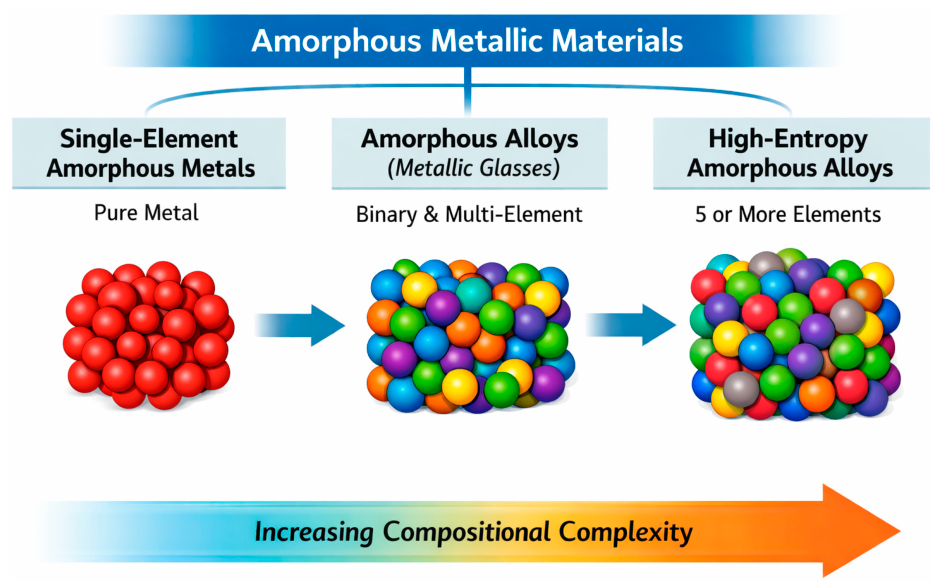
From a compositional point of view, amorphous metallic materials can be classified into three main categories: single-element amorphous metals, amorphous alloys, and high-entropy amorphous alloys [24]. This classification considers a degree of increasing compositional complexity, which is associated with the number of elements involved in the fabrication of these non-crystalline metals, Figure 1.
Single-element amorphous metals represent the simplest compositional case, as they are composed of one metallic element. Their formation is extremely challenging because pure metals generally exhibit very high crystal nucleation and growth rates during cooling, which strongly suppress vitrification. Nevertheless, various studies have demonstrated that true single-element amorphous metals can be obtained under carefully controlled non-equilibrium conditions, including ultrafast quenching, confined-space quenching, high-pressure routes, and vapor deposition. Reported examples include amorphous Pd, Fe, Ta, V, W, Co, and Ni metallic systems, confirming that amorphization is not restricted to multicomponent alloys [25,26,27].
Amorphous alloys are multicomponent metallic systems composed of two or more constituent elements and represent the most extensively studied class of amorphous metallic materials [28]. The incorporation of multiple elements enhances the glass-forming ability by increasing atomic size mismatch and chemical complexity, thereby suppressing crystallization. Within this category, metallic glasses are more precisely defined as a subclass of amorphous alloys that are specifically formed by rapid quenching techniques from the liquid state and characterized by the presence of a glass transition and, in many cases, a supercooled liquid region prior to crystallization. By contrast, the term amorphous alloy also encompasses non-crystalline metallic systems produced through other non-equilibrium routes, such as physical vapor deposition, electrodeposition, mechanical alloying, or solid-state amorphization, which may not necessarily display the same thermal features typically associated with conventional metallic glasses, i.e., glass transition and supercooled liquid region. Therefore, although all metallic glasses are amorphous alloys, not all amorphous alloys should be strictly referred to as metallic glasses. Representative examples in this category include Fe-, Ni-, Mg-, and Zr-based amorphous alloys, as well as bulk metallic glass systems [29,30,31,32].
Finally, high-entropy amorphous alloys represent the most chemically complex amorphous systems and typically consist of five or more elements in equal or near-equal atomic ratios; they also show low atomic mobility and spatial heterogeneity. By combining high configurational entropy with the structural disorder of the amorphous state, these materials offer expanded compositional design windows and tunable properties [33]. In such systems, sluggish diffusion, severe local structural frustration, and broad compositional tunability promote the stabilization of the amorphous structure and generate unusual combinations of mechanical, electrochemical, and catalytic properties. Co-based and Fe-based high-entropy amorphous alloys are among the most reported examples in the literature [34,35].

3. Short-Range Structures in Amorphous Metals

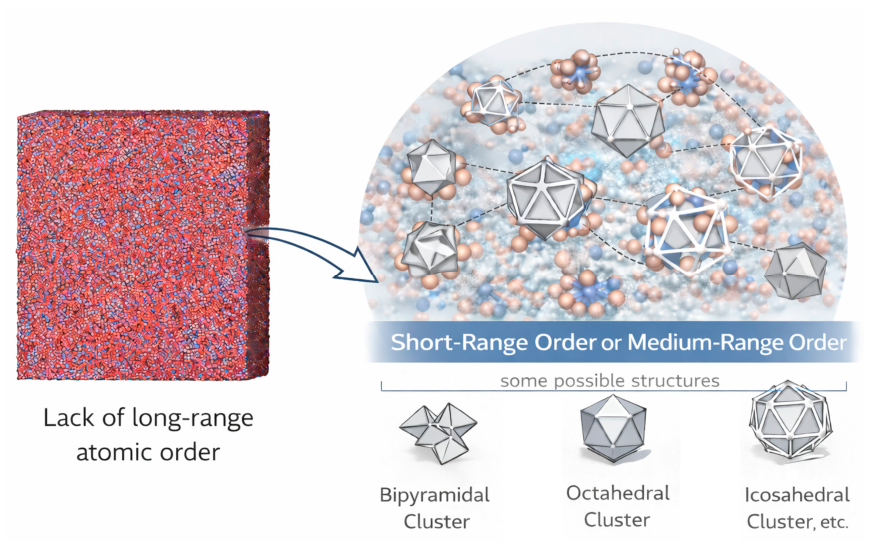
Although amorphous metallic materials lack long-range atomic order, their atomic arrangement is not fully random. Instead, their structure is governed by well-defined short-range order (SRO) and medium-range order (MRO) [35,36], as schematically illustrated in Figure 2. These local structures play a decisive role in determining their physical, chemical, and electrochemical properties.
SRO refers to the local atomic coordination within the first nearest-neighbor shell, typically extending over one to two interatomic distances (≈2–5 Å). At this length scale, atoms tend to organize into energetically favorable configurations governed by atomic size, bonding characteristics, and electronic interactions. As a result, the local coordination environments in amorphous metals differ significantly from those in crystalline counterparts, leading to broader bond-length distributions and variable coordination numbers [36,37,38]. A widely accepted description of SRO is based on dense atomic packing models, where atoms form distorted polyhedral clusters rather than periodic lattice units [39]. Among these, icosahedral-like clusters are frequently identified as dominant motifs due to their high packing efficiency and inherent geometric frustration, which suppresses crystallization. Other local configurations, such as distorted octahedra or bicapped polyhedra, may also coexist depending on composition and processing conditions [40].
Remarkably, SRO units do not exist in isolation but are spatially interconnected, giving rise to medium-range order. MRO describes the organization and correlation of these local clusters over longer length scales, typically extending from ≈0.5 to 2 nm. Unlike crystalline order, MRO does not imply periodicity; instead, it reflects preferred topological arrangements such as cluster connectivity (e.g., vertex-, edge-, or face-sharing) and the formation of cluster networks. Experimental and simulation studies have shown that such connectivity leads to the emergence of medium-range structural motifs, including icosahedral networks and quasi-equivalent cluster packing configurations, which are essential for understanding structural stability and transport properties in amorphous alloys [40].
The coexistence of SRO and MRO results in a hierarchical structural organization characterized by spatial heterogeneity and topological disorder. In this framework, SRO defines the local atomic packing, while MRO governs how these units are arranged and correlated over extended atomic distances. This structural hierarchy directly influences key material properties, including mechanical strength, diffusion pathways, electronic transport, and resistance to crystallization. Furthermore, variations in composition, atomic size mismatch, and processing routes strongly affect both SRO motifs and MRO connectivity, thereby enabling tunable structure–property relationships in amorphous metallic systems [38,39,40].

4. Implications of Local Structure in Functional Performance of Amorphous Metals

In recent years, advanced characterization techniques such as synchrotron X-ray scattering, pair distribution function analysis, and atomistic simulations have significantly improved the understanding of short- and medium-range structures in amorphous metals [41,42,43]. Despite these advances, establishing direct and quantitative correlations between local atomic configurations and macroscopic performance remains a major challenge. This limitation arises from the intrinsic heterogeneity of amorphous systems, where variations in coordination environments, bond lengths, and cluster connectivity generate spatial fluctuations in electronic structure, bonding strength, and free volume. These local variations are not merely structural features but actively determine functional properties by governing deformation mechanisms, chemical stability, and reaction pathways, particularly at surfaces and interfaces [44,45].
From a mechanical perspective, the influence of local atomic structure is most clearly illustrated in bulk metallic glasses (BMGs), where plastic deformation is governed by shear transformation zones (STZs). The activation of STZs is strongly dependent on local atomic packing efficiency and structural heterogeneity. Recent studies demonstrate that tuning the distribution of densely packed regions increases plastic strain from ~2% to >8% by promoting more homogeneous shear distribution [46]. This behavior reflects a direct structure–property relationship in which SRO and MRO define the spatial distribution of mechanically stiff and compliant regions, thereby controlling deformation pathways at the atomic scale.
A similar structural dependence is observed in chemical stability. In corrosion-resistant amorphous alloys, local atomic environments dictate the formation, composition, and stability of passive oxide layers. For example, alloying additions such as Ta in Zr-based BMGs promote the formation of dense oxide films, reducing corrosion current densities by up to one order of magnitude [47,48]. In contrast, structural relaxation or partial crystallization introduces chemical and topological heterogeneities that act as preferential corrosion sites [49]. These findings highlight that corrosion resistance is not solely a compositional effect but is fundamentally governed by the stability and uniformity of local atomic configurations.
The implications of local structure become even more pronounced in energy-related applications, where atomic-scale heterogeneity directly governs transport and reaction processes. In hydrogen storage systems, the disordered atomic arrangement of amorphous metals creates a broad distribution of interstitial sites with different binding energies, enabling enhanced hydrogen uptake (e.g., ~5–6 wt% in Mg-based systems) and improved diffusion kinetics [50,51,52]. Here, the underlying mechanism is the complex potential energy landscape associated with SRO and MRO, which facilitates reversible hydrogen accommodation without long-range structural constraints. The relationship between local structure and performance extends beyond transport phenomena to include catalytic activity and interfacial stability. Structural disorder modifies ion diffusion pathways, reaction energetics, and phase transformation behavior [53,54,55,56]. For instance, recent studies demonstrate that specific SRO motifs can be actively engineered to optimize electrochemical performance. In Ni–Mo–P–B metallic glasses, slight compositional variations enable the transition between dominant Z9 and Z10 polyhedral motifs, which directly modulate coordination environments and catalytic activity, leading to enhanced sensing performance and reaction kinetics, exhibiting sensitivities of about ~2.2 μA μM−1 cm−2 and low detection limits down to ~0.3 μM [57]. Similarly, in Pd–Ni–P metallic glass nanoparticles, electrochemical cycling induces MRO rearrangements (from face-sharing to edge-sharing motifs), stabilizing the amorphous structure and preventing crystallization-induced degradation, thereby improving long-term electrocatalytic stability, that is, maintaining high activity over >1000 cycles [58].
Finally, the dynamic nature of amorphous structures further reinforces the importance of local order. Structural relaxation processes, as observed in Fe-based amorphous alloys, lead to measurable changes in electrochemical response, including oxide layer growth and corrosion behavior, as a function of short-range ordering evolution [59]. This demonstrates that local structure is not static, but evolves under operating conditions, continuously redefining structure–property relationships.
These examples demonstrate that the functional performance of amorphous metals is governed not only by composition but fundamentally by the distribution, connectivity, and evolution of local atomic structures. In this context, SRO and MRO act as the primary structural descriptors that define energy landscapes, deformation mechanisms, and reaction environments. However, in practical energy applications, these structure–property relationships are most critically manifested at surfaces and interfaces, where electrochemical and catalytic processes occur. Therefore, particular attention is given to how amorphous surfaces govern interfacial processes and ultimately determine device-level performance in energy conversion and storage systems, as discussed in the following section.

5. Amorphous Surfaces in Energy Conversion and Storage Devices

Amorphous metallic surfaces have emerged as a versatile platform for improving performance across a wide range of energy conversion and storage technologies. Their functional behavior in practical devices, built upon structure–property relationships discussed in the previous sections, is largely governed by the distribution of local atomic environments and the resulting uniformity of reaction pathways at the surface. In this context, the absence of long-range order and the resulting chemical homogeneity at the atomic scale contribute to the formation of more stable and uniform electrode–electrolyte interfaces. These features have been reported to mitigate parasitic reactions, leading to more controlled interfacial processes [60,61,62,63,64,65].
In energy-storage systems, particularly metal-anode batteries (e.g., Zn, Li, Na, and Mg), amorphous surfaces promote more homogeneous ion flux and suppress localized deposition, thereby mitigating dendrite formation and enhancing cycling stability. This effect is especially relevant in aqueous Zn-ion systems, where corrosion and hydrogen evolution typically accelerate performance degradation [66,67]. Amorphous alloy coatings such as Ni–P, Co–P, and Ni–B have demonstrated improved coulombic efficiency and long-term stability under repeated cycling [68,69].
In electrocatalytic environments, including fuel cells and hydrogen-related systems, the disordered atomic structure enables adaptive surface behavior under operating conditions, facilitating stable catalytic activity and resistance to degradation mechanisms such as dissolution or coarsening [70,71,72,73]. For example, nanoporous metallic glass electrodes have shown stable hydrogen evolution performance, with low charge-transfer resistance (~13 Ω) and sustained operation for 20 h at 0.1 A·cm−2, highlighting their robustness under electrochemical conditions [74].
Amorphous metallic surfaces also exhibit strong performance in supercapacitors and hybrid energy-storage systems [75,76], where their structural flexibility supports rapid charge–discharge cycles and long-term durability. Representative metallic glass electrodes have achieved volumetric capacitances of ≈778 F·cm−3 while maintaining high-rate capability and full retention after 8000 cycles, demonstrating their suitability for high-performance and flexible energy-storage applications [77].
Overall, these results illustrate how the local structural features described in Section 3 and Section 4 translate into improved functional performance at the device level. By enabling uniform reaction environments, enhanced mechanical resilience, and stable interfaces, amorphous metallic surfaces provide a robust platform for energy technologies.

5.1. Amorphous Metallic Materials in the Context of Amorphous Systems

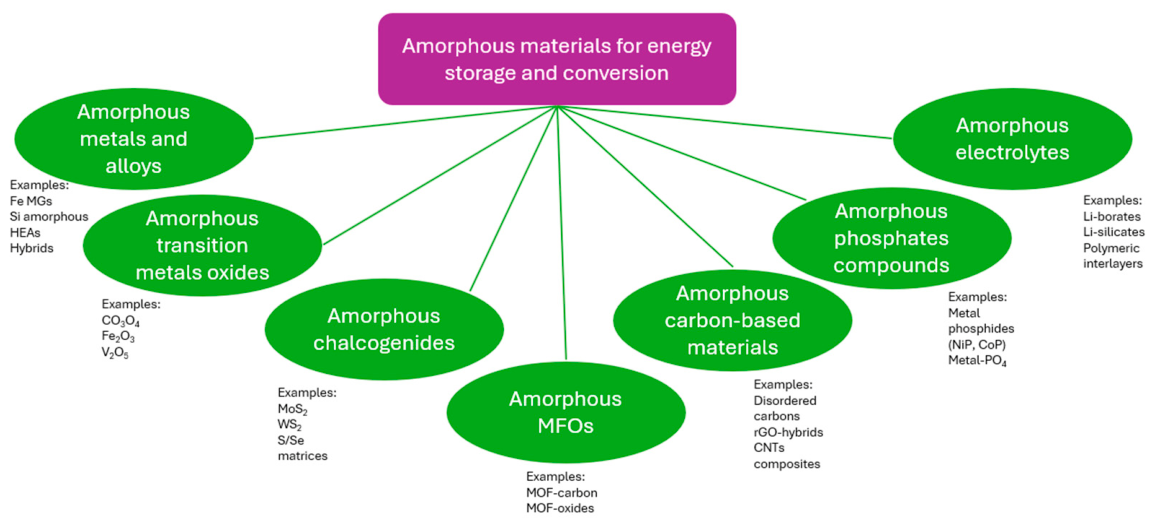
A wide range of amorphous materials has been explored for energy storage and conversion applications, highlighting structural disorder as a general design principle across diverse chemistries (Figure 3). Within this broader landscape, amorphous metallic materials can exhibit distinctive behavior compared to other amorphous systems, arising from their metallic bonding and structural disorder. This subsection briefly contextualizes amorphous metallic systems in relation to other amorphous materials, in order to highlight the unique structure–property–performance relationships that distinguish them.
Rather than considering amorphous metallic materials in isolation, their behavior can be more clearly understood when examined along with that of other classes of amorphous systems. As discussed in Section 3 and Section 4, the presence of SRO and MRO governs the distribution of local atomic environments and ultimately controls functional properties. In amorphous metallic systems, this structural framework is coupled with metallic bonding, which enables continuous atomic connectivity and compositional tunability. These features play a key role in defining how structural disorder translates into mechanical response, electrochemical stability, and interfacial behavior.
A useful point of comparison is provided by amorphous transition-metal oxides, such as MnO2, V2O5, Fe2O3, Co3O4, NiO, and TiO2. In these systems, structural disorder is primarily manifested through coordination defects and oxygen vacancies, which enhance ionic transport and improve tolerance to repeated ion insertion [10]. However, their electrochemical response is strongly influenced by localized redox processes and specific metal–oxygen bonding configurations, which introduce spatial heterogeneities during operation. In contrast, amorphous metallic systems, where bonding is less directional and more delocalized, tend to exhibit more uniform reaction environments, particularly under dynamic electrochemical conditions.
This distinction becomes more evident when considering amorphous chalcogenides, including MoS2, WS2, and metal sulfides/selenides such as FeSx, CoSx, and NiSe2. Here, structural disorder enables reversible conversion reactions and strong interactions with intermediate species, which are critical in Li–S and multivalent-ion batteries [78,79]. Nevertheless, the performance of these materials is closely tied to reaction-specific phase transformations and chemical affinities, whereas in amorphous metallic systems the response is less dependent on discrete reaction pathways and preferentially governed by the continuous distribution of local atomic environments [80].
In other amorphous systems, including phosphates and phosphides (e.g., FePO4, CoP, NiP), carbon-based materials such as disordered carbons, reduced graphene oxide, and amorphous metal–organic frameworks, structural disorder is primarily associated with stabilizing redox-active frameworks, enhancing electronic conductivity, facilitating ion transport, and buffering volume changes [81,82,83,84,85]. In these materials, the resulting structure–property relationships are often governed by specific local bonding environments, structural motifs, or porosity-driven effects, where electrochemical behavior is closely linked to localized redox processes or adsorption mechanisms.
Amorphous semiconducting systems, particularly amorphous silicon, provide a distinct but complementary example of how structural disorder modifies electrochemical behavior. Unlike metallic systems, amorphous silicon does not exhibit metallic bonding; instead, its response is governed by a covalent network with significant structural flexibility. First-principles calculations have shown that amorphization reduces ion-insertion energies by approximately 0.7–1.8 eV for Li, Na, and Mg species, facilitating a more favorable insertion thermodynamics compared to crystalline silicon [86]. This reduction is associated with a broader distribution of local atomic environments and insertion sites, which enables more homogeneous lithiation pathways and mitigates stress accumulation. Experimentally, this translates into more uniform lithiation fronts, reduced mechanical degradation, and improved cycling stability [87]. These effects are further enhanced in hydrogenated amorphous silicon and composite architectures, where increased network flexibility and more stable interfacial structures contribute to improved electrochemical performance [88,89,90,91].
These examples highlight that, although structural disorder is a unifying feature across amorphous materials, its impact on performance is strongly governed by the underlying bonding characteristics and structural connectivity. In oxide, chalcogenide, carbon-based, and semiconducting systems, disorder often operates through localized structural motifs or reaction-specific pathways. In contrast, amorphous metallic materials exhibit a more collective response, which is consistently reflected across diverse applications, Table 1. For instance, in hydrogen-related systems, metallic glasses such as Ni–Nb–Zr, Fe- and Mg-based alloys enable reversible hydrogen uptake and tunable diffusion pathways without crystallization [20,92,93,94]. In parallel, dealloying of metallic glasses produces nanoporous architectures (e.g., Cu- and Al-based systems) with high surface area and enhanced catalytic or capacitive performance [95,96,97]. In energy-conversion devices, Zr-based metallic glasses and thin-film coatings exhibit improved corrosion resistance and reduced interfacial resistance under fuel-cell conditions [98,99]. Furthermore, multicomponent amorphous and high-entropy systems demonstrate how compositional complexity combined with structural disorder enables high capacity and long-term stability in battery applications [100,101,102]. This response arises from the interplay between SRO/MRO and metallic bonding, which promotes smoother energy landscapes, more uniform reaction environments, and reduced sensitivity to local structural fluctuations, particularly at interfaces where more homogeneous electrochemical behavior and improved stability have been observed under dynamic operating conditions [100].
Despite these advantages, amorphous metallic materials are not free from degradation phenomena and performance limitations under practical conditions. Like other amorphous systems, they undergo structural and interfacial changes that impact long-term stability. These aspects are addressed in the following section.

5.2. Failure Mechanisms of Amorphous Metals

Amorphous metal surfaces exhibit unique electrochemical properties due to their disordered atomic structure; however, this same structural metastability makes them susceptible to various degradation mechanisms under practical operating conditions. One of the primary failure pathways is structural relaxation and crystallization during long-term cycling. Although amorphous alloys lack long-range order, repeated electrochemical insertion/extraction processes (e.g., hydrogen or lithium) induce atomic rearrangements that progressively lower the system’s free energy, leading to partial or localized crystallization. This transition is often associated with a loss of mechanical compliance and reduced electrochemical reversibility, as the amorphous structure originally accommodates volumetric changes more effectively than its crystalline counterpart [89,102].
Another critical degradation mechanism is electrochemically driven corrosion and chemical instability at the electrode/electrolyte interface. Despite the generally improved corrosion resistance of amorphous alloys compared to crystalline materials, prolonged exposure to aggressive electrolytes, especially under polarized conditions, leads to selective dissolution of active elements and modification of surface composition. This process alters the local atomic arrangement and degrades the functional properties of the material. In hydrogen-related environments, corrosion-assisted processes are further coupled with hydrogen absorption and desorption, which may accelerate structural degradation and lead to embrittlement or surface passivation phenomena [89].
Interfacial degradation is also a dominant factor limiting long-term stability. During repeated electrochemical cycling, the formation and evolution of interfacial layers—such as solid electrolyte interphases (SEI) or analogous passivation films—result in increased impedance and loss of active surface area. In amorphous systems, this issue is exacerbated by continuous structural rearrangement and volume changes, which promote the formation of micro-cracks and the progressive loss of electrical contact between the active material and the current collector. For instance, in amorphous silicon-based electrodes, repeated lithiation/delithiation induces significant volumetric expansion and contraction, leading to crack formation, delamination, and eventual capacity fading [89,103]. In Fe-based metallic glasses operating in alkaline media, electrochemical cycling induces the progressive oxidation of Fe0 into Fe(OH)2 and FeOOH, followed by the formation of mixed oxides such as Fe2O3 and Fe3O4. This evolution is associated with a characteristic activation behavior, where the discharge capacity increases up to ~90 mAh g−1 after ~80 cycles, compared to lower initial values, due to surface roughening and electrochemically active area enlargement [20]. However, continued cycling leads to thickening of the passive layer, increasing charge-transfer resistance and limiting hydrogen diffusion into the bulk alloy. Comparable interfacial stabilization mechanisms have been reported in hybrid systems such as Mn/carbon layered electrodes, where early formation of a stable SEI, detected by in situ techniques (e.g., DEMS and dilatometry), suppresses electrolyte decomposition and enables long-term stability with energy densities up to ~287.7 Wh kg−1 and power densities of ~12.5 kW kg−1 [104]. In addition, XPS depth profiling studies reveal that passive layers in amorphous alloys are often composed of mixed oxides (e.g., Fe-oxide, Cr-oxide, Mo-oxide), with compositional gradients across the thickness. Under proton-exchange-membrane fuel cell (PEMFC) conditions, for a Fe-Cr-Si-based alloy, chromium enrichment at the surface improves corrosion resistance; however, continuous electrochemical cycling can disrupt this protective layer, exposing the underlying alloy to further attack [102]. This cyclic breakdown and reformation of passive films contribute to long-term degradation and performance loss, particularly in aggressive acidic and fluoride-containing environments. Other authors suggest that amorphous alloy electrodes also suffer from parasitic interfacial reactions and unstable solid electrolyte interphase (SEI) formation. For example, in amorphous Al–Si–Mn metallic glass anodes, irreversible electrolyte decomposition during initial cycles leads to significant capacity loss (up to ~30% in early cycles) due to SEI formation and charge consumption [80]. Although amorphous structures can promote the formation of more uniform and stable SEI layers compared to crystalline counterparts, the SEI composition, typically containing LiF, LixPOyFz, and organic carbonate decomposition products, continues to evolve during cycling. This evolution results in thickening of the interphase, increased impedance, and gradual capacity fading. Additionally, preferential surface oxidation (e.g., Al oxidation in Al–Si–Mn systems) alters interfacial chemistry and contributes to voltage hysteresis and kinetic limitations. These results suggest that, regardless of composition, the formation of a thin, ionically conductive and mechanically stable SEI is critical to balancing activation and degradation in amorphous electrode systems.
Additionally, mechanical degradation associated with cyclic stress accumulation plays a crucial role in the failure of amorphous electrode systems. The absence of a crystalline lattice enables initial stress accommodation; however, over-extended cycling and localized strain accumulation generates defects such as voids, shear bands, and micro-cracks. These defects not only compromise structural integrity but also serve as pathways for electrolyte penetration, further accelerating chemical degradation and interfacial instability. Coupling between mechanical damage and electrochemical reactions thus creates a feedback loop that accelerates performance decay [104]. Structural disorder plays a dual role in amorphous metallic systems by enhancing ionic transport while promoting thermodynamic instability. In Al–Si–Ni amorphous alloys, lithium storage occurs through a combination of supersaturated solid solution and nanoscale heterogeneity, where α-Al nanograins (<10 nm) are dispersed within an amorphous matrix. This structure enables high specific capacities, reaching up to ~0.840 Ah g−1 at early cycles and stabilizing around ~0.370–0.660 Ah g−1 after extended cycling, depending on composition (e.g., Al86Si5Ni9) [105]. The enhanced performance is attributed to short diffusion paths and high defect density in the amorphous phase. Supporting this mechanism, studies on amorphous oxychloride solid electrolytes (e.g., Li2O–TaCl5 systems) have shown that increasing the degree of amorphization via high-energy ball milling raises ionic conductivity from ~6.6 × 10⁻³ to 8.3 × 10⁻³ S cm−1 at room temperature. This improvement is linked to distorted local coordination (e.g., TaCl6−xOx units), increased Li–Cl interactions, and reduced migration barriers due to structural disorder [106], boosting the ionic conductivity of amorphous oxychloride solid electrolytes via different degrees of amorphization. However, such defect-rich structures also store significant internal energy, as evidenced by exothermic DSC peaks upon heating, indicating metastability and a tendency toward structural relaxation or crystallization, which may degrade electrochemical performance over time.
Mechanical degradation in amorphous metallic electrodes is strongly associated with phase transformations and volumetric changes during cycling. In Al-based amorphous alloys, lithiation leads to the formation of intermetallic phases such as AlLi, which induces significant volume expansion and local stress accumulation. Although the amorphous matrix partially accommodates these changes, excessive cycling results in pulverization and fragmentation of the electrode, particularly when crystalline phases grow during annealing or cycling. For example, annealed Al–Si–Ni alloys show rapid capacity decay from ~1.379 Ah g−1 to ~0.150 Ah g−1 within ~20 cycles due to grain coarsening and loss of structural buffering [105]. In contrast, as-quenched amorphous alloys exhibit more stable cycling due to their ability to distribute strain more homogeneously. Similar chemo-mechanical degradation has been observed in conversion-type materials such as MnO, where repeated conversion reactions (MnO + 2Li+ + 2e ↔ Mn + Li2O) generate large volume changes and internal stress, leading to crack formation and electrode disintegration. Despite the absence of grain boundaries in metallic glasses delaying crack propagation, failure still occurs through cumulative localized deformation and interface debonding, highlighting the need for structural stabilization strategies.
In addition to the previously discussed degradation pathways, corrosion-driven compositional instability represents a critical failure mechanism in amorphous metals under realistic electrochemical environments. For instance, Fe-based amorphous alloys such as Fe–Cr–Mo–C–B systems exhibit corrosion behavior that is highly dependent on alloy composition and operating conditions. Under simulated PEM fuel cell environments (1 M H2SO4 + 2 ppm F at 75 °C), alloys with high Cr content (e.g., ~18 at.%) show stable passive behavior with low passive current densities (~0.000078.4 A cm−2), whereas alloys with lower Cr content display significantly higher passive currents (~0.00091 A cm−2), indicating inferior corrosion resistance [102]. This degradation originates from selective dissolution and the formation of non-uniform passive films, which evolve dynamically depending on whether hydrogen or oxygen environments are present. Furthermore, even when passive layers form (e.g., Cr2O3-rich films), their thickness (typically ~2–4 nm) and stability vary under anodic/cathodic cycling, leading to progressive interfacial instability and increased resistance.
Amorphous metallic electrodes exhibit hybrid electrochemical storage mechanisms involving a combination of intercalation, alloying/dealloying, and surface-controlled processes. In Al-based amorphous systems, lithium storage includes both solid-solution insertion into the amorphous matrix and alloy formation (Al–Li), while surface reactions contribute to additional capacity. This is consistent with cyclic voltammetry results showing multiple redox peaks corresponding to SEI formation (~0.55 V), alloying reactions (~0.1–0.2 V), and delithiation processes (~0.6 V) [105]. Analogously, MnO-based layered electrodes demonstrate a multi-electron transfer mechanism combining conversion reactions with surface adsorption and partial intercalation, resulting in high-rate capability and reversible capacities exceeding 0.200 Ah g−1 in LIC configurations [104]. While these hybrid mechanisms enhance power performance, they also introduce kinetic heterogeneity and a non-uniform strain distribution, which accelerate degradation. Therefore, controlling the relative contributions of bulk and surface storage processes is essential to optimize both performance and durability in amorphous metallic systems. The introduction of nanoscale confinement and hierarchical architectures has proven effective in improving the stability of amorphous systems.
In metallic glasses, the coexistence of nanocrystalline phases and amorphous regions creates multiple interfaces that enhance lithium storage and distribute mechanical stress. For example, in Al–Si–Ni alloys, increasing Ni content promotes the formation of a metallic glass matrix that embeds nanoscale α-Al grains, improving cycling stability compared with fully crystalline counterparts. Similarly, in nano-restricted carbon systems, confined domains regulate ion transport pathways and suppress structural collapse, leading to improved cycling stability over hundreds to thousands of cycles [63,106,107]. However, excessive confinement or heterogeneity results in uneven ion flux and localized degradation. In amorphous solid electrolytes, optimal performance is achieved when the amorphous phase is maximized while minimizing insulating crystalline byproducts such as LiCl, whose presence can reduce conductivity by several orders of magnitude (~10−7 vs. ~10−3 S cm−1) [107]. These observations highlight that the careful design of nano- and mesoscale structure is critical to balancing ionic transport, mechanical stability, and long-term durability in amorphous metallic systems.
Based on the aforementioned degradation mechanisms, several optimization strategies can be proposed to enhance the long-term stability of amorphous metallic systems. From a compositional standpoint, the incorporation of corrosion-resistant elements such as Cr and Mo has been shown to promote the formation of stable passive films (e.g., Cr2O3-rich layers), reducing dissolution rates and improving interfacial stability under aggressive conditions [102]. Structurally, controlling the degree of amorphization and avoiding excessive crystallization is critical, as partially amorphous systems with nanoscale heterogeneity balance ionic transport and mechanical resilience, as observed in Al–Si–Ni metallic glass systems [105]. Additionally, nanostructuring strategies—such as embedding nanocrystals within an amorphous matrix—have been shown to improve cycling stability by accommodating volume changes and mitigating stress accumulation during repeated lithiation/delithiation processes [63].
Interfacial engineering also plays a key role in the formation of thin, uniform, and ionically conductive SEI layers that minimize continuous electrolyte decomposition and impedance growth. For instance, stable SEI formation in amorphous Al–Si–Mn systems has been associated with reduced irreversible capacity losses (~30% in early cycles) and improved cycling performance [80]. Finally, optimizing electrochemical operating conditions (e.g., potential window, current density, and electrolyte composition) further suppresses parasitic reactions and structural degradation, although these aspects remain less explored for amorphous metallic systems and require further investigation. Altogether, the synergistic combination of composition design, structural control, and interfacial stabilization is essential for improving the durability and practical applicability of amorphous metallic electrodes in energy storage and conversion devices.

6. Fabrication Routes of Amorphous Metallic Alloy Surfaces in Energy Storage and Conversion Applications

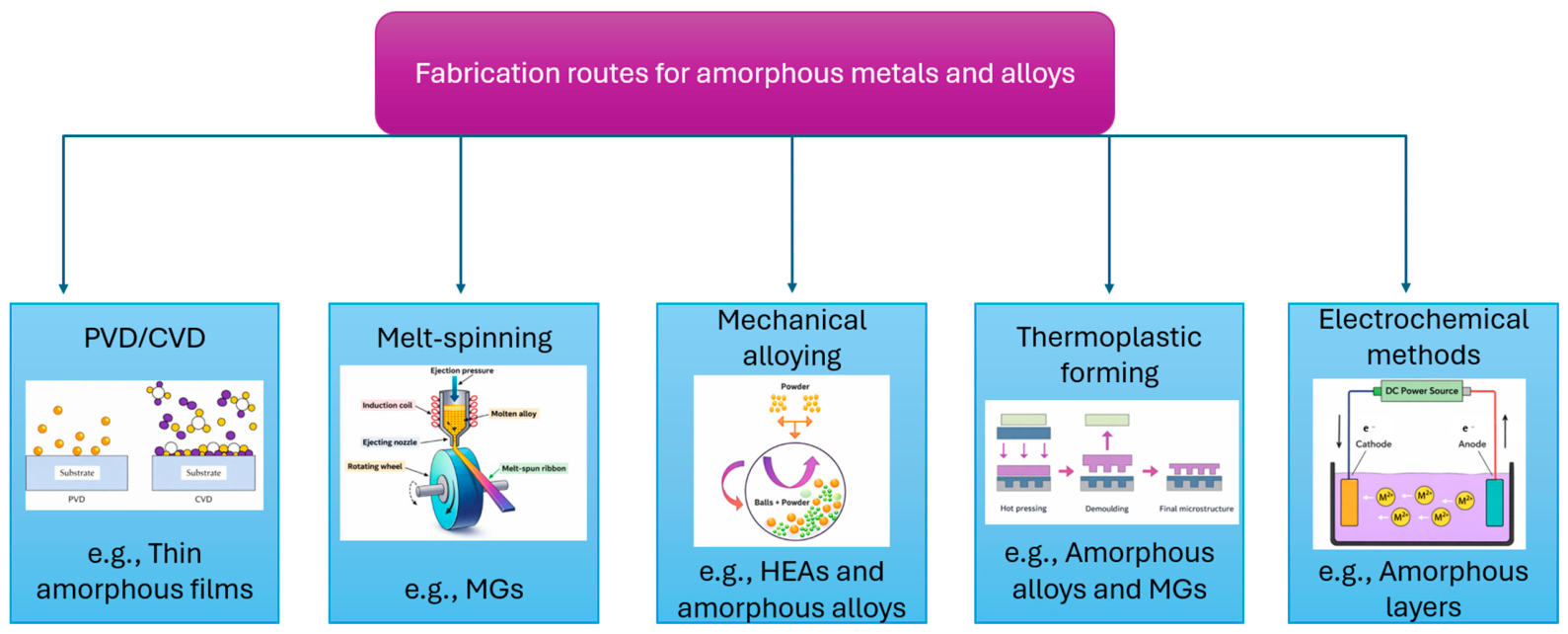
To integrate amorphous metals and alloys into devices such as Li-ion batteries, micro-fuel cells, electrolyzers, and hydrogen-storage electrodes, several synthesis pathways enable the formation of metallic amorphous states either as thin films, ribbons, or powders. These routes (see Figure 4) include vapor-phase deposition methods (PVD/CVD), rapid solidification techniques, mechanical alloying–based amorphization, thermoplastic nano-imprinting of pre-formed MGs, and electrochemical deposition–driven amorphization.
Together, they provide a versatile toolbox for engineering metallic amorphous architectures optimized for charge transport, catalytic activity, and structural durability in advanced energy devices. A comparative summary of these fabrication routes is presented in Table 2, highlighting key process parameters, scalability, advantages, and limitations.
As shown in Table 2, these fabrication routes differ significantly in terms of achievable geometries, processing conditions, and scalability, which directly influence their suitability for specific energy applications. Vapor-phase techniques such as PVD and CVD enable precise control over composition and thickness, making them particularly suitable for the fabrication of thin-film interfaces and micro-scale devices. In contrast, rapid solidification methods allow the production of bulk amorphous structures with high cooling rates, while mechanical alloying offers flexibility in composition design and is especially relevant for powder-based amorphous systems and amorphous high-entropy alloys. Thermoplastic forming provides access to micro- and nano-structured surfaces through processing in the supercooled liquid region, whereas electrodeposition stands out as a scalable and cost-effective route for producing conformal amorphous coatings on complex geometries. The selection of a given fabrication route is therefore not only determined by the ability to achieve an amorphous structure, but also by practical considerations such as processing scale, cost, and integration into device architectures. These approaches are considered complementary pathways for tailoring amorphous metallic surfaces across different length scales and application requirements.

6.1. PVD- and CVD-Based Routes

One of the most widely employed strategies to obtain amorphous metallic surfaces for energy conversion devices involves physical vapor deposition (PVD), particularly magnetron sputtering [112]. TFMGs such as Zr-, Pt-, Cu- or Ni-based glasses can be deposited at sufficiently high cooling rates (>106 K/s) to freeze the disordered atomic structure [113,114]. These thin films have been used in bipolar plates for proton-exchange-membrane fuel cells (PEMFCs) [100], where their amorphous character provides low interfacial contact resistance, superior corrosion resistance, and high durability under acidic conditions. By tuning sputtering power, substrate temperature, and deposition rate, homogeneous amorphous layers of a few micrometers can be produced, as demonstrated for Zr63Al10Cu26 coatings that drastically reduce corrosion currents and maintain metallic conductivity in PEM environments. Similar PVD-deposited amorphous HEA films (e.g., Ti–Zr–Cr–Mn–Fe–Ni, Fe–Mn–Al–Cr–Ti–x) exhibit outstanding hydrogen absorption activity and serve as active layers in hydrogen-storage electrodes or negative electrodes for Ni-MH batteries [115,116].
PVD routes such as magnetron sputtering, thermal evaporation, and electron-beam evaporation remain foundational for producing dense amorphous metallic thin films on current collectors and microdevice structures [117]. These processes quench metal atoms on the substrate at extremely high cooling rates, inhibiting long-range atomic ordering. Amorphous metallic layers produced by sputtering are widely used in micro-fuel cells, microcantilever sensors, and catalytic microreactors because they provide grain-boundary-free, highly uniform films with enhanced corrosion resistance and catalytic uniformity. PVD is often employed for multicomponent alloy processing (e.g., Pt–Cu–Ni–P BMG films), enabling tunable compositions and fast incorporation into MEMS-scale energy devices [118].
Chemical vapor deposition methods such as LPCVD and PECVD are among the most reliable techniques to prepare thin amorphous metallic or metalloid films, particularly for Si-based, Ge-based, and metal/metalloid alloy systems used as battery anodes or catalytic layers [27,119]. LPCVD allows the deposition of amorphous silicon films (a-Si) at moderate temperatures before crystallization kinetics become dominant. These amorphous metallic layers can be grown as highly conformal coatings on conductive substrates, which is crucial for improving interfacial stability, suppressing pulverization, and enhancing cycling life in LIBs [119]. PECVD provides high deposition rates at low temperatures, enabling uniform amorphous metallic coatings on carbonaceous or metallic substrates for industrially scalable battery electrodes.

6.2. Melt-Spinning and Rapid Solidification Techniques

For thicker metallic components in energy-harvesting systems or battery current collectors and electrodes, rapid solidification methods such as melt spinning, planar flow casting, and copper-mold suction casting are key routes to produce MGs [120,121,122,123]. These methods generate cooling rates between 105–108 K/s, enabling the formation of fully amorphous ribbons or plates. Such amorphous ribbons have been investigated as catalyst supports, current collectors, or micro fuel-cell components [110,124]. In micro fuel cells, Zr-based BMG ribbons embossed by thermoplastic forming enable the fabrication of micro-flow-fields and current collectors with excellent corrosion resistance, replacing stainless steel and silicon [125]. Likewise, amorphous HEAs synthesized by rapid solidification (e.g., Ti-based HEA ribbons) show high hydrogen absorption capacity at room temperature, making them suitable for hydrogen-storage electrodes and anodes for Ni-MH batteries [126].

6.3. Amorphization Through the Mechanical Alloying Route

Mechanical routes such as high-energy ball milling and cryomilling provide another major pathway to synthesize amorphous metallic alloys and amorphous HEAs [127]. High-energy deformation disrupts the long-range order of crystalline precursors, producing amorphous powders that can be consolidated into coatings or electrodes. These methods are widely used to create amorphous HEA-based and composite anodes for lithium-ion and sodium-ion batteries [101,102]. For example, amorphous Sn–Si–Co–Cu–P high-entropy alloys produced by ball milling exhibit large initial discharge capacities (>1.800 Ah·g−1) and exceptional lifecycles when hybridized with graphite. Mechanical alloying is especially valuable for compositions that are difficult to vitrify using melt quenching; repeated fracture and cold welding of multi-component HEAs facilitates the formation of amorphous high-entropy metallic states that show enhanced reaction kinetics, high diffusivity of Li+/H atoms, and improved structural stability during cycling [128].

6.4. Thermoplastic Forming and Nano-Imprinting of Metallic Glass Surfaces

Once an amorphous metallic alloy is obtained, thermoplastic forming (TPF) can be employed to create micro- and nano-structured surfaces useful for energy devices. Operating within the supercooled liquid region, TPF enables the shaping of metallic glasses into flow-fields, micro-lattices, electrodes, micro-cantilevers, or catalytically active textures [129]. This is particularly relevant for PEM fuel cells [130], where patterned metallic flow plates reduce pressure drop and enhance catalyst utilization. Nano-imprinting on amorphous metals also improves the electrochemically active surface area, enhancing electron transport and reaction kinetics in electrocatalytic electrodes for electrolyzers [130,131]. The key advantage is that the amorphous structure allows for defect-free forming without grain-boundary cracking, enabling scalable manufacturing of complex metallic architectures.

6.5. Electrochemical Amorphization of Metallic Alloys

Although electrodeposition typically yields crystalline metals, carefully controlled electrochemical conditions yield amorphous metallic alloys, especially multicomponent Ni-, Co-, Fe-, or transition-metal-rich systems [132]. By tuning deposition potential, pH, and current density, it is possible to deposit metallic layers where high configurational entropy or atomic-size mismatch suppresses crystallization. These electrodeposited amorphous metallic films are promising for supercapacitor current collectors, electrode scaffolds for electrocatalysis, and hydrogen-evolution electrodes, where metallic conductivity and structural homogeneity are essential [133,134]. In some systems, the electrochemical cycling itself induces amorphization, such as repeated metal-ion insertion/extraction in multi-component alloys, enabling the creation of in situ amorphized metallic electrodes with high defect density and improved reaction sites [110].

7. Perspectives and Conclusions

Amorphous metallic materials constitute a versatile and unifying platform for a wide range of energy-related applications, including supercapacitors, batteries, electrocatalytic systems, and solar energy devices. Across these technologies, performance is increasingly governed by surface- and interface-dominated phenomena rather than bulk properties [135,136,137]. In this context, the intrinsic structural disorder of amorphous materials provides a unique advantage by enabling chemically homogeneous, defect-tolerant, and mechanically compliant interfaces. Looking forward, the future development of amorphous metallic materials for energy applications can be guided by four key research priorities, which are outlined below.
(1)
Atomic-level control of structure and composition. A fundamental challenge lies in achieving precise control over composition, thickness, and local atomic structure, particularly at surfaces and interfaces. Recent advances highlight that short- and medium-range order, as well as local chemical environments, critically determine electrochemical behavior and stability [40]. In addition, emerging studies highlight that establishing quantitative relationships between atomic structure and functional properties remains a key bottleneck for amorphous systems, due to their intrinsic heterogeneity [21]. In this context, so-called structural descriptors—such as coordination numbers, bond-length distributions, and local atomic motifs—are used to represent the disordered structure in a simplified and quantifiable manner. However, unlike crystalline materials, where periodicity enables straightforward structure–property correlations, the lack of long-range order in amorphous systems makes it challenging to identify universal descriptors that reliably predict performance. Therefore, developing strategies to tailor atomic packing, chemical heterogeneity, and electronic structure, especially in multicomponent and high-entropy amorphous systems, represents a primary research direction [138,139].
(2)
Interface engineering under realistic operating conditions. While amorphous materials exhibit intrinsic advantages such as the absence of grain boundaries and improved mechanical compliance, their long-term stability under realistic conditions (e.g., electrochemical cycling, thermal fluctuations, and mechanical stress) remains insufficiently understood. In particular, dynamic disorder–order transitions and interfacial evolution during operation have been identified as critical factors influencing performance degradation and reversibility [21,40]. Systematic studies combining in situ/operating characterization and multiscale modeling are therefore essential.
(3)
Scalable fabrication and data-driven materials design. Translating laboratory-scale materials into practical devices requires scalable and cost-effective manufacturing routes. As discussed in Section 6, several established fabrication strategies, including PVD/CVD, rapid solidification, mechanical alloying, and electrochemical deposition, provide versatile pathways to obtain amorphous metallic structures with controlled properties. In this context, emerging techniques such as thermal spray (cold spray and plasma spray) can be regarded as promising extensions of these approaches toward large-area and industrial-scale production. These methods enable the deposition of thick, dense metallic coatings while preserving the amorphous structure due to rapid solidification upon impact, offering clear advantages for device integration. Although widely explored for crystalline alloys in batteries and hydrogen-related systems, their application to amorphous metallic alloys remains comparatively limited, representing a significant opportunity for future research [140,141,142,143]. At the same time, data-driven approaches and machine learning are increasingly recognized as powerful tools to accelerate the discovery of amorphous materials by linking structural descriptors with catalytic or electrochemical performance. The integration of scalable fabrication with computational and data-driven design frameworks is therefore expected to significantly accelerate materials optimization [21].
(4)
Expansion to new chemical compositions and energy systems. Current research is largely focused on a limited set of amorphous alloy compositions and Li-based systems. However, emerging battery chemistries, including Na-, K-, Zn-, Mg-, and multivalent systems, present significant opportunities where amorphous materials can mitigate phase transitions, suppress dendrite formation, and enable flexible reaction pathways [86,144]. In parallel, the compositional design space of amorphous alloys, particularly high-entropy systems and heterostructures, remains far from fully explored, offering vast potential for discovering new structure–property relationships [145,146].
Overall, these priorities highlight that future progress will depend on integrating atomic-level design, interface stability, scalable processing, and compositional innovation. At the core of this review, a central insight emerges: the unique performance of amorphous metallic materials arises from the interplay between structural disorder (SRO/MRO), tunable chemical environments, and interface-dominated processes, which collectively govern ion transport, catalytic activity, and mechanical stability. However, translating these advantages into practical energy devices requires meeting several critical conditions, including precise control over atomic structure and composition, stabilization of interfaces under realistic operating environments, and the development of scalable and reproducible manufacturing routes. In addition, bridging the gap between fundamental structure–property understanding and device-level performance, potentially through data-driven design and in situ characterization, will be essential. By fulfilling these conditions, amorphous metallic materials can transition from promising laboratory systems to enabling platforms for next-generation energy technologies, where their intrinsic structural disorder is not a limitation but a design advantage for achieving adaptive, durable, and high-performance devices.

Funding

This research received no external funding.

Data Availability Statement

No new data were created in this publication.

Acknowledgments

The authors acknowledge SECIHTI Mexico through the Investigadores Por Mexico program, project 848, for its support of this work.

Conflicts of Interest

The authors declare no conflicts of interest.

Abbreviations

The following abbreviations are used in this manuscript:
MGMetallic glass
BMGsBulk metallic glasses
HEAsHigh entropy alloys
PVDPhysical vapor deposition
CVDChemical vapor deposition
TPFThermoplastic forming
PEMProton exchange membrane
STZsShear Transformation zones
SEISolid electrolyte interface
MIBsMagnesium ion batteries
LIBsLithium-ion batteries
TFMGsThin-film metallic glasses
HERHydrogen evolution reaction
HORHydrogen oxidation reaction
SEAGSilicon edge-activated graphite
LPCVDLow pressure chemical vapor deposition
PECVDPlasma-enhanced chemical vapor deposition
MROMedium-range order
SROShort-range order

References

  1. Malik, F.H.; Hussain, G.A.; Alsmadi, Y.M.; Haider, Z.M.; Mansoor, W.; Lehtonen, M. Integrating energy storage technologies with renewable energy sources: A pathway toward sustainable power grids. Sustainability 2025, 17, 4097. [Google Scholar] [CrossRef]
  2. Huang, Q.; Zeng, L.; Huang, Z.; Xie, X. A comprehensive review on the techno-economic analysis of electrochemical energy storage systems: Technologies, applications, benefits and trends. Future Batter. 2025, 5, 100031. [Google Scholar] [CrossRef]
  3. Yao, Y.; Rui, X.; Bai, R.; Ouyang, Y.; Li, G.; Zhao, Y.; Zhu, Y.; Zhao, M.; Li, B.Q.; Zhang, X.; et al. Roadmap for next-generation electrochemical energy storage technologies: Secondary batteries and supercapacitors. ACS Nano 2025, 19, 30568–30687. [Google Scholar] [CrossRef] [PubMed]
  4. Rahman, M.M.; Imani, S.; Anjum, N.; Sijuade, A.A.; Okoli, O. Materials and design strategies for next-generation energy storage: A review. Renew. Sustain. Energy Rev. 2025, 212, 115368. [Google Scholar] [CrossRef]
  5. Argirusis, C.; Katsanou, M.E.; Alizadeh, N.; Argirusis, N.; Sourkouni, G. Recent advances in the application of MOFs in supercapacitors. Batteries 2025, 11, 181. [Google Scholar] [CrossRef]
  6. Kassem, A.F.A.E.; Saleh, E.A.M.; Mahmud, K.; Siddique, S.; Hassan, I.; Mohammed, M.M.M.H.; Husain, K.; Alshik, N.M.M.; Ibraim, W.I.A.; Iqbal, M.Z. Synergistic integration of Zn-BTC/Mg-Al LDH composites for advanced battery-supercapacitor hybrid energy storage. Mater. Chem. Phys. 2026, 355, 132150. [Google Scholar] [CrossRef]
  7. Zheng, D.; Lai, Y.; Wang, M.; Gong, C.; Li, Q.; Xie, H.; Bai, Q.; Zhang, C. Robust nanoporous copper-nickel@copper-nickel oxides/metallic glass sandwiches enabling highly flexible supercapacitors. Appl. Surf. Sci. 2025, 696, 162995. [Google Scholar] [CrossRef]
  8. Sohrabi, S.; Fu, J.; Li, L.; Zhang, Y.; Li, X.; Sun, F.; Ma, J.; Wang, W.H. Manufacturing of metallic glass components: Processes, structures and properties. Prog. Mater. Sci. 2024, 144, 101283. [Google Scholar] [CrossRef]
  9. Schulman, R.D.; Trejo, M.; Salez, T.; Raphaël, E.; Dalnoki-Veress, K. Surface energy of strained amorphous solids. Nat. Commun. 2018, 9, 982. [Google Scholar] [CrossRef]
  10. Yan, S.; Abhilash, K.P.; Tang, L.; Yang, M.; Ma, Y.; Xia, Q.; Guo, Q.; Xia, H. Research advances of amorphous metal oxides in electrochemical energy storage and conversion. Small 2019, 15, 1804371. [Google Scholar] [CrossRef]
  11. Guo, T.; Li, L.; Wang, Z. Recent development and future perspectives of amorphous transition metal-based electrocatalysts for oxygen evolution reaction. Adv. Energy Mater. 2022, 12, 2200827. [Google Scholar] [CrossRef]
  12. Li, Q.; Zhu, Y.; Zhao, P.; Yuan, C.; Chen, M.; Wang, C. Commercial activated carbon as a novel precursor of amorphous carbon for high-performance sodium-ion batteries anode. Carbon 2018, 129, 85–94. [Google Scholar] [CrossRef]
  13. Tian, S.; Hwang, T.; Zhang, Z.; Wu, S.; Mashhadian, A.; Zhang, R.; Milazzo, T.; Luo, T.; Jian, R.; Li, T.; et al. Transforming detrimental crystalline zinc hydroxide sulfate to homogeneous fluorinated amorphous solid–electrolyte interphase on zinc anode. ACS Nano 2025, 19, 3135–3146. [Google Scholar] [CrossRef]
  14. Ahmed, S.; Rossi, F.; Huo, H.; Haust, J.; Hüppe, F.; Belz, J.; Beyer, A.; Janek, J.; Volz, K. Microstructure of silicon anodes in solid-state batteries—From crystalline to amorphous. Adv. Energy Mater. 2026, 16, e04418. [Google Scholar] [CrossRef]
  15. Islam, T.; Bayat, S.; Wright, M.A.; Roy, S.C.; Sawicki, C.; Donley, C.L.; Kumbhar, A.S.; Chernikov, R.; Weret, M.A.; Wiaderek, K.M. Porous and amorphous Mn_xMo3S13 chalcogel electrode for high-capacity conversion-based lithium-ion batteries. J. Am. Chem. Soc. 2025, 147, 7400–7410. [Google Scholar] [CrossRef] [PubMed]
  16. Weret, M.A.; Adebanjo, A.; Amin, R.; Donley, C.L.; Kumbhar, A.S.; Roy, S.C.; Chernikov, R.; Abeykoon, A.M.; Islam, S.M. Amorphous zinc–molybdenum–sulfide chalcogel as a long-cycle, high-capacity electrode for lithium-ion batteries. J. Mater. Chem. A 2025, 13, 28223–28232. [Google Scholar] [CrossRef]
  17. Phung, N.T.; Feng, Y.; Poupardin, T.M.; Koo, B.M.; Henry de Villeneuve, C.; Rosso, M.; Ozanam, F. Infrared operando study of the solid-electrolyte interphase of amorphous-Si electrodes for Li-ion batteries: Effects of methylation and boron doping. ACS Appl. Energy Mater. 2025, 8, 4299–4310. [Google Scholar] [CrossRef]
  18. Zhang, Y.; Yu, J.; Gu, S.; Gao, L. An amorphous niobium pentoxide–carbon composite as a structurally stable high performance anode material for sodium-ion batteries. Chem. Commun. 2025, 61, 11597–11600. [Google Scholar] [CrossRef]
  19. He, R.; Lee, S.; Ding, Y.; Huang, C.; Lu, X.; Zheng, L.; Yu, A.; Zhang, C.; Li, C.; Bi, X.; et al. Amorphous high entropy alloy nanosheets enabling robust Li–S batteries. Adv. Funct. Mater. 2026, 36, e13859. [Google Scholar] [CrossRef]
  20. Sotelo, O.; Henao, J.; Poblano, C.; Campillo, B.; Castañeda, E.; Flores, N.; Molina, A.; Martinez, H. Evaluating a Fe-based metallic glass powder as a novel negative electrode material for applications in Ni–MH batteries. Batteries 2024, 10, 312. [Google Scholar] [CrossRef]
  21. Jiang, R.; Da, Y.; Chen, Z.; Cui, X.; Han, X.; Ke, H.; Liu, Y.; Chen, Y.; Deng, Y.; Hu, W. Progress and perspective of metallic glasses for energy conversion and storage. Adv. Energy Mater. 2022, 12, 2101092. [Google Scholar] [CrossRef]
  22. Ding, J.; Ji, D.; Yue, Y.; Smedskjaer, M.M. Amorphous materials for lithium-ion and post-lithium-ion batteries. Small 2024, 20, 2304270. [Google Scholar] [CrossRef]
  23. Kim, J.G.; Gu, D.; Cho, K.H.; Im, C.Y.; Kim, S.J. Exploiting zirconium-based metallic glass thin films for anode-free lithium-ion batteries and lithium metal batteries with ultra-long cycling life. Small 2023, 19, 2301207. [Google Scholar] [CrossRef]
  24. Feng, Z.; Geng, H.; Zhuang, Y.; Li, P. Progress, applications, and challenges of amorphous alloys: A critical review. Inorganics 2024, 12, 232. [Google Scholar] [CrossRef]
  25. Han, X.; Wu, G.; He, D.S.; Hong, X. Single-element amorphous metals. Interdiscip. Mater. 2024, 3, 480–491. [Google Scholar] [CrossRef]
  26. Treacy, M.M.J.; Borisenko, K.B. The local structure of amorphous silicon. Science 2012, 335, 950–953. [Google Scholar] [CrossRef]
  27. Liu, C.; Jiang, Y.; Meng, C.; Liu, X.; Li, B.; Xia, S. Amorphous germanium nanomaterials as high-performance anode for lithium and sodium-ion batteries. Adv. Mater. Technol. 2023, 8, 2201817. [Google Scholar] [CrossRef]
  28. Janovszky, D.; Sveda, M.; Sycheva, A.; Kristaly, F.; Zámborszky, F.; Koziel, T.; Bala, P.; Czel, G.; Kaptay, G. Amorphous alloys and differential scanning calorimetry (DSC). J. Therm. Anal. Calorim. 2022, 147, 7141–7157. [Google Scholar] [CrossRef]
  29. Qi, X.; You, J.; Zhou, J.; Qiu, K.; Cui, X.; Tian, J.; Li, B. A review of Fe-based amorphous and nanocrystalline alloys: Preparations, applications, and effects of alloying elements. Phys. Status Solidi A 2023, 220, 2300079. [Google Scholar] [CrossRef]
  30. Mir, R.A.; Kirk, D.W.; Thorpe, S.J. Recent progress and advances in nickel-based amorphous metal alloys towards alkaline water splitting: A review. J. Alloys Compd. 2024, 976, 173211. [Google Scholar] [CrossRef]
  31. He, S.; Li, J.; Xu, Y.; Xu, R.; Hua, Z.; Kong, H.; Sun, L.; Liu, H. Deep eutectic solvent-assisted synthesis of a 3D nanoporous surface on Zr-based amorphous alloy. J. Alloys Compd. 2022, 903, 163949. [Google Scholar] [CrossRef]
  32. Kotni, T.R.; Sampath, M.K.; Seepana, M.M.; Arya, A.K. A review on corrosion characteristics of bulk metallic glasses. J. Mater. Eng. Perform. 2026. [Google Scholar] [CrossRef]
  33. Wang, G.; Chen, Z.; Zhu, J.; Xie, J.; Wei, W.; Yan, Y.M.; Ni, B.J. High-entropy amorphous catalysts for water electrolysis: A new frontier. Nano-Micro Lett. 2026, 18, 77. [Google Scholar] [CrossRef]
  34. Wang, X.; Li, C.; Wang, B.; Yang, L.; Zhao, E.; Zhang, S.; Wang, H.; Kou, S. Ta-microalloying-mediated coupling between strength–ductility synergy and soft magnetic properties in Fe-Co-Ni-Al-Cu high-entropy alloys. Mater. Sci. Eng. B 2026, 324, 119030. [Google Scholar] [CrossRef]
  35. Lass, E.A.; Zhu, A.; Shiflet, G.J.; Poon, S.J. A short-range ordering description of amorphous metal alloys using the central atoms model. Acta Mater. 2010, 58, 5460–5470. [Google Scholar] [CrossRef]
  36. Hwang, S.; Koh, H.; Yang, J.C. Electron microscopy approaches to unraveling the structure of amorphous materials. Small Methods 2026, 10, e01852. [Google Scholar] [CrossRef]
  37. Jiang, H.; Shang, T.; Xian, H.; Sun, B.; Zhang, Q.; Yu, Q.; Bai, H.; Gu, L.; Wang, W. Structures and functional properties of amorphous alloys. Small Struct. 2021, 2, 2000057. [Google Scholar] [CrossRef]
  38. Poletaev, G.M.; Krasnov, V.Y.; Starostenkov, M.D.; Medvedev, N.N. The research of the structure of amorphous metals by molecular dynamics method. J. Phys. Conf. Ser. 2008, 98, 042011. [Google Scholar] [CrossRef]
  39. Yuan, Y.; Kim, D.S.; Zhou, J.; Chang, D.J.; Zhu, F.; Nagaoka, Y.; Yang, Y.; Pham, M.; Osher, S.; Chen, O.; et al. Three-dimensional atomic packing in amorphous solids with liquid-like structure. Nat. Mater. 2022, 21, 95–102. [Google Scholar] [CrossRef] [PubMed]
  40. Sheng, H.W.; Luo, W.K.; Alamgir, F.M.; Bai, J.M.; Ma, E. Atomic packing and short-to-medium-range order in metallic glasses. Nature 2006, 439, 419–425. [Google Scholar] [CrossRef]
  41. Stiehler, M.E.; Georgarakis, K. From metallic liquids to metallic glasses: In situ monitoring of atomic structure evolution by synchrotron X-ray diffraction. Crit. Rev. Solid State Mater. Sci. 2025, 50, 601–633. [Google Scholar] [CrossRef]
  42. Gao, M.; Xu, H.; Lin, K.; Sanson, A.; Venier, A.; Puri, A.; Tseng, J.; Li, G.; Zhang, Q. Emergent negative thermal expansion in amorphous Fe–Y–Zr–B alloys. Phys. Rev. Lett. 2025, 135, 106101. [Google Scholar] [CrossRef]
  43. Riechers, B.; Pekin, T.C.; Luo, X.Y.; Sun, Y.; Koch, C.T.; Derlet, P.M.; Maaß, R. Spatial distribution and connectivity of medium-range order signatures in a metallic glass probed with simulated and experimental 4D-STEM. J. Alloys Compd. 2026, 1058, 186631. [Google Scholar] [CrossRef]
  44. Rashidi, R.; Vaerst, Ø.; Riechers, B.; Rösner, H.; Wilde, G.; Maaß, R. Atomic-scale strain fluctuations as an origin for elastic microstructures in metallic glasses. Acta Mater. 2026, 308, 121982. [Google Scholar] [CrossRef]
  45. He, Y.; Li, L.; He, Q.; Chen, C.; Hojati, N.; Sayyedan, F.; Behmadi, R.; Hojjati-Najafabadi, A. Enhancing mechanical properties of Cu–Zr metallic glasses via aluminum addition: Structural heterogeneity insight. Mater. Today Commun. 2025, 44, 112044. [Google Scholar] [CrossRef]
  46. Wu, Y.; Cao, D.; Yao, Y.; Zhang, G.; Wang, J.; Liu, L.; Li, F.; Fan, H.; Liu, X.; Wang, H.; et al. Substantially enhanced plasticity of bulk metallic glasses by densifying local atomic packing. Nat. Commun. 2021, 12, 6582. [Google Scholar] [CrossRef]
  47. Wang, D.; Ding, H.; Ma, Y.; Gong, P.; Wang, X. Research progress on corrosion resistance of metallic glasses. J. Chin. Soc. Corros. Prot. 2021, 41, 277–288. [Google Scholar] [CrossRef]
  48. Shi, H.; Xu, Y.; Liang, G.; Zhan, J.; Chen, J.; Guo, X. Enhancing mechanical properties and corrosion resistance of Zr-based bulk metallic glasses by Ta addition. J. Non-Cryst. Solids 2025, 650, 123370. [Google Scholar] [CrossRef]
  49. Li, L.; Qian, Y.; Wang, Z.; Tong, Q.; Wang, M.; Pan, Q.; Yu, Y. Research progress on the corrosion behavior of metallic glass and its composites. Metals 2025, 15, 1345. [Google Scholar] [CrossRef]
  50. Nemukula, E.; Mtshali, C.B.; Nemangwele, F. Metal hydrides for sustainable hydrogen storage: A review. Int. J. Energy Res. 2025, 2025, 6300225. [Google Scholar] [CrossRef]
  51. Bylin, J.; Malinovskis, P.; Devishvili, A.; Scheicher, R.H.; Palsson, G.K. Hydrogen-induced volume changes, dipole tensor, and elastic hydrogen–hydrogen interaction in a metallic glass. Phys. Rev. B 2022, 106, 104110. [Google Scholar] [CrossRef]
  52. Du, Y.; Xu, L.; Shen, Y.; Zhuang, W.; Zhang, S.; Chen, G. Hydrogen absorption/desorption behavior of Mg50La20Ni30 bulk metallic glass. Int. J. Hydrogen Energy 2013, 38, 4670–4674. [Google Scholar] [CrossRef]
  53. Kursun, C. Electrochemical hydrogen storage, mechanical and thermal behaviors of novel Mg-based alloy. Emerg. Mater. Res. 2022, 11, 430–437. [Google Scholar] [CrossRef]
  54. Wang, T.; He, J.; Zhu, Z.; Cheng, X.B.; Zhu, J.; Lu, B.; Wu, Y. Heterostructures regulating lithium polysulfides for advanced lithium–sulfur batteries. Adv. Mater. 2023, 35, 2303520. [Google Scholar] [CrossRef] [PubMed]
  55. Sun, L.; Liu, Y.; Shao, R.; Wu, J.; Jiang, R.; Jin, Z. Recent progress and future perspective on practical silicon anode-based lithium-ion batteries. Energy Storage Mater. 2022, 46, 482–502. [Google Scholar] [CrossRef]
  56. Häusler, M.; Stamati, O.; Gammer, C.; Moitzi, F.; Sinojiya, R.J.; Villanova, J.; Sartory, B.; Scheiber, D.; Keckes, J.; Fuchsbichler, B.; et al. Amorphous shear band formation in crystalline Si-anodes governs lithiation and capacity fading in Li-ion batteries. Commun. Mater. 2024, 5, 163. [Google Scholar] [CrossRef]
  57. Yao, Z.; Zhu, H.; Lou, Y.; Xue, F.; Huang, J.; Ji, H.; Liu, W.D.; Zhu, X.; Liu, S.; Zheng, J.; et al. Composition engineering of short-range-ordered polyhedra in Ni-Mo-PB metallic glass for electrochemical sensing. Mater. Today 2026, 94, 103245. [Google Scholar] [CrossRef]
  58. Fu, S.; Chen, G.X.; Guo, H.; Liu, S.; Yan, M.; Lou, Y.; Ying, H.; Yao, Z.; Ren, Y.; Jiang, W.; et al. Synthesis of free-standing Pd-Ni-P metallic glass nanoparticles with durable medium-range ordered structure for enhanced electrocatalytic properties. Small 2023, 19, 2300721. [Google Scholar] [CrossRef] [PubMed]
  59. Pierna, A.R.; Lorenzo, A.; Marzo, F.F.; Altube, A.; Sistiaga, M. Electrochemical behaviour of Fe40Ni38Mo4B18 amorphous alloys in aqueous solution at high pH. Influence of the structural relaxation. J. Non-Cryst. Solids 1998, 235, 796–799. [Google Scholar] [CrossRef]
  60. Das, A.; Balakrishnan, N.T.; Sreeram, P.; Fatima, M.J.; Joyner, J.D.; Thakur, V.K.; Pullanchiyodan, A.; Ahh, J.H.; Raghavan, P. Prospects for magnesium ion batteries: A comprehensive materials review. Coord. Chem. Rev. 2024, 502, 215593. [Google Scholar] [CrossRef]
  61. Zhang, Z.; Song, M.; Si, C.; Cui, W.; Wang, Y. Amorphous germanium–crystalline bismuth films as a promising anode for magnesium-ion batteries. eScience 2023, 3, 100070. [Google Scholar] [CrossRef]
  62. Zong, Q.; Li, J.; Wang, Y.; Liu, Z. Advanced amorphous materials for aqueous Zn-ion batteries. Mater. Today 2026, 93, 103217. [Google Scholar] [CrossRef]
  63. Guo, T.; Hu, P.; Li, L.; Wang, Z.; Guo, L. Amorphous materials emerging as prospective electrodes for electrochemical energy storage and conversion. Chem 2023, 9, 1080–1093. [Google Scholar] [CrossRef]
  64. Nguyen, C.C.; Song, S.W. Interfacial structural stabilization on amorphous silicon anode for improved cycling performance in lithium-ion batteries. Electrochim. Acta 2010, 55, 3026–3033. [Google Scholar] [CrossRef]
  65. Arreaga-Salas, D.E.; Sra, A.K.; Roodenko, K.; Chabal, Y.J.; Hinkle, C.L. Progression of solid electrolyte interphase formation on hydrogenated amorphous silicon anodes for lithium-ion batteries. J. Phys. Chem. C 2012, 116, 9072–9077. [Google Scholar] [CrossRef]
  66. Song, X.; Bai, L.; Wang, C.; Wang, D.; Xu, K.; Dong, J.; Yang, J. Synergistic cooperation of Zn (002) texture and amorphous zinc phosphate for dendrite-free Zn anodes. ACS Nano 2023, 17, 15113–15124. [Google Scholar] [CrossRef]
  67. Gao, L.; Zhang, T.; Yang, X.; Lu, X.; Wang, X.; Liang, Z.; Shi, Q. Interfacial engineering of amorphous TiO2 coatings for dendrite-free and highly reversible zinc metal anodes. ACS Appl. Mater. Interfaces 2025, 17, 59211–59220. [Google Scholar] [CrossRef] [PubMed]
  68. Liu, T.; Li, N.; Wu, B.; Han, X.; Ding, Q.; Zhao, Q.; Cheng, Q.; Wang, R.; Li, D. Electroless deposition of Ni-Co-B-P coating as a durable electrode for hydrogen evolution reaction in alkaline media. Int. J. Hydrogen Energy 2025, 102, 900–908. [Google Scholar] [CrossRef]
  69. Yu, J.; Hu, B.; Xu, C.; Meng, J.; Yang, S.; Li, Y.; Zhou, X.; Liu, Y.; Yu, D.; Chen, C. An efficient Ni-P amorphous alloy electrocatalyst with a hierarchical structure toward borohydride oxidation. Dalton Trans. 2021, 50, 10168–10179. [Google Scholar] [CrossRef]
  70. Wang, L.; Huang, K.; Zheng, X.; Liu, Y.; Wu, J.; Dai, Q.; Hou, Y. A corrosion-resistant amorphous/crystalline heterostructured catalyst for industrial-level seawater electrolysis in membrane electrode assembly electrolyzer. Adv. Funct. Mater. 2025, 35, 2417603. [Google Scholar] [CrossRef]
  71. Hasannaeimi, V.; Mukherjee, S. Noble-metal-based metallic glasses as highly catalytic materials for hydrogen oxidation reaction in fuel cells. Sci. Rep. 2019, 9, 16755. [Google Scholar] [CrossRef]
  72. Zhang, D.; Soo, Z.; Tan, H.; Jagadish, C. Earth-abundant amorphous electrocatalysts for electrochemical hydrogen production: A review. Adv. Energy Mater. 2021, 11, 2100843. [Google Scholar] [CrossRef]
  73. Zhai, W.; Sakthivel, T.; Chen, F.; Du, C.; Yu, H.; Dai, Z. Amorphous materials for elementary-gas-involved electrocatalysis: An overview. Nanoscale 2021, 13, 13150–13175. [Google Scholar] [CrossRef]
  74. Aneeshkumar, K.S.; Tian, J.; Shen, J. Dual-phase amorphous–nanocrystalline nanoporous sites activated in Mo inserted CuTi metallic glass as efficient electrocatalysts for hydrogen evolution reaction. J. Alloys Compd. 2021, 886, 161215. [Google Scholar] [CrossRef]
  75. Wang, W.; Chai, M.; Lin, R.; Yuan, F.; Wang, L.; Chen, V.; Hou, J. Amorphous MOFs for next generation supercapacitors and batteries. Energy Adv. 2023, 2, 1591–1603. [Google Scholar] [CrossRef]
  76. Cheng, J.; Chen, S.; Liu, Z.; Wang, Y.; Zhang, T. Integration of transparent supercapacitors and electrodes using nanostructured metallic glass films for wirelessly rechargeable skin heat patches. Nano Lett. 2020, 20, 3343–3351. [Google Scholar] [CrossRef]
  77. Qin, C.; Zheng, D.; Hu, Q.; Zhang, X.; Wang, Z.; Li, Y. Flexible integrated metallic glass-based sandwich electrodes for high-performance wearable all-solid-state supercapacitors. Appl. Mater. Today 2020, 19, 100585. [Google Scholar] [CrossRef]
  78. Palchoudhury, S.; Ramasamy, K.; Han, J.; Chen, P.; Gupta, A. Transition metal chalcogenides for next-generation energy storage. Nanoscale Adv. 2023, 5, 2724–2742. [Google Scholar] [CrossRef]
  79. Yu, J.; Zhang, H.; Lin, Y.; Shen, J.; Xie, Y.; Huang, X.; Huang, H. Amorphous phosphorus chalcogenide as an anode material for lithium-ion batteries with high capacity and long cycle life. J. Energy Chem. 2022, 68, 658–668. [Google Scholar] [CrossRef]
  80. Xiong, F.; Tao, H.; Yue, Y. Role of amorphous phases in enhancing performances of electrode materials for alkali ion batteries. Front. Mater. 2020, 6, 328. [Google Scholar] [CrossRef]
  81. Pang, H.; Zhang, Y.Z.; Run, Z.; Lai, W.Y.; Huang, W. Amorphous nickel pyrophosphate microstructures for high-performance flexible solid-state electrochemical energy storage devices. Nano Energy 2015, 17, 339–347. [Google Scholar] [CrossRef]
  82. Mathew, V.; Kim, S.; Kang, J.; Gim, J.; Song, J.; Baboo, J.P.; Kim, J. Amorphous iron phosphate: Potential host for various charge carrier ions. NPG Asia Mater. 2014, 6, e138. [Google Scholar] [CrossRef]
  83. Xu, C.; Jiang, Y.; Ren, S.; Huang, T.; Zhang, X.; Zhu, G.; Xu, H. NiCoP@amorphous carbon composites with 3D core-shell structure for high-performance asymmetric supercapacitors. J. Energy Storage 2024, 99, 113441. [Google Scholar] [CrossRef]
  84. Ren, X.; Hussain, M.I.; Chang, Y.; Ge, C. State-of-the-art review on amorphous carbon nanotubes: Synthesis, structure, and application. Int. J. Mol. Sci. 2023, 24, 17239. [Google Scholar] [CrossRef]
  85. Ren, J.; Li, C.; Li, P.; Liu, S.; Wang, L. Amorphous MOF as smart artificial solid/electrolyte interphase for highly stable Zn-ion batteries. Chem. Eng. J. 2023, 462, 142270. [Google Scholar] [CrossRef]
  86. Zhang, J.; Li, Y.; Chen, Z.; Liu, Q.; Chen, Q.; Chen, M. Amorphous electrode: From synthesis to electrochemical energy storage. Energy Environ. Mater. 2023, 6, e12573. [Google Scholar] [CrossRef]
  87. Legrain, F.; Malyi, O.I.; Manzhos, S. Comparative computational study of the energetics of Li, Na, and Mg storage in amorphous and crystalline silicon. Comput. Mater. Sci. 2014, 94, 214–217. [Google Scholar] [CrossRef]
  88. Kim, C.; Ko, M.; Yoo, S.; Chae, S.; Choi, S.; Lee, E.H.; Park, S. Novel design of ultra-fast Si anodes for Li-ion batteries: Crystalline Si@amorphous Si encapsulating hard carbon. Nanoscale 2014, 6, 10604–10610. [Google Scholar] [CrossRef] [PubMed]
  89. Meng, T.; Young, K.; Beglau, D.; Yan, S.; Zeng, P.; Cheng, M.M.C. Hydrogenated amorphous silicon thin film anode for proton conducting batteries. J. Power Sources 2016, 302, 31–38. [Google Scholar] [CrossRef]
  90. Kim, N.; Chae, S.; Ma, J.; Ko, M.; Cho, J. Fast-charging high-energy lithium-ion batteries via implantation of amorphous silicon nanolayer in edge-plane activated graphite anodes. Nat. Commun. 2017, 8, 812. [Google Scholar] [CrossRef]
  91. Sonia, F.J.; Haider, G.; Ghosh, S.; Müller, M.; Volochanskyi, O.; Bouša, M.; Frank, O. Interface and morphology engineered amorphous Si for ultrafast electrochemical lithium storage. Small 2024, 20, 2311250. [Google Scholar] [CrossRef]
  92. Reslan, J.; Saadaoui, M.; Djenizian, T. Synthesis and structural design of graphene, silicon and silicon-based materials including incorporation of graphene as anode to improve electrochemical performance in lithium-ion batteries. Adv. Mater. Interfaces 2024, 11, 2301062. [Google Scholar] [CrossRef]
  93. Yamaura, S.I.; Shimpo, Y.; Okouchi, H.; Nishida, M.; Kajita, O.; Kimura, H.; Inoue, A. Hydrogen permeation characteristics of melt-spun Ni–Nb–Zr amorphous alloy membranes. Mater. Trans. 2003, 44, 1885–1890. [Google Scholar] [CrossRef]
  94. Ismail, N.; El-Meligi, A.A.; Uhlemann, M.; Gebert, A.; Eckert, J.; Schultz, L. Hydrogenation of Zr–Cu–Al–Ni–Pd metallic glasses by electrochemical means. J. Alloys Compd. 2009, 480, 321–324. [Google Scholar] [CrossRef]
  95. Lin, H.J.; He, M.; Pan, S.P.; Gu, L.; Li, H.W.; Wang, H.; Zhu, M. Towards easily tunable hydrogen storage via a hydrogen-induced glass-to-glass transition in Mg-based metallic glasses. Acta Mater. 2016, 120, 68–74. [Google Scholar] [CrossRef]
  96. Wang, Z.; Liu, J.; Qin, C.; Yu, H.; Xia, X.; Wang, C.; Zhao, W. Dealloying of Cu-based metallic glasses in acidic solutions: Products and energy storage applications. Nanomaterials 2015, 5, 697–721. [Google Scholar] [CrossRef] [PubMed]
  97. Yao, A.; Yang, H.; Wang, J.Q.; Xu, W.; Huo, J.; Li, R.W.; Chen, M. Flexible supercapacitor electrodes fabricated by dealloying nanocrystallized Al–Ni–Co–Y–Cu metallic glasses. J. Alloys Compd. 2019, 772, 164–172. [Google Scholar] [CrossRef]
  98. Alshahrie, A.; Arkook, B.; Al-Ghamdi, W.; Eldera, S.; Alzaidi, T.; Bamashmus, H.; Shalaan, E. Electrochemical performance and hydrogen storage of Ni–Pd–P–B glassy alloy. Nanomaterials 2022, 12, 4310. [Google Scholar] [CrossRef]
  99. Khan, M.M.; Nemati, A.; Rahman, Z.U.; Shah, U.H.; Asgar, H.; Haider, W. Recent advancements in bulk metallic glasses and their applications: A review. Crit. Rev. Solid State Mater. Sci. 2018, 43, 233–268. [Google Scholar] [CrossRef]
  100. Yoon, H.W.; Choi, J.Y.; Park, H.J.; Sun, J.H.; Shin, S.Y.; Moon, K.I. Zr-based thin-film metallic glass for bipolar plate in proton exchange membrane fuel cells. Adv. Eng. Mater. 2020, 22, 2000369. [Google Scholar] [CrossRef]
  101. Xiao, W.; Xu, H.; Pei, Y.; Hu, L.; Yang, Z. High entropy alloy/graphite composite as a new strategy to enhance the performance of lithium-ion batteries. Inorg. Chem. Commun. 2025, 178, 114594. [Google Scholar] [CrossRef]
  102. Jayaraj, J.; Kim, Y.C.; Kim, K.B.; Seok, H.K.; Fleury, E. Corrosion studies on Fe-based amorphous alloys in simulated PEM fuel cell environment. Sci. Technol. Adv. Mater. 2005, 6, 282–289. [Google Scholar] [CrossRef]
  103. Kim, H.; Kim, J.C.; Bianchini, M.; Seo, D.H.; Rodriguez-Garcia, J.; Ceder, G. Recent progress and perspective in electrode materials for K-ion batteries. Adv. Energy Mater. 2018, 8, 1702384. [Google Scholar] [CrossRef]
  104. Wang, K.; Ma, Y.; Diemant, T.; Hu, Y.; Liu, X.; Wang, T.; Cheng, X.; Ma, Y.; Wu, Y. Engineering manganese oxide-decorated carbon stacks with layered-inspired architecture for lithium-ion capacitors. Small 2025, 21, e09903. [Google Scholar] [CrossRef] [PubMed]
  105. Zhang, L.; Song, X.; Wang, F.; Hu, Q.; Sun, Z.; Yang, S.; Wang, L.; Sun, S. The electrochemical properties of Al-Si-Ni alloys composed of nanocrystal and metallic glass for lithium-ion battery anodes. J. Solid State Electrochem. 2012, 16, 2159–2167. [Google Scholar] [CrossRef]
  106. Ou, J.; Senevirathna, I.; Tatagari, V.; Saleem, A.; Segre, C.; Shaw, L. Boosting the ionic conductivity of amorphous oxychloride solid electrolytes via different degrees of amorphization. Energy Mater. 2025, 5, 500088. [Google Scholar] [CrossRef]
  107. Song, Z.; Chen, S.; Xiong, X.; Wang, K.; Sun, G.; Ma, Y.; Bai, Y.; Ma, Y.; Wu, Y. Nano-restricted structures in hard carbon anodes: Mechanisms and optimization. Small Methods 2025, 9, e01609. [Google Scholar] [CrossRef]
  108. Dymek, M.; Nowak, M.; Jurczyk, M.; Bal, H. Electrochemical characterization of nanocrystalline hydrogen storage La1.5Mg0.5Ni6.5Co0.5 alloy covered with amorphous nickel. J. Alloys Compd. 2019, 780, 697–704. [Google Scholar] [CrossRef]
  109. Küçükdeveci, N.; Erdoğan, I.A.; Aybar, A.B.; Anik, M. Electrochemical hydrogen storage properties of mechanically alloyed Mg0.8Ti0.2−xMnxNi (x = 0, 0.025, 0.05, 0.1) type alloys. Int. J. Hydrogen Energy 2022, 47, 2511–2519. [Google Scholar] [CrossRef]
  110. Hu, Y.C.; Wang, Y.Z.; Su, R.; Cao, C.R.; Li, F.; Sun, C.W.; Wang, W.H. A highly efficient and self-stabilizing metallic-glass catalyst for electrochemical hydrogen generation. Adv. Mater. 2016, 28, 10293–10297. [Google Scholar] [CrossRef]
  111. Huang, L.; Zheng, X.M.; Wu, Y.S.; Xue, L.J.; Ke, F.S.; Wei, G.Z.; Sun, S.G. Electrodeposition and lithium storage performance of novel three-dimensional porous Fe-Sb-P amorphous alloy electrode. Electrochem. Commun. 2009, 11, 585–588. [Google Scholar] [CrossRef]
  112. Shimamura, K.; Matsumoto, Y.; Matsunaga, T. Some applications of amorphous alloy coatings by sputtering. Surf. Coat. Technol. 1992, 50, 127–133. [Google Scholar] [CrossRef]
  113. Etiemble, A.; Der Loughian, C.; Apreutesei, M.; Langlois, C.; Cardinal, S.; Pelletier, J.M.; Steyer, P. Innovative Zr–Cu–Ag thin film metallic glass deposed by magnetron PVD sputtering for antibacterial applications. J. Alloys Compd. 2017, 707, 155–161. [Google Scholar] [CrossRef]
  114. Wei, X.; Ying, C.; Wu, J.; Jiang, H.; Yan, B.; Shen, J. Fabrication, corrosion, and mechanical properties of magnetron sputtered Cu–Zr–Al metallic glass thin film. Materials 2019, 12, 4147. [Google Scholar] [CrossRef]
  115. Giemza, A.; Sozańska, M.; Bala, H. Modification of hydrogenation and corrosion properties of hydrogen storage material by amorphous TiCrFeCoNi HEA layer. Materials 2022, 15, 2593. [Google Scholar] [CrossRef] [PubMed]
  116. Xu, X.; Zhang, C.; Dong, X. Electrochemical performance of Ni–MH battery using novel FeMnAlCrTix high-entropy alloys as negative electrode. J. Energy Storage 2026, 149, 120453. [Google Scholar] [CrossRef]
  117. Korkmaz, S.; Kariper, İ.A. Glass formation, production and superior properties of Zr-based thin film metallic glasses (TFMGs): A status review. J. Non-Cryst. Solids 2020, 527, 119753. [Google Scholar] [CrossRef]
  118. Hata, S.; Sakurai, J.; Shimokohbe, A. Thin film metallic glasses as new MEMS materials. In 18th IEEE International Conference on Micro Electro Mechanical Systems, MEMS 2005; IEEE: New York, NY, USA, 2005; pp. 479–482. [Google Scholar] [CrossRef]
  119. Shi, B.; Zou, Y.; Xu, G.; Tu, C.; Jin, C.; Sun, F.; Yue, Z. Preparation of pure hydrogenated amorphous silicon film via PECVD method as anode materials for high-performance lithium-ion batteries. Solid State Ion. 2023, 402, 116366. [Google Scholar] [CrossRef]
  120. Kostecki, R.; Cha, H.; Dopilka, A.; Haddad, A.; Larson, J.M.; Gu, Y.; Zorba, V. A study of Si-based metallic glass anodes for Li-ion batteries. In Electrochemical Society Meeting Abstracts Prime2024; PRIME2024-02; The Electrochemical Society, Inc.: Princeton, NJ, USA, 2024; p. 291. [Google Scholar] [CrossRef]
  121. Liu, D.; Wang, Y.; Tong, T.; Luo, G.; Shen, J.; Cai, X. Mesoporous copper-based metal glass as current collector for Li metal anode. Chem. Eng. J. 2023, 451, 138910. [Google Scholar] [CrossRef]
  122. Theisen, E.A.; Weinstein, S.J. An overview of planar flow casting of thin metallic glasses and its relation to slot coating of liquid films. J. Coat. Technol. Res. 2022, 19, 49–60. [Google Scholar] [CrossRef]
  123. Sekol, R.C.; Kumar, G.; Carmo, M.; Mukherjee, S.; Gittleson, F.; Hardesty-Dycke, N.; Taylor, A.D. Novel metallic glass micro fuel cell architecture. Electrochem. Soc. Meet. Abstr. 2012, 222, 1502. [Google Scholar] [CrossRef]
  124. Zhang, Y.; Li, C.; Fu, X.; Hou, S.; Li, C.; Kou, S.; Li, X. Thermoplastic forming Zr-based amorphous alloy grating and the excellent performance as micromolds. J. Alloys Compd. 2025, 1020, 179364. [Google Scholar] [CrossRef]
  125. Polukhin, V.A.; Estemirova, S.K. Amorphous high-entropy alloys as innovative materials for hydrogen energy: State of the art and development prospects. Russ. Metall. 2025, 2025, 1932–1952. [Google Scholar] [CrossRef]
  126. Enayati, M.H.; Mohamed, F.A. Application of mechanical alloying/milling for synthesis of nanocrystalline and amorphous materials. Int. Mater. Rev. 2014, 59, 394–416. [Google Scholar] [CrossRef]
  127. Zhang, L.; Huang, S.; Ding, Y.; Zeng, T. Research progress in the preparation of sodium-ion battery anode materials using ball milling. RSC Adv. 2025, 15, 6324–6341. [Google Scholar] [CrossRef]
  128. Sarac, B.; Eckert, J. Thermoplasticity of metallic glasses: Processing and applications. Prog. Mater. Sci. 2022, 127, 100941. [Google Scholar] [CrossRef]
  129. Lee, S.; Egbers, K.; Borole, Y.; Hüsing, F.; Brecher, C. Numerical modelling of tool wear in forming of metallic bipolar plates for PEM fuel cells. J. Phys. Conf. Ser. 2025, 3104, 012101. [Google Scholar] [CrossRef]
  130. Ding, D.; Huang, J.; Deng, X.; Fu, K. Recent advances and perspectives of nanostructured amorphous alloys in electrochemical water electrolysis. Energy Fuels 2021, 35, 15472–15488. [Google Scholar] [CrossRef]
  131. Sadeghilaridjani, M.; Yang, Y.C.; Hasannaeimi, V.; Mahajan, C.; Jha, S.; Pole, M.; Mukherjee, S. Multiscale manufacturing of amorphous alloys by a facile electrodeposition approach and their property dependence on the local atomic order. ACS Appl. Mater. Interfaces 2021, 13, 9260–9271. [Google Scholar] [CrossRef]
  132. Ma, X.; Ren, Q.; Wang, H.; Ji, S. Mesoporous and amorphous NiCoBP alloys with high specific capacitance for supercapacitors. Ionics 2018, 24, 529–537. [Google Scholar] [CrossRef]
  133. Zhang, M.F.; Zhu, C.F.; Yang, C.P.; Lv, Y.N. Preparation of amorphous Ni–W coating for the current collector of Na/S battery by electrodeposition. Surf. Coat. Technol. 2018, 346, 40–47. [Google Scholar] [CrossRef]
  134. Kutyła, D. Electrodeposited Ni–C amorphous alloys: A novel approach to enhancing catalytic activity for hydrogen evolution and urea electrooxidation. Int. J. Hydrogen Energy 2025, 129, 184–192. [Google Scholar] [CrossRef]
  135. Ye, C.; Tu, S.; Zhang, S.J.; Wang, C.; Qiao, S.Z. Harnessing interfacial solvation structure for next-generation secondary batteries. Nat. Energy 2026, 11, 167–175. [Google Scholar] [CrossRef]
  136. Zuo, W.; Liu, Z.; Dopilka, A.; Yang, Z.; Li, Y.; Kubal, J.; Xu, G.L. Next-generation anodes for high-energy and low-cost sodium-ion batteries. Nat. Rev. Mater. 2026, 11, 117–135. [Google Scholar] [CrossRef]
  137. Arafat, Y.; Bakhsh, K.; Azhar, M.R. Engineering zinc anodes through advanced manufacturing strategies for next-generation zinc–air batteries. Curr. Opin. Electrochem. 2026, 56, 101822. [Google Scholar] [CrossRef]
  138. Shinde, R.S.; Jaiswal, R.S.; Kadam, S.L.; Autade, A.M. MoSi2 nanocrystals embedded in an amorphous Li–Si–Mo matrix as high-stability anodes for lithium-ion batteries. Ceram. Int. 2026, 52, 14482–14492. [Google Scholar] [CrossRef]
  139. Chen, Z.; Chevrier, V.; Christensen, L.; Dahn, J.R. Design of amorphous alloy electrodes for Li-ion batteries: A big challenge. Electrochem. Solid-State Lett. 2004, 7, A310–A314. [Google Scholar] [CrossRef]
  140. Henao, J.; Bolelli, G.; Concustell, A.; Lusvarghi, L.; Dosta, S.; Cano, I.G.; Guilemany, J.M. Deposition behavior of cold-sprayed metallic glass particles onto different substrates. Surf. Coat. Technol. 2018, 349, 13–23. [Google Scholar] [CrossRef]
  141. Nakhate, R.K.; Rohilla, G.; Faridi, M.A.; Agasti, A.V.; Laha, T.; Kumar, A. Evaluation of corrosion behavior of plasma sprayed low Cr containing Fe-based (Fe73Cr2Si11B11C3) amorphous–crystalline coating. Procedia Struct. Integr. 2025, 71, 357–363. [Google Scholar] [CrossRef]
  142. Kim, E.; Tovar, A.G.; Ramos, E.P.; Roehling, J.D.; Hoover, S.M.; Surghani, N.E.; Baker, A.A. Cold-sprayed NMC622 composite as a cathode for lithium-ion batteries. ACS Appl. Mater. Interfaces 2025, 17, 67152–67159. [Google Scholar] [CrossRef] [PubMed]
  143. Wetegrove, M.; Jahn, R.; Kaufmann, B.; Ahrend, A.; Riaz, A.; Seitz, H.; Kruth, A. In-flight synthesis of an AlCoCrFeNi high entropy alloy during atmospheric plasma spray coating and its application as a catalyst for AEM electrolysis. Surf. Coat. Technol. 2025, 511, 132270. [Google Scholar] [CrossRef]
  144. Song, H.; Cui, Y.F.; Wang, Y.; Zhao, N.; Li, W.; Huang, C.; Yang, H.Y. Recent advances in amorphous electrode materials for aqueous zinc-ion batteries. ACS Energy Lett. 2026, 11, 1446–1464. [Google Scholar] [CrossRef]
  145. Zhou, Y.; Liang, Y.; Wu, Z.; Wang, X.; Guan, R.; Li, C.; Baek, J.B. Amorphous/crystalline heterostructured nanomaterials: An emerging platform for electrochemical energy storage. Small 2025, 21, 2411941. [Google Scholar] [CrossRef]
  146. Ding, J.; Du, M.; Wang, S.; Zhang, L.; Yue, Y.; Smedskjaer, M.M. Amorphous material-based heterostructures with disordered heterointerfaces for advanced rechargeable batteries. Energy Environ. Sci. 2025, 18, 1587–1611. [Google Scholar] [CrossRef]
Figure 1. Schematic representation of the classification of amorphous metallic materials.
Applsci 16 04039 g001
Figure 2. Schematic representation of atomic disorder and short- to medium-range atomic order in amorphous metals. The arrow indicates a magnified view (zoom-in) of the structure, highlighting short- to medium-range order through the presence of local atomic clusters.
Applsci 16 04039 g002
Figure 3. Schematic representation of the main families of amorphous materials investigated for energy-storage and energy-conversion devices, including emerging amorphous metals and their alloys, transition-metal oxides, chalcogenides, phosphorus-based materials, carbon-based amorphous structures, MOF-derived amorphous systems, and amorphous electrolytes.
Applsci 16 04039 g003
Figure 4. Most common processes employed for the fabrication of amorphous metals and alloys in the field of energy storage and conversion devices.
Applsci 16 04039 g004
Table 1. Summary of some amorphous metals, HEAs and MGs reported in the literature.
Material/CompositionTypeRole in DeviceTechnologyReferences
a–Si (amorphous silicon)Amorphous metalAlloying-type anode filmLi-ion & metal-ion batteries[64,65]
a–Si:HAmorphous metalThin-film anodeLi-ion; proton batteries[89]
a–Si/a–Si–HCCore–shell amorphousComposite anodeLi-ion[88]
a–Si nanolayer on graphiteAmorphous metalCoating for SEAG anodeFast-charging Li-ion[90]
3D a–Si on grapheneAmorphous metal3D supported anodeUltrafast Li-ion[91]
Ni–Nb–ZrMetallic glassH2-permeable membraneHydrogen separation[93]
Zr–Cu–Al–Ni–PdMetallic glassElectrochemical H hostHydrogen storage[94]
Mg–Ce–NiMetallic glassH storage (glass-to-glass)Solid H storage[95]
Fe–Si–B–C–CrMetallic glassNegative electrodeNi–MH batteries[20]
Cu–Hf–AlMetallic glassNPC precursorSupercapacitors, catalysis[96]
Mo–Cu–Ti Metallic glass (nanoporous)HER electrodeWater electrolysis[69]
Al–Ni–Co–Y–CuMetallic glassFlexible electrodeSupercapacitors[97]
Ni–Pd–P–B MGMetallic glassPseudocapacitive/H storageAlkaline SC, H storage[98]
Zr–Cu–Al–NiMetallic glassFlow plates, catalyst supportsMicro fuel cells[99]
Zr–Al–CuThin-film metallic glassBipolar plate coatingPEM fuel cells[100]
Pt–Cu–Ni–P
Pd–Pt–Cu–Ni–P
Metallic glassHOR catalystAlkaline fuel cells[71]
Cu–ZrMetallic glassTransparent/flexible electrodesWearable supercapacitors[77]
Ni–Zr–TiMetallic glassSandwich electrodeSolid-state SC[78]
Ni–P, Co–P, Ni–BAmorphous alloysProtective interlayersMetal anode batteries[62,66,67]
Fe-, Ni-, Co-, Cu- basedMetallic glassesHER/HOR catalystsWater splitting[72,73]
Cu–Ti–MoMetallic glassHER electrodesElectrolysis[74]
Sn–Si–Co–Cu–PAmorphous HEAHigh-capacity anodeLi-ion[101]
Table 2. Comparison of fabrication routes for amorphous metallic surfaces.
MethodKey Parameters for Amorphous Phase RetentionFormScaleAdvantagesLimitationsExample/PerformanceReferences
PVD/CVDHigh cooling rates (>106 K/s), deposition temperature, pressureThin filmsThickness: nm to μm
area: cm2
High uniformity, composition controlHigh cost, limited thicknessNi amorphous films prepared by magnetron sputtering (0.48 μm) were deposited on an La1.5Mg0.5Ni6.5Co0.5 alloy (anode, NiMH battery). This film improved the corrosion resistance of the anode around 30%, without capacity decay.[108]
Rapid solidificationCooling rates 105–108 K/s, glass forming ability of the alloyRibbonsThickness: μm to mm
length: cm to m
Bulk production, good mechanical propertiesLimited geometry controlA Ni40Zr20Ti40 metallic glass sandwich electrode (supercapacitor), obtained by melt-spinning. The electrode delivers a high volumetric capacitance of 778 F/cm3. [77]
Mechanical alloyingMilling time, energy inputPowdersParticle size: nm to μm
scalable to kg
Wide compositional flexibility, HEAs production.High cost, post-processing requiredA Mg0.8Ti0.2-xMnxNi (x = 0, 0.025, 0.05, 0.1) amorphous alloy as negative electrode for NiMH batteries with a capacity up to 0.543 Ah/g.[109]
Thermoplastic formingProcessing temperature within the supercooled liquid regionStructured surfacesFeature size: nm to μm.
device scale: cm
Precise shaping, micro/nano patterningRequires pre-formed amorphous partsA Pd40Ni10Cu30P20 alloy as a reversible hydrogen electrode without degradation after 10,000 cycles, being better than conventional Pt/C electrodes. [110]
ElectrodepositionPotential, pH, current densityCoatingsThickness: μm
area: cm2
Low cost, scalable, conformal coatingsComposition control limitationsFe–Sb–P amorphous alloy electrodes prepared by electroplating on porous copper current collector for Li-Ion batteries. These electrodes can deliver a discharge capacity of 0.448 Ah/g after 50 cycles.[111]
Disclaimer/Publisher’s Note: The statements, opinions and data contained in all publications are solely those of the individual author(s) and contributor(s) and not of MDPI and/or the editor(s). MDPI and/or the editor(s) disclaim responsibility for any injury to people or property resulting from any ideas, methods, instructions or products referred to in the content.