


Featured Application
This narrative review offers practical insights into the use of probiotics as adjunctive agents in periodontal therapy. It outlines protocols, strains, dosages, and administration routes assessed in human studies. These findings may guide clinicians and researchers seeking more standardized probiotic-based periodontal treatments.
Abstract
Periodontitis is a chronic inflammatory disease driven by microbial dysbiosis and an exacerbated host immune response. This leads to progressive breakdown of periodontal tissues. Although scaling and root planing remains the standard treatment, its capacity to fully restore immune balance and host–microbiota homeostasis is limited. Probiotics have emerged as promising adjunctive strategies to modulate pathways involved in periodontal disease progression. This review aimed to evaluate current clinical evidence on the use of probiotics as adjuncts in periodontal therapy. The review followed the Scale for the Assessment of Narrative Review Articles criteria, applied exclusively as a reporting-quality framework. A literature search was conducted in MEDLINE via PubMed for manuscripts indexed through January/2026, using MeSH terms related to periodontitis and probiotics. Probiotics demonstrate potential as adjunctive agents in periodontal therapy, as evidenced by improvements in clinical parameters (probing depth, clinical attachment level, and/or bleeding on probing) reported in clinical studies. However, the findings remain heterogeneous across trials. Variability in probiotic strains, CFU concentrations, administration routes, and treatment durations highlights the need for standardized clinical protocols to improve comparability and reproducibility and better establish their clinical efficacy. Stronger, long-term evidence is required to standardize therapeutic protocols.
1. Introduction
Periodontal disease is a major public health concern, as shown by recent Global Burden of Disease Study 2021 data [1,2]. Periodontitis remains one of the most common oral diseases and a leading cause of adult tooth loss [1,2].
The etiology of periodontitis involves a dysbiotic biofilm dominated by periodontopathogenic bacteria such as Porphyromonas gingivalis, Tannerella forsythia, and Fusobacterium nucleatum, which trigger an exaggerated host immune response leading to periodontal tissue breakdown [3]. Beyond its local manifestations, periodontitis has been associated with systemic conditions such as diabetes mellitus (DM), cardiovascular disease, and metabolic syndrome, suggesting an associative and epidemiological relationship between oral and systemic health [4,5,6,7].
Conventional treatment strategies for periodontitis primarily involve mechanical debridement through scaling and root planing (SRP). While SRP effectively reduces the microbial burden, it does not fully restore microbial homeostasis or modulate the host immune response [8]. The adjunctive use of antimicrobials may provide additional benefits, but concerns regarding antimicrobial resistance and disruption of beneficial microbiota remain [9]. Consequently, alternative or complementary therapeutic approaches have been explored to improve treatment outcomes [10].
In this context, probiotics are defined by the World Health Organization as “live microorganisms which, when administered in adequate amounts, confer a health benefit on the host” [11]. Building on this definition, probiotics have demonstrated potential in periodontal therapy, with proposed mechanisms including competitive inhibition of pathogenic bacteria, enhancement of mucosal barrier integrity, modulation of cytokine production, and effects on systemic immunometabolism [12,13,14]. Recent studies have investigated various strains such as Lactobacillus reuteri, Bifidobacterium animalis subsp. lactis, Akkermansia muciniphila, Streptococcus cristatus, Lactobacillus rhamnosus, and microbial consortia such as milk kefir [15]. These microorganisms are thought to exert beneficial effects not only locally within periodontal tissues but also systemically, by influencing gut microbiota, immune regulation, and metabolic pathways [12,16].
Evidence from preclinical studies in rodent and dog models indicates that probiotic administration may attenuate alveolar bone loss, reduce local and systemic inflammation, and modulate epigenetic and immunoregulatory pathways relevant to periodontal and systemic health [17,18,19]. Building on this preclinical evidence, clinical investigations have reported encouraging findings, suggesting that the incorporation of specific probiotic regimens into non-surgical periodontal therapy or supportive periodontal care may improve clinical outcomes in individuals with periodontitis [20,21,22]. Together, these findings provide a scientific basis for exploring the clinical application of probiotics in periodontal therapy.
This narrative review aimed to evaluate the current clinical evidence regarding the use of probiotics as adjuncts in periodontal therapy, with particular emphasis on clinical study protocols, including strain selection, dosage, timing, route of administration, preventive versus therapeutic approaches, and reported systemic effects.
2. Materials and Methods
Given the narrative nature of this review and the heterogeneity of the available literature, a qualitative synthesis approach was adopted.
This narrative review was conducted in accordance with the Scale for the Assessment of Narrative Review Articles (SANRA) criteria [23], which were used exclusively as a reporting-quality framework to ensure clarity, structure, and scientific rigor [23]. SANRA was not used as a methodological appraisal tool but rather as a guiding framework during manuscript preparation to ensure clarity and completeness in reporting. The overall SANRA sum score of the manuscript was 12.
A literature search was conducted in the MEDLINE database via PubMed to identify relevant studies addressing the role of probiotics in periodontal disease. Articles published up to 5 January 2026 were considered.
The following Boolean search strategy was used: (“periodontitis” OR “periodontal diseases”) AND (“probiotics” OR “Lactobacillus” OR “Bifidobacterium”). The search was performed using PubMed’s standard search interface. No filters were used, ensuring broad retrieval. Manual screening of references from selected articles identified additional publications not found in the initial database search.
Inclusion criteria were peer-reviewed, English-language studies on probiotics and periodontal disease. This included randomized controlled trials, clinical trials, observational studies, and case reports. Exclusion criteria were non-English papers, studies without periodontal outcomes, and duplicate datasets. All records were manually screened during title/abstract and full-text phases, not as database filters.
Three authors (NCK, CJHM, and ACPH) independently screened titles and abstracts for eligibility. Full-text manuscripts were then assessed for inclusion based on predefined criteria. Any disagreements were resolved through discussion.
Given the heterogeneity of the available literature and the narrative design of this review, studies were prioritized based on their relevance to the topic and their contribution to understanding biological mechanisms or clinical outcomes related to probiotics in periodontal therapy. Greater emphasis was placed on randomized clinical trials.
The search strategy identified 1367 records. After title and abstract screening, 157 articles were selected for full-text assessment. Following the eligibility evaluation, 38 clinical studies were included in this review.
Systematic reviews were used to provide context and identify relevant primary studies for screening, ensuring that no duplicate evidence was included.
3. Literature Review
3.1. Periodontitis
Periodontitis is a chronic multifactorial inflammatory disease that results in the destruction of tooth-supporting tissues [24,25]. Its etiology is understood to involve three essential factors: a susceptible host, the presence of periodontopathogens, and a reduction or absence of beneficial bacteria [26]. Conventional treatment of periodontitis includes biofilm control, subgingival instrumentation, and management of systemic risk factors [5]. Scaling and root planing (SRP) is performed to modify the subgingival microbial profile, reducing periodontopathogens and promoting colonization by health-associated bacteria, thereby decreasing periodontal inflammation [27]. Clinical parameters have been proposed to indicate remission or disease control following active periodontal therapy. These include the presence of ≤4 sites with probing depth (PD) ≥5 mm per patient in a full-mouth examination [4,28] or shallow pockets (≤4 mm) without bleeding on probing (BOP) in individuals with less than 30% of periodontal sites exhibiting bleeding [29]. Such parameters are based on the premise that a lower proportion of residual periodontal pockets and reduced inflammation favor disease stability and minimize tooth loss over time [29]. Several factors may influence the outcomes of nonsurgical periodontal therapy, including the initial PD of treated sites, tooth anatomy, the presence of furcation lesions, operator skill, and increased patient susceptibility to disease [30,31]. Furthermore, periodontal sites remain susceptible to recolonization by periodontopathogens, often reestablishing the same microbiota observed prior to treatment [30,31]. Systemic and environmental risk factors, such as diabetes mellitus (DM) and smoking, as well as certain genetically inherited traits, can alter the host’s immunoinflammatory response, thereby increasing susceptibility to periodontitis [32]. The host response plays a pivotal role in the pathogenesis of periodontitis [33], and an inappropriate immunoinflammatory response may promote biofilm dysbiosis, favoring the proliferation of periodontopathogenic bacterial species and consequently increasing the risk of periodontal tissue destruction [26,33].
In cases where conventional periodontal therapy yields unsatisfactory clinical results, adjunctive therapies have been investigated to enhance disease control. In recent years, growing attention has been directed toward the role of the beneficial oral microbiota and its potential applications in prevention and treatment of periodontitis [34]. Increasing the population of beneficial bacteria through probiotics has been proposed as a promising strategy for managing periodontal diseases. Probiotics may not only suppress pathogenic colonization but also modulate host immune responses, offering a low-risk and cost-effective adjunctive approach to periodontal therapy [35].
3.2. Probiotics
Probiotics are defined by the World Health Organization (WHO) and the Food and Agriculture Organization of the United Nations (FAO) as “live microorganisms which, when administered in adequate amounts, confer a health benefit on the host” [11]. Increasing evidence indicates that probiotic consumption may enhance the host’s immune system and contribute to the prevention or treatment of several diseases [36], including diabetes, intestinal infections, respiratory tract infections, cardiovascular diseases, osteoporosis, urogenital infections, allergic reactions, rheumatoid arthritis, and halitosis, among others [37,38].
The primary goal of probiotic therapy is to suppress the emergence of endogenous pathogens, prevent superinfection by exogenous microorganisms, and protect the host by promoting a favorable immunoinflammatory response [34]. However, the optimal dosage of probiotic microorganisms is not easily determined, as it depends on the specific strain and the desired beneficial effect [39]. Evidence from both animal and human studies suggests that probiotics have emerged as either a potential monotherapy or an adjunctive therapy, although the underlying mechanisms remain poorly defined [19,40,41,42]. Their introduction into the oral microbiota may promote microbial balance, attenuate inflammation, and regulate host immune responses, thereby improving host–microbiota interactions [40].
Several mechanisms have been proposed to explain the beneficial effects of probiotics on human health [43,44,45]. These include immunological modulation, particularly of intestinal immune pathways, mucin production, downregulation of inflammatory responses, secretion of antimicrobial substances, competition with other microbiota through competitive exclusion at epithelial and mucosal adhesion sites, nutrient competition, inhibition of epithelial invasion via regulation of intestinal permeability, and stimulation of immunoglobulin production [46]. Certain probiotic strains may also enhance epithelial barrier function in intestinal cells and regulate genes encoding junctional proteins such as E-cadherin and β-catenin [43,46].
3.3. Probiotic Mechanisms of Action in Periodontal Tissues and the Host Systemic Response
In the context of periodontal disease, probiotics can exert direct effects on periodontopathogens by influencing their growth, adhesion, and colonization [47]. They produce bacteriocins and other bacterial metabolites that induce pathogen death or inhibit proliferation [47]. For example, lactobacilli generate organic acids (lactic and acetic acids) that suppress the growth of Gram-negative bacteria [47,48]. Additionally, probiotics compete with pathogens for nutrients and adhesion sites by binding directly to epithelial cells [47].
Another mechanism involves modulation of the host immunoinflammatory response [47]. Probiotics can influence gene expression in immune pathways, inflammatory signaling, and immunological markers, including nuclear factor kappa B (NF-κB) and mitogen-activated protein kinase (MAPK) in periodontal tissues [45]. Certain probiotic species have been shown to attenuate interleukin (IL)-8 expression induced by periodontopathogens in oral epithelial cells [49] and to reduce levels of pro-inflammatory cytokines (IL-8, IL-17, IL-1β, tumor necrosis factor-α (TNF-α)), neutrophil elastase activity, and concentrations of myeloperoxidase and matrix metalloproteinases (MMP)-3 in gingival crevicular fluid of patients with periodontal disease [50]. Moreover, probiotics can stimulate host cells to produce and release defensins, innate immune proteins that disrupt bacterial activity [44]. It is important to note that most of these mechanisms have been demonstrated primarily in vitro and in animal models, and therefore their direct clinical relevance in humans remains to be fully established [49,50,51,52].
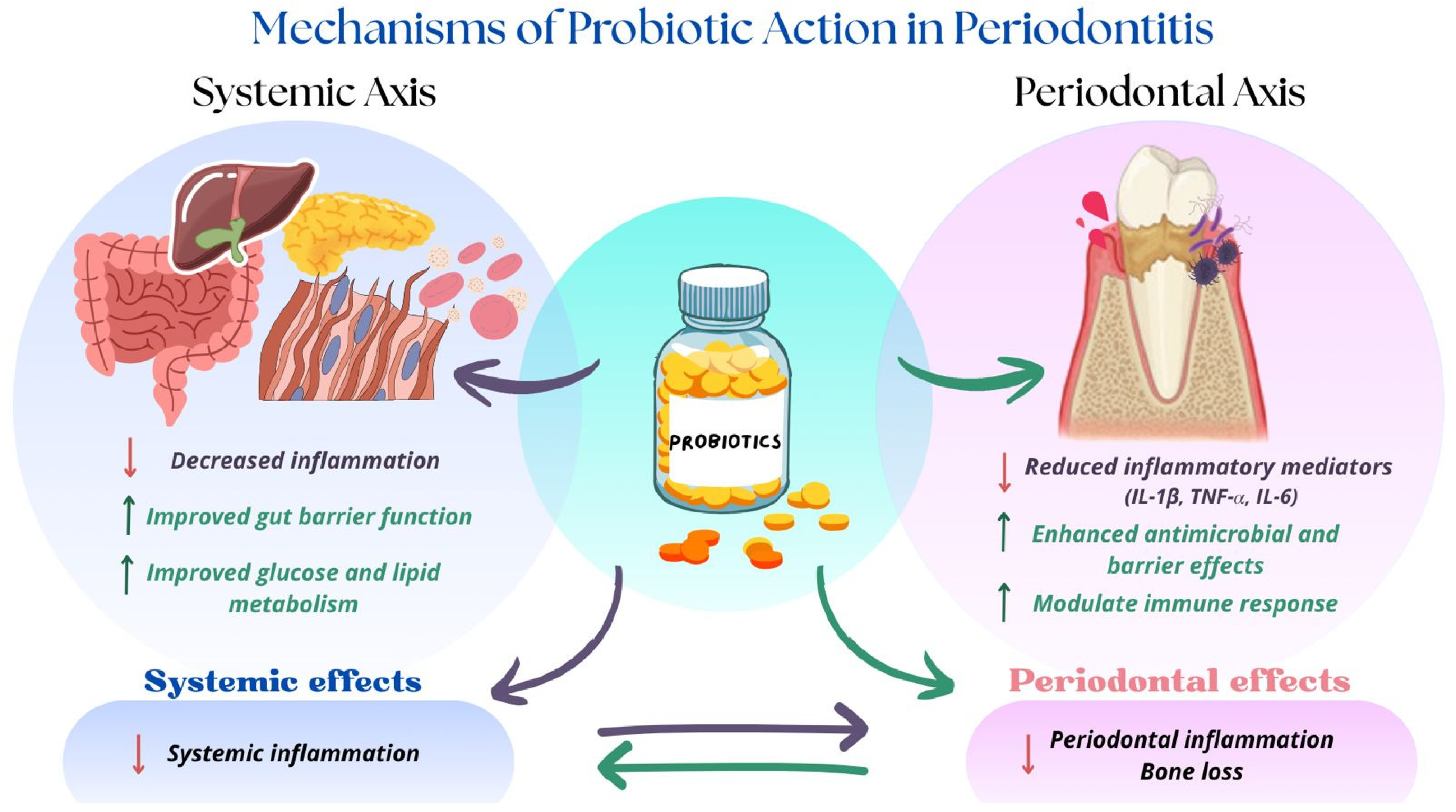
Taken together, these antimicrobial and immunomodulatory properties suggest that probiotics may represent a potential user-friendly, low-risk, and cost-effective adjunctive approach for achieving and maintaining periodontal health [19]. The mechanisms of probiotic action in periodontitis are illustrated in Figure 1.
Figure 1.
Mechanisms of probiotic action in Periodontitis. Figure designed with Canva (Canva Inc., Sydney, Australia). The large purple arrow represents the systemic axis, while the large green arrow represents the periodontal axis. The small green arrows indicate an increase, whereas the small red arrows indicate a decrease.
3.4. Clinical Evidence
While mechanistic and preclinical studies provide important insights into the potential effects of probiotics, clinical evidence is required to determine whether these biological effects translate into meaningful improvements in periodontal outcomes. Several clinical studies have examined the effects of various probiotic regimens on periodontal tissues and systemic parameters. Probiotic protocols used in clinical studies are summarized in Table 1. Clinical investigations in individuals with periodontitis have evaluated various probiotic regimens as adjuncts and, in several cases, have demonstrated added benefits beyond SRP [20,51,52,53,54]. Among Lactobacillus-based formulations, the combination of Limosilactobacillus reuteri DSM 17,938 and ATCC PTA 5289 has been the most extensively studied, consistently demonstrating superior reductions in PD, BOP, plaque index (PI), and gains in clinical attachment level (CAL) when used as adjuncts to non-surgical periodontal therapy [55,56,57,58]. This strain combination also delayed recolonization of periodontal pockets by anaerobic pathogens for up to 180 days [55,59], and a meta-analysis supported its use particularly in deep periodontal pockets [60]. It is important to highlight that probiotic effects depend strongly on the specific strain (or strain combinations), dosage, frequency, and route of administration employed [39].
Beyond the systemic or orally delivered formulations most studied, several investigations have also examined the local application of probiotics—using gels, dentifrices, mouthrinses, or subgingival irrigation solutions—in combination with SRP [61,62,63]. The most extensively studied probiotic genera in Dentistry include Lactobacillus and Bifidobacterium, which are naturally found in supragingival and subgingival biofilms [34,37].
Table 1.
Overview of Probiotic Protocols in Clinical Trial Studies.
Among 38 clinical studies, 31 reported improvements in at least one key periodontal clinical parameter (PD, BOP, CAL, or PI) when compared with placebo or SRP alone [20,21,40,50,51,53,54,55,57,63,64,65,66,67,69,70,71,72,73,74,75,76,78,79,80,82,83,85,86,87,88]. Clinical trials evaluating B. lactis HN019 as an adjunct to SRP also demonstrated significant clinical benefits, including reductions in moderate and deep pockets, lower risk of disease progression, and decreased need for periodontal surgery [70,74]. Only seven studies reported no significant added clinical benefit of probiotics over controls, although all showed improvements over baseline [20,67,75,79,80,81,84]. A summary of the effects of probiotics on periodontal clinical parameters is presented in Table 2.
Table 2.
Influence of Probiotics on Periodontal Clinical Outcomes.
A total of 14 studies assessed inflammatory and immunological biomarkers, of which 12 studies reported significant reductions in proinflammatory mediators—including IL-1β, IL-6, IL-8, IL-17, TNF-α, MMP-8, and salivary lactoferrin—following probiotic therapy [50,51,53,55,59,64,69,70,71,74,81,83]. Studies with B. lactis HN019 further demonstrated upregulation of β-defensin-3, Toll-Like Receptor 4 (TLR4), and Cluster of Differentiation 4 (CD4), suggesting enhanced epithelial immune barrier function [74]. Additionally, six studies documented increases in protective or regulatory mediators, including IL-10, IL-12, IL-16, β-defensin-3, TLR4, and CD4 [50,64,70,71,74,83].
Microbiological assessments were performed in 20 studies, of which 16 reported reductions in periodontal pathogens such as Porphyromonas gingivalis, Aggregatibacter actinomycetemcomitans, Fusobacterium nucleatum, Prevotella intermedia, and red/orange-complex species [40,53,54,55,65,67,70,71,83,86,87]. The oral administration of Ligilactobacillus salivarius TI 2711 also significantly reduced Porphyromonas gingivalis levels and improved PD and BOP [89,90]. In five studies, probiotic strains were detected in subgingival biofilms for 60–180 days after supplementation, indicating transient colonization [55,56,57,59,70].
According to preventive vs. therapeutic protocols and delivery methods, 32 evaluated probiotics as adjuncts to SRP, while six tested probiotics as stand-alone therapy [20,51,64,65,66,87]. Adjunctive protocols were more consistently beneficial, with 27 of 32 studies showing superior outcomes compared with SRP alone. Local delivery systems (gels, mouthrinses, subgingival pastes) were tested in 8 studies, of which 5 demonstrated significant short-term improvements [54,63,71,87,88].
3.5. Systemic Effects of Probiotics in Periodontal Therapy
The most consistent clinical evidence supporting the use of probiotics in the management of periodontitis comes from systemic administration in the form of lozenges, sachets, chewing gum, or functional foods. The systemic route offers the advantage of modulating the intestinal microbiome and restoring host–microorganism homeostasis, thereby potentially preventing or correcting intestinal dysbiosis, which has been linked to multiple systemic conditions [91]. This is particularly relevant because individuals with periodontitis chronically ingest high loads of periodontal pathogens, a process that may contribute to gut dysbiosis [92]. Conversely, an altered intestinal microbiota may exacerbate periodontal tissue destruction, supporting the hypothesis of a bidirectional relationship between oral and gut ecosystems [5,91].
Moreira et al. (2023a) showed that B. lactis HN019 reduced the sequelae of experimental periodontitis while modulating intestinal microbiota, downregulating lipogenic genes, and decreasing hepatic steatosis [93]. These findings support the role of the gut-liver axis in the pathogenesis of periodontal disease. Similarly, Moreira et al. (2023b) demonstrated that probiotics improved the intestine–adipose tissue axis in rats with metabolic syndrome and periodontitis, reducing systemic inflammation and improving periodontal outcomes [94]. Silva et al. (2022) confirmed these findings in another metabolic syndrome model, showing that probiotics attenuated systemic cytokines and alveolar bone loss in rats with experimental periodontitis [42]. Song et al. (2023) demonstrated that A. muciniphila can counteract Fusobacterium nucleatum-induced periodontitis by modulating the immune response [95]. Vieira et al. (2021) found that kefir supplementation decreased systemic cytokines while attenuating local alveolar bone loss in rats with experimental periodontitis [96]. Collectively, these studies highlight the dual role of probiotics in modulating both periodontal and systemic health parameters, supporting their potential as therapeutic agents in systemic conditions associated with periodontal disease.
Clinical studies have also reported systemic effects of adjuvant probiotic use in the treatment of periodontitis, whether or not associated with other systemic conditions [70,84,96]. Riccia et al. (2007) demonstrated that L. brevis CD2 lozenges reduced salivary nitrite/nitrate, prostaglandins, MMPs, and interferon-γ, indicating systemic anti-inflammatory activity [64]. Invernici et al. (2018) showed that B. lactis HN019 increased IL-10 and reduced IL-8 and IL-16 in gingival crevicular fluid, reflecting systemic cytokine modulation [70]. Later, the same authors confirmed that B. lactis HN019 strain enhanced β-defensin 3, TLR-4, and CD4 expression in gingival tissues, suggesting improved epithelial barrier immunocompetence with systemic implications [74].
In patients with type 2 DM and periodontitis, Elsadek et al. (2020) observed that adjunctive L. reuteri supplementation reduced periodontal pathogens and improved clinical parameters, although glycated hemoglobin (HbA1c) reduction was significant only in the periodontal debridement group [75]. Jardini et al. (2024) reported that L. reuteri (ATCC PTA 5289 and DSM-17938) lozenges increased IL-10, IL-12, and IL-16 levels in gingival crevicular fluid, while also improving lipid metabolism by reducing small low-density lipoprotein (LDL) particles and altering high-density lipoprotein (HDL) subfractions, but no effects were observed in HbA1c levels [83]. Bujaldón et al. (2026) further demonstrated that the same combination of L. reuteri strains and formulation significantly decreased HbA1c levels at 6 months in diabetic patients, reinforcing the potential of probiotics to improve glycemic control in systemic conditions associated with periodontitis [84].
Although clinical studies consistently suggest that probiotics may exert beneficial effects on systemic health through immunomodulation, metabolic regulation, and microbial balance, not all trials have demonstrated uniform outcomes; some reported only transient or limited systemic effects [75,86].
4. Discussion
The present narrative review evaluated clinical studies investigating the use of probiotics as adjunctive agents in periodontal therapy. Across clinical studies, adjunctive probiotic therapy was associated with a PD reduction of 0.28–1.2 mm compared with control groups [40,52,54,55,56,57,59,63,66,70,71,72]. These findings are supported by systematic reviews that indicate that probiotics, particularly L. reuteri, may enhance PD reduction, especially in moderate to deep pockets during short- to medium-term follow-up (1–12 months) [60,97,98].
In addition to PD reduction, adjunctive probiotics were associated with modest CAL gain ranging from 0.11 to 0.8 mm [40,50,54,55,56,57,59,70]. However, the clinical relevance of these improvements should be interpreted with caution, as mean differences below 1 mm may not necessarily translate into meaningful long-term periodontal stability. Also, several randomized clinical trials reported no significant intergroup differences in CAL outcomes [52,67,69,75,76,79,80,82,83,84], highlighting variability in clinical response. A more consistent effect was observed for BOP, with several studies reporting significant reductions in gingival bleeding following probiotic use [55,57,59,63,66,70,74]. As BOP reflects gingival inflammation, these findings support the hypothesis that probiotics primarily exert anti-inflammatory and immunomodulatory effects. In contrast, other trials failed to demonstrate significant intergroup differences [20,51,52,53,67,80,83], suggesting that clinical outcomes may be influenced by baseline disease severity, oral hygiene, and host-related factors. Importantly, reductions in BOP without parallel CAL gain may indicate control of inflammation rather than true periodontal regeneration.
These clinical findings are partially supported by biomarker analyses reported in the included studies. A total of 14 clinical studies assessed inflammatory and immunological markers, with most reporting reductions in proinflammatory mediators, such as IL-1β, IL-6, IL-8, IL-17, TNF-α, MMP-8, and salivary lactoferrin, following probiotic therapy [50,51,53,55,59,64,69,70,71,74,81]. Additionally, some studies, particularly those evaluating Bifidobacterium lactis HN019, observed upregulation of markers associated with host immune response, including β-defensin-3, Toll-like receptor 4 (TLR-4), and Cluster of Differentiation 4 (CD4), suggesting a potential enhancement of the epithelial immune barrier [74]. Increases in anti-inflammatory or regulatory mediators, such as IL-10, IL-12, and IL-16, were also described [50,64,70,71,74,83]. However, despite these favorable biochemical changes, a consistent correlation between biomarker modulation and clinically meaningful improvements (e.g., PD and CAL reduction) was not clearly established. Furthermore, considerable heterogeneity in biomarker selection, measurement methods, and reporting, along with the limited number of studies assessing these outcomes, hampers the identification of reproducible immunological patterns. Therefore, the clinical relevance of these biomarker changes remains uncertain. Studies with follow-up periods shorter than one month were not included in the present descriptive qualitative synthesis, as this timeframe is considered insufficient to detect meaningful changes in periodontal clinical parameters such as PD and CAL, which require tissue remodeling and healing over time [99]. Moreover, recent evidence suggests that improvements in inflammatory parameters may occur earlier than periodontal structural changes, reinforcing the notion that the short-term effects of probiotics are primarily anti-inflammatory [100,101].
Microbiological outcomes provide additional, albeit cautious, support for probiotic effects. Most studies assessing subgingival microbiota reported reductions in key periodontal pathogens, including Porphyromonas gingivalis, Aggregatibacter actinomycetemcomitans, Fusobacterium nucleatum, Prevotella intermedia, and red/orange-complex species [40,53,54,55,59,65,69,70,71,83,86,87]. Specific strains, such as Ligilactobacillus salivarius TI 2711, were also associated with improvements in clinical parameters and a reduction in Porphyromonas gingivalis levels [89,90]. However, probiotic colonization was generally transient, detectable for 60–180 days post-supplementation [55,57,59,70,77], suggesting that clinical effects may rely on continuous administration and are likely mediated by ecological modulation rather than stable integration into the resident microbiota. Variability in microbiological assessment methods further limits comparability and interpretation.
Beyond clinical outcomes, emerging evidence also points to possible immunoepigenetic implications. The modulation of inflammatory and lipogenic gene expression observed in B. animalis studies suggests that probiotics may induce transcriptional reprogramming. This raises the hypothesis that probiotics or their metabolites might influence the epigenetic landscape of tissue-resident memory T cells, which play a central role in the chronicity of periodontal inflammation [102]. Such interactions could be studied using advanced tools such as ATAC-seq or ChIP-qPCR to evaluate chromatin accessibility and histone modifications, ultimately providing deeper mechanistic insights.
Systematic reviews with meta-analysis have reported modest benefits of probiotics as adjuncts to periodontal therapy [98,103]. However, these effects appear to be more pronounced in sites with greater initial disease severity, particularly deep pockets (≥5 mm) [104]. Accordingly, current clinical guidelines do not support the routine use of probiotics as adjunctive therapy, although they acknowledge their safety and lack of significant adverse effects [5]. This reflects the fact that, despite promising findings, they were inconsistent across trials, limiting the ability to draw definitive conclusions regarding their clinical efficacy. Important limitations must be considered. Clinical studies are highly heterogeneous regarding patient populations, different probiotic strains, colony-forming unit (CFU) concentrations, dosages, administration routes, treatment durations, baseline disease severity, and follow-up periods, which limit direct comparisons across studies. Several studies reported no additional clinical benefit compared with conventional therapy alone [52,67,69,76,79,83,84]. Studies with follow-up periods shorter than one month were not included in the present descriptive qualitative synthesis, as this timeframe is considered insufficient to detect meaningful changes in periodontal clinical parameters such as PD and CAL, which require tissue remodeling and healing over time [105]. Moreover, recent evidence suggests that improvements in inflammatory parameters may precede periodontal structural changes, reinforcing the notion that the short-term effects of probiotics are primarily anti-inflammatory [100,101]. Therefore, while probiotics may offer potential adjunctive benefits, the current clinical evidence remains inconclusive and should be interpreted with caution.
Although clinically relevant, high-risk subgroups, such as those with genetic syndromes associated with gingival alterations or gingival enlargement, were not explored in depth due to the absence of clinical studies in these populations.
Future Directions
Future studies should prioritize mechanistically oriented and translational approaches to elucidate how probiotics modulate immune and metabolic pathways involved in periodontal disease. Well-designed clinical trials with harmonized probiotic formulations, dosing regimens, and timing relative to periodontal therapy should incorporate immunometabolic biomarkers alongside clinical parameters. Greater emphasis on systemic interactions, particularly within the gut–metabolic–oral axis, and on the long-term durability of probiotic-induced host modulation will be essential to advance probiotics as evidence-based adjuncts in periodontal therapy.
5. Conclusions
Probiotics demonstrate potential as adjunctive agents in periodontal therapy, as evidenced by improvements in clinical parameters such as PD, CAL, and BOP reported in clinical studies. However, the findings remain heterogeneous across trials. Variability in probiotic strains, CFU concentrations, administration routes, and treatment durations highlights the need for standardized clinical protocols to improve comparability and reproducibility and better establish their clinical efficacy. Stronger, long-term evidence is required to confirm their clinical efficacy and to standardize therapeutic protocols.
Author Contributions
Conceptualization, N.d.C.K., A.C.P.H., C.d.J.H.M. and P.M.L.; methodology, N.d.C.K., A.C.P.H. and C.d.J.H.M.; formal analysis, N.d.C.K., A.C.P.H., C.d.J.H.M., P.M.L. and Y.d.P.B.; investigation, N.d.C.K., A.C.P.H. and C.d.J.H.M.; writing—original draft and preparation, N.d.C.K., A.C.P.H. and C.d.J.H.M.; writing—review and editing N.d.C.K., A.C.P.H., C.d.J.H.M., P.M.L. and Y.d.P.B.; visualization, N.d.C.K., A.C.P.H., C.d.J.H.M., P.M.L. and Y.d.P.B.; supervision, N.d.C.K., P.M.L. and Y.d.P.B. All authors have read and agreed to the published version of the manuscript.
Funding
This research received no external funding.
Data Availability Statement
No new data were created.
Conflicts of Interest
The authors declare no conflicts of interest.
Abbreviations
The following abbreviations are used in this manuscript:
| SRP | scaling and root planing |
| SANRA | scale for the assessment of narrative review articles |
| PD | probing depth |
| BOP | bleeding on probing |
| DM | diabetes mellitus |
| WHO | World Health Organization |
| FAO | food and agriculture organization of the United Nations |
| NF-κB | nuclear factor kappa b |
| MAPK | mitogen-activated protein kinase |
| IL- | interleukin |
| TNF-α | tumor necrosis factor-α |
| MMP- | matrix metalloproteinases |
| PI | plaque index |
| CAL | clinical attachment level |
| TLR4 | toll-like receptor 4 |
| CD | cluster of differentiation |
| HbA1c | glycated hemoglobin |
| LDL | low-density lipoprotein |
| HDL | high-density lipoprotein |
| TGF-β | transforming growth factor beta |
| CFU | colony-forming units |
References
- Liang, X.; Lyu, Y.; Li, J.; Li, Y.; Chi, C. Global, Regional, and National Burden of Preterm Birth, 1990–2021: A Systematic Analysis from the Global Burden of Disease Study 2021. eClinicalMedicine 2024, 76, 102840. [Google Scholar] [CrossRef] [Scilit]
- Wu, L.; Huang, C.-M.; Wang, Q.; Wei, J.; Xie, L.; Hu, C.-Y. Burden of Severe Periodontitis: New Insights Based on a Systematic Analysis from the Global Burden of Disease Study 2021. BMC Oral Health 2025, 25, 861. [Google Scholar] [CrossRef] [Scilit] [PubMed]
- Socransky, S.S.; Haffajee, A.D. Periodontal Microbial Ecology. Periodontology 2000 2005, 38, 135–187. [Google Scholar] [CrossRef] [Scilit] [PubMed]
- Tonetti, M.S.; Greenwell, H.; Kornman, K.S. Staging and Grading of Periodontitis: Framework and Proposal of a New Classification and Case Definition. J. Periodontol. 2018, 89, S159–S172. [Google Scholar] [CrossRef] [Scilit]
- Sanz, M.; Herrera, D.; Kebschull, M.; Chapple, I.; Jepsen, S.; Berglundh, T.; Sculean, A.; Tonetti, M.S. EFP Workshop Participants and Methodological Consultants Treatment of Stage I–III Periodontitis—The EFP S3 Level Clinical Practice Guideline. J. Clin. Periodontol. 2020, 47, 4–60. [Google Scholar] [CrossRef] [Scilit]
- Hajishengallis, G.; Netea, M.G.; Chavakis, T. Trained Immunity in Chronic Inflammatory Diseases and Cancer. Nat. Rev. Immunol. 2025, 25, 497–514. [Google Scholar] [CrossRef] [Scilit]
- Villoria, G.E.M.; Fischer, R.G.; Tinoco, E.M.B.; Meyle, J.; Loos, B.G. Periodontal Disease: A Systemic Condition. Periodontology 2000 2024, 96, 7–19. [Google Scholar] [CrossRef] [Scilit]
- Darby, I. Risk Factors for Periodontitis & Peri-implantitis. Periodontology 2000 2022, 90, 9–12. [Google Scholar] [CrossRef] [Scilit]
- Jepsen, K.; Jepsen, S. Antibiotics/Antimicrobials: Systemic and Local Administration in the Therapy of Mild to Moderately Advanced Periodontitis. Periodontology 2000 2016, 71, 82–112. [Google Scholar] [CrossRef] [Scilit]
- Botelho, J.; Lyra, P.; Nascimento, G.G.; Leite, F.R.M.; Mendes, J.J.; Machado, V. Antibiotics in Periodontal Treatment: An Umbrella Review. Front. Cell. Infect. Microbiol. 2025, 15, 1601464. [Google Scholar] [CrossRef] [Scilit] [PubMed]
- Food and Agriculture Organization of the United States; W.H.O. Guidelines for the Evaluation of Probiotics in Food; Food and Agriculture Organization of the United Nations/World Health Organization: London, ON, Canada, 2002. [Google Scholar]
- Tan, J.; Zhang, D.; Cheng, L.; Liu, N.; Jamali, M.; Jamloo, H.; Farjaminejad, R.; Lei, C.; Saedisomeolia, A.; Jamilian, A. The Impacts of Probiotics Supplementation on the Treatment of Periodontitis: An Umbrella Meta-Analysis. Nutr. Rev. 2026, 84, 379–394. [Google Scholar] [CrossRef] [Scilit]
- Sachelarie, L.; Scrobota, I.; Romanul, I.; Iurcov, R.; Potra Cicalau, G.I.; Todor, L. Probiotic Therapy as an Adjuvant in the Treatment of Periodontal Disease: An Innovative Approach. Medicina 2025, 61, 126. [Google Scholar] [CrossRef] [Scilit] [PubMed]
- Laleman, I.; Teughels, W. Probiotics in the Dental Practice: A Review. Quintessence Int. 2015, 46, 255–264. [Google Scholar] [CrossRef] [Scilit] [PubMed]
- Mendonça, C.; Marques, D.; Silveira, J.; Marques, J.; De Souza, R.F.; Mata, A. Effects of Probiotic Therapy on Periodontal and Peri-Implant Treatments: An Umbrella Review. JDR Clin. Transl. Res. 2025, 10, 246–268. [Google Scholar] [CrossRef] [Scilit]
- Mendonça, C.D.D.; Mata, A.D.S.P.D.; Azevedo, L.F.R.; Marques, J.F.; Silveira, J.M.L.; Marques, D.N.D.S. Probiotics in the Non-Surgical Treatment of Periodontitis: A Systematic Review and Network Meta-Analysis. BMC Oral Health 2024, 24, 1224. [Google Scholar] [CrossRef] [Scilit]
- Alasbily, H.; Mohamed, H.H.; Asheibi, A.; Bazina, M.S.; Alkaseh, A.; Ghaith, H.M.; Ali Fahmi, F. Probiotics in Periodontal Diseases: Mechanisms, Evidence Mapping, Limitations, and Future Directions. Cureus 2025, 17, e96042. [Google Scholar] [CrossRef] [Scilit]
- Zhang, M.; Liu, Y.; Afzali, H.; Graves, D.T. An Update on Periodontal Inflammation and Bone Loss. Front. Immunol. 2024, 15, 1385436. [Google Scholar] [CrossRef] [Scilit] [PubMed]
- Gatej, S.M.; Marino, V.; Bright, R.; Fitzsimmons, T.R.; Gully, N.; Zilm, P.; Gibson, R.J.; Edwards, S.; Bartold, P.M. Probiotic Lactobacillus rhamnosus GG Prevents Alveolar Bone Loss in a Mouse Model of Experimental Periodontitis. J. Clin. Periodontol. 2018, 45, 204–212. [Google Scholar] [CrossRef] [Scilit]
- Yuki, O.; Furutani, C.; Mizota, Y.; Wakita, A.; Mimura, S.; Kihara, T.; Ohara, M.; Okada, Y.; Okada, M.; Nikawa, H. Effect of Bovine Milk Fermented with Lactobacillus rhamnosus L8020 on Periodontal Disease in Individuals with Intellectual Disability: A Randomized Clinical Trial. J. Appl. Oral Sci. 2019, 27, e20180564. [Google Scholar] [CrossRef] [Scilit]
- Laleman, I.; Pauwels, M.; Quirynen, M.; Teughels, W. A Dual-strain Lactobacilli reuteri Probiotic Improves the Treatment of Residual Pockets: A Randomized Controlled Clinical Trial. J. Clin. Periodontol. 2020, 47, 43–53. [Google Scholar] [CrossRef] [Scilit]
- Mensi, M.; Sordillo, A.; Marchetti, S.; Calza, S.; Scotti, E. Clinical Comparison of Guided Biofilm Therapy and Scaling and Root Planing in the Active Phase of Periodontitis Management. Eur. J. Dent. 2025, 19, 482–492. [Google Scholar] [CrossRef] [Scilit]
- Baethge, C.; Goldbeck-Wood, S.; Mertens, S. SANRA—A Scale for the Quality Assessment of Narrative Review Articles. Res. Integr. Peer. Rev. 2019, 4, 5. [Google Scholar] [CrossRef] [Scilit]
- Papapanou, P.N.; Sanz, M.; Buduneli, N.; Dietrich, T.; Feres, M.; Fine, D.H.; Flemmig, T.F.; Garcia, R.; Giannobile, W.V.; Graziani, F.; et al. Periodontitis: Consensus Report of Workgroup 2 of the 2017 World Workshop on the Classification of Periodontal and Peri-Implant Diseases and Conditions. J. Periodontol. 2018, 89, S173–S182. [Google Scholar] [CrossRef] [Scilit]
- Caton, J.G.; Armitage, G.; Berglundh, T.; Chapple, I.L.C.; Jepsen, S.; Kornman, K.S.; Mealey, B.L.; Papapanou, P.N.; Sanz, M.; Tonetti, M.S. A New Classification Scheme for Periodontal and Peri-implant Diseases and Conditions—Introduction and Key Changes from the 1999 Classification. J. Clin. Periodontol. 2018, 45, S1–S8. [Google Scholar] [CrossRef] [Scilit] [PubMed]
- Bartold, P.M.; Van Dyke, T.E. Host Modulation: Controlling the Inflammation to Control the Infection. Periodontology 2000 2017, 75, 317–329. [Google Scholar] [CrossRef] [Scilit]
- Mombelli, A. Microbial Colonization of the Periodontal Pocket and Its Significance for Periodontal Therapy. Periodontology 2000 2018, 76, 85–96. [Google Scholar] [CrossRef] [Scilit] [PubMed]
- Feres, M.; Retamal-Valdes, B.; Faveri, M.; Duarte, P.; Shibli, J.; Soares, G.M.S.; Miranda, T.; Teles, F.; Goodson, M.; Hasturk, H.; et al. Proposal of a Clinical Endpoint for Periodontal Trials: The Treat-to-Target Approach. J. Int. Acad. Periodontol. 2020, 22, 41–53. [Google Scholar] [PubMed]
- Loos, B.G.; Needleman, I. Endpoints of Active Periodontal Therapy. J. Clin. Periodontol. 2020, 47, 61–71. [Google Scholar] [CrossRef] [Scilit]
- Gellin, R.G.; Miller, M.C.; Javed, T.; Engler, W.O.; Mishkin, D.J. The Effectiveness of the Titan-S Sonic Sealer Versus Curettes in the Removal of Subgingival Calculus: A Human Surgical Evaluation. J. Periodontol. 1986, 57, 672–680. [Google Scholar] [CrossRef] [Scilit]
- Adriaens, P.A.; Adriaens, L.M. Effects of Nonsurgical Periodontal Therapy on Hard and Soft Tissues. Periodontology 2000 2004, 36, 121–145. [Google Scholar] [CrossRef] [Scilit]
- Salvi, G.E.; Lang, N.P. Host Response Modulation in the Management of Periodontal Diseases. J. Clin. Periodontol. 2005, 32, 108–129. [Google Scholar] [CrossRef] [Scilit]
- Marsh, P.D.; Devine, D.A. How Is the Development of Dental Biofilms Influenced by the Host? J. Clin. Periodontol. 2011, 38, 28–35. [Google Scholar] [CrossRef] [Scilit]
- Furlaneto, F.; Ishikawa, K.H.; Messora, M.R.; Mayer, M.P.A. Probiotics During the Therapeutic Management of Periodontitis. In Periodontitis; Santi-Rocca, J., Ed.; Advances in Experimental Medicine and Biology; Springer International Publishing: Cham, Switzerland, 2022; Volume 1373, pp. 353–375. ISBN 978-3-030-96880-9. [Google Scholar]
- Messora, M.R.; Pereira, L.J.; Foureaux, R.; Oliveira, L.F.F.; Sordi, C.G.; Alves, A.J.N.; Napimoga, M.H.; Nagata, M.J.H.; Ervolino, E.; Furlaneto, F.A.C. Favourable Effects of Bacillus subtilis and Bacillus licheniformis on Experimental Periodontitis in Rats. Arch. Oral Biol. 2016, 66, 108–119. [Google Scholar] [CrossRef] [Scilit]
- Markowiak, P.; Śliżewska, K. Effects of Probiotics, Prebiotics, and Synbiotics on Human Health. Nutrients 2017, 9, 1021. [Google Scholar] [CrossRef] [Scilit] [PubMed]
- Martinez, R.C.R.; Bedani, R.; Saad, S.M.I. Scientific Evidence for Health Effects Attributed to the Consumption of Probiotics and Prebiotics: An Update for Current Perspectives and Future Challenges. Br. J. Nutr. 2015, 114, 1993–2015. [Google Scholar] [CrossRef] [Scilit] [PubMed]
- Cuthill, S.; Muroke, V.; Dubois, A.; Dubé, M.-P.; Guertin, M.-C.; Millette, M.; Tardif, J.-C. Effect of Probiotic Supplementation on Glycemic Control in Patients with Type 2 Diabetes: A Randomized Controlled Trial. Clin. Nutr. ESPEN 2025, 68, 148–152. [Google Scholar] [CrossRef] [Scilit]
- Ricoldi, M.S.T.; Furlaneto, F.A.C.; Oliveira, L.F.F.; Teixeira, G.C.; Pischiotini, J.P.; Moreira, A.L.G.; Ervolino, E.; De Oliveira, M.N.; Bogsan, C.S.B.; Salvador, S.L.; et al. Effects of the Probiotic Bifidobacterium animalis subsp. lactis on the Non-Surgical Treatment of Periodontitis. A Histomorphometric, Microtomographic and Immunohistochemical Study in Rats. PLoS ONE 2017, 12, e0179946. [Google Scholar] [CrossRef] [Scilit]
- Teughels, W.; Durukan, A.; Ozcelik, O.; Pauwels, M.; Quirynen, M.; Haytac, M.C. Clinical and Microbiological Effects of Lactobacillus reuteri Probiotics in the Treatment of Chronic Periodontitis: A Randomized Placebo-controlled Study. J. Clin. Periodontol. 2013, 40, 1025–1035. [Google Scholar] [CrossRef] [Scilit] [PubMed]
- Foureaux, R.D.C.; Messora, M.R.; De Oliveira, L.F.F.; Napimoga, M.H.; Pereira, A.N.J.; Ferreira, M.S.; Pereira, L.J. Effects of Probiotic Therapy on Metabolic and Inflammatory Parameters of Rats with Ligature-Induced Periodontitis Associated with Restraint Stress. J. Periodontol. 2014, 85, 975–983. [Google Scholar] [CrossRef] [Scilit]
- Silva, G.A.; Moreira, A.L.G.; Silva, P.H.F.; Salvador, S.L.; Casarin, R.C.V.; Vicente, R.M.; Ferreira, G.C.; Tanus-Santos, J.E.; Furlaneto, F.A.C.; Messora, M.R. The Use of Probiotics Can Reduce the Severity of Experimental Periodontitis in Rats with Metabolic Syndrome: An Immunoenzymatic and Microtomographic Study. J. Periodontol. 2022, 93, e1–e12. [Google Scholar] [CrossRef] [Scilit]
- Meurman, J.H. Probiotics: Do They Have a Role in Oral Medicine and Dentistry? Eur. J. Oral Sci. 2005, 113, 188–196. [Google Scholar] [CrossRef] [Scilit] [PubMed]
- Homayouni Rad, A.; Torab, R.; Ghalibaf, M.; Norouzi, S.; Mehrabany, E.V. Might Patients with Immune-Related Diseases Benefit from Probiotics? Nutrition 2013, 29, 583–586. [Google Scholar] [CrossRef] [Scilit] [PubMed]
- Bedaiwi, M.K.; Inman, R.D. Microbiome and Probiotics: Link to Arthritis. Curr. Opin. Rheumatol. 2014, 26, 410–415. [Google Scholar] [CrossRef] [Scilit]
- Saavedra, J.M.; Abi-Hanna, A.; Moore, N.; Yolken, R.H. Long-Term Consumption of Infant Formulas Containing Live Probiotic Bacteria: Tolerance and Safety. Am. J. Clin. Nutr. 2004, 79, 261–267. [Google Scholar] [CrossRef] [Scilit]
- Stamatova, I.; Meurman, J.H. Probiotics: Health Benefits in the Mouth. Am. J. Dent. 2009, 22, 329–338. [Google Scholar]
- De Melo Pereira, G.V.; De Oliveira Coelho, B.; Magalhães Júnior, A.I.; Thomaz-Soccol, V.; Soccol, C.R. How to Select a Probiotic? A Review and Update of Methods and Criteria. Biotechnol. Adv. 2018, 36, 2060–2076. [Google Scholar] [CrossRef] [Scilit]
- Sliepen, I.; Van Essche, M.; Loozen, G.; Van Eldere, J.; Quirynen, M.; Teughels, W. Interference with Aggregatibacter actinomycetemcomitans: Colonization of Epithelial Cells under Hydrodynamic Conditions. Oral Microbiol. Immunol. 2009, 24, 390–395. [Google Scholar] [CrossRef] [Scilit]
- Szkaradkiewicz, A.K.; Stopa, J.; Karpiński, T.M. Effect of Oral Administration Involving a Probiotic Strain of Lactobacillus reuteri on Pro-Inflammatory Cytokine Response in Patients with Chronic Periodontitis. Arch. Immunol. Ther. Exp. 2014, 62, 495–500. [Google Scholar] [CrossRef] [Scilit]
- Shimauchi, H.; Mayanagi, G.; Nakaya, S.; Minamibuchi, M.; Ito, Y.; Yamaki, K.; Hirata, H. Improvement of Periodontal Condition by Probiotics with Lactobacillus salivarius WB21: A Randomized, Double-blind, Placebo-controlled Study. J. Clin. Periodontol. 2008, 35, 897–905. [Google Scholar] [CrossRef] [Scilit] [PubMed]
- Laleman, I.; Yilmaz, E.; Ozcelik, O.; Haytac, C.; Pauwels, M.; Herrero, E.R.; Slomka, V.; Quirynen, M.; Alkaya, B.; Teughels, W. The Effect of a Streptococci Containing Probiotic in Periodontal Therapy: A Randomized Controlled Trial. J. Clin. Periodontol. 2015, 42, 1032–1041. [Google Scholar] [CrossRef] [Scilit]
- Kang, M.-S.; Lee, D.-S.; Lee, S.-A.; Kim, M.-S.; Nam, S.-H. Effects of Probiotic Bacterium Weissella cibaria CMU on Periodontal Health and Microbiota: A Randomised, Double-Blind, Placebo-Controlled Trial. BMC Oral Health 2020, 20, 243. [Google Scholar] [CrossRef] [Scilit] [PubMed]
- Poulose, M.; Gujar, D.; Panicker, S.; Rokade, S.; Guruprasad, M.; Gopalakrishnan, D. Efficacy and Viability of Subgingival Application of Probiotics as an Adjunct to Scaling and Root Planing in Periodontitis. Indian J. Dent. Res. 2024, 35, 59–64. [Google Scholar] [CrossRef] [Scilit] [PubMed]
- Tekce, M.; Ince, G.; Gursoy, H.; Dirikan Ipci, S.; Cakar, G.; Kadir, T.; Yılmaz, S. Clinical and Microbiological Effects of Probiotic Lozenges in the Treatment of Chronic Periodontitis: A 1-year Follow-up Study. J. Clin. Periodontol. 2015, 42, 363–372. [Google Scholar] [CrossRef] [Scilit]
- Pelekos, G.; Acharya, A.; Eiji, N.; Hong, G.; Leung, W.K.; McGrath, C. Effects of Adjunctive Probiotic L. reuteri Lozenges on S/RSD Outcomes at Molar Sites with Deep Pockets. J. Clin. Periodontol. 2020, 47, 1098–1107. [Google Scholar] [CrossRef] [Scilit]
- Grusovin, M.G.; Bossini, S.; Calza, S.; Cappa, V.; Garzetti, G.; Scotti, E.; Gherlone, E.F.; Mensi, M. Clinical Efficacy of Lactobacillus reuteri-Containing Lozenges in the Supportive Therapy of Generalized Periodontitis Stage III and IV, Grade C: 1-Year Results of a Double-Blind Randomized Placebo-Controlled Pilot Study. Clin. Oral Investig. 2020, 24, 2015–2024. [Google Scholar] [CrossRef] [Scilit]
- El-bagoory, G.M.; El-guindy, H.; Shoukheba, M.M.; El-zamarany, E. The Adjunctive Effect of Probiotics to Nonsurgical Treatment of Chronic Periodontitis: A Randomized Controlled Clinical Trial. J. Indian Soc. Periodontol. 2021, 25, 525–531. [Google Scholar] [CrossRef] [Scilit]
- İnce, G.; Gürsoy, H.; İpçi, Ş.D.; Cakar, G.; Emekli-Alturfan, E.; Yılmaz, S. Clinical and Biochemical Evaluation of Lozenges Containing Lactobacillus reuteri as an Adjunct to Non-Surgical Periodontal Therapy in Chronic Periodontitis. J. Periodontol. 2015, 86, 746–754. [Google Scholar] [CrossRef] [Scilit]
- Martin-Cabezas, R.; Davideau, J.; Tenenbaum, H.; Huck, O. Clinical Efficacy of Probiotics as an Adjunctive Therapy to Non-surgical Periodontal Treatment of Chronic Periodontitis: A Systematic Review and Meta-analysis. J. Clin. Periodontol. 2016, 43, 520–530. [Google Scholar] [CrossRef] [Scilit]
- Dassi, E.; Ferretti, P.; Covello, G.; HTM-CMB-2015; Speccher, A.; Migazzi, A.; Bosco, B.; Rajashekar, B.; Zarbo, C.; Ballabio, C.; et al. The Short-Term Impact of Probiotic Consumption on the Oral Cavity Microbiome. Sci. Rep. 2018, 8, 10476. [Google Scholar] [CrossRef] [Scilit]
- Ranjith, A.; Nazimudeen, N.B.; Baiju, K.V. Probiotic Mouthwash as an Adjunct to Mechanical Therapy in the Treatment of Stage II Periodontitis: A Randomized Controlled Clinical Trial. Int. J. Dent. Hyg. 2022, 20, 415–421. [Google Scholar] [CrossRef] [Scilit] [PubMed]
- Minić, I.; Pejčić, A.; Bradić-Vasić, M. Effect of the Local Probiotics in the Therapy of Periodontitis A Randomized Prospective Study. Int. J. Dent. Hyg. 2022, 20, 401–407. [Google Scholar] [CrossRef] [Scilit]
- Riccia, D.D.; Bizzini, F.; Perilli, M.; Polimeni, A.; Trinchieri, V.; Amicosante, G.; Cifone, M. Anti-inflammatory Effects of Lactobacillus brevis (CD2) on Periodontal Disease. Oral Diseases 2007, 13, 376–385. [Google Scholar] [CrossRef] [Scilit]
- Mayanagi, G.; Kimura, M.; Nakaya, S.; Hirata, H.; Sakamoto, M.; Benno, Y.; Shimauchi, H. Probiotic Effects of Orally Administered Lactobacillus salivarius WB21-containing Tablets on Periodontopathic Bacteria: A Double-blinded, Placebo-controlled, Randomized Clinical Trial. J. Clin. Periodontol. 2009, 36, 506–513. [Google Scholar] [CrossRef] [Scilit] [PubMed]
- Vicario, M.; Santos, A.; Violant, D.; Nart, J.; Giner, L. Clinical Changes in Periodontal Subjects with the Probiotic Lactobacillus reuteri Prodentis: A Preliminary Randomized Clinical Trial. Acta Odontol. Scand. 2013, 71, 813–819. [Google Scholar] [CrossRef] [Scilit]
- Morales, A.; Carvajal, P.; Silva, N.; Hernandez, M.; Godoy, C.; Rodriguez, G.; Cabello, R.; Garcia-Sesnich, J.; Hoare, A.; Diaz, P.I.; et al. Clinical Effects of Lactobacillus rhamnosus in Non-Surgical Treatment of Chronic Periodontitis: A Randomized Placebo-Controlled Trial With 1-Year Follow-Up. J. Periodontol. 2016, 87, 944–952. [Google Scholar] [CrossRef] [Scilit] [PubMed]
- Morales, A.; Gandolfo, A.; Bravo, J.; Carvajal, P.; Silva, N.; Godoy, C.; Garcia-Sesnich, J.; Hoare, A.; Diaz, P.; Gamonal, J. Microbiological and Clinical Effects of Probiotics and Antibiotics on Nonsurgical Treatment of Chronic Periodontitis: A Randomized Placebo-Controlled Trial with 9-Month Follow-Up. J. Appl. Oral Sci. 2018, 26, e20170075. [Google Scholar] [CrossRef] [Scilit]
- Dhaliwal, P.K.; Grover, V.; Malhotra, R.; Kapoor, A. Clinical and Microbiological Investigation of the Effects of Probiotics Combined with Scaling and Root Planing in the Management of Chronic Periodontitis: A Randomized, Controlled Study. J. Int. Acad Periodontol. 2017, 19, 101–108. [Google Scholar] [PubMed]
- Invernici, M.M.; Salvador, S.L.; Silva, P.H.F.; Soares, M.S.M.; Casarin, R.; Palioto, D.B.; Souza, S.L.S.; Taba, M.; Novaes, A.B.; Furlaneto, F.A.C.; et al. Effects of Bifidobacterium Probiotic on the Treatment of Chronic Periodontitis: A Randomized Clinical Trial. J. Clin. Periodontol. 2018, 45, 1198–1210. [Google Scholar] [CrossRef] [Scilit]
- Sajedinejad, N.; Paknejad, M.; Houshmand, B.; Sharafi, H.; Jelodar, R.; Shahbani Zahiri, H.; Noghabi, K.A. Lactobacillus salivarius NK02: A Potent Probiotic for Clinical Application in Mouthwash. Probiotics Antimicrob. Prot. 2018, 10, 485–495. [Google Scholar] [CrossRef] [Scilit]
- Theodoro, L.H.; Cláudio, M.M.; Nuernberg, M.A.A.; Miessi, D.M.J.; Batista, J.A.; Duque, C.; Garcia, V.G. Effects of Lactobacillus reuteri as an Adjunct to the Treatment of Periodontitis in Smokers: Randomised Clinical Trial. Benef. Microbes 2019, 10, 375–384. [Google Scholar] [CrossRef] [Scilit]
- Vohra, F.; Bukhari, I.A.; Sheikh, S.A.; Albaijan, R.; Naseem, M.; Hussain, M. Effectiveness of Scaling and Root Planing with and without Adjunct Probiotic Therapy in the Treatment of Chronic Periodontitis among Shamma Users and Non-users: A Randomized Controlled Trial. J. Periodontol. 2020, 91, 1177–1185. [Google Scholar] [CrossRef] [Scilit]
- Invernici, M.M.; Furlaneto, F.A.C.; Salvador, S.L.; Ouwehand, A.C.; Salminen, S.; Mantziari, A.; Vinderola, G.; Ervolino, E.; Santana, S.I.; Silva, P.H.F.; et al. Bifidobacterium animalis subsp lactis HN019 Presents Antimicrobial Potential against Periodontopathogens and Modulates the Immunological Response of Oral Mucosa in Periodontitis Patients. PLoS ONE 2020, 15, e0238425. [Google Scholar] [CrossRef] [Scilit]
- Elsadek, M.F.; Ahmed, B.M.; Alkhawtani, D.M.; Zia Siddiqui, A. A Comparative Clinical, Microbiological and Glycemic Analysis of Photodynamic Therapy and Lactobacillus reuteri in the Treatment of Chronic Periodontitis in Type-2 Diabetes Mellitus Patients. Photodiagnosis Photodyn. Ther. 2020, 29, 101629. [Google Scholar] [CrossRef] [Scilit] [PubMed]
- Nędzi-Góra, M.; Wróblewska, M.; Górska, R. The Effect of Lactobacillus salivarius SGL03 on Clinical and Microbiological Parameters in Periodontal Patients. Pol. J. Microbiol. 2020, 69, 441–451. [Google Scholar] [CrossRef] [Scilit]
- Pelekos, G.; Ho, S.N.; Acharya, A.; Leung, W.K.; McGrath, C. A Double-blind, Paralleled-arm, Placebo-controlled and Randomized Clinical Trial of the Effectiveness of Probiotics as an Adjunct in Periodontal Care. J. Clin. Periodontol. 2019, 46, 1217–1227. [Google Scholar] [CrossRef] [Scilit]
- Morales, A.; Contador, R.; Bravo, J.; Carvajal, P.; Silva, N.; Strauss, F.-J.; Gamonal, J. Clinical Effects of Probiotic or Azithromycin as an Adjunct to Scaling and Root Planning in the Treatment of Stage III Periodontitis: A Pilot Randomized Controlled Clinical Trial. BMC Oral Health 2021, 21, 12. [Google Scholar] [CrossRef] [Scilit] [PubMed]
- Pudgar, P.; Povšič, K.; Čuk, K.; Seme, K.; Petelin, M.; Gašperšič, R. Probiotic Strains of Lactobacillus brevis and Lactobacillus plantarum as Adjunct to Non-Surgical Periodontal Therapy: 3-Month Results of a Randomized Controlled Clinical Trial. Clin. Oral Investig. 2021, 25, 1411–1422. [Google Scholar] [CrossRef] [Scilit] [PubMed]
- Ramos, T.C.D.S.; Boas, M.L.V.; Nunes, C.M.M.; Ferreira, C.L.; Pannuti, C.M.; Santamaria, M.P.; Jardini, M.A.N. Effect of Systemic Antibiotic and Probiotic Therapies as Adjuvant Treatments of Subgingival Instrumentation for Periodontitis: A Randomized Controlled Clinical Study. J. Appl. Oral Sci. 2022, 30, e20210583. [Google Scholar] [CrossRef] [Scilit]
- Gullapelli, P.; Koduganti, R.R. Efficacy of Probiotics Versus Tetracycline Fibers as Adjuvants to Scaling and Root Planing on Interleukin 1β Levels in Type 2 Diabetic Patients With Periodontitis: A Clinical and Biochemical Study. Cureus 2023, 15, e50968. [Google Scholar] [CrossRef] [Scilit]
- Şahin, T.; Akca, G.; ÖzmeriÇ, N. The Role of Probiotics for Preventing Dysbiosis in Periodontal Disease: A Randomized Controlled Trial. Turk. J. Med. Sci. 2024, 54, 357–365. [Google Scholar] [CrossRef] [Scilit]
- Jardini, M.A.N.; Pedroso, J.F.; Ferreira, C.L.; Nunes, C.M.M.; Reichert, C.O.; Aldin, M.N.; Figueiredo Neto, A.M.; Levy, D.; Damasceno, N.R.T. Effect of Adjuvant Probiotic Therapy (Lactobacillus reuteri) in the Treatment of Periodontitis Associated with Diabetes Mellitus: Clinical, Controlled, and Randomized Study. Clin. Oral Investig. 2024, 28, 80. [Google Scholar] [CrossRef] [Scilit]
- Bujaldón, R.; Montero, E.; Gamonal, J.D.; Abuelo, A.; Marín, M.J.; Iniesta, M.; Sanz, M.; Herrera, D. Use of the Probiotic Limosilactobacillus reuteri as an Adjunct to Subgingival Instrumentation in the Treatment of Periodontitis Patients with Diabetes: A Randomised Clinical Trial. J. Clin. Periodontol. 2026, 53, 26–36. [Google Scholar] [CrossRef] [Scilit]
- Galofré, M.; Palao, D.; Vicario, M.; Nart, J.; Violant, D. Clinical and Microbiological Evaluation of the Effect of Lactobacillus reuteri in the Treatment of Mucositis and Peri-implantitis: A Triple-blind Randomized Clinical Trial. J. Periodontal Res. 2018, 53, 378–390. [Google Scholar] [CrossRef] [Scilit]
- Salinas-Azuceno, C.; Martínez-Hernández, M.; Maldonado-Noriega, J.-I.; Rodríguez-Hernández, A.-P.; Ximenez-Fyvie, L.-A. Probiotic Monotherapy with Lactobacillus reuteri (Prodentis) as a Coadjutant to Reduce Subgingival Dysbiosis in a Patient with Periodontitis. Int. J. Environ. Res. Public Health 2022, 19, 7835. [Google Scholar] [CrossRef] [Scilit]
- Boyapati, R.; Peeta, J.; Dhulipalla, R.; Kolaparthy, L.; Adurty, C.; Cheruvu, R.N.S. Comparative Evaluation of the Efficacy of Probiotic, Aloe Vera, Povidine-Iodine, and Chlorhexidine Mouthwashes in the Treatment of Gingival Inflammation: A Randomized Controlled Trial. Dent. Med. Probl. 2024, 61, 181–189. [Google Scholar] [CrossRef] [Scilit] [PubMed]
- Manas, A.; Swain, J.R.; Kantale, S.A.; Narayane, R.; Jeevan Prakash, S.; Ms, S.K.; Tyagi, U. Probiotics, Tetracycline Fibres and Chlorhexidine Gel’s Effectiveness in Treating Chronic Periodontitis as a Supplement to Scaling and Root Planning. Bioinformation 2024, 20, 933–937. [Google Scholar] [CrossRef] [Scilit]
- Kobayashi, R.; Kobayashi, T.; Sakai, F.; Hosoya, T.; Yamamoto, M.; Kurita-Ochiai, T. Oral Administration of Lactobacillus gasseri SBT2055 Is Effective in Preventing Porphyromonas gingivalis-Accelerated Periodontal Disease. Sci. Rep. 2017, 7, 545. [Google Scholar] [CrossRef] [Scilit]
- Myneni, S.R.; Brocavich, K.; Wang, H.H. Biological Strategies for the Prevention of Periodontal Disease: Probiotics and Vaccines. Periodontology 2000 2020, 84, 161–175. [Google Scholar] [CrossRef] [Scilit]
- Wade, W.G. The Oral Microbiome in Health and Disease. Pharmacol. Res. 2013, 69, 137–143. [Google Scholar] [CrossRef] [Scilit] [PubMed]
- Lourenço, T.G.B.; De Oliveira, A.M.; Tsute Chen, G.; Colombo, A.P.V. Oral-gut Bacterial Profiles Discriminate between Periodontal Health and Diseases. J. Periodontal Res. 2022, 57, 1227–1237. [Google Scholar] [CrossRef] [Scilit] [PubMed]
- Moreira, A.L.G.; Silva, G.A.; Silva, P.H.F.; Salvador, S.L.; Vicente, R.M.; Ferreira, G.C.; Tanus-Santos, J.E.; Mayer, M.P.A.; Ishikawa, K.H.; De Souza, S.L.S.; et al. Bifidobacterium animalis Subspecies lactis HN019 Can Reduce the Sequelae of Experimental Periodontitis in Rats Modulating Intestinal Parameters, Expression of Lipogenic Genes, and Levels of Hepatic Steatosis. J. Periodontal Res. 2023, 58, 1006–1019. [Google Scholar] [CrossRef] [Scilit]
- Moreira, A.L.G.; Silva, P.H.F.; Salvador, S.L.; Ishikawa, K.H.; Ferreira, G.C.; Tanus-Santos, J.E.; Mayer, M.P.A.; De Souza, S.L.S.; Furlaneto, F.A.C.; Messora, M.R. Effects of Probiotics in Rats with Experimental Metabolic Syndrome and Periodontitis: An Investigation of the Intestine–Adipose Tissue Axis. J. Periodontol. 2023, 94, 1363–1375. [Google Scholar] [CrossRef] [Scilit]
- Song, B.; Xian, W.; Sun, Y.; Gou, L.; Guo, Q.; Zhou, X.; Ren, B.; Cheng, L. Akkermansia muciniphila Inhibited the Periodontitis Caused by Fusobacterium nucleatum. npj Biofilms Microbiomes 2023, 9, 49. [Google Scholar] [CrossRef] [Scilit]
- Vieira, L.V.; De Sousa, L.M.; Maia, T.A.C.; Gusmão, J.N.F.M.; Goes, P.; Pereira, K.M.A.; Miyajima, F.; Gondim, D.V. Milk Kefir Therapy Reduces Inflammation and Alveolar Bone Loss on Periodontitis in Rats. Biomed. Pharmacother. 2021, 139, 111677. [Google Scholar] [CrossRef] [Scilit] [PubMed]
- Inchingolo, F.; Inchingolo, A.M.; Malcangi, G.; De Leonardis, N.; Sardano, R.; Pezzolla, C.; De Ruvo, E.; Di Venere, D.; Palermo, A.; Inchingolo, A.D.; et al. The Benefits of Probiotics on Oral Health: Systematic Review of the Literature. Pharmaceuticals 2023, 16, 1313. [Google Scholar] [CrossRef] [Scilit] [PubMed]
- Ikram, S.; Hassan, N.; Raffat, M.A.; Mirza, S.; Akram, Z. Systematic Review and Meta-analysis of Double-blind, Placebo-controlled, Randomized Clinical Trials Using Probiotics in Chronic Periodontitis. J. Investig. Clin. Dent. 2018, 9, e12338. [Google Scholar] [CrossRef] [Scilit]
- Lang, N.P.; Bartold, P.M. Periodontal Health. J. Periodontol. 2018, 89, S9–S16. [Google Scholar] [CrossRef] [Scilit]
- Liu, S.; Song, T.; Zhao, J.; Yao, J. Effect of Probiotics Combined with Periodontal Basic Therapy on Inflammatory Factors in Gingival Crevicular Fluid in Patients with Moderate Periodontitis. Medicine 2025, 104, e46471. [Google Scholar] [CrossRef] [Scilit] [PubMed]
- Hromcik, F.; Holochova, P.; Bohm, J.; Kuzelova Kostakova, E.; Pokorny, Z.; Ruzicka, F.; Borilova Linhartova, P. Probiotic-Containing Nanofiber-Based Dental Floss Suppresses Subgingival Red Complex Periopathogens: A Randomized Double-Blind Crossover Trial. Probiotics Antimicro. Prot. 2026. Online ahead of print. [Google Scholar] [CrossRef] [Scilit]
- Graves, D.T.; Oates, T.; Garlet, G.P. Review of Osteoimmunology and the Host Response in Endodontic and Periodontal Lesions. J. Oral Microbiol. 2011, 3, 5304. [Google Scholar] [CrossRef] [Scilit]
- Gheisary, Z.; Mahmood, R.; Harri Shivanantham, A.; Liu, J.; Lieffers, J.R.L.; Papagerakis, P.; Papagerakis, S. The Clinical, Microbiological, and Immunological Effects of Probiotic Supplementation on Prevention and Treatment of Periodontal Diseases: A Systematic Review and Meta-Analysis. Nutrients 2022, 14, 1036. [Google Scholar] [CrossRef] [Scilit]
- Ho, S.N.; Acharya, A.; Sidharthan, S.; Li, K.Y.; Leung, W.K.; McGrath, C.; Pelekos, G. A Systematic Review and Meta-Analysis of Clinical, Immunological, and Microbiological Shift in Periodontitis After Nonsurgical Periodontal Therapy with Adjunctive Use of Probiotics. J. Evid. Based Dent. Pract. 2020, 20, 101397. [Google Scholar] [CrossRef] [Scilit] [PubMed]
- Lang, N.P.; Adler, R.; Joss, A.; Nyman, S. Absence of Bleeding on Probing an Indicator of Periodontal Stability. J. Clin. Periodontol. 1990, 17, 714–721. [Google Scholar] [CrossRef] [PubMed]
Disclaimer/Publisher’s Note: The statements, opinions and data contained in all publications are solely those of the individual author(s) and contributor(s) and not of MDPI and/or the editor(s). MDPI and/or the editor(s) disclaim responsibility for any injury to people or property resulting from any ideas, methods, instructions or products referred to in the content. |
© 2026 by the authors. Licensee MDPI, Basel, Switzerland. This article is an open access article distributed under the terms and conditions of the Creative Commons Attribution (CC BY) license.