


Abstract
The Stretch-Shortening Cycle (SSC) is a fundamental neuromuscular mechanism that enhances explosive performance by storing and releasing elastic energy, particularly through the Achilles tendon. While tendon stiffness and neuromuscular coordination are known to influence SSC efficiency, the role of ankle joint mobility in this context remains unclear. This study aimed to investigate the relationship between ankle dorsiflexion range of motion and SSC contribution during vertical jump performance in trained adults. Twenty-seven physically active participants (19 males, 8 females) were assessed for ankle dorsiflexion using the Leg Motion system and performed both Squat Jump (SJ) and Countermovement Jump (CMJ) on a force platform. SSC contribution was calculated as the difference between CMJ and SJ heights, expressed in both absolute (centimeters) and relative (percentage) terms. Participants were categorized into high and low mobility groups based on the median dorsiflexion value (13 cm). Statistical analyses, including Pearson correlation (r = −0.262, p = 0.186), linear regression (R2 = 0.069), and independent t-tests, showed no significant association between ankle mobility and SSC contribution. No meaningful performance differences were observed between the two groups in CMJ, SJ, or SSC metrics. These findings suggest that ankle dorsiflexion does not independently predict SSC utilization in vertical jumping among trained individuals. Other factors such as tendon stiffness, explosive strength, and neuromuscular coordination may play a more decisive role. Future research should include dynamic mobility assessments and more diverse populations to better understand the interplay of these variables.
1. Introduction
The Stretch-Shortening Cycle (SSC) represents a fundamental neuromuscular mechanism for improving the mechanical efficiency and effectiveness of human movement [1]. It is based on the storage and subsequent release of elastic energy by connective tissues during the rapid transition between an eccentric and concentric phase of movement [2]. In explosive activities such as jumping, running, or plyometric actions, the muscle–tendon structures behave similarly to a spring: during the loading phase (contact with the ground), there is an accumulation of potential energy, which is released during the propulsive phase (detachment from the ground), thus contributing to increased force and power production [3]. Some of the main factors that distinguish this contraction regime are the stretch reflex [4,5]; stretching myotendinous structures [6,7]; pre-activation [8,9,10]; and increase in residual force [11]. Among the components participating in this mechanism, the tendon plays a primary role in elastic energy storage [12]. In particular, the Achilles tendon, which connects the muscle complex of the triceps suralis to the calcaneus, is one of the structures with the greatest capacity to store and return mechanical energy [13,14]. This energy return is a central component of what is referred to as the tendon’s elastic capacity, that is, its ability to absorb, store, and then efficiently release mechanical energy to support movement [15]. A key determinant of this function is tendon stiffness, which describes the tendon’s resistance to elongation under load [16]. Tendons with optimal stiffness store more elastic energy during the eccentric phase and release it more effectively during the concentric phase, improving movement efficiency and jump height. Conversely, tendons that are too compliant may dissipate energy rather than transmit it, while excessively stiff tendons may limit joint range of motion. Both conditions can negatively affect SSC performance [17]. The function of the tendon is closely linked to the biomechanical behavior of the tibiotarsal joint, which serves as the primary axis of foot movement in the sagittal plane. This joint, formed by the articulation of the tibia, fibula, and talus, is designed to provide both stability and mobility during locomotor activities [18].
Complementing this joint complex, the talocalcaneal (subtalar) joint, which connects the talus to the calcaneus, plays a critical role in force transmission and influences the dynamic behavior of the Achilles tendon. In this context, the available range of dorsiflexion at the ankle joint may affect the length and tension of the tendon, thereby potentially modulating the effectiveness of the SSC [19]. Ankle joint mobility, particularly dorsiflexion, may influence tendon strain behavior during dynamic tasks [20]. Restricted dorsiflexion could limit tendon elongation, while excessive mobility might be associated with reduced tendon stiffness and diminished elastic efficiency. Therefore, understanding the relationship between ankle mobility and tendon stiffness is essential for explaining individual differences in SSC performance. From a musculoskeletal perspective, dorsiflexion may be limited by two primary factors: stiffness of the gastrocnemius–soleus–tendon complex and mechanical inefficiency of the talocrural joint mechanism, which may impair proper osteokinematic motion of the ankle [21].
Although the stretch-shortening cycle (SSC) has been widely investigated in sports biomechanics, no studies to date have specifically examined the relationship between ankle joint mobility and SSC efficiency, particularly in relation to Achilles tendon dynamics and performance during vertical jumping. Recent work explored how drop height and landing strategy influence lower-limb biomechanics in drop jumps, including measures of joint stiffness and work at the ankle [22]. However, their study did not assess ankle range of motion as an independent variable, nor did it investigate its role in modulating SSC behavior or tendon function. This underscores a critical gap in the literature and highlights the need to explore how variations in ankle mobility may affect SSC performance and related motor tasks such as the vertical jump.
The present study aims to investigate the relationship between tibiotarsal joint excursion and the contribution of the stretch-shortening cycle (SSC) during vertical jump performance. Specifically, it explores whether ankle joint mobility can predict SSC efficiency and examines differences in jump performance parameters, including the countermovement jump (CMJ), squat jump (SJ), and SSC contribution between individuals with higher and lower levels of ankle dorsiflexion.
2. Materials and Methods
2.1. Participants
A convenience sample of 27 physically active adults participated in this study, comprising 19 men and 8 women. The participants had a mean age of 34.0 ± 5.7 years, a mean body mass of 76.3 ± 8.5 kg, and an average height of 173.0 ± 6.9 cm. All individuals included in this study had a minimum of one year of consistent experience with resistance training. At the time of data collection, all participants were engaged in a structured training regimen that included two sessions per week focused on general muscular strengthening and metabolic conditioning. Participants were excluded from the study if they had any history of musculoskeletal injuries affecting the lower limbs, including the ankle, knee, or hip joints. Individuals were also excluded if they presented any medical conditions that could interfere with physical performance or pose a health risk during testing. Prior to participation, all individuals provided written informed consent, and the study was conducted in accordance with institutional ethical guidelines and the Declaration of Helsinki and its latest amendments adopted by the 75th General Assembly of the World Medical Association (WMA) in Finland on 19 October 2024 [23].
To facilitate comparative analysis, participants were divided into two groups based on the median value of ankle dorsiflexion (13 cm), measured using the Leg Motion system [24]. This approach ensured an equal and unbiased split of the sample to examine whether differing levels of ankle mobility were associated with variations in SSC contribution. Participants with dorsiflexion values below 13 cm were assigned to the low mobility group (n = 14), and those with values equal to or greater than 13 cm to the high mobility group (n = 13). The low mobility group included 10 males and 4 females, with a mean age of 33.4 ± 6.0 years, body mass of 75.5 ± 9.2 kg, and height of 172.5 ± 7.1 cm. The high mobility group consisted of 9 males and 4 females, with a mean age of 34.7 ± 5.5 years, body mass of 77.2 ± 8.0 kg, and height of 173.6 ± 6.8 cm. Although the sample included both male and female participants, sex-based subgroup analysis was not performed due to the limited number of female participants (n = 8), which would have resulted in insufficient statistical power. To avoid unreliable comparisons and Type II errors, the sexes were analyzed together.
2.2. Study Design
Training was structured across two days. Day one consisted of a warm-up, power exercises, multi-joint strength training, and aerobic conditioning. The warm-up included both ground-based and standing mobility exercises, such as glute and hip flexor stretches, thoracic spine mobility drills, and preparatory movement patterns (e.g., squats, split squats, knee hugs, and locomotor drills like marching and skipping). The warm-up lasted approximately 10 min and concluded once participants showed visible signs of increased body temperature (light perspiration, elevated respiratory rate) and confirmed readiness. Power work on the first day included box jumps and half-kneeling chest passes, both performed in the sagittal plane. Box jump height was standardized at 60 cm for all participants to ensure consistency. Each exercise was performed for three sets of five repetitions (3 × 5), with 60 s of rest between sets and 90 s between exercises. The strength block combined upper, lower, and core exercises, including box squats, dumbbell floor presses, single-leg hip bridges, dumbbell bench rows, and front planks. Conditioning was completed with 10 min of steady-state cycling, targeting a heart rate of 140–150 bpm.
Day two followed the same structure, but exercises emphasized frontal plane movement. The warm-up was adapted accordingly, with lateral marching and lateral skipping replacing their linear counterparts. Power exercises included lateral box bounds and half-kneeling side medicine ball tosses. These were also performed as 3 × 5 repetitions per side, with identical rest periods to day one.
The strength segment featured deadlifts, band-assisted pull-ups, split squats, half-kneeling overhead presses, and side planks. Conditioning involved high-intensity interval cycling, with 10 s sprints followed by 50 s of rest, repeated for 10 min. The two-day training structure reflected participants’ typical weekly regimen and was not part of a longitudinal intervention. All data collection and performance testing were conducted within a single week. Table 1 and Table 2 present the full content of both training days.
Table 1.
Day one of training.
Table 2.
Day 2 of training.
2.3. Testing Procedures
All performance testing and data collection were conducted within a single week, following participants’ regular training sessions and preceded by a standardized dynamic warm-up. The testing battery included: (1) measurement of ankle dorsiflexion using the Leg Motion system; (2) Countermovement Jump (CMJ); and (3) Squat Jump (SJ). Participants underwent a familiarization session two days prior to testing, during which they practiced both jumping protocols under supervision. For the dorsiflexion test, the Leg Motion platform was placed on the ground against a wall. The participant positioned their foot centrally in the zero direction and, while keeping the heel in contact with the ground, moved the knee forward over the toes. When maximal forward displacement was reached without heel lift, the distance in centimeters was recorded. The higher value of the two ankles was used for analysis. For the CMJ, participants began from a standing position, rapidly descended into a 90-degree squat, and immediately jumped vertically as high as possible. In the SJ, participants started in a static 90-degree squat position and held it for approximately 2 s before performing a concentric-only vertical jump. Jump height was recorded using a triaxial force platform (Kinvent, Montpellier, France) at a sampling frequency of 1000 Hz. Jump height was calculated using the flight time method based on vertical ground reaction force (vGRF) data. Take-off and landing were identified as the instants corresponding to the disappearance and reappearance of vertical force, respectively.
Each participant performed three attempts for both the CMJ and the SJ. The highest jump in each test was used for statistical analysis. To standardize upper limb influence, all participants kept their hands on their hips throughout the jump trials. Squat depth was controlled by a horizontal elastic band set to individual gluteal height at 90° knee flexion; participants were required to touch the band before jumping. Foot positioning was standardized to shoulder-width apart, marked on the platform surface, and maintained consistently across trials. To ensure methodological consistency and minimize confounding factors, strict control of squat depth during both CMJ and SJ was enforced across all trials. Any repetition in which the subject did not reach the standardized 90-degree depth (as confirmed visually by two trained assessors) was immediately discarded and repeated. This approach was adopted to control variability in muscle–tendon unit length, stiffness, and potential elastic energy storage, thereby ensuring valid comparisons between conditions and subjects. The difference in height between the CMJ and the SJ was used as an indirect estimate of the contribution of the SSC in the vertical jump gesture [25]. In addition to this absolute SSC contribution (measured in centimeters), a relative SSC contribution was also calculated using the formula: (CMJ−SJ)/SJ × 100, which reflects the proportional enhancement in jump performance due to elastic energy contribution [26]. Including both absolute and percentage values provides a more individualized and context-sensitive assessment of SSC function. This methodology has been validated through numerous studies that have confirmed its biomechanical robustness and reliability as a neuromuscular indicator [27].
2.4. Statistical Analysis
Prior to conducting inferential analyses, all continuous variables were assessed for normality to determine the appropriate statistical procedures. The Shapiro–Wilk test was applied due to the relatively small sample size. In addition, visual inspections of histograms and Q–Q plots were performed to confirm the distribution characteristics of the data. To ensure sufficient statistical power and determine the appropriate sample size, a priori power analysis was conducted using G*Power software (version 3.1.9.7). Assuming a large effect size (Cohen’s d = 0.8), an alpha level of 0.05, and a desired power of 0.80, the minimum required sample size was calculated to be 26 participants. The final sample size of 27 participants met this requirement, ensuring adequate power to detect statistically significant effects. For the main analyses, Pearson’s correlation coefficient was used to examine the relationship between tibiotarsal mobility and elastic contribution. A simple linear regression was then conducted to predict elastic contribution based on ankle mobility. Finally, an independent samples t-test was used to compare groups categorized by high and low ankle mobility. All statistical analyses were performed using IBM SPSS Statistics (version 25.0, IBM, SPSS Inc., Armonk, NY, USA). Statistical significance was set at p < 0.05 for all tests.
3. Results
The results of the main tests are presented in Table 3. The table reports the ankle dorsiflexion values (in cm), jump heights in CMJ and SJ (in cm), and the absolute difference in jump height between CMJ and SJ, used as an indirect measure of the SSC contribution.
Table 3.
Outcomes assessment.
One subject (Subject 8) showed a negative SSC contribution (−1.13 cm), meaning their squat jump height exceeded their countermovement jump. Although unusual, this outcome may reflect measurement variability or fatigue effects during the CMJ trial, and is consistent with prior studies where similar outcomes have been occasionally observed.
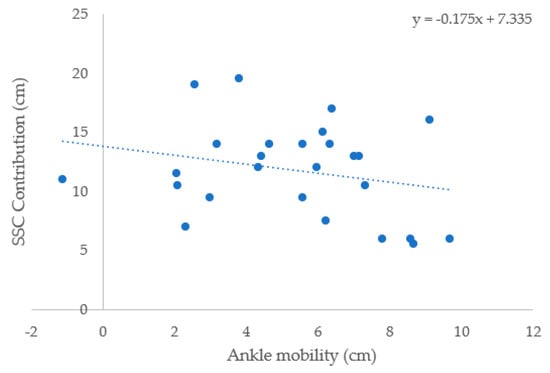
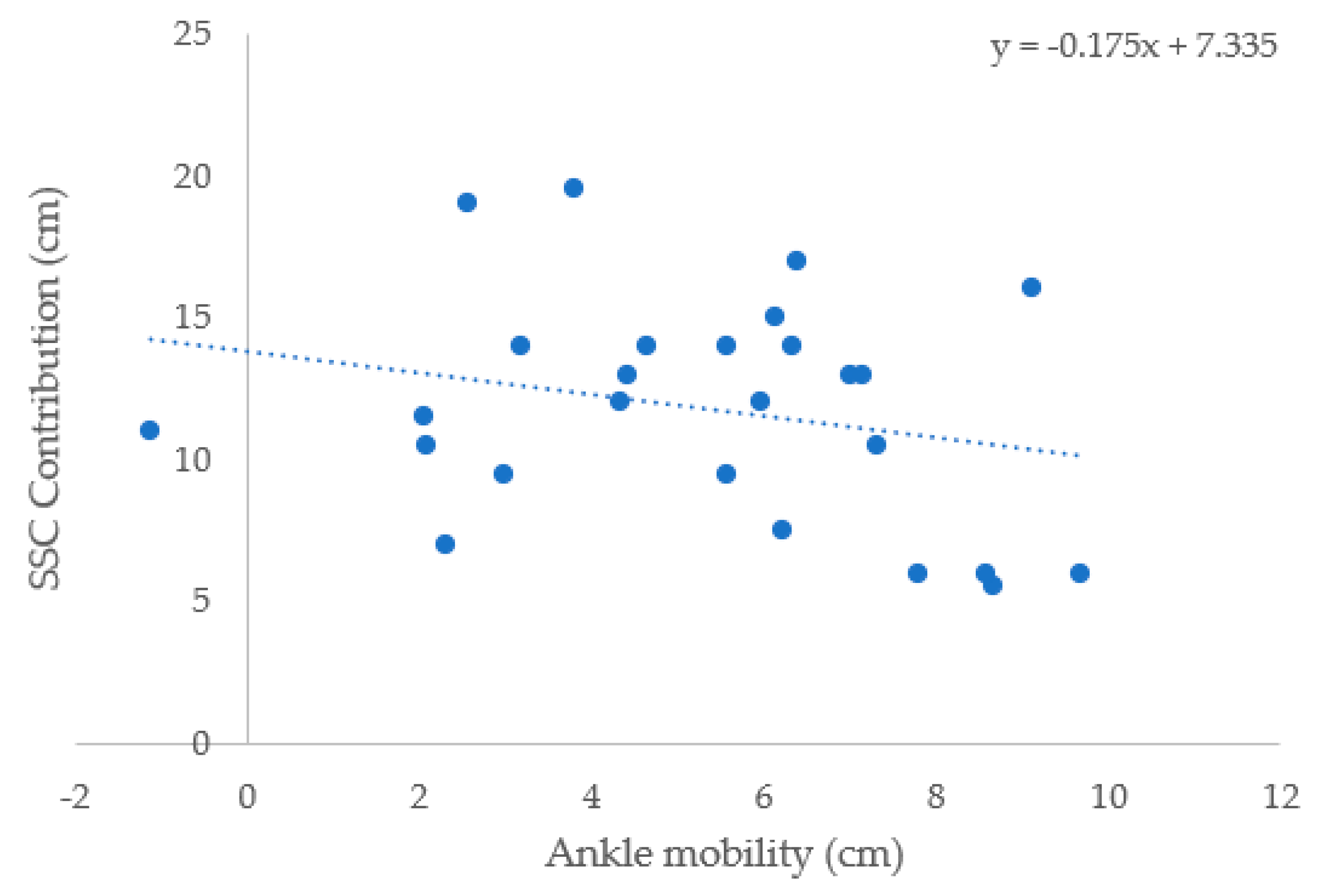
Figure 1 shows the relationship (in centimeters) between ankle dorsiflexion and SSC contribution during vertical jump. A Pearson correlation was conducted to determine the relationship between ankle dorsiflexion and SSC contribution. The correlation was not statistically significant (r = −0.262, p = 0.186), indicating no meaningful linear association between ankle mobility and SSC contribution.
Figure 1.
Correlation between ankle mobility (cm) and SSC contribution (cm).
A simple linear regression was conducted to examine whether ankle mobility could predict elastic contribution (SSC). The result predicts F (1, 25) = 1.85, p = 0.186. The model explained about 6.9 percent of the variance in elastic contribution, R2 = 0.069, adjusted R2 = 0.031. Coefficient analysis saw the following results: B = −0.175, SE = 0.129, β = −0.262, t = −1.36, p = 0.186 (Table 4). In the regression output, B represents the unstandardized coefficient indicating the change in SSC contribution for each unit increase in ankle mobility, while SE B is its standard error. The β value is the standardized coefficient, allowing for comparison independent of units. The t and p values refer to the statistical significance of each predictor. The overall model fit is described by the correlation coefficient (R), the explained variance (R2), and its adjusted value, which accounts for sample size. The F-statistic evaluates the significance of the overall regression model, and the standard error of the estimate reflects the average distance between observed and predicted values.
Table 4.
Linear regression coefficients for predicting SSC contribution (cm) from ankle mobility (cm).
Finally, Table 5 shows the results of the comparison between low and high mobility subjects, presenting mean, standard deviation and significance values.
Table 5.
Comparison between low and high mobility groups.
4. Discussion
The aim of this study was to examine the potential relationship between ankle joint mobility and the utilization of the stretch-shortening cycle (SSC), a key component in enhancing performance during explosive movements such as vertical jumps. While the underlying hypothesis posited that greater ankle dorsiflexion might influence the elastic contribution of the muscle–tendon unit, the results did not confirm this assumption statistically. The correlation analysis between ankle mobility and SSC contribution revealed no significant linear relationship (r = −0.262, p = 0.186). However, a negative, albeit non-significant, trend was observed. The linear regression analysis confirmed this directionality (B = −0.175), although it explained only 6.9% of the variance (R2 = 0.069). This trend may be explained by increased tendon compliance in individuals with higher ankle mobility, which could result in greater energy dissipation and reduced elastic efficiency.
This interpretation aligns with previous findings suggesting that stiffer tendons are more efficient in transmitting forces and facilitating rapid movements [28,29]. This contrasts with findings in highly trained populations, where increased stiffness has been shown to enhance mechanical efficiency and force transmission during explosive tasks [30]. In such cases, incorporating isometric and eccentric training may help to reinforce tendon stiffness, potentially mitigating excessive joint mobility and optimizing elastic energy use. Indeed, other studies reported that tendon stiffness is a determinant factor in jump and sprint performance, as it enables faster force transfer and reduces energy loss [31,32].
Further analysis through a t-test comparison between low and high mobility groups (threshold set at 13 cm) showed a significant difference in dorsiflexion values (p < 0.001), validating the group division. However, no significant differences emerged for CMJ (p = 0.167), SJ (p = 0.308), or SSC contribution (p = 0.649 in cm, p = 0.690 in percent). This result supports the view that joint mobility, although relevant for general movement efficiency and injury prevention, does not independently explain performance in ballistic tasks. These results further support that mobility alone is insufficient for predicting SSC performance and that strength, coordination, and tendon behavior must also be considered [33]. This aspect is important because it demonstrates the importance of multifactor training. Training only muscular strength and mobility is not enough, but it is necessary to include combining plyometric workouts with these in order to train the main contraction regime in which elastic strength finds its maximum expression [34]. Isometric, eccentric, and plyometric training should be integrated into conditioning programs, as these modalities specifically target the neuromuscular and tendon adaptations that underlie efficient SSC use [35]. Notably, some individual cases in the data set demonstrated atypical responses. For example, one subject (ID 8) exhibited a negative SSC contribution (−1.13 cm), where SJ performance exceeded CMJ. While unusual, such findings have been reported in the literature and are often attributed to fatigue, motor control anomalies, or measurement variability. Additionally, several participants with low ankle mobility (for example, Subjects 9, 14, 19, 21, 25, 26) exhibited high SSC contributions above 40 percent, reinforcing the idea that factors beyond passive dorsiflexion range, such as explosive strength or neuromuscular timing, may better account for elastic performance. In conclusion, while ankle joint mobility contributes to the functional capacity of the lower limb, it does not appear to significantly influence SSC utilization in the context of vertical jumping. A more comprehensive understanding of performance-related adaptations should consider the interplay between mobility, strength, and tendon mechanics.
4.1. Study Limitations
This study has some limitations. First, the sample size was relatively small, which may have limited the statistical power of the findings. Second, while all participants were trained individuals, there was notable variability in ankle mobility and jumping performance, which may have introduced additional noise into the analyses. Third, only static measurements of ankle dorsiflexion were assessed, which may not fully reflect functional mobility during dynamic tasks such as jumping. While both male and female participants were included, sex-specific analyses were not conducted due to the small number of female participants (n = 8). Conducting subgroup analyses with such an imbalanced sample could have led to underpowered comparisons and an increased risk of Type II errors. For this reason, data from all participants were analyzed collectively. Future research should aim to recruit more balanced samples to explore potential sex differences in stretch-shortening cycle (SSC) behavior, as biomechanical factors may differ between sexes. Notably, some individual cases demonstrated atypical responses. For example, one participant exhibited a negative SSC contribution, where squat jump performance exceeded countermovement jump, a finding reported in the literature and often attributed to fatigue, motor control issues, or measurement variability. Additionally, several participants with low ankle mobility exhibited high SSC contributions above 40%, suggesting that other factors such as neuromuscular coordination, tendon stiffness, or explosive strength may play a more dominant role in elastic performance than passive joint range alone.
4.2. Practical Implications and Future Directions
The findings suggest that ankle joint mobility does not appear to be a primary determinant of SSC performance during vertical jumping in trained individuals. While mobility remains important for general movement and injury prevention, other factors such as tendon stiffness, neuromuscular coordination, and muscle strength may play a more central role in elastic performance [36,37,38]. Future research should consider broader and more heterogeneous populations, including untrained individuals or those with mobility limitations. Incorporating methods such as ultrasound imaging, elastography, or electromyography may offer deeper insights into tendon properties and muscle activation patterns during SSC actions. Longitudinal studies examining the effects of targeted mobility or eccentric training on SSC function would also be valuable.
5. Conclusions
The present study aimed to examine whether tibiotarsal joint excursion, as measured through ankle dorsiflexion range of motion, influences the utilization of the Stretch-Shortening Cycle (SSC) during vertical jump performance. The results indicated no statistically significant association between ankle mobility and SSC contribution, as assessed by the difference in jump height between the countermovement jump (CMJ) and squat jump (SJ). Comparisons between participants with high and low ankle mobility also showed no meaningful differences in performance outcomes. These findings suggest that, within a trained population, passive ankle dorsiflexion range of motion alone does not explain variability in SSC effectiveness during vertical jumping tasks. Further research involving dynamic assessments and broader populations is needed to better understand the factors that influence SSC performance.
Author Contributions
Conceptualization, G.R. and F.M.; methodology, G.E.; software, G.G.; validation, V.M., G.D.L. and G.E.; formal analysis, F.M.; investigation, G.G.; resources, G.D.L.; data curation, G.G.; writing—original draft preparation, G.D.L.; writing—review and editing, G.G.; visualization, G.R.; supervision, F.M. All authors have read and agreed to the published version of the manuscript.
Funding
This research received no external funding.
Institutional Review Board Statement
The present study is part of the research project entitled “Psychophysical perception and body awareness in school and sports contexts through observational and non-invasive tools”, approved by the Ethics Committee of Pegaso University (PROT/E003479 dated 25 May 2025). All participants provided written informed consent prior to participation.
Informed Consent Statement
Informed consent was obtained from all subjects involved in the study.
Data Availability Statement
The data presented in this study are available on request from the corresponding author.
Conflicts of Interest
The authors declare no conflicts of interest.
Abbreviations
The following abbreviations are used in this manuscript:
| CMJ | Countermovement Jump |
| SJ | Squat Jump |
| SSC | Stretch Shortening Cycle |
References
- Elam, C.; Aagaard, P.; Slinde, F.; Svantesson, U.; Hulthén, L.; Magnusson, P.S.; Bunketorp-Käll, L. The effects of ageing on functional capacity and stretch-shortening cycle muscle power. J. Phys. Ther. Sci. 2021, 33, 250–260. [Google Scholar] [CrossRef] [Scilit]
- Groeber, M.; Stafilidis, S.; Baca, A. The effect of stretch–shortening magnitude and muscle–tendon unit length on performance enhancement in a stretch–shortening cycle. Sci. Rep. 2021, 11, 14605. [Google Scholar] [CrossRef] [Scilit] [PubMed]
- Turner, A.N.; Jeffreys, I. The stretch-shortening cycle: Proposed mechanisms and methods for enhancement. Strength Cond. J. 2010, 32, 87–99. [Google Scholar] [CrossRef] [Scilit]
- Daneshjoo, A.; Hosseini, E.; Heshmati, S.; Sahebozamani, M.; Behm, D.G. Effects of slow dynamic, fast dynamic, and static stretching on recovery of performance, range of motion, balance, and joint position sense in healthy adults. BMC Sports Sci. Med. Rehabil. 2024, 16, 167. [Google Scholar] [CrossRef] [Scilit] [PubMed]
- McDermott, E.J.; Balshaw, T.G.; Brooke-Wavell, K.; Maden-Wilkinson, T.M.; Folland, J.P. The effect of a prior eccentric lowering phase on concentric neuromechanics during multiple joint resistance exercise in older adults. Scand. J. Med. Sci. Sports 2023, 33, 2009–2024. [Google Scholar] [CrossRef] [Scilit]
- Alipasali, F.; Papadopoulou, S.D.; Komsis, S. The effect of static and dynamic stretching exercises on lower limbs concentric strength of amateur male volleyball players. J. Phys. Educ. Sport 2024, 24, 1016–1023. [Google Scholar]
- Vervloet, G.; Fregosi, L.; Gauthier, A.; Grenot, P.; Balestra, C. Impact of Five Weeks of Strengthening Under Blood Flow Restriction (BFR) or Supplemental Oxygen Breathing (Normobaric Hyperoxia) on the Medial Gastrocnemius. J. Funct. Morphol. Kinesiol. 2024, 9, 258. [Google Scholar] [CrossRef] [Scilit]
- Kasicki, K.; Rydzik, Ł.; Ambroży, T.; Spieszny, M.; Koteja, P. The Impact of Post-Activation Performance Enhancement Protocols on Vertical Jumps: Systematic Review. Appl. Sci. 2024, 14, 9664. [Google Scholar] [CrossRef] [Scilit]
- Barreto, M.V.C.; Telles, J.F.S.; de Castro, M.R.; Mendes, T.T.; Rodrigues, C.P.; de Freitas, V.H. Temporal Response of Post-Activation Performance Enhancement Induced by a Plyometric Conditioning Activity. Front. Sports Act. Living 2023, 5, 1209960. [Google Scholar] [CrossRef] [Scilit]
- Maroto-Izquierdo, S.; Bautista, I.J.; Rivera, F.M. Post-Activation Performance Enhancement (PAPE) after a Single Bout of High-Intensity Flywheel Resistance Training. Biol. Sport 2020, 37, 343–350. [Google Scholar] [CrossRef] [Scilit]
- Tecchio, P.; Raiteri, B.J.; Hahn, D. Eccentric exercise ≠ eccentric contraction. J. Appl. Physiol. 2024, 136, 954–965. [Google Scholar] [CrossRef] [Scilit] [PubMed]
- Kubo, K.; Kawakami, Y.; Fukunaga, T. Influence of elastic properties of tendon structures on jump performance in humans. J. Appl. Physiol. 1999, 87, 2090–2096. [Google Scholar] [CrossRef] [Scilit] [PubMed]
- Hunter, G.R.; McCarthy, J.P.; Carter, S.J.; Bamman, M.M.; Gaddy, E.S.; Fisher, G.; Newcomer, B.R. Muscle fiber type, Achilles tendon length, potentiation, and running economy. J. Strength Cond. Res. 2015, 29, 1302–1309. [Google Scholar] [CrossRef] [Scilit] [PubMed]
- Obst, S.J.; Barrett, R.S.; Newsham-West, R. Immediate effect of exercise on Achilles tendon properties: Systematic review. Med. Sci. Sports Exerc. 2013, 45, 1534–1544. [Google Scholar] [CrossRef] [Scilit]
- Roberts, T.J.; Azizi, E. Flexible mechanisms: The diverse roles of biological springs in vertebrate movement. J. Exp. Biol. 2011, 214, 353–361. [Google Scholar] [CrossRef] [Scilit]
- Kuriyama, K.; Takeshita, D. Leg stiffness adjustment during hopping by dynamic interaction between the muscle and tendon of the medial gastrocnemius. J. Appl. Physiol. 2025, 138, 899–908. [Google Scholar] [CrossRef] [Scilit]
- Waugh, C.M.; Blazevich, A.J.; Fath, F.; Korff, T. Age-related changes in mechanical properties of the Achilles tendon. J. Anat. 2012, 220, 144–155. [Google Scholar] [CrossRef] [Scilit]
- De Palma, L.; Santucci, A.; Ventura, A.; Marinelli, M. Anatomy and embryology of the talocalcaneal joint. Foot Ankle Surg. 2003, 9, 7–18. [Google Scholar] [CrossRef] [Scilit]
- Adam, N.C.; Smith, C.R.; Herzog, W.; Amis, A.A.; Arampatzis, A.; Taylor, W.R. In vivo strain patterns in the Achilles tendon during dynamic activities: A comprehensive survey of the literature. Sports Med. Open 2023, 9, 60. [Google Scholar] [CrossRef] [Scilit]
- Mizuno, T. Changes in joint range of motion and muscle–tendon unit stiffness after varying amounts of dynamic stretching. J. Sports Sci. 2017, 35, 2157–2163. [Google Scholar] [CrossRef] [Scilit]
- Yu, P.; Cen, X.; Mei, Q.; Wang, A.; Gu, Y.; Fernandez, J. Differences in intra-foot movement strategies during locomotive tasks among chronic ankle instability, copers and healthy individuals. J. Biomech. 2024, 162, 111865. [Google Scholar] [CrossRef] [Scilit] [PubMed]
- Zhang, Q.; Li, F.; Trowell, D.A.; Hou, M.; Qiu, Z.; Chen, S.; Ma, H. Optimizing stretch-shortening cycle performance: Effects of drop height and landing strategy on lower-limb biomechanics in drop jumps. PeerJ 2025, 13, e19490. [Google Scholar] [CrossRef] [Scilit] [PubMed]
- World Medical Association. World Medical Association Declaration of Helsinki: Ethical principles for medical research involving human participants. JAMA 2025, 333, 71–74. [Google Scholar] [CrossRef] [Scilit] [PubMed]
- Morales, C.R.; Lobo, C.C.; Sanz, D.R.; Corbalán, I.S.; Ruiz, B.R.; López, D.L. The concurrent validity and reliability of the Leg Motion system for measuring ankle dorsiflexion range of motion in older adults. PeerJ 2017, 5, e2820. [Google Scholar] [CrossRef] [Scilit]
- Gillen, Z.M.; Shoemaker, M.E.; McKay, B.D.; Bohannon, N.A.; Gibson, S.M.; Cramer, J.T. Influences of the stretch-shortening cycle and arm swing on vertical jump performance in children and adolescents. J. Strength Cond. Res. 2022, 36, 1245–1256. [Google Scholar] [CrossRef] [Scilit]
- Kozinc, Ž.; Žitnik, J.; Smajla, D.; Šarabon, N. The difference between squat jump and countermovement jump in 770 male and female participants from different sports. Eur. J. Sport Sci. 2022, 22, 985–993. [Google Scholar] [CrossRef] [Scilit]
- Markovic, G.; Dizdar, D.; Jukic, I.; Cardinale, M. Reliability and factorial validity of squat and countermovement jump tests. J. Strength Cond. Res. 2004, 18, 551–555. [Google Scholar]
- Blazevich, A.J.; Fletcher, J.R. More than energy cost: Multiple benefits of the long Achilles tendon in human walking and running. Biol. Rev. 2023, 98, 2210–2225. [Google Scholar] [CrossRef] [Scilit]
- Massey, G.J.; Balshaw, T.G.; Maden-Wilkinson, T.M.; Tillin, N.A.; Folland, J.P. Tendinous tissue adaptation to explosive-vs. sustained-contraction strength training. Front. Physiol. 2018, 9, 1170. [Google Scholar] [CrossRef] [Scilit]
- Brazier, J.; Maloney, S.; Bishop, C.; Read, P.J.; Turner, A.N. Lower extremity stiffness: Considerations for testing, performance enhancement, and injury risk. J. Strength Cond. Res. 2019, 33, 1156–1166. [Google Scholar] [CrossRef] [Scilit]
- Kubo, K.; Ikebukuro, T.; Yata, H. Mechanical properties of muscles and tendon structures in middle-aged and young men. Sci. Rep. 2022, 12, 1702. [Google Scholar] [CrossRef] [Scilit]
- Arampatzis, A.; Mersmann, F.; Bohm, S. Individualized muscle-tendon assessment and training. Front. Physiol. 2020, 11, 723. [Google Scholar] [CrossRef] [Scilit]
- Spurrs, R.W.; Murphy, A.J.; Watsford, M.L. The effect of plyometric training on distance running performance. Eur. J. Appl. Physiol. 2003, 89, 1–7. [Google Scholar] [CrossRef] [Scilit] [PubMed]
- Silva, A.F.; Clemente, F.M.; Lima, R.; Nikolaidis, P.T.; Rosemann, T.; Knechtle, B. The Effect of Plyometric Training in Volleyball Players: A Systematic Review. Int. J. Environ. Res. Public Health 2019, 16, 2960. [Google Scholar] [CrossRef] [Scilit] [PubMed]
- Kubo, K.; Ikebukuro, T. Changes in joint, muscle, and tendon stiffness following repeated hopping exercise. Physiol. Rep. 2019, 7, e14237. [Google Scholar] [CrossRef] [Scilit] [PubMed]
- Giardullo, G.; Di Lascio, G.; Ceruso, R.; Manzi, V.; Raiola, G. Relationship Between Ankle Mobility, Elastic Strength, and Rate of Force Development in the Two Karate Disciplines: Kata and Kumite. Sci 2025, 7, 151. [Google Scholar] [CrossRef] [Scilit]
- Raiola, G.; Esposito, G.; Aliberti, S.; D’Elia, F. Effects on Performance, Perception, and Awareness of Plyometric Training in Youth Volleyball: A Novel Methodological Approach to Training. Appl. Sci. 2025, 15, 1581. [Google Scholar] [CrossRef] [Scilit]
- D’Isanto, T.; Esposito, G.; Ceruso, R.; D’Elia, F.; Raiola, G. The role of the sports kinesiologist to prevent grade II ankle sprains in volleyball. Eur. J. Hum. Mov. 2024, 53, 101–113. [Google Scholar] [CrossRef] [Scilit]

Disclaimer/Publisher’s Note: The statements, opinions and data contained in all publications are solely those of the individual author(s) and contributor(s) and not of MDPI and/or the editor(s). MDPI and/or the editor(s) disclaim responsibility for any injury to people or property resulting from any ideas, methods, instructions or products referred to in the content. |
© 2026 by the authors. Licensee MDPI, Basel, Switzerland. This article is an open access article distributed under the terms and conditions of the Creative Commons Attribution (CC BY) license.