


Abstract
Disruption management is critical for airline operations, yet existing recovery models often assume deterministic disruption durations, limiting their effectiveness in real-world, uncertain environments. This paper addresses the integrated airline recovery problem under uncertain disruptions. To capture this uncertainty, delay times are modeled as fuzzy variables and a fuzzy chance-constrained programming model is developed, aimed at minimizing total recovery costs. The model is transformed into a deterministic equivalent using trapezoidal fuzzy numbers. An improved Greedy Randomized Adaptive Search Procedure (GRASP) algorithm is designed to efficiently solve the problem, balancing solution quality and computational efficiency through insert, exchange, and cancel. The local search process is enhanced by incorporating the acceptance criteria of the simulated annealing algorithm. The proposed method is validated using real-world airline data. Results show that, compared to the traditional GRASP algorithm, the improved GRASP algorithm can obtain better solutions in a shorter time; the solutions in deterministic scenarios tends to be more conservative, leading to resource waste; the proposed method can achieve airline recovery at the minimum recovery cost. Sensitivity analysis reveals that selecting an appropriate confidence level significantly influences recovery costs. This paper provides a robust framework for enhancing operational resilience and passenger satisfaction under uncertain conditions, offering practical insights for real-world application.
1. Introduction
Air transportation, renowned for its efficiency and speed, has emerged as the preferred mode of travel, especially for long-distance journeys. In 2019, global passenger traffic reached 4.5 billion, marking a 4.7% increase from the previous year [1]. Although the COVID-19 pandemic severely impacted the aviation industry, recent studies suggest a steady recovery, with traffic levels gradually returning to pre-pandemic figures after significant fluctuations [2]. The Federal Aviation Administration forecasts a 2.5% annual growth in air passenger traffic over the next two decades [3], indicating sustained growth and opportunities for the industry.
Nevertheless, air transport is highly vulnerable to uncertainties compared to other modes. Factors such as adverse weather, air traffic control restrictions, mechanical issues, pandemics, and crew unavailability can lead to significant disruptions. These disruptions not only affect individual flights but also propagate through the interconnected flight network, causing cascading delays [4]. According to the US Bureau of Transportation Statistics, over the past decade, an average of 20.52% of flights experienced delays exceeding 15 min, while 2.09% were canceled due to various uncertainties [5]. Prolonged delays and cancellations often result in passenger dissatisfaction, which can harm airlines’ reputations and lead to long-term customer loss [6,7]. Consequently, developing reactive strategies to mitigate disruptions and ensure operational efficiency remains a critical challenge for airlines and airport operators.
Reactive strategies, or post-disruption recovery strategies, play a vital role in addressing disruptions [8]. In response to these disruptions, airline operations control centers provide real-time information to air traffic controllers about the airline’s operational network, facilitating decisions on resource reallocation and flight schedule adjustments to restore disrupted schedules and resume normal operations. This paper focuses on reactive strategies, specifically airline recovery strategies, examining how effective responses can mitigate flight disruptions, enhance the resilience of the air transportation system, and meet growing demand while improving service quality.
The research on flight recovery has undergone decades of development and has formed a relatively complete theoretical system. Early research mainly focused on the aircraft recovery problem. Teodorović and Guberinić [9] were pioneers in this field, laying the corresponding theoretical foundation. As the problem became more complex, research gradually expanded to cover various disruption scenarios (such as multiple aircraft failures, airport closures) and richer recovery strategies. Aktürk et al. [10] first introduced cruise speed control as a recovery strategy; Liu et al. [11] explored the use of high-speed rail for multimodal transportation to alleviate airport congestion; Liang et al. [12] proposed a flexible aircraft maintenance strategy that considers airport capacity. In terms of modeling methods, network models represented by time-space network, time-band network, and connection network have become mainstream frameworks. Corresponding solving algorithms have also diversified, including commercial solvers [13,14,15,16,17], exact algorithms [18,19,20,21], various heuristic algorithms [22,23,24,25,26,27], and emerging machine learning techniques [28,29,30].
In practice, optimizing aircraft resources alone is often insufficient. Flight adjustments directly affect passengers, and recovery plans that neglect passenger experience are difficult to implement in practice. Therefore, the integrated recovery of aircraft and passengers has become a more realistic research focus, with the core lying in balancing airline recovery costs and passenger utility losses. In this study, most research focuses on the integrated recovery problem under multiple disruption scenarios, including aircraft-on-ground, flight delays, flight cancellations, and reduced airport capacity. For these scenarios, scholars mainly consider traditional recovery strategies, such as delaying flights, canceling flights, and aircraft swap. In terms of modeling, the main methods include time-space network, time-band network, and connection network, with the goal of minimizing flight delay costs, flight cancellation costs, and passenger-related recovery costs. In terms of solving methods, scholars adopt exact methods for solving [31,32,33,34,35,36,37]. As the number of considerations increases and the scale of the problem expands, exact methods often struggle to obtain optimal solutions within a given time frame. Therefore, scholars are increasingly turning to designing heuristic algorithms to obtain high-quality solutions [38,39,40,41]. In addition, Lee et al. [42] opened up a new direction for research in this field by considering the impact of climate change on airport operations.
In previous studies on airline recovery problems, the primary focus has been on modeling and solution methods, with limited attention given to the nature of disruption scenarios. Most studies assume fixed disruption durations or operate within static environments. However, the uncertainty of disruption duration is a critical factor that cannot be overlooked in real-world airline recovery. For instance, the time required to repair an aircraft malfunction may be influenced by multiple variables, including the complexity of the problem, the availability of spare parts, and the experience level of maintenance personnel. Typically, maintenance teams provide estimated repair times based on experience, but these estimates may significantly deviate from actual outcomes. Such deviations often render recovery plans based on these estimates ineffective or even impractical in real operations, leading to increased operational costs for airlines and negatively impacting passenger experience. Recent studies have begun to address uncertainty using stochastic programming approaches, which require precise probability distributions derived from historical data. However, in real-world operations, disruption durations (e.g., aircraft repair times) are often influenced by numerous unpredictable factors, making accurate probability distributions difficult or even impossible to obtain. This is particularly true for rare events such as major mechanical failures or extreme weather conditions, where historical data are scarce. To address this practical challenge, this paper investigates the integrated airline recovery problem under uncertain disruption durations to develop highly robust recovery plans, thereby improving the accuracy and applicability of recovery strategies in actual operations. The main contributions of this paper are outlined as follows. (1) A fuzzy chance-constrained programming approach is designed to model the uncertainty of disruption durations. Unlike stochastic programming, fuzzy programming does not require precise probabilistic information; instead, it captures uncertainty through membership functions based on expert knowledge and linguistic descriptions (e.g., approximately 2 to 6 h). This makes the proposed method particularly suitable for real-world applications where data are imprecise or incomplete. (2) An improved Greedy Randomized Adaptive Search Procedure (GRASP) algorithm is designed to efficiently solve the model. Building on the traditional GRASP algorithm, the proposed algorithm enhances the solution process by generating feasible solution neighborhoods through insert, exchange, and cancel. The local search phase is further improved by incorporating the acceptance criteria of the simulated annealing algorithm, ultimately achieving a balance between solution quality and computational efficiency.
2. Problem Description and Model Formulation
2.1. Problem Description
This paper investigates the integrated airline recovery problem under uncertain disruption durations. Most previous studies have been based on scenarios with fixed disruption durations, which have certain limitations in real-world operations. These fixed-duration models are less applicable in complex operating environments with high scheduling demands in air transportation. Therefore, it is necessary to consider disruption duration uncertainty as an important factor and include it in the scope of the study, in order to derive corresponding recovery plans that minimize the airline recovery costs and passenger utility losses. Based on existing deterministic airline recovery studies, this paper introduces the uncertainty of disruption duration and combines traditional recovery strategies to develop more accurate recovery plans, aiming to better address the airline recovery problem. In the following sections, the problem will be elaborated from two aspects: uncertain disruptions, and airline recovery strategies and passenger accommodation.
2.1.1. Uncertain Disruptions
The uncertainty of disruption duration is a critical characteristic in the operation of air transportation systems, with profound implications for the effectiveness and feasibility of airline recovery decisions. Disruption duration primarily refers to the time required for a flight to recover and resume normal operations after being disrupted by external factors. However, due to the complexity and uncertainty of the air transportation system, disruption duration is often difficult to predict precisely. It exhibits randomness, fuzziness, and dynamism, among other characteristics. The uncertainty of disruption duration mainly arises from factors such as the diversity of disruption types, incomplete information acquisition, dynamic changes in external factors, and the propagation effects of disruptions. Traditional airline recovery methods are generally based on static scenario assumptions, where disruption duration is considered a known fixed value. However, in real-world operations, the uncertainty of disruption duration means that static recovery plans may overestimate or underestimate the actual recovery time, resulting in poor implementation outcomes. Therefore, recovery plans need to be more robust, capable of maintaining good performance across different disruption scenarios. In summary, the uncertainty of disruption duration is one of the key challenges in the integrated airline recovery problem. Understanding this characteristic and its impacts is crucial for designing scientifically sound recovery strategies. To address disruption uncertainty, this paper represents the delay duration caused by disruptions as a fuzzy variable (e.g., a trapezoidal fuzzy number) and solves it using a fuzzy chance-constrained programming approach. This approach effectively handles situations where data is incomplete or information is imprecise, offering strong practical applicability.
2.1.2. Airline Recovery Strategies and Passenger Accommodation
After a disruption occurs, airlines typically need to quickly formulate and implement recovery strategies to minimize the negative impact of flight disruptions on operational efficiency and passenger satisfaction. The effectiveness of these recovery strategies is directly related to the overall operational stability and market competitiveness of the airline. To better adapt to complex and uncertain disruption scenarios, this paper simplifies and summarizes airline recovery strategies and passenger accommodation, forming a practical analytical framework with operational significance.
First, in terms of airline recovery strategies, this paper considers three traditional recovery strategies-delaying flights, canceling flights, and aircraft swap-to reschedule flights. Among them, since the delay time is uncertain, the associated costs are also uncertain, and thus, they need to be treated as fuzzy variables for further exploration. In the aircraft swap strategy, the possibility of using smaller aircraft to replace larger ones for flight operations is also considered. Whether this strategy is implemented depends on the capacity of the smaller aircraft and the number of passengers on the flight.
Next, passenger accommodation is an essential aspect of the airline recovery problem that cannot be overlooked. The goal is to minimize the negative impact on passenger rights and travel experience while achieving the airline’s operational objectives. Based on whether passengers are successfully accommodated or not, they can be mainly divided into two types: passengers whose itineraries are successfully accommodated (accommodated passengers) and passengers whose itineraries are not accommodated (non-accommodated passengers). Accommodated passengers refer to those whose flights are rescheduled or rebooked by the airline, allowing them to complete their itinerary as originally planned or with reasonable adjustments. This includes passengers who continue waiting for the original flight and board successfully (delayed passengers), as well as those who are rebooked on another flight (rebooked passengers). These passengers mainly experience psychological loss due to flight delays of uncertain durations. For convenience in the paper, passenger delay costs are incorporated into the flight delay costs and treated as fuzzy variables in the model. Non-accommodated passengers refer to those who ultimately do not board the flight to complete their itineraries, which can include voluntarily refunding passengers and those who are forced to refund due to failed boarding attempts (denied passengers).
In summary, airline recovery strategies and passenger accommodation are core components of the study on airline recovery. This section, by combining the aforementioned recovery strategies and passenger accommodation plan, further analyzes the impact of disruption duration uncertainty on the airline recovery problem, thereby laying the foundation for the construction of the fuzzy chance-constrained programming model in the next section.
2.2. Assumptions
Before constructing the mathematical model, in order to facilitate research and obtain reasonable results, the following assumptions have been made.
- (1)
- This paper mainly considers passengers with at most one connection.
- (2)
- The costs related to the crew are not considered, and it is assumed that the crew can meet the airline’s scheduling requirements.
- (3)
- The fuel and maintenance costs of the aircraft are not calculated separately.
- (4)
- All flights cannot depart advance.
2.3. Model Formulation
The definitions of the notations involved in the model are shown in Table 1.
Table 1.
Notations.
This paper constructs a model for the integrated airline recovery problem in scenarios with uncertain disruption durations, aiming to minimize the total recovery costs. To simplify the problem, this paper combines the airline costs with the passenger costs. For the airline, the primary costs are the flight delay costs and cancellation costs. For passengers, some of the recovery costs are combined with flight-related costs, while passengers who fail to complete their itineraries are considered as a separate item. The following sections will describe the modeling process in detail.
2.3.1. Objective
The objective function of this paper is to minimize the total recovery costs, which includes two components: airline-related costs and the passenger-related costs, as shown in Equation (1).
where the airline-related costs can be expressed by Equation (2).
Since the disruption duration is uncertain and the delay time is treated as a fuzzy variable, the delay costs in Equation (2) is expanded as shown in Equation (3).
Since the delay cost of passengers who successfully board has already been incorporated into , the primary focus in passenger recovery costs is the cost associated with unassigned passengers, as represented in Equation (4).
Specifically, when , can be considered as passengers who continue waiting for the original flights and ultimately board successfully.
In summary, the objective function of the proposed model can be expressed as shown in Equation (5).
2.3.2. Constraints
In terms of constraints of the model, they can be categorized into four types: flight-related constraints, time constraints, passenger constraints, and variable constraints.
- (1)
- Flight-related constraints
First, it is necessary to ensure that any given flight can be operated by at most one aircraft, guaranteeing its uniqueness. It can be presented by Equation (6).
Second, a flight can only be in one of two states: either it is operated by an aircraft or it is canceled, as detailed in Equation (7).
- (2)
- Time constraints
According to the assumptions, to ensure that no flight departs earlier than scheduled, this condition can be represented by Equation (8).
Next, if the aircraft cruising speed control strategy is not implemented, the flight time of each flight remains consistent. Specifically, the actual arrival time of a flight equals its actual departure time plus its flight time, as shown in Equation (9).
When an aircraft operates two consecutive flight tasks, it is necessary to ensure that the turnaround time constraint at the airport is satisfied, as shown in Equation (10).
- (3)
- Passenger constraints
When passengers are confirmed to be assigned to an alternative itinerary, it is necessary to ensure that the seating capacity of the aircraft operating this itinerary meets their demand, as shown in Equation (11).
In addition, Equation (12) ensures that the number of passengers reallocated from a given itinerary does not exceed the planned passenger demand for that itinerary.
During passenger itinerary assignment, if an itinerary is not disrupted, it means that all passengers scheduled for that itinerary can successfully board and complete their journey. This ensures that passengers on this itinerary cannot refund or rebook their tickets for other flights, as formally expressed in Equation (13).
If an alternative itinerary is disrupted, meaning it becomes unavailable, no passengers can be assigned to this itinerary. This condition is formally expressed in Equation (14).
- (4)
- Variable constraints
In the variable constraints, regarding the feasibility of passenger itineraries, it is ensured that passengers can only be assigned to flights that have not been canceled. Additionally, the likelihood of passenger itinerary disruptions must be lower than the probability of operation for all flight tasks, as formally expressed in Equation (15).
Furthermore, Equations (16)–(20) ensure the value constraints of the relevant variables, where , , , and are binary variables, and , representing the number of passengers assigned to an itinerary, is an integer variable.
3. Model Defuzzification Based on Fuzzy Programming
Marla et al. [43] applied different methods for handling uncertainty to solve the aircraft routing problem and, through comparison, demonstrated that these methods can mitigate delay propagation and improve airline punctuality rates. Their work emphasizes the importance of selecting methods based on the nature of uncertainty, available data, and evaluation metrics. Building on their findings, this paper employs fuzzy chance-constrained programming to clarify the model. It is worth emphasizing that compared to stochastic programming approaches that require precise probability distributions, the fuzzy programming method inherently exhibits better tolerance to parameter estimation errors. It allows decision-makers to describe uncertainties using linguistic terms (e.g., approximately 2 to 6 h), which better aligns with the imprecise and incomplete information characteristics of real-world operations.
3.1. Fuzzy Variable and Membership Function
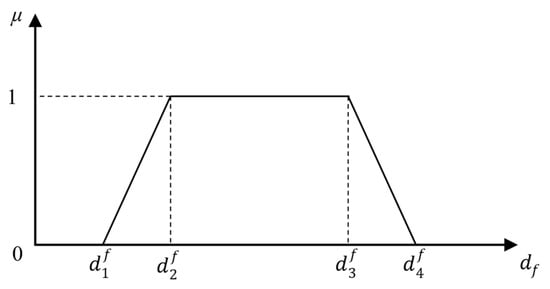
Based on the theory of fuzzy chance-constrained programming, the uncertain delay times addressed in this paper are represented using trapezoidal fuzzy numbers. The choice of trapezoidal fuzzy numbers is motivated by two key considerations. First, they offer rich information representation: Using four parameters, they capture not only the minimum and maximum possible delays but also the most likely delay interval, which aligns well with expert judgments in practice (e.g., the repair will take between 2 and 6 h, with a minimum of 1 h and a maximum of 10 h). Second, they ensure computational tractability: under credibility theory, trapezoidal fuzzy numbers lead to linear deterministic equivalents, enabling efficient solution using mixed-integer programming and heuristic algorithms. For a trapezoidal fuzzy number , it represents any possible delay time for flight and is determined by four parameters: denotes the minimum delay time, represents the interval of the most likely delay times, and denotes the maximum delay time. The membership function corresponding to the trapezoidal fuzzy number is given in Equation (21), and its graphical representation is shown in Figure 1. It should be noted that precisely determining the four parameters of trapezoidal fuzzy numbers in practical applications is indeed challenging. This difficulty arises primarily because the distribution of delay times is influenced by multiple factors, including failure types, maintenance resource availability, weather conditions, etc., and historical data are often limited or noisy. To address this challenge, the following practical suggestions are proposed. First, airlines can estimate the minimum delay time (as a reference for ) and maximum delay time (as a reference for ) based on historical maintenance records for different disruption types. Second, the most likely delay interval can be determined by combining the expertise of maintenance engineers and operations controllers, typically through methods such as the Delphi technique or expert interviews. When sufficient historical data are available, statistical approaches (e.g., percentile methods) can also be employed to estimate these parameters.
Figure 1.
The membership function of flight delay times.
3.2. Model Reformulation
Before proceeding with the model reformulation, this section introduces relevant theoretical foundations as a prerequisite.
Theorem 1
[44]. If the chance constraint function has the following form:
where is a decision variable, is a fuzzy variable, and are fuzzy parameters in the fuzzy chance-constrained programming model, i.e., , with its membership function denoted as . For the credibility chance constraint (), it is equivalent to , where can be represented by Equation (23).
Theorem 2
[44]. Let be a trapezoidal fuzzy variable, . According to credibility theory, the following expressions hold:
where is a deterministic parameter in the constraint. Fuzzy chance-constrained programming models typically aim for a higher credibility of the constraint being satisfied, i.e., the likelihood of the constraint holding. Therefore, when a given confidence level is , the following expression holds:
In addition, since the constraint involving fuzzy variables in this paper is equality constraint, Lemma 1 is utilized to reformulate these constraints.
Lemma 1.
Assume that is a trapezoidal fuzzy number, , with a membership function . Under the confidence level , if its possibility measure holds, if and only if and .
In summary, for the terms in the objective function involving uncertain delay times, they are reformulated into the form of Equation (28), and a new constraint, Equation (29), is added.
Since is a positive constant, we can divide both sides of the inequality inside the braces without affecting the credibility measure. By reformulating Equations (29) and (30) can be derived:
where can be regarded as an auxiliary variable, and represents the given confidence level. This is now a standard credibility constraint of the form , where is a trapezoidal fuzzy number and is a deterministic parameter. According to Theorem 2 and Equation (27), through further transformation, Equation (30) can be converted into its final deterministic form:
To handle the fuzzy variable appearing in Equation (9), it is first transformed into a form related to the possibility measure:
Based on Lemma 1, holds, if and only if and , Equation (33) is further transformed into its deterministic form, as shown in Equations (34) and (35).
In summary, the reformulated model in this paper is presented as follows:
4. Solution Algorithm
This section designed an Improved GRASP (IGRASP) algorithm for solving. The GRASP algorithm was initially proposed by Feo and Resende [45] as a multi-start heuristic for solving combinatorial optimization problems. Each generation of the algorithm consists of two key phases: the construction phase and the local search phase. During the construction phase, the algorithm builds a feasible solution through multiple generations, adding one element at a time. This process typically employs an adaptive randomized greedy function to construct an initial solution, providing a starting point for the local search phase. In the local search phase, the current solution is iteratively replaced with a more satisfactory solution from its neighborhood. The algorithm terminates when no better solution can be found within the neighborhood.
When aircraft are disrupted due to delays or grounding, canceling the affected flights directly can serve as the initial solution for the problem addressed in this paper. This ensures that the initial solution remains as close as possible to the original aircraft routing in the flight schedule, which aligns with the principles of the IGRASP algorithm. The rules for determining the initial solution can be defined as follows: for delayed aircraft, their originally scheduled flight tasks can be delayed sequentially while satisfying the constraints; for grounded aircraft, their originally scheduled flight tasks can be inserted into the executable task sequence of substitute aircraft based on cancellation costs. Finally, passengers from all canceled flights are reaccommodated to minimize the number of unassigned passengers. The main framework of the IGRASP algorithm is summarized in Table 2.
Table 2.
The main framework of IGRASP.
Based on the solution construction, the proposed algorithm in this paper needs to address three key issues: (1) reassigning passenger itineraries corresponding to each iterated aircraft routing, (2) defining the neighborhood of the initial feasible solution to enhance algorithm efficiency, and (3) improving the quality of feasible solutions in the second phase through an enhanced local search to avoid getting trapped in local optima. The following sections will describe the solution process of the algorithm based on these issues.
4.1. Passenger Reaccommodation
From the decision variables, it can be seen that each feasible solution consists of aircraft routing, canceled flights, and reaccommodated passenger itineraries. The aim of this section is to design an algorithm that minimizes the costs of passenger reaccommodation. The algorithm aims to sort passenger itineraries based on cancellation costs and then solve the assignment of each itinerary using a minimum-cost flow algorithm.
Let be the set of disrupted passenger itineraries. To facilitate the analysis, the itineraries are categorized based on their origin-destination (departure and arrival airports). That is, for each disrupted itinerary , its origin and destination remain the same. All itineraries are then sorted according to their cancellation costs. Within the recovery time window, feasible routes that share the same origin and destination are selected and constructed into a feasible route network, denoted as . In this network, represents the set of airport nodes, and denote the origin of itinerary , and represent its destination. Let denote the set of passenger reaccommodation states for disrupted itineraries, which can be categorized into the following types: represents the initial state of disrupted itinerary ; represents the set of flights whose actual departure time is no earlier than the scheduled departure time of itinerary ; represents the final state of disrupted itinerary . Each arc within these sets is associated with two labels: and . represents the costs incurred for reaccommodating passengers onto a new itinerary, and denotes the capacity of the new itinerary. The algorithmic process for passenger reaccommodation is presented in Table 3.
Table 3.
Framework of the passenger reaccommodation algorithm.
4.2. Neighborhood Generation
This paper proposes three neighborhood generation methods based on aircraft routing: insert, exchange, and cancel. The following sections will provide a detailed description of these three methods.
4.2.1. Insert
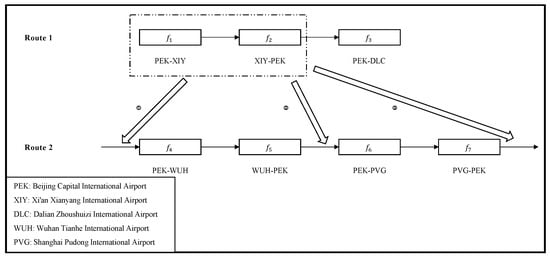
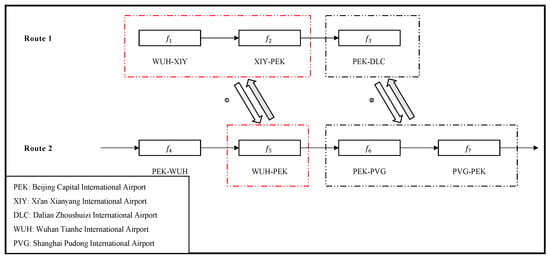
The process of the insert operation is shown in Figure 2. This operation can be divided into three types: head-insert, mid-insert, and tail-insert.
Figure 2.
Insert process.
The operation of head-insert is shown as ① in Figure 2. In two routes, if the arrival airport of flight in Route 1 (PEK) matches the departure airport of flight in Route 2 (PEK), the head-insert operation can be performed. This involves inserting the flight pair at the beginning of Route 2. As a result, Route 1 becomes , Route 2 becomes .
The operation of mid-insert is shown as ② in Figure 2. In two routes, if the departure airport of flight in Route 1 (PEK) matches the arrival airport of flight in Route 2 (PEK), the mid-insert operation can be performed. This involves inserting the flight pair into the middle of Route 2. As a result, Route 1 becomes , and Route 2 becomes .
The operation of tail-insert is shown as ③ in Figure 2. In two routes, if the departure airport of flight in Route 1 (PEK) matches the arrival airport of flight in Route 2 (PEK), the tail-insert operation can be performed. This involves inserting the flight pair into the tail of Route 2. As a result, Route 1 becomes , and Route 2 becomes .
4.2.2. Exchange
The process of the exchange operation is shown in Figure 3. This operation can be divided into two types: mid-exchange and tail-exchange.
Figure 3.
Exchange process.
The operation of mid-exchange is shown as step ① in Figure 3. In two routes, if the departure airport of flight in Route 1 (WUH) matches the departure airport of flight in Route 2 (WUH), and the arrival airport of flight in Route 1 (PEK) matches the arrival airport of flight in Route 2 (PEK), the mid-exchange operation can be performed. This involves exchanging the flight pair with flight . As a result, Route 1 becomes , and Route 2 becomes .
The operation of tail-exchange is shown as step ② in Figure 3. In two routes, if the departure airport of flight in Route 1 (PEK) matches the departure airport of flight in Route 2 (PEK), the mid-exchange operation can be performed. This involves exchanging the flight with flight . As a result, Route 1 becomes , and Route 2 becomes .
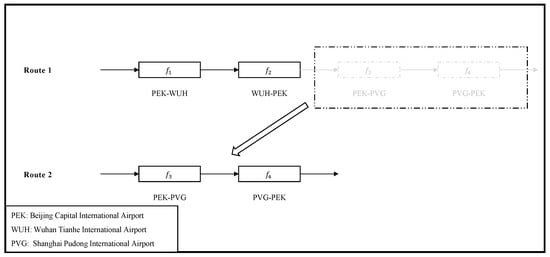
4.2.3. Cancel
The process of the cancel operation is shown in Figure 4. In Route 1, the original flight pair is . Through the cancel operation, can be removed from Route 1, creating a new canceled Route 2. As a result, Route 1 becomes .
Figure 4.
Cancel process.
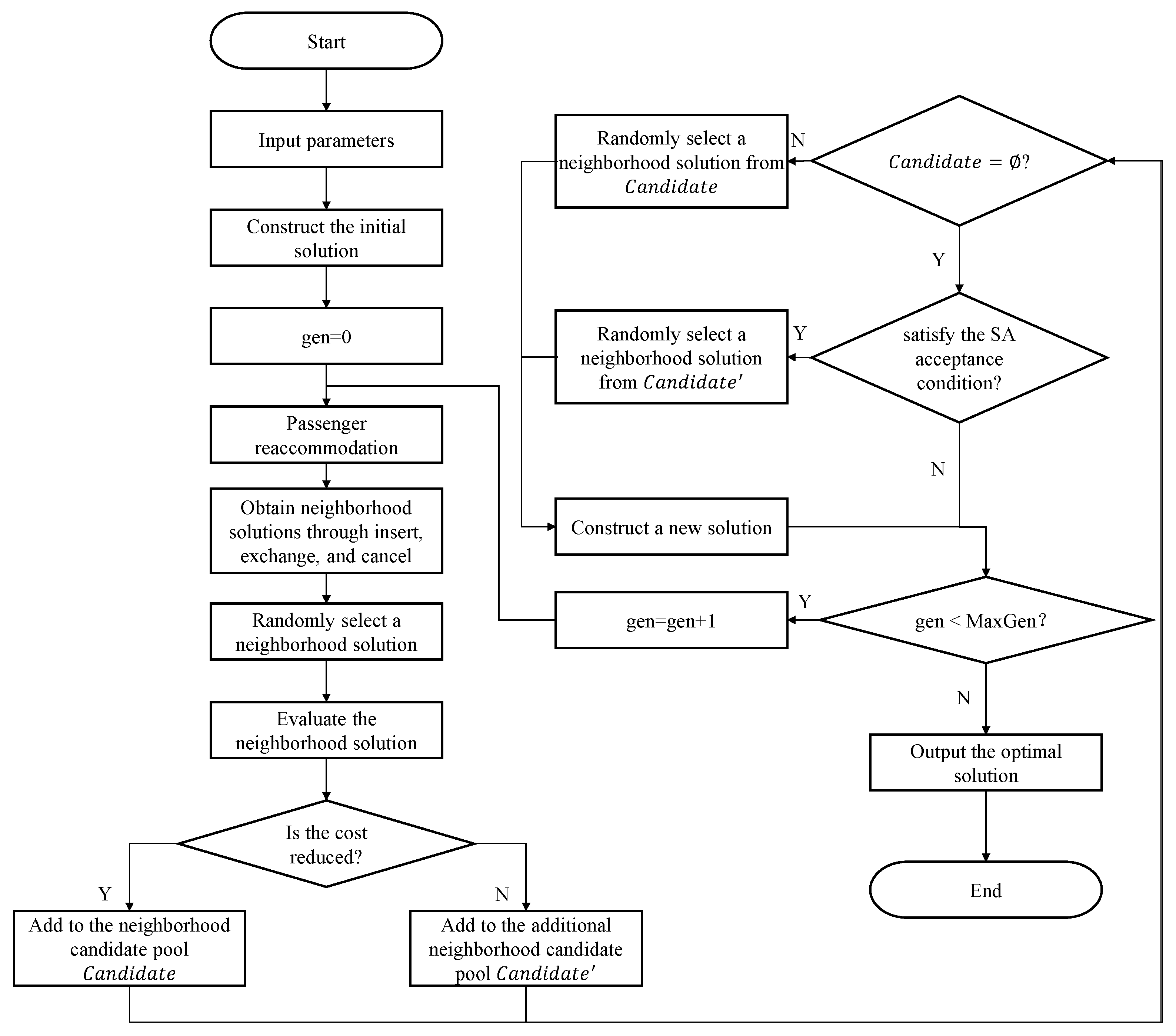
Next, it is necessary to determine the capacity of the neighborhood candidate pool . In this paper, in order to improve the solution quality and accelerate the convergence speed, a quality rule is used to determine its size. Specifically, when evaluating a neighborhood solution, if the result has a lower cost than the original solution, it is directly placed into the neighborhood candidate pool . On this basis, solutions with increased costs are placed into an additional candidate pool . The purpose of this is to better control the number of neighborhood solutions and facilitate the execution of local search, thereby improving the convergence of the algorithm.
4.3. Local Search
The traditional GRASP algorithm mainly relies on local search to improve the solution. The essence of local search is to explore the neighborhood of the solution space. Although it incorporates randomization to avoid being completely trapped in local optima, its effectiveness is limited. Therefore, in this paper, based on the traditional GRASP algorithm, the idea of Simulated Annealing (SA) is introduced into the local search phase. SA enhances the global search capability of GRASP by accepting some worse solutions during the search phase and gradually reducing the probability of accepting worse solutions. This helps escape the local optimum trap to some extent. The local search process is as follows: when the basic neighborhood candidate pool is not empty, a neighborhood solution is selected as the execution solution from it. Otherwise, the additional neighborhood candidate pool is used, allowing the random selection of a worse solution as the execution solution. In this case, based on the principles of SA, a decision rule (Equation (36)) is established, which checks the ratio of neighborhood solutions in the additional neighborhood candidate pool that satisfy this rule to those in the basic neighborhood candidate pool. If this ratio exceeds 5%, a random solution is selected from the additional neighborhood candidate pool. Otherwise, the process stops.
where represents the increased recovery costs, represents the current temperature, and is a random number uniformly distributed in the interval .
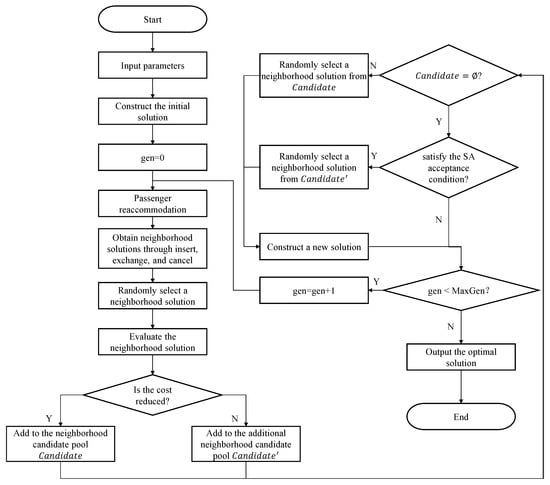
Based on the three subsections, Figure 5 presents the process of the IGRASP algorithm proposed in this paper.
Figure 5.
Flowchart of the IGRASP algorithm.
5. Case Study
5.1. Data Source
This section uses actual flight data from an airline to validate the effectiveness of the proposed method. The specific information in the data includes aircraft ID, seating capacity, flight ID, scheduled departure time, scheduled arrival time, departure airport, arrival airport, and the number of passengers. A sample is shown in Table 4. Based on related studies, the parameters required for the model are set as follows. The minimum turnaround time for aircraft at all airports is set to 40 min, the flight delay cost is 13.74 yuan/min, the flight cancellation cost is 6597.81 yuan, and the cost of unassigned passengers is related to the average ticket price of the rebooked flight. The trapezoidal fuzzy number for the delay time is (h), with the maximum allowable delay time set to 10 h, and the confidence level is set to . The algorithm designed in this paper is based on Python 3.9 and developed on the PyCharm 2019.3 platform. It runs on a desktop computer equipped with an Intel Xeon Gold 6244 CPU, 128GB RAM, and a Windows 10 operating system. To ensure the reproducibility of the proposed IGRASP algorithm, the key parameter configurations are detailed below. The maximum generation for the algorithm is set to , the initial temperature is set to 500, cooling schedule is set to 0.95, the termination temperature is set to 10−5.
Table 4.
Sample of airline operations data.
Additionally, the disruption scenarios are given: due to uncertainty factors, 1 to 5 aircraft are grounded on that day due to malfunctions, and their corresponding flights will experience delays. Correspondingly, we consider them as five types of disruption scenarios, for example, disruption scenario 1 represents that one aircraft cannot be used. The recovery time window for the disruptions is set from 7:00 to 22:00. The results will be analyzed below.
5.2. Results
5.2.1. Algorithm Analysis
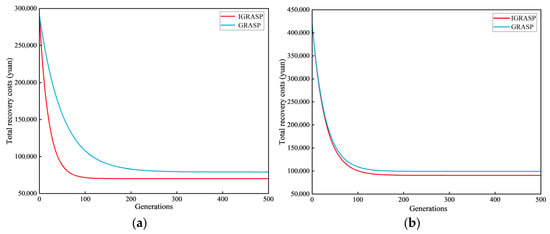
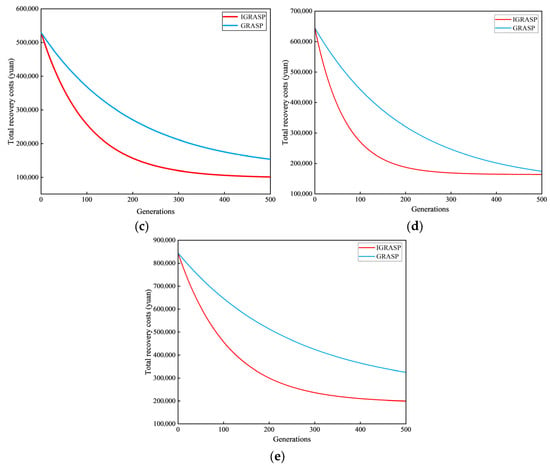
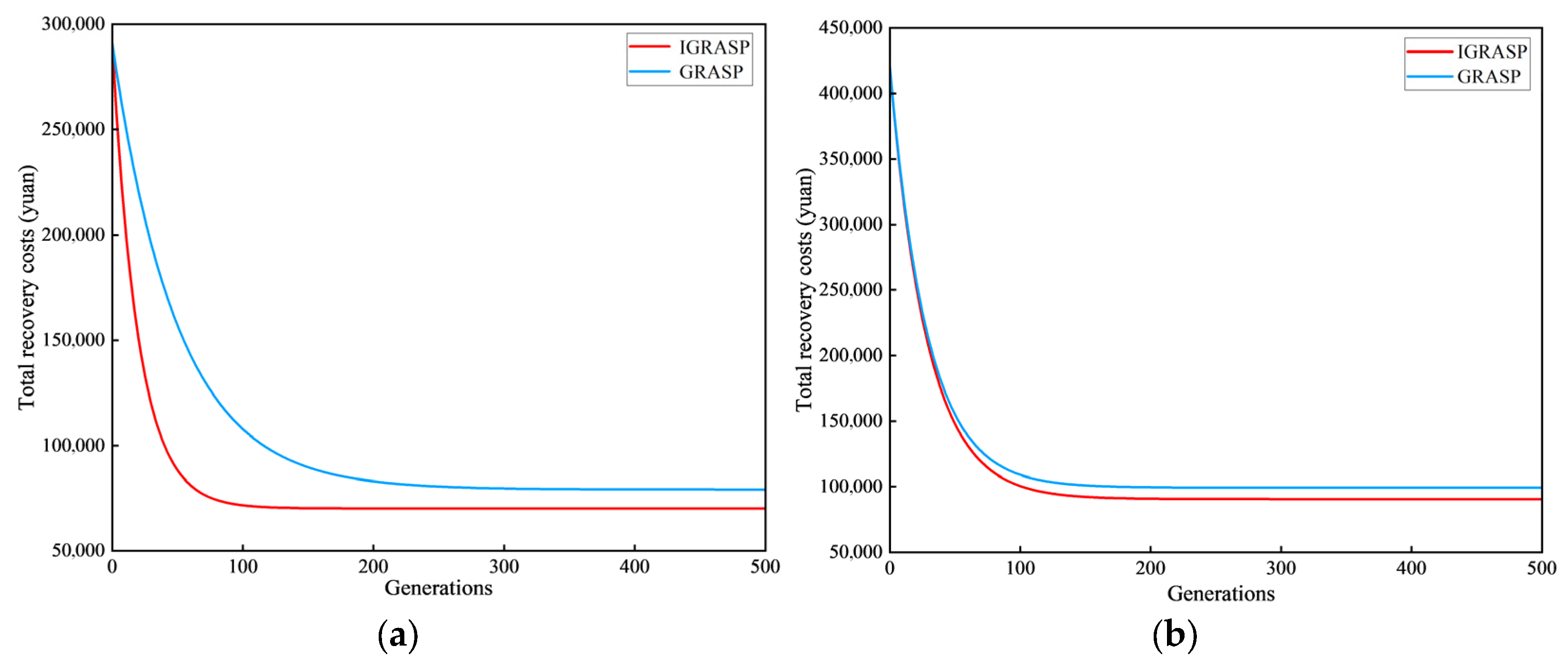
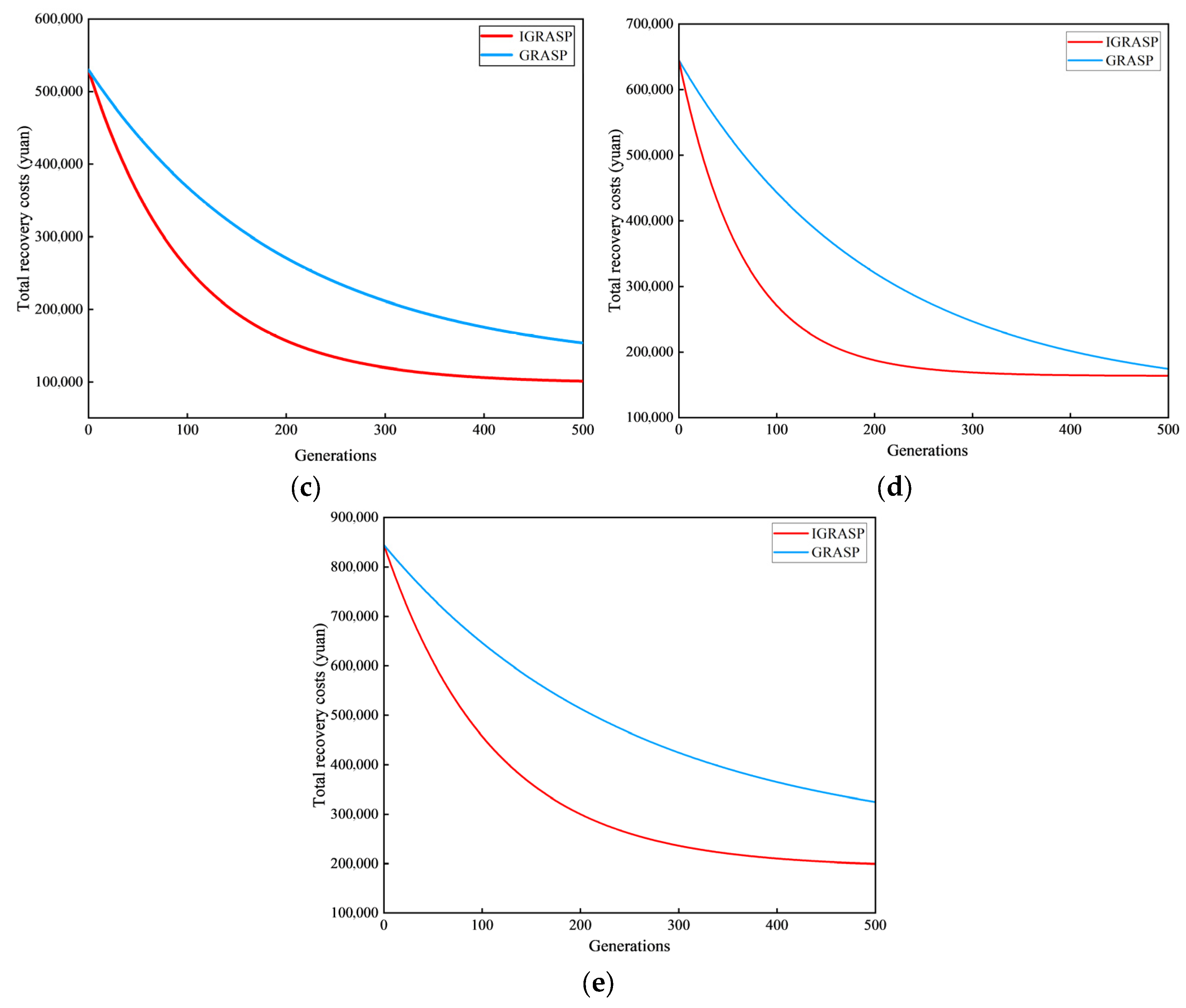
To verify the effectiveness and efficiency of the algorithm proposed in this paper, the traditional GRASP algorithm is used as the baseline algorithm for comparison with the proposed IGRASP algorithm. The generation curves of the solving algorithms under five disruption scenarios generated from actual data are shown in Figure 6. First, in different disruption scenarios, the IGRASP algorithm converges to the optimal solution earlier than the traditional GRASP algorithm and is able to obtain a better solution. This indicates that the improvement in the neighborhood generation strategy and the optimization of local search in the IGRASP algorithm enable the algorithm to converge faster, effectively escape local optima, and achieve better results. Secondly, in scenarios with smaller disruptions, both algorithms converge to the optimal value earlier. As the scale of the disruption increases, the complexity of the problem also gradually grows, requiring longer running times to search for the optimal value. Therefore, in subsequent disruption scenarios, the number of generations required for both algorithms to reach the optimal solution increases. Notably, in disruption scenario 5, the GRASP algorithm reaches convergence only before the maximum generation is reached, while the IGRASP algorithm converges well in all disruption scenarios, further reflecting that the algorithm proposed in this paper can obtain better solutions within a reasonable time frame, demonstrating its real-time capability and accuracy.
Figure 6.
Comparison of generation curves of the two algorithms under different disruption scenarios. (a) Disruption scenario 1, (b) Disruption scenario 2, (c) Disruption scenario 3, (d) Disruption scenario 4, (e) Disruption scenario 5.
The total recovery costs obtained by the two algorithms are compared with those solved by CPLEX, as shown in Table 5. It can be observed that, under different disruption scenarios, the computation time of the IGARSP algorithm is shorter than that of the GRASP algorithm, and the computation time remains within an acceptable range as the scale of disruption increases, demonstrating the superiority of the proposed algorithm. Furthermore, in small-scale disruption scenarios, the gaps between the solutions obtained by IGRASP and the optimal costs solved by CPLEX are all less than 1.50%, indicating satisfactory solution performance. Moreover, in disruption scenario 5, CPLEX failed to find the optimal solution, while IGRASP obtained a solution within 3.61% of the lower bound in a shorter time, which further verifies the rationality of the method.
Table 5.
Comparison of results and computation time from different algorithms.
5.2.2. Recovery Plans Comparison
This section discusses the impact of uncertainty in disruption duration on the recovery plans. For comparison, a deterministic recovery plan is chosen as the baseline Plan 1 (B1), which ignores the uncertain disruption duration. Another baseline, Plan 2 (B2), is based on a recovery solution derived using the traditional GRASP algorithm under uncertain scenarios. The results for the three recovery plans under different disruption scenarios are shown in Table 6. First, it can be observed that in all disruption scenarios, the proposed recovery plan in this paper provides the optimal solutions and saves more costs compared to B1. Particularly, in scenarios with larger disruptions, the proposed plan performs better. For instance, in Disruption scenario 5, the result from this paper reduces total recovery costs by 30.76% compared to B1. Secondly, for both B1 and B2, B1 performs better than B2 only in Disruption scenario 1. In all other disruption scenarios, B2 outperforms B1. This suggests that in scenarios with smaller disruptions, deterministic recovery plans may yield better results, but as the scale of the disruptions increases, deterministic plans tend to provide more conservative solutions, which, in turn, may lead to higher costs compared to uncertainty-aware approaches. On average, B2 saves 9.49% of total recovery costs compared to B1, and the proposed plan saves 25.01% of the costs, highlighting the importance of considering uncertainty factors in actual operations. This ensures the accuracy of the recovery plan.
Table 6.
Comparison of results from different recovery plans.
In conclusion, reasonably accounting for uncertainty and improving algorithm efficiency can enhance the accuracy of recovery plans, reduce recovery costs, save airline resources, ensure passenger satisfaction, and alleviate airport congestion.
5.3. Sensitivity Analysis
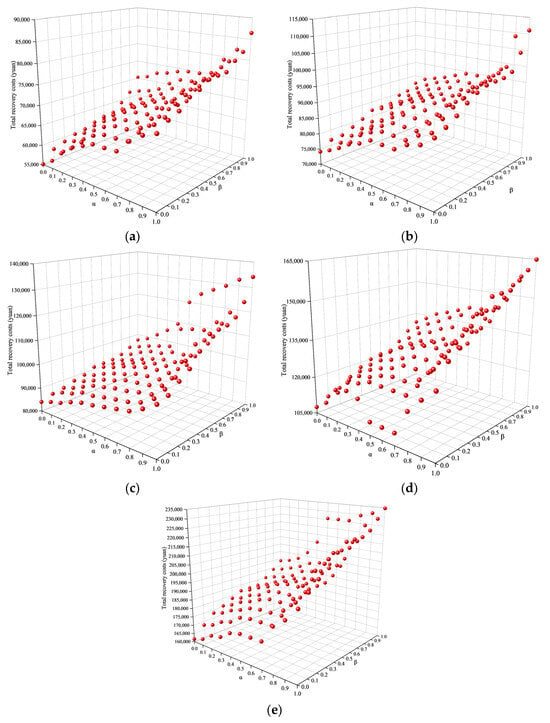
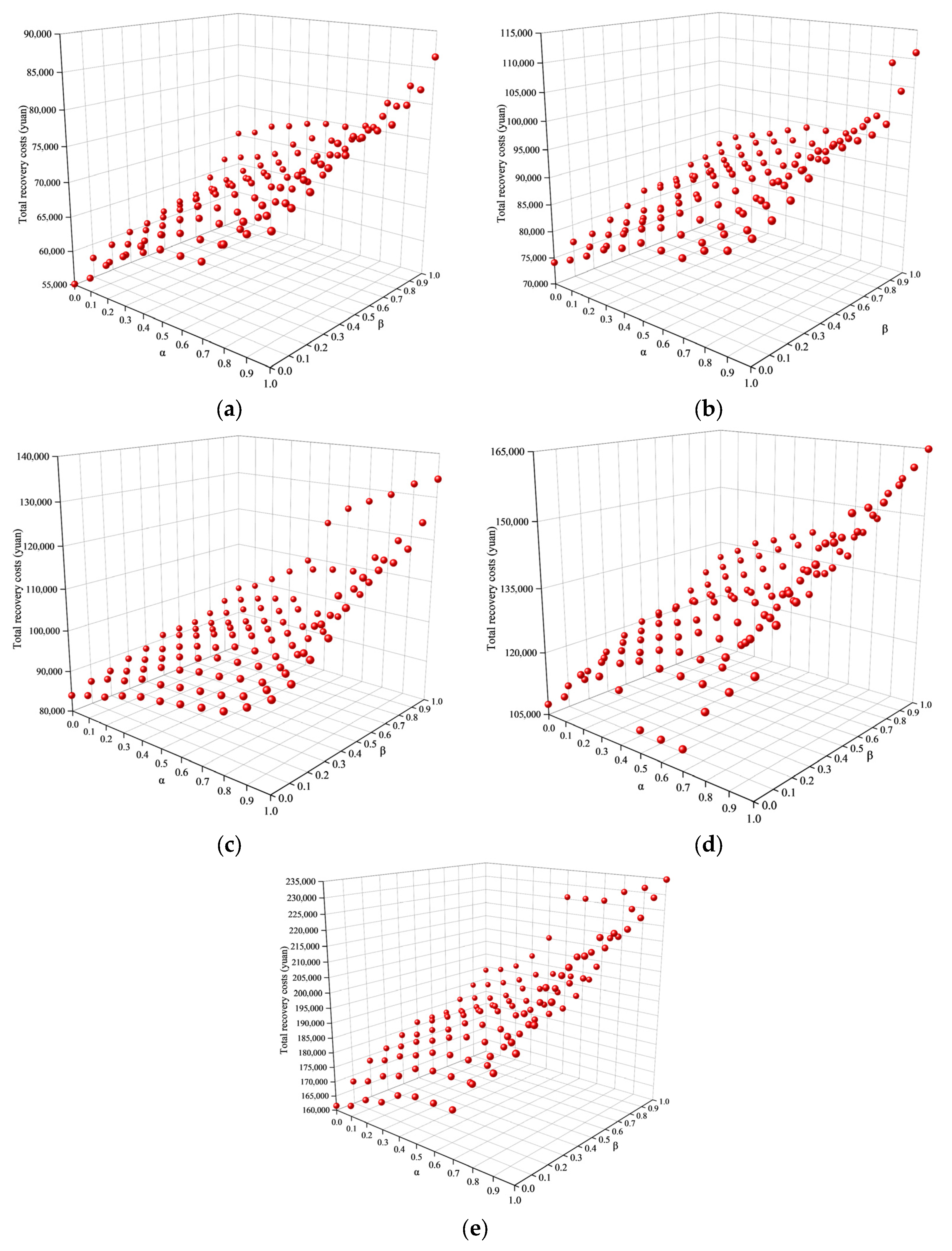
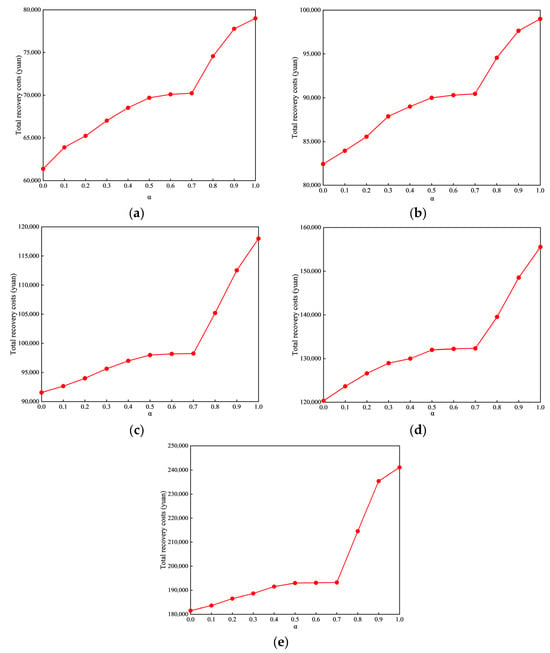
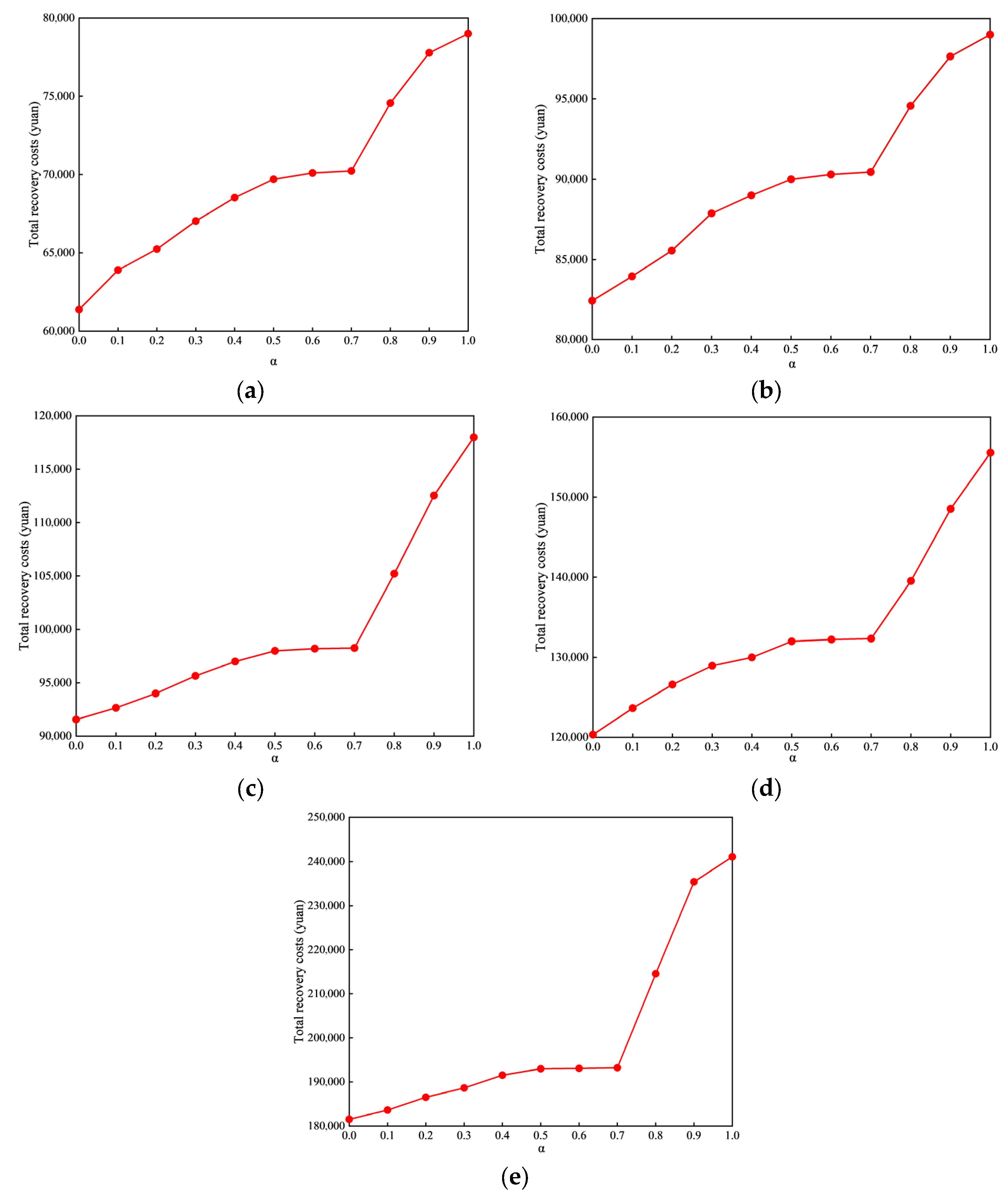
A sensitivity analysis is conducted on the confidence levels and used in the model clarification. Both confidence levels are set within the range of , with a step size of 0.1, to observe how the objective function changes across different disruption scenarios, as shown in Figure 7. From the figure, it can be seen that in different disruption scenarios, as the confidence levels ( and ) increase, the constraints become more stringent, which in turn causes the total recovery costs to increase. Therefore, the choice of an appropriate confidence level has a significant impact on the results. For the convenience of analysis, the following discussion will separately focus on the sensitivity of and .
Figure 7.
The relationship between total recovery costs and confidence levels in different disruption scenarios. (a) Disruption scenario 1, (b) Disruption scenario 2, (c) Disruption scenario 3, (d) Disruption scenario 4, (e) Disruption scenario 5.
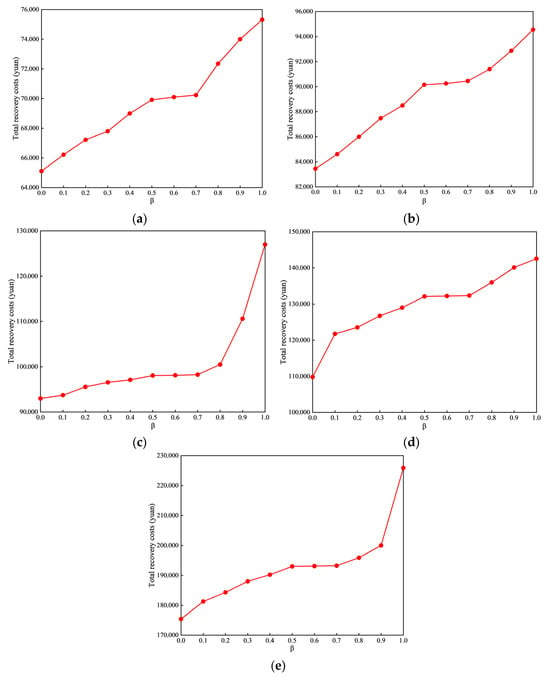
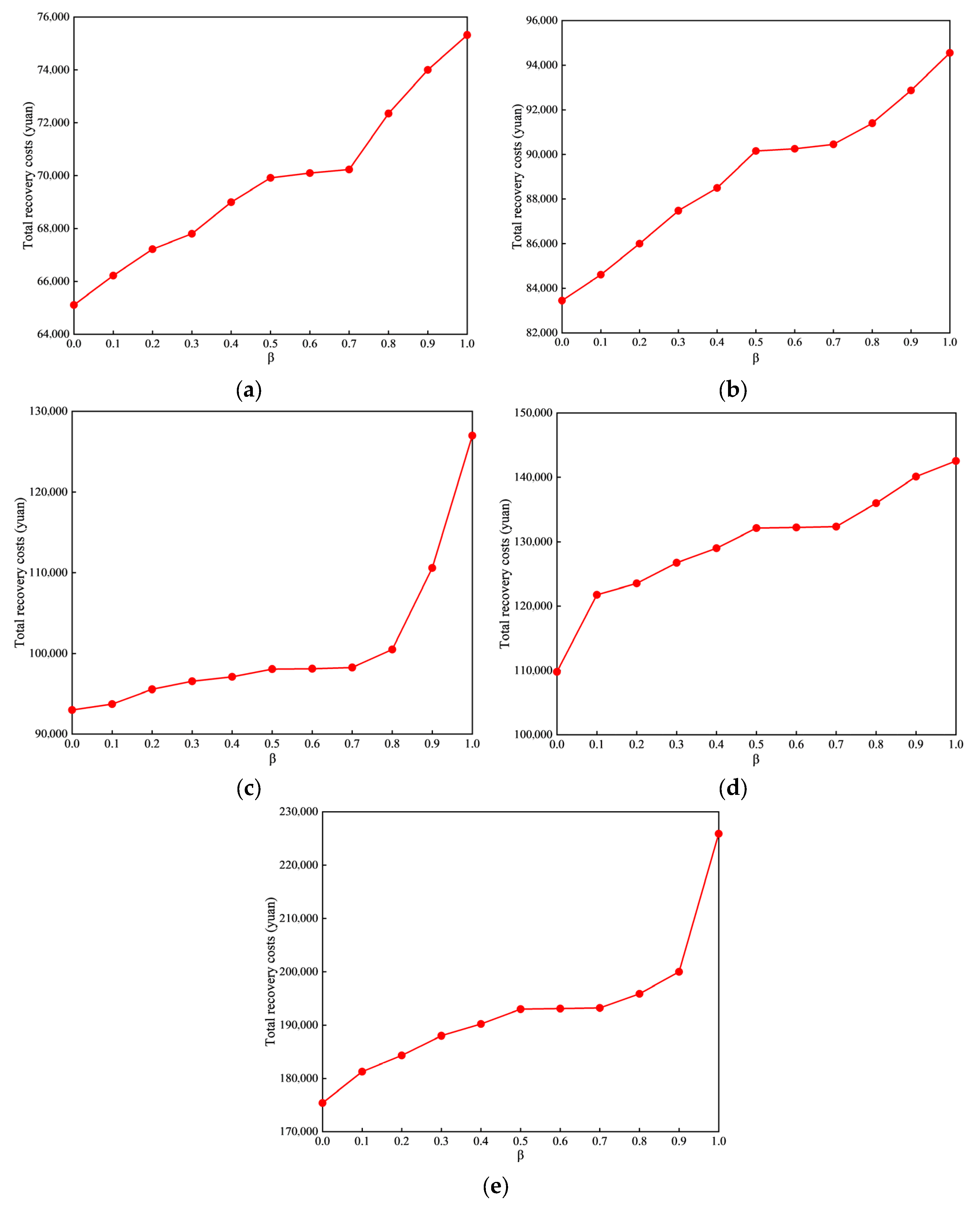
The results of the sensitivity analysis for and are shown in Figure 8 and Figure 9. Firstly, consistent with the previous conclusion, in different disruption scenarios, as the individual confidence level increases, the constraints need to be satisfied at a higher probability. This means that more conservative recovery plans must be designed for a greater number of potential delay scenarios, leading to an increase in the total recovery cost. Secondly, by observing the trends in the figures, it can be seen that when the confidence level ranges from [0, 0.4], the increase in total recovery costs is relatively gradual. When the confidence level is in the range of [0.5, 0.7], the results show only minor variations, suggesting that within this range, the impact of the confidence level on the objective function is not significant. However, when the confidence level is in the range of [0.8, 1], stricter conditions cause a noticeable increase in the objective function (with the exception of Figure 9d), indicating that in this range, the confidence level has a significant impact on the objective function. Therefore, when selecting the confidence levels, careful consideration is necessary. The sensitivity analysis shows that confidence levels α and β in the range of [0.5, 0.7] have a minimal effect on the recovery plan, making the values used in this paper reasonably appropriate.
Figure 8.
The relationship between total recovery costs and confidence level in different disruption scenarios (). (a) Disruption scenario 1, (b) Disruption scenario 2, (c) Disruption scenario 3, (d) Disruption scenario 4, (e) Disruption scenario 5.
Figure 9.
The relationship between total recovery costs and confidence level in different disruption scenarios (). (a) Disruption scenario 1, (b) Disruption scenario 2, (c) Disruption scenario 3, (d) Disruption scenario 4, (e) Disruption scenario 5.
5.4. Practical Implications
The experimental results presented above offer several actionable insights for airline operations control centers and disruption management practitioners.
Handling Imprecise Information. The comparative analysis in Section 5.2 demonstrates that recovery plans generated under deterministic assumptions (Plan B1) tend to be overly conservative, leading to unnecessary costs. In contrast, the proposed fuzzy programming approach effectively incorporates imprecise disruption duration estimates, achieving an average cost reduction of 25.01% compared to deterministic plans. This finding confirms that when precise delay information is unavailable—as is often the case in real-world operations—fuzzy modeling provides a practical and cost-effective alternative.
Guidance on Confidence Level Selection. The sensitivity analysis in Section 5.3 reveals that total recovery costs increase with higher confidence levels and . For airlines prioritizing cost efficiency (e.g., low-cost carriers), lower confidence levels can be adopted to minimize recovery costs. For airlines emphasizing operational stability and passenger satisfaction (e.g., full-service network carriers), higher confidence levels are recommended to ensure plans remain feasible even under pessimistic delay realizations. Importantly, recovery costs are relatively stable within the [0.5, 0.7] range, indicating that moderate confidence levels offer a good balance between robustness and economy without requiring precise calibration of uncertainty parameters.
Real-Time Decision Support. The computational results show that the IGRASP algorithm converges within 154–661 s for all disruption scenarios, significantly faster than the benchmark algorithms. This efficiency enables its use in real-time decision support systems. During major disruptions, controllers can rapidly evaluate multiple recovery strategies, compare their costs and feasibility, and select the most effective response within the operational time window.
Modularity and Extensibility. The proposed model is designed with modularity in mind. Airlines can easily incorporate their specific operational constraints by adding appropriate equations to the base formulation. The core fuzzy programming and IGRASP framework remains unchanged, allowing for flexible adaptation to diverse operational contexts without requiring fundamental methodological redesign.
Training and Simulation. Beyond real-time decision support, the model can serve as a training tool for operations controllers. By simulating different disruption scenarios and comparing the recovery plans generated by the model with manual decisions, controllers can gain insights into cost-effective recovery strategies and improve their decision-making skills over time. The sensitivity analysis also provides valuable training material for understanding how different confidence levels affect recovery costs and plan robustness.
In summary, the proposed methodology not only advances the theoretical understanding of airline recovery under uncertainty but also provides a practical, scalable framework for enhancing operational resilience in real-world airline operations.
6. Conclusions
This paper systematically addresses the integrated airline recovery problem under uncertain disruption durations, focusing on optimizing recovery plans in complex and dynamic operational environments. To address the uncertainty of disruption durations, a fuzzy chance-constrained optimization model is developed, aiming to minimize total recovery costs. By modeling delay times as fuzzy variables and transforming the model into its deterministic equivalent using trapezoidal fuzzy numbers, the proposed approach ensures practical operability. For efficient solution of the optimization model, the IGRASP algorithm is designed. The algorithm first reaccommodates passenger itineraries and then generates feasible solution neighborhoods through insert, exchange, and cancel. The local search process is enhanced by incorporating the acceptance criteria of the SA algorithm, ultimately balancing solution quality and computational efficiency.
The effectiveness of the proposed method is validated using real-world airline operational data under disruption scenarios of varying scales. The results demonstrate that, compared to the traditional GRASP algorithm, the IGRASP algorithm obtains higher-quality solutions within shorter computation times. Recovery plans under deterministic scenarios tend to be overly conservative, leading to resource wastage, whereas the proposed approach achieves cost-effective recovery of flight operations. Sensitivity analysis on the confidence level reveals that lower confidence levels, indicating looser constraints, yield smaller recovery costs, while higher confidence levels, reflecting stricter constraints, result in higher recovery costs. Selecting an appropriate confidence level significantly influences the final solutions.
The framework presented in this paper has limitations to consider in future research. First, it should be acknowledged that this paper makes several simplifying assumptions to maintain tractability and focus on handling disruption uncertainty. Specifically, crew scheduling constraints were not explicitly considered, and fuel and maintenance costs were treated as fixed. While these factors are important in real-world operations. Future research can naturally extend the current model by incorporating crew availability constraints (e.g., duty time limits, qualification requirements, connectivity rules) and more detailed operating costs (e.g., fuel consumption under speed control, usage-based maintenance costs). This would lead to a truly integrated recovery problem involving aircraft, crew, and passengers, better reflecting the complexities of real-world airline operations. Such extensions would further enhance the practical applicability of the methodology without altering its fundamental structure. In addition, this paper employs the fuzzy chance-constrained approach to handle uncertainty. However, this method is not the only possible solution. Future research can explore other effective approaches to managing uncertainty and conduct comparative analyses with the fuzzy chance-constrained method to enhance the accuracy and applicability of recovery solutions. Finally, it should be noted that the empirical validation in this paper is based solely on operational data from a Chinese airline. Although this dataset is representative and realistic, aviation markets in different countries and regions may exhibit variations in network structures, passenger behavior, and operational management practices. Therefore, applying the proposed methodology to datasets from international airlines (Europe or North America) constitutes a promising direction for future research. Such cross-validation would further assess the generalizability and robustness of the model and algorithm across diverse operational environments, thereby providing broader theoretical support for global airline disruption management.
Author Contributions
Conceptualization, S.W.; methodology, S.W.; software, S.W.; validation, S.W., Y.J., X.C. and D.Q.; formal analysis, S.W.; investigation, S.W.; data curation, S.W.; writing—original draft preparation, S.W.; writing—review and editing, S.W., Y.J., X.C. and D.Q.; visualization, S.W.; supervision, Y.J., X.C. and D.Q.; funding acquisition, Y.J., X.C. and D.Q. All authors have read and agreed to the published version of the manuscript.
Funding
This research was funded by National Natural Science Foundation of China (Grant No. 52272311), and the Natural Science Foundation of Shandong Province, China (Grant No. ZR2023MG058, ZR2024LZN012, ZR2025QC671).
Institutional Review Board Statement
Not applicable.
Informed Consent Statement
Not applicable.
Data Availability Statement
The data presented in this study are available on request from the corresponding author. The data are not publicly available due to privacy.
Conflicts of Interest
The authors declare no conflicts of interest.
References
- IATA. IATA Annual Review. Amsterdam: International Air Transport Association. 2020. Available online: https://www.iata.org/contentassets/c81222d96c9a4e0bb4ff6ced0126f0bb/iata-annual-review-2020.pdf (accessed on 24 February 2026).
- Sun, X.; Wandelt, S.; Zhang, A. A data-driven analysis of the aviation recovery from the COVID-19 pandemic. J. Air Transp. Manag. 2023, 109, 102401. [Google Scholar] [CrossRef] [Scilit]
- FAA. Aerospace Forecast Fiscal Years 2024–2044. 2024. Available online: https://www.faa.gov/dataresearch/aviation/aerospaceforecasts/faa-aerospace-forecast-fy-2024-2044 (accessed on 24 February 2026).
- Liu, Y.; Qi, N.; Yao, W.; Zhao, J.; Xu, S. Cooperative path planning for aerial recovery of a UAV swarm using genetic algorithm and homotopic approach. Appl. Sci. 2020, 10, 4154. [Google Scholar] [CrossRef] [Scilit]
- Bureau of Transportation Statistics (BTS). On-Time Performance—Reporting Operating Carrier Flight Delays at a Glance. 2023. Available online: https://www.transtats.bts.gov/HomeDrillChart.asp (accessed on 24 February 2026).
- Hatıpoğlu, I.; Tosun, ö. Predictive modeling of flight delays at an airport using machine learning methods. Appl. Sci. 2024, 14, 5472. [Google Scholar] [CrossRef] [Scilit]
- Jacyna-Gołda, I.; Cur, K.; Tomaszewska, J.; Przanowski, K.; Hoskova-Mayerova, S.; Świergolik, S. Optimizing flight delay predictions with scorecard systems. Appl. Sci. 2025, 15, 5918. [Google Scholar] [CrossRef] [Scilit]
- Wu, S.; Liu, E.; Cao, R.; Bai, Q. Airline recovery problem under disruptions: A review. Comput. Oper. Res. 2025, 175, 106915. [Google Scholar] [CrossRef] [Scilit]
- Teodorović, D.; Guberinić, S. Optimal dispatching strategy on an airline network after a schedule perturbation. Eur. J. Oper. Res. 1984, 15, 178–182. [Google Scholar] [CrossRef] [Scilit]
- Aktürk, M.; Atamtürk, A.; Gürel, S. Aircraft rescheduling with cruise speed control. Oper. Res. 2014, 62, 829–845. [Google Scholar] [CrossRef] [Scilit]
- Liu, H.; Sun, F.; Zhang, Y. An air-rail inter-modal strategy for aircraft recovery. Chin. J. Aeronaut. 2022, 35, 240–249. [Google Scholar] [CrossRef] [Scilit]
- Liang, Z.; Xiao, F.; Qian, X.; Zhou, L.; Jin, X.; Lu, X.; Karichery, S. A column generation-based heuristic for aircraft recovery problem with airport capacity constraints and maintenance flexibility. Transp. Res. B Methodol. 2018, 113, 70–90. [Google Scholar] [CrossRef] [Scilit]
- Thengvall, B.; Yu, G.; Bard, J.F. Multiple fleet aircraft schedule recovery following hub closures. Transp. Res. A Policy Pract. 2001, 35, 289–308. [Google Scholar] [CrossRef] [Scilit]
- Bard, J.F.; Yu, G.; Arguello, M.F. Optimizing aircraft routings in response to groundings and delays. IIE Trans. 2001, 33, 931–947. [Google Scholar] [CrossRef] [Scilit]
- Khaled, O.; Minoux, M.; Mousseau, V.; Michel, S.; Ceugniet, X. A multi-criteria repair/ recovery framework for the tail assignment problem in airlines. J. Air Transp. Manag. 2018, 68, 137–151. [Google Scholar] [CrossRef] [Scilit]
- Lee, J.; Marla, L.; Jacquillat, A. Dynamic disruption management in airline networks under airport operating uncertainty. Transp. Sci. 2020, 54, 973–997. [Google Scholar] [CrossRef] [Scilit]
- Lee, J.; Moon, I. Flight rescheduling of an airline underground delay program considering delay propagation in multiple airports. Transp. B Transp. Dyn. 2023, 11, 1871–1892. [Google Scholar] [CrossRef] [Scilit]
- Yan, S.; Yang, D. A decision support framework for handling schedule perturbation. Transp. Res. B Methodol. 1996, 30, 405–419. [Google Scholar] [CrossRef] [Scilit]
- Yan, S.; Tu, Y. Multifleet routing and multistop flight scheduling for schedule perturbation. Eur. J. Oper. Res. 1997, 103, 155–169. [Google Scholar] [CrossRef] [Scilit]
- Li, J.; Li, K.; Tian, Q.; Ram Kumar, P.N. An improved column generation algorithm for the disrupted flight recovery problem with discrete flight duration control and aircraft assignment constraints. Comput. Ind. Eng. 2022, 174, 108772. [Google Scholar] [CrossRef] [Scilit]
- Zang, H.; Zhu, J.; Zhu, Q.; Gao, Q. A proactive aircraft recovery approach based on airport spatiotemporal network supply and demand coordination. Comput. Oper. Res. 2024, 165, 106599. [Google Scholar] [CrossRef] [Scilit]
- Argüello, M.; Bard, J.F.; Yu, G. A GRASP for aircraft routing in response to groundings and delays. J. Comb. Optim. 1997, 1, 211–228. [Google Scholar] [CrossRef] [Scilit]
- Yan, S.; Lin, C. Airline scheduling for the temporary closure of airports. Transp. Sci. 1997, 31, 72–82. [Google Scholar] [CrossRef] [Scilit]
- Liu, T.K.; Chen, C.H.; Chou, J.H. Optimization of short-haul aircraft schedule recovery problems using a hybrid multiobjective genetic algorithm. Expert Syst. Appl. 2010, 37, 2307–2315. [Google Scholar] [CrossRef] [Scilit]
- Hu, Y.; Liao, H.; Zhang, S.; Song, Y. Multiple objective solution approaches for aircraft rerouting under the disruption of multi-aircraft. Expert Syst. Appl. 2017, 83, 283–299. [Google Scholar] [CrossRef] [Scilit]
- Zhao, A.; Bard, J.; Bickel, J. A two-stage approach to aircraft recovery under uncertainty. J. Air Transp. Manag. 2023, 111, 102421. [Google Scholar] [CrossRef] [Scilit]
- Martin, M.; Alvarez, A.; De La Vega, J.; Morabito, R. A constraint programming model and a hybrid iterated local search algorithm for solving an aircraft recovery problem in the oil and gas industry. J. Oper. Res. Soc. 2025, 76, 2494–2506. [Google Scholar] [CrossRef] [Scilit]
- Lee, J.; Lee, K.; Moon, I. A reinforcement learning approach for multi-fleet aircraft recovery under airline disruption. Appl. Soft Comput. 2022, 129, 109556. [Google Scholar] [CrossRef] [Scilit]
- Haider, I.; Sen, G.; Arsalan, M.; Das, A.K. Subnetwork prediction approach for aircraft schedule recovery. Eng. Appl. Artif. Intel. 2024, 133, 108472. [Google Scholar] [CrossRef] [Scilit]
- Rashedi, N.; Sankey, N.; Vaze, V.; Wei, K. A machine learning approach for solution space reduction in aircraft disruption recovery. Eur. J. Oper. Res. 2025, 323, 297–308. [Google Scholar] [CrossRef] [Scilit]
- Eggenberg, N.; Salani, M.; Bierlaire, M. Constraint-specific recovery network for solving airline recovery problems. Comput. Oper. Res. 2010, 37, 1014–1026. [Google Scholar] [CrossRef] [Scilit]
- Hu, Y.; Xu, B.; Bard, J.F.; Chi, H.; Gao, M. Optimization of multi-fleet aircraft routing considering passenger transiting under airline disruption. Comput. Ind. Eng. 2015, 80, 132–144. [Google Scholar] [CrossRef] [Scilit]
- Arikan, U.; Gürel, S.; Aktürk, M.S. Integrated aircraft and passenger recovery with cruise time controllability. Ann. Oper. Res. 2016, 236, 295–317. [Google Scholar] [CrossRef] [Scilit]
- Sinclair, K.; Cordeau, J.F.; Laporte, G. A column generation post-optimization heuristic for the integrated aircraft and passenger recovery problem. Comput. Oper. Res. 2016, 65, 42–52. [Google Scholar] [CrossRef] [Scilit]
- Zhang, D.; Yu, C.; Desai, J.; Lau, H.Y.K.H. A math-heuristic algorithm for the integrated air service recovery. Transp. Res. B Methodol. 2016, 84, 211–236. [Google Scholar] [CrossRef] [Scilit]
- Marla, L.; Vaaben, B.; Barnhart, C. Integrated disruption management and flight planning to trade off delays and fuel burn. Transp. Sci. 2017, 51, 88–111. [Google Scholar] [CrossRef] [Scilit]
- Santos, B.F.; Wormer, M.M.E.C.; Achola, T.A.O.; Curran, R. Airline delay management problem with airport capacity constraints and priority decisions. J. Air Transp. Manag. 2017, 63, 34–44. [Google Scholar] [CrossRef] [Scilit]
- Bratu, S.; Barnhart, C. Flight operations recovery: New approaches considering passenger recovery. J. Schedul. 2006, 9, 279–298. [Google Scholar] [CrossRef] [Scilit]
- Hu, Y.; Song, Y.; Zhao, K.; Xu, B. Integrated recovery of aircraft and passengers after airline operation disruption based on a GRASP algorithm. Transp. Res. E Logist. Transp. Rev. 2016, 87, 97–112. [Google Scholar] [CrossRef] [Scilit]
- Yan, C.W.; Vaze, V.; Barnhart, C. Airline-driven ground delay programs: A benefits assessment. Transp. Res. C Emerg. Technol. 2018, 89, 268–288. [Google Scholar] [CrossRef] [Scilit]
- Wandelt, S.; Xu, Y.; Sun, X. Measuring node importance in air transportation systems: On the quality of complex network estimations. Reliab. Eng. Syst. Saf. 2023, 240, 109596. [Google Scholar] [CrossRef] [Scilit]
- Lee, J.; Marla, L.; Vaishnav, P. The impact of climate change on the recoverability of airline networks. Transp. Res. D Transp. Environ. 2021, 95, 102801. [Google Scholar] [CrossRef] [Scilit]
- Marla, L.; Vaze, V.; Barnhart, C. Robust optimization: Lessons learned from aircraft routing. Comput. Oper. Res. 2018, 98, 165–184. [Google Scholar] [CrossRef] [Scilit]
- Liu, B. Theory and Practice of Uncertain Programming, 3rd ed.; Springer-Verlag: Berlin, Germany, 2009. [Google Scholar]
- Feo, T.A.; Resende, M.G.C. A probabilistic heuristic for a computationally difficult set covering problem. Oper. Res. Lett. 1989, 8, 67–71. [Google Scholar] [CrossRef] [Scilit]

Disclaimer/Publisher’s Note: The statements, opinions and data contained in all publications are solely those of the individual author(s) and contributor(s) and not of MDPI and/or the editor(s). MDPI and/or the editor(s) disclaim responsibility for any injury to people or property resulting from any ideas, methods, instructions or products referred to in the content. |
© 2026 by the authors. Licensee MDPI, Basel, Switzerland. This article is an open access article distributed under the terms and conditions of the Creative Commons Attribution (CC BY) license.