


Abstract
Vehicular Ad Hoc Networks (VANETs) are a key enabler of intelligent transportation systems, supporting safety-critical and latency-sensitive applications through vehicle-to-vehicle and vehicle-to-infrastructure communications. However, high node mobility, rapidly changing network topologies, and heterogeneous wireless conditions pose significant challenges to traditional distributed networking approaches, particularly in terms of quality of service (QoS) stability and handover performance. Software-Defined Networking (SDN) offers promising solutions by enabling centralized control, programmability, and flexible deployment of network functions. This paper presents an SDN-enabled vehicular networking platform designed for realistic, system-level experimentation under dynamic mobility conditions. The proposed platform tightly couples microscopic vehicular mobility generated by SUMO with wireless network emulation in Mininet-WiFi, enabling real-time interaction between vehicle movement, wireless connectivity, and SDN control decisions, where a custom SDN controller implements mobility-aware traffic management and handover handling across roadside units. Extensive experimental scenarios evaluate throughput, packet loss, jitter, and end-to-end latency under varying traffic loads and mobility patterns. Results indicate that SDN-based centralized control improves QoS consistency relative to the unmanaged baseline configuration considered in this study. The proposed platform provides practical insights and a reproducible experimental framework for the design and evaluation of software-defined vehicular networking systems.
1. Introduction
The rapid evolution of intelligent transportation systems (ITSs) and connected vehicle technologies has transformed modern road networks into highly dynamic, data-driven cyber–physical systems. Vehicles are no longer isolated entities but active network nodes capable of exchanging information with other vehicles, roadside infrastructure, cloud services, and edge computing platforms. Vehicular Ad Hoc Networks (VANETs) play a central role in this ecosystem by enabling vehicle-to-vehicle (V2V), vehicle-to-infrastructure (V2I), and, more broadly, vehicle-to-everything (V2X) communications [1]. These capabilities underpin a wide range of applications, including collision avoidance, cooperative driving, traffic efficiency optimization, and real-time infotainment services.
Despite their potential, VANETs face inherent limitations that stem from the very characteristics that make them attractive. High node mobility, rapidly changing network topologies, variable node density, and the unreliability of wireless channels significantly complicate network management and performance assurance. Traditional distributed networking approaches, which rely on localized decision making and static protocol configurations, struggle to maintain consistent quality of service (QoS) in such environments [2,3]. Frequent link disruptions, inefficient handover procedures, and limited network visibility often lead to increased latency, packet loss, and service instability, particularly during mobility events such as transitions between roadside units (RSUs).
In this context, Software-Defined Networking (SDN) has been widely recognized as a promising architectural paradigm for addressing the management complexity of highly dynamic networks. By decoupling the control plane from the data plane, SDN enables centralized network intelligence, global topology awareness, and programmable traffic management. These properties are particularly attractive for vehicular environments, where rapid adaptation to changing conditions is essential.
A growing body of research has explored the application of SDN to vehicular networking, often referred to as Software-Defined Vehicular Networks (SDVNs). Prior studies have demonstrated the theoretical benefits of centralized routing control, adaptive resource allocation, and virtualized service deployment in VANET scenarios. However, much of the existing literature relies on abstract simulations, analytical models, or isolated component evaluations that decouple vehicular mobility from realistic wireless networking behavior. As a result, it remains difficult to assess how SDN control logic in practice under realistic mobility patterns and traffic conditions.
Moreover, reproducible experimental frameworks that allow fine-grained observation of both control-plane and data-plane behavior during vehicular mobility events are still relatively scarce. Evaluating QoS metrics such as latency, jitter, and packet loss during handovers requires a tightly synchronized environment in which vehicle movement, wireless connectivity, and SDN decision making evolve in real time. Without such integration, important system-level trade-offs, such as control overhead versus performance gains or scalability versus responsiveness, are often overlooked.
Although tools such as SUMO and Mininet-WiFi have been used in previous vehicular networking studies, the novelty of the proposed work lies in the coordinated design and implementation of a reproducible SDN-based vehicular networking platform that enables controlled evaluation of mobility-driven network behavior.
Unlike prior loosely coupled simulation environments, the proposed framework supports synchronized interaction between vehicular mobility, wireless communication, and centralized SDN control logic. This enables deterministic evaluation of handover events and systematic variation in network parameters such as vehicle density, mobility speed, and traffic load.
Furthermore, the platform emphasizes reproducibility through structured configuration workflows and openly available implementation resources, allowing independent replication and extension of the presented experiments.
The main contributions of this work are summarized as follows:
- Design of an SDN-based vehicular networking platform supporting mobility-triggered flow updates.
- Implementation of synchronized interaction between vehicular mobility and wireless network emulation environments.
- Development of structured experimental scenarios enabling reproducible QoS evaluation under varying mobility conditions.
- Experimental validation of mobility-aware forwarding mechanisms and their impact on throughput, latency, and packet loss.
Therefore, the main contribution of this work lies not in proposing new routing algorithms, but in providing an experimentally reproducible platform that enables controlled evaluation of mobility-aware SDN behavior under realistic vehicular conditions.
To evaluate these contributions, the following research questions are defined:
- RQ1: How does centralized SDN control affect QoS performance (throughput, packet loss, jitter, and latency) in highly dynamic vehicular environments?
- RQ2: To what extent can mobility-aware SDN control improve network performance during RSU handover events compared to uncoordinated forwarding behavior?
- RQ3: How does the integration of SDN within a synchronized mobility–network environment influence system-level behavior and performance under varying mobility conditions?
The remainder of this paper is organized as follows. Section 2 reviews related work on SDN-based vehicular networking and highlights existing limitations. Section 3 describes the architecture and components of the proposed experimental platform. Section 4 presents the experimental methodology and evaluation scenarios. Section 5 discusses the obtained results and extracts key insights. Finally, Section 6 concludes the paper and outlines directions for future work.
2. Related Work
Vehicular ad hoc networks have been widely studied as a communication backbone for Intelligent Transportation Systems, where they support safety-critical messaging, traffic management, and infotainment services [4,5,6,7,8]. Even so, VANETs inherit structural limits from their highly dynamic operating environment. High vehicle mobility, rapidly changing topology, intermittent connectivity, and dense traffic conditions make stable routing and consistent quality of service difficult to maintain [2,3,4,9]. These constraints are especially visible during congestion, handovers, and multi-hop forwarding, where route disruption and delay variation can quickly degrade network performance [2,3].
This motivates the move toward Software-Defined Networking. By separating the control plane from the data plane, SDN enables centralized decision-making, global topology awareness, programmable forwarding behavior, and more flexible traffic management [6,10]. At the same time, foundational SDN studies note that these benefits come with tradeoffs, especially around controller scalability, control-plane overhead, and the risk of single points of failure in overly centralized designs [6,10]. In vehicular settings, these issues become more acute because the underlying network state changes far more quickly than in conventional fixed infrastructures.
Recent literature has therefore explored SDN-enabled vehicular networking as a way to address the limitations of conventional VANETs. Survey papers report that Software-Defined VANETs can improve routing adaptability, network visibility, resource allocation, and traffic engineering in dynamic road environments [11,12,13,14,15]. Broader background works also show that future vehicular networking increasingly intersects with cloud, fog, and edge support, further strengthening the case for programmable and centrally coordinated control [8,16]. More focused routing-oriented reviews argue that SDN is particularly attractive for vehicular routing because it can use a wider network view to improve forwarding decisions under changing traffic and mobility patterns [17].
At the architectural level, early and influential SDN-VANET studies proposed hierarchical and software-defined vehicular designs that move control decisions away from fully distributed routing and toward controller-assisted coordination [18,19]. Later work refined this direction through control-plane optimization and dynamic controller placement, showing that the placement and management of controllers strongly affect responsiveness, signaling cost, and scalability in mobile vehicular environments [20,21]. Security-focused studies further note that although centralized control improves observability and policy enforcement, it also creates new attack surfaces, including denial-of-service, distributed denial-of-service, and control-plane manipulation threats [15].
Despite this progress, much of the existing literature remains centered on architecture proposals, surveys, and simulation-driven analysis. Comparatively fewer studies provide experimentally grounded platforms that combine realistic vehicular mobility, wireless behavior, and SDN control in a reproducible way [22,23,24,25]. This leaves an important gap between conceptual SDN-VANET designs and deployable system-level evaluation. The present work is positioned in that gap. Rather than proposing a new routing protocol or a learning-based control algorithm, it focuses on building a reproducible SDN-based vehicular networking platform and experimentally evaluating mobility-aware forwarding and QoS behavior under dynamic vehicular conditions. Advanced control and learning methods remain promising extensions, but they are treated here as future directions rather than the main contribution.
To provide a clearer positioning of the proposed framework relative to existing studies, a structured comparison of representative state-of-the-art SDN-based vehicular networking platforms is presented in Table 1.
Table 1.
Comparative analysis of representative SDN-based vehicular networking frameworks.
3. System Architecture and Experimental Platform
3.1. Design Goals and Rationale
The primary objective of the proposed platform is to enable realistic, system-level experimentation of SDN-based vehicular networking mechanisms under highly dynamic mobility conditions. Unlike abstract simulations that decouple mobility from network control, the platform is designed around a closed feedback loop in which vehicular movement, wireless connectivity, and SDN control decisions continuously influence one another in real time.
To achieve this objective, the platform is guided by the following design goals:
- Mobility realism: Vehicle movement must reflect realistic urban traffic behavior, including acceleration, deceleration, intersections, and varying vehicle density.
- Wireless network fidelity: Communication links should be affected by node mobility, distance, and interference, allowing meaningful evaluation of QoS metrics.
- Centralized yet programmable control: The network must support SDN-based global visibility and dynamic traffic management without abstracting away control-plane delays and overhead.
- Reproducibility and extensibility: The platform should rely on widely used, open-source tools and modular components that can be reused and extended by other researchers.
Based on these goals, the proposed platform integrates microscopic vehicular mobility simulation, wireless network emulation, and SDN-based control into a unified experimental environment.
3.2. Design Contributions of the Proposed Platform
Although the proposed platform integrates established tools such as SUMO, Mininet-WiFi, and a POX-based SDN controller, several implementation-level design decisions were introduced to enable coordinated vehicular networking experiments.
First, the platform supports mobility-triggered flow management, where forwarding rules are dynamically updated when vehicles associate with different roadside units (RSUs). This enables controlled handover execution and reduces transient communication disruption during mobility events.
Second, the system establishes synchronized interaction between vehicular mobility and wireless network emulation. Mobility traces generated in SUMO directly influence network topology conditions in Mininet-WiFi, allowing deterministic testing of handover scenarios.
Third, the platform defines structured experimental scenarios that systematically vary mobility speed, vehicle density, and traffic load. This structured workflow enables reproducible evaluation of network performance under diverse operating conditions and allows controlled comparison between baseline and SDN-enabled configurations.
These coordinated elements transform the environment from a simple tool integration into an operational experimental framework for evaluating mobility-aware SDN behavior in vehicular networks.
3.3. Overall Architecture
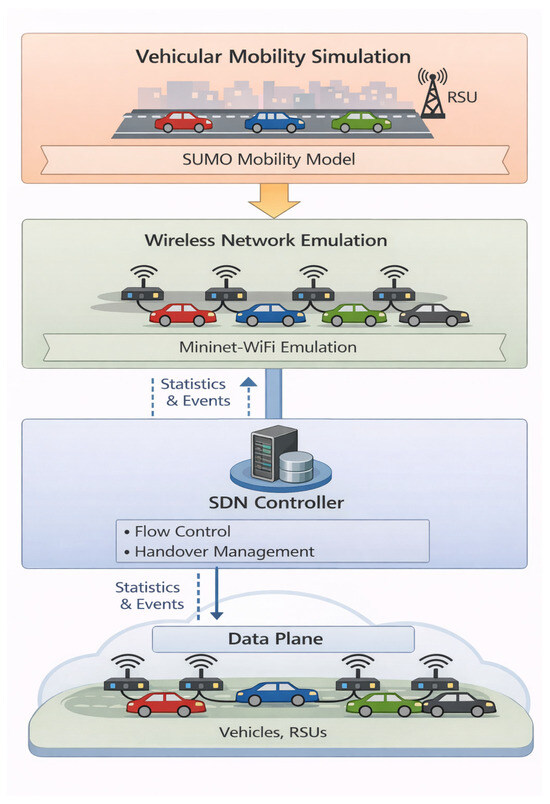
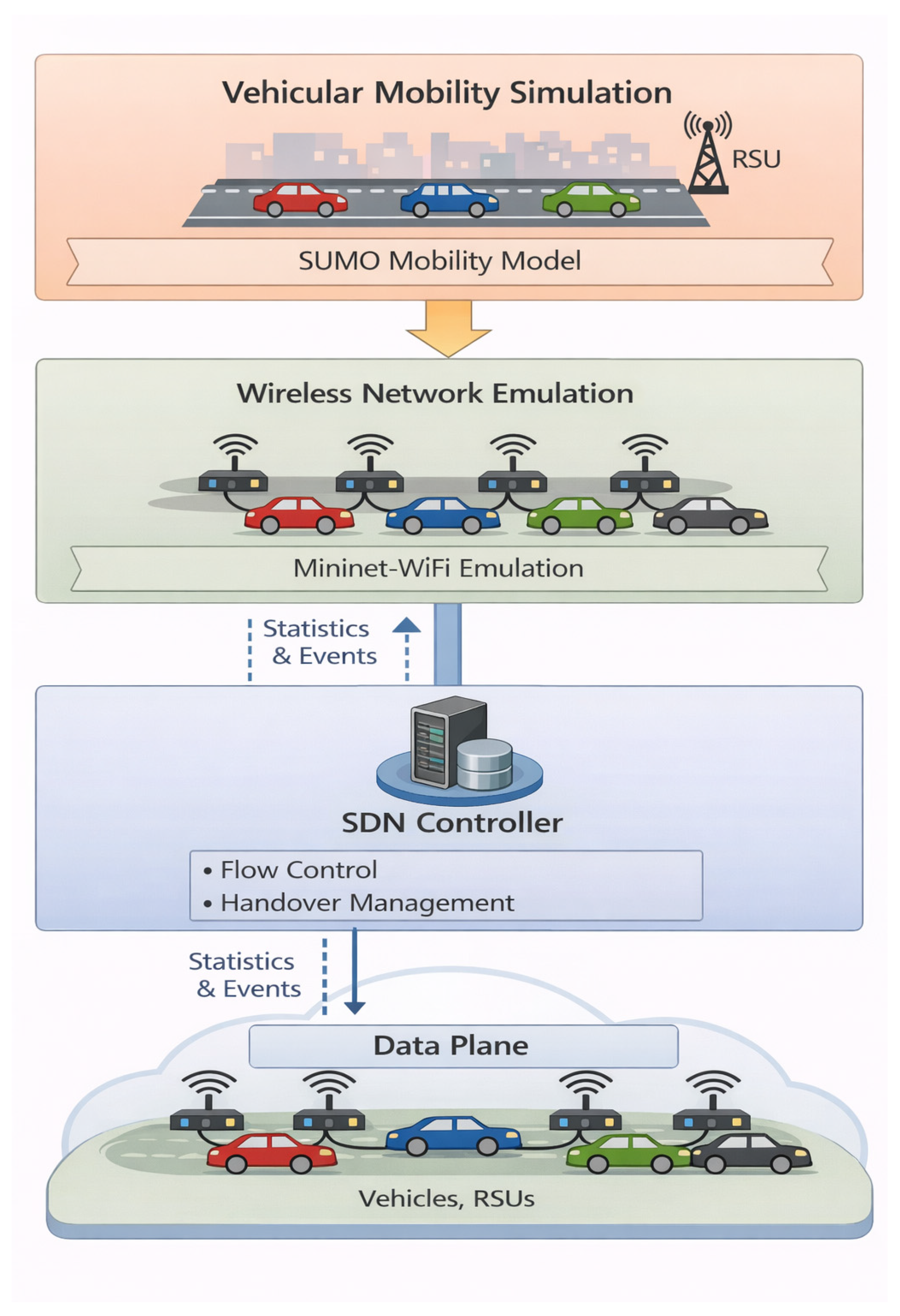
The overall architecture of the platform follows a layered design that combines vehicular mobility, wireless communication, and software-defined control, as illustrated conceptually in Figure 1. The architecture consists of four tightly coupled layers:
Figure 1.
Platform architecture diagram.
- Vehicular Mobility Layer
- Wireless Network Emulation Layer
- SDN Control Layer
Each layer is responsible for a specific aspect of the system while exposing well-defined interfaces to enable cross-layer interaction.
3.4. Vehicular Mobility Layer
Vehicular mobility is generated using the Simulation of Urban Mobility (SUMO), a microscopic traffic simulator widely adopted in vehicular networking research. SUMO enables fine-grained control over vehicle behavior, including speed, acceleration, routing, and interaction with road infrastructure such as intersections and traffic lights.
Urban road topologies are defined using realistic map layouts, and traffic demand is configured to produce varying vehicle densities and mobility patterns. Vehicles follow predefined or dynamically assigned routes, allowing the evaluation of both predictable and highly dynamic movement scenarios.
To enable real-time interaction with the networking layer, the platform leverages SUMO’s Traffic Control Interface (TraCI). Through TraCI, vehicle position, speed, and mobility events are continuously exported and synchronized with the wireless network emulation environment. This synchronization ensures that changes in vehicle location directly affect network connectivity and handover behavior without artificial delays or post-processing.
3.5. Wireless Network Emulation Layer
Wireless communication is emulated using Mininet-WiFi, which extends the Mininet network emulator with support for wireless nodes, access points, and mobility-aware link modeling. Each vehicle simulated in SUMO is mapped to a corresponding wireless node in Mininet-WiFi, effectively acting as an on-board unit (OBU).
Roadside units (RSUs) are represented as fixed wireless access points strategically placed along the road topology. As vehicles move through the environment, their association with RSUs is dynamically updated based on proximity and signal conditions, enabling realistic modeling of connectivity changes and handover events.
Mininet-WiFi provides configurable wireless parameters such as transmission range, bandwidth, and propagation models. These parameters are used to emulate varying network conditions, including link degradation due to distance or congestion. By tightly coupling Mininet-WiFi with SUMO, the platform ensures that wireless connectivity evolves continuously in response to vehicular mobility.
3.6. SDN Control Layer
At the core of the proposed platform lies the SDN control layer, which is responsible for centralized traffic management and mobility-aware decision making. The wireless access points and virtual switches in the network are implemented using Open vSwitch and operate under the control of a centralized SDN controller.
A custom SDN controller, based on the POX framework, is employed to manage forwarding rules, monitor network state, and handle mobility-related events. The controller maintains a global view of the network topology, including vehicle-to-RSU associations, active flows, and link conditions.
Unlike static SDN configurations, the controller is designed to operate in a mobility-aware manner. When a vehicle changes its point of attachment due to movement, the controller detects the event and dynamically updates forwarding rules to maintain service continuity. This approach enables explicit control over handover behavior, allowing the evaluation of different handover strategies and their impact on QoS metrics.
Importantly, the control-plane interactions are not abstracted away. Flow setup delays, controller decision times, and signaling overhead are all part of the experimental environment, enabling realistic assessment of SDN responsiveness under mobility.
3.7. Discussion: System-Level Advantages
A critical aspect of the platform is the synchronized collection of mobility and network performance data. Vehicle positions, connectivity events, flow statistics, and QoS metrics are logged continuously during experiments. This synchronized data collection allows precise correlation between mobility events, such as RSU handovers, and observed network performance variations.
The proposed architecture differs from conventional VANET simulation approaches in three key ways. First, it enables direct interaction between vehicular mobility and SDN control decisions, rather than treating mobility as an external input. Second, it exposes both control-plane and data-plane dynamics, allowing evaluation of trade-offs between responsiveness and overhead. As such, the platform is not intended as a replacement for large-scale analytical simulations, but rather as a complementary experimental framework that bridges the gap between abstract models and real-world SDN-based vehicular networking systems. The tight synchronization between mobility generation, wireless emulation, and control-plane operation constitutes a key design aspect of the platform, enabling consistent observation of transient effects that are typically abstracted in purely simulation-based studies.
4. Experimental Methodology and Evaluation Scenarios
4.1. Experimental Setup
The experimental evaluation was conducted using the SDN-enabled vehicular networking platform described in Section 3. The platform combines microscopic vehicular mobility simulation with wireless network emulation and centralized SDN control, enabling realistic assessment of network behavior under dynamic mobility conditions.
Vehicular mobility scenarios were generated using SUMO, while wireless communication and network topology were emulated using Mininet-WiFi. Each simulated vehicle was mapped to a wireless node representing an OBU, and RSUs were modeled as fixed wireless access points equipped with OpenFlow-enabled switches. A centralized SDN controller managed traffic forwarding and mobility-aware handover decisions.
All experiments were executed multiple times (5 times for each case) to mitigate random effects and ensure result consistency. Performance metrics were collected continuously and synchronized across mobility, network, and control layers.
To support reproducibility of the proposed framework, the implementation scripts, controller logic, and experimental configuration files used in this study are made publicly available through a GitHub repository (https://github.com/faethonAnt/An-SDN-Based-Vehicular-Networking-Platform-for-Mobility-Aware-QoS-and-Handover-Evaluation.git, accessed on 1 March 2026). This enables independent replication and extension of the presented experiments.
4.2. Mobility and Network Configuration
Urban road topologies were defined in SUMO to represent realistic vehicular environments with intersections and varying traffic density. Vehicle routes were selected to induce frequent topology changes and RSU handovers, allowing evaluation of network performance under both steady-state and highly dynamic conditions.
Wireless communication parameters in Mininet-WiFi were configured to emulate IEEE 802.11-based vehicular communication. RSUs were strategically placed to ensure partial overlap of coverage areas, enabling controlled handover scenarios. Vehicle transmission ranges and bandwidth limits were selected to reflect realistic constraints of vehicular wireless networks.
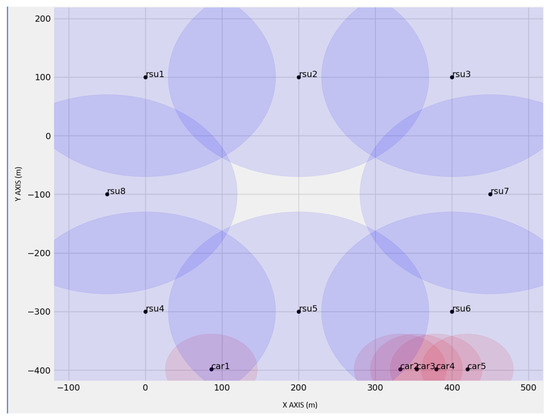
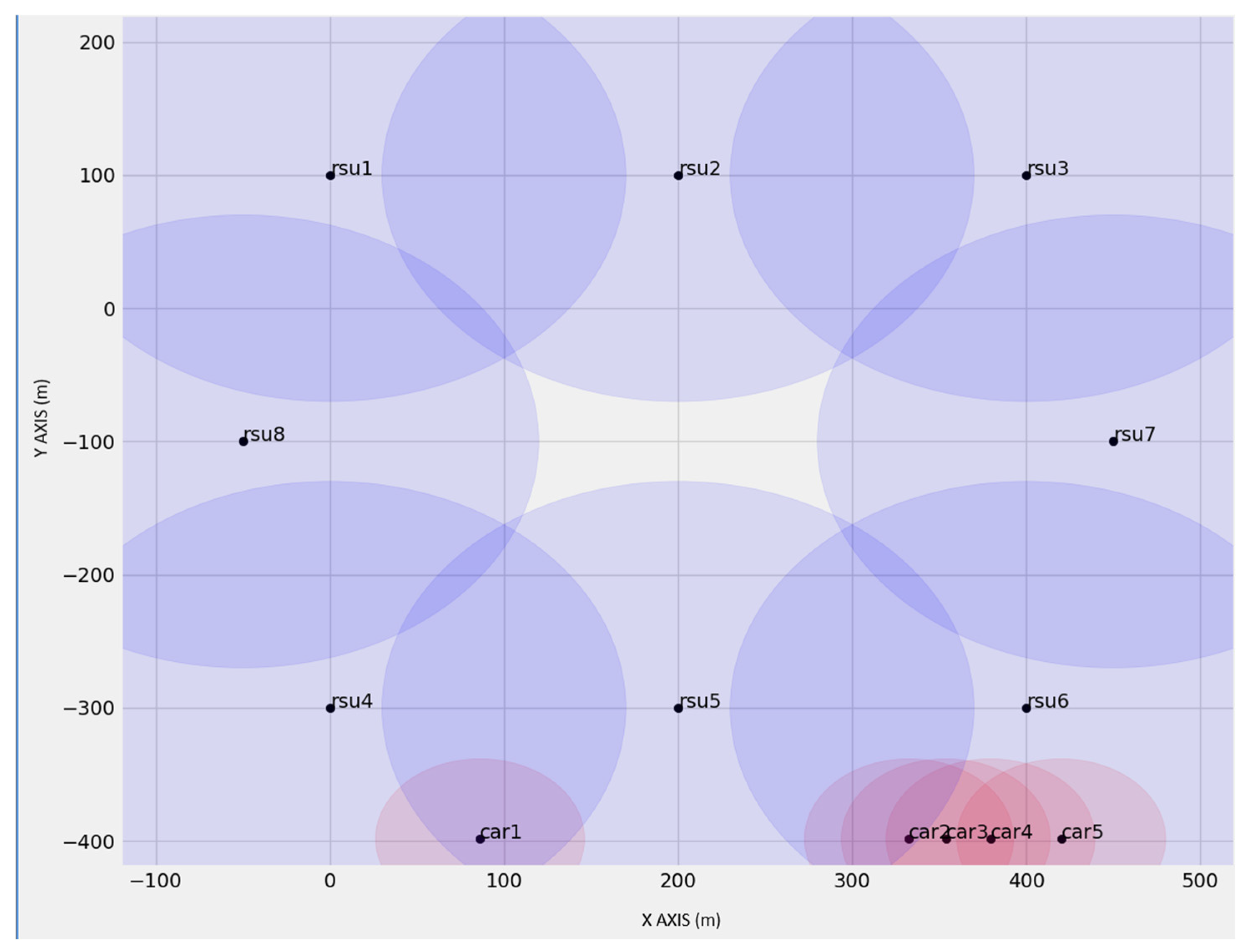
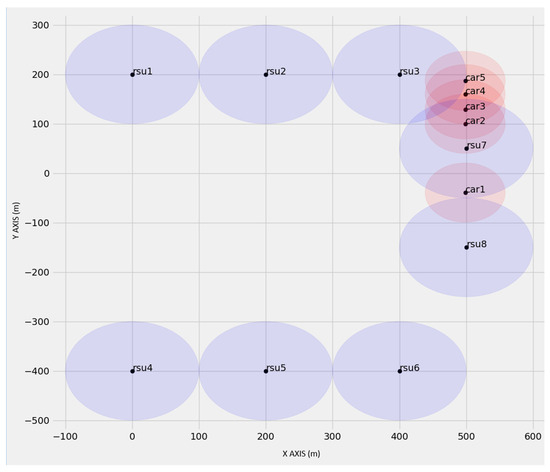
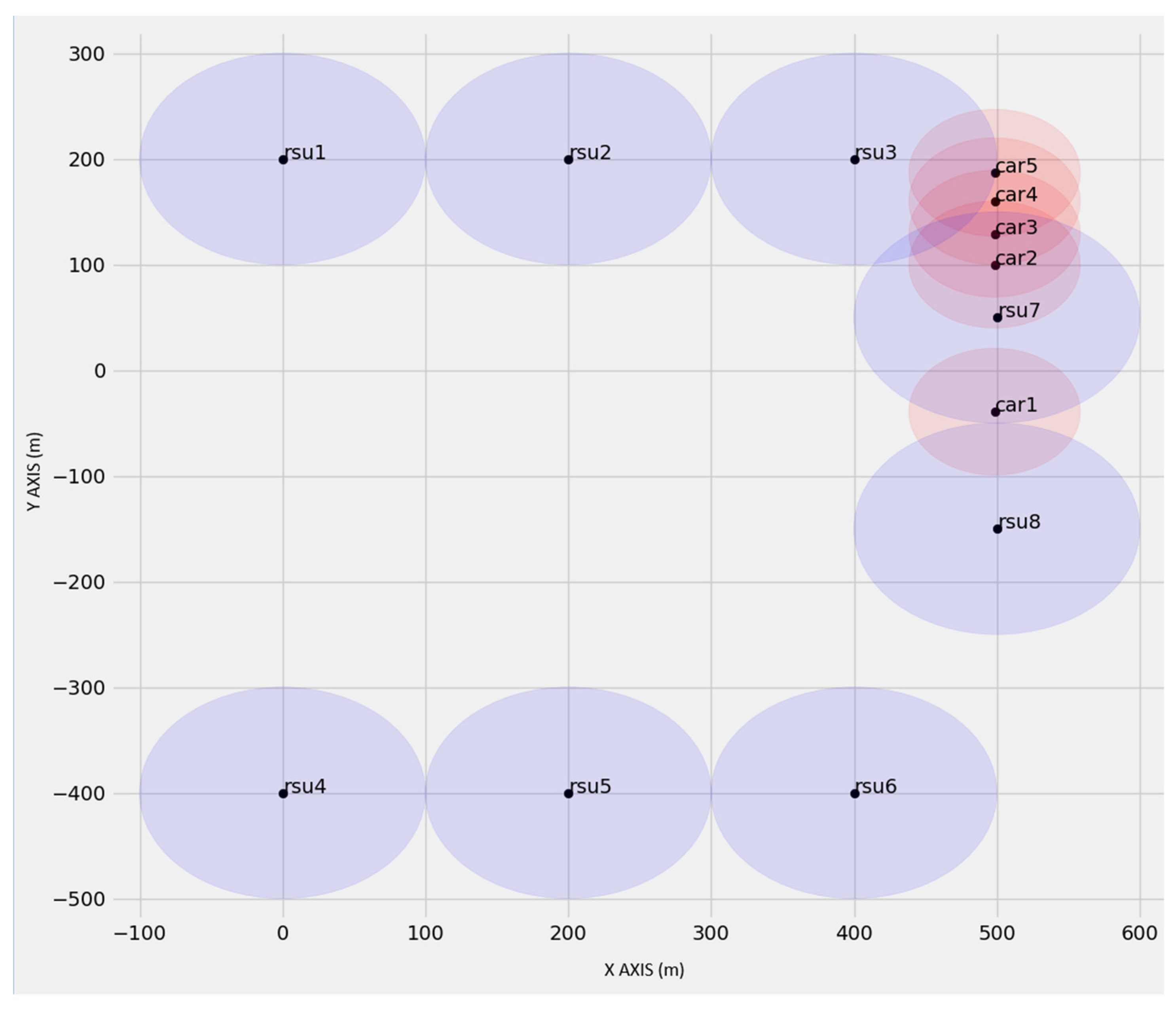
The integration between SUMO and Mininet-WiFi was achieved through real-time TraCI synchronization, ensuring that vehicle mobility directly influenced wireless connectivity and network topology. The simulated urban mobility scenario and the corresponding vehicle-RSU topology used in the QoS evaluation experiments are shown in Figure 2 and Figure 3, for different RSU communication ranges.
Figure 2.
Visualization of the simulated urban mobility scenario and corresponding vehicle–RSU topology used in the QoS evaluation experiments (vehicles represented as OBUs; RSU communication range = 170 m).
Figure 3.
Visualization of the simulated urban mobility scenario and corresponding vehicle–RSU topology used in the handover evaluation experiments (vehicles represented as OBUs; RSU communication range = 100 m).
4.3. Baseline and SDN-Enabled Configurations
To assess the impact of SDN-based control, two network configurations were evaluated:
- Baseline configuration: Vehicles and RSUs operate without centralized SDN control. Forwarding decisions rely on default networking behavior, and handovers occur implicitly based on wireless association without explicit coordination. In the baseline configuration, no centralized control is applied. Packet forwarding relies on the default behavior of Open vSwitch (NORMAL action), without mobility-aware flow management. No explicit routing protocol (e.g., AODV or OLSR) is implemented, and handovers occur implicitly through wireless association changes. Therefore, the baseline represents an uncoordinated forwarding scenario rather than an optimized decentralized VANET routing solution. To ensure fairness of comparison, all experimental conditions remain identical between the baseline and SDN-controlled scenarios. Specifically, the same vehicular mobility patterns, wireless transmission parameters, network topology, and traffic generation settings are used in both configurations. The only difference between the two cases is the presence or absence of centralized SDN-based flow management. This design ensures that any observed performance differences can be attributed to the effect of centralized control rather than variations in environmental or network parameters.
- SDN-enabled configuration: RSUs and switches are controlled by a centralized SDN controller. Forwarding rules are dynamically installed and updated based on global network visibility, and handover events are explicitly managed through mobility-aware control logic.
Both configurations used identical mobility patterns, traffic generation parameters, and wireless settings to ensure a fair comparison.
4.4. Controller Logic
The controller monitors network events related to node connectivity. When a vehicle changes its associated RSU, the controller updates the forwarding rules accordingly to maintain end-to-end communication paths. Flow entries are installed proactively or reactively depending on the observed topology changes. This mobility-aware behavior reduces disruptions during handover and improves forwarding consistency across the network.
4.5. Traffic Generation and Experimental Scenarios
Traffic flows were generated between vehicle nodes and infrastructure endpoints to emulate typical VANET communication patterns. UDP-based traffic was used to evaluate latency-sensitive applications, allowing accurate measurement of packet loss, jitter, and end-to-end delay. Scenario duration = 30 s.
Traffic load is expressed as a percentage of the bottleneck capacity in order to provide a normalized evaluation across different traffic scenarios.
Multiple experimental scenarios were designed by varying the input parameters. Specifically, the scenario duration was 30 s, the bottleneck capacity was fixed at 2 Mbps, mobility intensity ranged from 5 to 14 m/s, traffic load ranged from 25% to 250% of bottleneck capacity, and vehicle density varied from 5 to 13 vehicles.:
These scenarios were grouped into two main categories:
- QoS evaluation scenarios, focusing on steady-state performance under dynamic mobility.
- Handover evaluation scenarios, emphasizing transient behavior during RSU transitions.
4.6. QoS and Handover Evaluation Methodology
QoS performance was evaluated using standard networking metrics that are widely adopted in vehicular networking research:
- Throughput, measuring the effective data delivery rate.
- Packet loss, indicating reliability under mobility.
- Jitter, capturing variability in packet inter-arrival times.
- End-to-end latency (RTT), reflecting responsiveness for time-sensitive applications.
Metrics were collected at both the vehicle and network levels, enabling analysis of per-flow and aggregate performance. Measurements were synchronized with mobility events to capture transient effects that occur during topology changes.
Handover performance was evaluated by analyzing vehicle transitions between RSU coverage areas. Particular attention was given to the impact of handovers on latency and packet delivery, as these events represent critical stress points for vehicular networks.
In the SDN-enabled configuration, the controller monitored vehicle association changes and updated forwarding rules accordingly to maintain service continuity. In contrast, the baseline configuration relied solely on default wireless reassociation mechanisms.
Handover events were identified using mobility traces and correlated with network performance metrics to quantify transient disruptions.
4.7. Summary of Evaluation Methodology
The experimental methodology is designed to expose both steady-state and transient network behavior under realistic vehicular mobility. By combining baseline and SDN-enabled configurations with synchronized mobility and network measurements, the evaluation framework enables systematic analysis of the benefits and trade-offs introduced by software-defined control and virtualization. The experimental setup, mobility scenarios, and evaluation methodology described above provide the basis for the quantitative performance results presented in the following section.
The key simulation parameters used throughout the experiments are summarized in Table 2, including mobility characteristics, wireless communication settings, traffic generation parameters, and controller configuration details.
Table 2.
Key simulation parameters used in the SDN-enabled vehicular networking experiments.
5. Results and Discussion
5.1. Evaluation Overview
This section presents the experimental results obtained using the proposed SDN-enabled vehicular networking platform. The evaluation focuses on the impact of centralized SDN control on QoS and handover performance under dynamic vehicular mobility. Results are reported for both the baseline (non-SDN) configuration and the SDN-enabled configuration under identical mobility and traffic conditions.
The performance analysis is based on standard networking metrics, including throughput, packet loss, jitter, and end-to-end latency (RTT). All metrics were collected in a synchronized manner across mobility, network, and control layers, enabling accurate correlation between mobility events and observed network behavior.
5.2. QoS Performance Under Dynamic Mobility
5.2.1. Throughput Performance
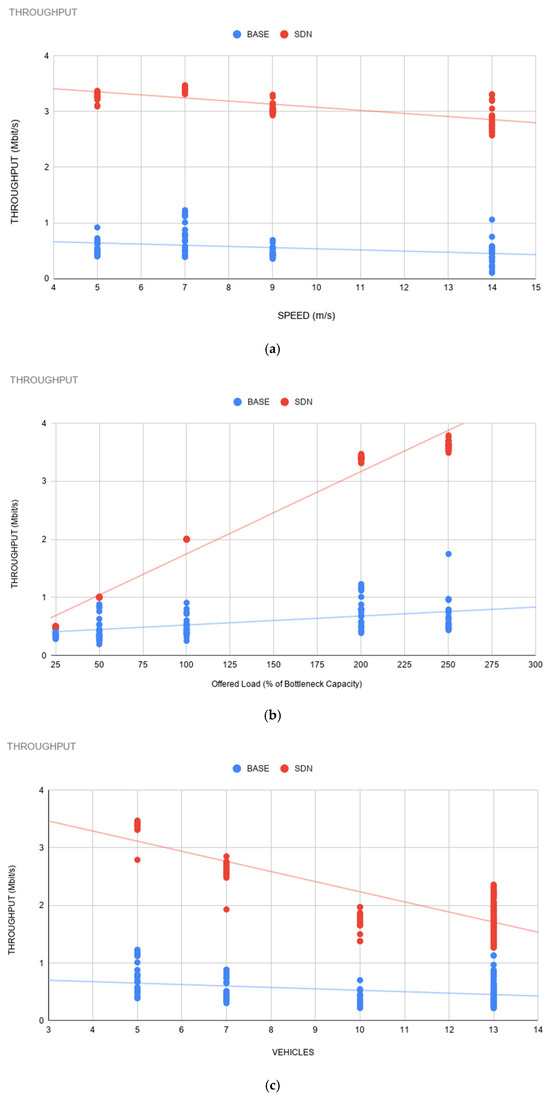
The throughput performance of the vehicular network was evaluated under three different experimental conditions: varying vehicle speed, varying wireless data rate, and increasing vehicle density. Figure 4a–c illustrate the measured throughput values for both the baseline VANET configuration and the SDN-enabled architecture.
Figure 4.
(a) Throughput comparison between the baseline VANET configuration and the SDN-enabled architecture under varying vehicle speeds. (b) Throughput performance of the baseline and SDN-enabled VANET architectures for different wireless data rate configurations. (c) Impact of vehicle density on network throughput for both baseline and SDN-enabled VANET configurations.
The results indicate that the SDN-based architecture consistently achieves higher throughput compared to the baseline configuration across all experimental scenarios.
When vehicle speed increases (Figure 4a), the baseline network shows relatively low throughput values with noticeable fluctuations, typically ranging between approximately 0.3 and 1.2 Mbit/s. This degradation can be attributed to frequent topology changes and unstable wireless links caused by vehicle mobility. In contrast, the SDN-enabled network maintains significantly higher throughput levels, generally between 3.0 and 3.4 Mbit/s. The centralized controller enables rapid flow rule updates during mobility events, allowing the network to quickly adapt to topology changes and maintain efficient packet forwarding.
A similar trend is observed when the wireless data rate increases (Figure 4b). While both configurations benefit from higher available bandwidth, the SDN-enabled network demonstrates a much stronger scaling effect. Throughput in the SDN scenario increases almost linearly with the data rate, reaching values close to 3.8 Mbit/s at the highest configuration. Conversely, the baseline network exhibits only modest improvements, remaining below approximately 1.7 Mbit/s. This indicates that traditional distributed routing mechanisms fail to fully utilize the available wireless capacity, whereas the SDN controller dynamically optimizes forwarding decisions to better exploit network resources.
The impact of network density is shown in Figure 4c. As the number of vehicles increases, throughput decreases in both configurations due to higher contention for the wireless medium. However, the degradation is significantly more pronounced in the baseline network. Throughput values in the baseline case remain below 1 Mbit/s for most scenarios and gradually decline as the number of vehicles grows. In contrast, the SDN-enabled network maintains considerably higher throughput levels, ranging from approximately 3.3 Mbit/s with fewer vehicles to around 1.5–2.3 Mbit/s under the highest density conditions. This indicates that centralized traffic management helps mitigate the effects of congestion and improves overall channel utilization.
The experimental results confirm that the SDN-based VANET architecture significantly improves throughput performance under varying mobility, bandwidth, and network density conditions. This improvement can be primarily attributed to the controller’s global network visibility and its ability to proactively install optimized forwarding rules. During mobility events, the controller detects topology changes and updates flow entries accordingly, reducing the time required to restore valid forwarding paths. In contrast, the baseline configuration relies on default switching behavior, which may introduce temporary forwarding inconsistencies during handovers, leading to reduced effective throughput.
5.2.2. Packet Loss Performance
Packet loss is a critical performance indicator in vehicular networks, as high packet loss directly affects communication reliability and the timely delivery of safety-related information. To evaluate the reliability of the proposed architecture, packet loss was measured under three different conditions: varying wireless data rates, increasing vehicle density, and different vehicle speeds.
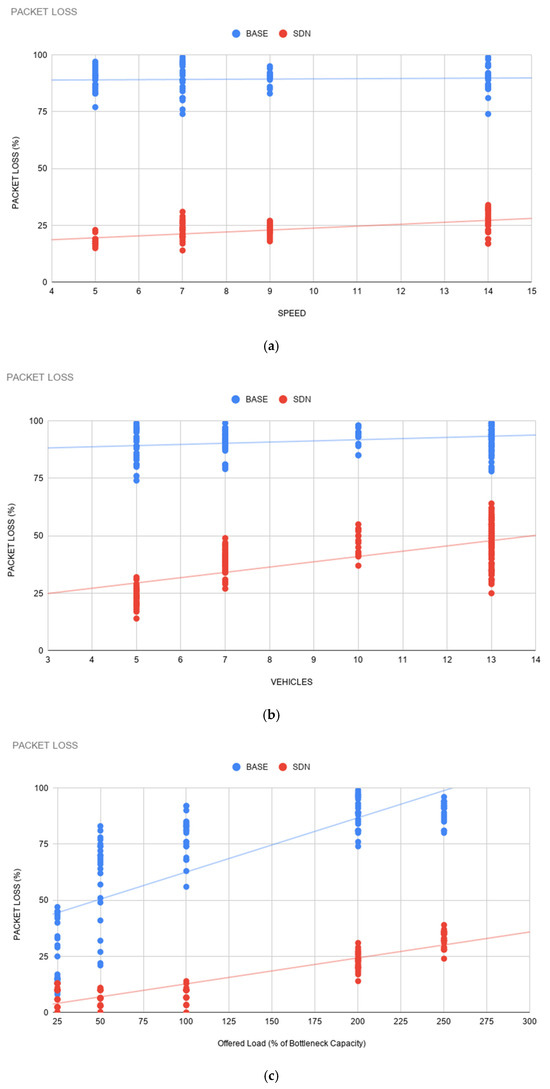
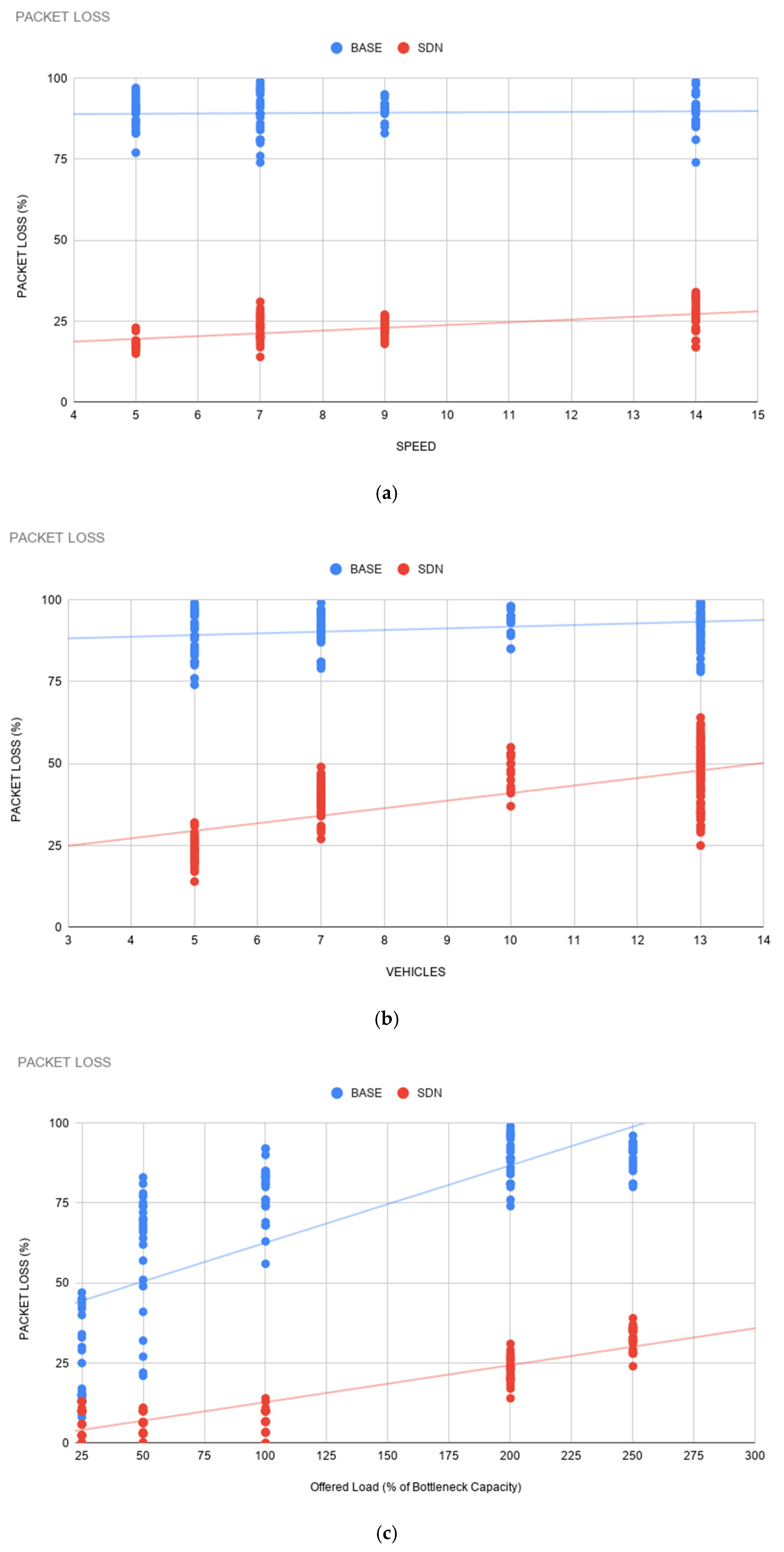
The results demonstrate that the SDN-enabled VANET consistently achieves significantly lower packet loss compared to the baseline configuration. Figure 5a presents the relationship between vehicle speed and packet loss. Higher vehicle speeds introduce more frequent topology changes and unstable wireless links, which negatively affect communication reliability in the baseline network. In contrast, the SDN-enabled network maintains lower packet loss across all speed levels. The centralized control mechanism allows the controller to quickly update forwarding paths during mobility events, reducing packet drops caused by routing inconsistencies.
Figure 5.
(a) Packet loss performance of the baseline and SDN-enabled VANET architectures under varying vehicle speeds. (b) Impact of vehicle density on packet loss for both baseline and SDN-enabled VANET configurations. (c) Packet loss comparison between the baseline VANET configuration and the SDN-enabled architecture under different wireless data rates.
Figure 5b illustrates the impact of increasing vehicle density on packet loss. As the number of vehicles grows, the wireless channel becomes more congested, leading to higher packet loss in both configurations. Nevertheless, the baseline network suffers from severe packet loss as vehicle density increases, whereas the SDN-enabled architecture demonstrates improved resilience and maintains significantly lower loss rates. This behavior highlights the ability of the SDN controller to coordinate network resources more efficiently and reduce congestion effects.
Finally, as shown in Figure 5c, packet loss increases with higher data rates in both scenarios due to increased traffic load and channel contention. However, the baseline configuration experiences a substantial rise in packet loss, reaching very high levels as network traffic intensifies. In contrast, the SDN-based architecture maintains considerably lower packet loss values. This improvement is mainly attributed to the centralized SDN controller, which dynamically manages forwarding rules and optimizes traffic distribution across the network.
Overall, the experimental results confirm that integrating SDN into VANET environments significantly improves communication reliability by reducing packet loss under varying mobility conditions, network density, and traffic loads. This reduction in packet loss is primarily related to improved handover coordination enabled by centralized control. By updating forwarding rules immediately after association changes, the controller minimizes transient packet drops that typically occur during mobility transitions in unmanaged networks. This behavior contributes to more stable packet delivery under dynamic vehicular movement. This mechanism highlights the importance of mobility-aware flow management in maintaining reliable communication during frequent topology changes.
5.2.3. Jitter Analysis
Jitter represents the variation in packet delay during network communication and is an important metric for evaluating the stability of real-time vehicular applications. High jitter values may negatively affect time-sensitive services such as safety messaging, traffic monitoring, and cooperative driving applications. To analyze network stability, jitter was measured under three different experimental conditions: varying vehicle speed, different wireless data rates, and increasing vehicle density.
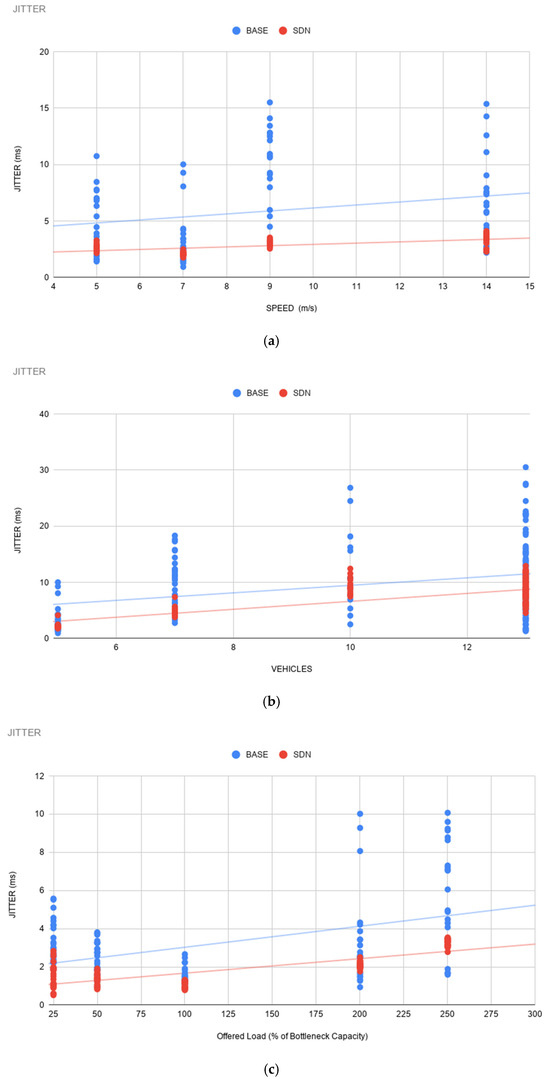
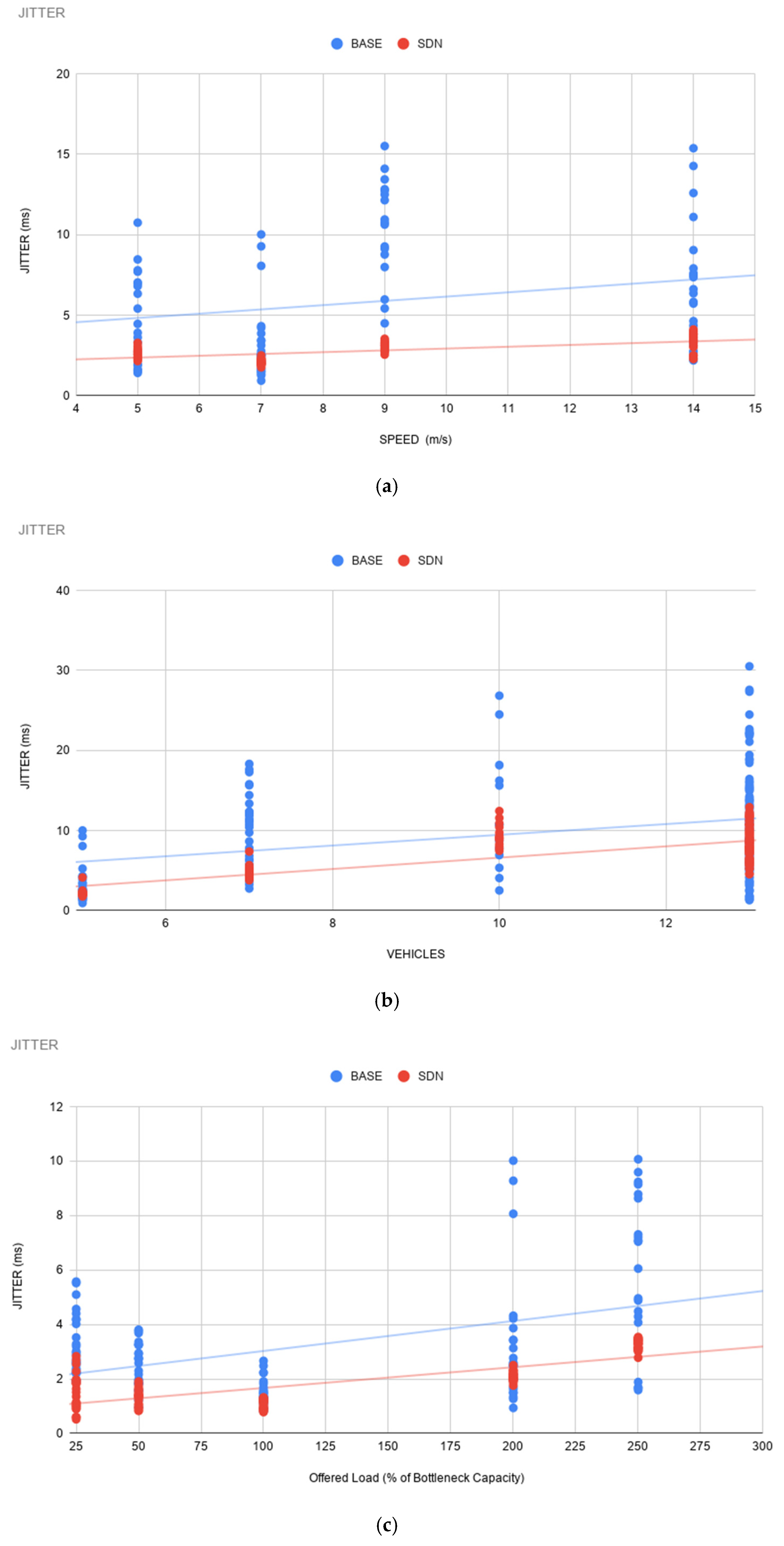
As illustrated in Figure 6a, jitter increases with higher vehicle speeds in both network configurations due to more frequent topology changes and link instability. However, the baseline network exhibits significantly higher jitter values compared to the SDN-enabled architecture. The SDN-based network maintains more stable delay patterns because the centralized controller dynamically updates forwarding rules and adapts to mobility changes more efficiently.
Figure 6.
(a) Jitter comparison between the baseline VANET configuration and the SDN-enabled architecture under varying vehicle speeds. (b) Jitter performance of baseline and SDN-enabled VANET architectures for different wireless data rates. (c) Impact of vehicle density on jitter for both baseline and SDN-enabled VANET configurations.
Figure 6b presents jitter measurements under different wireless data rates. As the available data rate increases, jitter also increases due to higher traffic intensity and potential congestion in the wireless medium. Nevertheless, the SDN-enabled network maintains lower jitter values than the baseline configuration. This improvement can be attributed to the controller’s ability to optimize traffic flows and reduce packet queuing delays.
Finally, Figure 6c illustrates the effect of vehicle density on jitter. As the number of vehicles increases, the wireless channel becomes more congested, leading to higher delay variations. The baseline network experiences a significant increase in jitter as vehicle density grows, whereas the SDN-enabled architecture demonstrates improved stability and lower delay variation. The centralized SDN controller effectively manages network resources and coordinates traffic flows, reducing congestion effects and improving overall communication consistency.
The results indicate that the SDN-enabled VANET architecture significantly improves network stability by reducing delay variation under varying mobility conditions, traffic loads, and network densities.
5.3. Handover Performance Evaluation
5.3.1. End-to-End Latency During Handover
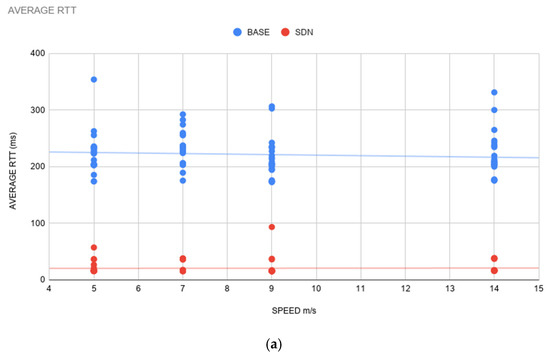
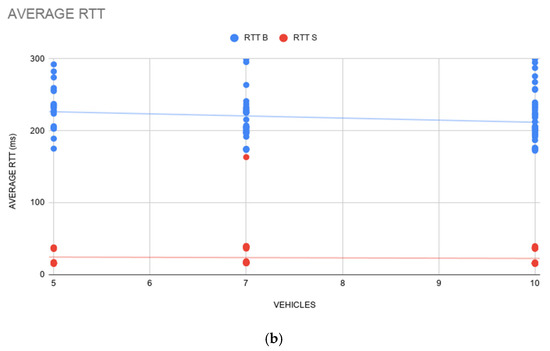
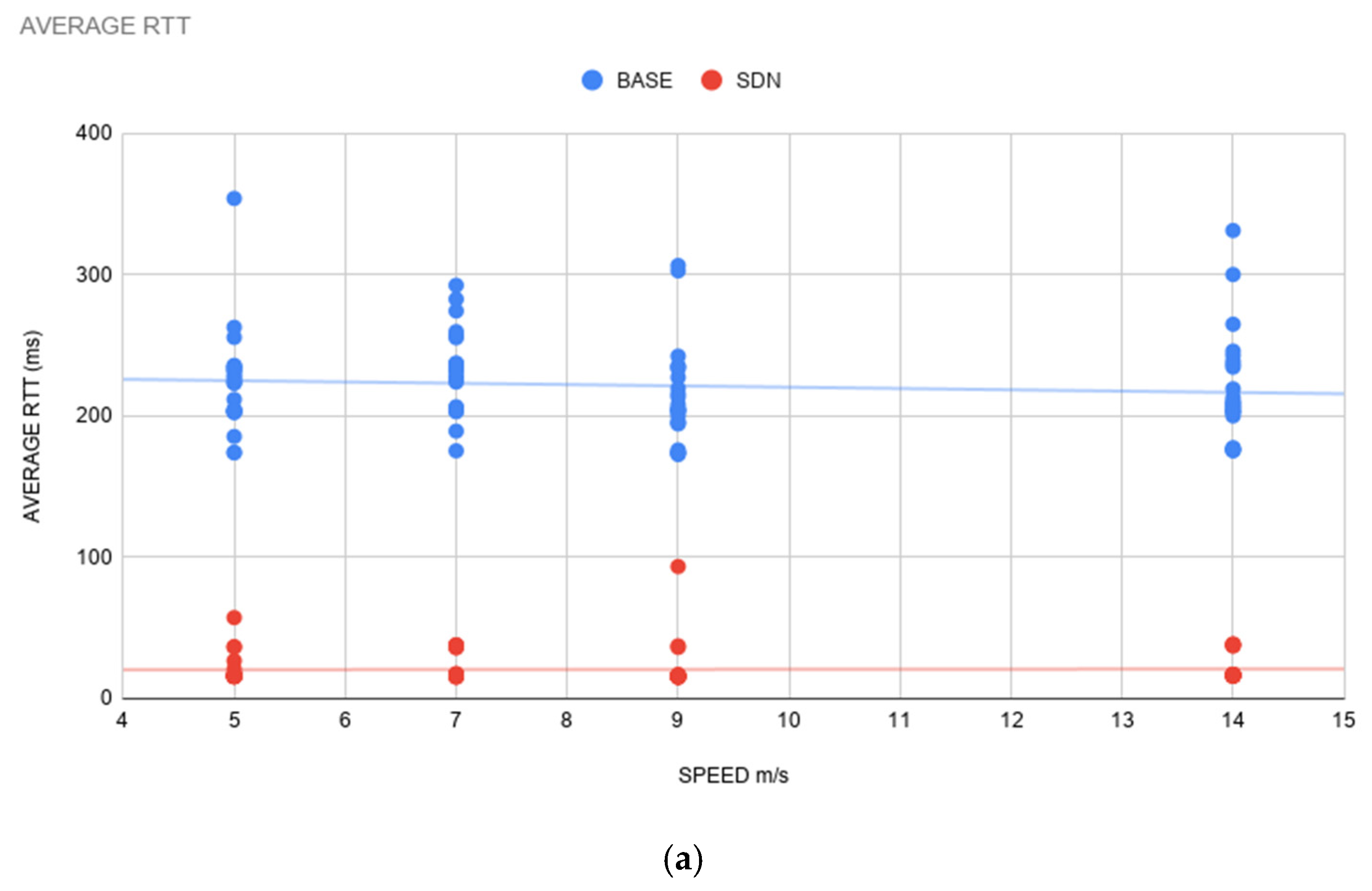
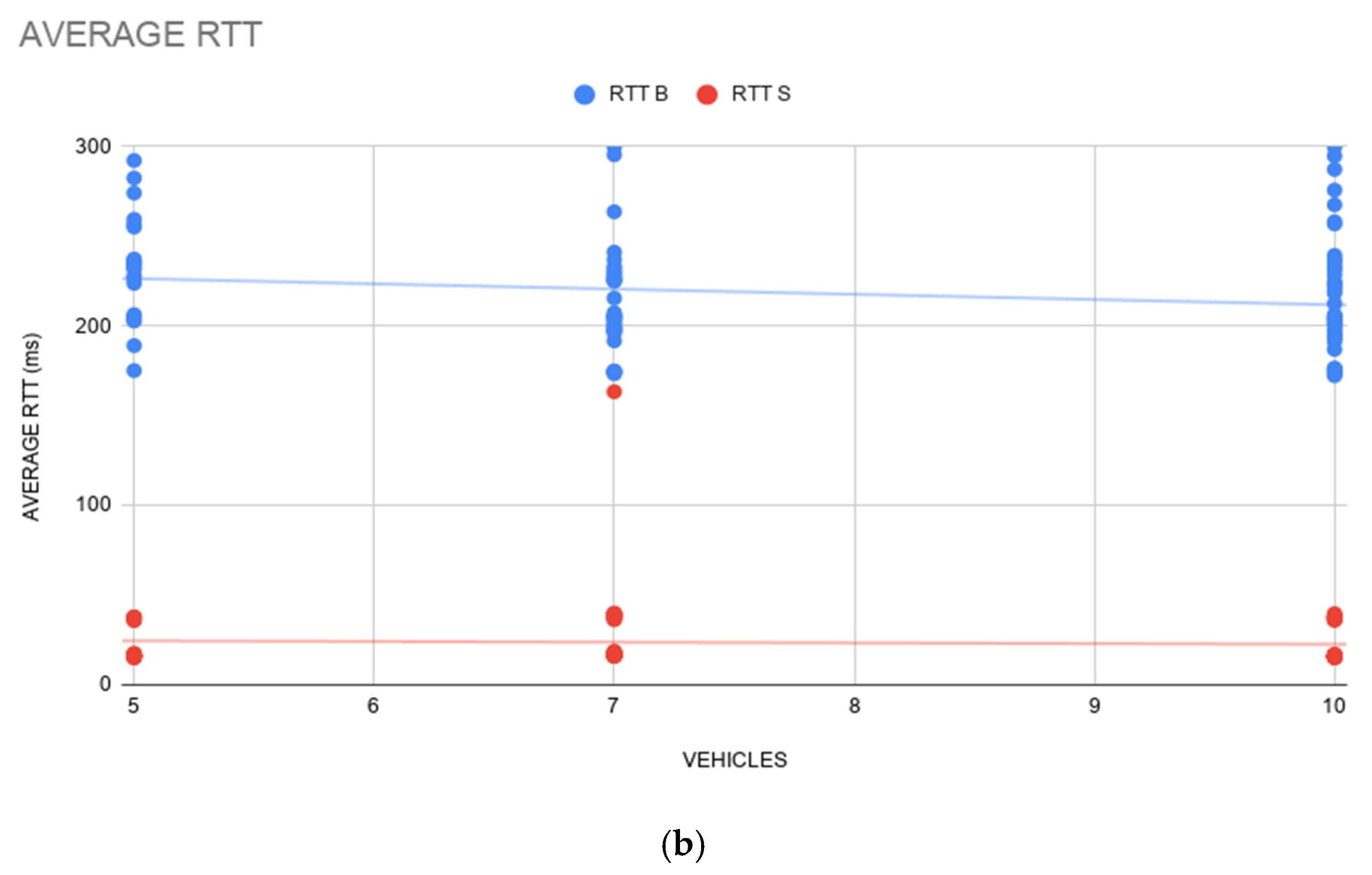
Handover is a fundamental mechanism in vehicular networks, as vehicles frequently move between the coverage areas of different roadside units (RSUs). Efficient handover management is essential to maintain continuous connectivity and minimize communication disruptions. To assess the effectiveness of the proposed architecture, the round-trip time (RTT) was measured during vehicle mobility and RSU transitions.
Figure 7a presents the average RTT observed under different vehicle speeds. As mobility increases, the baseline network experiences higher latency due to delayed route updates and temporary forwarding inconsistencies during handover events. The SDN-enabled network, however, maintains considerably lower RTT values. This behavior results from the centralized controller’s ability to quickly adjust forwarding rules and redirect traffic paths when vehicles associate with new RSUs.
Figure 7.
(a) Round-trip time comparison between the baseline VANET and the SDN-enabled architecture under different vehicle speeds during handover events. (b) Average RTT measurements for baseline and SDN-enabled VANET configurations as vehicle density increases.
The influence of vehicle density on RTT is shown in Figure 7b. When more vehicles are present in the network, additional signaling and channel contention increase overall delay in the baseline configuration. In contrast, the SDN-based architecture limits RTT growth by coordinating traffic flows and maintaining an updated global network view. This allows the controller to react efficiently to topology changes and avoid unnecessary routing overhead.
Overall, the results indicate that the SDN-enabled VANET architecture significantly improves handover efficiency. By rapidly updating forwarding paths and maintaining centralized awareness of the network state, the SDN controller reduces latency during RSU transitions and ensures smoother communication continuity for mobile vehicles.
5.3.2. Packet Loss During Handover
In vehicular environments, handover events occur when vehicles move between the coverage areas of different roadside units. During these transitions, temporary communication disruptions may occur, which can lead to packet drops. Evaluating packet loss during handover is therefore essential to assess the robustness of the network architecture.
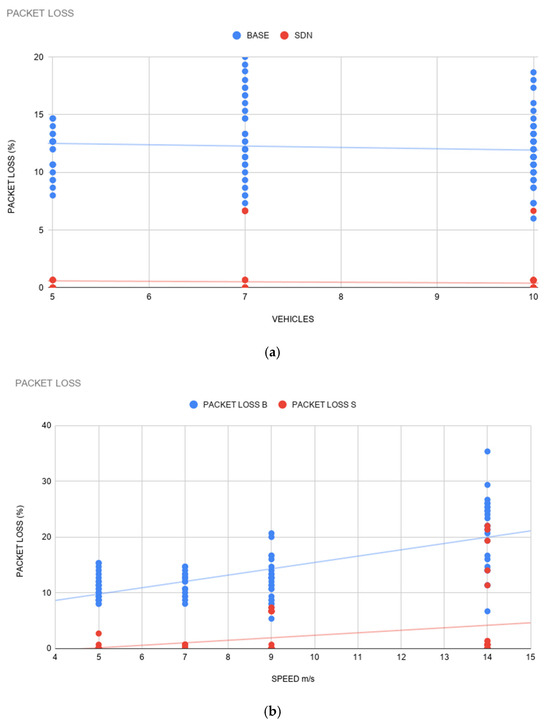
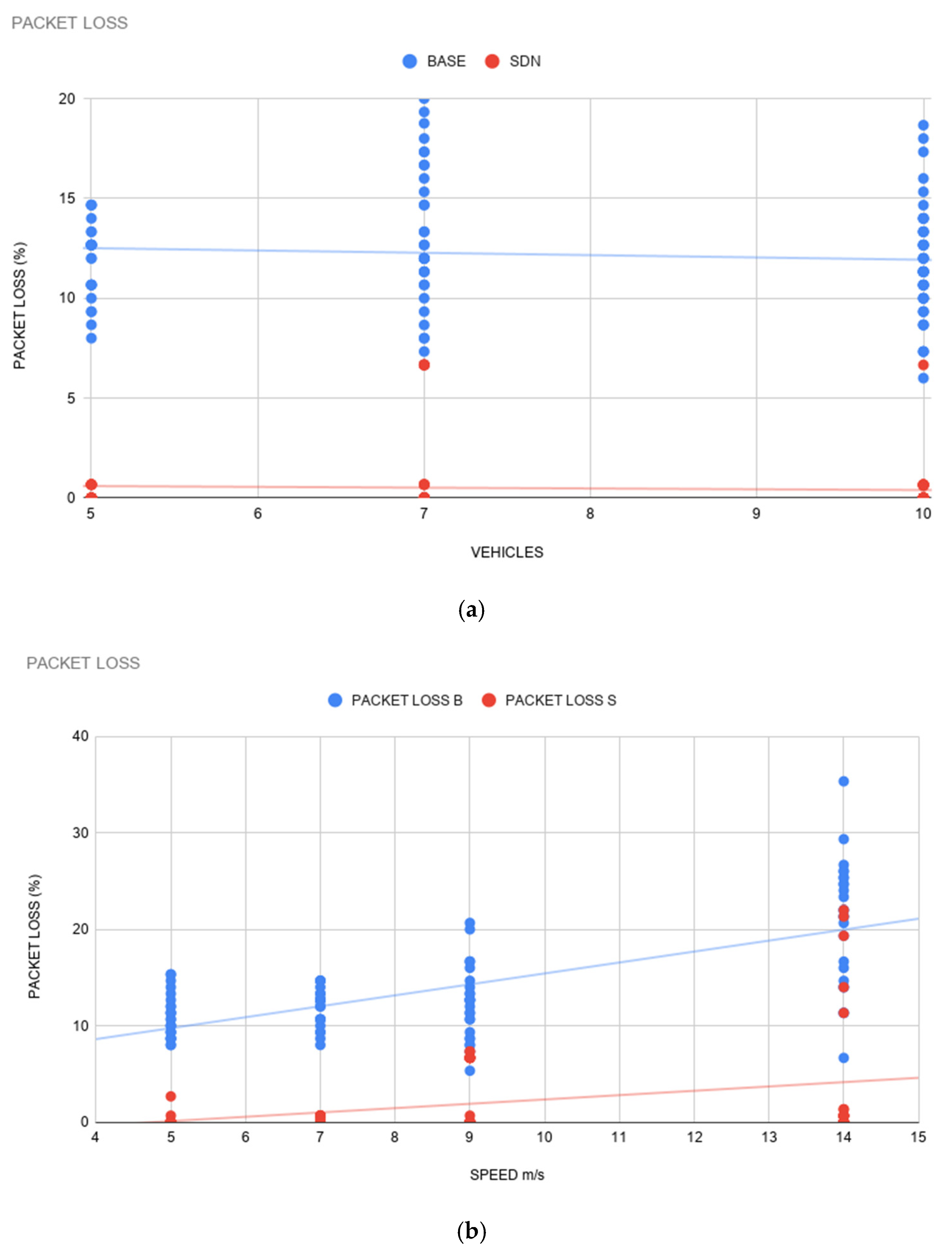
Figure 8a illustrates the packet loss behavior as the number of vehicles increases during handover scenarios. As network density grows, the baseline configuration experiences a noticeable increase in packet loss due to higher contention and delayed routing updates. In contrast, the SDN-enabled network maintains significantly lower loss rates even as more vehicles participate in the network. The centralized control plane allows the controller to anticipate topology changes and rapidly adjust forwarding rules when vehicles switch between RSUs.
Figure 8.
(a) Packet loss comparison between the baseline VANET configuration and the SDN-enabled architecture during handover events as vehicle density increases. (b) Packet loss measurements for baseline and SDN-enabled VANET configurations under varying vehicle speeds during handover scenarios.
Figure 8b shows the influence of vehicle speed on packet loss during handover events. Higher speeds increase the frequency of RSU transitions and create additional challenges for maintaining stable connections. In the baseline network, these rapid topology changes lead to increased packet drops. Conversely, the SDN-based architecture demonstrates improved resilience by maintaining lower packet loss levels across different mobility conditions. This behavior highlights the ability of the SDN controller to promptly update forwarding paths and minimize disruptions during mobility-driven handovers.
Overall, the results indicate that the SDN-enabled VANET architecture enhances communication reliability during handover events by reducing packet loss and maintaining more stable connectivity between vehicles and roadside infrastructure.
5.4. Discussion and Key Observations
The experimental results lead to several important observations. First, centralized SDN control improves QoS consistency relative to the unmanaged baseline used in this study under dynamic mobility by stabilizing throughput, reducing packet loss, and minimizing jitter. Second, explicit mobility-aware handover management enhances performance during RSU transitions, reducing both latency and packet loss. Although SDN introduces additional control-plane signaling, the present study focuses on application-level performance outcomes rather than detailed measurement of control-plane resource consumption. Quantitative analysis of signaling overhead remains an important direction for future work.
The observed performance improvements can be attributed to the ability of the SDN-enabled configuration to maintain more consistent forwarding paths during mobility events. In the baseline scenario, the lack of coordination leads to transient disruptions during handover and inefficient use of available network resources, resulting in increased packet loss and reduced throughput.
It is important to note that the magnitude of the observed improvement is influenced by the experimental setup and the constrained forwarding behavior of the baseline configuration, which represents unmanaged forwarding rather than an optimized decentralized VANET routing protocol. Therefore, the reported performance gains reflect the benefits of coordinated SDN-based traffic management relative to unmanaged operation, and should not be interpreted as a direct comparison against state-of-the-art distributed routing algorithms.
Furthermore, it is worth mentioning that while advanced control and learning-based approaches (e.g., reinforcement learning or predictive control methods) represent promising directions for improving vehicular network management, the present study focuses on establishing a reproducible SDN-based experimental platform. The integration of predictive handover management or adaptive resource allocation mechanisms is therefore considered a valuable direction for future work.
Overall, the results demonstrate that system-level integration of SDN with realistic vehicular mobility enables meaningful performance gains that are difficult to capture through abstract simulations alone.
6. Conclusions
This paper presented an SDN-enabled vehicular networking platform designed to support realistic, system-level experimentation in highly dynamic VANET environments. By tightly coupling microscopic vehicular mobility with wireless network emulation and centralized SDN control, the proposed framework enables fine-grained observation of both data-plane and control-plane behavior under realistic mobility and traffic conditions.
Unlike approaches that rely solely on abstract simulations or isolated component evaluations, the proposed platform captures the continuous interaction between vehicle movement, wireless connectivity, and network control decisions. This integration proved essential for analyzing transient effects, particularly during handover events, where performance degradation is often short-lived but critical for vehicular applications.
Experimental results demonstrated that SDN-based centralized control improves QoS stability compared to baseline non-SDN configurations. In particular, higher and more consistent throughput, reduced packet loss, and lower jitter were observed under dynamic mobility conditions. The benefits were especially pronounced during RSU handovers, where mobility-aware SDN control reduced latency spikes and packet loss by proactively updating forwarding rules. These improvements were achieved despite the additional control-plane signaling overhead, indicating a favorable trade-off between responsiveness and performance.
Although SDN introduces additional control-plane signaling for flow installation and topology updates, this study focuses on evaluating the resulting impact on application-level performance metrics such as throughput, latency, and packet loss. Detailed analysis of control-plane resource consumption remains an area for future investigation.
Beyond quantitative performance gains, this study provides several practical insights for the design of software-defined vehicular networks. Centralized control is particularly effective when mobility awareness is explicitly incorporated into decision making, while tight synchronization between mobility and networking layers is critical for capturing realistic system behavior. These findings highlight the importance of integrated experimental platforms as a complement to large-scale simulations and analytical models.
Despite its advantages, the proposed platform has certain limitations. The scale of the experimental environment is constrained by the underlying emulation framework, and extremely large vehicular deployments may require hybrid simulation–emulation approaches. In addition, the current implementation relies on a single centralized SDN controller, which may raise scalability and fault-tolerance concerns in large-scale deployments.
Future work will focus on extending the platform to support distributed and hierarchical SDN control architectures, as well as exploring adaptive controller placement strategies in mobile environments. Further investigation of edge-oriented Network Function Virtualization (NFV) deployment, integration with emerging vehicular communication technologies (e.g., 5G and beyond), and large-scale scenario evaluation will also be pursued. By addressing these directions, the proposed framework can be further enhanced as a practical reference platform for software-defined intelligent transportation and mobile networking systems.
Author Contributions
Conceptualization, E.L.; Methodology, F.A.; Software, F.A.; Validation, F.A.; Investigation, E.L.; Writing—original draft, F.A.; Writing—review & editing, E.L.; Visualization, F.A.; Supervision, E.L.; Project administration, E.L. All authors have read and agreed to the published version of the manuscript.
Funding
This research received no external funding.
Data Availability Statement
The original contributions presented in the study are included in the article, further inquiries can be directed to the corresponding author.
Conflicts of Interest
The authors declare no conflicts of interest.
Abbreviations
The following abbreviations are used in this manuscript:
| AP | Access Point |
| ITSs | Intelligent Transportation Systems |
| NFV | Network Function Virtualization |
| OBU | On-Board Unit |
| QoS | Quality of Service |
| RSU | Roadside Unit |
| RTT | Round-Trip Time |
| SDN | Software-Defined Networking |
| SDVN | Software-Defined Vehicular Network |
| SUMO | Simulation of Urban Mobility |
| V2I | Vehicle-to-Infrastructure |
| V2V | Vehicle-to-Vehicle |
| V2X | Vehicle-to-Everything |
| VANET | Vehicular Ad Hoc Network |
References
- Arif, M.; Wang, G.; Geman, O.; Balas, V.E.; Tao, P.; Brezulianu, A.; Chen, J. SDN-based VANETs, Security Attacks, Applications, and Challenges. Appl. Sci. 2020, 10, 3217. [Google Scholar] [CrossRef] [Scilit]
- Marzak, B.; Toumi, H.; Benlahmar, E.; Talea, M. Performance Analysis of Routing Protocols in Vehicular Ad Hoc Network. In Advances in Ubiquitous Networking 2; Lecture Notes in Electrical Engineering; Springer: Singapore, 2017; Volume 397, pp. 31–42. [Google Scholar] [CrossRef] [Scilit]
- Karne, R.; Sreeja, T.K. Review on Vanet Architecture and Applications. Turk. J. Comput. Math. Educ. 2021, 12, 1745–1749. [Google Scholar]
- Lee, M.; Atkison, T. VANET applications: Past, present, and future. Veh. Commun. 2021, 28, 100310. [Google Scholar] [CrossRef] [Scilit]
- Rehman, S.U.; Khan, M.; Zia, T.; Zheng, L. Vehicular Ad-Hoc Networks (VANETs)―An Overview and Challenges. J. Wirel. Netw. 2013, 3, 29–38. [Google Scholar]
- Kumari, N.; Kathuria, K. Overview of SDN Building Foundations and Applications. J. Res. Sci. Eng. 2024, 6, 43–53. [Google Scholar] [CrossRef] [Scilit]
- Dutta, A.; Samaniego Campoverde, L.M.; Tropea, M.; De Rango, F. A Comprehensive Review of Recent Developments in VANET for Traffic, Safety & Remote Monitoring Applications. J. Netw. Syst. Manag. 2024, 32, 73. [Google Scholar] [CrossRef] [Scilit]
- Hussein, N.H.; Koh, J.S.P.; Yaw, C.T.; Tiong, S.K.; Benedict, F.; Yusaf, T.; Kadirgama, K.; Hong, T.C. SDN-Based VANET Routing: A Comprehensive Survey on Architectures, Protocols, Analysis, and Future Challenges. IEEE Access 2024, 13, 126801–126861. [Google Scholar] [CrossRef] [Scilit]
- Shrestha, R.; Bajracharya, R.; Nam, S.Y. Challenges of Future VANET and Cloud-Based Approaches. Wirel. Commun. Mob. Comput. 2018, 2018, 5603518. [Google Scholar] [CrossRef] [Scilit]
- Open Networking Foundation. Software-Defined Networking: The New Norm for Networks; ONF White Paper: Palo Alto, CA, USA, 2012. [Google Scholar]
- Hande, Y.; Vairagade, R. A Comprehensive Introduction to SDN Architectural Foundations and Applications. Int. J. Sci. Res. IJSR 2024, 13, 836–846. [Google Scholar] [CrossRef] [Scilit]
- Jaballah, W.B.; Conti, M.; Lal, C. A Survey on Software-Defined VANETs: Benefits, Challenges, and Future Directions. arXiv 2019, arXiv:1904.04577. [Google Scholar] [CrossRef] [Scilit]
- Mekki, T.; Jabri, I.; Rachedi, A.; Chaari, L. Software-defined networking in vehicular networks: A survey. Trans. Emerg. Telecommun. Technol. 2022, 33, e4265. [Google Scholar] [CrossRef] [Scilit]
- Al-Heety, O.S.; Zakaria, Z.; Ismail, M.; Shakir, M.M.; Alani, S.; Alsariera, H. A Comprehensive Survey: Benefits, Services, Recent Works, Challenges, Security, and Use Cases for SDN-VANET. IEEE Access 2020, 8, 91028–91047. [Google Scholar] [CrossRef] [Scilit]
- Sharma, P.; Jain, S. Review of VANET Challenges and Protocol for Architecture Design and Intelligent Traffic System. In Proceedings of the 2nd International Conference on Data, Engineering and Applications (IDEA); IEEE: New York, NY, USA, 2020; pp. 1–4. [Google Scholar] [CrossRef] [Scilit]
- Al-shareeda, M.A.; Alazzawi, M.A.; Anbar, M.; Manickam, S.; Al-Ani, A.K. A Comprehensive Survey on Vehicular Ad Hoc Networks (VANETs). In Proceedings of the 2021 International Conference on Advanced Computer Applications (ACA); IEEE: New York, NY, USA, 2021; pp. 156–160. [Google Scholar] [CrossRef] [Scilit]
- Sharma, S.; Sharma, P. Comprehensive Study of Various Routing Protocols in VANET. In Proceedings of the 2019 International Conference on Intelligent Computing and Control Systems (ICCS); IEEE: New York, NY, USA, 2019; pp. 1272–1275. [Google Scholar] [CrossRef] [Scilit]
- Ku, I.; Lu, Y.; Gerla, M.; Gomes, R.L.; Ongaro, F.; Cerqueira, E. Towards software-defined VANET: Architecture and services. In Proceedings of the 13th Annual Mediterranean Ad Hoc Networking Workshop (MED-HOC-NET); IEEE: New York, NY, USA, 2014; pp. 103–110. [Google Scholar] [CrossRef] [Scilit]
- Secinti, G.; Canberk, B.; Duong, T.Q.; Shu, L. Software Defined Architecture for VANET: A Testbed Implementation with Wireless Access Management. IEEE Commun. Mag. 2017, 55, 135–141. [Google Scholar] [CrossRef] [Scilit]
- Toufga, S.; Abdellatif, S.; Assouane, H.T.; Owezarski, P.; Villemur, T. Towards Dynamic Controller Placement in Software Defined Vehicular Networks. Sensors 2020, 20, 1701. [Google Scholar] [CrossRef] [Scilit] [PubMed]
- Fontes, R.D.R.; Campolo, C.; Rothenberg, C.E.; Molinaro, A. From Theory to Experimental Evaluation: Resource Management in Software-Defined Vehicular Networks. IEEE Access 2017, 5, 3069–3076. [Google Scholar] [CrossRef] [Scilit]
- Correia, S.; Boukerche, A.; Meneguette, R.I. An Architecture for Hierarchical Software-Defined Vehicular Networks. IEEE Commun. Mag. 2017, 55, 80–86. [Google Scholar] [CrossRef] [Scilit]
- Sadio, O.; Ngom, I.; Lishou, C. Design and Prototyping of a Software Defined Vehicular Networking. IEEE Trans. Veh. Technol. 2020, 69, 842–850. [Google Scholar] [CrossRef] [Scilit]
- Li, H.; Dong, M.; Ota, K. Control Plane Optimization in Software-Defined Vehicular Ad Hoc Networks. IEEE Trans. Veh. Technol. 2016, 65, 7895–7904. [Google Scholar] [CrossRef] [Scilit]
- Islam, M.M.; Khan, M.T.R.; Saad, M.M.; Kim, D. Software-defined vehicular network (SDVN): A survey on architecture and routing. J. Syst. Archit. 2021, 114, 101961. [Google Scholar] [CrossRef] [Scilit]

Disclaimer/Publisher’s Note: The statements, opinions and data contained in all publications are solely those of the individual author(s) and contributor(s) and not of MDPI and/or the editor(s). MDPI and/or the editor(s) disclaim responsibility for any injury to people or property resulting from any ideas, methods, instructions or products referred to in the content. |
© 2026 by the authors. Licensee MDPI, Basel, Switzerland. This article is an open access article distributed under the terms and conditions of the Creative Commons Attribution (CC BY) license.