Article

Drone Rider: Effects of Wind Conditions on the Sense of Flight

Department of Computer Science, Tokyo Metropolitan University, Hino 191-0065, Japan
*
Author to whom correspondence should be addressed.
Appl. Sci. 2026, 16(7), 3544; https://doi.org/10.3390/app16073544
Submission received: 25 February 2026 / Revised: 28 March 2026 / Accepted: 31 March 2026 / Published: 4 April 2026

Abstract

Recent advances in extended reality (XR) have enabled immersive virtual flight experiences for applications such as entertainment and teleoperation support. However, XR-based flight systems that rely primarily on audiovisual cues often fail to evoke a compelling sense of flight and embodied sensation. This study investigates how adaptive wind feedback enhances subjective flight perception in a virtual flight simulation system, Drone Rider. We implemented direction- and velocity-adaptive wind feedback that synchronizes airflow intensity and direction with the user’s motion in the virtual environment, focusing on perceptual effects in a controlled manner to identify key design factors, rather than reproducing aerodynamically accurate airflow. To explore flexible system configurations, two fan installation positions were compared: front-mounted and bottom-mounted. A questionnaire-based user study revealed that adaptive wind feedback significantly enhanced the sense of flight, self-location, and agency compared with the constant-wind and no-wind conditions. However, no significant differences were observed between velocity-adaptive wind and direction- and velocity-adaptive wind conditions. Furthermore, wind delivered from beneath the user yielded flight sensations comparable to those generated by front-mounted airflow. These findings suggest that temporal coupling between airflow intensity and visual motion plays a central role in XR flight perception and provide practical design insights for immersive and flexible XR-based flight simulation systems.

1. Introduction

Recent advances in extended reality (XR) technologies have enabled immersive virtual flight experiences—extraordinary forms of locomotion that are difficult or impossible to realize in the real world—across entertainment and teleoperation support [1,2,3,4,5,6,7,8,9,10,11]. For example, Zhang et al. [1] proposed a “flexible perching” stance using a specially designed chair that allowed independent movements of both legs while keeping the feet off the ground. They reported that freeing the lower body enhanced users’ perceived feeling of flying in VR. Page et al. [2] adapted a commercially available flexible chair by removing the seat and attaching a broom-like rod to simulate riding a virtual magic broom in their study of cybersickness. Some of them involved vestibular stimuli by introducing mechanisms or platforms that provide the feeling of postural instability to effectively recreate the sense of being in the sky. Further, interfaces based on body leaning have been shown to enhance user experience in three-dimensional navigation tasks [9,10,11]. For example, systematic comparisons between leaning- and controller-based flying locomotion approaches revealed that interface design influences subjective flight experience [11]. These studies collectively highlight the importance of embodied control in VR flight simulation.
However, despite advances in interaction techniques, many systems still rely predominantly on visual and proprioceptive cues, while the role of dynamically modulated tactile feedback—such as airflow—remains comparatively underexplored. Effectively employing multisensory cues is expected to lead to strong embodied sensations associated with flying, such as the sense of flight.
This study focuses on wind feedback as a promising tactile cue for enhancing flight-related sensations in XR. Because airflow directly acts on a large area of the body surface, it can intuitively convey information about the direction and speed of self-movement [12,13,14,15]. Prior studies have demonstrated that wind stimulation facilitates visually induced self-motion perception (vection [16,17]) [18,19,20,21,22,23,24] and enhances immersion in virtual environments [15,25,26,27,28,29,30].
For example, Kurosawa et al. [19] reported that combining wind stimulation with navigation video enhances vection in a seated VR walking scenario. Similarly, Park et al. [23] showed that directional congruence between visual motion and wind stimulation further strengthens vection. In a more dynamic setting, Banerjee et al. [28] demonstrated that variable-intensity wind presented from the front enhances the sense of immersion compared to constant airflow in a virtual surfing experience using a motion platform. Cai et al. [24] further demonstrated that when wind feedback is dynamically coupled with curvilinear walking it enhances both vection and presence. These studies consistently indicate that wind feedback plays a beneficial role in multisensory VR locomotion systems.
Beyond its effects on motion perception and immersion, wind stimulation has also been reported to mitigate cybersickness in VR experiences [2,23,24,28,31,32,33]. For instance, D’Amour et al. [32] showed that wind stimulation reduces visually induced motion sickness in a first-person motorcycle riding scenario. Furthermore, the effectiveness of wind feedback can be amplified when combined with congruent visual cues, such as swaying trees or moving flags [26,34].
Although many studies employ large-scale fans to generate airflow, prior work has also discussed the design of devices that locally present airflow using compact fans [35,36,37], as well as techniques for inducing the sensation of wind without using physical fans [38,39].
However, many existing systems rely on constant airflow or simple on–off control schemes, and systematic investigations of dynamically modulated wind feedback synchronized with user motion remain limited. In particular, the role of velocity synchronization between airflow (in both direction and intensity) and visual motion during active body-based interaction has not been explicitly examined as a design principle for enhancing the experiences in XR flight simulators.
In addition, although wind direction is often assumed to be perceptually important [14,24], its relative contribution compared with velocity-dependent intensity modulation remains unclear. It therefore remains an open question as to which attributes of wind feedback should be prioritized when designing XR flight systems involving continuous changes in velocity and orientation.
The present study addresses these gaps by focusing on the perceptual effects of dynamically modulated wind feedback, particularly airflow coupled with motion velocity and orientation.
Preliminary investigations conducted prior to the main experiment provided initial evidence regarding the role of wind feedback in XR flight experiences. When a constant airflow was applied toward the user during virtual flight, participants consistently reported an enhanced sense of flight compared with no-wind conditions, suggesting that the presence of wind feedback itself functions as an effective somatosensory cue [40,41]. Furthermore, when wind intensity was adaptively modulated according to simulated flight speed, subjective flight-related sensations were further strengthened [42]. These observations indicate that not only the presence of wind, but also its temporal coupling with visual motion, may play an important role in shaping immersive flight experiences. However, these preliminary findings primarily addressed wind presence and velocity dependence, leaving the contribution of wind direction unclear.
To address these issues, this study investigates the effects of adaptive wind feedback on subjective flight-related perceptions using an XR flight simulator named Drone Rider [5]. We implement direction- and velocity-adaptive wind feedback that synchronizes airflow direction and intensity with the user’s motion in the virtual environment.
In addition, to explore flexible system configurations, we compared two fan installation positions and examined whether alternative wind presentation layouts could achieve comparable perceptual benefits. In one condition, fans were placed in front of the participants, whereas in another condition, they were positioned beneath them. If wind direction is not a dominant factor in enhancing flight perception, more flexible fan placement may be possible, thereby increasing the design freedom of practical XR flight simulators.
The main aim of this study is to clarify how dynamic, motion-coupled wind feedback influences the sense of flight, self-location, and agency in XR flight experiences. Rather than reproducing aerodynamically accurate airflow, this study focuses on identifying fundamental design factors of wind feedback that contribute to subjective flight perception. To this end, the present study addresses the following research question: How does motion-adaptive wind feedback influence subjective perceptions of flight, self-location, and agency in XR flight simulation? Based on prior findings on multisensory integration and motion perception, we formulated the following hypotheses:
H1. 
The presence of wind feedback enhances the sense of flight compared to the no-wind condition.
H2. 
Motion-adaptive wind feedback further enhances the sense of flight compared to constant wind.
H3. 
Wind feedback contributes to the sense of self-location by reinforcing perceived movement in the virtual environment.
H4. 
Wind feedback indirectly enhances the sense of agency through improved perception of motion consistency.
H5. 
Wind delivered from fans located beneath the platform produces comparable effects to wind delivered from front-mounted fans.
The findings provide practical insights for the design of immersive and flexible multisensory XR flight systems.
The remainder of this paper is organized as follows. Section 2 describes the overall configuration of the Drone Rider system. Section 3 presents the experimental setup and wind feedback conditions. Section 4 reports the results of the user study, and Section 5 discusses the findings and their implications. Finally, Section 6 concludes the paper.

2. Drone Rider: XR Flight Simulator

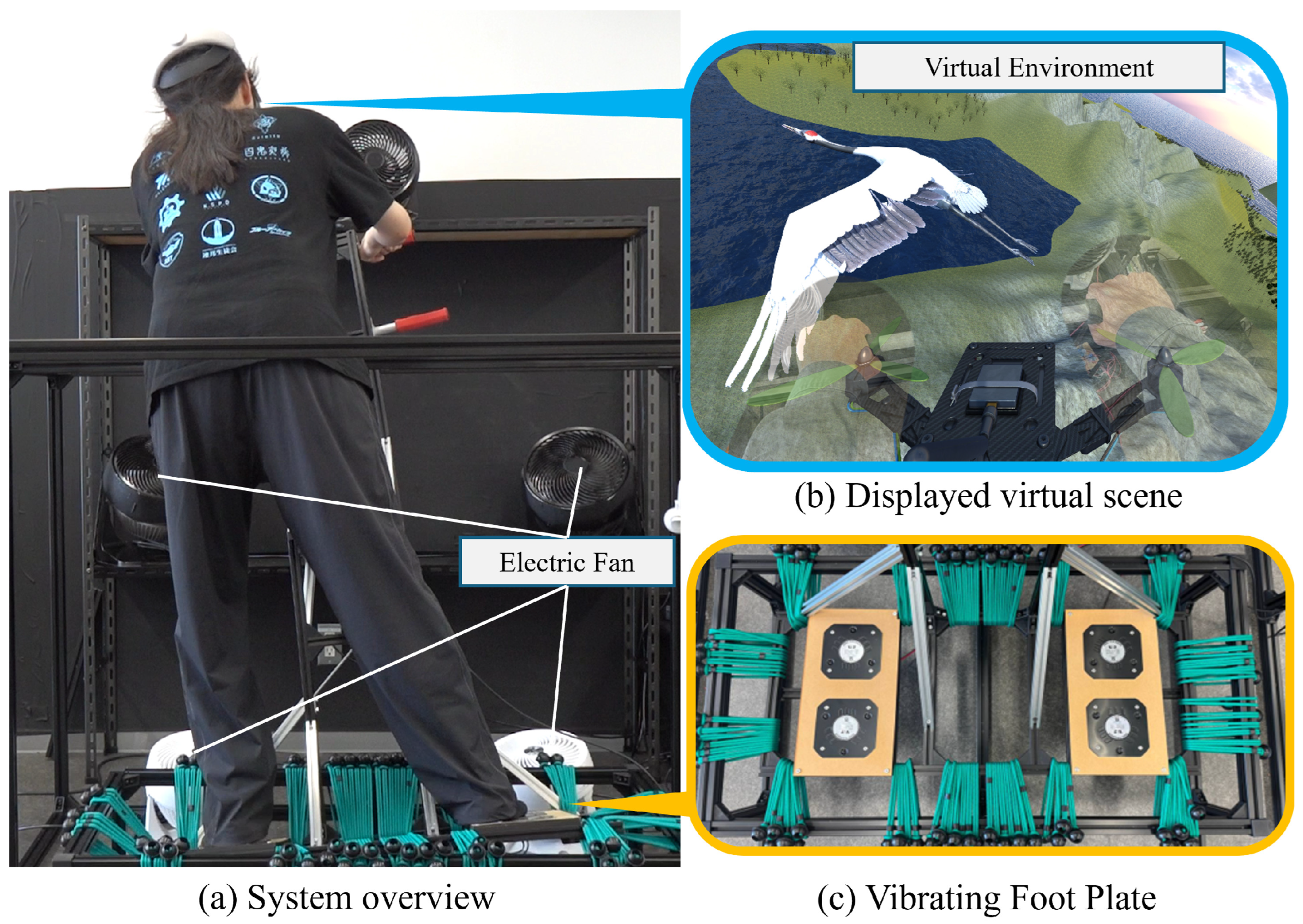
This section describes the overall configuration and operation of Drone Rider, which was designed to provide an embodied flight experience by integrating visual feedback, body-based control, and vibratory stimulation [5]. An overview of the physical configuration of the system is shown in Figure 1. These components form the basis of the experimental conditions described in Section 3.

2.1. Body-Based Control Mechanism

Users operated the system while standing on a passive tilting platform, controlling the simulated drone through body leaning. The platform was suspended from a rigid frame using bungee cords and functioned as a passive body-based input device. Flight motion was controlled through voluntary weight-shifting: forward leaning modulated forward speed, whereas leaning left and right controlled the yaw rotation of the drone. Such body-leaning control of a flying object is expected to evoke a strong sense of immersion [11].
The simulated speed was linearly defined as 0 m / s at 0 (upright posture) and 16 m / s at 30 of forward tilt, enabling continuous acceleration and deceleration through intuitive body movement.
Similarly, the drone’s yaw angular velocity was proportional to the body’s roll-axis inclination. The angular velocity increased linearly to 5°/s at a body tilt angle of 20°.

2.2. Visual Presentation

Visual feedback was presented through a head-mounted display (HMD) (Meta Quest 3, Meta Platforms, Inc., Menlo Park, CA, USA). The system was implemented in Unity (2022.3.11f1, Unity Technologies, Inc., San Francisco, CA, USA), where the user’s head position was continuously captured to update the flight state of the simulated drone. The virtual environment represented an aerial flight scene including terrain, water surfaces, and sky elements. Flight altitude was kept constant, and vertical translation was disabled to isolate forward-motion effects.
The system included a self-body visualization function. Using the built-in cameras and hand-tracking capabilities of the HMD, the user’s real arms and hands were overlaid onto the virtual environment in real-time. This function maintained visual continuity between the physical body and the virtual space [43]. Its purpose was to support stable perception of body ownership and sense of agency rather than to serve as an experimental variable in the present study.

2.3. Vibratory Feedback

Vibration stimuli were delivered according to the simulated flight state. Voice–coil actuators (Vibro-Transducer Vt7, model Vt708, Acouve Laboratory, Inc., Tokyo, Japan) were installed beneath the user’s feet to provide vibratory cues. Two actuators were positioned under each foot to stimulate both the forefoot and rearfoot regions. The vibration signal was derived from recorded motorcycle engine sounds [5], primarily containing frequency components below 100 Hz. The vibration amplitude was proportional to the simulated flight speed. This lower-body vibration was intended to enhance the sensation of riding on a powered drone. Some studies have reported that vibratory stimuli to the feet or seat can enhance vection [44,45,46,47]. In the present study, however, vibration was kept consistent across conditions and was not treated as an experimental variable.

3. Methods

3.1. Participants

Seventeen participants (10 males and 7 females, all in their twenties) took part in the experiment. All participants provided informed consent prior to participation.
Participants were recruited through an open call within the university. The recruitment materials included a brief description of the VR-based experimental task. No explicit inclusion or exclusion criteria were applied; however, a degree of self-selection is expected, as individuals with an interest in VR or lower susceptibility to cybersickness may have been more likely to participate.
None of the participants had prior experience in operating real drones, including consumer-grade drones. One participant reported limited experience with a radio-controlled airplane approximately five years prior to the experiment. In addition, none of the participants had prior experience with the Drone Rider system.
An a priori power analysis was conducted using G*Power software (ver. 3.1.9.7) [48] to determine the required sample size. Because the primary inferential interest of this study lay in planned pairwise comparisons between wind conditions, the power analysis was based on a two-tailed paired t-test. With α = 0.05 , power of 1 β = 0.80 , and an expected effect size of d z = 0.8 , the required sample size was estimated to be 15 participants. To satisfy this requirement, 17 participants were recruited.

3.2. Apparatus

The experiment was conducted using the Drone Rider XR flight simulator, which integrates visual presentation, body-based control input, vibratory feedback to the soles, and wind feedback. Wind feedback was generated using high-output air circulator fans (533DC Energy Smart Small Air Circulator, Vornado Air LLC, Andover, KS, USA).
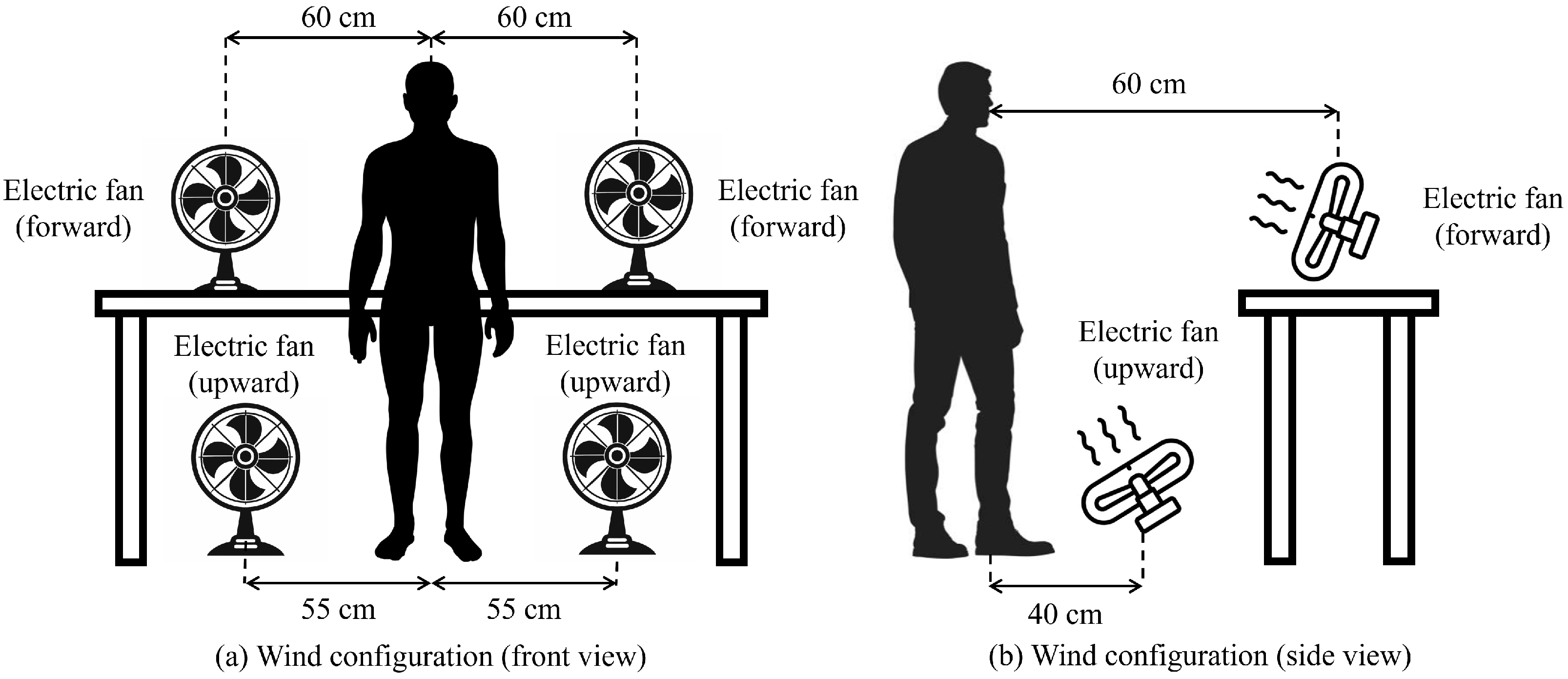
To examine the effect of wind direction, two wind delivery configurations were prepared: a front-mounted configuration and a bottom-mounted configuration. The front-mounted configuration delivered airflow toward the participant’s face, whereas the bottom-mounted configuration delivered airflow upward from beneath the participant.
As shown in Figure 2, two fans were placed symmetrically in front of the participant and directed toward the face for the front-mounted condition. The distance between the fans and the participant was 60 cm when the participant stood upright.
For the bottom-mounted condition, two fans were placed on the floor and 40 cm front of the participant. These fans were inclined such that the winds were directed to the participant’s face when they leaned 30° forward.
Fan output was controlled via a microcontroller-based system. Control signals were computed in Unity and transmitted to an Arduino Mega 2560, which regulated fan rotation speed using pulse-width modulation (PWM) through a MOSFET driver (D4184A, Alpha & Omega Semiconductor Ltd., Sunnyvale, CA, USA).
To achieve stable and reproducible airflow control, a calibration table was constructed by measuring airflow velocity (CHE-WD1, Sanwa Supply Inc., Okayama, Japan) at discrete PWM duty ratios (0.6–1.0, in increments of 0.05). The airflow velocity was measured at the participant’s face position when leaning forward by 30° under steady-state conditions. Based on this lookup table, the PWM duty ratio corresponding to a desired airflow intensity was determined using linear interpolation. During the experiment, the PWM duty ratio was continuously updated according to the simulated flight state using this mapping.

3.3. Experimental Conditions

A within-participant design was employed, in which all participants experienced five wind conditions.
The objective of this study was to examine the effects of velocity-dependent and direction-dependent wind feedback. The no-wind and constant-wind conditions were included as reference conditions for evaluating the adaptive wind configurations. Furthermore, two fan installation positions were introduced to investigate whether strict placement requirements could be relaxed, as discussed in the Introduction.
The five wind conditions were as follows:
  • No-Wind Condition: No wind feedback was presented.
  • Constant-Wind Condition: A steady airflow of 2.6 m/s was continuously delivered toward the participant’s face throughout the flight. The airflow intensity was constrained by considerations of participant comfort. Prolonged facial airflow at higher velocities may induce cooling-related sensations unrelated to flight perception. To minimize such confounding effects, a moderate and stable airflow level (2.6 m/s) was adopted.
  • Velocity-Adaptive Wind (Front): Front-mounted fans were used, and wind speed was continuously modulated according to the simulated drone speed. The maximum wind speed was 2.9 m/s for drone speeds of 16 m/s and above. The minimum wind speed was 1.9 m/s, corresponding to a drone speed of 8 m/s. Because the fans could not stably generate airflow below 1.9 m/s, this value was set as the minimum. Wind speed and drone speed were linearly mapped within this range. When the drone speed was below 8 m/s, the minimum wind velocity (1.9 m/s) was delivered. During the main task, this low-speed range was rarely used by participants, as described in Section 3.4. The left and right fans were synchronously controlled.
  • Velocity-Adaptive Wind (Bottom): Bottom-mounted fans were used. The velocity-control rule was identical to that of the velocity-adaptive wind (front) condition.
  • Direction- and Velocity-Adaptive Wind: Wind speed followed the same velocity-dependent mapping (1.9–2.9 m/s). In addition, airflow direction was dynamically adjusted according to the drone’s yaw angular velocity. When the yaw angular velocity was 0 /s, both fans produced equal wind output. When the yaw angular velocity reached 5 /s, the outputs of the two fans followed a 2:1 ratio, with the fan on the turning side producing stronger airflow. The wind velocity ratio changed linearly within the range of ± 5 /s. Outside this range, the ratio was fixed at 2:1 to maintain the intended velocity- and direction-dependent behavior.

3.4. Tasks and Procedures

An overview of the experimental procedure is shown in Figure 3. Each participant completed two blocks, in each of which the five wind conditions were tested once, resulting in 10 trials in total. Each trial consisted of a 90 s experimental flight followed by a subjective evaluation. The order of the wind conditions was counterbalanced across blocks and participants using a Latin square design.
At the beginning of the experiment, participants received instructions regarding the task and control method. They then performed a practice flight to become familiar with the body-based flight control. The practice session lasted approximately 3–4 min, until participants reported that they were familiar with the operation of the Drone Rider system.
During each experimental trial, participants actively controlled the flight by shifting their body posture on the platform. To reduce variability in flight trajectories while preserving active control, participants were instructed to follow a moving target (a flying crane) presented in the virtual environment. The target followed an invisible figure-eight trajectory in the sky. Its flight speed periodically varied between 8 m/s and 16 m/s, corresponding to the range in which wind velocity was linearly modulated in the velocity-adaptive conditions. Left and right turns occurred equally often, and the crane completed the figure-eight trajectory approximately twice during each 90 s trial. Hence, participants experienced multiple left and right turns, ensuring sufficient exposure to the wind feedback.
Short breaks were provided between trials to mitigate fatigue and discomfort associated with repeated XR flight experiences. After each trial and the practice session, participants’ physical conditions were assessed using cybersickness questionnaire items [49]. If notable increases in cybersickness scores were observed, the experiment was suspended or terminated.

3.5. Subjective Measures

The present study evaluated three subjective constructs: sense of flight, self-location, and agency. These constructs were selected to capture perceptual, spatial, and motor aspects of embodiment during XR flight. The questionnaire items were as follows:
  • Sense of Flight: “To what extent did you feel as if you were flying?”
  • Sense of Self-Location: “To what extent did you feel that you were located on the drone?”
  • Sense of Agency: “To what extent did you feel that you were controlling the drone?”
The sense of flight is closely related to self-motion perception (vection [16,17]), reflecting whether participants experienced forward movement through the virtual space. Wind feedback has been shown to facilitate vection by providing cutaneous cues consistent with visual motion [19,22,23].
The sense of self-location refers to the perceived spatial position of one’s body within the virtual environment and is influenced by the coherence between visual perspective, body posture, and sensorimotor contingencies [50]. As mentioned in Section 1, we hypothesized that wind feedback contributes to the sense of self-location by reinforcing perceived motion in the virtual environment.
The sense of agency denotes the subjective experience of controlling the drone’s motion [51,52]. This is generally considered to arise from consistency between motor commands and their multisensory consequences. Temporal alignment between body-based input and visual or wind feedback is considered to play some role in shaping the sense of agency.
By jointly assessing these three constructs, this study aims to clarify how adaptive wind feedback influences the sense of flight, self-location, and agency in XR flight simulation.
The sense of self-location and agency, together with the sense of body ownership, are commonly discussed as core subcomponents of embodiment [53,54,55,56,57]. In the present study, however, we focused on self-location and agency rather than body ownership. Wind stimulation primarily provides motion-related cutaneous cues and modulates sensorimotor consistency, which are theoretically more directly associated with self-motion perception and agency than with ownership of a virtual body. Because the visual representation of the participant’s body remained stable across conditions and no manipulation targeted body ownership explicitly, the sense of body ownership was not treated as a primary dependent variable in this study.
After each trial, participants rated each construct on a 10-point Likert scale ranging from 0 (“not at all”) to 9 (“very strongly”).

3.6. Data Analysis

To examine the effects of wind condition on each subjective rating, we conducted a one-way repeated-measures analysis of variance (rANOVA) separately for each measure using MATLAB (2025b, MathWorks, Inc., Natick, MA, USA). Wind condition was treated as a within-participant factor with five levels. The assumption of sphericity was not violated (Mauchly’s test).
When a significant main effect was detected, post hoc pairwise comparisons were performed using two-tailed paired t-tests with Bonferroni correction for multiple comparisons (10 pairwise comparisons).

4. Results

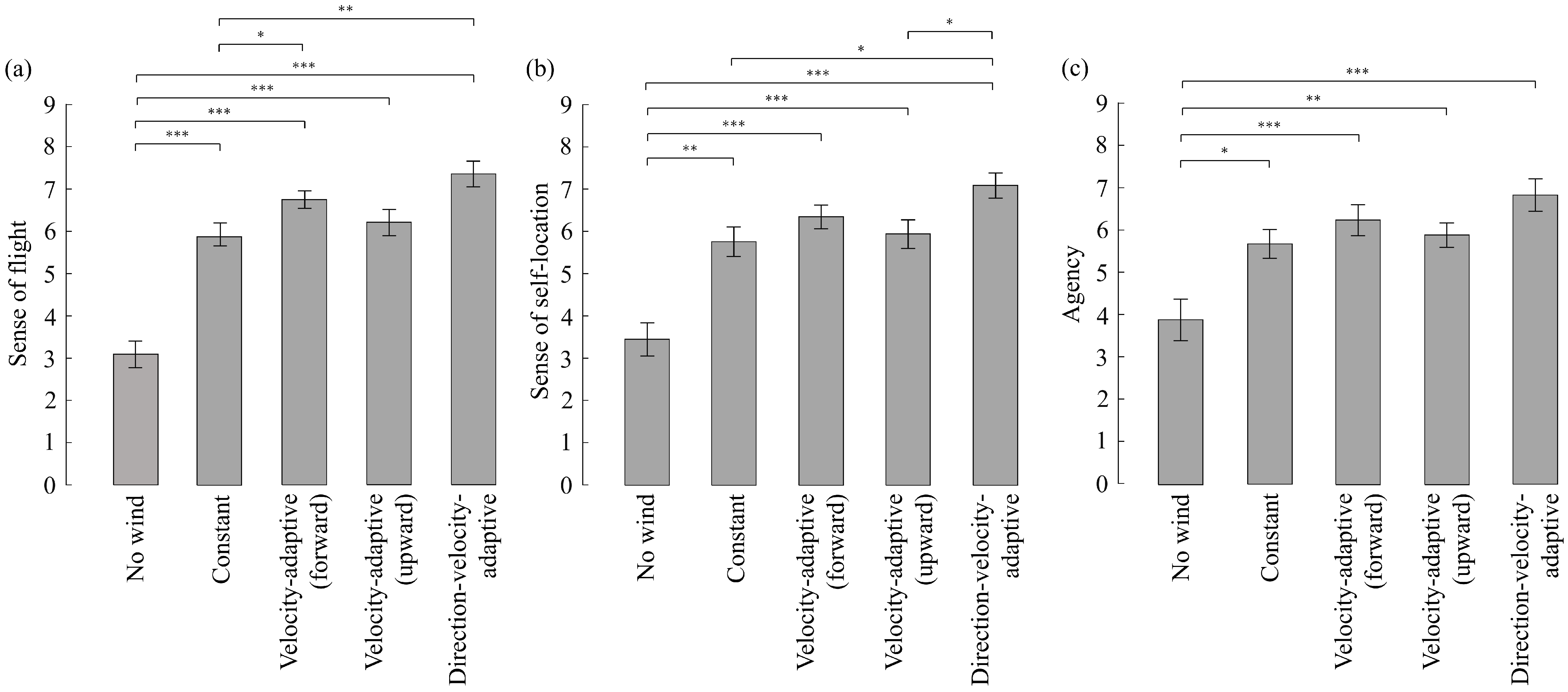
We examined the effects of wind conditions on subjective evaluations of flight-related perception. Figure 4 shows the mean scores of three types of measures, that is, the sense of flight, self-location, and agency, for each experimental condition.

4.1. Sense of Flight

For the sense of flight (Figure 4a), a one-way rANOVA revealed a significant main effect of wind condition ( F ( 4 , 64 ) = 56.95 , p < 0.001 ). Post hoc comparisons showed that all wind-feedback conditions were rated significantly higher than the no-wind condition.
Among the wind-feedback conditions, the direction- and velocity-adaptive condition showed the highest mean rating. Its score was significantly higher than that of the constant-wind condition ( t ( 16 ) = 4.12 , p = 0.0081 ), and tended to be higher than that of the velocity-adaptive (upward) condition ( t ( 16 ) = 3.18 , p = 0.058 ). The velocity-adaptive (forward) condition also exhibited higher scores than the constant condition ( t ( 16 ) = 3.47 , p = 0.032 ).

4.2. Sense of Self-Location

For the sense of self-location (Figure 4b), a one-way rANOVA revealed a significant main effect of wind condition ( F ( 4 , 64 ) = 36.10 , p < 0.001 ). The no-wind condition showed significantly lower ratings than all wind-feedback conditions.
In addition, the direction- and velocity-adaptive wind condition resulted in significantly higher self-location ratings than the constant-wind condition ( t ( 16 ) = 3.93 , p = 0.012 ) and the velocity-adaptive (upward) condition ( t ( 16 ) = 3.86 , p = 0.014 ).

4.3. Sense of Agency

For the sense of agency (Figure 4c), a one-way rANOVA revealed a significant main effect of wind condition ( F ( 4 , 64 ) = 14.66 , p < 0.001 ). The no-wind condition showed significantly lower agency ratings than all wind-feedback conditions. Among the four wind-feedback conditions, no significant differences in agency ratings were observed.

5. Discussion

The experimental results showed that, for the sense of flight, the no-wind condition was rated significantly lower than the other conditions with wind. This finding supports H1, indicating that the presence of wind feedback enhances the sense of flight compared with the no-wind condition. This result is consistent with previous studies showing that wind stimulation enhances self-motion perception [18,19,20,21,22,23,24,42] and immersion in virtual environments [15,25,26,27,28,29,30]. It is plausible that coherent multisensory feedback positively influenced the overall VR experience in the present study.
In this study, the sense of flight was defined as the subjective feeling of moving through the sky. It is reasonable to assume that the well-documented influence of airflow on speed perception [15,34] contributed substantially to the enhancement of the sense of flight. In addition, awareness of the presence of wind may have strengthened the sense of self-location—namely, the feeling of boarding the drone in midair—by reinforcing the spatial consistency between visual motion and bodily sensation.
Consistent with H2 (effect of adaptive wind feedback on the sense of flight), the velocity-dependent wind condition partly yielded higher ratings than the constant wind condition. This suggests that wind stimulation modulated in accordance with flight speed can provide additional benefits over constant airflow.
Similarly, Banerjee et al. [28] reported, in a VR surfing scenario, that aligning front-directed wind intensity with visual motion speed enhances the sense of immersion compared with the constant wind condition. These findings suggest that the beneficial effects of velocity-dependent wind are not limited to a specific application, but may generalize across XR experiences through multisensory consistency.
Tran et al. [15] reported that when physical airflow remained constant while only visual speed changed, participants’ perception of speed change was impaired. They argued that consistency between visual velocity and airflow is critical for accurately perceiving speed variations. If velocity-dependent wind stimulation facilitates the correct recognition of one’s own speed changes, the superiority of the velocity-dependent condition observed in the present study can be interpreted as reflecting this multisensory consistency.
It has also been reported that visually inferred motion intensity can influence the perceived intensity of physical wind stimulation [34]. Even when simulated velocity changed while airflow intensity remained constant (i.e., the constant-wind condition), such cross-modal inconsistency may not have been immediately or explicitly recognized as a sensory conflict. As a result, the constant-wind condition could still produce relatively favorable ratings in the measured indices, despite the lack of strict sensory congruency.
As for H3 (effect of wind feedback on the sense of self-location), the with-wind conditions were clearly preferred over the no-wind condition in terms of self-location ratings. In addition, the direction- and velocity-adaptive condition was preferred over the constant wind condition. One possible explanation for this is that the presence of wind directly evokes the sensation of being on a drone flying through the air. From another perspective, if wind stimulation enhances the perception of one’s own locomotion [18,19,20,21,22,23,24], it is reasonable that wind also strengthens the sense of being located on the flying vehicle.
Although there has been little prior work explicitly examining how the sense of flight is structured, it can be interpreted as a higher-level construct composed of multiple perceptual components, including the sense of self-location and the sense of self-motion (vection). Therefore, it is natural that the effect of wind on the sense of self-location parallels its effect on the sense of flight.
Regarding H4 (effect of wind feedback on the sense of agency), a significant difference was observed only between the presence and absence of wind stimuli, with higher scores in the wind-present condition. The mechanism by which wind enhanced the sense of agency is likely indirect. The presence of wind does not directly alter the participant’s control over the drone, which is primarily determined by the correspondence between the participant’s actions and the resulting simulated motion. However, because wind feedback was provided in accordance with the drone’s motion, it may have served as an additional cue for interpreting that motion. Therefore, wind stimulation may have influenced the sense of agency indirectly by enhancing participants’ perception and interpretation of their own movement within the virtual environment.
The effect of direction-dependent wind on the sense of flight was comparable to that of velocity-dependent wind and did not exhibit the stronger impact we initially expected. Several explanations may account for this outcome.
First, it is possible that changes in wind direction were not sufficiently perceived by participants. However, human sensitivity to wind direction has been reported to be approximately 5° for frontal airflow and around 11° for lateral airflow [14]. Given this resolution, the directional differences produced by the two fans in the present experiment should have been perceptually discriminable. Moreover, in the post-experimental open-ended questionnaire, 5 out of 17 participants explicitly mentioned noticing changes in wind direction. These observations suggest that complete perceptual insensitivity to wind direction is unlikely to fully explain the limited effect.
Second, the implementation of direction-dependent wind may have introduced a form of physical and sensory inconsistency. In the present system, wind direction was manipulated by changing the output ratio of two front-mounted fans. This configuration corresponds to a situation in which wind approaches diagonally while the simulated drone moves forward, rather than representing airflow inherently coupled with yaw rotation. Furthermore, participants did not physically rotate their bodies during yaw motion in Drone Rider. Thus, the direction-dependent wind was not physically or perceptually congruent with the simulated rotational movement. This incongruency may have weakened its contribution to embodiment-related measures.
Third, yaw rotation perception is likely dominated by visual and proprioceptive cues, with airflow playing a relatively minor role. In everyday life, individuals rarely rely on wind direction to determine their own rotational posture. This limited experiential association may reduce the perceptual weighting assigned to wind direction during self-rotation judgments in XR. Consequently, airflow modulation along the yaw axis may not substantially influence the perceived sense of rotational motion or embodiment.
Taken together, these findings suggest that airflow cues may be more naturally integrated with translational motion than with rotational motion in XR flight experiences. This interpretation is also consistent with the findings of Page et al. [2], who reported that airflow delivered from the direction of motion contributes to reducing cybersickness. Enhancing the effectiveness of rotation-dependent wind may require stronger angular velocities, more spatially differentiated airflow patterns, or physical body rotation to establish clearer sensorimotor congruency.
For H5 (location of fans), the comparable effectiveness of front-mounted and bottom-mounted velocity-adaptive wind suggests that compelling flight sensations can be achieved without strictly front-facing airflow. In this context, bottom-mounted airflow may serve as a practical alternative configuration. This flexibility has important implications for XR system deployment, as bottom-mounted setups may simplify hardware layout while maintaining immersive flight perception.
Post-experimental responses indicated that participants were aware that the airflow originated from below in the bottom-mounted condition. However, none of them reported that this configuration felt unnatural within the experimental scenario. Considering previously reported discrimination thresholds for wind direction [14], this may initially appear contradictory, as participants should have been capable of detecting deviations from a strictly frontal airflow.
A possible interpretation is that the ability to discriminate wind direction and the tolerance for directional incongruency within a given context are distinct perceptual processes. While participants may have been able to detect the physical direction of airflow, this did not necessarily translate into a perception of unnaturalness within the XR flight scenario. In other words, perceptual discriminability does not directly imply ecological implausibility. Future studies should systematically investigate the relationship between wind-direction sensitivity and contextual acceptability in XR environments.
From a system design perspective, the present findings highlight velocity synchronization as a central design principle for wind-based feedback in XR flight experiences. Ensuring consistency between simulated flight speed and airflow intensity appears to be more critical than the precise spatial origin of the wind. For systems constrained by hardware complexity, cost, or installation space, implementing velocity-adaptive wind feedback alone may already yield substantial perceptual benefits. These results therefore provide actionable guidance for designing XR flight systems.
Several limitations should be acknowledged.
First, the airflow used in the present experiment was not aerodynamically accurate. The wind speed did not match the simulated drone speed and was substantially lower than the virtual flight velocity. In addition, changes in airflow associated with yaw rotation were implemented by modulating the output ratio of two spatially fixed fans, which does not physically correspond to the airflow that would accompany actual rotational flight [24]. Thus, the wind stimulation in this study was a simplified approximation rather than a physically faithful reproduction of aerodynamic conditions.
Further, in the current system, airflow was controlled using an open-loop scheme without real-time sensing of airflow velocity, and transient airflow responses were not explicitly modeled. This simplification was partly due to practical constraints in implementing closed-loop airflow control in the commercial fans. Moreover, it remains unclear to what extent the precise control of transient airflow dynamics contributes to perceptual experience in XR flight simulation. While temporal alignment between sensory modalities is generally important, the perceptual relevance of fine-grained airflow dynamics has not been sufficiently established.
Second, participants had no prior real-world experience of riding a drone and flying through the sky. Therefore, their evaluations were not based on comparisons with their own flight experiences. Instead, their judgments reflected perceptual coherence and experiential plausibility within the constructed VR scenario. In this sense, the present results do not validate the ecological realism of the airflow but rather demonstrate its functional effectiveness within a virtual flight context. Accordingly, the findings should be interpreted in the context of simplified wind modeling designed to examine perceptual effects in a controlled manner.
Third, because an enhanced flight sensation is expected to be associated with increased enjoyment and emotional arousal, physiological indices related to affective states, such as electrodermal activity (EDA) or electroencephalography (EEG), may serve as objective correlates of the user experience. Heart rate-based measures may also provide a practical alternative for capturing arousal in dynamic situations. However, in systems such as Drone Rider, which involve active body movement and can be regarded as an exergame-like experience [58], heart rate is strongly influenced by physical load. This makes it difficult to separate changes due to emotional arousal from those induced by exercise. Moreover, acquiring electrophysiological signals such as EDA or EEG in a system like Drone Rider, which involves continuous whole-body movement, poses substantial challenges due to motion artifacts and sensor stability. Therefore, careful consideration of measurement methods and experimental design will be required in future work.
Another limitation of the present study concerns the generalizability of the findings. The experiment was conducted under controlled conditions with a relatively homogeneous participant group and a predefined flight trajectory. While this design was appropriate for isolating perceptual effects, it may not fully represent the complexity of real-world XR applications. The observed effectiveness of velocity-dependent wind feedback is consistent with prior studies in different XR scenarios, suggesting that this effect may reflect a general principle of multisensory integration. However, it remains unclear whether the findings can be generalized to contexts that are directly comparable to everyday experiences, such as wind feedback in VR walking simulations. In contrast, the effectiveness of alternative fan placements, such as bottom-mounted configurations, may be more dependent on the specific interaction design and task context.
Future studies should examine a wider range of environments, interaction paradigms, and user populations, including scenarios grounded in familiar real-world locomotion, to further validate the generalizability of these findings.

6. Conclusions

This study investigated wind feedback design for XR-based flight experiences, examining how wind presence, velocity coupling, and directional configuration affect sense of flight, self-location, and agency. Using the Drone Rider system, we demonstrated that wind feedback significantly enhances subjective flight perception compared with the no-wind condition.
Specifically, velocity-adaptive wind synchronized with simulated flight speed produced more consistent improvements than static airflow, highlighting dynamic visual–tactile coupling as a key design principle. Comparable perceptual effectiveness across different airflow installation positions further indicates that practical hardware flexibility can be achieved without compromising immersion.
Despite limitations in aerodynamic realism and sample size, the findings suggest that velocity-adaptive wind feedback offers an efficient and scalable strategy for enhancing XR flight experiences. Future research should explore more ecologically grounded airflow implementations and objective evaluation measures.

Author Contributions

Conceptualization, H.Y. and S.O.; methodology, H.Y. and S.O.; software, H.Y. and H.S.; validation, H.Y., S.O. and H.S.; formal analysis, H.Y. and S.O.; investigation, H.Y., S.O. and H.S.; resources, H.Y. and H.S.; data curation, H.Y. and H.S.; writing—original draft preparation, H.Y. and S.O.; writing—review and editing, H.Y. and S.O.; visualization, H.Y. and H.S.; supervision, S.O.; project administration, S.O. All authors have read and agreed to the published version of the manuscript.

Funding

This research received no external funding.

Institutional Review Board Statement

The experimental protocol was approved by Institutional Review Board, Hino Campus, Tokyo Metropolitan University (Approval number: R7-006, Approval date: 28 March 2025).

Informed Consent Statement

Written informed consent was obtained from all participants involved in the study.

Data Availability Statement

The research data are available from the corresponding author upon direct request, accompanied by a clear explanation of the intended purpose.

Acknowledgments

We thank Kazuya Shimato for his substantial contribution to the hardware and software development of Drone Rider system.

Conflicts of Interest

The authors declare no conflicts of interest.

Abbreviations

The following abbreviations are used in this manuscript:
XRExtended reality
HMDHead-mounted display

References

  1. Zhang, Y.; Riecke, B.E.; Schiphorst, T.; Neustaedter, C. Perch to fly: Embodied virtual reality flyingocomotion with a flexible perching stance. In Proceedings of the 2019 on Designing Interactive Systems Conference; ACM: San Diego, CA, USA, 2019; pp. 253–264. [Google Scholar] [CrossRef]
  2. Page, D.; Lindeman, R.W.; Lukosch, S. Identifying strategies to mitigate cybersickness in virtual reality induced by flying with an interactive travel interface. Multimodal Technol. Interact. 2023, 7, 47. [Google Scholar] [CrossRef]
  3. Tong, X.; Kitson, A.; Salimi, M.; Fracchia, D.; Gromala, D.; Riecke, B.E. Exploring embodied experience of flying in a virtual reality game with kinect. In Proceedings of the 2016 IEEE International Workshop on Mixed Reality Art; IEEE: Greenville, SC, USA, 2016; pp. 5–6. [Google Scholar] [CrossRef]
  4. Mashal, S.; Kranz, M.; Hoelzl, G. Do you feelike flying? A study of flying perception in virtual reality for future game development. IEEE Comput. Graph. Appl. 2020, 40, 51–61. [Google Scholar] [CrossRef] [PubMed]
  5. Shimato, K.; Goto, Y.; Okamoto, S. Drone rider: Foot vibration stimuli to enhance immersion and flight sensation in VR. Appl. Sci. 2024, 14, 12019. [Google Scholar] [CrossRef]
  6. Medeiros, D.; Sousa, M.; Raposo, A.; Jorge, J. Magic carpet: Interaction fidelity for flying in VR. IEEE Trans. Vis. Comput. Graph. 2020, 26, 2793–2804. [Google Scholar] [CrossRef]
  7. Rheiner, M. Birdly an attempt to fly. In Proceedings of the ACM SIGGRAPH 2014 Emerging Technologies; ACM: Vancouver, BC, Canada, 2014; p. 1. [Google Scholar] [CrossRef]
  8. Cherpillod, A.; Floreano, D.; Mintchev, S. Embodied Flight with a Drone. In Proceedings of the 2019 Third IEEE International Conference on Robotic Computing (IRC); IEEE: Naples, Italy, 2019; pp. 386–390. [Google Scholar] [CrossRef]
  9. Adhikari, A.; Hashemian, A.M.; Nguyen-Vo, T.; Kruijff, E.; Heyde, M.V.D.; Riecke, B.E. Lean to Fly: Leaning-Based Embodied Flying can Improve Performance and User Experience in 3D Navigation. Front. Virtual Real. 2021, 2, 730334. [Google Scholar] [CrossRef]
  10. Hashemian, A.M.; Lotfaliei, M.; Adhikari, A.; Kruijff, E.; Riecke, B.E. HeadJoystick: Improving Flying in VR Using a Novel Leaning-Based Interface. IEEE Trans. Vis. Comput. Graph. 2022, 28, 1792–1809. [Google Scholar] [CrossRef]
  11. Hedlund, M.; Müller, F.; Schmitz, M.; Bogdan, C.; Rey, R.; Ghavamian, P.; Tobin, D.; Matviienko, A. BroomBroom! Evaluation ofeaning and controller-basedocomotion for flying in virtual reality. In Proceedings of the 2025 31st ACM Symposium on Virtual Reality Software and Technology; ACM: Montreal, QC, Canada, 2025; pp. 1–12. [Google Scholar] [CrossRef]
  12. Moon, T.; Kim, G.J. Design and evaluation of a wind display for virtual reality. In Proceedings of the ACM Symposium on Virtual Reality Software and Technology; ACM: Hong Kong, China, 2004; pp. 122–128. [Google Scholar] [CrossRef]
  13. Hülsmann, F.; Fröhlich, J.; Mattar, N.; Wachsmuth, I. Wind and warmth in virtual reality: Implementation and evaluation. In Proceedings of the the 2014 Virtual Reality International Conference; ACM: Laval, France, 2014; pp. 1–8. [Google Scholar] [CrossRef]
  14. Nakano, T.; Yanagida, Y. Conditions influencing perception of wind direction by the head. In Proceedings of the 2017 IEEE Virtual Reality (VR); IEEE: Los Angeles, CA, USA, 2017; pp. 229–230. [Google Scholar] [CrossRef]
  15. Tran, T.Q.; Tran, T.D.N.; Nguyen, T.D.; Regenbrecht, H.; Tran, M.T. Can we perceive changes in our moving speed: A comparison between directly and indirectly powering theocomotion in virtual environments. In Proceedings of the 24th ACM Symposium on Virtual Reality Software and Technology; ACM: Tokyo, Japan, 2018; pp. 1–10. [Google Scholar] [CrossRef]
  16. Brandt, T.; Dichgans, J.; Koenig, E. Differential effects of central versus peripheral vision on egocentric and exocentric motion perception. Exp. Brain Res. 1973, 16, 476–491. [Google Scholar] [CrossRef] [PubMed]
  17. Palmisano, S.; Allison, R.S.; Schira, M.M.; Barry, R.J. Future challenges for vection research: Definitions, functional significance, measures, and neural bases. Front. Psychol. 2015, 6, 193. [Google Scholar] [CrossRef] [PubMed]
  18. Kulkarni, S.; Fisher, C.; Pardyjak, E.; Minor, M.; Hollerbach, J. Wind display device forocomotion interface in a virtual environment. In Proceedings of the World Haptics 2009—Third Joint EuroHaptics conference and Symposium on Haptic Interfaces for Virtual Environment and Teleoperator Systems; IEEE: Tsukuba, Japan, 2009; pp. 184–189. [Google Scholar] [CrossRef]
  19. Kurosawa, M.; Ito, K.; Ikei, Y.; Hirota, K.; Kitazaki, M. Evaluation of airflow effect on a VR walk. In Proceedings of the 2017 IEEE Virtual Reality (VR); IEEE: Los Angeles, CA, USA, 2017; pp. 283–284. [Google Scholar] [CrossRef]
  20. Deligiannidis, L.; Jacob, R. The VR scooter: Wind and tactile feedback improve user performance. In Proceedings of the 3D User Interfaces; IEEE: Alexandria, VA, USA, 2006; pp. 143–150. [Google Scholar] [CrossRef]
  21. Seno, T.; Ogawa, M.; Ito, H.; Sunaga, S. Consistent air flow to the face facilitates vection. Perception 2011, 40, 1237–1240. [Google Scholar] [CrossRef]
  22. Murata, K.; Seno, T.; Ozawa, Y.; Ichihara, S. Self-motion perception induced by cutaneous sensation caused by constant wind. Psychology 2014, 5, 1777–1782. [Google Scholar] [CrossRef]
  23. Park, S.; Son, S.; Kim, J.; Kim, G.J. The Effect of directional airflow toward vection and cybersickness. In Proceedings of the 2024 IEEE Conference Virtual Reality and 3D User Interfaces (VR); IEEE: Orlando, FL, USA, 2024; pp. 839–848. [Google Scholar] [CrossRef]
  24. Cai, Y.; Jin, S.; Chen, Z.; Yang, D.; Tu, H.; Hansen, P.; Sun, L.; Chen, L. Measuring human perception of airflow for natural motion simulation in virtual reality. IEEE Trans. Vis. Comput. Graph. 2025, 31, 2943–2953. [Google Scholar] [CrossRef]
  25. Giraldo, G.; Servières, M.; Moreau, G. Perception of multisensory wind representation in virtual reality. In Proceedings of the 2020 IEEE International Symposium on Mixed and Augmented Reality, Online, 9–13 November 2020; pp. 45–53. [Google Scholar] [CrossRef]
  26. Giraldo, G.; Servières, M.; Moreau, G. Towards a sensitive urban wind representation in virtual reality. ISPRS Int. J. Geo-Inf. 2022, 11, 239. [Google Scholar] [CrossRef]
  27. Shaw, L.A.; Wuensche, B.C.; Lutteroth, C.; Buckley, J.; Corballis, P. Evaluating sensory feedback for immersion in exergames. In Proceedings of the Australasian Computer Science Week Multiconference; ACM: Geelong, Australia, 2017; pp. 1–6. [Google Scholar] [CrossRef]
  28. Banerjee, P.; Montiel, M.P.; Tomita, L.; Means, O.; Kutch, J.; Culbertson, H. The impact of airflow and multisensory feedback on immersion and cybersickness in a VR surfing simulation. IEEE Trans. Vis. Comput. Graph. 2025, 31, 2445–2454. [Google Scholar] [CrossRef]
  29. Narciso, D.; Melo, M.; Vasconcelos-Raposo, J.; Bessa, M. The impact of olfactory and wind stimuli on 360 videos using head-mounted displays. ACM Trans. Appl. Percept. 2020, 17, 4. [Google Scholar] [CrossRef]
  30. Chen, Y.T.; Tsai, M.S. The impact of wind experience on VR game immersion. In Proceedings of the Virtual, Augmented and Mixed Reality; Springer Nature: Cham, Switzerland, 2025; pp. 3–17. [Google Scholar] [CrossRef]
  31. Harrington, J.; Williams, B.; Headleand, C. A somatic approach to combating cybersickness utilising airflow feedback. Comput. Graph. Vis. Comput. 2019, 35–43. [Google Scholar] [CrossRef]
  32. D’Amour, S.; Bos, J.E.; Keshavarz, B. The efficacy of airflow and seat vibration on reducing visually induced motion sickness. Exp. Brain Res. 2017, 235, 2811–2820. [Google Scholar] [CrossRef]
  33. Matviienko, A.; Müller, F.; Zickler, M.; Gasche, L.A.; Abels, J.; Steinert, T.; Mühlhäuser, M. Reducing virtual reality sickness for cyclists in VR bicycle simulators. In CHI ’22: Proceedings of the 2022 CHI Conference on Human Factors in Computing Systems; ACM: New Orleans, LA, USA, 2022; pp. 1–14. [Google Scholar] [CrossRef]
  34. Nishimaki, Y.; Goda, N.; Kamachi, M.G. Visuo-tactile integration for the perception of wind intensity in a VR environments. Trans. Virtual Real. Soc. Jpn. 2021, 26, 14–21. [Google Scholar] [CrossRef]
  35. Kojima, Y.; Hashimoto, Y.; Kajimoto, H. A novel wearable device to presentocalized sensation of wind. In Proceedings of the International Conference on Advances in Computer Entertainment Technology; ACM: Athens, Greece, 2009; pp. 61–65. [Google Scholar] [CrossRef]
  36. Zhao, F.; Li, Z.; Luo, Y.; Li, Y.; Liang, H.N. AirWhisper: Enhancing virtual reality experience via visual-airflow multimodal feedback. J. Multimodal User Interfaces 2024, 19, 139–154. [Google Scholar] [CrossRef]
  37. Sun, Y.; Sugiura, Y. Wrist-worn haptic design for 3D perception of the surrounding airflow in virtual reality. In Proceedings of the 16th Asia-Pacific Workshop on Mixed and Augmented Reality, Kyoto, Japan, 29–30 November 2024. [Google Scholar]
  38. Hosoi, J.; Ban, Y.; Ito, K.; Warisawa, S. Pseudo-wind perception induced by cross-modal reproduction of thermal, vibrotactile, visual, and auditory stimuli. IEEE Access 2023, 11, 4781–4793. [Google Scholar] [CrossRef]
  39. Mochizuki, T.; Hosoi, J.; Ban, Y.; Honda, K.; Warisawa, S. Exploring full-body wind sensations through multisensory feedback to multiple body regions in virtual reality. In Proceedings of the Augmented Humans International Conference 2025; ACM: Abu Dhabi, United Arab Emirates, 2025; pp. 356–368. [Google Scholar] [CrossRef]
  40. Yang, H.; Shimato, K.; Goto, Y.; Okamoto, S. Drone Rider: Wind stimulation to enhance speed perception of virtual flight. In Proceedings of the ICAT-EGVE 2024—International Conference on Artificial Reality and Telexistence and Eurographics Symposium on Virtual Environments—Posters and Demos; Tanabe, T., Yem, V., Eds.; The Eurographics Association: Tsukuba, Japan, 2024. [Google Scholar] [CrossRef]
  41. Shimato, K.; Goto, Y.; Okamoto, S. Drone Rider: Enhancing VR Flying Experiences via Directed Wind Stimuli. In Proceedings of the 2024 IEEE 13th Global Conference on Consumer Electronics; IEEE: Kitakyushu, Japan, 2024; pp. 735–737. [Google Scholar] [CrossRef]
  42. Yang, H.; Okamoto, S.; Shimato, K.; Shen, H. Drone Rider: Enhancing VR flight experience with dynamic wind feedback. In Proceedings of the 2025 IEEE 14th Global Conference on Consumer Electronics; IEEE: Osaka, Japan, 2025; pp. 1068–1070. [Google Scholar] [CrossRef]
  43. Shen, H.; Shimato, K.; Goto, Y.; Okamoto, S. Drone Rider: Effects of translucent actual own body parts on embodiment in virtual reality space. In Proceedings of the International Symposium on Affective Science and Engineering, Online, 9 March 2024; pp. 1–4. [Google Scholar] [CrossRef]
  44. Väljamäe, A.; Larsson, P.; Västfjäll, D.; Kleiner, M. Vibrotactile enhancement of auditory-induced self-motion and spatial presence. J. Acoust. Eng. Soc. 2006, 54, 954–963. [Google Scholar]
  45. Farkhatdinov, I.; Ouarti, N.; Hayward, V. Vibrotactile inputs to the feet can modulate vection. In Proceedings of the IEEE World Haptics Conference; IEEE: Daejeon, Republic of Korea, 2013; pp. 677–681. [Google Scholar] [CrossRef]
  46. Kruijff, E.; Marquardt, A.; Trepkowski, C.; Lindeman, R.W.; Hinkenjann, A.; Maiero, J.; Riecke, B.E. On your feet!: Enhancing vection ineaning-based interfaces through multisensory stimuli. In Proceedings of the 2016 Symposium on Spatial User Interaction; ACM: Tokyo, Japan, 2016; pp. 149–158. [Google Scholar] [CrossRef]
  47. Murovec, B.; Spaniol, J.; Campos, J.L.; Keshavarz, B. Multisensory effects on illusory self-motion (vection): The role of visual, auditory, and tactile cues. Multisensory Res. 2021, 34, 869–890. [Google Scholar] [CrossRef]
  48. Faul, F.; Erdfelder, E.; Lang, A.G.; Buchner, A. G*Power 3: A flexible statistical power analysis program for the social, behavioral, and biomedical sciences. Behav. Res. Methods 2007, 39, 175–191. [Google Scholar] [CrossRef]
  49. Kourtesis, P.; Linnell, J.; Amir, R.; Argelaguet, F.; MacPherson, S.E. Cybersickness in virtual reality questionnaire (CSQ-VR): A validation and comparison against SSQ and VRSQ. Virtual Worlds 2023, 2, 16–35. [Google Scholar] [CrossRef]
  50. Slater, M. Place illusion and plausibility canead to realistic behaviour in immersive virtual environments. Philos. Trans. R. Soc. B Biol. Sci. 2009, 364, 3549–3557. [Google Scholar] [CrossRef] [PubMed]
  51. Gallagher, S. Philosophical conceptions of the self: Implications for cognitive science. Trends Cogn. Sci. 2000, 4, 14–21. [Google Scholar] [CrossRef] [PubMed]
  52. Haggard, P. Sense of agency in the human brain. Nat. Rev. Neurosci. 2017, 18, 196–207. [Google Scholar] [CrossRef]
  53. Kilteni, K.; Groten, R.; Slater, M. The sense of embodiment in virtual reality. Presence Teleoperators Virtual Environ. 2012, 21, 373–387. [Google Scholar] [CrossRef]
  54. Kim, C.S.; Jung, M.; Kim, S.Y.; Kim, K. Controlling the sense of embodiment for virtual avatar applications: Methods and empirical study. JMIR Serious Games 2020, 8, e21879. [Google Scholar] [CrossRef]
  55. Guy, M.; Jeunet, C.; Moreau, G.; Normand, J.M. Manipulating the sense of embodiment in virtual reality: A study of the interactions between the senses of agency, self-location and ownership. In Proceedings of the International Conference on Artificial Reality and Telexistence Eurographics Symposium on Virtual Environments; The Eurographics Association: Yokohama, Japan, 2022. [Google Scholar] [CrossRef]
  56. Eubanks, J.C.; Moore, A.G.; Fishwick, P.A.; McMahan, R.P. A preliminary embodiment short questionnaire. Front. Virtual Real. 2021, 2, 647896. [Google Scholar] [CrossRef]
  57. Tomás, D.J.; Pais-Vieira, M.; Pais-Vieira, C. Sensorial feedback contribution to the sense of embodiment in brain-machine interfaces: A systematic review. Appl. Sci. 2023, 13, 13011. [Google Scholar] [CrossRef]
  58. Shen, H.; Shimato, K.; Yang, H.; Okamoto, S. Drone Rider: Virtual flight meets exergaming. In Proceedings of the 2025 IEEE 14th Global Conference on Consumer Electronics; IEEE: Osaka, Japan, 2025; pp. 1439–1441. [Google Scholar] [CrossRef]
Figure 1. Overview of Drone Rider, the XR flight simulator. (a) Photograph of the experimental setup, in which a participant stands on a passive tilting platform and controls virtual flight by leaning the body, with wind stimulation devices positioned around the participant. (b) Example of the virtual environment presented in the head-mounted display, showing a first-person flight view during the XR experience. (c) Top view of the foot vibration platform equipped with voice–coil actuators located beneath the forefoot and rearfoot areas.
Applsci 16 03544 g001
Figure 2. Schematic illustration of the wind stimulation configurations used in the experiment. (a) Front view; (b) side view. Two fans were used in the front-mounted configuration, directing airflow toward the participant’s face. In the bottom-mounted configuration, fans were installed beneath the participant and directed upward so that airflow reached the participant’s face when leaning forward at 30 .
Applsci 16 03544 g002
Figure 3. Experimental procedure of the main study. Each trial consisted of a break, a flight task under one wind condition, and a questionnaire.
Applsci 16 03544 g003
Figure 4. Subjective ratings (0–9) for the five wind conditions across three measures: (a) sense of flight, (b) self-location, and (c) agency. Error bars indicate standard errors across participants. Asterisks denote significant pairwise differences (Bonferroni-corrected paired t-tests; * p < 0.05 , ** p < 0.01 , *** p < 0.001 ). Wind conditions include: no wind, constant wind (2.6 m/s), velocity-adaptive wind (front), velocity-adaptive wind (bottom), and direction- and velocity-adaptive wind.
Applsci 16 03544 g004
Disclaimer/Publisher’s Note: The statements, opinions and data contained in all publications are solely those of the individual author(s) and contributor(s) and not of MDPI and/or the editor(s). MDPI and/or the editor(s) disclaim responsibility for any injury to people or property resulting from any ideas, methods, instructions or products referred to in the content.