


Abstract
In this study, potential fungicides were prepared following the principles of green chemistry. The compounds were synthesized in deep eutectic solvents as an alternative medium and compared with syntheses in traditional solvents such as ethanol. The efficiency of the reaction was improved by ultrasonic synthesis in both eutectic solvents and ethanol, resulting in higher yields while reducing reaction energy and time. For the first time, deep eutectic solvents (DES) were used for quaternisation reactions, with choline chloride as a hydrogen bond acceptor and urea, glycerol, malic acid, malonic acid, and levulinic acid as donors. DES, composed of biodegradable, non-toxic, and renewable components, represented a greener alternative to conventional solvents. However, reactions in DES by the conventional method generally resulted in lower yields, probably due to solubility and viscosity limitations inherent in the eutectic medium. The combination of ultrasound and deep eutectic solvents proved to be a good alternative to organic solvents for the quaternisation reaction, as higher yields were achieved in a shorter time compared to conventional methods. The antifungal activity of all 18 synthesized compounds was tested. The compounds exhibited significant antifungal activity against all four pathogens, with varying levels of mycelial growth inhibition. B. cinerea was the most sensitive species (up to 70.7% inhibition), while F. culmorum was the least sensitive (≤32%).
1. Introduction
Heterocyclic compounds occupy a central position in organic and medicinal chemistry due to their structural diversity and rich reactivity. Among the reactions they undergo, quaternization—in which a heterocyclic nitrogen atom forms a quaternary ammonium salt—is of particular importance. A classic example is the Menschutkin reaction of pyridine with alkyl halides, which remains a fundamental method for the synthesis of quaternary pyridinium salts. N-phenacylpyridinium salts are valuable intermediates in the synthesis of numerous N-, O-, and S-heterocycles, as well as carbocycles [1]. Current synthesis methods are problematic because quaternization is typically performed in solvents such as acetonitrile [2], dimethylformamide, dry acetone [3], pyridine [4], dry dichloromethane [5], dry chloroform [3], and anhydrous benzene [6], all classified as priority pollutants [7,8,9] and inconsistent with the principles of green chemistry [10,11].
The solution lies in alternative solvents such as deep eutectic solvents (DESs), which, due to their physicochemical characteristics, are considered green solvents. Building on the previous findings [12] that quaternization reactions proceed efficiently in polar media, we propose the use of deep eutectic solvents (DESs) as greener and highly polar alternatives.
In this work, the quaternization reaction was investigated in accordance with the principles of green chemistry by substituting traditional solvents with a greener alternative to reduce energy consumption and minimize waste generation. Pyridine-3- and pyridine-4-aldoximes were selected as nucleophilic starting materials, while substituted 2-bromoacetophenones were used as electrophiles. The quaternary salts prepared in this study are not novel; they were previously synthesized [13,14]. However, the novelty of the present work lies in the preparation methodology, which includes choline chloride (ChCl) based deep eutectic solvents. Specifically, synthesis was carried out in acetonitrile [13], whereas some of the reported compounds were synthesized in dry acetone [14]. Acetone is highly volatile and flammable, which poses practical and safety challenges during handling. Moreover, acetonitrile is not regarded as a recommended “green solvent” from an environmental assessment perspective due to its properties and associated risks, and it has a higher hazard classification compared to alcohols such as ethanol [15]. Therefore, ethanol was selected as the conventional solvent, while deep eutectic solvents were employed as an alternative reaction medium for the quaternization process.
The synthesis of fluorinated pyridinium hydrazones was investigated using classical and ultrasound (US) alkylation and metathesis methods in acetonitrile [16]. Ultrasound synthesis provided better yields and reduced reaction time compared to the conventional method. A simple synthetic method for the preparation of imidazolium and pyridinium salts in ethanol using ultrasound synthesis was developed [17]. The method showed a significantly shorter reaction time compared to conventional methods, with moderate to high yields and product purity. A series of fifteen quaternary ammonium salts containing the 1,2-bis(4-pyridyl) ethane core was synthesized [18]. For the first time, they applied two green chemistry techniques—microwave (MW) and ultrasound (US) irradiation—to obtain these compounds. Compared to the classical reflux method, which required 12–24 h, microwave and ultrasound irradiation significantly shortened the reaction time to just a few minutes while maintaining high yields. Guided by other studies in which ultrasonic synthesis demonstrated higher efficiency and shorter reaction times, we decided to investigate the course of our syntheses under the influence of ultrasound.
Quaternary salts were selected for their versatile reactivity and biological relevance—their derivatives are known to possess antimicrobial [19], antifungal [20,21], insecticidal [22,23] and cytotoxic properties [24,25] and also show potential applications in cosmetics [26], pharmaceuticals [27], gene delivery [28], polymerization [29], and in many other industrial applications [30,31,32].
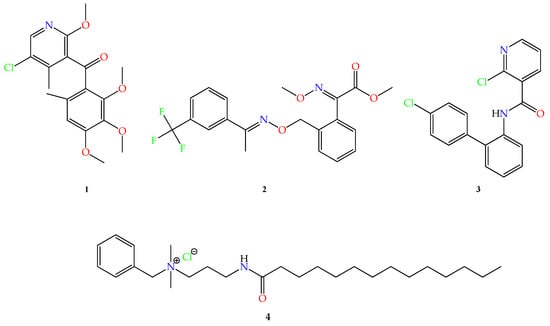
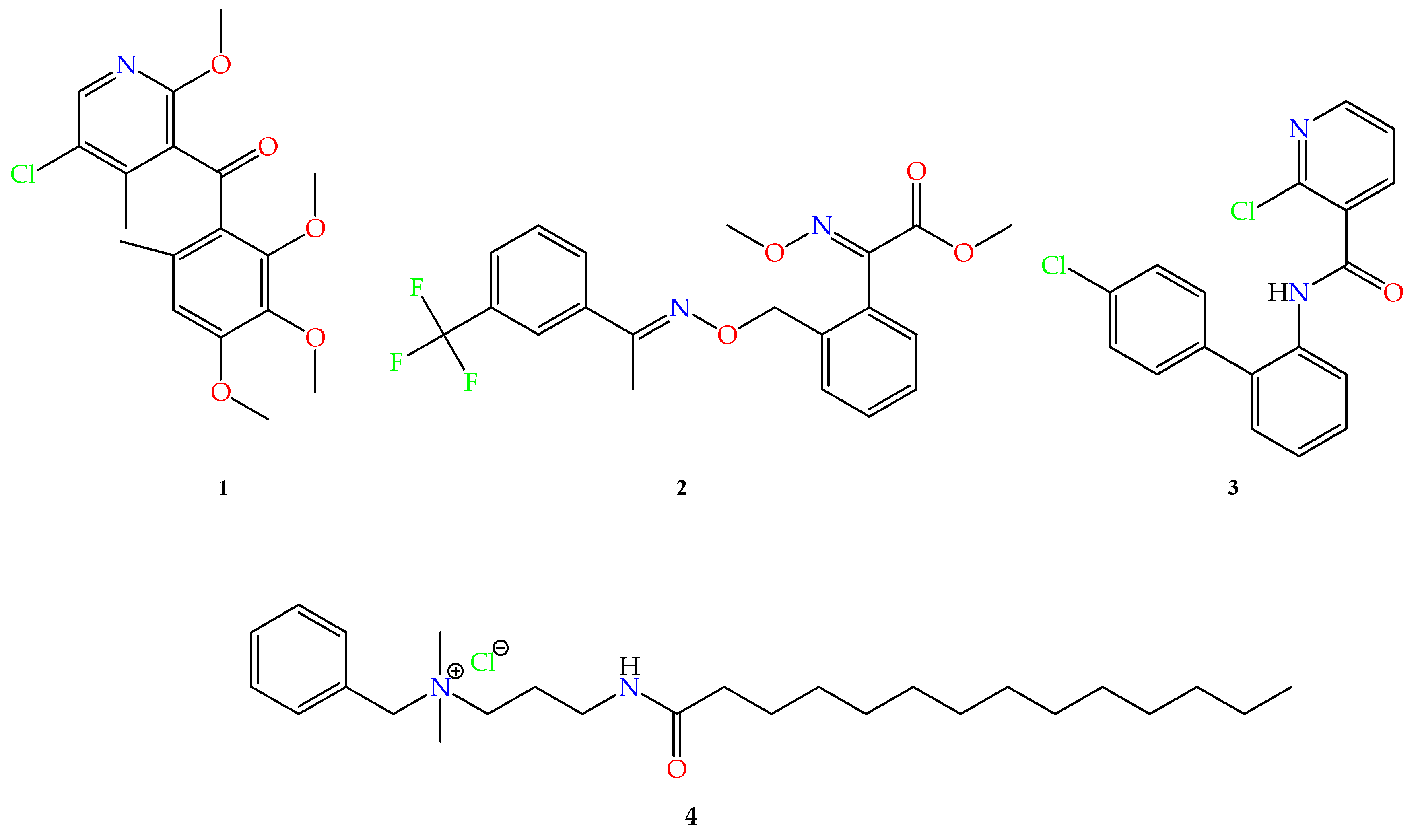
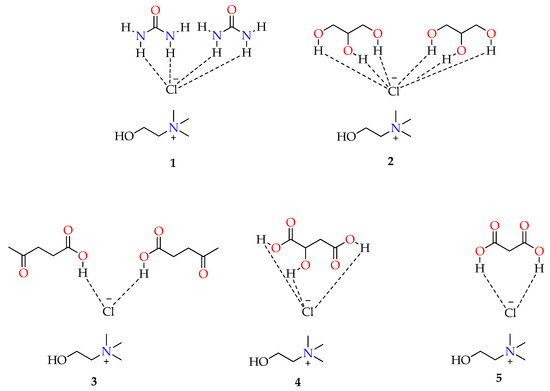
Oxime functional groups (–CH=N–OH) are well known for their ability to act as nucleophiles [33] and chelating ligands [34]. These compounds exhibit significant biological and pharmacological activities, including acetylcholinesterase inhibition, antimicrobial, and antidote [35] properties, making them highly relevant in medicinal chemistry and drug design. Oximes are valuable synthetic building blocks used in innovative methodologies involving dynamic materials and energetic materials [36]. Previous studies have demonstrated the antifungal activity of related compounds against key phytopathogenic fungi, providing a rationale for evaluating the current series of synthesized compounds under similar conditions [37,38]. Notably, several commercial fungicides contain a pyridine or oxime group in their structure. Pyriophenone has a benzoyl-pyridine skeleton. Trifloxystrobin is a commercial fungicide that possesses an oxime group. Boscalid is a pyridine carboxamide widely used in agriculture.
Additionally, several scientific papers explicitly demonstrate the antifungal activity of quaternary pyridinium salts [39,40,41], and there are also commercial fungicides based on quaternary ammonium compounds (Figure 1) [42]. Since our synthesized compounds share some structural components with these commercial fungicides, we tested their antifungal activity.
Figure 1.
Structures of commercial fungicides: 1. pyriofenone, 2. trifloxystrobin, 3. boscalid, 4. miramistin.
2. Materials and Methods
The ultrasound bath (US) used in the experiments was manufactured by BANDELIN GmbH & Co (Berlin, Germany), model DT 510 H, operating at a frequency of 35 kHz, with a nominal power of 160 W and a temperature range of 20–80 °C (maximum power 400 W). Thin-layer chromatography was performed on fluorescent silica gel plates F254 (Merck, Darmstadt, Germany) under UV light at 254 and 365 nm, using a chloroform: methanol solvent system in a 6:1.5 ratio.
Melting points were determined using the Electrothermal IA 9100 Melting Point Apparatus (Electrothermal Inc., Gillete, NJ, USA). 1D and 2D NMR spectra were recorded with a Bruker AV300 spectrometer (Bruker BioSpin GmbH, Rheinstetten, Germany) equipped with a 7 T superconducting magnet. The standard 1H and proton-decoupled 13C{1H} NMR spectra were recorded at 300.130 and 75.468 MHz, respectively. The chemical shifts (δ/ppm) of the 1H and 13C spectra were referenced to the dimethyl sulfoxide solvent signal: DMSO-d6 (1H: δ = 2.50 ppm; 13C: δ = 39.50 ppm). The assignment of the 1H and 13C signals in the recorded NMR spectra was confirmed by cross peaks in the 2D spectra: 1H-1H COSY (Correlation Spectroscopy), 1H-13C HSQC (Heteronuclear Single Quantum Coherence) and 1H-13C HMBC (Heteronuclear Multiple Bond Correlation). A growth chamber (Aralab, Rio de Mouro, Portugal) was used to control temperature and humidity.
All solvents and reagents were obtained from various commercial sources and used without further purification: pyridine-3- and pyridoxal-4-aldoximes (98%) (MilliporeSigma, Burlington, MA, USA); choline-chloride (Acros Organics, Geel, Belgium); urea (Gram-Mol d.o.o., Zagreb, Hrvatska); glycerol (Gram-Mol d.o.o., Zagreb, Hrvatska); levulinic acid (Acros Organics, Geel, Belgium); malic acid (MilliporeSigma, Burlington, MA, USA); malonic (Fisher Chemical, Waltham, MA, USA).
2.1. Preparation of DESs and Determination of pH and Water Content
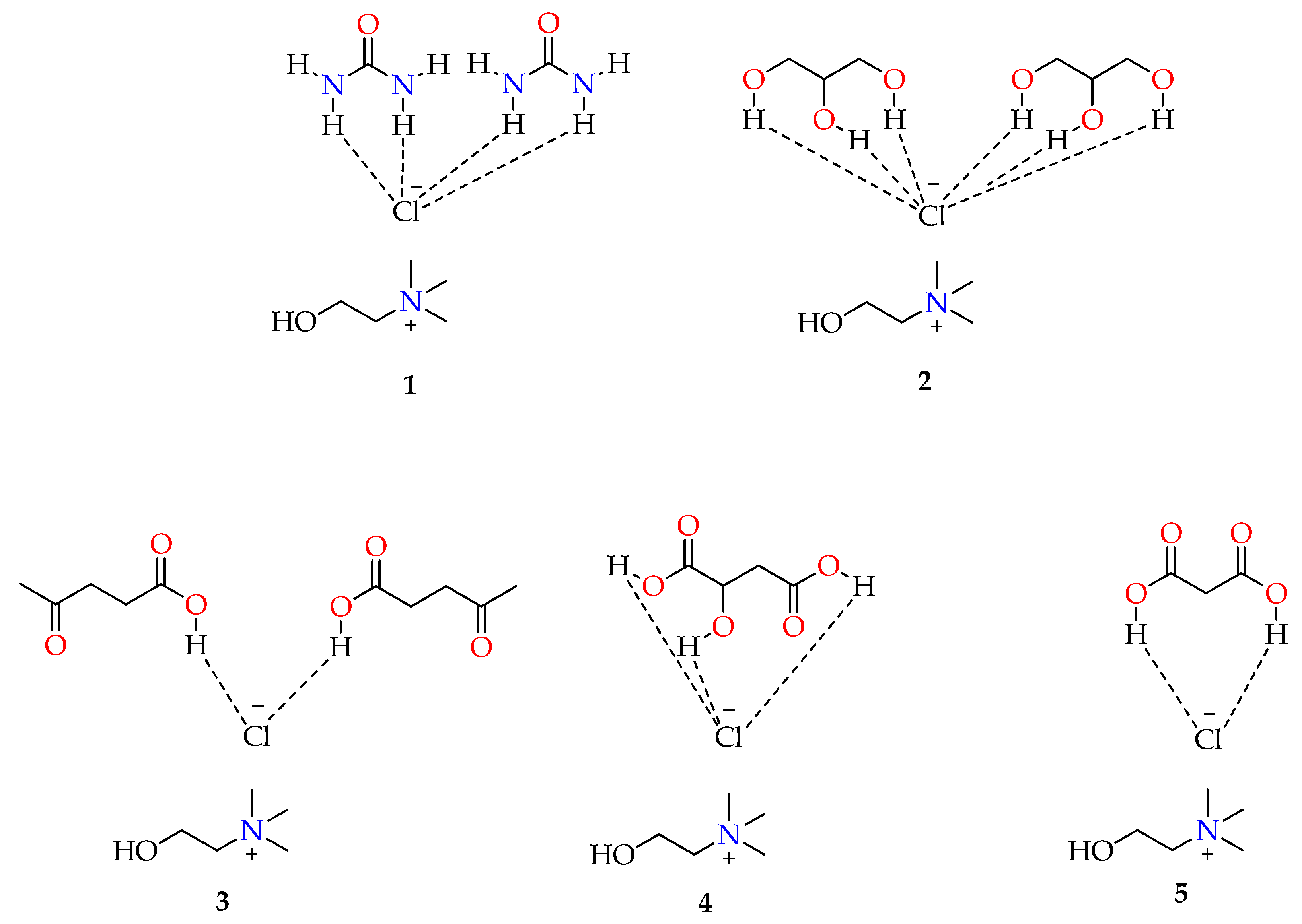
The eutectic solvents were prepared by mixing ChCl as the hydrogen bond acceptor (HBA) with various hydrogen bond donors (HBDs) in the ratios specified in Figure 2. All DESs used 2.28 g ChCl as HBA, with HBDs added as follows: 1.96 g urea (1:2), 3.00 g glycerol (1:2), 2.19 g malic acid (1:1), 1.70 g malonic acid (1:1), and 3.79 g levulinic acid (1:2). The mixtures were heated and stirred magnetically at 80 °C for an appropriate period, depending on the specific HBD. According to previous study [43] the thermal stability of most deep eutectic solvents composed of choline chloride and organic acids (lactic, tartaric, citric, oxalic) allows their use in a wide temperature range of approximately 135–198 °C, with all DESs being thermally stable between 25 and 400 °C.
Figure 2.
Structures of deep eutectic solvents used in this research: 1. ChCl: urea (1:2), 2. ChCl: glycerol (1:2), 3. ChCl: levulinic acid (1:2), 4. ChCl: malic acid (1:1), 5. ChCl: malonic acid (1:1).
During this process, a stable and homogeneous liquid formed, which was then cooled and used directly for quaternary salt synthesis without further purification [44,45,46,47,48,49,50].
The relative acidity values of the prepared solvents were measured using a SevenCompact Duo pH metre (Mettler–Toledo, Greifensee, Switzerland) equipped with an InLab Viscous Pro-ISM electrode. The water content in the deep eutectic solvents was determined using the Karl Fischer method in accordance with the HRN EN 13466-1:2003 [51] standard, which employs methanol as the extraction medium.
2.2. Conventional Method for the Synthesis of Quaternary Pyridinium Aldoxime Salts
2.2.1. Preparation of Quaternary Salts by Conventional Synthesis in Ethanol
Pyridine-aldoxime (1.63 mmol, 0.2 g) was dissolved in 10 mL of anhydrous ethanol (EtOH). An equimolar amount of the appropriate 2-bromoacetophenone (1.63 mmol), previously dissolved in 10 mL of EtOH, was then added to this solution. The syntheses were carried out for 3 h, in ethanol at reflux temperature at 78 °C. The reaction mixture was left to stand overnight at room temperature. After standing, coloured crystals of the crude product precipitated and were collected by vacuum filtration. The crude product was recrystallized from ethanol and dried in a desiccator.
2.2.2. Preparation of Quaternary Salts by Conventional Synthesis in DES
The quaternization reaction was carried out using the same amounts of starting materials as in the previous procedure, in DES with a reactant-to-ChCl molar ratio of 1:10, for 3 h at 80 °C. After the reaction was complete, ice-cold water was added to the reaction mixture to precipitate the product. The crude product was washed with ethanol, recrystallized from ethanol, and dried in a desiccator.
2.3. Ultrasound-Assisted Method for the Synthesis of Quaternary Pyridinium Aldoxime Salts
2.3.1. Ultrasound Method in Ethanol
An equimolar mixture of pyridine-3-aldoximes or pyridine-4-aldoximes (1.63 mmol, 0.2 g) and substituted 2-bromoacetophenones was dissolved in ethanol. The reaction mixture was then subjected to ultrasound irradiation in a bath for 1 h, at the reflux temperature (78 °C). Upon completion, the reaction mixture in ethanol was left to stand overnight at room temperature to allow crystals to precipitate. The crude solid was collected by vacuum filtration, washed with ethanol, and recrystallized from ethanol to yield a chromatographically pure compound.
2.3.2. Ultrasound Method in DESs
The quaternization reaction was carried out using the same amounts of starting materials as in the previous procedure, in DES with a reactant-to-ChCl molar ratio of 1:10, for 1 h at 80 °C. After completion of the reaction, ice-cold water was added to the reaction mixture to precipitate the product. The crude product was washed with ethanol, recrystallized from ethanol, and dried in a desiccator. The product’s structure was confirmed by NMR and IR spectroscopy, mass spectrometry (MS) and elemental analysis. Recorded one and two-dimensional NMR spectra, IR spectra and MS data are provided in the Supporting Information.
2.3.3. Spectroscopic Characterization of Compounds
(7) 1-(2-([1,1′-biphenyl]-4-yl)-2-oxoethyl)-4-((hydroxyimino)methyl)pyridin-1-ium bromide, light yellow solid white solid; Rf value: 0.45; (chloroform:methanol, 6:1.5, v/v); mp 257–259 °C; FT-IR (KBr) νmax: 3239–2683, 1684, 1640, 1416, 991, 697 cm−1; 1H (300 MHz, DMSO-d6, 298 K): δ 12.93 (1H, s, OH), 9.05 (2H, d, J = 6.68 Hz, H-2/6), 8.51 (1H, s, HC=N), 8.39 (2H, d, J = 6.68 Hz, H-3/5), 8.16 (2H, d, J = 8.35 Hz, H-10/14), 7.98 (2H, t, J = 8.35 Hz, H-11/13), 7.82 (2H, d, J = 6.68 Hz, H-16/20), 7.54 (2H, t, J = 7.08 Hz, H-17/19), 7.48 (1H, d, J = 7.51 Hz, H-18), 6.61 (2H, s, H-7) ppm; 13C (75 MHz, DMSO-d6, 298 K): δ 190.3 (C-8), 149.1 (C-4), 146.4 (C-2/6), 145.8 (C-12), 145.2 (HC=N), 138.4 (C-15), 132.3 (C-9), 129.2 (C-17/19), 129.0 (C-10/14), 128.8 (C-18), 127.2 (C-11/13), 127.1 (C-16/20), 123.8 (C-3/5), 65.8 (C-7) ppm; MS (m/z): 315 [M]−; Anal. Calcd. mass fractions of elements, w/% for: C20H17BrN2O2 (Mr = 396.05): C 60.47, H 4.31 N, 7.05: found: C 60.31, H 4.10, N 6.87.
(12) 1-(2-(4-bromophenyl)-2-oxoethyl)-3-((hydroxyimino)methyl)pyridin-1-ium bromide, white solid; Rf value: 0.22 (chloroform:methanol, 6:1.5, v/v); mp 253–254 °C; FT-IR (KBr) νmax: 3380–2720, 1692, 1632, 1584, 984, 812 cm−1; 1H (300 MHz, DMSO-d6, 298 K): δ 12.26 (1H, s, OH), 9.31 (1H, s, H-2), 9.02 (1H, d, J = 5.98 Hz, H-6), 8.85 (1H, d, J = 7.97 Hz, H-4), 8.41 (1H, s, HC=N), 8.31 (1H, dd, J = 9.30; 5.32 Hz, H-5), 8.00 (2H, d, J = 8.64 Hz, H-10/14), 7.90 (2H, d, J = 8.64 Hz, H-11/13), 6.58 (2H, s, H-7) ppm; 13C (75 MHz, DMSO-d6, 298 K): δ 190.0 (C-8), 145.7 (C-6), 143.5 (C-2), 143.3 (HC=N), 143.0 (C-4), 133.1 (C-3), 132.6 (C-9), 132.2 (C-11/13), 130.2 (C-10/14), 128.8 (C-12), 127.9 (C-5), 66.4 (C-7) ppm; MS (m/z): 319 [M]+; Anal. Calcd. mass fractions of elements, w/% for: C14H12Br2N2O2 (Mr = 400.07): C 42.03, H 3.02, N 7.00: found: C 41.89, H 2.92, N 6.85.
(16) 1-(2-([1,1′-biphenyl]-4-yl)-2-oxoethyl)-3-((hydroxyimino)methyl)pyridin-1-ium bromide, light yellow solid; Rf value: 0.41 (chloroform:methanol, 6:1.5, v/v); mp 232–233 °C; FT-IR (KBr) νmax: 3153–2735, 1688, 1606, 1502, 995, 764 cm−1; 1H (300 MHz, DMSO-d6, 298 K): δ 12.28 (1H, s, OH), 9.35 (1H, s, H-2), 9.07 (1H, d, J = 5.82 Hz, H-6), 8.86 (1H, d, J = 8.14 Hz, H-4), 8.43 (1H, s, HC=N), 8.33 (1H, dd, J = 8.14; 6.59 Hz, H-5), 8.16 (2H, d, J = 8.14 Hz, H-10/14), 7.99 (2H, d, J = 7.75 Hz, H-11/13), 7.82 (2H, d, J = 7.75 Hz, H-16/20), 7.55 (2H, t, J = 6.59 Hz, H-17/19), 7.49 (1H, d, J = 7.75 Hz, H-18), 6.65 (2H, s, H-7) ppm; 13C (75 MHz, DMSO-d6, 298 K): δ 190.1 (C-8), 145.9 (C-12), 145.8 (C-6), 143.5 (C-2), 143.3 (HC=N), 142.9 (C-4), 138.4 (C-15), 133.1 (C-3), 132.3 (C-9), 129.2 (C-17/19), 129.0 (C-10/14), 128.8 (C-18), 127.9 (C-5), 127.2 (C-11/13), 127.1 (C-16/20), 66.5 (C-7) ppm; MS (m/z): 317 [M]+; Anal. Calcd. mass fractions of elements, w/% for: C20H17BrN2O2 (Mr = 396.05): C 60.47, H 4.31, N 7.05, found: C 60.42, H 4.29, N 7.05.
2.4. Recycling and Reuse of DES Choline Chloride: Urea
The DESs were recovered by evaporating the water and drying under reduced pressure for recycling and reuse. The model reaction for DES recycling and reuse was the reaction of pyridine-3-aldoxime with 2,4-dibromoacetophenone in DES choline chloride: urea. For each subsequent run, the reaction mixture of starting materials was taken in the same stoichiometric ratio and under the same conditions by the conventional method (3 h, 80°C).
2.5. Antifungal Assay
2.5.1. Antifungal Activity of the Synthesized Compounds
The compounds were tested against four phytopathogenic fungi: Botrytis cinerea Pers., Fusarium culmorum (W.G. Sm.) Sacc., Macrophomina phaseolina (Tassi) Goid., and Sclerotinia sclerotiorum (Lib.) de Bary. The experiments were carried out at the Central Analytical Unit of the Faculty of Agrobiotechnical Sciences, Osijek, in the Laboratory of Phytopathology. Pure cultures of the four fungi were obtained from the isolate collection of the Chair of Phytopathology.
Media Preparation and Inoculation
For the experiments, sterile Petri dishes (90 mm in diameter) were filled with 15 mL of potato dextrose agar (PDA) mixed with one of the test compounds at concentrations of 10 µg/mL and 100 µg/mL. Mycelial plugs (4 mm in diameter) were cut from the actively growing edge of 7-day-old fungal colonies and transferred to the centre of each plate following the procedure described in [20].
Incubation and Evaluation
Plates were incubated in a growth chamber at 22 ± 1 °C with a 12 h light/12 h dark cycle and 70% relative humidity. The radial growth of fungal colonies was measured by determining the colony diameter in two perpendicular directions on the third day after inoculation, when the control plates (PDA without compounds) were fully covered with mycelium.
Each treatment was performed in four replicates and at two concentrations (10 and 100 µg/mL). Commercial fungicides were used as positive controls: pyrimethanil (0.2%) for B. cinerea, fenhexamid (0.075%) for S. sclerotiorum, difenoconazole + tebuconazole (0.4%) for F. culmorum, and a dithiocarbamate fungicide for M. phaseolina. PDA was amended with fungicides at the concentrations specified by the manufacturer.
The percentage of mycelial growth inhibition (%) was calculated in Microsoft Excel using the formula:
where C is the diameter of fungal growth in the control, and T is the diameter of fungal growth on treated PDA.
2.5.2. Statistical Data Analysis
To test for significant differences among treatments, one-way analysis of variance (ANOVA) was performed for each pathogen at both concentrations. Mean comparisons were carried out using Tukey’s (HSD) test at p < 0.05 in SAS software version 9.4 and SAS Enterprise Guide 7.1 (SAS Institute Inc., Cary, NC, USA). Data in tables are presented as means with standard deviations (SD). Graphs were prepared in Microsoft Excel and are shown as means with standard errors (SE). Different letters above the bars or within the same column indicate statistically significant differences among compounds at the same concentration.
3. Results
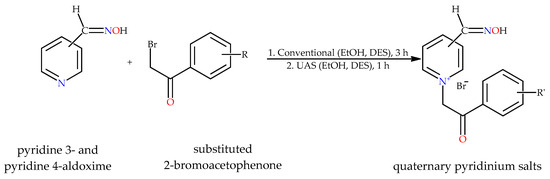
The aim of this work was to conduct a quaternization reaction within the framework of green chemistry. Pyridine-3-aldoxime and pyridine-4-aldoxime were used as nucleophiles in the quaternization reaction, while substituted 2-bromoacetophenones served as electrophiles. The reaction yielded the corresponding quaternary pyridine analogues 1–18 (Figure 3).
Figure 3.
Scheme of the quaternization of pyridine-aldoximes with substituted 2-bromoacetophenones (R = -4-F, -4-Cl, -4-Br, -4-H, -4-CH3, -4-OCH3, -4-Ph, -2-OCH3, -4-NO2) and formation quaternary salts of pyridine-4-aldoxime R′ = -4-F (1), -4-Cl (2), -4-Br (3), -4-H (4), -4-CH3 (5),-4-OCH3 (6), -4-Ph (7), -2-OCH3 (8), 4-NO2 (9) and pyridine-3-aldoxime (R′ = -4-F (10), -4-Cl (11), -4-Br (12), -4-H (13), -4-CH3 (14), -4-OCH3 (15), -4-Ph (16), -2-OCH3 (17), -4-NO2 (18).
3.1. Conventional Synthesis vs. UAS in EtOH
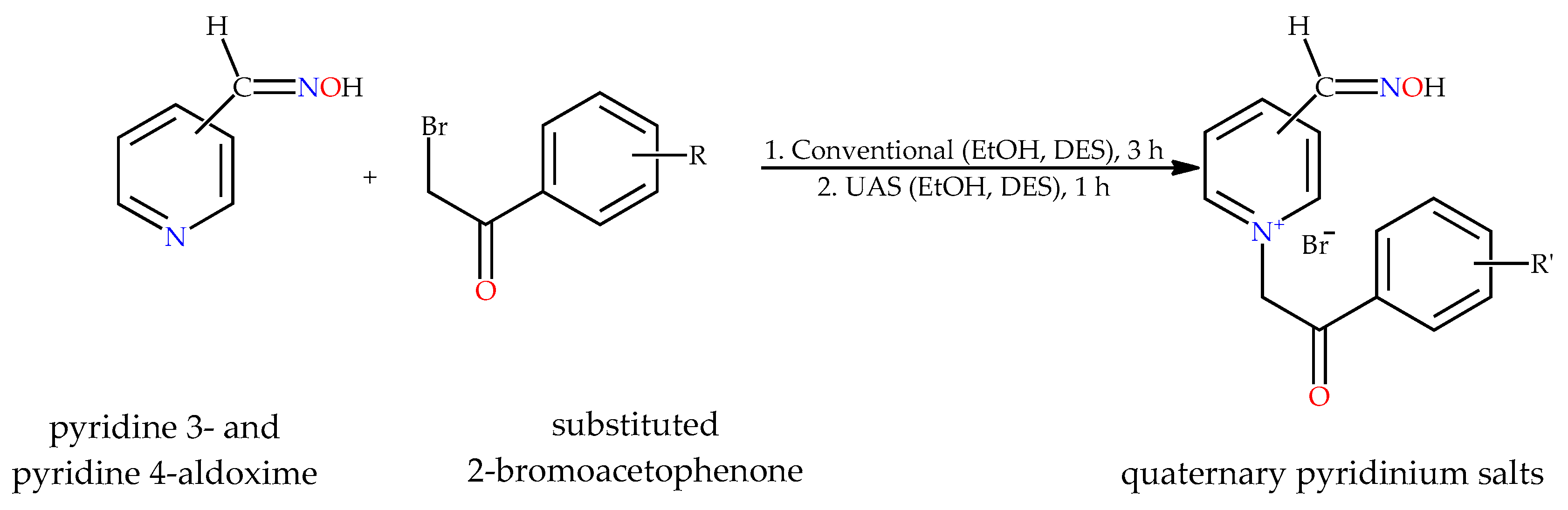
The conventional method for preparing quaternary salts required a reaction time of 3 h at reflux temperature (78 °C), and compounds 1–18 were generally obtained in low to moderate yields (Table 1, Figure 4). These results indicate that the traditional methodology typically provides low to moderate efficiency in ethanol. Analyzing the yields under conventional conditions in ethanol, with reactions classified as low (0–40%), medium or moderate (41–80%) and high (81–100%) yields, approximately 33% of the syntheses produced products in the low yield category (0–40%), 50% in the medium yield category (41–80%), and only 17% in the high yield category (>80%). The highest yield was achieved for compound 3 (85%).
Table 1.
Yields and melting points of compounds 1–18 obtained by the conventional method (3 h) and ultrasound-assisted synthesis (1 h) in ethanol under reflux conditions (78 °C).
Figure 4.
Distribution of Product Yields under Conventional and US Conditions in Ethanol.
A comparison of conventional synthesis and UAS in ethanol shows that the UAS method generally produces higher yields. UAS improves reaction efficiency by enhancing mixing and mass transfer, which accelerates reaction kinetics. The use of UAS resulted in higher yields for almost all compounds 1–18 compared to conventional synthesis, with a significant reduction in reaction time from 3 h to only 1 h. In contrast, the ultrasound-assisted synthesis produced 11% of the products in the low yield category, 50% in the medium yield category, and 39% in the high yield category.
3.2. Conventional Synthesis in DESs
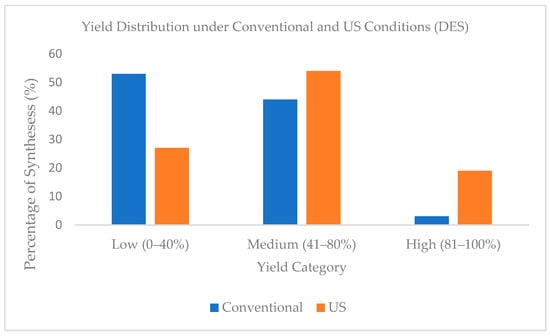
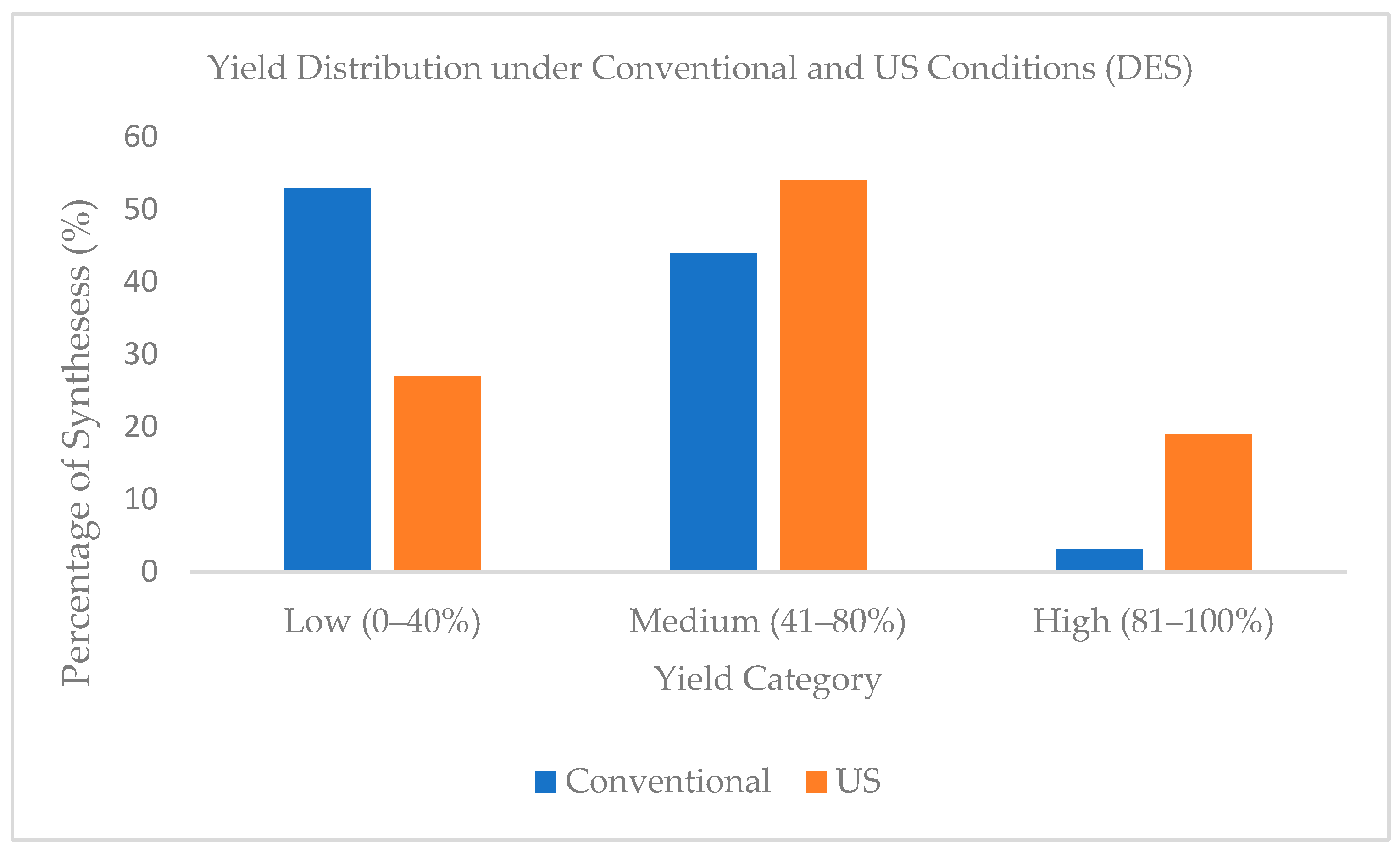
Table 2, Figure 5 shows the yields of the prepared compounds (1–18) in five different ChCl-based deep eutectic solvents (DES): ChCl:urea (1:2), ChCl: glycerol (1:2), ChCl: malic acid (1:1), ChCl:malonic acid (1:1) and ChCl:levulinic acid (1:2). Of the 90 syntheses performed, low yields (0–40%) were obtained in 53% of the reactions. Moderate yields (41–80%) were obtained in 44% of the reactions, whereas high yields (greater than 80%) were achieved in only 3% of cases.
Table 2.
Yields of compounds (1–18) obtained by the conventional method (80 °C, 3 h) in five different ChCl-based DESs characterized by water content.
Figure 5.
Distribution of Product Yields under Conventional and US Conditions in DESs.
3.3. Ultrasound Assisted Synthesis (UAS) in DESs
The UAS in DES produced significantly higher results than conventional synthesis in ethanol; however, the yields were similar to those obtained with the UAS in ethanol (Table 3, Figure 5).
Table 3.
Yields of compounds (1–18) obtained by the UAS method (80 °C, 1 h) in five different DESs.
Although ethanol provides higher yields, DES are ecologically superior due to lower toxicity and greater sustainability. The yields from the synthesis of compounds (1–18) in five different DES show that 54% of the syntheses resulted in moderate yields (41–80%). Low yields (0–40%) were recorded in 27% of the syntheses, while high yields (81–100%) were achieved in 19% of the syntheses. This indicates that although the method was generally effective, most reactions did not achieve the highest levels of efficiency, especially when compared to the yields obtained using the conventional method in acetonitrile.
Identification of the three new compounds, labelled as 7, 12, and 16, was accomplished through spectroscopic analyses, including NMR, IR, and MS spectroscopy.
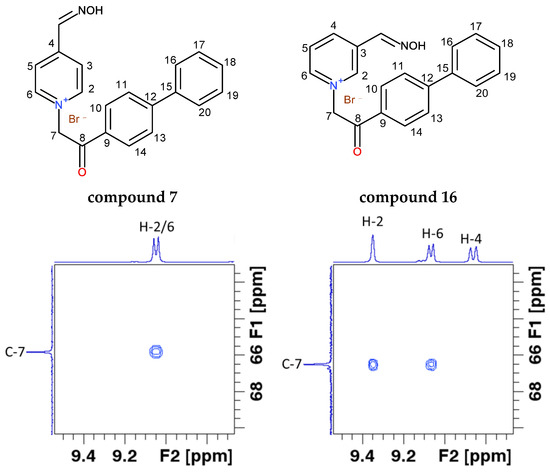
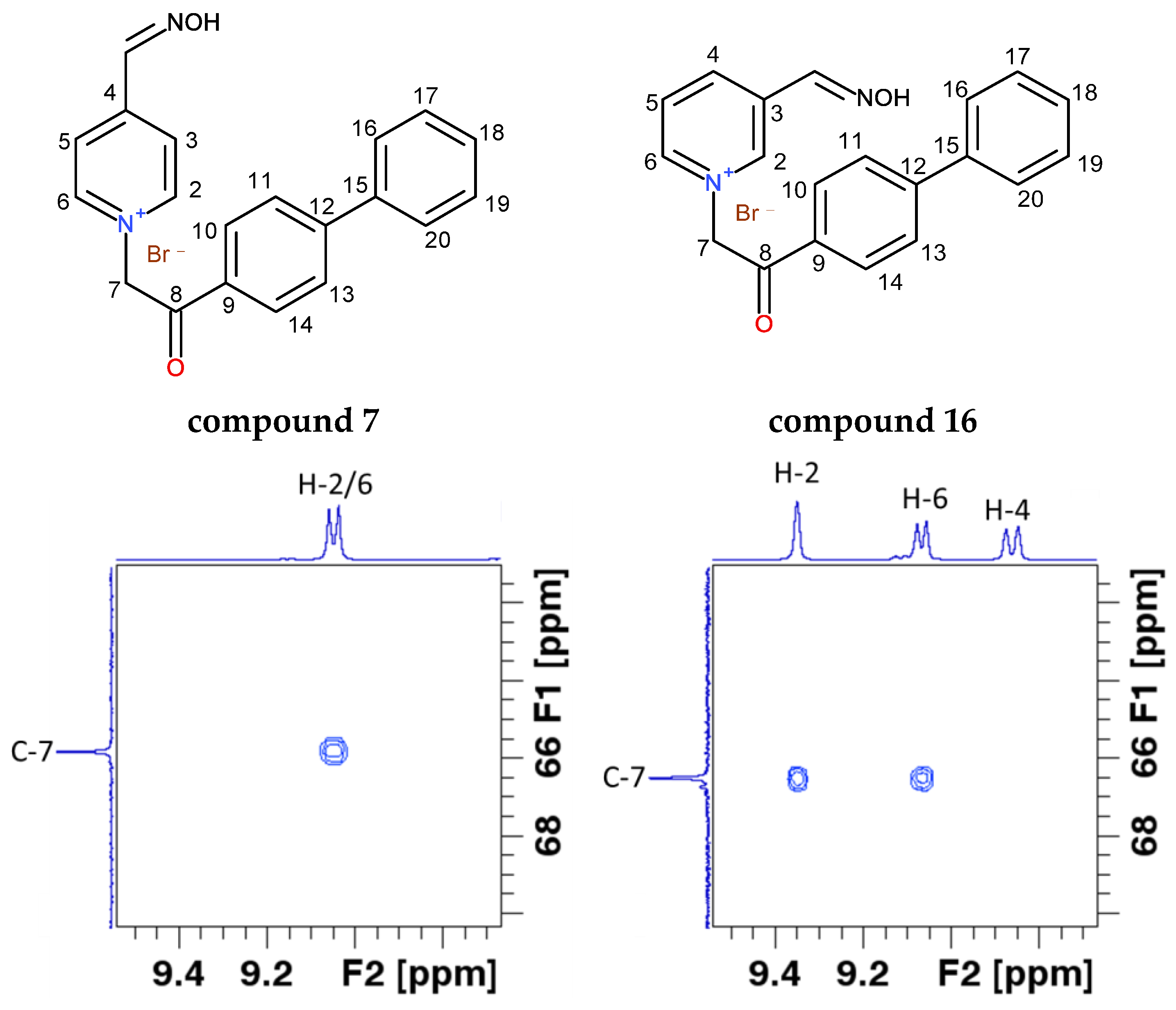
The recorded 1H and 13C NMR spectra of these three compounds unambiguously confirmed the proposed structures. Cross peaks observed in the 1H-13C HMBC spectra between the C-7 and H-2/H-6 signals provide clear evidence of the bonding interaction mediated by the lone electron pair of the pyridine nitrogen atom (Figure 6) (Figures S1–S15 in the Supplementary Materials).
Figure 6.
Part of the 1H-13C HMBC spectra of compounds 7 and 16. Key cross-peaks confirming the successful synthesis are highlighted (1H frequency: 300 MHz, 13C frequency: 75 MHz, DMSO-d6).
IR spectral analysis of the three new compounds, 7, 12, and 16, showed patterns consistent with previously reported IR spectra and clearly indicated the presence of characteristic functional groups.
The oxime group typically displays a broad O–H stretching band in the 3300–3500 cm−1 region; however, in this case, the band was markedly broadened, extending to approximately 2500 cm−1, indicative of strong hydrogen bonding. The compounds show C=N absorption around 1640 cm−1, while N–O vibrations are observed near 970 cm−1. The phenacyl carbonyl group is recorded around 1680 cm−1, and aromatic rings display clear bands in the 1500–1600 cm−1 region. These results confirm the structure and the presence of all key functional groups in the synthesized compounds (Figures S16–S18 in Supplementary Materials).
Quaternary pyridinium compounds exhibit characteristic peaks in their mass spectra. The MS spectra show the mass-to-charge ratio (m/z) of the ions in relation to their relative abundance, with each peak representing the corresponding ion in the sample, as supported by Figures S19–S36 in Supplementary Materials.
3.4. Antifungal Activity of Tested Compounds
The results presented in Table 4 display the antifungal activity of the tested compounds, evaluated by the percentage of mycelial growth inhibition of four pathogens: B. cinerea, F. culmorum, M. phaseolina, and S. sclerotiorum. These values were measured after 96 h of incubation. According to the results of one-way ANOVA, all tested compounds significantly inhibited mycelial growth compared to the negative control. The findings showed that the tested compounds caused varying levels of mycelial growth inhibition, with different pathogens displaying different sensitivities to the treatments.
Table 4.
Mycelial growth inhibition (%) of Botrytis cinerea, Fusarium culmorum, Macrophomina phaseolina, and Sclerotinia sclerotiorum after 96 h of incubation with tested compounds (1–18) at concentrations of 10 and 100 µg/mL. Values of mycelial growth inhibition rates (%) are expressed as mean ± standard deviation (SD) of four replicates. Different letters within the same column for each pathogen indicate significant differences among compounds at the same concentration according to one-way ANOVA followed by Tukey’s HSD test (p < 0.05).
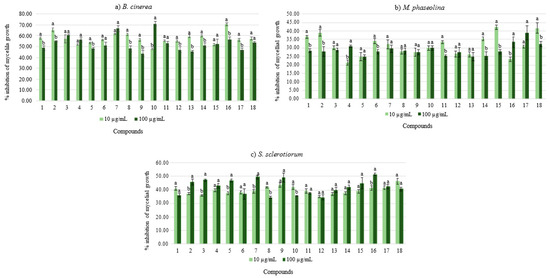
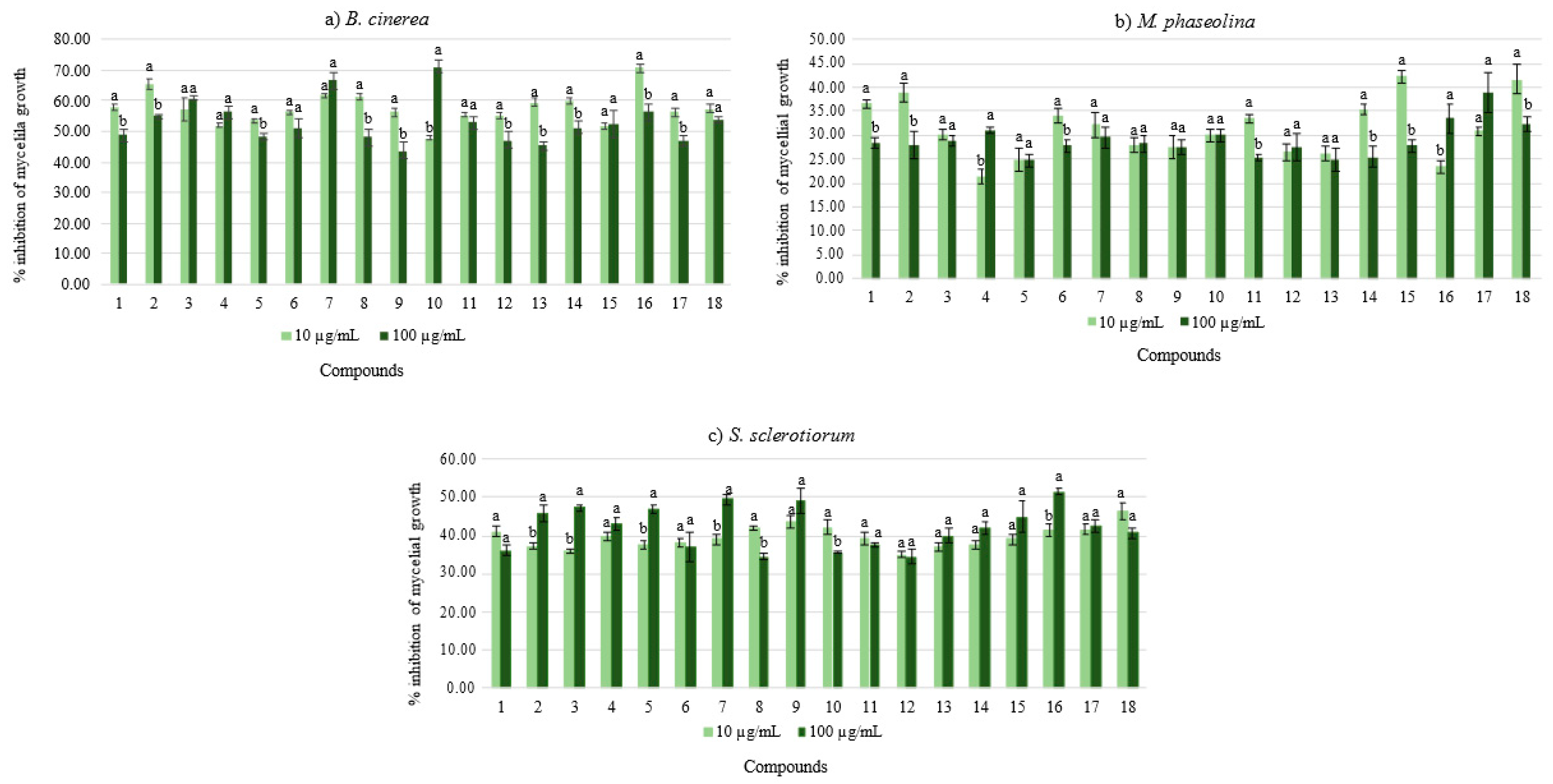
When comparing the two concentrations (10 and 100 µg/mL), the lower concentration often resulted in stronger inhibition than the higher concentration. This trend was particularly evident in B. cinerea, where most compounds (1, 2, 5, 6, 8, 9, 12, 13, 14, 15, and 18) were significantly more effective at 10 µg/mL. Only compounds 7 and 10 showed stronger inhibition at a concentration of 100 µg/mL. A similar pattern was observed in M. phaseolina, with compounds 1, 2, 6, 11, 14, 15, and 18 being significantly more effective at the lower concentration, while the others did not show a significant difference. For S. sclerotiorum, compounds 8 and 10 exhibited stronger inhibition at 10 µg/mL, while compounds 7 and 16 were significantly more effective at the higher concentration (Figure 7).
Figure 7.
Effects of the different concentrations of compounds on mycelial growth inhibition of (a) Botrytis cinerea, (b) Macrophomina phaseolina, and (c) Sclerotinia sclerotiorum. Bars represent mean values of mycelial growth inhibition (%) ± standard error (SE) of four replicates. Different letters above the bars indicate statistically significant differences between concentrations of the same compound according to Tukey’s HSD test (p < 0.05).
4. Discussion
Quaternary pyridinium salts (QAS) were synthesized from two different heterocyclic compounds, pyridine-3 and pyridine-4-aldoximes. Both heterocyclic compounds and the substituted 2-bromoacetophenones used in this work are commercially available. The precursors in the synthesis of the quaternary pyridinium salts, pyridine-3- and 4-aldoximes, share an important property: both contain a nitrogen atom with a lone electron pair, which imparts basic properties. Therefore, in quaternization reactions, the nitrogen atom acts as an electron donor, i.e., a nucleophile, and readily reacts with the electrophilic carbon of the substituted 2-bromoacetophenones. Ethanol, being a greener solvent compared to acetone and acetonitrile previously used in the synthesis of these compounds [13,14], was chosen as the solvent in both conventional and ultrasonic synthesis, and its effectiveness has also been supported by other studies as a promising solvent for quaternization reactions [52,53]. The syntheses of the same compounds were carried out in dry acetonitrile, at temperatures ranging from room temperature to 80 °C, with quaternary salts obtained in yields ranging from 10 to 90% [13]. A comparison of conventional and ultrasonic synthesis shows clear advantages of UAS. The conventional method required 3 h of reflux at 78 °C and gave low to moderate yields. In contrast, UAS shortened the reaction time to 1 h and increased the efficiency: only 11% of the products were in the low yield category, while 39% achieved high yields. In conclusion, the UAS method is faster and more efficient, with better utilization of reactions in ethanol.
To design the most suitable solvent for the preparation of quaternary salts, five deep eutectic solvents (DES) with varying hydrogen bond donor (HBD) components were synthesized using a relatively simple, cost-effective, and environmentally friendly method. The selected DESs are based on ChCl as the hydrogen-bond acceptor and urea, glycerol, or organic acids as hydrogen bond donors, in specific molar ratios. This process usually involves only mixing and heating, without the need for additional purification steps. Deep eutectic solvents (DES) are characterized by a low E-factor, close to zero, due to their nature of being formed by mixing two or more components without the need for complex purification steps after formation. The low E-factor results from the absence of significant waste generation during preparation. The E-factor (environmental factor) is defined as the ratio of the total mass of waste generated to the mass of the desired product in a chemical process. It is usually expressed in units of kg of waste per kg of product (kg/kg) and is used to assess the environmental impact of manufacturing processes, where lower values indicate a cleaner and more efficient process [54,55,56]. As DESs are formed by intermolecular interactions, such as hydrogen bonds, usually no chemical reaction occurs during their formation. This means the reactants are efficiently converted to the product (DES) without the generation of waste, thereby satisfying the atom economy as one of the 12 principles of green chemistry. The effect of water on DESs has been extensively investigated in the literature, as it significantly influences their physicochemical properties, structural characteristics, and practical applicability. Even small amounts of water have been shown to disrupt the heterogeneous three-dimensional network of pure DES components [57,58].
The water content of the synthesized DESs in this study was determined using Karl Fischer titration (Table 2). Among them, the ChCl: glycerol (1:2) DES exhibited the lowest water content (0.76%), while the ChCl: levulinic acid (1:2) DES showed the highest water content (1.92% of total mass). The physicochemical properties of DESs, particularly relative acidity, play a crucial role in determining their suitability as reaction media. The DESs studied here covered a wide range of relative acidity, from strongly alkaline (ChCl: urea, relative acidity 10.5) to strongly acidic (ChCl: malic acid, relative acidity = 1.6; ChCl: malonic acid, relative acidity = 1.3; ChCl: levulinic acid, relative acidity = 1.2). DES ChCl: glycerol was a slightly acidic medium with a relative acidity of 4.3. In terms of water content, ChCl: glycerol had the lowest value (0.76%), while ChCl: levulinic acid had the highest (1.92%) (Table 2).
Quaternary pyridinium salts were successfully prepared in all the deep eutectic solvents, but with varying yields. Comparing the conventional method in ethanol with those in deep eutectic solvents, it is evident that ethanol remains a superior reaction medium for quaternization, as higher yields were obtained in ethanol than in any DES. This suggests that the choice of DES significantly affects the efficiency of the synthesis. The choice of DES had a significant impact on the reaction yields. Among the investigated systems, ChCl: urea (1:2) consistently showed the highest efficiency, providing the greatest number of moderate and high yields, including several reactions above 80% and a nearly quantitative yield (99%) for compound 3. In contrast, DESs based on glycerol and organic acids (malic, malonic, and levulinic acid) generally resulted in lower or moderate yields, indicating reduced efficiency under more acidic conditions. Overall, these results suggest that DESs with a more basic character are more favourable media for the quaternization reaction than their acidic counterparts.
At low yields, the reaction mixture mainly contains unreacted starting components: pyridine aldoximes and substituted phenacyl bromides. We assume that the high viscosity of DES results in poor diffusion. We also assume that the hydrogen bond network in DES may further prevent the reactants from reacting, thus leaving unused starting material. We believe that the problem is not only in the synthesis phase itself, since in most cases one reactant is consumed, but that the problem is also greater in the product separation phase, in which the resulting product cannot be completely precipitated because a polar quaternary salt is formed, which remains dissolved in DES. Therefore, yields in most DES are quite low, and it is almost impossible to achieve quantitative yields.
The data suggest that urea-based DESs are the most promising solvents for this synthetic route, offering the highest probability of achieving medium to high yields. The highest yield was achieved for compound 12 (88%) in the eutectic solvent ChCl: urea. Investigations showed that all applied DESs were successful in carrying out the synthesis, which is especially significant because classical solvents were successfully replaced by a greener alternative. Although slightly higher yields were obtained by the classical route, the importance of using DES remains. Their application contributes to sustainability and green chemistry due to properties such as biodegradability, non-toxicity, ease of preparation and the ability to tune their characteristics by selecting appropriate components. These properties make DESs a valuable alternative to traditional solvents, and although the obtained yields are somewhat lower, they confirm that DESs represent a viable and promising option for the future development of synthetic processes. Comparing the yields of synthesis with respect to the group present on the benzene ring, the lowest yields can be observed regardless of whether the method is conventional or UAS. Products 8 and 17 were obtained in the lowest yields, probably due to steric effects; the ortho-positioned methoxy substituent likely hinders the access of the electrophile, thus preventing its interaction with the nitrogen atom.
A clear correlation between relative acidity and reaction efficiency was observed. Alkaline DES (ChCl: urea) gave the highest yields under both conventional and sonication-assisted conditions. For example, compound 3 achieved a yield of 87% in conventional synthesis and an almost quantitative yield of 99% under sonication in this medium. This indicates that the quaternization reaction is strongly favoured in a basic environment, most likely because the nucleophilicity of the pyridine nitrogen atom is enhanced under alkaline conditions, thereby promoting its attack on electrophilic bromoacetophenones. In contrast, strongly acidic DESs (malic and malonic acids) often resulted in low yields.
Interestingly, there are not many studies on quaternization reactions (Menshutkin type) carried out in deep eutectic solvents. The few published studies show how DES can replace conventional volatile organic solvents while maintaining high efficiency [59]. These systems provide a highly polar ionic environment that facilitates SN2 alkylation processes. Furthermore, pyridinium-based ionic systems have been shown to be stable and compatible with eutectic media [60]. However, synthesis of pyridinium quaternary salts directly in DES remains significantly underexplored. Therefore, our preliminary study is significant because it provides information on suitable DESs and conditions for quaternization of pyridine compounds. A series of fluorinated pyridinium salts was synthesized via a multistep procedure involving hydrazone formation followed by quaternization. The authors evaluated both conventional and ultrasound-assisted conditions, demonstrating that ultrasound irradiation significantly improves reaction efficiency, leading to higher yields and shorter reaction times compared to classical methods [18].
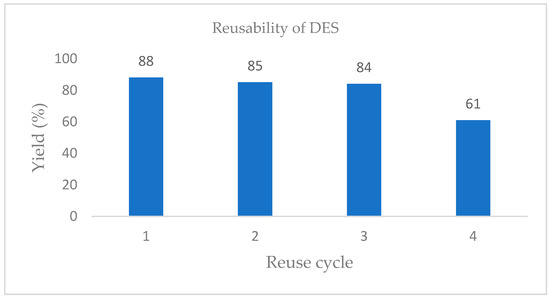
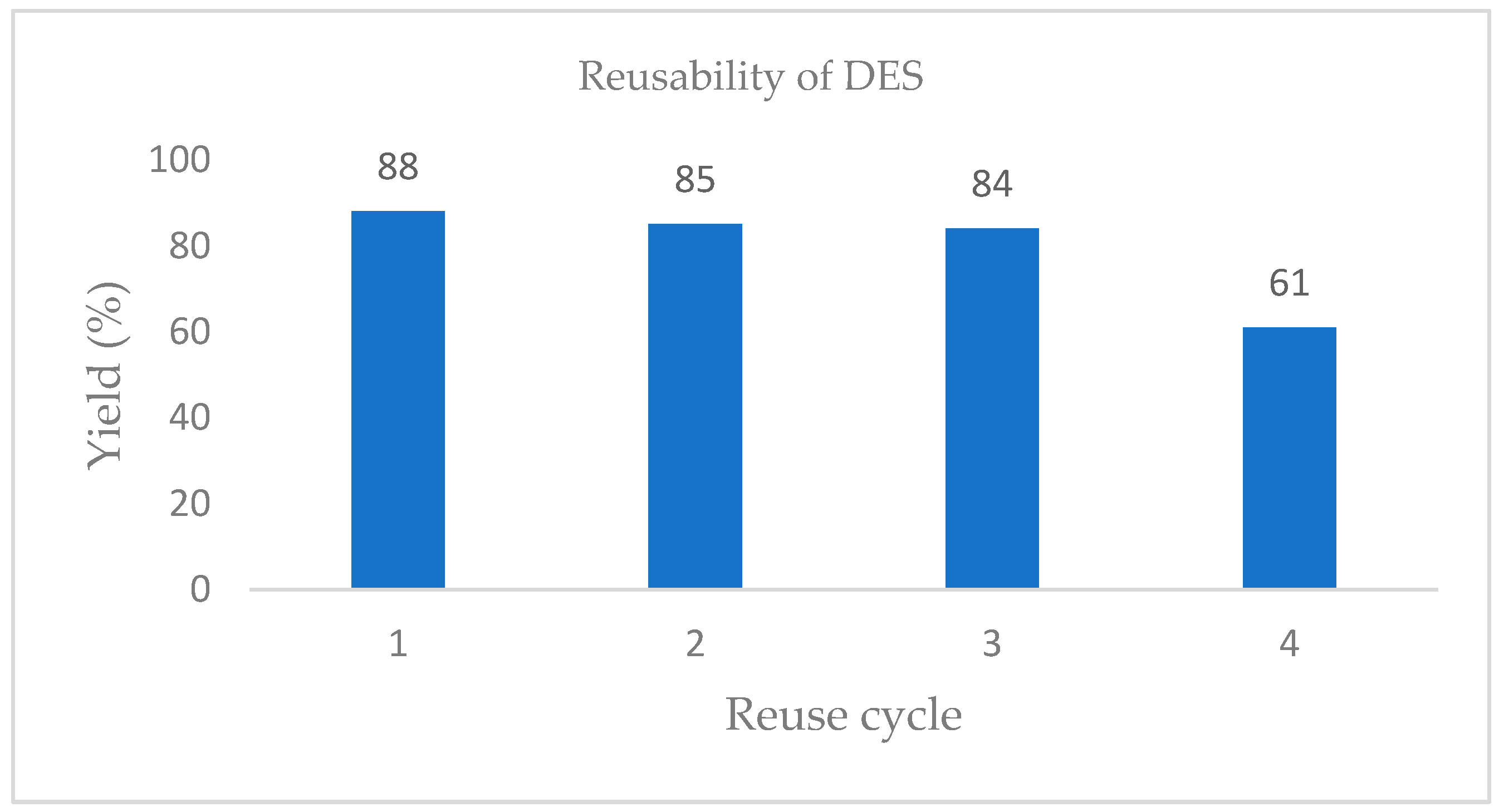
The reusability of DES was evaluated using choline chloride: urea (1:2) in a model reaction of pyridine-3-aldoxime with 2,4-dibromoacetophenone under conventional conditions (3 h, 80 °C). The reaction showed very similar yields during the first three cycles (88%, 85% and 84%), demonstrating the stability and recyclability of DES. However, after the third cycle, a significant drop in yield to 61% was observed, indicating a limitation in the number of effective reusability cycles (Figure 8).
Figure 8.
Reusability of DES using choline chloride: urea (1:2) in a model reaction of pyridine-3-aldoxime with 2,4-dibromoacetophenone under conventional conditions (3 h, 80 °C).
When evaluating the antifungal activity of the compounds against B. cinerea at a concentration of 10 µg/mL, compound 16 showed the highest inhibition at 70.7%, which was significantly different from all other compounds except compound 2 (65.6%). The least effective was compound 10, with 47.8% inhibiotion. Among compounds with intermediate effects (50–57%), no significant differences were observed. At 100 µg/mL, the strongest effects were observed with compounds 10 (71.1%) and 7 (66.5%), both of which were significantly different from most other compounds. Unlike the other compounds, compound 10 exhibited the weakest effect at the lower concentration and the strongest effect at the higher concentration. The remaining compounds, with inhibition rates between 50 and 60%, showed no significant differences among themselves. The fungicide completely inhibited mycelial growth and was significantly more effective than all the compounds.
For F. culmorum, at a concentration of 10 µg/mL, inhibition ranged from 20% to 32%. The highest value was recorded for compound 15 (32.0%), while the lowest was observed for compound 8 (20.0%). However, no statistically significant differences were found among the compounds. At 100 µg/mL, the range of values was very similar (17–31%). The strongest inhibitory effect was shown by compound 7 (30.7%), whereas the weakest was again recorded for compound 8 (17.3%). At this concentration as well, no statistically significant differences were observed among the compounds. All compounds were significantly more effective than the negative control, while the fungicide again achieved complete inhibition.
For M. phaseolina, moderate inhibition levels were observed, ranging from 21% to 42%. The strongest effect at the lower concentration was achieved by compound 15 (42.29%), while compound 18 (41.76%) showed similar activity. Increasing the concentration to 100 µg/mL did not always lead to stronger inhibition, as some compounds exhibited decreased effects. This trend was seen in compounds 2, 11, 14, 15, and 18, which had lower inhibition at 100 µg/mL compared to 10 µg/mL. This may be explained by the reduced availability of the compounds at higher concentrations, as physicochemical properties such as lipophilicity and aggregation can influence their interaction with fungal cells and antifungal efficacy [61,62]. Antifungal activity may involve effects on the cell membrane, enzymes, or stress responses in fungal cells.
For S. sclerotiorum, all compounds showed inhibitory effects, although these were significantly weaker compared to the fungicide (67.4%). At a concentration of 10 µg/mL, the most significant effect was observed for compound 18 (46.5%), followed by compounds 9 (43.6%) and 10 (42.2%). The least effective was compound 12 (34.9%). Statistically significant differences were observed between the most and least effective compounds. At 100 µg/mL, the highest inhibition was achieved by compound 16 (51.5%), which was significantly different from compounds 8 and 12 (34.5%). However, no significant differences were found among compounds 16 (51.5%), 7 (49.4%), and 9 (49.2%). For compounds with moderate efficacy (38–45%), no statistically significant differences were found.
Overall, B. cinerea was the most sensitive to the tested compounds, with inhibition values exceeding 70%. In contrast, F. culmorum was the least sensitive, with values not exceeding 32% and no statistically significant differences among compounds. M. phaseolina and S. sclerotiorum showed moderate sensitivity, with the highest value for M. phaseolina being 42.29%, while for S. sclerotiorum, some compounds reached slightly higher inhibition levels (up to 51%). The fungicide was significantly more effective than all compounds in every case, except for S. sclerotiorum, where the difference was minor but still statistically significant.
The inhibitory effect of the tested compounds on mycelial growth varied among pathogens and concentrations (Figure 7). Values are presented as means with standard errors (SE). Different letters above the bars indicate statistically significant differences among compounds at the same concentration (p < 0.05). As no statistically significant differences were found between the two concentrations for any compound against F. culmorum, no graphical data are shown for this pathogen.
5. Conclusions
Quaternization reactions between pyridinium aldoximes and substituted 2-bromoacetophenones have been successfully carried out for the first time in accordance with the principles of green chemistry. The most effective method is to combine ultrasound with deep eutectic solvents. Ethanol was selected as a greener alternative to conventional solvents, although it produced slightly lower yields than acetone and acetonitrile. Eutectic solvents were chosen as alternatives to conventional solvents due to their environmentally friendly properties. ChCl: urea (1:2) proved to be the most effective solvent, while the other DESs mainly resulted in moderate to low yields. The results indicate that higher yields are achieved in polar aprotic solvents compared to the polar protic solvent used in this work. Therefore, it is necessary to find an optimal balance between the principles of green chemistry and achieving satisfactory yields. The tested compounds exhibited antifungal activity with varying efficacy depending on the pathogen. B. cinerea was the most sensitive, showing an inhibition level above 70%, while F. culmorum was the least affected, with inhibition not exceeding 32%. Overall, although the compounds demonstrated promising activity, the fungicide remained significantly more effective against all pathogens.
Supplementary Materials
The following supporting information can be downloaded at: https://www.mdpi.com/article/10.3390/app16073470/s1.
Author Contributions
Conceptualization, V.B., D.G.-S. and K.V.; methodology, V.B., D.G.-S., K.V., T.S. and J.Ć.; formal analysis, S.R. and T.S.; investigation, V.B., D.G.-S. and K.V.; writing—original draft preparation, V.B., S.R., D.G.-S., K.V., T.S. and J.Ć.; writing—review and editing, V.B., S.R., D.G.-S., K.V.; supervision, V.B.; project administration, V.B. All authors have read and agreed to the published version of the manuscript.
Funding
This research was funded by the European Union—NextGenerationEU, Institutional Research Project “Environmentally friendly methods for the synthesis and extraction of organic compounds with potential biological activity” (581-UNIOS-92).
Institutional Review Board Statement
Not applicable.
Informed Consent Statement
Not applicable.
Data Availability Statement
The data presented in this study are available in this article.
Conflicts of Interest
The authors declare no conflicts of interest.
References
- Doraghi, F.; Serajian, A.; Karimian, S.; Larijani, B. The cyclization and functionalization reactions involving N-phenacylpyridinium salts. Chem. Pap. 2024, 78, 6821–6841. [Google Scholar] [CrossRef] [Scilit]
- Marek, J.; Malinak, D.; Dolezal, R.; Soukup, O.; Pasdiorova, M.; Dolezal, M.; Kuca, K. Synthesis and disinfection effect of the pyridine-4-aldoxime based salts. Molecules 2015, 20, 3681–3696. [Google Scholar] [CrossRef] [Scilit] [PubMed]
- Pernak, J.; Rogoża, J. Synthesis of 3-substituted pyridinium salts. Arkivoc 2000, vi, 889–904. [Google Scholar] [CrossRef] [Scilit]
- Shakurova, E.R.; Salimova, E.V.; Mescheryakova, E.S.; Parfenova, L.V. One-pot synthesis of quaternary pyridinium salts and tetrahydropyridine derivatives of fusidane triterpenoids. Chem. Heterocycl. Compd. 2019, 55, 1204–1210. [Google Scholar] [CrossRef] [Scilit]
- James, T.; Kim, S.M. Synthesis and properties of quaternary ammonium salts of substituted alpha-phenylcinnamonitriles. J. Chem. Eng. Data 1987, 32, 387–389. [Google Scholar] [CrossRef] [Scilit]
- Pidlypnyi, N.; Kaul, S.; Wolf, S.; Drafz, M.H.H.; Schmidt, A. Syntheses and characterization of N-(indolyl)pyridinium salts and of their ylides. Z. Naturforsch. B 2014, 69, 605–614. [Google Scholar] [CrossRef] [Scilit]
- Alcántara, A.R.; de Gonzalo, G. Green Pathways: Enhancing Amine Synthesis Using Deep Eutectic Solvents. Catalysts 2025, 15, 586. [Google Scholar] [CrossRef] [Scilit]
- Khandelwal, S.; Tailor, Y.K.; Kumar, M. Deep Eutectic Solvents (DESs) as Eco-Friendly and Sustainable Solvent/Catalyst Systems in Organic Transformations. J. Mol. Liq. 2016, 215, 345–386. [Google Scholar] [CrossRef] [Scilit]
- Hansen, B.B.; Spittle, S.; Chen, B.; Poe, D.; Zhang, Y.; Klein, J.M.; Horton, A.; Adhikari, L.; Zelovich, T.; Doherty, B.W.; et al. Deep Eutectic Solvents: A Review of Fundamentals and Applications. Chem. Rev. 2021, 121, 1232–1285. [Google Scholar] [CrossRef] [Scilit]
- Anastas, P.T.; Eghbali, N. Green Chemistry: Principles and Practice. Chem. Soc. Rev. 2010, 39, 301–312. [Google Scholar] [CrossRef] [Scilit]
- Kurul, F.; Doruk, B.; Topkaya, S.N. Principles of green chemistry: Building a sustainable future. Discov. Chem. 2025, 2, 68. [Google Scholar] [CrossRef] [Scilit]
- Turan, H.T.; Brickel, S.; Meuwly, M. Solvent effects on the Menshutkin reaction. J. Phys. Chem. B 2022, 126, 1951–1961. [Google Scholar] [CrossRef] [Scilit] [PubMed]
- Valiveti, A.K.; Acharya, J.; Pratap, A.; Halve, A.K.; Kaushik, M.P. Synthesis and In Vitro Screening of N-Phenacylpyridinium Oximes as Reactivators of Organophosphorus (OP)-Inhibited Electric Eel Acetylcholinesterase (AChE). Med. Chem. Res. 2015, 24, 3353–3371. [Google Scholar] [CrossRef] [Scilit]
- Venugopala, K.N.; Chandrashekharappa, S.; Pillay, M.; Deb, P.K.; Venugopala, R. (E)-1-(2-(4-substitutedphenyl)-2-oxoethyl)-4-((hydroxyimino)methyl)pyridinium Bromides as Antitubercular Agents. U.S. Patent US 12,215,082 B1, 4 February 2025. [Google Scholar]
- Byrne, F.P.; Jin, S.; Paggiola, G.; Petchey, T.H.M.; Clark, J.H.; Farmer, T.J.; Hunt, A.J.; McElroy, C.R.; Sherwood, J. Tools and techniques for solvent selection: Green solvent selection guides. Sustain. Chem. Process. 2016, 4, 7. [Google Scholar] [CrossRef] [Scilit]
- Rezki, N.; Al-Sodies, S.A.; Aouad, M.R.; Bardaweel, S.; Messali, M.; El Ashry, E.S.H. An eco-friendly ultrasound-assisted synthesis of novel fluorinated pyridinium salts-based hydrazones and antimicrobial and antitumor screening. Int. J. Mol. Sci. 2016, 17, 766. [Google Scholar] [CrossRef] [Scilit]
- Zhao, S.; Xu, X.; Zheng, L.; Liu, H. An efficient ultrasonic-assisted synthesis of imidazolium and pyridinium salts based on the Zincke reaction. Ultrason. Sonochem. 2010, 17, 685–689. [Google Scholar] [CrossRef] [Scilit]
- Tăbăcaru, A.; Botezatu, A.V.D.; Horincar, G.; Furdui, B.; Dinică, R.M. Green accelerated synthesis, antimicrobial activity and seed germination test of quaternary ammonium salts of 1,2-bis(4-pyridyl)ethane. Molecules 2019, 24, 2424. [Google Scholar] [CrossRef] [Scilit]
- Bušić, V.; Pavlović, H.; Roca, S.; Vikić-Topić, D.; Gašo-Sokač, D. Microwave-assisted quaternization of various pyridine derivatives and their antibacterial activity. Croat. Chem. Acta 2017, 90, 425–433. [Google Scholar] [CrossRef] [Scilit]
- Wu, J.; Kang, S.; Luo, L.; Shi, Q.; Ma, J.; Yin, J.; Yang, S. Synthesis and antifungal activities of novel nicotinamide derivatives containing 1,3,4-oxadiazole. Chem. Cent. J. 2013, 7, 64. [Google Scholar] [CrossRef] [Scilit]
- Janeczko, M.; Masłyk, M.; Demchuk, O.M.; Kurowska-Okoń, A.; Kwaśnik, M.; Górka, K.; Martyna, A.; Foll-Josselin, B.; Ruchaud, S.; Bach, S.; et al. Development of a novel family of antifungal agents based on a quinone methide oxime framework. Sci. Rep. 2025, 15, 13458. [Google Scholar] [CrossRef] [Scilit]
- Bakhite, E.A.; Abd-Ella, A.A.; El-Sayed, M.E.A.; Abdel-Raheem, S.A.A. Pyridine derivatives as insecticides. Part 2: Synthesis of some piperidinium and morpholinium cyanopyridinethiolates and their insecticidal activity. J. Saudi Chem. Soc. 2017, 21, 95–104. [Google Scholar] [CrossRef] [Scilit]
- Drar, A.M.; Al-Saadi, T.A.A.M.; Thagfan, F.A.; Mohamed, R.A.E.H.; El-Hady, O.M.; Bakry, M.M.S.; Gad, M.A. Acyl hydrazides as insecticides: Synthesis, biochemical, structure-activity relationship studies and insecticidal activity of some IGR analogues against Spodoptera littoralis (Boisd.). Chem. Biodivers. 2025, 22, e202402098. [Google Scholar] [CrossRef] [Scilit] [PubMed]
- Fedorowicz, J.; Sączewski, J. Advances in the synthesis of biologically active quaternary ammonium compounds. Int. J. Mol. Sci. 2024, 25, 4649. [Google Scholar] [CrossRef] [Scilit] [PubMed]
- Zandona, A.; Lihtar, G.; Maraković, N.; Miš, K.; Bušić, V.; Gašo-Sokač, D.; Pirkmajer, S.; Katalinić, M. Vitamin B3-based biologically active compounds as inhibitors of human cholinesterases. Int. J. Mol. Sci. 2020, 21, 8088. [Google Scholar] [CrossRef] [Scilit]
- Coltelli, M.-B.; Serpico, A.; Domenech, R.; Tronch, M.; Galli, C.; Sonzini, P.; Escrivà-Cerdán, C.; Mastroianni, S.; Lazzeri, A.; Licursi, D.; et al. Fatty amines in detergents and cosmetics: Current state and biocircular perspectives. Cosmetics 2025, 12, 227. [Google Scholar] [CrossRef] [Scilit]
- Nunes, B.A.; Cagide, F.; Fernandes, C.; Borges, A.; Borges, F.; Simões, M. Efficacy of Novel Quaternary Ammonium and Phosphonium Salts Differing in Cation Type and Alkyl Chain Length against Antibiotic-Resistant Staphylococcus aureus. Int. J. Mol. Sci. 2024, 25, 504. [Google Scholar] [CrossRef] [Scilit]
- Zhang, M.; Sun, S.; Liang, X.; Liu, Z.; Yin, J.; Li, Q.; Yang, S. A quaternary ammonium-based nanosystem enables delivery of CRISPR/Cas9 for cancer therapy. Biomater. Sci. 2024, 12, 1197–1210. [Google Scholar] [CrossRef] [Scilit]
- Shamsuri, A.A.; Jamil, S.N.A.M. Application of Quaternary Ammonium Compounds as Compatibilizers for Polymer Blends and Polymer Composites—A Concise Review. Appl. Sci. 2021, 11, 3167. [Google Scholar] [CrossRef] [Scilit]
- Wang, Y.; Yang, S.; Wang, Q.; Chen, B.; Bao, S.; Li, W.; Liu, C. Synthesis and application of a quaternary ammonium ionic liquid collector for flotation separation of fluorite and bastnaesite. J. Rare Earths 2026, 44, 946–956. [Google Scholar] [CrossRef] [Scilit]
- Marzullo, P.; Gruttadauria, M.; D’Anna, F. Quaternary ammonium salts-based materials: A review on environmental toxicity, anti-fouling mechanisms and applications in marine and water treatment industries. Biomolecules 2024, 14, 957. [Google Scholar] [CrossRef] [Scilit]
- Cao, F.; Yao, S.; Meng, X.; Wang, J.; Chang, S.; Wang, Y.; Song, A.; Li, D.; Shi, L. Novel Pyridine Oxime-Based Complexing Agents for Enhanced Corrosion Resistance in Zinc–Nickel Alloy Electroplating: Mechanisms and Applications. Coatings 2025, 15, 635. [Google Scholar] [CrossRef] [Scilit]
- Mikhaleva, A.I.; Zaitsev, A.B.; Trofimov, B.A. Oximes as reagents. Russ. Chem. Rev. 2006, 75, 797–823. [Google Scholar] [CrossRef] [Scilit]
- Milios, C.J.; Stamatatos, T.C.; Perlepes, S.P. The coordination chemistry of pyridyl oximes. Polyhedron 2006, 25, 134–194. [Google Scholar] [CrossRef] [Scilit]
- Kuca, K.; Bartosová, L.; Jun, D.; Patocka, J.; Cabal, J.; Kassa, J.; Kunesová, G. New Quaternary Pyridine Aldoximes as Casual Antidotes against Nerve Agents Intoxications. Biomed. Pap. 2005, 149, 75–82. [Google Scholar] [CrossRef] [Scilit]
- Rykaczewski, K.A.; Wearing, E.R.; Blackmun, D.E.; Schindler, C.S. Reactivity of oximes for diverse methodologies and synthetic applications. Nat. Synth. 2022, 1, 24–36. [Google Scholar] [CrossRef] [Scilit]
- Yan, Z.; Yang, Z.; Qiu, L.; Chen, Y.; Li, A.; Chang, T.; Niu, X.; Zhu, J.; Wu, S.; Jin, F. Discovery of Novel Pyridine Carboxamides with Antifungal Activity as Potential Succinate Dehydrogenase Inhibitors. J. Pestic. Sci. 2022, 47, 118–124. [Google Scholar] [CrossRef] [Scilit]
- Kwiatek, D.; Kubicki, M.; Belter, J.; Jastrząb, R.; Wiśniewska, H.; Lis, S.; Hnatejko, Z. Synthesis, Spectroscopic Characterization and Antifungal Activity Studies of Five Novel Complexes with Pyridine Carboxamides. Polyhedron 2017, 133, 187–194. [Google Scholar] [CrossRef] [Scilit]
- Seghetti, F.; Ocello, R.; Bisi, A.; Masetti, M.; Gobbi, S.; Falchi, F.; Gentilomi, G.A.; Bonvicini, F.; Belluti, F. Alkyl Tail Variation on Chalcone-Based Quaternary Pyridinium Salts as Rule-of-Thumb for Antimicrobial Activity. Arch. Pharm. 2025, 358, e70003. [Google Scholar] [CrossRef] [Scilit]
- López-Fernández, A.M.; Neto, J.C.; de Llanos, R.; Miravet, J.F.; Galindo, F. Minimalistic bis-triarylpyridinium cations: Effective antimicrobials against bacterial and fungal pathogens. RSC Med. Chem. 2025, 16, 2641–2650. [Google Scholar] [CrossRef] [Scilit]
- Alptüzün, V.; Parlar, S.; Taşlı, H.; Erciyas, E. Synthesis and Antimicrobial Activity of Some Pyridinium Salts. Molecules 2009, 14, 5203–5215. [Google Scholar] [CrossRef] [Scilit]
- Vereshchagin, A.N.; Frolov, N.A.; Egorova, K.S.; Seitkalieva, M.M.; Ananikov, V.P. Quaternary Ammonium Compounds (QACs) and Ionic Liquids (ILs) as Biocides: From Simple Antiseptics to Tunable Antimicrobials. Int. J. Mol. Sci. 2021, 22, 6793. [Google Scholar] [CrossRef] [Scilit]
- Haz, A.; Strižincová, P.; Majová, V.; Skulcova, A.; Jablonský, M. Thermal Stability of Selected Deep Eutectic Solvents. Int. J. Sci. Res. 2016, 7, 14441–14444. [Google Scholar]
- Liu, P.; Hao, J.-W.; Mo, L.-P.; Zhang, Z.-H. Recent advances in the application of deep eutectic solvents as sustainable media as well as catalysts in organic reactions. RSC Adv. 2015, 5, 48675–48704. [Google Scholar] [CrossRef] [Scilit]
- AlOmar, M.K.; Hayyan, M.; Alsaadi, M.A.; Akib, S.; Hayyan, A.; Hashim, M.A. Glycerol-based deep eutectic solvents: Physical properties. J. Mol. Liq. 2016, 215, 98–103. [Google Scholar] [CrossRef] [Scilit]
- Hua, H.-C.; Liu, Y.-H.; Li, B.-L.; Cui, Z.-S.; Zhang, Z.-H. Deep eutectic solvent based on choline chloride and malonic acid as an efficient and reusable catalytic system for one-pot synthesis of functionalized pyrroles. RSC Adv. 2015, 5, 7720–7728. [Google Scholar] [CrossRef] [Scilit]
- Vuksanović, J.M.; Todorović, N.M.; Kijevčanin, M.L.; Šerbanović, S.P.; Radović, I.R. Experimental investigation and modeling of thermophysical and extraction properties of choline chloride + DL-malic acid based deep eutectic solvent. J. Serb. Chem. Soc. 2017, 82, 1287–1302. [Google Scholar] [CrossRef] [Scilit]
- Gutiérrez, A.; Rozas Azcona, S.; Zamora Pastor, L.; Benito, C.; Atilhan, M.; Aparicio, S. Nature of a Tetrabutylammonium Chloride–Levulinic Acid Deep Eutectic Solvent. Ind. Eng. Chem. Res. 2023, 62, 20412–20426. [Google Scholar] [CrossRef] [Scilit]
- Sharma, S.K.; Rawat, N.; Saini, D.; Sirohi, R.; Prakash, O.; Dubey, A.; Dutta, A.; Shahi, N.C. Deep Eutectic Solvents: Preparation, Properties, and Food Applications. Heliyon 2024, 10, e28784. [Google Scholar] [CrossRef] [Scilit]
- Smith, E.L.; Abbott, A.P.; Ryder, K.S. Deep Eutectic Solvents (DESs) and Their Applications. Chem. Rev. 2014, 114, 11060–11082. [Google Scholar] [CrossRef] [Scilit]
- Fertilizers—Determination of Water Content (Karl Fischer Method)—Part 1: Methanol as Extracting Medium. HRN EN 13466-1:2003Croatian Standards Institute: Zagreb, Croatia, 2003. Available online: https://repozitorij.hzn.hr/norm/HRN%2BEN%2B13466-1%3A2003?utm_source=chatgpt.com (accessed on 26 March 2026).
- Marek, J.; Stodulka, P.; Cabal, J.; Soukup, O.; Pohanka, M.; Korabecny, J.; Musilek, K.; Kuca, K. Preparation of the pyridinium salts differing in the length of the N-alkyl substituent. Molecules 2010, 15, 1967–1972. [Google Scholar] [CrossRef] [Scilit] [PubMed]
- Mavronasou, K.; Zamboulis, A.; Klonos, P.; Kyritsis, A.; Bikiaris, D.N.; Papadakis, R.; Deligkiozi, I. Poly(vinyl pyridine) and Its Quaternized Derivatives: Understanding Their Solvation and Solid State Properties. Polymers 2022, 14, 804. [Google Scholar] [CrossRef] [Scilit] [PubMed]
- Bhavani, G.V.; Kondapuram, S.K.; Shamsudeen, A.F.; Coumar, M.S.; Selvin, J.; Kannan, T. Synthesis, antitubercular evaluation, and molecular docking studies of hybrid pyridinium salts derived from isoniazid. Drug Dev. Res. 2023, 84, 500–513. [Google Scholar] [CrossRef] [Scilit]
- Sheldon, R.A. The E factor at 30: A passion for pollution prevention. Green Chem. 2023, 25, 1704. [Google Scholar] [CrossRef] [Scilit]
- Rente, D.; Cvjetko Bubalo, M.; Panić, M.; Paiva, A.; Caprin, B.; Radojčić Redovniković, I.; Duarte, A.R.C. Review of deep eutectic systems from laboratory to industry, taking the application in the cosmetics industry as an example. J. Clean. Prod. 2022, 380, 135147. [Google Scholar] [CrossRef] [Scilit]
- Nolasco, M.N.; Pedro, S.N.; Vilela, C.; Vaz, P.D.; Ribeiro-Claro, P.; Rudić, S.; Parker, S.F.; Freire, C.R.S.; Freire, M.G.; Silvestre, A.J.D. Water in deep eutectic solvents: New insights from inelastic neutron scattering spectroscopy. Front. Phys. 2022, 10, 834571. [Google Scholar] [CrossRef] [Scilit]
- Gabriele, F.; Chiarini, M.; Germani, R.; Tiecco, M.; Spreti, N. Effect of water addition on choline chloride/glycol deep eutectic solvents: Characterization of their structural and physicochemical properties. J. Mol. Liq. 2019, 291, 111301. [Google Scholar] [CrossRef] [Scilit]
- Bušić, V.; Molnar, M.; Tomičić, V.; Božanović, D.; Jerković, I.; Gašo-Sokač, D. Choline Chloride-Based Deep Eutectic Solvents as Green Effective Medium for Quaternization Reactions. Molecules 2022, 27, 7429. [Google Scholar] [CrossRef] [Scilit]
- Wu, X.; Shi, J.; Yu, H.; Li, Q.; Zhou, Z.; Ren, Z. Pyridine Ionic Liquid-Based Deep Eutectic Solvents Selectively Separating Toluene from Alkanes. Energy Fuels 2023, 37, 4567–4576. [Google Scholar] [CrossRef] [Scilit]
- Tot, A.; Vrandečić, K.; Ćosić, J.; Matić, M.; Vraneš, M. Influence of side-chain length on antifungal efficacy of N-alkyl nicotinamide-based compounds. Environ. Sci. Pollut. Res. 2022, 29, 71742–71751. [Google Scholar] [CrossRef] [Scilit]
- Bakkali, F.; Averbeck, S.; Averbeck, D.; Idaomar, M. Biological effects of essential oils—A review. Food Chem. Toxicol. 2008, 46, 446–475. [Google Scholar] [CrossRef] [Scilit]

Disclaimer/Publisher’s Note: The statements, opinions and data contained in all publications are solely those of the individual author(s) and contributor(s) and not of MDPI and/or the editor(s). MDPI and/or the editor(s) disclaim responsibility for any injury to people or property resulting from any ideas, methods, instructions or products referred to in the content. |
© 2026 by the authors. Licensee MDPI, Basel, Switzerland. This article is an open access article distributed under the terms and conditions of the Creative Commons Attribution (CC BY) license.