


Abstract
Inpatient falls often occur at the bedside during unsupervised bed egress or bed exit attempts. Many artificial intelligence methods predict fall risk, but clinical value depends on workflow-ready decision support. This scoping review, reported in accordance with the Preferred Reporting Items for Systematic Reviews and Meta-Analyses extension for Scoping Reviews (PRISMA-ScR), mapped AI-driven inpatient fall prevention systems using continuous monitoring data that generate explicit action triggers. We searched PubMed, Scopus, and Web of Science Core Collection for English-language studies published between 2016 and 2026 on 15 February 2026. Of 200 records identified, 32 duplicates were removed, and 168 records were screened. Eighty-three full-text reports were assessed for eligibility. Thirty-eight studies were included in the Tier 1 synthesis as action-trigger decision support systems, and 20 were classified as Tier 2 prediction or detection only to characterize evidence gaps. Tier 1 systems clustered into room-based monitoring with direct nurse alerting, wearable or batteryless sensing for bed egress and bed or chair exit alarms, and bed-centered early warning. Reporting was often incomplete for implementation-critical metrics such as alert burden, false alarms, response times, alert routing, and downstream actions. We propose a minimum operational reporting set to support clearer evaluation and comparison of AI-enabled inpatient fall-prevention systems in real-world ward settings.
1. Introduction
Inpatient falls remain a persistent patient safety problem, with substantial consequences for patients and health systems, including injuries, prolonged length of stay, increased costs, and loss of confidence and functional independence. Despite widespread adoption of multifactorial fall prevention practices, falls continue to occur, particularly around the bedside and during unsupervised transitions such as bed egress, bed exit, or attempts to mobilize to the toilet. These events sit at the intersection of mobility impairment, acute illness, medication effects, environmental factors, and fluctuating cognition, and they therefore challenge prevention strategies that rely only on periodic risk scoring or staff observation. Scoping reviews are well suited to map heterogeneous evidence and implementation characteristics, and guidance on AI decision support and alert governance underscores that clinical value depends on the context of use, user interaction, workflow integration, and the optimization of alerts in practice [1,2,3]. Because fall prevention interventions are implemented within complex socio-technical ward systems, outcomes depend on interactions among technology, people, workflow and communication, organizational policies and culture, and external constraints that shape real-world implementation and scale-up [4,5].
At the same time, hospitals are increasingly instrumented with continuous monitoring technologies that can capture behavioral and physiological indicators in real time. Monitoring may be room-based, for example, using cameras and computer vision; or bed-centered, for example, using under-mattress force sensing; or patient anchored, for example, using wearable or batteryless sensors. These data streams create an opportunity for artificial intelligence to support earlier detection of fall-related risk states and to translate monitoring into actionable decision support. In contrast to fall risk models that end at prediction, AI-enabled decision support systems aim to trigger preventive actions in clinical workflow by delivering alerts, alarms, notifications, or staged warnings to the right clinical actors at the right time. Recent inpatient implementations span privacy-protected room-based monitoring with ward-facing alert displays and measured operational response behavior [6], ward-deployed vision-based monitoring evaluated against fall-related outcomes [7], and real-time sensor-driven inpatient risk behavior monitoring concepts [8]. Complementary sensing approaches have targeted bed/chair exits and bed egress using batteryless wearable platforms and sequence-learning methods to improve real-time recognition robustness [9,10,11,12,13], as well as bed-centered staged warning or smart-bed early warning concepts intended to provide earlier lead time for staff response [14,15].
However, the literature remains heterogeneous across sensing modalities, model types, and evaluation endpoints, and many studies emphasize technical accuracy while underspecifying how decision support is implemented. In practice, a model output becomes meaningful only when it is routed to an intended recipient, presented in a usable form, acknowledged, and followed by a concrete preventive action. Without explicit reporting of alert routing, escalation logic, acknowledgement mechanisms, response time distributions, and downstream actions, it is difficult to judge whether a system can be implemented safely and sustainably. This matters because fall prevention decision support is inherently multi-criteria. Increasing sensitivity may improve early detection but can increase alert burden and false alarms, while prioritizing specificity may reduce alarm fatigue but sacrifice lead time for intervention. Alert/alarm fatigue is a well-recognized risk mechanism in clinical alerting environments and should be treated as a safety-relevant operational outcome when designing and evaluating fall prevention triggers [16]. Privacy, consent, acceptability, staffing models, and infrastructure constraints further shape what is feasible in real wards. In addition, evidence from other inpatient electronic alert domains suggests that alerts do not reliably improve outcomes unless they are embedded in clear response pathways and integrated with workflow [17].
Accordingly, this scoping review, conducted and reported in accordance with the Preferred Reporting Items for Systematic Reviews and Meta-Analyses extension for Scoping Reviews (PRISMA-ScR), maps AI-driven inpatient fall prevention decision support systems that use continuous monitoring data and generate an explicit action trigger intended to prompt preventive action [1]. We focus on sensing modalities and data inputs, AI approaches and trigger definitions, alert routing and workflow integration, and the clinical, operational, implementation, and economic endpoints used to evaluate these systems. Our emphasis on action triggers is deliberate: decision support is not only a prediction problem, but also an operational and governance problem in which the burden, timing, and optimization of alerts shape safety and sustainability [2]. Emerging guidance for early-stage live evaluation of AI-driven decision support similarly highlights the need to report context of use, user interaction, and workflow integration alongside technical performance [3]. Implementation effort, resource requirements, and costs are also frequently underreported despite being key determinants of scale-up and sustainability, and these gaps are increasingly visible across implementation-cost and health-economic evaluation studies in digital and AI-enabled healthcare [18,19]. By organizing evidence through an implementation lens, we aim to clarify what is currently known, what remains underreported, and what minimum reporting elements are needed to support safe, human-centered, and scalable deployment of AI-enabled fall prevention decision support in inpatient wards.
Review Questions
This review addressed three questions. First, what types of AI-enabled monitoring systems are used for inpatient fall prevention, and which fall-proximal risk states do they target, such as bed exit attempts, bed egress, bedside falls, or imminent fall scenarios? Second, how do these systems operationalize decision support through trigger logic, alert routing, and staged warnings, and which clinical actors are intended recipients? Third, which endpoints are reported to evaluate effectiveness and implementability, including clinical outcomes, alert burden, false alarms, response time distributions, acceptability, privacy, and economic outcomes, and what reporting gaps remain?
2. Materials and Methods
2.1. Protocol and Reporting Standard
This scoping review was conducted and reported in accordance with the PRISMA Extension for Scoping Reviews (PRISMA-ScR) [1]. An author-developed protocol and screening guide were prepared before screening began. Although the review was not registered in a public repository, we now provide the protocol-related materials in the Supplementary Materials to improve transparency, including the eligibility framework, Tier 1/Tier 2 classification rules, the handling of ambiguous cases, and the workflow-oriented charting domains (Supplementary Material S2). The core review questions, eligibility criteria, and the conceptual distinction between Tier 1 and Tier 2 were specified before screening. During full-text review, clarifications were made only to support consistent interpretation of incompletely reported alerting workflows; these clarifications did not substantively change the scope of the review.
Because this review focused on workflow-integrated decision support rather than prediction models in isolation, we also drew on reporting guidance for the early-stage clinical evaluation of AI-driven decision support to inform the implementation-oriented variables charted from each study, such as context of use, user interaction, and workflow integration [3].
2.2. Eligibility Criteria
We included English-language full-text studies published between 2016 and 2026 that investigated inpatient hospital fall prevention using continuous monitoring data in which artificial intelligence, machine learning, or deep learning was an explicit component of the analytical pipeline. To be eligible for the primary synthesis, studies had to describe an actionable decision support trigger intended to prompt preventive action in the clinical workflow, such as an alert, alarm, notification, or warning routed to staff or to a nursing station. We included bedside fall events and fall-proximal risk states, including bed egress, bed exit, and chair exit, when these were explicitly framed as triggers for fall prevention in inpatient wards.
We excluded studies conducted outside inpatient hospital contexts, including home or community settings, assisted living or long-term care, and emergency department-only settings. We also excluded studies in which the term fall referred to non-relevant clinical entities, and studies focused on movement analysis without an inpatient fall preventive trigger. Reviews, editorials, and protocols were not included in the Tier 1 synthesis.
2.3. Information Sources and Search Strategy
We searched PubMed, Scopus, and Web of Science Core Collection on 15 February 2026. Searches were limited to English-language records, and publication years were restricted to 2016 to 2026. These databases were selected to provide broad coverage of biomedical, interdisciplinary, and citation-indexed literature relevant to inpatient fall prevention and AI-enabled monitoring. PubMed was used to capture clinically indexed literature, while Scopus and Web of Science Core Collection were used to broaden retrieval across interdisciplinary and engineering-adjacent venues, including conference-oriented publication pathways when indexed in those databases.
The PubMed strategy was developed first and then translated to Scopus and Web of Science. Full electronic search strategies for all databases are provided in Supplementary Material S1. We nevertheless recognize that some engineering-focused conference papers and venue-specific technical reports may not have been captured if they were not indexed in these sources. Accordingly, we interpret this review as a structured scoping synthesis rather than an exhaustive capture of every technical report.
2.4. Study Selection, Tier Classification, and PRISMA Flow
All records were exported and deduplicated in Microsoft Excel using DOI and title matching. Screening proceeded in two stages and was conducted independently by two reviewers. First, both reviewers independently screened titles and abstracts for an inpatient hospital setting, relevance to accidental falls or fall-proximal bedside events, explicit use of artificial intelligence or machine learning, and the plausible presence of a workflow-facing action trigger. Second, both reviewers independently assessed full-text reports to confirm the inpatient setting and determine whether the system generated an explicit action trigger intended to prompt preventive action in clinical workflow, such as an alert, alarm, notification, or warning directed to staff, a nurse station, or another operational interface. Disagreements at either stage were resolved through discussion until consensus was reached.
To emphasize implementation relevance, eligible studies were classified into two tiers after full-text review. Tier 1 studies were required to provide minimum evidence of an actionable trigger intended to prompt preventive action in the workflow. At minimum, the report had to describe: (i) a monitored fall-related event or risk state, such as bed exit, bed egress, chair exit, fall-related movement, or imminent fall warning; and (ii) an explicit alert, alarm, warning, or notification directed to a workflow-facing recipient, destination, or presentation modality, such as a bedside nurse, caregiver, nurse station, ward display, smartphone, tablet, or staff-facing system interface. Tier 2 studies remained relevant to the review topic but did not provide sufficient information to confirm such a workflow-facing trigger pathway. These studies typically described fall prediction, recognition, classification, or monitoring approaches without clearly identifying how the output was directed into the clinical workflow.
When classification was uncertain, decisions were made conservatively. If the presence of a workflow-facing trigger, recipient, or action pathway could not be confirmed from the full text, the study was retained in Tier 2 rather than Tier 1. The operational classification framework and handling rules for ambiguous cases are provided in Supplementary Material S2.
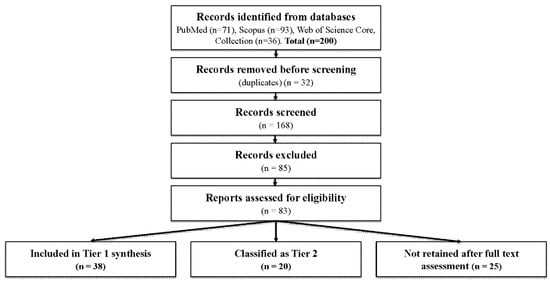
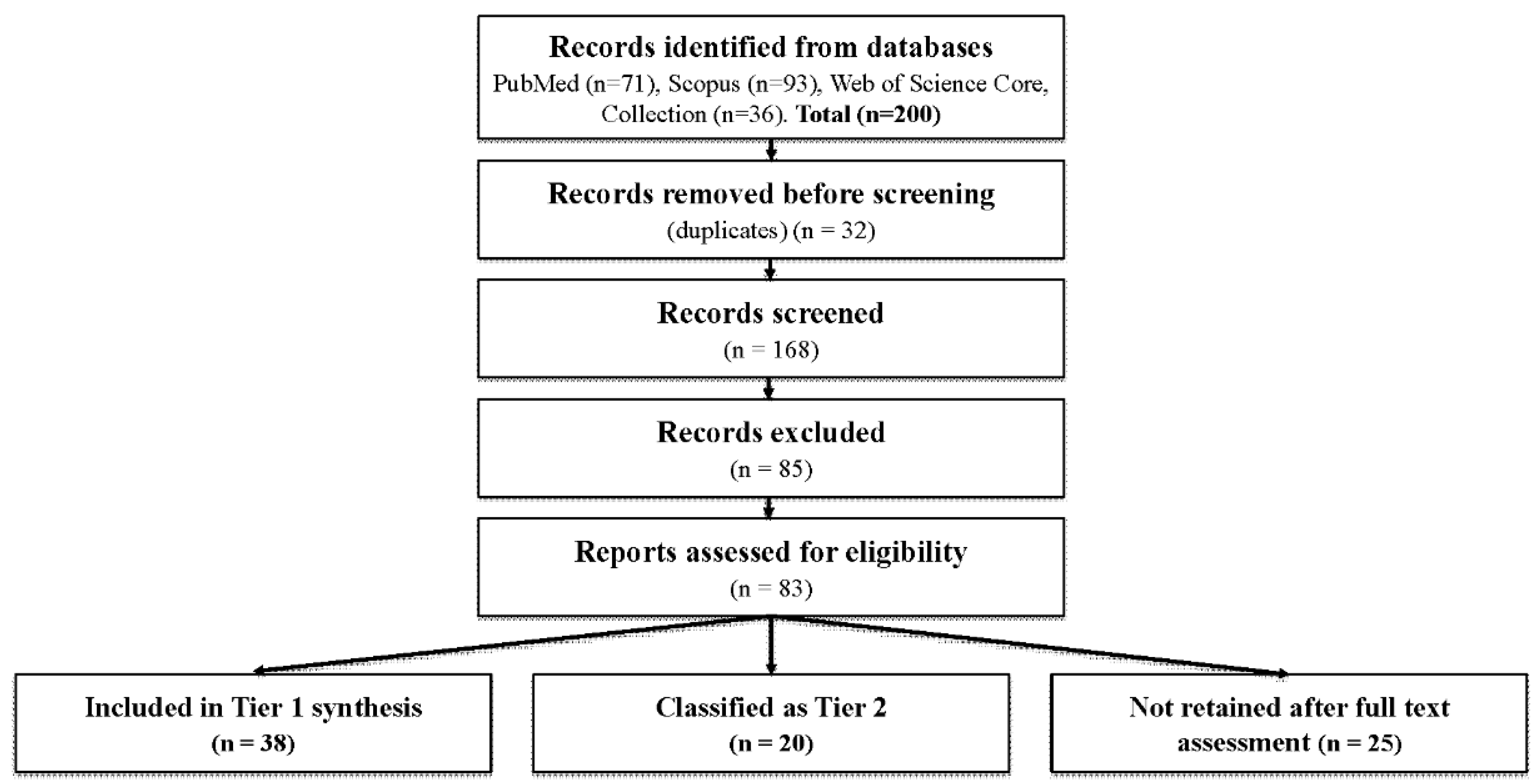
The study selection process is summarized in Figure 1. Records were identified from PubMed, Scopus, and Web of Science Core Collection, yielding 200 records in total. After removal of duplicates, 168 records remained for title and abstract screening. We excluded 85 records at this stage, leaving 83 full-text reports assessed for eligibility. Following full-text assessment and tier classification, 38 studies were included in the Tier 1 synthesis, and 20 studies were classified as Tier 2 and used to characterize evidence gaps. The remaining 25 full-text reports were not retained after full-text assessment because they were outside the inpatient hospital scope or did not provide sufficient evidence for inclusion in either tiered synthesis.
Figure 1.
PRISMA-ScR flow diagram of study selection and tier classification. Records were identified from PubMed (n = 71), Scopus (n = 93), and Web of Science Core Collection (n = 36), yielding 200 records in total. After duplicate removal (n = 32), 168 records remained for screening. 83 full-text reports were assessed for eligibility. 38 studies were included as Tier 1 (action-trigger decision support systems), and 20 studies were classified as Tier 2 (prediction/detection only) to characterize evidence gaps; 25 full-text reports were not retained after full-text assessment due to borderline scope or insufficient information to determine an actionable trigger.
2.5. Data Charting and Synthesis
A standardized data-charting form was used to extract both technical and implementation-oriented variables. Charted items included citation details; country or region; ward setting and population; sensing modalities and inputs; AI approaches as reported; target events; and study design type, categorized as real-world clinical implementation/evaluation, pilot feasibility study, methodological validation study, or proof-of-concept, conference, or simulation-oriented study.
To operationalize workflow integration, we explicitly charted the following decision-support elements whenever reported: trigger definition, intended recipient, alert channel or destination, routing or escalation logic, acknowledgement or dismissal logic, false-alarm reporting, response-time reporting, and whether downstream preventive actions were described. Reported endpoints were grouped into four broad domains: clinical outcomes, operational decision-support outcomes, implementation outcomes, and economic outcomes. The full workflow-oriented charting framework is summarized in Supplementary Material S2.
Findings were synthesized narratively and structured primarily by implementation archetype, focusing on how monitoring outputs were translated into actionable decision support in ward workflows. To support the narrative synthesis with a minimal descriptive overview, we also summarized the reporting frequency of key implementation-oriented variables across Tier 1 studies. These descriptive summaries were intended to characterize reporting completeness and implementation patterns rather than to appraise study quality.
3. Results
3.1. Overview of Included Studies and Tier 1 Evidence Base (Figure 1)
Records were identified from PubMed, Scopus, and Web of Science Core Collection (n = 200). After duplicate removal (n = 32), 168 records were screened. Eighty-three full-text reports were assessed for eligibility. Thirty-eight studies were included as Tier 1 (action-trigger decision support systems), and 20 studies were classified as Tier 2 (prediction/detection only) to characterize evidence gaps.
The Tier 1 evidence base comprised 38 studies describing AI-enabled inpatient monitoring systems that generated explicit action triggers intended to prompt preventive action by clinical staff. Across these studies, three implementation archetypes were recurrent: room-based monitoring with direct nurse alerting, wearable or batteryless sensing for bed egress and bed/chair exit alarms, and bed-centered sensing intended to provide earlier warning.
To support the narrative synthesis with a minimal descriptive overview, we also summarized how often key implementation-oriented reporting elements were present across Tier 1 studies (Table 1).
Table 1.
Descriptive summary of implementation-oriented reporting among Tier 1 studies (n = 38).
The 38 Tier 1 studies included a mix of real-world clinical implementation or evaluation studies, pilot feasibility studies, methodological validation studies, and proof-of-concept, conference, or simulation-oriented reports. Study design type could be classified for all Tier 1 studies. However, the depth of contextual reporting varied considerably. Only 8 of 38 studies (21.1%) clearly identified an inpatient ward setting, and the same proportion explicitly reported a ward type. Country or region was reported in 17 studies (44.7%).
The implementation-oriented reporting profile was similarly uneven. Trigger events were explicitly described in all Tier 1 studies, but intended recipients were identifiable in 19 studies (50.0%), and alert channels or destinations were reported in 16 (42.1%). Routing or escalation logic was reported in 12 studies (31.6%), whereas acknowledgement or dismissal logic was reported in only 1 study (2.6%). False-alarm or nuisance-alert metrics were reported in 10 studies (26.3%), response-time metrics in 12 (31.6%), downstream preventive actions in 4 (10.5%), acceptability or usability outcomes in 2 (5.3%), and economic outcomes in 1 study (2.6%). A descriptive summary of these reporting elements across Tier 1 studies is provided in Table 1.
To keep the main text readable while preserving study-level transparency, Table 2 provides an abbreviated summary of representative Tier 1 studies across the major implementation archetypes identified in this review. Full study-level details for all Tier 1 and Tier 2 studies are provided in Supplementary Tables S1 and S2.
Table 2.
Characteristics of the Tier 1 action trigger studies (main text, abbreviated).
3.2. Room-Based Monitoring with Direct Nurse Alerting
Room-based systems framed fall prevention as a continuous early detection task in which risk situations can be recognized in real time and presented as actionable alerts. Within this archetype, a key differentiator was how explicitly studies described alert routing and workflow integration. In a prospective pilot implementation in an acute stroke unit, one system used privacy-protected video monitoring and displayed color-coded alerts on ward panels, while also incorporating staff presence recognition to support alert dismissal and passive logging of response times [6]. This study emphasized operational decision support outcomes, including alert volume, false alarms, and response time distributions, alongside fall counts during the implementation period.
In contrast, a retrospective evaluation of a ward-deployed vision system emphasized clinical outcomes, reporting modeled associations with reduced fall incidence during monitored periods, while providing less detail on alert burden and response behavior [7]. These differences illustrate a broader pattern in the room-based literature, where clinical effectiveness is sometimes reported without the operational metrics needed to judge workload implications, alarm fatigue risk, and scalability.
Process evaluations of inpatient video monitoring programs further indicate that effectiveness depends on standardizing escalation pathways (who is notified, how, and when), clarifying the roles of monitor technicians versus bedside staff, and iteratively improving workflows based on frontline feedback [20].
3.3. Wearable and Batteryless Sensing for Bed Egress and Bed or Chair Exit Alarms
Wearable and batteryless approaches focused on fall-proximal transitions at the bedside, particularly bed egress and exits from bed or chair. In this archetype, decision support was operationalized as a near-real-time alarm, and performance was often evaluated through recognition metrics that directly relate to clinical usability, including missed events, false alarms, and detection delay. Several studies used passive radio-frequency identification (RFID) and/or accelerometer-based platforms with room-installed infrastructure, illustrating how sensing placement and room configuration can materially influence alarm fidelity and false-alarm burden [9,10,11,13]. Pilot evaluations in hospitalized older adults demonstrated feasibility but also highlighted clinically meaningful false-alarm burdens during routine care [9]. Complementary studies in healthy volunteers and methodological work clarified deployment trade-offs and proposed learned alarming-state models and sequence learning to improve robustness under sparse or irregular reads [10,11,13]. Sequence learning with passive RFID sensors has also been used to support real-time bed-egress recognition, helping clarify how temporal modeling can reduce missed detections under sparse sensor reads [12].
A modular bed-absence sensor evaluation reported high sensitivity with explicit quantification of nuisance alarms and perceived workload impact, illustrating why false-positive rates and alarms-per-bed-day should be treated as implementation-critical outcomes rather than secondary technical details [21]. Across this literature, more transferable contributions were those that treated alarms as part of a workflow, reporting not only classification performance but also delays and false positives that determine whether alarms can be tolerated during routine care.
3.4. Bed-Centered Sensing and Early Warning Systems
Bed-centered systems aimed to provide staff with earlier warning than conventional bed exit alarms by using bed-proximal sensing or staged posture recognition. One line of work used edge-based vision and posture staging to distinguish clinically meaningful phases such as lying, sitting up, sitting at the bed edge, and exiting, and then translated those phases into staged warnings routed to nurse station interfaces and mobile notifications [14]. Another line used bed-integrated sensing and machine learning to predict imminent hazardous behaviors such as attempts to climb over side rails, with escalation through nurse station user interfaces and audible alarms [15].
End-to-end bed-exit detection systems have also been described with immediate alerting to nursing staff, providing concrete examples of sensing-to-notification design intended to fit ward workflows [22]. These bed-centered studies often described the decision support concept clearly and reported recognition performance or prediction success rates, but they less consistently reported ward-level operational metrics such as alerts per bed-day, false alarm rates during routine deployment, or response time distributions.
3.5. Endpoint Heterogeneity and Implementation-Oriented Gaps
Across the Tier 1 literature, reported outcomes were uneven not only in type but also in practical interpretability. Technical performance metrics and event-detection results were more commonly described than the workflow-operational details needed to understand how these systems were actually meant to function in care delivery. In many studies, the presence of a trigger could be identified, but routing logic, acknowledgement behavior, downstream preventive action, and implementation-oriented outcomes remained limited or absent. These implementation-facing elements and endpoints are summarized in abbreviated form in Table 3 for the Tier 1 core set.
Table 3.
Decision-support elements and implementation-oriented endpoints across the Tier 1 core set (main-text abbreviated summary).
The Tier 2 studies were retained to help characterize this broader evidence landscape. Although these studies remained relevant to falls, fall-related monitoring, or near-fall risk, they did not provide sufficient information to confirm a workflow-facing action-trigger pathway. As a result, they were not included in the primary synthesis but were useful in highlighting how often technical development outpaced operational reporting. The full Tier 2 study summary is provided in Supplementary Table S2.
4. Discussion
This scoping review mapped AI-enabled inpatient fall prevention systems that use continuous monitoring data to generate explicit action triggers intended to prompt preventive action by ward staff. Across the Tier 1 evidence base, the literature reflects a shift from model-only risk estimation toward workflow-coupled decision support, where alerts, alarms, notifications, and staged warnings are designed to reach staff in time to change what happens at the bedside. At the same time, reporting remains uneven: many studies still treat deployment details as secondary, even though real-world impact depends on how reliably model outputs become meaningful clinical action within the constraints of staffing, competing alarms, privacy expectations, and ward infrastructure [1].
4.1. Trigger Design Is Clinical Design: Balancing Lead Time, Burden, and Preventability
A consistent lesson across Tier 1 systems is that the trigger itself is a clinical design decision rather than a purely technical output. Triggering at an early posture stage or at a bed-exit attempt may create valuable lead time, but it implicitly asks staff to respond earlier and more often. Triggering later may reduce interruptions yet leave a narrower window for prevention. These trade-offs are familiar in clinical decision support: the benefit of an alert depends not only on accuracy, but also on how it is governed, presented, and acted upon in the workflow [2]. In fall prevention, the “right” trigger timing is tightly coupled to human attention and the realities of bedside care; thus, trigger selection is inseparable from escalation design choices—who is notified first, whether alerts repeat or escalate, what constitutes acknowledgement, and which preventive actions are expected after alert receipt [2,3]. A practical way to make these trade-offs explicit is to frame trigger performance using decision-theoretic language (misses vs. false alarms) and to report how thresholds were chosen for the ward context rather than only reporting a single “best” model performance estimate [23].
4.2. Making Workflow Explicit: Reporting the Alert-to-Action Pathway and “Five Rights”
The studies most ready for implementation were those that treated decision support as a complete alert-to-action pathway and described it in concrete terms. Related literature on multimodal monitoring, adaptive fall detection across unseen environments, fall-risk prediction, and adverse-event classification also highlights the importance of clearly specifying how AI outputs are intended to inform action, interpretation, and deployment across settings [24,25,26,27]. When authors specify who receives the alert, how it is presented, how it is acknowledged or dismissed, and whether response behavior can be measured, they provide the minimum information needed to judge feasibility and safety at scale. This emphasis aligns with early-stage reporting guidance for AI-driven decision support, which treats context of use, user interaction, and workflow integration as first-class reporting elements rather than optional details [3]. In addition, long-standing CDS design principles such as the “Five Rights” (right information, right person, right format, right channel, right time in workflow) provide a concise checklist that directly maps onto inpatient fall prevention alerting [28]. Using these principles as a reporting scaffold would reduce ambiguity in Tier 2 studies and strengthen the interpretability of Tier 1 reports by making recipients, channels, timing, and intended actions auditable across settings [3,28].
4.3. Alarm and Alert Fatigue as Patient-Safety Hazards: Measure Burden and Workload, Not Only Model Metrics
Alarm fatigue remains a predictable risk, yet it is not measured or reported with the consistency that implementation decisions require. Non-actionable alerts can be harmful even when the underlying model is “accurate,” by adding cognitive load and competing with other alarms and tasks. Alert fatigue is a recognized mechanism by which excessive or poorly targeted alerts can reduce responsiveness to future alerts [16]. Hospital safety organizations have repeatedly treated alarm overload as a systems-level hazard, emphasizing prioritization, standardization, and governance rather than relying on clinician vigilance alone [29,30]. For AI-enabled fall prevention, the implication is straightforward: alert burden should be reported with meaningful denominators (e.g., alerts per bed-day), and false alarms should be defined operationally (alerts not requiring or not resulting in preventive action) rather than only as misclassifications on an offline test set [2,16,29,30]. Where feasible, studies should also quantify workload consequences using validated instruments (e.g., NASA-TLX variants used in clinical alarm research) to link alert burden to staff cognitive load and missed care risk [31].
4.4. Quantifying Alert Interaction: Acknowledgement, Dwell Time, Escalation, and Response Distributions
Across many included studies, the most consequential missing information was often not model architecture but implementation specifics: (i) intended recipients (e.g., bedside nurse, nursing assistant, monitor technician, charge nurse), (ii) routing rules (parallel vs. sequential, tiered escalation, timeouts), (iii) acknowledgement and dismissal logic (including audit trails), (iv) response time distributions rather than averages, and (v) the mapping from alert types to downstream actions (e.g., check-in, toileting assistance, mobility support, bed-height adjustment) [2,3]. In other CDS domains, interaction metrics such as time-to-dismiss (alert dwell time) have been proposed and empirically extracted to characterize interruptiveness and burden, complementing conventional alert counts [32]. Similarly, cross-institutional experiences in reducing EHR alert burden emphasize the importance of lifecycle governance (monitoring, retiring low-value alerts, and iteratively refining presentation and logic), which is directly relevant when inpatient fall prevention systems add a new stream of alerts into already alarm-dense environments [33]. Adapting these alert-metrics and governance practices would make fall-prevention decision support evaluations more comparable and more actionable for hospital leaders deciding whether systems can scale safely [2,32,33].
4.5. Implementation Outcomes and Strategies: Feasibility, Fidelity, and Sustainability as Primary Endpoints
Economic evaluation remains uncommon in this area, even though resource implications frequently determine whether pilots can become sustainable services. This gap is consistent with broader findings that implementation costs of computerized decision support systems are heterogeneous and incompletely reported [18], and that health-economic evaluations focused on AI interventions remain methodologically diverse and variably reported across healthcare [19]. For inpatient fall prevention, the resource question is not only device or software cost but also the cost of attention—time spent responding to alerts, training and support needs, and potential shifts in work from bedside staff to monitoring roles [18,19,31]. Implementation science provides an established set of outcomes—acceptability, adoption, appropriateness, feasibility, fidelity, implementation cost, penetration, and sustainability—that can be used to standardize how these systems are evaluated beyond accuracy and fall counts [34]. In addition, implementation-strategy taxonomies (e.g., ERIC) provide a practical vocabulary for describing what hospitals actually do to achieve adoption and sustainment (training, audit and feedback, workflow redesign, monitoring and iterative refinement), which can be reported alongside technical system descriptions to support replication [35]. Where fall-prevention monitoring is implemented as a service model (e.g., monitor technicians plus escalation protocols), explicit reporting of roles and strategies becomes part of the intervention description and is necessary for interpretability and scale-up [20,34,35].
4.6. Lessons from Prior Alarm Interventions: Alarms Alone Do Not Guarantee Fall Reduction
A caution from other inpatient e-alert domains is that adding an alert channel does not guarantee better outcomes unless the alert is embedded in a workflow that reliably produces timely, appropriate action. Systematic review evidence for acute kidney injury e-alerts illustrates variable outcomes and highlights the importance of workflow integration and response pathways [17]. In the fall prevention domain specifically, cluster randomized evidence suggests that simply increasing the use of standardized bed alarms may not reduce falls, reinforcing the principle that alerts are not equivalent to effective interventions unless they reliably trigger preventive actions under real staffing constraints [36]. This strengthens the case for explicitly reporting escalation pathways, staffing models, and response behaviors as part of the intervention “dose,” rather than treating them as implementation details [2,3,17,36].
4.7. Data, Bias, and Trust: Transparency Across Populations and Settings
This review also highlights that implementability and safety depend on data provenance, representativeness, and transparency, especially when systems are trained or evaluated in limited ward contexts but deployed more broadly. Consensus recommendations, such as the STANDING Together dataset documentation framework, emphasize proactive documentation of dataset limitations and assessment of potential bias across populations and settings [37]. For Tier 2 prediction-model studies, updated reporting and appraisal tools such as TRIPOD+AI and PROBAST+AI can support transparent reporting of model development, validation, and applicability, even when studies do not yet report a deployable workflow [38,39]. More generally, minimum information proposals for medical AI reporting (e.g., MINIMAR) reinforce that intended use, target population, and hidden biases should be declared in ways that allow readers to assess generalizability and deployment risk [40]. For confirmatory trials and protocol-driven evaluations, CONSORT-AI and SPIRIT-AI provide complementary expectations about describing the AI intervention, human–AI interaction, and context of use [41,42]. In inpatient monitoring, these transparency expectations are particularly salient because datasets and workflows can vary substantially by ward type, staffing patterns, patient mix, and privacy constraints [4,5,37,40].
4.8. Reporting Completeness for Interventions: From “Model Description” to “Intervention Description”
Because Tier 1 systems function as complex interventions (technology plus workflow plus response behaviors), incomplete intervention descriptions can limit interpretability and replication even when performance metrics are reported. The TIDieR checklist was developed to improve completeness of intervention reporting and can complement AI-specific reporting guidance by ensuring that implementation elements (materials, procedures, who provides, how delivered, tailoring, and fidelity) are described clearly [43]. Applying TIDieR-like completeness expectations to fall-prevention monitoring interventions would make it easier to compare systems across wards and to distinguish which elements are essential for safety and effectiveness versus context-specific adaptations [3,43]. For safety-relevant EHR/IT interventions, the SAFER reporting framework similarly emphasizes documenting context, workflow, and unintended consequences—elements that align closely with alert-to-action pathway reporting in this review [44].
4.9. Summary Implication: A Minimum Operational Reporting Set for Fall-Prevention Alerting
Based on recurrent interpretation gaps across the included literature, we summarize a proposed minimum operational reporting set for future inpatient fall-prevention decision-support studies (Table 4). We present this as a practical, synthesis-derived framework rather than a formal consensus standard.
Table 4.
Proposed minimum operational reporting set for inpatient fall-prevention decision-support studies.
5. Limitation
This review has several limitations that should be considered when interpreting the findings and when translating them into practice. First, the search was restricted to English-language full texts and to three databases (PubMed, Scopus, and Web of Science Core Collection). Although these sources cover substantial portions of the clinical and interdisciplinary literature, inpatient monitoring and sensing studies are also disseminated through engineering venues and conference proceedings that may be indexed differently. Consequently, some relevant systems—particularly early prototypes or workflow pilots reported outside these databases—may have been missed. As recommended by PRISMA ScR, this limitation reflects a trade-off inherent to scoping reviews between breadth, feasibility, and reproducibility of the search process [1]. Future updates could broaden coverage by adding targeted engineering databases and structured backward/forward citation searching to better capture implementations that progress through conference-to-journal publication pathways.
Second, we intentionally focused the primary synthesis on Tier 1 studies in which AI-enabled monitoring generated an explicit action trigger intended to prompt preventive action. This implementation-first framing narrows the scope relative to the broader fall prediction literature and may underrepresent technically strong models that have not yet been described with deployable workflow details. Some studies may have been classified as Tier 2 primarily due to incomplete reporting of alert routing, intended recipients, escalation logic, acknowledgement/dismissal mechanisms, and response behaviors rather than the absence of such a pathway in practice. This reinforces the practical value of adopting reporting expectations that treat context of use, user interaction, and workflow integration as core elements in early-stage evaluations [3,41,42].
Third, heterogeneity across wards, patient populations, baseline fall-prevention bundles, and staffing models limited direct comparability. Many reports did not describe baseline practices, ward context, or competing alarm environments in sufficient detail to isolate the incremental contribution of AI-enabled monitoring. Because inpatient fall prevention is enacted within complex socio-technical systems, outcomes plausibly depend on interactions among technology, people, workflows, communication pathways, and organizational constraints; these contextual factors are not merely “background variables” but determinants of real-world effectiveness and sustainability [4,5,44].
Fourth, endpoints were variable and often incomplete for implementation-critical evaluation. Operational outcomes such as alerts per bed-day, denominators for false alarms, response time distributions, acknowledgement behavior, and downstream preventive actions were inconsistently reported. This constrained synthesis to narrative mapping rather than quantitative comparison of operational effectiveness across systems. A pragmatic next step for the field is to converge on a minimum operational reporting set for fall-prevention alerting interventions, aligned with decision-support governance and early-stage evaluation guidance, so that the full alert-to-action pathway becomes auditable and comparable across wards [2,3,33].
Finally, economic evaluation remains sparse in this area, and we were therefore limited in our ability to compare value propositions across technologies. This gap is consistent with broader findings that implementation costs and health-economic evaluations for digital and AI interventions are heterogeneous and incompletely reported [18,19]. Future studies should more explicitly report resource requirements, including the “cost of attention” (staff time responding to alerts), training and support needs, and governance overhead, alongside clinical outcomes to support realistic decisions about sustainability and scale-up [18,19,31,34].
6. Conclusions
This PRISMA-ScR scoping review mapped AI-enabled inpatient fall prevention systems that use continuous monitoring data to generate explicit action triggers intended to prompt preventive action by ward staff. Tier 1 systems clustered into room-based monitoring with direct nurse alerting, wearable or batteryless sensing for bed egress and bed/chair exit alarms, and bed-centered early warning. Reporting of implementation-critical elements—such as alert burden, false-alarm definitions, response time distributions, alert routing, acknowledgement, and downstream actions—was often incomplete. Future work should prioritize workflow-centered evaluations that characterize the entire alert-to-action pathway and report a consistent minimum set of implementation-relevant elements to support more transparent, comparable, and human-centered evaluations in inpatient wards.
Advancing from promising pilots to safe scale-up will require that inpatient fall-prevention alerts be evaluated and governed as socio-technical interventions, with standardized reporting of alert burden, interaction metrics, and response pathways [2,33,34,44]. Aligning future studies with established reporting and appraisal guidance for AI decision support and prediction models (DECIDE-AI, CONSORT-AI/SPIRIT-AI, TRIPOD+AI/PROBAST+AI, and complementary minimum information proposals) can strengthen reproducibility and support responsible translation into routine ward practice [3,38,39,40,41,42,43,45]. Where applicable, explicitly connecting evaluation endpoints to widely used falls-prevention guidance and baseline epidemiology can improve interpretability across health systems and support more realistic implementation targets [46,47].
Supplementary Materials
The following supporting information can be downloaded at https://www.mdpi.com/article/10.3390/app16073383/s1. Supplementary Material S1: electronic search strategies for PubMed, Scopus, and Web of Science Core Collection; Supplementary Material S2: protocol elements, operational definitions, tier classification rules, and workflow-oriented data-charting framework; Supplementary Table S1: full characteristics of Tier 1 studies included in the action-trigger decision-support synthesis; and Supplementary Table S2: characteristics of Tier 2 studies retained to characterize evidence gaps in workflow-facing decision support.
Author Contributions
Conceptualization, K.K., S.T. and A.K.; Methodology, K.K., S.T. and A.K.; Investigation, K.K., S.T. and A.K.; Data Curation, K.K., S.T. and A.K.; Formal Analysis, K.K., S.T. and A.K.; Visualization, K.K., S.T. and A.K.; Writing—Original Draft Preparation, K.K., S.T. and A.K.; Writing—Review & Editing, K.K., S.T. and A.K.; Supervision, K.K.; Project Administration, K.K. All authors have read and agreed to the published version of the manuscript.
Funding
This research received no external funding.
Data Availability Statement
No new data were created or analyzed in this study. Data sharing is not applicable to this article.
Conflicts of Interest
The authors declare no conflicts of interest.
References
- Tricco, A.C.; Lillie, E.; Zarin, W.; O’Brien, K.K.; Colquhoun, H.; Levac, D.; Moher, D.; Peters, M.D.J.; Horsley, T.; Weeks, L.; et al. PRISMA Extension for Scoping Reviews (PRISMA-ScR): Checklist and Explanation. Ann. Intern. Med. 2018, 169, 467–473. [Google Scholar] [CrossRef] [Scilit] [PubMed]
- Van Dort, B.A.; Zheng, W.Y.; Sundar, V.; Baysari, M.T. Optimizing Clinical Decision Support Alerts in Electronic Medical Records: A Systematic Review of Reported Strategies Adopted by Hospitals. J. Am. Med. Inform. Assoc. 2021, 28, 177–183. [Google Scholar] [CrossRef] [Scilit] [PubMed]
- Vasey, B.; Nagendran, M.; Campbell, B.; Clifton, D.A.; Collins, G.S.; Denaxas, S.; Denniston, A.K.; Faes, L.; Geerts, B.F.; Ibrahim, M.; et al. Reporting Guideline for the Early Stage Clinical Evaluation of Decision Support Systems Driven by Artificial Intelligence: DECIDE-AI. BMJ 2022, 377, e070904. [Google Scholar] [CrossRef] [Scilit]
- Sittig, D.F.; Singh, H. A New Sociotechnical Model for Studying Health Information Technology in Complex Adaptive Healthcare Systems. Qual. Saf. Health Care 2010, 19, i68–i74. [Google Scholar] [CrossRef] [Scilit]
- Greenhalgh, T.; Wherton, J.; Papoutsi, C.; Lynch, J.; Hughes, G.; A’Court, C.; Hinder, S.; Procter, R.; Shaw, S. Beyond Adoption: A New Framework for Theorizing and Evaluating Nonadoption, Abandonment, and Challenges to the Scale-Up, Spread, and Sustainability of Health and Care Technologies. J. Med. Internet Res. 2017, 19, e367. [Google Scholar] [CrossRef] [Scilit]
- Danial, M.; Chow, C.T.; Lim, M.H.; Ayop, N.A.; Looi, I.; Ch’ng, A.S.H. AI-Based Patient Monitoring for Fall Prevention in Stroke Patients: A Pilot Study at a Malaysian Acute Stroke Unit. J. Neuroeng. Rehabil. 2025, 22, 216. [Google Scholar] [CrossRef] [Scilit]
- Gervasi, C.; Perego, E.; Galli, F.; Torri, V.; Castoldi, M.; Bombardieri, E. Prevention of Falls in Hospitalized Patients—Evaluation of the Effectiveness of a Monitoring System (Verso Vision) Developed with Artificial Intelligence. Front. Digit. Health 2025, 7, 1548209. [Google Scholar] [CrossRef] [Scilit]
- Lee, J.S.; Jun, J.H.; Kim, D.H.; Oh, S.J. Implementation of a Patient Risk Behavior Monitoring System Using Real-Time Sensor Data and AI. IEEE Access 2025, 13, 177907–177918. [Google Scholar] [CrossRef] [Scilit]
- Shinmoto Torres, R.L.; Visvanathan, R.; Abbott, D.; Hill, K.D.; Ranasinghe, D.C. A Battery-Less and Wireless Wearable Sensor System for Identifying Bed and Chair Exits in a Pilot Trial in Hospitalized Older People. PLoS ONE 2017, 12, e0185670. [Google Scholar] [CrossRef] [Scilit]
- Shinmoto Torres, R.L.; Visvanathan, R.; Hoskins, S.; van den Hengel, A.; Ranasinghe, D.C. Effectiveness of a Batteryless and Wireless Wearable Sensor System for Identifying Bed and Chair Exits in Healthy Older People. Sensors 2016, 16, 546. [Google Scholar] [CrossRef] [Scilit] [PubMed]
- Shinmoto Torres, R.L.; Shi, Q.; van den Hengel, A.; Ranasinghe, D.C. A Hierarchical Model for Recognizing Alarming States in a Batteryless Sensor Alarm Intervention for Preventing Falls in Older People. Pervasive Mob. Comput. 2017, 40, 1–16. [Google Scholar] [CrossRef] [Scilit]
- Wickramasinghe, A.; Ranasinghe, D.C.; Fumeaux, C.; Hill, K.D.; Visvanathan, R. Sequence Learning with Passive RFID Sensors for Real-Time Bed-Egress Recognition in Older People. IEEE J. Biomed. Health Inform. 2017, 21, 917–929. [Google Scholar] [CrossRef] [Scilit]
- Chen, L.-B.; Chang, W.-J.; Yang, T.-C. BedEye: A Bed Exit and Bedside Fall Warning System Based on Skeleton Recognition Technology for Elderly Patients. IEEE Access 2025, 13, 60403–60423. [Google Scholar] [CrossRef] [Scilit]
- Sofer, T.; Dabran, I.; Ginzburg, E.; Levi, E.; Ron, T. Smart Healthcare Bed for Prevention of Hospital Inpatient Falls. In Proceedings of the 2024 IEEE International Conference on Microwaves, Communications, Antennas, Biomedical Engineering and Electronic Systems (COMCAS); IEEE: Piscataway, NJ, USA, 2024. [Google Scholar] [CrossRef] [Scilit]
- Pham, C.T.; Visvanathan, R.; Strong, M.; Wilson, E.C.F.; Lange, K.; Dollard, J.; Ranasinghe, D.; Hill, K.; Wilson, A.; Karnon, J. Cost-Effectiveness and Value of Information Analysis of an Ambient Intelligent Geriatric Management (AmbIGeM) System Compared to Usual Care to Prevent Falls in Older People in Hospitals. Appl. Health Econ. Health Policy 2023, 21, 315–325. [Google Scholar] [CrossRef] [Scilit] [PubMed]
- AHRQ Patient Safety Network (PSNet). Alert Fatigue. Available online: https://psnet.ahrq.gov/primer/alert-fatigue (accessed on 16 February 2026).
- Lachance, P.; Villeneuve, P.-M.; Rewa, O.G.; Wilson, F.P.; Selby, N.M.; Featherstone, R.M.; Bagshaw, S.M. Association between e-Alert Implementation for Detection of Acute Kidney Injury and Outcomes: A Systematic Review. Nephrol. Dial. Transplant. 2017, 32, 265–272. [Google Scholar] [CrossRef] [Scilit] [PubMed]
- Donovan, T.; Abell, B.; Fernando, M.; McPhail, S.M.; Carter, H.E. Implementation Costs of Hospital-Based Computerised Decision Support Systems: A Systematic Review. Implement. Sci. 2023, 18, 7. [Google Scholar] [CrossRef] [Scilit] [PubMed]
- Voets, M.M.; Veltman, J.; Slump, C.H.; Siesling, S.; Koffijberg, H. Systematic Review of Health Economic Evaluations Focused on Artificial Intelligence in Healthcare: The Tortoise and the Cheetah. Value Health 2022, 25, 340–349. [Google Scholar] [CrossRef] [Scilit]
- Jecklin, S.; Johnson, J.; Tringhese, A.; Daniels, C.; White, F. Video Monitoring for Fall Prevention and Patient Safety: Process Evaluation and Improvement. J. Nurs. Care Qual. 2019, 34, 145–150. [Google Scholar] [CrossRef] [Scilit]
- Subermaniam, K.; Welfred, R.; Subramanian, P.; Chinna, K.; Ibrahim, F.; Mohktar, M.S.; Tan, M.P. The Effectiveness of a Wireless Modular Bed Absence Sensor Device for Fall Prevention among Older Inpatients. Front. Public Health 2016, 4, 292. [Google Scholar] [CrossRef] [Scilit]
- Jähne-Raden, N.; Raden, M.; Kulau, U.; Marschollek, M. INBED: A Highly Specialized System for Bed-Exit-Detection and Fall Prevention on a Geriatric Ward. Sensors 2019, 19, 1017. [Google Scholar] [CrossRef] [Scilit]
- Sittig, D.F.; Wright, A.; Osheroff, J.A.; Middleton, B.; Teich, J.M.; Ash, J.S.; Campbell, E.; Bates, D.W. Evaluating the Effectiveness of Clinical Decision Support Alerts: A Signal Detection Theory Framework. J. Am. Med. Inform. Assoc. 2011, 18, 404–408. [Google Scholar] [CrossRef] [Scilit]
- Xue, W.; Duan, A.; Zhao, Y.; Zuo, H.; Isleem, H.F. AI-Enabled Multimodal Monitoring for Enhanced Safety and Functional Recovery in Elderly and Post-Stroke Care: A Mixed-Methods Study. Digit. Health 2025, 11, 20552076251384834. [Google Scholar] [CrossRef] [Scilit]
- Bayad, I.; Mahfouz, S.; Samrouth, K.; Mourad-Chehade, F.; Amoud, H. Adaptive Fall Detection Using WiFi CSI for Unseen Environments and New Individuals. In Proceedings of the IEEE International Symposium on Medical Measurements and Applications (MeMeA); IEEE: Piscataway, NJ, USA, 2025. [Google Scholar] [CrossRef] [Scilit]
- Maiora, J.; Rezola-Pardo, C.; García, G.; Sanz, B.; Graña, M. Older Adult Fall Risk Prediction with Deep Learning and Timed Up and Go (TUG) Test Data. Bioengineering 2024, 11, 1000. [Google Scholar] [CrossRef] [Scilit] [PubMed]
- Marchal, N.; Popescu, M.; Robinson, E.L.; Wolpert, R.; Song, X. Classifying Adverse Events from SOAP Notes and Sensor Features in a Clinical Trial of Older Adults. medRxiv 2025. [Google Scholar] [CrossRef] [Scilit] [PubMed]
- Osheroff, J.A.; Teich, J.M.; Middleton, B.; Steen, E.B.; Wright, A.; Detmer, D.E. The Five Rights of Clinical Decision Support: CDS Tools Helpful for Meeting Meaningful Use. Available online: https://journal.ahima.org/Portals/0/archives/AHIMA%20files/The%20Five%20Rights%20of%20Clinical%20Decision%20Support_%20CDS%20Tools%20Helpful%20for%20Meeting%20Meaningful%20Use.pdf (accessed on 16 February 2026).
- The Joint Commission. Sentinel Event Alert, Issue 50: Medical Device Alarm Safety in Hospitals. 2013. Available online: https://www.jointcommission.org/resources/sentinel-event/sentinel-event-alert-newsletters/sentinel-event-alert-issue-50-medical-device-alarm-safety-in-hospitals/ (accessed on 16 February 2026).
- ECRI. Top 10 Health Technology Hazards for 2020: Executive Brief. 2020. Available online: https://www.ecri.org.uk/wp-content/uploads/2020/06/ECRI_Institute_2020_Top_10_Hazards_Executive_Brief.pdf (accessed on 16 February 2026).
- Rasooly, I.R.; Kern-Goldberger, A.S.; Xiao, R.; Ponnala, S.; Ruppel, H.; Luo, B.; Craig, S.; Khan, A.; McLoone, M.; Ferro, D.; et al. Physiologic Monitor Alarm Burden and Nurses’ Subjective Workload in a Children’s Hospital. Hosp. Pediatr. 2021, 11, 703–710. [Google Scholar] [CrossRef] [Scilit]
- McDaniel, R.B.; Burlison, J.D.; Baker, D.K.; Hasan, O.; Robertson, J.M. Alert Dwell Time: Introduction of a Measure to Evaluate Interruptive Clinical Decision Support Alerts. J. Am. Med. Inform. Assoc. 2016, 23, e138–e141. [Google Scholar] [CrossRef] [Scilit]
- McGreevey, J.D., III; Mallozzi, C.P.; Perkins, R.M.; Shelov, E.; Schreiber, R. Reducing Alert Burden in Electronic Health Records: State of the Art Recommendations from Four Health Systems. Appl. Clin. Inform. 2020, 11, 1–12. [Google Scholar] [CrossRef] [Scilit]
- Proctor, E.; Silmere, H.; Raghavan, R.; Hovmand, P.; Aarons, G.; Bunger, A.; Griffey, R.; Hensley, M. Outcomes for Implementation Research: Conceptual Distinctions, Measurement Challenges, and Research Agenda. Adm. Policy Ment. Health 2011, 38, 65–76. [Google Scholar] [CrossRef] [Scilit] [PubMed]
- Powell, B.J.; Waltz, T.J.; Chinman, M.J.; Damschroder, L.J.; Smith, J.L.; Matthieu, M.M.; Proctor, E.K.; Kirchner, J.E. A Refined Compilation of Implementation Strategies: Results from the Expert Recommendations for Implementing Change (ERIC) Project. Implement. Sci. 2015, 10, 21. [Google Scholar] [CrossRef] [Scilit]
- Shorr, R.I.; Chandler, A.M.; Mion, L.C.; Waters, T.M.; Liu, M.; Daniels, M.J.; Kessler, L.A.; Miller, S.T. Effects of an Intervention to Increase Bed Alarm Use to Prevent Falls in Hospitalized Patients: A Cluster Randomized Trial. Ann. Intern. Med. 2012, 157, 692–699. [Google Scholar] [CrossRef] [Scilit]
- Alderman, J.E.; Palmer, J.; Laws, E.; McCradden, M.D.; Ordish, J.; Ghassemi, M.; Pfohl, S.R.; Rostamzadeh, N.; Cole-Lewis, H.; Glocker, B.; et al. Tackling Algorithmic Bias and Promoting Transparency in Health Datasets: The STANDING Together Consensus Recommendations. Lancet Digit. Health 2024, 7, e64–e88. [Google Scholar] [CrossRef] [Scilit] [PubMed]
- Collins, G.S.; Moons, K.G.; Dhiman, P.; Riley, R.D.; Beam, A.L.; Van Calster, B.; Ghassemi, M.; Liu, X.; Reitsma, J.B.; Van Smeden, M.; et al. TRIPOD+AI Statement: Updated Guidance for Reporting Clinical Prediction Models That Use Regression or Machine Learning Methods. BMJ 2024, 385, e078378. [Google Scholar] [CrossRef] [Scilit]
- Moons, K.G.M.; Damen, J.A.; Kaul, T.; Hooft, L.; Navarro, C.A.; Dhiman, P.; Beam, A.L.; Van Calster, B.; Celi, L.A.; Denaxas, S.; et al. PROBAST+AI: An Updated Quality, Risk of Bias, and Applicability Assessment Tool for Prediction Models Using Regression or Artificial Intelligence Methods. BMJ 2025, 388, e082505. [Google Scholar] [CrossRef] [Scilit] [PubMed]
- Hernandez-Boussard, T.; Bozkurt, S.; Ioannidis, J.P.A.; Shah, N.H. MINIMAR (MINimum Information for Medical AI Reporting): Developing Reporting Standards for Artificial Intelligence in Health Care. J. Biomed. Inform. 2020, 111, 103387. [Google Scholar] [CrossRef] [Scilit]
- Liu, X.; Rivera, S.C.; Moher, D.; Calvert, M.J.; Denniston, A.K. The SPIRIT-AI and CONSORT-AI Working Group. Reporting Guidelines for Clinical Trial Reports for Interventions Involving Artificial Intelligence: The CONSORT-AI Extension. Nat. Med. 2020, 26, 1364–1374. [Google Scholar] [CrossRef] [Scilit]
- Rivera, S.C.; Liu, X.; Chan, A.-W.; Denniston, A.K.; Calvert, M.J. Guidelines for Clinical Trial Protocols for Interventions Involving Artificial Intelligence: The SPIRIT-AI Extension. BMJ 2020, 370, m3210. [Google Scholar] [CrossRef] [Scilit]
- Hoffmann, T.C.; Glasziou, P.P.; Boutron, I.; Milne, R.; Moher, D.; Johnston, M.; Lamb, S.E.; Wyatt, J.C.; Dixon-Woods, M. Better Reporting of Interventions: Template for Intervention Description and Replication (TIDieR) Checklist and Guide. BMJ 2014, 348, g1687. [Google Scholar] [CrossRef] [Scilit]
- Singh, H.; Sittig, D.F. A Sociotechnical Framework for Safety-Related Electronic Health Record Research Reporting: The SAFER Reporting Framework. Ann. Intern. Med. 2020, 172, S92–S100. [Google Scholar] [CrossRef] [Scilit] [PubMed]
- FUTURE-AI Consortium; Lekadir, K.; Frangi, A.F.; Porras, A.R.; Glocker, B.; Cintas, C.; Langlotz, C.P.; Weicken, E.; Asselbergs, F.W.; Prior, F.; et al. FUTURE-AI: International Consensus Guideline for Trustworthy and Deployable Artificial Intelligence in Healthcare. BMJ 2025, 388, e081554. [Google Scholar] [CrossRef] [Scilit]
- World Health Organization. Patient Safety. Available online: https://www.who.int/news-room/fact-sheets/detail/patient-safety (accessed on 16 February 2026).
- Agency for Healthcare Research and Quality (AHRQ) Patient Safety Network (PSNet). Falls. Available online: https://psnet.ahrq.gov/primer/falls (accessed on 16 February 2026).

Disclaimer/Publisher’s Note: The statements, opinions and data contained in all publications are solely those of the individual author(s) and contributor(s) and not of MDPI and/or the editor(s). MDPI and/or the editor(s) disclaim responsibility for any injury to people or property resulting from any ideas, methods, instructions or products referred to in the content. |
© 2026 by the authors. Licensee MDPI, Basel, Switzerland. This article is an open access article distributed under the terms and conditions of the Creative Commons Attribution (CC BY) license.