


Abstract
Functionally graded porous beams are increasingly used in lightweight engineering structures, where thermal effects and material inhomogeneity significantly influence vibration behavior. In this study, the thermoelastic free vibration of functionally graded porous Euler–Bernoulli beams with temperature-dependent material properties is investigated by considering uniform and symmetric porosity distributions, together with uniform, linear, and nonlinear temperature fields. The governing equations are derived based on classical Euler–Bernoulli beam theory and solved using the Differential Transformation Method, while the accuracy of the semi-analytical formulation is verified through a Hermite-based finite element model. The results show that increasing temperature reduces the bending stiffness due to thermal axial forces and leads to a rapid decrease in natural frequency as the critical buckling temperature is approached. Increasing porosity generally decreases the natural frequency, although a slight increase may occur in symmetric distributions because of the accompanying reduction in mass density. The present study provides a computational framework for the thermo-vibration analysis of functionally graded porous beams in lightweight structural applications.
1. Introduction
Cellular materials and metal foams have attracted considerable attention due to their high stiffness-to-weight ratio, excellent energy absorption capability, and multifunctional thermal–acoustic performance. These characteristics make them highly suitable for advanced engineering applications such as aerospace, automotive, and lightweight structural systems [1,2,3,4]. The mechanical behavior of such materials is strongly governed by the relative density, pore morphology, and spatial distribution of the porous architecture.
Functionally graded materials (FGMs) enable continuous spatial variation in material composition and microstructure, allowing improved structural efficiency and thermal resistance. By integrating graded material design with porous architectures, functionally graded porous materials provide enhanced vibration performance and structural stability. Variations in elastic modulus, density, and porosity distribution have been shown to significantly influence bending stiffness, vibration characteristics, and structural response [5,6,7].
Beam structures constitute fundamental elements in numerous engineering applications including aircraft wings, turbine components, sandwich panels, and support structures. The dynamic behavior of beams is strongly affected by material gradation, porosity distribution, and environmental thermal loading. Previous studies based on Euler–Bernoulli and higher-order beam theories demonstrated that porosity parameters, shear deformation effects, and boundary conditions substantially influence vibration frequencies and stability characteristics [8,9,10,11,12,13,14,15,16,17].
Thermal loading further complicates the structural response of functionally graded porous beams due to temperature-dependent material properties and thermally induced stresses. Several investigations examined thermoelastic vibration and buckling behavior of graded beams, plates, and shells under different temperature distributions, confirming that temperature profiles and porosity distributions play a critical role in determining natural frequencies and critical temperatures [18,19,20,21,22,23,24,25,26,27,28,29].
Despite extensive studies, most existing investigations rely primarily on numerical or approximate analytical approaches and rarely consider realistic thermal distributions together with symmetric and uniform porosity configurations simultaneously. The present study is restricted to a simplified midplane-based EB formulation for symmetric and uniform porosity distributions. Moreover, conventional numerical techniques may require significant computational cost when temperature-dependent material properties are incorporated.
The Differential Transformation Method (DTM) has emerged as an efficient semi-analytical technique for solving differential equations in structural mechanics with high accuracy and low computational effort. Previous studies demonstrated the applicability of DTM in vibration analysis of beams, nanostructures, and coupled systems [30,31,32,33,34]. However, thermoelastic vibration and stability analyses of porous Euler–Bernoulli beams combining multiple temperature fields with symmetric and uniform porosity distributions remain limited within simplified semi-analytical frameworks.
Therefore, the present study investigates the thermal free vibration behavior of functionally graded porous Euler–Bernoulli beams with temperature-dependent material properties. The governing equations are solved using the Differential Transformation Method, and the results are validated through finite element simulations. The effects of porosity distribution, multiple thermal loading types (UTD, LTD, and NLTD), and structural parameters on vibration characteristics are systematically analyzed. The present work applies a DTM-based semi-analytical framework to investigate the thermoelastic vibration behavior of graded porous beam structures and provides a computationally efficient framework for comparative thermo-vibrational assessment within the adopted simplified beam formulation.
2. Materials and Methods
2.1. Beam Model and Assumptions
In this study, the thermoelastic free vibration and thermal buckling behavior of a functionally graded porous Euler–Bernoulli beam are investigated. The Euler–Bernoulli theory is adopted, assuming that plane cross-sections remain in plane and perpendicular to the neutral axis during deformation; therefore, transverse shear deformation and rotary inertia are neglected [35]. This assumption is appropriate for slender beams with sufficiently large length-to-thickness ratios (here, L/ℎ ≥ 20).
A straight beam of length , width , and thickness is considered. A Cartesian coordinate system is introduced, where denotes the longitudinal coordinate and is the thickness coordinate measured from the mid-plane:
2.2. Functionally Graded Porous Material Model
The beam is composed of a porous functionally graded material whose effective properties vary through the thickness due to porosity distribution [24,36]. Two porosity profiles are examined.
For the symmetric porosity distribution, the material properties are expressed as
For the uniform porosity distribution, the material properties are defined as
where and denote the Young’s modulus and mass density of the material of the core without any pores, respectively. Poisson’s ratio, υ, is assumed to remain constant throughout the beam. The parameter κ represents thermal conductivity, denotes the porosity coefficient, and indicates the coefficient of mass density.
The parameter can be assessed through using the following relation [37]:
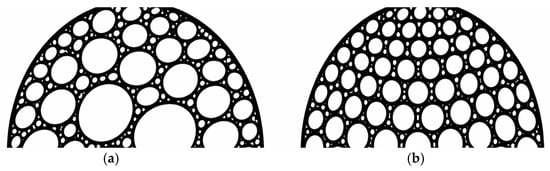
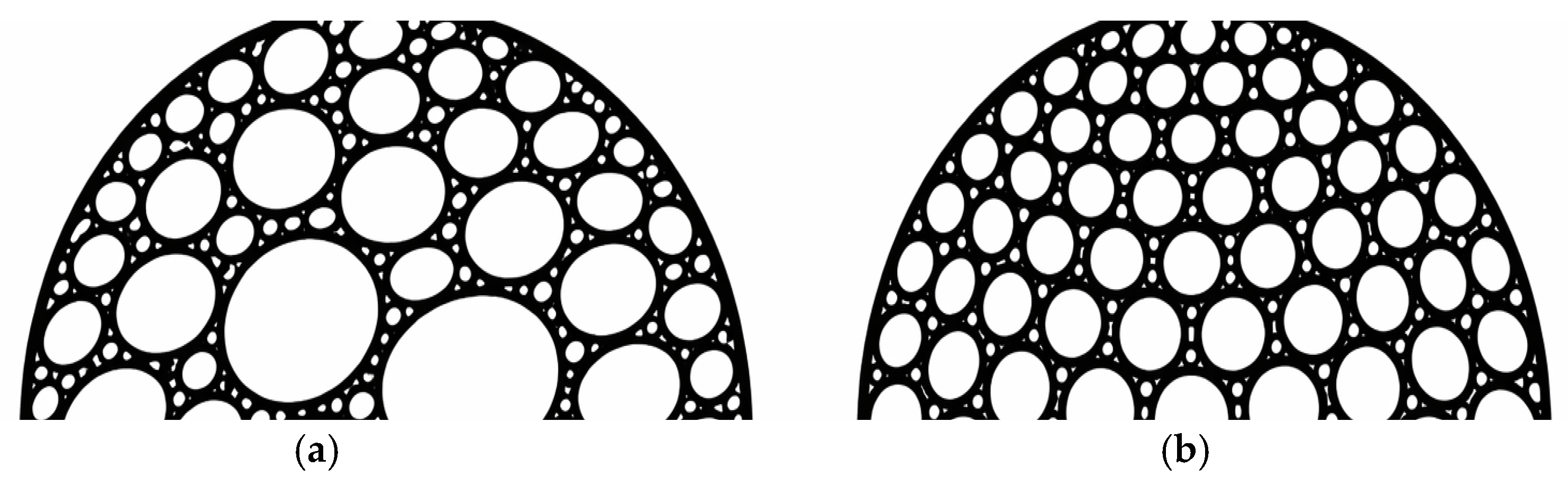
Equation (4) is adopted as an equivalent-property relation for the open-cell porous material used in the present beam model. It links the stiffness-related and mass-related porosity coefficients within an effective continuum description and is used here as a modeling assumption rather than a newly derived constitutive law. Different porous morphologies may lead to different stiffness–density relationships; therefore, the present predictions should be interpreted within the adopted open-cell porous material representation. Figure 1 illustrates the distributions of symmetric and uniform porosity profiles along the beam thickness. The selected porosity range covers typical values reported for metal foam structures.
Figure 1.
Distribution of (a) symmetric porosity distribution and (b) uniform porosity distribution profiles.
The beam’s material properties, commonly denoted by P, must be dependent on temperature and can be expressed by the function of temperature T (in K) as [38]. The thermal conductivity of the air is and [23].
where , and are the temperature-dependent coefficients. In the case of Stainless Steel, they are given in Table 1 [38].
Table 1.
Temperature-dependent material coefficients of stainless steel [38].
2.3. Governing Equation of Motion
Based on the Euler–Bernoulli beam theory, the displacement field of the beam can be described in terms of the transverse displacement . According to the kinematic assumptions of the Euler–Bernoulli theory, the axial displacement and transverse displacement are defined as follows [39]:
Based on the displacement field defined in Equations (6) and (7), the normal strain along the longitudinal direction of the beam can be expressed as
Substituting Equation (6) into Equation (8) yields
Equation (9) shows that the normal strain varies linearly along the beam thickness coordinate z. This linear strain distribution is consistent with the Euler–Bernoulli beam assumption that plane cross-sections remain plane during deformation. Since the present study focuses on slender beams with L/h ≥ 20, the Euler–Bernoulli assumption remains valid and shear deformation effects can be neglected.
Since transverse shear deformation is neglected in Euler–Bernoulli beam theory, the shear strain component is assumed to be zero:
The stress field, , can be expressed via the elastic moduli and strain field as
Considering thermoelastic effects, the stress–strain relation can be written as
where is the coefficient of thermal expansion and represents the temperature rise with respect to the reference temperature. The bending strain energy associated with flexural deformation is written as
Substituting Equations (8) and (9) into Equation (13) gives
where the bending stiffness is defined as
Here, denotes the beam width. Due to restrained thermal expansion, a thermal axial force NT is generated and can be expressed as follows [24]:
The minus sign indicates that the thermally induced axial force is taken as compressive in the adopted sign convention. The corresponding thermal potential energy of the axial force is written as
The kinetic energy of the beam is expressed as
where the mass per unit length is defined as
Applying Hamilton’s principle,
The governing differential equation of motion for the porous beam under thermal loading can be obtained as
Equation (21) is written within the adopted simplified Euler–Bernoulli framework, in which sectional quantities are evaluated with respect to the geometric midplane.
Thermal axial force produces compressive load and may cause thermal buckling. We can assume harmonic motion in the form
Substituting Equation (22) into Equation (21) leads to the following frequency equation:
2.4. Temperature Field Models
The temperature variation through the beam thickness significantly influences the thermoelastic response of functionally graded porous beams. In the present study, three different temperature distributions are considered in order to investigate their influence on vibration characteristics: uniform temperature distribution (UTD), linear temperature distribution (LTD), and nonlinear temperature distribution (NLTD) [40].
2.4.1. Uniform Temperature Distribution (UTD)
For the uniform temperature distribution, the temperature is assumed to be constant throughout the thickness:
where ΔT represents a constant temperature rise.
This distribution produces uniform thermal strain along the thickness but generates a thermal axial force if the beam is axially constrained.
2.4.2. Linear Temperature Distribution (LTD)
For the linear temperature distribution, the temperature varies linearly along the thickness direction [41]:
where Tt and Tb are the given temperatures at the top and bottom faces.
2.4.3. Nonlinear Temperature Distribution (NLTD)
The nonlinear temperature distribution is obtained from the steady-state one-dimensional heat conduction equation
subject to the boundary conditions
where Tb and Tt denote the bottom and top surface temperatures, respectively.
Solving Equation (26) yields the nonlinear temperature distribution
The corresponding temperature rise is then
2.5. Boundary Conditions
The boundary conditions in Table 2 are imposed at the beam ends x = 0 and x = L to represent different support configurations. These support conditions are transformed into algebraic equations within the Differential Transform Method formulation.
Table 2.
Boundary conditions used in the present study.
3. Numerical Solution Procedure
3.1. Differential Transform Method (DTM) Formulation
3.1.1. Basic Concept of DTM
The Differential Transform Method (DTM) is a semi-analytical numerical technique for solving differential equations by transforming them into recursive algebraic relations. For a sufficiently smooth function , the one-dimensional differential transform is defined as follows [30]:
The inverse differential transform is expressed as a truncated power series:
3.1.2. Application to the Governing Equation
The resulting differential equation system, which is presented with Equation (23), is transformed by using the rules of DTM, given in Table 3, to yield the following recurrence relation:
Table 3.
DTM rules.
This relation allows the higher-order coefficients W(k + 4) to be expressed in terms of lower-order coefficients.
3.1.3. Implementation of Boundary Conditions
The classical boundary conditions given in Table 4 and Table 5 are transformed into algebraic constraints using the series expansion in Equation (31).
Table 4.
DTM theorems used for boundary conditions at x = 0.
Table 5.
DTM theorems used for boundary conditions at x = L.
3.1.4. Eigenvalue Determination
By truncating the series at order M, a finite system of algebraic equations is obtained. The boundary conditions lead to a homogeneous system of equations of the form
where is the vector of unknown transform coefficients. Non-trivial solutions exist only if
Solving Equation (34) yields the natural frequencies of the porous Euler–Bernoulli beam under thermal loading.
In the present study, convergence of the DTM solution is ensured by selecting an appropriate truncation order , and the obtained results are validated against available literature solutions. The DTM-based numerical solution procedure was implemented using Wolfram Mathematica 14.0 and MATLAB R2024a.
3.2. Finite Element Formulation
In order to verify the accuracy of the proposed DTM formulation, a finite element model based on the Euler–Bernoulli beam theory is developed using cubic Hermite interpolation functions [42]. Each node possesses two degrees of freedom corresponding to the transverse displacement and rotation .
The displacement field within the element is expressed as
where N(x) represents the Hermite interpolation matrix and
denotes the nodal displacement vector.
Element Matrices and Eigenvalue Problem
Using energy expressions, the element bending stiffness matrix, geometric stiffness matrix, and consistent mass matrix are obtained as
After assembling the global matrices, the equation of motion is written as
Assuming harmonic motion leads to the eigenvalue problem:
The natural frequencies are obtained by applying the corresponding boundary conditions using MATLAB R2024a.
4. Results and Discussion
4.1. Convergence Study and Verification
The convergence behavior of the Differential Transform Method (DTM) solution is examined in Table 6 for the porous Euler–Bernoulli beam with simply supported boundary conditions. The fundamental frequency increases significantly when the truncation order rises from to , while only negligible variations are observed beyond . The nearly identical results obtained for and clearly indicate that numerical convergence has been achieved and confirm the stability of the DTM formulation. Therefore, is adopted in all subsequent computations as an optimal compromise between numerical accuracy and computational efficiency.
Table 6.
Convergence study of the fundamental frequency for porous Euler–Bernoulli beams (H-H, , ).
The accuracy of the present thermoelastic formulation is further assessed through comparison with available literature results for thermally loaded functionally graded beams. Although the referenced study considers classical FGMs, it provides a reliable benchmark for validating both the governing equations and the temperature-dependent material modeling. For comparison purposes, the porosity formulation is reduced to the equivalent graded-material representation.
As shown in Table 7, the present results exhibit very good agreement with the reference data for different temperature increases, gradation parameters, and boundary conditions. The observed deviations remain small, supporting the correctness of the adopted thermoelastic formulation and its numerical implementation.
Table 7.
Comparison with Table 7 in Reference [43] for the thermally loaded FGM beam under LTD.
In addition, the proposed DTM solution is verified against a Hermite finite-element formulation for porous Euler–Bernoulli beams (Table 8 and Table 9). The relative discrepancies between the two approaches remain extremely small, below 0.004%, providing additional numerical verification of the DTM implementation. Consequently, the FEM solution is adopted as an independent numerical reference for the subsequent parametric studies.
Table 8.
Comparison of natural frequencies obtained by DTM and FEM for the symmetric porous Euler–Bernoulli beam (H-H, L/h = 30, e0 = 0.5, UTD = 350 K).
Table 9.
Comparison of natural frequencies obtained by DTM and FEM for the uniform porous Euler–Bernoulli beam (H-H, L/h = 30, e0 = 0.5, UTD = 350 K).
4.2. Effect of Temperature Rise on the Natural Frequency
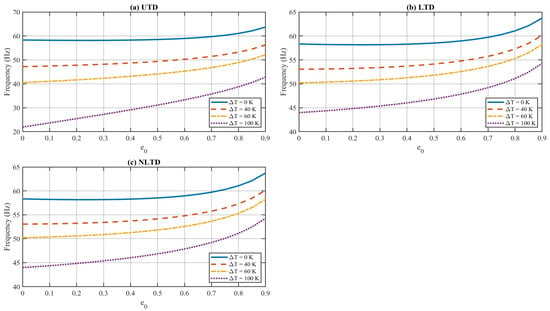
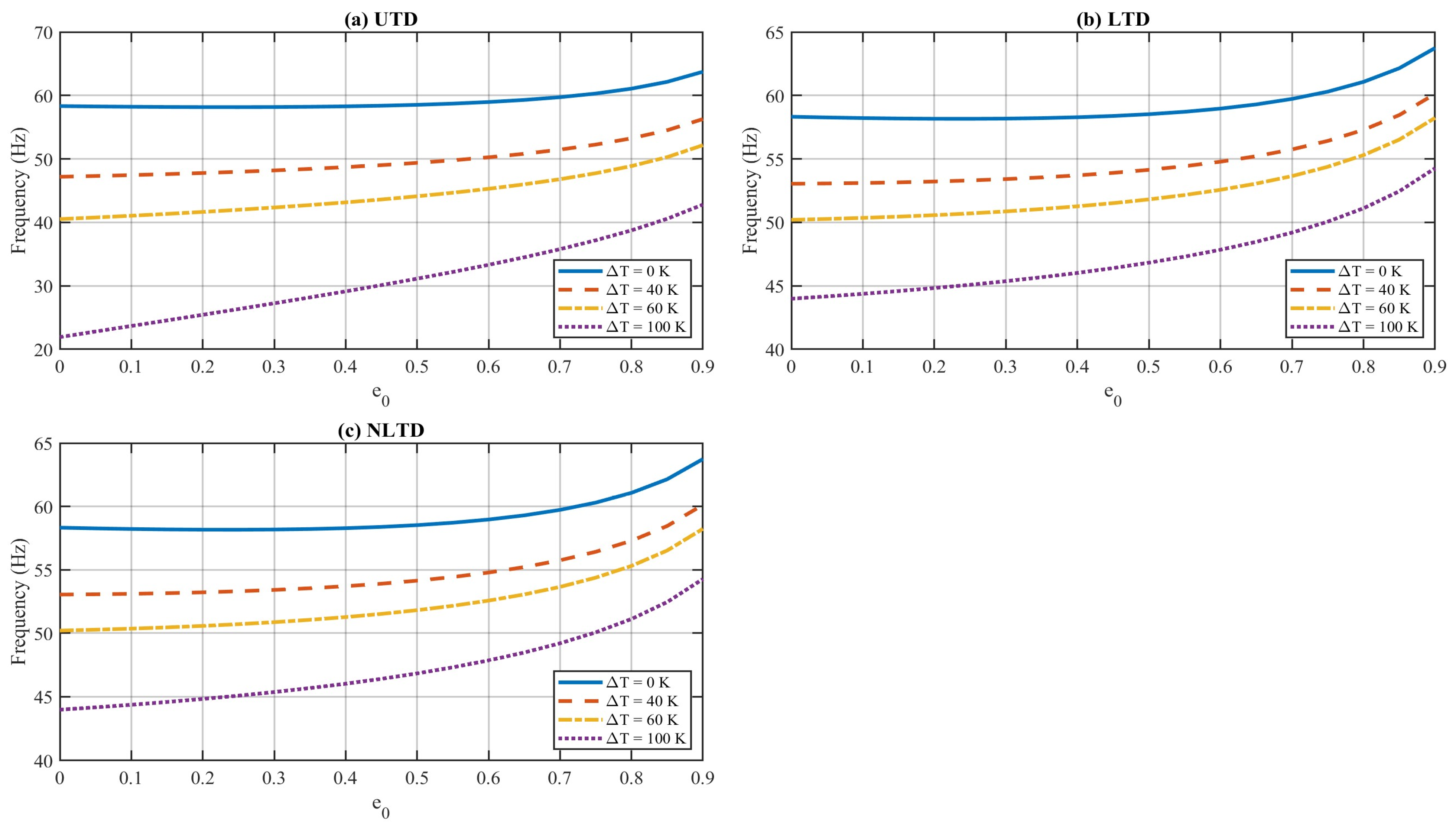
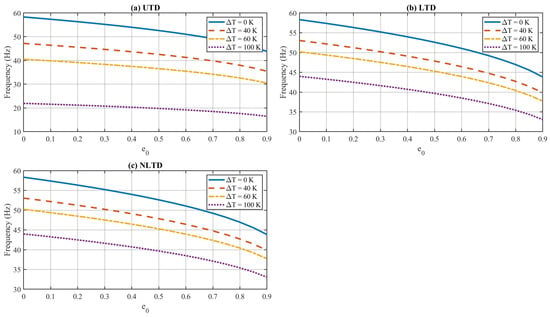
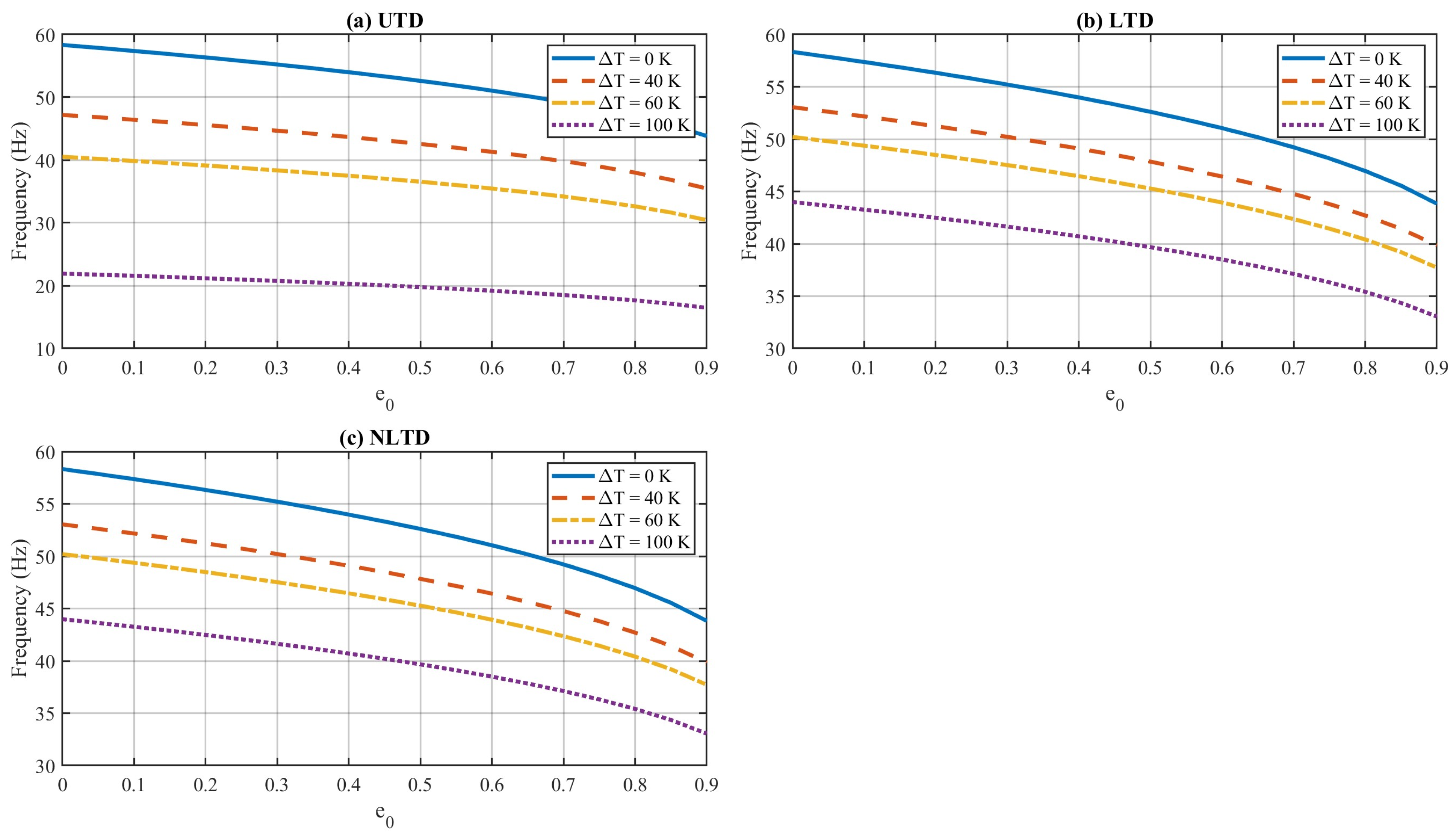
Figure 2 and Figure 3 illustrate the variation in the fundamental frequency with respect to the porosity coefficient for different temperature increases under UTD, LTD, and NLTD thermal conditions for symmetric and uniform porosity distributions, respectively. For symmetric porous beams (Figure 2), the frequency generally decreases with increasing porosity; however, at higher porosity levels, a slight recovery of the frequency is observed. This counter-intuitive behavior arises because the introduction of pores simultaneously reduces both stiffness and mass density. At sufficiently large porosity values, the reduction in density becomes comparable to, or partially exceeds, the stiffness degradation, resulting in a modest increase in the stiffness-to-mass ratio and thus in the natural frequency.
Figure 2.
Fundamental natural frequency versus porosity coefficient for different temperature rises under (a) UTD, (b) LTD, and (c) NLTD (symmetric, H-H, L/h = 20).
Figure 3.
Fundamental natural frequency versus porosity coefficient for different temperature rises under (a) UTD, (b) LTD, and (c) NLTD (uniform, H-H, L/h = 20).
In contrast, for uniform porous beams (Figure 3), the frequency decreases almost monotonically as the porosity coefficient increases. Since the porosity is distributed uniformly, the reduction in material properties affects the beam more evenly and leads to a continuous loss of structural stiffness. In this case, the stiffness degradation dominates over the accompanying mass reduction, and therefore the slight frequency recovery observed in the symmetric configuration does not occur. A comparison among the thermal models shows that LTD and NLTD produce very similar frequency responses. This similarity indicates that, for the present material system, the variation in thermal conductivity is not sufficiently pronounced to generate a nonlinear temperature profile significantly different from the linear one.
Therefore, the corresponding sectional thermal quantities remain close to each other, leading to only minor differences in the predicted natural frequencies. However, the UTD model generally yields slightly lower frequencies. This behavior is attributed to the stronger resultant thermal axial compression generated by the uniform temperature field.
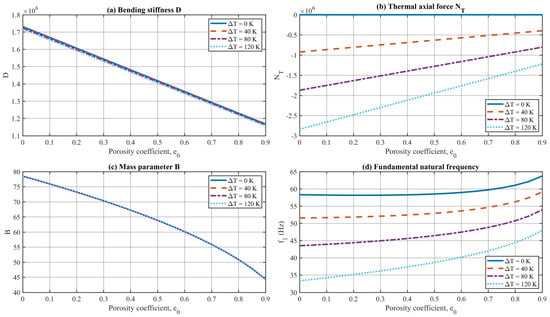
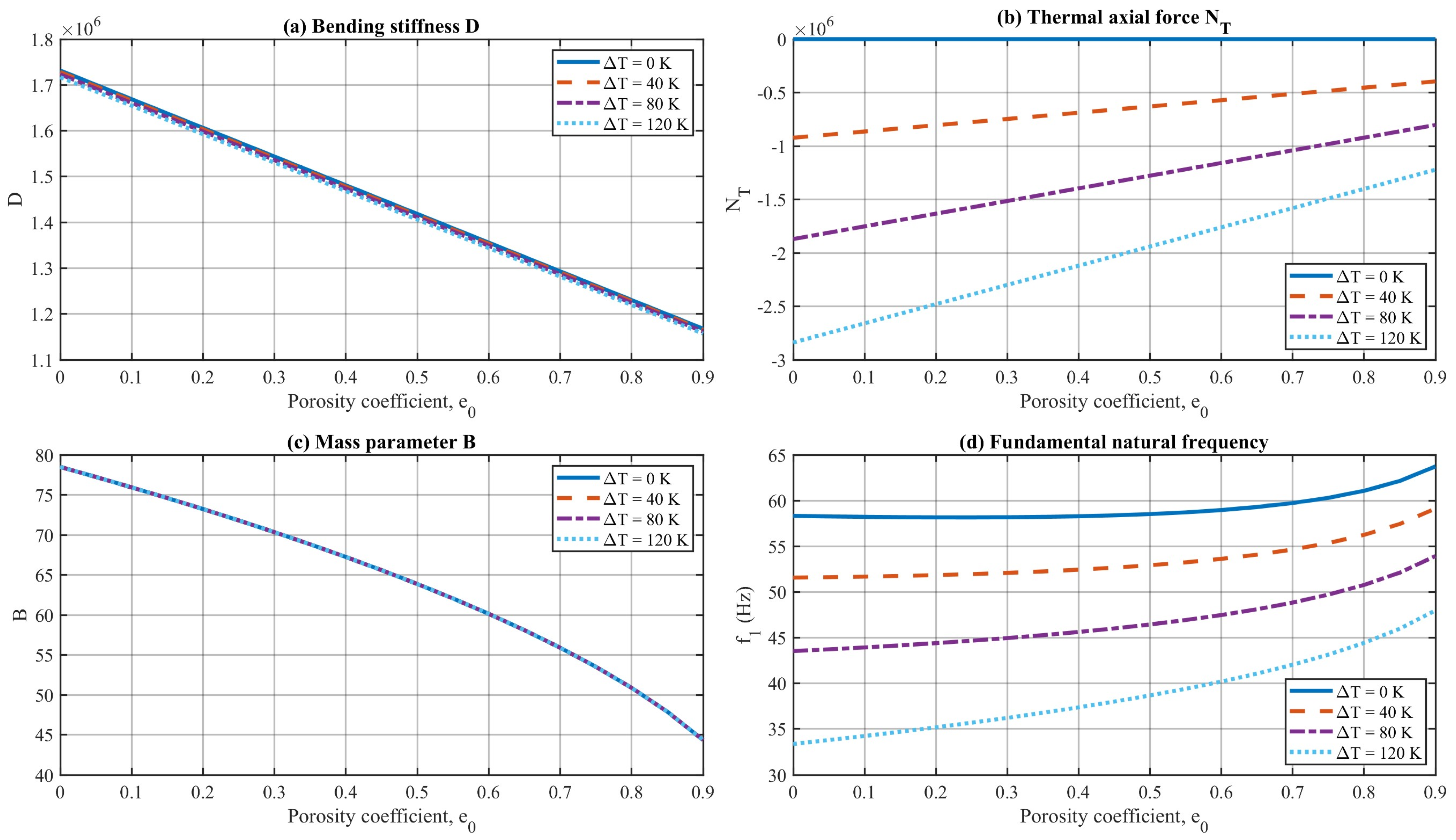
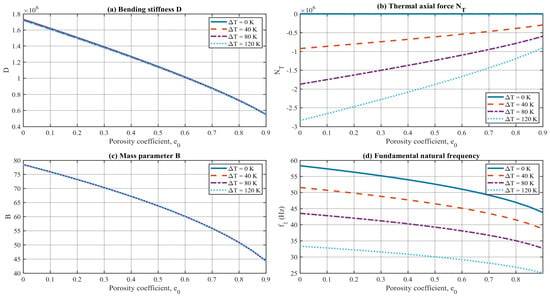
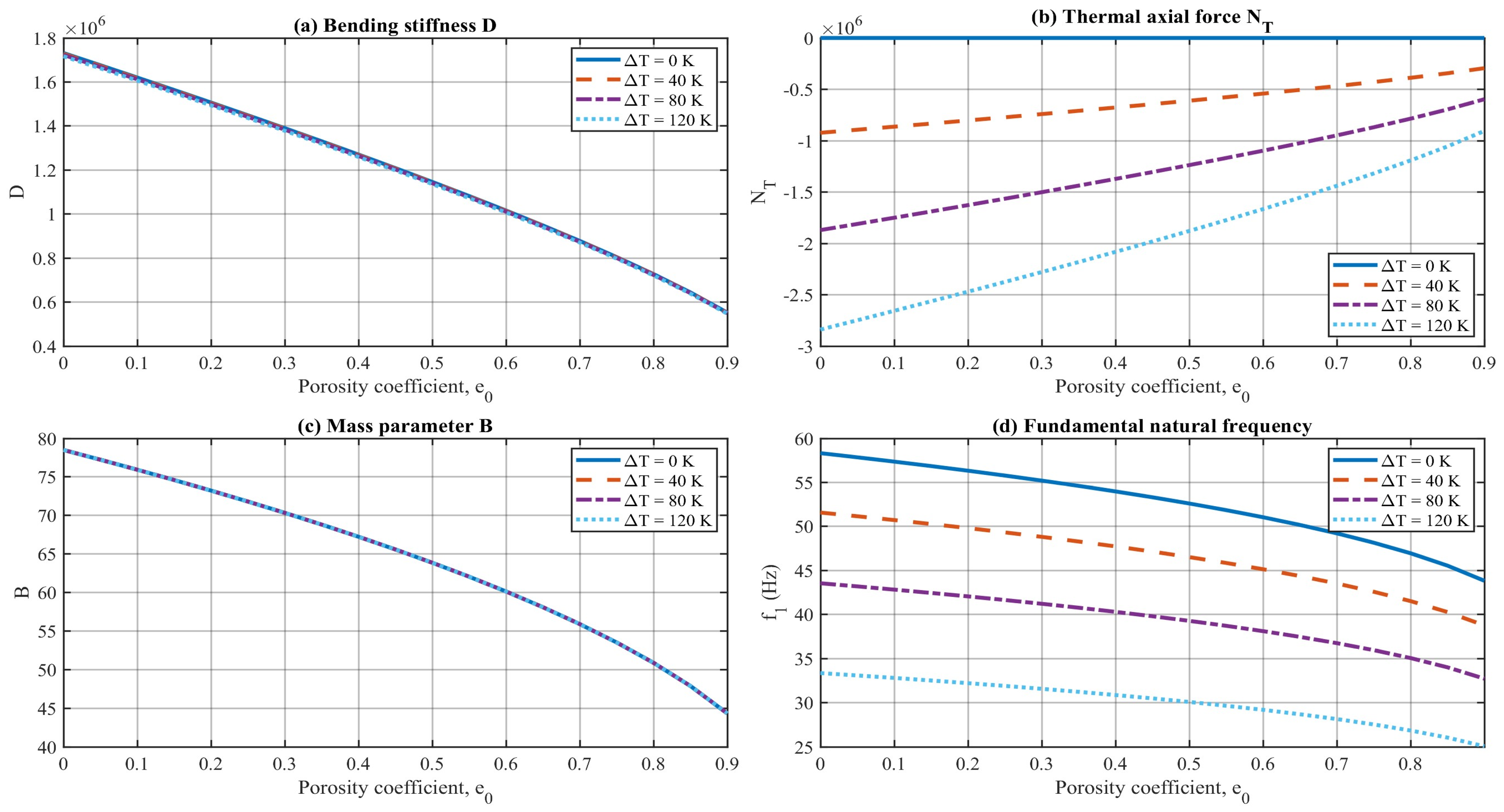
To provide a clearer physical interpretation of the frequency trends observed in Figure 2 and Figure 3, the variations in the bending stiffness , thermal axial force , and mass parameter are plotted together with the fundamental natural frequency as functions of the porosity coefficient , as shown in Figure 4 and Figure 5. These additional plots clarify how the combined stiffness–mass–thermal interactions govern the vibration response for symmetric and uniform porous beams. For the symmetric porous beam (Figure 4), although the bending stiffness decreases with increasing porosity, the reduction in the mass parameter and the weakening of the compressive thermal force partially compensate for the stiffness loss, which explains the slight recovery or increase in the fundamental frequency at higher porosity levels.
Figure 4.
Variation in (a) bending stiffness , (b) thermal axial force , (c) mass parameter , and (d) fundamental natural frequency with respect to the porosity coefficient for the symmetric porous beam under NLTD conditions at , 40, 80, and 120 K (H-H, L/h = 20).
Figure 5.
Variation in (a) bending stiffness , (b) thermal axial force , (c) mass parameter , and (d) fundamental natural frequency with respect to the porosity coefficient for the uniform porous beam under NLTD conditions at , 40, 80, and 120 K (H-H, L/h = 20).
For the uniform porous beam (Figure 5), both the bending stiffness and the mass parameter decrease monotonically with increasing porosity coefficient. At the same time, the thermal axial force magnitude is reduced as porosity increases. As a result, the fundamental frequency decreases more clearly with increasing porosity for all temperature levels. Unlike the symmetric case, the uniform porosity distribution does not exhibit a clear stabilizing shift toward higher critical temperatures, because the reduction in stiffness remains the dominant effect throughout the response.
4.3. Thermal Stability and Buckling Considerations
The thermal stability of the porous beam is evaluated by examining the thermally induced axial force. Parametric studies were restricted to thermally stable regimes (ΔT < ΔTcr) to avoid post-buckling effects.
The nondimensional axial load parameter is defined as P = NT L2/A0, where NT denotes the thermal force generated by the temperature field. The critical Euler load depends on the boundary conditions; therefore, the computed thermal load is compared with the corresponding boundary-condition-dependent critical value Pcr. As the temperature difference approaches the critical value, the thermally induced compressive axial force progressively reduces the bending stiffness of the beam. When the thermal load approaches the Euler critical level, the stiffness matrix becomes nearly singular, causing the fundamental eigenvalue to approach zero. Consequently, the first natural frequency rapidly decreases and vanishes at the onset of thermal buckling. This rapid frequency drop is therefore a physical manifestation of structural instability rather than a numerical artifact.
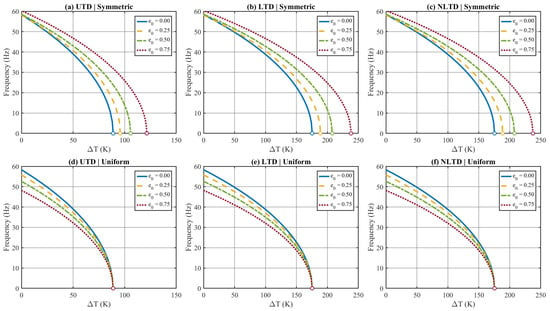
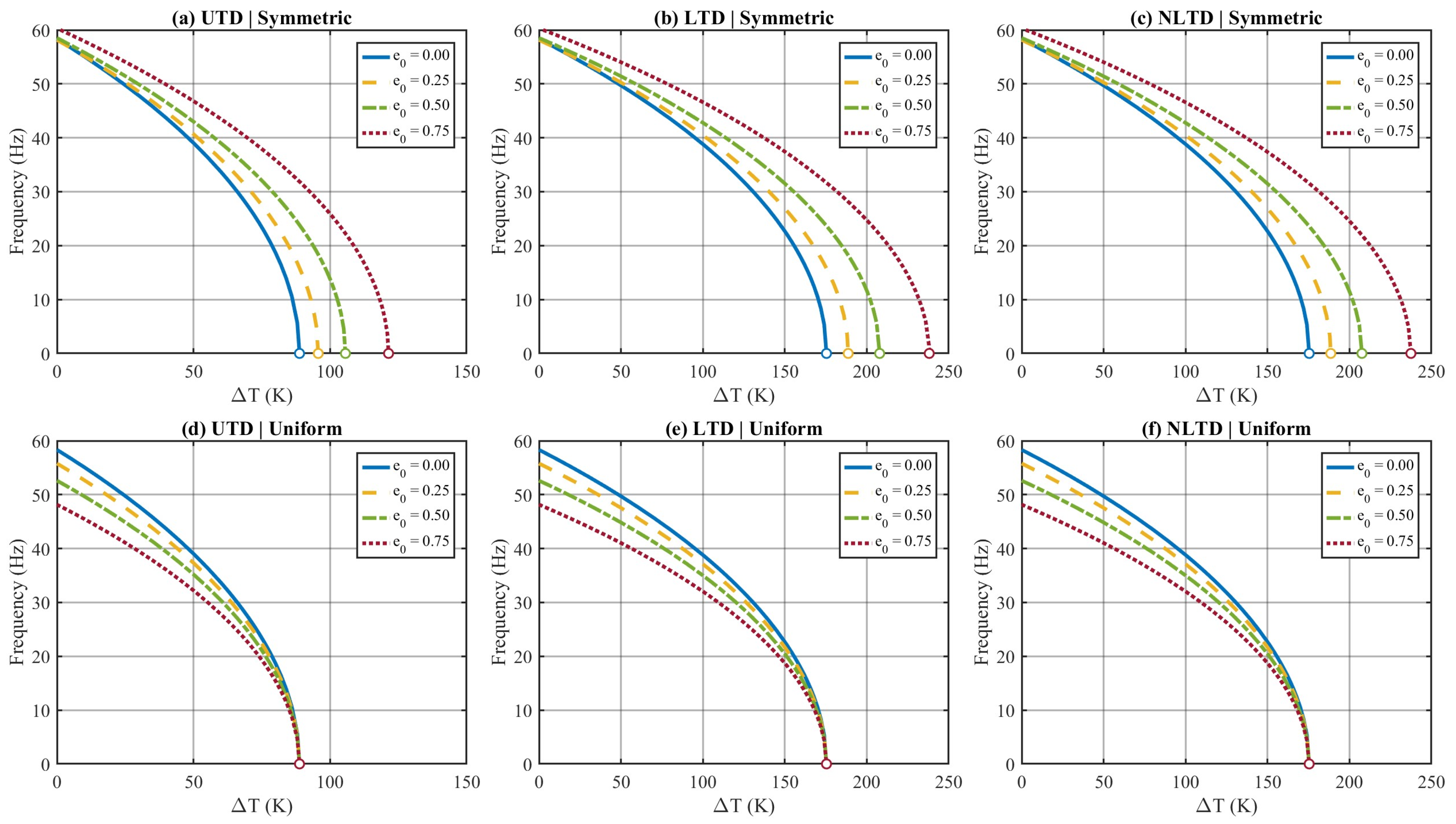
Figure 6 shows the variation in the fundamental frequency with increasing temperature difference for different porosity levels under symmetric and uniform porosity distributions. For all thermal models, the frequency decreases monotonically as the temperature rises due to the reduction in effective bending stiffness caused by thermally induced axial forces. The porosity distribution has a significant influence on thermal stability. For the symmetric porosity distribution, increasing shifts the curves toward higher critical temperatures. Although porosity reduces the stiffness, it also decreases the thermal force resultants, enabling the beam to withstand larger temperature differences before reaching instability. In contrast, for the uniform porosity distribution, increasing generally shifts the curves toward lower frequencies while the critical temperatures remain much closer to each other. This indicates that, in the uniform case, the reduction in stiffness becomes more dominant, whereas the stabilizing effect associated with the reduction in thermal force is less pronounced than in the symmetric case.
Figure 6.
Variation in the fundamental frequency versus temperature increase for different porosity coefficients under (a) UTD, (b) LTD, and (c) NLTD for the symmetric porosity distribution, and under (d) UTD, (e) LTD, and (f) NLTD for the uniform porosity distribution. (H-H, L/h = 20).
Among the models considered, the uniform temperature distribution leads to the earliest loss of stability, indicating stronger thermally induced axial compression compared to nonuniform temperature fields.
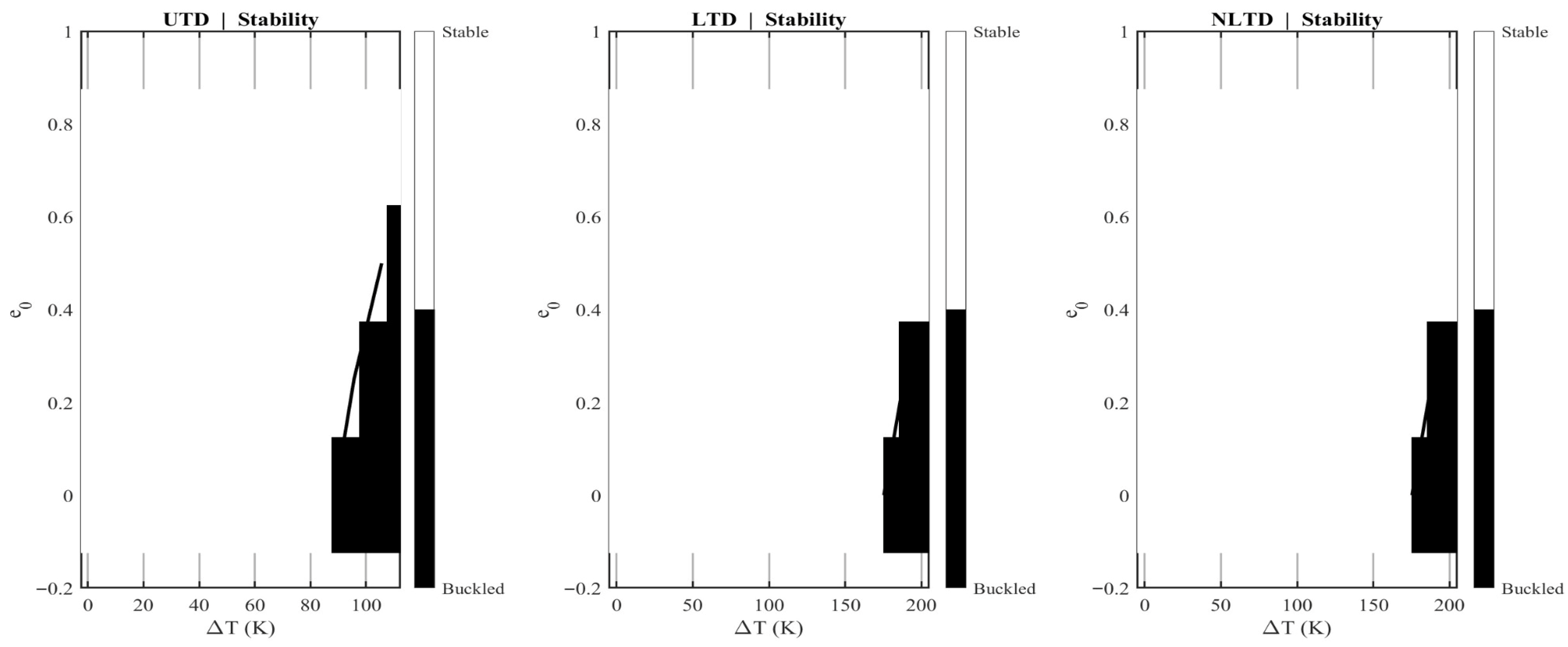
Figure 7 presents stability maps in the plane. In all cases, the white region corresponds to the stable domain, whereas the black region denotes the buckled or unstable region. The results show that the critical temperature generally increases with increasing porosity coefficient, indicating that the symmetric porosity distribution improves the thermal stability of the beam. This trend is more pronounced under LTD and NLTD conditions, where the buckling boundary shifts toward higher temperature differences as e0e_0e0 increases. The observed behavior suggests that, for the symmetric porous beam, the reduction in thermally induced axial force becomes more influential than the accompanying stiffness degradation, thereby extending the stable thermal range.
Figure 7.
Stability maps in the (ΔT, e0) plane for the symmetric porous beam under UTD, LTD, and NLTD temperature distributions (H-H, L/h = 20).
It should be noted that the present formulation accounts for thermal effects through the axial thermal force resultant . The bending moment induced by a through-thickness thermal gradient and the associated initial thermal deflection are not included in the current model. Therefore, the present thermal stability discussion is limited to the influence of on the vibration characteristics and buckling tendency.
4.4. Effect of Length-to-Height Ratio
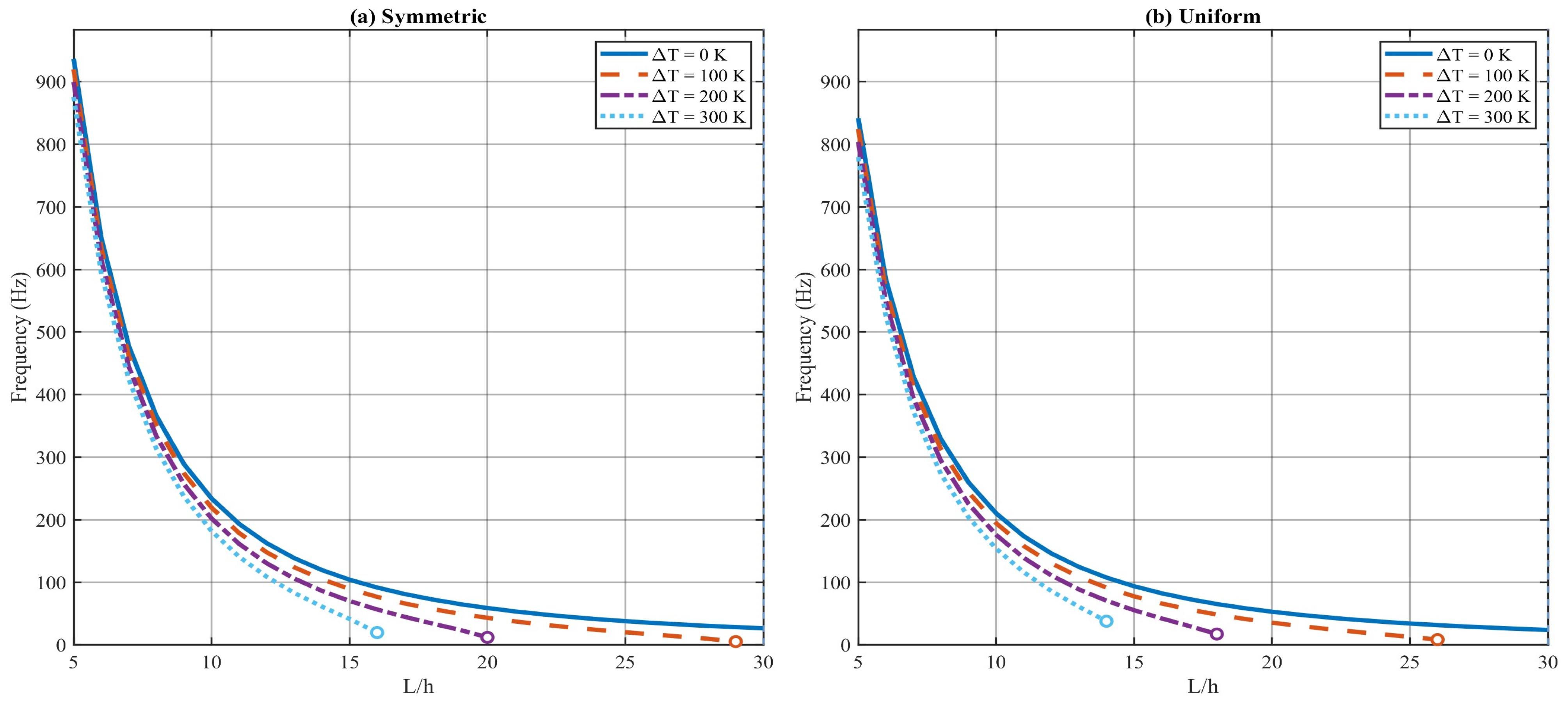
Figure 8 shows the variation in the first natural frequency with the length-to-height ratio (L/h) for the functionally graded porous beams subjected to a nonlinear temperature distribution (NLTD) with porosity parameter e0 = 0.5.
Figure 8.
Effects of length to height ratio on the first frequency for H–H FG porous beams with NLTD: (a) symmetric porosity distribution and (b) uniform porosity distribution ( = 0.5).
In both cases, the fundamental frequency decreases markedly with increasing L/h, while higher temperature increments further reduce the frequency due to thermally induced stiffness degradation. The symmetric distribution generally maintains slightly higher frequency levels and a wider stable range, whereas the uniform distribution exhibits a stronger reduction in frequency, indicating that the stiffness loss is more dominant in that case.
4.5. Effect of Porosity Distribution Type and Boundary Conditions
Table 10 presents the first natural frequencies for symmetric and uniform porous beams under various boundary conditions and temperature levels. It is clearly observed that, for all boundary conditions, porosity parameters, and temperature levels considered, the symmetric porosity distribution yields higher natural frequencies than the uniform porosity distribution. This trend indicates that the symmetric distribution preserves the effective bending stiffness more efficiently, whereas the uniform distribution leads to a more pronounced reduction in structural stiffness. For all boundary conditions, an increasing temperature difference produces a monotonic decrease in frequency due to thermally induced compressive forces and temperature-dependent stiffness degradation. The sensitivity to temperature becomes stronger for higher porosity parameters, indicating that void-induced material softening amplifies the thermoelastic response. Among the boundary conditions, the clamped–clamped configuration consistently produces the highest frequencies due to the strongest structural restraint, whereas the hinge–hinge configuration exhibits the greatest reduction in frequency with temperature.
Table 10.
Frequency of porosity beams with different boundary conditions under UTD (L/h = 20).
In certain parameter ranges, the results indicate that the uniform porosity distribution leads to lower natural frequencies than the symmetric porosity distribution under all examined cases. This behavior highlights the significant role of porosity distribution in governing the stiffness–mass balance and, consequently, the dynamic response of the beam.
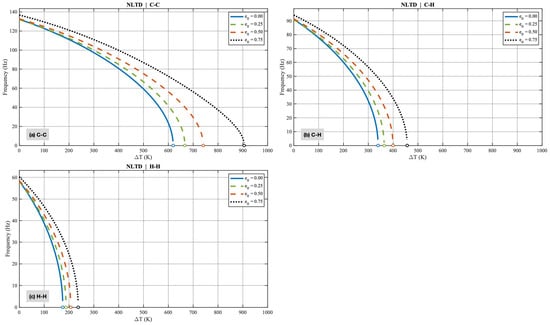
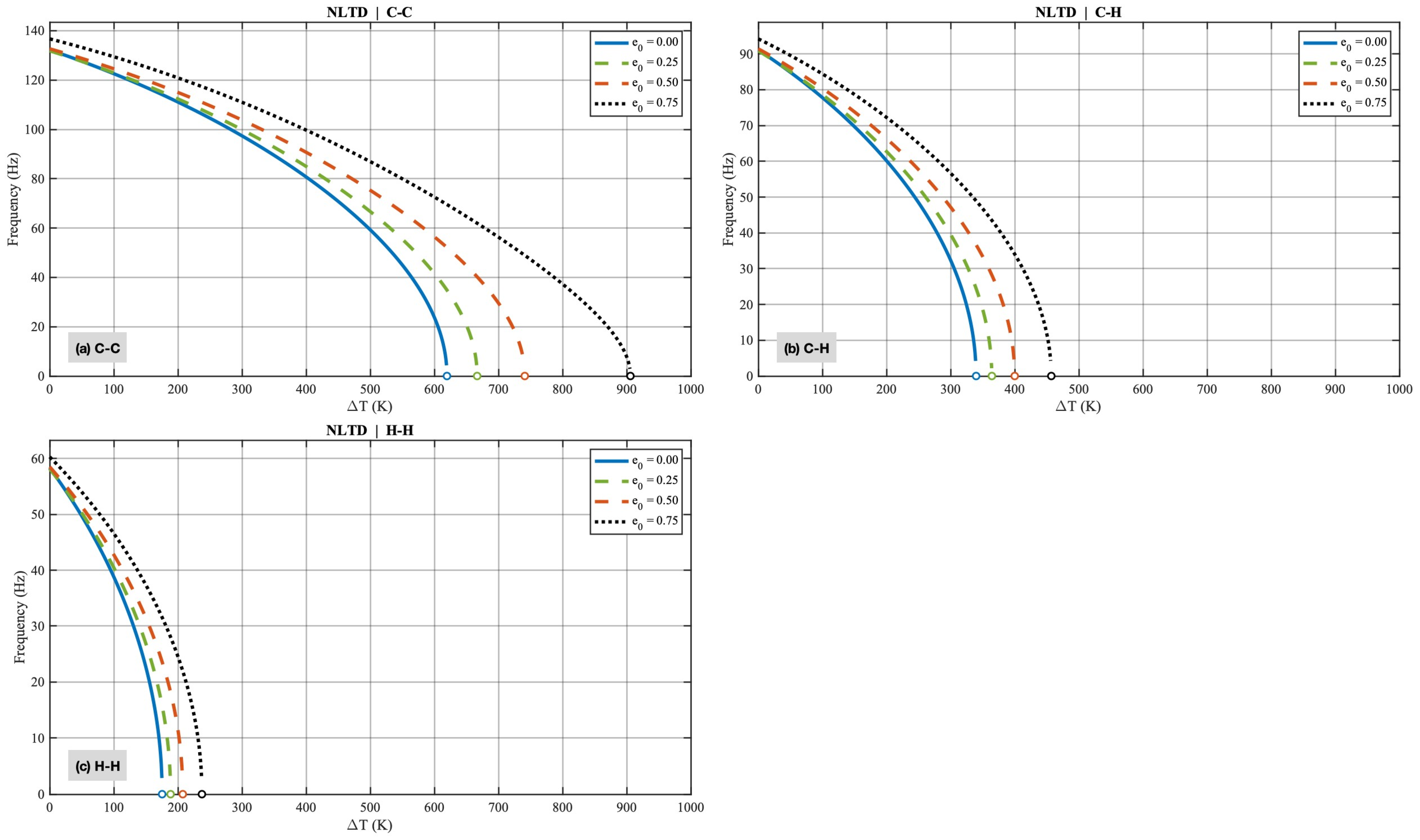
Figure 9 compares the boundary-condition effects under NLTD conditions. The clamped–clamped beam exhibits the highest thermal stability, whereas the hinged–hinged beam loses stability at significantly lower temperature differences.
Figure 9.
Effect of boundary conditions for the symmetric beam under NLTD (L/h = 20).
5. Conclusions
In this study, the thermoelastic free vibration and thermal stability behavior of functionally graded porous Euler–Bernoulli beams with temperature-dependent material properties were investigated using the Differential Transformation Method (DTM) and validated through a Hermite-based finite element formulation. The proposed semi-analytical framework simultaneously accounts for symmetric and uniform porosity distributions together with uniform, linear, and nonlinear temperature fields within a unified thermo-mechanical formulation.
The results demonstrate that a temperature increase significantly reduces the natural frequency due to thermally induced compressive axial forces and stiffness degradation. As the temperature difference approaches the critical value, the fundamental frequency rapidly decreases and vanishes at the onset of thermal buckling, confirming the strong coupling between vibration and stability behavior. Among the thermal models considered, the uniform temperature distribution produces the earliest loss of stability, whereas the nonlinear temperature distribution provides the widest thermally stable region due to reduced resultant axial forces.
Porosity distribution plays a crucial role in the thermal stability and vibration response of the beam. While the symmetric porosity distribution leads to a comparatively milder reduction in frequency, the uniform porosity distribution results in lower natural frequencies and reduced thermal stability within the adopted simplified midplane-based formulation. These trends should be interpreted within the assumptions of the present EB thermal-force-based model. In certain parameter ranges, a slight frequency increase is observed for the symmetric porosity case due to the partial compensation of stiffness loss by density reduction, highlighting the importance of the stiffness-to-mass interaction in porous materials. In contrast, for the uniform porosity distribution, stiffness degradation remains dominant, and the natural frequency therefore decreases more consistently with increasing porosity.
From an engineering design perspective, the present results show that the selection of porosity distribution should account not only for lightweighting efficiency but also for its influence on structural stiffness, vibration response, and thermal stability. Although porous configurations can provide mass reduction, the results indicate that the uniform porosity distribution leads to a more pronounced decrease in natural frequency than the symmetric porosity distribution. The slight frequency increase observed in the symmetric case should be interpreted as a local effect arising from the balance between stiffness reduction and mass reduction and does not represent a general improvement in structural performance. In a broader sense, increasing porosity tends to reduce stiffness and thermal stability, particularly under elevated temperature conditions. Therefore, the potential weight-saving benefit of porous beam configurations should always be evaluated together with the associated change in dynamic behavior and stability margin. In this context, the validated DTM-based formulation developed in the present study provides an accurate and computationally efficient tool for predicting the thermo-vibrational response of porous beam structures subjected to different thermal environments.
The present study is limited to steady-state thermal fields. In principle, the adopted constitutive model and DTM-based framework could be extended to transient thermal loading. However, such an extension would require treatment of time-dependent temperature fields, evolving material properties, and coupled spatial–temporal governing equations with time-dependent coefficients. These issues, together with possible thermal-shock-induced steep gradients and stability challenges, make the transient problem significantly more complex and therefore beyond the scope of the present study.
The present framework is limited to slender beams modeled by the Euler–Bernoulli theory. Extension to thicker functionally graded porous beams would require shear-flexible formulations, such as Timoshenko or higher-order shear deformation theories. In such cases, additional kinematic variables, shear deformation, rotary inertia, and coupled governing equations would significantly increase the complexity of the corresponding DTM recurrence relations, boundary conditions, and eigenvalue solution process. Therefore, such an extension is possible in principle but beyond the scope of the present study.
Author Contributions
S.K. conceptualized the study, developed the methodology, performed the numerical analysis, and prepared the original draft of the manuscript. İ.Ö. contributed to methodology refinement, supervised the research, and reviewed and edited the manuscript. All authors have read and agreed to the published version of the manuscript.
Funding
This research received no external funding.
Institutional Review Board Statement
Not applicable.
Informed Consent Statement
Not applicable.
Data Availability Statement
The data supporting the findings of this study are included within the article.
Conflicts of Interest
The authors declare no conflicts of interest.
References
- Banhart, J. Manufacture, characterization and application of cellular metals and metal foams. Prog. Mater. Sci. 2001, 46, 559–632. [Google Scholar] [CrossRef] [Scilit]
- Gibson, L.J.; Ashby, M.F. Cellular Solids: Structure and Properties; Cambridge University Press: Cambridge, UK, 1997. [Google Scholar]
- Ashby, M.F.; Evans, A.G.; Fleck, N.A.; Hutchinson, J.W.; Wadley, H.N.G. Metal Foams: A Design Guide; Butterworth-Heinemann: Oxford, UK, 2000. [Google Scholar]
- Duarte, I.; Banhart, J. A study of aluminium foam formation. Acta Mater. 2000, 48, 2349–2362. [Google Scholar] [CrossRef] [Scilit]
- Chen, D.; Gao, K.; Yang, J. Functionally graded porous structures: Analyses, performances, and applications—A review. Thin-Walled Struct. 2023, 191, 111046. [Google Scholar] [CrossRef] [Scilit]
- Madgule, M.; Sreenivasa, C.G.; Borgaonkar, A.V. Aluminium metal foam production methods, properties and applications—A review. Mater. Today Proc. 2022, 77, 673–679. [Google Scholar] [CrossRef] [Scilit]
- Conde, Y.; Pollien, A.; Mortensen, A. Functional grading of metal foam cores for yield-limited lightweight sandwich beams. Scr. Mater. 2006, 54, 539–543. [Google Scholar] [CrossRef] [Scilit]
- Öchsner, A. Classical Beam Theories of Structural Mechanics; Springer: Cham, Switzerland, 2021. [Google Scholar]
- Kukla, S.; Rychlewska, J. Free vibration analysis of functionally graded beams. J. Appl. Math. Comput. Mech. 2013, 12, 39–44. [Google Scholar] [CrossRef] [Scilit]
- Wattanasakulpong, N.; Chaikittiratana, A. Flexural vibration of imperfect functionally graded beams based on Timoshenko beam theory: Chebyshev collocation method. Meccanica 2015, 50, 1331–1342. [Google Scholar] [CrossRef] [Scilit]
- Chen, D.; Kitipornchai, S.; Yang, J. Dynamic response of shear deformable functionally graded porous beams. Appl. Mech. Mater. 2016, 846, 434–439. [Google Scholar] [CrossRef] [Scilit]
- Guo, L.; Zhao, S.; Guo, Z.; Yang, J.; Kitipornchai, S. Functionally graded engineering structures: An overview. Eng. Struct. 2026, 351, 121995. [Google Scholar] [CrossRef] [Scilit]
- Zhao, J.; Wang, Q.; Deng, X.; Choe, K.; Xie, F.; Shuai, C. A modified series solution for free vibration analyses of moderately thick functionally graded porous beams. Compos. Part B Eng. 2019, 165, 155–166. [Google Scholar] [CrossRef] [Scilit]
- Cho, J.-R. Natural element static and free vibration analysis of functionally graded porous composite plates. Appl. Sci. 2022, 12, 11648. [Google Scholar] [CrossRef] [Scilit]
- Chen, D.; Yang, J.; Kitipornchai, S. Buckling and bending analyses of a novel functionally graded porous plate using Chebyshev–Ritz method. Arch. Civ. Mech. Eng. 2019, 19, 157–170. [Google Scholar] [CrossRef] [Scilit]
- Wang, Y.; Zhou, A.; Fu, T.; Zhang, W. Transient response of a sandwich beam with functionally graded porous core traversed by a non-uniformly distributed moving mass. Int. J. Mech. Mater. Des. 2020, 16, 519–540. [Google Scholar] [CrossRef] [Scilit]
- Srikarun, B.; Songsuwan, W.; Wattanasakulpong, N. Linear and nonlinear static bending of sandwich beams with functionally graded porous core under different distributed loads. Compos. Struct. 2021, 276, 114538. [Google Scholar] [CrossRef] [Scilit]
- Beg, M.S.; Yasin, M.Y. Bending, free and forced vibration of functionally graded deep curved beams in thermal environment using an efficient layerwise theory. Mech. Mater. 2021, 159, 103919. [Google Scholar] [CrossRef] [Scilit]
- Trinh, L.C.; Vo, T.P.; Thai, H.-T.; Nguyen, T.-K. An analytical method for the vibration and buckling of functionally graded beams under mechanical and thermal loads. Compos. Struct. 2016, 100, 152–163. [Google Scholar] [CrossRef] [Scilit]
- Ungbhakorn, V.; Wattanasakulpong, N. Thermo-elastic vibration analysis of third-order shear deformable functionally graded plates with distributed patch mass under thermal environment. Appl. Acoust. 2013, 74, 1045–1059. [Google Scholar] [CrossRef] [Scilit]
- Trabelsi, S.; Frikha, A.; Zghal, S.; Dammak, F. A modified FSDT-based four-node finite shell element for thermal buckling analysis of functionally graded plates and cylindrical shells. Eng. Struct. 2019, 178, 444–459. [Google Scholar] [CrossRef] [Scilit]
- Vuong, P.M.; Duc, N.D. Nonlinear response and buckling analysis of eccentrically stiffened FGM toroidal shell segments in thermal environment. Aerosp. Sci. Technol. 2018, 79, 383–398. [Google Scholar] [CrossRef] [Scilit]
- Radaković, A.; Čukanović, D.; Bogdanović, G.; Blagojević, M.; Stojanović, B.; Dragović, D.; Manić, N. Thermal buckling and free vibration analysis of functionally graded plate resting on an elastic foundation according to high-order shear deformation theory. Appl. Sci. 2020, 10, 4190. [Google Scholar] [CrossRef] [Scilit]
- Eiadtrong, S.; Wattanaskulpon, N.; Vo, T.P. Thermal vibration of functionally graded porous beams with classical and non-classical boundary conditions using a modified Fourier method. Acta Mech. 2023, 234, 729–750. [Google Scholar] [CrossRef] [Scilit]
- Wattanasakulpong, N.; Chaikittiratana, A. A comprehensive study on bending, buckling and vibration of sandwich beams made of FG-GPLRC faces and FGP core using a quasi-3D theory. Structures 2025, 74, 108561. [Google Scholar] [CrossRef] [Scilit]
- Zhang, Q.; Zhang, R.; Su, J.; Jiang, Y. A unified variational method for vibration of functionally graded porous beams with variable curvature under arbitrary boundary condition. Eng. Struct. 2023, 284, 115948. [Google Scholar] [CrossRef] [Scilit]
- Hong, C.-C. Thermal stresses and vibration of thick FGM conical shells using TSDT. J. Compos. Sci. 2025, 9, 465. [Google Scholar] [CrossRef] [Scilit]
- Do, M.-D.; Tran, Q.-H.; Tran, M.-T.; Le, C.-T.; Dang, C.-T. Thermal free vibration and thermal buckling of FGP beams with temperature-dependent material properties. Iran J. Sci. Technol. Trans. Mech. Eng. 2025, 50, 283–302. [Google Scholar] [CrossRef] [Scilit]
- Vu, A.N.T.; Nguyen, D.K. Thermoelastic nonlinear dynamics of sandwich microbeams with functionally graded porous core under a moving mass. Arch. Appl. Mech. 2025, 95, 255. [Google Scholar] [CrossRef] [Scilit]
- Arikoglu, A.; Ozkol, I. Solution of differential–difference equations by using differential transform method. Appl. Math. Comput. 2006, 181, 153–162. [Google Scholar] [CrossRef] [Scilit]
- Talebitooti, R.; Rezazadeh, S.O.; Amiri, A. Comprehensive semi-analytical vibration analysis of rotating tapered AFG nanobeams based on nonlocal elasticity theory considering various boundary conditions via differential transformation method. Compos. Part B Eng. 2019, 160, 412–435. [Google Scholar] [CrossRef] [Scilit]
- Demir, İ.; Karahan, M.M.F.; Aktürk, N. Transverse vibration analysis of a self-excited beam subjected to delayed distributed and a singular load using differential transformation method. J. Vib. Eng. Technol. 2024, 12, 5369–5382. [Google Scholar] [CrossRef] [Scilit]
- Rezaiee-Pajand, M.; Mirjalili, Z.; Kazemiyan, M.S.; Arefipoor, A. Free vibration analysis of soil–beam–fluid interaction with variable Winkler backfill using differential transformation method. Eng. Struct. 2024, 309, 118048. [Google Scholar] [CrossRef] [Scilit]
- Botean, A.I. Application of the DTM to the elastic curve equation in Euler–Bernoulli beam theory. Mathematics 2025, 13, 2647. [Google Scholar] [CrossRef] [Scilit]
- Cardoso, R.P.R. A new beam element blending Euler–Bernoulli beam theory with idealised transverse shear flows for aircraft structural analysis. Thin-Walled Struct. 2020, 157, 107118. [Google Scholar] [CrossRef] [Scilit]
- Gao, K.; Li, R.; Yang, J. Dynamic characteristics of functionally graded porous beams with interval material properties. Eng. Struct. 2019, 197, 109441. [Google Scholar] [CrossRef] [Scilit]
- Hung, T.Q.; Duc, D.M.; Tu, T.M. Thermally induced vibration analysis of sandwich beam with metal foam core subjected to blast loading using a higher-order beam theory. IOP Conf. Ser. Mater. Sci. Eng. 2023, 1289, 012006. [Google Scholar] [CrossRef] [Scilit]
- Wang, Y.; Zhang, W. On the thermal buckling and post buckling responses of temperature-dependent graphene platelets reinforced porous nanocomposite beams. Compos. Struct. 2022, 296, 115880. [Google Scholar] [CrossRef] [Scilit]
- Pradhan, K.K.; Chakraverty, S. Computational Structural Mechanics: Static and Dynamic Behaviors; Academic Press: London, UK, 2019. [Google Scholar]
- Ebrahimi, F.; Ghasemi, F.; Salari, E. Investigating thermal effects on vibration behavior of temperature-dependent compositionally graded Euler beams with porosities. Meccanica 2016, 51, 223–249. [Google Scholar] [CrossRef] [Scilit]
- Kiani, Y.; Eslami, M.R. An exact solution for thermal buckling of annular FGM plates on an elastic medium. Compos. Part B Eng. 2013, 45, 101–110. [Google Scholar] [CrossRef] [Scilit]
- Kılıç, B.; Özdemir, Ö. Vibration and stability analyses of functionally graded beams. Arch. Mech. Eng. 2021, 68, 93–113. [Google Scholar] [CrossRef] [Scilit]
- Chen, Y.; Jin, G.; Zhang, C.; Ye, T.; Xue, Y. Thermal vibration of FGM beams with general boundary conditions using a higher-order shear deformation theory. Compos. Part B Eng. 2018, 153, 376–386. [Google Scholar] [CrossRef] [Scilit]

Disclaimer/Publisher’s Note: The statements, opinions and data contained in all publications are solely those of the individual author(s) and contributor(s) and not of MDPI and/or the editor(s). MDPI and/or the editor(s) disclaim responsibility for any injury to people or property resulting from any ideas, methods, instructions or products referred to in the content. |
© 2026 by the authors. Licensee MDPI, Basel, Switzerland. This article is an open access article distributed under the terms and conditions of the Creative Commons Attribution (CC BY) license.