


Featured Application
Multidisciplinary project-based learning offers a positive learning experience and student retention for non-calculus-ready first-year engineering students.
Abstract
The objective of this study is to develop and incorporate a multidisciplinary engineering design experience into an academic success and professional development course that aims to retain non-calculus-ready first-year engineering students. The project followed the five-step engineering design process using knowledge from multiple engineering disciplines. Students were tasked to design a scale model of a safe, sustainable, and cost-efficient oil derrick with PASCO kits, engage in discussion to consider societal, global, cultural, and further factors in design, practice an elevator pitch with entrepreneurship specialists from the university start-up incubator, and present the final design to a multidisciplinary judge panel from academia and industry in engineering, math, social science, and business at a Poster Expo. This project-based learning aligned with the student outcomes of ABET and the Engineering for One Planet framework for sustainability education in engineering. Opportunities and challenges of this multidisciplinary learning experience were analyzed using triangulated data sources from student course performance, a student perception survey (N = 16; Cronbach’s α = 0.959), and student retention data. Results showed a positive student learning experience with 88% of students reporting that the multidisciplinary design experience was positive to their learning and increased their interest in engineering. Ninety-four percent of student retention in engineering was reported by the end of the semester (N = 17).
1. Introduction
Maintaining student interest in engineering during their first-year engineering (FYE) experience is critical to promote student success and retention in engineering because many FYE students leave engineering programs due to loss of interest in engineering [1,2]. This is particularly important and challenging for students from educationally disadvantaged backgrounds in the United States who are academically promising but often non-calculus-ready when accepted into the engineering programs [3,4,5]. Those non-calculus-ready students cannot enroll in engineering entry courses due to lack of the math prerequisite and spend their first one to two years in more math preparation courses instead of gaining engineering experience, which may result in their loss of interest or motivation for engineering [6,7].
Experiential learning, where students learn through direct hands-on experience instead of through passive lectures, has become an important part of engineering education. Some examples of experiential learning include project designs, internships, laboratory experiments, and field work where students actively participate in real problems [8]. Kolb’s Experiential Learning Theory explained this as a four-stage learning cycle: (1) Concrete Experience, during which the learner is engaged in an activity of direct experience to gain valuable experience, (2) Reflective Observation, when the individual steps back and consciously reflects and observes what took place with that experience, (3) Abstract Conceptualization, during which the thoughts about reflections are formed into a unique understanding, and (4) Active Experimentation, when the learner validates their ideas in new situations [9,10]. Research shows that one form of experiential learning, which is project-based learning (PBL), trains students in not only technical aspects but also other key skills like communication and collaboration, which would help students in their professional lives [11,12]. Recent analyses show that PBL is most effective when projects involve various fields of engineering coming together and include real-world feedback from industries professionals and partners [13]. The implementation of PBL varies. Sponsor-based or community service-based real-world projects are used by upper-level courses or courses resourceful in industry/community partnerships and funding [13,14]. But hypothetical design projects using accessible or 3D printing materials [15,16] or given kits such as PASCO kits [17], electronic kits (breadboard, Arduino, etc.) [1,18], and LEGO Mindstorms kits [19] are also used frequently in FYE courses to give students early exposure to the engineering design process [20] and in courses that faced resource limitations or COVID disruptions [15]. Studies have shown that students who work with structured physical kits in an introductory course show stronger engagement with the design process, better follow-through on design iterations, and increased confidence in engineering compared to those in a traditional course setting [21].
Multidisciplinary experiences have also been developed and implemented in undergraduate engineering education to enhance learning. The form of “multidiscipline” varies, including multidisciplinary projects [19,22,23], multidisciplinary teams [24,25], multidisciplinary design approaches [26,27], multidisciplinary course experience [28,29], and more. Some integrated the STEAM (science, technology, engineering, art, and math) education approach [30] or social-based design [26]. They have also shown positive impacts on student interest in engineering, learning experience, engineering entrepreneurship mindset cultivation, and retention within engineering [31,32,33]. Some combined PBL and multidisciplinary experience for engineering design projects to enhance student learning [19,31]. However, few explore the application of PBL with multidisciplinary experience in multiple aspects (team composition, project itself, and STEAM approach) for non-calculus-ready FYE from educationally disadvantaged backgrounds in low-resource areas. This study will fill this gap.
The West Virginia University (WVU) Benjamin M. Statler College of Engineering and Mineral Resources (Statler College) offers engineering and computing majors from seven departments such as Mechanical and Aerospace Engineering (MAE), Chemical and Biomedical Engineering (CBE), Civil and Environmental Engineering (CEE), Computer Science and Electrical Engineering (CSEE), Industrial Engineering (IE), Mining Engineering (MINE), Petroleum and Natural Gas Engineering (PNGE), and more. It has a common FYE program named Fundamentals of Engineering Program (FEP) where students complete FYE core courses before declaring majors and moving to their department. West Virginia (WV) is a rural state and one of the most underserved states economically in the United States. FEP has seen approximately 30% of low-income students. During the COVID lockdown, the faculty mailed hotspots to students so that they had reliable internet, and some students went to McDonald’s or local library parking lots for free WIFI to access online learning materials and submit homework. With limited resources, the FEP faculty need to be creative and mindful of accessibility when developing a project because a $20 material budget can be challenging for some student teams. Therefore, projects using kits provided by the FEP are a preferred approach when engaging in PBL, which supports accessibility but also creates challenges when framing the project.
ENGR 112 Professional Development in Engineering in the FEP is part of the Academy of Engineering Success (AcES) co-curricular support program that is dedicated to supporting the engineering identity development and retention of low-income and non-calculus-ready FYE students in their first semester in college [34,35,36,37,38,39]. Many students in this course are also from underserved populations (e.g., women, underrepresented minorities, first-generation students, and low-income students) that have been challenging to be retained in engineering. This course is usually the only engineering-oriented course that the ENGR 112 students enrolled in during their first semester due to their math placement. PBL has been used in this course so that those educationally disadvantaged students can have similar engineering design project experience as their peers in calculus-ready engineering courses, but past projects from a single discipline were not attractive to all students in the course [40]. Students in ENGR 112 have different major interests. Since most FEP students intend to choose majors in the departments of MAE and CEE, when using a single-disciplinary project, a project from those disciplines is more likely to be chosen, resulting in students from other departments such as CSEE, MINE and PNGE feeling less engaged throughout the project. Additionally, due to many students’ math placement in algebra, the project needs to be feasible for them. A possible solution to these challenges is a multidisciplinary project. The purpose of this study is to develop and incorporate PBL with multidisciplinary experience into this FYE course with non-calculus-ready students from various engineering majors. The multidisciplinary project experience was framed on experiential learning theory, particularly on Kolb’s cycle of experiential learning [8]. The multidisciplinary relevance across the design experience was as follows: (1) multidisciplinary teams, (2) engineering design approach using knowledge from multiple disciplines, and (3) multidisciplinary technical communication experience.
This study will explore the opportunities and challenges of implementing this multidisciplinary PBL to a low resource non-calculus-ready FYE course to enhance student learning. Additionally, as an extended version of a previously published conference paper [40], this paper further explores the implementation of this project through the lens of ABET criterion 3 Student Outcomes (SOs) and the Engineering for One Planet (EOP) framework. The ABET outlines that engineering programs are accredited through a set of established criteria to ensure that engineering graduates possess the skills necessary for professional practice and it requires engineering programs to assess attainment of seven student outcomes [41]. EOP is an emerging framework that was created in 2020 in collaboration with academic, industry, public, and nonprofit sectors to guide the incorporation of sustainability education into the engineering curriculum and was rapidly adopted by more than 50 universities in the United States [42]. The integration of sustainability into engineering curricula has shown evidence on increasing the enrollment and retention of students from the traditionally low-resource backgrounds [43]. However, its application in guiding multidisciplinary PBL for non-calculus-ready FYE students has not been reported yet.
In summary, this paper will present curriculum development as well as a study to (1) explore the opportunities and challenges of implementing this multidisciplinary engineering project experience and (2) investigate its alignment with ABET SOs and the EOP framework. Analyzing the opportunities and challenges provides insights to enhance the learning and retention of non-calculus-ready FYE students through multidisciplinary engineering PBL. Mapping it to both ABET and EOP provides insights on its usage in ABET assessment and sustainability education in FYE. Additionally, this multidisciplinary engineering design approach may also be beneficial to general engineering and engineering technology programs that need to choose projects attractive to students from various engineering discipline interests.
2. Materials and Methods
2.1. Development and Incorporation of the Multidisciplinary PBL
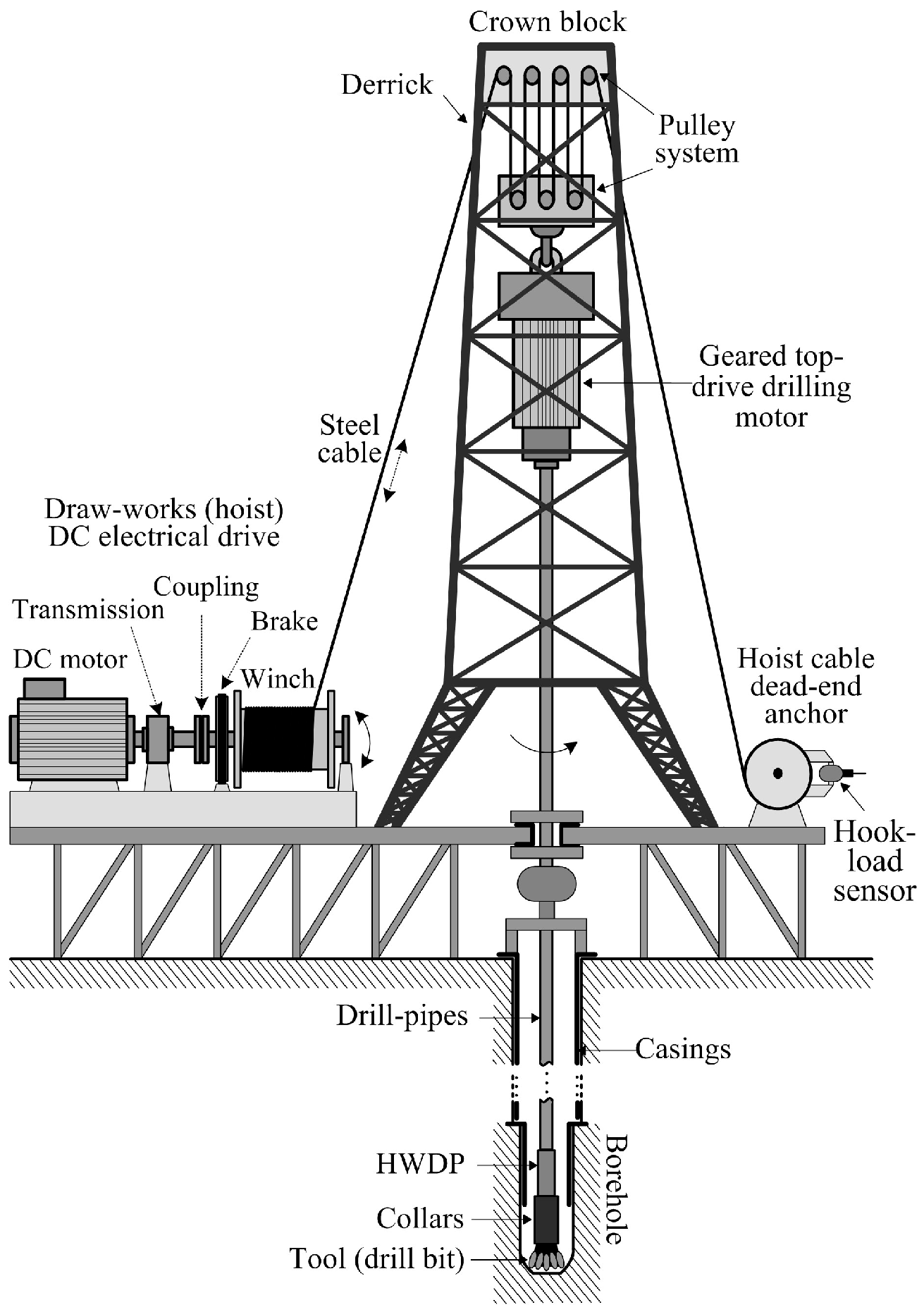
The chosen multidisciplinary project is the design of a sustainable oil derrick. A drilling derrick, or rig, is an important structure used to drill water wells, oil wells, or natural gas extraction wells (Figure 1). The oil derrick supports the load of the drill string above the blowout preventer while working on a well and is responsible for the load of the drill string in tension or compression and in many different environments. They can be found on land or offshore and are constantly modified to keep up with new technologies [44] and the needs of sustainability in industry [45,46]. Today, they are not only used to support drilling on fluid with oil or water-based mud as they were ten years ago but also equipped to drill using air. However, although products and byproducts from the oil and gas industry such as plastics, nylon, polyester, lubricants, waxes, and more play a critical role in society such as energy security, public health, and transportation [47], there is a growing concern with the environmental impact of fossil fuels. Therefore, the design of oil derricks needs not only multidisciplinary collaboration among petroleum and natural gas, civil and environmental engineering, and mechanical engineering (ME), but also consideration of important factors such as sustainability, societal impact, global supply chain, and cultural context that are important to the engineering design.
To incorporate multidisciplinary PBL, students in ENGR 112 were tasked to design a strong, safe, sustainable, and cost-effective drilling rig structure above the ground, considering the modern needs of the industry. The design followed a five-step engineering design process including Define, Imagine, Evaluate, Create, and Test steps with continuous improvements throughout the process [48]. A working scale model using a PASCO Structure Kit [40] is required for the Create and Test steps to demonstrate their model’s functionality and quality. Additional competing constraints were given to the working scale model (e.g., dimension, weight, pulley system, weight-lifting ability) so that students must practice the trade-offs in engineering design and factor in the material capacity limitation. A kit-based approach was used instead of a more realistic model due to the accessibility and low resource considerations, a practical choice to simulate a real project as much as possible. Project activities include at least the following: (1) develop a problem statement and working criteria and research the literature in relevant topics from different disciplines (CE, ME, PNGE) and the sustainability/environmental impact (Define), (2) brainstorm and sketch multiple solutions (Imagine), (3) evaluate multiple solutions using a decision matrix (Evaluate), (4) create the working scale model (Create), and (5) test the working scale model (Test). Multiple iterations took place. Major project deliverables include a final working model and technical communications. Each PASCO Structure Kit contained a limited amount of the following components: different sizes of I-beams (members), different types of connectors, axle spares, strews, and drive wheels. PASCO wireless Bluetooth sensors connected to the SparkVue Version 4.12.4 application were used to measure the force on different members of the derrick during the testing. More details are documented in the previous conference paper [40]. The working model was evaluated by the quality of design (professional appearance, free-standing, stability/safety) and constraints on weight, dimensions, and weightlifting capability. Students were also required to not only consider at least three of the following factors that are emphasized by the ABET in their designs—public health, safety, and welfare, as well as global, cultural, social, environmental, and economic factors (abbreviated as ABET factors in the rest of this paper)—but also discuss them in reports and posters.
Figure 1.
Oil derrick example (reprinted with permission from Ref. [49]. 2018, MOTSP).
The multidisciplinary technical communication experience during the projects includes a multidisciplinary judge panel for the Poster Expo event and elevator pitch practice with specialists in engineering and business from the WVU LaunchLab, a university-operated entrepreneurship incubator, prior to the Poster Expo. Judges included experts from academia and industry in engineering, math, education, business, and library services.
2.2. Assessment of the Learning Experience
The direct assessment of the project intends to assess students’ knowledge and skills on teamwork, engineering design process, and technical communications. It includes the following project deliverables: Team Agreement Assignment (5%), two Peer Evaluations (15%), Working Model (30%), Poster Presentation (20%), and Technical Reports (30%) consisting of 5% Report 1 (Introduction, Problem Statement, and Background Literature Review sections), 10% Report 2 (revised Report 1 plus Methodology and Results sections), and 15% Final Report (revised Report 2 plus Discussion and Conclusion sections). Holistic rubric aligning with ABET assessment was used to grade student work into categories of Excellent, Acceptable, Marginal, and Unacceptable.
2.3. Data Sources
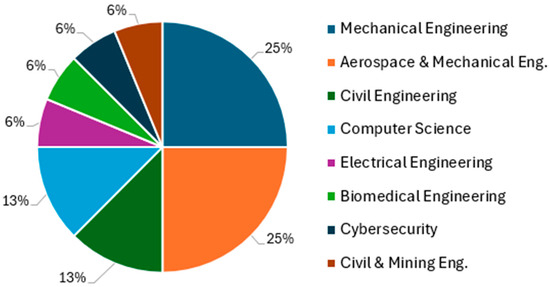
There were 17 students enrolled in ENGR 112, including 24% female, 35% underrepresented minorities, and 24% first-generation students. An official low-income student ratio is not available, but several received need-based AcES scholarships, indicating their financial status. Their intended engineering major choices are shown in Figure 2. Some students were enrolled in dual degree programs such as Mechanical and Aerospace Engineering (MAE) and Mining and Civil Engineering (MCE). Each team was multidisciplinary. This cohort of students is classified as Cohort Y1.
Figure 2.
Student academic major choices in ENGR 112.
To understand student perspectives on the effect of the multidisciplinary experience on their learning and its effect on their interests in engineering, a survey was created using the Qualtrics XM service and distributed using a scannable Quick Response code after the poster presentation (Poster Expo) which concluded the entire project. The survey items are summarized in Table 1. A consent form was provided at the beginning of the survey, and only consented responses were analyzed. Among all six ABET factors, global, cultural, social, and economic factors are usually more challenging to FYE students because those factors are considered “non- engineering fields” by students and usually need them to incorporate knowledge learned from their liberal arts and business courses. Therefore, we included one question (Q2) to probe student perspective of the effect of the multidisciplinary discussion experience on those non-engineering fields.
Table 1.
Summary of survey items (5-point Likert: 1 = Strongly disagree to 5 = Strongly agree; 3-point Likert: Increased interest, No change, or Decreased interest).
The study follows qualitative study methods to choose data sources [50]. Unlike the quantitative study approach with the primary purpose to explain or evaluate, the qualitative approach with the primary purpose to explore, describe, or explain [51] can document experiences from small or marginal groups that may be otherwise overlooked. Triangulation is used to improve the research quality of a qualitative study. Therefore, three data sources were used in this study for triangulation: (1) instructor’s observation and reflection along with the summarized direct assessment of student learning, (2) student post-project perspective survey responses (valid ones), and (3) ENGR 112 FYE student retention data at the end of the semester. Students’ performance and retention were compared with students enrolled in the same course in the previous year (classified as Cohort Y0).
2.4. Data Analysis
The results of the direct assessment of student learning were summarized and analyzed along with the observation and reflection from the instructor and Expo panel judges. Descriptive statistics were conducted for the Likert-scale items (ordinal data) from the post-project student perspective survey results and student retention data. Due to the small sample size and lack of control group, descriptive statistics and visual representation were used to describe the sample characteristics while inferential statistics were not applicable. To assess the survey’s internal reliability, Cronbach’s alpha (α) was calculated for the Likert-scale items. Qualitative analysis was used to analyze open-ended responses from the survey [50].
3. Results
3.1. Project Results (Direct Assessment of the Project)
Seventeen students formed four teams. All teams followed the entire five-step engineering design process. They researched topics such as truss structure, pulley system, oil drilling, environmental impacts, and more, which are related to petroleum and natural gas, civil and environmental engineering, and mechanical engineering as a first part (Step 1—Define) of the engineering design process. They brainstormed potential designs (Step 2—Imagine), ranked potential designs using a decision matrix (Step 3—Evaluate), created iterations of their models (Step 4—Create), and tested the final working model (Step 5—Test).
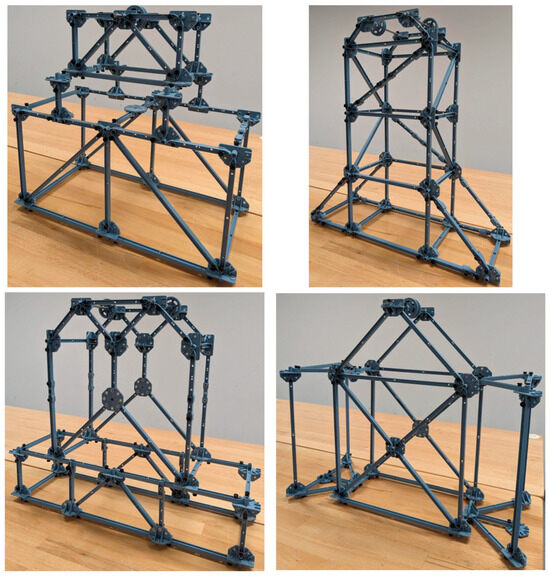
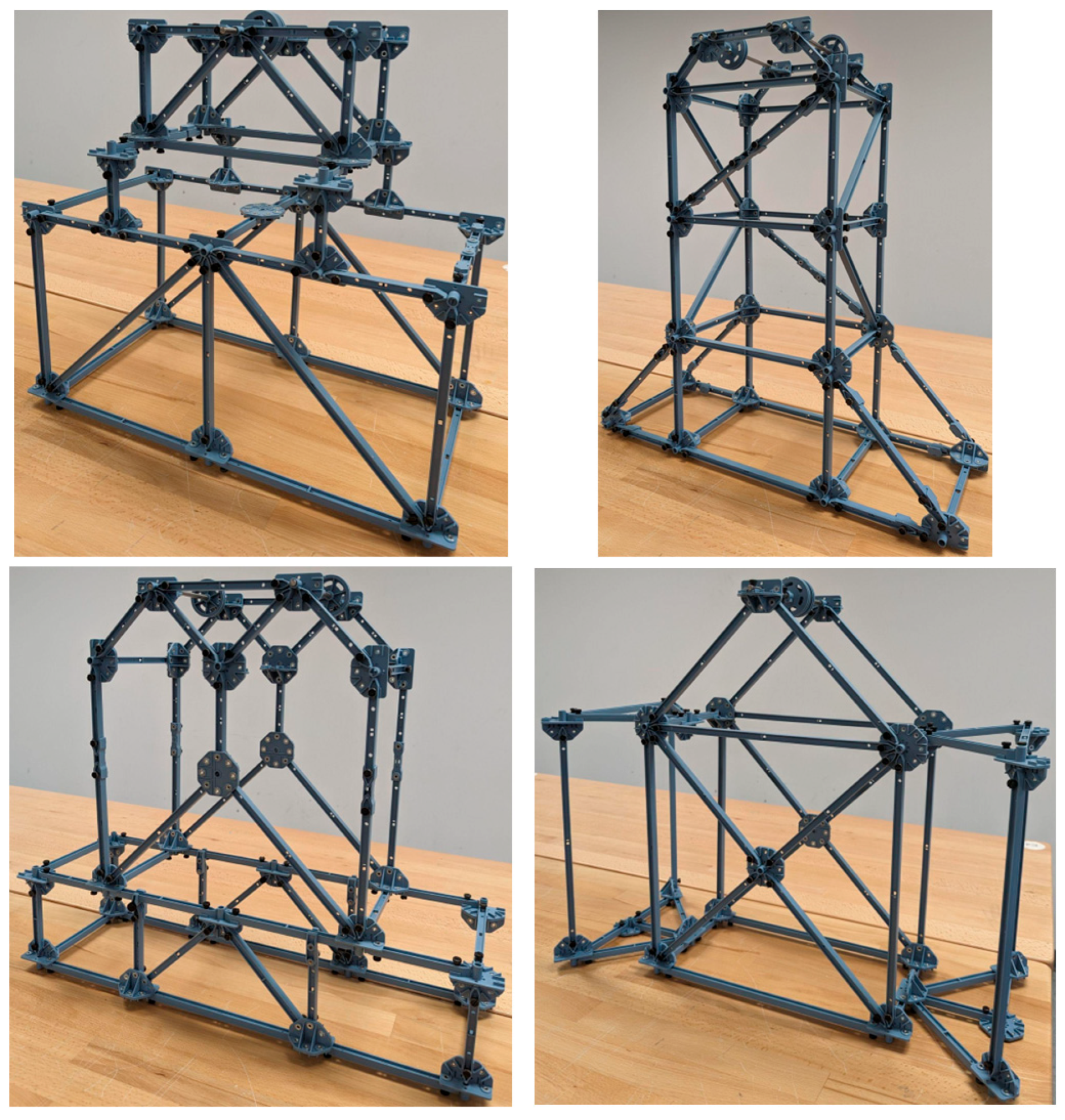
Each team successfully completed their models on time though Team 3 took significantly more iterations than other teams to make their model functional and meet all constraints. All final models met requirements on professional appearance, free-standing, stability/safety, and constraints on weight, dimensions, and weightlifting capability. Figure 3 shows the different final designs from each team. The successful completion rate of a final model meeting all design requirements (100%) is a huge improvement compared to Cohort Y0 when a single-discipline project pasta bridge was used and only one out of four teams completed a final model meeting all design requirements (25% successful completion rate).
Figure 3.
Different designs from different teams (top left to right: Team 1, 2; bottom left to right: Team 3, and 4) (adapted with permission from Ref. [40]. 2023, ASEE).
The qualtity of technical communication deliverables (reports and the poster presentation) improved compared to Cohort Y0. Students performed very well in the poster presentation (both poster design and elevator pitch). The instructor and FEP faculty who served as judges in both years witnessed the clear enhancement in the elevator pitch and engagement with the audience during the Poster Expo, confirming the benefits from elevator pitch practice that may help their preparation and confidence. One judge who was the instructor of the FEP engineering design course for calculus-ready students commented that the posters were more professional than many of his calculus-ready student teams’. Overall performance on the poster was better than on the reports, a common trend in FEP students. However, the report quality increased throughout the iteration from Report 1 (with the most struggles) to the Final Report (mostly rated Excellent). Allowing multiple iterations and feedback opportunities helped students to improve their report writing.
As to the consideration of ABET factors, student teams heavily incorporated safety, environmental, and economic factors in their design as shown in their model and technical communications. However, some teams also discussed their incorporation of global, social, and cultural factors in their technical report and the poster presentation.
3.2. Survey Results
All 17 enrolled students completed the survey, but only 16 consented to participate in this research (N = 16). Therefore, only 16 valid responses were used for the survey data analysis. One student was absent from the Poster Expo due to a personal reason, and thus did not answer the two questions related to the Poster Expo and muldidisciplinary judge panel during the Poster Expo. Two students did not attend and respond to the elevator pitch practice experience with WVU LaunchLab specialists.
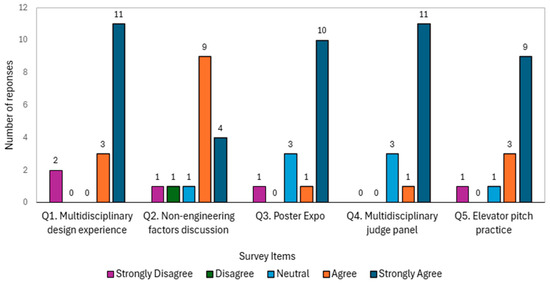
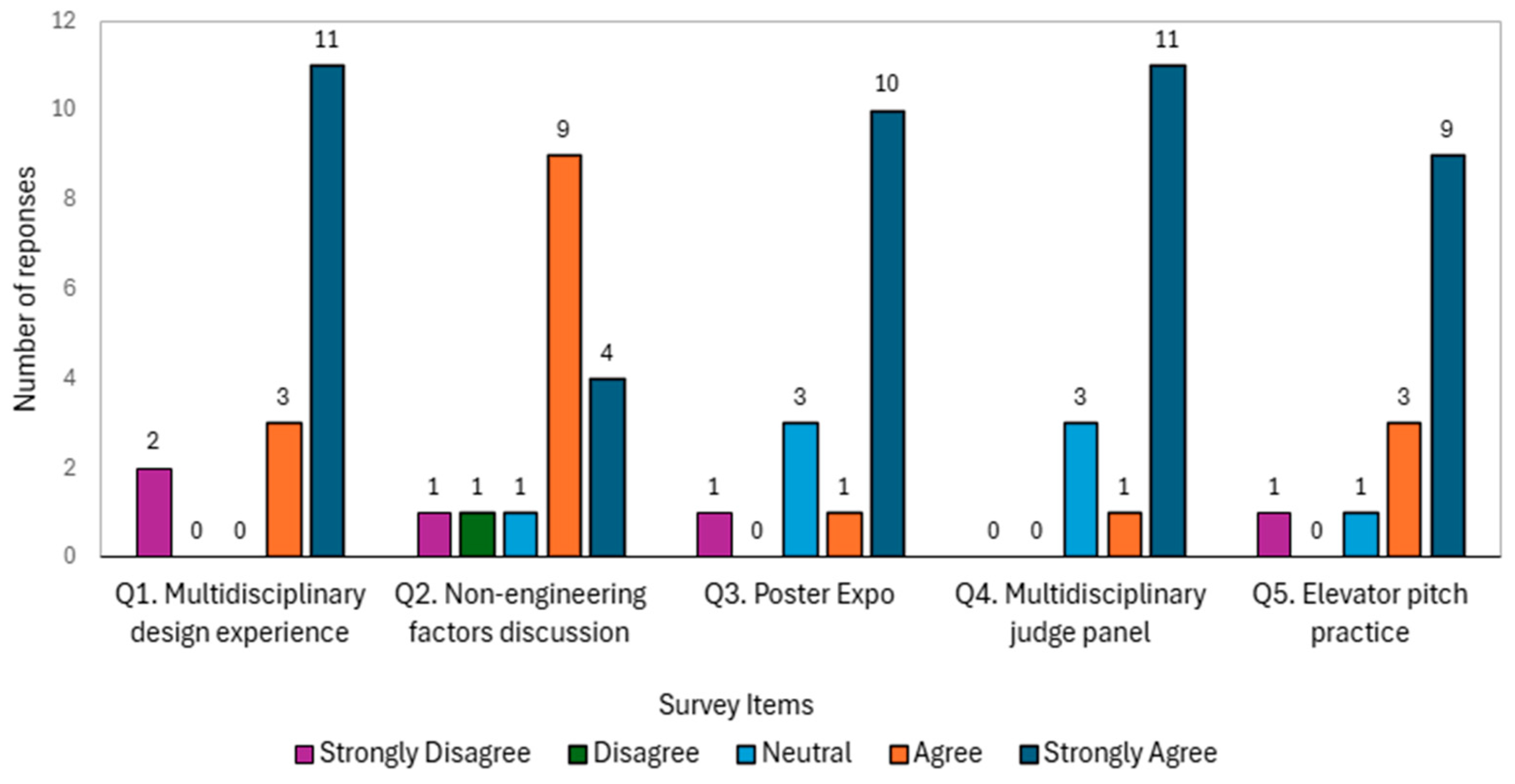
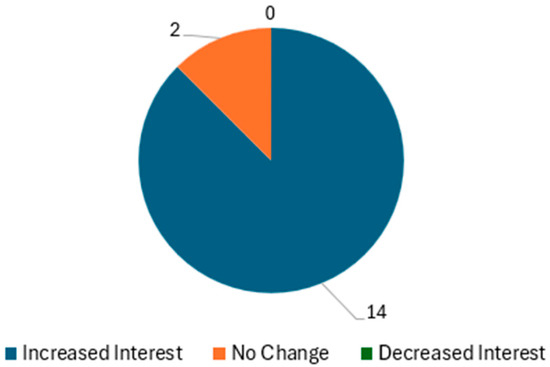
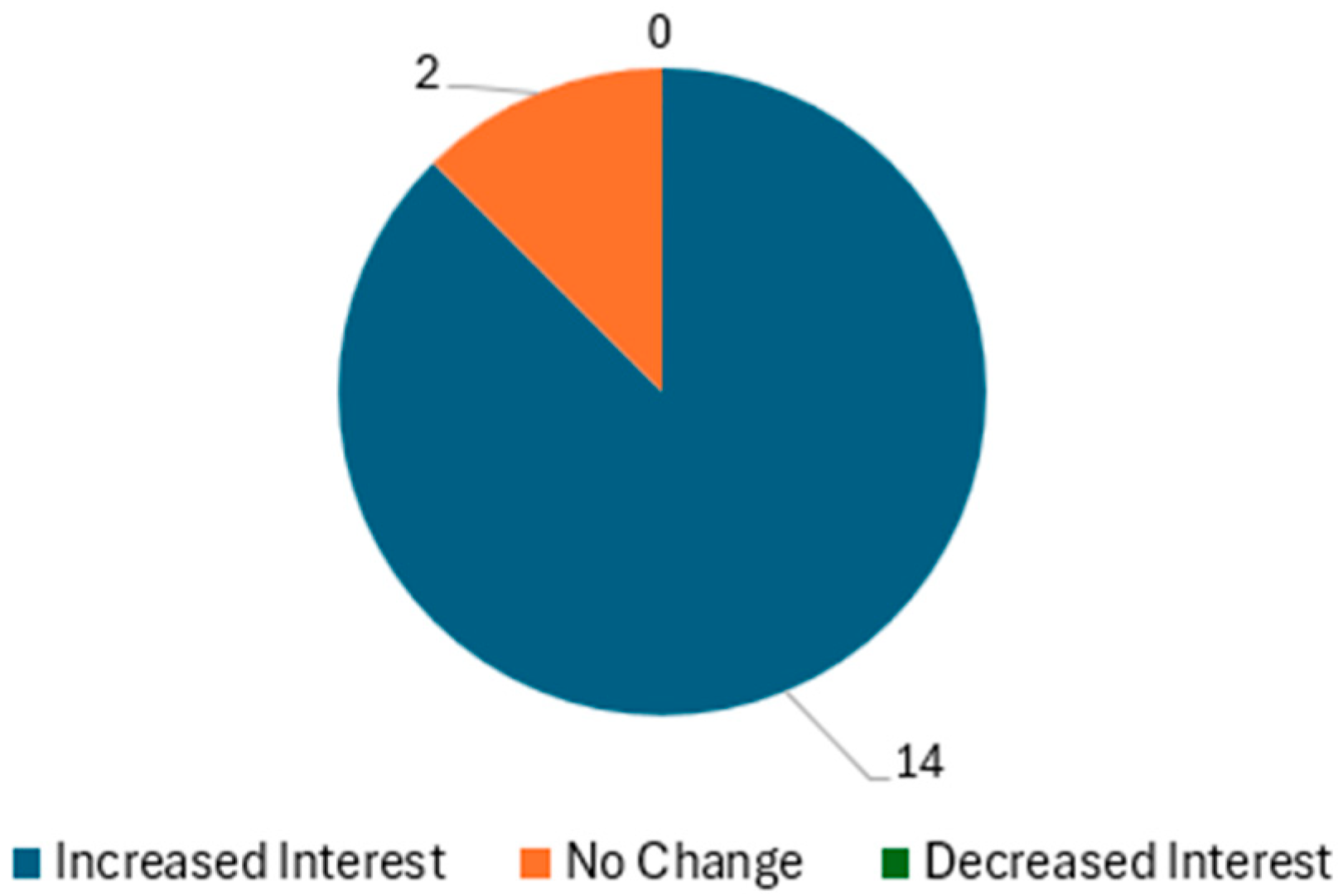
The survey showed excellent internal consistency, with a Cronbach’s alpha of 0.959. This indicates that the survey questions reliably measured the students’ unified positive perception for the learning experience. Table 2 shows a summary of the calculated descriptive statistics for each survey question. Figure 4 illustrates the students’ opinion of the effect of the multidisciplinary experience on their learning experience (frequency). Figure 5 illustrated the perceived effects of the multidisciplinary engineering project experience on their engineering interests.
Table 2.
Descriptive statistics for survey responses on multidisciplinary experience (Note: Cronbach’s Alpha (α) = 0.959 for the Likert-scale items).
Figure 4.
Student perception on the positive impact on learning from different aspects (design experience, ABET factor discussion, Poster Expo, judge panel, and elevator pitch practice) of multidisciplinary PBL.
Figure 5.
Effects of the multidisciplinary engineering project experience on engineering interests.
The open-ended survey responses on the usage of multidisciplinary PBL were summarized as follows.
- Work more on the project and explain the project in greater detail.
- I think a project with more variety would be beneficial. We were pretty limited on parts and potential designs.
- I really enjoyed the project.
- Let the individual focus on their discipline, not multiple.
- More individual activity.
- Incorporate more types of engineering.
- I thought it was a great project, and I cannot think of any specific improvements currently.
- Maybe give a “budget” and different prices to the pieces of the kit so that the team can gauge how much their design costs.
- Keep doing visits to departments.
3.3. Retention Data
The student retention rate in engineering of Cohort Y1 of ENGR 112 students by the end of the first semester was 94%. Only one student switched to a non-engineering major by the end of the semester. As a comparison, the student retention rate in engineering of the same course for Cohort Y0 was 58% (N = 17) where some students felt the course project was irrelevant to their majors and not attractive.
4. Discussion
4.1. Opportunities from the Multidisciplinary PBL
The major opportunity this multidisciplinary PBL can offer to the non-calculus-ready FYE students is a positive learning experience. Overall, it associated positive learning experience to students enrolled in ENGR112, evident by all three data sources: good project deliverable quality, positive student perception on the learning experience from the survey, and high student retention in engineering. For example, the survey results showed that 88% of students reported that the multidisciplinary design experience with multiple engineering fields is positive to their learning experience (Figure 4). Student project scores of Cohort Y1 were in the Excellent and Acceptable range, better than those of Cohort Y0. First, several teams in Cohort Y0 acknowledged they ignored some design constraints when working on their model because they forgot them or got frustrated with iterations, showing a lack of attention and engagement with their project. Cohort Y1 teams met all constraints probably due to better attention to instructions, more in-class discussions on the Evaluate step before model construction, better team collaborations, and more iterations with the help of PASCO kits, which were all possible signs of better engagement. Second, the technical reports and the poster presentation (both the poster and elevator pitch) were of better quality because (1) the report writing and poster design were broken into multiple revision cycles with feedback from the instructor and peer teams given before the final version was due, (2) in-class writing practice improved the report quality, and (3) the elevator pitch practice session helped students to prepare for the poster presentation. According to the student perception survey, 80% of students reported the multidisciplinary judge panel during the Poster Expo had a positive impact on their learning experience and 86% of students reported the elevator pitch practice with entrepreneurship specialists before the Expo was positive to their preparation to the Expo (Figure 4). Observations from the instructor and Post Expo judges also confirm enhanced learning outcomes.
The second opportunity is its support to the engineering interests and retention of non-calculus-ready FYE students. With multidisciplinary PBL, students from different majors can contribute to the design instead of feeling it irrelevant to their majors. The survey results showed that 88% of students reported the project increased their interest in engineering and none reported a decrease (Figure 5). Interest in engineering is associated with retention [2]. Although student retention in engineering was affected by many factors, the multidisciplinary PBL experience in ENGR 112 may have contributed to the student retention because for non-calculus-ready students in ENGR112, this course project usually was the only hands-on engineering-relevant experience for them during their first semester. Since maintaining and increasing students’ interest in engineering is important to student retention in FYE, implementing a project that is perceived to increase their engineering interest may help retain them in engineering. This study does not compare the retention rate between Cohort Y0 and Y1 to suggest the multidisciplinary design experience is the only reason for the change because many confounding factors exist such as cohort differences, personal reasons, experiences outside the course, etc. Instead, it triangulates the reported enhanced engineering interests, good student performance, and high retention data. Our finding aligns with studies that suggest increasing student interests in engineering as a potential ecthod to retain students [2].
The third opportunity is introducing multidiscplinary team collaborations and mindsets to students. Along with exposure to different engineering disciplines for engineering interests and non-engineering factors that are important as ABET outcomes, it was also important to draw students’ attention to multidisciplinary collaboration through this project. Oil derrick design, like many other engineering projects, requires knowledge and collaboration from many disciplines. It is important to seek out alternatives and synergistic approaches to incorporate societal and environmental responsibilities in future designs used in the oil and gas industry. This will need collaboration from PNGE, ME, CEE, and many other engineering disciplines. Challenging today’s FYE students to create sustainable, safe, and cost-efficient oil derricks is not only a way to introduce students to a task they may face in their future engineering careers, but also an opportunity for them to think about alternative solutions as future leaders. Therefore, it is necessary for multidisciplinary collaboration amongst engineering, business, local communities, and governments. Much engineering problem-solving needs a similar multidisciplinary approach.
4.2. Challenges During the Multidisciplinary PBL and Future Improvements
The major challenge is how to incorporate more disciplines into one project. This project applies knowledge from civil, environmental, mechanical, and petroleum and natural gas engineering during the design and the data analysis may attract attention from students in computer science. But students from other engineering majors may still feel less attracted. The open-ended survey responses and course feedback at the end of the semester both suggested to include more engineering disciplines in the future. An improved version with more detailed guidelines was developed which required students to incorporate topics from all seven departments: oil derrik design (PNGE), truss structure and pulley system (CEE and MAE), manufacturing process optimization and modeling in a design process (IE and CSEE), environmental impact and life-cycle stages including raw materials extraction from mining (CEE and MINE), and fossil fuel products and its non-fuel applications in industries such as healthcare, electricity, and manufacturing (PNGE and CBE). Cost analysis and environmental impact analysis are required. Both Excel and Matlab will be used for data analysis (calculation and visualization of forces experienced by chosen beams over time).
Another challenge is the consideration and discussion of social, global, cultural, and economic factors, which are viewed as “non-engineering” topics by many FYE students. Although 81% of students reported the multidisciplinary discussion on the those factors was positive to their learning experiences (Figure 4) and improvements in considering them in their design were observed compared to Cohort Y0, more interventions are needed to help students better approach those factors. Future improvement of engagement with the economic factor may be the easiest to implement by providing budget and cost information for a required cost analysis as suggested in the open-ended survey responses. To enhance consideration of social, global, and cultural factors, more practice examples and guided discussions are needed. The lead author has another project to develop an embodied carbon module guided by the EOP framework to teach systems thinking, social responsibility, and ethics in engineering courses. Applying it to this course as a practice example may help improve students’ consideration of social, global, and cultural factors in their design.
The third challenge is how to balance project time spent between professional skills and technical skills as well as balance between teamwork and individual activities. FEP students tended to value the time spent on the professional skills such as technical communication less, particularly writing, even though they recoganized their importance later in their academic journey [52,53,54]. Even though the course name is “Professional Development in Engineering”, students still showed more excitement during hands-on project time than writing. Few students were interested in a single disciplinary project or individual work as shown in the open-ended survey responses. How to motivate them through multidisciplinary PBL should be addressed in future improvements. Adding competition elements to the project model score may encourage teamwork and professional skill development.
4.3. Mapping the Multidisciplinary PBL to ABET SOs and EOP Framework
ABET criterion 3 student outcomes include the ability to apply engineering design to produce solutions that meet specified needs with consideration of public health, safety, and welfare, as well as global, cultural, social, environmental, and economic factors (SO2), communicate effectively with a range of audiences (SO3), and function effectively on a team whose members together provide leadership, create a collaborative environment, establish goals, plan tasks, and meet objectives (SO5) [41]. In the multidisciplinary PBL for the oil derrick design, these three ABET SOs were addressed by the project deliverables and design process. For ABET SO2 alignment, students are expected to consider public health, safety, and welfare, as well as global, cultural, social, environmental, and economic factors. After considering those factors, student teams heavily incorporated safety, environmental, and economic factors into their design solutions, while some teams also incorporated global, social, or cultural factors. ABET SO3 alignment was provided through the use of technical written reports with subsequent revisions and a poster presentation to demonstrate their design solutions to a judge panel with multidisciplinary experts, representing a wide range of audiences. ABET SO5 was covered by the team approach throughout the project with peer evaluations and instructor observation.
The EOP framework identified 92 key sustainability-focused learning outcomes necessary for all graduating engineers in 9 topics within 3 categories, including identifying that “Engineers shall be aware that their designs live within and impact environmental and social systems” [42]. The oil derrick project can be mapped to two of the EOP framework topics, which were “systems thinking” and “communication and teamwork”. The students addressed how the oil derrick’s design functions within broader environmental, economic, and social sustainability contexts, which is related to the EOP’s core “systems thinking”. Students were informed about the environmental effects of oil drilling, the economic considerations of design choices, and the societal implications of energy infrastructure. Survey results showed that 81% of the students said the multidisciplinary discussion on social, global, cultural, and economic factors positively contributed to their learning experience. The multidisciplinary judge panel and elevator pitch practice developed the students’ ability to communicate technical concepts to diverse audiences. Additionally, this multidisciplinary project was completed in a team setting. Both align with the EOP “communication and teamwork” topic.
5. Conclusions
The multidisciplinary PBL developed and implemented in ENGR 112 successfully provided a positive learning experience to non-calculus-ready FYE students enrolled in the course. Perceived increased interest in engineering in the survey (N = 16), good student performance throughout the project, and high retention by the end of the semester were observed. Most students reported that multidisciplinary PBL was positive to their learning experience, and 88% of students reported the project increased their interest in engineering. The student retention rate in engineering by the end of the semester was 94% (N = 17). This study showed possible benefits, potential challenges, and alignment with ABET SOs and the EOP framework of using multidisciplinary PBL for non-calculus-ready FYE students in engineering, which can be modeled by other programs and courses. This study only observed the association among reported positive learning experiences, perceived engineering interests, and retention. A larger sample size controlling confounding factors is needed if any future study intends to explore the causation among them. A longitudinal study is also suggested for future work.
Author Contributions
Conceptualization, X.Z. and J.G.R.; methodology, X.Z., J.G.R. and A.P.; validation, X.Z. and J.G.R.; formal analysis, E.E.; investigation, X.Z.; resources, X.Z.; data curation, J.G.R.; writing—original draft preparation, X.Z. and E.E.; writing—review and editing, X.Z., J.G.R., E.E. and A.P.; visualization, E.E.; supervision, X.Z.; project administration, X.Z. All authors have read and agreed to the published version of the manuscript.
Funding
This research received no external funding.
Institutional Review Board Statement
The study was conducted in accordance with the Declaration of Helsinki and approved by the Institutional Review Board of West Virginia University (2211673473, 11 September 2022).
Informed Consent Statement
Informed consent was obtained from all subjects involved in the study.
Data Availability Statement
The original contributions presented in this study are included in the article. Further inquiries can be directed to the corresponding author.
Conflicts of Interest
The authors declare no conflicts of interest.
Abbreviation
The following abbreviation are used in this manuscript:
| ABET | Accreditation Board for Engineering and Technology |
References
- Santiago, L.; Abioye, O.L. Teaching Electronics to First-year Engineering Students. In Proceedings of the 2015 ASEE Annual Conference & Exposition, Seattle, WA, USA, 14–17 June 2015; pp. 26.1473.1–26.1473.9. [Google Scholar]
- Lizzie, Y.S.; Robin, A.M.H.E.D. Engineering Attrition and University Retention. In Proceedings of the 2012 ASEE Annual Conference & Exposition, San Antonio, TX, USA, 10–13 June 2012. [Google Scholar]
- Green, S.; Jacquez, R.B.; Auzenne, M.; Burnham, C. Building a Foundation for pre Calculus Engineering Freshman Through an Integrated Learning Community. In Proceedings of the 2005 ASEE Annual Conference & Exposition; ASEE Conferences: Portland, OR, USA, 2005. [Google Scholar]
- Pirkey, A.; Santiago, L. Understanding the Educational Path of Non-Calculus-Ready Students in Engineering. In Proceedings of the 2021 ASEE Annual Conference & Exposition, Virtual Online, 26–29 July 2021. [Google Scholar]
- Ryan, O.; Sajadi, S.; Barrera, S.; Jaghargh, R.T. Understanding the Effects of a Math Placement Exam on Calculus 1 Enrollment and Engineering Persistence. Educ. Sci. 2025, 15, 154. [Google Scholar] [CrossRef] [Scilit]
- Hensel, R.; Sigler, J.R.; Lowery, A. Breaking the Cycle of Calculus Failure: Models of Early Math Intervention to Enhance Engineering Retention. In Proceedings of the 2008 ASEE Annual Conference & Exposition, Pittsburgh, PA, USA, 22–25 June 2008. [Google Scholar]
- Nathan, K. Rethinking Engineering Mathematics Education: A Model for Increased Retention, Motivation, and Success in Engineering. In Proceedings of the 2004 ASEE Annual Conference & Exposition, Salt Lake City, UT, USA, 20–23 June 2004. [Google Scholar]
- Kolb, A.; Kolb, D. Experiential Learning Theory: A Dynamic, Holistic Approach to Management Learning, Education and Development. In Handbook of Management Learning, Education and Development; Armstrong, S.J., Fukami, C., Eds.; SAGE Publications Ltd.: Los Angeles, CA, USA, 2009; pp. 42–68. [Google Scholar]
- Kolb, A.; Kolb, D. Learning Styles and Learning Spaces: Enhancing Experiential Learning in Higher Education. Acad. Manag. Learn. Educ. 2005, 4, 193–212. [Google Scholar] [CrossRef] [Scilit]
- McCarthy, M. Experiential Learning Theory: From Theory to Practice. J. Bus. Econ. Res. 2016, 14, 91–99. [Google Scholar] [CrossRef] [Scilit]
- Lavado-Anguera, S.; Velasco-Quintana, P.-J.; Terrón-López, M.-J. Project-Based Learning (PBL) as an Experiential Pedagogical Methodology in Engineering Education: A Review of the Literature. Educ. Sci. 2024, 14, 617. [Google Scholar] [CrossRef] [Scilit]
- Montés, N.; Aloy, P.; Ferrer, T.; Romero, P.D.; Barquero, S.; Carbonell, A.M. EXPLORIA, STEAM Education at University Level as a New Way to Teach Engineering Mechanics in an Integrated Learning Process. Appl. Sci. 2022, 12, 5105. [Google Scholar] [CrossRef] [Scilit]
- Tsutsumi, H. Community-Integrated Project-Based Learning for Interdisciplinary Engineering Education: A Mechatronics Case Study of a Rideable 5-Inch Gauge Railway. Educ. Sci. 2025, 15, 806. [Google Scholar] [CrossRef] [Scilit]
- Narong, D.; Hallinger, P. The evolution of service learning in engineering education: A bibliometric review of research (1995–2023). Eur. J. Eng. Educ. 2024, 49, 834–855. [Google Scholar] [CrossRef] [Scilit]
- Wilkerson, S.; Gadsden, S.A. Project Based Capstone Design Projects Amidst COVID-19 Restrictions. In Proceedings of the 2021 ASEE Annual Conference & Exposition, Virtual Conference, 26–29 July 2021. [Google Scholar]
- Emine Celik, F. Project-Based Learning (PBL) in the First-Year Engineering Design Class. In Proceedings of the 2021 ASEE Annual Conference & Exposition, Virtual Conference, 26–29 July 2021. [Google Scholar]
- Song, Y. Integrating a Design Project to Bridge Experiment for Statics learning in General Engineering Education. In Proceedings of the 2024 ASEE Annual Conference & Exposition, Portland, OR, USA, 23–26 June 2024. [Google Scholar]
- Demetris, G.; Brian, A.; Herman, W.C., Jr. Work in Progress: Project and Design-Based Introductory Engineering Course using Arduino Kits. In Proceedings of the 2020 ASEE Annual Conference & Exposition, Virtual Online, 22–26 June 2020. [Google Scholar]
- Calvo, I.; Cabanes, I.; Quesada, J.; Barambones, O. A Multidisciplinary PBL Approach for Teaching Industrial Informatics and Robotics in Engineering. IEEE Trans. Educ. 2018, 61, 21–28. [Google Scholar] [CrossRef] [Scilit]
- Krupczak, J., Jr.; Polasek, K.H. Hands-On Design Activities for Introduction to Engineering Courses to Accommodate Students of Varying Backgrounds. In Proceedings of the 2022 ASEE Annual Conference & Exposition, East Lansing, MI, USA, 26–29 June 2022. [Google Scholar]
- Dhanasekaran, P.S. The Role of Project-based learning in first year engineering. In Proceedings of the 2023 Fall Mid Atlantic Conference: Meeting Our Students Where They Are and Getting Them Where They Need to Be, Ewing, NJ, USA, 27 October 2023. [Google Scholar]
- Leung, J.K.L.; Chu, S.K.W.; Pong, T.-C.; Ng, D.T.K.; Qiao, S. Developing a Framework for Blended Design-Based Learning in a First-Year Multidisciplinary Design Course. IEEE Trans. Educ. 2022, 65, 210–219. [Google Scholar] [CrossRef] [Scilit]
- McCormick, M.; Parham-Mocello, J.; Heer, D. Improving Multidisciplinary Understanding Through Interdisciplinary Project-based Learning in a First-Year Orientation Course. In Proceedings of the 2020 IEEE Frontiers in Education Conference (FIE), Uppsala, Sweden, 21–24 October 2020; pp. 1–9. [Google Scholar]
- Denton, H.G. Multidisciplinary team-based project work: Planning factors. Des. Stud. 1997, 18, 155–170. [Google Scholar] [CrossRef] [Scilit]
- vanPutten, J.; Mulder, B.; Krupczak, J. Multidisciplinary Student Experiences in a Liberal Arts Engineering Program. In Proceedings of the 1997 ASEE Annual Conference & Exposition, Milwaukee, WI, USA, 15–18 June 1997; pp. 2.298.1–2.298.7. [Google Scholar]
- Cárdenas, C. A multidisciplinary approach to teach the design of socially relevant computing systems for social change. Int. J. Eng. Educ. 2011, 27, 3. [Google Scholar]
- Say, B.; Erden, Z.; Turhan, C. A Team-oriented Course Development Experience in Distance Education for Multidisciplinary Engineering Design. Comput. Appl. Eng. Educ. 2022, 30, 1617–1640. [Google Scholar] [CrossRef] [Scilit]
- Mazzaro, G.J.; Skenes, K.; Wood, T.A. A Review of Multi-Disciplinary Introduction-to-Engineering Courses and Unified First-Year Engineering Programs. In Proceedings of the 2023 ASEE Southeast Section Conference, American Society for Engineering Education, Arlington, VA, USA, 12–14 March 2023. [Google Scholar]
- Marino, R.; Cross, M.; Feinauer, D.; McCusker, J.; Casale, J. Including Multi-Disciplinary Project Awareness in First Year Introduction to Engineering Courses. In Proceedings of the 2021 ASEE Annual Conference & Exposition, Virtual Online, 26–29 July 2021. [Google Scholar]
- Basri, I.Y.; Giatman, M.; Muskhir, M.; Effendi, H.; Ambiyar, A.; Elfina, E.; Yuliardi, T.P. Improving the Quality of Learning Through Project Based Learning (PjBL) With the STEAM Approach in CAD Courses in the Department of Automotive Engineering Universitas Negeri Padang. Invotek J. Inov. Vokasional Dan Teknol. 2023, 23, 1–10. [Google Scholar] [CrossRef] [Scilit]
- Tiwari, B.; Nair, P.; Barua, S. Effectiveness of Freshman Level Multi-disciplinary Hands-on Projects in Increasing Student Retention Rate and Reducing Graduation Time for Engineering Students in a Public Comprehensive University. In Proceedings of the 2018 ASEE Annual Conference & Exposition, Salt Lake City, UT, USA, 24–27 June 2018. [Google Scholar]
- Ochs, J.B.; Watkins, T.A.; Boothe, B.W. Creating a Truly Multidisciplinary Entrepreneurial Educational Environment*. J. Eng. Educ. 2001, 90, 577–583. [Google Scholar] [CrossRef] [Scilit]
- Roy, N.; Schlosser, F.; Pasek, Z. Stimulating Entrepreneurial Interest in Engineers Through an Experiential and Multidisciplinary Course Collaboration. Entrep. Educ. Pedagog. 2019, 3, 14–40. [Google Scholar] [CrossRef] [Scilit]
- Zhang, X.; Santiago, L.; Hines, S.P. WIP: Effectiveness of Recruitment Strategies for Underrepresented Groups in an Engineering Bridge Program. In Proceedings of the 2022 First-Year Engineering Experience, East Lansing, MI, USA, 26–29 June 2022. [Google Scholar]
- Zhang, X.; Wang, L.; Michaluk, L.; Hensel, R.A.M.; Perez, I.; Hammond, C.S.; Bush, I.; Cao, R.G. WIP: Investigation of Recruitment Communication Channels and Student Awareness of an Engineering Bridge Program via Cross-Disciplinary Collaboration. In Proceedings of the 2023 First-Year Engineering Experience, Knoxville, TN, USA, 30 July–1 August 2023. [Google Scholar]
- Hensel, R.A.M.; Zhang, X. Institutionalization Challenges for an NSF S-STEM Program. In Proceedings of the 2024 ASEE Annual Conference & Exposition, Portland, OR, USA, 23–26 June 2024. [Google Scholar]
- Zhang, X.; Michaluk, L.; Harris, N.D.; Shamblin, A.L. BOARD # 430: Progress of an NSF BCSER Grant: Effective Strategies to Recruit Underserved Students to Engineering Bridge and Success Programs. In Proceedings of the 2025 ASEE Annual Conference & Exposition, Montreal, QC, Canada, 22–25 June 2025. [Google Scholar]
- Zhang, X.; Michaluk, L.; Harris, N.D.; Shamblin, A.L. WIP: Investigate recruitment strategies used by engineering bridge and success programs to recruit underserved students. In Proceedings of the 2025 Collaborative Network for Engineering & Computing Diversity (CoNECD), San Antonio, TX, USA, 9–11 February 2025. [Google Scholar]
- Zhang, X.; DiBacco, R.; Kmetz, J.; May, J. Development and Implementation of Escape Rooms for an Engineering Summer Bridge Program. In Proceedings of the 2025 IL-IN Section Conference, Terre Haute, IN, USA, 12 April 2025; pp. 1–18. [Google Scholar]
- Zhang, X.; Roberts, J.G.; Parrish, A. Using a multidisciplinary engineering project in a first-year engineering course for educationally disadvantaged students. In Proceedings of the 2023 ASEE North Central Section Conference, Morgantown, WV, USA, 24–25 March 2023. [Google Scholar]
- ABET Engineering Accreditation Commission. Criteria for Accrediting Engineering Programs; ABET: Baltimore, MD, USA, 2025. [Google Scholar]
- Foundation, L. The Engineering for One Planet Framework: Essential Sustainability-Focused Learning Outcomes for Engineering Education; The Lemelson Foundation: Portland, OR, USA, 2022. [Google Scholar]
- Garibay, J.C.; Vincent, S. Racially Inclusive Climates Within Degree Programs and Increasing Student of Color Enrollment: An Examination of Environmental/Sustainability Programs. J. Divers. High. Educ. 2018, 11, 201–220. [Google Scholar] [CrossRef] [Scilit]
- Harold, B.; Sam, H.S. Petroleum and Natural Gas. In The Mining Industries, 1899–1939: A Study of Output, Employment, and Productivity; National Bureau of Economic Research, Inc.: New York, NY, USA, 1944; pp. 188–208. [Google Scholar]
- Arscott, L. Sustainable Development in the Oil and Gas Industry. J. Energy Resour. Technol. 2004, 126, 1–5. [Google Scholar] [CrossRef] [Scilit]
- Mojarad, A.A.S.; Atashbari, V.; Tantau, A. Challenges for sustainable development strategies in oil and gas industries. Proc. Int. Conf. Bus. Excell. 2018, 12, 626–638. [Google Scholar] [CrossRef] [Scilit]
- Gold, T. The origin of natural gas and petroleum, and the prognosis for future supplies. Annu. Rev. Energy 1985, 10, 53–77. [Google Scholar] [CrossRef]
- Oakes, W.; House, R. Fundamental Engineering Problem Solving; West Virginia University Custom Edition; Oakes, W., House, R., Eds.; Oxford University Press: Oxford, UK, 2017. [Google Scholar]
- Šprljan, P.; Pavković, D.; Klaić, M.; Staroveški, T.; Cipek, M. Laboratory prototyping of control system retrofitting designs for oil drilling applications. In Proceedings of the 10 th International Scientific Conference on Management of Technology-Step to Sustainable Production (MOTSP 2018), Primošten, Croatia, 6–8 June 2018. [Google Scholar]
- Creswell, J.W.; Creswell, J.D. Research Design: Qualitative, Quantitative, and Mixed Methods Approaches, 5th ed.; Sage Publications, Inc.: Los Angeles, CA, USA, 2018. [Google Scholar]
- Leavy, P. Research Design: Quantitative, Qualitative, Mixed Methods, Arts-Based, and Community-Based Participatory Research Approaches; Guilford Publications: New York, NY, USA, 2022. [Google Scholar]
- Almasri, A.; Hamrick, T.R.; Hulcher, C.; Oppong-Anane, A.B.; Zhang, X.; Santiago, L. Student Perspectives on Skills Required in Engineering and Computing Sciences Courses. In Proceedings of the 2024 ASEE Annual Conference & Exposition, Portland, OR, USA, 23–26 June 2024. [Google Scholar]
- Atheer, A.; Akua, B.O.-A.; Carter, H.; Todd, R.H.; Xinyu, Z.; Lizzie, S. Full Paper: The Professional and Technical skills that engineering students find most important for success in their major. In Proceedings of the 15th Annual First-Year Engineering Experience Conference (FYEE), Boston, MA, USA, 28–30 July 2024. [Google Scholar]
- Carter, H.; Akua, B.O.-A.; Xinyu, Z.; Lizzie, S.; Todd, R.H.; Atheer, A. Full Paper: Gender and First-Generation Status Impacts on the Perceived Importance of Technical and Non-Technical Skills for Upper-Level Undergraduate Engineering and Computer Science Courses. In Proceedings of the 15th Annual First-Year Engineering Experience Conference (FYEE), Boston, MA, USA, 28–30 July 2024. [Google Scholar]

Disclaimer/Publisher’s Note: The statements, opinions and data contained in all publications are solely those of the individual author(s) and contributor(s) and not of MDPI and/or the editor(s). MDPI and/or the editor(s) disclaim responsibility for any injury to people or property resulting from any ideas, methods, instructions or products referred to in the content. |
© 2026 by the authors. Licensee MDPI, Basel, Switzerland. This article is an open access article distributed under the terms and conditions of the Creative Commons Attribution (CC BY) license.