


Abstract
Deep neural networks suffer performance drops when source and target domains differ in distribution, motivating research into domain adaptation (DA). Traditional DA approaches presume source samples come from a single domain and can be available during adaptation. Nevertheless, in real-world applications, multiple source domains often exist, and source samples may be inaccessible owing to privacy and storage limitations. In response to the challenges of multi-source and source-free, multi-source-free domain adaptation (MSFDA) is proposed, which captures transferable information from a set of pre-trained source models to boost performance of the model on target domain. Most MSFDA methods meet these challenges by utilizing pseudo-labeling. However, pseudo-labels generated by distinct source models may contain noise and even be contradictory, which weakens their efficacy in facilitating source models adapting to the target domain. Moreover, these methods do not consider class imbalance, which would lead to biased predictions for minority classes, and undermine adaptation. Therefore, we propose a novel MSFDA method which extends adversarial learning to a multi-source-free setting. This method presents proxy multi-source domain adversarial learning, which aligns target features extracted by different source models in an adversarial manner, enhancing the capability of source models to extract domain-invariant features and potentially obtain high-quality pseudo-labels. Moreover, a nuclear-norm maximization regularization is employed to constrain prediction matrices, which can reduce the prediction uncertainty and enhance the discriminability of the model, while mitigating the prediction bias and promoting the prediction accuracy for minority classes. Finally, comprehensive evaluations on four benchmark datasets prove the validity of the proposed method.
1. Introduction
Deep learning algorithms have achieved great success on various computer vision tasks [1]. However, their remarkable performance heavily relies on the assumption that the training and test data are subjected to an identical distribution. This assumption does not always hold in practical scenarios, as the training and test samples may come from different conditions, which inevitably leads to model performance degradation [2]. A commonly used technology to address this problem is unsupervised domain adaptation (UDA), which generalizes transferable knowledge from one labeled source domain to an unlabeled target domain with different distributions.
UDA has received considerable research interest in computer vision, with methods being used for tasks including but not limited to image classification [3,4], object detection [5,6], and semantic segmentation [7,8]. The existing UDA approaches are particularly suitable for scenarios in which the source domain samples are available. However, due to reasons such as privacy protection, data storage limitations, and computational burden, source domain samples are often inaccessible in practice, which has become an urgent issue [9]. For instance, medical images often relate to patient privacy and thus cannot be released to the general public. To address this, source-free domain adaptation (SFDA) is proposed, whose main goal is to accomplish knowledge adaptation to the unlabeled target domain with only the pre-trained source model [10]. While SFDA has achieved significant progress, it remains limited by its inability to leverage knowledge from other source models during adaptive training.
In fact, there is usually more than one model pre-trained on different source domains in real scenarios. Moreover, there have been studies which indicate that the performance of the target model can be improved by utilizing information from multiple source domains with appropriate weights [11,12]. Therefore, multi-source-free domain adaptation (MSFDA) is investigated, which aims to transfer knowledge from multiple source domains to an unlabeled target domain without requiring access to source samples [13,14,15]. It should be noted that while leveraging multi-source models can obtain complementary knowledge, it simultaneously brings about substantial domain shift, which not only occurs between each individual source domain and the target domain, but also among different source domains. Therefore, the key to MSFDA research lies in effectively exploring transferable knowledge from multiple source domains to assist target prediction with pre-trained source models but without source samples during training.
Most of the existing MSFDA methods achieve this goal by evaluating the importance of each source model. As an illustration, Ahmed et al. [16] introduced a self-training method that leverages pseudo-labeling and mutual information maximization to adapt each source model to the target domain. Subsequently, they integrated multiple source models using learnable weights to obtain the ultimate prediction. Dong et al. [17] devised a source-specific transferable perception component to assess the relative contributions of different source domains, and developed a pseudo-label generator driven by confident anchors to generate pseudo-labels for the target domain. Han et al. [18] proposed a discriminability and transferability estimation (DATE)-based Bayesian framework to determine the importances of source models. The success of these methods usually depends on pseudo-labels. Nevertheless, owing to variations in data distributions, the pseudo-labels produced by distinct source models are often contaminated by noise. When noisy labels are employed during training, they become prone to causing error propagation, which in turn exerts a detrimental impact on the performance of the model. In addition, existing MSFDA methods rarely take the class imbalance issue into consideration, which could lead to biased predictions where samples from minority classes exhibit a propensity to be misclassified into majority classes.
In this paper, we propose a two-stage MSFDA framework named PDAL, which employs proxy domain adversarial training and nuclear-norm maximization regularization, to enhance the fidelity of pseudo-labels and prediction performance for minority classes. Specifically, we introduce adversarial training on target features extracted from different source models and present a proxy multi-source domain adversarial learning strategy in the first stage. This strategy can enhance the capability of the model to extract domain-invariant features, which facilitates the quality of pseudo-labels in the second stage. Inspired by the success of nuclear-norm regularization [19], we impose a nuclear-norm maximization constraint on each source model in the first stage, with an effort to optimize the rank and F-norm of the prediction matrices, hence improving the discriminability of feature representations. Moreover, this constraint is also imposed on the weighted aggregation of prediction matrices during the second stage, which can increase the attention of the model to minority classes, and thereby mitigate prediction bias. Finally, the superiority of the proposed PDAL over state-of-the-art approaches is demonstrated through comprehensive experiments on multiple cross-domain image recognition tasks.
The main contributions of this paper are highlighted as follows:
- A proxy multi-source domain adversarial learning strategy is proposed for the first-stage training, which enhances the ability of the model to extract domain-invariant feature representations and helps to obtain more reliable pseudo-labels.
- The nuclear-norm maximization constraint is applied in both the first and second stages, which improves the discriminability of feature representations extracted by source models and mitigate prediction bias for minority classes.
- The extensive experimental results on four widely-used domain adaptation benchmark datasets validate the effectiveness of the proposed method in comparison to state-of-the-art methods.
The remainder of this paper is organized as follows. Section 2 provides a systematic review of domain adaptation, summarizing studies on multi-source, source-free, and multi-source-free paradigms. Section 3 elaborates on the proposed method, including architectural design, implementation considerations, and algorithmic workflow. Section 4 conducts comparative experiments on benchmark datasets, followed by thorough analyses of the results. Section 5 concludes this study, outlining limitations and future work.
2. Related Work
2.1. Multi-Source Domain Adaptation
Multi-source domain adaptation (MSDA) is intended to explore transferable knowledge from multiple source domains to assist target prediction by alleviating domain discrepancies between domains [20,21]. In existing research, MSDA methods achieve this typically through three different learning strategies, including intermediate domain generation, latent space transformation, and task classifier refinement [22]. Intermediate domain generation attempts to construct an adaptive domain that is closely approximate to the target domain for each source domain. A representative example of this type of method is DVCP [23], which creates trainable text prompts incorporating domain-level visual information by mapping global visual data into the textual prompt embedding space. Latent space transformation seeks to diminish domain discrepancies by optimizing discrepancy losses within latent feature spaces. For instance, Zhao et al. [24] reduced the empirical Wasserstein distance to project the target domain separately into the feature space of each source domain. Liu et al. [25] minimized weighted hybrid maximum mean discrepancy (WHMMD) for more precise feature alignment. Task classifier refinement aims to bridge the persistent classification differences after feature alignment, which are typically caused by class imbalance and domain boundaries. The commonly used techniques include decision boundary refinement [26] and pseudo-label training [27].
2.2. Source-Free Domain Adaptation
Source-free domain adaptation (SFDA) adapts the pre-trained source model to an unlabeled target domain when source samples are unavailable [28,29]. Current research on SFDA can be broadly classified into two categories, i.e., data generation approaches and model fine-tuning approaches [30]. The former attempts to directly generate source-like images by batch normalization statistics [31,32] or generative networks [33,34] and apply traditional domain adaptation methods to achieve source knowledge transfer. The latter utilizes target samples to fine-tune the source model with self-supervised methods. For example, Li et al. [35] applied orthogonal decomposition to the target features and refined decision boundaries by exploiting the similarity between samples. Sun et al. [36] applied adversarial training on penultimate activations to boost the confidence of the target prediction. Several methods [37,38] also progressively refine pseudo-label assignments for unlabeled target instances.
2.3. Multi-Source-Free Domain Adaptation
Multi-source-free domain adaptation (MSFDA) is proposed for simultaneously tackling the challenges of multi-source and source-free. By extracting complementary knowledge from multiple pre-trained source models, it enhances adaptation performance. To date, however, only a small amount of research has been undertaken on situations where more than one source domain is unavailable. Ahmed et al. [16] first explored the MSFDA problem, and proposed an algorithm for computing multiple model combination weights. Han et al. [18] analyzed the source importance from the Bayesian perspective and evaluated source domain weights by quantifying discriminability and transferability. Feng et al. [39] determined domain weights using statistical information derived from the source domains. Shen et al. [40] analyzed the generalization error of MSFDA problems through information-theoretic approaches and revealed inherent trade-offs between bias and variance. Li et al. [41] proposed an agile framework, which balances the instance specificity and domain consistency by performing partial model combination to learn intra-domain and inter-domain ensemble weights. Cai et al. [42] dynamically fused source knowledge using an uncertainty-aware weighting mechanism and refined pseudo-labels via confidence-driven strategies.
3. Methods
3.1. Problem Definition
As mentioned earlier, MSFDA aims to adapt multiple pre-trained source models to the target domain without accessing source data during adaptation. Suppose that there are m pre-trained source models that are obtained from m different source domains, where denotes the j-th source model. Each source model consists of a feature extraction network and a classification network , where represents the sample space, represents the feature space, and represents the label space. The goal of this paper is to learn a classification model for a new unlabeled target domain , and consequently obtain the target prediction with satisfactory performance.
3.2. Proposed Framework
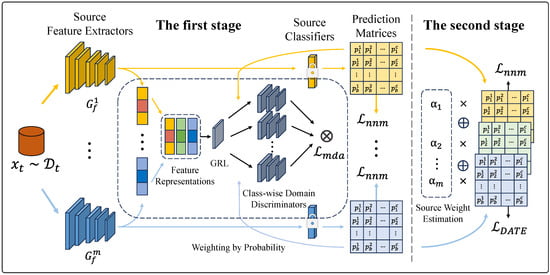
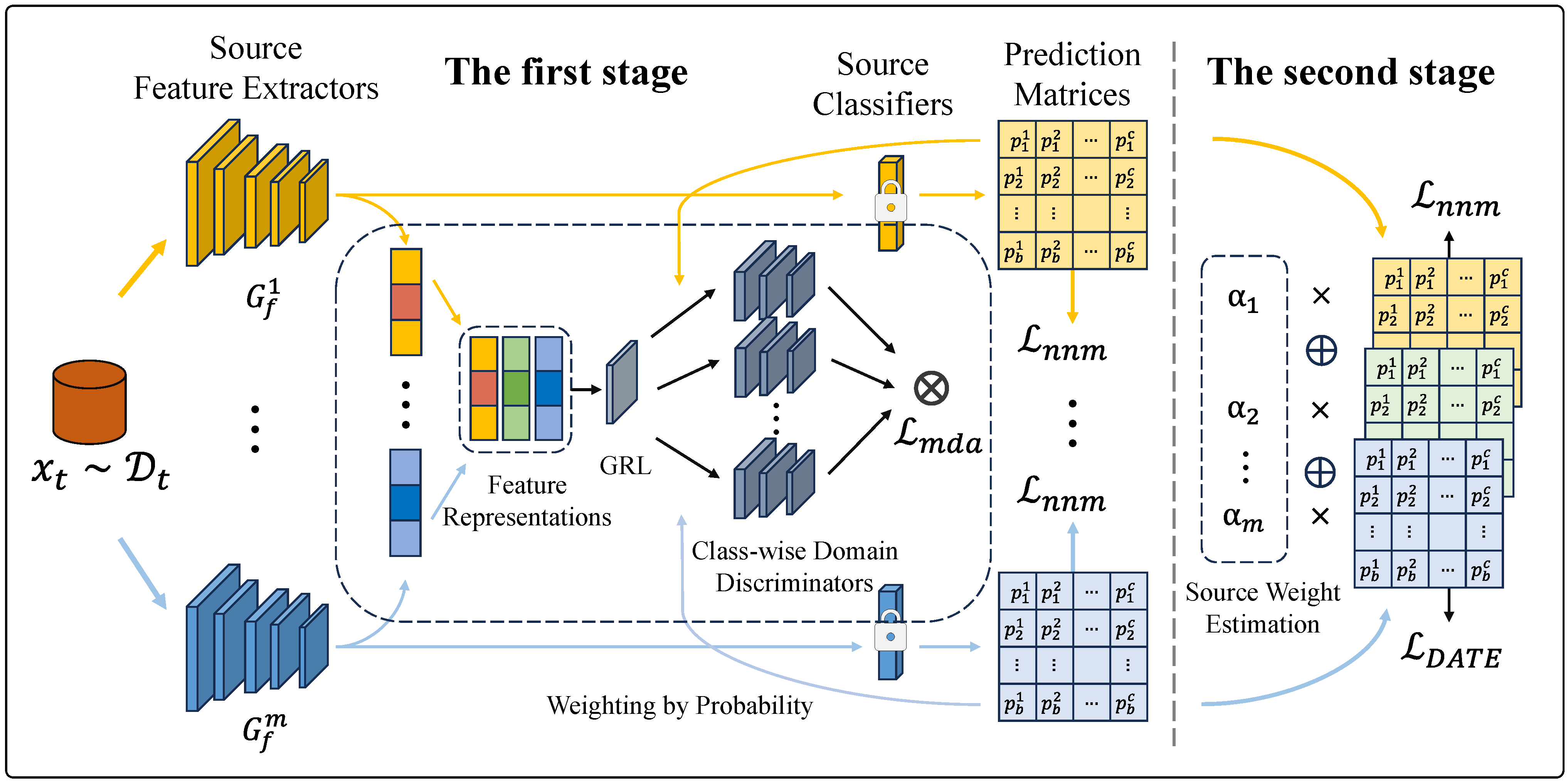
The proposed PDAL is structured into two stages, and its overall framework is illustrated in Figure 1. In the first stage, we propose proxy multi-source domain adversarial learning, which aligns target domain features extracted from different source domain models in an adversarial manner, thereby enabling these source domain models to extract domain-invariant feature representations. Meanwhile, a nuclear-norm maximization constraint is applied on the prediction matrix output by each source model to enhance the discriminability of models. In the second stage, we evaluate the importance of each source domain and perform weighted multi-source-free domain adaptation. Moreover, we also impose the nuclear-norm maximization constraint on the weighted sum of prediction matrices to improve the predictions for minority classes. Next, we detail the used technologies.
Figure 1.
The framework for PDAL.
3.3. Proxy Multi-Source Domain Adversarial Learning
A fundamental challenge in cross-domain learning lies in bridging the distribution differences between source and target domains to enable effective knowledge transfer. It is well known that adversarial learning can extract domain-invariant feature representations through the adversarial game between the feature extractor and the domain discriminator [43,44], and the corresponding optimization objective is defined as
where refers to the cross-entropy loss, represents the domain adversarial loss, represents the domain discriminator, and , , and are the corresponding parameters of networks , , and , respectively.
Building upon the advantage of adversarial training paradigms, we introduce them to multi-source-free domain adaptation to align target feature representations extracted from multiple source models. However, the unavailability of source data poses a significant challenge, which prevents performing feature alignment through joint training on both source and target domains. As an alternative, existing approaches generate pseudo-labels for target samples to guide self-supervised clustering. Nevertheless, due to distribution discrepancies, pseudo-labels may be unreliable in early training stages, which can easily result in error propagation.
To tackle the aforementioned issue, we propose proxy domain adversarial learning, which is applied in the first stage. Specifically, although the source data are unavailable in the multi-source-free scenario, the target features extracted by different source models can still reflect the underlying characteristics of their corresponding source domains. Defining the target feature distributions extracted by given source models as proxy distributions for the source domains, adversarial training on proxy distributions can improve the capability of the models to extract domain-invariant features. This can be achieved through end-to-end training of multiple source models using a domain discriminator with a gradient reversal layer. The proxy domain adversarial loss across multiple source domains is formulated as:
where b is the size of batches, is the cross-entropy loss, is the domain discriminator, is the feature extractor of the corresponding j-th source model, and is the domain label for the j-th source domain.
Furthermore, to facilitate the transfer of relevant knowledge while suppressing the negative impact of irrelevant information, we employ class-wise domain discriminators [45]. This strategy forwards target features weighted by prediction probabilities to corresponding domain discriminators for domain adversarial training. The proxy domain adversarial loss is redefined as:
where c denotes the number of classes, b denotes the size of batches, denotes the domain discriminator for the i-th class, and denotes the predicted probability of the i-th class. Specifically, for a task with c classes, we construct c domain discriminators, where is responsible for aligning features associated with the i-th class. During training, features extracted by the source domain models are first weighted by their predicted class probabilities. For a given feature representation, the predicted probability for the i-th class is used to weight the feature before forwarding it to the i-th domain discriminator . By introducing a class-wise domain discrimination strategy, the proposed method can align features with the most relevant classes and filter out irrelevant classes based on the prediction probability, resulting in more precise distribution alignment.
3.4. Nuclear-Norm Maximization
Proxy domain adversarial learning is beneficial for the source models to extract domain-invariant features, which could enhance the transferability of multiple source models. However, the discriminability of extracted features tends to degrade during the adversarial learning [46]. In addition, the potential class imbalance within target samples may lead to biased predictions for minority classes. To address these issues, we impose a nuclear-norm maximization constraint [19] on the prediction matrices, which can enhance feature discriminability and improve the predictions for minority classes.
For a prediction matrix , where each row encodes the predictive probability distribution of a sample across c categories, its F-norm is defined as follows:
As the row vectors approach one-hot encoding, i.e., becoming increasingly peaked at a single category, the F-norm of A increases. Therefore, for the prediction matrix, the F-norm can be used as a metric to quantify feature discriminability. Specifically, a higher norm value correlates with more confident predictions (i.e., lower uncertainty), which in turn indicates that the underlying features are more discriminative. The F-norm is numerically equivalent to the square root of the sum of the squared singular values of matrix A, as derived from its singular value decomposition (SVD):
where is the q-th largest singular value of matrix A, and .
On the other hand, good classification results require not only high prediction probabilities but also broad category coverage. Such broad category coverage can be approximately indicated by the rank of the prediction matrix A, which reflects the number of independent components, and numerically equals the number of non-zero singular values of the matrix. Since optimizing the rank of a matrix is relatively difficult, nuclear norm can be used as an approximate substitute:
The nuclear norm is both an upper bound of the F-norm and a convex approximation of the matrix rank. Maximizing the nuclear norm can enhance the discriminability of extracted features and improve the predictions for minority classes.
To reduce computational overhead, we apply an approximation method based on the -norm to quickly calculate the nuclear norm. Specifically, when the F-norm of the matrix A approaches the upper bound , the q-th singular values can be approximately calculated by the following formula:
where the operation represents selecting the q-th largest components.
Based on the above equation, the nuclear-norm maximization constraint for the prediction matrix A is defined as follows:
3.5. Source Weight Estimation
It is of significant note that quantifying the importance of source domains plays a crucial role in attaining effective knowledge transfer in MSFDA. To this end, we employ DATE [18] to estimate source importance in the second stage. Specifically, DATE precisely quantifies transferability and discriminability, where the transferability is related to the adaptability of source knowledge to the target domain, while the discriminability is related to the ability to distinguish various classes in the data. The proxy discriminability of the j-th source domain is defined as follows:
and the source transferability of batch samples is quantified as follows:
where is the habitat density for the j-th source, is the habitat uncertainty, represents the soft-max function, the symbol ∘ represents function composition, and is a multi-layer perceptron (MLP) network. For the specific formulation, readers are referred to the original work.
3.6. Overall Formulation
In the first stage, we adopt proxy domain adversarial learning for multiple source models and apply the nuclear-norm maximization constraint to each source model. The optimization objective of PDAL in the first stage is formulated as follows:
where is the prediction matrix from the j-th source model.
In the second stage, we first estimate the importance of source domains and perform weighted multi-source-free domain adaptation. Moreover, we employ the nuclear-norm maximization constraint to optimize the weighted sum of prediction matrices for improving the predictions for minority classes. The optimization objective in the second stage is formulated as follows:
where is the loss function of DATE; specific details can be found in Han et al. [18].
The final prediction for the target sample is obtained through a weighted combination of predictions from multiple source models:
The workflow of the proposed PDAL is summarized as Algorithm 1.
| Algorithm 1 PDAL |
| Input: pre-trained source models , target domain data , maximum number of epochs and , regularization parameters , and Initialize: compute discriminability of source models by Equation (9), set the optimizer to SGD, set the learning rate of feature extractors to 1 × 10⁻³, set the learning rate of domain discriminators to 1 × 10⁻² First stage: for epoch = 1 to do 1: Obtain feature representations and corresponding prediction matrices based on source models ; 2: Compute by Equation (12); 3: Update feature extractors and domain discriminators ; End Second stage: for epoch = 1 to do 1: Obtain target feature representations and corresponding prediction matrices based on the updated source models ; 2: Quantify the transferability of batch samples by Equation (10); 3: Evaluate source importance by Equation (11); 4: Obtain weighted prediction matrices with source importance ; 5: Compute by Equation (13); 6: Update feature extractor ; End Output: . |
4. Experiments
In this section, we perform comprehensive evaluations on four benchmark datasets for across-domain image classification tasks, and give in-depth analyses including the ablation study, parameter sensitivity and transferability, to prove the superiority of the proposed method.
4.1. Datasets
To evaluate the performance of the proposed approach, we conduct experiments on four datasets, Office-31 [47], Office-Caltech [48], Office-Home [49], and Digits-Five [50]. The introductions to each dataset are presented as follows.
Office-31 [47] is a widely used benchmark dataset in domain adaptation research, which consists of three distinct domains that share 31 identical categories. Specifically, Amazon has 2817 product images downloaded from amazon.com, Webcam has 795 low-resolution images taken from web cameras, and DSLR has 498 high-resolution images taken from digital SLR cameras.
Office-Caltech [48] is another benchmark dataset commonly used in cross-domain learning tasks, which is jointly created by Office-31 and Caltech-256 with 10 identical categories. It includes four domains and 2533 images: Amazon with 958 images, Webcam with 295 images, DSLR with 157 images, and Caltech with 1123 images.
Office-Home [49] is a larger dataset than the two above, consisting of 65 categories and 15,588 images. It can be divided into four domains: Art with 2427 artistic images in the form of sketches, paintings, ornamentation, etc., Clipart with 4365 clipart images, Product with 4439 images of objects without background, and Real-world with 4357 images of objects captured with a regular camera.
Digits-Five [50] is a digital image dataset with 10 identical categories, which consists of five domains: MNIST, Synthetic, MNIST-M, SVHN, and USPS. Following Cheng et al. [50], each domain except USPS allocates 25,000 images for training and 9000 images for testing. In contrast, USPS uses 7438 images for training and 1860 images for testing out of its total 9298 samples.
4.2. Baseline Methods and Setups
In experiments, the proposed PDAL is compared with three groups of state-of-the-art methods. Specifically, the methods we compared are:
(1) MSDA methods: Multi-source domain adaptation with access to source data, including MDAN [51], M3SDA [52], MDDA [24], LtC-MSDA [53], and DJSAN [50];
(2) SFDA methods: Single-source domain adaptation without accessing to source data, including BAIT [54], MA [55], SHOT [56], and NRC [57];
(3) MSFDA methods: Multi-source-free domain adaptation, including Bi-ATEN [41], DATE [18], DECISION [16], CAiDA [17], and CODA [15].
For a fair comparison, we follow the experimental protocols established in previous research works [15,18]. Specifically, except for the Digits-Five dataset using pre-trained LeNet [58], all other datasets adopt ResNet-50 [59] as a feature extractor backbone. In addition, to extend SFDA methods to multi-source settings, a decoupled processing strategy is implemented where each source domain is processed separately by a method, followed by ensemble prediction aggregation through averaging the outputs from all trained models. The domain discriminators are implemented based on multi-adversarial domain adaptation (MADA) [45]. All experimental evaluations are implemented within the PyTorch framework, utilizing NVIDIA GeForce RTX 4090 GPU accelerators for computation.
4.3. Performance Comparison
The performance evaluation results of the proposed PDAL method and baselines are presented in Table 1, Table 2, Table 3 and Table 4, with the optimal results for each task emphasized in boldface.
Table 1.
Classification results on Office-31 (ResNet-50).
Table 2.
Classification results on Office-Caltech (ResNet-50).
Table 3.
Classification results on Office-Home (ResNet-50).
Table 4.
Classification results on Digits-Five (LeNet).
Through quantitative comparison of the results in Table 1, Table 2, Table 3 and Table 4, we can derive the following key observations.
(1) All MSFDA methods outperform the SFDA methods on Office-31 as presented in Table 1, which indicates that directly averaging the predictions of source models is not sufficient to capture the complexity in multi-source scenarios. Although the proposed PDAL does not outperform the latest CODA, it achieves the second-best average accuracy of 90.8% among the MSFDA methods. The reason might be that this dataset has a small number of domains, thus providing limited information.
(2) As reported in Table 2, the proposed PDAL outperforms both the compared MSDA and MSFDA approaches on Office-Caltech. Specifically, PDAL achieves the highest average recognition performance of 97.8%, which is higher than CODA. Moreover, PDAL outperforms Bi-ATEN on three out of four recognition tasks, especially when Caltech and DSLR are used as the target domains.
(3) As seen from Table 3, the proposed PDAL and the latest MSFDA methods outperforms MSDA methods on Office-Home, which indicates that for this dataset, MSDA has the potential to attain superior performance, even in the absence of direct access to source samples. PDAL shows better progress compared to CODA when Art is used as the target domain.
(4) As shown in Table 4, the proposed PDAL ranks third in average performance and falls behind Ltc-MSDA and DJSAN. This is because Ltc-MSDA and DJSAN can directly access source samples for explicit domain alignment, so they can better handle severe domain shifts on Digits-Five. It is worth noting that the baseline backbone used for this benchmark is LeNet, whose representation capacity is limited compared with deeper networks such as ResNet-50, which further restricts the performance of source-free methods. Although PDAL does not achieve the best performance, it still surpasses other MSFDA methods on three out of five tasks.
Overall, the proposed PDAL obtains superior performance on benchmark datasets. The good results achieved by PDAL can likely be attributed to its introduction of adversarial domain alignment and the imposition of a nuclear-norm constraint. These two strategies work in tandem to comprehensively enhance the discriminability of feature representations across different domains. Simultaneously, they effectively preserve transferable semantic structures and alleviate the biases caused by class imbalance, thereby contributing to the superior performance of the model.
4.4. Ablation Study
Compared with the existing MSFDA approaches, the proposed PDAL introduces proxy domain adversarial learning and the nuclear-norm maximization constraint. To evaluate their effectiveness, we perform an ablation study on the Office-Home dataset.
The experimental results of the various models are shown in Table 5, where denotes the proxy domain adversarial learning loss in the first stage, and and denote the nuclear-norm maximization constraints in the first and second stages, respectively. The symbol indicates to add the module behind it. From Table 5, we find that the performance is improved in most cases after introducing the proxy domain adversarial learning loss and nuclear-norm maximization constraint individually, which shows the effectiveness of the introduced modules. When and are applied in the first stage, the performance further improves, which can be attributed to the enhancement of discriminability alongside the promotion of domain-invariant feature extraction. These experimental results confirm that the introduced components are essential in the proposed PDAL.
Table 5.
Results of ablation experiments on the Office-Home dataset.
4.5. Time Complexity Analysis
We conducted time complexity experiments on the Office-Home dataset, comparing PDAL with two baseline methods: DECISION [16] and DATE [18]. The experiments were conducted on a machine equipped with an NVIDIA RTX 4090 GPU. The results of the comparison are shown in Table 6. As shown, PDAL requires significantly more training time compared to DECISION and DATE. This increased time is mainly due to the addition of the proxy domain adversarial training phase and the nuclear-norm maximization constraint. Despite the longer training time, PDAL achieves improved adaptation performance on the target task, demonstrating that the additional computational cost leads to enhanced model transferability and generalization capabilities.
Table 6.
Training time comparison on the Office-Home dataset.
4.6. Parameter Sensitivity Analysis
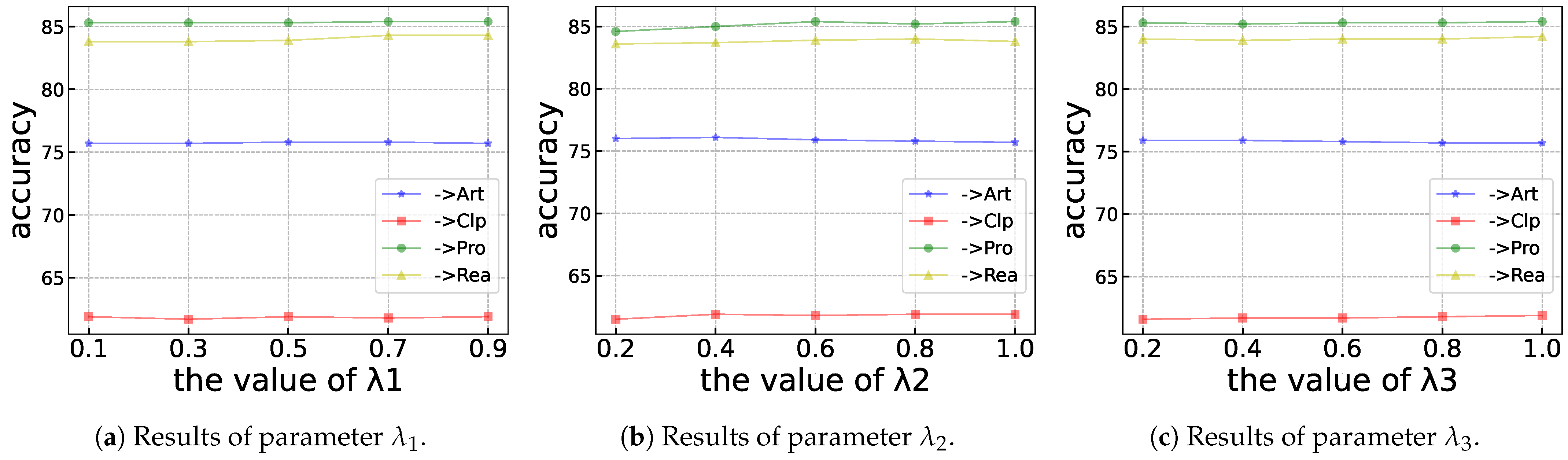
The proposed PDAL involves three adjustable parameters, namely the proxy domain adversarial learning parameter and two nuclear-norm maximization constraint parameters and . This subsection analyze the impact of these parameters on performance. To this end, we conduct parameter sensitivity experiments on Office-Home, where the value of varies within the range of {0.1, 0.3, 0.5, 0.7, 0.9}, while the values of and both vary within the range of {0.2, 0.4, 0.6, 0.8, 1.0}.
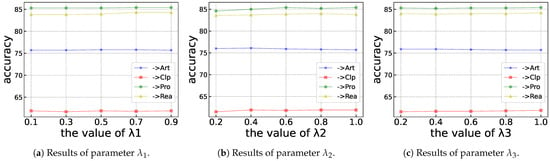
Firstly, we study how the parameter affects the performance with and fixed as the optimal values. The evaluation results are shown in Figure 2a, where the horizontal axis denotes the parameter values and the vertical axis denotes the prediction accuracy (the same below). From this figure, we could find that the performance is best when is chosen as 0.5, and most curves follow a similar trend of change.
Figure 2.
Impact of the parameters , , and on Office-Home.
Next, we evaluate the influence of the parameter on classification accuracy when and are optimal values. The parameter controls nuclear-norm maximization constraint and larger values of it would enable the features to be more discriminate. As shown in Figure 2b, PDAL achieves high classification accuracy when is not too small. In experiments, it can be empirically selected between 0.8 and 1.0.
Finally, we examine the influence of the parameter on performance when and are fixed. The experimental results are shown in Figure 2c. From it, we can obverse that the model can achieve relatively stable classification performance under a wide range of values of on most tasks, which indicates the parameter is relatively insensitive on performance.
The sensitivity analysis shows that the optimal parameter settings may vary depending on the target domain, but PDAL exhibits relatively stable performance under parameter changes. In other words, PDAL has good model stability.
4.7. Transferability Analysis
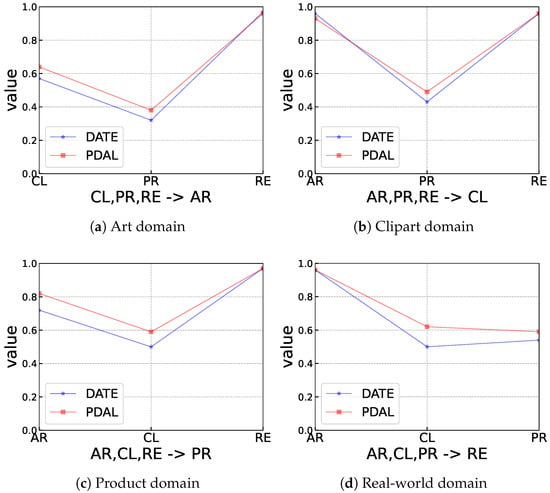
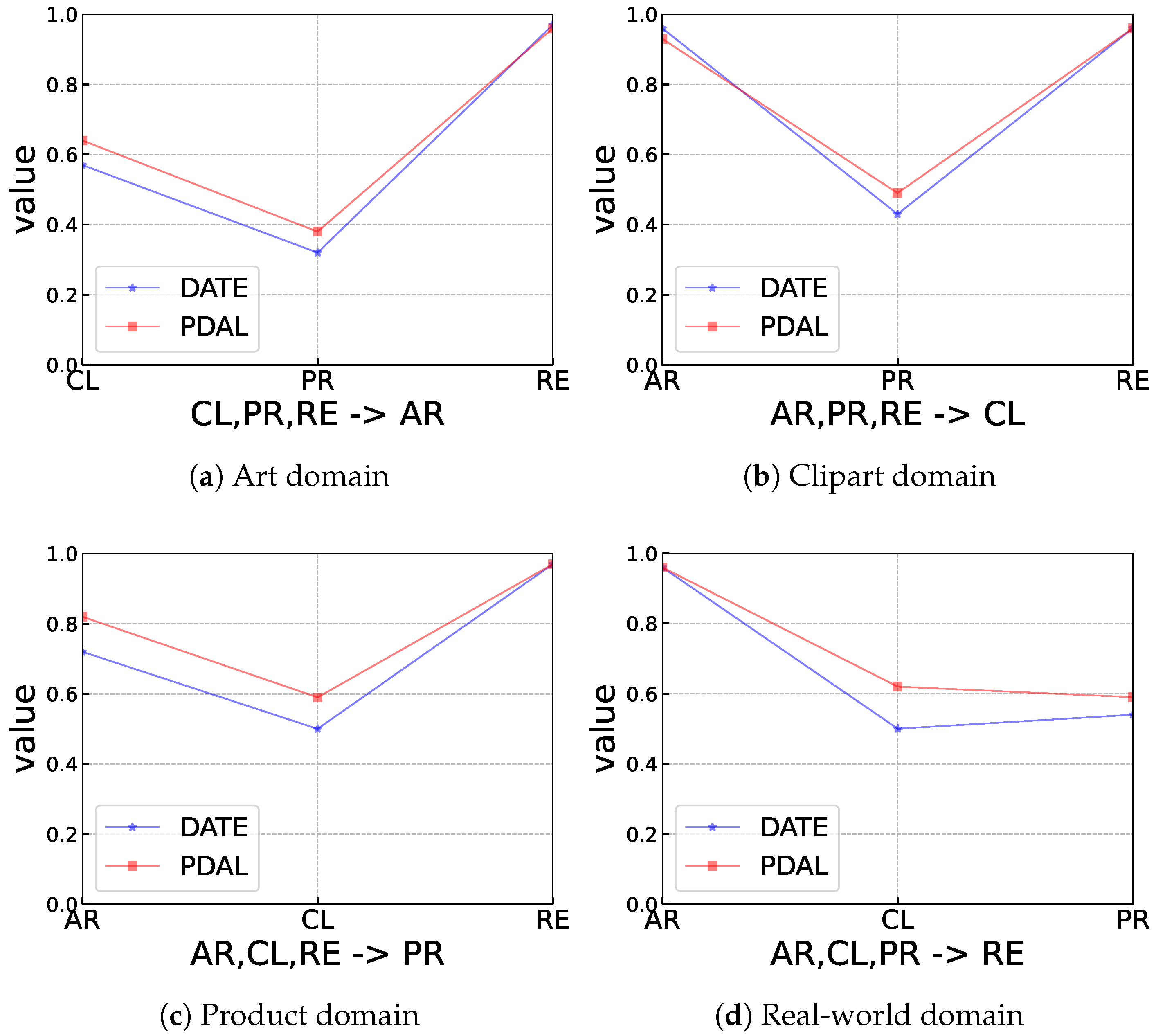
The source importance is evaluated by quantifying proxy source discriminability and source transferability, where the former is estimated before training, and the latter is obtained by passing feature representations through a multi-layer perceptron (MLP) network. Figure 3 shows the numerical changes in source transferability of PDAL training compared to DATE. According to Figure 3, it is clear that the source transferability values are improved in most cases. This indicates the proposed proxy domain adversarial learning strategy is helpful to align the features extracted by different source models.
Figure 3.
The comparison of source transferability between PDAL and DATE.
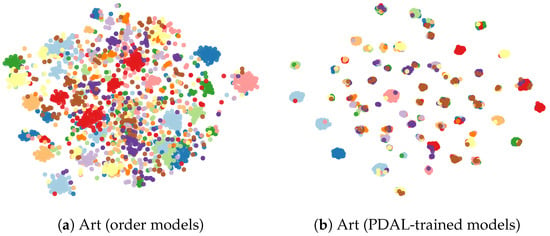
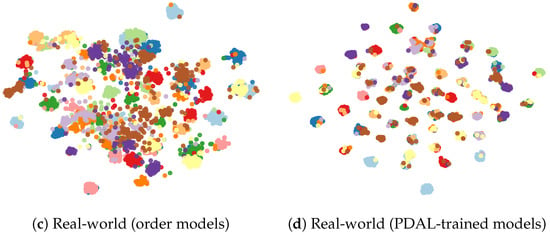
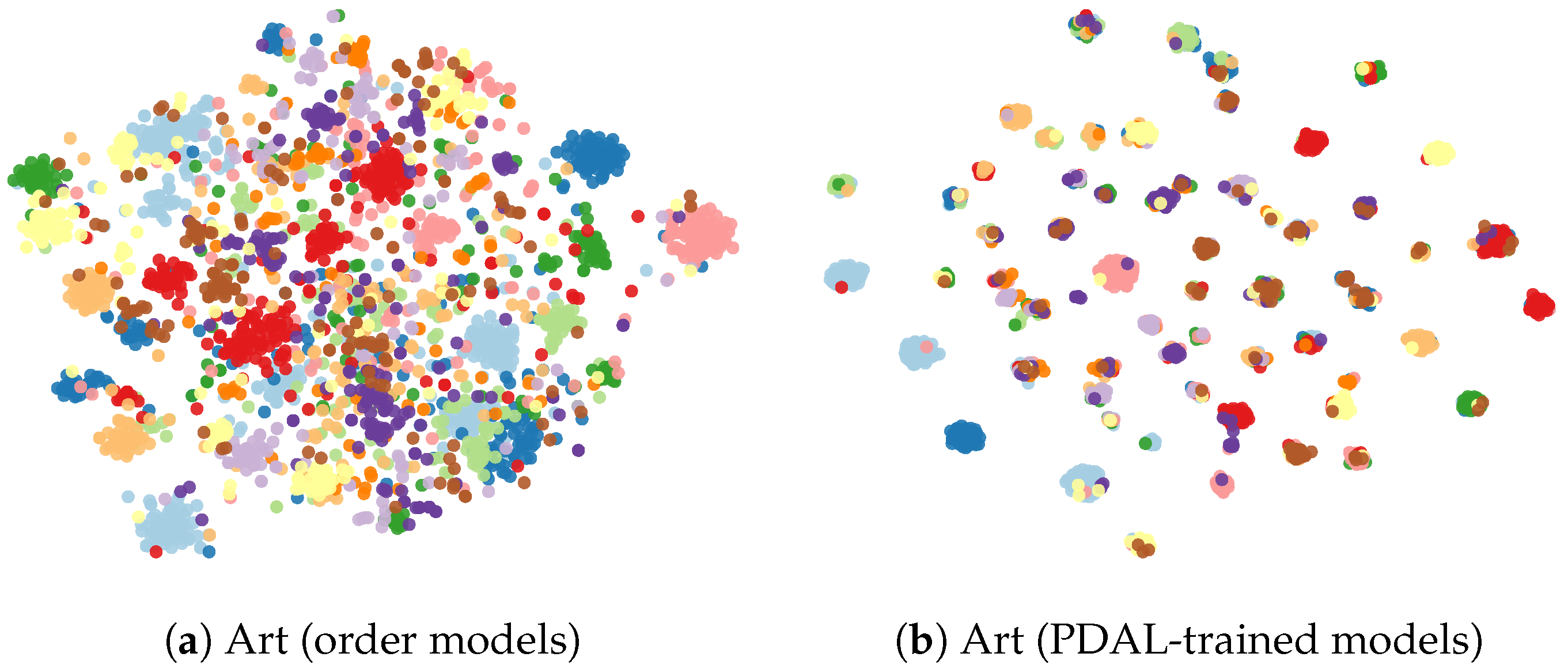
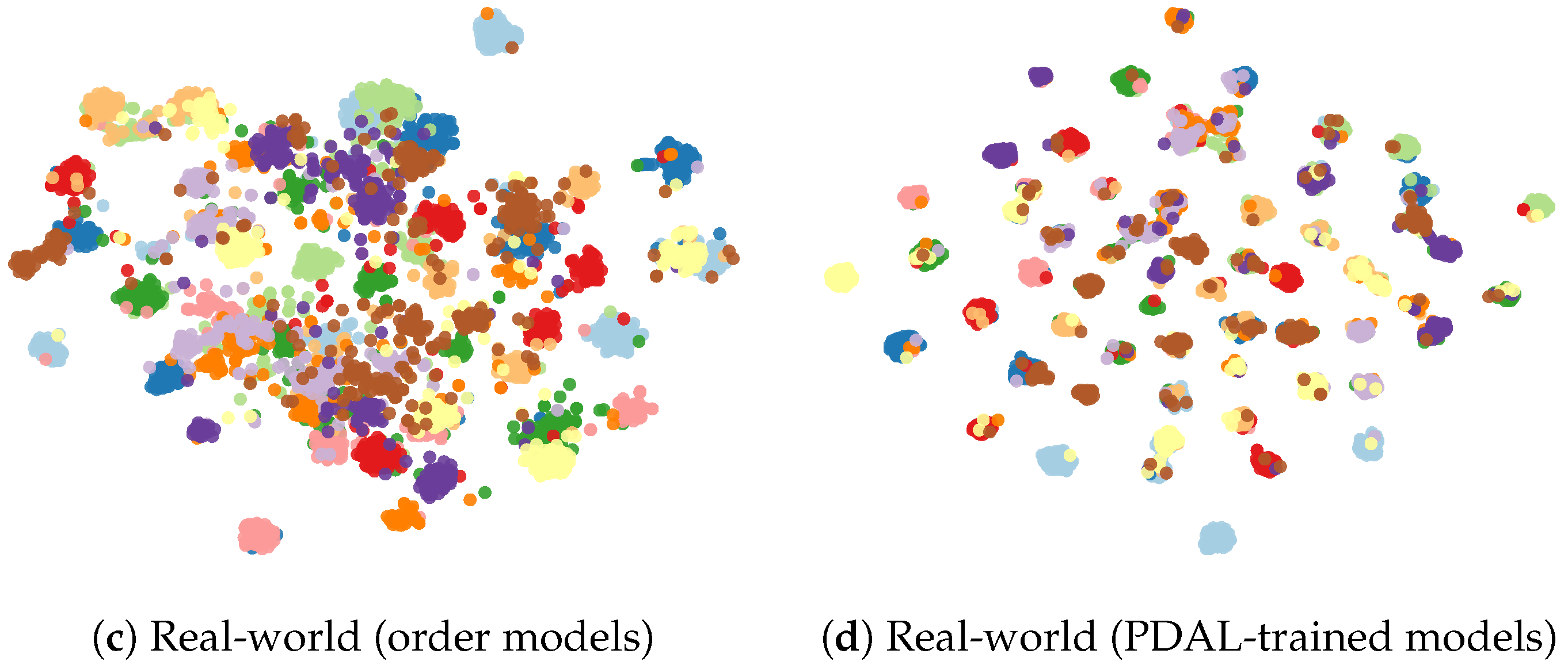
Moreover, to intuitively demonstrate the superiority of the proposed PDAL, we employ the t-distributed stochastic neighbor embedding (t-SNE) technique [60] to visualize features learned by the source models and PDAL. Figure 4 presents the 2-Dim feature embeddings learned on the →Art and →Clipart tasks of the Office-Home dataset. From this figure, it can be found that features extracted by the original source models tend to be mixed up, while PDAL produces more tightly clustered features for each class.
Figure 4.
The t-SNE visualization of features.
5. Conclusions
In this paper, a two-stage learning framework based on proxy domain adversarial learning and the nuclear-norm maximization constraint, termed PDAL, has been proposed for multi-source-free domain adaptation. This approach allows the proxy domain adversarial learning to facilitate the extraction of domain-invariant features, leading to better pseudo-labels. Meanwhile, the nuclear-norm maximization constraint effectively enhances feature discriminability and optimizes predictions for minority classes. Finally, empirical validation on benchmark datasets has demonstrated the validity of the proposed method.
Despite its promising performance, PDAL is currently only evaluated on image classification tasks. This limits its applicability to broader real-world scenarios. In future work, we aim to extend the proposed method to more challenging tasks such as object detection and semantic segmentation, where domain shift and data imbalance are also prevalent. In addition, we plan to investigate the applicability of the proposed method in more complex scenarios where the features extracted by different source models are highly inconsistent or the target samples exhibit a larger class imbalance.
Author Contributions
Conceptualization, L.Y.; methodology, L.Y. and J.Q.; software, J.Q.; validation, J.Q.; formal analysis, Z.Q.; investigation, J.Q.; writing—original draft preparation, L.Y. and J.Q.; writing—review and editing, P.S.; visualization, T.S.; supervision, P.S.; and funding acquisition, L.Y. All authors have read and agreed to the published version of the manuscript.
Funding
This work was supported in part by the Hebei Natural Science Foundation under Grant F2024502002, and in part by the Fundamental Research Funds for the Central Universities under Grant 2024MS127.
Data Availability Statement
The datasets used in this article are all publicly available data.
Conflicts of Interest
The authors declare no conflicts of interest.
References
- Dong, S.; Wang, P.; Abbas, K. A survey on deep learning and its applications. Comput. Sci. Rev. 2021, 40, 100379. [Google Scholar] [CrossRef] [Scilit]
- Uzair, M.; Mian, A. Blind domain adaptation with augmented extreme learning machine features. IEEE Trans. Cybern. 2016, 47, 651–660. [Google Scholar] [CrossRef] [Scilit]
- Yang, L.; Zhou, Q.; Lu, B. Marginal Subspace Learning with Group Low-Rank for Unsupervised Domain Adaptation. IEEE Trans. Neural Netw. Learn. Syst. 2022, 35, 9122–9135. [Google Scholar] [CrossRef] [Scilit] [PubMed]
- Zhang, W.; Liu, Q.; Cong, F.O.W.; Ragab, M.; Foo, C.S. Universal Semi-Supervised Domain Adaptation by Mitigating Common-Class Bias. In Proceedings of the IEEE/CVF Conference on Computer Vision and Pattern Recognition, Seattle, WA, USA, 16–22 June 2024; pp. 23912–23921. [Google Scholar]
- Zhang, C.; Lee, D. Advancing Nighttime Object Detection through Image Enhancement and Domain Adaptation. Appl. Sci. 2024, 14, 8109. [Google Scholar] [CrossRef] [Scilit]
- Park, S.H.; Syazwany, N.S.; Nam, J.H.; Lee, S.C. Integrating multimodal contrastive learning with prototypical domain alignment for unsupervised domain adaptation of time series. Eng. Appl. Artif. Intell. 2024, 137, 109205. [Google Scholar] [CrossRef] [Scilit]
- Dong, H.; Zhang, G. Frequency-Aware Unsupervised Domain Adaptation for Semantic Segmentation of Laparoscopic Images. Appl. Sci. 2026, 16, 840. [Google Scholar] [CrossRef] [Scilit]
- Yao, K.; Tan, Z.; Su, Z.; Yang, X.; Sun, J.; Huang, K. SCMix: Stochastic Compound Mixing for Open Compound Domain Adaptation in Semantic Segmentation. IEEE Trans. Neural Netw. Learn. Syst. 2025, 36, 16803–16813. [Google Scholar] [CrossRef] [Scilit]
- Fang, Y.; Yap, P.T.; Lin, W.; Zhu, H.; Liu, M. Source-free unsupervised domain adaptation: A survey. Neural Netw. 2024, 174, 106230. [Google Scholar] [CrossRef] [Scilit]
- Tang, S.; Su, W.; Ye, M.; Zhu, X. Source-free domain adaptation with frozen multimodal foundation model. In Proceedings of the IEEE/CVF Conference on Computer Vision and Pattern Recognition, Seattle, WA, USA, 16–22 June 2024; pp. 23711–23720. [Google Scholar]
- Li, Y.; Yuan, L.; Chen, Y.; Wang, P.; Vasconcelos, N. Dynamic transfer for multi-source domain adaptation. In Proceedings of the IEEE/CVF Conference on Computer Vision and Pattern Recognition, Nashville, TN, USA, 20–25 June 2021; pp. 10998–11007. [Google Scholar]
- Lu, Y.; Huang, H.; Zeng, B.; Lai, Z.; Li, X. Multi-Source and Multi-Target Domain Adaptation Based on Dynamic Generator with Attention. IEEE Trans. Multimed. 2024, 26, 6891–6905. [Google Scholar] [CrossRef] [Scilit]
- Li, K.; Lu, J.; Zuo, H.; Zhang, G. Source-free multidomain adaptation with fuzzy rule-based deep neural networks. IEEE Trans. Fuzzy Syst. 2023, 31, 4180–4194. [Google Scholar] [CrossRef] [Scilit]
- Pei, J.; Men, A.; Liu, Y.; Zhuang, X.; Chen, Q. Evidential multi-source-free unsupervised domain adaptation. IEEE Trans. Pattern Anal. Mach. Intell. 2024, 46, 5288–5305. [Google Scholar]
- Liu, Z.; Cui, C.; Zhang, C.; Meng, F.; Gong, S.; Xi, M.; Li, L. Consistency-guided Multi-Source-Free Domain Adaptation. Eng. Appl. Artif. Intell. 2025, 139, 109497. [Google Scholar]
- Ahmed, S.M.; Raychaudhuri, D.S.; Paul, S.; Oymak, S.; Roy-Chowdhury, A.K. Unsupervised Multi-source Domain Adaptation Without Access to Source Data. In Proceedings of the IEEE/CVF Conference on Computer Vision and Pattern Rrecognition, Nashville, TN, USA, 20–25 June 2021; pp. 10098–10107. [Google Scholar]
- Dong, J.; Fang, Z.; Liu, A.; Sun, G.; Liu, T. Confident anchor-induced multi-source free domain adaptation. Adv. Neural Inf. Process. Syst. 2021, 34, 2848–2860. [Google Scholar]
- Han, Z.; Zhang, Z.; Wang, F.; He, R.; Su, W.; Xi, X.; Yin, Y. Discriminability and transferability estimation: A bayesian source importance estimation approach for multi-source-free domain adaptation. Proc. AAAI Conf. Artif. Intell. 2023, 37, 7811–7820. [Google Scholar]
- Cui, S.; Wang, S.; Zhuo, J.; Li, L.; Huang, Q.; Tian, Q. Towards discriminability and diversity: Batch nuclear-norm maximization under label insufficient situations. In Proceedings of the IEEE/CVF Conference on Computer Vision and Pattern Recognition, Seattle, WA, USA, 13–19 June 2020; pp. 3941–3950. [Google Scholar]
- Ben-David, S.; Blitzer, J.; Crammer, K.; Kulesza, A.; Pereira, F.; Vaughan, J.W. A theory of learning from different domains. Mach. Learn. 2009, 79, 151–175. [Google Scholar] [CrossRef] [Scilit]
- Sun, S.; Shi, H.; Wu, Y. A survey of multi-source domain adaptation. Inf. Fusion 2015, 24, 84–92. [Google Scholar] [CrossRef] [Scilit]
- Zhao, S.; Chen, H.; Huang, H.; Xu, P.; Ding, G. More is Better: Deep Domain Adaptation with Multiple Sources. In Proceedings of the International Joint Conference on Artificial Intelligence, Jeju, Republic of Korea, 3–9 August 2024; pp. 8354–8362. [Google Scholar]
- Lu, Y.; Huang, H.; Hu, X. Domain-aware Visual Context Prompt for Multi-Source Domain Adaptation. In Proceedings of the 33rd ACM International Conference on Multimedia, Dublin, Ireland, 27–31 October 2025; pp. 2625–2633. [Google Scholar]
- Zhao, S.; Wang, G.; Zhang, S.; Gu, Y.; Li, Y.; Song, Z.; Xu, P.; Hu, R.; Chai, H.; Keutzer, K. Multi-source distilling domain adaptation. Proc. AAAI Conf. Artif. Intell. 2020, 34, 12975–12983. [Google Scholar] [CrossRef] [Scilit]
- Liu, Z.; Ning, L.; Zhang, Z. A new progressive multisource domain adaptation network with weighted decision fusion. IEEE Trans. Neural Netw. Learn. Syst. 2022, 35, 1062–1072. [Google Scholar] [CrossRef] [Scilit] [PubMed]
- Lu, Y.; Huang, H.; Hu, X.; Lai, Z. Multiple Adaptation Network for Multi-Source and Multi-Target Domain Adaptation. IEEE Trans. Multimed. 2025, 27, 5731–5745. [Google Scholar]
- Venkat, N.; Kundu, J.N.; Singh, D.; Revanur, A. Your classifier can secretly suffice multi-source domain adaptation. Adv. Neural Inf. Process. Syst. 2020, 33, 4647–4659. [Google Scholar]
- Li, J.; Du, Z.; Zhu, L.; Ding, Z.; Lu, K.; Shen, H.T. Divergence-agnostic unsupervised domain adaptation by adversarial attacks. IEEE Trans. Pattern Anal. Mach. Intell. 2021, 44, 8196–8211. [Google Scholar] [CrossRef] [Scilit]
- Yang, B.; Yeh, H.W.; Harada, T.; Yuen, P.C. Model-induced generalization error bound for information-theoretic representation learning in source-data-free unsupervised domain adaptation. IEEE Trans. Image Process. 2021, 31, 419–432. [Google Scholar] [CrossRef] [Scilit]
- Duan, J.; Zhang, Y.; Qu, Y. Source-Free Domain Adaptation for Point Cloud Semantic Segmentation. In Proceedings of the IEEE International Conference on Multimedia and Expo (ICME), Niagara Falls, ON, Canada, 15–19 July 2024; pp. 1–6. [Google Scholar]
- Ding, N.; Xu, Y.; Tang, Y.; Xu, C.; Wang, Y.; Tao, D. Source-free domain adaptation via distribution estimation. In Proceedings of the IEEE/CVF Conference on Computer Vision and Pattern Recognition, New Orleans, LA, USA, 18–24 June 2022; pp. 7212–7222. [Google Scholar]
- Ding, Y.; Sheng, L.; Liang, J.; Zheng, A.; He, R. Proxymix: Proxy-based mixup training with label refinery for source-free domain adaptation. Neural Netw. 2023, 167, 92–103. [Google Scholar] [CrossRef] [Scilit]
- Hou, Y.; Zheng, L. Visualizing Adapted Knowledge in Domain Transfer. In Proceedings of the IEEE/CVF Conference on Computer Vision and Pattern Recognition, Nashville, TN, USA, 20–25 June 2021; pp. 13819–13828. [Google Scholar]
- Kurmi, V.K.; Subramanian, V.K.; Namboodiri, V.P. Domain Impression: A Source Data Free Domain Adaptation Method. In Proceedings of the IEEE/CVF Winter Conference on Applications of Computer Vision, Virtual, 5–9 January 2021; pp. 615–625. [Google Scholar]
- Li, F.; Lan, Y.; Lu, Y.; Wong, W.K.; Zhao, M.; Lai, Z.; Li, X. Separation of Unknown Features and Samples for Unbiased Source-free Open Set Domain Adaptation. Pattern Recognit. 2025, 166, 111661. [Google Scholar] [CrossRef] [Scilit]
- Sun, T.; Lu, C.; Ling, H. Domain adaptation with adversarial training on penultimate activations. Proc. AAAI Conf. Artif. Intell. 2023, 37, 9935–9943. [Google Scholar] [CrossRef] [Scilit]
- Liang, J.; Hu, D.; Wang, Y.; He, R.; Feng, J. Source Data-Absent Unsupervised Domain Adaptation Through Hypothesis Transfer and Labeling Transfer. IEEE Trans. Pattern Anal. Mach. Intell. 2021, 44, 8602–8617. [Google Scholar] [CrossRef] [Scilit]
- Lu, Y.; Lan, Y.; Yang, H.; Lai, Z.; Li, X. Exploring Generic Knowledge and Reactivating Source Model for Source-free Universal Domain Adaptation. IEEE Trans. Multimed. 2026, 1–12. [Google Scholar] [CrossRef] [Scilit]
- Feng, H.; You, Z.; Chen, M.; Zhang, T.; Zhu, M.; Wu, F.; Wu, C.; Chen, W. KD3A: Unsupervised Multi-Source Decentralized Domain Adaptation via Knowledge Distillation. In Proceedings of the International Conference on Machine Learning, Virtual, 18–24 July 2021; pp. 3274–3283. [Google Scholar]
- Shen, M.; Bu, Y.; Wornell, G.W. On balancing bias and variance in unsupervised multi-source-free domain adaptation. In Proceedings of the International Conference on Machine Learning, Honolulu, HI, USA, 23–29 July 2023; pp. 30976–30991. [Google Scholar]
- Li, X.; Li, J.; Li, F.; Zhu, L.; Lu, K. Agile multi-source-free domain adaptation. Proc. AAAI Conf. Artif. Intell. 2024, 38, 13673–13681. [Google Scholar] [CrossRef] [Scilit]
- Cai, Z.; Liu, J.; Huang, Y.; Hu, C.; Wu, X.; Jing, X.Y.; Shao, L. Make Source-Free Transfer Great: Dynamic Uncertainty-Driven Confident Fusion for Multi-Source-Free Domain Adaptation. Inf. Fusion 2025, 127, 103859. [Google Scholar] [CrossRef] [Scilit]
- Zhao, S.; Li, B.; Xu, P.; Yue, X.; Ding, G.; Keutzer, K. Madan: Multi-source adversarial domain aggregation network for domain adaptation. Int. J. Comput. Vis. 2021, 129, 2399–2424. [Google Scholar] [CrossRef] [Scilit]
- Li, X.; Lei, C.; Bai, X.; Zhang, G. Selective Adversarial Augmentation Network for Bearing Fault Diagnosis with Partial Domain Adaptation. Appl. Sci. 2026, 16, 1634. [Google Scholar] [CrossRef] [Scilit]
- Pei, Z.; Cao, Z.; Long, M.; Wang, J. Multi-adversarial domain adaptation. Proc. AAAI Conf. Artif. Intell. 2018, 32, 3934–3941. [Google Scholar] [CrossRef] [Scilit]
- Chen, X.; Wang, S.; Long, M.; Wang, J. Transferability vs. discriminability: Batch spectral penalization for adversarial domain adaptation. In Proceedings of the International Conference on Machine Learning, Long Beach, CA, USA, 9–15 June 2019; pp. 1081–1090. [Google Scholar]
- Saenko, K.; Kulis, B.; Fritz, M.; Darrell, T. Adapting visual category models to new domains. In Proceedings of the ECCV European Conference on Computer Vision, Heraklion, Greece, 5–11 September 2010; pp. 213–226. [Google Scholar]
- Gong, B.; Shi, Y.; Sha, F.; Grauman, K. Geodesic flow kernel for unsupervised domain adaptation. In Proceedings of the IEEE Conference on Computer Vision and Pattern Recognition, Providence, RI, USA, 16–21 June 2012; pp. 2066–2073. [Google Scholar]
- Venkateswara, H.; Eusebio, J.; Chakraborty, S.; Panchanathan, S. Deep hashing network for unsupervised domain adaptation. In Proceedings of the IEEE Conference on Computer Vision and Pattern Recognition, Honolulu, HI, USA, 21–26 July 2017; pp. 5018–5027. [Google Scholar]
- Cheng, Z.; Wang, S.; Yang, D.; Qi, J.; Xiao, M.; Yan, C. Deep joint semantic adaptation network for multi-source unsupervised domain adaptation. Pattern Recognit. 2024, 151, 110409. [Google Scholar] [CrossRef] [Scilit]
- Zhao, H.; Zhang, S.; Wu, G.; Moura, J.M.; Costeira, J.P.; Gordon, G.J. Adversarial multiple source domain adaptation. Adv. Neural Inf. Process. Syst. 2018, 31, 8568–8579. [Google Scholar]
- Peng, X.; Bai, Q.; Xia, X.; Huang, Z.; Saenko, K.; Wang, B. Moment matching for multi-source domain adaptation. In Proceedings of the IEEE/CVF International Conference on Computer Vision, Seoul, Republic of Korea, 27 October–2 November 2019; pp. 1406–1415. [Google Scholar]
- Wang, H.; Xu, M.; Ni, B.; Zhang, W. Learning to combine: Knowledge aggregation for multi-source domain adaptation. In Proceedings of the ECCV European Conference on Computer Vision, Glasgow, UK, 23–28 August 2020; pp. 727–744. [Google Scholar]
- Yang, S.; Wang, Y.; Van De Weijer, J.; Herranz, L.; Jui, S. Unsupervised domain adaptation without source data by casting a bait. arXiv 2020, arXiv:2010.12427. [Google Scholar]
- Li, R.; Jiao, Q.; Cao, W.; Wong, H.S.; Wu, S. Model Adaptation: Unsupervised Domain Adaptation Without Source Data. In Proceedings of the IEEE Conference on Computer Vision and Pattern Recognition, Seattle, WA, USA, 14–19 June 2020; pp. 9638–9647. [Google Scholar]
- Liang, J.; Hu, D.; Feng, J. Do we really need to access the source data? source hypothesis transfer for unsupervised domain adaptation. In Proceedings of the International Conference on Machine Learning, Virtual, 13–18 July 2020; pp. 6028–6039. [Google Scholar]
- Yang, S.; Wang, y.; Van De Weijer, J.; Herranz, L.; Jui, S. Exploiting the intrinsic neighborhood structure for source-free domain adaptation. Adv. Neural Inf. Process. Syst. 2021, 34, 29393–29405. [Google Scholar]
- LeCun, Y.; Bottou, L.; Bengio, Y.; Haffner, P. Gradient-based learning applied to document recognition. Proc. IEEE 1998, 86, 2278–2324. [Google Scholar] [CrossRef] [Scilit]
- He, K.; Zhang, X.; Ren, S.; Sun, J. Deep residual learning for image recognition. In Proceedings of the IEEE Conference on Computer Vision and Pattern Recognition, Las Vegas, NV, USA, 27–30 June 2016; pp. 770–778. [Google Scholar]
- Donahue, J.; Jia, Y.; Vinyals, O.; Hoffman, J.; Zhang, N.; Tzeng, E.; Darrell, T. Decaf: A deep convolutional activation feature for generic visual recognition. In Proceedings of the International Conference on Machine Learning, Atlanta, GA, USA, 16–21 June 2013; pp. 647–655. [Google Scholar]

Disclaimer/Publisher’s Note: The statements, opinions and data contained in all publications are solely those of the individual author(s) and contributor(s) and not of MDPI and/or the editor(s). MDPI and/or the editor(s) disclaim responsibility for any injury to people or property resulting from any ideas, methods, instructions or products referred to in the content. |
© 2026 by the authors. Licensee MDPI, Basel, Switzerland. This article is an open access article distributed under the terms and conditions of the Creative Commons Attribution (CC BY) license.