Deterministic Structural Design

Information Technology and Communication Sciences, Tampere University, P.O. Box 553, FI-33014 Tampere, Finland
Appl. Sci. 2026, 16(6), 3002; https://doi.org/10.3390/app16063002
Submission received: 5 February 2026
/
Revised: 17 March 2026
/
Accepted: 18 March 2026
/
Published: 20 March 2026
(This article belongs to the Section Civil Engineering)
Abstract
Current structural design codes use a stochastic approach (SC) in load combination and reliability calculation. This article presents a design model with a deterministic (DC) approach. Currently, design codes have variable load factors (γG ≠ γQ) and constant safety factors (γM) for all loads. This approach makes two significant approximations: It assumes a single material factor for all ratios of permanent to variable loads and across all types of variable loads. This research proposes the opposite strategy: instead of a single material factor, each load is assigned to its own material factor. Such a shift removes those approximations, simplifies codes, and reduces calculation effort. A central challenge in reliability assessment is combining loads. Existing SC methods differ in their reference time and target reliability. The fundamental fact of load–material interaction is that each load acts independently, without influencing others. This deduction results in the DC combination. Safety factors within the Eurocode framework are derived using today’s semi-probabilistic SC methods and a fully probabilistic DC approach. The proposed design model is straightforward, requires minimal computation, meets the target reliability, and yields significant savings in material use.
1. Introduction
The Eurocodes [1,2], fundamental standards governing structural design, are currently undergoing an update process to usher in their second generation.
The author has advocated the deterministic approach for two decades. This article includes a new critical argument for the deterministic concept and presents a new deterministic design model.
The article is organized as follows: The introduction presents the background, the target, key terminology, limitations, the novelty of the approach, and arguments for the DC approach. The review section provides an overview of current structural design codes. The methodology outlines the reasoning and assumptions used. The findings section presents the key results. The discussion interprets the findings and places them in a wider context. The conclusion summarizes the main contributions of the research.
1.1. Target
The objective of the article is to introduce a new deterministic design model that improves current design codes, such as the Eurocodes, by simplifying the code structure, reducing calculation effort, and providing improved accuracy with respect to the target reliability.
The model is based on several characteristics that differ from current codes.
- Independent load–material pairs. Each load–material pair is treated independently, meaning that each pair has its own safety factor. These factors are preferably assigned to the material, while load factors can be set arbitrarily and uniformly for all materials. In current codes, the load factors vary while the material factors are constant.
- Deterministic load combination without reductions. Loads are combined deterministically without load reductions, such as combination factors ψ. Consequently, load effects are also combined without reductions. In current codes, loads are primarily combined stochastically with reductions.
- Variable loads based on service time. Variable loads are evaluated for the full service time, i.e., 50 years. In current codes, a reduced reference time is applied.
- Reliability calculation. Reliability is calculated using the equations presented in this article. In current codes, the FORM process is typically applied.
- Criterion for acceptable design. Designs are not allowed to be unsafe with respect to the target reliability. In current codes, the target reliability is typically achieved on average across the relevant design cases.
- The partial safety factors concept. In the current SC approach, the ULS and SLS are treated separately: load reductions are applied in the ULS, whereas no reductions are applied in the SLS. The new design can be applied within the partial safety factor framework; however, because no load reductions are used, a simpler code structure with reduced calculation effort is achieved by re-adopting the allowable stress approach.
- Safety factor optimization. Safety factors are calculated to achieve the target reliability without error, i.e., each design matches the target reliability. In current codes, safety factors are optimized across multiple load cases, which may include considerable errors.
- A new basic design equation is introduced.
The author believes that the proposed approach resolves conceptual inconsistencies in current design codes, while improving clarity and accuracy with respect to the target reliability, reducing both complexity and computational effort, and advancing the goal of broader international harmonization.
1.2. Terms, Limitations
The notation used in this article follows that outlined in the Eurocodes [1,2]. The focus is on structural design in fundamental design situations typical of standard construction practices, with particular emphasis on ultimate limit state (ULS) design. The scope is limited to basic linear elastic cases, excluding the effects of nonlinearity, plasticity, and geometric imperfections.
1.3. Novelty
In addition to the novel design model, this article introduces two novel contributions to the field of structural reliability:
- Current design codes use variable load factors (γG ≠ γQ) combined with constant material factors for all loads. This article proposes an opposite approach: employing variable material factors which enable arbitrary load factors to set preferably constant (γG = γQ). This shift eliminates approximations up to about 20% in the resistance design related to constant material factors across all permanent-to-variable load ratios and within all variable loads. As a result, the new approach enhances reliability accuracy, bringing it to the target reliability in the resistance design in each actual design.
- The core issue in reliability calculation lies in how two loads are combined. While the stochastic SC combination is predominantly used, the deterministic DC combination is applied in certain cases (rule (8.12), permanent loads, and more than two variable loads), and no clear consensus exists, particularly regarding the choice of reference time and reference reliability. This article argues that, rather than focusing on the combination of load pairs, the fundamental nature of load–material interaction is best understood by examining each load-material pair individually—acting independently without interaction with other loads or materials. This perspective leads to the DC approach, which appears to resolve key inconsistencies in load combination and reliability calculation.
1.4. Stochastic SC vs. Deterministic DC Reliability Calculation and Load Combination
Current design codes face uncertainty regarding whether loads should be combined deterministically, as in Eurocode rule (8.12), or stochastically, as in rules (8.13) and (8.14) [1,2]. Despite this, the calculation of reliability is normally stochastic [1,2,3,4,5,6,7,8,9,10,11,12,13,14,15,16,17,18,19,20,21]. However, permanent loads and more than two variable loads are combined deterministically.
The dominant hypothesis is the stochastic reliability calculation, where loads are assumed to be random and are combined using a mathematical process that accounts for their random occurrence, resulting in decreased simultaneous occurrence probability of high loads and in a reduction in the combined load, normally implemented by applying two permanent load factors in combination of permanent and variable loads or applying a combination factor ψ in combination of two variable loads.
The deterministic reliability calculation for load combination also assumes that the loads are random but combines them deterministically, without any reduction—that is, by adding them directly as if they were fully correlated.
The distinction of SC and DC is crucial as both load combination and reliability calculation are fundamental to the integrity of design codes and deserve careful consideration. The author has presented earlier arguments for the DC [22,23,24,25] based on load pair combination. A new argument for the dependent load combination is given next:
It is widely accepted that structural loads are random and that individual load pairs are statistically independent. From this, it is commonly concluded that a combination of load pairs is also treated as independent, leading to a reduction in combined loads, based on the probability that simultaneous extremely high loads are low. However, the opposite conclusion should be drawn: When loads are independent and stochastic, they should be combined deterministically and additively—not reduced. The load reduction applied in the SC approach introduces correlation, since the effect of one load depends on whether the other is present. This violates the very assumption of independence, revealing a critical inconsistency in the current SC methodology.
To illustrate this deduction, assume load L1 produces an effect e1 in the structure; other loads may have no effect on e1. Another load L2 produces effect e2. If L1 and L2 are statistically independent, there is no justification for reducing their combined effect—the total effect is: e1 + e2. Applying a reduction in this case would imply statistical dependence, contradicting the assumption of independence.
If there are more than two loads, the effects of all of them are additive; no reductions like combination factors ψ are applied. The author reached the same conclusion earlier, ψ = 1, through an approximate methodology, i.e., by examining load pairs [24]. The SC approach yields lower design loads and, in theory, leads to reduced material use in structures. However, as discussed later in this article, the SC approach in its current implementation and the DC approach led to broadly similar overall material consumption. Nevertheless, they yield noticeably different design outcomes in several respects. In general, the DC method results in lower material demand for permanent loads, whereas the SC method results in lower material when applying the combination factor ψ or the combination rules (8.13) and (8.14).
The current axioms of probability theory, when applied to independent loads, are based on a flawed two-step process in which one load is selected first and the other subsequently. This procedure leads to a low probability of the simultaneous occurrence of independent extreme loads and to the dominant SC approach. In this approach, when and act individually, producing effects and , the effects in the combination are typically less than and . This contradicts fundamental principles of mechanics and logical reasoning. Once the effect of the first load and its effect are determined, the second load cannot alter the effect of the first load.
The current theory examines load pairs and claims that the load combination includes a load reduction. The argument presented here for the DC, based on single loads acting independently, is most obvious and convincing. The DC approach is more aligned with the true stochastic nature of structural loads, and it avoids the inconsistencies introduced by artificial load reduction. The DC approach is safe because no load reductions—such as combination factors ψ or the combination rules (8.13) and (8.14)—are applied. Reliability is evaluated over the actual service life and compared directly with the target reliability for each individual load–material pair, without considering interactions among different loads. This independence of load–material pairs underlies the DC approach, which provides a simpler and more transparent design framework by eliminating the need to address the complex issue of load-pair combinations.
- The design equation establishes a constraint for the combination, which makes the combination correlated as load one plus load two is less than or equal to resistance.
- The basic argument for load reduction and the SC approach is that high loads occur simultaneously with negligible probability. However, high loads are never simultaneous in combination, because the resistance defines the admissible load domain: when one load attains a high value, the other necessarily takes a low value.
- Deterministic mechanics demand that the combination load distribution crosses individual distributions.
- A load combination is a unique event, and therefore, a single seed number should be used in the MC simulation.
- Variable load simultaneously strikes multiple permanent loads.
This article supports the DC approach; results for the SC are given, too.
2. Review
Structural design codes and related literature can be divided into three levels of accuracy: I, II, and III [5,6,7,8,9,10,11].
Level I represents the traditional approach, based on historical and empirical methods, with deterministic load combination and reliability calculation. Normally, the allowable stress design concept is applied.
Level II forms the basis of the current Eurocodes, employing the SC and the First-Order Reliability Method (FORM). This semi-probabilistic method assumes independent reliability calculation, where load reduction is applied due to the low probability that the extreme values of both permanent and variable loads occur simultaneously. This reduction is introduced via sensitivity factors, denoted αE and αR, which lower the effective target reliability and lead to reduced design loads. Load reduction is implemented through two permanent load factors in the combination of permanent and variable loads and through a combination factor ψ in the combination of two variable loads without applying ψ to further loads. The idea of this load combination was presented first in [9], where loads were assumed to be pulses of varying time and interval.
Turkstra [10] introduced a load combination rule for multiple loads by designating each load as the leading load in succession, applying no reduction factor to it, while treating other loads as accompanying loads with a reduction factor without further reductions, i.e., combining the accompanying loads dependently. This concept has been incorporated into the Eurocodes.
In practice, the reliability is currently calculated in three alternative ways, which apply the SC and differ either regarding the reference reliability or time. In all these safety factor calculation options, the load combination may be deterministic, like in rule (8.12), or stochastic, like in rules (8.13) and (8.14) in the Eurocodes.
Level III involves a fully probabilistic approach and represents the most accurate modeling level. While not yet adopted in any structural design code, it is permitted as an option in the updated Eurocodes [2]. The approach proposed in this article is based on a fully probabilistic model consistent with Level III accuracy.
In current design codes, one material factor is applied to all loads, which induces excess reliability of up to about 20%. Recently, the so-called Direct Design Method (DDM) has been introduced with the aim of overcoming this deficiency by calculating reliability directly from load and resistance distributions, thereby avoiding approximations in the setting of safety factors [19,20]. The method uses the Eurocode reliability model, which the author considers unsafe in the SC load combination and in the reliability calculation of variable loads. Furthermore, DDM is complex and requires extensive computation, making it unsuitable for hand calculations.
In current practice [1,2,6,7,8,12,13,15], safety factors γG, γQ, and γM are typically calibrated by minimizing the sum of squared deviations of the reliability indices from the target value across a set of pertinent design cases i using the expression:
where denotes the weight factor of the design case i, is the reliability index in the design case i and is the target reliability index. This approach yields safety factors that are optimal on average, at load range i, but it inherently leads to a roughly equal number of unsafe and overly safe designs regarding and the codes may include considerable unsafe and excessively conservative load cases.
This article does not employ the reliability index or Equation (1) for reliability assessment and safety factor determination. The safety factors are set using the full probabilistic model, where each design is based on a mathematical reliability model established on load and resistance distributions. The proposed method achieves full consistency with the target reliability because factors for multiple loads are not applied, thereby avoiding errors in their calibration. An assessment is provided of the current safety factors, considering both the use of Equation (1) and an approximate alternative criterion requiring that no unsafe designs occur within permanent-to-variable load ratios of α = 0.2–0.8. The proposed model is based on independent load–material pairs that exactly match the target reliability index βt. An alternative approach is also presented, employing a reduced number of safety factors and simpler design rules, which reproduces βt with an accuracy of approximately 2%.
3. Materials and Methods
The calculations are made for the Eurocodes [1,2]: β1 = 4.7, i.e., β50 = 3.8, Pf,50 = 1/15,380. This reliability is used as a reference in the current calculations. The proposed calculations use β50 = 3.2, Pf,50 = 1/1499, as the current material factors approximately align with it, γG = 1.35, γQ = 1.5. The design point (DP) is taken as unity for both the SLS and ULS. In other words, the mean of the permanent load, the 0.98 fractile of the one-year variable load, and the 0.05 fractile of the material resistance (However, in the case of steel, the assured resistance, discussed in detail in the author’s article currently under review, is set equal to one). In the ULS, the load distributions are divided by partial safety factors, while the resistance distributions are multiplied by their respective factors. Many alternative approaches are also possible, as discussed in [23].
3.1. Uncertainty
Uncertainty is a challenging aspect of code calibration. Currently, it is accounted for by modifying the resistance or load distribution, which implies the SC approach. In the author’s opinion, the DC approach is more appropriate. A key challenge in reliability analysis is the determination of appropriate uncertainty parameters for reliability calculation. Although several approaches like [21] have been proposed, there is currently no widely accepted method for their evaluation in each design case. Therefore, uncertainty is disregarded here, under the assumption that the load and resistance parameters, as well as the target reliability, are carefully chosen to justify this simplification.
3.2. Permanent Load
3.3. Variable Loads
The variable load distribution is assumed to be the Gumbel distribution with a cumulative distribution function and density distribution where one-year parameters are = 0.659, = 0.132 for VQ = 0.2 and = 0.491, = 0.196 for VQ = 0.4. When the calculation is based on a time other than one year, the distribution is where (years) is the time for which the calculation is made [1,2].
3.4. Materials
Three materials: steel, timber, and concrete are examined with parameters given in Table 1.
3.5. Equations
The reliability calculation utilizes three equations. The safety factor calculation procedure is explained in detail [22,23,24,25] and summarized here. When a load L with the cumulative distribution and the safety factor strikes a material with the resistance cumulative distribution and density distribution , the equation to calculate the safety factor γL or γM or the failure probability Pf may have multiple alternative forms, e.g., [22,23,24,25]
When the load comprises the permanent and variable load and the variable load proportion is α in relation to the total load α = , the cumulative distribution of the SC is calculated by [22,23,24,25]
where G is the cumulative distribution of the permanent load and is the density distribution of the variable load. The material factors and combination factors ψ of the current Eurocodes can be obtained using these equations.
4. Findings
This section presents material factors for individual loads and is calculated using both the three current procedures and the proposed approach.
4.1. Single Loads
The author notes that current material factors are well below the reference reliability index β50 = 3.8. For a 50-year variable load, VQ = 0.4, the material factors for steel, timber, and concrete should be 1.40, 1.55, and 1.72, respectively. One practical option to choose safety factors is to ensure that no unsafe designs occur across the permanent-to-variable load range α = 0.2–0.8. Under this requirement, the corresponding material factors become 1.30 (steel), 1.49 (timber), and 1.68 (concrete), i.e., these values exceed γM,code by 15–30%. The current material factors approximately match β50 = 3.8 for permanent loads. Report [29] supports the observation that the current safety factors do not reach β50 = 3.8 for variable loads.
To have an overview of the three safety factor calculation methods presented in the literature and the new proposed method introduced here, the material factors are given in Table 2 for single loads only for the Eurocodes. In such a calculation, the SD vs. DC plays no role; both options result in the same. The calculation options are:
- Opt 1
- Proposed approach, DC, β50 = 3.2, i.e., the target reliability of the Eurocodes β50 = 3.8 is reduced as the current material factors do not reach reliability β50 = 3.8 for variable loads.
- Opt 2
- Opt 3
- Köhler et al. [15], SC, β1 = 0.9 * 4.7, reference time one year.
- Opt 4
- Ranta-Maunus et al. [14], SC, β50 = 3.8, reference time one year.
In this assessment, calculations 1, 2, and 3 yield similar outcomes for variable loads. Calculation 4 results in unrealistically low values for variable loads, making it unsuitable for further consideration, and thus it is excluded. Conversely, calculation 3 produces unrealistically high values for permanent loads due to a high target reliability β1 = 0.9 * 4.7 = 4.2, which is higher than the target reliability of the Eurocodes β50 = 3.8 (permanent load is independent of time, i.e., the permanent load reference reliability need not be higher than β50 = 3.8), leading to its exclusion as well. Thus, the calculation option 2 is considered the most plausible to represent a current reliability calculation.
4.2. Proposed Calculation vs. Current Calculation
Calculated material factors for options one and two are given in Table 3 for permanent load γM,G, and variable load γM,Q,0.2, for VM = 0.2 and γM,Q,0.4, for VM = 0.4.
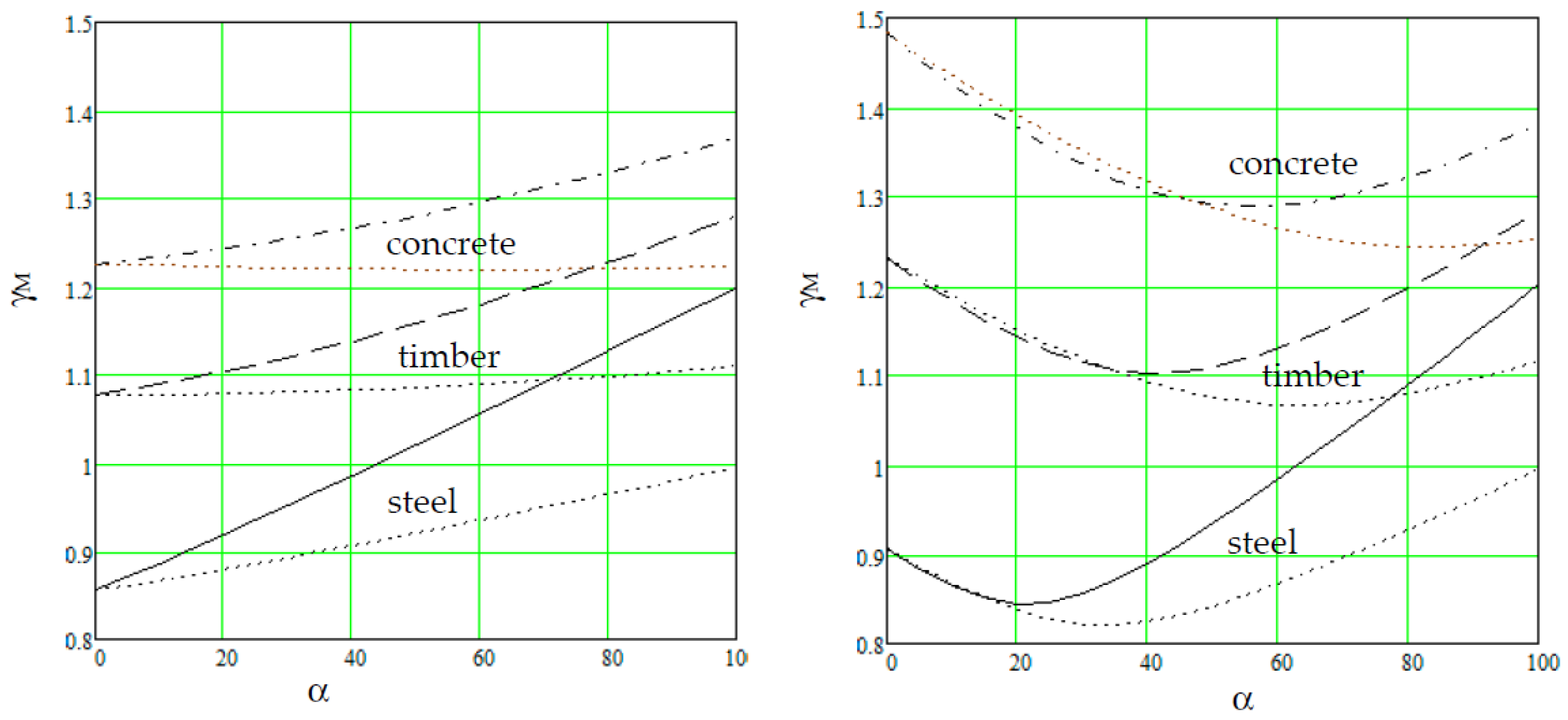
Material safety factors given numerically for single loads in Table 3 are presented in Figure 1 as function of variable load proportion α calculated for Option 1, left Figure and for Option 2 right Figure, solid line, steel, VQ = 0.4; dashed line, timber, VQ = 0.4; dash-dotted line, concrete, VQ = 0.4, dotted lines apply to VQ = 0.2.
The factors for Option 1 are nearly straight lines. The slight deviations from linearity are due to distributional anomalies in the probabilistic combination of the two loads. Material factors should be calculated for individual loads, which result in a full linear relation between loads. Both calculation options yield similar outcomes for single variable loads, which makes sense given that both target approximately the same reliability level for variable loads (50-year loads with β50 = 3.2 result virtually the same as 5-year loads with β50 = 3.8). In multiple variable loads, the SC approach results in a lower load due to the combination factor ψ. However, when it comes to permanent loads, the results differ.
Option 1 results in lower factors for permanent loads since it is based on β50 = 3.2, whereas Option 2 uses β50 = 3.8. The current approach results in lower combination loads at about load proportion a = 0.5 for steel and higher for concrete. Overall, the proposed method results in significantly lower material consumption in concrete structures, whereas the current approach tends to favor steel structures. For timber structures, both methods yield roughly equivalent outcomes. The author proposes that structural codes should prevent unsafe designs for load proportions α = 0.2–0.8. Under this criterion and using the proposed approach, the material factors become 1.15 for steel, 1.25 for timber, and 1.35 for concrete with the variable load governing. In the current approach, the material factors are 1.10 for steel, 1.20 for timber, and 1.40 for concrete, with the variable load governing steel and timber and the permanent load governing concrete. If Equation (1) and the current approach are applied, the corresponding material factors become 1.00, 1.20, and 1.35.
The current steel material factor is unity γM = 1.0, although both calculations indicate that in common design cases with a variable load proportion of 0.8, it should be at least 1.10. If combination rules (8.13) or (8.14) are applied, the mismatch between calculation and code increases about 3%. These calculations are based on medium-grade steel; for high-strength steel, the mismatch is even more pronounced. At present, Equation (1) is used to set the safety factor, and under this formulation, the current value is deemed feasible. However, Equation (1) is questionable, as it accepts unsafe designs under variable loads on the basis that designs under permanent loads are excessively safe.
Figure 1 illustrates calculations using a full probabilistic model, ensuring that there is no reliability error due to a constant material factor setting. By incorporating these figures into codes or textbooks, the material factor in the design equation is variable. This adaptability allows engineers to tailor the design equation where the material factor is variable:
The excess calculation work is negligible. This update significantly enhances precision regarding the target reliability by demonstrating that the approximation of constant material factors across all load proportions, α = 0–1, results in a conservative design approach. The current implementation of Equation (5) with constant may involve up to four load reductions, which at least partially offset its inherent overdesign.
- The SC includes up to about 10% load reduction.
- A reduction of up to about 10% applies to combination rules (8.13) and (8.14).
- Reducing the reference target reliability or time may include up to about 20% reduction.
- Combination factors ψ applied in multiple variable loads may include up to about 5% load reduction.
Several of these reductions may act simultaneously, resulting in a total reduction of up to approximately 20%. However, the locations of overdesign and reductions do not necessarily align, leading to a diffuse and inconsistent outcome.
Equation (5) can be applied in the DC approach with ψ0 = 1, and rule (8.12) where is a linear function of α. The SC approach can be applied, too. If rules (8.13) and (8.14) are applied, other graphs are needed. However, as explained later, the DC approach offers straightforward and simpler calculations.
4.3. Gain
The use of constant material factors in the Eurocodes leads to excessive safety and material use due to approximations in the material factor settings. Assuming that actual design scenarios are uniformly distributed within the load range α = 0.2–0.8, rule (8.12) is applied, and load cases are considered in which only the permanent load and one variable load act, we can estimate the accuracy gain by the variable material factors. This involves computing the mean ratios of calculated factors versus code factors. The results of this approximate calculation are presented in Table 4.
Both calculation options result in a mean overall ratio of 0.88, i.e., the current safety factors indicate about 12% reliability reserve for the target reliability. A useful rule of thumb is that reducing the safety factor by 1% leads to a reduction in material usage of about 0.5% for the material defined by the design.
Given that the total material use governed by Eurocode design rules amounts to approximately EUR 100 billion annually in Europe (as estimated by Forecon Oy, https://www.forecon.fi/en/ accessed on 6 April 2020), updating the safety factors to align with actual reliability levels could potentially result in material savings of about EUR 6 billion per year. Since this option is permitted under the current Eurocodes, it is obvious that this design method will likely gain support. However, the challenge remains in deciding which calculation option—the proposed one or the current one—should be used.
5. Discussion
This section discusses the reliability calculation between the proposed calculation and the current calculation. A new design model is presented. Stability design is discussed. The implementation proposal is presented with examples and benefits.
5.1. Proposed Reliability Calculation vs. Current Calculation
The results obtained from the two calculation options differ. The author supports Option 1 and the DC approach for two main reasons. First, both reliability assessment and load combination should be based on the DC method: no load or reliability reductions are applied, and reliability is evaluated over the actual service life [22,23,24,25]. A key argument for the DC approach is that independent loads act independently; no reduction can be applied. Applying a reduction introduces correlation between loads. Second, the current SC reliability calculations, options 2–4, introduce two significant inconsistencies:
- The target reliability used in the current reliability calculation does not correspond to the service time assumed in the calculation, leading to a mismatch between the design-targeted service time and reliability applied in the calculation.
- Reliability and safety factor calculation is straightforward for single load cases. Therefore, the material factor curves plotted against permanent-to-variable load ratios should align with the safety factors determined for individual loads at both ends of the curve.
The DC approach is safe with respect to the SC approach, as no reductions in loads or reliability are applied. It is also simpler and requires less computational effort. It is up to the research community to decide which method—or potentially a new one—should be adopted.
However, based on these observations, this article further develops Option 1 and proposes a new, simple, and accurate structural design model.
5.2. A New Model for Resistance Design
When a load L acts alone, the design equation is
which is probabilistically realized by Equation (2). This equation is reformulated into an alternative form
where C denotes the resistance utilization ratio. A value of C = 1 indicates full resistance utilization, while C > 1 denotes failure. An acceptable design requires C ≤ 1.
When multiple loads with corresponding partial load factors , and material factors act simultaneously, each consumes a portion of the available resistance. As the loads are independent, their combined effect is calculated additively in terms of capacity usage. No reduction factors are applied to account for the load interaction, as any such reduction would imply correlation between the loads and contradiction with the assumption of independent loads. The resulting design equation for resistance is
This equation yields a different result from the corresponding Eurocode Equation (5) (with constant material factors), which may incorporate up to approximately 20% excess reliability due to the use of a uniform material factor across all permanent-to-variable load ratios and for all types of variable loads.
On the other hand, the parameters of Equation (8) are defined for each load–material interaction and are aligned with the target reliability. As a result, the outcome of Equation (8) matches the target reliability in each load case—avoiding excess reliability and potentially leading to savings of up to about 20% regarding Equation (5).
Equations (5) and (8) result in the same outcome in single loads and in multiple loads. Equation (8) is safe and conservative, as no load reductions are applied.
and M are constants in each load-material combination. Therefore, it is feasible to define
where is factored resistance, i.e., it is allowable stress, and the design equation becomes
Each material requires at least two values: one for permanent loads and another for variable loads. It is feasible to assume that all permanent loads have the same distribution, i.e., each material has one material factor for permanent loads. In theory, every variable load would need its own value, which leads to a considerable number of design parameters. However, it is possible to calibrate all variable loads uniformly by adjusting their characteristic values. This approach introduces minor errors, as it is exact for a single reference material only. Assuming timber as the reference material with full reliability accuracy, its characteristic load at VQ = 0.2 is 15% higher than at VQ = 0.4 to yield the same material factor in both cases. When the same characteristic load at VQ = 0.2 is applied to steel, the resulting material factor is 4% lower, and for concrete, 3% higher, compared with the values at VQ = 0.4. These deviations are negligible.
If all materials are assigned the same variable load characteristic value as in the current Eurocodes, the excess safety at VQ = 0.2 compared to VQ = 0.4 is 21% in steel, 15% in timber, and 12% in concrete. This approach of adjusting the characteristic values of variable loads keeps the design model straightforward, minimizes calculation effort, and ensures results that match the target reliability in each design case within about 2% accuracy. As Equations (8) and (10) yield identical results, the designer is free to use either one.
5.3. Stability Design
In the current Eurocodes, the load factors used for resistance design are also applied to stability design. The load factors for resistance design can be chosen arbitrarily by defining the characteristic values or the material factors variable appropriately. The same approach can be applied in setting the stability load factors, too, regarding variable characteristic values only, as the current codes lack stability factors analogous to material factors. The stability load factors γS are given in Table 5 assuming the variability of material elasticity is disregarded for the Eurocodes, β0 = 4.7 (β50 = 3.8, Pf,50 = 1/15,380) and β0 = 4.2 (β50 = 3.2, Pf,50 = 1/1499) for permanent load γS,G, variable load γS,Q,0.2, VQ = 0.2 and gS,Q,0.4, VQ = 0.4.
If the variability of material elasticity is considered, the factors in Table 5 would be higher. The numbers are high especially in VQ = 0.4 cases. In the current Eurocodes the stability factor is typically less than 1.5, which is one indication that the Eurocode’s reliability is less than β50 = 3.8.
Loads are combined using the DC approach. The stability design load is calculated by
One ideal set of safety factors can be achieved by calibrating load factors for stability and then applying the same factors to resistance by setting the material factors variable. This approach enables a fully probabilistic and consistent design framework with each design matching the target reliability. However, stability design is secondary, while the primary goal is to keep the resistance design simple with little calculation work. Therefore, another practical solution is to allow different load factors for resistance and stability. The author supports this option, as resistance design should be based on uniform load factors and preferably allowable stresses at least in the long term. In any case, it is obvious that the material factors should be variable when the load factors may be selected arbitrarily, and selection γG = γQ simplifies codes. This approach implies that stability design will require its own distinct set of load factors.
5.4. Implementation
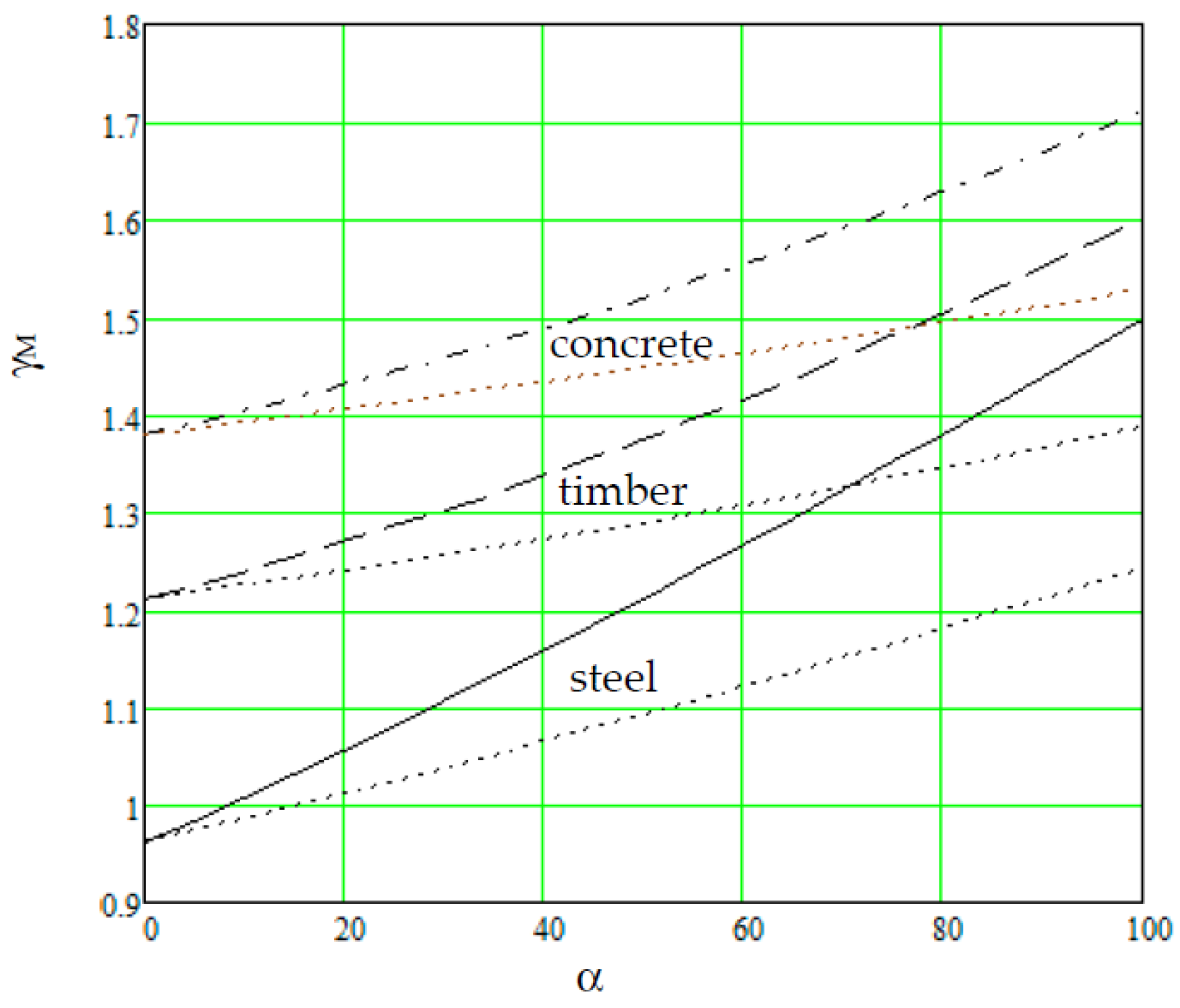
It is obvious that the load factor setting γG = γQ and preferably γG = γQ = 1 simplifies codes and decreases calculation work. From a reliability calculation perspective, this selection is possible, but some design equations, especially in the current concrete Eurocodes, require elevated, i.e., factored loads. Therefore, the author proposed earlier γG = γQ = 1.2 [25] and targeted according to the current approach constant material factors, which required a change in the variable load characteristic values. As the material factors are variable, the current characteristic values may remain. Material factors are proposed here for γG = γQ = 1.2 and obtained by modifying Figure 1, left Figure by increasing the material factors for permanent load by 12.5% (1.35/1.2) and for variable load factors by 25% (1.5/1.2). The results are given in Table 6 and in Figure 2.
Values in parentheses are ratios of calculated factors regarding corresponding factors in the Eurocodes. The mean ratio for permanent load is 0.85, primarily because the calculated factors are based on β50 = 3.2, whereas the Eurocode factors are derived using β50 = 3.8. The author argues that the current Eurocode design is overly conservative with respect to permanent loads, as it is feasible to design for permanent loads with the same reliability as for variable loads. Therefore, the current permanent load factor of 1.35 is excessively high. Furthermore, a permanent load factor of 1.2 was successfully applied in earlier design codes in place of the current value of 1.35. Report [29] suggests γG ≈ 1.2 as a sole permanent load factor.
The mean ratio for variable loads is 0.96, indicating that the proposed safety factors result in slightly lower material volumes for variable actions compared to the current Eurocodes. The mean ratios are 0.98 for steel, 0.88 for timber, and 0.84 for concrete. This suggests that the new safety factors are essentially neutral for steel (excessively safe in permanent loads and unsafe in variable loads), favorable for timber, and highly favorable for concrete.
The outcome given numerically in Table 6 is given graphically in Figure 2. The γM-curves are inclined, which is a disadvantage in the Eurocodes, where horizontal curves are ideal as material factors are constants at all permanent-variable load proportions. However, in the proposed approach, only the endpoints of the curves are relevant; curve inclinations are irrelevant. For stability design a factor for all loads is proposed γs = 1.5. This value is lower than the calculated outcome, but is recommended here since the current Eurocode specifies an even lower overall value.
In the author’s opinion, Table 6 and Figure 2 represent a feasible set of material factors for the Eurocodes. In this approach, each design is aligned with a full mathematical reliability model. However, this model has the disadvantage that each variable load is assigned to its own material factor, which complicates the design process. Therefore, as discussed earlier, it is impossible to determine a single material factor applicable to all variable loads. Use of Equation (8) or Equation (11) is primarily recommended. Equation (5) can be used too, when the material factors are set variable and when the combination factors ψ and rules (8.13) and (8.14) are removed. However, this calculation is laborious as the material factor γM must be excessively defined as a function of the permanent-variable load proportion. All these alternative calculation options make the same outcome. Load factors of γG = γQ = 1.2 are proposed as a temporary solution, while γG = γQ = 1.0 are the target values, with γM values increased by 20% to be used once the design equations are modified accordingly.
5.5. Examples
The practical implications of the proposed design concept and comparison with the current Eurocodes are illustrated through two examples:
A timber structure is subjected to a characteristic permanent load, assumed to correspond to the mean of a normally distributed load. This load induces a stress σG in the structure. The full capacity resistance is calculated by dividing the characteristic material resistance —defined as the 5% fractile of a log-normal resistance distribution—by the product 1.2 × 1.22 = 1.46. This leads to the design criterion: σG ≤ /1.46. In comparison, the corresponding resistance divider in the Eurocodes is 1.76 according to the combination rule (8.12) and 1.50 according to rule (8.14).
A timber structure is subjected to a characteristic variable load, assumed to follow a Gumbel distribution with a coefficient of variation VQ = 0.4; the one-year 0.98-fractile represents the characteristic load. This load induces a stress σQ in the structure. The design resistance is calculated by dividing by 1.2 × 1.6 = 1.92, resulting in the design criterion: σQ ≤ /1.92. In the Eurocodes, the corresponding resistance limit is /1.95.
5.6. Benefits
The proposed design model has some advantages:
The design codes become simpler when the combination rules (8.13) and (8.14), along with the combination factors ψ, are removed.
The calculation work is reduced by more than 50% when alternative load cases arising from combination factors ψ or from rules (8.13) and (8.14) are eliminated.
The proposed design model is safe regarding the current one, since no load or reliability reductions are applied, and its implementation should be straightforward. In theory, the new design might be expected to increase material usage. However, this is not the case because current calculations contain inconsistencies that lead to both unsafe and overly conservative designs. In current codes, the calibration of safety factors results in up to about 20% excess reliability, which is approximately balanced by the unsafe outcome associated with the SC approach. The DDM approach [19,20] removes this excess reliability, implying that the resulting designs may be up to about 15% unsafe due to the SC, with further imbalance between permanent and variable load reliability because the reliability of the variable load is evaluated for reduced loads.
The new design method matches the target reliability. However, achieving this would require a separate material factor for every variable load, which implies a considerable number of material factors. To simplify the codes, it is possible to allow the characteristic value of each variable load to vary—typically corresponding to return periods ranging from about 50 to 400 years—while selecting a single material factor to represent all variable loads. This simplification results in an overall deviation from the target reliability of no more than about 2%. The current characteristic values are based on a long tradition, and changing them may cause confusion among designers. However, having many material factors may not be particularly problematic, especially when full reliability accuracy regarding the target is achieved in each design.
The current reliability calculation relies on combining load pairs, a process that introduces multiple complexities. In the proposed model, load-pair combination is eliminated: each load is treated independently and assigned a proportion of the material’s resistance. These proportions are then summed directly—without reduction—and the total must not exceed the material’s actual resistance. The fundamental concept is straightforward. This approach results in the dependent combination.
Safety-factor selection is challenging in current design codes because a single material factor must be optimized to cover all loads. In the proposed code, this issue is eliminated: no optimization is required, and the target reliability is reached for each design. Load factors can be chosen freely, while material factors are derived from well-established statistical distributions that already enjoy broad professional consensus.
Updating the Eurocodes to the proposed model is straightforward: material factors become variable, and Equation (5) is applied. Equation (8) is simpler and yields the same results with less computation. Combination factors ψ are removed, and rule (8.12) is used; all other current provisions may remain unchanged.
In the author’s view, implementation of the proposed design model requires virtually no additional training for designers. In the first step, only the material factors are set variable and the function of the variable-load proportion to total load a. Combination rules (8.13), (8.14), and combination factors ψ are removed. This adjustment reduces the excess reliability by roughly half, bringing it to about 10%. In the next step, a decision is made whether to adopt the option of accurate reliability with multiple material factors or the option of fewer material factors with updated characteristic values. In the third step, resistance and stability load factors are refined, and the design equations, which were calibrated for elevated, i.e., factored loads, are recalibrated to be independent of the load factors, enabling adoption of the allowable stress approach.
Structural optimization becomes feasible by using the reliable and safe DC calculation. The current SC approach contains inconsistencies, and it is questionable for optimization.
Automatic structural design becomes feasible. Current FEM programs calculate stresses. It is a straightforward task to adapt this calculation into a resistance capacity calculation by dividing the stresses of individual loads by characteristic resistances and summing them.
Ecological benefits arise mainly from lowering the CO2 emissions linked to concrete. Currently, concrete production accounts for roughly 8% of global CO2 emissions. This study shows that the updated Eurocodes can reduce concrete consumption in structural applications by roughly 8% across Europe. Because the Eurocodes are the primary international reference standards, comparable savings are likely to be achieved worldwide. The author estimates that one-third of concrete is structural use defined by codes, and updated codes result in lower volumes and fewer grades. Consequently, global CO2 emissions could decrease by roughly 0.2%—equivalent to about double Finland’s annual emissions and roughly 2% of the EU’s emissions.
6. Conclusions
By allowing material factors to vary, considerable material savings, approximately EUR 6 billion annually in Europe, are achieved by avoiding excess safety margins introduced when assuming constant material factors across all permanent-to-variable load ratios and all types of variable loads.
Safety factors are analyzed using both the current stochastic SC methods and the proposed deterministic DC method. While the results differ in detail, both approaches achieve approximately similar overall material savings when the material factors are set as variables. The two methods produce comparable results for variable loads. However, the proposed method leads to reduced material use in permanent load cases, whereas the current approach proves more efficient in combination load scenarios, especially when the rules (8.13) or (8.14) or combination factors ψ are applied. In terms of material impact, the proposed method significantly reduces material consumption in concrete structures, while the current approach tends to favor steel structures. For timber structures, both methods result in roughly equivalent overall outcomes. Both calculations show that the current material factor for steel, γM = 1.0, is too low in variable loads.
The current stochastic SC reliability calculation incorporates load reductions, which introduces inconsistencies. To address this issue, this research recommends adopting a deterministic DC approach without applying any load reductions. In this context, the combination rules (8.13) and (8.14), as well as the combination factors , are not applied.
A new basic design equation is introduced that is based on independent load–material interaction, eliminating the complicated load-pair reliability calculation. Each load independently consumes a portion of the material’s capacity; these portions are summed, without reductions, and the total must not exceed the material’s capacity.
The overall reliability of the Eurocodes is about β50 = 3.2, because the current safety factors do not achieve resistance and stability for β50 = 3.8 in variable loads.
This research recommends setting uniform load factors for resistance design—for example, γG = γQ = 1.2 or γG = γQ = 1. This implies that stability design will require its own set of load factors.
An approximate stability load factor of γs = 1.5 is proposed for all loads. This value is lower than the calculated outcome, but is recommended since the current Eurocode specifies an even lower value.
The new model can be implemented into the Eurocodes as a special DDM approach without altering the basic load–material design equations. The codes become simpler, computational effort is reduced, reliability and accuracy improve, and both material and CO2 savings are achieved.
Funding
This research received no external funding.
Data Availability Statement
All data are contained within this article. The data presented in the figures can be fully reproduced using the equations provided in this study.
Conflicts of Interest
The author reports no conflict of interest.
Abbreviations
| α | proportion of variable load in combination of permanent and variable load |
| FEM | Finite Element Method |
| FORM | First Order Reliability Model, reliability and load combination process applied in SC |
| DDM | Direct Design Method, a design model where reliability is calculated from load and resistance distributions without predefined safety factors |
| DC | Dependent, i.e., deterministic load combination, dependent, i.e., deterministic reliability calculation |
| DP | Design Point, reference point where loads and resistances match in fixed fractiles |
| SC | Independent, i.e., stochastic load combination, independent, i.e., stochastic reliability calculation |
| SLS | Serviceability limit state |
| ULS | Ultimate limit state |
References
- EN 1990:2002; Eurocode—Basis of Structural Design. CEN: Brussels, Belgium, 2005.
- Draft prEN 1990:2020; Eurocode—Basis of Structural Design. CEN: Brussels, Belgium, 2021.
- Eurocodes: Building the Future. Available online: https://eurocodes.jrc.ec.europa.eu/en-eurocodes (accessed on 3 August 2024).
- Denton, S.; Angelino, M. Eurocodes evolution: Preparing for the second generation. Struct. Eng. 2022, 100, 24–26. [Google Scholar] [CrossRef]
- Ditlevsen, O.; Madsen, H.O. Structural Reliability Methods, Monograph, Internet Edition 2.2.5. Available online: https://www.researchgate.net/publication/263047733_Structural_Reliability_Methods (accessed on 3 March 2025).
- European Commission; Joint Research Centre; Vrouwenvelder, T.; Dimova, S.; Sousa, M.L.; Marková, J.; Mancini, G.; Kuhlmann, U.; Taras, A.; Jockwer, R.; et al. Reliability Background of the Eurocodes; Publications Office of the European Union: Luxembourg, 2024; Available online: https://data.europa.eu/doi/10.2760/9482837 (accessed on 3 March 2025).
- Markova, J.; Sousa, M.L.; Dimova, S.; Athanasopoulou, A.; Iannaccone, S. Reliability of Structural Members Designed with the Eurocodes NDPs Selected by EU and EFTA Member States; EUR 29410 EN; Publications Office of the European Union: Luxembourg, 2018; ISBN 978-92-79-96816-7. [Google Scholar]
- Formichi, P.; Landi, F.; Croce, P. A consistent approach to the calibration of partial factors for permanent and variable loads in the 2nd generation of the Eurocodes. Struct. Infrastruct. Eng. 2023, 21, 1695–1709. [Google Scholar] [CrossRef]
- Ferry Borges, J.; Castanheta, M. Structural Safety, 2nd ed.; Laboratorio National de Engenharia Civil: Lisbon, Portugal, 1971. [Google Scholar]
- Turkstra, C.J. Theory of Structural Design Decisions; Solid Mechanics Division; University of Waterloo: Waterloo, ON, Canada, 1972. [Google Scholar]
- JCSS. Probabilistic Model Code, Parts 1 to 4, Basis of Design, Load and Resistance. Available online: https://www.jcss-lc.org/jcss-probabilistic-model-code/ (accessed on 3 March 2025).
- Gulvanessian, H.; Calgaro, J.-A.; Holicky, M. Designer’s Guide to EN 1990, EUROCODE: Basis of Structural Design; Thomas Telford Publishing: London, UK, 2002. [Google Scholar]
- Gulvanessian, H.; Holicky, M. Eurocodes: Using reliability analysis to combine action effects. Proc. Inst. Civ. Eng. Struct. Build. 2005, 158, 243–252. [Google Scholar] [CrossRef]
- Ranta-Maunus, A.; Fonselius, M.; Kurkela, J.; Toratti, T. Reliability Analysis of Timber Structures; VTT Technical Research Centre of Finland: Espoo, Finland, 2001; Available online: https://publications.vtt.fi/pdf/tiedotteet/2001/T2109.pdf (accessed on 28 July 2025).
- Köhler, J.; Sørensen, J.D.; Baravalle, M. Calibration of existing semi-probabilistic design codes. In Proceedings of the 13th International Conference on Application of Statics and Probability in Civil Engineering, ICASP13, Seoul, Republic of Korea, 26–30 May 2019. [Google Scholar]
- Handbook 1, Basis of Structural Design, Leonardo Da Vinci Pilot Project CZ/02/B/F/PP-134007. Available online: https://eurocodes.jrc.ec.europa.eu/sites/default/files/2021-12/handbook1.pdf (accessed on 3 March 2025).
- Handbook 2, Reliability Backgrounds, Leonardo Da Vinci Pilot Project CZ/02/B/F/PP-134007. Available online: https://eurocodes.jrc.ec.europa.eu/sites/default/files/2021-12/handbook2.pdf (accessed on 3 March 2025).
- Holicky, M. Target reliability of civil engineering structures. IOP Conf. Ser. Mater. Sci. Eng. 2018, 365, 052002. [Google Scholar] [CrossRef]
- Zhang, H.; Shayan, S.; Rasmussen, K.J.R.; Ellingwood, B.R. System-based design of planar steel frames, I: Reliability framework. J. Constr. Steel Res. 2016, 123, 135–143. [Google Scholar] [CrossRef]
- Jaamala, L. System-Level Design Method for High-Strength Steel Hollow Section Structures, Eurocode-Compliant Approach. Ph.D. Thesis, Tampere University, Tampere, Finland, 2025. Available online: http://urn.fi/URN:ISBN:978-952-03-4125-1 (accessed on 7 March 2026).
- Mašek, J.; Vořechovský, M. Uncertainty quantification of engineering problems using N-body system designs: An overview. Adv. Eng. Softw. 2025, 207, 103927. [Google Scholar] [CrossRef]
- Poutanen, T.; Pursiainen, S.; Länsivaara, T. Combination of Permanent and Variable Load Is Dependent. Appl. Sci. 2021, 11, 4434. [Google Scholar] [CrossRef]
- Poutanen, T.; Länsivaara, T.; Pursiainen, S.; Mäkinen, J.; Asp, O. Calculation of Safety Factors of the Eurocodes. Appl. Sci. 2021, 11, 208. [Google Scholar] [CrossRef]
- Poutanen, T. Combination of variable loads in structural design. Appl. Sci. 2024, 14, 6466. [Google Scholar] [CrossRef]
- Poutanen, T. Code Calibration of the Eurocodes. Appl. Sci. 2021, 11, 5474. [Google Scholar] [CrossRef]
- EN 1992-1-1:2005; Eurocode 2. Design of Concrete Structures. CEN: Brussels, Belgium, 2005.
- EN 1993-1-1:2005; Eurocode 3. Design of Steel Structures. CEN: Brussels, Belgium, 2005.
- EN 1995-1-1:2004; Eurocode 5. Design of Timber Structures. CEN: Brussels, Belgium, 2004.
- Köhler, J.; Sørensen, J.D. Sustainability Potential—NDP Eurocodes; Eurocodes internal report; Joint Research Centre (JRC): Brussels, Belgium, 2024. [Google Scholar]
Figure 1.
The left figure shows the material factors for Option 1: solid line, steel, VQ = 0.4; dashed line, timber, VQ = 0.4; dash-dotted line, concrete, VQ = 0.4; dotted lines apply to VQ = 0.2. The right figure shows the corresponding factors for Option 2.
Figure 1.
The left figure shows the material factors for Option 1: solid line, steel, VQ = 0.4; dashed line, timber, VQ = 0.4; dash-dotted line, concrete, VQ = 0.4; dotted lines apply to VQ = 0.2. The right figure shows the corresponding factors for Option 2.

Figure 2.
Material factors as a function of proportion of variable load a, calculated for steel, VQ = 0.4, solid line; timber, VQ = 0.4, dashed line; and concrete, VQ = 0.4, dash-dotted line; dotted lines apply to VQ = 0.2, γG = γQ = 1.2, β50 = 3.2.
Figure 2.
Material factors as a function of proportion of variable load a, calculated for steel, VQ = 0.4, solid line; timber, VQ = 0.4, dashed line; and concrete, VQ = 0.4, dash-dotted line; dotted lines apply to VQ = 0.2, γG = γQ = 1.2, β50 = 3.2.


Table 1.
The parameters of the three examined materials: steel, timber, and concrete. γM,code, current material factor of the Eurocodes, VM = coefficient of variation; μM = mean; σM = deviation. The steel parameters correspond to standard medium-resistant steel grades S355 and S420 [26,27,28].
| Material | γM,code | VM | μM | σM |
|---|---|---|---|---|
| Steel | 1.0 | 0.05 | 1.200 | 0.060 |
| Timber | 1.3 | 0.20 | 1.412 | 0.283 |
| Concrete | 1.5 | 0.30 | 1.692 | 0.508 |
Table 2.
Factors for permanent load γM,G, and variable load γM,Q, VQ = 0.4, calculated according to options 1–4.
Table 2.
Factors for permanent load γM,G, and variable load γM,Q, VQ = 0.4, calculated according to options 1–4.
| Material | γM,G | γM,Q | ||||||
|---|---|---|---|---|---|---|---|---|
| Opt 1 | Opt 2 | Opt 3 | Opt 4 | Opt 1 | Opt 2 | Opt 3 | Opt 4 | |
| Steel | 0.86 | 0.91 | 0.94 | 0.91 | 1.20 | 1.20 | 1.21 | 1.06 |
| Timber | 1.08 | 1.23 | 1.34 | 1.23 | 1.28 | 1.29 | 1.30 | 1.11 |
| Concrete | 1.23 | 1.48 | 1.68 | 1.48 | 1.37 | 1.38 | 1.40 | 1.16 |
Table 3.
Material factors for permanent load γM,G, and variable load γM,Q,0.2, for VM = 0.2 and gM,Q,0.4, for VM = 0.4, calculated according to option 1, proposed calculation, and option 2, current calculation.
Table 3.
Material factors for permanent load γM,G, and variable load γM,Q,0.2, for VM = 0.2 and gM,Q,0.4, for VM = 0.4, calculated according to option 1, proposed calculation, and option 2, current calculation.
| Material | Option 1, Proposed Calculation | Option 2, Current Calculation | ||||
|---|---|---|---|---|---|---|
| γM,G | γM,Q,0.2 | γM,Q,0.4 | γM,G | γM,Q,0.2 | γM,Q,0.4 | |
| Steel | 0.86 | 1.00 | 1.20 | 0.91 | 1.00 | 1.20 |
| Timber | 1.08 | 1.11 | 1.28 | 1.23 | 1.12 | 1.29 |
| Concrete | 1.23 | 1.22 | 1.37 | 1.48 | 1.25 | 1.38 |
Table 4.
Ratios of the calculated material factors γCalc,0.2 for VM = 0.2 and γCalc,0.4 for VM = 0.4 vs. code factors γCode.
Table 4.
Ratios of the calculated material factors γCalc,0.2 for VM = 0.2 and γCalc,0.4 for VM = 0.4 vs. code factors γCode.
| Material | Option 1 | Option 2 | ||
|---|---|---|---|---|
| γCalc,0.2/γCode | γCalc,0.4/γCode | γCalc,0.2/γCode | γCalc,0.4/γCode | |
| Steel | 0.92 | 1.02 | 0.86 | 0.95 |
| Timber | 0.84 | 0.89 | 0.84 | 0.88 |
| Concrete | 0.81 | 0.85 | 0.87 | 0.88 |
Table 5.
Load factors γS for stability, γS,G, gS,Q,0.2 and γS,Q,0.4, β50 = 3.2, β50 = 3.8.
| β50 | γS,G | γS,Q,0.2 | γS,Q,0.4 |
|---|---|---|---|
| 3.2 | 1.32 | 1.75 | 2.12 |
| 3.8 | 1.38 | 1.99 | 2.48 |
Table 6.
Material factors for permanent load γM,G, and for variable loads γM,Q,0.2, γM,Q,0.4, for steel, timber, and concrete, β50 = 3.2 (Pf,50 = 1/1499), γG = γQ = 1.2 (ratios regarding gcode).
Table 6.
Material factors for permanent load γM,G, and for variable loads γM,Q,0.2, γM,Q,0.4, for steel, timber, and concrete, β50 = 3.2 (Pf,50 = 1/1499), γG = γQ = 1.2 (ratios regarding gcode).
| Material | γM,G | γM,Q,0.2 | γM,Q,0.4 |
|---|---|---|---|
| Steel | 0.97 (0.86) | 1.25 (1.00) | 1.50 (1.20) |
| Timber | 1.22 (0.83) | 1.39 (0.86) | 1.60 (0.99) |
| Concrete | 1.38 (0.82) | 1.52 (0.81) | 1.71 (0.91) |
Disclaimer/Publisher’s Note: The statements, opinions and data contained in all publications are solely those of the individual author(s) and contributor(s) and not of MDPI and/or the editor(s). MDPI and/or the editor(s) disclaim responsibility for any injury to people or property resulting from any ideas, methods, instructions or products referred to in the content. |
© 2026 by the author. Licensee MDPI, Basel, Switzerland. This article is an open access article distributed under the terms and conditions of the Creative Commons Attribution (CC BY) license.
Share and Cite
MDPI and ACS Style
Poutanen, T. Deterministic Structural Design. Appl. Sci. 2026, 16, 3002. https://doi.org/10.3390/app16063002
AMA Style
Poutanen T. Deterministic Structural Design. Applied Sciences. 2026; 16(6):3002. https://doi.org/10.3390/app16063002
Chicago/Turabian StylePoutanen, Tuomo. 2026. "Deterministic Structural Design" Applied Sciences 16, no. 6: 3002. https://doi.org/10.3390/app16063002
APA StylePoutanen, T. (2026). Deterministic Structural Design. Applied Sciences, 16(6), 3002. https://doi.org/10.3390/app16063002
Note that from the first issue of 2016, this journal uses article numbers instead of page numbers. See further details here.