


Abstract
Robotic pipe welding represents a key and rapidly evolving technology for the automation of pipe and pipe-joint welding processes with standard, intersecting, and complex geometries. This review analyses 84 studies published over the past three decades, categorising them into four primary research areas: general pipe welding, intersecting pipes, boiler and tube-to-tubesheet welding, and control and modelling. Two separate comparative analyses were conducted: one within intersecting pipe research and another within the control and modelling category. The aggregated findings reveal consistent, complementary patterns: simulation and laboratory experiments clearly dominate validation methods, while industrial-scale evaluations remain scarce. The results further demonstrate that control strategies, sensor integration, and validation levels are strongly interconnected, collectively determining system performance, reliability, and practical applicability. Despite significant progress, challenges remain, including system integration complexity, limited robustness in variable industrial environments, insufficient real-time adaptive control, and inconsistent quantitative performance evaluation. Further research should prioritise the development of digital twins, human–robot collaboration, multi-sensor fusion, reinforcement learning-based adaptive control, and scalable industrial deployment. This review provides an overview of current progress and outlines key directions for developing intelligent and reliable robotic pipe welding systems.
1. Introduction
Welding is a fundamental manufacturing process used to join metallic components by applying heat to form a permanent bond [1,2]. It plays a crucial role in modern industrial manufacturing, with applications in shipbuilding, construction, mining, transportation, petrochemicals, and metallurgy [1]. The primary objective of welding is to achieve a structurally reliable joint that meets functional requirements while maintaining high productivity and cost-effectiveness [2].
Unlike many other industrial processes, welding exposes operators to fumes, ultraviolet (UV) radiation and thermal hazards that may cause acute and chronic respiratory illnesses, including bronchitis and increased risk of cancer [1,3]. In industrial practice, these risks are mitigated by engineering controls such as local exhaust ventilation and on-gun fume extraction systems, which capture contaminants at the source, together with respiratory protective equipment and comprehensive personal protective measures. Together, these measures help to minimise the negative health impacts associated with welding operations [4].
Although such solutions significantly reduce exposure, they do not eliminate operator dependency or variability in weld quality, which further encourages the implementation of robotic systems. Weld quality and productivity are further influenced by operator fatigue, parameter control, and working conditions, especially in challenging welding positions [5,6]. Due to increasing quality requirements and the shortage of qualified personnel, robotic welding has become an important solution for improving safety, repeatability, and process stability.
Early robotic welding systems operated on a teach-and-play principle with limited adaptability [7]. On the other hand, modern systems integrate machine vision, real-time image processing, and adaptive control strategies, such as adaptive neuro-fuzzy inference systems, to enable weld seam detection, tracking, and dynamic parameter adjustment [8]. In addition, advanced path planning methods, including improved genetic algorithms, are used to optimise spatial welding trajectories and overcome limitations of conventional optimisation techniques [9]. These developments support higher autonomy, improved accuracy, and increased process efficiency in intelligent robotic welding.
In the context of Industry 4.0, the optimisation of robotic processes increasingly relies on digital modelling, simulation-based verification, and multi-criteria analysis of motion parameters such as Tool Centre Point trajectory length, velocity, and cycle time. Comparative studies of collaborative robotic systems have shown that monitoring motion and controller signals allows evaluation of productivity, energy consumption, and economic efficiency already at the simulation stage [10]. These approaches are particularly relevant for robotic pipe welding, where complex three-dimensional trajectories and continuously changing torch orientations directly affect process stability and total cycle time.
The emerging Industry 5.0 paradigm further extends these objectives by emphasising human–robot collaboration and sustainable manufacturing, including energy-efficient robotic welding systems [10,11]. Optimisation of motion paths and control parameters has been shown to significantly affect overall energy consumption [11], which is particularly important in welding intersecting pipe joints due to long spatial trajectories and frequent torch reorientation. Therefore, integrating energy-aware trajectory planning represents an important step toward sustainable and intelligent robotic pipe welding.
In industrial practice, robotic welding is widely used in the automotive sector for spot welding and MIG/MAG welding on vehicle assembly lines [12]. It is also increasingly applied in small-batch production and more complex contexts, where high-quality, reliable welding and process flexibility are required.
Pipe welds can be classified according to geometry and structural requirements, including butt welds, flange welds, and unsupported flange welds [13]. Particularly challenging are TKY joints (forming the letters T, K, and Y), which are often encountered in shipbuilding and power plant installations. These spatial configurations require welding in the 6G position and involve continuously varying groove geometry [14]. Such joints often present challenges for full automation and are frequently the subject of research in robotic path planning and process optimisation. Recent work has proposed an autonomous AHP-based method for optimising welding positions in thick plate T-joints, aimed at controlling angular distortion and weld collapse and improving automation and manufacturing efficiency [15].
Robotic welding of intersecting pipes is widely used in petroleum, chemical, and energy industries, where high weld quality is critical for structural integrity and safety [16,17]. Due to geometric complexity and positional constraints, such joints have traditionally been welded manually, resulting in high physical workload and variable quality [18].
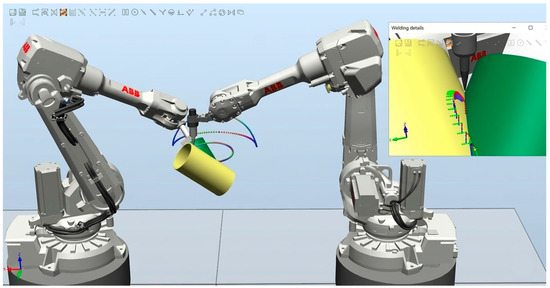
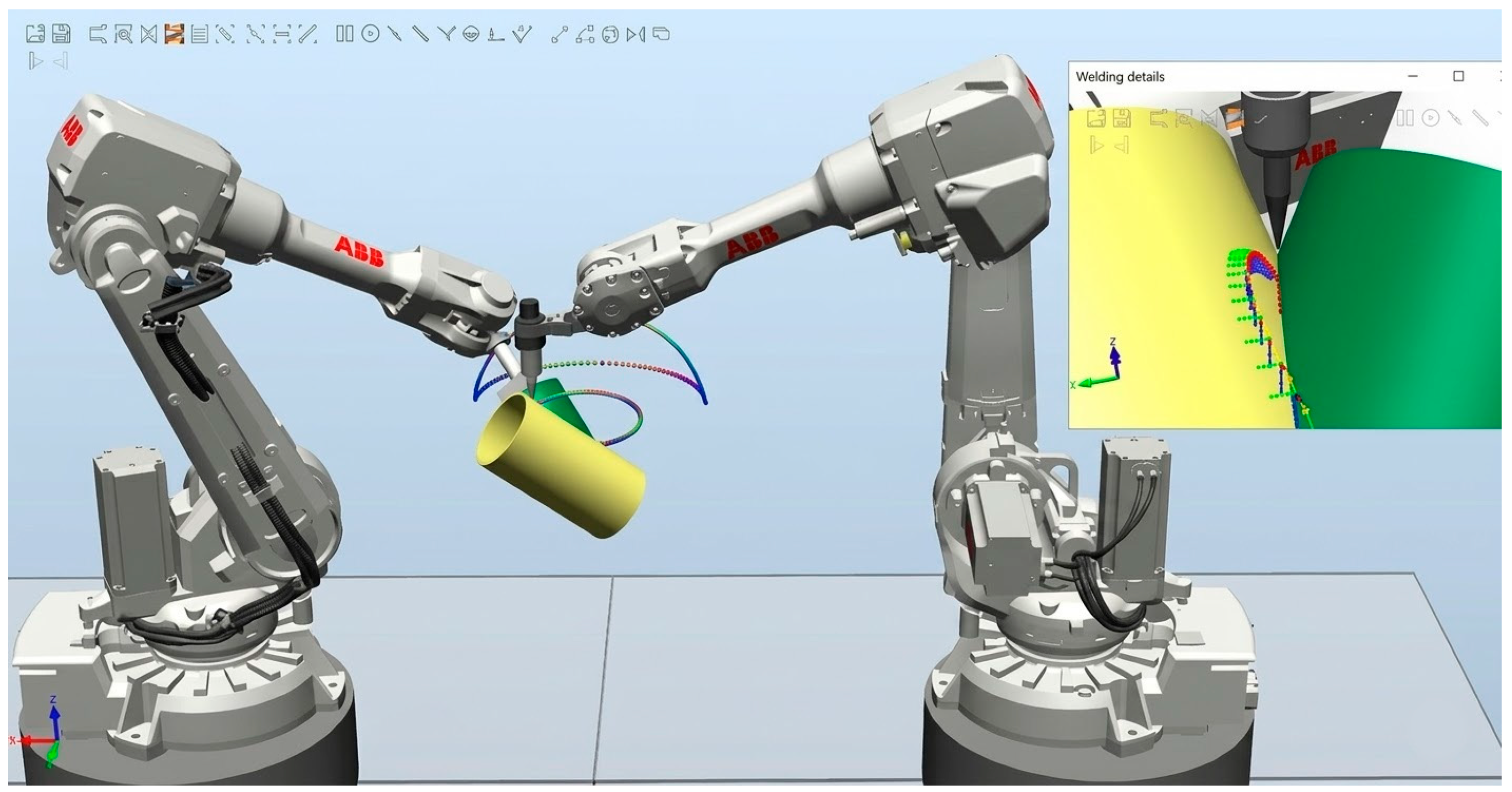
The weld seam formed on intersecting pipes represents a three-dimensional curve with continuously changing curvature and torsion [16]. These variations require continuous adjustment of the welding torch orientation and precise synchronisation of the trajectory and process parameters [17]. Achieving stable robotic welding under such conditions therefore demands accurate trajectory planning and robust seam localisation. To address these challenges in industrial practice, dual-robot systems are increasingly being used to coordinate welding trajectories and ensure consistent weld quality across intersecting pipes, as illustrated in Figure 1.
Figure 1.
Dual-robot system welding intersecting pipes, illustrating spatial complexity and trajectory requirements [19].
To enable precise welding in such complex conditions, it is crucial to select an appropriate programming method for the robotic system. Two primary programming approaches are commonly used: teaching-based programming and model-based programming. While teaching ensures high geometric accuracy, it is time-consuming; model-based programming reduces manual effort but assumes ideal geometry that rarely corresponds to real production conditions. To overcome these limitations, optical and acoustic sensing systems for real-time seam detection and path correction have been introduced [20].
Despite these advances, practical implementation remains limited by geometric deviations caused by manufacturing tolerances, transport-induced deformation, and assembly errors, which prevent reliable modelling of ideal joints [20]. One reported industrial configuration includes a robotic system with four rotary axes designed for pipe welding in desalination plants [21]. However, adapting such systems to variable real-world conditions remains challenging.
Although numerous reviews on robotic welding exist, most focus on general automation strategies, path planning algorithms, or process optimisation techniques, without explicitly addressing the robotic welding of intersecting and irregular pipe geometries. Robotic pipe welding of intersecting and irregular joints remains underexplored, especially in terms of process stability, trajectory planning, sensor-based monitoring, energy efficiency, and human–robot collaboration under industrial conditions.
This review addresses these gaps by providing a systematic bibliographic analysis of 84 selected studies on robotic pipe welding, systematically categorised into four main research areas: general pipe welding, intersecting pipes, boiler and tube-to-tubesheet welding, and control and modelling. Each category is further divided into subcategories reflecting technological approaches, sensing strategies, path-planning methods, and system design considerations.
The novelty of this paper lies in the following:
- (i)
- Systematically identifying and categorising research specifically on intersecting and irregular pipe joints;
- (ii)
- Highlighting gaps in trajectory planning, process parameter optimisation, sensing integration, and real-world implementation;
- (iii)
- Providing a structured reference framework to guide future research, particularly in energy-aware and human–robot collaborative welding.
The remainder of the paper is organised as follows: Section 2 describes the methodology used for literature selection and analysis; Section 3 presents the categorisation of pipe joints and robotic welding technologies; Section 4 summarises key findings and technological trends; Section 5 identifies research gaps and proposes directions for future work.
2. Methodology
The data set analysed in this literature review on robotic pipe welding was obtained from the Web of Science platform, a major bibliographic database indexing thousands of scientific journals. The review is based on a four-step process: data gathering, data cleaning, AI-based screening, and manual data screening, as shown in Figure 2. This four-step process is limited by the number of databases and selected keywords. Furthermore, the AI prompts used for data analysis certainly influence the results, as well the manual screening performed by the researchers.
Figure 2.
Four-step process of the literature review.
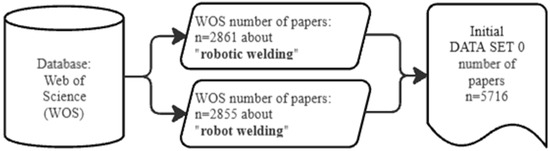
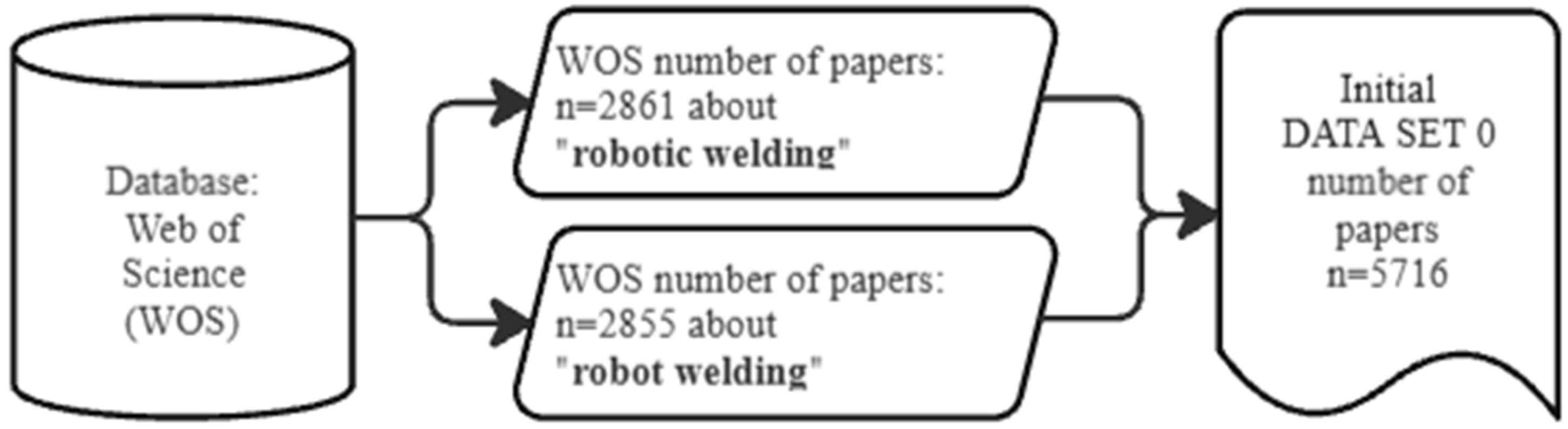
The first step, “Data gathering”, is performed using keywords entered into the Web of Science search engine (WoS) configured to query “All Databases”. To ensure comprehensive coverage of the literature, both commonly used keyword variants, “robot welding” and “robotic welding,” are included in the search. Search results are limited exclusively to articles, which are then exported to Microsoft Excel spreadsheets containing information such as titles and abstracts. The first keyword, “robot welding,” yielded an Excel list of 2855 articles, while the second keyword, “robotic welding,” resulted in another Excel list of 2861 articles. The exported Excel tables were consolidated into a single worksheet titled “DATA SET 0”; see Figure 3.
Figure 3.
The “Data gathering” subprocess.
In the second step, “Data cleaning,” standard Excel functions are applied to clean “DATA SET 0”. First, duplicate titles are removed, followed by articles without listed authors and those lacking abstracts, as shown in Figure 4. After this step, 3232 articles remain in “DATA SET 3”.
Figure 4.
The “Data cleaning” subprocess.
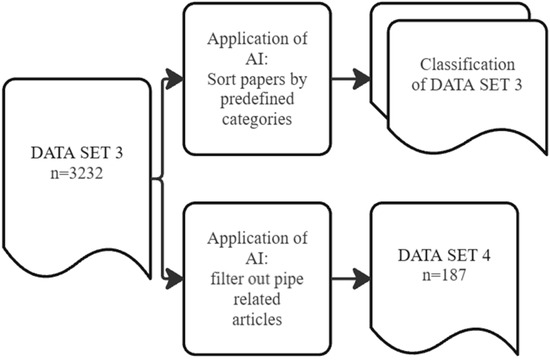
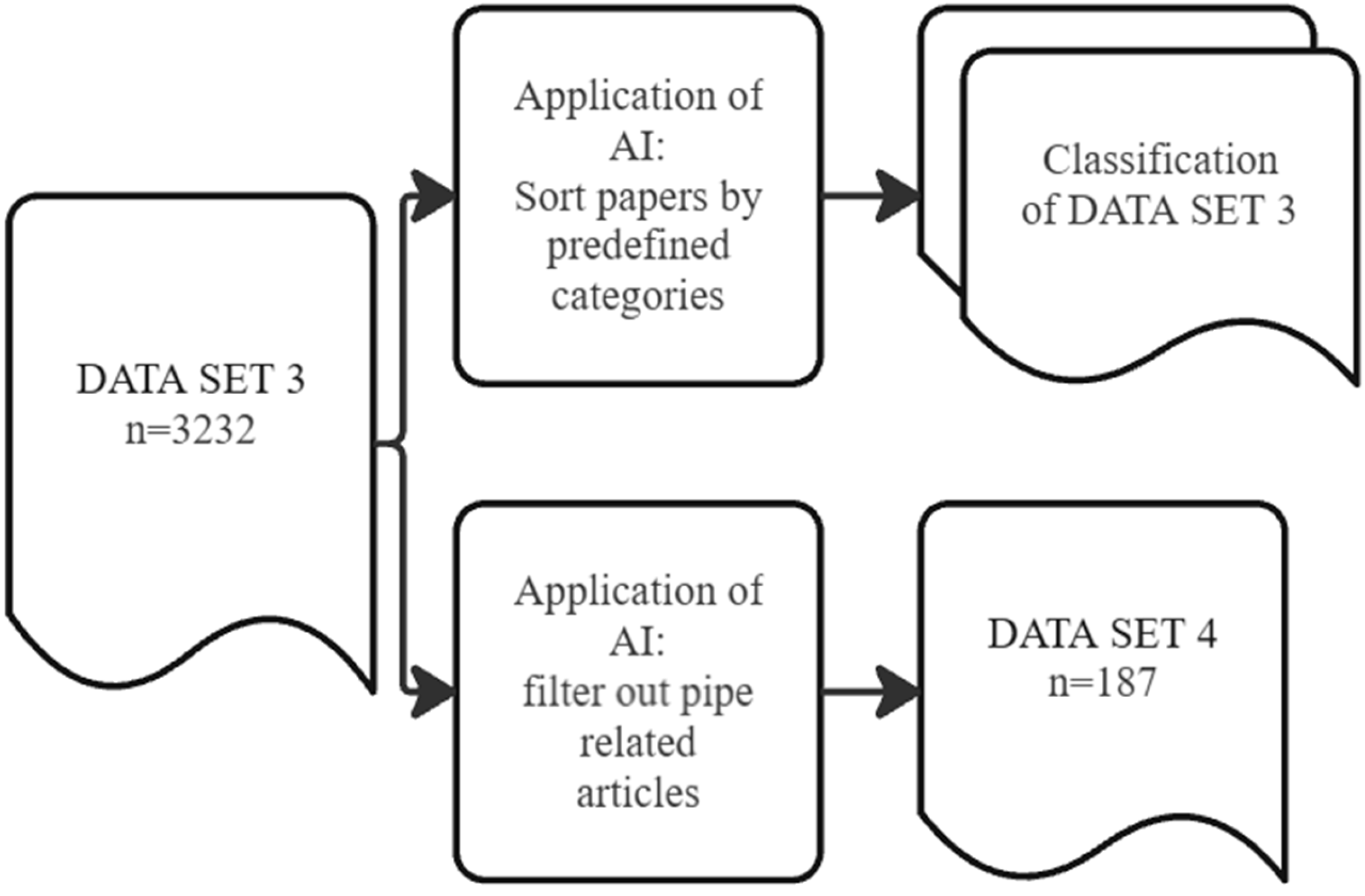
The “AI screening” subprocess can be divided into two applications: sorting and filtering of “DATA SET 3”, as illustrated in Figure 5.
Figure 5.
The “AI screening” subprocess.
For both applications, a prompt design consists of three parts: the first part describes the structure of the input “DATA SET 3”, the second part defines the screening parameters, and the third part describes how the output should be organised.
The content of the “DATA SET 3” is organised as an Excel worksheet with five columns: Column A—Article ID, Column B—Article Title, Column C—DOI, Column D—Publication Year, and Column E—Abstract. Each row represents a single paper, resulting in 3232 rows.
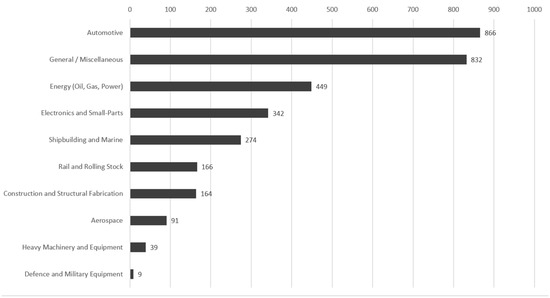
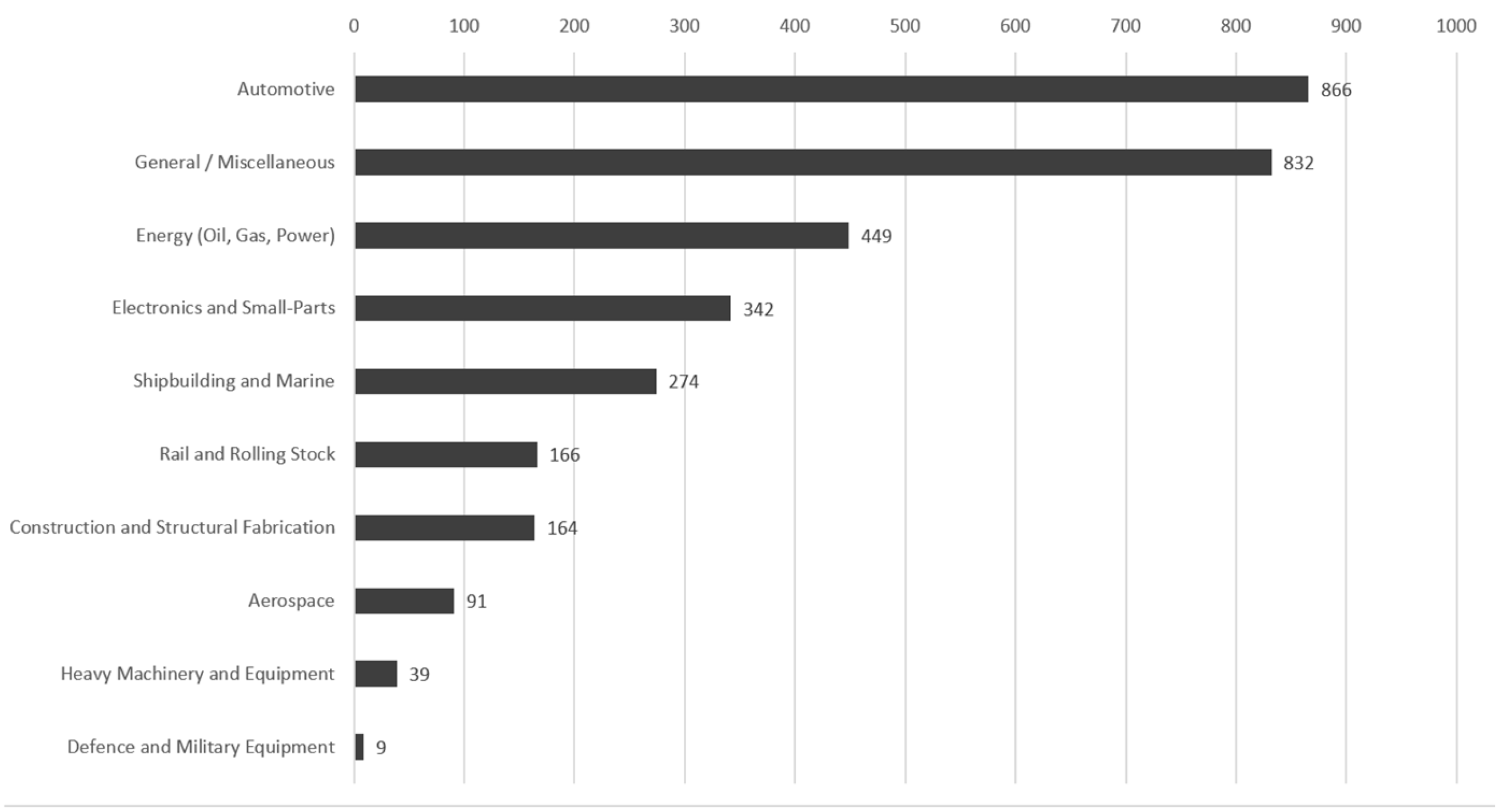
To classify the “DATA SET 3”, the screening parameters were set to sort the articles into the following nine industrial classes in which robot or robotic assisted welding is applied: Aerospace, Automotive, Construction and Structural Fabrication, Defence and Military Equipment, Electronics and Small Parts, Energy (Oil, Gas, Power), Heavy Machinery and Equipment, Rail and Rolling Stock, and Shipbuilding and Marine. Since some papers fit into more than one category, a tenth category “Miscellaneous” was added to accommodate overlapping classifications. Figure 6 shows that robotic welding is most prevalent in the automotive industry, and a substantial number of articles are not motivated by a single specific industrial sector. This categorisation does not provide information on the extent to which robot welding and robotic welding are applied to pipe welding.
Figure 6.
Classification of articles based on “DATA SET 3”.
Therefore, a second AI application was employed to filter articles related to pipes using keywords such as pipe, tube, cylindrical joint, and curved ducts. This filtering reduced the number of articles to 187, resulting in “DATA SET 4”, as shown in Figure 5.
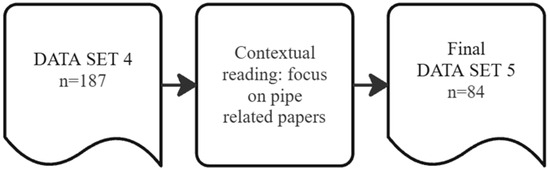
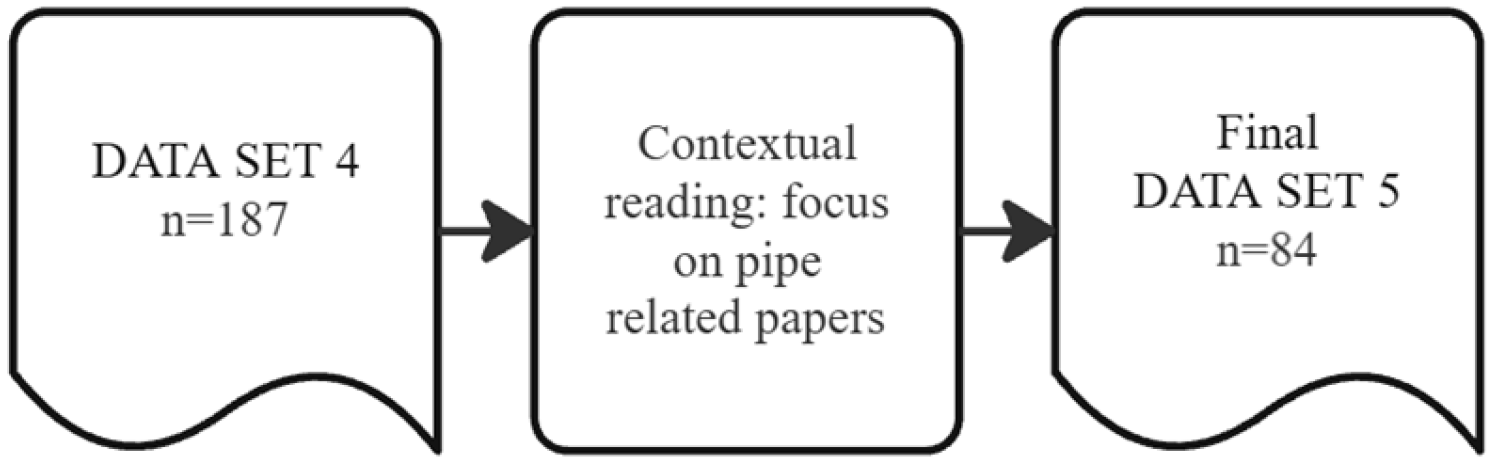
The last step, “manual screening”, involved contextual reading of the remaining 187 articles in the “DATA SET 4” after AI-based screening to ensure the quality and relevance of the selected publications, as illustrated in Figure 7. Finally, 84 articles on robotic pipe welding and related tubular components were included in this literature review.
Figure 7.
The “Manual screening” subprocess.
3. Categorisation
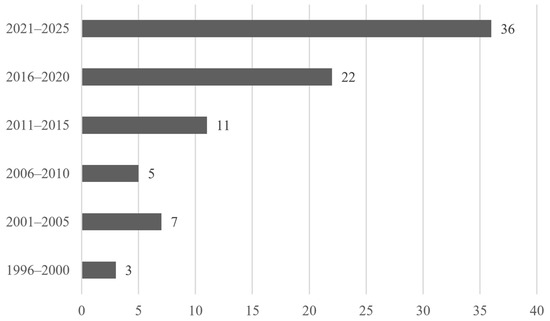
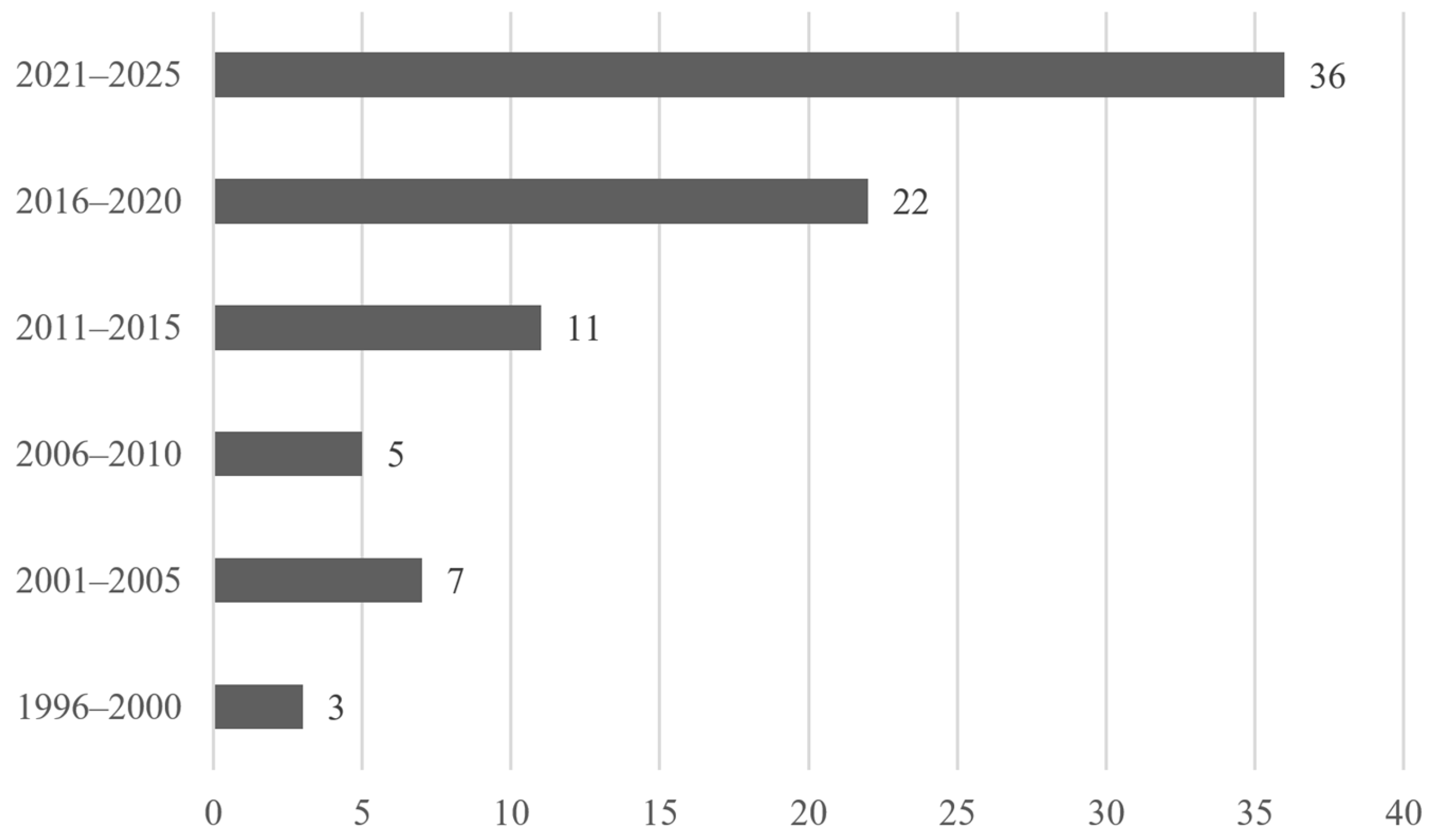
The articles included in this literature review indicate that robotic pipe welding has become an increasingly researched topic over the past 30 years, as Figure 8 visually illustrates. For clarity and consistency, the timeline was divided into five-year intervals, which makes it easier to follow the trends and see how research activity has evolved over time.
Figure 8.
Number of relevant papers on robotic pipe welding in the last 30 years.
In recent years, the development of robotic welding systems in industry has increasingly focused on the implementation of intelligent algorithms, sensor-based perception, and adaptive control to address the challenges posed by complex joint geometries, high workpiece variability, and real-time precision requirements.
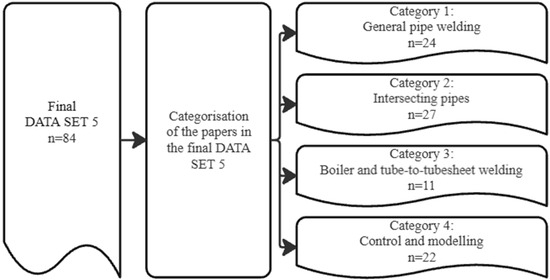
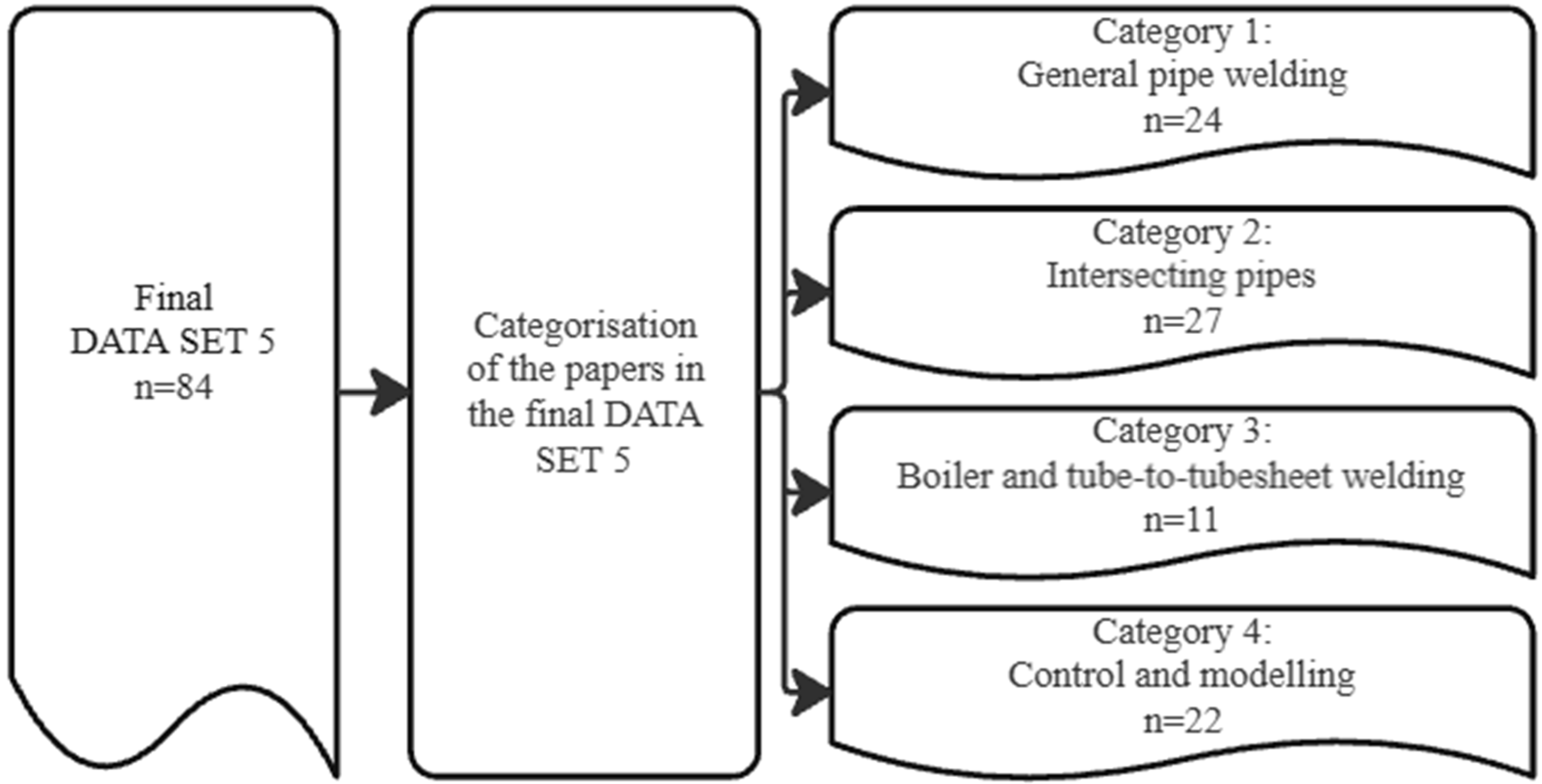
In this review, the authors focused on welding technologies for intersecting pipes and pipe joints. Based on the analysis of article titles and abstracts, four main categories emerged: general pipe welding, intersecting pipes, boiler and tube-to-tubesheet, and control and modelling, as shown in Figure 9. Papers not specifically addressing intersecting pipes were grouped as general pipe welding, while recurring themes on boilers or tube-to-tubesheet welding were classified accordingly. Studies emphasising control strategies or modelling approaches were placed in the control and modelling category. This categorisation reflects both the thematic focus of the review and the distribution of topics in the analysed literature. The references for each category are summarised in Table 1.
Figure 9.
Categorisation of the final “DATA SET 5”.
Table 1.
Categorisation of robot and robotic pipe welding.
The “General pipe welding” category includes research papers that focus on the application of robotic welding techniques to straight or linear pipe structures. This category primarily addresses automation strategies for welding pipes with simple geometries, where the welding path is predictable, and high precision is required.
The “Intersecting pipes” category refers to studies examining welding processes involving cylindrical pipes that intersect at specific angles. The geometric complexity of these intersections presents significant challenges for conventional manual welding, requiring advanced robotic solutions. Research in this category primarily focuses on trajectory planning, sensor-assisted monitoring, and robotic end-effector design to achieve accurate welds along irregular seams.
Additionally, the “Boiler and tube-to-tubesheet welding” category addresses the specialised application of robotic welding within the boiler manufacturing sector. Boilers frequently involve numerous tubes welded into tubesheets, forming densely packed welding configurations with significant geometric constraints.
Finally, the “Control and modelling” category covers research that emphasises theoretical and computational aspects of robotic welding systems. This category includes studies on process modelling, simulation, trajectory optimisation, and adaptive control strategies aimed at improving weld quality and operational efficiency.
Collectively, these categories reflect the diversity of robotic pipe welding research, including both practical applications and theoretical advances. The categorisation of this literature review with the associated papers is shown in Table 1.
3.1. General Pipe Welding
In the domain of general pipe welding (Table 2), studies cover the deployment of robotic systems in unstructured and challenging environments [22,23], the integration of sensor systems and computer vision methods for precise positioning and seam tracking [25,26,31], adaptive control strategies based on visual feedback and data-driven learning [27], the automation of multi-layer and multi-pass welding paths [30], as well as the application of various welding technologies, including SMAW and laser welding [24,28,29].
Table 2.
Subcategorisation of “General pipe welding”.
Research in this area demonstrates significant advances in specialised mechanical systems for orbital and circumferential welding [33,34,38,44], process optimisation and control [37,40], and the deployment of advanced sensor systems for real-time seam monitoring and automatic parameter adjustment [35,36,41]. Computer vision and artificial intelligence further enable precise real-time seam recognition and tracking, including the use of infrared cameras and neural networks [39,42,43,45]. Conventional industrial robots are also effectively applied in this domain with appropriate programming and adaptation [32].
3.2. Intersecting Pipes
This subcategorisation covers studies addressing intersecting pipe geometries and is further divided into seven distinct subcategories, as shown in Table 3. Recent studies highlight advanced algorithms for trajectory generation, path interpolation, and motion simulation to address complex geometries and surface deviations of workpieces [16,17,18,20,21,46,54,56,61,63,66]. Collaborative multi-robot operations demonstrate improvements in productivity and weld quality, particularly in scenarios demanding synchronised manipulation and coordinated motion [19,51].
Table 3.
Subcategorisation of “Intersecting pipes”.
The integration of advanced sensor technologies, including laser scanning, structured light, and 3D vision systems, enables accurate mapping of joints and automatic extraction of welding paths, reducing reliance on manual programming and improving process adaptability [52,57,59]. Optimisation of welding parameters, combined with real-time monitoring and control strategies such as H∞ methods and data-driven adaptive approaches, ensures consistency and precision across multi-pass welding operations [48,64].
Mathematical modelling of joint geometry supports path planning and robotic control, providing precise representations of cylindrical and complex intersections that guide automated operations [65]. Tailored methods for specific joint types, including multi-layer and segmented welding strategies, as well as kinematic and dynamic modelling for moving or rotating workpieces, further enhance weld quality in variable and challenging geometries [49,50,58,60,62]. In parallel, engineering design of robotic systems, including mechanical configuration, kinematic optimisation, and end-effector trajectory planning, ensures that hardware and software capabilities are aligned with the demands of industrial welding tasks [47,53,55].
For this category, Table 4 presents a structured comparison of 27 studies addressing robotic welding of intersecting pipes. Each study is summarised according to its technical focus, validation level, type of robotic control, integration level, and quantitative metrics reported. The technical focus highlights the main contributions of each paper, including trajectory planning, multi-robot coordination, collision avoidance, interpolation strategies, and data-driven control. The validation levels indicate whether the proposed methods were assessed through simulation, laboratory experiments, prototype development, or industrial testing. Type of robotic control captures the extent to which robotic systems operate offline, semi-adaptively, or in real-time. The level of integration reflects the scope of the system, from single-module contributions to multi-module or full robotic implementations. Finally, the quantitative metrics reveal whether numerical performance indicators, such as accuracy, RMS error, or processing speed, were reported, or whether the evaluation was only qualitative.
Table 4.
Comparative analysis of the subcategorisation “Intersecting pipes”.
The aggregated results reveal several key trends. Simulation and laboratory experiments dominate the validation methods, whereas industrial-scale evaluation remains rare. Most studies use offline programming, while semi-adaptive methods appear primarily in dual-robot or interpolation-based strategies. True real-time adaptive control is implemented in only a few studies. Multi-module integration is common, reflecting the combination of trajectory planning, welding strategies, and control algorithms, whereas full robotic system implementations are limited. Quantitative performance reporting is inconsistent: approximately half of the studies provide numerical accuracy measures, many rely solely on qualitative assessments, and few evaluate computational efficiency or processing speed.
Overall, these observations suggest that research on intersecting pipe welding has primarily focused on algorithmic development and laboratory validation. Significant gaps remain in real-time adaptive control, industrial application, and standardised quantitative evaluation, indicating opportunities for future work to enhance both the robustness and practical applicability of robotic welding systems.
3.3. Boiler and Tube-to-Tubesheet Welding
Over the past decade, robotic systems and advanced sensor technologies have significantly advanced the automation of membrane wall welding and tube-to-tubesheet joints. These studies can be subcategorised as shown in Table 5.
Table 5.
Subcategorisation of “Boiler and tube-to-tubesheet welding”.
Studies in the first category [67,68] aim to improve the efficiency and accuracy of membrane wall welding by utilising robotic systems and integrated sensors. The second category [70,72,74,77] addresses multi-sensor systems for tube-to-tubesheet joints, combining vision systems, laser sensors, and advanced algorithms to enable precise weld tracking and control. The third category [69,71,73,75,76] encompasses more complex solutions that employ 3D vision, laser technologies, and data-processing algorithms for accurate positioning, adaptive path planning, and enhanced weld quality under dynamic conditions.
3.4. Control and Modelling
The subcategorisation of “Control and modelling” can be divided into four categories, as shown in Table 6. These include different modelling approaches (e.g., kinematic and welding process modelling) as well as robotic control strategies and sensor-based techniques for seam detection and path correction. Recent studies highlight the development of advanced kinematic models and simulations to enable accurate torch positioning and real-time control, supported by finite element analysis and 3D point cloud-based teaching-free localisation [89,93,96,97]. Predictive modelling of weld bead geometry and molten pool characteristics, using methods such as surface response and neural networks, facilitates process automation and optimisation [87,90,92].
Table 6.
Subcategorisation of “Control and modelling”.
Adaptive control strategies, including multi-robot trajectory planning, fuzzy-tuned PID controllers, and impedance-based coordination, ensure stable execution and quality in complex welding tasks [84,85,86]. Machine learning techniques further support real-time parameter adjustment and predictive control [82,98,99]. Integration of sensor-based approaches, such as structured light, point cloud seam extraction, and 6D laser scanning, enhances seam detection, path accuracy, and system flexibility [78,79,80,81,83,88,91,94,95].
For this subcategorisation, Table 7 presents a structured comparison of 22 studies addressing robotic control strategies in welding and related applications. Each study is summarised according to its control strategy, modelling approach, sensor usage, and validation category. The control strategy highlights the main methodology adopted, including guide control, adaptive control systems, human-in-the-loop control, feedforward control, closed-loop regulation, predictive model control, and data-driven approaches. The modelling approach indicates whether geometric, kinematic, numerical, or machine learning-based models were used to represent the system. The use of sensors captures whether vision, laser, force, voltage, or other sensing modalities are incorporated into the robotic system. Finally, the validation category reflects the level of experimental verification, ranging from simulations and statistical validations to laboratory prototypes and hybrid simulation–experiment tests.
Table 7.
Comparative analysis of the subcategorisation “Control and modelling”.
The analysis highlights that control strategy, sensor integration, and validation are closely intertwined in defining the capabilities and limitations of robotic and automated systems. Adaptive, sensor-rich architectures offer flexibility and precision in dynamic environments. Simulation, offline optimisation, and data-driven approaches provide predictive insights for design, planning, and risk reduction. Despite these advances, several technological gaps remain. Vision and laser sensors, while highly effective in controlled environments, can be sensitive to lighting conditions, dust, reflections, or surface variations, limiting their reliability in industrial settings. Data-driven and machine learning models require large, high-quality data sets, and limited availability of annotated data may reduce accuracy and adaptability. Although sensor fusion is common, optimal methods for integrating heterogeneous sensors in real time are still underdeveloped, particularly when handling high-dimensional data streams.
In summary, adaptive and sensor-rich systems represent the current state of the art, combining flexibility, precision, and real-time responsiveness. Simulation, offline optimisation, and data-driven approaches complement these systems by providing predictive insights, enabling safe and efficient deployment. Closing the technological gaps in sensing, data availability, multi-modal integration, computation, validation, human–robot safety, and scalability will unlock the full potential of intelligent and autonomous robotic systems. Addressing these challenges promises to transform manufacturing, welding, and other precision-driven industries, delivering higher efficiency, reliability, and safety across manufacturing, welding, and other precision-driven industries.
4. Conclusions
Robotic pipe welding has advanced significantly in the last few decades, driven by developments in automation, sensing, and computational modelling. Emerging trends and technological focuses can be grouped into four main categories: general pipe welding, intersecting pipes, boiler and tube-to-tubesheet welding, and control and modelling.
In general pipe welding, research demonstrates the application of robots in challenging and unstructured environments. Research highlights integration of sensor systems and computer vision for precise seam tracking, adaptive control strategies, and optimisation of multi-layer or multi-pass welding paths. Mechanical innovations for orbital and circumferential welding further enhance efficiency and reliability.
For intersecting pipes, studies primarily focus on trajectory planning, path interpolation, and multi-robot coordination. Advanced sensor integration, including 3D vision and laser systems, supports accurate weld path extraction and adaptive process control. While offline programming remains prevalent, semi-adaptive and limited real-time methods show potential for improving weld quality. Despite these advances, industrial-scale validation and consistent quantitative evaluation are still limited.
In boiler and tube-to-tubesheet welding, robotic automation combined with multi-sensor and 3D vision systems has enabled precise weld tracking and adaptive path planning in geometrically constrained environments, improving efficiency and quality in membrane walls and dense tube arrays.
The control and modelling domain highlights the role of adaptive, sensor-rich architectures for accurate torch positioning, real-time seam detection, and predictive process control. Machine learning and data-driven approaches support real-time parameter adjustment, while offline simulations and optimisation provide predictive insights for trajectory planning and process design. Remaining challenges include sensor reliability under industrial conditions, limited annotated data for learning models, and underdeveloped methods for multi-modal sensor fusion.
Overall, robotic pipe welding has technologically matured, yet gaps remain in real-time adaptive control, full industrial deployment, standardisation, and systematic quantitative evaluation. Further research should address these gaps, enhancing robustness, and developing scalable, sustainable, and human–robot collaborative systems to realise the full potential of intelligent robotic welding.
5. Further Research
Despite significant advances in algorithm optimisation, sensor integration, and experimental validation, robotic pipe welding of intersecting and irregular joints still presents numerous opportunities for future research. The following directions highlight underexplored areas and emerging trends for next-generation robotic welding systems.
Digital twin models of robotic welding systems offer a powerful tool for predictive planning, trajectory optimisation, and real-time process simulation. Combined with VR/AR interfaces, they enable immersive operator training, remote supervision, and rapid testing of complex joint geometries without risking production equipment. Future research should investigate integrating digital twins with multi-robot systems and real-time sensor data to improve adaptability, fault detection, and process reliability.
While Industry 4.0 emphasises automation and digital modelling, Industry 5.0 introduces human–robot collaboration, sustainability, and energy-aware operations. Future studies should explore dual-robot systems working alongside human operators in flexible production environments, optimising energy consumption, weld quality, and safety. Research could focus on adaptive task allocation, ergonomics, and collaborative decision-making in complex welding scenarios.
Advances in machine learning, multi-sensor fusion, and adaptive control can enable real-time trajectory adjustment, parameter optimisation, and error compensation across variable joint geometries and materials. Future research should explore data-driven and reinforcement learning approaches to improve weld consistency and reduce dependency on manual intervention, particularly for irregular and intersecting pipe joints.
The integration of 3D vision, laser scanning, point clouds, and structured light systems has shown promise in laboratory settings but remains underexplored in industrial deployments. Future work should investigate coordinated multi-sensor fusion, real-time path correction, and adaptive monitoring in challenging industrial environments, enabling robots to operate autonomously with high accuracy.
Few studies have validated advanced robotic welding strategies in real-world production lines. Future research should focus on scaling algorithms and control strategies from simulation to industrial environments, assessing robustness across diverse pipe geometries, materials, and collaborative setups, including dual-robot configurations. Evaluating practical feasibility and reliability under operational constraints is critical.
Energy efficiency, cost-effectiveness, and resource optimisation are increasingly important in industrial robotics. Future studies should assess energy-aware trajectory planning, process parameter optimisation, and overall sustainability of robotic welding systems, aligning technological advances with environmental and economic objectives.
In conclusion, these directions integrate emerging digital technologies, human–robot collaboration, adaptive control, and sustainability considerations, offering a roadmap for advancing robotic welding of intersecting and irregular pipes. Addressing these challenges will enable more flexible, intelligent, and energy-efficient welding solutions suitable for complex industrial applications.
Author Contributions
Conceptualisation, P.V. and V.L.; methodology, P.V. and V.L.; investigation, P.V. and V.L.; data curation, P.V., V.L., H.C., M.T. and M.G.; writing—original draft preparation, P.V. and V.L.; writing—review and editing, P.V., V.L., H.C., M.T. and M.G.; visualisation, H.C., M.T. and M.G.; supervision, H.C.; funding acquisition, H.C. and M.T. All authors have read and agreed to the published version of the manuscript.
Funding
This research received no external funding.
Institutional Review Board Statement
Not applicable.
Informed Consent Statement
Not applicable.
Data Availability Statement
Not applicable.
Acknowledgments
During the preparation of this manuscript, the authors used ChatGPT-5 for the purpose of data sorting based on predefined keywords and categories. The authors have reviewed and edited the output and take full responsibility for the content of this publication.
Conflicts of Interest
The authors declare no conflicts of interest.
References
- Kumar, P.; Mistry, J. Impact of Welding Processes on Environment and Health. Int. J. Adv. Res. Mech. Eng. Technol. 2015, 1, 17–20. [Google Scholar]
- Zhang, Y.M.; Yang, Y.-P.; Zhang, W.; Na, S.-J. Advanced Welding Manufacturing: A Brief Analysis and Review of Challenges and Solutions. J. Manuf. Sci. Eng. 2020, 142, 110816. [Google Scholar] [CrossRef] [Scilit]
- Antonini, J.M. Health Effects of Welding. Crit. Rev. Toxicol. 2003, 33, 61–103. [Google Scholar] [CrossRef] [Scilit] [PubMed]
- Knott, P.; Csorba, G.; Bennett, D.; Kift, R. Welding Fume: A Comparison Study of Industry Used Control Methods. Safety 2023, 9, 42. [Google Scholar] [CrossRef] [Scilit]
- Sotnikov, A.L.; Denisova, N.A.; Knyazkov, O.V.; Belelyubskii, B.F.; Balakhnina, E.E. Methodological Assessment of Human Factor Impact on the Reliability of Production System. Metallurgist 2025, 68, 1949–1958. [Google Scholar] [CrossRef] [Scilit]
- Liu, Y.K.; Zhang, W.J.; Zhang, Y.M. A Tutorial on Learning Human Welder’s Behavior: Sensing, Modeling, and Control. J. Manuf. Process. 2014, 16, 123–136. [Google Scholar] [CrossRef] [Scilit]
- Eren, B.; Demir, M.H.; Mistikoglu, S. Recent Developments in Computer Vision and Artificial Intelligence Aided Intelligent Robotic Welding Applications. Int. J. Adv. Manuf. Technol. 2023, 126, 4763–4809. [Google Scholar] [CrossRef] [Scilit]
- Al-Karkhi, N.K.; Abbood, W.T.; Khalid, E.A.; Al-Tamimi, A.N.J.; Kudhair, A.A.; Abdullah, O.I. Intelligent Robotic Welding Based on a Computer Vision Technology Approach. Computers 2022, 11, 155. [Google Scholar] [CrossRef] [Scilit]
- Liu, J.; Cai, Y.; Cao, Y. A Robot Path-Planning Method Based on an Improved Genetic Algorithm. Trans. FAMENA 2024, 48, 141–154. [Google Scholar] [CrossRef] [Scilit]
- Peta, K.; Wiśniewski, M.; Kotarski, M.; Ciszak, O. Comparison of Single-Arm and Dual-Arm Collaborative Robots in Precision Assembly. Appl. Sci. 2025, 15, 2976. [Google Scholar] [CrossRef] [Scilit]
- Peta, K.; Suszyński, M.; Wiśniewski, M.; Mitek, M. Analysis of Energy Consumption of Robotic Welding Stations. Sustainability 2024, 16, 2837. [Google Scholar] [CrossRef] [Scilit]
- Pires, J.N.; Loureiro, A.; Godinho, T.; Ferreira, P.; Fernando, B.; Morgado, J. Welding Robots. IEEE Robot. Autom. Mag. 2003, 10, 45–55. [Google Scholar] [CrossRef]
- Ťavodová, M.; Náprstková, N.; Hnilicová, M.; Beňo, P. Quality Evaluation of Welding Joints by Different Methods. FME Trans. 2020, 48, 816–824. [Google Scholar] [CrossRef] [Scilit]
- Fang, H.; Ong, S.; Nee, A.Y.C. Robot path planning optimization for welding complex joints. Int. J. Adv. Manuf. Technol. 2017, 90, 3829–3839. [Google Scholar] [CrossRef] [Scilit]
- He, Y.; Yu, Z.; Deng, Y.; Deng, J.; Cai, R.; Wang, Z.; Tu, W.; Zhong, W. AHP-based welding position decision and optimization for angular distortion and weld collapse control in T-joint multipass GMAW. J. Manuf. Process. 2024, 121, 246–259. [Google Scholar] [CrossRef] [Scilit]
- Liu, Y.; Tang, Q.; Tian, X. A discrete method of sphere–pipe intersecting curve for robot welding by offline programming. Robot. Comput.Integr. Manuf. 2019, 57, 404–411. [Google Scholar] [CrossRef] [Scilit]
- Ghariblu, H.; Shahabi, M. Path planning of complex pipe joints welding with redundant robotic systems. Robotica 2019, 37, 1020–1032. [Google Scholar] [CrossRef] [Scilit]
- Wang, Y.Q. Path planning of the intersecting line of cylindrical pipes welded by the welding robot. Appl. Mech. Mater. 2013, 456, 43–49. [Google Scholar] [CrossRef] [Scilit]
- Xiong, J.; Fu, Z.; Chen, H.; Pan, J.; Gao, X.; Chen, X. Simulation and trajectory generation of dual-robot collaborative welding for intersecting pipes. Int. J. Adv. Manuf. Technol. 2020, 111, 2231–2241. [Google Scholar] [CrossRef] [Scilit]
- Liu, Y.; Liu, J.; Tian, X. An approach to the path planning of intersecting pipes weld seam with the welding robot based on non-ideal models. Robot. Comput. Integr. Manuf. 2019, 55, 96–108. [Google Scholar] [CrossRef] [Scilit]
- Shi, L.; Tian, X.; Zhang, C. Automatic programming for industrial robot to weld intersecting pipes. Int. J. Adv. Manuf. Technol. 2015, 81, 2099–2107. [Google Scholar] [CrossRef] [Scilit]
- Zhang, W.; Li, J. The application of intelligent welding robots and visual detection algorithms in building steel structures. Scalable Comput. Pract. Exp. 2024, 25, 4265–4273. [Google Scholar] [CrossRef] [Scilit]
- Madsen, O.; Bro Sørensen, C.; Larsen, R.; Overgaard, L.; Jacobsen, N.J. A system for complex robotic welding. Ind. Robot 2002, 29, 127–131. [Google Scholar] [CrossRef] [Scilit]
- Lima, E.J.; Queiroz Bracarense, A. Trajectory generation in robotic shielded metal arc welding during execution time. Ind. Robot 2009, 36, 19–26. [Google Scholar] [CrossRef] [Scilit]
- Mobaraki, M.; Ahani, S.; Gonzalez, R.; Yi, K.M.; Van Heusden, K.; Dumont, G.A. Vision-based seam tracking for GMAW fillet welding based on keypoint detection deep learning model. J. Manuf. Process. 2024, 117, 315–328. [Google Scholar] [CrossRef] [Scilit]
- Ou, J.; Wang, X.; Lin, Y. Research on three-dimensional positioning method of casing welds based on binocular vision. In Ninth International Symposium on Precision Mechanical Measurements; You, Z., Ed.; SPIE: Bellingham, WA, USA, 2019; p. 111. [Google Scholar] [CrossRef] [Scilit]
- Asadi, M.; Ashoori, A.; Afshar, M.; Sheikhshab, A.; Scheerer, T.; Kaspardlov, A.; Bagheri, S.; Firouz, S.; Karimzadeh, S. Vision-driven adaptive welding solutions for the top three challenges in welding fabrication. Weld. World 2025, 69, 1277–1289. [Google Scholar] [CrossRef] [Scilit]
- Sekhar, N.C.; Bjørneklett, B. Laser welding of complex aluminium structures. Sci. Technol. Weld. Join. 2002, 7, 19–25. [Google Scholar] [CrossRef] [Scilit]
- Kim, J.-D.; Lee, C.-J. Study on laser welding of automotive modular steering gear housing by using multi-axis control. J. Weld. Join. 2008, 26, 59–66. [Google Scholar] [CrossRef] [Scilit]
- Liu, K.; Sheng, Z.; Zhang, W.; Zhong, Z.; Yang, X.; Chen, H.; Xiao, R. A novel robotic multi-layer multi-pass welding adaptive path generation method based on point cloud slicing and Transformer for saddle-shaped weld seams. J. Manuf. Process. 2025, 141, 1578–1594. [Google Scholar] [CrossRef] [Scilit]
- Jiahao, O.; Xian, W.; Zhou, X. An identification method for casing weld in complex environment. In Tenth International Symposium on Precision Engineering Measurements and Instrumentation; Tan, J., Lin, J., Eds.; SPIE: Bellingham, WA, USA, 2019; p. 187. [Google Scholar] [CrossRef] [Scilit]
- Iovanas, R.; Joni, A.; Staretu, I.; Iovanaș, D.M.; Iovanas, R.F. The anthropomorphic six axis robot as an appropriate tool for automatic gas pipe welding process. Appl. Mech. Mater. 2012, 162, 455–462. [Google Scholar] [CrossRef] [Scilit]
- Lima, E.J.; Fortunato Torres, G.C.; Felizardo, I.; Ramalho Filho, F.A.; Bracarense, A.Q. Development of a robot for orbital welding. Ind. Robot 2005, 32, 321–325. [Google Scholar] [CrossRef] [Scilit]
- Zheng, L.; Ji, A.; Cheng, Y.; Qin, G.; Zhang, W.; Zhang, Y.; Wang, C.; Han, H. Design and development of automatic pipe cutting and welding robot for fusion reactor. Fusion Eng. Des. 2024, 205, 114555. [Google Scholar] [CrossRef] [Scilit]
- Silva, R.H.G.E.; Galeazzi, D.; Schwedersky, M.B.; Mendonça, F.K.; Bonamigo, A.V.; Marques, C. An adaptive orbital system based on laser vision sensor for pipeline GMAW welding. J. Braz. Soc. Mech. Sci. Eng. 2021, 43, 358. [Google Scholar] [CrossRef] [Scilit]
- Kindermann, R.M.; Silva, R.H.G.E.; Dutra, J.C. Development and Validation of Algorithms Employed for Sensor Systems in Robotic Orbital Root Pass Welding of Pipelines. Soldag. Inspeção 2015, 20, 391–402. [Google Scholar] [CrossRef] [Scilit]
- Yin, T.; Wang, J.; Zhao, H.; Zhou, L.; Xue, Z.; Wang, H. Research on Filling Strategy of Pipeline Multi-Layer Welding for Compound Narrow Gap Groove. Materials 2022, 15, 5967. [Google Scholar] [CrossRef] [Scilit]
- Kim, J.-D.; Song, M.-K.; Lee, C.-J.; Moon, C.-H.; Lee, J.-R. Study on Welding Systems for Efficient Joining of Stainless Steel Pipes (I)—Development of a Four-Axes Control Automatic Welding System. J. Korean Soc. Mar. Eng. 2017, 41, 819–824. [Google Scholar] [CrossRef] [Scilit]
- Wang, Y.; Lee, W.; Jang, S.; Truong, V.D.; Jeong, Y.; Won, C.; Lee, J.; Yoon, J. Prediction of Internal Welding Penetration Based on IR Thermal Image Supported by Machine Vision and ANN-Model during Automatic Robot Welding Process. J. Adv. Join. Process. 2024, 9, 100199. [Google Scholar] [CrossRef] [Scilit]
- Silva, R.H.G.E.; Schwedersky, M.B.; Rosa, Á.F.D. Evaluation of Toptig Technology Applied to Robotic Orbital Welding of 304L Pipes. Int. J. Press. Vessel. Pip. 2020, 188, 104229. [Google Scholar] [CrossRef] [Scilit]
- Bae, K.-Y.; Lee, T.-H.; Ahn, K.-C. An Optical Sensing System for Seam Tracking and Weld Pool Control in Gas Metal Arc Welding of Steel Pipe. J. Mater. Process. Technol. 2002, 120, 458–465. [Google Scholar] [CrossRef] [Scilit]
- Habibkhah, F.; Moallem, M. Application of Machine Learning for Seam Profile Identification in Robotic Welding. Mach. Learn. Appl. 2025, 20, 100633. [Google Scholar] [CrossRef] [Scilit]
- Chen, X.; Dharmawan, A.G.; Foong, S.; Soh, G.S. Seam Tracking of Large Pipe Structures for an Agile Robotic Welding System Mounted on Scaffold Structures. Robot. Comput. Integr. Manuf. 2018, 50, 242–255. [Google Scholar] [CrossRef] [Scilit]
- Chen, S.; Shen, W. Design of Cylindrical Pipe Automatic Welding Control System Based on STM32. AIP Conf. Proc. 2018, 1995, 040110. [Google Scholar] [CrossRef] [Scilit]
- Wang, T.; Meng, K.; Cui, L.; Li, X. Weld Tracking Technology for All-Position Welding of Pipes Based on Laser Vision. Opt. Lasers Eng. 2025, 188, 108912. [Google Scholar] [CrossRef] [Scilit]
- Somasundar, A.V.S.S.; Yedukondalu, G. Six DOF robot: Inverse kinematics solution to path planning for intersecting pipes for welding operation and inverse Jacobian comparison. Int. J. Interact. Des. Manuf. 2024, 18, 3313–3322. [Google Scholar] [CrossRef] [Scilit]
- Liu, Y.; Zhao, J.; Chen, S.; Lu, Z. Type and dimension synthesis of a portable all-position welding robot. Ind. Robot 2010, 37, 293–301. [Google Scholar] [CrossRef] [Scilit]
- Wu, H.W.; Cai, Y.Q.; Geng, Z.H. Numerical simulation of intersecting line workpiece welded by arc robot welding. Metalurgija 2024, 63, 407–409. [Google Scholar]
- Liu, Y.; Ren, L.; Tian, X. A robot welding approach for the sphere-pipe joints with swing and multi-layer planning. Int. J. Adv. Manuf. Technol. 2019, 105, 265–278. [Google Scholar] [CrossRef] [Scilit]
- Han, G.; Zhou, Y.; Chen, X.; Peng, Y.; Xiao, W.; Gong, L. Multi-layer and multi-pass welding trajectory planning of thick-walled pipes intersecting curve in a pressure vessel. Int. J. Comput. Integr. Manuf. 2025, 38, 1741–1764. [Google Scholar] [CrossRef] [Scilit]
- Zhang, T.; Ouyang, F. Offline motion planning and simulation of two-robot welding coordination. Front. Mech. Eng. 2012, 7, 81–92. [Google Scholar] [CrossRef] [Scilit]
- Liu, Y.; Tian, X. Robot path planning with two-axis positioner for non-ideal sphere-pipe joint welding based on laser scanning. Int. J. Adv. Manuf. Technol. 2019, 105, 1295–1310. [Google Scholar] [CrossRef] [Scilit]
- Vosniakos, G.-C.; Katsaros, P.; Papagiannoulis, I.; Meristoudi, E. Development of robotic welding stations for pressure vessels: Interactive digital manufacturing approaches. Int. J. Interact. Des. Manuf. 2022, 16, 151–166. [Google Scholar] [CrossRef] [Scilit]
- Hong, L.; Wang, B.; Xu, Z.; Yan, Z. Research on off-line programming method of spatial intersection curve welding based on VTK. Int. J. Adv. Manuf. Technol. 2020, 106, 1587–1599. [Google Scholar] [CrossRef] [Scilit]
- Liu, Y. Pose Planning for the End-Effector of Robot in the Welding of Intersecting Pipes. Chin. J. Mech. Eng. 2011, 24, 264. [Google Scholar] [CrossRef] [Scilit]
- Liu, Y.; Tang, Q.; Tian, X.; Yang, S. A Novel Offline Programming Approach of Robot Welding for Multi-Pipe Intersection Structures Based on NSGA-II and Measured 3D Point-Clouds. Robot. Comput. Integr. Manuf. 2023, 83, 102549. [Google Scholar] [CrossRef] [Scilit]
- Geng, Y.; Zhang, Y.; Tian, X.; Zhou, L. A Novel 3D Vision-Based Robotic Welding Path Extraction Method for Complex Intersection Curves. Robot. Comput. Integr. Manuf. 2024, 87, 102702. [Google Scholar] [CrossRef] [Scilit]
- Chen, C.; Hu, S.; He, D.; Shen, J. An Approach to the Path Planning of Tube–Sphere Intersection Welds with the Robot Dedicated to J-Groove Joints. Robot. Comput. Integr. Manuf. 2013, 29, 41–48. [Google Scholar] [CrossRef] [Scilit]
- Bonser, G. Robotic Gas Metal Arc Welding of Small Diameter Saddle Type Joints Using Multistripe Structured Light. Opt. Eng. 1999, 38, 1943. [Google Scholar] [CrossRef] [Scilit]
- Shi, L.; Tian, X. Automation of Main Pipe-Rotating Welding Scheme for Intersecting Pipes. Int. J. Adv. Manuf. Technol. 2015, 77, 955–964. [Google Scholar] [CrossRef] [Scilit]
- Shahabi, M.; Ghariblu, H.; Beschi, M.; Pedrocchi, N. Path Planning Methodology for Multi-Layer Welding of Intersecting Pipes Considering Collision Avoidance. Robotica 2021, 39, 945–958. [Google Scholar] [CrossRef] [Scilit]
- Zhang, Y.; Lv, X.; Xu, L.; Jing, H.; Han, Y. A Segmentation Planning Method Based on the Change Rate of Cross-Sectional Area of Single V-Groove for Robotic Multi-Pass Welding in Intersecting Pipe-Pipe Joint. Int. J. Adv. Manuf. Technol. 2019, 101, 23–38. [Google Scholar] [CrossRef] [Scilit]
- Shahabi, M.; Ghariblu, H.; Beschi, M. Comparison of Different Sample-Based Motion Planning Methods in Redundant Robotic Manipulators. Robotica 2022, 40, 3104–3119. [Google Scholar] [CrossRef] [Scilit]
- Xia, S.; Pang, C.K.; Mamun, A.A.; Wong, F.S.; Chew, C.-M. Robotic Welding for Filling Shape-Varying Geometry Using Weld Profile Control with Data-Driven Fast Input Allocation. Mechatronics 2021, 79, 102657. [Google Scholar] [CrossRef] [Scilit]
- Stockie, J.M. The Geometry of Intersecting Tubes Applied to Controlling a Robotic Welding Torch. Maple Tech 1998, 19, 2. [Google Scholar]
- Xue, L.; Wei, M.; Yang, T.; Lu, Y.; Shi, N.; Zhang, Z. Interpolation Algorithm and Mathematical Model in Automated Welding of Saddle-Shaped Weld. Model. Simul. Eng. 2018, 2018, 8045162. [Google Scholar] [CrossRef] [Scilit]
- Chen, Y.; Hu, Q. Dual-Robot Stud Welding System for Membrane Wall. Ind. Robot 2022, 49, 132–140. [Google Scholar] [CrossRef] [Scilit]
- Ji, X.; Chen, Y.; Yang, S. Stud Welding System Using an Industrial Robot for Membrane Walls. Int. J. Adv. Manuf. Technol. 2022, 121, 8467–8477. [Google Scholar] [CrossRef] [Scilit]
- Ding, Y.; Su, H.; Zhang, R.; Zhao, W.; Cui, X. Research on Automatic Guidance Technology of Tube-Sheet Welding Based on Vision and Laser Displacement Sensor. IEEE Access 2025, 13, 68141–68151. [Google Scholar] [CrossRef] [Scilit]
- Lei, T.; Huang, Y.; Wang, H.; Rong, Y. Automatic Weld Seam Tracking of Tube-to-Tubesheet TIG Welding Robot with Multiple Sensors. J. Manuf. Process. 2021, 63, 60–69. [Google Scholar] [CrossRef] [Scilit]
- Cai, J.; Lei, T. An Autonomous Positioning Method of Tube-to-Tubesheet Welding Robot Based on Coordinate Transformation and Template Matching. IEEE Robot. Autom. Lett. 2021, 6, 787–794. [Google Scholar] [CrossRef] [Scilit]
- Ma, J.; Wang, X.; Kong, J.; Rong, Y.; Huang, Y. Tube Sheet Annular Seam Measurement Technology Based on Laser Collaboration with Vision Sensor. IEEE Access 2023, 11, 47491–47500. [Google Scholar] [CrossRef] [Scilit]
- Rao, M.; Liu, K.; Sheng, Z.; Xiao, R.; Yang, X.; Zhang, W.; Zhong, Z.; Lu, Y.; Chen, H. A Novel Filling Strategy for Robotic Multi-Layer and Multi-Pass Welding Based on Point Clouds for Saddle-Shaped Weld Seams. J. Manuf. Process. 2024, 121, 233–245. [Google Scholar] [CrossRef] [Scilit]
- Wang, H.; Rong, Y.; Liu, C.; Huang, Y. Construction of a Semi-Dense Point Cloud Model for a Tube-to-Tubesheet Welding Robot. IET Collab. Intell. Manuf. 2022, 4, 220–231. [Google Scholar] [CrossRef] [Scilit]
- Dutra, J.C.; Bonacorso, N.G.; Silva, R.H.G.E.; Carvalho, R.S.; Silva, F.C. Development of a flexible robotic welding system for weld overlay cladding of thermoelectrical plants’ boiler tube walls. Mechatronics 2014, 24, 416–425. [Google Scholar] [CrossRef] [Scilit]
- Jin, Z.; Li, H.; Zhang, C.; Wang, Q.; Gao, H. Online welding path detection in automatic tube-to-tubesheet welding using passive vision. Int. J. Adv. Manuf. Technol. 2017, 90, 3075–3084. [Google Scholar] [CrossRef] [Scilit]
- Lei, T.; Wu, C.; Rong, Y.; Huang, Y. The development of tube-to-tubesheet welding from automation to digitization. Int. J. Adv. Manuf. Technol. 2021, 116, 779–802. [Google Scholar] [CrossRef] [Scilit]
- Yao, S.; Xue, L.; Huang, J.; Chen, B.; Zhang, R.; Han, F. Research and experiment on a mobile welding robot for expandable convoluted pipe. Sci. Rep. 2025, 15, 8219. [Google Scholar] [CrossRef] [Scilit]
- Muramatsu, M.; Suga, Y.; Mori, K. Autonomous mobile robot system for monitoring and control of penetration during fixed pipes welding. JSME Int. J. Ser. A 2003, 46, 391–397. [Google Scholar] [CrossRef] [Scilit]
- Liu, Y.K.; Shao, Z.; Zhang, Y.M. Learning human welder movement in pipe GTAW: A virtualized welding approach. Weld. J. 2014, 93, 388–398. [Google Scholar]
- Dong, X.; Feng, Q.; Xia, J.; Zhang, Y. Positioning method of positive circular weld with left and right swing interferences of robot. Laser Optoelectron. Prog. 2022, 59, 1215007. [Google Scholar] [CrossRef] [Scilit]
- Arko, P.; Jezeršek, M. Automatic calibration of the adaptive 3D scanner-based robot welding system. Front. Robot. AI 2022, 9, 876717. [Google Scholar] [CrossRef] [Scilit]
- Yue, H.; Li, K.; Zhao, H.; Zhang, Y. Vision-based pipeline girth-welding robot and image processing of weld seam. Ind. Robot 2009, 36, 284–289. [Google Scholar] [CrossRef] [Scilit]
- Rezaee, A. Determining PID controller coefficients for the moving motor of a welder robot using fuzzy logic. Autom. Control Comput. Sci. 2017, 51, 124–132. [Google Scholar] [CrossRef] [Scilit]
- Gan, Y.; Duan, J.; Chen, M.; Dai, X. Multi-robot trajectory planning and position/force coordination control in complex welding tasks. Appl. Sci. 2019, 9, 924. [Google Scholar] [CrossRef] [Scilit]
- Lei, T.; Wu, C.; Yu, H. Electric arc length control of circular seam in welding robot based on arc voltage sensing. IEEE Sens. J. 2022, 22, 3326–3333. [Google Scholar] [CrossRef] [Scilit]
- Miyasaka, F.; Yamane, Y.; Ohji, T. Development of circumferential TIG welding process model: A simulation model for welding of pipe and plate. Sci. Technol. Weld. Join. 2005, 10, 521–527. [Google Scholar] [CrossRef] [Scilit]
- Lauridsen, J.K.; Madsen, O.; Holm, H.; Hafsteinsson, I.; Boelskifte, J. Model based control of a one degree of freedom workpiece manipulator for welding of nozzles. Math. Comput. Simul. 1996, 41, 407–417. [Google Scholar] [CrossRef] [Scilit]
- Lima, E.J.; Souza, H.A.D.M.; Kienitz, K.M.; Ramalho Filho, F.A. Closed-form solution for direct and inverse kinematic models of a parallel manipulator for robotic orbital welding. J. Braz. Soc. Mech. Sci. Eng. 2020, 42, 74. [Google Scholar] [CrossRef] [Scilit]
- Doodman Tipi, A. The study on the drop detachment for automatic pipeline GMAW system: Free flight mode. Int. J. Adv. Manuf. Technol. 2010, 50, 137–147. [Google Scholar] [CrossRef] [Scilit]
- Fridenfalk, M.; Bolmsjö, G. Design and validation of a universal 6D seam tracking system in robotic welding based on laser scanning. Ind. Robot 2003, 30, 437–448. [Google Scholar] [CrossRef] [Scilit]
- Shim, J.-Y.; Zhang, J.-W.; Yoon, H.-Y.; Kang, B.-Y.; Kim, I.-S. Prediction model for bead reinforcement area in automatic gas metal arc welding. Adv. Mech. Eng. 2018, 10, 1687814018781492. [Google Scholar] [CrossRef] [Scilit]
- Tang, L.; Yang, M.; Hou, Z. Simulation of three-dimensional temperature field in high-frequency welding based on nonlinear finite element method. Nonlinear Eng. 2023, 12, 20220316. [Google Scholar] [CrossRef] [Scilit]
- Li, J.; Chen, Z.; Rao, G.; Xu, J. Structured light-based visual servoing for robotic pipe welding pose optimization. IEEE Access 2019, 7, 138327–138340. [Google Scholar] [CrossRef] [Scilit]
- Gao, J.; Li, F.; Zhang, C.; He, W.; He, J.; Chen, X. A Method of D-Type Weld Seam Extraction Based on Point Clouds. IEEE Access 2021, 9, 65401–65410. [Google Scholar] [CrossRef] [Scilit]
- Li, Y.; Xu, Y.; Wang, X.; Ma, X.; Wang, Q.; Zhang, H. A Feature-Extraction Localization Algorithm Research for Teaching-Free Automated Robotic Welding Based on 3D Point Cloud. Int. J. Adv. Manuf. Technol. 2025, 138, 5397–5412. [Google Scholar] [CrossRef] [Scilit]
- Bauer, A.; Manurung, Y.H.P.; Sprungk, J.; Graf, M.; Awiszus, B.; Prajadhiana, K. Investigation on Forming–Welding Process Chain for DC04 Tube Manufacturing Using Experiment and FEM Simulation. Int. J. Adv. Manuf. Technol. 2019, 102, 2399–2408. [Google Scholar] [CrossRef] [Scilit]
- Kim, J.-S.; Lee, J.-P.; Park, M.-H.; Park, C.-K.; Kim, I.-S. A Study on Prediction of the Optimal Process Parameters for GMA Root-Pass Welding in Pipeline. Procedia Eng. 2014, 97, 723–731. [Google Scholar] [CrossRef] [Scilit]
- Chandra, M.; Vimal, K.E.K.; Rajak, S. A Comparative Study of Machine Learning Algorithms in the Prediction of Bead Geometry in Wire-Arc Additive Manufacturing. Int. J. Interact. Des. Manuf. 2024, 18, 6625–6638. [Google Scholar] [CrossRef] [Scilit]





Disclaimer/Publisher’s Note: The statements, opinions and data contained in all publications are solely those of the individual author(s) and contributor(s) and not of MDPI and/or the editor(s). MDPI and/or the editor(s) disclaim responsibility for any injury to people or property resulting from any ideas, methods, instructions or products referred to in the content. |
© 2026 by the authors. Licensee MDPI, Basel, Switzerland. This article is an open access article distributed under the terms and conditions of the Creative Commons Attribution (CC BY) license.