Research on Enhanced Chinese Text Classification Through Feature Confusion and Hierarchical Perception

Abstract
1. Introduction
- (1)
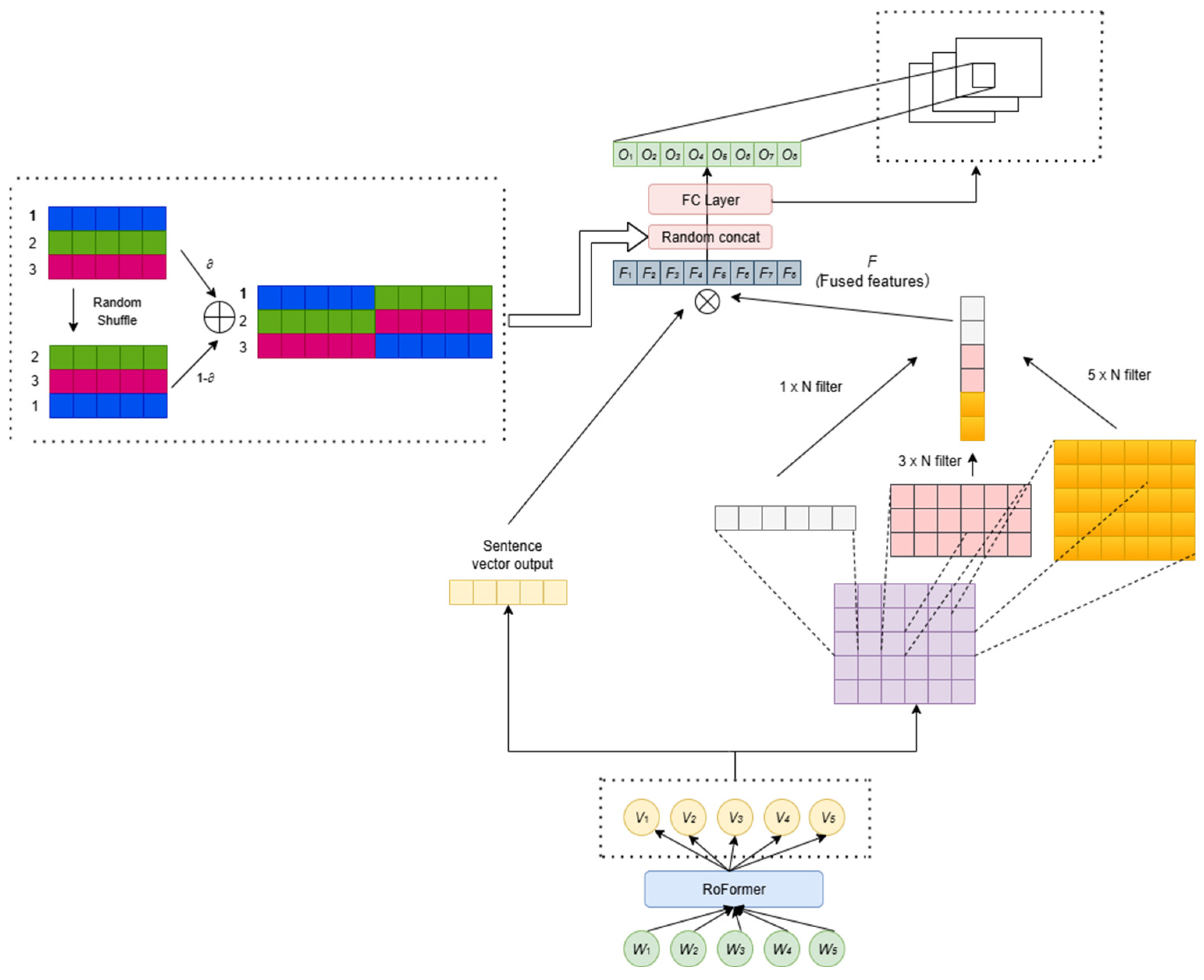
- The pre-trained RoFormer model is employed to perform word embedding on text data, representing textual information as a dense matrix in a low-dimensional space to extract high-level semantic features.
- (2)
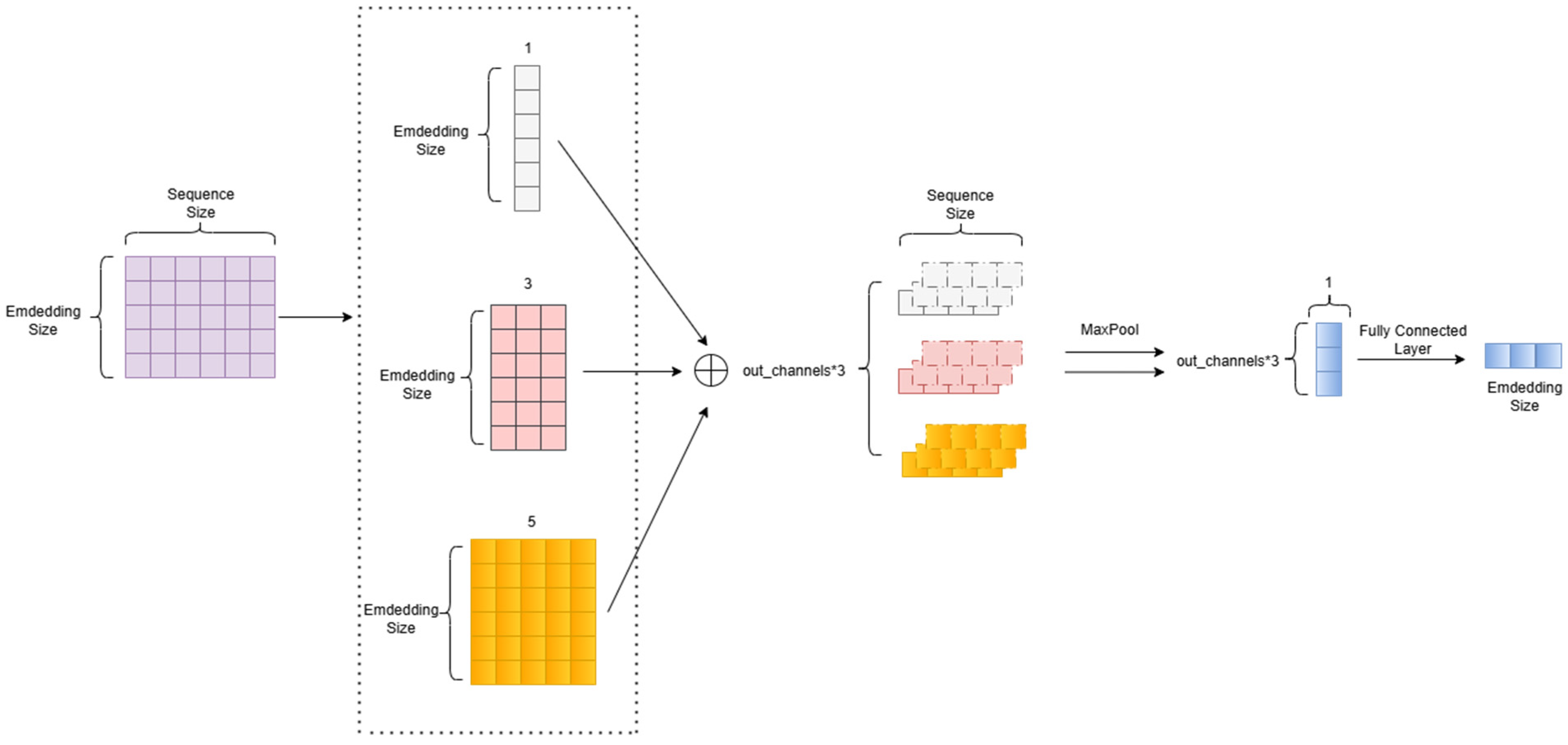
- An optimized multi-scale convolutional neural network is utilized to enhance the relational representation of character information, thereby obtaining richer global contextual features.
- (3)
- The captured global contextual features are combined with the initial RoFormer sentence features through an optimized blending method for text classification.
2. Related Work
3. Methods
3.1. Word Embedding Layer
3.2. Multi-Scale Convolutional Layer
3.3. Feature Fusion Layer
- (1)
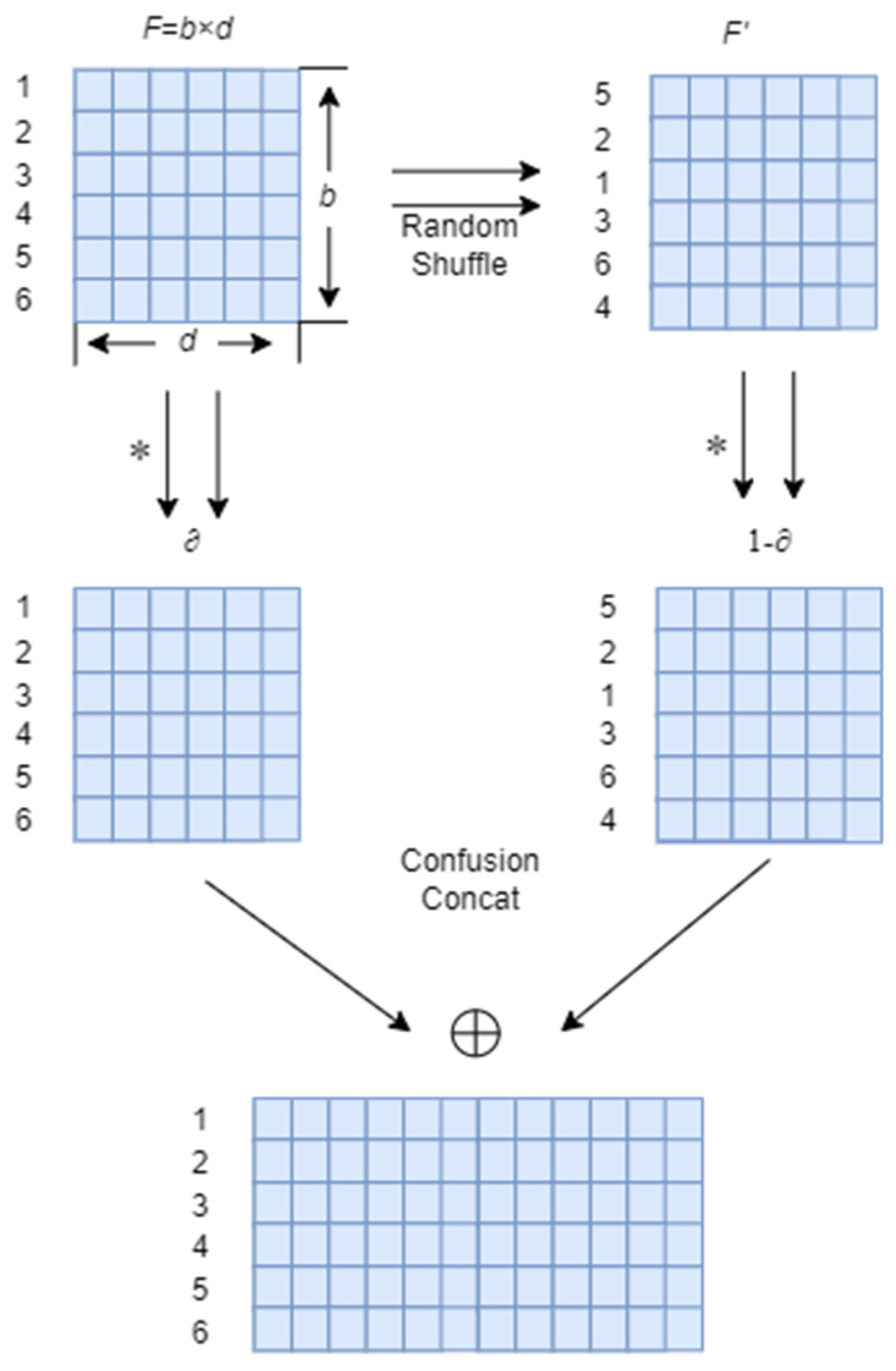
- Random Shuffling: Based on the fused features F generated by Equation (9), we first extract the corresponding sample indices. The torch.randperm function is then employed to randomly permute these indices, yielding the shuffled feature representation F’ (as depicted in the top-right corner of Figure 3).
- (2)
- Adaptive Confusion: A mixing coefficient ∂, sampled from a Beta distribution, is introduced to perform linear interpolation. Specifically, the original fused features F are weighted by ∂, while the shuffled features F’ are weighted by the complementary coefficient (1 − ∂). These weighted components are then summed to achieve adaptive feature confusion.
- (3)
- Feature Concatenation: The resulting confused feature vectors are concatenated to construct the final enhanced representation, preparing the input for the subsequent fully connected layers for classification.
3.4. Loss Function
4. Experiments
4.1. Dataset Selection and Characteristics
4.2. Evaluation Metrics
4.3. Experimental Environment and Preprocessing
4.4. Comparative Model
4.5. Results and Analysis
4.5.1. Comparison with Other Models
- (1)
- Across three datasets, the Acc score improvement over traditional deep learning models ranged from 9.02% to 11.94%, 5.56% to 7.98%, and 1.57% to 3.94%. Similarly, the F1 score improvements were 9.04–13.16%, 5.88–8.01%, and 2.65–6.08%.
- (2)
- Across the three datasets, compared to pre-trained models, the Accuracy improvement ranged from 1.19% to 6.84%, 0.51% to 2.57%, and 2.52% to 4.1%. Similarly, the F1 score improvement ranged from 1.16% to 6.82%, 0.27% to 2.27%, and 3.73% to 4.68%. Compared to traditional deep learning models, pre-trained models can learn deeper semantic meanings. However, the proposed model further improves performance over pre-trained models, indicating that our approach uncovers local fine-grained features overlooked by pre-trained models, thereby enhancing the model’s resolution when processing complex texts.
- (3)
- On the Waimai_10k dataset, compared to the AlDCBAT model, Accuracy and F1 scores improved by 2.43% and 4.02%, respectively; compared to the OSLCFit model, Accuracy and F1 scores improved by 2.49% and 0.91%, respectively. The results demonstrate that our method achieves further performance improvements compared to the AlDCBAT and OSLCFit models, which also employ convolutional networks. This is attributed to the high divergence and colloquial, informal expressions characteristic of the Waimai_10k dataset. Our proposed approach utilizes multi-scale convolutions to capture local keywords and long-range semantic dependencies. Through a multi-granularity feature fusion mechanism, it significantly enhances the feature fitting capability for non-standardized text compared to conventional convolutional networks.
- (4)
- On the Waimai_10k dataset, compared to the KSCB model, the Accuracy and F1 scores improved by 1.88% and 1.97%, respectively. Results indicate that while KSCB effectively adjusts data distribution by generating synthetic corpora, this sample-generation strategy may introduce latent semantic noise into the feature space. In contrast, the proposed method achieves synergistic collaboration among its modules, comprehensively analyzing text semantics across multiple receptive fields and granularities. Concurrently, its deeply integrated feature confusion mechanism effectively suppresses overfitting risks caused by noisy data, balancing multidimensional feature extraction with model robustness.
- (5)
- On the ChnSentiCorp dataset, our method achieves an Accuracy of 95.94% and an F1 score of 95.91%, surpassing MF-SDAM, which records 95% for both metrics. This demonstrates that integrating RoFormer-based positional enhancement with multi-scale convolution more effectively captures long-range dependencies and local semantic nuances in Chinese text. In the short-text, high-noise scenario of Waimai_10k, our approach attains 91.5% accuracy and 91.48% F1, significantly outperforming CG-BERT, which yields an F1 score of 78.34%, and slightly exceeding MF-SDAM. Notably, the substantial improvement in F1 score underscores the efficacy of our feature confusion mechanism in suppressing noise interference and sharpening decision boundaries, thereby confirming the model’s enhanced robustness and generalization capability, particularly under class imbalance conditions.
4.5.2. Ablation Experiment
- Overall Analysis
- (1)
- To validate the role of the hierarchical perception module in extracting local semantic features, a multi-scale convolution module was introduced based on the Base model. Experimental results show that after adding this module, the model outperformed the baseline model across all three datasets. Specifically, on the ChnSentiCorp dataset, Acc improved from 94.93% to 95.16%; on the COLD dataset, it increased from 80.95% to 81.49%; and on the Waimai_10k dataset, it rose from 90.83% to 90.91%. This significant improvement demonstrates that the multi-scale convolutional network effectively captures local phrase features, complementing the global features of the pre-trained model.
- (2)
- Having validated the Hierarchy-Aware Module, we further investigated the necessity of the Feature Fusion Module. By integrating BERT sentence vectors with the outputs of multi-scale convolutions, model performance was further enhanced. Experimental data show that compared to models using only hierarchical perception, introducing feature fusion increased ChnSentiCorp Accuracy by 0.31%, COLD by 0.39%, and Waimai_10k by 0.42%. This proves that simple feature concatenation is insufficient to fully utilize information, while explicit feature fusion mechanisms can more effectively integrate global and local information to improve classification accuracy.
- (3)
- To determine the optimal feature interaction method, experiments compared “additive” and “multiplicative” fusion strategies. While the additive strategy performed well on some metrics, the multiplicative strategy demonstrated greater potential for deep interactions among high-dimensional features. Specifically, on the ChnSentiCorp dataset, the “multiplication, no confusion” strategy achieved an Accuracy of 95.86%, significantly outperforming the “addition, no confusion” strategy’s Accuracy of 95.47%. This suggests that the multiplication operation may function similarly to gating or attention mechanisms within the feature space, suppressing noise while amplifying key feature representations. This provides a superior feature foundation for subsequent confusion mechanisms.
- (4)
- Finally, experiments validate the ultimate contribution of the proposed obfuscation mechanism to the model. Comparing the “multiplication, no obfuscation” approach with the final model (ours—multiplication, obfuscation), it can be seen that incorporating the obfuscation mechanism achieves optimal performance across all datasets. For the more complex COLD and Waimai_10k datasets, in particular, the Accuracy improved to 82.13% and 91.50%, respectively, with significant gains in F1 scores. This confirms that the confusion mechanism, as an effective regularization approach, successfully prevents model overfitting on training data while substantially enhancing generalization capability and robustness across diverse domain data.
- 2.
- Category Accuracy Analysis
- (1)
- After introducing the hierarchical perception module on top of the Base model, the model’s ability to capture fine-grained semantics is significantly enhanced, with particularly noticeable improvements in Recall. Experimental data reveals that the pure Transformer architecture exhibits omissions when processing certain specific categories. Taking the Waimai_10k dataset as an example, the Base model achieves only 78.50% Recall for positive categories. However, after incorporating the hierarchical perception module, this metric rapidly jumps to 85.50%, representing a 7-percentage-point increase. This demonstrates that the multi-scale convolutional network effectively extracts key local phrase features, compensating for the pre-trained model’s shortcomings in local semantic perception and substantially reducing sample omissions.
- (2)
- When validating the feature fusion module, experiments compared “additive” and “multiplicative” strategies (both under no confusion settings). Data indicates that the multiplicative strategy promotes deeper interactions between features. On the ChnSentiCorp dataset, comparing the “additive, no confusion” model with the “multiplicative, no confusion” model, the latter achieved higher F1 scores across both categories: F1 for the Negative category increased from 95.67% to 96.04%, and F1 for the positive category rose from 95.26% to 95.67%. This suggests that the multiplication operation may function similarly to attention gating, enhancing core semantic features while suppressing noise, thereby achieving a better balance between Precision and Recall.
- (3)
- After determining “multiplication” as the optimal fusion method, introducing a random index shuffling mechanism (our model) further enhances the model’s robustness in complex contexts. This is particularly evident in the more challenging COLD dataset. Compared to “Multiplication without Scrambling” and “Our,” the F1 score for the Safe category increased from 83.89% to 84.22%, while the F1 score for the Offensive category rose from 79.17% to 79.41%. The confusion mechanism effectively regularizes the model by increasing training sample diversity, enabling stronger generalization capabilities when encountering semantically ambiguous or borderline samples.
- (4)
- Overall, the Base model often exhibited an imbalance between Precision and Recall metrics, whereas our model achieved high performance across multiple metrics through modular integration. For instance, in the positive category of ChnSentiCorp, the Base model exhibits relatively low Recall (92.48%), whereas our model maintains high Precision (96.43%) while significantly boosting Recall to 95.20%, ultimately achieving an optimal F1 score of 95.81%. In the Negative category of Waimai_10k, our model achieves an impressive 96.00% Recall and 93.77% F1 score. This confirms that the proposed architecture effectively optimizes prediction distributions for specific categories, demonstrating significant advantages in fine-grained classification tasks.
4.5.3. Parameter Sensitivity Experiment
- Multi-scale parameters
- (1)
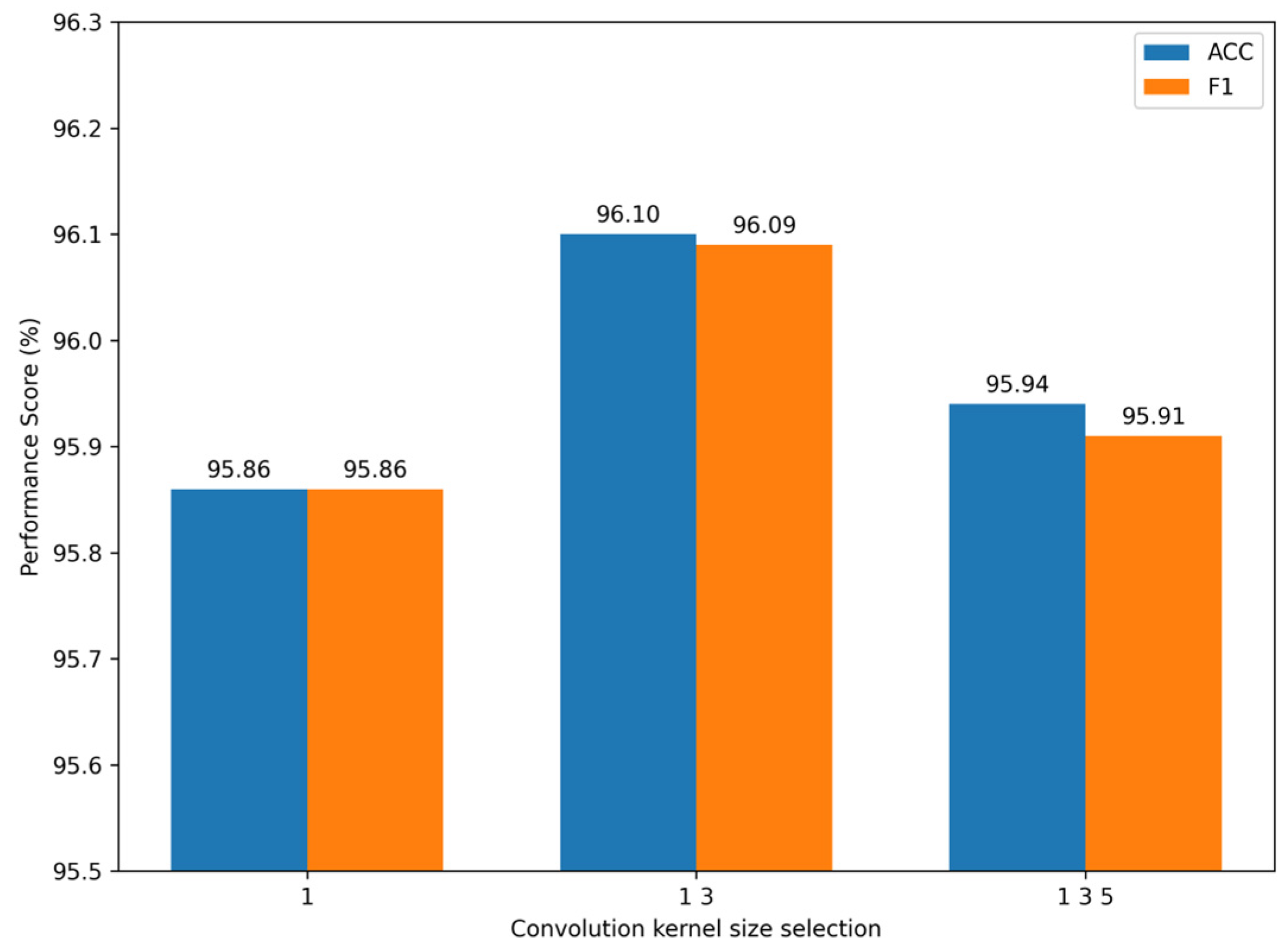
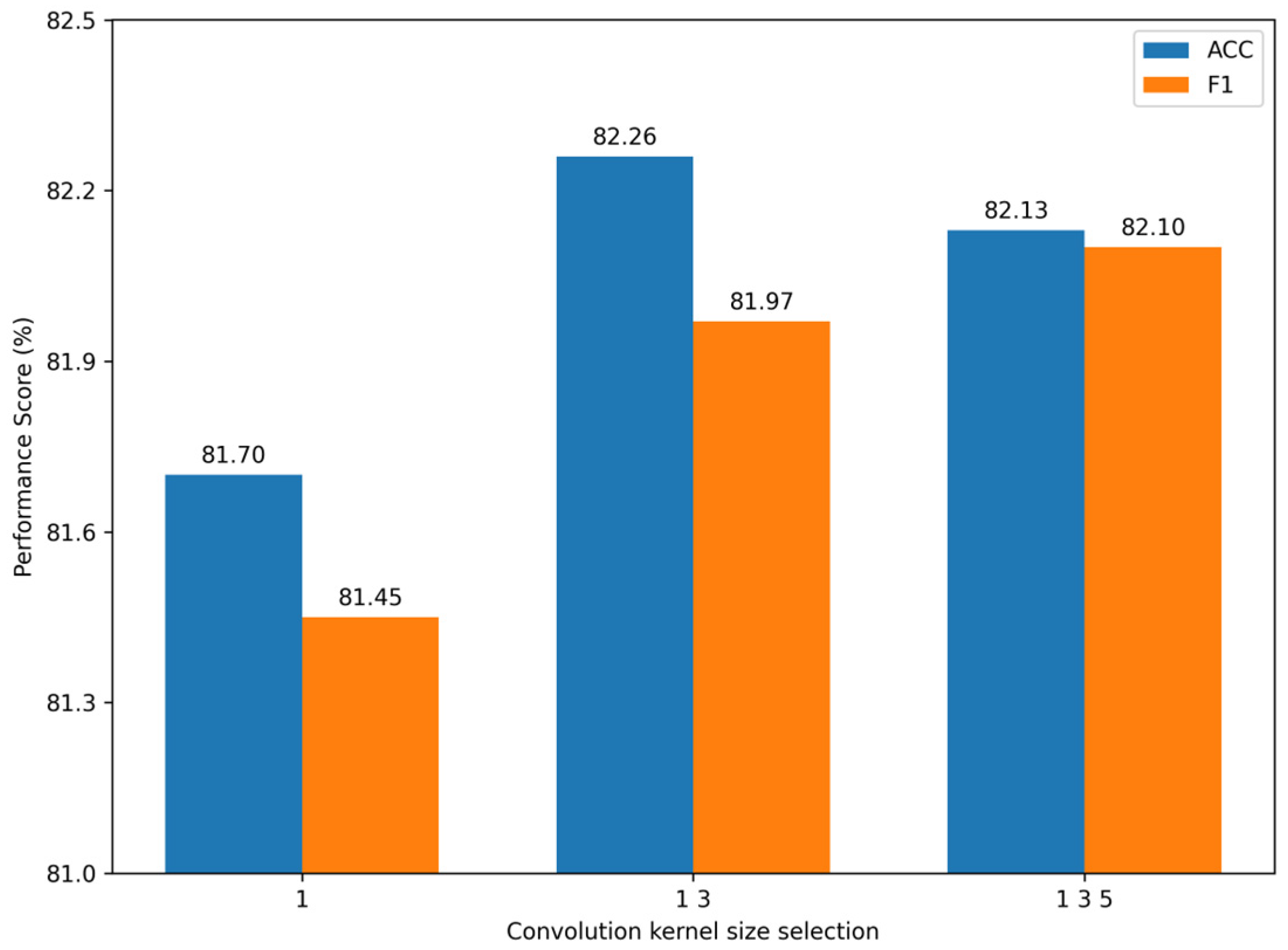
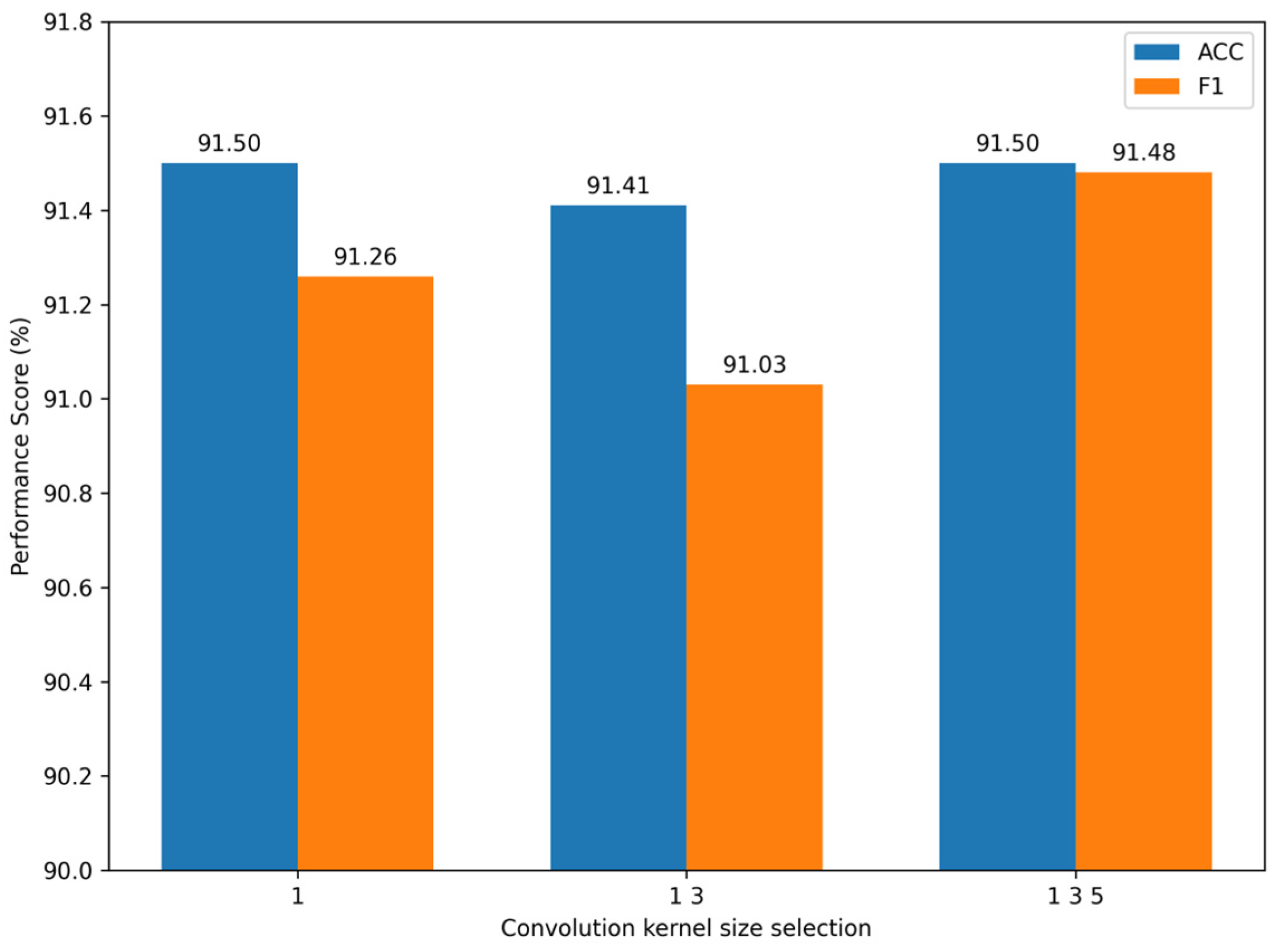
- For the Acc metric, the ChnSentiCorp dataset achieved optimal performance of 96.10% when the convolution kernel value was (1, 3), with the lowest performance of 95.86% at value 1. In the COLD dataset, performance peaked at 82.26% with kernel values (1, 3) and dropped to 81.70% at value 1. In the Waimai_10k dataset, performance reached its best at 91.50% with kernel values (1, 3, 5) and 1, while the lowest performance was 91.41% at values (1, 3).
- (2)
- In the Waimai_10k dataset, multi-scale processing did not yield significant improvements. This is because food delivery reviews are typically very short, with most core semantics often contained within just 1–2 characters or words. Consequently, a single scale is sufficient to capture the vast majority of critical sentiment features.
- (3)
- On the semantically ambiguous COLD and ChnSentiCorp datasets, models using Kernel = 1 alone performed poorly. Introducing the dual-scale structure (1, 3) rapidly enhanced the model’s understanding of phrase-level semantics, improving performance by 0.56% and 0.24%, respectively. This demonstrates that convolutional kernels of different scales form effective complementarity in the feature space, jointly constructing a more comprehensive semantic view.
- 2.
- Confusing Parameters
- (1)
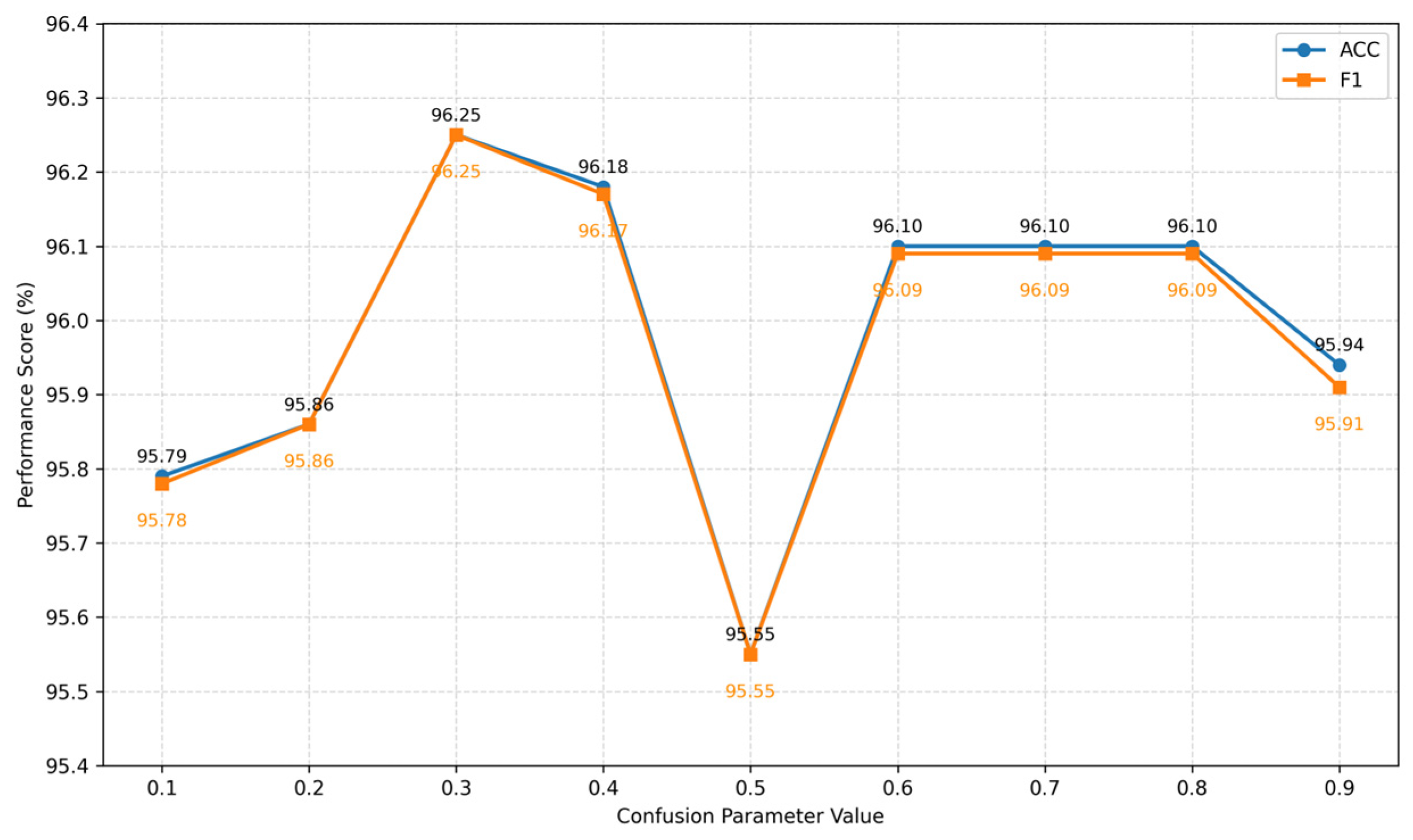
- In the ChnSentiCorp dataset, performance peaked at 96.25% when the threshold was set to 0.3 and reached its lowest point at 95.55% when set to 0.5. Overall, the average Accuracy and F1 scores reached 95.98% and 95.97%, respectively, outperforming all comparison models in the experiment. Additionally, the range of variation for both Accuracy and F1 metrics was 0.70%, indicating low fluctuation.
- (2)
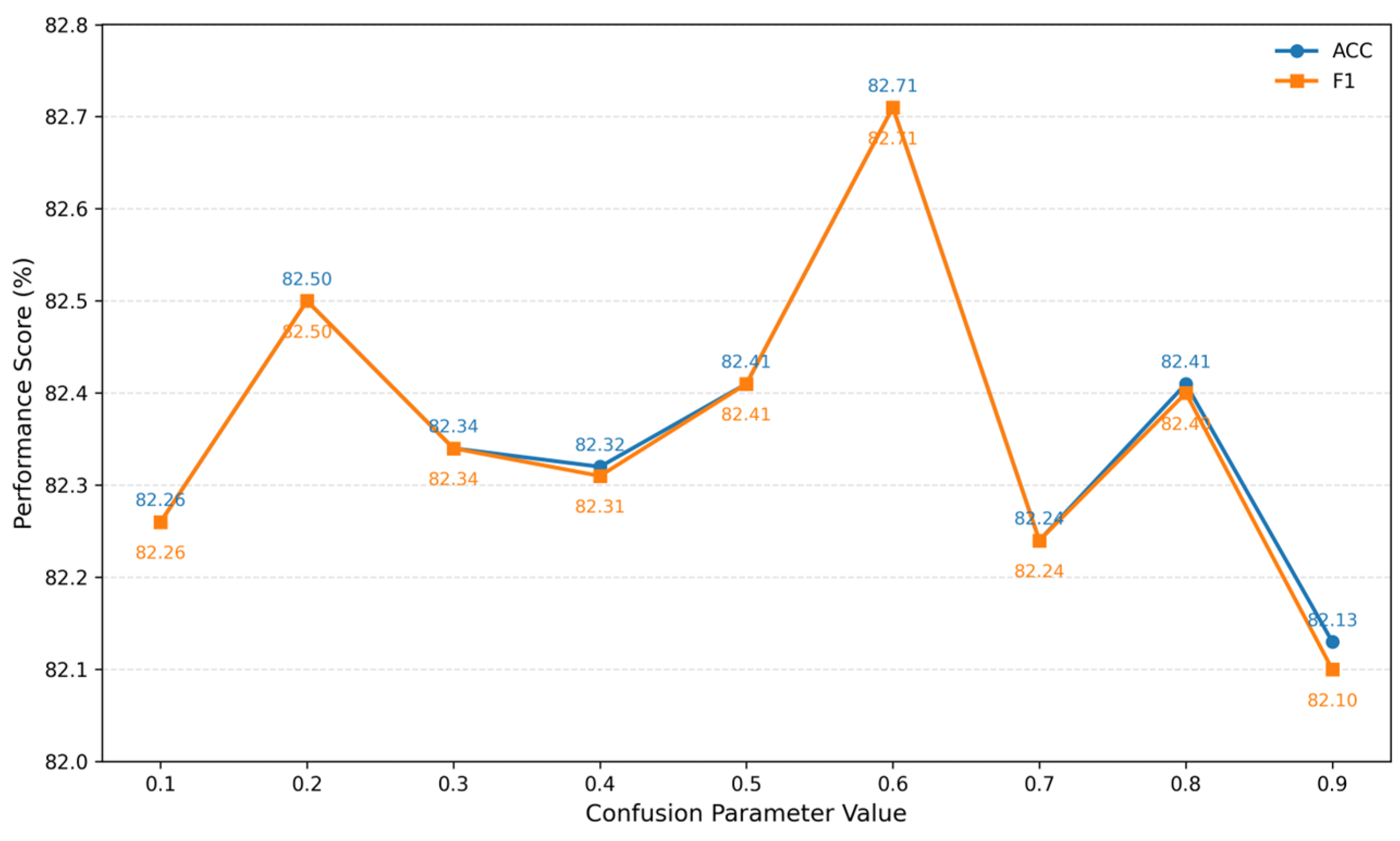
- In the COLD dataset, performance peaked at 82.71% with a value of 0.6 and reached its lowest point at 82.13% with a value of 0.9. Overall, the average Accuracy and F1 scores both reached 82.36%, outperforming the comparison models in the experiment. Additionally, the range of variation for both Accuracy and F1 scores was low at 0.58% and 0.61%, respectively.
- (3)
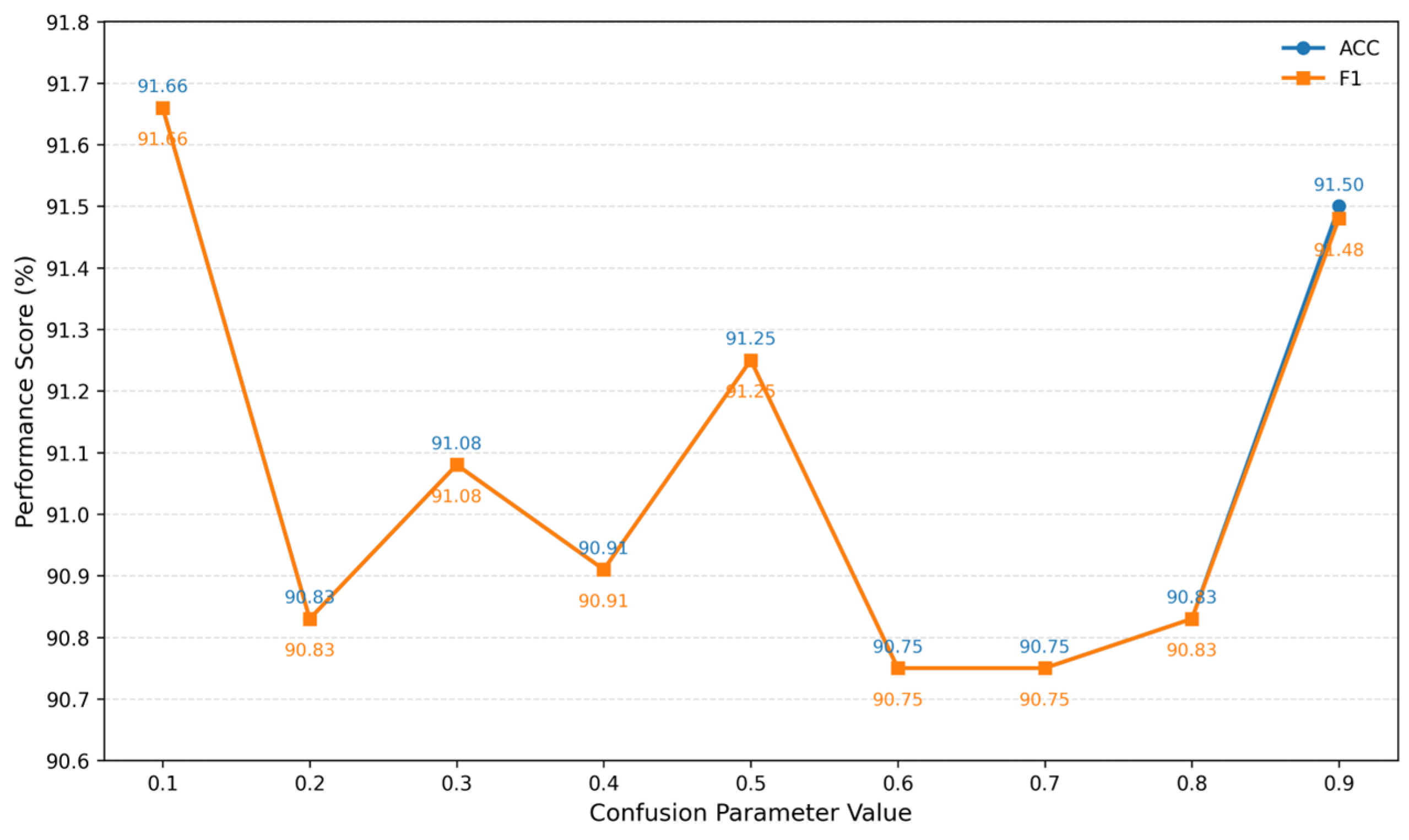
- In the Waimai_10k dataset, performance peaked at 91.66% with a value of 0.1 and reached its lowest point at 90.75% with a value of 0.6. Overall, the average Accuracy and F1 scores both reached 91.06%, outperforming the comparison models in the experiment. Additionally, the range of Accuracy results was 0.91%, indicating a low fluctuation range.
- (4)
- The differing extremes across these three datasets stem from distinct semantic space distributions: The ChnSentiCorp dataset primarily consists of reviews from domains like hotels and books. Texts are typically of moderate length with relatively standardized syntax, clear sentiment word distribution, and minimal noise, allowing smaller parameter values to serve as regularization. The COLD dataset contains aggressive social media discourse, often featuring ambiguous semantics, irony, slang, or non-standard expressions. Parameter fine-tuning has limited impact here, demonstrating high robustness. The Waimai_10k dataset is characterized by extremely short texts with sparse semantic features, making it highly sensitive to parameter values.
4.5.4. Efficiency and Performance Trade-Off Analysis
5. Conclusions and Future Work
Author Contributions
Funding
Institutional Review Board Statement
Informed Consent Statement
Data Availability Statement
Acknowledgments
Conflicts of Interest
References
- Zavrak, S.; Yilmaz, S. Email spam detection using hierarchical attention hybrid deep learning method. Expert Syst. Appl. 2023, 233, 120977. [Google Scholar] [CrossRef] [Scilit]
- Zhao, Q.; Niu, J.; Liu, X. ALS-MRS: Incorporating aspect-level sentiment for abstractive multi-review summarization. Knowl.-Based Syst. 2022, 258, 109942. [Google Scholar] [CrossRef] [Scilit]
- Zhou, Z.; Zhou, X.; Qian, L. Online public opinion analysis on infrastructure megaprojects: Toward an analytical framework. J. Manag. Eng. 2021, 37, 04020105. [Google Scholar] [CrossRef] [Scilit]
- Zeng, J.; Zhang, D.; Li, Z.; Li, X. Semi-supervised training of transformer and causal dilated convolution network with applications to speech topic classification. Appl. Sci. 2021, 11, 5712. [Google Scholar] [CrossRef] [Scilit]
- Anki, P.; Bustamam, A.; Buyung, R.A. Comparative analysis of performance between multimodal implementation of chatbot based on news classification data using categories. Electronics 2021, 10, 2696. [Google Scholar] [CrossRef] [Scilit]
- Kim, Y. Convolutional neural networks for sentence classification. In Proceedings of the 2014 Conference on Empirical Methods in Natural Language Processing (EMNLP), Doha, Qatar, 25–29 October 2014; Available online: https://aclanthology.org/D14-1181/ (accessed on 4 February 2026).
- Sparck Jones, K. A statistical interpretation of term specificity and its application in retrieval. J. Doc. 1972, 28, 11–21. [Google Scholar] [CrossRef] [Scilit]
- Ruan, S.; Chen, B.; Song, K.; Li, H. Weighted naïve Bayes text classification algorithm based on improved distance correlation coefficient. Neural Comput. Appl. 2022, 34, 2729–2738. [Google Scholar] [CrossRef] [Scilit]
- El Hindi, K.; Abu Shawar, B.; Aljulaidan, R.; Alsalamn, H. Improved Distance Functions for Instance-Based Text Classification. Comput. Intell. Neurosci. 2020, 2020, 4717984. [Google Scholar] [CrossRef] [Scilit] [PubMed]
- Chen, T.; Guestrin, C. XGBoost: A scalable tree boosting system. In Proceedings of the 22nd ACM SIGKDD International Conference on Knowledge Discovery and Data Mining, San Francisco, CA, USA, 13–17 August 2016; pp. 785–794. [Google Scholar] [CrossRef] [Scilit]
- Ke, G.; Meng, Q.; Finley, T.; Wang, T.; Chen, W.; Ma, W.; Ye, Q.; Liu, T. LightGBM: A highly efficient gradient boosting decision tree. In Proceedings of the 31st International Conference on Neural Information Processing Systems, Long Beach, CA, USA, 4–9 December 2017; pp. 3149–3157. Available online: https://dl.acm.org/doi/10.5555/3294996.3295074 (accessed on 4 February 2026).
- Mienye, I.D.; Swart, T.G.; Obaido, G. Recurrent neural networks: A comprehensive review of architectures, variants, and applications. Information 2024, 15, 517. [Google Scholar] [CrossRef] [Scilit]
- Conneau, A.; Schwenk, H.; Barrault, L.; Lecun, Y. Very deep convolutional networks for text classification. In Proceedings of the 15th Conference of the European Chapter of the Association for Computational Linguistics, Valencia, Spain, 3–7 April 2017; Volume 1. Available online: https://aclanthology.org/E17-1104/ (accessed on 7 February 2026).
- Johnson, R.; Zhang, T. Semi-supervised convolutional neural networks for text categorization via region embedding. Adv. Neural Inf. Process. Syst. 2015, 28, 919–927. [Google Scholar] [PubMed]
- Johnson, R.; Zhang, T. Deep pyramid convolutional neural networks for text categorization. In Proceedings of the 55th Annual Meeting of the Association for Computational Linguistics, Vancouver, BC, Canada, 30 July–4 August 2017; Volume 1, pp. 562–570. [Google Scholar] [CrossRef] [Scilit]
- He, K.; Zhang, X.; Ren, S.; Sun, J. Identity mappings in deep residual networks. In Proceedings of the European Conference on Computer Vision, Amsterdam, The Netherlands, 11–14 October 2016; Springer International Publishing: Cham, Switzerland, 2016; pp. 630–645. [Google Scholar] [CrossRef] [Scilit]
- Jiang, B.; Zhang, Z.; Lin, D.; Tang, J.; Luo, B. Semi-supervised learning with graph learning-convolutional networks. In Proceedings of the IEEE/CVF Conference on Computer Vision and Pattern Recognition, Long Beach, CA, USA, 16–20 June 2019. [Google Scholar] [CrossRef] [Scilit]
- Yao, L.; Mao, C.; Luo, Y. Graph convolutional networks for text classification. In Proceedings of the AAAI Conference on Artificial Intelligence, Honolulu, HI, USA, 27 January–1 February 2019; Volume 33, pp. 7370–7377. [Google Scholar] [CrossRef] [Scilit]
- Chen, G.; Tian, Y.; Song, Y. Joint aspect extraction and sentiment analysis with directional graph convolutional networks. In Proceedings of the 28th International Conference on Computational Linguistics, Virtual, 8–13 December 2020; pp. 272–279. [Google Scholar] [CrossRef] [Scilit]
- Chen, M.; Wei, Z.; Huang, Z.; Ding, B.; Li, Y. Simple and deep graph convolutional networks. In Proceedings of the International Conference on Machine Learning. PMLR, Virtual, 13–18 July 2020; pp. 1725–1735. Available online: https://dl.acm.org/doi/abs/10.5555/3524938.3525099 (accessed on 10 February 2026).
- Koutnik, J.; Greff, K.; Gomez, F.; Schmidhuber, J. A clockwork rnn. In Proceedings of the International Conference on Machine Learning. PMLR, Beijing, China, 21–26 June 2014; pp. 1863–1871. Available online: https://proceedings.mlr.press/v32/koutnik14.html (accessed on 10 February 2026).
- Schuster, M.; Paliwal, K.K. Bidirectional recurrent neural networks. IEEE Trans. Signal Process. 1997, 45, 2673–2681. [Google Scholar] [CrossRef] [Scilit]
- Wang, Y.; Sun, A.; Han, J.; Liu, Y.; Zhu, X. Sentiment analysis by capsules. In Proceedings of the 2018 World Wide Web Conference, Lyon, France, 23–27 April 2018; pp. 1165–1174. [Google Scholar] [CrossRef] [Scilit]
- Zhou, P.; Shi, W.; Tian, J.; Qi, Z.; Li, B.; Hao, H.; Xu, B. Attention-based bidirectional long short-term memory networks for relation classification. In Proceedings of the 54th Annual Meeting of the Association for Computational Linguistics, Berlin, Germany, 7–12 August 2016; Volume 2, pp. 207–212. [Google Scholar] [CrossRef] [Scilit]
- Devlin, J.; Chang, M.W.; Lee, K.; Toutanova, K. Bert: Pre-training of deep bidirectional transformers for language understanding. In Proceedings of the 2019 Conference of the North American Chapter of the Association for Computational Linguistics: Human Language Technologies, Minneapolis, MN, USA, 2–7 June 2019; Volume 1, pp. 4171–4186. [Google Scholar] [CrossRef] [Scilit]
- Guo, Z.; Zhu, L.; Han, L. Research on short text classification based on roberta-textrcnn. In Proceedings of the 2021 International Conference on Computer Information Science and Artificial Intelligence (CISAI), Virtual, 17–19 September 2021; IEEE: Piscataway, NJ, USA, 2021. [Google Scholar] [CrossRef] [Scilit]
- Runmei, Z.; Lulu, L.; Lei, Y.; Jingjing, L.; Weiyi, X.; Weiwei, C.; Zhong, C. Chinese named entity recognition method combining ALBERT and a local adversarial training and adding attention mechanism. Int. J. Semant. Web Inf. Syst. 2022, 18, 1–20. [Google Scholar] [CrossRef] [Scilit]
- Dai, Y.; Li, L.; Zhou, C.; Feng, Z.; Zhao, E.; Qiu, X.; Li, P.; Tang, D. “Is whole word masking always better for Chinese BERT?”: Probing on Chinese grammatical error correction. In Findings of the Association for Computational Linguistics: ACL 2022; ACL Press: Stroudsburg, PA, USA, 2022. [Google Scholar] [CrossRef] [Scilit]
- Yu, W.; Zhu, C.; Fang, Y.; Yu, D.; Wang, S.; Xu, Y.; Zeng, M.; Jiang, M. Dict-bert: Enhancing language model pre-training with dictionary. In Findings of the Association for Computational Linguistics: ACL 2022; ACL Press: Stroudsburg, PA, USA, 2022. [Google Scholar] [CrossRef] [Scilit]
- Su, J.; Ahmed, M.; Lu, Y.; Pan, S.; Bo, W.; Liu, Y. Roformer: Enhanced transformer with rotary position embedding. Neurocomputing 2024, 568, 127063. [Google Scholar] [CrossRef] [Scilit]
- Liang, D.; Yang, F.; Zhang, T.; Yang, P. Understanding mixup training methods. IEEE Access 2018, 6, 58774–58783. [Google Scholar] [CrossRef] [Scilit]
- Müller, R.; Kornblith, S.; Hinton, G.E. When does label smoothing help? In Proceedings of the 33rd International Conference on Neural Information Processing Systems, Vancouver, BC, Canada, 8–14 December 2019; Volume 32. Available online: https://dl.acm.org/doi/10.5555/3454287.3454709 (accessed on 11 February 2026).
- Joulin, A.; Grave, E.; Bojanowski, P.; Mikolov, T. Bag of tricks for efficient text classification. In Proceedings of the 15th Conference of the European Chapter of the Association for Computational Linguistics, Valencia, Spain, 3–7 April 2017; Volume 2. Available online: https://aclanthology.org/E17-2068/ (accessed on 11 February 2026).
- Ankita; Rani, S.; Bashir, A.K.; Alhudhaif, A.; Koundal, D.; Gunduz, E.S. An efficient CNN-LSTM model for sentiment detection in #BlackLivesMatter. Expert Syst. Appl. 2022, 193, 116256. [Google Scholar] [CrossRef] [Scilit]
- Zhang, Y.; Wang, J.; Zhang, X. YNU-HPCC at semeval-2018 task 1:BiLSTM with attention based sentiment analysis for affect in tweets. In Proceedings of the 12th International Workshop on Semantic Evaluation, Valencia, Spain, 3–7 April 2017; ACL Press: Stroudsburg, PA, USA, 2018; pp. 273–278. [Google Scholar] [CrossRef] [Scilit]
- Jia, K.; Meng, F.; Liang, J.; Gong, P. Text sentiment analysis based on BERT-CBLBGA. Comput. Electr. Eng. 2023, 112, 109019. [Google Scholar] [CrossRef] [Scilit]
- Zhang, Z.; Han, X.; Liu, Z.; Jiang, X.; Sun, M.; Liu, Q. ERNIE: Enhanced language representation with informative entities. In Proceedings of the 57th Annual Meeting of the Association for Computational Linguistics, Florence, Italy, 28 July–2 August 2019. [Google Scholar] [CrossRef] [Scilit]
- Yang, Z.; Dai, Z.; Yang, Y.; Carbonell, J.; Salakhutdinov, R.; Le, Q.V. Xlnet: Generalized autoregressive pretraining for language understanding. In Proceedings of the 33rd Annual Conference on Neural Information Processing Systems, Vancouver, BC, Canada, 8–14 December 2019; Volume 32. [Google Scholar] [CrossRef]
- Cui, Y.; Che, W.; Liu, T.; Qin, B.; Wang, S.; Hu, G. Revisiting pre-trained models for Chinese natural language processing. In Findings of the Association for Computational Linguistics: EMNLP 2020; ACL Press: Stroudsburg, PA, USA, 2020. [Google Scholar] [CrossRef] [Scilit]
- Zhu, Y.; Luosai, B.; Zhou, L.; Qun, N.; Nyima, T. Research on sentiment analysis of tibetan short text based on dual-channel hybrid neural network. In Proceedings of the 2023 IEEE 4th International Conference on Pattern Recognition and Machine Learning (PRML), Urumqi, China, 4–6 August 2023; IEEE: Piscataway, NJ, USA, 2023; pp. 377–384. [Google Scholar] [CrossRef] [Scilit]
- Kiran, R.; Kumar, P.; Bhasker, B. OSLCFit (organic simultaneous LSTM and CNN Fit): A novel deep learning based solution for sentiment polarity classification of reviews. Expert Syst. Appl. 2020, 157, 113488. [Google Scholar] [CrossRef] [Scilit]
- Jiang, W.; Zhou, K.; Xiong, C.; Du, G.; Ou, C.; Zhang, J. KSCB: A novel unsupervised method for text sentiment analysis. Appl. Intell. 2023, 53, 301–311. [Google Scholar] [CrossRef] [Scilit]
- Cao, F.; Huang, X. Performance analysis of aspect-level sentiment classification task based on different deep learning models. PeerJ Comput. Sci. 2023, 9, e1578. [Google Scholar] [CrossRef] [Scilit] [PubMed]
- Xia, J.; Yu, Z.; Deng, Q. Multi-feature multiple fusion sentiment classification model based on syntactic dependency and attention mechanism. Appl. Res. Comput. 2024, 41, 3295–3302. [Google Scholar] [CrossRef]



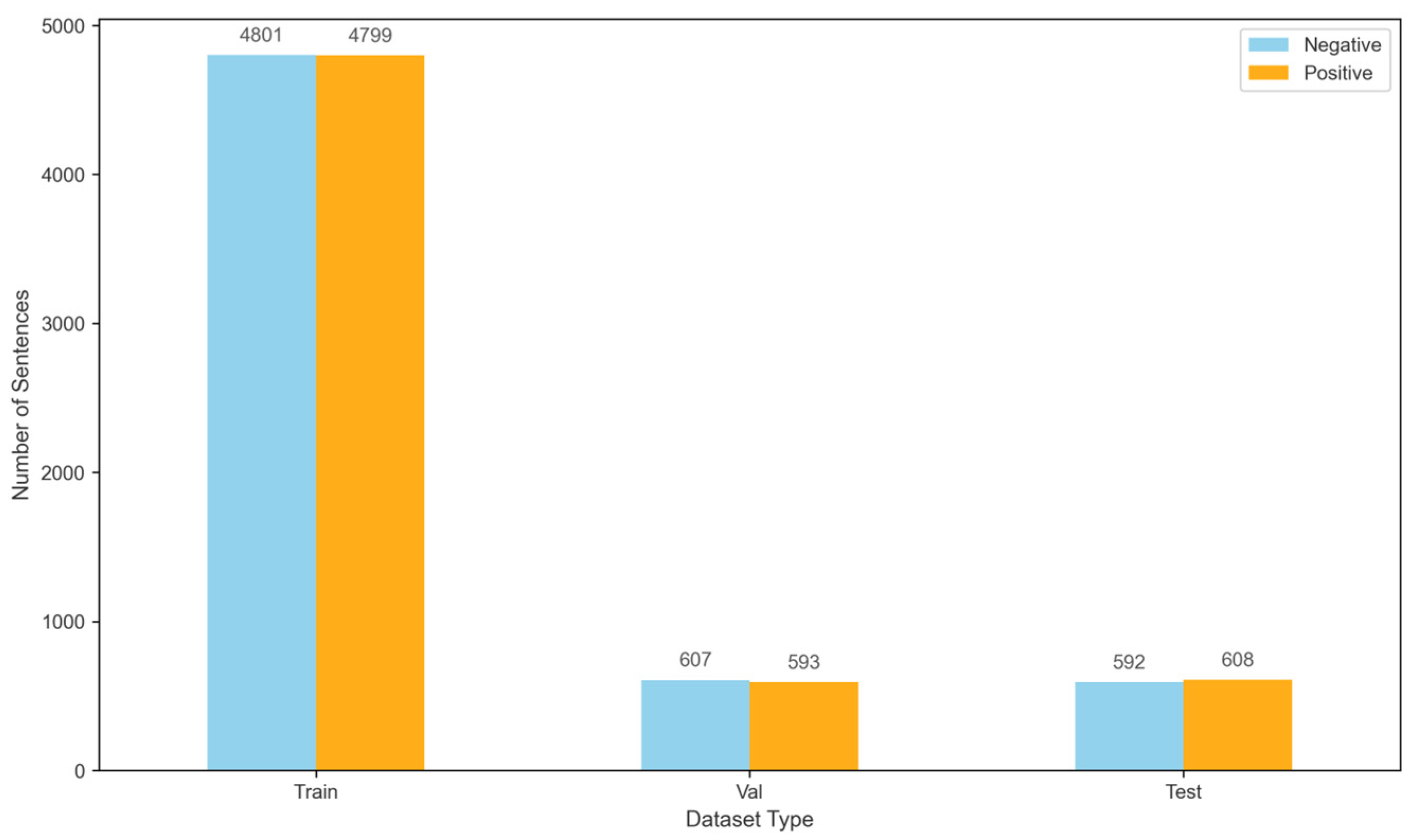
| Dataset | Train | Val | Test | Domain |
|---|---|---|---|---|
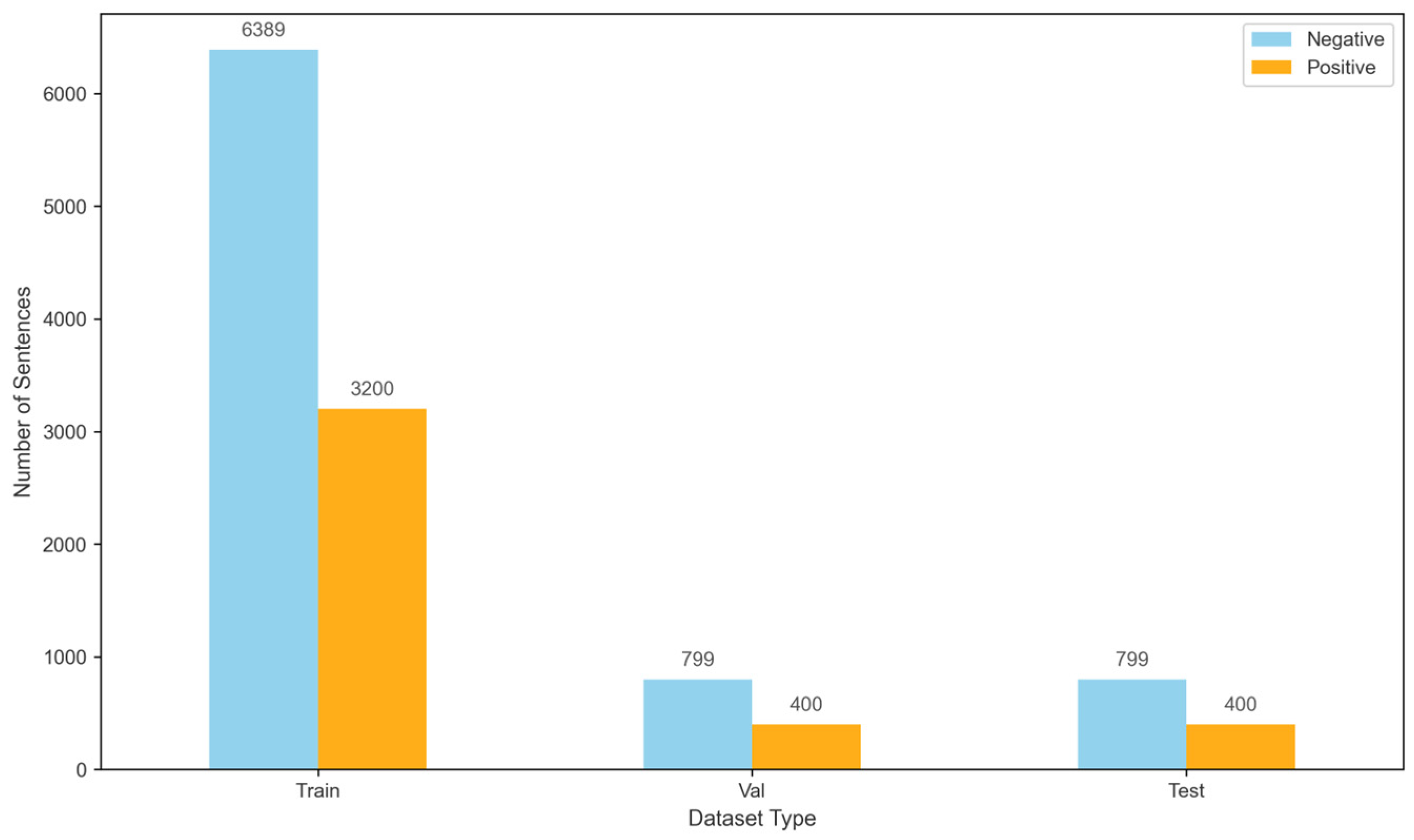
| Waimai_10k | 9589 | 1199 | 1199 | Food Delivery Reviews |
| ChnSentiCorp | 9600 | 1200 | 1200 | Hotel Reviews |
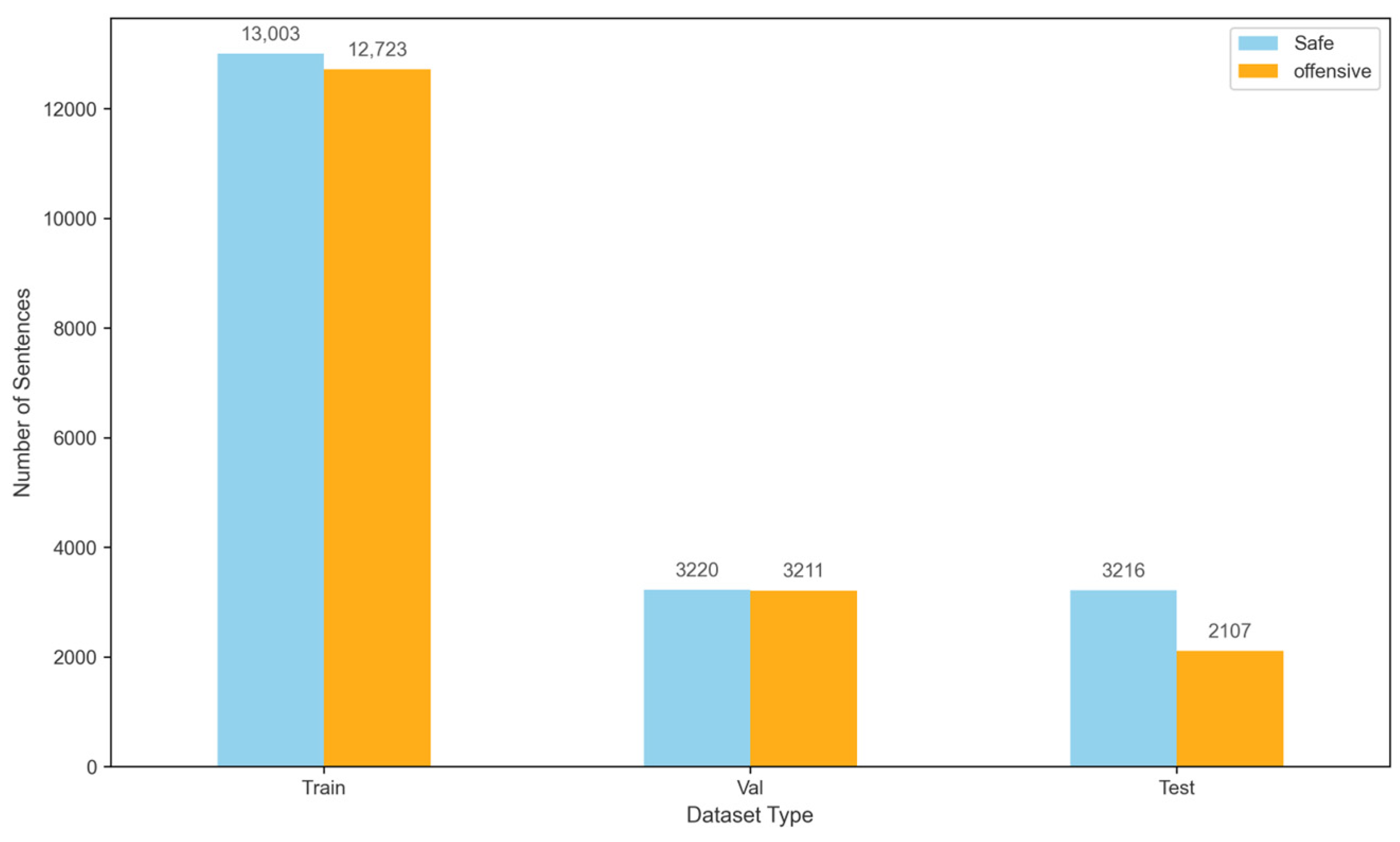
| COLD | 25,726 | 6431 | 5323 | Offensive Language Detection |
| Sample True Class | Model Prediction Category | |
|---|---|---|
| True | False | |
| True | TP | FN |
| False | FP | TN |
| Environment Component | Configuration |
|---|---|
| Operating System | Ubuntu20.04 |
| CPU | Intel Xeon Platinum 8358P |
| GPU | RTX 3090 |
| RAM | 90 GB |
| Programming Language | Python 3.8 |
| Framework | PyTorch 1.10.0 |
| Parameter | Waimai_10k | ChnSentiCorp | COLD |
|---|---|---|---|
| Batch size | 16 | 16 | 16 |
| max_len | 256 | 256 | 256 |
| lr | 2 × 10⁻⁵ | 2 × 10⁻⁵ | 2 × 10⁻⁵ |
| Word vector dimension | 1024 | 1024 | 1024 |
| eval_step | 500 | 500 | 500 |
| Optimizer | AdamW | AdamW | AdamW |
| Epoch | 7 | 7 | 3 |
| Convolution kernel size | 1, 3, 5 | 1, 3, 5 | 1, 3, 5 |
| 0.9 | 0.9 | 0.9 | |
| out_channels | 256 | 256 | 256 |
| Dropout | 0.3 | 0.3 | 0.3 |
| Model | ChnSentiCorp | COLD | Waimai_10k | |||
|---|---|---|---|---|---|---|
| Acc (%) | F1 (%) | Acc (%) | F1 (%) | Acc (%) | F1 (%) | |
| TextCNN | 84.00 | 84.00 | 74.15 | 74.09 | 87.56 | 85.40 |
| FastText | 86.92 | 86.90 | 74.96 | 75.21 | 89.93 | 88.83 |
| DPCNN | 84.75 | 82.75 | 76.57 | 76.22 | 88.93 | 87.64 |
| BERT-CNN-LSTM | - | - | - | - | 89.65 | 88.35 |
| BERT | 92.30 | 92.29 | 81.23 | 81.39 | 88.98 | 87.75 |
| BERT-BiLSTM-ATT | - | - | - | - | 89.23 | 87.71 |
| Albert-base | 89.10 | 89.09 | 79.56 | 80.12 | 87.40 | 86.80 |
| Albert-large | 91.47 | 91.52 | 80.24 | 79.83 | - | - |
| RoBerta | 92.64 | 92.64 | 81.62 | 81.83 | - | - |
| MacBERT | 92.45 | 92.45 | 81.36 | 81.29 | - | - |
| ERNIE | 93.58 | 93.58 | 81.29 | 81.46 | - | - |
| Xlnet | 94.75 | 94.75 | 81.57 | 81.76 | 91.42 | 90.50 |
| AlDCBAT | - | - | - | - | 89.07 | 87.46 |
| OSLCFit | - | - | - | - | 89.01 | 90.57 |
| KSCB | - | - | - | - | 89.62 | 89.51 |
| CG-BERT | - | - | - | - | 89.01 | 78.34 |
| MF-SDAM | 95.00 | 95.00 | - | - | 91.49 | 90.36 |
| Our | 95.94 | 95.91 | 82.13 | 82.10 | 91.50 | 91.48 |
| Model | ChnSentiCorp | |
|---|---|---|
| Acc (%) | F1 (%) | |
| Base | 94.93 | 94.92 |
| Base + Hierarchy-aware | 95.16 | 95.15 |
| Base + Hierarchy-aware + Feature fusion (Addition, no confusion) | 95.47 | 95.47 |
| Base + Hierarchy-aware + Feature fusion (Addition, confusion) | 95.86 | 95.86 |
| Base + Hierarchy-aware + Feature fusion (Multiplication, no confusion) | 95.86 | 95.86 |
| Base + Hierarchy-aware + Feature fusion (Multiplication, confusion—our model) | 95.94 | 95.91 |
| Model | COLD | |
|---|---|---|
| Acc (%) | F1 (%) | |
| Base | 80.95 | 80.77 |
| Base + Hierarchy-aware | 81.49 | 81.27 |
| Base + Hierarchy-aware + Feature fusion (Addition, no confusion) | 81.88 | 81.64 |
| Base + Hierarchy-aware + Feature fusion (Addition, confusion) | 81.79 | 81.48 |
| Base + Hierarchy-aware + Feature fusion (Multiplication, no confusion) | 81.83 | 81.53 |
| Base + Hierarchy-aware + Feature fusion (Multiplication, confusion—our model) | 82.13 | 82.10 |
| Model | Waimai_10k | |
|---|---|---|
| Acc (%) | F1 (%) | |
| Base | 90.83 | 89.23 |
| Base + Hierarchy-aware | 90.91 | 89.73 |
| Base + Hierarchy-aware + Feature fusion (Addition, no confusion) | 91.33 | 90.05 |
| Base + Hierarchy-aware + Feature fusion (Addition, confusion) | 90.91 | 89.54 |
| Base + Hierarchy-aware + Feature fusion (Multiplication, no confusion) | 91.08 | 89.85 |
| Base + Hierarchy-aware + Feature fusion (Multiplication, confusion—our model) | 91.50 | 91.48 |
| Model | ChnSentiCorp | |||||
|---|---|---|---|---|---|---|
| Negative | Positive | |||||
| P (%) | R (%) | F1 (%) | P (%) | R (%) | F1 (%) | |
| Base | 93.15 | 97.26 | 95.16 | 96.97 | 92.48 | 94.67 |
| Base + Hierarchy-aware | 93.44 | 97.41 | 95.38 | 97.15 | 92.80 | 94.92 |
| Base + Hierarchy-aware + Feature fusion (Addition, no confusion) | 93.98 | 97.41 | 95.67 | 97.17 | 93.44 | 95.26 |
| Base + Hierarchy-aware + Feature fusion (Addition, confusion) | 95.76 | 96.20 | 95.98 | 95.98 | 95.52 | 95.74 |
| Base + Hierarchy-aware + Feature fusion (Multiplication, no confusion) | 94.28 | 97.87 | 96.04 | 97.66 | 93.76 | 95.67 |
| Base + Hierarchy-aware + Feature fusion (Multiplication, confusion—our model) | 95.49 | 96.65 | 96.07 | 96.43 | 95.20 | 95.81 |
| Model | COLD | |||||
|---|---|---|---|---|---|---|
| Safe | Offensive | |||||
| P (%) | R (%) | F1 (%) | P (%) | R (%) | F1 (%) | |
| Base | 92.11 | 74.87 | 82.60 | 70.17 | 90.22 | 78.94 |
| Base + Hierarchy-aware | 91.48 | 76.49 | 83.31 | 71.29 | 89.13 | 79.22 |
| Base + Hierarchy-aware + Feature fusion (Addition, no confusion) | 91.33 | 77.36 | 83.77 | 71.98 | 88.79 | 79.51 |
| Base + Hierarchy-aware + Feature fusion (Addition, confusion) | 90.16 | 78.42 | 83.88 | 72.52 | 86.94 | 79.08 |
| Base + Hierarchy-aware + Feature fusion (Multiplication, no confusion) | 90.34 | 78.29 | 83.89 | 72.47 | 87.23 | 79.17 |
| Base + Hierarchy-aware + Feature fusion (Multiplication, confusion—our model) | 90.28 | 78.91 | 84.22 | 73.00 | 87.04 | 79.41 |
| Model | Waimai_10k | |||||
|---|---|---|---|---|---|---|
| Negative | Positive | |||||
| P (%) | R (%) | F1 (%) | P (%) | R (%) | F1 (%) | |
| Base | 90.02 | 97.00 | 93.38 | 92.89 | 78.50 | 85.09 |
| Base + Hierarchy-aware | 92.81 | 93.62 | 93.21 | 87.02 | 85.50 | 86.25 |
| Base + Hierarchy-aware + Feature fusion (Addition, no confusion) | 91.92 | 95.37 | 93.61 | 90.00 | 83.25 | 86.49 |
| Base + Hierarchy-aware + Feature fusion (Addition, confusion) | 91.37 | 95.37 | 93.33 | 89.86 | 82.00 | 85.75 |
| Base + Hierarchy-aware + Feature fusion (Multiplication, no confusion) | 92.41 | 94.37 | 93.38 | 88.25 | 84.50 | 86.33 |
| Base + Hierarchy-aware + Feature fusion (Multiplication, confusion—our model) | 91.64 | 96.00 | 93.77 | 91.16 | 82.50 | 86.61 |
| Datasets | Acc (%) | F1 (%) | Training Time (s) | Inference Time (s) | Model Size (MB) | |||||
|---|---|---|---|---|---|---|---|---|---|---|
| Baseline | Our | Baseline | Our | Baseline | Our | Baseline | Our | Baseline | Our | |
| ChnSentiCorp | 94.93 | 95.94 (+1.01%) | 94.92 | 95.91 (+0.99%) | 1820.1 | 2030.3 (+210.2 s) | 10.26 | 10.40 (+0.14 s) | 1198 | 1214 (+16 M) |
| COLD | 80.95 | 82.13 (+1.18%) | 80.77 | 82.10 (+1.33%) | 1445.96 | 1559.71 (+113.75 s) | 23.97 | 24.04 (+0.07 s) | 1198 | 1214 (+16 M) |
| Waimai_10k | 90.83 | 91.5 (+0.67%) | 89.23 | 91.48 (+2.25%) | 820.46 | 916.75 (+96.29 s) | 4.64 | 4.68 (+0.04 s) | 1198 | 1214 (+16 M) |
Disclaimer/Publisher’s Note: The statements, opinions and data contained in all publications are solely those of the individual author(s) and contributor(s) and not of MDPI and/or the editor(s). MDPI and/or the editor(s) disclaim responsibility for any injury to people or property resulting from any ideas, methods, instructions or products referred to in the content. |
© 2026 by the authors. Licensee MDPI, Basel, Switzerland. This article is an open access article distributed under the terms and conditions of the Creative Commons Attribution (CC BY) license.
Share and Cite
He, D.; Qun, N.; Tashi, N. Research on Enhanced Chinese Text Classification Through Feature Confusion and Hierarchical Perception. Appl. Sci. 2026, 16, 2973. https://doi.org/10.3390/app16062973
He D, Qun N, Tashi N. Research on Enhanced Chinese Text Classification Through Feature Confusion and Hierarchical Perception. Applied Sciences. 2026; 16(6):2973. https://doi.org/10.3390/app16062973
Chicago/Turabian StyleHe, Dongkang, Nuo Qun, and Nyima Tashi. 2026. "Research on Enhanced Chinese Text Classification Through Feature Confusion and Hierarchical Perception" Applied Sciences 16, no. 6: 2973. https://doi.org/10.3390/app16062973
APA StyleHe, D., Qun, N., & Tashi, N. (2026). Research on Enhanced Chinese Text Classification Through Feature Confusion and Hierarchical Perception. Applied Sciences, 16(6), 2973. https://doi.org/10.3390/app16062973