1. Introduction
Cereals are a fundamental component of the human diet, providing essential nutrients such as carbohydrates, proteins, vitamins, and minerals. Their consumption has a significant impact on human health, including the regulation of metabolic processes, support of the immune system, and prevention of chronic diseases. Among cereals, rice (Oryza sativa), buckwheat (Fagopyrum esculentum), oats (Avena sativa), and corn (Zea mays) are widely used due to their high nutritional value, functional properties, and accessibility.
In the context of global food security, cereals are indispensable as they account for over 50% of the world’s caloric intake [
1]. However, the protein quality of cereals is often suboptimal due to deficiencies in one or more essential amino acids, particularly lysine, threonine, and tryptophan [
2]. This amino acid imbalance necessitates the consumption of complementary protein sources or the development of formulated multigrain products to meet human nutritional requirements, especially in regions where diets are predominantly plant-based.
The development of multicomponent cereal mixtures is an effective approach to enhance the nutritional and biological value of food products. By combining cereals with complementary amino acid profiles and bioactive compounds, it is possible to produce products that meet daily physiological requirements for proteins, carbohydrates, vitamins, and minerals. Such mixtures can be used in various segments of the food industry, including meat processing, bakery, confectionery, and ready-to-eat breakfast products, thereby providing a versatile dietary ingredient.
Recent studies have highlighted the importance of optimizing multicomponent cereal formulations to achieve an optimal balance of essential amino acids, organoleptic properties, and energy content. Computational modeling and mathematical optimization allow for the precise calculation of ingredient proportions to meet recommended dietary standards established by the World Health Organization (WHO) [
2].
In addition to nutritional quality, the technological processing of cereals—such as cleaning, sorting, hydrothermal treatment, dehulling, and grinding—affects the digestibility, bioavailability of nutrients, and sensory characteristics of the final product. Hydrothermal treatment, in particular, modifies the physicochemical structure of starch and protein molecules, leading to improved gelatinization and texture characteristics, while also reducing anti-nutritional factors such as phytic acid and trypsin inhibitors [
1,
3]. These compounds can reduce the bioavailability of minerals and proteins, and their reduction through processing is critical for enhancing nutritional value [
4,
5].
Furthermore, cereals, due to their botanical origin and handling during harvest, storage, and processing, are susceptible to contamination with various microorganisms, including spore-forming bacteria such as
Bacillus species and toxigenic fungi capable of producing mycotoxins [
6,
7]. Therefore, microbiological evaluation is critical to ensure the safety of the final product, prevent foodborne illnesses, and guarantee compliance with food safety regulations.
Cereal grains have long been recognized as a cornerstone of human nutrition due to their high content of carbohydrates, dietary fiber, vitamins, and minerals. They provide a significant portion of energy and essential nutrients in diets worldwide [
1]. Despite their widespread use, single-cereal products often lack a complete profile of essential amino acids, which limits their biological value when consumed alone. For example, rice and corn are relatively low in lysine, an essential amino acid for human health [
2].
While previous studies have explored multigrain formulations [
8,
9], to the best of our knowledge, no research has systematically optimized a specific combination of rice, buckwheat, oats, and corn from Kazakhstan using computer-aided modeling that simultaneously balances essential amino acid profile (according to WHO standards), energy value, and sensory acceptability. Furthermore, a comprehensive evaluation of the nutritional, biological, and microbiological quality of this specific optimized mixture has not been previously reported. Therefore, this study aims to fill this gap by: (1) mathematically optimizing the proportions of rice, buckwheat, oats, and corn to achieve a balanced amino acid profile; (2) developing a technological scheme for producing the multicomponent mixture; and (3) comprehensively evaluating its chemical composition, amino acid profile, vitamin and mineral content, organoleptic properties, microbiological safety, and shelf life.
2. Materials and Methods
2.1. Selection of Raw Materials
Four types of cereals—rice (Oryza sativa), buckwheat (Fagopyrum esculentum), oats (Avena sativa), and corn (Zea mays)—were selected based on their amino acid profiles, mineral and vitamin content, and functional properties. The cereals were chosen to complement each other to achieve a balanced composition of essential amino acids and nutrients in the final multicomponent mixture.
All raw materials were of food-grade quality and procured from local suppliers in Kazakhstan. The rice (Kazakhstan variety ‘Aru’) was obtained from “KazRis” Ltd. (Kyzlorda, Kazakhstan), buckwheat (Kazakhstan variety ‘
Bogatyr’) from “Bio-Food” Ltd. (Shchuchinsk, Kazakhstan), oats (Kazakhstan variety ‘
Sary-Arka’) from “Efes Kazakhstan” (Karaganda, Kazakhstan), and corn (Kazakhstan variety ‘
Kazakhstan 435’) from “KazFoodProducts” Ltd. (Almaty, Kazakhstan). Prior to use, all raw materials were tested for the presence of major mycotoxins (aflatoxins, ochratoxin A, and deoxynivalenol) using ELISA test kits (R-Biopharm, Darmstadt, Germany) according to the manufacturer’s instructions. All samples were confirmed to be below the maximum permissible limits established by the European Union and the Republic of Kazakhstan. Basic quality indicators (initial moisture, ash, crude protein) were determined according to standard methods [
10].
2.2. Computer-Based Formulation and Optimization
A mathematical modeling approach was employed to optimize the mixture. The quantities of each cereal (X
1–X
4) were determined to meet WHO-recommended levels of essential amino acids [
2]. Linear programming and the simplex method were applied to solve the multi-component formulation task using the “Formulation Optimizer” module within the MATLAB R2021a software environment (The MathWorks Inc., Natick, MA, USA). The optimization procedure was conducted according to the algorithm described by Ivashkin [
11]. Optimization criteria included protein content (Y
1), carbohydrate content (Y
2), and organoleptic properties (Y
3). Weight coefficients were assigned (μ
1 = 0.25, μ
2 = 0.50, μ
3 = 0.25) to calculate an overall quality criterion. The weighting coefficients were assigned based on the relative importance of each criterion in determining the overall quality of cereal-based products. The higher coefficient for carbohydrate content (μ
2 = 0.50) reflects its dominant role as the primary energy source and major component in cereal formulations [
12,
13]. Protein content and sensory properties were assigned equal importance (μ
1 = μ
3 = 0.25) as both are critical for nutritional value and consumer acceptance, respectively, in functional food development [
14]. Multiple iterations were performed to achieve an optimal mixture composition: rice 35%, buckwheat 20%, oats 20%, and corn 25% [
11]. The optimization was run in triplicate to ensure reproducibility; the coefficient of variation for the final proportions was less than 2%.
2.3. Technological Processing
Cereal processing included the following stages:
Cleaning and sorting: removal of foreign impurities, defective grains, and mineral contaminants using sieves, air flow separation, and trier machines; magnetic separation for metallic impurities.
Hydrothermal treatment (HTT): conducted using a thermostatically controlled water bath (DK-2000-IIL, Huanghua Faithful Instrument Co. Ltd., Huanghua, China) under atmospheric pressure. Cereals were placed in stainless steel containers with the specified grain-to-water ratios and heated at 60–70 °C for the designated durations without stirring to ensure uniform heat distribution. Treatment times and water ratios varied: rice 40 min, 1:2; buckwheat 30 min, 1:1; oats 90 min, 1:3; corn 60 min, 1:3.
Dehulling: removal of husks using a laboratory dehuller (TFKH1200 Model, Liaoning Qiaopai Machineries Co. Ltd., Jinzhou, China).
Drying: samples were dried in a convection oven (SSh-80-01-SPU, Cybercom Ltd., Moscow, Russia) at 40 °C for 50–55 min to achieve a final moisture content of 13–14%.
Cooling: after drying, the grains were cooled at 18–20 °C for 90–120 min.
Grinding: grains were ground using a laboratory hammer mill (PM 100 CM, Retsch GmbH, Haan, Germany) equipped with a 0.5 mm sieve. The particle size distribution (325–400 μm) was determined using a vibratory sieve shaker (AS 200, Retsch GmbH, Haan, Germany) with a stack of sieves (mesh sizes: 500, 400, 325, 250 μm) according to ISO 2591-1:1988 [
15]. The fraction passing through the 400 μm sieve but retained on the 325 μm sieve was collected for analysis.
Mixing: processed cereals were combined according to the optimized formulation using a laboratory drum mixer (Turbula T2F, Willy A. Bachofen AG, Muttenz, Switzerland) for 15 min to ensure homogeneity.
2.4. Chemical and Nutritional Analysis
Moisture, protein (N × 6.25), fat, carbohydrate, ash, and energy content were determined using standard AOAC methods [
10]. Amino acid composition was analyzed by high-performance liquid chromatography (HPLC) after acid hydrolysis (6 M HCl, 110 °C, 24 h) using an Agilent 1260 Infinity system (Agilent Technologies, Santa Clara, CA, USA) with a Zorbax Eclipse AAA column (Agilent Technologies, Santa Clara, CA, USA). Tryptophan was determined after alkaline hydrolysis. Macro- and microelements were analyzed by inductively coupled plasma optical emission spectrometry (Optima 8300, PerkinElmer, Inc., Waltham, MA, USA) after dry ashing at 550 °C and dissolution in nitric acid. Vitamins were determined by HPLC according to standard methods [
10]. All analyses were performed in triplicate.
2.5. Organoleptic Evaluation
Sensory evaluation of the multicomponent mixture was conducted by a trained panel consisting of 10 assessors (5 female, 5 male; age range 25–50 years). Panelists were selected based on their availability, interest, and basic sensory acuity, following the guidelines of ISO 8586:2012 [
16]. The panelists underwent three 60 min training sessions to familiarize themselves with the product attributes and the scoring scale, using reference samples representing different quality levels.
The evaluation sessions were conducted in a standardized sensory laboratory at Shakarim University (Semey, Kazakhstan) equipped with individual booths, controlled lighting (white light, approximately 350 lux), and ambient temperature (22 ± 2 °C) with relative humidity of 55 ± 5%, in accordance with ISO 8589:2007 [
17].
Samples (approximately 10 g of the dry mixture) were presented in odorless, disposable plastic cups coded with three-digit random numbers. The order of sample presentation was randomized across panelists to minimize order effects. Panelists evaluated the samples in two separate sessions (with a 30 min break between sessions) and were instructed to cleanse their palates with distilled water between samples.
The following attributes were evaluated using a 5-point hedonic scale (1 = extremely dislike, 2 = dislike, 3 = neither like nor dislike, 4 = like, 5 = extremely like):
Appearance: homogeneity of the powder, color uniformity.
Color: intensity and typicality of the cereal color (ranging from yellowish to light brown with grayish hue).
Odor: intensity of characteristic cereal aroma, absence of off-odors.
Taste: absence of off-flavors, bitterness, or sourness.
The results were expressed as mean ± standard deviation. Panelist consistency was assessed by including a duplicate sample in each session and calculating the intra-class correlation coefficient (>0.80 was considered acceptable).
2.6. Microbiological Analysis
The microbiological safety of the multicomponent mixture was assessed by testing for the following parameters according to standardized methods:
Total Plate Count—not to exceed 5.0 × 10
4 CFU/g (as per ISO 4833-1:2013 [
18]);
Coliforms—absent in 0.1 g of the product (as per ISO 4832:2006 [
19]);
Escherichia coli—absent in 1 g of the product (as per ISO 16649-2:2001 [
20]);
Yeasts and Molds—not to exceed 10
2 CFU/g (as per ISO 21527-1:2008 [
21]);
Bacillus mesentericus—not detected (according to bacteriological diagnostic methodology [
22]);
Salmonella spp.—absent in 25 g of the product (as per ISO 6579-1:2017 [
23]);
Staphylococcus aureus—absent in 1 g of the product (as per ISO 6888-1:2021 [
24]).
All analyses were conducted in triplicate at the National Expertise Center, Ministry of Health, Kazakhstan (Semey branch). Results were compared with the maximum permissible limits established by the Customs Union Technical Regulation “On Food Safety” (TR CU 021/2011).
2.7. Storage Conditions
The storage experiment was conducted under real-time storage conditions (not accelerated). The final product (100 g samples) was packaged in multilayer paper bags (food-grade, with inner polyethylene layer, dimensions 15 × 20 cm) and heat-sealed under ambient atmospheric conditions (non-vacuum). The packaged samples were stored in a controlled environment chamber (LAC-475-N, HiYi Industry, Hong Kong, China) at a constant temperature of 20 ± 2 °C and a relative humidity of 65 ± 5%, maintaining a product moisture content of 13–14%. Samples were analyzed at 0, 1, 2, 3, 4, 5, and 6 months for chemical stability (peroxide value, free fatty acids), organoleptic quality (using the same panel and scale as in
Section 2.5), and microbiological safety (total plate count, yeasts and molds). The end of shelf life was defined as the time point at which any parameter exceeded the permissible limits or the organoleptic score fell below 4.0.
2.8. Statistical Analysis
All experiments were performed in triplicate, and results are expressed as mean ± standard deviation (SD). One-way analysis of variance (ANOVA) followed by Tukey’s post hoc test was performed using Statistica software (version 10.0.1011 Eneterpise, StatSoft, Moscow, Russia). For the optimization model, F-values, p-values, Adjusted R2, and Predicted R2 were calculated. Differences were considered statistically significant at p < 0.05.
3. Results
3.1. Optimization of the Multicomponent Mixture Formulation
The amino acid compositions of the individual cereals used as inputs for the optimization model are presented in
Table 1.
By solving the optimization problem using the simplex method in MATLAB, the optimal solution was obtained as follows: X1 = 35%, X2 = 20%, X3 = 20%, X4 = 25%. The statistical evaluation of the optimization model revealed an F-value of 24.56 (p < 0.001), indicating that the model was highly significant. The Adjusted R2 was 0.92, and the Predicted R2 was 0.89, demonstrating excellent predictive ability and a good fit of the model to the experimental data.
The predicted amino acid profile of the optimized mixture, calculated from the individual cereal compositions, is shown in
Table 2. All predicted values meet or exceed the WHO reference standards.
The organoleptic evaluation of five experimental formulations was conducted to validate the optimization. The results are presented in
Table 3.
The energy value of 100 g of the optimal multicomponent mixture (Formulation 3) was calculated as follows:
Protein: 4.0 kcal/g × 14.43 g = 57.72 kcal;
Fat: 9.0 kcal/g × 4.48 g = 40.32 kcal;
Carbohydrates: 3.75 kcal/g × 59.92 g = 224.70 kcal;
Total Energy Value: 57.72 + 40.32 + 224.70 = 322.74 kcal (1351 kJ).
The contribution of 100 g of the mixture to the daily requirements of an adult (based on a 2850 kcal diet) is: protein 16.4%, fat 4.2%, carbohydrates 14.2%, and energy 11.3%.
To determine the overall optimization criterion (J), the local criteria Y
1 (protein content), Y
2 (carbohydrate content), and Y
3 (organoleptic score) were combined using the weighting coefficients μ
1 = 0.25, μ
2 = 0.50, and μ
3 = 0.25. For the optimal formulation (Formulation 3), J
3 was calculated as:
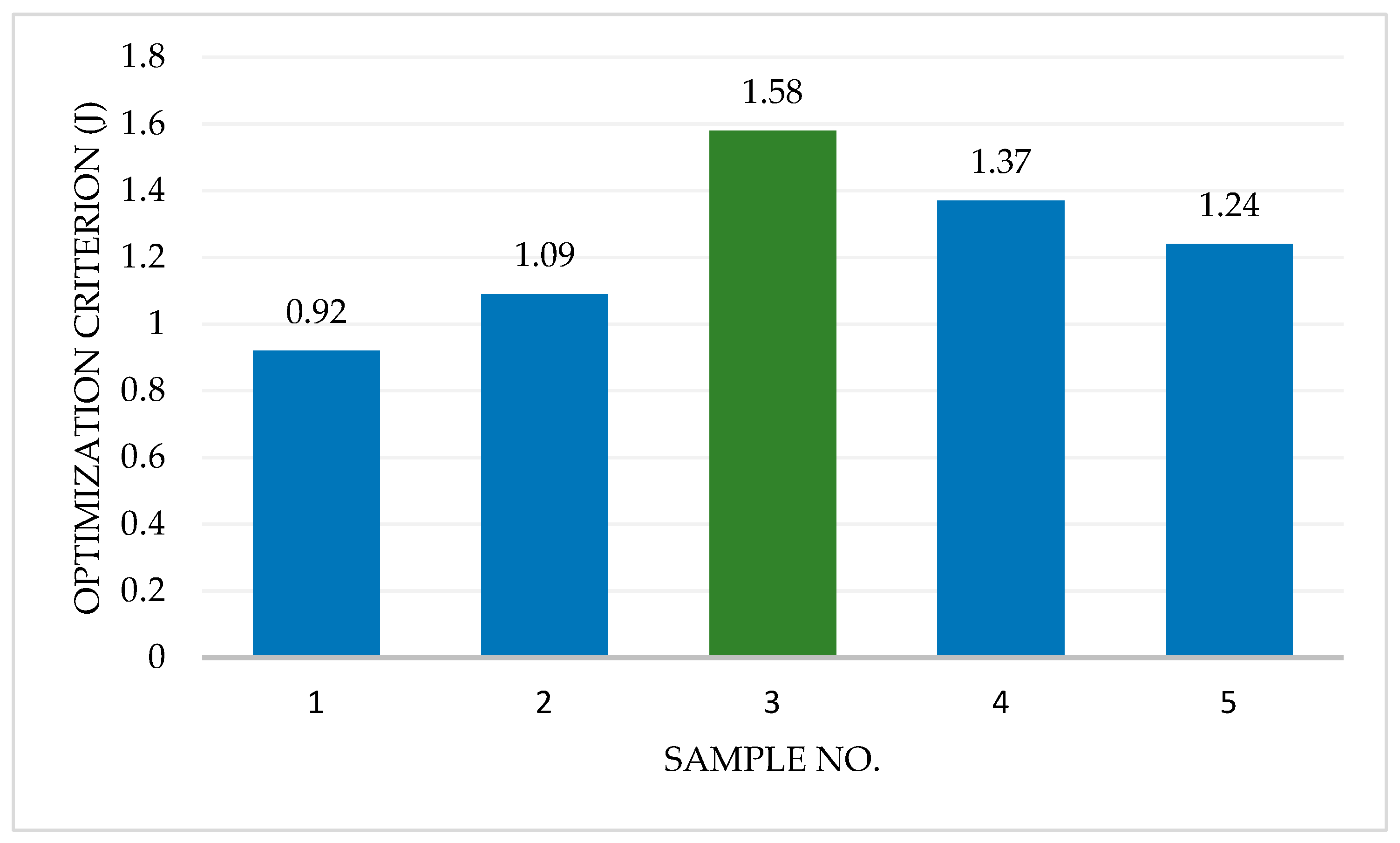
This was the highest J value among all tested formulations, confirming its selection as the optimum (
Figure 1).
The criterion (J) was calculated as J = μ1Y1 + μ2Y2 + μ3Y3, where Y1 is protein content (normalized), Y2 is carbohydrate content (normalized), Y3 is organoleptic score, and weighting coefficients were μ1 = 0.25, μ2 = 0.50, μ3 = 0.25. Formulation 3 (rice 35%, buckwheat 20%, oats 20%, corn 25%) exhibited the highest J value (1.58), indicating optimal balance of nutritional and sensory properties.
3.2. Technology for Obtaining a Multicomponent Mixture from Cereal Grains
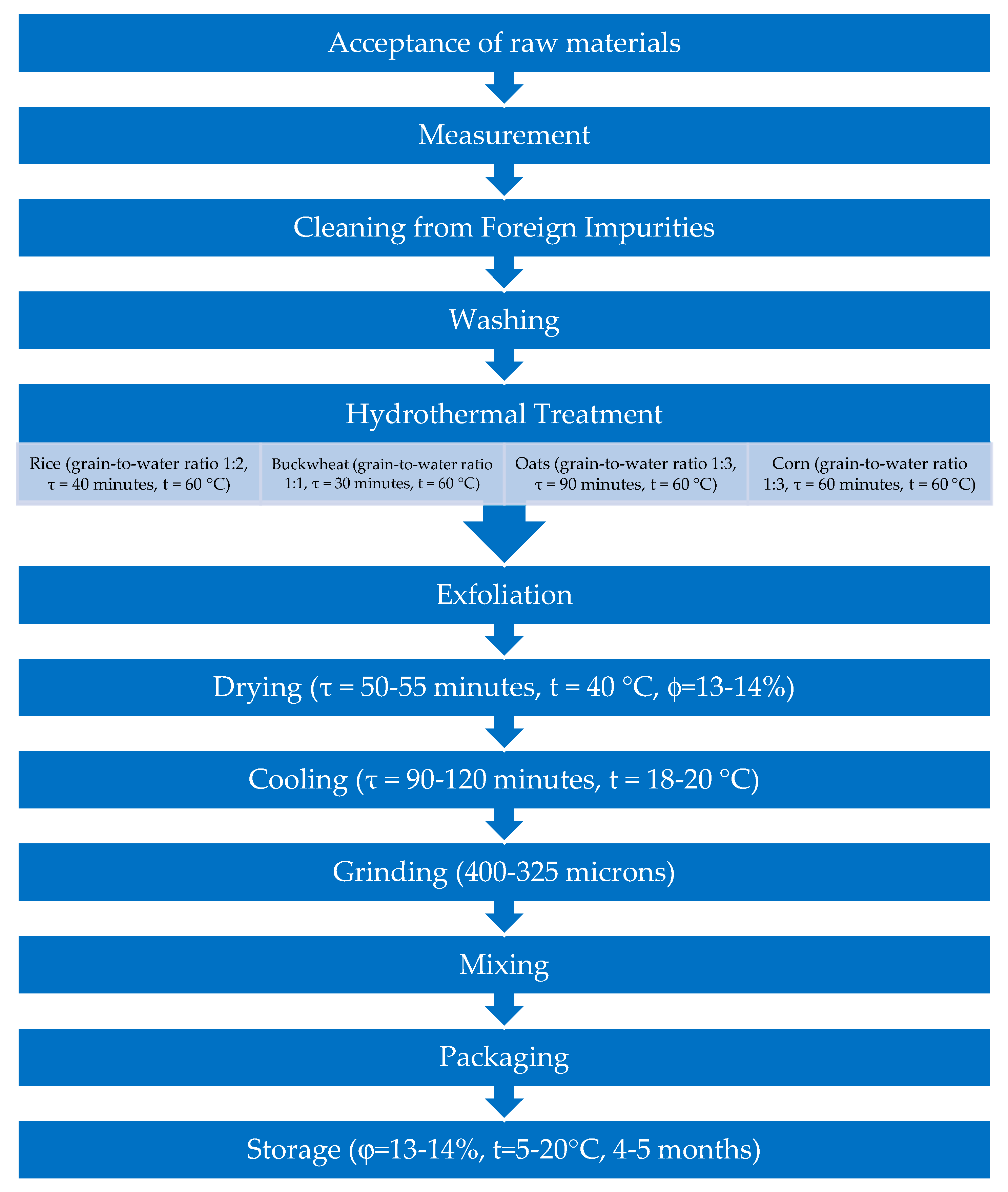
The technological scheme for producing the multicomponent mixture is presented in
Figure 2. The process includes: raw material acceptance → cleaning → washing → hydrothermal treatment (HTT) with grain-specific parameters (see
Section 2.3) → dehulling → drying (50–55 min, 40 °C, to 13–14% moisture) → cooling (90–120 min, 18–20 °C) → grinding (to 325–400 μm) → mixing according to the optimized formulation → packaging → storage (13–14% moisture, 4–5 months at 20 ± 2 °C).
3.3. Organoleptic Properties of the Multicomponent Mixture
The sensory evaluation of the optimal formulation (Formulation 3) confirmed its high quality (
Table 4).
3.4. Chemical Composition of the Multicomponent Mixture
The chemical composition of the optimal formulation was compared to a commercial multigrain flour blend (control sample) (
Table 5).
3.5. Nutritional and Biological Value of the Multicomponent Mixture
The amino acid profile of the experimental mixture confirmed the predictions of the optimization model (
Table 6). All essential amino acids met or exceeded the WHO reference pattern.
The vitamin and mineral contents of the experimental mixture are presented in
Table 7 and
Table 8, respectively.
3.6. Microbiological Indicators and Shelf Life
The microbiological analysis confirmed the safety of the product (
Table 9). No spoilage or pathogenic organisms were detected within the specified limits.
Based on the stability of chemical, organoleptic, and microbiological parameters over 6 months of monitoring, the recommended shelf life of the multicomponent mixture, when stored at 13–14% moisture content and 20 ± 2 °C, is 4–5 months.
3.7. Limitations of the Study
While this study provides a comprehensive evaluation of the developed multicomponent cereal mixture, several limitations should be acknowledged. First, the in vitro assessment of nutritional quality, particularly protein digestibility and mineral bioavailability, was not performed. Such analyses would provide a more accurate measure of the physiological value of the nutrients. Second, the organoleptic evaluation, while conducted by a trained panel, was limited to the dry mixture. Consumer acceptance studies involving end-products (e.g., porridge, baked goods) prepared from the mixture would be valuable. Third, the study did not investigate the potential presence of anti-nutritional factors, such as phytic acid or trypsin inhibitors, which could affect nutrient absorption. Fourth, the control sample used for comparison, while representing a commercial product, may not be an ideal benchmark due to differences in ingredient composition and processing. Finally, the shelf-life study, while adequate for establishing a preliminary recommendation, could be extended and include additional quality parameters over a longer period to confirm stability.
5. Conclusions
This study successfully developed and optimized a multicomponent cereal mixture based on rice (35%), buckwheat (20%), oats (20%), and corn (25%) using a combination of computer modeling and experimental validation. The main conclusions are as follows:
Optimization: The simplex method-based optimization, with a statistically significant model (p < 0.001, Adjusted R2 = 0.92), was effective in determining a formulation that meets WHO amino acid recommendations while balancing protein, carbohydrate, and sensory quality. The optimal formulation achieved the highest overall optimization criterion (J = 1.58).
Nutritional Profile: The developed mixture possesses a favorable nutritional composition, with a protein content of 14.43 g/100 g, low fat (4.48 g/100 g), and an energy value of 322.74 kcal/100 g. Its amino acid profile is well-balanced, with all essential amino acids meeting or exceeding reference standards.
Micronutrient Content: The mixture is a good source of key minerals (particularly magnesium, phosphorus, and calcium) and vitamins (A and E), with levels significantly higher than a comparable commercial product for several of these micronutrients. When expressed in mg/100 g, 100 g of the mixture provides 3.9% of the DRI for magnesium and 3.6% for phosphorus.
Sensory and Safety Characteristics: The product exhibits excellent organoleptic properties, achieving the maximum score (5.0) in sensory evaluation. It is microbiologically safe, complying with all tested standards (total plate count, coliforms, E. coli, yeasts and molds, Bacillus mesentericus, Salmonella, S. aureus), and has an estimated shelf life of 4–5 months under recommended storage conditions (13–14% moisture, 20 ± 2 °C).
Technological Feasibility: The established technological scheme, incorporating hydrothermal treatment parameters specific to each grain, is suitable for producing the mixture while preserving its nutritional and functional qualities. Detailed processing parameters and equipment have been specified to ensure reproducibility.
In conclusion, the developed multicomponent cereal mixture represents a functional, nutritionally balanced, and biologically valuable product. It holds potential for various applications in the food industry, including use as a base for instant porridges, an ingredient in bakery and meat products, or a component of specialized dietary foods. Future research should focus on in vivo studies to assess protein digestibility and mineral bioavailability, as well as consumer acceptance trials of final food products formulated with this mixture.




 ,
,