


Abstract
Against the backdrop of global warming, changes in the frequency and intensity of freeze–thaw cycles in cold regions profoundly impact soil physical structure. This review examines the mechanisms by which freeze–thaw cycles influence soil aggregate stability and pore structure evolution, focusing on revealing their synergistic evolution patterns. Results indicate that ice crystal growth during freeze–thaw processes directly disrupts soil cementation systems through expansion pressure and wedging effects, leading to aggregate disintegration and pore restructuring. This process is not unidirectional but forms a coupled feedback cycle of “ice crystal action–aggregate disintegration–pore restructuring.” Aggregate stability governs the initial pore restructuring, while the pore structure, in turn, influences aggregate stability by regulating water migration and colloidal dynamics. Responses of soil aggregates and pore structures to freeze–thaw cycles are comprehensively regulated by multiple factors, including soil physicochemical properties, freeze–thaw parameters, and anthropogenic disturbances. This synergistic evolution mechanism profoundly impacts soil water and heat transport, nutrient cycling, and erosion resistance. The paper also identifies current research gaps in regional coverage, cross-scale coupling, and in situ monitoring techniques. It envisions future efforts integrating multi-scale observations with intelligent technologies to deepen understanding of freeze–thaw-driven soil structure evolution mechanisms, thereby providing theoretical support for sustainable agriculture and ecological conservation in cold regions.
1. Introduction
Permafrost (including seasonal and perennial permafrost) covers approximately 20% of the Earth’s land surface globally, with the Northern Hemisphere accounting for as much as 24%. It serves as the core medium for cold-region hydrological cycles, carbon storage, and ecosystem stability [1,2]. In China, perennial permafrost is primarily concentrated on the Qinghai–Tibet Plateau, spanning about 1.05 million square kilometers and exhibiting unique high-altitude permafrost characteristics. Seasonal permafrost, meanwhile, is predominantly distributed in regions north of the Yangtze River in China, covering 54% of the country’s land area and representing a globally significant zone for seasonal permafrost distribution [3].
Against the backdrop of global warming, soil temperatures in cold regions show a significant upward trend. The frequency, intensity, and duration of freeze–thaw cycles have undergone structural changes, profoundly disrupting soil physical structure [4]. Soil aggregates and pore structure, as core components of soil physical properties, exhibit a close synergistic relationship. Aggregates serve as the foundational building blocks of pore structure, with their stability directly determining the integrity of the pore network [5,6]. Conversely, pore structure influences aggregate formation and disintegration by regulating water migration and ice crystal growth [7]. Freeze–thaw cycles induce soil water expansion during freezing and contraction during thawing, directly disrupting the soil cementation system. This leads to aggregate fragmentation and pore structure reorganization, subsequently altering soil water and heat transport efficiency, nutrient cycling capacity, and erosion resistance [8,9,10].
Current research has confirmed that the effects of freeze–thaw cycles on soil structure exhibit significant nonlinear characteristics, regulated by multiple factors including soil texture, initial moisture content, freeze–thaw parameters, and external disturbances [11,12,13]. For instance, when initial moisture content ranges between 60% and 80% of field capacity, the compressive forces generated by ice crystal expansion cause the most pronounced damage to soil aggregates and pore structures [14]. Under the “slow freezing–rapid thawing” pattern, soil structure degradation is significantly more severe than under other freeze–thaw rate combinations. However, existing research remains insufficient in elucidating the microscopic mechanisms, cross-scale correlations, and multi-factor interactions driving their synergistic evolution under freeze–thaw stress. This limitation hinders comprehensive responses to the evolving demands of cold-region soil ecosystems amid climate warming.
To address the aforementioned research gaps, this review aims to answer a core scientific question: “How do soil aggregate stability and pore structure co-evolve under freeze–thaw cycling?” Centering on this core question, this paper primarily discusses the following: (1) identifying key factors that influence soil aggregates and pore structure under freeze–thaw cycling (soil physicochemical properties, freeze–thaw parameters, external disturbances); (2) deeply analyzing the ice crystal-driven “aggregate-pore” synergistic evolution mechanism, revealing their interconnected effects during freeze–thaw processes; and (3) clarifying the bidirectional coupling relationship between aggregate stability and pore structure evolution, elucidating the interaction patterns where aggregates dominate initial pore restructuring while pore structure dynamically regulates aggregate dynamics. Through this systematic exposition, this paper aims to refine the theoretical framework governing soil structural evolution driven by freeze–thaw cycles, deepen understanding of the synergistic evolution mechanism between aggregate stability and pore structure, and provide theoretical support for sustainable agriculture, soil and water conservation, permafrost disaster prevention, and climate change adaptation in cold regions.
2. Research Methodology
To ensure the systematic and comprehensive nature of this review, a standardized literature retrieval and screening process was adopted. The literature search covered the Web of Science Core Collection and China National Knowledge Infrastructure (CNKI) databases, spanning the period from 2000 to 2025. The search strategy combined subject headings with free-text terms, using both Chinese and English keywords, including: “freeze–thaw cycles,” “soil aggregate stability,” “soil pore structure,” “pore morphology,” “aggregate-pore interaction,” and their combinations. Additionally, Boolean operators (AND, OR) were used to construct search expressions, such as (freeze–thaw cycles OR freezing–thawing) AND (soil aggregate OR aggregate stability) AND (pore structure OR porosity), to comprehensively capture the relevant literature.
The literature screening adhered to predefined inclusion and exclusion criteria. Inclusion criteria comprised: (1) studies focusing on the effects of freeze–thaw cycles on soil aggregates or pore structure; (2) research subjects involving natural soils or soil samples under simulated freeze–thaw conditions; (3) methodologies including experimental observation, in situ monitoring, or numerical simulation; and (4) publication types such as peer-reviewed journal articles, theses, or authoritative research reports. Exclusion criteria included: (1) studies addressing only the thermodynamic properties of frozen soil without examining soil structure; (2) research on engineered materials (e.g., concrete, roadbeds) rather than natural soils; and (3) conference abstracts and the literature where full-text access was unavailable.
Through this retrieval strategy, 856 relevant articles were initially identified. After screening titles and abstracts to exclude those clearly irrelevant to the theme, 312 articles remained for full-text review. Ultimately, 103 core documents highly relevant to this study’s theme were included (25 Chinese-language documents and 78 English-language documents), forming the foundation for this systematic review. The literature screening process adhered to the PRISMA (Preferred Reporting Items for Systematic Reviews and Meta-Analyses) guidelines to ensure the standardization and reproducibility of the review process.
3. Key Factors Influencing Soil Aggregate and Pore Structure Under Freeze–Thaw Cycling
3.1. Soil Physical, Chemical, and Biological Properties
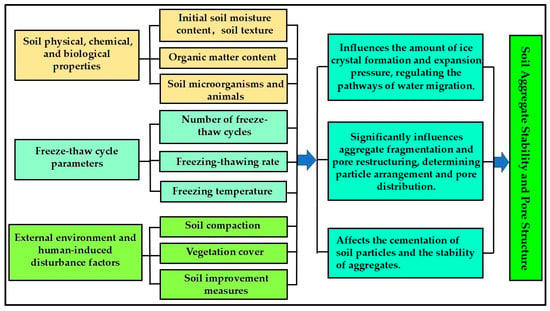
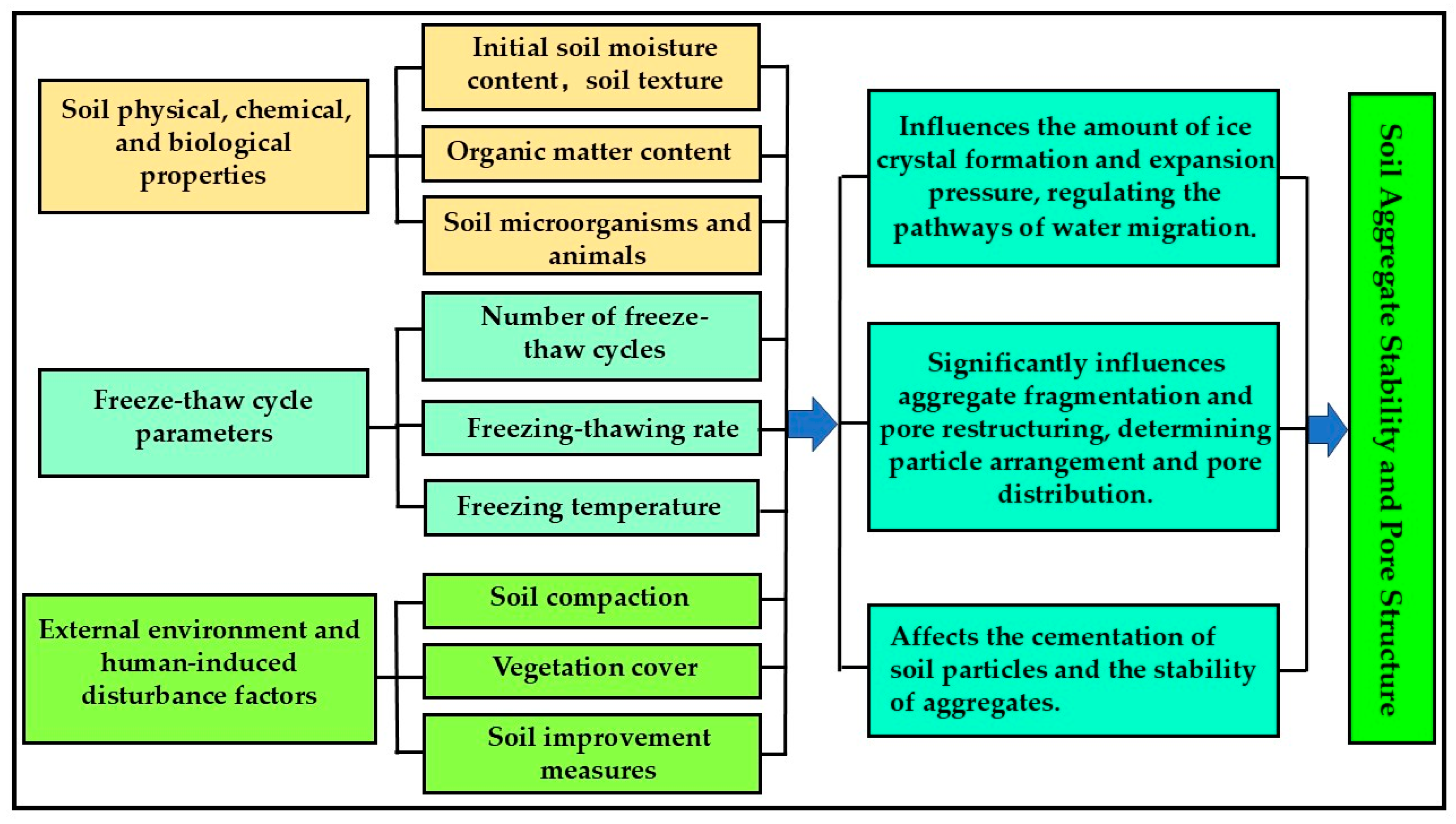
The physical and chemical properties of soil form the core foundation determining the sensitivity of soil structure to freeze–thaw cycles. Different physicochemical characteristics indirectly influence aggregate stability and pore structure remodeling processes by regulating ice crystal growth, water migration, and the intensity of cementation (Figure 1) [12,15].
Figure 1.
Key factors influencing soil aggregate and pore structure under freeze–thaw cycling.
Initial moisture content serves as a key regulatory factor in freeze–thaw processes, directly determining ice crystal formation, expansion pressure, and water migration pathways during freezing and thawing. This, in turn, significantly influences the efficiency of aggregate disintegration and pore restructuring [16]. Recent studies have confirmed that under freeze–thaw cycling conditions, the influence of initial moisture content on the structure of most mineral soils exhibits a threshold range (60–80% of field capacity) [14]. At lower moisture contents, the amount of free water in soil pores is minimal, limiting ice crystal formation and resulting in weaker disruption of aggregate cohesive bonds, with only slight fluctuations in pore structure [17]. However, research by Shi et al. indicates that at 17.5% moisture content—where water is not fully saturated—uneven pore water distribution causes localized stress concentration, leading to the highest failure rate [18]. When soil moisture content is high, the freezing of large amounts of free water within pores causes pore volume expansion, with an expansion rate of approximately 9%. The resulting compressive forces directly tear apart the internal cohesive structure of soil aggregates, leading to the transformation of large aggregates into smaller ones. This process simultaneously triggers pore squeezing, connectivity, or collapse, causing a significant increase in porosity and dramatic changes in the proportion of large pores [19]. Additionally, the effect of soil moisture content on the stability of aggregates varies across different particle size fractions. Cao et al. found that as initial moisture content increased, the structural stability of soil aggregates decreased by 38.4%, 28.9%, and 24.1% for bare soil, cyanobacterial crust, and moss crust soils, respectively [20]. Zhang et al. also demonstrated a significant negative correlation between soil moisture content and aggregate stability, where increased soil moisture led to a decrease in the proportion of >0.25 mm aggregates, thereby reducing aggregate stability [21]. The initial moisture content exerts the most pronounced regulatory effect on macroaggregates. After freeze–thaw cycles, high-moisture-content soils exhibit a significant reduction in macroaggregate content, whereas the impact on microaggregates is relatively minor. The stability of microaggregates relies more heavily on the support provided by cementing materials.
Soil texture profoundly influences the response mechanisms of soil structure under freeze–thaw cycles by altering particle arrangement, specific surface area, and pore size distribution [13]. Due to differences in particle composition, specific surface area, cementation properties, and pore characteristics, soils of varying textures exhibit significantly divergent responses to freeze–thaw action. Sandy soils possess coarse particles, low specific surface area, and weak inter-particle cohesion. During freeze–thaw cycles, ice crystal expansion readily causes particle dispersion, resulting in the poorest aggregate stability. Furthermore, their pore structure is dominated by large pores, making pore connectivity susceptible to disruption after freeze–thaw cycles and leading to low pore structure stability [22]. Clay particles are fine-grained with large specific surface areas, exhibiting strong interparticle van der Waals forces and cohesive forces, resulting in relatively high stability of initial aggregates. However, under high moisture content, ice crystal pressure generated during freeze–thaw cycles readily causes pore blockage. Prolonged water retention after thawing easily leads to loss of cementing material, resulting in significant structural deterioration under long-term freeze–thaw cycles. Silt soils exhibit balanced particle distribution with optimal proportions of sand, silt, and clay particles. During freeze–thaw cycles, sand particles support the pore structure while clay particles and organic matter form stable cementation, providing the strongest buffering capacity against freeze–thaw disturbance [23]. Although black soil has high organic matter content, its texture tends to be clayey. Under freeze–thaw cycles, organic matter readily decomposes and leaches away, weakening cohesion. The rate of aggregate disintegration is significantly higher than in loamy soils, and during pore space restructuring, there is a tendency for large pores to decrease while the proportion of medium and small pores increases. Zhao et al. confirmed that due to soil texture differences, porosity in the 0–75 mm layer first increases, then decreases with increasing freeze–thaw cycles, while in the 75–280 mm layer, it shows a gradual decreasing trend [24].
Organic matter content and type are key factors regulating soil freeze–thaw resistance. Higher organic matter content enhances soil aggregate stability and improves the resistance of pore structures to freeze–thaw cycles [25,26]. As a key organic binder, humus forms stable aggregates by binding to soil particles through hydrogen bonds and hydrophobic interactions [27,28], while simultaneously filling micropores to reduce the compressive damage caused by ice crystal formation. Additionally, humus enhances soil water-holding capacity and mitigates structural fluctuations caused by rapid water migration during freeze–thaw cycles [25,29]. Research indicates that at a biochar addition rate of 3%, the MWD and GMD of soil aggregates increased by 7.92–41.36% and 3.53–15.08%, respectively, following freeze–thaw cycles. Concurrently, the fractal dimension of soil pores decreased by 0.12–0.43%, resulting in enhanced aggregate stability [30]. The synergistic interaction between organic and mineral cementing agents also influences soil structure evolution under freeze–thaw cycles. Organic cementing agents (humus, root exudates, and microbial extracellular polymers) and mineral cementing agents (clays, calcium carbonate, iron oxides, and aluminum oxides) form a composite cementing system. Organic binders enhance the cohesive strength of mineral binders by enveloping mineral particles and constructing aggregate frameworks, while mineral binders provide attachment substrates for organic binders. This synergistic interaction improves soil pore structure and enhances aggregate stability [31,32].
Soil microbial communities and soil animals play a significant mediating role in the synergistic evolution of aggregates and pores during freeze–thaw cycles. Fungal mycelium networks, as key biocementing factors for the formation of large aggregates (>250 μm) in soil, influence freeze–thaw processes. During soil freezing, ice crystal growth directly punctures and fractures fungal hyphae, potentially compromising network integrity and weakening their entrapment of soil particles [33,34]. However, as thaw water accumulates post-freezing, regenerated fungal networks can re-entangle fragmented aggregates while secreting glycoprotein-based cementing substances like ballastins [35], facilitating aggregate reassembly. Concurrently, the contribution of microbial cell death and lysis during freeze–thaw cycles to organic binding material pools represents another critical mechanism. During freezing, soil microbial cells undergo death and lysis due to ice crystal puncture and osmotic shock. The released intracellular organic matter can function as organic binders [36], adhering to soil particles through hydrogen bonding and cation bridging to promote microaggregate formation. Wang’s research indicates that freeze–thaw cycles reduced large soil aggregates by 71.96% while increasing soluble organic carbon content by 4.68%, accompanied by an increase in aggregate number [37]. Additionally, the protective and binding functions of bacterial extracellular polymers (EPS) in freeze–thaw environments warrant attention. Certain cold-tolerant bacteria enhance EPS secretion during early stages of low-temperature stress [38], forming protective biofilms. EPS, primarily composed of polysaccharides and proteins, adheres to soil particles to form micro-aggregate units, maintaining micro-aggregate stability. Soil animal activity (e.g., earthworms, nematodes, springtails) also modulates freeze–thaw responses. Macroporous channels created by earthworm activity may serve as preferential water migration pathways and ice crystal growth spaces during freeze–thaw cycles. Small-to-medium soil animals like nematodes and springtails indirectly influence organic binder decomposition and transformation efficiency by consuming microorganisms and fragmenting organic residues, thereby regulating aggregate stability dynamics.
3.2. Freeze–Thaw Cycle Parameters
Freeze–thaw cycle parameters independently or synergistically influence soil aggregate stability and pore structure evolution by regulating ice crystal growth morphology, physical stress intensity, and water migration processes. Their action patterns and interactive effects exhibit pronounced nonlinear characteristics (Figure 1).
The number of freeze–thaw cycles is the core parameter determining the cumulative effect on soil structure. Its influence on structure exhibits a phased characteristic of “initial intense fluctuation followed by later stabilization,” with a threshold number of cycles. That is, the threshold number of freeze–thaw cycles corresponds to the point where the rate of change in soil structural indicators (such as mean weight diameter of aggregates, total porosity, and pore connectivity index) transitions from intense fluctuation to a gradual, quasi-equilibrium state. Based on typical mineral soils in mid-latitude seasonal permafrost regions, with freezing temperatures ranging from −10 °C to −20 °C and thawing temperatures from 5 °C to 15 °C, existing research indicates that the critical number of freeze–thaw cycles typically ranges between 5 and 15 [23]. As the number of cycles increases, the repeated expansion and contraction of ice crystals continuously disrupt organic-mineral cementation bonds, leading to the persistent fragmentation of large aggregates and an increase in the content of small aggregates [39]. Pores undergo multiple cycles of compression, collapse, and reconstruction, resulting in significant fluctuations in indicators such as porosity and connectivity [40]. Zhao et al. investigated the response of inter-aggregate porosity and aggregate internal porosity structure to freeze–thaw cycles in alpine meadows. They found that aggregate internal porosity initially decreased and then increased with the number of freeze–thaw cycles, while inter-aggregate porosity first increased and then decreased [41]. Liu et al. demonstrated that freeze–thaw cycles increased total imaging porosity (TIP) and total number of pores (TNPs). TIP in FT.20 increased by 255.6% compared to CK, while TNP in both FT.15 and FT.20 was significantly higher than CK (p < 0.05) [42]. After exceeding the critical number of cycles, soil particles and aggregates reach a new equilibrium state where the destruction of cementing materials and weak reorganization processes become synchronized, leading to gradual stabilization of aggregate size distribution and pore structure indices [43]. Jin et al. proposed that the coefficient of variation in black soil aggregate content gradually stabilizes with increasing freeze–thaw cycles, particularly for aggregates > 0.25 mm; pore porosity increases with the number of freeze–thaw cycles, varying between 32.4% and 41.4% [44]. Furthermore, the influence of freeze–thaw cycles exhibits particle size and pore size specificity, exerting the most pronounced regulatory effect on large aggregates (>2 mm) and large pores (>50 μm). However, the impact on microaggregates and small pores largely plateaus after the critical number of cycles.
Freeze–thaw rates exert differential effects on soil structure by altering ice crystal morphology and water migration efficiency [45]. During rapid freezing (freezing rate > 5 °C/h), soil water cannot migrate sufficiently, leading to the rapid formation of fine, dispersed ice crystals. These crystals distribute compressive stress more uniformly within aggregates, resulting in relatively minor aggregate fragmentation. However, the fine ice crystals readily fill small and medium-sized pores, reducing pore connectivity [4,46,47]. Gao et al. utilized in situ X-ray computed tomography to discover that as the freezing rate increases, ice crystal size decreases, and interconnected networks form between pore ice and unfrozen water during the freezing process [48]. During slow freezing (freezing rate < 1 °C/h), water has sufficient time to migrate toward the freezing front, forming coarse, continuous ice crystals. This generates localized expansive pressure, readily causing aggregates to fracture along the ice crystal growth path. The breakage rate of large aggregates is significantly higher than that observed during rapid freezing. However, after melting, coarse ice crystals leave behind numerous large voids, resulting in relatively high porosity [49,50]. Additionally, during slow thawing, water migrates gradually, allowing particles to progressively rearrange. This mitigates structural damage to some extent and enhances pore connectivity [51]. Rapid thawing causes water to permeate and drain quickly, leaving soil particles insufficient time to reorganize. This often leads to pore collapse and accelerated structural deterioration [52]. Among different rate combinations, the “slow freeze–rapid thaw” pattern may cause the most severe damage to soil structure, resulting in a significant decrease in aggregate MWD and a marked increase in pore fractal dimension.
Freezing temperatures influence the compressive strength exerted by freeze–thaw cycles on soil particles by regulating ice crystal expansion pressure and growth morphology, with this effect closely related to temperature gradients [53,54,55]. A larger temperature gradient intensifies ice crystal volume expansion pressure and promotes the formation of irregular ice crystals, such as columnar or needle-like structures. This may enhance wedging effects on aggregates, leading to more severe fragmentation. Simultaneously, intense compression causes pore contraction and collapse, reducing the proportion of large pores [56,57]. Conversely, freezing temperatures near 0 °C (with a small temperature gradient) produce predominantly plate-like and granular ice crystals. Their weaker expansion pressure exerts a relatively mild destructive force on the structure, allowing the pore structure to maintain its integrity more readily. Furthermore, a significant interaction effect exists between freezing temperature and cycle number. Zhu et al. demonstrated that freeze–thaw temperature and cycle count synergistically reduced the content of large aggregates (1–0.5 mm) in black soil by 40.13% and increased the proportion of microaggregates (0.25–0.053 mm) by 50.51%. The fractal dimension increased most significantly at −9 °C, rising from 2.09 to 2.74 [58]. Concurrently, Wei et al. investigated changes in loess mechanical properties through freezing cycles at 0, −5, −10, −15, and −20 °C followed by thawing at 15 °C. Results indicated that lower freezing temperatures accelerated the decline in unconfined compressive strength, deteriorating soil structure [59]. Furthermore, the effect of freezing temperature on cementing materials is indirect. Low temperatures inhibit microbial activity, slowing the decomposition of organic cementing agents and partially offsetting physical damage, thereby creating an antagonistic effect between “physical damage and biological regulation.”
The combined effects of freeze–thaw cycle parameters exhibit pronounced nonlinear characteristics, representing not a simple summation of individual parameter effects but rather a coordinated regulation of the chain process involving ice crystal growth, water migration, and cementation. Together, these factors jointly determine the evolution patterns of soil structure. The core driver of this nonlinearity lies in the synergistic and antagonistic interactions among parameters. For instance, freezing temperature and rate synergistically regulate ice crystal morphology, while cycle number and temperature antagonistically influence cementing material dynamics. This ultimately results in complex mapping relationships between soil structural responses and parameter combinations—a central challenge in current quantitative simulation research.
3.3. External Environment and Human-Induced Disturbance Factors
External environmental factors and anthropogenic disturbances indirectly influence aggregate stability and pore structure remodeling by altering initial soil conditions and regulating the freeze–thaw cycle pathway (Figure 1).
Soil compaction is the most prevalent anthropogenic disturbance in agricultural tillage. Its interaction with freeze–thaw cycles governs soil structural evolution, with effects regulated by compaction intensity (bulk density) [60,61]. Mechanical compaction during agricultural tillage increases soil bulk density, drastically reduces macropore fraction, and significantly diminishes pore connectivity. Aggregates undergo fragmentation and reorganization under mechanical stress, weakening initial structural stability. Mild compaction (bulk density 1.2–1.4 g/cm3) may allow frost-induced ice crystal expansion pressure to disrupt the compacted dense structure, promoting pore connectivity and aggregate restructuring, thereby partially restoring soil aeration and permeability [62]. Under heavy compaction (bulk density > 1.4 g/cm3), soil particles are tightly packed, making it difficult for ice crystal expansion pressure to diffuse during freeze–thaw cycles. This may accelerate aggregate disintegration and further deteriorate pore connectivity, though this tendency gradually stabilizes with increasing compaction intensity [63]. Zhang et al.’s three-dimensional visualization study revealed that soil compaction induces a distinct layered structure in the pore network, significantly reducing total image porosity, macropores, connected porosity, coordination number, and fractal dimension (p < 0.05), while impairing pore connectivity [6]. However, other studies indicate that after repeated freeze–thaw cycles, artificially porous soil (bulk density 1.6 g/cm3) generally exhibits superior air porosity, average aggregate weight diameter, and structural coefficient in both surface and subsurface layers compared to non-porous soil [64]. Recent studies confirm that the combined effects of compaction and freeze–thaw are significantly stronger than either factor alone. The dominant direction of soil structure evolution depends on the combination of compaction degree and freeze–thaw parameters. For instance, after 5–10 freeze–thaw cycles, the mean weight diameter (MWD) of soil aggregates in lightly compacted soils increases by 10–20%, while that in heavily compacted soils decreases by 15–25%.
Vegetation cover forms a buffer and protective mechanism against freeze–thaw damage through the dual actions of root interweaving and litter decomposition, significantly enhancing soil structural stability [65,66]. Root interweaving directly entangles soil particles and aggregates, enhancing inter-particle cohesion. Simultaneously, root exudates (polysaccharides, proteins, etc.) act as organic cementing agents, promoting the formation of composite aggregates [67] and improving their resistance to freeze–thaw fragmentation. The root interweaving of perennial plants also constructs stable macropore channels, mitigating pore blockage and collapse caused by freeze–thaw cycles and maintaining pore network integrity. Decomposed litter releases humus and nutrients that replenish soil organic binders, regulating initial soil moisture content and thermal conductivity [68]. This slows temperature change rates during freeze–thaw cycles and reduces structural damage from ice crystal expansion pressure. Regulatory effects vary across vegetation types. Perennial herbaceous plants, characterized by extensive root systems and moderate litter decomposition rates, enhance large aggregate content post-freeze–thaw. For instance, freeze–thaw processes significantly increased the content and geometric mean diameter (GMD) of 2–5 mm water-stable aggregates in North China larch forests [69].
Soil improvement measures such as biochar incorporation and straw return to the fields are key technologies for restoring soil structure in cold regions by optimizing soil physicochemical properties and regulating structural evolution during freeze–thaw cycles. Biochar, with its large specific surface area and rich pore structure, acts as a “scaffold carrier” for aggregate formation when applied to soil. It adsorbs soil particles and cementing substances, promoting the formation and stability of large aggregates. The loose, porous nature of biochar also enhances soil water-holding capacity, regulates water migration during freeze–thaw cycles, and reduces damage to pore structures caused by ice crystal expansion pressure. Research by Shi et al. confirmed that adding biochar and straw increases the content of water-stable aggregates > 0.25 mm, improves geometric mean diameter (GMD) and mean weight diameter (MWD), and reduces the percentage of aggregate disintegration (PAD), thereby enhancing soil aggregate stability. Applying biochar and straw increased the proportion of soil pores (>100 μm and 0.3–100 μm) while decreasing the proportion of ultramicropores, ultimately affecting pore connectivity [70]. Applying biochar (7.0 t/hm2) increased MWD of soil aggregates by 36.47%, decreased PAD by 17.34%, reduced soil ultramicropores by 4.13%, and increased mesopores by 18.93% [71]. Straw mulching reduces soil surface temperature fluctuations, slows freezing and thawing rates, and decreases freeze–thaw intensity [72]. Furthermore, decomposing straw releases organic matter that supplements soil binders, enhances aggregate stability, and mitigates pore collapse caused by freeze–thaw cycles.
Beyond these core factors, external environmental elements such as alternating wet and dry conditions and grazing disturbances also exert indirect interference [73,74]. These external disturbances do not operate in isolation but interact with soil properties and freeze–thaw parameters to form a complex influence system, ultimately determining the evolution patterns of soil structure under freeze–thaw cycles.
4. Cooperative Evolution Mechanism of Soil Aggregates and Pore Structure Under Freeze–Thaw Cycling
4.1. Synergistic Mechanisms of Soil Aggregate Formation and Pore Structure Driven by Ice Crystals
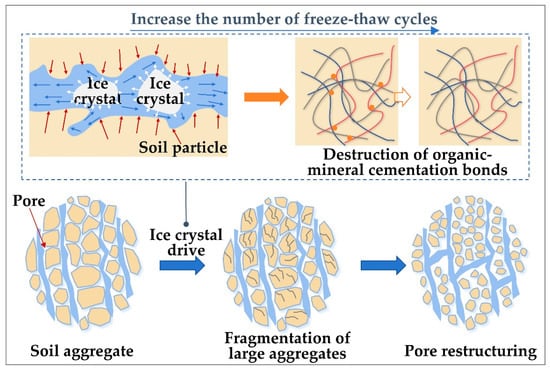
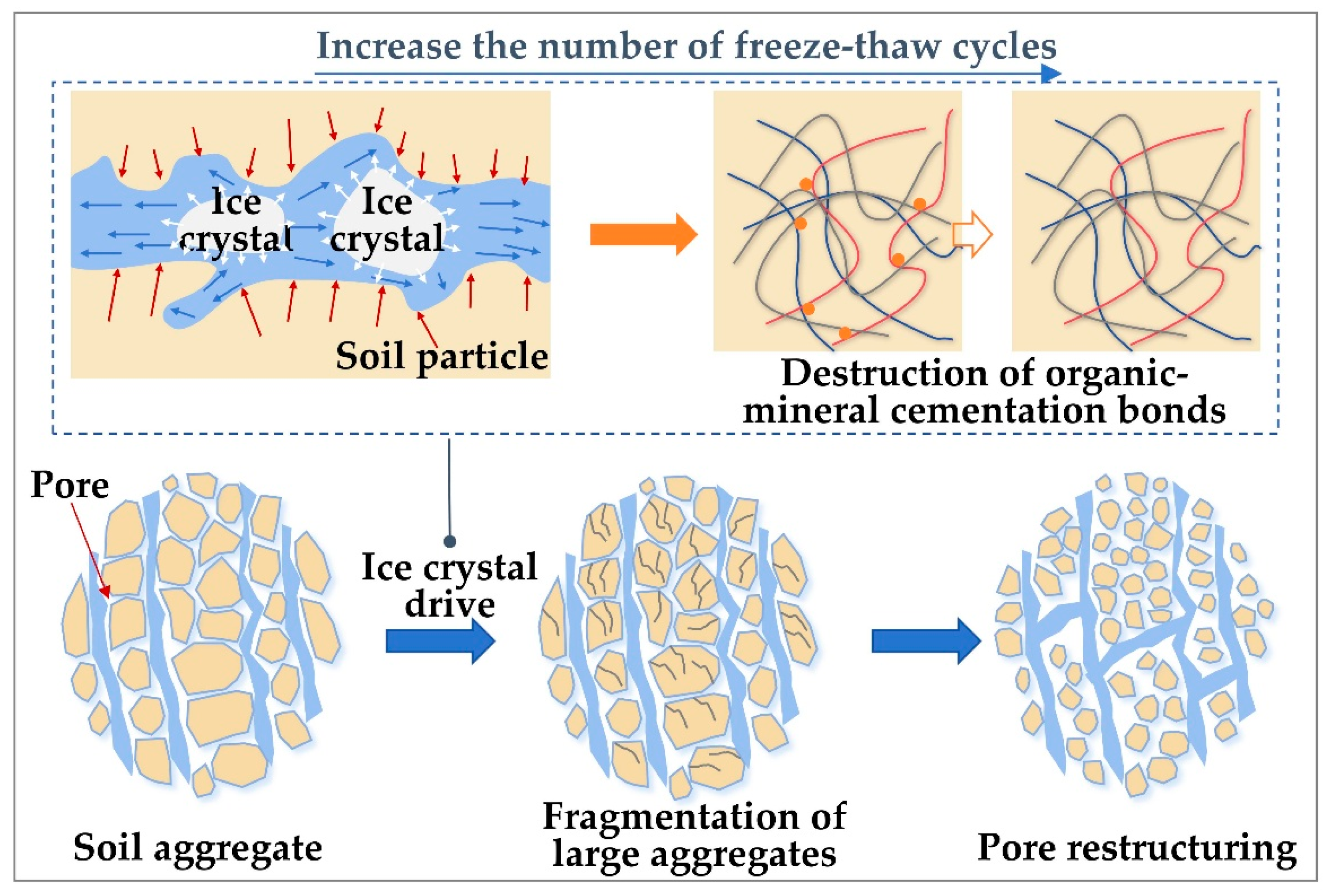
Aggregate stability and pore structure form a coupled, synchronously evolving “ice crystal action–aggregate disintegration–pore restructuring” chain reaction driven by ice crystals (Figure 2) [75,76]. During the freezing stage, the expansion of free water in soil pores causes uneven expansion pressure. This pressure simultaneously strains organic-mineral cement bonds (hydrogen bonds, ionic bonds, etc.) within aggregates, causing weak bonds to rupture, while also exerting compression on pore walls. This leads to the collapse of small and medium-sized pores and the filling or penetration of large pores by ice crystals [77,78]. Ice wedging further intensifies this synergistic effect. Needle-like and columnar ice crystals, which preferentially form in large pores, not only induce microfractures along weak bonding planes within aggregates but also expand pore channels, altering their morphology. Coarse, continuous ice crystals formed by slow freezing cause over 30% greater damage to aggregate cementation bonds than rapid freezing, while also more readily restructuring macropore distribution. Shi et al. used scanning electron microscopy (SEM) to compare soil pore changes before and after freeze–thaw cycles, finding that macropores in the frozen layer increased by an average of 15%, mesopores decreased by 16%, and micropores showed minimal change (approximately a 1% increase) [79]. Wang et al. observed that the pore networks within 0.25–2 mm aggregates were more susceptible to seasonal freeze–thaw cycles than those in >2 mm aggregates, with freezing promoting the formation of pores > 80 μm in size within aggregates [80]. During thawing, melting ice crystals rapidly release accumulated stress, causing microfractures in aggregates to expand and break into smaller aggregates. Released fine particles partially clog pores. Meltwater drives soil particle rearrangement [39], repairing some collapsed pores, but the blocking particles resist migration. Thus, freeze–thaw cycles may ultimately cause aggregate deformation and separation, increase surface porosity, promote local particle fragmentation, and generate new particles, creating a synergistic evolutionary cycle [81]. However, large voids such as cracks, root channels, and animal burrows can serve as efficient permeation pathways, facilitating water infiltration. A one-directional soil-column freezing and thawing experiment was conducted using unsaturated sandy and silt loams with different sizes and numbers of macropores. During freezing, macropores were found to retard the formation of the frozen layer, depending on their size and number. During thawing, water flowed through macropores in the frozen layer and reached the underlying unfrozen soil. However, infiltrated water sometimes refroze in a macropore [78]. Yang et al. used scanning electron microscopy to confirm that after freeze–thaw cycles, soil particle morphology and arrangement became more complex, inter-particle connections loosened, and pore shapes became irregular. Surface porosity increased, the proportion of large and medium pores rose, pore orientation strengthened, and pore complexity heightened [82]. Wang et al. also demonstrated that seasonal freeze–thaw cycles increased soil porosity across all samples (0.4–11.9%) [83]. Zhang et al. employed rare earth oxide (REO) tracers in in situ dynamic monitoring experiments under natural freeze–thaw conditions, precisely tracing transformation pathways between aggregates of different particle sizes and quantifying transformation rates [21]. Freeze–thaw cycles primarily alter aggregate stability, thereby influencing aggregate migration and fragmentation rates. Zhang et al. found that after freeze–thaw cycles, aggregates of 5–7 mm and 3–5 mm primarily transformed into 0.5–1 mm particle sizes, with the average weight diameter (MWD) of aggregates showing an overall decreasing trend as freeze–thaw cycles increased [39]. Zhang et al. employed X-ray computed tomography (CT) to reveal that seasonal freeze–thaw cycles significantly impacted aggregate stability by 28.89%. Aggregate stability was primarily influenced by fractal dimension, 30–80 μm porosity, and <30 μm porosity [6], confirming the interplay between aggregate and pore restructuring. Gao et al. further validated through dynamic tracking that ice crystal morphology not only regulates aggregate fragmentation pathways but also directly determines the direction and magnitude of pore restructuring [48]. To summarize the synergistic evolution patterns of aggregates and pore structures in the aforementioned studies, Table 1 compiles the soil types, freeze–thaw parameters, primary responses, and core mechanisms from representative research.
Figure 2.
Schematic diagram of soil aggregate evolution under freeze–thaw conditions.
Table 1.
Summary of representative studies on the co-evolution of soil aggregates and pore structure under freeze–thaw cycles.
The synergistic evolution mechanisms of soil aggregates and pore structures under freeze–thaw cycles differ across soil types, stemming from fundamental variations in particle composition, cementation types, and pore geometry. For clay soils, this synergistic evolution primarily manifests as plastic deformation-dominated changes. During fewer freeze–thaw cycles (3–5 cycles), ice crystals fill small pores, and combined with clay swelling due to water absorption, this leads to an increase in microporosity and a temporary decrease in pore connectivity. As the number of cycles increases (>10 cycles), cumulative plastic deformation causes the rearrangement of particles released from fragmented aggregates. The proportion of macropores gradually recovers, but the pore morphology becomes more complex, with an increase in fractal dimension. Fan et al. observed via μCT that after 15 freeze–thaw cycles, clay exhibited an 8–15% increase in porosity alongside significantly enhanced anisotropy in the pore network, reflecting a plastic deformation-dominated restructuring process [55]. The synergistic evolution mechanism of sandy soils during freeze–thaw cycles is primarily dominated by particle rearrangement. Due to low organic matter content and weak cementation, sandy soil aggregates exhibit low stability. Ice crystal growth during freeze–thaw cycles readily causes particle dispersion, allowing aggregates to rapidly disintegrate into soil particles within a few cycles (3–5) [22]. Starkloff et al. observed via X-ray CT that after 7 freeze–thaw cycles, sandy loam exhibited a >40% reduction in macropores (>100 μm) and significantly increased fracture density in the pore network [22]. The synergistic evolution mechanism of organic-rich soils during freeze–thaw cycles primarily manifests as biophysically coupled evolution. Organic matter (especially humus) forms stable organic-mineral complexes with mineral particles through hydrogen bonding, hydrophobic interactions, and cation bridging, conferring high mechanical strength and elasticity to aggregates [27,28]. Simultaneously, organic matter filling the pore network buffers ice crystal expansion pressure, reducing direct damage to pores [25]. Zhu et al. demonstrated that a 1% increase in organic matter content enhances aggregate MWD retention by 5–8% after freeze–thaw cycles, reflecting organic matter’s protective effect on structural stability [25].
4.2. Quantification and Regional Variation in Soil Aggregates and Pore Structure
In recent years, leveraging technological innovations in soil structure research has enabled the quantification of the synergistic evolution of aggregates and pore structure [88]. Using SEM and IPP image analysis techniques, researchers have quantified the synergistic variation patterns of key indicators for soil aggregates and pore structure in cultivated soils of cold regions [79,89,90]. For instance, Munkholm and Sheng et al. systematically revealed the interannual variations and driving factors of aggregate MWD and macropore fraction in black soil under natural freeze–thaw cycles through long-term field experiments [91,92]. Dong and Hong et al., studying permafrost soils on the Qinghai–Tibet Plateau, established a positive correlation between aggregate disintegration rates and pore connectivity degradation rates under varying compaction levels [93,94], providing support for engineering protection in cold regions. Simultaneously emphasizing technological innovation and mechanism refinement, they employed synchrotron radiation μCT, three-dimensional imaging, and spatial reconstruction methods to precisely analyze the microscopic processes of synergistic evolution between soil aggregates and pore structures [40,95]. Zhao et al. employed computed tomography (CT) to simulate freeze–thaw cycles in alpine meadow soils, investigating the response mechanism of soil pore structure to freeze–thaw cycles. They confirmed that soil pore connectivity significantly decreased after 10 freeze–thaw cycles [24]. Liu et al. used X-ray computed tomography to evaluate the effects of freeze–thaw cycles on soil macropores and macroaggregate properties and their correlations. Results indicated that freeze–thaw cycles significantly increased total image porosity, average pore size, branching porosity, and connectivity density. Specifically, the porosity of 7 mm aggregates increased by 27.9%, while that of 3 mm aggregates increased by 78.0%. Increased porosity and pore branching readily lead to the disintegration of giant aggregates [84]. The conclusions regarding pore connectivity in the aforementioned studies vary, primarily due to differences in soil type, initial moisture content, freeze–thaw stages, and observational scales. Zhao et al. [24] studied alpine meadow soils with high organic matter content (>5%) and near-saturated initial moisture content (80–90% field capacity). Under these conditions, extensive ice crystal formation during freezing filled pores, and partial pore connectivity was lost after thawing due to particle blockage, resulting in overall connectivity decline. In contrast, Liu et al. [84] studied black soil with moderate organic matter content (2–4%) and initial moisture content at 60–70% field capacity. During freeze–thaw cycles, ice crystal growth primarily expanded existing pore channels. Simultaneously, particles released from aggregated soil structure rearranged to form new pore connections, resulting in increased branching porosity and connectivity density. For instance, Navid et al. developed a high-dimensional evaluation system, establishing a nonlinear mapping model between aggregate and pore structure parameters and freeze–thaw factors, with the results applied to assessing pavement subgrade soil strength [96]. Xie et al. reviewed the application of fixed-point, aerial survey, and remote sensing satellite methods in studying CH4 monitoring and emission characteristics in submarine permafrost zones. They explored influencing factors of CH4 emissions, emphasizing the significance of Arctic submarine permafrost dynamics and carbon cycle research for global climate change [97], providing theoretical references for cold region ecological conservation. Cross-regional studies confirm that the integrity of the organic-mineral cementation system is central to maintaining the synergistic stability of soil aggregates and pore structure. Pore connectivity and macropore content serve as key indicators characterizing the degree of synergistic evolution.
4.3. Synergistic Evolution of Soil Aggregates and Pore Structure in Regulating Soil Ecological Processes
The synergistic evolution of soil aggregates and pore structure is not merely a change in soil structure but rather a comprehensive influence on soil ecological functions by regulating water and heat transport, nutrient cycling, and other processes. Regarding water and heat transport, soil freezing leads to aggregate disintegration, reducing macropore proportion to 0.05–0.1% and saturated flow share to approximately 30% [85]. This may decrease soil infiltration rates, intensify spring snowmelt runoff, and heighten soil erosion risks. Other studies indicate that freeze–thaw cycles can improve soil pore connectivity, with soil infiltration rates reaching relatively high and peak values after 7–15 freeze–thaw cycles [8]. Furthermore, Shi et al.’s study on terraced farmland in the Loess Plateau confirmed that both aggregate mean width distribution (MWD) and pore connectivity decreased, showing a significant positive correlation with increased erosion rates [9]. Regarding carbon pools and nutrient cycling, good soil structure can reduce organic carbon mineralization rates. Notably, FTCs significantly increased the contribution of 2–5 mm water-stable (WS) aggregates to SOC sequestration, with increment rates of 86% (farmland), 80% (grassland), and 86% (forestland) [10]. When soil structure deteriorates, the protective effect of microaggregates on carbon diminishes, leading to increased mineralization of organic carbon. Wang et al. confirmed that total organic carbon, particulate organic carbon, and mineral-associated organic carbon content in aggregates were higher during stable freezing periods but declined sharply during unstable thawing periods. This indicates a positive correlation between the freezing process and soil organic carbon accumulation, while soil organic carbon loss was significant during the initial thawing phase [80]. Su et al. also demonstrated through quantitative analysis that freeze–thaw cycles significantly promote the release of dissolved organic carbon, particularly under initial soil moisture conditions of 40% [98]. Furthermore, the pore network and aggregate structure formed through their co-evolution directly regulate microbial activity space. Irregular pore morphology and aggregate fragmentation jointly inhibit microbial migration efficiency, affecting organic cement synthesis [99], which in turn influences their subsequent co-evolution. This functional linkage makes their co-evolutionary state a core basis for assessing the health of cold-region soil ecosystems.
5. Coupling Relationship Between Soil Aggregate Stability and Pore Structure Evolution
5.1. Soil Aggregate Stability Governs the Initial Restructuring of Pore Structure
Soil pores do not exist in isolation; their morphology, size, and connectivity are inherently derived properties of aggregate arrangement, combination, and internal structure. Stable aggregates are formed when organic binders combine with mineral particles through hydrogen bonding, hydrophobic interactions, and cation bridging, creating fundamental units with specific mechanical strength. The spatial stacking pattern of these units directly determines the initial configuration of soil pores (>30 μm). Therefore, the stability of aggregates directly determines whether they maintain their original structure or undergo fragmentation, deformation, and reorganization when subjected to external forces, thereby triggering a cascade reaction in the pore system. Advanced in situ and dynamic observation techniques provide direct evidence for this dominant mechanism. Synchrotron radiation X-ray micro-computed tomography (SR-μCT) studies reveal that under freeze–thaw cycles, failure initiates at weak connection points within or between aggregates. Expansion pressure from ice crystal growth preferentially induces microfractures within large aggregates (>2 mm) [100]. High-resolution image sequences confirm that microfracture initiation and propagation precede or coincide with the noticeable collapse and deformation of surrounding small pores (<10 μm) [101]. This implies that the fragmentation behavior of aggregates establishes the spatial foundation for subsequent pore reconstruction. Research indicates that after five freeze–thaw cycles, aggregates begin to deform, altering their internal pore morphology. Ten freeze–thaw cycles cause aggregate fragmentation and deformation, reducing total porosity, eliminating fissure-like pores, and generating numerous bubble-like pores. Following twenty freeze–thaw cycles, all large aggregates exhibit rounded, micro-fractured, and bubble-like internal pore structures [5]. Quantitative analysis based on scanning electron microscopy (SEM) and image processing techniques (IPP) indicates that after freeze–thaw cycles, the decrease in the mean weight diameter (MWD) of soil aggregates exhibits a significant statistical correlation with the increase in pore fractal dimension and the decrease in the proportion of large pores [102,103]. Long-term field experiments further confirm that in seasonally frozen regions, the interannual fluctuations in spring soil macropore volume can be effectively predicted using the aggregate stability index from the preceding autumn. This provides temporal evidence for the predictive role of aggregate condition in pore space restructuring.
5.2. Dynamics of Aggregate Stability Regulated by Soil Pore Structure
Pore structure does not passively respond to changes in aggregates. The state of the restructured pores exerts a negative feedback effect on aggregate stability, establishing a “pore–aggregate” interactive cycle and synergistic evolution effect. Pore size distribution significantly governs water distribution and migration efficiency during freeze–thaw cycles. When large pores dominate, water permeates rapidly, resulting in reduced ice crystal formation. Expansion pressure can diffuse through these large pores, thereby mitigating damage to the cohesive bonds within aggregates. When the proportion of small and medium-sized pores is excessively high, water retention capacity increases, leading to the formation of large quantities of ice crystals during the freezing stage and accelerating the fragmentation of aggregates. Meanwhile, pore connectivity influences the migration and synthesis of binding agents. A well-connected pore network facilitates the diffusion of organic binding agents such as root exudates and humus, thereby enhancing aggregate restructuring. Conversely, when pores become blocked or connectivity is poor, binding agents tend to accumulate locally, hindering the formation of a uniform composite binding system. This leads to a continuous decline in aggregate stability. Rooney et al. found that after freeze–thaw cycles, the spatial connectivity of pore networks in all aggregates decreased, with a significant increase in the proportion of single-connected pores. Different aggregates exhibited varying responses to freeze–thaw action, suggesting that initial pore morphology may influence freeze–thaw response mechanisms [86]. Ma et al. demonstrated that repeated freeze–thaw cycles resulted in aggregate microstructures forming pore networks with higher porosity and improved connectivity. Freeze–thaw cycles reduced aggregate stability, a phenomenon closely related to pore characteristics [87]. Jin et al. confirmed that the average weight diameter of aggregates is negatively correlated with porosity, indicating that porosity is a key factor affecting aggregate stability under freeze–thaw conditions [42]. Liu et al.’s findings indicate a significant negative correlation between the fractal dimension of soil pores and the mean weight diameter (MWD) of aggregates [84]. The more complex the pore morphology, the more pronounced the reverse inhibition effect on aggregate stability. Using scanning electron microscopy, Kong et al. observed that freeze–thaw cycles significantly increased microfractures within soil structural units, progressively weakened cementation between units, enhanced pore connectivity, and increased pore size homogeneity [7], quantifying the reverse feedback effect.
6. Conclusions
This paper reviews the mechanisms by which freeze–thaw cycles influence soil aggregate stability and pore structure evolution, with a focus on revealing the synergistic evolution patterns and coupling relationships between these two processes. Through analysis of representative domestic and international studies, the following core conclusions are drawn:
- (1)
- Soil intrinsic properties, freeze–thaw cycle parameters, and anthropogenic disturbances are key factors influencing how freeze–thaw cycles affect soil aggregates and pore structure. Soil physicochemical characteristics, freeze–thaw cycle parameters, and anthropogenic disturbances directly or indirectly impact aggregate stability and pore structure remodeling by regulating ice crystal growth, physical stress intensity, water migration, and cementation strength, and by altering the soil’s initial state.
- (2)
- Freeze–thaw cycles directly drive soil structural evolution through physical stresses induced by ice crystal growth. During freeze–thaw cycles, soil aggregate stability and pore structure undergo a coupled and synchronous evolution driven by ice crystals, forming a synergistic effect of “ice action–aggregate disintegration–pore restructuring.” Concurrently, the coordinated evolution of soil aggregates and pore structure influences soil ecological functions.
- (3)
- Aggregate stability and pore structure evolution exhibit a bidirectional coupling relationship. Aggregate disintegration dominates the initial restructuring of pores, with the breakdown of large aggregates directly triggering an increase in pore fractal dimension and a decrease in the proportion of large pores. The restructured pore structure, in turn, influences aggregate reorganization and stability by regulating water migration and cement distribution.
- (4)
- Current research still has gaps in quantifying multi-factor interactions of freeze–thaw cycles on soil structure, understanding cross-scale structural evolution mechanisms, developing in situ dynamic monitoring techniques, and achieving regional soil type coverage. These limitations constrain the establishment of predictive models and the precise assessment of cold-region soil ecosystems.
Author Contributions
Conceptualization, Y.Q. and H.T.; investigation, J.H.; resources, J.H. and Y.B.; data curation, Y.Q. and J.H.; writing—original draft preparation, Y.Q. and J.H.; writing—review and editing, Y.Q. and H.T.; supervision, H.T. and Y.B.; project administration, Y.Q.; funding acquisition, Y.Q. All authors have read and agreed to the published version of the manuscript.
Funding
This research was funded by the Commonweal Project of Jilin Province, grant number YDZJ202301ZYTS236, and the Siping Science and Technology Development Plan Project, grant number 2023077.
Institutional Review Board Statement
Not applicable.
Informed Consent Statement
Not applicable.
Data Availability Statement
The original contributions presented in this study are included in the article. Further inquiries can be directed to the corresponding author.
Conflicts of Interest
The authors declare no conflicts of interest.
References
- IPCC. IPCC Special Report on the Ocean and Cryosphere in a Changing Climate; Intergovernmental Panel on Climate Change: Geneva, Switzerland, 2019. [Google Scholar]
- Obu, J.; Westermann, S.; Bartsch, A.; Berdnikov, N.; Christiansen, H.H.; Dashtseren, A.; Delaloye, R.; Elberling, B.; Etzelmüller, B.; Kholodov, A.; et al. Northern Hemisphere permafrost map based on TTOP modelling for 2000–2016 at 1 km 2 scale. Earth-Sci. Rev. 2019, 193, 299–316. [Google Scholar] [CrossRef] [Scilit]
- Zhao, L. A New Map of Permafrost Distribution on the Tibetan Plateau (2017); National Tibetan Plateau Data Center: Beijing, China, 2019. [Google Scholar]
- Frederic, L.; Steffen, S. Impact of freeze–thaw cycles on soil structure and soil hydraulic properties. Soil 2021, 7, 179–191. [Google Scholar]
- Skvortsova, E.B.; Shein, E.V.; Romanenko, K.A.; Abrosimov, K.N.; Yudina, A.V.; Klyueva, V.V.; Khaidapova, D.D.; Rogov, V.V. The changes in pore space in humus aggregates of soddy podzolic soil in conditions of multiple freezing and thawing process. Dokuchaev Soil Bull. 2018, 91, 6–20. [Google Scholar] [CrossRef] [Scilit]
- Zhang, B.; Liu, B.; Li, S.; Fu, J.; Jia, Y.; Fan, H.; Guo, C.; Su, F.; Ma, R. Impact of soil compaction and seasonal freeze-thaw cycles on the microstructural evolution and aggregate stability of Mollisol. Soil Tillage Res. 2026, 257, 106952. [Google Scholar] [CrossRef] [Scilit]
- Kong, F.; Nie, L.; Xu, Y.; Rui, X.; He, Y.; Zhang, T.; Wang, Y.; Du, C.; Bao, C. Effects of freeze-thaw cycles on the erodibility and microstructure of soda-saline loessal soil in Northeastern China. Catena 2022, 209, 105812. [Google Scholar] [CrossRef] [Scilit]
- Fu, S.; Feng, D.; Ma, H.; Zhang, K. Effect of freeze-thaw action on soil infiltration characteristics in the black soil region of Northeast China. Chin. J. Soil Sci. 2025, 56, 1253–1259. [Google Scholar]
- Shi, P.; Ren, M.; Li, P.; Li, Z.; Sun, J.; Min, Z.; Ding, S. Effects of 15-year vegetation restoration on organic carbon in soil aggregates on the Loess Plateau, China. Arch. Agron. Soil Sci. 2023, 69, 344–357. [Google Scholar] [CrossRef] [Scilit]
- Cheng, Y.; Liu, M.; Zhang, Y.; Hao, S.; Dang, X.; Wang, Z. Effects of freeze–thaw cycles on soil aggregate stability and organic carbon distribution under different land uses. Agriculture 2025, 15, 2369. [Google Scholar] [CrossRef] [Scilit]
- Zhang, Z.; Ma, W.; Feng, W.; Xiao, D.; Hou, X. Reconstruction of soil particle composition during freeze-thaw cycling: A review. Pedosphere 2016, 26, 167–179. [Google Scholar] [CrossRef] [Scilit]
- Han, L.; Wan, Z.; Sun, H. Research progress on the effects of freezing and thawing on soil physical, chemical and biological properties. Chin. J. Soil Sci. 2018, 49, 736–742. [Google Scholar]
- Liu, S.; Huang, Q.; Zhang, W.; Ren, D.; Xu, X.; Xiong, Y.; Huang, G. An improved estimation of soil water and salt dynamics by considering soil bulk density changes under freeze/thaw conditions in arid areas with shallow groundwater tables. Sci. Total Environ. 2023, 859, 160342. [Google Scholar] [CrossRef] [Scilit] [PubMed]
- Liu, J.; Yang, Y.; Zhou, J.; Feng, X.; Li, Y.; Li, Y.; Zi, J.; Wang, C.; Wang, E.; Jia, Y. Evaluation of Soil Aggregate Sieving: The Impact of Field Moisture Content on Size Distribution and Stability. Agronomy 2025, 15, 558. [Google Scholar] [CrossRef] [Scilit]
- Wang, G.; Zhang, Z.; Zhang, K. Responses of soil aggregates to freeze-thaw cycles under simulated experiments in typical black soils of Northeast China. J. Soils Sediments 2025, 25, 1100–1114. [Google Scholar] [CrossRef] [Scilit]
- Li, Q.; Qian, Y.; Wang, Y.; Peng, X. The relation between soil moisture phase transitions and soil pore structure under freeze–thaw cycling. Agronomy 2024, 14, 1608. [Google Scholar] [CrossRef] [Scilit]
- Wang, L.; Zuo, X.; Zheng, F.; Wilson, G.V.; Zhang, X.J.; Wang, Y.; Fu, H. The effects of freeze-thaw cycles at different initial soil water contents on soil erodibility in Chinese Mollisol region. Catena 2020, 193, 104615. [Google Scholar] [CrossRef] [Scilit]
- Shi, X.G. Research on the Influence of the Combined Action of Multiple Forces on the Stability of Black Soil Aggregate Structure. Master’s Thesis, Shenyang Agricultural University, Shenyang, China, 2025. [Google Scholar]
- Pan, Z.; Yang, G.; Ye, W.; Liu, H.; Liang, B.; Yang, Q.; Li, G. Effect of freeze–thaw cycles and initial water content on the pore structure and mechanical properties of Loess in Northern Shaanxi. Sustainability 2023, 15, 10937. [Google Scholar] [CrossRef] [Scilit]
- Cao, Y.; Xiao, B.; Ghanbarian, B. Biocrusts enhance soil structural stability during freeze-thaw cycles and improve soil erosion resistance in cold-winter drylands. Catena 2024, 243, 108206. [Google Scholar] [CrossRef] [Scilit]
- Zhang, Y.; Fu, Y.; Xu, J.; Li, Y.; Zhao, Y.; Wei, S.; Liu, B.; Zhang, X.; Lei, H.; Shao, S. Impact of freeze–thaw cycling on the stability and turnover of black soil aggregates. Geoderma 2024, 449, 117004. [Google Scholar] [CrossRef] [Scilit]
- Starkloff, T.; Larsbo, M.; Stolte, J.; Hessel, R.; Ritsema, C. Quantifying the impact of a succession of freezing-thawing cycles on the pore network of a silty clay loam and a loamy sand topsoil using X-ray tomography. Catena 2017, 156, 365–374. [Google Scholar] [CrossRef] [Scilit]
- Ma, Q.; Zhang, K.; Jabro, J.D.; Ren, L.; Liu, H. Freeze–thaw cycles effects on soil physical properties under different degraded conditions in Northeast China. Environ. Earth Sci. 2019, 78, 321. [Google Scholar] [CrossRef] [Scilit]
- Zhao, Y.; Hu, X.; Li, X.; Jiang, L.; Gao, Z. Evaluation of the impact of freeze–thaw cycles on the soil pore structure of alpine meadows using X-ray computed tomography. Soil Sci. Soc. Am. J. 2021, 85, 1060–1072. [Google Scholar] [CrossRef] [Scilit]
- Zhu, D.; Ciais, P.; Krinner, G.; Maignan, F.; Puig, A.J.; Hugelius, G. Controls of soil organic matter on soil thermal dynamics in the northern high latitudes. Nat. Commun. 2019, 10, 3172. [Google Scholar] [CrossRef] [Scilit] [PubMed]
- Miranda-Vélez, J.F.; Leuther, F.; Köhne, J.M.; Munkholm, L.J.; Vogeler, I. Effects of freeze-thaw cycles on soil structure under different tillage and plant cover management practices. Soil Tillage Res. 2023, 225, 105540. [Google Scholar] [CrossRef] [Scilit]
- Fedotov, G.N.; Shoba, S.A.; Khaydapova, D.D. The mechanism of influence of the organic matter on the soil structure and mechanical properties. Dokl. Biol. Sci. 2014, 456, 177–181. [Google Scholar] [CrossRef] [Scilit]
- Kögel-Knabner, I.; Guggenberger, G.; Kleber, M.; Kandeler, E.; Kalbitz, K.; Scheu, S.; Eusterhues, K.; Leinweber, P. Organo-mineral associations in temperate soils: Integrating biology, mineralogy, and organic matter chemistry. J. Plant Nutr. Soil Sci. 2008, 171, 61–82. [Google Scholar] [CrossRef] [Scilit]
- Feifel, M.; Durner, W.; Hohenbrink, T.L.; Peters, A. Effects of improved water retention by increased soil organic matter on the water balance of arable soils: A numerical analysis. Vadose Zone J. 2023, 23, e20302. [Google Scholar] [CrossRef] [Scilit]
- Bai, X.Y. Effect of Freeze-Thaw on Black Soil Aggregate and Its Cadmium Speciation under Biochar Application. Master’s Thesis, Northeast Agricultural University, Harbin, China, 2025. [Google Scholar]
- Oades, J.M. The role of biology in the formation, stabilization and degradation of soil structure. Geoderma 1993, 56, 377–400. [Google Scholar] [CrossRef] [Scilit]
- Kleber, M.; Eusterhues, K.; Keiluweit, M.; Mikutta, C.; Mikutta, R.; Nico, P.S. Chapter one—Mineral–organic associations: Formation, properties, and relevance in soil Environments. Adv. Agron. 2015, 130, 1–140. [Google Scholar]
- Tisdall, J.M.; Oades, J.M. Organic matter and water-stable aggregates in soils. Eur. J. Soil Sci. 1982, 33, 141–163. [Google Scholar] [CrossRef] [Scilit]
- Fan, X.; Pan, H.; Ping, Y.; Jin, G.; Song, F. The underlying mechanism of soil aggregate stability by fungi and related multiple factor: A review. Eurasian Soil Sci. 2021, 55, 242–250. [Google Scholar] [CrossRef] [Scilit]
- Yang, F.; Li, Y.; Fang, Z.; Ji, B.; Su, D. Effects of seasonal glacier freeze-thaw on fungal structure and function in alpine meadow. Chin. J. Grassl. 2022, 44, 91–101. [Google Scholar]
- Liu, M.; Feng, F.; Cai, T.; Tang, S. Soil microbial community response differently to the frequency and strength of freeze-thaw events in a Larix gmelinii forest in the Daxing’an Mountains, China. Front. Microbiol. 2020, 11, 1164. [Google Scholar] [CrossRef] [Scilit] [PubMed]
- Sang, C.; Xia, Z.; Sun, L.; Sun, H.; Jiang, P.; Wang, C.; Bai, E. Responses of soil microbial communities to freeze–thaw cycles in a Chinese temperate forest. Ecol. Process. 2021, 10, 66. [Google Scholar] [CrossRef] [Scilit]
- Wang, P. Effects of Warming and Freeze-Thaw on Soil CO2 Emission and Dissolved Organic Matter in Alpine Peat Wetlands. Master’s Thesis, Beijing Forestry University, Beijing, China, 2021. [Google Scholar]
- Zhang, Q.; Ma, R.; Jia, Y.; Fan, M.; Chu, Z. Effect of freeze-thaw cycles on aggregate breakdown of typical black soil during transportation. Chin. J. Appl. Ecol. 2024, 35, 1275–1282. [Google Scholar]
- Kirill, D.T.; Dmitry, A.K.; Konstantin, A.R.; Marina, V.K.; Aleksey, M.C.; Aleksey, K.; Kirill, M.G. Soil structural transformation under multiple freeze–thaw cycles with comprehensive morphological and topological analysis: The hypothesis of periodicity. Soil Tillage Res. 2026, 258, 106980. [Google Scholar]
- Zhao, Y.D.; Hu, X. How do freeze–thaw cycles affect the soil pore structure in alpine meadows considering soil aggregate and soil column scales? J. Soil Sci. Plant Nutr. 2022, 22, 4207–4216. [Google Scholar] [CrossRef] [Scilit]
- Liu, B.; Fan, H.; Han, W.; Zhu, L.; Zhao, X.; Zhang, Y.; Ma, R. Linking soil water retention capacity to pore structure characteristics based on X-ray computed tomography: Chinese Mollisol under freeze-thaw effect. Geoderma 2021, 401, 115170. [Google Scholar] [CrossRef] [Scilit]
- Jiang, R.; Bai, X.; Wang, X.; Hou, R.; Liu, X.; Yang, H. Effects of freeze–thaw cycles and the prefreezing water content on the soil pore size distribution. Water 2024, 16, 2040. [Google Scholar] [CrossRef] [Scilit]
- Jin, W.; Fan, M.; Liu, B.; Jiang, Y.; Jiang, Y.; Ma, R. Effects of freeze-thaw cycles on aggregate stability of black soil. Chin. J. Appl. Ecol. 2019, 30, 4195–4201. [Google Scholar]
- Qin, Y.; Bai, Y.; Chen, G.; Liang, Y.; Li, X.; Wen, B.; Lu, X.; Li, X. The effects of soil freeze–thaw processes on water and salt migrations in the western Songnen Plain, China. Sci. Rep. 2021, 11, 3888. [Google Scholar] [CrossRef] [Scilit]
- Williams, P.J.; Smith, M.W. The Frozen Earth: Fundamentals of Geocryology; Cambridge University Press: Cambridge, UK, 1989; pp. 174–201. [Google Scholar]
- Klöffel, T.; Larsbo, M.; Jarvis, N.; Barron, J. Freeze-thaw effects on pore space and hydraulic properties of compacted soil and potential consequences with climate change. Soil Tillage Res. 2024, 239, 106041. [Google Scholar] [CrossRef] [Scilit]
- Gao, X.; Tian, R.; Yin, T.; Torres, S.A.G.; Lei, L. Pore-scale freezing of a sandy saline soil visualized with micro-computed tomography. Permafr. Periglac. Process. 2024, 35, 109–124. [Google Scholar] [CrossRef] [Scilit]
- Miller, R.D. Freezing phenomena in soils. Appl. Soil Phys. 1980, 16, 254–299. [Google Scholar]
- Xu, W.; Li, K.; Chen, L.; Kong, W.; Liu, C. The impacts of freeze–thaw cycles on saturated hydraulic conductivity and microstructure of saline–alkali soils. Sci. Rep. 2021, 11, 18655. [Google Scholar] [CrossRef] [Scilit] [PubMed]
- Yang, Z.; Mou, X.; Ji, H.; Liang, Z.; Zhang, J. Effects of freeze–thaw on bank soil mechanical properties and bank stability. Sci. Rep. 2024, 14, 9808. [Google Scholar] [CrossRef] [Scilit] [PubMed]
- Wang, D.; Yang, C.; Cheng, G.; Ma, W.; Zhang, L. Experimental study on pore water pressure and microstructures of silty clay under freeze-thaw cycles. Transp. Soil Eng. Cold Reg. 2020, 2, 239–254. [Google Scholar]
- Rempel, A.W. Formation of ice lenses and frost heave. J. Geophys. Res. Earth Surf. 2007, 112, F02S21-1–F02S21-17. [Google Scholar] [CrossRef] [Scilit]
- Kjelstrup, S.; Ghoreishian Amiri, S.A.; Loranger, B.; Gao, H.; Grimstad, G. Transport coefficients and pressure conditions for growth of ice lens in frozen soil. Acta Geotech. 2021, 16, 2231–2239. [Google Scholar] [CrossRef] [Scilit]
- Fan, W.; Yang, P.; Wang, S.; Yang, Z.; Fan, X.; Tao, Y. Freeze-thaw effects on pore structure of clay by 3D X-ray computed tomography and mercury intrusion porosimetry. Cold Reg. Sci. Technol. 2024, 225, 104276. [Google Scholar] [CrossRef] [Scilit]
- Zheng, H.; Sasaki, Y.; Kanie, S. Image processing method for observing ice lenses produced by the frost heave process. Cold Reg. Sci. Technol. 2020, 171, 102977. [Google Scholar] [CrossRef] [Scilit]
- Torrance, J.K.; Elliot, T.; Martin, R.; Heck, R.J. X-ray computed tomography of frozen soil. Cold Reg. Sci. Technol. 2007, 53, 75–82. [Google Scholar] [CrossRef] [Scilit]
- Zhu, S.; Li, S.; Jiang, B.; Zhao, W.; Zhao, M.; Chen, Y.; Sui, Y.; Jiao, X. Effect of freeze-thaw cycles on distribution of soil aggregate and their organic carbon content in arable mollisol. Chin. Agric. Sci. Bull. 2024, 40, 53–59. [Google Scholar]
- Wei, Y.; Yang, G.; Ye, W. Impact of freezing temperature on mechanical properties of loess under cyclic freezing and thawing. J. Yangtze River Sci. Res. Inst. 2018, 35, 61–66. [Google Scholar]
- Kochiieru, M.; Feiziene, D.; Feiza, V.; Volungevicius, J.; Velykis, A.; Alvyra Slepetiene, A.; Deveikyte, I.; Seibutis, V. Freezing-thawing impact on aggregate stability as affected by land management, soil genesis and soil chemical and physical quality. Soil Tillage Res. 2020, 203, 104705. [Google Scholar] [CrossRef] [Scilit]
- Zhang, Q.; Huang, Y.; Jia, Y.; Fan, H.; Guo, H.; Zhang, B.; Ma, R. Effect of freeze-thaw on the stability of aggregates in mechanically compacted. Sci. Soil Water Conserv. 2025, 23, 37–46. [Google Scholar]
- Wang, L.; Wang, H.; Tian, Z.; Lu, Y.; Gao, W.; Ren, T. Structural Changes of Compacted Soil Layers in Northeast China due to Freezing-Thawing Processes. Sustainability 2020, 12, 1587. [Google Scholar] [CrossRef] [Scilit]
- Qu, Y.; Chen, G.; Niu, F.; Ni, W.; Mu, Y.; Luo, J. Effect of freeze-thaw cycles on uniaxial mechanical properties of cohesive coarse-grained soils. J. Mt. Sci. 2019, 16, 2159–2170. [Google Scholar] [CrossRef] [Scilit]
- He, T.; Zhang, H.; Liu, H.; Enke, L.; Ding, Q. Restoration of compacted soils using artificial pores under freeze–thaw conditions. Soil Tillage Res. 2025, 248, 106401. [Google Scholar] [CrossRef] [Scilit]
- Witzgall, K.; Steiner, F.A.; Hesse, B.D.; Riveras Muñoz, N.; Rodríguez, V.; Teixeira, P.P.C.; Li, M.; Oses, R.; Seguel, O.; Seitz, S.; et al. Living and decaying roots as regulators of soil aggregation and organic matter formation—From the rhizosphere to the detritusphere. Soil Biol. Biochem. 2024, 197, 109503. [Google Scholar] [CrossRef] [Scilit]
- Sun, L.; Zhang, B.; Liu, H.; Han, P.; Pei, Q.; Gan, Z. A review of the synergistic effects and feedback mechanisms of freeze-thaw on soil sites under vegetation cover. J. Beijing Univ. Chem. Technol. (Nat. Sci.) 2025, 52, 32–41. [Google Scholar]
- Bissonnais, Y.L.; Prieto, I.; Roumet, C.; Nespoulous, J.; Metayer, J.; Huon, S.; Villatoro, M.; Stokes, A. Soil aggregate stability in Mediterranean and tropical agro-ecosystems: Effect of plant roots and soil characteristics. Plant Soil 2018, 424, 303–317. [Google Scholar] [CrossRef] [Scilit]
- Castellano, M.J.; Mueller, K.E.; Olk, D.C.; Sawyer, J.E.; Six, J. Integrating plant litter quality, soil organic matter stabilization, and the carbon saturation concept. Glob. Change Biol. 2015, 21, 3200–3209. [Google Scholar] [CrossRef] [Scilit] [PubMed]
- Li, J. The Responses of Soil Water-Stable Macroaggregates to Seasonal Freeze-Thaw in Typical Timberline Vegetation of Wutai Mountain. Master’s Thesis, Taiyuan University of Technology, Taiyuan, China, 2020. [Google Scholar]
- Shi, J. Effects of Biochar and Straw Application on the Migration Characteristics of Soil Freezing and Infiltration Process of Snowmelt Water. Master’s Thesis, Northeast Agricultural University, Harbin, China, 2023. [Google Scholar]
- Liu, C.; Fu, Q.; Hou, R.; Li, T. Effects of applying biochar on soil structure and snowmelt infiltration in black soil area of Northeast China. J. Northeast Agric. Univ. 2025, 56, 131–143. [Google Scholar]
- Li, S. Effect of Straw Mulch on Physical Properties and Runoff Erosion of Black Soil During Freeze-thaw Period. Master’s Thesis, Shenyang Agricultural University, Shenyang, China, 2024. [Google Scholar]
- Lu, Z.; Du, R.; Du, P.; Qin, S.; Liang, Z.; Li, Z.; Wang, Y.; Wang, Y. Influences of land use/cover types on nitrous oxide emissions during freeze-thaw periods from waterlogged soils in Inner Mongolia. PLoS ONE 2017, 10, e0139316. [Google Scholar] [CrossRef] [Scilit] [PubMed]
- Congreves, K.A.; Wagner-Riddle, C.; Si, B.C.; Clough, T.J. Nitrous oxide emissions and biogeochemical responses to soil freezing-thawing and drying-wetting. Soil Biol. Biochem. 2018, 117, 5–15. [Google Scholar] [CrossRef] [Scilit]
- Ma, R.M.; Fan, H.M. Study on the Pore Structure of Black Soil Under Freeze-Thaw Conditions; Liaoning Science and Technology Press: Shenyang, China, 2022; pp. 22–85. [Google Scholar]
- Shen, J.; Wang, Q.; Chen, Y.; Han, Y.; Zhang, X.; Liu, Y. Evolution process of the microstructure of saline soil with different compaction degrees during freeze-thaw cycles. Eng. Geol. 2022, 304, 106699. [Google Scholar] [CrossRef] [Scilit]
- Ní Bhreasail, Á.; Lee, P.D.; O’Sullivan, C.; Fenton, C.H.; Hamilton, R.; Rockett, P.; Connolley, T. In-situ observation of cracks in frozen soil using synchrotron tomography. Permafr. Periglac. Process. 2012, 23, 170–176. [Google Scholar] [CrossRef] [Scilit]
- Watanabe, K.; Kugisaki, Y. Effects of macropores on soil freezing and thawing with infiltration. Hydrol. Process. 2017, 31, 270–278. [Google Scholar] [CrossRef] [Scilit]
- Shi, Y.; Zhang, L.; Mu, Y.; Ma, W.; Kong, X.; Yang, C. Dynamic characteristics of soil pore structure and water-heat variations during freeze-thaw process. Eng. Geol. 2024, 343, 107785. [Google Scholar] [CrossRef] [Scilit]
- Wang, R.; Hu, X. Freeze–thaw processes correspond to the protection–loss of soil organic carbon through regulating pore structure of aggregates in alpine ecosystems. Soil 2024, 10, 859–871. [Google Scholar] [CrossRef] [Scilit]
- Ge, Z.; Gao, K.; Liu, X.; Huang, N.; He, K.; Dun, H. Freeze-thaw cycles enhance dust emission from soil aggregates. Geoderma 2025, 464, 117593. [Google Scholar] [CrossRef] [Scilit]
- Yang, X.; Hu, Z.; Li, H.; Wang, Y.; Zhang, Y.; She, H.; Wang, X. Effect of freeze-thaw cycles on mechanical properties and microstructure of artificially prepared site soil. Constr. Build. Mater. 2025, 485, 141878. [Google Scholar] [CrossRef] [Scilit]
- Wang, G.; Zhang, K.; Jia, C.; Zhang, Z. Physical property responses of soils subjected to different degrees of erosion and seasonal freeze-thaw cycles in Northeast China. Soil Tillage Res. 2024, 244, 106264. [Google Scholar] [CrossRef] [Scilit]
- Liu, B.; Fan, H.; Jiang, Y.; Ma, R. Evaluation of soil macro-aggregate characteristics in response to soil macropore characteristics investigated by X-ray computed tomography under freeze-thaw effects. Soil Tillage Res. 2023, 225, 105559. [Google Scholar] [CrossRef] [Scilit]
- Jiang, R.; Li, T.; Liu, D.; Fu, Q.; Hou, R.; Li, Q.; Cui, S.; Li, M. Soil infiltration characteristics and pore distribution under freezing–thawing conditions. Cryosphere 2021, 15, 2133–2146. [Google Scholar] [CrossRef] [Scilit]
- Rooney, E.C.; Bailey, V.L.; Patel, K.F.; Dragila, M.; Battu, A.K.; Buchko, A.C.; Gallo, A.C.; Hatten, J.; Possinger, A.R.; Qafoku, O.; et al. Soil pore network response to freeze-thaw cycles in permafrost aggregates. Geoderma 2022, 411, 115674. [Google Scholar] [CrossRef] [Scilit]
- Ma, R.; Jiang, Y.; Liu, B.; Fan, H. Effects of pore structure characterized by synchrotron-based micro-computed tomography on aggregate stability of black soil under freeze-thaw cycles. Soil Tillage Res. 2021, 207, 104855. [Google Scholar] [CrossRef] [Scilit]
- Tridiv, G.; Pramanik, M.P.; Rabbi Sheikh, M.F.; Das, T.K.; Ranjan, B. Application of X-ray computed tomography in soil and plant—A review. Front. Environ. Sci. 2023, 11, 1216630. [Google Scholar]
- Tang, R.; Sun, Y.; Dai, Q.; Lin, Q.; Xie, L. Research methods and progress of soil aggregate microstructure. J. Henan Agric. Sci. 2018, 47, 8–15. [Google Scholar]
- Wang, W.; Wang, B.; Gu, W.; Chen, Z.; Jiang, Y. Effect of freeze-thaw cycles on soil aggregate stability and microstructure of black soil. J. Soil Water Conserv. 2022, 36, 66–73. [Google Scholar]
- Munkholm, L.J.; Heck, R.J.; Deen, B. Long-term rotation and tillage effects on soil structure and crop yield. Soil Tillage Res. 2013, 127, 85–91. [Google Scholar] [CrossRef] [Scilit]
- Sheng, M.; Long, J.H.; Lei, W.Y.; Hao, X.X.; Li, N.; Han, X.Z.; Li, L.J. Effect of straw returning on the characteristics of Fourier Infrared Spectroscopy organic carbon within aggregates in a Mollisols. Soil Grops 2020, 9, 355–366. [Google Scholar]
- Dong, C.J. Effects of Permafrost Changes on Soil Aggregates Composition and Stability. Master’s Thesis, Northwest A&F University, Xianyang, China, 2024. [Google Scholar]
- Hong, C.; Zhu, H.; Zhang, H.; Wu, Y.; Xu, P.; Liu, Y.; Li, G. Effects of freeze-thaw on the pore structure of alpine meadow soil with different degrees of degradation. J. Soil Water Conserv. 2025, 39, 215–224. [Google Scholar]
- Jiang, Y.; Fan, H.M.; Hou, Y.Q.; Liu, B.; Guo, X.Y.; Ma, R.M. Characterization of aggregate microstructure of black soil with different number of freeze-thaw cycles by synchrotron-based micro-computed tomography. Acta Ecol. Sin. 2019, 39, 4080–4087. [Google Scholar]
- Navid, K.; Mohammad, A.; Muhammad, N.A.R.; Gaurav, K.; Abidhan, B.; Majidreza, N. Prediction of the resilient modulus of compacted subgrade soils using ensemble machine learning methods. Transp. Geotech. 2022, 36, 100827. [Google Scholar] [CrossRef] [Scilit]
- Xie, S.; Du, Z.; Wang, L.; Yan, F.; Cui, H.; Tao, C.; Yang, J.; Wu, T.; Xiao, C. Research progress on the characteristics of changes and greenhouse gases in the Arctic subsea permafrost. Adv. Earth Sci. 2025, 40, 360–373. [Google Scholar]
- Su, F.; Li, Y.; Qian, J.; Zhang, Y.; Wang, Y.; Li, H.; Li, M. Effect of repeated freezing–thawing on soil dissolved organic matter: A case study of brown farmland soil in Northeast China. Arab. J. Geosci. 2022, 15, 1754. [Google Scholar] [CrossRef] [Scilit]
- Uramoto, T.; Sakoda, M.; Guo, Y.; Sakagami, N.; Komatsuzaki, M.; Nishizawa, T. No-tillage effects on the soil nitrogen-cycling prokaryotic community inhabiting soil aggregates in upland fields. Appl. Soil Ecol. 2025, 213, 106232. [Google Scholar] [CrossRef] [Scilit]
- Niu, H.; Luo, W.; Wang, J.; Xing, W.; Wu, F. Effects of freeze-thaw on the composition and stability of air-dried and water-stable aggregates of black soil in Northeast China. Chin. J. Soil Sci. 2020, 51, 841–847. [Google Scholar]
- Mirzaei, F.; Jaiswal, M.; Younas, D.; Kaestner, A.; Scheidl, K.; Chattopadhyay, B.; Mathiesen, R.H.; Breiby, D.W. 4D imaging of frost heave and ice lens growth in silt using neutron and x-ray computed tomography. Appl. Phys. Lett. 2025, 126, 174103. [Google Scholar] [CrossRef] [Scilit]
- Gu, W.; Zhou, J.; Wang, B.; Guan, B. Effects of freeze-thaw cycle on the characteristics of black soil water-stable aggregates. Sci. Soil Water Conserv. 2020, 18, 45–52. [Google Scholar]
- Zhao, Y.D.; Hu, X. A pore-scale investigation of soil aggregate structure responding to freeze-thaw cycles using X-ray computed microtomography. J. Soils Sediments 2023, 23, 3137–3148. [Google Scholar] [CrossRef] [Scilit]

Disclaimer/Publisher’s Note: The statements, opinions and data contained in all publications are solely those of the individual author(s) and contributor(s) and not of MDPI and/or the editor(s). MDPI and/or the editor(s) disclaim responsibility for any injury to people or property resulting from any ideas, methods, instructions or products referred to in the content. |
© 2026 by the authors. Licensee MDPI, Basel, Switzerland. This article is an open access article distributed under the terms and conditions of the Creative Commons Attribution (CC BY) license.