


Abstract
This study introduces a novel transcritical CO2 pumpless Rankine power generation cycle based on the thermal compression concept, utilizing low-temperature renewable sources. The investigated theoretical system consists of a 5 kWe unit incorporating the aforementioned working cycle coupled with a 50 m2 evacuated tube solar collector arrangement installed on the rooftop of a multifamily house in Athens, Greece. The proposed innovative configuration is parametrically analyzed for different hot water inlet temperature levels ranging from 70 to 120 °C and its efficiency is compared to the typical Organic Rankine Cycle (ORC) topology employing different conventional refrigerants. The energetic assessment is made using validated mathematical models developed in MATLAB integrating the CoolProp library. The derived results show that the investigated topology increases the performance figures compared to the baseline system for all the examined refrigerants, leading up to over 15% thermal efficiency enhancement for operation under low heat source temperatures. Finally, the year-round operation of the proposed system generates up to 5221 kWh/year for the building.
1. Introduction
Climate strategies worldwide characterize renewable electricity as the key factor for the decarbonization of building stocks [1,2]. The latter seems to have higher importance in the scope of the ongoing crisis in the global energy market [3]. A favorable solution lies in the small-scale ORCs that can utilize low-temperature heat characterizing Renewable Energy Sources (RESs), such as solar energy and biomass with temperature levels typically below 200 °C [4,5]. More specifically, small-scale ORC utilizing renewables can offer several advantages for the building sector, such as energy security and independence from the grid, as well as the inherent reduced energy cost for the consumers [6].
In recent years, many researchers have focused on the assessment of small-scale ORC-CHP (combined heat and power) solutions in residential applications using various low-temperature renewable sources [7,8,9,10]. Among the available renewables, ORC systems utilizing solar thermal energy for residential power generation have gained increased scientific attention recently in the context of the current energy governance worldwide [11,12]. The study of Pervez and Khan [13] analyzed an innovative solar-operated trigeneration cycle incorporating an ORC-ejector, improving the overall energy utilization and efficiency up to 3.9% in reference to conventional methods. Bellos et al. [4] proposed a novel solar ORC unit driven by evacuated tube collectors (ETCs) using the reheating concept, showing promising energy and financial performance outcomes of 7.0% yearly average energy efficiency and 10.8 years payback period. The detailed design and establishment of a stand-alone solar ORC for households was performed in the work of Xu et al. [6], in which after the experimental evaluation of a 3 kW prototype, an average thermal efficiency of 6.8% was measured for the proposed novel household power generation system. Shi et al. [14] experimentally evaluated a small-scale ORC configuration fed by a 24 m2 parabolic trough collector (PTC) arrangement under different conditions and operation control logic scenarios, indicating that the efficiency is improved by up to 0.05% for each 1 m/s increment in wind speed, plus that the bypass control method significantly increases power output stability. In the study of Gonidaki et al. [15], a solar-driven ORC system using the zeotropic mixture R601/R600 was investigated, resulting in improved annual power generation production by up to 3.7%, outperforming the corresponding figures of its pure fluid counterpart cases.
Despite the increased research interest during the latter years in small-scale solar ORC for renewable power generation, these applications are characterized by the inherent drawback of relatively low thermal efficiencies, making their spread into the market not affordable for the building sector [16]. For this reason, several researchers focused on the modification of the typical ORC, incorporating a refrigerant pump for the compression of the low-pressure media to the high pressure, utilizing pumpless Rankine cycle (PRC) innovative designs using the thermal compression concept [17,18]. Yamada et al. [19] presented an experimental assessment of a mini-PRC configuration employing a scroll expander, showing ambitious results of relatively higher net power production than the conventional ORC. Important findings are shown in the study of Jiang et al. [20] in which a small-scale PRC system working with low temperature heat sources between 75 and 95 °C is investigated. According to the results, the power generation process remained stable for about 95% of the cycle time, resulting in 2.4% and 13.7% energy and exergy efficiency figures respectively. In the work of Gao et al. [21], a passive compression ORC, with one evaporator and two condensers, is evaluated, resulting in an improved exergy efficiency up to 18%. A novel simulation model for the dynamic behavior of a PRC topology developed by Gkimisis et al. [22], which is validated by an experimental prototype of 1 kWe, resulted in mean energy efficiency of 4.8%. Zhang et al. [23] experimentally investigated a novel 10 kWe pumpless ORC unit and they conclude that the equivalent electricity consumption compared to the electrically driven pump system can save up to 36.1% power at 90 °C heat source temperature. A two-stage ORC employing thermal-gravitational pumping system was introduced in the study of Zhu et al. [24], where the proposed system was evaluated under low evaporation temperature conditions, showing optimal thermal and exergy efficiency of 3.8% and 24.3%. In the research of Syngounas et al. [25], an innovative PRC configuration employing low-temperature heat sources is experimentally analyzed, leading to higher performance values in relation to a typical ORC solution in all the examined conditions. Precisely, for a heat source of 90 °C and heat sink of 40 °C, the investigated PRC resulted in 7.7% and 7.5% higher thermal and exergy efficiencies respectively than the conventional ORC topology.
In the scope of the environmental restrictions imposed in the utilization of the high global warming potential (GWP) refrigerants in the building sector, as well as the gradual phase out of the conventional hydrofluorocarbon (HFC) refrigerants, the global market is turning to natural refrigerant solutions [26,27]. Among the natural refrigerants, CO2 refrigerant (R744) seems to be the most long-term and viable alternative, as it has a neutral environmental impact (ozone depletion potential (ODP) = 0, GWP = 1), zero toxicity, it is nonflammable, and is also linked to excellent thermophysical properties [28]. Most common CO2 power generation systems can be split into the well-known supercritical Brayton cycles harvesting high temperature heat sources typically over 300 °C and the transcritical Rankine cycles, which are able to harvest low grade heat sources, even below 100 °C, and they are suitable for building applications [29,30,31].
In this context, several studies evaluated the efficiency of transcritical CO2 Rankine-based cycle applications in the building sector during recent years. A low-grade power generation configuration with CO2 transcritical cycles is investigated in the work of Ge et al. [32], in which the overall thermal efficiency was calculated at over 8.0% for the heat source temperature of 200 °C. The coupling of a parabolic trough solar collector arrangement with a novel CO2 transcritical ORC was introduced by Bellos and Tzivanidis [33], who calculated the system efficiency to be 24.3% for solar irradiation of 800 W/m2. Additionally, for the region of Athens (Greece), the annual efficiency of the unit was estimated at 19.8%. Lee [34] investigated a small-scale transcritical CO2 Rankine cycle coupled with an ETC solar arrangement, using an experimental facility of 12 kW thermal capacity, where the maximum efficiencies of 6.4% and 6.0% were measured for the maximum solar radiation of 758 and 674 W/m2 in May and June respectively. In the work of Li et al. [35], a dynamic performance comparison between supercritical and transcritical CO2 CHP cycles employing hot dry rock geothermal resources was conducted, in which the transcritical cycle demonstrated higher efficiency figures, namely 1.35 times higher power generation capacity than the supercritical cycle. The thermodynamic optimization of a transcritical CO2 combined cooling and power system was carried out by Fathi et al. [36], achieving enhancement of the system’s exergy efficiency from 32.1% in the base state to up to 44.2% in the optimal state, while the respective capital cost reduced by 28%.
The above literature review highlights that there has been significant scientific concern about the utilization of innovative solar ORC units in the building sector. Many researchers also focused on the integration of passive compression cycle modifications to enhance the performance figures of the aforementioned ORC configurations. Additionally, there is increased interest in the employment of sustainable CO2 transcritical topologies for small-scale power generation. The current study introduces a novel transcritical CO2 pumpless Rankine power generation cycle based on the thermal compression concept for small-scale solar power generation. In the authors’ previous study [25], the examined experimental PRC prototype utilizes R245fa as working medium and it is designed for pressures up to 25 bar, enabling the evaluation of common HFC refrigerants working in the subcritical area. A pumpless Rankine system using CO2 refrigerant has not been investigated before, according to the authors’ best knowledge, and therefore the current analysis aims to fill this scientific gap. The introduced innovative topology is parametrically analyzed for operation under various heat source and heat sink temperature conditions, in a scope of a theoretical simulation, highlighting the advantage of the subject arrangement for exploiting low-grade renewable heat. Additional important findings are offered by the energy performance comparison of the proposed system against the conventional ORC alternative. The percentage efficiency amelioration of the proposed cycle, in combination with the higher annual power generation yields, proves the benefits of the proposed idea adoption, enabling its potential spread in the power generation systems market for building applications.
2. Materials and Methods
2.1. The Investigated Configuration
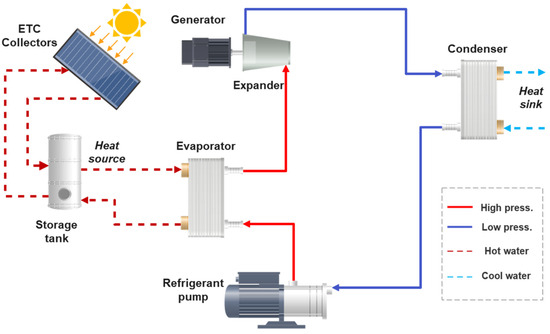
The examined theoretical innovative power generation application consists of a 5 kWe pumpless Rankine cycle (PRC) unit covering part of the electricity needs of a multifamily house located in the region of Athens, Greece. The PRC unit is coupled with a 50 m2 ETC solar arrangement installed on the rooftop of the building.
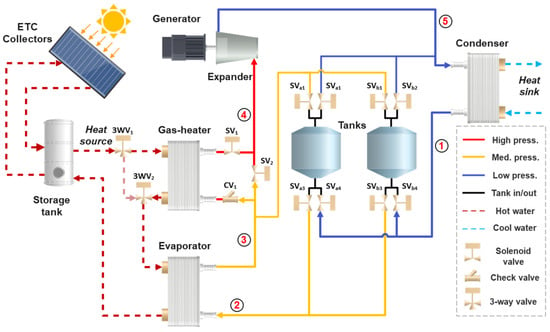
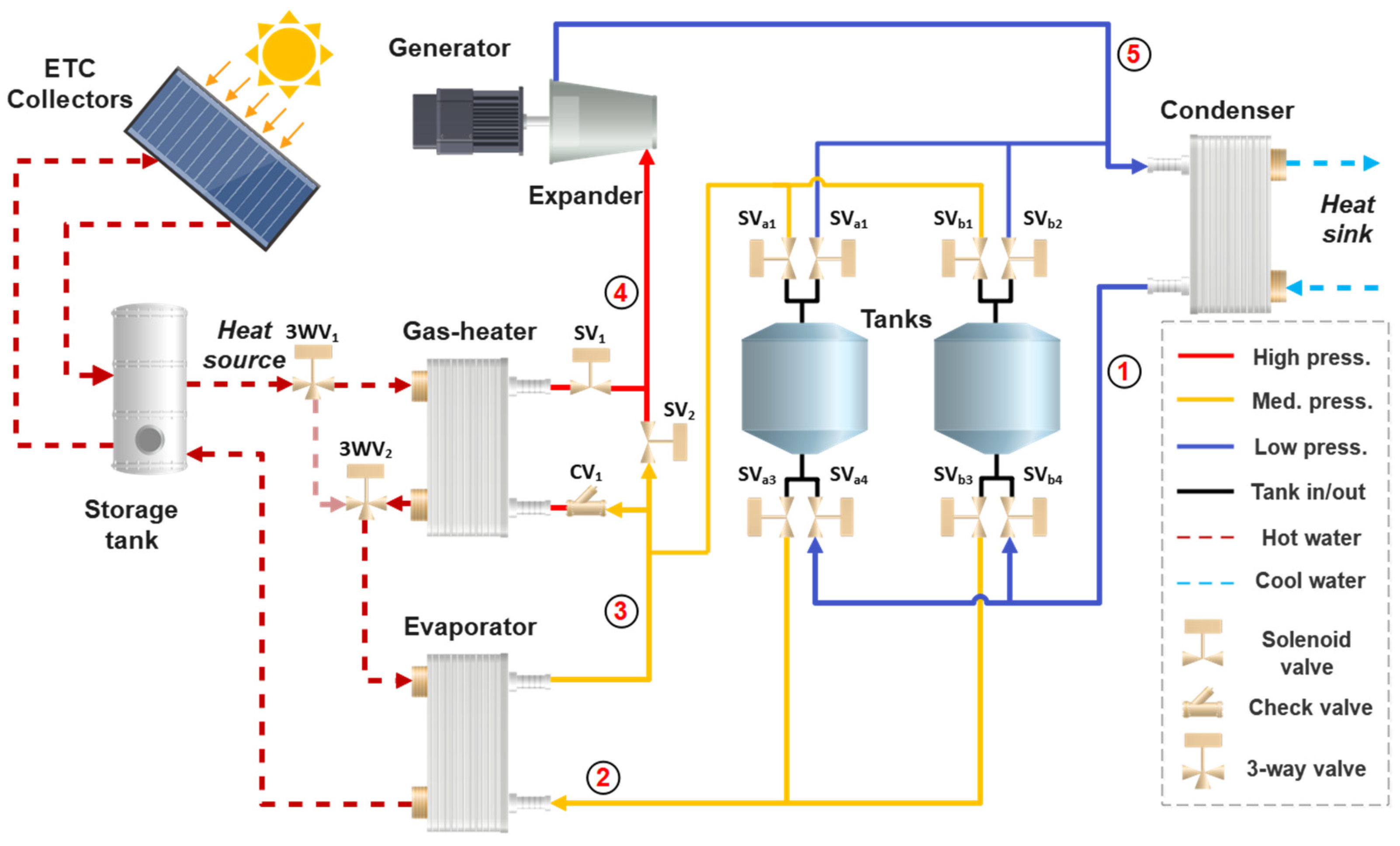
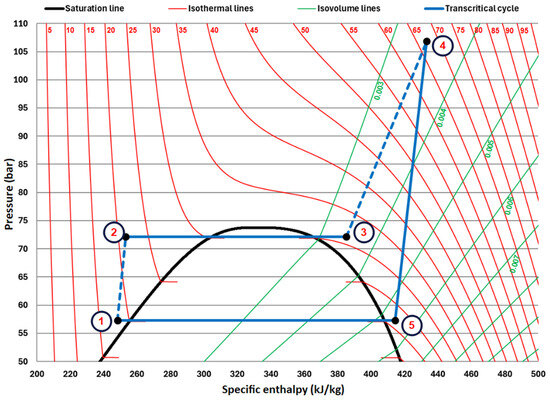
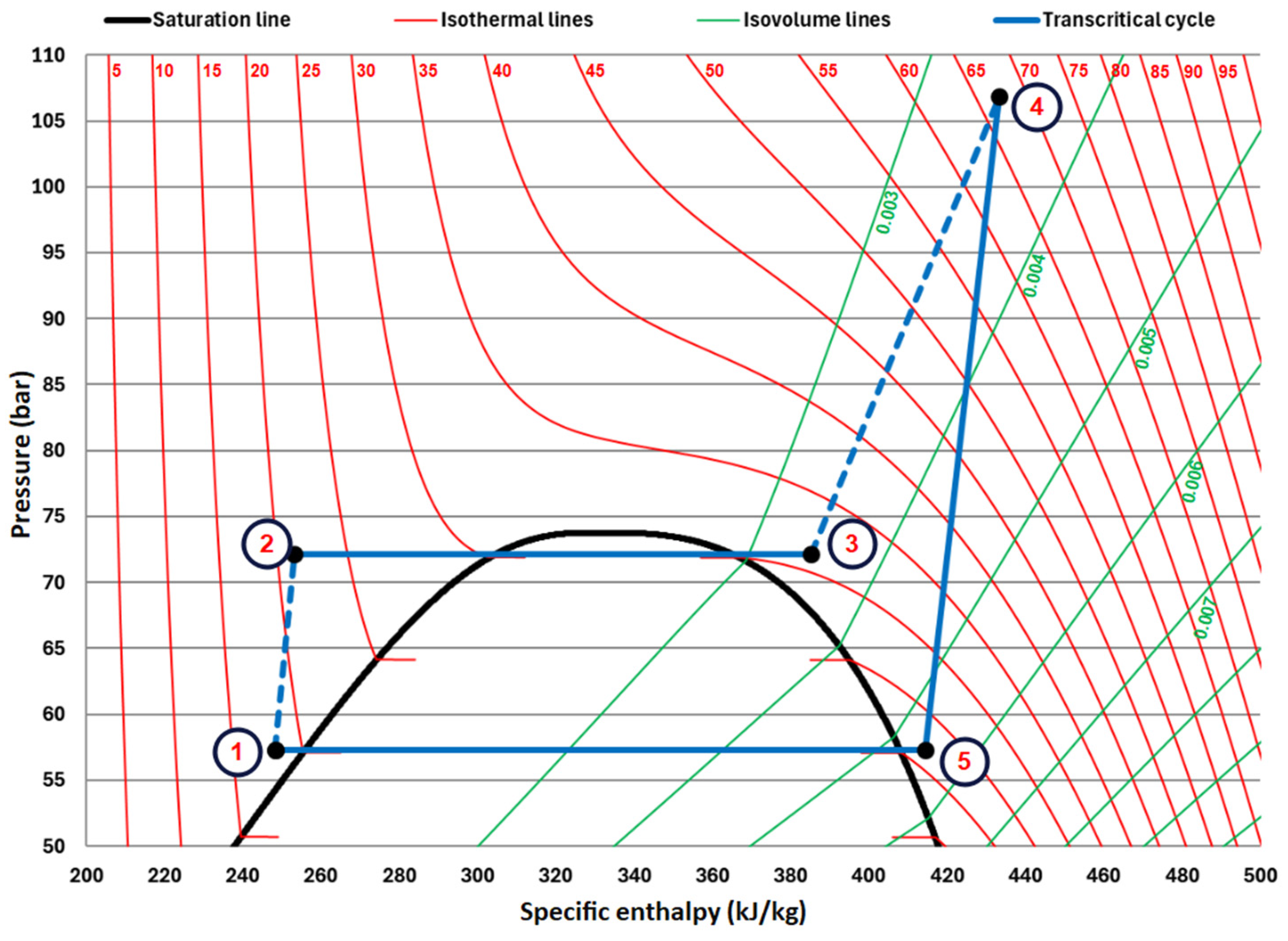
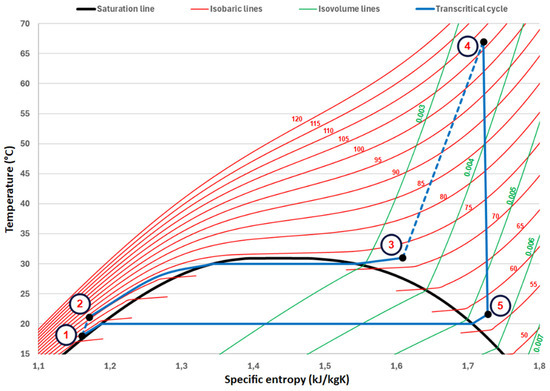
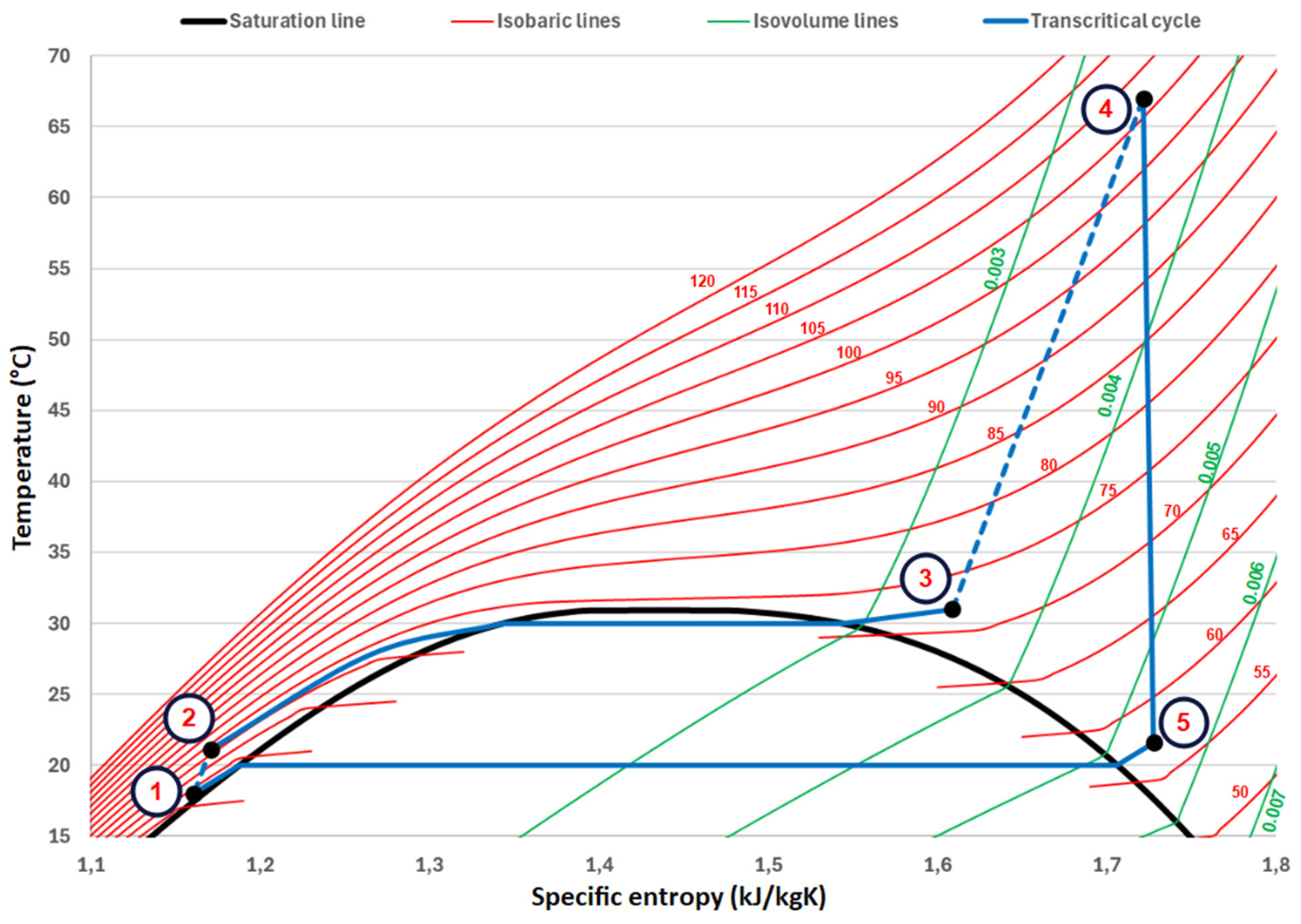
The investigated novel transcritical PRC configuration employs CO2 refrigerant (R744) as the working medium and incorporates a thermal compression operation logic which replaces the role of the refrigerant pump employed in the typical Rankine cycle system. More particularly, as illustrated in the simplified flowchart of Figure 1, the topology consists of three district pressure levels, the low pressure, the medium pressure, and the high pressure circuits, depicted with different color lines in the chart. The low and the medium pressure circuits are connected to two buffer tanks which switch from one circuit to the other through a solenoid valves arrangement. The tank connected to the low pressure circuit is called the “cold” buffer and the tank connected to the medium pressure circuit is called the “hot” buffer tank. In the medium pressure circuit, there is a plate heat exchanger which serves the role of the evaporator and it is fed through natural circulation by the “hot” buffer tank due to the height difference between them. The evaporation pressure is set constant to correspond at the evaporation temperature of Tevap = 30 °C, i.e., the maximum allowable value below the CO2 critical point. At the same time, there is a plate heat exchanger in the low pressure circuit working as the condenser, in which the condensed refrigerant liquid at its outlet flows through gravity to the “cold” buffer tank to be stored. Both buffer tanks are interconnected to the low and medium pressure circuits using another solenoid valve arrangement through pressure equalization lines. The valve systems are adjusted to switch the two buffer tanks and enable the conservation of the constant refrigerant flow in the cycle, considering the lack of a pumping module in the described pumpless working logic. Precisely, the “cold” buffer tank is filled with condensed refrigerant driven from the condenser up to a maximum liquid level. At the same time, the liquid refrigerant previously stored in the “hot” buffer tank is supplied to the evaporator until its liquid level reaches a minimum value. According to the buffer design, the moment when the liquid level in the cold buffer reaches its maximum value coincides with the moment when the liquid level in the hot buffer reaches its minimum value. At this point, the solenoid valves change positions, enabling the appropriate switching of the buffer tank connections from one circuit to the other and vice versa, to sustain constant refrigerant flow in both circuits. The achieved pressure increment from low pressure to medium pressure is attributed to the vapor mass accumulation on the evaporator outlet (isochoric compression 1). The latter is achieved through continuous natural refrigerant circulation supplying the evaporator, combined with a constant hot-water flow from the heat source. In the case that the provided heat source heats the working refrigerant to a temperature higher than its critical point, the system turns to the so called transcritical operation. In this case, the refrigerant vapor at the evaporator outlet is driven to a second heat exchanger called the gas-heater. In the gas-heater, the vapor pressure is increased by means of thermal compression under constant volume due to the expander rotation inertia (isochoric compression 2). Therefore, the isochoric compression 1 takes place in the outlet of the evaporator heat exchanger and increases the pressure in the medium pressure circuit and the isochoric compression 2 takes place in the outlet of the gas-heater heat exchanger and increases the pressure in the high pressure circuit. The last part of the described process includes the power generation in the expander generation system exploiting the expansion of the working refrigerant from high pressure back to low pressure. The described working cycle process is also illustrated in the pressure-specific enthalpy and the temperature-specific entropy charts of Figure 2 and Figure 3 accordingly. The isochoric compression 1 and isochoric compression 2 are presented with dashed lines in the aforementioned graphs since there are not strictly linear processes, but they consist of multiple intermediate states which cannot be depicted in a single graph.
Figure 1.
The investigated novel PRC configuration simplified flowchart.
Figure 2.
P-h chart of the proposed transcritical power generation cycle.
Figure 3.
T-s chart of the proposed transcritical power generation cycle.
The applied heat source of the hot water feeding the evaporator and the gas-heater heat exchangers of the system corresponds to a 50 m2 ETC solar arrangement installed on the building’s rooftop coupled with a thermal storage tank to store thermal energy during the non-power demand hours of the day. The selected ETC consists of 15 tubes of 2.06 m2 aperture area each. ETCs are an appropriate selection for employment in the described system for residential applications since they do not require sun tracking during the day, providing reduced complexity [37]. The thermal storage tank is insulated to store the sensible heat fed by the hot water generated in the collectors. The system heat sink source of the water cooling the condenser heat exchanger is not strictly specified in this study, since according to the application, this can be cooled either in a dry-cooler module or by a swallow geothermal configuration, if available.
2.2. The Implementer Mathematical Framework
In the current section, the thermodynamic equations and mathematical formulations characterizing the presented system energetic performance are presented.
2.2.1. Thermodynamic Formulation of the Presented Novel CO2 Cycle
The efficiency assessment of the examined novel transcritical CO2 pumpless Rankine cycle employs the thermodynamic equations presented in this section.
A critical parameter for the cycle analysis is the expander pressure ratio (Prexp), which is equal to the total pressure ratio in the cycle and it is described as:
The expander isentropic efficiency (ηisexp) is calculated as below:
The expander mechanical efficiency (ηmexp) is defined as the ratio of the generator electrical output power to the produced mechanical power:
The generated mechanical work in the expander (Wexp) is expressed as:
The cycle output heat (Qout) that is rejected to the ambient in the condenser heat exchanger is given by the following equation:
The cycle input heat (Qin) that is absorbed in the evaporator and the gas-heater heat exchangers is further examined through the individual heat fluxes absorbed during the different thermodynamic processes of the isochoric compression in the evaporator (isochoric compression 1), the main evaporation procedure, and the gas heating isochoric compression (isochoric compression 2) of the working refrigerant:
For each cycle component, the heat transfer rate is determined by multiplying the refrigerant mass flow rate by the corresponding specific enthalpy change, as shown below:
Using the above equations, the input heat in the cycle can also be expressed as the sum of the expander mechanical work and the output heat, validating the total energy balance in the system:
The cycle thermal efficiency is expressed through the formula below:
The input and output exergy rate in the cycle are calculated accordingly as:
The exergy efficiency of the cycle, based on the second law of thermodynamics, is defined as:
2.2.2. Mathematical Formulation of the Solar System Arrangement
The calculation of the average hourly solar irradiation in the inclined collector surface is carried out through the following equation [38].
The thermal efficiency of the solar evacuated tube collectors (ETCs) used in the current study can be estimated using the equation below, in which Tcolin corresponds to the collector fluid temperature entering the collectors [4]:
The collector outlet temperature of the collector arrangement working fluid is then calculated using the collector efficiency previously mentioned through the following formula, where Arcol is the aperture area of each collector [39]:
The collector’s incident solar energy is given through the following expression, where Ncol is the total number of the collectors:
Considering that for the utilized ETC arrangement the incident angle modifier is kτα ≈ 1, leading to approximately the maximum optical efficiency for the collectors, the total useful produced heat in the solar collector arrangement, which is driven to the described power generation cycle (Qin), can be calculated as below [40]:
The annual electricity production (Eel) is given using the following formula:
The investigated system overall energy efficiency can be expressed using the following formula [4]:
The input exergy rate in the total system can be expressed through the Petela equation, in which Tsun = 5770 K [41]:
The output exergy rate in the total system is equal to the output exergy rate of the power generation cycle, i.e., to the produced power:
The overall system exergy efficiency is defined by the following ratio:
2.3. Followed Methodology
The first step of the current analysis includes the parametric assessment of the proposed innovative system. For this purpose, several thermodynamic figures characterizing the performance of the described cycle are calculated for different heat source and heat sink temperature levels. Precisely, the input hot water temperature ranges from 70 to 120 °C, while for the cold water temperature for four different values of 10, 15, 20, and 25 °C are taken into consideration. The selected hot water temperature range corresponds to typical low-temperature renewables and waste-heat sources, which are commonly reported in their exploitation by ORC applications [42]. The selected cold water temperature levels represent realistic cooling water or ambient-dependent condenser conditions, which strongly influence ORC performance and are typically maintained as low as possible to improve cycle efficiency [43]. During the parametric analysis, the total input heat flux to the evaporator and the gas-heater heat exchangers is considered to remain constant and equal to 30 kWth. This assumption allows for a consistent comparison of system performance under different operating conditions, ensuring that variations in efficiency and power output are attributed solely to changes in temperature levels rather than to differences in thermal input. The selected heat input value is used as a reference design condition for the preliminary thermodynamic evaluation of the system. Assuming a constant heat source input during parametric investigations is a common practice in thermodynamic cycle analysis and ORC modeling studies, where the objective is to evaluate the influence of operating conditions on cycle performance independently of heat source variability [44]. The analysis continuous by the performance comparison of the proposed novel cycle to the typical ORC configuration, so as to quantify the efficiency advantage of the first one. In this context, the energy and exergy efficiency figures for different working mediums are calculated for the conventional ORC and they are compared to the described transcritical pumpless CO2 Rankine cycle under operation for different working conditions. The conventional ORC is used as a reference configuration because it represents a widely adopted baseline technology for low-temperature heat-to-power conversion systems. Comparison of novel transcritical CO2 cycles with conventional ORC configurations as the baseline model represents a common approach in the literature [45]. The last step of the analysis consists of the annual electricity production distribution estimation for the proposed configuration and the comparison of the calculated electricity figures to the conventional case.
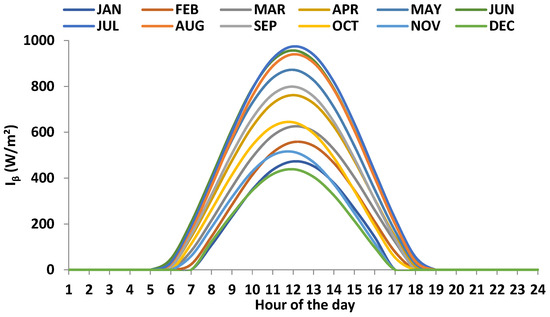
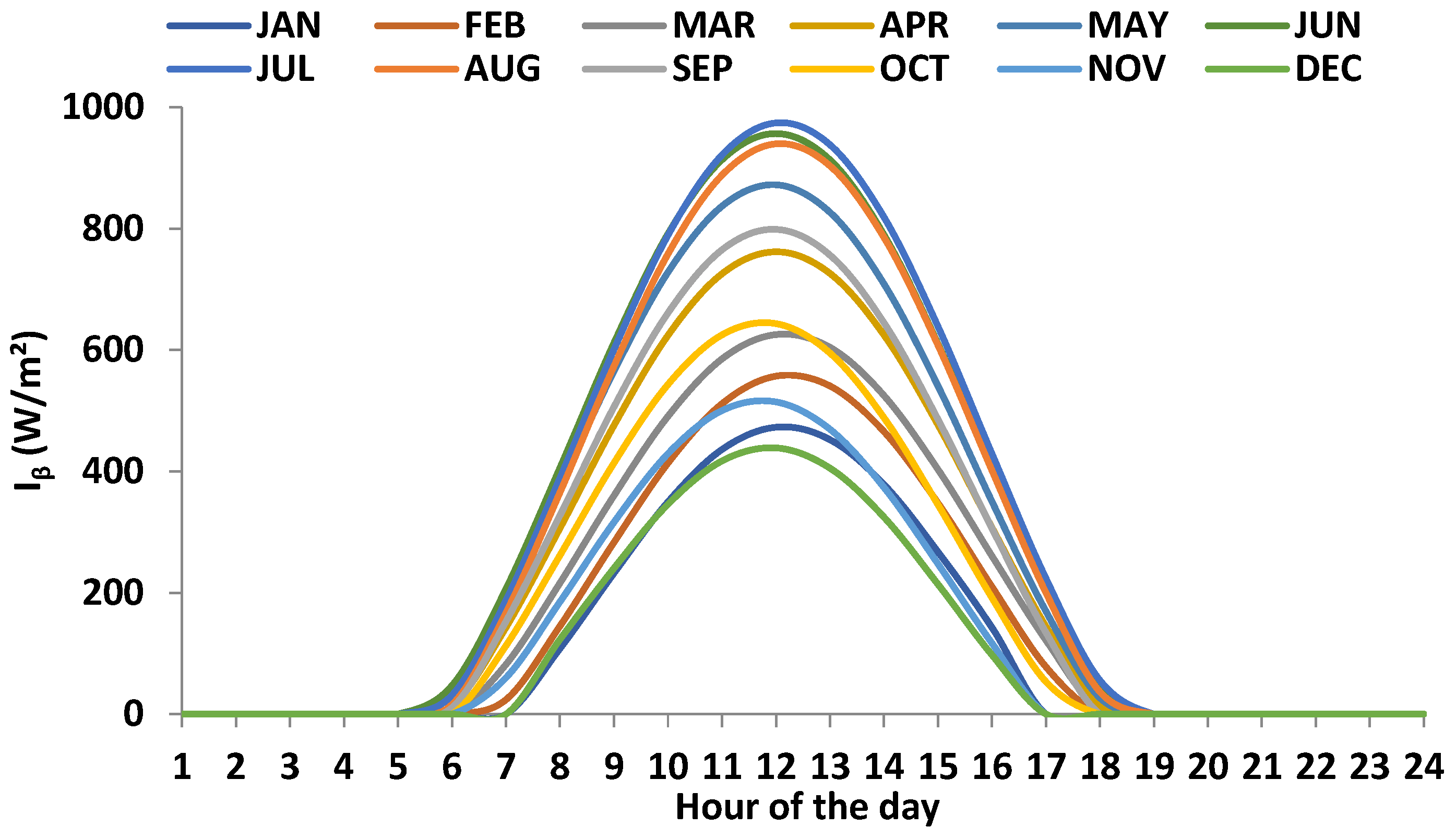
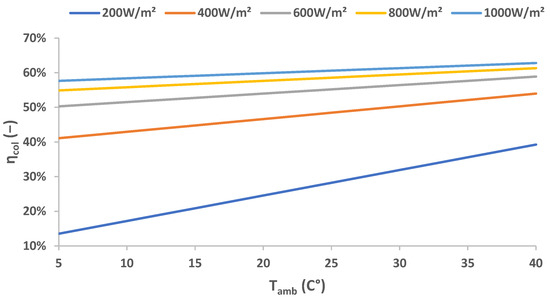
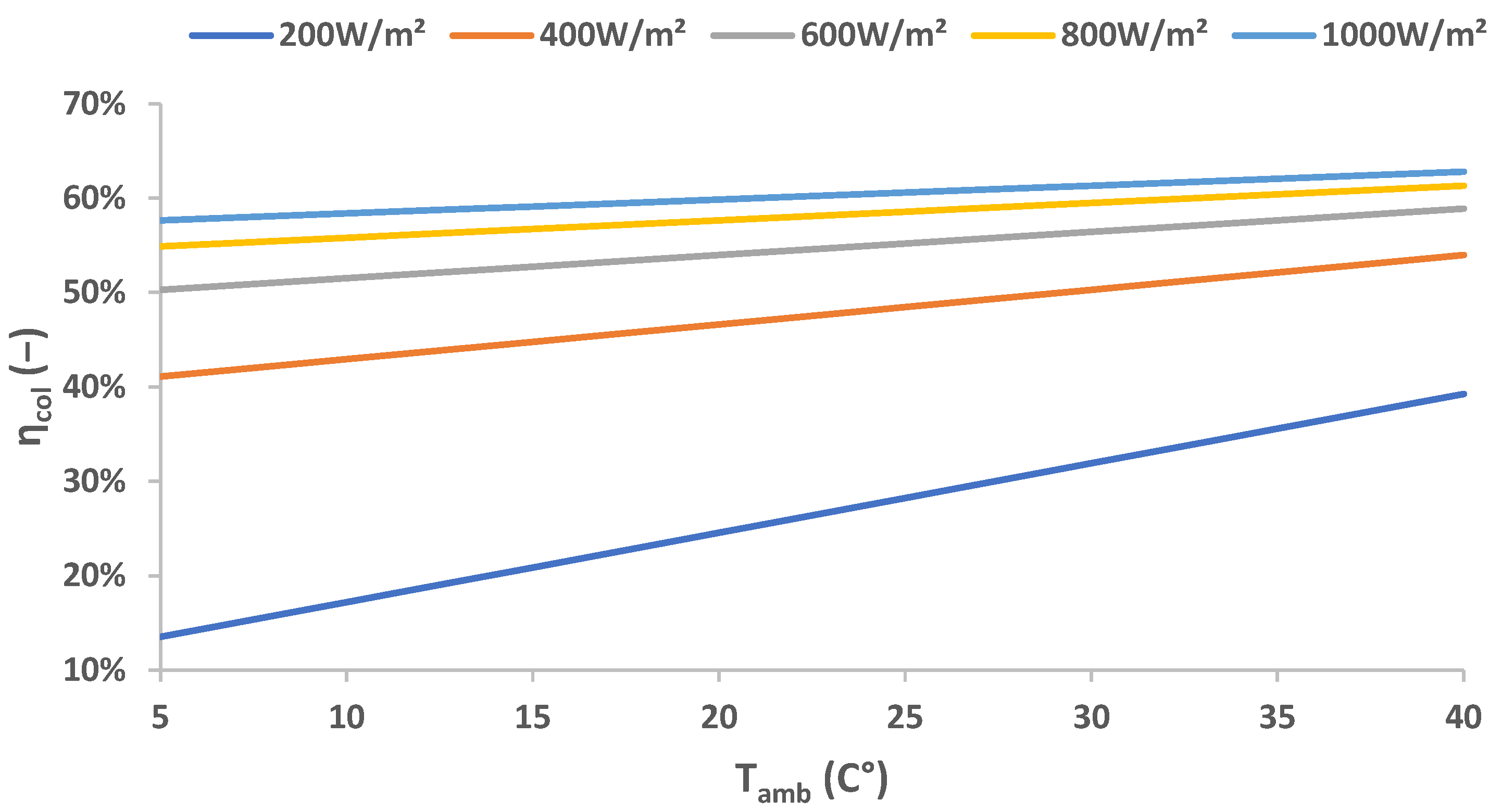
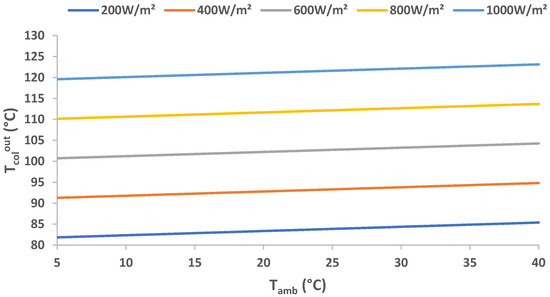
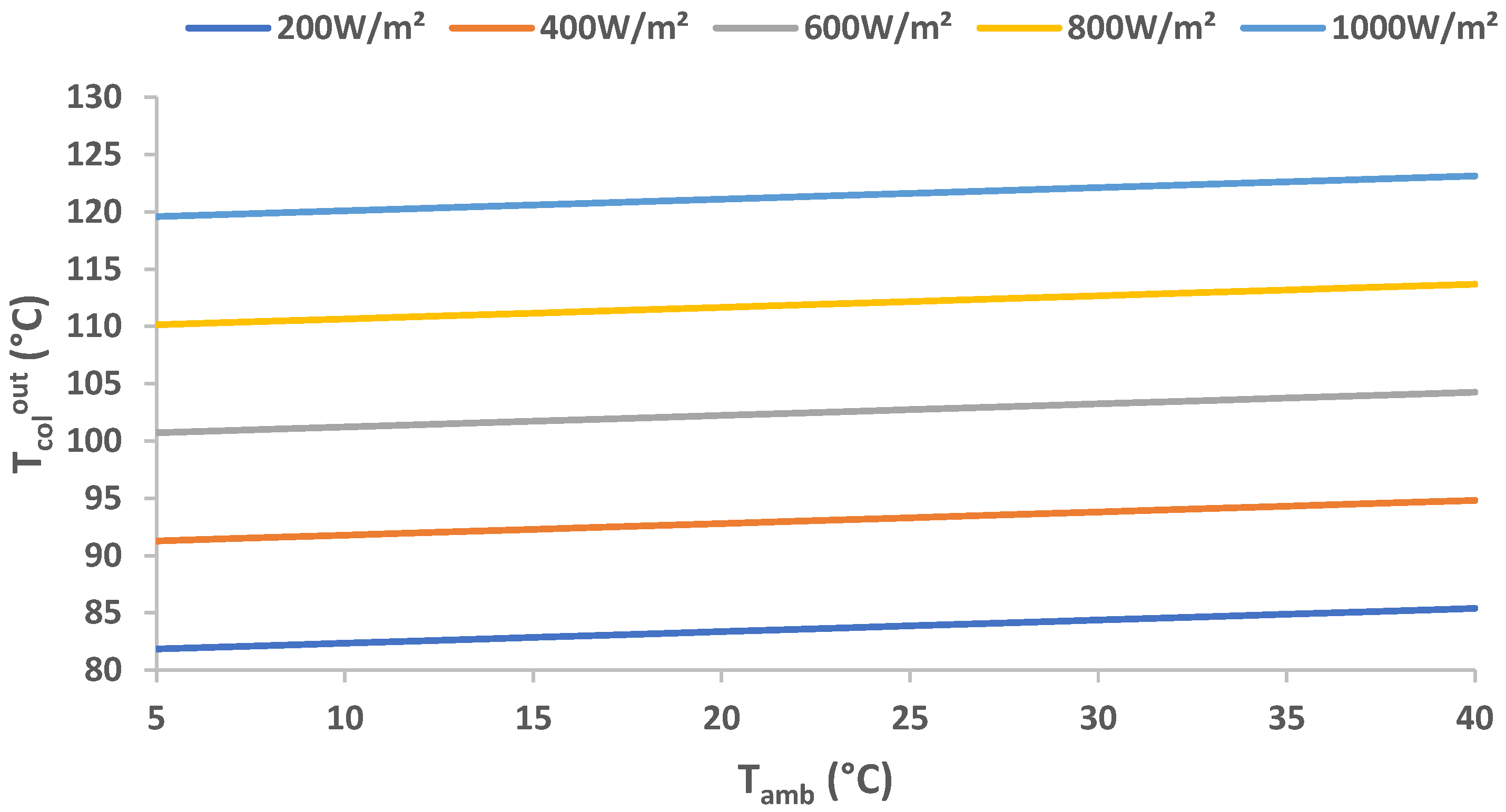
For the monthly power production distribution calculation, the solar radiation figures shall be estimated for the region of the building on which the investigated system will be installed. Therefore, the inclination angle of the collector surface is set to β = 38°, whereas all other required parameters are derived from solar radiation correlations and ambient temperature data for the region of Athens, Greece, where the subjected multifamily house lies [46]. The resulting average daily distribution of incident solar radiation onto the inclined surface of the ETCs is illustrated in Figure 4 [47]. The monthly average solar radiation values per hour of the day are considered for the characteristic day of each month, which is then used to calculate the distribution of the monthly solar radiation and then the final respective produced output power by the power generation system described. Since the working temperatures in the solar field arrangement can be over 100 °C, the selected heat transfer fluid in the ETCs is selected to be Therminol-VP1 to transfer the produced solar heat to the power generation device [48]. The working fluid inlet temperature in the solar collectors is considered constant throughout the current analysis and equal to Tcolin = 80 °C [49], as well as the fluid mass flow rate in each collector, mf = 0.013 kg/s [39]. The calculated fluctuation of solar collector arrangement efficiency and fluid outlet temperature in reference to the solar irradiation and the ambient temperature are illustrated in the graphs of Figure 5 and Figure 6 respectively.
Figure 4.
Average daily variation in incident solar radiation for each month of the year in the Athens region.
Figure 5.
Fluctuation of collector efficiency in reference to the solar irradiation and ambient temperature.
Figure 6.
Fluctuation of collector outlet temperature in reference to the solar irradiation and ambient temperature.
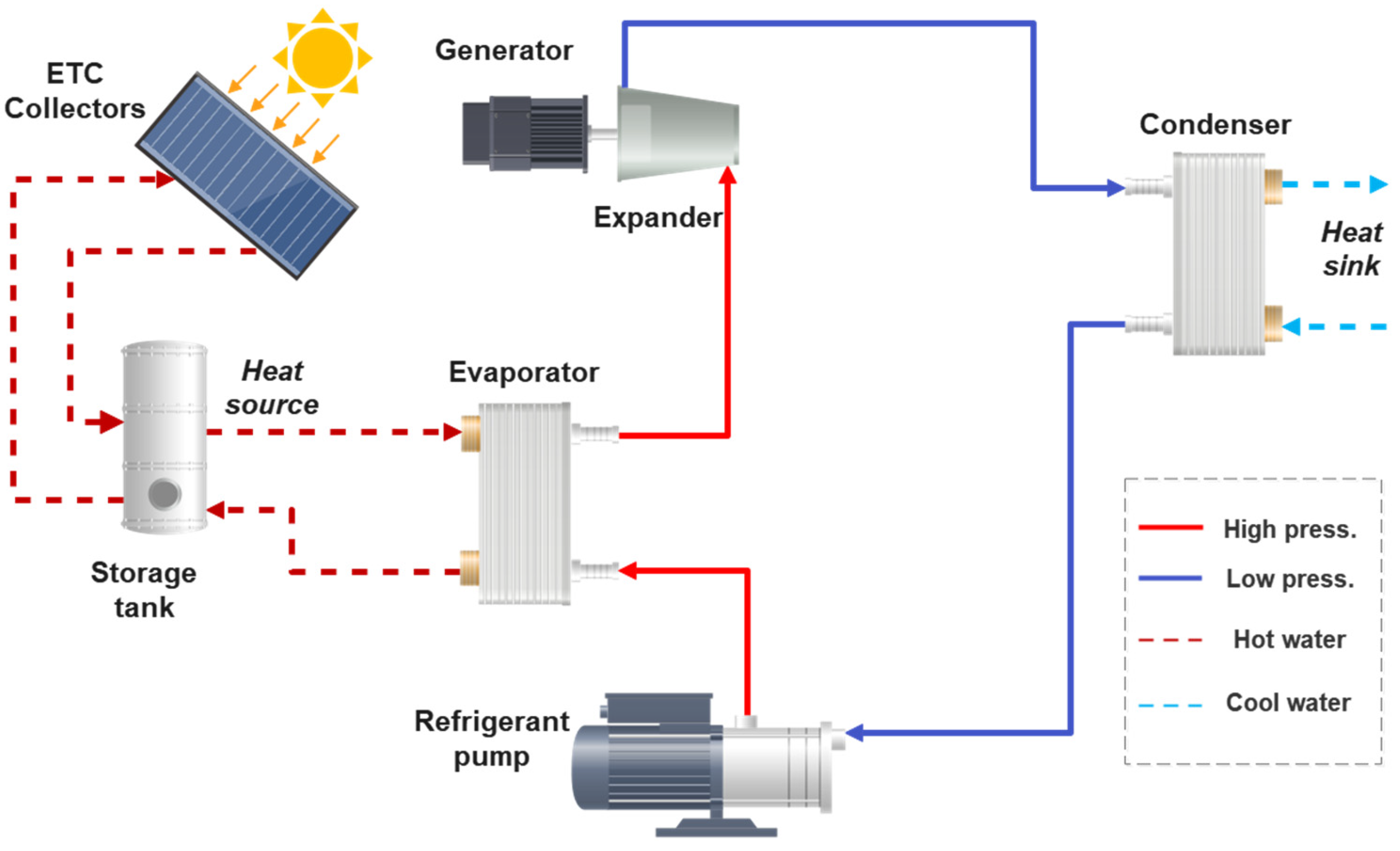
The conventional ORC used as the baseline system for comparison purposes in the current study includes a typical simple ORC topology. The simplified flowchart is illustrated in Figure 7. The simulation of the described conventional system consists of a simpler case than the innovative configuration presented in the previous section, and thus its thermodynamic modeling is not presented separately.
Figure 7.
The conventional solar ORC configuration simplified flowchart.
The performance investigation of the described cycles is performed through validated numerical models implemented in the MATLAB R2022b environment [50], integrating the CoolProp library for the calculation of the different thermodynamic properties of the employed refrigerants. The validity of the investigated transcritical cycle is made using the simulation results of the work of Wang et al. [29] who evaluate a simple CO2 transcritical power generation configuration. The validation results are presented in Table 1, where the maximum deviation of the compared parameters is below 2%, confirming the accuracy of the developed model in the current study. The verification of the conventional ORC simulation calculations is made using the published literature results from similar theoretical approaches. Precisely, Table 2 presents the comparison results of the developed code with the respective results for a conventional ORC system as presented in the work of Xu et al. [51] using several common working fluids as refrigerants. The maximum resulted absolute deviation of 2.32% is considered acceptable for the purposes of the current study, which validates the simulation model. Similar validation deviations below approximately 3% are commonly reported in cycle-modeling studies and are considered sufficient to ensure reliable prediction of system performance trends [52].
Table 1.
Validation results for the simple transcritical CO2 power generation cycle.
Table 2.
Validation results for the conventional ORC thermodynamic analysis.
The main parameter values utilized in the simulation models of the current study are given in Table 3.
Table 3.
Main simulation parameters used in the current study.
The main important assumptions made in this study are summarized below:
- The energy analysis is performed under quasi-steady-state conditions [55].
- All components are assumed to be perfectly insulated from the surroundings [56].
- The heat rejection temperature level remains constant throughout the analysis [57].
- Pressure losses in piping and system components are neglected [58,59].
3. Results and Discussion
3.1. Parametric Analysis of the Novel Cycle
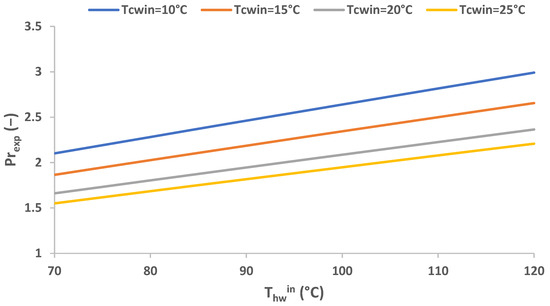
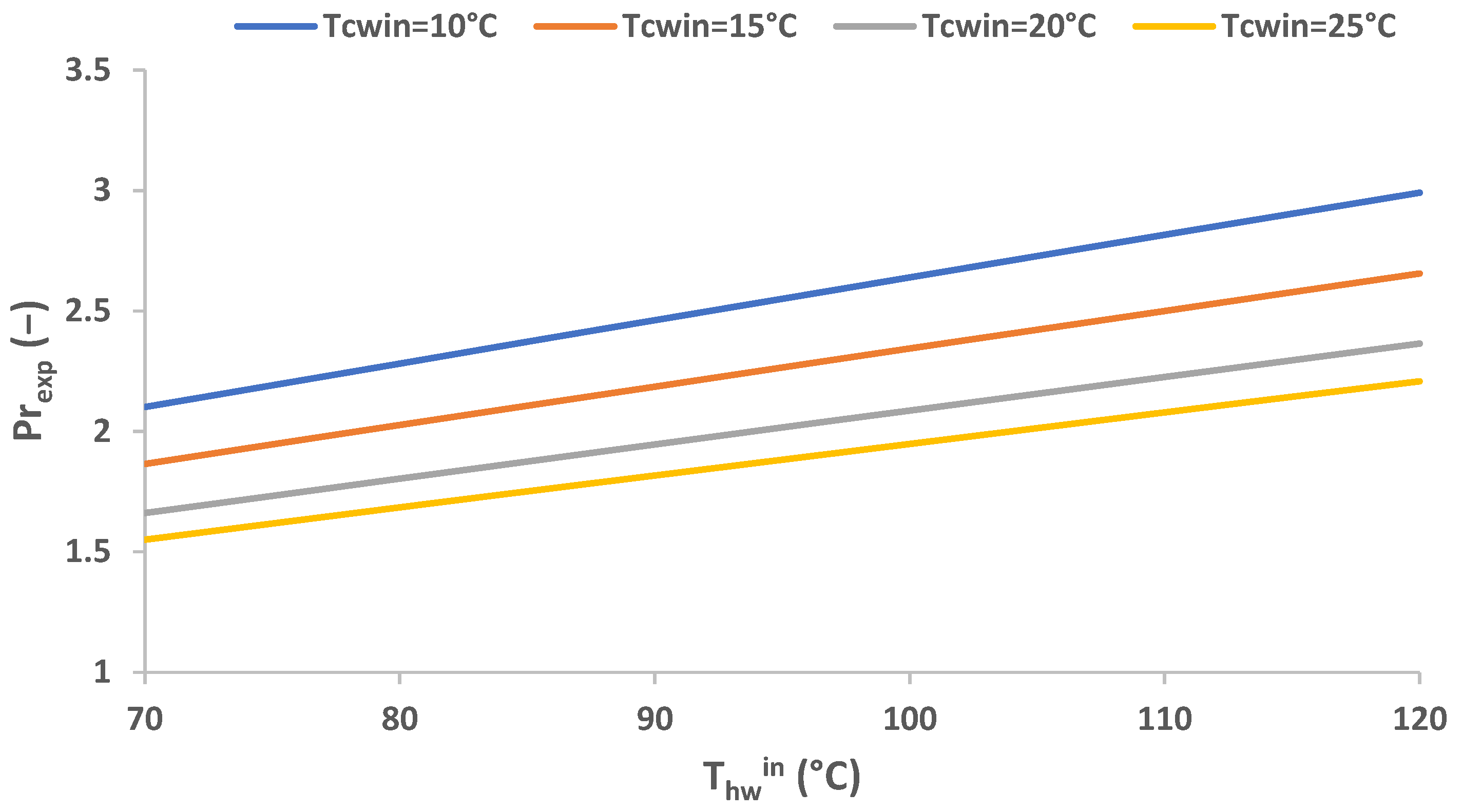
The parametric performance investigation of the proposed innovative transcritical CO2 pumpless Rankine cycle includes the calculation of several important thermodynamic parameters’ deviation for different heat source and heat sink temperature ranges. The first parameter to be examined is the expander pressure ratio, i.e., the fraction of the pressures before and after the expander module. The latter is highly related to the hot water feeding the gas-heater and the cold water feeding the condenser respectively. In the gas-heater, isochoric thermal compression of the working gas refrigerant takes place. This means that the final CO2 high pressure is proportional to the hot water inlet temperature value in the gas-heater. Additionally, the cold water inlet temperature from the heat sink affects the condensing temperature and the corresponding low pressure, which is the pressure in the expander outlet. The expander pressure deviation is illustrated in the graph of Figure 8. The results verify that for higher hot water inlet temperature, the expander pressure ratio also increases. Additionally, among the different heat sink temperature levels examined, the higher expander pressure ratio curve corresponds to the case of the lowest cold water inlet temperature to the condenser of Tcwin = 10 °C.
Figure 8.
Expander pressure ratio variation for different heat source and heat sink temperatures.
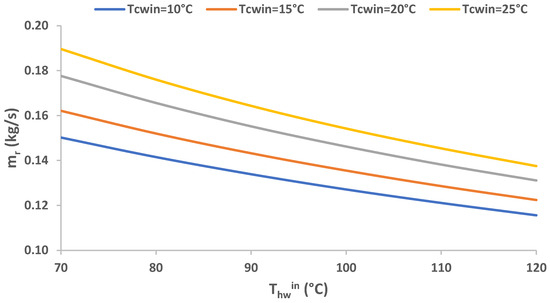
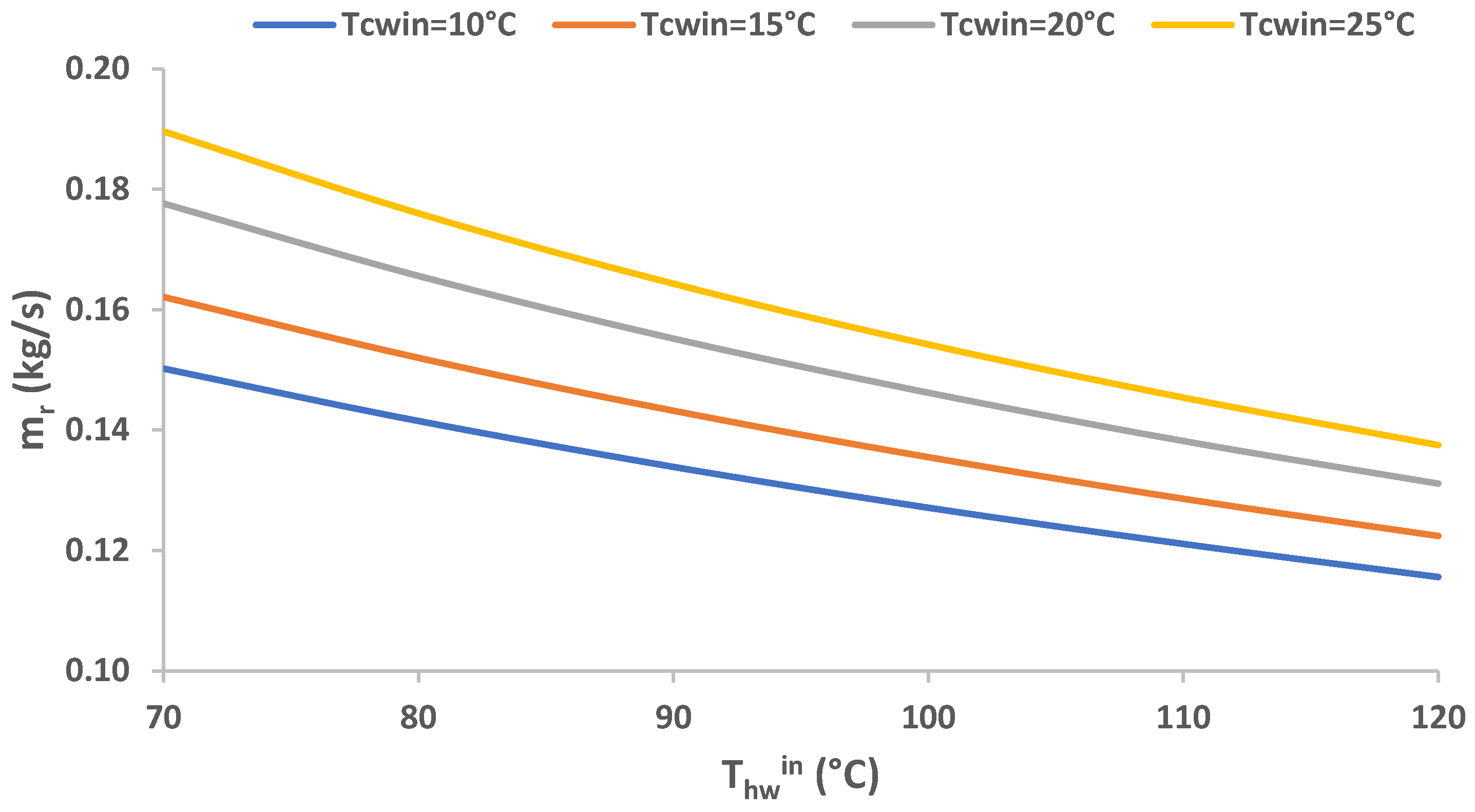
The next parameter to be analyzed parametrically is the CO2 mass flow ratio. Considering the constant total input heat flux to the system, the evaluation of the CO2 mass flow fluctuation is related to the deviation of the specific heat fluxes in the isochoric compression in the evaporator, the main evaporation process, and the gas heating isochoric compression. Since the evaporation temperature and pressure is constant, the delta enthalpy in the main evaporation process also remains constant throughout the parametric analysis. The absorbed heat in isochoric compression in the evaporator process (isochoric compression 1) is affected by the temperature of the CO2 entering the evaporator heat exchanger. The latter is linked to the condensation temperature and pressure, which is controlled by the cold water inlet temperature in the condenser. As a result, the lower the cold water temperature inlet is, the higher the specific absorbed heat for the isochoric compression 1 is, leading to slightly lower values of the CO2 mass flow ratio. Additionally, the absorbed heat in the isochoric compression in the gas-heater (isochoric compression 2) is affected by the final temperature and pressure in the expander outlet, which is directly linked to the hot water inlet temperature in the gas-heater. Therefore, for higher hot water inlet temperature, the specific absorbed heat in the gas-heater also rises, resulting in a slightly reduced CO2 mass flow ratio. The aforementioned are in accordance with the chart curves of Figure 9, in which the higher CO2 mass flow ratio curve corresponds to the Tcwin = 25 °C, while for all the examined cold water inlet temperatures, the mass flow reaches lower values along with the augmentation of the hot water inlet temperature.
Figure 9.
CO2 mass flow ratio deviation for various heat source and heat sink conditions.
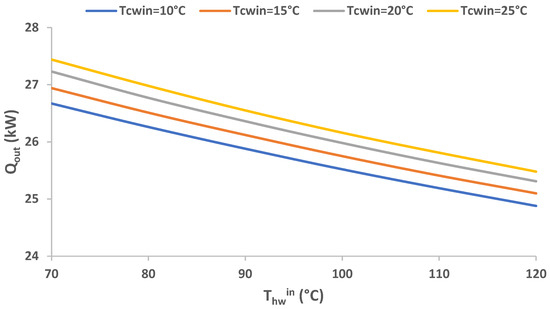
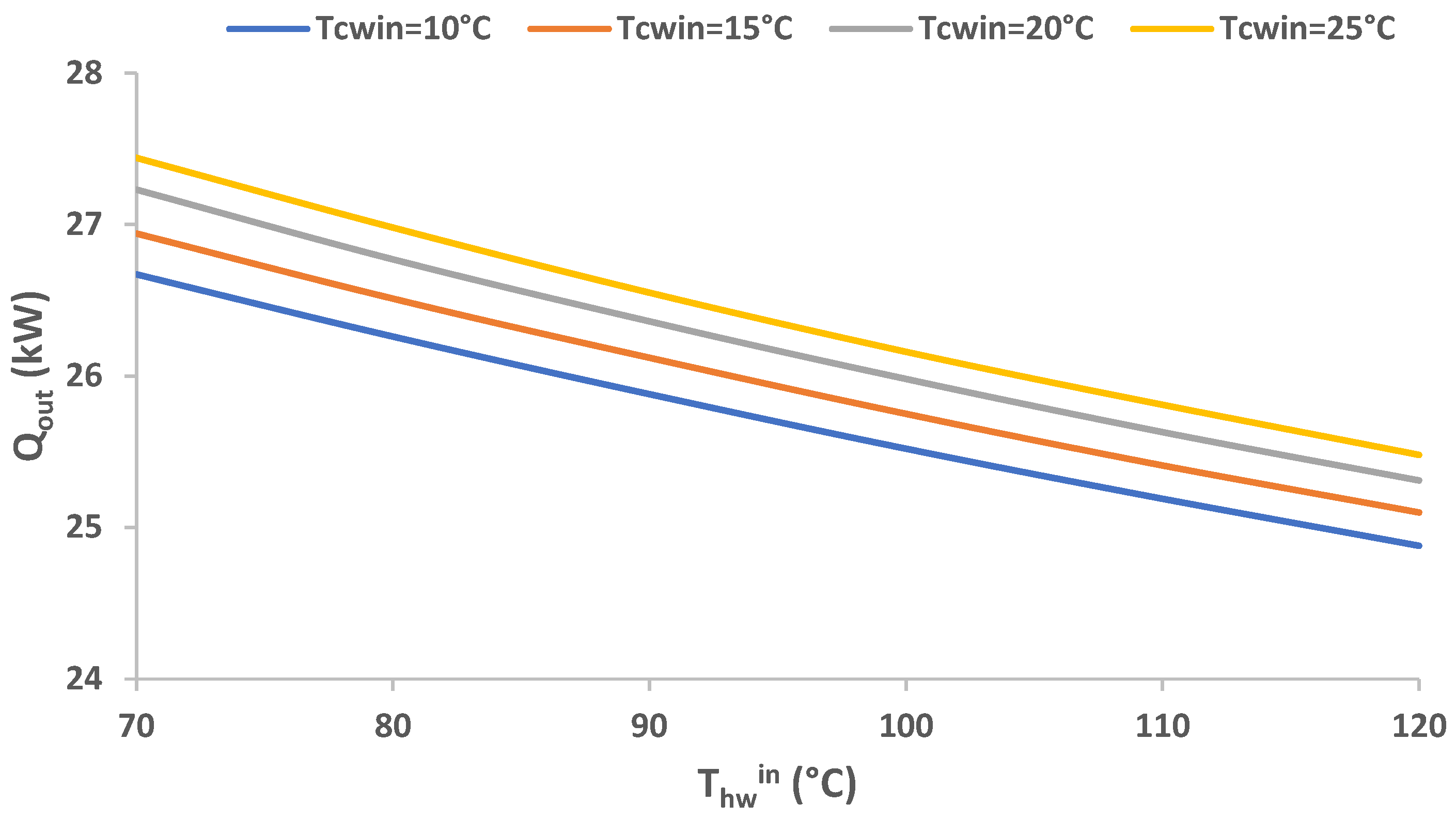
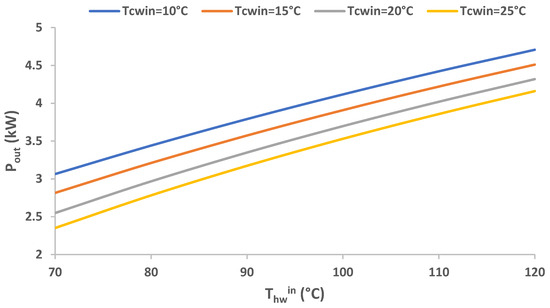
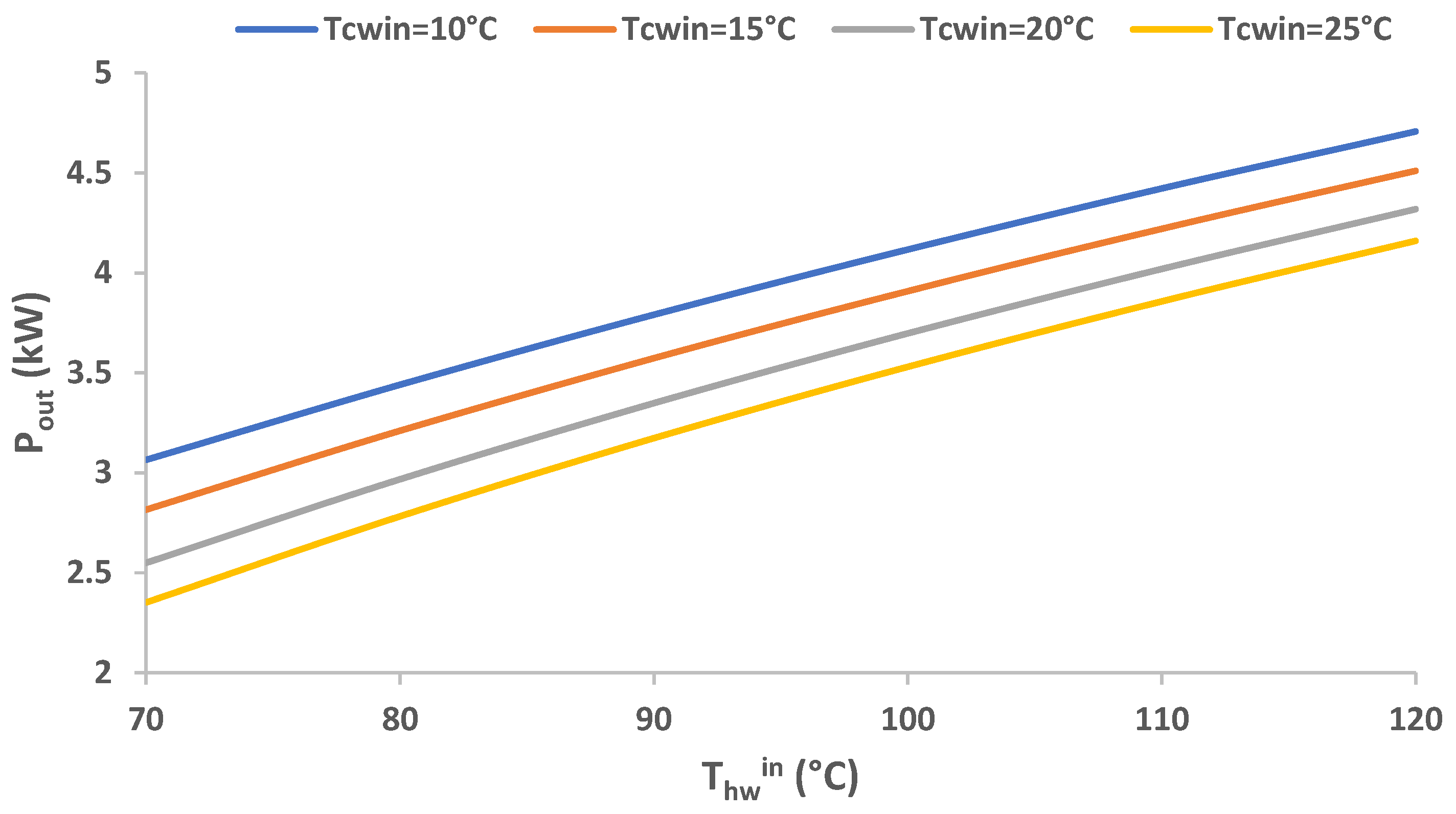
The heat output in the condenser and the output power in the generator of the examined system are also investigated parametrically in the current analysis. According to Equations (4) and (10), these two figures are interdependent to each other, considering the constant total heat input in the system. The deviation of the system heat output and the output power are depicted in the charts of Figure 10 and Figure 11 respectively. The results show that for higher hot water inlet temperature levels, the generated power in the expander rises, while the rejected heat in the cooling water in the condenser is lower and vice versa. The reason for this lies in the fact that for higher hot water inlet temperatures, the expander inlet specific enthalpy also rises, resulting from the isochoric compression in the gas-heater process. The latter leads to higher available delta enthalpy in the expanding procedure, leading to increased mechanical work in the expander and generated power as well. Additionally, for lower cold water inlet temperatures, the expander delta pressure increases, resulting in higher Pout and lower Qout, as it is also verified by the curves in the graphs.
Figure 10.
Heat output in the proposed cycle’s condenser for various heat source and heat sink conditions.
Figure 11.
Proposed cycle power output for various heat source and heat sink conditions.
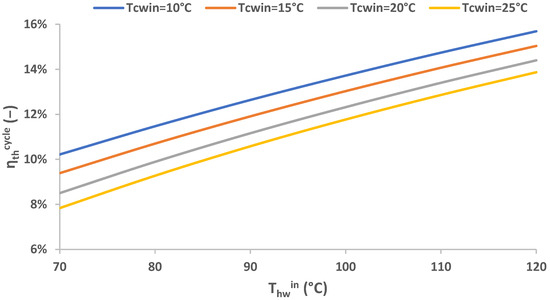
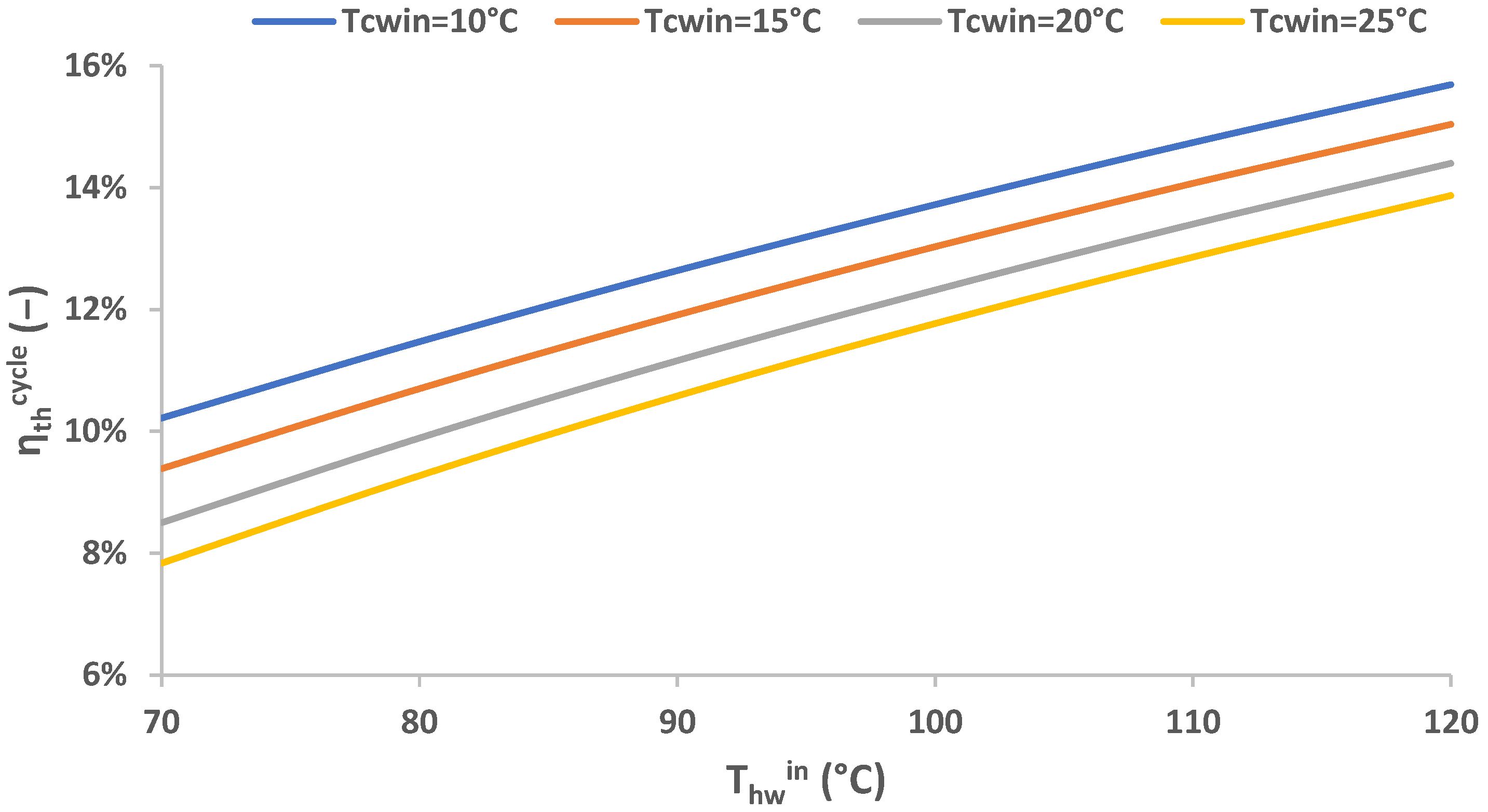
The main performance evaluation parameter for the examined cycle is the thermal efficiency figure, whose variation for the different working conditions analyzed is illustrated in Figure 12. According to the findings, the thermal efficiency follows the deviation pattern of the output power. The latter means that for higher hot water inlet and lower cold water inlet temperature respectively, the thermal efficiency is increased and vice versa, as it is also confirmed by the graphs. For Thwin = 120 °C and Tcwin = 10 °C, the thermal efficiency reaches the maximum value of 15.69%, while the minimum value of 7.84% is estimated for the pair of Thwin = 70 °C and Tcwin = 25 °C. The latter figures verify that the examined system shows very promising performance results for harvesting high temperature thermal energy, while it still also provides important energy efficiency ratios for operation under low temperature renewable heat. The calculated thermal efficiency values in the current study are consistent with those reported in the literature for CO2-based transcritical Rankine cycles operating with low-temperature heat sources, in which thermal efficiencies typically range between 8 and 16%, depending on the heat source temperature and cooling conditions [45,60].
Figure 12.
Proposed cycle thermal efficiency deviation for various heat source and heat sink conditions.
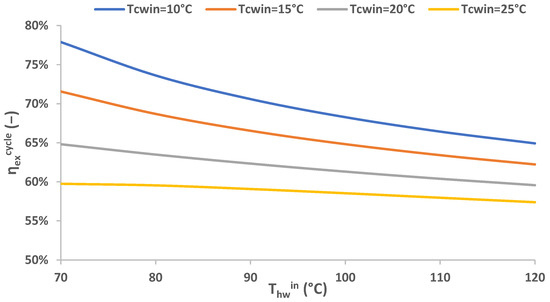
Another interesting parameter to be analyzed in terms of performance evaluation for the examined system is the exergy efficiency figure. The exergy efficiency is calculated as the fraction of the output exergy to the input exergy and expresses how effectively the described configuration converts the input renewable heat to output power. The deviation of the exergy efficiency under the current parametric analysis is given on Figure 13. The output exergy is equal to the output power in the current study, so for constant heat source temperature, the lower the cold water inlet temperature is, the higher the output power is and the exergy efficiency as well. The investigated power generation cycle shows the maximum exergy efficiency rate up to 77.90% for operation under Thwin = 70 °C and Tcwin = 10 °C. The latter exergy efficiency enhancement is mainly attributed to relatively low exergy input to the cycle, resulting from lower hot water inlet temperature levels, combined with increased power generation due to the lower heat sink temperature. The higher exergy efficiency observed at lower heat source temperatures reflects improved matching between the temperature profile of the heat source and the thermodynamic characteristics of the proposed novel CO2 power generation cycle. This behavior suggests that the proposed system is particularly suitable for low-grade heat-recovery applications, such as solar thermal or geothermal renewable sources, where minimizing irreversibilities associated with heat transfer is critical for efficient energy conversion. However, as the hot water inlet temperature rises, the input exergy value is also increased, leading to a slight reduction in the overall exergy efficiency. This is also verified by the graph, in which for the pair of Thwin = 120 °C and Tcwin = 25 °C, the exergy efficiency reaches its minimum point of 57.40%. The latter implies that the examined system shows better exergy efficiency rates under low temperature renewable heat, being an ideal alternative for harvesting low temperature renewables, such as solar energy.
Figure 13.
Proposed cycle exergy efficiency deviation for various heat source and heat sink conditions.
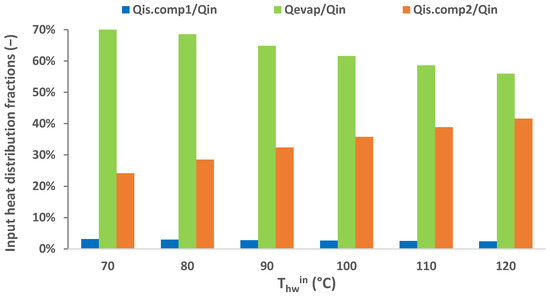
The total input heat distribution in the isochoric compression in the evaporator, the main evaporation, and the gas heating isochoric compression processes is also evaluated. Since, in the current analysis the total input heat remains constant, it is important to evaluate its further split into the individual absorbed heat fluxes in the different mentioned processes. Specifically, for Thwin ranges from 70 to 120 °C under constant Tcwin = 10 °C, the three aforementioned fractions are depicted in comparison on the chart in Figure 14. According to the results, the Qis.comp1/Qin fraction shows the lowest values, below 5%, and its variation throughout the analysis is negligible, which is reasonable since the evaporator inlet temperature is constant. The Qis.comp2/Qin fraction though depicts an increment trend along with the increase in Thwin. The reason for this as also previously analyzed lies in the fact that higher Thwin leads to the augmentation of the specific enthalpy value in the expander inlet. For Thwin = 120 °C, the isochoric compression in the gas-heater process absorbs up to 41.63% of the total heat input to the system. Finally, the Qevap/Qin fraction shows the opposite trend than Qevap/Qin, since the heat absorbed for the main evaporation process decreases along with the Thwin increment. Since the delta specific enthalpy for this process remains constant, the variation in Qevap/Qin is affected to the deviation of Qis.comp2/Qin, considering that the total Qin remains constant throughout the analysis.
Figure 14.
Heat input distribution fraction for different heat source temperature levels for cold water temperature equal to 10 °C.
3.2. Comparison to the Conventional Cycles
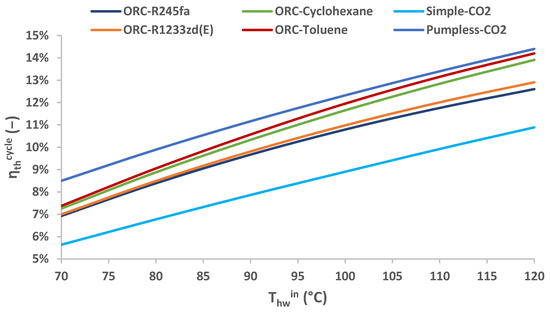
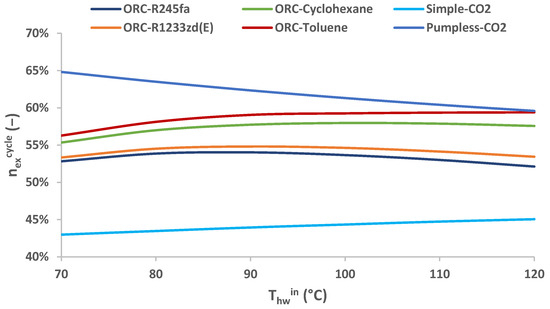
In order to evaluate the performance of the proposed novel transcritical pumpless CO2 Rankine configuration, it is important to compare its efficiency with well-established typical ORC alternatives using conventional refrigerants as the working mediums, along with the simple CO2 power generation cycle as well. In this context, for the simple ORC used as the baseline in the current analysis, four different working refrigerants are considered, namely R245fa, R1233zd(E), cyclohexane, and toluene. All the compared cycles are simulated parametrically for hot water inlet temperature from 70 to 120 °C and constant Tcwin = 20 °C. The results of the calculated thermal and exergy efficiency figures are plotted in comparison to each other in the charts of Figure 15 and Figure 16 respectively. Among the candidates compared, the examined pumpless CO2 topology shows the higher energy and exergy efficiency ratios, while the simple CO2 case has the worst performance results. Specifically, the novel CO2 configuration provides excellent results for performance under low heat source temperatures, calculating ηth= 8.50% and ηex= 64.82% for the case of Thwin = 70 °C, while all the rest of the alternatives show values of below 7.40% and 56.50% for thermal and exergy efficiency respectively in the same conditions. Specifically, the thermal and exergy efficiency enhancements are up to 15.19% and 15.23% respectively in comparison to the toluene case, which is the best examined alternative in terms of efficiency among the rest of the refrigerant candidates. Additionally, for operation under higher heat source input temperatures, the pumpless CO2 performance advantage is mitigated. However, still for Thwin = 120 °C, the innovative pumpless arrangement shows ηth= 14.40% and ηex= 59.58%, which are 1.41% and 0.30% respectively higher than the corresponding figures of the toluene case. The efficiency improvement of the proposed system compared to the conventional ORC cases lies in the thermal properties of the CO2 power generation cycle, leading to high expander pressure ratios and consequently to enhanced power generation potential. At the same time, in the conventional simple CO2 cycle, the pump work represents a significant fraction of the generated power, reaching approximately 50%. Therefore, its elimination through the pumpless operation concept enables the full exploitation of this power generation potential. The latter promising findings highlight the performance advantage of the proposed novel system over the conventional ORC configurations. The above energy and exergy efficiency comparison results are summarized in Table 4.
Figure 15.
Cycle thermal efficiency variation comparison between the proposed cycle and conventional ORC for different working fluids.
Figure 16.
Cycle exergy efficiency variation comparison between the proposed cycle and conventional ORC for different working refrigerants.
Table 4.
Energy and exergy efficiency comparison results between different power generation cycles and working refrigerants.
3.3. Coupling of the Proposed Cycle to the ETC Solar Arrangement Performance Evaluation
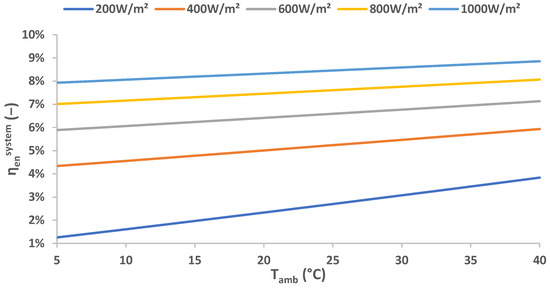
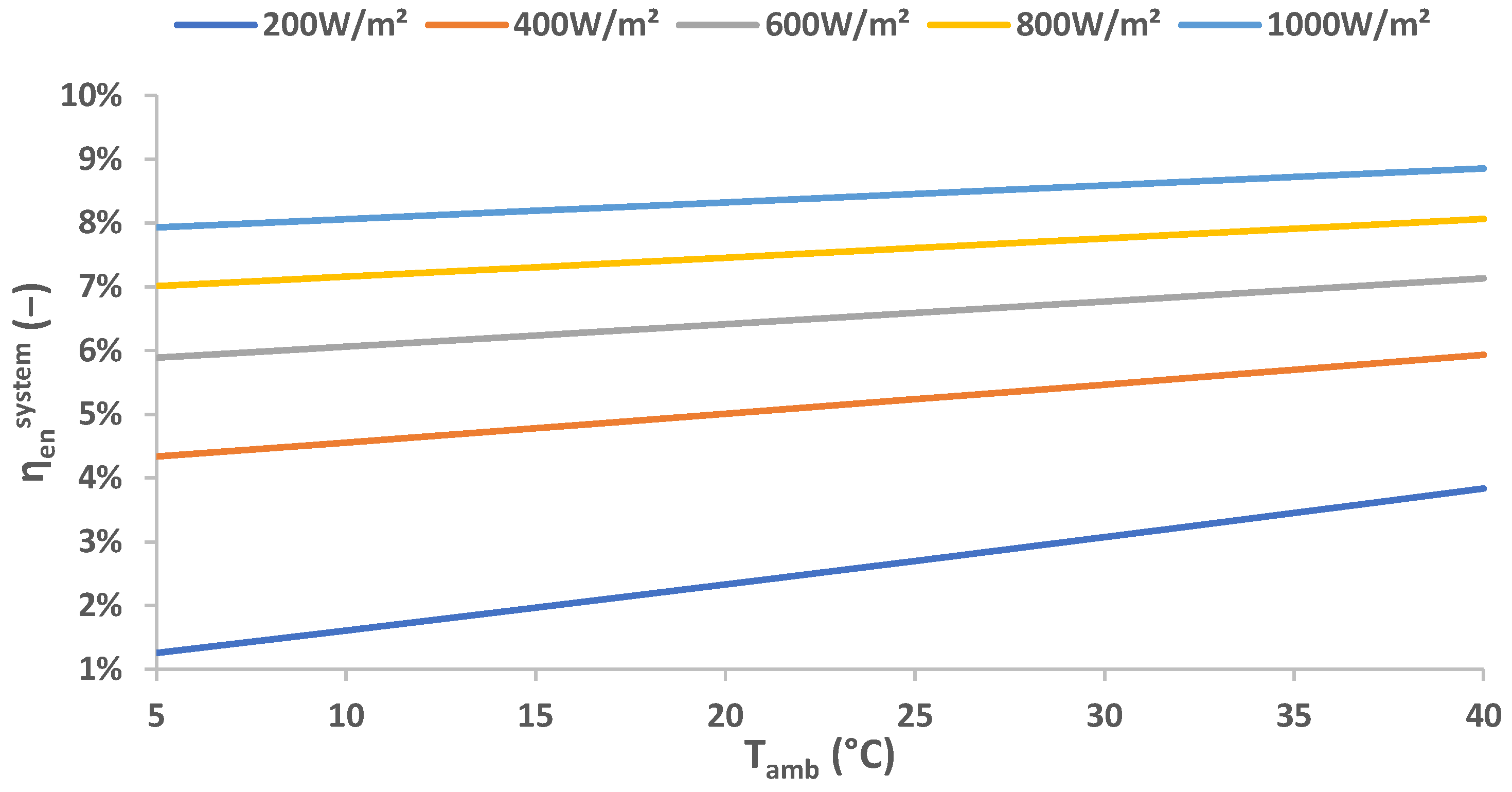
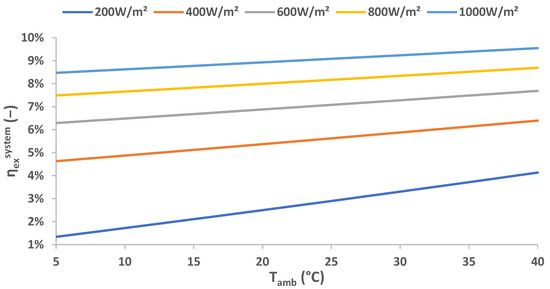
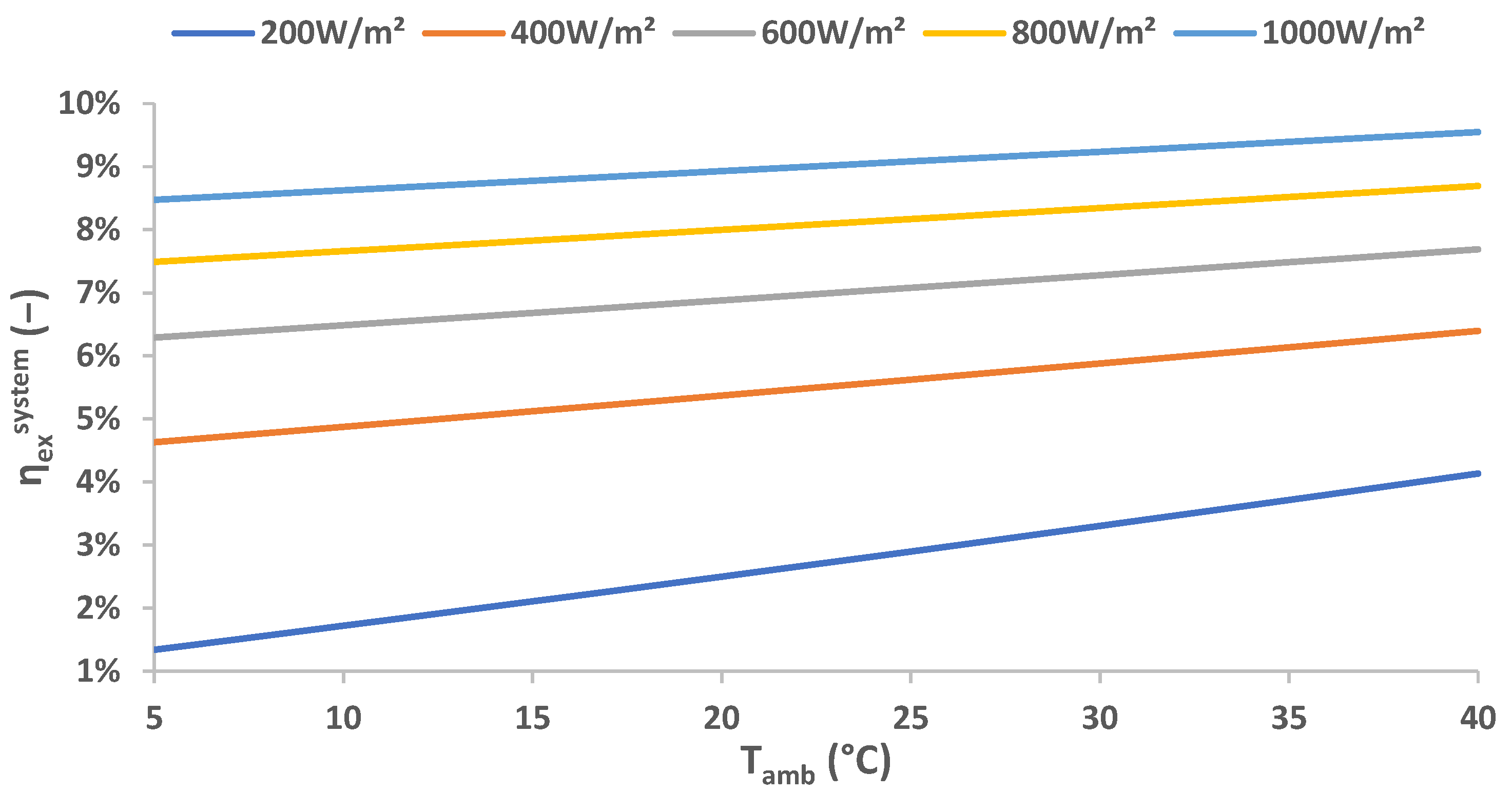
The next step of the current investigation involves the performance evaluation of the total system including the coupling of the proposed novel transcritical pumpless CO2 power generation cycle to the ETC solar collector arrangement. In this context, the system energetic and exergetic efficiency rates are calculated parametrically for different irradiation values in reference to the ambient temperature. The results are illustrated in the charts in Figure 17 and Figure 18 respectively. Both examined figures show a similar pattern of increment along with the augmentation of the ambient temperature and the solar radiation as well. Precisely, the highest energy and exergy system efficiencies are given in the case of Tamb = 40 °C and Ib = 1000 W/m2 corresponding to 8.86% and 9.55% respectively. Additionally, the low rates are shown for the pair of Tamb = 5 °C and Ib = 200 W/m2, with values of 1.26% for the energy efficiency and 1.34% for the exergy efficiency.
Figure 17.
Proposed solar power generation system energy efficiency variation in reference to the solar irradiation and ambient temperature.
Figure 18.
Proposed solar power generation system exergy efficiency variation in reference to the solar irradiation and ambient temperature.
3.4. Annual Electricity Production Calculation
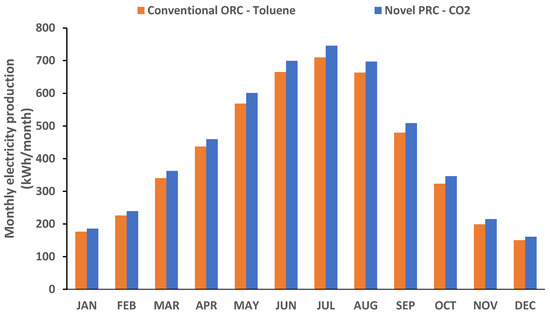
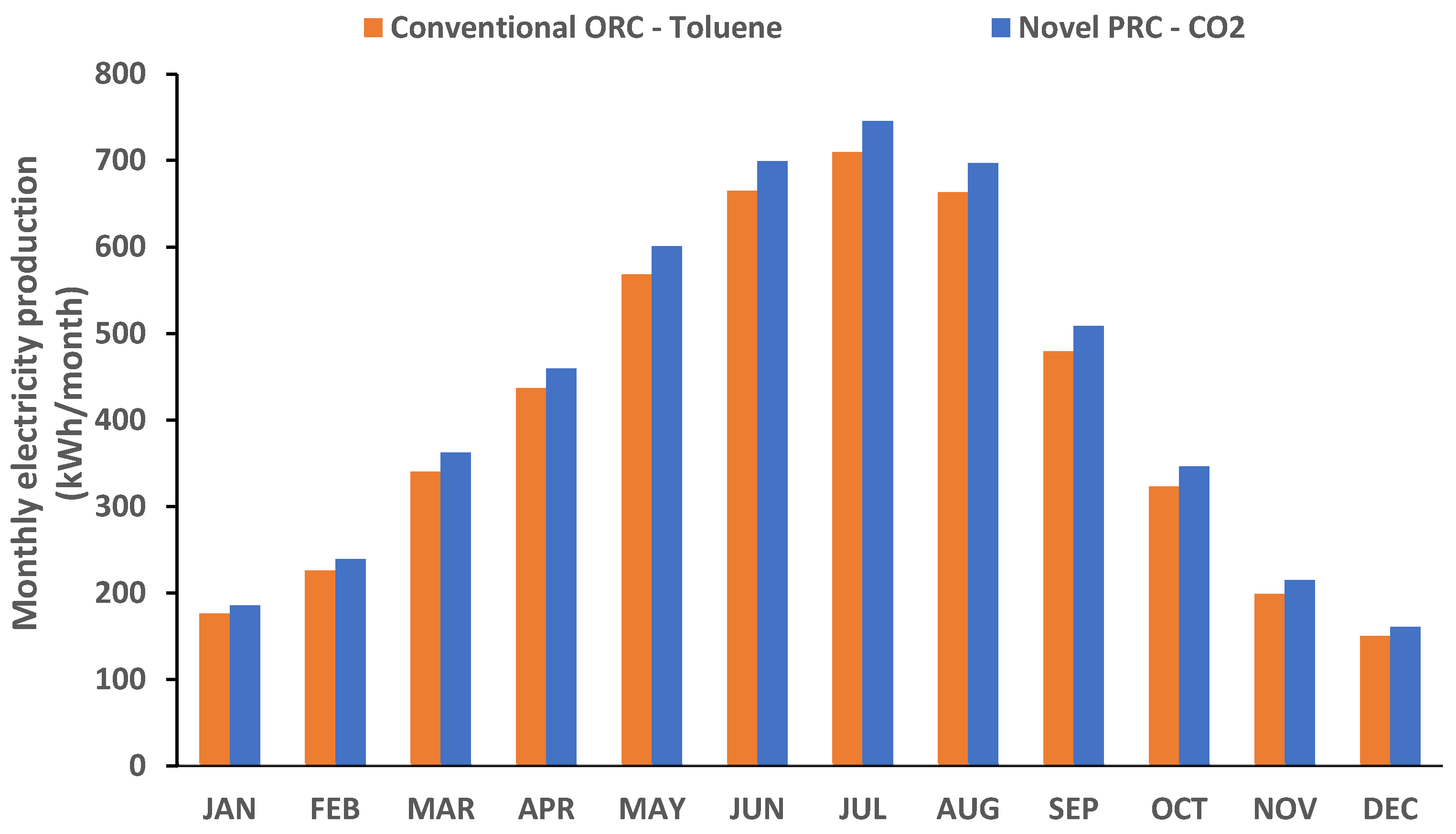
In the current section, the annual electricity production for the described novel transcritical pumpless CO2 configuration is calculated for its potential installation in a multifamily house located in the region of Athens, Greece. The monthly electricity production rates are compared with the respective figures of electricity production of a conventional ORC unit employing toluene as the working medium. The monthly electricity production results are summarized in the chart in Figure 19. Both examined alternatives show a similar annual electricity production pattern, providing as expected higher figures during the warmer months of the summer period, in which there are higher solar radiation values, and lower production during the winter period where the solar radiation is limited. The proposed pumpless CO2 system shows better performance over the typical ORC case, for all the examined months of the year, having maximum 7.95% higher electricity production for the case of November. The annual electricity production of the pumpless CO2 unit is calculated at 5221 kWh/year, which results in 283 kWh/year more electricity generation over the conventional ORC, which corresponds to 5.72% electricity production enhancement. The aforementioned results show a slight advantage of the investigated innovative pumpless CO2 configuration over the conventional ORC unit for the electricity production in a year-round analysis, which is considered important since it concerns a single building. The latter electricity production improvement is mainly attributed to the inherently enhanced power generation potential of CO2 power generation cycles, which is maximized through the pumpless operation concept. Therefore, the proposed system makes renewable power generation units more competitive, facilitating their further spread in the energy market, providing extremely promising energy saving benefits, in case such a solution is adopted in a higher number of buildings.
Figure 19.
Annual electricity production distribution for the conventional ORC and the proposed novel PRC system.
4. Conclusions
The objective of the current study is the theoretical investigation of novel pumpless transcritical CO2 power generation configuration coupled with an ETC solar arrangement to cover part of the electricity needs of a multifamily house building in the region of Athens, Greece. The methodology followed includes the parametrical analysis of the proposed topology and its energetic and exergetic performance comparison with a conventional ORC system. Additionally, the year-round operation of the examined system is simulated to quantify the potential benefits in power production of the innovative concept over the conventional baseline alternative. The study is performed using simulation models developed in the MATLAB R2022b environment. The thermodynamic modeling is based on assumptions that simplify the system representation, including negligible pressure losses in piping and heat exchangers, quasi-steady-state operation, and simplified component performance models. Nevertheless, these simplifications do not affect the comparative conclusions of the present work, which focuses on the thermodynamic potential of the proposed pumpless CO2 Rankine configuration. The most important findings that need to be highlighted are summarized below:
- The increment of the hot water inlet temperature increases the thermal efficiency of the proposed cycle, leading to maximum ηth = 15.69% for the condition pairs of Thwin = 120 °C and Tcwin = 10 °C.
- The proposed power generation cycle shows higher exergy efficiency rates for operation under low hot water inlet temperature levels, showing maximum ηex = 77.90% for Thwin = 70 °C and Tcwin = 10 °C.
- The total heat input distribution analysis shows that the Qis.comp1/Qin fraction has a merit below 5%, while Qis.comp2/Qin can be up to 41.63% for Thwin = 120 °C.
- The novel pumpless CO2 configuration shows the best performance ratios among the rest of the examined typical ORCs using conventional refrigerants. Specifically in comparison with the ORC-toluene case, there is a 15.19% and 15.23% enhancement in thermal and exergy efficiency respectively for Thwin = 70 °C, while the corresponding figures for Thwin = 120 °C are calculated at 1.41% and 0.30%.
- The year-round simulation of the proposed system produces up to 5221 kWh/year for the building, resulting in 283 kWh/year more electricity generation over the conventional ORC, which corresponds to 5.72% annual electricity production enhancement.
- The innovative pumpless CO2 configuration investigated is a promising alternative for renewable power generation in building stocks. The findings of the current work provide important and quantified efficiency amelioration potential over the conventional alternatives. Additional future research could exploit these results for the development of an experimental proof-of-concept prototype, while a techno-economic analysis including a life cycle assessment of the proposed pumpless configuration will facilitate its spread into the market.
Author Contributions
Conceptualization, E.S. and M.G.V.; Methodology, E.S.; Software, E.S., D.T., J.K. and N.A.; Validation, D.T.; Formal analysis, N.A. and M.K.K.; Investigation, E.S. and D.T.; Resources, J.K. and N.A.; Data curation, J.K. and N.A.; Writing—original draft, E.S. and D.T.; Writing—review & editing, M.K.K. and M.G.V.; Visualization, J.K.; Supervision, M.K.K. and M.G.V.; Project administration, M.K.K. All authors have read and agreed to the published version of the manuscript.
Funding
This research received no external funding.
Data Availability Statement
The original contributions presented in this study are included in the article. Further inquiries can be directed to the corresponding authors.
Conflicts of Interest
The authors declare no conflicts of interest.
Nomenclature
| Thermodynamic parameters | Subscripts and superscripts | ||
| Ar | aperture area, - | amb | ambient |
| cp | specific heat, kW∙kg−1K−1 | col | collector |
| Eel | electricity production, kWh | comp | compression |
| Ex | exergy rate, kW | evap | evaporation |
| h | specific enthalpy, kJ/kg | exp | expander |
| W | mechanical work, kW | f | solar collector fluid |
| m | mass flow ratio, kg/s | in | input |
| P | pressure, bar | is | isentropic |
| Pout | output generated power, kW | is.comp1 | isochoric compression 1 |
| Pr | pressure ratio, - | is.comp2 | isochoric compression 2 |
| Q | heat flux, kW | out | output |
| Rb | geometric factor for beam radiation, - | r | refrigerant |
| Greek Symbols | sol | solar | |
| ηcol | collector efficiency, - | ||
| ηen | energy efficiency, - | Abbreviations Symbols | |
| ηex | exergy efficiency, - | CHP | combined heat and power |
| ηis | isentropic efficiency, - | ETC | evacuated tube collectors |
| ηm | mechanical efficiency, - | ORC | organic Rankine cycle |
| ηth | thermal efficiency, - | PTC | parabolic trough collectors |
| Ιβ | solar radiation on tilted surface, W/m2 | PCM | phase change materials |
| Ιd | diffuse solar radiation on hor. surf., W/m2 | PRC | pumpless Rankine cycle |
| ΙT | global solar radiation on hor. surf., W/m2 | RESs | renewable energy sources |
| ρ | ground reflectance, - | ODP | ozone depletion potential |
| β | inclination angle, ° | GWP | global warming potential |
References
- Cruz, I.; Johansson, M.T.; Wren, J. Assessment of the potential for small-scale CHP production using Organic Rankine Cycle (ORC) systems in different geographical contexts: GHG emissions impact and economic feasibility. Energy Rep. 2022, 8, 7680–7690. [Google Scholar] [CrossRef] [Scilit]
- Oyekale, J.; Emagbetere, E. Heliyon Review article A review of conventional and exergetic life cycle assessments of organic Rankine cycle plants exploiting various low-temperature energy resources. Heliyon 2022, 8, e09833. [Google Scholar] [CrossRef] [Scilit] [PubMed]
- Liu, L.; Aljibori, H.S.S.; Abdulrahman, A.; Samad, S.; Zhang, L.; Osman, H.; Abdujabbarov, A.; Mahariq, I. A novel hybrid biogas–solar-driven energy system integrated with carbon capture for multi-generation: Machine learning-based technical, economic, and environmental optimization. Appl. Therm. Eng. 2025, 280, 128232. [Google Scholar] [CrossRef] [Scilit]
- Bellos, E.; Lykas, P.; Tzivanidis, C. Investigation of a Solar-Driven Organic Rankine Cycle with Reheating. Appl. Sci. 2022, 12, 2322. [Google Scholar] [CrossRef] [Scilit]
- Braimakis, K.; Charalampidis, A.; Karellas, S. Techno-economic assessment of a small-scale biomass ORC-CHP for district heating. Energy Convers. Manag. 2021, 247, 114705. [Google Scholar] [CrossRef] [Scilit]
- Xu, X.; Zhang, L.; Zhang, H.; Ma, J.; Sambatmaryde, K. Performance analysis of a novel small-scale integrated solar-ORC system for power and heating. Sol. Energy 2024, 274, 112605. [Google Scholar] [CrossRef] [Scilit]
- Mascuch, J.; Novotny, V.; Vodicka, V.; Spale, J.; Zeleny, Z. Experimental development of a kilowatt-scale biomass fired micro—CHP unit based on ORC with rotary vane expander. Renew. Energy 2020, 147, 2882–2895. [Google Scholar] [CrossRef] [Scilit]
- Eyerer, S.; Dawo, F.; Schifflechner, C.; Niederdränk, A.; Spliethoff, H.; Wieland, C. Experimental evaluation of an ORC-CHP architecture based on regenerative preheating for geothermal applications. Appl. Energy 2022, 315, 119057. [Google Scholar] [CrossRef] [Scilit]
- Fatigati, F.; Vittorini, D.; Cipollone, R. Dynamic response of a micro-scale ORC-based power unit fed by solar flat panels. Appl. Therm. Eng. 2024, 243, 122546. [Google Scholar] [CrossRef] [Scilit]
- Nguyen, T.; Lin, L. Potentials and effects of electricity cogeneration via ORC integration in small-scale biomass district heating system. Green Energy Resour. 2025, 3, 100113. [Google Scholar] [CrossRef] [Scilit]
- Maghfuri, A.M.; Loni, R.; Pavlovic, S.; Kasaeian, A. Solar ORC system using vacuum cubical cavity receiver to improve energy governance. Therm. Sci. Eng. Prog. 2025, 60, 103388. [Google Scholar] [CrossRef] [Scilit]
- Gilani, H.A.; Hoseinzadeh, S.; Esmaeilion, F.; Memon, S.; Garcia, D.A.; Assad, M.E.H. A solar thermal driven ORC-VFR system employed in subtropical Mediterranean climatic building. Energy 2022, 250, 123819. [Google Scholar] [CrossRef] [Scilit]
- Parvez, M.; Khan, O. A theoretical thermodynamic investigation on solar-operated combined electric power, heating, and ejector cooling cycle driven by an ORC turbine waste heat, tri-generation cycle system. Int. J. Thermofluids 2024, 24, 100931. [Google Scholar] [CrossRef] [Scilit]
- Shi, X.; Jiang, W.; Wang, X.; Zhang, C. Experimental and numerical investigations of an ORC power generation system based on solar concentration and heat collection technology. Appl. Therm. Eng. 2025, 281, 128642. [Google Scholar] [CrossRef] [Scilit]
- Gonidaki, D.; Bellos, E.; Kaldellis, J.K. Design and dynamic simulation of a solar-driven organic Rankine cycle with zeotropic mixture. Sol. Energy 2025, 301, 113948. [Google Scholar] [CrossRef] [Scilit]
- Kumar, A.; Gupta, P.R.; Tiwari, A.K.; Said, Z. Performance evaluation of small scale solar organic Rankine cycle using MWCNT + R141b nanorefrigerant. Energy Convers. Manag. 2022, 260, 115631. [Google Scholar] [CrossRef] [Scilit]
- Li, J.; Pei, G.; Li, Y.; Ji, J. Analysis of a novel gravity driven organic Rankine cycle for small-scale cogeneration applications. Appl. Energy 2013, 108, 34–44. [Google Scholar] [CrossRef] [Scilit]
- Gao, P.; Wang, L.W.; Wang, R.Z.; Jiang, L.; Zhou, Z.S. Experimental investigation on a small pumpless ORC (organic rankine cycle) system driven by the low temperature heat source. Energy 2015, 91, 324–333. [Google Scholar] [CrossRef] [Scilit]
- Yamada, N.; Watanabe, M.; Hoshi, A. Experiment on pumpless Rankine-type cycle with scroll expander. Energy 2013, 49, 137–145. [Google Scholar] [CrossRef] [Scilit]
- Jiang, L.; Lu, H.T.; Wang, L.W.; Gao, P.; Zhu, F.Q.; Wang, R.Z.; Roskilly, A.P. Investigation on a small-scale pumpless Organic Rankine Cycle (ORC) system driven by the low temperature heat source. Appl. Energy 2017, 195, 478–486. [Google Scholar] [CrossRef] [Scilit]
- Gao, P.; Wang, Z.X.; Wang, L.W.; Lu, H.T. Technical feasibility of a gravity-type pumpless ORC system with one evaporator and two condensers. Appl. Therm. Eng. 2018, 145, 569–575. [Google Scholar] [CrossRef] [Scilit]
- Gkimisis, L.; Arapkoules, N.; Vasileiou, G.; Soldatos, A.; Spitas, V. Modelling and numerical simulation of a novel Pumpless Rankine Cycle (PRC). Appl. Therm. Eng. 2020, 178, 115523. [Google Scholar] [CrossRef] [Scilit]
- Zhang, X.; Wang, L.; Zhu, H. Investigation on a novel pumpless module driven by thermal energy and gravity and its application in an ORC system. Renew. Energy 2022, 195, 476–487. [Google Scholar] [CrossRef] [Scilit]
- Zhu, H.; Zhang, X.; Gao, Z.; Wang, L.; Wang, Z. Thermodynamic analysis and experimental study of two-stage thermal-gravitational pumping ORC under low evaporation temperatures. Sustain. Energy Technol. Assess. 2024, 66, 103820. [Google Scholar] [CrossRef] [Scilit]
- Syngounas, E.; Konstantaras, J.; Arapkoules, N.; Tsimpoukis, D.; Koukou, M.K.; Vrachopoulos, M.G. Experimental Energy and Exergy Performance Evaluation of a Novel Pumpless Rankine Cycle (PRC) Unit Employing Low-Temperature Heat Sources. Energies 2025, 18, 4766. [Google Scholar] [CrossRef] [Scilit]
- García-Gutiérrez, P.; Hermann, M.; Bolashikov, Z.D.; Viegand, J. Environmental assessment of residential heat generation systems: Opportunities and EU policy implications. Build. Environ. 2026, 288, 113931. [Google Scholar] [CrossRef] [Scilit]
- Issa, A.A.B.; Liang, C.; Groll, E.A.; Ziviani, D. Residential heat pump and air conditioning systems with propane (R290) refrigerant: Technology review and future perspectives. Appl. Therm. Eng. 2025, 266, 125560. [Google Scholar] [CrossRef] [Scilit]
- Syngounas, E.; Tsimpoukis, D.; Koukou, M.K.; Vrachopoulos, M.G. Energetic, exergetic and financial evaluation of a solar-powered absorption chiller integration into a CO2 commercial refrigeration system. Proc. Inst. Mech. Eng. Part A J. Power Energy 2022, 236, 119. [Google Scholar] [CrossRef] [Scilit]
- Wang, J.; Sun, Z.; Dai, Y.; Ma, S. Parametric optimization design for supercritical CO2 power cycle using genetic algorithm and artificial neural network. Appl. Energy 2010, 87, 1317–1324. [Google Scholar] [CrossRef] [Scilit]
- Tsimpoukis, D.; Syngounas, E.; Bellos, E.; Koukou, M.; Tzivanidis, C.; Anagnostatos, S.; Vrachopoulos, M.G. Thermodynamic and economic analysis of a supermarket transcritical CO2 refrigeration system coupled with solar-fed supercritical CO2 Brayton and organic Rankine cycles. Energy Convers. Manag. X 2023, 18, 100351. [Google Scholar] [CrossRef] [Scilit]
- Cao, Y.; Li, P.; Qiao, Z.; Ren, S.; Si, F. A concept of a supercritical CO2 Brayton and organic Rankine combined cycle for solar energy utilization with typical geothermal as auxiliary heat source: Thermodynamic analysis and optimization. Energy Rep. 2022, 8, 322–333. [Google Scholar] [CrossRef] [Scilit]
- Ge, Y.T.; Li, L.; Luo, X.; Tassou, S.A. Performance evaluation of a low-grade power generation system with CO2 transcritical power cycles. Appl. Energy 2018, 227, 220–230. [Google Scholar] [CrossRef] [Scilit]
- Bellos, E.; Tzivanidis, C. Investigation of a novel CO2 transcritical organic rankine cycle driven by parabolic trough solar collectors. Appl. Syst. Innov. 2021, 4, 53. [Google Scholar] [CrossRef] [Scilit]
- Lee, W.; Lee, K.Y.; Barik, D. Experimental Study on a Small-Scale Transcritical CO2 Rankine Cycle for Solar Thermal Applications. Int. J. Energy Res. 2023, 2023, 1644463. [Google Scholar] [CrossRef] [Scilit]
- Li, T.; Zhou, K.; Li, J.; Yang, H. Dynamic performance of supercritical and transcritical CO2 cycle for combined heating and power from hot dry rock. Case Stud. Therm. Eng. 2025, 74, 106950. [Google Scholar] [CrossRef] [Scilit]
- Fathi, S.; Saray, R.K.; Aghaei, A.T. Thermoeconomic optimization of a transcritical CO2 combined cooling and power system. Energy Convers. Manag. X 2025, 28, 101292. [Google Scholar] [CrossRef] [Scilit]
- Bellos, E.; Tzivanidis, C.; Antonopoulos, K.A. Exergetic, energetic and financial evaluation of a solar driven absorption cooling system with various collector types. Appl. Therm. Eng. 2016, 102, 749–759. [Google Scholar] [CrossRef] [Scilit]
- Belessiotis, V.; Mathioulakis, E.; Papanicolaou, E. Theoretical formulation and experimental validation of the input-output modeling approach for large solar thermal systems. Sol. Energy 2010, 84, 245–255. [Google Scholar] [CrossRef] [Scilit]
- MElsheniti, B.; Kotb, A.; Elsamni, O. Thermal performance of a heat-pipe evacuated-tube solar collector at high inlet temperatures. Appl. Therm. Eng. 2019, 154, 315–325. [Google Scholar] [CrossRef] [Scilit]
- Zambolin, E.; del Col, D. An improved procedure for the experimental characterization of optical efficiency in evacuated tube solar collectors. Renew. Energy 2012, 43, 37–46. [Google Scholar] [CrossRef] [Scilit]
- Petela, R. Exergy of undiluted thermal radiation. Sol. Energy 2003, 74, 469–488. [Google Scholar] [CrossRef] [Scilit]
- Quoilin, S.; Van Den Broek, M.; Declaye, S.; Dewallef, P.; Lemort, V. Techno-economic survey of organic rankine cycle (ORC) systems. Renew. Sustain. Energy Rev. 2013, 22, 168–186. [Google Scholar] [CrossRef] [Scilit]
- Wang, E.H.; Zhang, H.G.; Fan, B.Y.; Ouyang, M.G.; Zhao, Y.; Mu, Q.H. Study of working fluid selection of organic Rankine cycle (ORC) for engine waste heat recovery. Energy 2011, 36, 3406–3418. [Google Scholar] [CrossRef] [Scilit]
- Grauberger, A.; Young, D.; Bandhauer, T. Off-design performance of an organic Rankine-vapor compression cooling cycle using R1234ze(E). Appl. Energy 2022, 321, 119421. [Google Scholar] [CrossRef] [Scilit]
- Cayer, E.; Galanis, N.; Nesreddine, H. Parametric study and optimization of a transcritical power cycle using a low temperature source. Appl. Energy 2010, 87, 1349–1357. [Google Scholar] [CrossRef] [Scilit]
- Τ.Ο.Τ.Ε.Ε. 20701-3/2010 Climate data of Greek Cities, Technical Directive by the Technical Chamber of Greece. Ministry of Environment, Energy and Climate Change—Υ.Π.Ε.Κ.A. Special Secretariat for Environmental and Energy Inspection Special Service for Energy Inspectors Technical Chamber of Greece. 2010. Available online: http://www.helapco.gr/ims/file/installers/totee-klimatika.pdf (accessed on 27 October 2025).
- Syngounas, E.; Tsimpoukis, D.; Koukou, M.K.; Vrachopoulos, M.G. Integration of a solar-powered absorption chiller for performance enhancement of a supermarket CO2 refrigeration plant. Green Energy Sustain. 2022, 2, 0003. [Google Scholar] [CrossRef] [Scilit]
- Tzivanidis, C.; Bellos, E.; Antonopoulos, K.A. Energetic and financial investigation of a stand-alone solar-thermal Organic Rankine Cycle power plant. Energy Convers. Manag. 2016, 126, 421–433. [Google Scholar] [CrossRef] [Scilit]
- Sun, Z.; Wang, C.; Liang, Y.; Sun, H.; Liu, S.; Dai, B. Theoretical study on a novel CO2 Two-stage compression refrigeration system with parallel compression and solar absorption partial cascade refrigeration system. Energy Convers. Manag. 2020, 204, 112278. [Google Scholar] [CrossRef] [Scilit]
- The MathWorks Inc. MATLAB, version: 9.13.0 (R2022b); The MathWorks Inc.: Natick, MA, USA, 2022. Available online: https://www.mathworks.com (accessed on 14 November 2025).
- Xu, G.; Song, G.; Zhu, X.; Gao, W.; Li, H.; Quan, Y. Performance evaluation of a direct vapor generation supercritical ORC system driven by linear Fresnel reflector solar concentrator. Appl. Therm. Eng. 2015, 80, 196–204. [Google Scholar] [CrossRef] [Scilit]
- Li, X.; Chen, Y.; Zhang, Y.; Liu, Y. Thermoeconomic modelling and multi-objective optimisation of ORC systems for low-temperature waste heat recovery. Appl. Therm. Eng. 2025, 279, 127603. [Google Scholar] [CrossRef] [Scilit]
- Scagnolatto, G.; Cabezas-Gómez, L.; Tibiriçá, C.B. Analytical model for thermal efficiency of organic Rankine cycles, considering superheating, heat recovery, pump and expander efficiencies. Energy Convers. Manag. 2021, 246, 114628. [Google Scholar] [CrossRef] [Scilit]
- Moradi, R.; Villarini, M.; Cioccolanti, L. Experimental modeling of a lubricated, open drive scroll expander for micro-scale organic Rankine cycle systems. Appl. Therm. Eng. 2021, 190, 116784. [Google Scholar] [CrossRef] [Scilit]
- Lecompte, S.; Chatzopoulou, M.A.; Markides, C.N.; De Paepe, M. Off-design comparison of subcritical and partial evaporating ORCs in quasi-steady state annual simulations. Energy Procedia 2019, 158, 2064–2069. [Google Scholar] [CrossRef] [Scilit]
- Xiao, M.; Zhou, Y.; Miao, Z.; Yan, P.; Zhang, M.; Xu, J. Multi-condition operating characteristics and optimization of a small-scale ORC system. Energy 2024, 290, 130099. [Google Scholar] [CrossRef] [Scilit]
- Moradi, R. Object-Oriented Modeling of Micro-ORC Systems for Low-Grade Waste Heat Recovery Applications. Ph.D. Thesis, Faculty of Civil and Industrial Engineering, Department of Astronautical, Electrical and Energy Engineering, Sapienza University of Rome, Rome, Italy, 2021. [Google Scholar]
- Syngounas, E.; Tsimpoukis, D.; Bellos, E.; Koukou, M.K.; Tzivanidis, C.; Vrachopoulos, M.G. Energy and exergy performance investigation of a transcritical CO2 vapor ejector-based refrigeration system for marine provision plants. Appl. Therm. Eng. 2025, 269, 126036. [Google Scholar] [CrossRef] [Scilit]
- Salim, M.S.; Saeed, M.; Kim, M.H. Performance analysis of the supercritical carbon dioxide re-compression brayton cycle. Appl. Sci. 2020, 10, 1129. [Google Scholar] [CrossRef] [Scilit]
- Manente, G.; Lazzaretto, A.; Bonamico, E. Design guidelines for the choice between single and dual pressure layouts in organic Rankine cycle (ORC) systems. Energy 2017, 123, 413–431. [Google Scholar] [CrossRef] [Scilit]

Disclaimer/Publisher’s Note: The statements, opinions and data contained in all publications are solely those of the individual author(s) and contributor(s) and not of MDPI and/or the editor(s). MDPI and/or the editor(s) disclaim responsibility for any injury to people or property resulting from any ideas, methods, instructions or products referred to in the content. |
© 2026 by the authors. Licensee MDPI, Basel, Switzerland. This article is an open access article distributed under the terms and conditions of the Creative Commons Attribution (CC BY) license.