


Featured Application
Differential wavefront sensing (DWS) enables nanoradian-level angular measurements but is restricted by a narrow measurement range. This study proposes a differential evolution technique based on inheritance and tournament selection, which extends DWS to high-precision angular measurements over a broad range. Besides space-based gravitational wave detection, this technology can be applied to other precision optical metrology fields like EUV lithography, surface metrology and nanomanufacturing position control, showing great potential for widespread scientific and industrial applications.
Abstract
Differential wavefront sensing (DWS) is widely adopted for high-precision angular detection in interferometric systems, yet its measurement range is constrained by the nonlinear implicit phase–angle relationship. This paper proposes a strategy-enhanced differential evolution algorithm, termed Bi-inheritance and Tournament-Selection-based Differential Evolution (BiTsDE), to suppress nonlinear angular errors. The method introduces fitness-guided inheritance of mutation and crossover factors and tournament-based elite parent selection, enabling adaptive balance between global exploration and local exploitation. Unlike conventional DE variants that mainly tune control parameters, BiTsDE optimizes the evolutionary search strategy, enhancing early-stage diversity and late-stage convergence stability. Simulations demonstrate angular resolution better than 0.06 nrad within ±1 mrad. Experiments show that up to 600 μrad, BiTsDE reduces demodulation error by 99.9% compared with linear DWS, achieving 17.9 nrad precision and 42% faster convergence. These results validate BiTsDE as an effective solution for nonlinear error suppression in DWS-based high-precision optical metrology, particularly for space-based gravitational wave detection.
1. Introduction
Differential wavefront sensing (DWS) is a high-precision phase-sensitive angular measurement technique [1]. When a misalignment exists between the reference and measurement beams, the tilted wavefront causes a differential phase change detected by quadrant photodiodes (QPDs), allowing beam pointing angles to be retrieved from the measured phase [2]. Owing to its high resolution, strong noise immunity and low background noise, DWS has been extensively employed in gravitational wave detection missions, including the Laser Interferometer Gravitational Wave Observatory (LIGO) [3,4], the Laser Interferometer Space Antenna (LISA) [5,6], Taiji [7,8] and TianQin [9], as well as in Earth gravity field programs such as the Gravity Recovery and Climate Experiment Follow-On (GRACE-FO) [10,11] and the Next Generation Gravity Mission (NGGM) [12].
In coherent detection systems, the relationship between phase and angle is governed by a nonlinear implicit function [13]. However, conventional DWS angular demodulation algorithms rely on a first-order approximation based on phase-angle coupling coefficients. For wide-range angular measurements, the linear approximation inevitably introduces nonlinear demodulation errors. To mitigate nonlinear errors in angular measurement, considerable research efforts have been made both domestically and internationally. Wanner employed mathematical modeling to suppress angular errors by predicting a more accurate phase-to-angle coupling coefficient [14]. Huizong Duan investigated the effects of detector aperture clipping and beam walk-off at the rotation point on DWS nonlinearity [15]. Qian et al. demonstrated that larger beam walk-off leads to stronger phase–angle nonlinearity in DWS, which can be effectively mitigated by introducing an imaging system [16]. Heinzel addressed DWS angular errors through phase-readout electronics by adopting a complex-amplitude-based phase-demodulation technique [2]. Fangjie Liao et al. replaced conventional angle generators with phase-shifting interferometry (PSI) to suppress piezoelectric hysteresis; by extending the angular range to ±17 mrad, the nonlinear error was reduced to below 10 µrad [17]. Fuzhong Yang et al. proposed a wide-range DWS interferometer with three degrees of freedom based on fiber beam delivery, extending the angular measurement range to ±534 µrad by suppressing phase-integration errors [18]. Xiangzhi Yu et al. analyzed the effects of beam mismatch, misalignment, and wavefront aberrations on interferometric DWS; their modeling results indicate that when the angular range exceeds ±59 µrad, the nonlinear error induced by the coupling coefficient exceeds 1 µrad [19]. As a result, suppressing nonlinear angle-demodulation errors over a wide angular range remains a critical challenge in DWS-based precision metrology.
To address this issue, this paper proposes a strategy-enhanced differential evolution (DE) framework, termed BiTsDE, specifically designed for nonlinear angle inversion in DWS. Rather than employing static or manually tuned parameters, the proposed algorithm introduces inheritance-based parameter control and tournament-guided mutation, enabling adaptive regulation of search dynamics throughout the evolutionary process. By integrating genetic inheritance principles with tournament-driven parent selection, the algorithm enhances population diversity during the early search stage while stabilizing convergence behavior near the global optimum. To further mitigate premature convergence and evolutionary stagnation commonly observed in standard DE algorithms [20,21,22,23], three coordinated strategy-level improvements are integrated: tournament-based parent selection to guide mutation toward high-fitness regions, inheritance-driven adaptive mutation scaling to enhance local exploitation capability, and fitness-dependent dynamic crossover control to balance global exploration and local exploitation.
The paper is organized as follows: Section 2 establishes the nonlinear optical field model of the DWS system and analyzes the implicit phase–angle relationship. Section 3 introduces the proposed BiTsDE framework, detailing the inheritance-based evolutionary memory and tournament-guided mutation strategies. Section 4 compares the angular measurement performance of the standard DE algorithm and the enhanced BiTsDE framework through both simulations and experiments under identical phase measurement precision conditions. Additionally, Section 5 concludes the paper and discusses potential applications in high-precision wavefront sensing, including space-based gravitational wave detection.
2. Implicit Nonlinear Phase-Angle Relationship in DWS
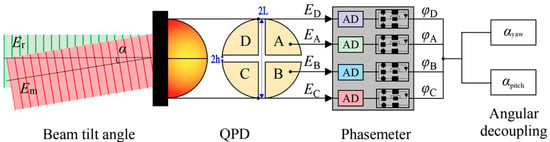
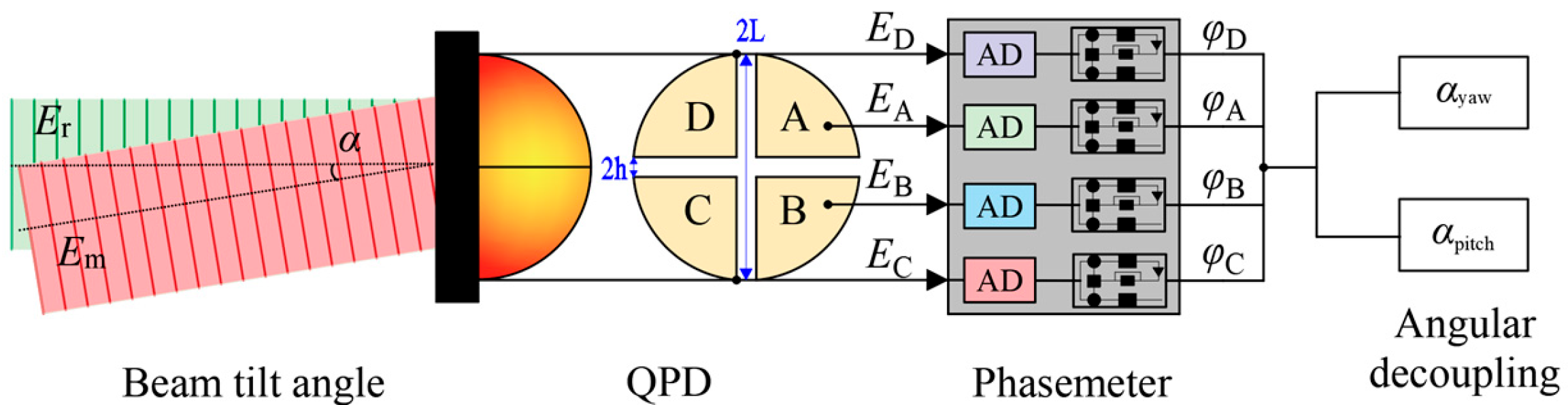
Differential wavefront sensing (DWS) provides nanoradian-level angular resolution derived from microradian-level phase sensitivity. As shown in Figure 1, when a relative angular misalignment exists between the local beam and the transmitted beam, the wavefront of the laser beam tilts accordingly with the misalignment angle, resulting in corresponding variations in the heterodyne phase detected by each quadrant of the QPD. The differential phase signals from different quadrants are used to determine the wavefront angle incident on the photodiode. The readout signal is expressed as [24,25]:
Figure 1.
The principle of Differential Wavefront Sensing (DWS) technique. Em and Er denote the measurement beam and the reference beam, respectively. α represents the angular misalignment between the two beams. “AD” denotes the analog-to-digital converter. The interference signal is converted into phase signals by the phasemeter. The pitch angle is retrieved from the phase difference between the upper and lower quadrants of the QPD, whereas the yaw angle is obtained from the phase difference between the left and right quadrants.
Here, represents the optical wavelength. The receiver is a quadrant photodiode (QPD) with a slit width of 2h and an aperture of 2L. and denote the yaw and pitch angles, respectively. is the phase-angle coupling coefficient. denote the interfering electric field, and represent the phase signals.
However, the above expression is obtained under the approximations of plane-wave interference and small-angle beam tilt. For two Gaussian beams, based on Maxwell’s equations, the electric field distributions of the reference beam and the measurement beam propagating along the z-axis can be written as follows:
where denotes the distance between an arbitrary point in the beam coordinate system and the optical axis. is the laser frequency of measurement beam or reference beam. And the detailed parameters are listed in Table 1.
Table 1.
The descriptions and definitions of physical parameters.
When the measurement Gaussian beam and the reference Gaussian beam have the same polarization state, the local intensity of the resultant interference signal is expressed as follows:
Thus, the intermediate-frequency (IF) current signal is obtained as follows:
Using the Rodrigues rotation matrix, the beam coordinate system can be transformed into the photosensitive-plane coordinate system of the QPD, from which the horizontal differential phase of DWS in the horizontal direction is obtained as follows:
where,
Equations above reveal that the demodulated phase is an implicit nonlinear function of the beam pointing angle α. When α is sufficiently small, the first-order approximation offers satisfactory linearity and forms the basis of conventional DWS demodulation. However, as α increases, the Gaussian beam overlap distribution becomes asymmetric, leading to a nonlinear error that can no longer be ignored. To reduce this effect, optimizing the optical system parameters and the phase readout scheme can mitigate non-uniform beam intensity distributions, thereby suppressing full-range DWS angular measurement errors to a certain extent.
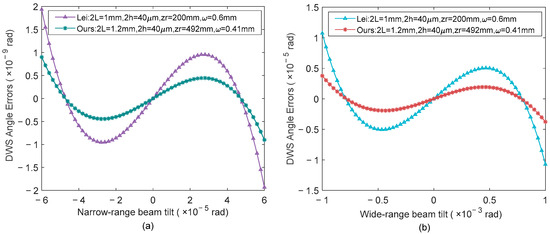
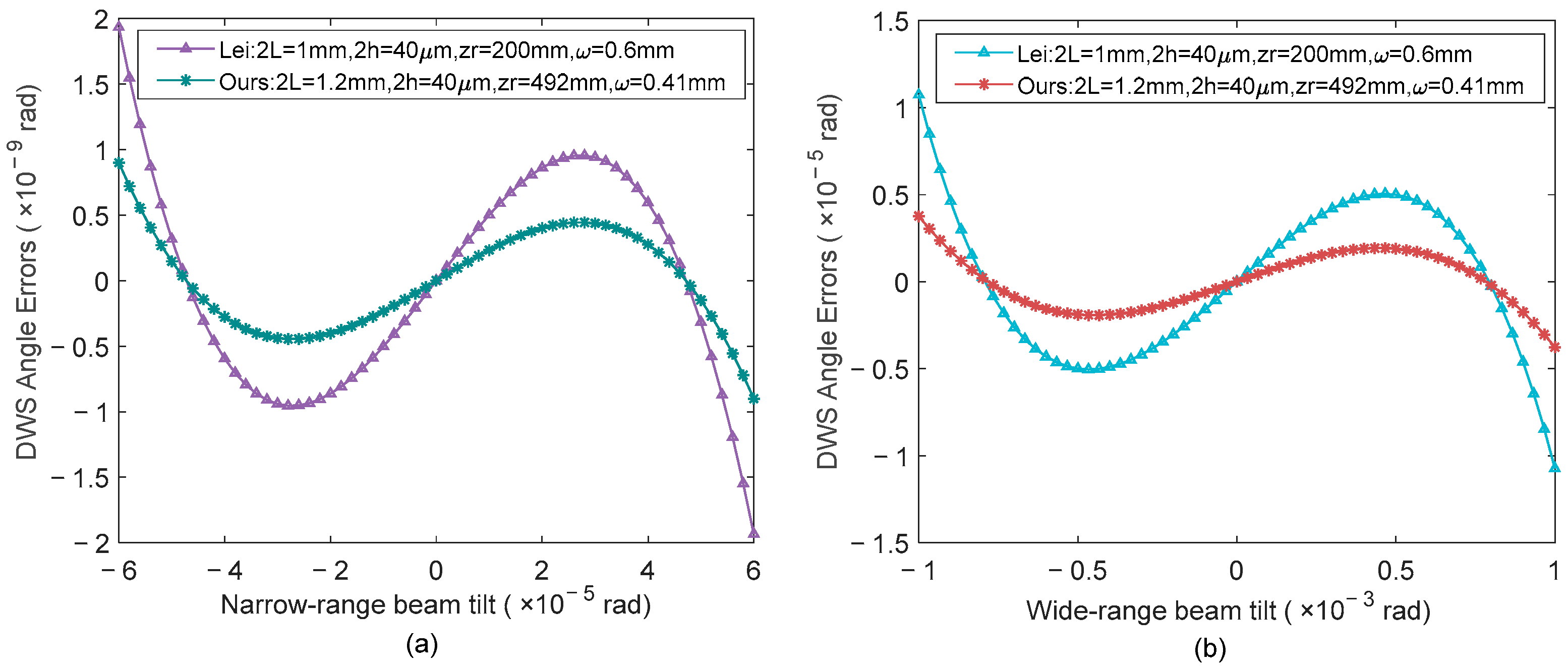
Figure 2 compares the results reported in [26] with those obtained using the optical system parameters adopted in this study. As the misalignment angle increases, the linearity of the DWS signal deteriorates significantly.
Figure 2.
Suppression of DWS nonlinear angular errors by the optical system. (a) The angular error suppression performance within an angular range of ±60 μrad. (b) The angular error suppression performance within an angular range of ±1 mrad.
In the Taiji space-based gravitational-wave detection mission, the telescope aperture is 0.4 m, while the beam spot diameter projected onto the QPD is approximately 1 mm. This indicates that after propagation through the space-borne optical system, the beam size is reduced by a factor of 400, and correspondingly, beam misalignment is amplified by the same factor. Within the three-stage pointing control system for gravitational wave detection, the field of view of the QPD operating under DWS is approximately 1.5 μrad. Therefore, the required angular decoupling range of DWS must reach ±600 μrad. The pointing accuracy requirement of the Taiji mission is 10 nrad. Considering the magnification of the telescope system, the allowable angular measurement error at the QPD plane should be less than 4 μrad. Consequently, for a misalignment angle varying within ±600 μrad, the angular measurement error must satisfy [27]:
Here, represents the true angle and represents the predicted angle.
Meanwhile, the inter-satellite distance in the Taiji constellation is approximately 3 million kilometers. During long-distance laser transmission, relative along-orbit displacement naturally arises between spacecraft. To successfully establish the inter-satellite laser link, precise beam pointing must be completed within the light-propagation delay, expressed as follows:
where c denotes the speed of light with the value of 3 × 10⁸ m/s. Accordingly, the real-time requirement for precision pointing in the Taiji mission is approximately 10 s.
As shown in Figure 2a, when the beam waist radius is 0.41 mm, the QPD aperture is 1.20 mm, and the slit width is 40 μm, the nonlinear angular error within ±60 μrad is reduced to approximately 1 nrad. However, as illustrated in Figure 2b, when the measurement range is extended to ±1 mrad, although the nonlinearity is suppressed by nearly 65%, the residual error remains around 3.76 μrad, which approaches the noise budget of space-based gravitational-wave detection and does not yet account for systematic errors. These results indicate that linear demodulation based on phase–angle coupling coefficients is fundamentally constrained. The first-order approximation inherently introduces nonlinear residual errors, and wide-range angular measurement therefore requires nonlinear inversion methods.
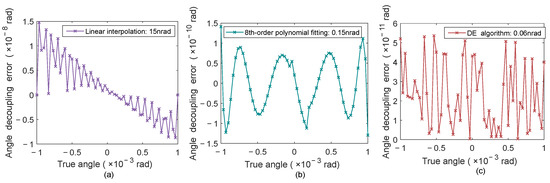
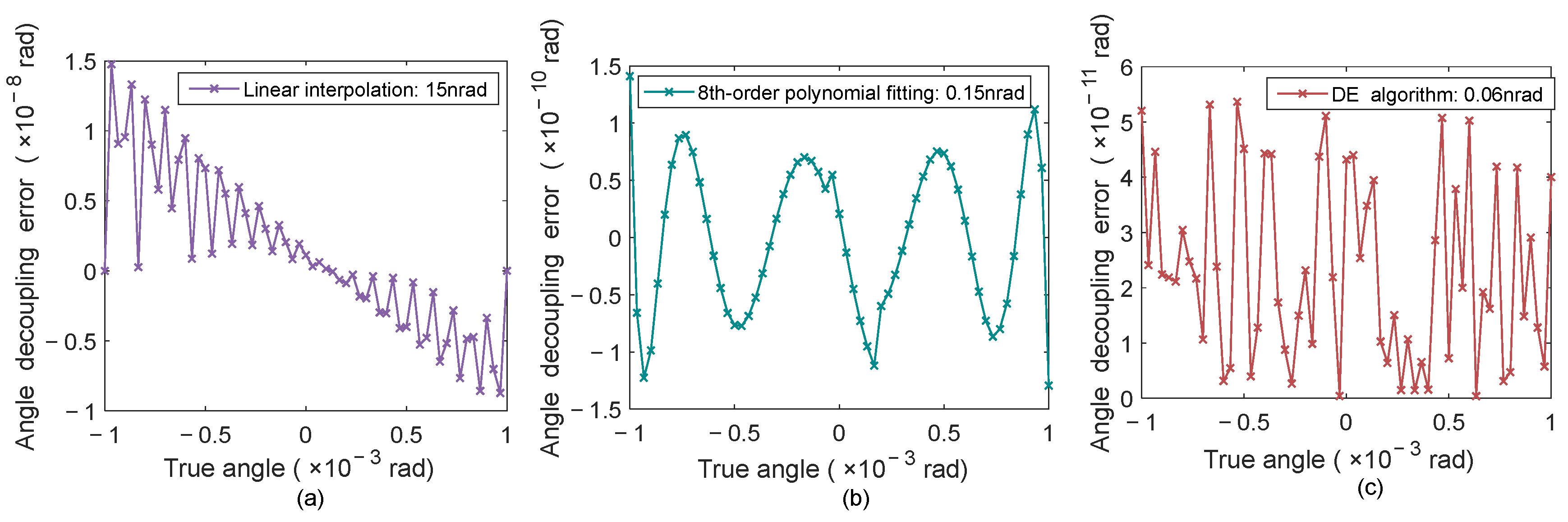
Figure 3 illustrates three different nonlinear decoupling algorithms. Figure 3a presents the linear interpolation method, Figure 3b shows the polynomial fitting method, and Figure 3c depicts the angle decoupling approach based on differential evolution (DE). Under identical system parameters and over an angular range of ±1 mrad, the maximum demodulation errors of the three methods are 15 nrad, 0.15 nrad, and 0.06 nrad, respectively. Compared with data-driven fitting approaches, such as linear interpolation and polynomial fitting, the DE algorithm provides higher accuracy without requiring calibration datasets, since it directly solves the physical forward model of DWS. These results motivate using the DE algorithm as the base framework for nonlinear inversion.
Figure 3.
Comparison of Angle Decoupling Errors of Nonlinear Algorithms. (a) Angular decoupling error of the linear interpolation method. (b) Angular decoupling error of the polynomial fitting method. (c) Angular decoupling error of the differential evolution (DE) algorithm.
For the nonlinear implicit relationship between phase and angle in DWS, the DE algorithm can be employed to iteratively estimate the angle by minimizing the discrepancy between predicted and measured phase values. However, when applied to high-precision nonlinear inversion problems, the standard DE algorithm exhibits several intrinsic limitations related to its search dynamics. First, premature convergence frequently occurs due to the gradual reduction of solution diversity in the search space, causing individuals to cluster around suboptimal regions. Once diversity diminishes, mutation operations based on inter-individual differences lose effectiveness, and the search becomes trapped near local optima. Second, the slowdown observed in later iterations is associated with reduced population variance, which weakens differential perturbations and decreases the effective search step size, ultimately leading to stagnation of convergence.
Moreover, the performance of conventional DE is highly sensitive to static control parameters such as the mutation factor F and the crossover probability Cr. The mutation factor F acts as the scaling coefficient of the differential vector and controls its contribution to the donor vector. A smaller F results in a donor vector closer to the target vector, whereas a larger F increases the influence of the differential perturbation. When F = 0, the donor vector becomes identical to the target vector, meaning that no evolutionary perturbation is introduced and the search remains at the previous generation’s solution. When F = 1, the donor vector is determined jointly by the target vector and the full differential vector. The crossover probability Cr determines whether each dimension of the trial vector is inherited from the target vector or the donor vector. A larger Cr increases the likelihood that components are inherited from the donor vector, thereby enhancing variation. When Cr = 1, the trial vector is completely inherited from the donor vector; when Cr = 0, the trial vector is identical to the target vector, meaning that no new mutation information is introduced in the current iteration. Fixed parameter settings cannot adapt to the evolving search landscape, where early stages require broad exploration while later stages demand stable local refinement.
Consequently, inappropriate parameter configurations may introduce excessive randomness that delays convergence or insufficient diversity that leads to stagnation. These issues indicate that improving nonlinear DWS angle inversion requires coordinated adjustment of both control parameters and mutation strategies.
3. Strategy-Enhanced Differential Evolution for Angle Demodulation
3.1. Standard DE Framework
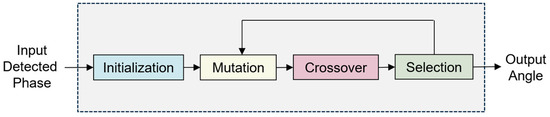
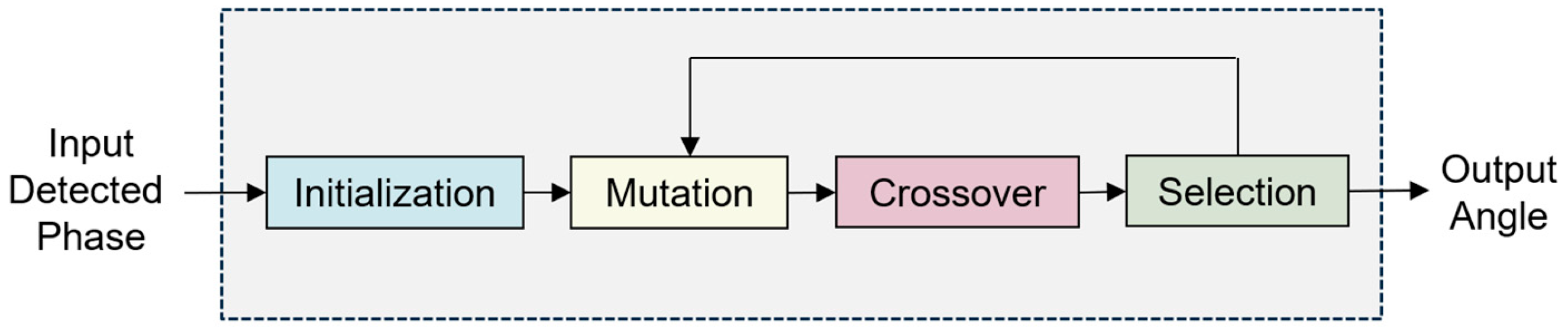
Differential Evolution (DE) is a stochastic optimization algorithm based on an evolutionary loop [28,29,30]. It evolves a population of candidate solutions through mutation, crossover and selection, and is effective for nonlinear, multi-dimensional and derivative-free optimization problems. It enables accurate inversion of the beam tilt angle from the DWS differential phase, as illustrated in Figure 4. The core concept of DE originates from Darwin’s principle of natural selection—survival of the fittest. The algorithm performs mutation by exploiting differential information among candidate solutions in the search space, followed by crossover operations governed by probabilistic rules, and finally updates the candidate solutions through a greedy selection mechanism. In DE, the original vector selected for mutation is referred to as the target vector. The vector generated through differential mutation is called the donor vector, which serves as an intermediate vector. By recombining the target vector and the donor vector through crossover, a trial vector is produced. A greedy selection process is then applied to choose the vector with better fitness between the target vector and the trial vector, which is retained for the next evolutionary iteration. The main control parameters of the DE algorithm include the population size NP, the mutation factor F in the mutation strategy, and the crossover probability Cr in the crossover operation.
Figure 4.
Principle of the Differential Evolution Algorithm.
3.1.1. Initialization
In the DE algorithm, each candidate solution is represented by a D-dimensional vector. Let NP denote the population size and G is the generation index. The individual can be expressed as , and the population can be represented as . During population initialization (G = 1), it is desirable to cover the entire search space as uniformly as possible. Therefore, the initial individuals are generated using a uniformly distributed random function:
where and denote the upper and lower bounds of the search space, respectively, and is a uniformly distributed random number in the interval (0, 1).
3.1.2. Mutation
A donor vector is generated by adding the weighted difference of two randomly selected individuals to a base vector:
where denotes the indices of three individuals randomly selected from the population, satisfying . is the target vector, represents the donor vector associated with individual , and is the differential vector. The corresponding scaling coefficient, referred to as the mutation factor F, determines the contribution of the differential vector to the mutation operation.
3.1.3. Crossover
A trial vector is generated by combining the donor vector and the target vector. For each dimension of the trial vector, a random number is compared with the crossover probability to determine whether the corresponding component is inherited from the target vector or from the donor vector. The crossover operation is performed as follows:
where denotes the crossover probability, which guarantees that the trial vector differs from the target vector in at least one dimension.
3.1.4. Selection
The vector with better fitness is selected to enter the next generation and participate in subsequent evolution. This process can be implemented using the following equation:
where the selection condition for the trial vector is set to rather than . This choice ensures that, even when the fitness value remains unchanged, the target vector may still be replaced by the trial vector, thereby reducing the likelihood of convergence stagnation.
3.2. Tournament-Selection-Based Mutation Strategy
Although the standard DE mutation strategy “DE/rand/1” preserves population diversity via random parent selection, the lack of directional guidance significantly impairs convergence efficiency in high-precision inverse problems, notably nonlinear DWS angle demodulation. Furthermore, fixed control parameters, specifically the mutation factor F and the crossover probability Cr, cannot adapt to the evolving search landscape, leading to either excessive exploration in early stages or premature convergence near local optima.
These limitations indicate that effective wide-range DWS angle inversion requires strategy-level adaptation of search behavior, rather than simple parameter adjustment. To this end, the proposed BiTsDE algorithm introduces a tournament-selection-guided mutation strategy, which biases the base vector toward high-quality individuals while preserving randomness in the differential vectors to maintain population diversity.
The procedure is defined as follows:
- Randomly select 2–5 candidate solutions from the current search space as tournament candidates;
- Choose the solution with the best fitness among these candidates as the base vector for mutation;
- Randomly select two additional solutions from the remaining search space to construct the differential vector, thereby preserving solution diversity.
The mutation operation itself follows Equation (9). By biasing the base vector toward high-quality solutions while retaining randomness in the differential vectors, this strategy guides the mutation direction toward promising regions of the search space without sacrificing diversity, thereby accelerating convergence and improving search stability.
3.3. Inheritance-Based Mutation and Crossover Factors
In conventional DE algorithms, the mutation factor F and the crossover probability Cr are usually treated as static or independently tuned control parameters. Such parameter-centric designs lack continuity across generations and fail to exploit valuable historical search information. As a result, the algorithm may exhibit unstable search trajectories, oscillatory behavior near promising regions, or premature stagnation when diversity decreases.
To address this issue, the proposed BiTsDE framework introduces an inheritance-based parameter control mechanism, in which F and Cr are not adjusted in isolation but are instead propagated across generations as evolutionary memory. This design allows the search process to retain beneficial evolutionary trends while still permitting controlled stochastic perturbations to maintain adaptability.
A convergence indicator k is defined according to Equation (14) to characterize the current evolutionary state of the population. Rather than serving as a direct tuning coefficient, k functions as a search-state descriptor, distinguishing between global exploration and local refinement phases.
Here, denotes the convergence threshold of the phase error, and represents the optimal phase error obtained in the current iteration; these are used to construct an adaptive weighting factor . Given the precision requirements of DWS, achieving angular decoupling at the nanoradian level requires phase measurement accuracy on the order of microradians. Therefore, is typically set to 1 × 10⁻⁷. During the convergence process, ranges from 1 × 10⁻⁷ to 1, leading to taking values in the interval (0, 1). Upon convergence, when , the corresponding weighting factor approaches .
3.3.1. Mutation Factor Inheritance
When the BiTsDE algorithm approaches the convergence stage with k < 0.2, a fine-grained search is required in the vicinity of the optimal solution. At this stage, the mutation factor in the current iteration inherits the value of from the previous generation with a small perturbation applied, and is expressed as follows:
This inheritance mechanism preserves favorable convergence directions while permitting fine adjustments, thereby stabilizing the search process in the vicinity of the optimum.
When the BiTsDE algorithm is in the global exploration stage with k ≥ 0.2, the mutation factor in the current iteration is assigned a larger mutation strength to enhance the ability to escape local optima. It is expressed as follows:
This design increases population diversity and enhances the ability to escape local optima, ensuring sustained global exploration.
3.3.2. Crossover Factor Inheritance
The crossover factor Cr controls the degree of information exchange between the trial vector and the target vector. When Cr = 0, the offspring completely inherits the parent vector, whereas when Cr = 1, the offspring is entirely generated from the donor vector. In this work, a dual-mode crossover factor mechanism is proposed.
During the convergence stage, the crossover factor Cr in the current iteration inherits the value from the previous generation, denoted as Crprev. This strategy preserves the stability of the search direction and prevents the disruption of well-adapted genetic structures. It is expressed as follows:
Conversely, in the global exploration stage, the crossover factor Cr is assigned a relatively large random value to promote information exchange among population members and enhance global exploration capability. The crossover operation is described as follows:
The pseudocode of the BiTsDE algorithm based on inheritance and tournament selection, in which the symbols used are defined as follows, is presented in Algorithm 1.
- NP: population size, i.e., the number of individuals in each generation;
- Gmax: maximum number of iterations;
- F: fitness convergence threshold;
- Cr: crossover probability used to generate the trial vector;
- αj: the j-th individual, representing a candidate angle;
- : fitness function, defined as the absolute error between the predicted phase and the measured target phase.
| Algorithm 1: Proposed BiTsDE Algorithm for Phase-Angle Decoupling | |
| Input: Population size NP, bounds [xmin, xmax], max iteration Gmax, tolerance ε. | |
| Output: Best solution α*, predicted phase φ(α*) | |
| 1. | Initialize population ; |
| evaluate ; | |
| set best . | |
| 2. | For g = 1 to Gmax do |
| 2.1 Update F and Cr dynamically using . | |
| 2.2 For j = 1 to NP do | |
| (a) Tournament select parent , choose , ; | |
| (b) Mutation: , clip to ; | |
| (c) Crossover: u = binomial_crossover (α, v, Cr); | |
| (d) If then | |
| update , ; update if improved. | |
| 2.3 If then break. | |
| 3. | Return α*, φ(α*). |
The main procedure of the BiTsDE algorithm is summarized as follows. In each generation, a base vector is first selected from the population using tournament selection, after which two additional and distinct individuals are randomly chosen. The mutation operation is then performed according to Equation (9) to generate a donor vector, and boundary constraints are applied to ensure solution feasibility. Subsequently, a binomial crossover operation combines the donor vector with the parent individual to produce a trial vector. Selection is carried out using a greedy criterion: if the trial vector exhibits better fitness, it replaces the parent individual in the next generation.
For parameter control, a convergence indicator k is introduced according to Equation (14), where f* denotes the current best fitness value. When k is small, the algorithm inherits the parameters from the previous generation to maintain convergence stability; when k is large, the mutation factor F and crossover probability Cr are re-adjusted to enhance population exploration. This adaptive mechanism effectively balances convergence and diversity, thereby improving search efficiency. Overall, the BiTsDE algorithm integrates differential evolution with tournament selection and dynamic parameter control. By strengthening local search capability in the vicinity of high-quality solutions while preserving global exploration ability, the algorithm achieves higher-precision decoupling from phase to angle in DWS.
4. Simulation Analysis and Experimental Validation
4.1. Simulation Results
4.1.1. Convergence Characteristics
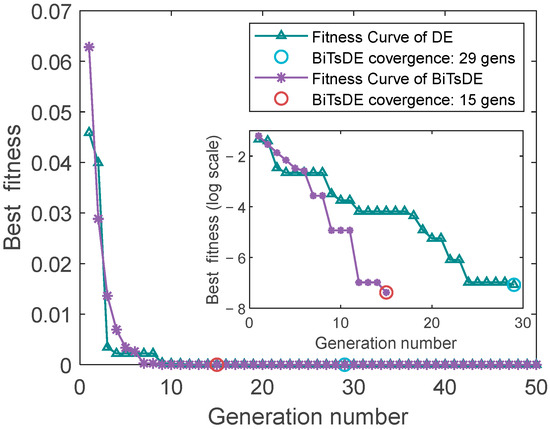
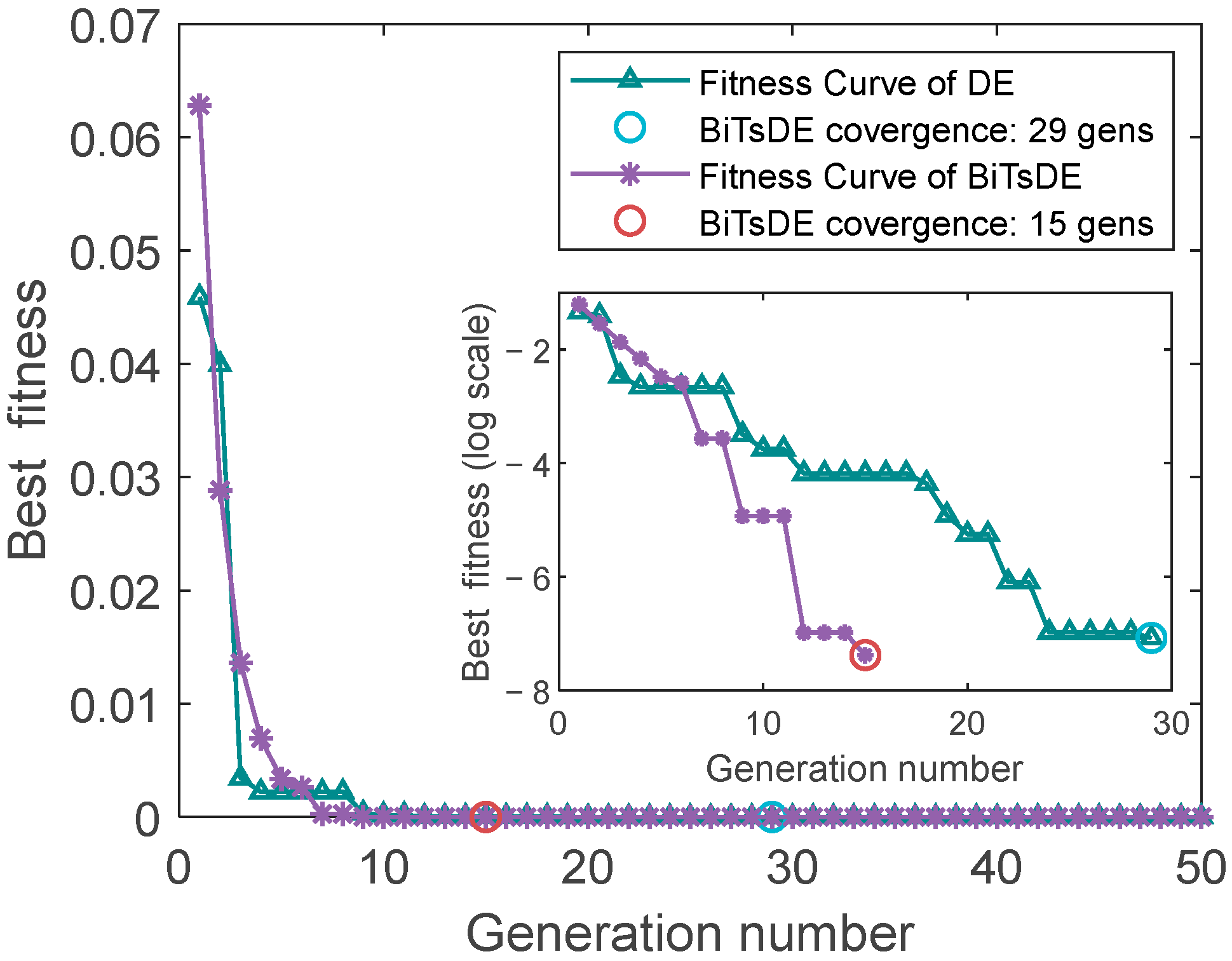
To evaluate the effectiveness of the proposed strategy-level improvements, the convergence behaviors of the standard DE algorithm and the BiTsDE framework were compared under identical initialization and target phase conditions. Figure 5 illustrates the evolution of the objective function value over iterations. To better highlight the differences in early-stage convergence behavior, a logarithmic-scale subplot is provided. The results show that the standard DE algorithm converges at approximately the 29th generation, exhibiting rapid initial progress but a pronounced slowdown in later stages. This behavior is consistent with the known limitation of random-parent mutation and fixed control parameters, which fail to maintain efficient search dynamics as the population diversity decreases.
Figure 5.
Convergence Process of the Objective Function in BiTsDE and DE Algorithms.
In contrast, the BiTsDE algorithm reaches convergence within only 15 generations, despite starting from a lower initial fitness. This accelerated convergence arises from the tournament-guided mutation strategy, which biases the search direction toward high-quality regions while retaining sufficient diversity through stochastic differential vectors. As a result, the search trajectory becomes more directional and efficient compared with the purely random mutation scheme of standard DE.
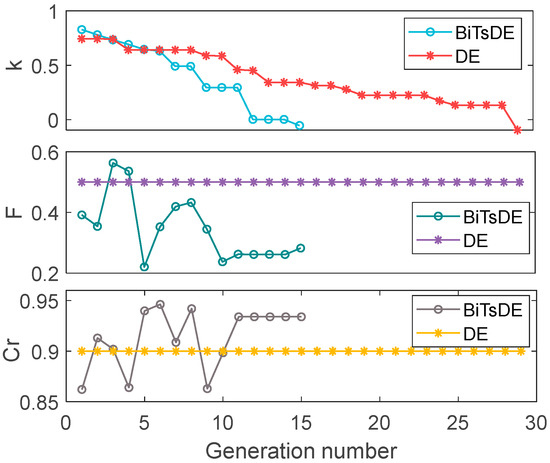
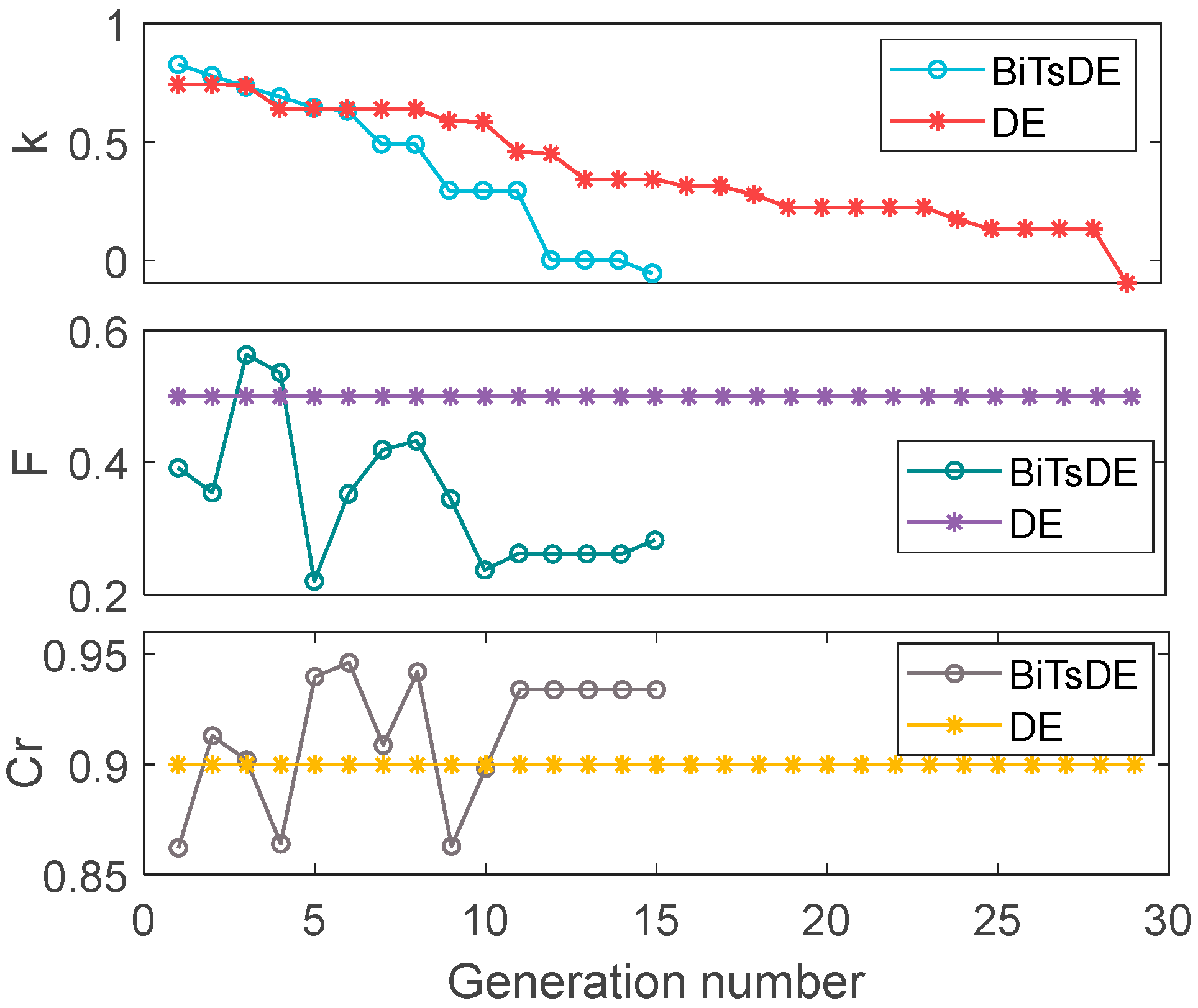
Figure 6 further presents the evolution of the mutation factor F and crossover factor Cr. In the standard DE algorithm, both parameters remain fixed throughout the optimization process. In contrast, the proposed BiTsDE framework exhibits state-dependent inheritance behavior: during early iterations, larger parameter values promote exploration, whereas in later stages, inherited parameter values stabilize local refinement. This demonstrates that the proposed inheritance mechanism functions as an evolutionary memory, enabling smooth transition from exploration to exploitation without abrupt parameter shifts.
Figure 6.
Variations in Control Parameters for BiTsDE and DE Algorithms.
These results verify that the proposed strategy-level modifications improve convergence efficiency by enhancing search directionality, parameter continuity, and population diversity preservation.
4.1.2. Robustness and Statistical Performance
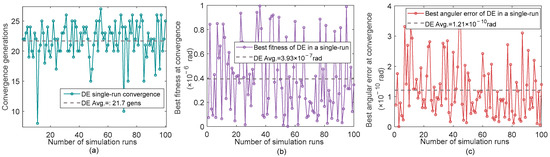
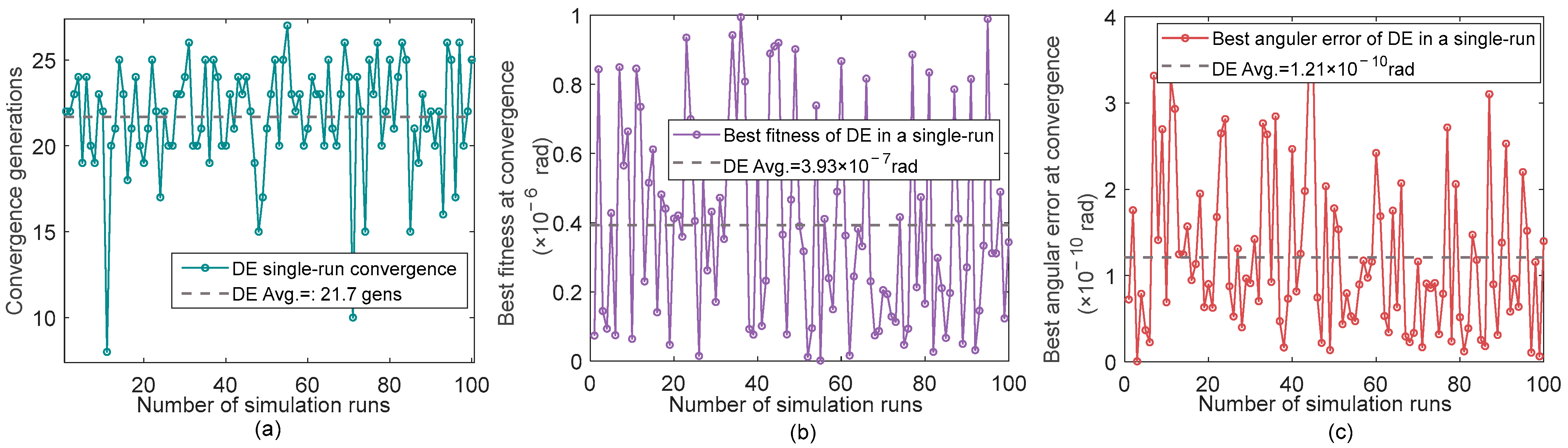
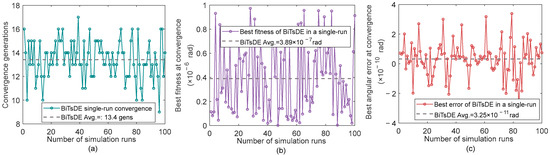
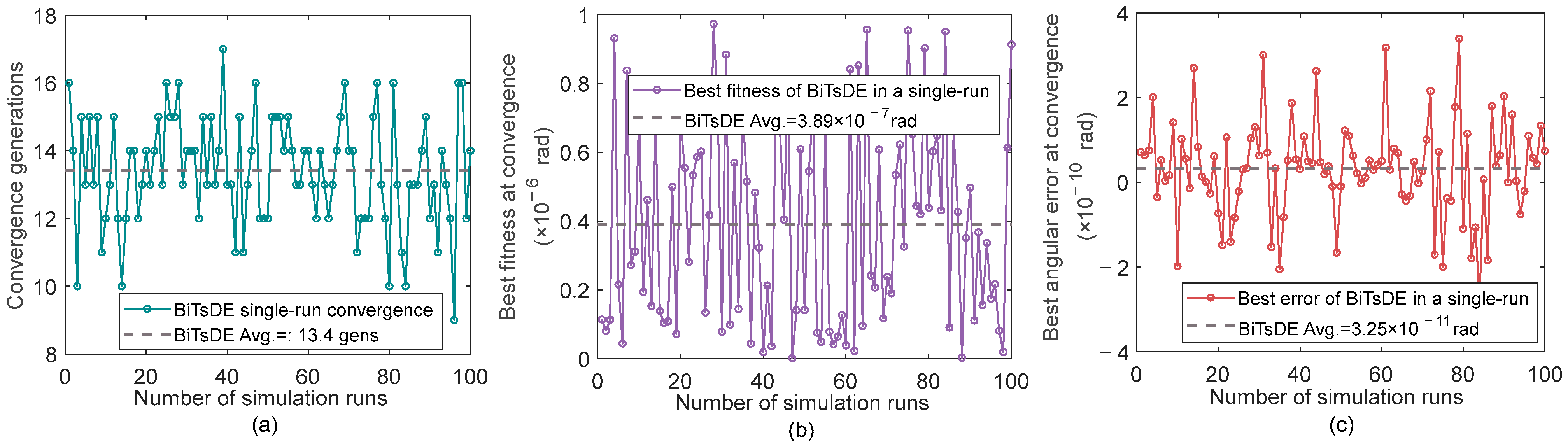
To evaluate the robustness of the proposed strategy-level search framework under measurement noise, 100 independent Monte Carlo simulations were performed with Gaussian phase noise added to the input signal. The statistical performance of the BiTsDE algorithm was compared with that of the standard DE algorithm under identical conditions. Figure 7 summarizes the statistical results of the standard DE algorithm, including (a) the number of generations required for convergence, (b) the best fitness value achieved, and (c) the angular error at convergence. Figure 8 presents the corresponding distributions for the BiTsDE algorithm.
Figure 7.
Repeated simulations of the DE algorithm. (a) Convergence generation of the DE algorithm. (b) Best fitness at convergence of the DE algorithm. (c) Best angular error at convergence of the DE algorithm.
Figure 8.
Repeated simulations of the BiTsDE algorithm. (a) Convergence generation of the BiTsDE algorithm. (b) Best fitness at convergence of the BiTsDE algorithm. (c) Best angular error at convergence of the BiTsDE algorithm.
The data reveals that BiTsDE exhibits a significantly narrower distribution of convergence generations compared with standard DE. This reduction in variance indicates that the proposed inheritance-based control mechanism effectively stabilizes the evolutionary trajectory by preserving favorable search directions across generations. In contrast, the standard DE algorithm, which lacks intergenerational parameter continuity, shows larger fluctuations in convergence speed due to its fully stochastic mutation behavior. In terms of solution accuracy, the BiTsDE algorithm achieves a 73.14% reduction in angular error, reaching an average error of 0.03 nrad. This improvement is attributed to the tournament-guided mutation strategy, which increases the probability that mutation steps are directed toward high-quality regions while still maintaining diversity through stochastic differential vectors. As a result, the search process avoids both premature stagnation and excessive random wandering. Moreover, the best fitness values obtained by BiTsDE are consistently lower and less dispersed than those of the standard DE algorithm. This indicates that the strategy-level balance between exploration and exploitation, enabled by inheritance and tournament selection, enhances both convergence stability and solution reliability under noisy conditions.
The proposed BiTsDE framework not only accelerates convergence but also improves robustness by reducing sensitivity to noise-induced perturbations, which is critical for high-precision nonlinear inversion in DWS applications.
4.2. Experimental Verification
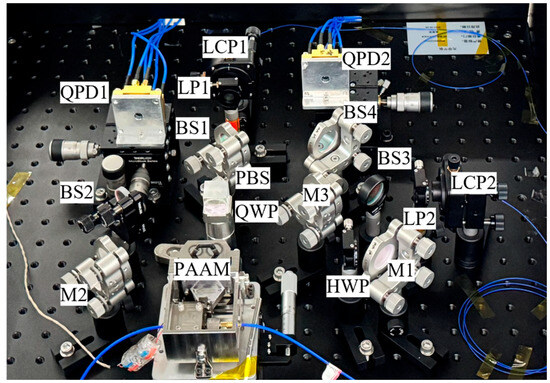
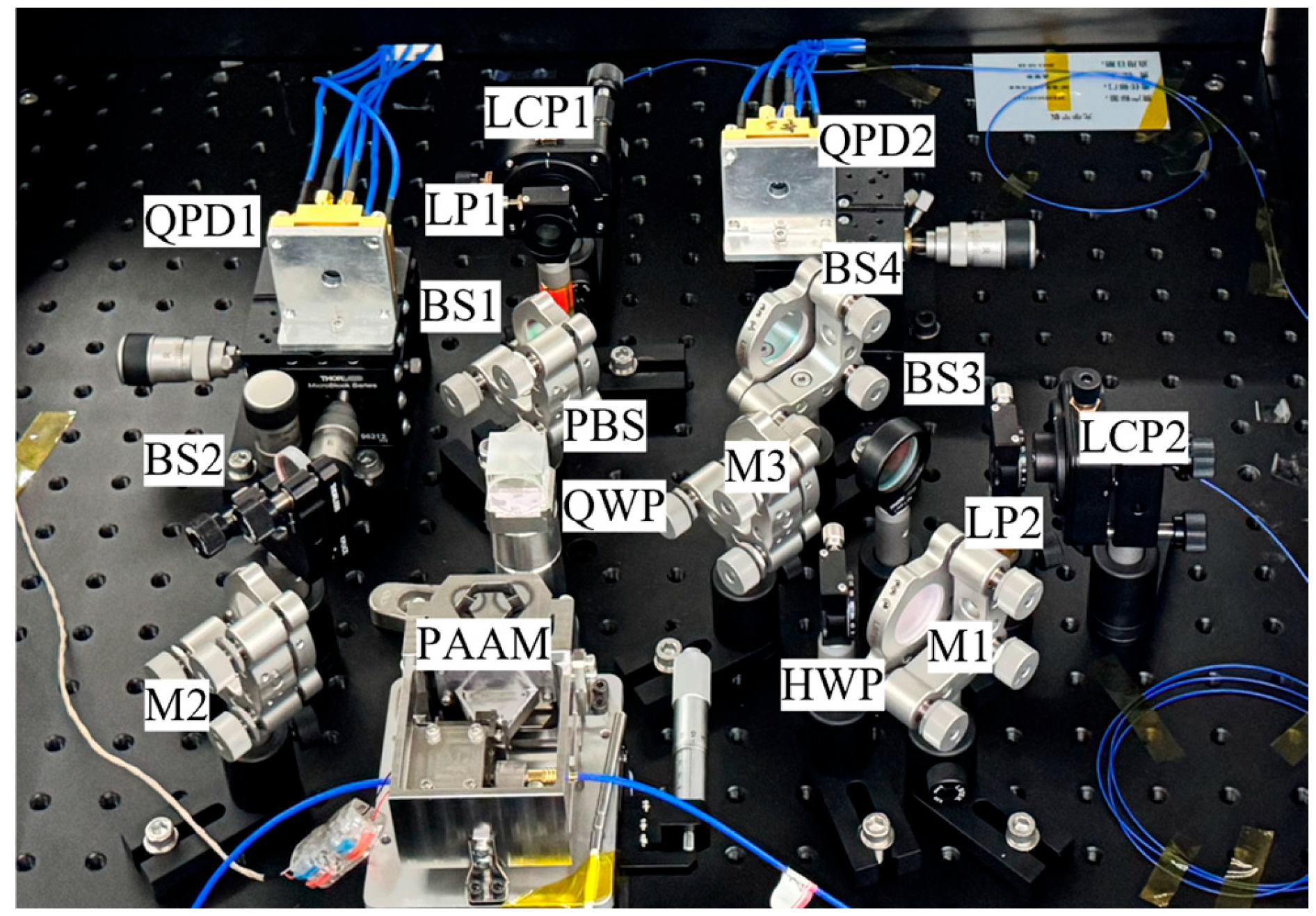
To experimentally validate the effectiveness of the proposed BiTsDE algorithm in wide-range DWS angle demodulation, an optical heterodyne interferometric setup was constructed as depicted in Figure 9. The Gaussian beams with identical polarization states were combined on a QPD to generate the differential phase signal. The optical configuration parameters were matched to those used in simulation to ensure physical consistency of the nonlinear inversion model. Specifically, the Gaussian beam waist was 0.41 mm, the QPD aperture was 1.20 mm, the slit width was 40 μm, the propagation distance was 492 mm, and the pivot-to-QPD distance was 282 mm with a lateral misalignment of 21 μm.
Figure 9.
DWS Heterodyne Interferometric Optical System.
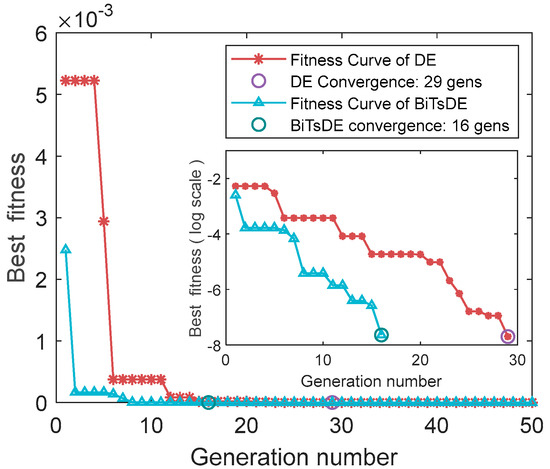
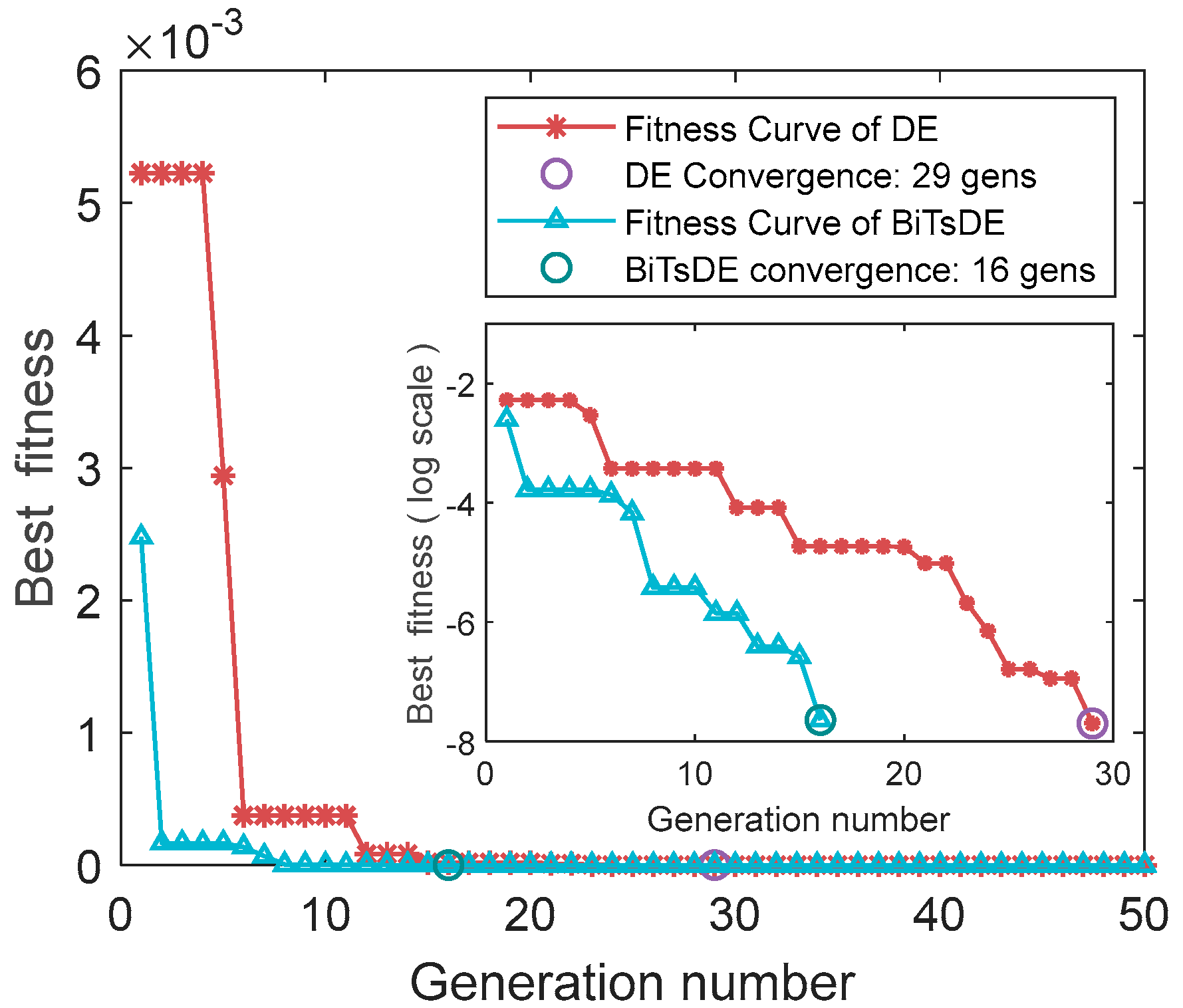
A calibrated capacitive actuator was used to set the target angular displacement to 600 μrad, and the measured DWS phase was subsequently adopted as the input for both the standard DE algorithm and the proposed BiTsDE framework. The fitness convergence threshold was chosen as 1 × 10⁻⁷ rad, corresponding to a theoretical angular resolution of approximately 0.1 nrad based on the linear DWS sensitivity. Figure 10 presents the iterative evolution of the objective function. A logarithmic-scale subplot is included for clearer visualization. The results show that the standard DE algorithm converges in approximately 29 generations, whereas BiTsDE reaches convergence at the 16th generation. This improvement in convergence speed is attributed to the tournament-guided mutation strategy, which directs the search toward high-fitness regions, and the inheritance-based parameter control, which stabilizes the search trajectory near convergence. These two mechanisms jointly enhance search efficiency without introducing instability.
Figure 10.
Iterative Process of the Objective Function in BiTsDE and DE Algorithms.
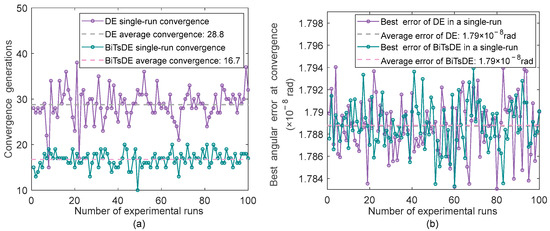
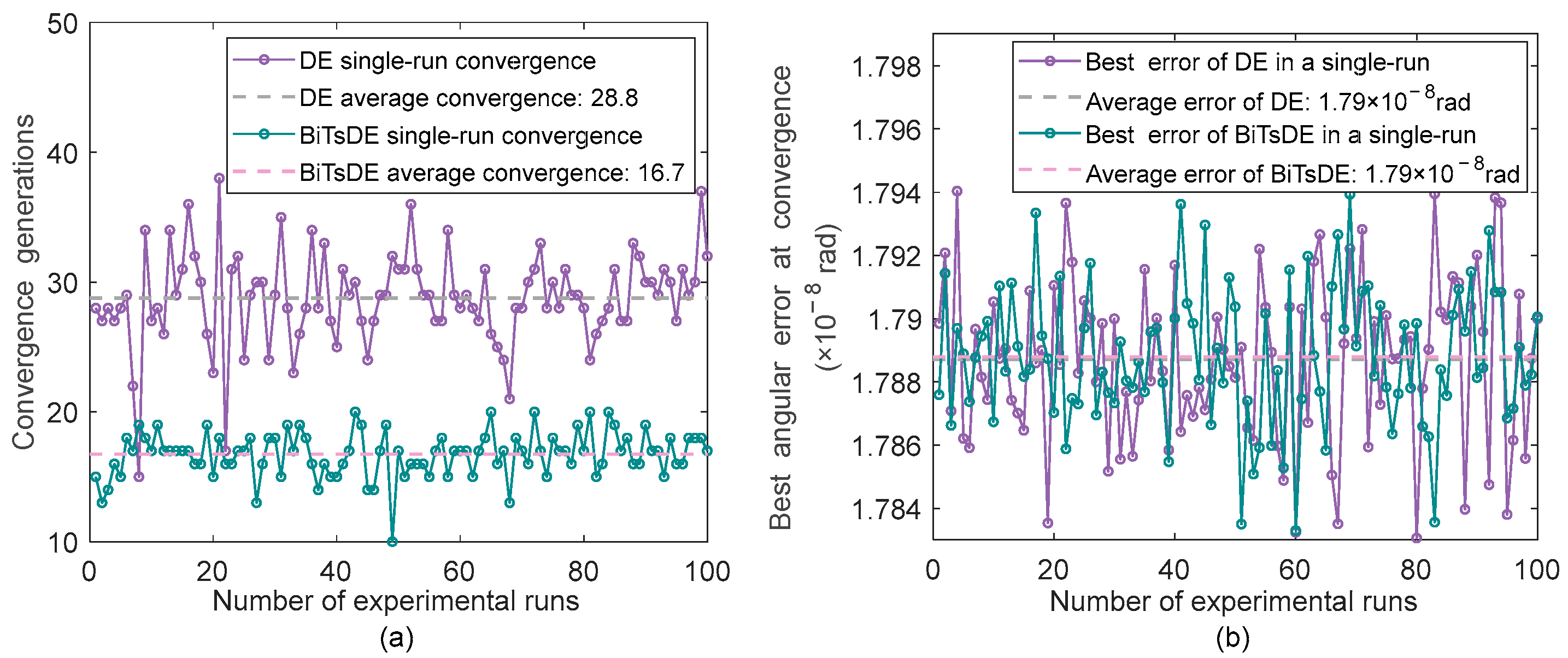
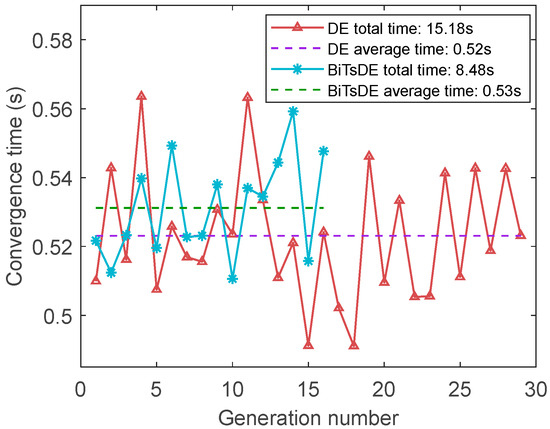
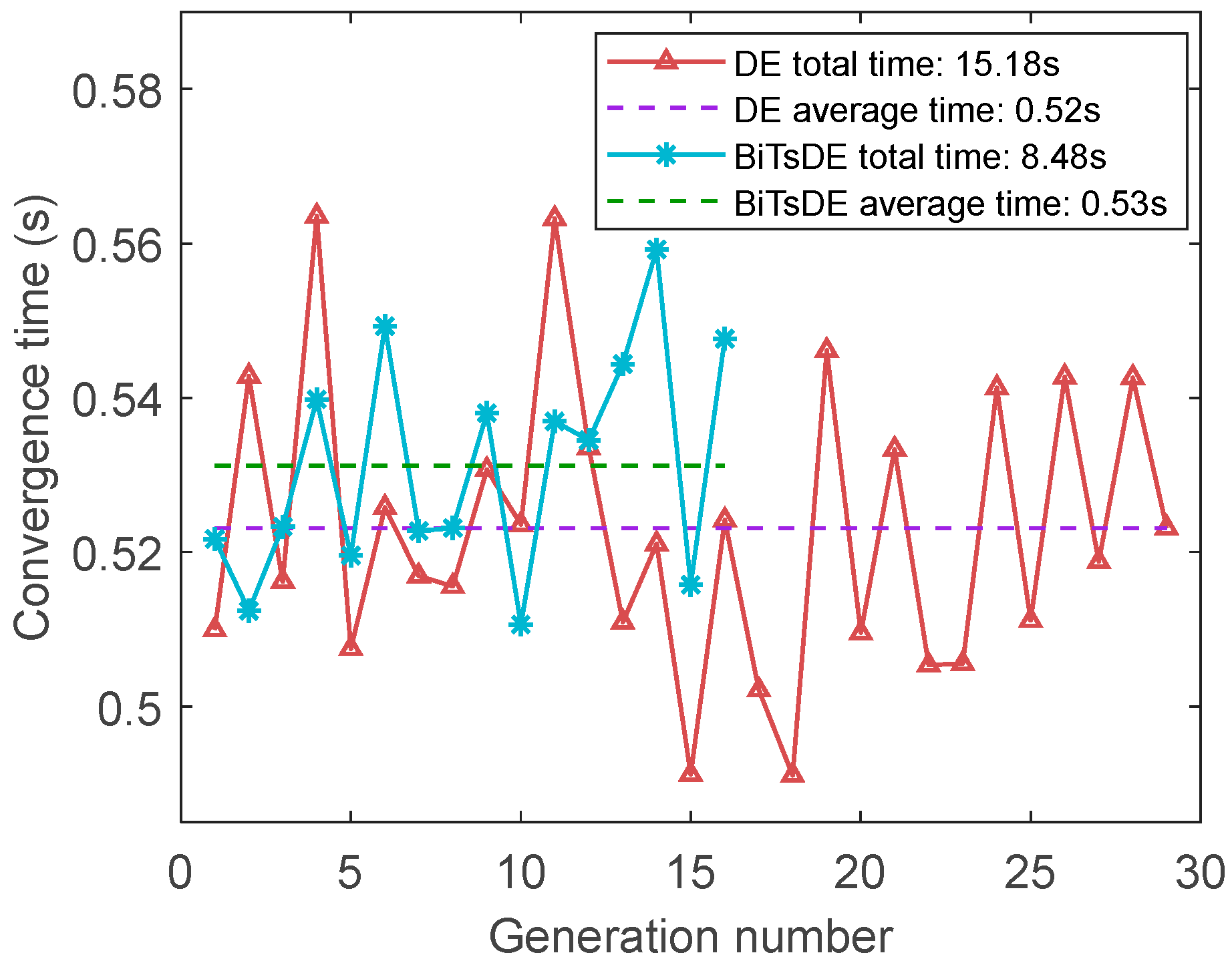
To quantitatively assess performance, the angle demodulation experiment was repeated 100 times under identical conditions. The statistical distributions of angular error and convergence generations are shown in Figure 11. Compared with the standard DE algorithm, the proposed BiTsDE framework reduces the average convergence generation from 28.8 to 16.7, corresponding to a 42.01% improvement in convergence efficiency. The corresponding convergence time is shown in Figure 12. The proposed BiTsDE algorithm achieves convergence within 8.48 s, satisfying the 10 s real-time requirement of the space-based gravitational-wave detection Taiji mission.
Figure 11.
Repeat Experiments of BiTsDE Algorithm and DE Algorithm. (a) Convergence generations over 100 repeated experiments. (b) Best angular error at convergence over 100 repeated experiments.
Figure 12.
Convergence time of angle decoupling.
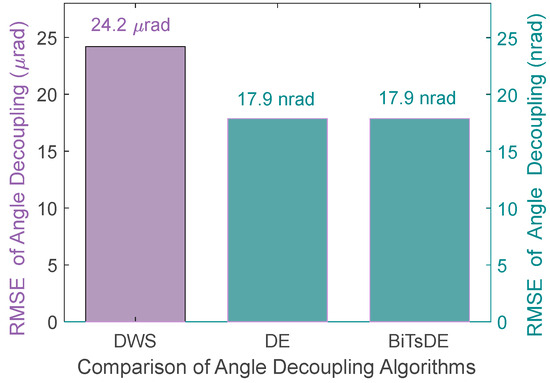
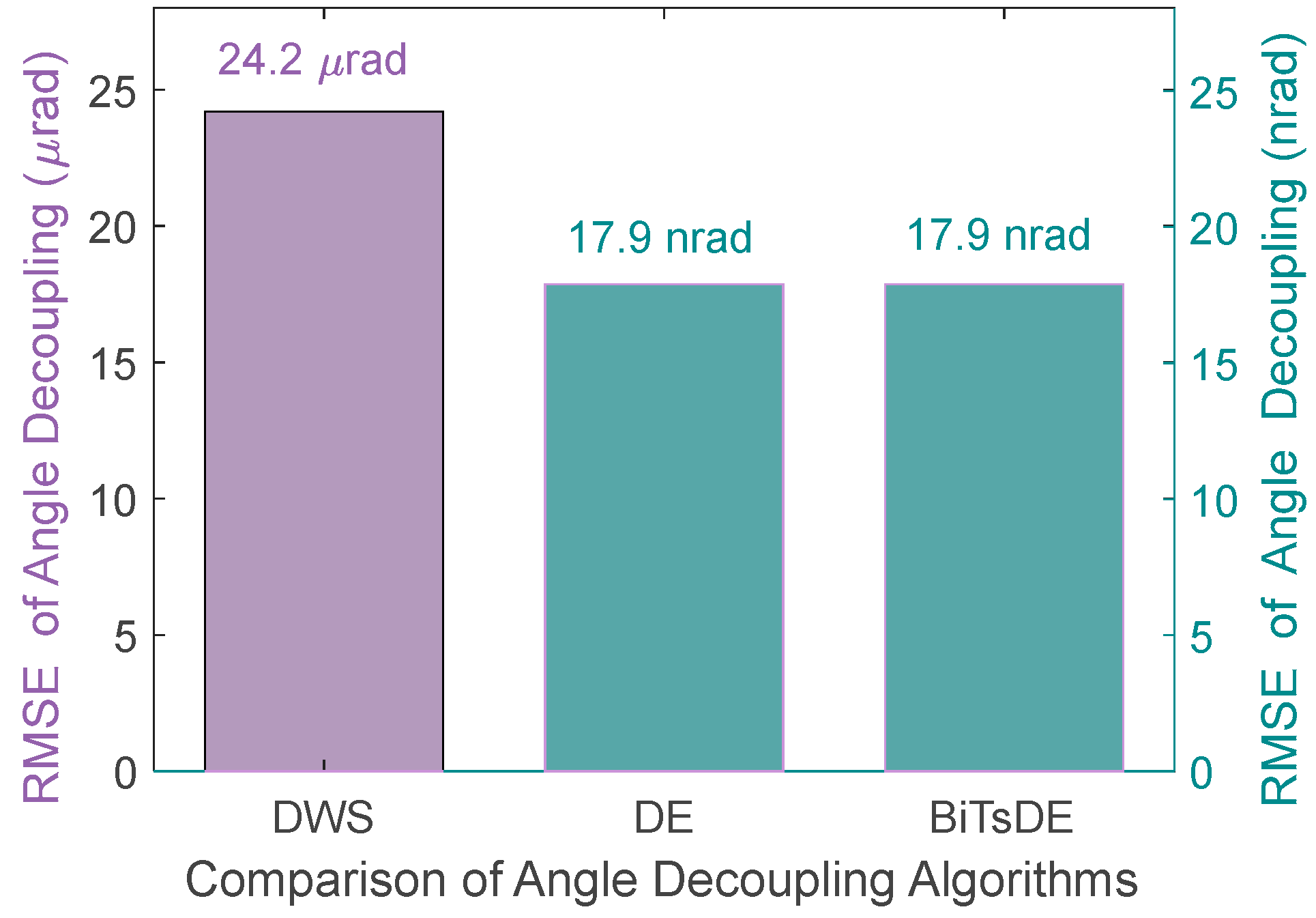
In Figure 11b, the final demodulated angular errors obtained using both evolutionary algorithms are approximately 17.9 nrad. Nevertheless, both algorithms dramatically outperform the classical linear DWS demodulation approach. As shown in Figure 13, the angular measurement error is reduced from 24.2 μrad (linear DWS) to 17.9 nrad, corresponding to an improvement of 99.9%.
Figure 13.
Large-Angle Decoupling Error for Different Algorithms.
This similarity between DE and BiTsDE arises because both methods solve the same nonlinear physics model of DWS under identical experimental noise conditions. After convergence, the optimization residual is predominantly constrained by system-level noise sources. These noise contributions mainly arise from three aspects:
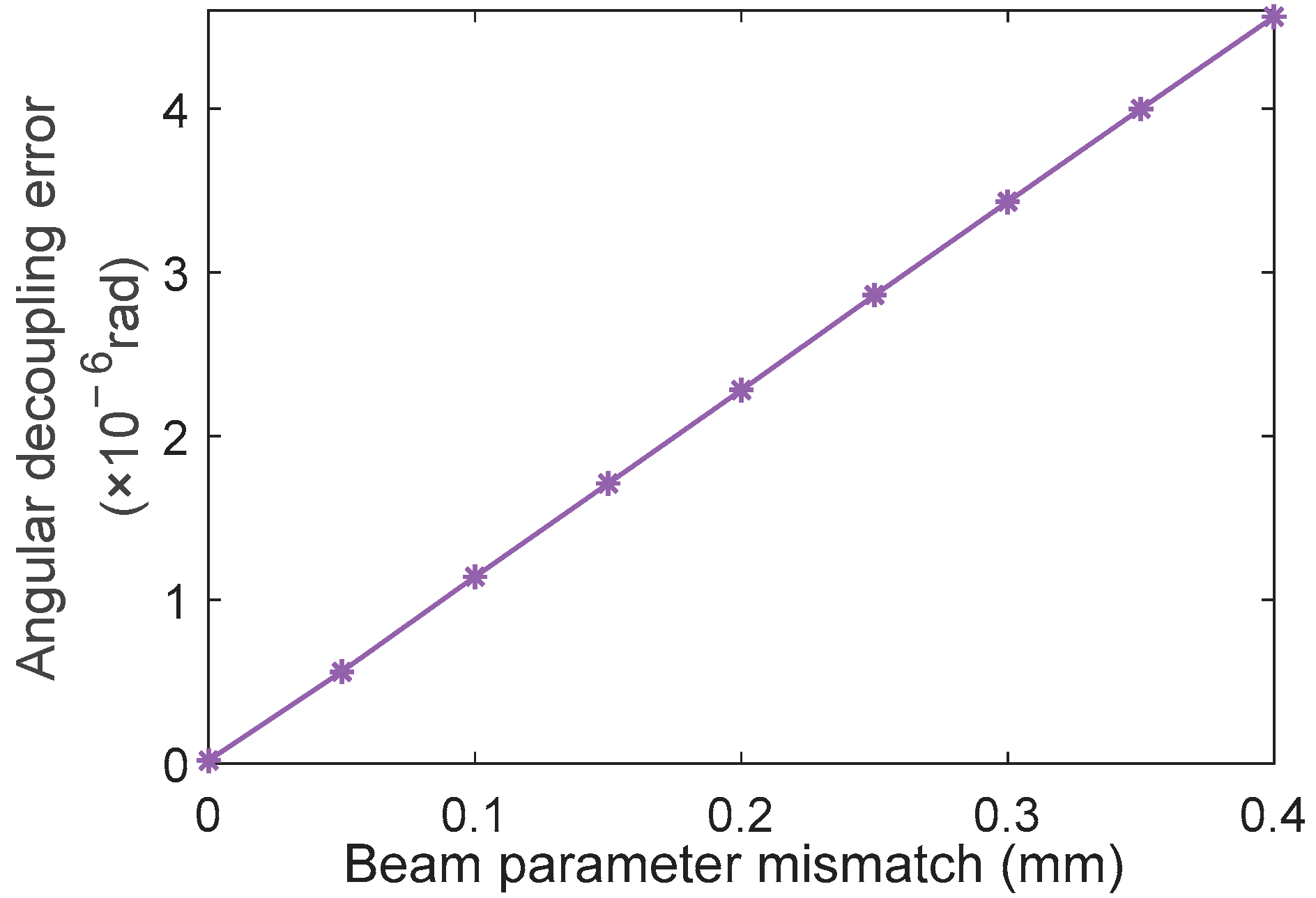
(1) Beam parameter mismatch between the reference and measurement beams introduces model-based systematic error. As shown in Figure 14, when the beam waist radius mismatch is within 0.35 mm, the resulting angular decoupling error remains within the 4 μrad measurement accuracy requirement specified by the Taiji mission.
(2) Although the optical platform is placed inside a vacuum chamber equipped with passive thermal control, long-term operation of electronic components such as the QPD and external temperature fluctuations continuously induce thermal variations within the system.
(3) Even with temperature fluctuations controlled to approximately 60 mK/Hz1/2, this level is still significantly higher than the thermal stability requirement for space-based gravitational wave detection (10 μK/Hz1/2). Consequently, optical components and mechanical mounts remain sensitive to temperature variations. This partially weakens the common-mode rejection capability of DWS and reintroduces sensitivity to thermal disturbances, thereby inducing residual interferometric phase error.
Figure 14.
Effect of beam parameter mismatch on the angular decoupling error of DE and BiTsDE algorithms.
The result highlights the primary contribution of the proposed framework: by introducing strategy-level evolutionary search mechanisms, BiTsDE enables accurate nonlinear inversion that fundamentally overcomes the linear-range limitation of classical DWS demodulation. The inheritance mechanism ensures stable convergence near the optimum, while tournament-guided mutation maintains directional search efficiency, allowing precise angle retrieval even in the presence of nonlinear phase–angle coupling. The experimental results confirm that the proposed strategy-enhanced evolutionary framework enables real-time, high-precision large-angle demodulation in DWS systems, providing a practical solution for beam pointing and alignment tasks where nonlinear effects cannot be neglected.
5. Conclusions
In conclusion, this work addresses the fundamental limitation of the narrow linear measurement range in differential wavefront sensing (DWS) by introducing a strategy-enhanced differential evolution framework, termed BiTsDE, for nonlinear angle inversion. Rather than relying on conventional parameter tuning, the proposed method improves the search mechanism itself through two coordinated strategies: inheritance-based evolutionary memory and tournament-guided elite parent selection. These mechanisms enable adaptive regulation of search dynamics, allowing the algorithm to maintain population diversity during global exploration while stabilizing convergence behavior in the vicinity of the optimum.
Algorithmic-wise, the inheritance mechanism ensures intergenerational continuity of beneficial search trends, reducing parameter volatility and avoiding convergence oscillations. Tournament selection imposes directional mutation pressure toward high-fitness regions without compromising stochastic diversity. Together, these strategy-level enhancements balance exploration and exploitation, suppress search stagnation, and boost convergence efficiency in high-precision nonlinear inverse problems.
In terms of physical measurement, BiTsDE overcomes the constraints of first-order linear approximation in DWS angle demodulation. Simulations show an angular inversion accuracy better than 0.06 nrad within ±1 mrad. Experimental validation in a heterodyne interferometric DWS system confirms that for large-angle measurements up to 600 μrad, BiTsDE reduces demodulation error by 99.9% compared to classical linear DWS, achieving 17.9 nrad precision with a 42.01% faster convergence speed. The proposed BiTsDE algorithm achieves convergence within 8.48 s, satisfying the 10 s real-time requirement of the space-based gravitational wave detection Taiji mission.
These results verify that strategy-enhanced differential evolution serves as an effective nonlinear inversion tool for precision optical metrology, enabling accurate beam pointing retrieval under strong phase-angle nonlinearity. The BiTsDE framework thus provides a practical, scalable solution for wide-range, high-precision angular measurement in advanced interferometric systems.
Author Contributions
Conceptualization, Y.L., D.H., Y.H. and Q.W.; methodology, Y.L.; validation, Y.L., C.F., H.Z., M.Z. and R.G.; formal analysis, Y.L., H.G. and L.L.; writing—original draft preparation, Y.L.; writing—review and editing, Y.L., D.H. and Y.H.; visualization, Y.L., Z.Z. and Q.W.; supervision, C.W.; project administration, C.M., D.H. and Y.H.; All authors have read and agreed to the published version of the manuscript.
Funding
This research was funded by the National Key Research and Development Program of China, grant number 2022YFC2203800.
Institutional Review Board Statement
Not applicable.
Informed Consent Statement
Not applicable.
Data Availability Statement
Data can be shared if relevant researchers have a reasonable need, and they can obtain the data by contacting the corresponding author.
Conflicts of Interest
The authors declare no conflicts of interest. This study was funded by the National Key Research and Development Program of China. The funders had no role in the study design; in the collection, analysis, or interpretation of data; in the writing of the manuscript; or in the decision to publish the results.
References
- Morrison, E.; Meers, B.J.; Robertson, D.I.; Ward, H. Experimental Demonstration of an Automatic Alignment System for Optical Interferometers. Appl. Opt. 1994, 33, 5037. [Google Scholar] [CrossRef] [Scilit] [PubMed]
- Heinzel, G.; Álvarez, M.D.; Pizzella, A.; Brause, N.; Delgado, J.J.E. Tracking Length and Differential-Wavefront-Sensing Signals from Quadrant Photodiodes in Heterodyne Interferometers with Digital Phase-Locked-Loop Readout. Phys. Rev. Appl. 2020, 14, 054013. [Google Scholar] [CrossRef] [Scilit]
- Abbott, B.P.; Abbott, R.; Abbott, T.D.; Abernathy, M.R.; Acernese, F.; Ackley, K.; Adams, C.; Adams, T.; Addesso, P.; Adhikari, R.X.; et al. Observation of Gravitational Waves from a Binary Black Hole Merger. Phys. Rev. Lett. 2016, 116, 061102. [Google Scholar] [CrossRef] [Scilit] [PubMed]
- The LIGO Scientific Collaboration; The Virgo Collaboration; The KAGRA Collaboration; Abbott, R.; Abe, H.; Acernese, F.; Ackley, K.; Adhikari, N.; Adhikari, R.X.; Adkins, V.K.; et al. First Joint Observation by the Underground Gravitational-Wave Detector KAGRA with GEO 600. Prog. Theor. Exp. Phys. 2022, 2022, 063F01. [Google Scholar] [CrossRef] [Scilit]
- Wanner, G. Space-Based Gravitational Wave Detection and How LISA Pathfinder Successfully Paved the Way. Nat. Phys. 2019, 15, 200–202. [Google Scholar] [CrossRef] [Scilit]
- Danzmann, K. LISA Mission Overview. Adv. Space Res. 2000, 25, 1129–1136. [Google Scholar] [CrossRef] [Scilit]
- Hu, W.R.; Wu, Y.L. The Taiji Program in Space for Gravitational Wave Physics and the Nature of Gravity. Natl. Sci. Rev. 2017, 4, 2. [Google Scholar] [CrossRef] [Scilit]
- Jin, X.; Guo, G. Program in Space Detection of Gravitational Wave in Chinese Academy of Sciences. J. Phys. Conf. Ser. 2017, 840, 012009. [Google Scholar] [CrossRef] [Scilit]
- Hu, Y.; Mei, J.; Luo, J. TianQin Project and International Collaboration. Chin. Sci. Bull. 2019, 64, 2475–2483. [Google Scholar] [CrossRef] [Scilit]
- Goswami, S.; Francis, S.P.; Bandikova, T.; Spero, R.E. Analysis of GRACE Follow-On Laser Ranging Interferometer Derived Inter-Satellite Pointing Angles. IEEE Sens. J. 2021, 21, 19209–19221. [Google Scholar] [CrossRef] [Scilit]
- Schütze, D.; Heinzel, G.; Müller, V. Laser Beam Steering for GRACE Follow-On Intersatellite Interferometry. Opt. Express 2014, 22, 24117–24132. [Google Scholar] [CrossRef] [Scilit] [PubMed]
- Massotti, L.; Siemes, C.; March, G.; Haagmans, R.; Silvestrin, P. Next Generation Gravity Mission Elements of the Mass Change and Geoscience International Constellation: From Orbit Selection to Instrument and Mission Design. Remote Sens. 2021, 13, 3935. [Google Scholar] [CrossRef] [Scilit]
- Zhang, Z.; Tong, S.; Lin, P.; Zeng, D.; Yu, X. A μrad Accuracy and nW Detection Sensitivity Four-Quadrant Heterodyne Coherent Angular Measurement System. Photonics 2025, 12, 509. [Google Scholar] [CrossRef] [Scilit]
- Wanner, G.; Heinzel, G. Analytical Description of Interference Between Two Misaligned and Mismatched Complete Gaussian Beams. Appl. Opt. 2014, 53, 3043–3048. [Google Scholar] [CrossRef] [Scilit]
- Duan, H.-Z.; Liang, Y.-R.; Yeh, H.-C. Analysis of Non-Linearity in Differential Wavefront Sensing Technique. Opt. Lett. 2016, 41, 914–917. [Google Scholar] [CrossRef] [Scilit]
- Qian, X.-G.; Cui, Z.; Shi, H.-Q.; Wang, X.; Yao, W.-L.; Gao, R.-H.; Wang, Y.-K. Analysis of Beam Walk in Inter-Satellite Laser Link: Implications for Differential Wavefront Sensing in Gravitational Wave Detection. Appl. Sci. 2024, 14, 5526. [Google Scholar] [CrossRef] [Scilit]
- Liao, F.-J.; Wu, K.-H.; Liu, S.-M.; Zhang, J.-Y.; Ming, M.; Liu, Q.; Duan, H.-Z.; Yeh, H.-C. High-Dynamical-Range Angular Measurement Based on Heterodyne Phase Shifting Interferometry. Opt. Commun. 2024, 555, 130209. [Google Scholar] [CrossRef] [Scilit]
- Yang, F.; Zhang, M.; Ye, W.; Wang, L. Three-Degrees-of-Freedom Laser Interferometer Based on Differential Wavefront Sensing with Wide Angular Measurement Range. Appl. Opt. 2019, 58, 723–728. [Google Scholar] [CrossRef] [Scilit]
- Yu, X.; Gillmer, S.R.; Ellis, J.D. Beam Geometry, Alignment, and Wavefront Aberration Effects on Interferometric Differential Wavefront Sensing. Meas. Sci. Technol. 2015, 26, 125203. [Google Scholar] [CrossRef] [Scilit]
- Schütze, D.; Müller, V.; Heinzel, G. Precision Absolute Measurement and Alignment of Laser Beam Direction and Position. Appl. Opt. 2014, 53, 6503–6507. [Google Scholar] [CrossRef] [Scilit]
- Pant, M.; Zaheer, H.; Garcia-Hernandez, L.; Abraham, A. Differential Evolution: A Review of More Than Two Decades of Research. Eng. Appl. Artif. Intell. 2020, 90, 103479. [Google Scholar] [CrossRef] [Scilit]
- Deshmukh, N.; Vaze, R.; Kumar, R.; Saxena, A. Quantum Entanglement Inspired Grey Wolf Optimization Algorithm and Its Application. Evol. Intell. 2022, 16, 1097–1114. [Google Scholar] [CrossRef] [Scilit]
- Wang, X.; Yu, X. Differential Evolution Algorithm with Three Mutation Operators for Global Optimization. Mathematics 2024, 12, 2311. [Google Scholar] [CrossRef] [Scilit]
- Wissel, L.; Hewitson, M.; Heinzel, G. Measuring the impact of laser relative intensity noise on heterodyne interferometers using differential wavefront sensing. Phys. Rev. Appl. 2024, 22, 044048. [Google Scholar] [CrossRef] [Scilit]
- Li, Y.; Fu, C.; Zhang, H.; Guo, H.; Wei, T.; Zhao, M.; Gao, R.; Wang, Q.; Wang, C.; Han, J.; et al. Suppression of DWS-based Angular Errors via Refined Gaussian Interferometric Models in Space Gravitational Wave Detection. Opt. Express 2025, 33, 40250. [Google Scholar] [CrossRef] [Scilit]
- Lei, M. Research of Misalignment Detection Technology Based on Heterodyne Interferometry. Inst. Opt. Electron. Chin. Acad. Sci. 2021, 62–64. [Google Scholar]
- Gao, R.-H.; Liu, H.-S.; Luo, Z.-R.; Jin, G. Introduction of laser pointing scheme in the Taiji program. Chin. Opt. 2019, 12, 425–431. [Google Scholar] [CrossRef] [Scilit]
- Das, S.; Suganthan, P.N. Differential Evolution: A Survey of the State-of-the-Art. IEEE Trans. Evol. Comput. 2010, 15, 4–31. [Google Scholar] [CrossRef] [Scilit]
- Tanabe, R.; Fukunaga, A. Success-History Based Parameter Adaptation for Differential Evolution. In 2013 IEEE Congress on Evolutionary Computation; IEEE: New York, NY, USA, 2013; pp. 71–78. [Google Scholar]
- Xia, X.; Gui, L.; Zhang, Y.; Xu, X.; Yu, F.; Wu, H.; Wei, B.; He, G.; Li, Y.; Li, K. A Fitness-Based Adaptive Differential Evolution Algorithm. Inf. Sci. 2021, 549, 116–141. [Google Scholar] [CrossRef] [Scilit]

Disclaimer/Publisher’s Note: The statements, opinions and data contained in all publications are solely those of the individual author(s) and contributor(s) and not of MDPI and/or the editor(s). MDPI and/or the editor(s) disclaim responsibility for any injury to people or property resulting from any ideas, methods, instructions or products referred to in the content. |
© 2026 by the authors. Licensee MDPI, Basel, Switzerland. This article is an open access article distributed under the terms and conditions of the Creative Commons Attribution (CC BY) license.