


Abstract
Pavement markings are critical traffic safety facilities that provide continuous and clear visual guidance to road users, thereby supporting traffic order and driving safety. During long-term service, however, white pavement markings are prone to yellowing under ultraviolet (UV) irradiance and elevated temperatures, which may reduce visibility. This study conducted accelerated aging tests on white thermoplastic and two-component pavement markings under four levels of ultraviolet irradiance (0–1.5 W/m2 at 340 nm) and temperature (20–80 °C) to quantitatively characterize the macroscopic evolution of yellowing (YI) under controlled environmental conditions. Generalized linear mixed-effects models (GLMMs) were then used to quantify the effects of UV exposure, temperature, and time on the yellowing behavior of white pavement markings. The results indicate that temperature is a key environmental driver of YI increases. UV irradiance also has a pronounced promoting effect, and the yellowing responses differ markedly between material types. The results clarify how UV irradiance, thermal conditions, and material systems jointly influence the yellowing behavior of white pavement markings, providing a scientific basis for evaluating anti-yellowing performance, improving durability design, and guiding engineering applications under complex environmental conditions.
1. Introduction
Pavement markings provide continuous visual information to road users, including lane boundaries, directional guidance, and traffic regulations, enabling drivers to perceive roadway conditions and traffic rules in a timely manner. Consequently, the effectiveness of pavement markings is highly dependent on their visibility [1]. Adequate visibility ensures that drivers can correctly recognize and interpret pavement markings from a sufficient distance, which is essential for maintaining lane discipline, reducing traffic conflicts, and supporting safe driving behavior [2]. In practice, this requirement is also reflected in roadway marking standards, which emphasize that markings should maintain prescribed colors and adequate conspicuity to fulfill their traffic control function.
The visibility of pavement markings arises from their contrast in color and brightness relative to the road surface [3]. White markings are therefore widely used because of their high reflectance and strong visual contrast. In practical service, however, white markings are more prone to yellowing than yellow markings. This yellowing is an inherent manifestation of material aging and directly reduces the color contrast between the marking and the pavement, thereby diminishing daytime visibility [4]. Because daytime guidance relies strongly on color contrast, yellowing can degrade the legibility of white markings even before severe retroreflectivity loss becomes apparent, motivating the need for color-based performance monitoring. In a study conducted in Arizona [5], changing the centerline color from white to yellow was found to significantly increase crash rates during dawn and dusk periods, as well as under wet pavement or low-visibility conditions. Previous studies have demonstrated that reductions in pavement marking visibility lead to shorter driver detection distances, thereby increasing recognition difficulty and potential safety risks. Pronounced yellowing of white pavement markings can substantially shorten their effective service life, forcing road agencies to adopt more frequent repainting cycles and consequently increasing maintenance costs.
Color stability is increasingly relevant to maintenance and quality control frameworks. Evaluations of red-colored pavement markings for transit lanes in Portland showed that enhanced chromatic contrast improved driver recognition and compliance, highlighting the importance of visual clarity in roadway communication [6]. Similarly, large-scale causal evidence from Seoul indicated that the implementation of colored lane markings resulted in a statistically significant reduction in crash rates, underscoring the safety benefits of improved marking conspicuity [7]. These findings suggest that degradation processes that alter the visual appearance of pavement markings, such as the yellowing of white markings under environmental exposure, may compromise their intended safety function and warrant systematic investigation. Moreover, studies have shown that the intense ultraviolet radiation in plateau environments can significantly impair drivers’ visual characteristics and hazard perception [8,9]. If the visibility of pavement markings further degrades under such extreme conditions, it would exacerbate traffic safety risks in these regions.
White pavement markings are polymer-based materials, and their yellowing is fundamentally an irreversible aging process driven by the combined effects of ultraviolet radiation, heat, oxygen, and moisture during service [10]. For instance, elevated temperatures can accelerate ultraviolet-induced photo-oxidation reactions, while prolonged ultraviolet exposure may increase the material’s sensitivity to temperature variations. Such multivariable-driven aging mechanisms make it difficult for traditional single-factor degradation models to accurately capture the true evolution of yellowing in pavement markings. Driskell et al. [11] further indicated that high temperature and humidity can extend the drying and curing time of marking materials, thereby adversely affecting their long-term durability. Previous studies have demonstrated that UV radiation represents the highest-energy component of the solar spectrum and poses a significant threat to organic materials [12]. UV exposure can directly damage polymeric constituents, leading to material degradation. Pospíšil et al. [13] identified solar UV radiation as a critical environmental factor that degrades coating binders, resulting in deterioration of their physical, chemical, and mechanical properties and ultimately reducing the service performance of pavement markings. Migletz et al. [14], based on a synthesis of prior studies and field investigations, examined the influence of climatic conditions on pavement marking visibility and found that visibility declines markedly with environmental exposure, highlighting climate and environmental factors as key external drivers of long-term visibility loss. Abboud et al. [15] further emphasized that pavement marking application and maintenance schedules should be optimized by jointly considering material service life and cost. Parker et al. [16] evaluated the visibility of white pavement markings under wet pavement and nighttime conditions using retroreflectivity measurements and reported that moisture significantly reduces marking visibility. Similarly, Burns et al. [17] conducted field visibility tests under dry, damp, and rainy conditions and found that marking visibility and recognition distance were substantially reduced under wet conditions, often falling below driver perception requirements. To address durability issues under harsh service environments, Jing Lu et al. [18] investigated cracking and delamination problems of thermoplastic pavement markings in high-altitude regions and improved material performance by incorporating toughening agents, rheology modifiers, and anti-aging additives. Mirabedini et al. [19] and Hadizadeh et al. [20] treated the proportions of resin, pigment, filler, and plasticizer as key variables and applied mixture design methods to optimize thermoplastic marking formulations. Their results demonstrated that optimized formulations significantly improved skid resistance and stain resistance. In addition, Huang et al. [21] and Miao et al. [22] reported that temperature and moisture play critical roles in determining the durability of pavement marking materials. Liu et al. [23] further noted that prolonged exposure to either high or low temperatures is particularly detrimental to the long-term performance of pavement markings.
White pavement markings are primarily composed of polymeric binders, pigments, and functional additives, whose long-term optical performance is strongly influenced by environmental aging processes. Extensive polymer science research has demonstrated that ultraviolet (UV) radiation and elevated temperature can induce coupled photochemical and thermo-oxidative degradation reactions in polymer materials [24,25,26]. Under UV exposure, polymer molecular chains absorb high-energy photons, leading to chain scission, free radical formation, and subsequent oxidation reactions in the presence of oxygen. These processes result in the generation of chromophoric functional groups, such as carbonyl and conjugated double bonds, which are widely recognized as the primary chemical origin of material yellowing. Thermal exposure further accelerates oxidation kinetics and molecular mobility, intensifying degradation reactions and promoting the accumulation of oxidation products. Previous studies have shown that such photo-oxidative and thermo-oxidative mechanisms are directly responsible for color instability, gloss loss, and optical deterioration in polymer-based materials. Therefore, the yellowing behavior observed in white pavement markings under natural environmental conditions can be fundamentally attributed to polymer degradation pathways driven by UV radiation and temperature, providing a clear chemical basis for evaluating aging-induced visibility degradation using colorimetric indicators such as the yellowing index (YI).
A review of existing studies indicates that most research has approached pavement marking durability primarily from a material perspective, focusing on optimizing material composition or incorporating modifiers to improve weather resistance. In parallel, some studies have examined the influence of environmental factors on the degradation of pavement marking visibility. However, these studies have largely addressed the effects of individual factors, such as ultraviolet radiation or temperature, in isolation. In real service conditions, pavement markings are exposed to multiple environmental factors simultaneously, and these factors interact to jointly influence the yellowing behavior of white pavement markings. For key environmental variables such as ultraviolet irradiance and temperature, studies employing multi-level, multi-factor coupled experimental designs to quantitatively distinguish main effects from interaction effects remain limited. This gap restricts a comprehensive understanding of the relative contributions and synergistic mechanisms governing white marking yellowing. To address this limitation, the present study conducts accelerated aging experiments under controlled ultraviolet irradiance and temperature conditions using a multi-gradient, multi-factor experimental framework. The independent effects of ultraviolet radiation, temperature, and exposure time, as well as their interaction effects on the yellowing behavior of white pavement markings, are systematically investigated. By elucidating the yellowing evolution of white pavement markings, this study provides theoretical support for understanding material aging mechanisms and for the development of high-performance marking materials, ultimately contributing to long-term performance assurance and life-cycle management of pavement markings.
2. Materials and Methods
2.1. Experimental Materials
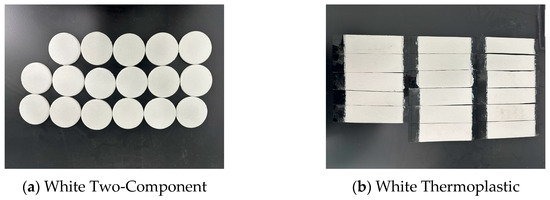
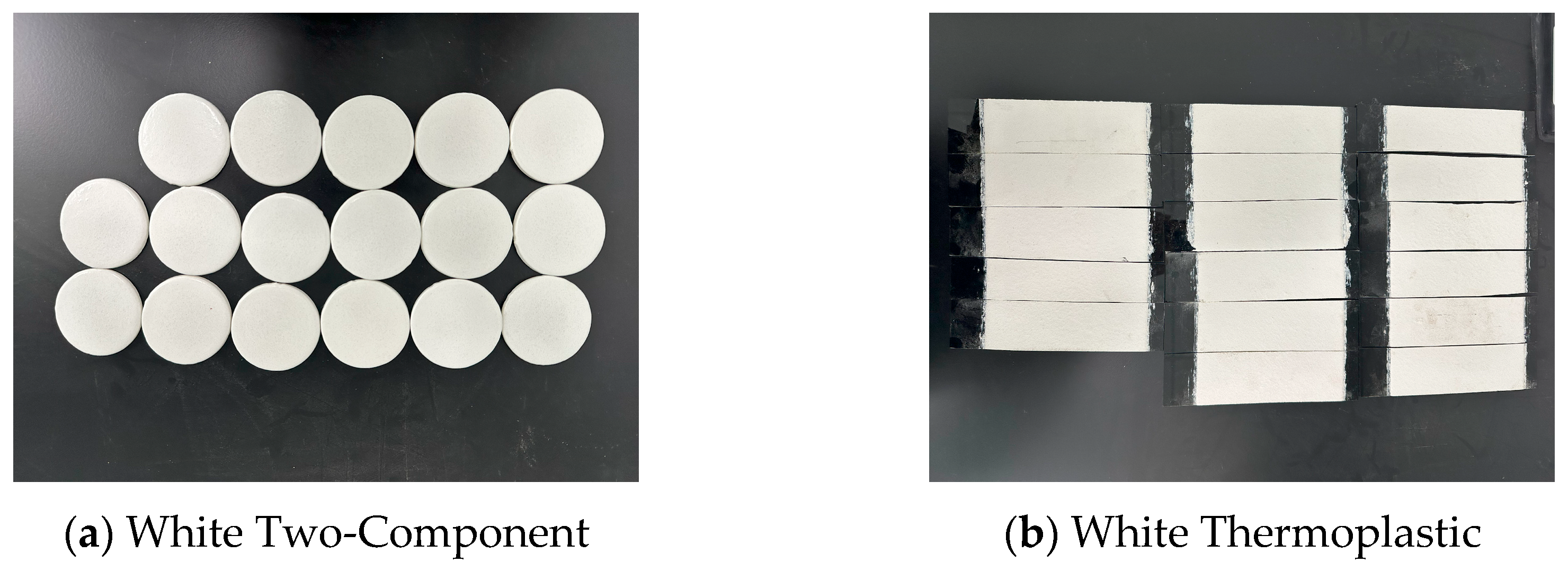
This study focuses on the yellowing behavior of white pavement markings under natural environmental influences. Two representative types of white pavement marking materials in China were selected: the widely used white thermoplastic marking and a white two-component marking known for its superior weather resistance. To minimize the influence of specimen preparation on the experimental results, all pavement marking specimens were produced under strictly controlled and uniform conditions. Key construction variables—including application equipment, raw material sources, and process parameters—were systematically standardized to ensure consistency in initial material properties across all specimens. The number of specimens was sufficient to meet the requirements for repeatability testing and statistical analysis, as illustrated in Figure 1.
Figure 1.
Pavement Marking Specimen.
The thermoplastic pavement marking material used in this study was a commercially supplied hot-applied thermoplastic road-marking compound, which is applied in the molten state and forms a solid film predominantly through cooling. The two-component marking material was a commercially supplied methyl methacrylate (MMA)-based, two-pack, ambient-curing cold-plastic pavement marking system. The pigmented base component comprised an MMA-based binder, mineral fillers including ground calcium carbonate and quartz, and titanium dioxide (TiO2) as the white pigment. Benzoyl peroxide (BPO) was used as the curing initiator to trigger free-radical polymerization. The two components were mixed immediately before application and cured at ambient conditions to form a continuous polymer matrix. No additional antioxidants or UV stabilizers were intentionally incorporated into the formulations, allowing the observed yellowing behavior to primarily reflect the intrinsic photothermal aging response of the base material systems, as illustrated in Table 1.
Table 1.
General component categories and functional roles of thermoplastic and two-component pavement marking materials.
2.2. Experimental Equipment
In studies of the yellowing behavior of white pavement markings, experimental approaches generally fall into two categories: natural exposure tests and artificial accelerated aging tests [27]. Natural exposure tests can realistically reflect the in-service performance of pavement marking materials under real environmental conditions. However, they are characterized by long testing periods, limited control over environmental variables, and poor repeatability, making it difficult to obtain statistically robust conclusions within a reasonable time frame. In contrast, artificial accelerated aging tests allow key factors—such as ultraviolet irradiance, temperature, humidity, and oxygen availability—to be precisely controlled, enabling the simulation of long-term natural aging within a much shorter period. This approach significantly reduces testing time, avoids the high resource demands and data collection challenges associated with natural exposure, and provides an efficient means to systematically evaluate the yellowing behavior of white pavement marking materials.
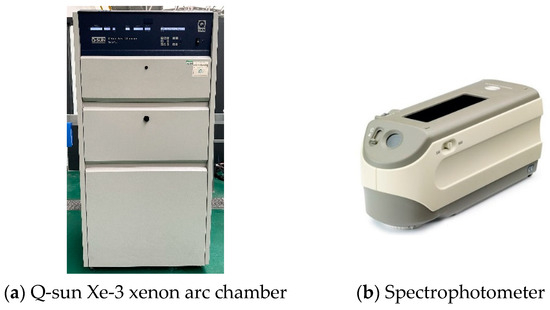
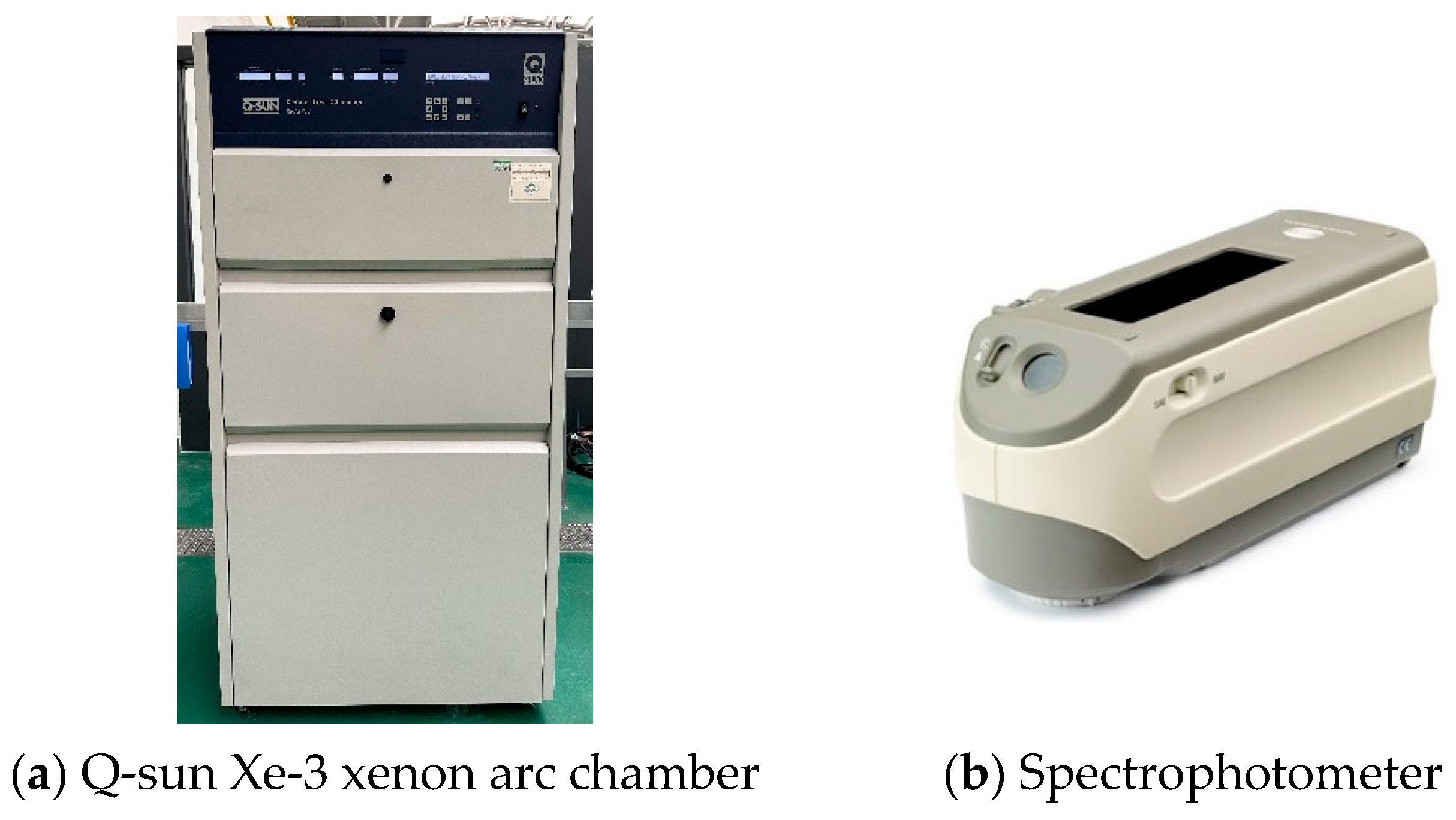
This study employed an accelerated aging approach to investigate the yellowing behavior of white pavement markings under simulated natural environmental conditions. A xenon arc weathering chamber was used to reproduce the combined effects of ultraviolet radiation and temperature, while color changes were quantitatively measured using a spectrophotometric colorimeter. The experimental setup consisted of a Q-SUN Xe-3 xenon arc test chamber (Atlas Material Testing Technology LLC, Chicago, IL, USA) and a spectrophotometer (Konica Minolta, Inc., Tokyo, Japan), as illustrated in Figure 2.
Figure 2.
Test equipment.
Accelerated aging tests were conducted using a Q-Sun Xe-3 xenon arc chamber. The system employs a full-spectrum xenon arc light source that closely reproduces the spectral distribution of natural solar radiation, particularly in the ultraviolet and visible ranges, making it well suited for investigating photo-aging behavior of pavement marking materials. During testing, irradiance was continuously regulated through a feedback control system to minimize the effects of lamp aging and ensure stable and consistent exposure conditions throughout the test period. The chamber allows independent control of irradiance and temperature while maintaining continuous air circulation, enabling the combined action of light, heat, and oxygen. This capability provides a controlled experimental platform for simulating the coupled environmental effects encountered during field service. By applying multiple combinations of ultraviolet irradiance and temperature, the test program systematically examined their influence on the yellowing behavior of white pavement markings, providing a robust experimental basis for subsequent multi-factor interaction analysis and model development.
During testing, a spectrophotometer was used to measure the yellowing-related color parameters of the white pavement marking specimens. Prior to each measurement session, the instrument was calibrated according to standard procedures to ensure data accuracy and comparability. All measurements were conducted under standardized illumination conditions and specified observation geometry to ensure consistency. To reduce the influence of random measurement error, multiple readings were taken at different locations on each specimen, and the average value was used as the representative result. This approach improved the stability and reliability of the experimental data.
2.3. Evaluation Indicators
Under natural service conditions, white pavement markings are continuously exposed to ultraviolet radiation, temperature fluctuations, and atmospheric oxidation. These environmental factors promote photochemical reactions within the material, leading to the formation of chromophoric structures and a gradual color shift from white to yellow [28]. This yellowing phenomenon not only alters the visual appearance of pavement markings but also represents one of the most sensitive and representative indicators of early-stage material aging. Therefore, selecting evaluation metrics that can accurately characterize the degree of yellowing is essential for elucidating the aging behavior of white pavement markings under environmental exposure.
The Yellowing Index (YI) is a colorimetric parameter derived from the spectral reflectance properties of materials and is used to quantitatively characterize the degree of yellowing. It captures color shifts caused by changes in short-wavelength and mid-to-long-wavelength reflectance. Compared with indicators such as luminance factor or overall color difference, YI is more sensitive to early-stage color degradation of white materials induced by environmental exposure. As a result, it provides a more direct and effective measure of the temporal evolution of yellowing in white pavement markings. Owing to these advantages, YI has been widely adopted to evaluate the aging behavior of white or light-colored materials subjected to ultraviolet radiation, thermal exposure, and other environmental factors. The calculation of YI is given in Equation (1) [29].
where = 1.2985, = 1.1335, , and are empirical constants, X is correlated with the red-green direction, Y represents brightness, and Z is correlated with the blue-yellow direction. These are the tristimulus values from the Commission Internationale de l’Éclairage (CIE).
From a practical perspective, the yellowness index (YI) provides a meaningful indicator of daytime color degradation in white pavement markings. Under daylight conditions, the conspicuity of white markings depends strongly on chromatic and luminance contrast against the pavement background; thus, an increase in YI directly indicates a loss of whiteness and a reduction in daytime legibility, particularly on dark asphalt surfaces. Importantly, YI is not intended to replace established performance indicators (e.g., retroreflectivity for nighttime visibility), but rather to complement them by capturing color shifts that may occur before severe luminance or retroreflective degradation becomes evident.
To facilitate maintenance and quality control, YI can be integrated into an operational decision framework in which (i) YI is measured during routine daytime inspections, (ii) an agency-defined acceptance limit YIlimit (or a tiered grading scheme) is specified for different roadway classes and background pavements, and (iii) repainting or corrective actions are triggered when YI exceeds the prescribed limit, together with conventional criteria (e.g., retroreflectivity or luminance factor) to ensure all-day visibility. Such a climate-adjusted, threshold-based approach allows agencies to align accelerated aging results with in-service requirements, compare candidate materials in a consistent manner, and incorporate color stability into performance-based specifications and acceptance guidelines.
2.4. Experimental Process
Under natural service conditions, pavement markings are continuously exposed to solar radiation. Although UV radiation accounts for a relatively small proportion of the total solar energy, its high photon energy has a pronounced impact on the photochemical stability of polymer-based materials. White pavement markings are primarily composed of polymer matrices, whose molecular bonds are susceptible to scission or rearrangement under UV exposure, thereby inducing color shifts and material degradation. Consequently, targeted control and intensification of UV radiation are essential when investigating the environmental aging and yellowing behavior of white pavement markings.
To obtain representative yellowing responses within a limited testing period while avoiding unrealistically severe irradiation that could cause non-service failure, this study selected the 340 nm wavelength as the controlled ultraviolet aging band, based on a balance between natural environmental relevance and experimental controllability. Multiple levels of ultraviolet irradiance were applied to characterize the effects of varying UV intensity on the yellowing behavior of white pavement markings. Specifically, irradiance levels of 0, 0.51, 1.01, and 1.50 W/m2 were employed, covering a typical range from no UV exposure to intensified ultraviolet conditions.
During service, pavement markings are exposed to cyclic variations in ambient temperature. Temperature not only affects the physical state of the material but also accelerates polymer aging by promoting oxidation reactions. Under elevated temperatures, molecular mobility increases and chemical reactions become more active, which can trigger irreversible degradation and lead to a gradual decline in marking performance and visibility over time. For this reason, appropriate temperature selection is essential for investigating the aging and yellowing behavior of white pavement markings under environmental exposure. Because current technical specifications do not provide a unified method to quantify the actual operating temperature of pavement markings after absorbing solar radiation, the temperature levels in this study were defined based on real service conditions of asphalt concrete pavements. Asphalt surfaces have a strong heat-absorbing capacity and often reach temperatures well above ambient air temperature. Taking both environmental realism and experimental control into account, four temperature levels—20 °C, 40 °C, 60 °C, and 80 °C—were selected to represent conditions ranging from moderate to intensified thermal exposure. These levels enable a systematic evaluation of the effects of thermal aging on white pavement marking materials.
The ultraviolet irradiance at 340 nm was selected to represent the most photochemically active portion of the terrestrial solar spectrum responsible for polymer degradation. The applied irradiance range (0–1.50 W/m2 at 340 nm) encompasses typical outdoor exposure levels observed in mid- to low-latitude regions and extends to moderately elevated intensities to accelerate photo-induced aging. This approach enables the cumulative effects of long-term solar exposure on pavement markings to be reproduced within a controlled laboratory timeframe, while preserving the underlying degradation mechanisms.
Similarly, the temperature range of 20–80 °C was designed to simulate both normal service conditions and accelerated thermal states. Although 80 °C exceeds typical ambient air temperatures, it is representative of extreme pavement surface temperatures under intense solar radiation, particularly for asphalt pavements with high solar absorptivity. Elevated temperature was therefore employed to promote thermo-oxidative reactions in accordance with Arrhenius-type kinetics, allowing the combined influence of UV radiation and temperature on yellowing behavior to be systematically evaluated without altering the fundamental aging pathways.
In addition, considering that the yellowing of white pavement markings under natural service conditions occurs over long time scales and is governed by complex environmental influences, the test duration was set to 300 h. This duration balances experimental feasibility with the need to induce measurable and analytically meaningful color changes, thereby providing a reliable data basis for examining the yellowing evolution of white pavement markings under environmental exposure.
During testing, the prepared white pavement marking specimens were placed flat on the sample tray of a Q-Sun Xe-3 xenon arc weathering chamber to ensure stability and uniform exposure throughout the experiment. A filter system with a spectral output closely matching natural direct sunlight was used to simulate outdoor solar radiation. The initial YI of each specimen was measured prior to exposure. After the irradiance and temperature conditions were set, the aging test was initiated. The YI of each specimen was recorded at 1 h intervals during exposure. Each test was terminated after 300 h, after which the chamber was cleaned and the specimens were replaced before proceeding to the next environmental condition. This procedure was repeated until all 16 combinations of irradiance and temperature were completed. To improve data reliability, multiple measurements were taken at each time point. Outliers were removed, and the arithmetic mean of the valid measurements was used as the final YI value for subsequent analysis of environmental effects.
2.5. Method for Decay Modeling
Because the yellowing of white pavement markings is governed by the combined effects of time, temperature, UV irradiance, and material type, with substantial interactions among these factors, conventional single-factor degradation models are insufficient to describe this multivariable and nonlinear aging process. To address this limitation, this study developed generalized linear mixed-effects models (GLMMs) to quantify the individual contributions of time, temperature, and UV irradiance to the YI, as well as the strength of their interaction effects, while accounting for the hierarchical structure of the experimental data. Model reliability was ensured through comprehensive statistical diagnostics and robustness checks, providing a sound basis for interpreting the environmental drivers of yellowing behavior in white pavement markings.
Data preprocessing followed three key steps to ensure consistency and model robustness. First, to accurately quantify yellowing, the initial color state of each specimen under a given test condition (t = 0) was used as the reference. The Yellowing Index was recalculated as ΔYI, representing color change relative to the initial state, thereby minimizing systematic differences across batches and test conditions. Second, to account for the nonlinear nature of time-dependent aging, different time representations were adopted for different material types. For thermoplastic pavement markings, a logarithmic time transformation (log t) was applied to capture the characteristic pattern of rapid early degradation followed by a slower aging rate. For two-component markings, both linear (t) and quadratic (t2) time terms were retained, allowing greater flexibility in describing potential acceleration or deceleration in aging behavior. Finally, all continuous independent variables were mean-centered to reduce multicollinearity between main effects and interaction terms and to improve the stability of parameter estimates. The dataset was then divided by material type into thermoplastic and two-component pavement markings, which were modeled separately to capture material-specific aging mechanisms.
The experimental data consist of sequential measurements taken from the same set of specimens over time within 32 distinct experimental groups. This repeated-measures design creates a hierarchical data structure where observations are not fully independent. Given the significant between-group variability (ICC = 0.747 for thermoplastic and 0.466 for two-component markings) and the right-skewed distribution of the YI values (skewness > 1.26, Shapiro–Wilk p < 0.001), generalized linear mixed-effects models (GLMMs) were employed. These models incorporate random intercepts for experimental groups to account for within-group correlations and assume a Gamma distribution for the response variable to accommodate its non-negative and right-skewed nature. The primary aim of the regression analysis is to quantify the direction and relative magnitude of the effects of key factors (time, temperature, UV) on color change, while providing valid statistical inference for the hierarchical data structure.
For thermoplastic markings, the degradation model was formulated using a logarithmic time framework, as expressed in Equation (2).
For two-component pavement markings, a more flexible quadratic time framework was adopted within the GLMM framework to capture potential nonlinear time effects in the yellowing process, as expressed in Equation (3).
where represents the linear predictor, ΔYI is the yellowing index change relative to the initial state, β1, β2, … βn are fixed-effect coefficients, u is the random intercept for the experimental group, and the conditional distribution of ΔYI given the random effects is assumed to follow a Gamma distribution with a log link function.
3. Results and Conclusions
3.1. Effect of Ultraviolet Irradiance on the YI of White Pavement Markings
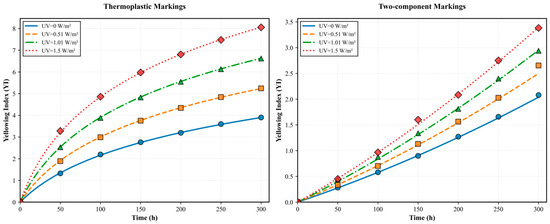
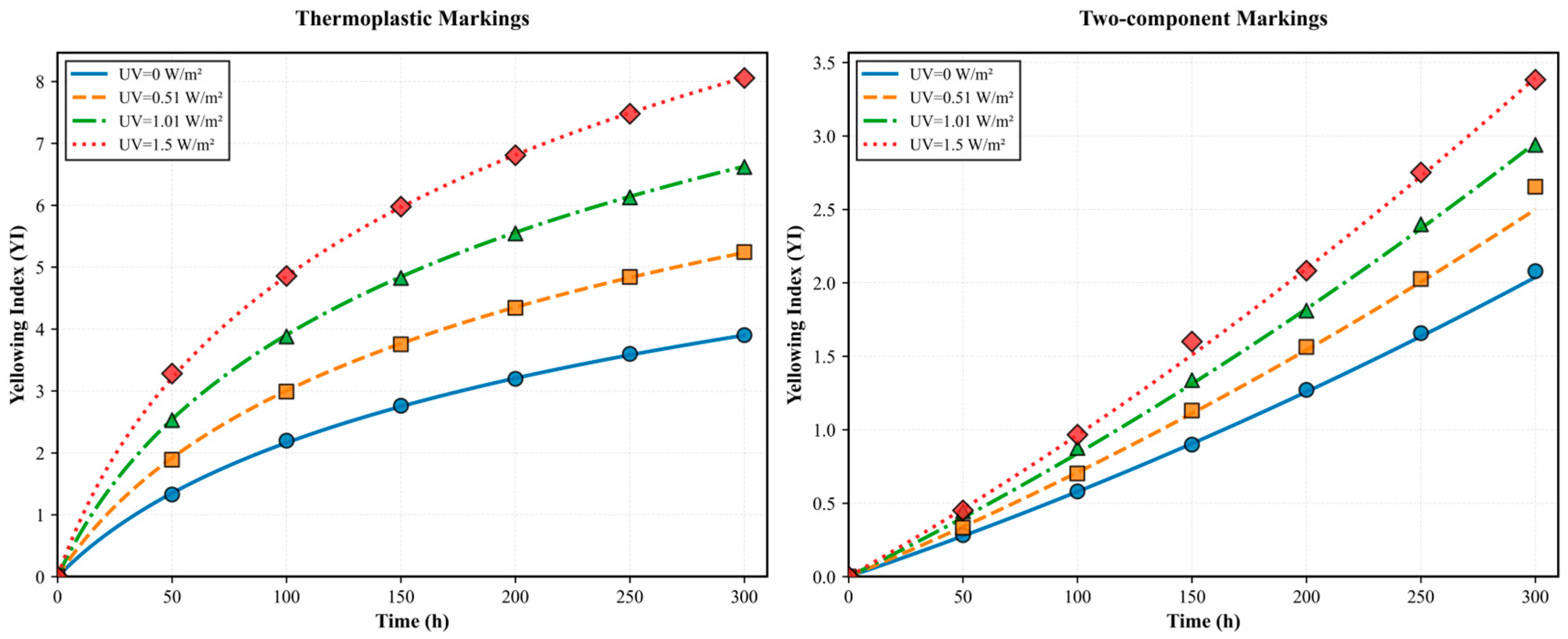
At 80 °C, UV irradiance exerts markedly different effects on the yellowing behavior of the two pavement marking materials (Figure 3). For thermoplastic markings, the YI increases nonlinearly with aging time, characterized by a rapid rise at early stages followed by a gradual slowdown, resulting in an overall increasing but leveling trend. UV irradiance significantly accelerates this process: YI increases monotonically as irradiance rises from 0 to 1.5 W/m2, and higher irradiance amplifies the cumulative effect of exposure time. In contrast, two-component markings exhibit substantially lower yellowing levels. Their YI shows an approximately linear relationship with time, indicating that, at this temperature, yellowing is primarily governed by time-dependent accumulation rather than strong nonlinear degradation. Although UV irradiance also promotes yellowing in two-component markings, its effect is comparatively modest, with YI growth rates under high irradiance remaining clearly lower than those observed for thermoplastic markings. This difference can be attributed to the high photon energy of UV radiation, which can directly disrupt resin molecular chains, initiate free-radical reactions, and generate oxidation products with strong visible-light absorption, thereby shifting the color of pavement markings from white toward yellow [30].
Figure 3.
Yellowing Index Evolution of Thermoplastic and Two-Component Road Markings under 80 °C and Varying UV Irradiance.
3.2. Effect of Temperature on the YI of White Pavement Markings
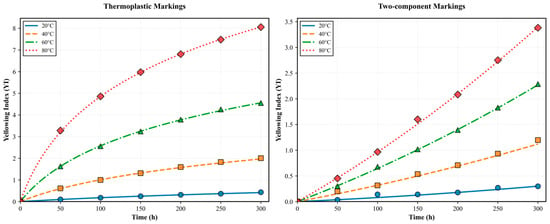
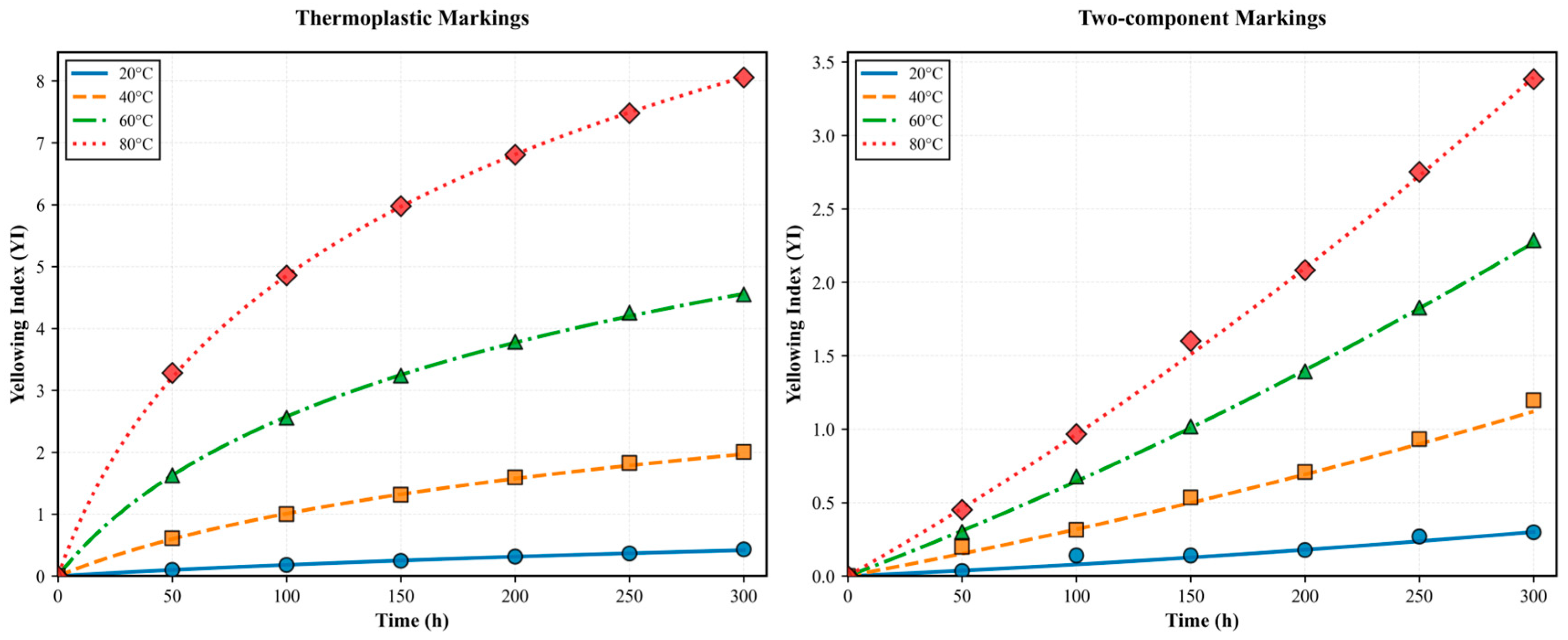
Under a constant ultraviolet irradiance of 1.5 W/m2, temperature exerts a pronounced influence on the yellowing behavior of both pavement marking materials (Figure 4). For thermoplastic markings, the YI increases continuously with aging time at all temperature levels, and elevated temperatures markedly amplify the UV-induced yellowing response. At 20 °C, the increase in YI is limited, indicating that photochemical degradation is constrained under low-temperature conditions. As the temperature rises to 40 °C and 60 °C, the yellowing rate increases substantially, and the YI–time curves exhibit a clear nonlinear growth pattern. At 80 °C, YI rises sharply during the early aging stage and then gradually levels off, reflecting the coexistence of rapid reaction initiation and subsequent rate limitation under combined high-temperature and high-UV exposure.
Figure 4.
Temperature-Dependent Yellowing Behavior of Thermoplastic and Two-Component Road Markings under 1.5 W/m2 UV Irradiance.
In contrast, under the same ultraviolet irradiance, the overall yellowing level of the two-component pavement markings was substantially lower than that of the thermoplastic markings. The YI increased approximately linearly with aging time, and temperature exerted only a limited accelerating effect on yellowing within the range of 20–60 °C. A clear temperature-driven acceleration was observed only at 80 °C. Even under combined high-temperature and high-UV conditions, both the absolute YI values and their growth rates for the two-component markings remained markedly lower than those of the thermoplastic markings. These results indicate that, under strong ultraviolet exposure, temperature acts as a key amplification factor for yellowing, while thermoplastic markings are more sensitive to coupled photo-thermal aging. In comparison, two-component markings exhibit superior resistance to yellowing. Elevated temperatures enhance molecular mobility and thermo-oxidative reaction rates and facilitate oxygen diffusion within the material, thereby intensifying oxidative degradation. In addition, the migration and surface accumulation of wax-based components at high temperatures may further aggravate surface color changes and increase the degree of yellowing [31].
3.3. Comparative Analysis of YI Evolution in White Pavement Markings with Different Materials
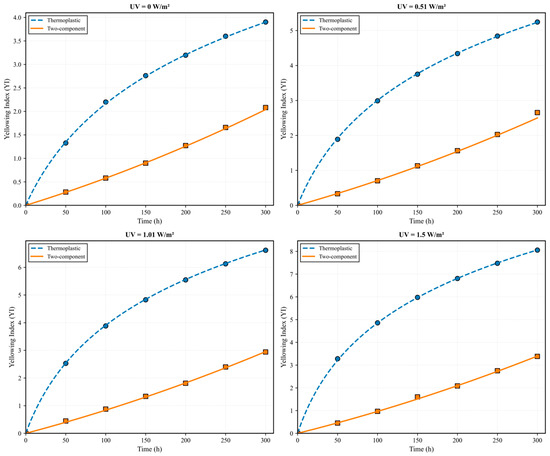
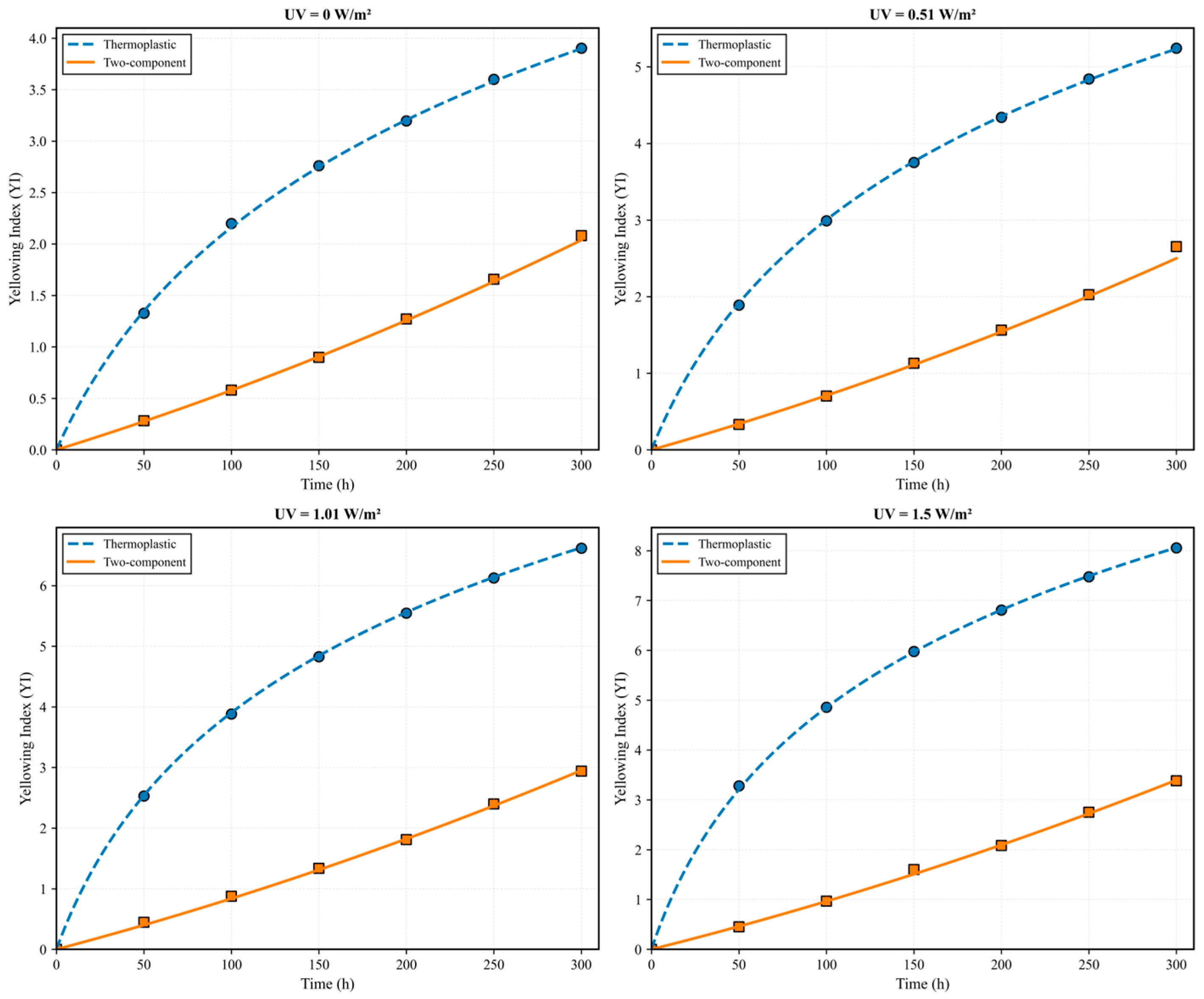
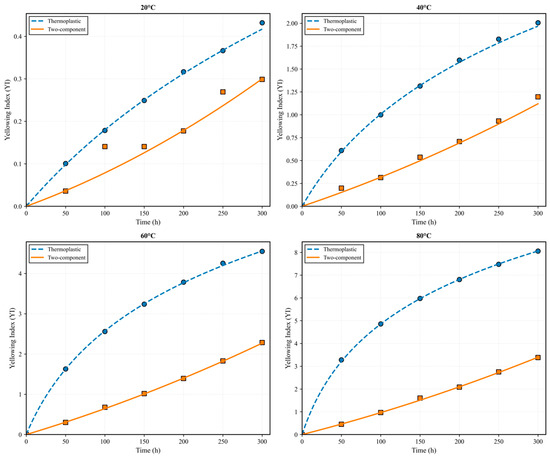
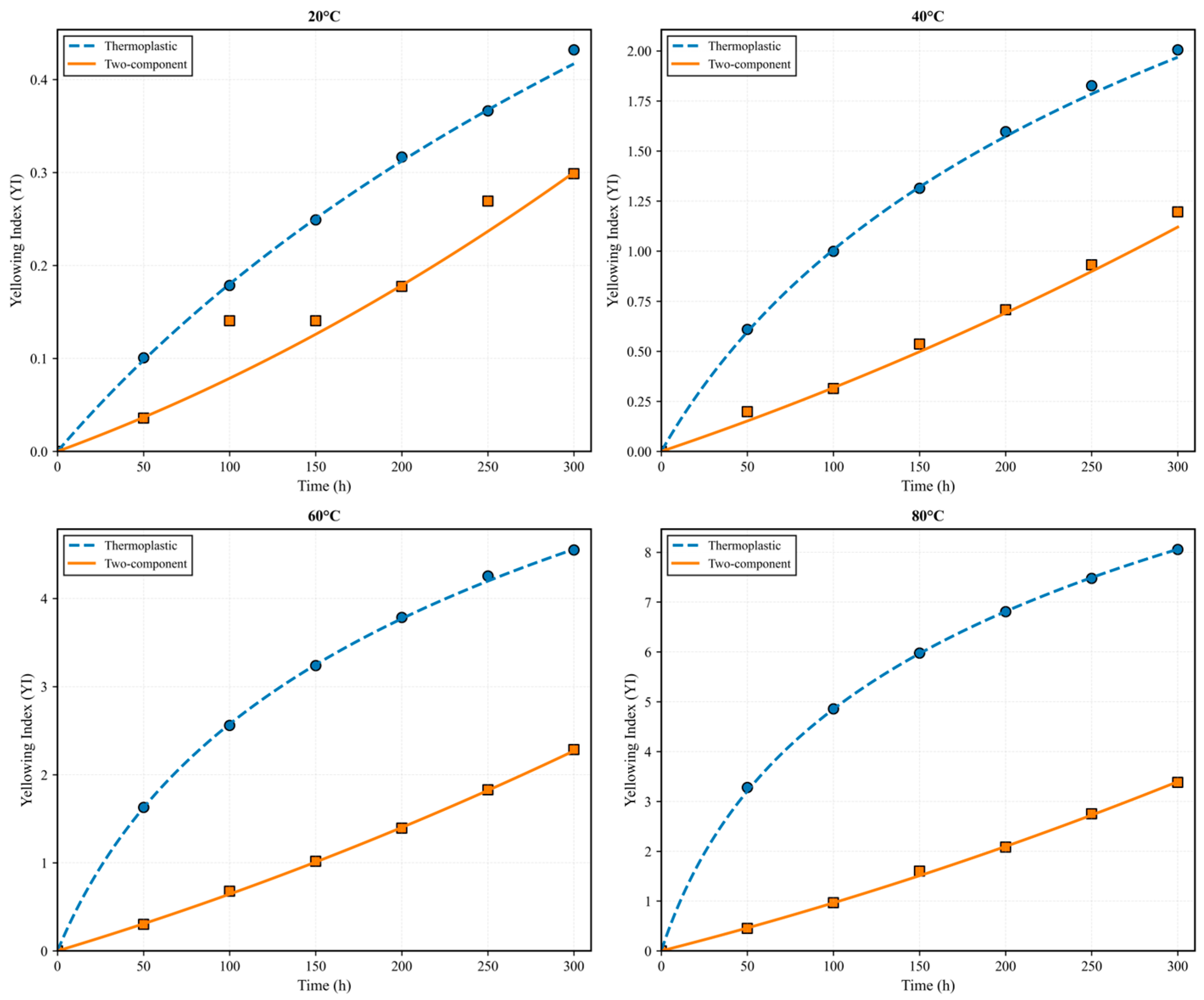
Across all temperature and UV irradiance conditions, the evolution of the YI over aging time shows clear and consistent material-dependent differences between the two types of white pavement markings (Figure 5 and Figure 6). Overall, thermoplastic markings exhibit higher YI values than two-component markings under all test conditions and display a pronounced nonlinear increase with time. In contrast, the YI of two-component markings increases in a more nearly linear manner, indicating a fundamentally different aging response.
Figure 5.
Time Evolution of Yellowing Index of Thermoplastic and Two-Component Road Markings under Varying UV Irradiance.
Figure 6.
Time-Dependent Yellowing Behavior of Thermoplastic and Two-Component Road Markings under Different Temperatures.
Under varying UV irradiance levels (0–1.5 W/m2), yellowing in thermoplastic markings accelerates markedly as irradiance increases, whereas the time-dependent YI curves of two-component markings change only modestly (Figure 5). This finding indicates that UV intensity primarily amplifies photo-induced yellowing in thermoplastic materials, thereby widening the performance gap between the two marking types rather than affecting them proportionally. As temperature increases, Figure 6 shows that the yellowing behavior of thermoplastic markings transitions from a slow, gradual increase to a rapid rise followed by a tendency toward stabilization, forming a characteristic nonlinear pattern. By comparison, two-component markings maintain relatively consistent growth rates across all temperatures, reflecting a more balanced and stable thermal response.
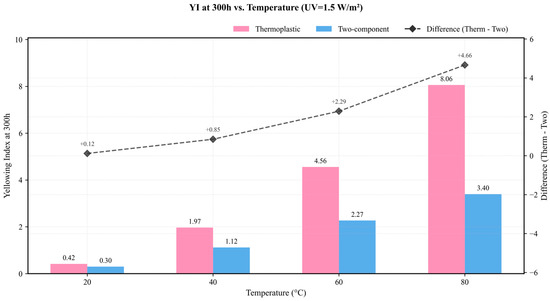
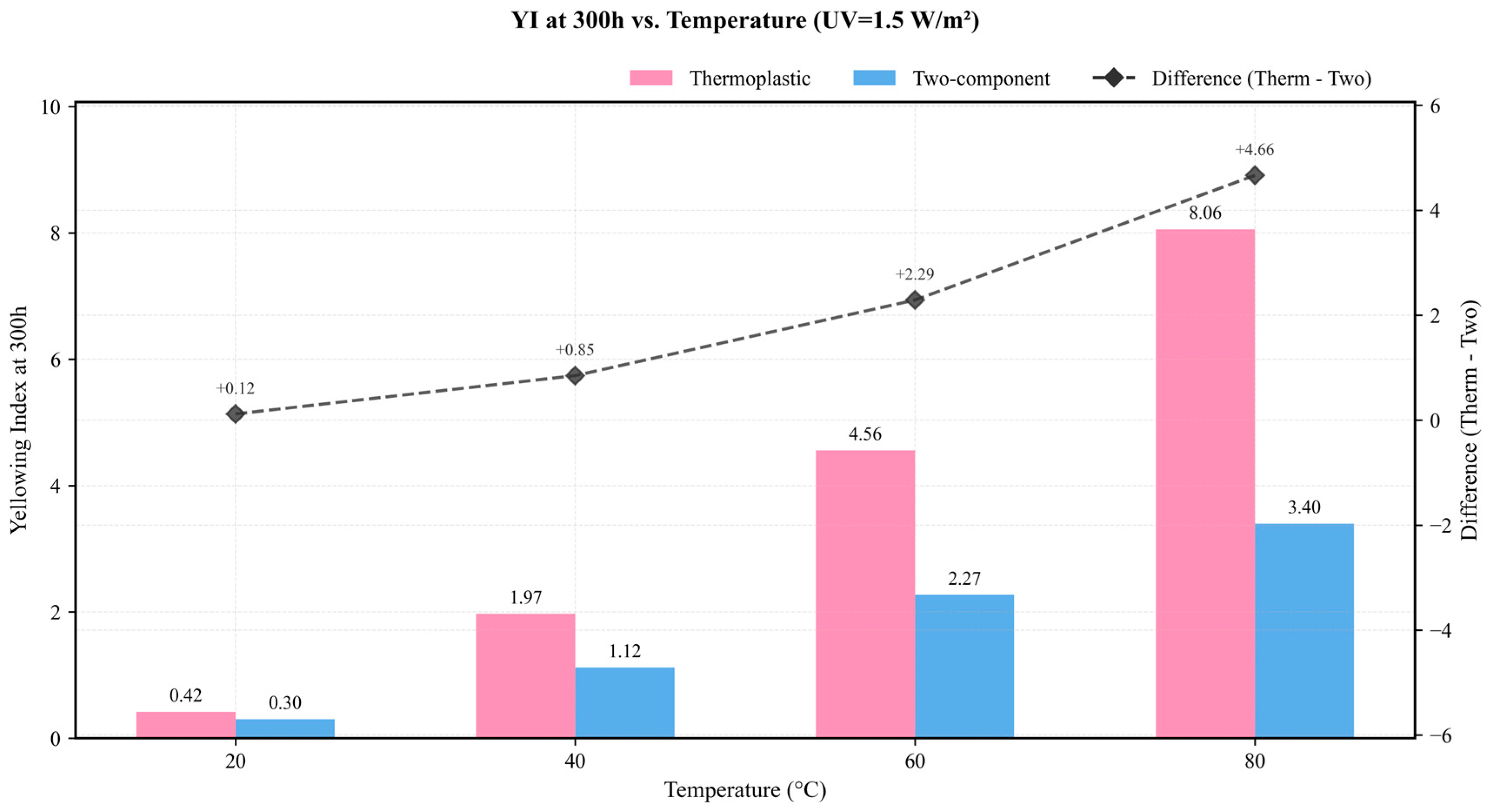
As shown in Figure 7, under a UV irradiance of 1.5 W/m2 and an aging duration of 300 h, the yellowing behavior of the two white pavement marking materials exhibits a clear dependence on temperature. At 20 °C, both materials show relatively low YI values, and the difference between thermoplastic and two-component markings is small, indicating that UV-induced yellowing is strongly constrained under low-temperature conditions. When the temperature increases to 40 °C and 60 °C, the YI of thermoplastic markings rises much more rapidly than that of two-component markings, and the gap between the two materials widens steadily, revealing distinct differences in their thermal sensitivity. At 80 °C, this divergence reaches its maximum: the YI of thermoplastic markings increases sharply, whereas two-component markings also yellow but remain at significantly lower absolute levels and growth rates.
Figure 7.
Comparison of Yellowing Index of Thermoplastic and Two-Component White Road Markings at 300 h under 1.5 W/m2 UV Irradiance.
The difference curves further indicate that, at 300 h, the YI difference between the two materials increases monotonically with temperature. This trend suggests that elevated temperature not only intensifies UV-induced yellowing but also amplifies the inherent differences in photo-thermal aging mechanisms between material systems. Overall, these results demonstrate that under combined high-temperature and high-UV conditions, two-component markings offer superior color stability, while thermoplastic markings face a substantially higher risk of long-term visual performance degradation.
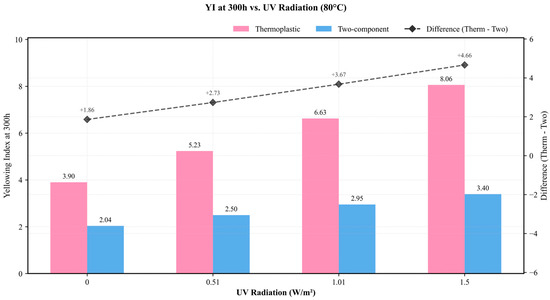
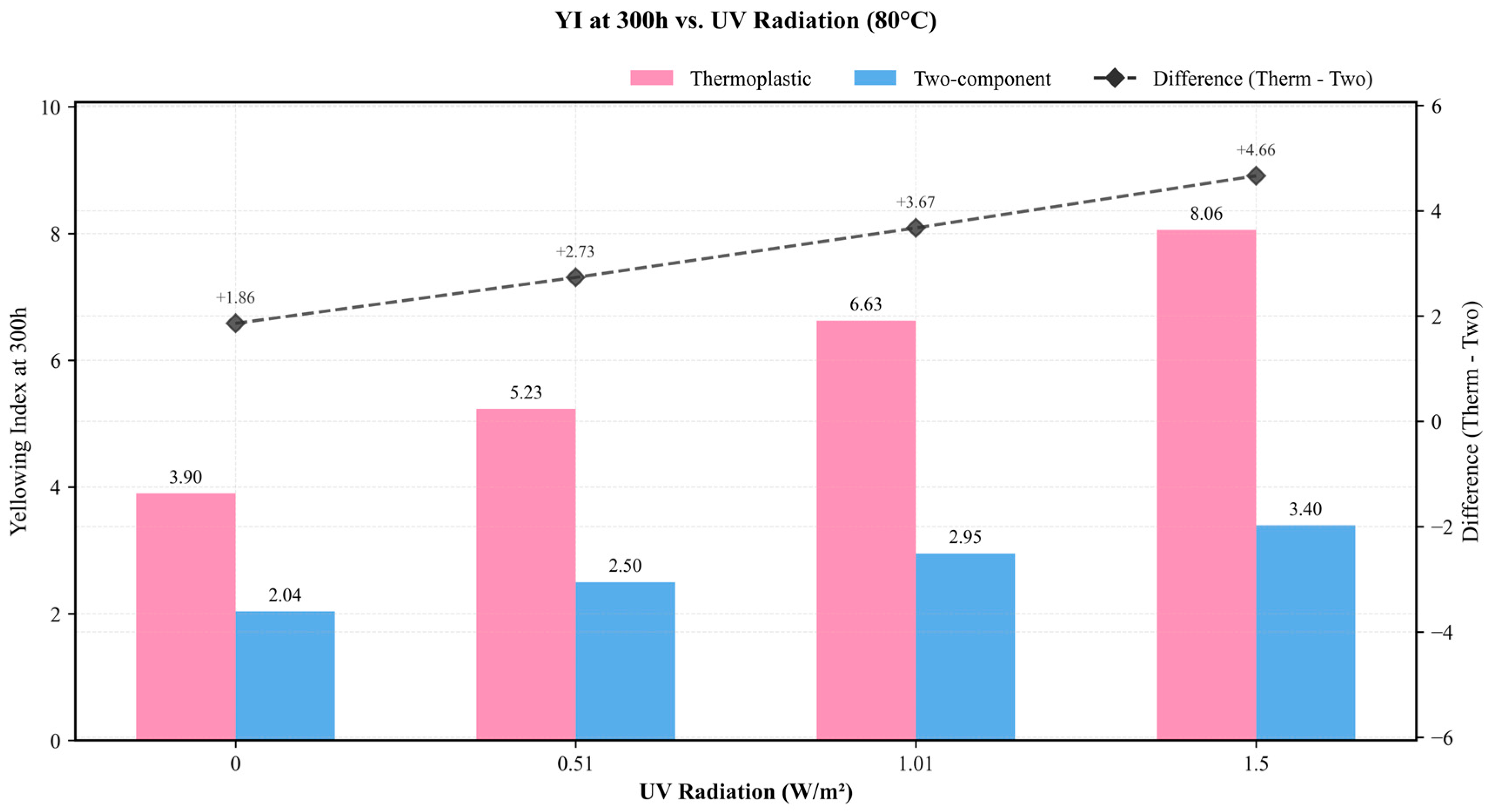
Under a constant temperature of 80 °C and an aging duration of 300 h, the yellowing behavior of the two white pavement marking materials was governed primarily by UV irradiance, and their material-specific responses differed from those observed under temperature-dominated conditions (Figure 8). As UV irradiance increased, the YI of the thermoplastic markings rose rapidly, whereas the YI of the two-component markings increased more gradually, indicating markedly different sensitivities to UV exposure.
Figure 8.
Effect of UV Irradiance on the Yellowing Index of Thermoplastic and Two-Component White Road Markings at 300 h and 80 °C.
Even at low UV levels, a clear difference in YI was observed between the two materials, suggesting that under high-temperature conditions, intrinsic differences in photostability already play a dominant role in controlling yellowing behavior. With further increases in UV irradiance, the thermoplastic markings exhibited a much stronger response, while the two-component markings maintained a relatively stable growth trend. As a result, the yellowing gap between the two materials continued to widen. This finding indicates that increasing UV intensity does not amplify yellowing uniformly across materials, but instead selectively accelerates degradation in systems with lower resistance to photochemical aging.
The difference curves further show that, at 300 h, the yellowing difference between the two materials increases approximately linearly with UV irradiance, confirming that under high-temperature conditions, UV radiation becomes the dominant factor amplifying material-dependent photo-oxidative degradation. Overall, these results demonstrate that thermoplastic pavement markings are more susceptible to UV-induced yellowing under intense irradiation, whereas two-component markings exhibit superior long-term color stability and lower sensitivity to UV exposure.
Compared with two-component markings, thermoplastic markings exhibited consistently more severe yellowing, which can be attributed to fundamental differences in material structure and aging mechanisms. Thermoplastic markings are primarily based on physically blended systems with relatively loose molecular arrangements, making them more susceptible to ultraviolet radiation and thermal stress. In contrast, two-component markings typically form cross-linked and cured polymer networks, which provide higher structural stability and suppress photo-thermal degradation. These findings highlight the critical role of material formulation and curing mechanisms in governing the yellowing resistance of white pavement markings under combined ultraviolet and thermal exposure.
3.4. Analysis of Degradation Model
The goodness-of-fit and key parameters of the fitted Generalized Linear Mixed-Effects Models (GLMMs) are summarized in Table 2. Within this controlled experiment, where the models capture the structured progression of photothermal degradation, a multi-faceted assessment based on the following metrics is provided.
Table 2.
Model Fit Statistics for Degradation Models of Thermoplastic and Two-Component Markings.
As shown in Table 2, the two-component model demonstrates superior performance overall compared to the thermoplastic model. Specifically, the two-component model exhibits significantly lower Root Mean Square Error (RMSE) and Mean Absolute Error (MAE), indicating smaller deviations between predictions and observations. This means that the yellowing process of the two-component material has less unexplained random fluctuation under controlled conditions, implying more consistent behavior. This finding aligns with the earlier observation from the time-evolution analysis that the two-component markings yellow in a more stable and gradual manner.
The Intra-class Correlation Coefficient (ICC) further clarifies the data structure. The high ICC for thermoplastic markings (0.747) indicates that a major portion of the variance stems from differences between experimental groups rather than from factors like time, strongly justifying the inclusion of random intercepts. The moderate ICC for two-component markings (0.466) also confirms notable between-group heterogeneity, which has been properly accounted for by the mixed-effects modeling structure.
3.4.1. Two-Component
The regression results for the two-component pavement marking model are summarized in Table 3. Quadratic and higher-order interaction terms were retained primarily to improve model flexibility, but their individual physical significance is limited, with some being statistically non-significant. Both time and temperature exert strong positive main effects on the YI, contributing 39.97% and 38.24%, respectively, and thus represent the dominant drivers of yellowing in two-component markings. Specifically, when temperature and UV irradiance are held at their mean (centered) levels, a one-unit increase in centered time leads to an average YI increase of 0.0104. Similarly, when time and UV are fixed at their mean (centered) values, a one-unit increase in centered temperature results in an average YI increase of 0.0388. UV irradiance also shows a statistically significant positive effect (coefficient = 0.2966, p < 0.001), accounting for 7.30% of the total contribution, indicating that UV exposure consistently promotes yellowing.
Table 3.
Regression Results for Two-component Markings.
These results indicate that the yellowing behavior of two-component pavement markings is governed by a time–temperature-dominated, thermo-oxidative aging pattern. Notably, the coefficient for the quadratic time term (time_sq_centered) is negative and highly significant (coefficient = −4.82 × 10⁻⁵, p < 0.001; contribution = 14.35%). This reveals a crucial nonlinear characteristic: the yellowing rate decelerates over time rather than accelerates. This aligns with a typical “fast-then-slow” saturation trend in aging, suggesting that the material undergoes active reactions initially, possibly entering a slower phase later due to the depletion of reactive groups or the formation of a stabilized layer.
Interaction analysis further reveals the coupled effects among environmental factors. The Time × Temperature interaction (Time_centered:temperature_centered) is negative and significant (coefficient = −6.16 × 10⁻⁶, p = 0.006) but its contribution is minuscule (0.00027%). This weak negative interaction might suggest a slight diminishing effect of temperature on yellowing promotion over prolonged exposure, though its practical impact is negligible. The Time × UV interaction (Time_centered:UV_centered) and the interactions involving the quadratic time term with temperature and UV are not significant (p > 0.85), indicating that, under these experimental conditions, the UV effect does not exhibit clear cumulative amplification over time, and higher-order nonlinear interactions are negligible. However, the Temperature × UV interaction (temperature_centered:UV_centered) remains significant (coefficient = 0.0031, p < 0.001, contribution = 0.14%), confirming a synergistic aging effect under combined high-temperature and high-UV conditions.
3.4.2. Thermoplastic
The regression results for the thermoplastic pavement marking yellowing model are summarized in Table 4. All variables are statistically significant at the 1% level (p < 0.001), indicating a robust model structure. Among the explanatory variables, temperature shows the largest contribution to yellowing (52.94%), with a regression coefficient of 0.0538 (95% CI: 0.053–0.054). The strong temperature sensitivity is closely related to the material composition of white thermoplastic markings. These materials mainly consist of petroleum resins, synthetic resins, waxes, pigments, and fillers. At elevated temperatures, resin and wax components are more prone to thermal oxidation and molecular chain scission, producing oxidation products that preferentially absorb short-wavelength visible light and thereby accelerate yellowing. In addition, higher temperatures enhance molecular mobility and promote oxygen diffusion within the material, which further intensifies oxidative aging and color degradation, leading to a sustained increase in YI with temperature [31].
Table 4.
Regression Coefficients for Thermoplastic Markings.
The logarithmic time term (log (Time)) accounts for 29.74% of the explained variance, with a coefficient of 1.1432 (95% CI: 1.127–1.159). This logarithmic relationship indicates that the yellowing of thermoplastic markings follows a typical aging pattern, characterized by rapid changes at early stages followed by a gradual slowdown. This nonlinear time dependence may be attributed to self-limiting radical reactions and the accumulation of aging by-products. During the early aging stage, resin and wax components readily undergo chain scission under combined UV and thermal exposure, generating highly reactive free radicals that rapidly initiate oxidation reactions and form light-absorbing products, leading to pronounced early yellowing [24]. As aging progresses, radical recombination becomes more dominant, limiting radical concentration and reducing reaction rates. Meanwhile, accumulated oxidation products and degradation fragments form partial barriers to UV penetration and oxygen diffusion, which suppress further acceleration of aging and result in a gradual reduction in the yellowing rate.
The main effect of UV irradiance contributes 14.03% to the model, with a coefficient of 0.5700 (95% CI: 0.553–0.587). This indicates that, at mean time and temperature, an increase of one unit in UV irradiance leads to an average increase of 0.5700 in YI. Notably, the interaction between log (Time) and UV irradiance contributes as much as 2.96%, with an interaction coefficient of −0.0672. This interaction contributes relatively less, and its negative coefficient suggests that the yellowing-promoting effect of UV irradiation may slightly diminish over longer time scales.
The yellowing of white pavement markings is governed by multiple environmental factors, among which ultraviolet irradiance and temperature play critical roles. Yellowing not only degrades color performance but also reduces the luminance and color contrast between the marking and the pavement, thereby impairing daytime visibility and potentially compromising traffic safety. These findings highlight the need to prioritize resistance to ultraviolet exposure and thermal aging in the design and application of white pavement marking materials. Enhancing color stability and service durability under complex environmental conditions can be achieved by optimizing resin systems, incorporating light stabilizers, and improving material structure.
3.4.3. Sensitivity Analysis of Models
To quantify the limitation of applying the fitted models to real-world conditions with environmental variability, a simple local sensitivity analysis was conducted for both material systems. A representative reference condition was selected as T0 = 50 °C and UV0 = 0.755 W/m2 (340 nm), and three aging times (50, 150, and 300 h) were used to capture early, intermediate, and late-stage behavior.
Local sensitivities were estimated using central finite differences around the reference condition. Specifically, the local slopes of the predicted yellowness index (YI) with respect to temperature, ultraviolet irradiance, and aging time were computed as dY/dT, dY/dUV, and dY/dt, respectively. To enable comparison across variables with different units and scales, we further reported dimensionless standardized sensitivity indices:
where x0 is the reference input and is the model prediction at the reference condition. The results are summarized in Table 5.
Table 5.
Local and standardized sensitivity metrics of the fitted models at a representative reference condition (T0 = 50 °C, UV0 = 0.755 W/m2 at 340 nm).
As shown in Table 5, temperature consistently exhibits the largest standardized sensitivity for both materials, indicating that temperature variability is expected to introduce substantially greater uncertainty in YI predictions than comparable relative variability in UV irradiance. For thermoplastic markings, ST ranges from 2.48 to 2.93, whereas SUV ranges from 0.39 to 0.46, implying ST/SUV ≈ 6.3 across the examined time points. For two-component markings, ST ranges from 1.91 to 1.99 and SUV remains around 0.223–0.225, corresponding to ST/SUV ≈ 8.6–8.9. In addition, the absolute slopes (dY/dT and dY/dUV) generally increase with aging time for both materials, suggesting that late-stage yellowing predictions are more sensitive to environmental fluctuations. Moreover, the negative local time derivative for the two-component model at 300 h reflects the fitted nonlinear saturation behavior near the late-stage region and should not be interpreted as a physically reversible yellowing process. These results imply that caution is warranted when extrapolating the models to field conditions, especially in regions with substantial temperature variability.
4. Conclusions
This study employed accelerated aging tests under multiple levels of UV irradiance and temperature to systematically investigate the time-dependent evolution of the YI of white pavement markings made from different material systems. The individual and combined effects of UV exposure, temperature, and aging time on yellowing behavior were quantitatively evaluated. Based on the experimental results and subsequent analyses, the following conclusions can be drawn:
(1) Increasing UV irradiance led to a significant rise in the YI of white pavement markings, while elevated temperature further amplified yellowing, particularly for thermoplastic markings, indicating pronounced temperature sensitivity. For both thermoplastic and two-component markings, temperature contributed more strongly to yellowing than UV irradiance.
(2) Thermoplastic markings exhibited a logarithmic yellowing pattern, characterized by rapid growth at early aging stages followed by a gradual slowdown, reflecting typical aging kinetics of polymer-based materials. In contrast, two-component markings showed a nonlinear increase in YI over time characterized by a decelerating trend, with yellowing becoming more pronounced as exposure duration increased before potentially tending toward saturation.
(3) Under identical aging conditions, thermoplastic markings consistently demonstrated higher yellowing sensitivity, whereas two-component markings maintained lower YI levels. These differences highlight the critical role of material structure and curing mechanisms in governing the color stability of white pavement markings.
Overall, the findings provide experimental evidence and quantitative insight into the mechanisms by which environmental factors drive the yellowing of white pavement markings. The identified yellowing trends can support more rational maintenance scheduling in practice. Moreover, by establishing multivariate regression models with YI as the Dependent variable, this study enables predictive assessment of yellowing under different environmental scenarios. These results offer a quantitative basis for evaluating anti-yellowing performance, optimizing material formulations, and improving durability design, thereby enhancing the long-term visual performance of pavement markings in complex service environments.
For regions characterized by high solar irradiance and elevated pavement surface temperatures—such as low-latitude or high-altitude areas where summer pavement temperatures may exceed 60–70 °C—white two-component pavement markings are recommended for applications requiring long-term color stability and reduced maintenance frequency. In contrast, thermoplastic markings exhibit higher sensitivity to combined UV and thermal exposure, indicating a greater risk of premature yellowing under severe climatic conditions. From a material design perspective, the results suggest that formulation strategies for thermoplastic markings should prioritize the incorporation of effective thermal stabilizers and ultraviolet absorbers with strong attenuation capability in the photochemically active UV range around 340 nm. Such targeted stabilization measures are expected to mitigate polymer chain scission and oxidation-induced chromophore formation, thereby improving long-term optical durability.
It should be noted that moisture and humidity were not explicitly controlled in the present experimental program. In real service environments, humidity and water exposure may act synergistically with ultraviolet radiation and temperature, contributing to additional aging mechanisms such as hydrolysis, material swelling, and leaching of stabilizing additives. These processes can further influence the yellowing behavior and long-term optical stability of pavement markings. Future research should incorporate controlled humidity and moisture cycling to more comprehensively simulate real-world environmental conditions and to further elucidate the coupled aging mechanisms governing pavement marking durability.
Moreover, the present study focused on macroscopic YI evolution under controlled and fixed UV irradiance and temperature and therefore does not directly verify chemical-structural changes responsible for yellowing. In particular, spectroscopic characterization (e.g., FTIR, XPS, or UV–Vis/diffuse reflectance spectroscopy) was not performed. Accordingly, any mechanistic statements are presented as literature-supported interpretations rather than experimentally confirmed pathways. The proposed models are limited to the controlled experimental conditions of fixed UV irradiance and temperature and are not intended to provide direct quantitative predictions for real-world service environments. Additional environmental variability (e.g., fluctuating exposure, moisture, pollution, and wear) is expected to increase uncertainty, and a formal sensitivity analysis is therefore identified as an important topic for future research. Therefore, future research will focus on integrating spectroscopic tools on representative specimens to directly link YI evolution with chemical changes and conducting a formal sensitivity analysis, which is also an important topic for subsequent research.
Author Contributions
Conceptualization, J.H. and T.L.; methodology, A.Y. and T.L.; software, T.L.; validation, J.H., T.L., Q.C., M.Z. and A.Y.; formal analysis, A.Y. and T.L.; investigation, Q.C. and T.L.; resources, J.H.; data curation, T.L.; writing—original draft preparation, T.L.; writing—review and editing, J.H., M.Z., Q.C. and A.Y.; visualization, T.L., Q.C., M.Z. and A.Y.; supervision, J.H.; project administration, J.H.; funding acquisition, J.H. All authors have read and agreed to the published version of the manuscript.
Funding
This research was funded by the Key Research and Development Program of Yunnan Provincial Science and Technology Department [Grant number: 202503AA080030].
Institutional Review Board Statement
Not applicable.
Informed Consent Statement
Not applicable.
Data Availability Statement
The data generated in this study are available upon request.
Acknowledgments
The authors would like to thank all the participants in the experiments.
Conflicts of Interest
Authors Ming Zhang were employed by the company Zhaotong Expressway Investment and Development Co., Ltd. The remaining authors declare that the research was conducted in the absence of any commercial or financial relationships that could be construed as a potential conflict of interest.
References
- Babić, D.; Babić, D.; Fiolić, M.; Ferko, M. Road markings and signs in road safety. Encyclopedia 2022, 2, 1738–1752. [Google Scholar] [CrossRef] [Scilit]
- Guan, Y.; Wang, R.; Cao, Q.; Guo, Y.; Hu, Q. Investigating the daytime visibility requirements of pavement marking considering the influence of CCT and illuminance of natural light. Int. J. Environ. Res. Public Health 2022, 19, 3051. [Google Scholar] [CrossRef] [Scilit]
- Yu, A.; Hu, J.; Wang, R.; Hu, Q.; Guan, Y.; Liu, T. Daytime visibility requirements of drivers for age-inclusive road markings. J. Transp. Health 2026, 47, 102243. [Google Scholar] [CrossRef] [Scilit]
- Burghardt, T.E.; Pashkevich, A.; Babić, D.; Mosböck, H.; Babić, D.; Żakowska, L. Microplastics and road markings: The role of glass beads and loss estimation. Transp. Res. Part D 2022, 102, 103123. [Google Scholar] [CrossRef] [Scilit]
- Johns, R.C.; Matthias, J.S. Relationship of the Color of the Highway Centerline Stripe to the Accident Rate in Arizona. Transp. Res. Rec. 1977, 643, 32–36. [Google Scholar]
- McNeil, N.; Monsere, C.; Dill, J. Evaluation of Driver Comprehension and Compliance of Red-Colored Pavement Markings for Transit Lanes in Portland, Oregon. Transp. Res. Rec. 2024, 2678, 123–137. [Google Scholar] [CrossRef] [Scilit]
- Lee, S.; Lee, E.H. Do Colored Lane Markings Improve Road Safety? Causal Evidence from Seoul. Accid. Anal. Prev. 2026, 226, 108336. [Google Scholar] [CrossRef] [Scilit]
- Wang, C.; Easa, S.M.; Chen, F.; Cheng, J. Difference in perception-reaction time of plain and plateau drivers at expressway exit ramps. Transp. Res. Part F Traffic Psychol. Behav. 2023, 98, 318–336. [Google Scholar] [CrossRef] [Scilit]
- Yu, A.; Hu, J.; Fu, Y.; Wang, R. Identification of Driving Workload in Plateau Environment: A Naturalistic Driving Study. J. Adv. Transp. 2026, 2026, 9886167. [Google Scholar] [CrossRef] [Scilit]
- Huang, Y.; Shao, S.; Zan, L.; Niu, J.; Fan, Y. Study on the modification of ABS for resistance to thermo-oxidative aging. Plast. Sci. Technol. 2016, 44, 55–58. [Google Scholar] [CrossRef]
- Driskell, G. Sealcoating, Striping and the Weather; Pavement Maintenance & Reconstruction; Cygnus Business Media: Fort Atkinson, WI, USA, 2010; Volume 25. [Google Scholar]
- Ye, Y.X. Analysis of factors affecting the durability of coatings. New Build. Mater. 2000, 8, 43–44. [Google Scholar] [CrossRef]
- Pospíšil, J.; Nešpurek, S. Photostabilization of coatings: Mechanisms and performance. Prog. Polym. Sci. 2000, 25, 1261–1335. [Google Scholar] [CrossRef] [Scilit]
- Migletz, J.; Graham, J.L. Long-Term Pavement Marking Practices: A Synthesis of Highway Practice (NCHRP Synthesis 306); Transportation Research Board: Washington, DC, USA, 2002. [Google Scholar] [CrossRef] [Scilit]
- Abboud, N.; Bowman, B.L. Cost- and longevity-based scheduling of paint and thermoplastic striping. Transp. Res. Rec. 2002, 1794, 55–62. [Google Scholar] [CrossRef] [Scilit]
- Parker, N.A.; Meja, M.C. Evaluation of wet-night visibility of pavement markings. Transp. Res. Rec. 2003, 1824, 1–8. [Google Scholar] [CrossRef] [Scilit]
- Burns, D.M.; Hodson, N.; Haunschild, D.; May, D. Pavement marking photometric performance and visibility under dry, wet, and rainy conditions: Pilot field study. Transp. Res. Rec. 2006, 1973, 113–119. [Google Scholar] [CrossRef]
- Lu, J.; Zhang, M.; Feng, J.L.; Gao, Y.M.; Yang, Y.; Li, Y.Y.; Li, L.L. Investigation on the technical performance and workability of hot-melt road marking materials for high-altitude areas. Case Stud. Constr. Mater. 2023, 18, e02027. [Google Scholar] [CrossRef] [Scilit]
- Dwyer, C.E.; Vavrik, W.R.; Becker, R.L. A Pavement Marking Selection Guide for the Illinois Department of Transportation. In Proceedings of the Transportation Research Board 94th Annual Meeting, Washington, DC, USA, 11–15 January 2015. [Google Scholar]
- Hadizadeh, E.; Pazokifard, S.; Mirabedini, S.; Ashrafian, H. Optimizing practical properties of MMA-based cold plastic road marking paints using mixture experimental design. Prog. Org. Coat. 2020, 147, 105784. [Google Scholar] [CrossRef] [Scilit]
- Huang, L.; Jia, L.; Wan, J.; Wan, Z. Numerical analysis and experimental verification of high-temperature fields in asphalt pavements. Rock Soil Mech. 2006, 27, 40–45. [Google Scholar] [CrossRef]
- Miao, Y.; Wang, B.; Li, C.; Ge, P. Climatic regionalization scheme for moisture damage of asphalt pavements in China. J. Chang’an Univ. (Nat. Sci. Ed.) 2008, 26–31. [Google Scholar] [CrossRef]
- Liu, Y.; Liu, C. Evaluation indices and methods for durability of road coatings. J. Chang’an Univ. (Nat. Sci. Ed.) 2018, 38, 40–48. [Google Scholar] [CrossRef]
- Yousif, E.; Haddad, R. Photodegradation and Photostabilization of Polymers, Especially Polystyrene: Review. SpringerPlus 2013, 2, 398. [Google Scholar] [CrossRef] [Scilit] [PubMed]
- Celina, M.C. Review of polymer oxidation and its relationship with materials performance and lifetime prediction. Polym. Degrad. Stab. 2013, 98, 2419–2429. [Google Scholar] [CrossRef] [Scilit]
- Rabek, J.F. Polymer Photodegradation: Mechanisms and Experimental Methods; Springer: Berlin, Germany, 1995. [Google Scholar]
- Gibbons, R.B.; Williams, B.; Cottrell, B. Assessment of the durability of wet-night visible pavement markings: Retroreflectivity experiment. In Proceedings of the Transportation Research Board 92nd Annual Meeting, Washington, DC, USA, 13–17 January 2013; pp. 1–20. [Google Scholar]
- Wang, N.; Li, Q.; Zhang, L.; Wang, J.Q. Anti-aging and durability performance of pavement markings under multifactor coupling effects. Constr. Build. Mater. 2025, 484, 138798. [Google Scholar] [CrossRef] [Scilit]
- ASTM E313-10; Standard Practice for Calculating Yellowness and Whiteness Indices from Instrumentally Measured Color Coordinates. ASTM International: West Conshohocken, PA, USA, 2010.
- Maraveas, C.; Kyrtopoulos, I.V.; Arvanitis, K.G.; Bartzanas, T. The aging of polymers under electromagnetic radiation. Polymers 2024, 16, 689. [Google Scholar] [CrossRef] [Scilit] [PubMed]
- Zhang, F.; Yang, R.; Lu, D. Investigation of polymer aging mechanisms using molecular simulations: A review. Polymers 2023, 15, 1928. [Google Scholar] [CrossRef] [Scilit]

Disclaimer/Publisher’s Note: The statements, opinions and data contained in all publications are solely those of the individual author(s) and contributor(s) and not of MDPI and/or the editor(s). MDPI and/or the editor(s) disclaim responsibility for any injury to people or property resulting from any ideas, methods, instructions or products referred to in the content. |
© 2026 by the authors. Licensee MDPI, Basel, Switzerland. This article is an open access article distributed under the terms and conditions of the Creative Commons Attribution (CC BY) license.