


Abstract
The extraction and matching of interest points are fundamental to many geometric computer vision tasks. Traditionally, matching is performed by assigning descriptors to interest points and identifying correspondences based on descriptor similarity. This work introduces a technique whereby interest points are inherently associated during detection, eliminating the need for computing, storing, transmitting, or matching descriptors. Although the matching accuracy is marginally lower than that of conventional approaches, our method completely eliminates the need for descriptors, leading to a drastic reduction in memory usage for localization systems. We assess its effectiveness by comparing it against both classical handcrafted methods and modern learned approaches.
1. Introduction
Feature extraction and matching play a fundamental role in applications such as visual localization [1], structure-from-motion applications [2], and visual odometry [3]. These applications rely heavily on accurately identifying salient points across different views and establishing reliable correspondences. The quality of keypoints and their associated descriptors directly influences downstream tasks such as pose estimation, mapping, and 3D reconstruction. Thus, designing reliable and efficient keypoint detectors remains a central challenge.
Traditional methods like SIFT [4], SURF [5], and ORB [6] introduced handcrafted detectors and binary descriptors that perform well under moderate transformations. However, their performance degrades in challenging scenarios involving large viewpoint or illumination changes. Deep learning-based methods such as LIFT [7], SuperPoint [8], and R2D2 [9] have significantly improved detection robustness by learning keypoints and descriptors from data in an end-to-end manner. Despite these advances, many models remain computationally expensive or lack sufficient flexibility to adapt to real-time or resource-constrained settings.
In this work, we propose an alternative training paradigm that uses a student–teacher framework to enhance keypoint detection. We leverage SuperPoint [8] as the teacher to provide structured supervision for a MobileNetV3 [10]-based student network enhanced with a Feature Pyramid Network [11] to capture multi-scale features.
Our approach includes a two-stage training strategy to improve robustness and spatial consistency. In the second stage, we introduce a consistency loss and smooth target masks generated with LightGlue [12], framing keypoint detection as both a regression and a classification problem.
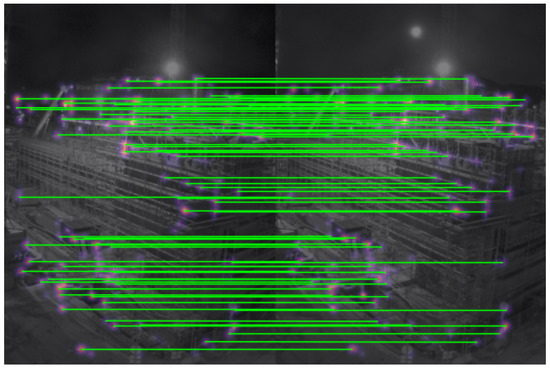
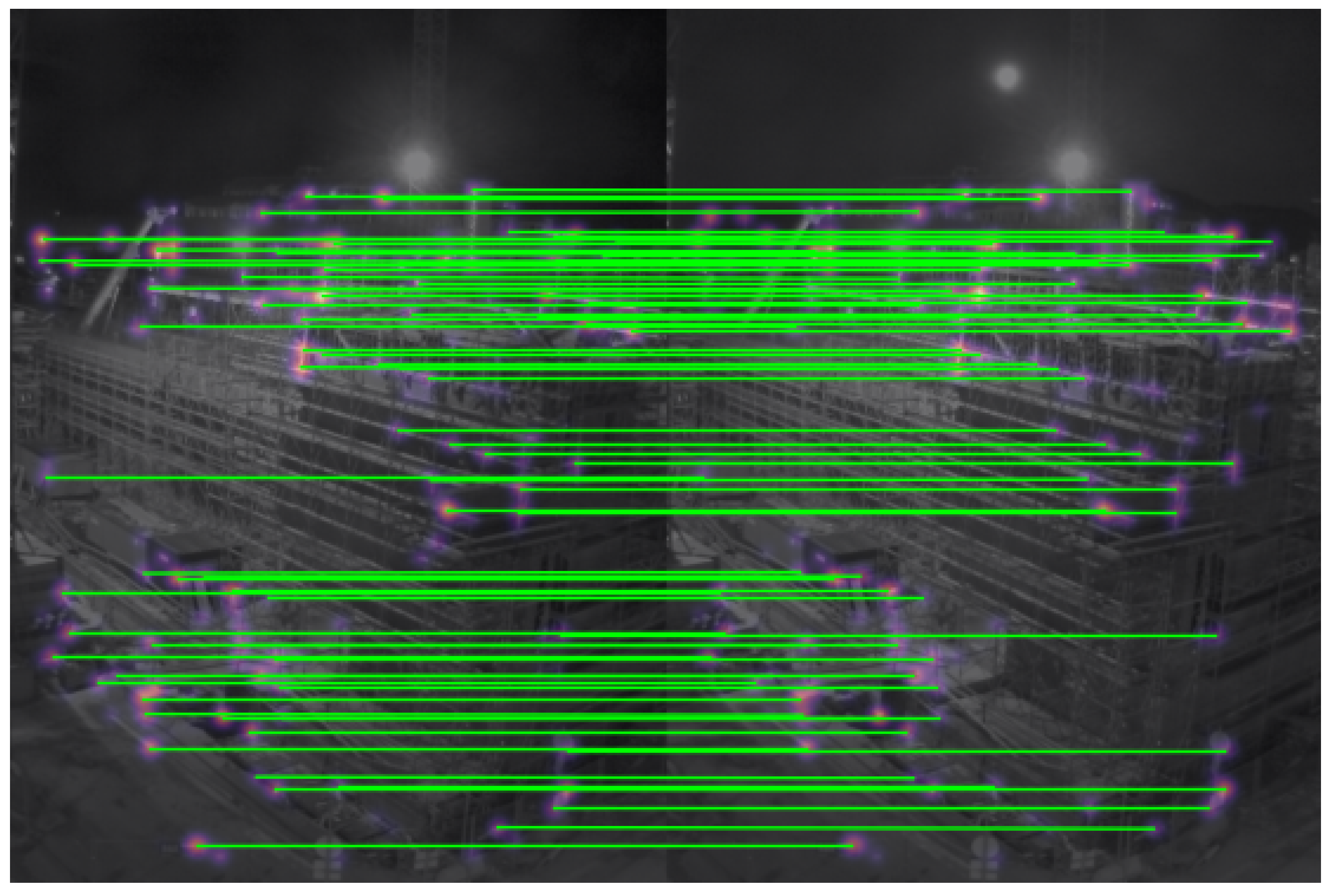
Overall, our method achieves accurate and efficient keypoint detection (Figure 1), offering a strong tradeoff between performance and computational cost. We evaluate our model against both classical handcrafted methods and modern learned alternatives, demonstrating its effectiveness in challenging scenarios.
Figure 1.
Qualitative matching example using our method. The figure shows reliable correspondences between two challenging views with significant lighting and perspective changes. Green lines denote the matched keypoint correspondences between the two images, illustrating spatially consistent and semantically meaningful matches obtained by our approach.
Unlike pipelines that detect, describe, then match, our detector produces a keypoint heatmap whose peaks are implicitly associated through geometric consistency, removing descriptors entirely. This results in (i) zero descriptor storage/transmission (0 MB/pair in our HPatches protocol); (ii) real-time matching (∼8 ms/pair); and (iii) a simpler front end with fewer moving parts, which is attractive for embedded VIO/SLAM. We empirically show competitive homography accuracy while eliminating descriptor cost, emphasizing applicability where bandwidth and memory are primary constraints.
Our main contributions are outlined as follows:
- We propose a novel student–teacher framework for keypoint detection, where SuperPoint provides structured supervision to a lightweight student network. To increase stability under homographic transformations, we introduce a consistency loss that can be framed as either a regression or classification objective.
- We design an efficient architecture based on MobileNetV3 enhanced with a Feature Pyramid Network (FPN) to improve multi-scale spatial representation while maintaining low computational cost.
- We introduce a two-stage training strategy that first learns strong feature representations, then refines them using label smoothing and Gaussian-filtered masks to improve spatial consistency.
- We demonstrate that our approach produces consistent and high-quality keypoint heatmaps and achieves competitive results on benchmark datasets while remaining efficient and scalable.
- The code is available at https://github.com/ionut-grigore99/FPC-Net, accessed on 20 April 2025.
2. Related Work
The field of feature matching in computer vision has evolved significantly, shaped by both algorithmic constraints and the increasing demand for scalability. Early approaches prioritized sparse matching strategies [1,7,8,9,13,14,15,16] due to the computational infeasibility of dense correspondence estimation [17,18,19,20,21,22,23,24,25,26,27,28]. Pioneering detectors focused on identifying isolated, distinctive pixels—those that stand out from their neighbors and are more likely to be uniquely identified in other views. Over time, various detectors emerged, ranging from gradient-based techniques [29,30] to fast corner and blob detectors [31]. These methods generally assign a score to each pixel and retain only the top responses, often applying non-maximum suppression to ensure spatial diversity.
Once such interest points are extracted, the challenge shifts to establishing reliable matches across views. Initial strategies used raw image patches, but these were quickly replaced by descriptors—compact representations designed to be invariant to certain transformations, such as minor viewpoint or illumination changes. Traditional descriptors such as SIFT [4] and HoG [32] encode gradient information, while binary descriptors emerged as computationally lighter alternatives [6,33,34].
Despite their success, handcrafted descriptors struggle with large-scale transformations such as rotations or scale changes. This limitation motivated the use of multi-scale detection schemes [34,35] and local orientation estimation [4,6] to improve stability under geometric transformations. However, these pipelines—comprising independent detection, description, and matching stages—often required delicate tuning and lacked adaptability to new domains.
The rise of deep learning reshaped this landscape. Convolutional neural networks (CNNs) proved capable of learning not just descriptors but entire detection pipelines. CNN-based detectors can be trained for invariance across geometric and photometric changes [36], yielding sharper and more stable interest-point predictions [37]. Moreover, CNNs can learn to consistently rank keypoints [38] and provide high-quality outputs that outperform traditional handcrafted metrics in various settings. More recently, transformer architectures and attention-based models [12,17] have further advanced this field by enabling global context modeling for feature representation and matching. These methods can capture long-range dependencies and enhance stability in complex scenes with repetitive structures or large viewpoint changes. In parallel, graph neural networks (GNNs) [39] have been employed to reason about spatial relationships between keypoints, refining matches through structured attention mechanisms. These innovations, often layered on top of CNN-based feature extractors, have led to more accurate and context-aware matching pipelines.
Architectures such as SuperPoint [8] and SuperGlue [39] embrace full deep pipelines by learning both keypoint detection and description in a unified framework. SuperPoint, for example, shares encoder layers between detection and description heads and trains via a synthetic-to-real transfer approach with homographic warping. SuperGlue, in turn, builds on SuperPoint keypoints and descriptors, using an attention-based graph neural network to perform context-aware matching between images—while still relying on explicit descriptors for correspondence estimation.
Although these models have brought end-to-end learning to feature extraction, they still maintain an explicit notion of descriptors. Our approach challenges this paradigm by discarding traditional descriptors entirely. Instead, we introduce a unified architecture in which the notion of a keypoint is intrinsically tied to the output activation channels of the network itself. This implicit representation enables matching without needing to extract or compare explicit descriptor vectors, reducing computational and memory overhead.
In doing so, we not only simplify the matching pipeline but also open the door to lightweight, communication-efficient systems. Unlike previous descriptor compression efforts—which relied on quantization or vocabulary encoding [40,41]—our method inherently encodes correspondence information in the detection process, eliminating the need for descriptors altogether.
Beyond detector-free dense matchers and attention-based sparse matchers, we also consider recent re-assessments of low-level features [42] and UAV panorama [43] pipelines that emphasize anti-clutter filtering and scale robustness. We adopt these insights but depart fundamentally by removing descriptors and supervising a single heatmap head whose correspondences are validated by geometric consistency rather than descriptor or attention similarity.
3. Method
Our approach utilizes SuperPoint [8] as a teacher model to generate keypoint labels, enabling a more structured learning process for a student network. We use SuperPoint [8] strictly as a detector teacher: a VGG-like encoder with a detector head that predicts 65 cell-wise logits (an 8 × 8 grid plus a dustbin), softmaxed and reshaped into a pixel saliency map; the descriptor head is not used. Teacher detections are converted into soft target masks (m) by placing Gaussian bumps at NMS-filtered keypoints; for pairs related by homography (), targets are warped to the counterpart view and multiplied by a binary validity mask to exclude out-of-bounds/occluded pixels. SuperPoint’s synthetic/homographic training is known to stabilize low-level keypointness [8]. To harden the student against clutter and photometric artifacts, we apply strong augmentations as enumerated in Section 5.
The backbone of our student model is MobileNetV3 [10], a lightweight and efficient feature extractor, which we augment with a Feature Pyramid Network [11] (FPN) at four strategic locations to enhance multi-scale feature representation. The feature maps undergo a streamlined aggregation process—bicubic upscaling, summation, and dimensionality reduction via a convolutional layer—before being interpolated to a VGA-resolution heatmap. We leverage keypoints to guide the pretrained backbone’s feature maps to concentrate on regions pertinent to keypoint detection. The resulting model produces heatmaps that are consistent across frames and more responsive to keypoint-like regions. Heatmaps offer broader applicability beyond keypoints alone, allowing for experiments on the derivation of various features, such as lines or shapes.
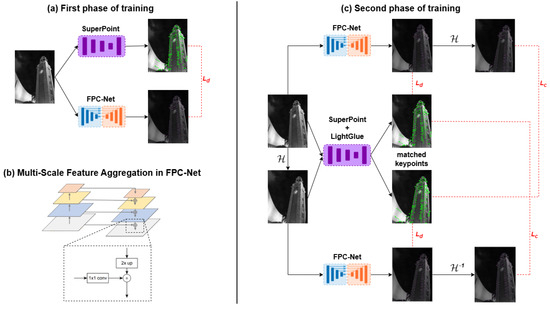
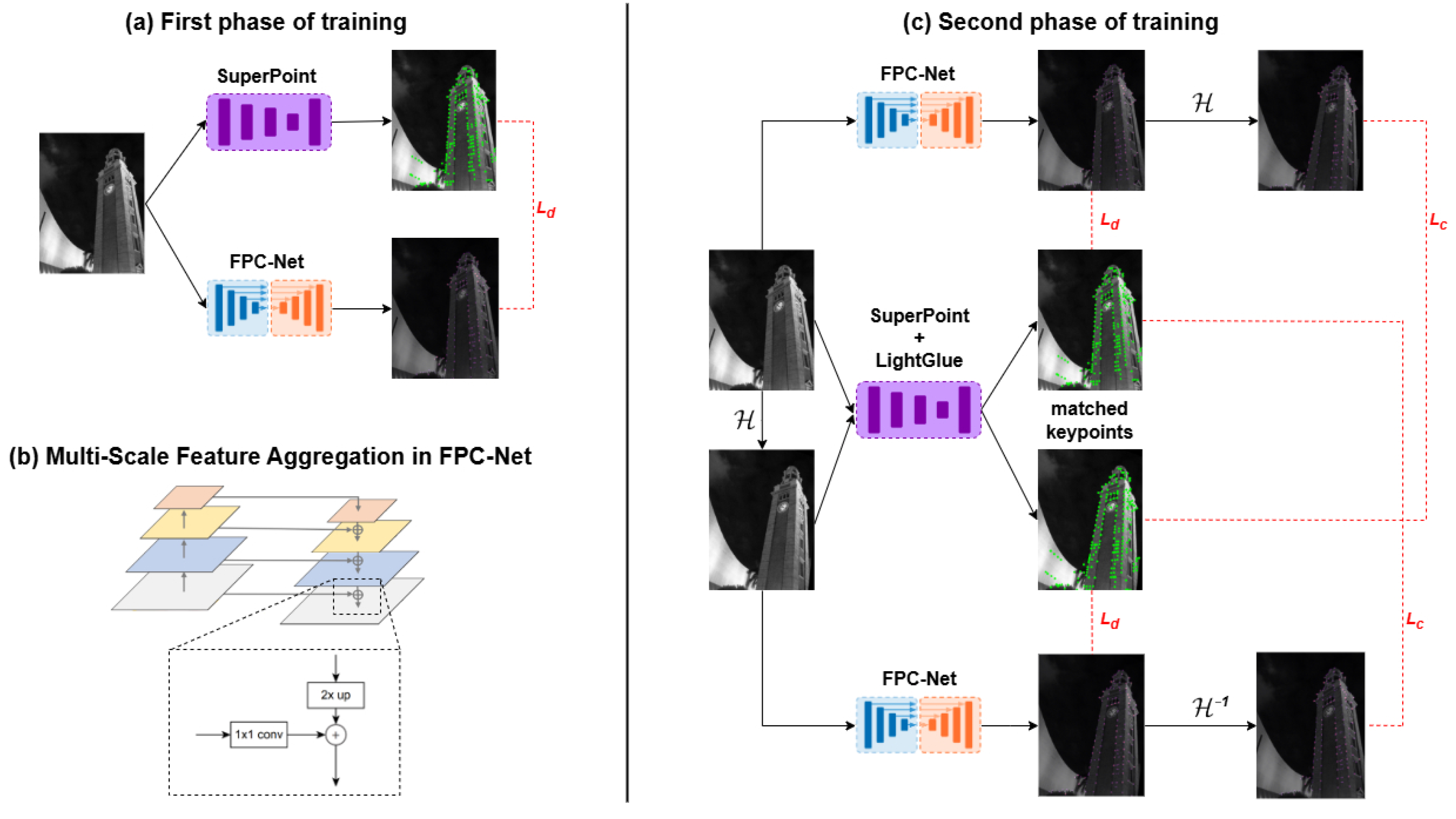
We employ a two-stage training strategy to refine keypoint detection and improve spatial consistency. The first stage fine-tunes the backbone alongside the FPN to develop a strong representation of “keypointness”, enriching feature maps with more meaningful spatial information, as illustrated in Figure 2a. To supervise the detection head, we employ the sigmoid focal loss [44]—a variant of the standard cross-entropy loss that mitigates the imbalance between foreground and background pixels. It downweights well-classified examples and focuses training on hard, ambiguous regions. We use its default parameters of and .
Figure 2.
Overview of the proposed two-stage training framework. (a) In the first phase, we use SuperPoint to generate pseudo-ground-truth keypoint masks, which supervise the FPC-Net detector through a sigmoid focal loss . (b) FPC-Net is built on a MobileNetV3 backbone with a Feature Pyramid Network (FPN) for multi-scale feature aggregation, combining representations from four stages via bicubic upsampling and 1×1 convolutions. (c) In the second phase, LightGlue is used to obtain matched keypoints between original and warped images. Gaussian-filtered masks derived from these matches are used to supervise FPC-Net predictions under homographies and through a consistency loss (). The focal loss () remains active in both phases to encourage sharp and discriminative heatmap predictions.
The sigmoid focal loss used in our training is defined as follows:
where is the predicted heatmap value, is the ground-truth keypoint mask, denotes the sigmoid function, and and are the balancing parameters.
The second stage, as shown in Figure 2c, builds upon this foundation, introducing label smoothing and Gaussian-filtered target masks to encourage spatial awareness and uncertainty modeling. These masks are derived using LightGlue [12], ensuring that keypoints remain consistent between original and warped images. The sigmoid focal loss remains active during this phase to continue supervising the detector head with hard-negative mining and class imbalance mitigation. We augment the second phase by incorporating a consistency loss alongside the active sigmoid focal loss, aiming to enhance invariance to homographic transformations. For this, we experiment with the Huber loss, which offers a balance between L1 and L2 penalties, allowing for smoother gradient propagation while handling outliers more effectively.
Additionally, we explore an alternative approach by formulating keypoint detection as a fine-tuning classification problem, leveraging KL divergence to treat the image as a probability distribution. This perspective shifts the focus towards learning a structured distribution of keypoint locations rather than explicit coordinate regression. However, because certain image regions may become occluded or invalid after warping (e.g., moving outside the image bounds), we apply a binary validity mask that excludes these regions from contributing to the loss. This ensures that consistency is only enforced where pixel-level correspondence is well defined.
The consistency loss can be mathematically defined as follows:
where p and denote the predictions for the original and warped images, is a homography, m and are the corresponding ground-truth masks, is the sigmoid function, and is the softmax function.
Functionally, the teacher supplies pseudo-labels that bootstrap “keypointness” (Stage 1 with focal loss) and provides smoothed, warp-consistent supervision (Stage 2), while the student learns a sharpened, spatially aware heatmap supervised by focal loss plus either Huber- or KL-based consistency; LightGlue [12] provides robust matches to estimate , and inference remains descriptor-free.
To reduce locally duplicated peaks in the predicted heatmap and improve match stability without introducing NMS at inference, we add a small regularizer that encourages a single dominant peak per neighborhood. Let Z denote the pre-sigmoid logits of the head and be a window around pixel . We form a low-temperature softmax within each window, i.e.,
and minimize the complement of the squared norm (high when mass is spread, low when one entry dominates):
where denotes the set of valid pixels over which we average the term.
The total loss becomes the following:
This regularizer spreads detections spatially during training and reduces spurious local duplicates while leaving the inference recipe unchanged (quantile-based, top-K, descriptor-free matching).
4. Experiments
In our experiments, we train the FPC-Net model on MS-COCO images and evaluate its performance on the HPatches dataset [45]; the initial sequence (00) from the KITTI autonomous driving dataset [46]; and sequence V1_01 from the EuRoC MAV dataset [47], which captures indoor drone navigation.
HPatches consists of 116 scenes and 696 unique images, with the first 57 scenes featuring significant illumination changes and the remaining 59 showcasing large viewpoint variations.
To construct evaluation pairs for the KITTI and EuRoC datasets, we randomly select 100 image pairs using the sampling method detailed below. Although both datasets offer stereo sequences, our experiments are limited to images from the left camera only.
The procedure for generating pairs from an image sequence is described as follows: starting from a given reference frame, we densely initialize 2D points and track them forward using the Kanade–Lucas–Tomasi (KLT) algorithm across subsequent frames. A pair is then formed between the reference frame and a randomly chosen later frame, in which at least a fraction () of the original points remains successfully tracked. The parameter effectively controls the minimum required scene overlap between the two views. This strategy offers the advantage of being agnostic to camera calibration while still ensuring a reliable level of shared scene content. In our setup, we use a stricter when generating evaluation pairs to ensure higher overlap during testing.
4.1. Keypoint Repeatability on HPatches
To assess FPC-Net’s interest-point detection capabilities, we measure repeatability on the HPatches dataset. We compare its performance against the SuperPoint model, as well as the FAST [31], Harris [30], and Shi [29] models.
To evaluate the performance of an interest-point detector across image pairs, we measure repeatability, defined as the proportion of keypoints detected in one image that also appear in the corresponding warped image within a given pixel threshold.
All evaluations are performed at a resolution of 640 × 480, with 300 keypoints detected per image. For SuperPoint, Non-Maximum Suppression (NMS) with a radius of four pixels is applied to select the top responses. The correct match distance threshold is varied across one, three, and eight pixels to provide a comprehensive assessment under different levels of geometric tolerance.
Let us denote the set of detected keypoints in the first image as and those in the second image as . We define a tolerance radius () to determine whether a keypoint match is valid. A point () is considered to be repeated successfully if it has at least one corresponding point () within that radius. Mathematically, the correctness indicator for a point () is expressed as follows:
Likewise, we apply the same rule symmetrically to each point () from the second image. The final repeatability score is then computed as the average fraction of matched keypoints from both sets:
This value reflects the fraction of points that are consistently detected between the two images.
In summary, applying the consistency loss enhances repeatability, particularly under substantial viewpoint changes. The corresponding results are presented in Table 1, where we can see that FPC-Net outperforms existing methods in repeatability while remaining descriptor-free and computationally efficient.
Table 1.
HPatches detector repeatability. Repeatability is measured as the fraction of correctly re-detected keypoints under different levels of geometric tolerance ( = 1, 3, 8 pixels). Results are reported separately for illumination changes (i), viewpoint changes (v), and the full set (all) of HPatches image sequences. Best results are highlighted in bold.
4.2. Homography Estimation Accuracy on HPatches
To evaluate FPC-Net’s matching performance, we assess its matching capabilities on the HPatches dataset. All experiments were conducted on images resized to a resolution of 480 × 640 pixels. Unlike traditional systems that output both keypoints and descriptors, FPC-Net produces a heatmap indicating the keypointness of each pixel, without providing descriptors. To enable homography estimation, we extract keypoints by applying quantile-based thresholding to the heatmap, selecting the most confident locations. We then perform descriptor-free matching by comparing the spatial proximity of detected points. Specifically, we match keypoints between image pairs based on a nearest-neighbor search in image coordinates and estimate the homography using RANSAC using OpenCV’s findHomography() function. FPC-Net is compared against three established systems: BRISK [34], SIFT [4], and ORB [6].
In Table 2, we report the descriptor size (MB/pair), i.e., the bytes that must be stored or transmitted per image pair for descriptor-based matching. Our pipeline does not compute descriptors—keypoints are selected by quantile-based thresholding on the heatmap and matched in image coordinates. Therefore, the descriptor payload is 0 MB. This metric is distinct from the network’s model size/weights. To avoid conflating descriptor payload with model footprint, we additionally report #Params and FLOPs for all trainable methods in Table 3. FLOPs are measured with the thop library in the PyTorch 1.12.0 graph at 480 × 640 (batch = 1, eval) and reported as 2 × MACs; classical hand-crafted baselines (e.g., ORB/SIFT/BRISK) are not profiled (n/a).
Table 2.
HPatches homography estimation. A homography is considered correct if the average projection error of the warped image corners is below pixels. We report results for illumination (i), viewpoint (v), and the full set (all), along with the total runtime (ms per pair) and descriptor size (MB per pair). Best results are highlighted in bold.
Table 3.
FLOPs measured for trainable methods with thop in the PyTorch 1.12.0 graph (batch = 1, eval) at 480 × 640; we report FLOPs as 2 × MACs. Classical hand-crafted baselines (BRISK/ORB/SIFT) are not profiled with thop (n/a). Descriptor payloads (MB/pair) are reported separately in Table 2.
To assess how well an algorithm estimates a homography between two images, we evaluate how accurately it maps known reference points rather than directly comparing the matrix values—which can be unreliable due to varying matrix entry scales. Instead, we use a geometric validation method based on how well four canonical points (e.g., image corners) from one image are transformed to their expected locations in the other image.
Let the corner coordinates in the source image be denoted by . The true homography matrix () maps these to in the second image. Meanwhile, the predicted homography () gives the transformed points, i.e., .
We define the homography correctness over a batch of K samples by measuring the average reprojection error over the four corners and checking whether the mean distance is below a threshold ():
where represents the c-th ground-truth corner in sample k, while is the corresponding point predicted by the estimated homography. The threshold () defines the maximum permissible average corner error for a match to be counted as correct.
Scores range between 0 and 1, with values closer to 1 indicating a more accurate homography estimation.
The homography estimation results, shown in Table 2, indicate that FPC-Net achieves better accuracy and reliability, all while remaining descriptor-free and efficient.
4.3. Pose Estimation Accuracy
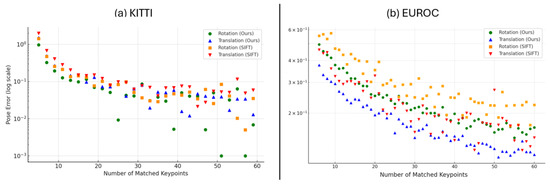
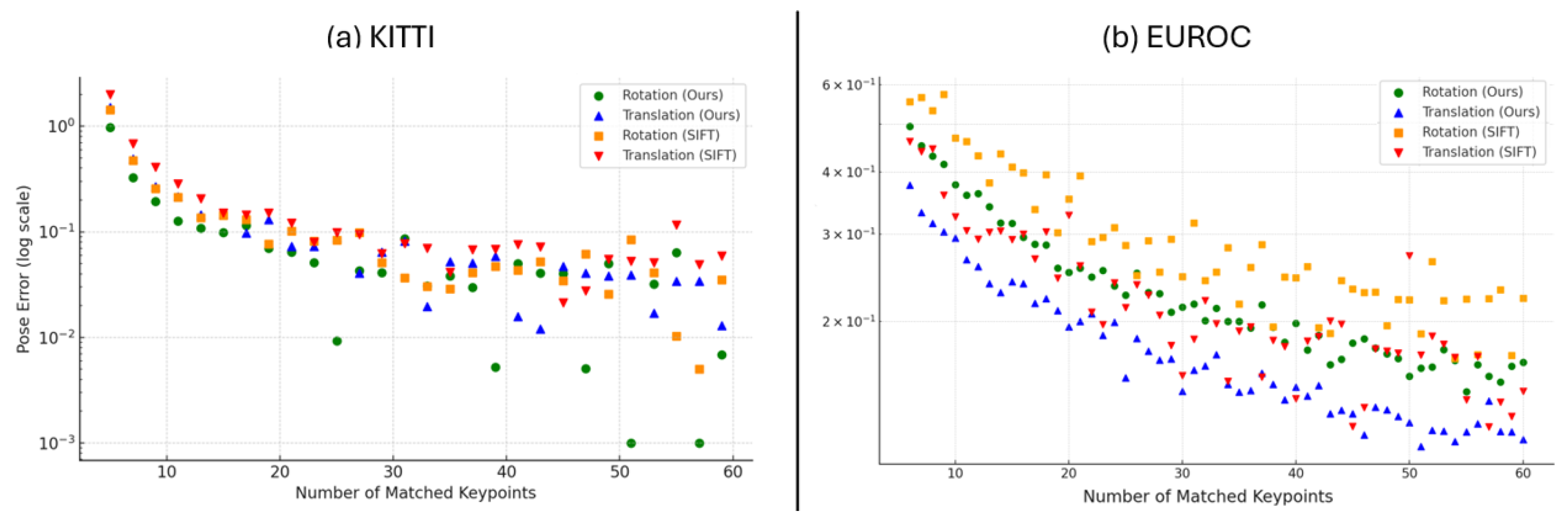
To understand how detection and matching performance impacts downstream pose estimation, we compare the relative camera pose recovered using our method versus SIFT with respect to the ground truth on KITTI and EuRoC. For each image pair, we compute 3D point correspondences via stereo triangulation from interest-point matches (left–right camera) and estimate the pose using P3P [49] within a RANSAC loop [50]. The estimated poses are then compared to the ground truth using rotation error (measured as the geodesic distance in angle-axis representation) and translation error (measured in Euclidean distance). In Figure 3a, we plot these errors against the number of inlier correspondences for each image pair in KITTI. The corresponding results for EuRoC are provided in Figure 3b. As can be seen, pose error decreases as the number of inlier matches increases, and our method achieves consistently lower rotation and translation error than SIFT across most bins; the corresponding numeric values are summarized in Table 4 (y-axis is in log scale).
Figure 3.
Pose estimation error versus number of matched keypoints for (a) KITTI and (b) EuRoC datasets. We report both rotation and translation errors in log scale for our method and SIFT. For both datasets, our method consistently achieves lower or comparable pose errors, particularly in low-keypoint regimes. This demonstrates its ability to produce more geometrically informative matches, especially when only a few correspondences are available. Notably, the performance gap is most significant below 30 keypoints, where our method yields accurate pose estimates despite the sparse input.
Table 4.
Pose error vs. matched keypoints for KITTI and EuRoC. Values correspond to the plot in Figure 3.
4.4. Ablation Studies: FPN, Training Strategy, and Loss Design
We quantify the effect of the training schedule and loss. The backbone and FPN, input resolution (480 × 640), top-K selection (quantile-based, no NMS), descriptor-free matching (nearest neighbors in image coordinates), and homography estimation (RANSAC) are identical across rows. Metrics are reported on HPatches as Repeatability@ and Homography Acc.@ for (corner reprojection criterion) in Table 5.
Table 5.
Ablation on HPatches. Repeatability and homography accuracy at thresholds of . All settings are identical across rows, except training stage/loss. The Full model uses Stage 2 with Huber consistency and the peak-separation regularizer; other rows omit parts as indicated. ↑ indicates that higher values correspond to better performance. Best results are highlighted in bold.
Results show clear gains from Stage 2 and from the addition of consistency loss (Huber or KL), with Huber loss slightly ahead.
4.5. Other Experiments
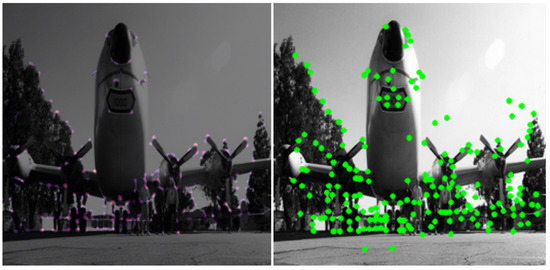
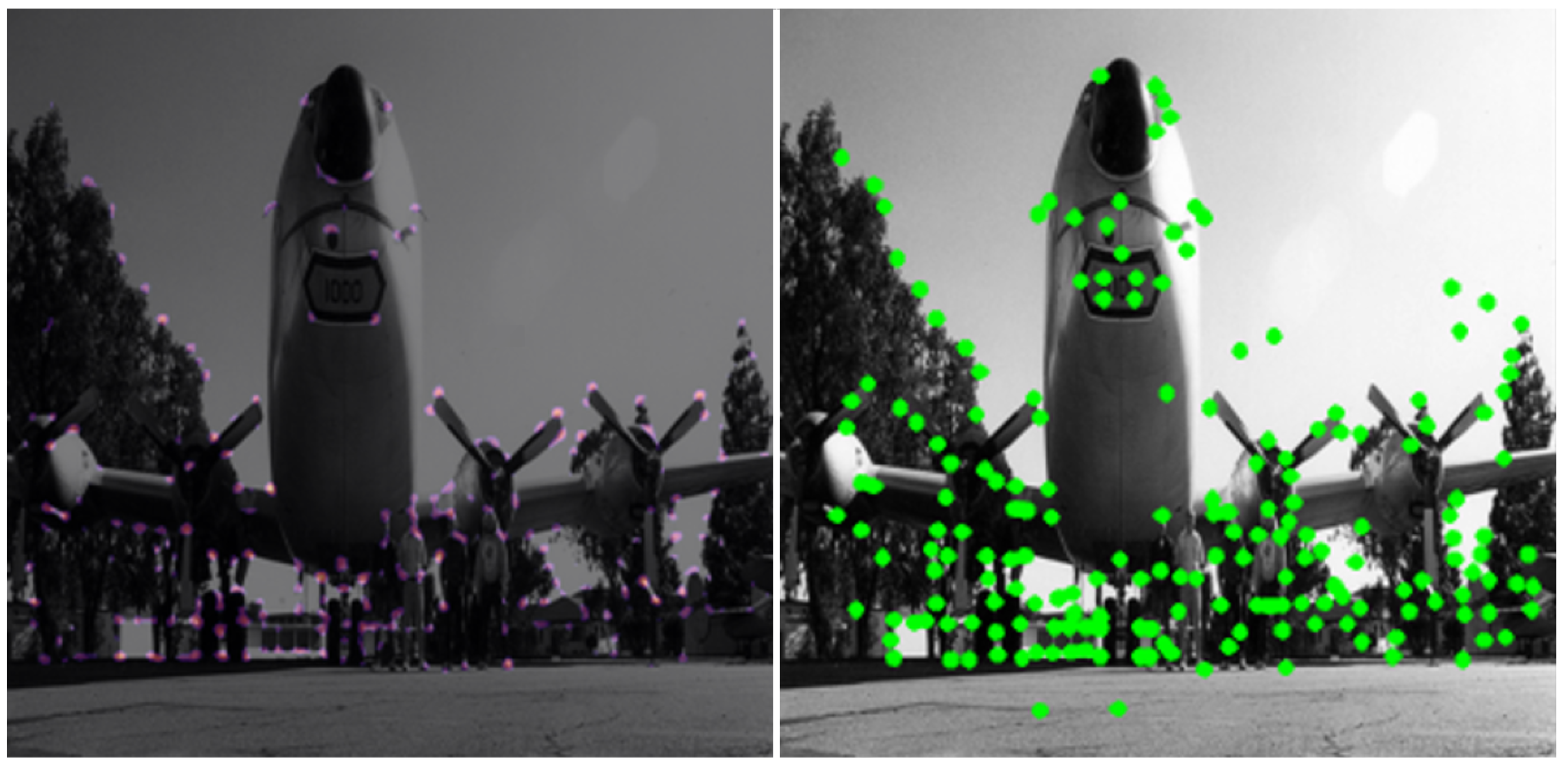
To further assess the behavior of our network, we present a qualitative comparison between its predicted keypoints and those generated by the SuperPoint+LightGlue pipeline. As illustrated in Figure 4, our model produces cleaner, more spatially structured keypoints, with improved semantic coverage of salient object regions. In contrast, SuperPoint+LightGlue tends to produce dense and often redundant keypoints, particularly in texture-rich areas such as the ground or tree foliage.
Figure 4.
Comparison of keypoint detections between our network (left) and SuperPoint + LightGlue (right). Colored dots indicate the detected keypoints in each image. Our method outputs clean, sparse, and semantically meaningful detections focused on salient object parts (e.g., aircraft body and propellers), while SuperPoint + LightGlue produces dense and redundant detections, particularly in texture-heavy regions like the ground and foliage.
These dense detections require non-maximum suppression (NMS) to achieve a usable sparse set, whereas our method directly outputs sharp heatmap peaks that reflect high confidence in semantically meaningful areas. This demonstrates the ability of our network to learn a more interpretable and focused keypoint distribution, which simplifies downstream processing and matching.
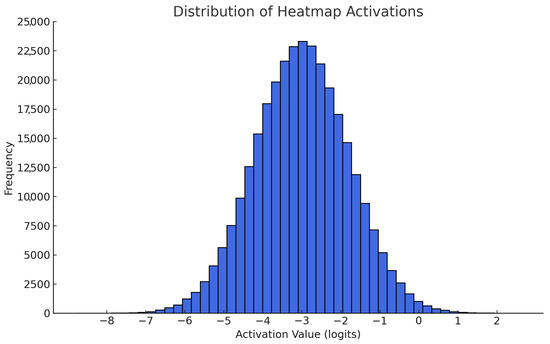
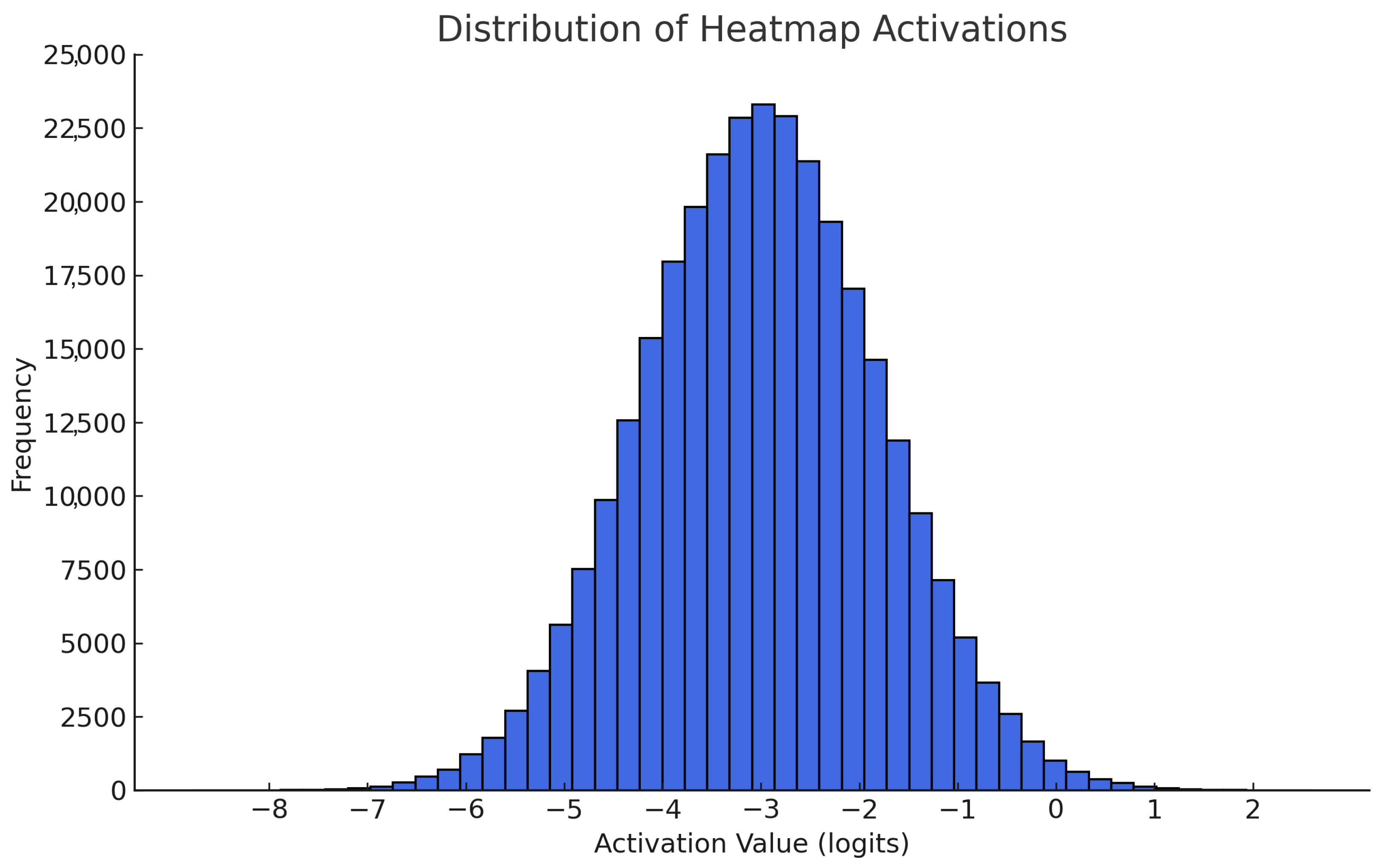
To further support this observation, we visualize the distribution of heatmap activations in Figure 5. The majority of activation values are sharply concentrated around , which, after applying the sigmoid function, corresponds to a very low confidence (i.e., ), effectively suppressing irrelevant regions. Only a small fraction of the activations exceed zero, indicating confident peaks for true keypoints. This distribution confirms that our network learns to produce sparse and confident detections and that the sigmoid-based activation output acts as an implicit confidence filter.
Figure 5.
Distribution of raw heatmap activation values before sigmoid transformation. Most activations are centered around , suppressing low-confidence regions. Only a few high-activation peaks contribute to keypoint predictions after sigmoid, promoting sparsity and precision.
4.6. Applicability, Edge-Readiness, Scale, FOV, Failure Modes, and Mitigation
Applicability. Our method is best suited for medium/high-overlap views (e.g., driving and indoor sequences), resource-constrained deployment, and real-time front ends, where descriptor memory and latency dominate. On HPatches, we observe strong accuracy with stricter thresholds and illumination changes; SIFT can outperform our method with very loose thresholds under severe viewpoint change.
Failure Modes and Mitigation. When the two views share little or no content, nearest-neighbor (NN) matching in image coordinates can fabricate spurious pairs (every point in still has a nearest point in ). We add an inexpensive early-reject by heatmap correlation safeguard: let be the two heatmaps downsampled (e.g., by ) via average pooling, which preserves the coarse spatial structure indicative of overlap while suppressing local noise and small misregistrations and makes the NCC check negligible in cost. We then compute the normalized cross-correlation (NCC) on the mean-centered maps:
Pairs with are early-rejected (we do not attempt matching or RANSAC). We set on a validation split. This guard suppresses low-overlap or geometrically impossible matches before RANSAC.
Scale & FOV. Wide-FOV imagery introduces more background clutter and texture repeats. Our descriptor-free pipeline mitigates this with (i) quantile-based selection (constant density across resolutions); (ii) the NCC early-reject, which skips non-overlapping or weakly overlapping pairs; and (iii) multi-scale context from the FPN backbone. In this version, we resize inputs to a fixed evaluation size; dynamic-resolution and multi-scale inference (e.g., image pyramids run the detector at multiple image scales, rescale detections back to the original frame, then merge and de-duplicate to add scale robustness beyond what FPN already gives or tiled processing with overlap for very large frames split the image into manageable tiles with an overlap margin, run the network per tile, then stitch the tile heatmaps by max or weighted average in the overlaps) are promising directions we leave for future work.
Edge-Readiness and Limitations. We augment our main results with model-agnostic compute floating-point operations per second (FLOPS), the number of parameters, and descriptor payload (MB/pair). These metrics are reproducible indicators of deployability on resource-constrained hardware. Our pipeline is descriptor-free (descriptor size MB/pair), eliminating storage/transmission of per-keypoint descriptors. Absolute on-device latency and energy remain platform-dependent; a comprehensive embedded benchmark (e.g., ARM CPU and Jetson-class GPU) is left to future work.
Conservative Detection and “Noisy Points.” In a descriptor-free pipeline, spurious detections are disproportionately harmful because they propagate directly to incorrect correspondences. Therefore, we choose a conservative operating point that favors precision and temporal/geometric stability. Throughout this paper, we refer to noisy points as local responses that arise in low-contrast or repetitive regions (e.g., foliage, lattices, or specular highlights) and yield unstable or non-repeatable matches. Our training includes strong photometric/geometric augmentations and a peak-separation regularizer (Section 3) to reduce such clutter; at test time, we retain only the most confident responses via an image-adaptive selection quantile.
Content-Adaptive Thresholds. While a global per-image quantile is simple and effective, it may suppress true positives in very textured scenes. A promising extension is a content-adaptive policy (learned or heuristic) that adjusts the selection threshold based on heatmap statistics (e.g., histogram shape/entropy) or targets a fixed keypoint density per megapixel. Exploring such adaptive policies—potentially combined with region-wise thresholds—is left for future work.
5. Implementation Details
All training is conducted using PyTorch 1.12.0 [51] with a mini-batch size of eight and the Adam optimizer, configured with its default parameters (learning rate = 0.001 and beta = (0.9, 0.999)). The experiments are run on a single NVIDIA Tesla V100-SXM2 GPU. The training follows a two-phase strategy: the first phase, focused on learning discriminative keypoint representations, runs for 10 epochs, while the second phase, which incorporates spatial consistency and uncertainty modeling, is trained for an additional 6 epochs.
To strengthen the network’s adaptability to lighting, viewpoint, and local image distortions, we employ a diverse set of data augmentation techniques from the Albumentations library [52]. Specifically, we apply glass blur, motion blur, defocus, and Gaussian noise to simulate sensor and camera noise. To account for geometric variability, we include perspective transforms, affine and piecewise affine deformations, and shift–scale–rotate augmentations. We also apply random zoom-in/out implemented as a resized crop with anti-aliasing, which encourages scale invariance by exposing the network to variable object sizes and fields of view while avoiding resampling artifacts. Additionally, we introduce random brightness and contrast changes to enhance illumination invariance. These augmentations are applied with high probability to encourage generalization under real-world image variations.
Our model adopts a lightweight yet expressive architecture, combining MobileNetV3-Small [10] as the backbone and a Feature Pyramid Network (FPN) [11] for multi-scale feature aggregation. We chose MobileNetV3 due to its efficient inverted residual bottlenecks and low computational footprint, which makes it suitable for real-time keypoint detection. From the MobileNetV3 feature extractor, we select intermediate outputs from four strategically chosen layers—indexed as 1, 2, 4, and 12—which correspond to progressively deeper semantic representations with increasing receptive fields.
These feature maps, with channel sizes or {16, 24, 40, and 576}, are fed into an FPN that projects them to a common embedding space of 128 channels using lateral 1 × 1 convolutions, followed by upsampling and top–down fusion. This hierarchical design, illustrated in Figure 2b, enhances the model’s ability to detect keypoints across scales by blending low-level texture and high-level context information. We then upsample the top-level FPN features (from layer 12) step by step, summing them with lower-level outputs (from layers 4, 2, and 1) using bicubic interpolation. The final aggregated feature map is passed through a 1 × 1 convolution and batch normalization layer to produce a single-channel heatmap that represents the likelihood of keypoint locations.
During inference, this heatmap is rescaled to the target resolution using bicubic interpolation and post-processed via quantile-based thresholding to retain only the most salient peaks. This design balances detection performance and computational efficiency, making the model deployable in real-time scenarios.
6. Conclusions
This study introduces a technique whereby interest points are inherently associated during detection, eliminating the need for computing, storing, transmitting, or matching descriptors. The key novelty is that, instead of relying on descriptors for matching, interest points are uniquely associated through a descriptor-free heatmap prediction, supervised using LightGlue matches, and regularized with a KL-divergence consistency loss between warped and original images. Although our method does not rely on descriptors, it achieves matching accuracy on par with or better than that of conventional approaches while drastically reducing memory usage in localization systems.
Author Contributions
Conceptualization, I.-O.G.-A., C.L.-C. and C.-A.P.; methodology, I.-O.G.-A., C.L.-C. and C.-A.P.; software, I.-O.G.-A.; validation, I.-O.G.-A.; formal analysis, I.-O.G.-A.; investigation, I.-O.G.-A.; resources, C.-A.P.; data curation, I.-O.G.-A.; writing—original draft preparation, I.-O.G.-A.; writing—review and editing, C.-A.P.; visualization, I.-O.G.-A.; supervision, C.L.-C. and C.-A.P.; project administration, C.L.-C. and C.-A.P.; funding acquisition, C.-A.P. All authors have read and agreed to the published version of the manuscript.
Funding
This research received no external funding. The APC was funded by Politehnica University of Timișoara.
Institutional Review Board Statement
Not applicable.
Informed Consent Statement
Not applicable.
Data Availability Statement
Data are contained within the article.
Conflicts of Interest
Author Claudiu Leoveanu-Condrei was employed by the company ExtensityAI. The remaining authors declare that the research was conducted in the absence of any commercial or financial relationships that could be construed as a potential conflict of interest.
References
- Sattler, T.; Maddern, W.; Toft, C.; Torii, A.; Hammarstrand, L.; Stenborg, E.; Safari, D.; Okutomi, M.; Pollefeys, M.; Sivic, J.; et al. Benchmarking 6DOF outdoor visual localization in changing conditions. In Proceedings of the IEEE Conference on Computer Vision and Pattern Recognition (CVPR), Salt Lake City, UT, USA, 18–22 June 2018; pp. 8601–8610. [Google Scholar]
- Schönberger, J.L.; Frahm, J.-M. Structure-from-motion revisited. In Proceedings of the IEEE Conference on Computer Vision and Pattern Recognition (CVPR), Las Vegas, NV, USA, 26 June–1 July 2016; pp. 4104–4113. [Google Scholar]
- Nistér, D.; Naroditsky, O.; Bergen, J. Visual odometry for ground vehicle applications. J. Field Robot. 2006, 23, 3–20. [Google Scholar] [CrossRef] [Scilit]
- Lowe, D.G. Distinctive image features from scale-invariant keypoints. Int. J. Comput. Vis. 2004, 60, 91–110. [Google Scholar] [CrossRef] [Scilit]
- Bay, H.; Tuytelaars, T.; Van Gool, L. SURF: Speeded up robust features. In Proceedings of the European Conference on Computer Vision (ECCV), Graz, Austria, 7–13 May 2006; pp. 404–417. [Google Scholar]
- Rublee, E.; Rabaud, V.; Konolige, K.; Bradski, G. ORB: An efficient alternative to SIFT or SURF. In Proceedings of the IEEE International Conference on Computer Vision (ICCV), Barcelona, Spain, 6–13 November 2011; pp. 2564–2571. [Google Scholar]
- Yi, K.M.; Trulls, E.; Lepetit, V.; Fua, P. LIFT: Learned invariant feature transform. In Proceedings of the European Conference on Computer Vision (ECCV), Amsterdam, The Netherlands, 11–14 October 2016; pp. 467–483. [Google Scholar]
- DeTone, D.; Malisiewicz, T.; Rabinovich, A. SuperPoint: Self-supervised interest point detection and description. In Proceedings of the IEEE Conference on Computer Vision and Pattern Recognition Workshop (CVPRW), Salt Lake City, UT, USA, 18–22 June 2018; pp. 224–236. [Google Scholar]
- Revaud, J.; De Souza, C.; Humenberger, M.; Weinzaepfel, P. R2D2: Reliable and repeatable detector and descriptor. In Proceedings of the Advances in Neural Information Processing Systems (NeurIPS), Vancouver, BC, Canada, 8–14 December 2019; Volume 32. [Google Scholar]
- Howard, A.; Sandler, M.; Chu, G.; Chen, L.C.; Chen, B.; Tan, M.; Wang, W.; Zhu, Y.; Pang, R.; Vasudevan, V.; et al. Searching for MobileNetV3. In Proceedings of the IEEE International Conference on Computer Vision (ICCV), Seoul, Republic of Korea, 27 October–2 November 2019; pp. 1314–1324. [Google Scholar]
- Lin, T.Y.; Dollár, P.; Girshick, R.; He, K.; Hariharan, B.; Belongie, S. Feature pyramid networks for object detection. In Proceedings of the IEEE Conference on Computer Vision and Pattern Recognition (CVPR), Honolulu, HI, USA, 21–26 July 2017; pp. 2117–2125. [Google Scholar]
- Lindenberger, P.; Sarlin, P.-E.; Pollefeys, M. LightGlue: Local feature matching at light speed. In Proceedings of the IEEE/CVF International Conference on Computer Vision (ICCV), Paris, France, 2–6 October 2023; pp. 17627–17638. [Google Scholar]
- Dusmanu, M.; Rocco, I.; Pajdla, T.; Pollefeys, M.; Sivic, J.; Torii, A.; Sattler, T. D2-Net: A trainable CNN for joint description and detection of local features. In Proceedings of the IEEE/CVF Conference on Computer Vision and Pattern Recognition (CVPR), Long Beach, CA, USA, 16–20 June 2019; pp. 8092–8101. [Google Scholar]
- Taira, H.; Okutomi, M.; Sattler, T.; Cimpoi, M.; Pollefeys, M.; Sivic, J.; Pajdla, T.; Torii, A. InLoc: Indoor visual localization with dense matching and view synthesis. In Proceedings of the IEEE Conference on Computer Vision and Pattern Recognition (CVPR), Salt Lake City, UT, USA, 18–22 June 2018; pp. 7199–7209. [Google Scholar]
- Zhou, H.; Sattler, T.; Jacobs, D.W. Evaluating local features for day-night matching. In Proceedings of the European Conference on Computer Vision (ECCV) Workshops, Amsterdam, The Netherlands, 8–16 October 2016; pp. 724–736. [Google Scholar]
- Ono, Y.; Trulls, E.; Fua, P.; Yi, K.M. LF-Net: Learning local features from images. In Proceedings of the Advances in Neural Information Processing Systems (NeurIPS), Montréal, QC, Canada, 2–8 December 2018; Volume 31. [Google Scholar]
- Sun, J.; Shen, Z.; Wang, Y.; Bao, H.; Zhou, X. LoFTR: Detector-free local feature matching with transformers. In Proceedings of the IEEE/CVF Conference on Computer Vision and Pattern Recognition (CVPR), Nashville, TN, USA, 19–25 June 2021; pp. 8922–8931. [Google Scholar]
- Farnebäck, G. Two-frame motion estimation based on polynomial expansion. In Proceedings of the Scandinavian Conference on Image Analysis (SCIA), Halmstad, Sweden, 29 June–2 July 2003; pp. 363–370. [Google Scholar]
- Horn, B.K.P.; Schunck, B.G. Determining optical flow. Artif. Intell. 1981, 17, 185–203. [Google Scholar] [CrossRef] [Scilit]
- Rocco, I.; Cimpoi, M.; Arandjelović, R.; Torii, A.; Pajdla, T.; Sivic, J. Neighbourhood consensus networks. In Proceedings of the Advances in Neural Information Processing Systems (NeurIPS), Montréal, QC, Canada, 3–8 December 2018; Volume 31. [Google Scholar]
- Rocco, I.; Arandjelović, R.; Sivic, J. Efficient neighbourhood consensus networks via submanifold sparse convolutions. In Proceedings of the European Conference on Computer Vision (ECCV), Glasgow, UK, 23–28 August 2020; pp. 605–621. [Google Scholar]
- Li, X.; Han, K.; Li, S.; Prisacariu, V. Dual-resolution correspondence networks. In Proceedings of the Advances in Neural Information Processing Systems (NeurIPS), Virtual Event, 6–12 December 2020; Volume 33, pp. 17346–17357. [Google Scholar]
- Chen, H.; Luo, Z.; Zhou, L.; Tian, Y.; Zhen, M.; Fang, T.; McKinnon, D.; Tsin, Y.; Quan, L. Aspanformer: Detector-free image matching with adaptive span transformer. In Proceedings of the European Conference on Computer Vision (ECCV), Tel Aviv, Israel, 23–27 October 2022; pp. 20–36. [Google Scholar]
- Wang, Q.; Zhang, J.; Yang, K.; Peng, K.; Stiefelhagen, R. MatchFormer: Interleaving attention in transformers for feature matching. In Proceedings of the Asian Conference on Computer Vision (ACCV), Macau, China, 4–8 December 2022; pp. 2746–2762. [Google Scholar]
- Choy, C.B.; Gwak, J.; Savarese, S.; Chandraker, M. Universal correspondence network. In Proceedings of the Advances in Neural Information Processing Systems (NeurIPS), Barcelona, Spain, 5–10 December 2016; Volume 29. [Google Scholar]
- Fathy, M.E.; Tran, Q.-H.; Zia, M.Z.; Vernaza, P.; Chandraker, M. Hierarchical metric learning and matching for 2D and 3D geometric correspondences. In Proceedings of the European Conference on Computer Vision (ECCV), Munich, Germany, 8–14 September 2018; pp. 803–819. [Google Scholar]
- Savinov, N.; Ladicky, L.; Pollefeys, M. Matching neural paths: Transfer from recognition to correspondence search. In Proceedings of the Advances in Neural Information Processing Systems (NeurIPS), Long Beach, CA, USA, 4–9 December 2017; Volume 30. [Google Scholar]
- Schönberger, J.L.; Pollefeys, M.; Geiger, A.; Sattler, T. Semantic visual localization. In Proceedings of the IEEE Conference on Computer Vision and Pattern Recognition (CVPR), Salt Lake City, UT, USA, 18–22 June 2018; pp. 6896–6906. [Google Scholar]
- Shi, J. Good features to track. In Proceedings of the IEEE Conference on Computer Vision and Pattern Recognition (CVPR), Seattle, WA, USA, 21–23 June 1994; pp. 593–600. [Google Scholar]
- Harris, C.; Stephens, M. A combined corner and edge detector. In Proceedings of the Alvey Vision Conference, Manchester, UK, 31 August–2 September 1988; Volume 15, pp. 10–5244. [Google Scholar]
- Rosten, E.; Drummond, T. Machine learning for high-speed corner detection. In Proceedings of the European Conference on Computer Vision (ECCV), Graz, Austria, 7–13 May 2006; pp. 430–443. [Google Scholar]
- Dalal, N.; Triggs, B. Histograms of oriented gradients for human detection. In Proceedings of the IEEE Conference on Computer Vision and Pattern Recognition (CVPR), San Diego, CA, USA, 20–25 June 2005; Volume 1, pp. 886–893. [Google Scholar]
- Calonder, M.; Lepetit, V.; Ozuysal, M.; Trzcinski, T.; Strecha, C.; Fua, P. BRIEF: Computing a local binary descriptor very fast. IEEE Trans. Pattern Anal. Mach. Intell. 2011, 34, 1281–1298. [Google Scholar] [CrossRef] [Scilit] [PubMed]
- Leutenegger, S.; Chli, M.; Siegwart, R.Y. BRISK: Binary robust invariant scalable keypoints. In Proceedings of the IEEE International Conference on Computer Vision (ICCV), Barcelona, Spain, 6–13 November 2011; pp. 2548–2555. [Google Scholar]
- Mikolajczyk, K.; Schmid, C. Scale & affine invariant interest point detectors. Int. J. Comput. Vis. 2004, 60, 63–86. [Google Scholar] [CrossRef] [Scilit]
- Lenc, K.; Vedaldi, A. Learning covariant feature detectors. In Proceedings of the European Conference on Computer Vision (ECCV) Workshops, Amsterdam, The Netherlands, 8–16 October 2016; pp. 100–117. [Google Scholar]
- Zhang, L.; Rusinkiewicz, S. Learning to detect features in texture images. In Proceedings of the IEEE Conference on Computer Vision and Pattern Recognition (CVPR), Salt Lake City, UT, USA, 18–22 June 2018; pp. 6325–6333. [Google Scholar]
- Savinov, N.; Seki, A.; Ladicky, L.; Sattler, T.; Pollefeys, M. Quad-networks: Unsupervised learning to rank for interest point detection. In Proceedings of the IEEE Conference on Computer Vision and Pattern Recognition (CVPR), Honolulu, HI, USA, 21–26 July 2017; pp. 1822–1830. [Google Scholar]
- Sarlin, P.-E.; DeTone, D.; Malisiewicz, T.; Rabinovich, A. SuperGlue: Learning feature matching with graph neural networks. In Proceedings of the IEEE/CVF Conference on Computer Vision and Pattern Recognition (CVPR), Seattle, WA, USA, 14–19 June 2020; pp. 4938–4947. [Google Scholar]
- Lynen, S.; Sattler, T.; Bosse, M.; Hesch, J.A.; Pollefeys, M.; Siegwart, R. Get out of my lab: Large-scale, real-time visual-inertial localization. In Proceedings of the Robotics: Science and Systems (RSS), Rome, Italy, 13–17 July 2015; Volume 1. [Google Scholar]
- Tardioli, D.; Montijano, E.; Mosteo, A.R. Visual data association in narrow-bandwidth networks. In Proceedings of the IEEE/RSJ International Conference on Intelligent Robots and Systems (IROS), Hamburg, Germany, 28 September–2 October 2015; pp. 2572–2577. [Google Scholar]
- Wang, C.; Zhang, G.; Cheng, Z.; Zhou, W. Rethinking low-level features for interest point detection and description. In Proceedings of the Asian Conference on Computer Vision (ACCV), Macau, China, 4–8 December 2022; pp. 2059–2074. [Google Scholar]
- Guo, Y.; Xu, Y.; Niu, H.; Li, Z.; Jiao, X.; Li, S. Vision-based full-field panorama generation by UAV using GPS data and feature points filtering. Smart Struct. Syst. 2020, 25, 631–641. [Google Scholar]
- Lin, T.-Y.; Goyal, P.; Girshick, R.; He, K.; Dollár, P. Focal loss for dense object detection. In Proceedings of the IEEE International Conference on Computer Vision (ICCV), Venice, Italy, 22–29 October 2017; pp. 2980–2988. [Google Scholar]
- Balntas, V.; Lenc, K.; Vedaldi, A.; Mikolajczyk, K. HPatches: A benchmark and evaluation of handcrafted and learned local descriptors. In Proceedings of the IEEE Conference on Computer Vision and Pattern Recognition (CVPR), Honolulu, HI, USA, 21–26 July 2017; pp. 5173–5182. [Google Scholar]
- Geiger, A.; Lenz, P.; Stiller, C.; Urtasun, R. Vision meets robotics: The KITTI dataset. Int. J. Robot. Res. 2013, 32, 1231–1237. [Google Scholar] [CrossRef] [Scilit]
- Burri, M.; Nikolic, J.; Gohl, P.; Schneider, T.; Rehder, J.; Omari, S.; Achtelik, M.W.; Siegwart, R. The EuRoC micro aerial vehicle datasets. Int. J. Robot. Res. 2016, 35, 1157–1163. [Google Scholar] [CrossRef] [Scilit]
- Wang, Q.; Zhou, X.; Hariharan, B.; Snavely, N. Learning feature descriptors using camera pose supervision. In Proceedings of the European Conference on Computer Vision (ECCV), Glasgow, UK, 23–28 August 2020; pp. 757–774. [Google Scholar]
- Gao, X.-S.; Hou, X.-R.; Tang, J.; Cheng, H.-F. Complete solution classification for the perspective-three-point problem. IEEE Trans. Pattern Anal. Mach. Intell. 2003, 25, 930–943. [Google Scholar]
- Fischler, M.A.; Bolles, R.C. Random sample consensus: A paradigm for model fitting with applications to image analysis and automated cartography. Commun. ACM 1981, 24, 381–395. [Google Scholar] [CrossRef] [Scilit]
- Paszke, A.; Gross, S.; Massa, F.; Lerer, A.; Bradbury, J.P.; Chanan, G.; Killeen, T.; Lin, Z.; Gimelshein, N.; Antiga, L. An imperative style, high-performance deep learning library. In Proceedings of the Advances in Neural Information Processing Systems (NeurIPS), Vancouver, BC, Canada, 8–14 December 2019; Volume 32, p. 8026. [Google Scholar]
- Buslaev, A.; Iglovikov, V.I.; Khvedchenya, E.; Parinov, A.; Druzhinin, M.; Kalinin, A.A. Albumentations: Fast and flexible image augmentations. Information 2020, 11, 125. [Google Scholar] [CrossRef] [Scilit]

Disclaimer/Publisher’s Note: The statements, opinions and data contained in all publications are solely those of the individual author(s) and contributor(s) and not of MDPI and/or the editor(s). MDPI and/or the editor(s) disclaim responsibility for any injury to people or property resulting from any ideas, methods, instructions or products referred to in the content. |
© 2026 by the authors. Licensee MDPI, Basel, Switzerland. This article is an open access article distributed under the terms and conditions of the Creative Commons Attribution (CC BY) license.