


Featured Application
The findings can inform mechanical keyboard selection and design by clarifying trade-offs among tactile and auditory feedback, user experience, typing performance, and bilateral forearm loading.
Abstract
Mechanical keyboard switches differ in force–travel characteristics, tactile feedback, and sound, but their combined effects on user experience, typing performance, and muscular loading remain unclear. We compared four switch types (Clicky, Tactile, Linear, and Silent) using subjective, performance, and surface electromyography (sEMG) measures. Twenty healthy, right-handed adults completed standardized typing tasks under all four conditions in a 4 × 4 balanced Latin square. Custom ratings, System Usability Scale, NASA Task Load Index, typing speed and accuracy, and bilateral forearm muscle activity normalized to maximum voluntary contraction were recorded. A Symmetry Index described side-to-side activation balance. Switch type significantly affected perceived noise, pleasure, and tactile feedback. Clicky switches received the highest pleasure and tactile-feedback ratings but the least favorable noise ratings, whereas Silent switches showed the opposite pattern. Silent switches also required more self-rated effort than Tactile switches. Typing speed, accuracy, usability, overall workload, and mean forearm muscle activity did not differ. The exploratory Symmetry Index showed clear side-to-side differences within individuals, but these did not differ across switch types. In this short typing task, switch design affected the subjective typing experience more than performance or muscular loading.
1. Introduction
Physical keyboards continue to be the most efficient and accurate input tools for text, data, and commands [1,2,3]. Tactile feedback, in particular, has been identified as a key factor in improving task efficiency and user satisfaction [4,5,6]. Despite the increasing prevalence of touchscreens and virtual keyboards, physical keyboards remain widely used across various work environments due to their superior performance. In contrast, touchscreens, while versatile, are often criticized for their lack of tactile feedback, slower input speeds, and lower task efficiency [7,8,9].
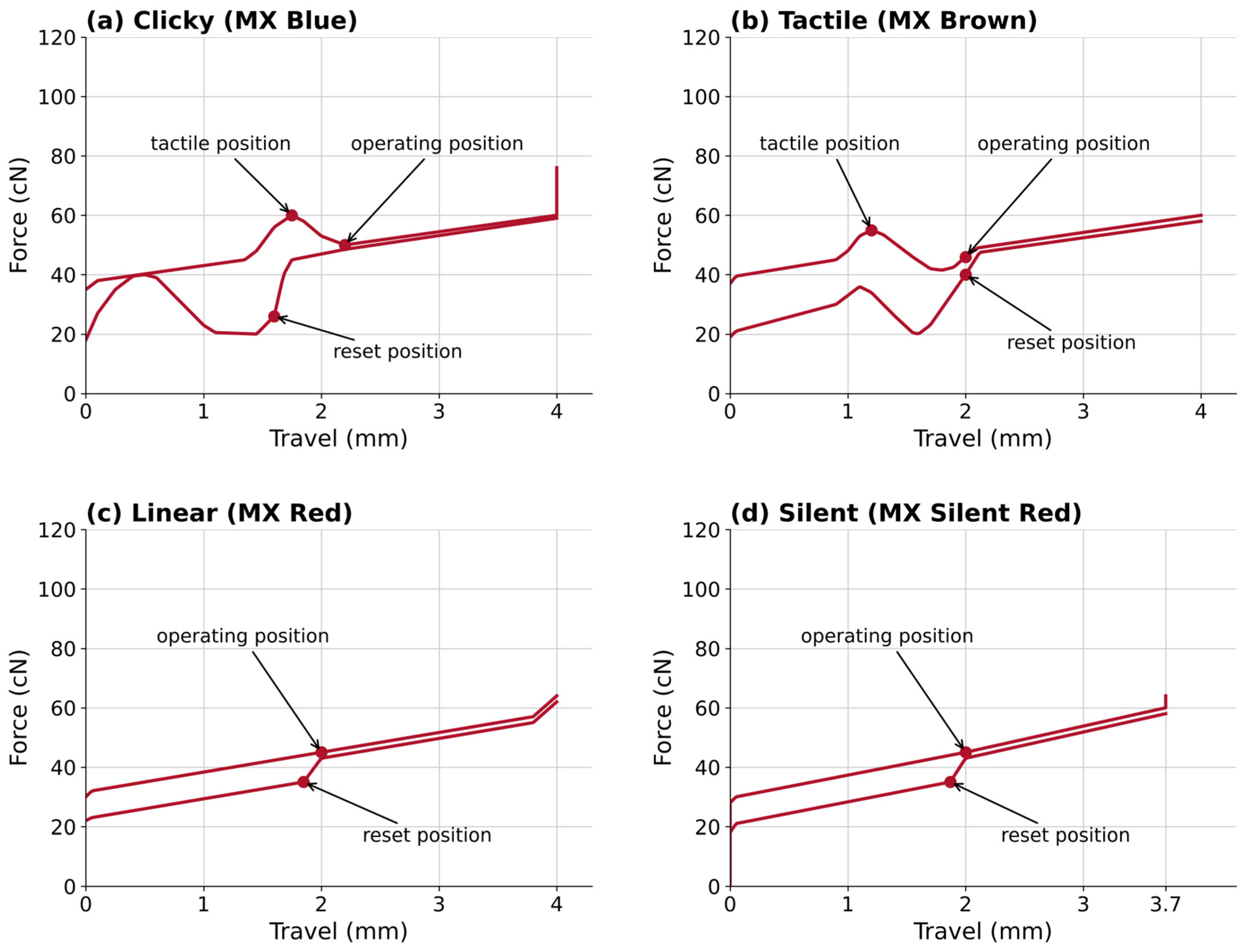
Mechanical keyboards are particularly favored by a wide range of users, including gamers and programmers, because of their durability, distinct tactile and auditory feedback, and user configurability [10,11]. Notably, Taylor et al. (2014) highlighted the ongoing significance of mechanical keyboards in desktop productivity and gaming [12]. Mechanical keyboard switches are typically categorized into three main types based on their operating characteristics: Clicky, Tactile, and Linear (Figure 1).
Clicky switches are typically characterized by the inclusion of a click jacket within the switch mechanism, requiring the highest actuation force and the longest operating travel among the three types, while producing distinct clicking sounds. This design provides pronounced tactile and auditory feedback [13]. Tactile switches, which lack the click jacket, offer smoother tactile feedback and reduced noise compared to Clicky switches [11]. Linear switches, devoid of tactile or auditory feedback components, exhibit a linearly increasing actuation force, resulting in a quieter and smoother typing experience [10,14].
Figure 1.
Force–travel curves of the four switches, based on CHERRY product information [15]. (a) Clicky (MX Blue). (b) Tactile (MX Brown). (c) Linear (MX Red). (d) Silent (MX Silent Red).
These design differences in keyboard switches not only shape user preferences but also have a direct impact on task efficiency and physical demands [2,16,17,18,19,20]. For instance, Gerard et al. (1999) conducted a study where transcriptionists used four different types of keyboards over seven days [17]. The results showed that keyboards with higher actuation force switches led to the highest levels of subjective discomfort, while keyboards with lower actuation force switches were associated with reduced electromyographic (EMG) activity in finger flexor and extensor muscles. Similarly, Radwin and Ruffalo (1999) found that participants reported lower levels of fatigue when using switches with lower actuation forces in a repetitive key tapping experiment [21].
Building on these insights, several studies have investigated the impact of different types of mechanical keyboard switches on usability, task efficiency, and physical demands. For instance, Pham and Kelling (2015) investigated the differences between a mechanical keyboard (with Clicky switches) and a membrane keyboard, finding that the mechanical keyboard required less physical effort, as measured by muscle activity [13]. However, as the study focused on a single mechanical switch type, its findings offer a limited understanding of the overall usability of mechanical keyboard switches. Miller et al. (2018) found that while linear switches reduced peak forearm muscle activity, they resulted in the poorest typing performance and were the least preferred by users [10]. Similarly, Li et al. (2024) examined the impact of mechanical switches on typing performance and user experience, revealing that Clicky switches significantly outperformed Linear switches in terms of typing speed, accuracy, and user satisfaction [22]. These findings underscore the importance of switch characteristics in shaping both user performance and experience.
Beyond mean muscle activity, surface electromyography (sEMG) can also provide a biofeedback-based view of how loading is distributed between the two upper limbs during typing. Asymmetric loading between the dominant and non-dominant forearm has been associated with overuse and lateralized musculoskeletal disorders in computer-based occupations [16,18,19], and bilateral indices derived from sEMG are increasingly used in ergonomics, sports, and rehabilitation research as objective measures of side-to-side balance. However, the influence of mechanical keyboard switch design on bilateral forearm muscle activation has not been systematically described.
Taken together, these studies suggest that the operating characteristics of keyboard switches play a critical role in shaping both objective performance metrics and subjective user experience. As the mechanical keyboard market continues to evolve, with a wide variety of switch types and characteristics, the impact of these variations on user preferences and performance remains significant, yet clear ergonomic standards are still lacking. The primary aim of the present study is therefore to compare four widely used mechanical switch types (Clicky, Tactile, Linear, and Silent) in terms of user satisfaction, perceived workload, typing performance, and forearm muscle activity. As a complementary, exploratory analysis, bilateral sEMG data are additionally used to describe side-to-side balance of forearm muscle activation across switch types, providing a first biofeedback-oriented view of how switch design may relate to bilateral loading patterns in occupational typing.
2. Materials and Methods
2.1. Participants
A total of 20 healthy participants (sex-balanced) were recruited through recruitment flyers within the university for this study. The participants’ mean age was 23.1 years (SD = 2.9), and all were right-handed. In a brief demographic questionnaire, 18 participants reported using a computer at least once a day, while 2 participants reported using a computer at least once a week. The average usage time per session was 4.9 h (±3.7). Four participants had no prior experience using a mechanical keyboard. All participants provided written informed consent prior to participation, and the study was conducted in accordance with the Declaration of Helsinki.
2.2. Mechanical Keyboard Switches Tested
Four widely used mechanical keyboard switches with distinct operating characteristics were set as the independent variables in this study. The switches included three main types: Clicky, Tactile, and Linear. To further investigate the influence of key actuation noise, an additional linear switch designed with dampers to reduce noise (Silent) was also included. Consequently, the experiment was conducted using a total of four types of mechanical keyboard switches (Table 1).
Table 1.
Hardware features of the four mechanical keyboard switches.
The keyboard equipped with the Clicky switch had dimensions of 359 mm (L) × 135 mm (W) × 38 mm (H) (STORMCHASER TENKEYLESS, Xenics Creative Co., Ltd., Seoul, Republic of Korea). Keyboards equipped with the Tactile, Linear, and Silent switches all shared the same form factor, with dimensions of 361 mm (L) × 133 mm (W) × 38 mm (H) (GK993B, HANSUNG Co., Ltd., Seoul, Republic of Korea). The layouts of all keyboards were identical.
2.3. Experimental Procedure
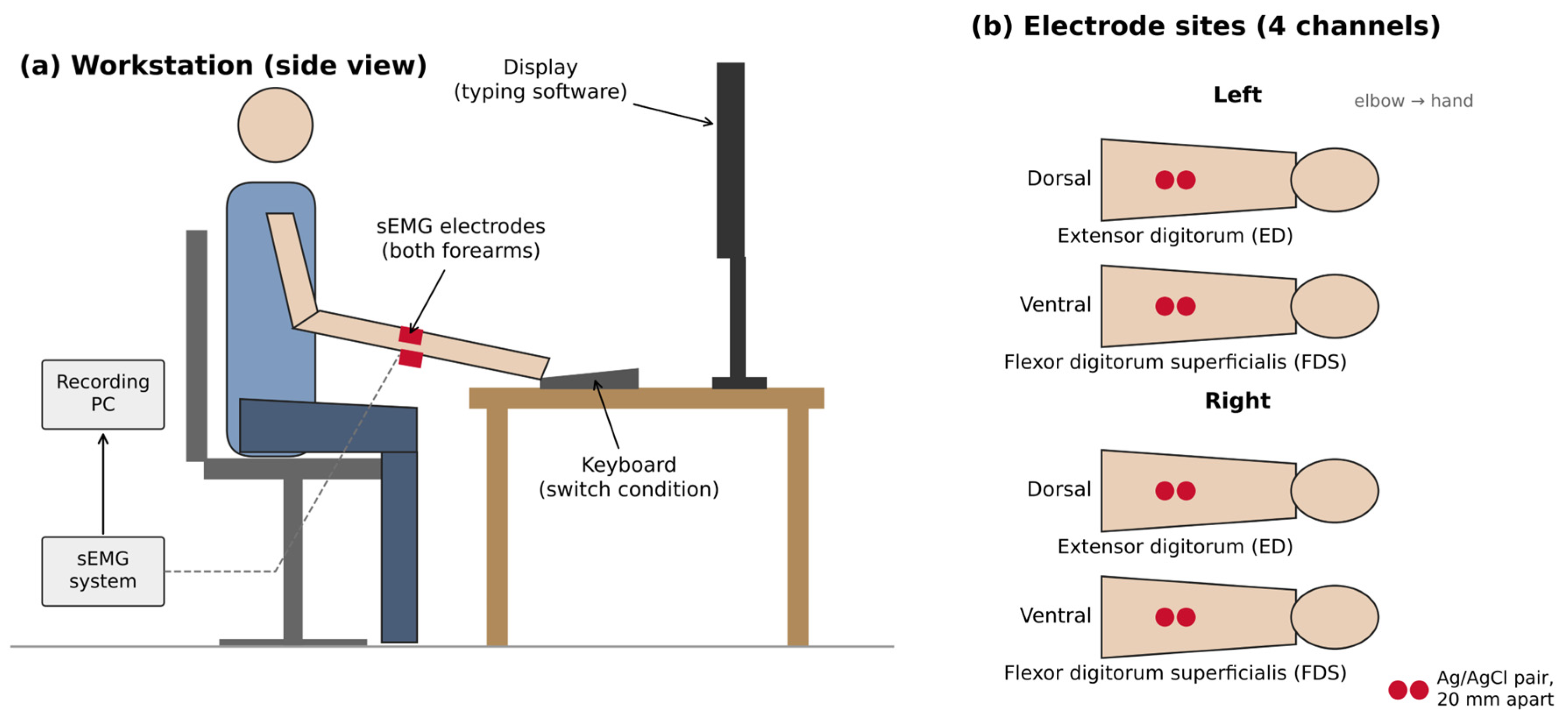
The participants were fully informed about the purpose and procedure of the experiment before participation. To record muscle activity in real time during the task, surface electromyography (sEMG) electrodes were placed on the flexor digitorum superficialis and extensor digitorum muscles of both forearms. Subsequently, to standardize the comparison of muscle activity differences between participants, the Maximum Voluntary Contraction (MVC) value for each muscle was measured. Before the task, participants were asked to adjust the positions of the keyboard, display, and seating to ensure maximum comfort. Figure 2 shows the experimental setup and the electrode sites. Following this, participants were given a practice session to familiarize themselves with the software used in the experiment (Hancom Taja, HANCOM Inc., Seongnam-si, Republic of Korea).
Figure 2.
Experimental setup. (a) Workstation (side view). (b) Electrode sites.
Participants performed the designated typing task once under each of the four experimental conditions, totaling four trials. The presented text consisted of 533 characters, including spaces. The order of the experimental conditions was counterbalanced using a 4 × 4 balanced Latin square design to offset order effects. After completing each task, participants were asked to respond to a set of subjective rating items (self-reported satisfaction and comfort ratings, SUS, NASA-TLX) on a 100-point scale.
2.4. Dependent Measures
The usability of the mechanical keyboard switches (i.e., Clicky, Tactile, Linear, and Silent) was quantified using both subjective and objective metrics. The primary dependent measures were subjective ratings (custom satisfaction and comfort items, SUS, NASA-TLX), typing performance (speed and accuracy), and mean forearm muscle activity. As a secondary, exploratory analysis, bilateral muscle activation was additionally described using a Symmetry Index derived from the same sEMG signals (see Section 2.4.3).
2.4.1. Typing Performance
The typing performance metrics collected in the experiment consisted of typing speed and accuracy, which were automatically calculated by the software used in the study. Typing speed was determined by dividing the number of correctly typed characters by the time taken, with the results expressed in CPM (characters per minute). Accuracy was calculated as the percentage match between the characters typed by the participants and the reference string.
2.4.2. Forearm Muscle Activity
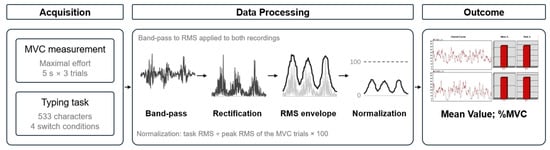
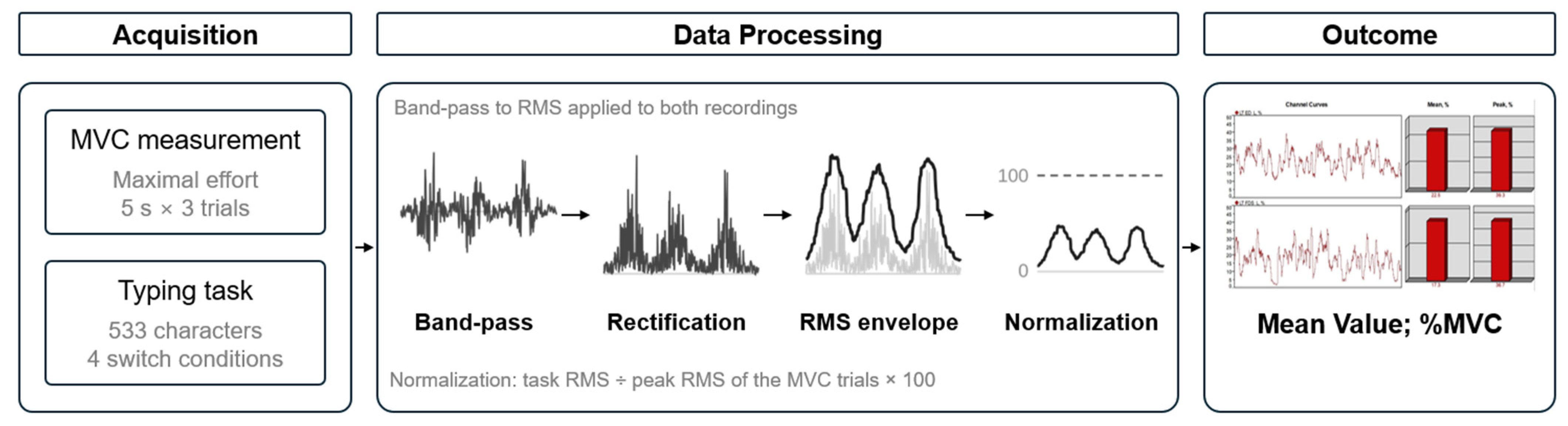
Muscle activity from the flexor digitorum superficialis and extensor digitorum muscles of both arms was collected through sEMG. Prior to attaching the sEMG electrodes to the skin, the skin over the target muscles was identified, and a pair of Ag/AgCl surface electrodes was placed on the muscles with a 20 mm inter-electrode distance, following sEMG guidelines. During the MVC test, participants were instructed to sustain maximum force for approximately 5 s, repeating this three times. The highest value among the trials was used for standardization. The EMG signals (collected during both the experimental task and MVC) were processed using MR 3.20 software (Noraxon U.S.A. Inc., Scottsdale, AZ, USA). The signals, filtered using a band-pass filter (20–400 Hz), underwent rectification and were then smoothed using the root mean square (RMS) method. The RMS envelope was formed using a 300 ms moving window. The processed EMG data were normalized to the corresponding MVC value, and the mean activity value (%MVC) for each muscle was calculated (Figure 3). Channels with poor signal quality were excluded.
Figure 3.
Processing of sEMG signals to obtain mean %MVC.
2.4.3. Symmetry Index
As a complementary, exploratory analysis to the primary outcomes described above, side-to-side balance of forearm muscle activation during typing was additionally described using a Symmetry Index (SI). Following approaches widely used in gait, posture, and upper-limb biomechanics research, the SI was defined as:
where L and R denote the mean normalized muscle activity (%MVC) of the left and right forearm muscles, respectively. An SI value of 0% indicates perfect bilateral symmetry, whereas higher SI values indicate greater side-to-side imbalance. SI was computed for each participant, switch condition, and muscle pair (flexor and extensor) and then averaged across participants. It was computed only when both the left and the right channel were valid. The SI analysis was exploratory. It was tested with the same model as the primary outcomes (Section 2.5), but its p-values were not corrected for multiple testing and are used only to describe the size of the observed differences.
SI = |L − R|/(0.5 × (L + R)) × 100 (%)
2.4.4. Subjective Responses
The subjective measures collected after the experiment consisted of self-reported satisfaction and comfort ratings, the System Usability Scale (SUS), and the NASA Task Load Index (NASA-TLX). The self-reported satisfaction and comfort ratings were custom-developed items specifically designed to evaluate the mechanical keyboard switches. These items were intended to assess the impact of using the mechanical keyboard switches on the user experience. The factors evaluated included overall satisfaction, wrist comfort, finger comfort, perceived noise, perceived accuracy, pleasure, and tactile feedback, all rated on a 0–100 scale. For overall satisfaction, perceived accuracy, pleasure, and tactile feedback, higher scores indicate a more favorable evaluation. Wrist and finger comfort were rated as the degree to which the wrist or fingers felt free of burden. Higher scores indicate less fatigue and discomfort. For perceived noise, higher scores indicate a quieter keyboard (Table 2).
Table 2.
Self-reported rating items.
The usability of the mechanical keyboard switches was assessed using the SUS, which consists of 10 items, with a combination of five positive and five negative questions rated on a 5-point scale from “strongly disagree” (1) to “strongly agree” (5). The final SUS score ranges from 0 to 100, where higher scores indicate better usability. Scores of 68 or above are considered acceptable, while scores of 80 or higher are regarded as excellent [23].
The task load during typing tasks was measured using NASA-TLX [24]. NASA-TLX is a tool for evaluating task load across six subscales, with each subscale rated on a range from 0 to 100. The subscales are mental demand, physical demand, temporal demand, performance, effort, and frustration, and participants subjectively assessed the extent to which they experienced each factor. The scores for each subscale were averaged to calculate a final task load score (raw and unweighted), where higher scores indicate a higher level of perceived task load.
2.5. Statistical Analysis
Statistical analyses were performed in R 4.3.3 (R Foundation for Statistical Computing, Vienna, Austria) with the lme4 (1.1-35), lmerTest (3.1-3), and emmeans (1.10.0) packages. The significance level was α = 0.05. Each participant used all four switches, so switch type was a within-subject factor. Each outcome was analyzed separately with a linear mixed-effects model, with switch type as a fixed effect and participant as a random intercept. For outcomes with complete data, this model is equivalent to a one-way repeated-measures ANOVA. Unlike that ANOVA, it retains participants who had a missing sEMG channel in one or more conditions. Separate univariate models were used rather than a multivariate model because the outcomes measured different constructs and the sample was small. Denominator degrees of freedom were estimated with the Satterthwaite method. When switch type had a significant effect, the estimated marginal means were compared pairwise with Bonferroni adjustment. For outcomes with complete data, sphericity was checked with Mauchly’s test. It was not violated for any outcome with a significant effect. Several ratings were skewed, and accuracy was close to its ceiling. All complete-data outcomes were therefore also analyzed with the Friedman test, which led to the same conclusions in every case. Data are reported as mean (standard deviation).
3. Results
3.1. Subjective Ratings
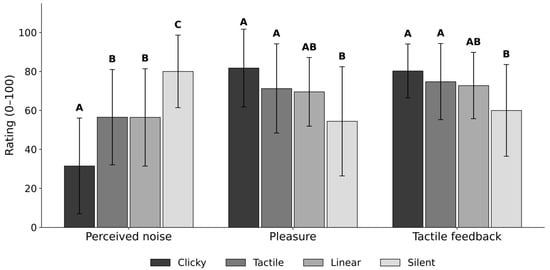
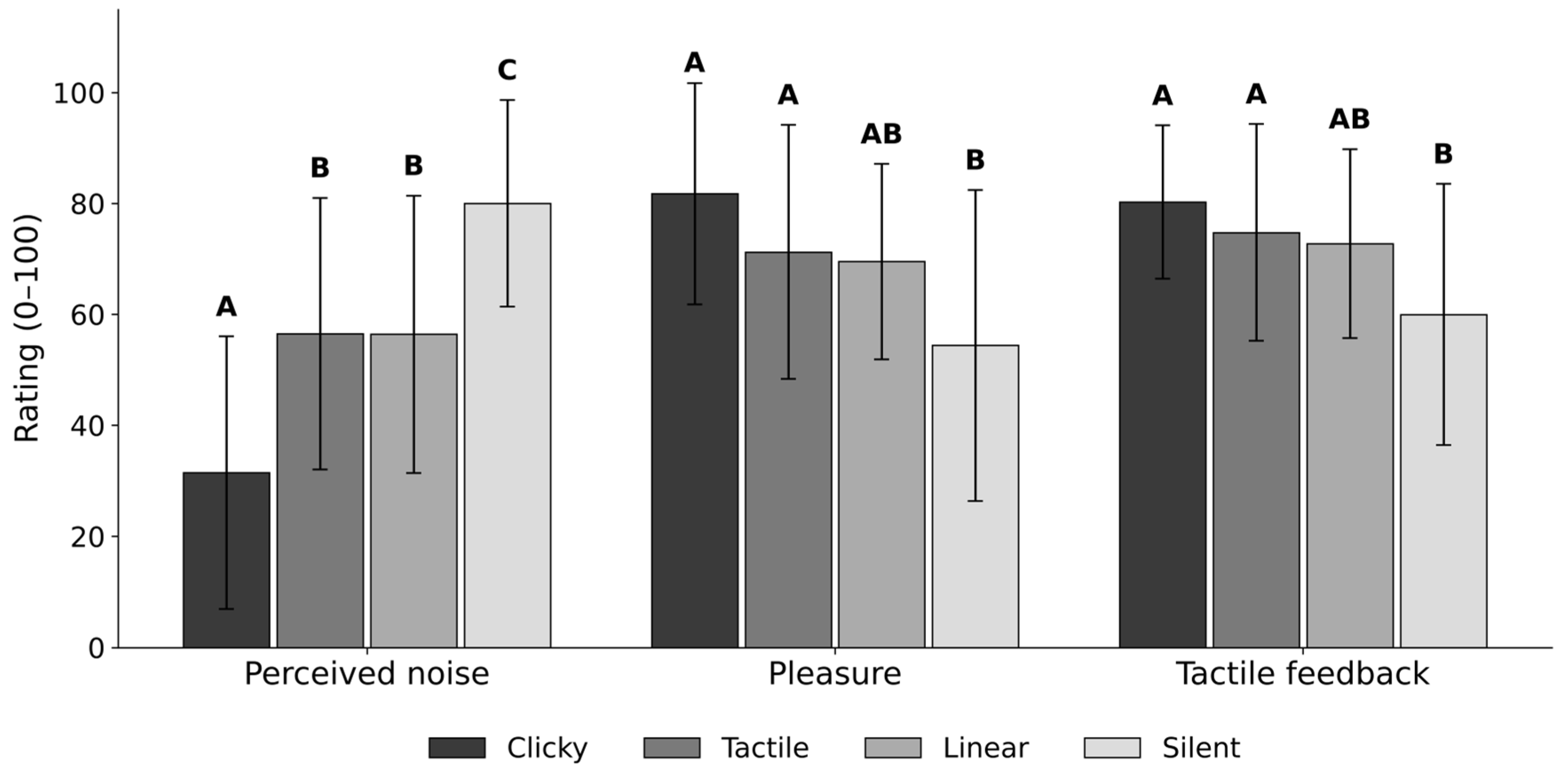
Switch type had a significant effect on three of the self-reported satisfaction and comfort ratings: perceived noise (F(3, 57) = 16.54, p < 0.001), pleasure (F(3, 57) = 6.68, p < 0.001), and tactile feedback (F(3, 57) = 5.28, p = 0.003). Participants rated the Clicky switches as providing the highest levels of pleasure and tactile feedback, while the Silent switches received the lowest ratings in these categories. In pairwise comparisons, Clicky and Tactile switches were rated higher than Silent switches for both pleasure and tactile feedback. Linear switches did not differ from any other switch. Conversely, for perceived noise, the trend was reversed, with Silent switches receiving the most favorable ratings. For perceived noise, all pairs differed except Tactile and Linear (Table 3 and Figure 4).
Table 3.
Self-reported ratings across switch types.
Figure 4.
Self-reported ratings that differed across switch types (mean ± SD). Switches that share a letter do not differ significantly.
SUS scores and the overall NASA-TLX score did not differ across switch types. Among the NASA-TLX subscales, only effort differed (F(3, 57) = 2.88, p = 0.044): Silent switches required more effort than Tactile switches (p = 0.043, Bonferroni-adjusted). Tactile switches had the highest mean SUS score and the lowest mean workload, but these differences were not significant (Table 4 and Table 5).
Table 4.
SUS scores across switch types.
Table 5.
NASA-TLX scores across switch types.
3.2. Typing Performance and Muscle Activity
For quantitative metrics, no statistically significant differences were observed in typing performance or mean forearm muscle activity. Typing speed was about 2.1% higher with the Clicky switches, but this difference was not significant, and accuracy was nearly identical across switches. Additionally, mean muscle activity did not exhibit any consistent trends related to actuation force (Table 6 and Table 7).
Table 6.
Typing performance across switch types.
Table 7.
Forearm muscle activity (%MVC) across switch types.
3.3. Exploratory Bilateral Symmetry Analysis
Table 8 summarizes the SI for each muscle pair. SI was computed for each participant and then averaged. Mean SI ranged from about 25% to 29% for the extensor digitorum and from about 22% to 31% for the flexor digitorum superficialis. Individual participants therefore showed clear side-to-side differences in activation. The direction of these differences varied across participants, so the group means of the left and right muscles in Table 7 are close to each other. SI did not differ across switch types for either muscle pair (extensor, p = 0.626; flexor, p = 0.190).
Table 8.
Symmetry Index (SI, %) across switch types.
4. Discussion
In the self-reported satisfaction and comfort ratings, Clicky switches received more favorable evaluations for pleasure and tactile feedback compared to Silent switches, despite their relatively louder actuation noise. This finding is attributed to the clear and distinct audio–tactile feedback provided by the non-linear actuation characteristics of Clicky switches. These results align with previous studies that have demonstrated the relationship between distinct audio–tactile feedback and improved usability of keyboard switches [10,17,25]. The lower tactile-feedback ratings for Silent switches may reflect their dampers, which reduce noise and vibration and may also soften the end of the keystroke.
In the perceived noise category, Silent switches received positive evaluations. This result aligns with the design objective of Silent switches, which focus on noise reduction, making them particularly suitable for users who prioritize a quieter working environment. Clicky switches, in contrast, were rated higher than Silent switches for pleasure and tactile feedback, probably because of their distinct click sound and tactile response, but they were also rated as the noisiest. This highlights a key trade-off between providing enhanced user satisfaction through the clicky experience and managing noise levels.
Typing performance did not differ across switch types. Typing speed was about 2.1% higher with Clicky switches, but this difference was not significant, and accuracy was nearly identical. These findings suggest that typing performance does not differ substantially based on the type of switch used, indicating that individual preferences may play a more crucial role in switch selection, with satisfaction and comfort being more important criteria for users.
No significant differences were found in the mean activity of the flexor digitorum superficialis and extensor digitorum muscles between the switch types. Despite the increased actuation force and key travel distance of Clicky switches, no notable trends were observed in relation to mean muscle activity. This suggests that the average physical strain experienced by users is not strongly affected by the type of switch.
The exploratory Symmetry Index (SI) gave a complementary view of muscular loading. Individual participants showed clear side-to-side differences in both muscle pairs, but the size of these differences did not depend on switch type. Because the direction of the asymmetry varied across participants, the group means of the left and right muscles (Table 7) were similar and did not reveal these individual differences. A per-participant index such as the SI may therefore be useful in longer typing studies, even though it did not distinguish the switches in the present short task.
In the study by Gerard et al. (1999), it was found that an audible key click and/or an abrupt change in force feedback can help reduce the ratio of typing force to make force [17]. In the present study, left flexor activity was only slightly lower with the Clicky switch than with the Silent switch (14.1 vs. 14.4% MVC), and the difference was not significant. Whether the auditory feedback of a switch affects muscle activity therefore remains an open question.
SUS and overall NASA-TLX scores did not differ across switch types. However, Tactile switches had the highest mean usability and the lowest mean workload, and they required less self-rated effort than Silent switches. Tactile switches may therefore offer a useful balance between tactile feedback and noise. This possibility should be tested in longer typing tasks.
The findings of this study should be interpreted considering several limitations. Statistically significant differences were observed only for certain subjective response items, suggesting that factors such as sample size and task duration may have influenced the outcomes related to typing performance, mean muscle activity, and the exploratory bilateral symmetry analysis. The SI results are exploratory and should be confirmed in larger samples and longer typing tasks. Some sEMG channels were missing, which reduced the sample for the right flexor in particular. In addition, muscular loading was assessed only with sEMG. Measuring key force at the same time, for example with force sensors or force-sensitive resistors under the keys, would allow muscle activity to be related to the force actually applied [2,17]. Additionally, while the switches used in this study are popular and have notable differences in their force–travel curves, the variation in actuation force and travel distance was not substantial. Future studies should consider incorporating switches with a wider range of operating characteristics, longer continuous typing exposures, and concurrent force measurement.
5. Conclusions
This study compared four mechanical keyboard switch types (Clicky, Tactile, Linear, and Silent) in terms of user satisfaction, perceived workload, typing performance, and forearm muscle activity, with a complementary exploratory analysis of bilateral muscle activation. The findings show a clear influence of tactile and auditory feedback on subjective ratings, with Clicky switches offering the most engaging typing experience despite their higher noise levels, Silent switches providing a quieter environment but lower tactile satisfaction, and Tactile switches requiring less effort than Silent switches. Typing speed, accuracy, and mean forearm muscle activity did not differ across switches, suggesting that switch choice should largely be guided by individual user priorities such as preferred feedback style and acceptable noise level.
The exploratory Symmetry Index showed clear side-to-side differences in forearm activation within individuals, but these did not differ across switch types. Per-participant bilateral indices may still complement mean %MVC in longer typing studies. Future research should test a broader range of switch designs, longer typing exposures, and concurrent force measurement to develop guidelines for mechanical keyboard ergonomics.
Author Contributions
Conceptualization, B.C. and J.P.; methodology, B.C. and J.P.; software, B.C.; validation, B.C. and J.P.; formal analysis, B.C.; investigation, B.C. and J.C.; resources, J.P.; data curation, B.C.; writing—original draft preparation, B.C.; writing—review and editing, J.P. and J.C.; visualization, B.C.; supervision, J.P.; project administration, J.P.; funding acquisition, J.P. All authors have read and agreed to the published version of the manuscript.
Funding
This work was supported by the Korea Institute of Energy Technology Evaluation and Planning (KETEP) and the Ministry of Climate, Energy & Environment (MCEE) of the Republic of Korea (No. RS-2025-02422969).
Institutional Review Board Statement
The study was conducted in accordance with the Declaration of Helsinki. IRB review was not sought because the study involved only non-invasive measurements and questionnaires in healthy adults and collected no sensitive personal information (Article 13, Enforcement Rule of the Bioethics and Safety Act, Republic of Korea).
Informed Consent Statement
Informed consent was obtained from all participants involved in the study.
Data Availability Statement
The data presented in this study are available on reasonable request from the corresponding author. The data are not publicly available due to privacy considerations of the participants.
Conflicts of Interest
The authors declare no conflicts of interest.
References
- Hoggan, E.; Brewster, S.A.; Johnston, J. Investigating the effectiveness of tactile feedback for mobile touchscreens. In Proceedings of the SIGCHI Conference on Human Factors in Computing Systems, Florence, Italy, 5–10 April 2008; Association for Computing Machinery: New York, NY, USA, 2008; pp. 1573–1582. [Google Scholar]
- Kim, J.H.; Aulck, L.; Bartha, M.C.; Harper, C.A.; Johnson, P.W. Differences in typing forces, muscle activity, comfort, and typing performance among virtual, notebook, and desktop keyboards. Appl. Ergon. 2014, 45, 1406–1413. [Google Scholar] [CrossRef] [Scilit] [PubMed]
- Knierim, P.; Schwind, V.; Feit, A.M.; Nieuwenhuizen, F.; Henze, N. Physical keyboards in virtual reality: Analysis of typing performance and effects of avatar hands. In Proceedings of the 2018 CHI Conference on Human Factors in Computing Systems, Montréal, QC, Canada, 21–26 April 2018; Association for Computing Machinery: New York, NY, USA, 2018; pp. 1–9. [Google Scholar]
- Fukumoto, M.; Sugimura, T. Active click: Tactile feedback for touch panels. In Proceedings of the CHI ‘01 Extended Abstracts on Human Factors in Computing Systems, Seattle, WA, USA, 31 March–5 April 2001; Association for Computing Machinery: New York, NY, USA, 2001; pp. 121–122. [Google Scholar]
- Koskinen, E.; Kaaresoja, T.; Laitinen, P. Feel-good touch: Finding the most pleasant tactile feedback for a mobile touch screen button. In Proceedings of the 10th International Conference on Multimodal Interfaces, Chania, Greece, 20–22 October 2008; Association for Computing Machinery: New York, NY, USA, 2008; pp. 297–304. [Google Scholar]
- Park, W.; Jamil, M.H.; Eid, M. Vibration feedback reduces perceived difficulty of virtualized fine motor task. J. Multimodal User Interfaces 2025, 19, 93–99. [Google Scholar] [CrossRef] [Scilit]
- Dhakal, V.; Feit, A.M.; Kristensson, P.O.; Oulasvirta, A. Observations on typing from 136 million keystrokes. In Proceedings of the 2018 CHI Conference on Human Factors in Computing Systems, Montréal, QC, Canada, 21–26 April 2018; Association for Computing Machinery: New York, NY, USA, 2018; pp. 1–12. [Google Scholar]
- Pitts, M.J.; Williams, M.A.; Wellings, T.; Attridge, A. Assessing subjective response to haptic feedback in automotive touchscreens. In Proceedings of the 1st International Conference on Automotive User Interfaces and Interactive Vehicular Applications, Essen, Germany, 21–22 September 2009; Association for Computing Machinery: New York, NY, USA, 2009; pp. 11–18. [Google Scholar]
- Sears, A. Improving touchscreen keyboards: Design issues and a comparison with other devices. Interact. Comput. 1991, 3, 253–269. [Google Scholar] [CrossRef] [Scilit]
- Miller, C.; Barr, A.; Riemer, R.; Harris, C. The effect of 5 mechanical gaming keyboard key switch profiles on typing and gaming muscle activity, performance and preferences. Proc. Hum. Factors Ergon. Soc. Annu. Meet. 2018, 62, 1552–1556. [Google Scholar] [CrossRef] [Scilit]
- Montgomery, D. Best Mechanical Keyboard. 2020. Available online: https://www.rtings.com/keyboard/reviews/best/mechanical (accessed on 21 May 2026).
- Taylor, S.; Keskin, C.; Hilliges, O.; Izadi, S.; Helmes, J. Type-hover-swipe in 96 bytes: A motion sensing mechanical keyboard. In Proceedings of the SIGCHI Conference on Human Factors in Computing Systems, Toronto, ON, Canada, 26 April–1 May 2014; Association for Computing Machinery: New York, NY, USA, 2014; pp. 1695–1704. [Google Scholar]
- Pham, T.; Kelling, N. Mechanical and membrane keyboard typing assessment using surface electromyography (sEMG). Proc. Hum. Factors Ergon. Soc. Annu. Meet. 2015, 59, 912–915. [Google Scholar] [CrossRef] [Scilit]
- Harrington, J. Linear vs. Tactile vs. Clicky Switches: A Helpful Guide. 2020. Available online: https://switchandclick.com/ (accessed on 21 May 2026).
- CHERRY. MX Switches. Available online: https://www.cherry.de/en-gb/products/mx-switches (accessed on 21 May 2026).
- Coppola, S.M.; Dixon, P.C.; Hu, B.; Lin, M.Y.; Dennerlein, J.T. Going short: The effects of short-travel key switches on typing performance, typing force, forearm muscle activity, and user experience. J. Appl. Biomech. 2019, 35, 149–156. [Google Scholar] [CrossRef] [Scilit] [PubMed]
- Gerard, M.J.; Armstrong, T.J.; Franzblau, A.; Martin, B.J.; Rempel, D.M. The effects of keyswitch stiffness on typing force, finger electromyography, and subjective discomfort. Am. Ind. Hyg. Assoc. J. 1999, 60, 762–769. [Google Scholar] [CrossRef] [Scilit]
- Jindrich, D.L.; Balakrishnan, A.D.; Dennerlein, J.T. Effects of keyswitch design and finger posture on finger joint kinematics and dynamics during tapping on computer keyswitches. Clin. Biomech. 2004, 19, 600–608. [Google Scholar] [CrossRef] [Scilit] [PubMed]
- Rempel, D.; Tittiranonda, P.; Burastero, S.; Hudes, M.; So, Y. Effect of keyboard keyswitch design on hand pain. J. Occup. Environ. Med. 1999, 41, 111–119. [Google Scholar] [CrossRef] [Scilit] [PubMed]
- Watanabe, H.; Nakajima, K.; Takagi, S.; Mizuyama, R.; Saito, M.; Furusawa, K.; Nakatani, K.; Yokota, Y.; Kataoka, H.; Nakajima, H.; et al. Differences in mechanical parameters of keyboard switches modulate motor preparation: A wearable EEG study. Front. Neuroergonomics 2021, 2, 644449. [Google Scholar] [CrossRef] [Scilit] [PubMed]
- Radwin, R.G.; Ruffalo, B.A. Computer key switch force-displacement characteristics and short-term effects on localized fatigue. Ergonomics 1999, 42, 160–170. [Google Scholar] [CrossRef] [Scilit] [PubMed]
- Li, J.; Wang, J.; Huang, Y. Effect of mechanical keyboard switch and backlight status on typing performance and user experience. Electronics 2024, 13, 4205. [Google Scholar] [CrossRef] [Scilit]
- Sauro, J. Measuring Usability with the System Usability Scale (SUS). Measuring U 2011, Blog Post. Available online: https://measuringu.com/sus/ (accessed on 21 May 2026).
- Hart, S.G.; Staveland, L.E. Development of NASA-TLX (Task Load Index): Results of empirical and theoretical research. In Advances in Psychology; Hancock, P.A., Meshkati, N., Eds.; Elsevier: Amsterdam, The Netherlands, 1988; Volume 52, pp. 139–183. [Google Scholar]
- Bufton, M.J.; Marklin, R.W.; Nagurka, M.L.; Simoneau, G.G. Effect of keyswitch design of desktop and notebook keyboards related to key stiffness and typing force. Ergonomics 2006, 49, 996–1012. [Google Scholar] [CrossRef] [Scilit] [PubMed]

Disclaimer/Publisher’s Note: The statements, opinions and data contained in all publications are solely those of the individual author(s) and contributor(s) and not of MDPI and/or the editor(s). MDPI and/or the editor(s) disclaim responsibility for any injury to people or property resulting from any ideas, methods, instructions or products referred to in the content. |
© 2026 by the authors. Licensee MDPI, Basel, Switzerland. This article is an open access article distributed under the terms and conditions of the Creative Commons Attribution (CC BY) license.