


Abstract
This study aimed to assess the effect of mulberry leaf fortification with a probiotic (Enterococcus faecium and rosemary) on larval development, feed utilization efficiency, digestive performance, and cocoon-related traits in two Bombyx mori breeds. The results showed that a probiotic addition to the silkworms’ diet, particularly at a 2% inclusion level, enhances key productive traits such as larval weight, silk gland weight, cocoon weight, digestibility, and feed efficiency, while reducing excreta. Breed-specific differences were evident, with Kahuri/T exhibiting superior nutrient intake, assimilation, and overall productivity compared to AO/T (p < 0.0001). Productive traits during the 5th instar increased significantly over time, with both larval growth and silk gland development following rapid, exponential patterns. The Kahuri/T breed and the probiotic-supplemented groups—particularly at a 2% concentration—showed the most notable improvements compared with the AO/T breed and the control diet. Pearson correlation analyses identified strong positive relationships between feed efficiency, protein intake, and silk yield, underscoring probiotics as a viable strategy for sustainable productivity gains in sericulture. In conclusion, mulberry leaf fortification with Enterococcus faecium and rosemary, especially at a 2% inclusion level, significantly improved performance and nutrient utilization, with the strongest responses observed in the Kahuri/T breed. These findings highlight probiotic supplementation as an effective and sustainable strategy for enhancing sericulture.
1. Introduction
The following statement accurately reflects a significant paradigm shift in rearing Bombyx mori, Linnaeus, 1758, silkworms: diet is a crucial variable that influences insect physiology and health. This is particularly evident when transitioning from traditional mulberry leaves to artificial diets, which can alter microbial composition and host functions like metabolism and immune resistance. Studies like those by Chen et al. [1] highlight that changes in diet, including artificial diets and the transition to them, substantially influence the gut microbiota.
Although the classic silkworm breeding technology, based on mulberry leaf as the only feed source, has provided notable results over time, new silkworm breeding technologies enhance production by enriching mulberry leaves with nutrients like amino acids, proteins, vitamins, and minerals to improve silkworm health and silk quality [2].
Probiotics are recognized for their role in intestinal tissue development, maturation, and improving nutrient absorption in both humans and animals. Adding probiotics like Lactobacillus, Bacillus, Saccharomyces, and Bifidobacterium to silkworm diets improves gut health, growth, and silk production. These microorganisms enhance the digestion of food, boost the immune system, and positively alter the gut microbiota, leading to significant improvements in silkworm performance and reduced mortality rate from infections [3]. Probiotics act through several mechanisms, including competing with pathogens for nutrients, producing antimicrobial substances, and strengthening the intestinal barrier. They also produce beneficial metabolites like short-chain fatty acids and influence the gut–brain axis. These actions collectively contribute to improved gut health, nutrient absorption, and a balanced immune response [2,4,5,6].
According to Priyadharshini et al. [7], probiotics primarily interact with the complex ecology of microorganisms found in the gut. Certain bacteria produce essential vitamins, amino acids, and other nutrients, while others help break down dietary fiber. Conversely, a 2024 study by Chen et al. [1] noted that there has been no research on how diet (mulberry leaves or artificial) affects the intestinal microbiota of fifth-instar silkworms.
Plant extracts can fortify mulberry leaves to enhance silkworm growth, silk quality, and disease resistance. Extracts from plants like Ocimum sanctum (Tulsi), Aloe vera, Withania somnifera (Ashwagandha), and Azadirachta indica (Neem) can improve factors such as silk filament length, protein content, and the silkworm’s antioxidant defenses. This practice aims to optimize silkworm diets for better cocoon production and silk quality. These extracts are typically applied to mulberry leaves as a spray or mixed into the diet [8,9]. Jeyapaul et al. [10] used mulberry leaves treated with extracts of Coffea arabica, Alternanthera sessilis, and Eichhornia crassipes in silkworm feed. While Eswaran and Sovarkodiyone [11] used tapioca flour and green leaves of Amaranthus viridis, Bohidar and Choubey [12] used extracts from 18 different plants for the fortification of mulberry leaves.
Particularly, rosemary extract can improve silkworm B. mori growth and silk production by increasing the cocoon shell ratio and larval/pupal weights, though results can vary based on the extract’s concentration and type (aqueous vs. alcoholic). Some treatments may lead to a decrease in larval weight, but rosemary is still considered a promising extract for boosting sericulture [8,13].
Nutrient digestibility in silkworms is influenced by factors like age and diet quality, with an average mulberry leaf digestibility of around 54.46%. Age is a major factor, as older leaves have lower nutritional value, affecting the breakdown of components like carbohydrates and proteins, which rely on specific enzymes. Other impacts on overall digestibility include crude fiber, chitin, and anti-nutritional compounds in the diet [14]. Enterococcus faecium are common bacteria in silkworms, generally considered a probiotic commensal that aids in digestion and provides disease resistance. However, under certain conditions (like artificial diets), some strains can act as opportunistic pathogens.
Studies show E. faecium enhances digestive enzyme activity and gut health, while rosemary, as a botanical additive, can have synergistic effects on these improvements [2,3,6,8].
The hypothesis that a concentrated probiotic containing E. faecium and rosemary will improve nutrient digestibility (protein, fat, and dry matter) in B. mori silkworms is plausible, as probiotics can enhance nutrient absorption and gut health. This is supported by evidence that probiotics, including Enterococcus species, improve the digestive and immune systems of insects and other animals by modulating the gut microbiota, which in turn leads to better nutrient uptake. The addition of rosemary may provide additional benefits through its own compounds, which could further improve silkworm health and performance.
In comparison with earlier research, this study focused on a defined, concentrated probiotic formulation combining Enterococcus faecium with rosemary extract, employing mulberry leaf fortification as a practical and scalable feeding strategy, comparing responses between two silkworm breeds (AO/T and Kahuri/T), and simultaneously assessing nutrient digestibility (protein, fat, and dry matter) alongside growth and cocoon characteristics.
In light of this state-of-the-art investigation and the hypotheses mentioned above, the objective of this study was to investigate whether fortifying mulberry leaves with a concentrated probiotic mixture of E. faecium and rosemary enhances silkworm (B. mori) growth, feed efficiency, nutrient digestibility, and cocoon productivity, and to determine whether these effects differ between the AO/T and Kahuri/T breeds.
2. Materials and Methods
2.1. Rearing and Diet of B. mori Silkworms
The bioassay was conducted at the Research Station for Sericulture Baneasa (44°29′33″ N 26°04′45″ E), which is situated in the north of Bucharest, Romania.
Two indigenous silkworm breeds from Romania, AO/T and Kahuri/T, were selected from the Research Station for Sericulture Baneasa, Bucharest, genetic pool to be studied for their productivity and nutrient digestibility. These breeds were developed through crosses between the Japanese Tokay breed and the Romanian breeds Kahuri and Alb Orsova and are suitable for rearing in Romania during the May-June period.
The AO/T and Kahuri/T breeds are regionally important Romanian silkworm lines, commonly used in local sericulture due to their adaptability to local environmental conditions and favorable performance traits, including cocoon yield and disease resilience.
The larvae were raised in a standard rearing environment for insect larvae, likely for B. mori, maintaining hygienic conditions and a stable environment with a temperature between 24 and 26 °C and a relative humidity of 70–80% for the first to fifth larval instars. This controlled setup in a special rearing room is designed to promote optimal growth and development by providing suitable environmental parameters.
2.2. Probiotic
The probiotic used in this work was developed by Mervue Laboratories, Ireland, and intended to increase animal production and support performance. The product’s main ingredients are E. faecium 10415, a live microorganism, and rosemary extract. One of the probiotic’s distinctive characteristics is the presence of two distinct E. faecium strains, NCIMB 11181 and NCIMB 10415.
2.3. Experimental Design
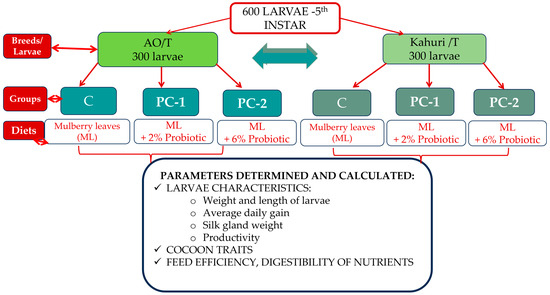
A total of 600 B. mori silkworms were divided into three feeding groups during the fifth instar: a control group (C) fed only mulberry leaves and two experimental groups (PC-1 and PC-2) that received mulberry leaves supplemented with a probiotic. The PC-1 group received a 2% concentration of probiotic, while the PC-2 group was given mulberry leaves sprayed with a 6% probiotic solution (Figure 1). These doses were chosen to evaluate potential dose-dependent effects on silkworm growth, feed efficiency, and cocoon traits. The 2% dose represents a moderate, effective level, while the 6% dose was included to test whether higher supplementation provides additional benefits. Both concentrations were combined with rosemary extract to explore potential synergistic effects on nutrient digestibility and larval performance. The probiotic contained 1 × 10¹⁰ CFU g−1. The carton trays were used to house larvae, with the trays arranged to ensure similar environmental conditions and prevent cross-contamination. The trays have dimensions of 30 × 15 × 5 cm and are spaced apart to provide adequate distance between each replicate.
Figure 1.
Experimental design.
2.4. Feeding
Mulberry leaves were administered twice daily. The first meal involved spraying 100 g of mulberry leaves (50 g per replicate) with 20 mL of distilled water and probiotic solution between 8:00 and 9:30 a.m. The probiotic concentration varied by group: 2% for the PC-1 group and 6% for the PC-2 group. A solution was prepared by dissolving 100 g of probiotic powder in 1000 L of distilled water, yielding a final concentration of 1 × 10⁶ CFU mL−1. Mulberry leaves were sprayed with 20 mL of probiotic solution per feeding. The PC-1 group received a 2% dilution (4 × 10⁵ CFU mL−1), while the PC-2 group received a 6% dilution (1.2 × 10⁶ CFU mL−1).
After treatment, the mulberry leaves were dried for 20 min to remove excess moisture before being given to the worms ad libitum. The control group was fed only mulberry leaves. For the 2nd meal, only mulberry leaves were administered in a quantity that depended on intake. The weight of the leftovers (excreta and leaves) was measured each time the bedding was changed to track consumption and output.
The average daily feed intake (ADFI) was calculated by subtracting the amount of uneaten or rejected feed from the total feed provided and then dividing that value by the number of larvae and the number of days; the difference between the total feed offered and the rejected feed is calculated for each day.
2.5. Chemical Composition
2.5.1. Proximate Analyses of the Diet
The proximate composition of the diets (dry matter, crude protein, fat, and cellulose) was determined in the Chemistry Laboratory of IBNA Balotesti according to Commission Regulation No. 152/2009 [15] (Table 1).
Table 1.
Proximate composition of the diets (%).
The chemical content of each sample was measured in duplicate (Table 1). Briefly, the gravimetric method was used to quantify the ash (ISO 2171:2010 [16]) and DM (ISO 6496:2001 [17]). Samples were first dried at 65 °C and thereafter at 103 °C. The crude protein was evaluated using the semiautomatic conventional Kjeldahl method with a semiautomatic Kjeltek auto 1030-Tecator system (FOSS Tecator AB, Höganäs, Sweden) following SR EN ISO 5983-2:2009 [18]. The fats (ether extractives) were continuously extracted using a modified version of the conventional method, which required measuring the fat after the solvent was extracted in accordance with SR ISO 6492:2001 [19]. The cellulose was evaluated using an intermediate filtering procedure (European Commission (EC) Regulation No. 152/2009 [15] and standard SR EN ISO 6865:2002 [20]) [21].
2.5.2. Mineral Composition of the Diets
Following the procedure outlined by Oancea et al. [22], the mineral composition (calcium, iron, potassium, magnesium, and phosphorus, Table 2) was determined using flame atomic absorption/emission spectrometry (FAAS) employing the Thermo Electron SOLAAR M6 Dual Zeeman Comfort system (Cambridge, UK). Thus, calcium (Ca) concentration was determined according to a complexometric method validated in the IBNA Chemistry Laboratory (Titrimetric Method-SR ISO 6490-1:2006 [23]). Iron (Fe) was analyzed by Atomic Absorption Spectrometry Method (Regulation (EC) No. 152/2009 [15] and SR EN ISO 6869:2002 [24]). Potassium (K) and magnesium (Mg) were analyzed by Flame Emission Spectrometry method (SR EN ISO 7485:2001 [25]), while phosphorus (P) was evaluated by the photometric method presented in Regulation (EC) No. 152/2009 [15].
Table 2.
Mineral composition of the diets.
2.6. Productive Parameters
2.6.1. Larvae Characteristics
The ingesta of each nutrient was determined as the difference between the nutrient intake and the leftovers. Digesta was calculated as the difference between intake and excreta.
A total of 20 larvae per group (60 larvae per breed, 10 larvae per replicate) were randomly selected during the fifth instar to determine larval weight and length on the 1st D, 5th D, and 7th D of the fifth instar.
Average daily gain (ADG) was evaluated by dividing the larvae weight by the number of experimental days. The growth index (GI) was calculated using the Rahmathulla and Suresh [26] formula:
GI, g = (final larvae weight, g − initial larvae weight, g)/initial larvae weight, g
The feed conversion ratio (feed to gain, g: g) was estimated as the ratio of feed consumed to ADG.
In order to determine dynamic changes in dependent variables, the evaluation was made on the 1st D, 5th D, and 7th D time points.
Six larvae per group (eighteen larvae per breed, three within each replicate) were dissected on days 5 and 7 before spinning to determine whether the addition of probiotics influences the weight of the silk glands.
The tissue somatic index (TSI) was calculated using the formula presented by Islam et al. [27]:
TSI, % = (silk gland weight, g/larvae weight in 5th instar, g) × 100
2.6.2. Cocoon Characteristics
Seven days after spinning, 20 cocoons per group were carefully opened with a cutter to remove the pupae and the following traits were determined: the weight of the raw cocoon, pupa, and shell, and the longitudinal (L) and transverse axis (l). A digital caliper and an electronic scale were used for measurements. The ratio between the longitudinal and transverse axes (L/l ratio) was calculated.
The percentage of shell (% SR) was estimated according to the formula of Sekar et al. [28]:
SR, % = (weight of cocoon shell, g/cocoons weight, g) × 100
For the calculation of productivity (SP), the formula developed by Saranya et al. [29] was applied:
SP, cg/day = shell weight/days on the 5th instar
To determine the silk conversion index (SCI), the formula from Islam et al. [27] was applied:
SCI, % = shell weight, g/silk gland weight, g
The cocoons were dried in an oven automatically set at 80 °C for 3 h.
2.7. Feed Efficiency
To calculate the consumption index (CI), efficiency of conversion of feed intake (ECI), and efficiency of conversion of digested feed (ECD), the Hachad et al. [30] formulas were applied:
where ADFI is average daily feed intake and avg. = average
CI, g/day = ADFI/Avg. fresh weight of larvae
ECI, % = (growth rate, g/CI) × 100
ECD, % = weight gain, g/(FI, g − excreta, g), were: FI = feed intake
To calculate the reference ratio (RR), the Manjunatha et al. [31] formula was used:
RR, g = Ingesta/Excreta
The AD of the feed and its components was assessed by an in vivo approach using two control periods. By taking into account the quantity of the feed/nutrients consumed, the leftovers, the excreta, and the chemical analysis data, coefficients of digestibility were calculated using the Etebari et al. [32] equation:
AD, % = (x intake − y excreta)/x intake × 100
The balance of each nutrient was calculated according to the formula:
X (nutrient balance, g) = Y (nutrient ingested, g) − Z (nutrient excreted, g)
Each data point was compiled independently according to breed and feeding group.
2.8. Statistical Analyses
The trifactorial experiment ran during May–June 2025. The recorded data were statistically processed with the Statistical Package SPSS software, version 20 (2011). The factors analyzed were “breed” (2 levels), “diet” (3 levels) and “time” (3 levels except silk gland with 2 level). The data are presented as means and standard errors of the mean (SEM). The establishment of the means and the difference between means was performed using the ANOVA test followed by the LSD test, if differences were reported. Each larva and cocoon were considered an experimental unit. Values from the experimental and control groups were compared. For the statistical differences caused by time, the repeated measures test in GLM (SPSS software) was used. Since the p-value was greater than 0.05, replicate effects were excluded from the analysis. The measure of correlation was determined using a Pearson test. Higher coefficient values were considered highly correlated; a strong correlation was defined as one greater than 0.7, a moderate correlation as one between 0.69 and 0.5, and 0.49–0.40 as a fair correlation [33]. Differences were considered significant or highly significant at p values ≤ 0.05, 0.01, 0.001, or 0.0001.
3. Results
3.1. Feed Intake
Adding a probiotic to the diet of fifth-instar larvae in groups PC-1 and PC-2 increased the dry matter content and slightly raised crude protein and fat content, while decreasing cellulose). Table 3 provides data on the specific consumption of feed and nutrients for these groups and for the two breeds.
Table 3.
Comparative effect of mulberry leaves enriched with probiotics (2% and 6%) on feed intake in AO/T and Kahuri/T silkworm breeds.
In the Kahuri/T fed group, the intake was higher regardless of the nutrient (p < 0.0001, with the exception of fat content, where p = 0.091), resulting in a 4.43% increase in the ADFI. The treatment had a significant influence, increasing the consumption of nutrients.
If we consider the effect of the treatment, a discrepancy between the two breeds was noticed, in the sense that, while in the AO/T breed, the supplementation of mulberry leaf with 2% or 6% probiotic led to a slight increase in ADFI (+1.43%, +3.28%, respectively), in the Kahuri/T breed ADFI was slightly lower in the PC-2 group (−1.92% compared to the C group).
3.2. Productive Parameters
3.2.1. Larva Performances
Table 4 presents the mean, standard error of the mean (SEM), and the statistical interpretation of the results obtained as an effect of the probiotic addition. The targeted productive parameters were larval weight and length, ADG, feed conversion, growth index, and silk gland weight.
Table 4.
Comparative effect of mulberry leaves enriched with probiotics (2% and 6%) on productive parameters in AO/T and Kahuri/T silkworm breeds.
Regardless of the productive parameter targeted, there are very significant differences between breeds, except for growth index, larval length on day 7, and silk gland weight. Higher values were recorded in the Kahuri/T breed (larval weight D7 +15%, larval length +0.4%, silk gland weight +1.3%). The higher feed intake in Kahuri/T larvae was reflected in a higher ADG (+15.6%) and feed conversion (+7.98%, p = 0.002).
Except for the silk gland weight, in the AO/T breed, probiotic treatment did not lead to notable effects, especially when using probiotics at a concentration of 2% (+14.97%). In contrast, in the Kahuri/T breed, regardless of the production parameter, the average values were higher in the experimental groups, but highest in the PC-1 group (+4.13% larvae weight at D7, +0.94% larval length at D7, +5.84% growth index, respectively, +22.8% silk gland weight on day 7 vs. C). Overall data showed a slightly more efficient feed conversion as an effect of the treatment with the 2% probiotic (+0.73% compared to the C group).
Overall, the applied treatment, contrary to expectations, led to superior effects in the group with the addition of 2% probiotic, and significant effects were observed in the silk gland (+15.92% compared to C, p = 0.019). Between the C and PC-2 groups, there was a trend for the treatment to have an effect.
Table 5 presents the quality parameters of silk thread (tissue somatic index and silk productivity). The tissue somatic index is an important indicator for comprehending silk output and is influenced by various elements, including disease, environment, and silkworm breed.
Table 5.
Comparative effect of mulberry leaves enriched with probiotics (2% and 6%) on productivity and somatic tissue index in AO/T and Kahuri/T silkworm breeds.
A higher silk gland tissue somatic index is frequently associated with better characteristics of the silk, including a lengthier filament and a higher percentage of raw silk. The index was influenced by the genetic architecture of the silkworms, confirming the assumption of Murugesh et al. [34] (+1.18 times greater in AO/T breed, p = 0.013). Silk productivity was greatly affected by both the breed (p = 0.0001) and the treatment (p = 0.05), with a higher mean value observed in the Kahuri/T breed (+18.75%) and the PC-1-fed group (+8.18% vs. C group).
3.2.2. Cocoon Characteristics
After the pupation phase, the productive parameters (weight of cocoons and pupae, shell weight, and size of longitudinal and transverse axes) were determined. Based on these measurements, the ratio between the longitudinal and transverse axes, the silk conversion index (%), and the shell ratio (%) were estimated. The cocoons’ trait results are shown in Table 6.
Table 6.
Comparative effects of mulberry leaves enriched with probiotics (2% and 6%) on cocoon characteristics in AO/T and Kahuri/T silkworm breeds.
Through the GLM-multivariate test, it was highlighted that breed had an important effect on cocoon traits (p = 0.0001), with the exception of shell ratio and silk conversion index, with a higher value reported for Kahuri/T, excluding the transversal axis, where AO/T recorded a mean value +10.15% higher. Therefore, in Kahuri/T, cocoon weight was 16.76% higher and was 14.85% higher after the drying process, other differences were a shell weight +18.99% and a pupae weight +8.7%.
Looking at the overall influence of the treatment, we observe that although the weight of the cocoons was higher in the PC-1 group, contrary to expectations, after drying, the weight of the cocoons tended to be higher in the PC-2 group (+8.37% compared to C, LSD test: p = 0.09). Shell recorded higher values in both experimental groups than C (p = 0.017), while the pupa had a higher weight value in the PC-2 group (+3.55%, LSD test: p = 0.41). The diet influenced the longitudinal axes (+4.67% in PC-2 group vs. C) and transversal axes (+7.6% in PC-2 group vs. C). When considering the longitudinal axis, the effects of the two influencing factors were additive, with the interaction being significant (p = 0.015). The ratio between the longitudinal and transverse axes (L/l) was higher in the C treatment. The shell ratio had an average value 3.28% higher in the group in which the mulberry leaf was supplemented with probiotics at 6% concentration compared to C.
3.3. Feed Efficiency and Approximate Digestibility
The feed efficiency and approximate digestibility vary with factors like mulberry leaf age, silkworm breed, and season, as the silkworm’s diet is crucial for silk production. As leaves age and silkworms grow, the digestibility of most nutrients decreases, although crude fiber digestibility increases as the silkworm’s digestive enzymes develop. Optimal feeding requires consideration of these variables to improve silk yield.
The data regarding consumption index and efficiency of conversion of ingested and digested feed are presented in Table 7.
Table 7.
Effects of mulberry leaves enriched with probiotics (2% and 6%) on consumption index, efficiency of conversion of feed intake and efficiency of conversion of feed digested in AO/T and Kahuri/T silkworm breeds.
Our findings showed that genetic factors and diet significantly impact nutrition-related indices (CI, ECI, ECD, and RR), with genetics being a substantial factor in overall nutritional outcomes. Specifically, diet has a highly significant effect on the reference ratio index in the PC-1 group. The Kahuri/T breed shows higher values for several indices, including a 20.04% increase in consumption index (a measure of nutrient passage into the digestive tract). Consumption index was 2.7% greater in the PC-1 group and also shows strong positive correlations with the ADFI (r = 0.5, p < 0.001), efficiency of conversion of feed intake (r = 0.945, p < 0.0001), and efficiency of conversion of feed digested (r = 0.95, p < 0.0001) indices, indicating these measures are correlated. A more pronounced capability to use ingested feed for growth (ECI index) or to convert digested feed into body substances (EDI index) was recorded for the Kahuri/T breed. On the contrary, probiotics had no influence on the two parameters (p > 0.05).
The data on total and nutrient-differentiated excretion are provided in Table 8.
Table 8.
Effects of mulberry leaves enriched with probiotics (2% and 6%) on digesta, excreta, and nutrient excreta in AO/T and Kahuri/T silkworm breeds.
Table 8 shows that the digesta was significantly affected by both breed and probiotic treatment (>1.6% in Kahuri/T, p = 0.021 and >0.65% in PC-2 group vs. C, p < 0.0001). The total amount of excreta produced by larvae at the 5th instar was highly significantly influenced by breed and feed. In comparison to the C group, the proportion of excreta from the probiotic-supplemented groups was considerably lower (<15.2% PC-1 group, <14.56% PC-2 group, p = 0.0001).
Breed and feed had an important effect on DM, CP, and Cel. excretion (p < 0.0001), but not on fat excretion. The values reported for intake and excreta served as the basis for estimating the digestibility of nutrients (Table 9).
Table 9.
Apparent digestibility coefficients as effect of mulberry leaves enriched with probiotics (2% and 6%) in AO/T and Kahuri/T silkworm breeds.
Breed and diet greatly influenced approximate digestibility, irrespective of the nutrient taken into consideration (p < 0.0001). Apparent digestibility of the diet was 2.8% lower in the Kahuri/T group and 5.8% higher in the group supplemented with 2% probiotic.
The fortification of mulberry leaves by supplementing with a 2% concentrated probiotic had a highly significant influence on nutrient digestibility (DM + 1.12 times in PC-1 group vs. C group, CP +1.02 times in PC-1 group compared to C group, fat +1.09 times, respectively, Cel. + 1.00 times in PC-1 than C group).
There was a highly significant impact on nutrient digestibility by fortifying mulberry leaves with a 2% concentrated probiotic supplement vs. C (DM + 1.12 times higher, CP +1.02 times, fat +1.09 times, respectively, Cel. +1.00 times, p < 0.0001).
3.4. Dynamic Changes in Productive Parameters
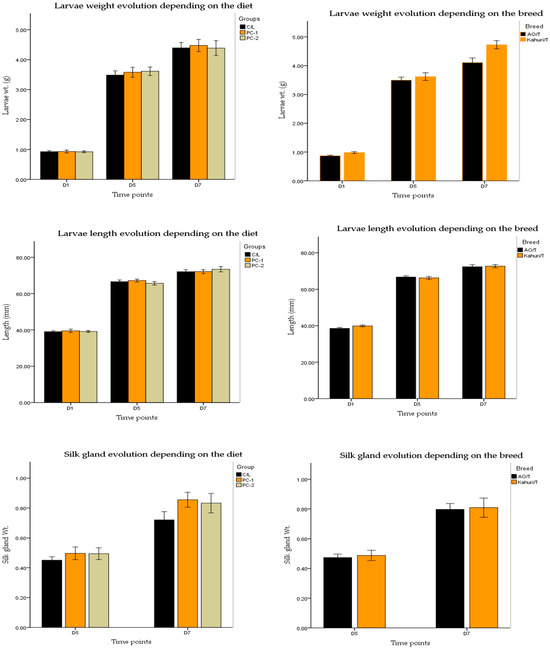
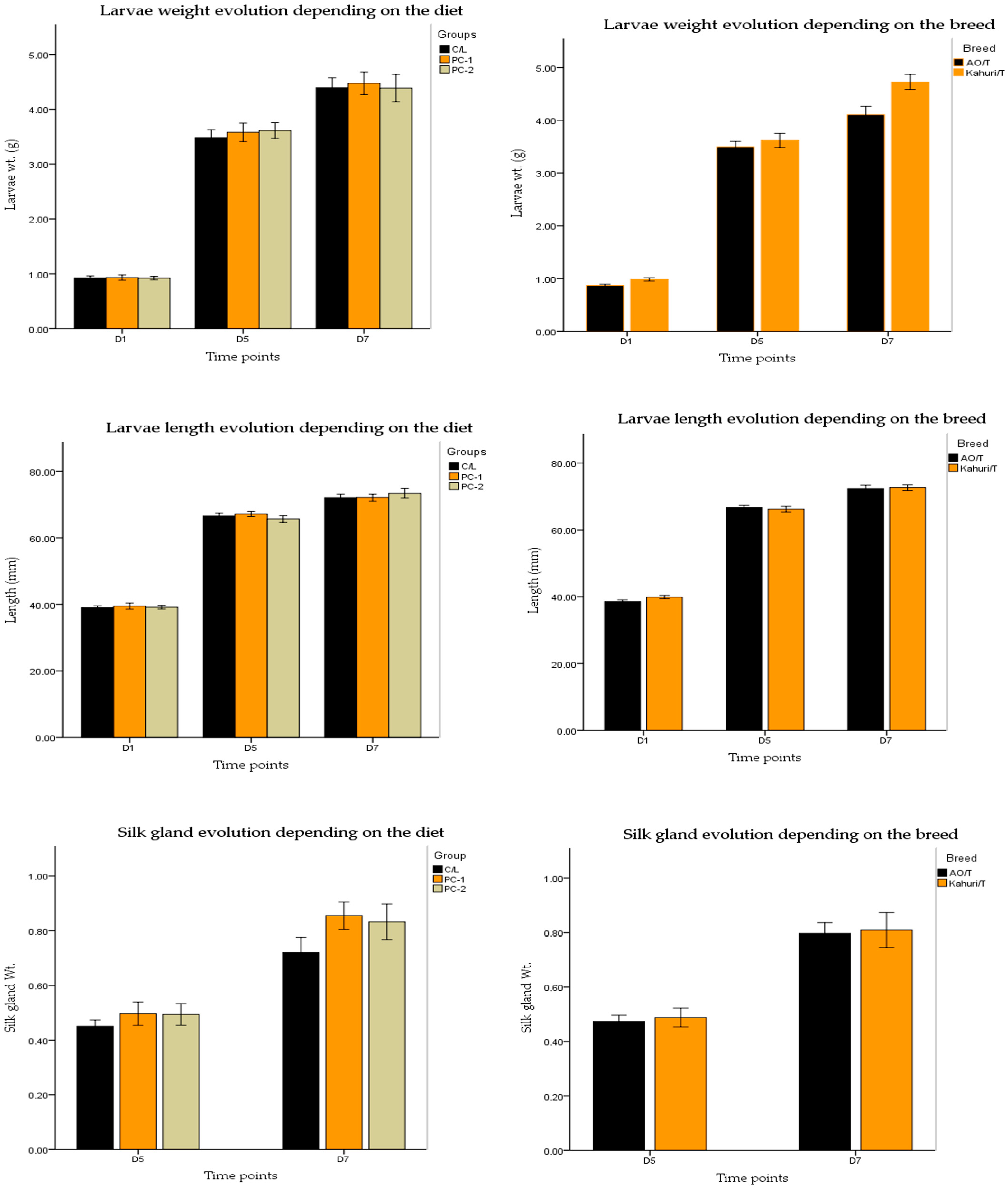
Figure 2 shows the dynamic changes in the productive parameters during the fifth instar. The determinations were performed at D1, D5, and D7 for larval weight and length, and at D5 and D7 for silk gland weight. For statistical evaluation, the GLM repeated measurements test was used, with time as a factor defined on three or two levels depending on the breed and treatment applied. The weight of the silk gland, a key indicator of development and future silk production, shows a logarithmic increase until it reaches the spinning state. The overall larval weight and length follow a similar pattern during the early and middle days of the 5th instar, often including an initial rapid, exponential growth phase.
Figure 2.
Changes over time in the traits of larvae and the silk gland weight according to the breed and the treatments applied. C, control group fed mulberry leaves (ML); PC-1, group fed MLs + 2% probiotic; PC-2, group fed MLs + 6% probiotic.
As expected, time influenced the results very significantly.
3.4.1. Changes in Time as Affected by Breed
In our study, Kahuri/T larvae gained more weight (D7 +4.82 times vs. D1, D5 +3.69 vs. D1) than AO/T larvae (4.72-fold at D7 vs. D1, as well as 4.11-fold at D5).
The length growth on 7D compared to the 1st D was slightly greater in the AO/T breed (+1.87 compared to 1.82. p < 0.0001), although the average larval length value in the Kahuri/T breed was higher. On day seven, we found that the weight of the silk gland in the two breeds was similar. However, Kahuri/T’s increase was slightly lower (1.70-fold in AO/T, respectively, and 1.65-fold for Kahuri/T, p < 0.0001).
3.4.2. Changes in Time as Affected by Diet
During the 5th instar, the PC-1 group’s larvae gained more weight from day 1 to day 7 (+3.80 times); however, the PC-2 group’s larvae showed a more noticeable increase on day 5 (+2.92 times). When the mulberry leaves was supplemented with 6% probiotics, the increase in larval length was 1.87-fold higher compared to D1, while at D5, a more pronounced increase was recorded in the PC-1-fed group (1.7-fold higher vs. D1, (p < 0.0001). In comparison to the control group, where the larvae were given only mulberry leaves, a 2% probiotic supplement resulted in a 15.2% increase in the silk gland.
3.5. Pearson Correlation
The data from the correlation between the parameters for the AO/T and Kahuri/T breeds are presented in Table 10 and interpreted using a guide by Akoglu [33]. In an SPSS-based correlation analysis, larval weight showed a moderate significant correlation with larval length (r = 0.590, p < 0.0001), while with protein intake (r = 0.483, p = 0.019), dry matter intake (r = 0.432, p = 0.048), and ADFI (r = 0.422, p = 0.01), the correlation was fair. A negative moderate correlation was noticed between larval weight and tissue somatic index (r = −0.590, p = 0.0001).
Table 10.
Pearson correlation coefficients.
Larval length and tissue somatic index and dry matter intake showed a somewhat negative connection (r = −0.426, p = 0.01 and r = 0.408, p = 0.013, respectively). Silk gland weight was shown to be fairly positively connected with tissue somatic index (r = 0.497, p = 0.002), protein intake (r = 0.436, p = 0.008), and fat intake (r = 0.486, p = 0.003), and moderately negatively correlated with silk conversion index (r = −0.527, p = 0.001). A slightly negative relationship was recorded for tissue somatic index and silk conversion index (r = −0.459, p = 0.005) and ADFI (r = 0.418, p = 0.016).
Silk productivity was moderately positively correlated with silk conversion index (r = 0.619, p = 0.0001), cocoons (r = 0.584, p = 0.0001), protein consumption (r = 0.527, p = 0.001), and ADFI (r = 0.562, p = 0.0001), whereas it was fairly correlated with pupae (r = 0.442, p 0.007). Shell weight and ADFI were found to be highly significantly correlated with silk conversion index (r= 0.619, p = 0.0001 and ADFI (r = 0.557, p = 0.0001, respectively). According to our findings, approximate digestibility was highly significantly dependent on protein intake (r = 0.553, p = 0.0001) and silk conversion index (r = −0.457, p = 0.005).
4. Discussion
Research on fortifying B. mori silkworm diets with agents like vitamins, minerals, and plant extracts is crucial because it boosts growth, improves silk quality, enhances disease resistance, and ensures year-round production, overcoming mulberry leaf limitations and ultimately benefiting the textile industry by fulfilling nutritional gaps in basic mulberry, making feed more efficient for better silk yield [35].
E. faecium exhibits marked strain-level variability and probiotic effects cannot be generalized across the species. The strain used in this study was selected based on its prior use as a probiotic/commensal organism and was applied under controlled experimental conditions.
In this paper, we show that a probiotic combination of E. faecium and rosemary, when fed to silkworms, can enhance productive traits like silk gland weight, cocoon weight, and shell, reduce waste, and improve apparent digestibility, particularly at a 2% concentration. Nevertheless, during the fifth instar, at various times, there were notable changes in the dependent variables (larvae weight and length, silk gland weight).
The data from the literature underlines a key gap in sericulture (silk farming): while extensive research focuses on the best feed (like specific mulberry varieties or artificial diets) to boost silkworm growth and silk yield, less attention has historically been paid to breeding or selecting silkworms for inherent genetic strengths (like disease resistance, faster growth, or better silk quality) to complement feeding strategies, though modern genomics is starting to change this [36,37].
Direct studies on this specific E. faecium strain, particularly in combination with rosemary and under the rearing conditions applied here, remain limited, despite the well-established probiotic roles of E. faecium in immune modulation, pathogen inhibition, and gut health enhancement [38].
E. faecium is recognized for immune-modulating potential in other systems, by inducing the release of cytokines, which helps regulate both humoral and cell-mediated immunity, which may contribute to the observed improvements, although we did not directly measure immune parameters in this study. This beneficial bacterium contributes to gut health by enhancing methionine production and protecting against pathogens [39]. Separately, rosemary contains active phenols like α-pinene, camphor, and eucalyptol, and possesses antibacterial, antifungal, antioxidant, and anticancer properties [40].
Nutrition significantly impacts silkworm growth and cocoon quality, and the 4th and 5th larval stages are the most critical for supplementation. During these stages, silkworms are more responsive to nutritional supplements, making this the ideal time for selecting and breeding nutritionally efficient breeds for commercial purposes. This is because these later stages are when they consume the majority of their feed, with the 5th instar alone accounting for 80–85% of total leaf consumption, which directly influences the quality and quantity of the resulting cocoon crop [41].
Silkworm feed consumption and development are affected by the nutritional quality of mulberry leaves and the inclusion of probiotics, which stimulate feed and nutrient intake. High-quality leaves are rich in nutrients, while probiotics can improve digestion and growth, leading to better performance.
Our data show that probiotic supplementation—especially at 2%—improved feed intake, growth, silk gland development, cocoon traits, and nutrient digestibility, with stronger responses in the Kahuri/T breed. Thus, the Kahuri/T breed has a greater capacity to consume and utilize feed and its component nutrients. Breed differences remained pronounced overall, with Kahuri/T showing superior performance and efficiency, while AO/T exhibited limited but positive treatment effects.
Due to the addition of probiotics, regardless of concentration, the ADFI and nutrients are higher. These effects may result from enhanced nutrient utilization, which could involve multiple physiological processes.
Probiotics also improve feed efficiency by reducing the population of pathogenic bacteria in the gut, which prevents infections that hinder growth. Additional mechanisms have been mentioned before, by Sachdeva et al. [42], such as improving intestinal morphology and barrier function.
In this paper, the results regarding feed intake show superior values to those mentioned by Manjunatha et al. [31] for the control group or those of Begum and Savithri [43] in polyvoltine breeds.
A higher feed intake in probiotic-treated silkworms (PC-1 and PC-2 groups) led to better performance traits. Probiotics enhance digestion and nutrient assimilation, leading to a more robust growth rate and better overall health, which contributes to a more profitable and sustainable sericulture industry. Such as, particularly in the PC-1 group (2% probiotic concentration) and the Kahuri/T breed, the larvae weight, ADG, feed conversion, growth index, and silk gland weight, for which the mean values were superior. These findings support the findings of Sekar et al. and Ren et al. [28,44], which indicated that probiotics added to mulberry leaves significantly increased larval body weight and length at all instar stages. However, in our study, the mean values were slightly lower than those obtained by Hăbeanu et al. [45] in the Line C breed using Rhodotorula glutinis yeast, whereas the growth index had a higher value. Furthermore, the average values obtained in our experiment of larvae weight, cocoons, pupae, and shell weight were slightly higher than in the findings of Hiware [46] and of those reported by Bhuvana et al. [47] for treated mulberry leaves with Lactobacillus rhimonus, Saccaramycis boulardii, and Bifidobacterium longum, or Murugesh et al. [34] for polyvoltine breeds. However, our work recorded lower silk gland weights, which is linked to an insignificant correlation between larval weight and silk gland weight. This implies that while larvae were heavier overall, the weight increase did not translate to proportionally larger silk glands, suggesting that factors other than overall body mass were more critical for silk gland development in our experiment.
The tissue somatic index is an indicator of silk output, affected by factors such as disease, environment, and silkworm breed, and a higher tissue somatic index can be linked to better silk quality, as indicated by a study by Murugesh et al. [34]. The breed significantly influenced TSI, being lower in Kahuri/T. Although mulberry leaves enriched with probiotics did not impact the tissue somatic index significantly, we observed an increase in the probiotic-treated groups. Silk productivity had a higher recorded value in the Kahuri/T breed than that obtained by Hăbeanu et al. [45] in Line C and Line Z, irrespective of the treatment applied. This suggests that the Kahuri/T breed has a superior inherent ability to produce silk compared to the other breeds under the experimental conditions. Fayard (1978), cited by Tantray [48], reported that there is a low correlation between silk production and the somatic index of silk gland tissues, this statement being confirmed in our study. Therefore, it can be assumed that the activity of the silk gland is primarily determined by its own characteristics and remains largely independent of other organs. This indicates that increased larval weight is not always a prerequisite for increased silk production.
The data recorded in this paper showed that supplementing mulberry leaves with probiotics (2% and 6%) improves the quality of silkworm cocoons by enhancing the majority of growth traits, particularly in PC-2 group, with the strongest positive effects observed in the Kahuri/T breed. The mean values are close to that obtained by Hăbeanu et al. [45].
Interestingly, our results indicate a differential response of silkworm larvae and cocoon traits to probiotic concentration. This pattern suggests that higher probiotic concentrations may exert more delayed or cumulative effects on B. mori development, influencing later stages such as cocoon formation rather than immediate larval growth.
From a practical sericulture perspective, these findings imply that a 2% probiotic supplementation is optimal during the fifth instar for silk-producing larvae, maximizing growth, feed efficiency, and silk gland development. In contrast, a 6% concentration could be considered for applications targeting cocoon quality or reproductive performance, where prolonged probiotic exposure may be advantageous. Future investigations that examine stage-specific administration, continuous supplementation, and time-course responses could provide mechanistic insight into these differential effects and help optimize dosage strategies for both larval growth and silk production
The effectiveness of a silkworms’ feed intake was reflected in the approximate digestibility and consumption index, which measures how much of the ingested feed was assimilated. Approximate digestibility compares the dry weight of digested feed to the dry weight of ingested feed, while the consumption index relates the dry weight of ingested food to the larval weight. The approximate digestibility for silkworms fed on mulberry leaves generally averages around 54.46% for the whole leaf. This value can vary significantly, ranging from approximately 33% to over 85%, depending heavily on the larval age, mulberry variety, and environmental conditions [14,31]. Although, in our study the breed showed a highly significant impact and a greater interaction between breed and diet was noticed. Furthermore, the fortification of mulberry leaves by probiotic addition affects the more noticeable approximate digestibility of the nutrients. The mean values of approximate digestibility of dry matter recorded in our trial, irrespective of breed or diet, are close to those mentioned by Samami et al. [36].
Enriching mulberry leaves with probiotics significantly improved the digestibility of their nutrients, particularly in the PC-1 feed group (2% probiotic concentration), except for fat. A possible explanation is that probiotics break down anti-nutritional factors in the leaves, making the nutrients more available for absorption.
Probiotics beneficially affect silkworm excreta by improving digestion and nutrient absorption, which results in less waste material and a higher digestion rate. The composition of the excreta is altered as the gut microbiota is modulated, including changes in pH and the detoxification of certain compounds [49].
In our paper, both the silkworm breed and probiotic treatment significantly affected digesta, with the probiotic groups producing less excreta overall, but with a higher proportion of nutrients in the excreta compared to the control group. Breed and feed also influenced nutrient excretion, though not fat excretion. These factors were used to estimate the digestibility of nutrients in the silkworms.
Silkworm larval weight and length during the fifth instar exponentially increases at a rapidly accelerating rate, with the most growth occurring in the first few days, before a significant weight loss begins as the larva starts to spin its cocoon. Time is a crucial factor, as the rapid growth of larvae and their ultimate preparation for pupation are directly tied to the time spent feeding and developing. In fact, during the 5th instar, silkworm larvae experience rapid growth, marked by significant increases in body weight and length, driven by intense feeding and massive silk gland development, which undergoes rapid DNA replication (endomitosis), cell expansion, and massive silk protein synthesis, culminating in the production of the cocoon silk before the wandering stage. This final instar is a period of extreme metabolic shift, transitioning from nutrient absorption to silk production, involving specific gene expression for silk proteins (fibroin, sericin) and complex metabolic changes in the hemolymph, all preparing the larva for pupation.
During the fifth instar, Kahuri/T larvae showed greater weight gain than AO/T larvae, even though AO/T larvae had a slightly larger length increase from day 1 to day 7. On day 7, the silk gland weights were similar in both breeds, but the increase in silk gland weight was slightly lower in the Kahuri/T larvae.
Regarding the effect of dietary factors, during the 5th instar, the PC-1 silkworm group gained more weight from day 1 to day 7, whereas the PC-2 group showed a more noticeable increase on day 5. Supplementing mulberry leaves with a 6% probiotic led to a greater increase in larval length compared to day 1, with the most pronounced increase on day 5 occurring in the PC-1-fed group. Furthermore, supplementation with a 2% probiotic (PC-1 group) led to a larger silk gland compared with the control group fed only mulberry leaves.
Studies have found that silkworms’ productive traits strongly correlate with feed efficiency, where better strains show a higher conversion efficiency of ingesta and a lower consumption index, meaning they get more silk from less feed. Key correlations include positive links between higher feed intake and increased silk yield/cocoon weight, but also negative correlations where better strains need less intake for the same output. Understanding these relationships helps breed superior, efficient silkworms for commercial sericulture [41,50]. We found that larval weight had a moderate negative relationship with tissue somatic index, a fair negative correlation with protein and dry matter consumption, and a moderate correlation with larval length. There is a relatively inverse relationship between larval length and the tissue somatic index and dry matter intake. Silk gland weight had a significantly negative correlation with the silk conversion index but a fairly positive correlation with the tissue somatic index and protein/fat consumption. Lastly, there was a small negative correlation between the silk conversion index and the tissue somatic index. Silk productivity is positively correlated with silk conversion index, cocoons, protein consumption, and average daily feed intake, and fairly correlated with pupae. Shell weight and average daily feed intake are highly correlated with the silk conversion index. Approximate digestibility is highly dependent on protein intake and the silk conversion index.
Although genomic characterization and antimicrobial resistance profiling were beyond the scope of the present work, this limitation is acknowledged and any future application would require comprehensive strain-level safety assessment, including screening for virulence determinants and antimicrobial resistance. Notably, no adverse effects, abnormal mortality, or disease symptoms were observed during the rearing period, providing preliminary evidence of safety under the conditions tested.
While this study observed clear improvements in performance, mechanistic parameters such as gut microbiota, digestive enzymes, gut histology, or immune markers were not measured. Proposed mechanisms—microbiota modulation, enhanced digestion, or immune support—remain hypotheses. Future studies with targeted assays will be needed to confirm the underlying processes and the current findings should be interpreted primarily as performance-level outcomes.
5. Conclusions
This study reveals that a mix of Enterococcus faecium and rosemary has potential to act as a probiotic by enhancing silkworm growth, feed efficiency, and cocoon traits, with the specific impact varying by silkworm breed and probiotic concentration. The mulberry leaves fortified with probiotics—especially at a 2% concentration—led to increases in larval weight, silk gland weight, and cocoon weight, as well as improved digestibility and reduced excretion.
Productive performance varied by breed, with superior results in Kahuri/T, which showed a greater capacity for nutrient intake and utilization. Supplementing mulberry leaves with probiotics (2% and 6%) improved most of the productive traits, nutrient digestibility, and cocoon quality, with stronger effects in the probiotic groups and in the Kahuri/T breed. Correlation analysis revealed strong relationships between feed utilization efficiency and silk yield, where protein intake, average daily intake, and feed conversion were positively associated with cocoon yield and silk productivity. The results confirm the potential of probiotics as an effective and sustainable strategy for optimizing sericultural performance under controlled rearing conditions. However, this study did not directly assess silk quality parameters such as filament length, denier, reelability, raw silk percentage, fibroin/sericin ratio, or tensile strength. Therefore, conclusions regarding silk quality remain speculative, and further research is needed to evaluate these economic traits, validate results across additional breeds, and confirm applicability under large-scale commercial sericulture conditions.
Author Contributions
Conceptualization. M.H.; methodology. M.H. and AG.; software. N.A.L.; validation. A.G. and T.M.; formal analysis. N.A.L.; investigation. M.H. and A.G.; resources. T.M.; data curation. N.A.L.; writing—original draft preparation. M.H.; writing—review and editing. A.G.; visualization. T.M.; supervision. A.G.; project administration. M.H.; funding acquisition. M.H. and T.M. All authors have read and agreed to the published version of the manuscript.
Funding
This research was funded by the Romanian Ministry of Agriculture and Rural Development (MADR), grant ADER 24.1.3.
Institutional Review Board Statement
Not applicable.
Informed Consent Statement
Not applicable.
Data Availability Statement
The data presented in this study are available on request from the corresponding author.
Conflicts of Interest
The authors declare no conflicts of interest.
References
- Chen, C.; Li, M.; Li, F.; Liang, X.; Zhang, H.; Gu, Y.; Guo, G. Dynamic alterations of the intestinal microbiota of fifth-instar silkworms (Bombyx mori) fed an artificial diet or mulberry leaves. Insects 2024, 15, 970. [Google Scholar] [CrossRef] [Scilit]
- Gheorghe, A.; Hăbeanu, M.; Mihalcea, T.; Diniță, G.; Moise, A.R. Probiotics supplementation to mulberry silkworm Bombyx mori. Sci. Pap. Anim. Sci. Biotechnol. 2024, 57, 1–9. [Google Scholar]
- Dutta, P.L.; Nath, I.; Narzary, P.R.; Purad, B.S.; Ganesh, O.; Mallikarjun. The role of probiotic supplementation in silkworm (Bombyx mori) biology: Current insights and future perspectives. Microbiol. Res. J. Int. 2025, 35, 77–93. [Google Scholar] [CrossRef]
- Hemaiswarya, S.; Raja, R.; Ravikumar, R.; Carvalho, I.S. Mechanism of action of probiotics. Braz. Arch. Biol. Technol. 2013, 56, 113–119. [Google Scholar] [CrossRef] [Scilit]
- Suraporn, S.; Terenius, O. Supplementation of Lactobacillus casei reduces the mortality of Bombyx mori larvae challenged by Nosema bombycis. BMC Res. Notes 2021, 14, 398. [Google Scholar] [CrossRef] [Scilit] [PubMed]
- Latif, A.; Shehzad, A.; Niazi, S.; Zahid, A.; Ashraf, W.; Iqbal, M.W.; Rehman, A.; Riaz, T.; Aadil, R.M.; Khan, I.M.; et al. Probiotics: Mechanism of action, health benefits and their application in food industries. Front. Microbiol. 2023, 14, 1216674. [Google Scholar] [CrossRef] [Scilit]
- Priyadharshini, P.; Swathiga, G.; Joncy, A.M.; Thangamalar, A. Probiotics and its role in silkworm growth and development. Just Agric. 2021, 2, 1–6. [Google Scholar]
- Rateb, S.H.; Abdel-Rahman, Y.A. Effects of some extracts on growth characters of mulberry silkworm. Assiut J. Agric. Sci. 2015, 46, 58–71. [Google Scholar]
- Gupta, S.K.; Singh, V.; Pandey, R.P.; Yadav, P. Impact of certain plant extracts on different larval and cocoon characters of silkworm Bombyx mori Linn. Zool. Entomol. Lett. 2022, 2, 42–45. [Google Scholar] [CrossRef] [Scilit]
- Jeyapaul, C.; Padmalatha, C.; Singh, A.J.A.R.; Murugesan, A.G.; Dhasarathan, P. Effect of plant extracts on nutritional efficiency in mulberry silkworm, Bombyx mori L. Indian J. Seric. 2003, 42, 128–131. [Google Scholar]
- Eswaran, R.; Sevarkodiyone, S. Comparative effect of tapioca flour and Amaranthus green leaves on feeding characters of mulberry silkworm, Bombyx mori L. Bionotes 2004, 6, 88–89. [Google Scholar]
- Bohidar, K.; Choubey, M. Effect of some indigenous plant leaf extracts on the economic characters of mulberry silkworm, Bombyx mori L. Indian J. Entomol. 2005, 67, 238–240. [Google Scholar]
- Mahmoud, M.M.; Mesbah, H.A.; El-Sayed, A.A. Evaluation of certain types of honey, essential botanical oils and their mixtures on the productivity of the mulberry silkworm Bombyx mori L. Alex. Sci. Exch. J. 2012, 33, 65–72. [Google Scholar]
- Doliş, M.G.; Pânzaru, C.; Usturoi, M.G.; Usturoi, A.; Radu-Rusu, C.G.; Davidescu, M.A. On the digestibility of mulberry leaf fed to Bombyx mori larvae. Agriculture 2024, 14, 1394. [Google Scholar] [CrossRef] [Scilit]
- European Commission. Commission Regulation (EC) No. 152/2009 of 27 January 2009 laying down the methods of sampling and analysis for the official control of feed. Off. J. Eur. Union 2009, L54, 26–61. [Google Scholar]
- ISO 2171:2010; Cereals, Pulses and By-Products—Determination of Ash Yield by Incineration. International Organization for Standardization (ISO): Geneva, Switzerland, 2010.
- ISO 6496:2001; Animal Feeding Stuffs—Determination of Moisture and Other Volatile Matter Content. International Organization for Standardization (ISO): Geneva, Switzerland, 2001.
- SR EN ISO 5983-2:2009; Animal Feeding Stuffs—Determination of Nitrogen Content and Calculation of Crude Protein Content—Part 2: Block Digestion and Steam Distillation Method. Romanian Standards Association (ASRO): Bucharest, Romania, 2009.
- SR ISO 6492:2001; Animal Feeding Stuffs—Determination of Fat Content. Romanian Standards Association (ASRO): Bucharest, Romania, 2001.
- SR EN ISO 6865:2002; Animal Feeding Stuffs—Determination of Crude Fibre Content—Intermediate Filtration Method. Romanian Standards Association (ASRO): Bucharest, Romania, 2002.
- Untea, A.E.; Varzaru, I.; Saracila, M.; Panaite, T.D.; Oancea, A.G.; Vlaicu, P.A.; Grosu, I.A. Antioxidant properties of cranberry leaves and walnut meal and their effect on nutritional quality and oxidative stability of broiler breast meat. Antioxidants 2023, 12, 1084. [Google Scholar] [CrossRef] [Scilit]
- Oancea, A.-G.; Dragomir, C.; Untea, A.E.; Saracila, M.; Cismileanu, A.E.; Vlaicu, P.A.; Varzaru, I. The effects of flax and mustard seed inclusion in dairy goats’ diet on milk nutritional quality. Agriculture 2024, 14, 1009. [Google Scholar] [CrossRef] [Scilit]
- SR ISO 6490-1:2006; Animal Feeding Stuffs—Determination of Calcium Content—Part 1: Titrimetric Method. Romanian Standards Association (ASRO): Bucharest, Romania, 2006.
- SR EN ISO 6869:2002; Animal Feeding Stuffs—Determination of the Contents of Calcium, Copper, Iron, Magnesium, Manganese, Potassium, Sodium and Zinc—Method Using Atomic Absorption Spectrometry. Romanian Standards Association (ASRO): Bucharest, Romania, 2002.
- SR EN ISO 7485:2001; Animal Feeding Stuffs—Determination of Potassium and Sodium Contents—Flame Emission Spectrometric Method. Romanian Standards Association (ASRO): Bucharest, Romania, 2001.
- Rahmathulla, V.K.; Suresh, H.M. Seasonal variation in food consumption, assimilation, and conversion efficiency of Indian bivoltine hybrid silkworm, Bombyx mori. J. Insect Sci. 2012, 12, 82. [Google Scholar] [CrossRef] [Scilit]
- Islam, T.; Bhat, S.A.; Malik, F.A.; Wani, S.A.; Farooq, A.K.; Mir, S.A.; Nazir, N. Feeding of different mulberry varieties and its impact on silk gland of silkworm, Bombyx mori L. Biol. Forum 2023, 15, 488–492. [Google Scholar]
- Sekar, P.; Kalpana, S.; Ganga, S.; John, G.; Kannadasan, N.; Krishnamoorthy, R. Studies on the growth parameters and cocoon production in Bombyx mori fed on mulberry leaves fortified with Lactobacillus casei. Int. J. Curr. Res. 2016, 8, 29127–29132. [Google Scholar]
- Saranya, M.; Krishnamoorthy, S.V.; Murugesh, K.A. Fortification of mulberry leaves with indigenous probiotic bacteria on larval growth and economic traits of silkworm (Bombyx mori L.). J. Entomol. Zool. Stud. 2019, 7, 780–784. [Google Scholar]
- Hachad, S.; Ravikumar, A.; Hadimani, D.K.; Kirankumar, R.; Shrihari, H.; Kisan, B. Effect of antibiotics administration on consumption index and growth efficiency of mulberry silkworm, Bombyx mori L. Int. J. Novel Res. Dev. 2025, 10, c360–c367. [Google Scholar]
- Manjunatha, S.R.; Gowda, M.; Karaba, N.; Narayanaswamy, K.C.; Jagadish, K.S. Consumption indices in silkworm as influenced by feeding of transgenic mulberry. J. Entomol. Zool. Stud. 2020, 8, 2008–2014. [Google Scholar]
- Etebari, K.; Ebadi, R.; Matindoost, L. Physiological changes of silkworm (Bombyx mori L.) larvae fed on mulberry leaves supplemented with nitrogenous compounds. J. Entomol. Res. Soc. 2007, 9, 1–15. [Google Scholar]
- Akoglu, H. User’s guide to correlation coefficients. Turk. J. Emerg. Med. 2018, 18, 91–93. [Google Scholar] [CrossRef] [Scilit]
- Murugesh, K.A.; Mahalingam, C.A.; Mohankumar, S. Silk gland tissue somatic index and silk quality traits of silkworm races. Madras Agric. J. 2013, 100, 524–527. [Google Scholar] [CrossRef] [Scilit]
- Aramani, K.; Tejaswini, A.S.; Kankanawadi, N.; Veenita, M.K.; Jekinakatti, B.; Madarakhandi, V. Enhancing performance of Bombyx mori L. via nutrient-fortified mulberry leaves. Uttar Pradesh J. Zool. 2025, 46, 1–13. [Google Scholar] [CrossRef] [Scilit]
- Samami, R.; Seidavi, A.; Eila, N.; Moarrefi, M.; Ziaja, D.J.; Lis, J.A.; Rubiu, N.G.; Cappai, M.G. Production performance and economic traits of silkworms fed mulberry leaves differ according to hybrid lines. Livest. Sci. 2019, 226, 133–137. [Google Scholar] [CrossRef] [Scilit]
- Gowda, K.B.; Jerry, D.R.; Zenger, K.R. Genetic improvement of farmed insect species: Programmes, progress, and prospects. J. Insects Food Feed. 2025, 11, 1357–1384. [Google Scholar] [CrossRef] [Scilit]
- Dowarah, R.; Verma, A.K.; Agarwal, N. The use of Lactobacillus as an alternative to antibiotic growth promoters in pigs: A review. Anim. Nutr. 2017, 3, 1–6. [Google Scholar] [CrossRef] [Scilit] [PubMed]
- Raheem, A.; Liang, L.; Zhang, G.; Cui, S. Modulatory effects of probiotics during pathogenic infections with emphasis on immune regulation. Front. Immunol. 2021, 12, 616713. [Google Scholar] [CrossRef] [Scilit]
- Li, X.-W.; Lu, X.-X.; Zhang, Z.-J.; Huang, J.; Zhang, J.-M.; Wang, L.-K.; Hafeez, M.; Fernández-Grandon, G.M.; Lu, Y.-B. Intercropping rosemary with sweet pepper reduces major pest populations. Insects 2021, 12, 74. [Google Scholar] [CrossRef] [Scilit]
- Ramesha, C.; Lakshmi, H.; Kumari, S.S.; Anuradha, C.M.; Kumar, C.S. Nutrigenetic screening of mulberry silkworm strains for nutritional efficiency. J. Insect Sci. 2011, 12, 15. [Google Scholar]
- Sachdeva, A.; Tomar, T.; Malik, T.; Bains, A.; Karnwal, A. Exploring probiotics as a sustainable alternative to antimicrobial growth promoters. Front. Sustain. Food Syst. 2025, 8, 1523678. [Google Scholar] [CrossRef] [Scilit]
- Begum, S.F.; Savithri, G. Dynamics of nutritional indices in fifth instar silkworm Bombyx mori L. parasitized with Beauveria bassiana. J. Adv. Zool. 2023, 44, 281–290. [Google Scholar] [CrossRef] [Scilit]
- Ren, C.; Meng, Y.; Liu, Y.; Wang, Y.; Wang, H.; Liu, Y.; Liu, C.; Fan, X.; Zhang, S. Bacillus subtilis enhances silkworm growth and silk production via gut microbiota modulation. Anim. Microbiome 2025, 7, 103. [Google Scholar] [CrossRef] [Scilit] [PubMed]
- Hăbeanu, M.; Gheorghe, A.; Lefter, N.A.; Dumitru, M.; Toma, S.M.; Vlaicu, P.A.; Mihalcea, T. Comparative study of productive parameters of Bombyx mori fed Rhodotorula glutinis. Insects 2025, 16, 482. [Google Scholar] [CrossRef] [Scilit]
- Hiware, C.J. Effect of fortification of mulberry leaves with homeopathic drug Nux vomica on Bombyx mori L. Homeopathy 2006, 95, 148–150. [Google Scholar] [CrossRef] [Scilit]
- Bhuvana, S.; Susikaran, S.; Kiruthika, C.; Deepa, E.; Bharathi, B.K.M.; Priyadharshini, P. Influence of probiotic feed supplements on silkworm economic metrics. Int. J. Vet. Sci. Anim. Husb. 2024, 9, 166–170. [Google Scholar]
- Tantray, A.K. Influence of botanical and synthetic antiscorbutic factors on larval growth and silk gland index of silkworm. J. Entomol. Zool. Stud. 2017, 5, 212–216. [Google Scholar]
- Chandrasekaran, P.; Weiskirchen, S.; Weiskirchen, R. Effects of probiotics on gut microbiota: An overview. Int. J. Mol. Sci. 2024, 25, 6022. [Google Scholar] [CrossRef] [Scilit] [PubMed]
- Begum, A.N.; Yamamoto, T. Correlation coefficient studies on certain quantitative traits in silkworms, Bombyx mori L. Int. J. Ind. Entomol. 2002, 5, 45–52. [Google Scholar]

Disclaimer/Publisher’s Note: The statements, opinions and data contained in all publications are solely those of the individual author(s) and contributor(s) and not of MDPI and/or the editor(s). MDPI and/or the editor(s) disclaim responsibility for any injury to people or property resulting from any ideas, methods, instructions or products referred to in the content. |
© 2026 by the authors. Licensee MDPI, Basel, Switzerland. This article is an open access article distributed under the terms and conditions of the Creative Commons Attribution (CC BY) license.