


Abstract
This study investigates the creep behavior and acoustic emission (AE) characteristics of bedded coal samples under acidic water environments. Uniaxial graded creep tests coupled with AE monitoring were conducted on samples with bedding angles of 0°, 30°, 60°, and 90°, respectively. The anisotropic mechanical behavior and acoustic emission characteristics in terms of stress–strain, deformation, AE count, AE energy, and spectrum characteristics were revealed. The experimental results show that the strength of the coal samples gradually decreases as the saturation duration increases. At the same axial stress level, the axial deformation of the coal samples becomes larger with increasing saturation duration. The mechanical strength exhibits a distinct “U-shaped” relationship with the bedding angle, initially decreasing and then increasing. Correspondingly, axial deformation at a given stress level first increases and then decreases as the bedding angle increases. AE activity, particularly the AE ring count and energy, peaks at specimen failure, indicating significant fracture development. Spectral analysis revealed that under conditions of severe strength degradation (e.g., 0° bedding after 60-day saturation or 60° bedding after 30-day saturation), high-frequency, high-amplitude AE signals were absent. This suggests a shift in the dominant fracture mechanism from small-scale cracking to larger-scale fracture propagation in weakened samples. These findings offer valuable theoretical insights for the prevention and early warning of coal mine disasters.
1. Introduction
Coal resources serve as a fundamental energy source and a crucial industrial raw material, playing a pivotal role in the national economy and social development. As a naturally occurring, discontinuous, and heterogeneous geological material, coal forms anisotropic layered structure with the coal rock [1,2,3,4]. Influenced by the orientation of coal seams and the surrounding rock stress field, the internal structure of coal is highly susceptible to the formation of random, disordered fractures, rendering the fracture process more complex. Furthermore, the groundwater stored in coal mines often contains a variety of suspended particles, ions, and ion clusters. When pyrite is present in the vicinity or the coal seams have high sulfur content, the mine water may become acidic due to chemical and microbial processes. The corrosion induced by this acidic environment leads to alterations in the mineral composition and structure of the coal. Repeated water saturation, particularly under prolonged acidic conditions [5,6,7], significantly affects the physical and mechanical properties of the coal. The interaction between acidic water and coal samples leads to the deterioration of physical and mechanical parameters, resulting in volumetric expansion, creep deformation, and associated instability. These changes also alter the acoustic emission characteristics during the rupture process. During mining operation, coal often fails not due to insufficient strength, but because the cumulative creep deformation surpasses the material’s stability threshold before it reaches its failure limit. This phenomenon severely impacts the safe operation of coal mines. Therefore, studying the creep behavior and acoustic emission characteristics of water-saturated coal samples with bedding is of considerable significance for the prevention, early warning, and safety assurance of coal mine operations.
The deformation and failure behavior, as well as the acoustic emission characteristics, of coal rock under various operating conditions have garnered widespread attention, with numerous studies yielding valuable results. In terms of the deformation and failure behavior of water-saturated coal rock, Han et al. [8] investigated the effect of water ratio on mechanical behaviors of coal samples from the mesoscopic view, and it was found that the tensile strength of coal samples reduces exponentially and the plastic behavior increases, while the wave velocity increases logarithmically. Wang et al. [9] investigated the relationship between sound wave speed variation and microstructure of coal under wet conditions, and the relationships between the longitudinal wave speed and water-bearing saturation, porosity, and fractal dimension of coal were established. In addition, they found that the water saturation state can help to predict coal’s cementation and connectivity and the number of isolated pores. Li et al. [10] prepared four types of coal samples with different saturations (10%, 30%, 50%, and 100%) under creep damage conditions and conventional coal samples. A comparative study was conducted using uniaxial compression tests to examine the deterioration characteristics of physical and mechanical parameters, failure modes, and energy evolution patterns in these two types of coal samples. Wang et al. [11] conducted cyclic mechanical testes to study the deformation and acoustic emission characteristics of coal with different water saturations; the results show that the deformation modulus and peak stress of the coal samples show a consistently decrease trend with the increase in water saturation. Zhang et al. [12] conducted quantitative analysis of the wave attenuation pattern and wave properties of coal samples with varying degrees of water saturation; the testing results indicated that peak P-wave amplitude decreases consistently with increasing water saturation and porosity.
In experimental mechanics of rock materials, acoustic emission (AE) research plays a crucial role in revealing the evolution process of microfracture initiation, propagation, and macroscopic failure within coal rock. Regarding the acoustic emission characteristics of coal sample, Vinnikov et al. [13] analyzed the AE characteristics during the fracture process of coal samples at different temperatures, establishing a theoretical model and validating it through experimentation. Shkuratnik et al. [14] studied the spectral characteristics of acoustic emission in loaded coal; they found that acoustic emission spectral patterns change considerably at the pre-failure stage in the samples under uniaxial compression, and the amplitudes of low-frequency components grow, while those of high frequencies reduce. Wang et al. [15] reveled the mechanical properties and acoustic emission characteristics of deep hard coal after high-temperature treatment. They found that a temperature of 100 °C, similar to 400 °C, was not a sufficient ignition temperature to change the mechanical and acoustic emission characteristics of hard coal. Zhang et al. [16] investigated the change in AE parameters to identify precursor information indicating the critical transition before failure in coal rock masses, and an index of RA/AF was employed to predict coal failure. Yao et al. [17] studied the strength, porosity, fracture propagation, and failure characteristics of coal with different moisture contents. A coupled uniaxial compression–acoustic emission experiment showed that acoustic emissions are closely related to the macroscopic failure mode of the coal sample. Li et al. [18] established the acoustic–electric–heat multi-parameter experimental system of coal and rock, and the acoustic emission, surface potential, and thermal infrared radiation (TIR) signals were tested and analyzed in the failure processes of coal and rock under uniaxial compression. Wang et al. [19] developed a three-dimensional convolution recognition model for acoustic emission signal analysis for coal during uniaxial compression failure of coal, and they identified hazardous coal damage stages using a series of AE parameters. Kong et al. [20] conducted uniaxial compression experiments on coal samples with different initial damage degrees, and the acoustic emission signals of the whole deformation and destruction process were captured synchronously. Their testing results indicated that the acoustic emission responses of coal samples with different damage levels had obvious stage characteristics during the whole destruction process. Zhao et al. [21] conducted acoustic and thermal infrared radiation tests on bump-prone coal under uniaxial compression and cyclic loading to monitor the failure precursory and the AE energy, and ring count distribution was analyzed. Jia et al. [22] investigated the variation in infrasound intensity in different frequency bands before coal sample failure; they found that the acoustic emission variation proves feasibility of predicting coal sample damage according to variation in frequency. Zhang et al. [23] analyzed the fracture characteristics and energy evolution of tectonic coal after loading based on the acoustic emission technique, and the link between the physical and mechanical parameters and acoustic parameters were established. These studies have deepened the understanding of the AE characteristics of coal rock and advanced the application of AE technology. However, research focusing on the impact of bedding structure on the AE features during the creep deformation and failure of water-saturated coal rock remains relatively scarce.
In this study, to simulate the in situ environment of coal mines, an acidic solution with a pH of 6 was prepared. Uniaxial compression creep tests, combined with acoustic emission monitoring, were conducted on pre-saturated coal samples. The stress-strain characteristics and creep stages of the saturated coal samples were analyzed. The effects of different acid immersion durations and bedding angles on the strength and deformation characteristics of the coal samples were investigated. The evolution of acoustic emission features, including ringing/energy counts, cumulative ringing/energy counts, and frequency spectrum characteristics during the failure process, was examined. Additionally, the influence mechanism of water saturation time and bedding structure on the creep failure of coal samples was explored, and the relationship between acoustic emission parameters and the mechanical failure mechanisms of coal rock was clarified. This study provides valuable insights into the damage evolution laws of coal rock and contributes to a deeper understanding of the underlying mechanisms of coal rock dynamic disasters.
2. Testing Methods
2.1. Coal Sample Preparation
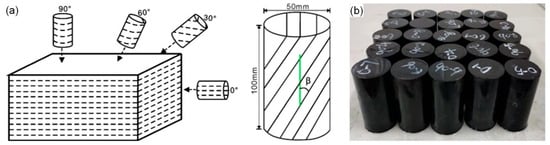
The anthracite coal samples used in the experiments were obtained from a coal mine in Shandong province, China, and processed according to the international standard of the ISRM. To investigate the impact of bedding angle on the anisotropic characteristics of coal samples, a drilling machine was employed to extract cylindrical specimens, with the drilling direction controlled at an angle β relative to the horizontal plane. Coal samples with bedding angles of 0°, 30°, 60°, and 90° were obtained, where 0° represents horizontal bedding and 90° represents vertical bedding, as shown in Figure 1a. The cylindrical specimens were then cut to a height of 100 mm and a diameter of 50 mm using an automatic cutting machine. Next, the ends of the coal specimens were polished using a computer-controlled double-end grinding machine, ensuring that the parallelism error of the two ends did not exceed 0.005 mm, the flatness error of the upper and lower ends did not exceed 0.02 mm, and the diameter error of the specimen’s ends did not exceed 0.3 mm. The ends were also aligned perpendicular to the specimen’s central axis, with a maximum deviation of no more than 0.25°. The final coal samples were thus prepared, as shown in Figure 1b.
Figure 1.
Preparation of coal samples. (a) Preparation scheme of coal samples with different bedding orientations. (b) Typical coal samples used in the creep tests.
It is accepted that groundwater stored in coal mine reservoirs contains various suspended particles, ions, and ion clusters. Particularly when pyrite is present in the vicinity or when the coal seams have a high sulfur content, the mine water tends to become acidic due to chemical and microbial processes. As a result, all the coal samples achieved saturation in acidic water. For the experiment, 16 standard cylindrical coal samples measuring 50 mm in diameter and 100 mm in height, 12 containers of the same specification, several 250 mL beakers, and other chemical reaction apparatus were prepared. The solutes used were high-purity hydrochloric acid and sodium hydroxide, and the solvent was distilled water (pH = 6.3). A 1000 mL solution with a pH of 6 was prepared, and its acidity was verified using a laboratory pH meter. All the prepared coal samples were saturated within the solution with various days.
2.2. Experimental Apparatus
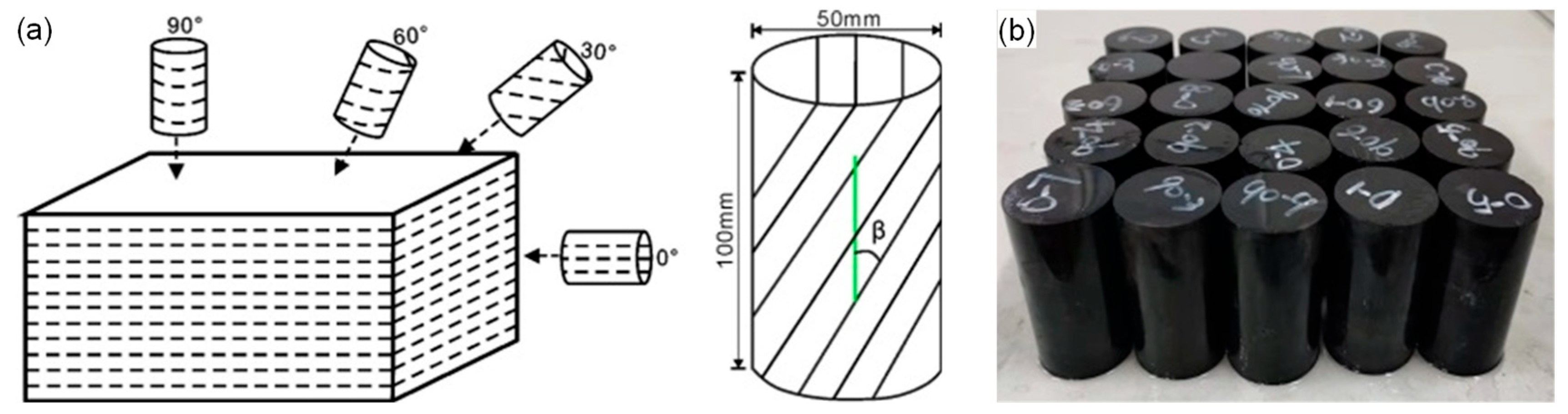
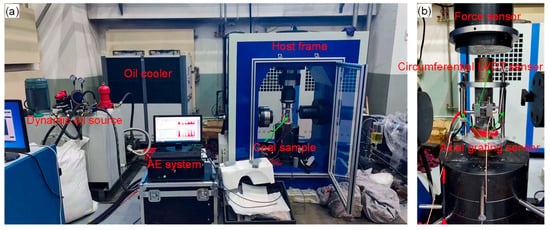
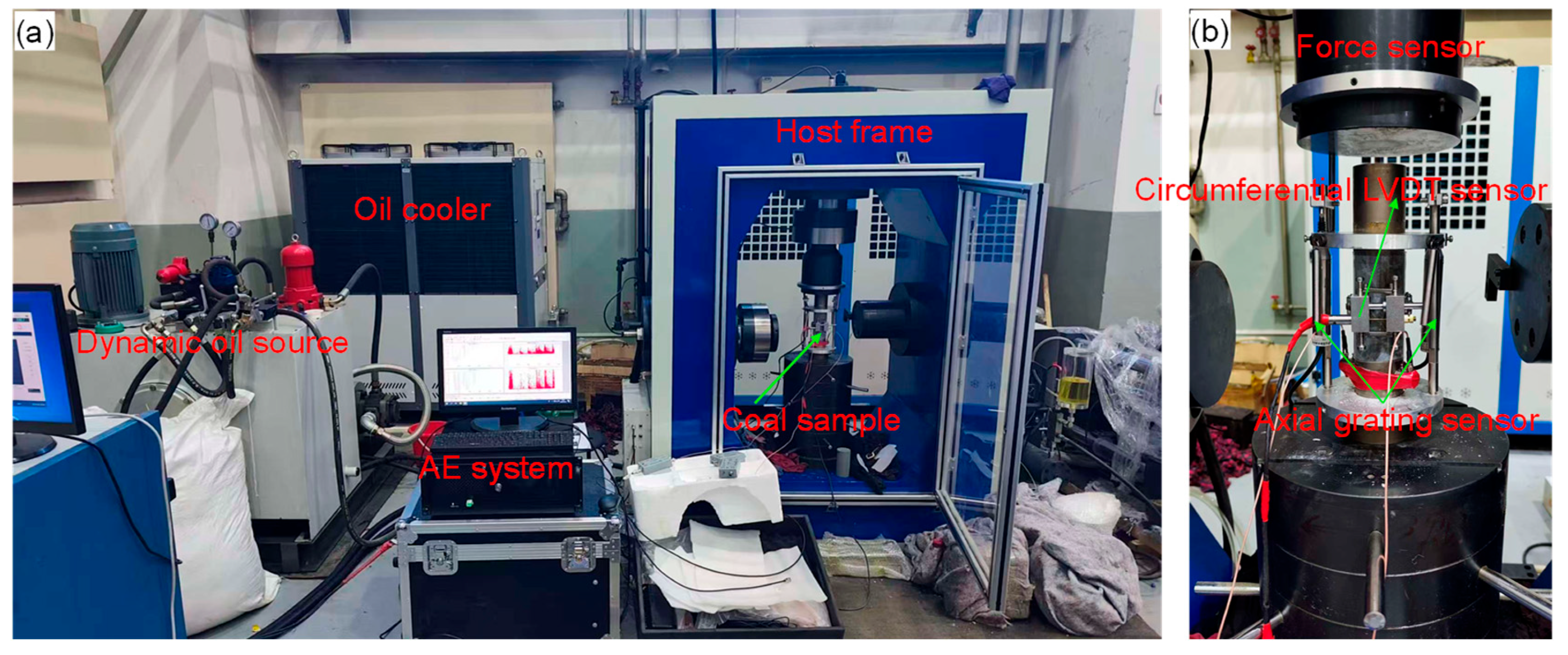
The uniaxial creep tests were conducted on an RTFS-1000 electro-hydraulic servo-controlled rock mechanics testing machine, as shown in Figure 2. This equipment is capable of applying dynamic loading frequencies in the range of 0–10 Hz. During each test, axial and radial strains were continuously monitored using a grating sensor and a circumferential LVDT device, and the axial stress, axial strain, and radial strain data were recorded by a computer.
Figure 2.
The apparatus used in the short-time creep tests. (a) The mechanical loading device; (b) the sample holder for coal.
During the entire loading process, the acoustic emission monitoring system developed by Softland Times (Beijing, China) was used to continuously record the acoustic emission signals from each specimen in real time. With the Softland acoustic emission monitoring system, a sampling rate of up to 3MSPS with a resolution of 18 bits can be obtained. The sampling filter frequencies range from 125 kHz to 750 kHz. The acoustic emission sensor used is a miniature sensor with a diameter of 6 mm × 6 mm and a resonance frequency of 300 kHz. A high-viscosity, silicone-based acoustic couplant is applied to the sensor’s face and the sample surface. The system features multiple monitoring channels for signal transmission, each consisting of monitoring components, digital signal conversion, processing, and the main computer system, supplemented by external hardware. The monitoring system’s components include AE sensors, pre-amplifiers, signal acquisition cards, and units for recording, processing, and displaying data. Before the uniaxial compression creep test, the acoustic emission monitoring equipment was connected and calibrated. The amplifier and threshold values were set to a specified level of 40 dB, and the signal acquisition time intervals were defined, with the SNR ratio being more than 20 dB to obtain effective signals. A simple test was performed, followed by the application of a coupling agent on the sensor probe and the central area of the coal sample. The sensor was then affixed to the surface of the coal specimen. Once the acoustic emission setup was complete, the uniaxial compression creep test was conducted.
2.3. Testing Scheme
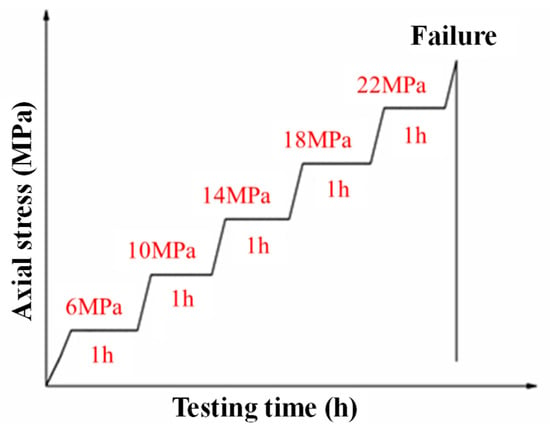
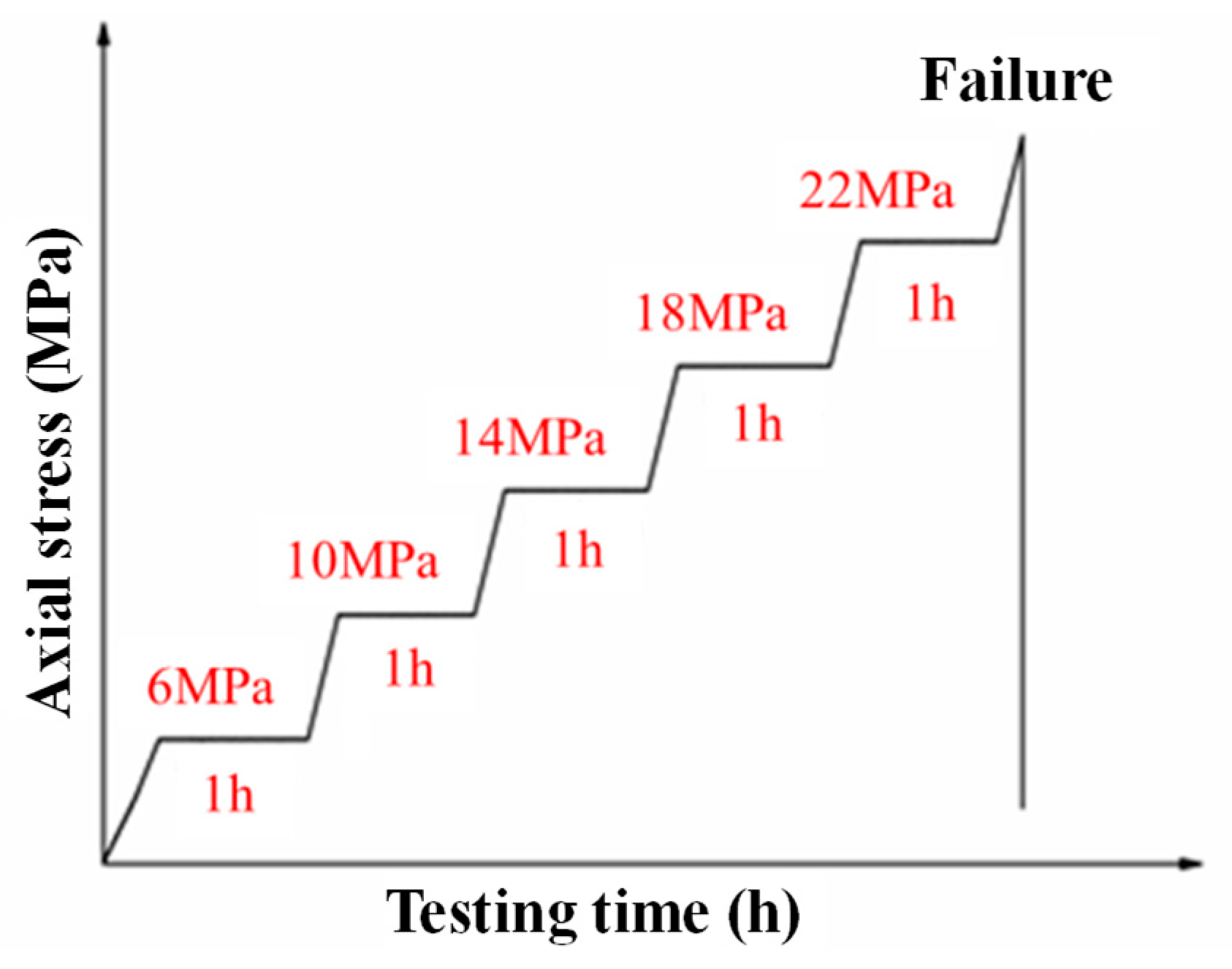
The uniaxial compression creep test employed a graded loading method, which is highly effective for investigating the creep mechanical properties of coal samples. The test was conducted under stress-controlled mode, with the load incrementally applied to the specimen, and the loading rate was 0.5 kN/s. The initial loading level for the creep test was set at 6 MPa, followed by an increase of 4 MPa for each subsequent stress level. Each stress level was maintained for 1 h until failure occurred at a particular loading level. Given that the applied load is dynamically stable and the equipment has high energy consumption, coupled with the relatively low strength of the coal, it was anticipated that the creep characteristics would manifest within a short time frame. Therefore, the loading duration for each stress level was designed to be 1 h, allowing for automatic data collection, which enabled the detection of subtle changes during the creep process. The loading scheme for the test is illustrated in Figure 3.
Figure 3.
Illustration of the scheme of short-time creep loading paths in this work. The loading rate is stress-controlled at 0.5 kN/s.
The aim of this experiment is to investigate the effects of water saturation time and bedding structure on the creep mechanical properties of coal samples. Therefore, the prepared standard coal samples were separated based on their bedding angles into four groups, labeled B0, B30, B60, and B90, with four samples in each group. The samples from each group were immersed in acidic water with a pH of 6 for durations of 7 days, 14 days, 30 days, and 60 days, respectively. After the immersion period, a plastic film was wrapped around each sample to seal it, ensuring that the moisture content remained as consistent as possible across all specimens. The sealed samples were then stored in a cool, shaded area for 60 days before proceeding with the subsequent uniaxial compression creep tests and acoustic emission monitoring experiments.
3. Creep Mechanical Behavior of Saturated Coal Samples
3.1. Typical Stress–Strain Curves
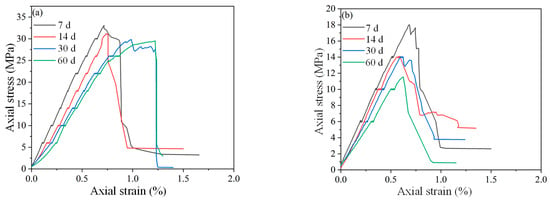
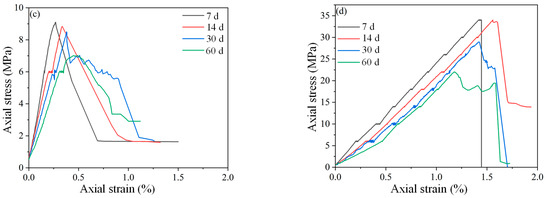
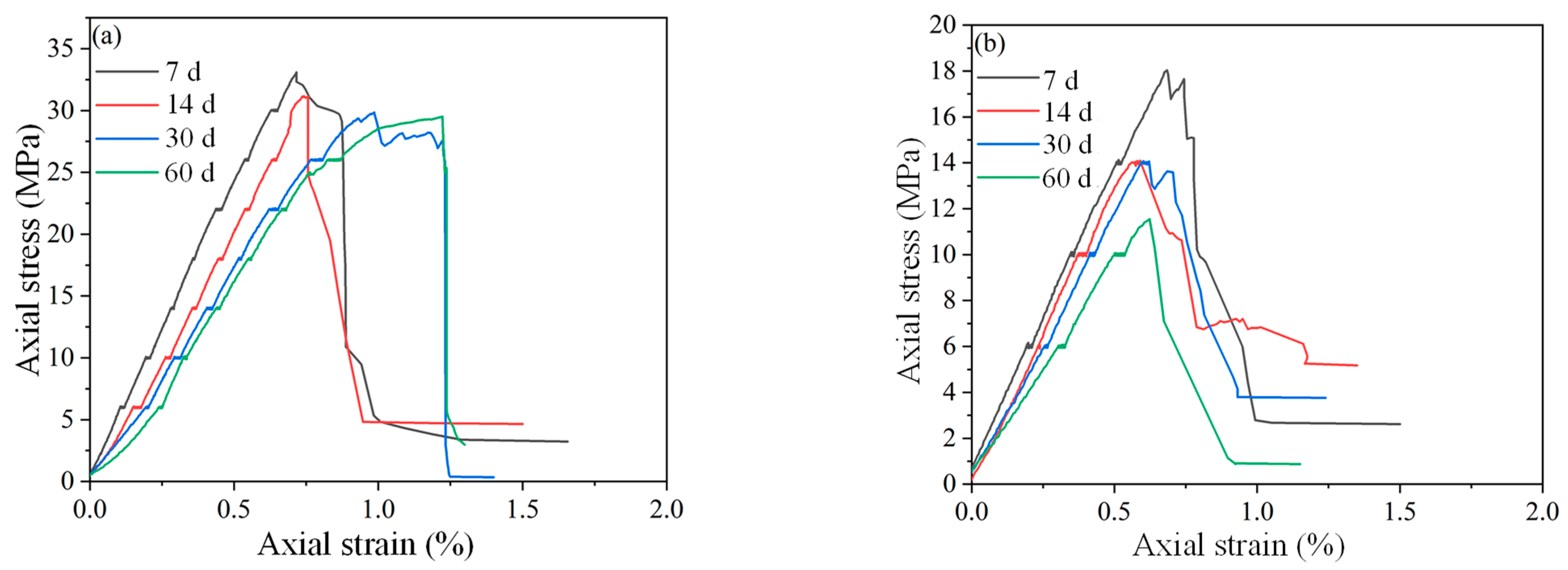
In the experiment, uniaxial creep loading was applied to the coal samples until failure occurred. Figure 4 presents the axial stress–strain characteristic curves for coal samples with different bedding angles under various water saturation times. The results indicate that, for coal samples with the same bedding angle, differences in water saturation time significantly affected the number of creep stages and the strength throughout the entire test process. After the completion of the experiment, the data for each group of coal samples (including peak stress, peak strain, and number of creep stages) were subjected to statistical analysis, as shown in Table 1.
Figure 4.
Typical axial stress–strain curves for the tested coal samples subjected to different saturation durations. (a–d) Coal samples with bedding angles of 0, 30, 60, and 90, respectively.
Table 1.
Specific failure parameters of anisotropic coal samples under different saturation times.
From Figure 4 and Table 1, it can be observed that coal samples with a bedding angle of 90° and water saturation times of 7 and 30 days, as well as coal samples with a bedding angle of 30° and water saturation times of 14 and 30 days, failed during the creep process. In contrast, the other samples failed during the loading phase. This indicates that the inherent heterogeneity of the coal samples and the presence of complex internal fractures have a significant impact on their strength. Additionally, the experimental data show that each increase in creep stress level leads to changes in the stress–strain response of the coal samples. During the experiment, it was observed that for coal samples with consistent bedding angles, as the water saturation time increased, the loading duration became shorter, the number of creep stages decreased, and the strength of the coal samples continued to decline. Specifically, when the bedding angle was 0°, the strength of the coal sample with 7 days of water saturation was the highest at 33.09 MPa, while the strength of the coal sample with 60 days of water saturation was the lowest, reducing to 29.50 MPa, which represents a 10.85% decrease. For coal samples with a bedding angle of 30°, the strength was the highest at 18.03 MPa for 7 days of saturation and the lowest at 11.55 MPa for 60 days of saturation, representing a 35.94% decrease. For coal samples with a bedding angle of 60°, the strength was the highest at 9.10 MPa for 7 days of saturation and the lowest at 7.02 MPa for 60 days of saturation, representing a 22.86% decrease. For coal samples with a bedding angle of 90°, the strength was the highest at 34.07 MPa for 7 days of saturation and the lowest at 22.04 MPa for 60 days of saturation, representing a 35.31% decrease.
These results demonstrate that the water saturation time significantly affects the creep failure strength of coal samples. The moisture content is a critical factor in determining the strength of coal samples in resisting failure. This effect is primarily due to stress corrosion and other mechanical effects induced by acidic water, which reduce the cohesion of the coal samples. As the moisture content increases, the friction coefficient decreases, leading to a reduction in the internal friction factor. Furthermore, the coal samples contain small amounts of clay-like components, and as acidic water circulates within the coal samples, these clay components gradually dissolve, further reducing the strength of the coal samples in resisting failure.
3.2. Influence of Saturation Time on Coal Deformation Characteristics
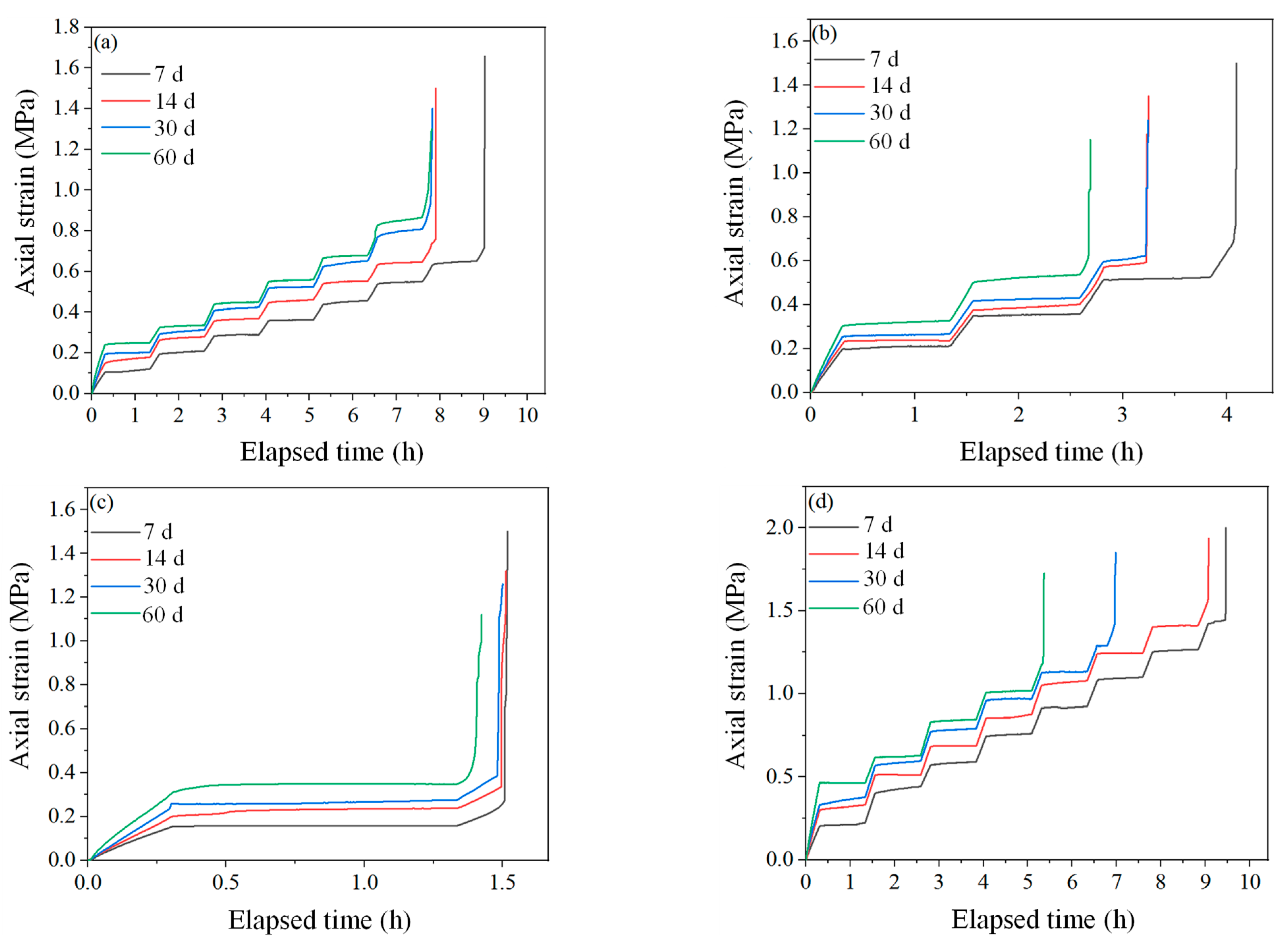
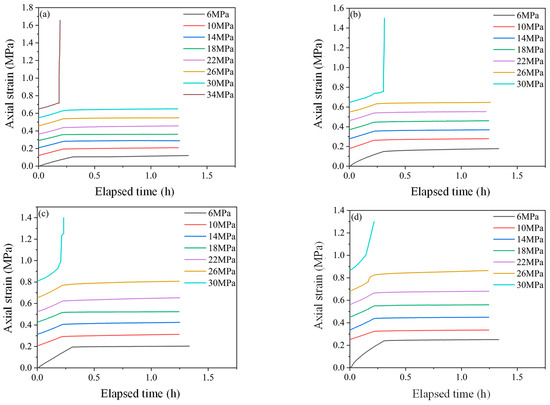
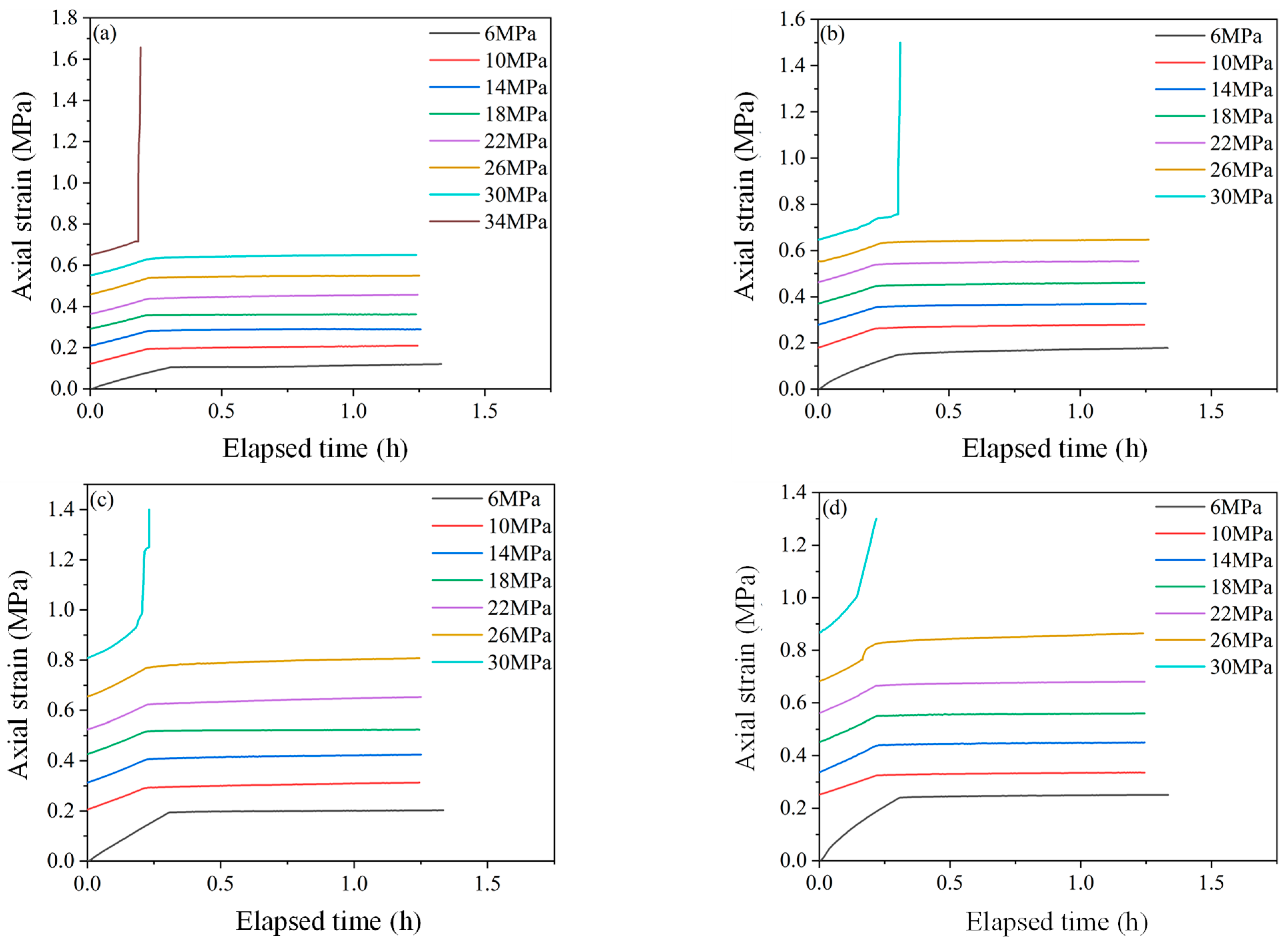
In order to investigate the impact mechanism of different water saturation durations on the deformation evolution of coal samples, a total of 16 coal samples were immersed in the same acidic water environment for 7, 14, 30, and 60 days. Figure 5a–d show the relationships between axial strain and testing time for coal samples with bedding angles of 0°, 30°, 60°, and 90° under varying saturation durations. It can be clearly observed that, at the same stress level, the axial strain of the coal samples increases with the duration of immersion. This phenomenon strongly demonstrates that under water saturation conditions, the coal samples undergo significant softening, and the softening effect becomes more pronounced as the immersion time increases.
Figure 5.
Plots of axial strain against elapsed time. ((a–d): The bedding orientation of coal samples is 0°, 30°, 60°, and 90°, respectively).
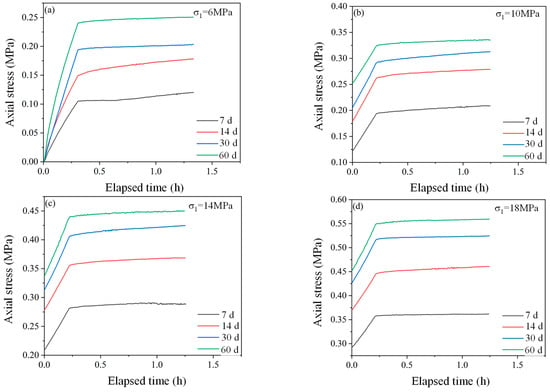
By performing classification analysis on the creep experimental data of coal samples with different bedding angles saturated for 7, 14, 30, and 60 days, the corresponding creep curves were obtained, as shown in Figure 6. Taking a coal sample with a bedding angle of 0° as an example, the following observations were obtained: (1) As the axial stress increased from 0 MPa to 6 MPa, from 6 MPa to 10 MPa, from 10 MPa to 14 MPa, from 14 MPa to 18 MPa, from 18 MPa to 22 MPa, from 22 MPa to 26 MPa, and from 26 MPa to 30 MPa, the axial strain increased by 0.109%, 0.094%, 0.085%, 0.072%, 0.088%, 0.097%, and 0.098%, respectively. At the moment of axial stress application, the strain of the specimen exhibited an immediate response, indicating instantaneous deformation. (2) When the coal sample was subjected to relatively low loads, it displayed characteristics of decaying creep. The specimen showed distinct instantaneous strain, with the curve exhibiting a convex shape, after which it entered the stable creep phase, where the curve became linear. (3) When the coal sample was subjected to higher loads, it entered the steady-state creep phase. As the load continued to increase, the coal sample rapidly transitioned into the accelerating creep phase, showing non-decaying creep characteristics. After loading was completed, the coal sample underwent creep fracture failure in a very short time, and the curve exhibited a concave shape.
Figure 6.
The graded creep curve of a coal sample with a 0° bedding angle. (a–d) The saturation durations are 0, 14, 30, and 60 days, respectively.
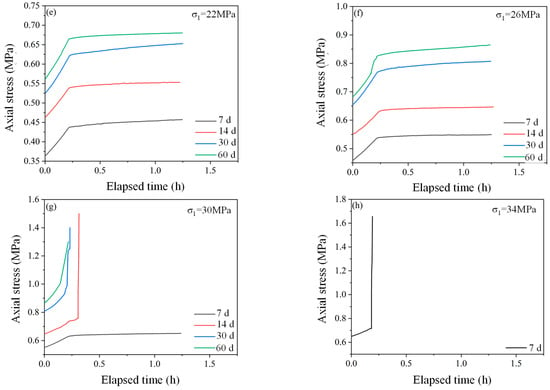
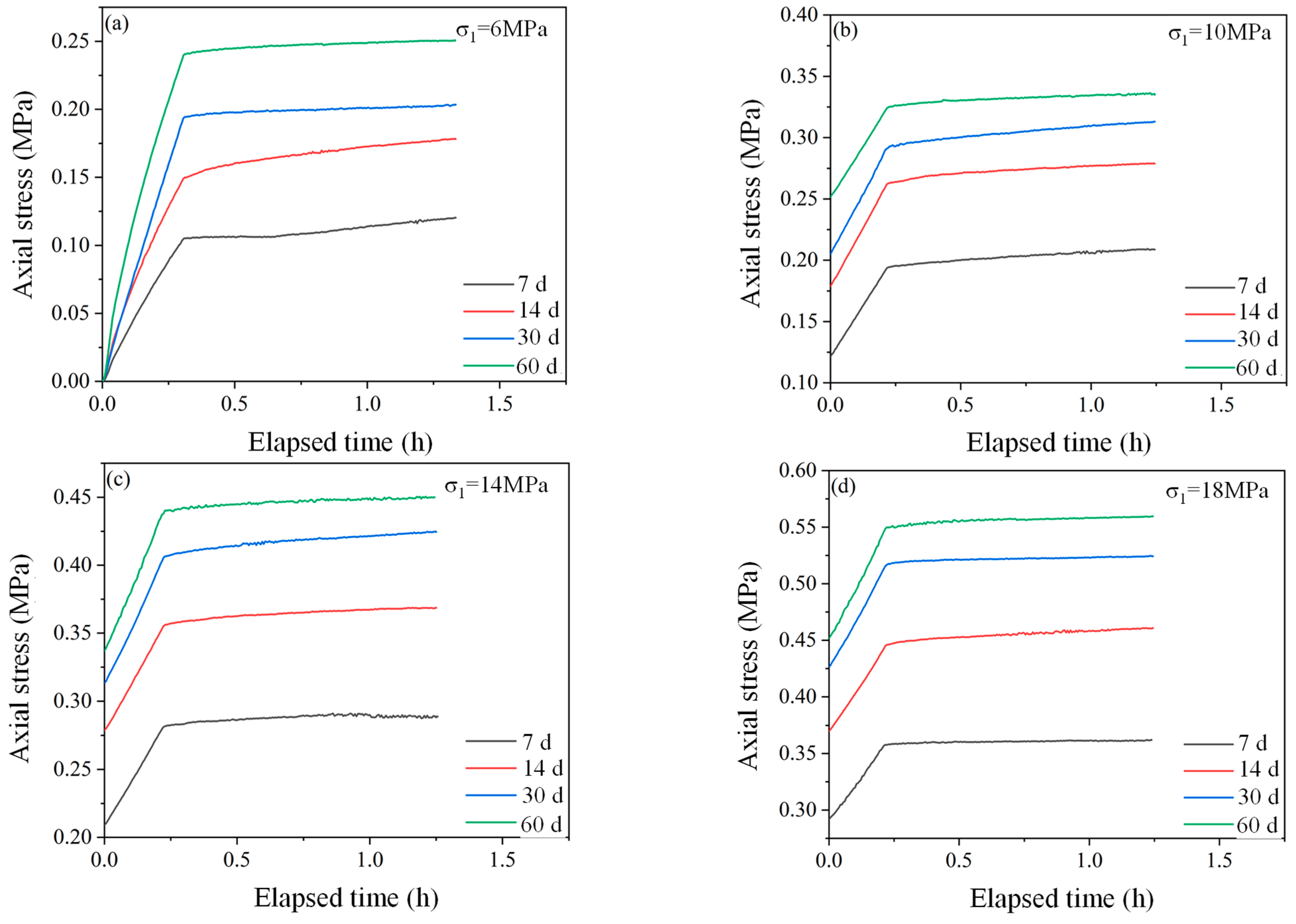
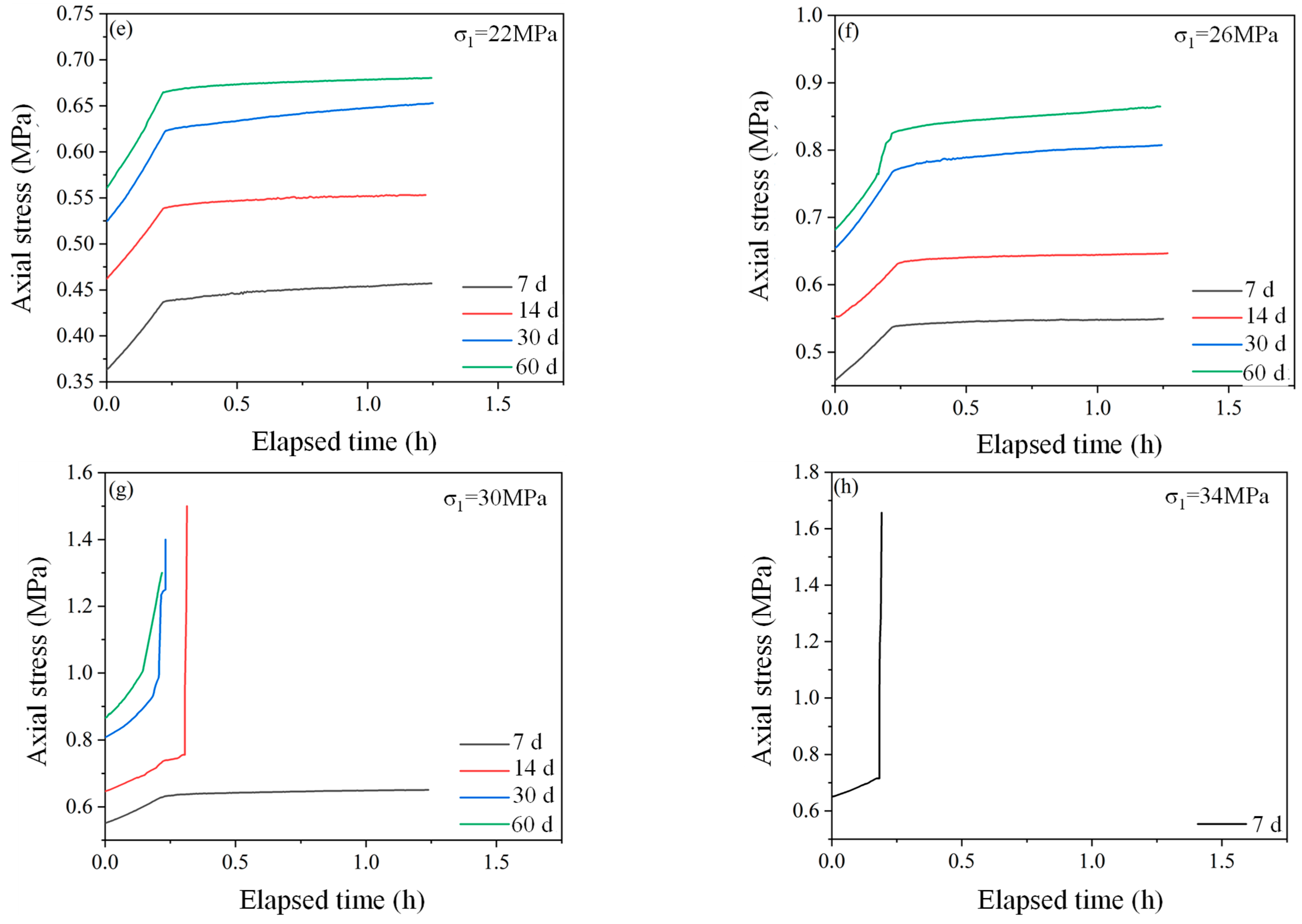
To more clearly compare the effects of different water saturation times on the deformation evolution of coal samples under the same stress level, an analysis was carried out using coal samples with a bedding angle of 0°, classified according to the creep stage, as shown in Figure 7. Through analysis and comparison, the following testing results can be drawn: (1) When the axial stress increases from 0 MPa to 6 MPa, the axial strain of the coal sample saturated for 7 days is 0.109%, while the axial strain for samples saturated for 14, 30, and 60 days increases to 0.169%, 0.199%, and 0.248%, respectively. This indicates that under the same stress level, as the water saturation time increases, the axial strain of the coal sample gradually increases. It can be concluded that the acidic water environment causes an increase in the axial strain of the coal sample, with longer water saturation times resulting in greater axial deformation. (2) As the axial stress continues to increase to 26 MPa, the axial strain of the coal samples at all previous stages exhibits the same trend. That is, as the water saturation time increases, the axial strain of the coal samples increases. (3) When the axial stress reaches 30 MPa, it is observed that the coal samples saturated for 60, 30, and 14 days experience accelerated creep in a very short time. The axial strain increases rapidly, showing a non-decaying creep characteristic, and subsequently enters the fracture damage stage. This indicates that with increasing saturation time and water content, the axial strain of the coal sample increases, demonstrating that the coal sample exhibits water absorption properties. Water infiltrates the coal sample and alters its internal structure, weakening its physical and mechanical properties. (4) Impact on Strength with Increased Saturation Time: When the axial stress increases to 34 MPa, only the coal sample saturated for 7 days remains intact, while all other samples fail. This further illustrates that the increase in water saturation time directly affects the strength of the coal sample. The longer the saturation time, the more pronounced the softening effect on the coal sample, resulting in a decrease in strength.
Figure 7.
The creep curves of each stage for the coal sample with a 0° bedding angle exposed to different stress levels of (a–h) 6, 10, 14, 16, 22, 26, 30, and 34 MPa, respectively.
3.3. The Effect of Bedding Angle on Creep Behavior
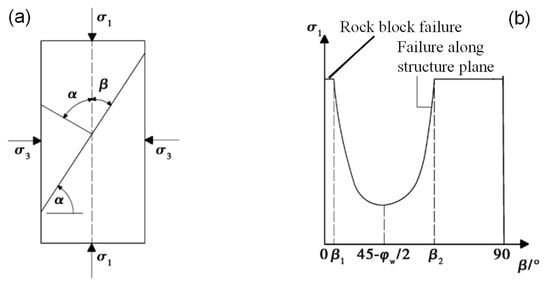
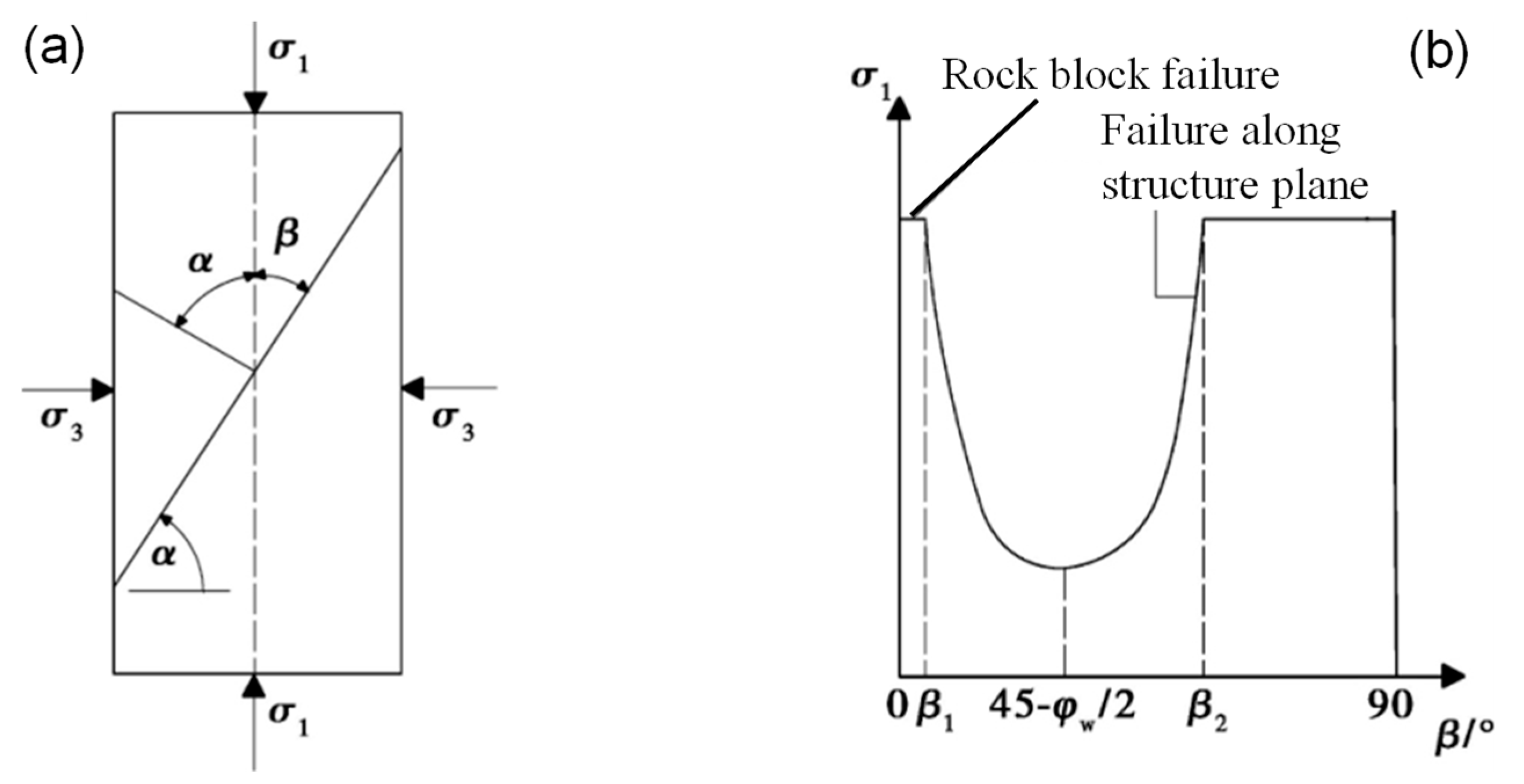
Coal beds, subjected to long-term crustal movement and complex depositional conditions, are often influenced by underground mining activities and operations. This frequently results in the formation of layered structures with varying angles, which in turn exhibit physical and mechanical anisotropy. The root cause of this anisotropy lies in the different stress orientations acting on the coal’s layered structure. The weakest zones of the coal’s layered structure typically accumulate and release energy, making them susceptible to deformation, instability, and failure. In terms of the mechanical properties of coal, the presence of bedding planes significantly impacts the coal’s failure strength. As the bedding angle changes, most bedded coal samples exhibit a “U”-shaped strength variation, as shown in Figure 8.
Figure 8.
Illustration of the ‘U’-shaped pattern of strength variation. ((a). Illustration of the principal stress and rock structure plane; (b). The rock strength against the structure plane orientation).
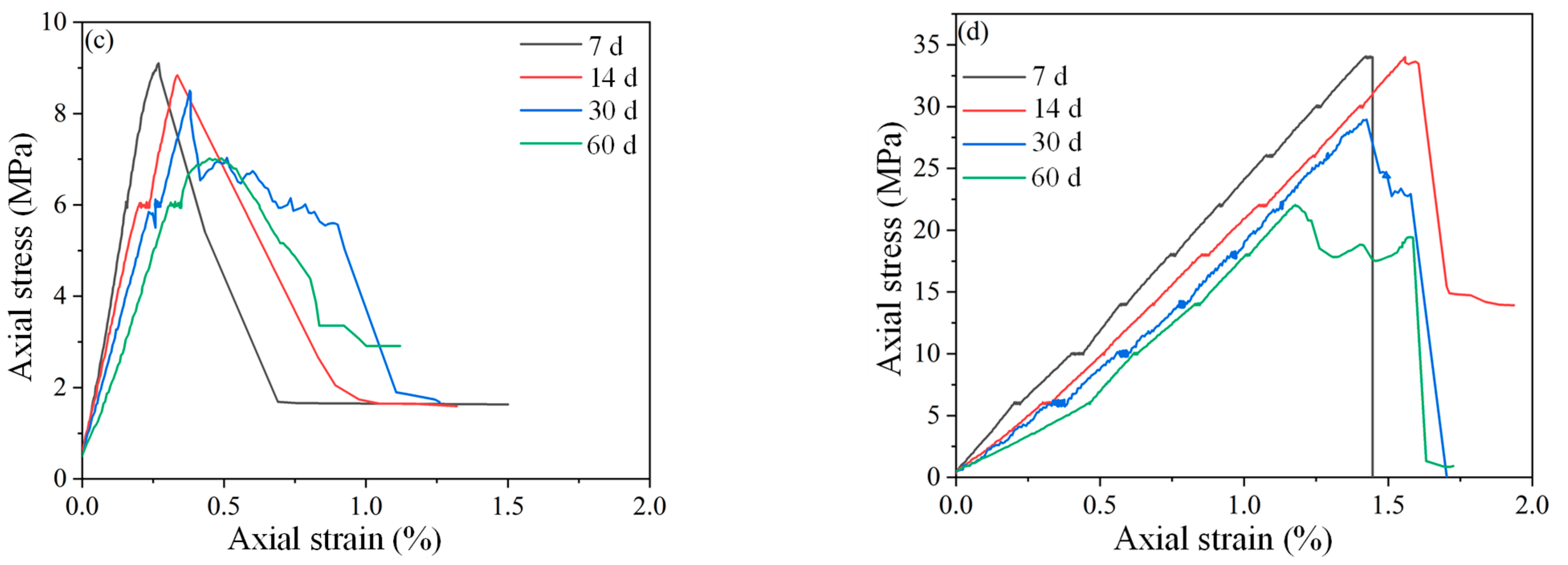
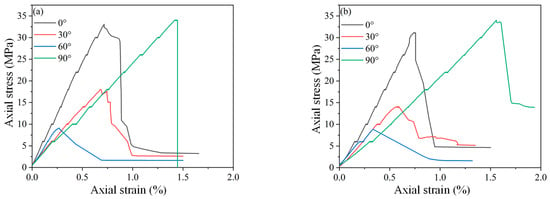
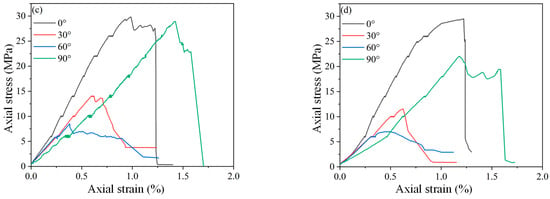
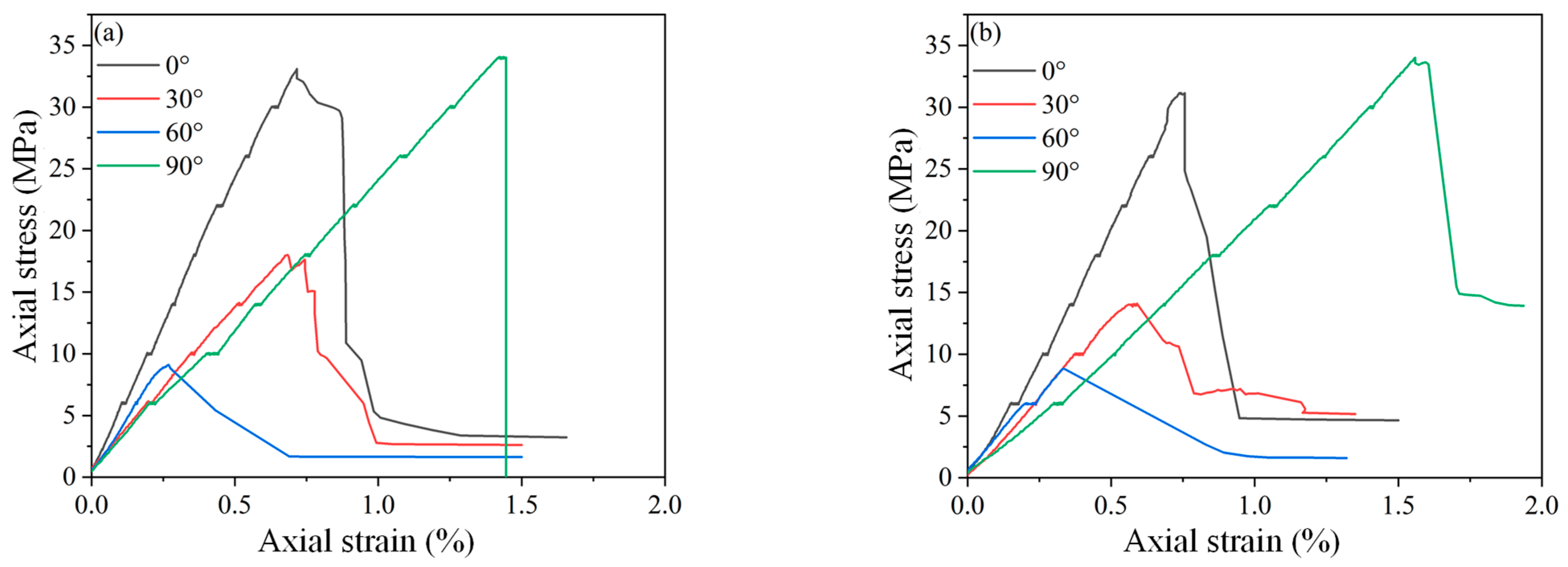
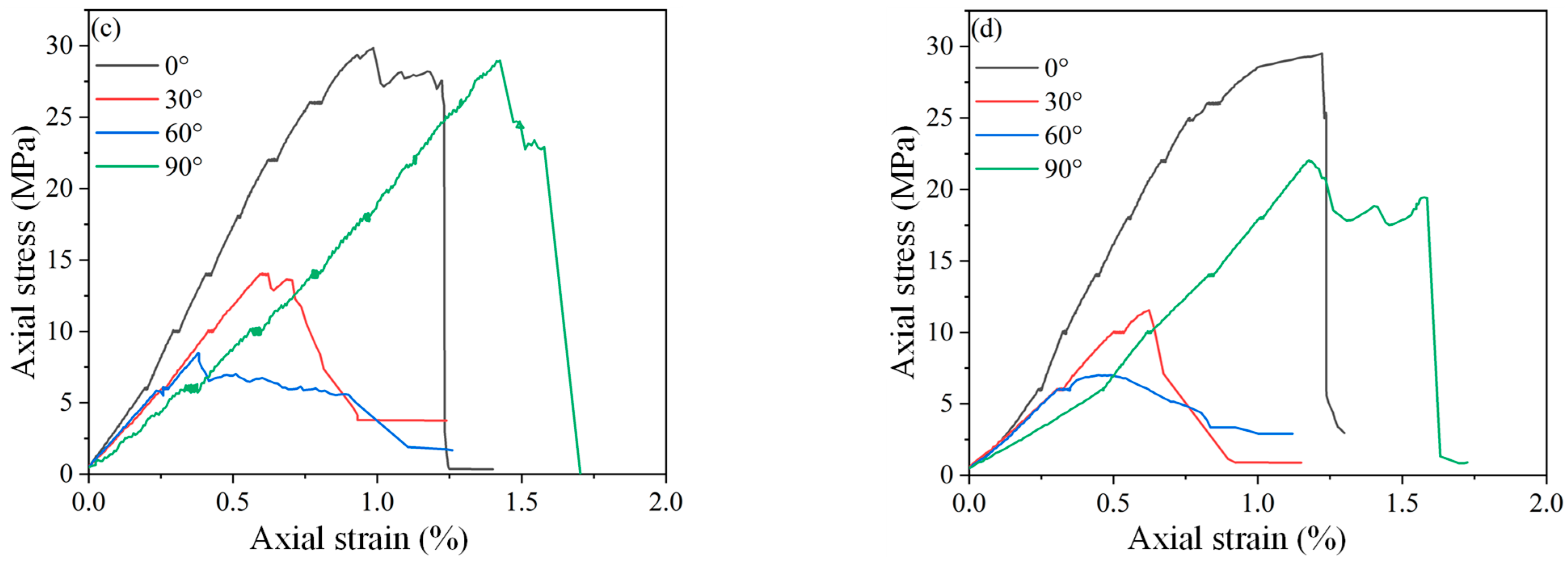
In order to investigate the effect of bedding angle variation on the creep behavior of coal samples, four sets of coal samples with different bedding angles, specifically 0°, 30°, 60°, and 90°, were designed. Considering the influence of acidic environments, uniaxial compression creep tests were conducted for each sample, resulting in the stress–strain characteristic curves shown in Figure 9. As shown in Figure 9, when the water saturation time is constant, after the uniaxial compression creep tests, the strength of all four sets of coal samples decreases initially and then increases as the bedding angle increases, following the “U”-shaped strength variation pattern. When the water saturation time is 7 days, the peak strengths for bedding angles of 0°, 30°, 60°, and 90° are 33.09 MPa, 18.03 MPa, 9.10 MPa, and 34.07 MPa, respectively. It can be observed that the strength of the coal sample with a bedding angle of 60° is reduced by 72.50%, 49.53%, and 73.25% compared to those with bedding angles of 0°, 30°, and 90°, respectively. When the water saturation time is 14 days, the peak strengths for bedding angles of 0°, 30°, 60°, and 90° are 31.16 MPa, 14.09 MPa, 8.84 MPa, and 34.01 MPa, respectively. The strength of the coal sample with a bedding angle of 60° decreases by 71.63%, 37.26%, and 74.01% compared to those with bedding angles of 0°, 30°, and 90°, respectively. When the water saturation time is 30 days, the peak strengths for bedding angles of 0°, 30°, 60°, and 90° are 29.84 MPa, 14.07 MPa, 8.50 MPa, and 28.96 MPa, respectively. The strength of the coal sample with a bedding angle of 60° is reduced by 71.51%, 39.59%, and 70.65% compared to those with bedding angles of 0°, 30°, and 90°, respectively. When the water saturation time is 60 days, the peak strengths for bedding angles of 0°, 30°, 60°, and 90° are 29.50 MPa, 11.55 MPa, 7.02 MPa, and 22.04 MPa, respectively. The strength of the coal sample with a bedding angle of 60° is reduced by 76.20%, 39.22%, and 68.15% compared to those with bedding angles of 0°, 30°, and 90°, respectively.
Figure 9.
Axial stress–strain curves of coal samples with different bedding angles (a–d). The saturation durations are 0, 14, 30, and 60 days, respectively.
These results clearly show that the strength difference between coal samples with bedding angles of 0° and 90° is minimal. However, the coal sample with a bedding angle of 60° exhibits the lowest strength and is most prone to pure shear failure. Therefore, during the mining process in strip mining operations, it is important to consider the impact of the bedding angle of the pillar on the overall strength of the pillar. Coal samples with bedding angles close to 0° or 90° should be preferentially retained as supporting pillars.
4. AE Characteristics of Saturated Coal Samples
4.1. Acoustic Emission Ringing Count Characteristics
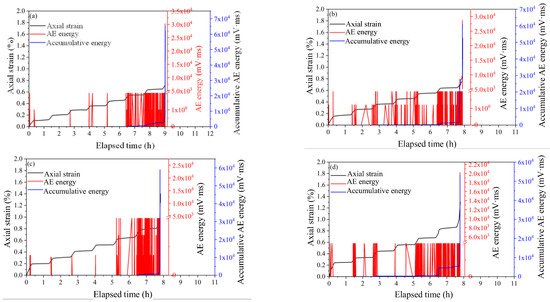
The variations in the stress–strain curves above reflect the macroscopic fracture evolution characteristics of the coal samples. The acoustic emission (AE) parameters recorded during the deformation process provide valuable information about the microscopic fracture process. AE ring count refers to the number of times the detected acoustic emission signal amplitude crosses a predefined threshold voltage level. Each threshold crossing (or “ring”) typically corresponds to a discrete emission event or a significant oscillation within a burst-type signal. It is a measure of the activity or frequency of acoustic events. Higher ring counts generally indicate more numerous or more sustained microfracturing processes. Creep acoustic emission tests were conducted on 16 coal samples across four groups under uniaxial compression conditions. The AE ringing counts, energy, frequency, and amplitude collected from the specimens were analyzed. Since the data distribution for each group is similar, samples with a bedding angle of 0° and different saturation times, as well as samples with 30 days of saturation and different bedding angles, were selected for comparative analysis.
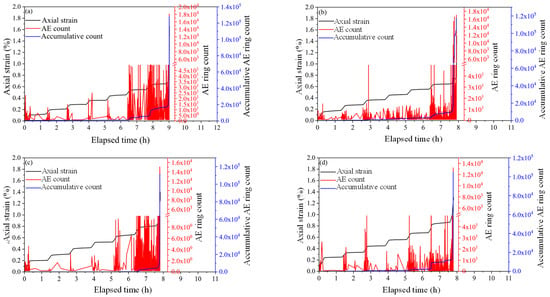
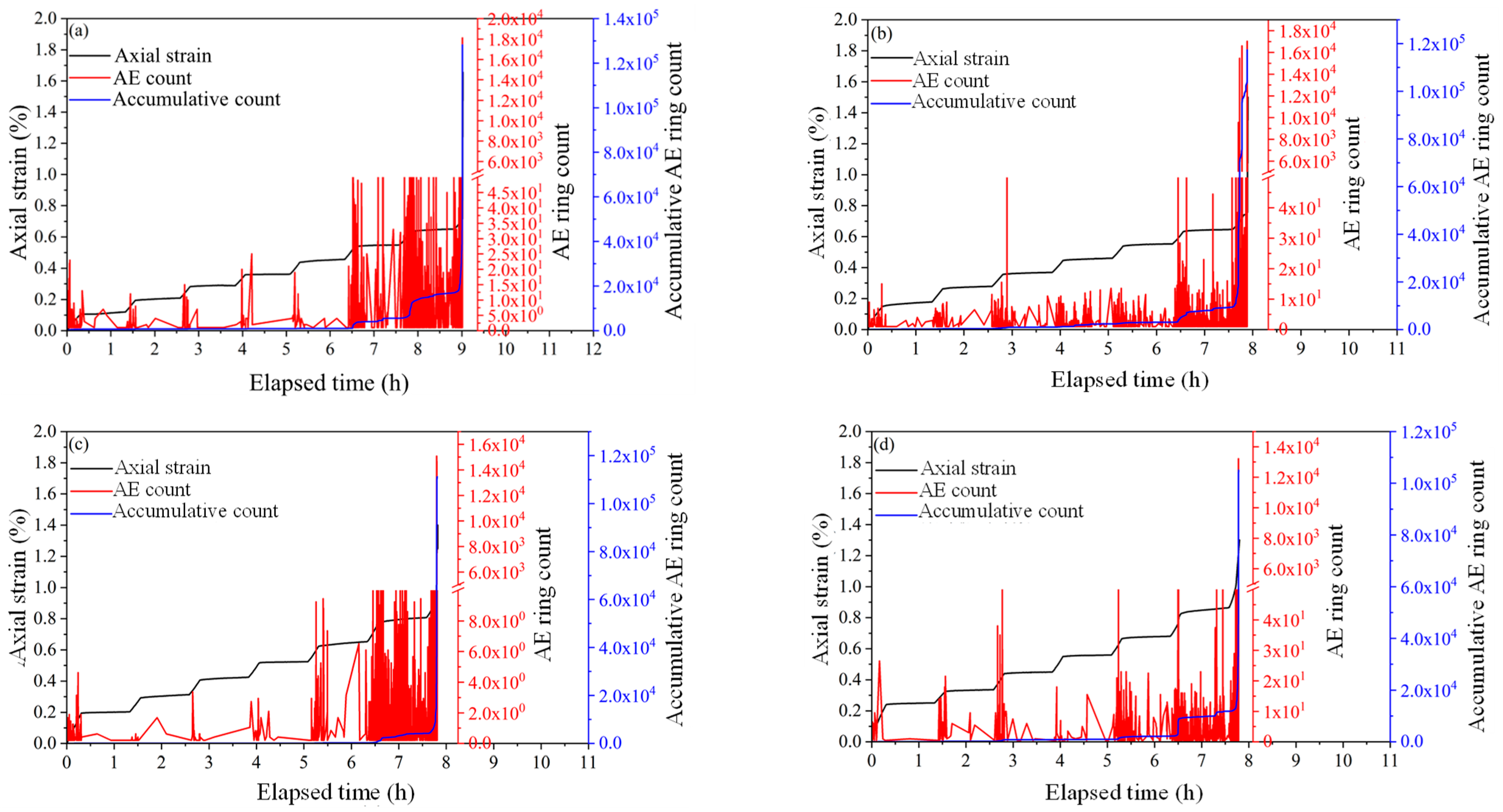
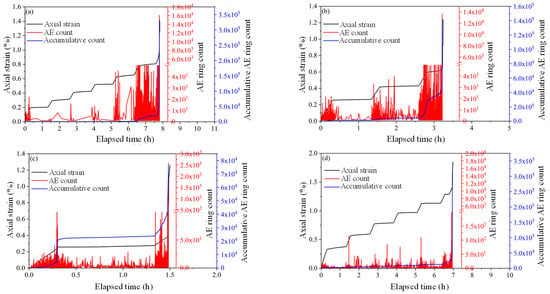
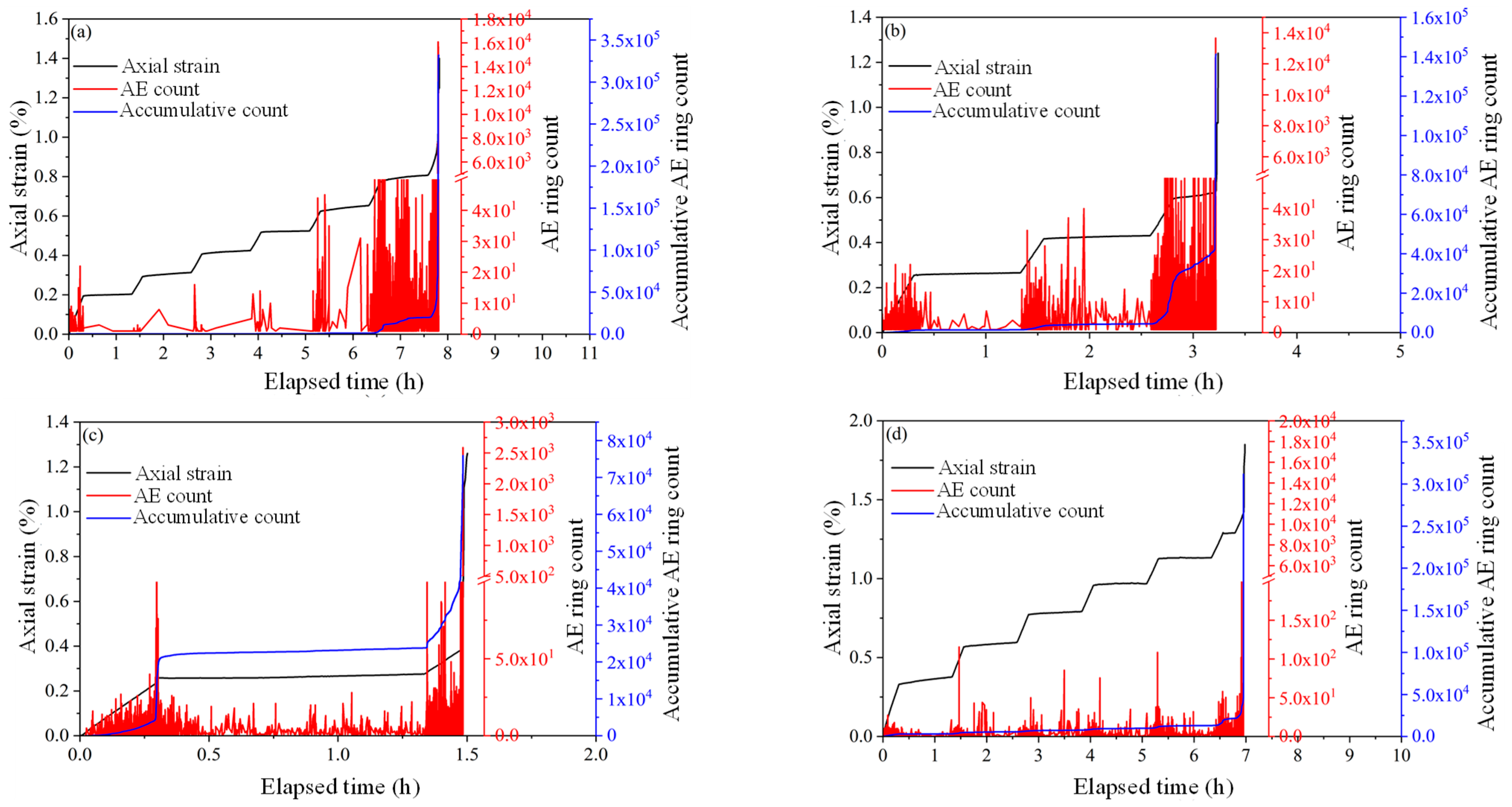
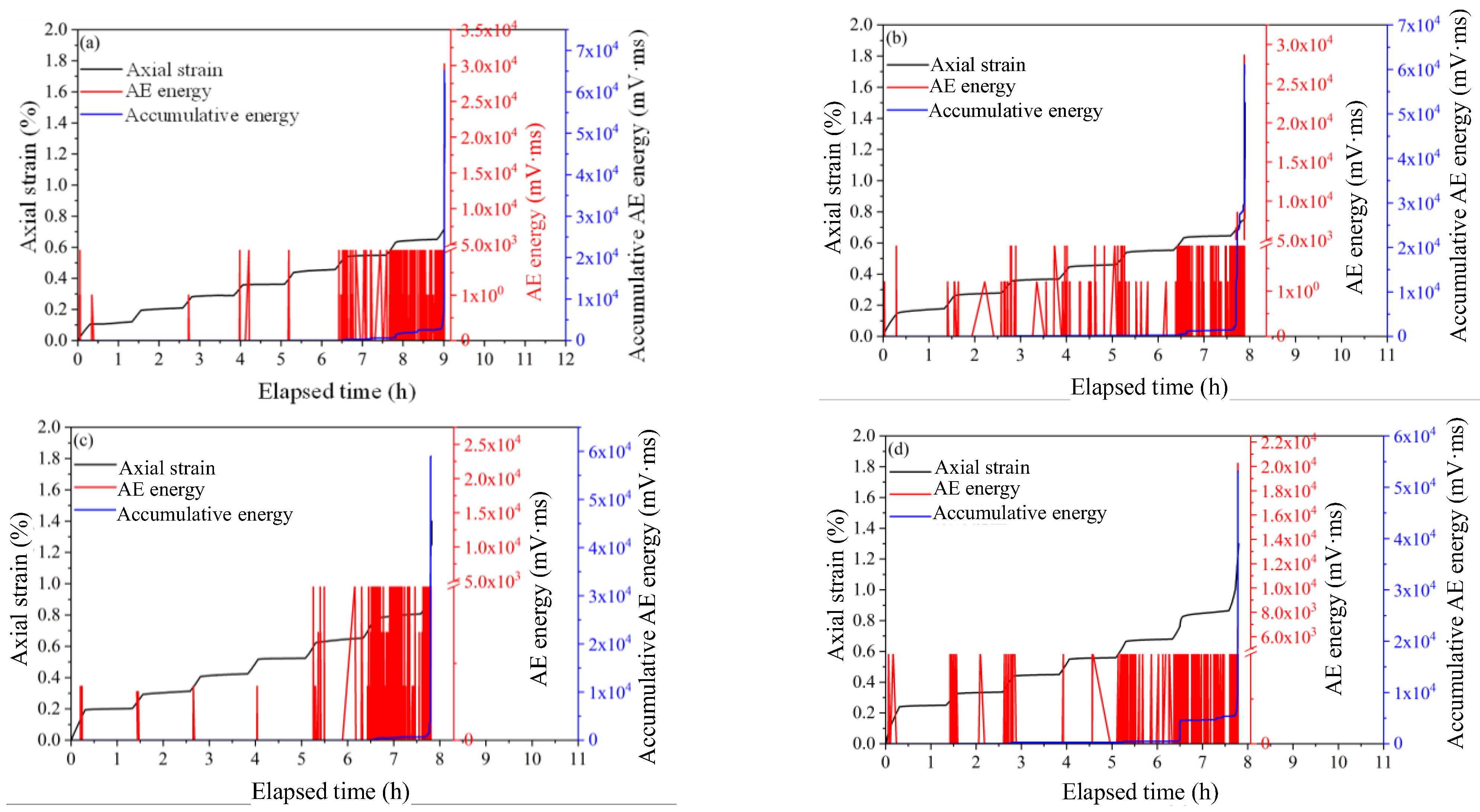
The ringing count test data obtained from the AE system was used to plot the curves of axial strain, ringing count, cumulative ringing count, and test time, as shown in Figure 10 and Figure 11. It can be observed that at lower stress levels, as stress increases, pre-existing cracks within the specimen begin to close, extend, and form new cracks. At each stage of axial stress increase, there is a significant response in the AE ringing count, which reaches higher values. When stress reaches the set level and remains constant, the AE ringing count gradually decreases and stabilizes at a lower level. As the load continues to increase, the AE ringing count increases correspondingly, although overall, the AE ringing count remains relatively low. This indicates that at lower stress levels, although the pre-existing cracks in the internal structure of the specimen close and extend, and new cracks begin to form, the impact on the overall stability of the coal sample is minimal. As stress continues to increase, axial strain also increases, leading to a continuous rise in the AE ringing count. When the axial stress level remains constant, the axial strain does not change significantly. Therefore, the AE ringing count signal gradually weakens and reaches a relatively low stable level. After the axial stress reaches the peak stress, before the coal sample reaches the final creep fracture failure stage, the AE ringing count shows a slight decrease. Then, in a short period of time, the AE ringing count rapidly increases, and the data becomes denser. When the coal sample fractures, the AE ringing count reaches its maximum, causing the cumulative ringing count curve to present a sharp increase. Finally, when the specimen fails and the load is stopped, the AE signals disappear.
Figure 10.
Relationship between the AE ring count/cumulative ringing count and axial strain for a coal sample with bedding angle of 0°. (a–d) The saturation durations are 0, 14, 30, and 60 days, respectively.
Figure 11.
Relationship between the AE ring count/cumulative ring count and axial strain for a sample exposed to saturation for 30 days. (a–d) The bedding angles are 0°, 30°, 60°, and 90° days, respectively.
To explore the effect of water saturation time on the mechanical properties and fracture failure of coal samples, it can be observed from Figure 10a–d that as the saturation time increases for coal samples with a bedding angle of 0° (7, 14, 30, and 60 days), the maximum AE ringing counts are 1.81 × 10⁴, 1.71 × 10⁴, 1.51 × 10⁴, and 1.32 × 10⁴, respectively. Meanwhile, the cumulative AE ringing count curve shows a sudden increase just before the sample fails. The cumulative ringing count values at the end of the test are 1.28 × 10⁵, 1.17 × 10⁵, 1.11 × 10⁵, and 1.05 × 10⁵, respectively. This indicates that the immersion of the coal sample in an acidic solution weakens its physical and mechanical properties due to the chemical reactions during the loading process. The longer the coal sample is immersed in the acidic solution, the more evident the weakening effect, which is reflected in the gradual decrease in the AE ringing count.
Additionally, to investigate the impact of different bedding angles on the mechanical properties and fracture failure of coal samples, it can be observed from Figure 11a–d that when the saturation time is 30 days, the maximum AE ringing counts for coal samples with bedding angles of 0°, 30°, 60°, and 90° are 1.61 × 10⁴, 1.37 × 10⁴, 0.26 × 10⁴, and 1.43 × 10⁴, respectively. Similarly, the cumulative AE ringing count also shows a sudden increase just before the coal sample fails, with the cumulative ringing count values at the end of the test being 3.32 × 10⁵, 1.41 × 10⁵, 7.60 × 10⁴, and 3.12 × 10⁵, respectively.
Thus, when the saturation time is consistent, as the bedding angle of the coal sample increases, the AE ringing count initially decreases and then increases, following a “U”-shaped trend. This phenomenon corresponds to the previously discussed anisotropic effects on coal sample strength. Notably, the AE ringing count for coal samples with bedding angles of 0° and 90° shows little difference, while the coal sample with a bedding angle of 60° exhibits the lowest AE ringing count, indicating that the presence of bedding significantly affects the stability of the coal sample, with the 60° bedding angle having the most detrimental effect.
4.2. Acoustic Emission Energy Characteristics
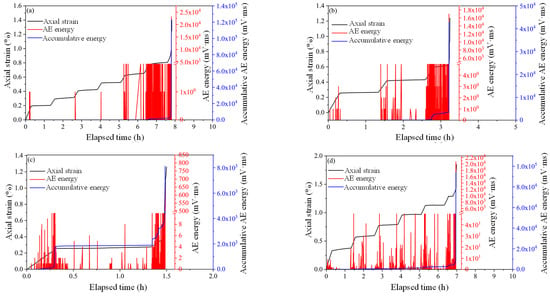
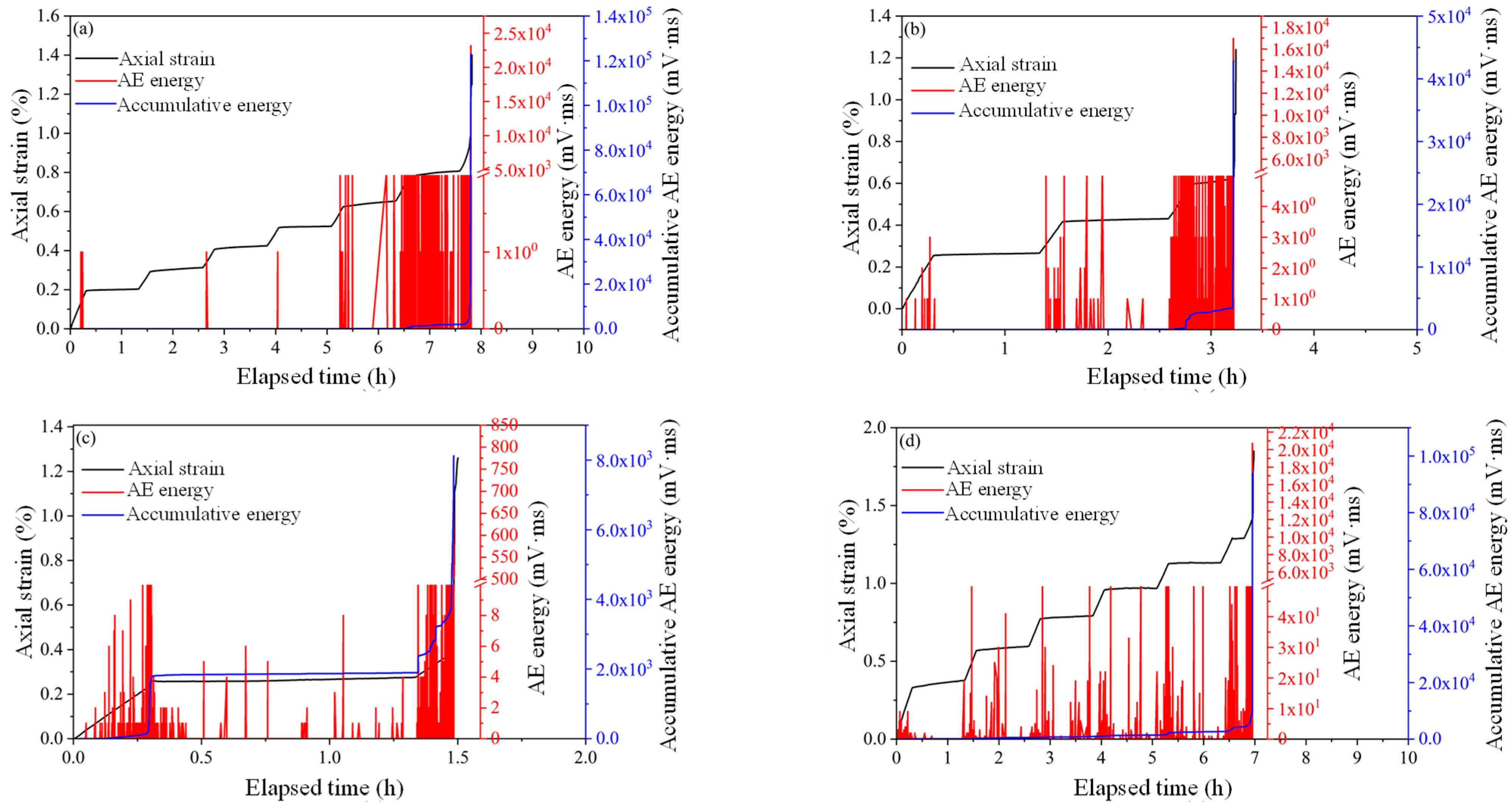
Using the acoustic emission system, energy test data were also obtained, and the relationship curves of axial strain, acoustic emission energy, and total acoustic emission energy with test time were plotted, as shown in Figure 12 and Figure 13. AE energy is a measure of the absolute energy released from a microcrack or deformation event. It is often derived from the integral of the squared voltage signal over the duration of the AE hit or through calibrated measurements. It represents the intensity or magnitude of the individual emission source. Higher energy values typically correspond to larger or more rapid crack extensions and more significant damage. It can be observed that the trend of acoustic emission energy variation is similar to that of the ringing count. At lower stress levels, during each stage of axial stress increase, the acoustic emission energy curve shows a sudden increase in value. During the creep stage, the acoustic emission energy slightly decreases and gradually stabilizes. As axial stress continues to increase, the acoustic emission energy also increases accordingly, with the points of abrupt changes in energy occurring during the stress increase phase. At higher axial stress levels, as the axial stress continues to rise, the acoustic emission energy values are higher than those at lower stress levels in the corresponding stages. The maximum energy values are all distributed during the fracture failure stage of the coal sample. This is also evident in the cumulative energy curve, which shows a sharp increase at the moment of failure.
Figure 12.
Relationship between AE energy/cumulative energy and axial strain with time for coal samples with a 0° bedding angle. (a–d) The acidic saturation durations are 0, 7, 30, and 60 days, respectively.
Figure 13.
Relationship between AE energy/cumulative energy and axial strain with time for coal samples subjected to saturation for 30 days. (a–d) The bedding angles are 0°, 30°, 60°, and 90°, respectively.
To more comprehensively explore the impact of water saturation time on the mechanical properties and fracture failure of coal samples, an analysis from the perspective of acoustic emission energy was conducted. As shown in Figure 12a–d, when the bedding angle is 0° and the saturation times are 7, 14, 30, and 60 days, the maximum acoustic emission energy values for the coal samples are 3.02 × 10⁴, 2.86 × 10⁴, 2.32 × 10⁴, and 2.02 × 10⁴, respectively. This trend is similar to that of the acoustic emission ringing count, with the values gradually decreasing. Meanwhile, the cumulative acoustic emission energy curve shows a sudden increase just before the coal sample fails. At the end of the uniaxial compression creep test, the cumulative acoustic emission energy values are 6.51 × 10⁴, 6.11 × 10⁴, 5.89 × 10⁴, and 5.31 × 10⁴, respectively. At the same stress level, during the stress increase process, coal samples with shorter water saturation times exhibit higher energy values than those with longer saturation times. This indicates that when coal samples are exposed to acidic environments for extended periods, their strength gradually decreases, leading to a progressive reduction in acoustic emission energy.
Additionally, the acoustic emission energy provides a better understanding of the mechanisms of the effect of bedding angle on the mechanical properties and fracture failure of coal samples. As shown in Figure 13a–d, when the saturation time is 30 days, the maximum energy values for coal samples with bedding angles of 0°, 30°, 60°, and 90° are 2.32 × 10⁴, 1.69 × 10⁴, 7.53 × 10², and 2.07 × 10⁴, respectively. The cumulative acoustic emission energy curve shows a sharp increase at the moment of fracture failure for all samples, with cumulative energy values at the end of the test being 1.23 × 10⁵, 4.28 × 10⁴, 8.12 × 10³, and 9.42 × 10⁴, respectively. Thus, when the saturation time is consistent, as the bedding angle of the coal sample increases, the trend in acoustic emission energy changes from decreasing to increasing, similar to the trend observed in the ringing count. Notably, the energy values for coal samples with bedding angles of 0° and 90° are quite similar, while the sample with a bedding angle of 60° exhibits the lowest energy. This conclusion further verifies the correctness of the analysis results from the acoustic emission ringing count and strength data.
4.3. Acoustic Emission Frequency Spectrum Characteristics
Acoustic emission signals consist of various frequency components, and the frequency and amplitude of the signal waveform vary depending on the source of the acoustic emission. The waveform characteristics of the acoustic emission signal can reflect the type, scale, and extent of the cracks; thus, frequency spectrum information can reveal the fracture evolution process of the sample. Some studies have shown that the dominant frequency characteristics of acoustic emission can more accurately reflect the micro-fractures of the sample and are more sensitive than the acoustic emission ringing count. The frequency spectrum characteristics of acoustic emission events can serve as a means to characterize the impact of anisotropy on coal sample failure. By applying Fast Fourier Transform (FFT), the extracted discrete time-domain signals are converted into continuous frequency-domain signals. Similarly, due to the large amount of experimental data, two representative datasets were selected to correspond to the saturation time and the effects of anisotropy on the coal sample’s mechanical properties. The low-, medium-, and high-frequency bands were divided based on the different influencing factors, as shown in Table 2. In addition, the extracted amplitudes were normalized and divided into two parts, greater than 0.5 and less than 0.5, with 0.5 as the boundary. Therefore, in the subsequent analysis of the acoustic emission dominant frequency band characteristics, the impact of the main amplitude of acoustic emission should be fully considered.
Table 2.
Division of acoustic emission dominant frequency bands under the influence of different saturation times and bedding angles.
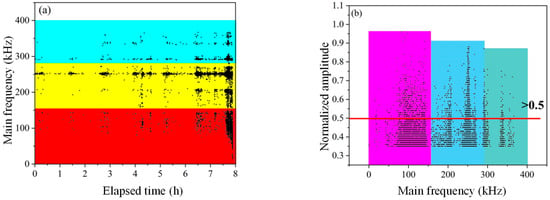
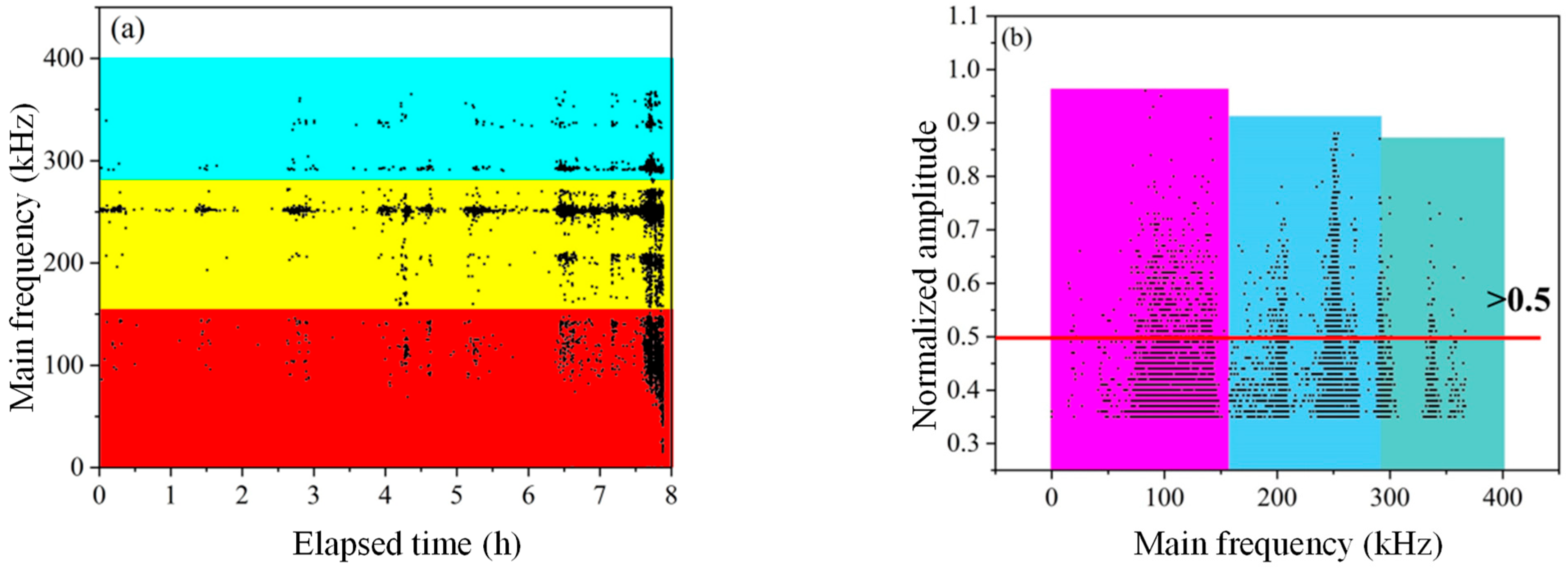
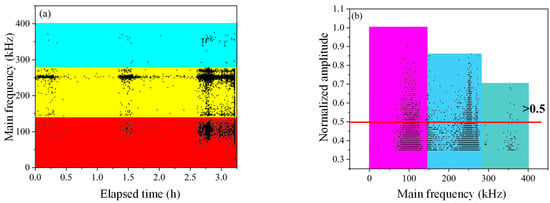
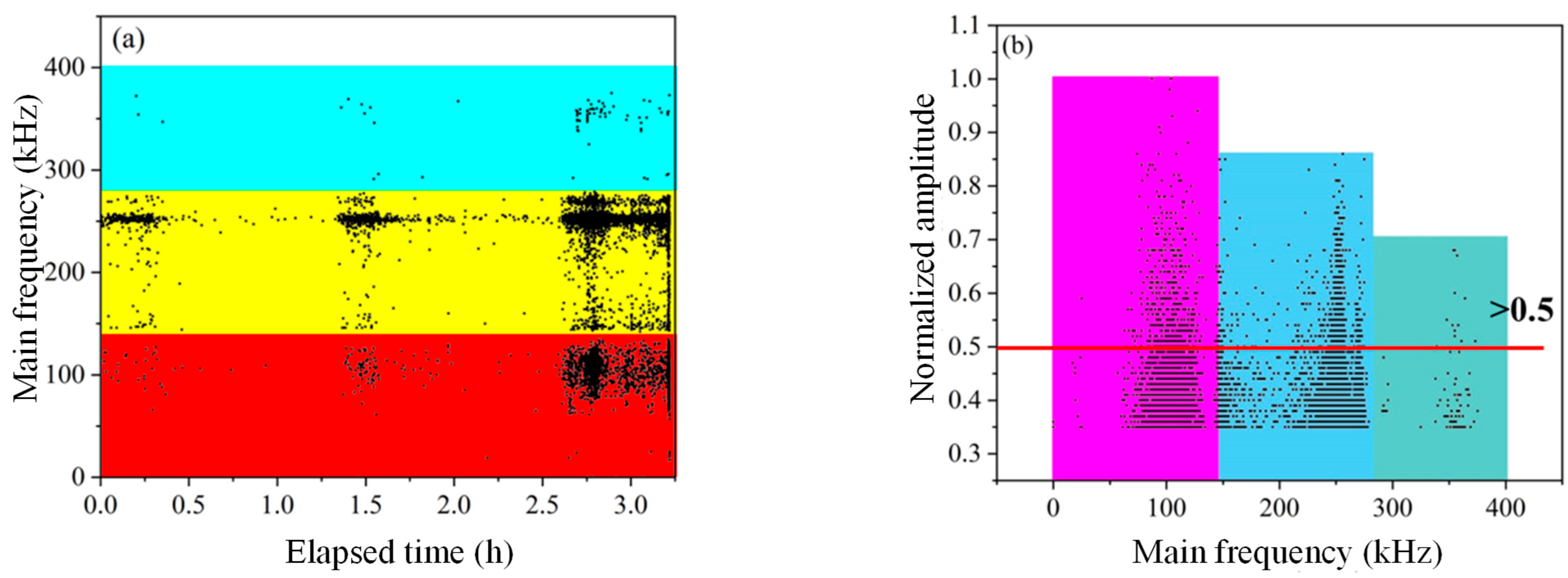
The coal samples selected for frequency spectrum analysis are the same as those used in the previous acoustic emission ringing count/energy analysis. Based on saturation time and anisotropy, the effects on coal sample stability and fracture failure were analyzed, and the distribution patterns of acoustic emission frequency and amplitude were plotted, as shown in Figure 14 and Figure 15.
Figure 14.
Acoustic emission main frequency–amplitude distribution of saturated coal sample with bedding angle of 0° after 14 days of saturation. ((a). Plot of main frequency against elapsed time; (b). Plot of the normalized amplitude against main frequency).
Figure 15.
Acoustic emission main frequency–amplitude distribution of saturated coal sample with bedding angle of 30° after 30 days of saturation. ((a). Plot of main frequency against elapsed time; (b). Plot of the normalized amplitude against main frequency).
A comprehensive comparative analysis of the two influencing factors, saturation time and bedding angle, was conducted. It was revealed that, similar to the results from the acoustic emission ringing count and energy analysis, during the uniaxial compression creep test, at lower stress levels, the distribution of mid- and low-frequency signals becomes denser with the increase in axial stress, while high-frequency signals are relatively rare. This indicates the formation of a large number of cracks within the coal sample. When the stress is kept constant, mid- and low-frequency signals weaken or even disappear, with fewer high-frequency signals, suggesting that the cracks are stabilizing and expanding. At higher stress levels, all frequency bands (low, medium, and high) increase, and in the final stages of the test, the frequency signals increase sharply, reaching the highest density, indicating severe fracture and failure of the coal sample.
5. Discussions
The experimental results presented in this study elucidate the complex interplay between chemical corrosion from an acidic environment, the anisotropic nature of bedded coal, and its time-dependent mechanical behavior (creep) and associated micro-fracturing processes (acoustic emission). The discussions aim to interpret these findings in depth, linking the macroscopic mechanical responses to the microscopic damage mechanisms and comparing them with established principles in rock mechanics.
The observed gradual decrease in coal sample strength and the corresponding increase in axial deformation at the same stress level with prolonged saturation duration are direct consequences of the chemical–physical interaction between the acidic solution and the coal matrix. This phenomenon can be attributed to a two-fold mechanism. Primarily, the acidic solution (pH = 6) induces chemical corrosion of the mineral components and organic macromolecular structures within the coal. Calcite and other carbonate cements that bind the coal particles are particularly susceptible to dissolution in acidic conditions, as described by the following reaction: CaCO3 + 2H+ → Ca2+ + H2O + CO2↑ [24]. This dissolution process weakens the cementation between coal particles, increasing porosity and creating new micro-pores and fractures [25]. Consequently, the effective load-bearing area of the coal sample is reduced, leading to a lower overall strength. Furthermore, the acidic environment can hydrolyze and break the long-chain organic molecules in coal, further degrading its structural integrity [26]. Secondly, water saturation itself plays a crucial role. The invasion of water molecules into the coal matrix can soften the coal mass, reducing its internal friction angle and cohesion. This water-softening effect is a well-documented mechanism for strength reduction in sedimentary rocks [27]. The combination of chemical corrosion and physical softening leads to the accelerated degradation of mechanical properties over time, explaining why samples with longer saturation times exhibit larger deformations under the same load and fail at lower stress levels. This synergistic effect is critical for assessing the long-term stability of coal pillars in acidic mine water environments.
The “U-shaped” variation in strength with bedding angle is a classic manifestation of material anisotropy and aligns with the findings of previous studies on layered rocks [28,29]. This behavior is fundamentally governed by the orientation of the weak bedding planes relative to the applied axial load. When the bedding angle is 0°, the planes are parallel to the loading direction. Failure primarily occurs through the splitting of the coal matrix itself, as the weak planes are not favorably oriented for shear slippage. This requires breaking the stronger coal material, resulting in relatively higher strength [30]. As the bedding angle increases to 30° and 60°, the planes become inclined, creating a preferential path for shear failure. At these angles, the resolved shear stress along the bedding planes is maximized while the normal stress clamping the planes is reduced, facilitating slippage and shear failure along these inherent weaknesses [31]. This leads to a minimum strength, typically observed around 30–60° in many anisotropic rocks. In our case, the deformation data (axial deformation first increasing and then decreasing with bedding angle) corroborates this, indicating that the most compliant and weakest configuration occurs at an intermediate angle. Finally, at a 90° bedding angle, the planes are perpendicular to the load. Failure transitions back to a more complex mechanism involving transverse cracking and crushing across the bedding planes, which again requires more energy, thus increasing the strength [32]. The specific angle at which the minimum strength occurs depends on the friction angle of the bedding planes themselves. The fact that the strength recovers at 90° but may not reach the level of the 0° sample suggests that the bedding planes, even when perpendicular to the load, still represent discontinuities that can initiate cracks, slightly reducing the strength compared to a hypothetical isotropic material.
The acoustic emission (AE) data provides a real-time window into the micro-fracturing processes underlying the macroscopic creep behavior. The highest AE ring count and energy at the final failure stage under the combined influence of saturation time and anisotropy is a clear indicator of a large-scale, violent structural collapse [33]. This final surge in AE activity represents the coalescence of micro-cracks into a macroscopic failure plane. More critically, the spectral characteristics of the AE signals offer profound insights into the fracture mechanisms. The absence of high-frequency, high-amplitude signals in specific scenarios (0° bedding/60-day saturation and 60° bedding/30-day saturation) is a highly significant finding. High-frequency AE signals are typically associated with small-scale, brittle tensile cracking events, which generate rapid, sharp acoustic waves [34,35]. The absence of these signals in the most severely weakened samples (long saturation at 0°) and in the most structurally vulnerable configuration (60° bedding) suggests a shift in the dominant failure mode. We postulate that in these cases, the coal samples have been so significantly weakened that the failure process is dominated by the frictional sliding and propagation of pre-existing larger fractures or the shear failure along bedding planes, rather than the nucleation of new, small-scale tensile cracks. Shear-type failures and large-scale crack propagation tend to generate lower-frequency AE signals due to their larger source dimension and more prolonged energy release [36,37]. Therefore, the observed spectral signature indicates that in severely corroded or favorably oriented samples, the material lacks the integrity to sustain small-scale brittle fracture; instead, damage localizes rapidly along major weaknesses, leading to failure characterized by fewer but larger, structural changes. This correlation between reduced strength and the prevalence of lower-frequency AE signals is a valuable diagnostic tool for assessing the degree of degradation and the dominant fracture mode in coal.
The findings of this study have direct practical implications. The “U-shaped” strength curve underscores the necessity of identifying the critical bedding angles in a coal seam, as ribs and pillars with these orientations will be most prone to time-dependent failure. The strong influence of acidic water highlights that hydro-geochemical conditions must be monitored alongside mechanical deformation. Most importantly, the AE characteristics, particularly the spectral shift, can be leveraged for early warning systems. Monitoring not just the cumulative AE counts but also the dominant frequency components could provide a more robust precursor to failure. A system that detects a decrease in high-frequency activity coupled with an increase in low-energy, low-frequency events could indicate that the rock mass is undergoing progressive structural weakening and entering a critical stage where large-scale slip or collapse is imminent. This allows for intervention before the final, catastrophic surge in AE activity.
This study was conducted under uniaxial conditions, whereas in situ coal is almost always under a complex triaxial stress state. Future work should investigate the creep and AE behavior under different confining pressures, as confinement can significantly suppress dilatant cracking and alter the failure mode [38]. Furthermore, post-test micro-CT or SEM analysis could be employed to visually correlate the observed AE patterns with the actual fracture networks developed under different conditions, providing direct validation of the proposed failure mechanisms.
6. Conclusions
This study primarily investigates the effects of acidic saturation time and bedding angle on the short-term creep behavior of coal samples. The stress–strain curves, deformation curves, and acoustic emission characteristics highlight the influence mechanisms of saturation time and bedding angle on coal damage and failure. The conclusions are summarized below:
(1) As the saturation time increases, the strength of the coal sample gradually decreases. At the same axial stress level, as the saturation time increases, the axial deformation of the coal sample increases, indicating that the acidic water environment has a softening effect on the coal sample. The longer the immersion time, the more pronounced the softening effect.
(2) The strength of the coal sample follows a “U”-shaped variation with respect to the bedding angle. Specifically, when the bedding angles are 0°, 30°, 60°, and 90°, the strength decreases first and then increases. Additionally, at the same axial stress level, as the bedding angle increases, the axial deformation of the coal sample first increases and then decreases, which is consistent with the theory of single structural plane strength.
(3) When the saturation time is the same, the acoustic emission ring count/energy exhibits a “U”-shaped variation with respect to the bedding angle, reaching the minimum at 60°. This variation also follows the “U”-shaped strength change pattern. On the other hand, at the same bedding angle, as the saturation time increases, the acoustic emission ring count/energy decreases gradually, which is consistent with the change in strength. At the end of the uniaxial compression creep test, under the effects of both saturation time and anisotropy, the acoustic emission ring count/energy is the highest, indicating that the coal sample undergoes intense fracture and failure.
(4) When the saturation time is the same, low-frequency, low-amplitude and low-frequency, high-amplitude signals show a “U”-shaped variation with respect to the bedding angle. Low-amplitude and high-amplitude signals correspond to the microcracks generated during the initial damage of the coal sample and the large-scale cracks formed toward the end of the test, respectively. At the same bedding angle, low-frequency, high-amplitude signals decrease gradually. Combined with the analysis of both factors, mid-frequency, low-amplitude and mid-frequency, high-amplitude signals are present throughout the test, corresponding to small-scale cracks, and reflect the unstable crack propagation mode that persists throughout the test. When the bedding angle is 0° and the saturation time is 60 days, or when the bedding angle is 60° and the saturation time is 30 days, high-frequency, high-amplitude signals do not appear in the frequency spectrum characteristics. This indicates that the strength of the coal sample significantly influences the acoustic emission frequency spectrum, and the lower the strength, the fewer small-scale cracks appear, while larger cracks predominate.
Author Contributions
Project administration, Z.Z.; methodology, L.H.; funding acquisition, H.S.; software, H.L.; experiment and writing, R.Z.; data analysis and writing—original draft preparation, X.B.; funding acquisition, Y.W. All authors have read and agreed to the published version of the manuscript.
Funding
This research received no external funding.
Institutional Review Board Statement
Not applicable.
Informed Consent Statement
Not applicable.
Data Availability Statement
The original contributions presented in the study are included in the article; further inquiries can be directed to the corresponding author.
Conflicts of Interest
The authors declare no conflicts of interest.
References
- Jasinge, D.; Ranjith, P.G.; Choi, S.K.; Kodikara, J.; Arthur, M.; Li, H. Mechanical properties of reconstituted Australian black coal. J. Geotech. Geoenviron. Eng. 2009, 135, 980–985. [Google Scholar] [CrossRef] [Scilit]
- Ranathunga, A.S.; Perera, M.S.A.; Haque, R.T.; Ranjith, P.G. An experimental study on behavior of reconstituted low-rank coal under different fluid saturations. In Proceedings of the ISRM International Symposium—EUROCK 2016, Ürgüp, Turkey, 29–31 August 2016. [Google Scholar]
- Song, J.; Wang, H.; Zhang, C.; Chen, S. Effects of crack properties on coal strength and failure mode: A simulation study. Rock Mech. Rock Eng. 2023, 56, 6667–6689. [Google Scholar] [CrossRef] [Scilit]
- Zhang, Z.; Zhang, R.; Li, G.; Li, H.; Liu, J. The effect of bedding structure on mechanical property of coal. Adv. Mater. Sci. Eng. 2014, 2014, 952703. [Google Scholar] [CrossRef] [Scilit]
- Shi, P.; Zhang, J.; Li, B.; Yan, H.; Xia, Y. Mechanical property weakening mechanisms and ensemble assessment during coalbed carbon sequestration. Fuel 2025, 395, 135197. [Google Scholar] [CrossRef] [Scilit]
- Yu, W.; Yu, Y.; Xia, Y.; Li, P.; Cai, M. The effect of rock bridge angle on fracture and energy dissipation for pre-flawed marble exposed to fatigue loading condition. Eng. Fail. Anal. 2025, 182, 110063. [Google Scholar]
- Kang, J.; Elsworth, D.; Fu, X.; Liang, S.; Chen, H. Influence of water on elastic deformation of coal and its control on permeability in coalbed methane production. J. Pet. Sci. Eng. 2022, 208, 109603. [Google Scholar] [CrossRef] [Scilit]
- Han, P.; Zhao, Y.; Zhang, C.; Wang, X.; Wang, W. Effects of water on mechanical behavior and acoustic emission characteristics of coal in Brazilian tests. Theor. Appl. Fract. Mech. 2022, 122, 103636. [Google Scholar] [CrossRef] [Scilit]
- Wang, G.; Li, J.; Liu, Z.; Qin, X.; Yan, S. Relationship between wave speed variation and microstructure of coal under wet conditions. Int. J. Rock Mech. Min. Sci. 2020, 126, 104203. [Google Scholar] [CrossRef] [Scilit]
- Li, Y.; Zheng, D.; Zhang, S.; Dang, J.; Zhang, H.; Hou, J. Study on mechanical characteristics and energy accumulation and release law of coal samples with different saturation and creep damage. Int. J. Coal Prep. Util. 2024, 44, 1477–1504. [Google Scholar] [CrossRef] [Scilit]
- Wang, X.; Zou, Q.; Wang, R.; Li, Z.; Zhang, T. Deformation and acoustic emission characteristics of coal with different water saturations under cyclic load. Soil Dyn. Earthq. Eng. 2022, 162, 107468. [Google Scholar] [CrossRef] [Scilit]
- Zhang, X.; Chen, D.; Jia, H.; Wang, E. Quantitative analysis of the wave attenuation pattern and wave properties of coal samples with varying degrees of water saturation. Phys. Fluids 2025, 37, 086634. [Google Scholar] [CrossRef] [Scilit]
- Vinnikov, V.A.; Voznesenskii, A.S.; Ustinov, K.B.; Shkuratnik, V.L. Theoretical models of acoustic emission in rocks with different heating regimes. J. Appl. Mech. Tech. Phys. 2010, 51, 84–88. [Google Scholar] [CrossRef] [Scilit]
- Shkuratnik, V.L.; Nikolenko, P.V.; Koshelev, A.E. Spectral characteristics of acoustic emission in loaded coal specimens for failure prediction. J. Min. Sci. 2017, 53, 818–823. [Google Scholar] [CrossRef] [Scilit]
- Wang, C.; Li, X.R.; Cheng, L.P.; Jiang, D.P.; Xiong, Z.Q.; Lei, B.B.; Zhang, P.-L.; Zhan, S.F. Mechanical properties and acoustic emission characteristics of deep hard coal after segmented high-temperature treatment. Sci. Rep. 2023, 13, 1134. [Google Scholar] [CrossRef] [Scilit] [PubMed]
- Zhang, E.; Zhou, B.; Li, P. Comparative research on the precursory characteristics of critical slowing down before the failure of raw coal and briquettes. Bull. Eng. Geol. Environ. 2023, 82, 358. [Google Scholar] [CrossRef] [Scilit]
- Yao, Q.; Zheng, C.; Tang, C.; Xu, Q.; Chong, Z.; Li, X. Experimental investigation of the mechanical failure behavior of coal specimens with water intrusion. Front. Earth Sci. 2020, 7, 348. [Google Scholar] [CrossRef] [Scilit]
- Li, Z.H.; Lou, Q.; Wang, E.Y.; Liu, S.J.; Niu, Y. Study on acoustic–electric–heat effect of coal and rock failure processes under uniaxial compression. J. Geophys. Eng. 2018, 15, 71–80. [Google Scholar] [CrossRef] [Scilit]
- Wang, T.; Liu, Z.; Liu, L. Investigating a three-dimensional convolution recognition model for acoustic emission signal analysis during uniaxial compression failure of coal. Geomat. Nat. Hazards Risk 2024, 15, 2322483. [Google Scholar] [CrossRef] [Scilit]
- Kong, X.; Zhan, M.; Lin, H.; Cai, Y.; Ji, P.; He, D.; Muhammad, A. Time-varying characteristics of acoustic emission and fractals based on information dimension during structural failure of coal subjected to uniaxial compression. Measurement 2024, 236, 115088. [Google Scholar] [CrossRef] [Scilit]
- Zhao, Y.; Jiang, Y. Acoustic emission and thermal infrared precursors associated with bump-prone coal failure. Int. J. Coal Geol. 2010, 83, 11–20. [Google Scholar] [CrossRef] [Scilit]
- Jia, B.; Wan, X.Y.; Peng, R.F. Study on the Variation of Infrasound Intensity in Different Frequency Bands before Coal Sample Failure. Acta Acust. United Acust. 2019, 105, 284–293. [Google Scholar] [CrossRef] [Scilit]
- Zhang, C.; Ji, H.; Fu, Z.; Zhang, Y. Analysis of fracture characteristics and energy evolution of tectonic coal after loading based on acoustic emission. Measurement 2025, 252, 117388. [Google Scholar] [CrossRef] [Scilit]
- Feng, X.T.; Chen, S.L.; Zhou, H. Real-time computerized tomography (CT) experiments on sandstone during chemical corrosion. Can. Geotech. J. 2004, 41, 166–175. [Google Scholar]
- Li, M.; Zhang, J.; Peng, S. Effects of chemical corrosion on the mechanical properties of coal. Energy Sci. Eng. 2018, 6, 784–797. [Google Scholar]
- Wasantha, P.L.P.; Ranjith, P.G.; Permata, G. The role of geochemical conditions in the mechanical behavior of coal. Fuel 2018, 222, 63–73. [Google Scholar]
- Vásárhelyi, B.; Ván, P. Influence of water content on the strength of rock. Eng. Geol. 2006, 84, 70–74. [Google Scholar] [CrossRef] [Scilit]
- Tien, Y.M.; Kuo, M.C. A failure criterion for transversely isotropic rocks. Int. J. Rock Mech. Min. Sci. 2001, 38, 399–412. [Google Scholar] [CrossRef] [Scilit]
- Niandou, H.; Shao, J.F.; Henry, J.P.; Fourmaintraux, D. Laboratory investigation of the mechanical behavior of Tournemire shale. Int. J. Rock Mech. Min. Sci. 1997, 34, 3–16. [Google Scholar] [CrossRef]
- Heng, S.; Guo, Y.; Yang, C.; Daemen, J.J.K.; Li, Z. Experimental and theoretical study of the anisotropic properties of shale. Int. J. Rock Mech. Min. Sci. 2015, 74, 56–68. [Google Scholar] [CrossRef] [Scilit]
- Jaeger, J.C.; Cook, N.G.W.; Zimmerman, R.W. Fundamentals of Rock Mechanics, 4th ed.; Wiley-Blackwell: Hoboken, NJ, USA, 2009. [Google Scholar]
- Wang, Y.; Chen, Z.; Xia, Y.; Li, P.; Cai, M. The Effect of Cyclic Disturbed Frequency on Mechanical, Acoustic Emission and Crack Pattern for Rock–Backfill Composites Exposed to Fatigue Loading Condition. Rock Mech. Rock Eng. 2025, 58, 7041–7066. [Google Scholar] [CrossRef] [Scilit]
- Lockner, D. The role of acoustic emission in the study of rock fracture. Int. J. Rock Mech. Min. Sci. Geomech. Abstr. 1993, 30, 883–899. [Google Scholar] [CrossRef] [Scilit]
- Ohnaka, M.; Mogi, K. Frequency characteristics of acoustic emissions in rocks under uniaxial compression and its relation to the fracturing mechanism to failure. J. Geophys. Res. Solid Earth 1982, 87, 3873–3884. [Google Scholar] [CrossRef] [Scilit]
- Xia, Y.; Yu, Y.; Li, P.; Cai, M. Investigation on fatigue fracture and energy evolution characteristics of marble with multiple discontinuous fissures under stress disturbance condition. Eng. Fract. Mech. 2025, 330, 111682. [Google Scholar] [CrossRef] [Scilit]
- Grosse, C.U.; Ohtsu, M. (Eds.) Acoustic Emission Testing; Springer Science & Business Media: Berlin/Heidelberg, Germany, 2008. [Google Scholar]
- Manthei, G.; Plenkers, K. Review on in situ acoustic emission monitoring in the context of structural health monitoring in mines. Appl. Sci. 2018, 8, 1595. [Google Scholar] [CrossRef] [Scilit]
- Paterson, M.S.; Wong, T.F. Experimental Rock Deformation—The Brittle Field, 2nd ed.; Springer: Berlin/Heidelberg, Germany, 2005. [Google Scholar]

Disclaimer/Publisher’s Note: The statements, opinions and data contained in all publications are solely those of the individual author(s) and contributor(s) and not of MDPI and/or the editor(s). MDPI and/or the editor(s) disclaim responsibility for any injury to people or property resulting from any ideas, methods, instructions or products referred to in the content. |
© 2026 by the authors. Licensee MDPI, Basel, Switzerland. This article is an open access article distributed under the terms and conditions of the Creative Commons Attribution (CC BY) license.