


Abstract
(1) Background: Research on non-software small and medium-sized enterprises (SMEs) uses agile to describe named management practices, related approaches such as Lean, and organizational capabilities. Conflating these constructs obscures what firms actually do. (2) Methods: We revisited a systematic search of Scopus and Web of Science that identified 502 records and yielded an original set of 53 studies. We linked each record to its PDF and extracted study context, design, principal finding, and reported enabling or limiting factors. (3) Results: The map distinguishes 11 practice-focused records, 8 on adjacent approaches, 25 on agility as a capability, and 9 retained in a separate peripheral category. These are thematic strata of the historical set; the 44 non-peripheral records form the domain-focused synthesis. Some practice-focused records assess awareness, feasibility, or proposed models rather than observed adoption. (4) Conclusions: The literature supports a differentiated account of agile practices and agility in non-software SMEs; it does not establish a general causal effect of Agile Methodology adoption on SME performance. Historical screening gaps and the absence of an independently verified risk-of-bias appraisal limit certainty.
1. Introduction
SMEs often face resource constraints when responding to volatile demand. Management practices that provide feedback and permit adaptation may be useful, but their effects depend on the firm’s work and context [1,2].
The 2001 Agile Manifesto articulated values for iterative and adaptive software development [3]. Named methods and related practices have since been discussed outside software development. The word agility, however, is also used for an organizational capability, without evidence that a firm implemented any particular method. This ambiguity motivates the present review.
This study examines both explicit agile practices and the broader use of agility as an organizational capability in non-software SMEs. A study that measures strategic or supply-chain agility without documenting an adopted method cannot establish adoption of Scrum, Kanban, or another named method. We therefore distinguish practices, adjacent approaches, and capabilities throughout the synthesis. The research questions are as follows:
- RQ1. Which organizational areas of non-software SMEs are examined in studies of agile practices and agility?
- RQ2. Which explicit agile practices, adjacent approaches, and agility capabilities are examined?
- RQ3. Which drivers and barriers are reported for these practices and capabilities?
The original 53-record set spans manufacturing, textiles, services, supply chains, and other settings. Its conceptual diversity is itself a result: only a subset examines explicit agile practices, whereas many studies measure agility as a capability. We therefore interpret reported flexibility, efficiency, and responsiveness in relation to the construct and study design that generated each claim.
The original systematic search of Web of Science and Scopus identified 502 records and retained 53 after screening. We audit that historical set against the available full texts and describe the screening evidence and its limits in Section 3; the new construct codes identify records whose final eligibility remains uncertain.
The article is organized as follows. Section 2 presents the key concepts necessary to follow the course of this research. Section 3 explains and applies the research methodology used in this study. Section 4 discusses the results obtained. Section 5 briefly presents a future research agenda, and Section 6 concludes and describes the limitations of this research.
Data Access of SLR: The list of selected papers in each stage of this systematic literature review is available on https://tinyurl.com/paper-agile-slr (accessed on 28 February 2025).
2. Background: Agile Practices and Organizational Agility
This section defines the constructs used in the review. A named agile method specifies recognizable roles, events, artifacts, or work practices that can be observed in a firm. An adjacent approach may share iteration or continuous improvement without being a software-origin agile method. Organizational agility denotes a firm’s capacity to sense and respond to change; a study may measure this capacity without observing any particular agile method. These distinctions are coding rules, not claims that the three constructs are interchangeable.
2.1. AMs from Traditional Business Management Methodologies
Organizations require principles and practices that enhance productivity and support effective decision-making, particularly in uncertain and rapidly evolving environments. Selecting an appropriate management methodology is essential, as it directly impacts the achievement of organizational performance indicators.
Until the 1990s, most industries relied on traditional management methodologies characterized by structured and planned approaches [4,5]. These approaches emphasized standardized processes, extensive documentation, and precise planning to ensure control and predictability [6].
In the software industry, traditional methodologies such as the Waterfall Model and Evolutionary Development Models were widely applied, especially for large-scale projects [7]. The Waterfall Model introduced by Royce in 1970 defined a sequential process comprising five stages: (1) requirements analysis and definition, (2) system design, (3) implementation and unit testing, (4) system integration and testing, and (5) operation and maintenance. Although this model offers comprehensive documentation and integration with engineering models, it lacks flexibility for adapting to changing requirements.
In contrast, the Evolutionary Development Model follows an iterative approach where early system versions undergo user testing and feedback. Based on these evaluations, new versions are developed until the system meets the defined requirements. Unlike the Waterfall Model, it acknowledges that requirements may evolve during the software lifecycle [7].
Different approaches assign different roles to planning, feedback, and adaptation. These are conceptual distinctions; the present review tests whether an included study actually describes a practice before treating it as evidence of method adoption.
2.2. Agile Methodologies in the Software Development Industry
The 2001 Agile Manifesto articulated values associated with iterative and incremental software development [8]. Individual methods have distinct histories and operational components; the manifesto’s date is not the inception date of every method.
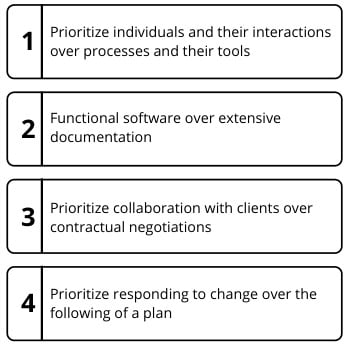
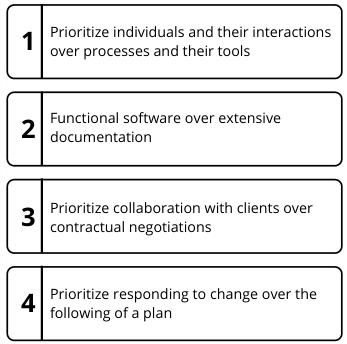
The Agile Manifesto establishes a conceptual framework based on four fundamental values and twelve principles, which guide adopting this work philosophy in software project management. These values, represented in Figure 1, promote a new organizational mindset centered on flexibility, collaboration, and the continuous delivery of value [8,9].
Figure 1.
Values of the Agile Manifesto.
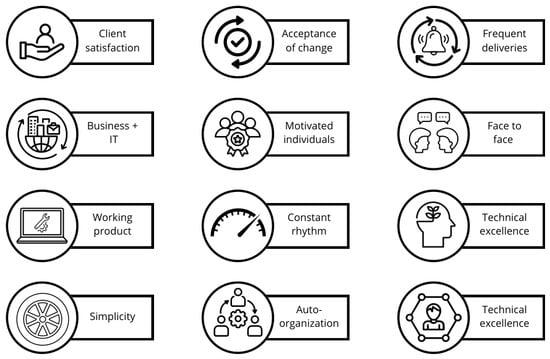
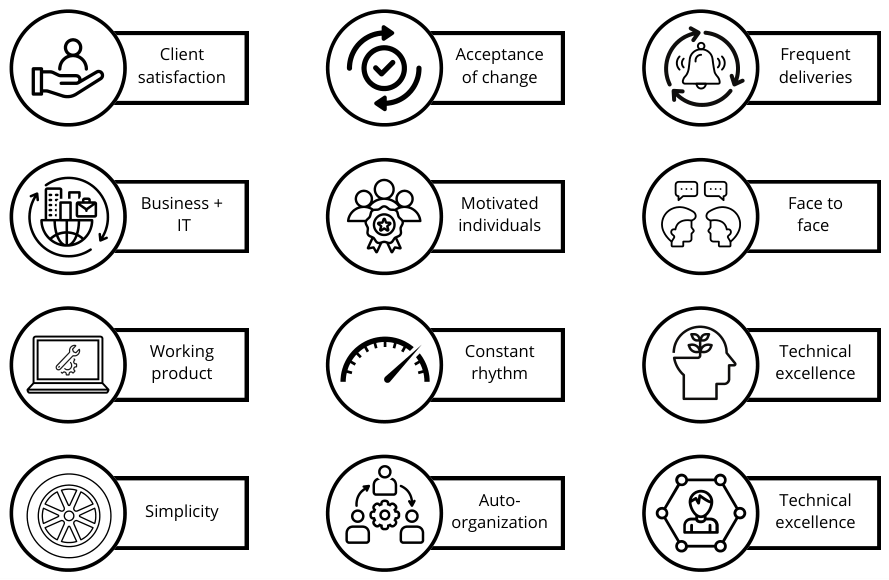
The twelve principles, illustrated in Figure 2, describe how these values translate into concrete practices within agile teams. These principles emphasize the importance of customer satisfaction, the continuous delivery of functional software, adaptability to change, and continuous improvement, among other key aspects of agile software development [10].
Figure 2.
Principles of the Agile Manifesto.
AMs emerged to address the limitations of traditional software development approaches. While conventional methodologies emphasize exhaustive planning and rigid change management, AMs introduce a paradigm shift by prioritizing adaptability, iterative progress, and stakeholder collaboration. This transition has enabled organizations to achieve shorter delivery cycles, cost reductions, simplified documentation processes, and higher customer satisfaction [9].
Over the past decade, AMs have become one of the most widely adopted development methodologies in the software industry [11]. Their success stems from their ability to enhance responsiveness to evolving market conditions while fostering continuous improvement.
Table 1 presents a comparative analysis of traditional and agile methodologies, highlighting the fundamental differences in their principles and implementation. While traditional approaches prioritize meticulous planning, contractual stability, and large team structures, agile methodologies emphasize flexibility, iterative development, and active customer involvement. For example, in a traditional manufacturing company, strict contracts and detailed planning might lead to delays if unexpected supply chain disruptions occur. In contrast, an agile approach allows for rapid adjustments, enabling teams to reallocate resources and modify production strategies dynamically.
Table 1.
Methodologies comparison.
Types of AMs
Various AMs have emerged over time, each with distinct approaches and characteristics. However, they all share fundamental principles such as incremental and iterative development, rapid adaptation to change, customer satisfaction as a priority, and a commitment to delivering high-quality products.
Among the named methods is Scrum, which organizes work into iterative cycles (Sprints). Extreme Programming (XP) emphasizes software engineering practices such as pair programming and automated testing. Table 2 lists conceptual reference points for coding. Inclusion in this background table does not imply that any of the 53 studies implemented the method.
Table 2.
Named agile methods used as conceptual reference points.
Design Thinking is a user-centered innovation approach [20,21,22], and Lean Startup is an experimentation approach [23]. Neither is classified here as an Agile Methodology solely because it uses iteration. Lean manufacturing and Lean construction are similarly coded as adjacent operational approaches. In the included-study audit (Appendix A), an explicit agile-practice code requires a named method or identifiable agile project/production practices in the study itself; capability studies receive a separate code. This rule prevents an agility outcome from being counted as evidence that a firm adopted Scrum or another named method.
2.3. AMs in Business SMEs
While AMs are widely implemented in the software sector, large enterprises in other industries, such as technology and finance, have adopted them as well. Examples include Google, Amazon, BBVA, and Microsoft [8]. These transitions often involve changes in organizational structure, team roles, and work processes [24].
Non-software SMEs are studied in manufacturing, supply-chain management, services, and other activities. The study-level map distinguishes reports of implemented project or production practices from measures of supply-chain or organizational agility; the latter cannot by themselves establish method adoption (Appendix A).
However, SME adoption is influenced by unique characteristics. On the one hand, SMEs benefit from flatter hierarchies and greater structural flexibility [5]. On the other hand, they may face cultural resistance, fear of change, and limited resources [6,25]. A lack of awareness or understanding of AMs can also hinder implementation. Understanding these dynamics is essential for promoting effective and sustainable adoption of agility in non-software SMEs.
In this study, the term business SMEs refers to non-software SMEs, i.e., small and medium-sized enterprises whose core activity is not software development, as opposed to software-focused firms, which are excluded from this review under criterion EC3, defined in Section 3.3.
3. Methodology
This section describes the methodology applied in this study, which follows the guidelines proposed by Petersen et al. [26] for conducting Systematic Literature Reviews (SLR). This methodology, complemented by the works of Petersen et al. [27], Wohlin [28], and Petticrew and Roberts [29], provides a structured framework for performing a comprehensive and organized analysis of the study area.
This review is reported in accordance with the Preferred Reporting Items for Systematic Reviews and Meta-Analyses (PRISMA) 2020 statement [30]. The completed PRISMA 2020 checklist is provided as Supplementary Material, and Figure 3 presents the study selection flow in PRISMA style. Because this article revisits a historical search, some items could not be fully reported; these are detailed in the checklist.
This section is divided into six subsections that detail the steps of this methodology: (1) Research Questions, (2) Search, (3) Study Selection, (4) Data Extraction, (5) Analysis and Classification, and (6) Validity Assessment.
3.1. Research Questions
This review examines agile practices and agility-related capabilities in non-software SMEs. The three research questions in Table 3 separately address organizational area, focal construct, and reported drivers or barriers.
Table 3.
Research questions.
3.2. Search
After defining the research questions, we searched Scopus and Web of Science (WoS). The general terms combined agile/agility, SME variants, and business/management:
   ("agile" OR "agility")  AND
   ("sme" OR "smb" OR "small and medium-sized enterprises" OR "small and medium-sized businesses") AND
   ("business" OR "management")
The databases were selected for their coverage of management and operations research. Database indexing is not a study-level quality appraisal. The original search was conducted in 2024; only complete publication years through 2023 were intended to be eligible. The working files do not record the exact execution date or a contemporaneous pilot-search log, so pilot sensitivity cannot be reconstructed as a verified historical procedure.
Table 4 reports the archived initial database queries and their returns (288 from Scopus and 214 from WoS). Both initial queries already excluded the databases’ Computer Science category. This subject-category filter is distinct from the later study-level EC3 decision about whether a retrieved paper focuses on software development. The archived refined queries, including year, document-type, and language filters, are preserved in the companion workbook, sheet “Search Strings.”
Table 4.
Exact database-specific search strings.
Applying each platform’s native filters for publication year (2010–2023), document type (article or review), and language (English) narrowed 502 records to 238 (113 from Scopus and 125 from WoS). The original files preserve these queries and counts but no pilot results, test set, or exact search date. The requirement for an SME term may have missed studies that describe small firms using different terminology; we did not rerun an expanded search for this revision.
3.3. Selection
The articles were selected in several stages, applying a systematic approach to ensure the relevance and quality of the included studies. Figure 3 summarizes the number of studies retained at each stage. The stages are described as follows:
- Application of Inclusion and Exclusion Criteria: Starting from 238 records after the database-native year/type/language filters, duplicates were removed (56 by title, 12 additional by DOI), reducing the sample to 170. Study-level criteria EC3 (software-development focus) and EC4 (secondary systematic reviews or mappings) were then applied together, reducing the sample to 165. The historical sheet does not separate the five exclusions by criterion.
- Title and Abstract Screening: The original review screened the 165 remaining records for relevance to SMEs and agile practices or agility, applying IC4 and EC2. This step narrowed the set to 85, but the original file does not record a reason for each of the 80 exclusions.
- Full-Text Analysis: The original team reviewed the introductions and conclusions of the 85 selected articles and other sections when necessary. This stage retained 48. The workbook flags 35 of the 37 records not carried forward as rejected and gives a brief free-text note for each of the 37; these notes are not coded by exclusion criterion.
- Snowball Method: To minimize the risk of missing relevant studies, we applied the snowball method following the guidelines of [28]. This approach identified three additional articles, resulting in 51 articles.
- Review of Excluded Articles: The original review reinstated two records, producing the historical set of 53. The workbook identifies them but does not record why they were reinstated.
Figure 3.
Archived selection flow for the original 53-record set.
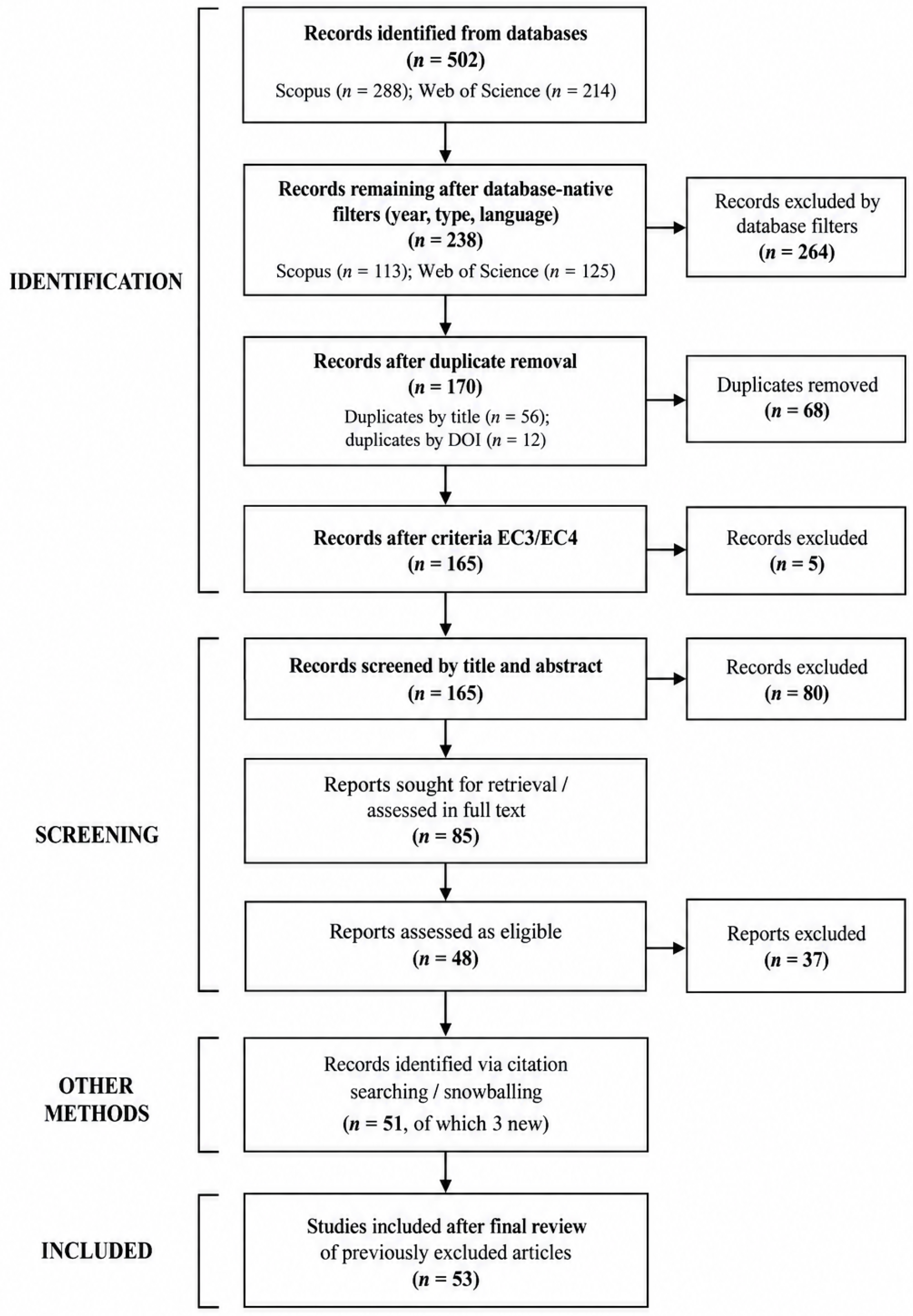
Table 5 lists the full set of inclusion (IC) and exclusion (EC) criteria applied at each stage above.
Table 5.
Inclusion (IC) and exclusion (EC) criteria applied during study selection.
3.4. Data Extraction
A structured template was used for data extraction. This template allowed us to uniformly organize the extracted information, facilitating the analysis and subsequent classification of the selected studies. The fields used in the template are as follows:
- General Study Information: ID, Title, Reviewer, Database, Year, Source Title, Document Type.
- Author Information: Authors, Authors’ Keywords.
- Article Content: Abstract, Abstract/Introduction, Full Text.
- Technical and Relevance Details: DOI, Software, Systematic Literature Review (SLR).
- Research Questions: RQ1, RQ2, RQ3.
- Additional Observations: Observations.
3.5. Analysis and Classification
For this revision, we reconciled each of the 53 original records with one accessible PDF and extracted the focal construct, study country when stated, industry, SME context, study design, principal finding, and factors reported as enablers or barriers. We checked the abstract and relevant methods, results, and discussion passages in the supplied PDFs; the record-level extraction and source notes are in data/study_evidence.csv, with compact tables in Appendix A. We used four mutually exclusive primary construct codes: direct for a study centered on an explicit agile method or identifiable agile project/production practice, adjacent for an operational approach such as Lean that shares some principles but is not itself evidence of Agile Methodology adoption, capability for agility measured or theorized as an organizational property, and peripheral when the article does not establish an agile practice or agility as a central research construct. When a paper discussed more than one construct, the code describes its focal research object. A separate evidence-type field distinguishes observed implementation, survey association, proposed model, and peripheral publication; a direct code alone does not show that a method was adopted. Following the authors’ scope decision, the nine peripheral records remain a separately labeled stratum of the historical 53 and are not used to infer method adoption. The 44 non-peripheral records form the domain-focused synthesis. Lean remains an adjacent approach.
RQ1 uses the primary organizational area recorded for each paper; industry and study country are separate context fields. RQ2 uses the construct code, focal practice/capability, and evidence type. For RQ3, one paper may contribute to several factors. The newly extracted reported enablers and barriers are separate from the historical citation-to-category links in Table 6 and Table 7. We linked those citations back to study records by DOI or bibliographic title; all cited keys resolved, but this verifies attribution, not the semantic correctness of the old category assignment. The historical review did not preserve independent code-level decisions or a formal codebook, so the old categories remain descriptive.
Table 6.
Themes originally coded as drivers of agile practices or agility.
Table 7.
Themes originally coded as barriers to agile practices or agility.
3.6. Validity Assessment
An earlier version described a collaborative review with consensus discussions. The preserved extraction workbook, however, contains one assigned reviewer per record and no record-level history of independent second or third judgments, disagreement resolution, or item-level coding. Consequently, we cannot verify the earlier statement that every article was independently cross-validated by at least three authors, and we cannot calculate inter-rater agreement from the available material. The revision adds a provisional, single-reader reporting appraisal for all 53 PDFs: SME context, sample or case description, data source, analysis procedure, and limitations are each marked clearly reported (Y), partly reported (P), not reported (N), or not applicable (NA). The record-level codes and rubric are supplied with the evidence CSV. They describe reporting completeness, not risk of bias or causal strength; no numerical quality score or exclusion threshold was imposed. A second independent appraisal is still needed before ranking evidence strength. We therefore qualify causal and managerial conclusions by design and observed versus proposed practice.
4. Results
4.1. Bibliometric Overview of the Included Studies
Before answering the research questions, we present a bibliometric overview of the original 53-record set (37 attributed to Web of Science and 16 to Scopus in the selection workbook). The unit is one retained record, with the year, source title, authors, and author keywords from that workbook. Annual production groups records by the workbook’s year field; recurring outlets are counted by exact source-title strings; and the keyword network uses author keywords occurring in at least two records and links terms that occur in the same record. The co-authorship summary connects authors who share a record. Author affiliation countries were recovered from the original export records for 44 records and are distinct from the countries of the firms studied. Because the nine peripheral records remain in this historical set as a separately labeled stratum, these descriptive figures should not be interpreted as bibliometrics of the 44-record domain-focused synthesis. The figure-generation code and a complete normalization log for authors and keywords were not preserved, limiting exact regeneration of the network figures.
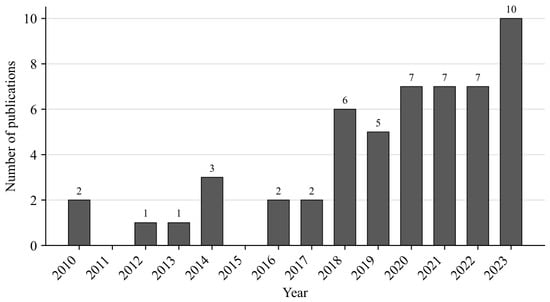
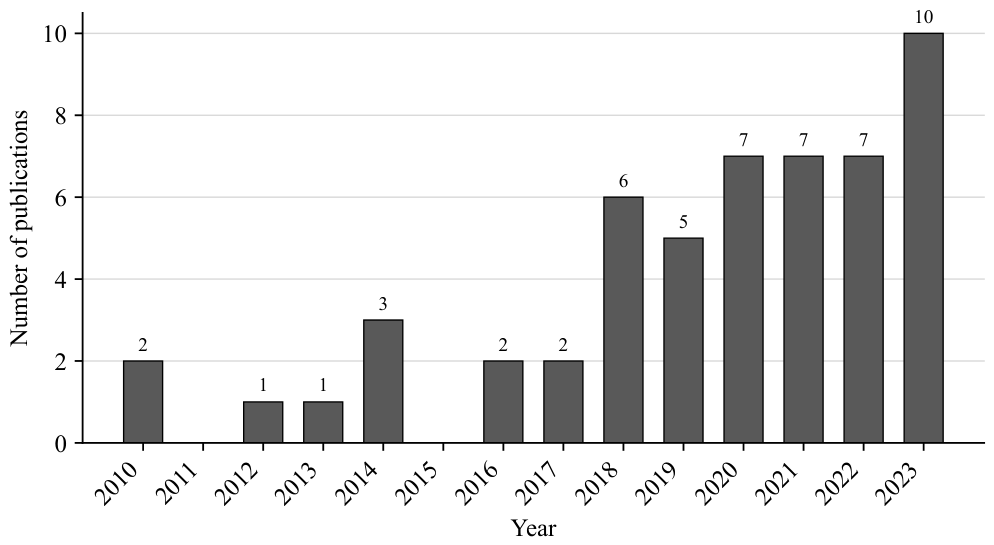
The 53 records have workbook year values from 2010 to 2023 and list 133 distinct authors (2.6 authors per record, on average) across 48 source outlets. Figure 4 shows their annual distribution; 31 of 53 (58%) carry a year of 2020–2023. This trend describes the original search result, not a measured growth rate of method adoption. One record entered as 2023 early access (study 35, Appendix A) appears in a journal volume dated 2024; its treatment depends on whether online-first or issue year governs the eligibility cutoff.
Figure 4.
Annual scientific production of the 53 included studies (2010–2023).
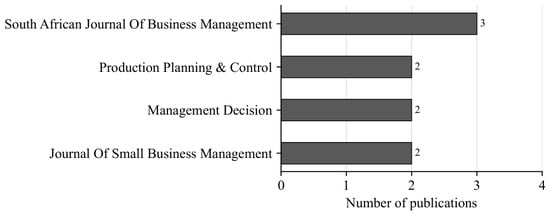
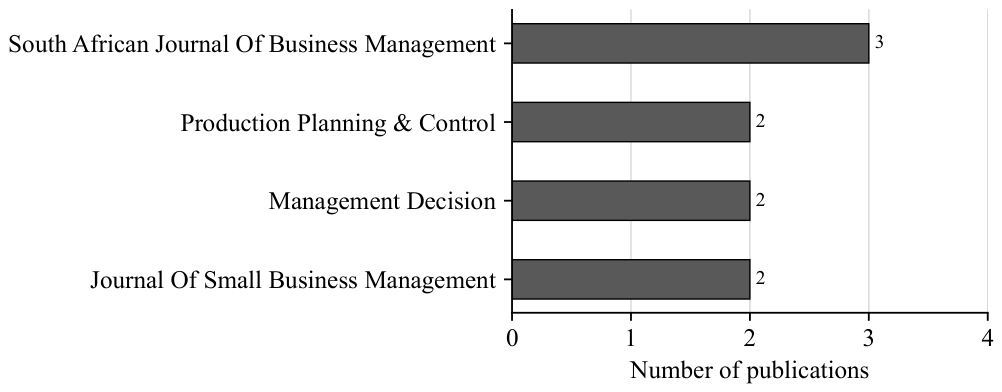
Regarding publication venues, only 4 of the 48 sources contributed more than one record, while 44 sources (92%) contributed one record each. Figure 5 lists the four recurring sources, led by the South African Journal of Business Management (three records). This distribution concerns the mixed original corpus and cannot establish that research on a specific named methodology is fragmented.
Figure 5.
Source outlets with more than one included publication.
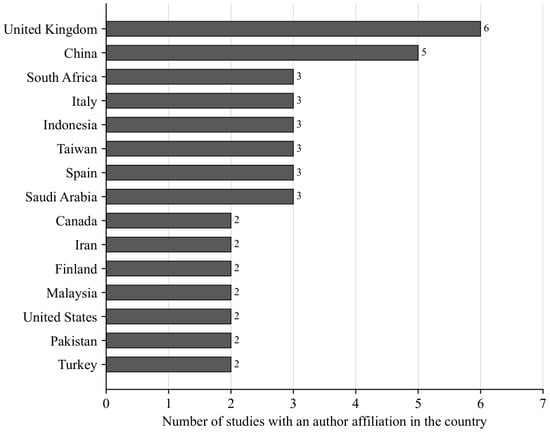
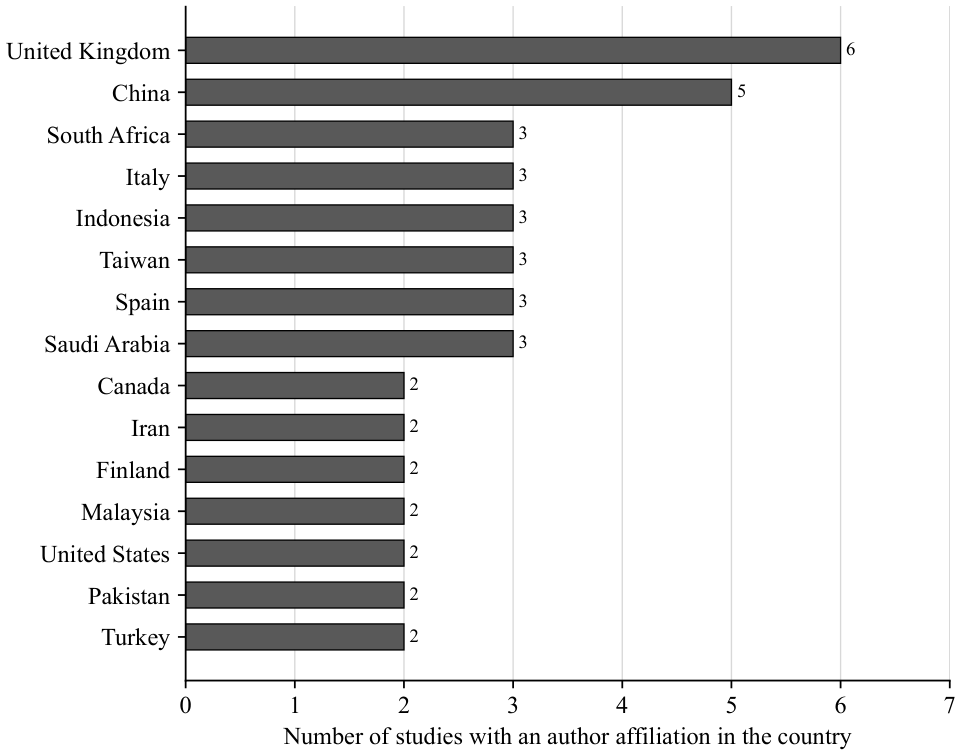
We further examined the institutional affiliations reported for each author. This measure reflects where the authors are based, not the location of the SMEs studied. Country information could be recovered for 44 of the 53 records (83%); the remaining 9 lack suitable export metadata. These 44 records draw on author affiliations from 32 countries. Figure 6 shows the 15 most represented countries: the United Kingdom (6 records) and China (5 records) lead the list. Twelve of the 44 records with country data (27%) involve authors affiliated with more than one country. We do not infer geographic coverage of SME settings from these affiliation counts.
Figure 6.
Countries of author affiliation (top 15) among the 44 included studies with extractable country data.
We also examined co-authorship patterns among the 133 authors of the 53 included studies. The resulting co-authorship network is highly fragmented: it forms 49 disconnected components (i.e., separate author teams that never share a co-authored study with another team in the sample), and the largest component includes only six researchers. In practice, this means that, with few exceptions (e.g., “Liu, HM” and “Yang, HF”, who co-author two of the included studies), each of the 53 studies is produced by an independent author team rather than by a small number of recurring research groups; we therefore report this fragmentation as a summary statistic rather than as a network diagram, since a plot of 49 mostly disconnected clusters would not convey additional information beyond the figures above.
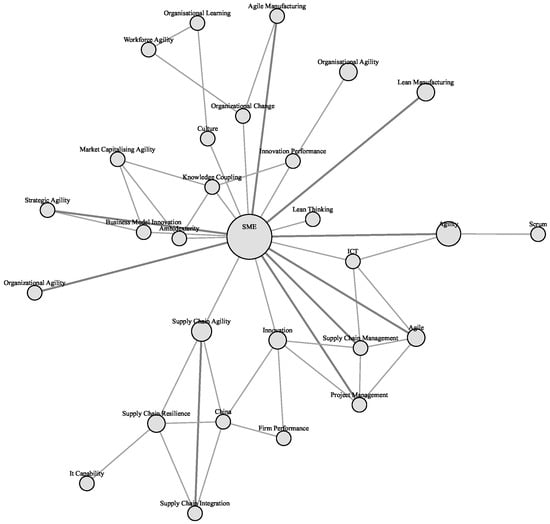
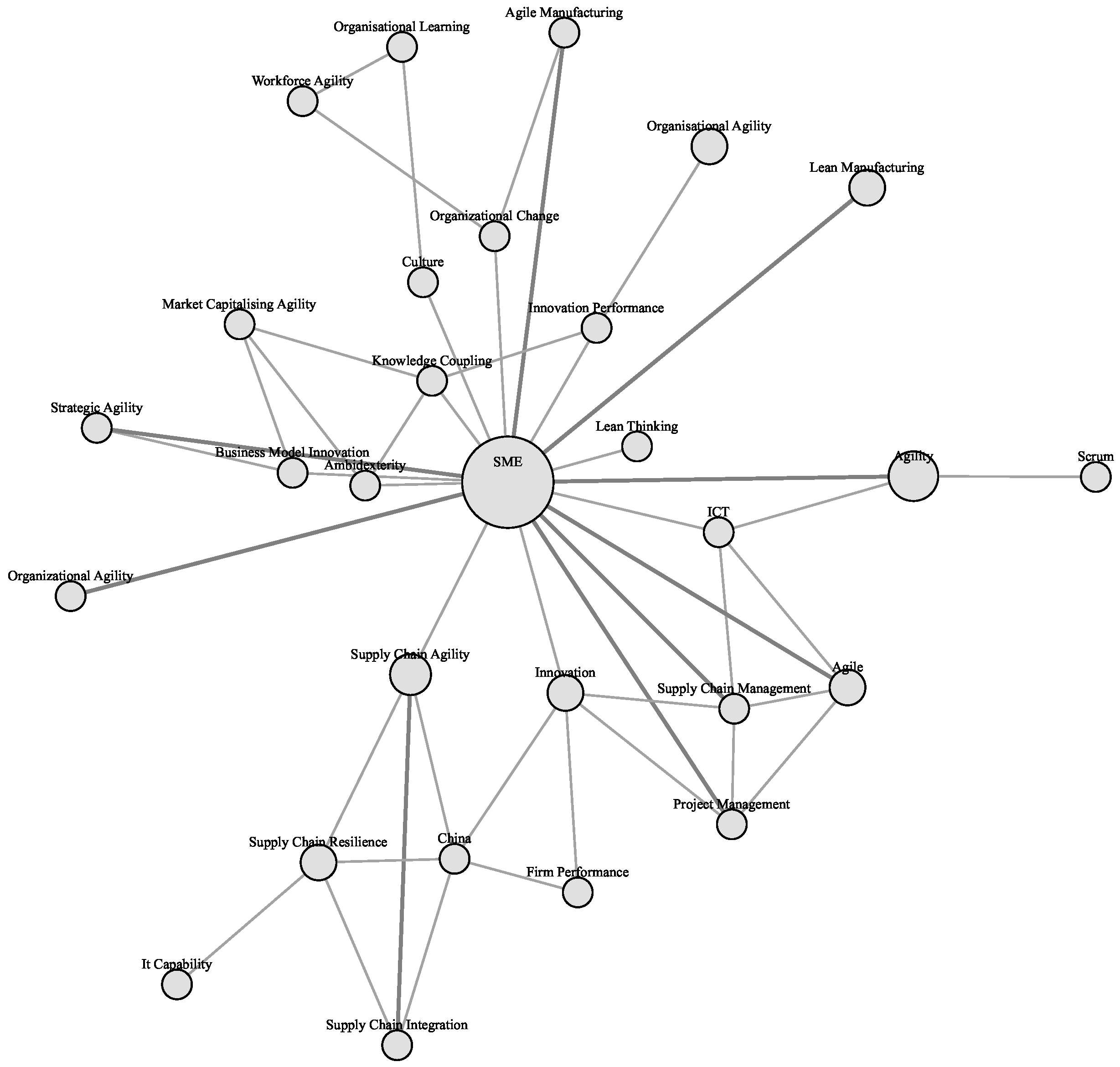
Figure 7 presents the author–keyword co-occurrence network, restricted to the 29 keywords appearing in at least two original records. Nodes are sized by frequency and edges by record-level co-occurrence. Operations and supply-chain terms appear alongside organizational-capability terms. This is consistent with the study-level coding, which places 25 records in the capability class and 11 in the explicit-practice class; keyword proximity itself does not demonstrate implementation of a named method.
Figure 7.
Author–keyword co-occurrence network (keywords appearing in at least two of the 53 included studies).
4.2. Answering RQ1 and RQ2: Organizational Areas and Focal Constructs
The 53-record evidence map (Appendix A) identifies each record’s primary organizational area and separately reports study country, industry, SME context, design, and principal finding in Table A2. The domain-focused synthesis comprises 44 non-peripheral records; the other nine remain a visible separate stratum, preserving the historical PRISMA count. Project and operations management, supply chains, innovation, and workforce management all occur, but an industry label such as manufacturing must not be substituted for the function being studied.
The 11 direct records are heterogeneous. One centrally describes Scrum implementation in a UK bed-manufacturing SME [71]; four concern agile project management or a Lean–agile project office, two agile manufacturing, one Lean–agile garment operations, one general agile processes, one a proposed people-management model, and one the potential use of agile methods in construction. No record centrally studies Kanban or XP adoption in a non-software SME. Awareness surveys, feasibility judgments, modeled associations, and conceptual proposals within the 11 records are not counted as observed implementations. The eight Lean-related records remain adjacent approaches. Among the 25 capability records, the construct ranges from supply-chain and workforce agility to strategic and market agility; these studies do not document adoption of a named method merely by measuring agility. The exact study-to-construct links and evidence types are in the companion CSV.
4.3. Answering RQ3: Reported Drivers and Barriers
Table 6 and Table 7 retain the original review’s thematic links to all 53 historical records for audit, including citations to peripheral papers. The domain-focused interpretation concerns the 44 non-peripheral records and uses the newly extracted factors in the companion CSV. The historical labels cover both implementation experiences and correlates of measured agility; a citation is not proof that a specific named method was implemented. For example, Sukwadi et al. [31] study Lean–agile operations and supplier partnerships in garment supply chains, whereas Zhuo et al. [61] study supply-chain integration and resilience in China’s pig sector with agility as a mechanism. The latter does not test an Agile Methodology from Table 2. The study-level map allows readers to interpret each citation in its actual construct class.
The new study-level extraction also exposes variation hidden by the historical categories. In Thai SME exporters, perceived technology advantage supported adoption of an inventory system while perceived complexity reduced it [72]; this concerns a marketing-agility capability rather than method adoption. In two Swedish textile SMEs, Lean management changes improved coordination, but work stress increased in one case and decreased in the other [32]. In Indonesian garment SMEs, supplier partnership and agile supply-chain constructs were associated with performance, whereas the modeled leanness construct was not [31]. These contrasts show why a single list of generic “agile adoption barriers” is insufficient. The CSV preserves the newly extracted factors separately from the original table assignments, so readers can inspect the source-specific interpretation.
Table 7 similarly records the original barrier categories. A paper may appear in several categories. In particular, seven cited records appear in “Training deficiencies”; this is a descriptive frequency within the original 53-record set, not an estimate of the causal effect of training. Because independent code-level records were not retained, the assignments require a future second-coder audit before they can support strong frequency comparisons.
4.4. Integrative Interpretation of the Evidence
The study map supports a differentiated interpretation of how agility-related factors may be connected. Market uncertainty, customer requirements, leadership, resources, and learning are reported as possible antecedents. Explicit practices such as Scrum or agile project management, adjacent Lean practices, and coordination or knowledge-sharing processes are different possible mechanisms. Industry, SME size, supply-chain position, and available expertise are plausible contextual conditions. Flexibility, responsiveness, innovation, and performance are outcomes reported or measured in the original studies. These elements should not be collapsed into a single “adoption leads to performance” claim: in capability studies, agility is often itself a measured mediator or outcome, whereas in practice studies a specific work method can be observed. For example, the Scrum case [71] describes an implementation, while the strategic-agility study [41] analyzes a capability in business-model innovation. This framework organizes the heterogeneous findings; it is an interpretive synthesis, not a causal model tested across all 53 records.
5. Future Research Agenda
The following research agenda emerges from the results and analysis presented in response to the RQs of this paper (Section 4). Based on these insights, we identify critical areas where future research can deepen our understanding and provide potential and beneficial actions for SMEs operating outside the software industry. The agenda focuses on three main dimensions: developing sector-specific agile frameworks, identifying strategies to address the interplay of adoption drivers and barriers, and expanding research into under-explored regions and economic sectors.
5.1. Context-Specific Agile Frameworks for SMEs
Future studies should test how specific named practices operate in non-software SMEs and distinguish those practices from adjacent Lean approaches and measured agility capabilities. Comparative designs can examine whether a practice fits production, project, service, or supply-chain work and document the resources required to use it. The current evidence map identifies these settings but does not establish which practice works best in each one.
5.2. Strategies to Overcome Barriers and Leverage Enablers in Agile Adoption
The descriptive categories suggest candidate relationships among leadership, learning, resources, resistance, and outcomes. They do not establish a tested causal pathway across the corpus. The framework in Section 4.4 specifies relationships that future intervention or comparative studies could examine.
Future research should aim to achieve the following:
- Develop and test interventions using a named agile practice while documenting costs, skills, and implementation fidelity.
- Conduct empirical studies or controlled pilots to evaluate the effectiveness of enabling factors (e.g., leadership engagement, strategic partnerships, or organizational learning) in counterbalancing resistance and resource limitations.
- Test multilevel models that distinguish a work practice from individual, organizational, and environmental conditions and from the measured outcome.
5.3. Explore Under-Studied Regions and Sectors
Future reviews should code the country where each SME was studied. The present affiliation analysis locates authors, not study settings, and therefore cannot justify a claim about which regions lack SME evidence. New primary studies should report their organizational and national context sufficiently to permit comparison.
Cross-sector studies should compare how specific agile practices are adapted and evaluated, including sectors that are sparsely represented in the original set. The reviewed data do not support a ranked list of neglected sectors because industry was not uniformly coded in the historical extraction file.
6. Conclusions
This review revisits 53 records originally retained from a search of non-software SMEs. The domain-focused synthesis comprises 11 practice-focused records, 8 adjacent approaches, and 25 agility-capability records; nine peripheral records remain visible as a separate stratum of the historical set. The study-level extraction now documents context, design, principal finding, and reported factors for every record. Practice-focused records include proposals, awareness surveys, and feasibility studies as well as observed implementations. The varied designs do not establish a general causal performance effect of agile adoption.
The original thematic tables identify leadership, learning, resources, cultural resistance, and training as recurring topics. The new extraction records article-specific findings and disagreements, including different stress outcomes across two Lean textile cases. Historical category frequencies describe citations in the original set; they are not pooled effect estimates or independently reconciled codes. The integrative interpretation in Section 4.4 offers a structure for future tests rather than a validated causal model.
From a practical standpoint, this study offers several implications for SME managers and decision-makers:
- Specify the intervention. Managers should document the named practice, the area of use, and the intended outcome before interpreting results. Evidence about supply-chain agility as a capability cannot establish the effects of Scrum or Design Thinking.
- Assess the local context. Resources, leadership, coordination, and staff skills recur in the reviewed studies, but their relative importance has not been compared across sectors in this corpus.
- Treat training as a hypothesis to test. Seven of the 53 original records were cited in the historical “Training deficiencies” category (13%; Table 7). This frequency motivates attention to skills but does not prove that a specific training intervention improves adoption or performance.
These implications are deliberately conditional. A manager or policymaker should select a practice on the basis of the firm’s work and evaluate it locally rather than treating the mixed literature as a universal implementation guide.
Limitations
The historical search covered Scopus and Web of Science but not gray literature [73]; its required SME term and software subject-category exclusions could have omitted relevant non-software studies. No contemporaneous pilot log or exact search date was preserved. The selection workbook retains the surviving records and stage totals; it gives no reasons for the 80 title/abstract exclusions or the two final reinstatements, and its notes on the 37 full-text exclusions are free text not coded by criterion. The nine peripheral records are retained as a separate stratum, so historical bibliometrics of 53 and the domain-focused synthesis of 44 have different denominators. The count refers to publications, not necessarily independent datasets: two Taiwanese papers by the same authors each report 260 SME responses, and possible sample overlap remains to be checked. One 2023-online/2024-volume year ambiguity remains. The original file has one assigned reviewer per record, no independent coding or consensus log, and no inter-rater statistic. The new five-item reporting appraisal is provisional and single-reader; it is not a validated risk-of-bias assessment. Some study contexts and SME characteristics are incompletely reported in the source PDFs. Bibliometric normalization and figure-generation code were not preserved. Study designs, sectors, and agility constructs vary substantially, precluding a pooled causal conclusion.
Supplementary Materials
The following supporting information can be downloaded at https://www.mdpi.com/article/10.3390/app16199842/s1, The completed PRISMA 2020 checklist.
Author Contributions
Conceptualization, N.A.P., P.L. and C.M.; methodology, N.A.P. and A.O.; validation, A.K.Y.; investigation, N.A.P. and P.G.; writing—original draft preparation, N.A.P.; writing—review and editing, P.L., A.O., C.M. and A.K.Y.; supervision, P.L. and C.M. All authors have read and agreed to the published version of the manuscript.
Funding
This research received no external funding.
Data Availability Statement
The list of selected papers in each stage of this systematic literature review is available at https://tinyurl.com/paper-agile-slr (accessed on 28 February 2025).
Conflicts of Interest
The authors declare no conflicts of interest.
Appendix A. Study-Level Evidence Map
The table reports the focal construct and study design recorded in the source corpus. The categories are descriptive coding of the original 53-record set, not a retrospective claim that every record implements a named Agile Methodology. Direct means an explicitly named agile practice or method; adjacent means a related operational approach such as Lean; capability means agility assessed as an organizational property; peripheral means that the abstract does not establish an agile practice or agility as a central construct. Eligibility flags require author adjudication before a revised final sample can be asserted. For complete bibliographic metadata and the matching PDF filename, see the accompanying data/study_evidence.csv.
Table A1.
Study-level map of the original 53 records.
Table A2.
Study context and principal finding in each original record. Findings are condensed from the supplied PDFs and preserve the original study designs.
References
- Tarhini, A.; Yunis, M.; El-Kassar, A.N. Innovative Sustainable Methodology for Managing In-house Software Development in SMEs. Benchmarking 2018, 25, 1085–1103. [Google Scholar] [CrossRef] [Scilit]
- Bin-Hezam, R.; Bin-Essa, A.; Abubacker, N. Is the Agile Development Method the Way to Go for Small to Medium Enterprises (SMEs) in Saudi Arabia? In Proceedings of the 21st Saudi Computer Society National Computer Conference (NCC), Riyadh, Saudi Arabia, 25–26 April 2018; pp. 1–6. [Google Scholar]
- Beck, K. Extreme Programming Explained: Embrace Change; Addison-Wesley Professional: Boston, MA, USA, 2000. [Google Scholar]
- Dahab, A.; Younes, M.A.; Backar, S. Overall Equipment Efficiency Improvement through a Lean Approach in SME: A Case Study. Int. J. Eng. Res. Afr. 2023, 65, 117–129. [Google Scholar] [CrossRef] [Scilit]
- Tufan, C.; Mert, I.S. The Sequential Effect of Absorptive Capacity, Strategic Agility, and Sustainable Competitive Advantage on Sustainable Business Performance of SMEs. Environ. Sci. Pollut. Res. Int. 2023, 30, 55958–55973. [Google Scholar] [CrossRef] [Scilit] [PubMed]
- Khafri, A.Z.; Aboumasoudi, A.S.; Khademolqorani, S. The Effect of Innovation on the Company’s Performance in Small and Medium-Sized Businesses with the Mediating Role of Lean: Agile Project Management Office (LAPMO). Complexity 2023, 2023, 4820636. [Google Scholar] [CrossRef] [Scilit]
- Royce, W. 33: Managing the Development of Large Software Systems (1970); The MIT Press: Cambridge, MA, USA, 2021. [Google Scholar]
- Digital.ai. 17th Annual State-of-Agile Report. 2023. Available online: https://digital.ai/resource-center/analyst-reports/state-of-agile-report/ (accessed on 24 June 2024).
- Gandomani, T.J.; Nafchi, M.Z. An Empirically-developed Framework for Agile Transition and Adoption: A Grounded Theory approach. J. Syst. Softw. 2015, 107, 204–219. [Google Scholar] [CrossRef] [Scilit]
- Fernandes, J.; Almeida, M. Classification and Comparison of Agile Methods. In Proceedings of the Seventh International Conference on the Quality of Information and Communications Technology, Porto, Portugal, 29 September–2 October 2010; pp. 391–396. [Google Scholar]
- Hamed, A.; Abushama, H. Popular Agile Approaches in Software Development: Review and analysis. In Proceedings of the International Conference on Computing, Electrical And Electronic Engineering, Khartoum, Sudan, 26–28 August 2013; pp. 1–8. [Google Scholar]
- Williams, L.; Cockburn, A. Agile Software Development: It’s About Feedback and Change. Computer 2003, 36, 39–43. [Google Scholar] [CrossRef] [Scilit]
- Sutherland, J. Future of Scrum: Parallel Pipelining of Sprints in Complex Projects. In Proceedings of the Agile Development Conference (ADC’05), Denver, CO, USA, 24–29 July 2005; pp. 5–20. [Google Scholar]
- Hidalgo, E.S. Adapting the Scrum Framework for Agile Project Management in Science: Case Study of a Distributed Research Initiative. Heliyon 2019, 5, e01447. [Google Scholar] [CrossRef] [Scilit] [PubMed]
- Lei, H.; Ganjeizadeh, F.; Jayachandran, P.; Ozcan, P. A Statistical Analysis of the Effects of Scrum and Kanban on Software Development Projects. Robot. Comput.-Integr. Manuf. 2017, 43, 59–67. [Google Scholar] [CrossRef] [Scilit]
- Schwaber, K.; Sutherland, J. SCRUM Development Process. In Business Object Design and Implementation; Springer: London, UK, 1997; pp. 117–134. [Google Scholar]
- Beck, K. Embracing Change with Extreme Programming. Computer 1999, 32, 70–77. [Google Scholar] [CrossRef] [Scilit]
- Beck, K.; Andres, C. Planning Extreme Programming; Addison-Wesley: Boston, MA, USA, 2000. [Google Scholar]
- Abrahamsson, P.; Warsta, J.; Siponen, M.; Ronkainen, J. New Directions on Agile Methods: A Comparative Analysis. In Proceedings of the 25th International Conference on Software Engineering, Portland, OR, USA, 3–10 May 2003; pp. 244–254. [Google Scholar]
- Brown, T. Design thinking. Harv. Bus. Rev. 2008, 86, 84–92. [Google Scholar] [PubMed]
- Wrigley, C.; Nusem, E.; Straker, K. Implementing Design Thinking: Understanding Organizational Conditions. Calif. Manag. Rev. 2020, 62, 125–143. [Google Scholar] [CrossRef] [Scilit]
- Johansson-Skoldberg, U.; Woodilla, J.; Çetinkaya, M. Design Thinking: Past, Present and Possible Futures. Creat. Innov. Manag. 2013, 22, 121–146. [Google Scholar] [CrossRef] [Scilit]
- Ries, E. The Lean Startup: How Today’s Entrepreneurs Use Continuous Innovation to Create Radically Successful Businesses; Crown Currency: Sydney, Australia, 2011. [Google Scholar]
- Duarte, V.; Cleveland-Slimming, M.; Vidal, C.; Contreras, S. Information System Development by Using Agile Teamwork and Service-Learning. IEEE Trans. Educ. 2023, 66, 431–441. [Google Scholar] [CrossRef] [Scilit]
- Gray, C. Entrepreneurship, Resistance to Change and Growth in Small Firms. J. Small Bus. Enterp. Dev. 2002, 9, 61–72. [Google Scholar] [CrossRef] [Scilit]
- Petersen, K.; Vakkalanka, S.; Kuzniarz, L. Guidelines for Conducting Systematic Mapping Studies in Software Engineering: An Update. Inf. Softw. Technol. 2015, 64, 1–18. [Google Scholar] [CrossRef] [Scilit]
- Petersen, K.; Feldt, R.; Mujtaba, S.; Mattsson, M. Systematic Mapping Studies in Software Engineering. In Proceedings of the 12th International Conference on Evaluation and Assessment in Software Engineering (EASE), Bari, Italy, 26–27 June 2008; Volume 8, pp. 68–77. [Google Scholar]
- Wohlin, C. Guidelines for Snowballing in Systematic Literature Studies and a Replication in Software Engineering. In Proceedings of the 18th International Conference on Evaluation and Assessment in Software Engineering, London, UK, 13–14 May 2014; Volume 14, pp. 1–10. [Google Scholar]
- Petticrew, M.; Roberts, H. Systematic Reviews in the Social Sciences; Blackwell: Hoboken, NJ, USA, 2006; pp. 1–354. [Google Scholar]
- Page, M.J.; McKenzie, J.E.; Bossuyt, P.M.; Boutron, I.; Hoffmann, T.C.; Mulrow, C.D.; Shamseer, L.; Tetzlaff, J.M.; Akl, E.A.; Brennan, S.E.; et al. The PRISMA 2020 Statement: An Updated Guideline for Reporting Systematic Reviews. BMJ 2021, 372, n71. [Google Scholar] [CrossRef] [Scilit] [PubMed]
- Sukwadi, R.; Wee, H.M.; Yang, C.C. Supply Chain Performance Based on the Lean-Agile Operations and Supplier-Firm Partnership: An Empirical Study on the Garment Industry in Indonesia. J. Small Bus. Manag. 2013, 51, 297–311. [Google Scholar] [CrossRef] [Scilit]
- Manfredsson, P. Textile Management Enabled by Lean Thinking: Z Case Study of Textile SMEs. Prod. Plan. Control 2016, 27, 541–549. [Google Scholar]
- Alavi, S.; Wahab, D.A.; Muhamad, N.; Shirani, B.A. Organic Structure and Organisational Learning as the Main Antecedents of Workforce Agility. Int. J. Prod. Res. 2014, 52, 6273–6295. [Google Scholar] [CrossRef] [Scilit]
- Dabić, M.; Stojčić, N.; Simić, M.; Potocan, V.; Slavković, M.; Nedelko, Z. Intellectual Agility and Innovation in Micro and Small Businesses: The Mediating Role of Entrepreneurial Leadership. J. Bus. Res. 2020, 123, 683–695. [Google Scholar] [CrossRef] [Scilit]
- Tezel, A.; Koskela, L.; Aziz, Z. Current Condition and Future Directions for Lean Construction in Highways Projects: A Small and Medium-Sized Enterprises (SMEs) Perspective. Int. J. Proj. Manag. 2018, 36, 267–286. [Google Scholar] [CrossRef] [Scilit]
- Gani, M.O.; Yoshi, T.; Rahman, M.S. Optimizing Firm’s Supply Chain Resilience in a Data-Driven Business Environment. J. Glob. Oper. Strateg. Sourc. 2022, 16, 258–281. [Google Scholar] [CrossRef] [Scilit]
- Stabilini, G.; Belvedere, V. Alternative Models of Demand-driven Supply Chains: Size-specific Solutions in Italian Fashion Companies. Fash. Pract. 2014, 6, 221–242. [Google Scholar] [CrossRef] [Scilit]
- Bogoyavlenska, Y.; Persia, L.; Bondarenko, K. Smart-logistics for People Management of Innovative Small and Medium Enterprises’ Development: Agile Methodology. Econ. Ecol. Socium 2020, 4, 8–15. [Google Scholar] [CrossRef] [Scilit]
- Wikaningrum, T.; Ghozali, I.; Nurcholis, L.; Widodo; Nugroho, M. Strategic Partnership: How Important for Reputation of Small and Medium Enterprise? Qual.-Access Success 2020, 21, 35–39. [Google Scholar]
- Alshahrani, M.A.; Salam, M.A. The Role of Supply Chain Resilience on SMEs’ Performance: The Case of an Emerging Economy. Logistics 2022, 6, 47. [Google Scholar] [CrossRef] [Scilit]
- Albayraktaroglu, A. Strategic Agility, Exaptation, and Business Model Innovation: The Case of an SME. IEEE Trans. Eng. Manag. 2023, 71, 7195–7206. [Google Scholar] [CrossRef] [Scilit]
- Govuzela, S.; Mafini, C. Organisational Agility, Business Best Practices and the Performance of Small to Medium Enterprises in South Africa. S. Afr. J. Bus. Manag. 2019, 50, 1–13. [Google Scholar] [CrossRef] [Scilit]
- Molina, C.M.; Soriano, D.R.; González-Tejero, C.B. Multi-Level Corporate Entrepreneurship in SMEs: An Intra-metropolitan Analysis. Rev. Manag. Sci. 2022, 17, 2185–2213. [Google Scholar] [CrossRef] [Scilit]
- Ribeiro, F.L.; Fernandes, M.T. Exploring Agile Methods in Construction Small and Medium Enterprises: A Case Study. J. Enterp. Inf. Manag. 2010, 23, 161–180. [Google Scholar] [CrossRef] [Scilit]
- Liao, S.; Liu, Z.; Ma, C. Direct and Configurational Paths of Open Innovation and Organisational Agility to Business Model Innovation in SMEs. Technol. Anal. Strateg. Manag. 2019, 31, 1213–1228. [Google Scholar] [CrossRef] [Scilit]
- Goswami, M.; Kumar, G. An Investigation of Agile Manufacturing Enablers in Indian Automotive SMEs Using Structural Equation Model. Meas. Bus. Excell. 2018, 22, 276–291. [Google Scholar] [CrossRef] [Scilit]
- Alam, M.S.A.; Wang, D.; Waheed, A.; Khan, M.S.; Farrukh, M. Analysing the Impact of Agile Supply Chain on Firms’ Sales Performance with Moderating Effect of Technological-integration. Int. J. Appl. Decis. Sci. 2019, 12, 402. [Google Scholar] [CrossRef] [Scilit]
- Wang, S.; Wang, Y.; Archer, N. The Co-evolution of IT Competence, Organisational Agility and Entrepreneurial Action: A case Study of Entrepreneurial e-tailers. Int. J. Netw. Virtual Organ. 2018, 18, 1–29. [Google Scholar] [CrossRef] [Scilit]
- Bongso, B.; Hartoyo, R. The Urgency of Business Agility During COVID-19 Pandemic: Distribution of Small and Medium Business Products and Services. J. Distrib. Sci. 2022, 20, 57–66. [Google Scholar]
- Kankaanhuhta, V.; Packalen, T.; Vaatainen, K. Digital Transformation of Forest Services in Finland: A Case Study for Improving Business Processes. Forests 2021, 12, 781. [Google Scholar] [CrossRef] [Scilit]
- Pooley, A.; Chan, J.H. A Case Study on Performance Assessment Framework for Agile Processes. Int. J. Bus. Perform. Manag. 2021, 22, 1–14. [Google Scholar] [CrossRef] [Scilit]
- Roy, M.A.; Abdul-Nour, G.; Gamache, S. Implementation of an Industry 4.0 Strategy Adapted to Manufacturing SMEs: Simulation and Case Study. Sustainability 2023, 15, 15423. [Google Scholar] [CrossRef] [Scilit]
- Direction, S. Innovation and the SME. Strateg. Dir. 2020, 36, 25–27. [Google Scholar] [CrossRef] [Scilit]
- Liu, H.M.; Yang, H.F. Managing Network Resource and Organizational Capabilities to Create Competitive Advantage for SMEs in a Volatile Environment. J. Small Bus. Manag. 2018, 57, 155–171. [Google Scholar] [CrossRef] [Scilit]
- Carlsson, I.L.; Aronsson, H. Investing in Lean to Improve Basic Capabilities: A Strategy for System Supply? J. Ind. Eng. Manag. 2017, 10, 28. [Google Scholar] [CrossRef] [Scilit]
- Yi, H.T.; Oh, D.; Amenuvor, F.E. The effect of SMEs Dynamic Capability on Operational Capabilities and Organisational Agility. S. Afr. J. Bus. Manag. 2023, 54, 3696. [Google Scholar] [CrossRef] [Scilit]
- Liu, H.M.; Yang, H.F. Network Resource Meets Organizational Agility. Manag. Decis. 2019, 58, 58–75. [Google Scholar] [CrossRef] [Scilit]
- Ju, X.; Ferreira, F.A.; Wang, M. Innovation, Agile Project Management and Firm Performance in a Public Sector-Dominated Economy: Empirical Evidence from High-tech Small and Medium-sized Enterprises in China. Socio-Econ. Plan. Sci. 2019, 72, 100779. [Google Scholar] [CrossRef] [Scilit]
- Reischl, A.; Weber, S.; Fischer, S.; Lang-Koetz, C. Contextual Ambidexterity: Tackling the Exploitation and Exploration Dilemma of Innovation Management in SMEs. Int. J. Innov. Technol. Manag. 2022, 19, 2250006. [Google Scholar] [CrossRef] [Scilit]
- Loury-Okoumba, W.V.; Mafini, C. Supply chain management antecedents of performance in small to medium scale enterprises. S. Afr. J. Econ. Manag. Sci. 2021, 24, 1–13. [Google Scholar] [CrossRef] [Scilit]
- Zhuo, N.; Ji, C.; Yin, N. Supply Chain Integration and Resilience in China’s Pig Sector: Case Study Evidences from Emerging Institutional Arrangements. Environ. Sci. Pollut. Res. 2020, 28, 8310–8322. [Google Scholar] [CrossRef] [Scilit] [PubMed]
- Putri, N.T.; Dona, L.S. Application of Lean Manufacturing Concept for Redesigning Facilities Layout in Indonesian Home-Food Industry. TQM J. 2019, 31, 815–830. [Google Scholar] [CrossRef] [Scilit]
- Naughton, S.; Golgeci, I.; Arslan, A. Supply Chain Agility as an Acclimatisation Process to Environmental Uncertainty and Organisational Vulnerabilities: Insights from British SMEs. Prod. Plan. Control 2019, 31, 1164–1177. [Google Scholar] [CrossRef] [Scilit]
- Ali, Z.; Gongbing, B.; Mehreen, A. Do Bulnerability Mitigation Strategies Influence firm Performance: The Mediating Role of Supply Chain Risk. Int. J. Emerg. Mark. 2021, 18, 748–767. [Google Scholar] [CrossRef] [Scilit]
- Kumar, T.V.; Mohammed, I.S.; Rajan, K.P.; Prasad, D.A.; Kaleeswaran, K. QCDM Culture Design: A new Paradigm in Manufacturing Sector to meet the Customer Satisfaction. Int. J. Mech. Eng. Technol. 2018, 9, 104–112. [Google Scholar]
- Kumar, V.; Babu, G.; Muthusamy, S. Assessing the Awareness of Agile Manufacturing for Organizational Change in Indian Small Manufacturing Firms. J. Organ. Change Manag. 2016, 29, 713–731. [Google Scholar] [CrossRef] [Scilit]
- Depaoli, P.; Za, S.; Scornavacca, E. A Model for Digital Development of SMEs: An Interaction-based Approach. J. Small Bus. Enterp. Dev. 2020, 27, 1049–1068. [Google Scholar] [CrossRef] [Scilit]
- Gurahoo, N.; Salisbury, R. Lean and Agile in Small- and Medium-Sized Enterprises: Complementary or Incompatible? S. Afr. J. Bus. Manag. 2018, 49, 11. [Google Scholar] [CrossRef] [Scilit]
- Gablas, B.; Ruzicky, E.; Ondrouchova, M. The Change in Management Style during then Course of a Project from the Classical to the Agile Approach. J. Compet. 2018, 10, 38–53. [Google Scholar] [CrossRef] [Scilit]
- Bhadu, J.; Bhamu, J.; Singh, D. Critical Success Factors of Lean Manufacturing for Indian Ceramic Industries: Modelling Through Interpretive Ranking Process. Indian J. Eng. Mater. Sci. 2021, 28, 271–281. [Google Scholar] [CrossRef] [Scilit]
- Javed, S.; Bamford, J.; Abualqumboz, M. Helping Deluxe Beds to Sleep Easy: A Case Study of Agile Project Management. Int. J. Entrep. Innov. 2020, 22, 132–139. [Google Scholar] [CrossRef] [Scilit]
- Thoumrungroje, A.; Racela, O.C. Linking SME international marketing agility to new technology adoption. Int. Small Bus. J. Res. Entrep. 2021, 40, 801–822. [Google Scholar] [CrossRef] [Scilit]
- Paez, A. Gray Literature: An Important Resource in Systematic Reviews. J. Evid.-Based Med. 2017, 10, 233–240. [Google Scholar] [CrossRef] [PubMed]

Disclaimer/Publisher’s Note: The statements, opinions and data contained in all publications are solely those of the individual author(s) and contributor(s) and not of MDPI and/or the editor(s). MDPI and/or the editor(s) disclaim responsibility for any injury to people or property resulting from any ideas, methods, instructions or products referred to in the content. |
© 2026 by the authors. Licensee MDPI, Basel, Switzerland. This article is an open access article distributed under the terms and conditions of the Creative Commons Attribution (CC BY) license.