


Featured Application
Surface electromyography (sEMG) signals for upper-limb rehabilitation suffer from severe noise pollution and low signal-to-noise ratio (SNR), which deteriorates motion recognition accuracy. This study develops a novel HO-TVF-EMD denoising method, where the Hippopotamus Optimization (HO) algorithm optimizes TVF-EMD hyperparameters, and incremental energy entropy is utilized to screen valid intrinsic mode functions for signal reconstruction. Comparative experiments show that the proposed method achieves higher SNR, lower RMSE and superior motion recognition accuracy (up to 92.34%) than VMD, original TVF-EMD and other -optimized TVF-EMD schemes. The proposed method preserves complete sEMG physiological features and provides reliable technical support for high-precision myoelectric control in clinical rehabilitation equipment.
Abstract
To tackle the low signal-to-noise ratio (SNR) of surface electromyography (sEMG) signals during upper-limb rehabilitation training—an issue arising from noise interference that undermines downstream motion recognition—this work develops a novel denoising approach integrating the Hippopotamus Optimization algorithm (HO) and time-varying filtering empirical mode decomposition (TVF-EMD). The HO algorithm optimizes the adaptive parameters of TVF-EMD to decompose raw sEMG into multiple intrinsic mode functions (IMFs); energy entropy increment is further adopted to separate valid signal components from noisy IMFs, and only effective modes are reconstructed to obtain clean sEMG signals. Comparative experiments reveal that the proposed HO-TVF-EMD improves SNR by over 7.48% on average and reduces root mean square error (RMSE) by more than 7.08% relative to VMD, vanilla TVF-EMD, and TVF-EMD optimized by IGOA, ISSA and SMA. The denoised waveforms remain smooth while preserving the essential signal characteristics. Within the evaluated dataset collected from six healthy participants, the corresponding motion recognition accuracy reached 92.34%, exceeding those of the benchmark approaches by 15.67%, 14.00%, 5.67%, 4.01%, and 7.34%, respectively. Overall, the proposed HO-TVF-EMD framework provides an effective denoising solution for improving signal quality and subsequent motion recognition performance. The results indicate its potential for future rehabilitation-oriented myoelectric applications, while further validation using larger populations and complete closed-loop systems remains necessary.
1. Introduction
Upper-limb dysfunction associated with neurological and postoperative conditions has increased the demand for effective rehabilitation strategies [1,2]. Upper-limb rehabilitation systems can assist repetitive training through human–computer interaction, and their performance depends partly on reliable motion recognition and control [1]. As a noninvasive bioelectrical signal reflecting muscle activation, surface electromyography (sEMG) has been widely investigated for motion recognition and signal-driven interaction in rehabilitation-related applications [3]. However, owing to its nonlinear and nonstationary characteristics, sEMG is susceptible to various forms of interference during acquisition, which may adversely affect subsequent signal analysis and motion recognition [4]. Therefore, effective denoising remains an important prerequisite for improving the reliability of sEMG-based applications.
Conventional sEMG denoising methods mainly include wavelet transform (WT) [5], empirical mode decomposition (EMD) [6], variational mode decomposition (VMD) [7], and ensemble empirical mode decomposition (EEMD) [8]. WT provides multiresolution time–frequency analysis and is suitable for processing nonstationary signals; however, its denoising performance depends strongly on the selection of the wavelet basis, decomposition level, and thresholding strategy, and inappropriate parameter settings may lead to signal distortion or loss of useful information. EMD is a data-driven decomposition method that does not require a predefined basis function and therefore exhibits good adaptability to nonlinear and nonstationary signals. Nevertheless, EMD is susceptible to mode mixing and endpoint effects, which may reduce the accuracy of signal decomposition. EEMD alleviates mode mixing through noise-assisted ensemble decomposition, but repeated decomposition increases the computational burden and may introduce residual noise. VMD formulates signal decomposition as a variational optimization problem and provides improved modal separation; however, its decomposition performance depends on preset parameters, such as the number of modes and the penalty factor, and inappropriate parameter settings may affect the decomposition results. Therefore, although these methods have shown effectiveness in sEMG processing, limitations related to parameter dependence, modal separation, and adaptability to strongly time-varying signals remain. Beyond conventional decomposition-based methods, learning-based approaches have also been investigated for sEMG signal enhancement and denoising. Deep learning models, including convolutional neural networks (CNNs), autoencoder-based architectures, recurrent neural networks (RNNs), and hybrid neural networks, have demonstrated promising performance in sEMG enhancement, artifact removal, and signal reconstruction by learning nonlinear representations from noisy biomedical signals [9,10]. These methods can automatically extract hierarchical features and achieve effective noise suppression without manually designed decomposition rules. However, their performance generally depends on sufficient training samples, carefully designed network architectures, and considerable computational resources. Moreover, the limited interpretability of deep learning models may restrict their application in biomedical scenarios where reliability and transparency are important. Therefore, adaptive signal decomposition approaches with lower data dependence, stronger interpretability, and flexible parameter optimization remain valuable for reliable sEMG signal processing.
To improve the decomposition of nonlinear and nonstationary signals, Li et al. [11] proposed time-varying filtering empirical mode decomposition (TVF-EMD). By introducing a time-varying filter based on B-spline functions, TVF-EMD can dynamically adjust the local cutoff frequency during decomposition, thereby alleviating mode mixing while preserving the time-varying characteristics of the signal. TVF-EMD has been applied to mechanical fault diagnosis and biological signal processing, showing its potential for analyzing nonlinear and nonstationary signals [12,13]. However, the bandwidth threshold ξ and B-spline order n must be specified before decomposition. These two parameters directly affect the stopping criterion and filtering characteristics of TVF-EMD. Inappropriate parameter combinations may result in insufficient modal separation, excessive decomposition, or even decomposition failure, thereby weakening the advantages of TVF-EMD. Consequently, the adaptive determination of ξ and n is an important issue in improving the stability and adaptability of TVF-EMD.
To reduce the subjectivity associated with empirical parameter selection, intelligent optimization algorithms have increasingly been introduced into TVF-EMD parameter optimization. Zhou et al. [14] employed an Improved Grasshopper Optimization Algorithm (IGOA) to optimize the parameters of TVF-EMD, while Yu et al. [15] adopted Bayesian Optimization (BO) to improve the parameter-selection process. Other population-based optimization algorithms, such as the whale optimization algorithm (WOA) and Particle Swarm Optimization (PSO), have also been applied to signal decomposition and parameter optimization. These approaches can reduce the dependence on manual parameter tuning; however, their optimization performance may still be affected by the search strategy, initialization, and the balance between global exploration and local exploitation.
From the perspective of the optimization problem itself, TVF-EMD parameter optimization involves a mixed continuous–discrete search space. Specifically, the bandwidth threshold ξ is a continuous variable, whereas the B-spline order n is an integer-valued variable. Moreover, the fitness value can only be obtained after completing the TVF-EMD and calculating the corresponding evaluation function. Therefore, it is difficult to establish an explicit analytical relationship between the optimization variables and the objective function, and the resulting search space may exhibit nonlinear and non-smooth characteristics. Conventional gradient-based optimization methods generally rely on differentiable objective functions and continuous parameter updates, which makes their direct application to this mixed-variable problem less straightforward. In contrast, population-based metaheuristic algorithms can perform derivative-free searches without requiring explicit gradient information, providing a suitable optimization framework for the parameter selection of TVF-EMD.
The Hippopotamus Optimization (HO) algorithm proposed by Amiri et al. [16] is a population-based metaheuristic optimization method that incorporates multiple search mechanisms to balance global exploration and local exploitation. Its derivative-free search characteristic makes it suitable for the mixed continuous–discrete parameter optimization problem involved in TVF-EMD. In the present study, HO is therefore employed to adaptively search for the bandwidth threshold ξ and B-spline order n. However, parameter optimization alone cannot determine which decomposed intrinsic mode functions (IMFs) mainly contain useful physiological information and which are dominated by noise. Therefore, an additional modal-selection criterion is required after decomposition. The energy distribution among IMF components reflects their relative contribution to the reconstructed signal and can provide a quantitative basis for distinguishing effective signal components from noise-dominated components. Accordingly, an IMF energy entropy increment criterion is introduced to screen the decomposed modes before signal reconstruction.
Therefore, this study proposes an sEMG denoising framework combining HO, TVF-EMD, and an IMF energy entropy increment criterion. The proposed framework aims to improve the reliability of sEMG signal processing by addressing two key challenges in existing approaches. First, HO is employed to adaptively optimize the key TVF-EMD parameters, including the bandwidth threshold ξ and B-spline order n, thereby reducing the dependence on empirical parameter selection and improving the adaptability of TVF-EMD. Second, an IMF energy entropy increment criterion is introduced after decomposition to quantitatively identify noise-dominated modes and retain effective signal components for reconstruction, thereby reducing the subjectivity associated with modal selection. Comparative experiments with VMD, conventional TVF-EMD, and several intelligent optimization-based TVF-EMD variants demonstrate that the proposed method improves signal-to-noise ratio, root mean square error, and motion recognition accuracy under the experimental conditions considered in this study. However, the current validation is mainly conducted using upper-limb sEMG signals collected from healthy participants under controlled laboratory conditions. Therefore, further investigations involving larger populations, diverse acquisition conditions, and practical application scenarios are required to comprehensively evaluate the generalizability and robustness of the proposed framework.
2. Materials and Methods
2.1. TVF-EMD Principle
Time-varying filtering empirical mode decomposition (TVF-EMD) addresses the modal aliasing problem of traditional EMD by introducing a time-varying filter. A low-pass filter with a time-varying cutoff frequency is constructed using a B-spline function. The local narrow-band signal is then employed to replace the IMF as the iteration termination condition, thereby completing the iterative mean removal process used in EMD and other modal decomposition methods. The basic steps of the TVF-EMD algorithm are as follows:
(1) The instantaneous amplitude A(t) and instantaneous frequency ϕ′(t) of the analytical signal z(t) are obtained using the Hilbert transform of x(t). The local minima and maxima of A(t) are then calculated and interpolated to obtain η1(t) and η2(t). The resulting curves are denoted as β1(t) and β2(t). According to Equation (1), the instantaneous mean α1(t) and instantaneous envelope α2(t) are calculated, from which the local cutoff frequency is derived.
(2) The cutoff frequency is rearranged and adjusted to mitigate the intermittency problem, and the signal is reconstructed into h(t) based on the adjusted cutoff frequency.
(3) A B-spline interpolation approximation filter is applied to x(t), and the approximation result is denoted as m(t). The cutoff condition θ(t) is then calculated to assess whether the stopping criterion θ(t) ≤ ξ is satisfied.
Here, ξ denotes the bandwidth threshold, BLoughlin(t) represents the Loughlin instantaneous bandwidth, and ϕavg(t) denotes the weighted mean instantaneous frequency. If the condition θ(t) ≤ ξ is satisfied, the residual signal x(t) is identified as an IMF. Otherwise, x(t) is updated as x(t) = x(t) − m(t), and the above steps are repeated until the stopping criterion is met. The weighted mean instantaneous frequency ϕavg(t) is calculated using the following expression:
The above describes the TVF-EMD screening process. It is evident that the method requires pre-setting the bandwidth threshold ξ and the B-spline order n, both of which have a substantial impact on the decomposition performance of TVF-EMD.
2.2. Hippopotamus Optimization Algorithm
The Hippopotamus Optimization (HO) algorithm was proposed by Amiri et al. [14] in 2024. It is a recently developed metaheuristic optimization algorithm inspired by hippopotamus behavior. The algorithm exhibits strong global search capability and is effective in parameter optimization for complex problems. It consists of three main stages: location update, defense exploration, and escape from predation.
(1) Location Update: This stage, which represents the core of the algorithm, simulates the aggregation and positional adjustments of hippos within their territory. The position of male hippos in the population is updated according to Equation (6):
where denotes the updated position of the i-th male hippo; xij denotes the current position in the j-th dimension of the i-th hippo; Dhippo represents the location of the dominant hippo; and y1 and I1 are uniformly distributed random numbers.
where denotes the updated position of the i-th female or immature hippo; and represent the upper and lower bounds of the j-th decision variable; θ1 and θ2 are uniformly distributed random numbers in [0, 1]; and are random vectors; τ denotes the selection probability threshold; t is the current iteration number; T is the maximum number of iterations; and T = exp(−t/τ).
(2) Defense Exploration: In this stage, hippos adjust their positions defensively in response to the predator’s location. The predator’s position is calculated as:
where denotes the position of the predator, and is a random vector. The hippo defense behavior is then expressed as:
where represents the updated position of the hippo during defense; L is a random vector following a Lévy distribution; denotes the distance between the hippo and the predator; represents the defensive response to predator attacks; Fi is the objective function value; and f, c, d, g are random variables drawn from specified distributions.
(3) Escape from Predation: In this phase, individuals in the hippo population adjust their positions relative to the predator in order to avoid predation. The escape behavior of hippos is modeled as:
where represents the updated position of the i-th hippo after escaping the predator, and λ denotes a uniformly distributed random number in [0, 1].
The fitness function is evaluated based on the three behavioral mechanisms of hippos, which collectively update the population. At each iteration, the dominant hippo with the best fitness value is retained, while Steps (2) and (3) are repeatedly executed until the termination criterion is satisfied.
2.3. Selection of Modal Components
The IMFs obtained through TVF-EMD may contain both effective signal components and noise-dominated components. Therefore, noise-dominated components should be identified and excluded before signal reconstruction. The energy distribution reflects the relative contribution of each IMF component to the decomposed signal and can therefore provide a basis for modal selection. Accordingly, this study employs the energy entropy increment method to identify false IMFs. The steps are as follows:
(1) Calculate the signal energy of each IMF component.
Ei(t) = i(t)2
(2) Calculate the normalized energy P(i) of each IMF.
where i(t) is the tth order IMF component, and n is the number of IMF components.
(3) Calculate the energy entropy increment ΔQ(i) of each IMF.
ΔQ(i) = −P(i)log[P(i)]
Here, ΔQ(i) represents the contribution of the i-th IMF to the energy entropy based on its normalized energy P(i), rather than the information entropy or complexity of the IMF itself. In this study, ΔQ(i) is used as an energy-distribution-based criterion for IMF selection. According to the criterion adopted in Ref. [17], IMF components with ΔQ(i) < 0.2 are regarded as noise-dominated components and excluded from signal reconstruction, whereas those with ΔQ(i) ≥ 0.2 are retained as effective components.
2.4. Based on HO-TVF-EMD and IMF Energy Entropy Incremental Denoising Process
To reduce the dependence of TVF-EMD on empirically selected parameters and improve the adaptability of signal decomposition, the HO algorithm is employed to optimize the bandwidth threshold ξ and B-spline order n. In this study, the population size and maximum number of iterations of the HO algorithm were set to 200 and 50, respectively. Since the optimization problem only involves two parameters of TVF-EMD, namely ξ and n, the number of optimization variables was set to 2. The search ranges of ξ and n were set to [0.1, 0.8] and [5, 30], respectively. These parameter settings were selected considering the low-dimensional search space of the optimization problem and the computational cost associated with repeated TVF-EMD. The selection of an appropriate fitness function is a key step in the parameter optimization process. Envelope entropy reflects the sparsity characteristics of the decomposed signal. Generally, an IMF containing more effective signal information and less noise tends to exhibit lower envelope entropy, whereas a noise-dominated component produces a larger envelope entropy. Therefore, envelope entropy is adopted as the fitness function for HO-based parameter optimization [18].
Unlike conventional gradient-based optimization problems, the parameter optimization of TVF-EMD involves a mixed continuous–discrete search space. Specifically, the bandwidth threshold ξ is a continuous variable, whereas the B-spline order n is an integer-valued variable. Moreover, the fitness value can only be obtained after the TVF-EMD is completed and the corresponding envelope entropy is calculated. Therefore, it is difficult to derive an explicit analytical relationship between the optimization variables and the objective function, and the resulting search space may exhibit nonlinear and non-smooth characteristics. Gradient-based methods, such as Gradient Descent and Adam, generally require differentiable objective functions and continuous parameter updates. In contrast, population-based metaheuristic algorithms can perform derivative-free searches and are therefore more suitable for the mixed-variable parameter optimization problem considered in this study. Accordingly, HO is employed to search for an appropriate combination of ξ and n. The envelope entropy Ee is calculated as follows:
where a(j) denotes the instantaneous amplitude envelope obtained from the magnitude of the analytic signal using the Hilbert transform, bj represents the normalized form of a(j), and N is the number of sampling points. No additional smoothing is applied to the Hilbert envelope in the fitness evaluation. The local amplitude fluctuations are retained so that the envelope entropy remains sensitive to variations associated with noise, and normalization is subsequently performed before entropy calculation.
In the HO process, each candidate solution is represented by the parameter vector x = [ξ,n], where ξ denotes the bandwidth threshold, and n denotes the B-spline order of TVF-EMD. For each candidate parameter combination, TVF-EMD is performed, and the corresponding envelope entropy Ee is calculated using the above equation. Accordingly, the fitness function used to evaluate each candidate solution is defined as f(ξ,n) = Ee(ξ,n). The optimization objective is to determine the parameter combination that minimizes the envelope entropy, i.e., [ξ*,n*] = arg minξ,nEe(ξ,n). Therefore, a smaller fitness value represents a better candidate solution, and the parameter combination corresponding to the minimum envelope entropy is selected as the optimal solution.
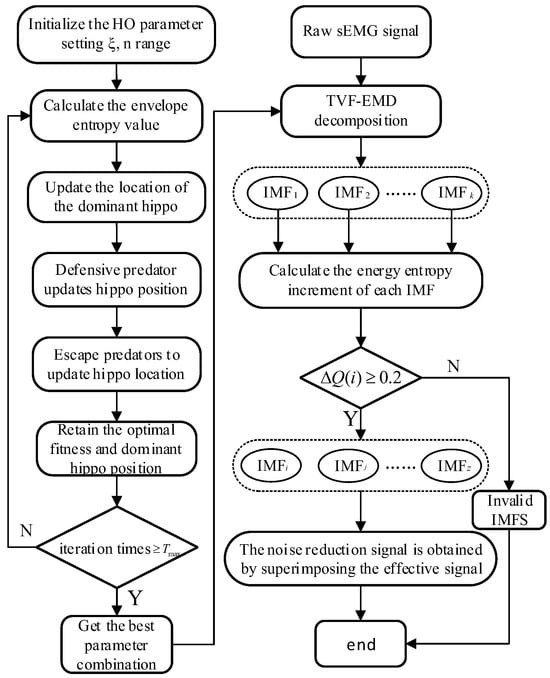
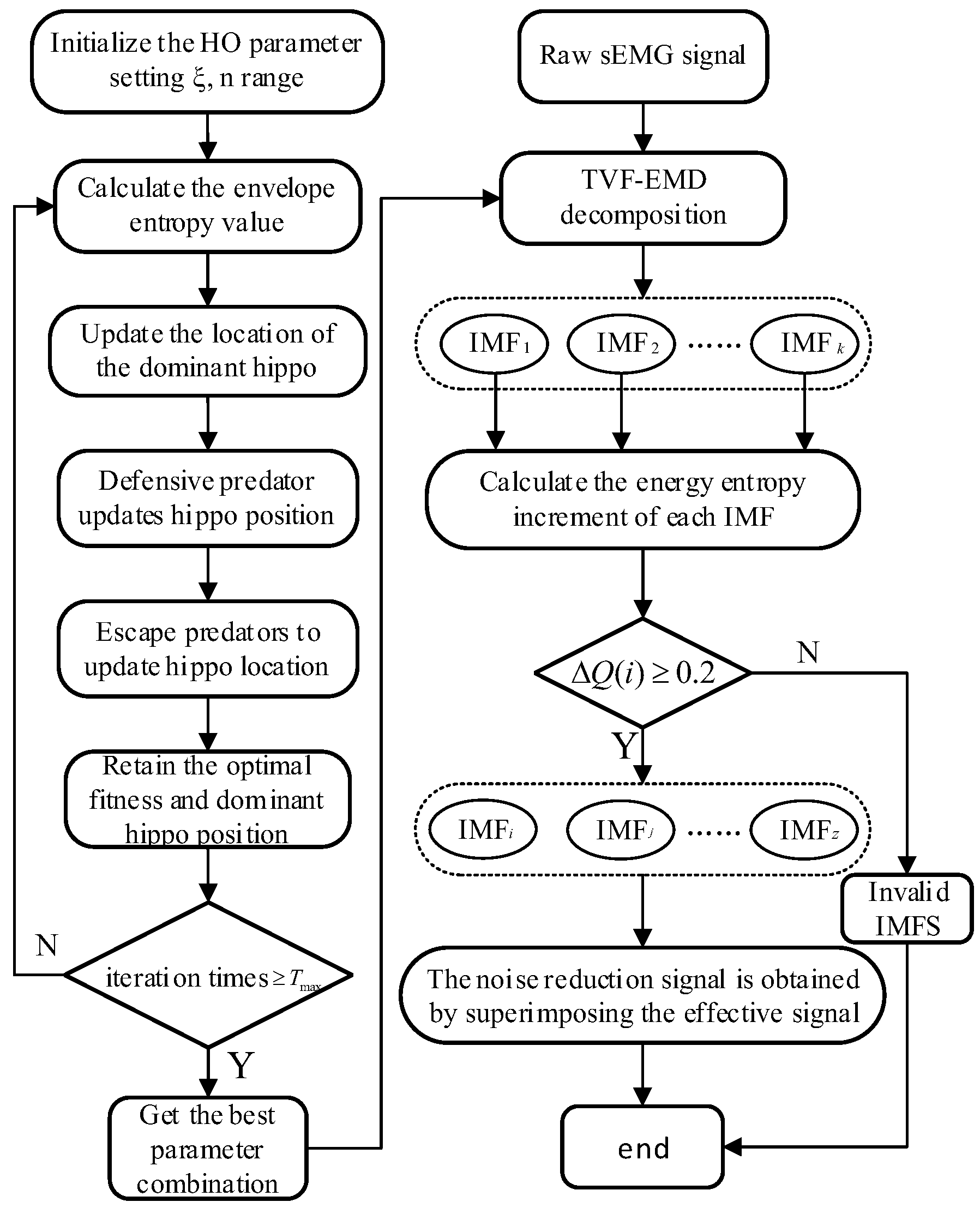
In this paper, HO is used to optimize the key parameters of TVF-EMD, and the minimum envelope entropy minEe is selected as the fitness function to determine the optimal parameter combination [ξ,n]. The effective mode and noisy mode are identified by the IMF energy entropy increment, and the surface EMG signal denoising method based on HO-TVF-EMD and IMF energy entropy increment is established. The overall HO-TVF-EMD–IMF energy entropy increment denoising process is illustrated in Figure 1. The specific steps are summarized as follows:
Figure 1.
HO-TVF-EMD-IMF energy entropy incremental denoising process.
(1) Input the original sEMG signal and initialize the HO population size, maximum iteration number, and the search ranges of the TVF-EMD parameters ξ and n.
(2) The HO algorithm is used to adaptively optimize the TVF-EMD parameters. The envelope entropy is used as the fitness value. The size of the envelope entropy corresponding to the parameter combination is obtained by comparing and calculating each iteration, and the parameter combination corresponding to the minimum envelope entropy is found [ξ,n].
(3) Based on the optimal bandwidth threshold ξ and B-spline order n, the original EMG signal is decomposed by TVF-EMD to obtain several IMF components.
(4) The effective mode and noise mode of the IMF components are identified, and the energy entropy increment of each IMF is calculated. The false IMF components with ∆Q(i) < 0.2 are eliminated.
(5) The filtered effective IMF components are reconstructed to obtain the sEMG signal after noise reduction.
3. Results and Discussion
3.1. Signal Acquisition
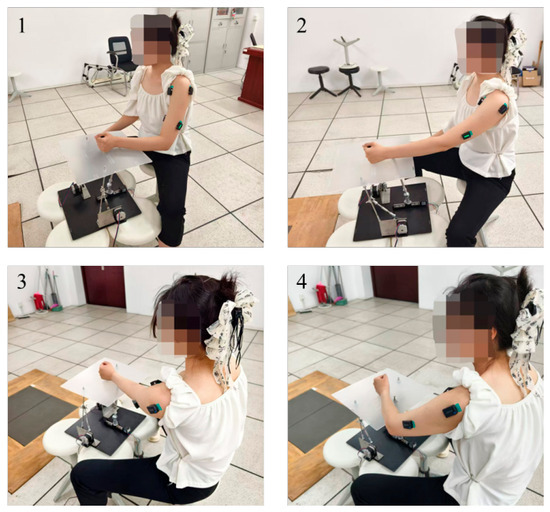
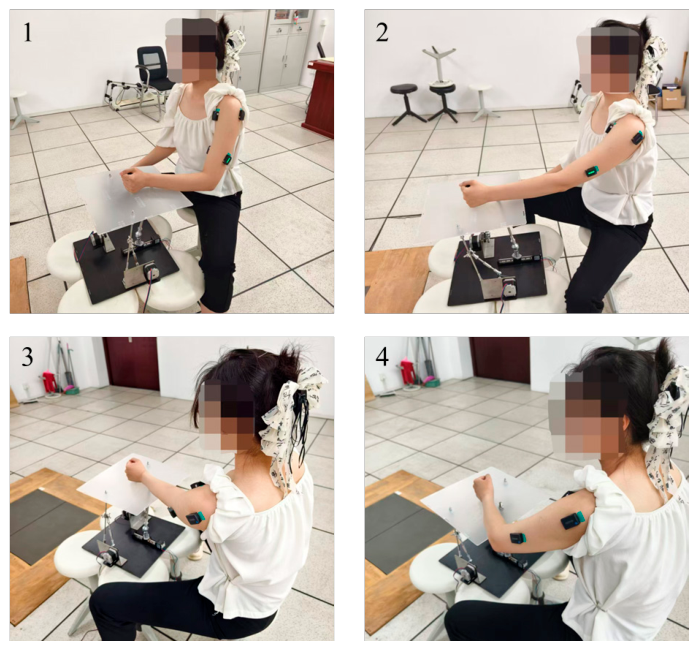
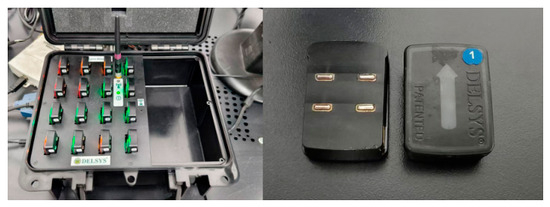
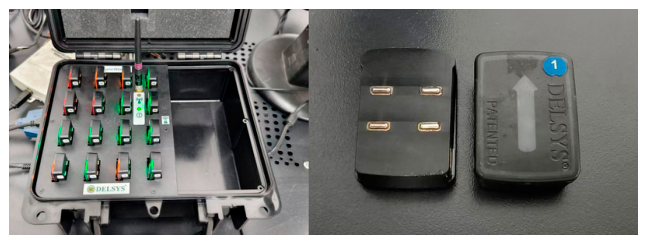
To obtain sEMG signals for upper-limb rehabilitation motion analysis and to provide data support for subsequent noise reduction algorithm validation and motion recognition research, the existing 2UU-PSU upper-limb rehabilitation device in our laboratory was used to guide participants in performing representative upper-limb rehabilitation movements [19]. Six healthy participants (four males and two females, aged 22–26) with no history of muscle damage were recruited. The experiment was conducted under controlled laboratory conditions and was intended to provide a healthy-subject validation of the feasibility and denoising performance of the proposed method. Four movements were recorded: elbow flexion, elbow extension, shoulder flexion, and circular shoulder motion (Figure 2). The sEMG signals were acquired using the TRIGNO™ Wireless System Delsys (Natick, MA, USA), as shown in Figure 3. The sampling frequency is set to 1250 Hz, and the sEMG sensor is attached to the biceps brachii, triceps brachii and deltoid anterior and posterior bundles. Before the experiment, alcohol-soaked cotton was used to clean and disinfect the target muscle and remove the hair, and the electromyography sensor was attached to the belly of the muscle to be tested. During the experiment, each participant performed each of the four movements for 10 repeated trials, with each trial lasting 5 s. Therefore, a total of 240 movement trials were collected from the six participants (six participants × four movements × 10 trials). A rest interval of 3–5 min was provided between consecutive movements to minimize the influence of muscle fatigue.
Figure 2.
Signal acquisition action.
Figure 3.
Signal acquisition equipment.
3.2. Noise Reduction
By comparing the waveforms of the collected signals, a group of signals with obvious noise interference in the four actions is selected for noise reduction analysis. According to the denoising process in Section 2, the parameters of the Hippo Optimization algorithm, the bandwidth threshold ξ, and the range of B-spline order n are set in references [19,20,21], as shown in Table 1. In order to verify the parameter optimization effect of HO on TVF-EMD, in addition to comparing classical algorithms such as the gray wolf optimizer (GWO) and whale optimization algorithm (WOA), this paper also selects improved optimization algorithms proposed in recent years to compare with the new algorithm. It includes: improved sparrow search algorithm (ISSA) [8], improved locust optimization algorithm (IGOA) [15], and slime mold algorithm (SMA) [22]. The parameters of each algorithm are the same as those of the Hippo Optimization algorithm.
Table 1.
Parameter settings of the Hippo Optimization algorithm.
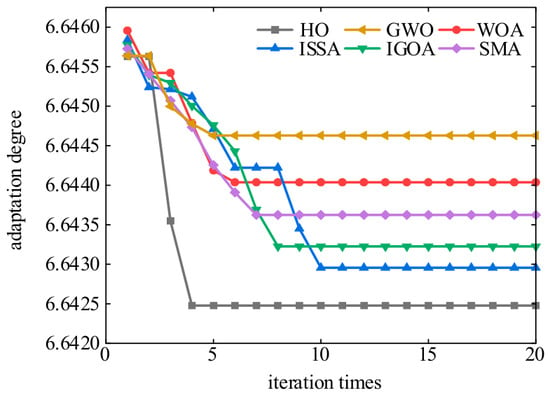
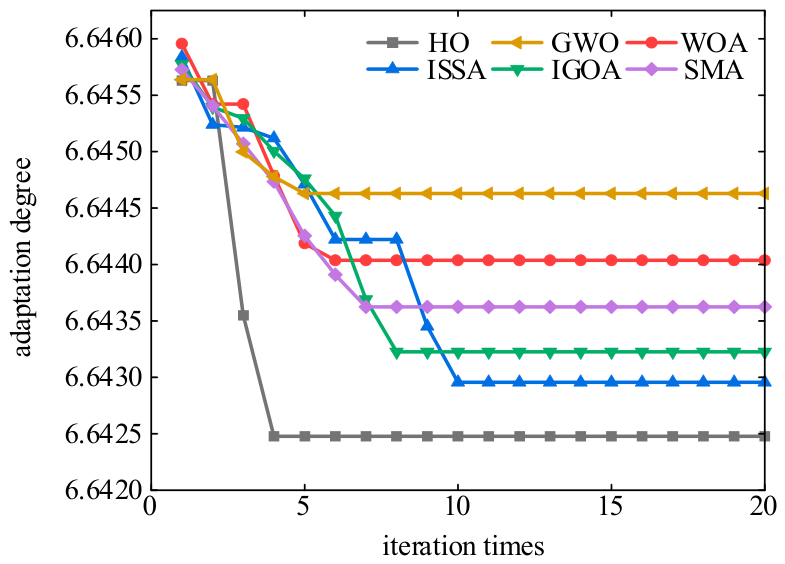
The fitness value curve of each algorithm is shown in Figure 4. From the graph, it can be seen that compared with the Hippo Optimization algorithm, other optimization algorithms need more iterations to reach the convergence state. Among them, GWO and WOA converge after five and six iterations respectively. The fitness value of the ISSA is lower than that of IGOA and SMA, but it converges after many iterations. Compared with other optimization algorithms, the HO algorithm has faster convergence and a lower fitness value, which is significantly better than the latest algorithms such as IGOA, ISSA and SMA, reflecting its fast convergence and superior global optimization ability in parameter optimization.
Figure 4.
Convergence performance comparison diagram.
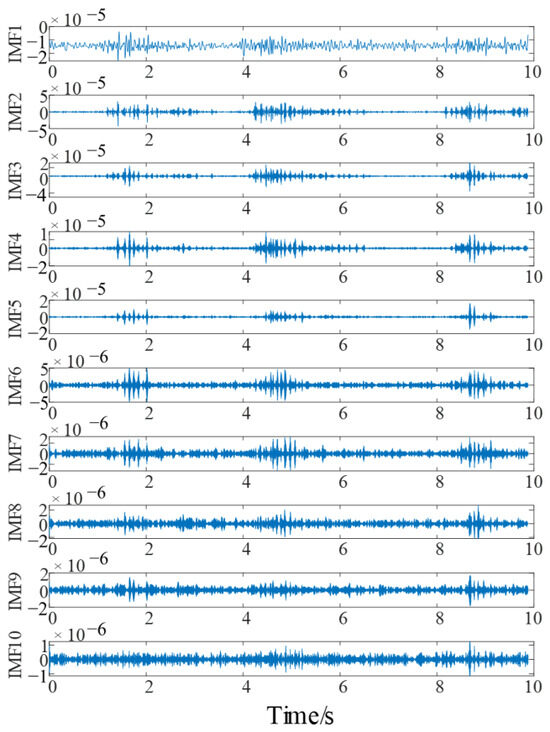
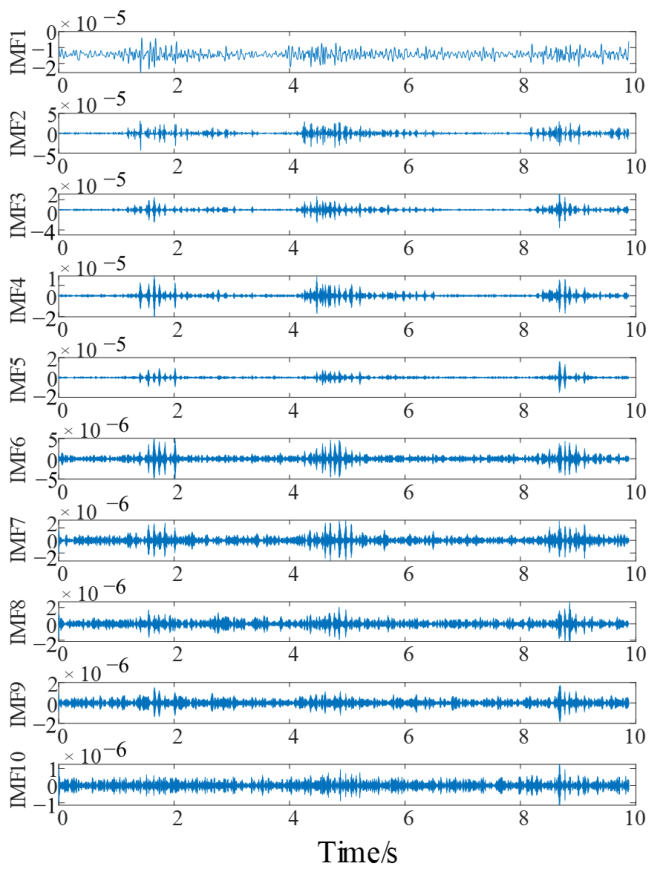
HO optimizes the optimal parameter combination ξ = 0.14, n = 5, and the fitness value is 6.6422 obtained by TVF-EMD iteration. The ξ, n are used in TVF-EMD for decomposition to obtain 10 IMFs, as shown in Figure 5.
Figure 5.
IMF decomposition diagram.
It can be seen from Figure 5 that IMF1 ~ IMF3 are greatly disturbed by noise. In order to determine whether the decomposed IMFs contain the main information of the original sEMG signal, Formula (13) is used to calculate the energy entropy increment of each IMF ∆Q(i). At the same time, the noise reduction effect of this method is verified for the system, and it is compared with various algorithms. The original signal is decomposed by VMD, the TVF-EMD algorithm, and three algorithms based on IGOA, ISSA and SMA-optimized TVF-EMD parameters respectively; the energy entropy increment value of each IMF is calculated and decomposed, and the waveforms after noise reduction by different methods are compared. The decomposition mode k and penalty factor α of VMD are set to 3 and 2000, respectively [23]. The bandwidth threshold ξ and B-spline order n of TVF-EMD are set to 0.1 and 28 [24]; the other three optimization algorithms have the same parameter optimization range as the HO algorithm. The IMF energy entropy increment ∆Q(i) obtained by the six methods is shown in Table 2.
Table 2.
IMF energy entropy increment results.
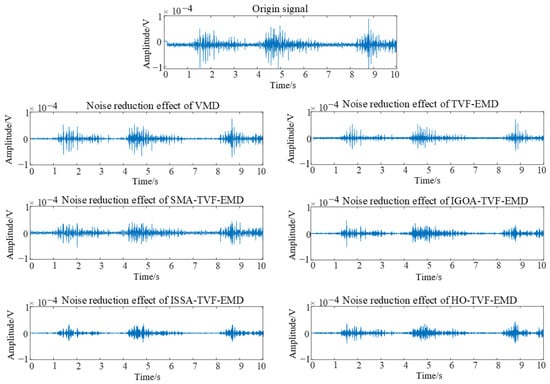
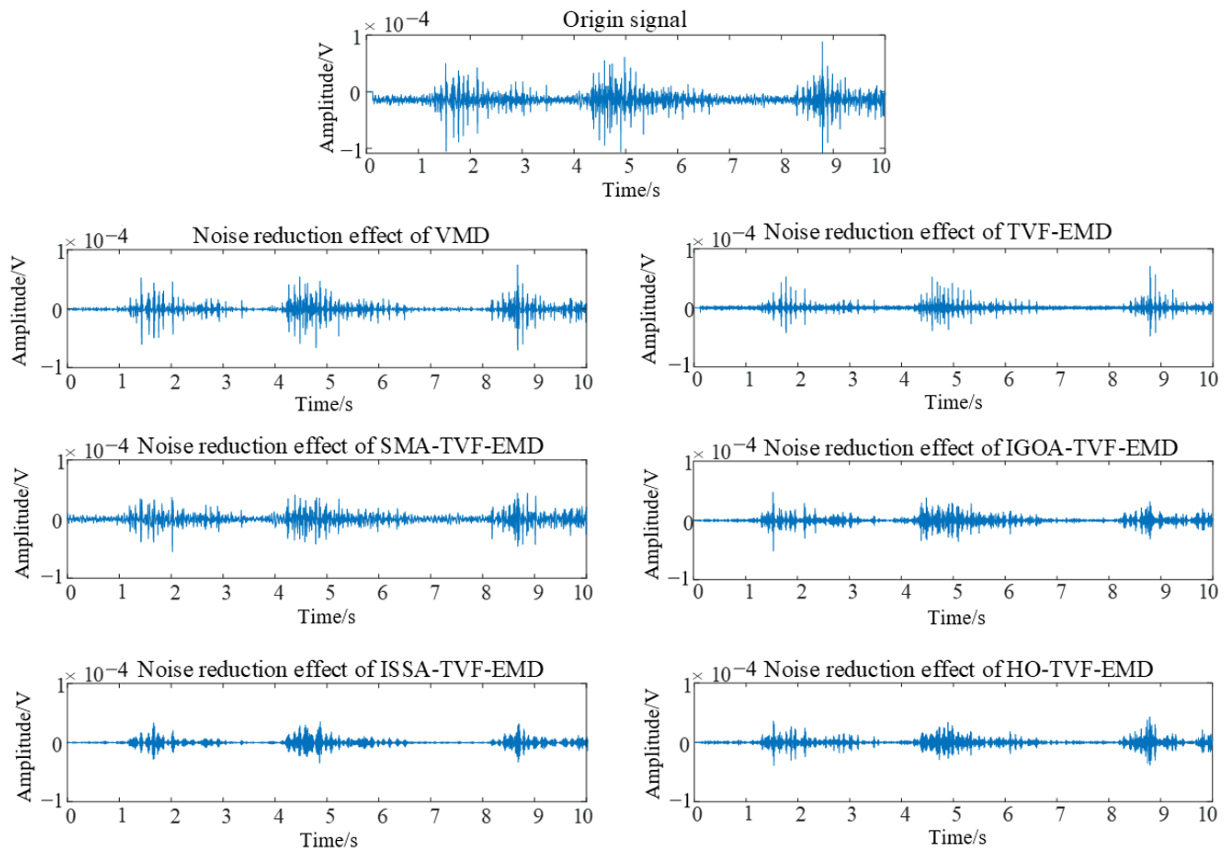
As shown in Table 2, the energy entropy increments ∆Q(i) for IMF5 through IMF8 obtained by HO-TVF-EMD are 0.4062, 0.5217, 0.4919, and 0.2328, respectively, all exceeding the threshold of 0.2. This result indicates that these four components represent the dominant, true signal components, whereas the remaining components are identified as false. Similarly, the true components identified by VMD are IMF3–IMF6, while those identified by TVF-EMD are IMF6–IMF8. For other optimized TVF-EMD methods, the effective component screening results are as follows: both IGOA-TVF-EMD and ISSA-TVF-EMD yield IMF5–IMF8 as true components, whereas SMA-TVF-EMD identifies IMF4–IMF8 as true components. According to the discrimination criterion, IMF components with ∆Q(i) values exceeding the threshold are retained as true signal components, whereas those below the threshold are discarded as noise. The true components identified by the six decomposition methods are then reconstructed to obtain the denoised signals. Figure 6 shows a waveform comparison of the denoised signals reconstructed from the dominant components.
Figure 6.
Comparison of noise reduction waveforms of six algorithms for the deltoid anterior bundle.
By observing Figure 6, it can be seen that the original signal has obvious noise interference. After the noise reduction in the algorithm in this paper, interference such as baseline drift is obviously suppressed. The signal information after noise reduction is relatively complete; most of the noise is removed, and the waveform is not distorted. At the same time, the burr is effectively eliminated, and the waveform of the signal is smoother. Compared to other denoising methods, although the noise has been removed, the waveform after noise reduction is slightly rough, indicating that the signal is lost or damaged during the filtering process.
3.3. Performance Analysis of the Algorithm
3.3.1. Noise Reduction Performance Analysis
To comparatively evaluate the denoising performance of the proposed method, five representative methods were selected as benchmarks, including VMD, conventional TVF-EMD, IGOA-TVF-EMD, ISSA-TVF-EMD, and SMA-TVF-EMD. Among these methods, VMD was selected as a representative adaptive decomposition approach, while conventional TVF-EMD was included to evaluate the effect of introducing adaptive parameter optimization. IGOA-TVF-EMD, ISSA-TVF-EMD, and SMA-TVF-EMD employ the same TVF-EMD framework as the proposed method but adopt different metaheuristic optimization strategies for parameter selection. Therefore, these methods provide a direct comparison of the influence of different optimization strategies on the denoising performance of the TVF-EMD framework. All methods were evaluated using the same experimental sEMG datasets and identical performance metrics. The signal-to-noise ratio (SNR) and root mean square error (RMSE) are introduced as evaluation indicators to calculate the mean value of the same muscle of each subject. The system verifies the universality of the proposed method [17].
where x(i) represents the original signal; f′(i) represents the denoised signal; N represents the signal length. SNR represents the relationship between the original and denoised signals. The larger the SNR and the smaller the RMSE, the better the denoising effect.
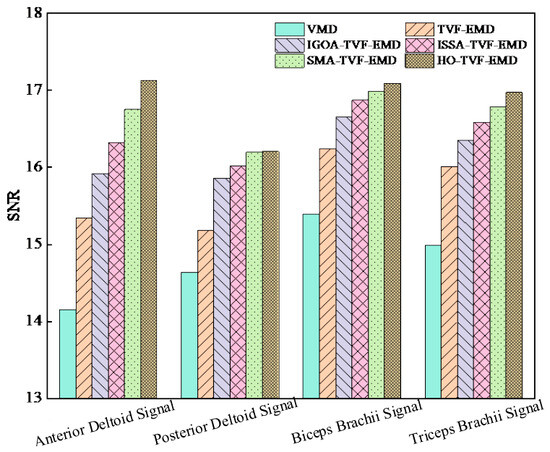
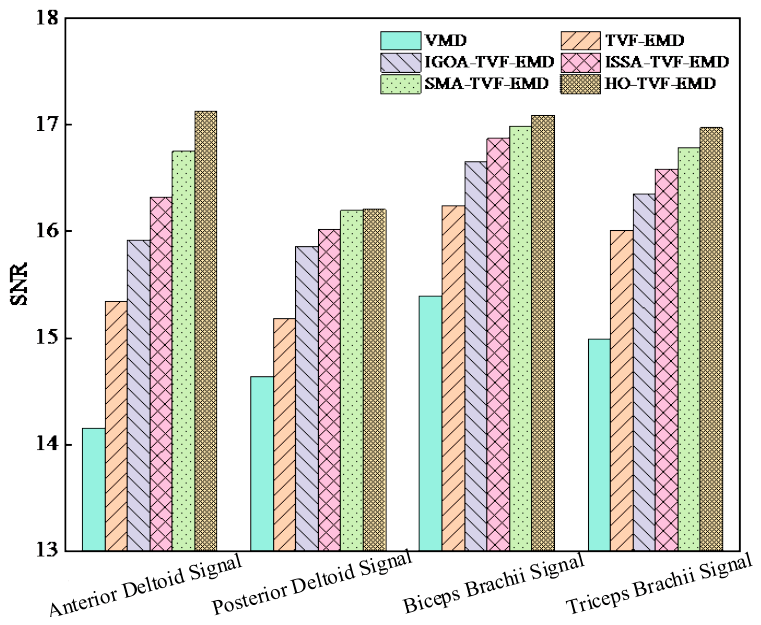
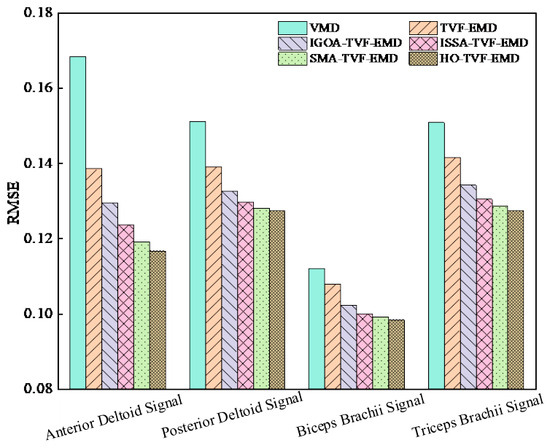
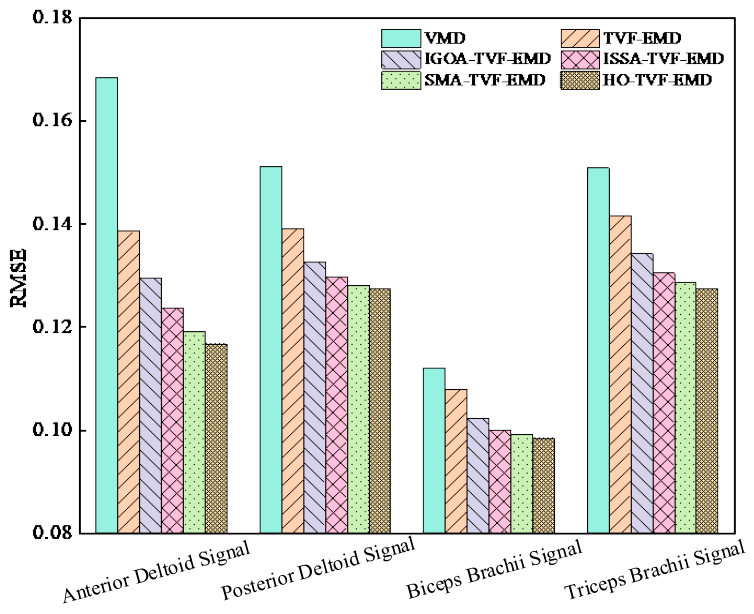
The denoising results of each method are shown in Figure 7 and Figure 8 and Table 3. Figure 7 and Figure 8 show the comparison of different methods on various muscle signals. Table 3 shows the improvement of HO-TVF-EMD compared with other methods, where R = |y(a) − y(x)|/y(x) × 100%, y(a) is the SNR and RMSE calculated by HO-TVF-EMD, and y(x) is the SNR and RMSE obtained by the other two algorithms.
Figure 7.
Comparison of SNR across different methods for various muscle signals.
Figure 8.
Comparison of RMSE across different methods for various muscle signals.
Table 3.
The change range of HO-TVF-EMD relative to different algorithm indices.
As shown in Figure 7 and Figure 8 and Table 3, the average SNR values achieved after applying the HO-TVF-EMD method to denoise the raw sEMG signals reached 17.1275, 16.2078, 17.0879, and 16.9731, respectively. The corresponding average RMSE values were reduced to 0.1167, 0.1274, 0.0984, and 0.1274, representing the best performance among the evaluated methods. Under the experimental conditions considered in this study, the HO-TVF-EMD method achieved an average 7.48% improvement in SNR and a 7.08% reduction in RMSE compared with VMD, TVF-EMD, and intelligent optimization-based TVF-EMD variants. Among the six evaluated methods, HO-TVF-EMD achieved the highest average SNR and the lowest average RMSE. In particular, comparisons with IGOA-TVF-EMD, ISSA-TVF-EMD, and SMA-TVF-EMD suggest that different parameter optimization strategies can influence the denoising performance of the TVF-EMD framework. These results indicate that HO can effectively optimize the key parameters of TVF-EMD for the present sEMG denoising application, thereby improving signal quality and providing a more reliable basis for subsequent signal analysis and motion recognition.
3.3.2. Classification Performance Analysis Based on Support Vector Machine (SVM)
To further evaluate whether the improvement in sEMG signal quality after denoising could enhance the separability of different upper-limb movements, a support vector machine (SVM) classifier was employed as an auxiliary evaluation tool. Signal-related features were extracted from the sEMG signals of the four upper-limb movements for classification. The classification performance obtained after different denoising methods was compared to evaluate the influence of signal denoising quality on subsequent motion recognition.
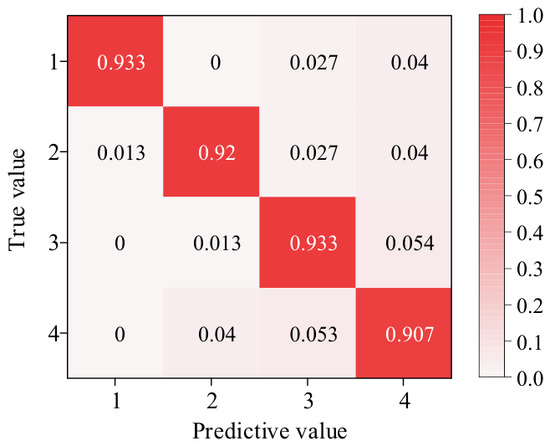
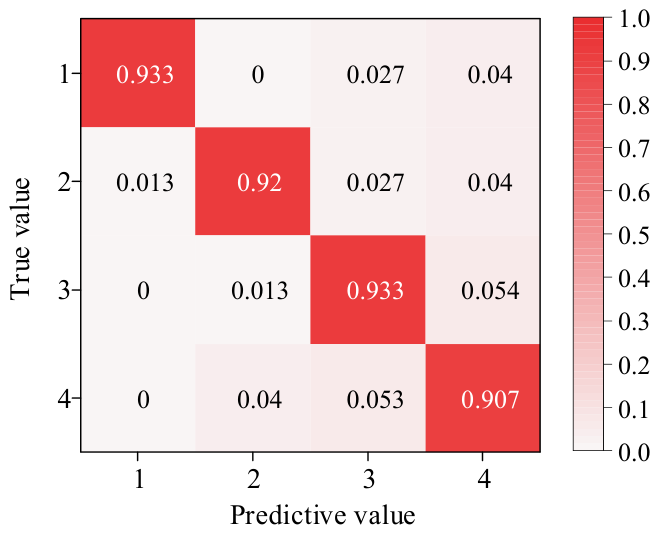
The above three noise reduction methods are used to denoise the collected sEMG signal, extract the time domain and frequency domain features, and fuse the features to construct the feature vector [25]. A total of 75% of the sample data were randomly selected as the training set, and 25% of the sample data were used as the test set, which were input into the SVM model for training and testing. The average value of 10 recognition results for each subject was used as the evaluation result, and the classification result of the test set was expressed by the confusion matrix [26]. Figure 7 is the classification result obtained by HO-TVF-EMD denoising. The accuracy of the four kinds of action recognition is above 90%, and the average recognition rate reaches 92.34%.
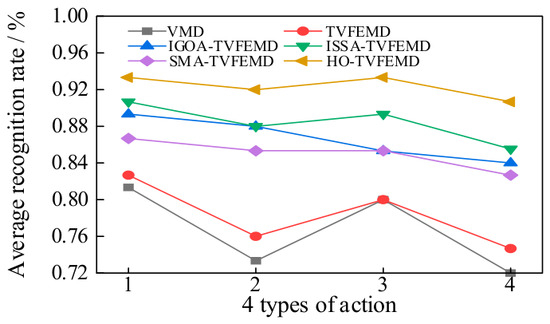
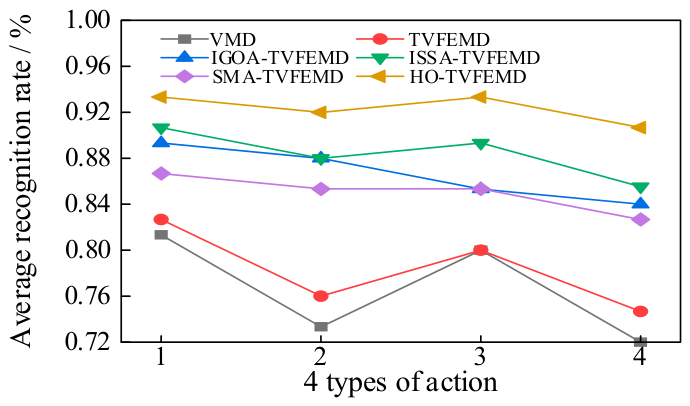
The classification confusion matrix is shown in Figure 9. The recognition rate of different noise reduction methods for the four types of actions is shown in Figure 10, and the average recognition rate is shown in Table 4. It can be seen from the chart that various noise reduction methods have similar trends in the recognition accuracy of each action. Among them, the average recognition rate of the HO-TVF-EMD noise reduction method proposed in this paper is the highest, reaching 92.34%. Compared with the noise reduction methods such as VMD, TVF-EMD, IGOA-TVF-EMD, ISSA-TVF-EMD and SMA-TVF-EMD, the average recognition rates are increased by 15.67%, 14.00%, 5.67%, 4.01% and 7.34%, respectively. The results fully show that the proposed method has a better noise reduction effect, can effectively remove noise interference, improve the accuracy of subsequent action classification, verify the effectiveness and reliability of the noise reduction algorithm, and provide technical means for the precise control of rehabilitation institutions.
Figure 9.
SVM classification result.
Figure 10.
The average recognition rate of 4 action types.
Table 4.
The average recognition accuracy of different noise reduction methods.
4. Conclusions
(1) A noise reduction framework for sEMG signals based on HO-TVF-EMD and IMF energy entropy increment is proposed. The bandwidth threshold ξ and B-spline order n of TVF-EMD are adaptively optimized using the HO algorithm, reducing the dependence on empirical parameter selection. Meanwhile, the IMF energy entropy increment criterion is introduced to distinguish effective signal components from noise-dominated components, thereby establishing an adaptive denoising strategy for nonlinear and nonstationary sEMG signals.
(2) Under the parameter settings and experimental conditions considered in this study, the HO algorithm exhibited faster convergence and lower fitness values compared with GWO, WOA, IGOA, ISSA, and SMA. These results indicate that HO provides an effective optimization strategy for determining the key parameters of TVF-EMD in the investigated sEMG denoising application.
(3) Experimental validation using upper-limb sEMG signals demonstrated that the proposed HO-TVF-EMD method achieved improved denoising performance compared with VMD, conventional TVF-EMD, and other optimized TVF-EMD variants. Specifically, the proposed method achieved an average SNR improvement exceeding 7.48% and an average RMSE reduction exceeding 7.08% compared with the evaluated benchmark methods. Meanwhile, the reconstructed signals exhibited smoother waveforms while preserving the essential characteristics of the original sEMG signals. Furthermore, within the evaluated dataset collected from six healthy participants, the denoised signals achieved the highest motion recognition accuracy among all evaluated methods, reaching 92.34%. These results demonstrate that the proposed framework can effectively improve sEMG signal quality and enhance subsequent motion recognition performance under the investigated experimental conditions.
(4) The proposed framework provides an adaptive strategy for improving sEMG signal processing and motion recognition performance, showing potential for future sEMG-based rehabilitation studies and related biomedical signal analysis applications. However, the current validation is limited to controlled experimental conditions, and further investigations are required to assess its robustness and generalizability in more diverse scenarios.
The present study has several limitations. First, the experimental validation was conducted using sEMG data acquired from a limited number of healthy participants under controlled laboratory conditions with a single acquisition system. Although repeated trials were performed for each movement, the limited diversity of participants and acquisition conditions may influence the generalizability of the obtained recognition results. Therefore, the current findings should be interpreted within the scope of the evaluated dataset. Second, multicenter validation, cross-device evaluation, heterogeneous patient populations, and cross-database testing were not performed. Future studies will further validate the proposed framework using larger and more diverse sEMG datasets, including signals acquired from different devices, sampling frequencies, experimental protocols, and participants with diverse neuromuscular conditions.
Furthermore, future research will investigate the robustness of the proposed method under diverse acquisition conditions, including different noise levels, electrode displacement, motion artifacts, and realistic rehabilitation scenarios. Cross-dataset validation, statistical analysis, computational optimization, and comparison with emerging learning-based denoising approaches will also be considered to further evaluate the stability and generalizability of the proposed framework. Moreover, the applicability of HO-TVF-EMD to other muscle groups and biomedical signal modalities requires further investigation. Future work will also investigate the integration of the proposed framework into complete closed-loop myoelectric systems to further evaluate its potential for future rehabilitation-oriented applications.
Author Contributions
Conceptualization, X.S.; methodology, X.S.; software, X.S.; validation, X.S., L.C., B.C. and W.W.; formal analysis, X.S.; investigation, X.S. and L.C.; resources, B.C. and W.W.; data curation, X.S.; writing—original draft preparation, X.S.; writing—review and editing, L.C., B.C. and W.W.; visualization, X.S.; supervision, B.C.; project administration, B.C.; funding acquisition, B.C. All authors have read and agreed to the published version of the manuscript.
Funding
Hebei province graduate student demonstration class ‘robotics technology’ (KCJSX2025058); North China University of Science and Technology Unveiled Project (ZD-YG-JBGS202513); key research project of North China University of Science and Technology (ZD-YG-202306).
Data Availability Statement
The raw data supporting the conclusions of this article will be made available by the authors, without undue reservation.
Conflicts of Interest
The authors declare no conflicts of interest.
References
- Zhang, M.L.; Ouyang, R.Z.; Guo, L.Q.; Xiong, D.X. Research on an Upper Limb Rehabilitation Robot andits Application in Rehabilitation Evaluation. Mach. Des. Manuf. 2025, 338–342+349. [Google Scholar]
- Huo, H.; Wang, Q.; Zhou, S.; Cui, L. The application of personalized rehabilitation exercises in the postoperative rehabilitation of breast cancer patients. Ann. Palliat. Med. 2021, 10, 4486–4492. [Google Scholar] [CrossRef] [Scilit] [PubMed]
- Li, J.N.; Wang, Y.F. Noise reduction processing of surface electromyography signal. Transducer Microsyst. Technol. 2017, 36, 42–44+49. [Google Scholar]
- Ahmed, A.F. A quick survey of filtering techniques for surface electromyography signals. Glob. J. Eng. Technol. Adv. 2022, 11, 105–110. [Google Scholar] [CrossRef] [Scilit]
- Karan, V. Wavelet transform-based classification of electromyogram signals using an ANOVA technique. Neurophysiology 2015, 47, 302–309. [Google Scholar] [CrossRef] [Scilit]
- Koppolu, P.K.; Chemmangat, K. Automatic selection of IMFs to denoise the sEMG signals using EMD. J. Electromyogr. Kinesiol. 2023, 73, 102834. [Google Scholar] [CrossRef] [Scilit] [PubMed]
- Dragomiretskiy, K.; Zosso, D. Variational Mode Decomposition. IEEE Trans. Signal Process. 2014, 62, 531–544. [Google Scholar] [CrossRef] [Scilit]
- Wu, T.; Cai, H.; Liang, J.K.; Xu, Y.; Huang, M.T.; Wang, N.J. Research of noise reduction about sEMG signal based on ISSA-VMD andsecond generation wavelet. Electron. Meas. Technol. 2023, 46, 93–100. [Google Scholar]
- Machado, J.; Machado, A.; Balbinot, A. Deep learning for surface electromyography artifact contamination type detection. Biomed. Signal Process. Control 2021, 68, 102752. [Google Scholar] [CrossRef] [Scilit]
- Chowdhury, R.H.; Reaz, M.B.I.; Ali, M.A.B.M.; Bakar, A.A.; Chellappan, K.; Chang, T.G. Surface electromyography signal processing and classification techniques. Sensors 2013, 13, 12431–12466. [Google Scholar] [CrossRef] [Scilit] [PubMed]
- Li, H.; Li, Z.; Mo, W. A time varying filter approach for empirical mode decomposition. Signal Process. 2017, 138, 146–158. [Google Scholar] [CrossRef] [Scilit]
- Xu, Y.; Cai, Z.; Cai, X.; Ding, K. An enhanced multipoint optimal minimum entropy deconvolution approach for bearing fault detection of spur gearbox. J. Mech. Sci. Technol. 2019, 33, 2573–2586. [Google Scholar] [CrossRef] [Scilit]
- Khan, S.B.; Balajee, A.; Shah, S.S.M.; Mahesh, T.R.; Alojail, M.; Gupta, I. A Novel Ensemble Empirical Decomposition and Time–Frequency Analysis Approach for Vibroarthrographic Signal Processing. Circuits Syst. Signal Process. 2025, 45, 512–534. [Google Scholar] [CrossRef] [Scilit]
- Zhou, C.; Xiong, Z.; Bai, H.; Xing, L.; Jia, Y.; Yuan, X. Parameter-Adaptive TVF-EMD Feature Extraction Method Based on Improved GOA. Sensors 2022, 22, 7195. [Google Scholar] [CrossRef] [Scilit] [PubMed]
- Yu, M.; Yuan, H.; Li, K.; Deng, L. Noise cancellation method based on TVF-EMD with bayesian parameter optimization. Algorithms 2023, 16, 296. [Google Scholar] [CrossRef] [Scilit]
- Amiri, M.H.; Mehrabi Hashjin, N.; Montazeri, M.; Mirjalili, S.; Khodadadi, N. Hippopotamus optimization algorithm: A novel nature-inspired optimization algorithm. Sci. Rep. 2024, 14, 5032. [Google Scholar] [CrossRef] [Scilit] [PubMed]
- Zhou, X.L.; Xu, X.L.; Wang, Y.; Liu, W.N.; Jiang, Z.H.; Ma, F.L. A gear signal de-noising method based on variational mode decomposition andmaximal overlap discrete wavelet packet transform. J. Vib. Shock 2021, 40, 265–274+289. [Google Scholar]
- Sun, G.; Wang, Y.; Sun, C.; Jin, Q. Intelligent Detection of a Planetary Gearbox Composite Fault Based on Adaptive Separation and Deep Learning. Sensors 2019, 19, 5222. [Google Scholar] [CrossRef] [Scilit] [PubMed]
- Cui, B.Y.; Li, W.J.; An, F.X.; Shang, L.; Wu, W.Y.; Du, Y.L.; Gui, X.G. Kinematics and dynamics of 2UU-PSU upper limbrehabilitation mechanism. Opt. Precis. Eng. 2025, 33, 884–894. [Google Scholar] [CrossRef] [Scilit]
- Zhang, L.Y.; Lu, K.T.; Jiang, H.Y.; Wang, Y.P. Research on Signal Decomposition and Reconstruction Methodof Rotor-Bearing System based on WOA-VMD. J. Eng. Therm. Energy Power 2025, 40, 158–166. [Google Scholar]
- Zhang, X.; Liu, Z.; Miao, Q.; Wang, L. An optimized time varying filtering based empirical mode decomposition method with grey wolf optimizer for machinery fault diagnosis. J. Sound Vib. 2018, 418, 55–78. [Google Scholar] [CrossRef] [Scilit]
- Wei, X.; Feng, G.; Qi, T.; Li, Z.; Zhao, D.; Li, Z. Reduce the noise of transient electromagnetic signal based on the method of SMA-VMD-WTD. IEEE Sens. J. 2022, 22, 14959–14969. [Google Scholar] [CrossRef] [Scilit]
- Shi, D.J.; Wang, W.B. Bearing Fault Feature Extraction Based on Improved TVF-EMD and SVD. Mach. Tool. Hydraul. 2024, 52, 218–229. [Google Scholar]
- Tang, G.J.; Zhou, C.; Pang, B.; Li, N.N. Parameter optimized time-varying filter based empirical mode decomposition methodfor the fault diagnosis of rotors. J. Vib. Shock 2019, 38, 162–168. [Google Scholar]
- Cui, B.Y.; Zhang, X.; Deng, J. Research on lower limb motion pattern recognition by sEMG signals based on GA-BP. Transducer Microsyst. Technol. 2024, 43, 63–67. [Google Scholar]
- Cai, S.; Chen, Y.; Huang, S.; Wu, Y.; Zheng, H.; Li, X.; Xie, L. SVM-based classification of sEMG signals for upper-limb self-rehabilitation training. Front. Neurorobot. 2019, 13, 31. [Google Scholar] [CrossRef] [Scilit] [PubMed]

Disclaimer/Publisher’s Note: The statements, opinions and data contained in all publications are solely those of the individual author(s) and contributor(s) and not of MDPI and/or the editor(s). MDPI and/or the editor(s) disclaim responsibility for any injury to people or property resulting from any ideas, methods, instructions or products referred to in the content. |
© 2026 by the authors. Licensee MDPI, Basel, Switzerland. This article is an open access article distributed under the terms and conditions of the Creative Commons Attribution (CC BY) license.