


Featured Application
This mapping review describes where and how generative artificial intelligence has been studied within rehabilitation pathways, while distinguishing current evidence from proposed future applications.
Abstract
Background: Generative artificial intelligence (GenAI) is rapidly entering rehabilitation, but the maturity and functional distribution of the evidence remain unclear. Methods: We conducted a mapping review reported in accordance with PRISMA-ScR as applicable. PubMed and Scopus were searched using controlled vocabulary and free-text terms for GenAI, large language models, and rehabilitation. After deduplication, the records were manually screened by title and abstract, and full texts were consulted for uncertainty. Results: Of 1313 unique records, 233 met the eligibility criteria. Publications appeared from 2023 to 2026. Multi-label coding identified rehabilitation clinical and workflow support in 106/233 records (45%), patient-level rehabilitation intervention or functional assistance in 64/233 (27%), rehabilitation professional education in 56/233 (24%), and patient or caregiver education within rehabilitation in 45/233 (19%). Twenty-eight records (12%) addressed more than one application. Model/output evaluation or technical development predominated (155/233; 67%), whereas 13/233 records (6%) were interventional or feasibility studies. Conclusions: GenAI research in rehabilitation has expanded rapidly, but its most frequent use is clinician-facing support rather than direct patient-level intervention. The evidence remains dominated by technical, simulated, and observational evaluations, with limited clinical experimentation. Future research should prioritize prospective patient-level evaluation, transparent model reporting, safety, and human oversight.
1. Introduction
Generative artificial intelligence (GenAI) differs from conventional predictive or classificatory artificial intelligence (AI) because it produces new content, including text or images, and even code and multimodal outputs [1,2,3,4]. Large language models (LLMs) have made these capabilities directly accessible to clinicians, researchers, and patients. In health care, different proposals and uses are emerging: summarization of clinical information, generation of educational material, and individualized management suggestions. These capabilities are accompanied by important risks, including hallucination, as well as unstable performance across model versions, privacy concerns, and uncertain professional responsibility [2,5,6,7,8,9,10].
In this context, rehabilitation is a particularly relevant setting because it is multidisciplinary and focused on functioning rather than diagnosis alone [11,12]. Hence, rehabilitation can obtain numerous advantages through the application of LLMs. In particular, rehabilitative decisions integrate clinical findings and patient-reported outcomes, but also environmental context and the preferences of patients and caregivers [13,14,15]. GenAI may contribute to assessment and rehabilitation planning, actively evaluating the aforementioned variables within a rehabilitation pathway [16,17,18,19,20,21,22,23,24,25,26,27,28].
The extensive growth of literature on GenAI in medicine makes it difficult to interpret its structural landscape. Existing studies describe a heterogeneous array of applications and evaluation methods [18,19,20,21,22,23,24,25,26,27,28]; however, analyses of model performance are often conflated with educational uses or direct patient interventions within the same conceptual framework.
This terminological fragmentation obscures the true scope of research aimed at direct clinical delivery, masking both the frequency of overlapping applications and the extent to which evidence has advanced beyond mere technical validation. A structured mapping is therefore required to distinguish the volume of publications from their actual translational maturity and to identify less developed areas.
Consequently, this review aims to outline the architecture of GenAI in rehabilitation by analyzing its evolution over time and the maturity of the evidence base. The study examines four integrated functional domains: direct patient care, clinical workflow support, professional training, and patient/caregiver education. Furthermore, it explores their intersections and distribution across various methodological levels. The primary objective is to characterize the sector’s translational gaps, without attempting to estimate cumulative efficacy.
2. Materials and Methods
This study was conducted as a systematic mapping review, defined here as a descriptive evidence synthesis that classifies the characteristics and distribution of a heterogeneous literature rather than estimating a pooled intervention effect. The review question was: what types of GenAI applications, evidence, and rehabilitation functions have been reported in the scientific literature? The conduct and drafting of the work adhered to the PRISMA extension for Scoping Reviews, supplemented by methodological guidelines for evidence synthesis and PRISMA-S recommendations for reporting search strategies. Given the descriptive nature of the mapping, focused on characterizing the field rather than estimating intervention efficacy, no meta-analysis was planned; the protocol was not prospectively registered [29,30,31].
Searches of the PubMed and Scopus databases were performed on 12 September 2026. Since the specific MeSH descriptor for GenAI was introduced only in 2025, the controlled vocabulary was supplemented with free-text terms and references to specific models [32]. The search strategy combined a conceptual block regarding GenAI, encompassing general terminology on language models and publicly available advanced architectures, with a block focused on the rehabilitation domain, extending from general physical medicine to specific medical specialties and physiotherapy. In Scopus, the search covered titles, abstracts, and keywords, whereas in PubMed, free-text terms were combined with the available controlled vocabulary. No time or language filters were applied; the complete search strings for each database are available in Supplementary File S1.
Eligible records were journal articles, systematic or non-systematic reviews, meta-analyses, guidelines, or consensus documents that described or evaluated a modern GenAI or LLM application with a substantive function in rehabilitation. The rehabilitative function was defined as any contribution to the patient’s clinical management, direct care, or educational activities aimed at healthcare professionals or caregivers. Conversely, the mere presence of general health information, or the use of AI in areas unrelated to rehabilitation, such as general diagnostics or pharmacotherapy, was deemed insufficient. Conference proceedings, secondary editorial material, monographs, brief surveys, and corrections were excluded. Similarly, AI studies lacking generative components and works containing only marginal references to the subject matter were discarded. Protocols published in full were retained if the intended function was relevant; no documents were excluded based on language.
Results from the databases were consolidated, and duplicates were removed by comparing identification codes and standardized titles. A final report-level reconciliation was performed before the flow counts were finalized to identify preprints, subsequent journal publications, or other multiple reports of the same study. D.C. performed the primary title, abstract, and selective full-text screening and assigned the initial application and evidence labels. G.R. reviewed uncertain cases and verified the aggregate analyses; disagreements were resolved through discussion. Automated term matching only prioritized records for manual inspection and did not determine eligibility or coding. Screening was not performed independently in duplicate, and an inter-rater agreement statistic was therefore not calculated.
For each included record, we charted source coverage, title, publication year, journal or citation, DOI, PMID, Scopus EID, document type, publication stage, abstract, author and index keywords, rehabilitation application, and evidence maturity. Applications were coded using four non-mutually exclusive categories: (1) rehabilitation clinical and workflow support, including clinician-facing assessment, reasoning, planning, documentation, monitoring, and workflow; (2) patient-level rehabilitation intervention or functional assistance, requiring GenAI to generate, adapt, deliver, or monitor a patient-level intervention or directly compensate a functional limitation; (3) rehabilitation professional education; and (4) patient or caregiver education within a defined rehabilitation pathway. Information provision alone did not qualify as patient-level intervention, and rehabilitation plans generated only for hypothetical cases were coded as clinical and workflow support. Multi-label coding was retained only when a record explicitly demonstrated more than one function.
The complete included corpus underwent a manual classification audit based on the intended recipient and the actual GenAI function. Titles were reviewed for every record; abstracts were examined when titles were insufficient for reliable classification, and full texts were consulted when uncertainty persisted after title and abstract review. Application labels were revised when the additional information changed the interpretation of the GenAI function. The selective consultation involved 25 distinct full texts: four for eligibility and 21 for the coding audit.
To provide a stable evidence architecture despite heterogeneous author terminology, study nature was harmonized into six mutually exclusive categories: model/output evaluation or technical development; observational or qualitative study; interventional or feasibility study; evidence synthesis; conceptual or commentary; and protocol. Classification followed a prespecified hierarchy based on explicit design terminology and the primary object of evaluation: the model, system, or generated output; people, perceptions, or practice; or an actual intervention. These categories describe evidence type and maturity, not methodological quality or risk of bias. Supplementary Table S1 contains all 233 included records and the variables required to reproduce the reported analyses, including year, source coverage, application labels, evidence category, and identified model(s).
All analyses were descriptive in nature, with frequencies and percentages calculated based on the total number of included studies unless otherwise specified. As the application categories allowed for multiple coding, the sum of percentages may exceed the total. Subgroup analyses report the corresponding numerators and denominators, while model-name frequencies were obtained by exact keyword matching in titles, abstracts, and keywords and were treated as mentions rather than mutually exclusive model assignments.
During the review phase, OpenAI Codex (GPT-5; accessed 13 September 2026) was used to assist with language editing, consistency checks, data synthesis, and draft preparation. Automated outputs also helped prioritize records for inspection, without determining eligibility or final classification. The lead author manually verified every title, consulted full texts where necessary, checked counts, and approved the final manuscript. No data were retained based solely on the model-generated output.
3. Results
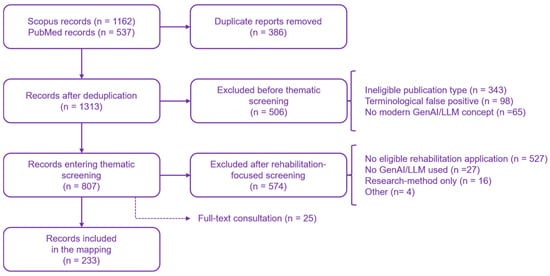
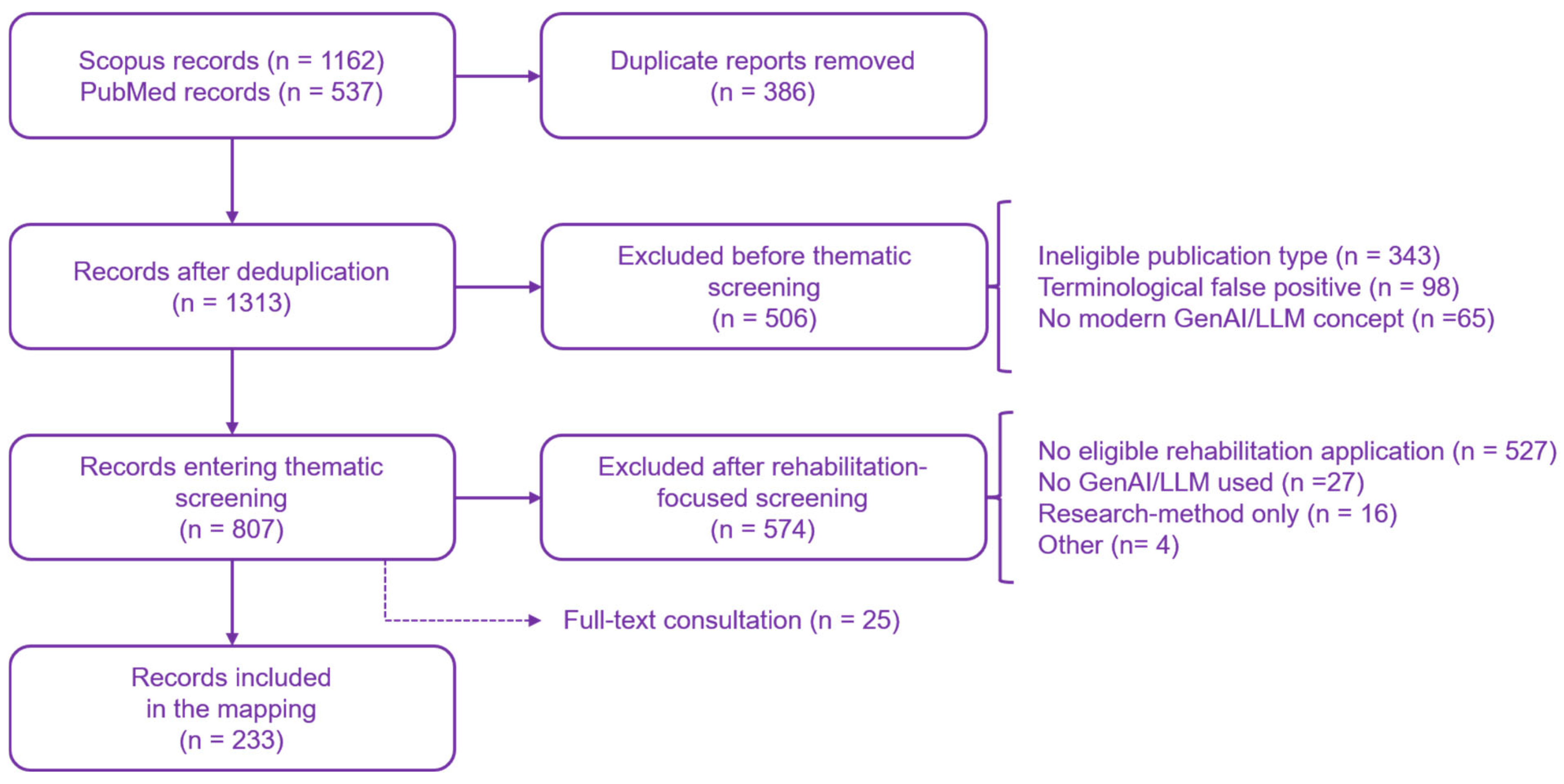
The searches retrieved 1699 records: 1162 from Scopus and 537 from PubMed. Deduplication and final report-level reconciliation removed 386 duplicate reports, leaving 1313 unique records for screening. Preliminary screening excluded 506 records: 343 because of ineligible publication type, 98 because of historical or terminological false-positive retrieval, and 65 because no explicit modern GenAI or LLM concept was identified. The remaining 807 records underwent rehabilitation-focused screening. At this stage, 574 were excluded: 527 because they did not address an eligible rehabilitation application, 27 because GenAI or an LLM was not actually used, 16 because GenAI was used only as a research method, and four for other prespecified reasons, including three decisions based on full-text adjudication. The final mapping corpus comprised 233 records. Full texts were selectively consulted for 25 distinct records: four during eligibility assessment and 21 during the classification audit. All four eligibility cases were retained, and the audit resulted in 20 application-label revisions. Systematic full-text screening was not performed for every record (Figure 1).
Figure 1.
Identification and selection of records.
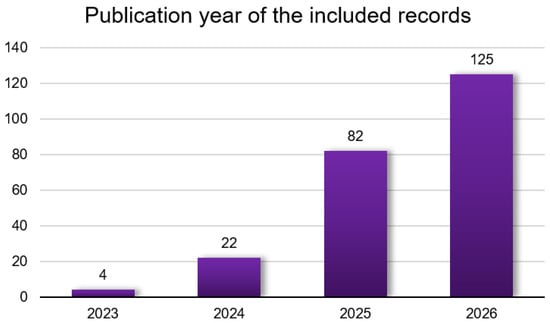
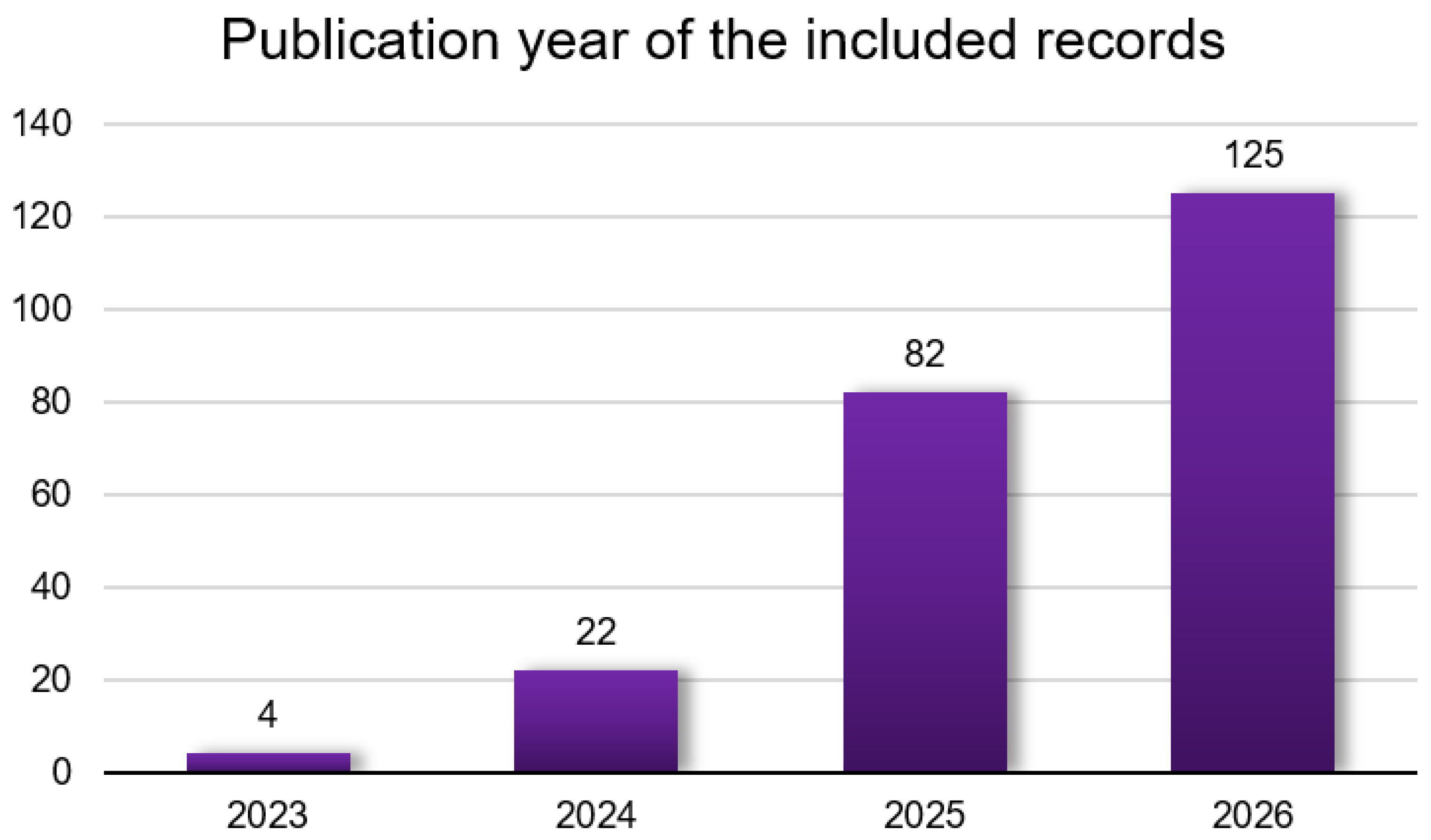
Among the 233 included records, 141 (61%) were indexed in both databases, 59 (25%) were retrieved only from Scopus, and 33 (14%) only from PubMed. The 92 records found in only one database represented 39% of the included corpus. A Scopus-only search would have retrieved 200/233 records and missed 33 (14%); a PubMed-only search would have retrieved 174/233 and missed 59 (25%). Four records (2%) were published in 2023, 22 (9%) in 2024, 82 (35%) in 2025, and 125 (54%) during the partial 2026 observation period (Figure 2). The 2026 count describes the volume available by the search date and should not be interpreted as a complete annual estimate.
Figure 2.
Publication year of the 233 included records. The 2026 bar represents an incomplete year.
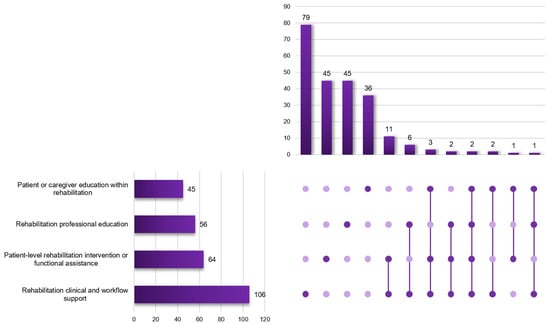
The most frequent category was rehabilitation clinical and workflow support, identified in 106/233 records (45%). Patient-level rehabilitation intervention or functional assistance was identified in 64/233 (27%), rehabilitation professional education in 56/233 (24%), and patient or caregiver education within rehabilitation in 45/233 (19%). Because categories were non-exclusive, 28/233 records (12%) received more than one application label: 20 had two labels, six had three, and two had all four. The UpSet representation in Figure 3 shows the exact combinations. The largest single-purpose groups were clinical and workflow support alone (79 records), patient-level intervention or functional assistance alone (45), professional education alone (45), and patient/caregiver education alone (36). The most frequent combined pattern was patient-level plus clinical and workflow support (11 records).
Figure 3.
Application overlaps across the 233 included records. Horizontal bars report total membership in each non-mutually exclusive application category. Vertical bars and the connected-dot matrix report mutually exclusive intersections; therefore, all intersection bars sum to 233.
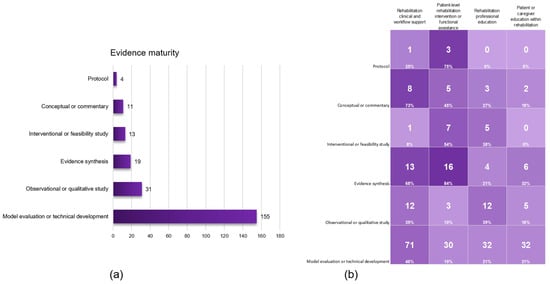
Model/output evaluation or technical development was the dominant evidence category (155/233; 67%), followed by observational or qualitative studies (31/233; 13%), evidence syntheses (19/233; 8%), interventional or feasibility studies (13/233; 6%), conceptual papers or commentaries (11/233; 5%), and protocols (4/233; 2%) (Figure 4a). Clinical and workflow support appeared in 71/155 model/technical records and 12/31 observational or qualitative records. Patient-level intervention or functional assistance occurred in 30/155 model/technical records and 7/13 interventional or feasibility studies. Professional education appeared in 5/13 interventional or feasibility studies, whereas patient/caregiver education was concentrated primarily in model/output or technical evaluations (32/45 records) (Figure 4b). The numerical expansion of the literature was therefore not matched by a comparable volume of patient-level experimental evidence.
Figure 4.
Evidence maturity and its relationship with rehabilitation application. (a) Mutually exclusive evidence categories across the included corpus. (b) Application frequencies within each evidence category; cells report n and row percentage. Application coding was multi-label, so percentages within a row may sum to more than 100%. The categories describe evidence architecture and do not constitute a risk-of-bias assessment.
ChatGPT or GPT terminology was present in 155/233 records (67%). Gemini was mentioned in 30 (13%), DeepSeek in 18 (8%), Claude in eight (3%), Copilot in seven (3%), LLaMA/Meta models in two (1%), and Perplexity and Grok in one record each (<1%). These counts were non-exclusive and reflect explicit textual mentions rather than a comparative measure of model performance. The identical total of 155 model/technical records and 155 GPT-mention records referred to different variables: 108 records overlapped between the model/technical evidence category and records mentioning GPT, 47 mentioned GPT but were assigned to another evidence category, 47 were model/technical records without GPT terminology, and 31 belonged to neither set. The literature was dispersed across clinical, rehabilitation, education, informatics, engineering, and multidisciplinary journals.
4. Discussion
This systematic mapping review identified 233 publications spanning the fields of rehabilitation, clinical practice, and information science. Of these, 92 (39%) were retrieved from only one of the two databases, demonstrating their complementarity. Searching Scopus alone would have missed 33 of the 233 included records (14%), whereas searching PubMed alone would have missed 59 (25%). The introduction of “Generative Artificial Intelligence” as a MeSH descriptor in 2025 further explains why controlled vocabulary alone is insufficient for a rapidly changing field; free-text model names remain necessary for retrieval.
Functional coding clarifies the structure of the field. Rehabilitation clinical and workflow support constituted the predominant category (106/233; 45%), whereas patient-level rehabilitation intervention or functional assistance accounted for a smaller share (64/233; 27%). This latter category involved the use of GenAI to generate, adapt, or monitor individualized rehabilitation actions. Studies focusing on response evaluation, readability, or hypothetical scenarios were classified under education or clinical support. Patient and caregiver education was included only when integrated into a rehabilitation pathway, thereby avoiding the conflation of mere content creation with the actual delivery of care.
The current literature represents an initial phase in the translation of GenAI into rehabilitation, characterized by a rapid rise in publications that is not yet matched by a corresponding level of clinical maturity. Model/output evaluation or technical development accounted for 155/233 records (67%), whereas only 13/233 records (6%) were interventional or feasibility studies. The application landscape confirms this disparity: clinical support predominates in simulated settings, while patient-level intervention or functional assistance was represented in 7 of the 13 interventional or feasibility studies. The apparent breadth of multi-purpose applications should also be interpreted cautiously. Evidence syntheses accounted for 20 of the 38 excess application labels generated by multi-label coding, indicating that much of the observed overlap reflects the broad scope of secondary literature rather than genuinely multifunctional primary interventions. Many contributions have assessed parameters such as response accuracy or expert opinion. However, as highlighted in broader healthcare evaluations, substantial heterogeneity exists in tasks and criteria, with a predominance of accuracy measures at the expense of real-world patient data, bias, and generalizability [5,33]. While useful in the early stages, these indicators fail to demonstrate improvements in autonomy, safety, adherence, or service organization. Performance on examination questions, simulated cases, or agreement with reference answers cannot be assumed to translate into effectiveness within real rehabilitation pathways. Evidence from interventional studies, covering both patient care and training, is limited and inconsistent in design, precluding any definitive claims regarding efficacy. This mapping complements the living systematic review by Morone et al., which examined the broader AI literature in rehabilitation and documented substantial use of conventional supervised and predictive approaches [18]. GenAI introduces a distinct level of interaction, capable of generating explanations, treatment plans, and multimodal content. These capabilities can bridge the gap between analysis and clinical practice but cannot replace empirical validation. Fluent language or positive expert assessments are no substitute for prospective field evaluation.
Professional training and patient education represent significant components of the body of literature, yet the existing volumes do not constitute evidence of efficacy. Training-focused studies require indicators to measure skill retention, clinical reasoning, and the detection of erroneous content [23,34,35,36,37,38]. User-facing systems must address health literacy and accessibility, while also evaluating the risks associated with guidance provided without professional mediation [2,19,20,24,25,39,40,41,42]. Clinical workflow support accounts for a large number of records, reflecting a prevalence of hypothetical scenarios rather than established adoption. The role of GenAI appears geared toward structured assistance under specialist supervision, rather than autonomous decision-making. Rehabilitation decisions integrate diagnoses, environmental barriers, patient goals, and multidisciplinary assessments. Future studies must determine whether GenAI-assisted pathways improve clinical outcomes compared to standard practice, moving beyond merely verifying the model’s ability to simulate an expert response. Recent studies illustrate the emerging range of applications, including LLM-generated rehabilitation exercise programs, automated individualized therapeutic exercise prescription, wearable-assisted exercise protocols, speech-language rehabilitation planning, and AI-assisted exercise prescription evaluation [43,44,45,46,47].
A likely further development is the transition toward multimodal systems capable of integrating language with other forms of clinical information, such as medical images, electrophysiological traces, movement data, and electronic data from wearable devices or telerehabilitation platforms [9,21,45,48]. This evolution is particularly relevant in rehabilitation because functioning and recovery cannot be adequately characterized through textual or diagnostic information alone, requiring the integration of longitudinal complex data across multiple settings [14,49]. Combining these heterogeneous sources could allow systems to generate integrated clinical summaries and evolve according to changes occurring during rehabilitation. However, increasing technological complexity must be accompanied by increasingly rigorous validation, as the clinical consequences of an error in longitudinal monitoring or decision-making differ substantially from those of an isolated generated response. Human oversight and clearly defined boundaries between automated support and professional responsibility remain essential [17].
The progressive integration of GenAI also raises relevant legal, ethical, and governance issues [8,9,50,51,52]. Responsibility for clinical decisions supported by generative systems remains with qualified professionals, especially as AI moves from providing general information to generating recommendations that influence treatment planning or longitudinal management [8,9]. Data protection and confidentiality represent critical concerns when sensitive health data are processed through commercial platforms [8,9,51,52]. Moreover, the formulation of input commands affects response quality, highlighting the need to document prompting procedures [50]. Given the rapid evolution of technology, technological obsolescence poses a methodological challenge: software updates and architectural changes can alter performance even under the same commercial name. Studies should therefore transparently report the provider, model, version, prompting protocols, and human verification procedures to ensure reproducibility over time [6,7,8,9].
Finally, the expansion of GenAI does not eliminate the conceptual distinction between computational performance and human cognition. The ability to produce fluent, contextually appropriate language may generate the impression of genuine understanding, yet current systems operate through probabilistic processing. In rehabilitation, where clinical decisions are embedded in individual goals and longitudinal human relationships, the most plausible role of GenAI is not replacing professionals, but serving as an integrative tool to extend communicative, educational, and workflow functions.
This review has several limitations. Regarding information coverage, although PubMed and Scopus provided complementary retrieval, databases such as Embase, Web of Science, IEEE Xplore, and specialized education indexes were not searched. The exclusion of conference proceedings may also have underrepresented informatics and engineering research, in which conference publication is common. The staged screening process represents a further limitation. All records were screened manually by title, whereas abstracts were examined when titles were insufficient and full texts when uncertainty persisted. Information reported only in the full text may therefore have been missed. Screening and coding were not independently duplicated, no inter-rater agreement statistic was available, and automated prioritization may have introduced an ordering or anchoring effect for the primary assessor. Despite explicit operational definitions, multi-label application coding also required interpretive judgment. No formal quality or risk-of-bias appraisal was performed because the purpose was to map research activity and evidence architecture rather than estimate evidential strength or effectiveness. Model frequencies were derived from explicit textual mentions and may therefore underestimate unnamed or incompletely reported systems. The protocol was not prospectively registered. Finally, because the search was performed during 2026, the 2026 publication count is incomplete and cannot support a full-year temporal comparison. Given the rapid evolution of the field, both the corpus and the technologies evaluated will require periodic updating.
5. Conclusions
The evidence map comprises 233 publications. GenAI has been studied primarily to support clinical activities, whereas direct patient intervention accounts for a smaller share. Professional training and user education represent significant yet distinct areas. The scientific evidence base is in its early stages, with evaluative studies and simulations outnumbering prospective clinical trials. Future research should prioritize the assessment of functional outcomes, model transparency, external validation, safety, and the definition of human oversight processes.
Supplementary Materials
The following supporting information can be downloaded at https://www.mdpi.com/article/10.3390/app16199784/s1: File S1: Complete Search Strategies. Table S1: List of the included records.
Author Contributions
Conceptualization, D.C.; methodology, D.C. and G.R.; formal analysis, D.C. and G.R.; screening and primary coding, D.C.; review of uncertain cases and verification of aggregate analyses, G.R.; formal analysis, D.C. and G.R.; writing—original draft preparation, D.C.; writing—review and editing, G.R., G.S. and S.M.; supervision, S.M. All authors have read and agreed to the published version of the manuscript.
Funding
This research received no external funding.
Institutional Review Board Statement
Not applicable.
Informed Consent Statement
Not applicable.
Data Availability Statement
Supplementary File S1 provides the complete database-specific search strategies. These files contain the data required to reproduce the descriptive counts, intersections, and cross-tabulations reported in the manuscript. Supplementary Table S1 provides the complete list of 233 included records and the coded variables used in the analyses, including source coverage, year, application labels, evidence category, and identified model(s).
Conflicts of Interest
The authors declare no conflicts of interest.
Abbreviations
The following abbreviations are used in this manuscript:
| AI | Artificial Intelligence |
| GenAI | Generative Artificial Intelligence |
| LLM | Large Language Model |
References
- Shanmugam, D.; Agrawal, M.; Movva, R.; Chen, I.Y.; Ghassemi, M.; Jacobs, M.; Pierson, E. Generative artificial intelligence in medicine. Annu. Rev. Biomed. Data Sci. 2025, 8, 199–226. [Google Scholar] [CrossRef] [Scilit]
- Moulaei, K.; Yadegari, A.; Baharestani, M.; Farzanbakhsh, S.; Sabet, B.; Afrash, M.R. Generative artificial intelligence in healthcare: A scoping review on benefits, challenges and applications. Int. J. Med. Inform. 2024, 188, 105474. [Google Scholar] [CrossRef] [Scilit]
- Li, J.; Dada, A.; Puladi, B.; Kleesiek, J.; Egger, J. ChatGPT in healthcare: A taxonomy and systematic review. Comput. Methods Programs Biomed. 2024, 245, 108013. [Google Scholar] [CrossRef] [Scilit]
- Ramadan, S.; Calvieri, C.; Gracia-Ramos, A.E.; Ferrari, G.R.; Pepe, M.; Biondi-Zoccai, G. An umbrella review encompassing 42 systematic reviews on medical applications of ChatGPT. Minerva Medica 2026, 117, 26–35. [Google Scholar] [CrossRef] [Scilit]
- Bedi, S.; Liu, Y.; Orr-Ewing, L.; Dash, D.; Koyejo, S.; Callahan, A.; Fries, J.A.; Wornow, M.; Swaminathan, A.; Lehmann, L.S.; et al. Testing and evaluation of health care applications of large language models: A systematic review. JAMA 2025, 333, 319–328. [Google Scholar] [CrossRef] [Scilit]
- Park, S.H.; Suh, C.H.; Lee, J.H.; Kahn, C.E.; Moy, L. Minimum Reporting Items for Clear Evaluation of Accuracy Reports of Large Language Models in Healthcare (MI-CLEAR-LLM). Korean J. Radiol. 2024, 25, 865–868. [Google Scholar] [CrossRef] [Scilit]
- Gallifant, J.; Afshar, M.; Ameen, S.; Aphinyanaphongs, Y.; Chen, S.; Cacciamani, G.; Demner-Fushman, D.; Dligach, D.; Daneshjou, R.; Fernandes, C.; et al. The TRIPOD-LLM reporting guideline for studies using large language models. Nat. Med. 2025, 31, 60–69. [Google Scholar] [CrossRef] [Scilit]
- Vasey, B.; Nagendran, M.; Campbell, B.; Clifton, D.A.; Collins, G.S.; Denaxas, S.; Denniston, A.K.; Faes, L.; Geerts, B.; Ibrahim, M.; et al. Reporting guideline for the early-stage clinical evaluation of decision support systems driven by artificial intelligence: DECIDE-AI. Nat. Med. 2022, 28, 924–933, Correction in Nat. Med. 2022, 28, 2218. [Google Scholar] [CrossRef]
- Lekadir, K.; Frangi, A.F.; Porras, A.R.; Glocker, B.; Cintas, C.; Langlotz, C.P.; Weicken, E.; Asselbergs, F.W.; Prior, F.; Collins, G.S.; et al. FUTURE-AI: International consensus guideline for trustworthy and deployable artificial intelligence in healthcare. BMJ 2025, 388, e081554. [Google Scholar] [CrossRef] [Scilit]
- Shahini, A.; Seoni, S.; Manzin, A.; Oria, M.; Gudigar, A.; Raghavendra, U.; Sengur, A.; Acharya, R.; Salvi, M. Can we really trust generative models in healthcare? A systematic review of uncertainty quantification in generative AI for medical imaging. Comput. Methods Programs Biomed. 2026, 285, 109560. [Google Scholar] [CrossRef] [Scilit]
- Cieza, A.; Causey, K.; Kamenov, K.; Hanson, S.W.; Chatterji, S.; Vos, T. Global estimates of the need for rehabilitation based on the Global Burden of Disease study 2019: A systematic analysis for the Global Burden of Disease Study 2019. Lancet 2021, 396, 2006–2017. [Google Scholar] [CrossRef] [Scilit]
- Stucki, G.; Cieza, A.; Melvin, J. The International Classification of Functioning, Disability and Health (ICF): A unifying model for the conceptual description of the rehabilitation strategy. J. Rehabil. Med. 2007, 39, 279–285. [Google Scholar] [CrossRef] [Scilit]
- Singh, R.; Küçükdeveci, A.A.; Grabljevec, K.; Gray, A. The role of interdisciplinary teams in physical and rehabilitation medicine. J. Rehabil. Med. 2018, 50, 673–678. [Google Scholar] [CrossRef] [Scilit]
- World Health Organization. International Classification of Functioning, Disability and Health: ICF; World Health Organization: Geneva, Switzerland, 2001. [Google Scholar]
- Brouwer, V.H.E.W.; Schuijt, H.J.; Visser-Meily, J.M.A.; Achterberg, W.P.; van Dam van Isselt, E.F. Rehabilitation outcomes of older persons within the context of the International Classification of Functioning, Disability and Health: A systematic review. Eur. Geriatr. Med. 2026, 17, 261–272. [Google Scholar] [CrossRef] [Scilit]
- Coraci, D.; Maccarone, M.C.; Regazzo, G.; Accordi, G.; Papathanasiou, J.V.; Masiero, S. ChatGPT in the development of medical questionnaires: The example of low back pain. Eur. J. Transl. Myol. 2023, 33, 12114. [Google Scholar] [CrossRef] [Scilit]
- Torous, J.; Linardon, J.; Goldberg, S.B.; Sun, S.; Bell, I.; Nicholas, J.; Hassan, L.; Hua, Y.; Milton, A.; Firth, J. The evolving field of digital mental health: Current evidence and implementation issues for smartphone apps, generative artificial intelligence, and virtual reality. World Psychiatry 2025, 24, 156–174. [Google Scholar] [CrossRef] [Scilit]
- Morone, G.; Carbonetti, R.; Cinnera, A.M.; Malfitano, C.; Bisirri, A.; Negrini, F.; REHALISE Group. Artificial intelligence in rehabilitation: A living systematic mapping review—First release. Eur. J. Phys. Rehabil. Med. 2025, 61, 694–708. [Google Scholar] [CrossRef] [Scilit]
- Kaur, J.; Adedoyin, F.; Budka, M.; Wainwright, T.W. Can AI-based chatbots enhance patient education and support nursing practice for hip replacement patients? A scoping review. Int. J. Orthop. Trauma Nurs. 2026, 62, 101299. [Google Scholar] [CrossRef] [Scilit]
- Lang, S.; Vitale, J.; Galbusera, F.; Fekete, T.; Boissiere, L.; Charles, Y.P.; Yucekul, A.; Yilgor, C.; Núñez-Pereira, S.; Haddad, S.; et al. Is the information provided by large language models valid in educating patients about adolescent idiopathic scoliosis? An evaluation of content, clarity, and empathy. Spine Deform. 2025, 13, 361–372. [Google Scholar] [CrossRef] [Scilit]
- AlSaad, R.; Abd-Alrazaq, A.; Boughorbel, S.; Ahmed, A.; Renault, M.-A.; Damseh, R.; Sheikh, J. Multimodal large language models in health care: Applications, challenges, and future outlook. J. Med. Internet Res. 2024, 26, e59505. [Google Scholar] [CrossRef] [Scilit]
- Han, S.; Yoon, J.; Park, D. Effects of augmented reality dual-task training with ChatGPT-assisted development on strength, balance, spatiotemporal gait parameters, and fall-related self-efficacy in patients with chronic stroke: A randomized controlled trial. NeuroRehabilitation 2026, 59, 85–98. [Google Scholar] [CrossRef] [Scilit]
- Sahin, G.E.; Bayram, G.A.; Sierra, A.S.; Akdemir, S.; Kurc, D.; Tarakci, D.; Tunali, A.N. Effects of artificial intelligence-based physiotherapy educational approach in developing clinical reasoning skills: A randomized controlled trial. BMC Med. Educ. 2025, 25, 1378. [Google Scholar] [CrossRef] [Scilit]
- Du, K.; Li, A.; Zuo, Q.-H.; Zhang, C.-Y.; Guo, R.; Chen, P.; Du, W.-S.; Li, S.-M. Comparing artificial intelligence-generated and clinician-created personalized self-management guidance for patients with knee osteoarthritis: Blinded observational study. J. Med. Internet Res. 2025, 27, e67830. [Google Scholar] [CrossRef] [Scilit]
- Neo, J.R.E.; Ser, J.S.; Tay, S.S. Use of large language model-based chatbots in managing rehabilitation concerns and education needs of outpatient stroke survivors and caregivers. Front. Digit. Health 2024, 6, 1395501. [Google Scholar] [CrossRef] [Scilit]
- Bonnechère, B. Unlocking the black box? A comprehensive exploration of large language models in rehabilitation. Am. J. Phys. Med. Rehabil. 2024, 103, 532–537. [Google Scholar] [CrossRef] [Scilit]
- Cha, S.M. Generative AI and large language models in rehabilitation: A scoping review. Life 2026, 16, 1310. [Google Scholar] [CrossRef] [Scilit]
- Dergaa, I.; Dergaa, M.A.; Razzak, M.; Ceylan, H.I.; Stefanica, V.; Muntean, R.I.; Guelmami, N. Generative artificial intelligence and large language models in sports medicine: A scoping review of applications, accuracy, and ethical implications. Front. Public Health 2026, 14, 1843535. [Google Scholar] [CrossRef] [Scilit]
- Tricco, A.C.; Lillie, E.; Zarin, W.; O’Brien, K.K.; Colquhoun, H.; Levac, D.; Moher, D.; Peters, M.D.J.; Horsley, T.; Weeks, L.; et al. PRISMA Extension for Scoping Reviews (PRISMA-ScR): Checklist and explanation. Ann. Intern. Med. 2018, 169, 467–473. [Google Scholar] [CrossRef] [Scilit]
- Peters, M.D.J.; Marnie, C.; Tricco, A.C.; Pollock, D.; Munn, Z.; Alexander, L.; McInerney, P.; Godfrey, C.M.; Khalil, H. Updated methodological guidance for the conduct of scoping reviews. JBI Evid. Synth. 2020, 18, 2119–2126. [Google Scholar] [CrossRef] [Scilit]
- Rethlefsen, M.L.; Kirtley, S.; Waffenschmidt, S.; Ayala, A.P.; Moher, D.; Page, M.J.; Koffel, J.B.; PRISMA-S Group. PRISMA-S: An extension to the PRISMA Statement for reporting literature searches in systematic reviews. Syst. Rev. 2021, 10, 39. [Google Scholar] [CrossRef] [Scilit]
- National Library of Medicine. Generative Artificial Intelligence. Medical Subject Headings (MeSH) Browser. Available online: https://meshb.nlm.nih.gov/record/ui?ui=D000098842 (accessed on 13 September 2026).
- Tam, T.Y.C.; Sivarajkumar, S.; Kapoor, S.; Stolyar, A.V.; Polanska, K.; McCarthy, K.R.; Osterhoudt, H.; Wu, X.; Visweswaran, S.; Fu, S.; et al. A framework for human evaluation of large language models in healthcare derived from literature review. npj Digit. Med. 2024, 7, 258. [Google Scholar] [CrossRef] [Scilit]
- Lucas, H.C.; Upperman, J.S.; Robinson, J.R. A systematic review of large language models and their implications in medical education. Med. Educ. 2024, 58, 1276–1285. [Google Scholar] [CrossRef] [Scilit]
- Lin, Y.; Luo, Z.; Ye, Z.; Zhong, N.; Zhao, L.; Zhang, L.; Li, X.; Chen, Z.; Chen, Y. Applications, challenges, and prospects of generative artificial intelligence empowering medical education: Scoping review. JMIR Med. Educ. 2025, 11, e71125. [Google Scholar] [CrossRef] [Scilit]
- Arbel, Y.; Gimmon, Y.; Shmueli, L. Evaluating the potential of large language models for vestibular rehabilitation education: A comparison of ChatGPT, Google Gemini, and clinicians. Phys. Ther. 2025, 105, pzaf010. [Google Scholar] [CrossRef] [Scilit]
- Ferrer-Peña, R.; Di-Bonaventura, S.; Pérez-González, A.; Lerín-Calvo, A. Feasibility of a randomized controlled trial of large AI-based linguistic models for clinical reasoning training of physical therapy students: Pilot randomized parallel-group study. JMIR Form. Res. 2025, 9, e66126. [Google Scholar] [CrossRef] [Scilit]
- Ayyıldız, A.; İnceoğlu, S.Ç.; Kuran, B.; Öneş, K. Artificial intelligence versus physical medicine and rehabilitation residents: Can ChatGPT compete in clinical exam performance? PM&R 2026, 18, 52–59. [Google Scholar] [CrossRef] [Scilit]
- Karaca, O.; Torlak, M.S.; Tekin, A.N. A comparative evaluation of ChatGPT and Gemini for stroke caregiver support: Accuracy, safety, and response characteristics. Rev. Assoc. Med. Bras. 2026, 72, e20251488. [Google Scholar] [CrossRef] [Scilit]
- Kim, S.; Yang, S.; Kim, J.; Joo, S.; Lee, H.Y.; Park, H.J.; Jeon, J.; Yi, Y.G. Evaluating the accuracy, usefulness, and safety of ChatGPT for caregivers seeking information on congenital muscular torticollis. Healthcare 2026, 14, 140. [Google Scholar] [CrossRef] [Scilit]
- Ozgen, A.N.K.; Karbancioglu, E.C.; Tezel, N. Artificial intelligence large language models for pelvic floor rehabilitation: Readability, usability and consistency. Neurourol. Urodyn. 2026. online ahead of print. [Google Scholar] [CrossRef] [Scilit]
- Li, W.; Li, Q. A comparative study on the application of large language models: DeepSeek-R1, GPT-4o, and Claude-Sonnet-4 in post-cardiac surgery rehabilitation—A cross-sectional study. Digit. Health 2025, 11, 20552076251393385. [Google Scholar] [CrossRef] [Scilit]
- Fu, Y.; Li, H.; You, M.; Wang, L.; Liu, W.; Zhou, K.; Wang, L.; Chen, X.; Chen, G. Evaluation of large language models in generating physical exercise rehabilitation programs for musculoskeletal disorders across multiple clinical scenarios. Healthcare 2026, 14, 2389. [Google Scholar] [CrossRef] [Scilit]
- Kim, J.H. Automated prescription of therapeutic exercise for shoulder impingement syndrome using literature-driven rule generation architecture. Musculoskelet. Sci. Pract. 2026, 82, 103520. [Google Scholar] [CrossRef] [Scilit]
- You, M.; Chen, X.; Liu, D.; Lin, Y.; Chen, G.; Li, J. ChatGPT-4 and wearable device assisted Intelligent Exercise Therapy for co-existing sarcopenia and osteoarthritis (GAISO): A feasibility study and design for a randomized controlled PROBE non-inferiority trial. J. Orthop. Surg. Res. 2024, 19, 635. [Google Scholar] [CrossRef] [Scilit]
- Yaşa, İ.C.; Dölek, M.; Tekin, S.E.; Kaya, A.S.; Akgün, P.; Yılmaz, S.D.; Tokalak, S. Artificial intelligence in speech and language therapy: A qualitative comparative analysis of clinical applications and outcomes. Inq. J. Health Care Organ. Provis. Financ. 2026, 63, 469580261445316. [Google Scholar] [CrossRef] [Scilit]
- Lai, X.; Lai, Y.; Chen, J.; Huang, S.; Gao, Q.; Huang, C. An AI-assisted adaptive Boolean rubric for exercise prescription evaluation: A pilot validation study. Int. J. Med. Inform. 2026, 207, 106202. [Google Scholar] [CrossRef] [Scilit]
- Mapinduzi, J.; Daniels, K.; Kossi, O.; Verbrugghe, J.; Bonnechère, B. Wearable sensors and artificial intelligence for ecological knee osteoarthritis assessment: Development and feasibility of a hybrid digital phenotyping framework. Sensors 2026, 26, 3563. [Google Scholar] [CrossRef] [Scilit]
- Madden, R.H.; Bundy, A. The ICF has made a difference to functioning and disability measurement and statistics. Disabil. Rehabil. 2019, 41, 1450–1462. [Google Scholar] [CrossRef] [Scilit]
- Cinar, B.; Safran, E.; Ayyildiz-Eroglu, Z. Shaping AI in pelvic floor physiotherapy: The impact of role-play prompting on ChatGPT response quality. Int. Urogynecology J. 2026. online ahead of print. [Google Scholar] [CrossRef] [Scilit]
- van Kessel, R.; Schmidt, J.; van Kolfschooten, H.; Feudo, S.; Young, K.; Valtere, L.; Minssen, T.; Mossialos, E. Artificial intelligence, intellectual property, and human rights: Mapping the legal landscape in European health systems. npj Health Syst. 2025, 2, 43. [Google Scholar] [CrossRef] [Scilit]
- van Kolfschooten, H.; van Oirschot, J. The EU Artificial Intelligence Act (2024): Implications for healthcare. Health Policy 2024, 149, 105152. [Google Scholar] [CrossRef] [Scilit]
Disclaimer/Publisher’s Note: The statements, opinions and data contained in all publications are solely those of the individual author(s) and contributor(s) and not of MDPI and/or the editor(s). MDPI and/or the editor(s) disclaim responsibility for any injury to people or property resulting from any ideas, methods, instructions or products referred to in the content. |
© 2026 by the authors. Licensee MDPI, Basel, Switzerland. This article is an open access article distributed under the terms and conditions of the Creative Commons Attribution (CC BY) license.