


Abstract
Object grasping and manipulation are fundamental operations for daily activities. Individuals with impaired grasping ability could be assisted and benefited by using prosthetic anthropomorphic robot hands (ARHs). However, controlling a high-degree-of-freedom ARH in unstructured environments using model-based methods is challenging because object-specific interaction models must be developed in advance and accessed in real time. This research presents an imitation learning framework for developing a model-free behavioral cloning (BC) policy that generates grasp strategies for three-dimensional deformable objects. The proposed four-stage framework includes human-guided grasp synthesis, synthetic grasp augmentation, BC policy training, and BC policy evaluation. Human demonstrations are captured using a user-interaction glove, an NVIDIA Isaac SimTM-based simulation environment, and an NI LabVIEW interface to transfer finger-motion and feedback data between the wearable and simulation environments. Fifty four (54) successful human-guided demonstrations were performed for cylindrical and cuboid deformable objects with variations in size, positional offset from the palm, and Young’s modulus. The human-guided demonstrations formed the basis to generate 200 additional successful grasps through contact-driven synthetic augmentation to form a 254-demonstration dataset for BC policy training and evaluation using an and split, respectively. The trained BC policy was assessed using offline action-error metrics and in-simulation deployment on held-out object configurations, achieving stable grasp execution rates of (15 of 22) for cylindrical and (9 of 16) for cuboid objects. These results demonstrate that contact-driven augmentation and BC can support ARH grasping of three-dimensional deformable objects despite an initial small-number human-demonstration dataset.
1. Introduction
Humans are highly skilled at grasping objects, an ability that continuously develops and improves over the course of our lives through interaction with physical objects of various shapes, sizes, and surface finishes. This ability is fundamental for performing everyday tasks and requires consideration of several factors, such as the force to apply, the weight and pliability of the object, and the optimal grasping location and pattern to complete a successful grasp or interaction. The ability to grasp objects can be impaired due to the loss of a limb(s), sensation during interaction with an object or impaired motor control caused by conditions such as spinal cord injuries or multiple sclerosis [1,2]. In such cases, a prosthetic anthropomorphic robotic hand (ARH) can be employed to improve the self-reliance of a person living with a condition affecting their ability to grasp objects. Beyond restoring functional capabilities, anthropomorphic and socially embodied robotic systems are increasingly being investigated in healthcare and rehabilitation because their human-like embodiment and interactive capabilities can improve user engagement, acceptance, and therapeutic interaction [3].
Grasping of an object by a person is the result of perception and intuition, developed over time through repeated interactions with various objects and coordinated movement of the limbs [4,5]. When using an ARH for grasping objects, a person must provide control instructions based on their perception and intuition, either directly or indirectly through the ARH controller. These instructions can be delivered manually via an interface or by mapping body-worn sensors to control the ARH operation. When a person cannot provide this input, the ARH controller must autonomously generate and execute the required grasping process commands. This requires the controller to at least engage with the object to identify unknown parameters (material properties such as mass, stiffness, etc.), plan an appropriate grasp, and execute it. Autonomous grasp generation and execution are challenging tasks considering the real-world variability and shape complexity of an object and the high degrees of freedom in ARHs when grasping rigid body objects. The complexity further increases during grasping of volumetric soft-bodied deformable objects, for example, food items, sponges, or soft foams, which exhibit significant nonlinear deformation under an applied force that could affect the grasping geometric pattern to yield a successful grasp.
Given that accurately modeling soft-object physics for every possible interaction is challenging and remains computationally prohibitive for real-time applications, machine learning-driven model-free approaches have emerged as a promising alternative. Machine learning (ML) approaches bypass explicit modeling of hand-object interactions and directly learn effective grasp strategies from demonstration data generated by a person based on their perception and intuition [6,7]. Learning-based methods directly infer grasping strategies from interaction datasets, bypassing explicit physics modeling [8]. However, collecting enough human-guided demonstrations for every deformable object condition is a prohibitively time-consuming and expensive process. This work presents an approach where a small set of successful human demonstrations form the basis and inform the generation of synthetic data to augment the grasping database and subsequently use the augmented database for BC policy training.
In this article, we present an imitation learning (IL) framework for grasping three-dimensional deformable objects with a high-degree-of-freedom ARH. The framework consists of four stages: (1) human-guided grasp synthesis using a small set of successful demonstrations, (2) synthetic grasp generation to augment the demonstration set, (3) behavioral cloning policy training using the augmented dataset, and (4) policy deployment and evaluation on held-out test object configurations. The grasps considered in this work are power grasps with the thumb abducted and the object held against the hand palm [9].
The framework is implemented through an NI LabVIEW interface between a user-interaction wearable glove (to capture user hand motions and provide proprioceptive feedback), NVIDIA Isaac SimTM (to simulate the object deformation due to forces applied by a simulated high-degree-of-freedom virtual ARH), and Robomimic [10] for BC training. Human-guided demonstrations and synthetically augmented grasps are collected for cylindrical and cuboid deformable objects of different sizes, Young’s moduli, and placement offsets from the ARH. The combined dataset is then used to train a BC policy whose performance is evaluated on a held-out test split.
2. Related Work
Classical model-based methods for deformable object manipulation traditionally employ physics-based deformation models, such as spring-mass-damper systems and Finite Element Method (FEM) simulations. These methods aim to predict object deformation under various grasps to determine optimal grasp configurations by either maximizing stability or minimizing undesired deformation to prevent damage to the object. Zaidi et al. [11] introduced tactile sensor-guided strategies to apply optimal grasp forces, and Ficuciello et al. [12] developed FEM-based controllers using inverse kinematics to adjust finger positions dynamically, assuming precise contact models and known material properties.
However, despite these successes in controlled laboratory environments, these classical approaches encounter substantial limitations in practical applications due to inaccuracies in object modeling, uncertainties in contact dynamics, or errors in state estimation. Such methods typically require precise prior knowledge of object geometry, pose, and material properties, which are often unavailable or difficult to estimate accurately in real-world scenarios [11] and in real time. Consequently, even minor errors in pose or deformation predictions can lead to grasp failures or cause catastrophic damage to the object.
Furthermore, analytical physics-based methods [11,12,13] face a fundamental trade-off between computational speed and modeling accuracy. Simplified models may omit critical deformation behaviors, whereas detailed simulations are often computationally prohibitive for real-time closed-loop control, restricting these analytical methods to offline grasp planning that cannot dynamically adapt to unexpected object slips or deformations.
Recognizing these constraints, recent research has increasingly adopted sensor-driven and learning-based methodologies that implicitly model complex object behaviors through training using extensive datasets or interactive experiences. These data-driven approaches robustly manage uncertainties and enable dynamic real-time grasp adjustments. Among these, imitation learning [10] is particularly promising, as it directly leverages expert demonstrations to efficiently develop adaptive grasping policies, bridging theory and practical execution effectively.
Yi et al. [14] developed an IL framework for training a commercial 16-DOF Allegro anthropomorphic robotic hand by leveraging human teleoperation via virtual reality (VR) controllers to replicate advanced grasp strategies such as enveloping and caging, applicable to both rigid and deformable objects. However, this approach still relies on collecting ‘sufficient’ numbers of human teleoperation demonstrations for each object condition and does not provide a scalable simulation-based augmentation stage for high-DOF anthropomorphic grasping of three-dimensional deformable objects. Similarly, Dyrstad et al. [15] employed IL with parallel-jaw grippers for grasping real fish, combining human-supervised virtual demonstrations with synthetic data through domain randomization. These IL methods effectively encapsulate human strategies for managing object shape and compliance uncertainties, enabling effective grasping with minimal deformation or slippage.
Imitation learning captures nuanced human skills such as force modulation and coordinated movements essential for delicate grasping by directly transferring human expertise to robots through demonstrations. Humans naturally adjust their grip when handling soft objects (e.g., gently picking up tofu without crushing it), and IL could effectively replicate these subtle strategies without requiring explicit manual controller design.
Nevertheless, acquiring sufficiently large datasets of high-quality demonstrations for deformable objects remains challenging due to cumbersome teleoperation processes or kinesthetic teaching, requiring human demonstrators to predict object deformation intuitively. To address this issue, recent research has explored synthetic or ‘human-free’ demonstrations. Li et al. [16] proposed an IL approach using systematically generated force-control trajectories based on known stiffness properties, training dual-convolutional neural network models for the gentle grasping of fragile items. Despite providing consistent training data, this approach heavily relies on accurately modeled force behaviors. Simulation data has been used to reduce the need for physical robot demonstrations. Wang et al. [17] and Turpin et al. [18] generated large synthetic dexterous grasp datasets for general objects. GRIP [19] extends grasp datasets to rigid and deformable objects with soft grippers and LEAP hands. For deformable grasping, Le et al. [13] used synthetic depth and stiffness data for deformation-aware grasp synthesis. Li et al. [20] proposed SoftGrasp, which learns adaptive dexterous grasping from visual, joint-angle, and torque demonstrations. These works show that simulation data and multimodal demonstrations are useful; however, they do not directly address the procedures for how a small human-guided ARH dataset can be augmented into successful grasp trajectories for three-dimensional deformable objects. These procedures are extremely desired and beneficial for scaling learned models to generalize grasping across various unseen objects.
Another effective IL strategy involves bilateral teleoperation, allowing humans to directly guide robotic hands while recording motions and applied forces. Yamane et al. [21] employed bilateral teleoperation to achieve human-level delicate grasping performance across diverse soft and rigid objects. Additionally, Hu et al. [22] demonstrated the potential of IL for soft-object grasping by predicting soft object deformation using deep neural networks trained on grasping demonstrations for objects with compliance low enough that deformation during closure must be predicted from demonstrations. Recent advancements, such as the uncertainty-aware IL framework by Winter et al. [23], have enabled robots to dynamically adapt grasp forces when encountering objects with unknown material properties. Scheikl et al. [24] combined diffusion-based IL with Probabilistic Dynamic Movement Primitives (MPD), achieving improved motion quality and data efficiency in deformable manipulation tasks.
Behavioral cloning, a subset of IL methods, learns a policy by predicting demonstrated actions from observations. BC had been widely used for dexterous manipulation from demonstrations [10,20,25]. Sequence models, including behavior transformers, have also been used to represent demonstrated behaviors over time [26]. DexDeform [27] learned dexterous deformable-object manipulation from human demonstrations and refines the trajectories with differentiable physics using a simulated Shadow hand. Recently (2025), D3Grasp [28] showed progress in dexterous grasping of compliant objects, although it mainly uses RL rather than a BC pipeline from human-guided demonstrations augmented with synthetic ones. Recent research has also explored diffusion-based policies for high-dimensional anthropomorphic hand control. Yang et al. [29] proposed a bionic-constrained diffusion policy that decomposes the anthropomorphic hand action space according to wrist and finger coordination, and combined this structure with reinforcement learning. Their results demonstrated improved learning efficiency, robustness, and control performance for complex dexterous manipulation tasks applied to piano playing.
IL methods are notably sample-efficient compared to reinforcement learning, as each demonstration explicitly encodes successful behaviors. However, they often struggle with generalization beyond their demonstrated scenarios and can fail with novel object shapes or conditions. Additionally, demonstration-based policies inherently reflect human biases or imperfections, potentially encoding suboptimal actions. Yamane et al. [21] emphasized the critical role of effectively incorporating perceptual inputs since processing of inadequate visual cues can lead to missing essential grasping information.
Prior work has advanced deformable object manipulation, synthetic grasp dataset generation, and imitation learning or behavioral cloning for dexterous hands. However, many deformable object manipulation studies focus on ropes and cloth manipulated with parallel-jaw grippers, while dexterous-hand learning studies often emphasize rigid objects or reinforcement learning-based policies for deformable objects [30,31].
Volumetric or three-dimensional (3D) deformable objects, such as tofu or a sponge, deform during a grasp, unlike rope-type one-dimensional (1D) or cloth-type two-dimensional (2D) objects, which only deform during manipulation and not during grasping. In contrast to a parallel-jaw gripper, a multi-finger hand such as an ARH increases the dexterity and complexity of successfully grasping a volumetric deformable object due to its higher DOFs. Consequently, ARH grasping of 3D deformable objects from a small human-guided dataset, augmented with contact-driven synthetic data for supervised learning, remains an underexplored research area [32].
This research investigates and contributes to ARH-based grasping of three-dimensional elastically deformable objects. A framework is proposed to enable collection of a small set of human-guided demonstrations that form the basis for generating a larger set through synthetic augmentation. The whole augmented dataset is then used to train and evaluate the performance of a BC policy by estimating the action-prediction error and grasp success on held-out three-dimensional deformable object configurations with an ARH in a simulated environment.
3. Framework
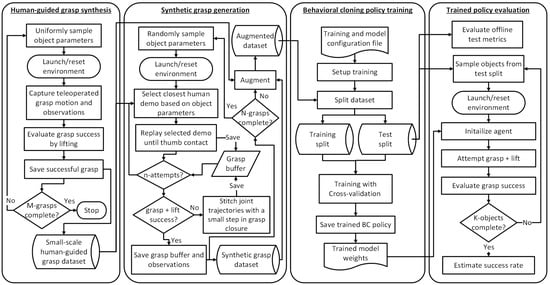
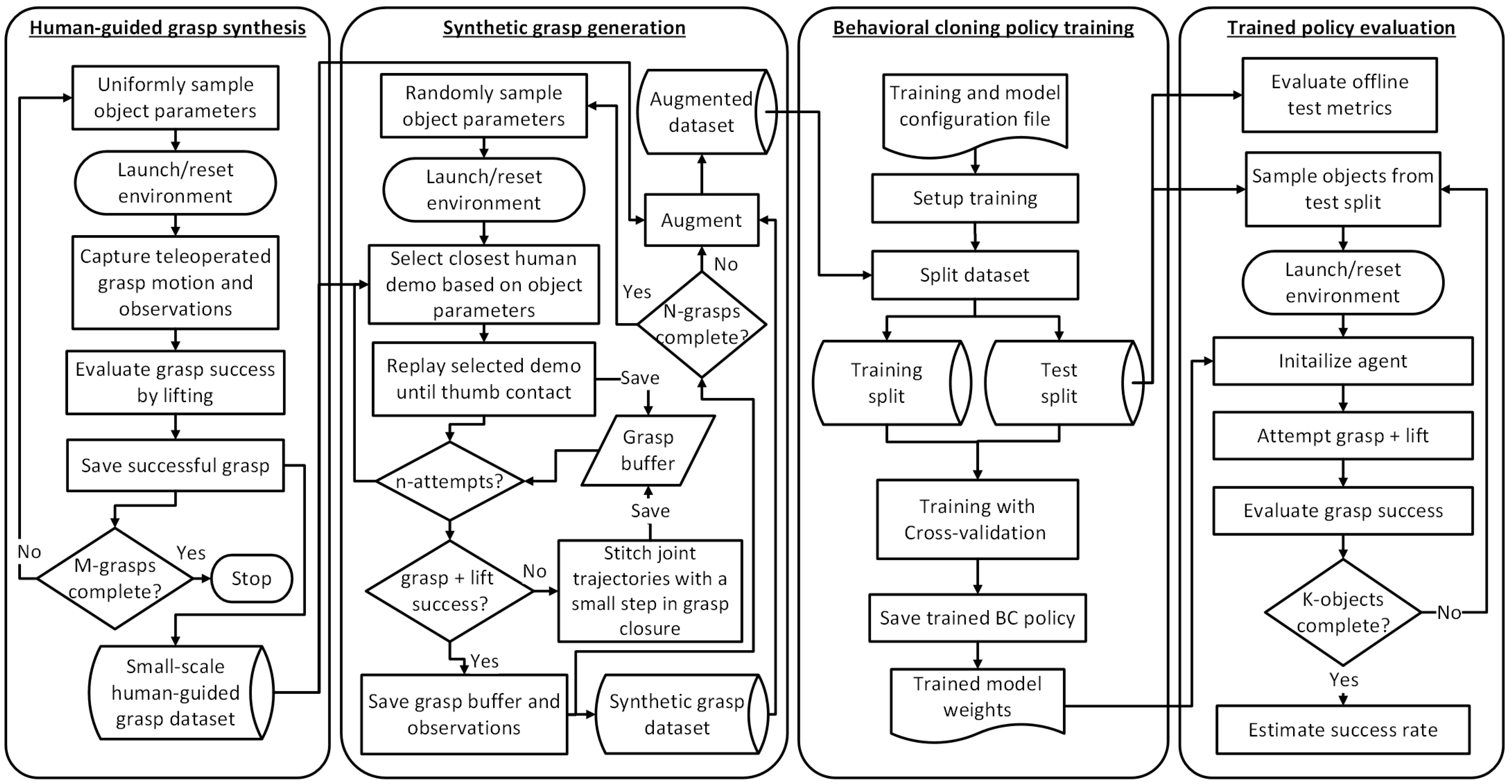
The proposed framework is used to collect, generate, augment, and learn deformable-object grasp strategies for an ARH. The trained policy is then evaluated on held-out object configurations. In this article, actions refer to simulated ARH actuator joint commands as functions of time, and observations refer to the recorded simulation states and interaction measurements associated with these actions. The framework is presented in Figure 1 and consists of four main stages:
Figure 1.
Grasp imitation learning process flow.
- Stage 1: Human-guided grasp synthesis using a small set of successful demonstrations.
- Stage 2: Synthetic grasp generation to augment the demonstration set.
- Stage 3: BC policy training using the augmented dataset.
- Stage 4: BC policy deployment and evaluation on held-out test object configurations.
The procedures and operations for each stage are introduced and discussed in the remainder of Section 3.
- Stage 1: Human-guided grasp synthesis using a small set of successful demonstrations.In Stage 1, a small-scale dataset of human-guided grasp trajectories for the ARH is synthesized for deformable objects spawned with uniformly sampled parameters such as object shape, size, Young’s modulus, and positional offset. The object density is held fixed in this study.For each demonstration, the motion from open-hand pre-grasp through contact and grasp completion is recorded, followed by lift-based validation. Only trajectories up to the lift phase are retained for training use. The human hand motion trajectories are captured using a hand tracking system. The captured motion is then mapped to the ARH hand motion with a suitable algorithm to accommodate the kinematic differences between them. The mapped joint angles are used to teleoperate the ARH in the virtual environment to simulate grasps of deformable objects in real time and provide a visual representation of both the final grasp and the deformation experienced by the object. During teleoperation, the simulated ARH-applied motor torques are provided as feedback to the user as a vibration to indicate the grasp effort level during closure (see Section 4.1) and guide the user to avoid ‘applying’ excessive compression on the object by reducing the human-guided kinematic closure of the virtual ARH. This feedback, in addition to the visual one from the simulator GUI, aids the user to synthesize grasps for deformable objects in the virtual environment.The simulated ARH actuator joint trajectories (the actions) and simulated grasp interactions (the observations) are recorded during the human-guided grasp attempts for a deformable object. The recorded actions are the ARH actuator joint trajectories and torques up to the initiation of the lift command. The recorded observations are the ARH joint positions, velocities, actuator torques, maximum stress and strain experienced by the object, object parameters (shape, size, Young’s modulus, and positional offset relative to the hand–object setup), and object pose with respect to the robot frame.The recorded grasp information is then validated in the simulated environment by slowly lifting the object and holding it for 20 time steps to ensure the object does not slide, thus yielding a stable grasp. The recorded grasp data for a successful stable human-guided grasp is stored in a dataset file.
- Stage 2: Synthetic grasp generation to augment the demonstration set.In Stage 2, the developed human-guided dataset of demonstrations becomes the foundation to synthetically generate grasps for deformable objects with randomly sampled ’unseen’ parameters from the predefined object-parameter ranges. The range for each parameter (shape, size, Young’s modulus, and positional offset) is defined in Table 1.The proposed synthetic grasp-generation algorithm is a contact-driven, incremental closure strategy designed to transform existing human demonstrations into successful simulated grasps across different object parameters. In this stage, grasp closure denotes progressively increasing finger and thumb flexion from the anchor configuration while maintaining thumb–object contact; each closure step applies tunable, predefined per-joint increments to the normalized finger and thumb commands.For each sampled object instance (using parameter values in their respective range shown in Table 1), the algorithm identifies and selects the nearest demonstration and replays only the pre-lift segment to detect a reliable thumb contact anchor based on joint torque thresholds. This anchor defines a stable reference configuration from which grasp refinement begins. Here, the pre-lift segment ends at the time step immediately before the lift command is issued in the demonstration. If immediate lifting fails (i.e., the object slips or is not securely held), the algorithm progressively increases finger and thumb flexion through tunable, predefined increments while enforcing monotonic joint constraints to avoid loss of contact. Each increment is applied through a smooth, velocity-limited ramp to ensure physically realistic motion. After each closure adjustment, a lift attempt is executed and evaluated using kinematic grasp success criteria (see synthetic grasp-generation algorithm, Algorithm 1, and experimental setup, Section 4). A trial is successful when the object tracks the lift without slip and remains stably raised for a fixed time-hold duration. Successful trials are recorded and exported into the augmented demonstration dataset, and the process repeats until the desired number of valid synthetic grasps is collected.
- Stage 3: Behavioral cloning policy training using the augmented dataset.During Stage 3, the large-scale synthetic grasp dataset is used to train a BC policy. The objective of the BC policy is to observe the current state of the deformable object and learn to predict grasp actions that closely resemble the behavior found in the collected grasp demonstrations. The augmented grasp dataset is split into training and test sets using an split at the demonstration level.The BC policy is trained to ’learn’ the mapping between observed states and corresponding actions. A five-fold (fold) cross-validation (CV) protocol is used to assess generalization across training folds and determine the number of epochs for the final training using the complete training split. During CV training, the validation loss is computed at every epoch on the held-out fold and the best epoch model weights are checkpointed. The median best epoch across the CV folds sets the epoch count for a final training run on the full-training split. The model emerging from the final training run is used for testing and deployment. The selected BC policy is capable of generating grasp trajectories for deformable objects resembling the human-guided demonstrations.
- Stage 4: Behavioral cloning policy deployment and evaluation on held-out test object configurations.In Stage 4, the trained policy is evaluated using the testing dataset. The policy is deployed in the simulation environment using the ARH model to grasp the objects in the test dataset. During offline testing, the discrepancy between predicted and demonstrated actions is evaluated using mean square error (MSE) and mean action deviation (MAD) measures over the held-out test split. The trained policy is then deployed in simulation on held-out test object configurations, and the grasp success rate is computed from the deployment trials.
Table 1.
Object parameter sampling ranges for human-guided demonstrations and synthetic generation.
| Algorithm 1 Synthetic Grasp Generation |
| 1: Initialize system and load demonstration dataset 2: 3: while do 4: Sample object parameters: size, positional offset, Young’s modulus, friction coefficient 5: Select nearest human-guided demonstration (lexicographic distance): 6: by sequentially minimizing , , 7: Reset simulation scene with sampled deformable object instance 8: 9: Detect Action Anchor 10: Replay pre-lift portion of selected demonstration 11: Detect hand-object contact using an empirically defined torque threshold 12: Require for i = {thumb_J0, thumb_J1, index, middle} for consecutive time steps 13: Store executed actions up to contact as anchor_buffer 14: 15: for attempt to do 16: Increase grasp closure from anchor by a predefined increment 17: Enforce monotonic floor on primary joints 18: Form grasp action sequence from anchor_buffer and closure target 19: Execute grasp sequence, lift object, and settle 20: 21: Check If Grasp Successful 22: Hold object for time steps defined empirically 23: Monitor relative velocity, , between object and hand 24: if then 25: Successful grasp 26: Record grasp information and break 27: end if 28: end for 29: end while 30: Close simulation |
4. Experimental Setup
4.1. System Components
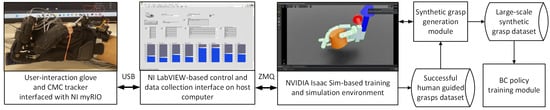
The proposed framework is realized in the developed system as four functional modules, namely, teleoperation, simulation environment, synthetic grasp generation, and BC policy training, as shown in Figure 2.
Figure 2.
System components of the grasp generation and training pipeline.
The function of the teleoperation module is to capture human hand motion and provide feedback during grasp interaction. The teleoperation module consists of a custom-built user-interaction (UI) glove interfaced via NI myRIO and connected to a NI LabVIEW 2021 interface on a host computer [33,34,35]. The UI glove is equipped with five resistive flex-sensors (one per digit), 15 Eccentric Rotating Mass (ERM) actuators placed on the palmar side of each phalange and in the middle of the palm, and a carpometacarpal (CMC) joint tracking device [33], as shown in Figure 2.
The myRIO samples the UI glove sensors to capture and map the human hand motion to the ARH while accommodating kinematic differences between the human and ARH hardware. The combined flexion/extension of the human fingers and the two thumb distal joints are captured using resistive flex-sensors. The flexion/extension and adduction/abduction of the CMC joint are tracked using an in-house-developed CMC tracker [33,34,35]. The finger/thumb motion captured by the flex-sensors is linearly mapped to the corresponding finger/thumb joint range of the ARH. The CMC joint motion is mapped to the two proximal robot thumb joints using the radial projection algorithm (see our previous work [33]). The ERM actuators on the UI glove are used to provide grasp-related vibrotactile feedback to the user. The NI LabVIEW interface processes the mapped human hand motion from myRIO and transmits it to the Isaac Sim 4.5 simulation environment using the ZeroMQ 4.3.5 messaging protocol.
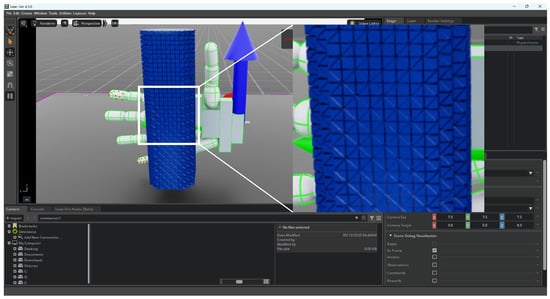
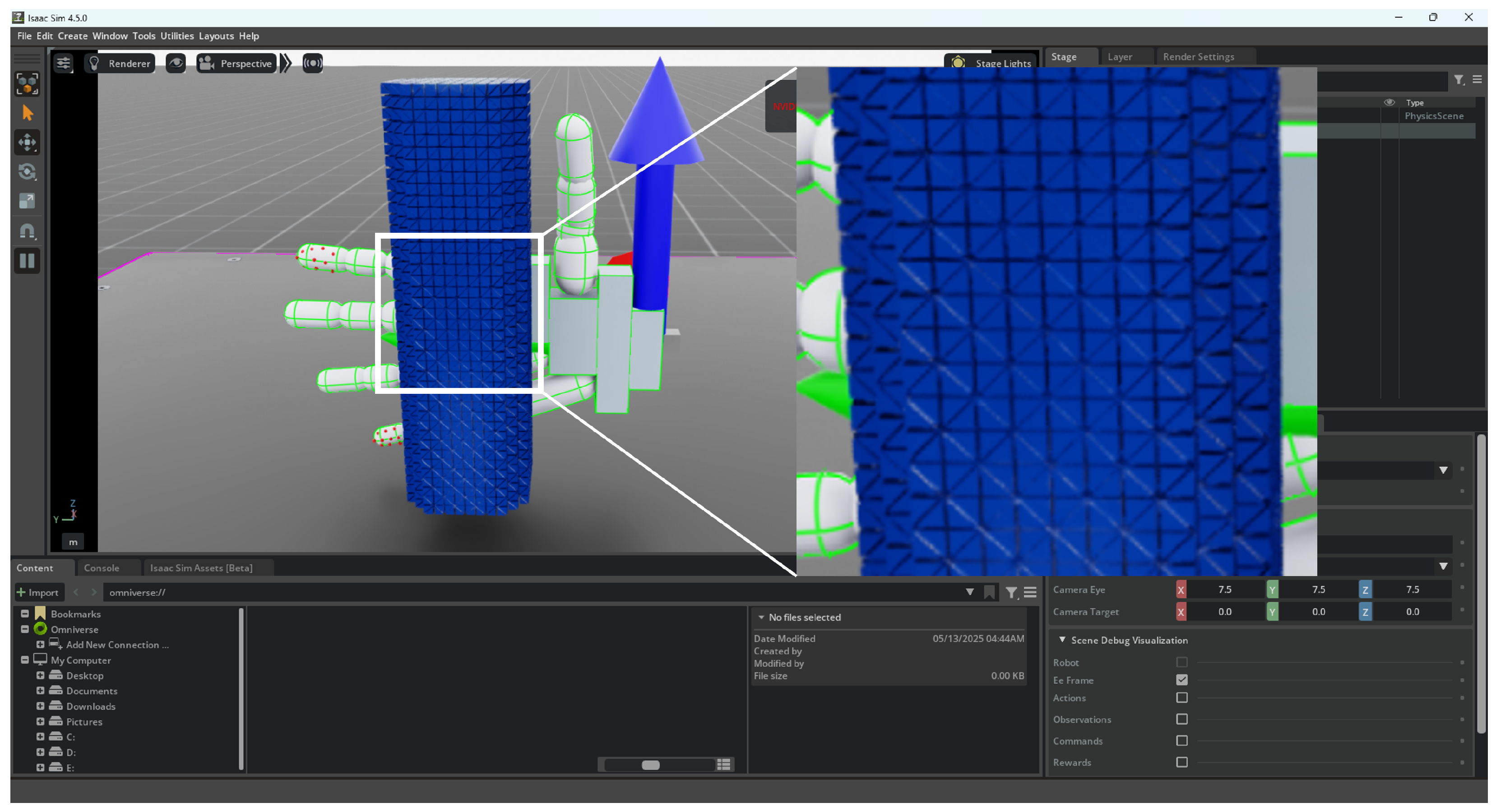
The simulation environment module provides the tools to model the virtual scene: a virtual model of the ARH and the deformable objects. The simulation module also provides the means to perform the required analyses. This module is implemented using Isaac Sim, which serves as the physics-based robotics simulator within the proposed system. It handles object spawning, deformable body modeling, and dynamic interaction simulation. A representative Isaac Sim scene with the virtual ARH and a cylindrical deformable object modeled with a tetrahedral mesh for finite element analysis is shown in Figure 3. The environment receives transmitted finger position data from the hardware (UI glove) through NI LabVIEW to guide the virtual ARH and simulates the deformable object and grasping interactions using nonlinear finite element analysis and the solver in Isaac Sim [36].
Figure 3.
Simulation mesh (original and zoom-in) for a cylindrical object during demonstrations.
During teleoperation, the simulated actuator torques of the virtual ARH are linearly mapped to a predefined intensity range of the corresponding finger ERM actuators. The proprioception is completed through vibrotactile feedback that provides the user with vibration of an intensity proportional to the applied torque during grasp closure against the deformable object. The deformable objects presented for grasping are modeled in Isaac Sim, with their geometric, material, and location properties summarized in Table 1.
The synthetic grasp-generation module is responsible for heuristically expanding the human-guided grasp demonstrations into a large-scale dataset according to Algorithm 1. This module is implemented in Python 3.10 and integrated with the developed Isaac Sim environment. The detailed operation of this module is presented in Section 4.3.
The BC policy training module is responsible for training the grasping policy from the generated dataset. To establish the training environment, NVIDIA Isaac Lab 2.0.2 [37] is employed to interface with Isaac Sim and access open source imitation learning libraries such as Robomimic 0.2 [10]. The BC policy training module is implemented using the Robomimic library and configured for the ARH deformable object-grasping task. Note that other libraries could be used with appropriate modifications to the interface and configuration files. The detailed operation of this module is further explained in this article.
4.2. Human-Guided Grasp Synthesis
The user uses the teleoperation module following the proposed framework (see Section 3 and Figure 1) to synthesize human-guided grasps for deformable objects and construct a small-scale grasp dataset. In order to synthesize diverse grasp demonstrations, a set of 54 deformable objects are spawned with different parameters, including shape, cross-section size, Young’s modulus, and positional offset relative to the palm, as shown in Table 1. Poisson’s ratio is fixed at for all objects. The proposed framework validation was performed using two object shapes, cylindrical and cuboid.
The grasp attempts begin with the user wearing and calibrating the custom UI glove [33]. Then, the virtual ARH is teleoperated in Isaac Sim, and the user visually verifies whether the virtual ARH follows the human hand motion. If there is a need, the user recalibrates the glove mapping and repeats the check before recording. Following Stage 1 of the framework (see Figure 1), each object from the set of 54 objects is spawned in contact with the palm of the virtual ARH. The user then teleoperates the virtual ARH to interact with and attempt to grasp the object. The virtual ARH joint actuators are modeled with a maximum torque effort limit of Nm. After achieving the desired grasp pose, the user lifts the object to evaluate whether the grasp is successful or not. A grasp is successful if the grasped-lifted object remains in contact with the hand for at least 20 time steps. Only successful grasp demonstrations are recorded in the dataset.
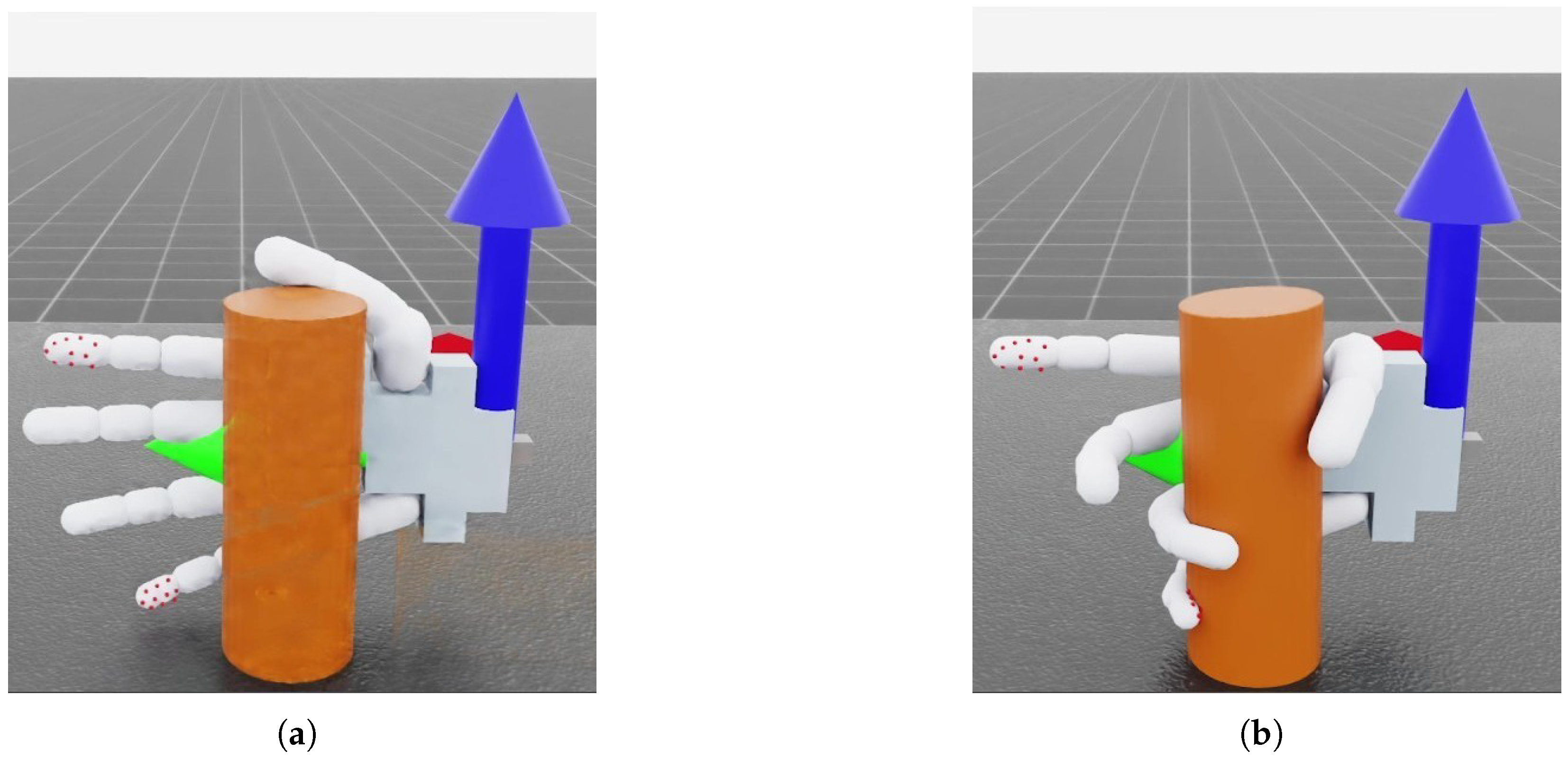
A total of 54 successful human-guided demonstrations were recorded. Each demonstration included the observations and actions defined in Stage 1 (Section 3). A representative human-guided demonstration for grasping a cylindrical-shaped deformable object is shown in Figure 4; the subfigures correspond to the Stage 1 sequence of pre-grasp, closure, lift command, and lift validation.
Figure 4.
Human-guided grasp synthesis for a cylindrical-shaped deformable object in simulation. (a) Start from the open-hand pre-grasp pose. (b) Teleoperate ARH fingers and thumb to perform grasping. (c) Hold grasp pose and signal lift command. (d) Verify if human-guided grasp is successful by holding for 20 time steps after lifting.
4.3. Synthetic Grasp Augmentation/Generation
The synthetic grasp augmentation module randomly samples cylinder and cuboid deformable objects based on the predefined parameter ranges in Table 1. The human-guided demonstrations use the discrete grid in Table 1 (yielding 54 demonstrations). The synthetic generation uses uniform random sampling over the continuous range for each parameter and targets successful grasps. Poisson’s ratio is fixed at , Young’s modulus varies between Pa and Pa, the circumscribe circle radius varies between m and m, and the positional offset varies between m and m relative to the palm. These ranges extend the human grid endpoints to include unseen object instances.
The human-guided demonstrations are loaded, and the nearest demonstration is selected by lexicographic ordering on absolute differences in size, positional offset, and Young’s modulus from the available set of 54 human demonstrations. Following the procedures presented in Algorithm 1, grasp attempts are executed on the spawned object while recording the same observation and action terms used in human-guided synthesis. Each sampled object is evaluated with up to five closure-lift trials; the time-step history of each successful trial is stored as a demonstration in an HDF5 (Hierarchical Data Format) file for training. Contact is established when thumb, index, and middle actuator torques satisfy Nm for three consecutive steps. For each failed closure-lift trial, the grasp closure increases by fixed steps in the normalized actuator range of : a fixed step of for the four finger servo actuators and for the four thumb joints. A lift success requires the object to be raised by at least m and held without slip for 20 consecutive hold time steps.
Using the developed generation module, 200 successful synthetic grasps were generated. An augmented dataset with 254 grasps was formed by combining the 200 successful synthetic and 54 human-guided grasps. Note that each successful grasp time-step history demonstration contains observations and actions for ≈240 time steps. The augmented dataset was then filtered to remove post-lift grasp data from all demonstrations. This filtering step ensures that only pre-lift grasp trajectories and observations are retained and used for BC training.
The maximum von Mises stress and strain are a measure of the simulated object deformation during grasping and are included as observation terms. The observation terms in the filtered dataset include the simulated ARH joint positions, joint velocities, actuator torques, object size, positional offset, Young’s modulus, and maximum von Mises stress and strain. Note that the size and offset parameters are reported in meters (Table 1), whereas stress and Young’s modulus are quantities with higher magnitudes relative to the other observed parameters. These scale differences can adversely affect policy training. Therefore, a base-10 logarithmic transform is applied to the Young’s modulus and maximum von Mises stress. The processed synthetic dataset is then used to train and evaluate the BC policy.
4.4. BC Training and Evaluation Setup
The BC training and evaluation modules are developed using the Robomimic framework [10]. The actor network uses a GPT-style decoder-only transformer architecture [38]. The hyper-parameters for the BC training algorithm and the network transformer are defined based on the ARH observation and action sizes as well as the demonstration sequence length, and are shown in Table 2.
Table 2.
Transformer architecture configuration hyper-parameters.
The transformer architecture, based on the self-attention model introduced by Vaswani et al. [39], takes a sequence of 10 time steps of state observations to model temporal dependencies and outputs the ARH joint actuator angles as the action vector. The transformer network is trained using the Adam optimizer [40] and a Gaussian error linear unit (GELU) activation function [41] by minimizing the MSE, , shown in Equation (1) [42].
where B denotes the number of supervised action samples in a mini-batch, and and are the actual and predicted action vectors for sample i, respectively.
The augmented grasp dataset with 254 demonstrations is divided into an demonstration-level training and test splits, while ensuring all temporal windows from a given demonstration remain within the same split. Using the training parameters shown in Table 2, the BC policy network is configured and trained on the training dataset using a five-fold (5-fold) cross-validation procedure. The model is trained on four folds (4 folds) of the training set and validated on the remaining fold for each run. The training uses a batch size of 128 samples, with each epoch capped at 100 gradient steps ( samples drawn with replacement), and the validation is evaluated over 10 batches (1280 samples) per epoch. These caps follow the fixed-length epoch convention used in Robomimic training [10], so each fold is evaluated after a consistent number of gradient updates instead of after a complete pass through all temporal windows in the dataset.
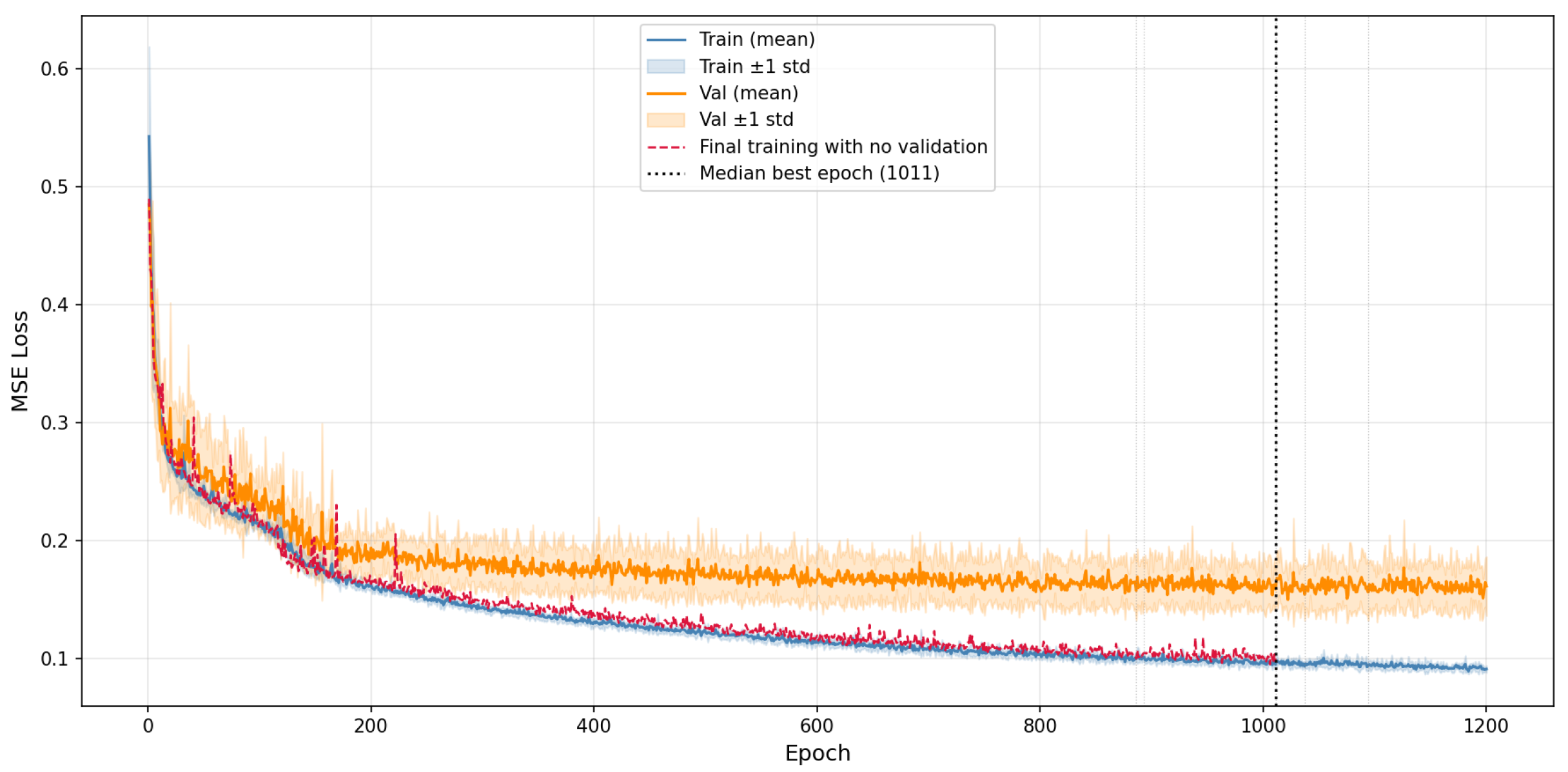
All five folds run for the same initial epoch budget of 1000 without early stopping. The epoch at which each fold achieves its lowest validation loss is recorded as its best epoch, and training continues to the end of the budget regardless. If the best epoch for any fold falls within the last of the current budget, indicating the model may still be improving, the budget is extended by 200 epochs and all folds resume from their latest checkpoints under the revised budget. This is repeated until all folds converge well within the budget. The mean and standard deviation of the training and validation loss across folds are computed per epoch to produce the cross-validation error curves. The median best epoch across the folds is then selected and used to train the final BC policy on the entire training split.
The performance of the trained policy is evaluated using the test dataset by evaluating the (Equation (1)) and mean action deviation (MAD), , shown in Equation (2).
where N is the total number of evaluated samples, and and are the demonstrated and predicted action vectors for sample i, respectively. The trained policy is then deployed in Isaac Sim on held-out test object configurations to evaluate the grasp success rate.
5. Results and Discussion
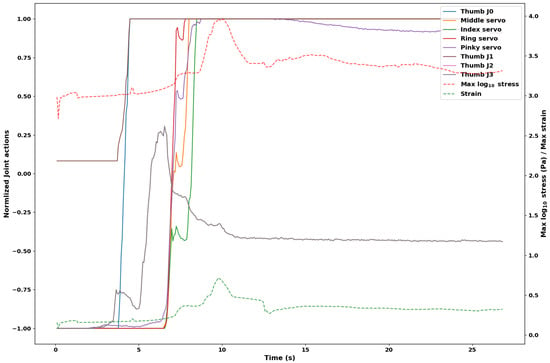
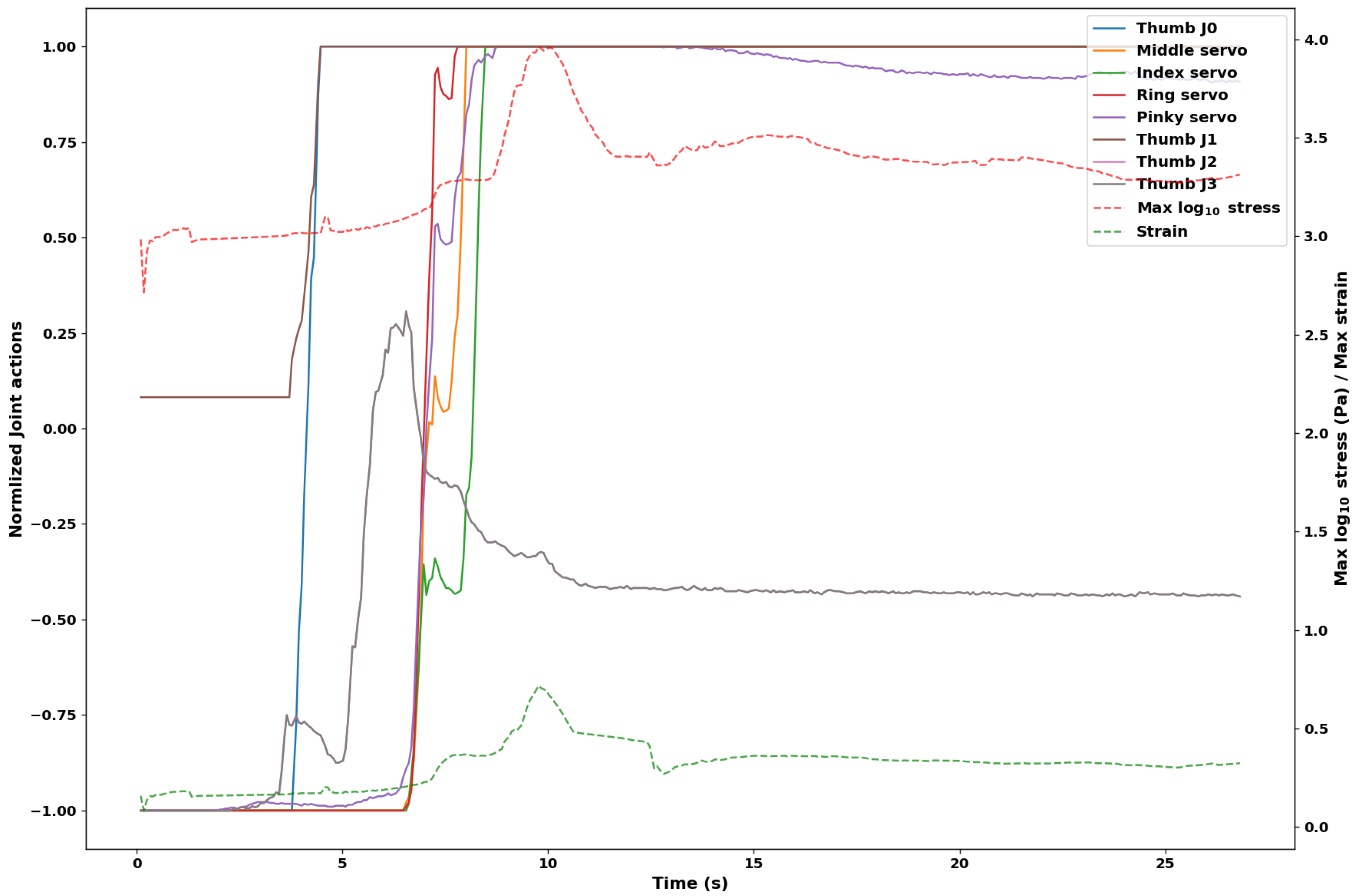
A dataset of 54 human-guided grasp demonstrations was collected for deformable cylinder and cuboid objects using the developed experimental setup. A grasp trajectory of the ARH finger joint angles for a human-guided demonstration of grasping a cuboid shaped object is shown in Figure 5.
Figure 5.
Trajectories of virtual ARH normalized joint actions, maximum strain, and log-transformed von Mises stress.
Using the collected human-guided demonstrations, the synthetic grasp-generation module algorithmically produced 200 additional grasp trajectories, resulting in a combined dataset of 254 grasps. This synthesized dataset is made of deformable cylinder and cuboid objects in the simulated ARH environment. Following the steps discussed in Section 4.3, the augmented dataset is filtered and processed.
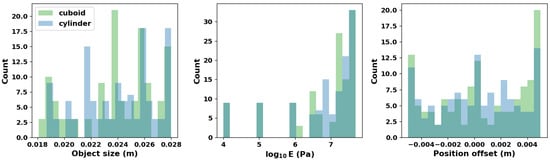
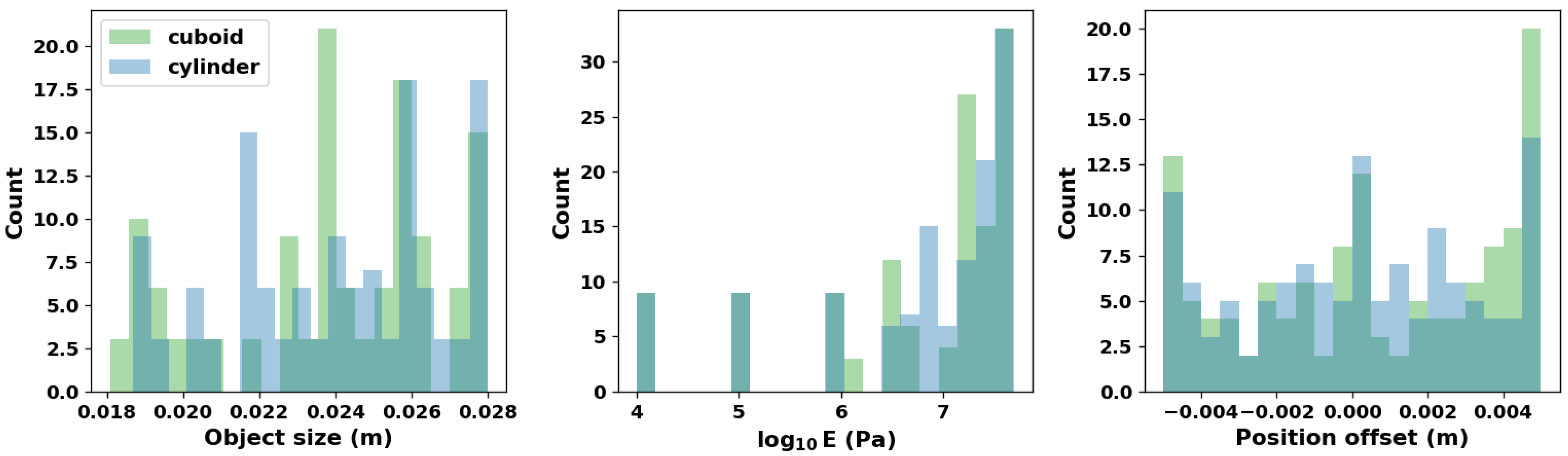
Although only successfully executed grasps are retained in the augmented dataset used for BC policy training, the sampled object parameters remain evenly distributed across their ranges, as shown in Figure 6. For the 254 grasps (127 cylinders and 127 cuboids), the object size was m for cylinders and m for cuboids, was for cylinders and for cuboids, and the positional offset was m for cylinders and m for cuboids.
Figure 6.
Augmented dataset distribution of sampled parameters (object size, Young’s modulus , and positional offset) for cylindrical- and cuboid-shaped objects.
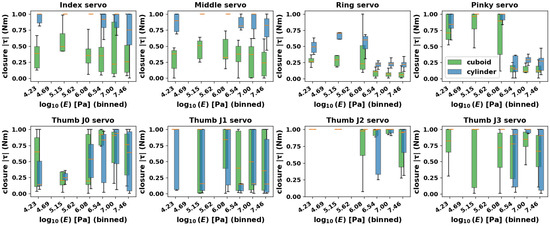
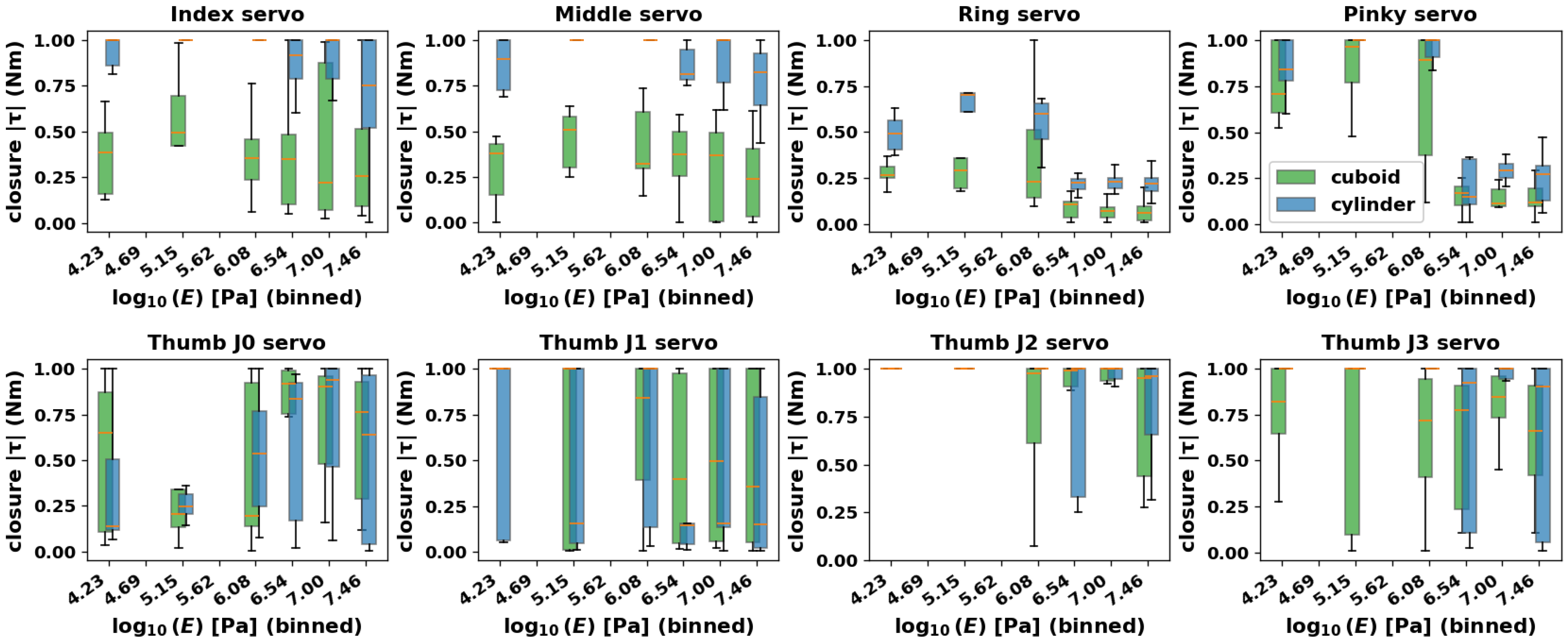
The binned distribution box plot of maximum applied and normalized finger joint closure torques over the sampled Young’s modulus is visualized in Figure 7.
Figure 7.
Finger joint closure normalized torque per unit mass over Young’s modulus.
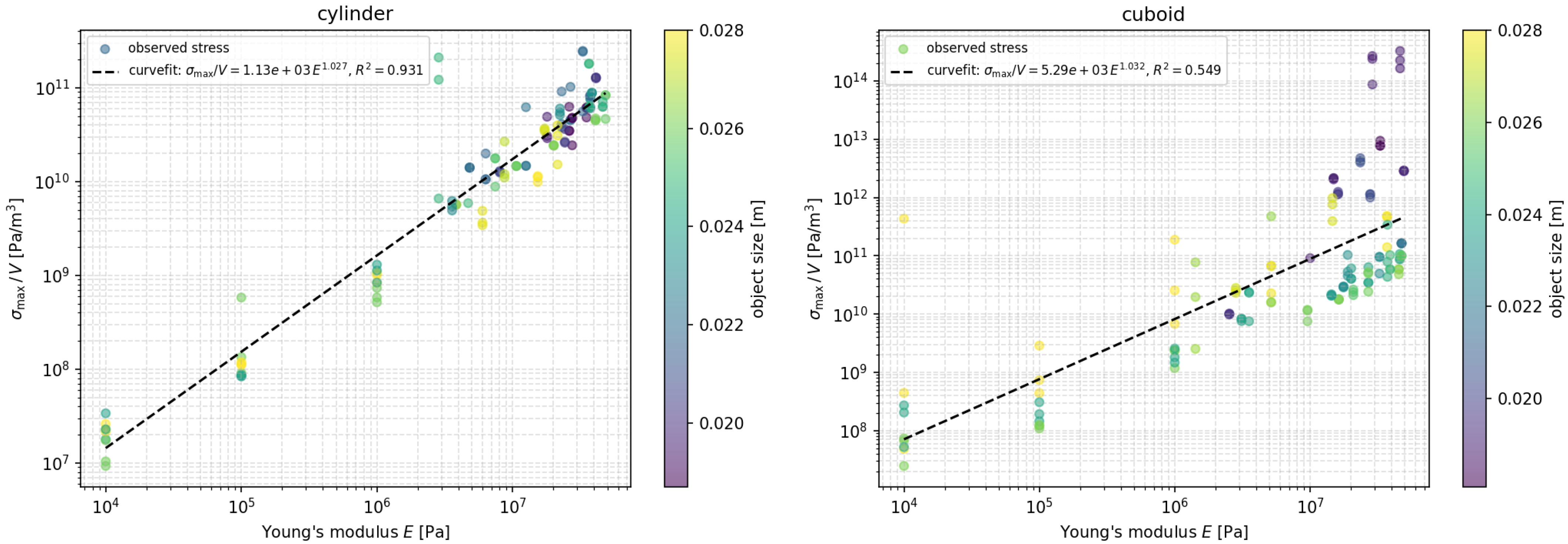
A positive, approximately linear correlation (fitted power-law exponent ) between the maximum von Mises stress per unit volume and Young’s modulus is observed in Figure 8 for both the cylinder and cuboid objects shown as a dashed line. This is consistent with linear elasticity, where stress () scales with stiffness for a given strain (). The cuboid data are considerably more scattered () than the cylinder data (); this is attributed to stress concentrations at the cuboid sharp edges, which produce mesh-dependent, poorly converging FEM stresses [43].
Figure 8.
Maximum von Mises stress per unit volume vs Young’s modulus of the objects in the augmented dataset.
Following the steps discussed in Section 4.4, the processed dataset containing 254 grasp demos was then split as a training and testing split with 216 and 38 demonstrations, respectively. The demonstrations were randomly assigned to each set. Then, the BC policy was trained with a five-fold cross-validation (CV) strategy to generalize the performance of the trained BC policy and identify the median stopping epoch across the folds. A five-fold cross-validation is preferred for this demonstration count and retains enough validation demos per fold.
The training and validation losses (), computed over all batches in each epoch and shown as mean and standard deviation across the cross-validation folds, are presented in Figure 9. Both the cross-validation train and validation losses decrease rapidly within the first 200 epochs and converge gradually thereafter, with the train loss reaching approximately and the validation loss stabilizing around at the median stopping epoch of 1011. The small and consistent gap between the two curves, along with the narrow standard deviation bands across folds, indicates that the policy generalizes well across the dataset splits without significant overfitting. The final training loss (dashed red), obtained by training on the full split, closely follows the cross-validation training mean and reaches at epoch 1011, confirming that the stopping epoch identified by cross-validation is appropriate for the full training run.
Figure 9.
Training and validation loss curves across epochs, shown as mean ± standard deviation over the five cross-validation folds, along with the training loss curve of the final model trained on the entire training split for the median best epoch.
The trained model is then evaluated on the test split, and was estimated to be , which is closer but higher than the training , as expected. The testing corresponds to a root-mean-squared error of approximately normalized action units per joint per time step, indicating the average per-joint deviation between the predicted and demonstrated actions. The for the test split was calculated to be , which represents the mean Euclidean distance between the predicted and demonstrated eight-dimensional action vectors across all test time steps, thus capturing the aggregate joint-space deviation at each step. The eight-dimensional action vector includes the joint actuator positions (one for each finger plus one for each of the four thumb joints). For the ARH deformable grasping BC policy, these losses show how closely the learned policy reproduces the demonstrated grasp-closure behavior in the joint-command space. The smaller and observed mean that the predicted thumb and finger commands stay closer to the human-guided trajectories as object shape, stiffness, size, and offset change.
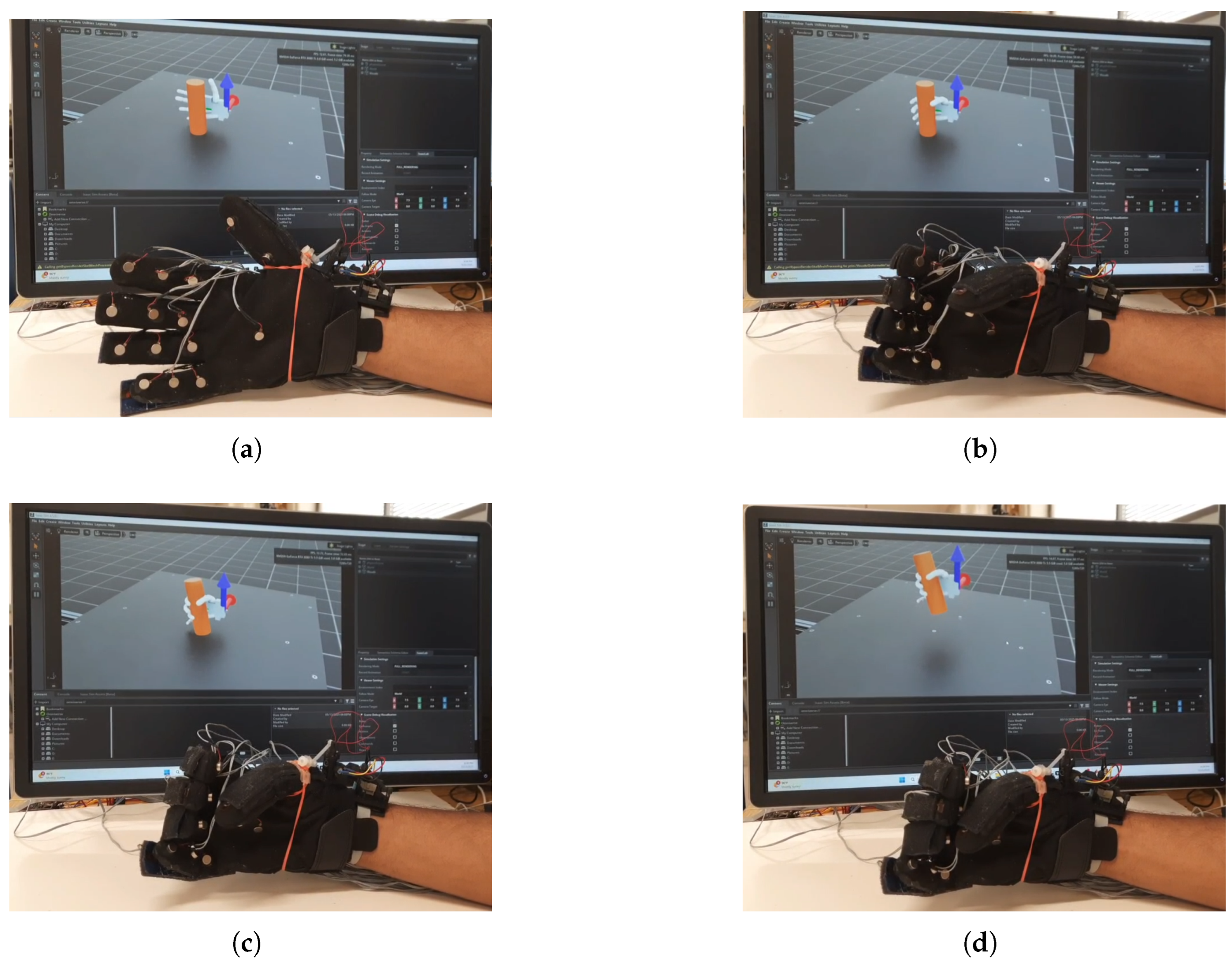
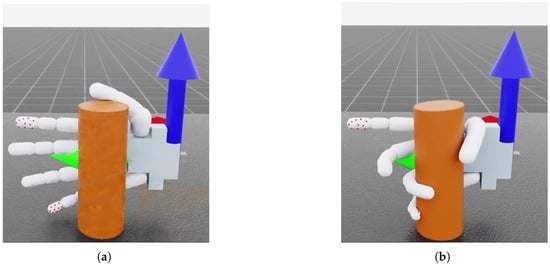
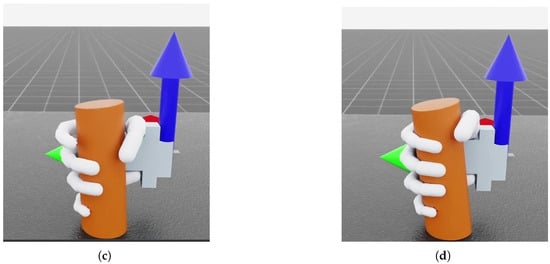
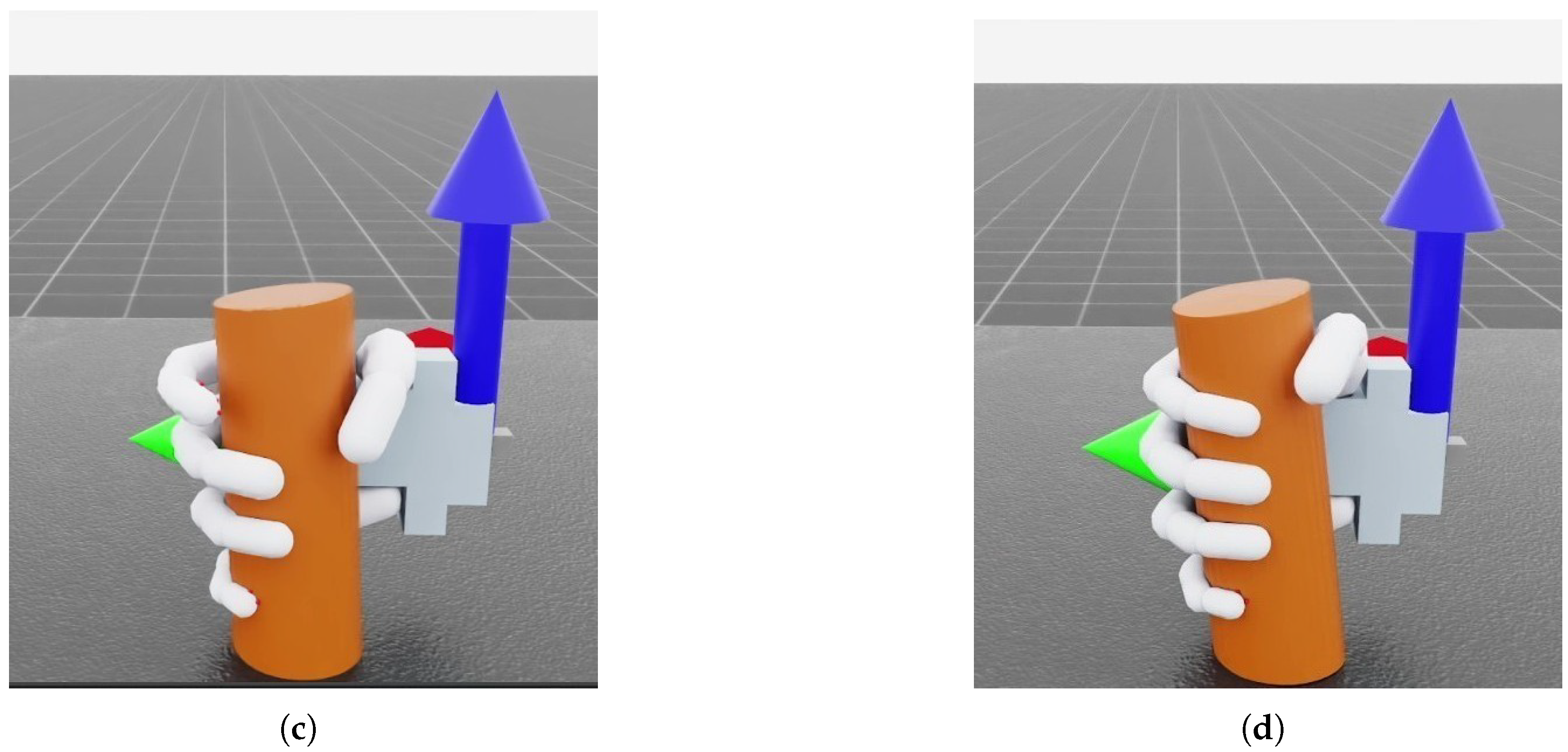
The trained policy is deployed in the Isaac Sim environment for grasp evaluation using 38 objects (22 cylinders and 16 cuboids) from the held-out test split. The Isaac Sim deployment checks whether this action-level agreement produces stable deformable object grasps. A representative grasp sequence performed by the trained BC policy on a cylindrical-shaped object is shown in Figure 10.
Figure 10.
BC policy grasp validation for a cylindrical-shaped deformable object in Isaac Sim. (a) Step 1—open-hand pre-grasp pose. (b) Step 2—initiate and execute grasp. (c) Step 3—continue grasp execution. (d) Step 4—finalize grasp and fix grasp pose for lift.
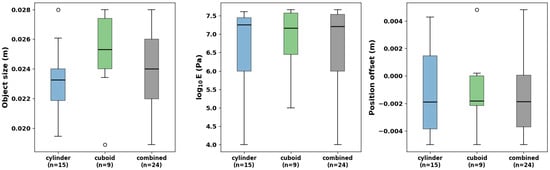
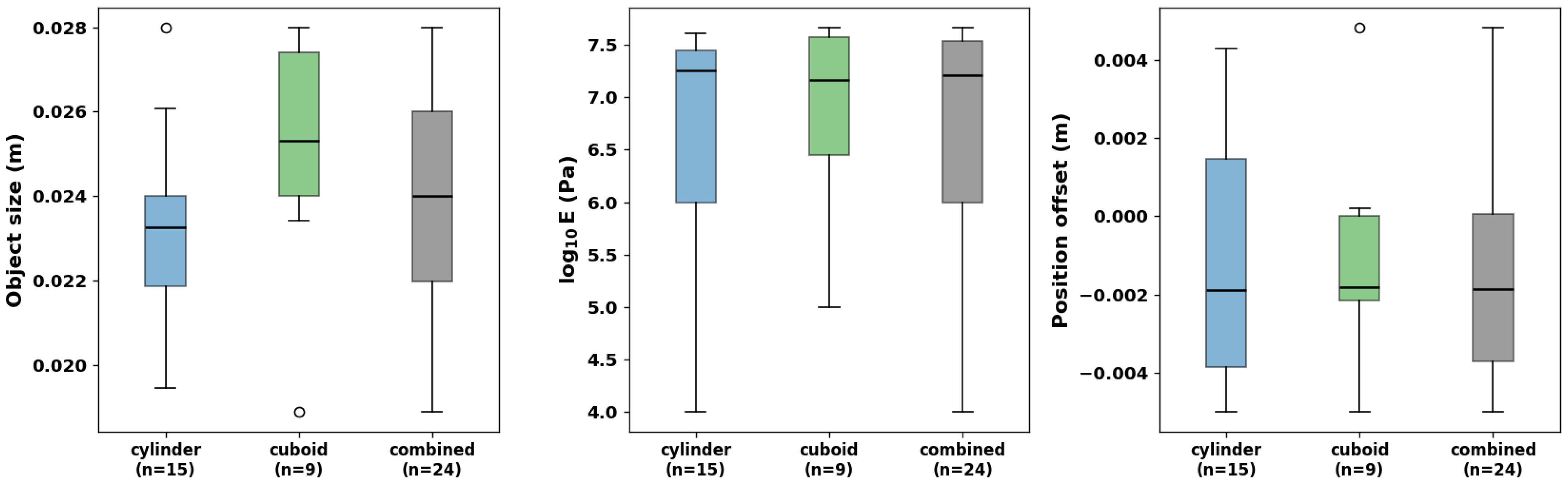
The trained BC policy achieved an overall success rate of across 38 objects in the test dataset; more specifically, (15 of 22) for cylindrical-shaped objects and (9 of 16) for cuboid-shaped objects. The parameter distribution of the successfully grasped cylindrical, cuboid and combined objects is shown in Figure 11. For the 24 successful test deployments (15 cylinders and 9 cuboids), the object size mean and standard deviation was m for cylinders and m for cuboids; was for cylinders and for cuboids; and the positional offset was m for cylinders and m for cuboids.
Figure 11.
Dataset distribution of sampled parameters (object size, Young’s modulus (), and positional offset) for cylindrical- and cuboid-shaped objects and both shapes.
The parameter statistics of the successful test grasps closely match the training distribution (e.g., combined object size mean and standard deviation m vs. m, and vs. ), indicating that successful grasps are distributed across the sampled parameter ranges rather than confined to an easier sub-region. The slightly lower cuboid success rate is consistent with their geometry, as sharp edges yield localized stress concentrations and smaller, less stable contact regions than cylinders; however, given the limited number of test objects, this remains a plausible contributing factor rather than an established causal effect.
6. Conclusions
In this research, we presented a framework to train a BC policy to generate grasp strategies, and then employ it to capture user-generated grasping strategies for deformable objects, specifically focusing on cuboid and cylindrical shapes. The framework was implemented using a hybrid experimental setup consisting of a user-interaction glove, an Isaac Sim-based simulation environment, and an NI LabVIEW interface for UI glove positional data capture, processing, transmission and user feedback. The proposed framework and experimental setup were employed to generate a small set of 54 successful human-guided grasp demonstrations for cylindrical- and cuboid-shaped deformable objects. These human-guided demonstrations were used to synthetically generate an additional 200 successful grasp demonstrations with varying geometry sizes, Young’s moduli, and positional offsets. The augmented grasp dataset with 254 successful demonstrations was further filtered, processed, and randomly split at for BC policy training and evaluation, respectively.
The BC policy network was configured and successfully trained using the processed grasp dataset split and then evaluated on the test split to determine the () and () losses. The trained BC policy was successfully deployed in Issac Sim to grasp all the objects in the test split. The overall grasp success rate of the policy was evaluated to be across the 38 (cylindrical and cuboid) objects in the test dataset. The individual geometry grasp success rates were (15 of 22) for cylindrical and (9 of 16) for cuboid objects.
The results of this study, starting with a small number of demonstrations and two object geometries, provide confidence in continuing this investigation by expanding the current object geometries (regular and irregular) and sizes, as well as by seeking to understand the effects different parameters have on BC policy performance and grasping success, with eventual demonstration on a physical ARH.
Author Contributions
Conceptualization, P.S.S.; methodology, P.S.S.; software, A.H.A.R.; investigation, A.H.A.R.; resources, P.S.S.; data curation, A.H.A.R.; writing—original draft preparation, A.H.A.R.; writing—review and editing, A.H.A.R. and P.S.S.; supervision, P.S.S.; project administration, P.S.S. All authors have read and agreed to the published version of the manuscript.
Funding
This research received no external funding.
Institutional Review Board Statement
In accordance with the research regulations of the University of Texas at Arlington, this study did not meet the federal definition of ‘research involving human subjects’ under 45 CFR 46 and therefore was not subject to Institutional Review Board (IRB) review or approval. All demonstrations described in this article were performed solely by one of the authors as part of system development and validation activities; no other individuals participated in the study.
Informed Consent Statement
Not applicable.
Data Availability Statement
Research data discussed in this article could be requested from the corresponding author on reasonable request.
Acknowledgments
The authors would like to thank Sudip Hazra for his guidance and assistance with the wearable glove operation and data acquisition.
Conflicts of Interest
The authors declare no conflicts of interest.
Abbreviations
The following abbreviations are used in this manuscript:
| 1D | One-Dimensional |
| 2D | Two-Dimensional |
| 3D | Three-Dimensional |
| ARH | Anthropomorphic Robotic Hand |
| BC | Behavioral Cloning |
| CMC | Carpometacarpal Joint |
| CNN | Convolutional Neural Network |
| CV | Cross-Validation |
| DOF | Degree(s) of Freedom |
| ERM | Eccentric Rotating Mass |
| FEM | Finite Element Method |
| GELU | Gaussian Error Linear Unit |
| GQI | Grasp Quality Index |
| IL | Imitation Learning |
| MAD | Mean Action Deviation |
| ML | Machine Learning |
| MSE | Mean Square Error |
| RL | Reinforcement Learning |
| UI | User Interaction |
| VR | Virtual Reality |
References
- Yun, Y.; Na, Y.; Esmatloo, P.; Dancausse, S.; Serrato, A.; Merring, C.A.; Agarwal, P.; Deshpande, A.D. Improvement of hand functions of spinal cord injury patients with electromyography-driven hand exoskeleton: A feasibility study. Wearable Technol. 2020, 1, e8. [Google Scholar] [CrossRef] [Scilit] [PubMed]
- Gutterman, J.; Gordon, A.M. Neural Correlates of Impaired Grasp Function in Children with Unilateral Spastic Cerebral Palsy. Brain Sci. 2023, 13, 1102. [Google Scholar] [CrossRef] [Scilit] [PubMed]
- Jia, T.; Pan, F.; Yang, X.; Ji, L.; Farina, D.; Li, C. Artificial Empathy in Therapy and Healthcare: Advancements in Interpersonal Interaction Technologies. Cyborg Bionic Syst. 2025, 6, 0473. [Google Scholar] [CrossRef] [Scilit] [PubMed]
- Betti, S.; Castiello, U.; Begliomini, C. Reach-to-Grasp: A Multisensory Experience. Front. Psychol. 2021, 12, 2021. [Google Scholar] [CrossRef] [Scilit] [PubMed]
- Sburlea, A.I.; Wilding, M.; Müller-Putz, G.R. Disentangling human grasping type from the object’s intrinsic properties using low-frequency EEG signals. Neuroimage Rep. 2021, 1, 100012. [Google Scholar] [CrossRef] [Scilit]
- Yu, C.; Wang, P. Dexterous Manipulation for Multi-Fingered Robotic Hands With Reinforcement Learning: A Review. Front. Neurorobotics 2022, 16, 2022. [Google Scholar] [CrossRef] [Scilit] [PubMed]
- NVIDIA. Robot Learning. 2025. Available online: https://www.nvidia.com/en-us/glossary/robot-learning/ (accessed on 1 February 2025).
- Xie, Z.; Liang, X.; Roberto, C. Learning-based robotic grasping: A review. Front. Robot. AI 2023, 10, 1038658. [Google Scholar] [CrossRef] [Scilit] [PubMed]
- Feix, T.; Romero, J.; Schmiedmayer, H.B.; Dollar, A.M.; Kragic, D. The GRASP Taxonomy of Human Grasp Types. IEEE Trans. Hum.-Mach. Syst. 2016, 46, 66–77. [Google Scholar] [CrossRef] [Scilit]
- Mandlekar, A.; Xu, D.; Wong, J.; Nasiriany, S.; Wang, C.; Kulkarni, R.; Fei-Fei, L.; Savarese, S.; Zhu, Y.; Martín-Martín, R. What Matters in Learning from Offline Human Demonstrations for Robot Manipulation. arXiv 2021, arXiv:2108.03298. [Google Scholar] [CrossRef] [Scilit]
- Zaidi, L.; Corrales, J.A.; Bouzgarrou, B.C.; Mezouar, Y.; Sabourin, L. Model-based strategy for grasping 3D deformable objects using a multi-fingered robotic hand. Robot. Auton. Syst. 2017, 95, 196–206. [Google Scholar] [CrossRef] [Scilit]
- Ficuciello, F.; Migliozzi, A.; Coevoet, E.; Petit, A.; Duriez, C. FEM-Based Deformation Control for Dexterous Manipulation of 3D Soft Objects. In Proceedings of the 2018 IEEE/RSJ International Conference on Intelligent Robots and Systems (IROS), Madrid, Spain, 1–5 October 2018; pp. 4007–4013. [Google Scholar] [CrossRef] [Scilit]
- Le, T.N.; Lundell, J.; Abu-Dakka, F.J.; Kyrki, V. Deformation-Aware Data-Driven Grasp Synthesis. IEEE Robot. Autom. Lett. 2022, 7, 3038–3045. [Google Scholar] [CrossRef] [Scilit]
- Yi, J.B.; Kim, J.; Kang, T.; Song, D.; Park, J.; Yi, S.J. Anthropomorphic Grasping of Complex-Shaped Objects Using Imitation Learning. Appl. Sci. 2022, 12, 12861. [Google Scholar] [CrossRef] [Scilit]
- Dyrstad, J.S.; Ruud Øye, E.; Stahl, A.; Reidar Mathiassen, J. Teaching a Robot to Grasp Real Fish by Imitation Learning from a Human Supervisor in Virtual Reality. In Proceedings of the 2018 IEEE/RSJ International Conference on Intelligent Robots and Systems (IROS), Madrid, Spain, 1–5 October 2018; pp. 7185–7192. [Google Scholar] [CrossRef] [Scilit]
- Li, M.; Zhang, L.; Li, T.; Jiang, Y. Learning Gentle Grasping from Human-Free Force Control Demonstration. IEEE Robot. Autom. Lett. 2025, 10, 2391–2398. [Google Scholar] [CrossRef] [Scilit]
- Wang, R.; Zhang, J.; Chen, J.; Xu, Y.; Li, P.; Liu, T.; Wang, H. DexGraspNet: A Large-Scale Robotic Dexterous Grasp Dataset for General Objects Based on Simulation. In Proceedings of the 2023 IEEE International Conference on Robotics and Automation (ICRA), London, UK, 29 May–2 June 2023; pp. 11359–11366. [Google Scholar] [CrossRef] [Scilit]
- Turpin, D.; Zhong, T.; Zhang, S.; Zhu, G.; Heiden, E.; Macklin, M.; Tsogkas, S.; Dickinson, S.; Garg, A. Fast-Grasp’D: Dexterous Multi-Finger Grasp Generation Through Differentiable Simulation. In Proceedings of the 2023 IEEE International Conference on Robotics and Automation (ICRA), London, UK, 29 May–2 June 2023; pp. 8082–8089. [Google Scholar] [CrossRef] [Scilit]
- Ma, S.; Du, W.; Yu, C.; Jiang, Y.; Zong, Z.; Xie, T.; Chen, Y.; Yang, Y.; Han, X.; Jiang, C. GRIP: A General Robotic Incremental Potential Contact Simulation Dataset for Unified Deformable-Rigid Coupled Grasping. arXiv 2025, arXiv:2503.05020. [Google Scholar] [CrossRef] [Scilit]
- Li, Y.; Guo, C.; Ren, J.; Chen, B.; Cheng, C.; Zhang, H.; Lu, H. SoftGrasp: Adaptive Grasping for Dexterous Hand Based on Multimodal Imitation Learning. Biomim. Intell. Robot. 2025, 5, 100217. [Google Scholar] [CrossRef] [Scilit]
- Yamane, K.; Saigusa, Y.; Sakaino, S.; Tsuji, T. Soft and Rigid Object Grasping With Cross-Structure Hand Using Bilateral Control-Based Imitation Learning. IEEE Robot. Autom. Lett. 2024, 9, 1198–1205. [Google Scholar] [CrossRef] [Scilit]
- Hu, Z.; Han, T.; Sun, P.; Pan, J.; Manocha, D. 3-D deformable object manipulation using deep neural networks. IEEE Robot. Autom. Lett. 2019, 4, 4255–4261. [Google Scholar] [CrossRef] [Scilit]
- Winter, T.R.; Sundaram, A.M.; Friedl, W.; Roa, M.A.; Stulp, F.; Silvério, J. State- and context-dependent robotic manipulation and grasping via uncertainty-aware imitation learning. arXiv 2024, arXiv:2410.24035. [Google Scholar] [CrossRef] [Scilit]
- Scheikl, P.M.; Schreiber, N.; Haas, C.; Freymuth, N.; Neumann, G.; Lioutikov, R.; Mathis-Ullrich, F. Movement Primitive Diffusion: Learning Gentle Robotic Manipulation of Deformable Objects. IEEE Robot. Autom. Lett. 2024, 9, 5338–5345. [Google Scholar] [CrossRef] [Scilit]
- An, S.; Meng, Z.; Tang, C.; Zhou, Y.; Liu, T.; Ding, F.; Zhang, S.; Mu, Y.; Song, R.; Zhang, W.; et al. Dexterous Manipulation through Imitation Learning: A Survey. arXiv 2025, arXiv:2504.03515. [Google Scholar] [CrossRef] [Scilit]
- Shafiullah, N.M.M.; Cui, Z.J.; Altanzaya, A.; Pinto, L. Behavior Transformers: Cloning k Modes with One Stone. arXiv 2022, arXiv:2206.11251. [Google Scholar] [CrossRef] [Scilit]
- Li, S.; Huang, Z.; Chen, T.; Du, T.; Su, H.; Tenenbaum, J.B.; Gan, C. DexDeform: Dexterous Deformable Object Manipulation with Human Demonstrations and Differentiable Physics. In Proceedings of the International Conference on Learning Representations (ICLR), Kigali, Rwanda, 1–5 May 2023. [Google Scholar] [CrossRef] [Scilit]
- Wang, K.; Lu, B.; Cheng, Z.; Zhang, H.; Song, L. D3Grasp: Diverse and Deformable Dexterous Grasping for General Objects. arXiv 2025, arXiv:2509.19892. [Google Scholar] [CrossRef] [Scilit]
- Yang, Y.; Wang, Z.; Xing, D.; Wang, P. Learning Playing Piano with Bionic-Constrained Diffusion Policy for Anthropomorphic Hand. Cyborg Bionic Syst. 2024, 5, 0104. [Google Scholar] [CrossRef] [Scilit] [PubMed]
- Gu, F.; Zhou, Y.; Wang, Z.; Jiang, S.; He, B. A Survey on Robotic Manipulation of Deformable Objects: Recent Advances, Open Challenges and New Frontiers. arXiv 2023, arXiv:2312.10419. [Google Scholar] [CrossRef] [Scilit]
- Laux, M.; Singh, C.; Fabisch, A. Grasping 3D Deformable Objects via Reinforcement Learning: A Benchmark and Evaluation. In Proceedings of the 3rd Workshop on Representing and Manipulating Deformable Objects @ ICRA2023, London, UK, 29 May 2023; Available online: https://deformable-workshop.github.io/icra2023/spotlight/03-Laux-spotlight.pdf (accessed on 30 July 2026).
- Sanchez, J.; Corrales, J.A.; Bouzgarrou, B.C.; Mezouar, Y. Robotic manipulation and sensing of deformable objects in domestic and industrial applications: A survey. Int. J. Robot. Res. 2018, 37, 688–716. [Google Scholar] [CrossRef] [Scilit]
- Abdul Rahaman, A.H.; Shiakolas, P.S. A Carpometacarpal Thumb Tracking Device for Telemanipulation of a Robotic Thumb: Development, Prototyping, and Evaluation. Appl. Sci. 2025, 15, 1301. [Google Scholar] [CrossRef] [Scilit]
- Hazra, S.; Abdul Rahaman, A.H.; Shiakolas, P.S. An Affordable Telerobotic System Architecture for Grasp Training and Object Grasping for Human–Machine Interaction. J. Eng. Sci. Med. Diagn. Ther. 2023, 7, 011011. [Google Scholar] [CrossRef] [Scilit]
- Abdul Rahaman, A.H.; Hazra, S.; Shiakolas, P.S. On the Development and Evaluation of an Affordable Telerobotic System for Object Grasping for Human-Machine Interaction. In Proceedings of the ASME 2023 International Mechanical Engineering Congress and Exposition, New Orleans, LA, USA, 29 October–2 November 2023; Volume 5: Biomedical and Biotechnology, p. V005T06A058. [Google Scholar] [CrossRef] [Scilit]
- Narang, Y.; Sundaralingam, B.; Macklin, M.; Mousavian, A.; Fox, D. Sim-to-Real for Robotic Tactile Sensing via Physics-Based Simulation and Learned Latent Projections. In Proceedings of the 2021 IEEE International Conference on Robotics and Automation (ICRA), Xi’an, China, 30 May–5 June 2021; pp. 6444–6451. [Google Scholar] [CrossRef] [Scilit]
- Mittal, M.; Roth, P.; Tigue, J.; Richard, A.; Zhang, O.; Du, P.; Serrano-Muñoz, A.; Yao, X.; Zurbrügg, R.; Rudin, N.; et al. Isaac Lab: A GPU-Accelerated Simulation Framework for Multi-Modal Robot Learning. arXiv 2025, arXiv:2511.04831. [Google Scholar] [CrossRef] [Scilit]
- Radford, A.; Narasimhan, K.; Salimans, T.; Sutskever, I. Improving Language Understanding by Generative Pre-Training. 2018, pp. 1–12. Available online: https://cdn.openai.com/research-covers/language-unsupervised/language_understanding_paper.pdf (accessed on 30 July 2026).
- Vaswani, A.; Shazeer, N.; Parmar, N.; Uszkoreit, J.; Jones, L.; Gomez, A.N.; Kaiser, L.; Polosukhin, I. Attention Is All You Need. In Proceedings of the Advances in Neural Information Processing Systems (NeurIPS 2017), Long Beach, CA, USA, 4–9 December 2017; Volume 30, pp. 5998–6008. [Google Scholar]
- Kingma, D.P.; Ba, J. Adam: A Method for Stochastic Optimization. arXiv 2014, arXiv:1412.6980. [Google Scholar] [CrossRef] [Scilit]
- Hendrycks, D.; Gimpel, K. Gaussian Error Linear Units (GELUs). arXiv 2016, arXiv:1606.08415. [Google Scholar] [CrossRef] [Scilit]
- Goodfellow, I.; Bengio, Y.; Courville, A. Deep Learning; MIT Press: Cambridge, MA, USA, 2016. [Google Scholar]
- Williams, M.L. Stress Singularities Resulting From Various Boundary Conditions in Angular Corners of Plates in Extension. J. Appl. Mech. 1952, 19, 526–528. [Google Scholar] [CrossRef] [Scilit]


Disclaimer/Publisher’s Note: The statements, opinions and data contained in all publications are solely those of the individual author(s) and contributor(s) and not of MDPI and/or the editor(s). MDPI and/or the editor(s) disclaim responsibility for any injury to people or property resulting from any ideas, methods, instructions or products referred to in the content. |
© 2026 by the authors. Licensee MDPI, Basel, Switzerland. This article is an open access article distributed under the terms and conditions of the Creative Commons Attribution (CC BY) license.