


Abstract
The paper presents a Bayesian Hierarchical Generalized Ordered Probit model quantifying how the dyadic age difference between delivery riders (DR) and Non-Delivery e-bike Riders (NDR) determines traffic collision injury severity. Analysis of 741 adjudicated civil verdicts from China’s OpenLaw platform demonstrated a strict negative association between this relational age gap and physical trauma outcomes. The dyadic age difference yielded a posterior coefficient of −0.13. Shifting the DR from the 5th to the 95th relative age percentile increased the NDR “Not disabled” probability by 22.25 percentage points. This identical interval concurrently decreased severe Grade 8+ injury probabilities by 10.29 percentage points. Conversely, NDR absolute age positively escalated injury severity across the clinical spectrum. These statistical estimates suggest that older DR are associated with reduced physiological vulnerability in aging commuter populations. Current automated dispatch algorithms optimize exclusively for delivery speed and completely atomize the gig workforce. Platform architects can reconfigure these digital systems to proactively pair experienced older riders with younger peers during overlapping dispatch windows. This algorithmic peer-mentoring strategy bypasses ineffective asynchronous training modules. Re-engineering dispatch logic directly operationalizes the relational age gradient to mitigate the systemic trauma burden threatening modern mobility.
1. Introduction
Instant delivery services represent a prominent sector of the digital gig economy in Chinese cities [1]. By the end of 2025, electric two-wheeled vehicle ownership in China exceeded 400 million units [2]. This massive fleet facilitates instant logistics. Meanwhile, this widespread utilization creates a hazardous environment for traffic crashes. Delivery platforms utilize algorithmic scheduling systems to maximize operational efficiency [3]. These automated dispatch algorithms enforce aggressive time constraints [4]. The platform penalizes delivery delays severely [5]. Such operational pressures compel young, inexperienced DR to execute hazardous traffic maneuvers [6,7,8]. Consequently, these young riders systematically amplify the baseline kinetic energy generated during urban traffic conflicts [9].
Age plays a critical role in both the likelihood of crash involvement and the severity of resulting injuries. Older individuals tend to exhibit declines in sensory, cognitive, and motor functions, including visual acuity, reaction time, and decision-making speed, which may increase their exposure to collision risk in complex traffic environments. Moreover, age-related reductions in bone mineral density and overall physiological resilience contribute to greater vulnerability to severe trauma when a collision occurs. These age-related pathways are particularly relevant to urban e-bike safety, where the rapid expansion of delivery services has introduced a young and aggressive rider population into the same road spaces as older, more fragile commuters. The collision between youthful aggressiveness and senescent fragility is associated with severe long-term disability outcomes. Yet the existing literature has largely treated age as an individual attribute rather than examining how the relative age between collision participants may moderate injury severity.
This elevated kinetic risk intersects with the absolute biological vulnerability of Non-Delivery e-bike Riders (NDRs). NDRs represent a distinct class of road users lacking delivery attributes [10]. These NDRs comprise a rapidly aging demographic in dense urban networks [11]. Advanced age correlates negatively with skeletal density and structural biomechanical tolerance [12,13,14]. Older NDRs lack the physiological resilience required to absorb high-velocity mechanical impacts [15]. When reckless young DR collide with these vulnerable older NDR, the resulting trauma escalates catastrophically [9,16]. The collision between youthful aggressiveness and senescent fragility is associated with severe long-term disability outcomes [10]. Conventional safety management frameworks fail to resolve these compounding dyadic risks. Delivery enterprises rely primarily on asynchronous online safety training modules [17]. The organizational structure of the platform economy completely atomizes the workforce [18]. This pervasive atomization dismantles the peer support systems and traditional mentoring lineages found in legacy logistics sectors [18]. Isolated DR operates without channels to acquire implicit safety knowledge from veteran peers [19]. Driven by immediate financial survival, young riders systematically prioritize economic gains over abstract safety videos [20].
Previous studies on traffic injury severity have extensively examined the role of age as an individual-level risk factor. A growing body of research has demonstrated that older riders are more vulnerable to severe injuries due to reduced physiological resilience, while younger riders are more likely to engage in risky riding behaviors that increase crash involvement. However, these studies have primarily focused on the age of a single road user, treating it as an isolated attribute rather than a relational characteristic. The interaction between the ages of collision participants, specifically how the age gap between two riders may influence injury outcomes, has received little attention. Although some research has considered the age of both parties in a crash, it has not systematically quantified the dyadic age difference or explored its protective or aggravating effects on injury severity.
Existing traffic safety literature typically treats participant age as a disconnected, individual attribute [16,21,22,23]. This static paradigm fails to capture the interactive, dyadic nature of urban road collisions. Beyond these behavioral and demographic factors, the dynamic characteristics of micromobility vehicles—including stability, steering control, braking performance, rider-vehicle interaction, speed management, impact dynamics, and infrastructure conditions—are critical determinants of crash outcomes and injury severity. Suspension system design and wheel dynamics [24], tire selection and road surface conditions [25], and vibration transmission during riding on different urban pavements [26] have all been shown to influence micromobility vehicle stability, rider control, and ultimately crash risk. These vehicle-level and infrastructure-related mechanisms are particularly relevant to e-bike safety, as they modulate kinetic energy transfer during collisions and may interact with rider behavior to influence injury outcomes. Moreover, e-scooters share comparable dynamic stability, visibility, braking, and infrastructure-related safety challenges with e-bikes, and should therefore be considered within the broader micromobility category. However, existing studies have rarely quantified the relational age dynamics between collision participants, leaving the protective role of dyadic age differences largely unexplored. This paper shifts the analytical focus toward the organizational and operational mechanisms of logistics management. From an organizational perspective, delivery platforms systematically disregard older riders as a safety resource. Older DR possess superior defensive riding techniques and highly developed risk perception metrics [27,28]. This experienced demographic represents an unexploited organizational asset for peer-led safety intervention programs. We explicitly quantify the dyadic age difference between colliding DR and NDR. We analyze 741 adjudicated traffic collision court verdicts from China’s OpenLaw platform. We deploy a Bayesian Hierarchical Generalized Ordered Probit model to evaluate these forensic data. The empirical findings reveal a powerful negative correlation between the dyadic age difference and NDR injury severity. Positive age differences, denoting older DR, provide a substantial protective buffer. This buffer reduces severe injury probabilities for NDR significantly. These forensic insights deliver empirical evidence for algorithmic dispatch reconfiguration and targeted peer-mentoring safety interventions.
This manuscript unfolds across five interconnected sections. Section 2 delineates the judicial data extraction procedures. This section also explains the mathematical framework of the Bayesian hierarchical model. These statistical formulations yield the posterior estimation results detailed in Section 3. Section 3 also presents ordered marginal probability effects. Section 4 interprets the behavioral dynamics behind these estimates. This analytical section outlines algorithmic peer-mentoring intervention strategies. Finally, Section 5 summarizes the core theoretical contributions and operational boundaries of this research.
2. Materials and Methods
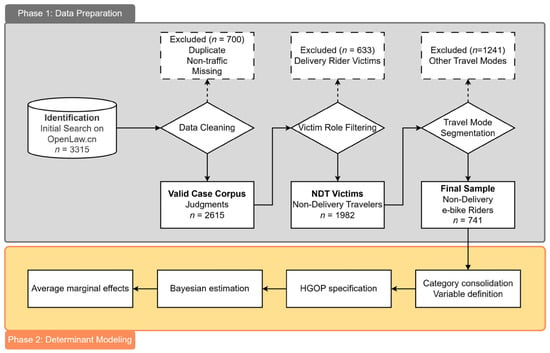
This study constructed a two-phase methodological framework to evaluate the trauma burden borne by non-DR. Phase one established a strict data curation pathway to isolate valid collision dyads from Chinese judicial verdicts. This data pipeline ensures all selected cases strictly represent interactions between instant logistics delivery personnel and personal-use riders. Phase two formulated a Bayesian hierarchical modeling architecture to estimate the protective gradient of the dyadic age difference. We subsequently computed ordered marginal probability shifts to evaluate potential algorithmic peer-mentoring interventions. Figure 1 illustrates this complete case-selection and analytical procedure.
Figure 1.
Study framework: case selection and analytical procedure. Note: Solid boxes indicate retained cases; dashed boxes indicate excluded cases. The gray and yellow areas represent Phase 1 (data preparation) and Phase 2 (determinant modeling), respectively.
2.1. Data Curation and Variable Operationalization
The initial search on OpenLaw.cn retrieved 3315 first-instance traffic collision verdicts. We applied a stepwise curation procedure to isolate valid collision dyads between DR and NDR. Collisions involving DR pairs or NDR pairs were excluded from the outset. While DR-DR cases exist in the raw data, our extraction protocol was designed to capture only DR-NDR dyads, as our study focuses specifically on the asymmetric externality conflict between commercial delivery riders and the general commuting public, rather than symmetric occupational interactions between delivery riders. Duplicate entries, non-traffic civil disputes, and records with missing key identifiers (e.g., injury severity, liability determination, or rider age) were removed, yielding 2615 valid corpus judgments. We further excluded 633 cases in which the DR was the victim rather than the offending party, as our study focuses on injuries sustained by NDR in collisions initiated by DR. Another 1241 collision events involving pedestrians, motor vehicle occupants, and non-e-bike cyclists were also excluded, restricting the analytical cohort exclusively to two-wheeled e-bike collisions between DR and NDR. This targeted isolation strategy generated a final analytical cohort comprising 741 valid dyads. All variables were extracted through automated parsing of the OpenLaw records using a predefined protocol, ensuring consistent and reproducible data extraction across all cases. Table 1 presents the descriptive statistics for all categorical covariates characterizing this final sample.
Table 1.
Descriptive statistics of the study sample (N = 741).
Operationalizing the outcome variable required balancing statistical frequency with clinical measurement criteria. We measured injury severity using the national Classification of Disability Degrees Due to Bodily Injury [29]. A single crash frequently inflicts multiple disabling injuries upon a victim. We extracted the highest assessed disability grade as the statistical baseline. Adopting the highest grade accurately quantifies the maximum mechanical impact consequences sustained by the NDR. We retained “Not disabled,” “Grade 10,” and “Grade 9” as independent clinical categories. Although Grade 9 cases constituted only 4.7% of the sample, maintaining this distinct level preserves trauma resolution granularity. We aggregated fatalities and extremely severe non-fatal outcomes to generate a unified “Grade 8+” category. This categorical consolidation produced a clinical outcome variable containing four strictly ordered levels. This aggregation was motivated by two practical and methodological considerations. The limited number of fatality cases in our sample precludes stable estimation as a separate category. At the same time, both fatalities and extremely severe non-fatal injuries occupy the most severe end of the injury spectrum, involving permanent functional loss or death, and are clinically distinguishable from Grade 9 and Grade 10 disabilities, which involve less severe and more localized impairments. Aggregating these cases into a single upper category therefore preserves the ordered nature of the outcome variable while maintaining sufficient cell counts for reliable Bayesian estimation.
We grouped continuous rider ages according to the World Health Organization’s standard five-year intervals [30], a clinically meaningful and internationally recognized scheme for age-related vulnerability analysis. This grouping strategy also mitigates sparse-cell bias by ensuring sufficient observations within each age stratum, thereby stabilizing the estimation of group-level random effects and avoiding convergence issues that may arise from modeling continuous age as a grouping factor. Subtracting the NDR age group from the DR age group constructed the core dyadic age difference predictor. For this ordinal variable, positive integers explicitly denote a relatively older DR. We centered this variable at its median to stabilize subsequent model interpretation. Preventing sparse-cell bias during Bayesian posterior sampling required establishing a 5% observation threshold for independent variables. We forcibly merged covariate sub-levels falling below this proportion into logically adjacent categories. Alongside the age metric, we concurrently operationalized forensic liability and temporal phases as systemic control variables.
2.2. Bayesian Hierarchical Model Specification
Accurately estimating disability outcomes required deploying a Hierarchical Generalized Ordered Probit (HGOP) model [31]. Standard ordered models incorrectly assume independent observations and fixed thresholds. Breaking these rigid assumptions, NDRs cluster within specific age groups and share unobserved systemic heterogeneities. The HGOP model explicitly relaxed the parallel regression assumption by introducing random intercepts. Let denote the observed injury severity for the i-th NDR in the j-th age group. We assumed a latent continuous variable determines the observed categorical outcome. The baseline structural equation models this relationship algebraically:
The vector represents fixed-effect coefficients. The component contains the predictor variables including the dyadic age difference. The error term follows a standard normal distribution to establish the required probit link.
Modeling the dynamic thresholds required linking the cutoff parameters directly to the covariates. We specified the variable threshold equation to capture these shifts:
We allowed the severity thresholds to vary as functions of selected covariates that may differentially shift the boundaries between adjacent injury levels. Specifically, the threshold parameters were modeled as linear functions of the dyadic age difference, NDR age, liability, and year indicators, as these variables were hypothesized to influence the likelihood of crossing each severity cutoff. This specification relaxes the parallel-regression assumption of standard ordered probit models and permits covariate effects to differ across the injury severity spectrum.
The component represents variables designated to shift the thresholds across different severity levels. Capturing the unobserved group-level correlation required integrating a hierarchical random effect into the threshold structure. The term constitutes the random intercept for the j-th NDR age group. We assumed this random intercept follows a normal distribution:
The hierarchical grouping structure was specified at the NDR age group level, since age is a primary determinant of physiological vulnerability to trauma. NDRs within the same age cohort are likely to share unobserved biological and behavioral characteristics that influence injury outcomes. Introducing random intercepts at this level captures within-group correlation not accounted for by observed covariates, while partial pooling across age groups stabilizes estimates for strata with smaller sample sizes. City, region, and delivery company were included as fixed effects to control for geographic and operational heterogeneity, consistent with our primary focus on the age-related dyadic mechanism.
These specific intercepts accurately captured systematic correlations within the NDR age strata. This hierarchical structure utilizes partial pooling to inform parameter estimates for demographic groups containing smaller sample sizes.
2.3. Marginal Effect Calculation
Translating the non-linear HGOP parameters into interpretable probabilities necessitated calculating Average Marginal Effects (AMEs). Raw coefficient estimates from hierarchical probit models do not directly represent discrete changes in outcome probabilities. We computed AMEs to quantify the practical implications of each predictor holding all other covariates constant. For categorical predictors, the AME algorithm calculates the exact discrete probability shift when transitioning between reference and comparison categories. Evaluating the continuous dyadic age difference required computing the discrete probability change from the 5th to the 95th percentile. We extracted predicted probabilities directly from the posterior draws of the fitted model parameters. All marginal effect calculations occurred within the R (version 4.4.3; R Core Team, Vienna, Austria) computational environment utilizing the full posterior predictive distribution.
2.4. Bayesian Parameterization and Convergence Diagnostics
Fitting the hierarchical model utilized the brms software package (version 2.22.0) in the R programming environment under a fully Bayesian paradigm to ensure exact uncertainty propagation. We selected weakly informative priors to regularize parameter estimates without dominating the empirical data signal. Specifically, the fixed-effect coefficients received a normal prior distribution with a mean of 0 and a variance of 2, while the intercepts and random effect standard deviations were assigned Student-t priors with 3 degrees of freedom, a location of 0, and a scale of 2.5. The complete matrix of prior distributions is detailed in Table A1.
Posterior estimation was performed using the No-U-Turn Sampler (NUTS) implemented in Stan (version 2.32.7). We executed four independent Markov Chain Monte Carlo chains, each completing 3000 iterations with the first 1000 discarded as warm-up draws, yielding 8000 post-warmup draws for final inference. To prevent divergent transitions, we set the target acceptance rate to 0.98 and the maximum tree depth to 12.
Convergence was rigorously assessed using the potential scale reduction factor () alongside bulk and tail effective sample sizes. All key parameters achieved values below 1.01 and generated effective sample sizes exceeding 5000, with no divergent transitions occurring during sampling. These diagnostic metrics confirm stable posterior approximation and mathematical reliability. The hierarchical structure successfully captured the unobserved group-level correlations embedded within the NDR age strata. Prior sensitivity and alternative model comparisons are presented in Table A2 and Table A3. The posterior predictive check is presented in Figure A1. Sensitivity analysis using an alternative severity classification is presented in Table A4. The LOOIC difference between the original and alternative models was 0.21, indicating comparable predictive performance and supporting the parsimony of the original specification.
3. Results
3.1. Cohort Characteristics and Exploratory Trends
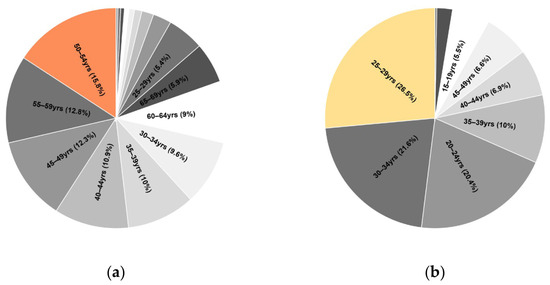
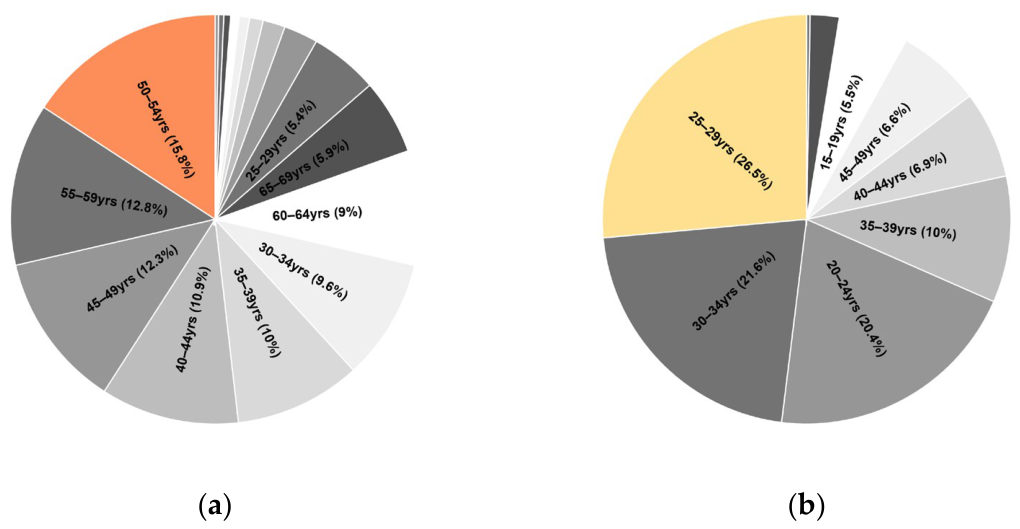
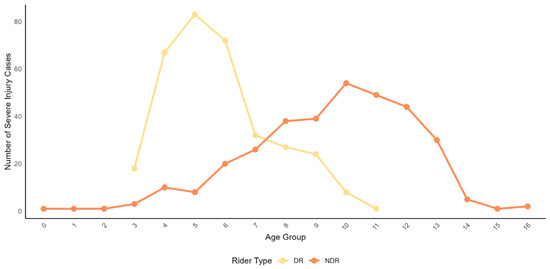
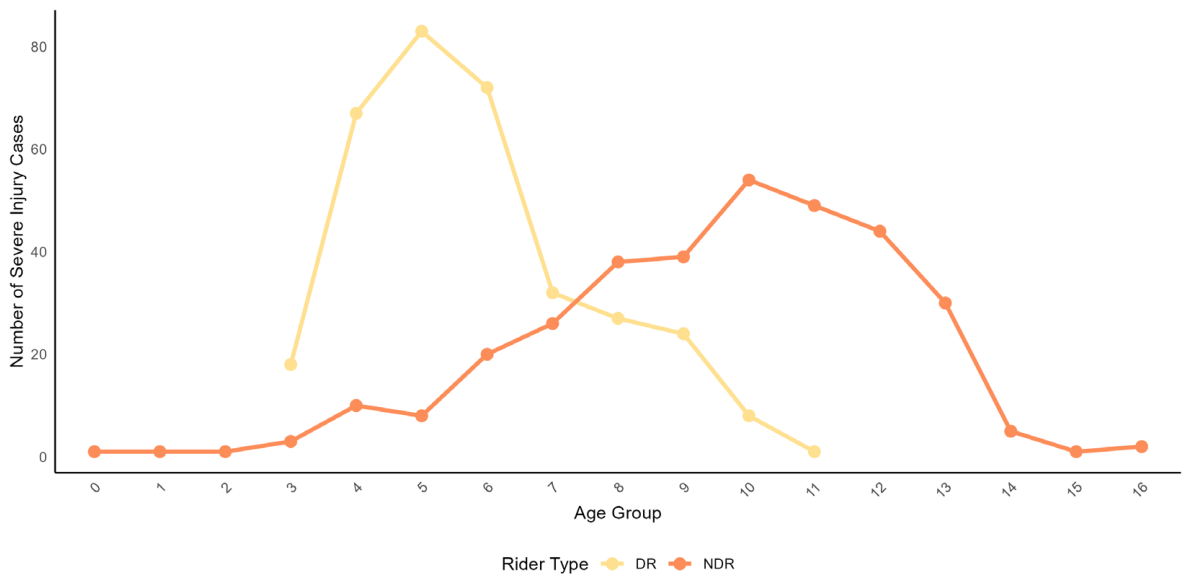
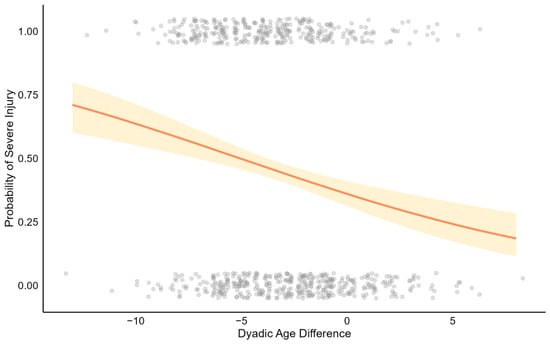
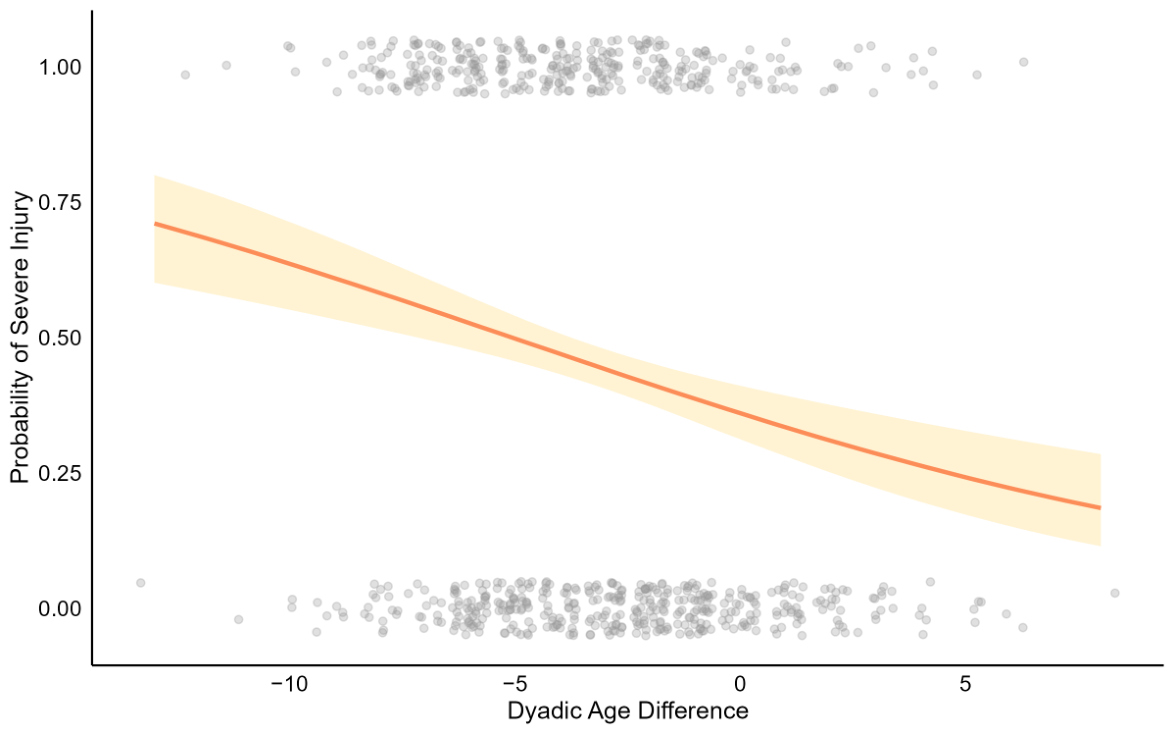
The analytical cohort exhibited distinct age distributions across the two rider populations. DR concentrated heavily in younger age intervals (Figure 2a). NDR presented a broader distribution across middle and older age brackets (Figure 2b). Severe injury occurrences clustered at different life stages for each rider group (Figure 3). We calculated the dyadic age difference by subtracting the NDR age group from the DR age group. Generalized additive modeling revealed a roughly linear negative trend between this calculated dyadic age difference and severe injury probability (Figure 4). The probability of severe injury decreased monotonically as the DR’s relative age increased.
Figure 2.
Age group distribution of (a) NDR and (b) DR. Note: Only age groups with a proportion ≥ 5% are labeled in the chart for clarity. The remaining age groups are as follows: (a) NDR: 0–4 yrs (0.3%), 5–9 yrs (0.8%), 10–14 yrs (0.7%), 15–19 yrs (1.8%), 20–24 yrs (2.7%), 70–74 yrs (1.1%), 75–79 yrs (0.5%), and 80–84 yrs (0.4%).; (b) DR: 50–54 yrs (2.3%) and 55–59 yrs (0.3%).
Figure 3.
Number of severe injury cases by age group for DR and NDR.
Figure 4.
Generalized additive model smoothing curves: dyadic age difference and probability of severe injury. Note: Points represent individual observations. The shaded area represents the 95% confidence interval of the GAM fit.
3.2. Posterior Estimates of Regression Coefficients
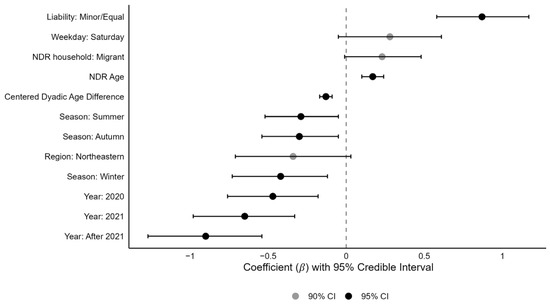
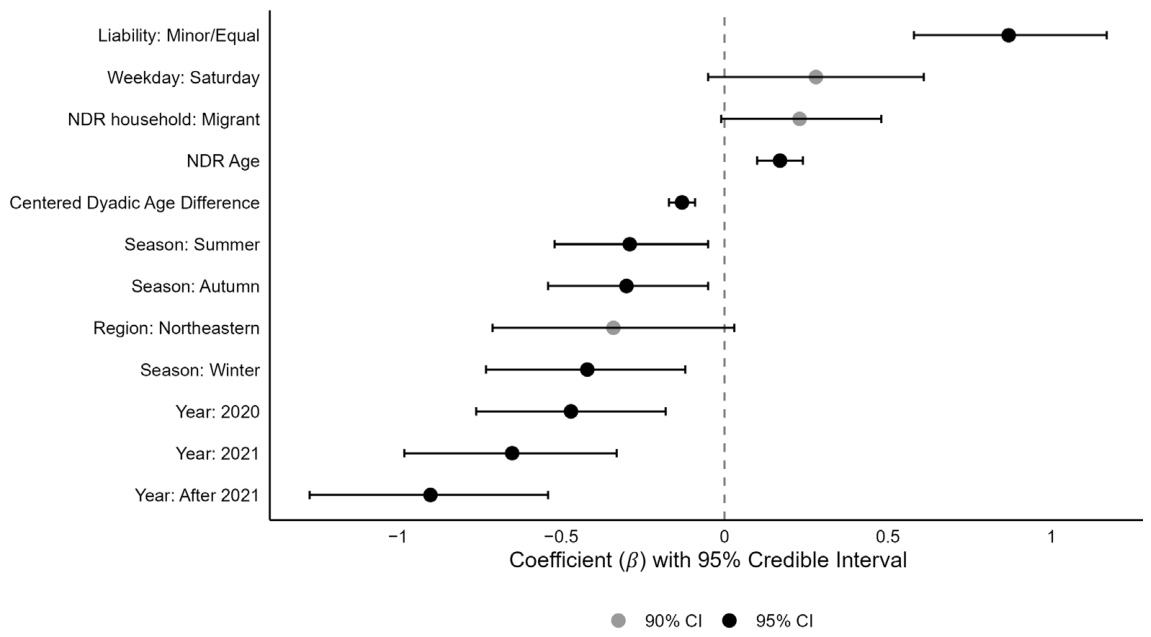
The Bayesian hierarchical model produced credible posterior estimates for the core dyadic age predictor. The dyadic age difference exhibited a strong negative association with NDR injury severity ( = −0.13, 95% CI [−0.17, −0.09]). This parameter estimate aligns directionally with the exploratory non-parametric analysis (Figure 5, Table 2). Legal liability produced an inverted statistical pattern within this posterior distribution. Minor or equal liability for the NDR correlated with higher injury severity relative to full liability ( = 0.87, 95% CI [0.58, 1.17]). NDR absolute age demonstrated a positive association with injury severity ( = 0.17, 95% CI [0.10, 0.24]).
Figure 5.
Forest plot of coefficient estimates () for significant predictors (with 95% credible intervals).
Table 2.
Key estimates of the hierarchical generalized ordered probit model for significant predictors.
Temporal factors indicated progressively lower severity over the study period. Crashes occurring after 2021 exhibited the largest negative coefficient relative to 2018 ( = −0.90, 95% CI [−1.27, −0.54]). Winter crashes correlated with lower severity compared to spring events ( = −0.42, 95% CI [−0.73, −0.12]). Weekend collisions on Saturday demonstrated elevated severity relative to Monday ( = 0.28, 90% CI [−0.05, 0.61]). Regional differences emerged marginally within the dataset. The Northeastern region recorded lower severity than the Eastern region ( = −0.34, 90% CI excluded zero). Full posterior summaries for all coefficients, including non-significant predictors, are provided in Table A5.
3.3. Ordered Marginal Probability Effects
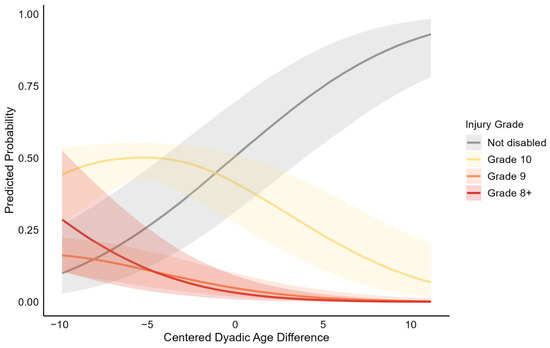
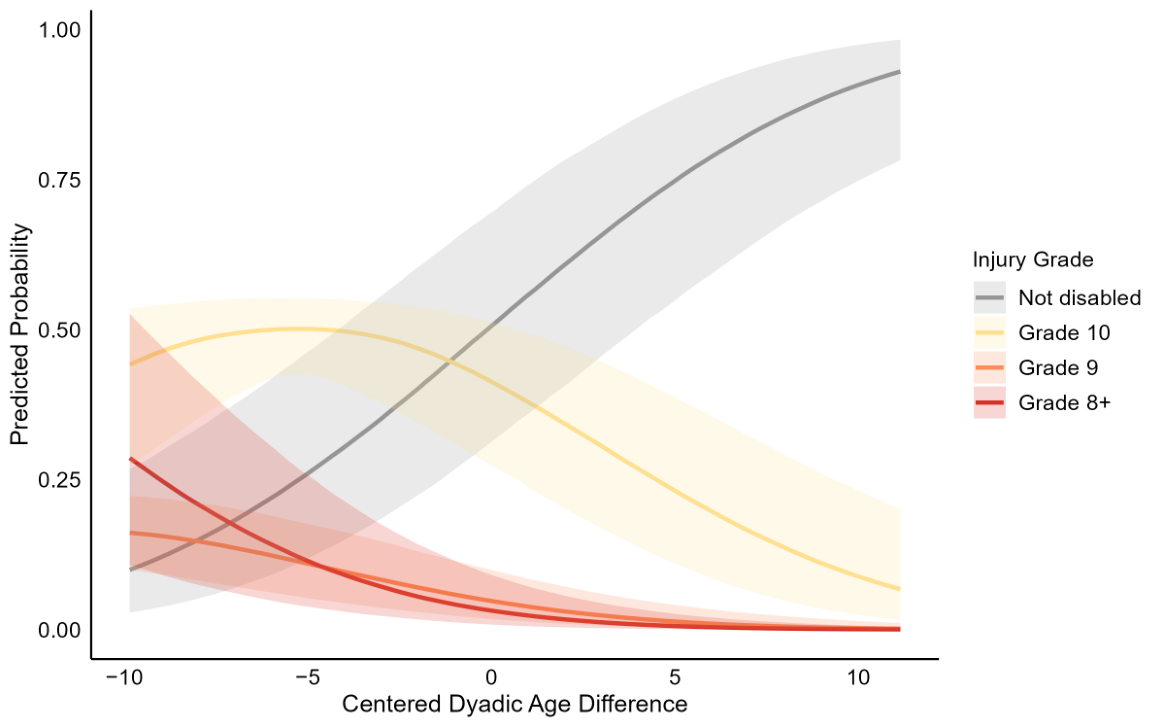
Average marginal effects quantified the discrete probability shifts across all four injury severity levels. Shifting the dyadic age difference from the 5th to the 95th percentile increased the probability of the “Not disabled” outcome by 22.25 percentage points (Figure 6). This identical interval concurrently decreased the probability of Grade 8+ severe injuries by 10.29 percentage points. Intermediate severity outcomes for Grade 10 and Grade 9 decreased by 17.30 and 2.83 percentage points, respectively. These marginal shifts verify a consistent reduction in disability probability across the ordered clinical spectrum.
Figure 6.
Marginal effects of dyadic age difference on predicted probabilities of injury severity. Note: The shaded areas represent 95% credible intervals.
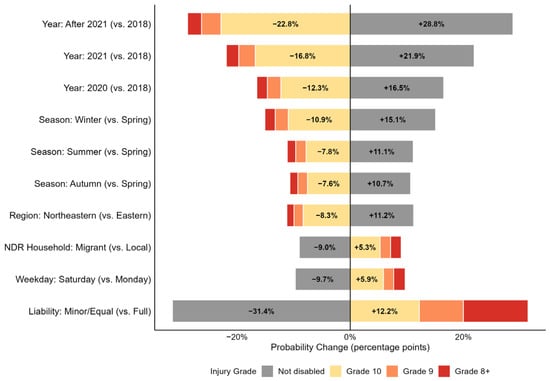
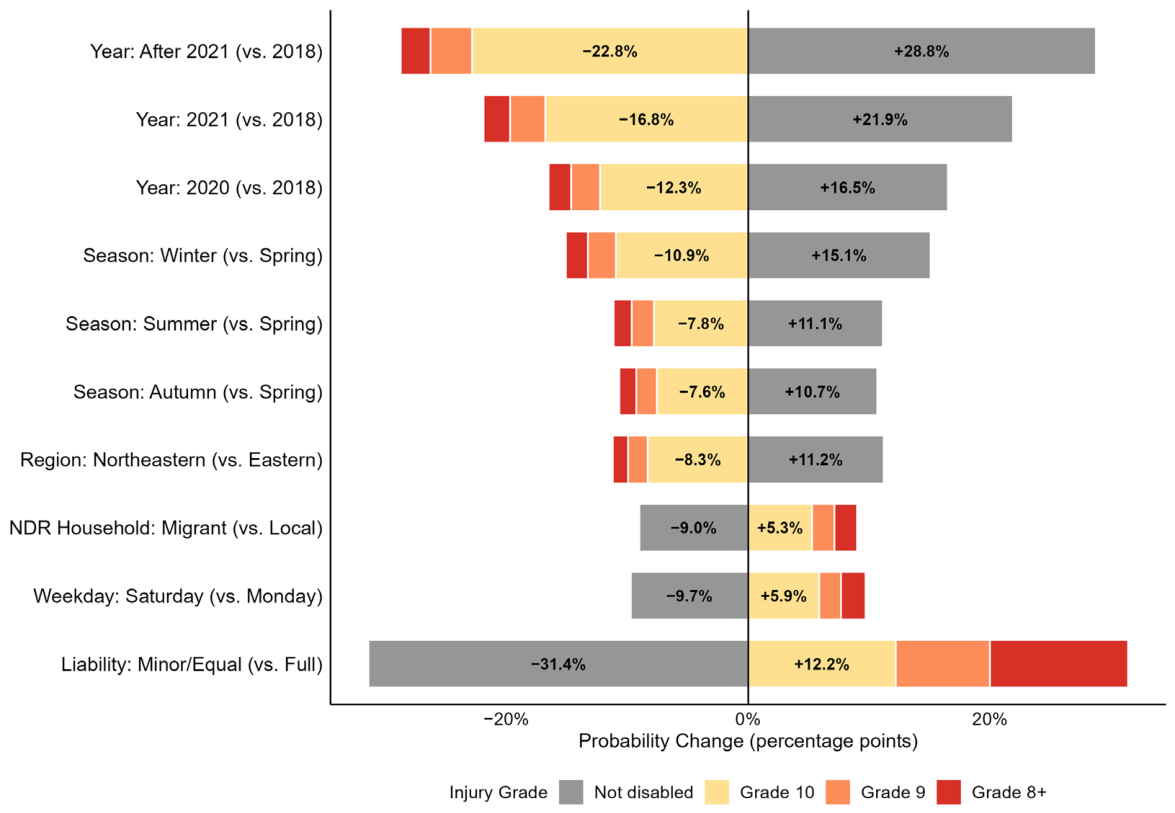
Forensic liability induced the largest magnitude probability shifts among all evaluated covariates (Figure 7, Table A6). Minor or equal NDR liability reduced the “Not disabled” probability by 31.41 percentage points compared to full liability. This condition simultaneously increased the Grade 8+ probability by 11.42 percentage points. NDR absolute age generated a similar magnitude of severity escalation. Moving from the 5th to the 95th absolute age percentile decreased the “Not disabled” probability by 25.01 percentage points. This absolute age interval concurrently increased the Grade 8+ probability by 7.75 percentage points.
Figure 7.
Marginal effects of significant predictors (excluding dyadic age difference) on injury severity probabilities.
Temporal and seasonal shifts translated into meaningful probability variations across the dataset. Crashes occurring after 2021 increased the “Not disabled” probability by 28.75 percentage points relative to 2018. This temporal shift simultaneously decreased the Grade 8+ probability by 2.46 percentage points. Winter conditions increased the “Not disabled” probability by 15.08 percentage points relative to spring. Saturday collisions decreased the “Not disabled” probability by 9.71 percentage points relative to Monday. NDR from migrant households experienced a 9.00 percentage point decrease in the “Not disabled” probability compared to non-migrant counterparts. Among the control variables, temporal factors showed the largest marginal effects. Liability assignment further moderated injury outcomes, with minor or equal liability linked to a 31.41 percentage point decrease in the “Not disabled” probability. These patterns collectively underscore the multifactorial nature of injury severity in delivery-related e-bike collisions.
4. Discussion
4.1. Interpreting the Dyadic Age Gradient
A positive dyadic age difference serves as a powerful protective buffer against severe injury for NDR during conflicts. This relational metric directly addresses the trauma burden generated when aggressive instant logistics schedules intersect with vulnerable commuting populations. Existing traffic safety literature evaluates participant age strictly as a disconnected, individual attribute [16,21,22,23]. Our data challenge this static paradigm by demonstrating that the dyadic age difference is systematically associated with clinical outcomes. While previous researchers demonstrated that age protects the individual rider, our findings extend this protective effect to the opposing collision partner. Moving this dyadic age difference toward a relatively older DR increases the probability of escaping permanent disability substantially. Single-rider assessments inherently obscure the compounding danger generated when opposing kinetic profiles interact within constrained urban road networks. We identify the dyadic age difference as a primary predictor of traffic trauma.
The protective effect of a positive dyadic age difference, however, is not uniform across all circumstances. The posterior probability curves reveal that the highest risk of severe injury emerges when young DR collide with elderly NDR during peak delivery hours (11:00–13:00 and 17:00–19:00). This pattern can be interpreted through the lens of risk compensation theory [32]. Younger riders, under heightened time pressure from algorithmic dispatch systems, tend to adopt more aggressive riding behaviors, including speeding, lane filtering, and red-light running, to meet tight delivery windows. Simultaneously, elderly NDRs exhibit slower hazard perception and prolonged braking response times, which reduce their capacity to evade imminent collisions. The confluence of youthful risk-taking and age-related sensory-motor decline creates a compounding effect that substantially elevates severe injury risk. In contrast, when older DRs collide with younger or middle-aged NDR, the severity risk is markedly attenuated, presumably due to the older DR’s more conservative riding style and superior hazard anticipation [27,28].
4.2. Mechanisms Behind the Age Difference Effect
The mechanical energy transfer during these collisions depends heavily on the behavioral profiles of the colliding demographics. Our data support previous researchers demonstrating that older riders possess superior defensive riding techniques and highly developed hazard perception [27,28]. These individual traits transfer mechanically to protect the opposing NDR by reducing pre-crash acceleration and impact velocity. Conversely, automated dispatch algorithms compel young DR to execute hazardous traffic maneuvers to satisfy aggressive delivery windows [4,6,7,8]. Driven by immediate financial survival, these young riders systematically prioritize economic gains over safe operational practices [20]. This youthful aggressiveness collides disastrously with the biological vulnerability of aging commuters, as evidenced by the positive association between NDR absolute age and injury severity. Advanced age correlates negatively with skeletal density and structural biomechanical tolerance [12,13,14]. Liability assignment provides critical behavioral insights that extend beyond legal apportionment. In our sample, NDR with minor or equal liability experienced a 31.41 percentage-point decrease in the “Not disabled” probability compared to those with full liability. This pattern suggests that when NDR bear partial responsibility, as indicated by traffic police investigations, their pre-crash evasive actions, including failure to yield, inadequate visual scanning, or delayed braking, may have been compromised. Viewed through the Haddon matrix framework [33], the injury outcome is determined not solely by the delivery rider’s behavior, but by the interaction between both riders’ pre-crash actions and their physiological states at the time of impact. For older NDR, age-related declines in cognitive processing speed and visual acuity may impair their ability to detect and react to sudden incursions by delivery riders, thereby contributing to both liability assignment and injury severity. This interpretation aligns with previous findings that older road users exhibit longer perception-reaction times in complex traffic environments [12,13,14]. Fleet managers should recognize that deploying an older DR may offset the physiological fragility characterizing the aging NDR population.
4.3. Algorithmic Peer-Mentoring Intervention Design
The protective magnitude of the dyadic age difference demands immediate translation into platform-level safety management measures. The organizational structure of the platform economy completely atomizes the gig workforce [18]. This pervasive atomization dismantles the peer support systems and traditional mentoring lineages found in legacy logistics sectors [18,19]. Consequently, isolated young DRs operate without channels to acquire implicit safety knowledge from veteran peers. Dispatch algorithms currently optimize exclusively for routing efficiency and delivery speed [3]. Platform architects could reconfigure these systems to proactively pair experienced older riders with younger peers during overlapping dispatch windows. This algorithmic peer-mentoring strategy bypasses ineffective asynchronous training modules by embedding peer guidance directly into the operational workflow [17]. Re-engineering the dispatch algorithm may leverage the relational age gradient and reduce the compound trauma burden inflicted upon road users. While algorithmic peer mentoring offers a promising operational pathway, its implementation would require careful consideration of several practical and ethical concerns. Delivery platforms would need to ensure that age-based pairing does not inadvertently discriminate against younger or older riders in terms of workload distribution or earnings. Privacy considerations regarding the collection and use of rider age data would also need to be addressed transparently. Moreover, the feasibility of such algorithmic reconfiguration depends on platform willingness to prioritize safety over pure delivery efficiency, which may necessitate regulatory incentives or industry-wide coordination. Given these uncertainties, the proposed intervention should be regarded as a hypothesis for prospective evaluation rather than a ready-to-implement policy solution. Field experiments or simulation studies would be essential to test its effectiveness and unintended consequences before any real-world deployment.
4.4. Limitations and Boundary Conditions
We extracted our parameter estimates despite relying exclusively on adjudicated civil verdicts for cohort construction. This judicial data constraint intrinsically limits our analytical sample to litigated, high-severity collision events. Furthermore, utilizing textual legal documents precludes direct observation of pre-crash kinematics, including absolute impact velocity and evasive braking trajectories. Despite these kinematic data deficits, our hierarchical modeling architecture successfully isolated the protective dyadic age gradient against unobserved group-level heterogeneities.
A second important limitation concerns unobserved confounders. Our dataset—derived from judicial verdicts—does not include direct measurements of pre-crash kinematics (e.g., impact velocity, braking distance), rider behavioral covariates (e.g., helmet use, riding experience, defensive riding techniques), vehicle characteristics (e.g., e-bike mass, brake condition), or environmental factors (e.g., road geometry, lighting conditions, weather). These omitted variables represent plausible alternative explanations for the observed protective association between positive dyadic age differences and reduced NDR injury severity. Older DR, for instance, may systematically differ from their younger counterparts in riding experience, risk perception, or daily exposure frequency—factors that could independently influence crash outcomes. We therefore interpret our findings as statistical associations consistent with a protective effect, rather than as definitive evidence of causation. Future research integrating police crash investigation reports, surveillance footage, and platform telemetry data will be essential to disentangle the relative contributions of age, experience, exposure, and behavioral factors to injury outcomes.
Regional and temporal reporting biases may also affect the generalizability of our findings. The Eastern region accounted for the largest proportion of cases (59.5%), which may reflect disparities in litigation rates, legal awareness, or court accessibility across regions rather than actual crash frequency. Regarding temporal bias, the concentration of cases between 2018 and 2020 may be partly attributable to the rapid expansion of the gig economy during that period, but could also be influenced by fluctuations in judicial documentation practices over time. We have included region and year as fixed effects in our model to partially account for these variations; nevertheless, unobserved regional or temporal factors may remain.
Future work should integrate forensic crash liability reports, intersection surveillance video, and rider trajectory telemetry to map the exact physical energy transfer. Moving beyond individual demographic attributes to assess relational structures provides a definitive operational pathway for urban logistics management. By algorithmically deploying veteran experience to shield physiological fragility, delivery platforms may have the potential to mitigate the systemic trauma burden threatening modern mobility.
5. Conclusions
This study contributes to the literature on delivery-related e-bike safety by shifting the analytical focus from static individual attributes to the relational dynamics between collision participants. We explicitly quantify the dyadic age difference between DR and NDR, and demonstrate that a positive age difference, where the DR is older than the NDR, is associated with a substantial reduction in NDR injury severity. Current automated dispatch algorithms optimize exclusively for routing efficiency and delivery speed. Building on this empirical evidence, we propose a concrete operational pathway, algorithmic peer mentoring via dispatch system reconfiguration, that translates this relational age gradient into a platform-level safety intervention.
The key findings are twofold. The dyadic age difference exhibited a strong negative association with NDR injury severity, with older DR corresponding to lower trauma outcomes. Conversely, the absolute age of NDR was positively associated with injury severity, reflecting the heightened physiological vulnerability of aging commuters. These patterns persisted after controlling for a range of temporal, seasonal, liability-related, and demographic factors.
From a practical standpoint, the observed protective association suggests that delivery platforms could leverage existing rider age heterogeneity as a safety resource. Rather than relying solely on asynchronous safety training modules, dispatch algorithms may be reconfigured to pair experienced older riders with younger peers during overlapping delivery windows. This intervention should be regarded as a hypothesis for prospective evaluation rather than an established policy measure.
Several limitations warrant acknowledgement. Our findings are derived from adjudicated judicial records and may not generalize to non-litigated or minor crashes. Unmeasured confounders, including riding experience, speed, helmet use, and road geometry, may partially explain the observed associations. Future research should integrate police crash investigation reports, intersection surveillance footage, and rider telemetry data to map the exact physical energy transfer and to disentangle the relative contributions of age, experience, and behavioral factors to injury outcomes. Validating the proposed algorithmic peer mentoring intervention through field experiments or simulation studies would also be a critical next step.
Author Contributions
Formal analysis, X.Z.; Writing—original draft, X.Z.; Investigation, X.Y. (Xingchen Yan); Writing—review and editing, T.W., X.Y. (Xiaofei Ye), H.L., H.B. and J.C.; Funding acquisition, T.W., X.Y. (Xiaofei Ye), H.L., H.B. and J.C. All authors have read and agreed to the published version of the manuscript.
Funding
This research was funded by the Guangxi Key Research and Development Program (AD25069109, AB25069333), Natural Science Foundation of Jiangsu Province (grant No. BK20180775), Natural Science Foundation of Zhejiang Province, China (No. LMS25E080010), Zhejiang Provincial Philosophy and Social Science Planning Project (No.26NDJC018Z), the Natural Science Foundation of Ningbo City, China (No. 2024J130), the National Natural Science Foundation of China (grant No. 52262047, 51408322). Humanities and Social Science Fund of Ministry of Education of China (No. 23YJCZH042) and Natural Science Research of Jiangsu Higher Education Institutions of China (No. 23KJB580011).
Institutional Review Board Statement
Not applicable.
Informed Consent Statement
Not applicable.
Data Availability Statement
The data presented in this study were extracted from adjudicated civil verdicts available on China’s OpenLaw platform. Due to privacy restrictions and the platform’s terms of service, the raw judicial documents are not publicly archived by the authors. Aggregate data supporting the findings of this study are available from the corresponding author upon reasonable request.
Acknowledgments
The authors thank the research teams for their administrative and technical support.
Conflicts of Interest
Author Hua Bai was employed by the China Design Group Co., Ltd. The remaining authors declare that the research was conducted in the absence of any commercial or financial relationships that could be construed as a potential conflict of interest.
Appendix A
Table A1.
Prior specifications for Bayesian estimation.
Table A2.
Prior sensitivity analysis results.
Table A3.
Alternative model comparison results.
Figure A1.
Posterior predictive check. Note: The dark line (y) represents the observed data, and the light lines (yrep) represent simulated datasets from the posterior predictive distribution.
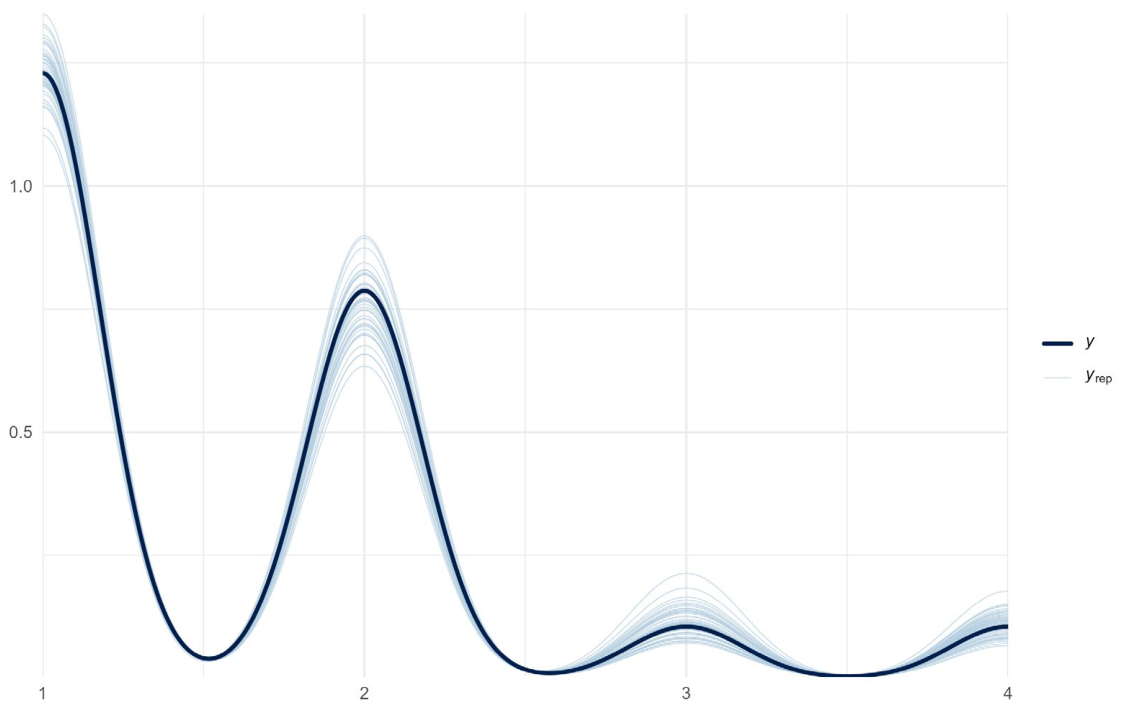
Table A4.
Sensitivity analysis results using alternative severity classification.
Table A5.
Full posterior summaries of regression coefficients.
Table A6.
Marginal effects (%) on injury severity levels for all significant predictors.
References
- Subramaniam, S.; Nazri Borhan, M.; Nguyen-Phuoc, D.Q.; Ibrahim, A.N.H. Exploring Determinants of Risk-Riding Behavior Among Food Delivery Riders: A Systematic Literature Review. IEEE Access 2025, 13, 183015–183037. [Google Scholar] [CrossRef] [Scilit]
- China Economic Information Service. Insight Report on Consumer Trends in China’s Electric Two-Wheeled Vehicle Market; China Economic Information Service: Beijing, China, 2026. [Google Scholar]
- Vignola, E.F.; Baron, S.; Abreu Plasencia, E.; Hussein, M.; Cohen, N. Workers’ Health under Algorithmic Management: Emerging Findings and Urgent Research Questions. Int. J. Environ. Res. Public Health 2023, 20, 1239. [Google Scholar] [CrossRef] [Scilit]
- Dong, H.; Zhong, S.; Xu, S.; Tian, J.; Feng, Z. The Relationships between Traffic Enforcement, Personal Norms and Aggressive Driving Behaviors among Normal e-Bike Riders and Food Delivery e-Bike Riders. Transp. Policy 2021, 114, 138–146. [Google Scholar] [CrossRef] [Scilit]
- Zheng, Y.; Ma, Y.; Guo, L.; Cheng, J.; Zhang, Y. Crash Involvement and Risky Riding Behaviors among Delivery Riders in China: The Role of Working Conditions. Transp. Res. Rec. 2019, 2673, 1011–1022. [Google Scholar] [CrossRef] [Scilit]
- da Silva, D.W.; Andrade, S.M.d.; Soares, D.F.P.d.P.; Mathias, T.A.d.F.; Matsuo, T.; de Souza, R.K.T. Factors Associated with Road Accidents among Brazilian Motorcycle Couriers. Sci. World J. 2012, 2012, 605480. [Google Scholar] [CrossRef] [Scilit]
- Griesbach, K.; Reich, A.; Elliott-Negri, L.; Milkman, R. Algorithmic Control in Platform Food Delivery Work. Socius 2019, 5, 2378023119870041. [Google Scholar] [CrossRef] [Scilit]
- Duggan, J.; Carbery, R.; McDonnell, A.; Sherman, U. Algorithmic HRM Control in the Gig Economy: The App-worker Perspective. Hum. Resour. Manag. 2023, 62, 883–899. [Google Scholar] [CrossRef] [Scilit]
- Yan, X.; Yang, L.; Ye, X.; Chen, J.; Wang, T.; Du, M. Unpacking the Hazards: An Analytic Study of Injury Patterns and Risk Factors in Urban Instant Delivery. Injury 2024, 55, 111706. [Google Scholar] [CrossRef] [Scilit]
- Laskaris, Z.; Hussein, M.; Stimpson, J.P.; Vignola, E.F.; Shahn, Z.; Cohen, N.; Baron, S. A Price Too High: Injury and Assault among Delivery Gig Workers in New York City. J. Urban Health 2024, 101, 439–450. [Google Scholar] [CrossRef] [Scilit]
- Wang, Z.; Huang, S.; Wang, J.; Sulaj, D.; Hao, W.; Kuang, A. Risk Factors Affecting Crash Injury Severity for Different Groups of E-Bike Riders: A Classification Tree-Based Logistic Regression Model. J. Saf. Res. 2021, 76, 176–183. [Google Scholar] [CrossRef] [Scilit]
- Berthelot, G.; Johnson, S.; Noirez, P.; Antero, J.; Marck, A.; Desgorces, F.-D.; Pifferi, F.; Carter, P.A.; Spedding, M.; Manoux, A.S.; et al. The Age-Performance Relationship in the General Population and Strategies to Delay Age Related Decline in Performance. Arch. Public Health 2019, 77, 51. [Google Scholar] [CrossRef] [Scilit]
- Malakar, B.; Roy, S.K.; Pal, B. Relationship between Physical Strength Measurements and Anthropometric Variables: Multivariate Analysis. J. Public Health Dev. 2022, 20, 132–145. [Google Scholar] [CrossRef] [Scilit]
- Chen, F.; Ye, W.; Yan, S.; Zhang, H.; Li, L.; Ou, L. Analysis on the present situation and influencing factors of road traffic injuries for takeaway riders in Shantou. Inj. Med. 2019, 8, 33–40. [Google Scholar]
- Jeong, B.Y. Occupational Deaths and Injuries by the Types of Street Cleaning Process. Int. J. Occup. Saf. Ergon. 2017, 23, 76–82. [Google Scholar] [CrossRef] [Scilit]
- Byun, J.; Park, M.; Jeong, B. Effects of Age and Violations on Occupational Accidents among Motorcyclists Performing Food Delivery. Work 2020, 65, 53–61. [Google Scholar] [CrossRef] [Scilit]
- Nguyen-Phuoc, D.Q.; Truong, T.M.; Ho-Mai, N.T.; Mai, N.X.; Oviedo-Trespalacios, O. Safety Climate and Its Contribution to Safety Performance in the Food Delivery Industry. Saf. Sci. 2025, 181, 106687. [Google Scholar] [CrossRef] [Scilit]
- Yao, Z.; Weden, S.; Emerlyn, L.; Zhu, H.; Kraut, R.E. Together But Alone: Atomization and Peer Support among Gig Workers. Proc. ACM Hum.-Comput. Interact. 2021, 5, 391. [Google Scholar] [CrossRef] [Scilit]
- Nguyen-Phuoc, D.; Nguyen, N.; Nguyen, M.; Nguyen, L.; Oviedo-Trespalacios, O. Factors Influencing Road Safety Compliance among Food Delivery Riders: An Extension of the Job Demands-Resources (JD-R) Model. Transp. Res. Part A Policy Pract. 2022, 166, 541–556. [Google Scholar] [CrossRef] [Scilit]
- Lachapelle, U.; Carpentier-Laberge, D.; Cloutier, M.; Ranger, L. A Framework for Analyzing Collisions, near Misses and Injuries of Commercial Cyclists. J. Transp. Geogr. 2021, 90, 102937. [Google Scholar] [CrossRef] [Scilit]
- Byun, J.H.; Jeong, B.Y.; Park, M.H. Characteristics of Motorcycle Crashes of Food Delivery Workers. J. Ergon. Soc. Korea 2017, 36, 157–168. [Google Scholar]
- Demir, N.; Sayar, S.; Dokur, M.; Sezer, H.B.; Koc, S.; Topkarci, Y.B.; Turk, M.F. Analysis of Increased Motorcycle Accidents during the COVID-19 Pandemic: A Single-Center Study from Türkiye. Turk. J. Trauma Emerg. Surg. 2024, 30, 114–122. [Google Scholar] [CrossRef] [Scilit]
- Ekinci, M.; Gunen, E.; Ataoglu, C.; Yilmaz, M. Orthopaedic Injuries and the Use of Protective Equipment in Commercial Motorcycle Couriers during the Coronavirus Trauma Center Experience. Turk. J. Trauma Emerg. Surg. 2024, 30, 892–899. [Google Scholar] [CrossRef] [Scilit]
- Karpenko, M.; Eičinas, D. Dynamic Analysis of Micromobility In-Wheel Suspension System—Enhancing Safety in Urban Environments. Promet—Traffic Transp. 2026, 38, 229–242. [Google Scholar] [CrossRef] [Scilit]
- Karpenko, M. Safety and Reliability Assessment of Personal Electric Kick-Scooter Riding with Different Tire Types. Eksploat. Niezawodn.—Maint. Reliab. 2026, 28, 1–14. [Google Scholar] [CrossRef] [Scilit]
- Karpenko, M.; Prentkovskis, O.; Skačkauskas, P. Analysing the Impact of Electric Kick-Scooters on Drivers: Vi bration and Frequency Transmission During the Ride on Different Types of Urban Pavements. Eksploat. Niezawodn.—Maint. Reliab. 2025, 27, 199893. [Google Scholar] [CrossRef] [Scilit]
- Sun, Y.; Lu, J.; Ren, G.; Ma, J. Exploring the Heterogeneities of Factors Affecting E-Bicyclist Severities in Delivery e-Scooter Crashes. J. Transp. Saf. Secur. 2024, 16, 443–466. [Google Scholar] [CrossRef] [Scilit]
- Wang, X.; Chen, J.; Quddus, M.; Zhou, W.; Shen, M. Influence of Familiarity with Traffic Regulations on Delivery Riders’ e-Bike Crashes and Helmet Use: Two Mediator Ordered Logit Models. Accid. Anal. Prev. 2021, 159, 106277. [Google Scholar] [CrossRef] [Scilit]
- Supreme People’s Court of the People’s Republic of China. Classification of Disability Degrees Due to Bodily Injury; Supreme People’s Court of the People’s Republic of China: Beijing, China, 2017.
- World (WHO 2000–2025) Standard—Standard Populations—SEER Datasets. Available online: https://seer.cancer.gov/stdpopulations/world.who.html (accessed on 1 May 2025).
- Eluru, N.; Bhat, C.R.; Hensher, D.A. A Mixed Generalized Ordered Response Model for Examining Pedestrian and Bicyclist Injury Severity Level in Traffic Crashes. Accid. Anal. Prev. 2008, 40, 1033–1054. [Google Scholar] [CrossRef] [Scilit]
- Wilde, G.J.S. The Theory of Risk Homeostasis: Implications for Safety and Health. Risk Anal. 1982, 2, 209–225. [Google Scholar] [CrossRef] [Scilit]
- Haddon, W., Jr. On the Escape of Tigers: An Ecologic Note. Am. J. Public Health 1970, 60, 2229–2234. [Google Scholar] [CrossRef] [Scilit]

Disclaimer/Publisher’s Note: The statements, opinions and data contained in all publications are solely those of the individual author(s) and contributor(s) and not of MDPI and/or the editor(s). MDPI and/or the editor(s) disclaim responsibility for any injury to people or property resulting from any ideas, methods, instructions or products referred to in the content. |
© 2026 by the authors. Licensee MDPI, Basel, Switzerland. This article is an open access article distributed under the terms and conditions of the Creative Commons Attribution (CC BY) license.