


Abstract
Interpretable-by-design architectures, such as Concept-Bottleneck Models (CBMs), are essential for trustworthy AI under regulations like the EU AI Act. While classical CBMs rely on costly expert labels, recent automated methods use vision–language models for concept discovery. However, whether automation preserves interpretability remains an open question. We systematically evaluate four automated methods (LF-CBMs, LaBo, PCBMs, and VLG-CBMs) against an expert-supervised CBM using fine-grained binary classification (Amanita muscaria vs. Boletus edulis) from the FungiTastic dataset. Although automated methods match expert accuracy, they systematically fail with regard to two key interpretability requirements: concept atomicity and instance-level grounding. Specifically, automated concepts conflate multiple morphological properties, yield scores ungrounded in visual evidence, and produce biologically implausible class-concept associations; a specific failure mode, cross-class contamination, is one that the expert-supervised vocabulary avoids by construction, though expert supervision remains subject to its own annotation and validation risks. We characterize four distinct failure modes across these architectures, concluding that automated concept discovery cannot yet substitute domain expert supervision in safety-critical tasks where explanation fidelity is a functional requirement alongside predictive accuracy.
1. Introduction
The growing use of machine learning systems in critical sectors has transformed interpretability from a research goal into a regulatory requirement. The EU Artificial Intelligence Act [1], which entered into force in August 2024, stipulates in Article 13 that high-risk AI systems must be designed and developed in such a way as to ensure that their operation is sufficiently transparent to allow operators to interpret the system’s results and use them appropriately. At the same time, Article 14 reinforces this requirement by specifying that such systems must support human oversight, enabling operators to fully understand the system’s capabilities and limitations and to correctly interpret the results of high-risk AI. This legislative framework represents a paradigm shift: interpretability is no longer an optional feature added to improve the user experience, but an essential safety requirement to be integrated into the system design.
In the context of eXplainable Artificial Intelligence (XAI), intrinsic interpretability and post hoc explainability are not merely semantic distinctions [2]. Post hoc explanations, such as SHapley Additive exPlanations (SHAP) [3], rely on approximations of the original model that are inherently unreliable; Rudin [4] argues that even if such explanations guarantee a certain percentage of correctness, they would be unacceptable in certain high-risk situations. Architectures that are interpretable by definition, on the other hand, build systems in which the explanation is the model itself, eliminating the need for post hoc approximations and providing a more solid foundation for ensuring trust, bias detection, debugging, and regulatory compliance. Concept-Bottleneck Models (CBMs) [5] belong to this latter category: they are inherently interpretable by design; they first map input representations onto a set of high-level, human-understandable attributes called concepts, which are then used by a linear layer to produce the final prediction, enhancing transparency by providing both the intermediate representations and the decision-making process in understandable terms.
The practical importance of models such as CBMs is particularly evident in safety-critical contexts, where a visually plausible but fundamentally incorrect explanation can have serious consequences for human health. Wild mushroom foraging represents a high-risk scenario for evaluating human–AI collaboration and for calibrating confidence [6]. The activity involves identifying edible specimens in the field, often by amateurs who rely solely on visual inspection, where a misidentification between poisonous and edible mushrooms can lead to severe poisoning [7,8]. A clear example of this challenge is the detailed distinction between the poisonous Amanita muscaria and the highly sought-after Boletus edulis. Although they belong to completely different families, these species frequently coexist in the same habitats [9].
Crucially, taxonomic distance at the family level does not imply coarse visual dissimilarity: the pileate-stipitate body plan shared by both species has evolved convergently multiple times across unrelated Basidiomycota lineages, driven by shared functional constraints on spore dispersal rather than common descent [10,11]. Gross morphotype (the presence of a cap and a stem) is, therefore, a taxonomically uninformative, and often misleading, cue; reliable discrimination between the two species, instead, hinges on subtle, spatially localized morphochromatic attributes (hymenophore type, cap/stem coloration and surface texture, presence of a ring and volva versus a reticulated stem), which is precisely what makes this a fine-grained rather than a coarse-grained classification problem. This challenge is compounded from a computer-vision perspective: deep vision backbones are known to disproportionately weight local texture statistics over global shape [12]; when the diagnostic morphochromatic cues are themselves fine local textures (surface roughness, reticulation, and pigmentation patterns), this bias can as easily favor incidental, non-diagnostic textures (lighting artifacts, background clutter, and sensor noise) as it can the biologically meaningful ones, making correct localization of the right local cue, not just the presence of local cues, the crux of the task.
In this vulnerable context, human-centered evaluation demonstrates that high-quality, concept-based explanations can effectively guide users in using deep models and in the decision-making process, increasing trust in algorithmic suggestions [6]. However, if an automated system generates explanations that appear plausible but are incorrect in a specific case, such misaligned explanations undermine both reliability and user trust. Rather than assisting the operator, such misaligned explanations risk being actively misleading, creating a false sense of security that lowers their guard and compromises safety.
Despite their theoretical advantages, CBMs in their classical formulation carry a significant practical limitation: the concept-bottleneck layer requires an auxiliary dataset in which each training instance is annotated by domain experts to indicate the presence or absence of each concept [5]. In specialized domains such as mycology, compiling such annotations requires considerable taxonomic expertise, is time-intensive, and does not scale with the number of target classes, a constraint that limits the applicability of CBMs to contexts where expert resources are available and accessible.
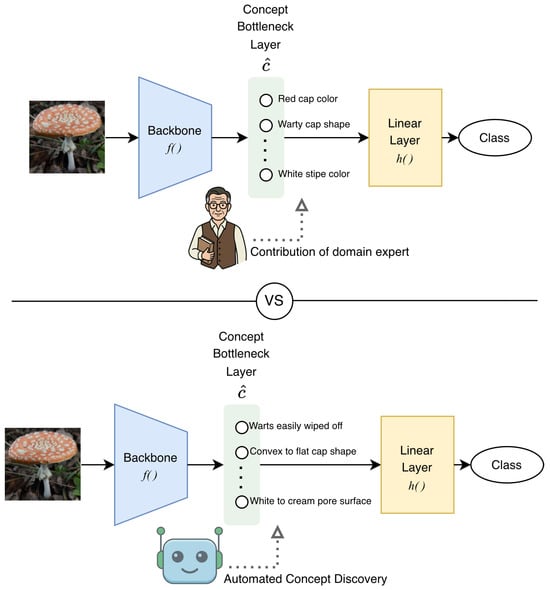
To overcome this limitation, as illustrated in Figure 1, several methods have been proposed that replace manual annotation with automated concept discovery, leveraging large language models (LLMs) and vision–language models (VLMs) to generate and score concepts without human supervision [13,14,15,16]. However, as the bottom side of Figure 1 illustrates, automatically generated concepts introduce several quality issues that are not present in expert-supervised vocabularies: concepts may be non-atomic, conflating multiple morphological attributes within a single description; they may exhibit class boundary violations, where a concept generated for one species receives discriminative weight for the other; their coverage may be imbalanced across classes; and they may include properties that are not visually verifiable from photographic data, such as tactile or internal characteristics. Whether these quality gaps translate into interpretability failures in practice, and to what extent they can be tolerated in safety-critical tasks, has not been systematically evaluated. This is the gap this work addresses directly.
Figure 1.
Comparison between concepts derived from domain expert knowledge (top) and concepts generated automatically by a large language model (bottom) for the same target class. Expert concepts are atomic, mutually exclusive, and organized within a controlled morphochromatic taxonomy. Automatically generated concepts, by contrast, may suffer from several quality issues, non-atomicity, class boundary violations, imbalanced coverage across classes, and the inclusion of non-visually verifiable properties such as tactile or olfactory attributes.
Specifically, this study investigates the following research question: to what extent can an automatically discovered CBM replace an expert-supervised one in a fine-grained, safety-critical classification task, in terms of (a) classification accuracy; (b) quality of the concepts employed, evaluated in terms of domain alignment and discriminative power; and (c) grounding of concepts to individual image instances, i.e., whether the concepts invoked by the model correspond to features that are visually present in the specific specimen under evaluation.
2. Related Work
The dominant paradigm in XAI has long been that of post hoc explainability: methods such as Local Interpretable Model-Agnostic Explanations (LIME) [17], SHAP [3], and Gradient-Weighted Class Activation Mapping (Grad-CAM) [18] are applied after training to approximate the reasoning of an otherwise opaque model. Despite their widespread use, post hoc methods suffer from a fundamental limitation: they approximate the original model without explaining it faithfully. As Rudin [4] argues, any surrogate explanation that is not identical to the model it explains is, by definition, to some extent unfaithful, an unacceptable property in high-risk contexts such as the classification of mushroom toxicity. This article explores the use of an architecture that is inherently interpretable by design, its advantages, and the main alternatives proposed in the literature to address its limitations.
2.1. Intrinsic Interpretability
An alternative line of research involves embedding interpretability directly into the model architecture, thereby eliminating the need for post hoc approximations. Prototype-based networks, introduced by Chen et al. [19] with ProtoPNet, operate by comparing parts of an input image with learned prototypical visual patches; consequently, classification is justified by statements such as “the image belongs to this class because this patch of the image resembles this prototype, which is of the same class.” Although ProtoPNet provides visually intuitive explanations, its justifications are based on purely visual similarities rather than semantic descriptions, leaving it up to the user to interpret the meaning of the prototypes. Concept-bottleneck models (CBMs), proposed by Koh et al. [5], address this limitation by replacing the visual bottleneck with a layer of human-defined textual concepts, each associated with a scalar score reflecting its estimated presence in the input. The final prediction is then a linear function of these conceptual scores, making the reasoning process fully interpretable: the user can trace which concepts contributed most to a prediction, manipulate individual scores during testing, and verify whether the invoked concepts are visually present in the evaluated image. CBMs can be trained in three modes: joint, sequential, and independent, each offering a different trade-off between concept interpretability and classification accuracy.
2.2. Models for Automatic Concept Discovery
The main bottleneck of classical CBMs is the need for a manually annotated auxiliary dataset in which each training image is labeled with the presence or absence of each concept. To overcome this limitation, several methods [13,14,15,16] have been proposed that automate the generation and evaluation of concepts.
Among the methods for identifying concepts associated with a class, the use of ConceptNet [20] has been proposed; this is an open, multilingual semantic knowledge graph that encodes common-sense relational knowledge between concepts using predicates such as HasA, IsA, MadeOf, and HasProperty. ConceptNet was designed to represent everyday human knowledge and natural language, and it achieves broad coverage of general-domain concepts.
A well-established method for the automatic generation of concepts relies on the use of pre-trained language models. This strategy is based on the fundamental finding that Large Language Models (LLMs) can serve as effective knowledge bases [21]. This capability has been significantly expanded by Brown et al. [22], who demonstrated that large-scale generative models excel at zero-shot conceptual reasoning.
After obtaining a set of textual concepts, one method for visually associating them with images is to use Contrastive Language–Image Pre-training (CLIP) [23]. This model learns a shared embedding space for images and text by training on large-scale pairs of images and captions. Its ability to align visual and linguistic representations has made it a natural backbone for automated CBM methods that measure the presence of concepts through embedding similarity.
A major limitation of automated CBMs lies in their ability to verify the actual presence of concepts within images, as LLMs often generate fine-grained properties that may not be visually grounded. To overcome this limitation, the open-set object-detector GroundingDINO [24] can be used, which combines the DINO [25] architecture with contrastive vision–language pre-training. This model enables the visual grounding of arbitrary textual descriptions, deterministically verifying the presence of the LLM-generated abstract concepts through bounding boxes and associated confidence scores, thereby mitigating the risk of semantic false positives within the bottleneck layer.
The four methods evaluated in this work, Label-Free Concept-Bottleneck Models (LF-CBM) [13], Language-Model-Guided Concept Bottlenecks (LaBo) [14], Post Hoc Concept-Bottleneck Models (PCBM) [15], and Vision–Language-Guided Concept-Bottleneck Models (VLG-CBM) [16] were selected because they represent the principal architectural strategies for automated concept discovery in the CBMs proposed in the literature at the time of study design. LLM-generated concepts scored via CLIP without spatial grounding (LF-CBM [13]); class-level submodular concept selection with CLIP scoring (LaBo [14]); concept extraction from an external knowledge graph via conceptual activation vectors (PCBM [15]); and LLM-generated concepts with explicit visual grounding via an open-set object detector (VLG-CBM [16]). Together, they span the primary design axes of automated CBM pipelines.
More recently, a parallel line of work has pursued automatic concept discovery through learned visual prototypes rather than LLM-generated text. Align2Concept [26] aligns automatically learned ProtoPNet-style visual prototypes with LLM-generated textual concepts in a shared CLIP embedding space, allowing each prototype to be assigned a human-readable label. This represents a very recent, frontier prototype-based approach to automatic concept discovery; however, at the time of this study it had not released an official codebase, which precluded its inclusion as an experimental baseline and confined it to this discussion.
2.3. Classification of Fungal Species
The automated identification of fungi from images has been addressed primarily through convolutional neural networks and, more recently, through vision transformers. Wang et al. [27] proposed a Visual Transformer (ViT)-based pipeline [28] that achieves high accuracy in binary edible/poisonous classification. Peng et al. [29] introduced an improved MobileViT architecture that combines convolutional and attention mechanisms for the classification of wild mushrooms of multiple species. At the benchmark level, the FungiCLEF challenge series [30] has established fine-grained mushroom recognition as a standard computer-vision task, with the 2024 edition being specifically focused on minimizing confusion between edible and poisonous species. Despite the growing body of work on classification accuracy, none of these approaches addresses interpretability: the models remain black boxes, providing no conceptual justification for their predictions. To the best of our knowledge, this work is the first to systematically apply and evaluate CBM architectures, both expert-supervised and automatically discovered, to the task of detailed mycological species classification.
3. Materials and Methods
To demonstrate the capabilities of CBMs with automatic concept discovery, we addressed a fine-grained binary classification problem between Amanita muscaria and Boletus edulis mushrooms. This task is a high-risk scenario given the danger and toxicity of the Amanita muscaria mushrooms; consequently, it is essential to use decision-support systems that can explain their reasoning to help users understand the logic behind each prediction and enable them to make more conscious decisions.
In this work, the standard CBM is used as a baseline to evaluate the quality of concepts obtained from domain experts. Meanwhile, to evaluate automatic concept discovery, the following models are trained and used: LF-CBM [13], LaBo [14], PCBM [15], and VLG-CBM [16].
3.1. Automatic Concept Generation
While the original implementations of LF-CBM, LaBo, and VLG-CBM use GPT-3 [22] for concept generation, in this study we replace it with Claude Sonnet 4.6 [31], a more recent and powerful large-scale language model, in order to assess whether a higher-quality language model results in higher-quality concepts within the same architectural framework.
Following the prompt templates of the original implementations [13,14], three queries were issued per target class c:
- “List the most important visual features for recognizing a {c}”;
- “List the things most commonly seen around a {c}”;
- “Give superclasses for the word {c}”.
The resulting raw concept set shown in Table 1 was shared across LF-CBM, LaBo, and VLG-CBM, and subsequently filtered independently by each method.
Table 1.
Complete list of LLM-generated (Claude Sonnet 4.6) concepts for both target species. The LLM-generated set was shared across LF-CBM, LaBo, and VLG-CBM; among all the concepts, A refers to the concepts generated for the species Amanita muscaria, while B refers to the concepts for the species Boletus edulis.
For LF-CBM, we followed the official concept-set-filtering pipeline, which applies three sequential filters to the raw concept set:
- (i)
- Removal of concepts exceeding a maximum character length, set at 40;
- (ii)
- Removal of concepts whose CLIP-text-embedding cosine similarity to one of the target class names exceeds ;
- (iii)
- Removal of concepts whose cosine similarity of the CLIP-text embeddings to another concept in the set exceeds , in which case only one representative is retained for each pair of nearly duplicate concepts.
Applying this pipeline to the set of 100 concepts shown in Table 1 resulted in 93 retained concepts, discarding “Bulbous stipe base”, “Cap surface viscid when wet”, “Stipe length greater than cap diameter”, “Stipe hollow interior”, “Stipe width nearly equal to cap”, “Cap large relative to stipe height”, and “Stipe surface longitudinally fibrous beneath reticulation”.
LaBo applied submodular optimization to select, for each class, the concepts that jointly maximized discriminative power and domain coverage; in our case, all 100 concepts (50 per class) were retained.
VLG-CBMs retained a concept for a given training image only when the GroundingDINO text-matching score exceeded the threshold of . Across the training set, twenty concepts failed to meet this threshold on any image and were, thus, pruned; specifically those numbered 7, 12, 14, 17, 19, 23, 28, 29, 31, 36, 54, 59, 63, 68, 69, 76, 77, 79, 81, and 82 in Table 1. The remaining eighty grounded concepts were retained for building the Concept-Bottleneck Layer (CBL).
All three automated methods (LF-CBM, LaBo, VLG-CBM) operate on input images resized to 224 × 224 pixels, the default input resolution prescribed by their respective backbone encoders: CLIP ViT-B/16 for LF-CBM’s concept-supervision branch and ResNet50 [32] for its target backbone; CLIP ViT-L/14 for LaBo; and CLIP RN50, a ResNet50-based visual encoder, for VLG-CBM. This default configuration was retained throughout in order to faithfully replicate the standard usage of these architectures, as released in their original implementations.
3.2. Dataset
The dataset used in this study is a binary subset of FungiTastic [33], a multimodal large-scale benchmark for detailed recognition of fungal species. The subset was curated under the supervision of expert mycologists using the Concept Annotation Tool [34], and includes two morphologically and ecologically distinct species: the toxic Amanita muscaria (Fly Agaric) and the edible Boletus edulis (Porcini mushroom). The choice of this pair of species is motivated by the safety-critical nature of the discrimination task: although they belong to taxonomically distant families, Amanitaceae and Boletaceae, respectively, the two species frequently coexist in the same forest habitats and may exhibit overlapping visual characteristics depending on the specimen’s stage of development and photographic conditions. As discussed in Section 1, this overlap is not incidental: convergent evolution of the agaricoid body plan across unrelated Basidiomycota lineages means that family-level taxonomic distance does not translate into coarse visual separability [10,11].
The morphological characteristics that distinguish the two species are subtle and highly localized: the presence of gills versus pores on the underside of the cap, the coloration of the cap and stem, the presence of a skirt-like ring and a volva in Amanita muscaria compared to the characteristic reticulate pattern on the stem of Boletus edulis, and variations in the texture of the cap surface across different growth stages. These subtle differences make automated species-level discrimination substantially more challenging than coarse-grained taxonomic classification.
The dataset consists of 2757 images in total, of which 1359 depict Amanita muscaria and 1398 depict Boletus edulis, with a nearly perfectly balanced class distribution. To prevent observation-level data leakage, we verified whether images derived from the same field observation (identified via the original FungiTastic observationID) were separated across subsets. This check revealed 243 observations (14.5% of the 1680 unique observations in the dataset), corresponding to 699 images (25.4% of the dataset), spanned more than one subset in the initial split. We, therefore, consolidated the split at the observation level, reassigning each observation’s images entirely to a single subset via a greedy size-balancing procedure that preserved the original train/validation/test proportions as closely as possible. The dataset is divided into three disjoint subsets: a training set of 2252 images (81.7%), a validation set of 246 images (8.9%), and a test set of 259 images (9.4%), as summarized in Table 2. This observation-aware split is used throughout the manuscript in place of the original one. The division was further restricted to ensure proportional representation of all six morphochromatic categories (cap, gills or tubes, stem, reticulation, ring, and volva) across the subsets, with approximately 81% of the annotations assigned to training and 9–10% to each evaluation partition, thereby avoiding any bias introduced by the absence of specific visual attributes during validation or testing.
Table 2.
Dataset and task scope for the binary FungiTastic subset used in this study.
Image-acquisition conditions vary considerably within the collection, encompassing multiple viewpoints, the cap from above, the underside, the stem, or the entire mushroom body, and lighting conditions are uncontrolled; thus, conditions of diffuse shade or low light in the undergrowth may be encountered. In addition, mushroom caps at different stages of development, including young, mature, and senescent specimens, were photographed. This intraclass variability, combined with interclass visual similarity at certain growth stages, constitutes a challenging benchmark for fine-grained visual-recognition systems.
Native image dimensions in the dataset are heterogeneous, with a mean size of 592 × 646 pixels (width × height) across the full collection. This variability partly reflects the original FungiTastic acquisition protocol and partly results from the curation process itself: a subset of source photographs originally depicted multiple specimens within a single frame and were manually cropped to isolate one mushroom per image, yielding images of differing dimensions and aspect ratios.
Regarding preprocessing, a uniform pipeline was not directly applied to the dataset. Instead, each model was evaluated using its own prescribed preprocessing procedure, as defined in the respective original papers [5,13,14,15,16]. This approach ensures that each architecture operates under the conditions for which it was originally designed and validated, making the comparison representative of real-world implementation scenarios where preprocessing is an integral component of the pipeline of each method.
3.3. Expert-Supervised CBM
In order to be trained, a classic CBM requires not only the standard dataset, in which each image is assigned a class, but also an auxiliary dataset of concepts, in which each image is assigned a set of concepts (morphochromatic properties) that distinguish its characteristic features.
The morphochromatic concept taxonomy was derived from established mycological references, including the taxonomic description of the Amanitaceae family by Cui et al. [35], the North American field guide by Lincoff and Nehring [36], and the online taxonomic resources MushroomExpert.com [37] and MushroomObserver.org [38]. The set of morphochromatic concepts thus obtained was subsequently examined and validated by expert mycologists, who confirmed its taxonomic accuracy.
It should be noted that while the taxonomic concept vocabulary was validated by domain mycologists, the qualitative evaluation of concept atomicity and instance-level grounding reported in Section 4 was conducted directly by the authors as a qualitative failure-mode analysis.
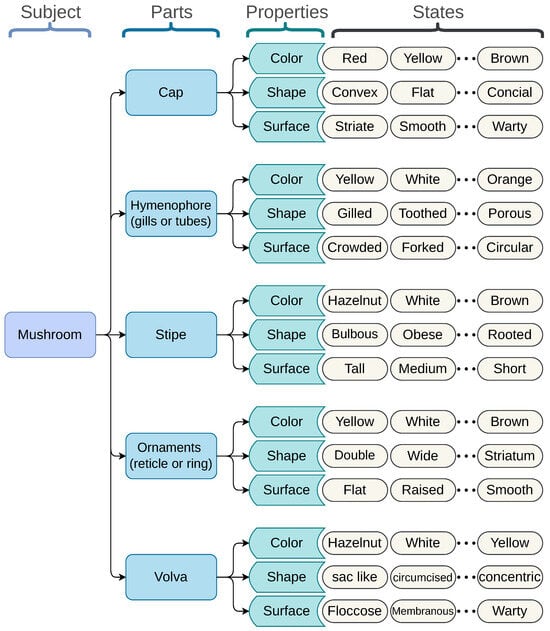
Figure 2 shows how a domain expert believes morphochromatic concepts should be defined to address their task; a path from the root to a leaf defines a single atomic interpretable concept. For example, “A mushroom with a cap of color: red”, constitutes the elementary annotation unit in the expert-supervised dataset.
Figure 2.
Hierarchical taxonomy of morphochromatic concepts defined by experts in the field. The root node represents the subject being classified; the first level encodes the anatomical parts of the specimen (e.g., cap, hymenophore, or stem); the second level specifies the visual properties analyzed for each part (color, shape, and surface structure); and the leaf nodes list the discrete atomic states that each property can take on.
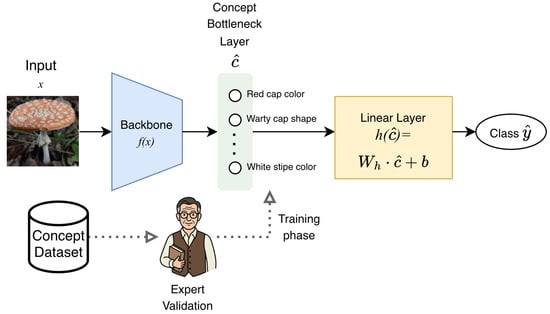
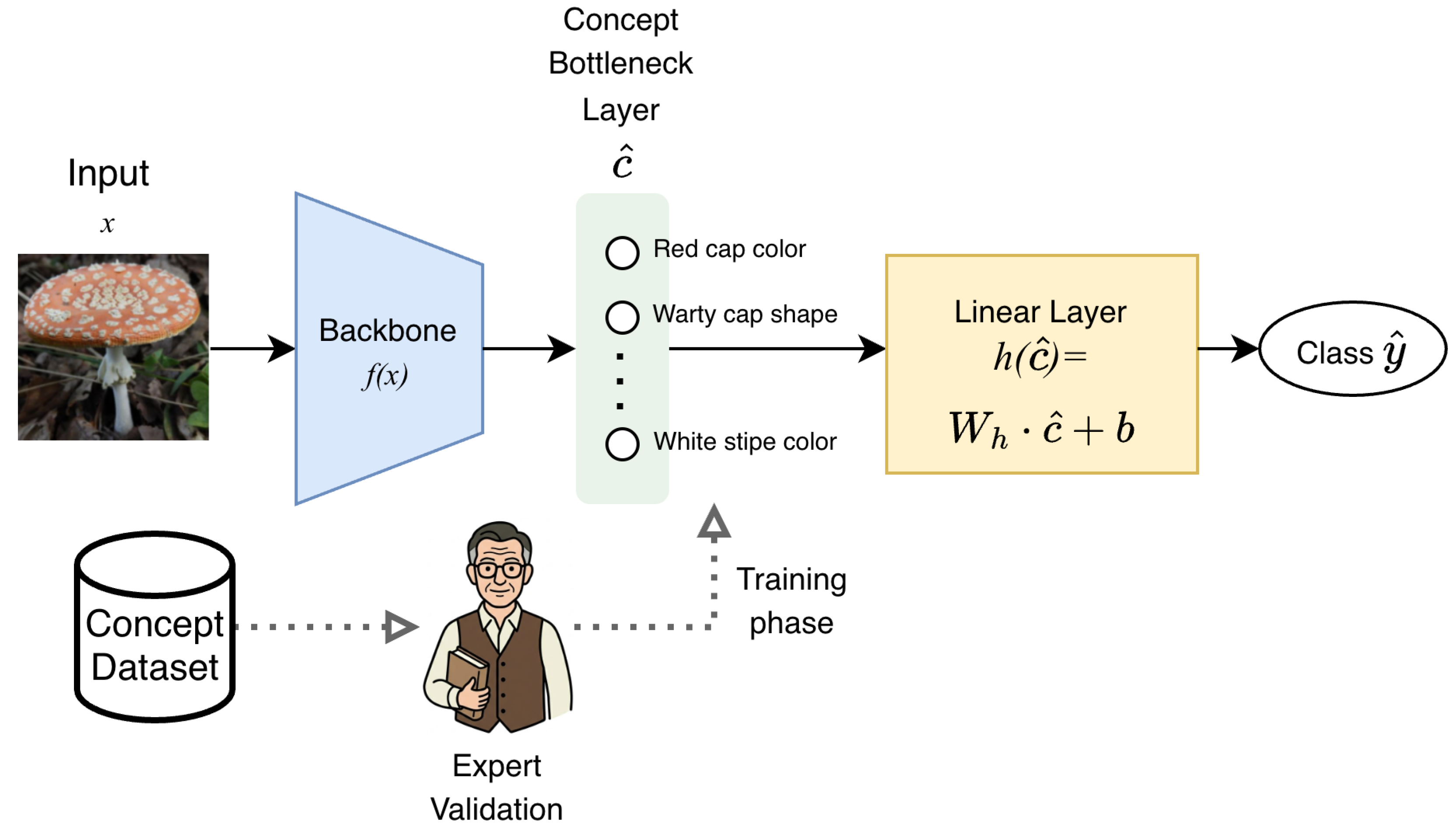
As shown in Figure 3, the expert-supervised CBM architecture consists of three main components. An arbitrary backbone network extracts concepts from the input image; the concepts in the Concept-Bottleneck Layer are scores, each of which reflects the estimated presence of a morphochromatic attribute in the image; finally, a linear classification head produces the class prediction as a weighted combination of the conceptual scores, making explicit which concepts contributed most to the final decision.
Figure 3.
Overview of the expert-supervised CBM used as a baseline. The concept dataset, annotated and validated by domain mycologists, is used during training to supervise the concept-bottleneck layer. At inference, the backbone maps the input image x to a vector of concept scores , where M is the number of concepts; the linear head produces the final class logits, where is the learned weight matrix, is the bias vector, and C is the number of target classes. The predicted class is .
The backbone used for the expert-supervised CBM follows the original concept-bottleneck-model implementation [5], which, by default, expects input images resized to 299 × 299 pixels (InceptionV3 architecture). Unlike the automated methods described in Section 3.1, whose native input resolution is 224 × 224, this discrepancy reflects each architecture’s original backbone.
3.4. LF-CBM
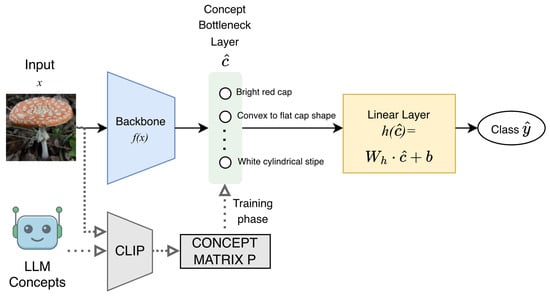
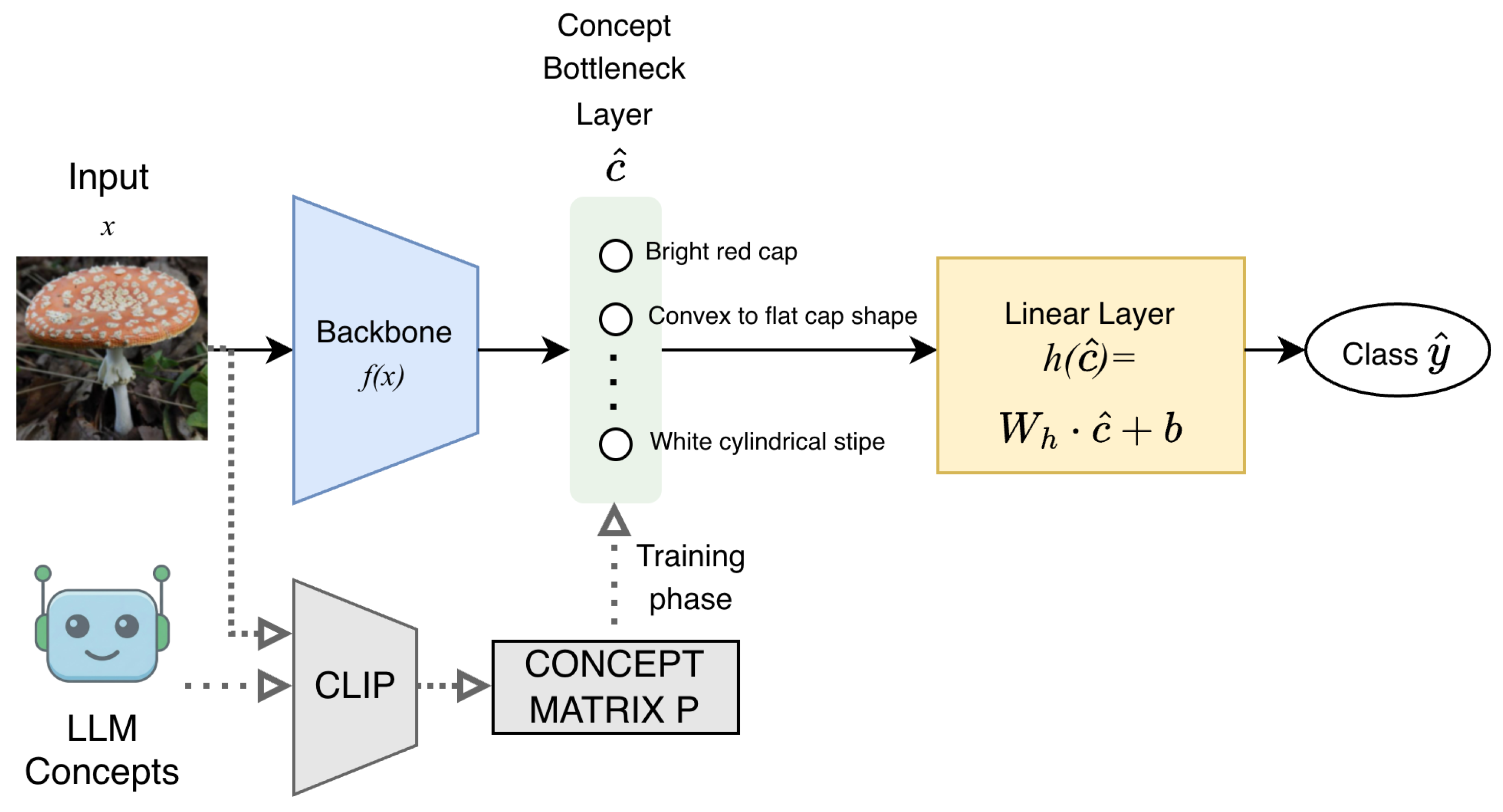
As illustrated in Figure 4, LF-CBM [13] eliminates the need for manual concept annotation by automating both concept generation and evaluation. Concepts are generated by querying a large-scale language model (GPT-3 in the original work) with three prompt templates for each class: list the most important features for recognizing something as a class, list the things most commonly seen around a class, and give superclasses for the word class.
Figure 4.
Overview of LF-CBM. Concepts are generated by an LLM using a prompt; after that, CLIP is only used during the training phase to attempt to measure the associations between images and concepts, which are then used to train the concept-bottleneck layer.
For the training phase only, the set of textual concepts and the images in the dataset are projected into an embedding space using CLIP’s text and image encoders, respectively; their similarity is then calculated as an inner product, yielding a concept matrix P. The concept matrix is only used during training to converge the matrix of the CBL so that it reproduces the concept scores derived from CLIP. An LF-CBM, therefore, involves the use of an arbitrary backbone that projects into the CBL, while the final linear classification head is trained based on the concept activations to produce the class prediction.
3.5. LaBo
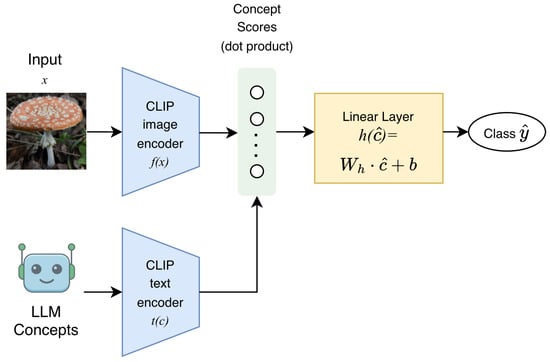
As illustrated in Figure 5, LaBo has a fundamental architectural difference from LF-CBM: the CLIP-image encoder serves simultaneously as both the backbone and the concept evaluator. In fact, in this architecture, CLIP is an integral part of the pipeline, not just during training.
Figure 5.
Overview of LaBo. It directly uses the CLIP encoder as the backbone for processing images, as well as for calculating the similarity between automatically generated concepts and images.
After generating concepts for each class using an LLM (GPT-3 in the original paper), the authors performed an initial preprocessing step called submodular optimization, which filters and selects only the concepts that best discriminate and cover the domain of each class. Next, using CLIP’s text and image encoders, they projected concepts and images into the same latent space and calculated their similarity scores using an inner product; these scores were then fed directly into the classification head to obtain the final classification. During training, since the frozen CLIP replaces the backbone, only the classification head is trained, along with its weight matrix .
3.6. PCBM
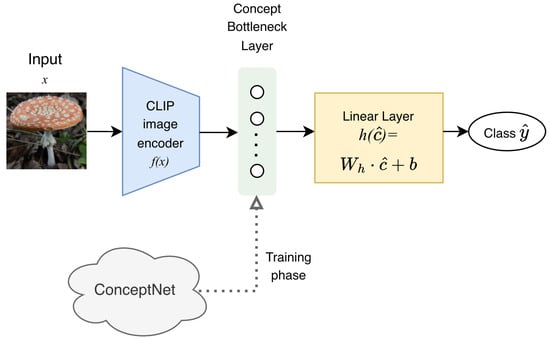
Unlike other CBMs that estimate concepts using an LLM, as illustrated in Figure 6, PCBM [15] extracts concepts from an external knowledge graph. Concepts are retrieved from ConceptNet [20] by querying the graph with the names of the target classes and collecting all nodes connected via the predicates HasA, IsA, MadeOf, and HasProperty; this choice stems from the fact that many predicates mapped in ConceptNet, such as UsedFor or CausesDesire, are irrelevant for concept discovery. Each retrieved concept is then represented as a conceptual activation vector (CAV) [39], obtained by training a Support Vector Machine (SVM) to distinguish the activations of the backbone structure on positive and negative examples of the concept. The backbone embeddings are subsequently projected onto the concept subspace generated by the CAVs, and a sparse linear classifier is trained on these projections to produce the final prediction.
Figure 6.
Overview of PCBM. A ConceptNet knowledge graph is used to extract keywords associated with the class of interest to be used as concepts, which are then used to represent the concepts in the concept-bottleneck layer.
3.7. VLG-CBMs
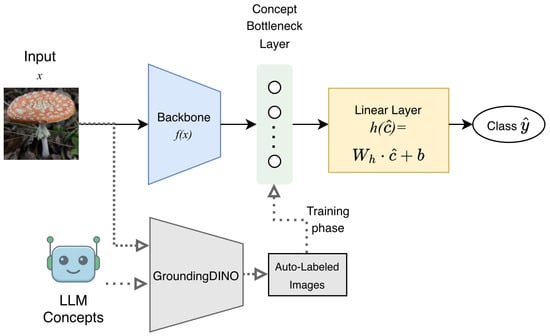
As illustrated in Figure 7, the VLG-CBM [16] addresses the main limitation common to both LF-CBMs and LaBo: the lack of verified visual grounding of automatically generated concepts within individual training images. Concepts are first generated by querying a large-scale language model with morphological description prompts for each target class. These concepts are then anchored to the training images using GroundingDINO (Swin-B backbone, release v0.1.0-alpha2) [24], which localizes arbitrary textual descriptions within images via bounding boxes and associated confidence scores. For each training image, only concepts whose corresponding bounding box exceeds a confidence threshold are marked as present, producing a self-labeled dataset of triplets (image x, concept c, and class label y) that constitutes a form of automated instance-level annotation.
Figure 7.
Overview of VLG-CBM. The dashed arrows indicate that the contribution in a given module occurs only during the training phase and not during the inference phase.
The rest of the architecture follows the classic CBM framework; thus, an arbitrary bottleneck is used to project the images into the CBL, which, during training, will align with the concepts automatically extracted from the dataset, and the final layer combines the predicted concepts to estimate an output class .
4. Results
The comparison between CBMs identified under expert supervision and those identified automatically is conducted along three complementary axes, which reflect the research questions identified in the research proposal.
Classification performance is measured using validation and test accuracy, along with training curves. Furthermore, since claims regarding interpretability cannot be evaluated using a single scalar metric, a qualitative analysis of the concepts is performed, assessing the atomicity of the concepts, whether the conceptual vocabulary reflects specialized mycological terminology, and whether the associations between concepts and classes are consistent with mycological knowledge.
Next, for a subset of test images, we evaluate instance-level grounding; that is, whether the concepts evoked by each model’s explanation are visually present in the specific instance under evaluation.
4.1. Classification Performance
To evaluate statistical robustness, each model was benchmarked across five random configuration seeds on the exact same test split. As detailed in Table 3, a VLG-CBM achieves the highest overall classification performance with an accuracy of and a Macro-F1 of , maintaining balanced class-wise F1-scores ( for Amanita and for Boletus). An Expert CBM achieves closely comparable overall accuracy () with per-class F1-scores of and , respectively. Paired t-test analyses reveal no statistically significant difference between an Expert CBM and either a VLG-CBM () or an LF-CBM (, ). Conversely, LaBo demonstrates a lower overall performance (), exhibiting a statistically significant degradation relative to Expert CBM (). Notably, Expert CBM maintains the highest precision (), minimizing false positive assignments.
Table 3.
Classification performance on the same test set across five random configuration seeds (mean ± standard deviation). F1-scores are reported for macro-average as well as individually for Amanita and Boletus. Statistical significance was calculated using a paired t-test compared to the Expert CBM model.
PCBM could not be trained in its automatic configuration; the ConceptNet knowledge graph failed to retrieve any morphologically relevant concepts for the species under examination, returning only semantic relationships at the macro-category, such as toadstool, magic mushroom, and generic synonyms related to mushrooms, which are entirely unsuitable for detailed visual discrimination. This outcome constitutes a negative but significant result; it confirms that while ConceptNet effectively encodes common-sense knowledge for general application domains, its coverage of specialized scientific terminology is insufficient and unsuitable for high-risk tasks in which relevant concepts are defined by domain-specific morphological vocabulary rather than everyday language. The automatic configuration of PCBM is, therefore, excluded from the quantitative comparison; its failure mode is analyzed in detail in the Section, Analysis of Error Patterns and Practical Implications.
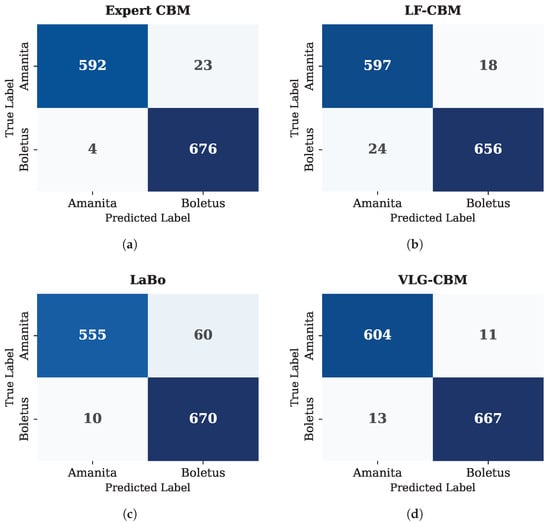
To gain deeper insights into class-level error distributions, Figure 8 illustrates the aggregated confusion matrices accumulated across all five evaluation seeds. In high-risk domains such as toxic mushroom identification, minimizing false positives for the edible class (Boletus), i.e., misclassifying toxic Amanita as edible, is of paramount safety importance. As shown in Figure 8a,d, Expert CBM and VLG-CBM demonstrate exceptional sensitivity, committing only 23 and 11 total Amanita-as-Boletus misclassifications across all runs, respectively. Conversely, LaBo (Figure 8c) exhibits a considerably higher rate of dangerous misclassifications (60 instances), accounting for its lower Recall (). LF-CBM (Figure 8b) shows a well-balanced error distribution (18 Amanita and 24 Boletus errors), confirming its operational stability without relying on expert concept annotations.
Figure 8.
Aggregated confusion matrices across five random configuration seeds on the test set: (a) Expert CBM; (b) LF-CBM; (c) LaBo; and (d) VLG-CBM. Rows represent ground-truth classes and columns represent model predictions. Considering Boletus as the positive class, top-left represents true negatives (Amanita), bottom-right true positives (Boletus), bottom-left false negatives, and top-right false positives (the high-risk critical error of misclassifying toxic Amanita as edible Boletus).
4.2. Concept Evaluation
To evaluate the quality and consistency of the automatically generated concepts, we compared them with the concepts provided by experts and examined how these concepts are used by CBM. Table 4 compares the structure of the concepts defined by experts with those generated by the large language model (LLM) for Amanita muscaria, although the same observations can be made for the concepts related to Boletus edulis. The experts’ concepts are drawn from a controlled vocabulary organized according to the hierarchical taxonomy described in Figure 2; each concept encodes a single morphochromatic attribute as a categorical or binary value, producing descriptions that are unambiguous, mutually exclusive within each category, and independently verifiable from photographic data.
Table 4.
Comparison of concept atomicity between the expert-supervised CBM and the LLM-generated concept set (Claude Sonnet 4.6, shared across LF-CBM, LaBo, and VLG-CBM) for Amanita muscaria. Expert concepts are binary or categorical attributes drawn from a controlled vocabulary; LLM-generated concepts are free-form natural language descriptions that frequently conflate multiple attributes.
Before examining individual concepts, it is worth noting that the weight magnitudes reported in Table 5 are not directly comparable across architectures, as each model imposes a different normalization on the concept space prior to fitting . In the Expert CBM, the final layer is a standard logistic regression fitted directly on sigmoid-activated concept probabilities in [5], without any additional rescaling, which keeps coefficients close to the range observed here (≈0.10–0.12). LF-CBM, instead, fits a sparse GLM-SAGA layer [13] on concept activations that have first been standardised (zero mean, unit variance) to approximate the underlying CLIP similarity distribution (range ), which is why its weights are one to two orders of magnitude larger than those of the other models. VLG-CBM follows the same sparse GLM-SAGA fitting procedure as LF-CBM [16], but applied to concept activations obtained from GroundingDINO grounding confidences rather than CLIP similarities, yielding intermediate weight magnitudes. LaBo weights are the smallest in absolute value because is passed through a softmax [14], constraining all weights for a given class to sum to 1 over the full 100-concept pool, so that no individual weight can exceed a few hundredths. Weight magnitudes, therefore, remain comparable only within, not across, models.
Table 5.
The top four concepts by weight in the final classification matrix , reported separately for each automated CBM and target class. Only positive weights are shown; CBM, LF-CBM, and VLG-CBM also have negative weights, while LaBo weights are strictly positive due to a softmax activation on . Weight magnitudes are not comparable across architectures (see main text). Concepts marked with † (bold) were originally generated by the LLM exclusively for the opposite class, indicating cross-class contamination rather than a genuine morphological signal.
To assess whether the concepts selected by each automated method as the most discriminative actually reflects distinctions based on mycological criteria, we examined the four concepts with the highest weights for each class in the final classification matrix for CBMs, LF-CBMs, LaBo, and VLG-CBMs in Table 5. For CBMs, it is interesting to note what appears to be a bias in the expert dataset regarding the concepts of “grooved, striate, and flaked cap surface” in Boletus edulis. From a mycological perspective, although ideal specimens of Boletus edulis have a smooth and sub-viscid cap, the standard taxonomic literature [36,37] establishes that dry weather, wind, and senescence frequently cause cracks to form on the cap’s surface, which is then officially described as rimose or areolate (corresponding to the concepts of “grooved,” “flaked,” and “areolate”). The CBM, trained on a dataset incorporating expert concepts, effectively utilizes these weather-induced morphological variations as a robust indicator for binary classification, since a cracked surface is taxonomically not related to Amanita muscaria; the model considers its presence as an exclusion criterion for Amanita and, consequently, a strong positive weight for Boletus edulis.
Since the set of concepts generated by the LLM for each species was produced independently for each class, each concept reported in Table 5 can be traced back to the class it was originally intended to describe; this allows for a direct verification of cross-class contamination, defined here as the case where a concept designed for one species receives a discriminative weight for the other.
From the weights in the matrix , it is possible to observe biological contradictions in each model with automatic concept discovery. For example, in the LF-CBM, the concept “dense white reticulation at the apex of the stem”, generated to describe the characteristic reticulated ornamentation of Boletus edulis, appears among the concepts with the highest weight for Amanita muscaria; conversely, “Sack-like white volva”, generated to describe Amanita muscaria, ranks among the strongest discriminators for Boletus edulis. The interesting thing about an interpretable model like CBM is that, thanks to the ability to observe certain behaviors, the user can then manage and correct certain biases.
The qualitative observations reported above (concept non-atomicity in Table 4 and cross-class contamination in Table 5) can be formalized into an explicit, reproducible rubric.
Table 6 reports rubric-based statistics for the concept set retained by each model after its own filtering procedure (Section 3.1). Two findings are notable. First, none of the three filtering mechanisms evaluated here (CLIP top five/interpretability similarity for LF-CBMs, submodular optimization for LaBo, GroundingDINO grounding confidence for VLG-CBMs) is designed to detect non-atomicity or visual non-verifiability: the proportion of non-atomic concepts remains essentially unchanged across methods (43.0–44.0%), and the proportion of non-visually-verifiable concepts, likewise, remains stable (7.5–8.8%), despite each method discarding a different subset of the shared 100-concept pool shown in Table 1. This indicates that concept filtering in these architectures selects for discriminative power and visual grounding confidence, not for the atomicity or photographic verifiability of the concept itself. Second, the expert-defined vocabulary scores 0% on both dimensions by construction, since each concept is a single categorical state within the controlled taxonomy of Figure 2. Cross-class contamination, assessed directly from the evidence in Table 5, is absent for the expert vocabulary and present in all three automated methods.
Table 6.
Concept-quality statistics by rubric criteria, applied to the expert-defined vocabulary and to the LLM-generated concept set as retained by each automated method after its own filtering procedure (Section 3.1). Atomicity and visual verifiability are computed as the percentage of retained concepts failing the corresponding criterion and class consistency reflects the cross-class contamination already documented in Table 5.
4.3. Instance-Level Grounding
To observe how accurate and reliable the automatic concepts are, post-training instance-level-grounding experiments were conducted using the various models during the inference phase.
Instance-level grounding refers to the ability of artificial intelligence not only to recognize which object is present in an image, but also to precisely identify the object in specific instances, in this case, the ability to identify the presence of the correct concepts in the images.
Table 7 shows some CBL output scores present in all CBMs, which are then combined with the weight matrix described in Table 5. Table 7 shows, for each concept, both its raw activation and its contribution to the logit of the predicted class (activation × weight), It is possible to distinguish between two different, related but distinct cases: whether a concept is estimated to be present in the image and whether that estimated presence, once weighted, effectively influences the prediction of the model.
Table 7.
The five concepts with the highest absolute contribution to the predicted class logit obtained by each model for two representative test images: Amanita muscaria (left) and Boletus edulis (right), regardless of whether the contribution favors the predicted class or the alternative one. These two instances were selected through manual inspection as qualitatively representative of the distinct failure modes and are not intended as a statistically exhaustive sample; a large-scale, expert-annotated grounding evaluation is identified as future work. Concepts are ranked by , i.e., the magnitude of their contribution to the predicted class logit, computed as activation × class-specific weight (Table 5); raw activation scores are reported alongside for reference. Contribution magnitudes are architecture-specific due to differing score normalizations (as in Table 5) and are comparable within, but not across, models. Positive contributions favor the predicted class and negative contributions favor the alternative class. Concepts marked with † (bold) refer to anatomical structures not visible in the specific image instance.
The expert-supervised CBM serves as a baseline; all five concepts with the highest contribution for both evaluated images correspond to morphological features directly observable in the image, whether they push toward the predicted class, e.g., “Cap surface: warty”, contribution , for Amanita muscaria or “Has reticulation”, contribution , for Boletus edulis, or act as minor distracting factors discarded by the model, e.g., “Stipe color: White”, contribution . This instance-level fidelity is not random; it is a structural consequence of the conceptual dataset annotation process, in which each label was assigned under the supervision of expert mycologists, ensuring the presence of each concept in every image.
LaBo represents the most critical error mode in terms of instance-level grounding. As a class-oriented method, LaBo associates concepts with classes rather than with individual images. The list of concepts is implicitly assigned to every image in a given class, regardless of its actual visual content. This is immediately evident in Table 7; for the specimen of Amanita muscaria, LaBo assigns significant positive contributions to “White universal veil remnants” and “Crowded gill spacing”, neither of which is visible in the specific image, which shows the mushroom from above with its underside completely hidden. The same pattern repeats for Boletus edulis, where the “Sack-like white volva” and the “White warty cap patches”, are not only not visible in the image but also describe morphological traits unique to Amanita muscaria, and contribute positively to the prediction for Boletus edulis.
The LF-CBM exhibits an error mode caused by CLIP. Concept scores are calculated as cosine similarities between the image embedding and the concept’s text embedding in the shared CLIP space, without any spatial localization, which risks associating concepts related to boletus with amanita, even though they are only semantically similar as mushrooms and are, therefore, very closely related elements. For the specimen of Amanita muscaria, the LF-CBM assigns a substantial contribution () to “Stipe surface matte texture”, a concept describing the structure of Boletus edulis that is completely absent in Amanita muscaria. The cross-class confusion is even more evident for Boletus edulis, “Bright red cap”; a concept generated to describe Amanita muscaria receives the single largest contribution in the entire ranking () despite a negative activation score, while “Warts easily wiped off”, another Amanita-specific and tactile, non-visually-verifiable concept, is the second highest in magnitude (). The CLIP embedding space confuses the visual and linguistic similarity of mushroom-related concepts without distinguishing which structures are visible in, or even relevant to, the specific image.
The VLG-CBM represents a partial improvement over the LF-CBM and LaBo, as it explicitly attempts to verify the presence of concepts within images using GroundingDINO. However, the grounding is performed at the level of bounding boxes that enclose the entire specimen or a macro-region, rather than at the level of individual anatomical structures. Consequently, GroundingDINO localized the body of the mushroom and assigned all concepts associated with a species, without verifying the presence of every single anatomical feature. This is visible for both classes: for Amanita muscaria, the two highest-magnitude contributions are both negative and reference structures are absent from the specific viewpoint, “Ring drooping downward” () and “Crowded gill spacing” (); and for Boletus edulis, “Cap underside spongy appearance” () and the negated concept “NOT warts white to cream colored” () again reference the hidden underside of the cap or a tactile property that cannot be verified visually. As with the LF-CBM, these results demonstrate the existence of tactile or non-instance-verifiable concepts that are, nonetheless, assigned strong contributions by the model.
4.4. Computational Efficiency Analysis
In addition to predictive accuracy, we evaluated the computational footprint and real-time inference efficiency of each model on GPU, as summarized in Table 8. The LF-CBM and VLG-CBM demonstrate superior execution speed, achieving latency bounds of and , respectively. Although the Expert CBM presents the lowest theoretical floating-point operations (), its fragmented architectural layers introduce sequential CUDA kernel launch overheads, resulting in higher execution latency (). Conversely, LaBo exhibits a substantially larger model size ( parameters) and computational load () due to its underlying vision transformer backbone, yet maintains balanced runtime latency ().
Table 8.
Computational complexity and inference-latency benchmark computed on CUDA (batch size = 1 and input resolution ). Latency is reported as the mean execution time over 300 runs following 50 warmup iterations.
5. Discussion
The results presented in Section 4 allow us to answer the three research questions formulated in the Introduction with empirical evidence drawn from classification performance, concept quality analysis, and instance-level-grounding evaluations.
Regarding classification accuracy (research question a), the VLG-CBM is the only automated method that matches the performance of the expert-supervised CBM, achieving 98.15% versus 97.92% on the test set. The LF-CBM comes close to this performance with 96.76%, while LaBo lags behind at 94.59%, confirming that the class-oriented association mechanism introduces a non-negligible accuracy penalty in fine-grained tasks. The PCBM cannot be evaluated in its automated configuration due to the vocabulary mismatch described in the following section.
Regarding concept quality (research question b), none of the automated methods produces concepts that match the atomicity, domain alignment, and terminological precision of the expert vocabulary. The concepts generated by LLMs systematically conflate multiple morphological attributes within a single description, introduce redundancy among concepts addressing the same aspect, and occasionally generate properties that cannot be verified photographically, such as the tactile attributes or internal characteristics of the flesh. Furthermore, all automated models exhibit cross-class contamination, which is defined as the assignment of a discriminative weight to a concept originally generated for the opposite class, as documented in Table 5.
The expert-supervised CBM is not subject to this specific type of error since its conceptual vocabulary is defined independently of the classification task and validated by expert mycologists prior to training. However, expert-supervised CBMs remain subject to annotator bias, incomplete taxonomic coverage, and subjective judgment in borderline cases; their reliability depends on the rigor of the annotation and validation protocol.
Regarding instance-level grounding (research question c), there is a systematic gap between the concepts invoked by automated models and the features visually present in the specific image under evaluation. LaBo exhibits the most severe failure, assigning class-level concept lists to individual instances regardless of their visual content. The LF-CBM produces CLIP-oriented scores that reflect the proximity of embeddings rather than spatial presence, triggering concepts related to structures absent from the specific viewpoint. The VLG-CBM reduces this gap through visual grounding during training, but GroundingDINO’s bounding-box-level granularity remains insufficient to verify the presence of individual atomic concepts.
A key observation emerging from these results is that equality in accuracy does not imply equality in interpretability. The VLG-CBM matches the CBM in terms of expertise in classification performance, yet its conceptual explanations differ substantially in terms of atomicity, domain alignment, and instance-level fidelity.
A limitation of the qualitative grounding evaluation presented in Section 4.3 is that it relies on a representative failure-mode analysis conducted by the authors rather than an exhaustive expert audit. Fully quantifying instance-level grounding across larger benchmarks will require structured protocols involving multiple independent domain experts who are blind to model identities, alongside formal inter-annotator agreement metrics such as Cohen’s or Fleiss’ . Producing such annotations at scale demands considerable domain expertise and was beyond the scope of the present study; we identify this rigorous validation framework as an essential direction for future work.
In safety-critical domains such as the identification of fungal species, where the explanation itself constitutes an essential safety requirement, this gap cannot be considered a secondary issue; an explanation that refers to concepts not visible in the instance under consideration provides no clear support and can actively undermine the operator’s confidence.
Analysis of Error Patterns and Practical Implications
The four automated methods examined in this study exhibit distinct and systematic error patterns that provide useful information for professionals designing CBM pipelines for specialized sectors.
PCBM, vocabulary mismatch. ConceptNet [20] was designed to encode common-sense knowledge expressed in everyday natural language. When queried with scientific mycological terminology (Amanita muscaria, Boletus edulis), it returns at most one concept at depth level one (“mushroom”) and macro-category synonyms at depth level two, with no morphological properties at any depth level. This does not represent a failure of PCBM as an architecture, but rather a fundamental incompatibility between generic knowledge graphs and granular, domain-specific tasks. Professionals intending to use PCBM in specialized fields should verify the coverage of the knowledge graph before adopting this approach, or consider domain-specific ontologies as alternative sources of concepts.
LaBo, class-oriented grounding. LaBo’s submodular optimization objective selects concepts that maximize discriminability and coverage at the class level, without any mechanism to verify presence at the instance level. Consequently, all images in a given class are associated with the same concepts, regardless of the concepts’ presence in the instance. This type of error is particularly problematic in datasets with high variability, such as the FungiTastic subset used here, where images of the same species may show the cap from above or from the underside, or show the stem alone.
LF-CBM, CLIP-oriented grounding. The concept matrix P in the LF-CBM measures the cosine similarity between the embeddings of images and concepts in the shared CLIP space. CLIP’s well-known “bag-of-words” behavior [40] implies that this similarity reflects the statistical co-occurrence of words and visual features in the pre-training distribution rather than the spatial presence of the described structure. Concepts may, therefore, not be visible in a given image and may still receive high similarity scores if the similarity in the embedding allows it.
VLG-CBM, approximate grounding. GroundingDINO improves CLIP-based grounding by localizing concept descriptions within images, but operates at the macro-area bounding-box level. For fine-grained mycological concepts that refer to specific substructures (gills, volva, ring, or reticulation), a bounding box that encloses the entire body of the mushroom is useful but insufficient for determining whether a morphochromatic property is actually visible in that image.
These error patterns suggest that an expert-supervised CBM may represent a more suitable choice than the automated methods evaluated here when the following conditions occur simultaneously: (i) the task requires species-level or fine-grained discrimination using specialized terminology; (ii) the deployment context is safety-critical and requires instance-level verification of explanations; and (iii) the conceptual vocabulary must be aligned with the professional lexicon of the domain experts who will interact with the system.
6. Conclusions
This study presents a systematic comparative evaluation of four automated concept-identification methods for concept-bottleneck (CBM) models, LF-CBMs, LaBo, PCBMs, and VLG-CBMs against an expert-supervised CBM baseline model, in the context of a fine-grained classification task involving fungal species that pose a high risk to health. The experimental results allow us to draw three main conclusions.
First, in terms of accuracy, the VLG-CBM is the only automated method that matches the expert baseline model, while the LF-CBM comes close to this result and LaBo lags behind.
The PCBM fails to produce a valid model in its automated configuration, confirming that generic knowledge graphs lack the domain-specific coverage required for specialized and detailed tasks, a finding that is informative for professionals designing CBM pipelines in technical fields.
Second, regarding concept quality, none of the automated methods produces concepts that match the atomicity, terminological precision, or biological plausibility of the expert vocabulary. The concepts generated by LLMs systematically confuse multiple morphological attributes, introduce contamination between classes, and, occasionally, generate properties that cannot be verified photographically. The expert-supervised CBM suffers much less from these types of errors due to its manual design process.
Third, regarding instance-level grounding, all automated methods exhibit systematic discrepancies between the concepts invoked in their explanations and the features visually present in the specific image under evaluation. LaBo assigns class-level concept lists to all instances regardless of viewpoint; the LF-CBM produces CLIP similarity scores that are insensitive to spatial presence; and the VLG-CBM reduces this discrepancy but remains limited by the low granularity and precision of GroundingDINO’s bounding box.
This analysis was based on qualitative inspection of representative cases; confirming the generality of these failure modes will require a larger expert-annotated sample with inter-rater reliability assessment.
Taken together, these results lead to a fundamental conclusion restricted to the binary, fine-grained mycological discrimination task evaluated here: where the explanation itself constitutes a functional safety requirement, the automated methods evaluated in this study do not yet provide an adequate substitute for expert supervision, whose concept vocabulary at least guarantees domain alignment and absence of cross-class contamination by design. This does not imply that expert-supervised CBMs are inherently reliable or risk-free; their annotation process remains subject to delicate decisions, and their reliability depends on rigorous validation rather than on any guarantee inherent in the architecture. Automated methods may be sufficient for general-purpose tasks, but their implementation in high-risk contexts requires greater effort to address their limitations.
A limitation of this comparison is that each method was evaluated under its own originally proposed architecture and training protocol; consequently, the observed accuracy and interpretability gaps are attributable to complete pipelines rather than to concept discovery in isolation. Future work should, therefore, include controlled ablations that hold the backbone, preprocessing, and training procedure fixed across methods, isolating the contribution of the concept source itself.
A further limitation concerns the scope of the evaluated task: our conclusions are drawn from a single binary discrimination problem between two morphologically similar species. While this setting was deliberately chosen for its safety-critical nature and fine-grained difficulty, it remains an open question whether the identified failure modes (concept non-atomicity, ungrounded scores, and class boundary violations) generalize to multi-class fine-grained problems, to other domains with different concept vocabularies, or to tasks with more than two classes where error asymmetries are structurally different.
Future work should focus on extending this benchmark to fine-grained, multi-class datasets to assess scalability, and on improving CBMs with automatic concept discovery so that they can also be considered in high-risk contexts.
Author Contributions
Conceptualization, V.B. and A.D.M.; methodology, A.D.M., V.B., I.D.F. and G.S.; software, A.D.M. and V.B.; validation, A.D.M., V.B., A.C., F.N., I.D.F. and G.S.; writing—original draft preparation, A.D.M. and V.B.; writing—review and editing, A.D.M., V.B., A.C., F.N., I.D.F. and G.S.; and supervision, I.D.F. and G.S. All authors have read and agreed to the published version of the manuscript.
Funding
This research received no external funding.
Data Availability Statement
The original implementations of the expert-supervised CBM [5] and of the automated methods (LF-CBM [13], LaBo [14], PCBM [15], and VLG-CBM [16]) are publicly available from their respective authors. Instead, the expert-annotated subset of the FungiTastic dataset generated during this work will be fully released in the near future, as it is currently tied to other submitted studies.
Acknowledgments
The authors thank Alfredo Vizzini (Department of Life Sciences and Systems Biology, University of Turin, Italy) and Stefano Ghignone (Institute for Sustainable Plant Protection, CNR, Italy) for their expert mycological guidance in the definition and validation of the morphochromatic concept taxonomy used in this study. This work was carried out while V.B. and A.D.M. were enrolled in the 39th cycle of the National PhD Program in Artificial Intelligence for Agrifood and Environment, coordinated by the University of Naples Federico II (Department of Biology), in collaboration with the National Research Council (CNR).
Conflicts of Interest
The authors declare no conflicts of interest.
Abbreviations
The following abbreviations are used in this manuscript:
| AI | Artificial Intelligence |
| CAV | Concept-Activation Vector |
| CBL | Concept-Bottleneck Layer |
| CBM | Concept-Bottleneck Model |
| CLIP | Contrastive Language–Image Pre-training |
| DINO | DETR with Improved DeNoising Anchor boxes |
| EU | European Union |
| GPT | Generative Pre-trained Transformer |
| Grad-CAM | Gradient-weighted Class Activation Mapping |
| LaBo | Language in a Bottle |
| LF-CBM | Label-Free Concept Bottleneck Model |
| LIME | Local Interpretable Model-Agnostic Explanations |
| LLM | Large Language Model |
| PCBM | Post Hoc Concept-Bottleneck Model |
| SHAP | SHapley Additive exPlanations |
| SVM | Support Vector Machine |
| ViT | Vision Transformer |
| VLG-CBM | Vision–Language-Guided Concept-Bottleneck Model |
| VLM | Vision–Language Model |
| XAI | eXplainable Artificial Intelligence |
References
- European Parliament and Council of the European Union. Regulation (EU) 2024/1689 of the European Parliament and of the Council of 13 June 2024 laying down harmonised rules on artificial intelligence and amending Regulations (EC) No 300/2008, (EU) No 167/2013, (EU) No 168/2013, (EU) 2018/858, (EU) 2018/1139 and (EU) 2019/2144 and Directives 2014/90/EU, (EU) 2016/797 and (EU) 2020/1828 (Artificial Intelligence Act), 2024. Official Journal of the European Union, OJ L, 2024/1689, 12.7.2024, ELI. Available online: https://eur-lex.europa.eu/eli/reg/2024/1689/oj (accessed on 22 June 2026).
- Lipton, Z.C. The Mythos of Model Interpretability: In machine learning, the concept of interpretability is both important and slippery. Queue 2018, 16, 31–57. [Google Scholar] [CrossRef] [Scilit]
- Lundberg, S.M.; Lee, S.I. A unified approach to interpreting model predictions. In Proceedings of the 31st International Conference on Neural Information Processing Systems; Curran Associates, Inc.: Red Hook, NY, USA, 2017; NIPS’17; pp. 4768–4777. [Google Scholar]
- Rudin, C. Stop explaining black box machine learning models for high stakes decisions and use interpretable models instead. Nat. Mach. Intell. 2019, 1, 206–215. [Google Scholar] [CrossRef] [Scilit]
- Koh, P.W.; Nguyen, T.; Tang, Y.S.; Mussmann, S.; Pierson, E.; Kim, B.; Liang, P. Concept Bottleneck Models. In Proceedings of the International Conference on Machine Learning (ICML), PMLR, Virtual Event, 13–18 July 2020; pp. 5338–5348. [Google Scholar]
- Leichtmann, B.; Hinterreiter, A.; Humer, C.; Streit, M.; Mara, M. Explainable Artificial Intelligence Improves Human Decision-Making: Results from a Mushroom Picking Experiment at a Public Art Festival. Int. J. Hum.-Comput. Interact. 2024, 40, 4787–4804. [Google Scholar] [CrossRef] [Scilit]
- Diaz, J.H. Evolving global epidemiology, syndromic classification, general management, and prevention of unknown mushroom poisonings. Crit. Care Med. 2005, 33, 419–426. [Google Scholar] [CrossRef] [Scilit]
- Cervellin, G.; Comelli, I.; Rastelli, G.; Sanchis-Gomar, F.; Negri, F.; De Luca, C.; Lippi, G. Epidemiology and clinics of mushroom poisoning in Northern Italy: A 21-year retrospective analysis. Hum. Exp. Toxicol. 2018, 37, 697–703. [Google Scholar] [CrossRef] [Scilit]
- Smith, S.E.; Read, D.J. Mycorrhizal Symbiosis, 3rd ed.; Academic Press: Amsterdam, The Netherlands; Boston, MA, USA, 2008. [Google Scholar]
- Hibbett, D.S. After the gold rush, or before the flood? Evolutionary morphology of mushroom-forming fungi (Agaricomycetes) in the early 21st century. Mycol. Res. 2007, 111, 1001–1018. [Google Scholar] [CrossRef] [Scilit]
- Virágh, M.; Merényi, Z.; Csernetics, Á.; Földi, C.; Sahu, N.; Liu, X.B.; Hibbett, D.S.; Nagy, L.G. Evolutionary Morphogenesis of Sexual Fruiting Bodies in Basidiomycota: Toward a New Evo-Devo Synthesis. Microbiol. Mol. Biol. Rev. 2022, 86, e00019-21. [Google Scholar] [CrossRef] [Scilit]
- Geirhos, R.; Rubisch, P.; Michaelis, C.; Bethge, M.; Wichmann, F.A.; Brendel, W. ImageNet-trained CNNs are biased towards texture; increasing shape bias improves accuracy and robustness. In Proceedings of the International Conference on Learning Representations (ICLR), New Orleans, LA, USA, 6–9 May 2019. [Google Scholar]
- Oikarinen, T.; Das, S.; Nguyen, L.M.; Weng, T.W. Label-free Concept Bottleneck Models. In Proceedings of the The Eleventh International Conference on Learning Representations, Kigali, Rwanda, 1–5 May 2023. [Google Scholar]
- Yang, Y.; Panagopoulou, A.; Zhou, S.; Jin, D.; Callison-Burch, C.; Yatskar, M. Language in a bottle: Language model guided concept bottlenecks for interpretable image classification. In Proceedings of the IEEE/CVF Conference on Computer Vision and Pattern Recognition, Vancouver, BC, Canada, 18–22 June 2023; pp. 19187–19197. [Google Scholar]
- Yuksekgonul, M.; Wang, M.; Zou, J. Post-hoc concept bottleneck models. arXiv 2022, arXiv:2205.15480. [Google Scholar]
- Srivastava, D.; Yan, G.; Weng, T.W. Vlg-cbm: Training concept bottleneck models with vision-language guidance. Adv. Neural Inf. Process. Syst. 2024, 37, 79057–79094. [Google Scholar] [CrossRef] [Scilit]
- Ribeiro, M.T.; Singh, S.; Guestrin, C. “Why should i trust you?” Explaining the predictions of any classifier. In Proceedings of the 22nd ACM SIGKDD International Conference on Knowledge Discovery and Data Mining, San Francisco, CA, USA, 13–17 August 2016; pp. 1135–1144. [Google Scholar]
- Selvaraju, R.R.; Cogswell, M.; Das, A.; Vedantam, R.; Parikh, D.; Batra, D. Grad-cam: Visual explanations from deep networks via gradient-based localization. In Proceedings of the IEEE International Conference on Computer Vision, Venice, Italy, 22–29 October 2017; pp. 618–626. [Google Scholar]
- Chen, C.; Li, O.; Tao, D.; Barnett, A.; Rudin, C.; Su, J.K. This looks like that: Deep learning for interpretable image recognition. Adv. Neural Inf. Process. Syst. 2019, 32, 8928–8939. [Google Scholar]
- Speer, R.; Chin, J.; Havasi, C. Conceptnet 5.5: An open multilingual graph of general knowledge. In Proceedings of the AAAI Conference on Artificial Intelligence, San Francisco, CA, USA, 4–9 February 2017; Volume 31. [Google Scholar]
- Petroni, F.; Rocktäschel, T.; Riedel, S.; Lewis, P.; Bakhtin, A.; Wu, Y.; Miller, A. Language models as knowledge bases? In Proceedings of the 2019 Conference on Empirical Methods in Natural Language Processing and the 9th International Joint Conference on Natural Language Processing (EMNLP-IJCNLP), Hong Kong, China, 3–7 November 2019; pp. 2463–2473. [Google Scholar]
- Brown, T.; Mann, B.; Ryder, N.; Subbiah, M.; Kaplan, J.D.; Dhariwal, P.; Neelakantan, A.; Shyam, P.; Sastry, G.; Askell, A.; et al. Language models are few-shot learners. Adv. Neural Inf. Process. Syst. 2020, 33, 1877–1901. [Google Scholar]
- Radford, A.; Kim, J.W.; Hallacy, C.; Ramesh, A.; Goh, G.; Agarwal, S.; Sastry, G.; Askell, A.; Mishkin, P.; Clark, J.; et al. Learning transferable visual models from natural language supervision. In Proceedings of the International conference on machine learning. PmLR, Virtual Event, 18–24 July 2021; pp. 8748–8763. [Google Scholar]
- Liu, S.; Zeng, Z.; Ren, T.; Li, F.; Zhang, H.; Yang, J.; Jiang, Q.; Li, C.; Yang, J.; Su, H.; et al. Grounding dino: Marrying dino with grounded pre-training for open-set object detection. In Proceedings of the European Conference on Computer Vision; Springer: Cham, Switzerland, 2024; pp. 38–55. [Google Scholar]
- Zhang, H.; Li, F.; Liu, S.; Zhang, L.; Su, H.; Zhu, J.; Ni, L.M.; Shum, H.Y. Dino: Detr with improved denoising anchor boxes for end-to-end object detection. arXiv 2022, arXiv:2203.03605. [Google Scholar]
- Wang, J.; Wang, P.; Feng, Y.; Liu, H.; Gao, C.; Jing, L. Align2Concept: Language Guided Interpretable Image Recognition by Visual Prototype and Textual Concept Alignment. In Proceedings of the 32nd ACM International Conference on Multimedia (MM ’24), ACM, Melbourne, VIC, Australia, 28 October–1 November 2024; pp. 8972–8981. [Google Scholar] [CrossRef] [Scilit]
- Wang, B. Automatic mushroom species classification model for foodborne disease prevention based on vision transformer. J. Food Qual. 2022, 2022, 1173102. [Google Scholar] [CrossRef] [Scilit]
- Dosovitskiy, A.; Beyer, L.; Kolesnikov, A.; Weissenborn, D.; Zhai, X.; Unterthiner, T.; Dehghani, M.; Minderer, M.; Heigold, G.; Gelly, S.; et al. An image is worth 16x16 words: Transformers for image recognition at scale. arXiv 2020, arXiv:2010.11929. [Google Scholar]
- Peng, Y.; Xu, Y.; Shi, J.; Jiang, S. Wild mushroom classification based on improved mobilevit deep learning. Appl. Sci. 2023, 13, 4680. [Google Scholar] [CrossRef] [Scilit]
- Picek, L.; Šulc, M.; Matas, J. Overview of FungiCLEF 2024: Revisiting Fungi Species Recognition Beyond 0-1 Cost. In Proceedings of the Working Notes of CLEF 2024—Conference and Labs of the Evaluation Forum. CEUR-WS.org, Grenoble, France, 9–12 September 2024; Volume 3740, CEUR Workshop Proceedings. pp. 1958–1965. [Google Scholar]
- Anthropic. Claude Sonnet 4.6. Large Language Model Used for Concept Generation. 2024. Available online: https://www.anthropic.com (accessed on 22 June 2026).
- He, K.; Zhang, X.; Ren, S.; Sun, J. Deep residual learning for image recognition. In Proceedings of the IEEE Conference on Computer Vision and Pattern Recognition, Las Vegas, NV, USA, 26 June–1 July 2016; pp. 770–778. [Google Scholar]
- Picek, L.; Janouskova, K.; Cermak, V.; Matas, J. Fungitastic: A multi-modal dataset and benchmark for image categorization. In Proceedings of the 2025 IEEE/CVF Conference on Computer Vision and Pattern Recognition Workshops (CVPRW), IEEE, Nashville, TN, USA, 11–12 June 2025; pp. 2037–2047. [Google Scholar]
- Bevilacqua, V.; Di Marino, A.; Ciaramella, A.; De Falco, I.; Sannino, G. CAT: A Concept Annotation Tool for supporting the development of interpretable deep learning models. Biomed. Signal Process. Control 2026, 125, 110817. [Google Scholar] [CrossRef] [Scilit]
- Cui, Y.Y.; Cai, Q.; Tang, L.P.; Liu, J.W.; Yang, Z.L. The family Amanitaceae: Molecular phylogeny, higher-rank taxonomy and the species in China. Fungal Divers. 2018, 91, 5–230. [Google Scholar] [CrossRef] [Scilit]
- Lincoff, G.; Nehring, C. The Audubon Society Field Guide to North American Mushrooms, 10th ed.; Alfred A. Knopf: New York, NY, USA, 1994. [Google Scholar]
- Kuo, M. MushroomExpert.Com. 2026. Available online: https://www.mushroomexpert.com (accessed on 25 February 2026).
- Mushroom Observer. Mushroom Observer: Collaborative Mushroom Classification and Identification. 2026. Available online: https://mushroomobserver.org (accessed on 25 February 2026).
- Kim, B.; Wattenberg, M.; Gilmer, J.; Cai, C.; Wexler, J.; Viegas, F. Interpretability beyond feature attribution: Quantitative testing with concept activation vectors (tcav). In Proceedings of the International Conference on Machine Learning, PMLR, Stockholm, Sweden, 10–15 July 2018; pp. 2668–2677. [Google Scholar]
- Yuksekgonul, M.; Bianchi, F.; Kalluri, P.; Jurafsky, D.; Zou, J. When and Why Vision-Language Models Behave like Bags-Of-Words, and What to Do About It? In Proceedings of the International Conference on Learning Representations (ICLR), Kigali, Rwanda, 1–5 May 2023. [Google Scholar]

Disclaimer/Publisher’s Note: The statements, opinions and data contained in all publications are solely those of the individual author(s) and contributor(s) and not of MDPI and/or the editor(s). MDPI and/or the editor(s) disclaim responsibility for any injury to people or property resulting from any ideas, methods, instructions or products referred to in the content. |
© 2026 by the authors. Licensee MDPI, Basel, Switzerland. This article is an open access article distributed under the terms and conditions of the Creative Commons Attribution (CC BY) license.