


Abstract
As driving becomes more automated, the driver–car interaction is changing. The steering wheel, traditionally the main interface between the driver and the vehicle, is reduced to being a part of the environment in autonomous driving. Its influence on kinematic reactions to decelerations without a prompt to take over control of the vehicle is still unknown. Therefore, low-speed sled tests with seven female volunteers matching 5th or 50th percentile anthropometrics were performed, including three upright trials and two reclined trials at backrest angles of 23° and 45° during a standardized braking pulse. A steering wheel was placed in front of the volunteers to limit available space when moving forward. Kinematic analysis focused on the forward head movement. The study showed that no targeted hand grasping towards the steering wheel occurred in either backrest configuration. Head forward excursion was slightly higher in the first upright trial for some volunteers. Less variation and lower absolute forward excursion of the head were found in the reclined trials. Without the need for a required vehicle takeover, no grasping of the steering wheel was observed among the participants studied.
1. Introduction
The increasing automation of vehicle systems is changing the interaction between occupants and the vehicle interior. With the transition towards highly automated and autonomous driving, traditional assumptions about driver engagement, posture, and interaction with vehicle controls are being reconsidered [1,2,3,4]. In conventional vehicles, the steering wheel is the main interface between the driver and the vehicle, maybe serving as a familiar physical reference point or support within the environment, beyond its control function [5,6].
Laboratory experiments on volunteer behavior during low-speed sled tests are usually carried out under highly controlled settings, which often involve removing environmental objects to make data collection easier. Consequently, interior features such as steering wheels or lateral restrictions are often missing from experimental environments, regardless of whether these might contribute substantially to the volunteers’ (muscular) reactions. Previous research has demonstrated that environmental limitations can significantly influence occupant kinematics. For example, a recent study examining how lateral space restrictions during side-impact scenarios influence upper body kinematics found significant differences compared with tests conducted without these lateral restrictions [7]. These findings indicate that even in simplified sled test setups, the inclusion of surrounding structures might be essential to be able to accurately replicate vehicle cabin boundary conditions. This assumption was previously made in the analysis of turning and lane-change maneuvers, as occupant responses are influenced by limited lateral space and proximity to the vehicle interior structure [2,8,9].
Studies that specifically involve steering wheels are usually conducted only when examining the driver’s interaction with the steering wheel itself—for example, to investigate various driving maneuvers [10,11], takeover performance and related reaction times [12,13,14,15,16], muscular activity [10,17,18,19,20], or the forces applied to the steering wheel [21,22,23]. During dynamic driving situations, such as sudden braking or deceleration, occupants may instinctively interact with available structures in the vehicle to stabilize themselves or reduce perceived discomfort. Carlsson and Davidsson [24] hypothesized that the increased muscle activity observed in participants in the driver’s seat compared to those in the passenger seat was due to easier bracing capability made possible by holding onto the steering wheel. Previous studies have shown that pre-impact bracing behavior can significantly influence occupant kinematics during low-severity pulses [20,25,26]. In addition to voluntary bracing behavior, occupants may exhibit anticipatory and protective responses when confronted with upcoming vehicle maneuvers.
To optimize safety systems and reduce injuries after impact, understanding the reactions of occupants during low external accelerations, like in the pre-crash phase, is crucial. The introduction of highly automated vehicles enables more flexible postures, including reclined positions. In recent decades, numerous volunteer studies have examined human responses and stabilization techniques in standard seating postures, either as a passenger or a driver under external loads. Fewer studies have been conducted with volunteers [2,27,28] or with post-mortem human subjects [29,30] in reclined postures with backrest angles between 35° and 75°.
This study aims to investigate the responses of female volunteers to a braking pulse during a scenario in which a steering wheel is positioned in front of them, without necessitating a vehicle takeover, utilizing a predefined experimental sled setup. The experiments are designed to simulate an autonomous driving scenario in which the test subjects sit both upright and reclined, with their hands off the steering wheel. Unlike many scenarios already investigated [12,13,14,15], this study does not aim to examine how quickly someone is able to (deliberately) grasp the steering wheel, but rather whether the mere presence of the steering wheel is sufficient to prompt a person to adapt or reach for it following a predefined deceleration—for example, to limit forward movement of the body using the steering wheel as a stabilizing tool during sudden deceleration. This may serve as a protective factor to avoid potential contact with the steering wheel or to stabilize one’s own body more quickly. As it is unknown whether volunteers will grasp the steering wheel at all under normal braking conditions, this pilot study refrains from a case–control study comparing volunteers with and without a steering wheel. This fact, combined with various potential influencing factors (like sex, age, and driving experience) each with unknown effect sizes, does not allow for a reliable estimate of the required sample size. Considering the exploratory purpose of this initial study, only a small number of participants was chosen to gather preliminary insights. Further, an intraindividual comparison without a steering wheel will lead to inconclusive interpretations, as any behavioral change might be due to the first-trial effect and/or habituation [6,31,32,33]. Based on this, it can be assumed that the first trial may differ from the subsequent ones, as volunteers might try to avoid moving their head too close to the steering wheel.
2. Materials and Methods
All testing procedures received approval from the Ethics Committee of the Medical Faculty of the Ludwig-Maximilians-Universität in Munich, Germany (approval number: 20-530). All volunteers gave informed consent for their participation.
2.1. Volunteer Characteristics
All participants needed to be between 18 and 50 years of age, without any known neuromuscular diseases or pre-existing conditions, and represent either the 5th (47 ± 4 kg body mass, 151 ± 4 cm height) or the 50th percentile (62 ± 4 kg body mass, 162 ± 4 cm height) of female American anthropometry. This was confirmed through a medical interview, and a brief examination was performed to rule out any current complaints.
In total, seven female test volunteers were examined, with five volunteers corresponding to the female 50th percentile and two to the female 5th percentile. The sitting height was measured according to ISO 7250 [34]. The main characteristics of the subjects are summarized in Table 1.
Table 1.
Anthropometric characteristics and driving experience of the study participants.
2.2. Experimental Setup & Design
Volunteers were positioned on a wooden seat with a 50 mm foam padding (polyurethane, N5063) covered with a cotton sheet. The angle of the seatpan was fixed to 16° throughout all trials, while the backrest angle was either 23° or 45°. The headrest was tilted forward by 17° compared to the backrest. The seat was fixed on a sled platform, which was accelerated by a system of bungee ropes, specifically designed to limit the maximum pulse to the desired values. The system is covered with wooden panels to ensure the safety of volunteers and testing personnel throughout all tests.
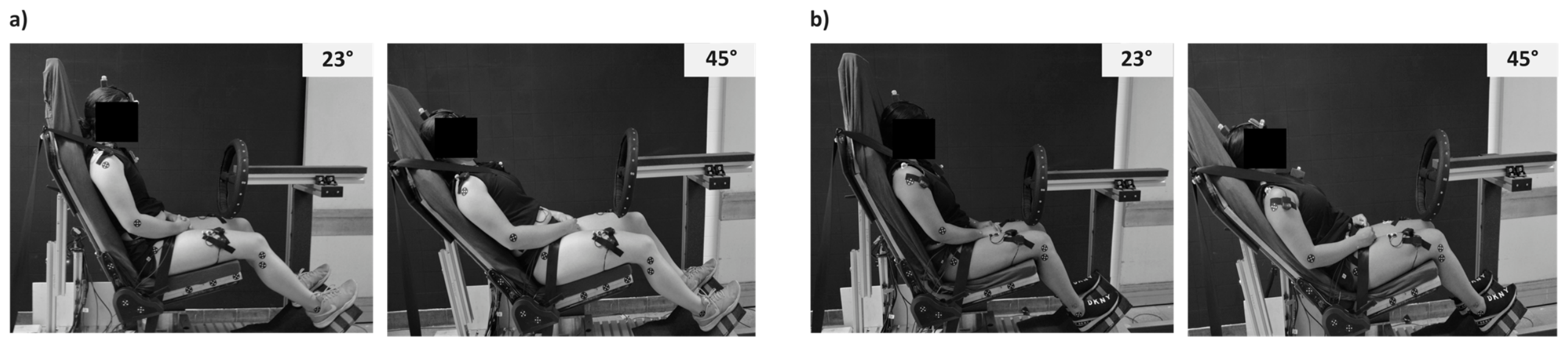
The participants’ hands were placed loosely on their thighs, palms facing downwards (Figure 1). The feet rested on a rigid footrest angled at 45°. The footrest distance was reduced by 10 cm to align with the anthropometric data of the 5th percentile female (compared to 25 cm for 50th-percentile volunteers). Volunteers were secured using a standard three-point belt (Ar4m, ArkPres, Kartepe, Türkiye) running over the right shoulder. The D-Ring was attached to the top of the backrest.
Figure 1.
Positioning of (a) 50th percentile female and (b) 5th percentile female with corresponding steering wheel configuration and foot placement for the 23° (left) and 45° (right) configurations.
The steering wheel position was adjusted specifically for each participant and remained unchanged through the trials. The height and distance of the steering wheel were adjusted according to the following protocol:
- Distance: The reference point was established at the steering wheel’s center, allowing palms to rest comfortably at the sides with elbows fully extended. Care was taken to ensure the shoulders and the back of the head were supported against the seat back and headrest, respectively, allowing test subjects to reach the steering wheel easily in a relaxed shoulder position.
- Height: The height of the steering wheel’s center was modified by lowering the arms about 25° from the horizontal, based on the individually adjusted distance. This adjustment ensured a comfortable palm placement.
- Tilt: The top of the steering wheel was tilted backward by 15–20°.
Each volunteer completed five trials, during which the backrest angle was adjusted. The first three trials were conducted at a backrest angle of 23°, followed by two trials at 45° (measured relative to the vertical axis). The 45° backrest angle simulates a moderately reclined seat, which is expected to enhance comfort during autonomous driving [35]. These two configurations therefore represent both a conventional and a plausible future posture. Similar angles have been examined in previous research under low-g [2,9,27] and high-g conditions [29,36]. The initial trial at a 23° backrest inclination is assumed to best approximate real-world conditions and is anticipated to exhibit distinguishable behavior relative to subsequent trials [31,32]. The subsequent trials, consisting of two at 23° and two at 45°, are considered adaptations to the pulse, employing a more effective muscular strategy aiming to ensure safety and/or comfort. This order ensured that trials began with the minimum distance between the volunteer and the steering wheel, thereby reducing the potential for gradual adaptation. All participants were positioned by the research staff, who also fastened the restraint system to ensure appropriate belt fit and routing. The participants were instructed to keep their hands on their thighs and to look straight forward until the start of the sled. Once the trial had started, they were free to move. An auditory countdown signaled the beginning of the pulse to the volunteers. Additionally, they were instructed to remain relaxed until the first movement of the sled.
2.3. Data Collection & Processing
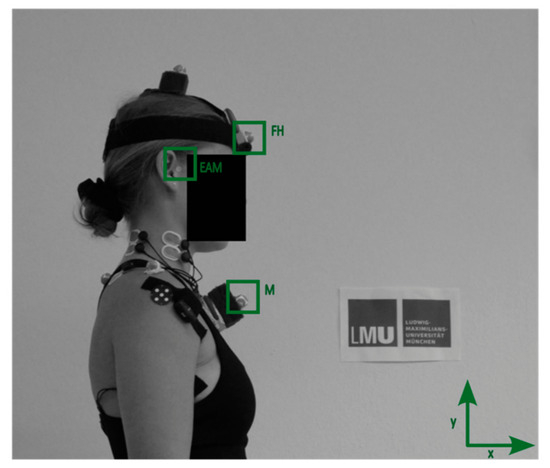
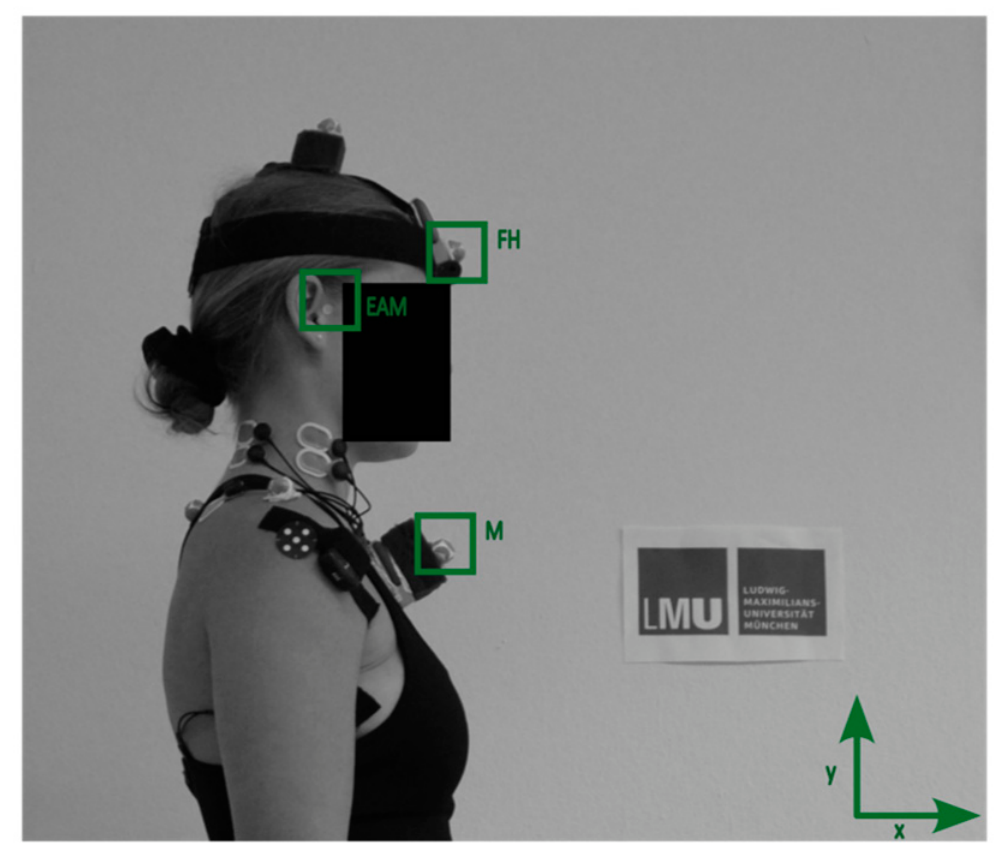
In total, 15 markers were placed on the volunteers to allow sagittal 2D motion tracking. Additional markers were placed on the sled and the steering wheel. This analysis focused on the following markers placed on the head and parts of the upper body (Figure 2):
Figure 2.
Marker positioning on the volunteer’s head (external acoustic meatus (EAM), the frontal head (FH)) and the upper body (at the sternum, manubrium (M)).
- Frontal head (centered at the most prominent anterior point of the forehead of the subjects), referred to as FH.
- External acoustic meatus, referred to as EAM.
- Sternum (caudal end of manubrium, placed on a 3 cm thick foam (fixed to the skin) to ensure visibility in the sagittal video recordings), referred to as M.
Additionally, data such as muscle activity, acceleration data, and belt forces were recorded. However, they were not incorporated into the subsequent analysis shown in this paper.
A high-speed video camera was used to record the motion of the volunteers in the sagittal view at 1000 fps (Photron FASTCAM SA-Z, Photron Limited, Tokyo, Japan). Two reference markers, spaced 10 cm apart, were attached to the seat to scale the tracked trajectories spatially. The x-axis was aligned parallel to the sled platform. The trajectories of the markers derived from the video data were automatically tracked using the software Kinovea (version 0.9.5) for the first 0.75 s. The tracking process was visually monitored throughout. Manual corrections were made during the tracking process only when automatic tracking failed to detect a marker in a given frame or if the tracked point clearly deviated from the actual marker position and was located outside the marker. No manual adjustments were performed after the tracking was completed. Kinovea did not offer a quantitative measure of tracking error; therefore, no independent numerical error was calculated. The quality of tracking was evaluated visually throughout the tracking process.
The exported trajectories were processed using a custom MATLAB script (version R2021b, MathWorks, Natick, MA, USA). The head and manubrium positions were analyzed relative to the seat marker. The resulting trajectories were smoothed using a third-order Savitzky–Golay filter with a window length of 61 frames. Local maxima and minima were identified using the findpeaks function, with a minimum peak prominence of 0.05 cm and a minimum peak distance of 0.05 s. Maxima were detected from the smoothed trajectory, while minima were identified from the inverted trajectory using the same parameters. Only the first relative maximum and the subsequent minimum were considered for the analysis. Displacement values and time points for each maximum and minimum were extracted for further analysis. For further analysis of head and thoracic movement relative to the sled, the change in position over time in the x and y direction of the EAM and manubrium markers was used, respectively. The absolute distance between the head and the steering wheel was analyzed using the FH marker, with negative displacement referring to movement towards the steering wheel.
The general behavior of the participants was visually monitored and recorded with a frontal camera. Movements of the upper extremities were documented after the test and then reviewed in the frontal video recording. The following categories were distinguished: (1) reaching for the steering wheel (any movement of the hands toward the steering wheel) and (2) grasping the steering wheel (direct grasping of the steering wheel).
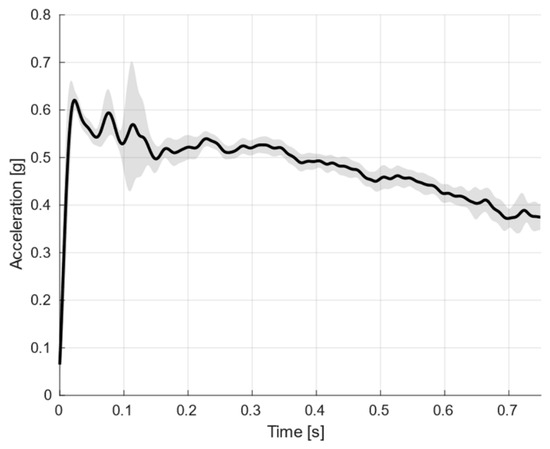
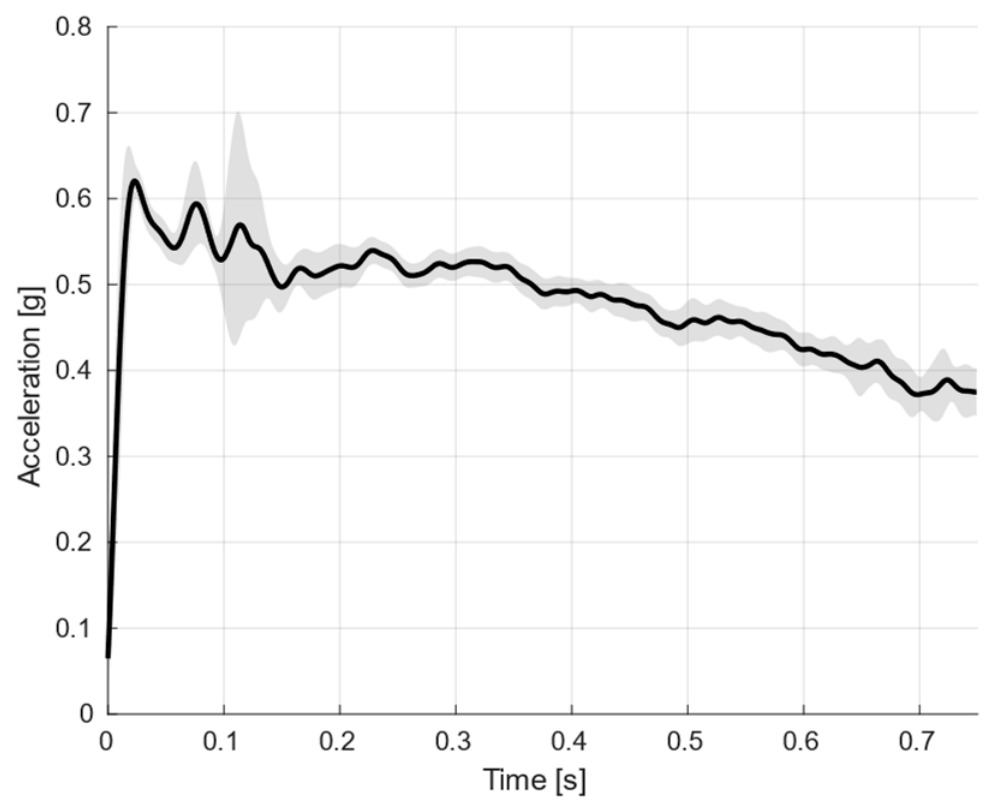
Sled acceleration data were measured using a single-axis accelerometer (BST 53K1, Bay SensorTec, Eching, Germany, nominal measurement range ±2 g, nominal sensitivity 2000 mV/g). The maximum acceleration across all 35 trials ranged from 0.58 to 0.71 g. The mean acceleration curve with its standard deviation for all 35 trials is shown in Figure 3, indicating a maximum average acceleration of 0.62 g and a maximum average jerk of 39 g/s measured over a duration of 0.75 s (Figure 3). Maximum speed ranged between 3.4 m/s (12.24 kph) and 3.7 m/s (13.32 kph) for all 35 trials after the examined acceleration over 0.75 s. The sled acceleration was processed using an SAE CFC 60 filter.
Figure 3.
Mean and standard deviation of the pulse over all 35 trials of the seven volunteers.
Subjective comfort levels for each seat configuration were recorded after each trial using a 10-point scale (1 indicating maximum discomfort and 10 indicating maximum comfort). Participants provided assessments of their comfort and subjective perceptions of the seat setup during each test. Comfort is presented as verbally reported by the volunteers. A grading scale with 0.5-step increments was allowed if participants specified it themselves. For each configuration, intraindividual results were assessed separately for each participant based on their measurements within the respective configuration (23° trials 1–3 and 45° trials 1–2). Interindividual results were assessed across the measurements of all participants within the respective configuration. Medians and ranges were used as descriptive measures to summarize the observed absolute values and their variability. No statistical tests were applied.
3. Results
The mere presence of the steering wheel did not prompt the female participants to reach for it during the examined selected sled pulse. None of the participants made physical contact with the steering wheel at any point before the sled came to a complete stop. In none of the trials, for either a 23° or a 45° backrest angle, did any volunteer initiate a reach towards the steering wheel. The participants indicated that the positioning of the steering wheel was perceived as realistic and suitable for daily use. An exception was observed among the two female participants, who were in the 5th percentile. They stated that they would not adopt the standardized steering wheel setting, determined based on individual anthropometric data and positioning procedure, for routine use. Both stated that in everyday situations, the steering wheel would be closer to their upper bodies.
None of the volunteers reported any pain or discomfort during or after the experiments. The individual comfort reported for each trial ranged from 3/10 (Volunteer 7; 1st trial at 45°) to 9/10 (Volunteers 3 and 4; all trials). All reported comfort values are shown in Table 2. There were no changes in reported comfort at 23° throughout the trials. Volunteers 2, 5, and 7 reported slightly lower comfort values in the 45° configuration; see Table 2.
Table 2.
Reported comfort per participant for all trials (on a 10-point scale with 10 indicating maximum comfort).
3.1. Head Movement Relative to the Steering Wheel
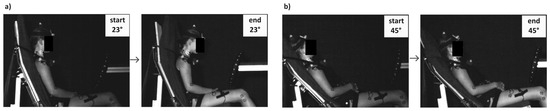
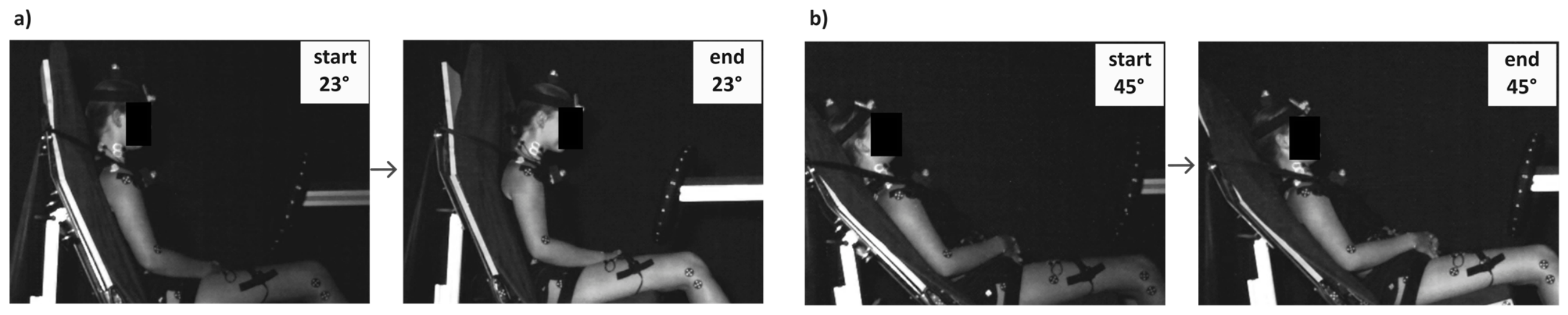
Figure 4 displays still images of a test subject and the steering wheel, captured at the beginning of the measurement and after 0.75 s, for both the upright (Figure 4a) and reclined (Figure 4b) seating positions.
Figure 4.
Volunteer position at the start of the trial (start, left) and after 0.75 s (end, right) in the (a) upright configuration with a seat back angle of 23° and (b) the reclined position with a seat back angle of 45°.
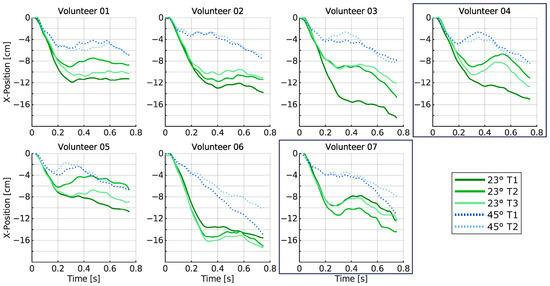
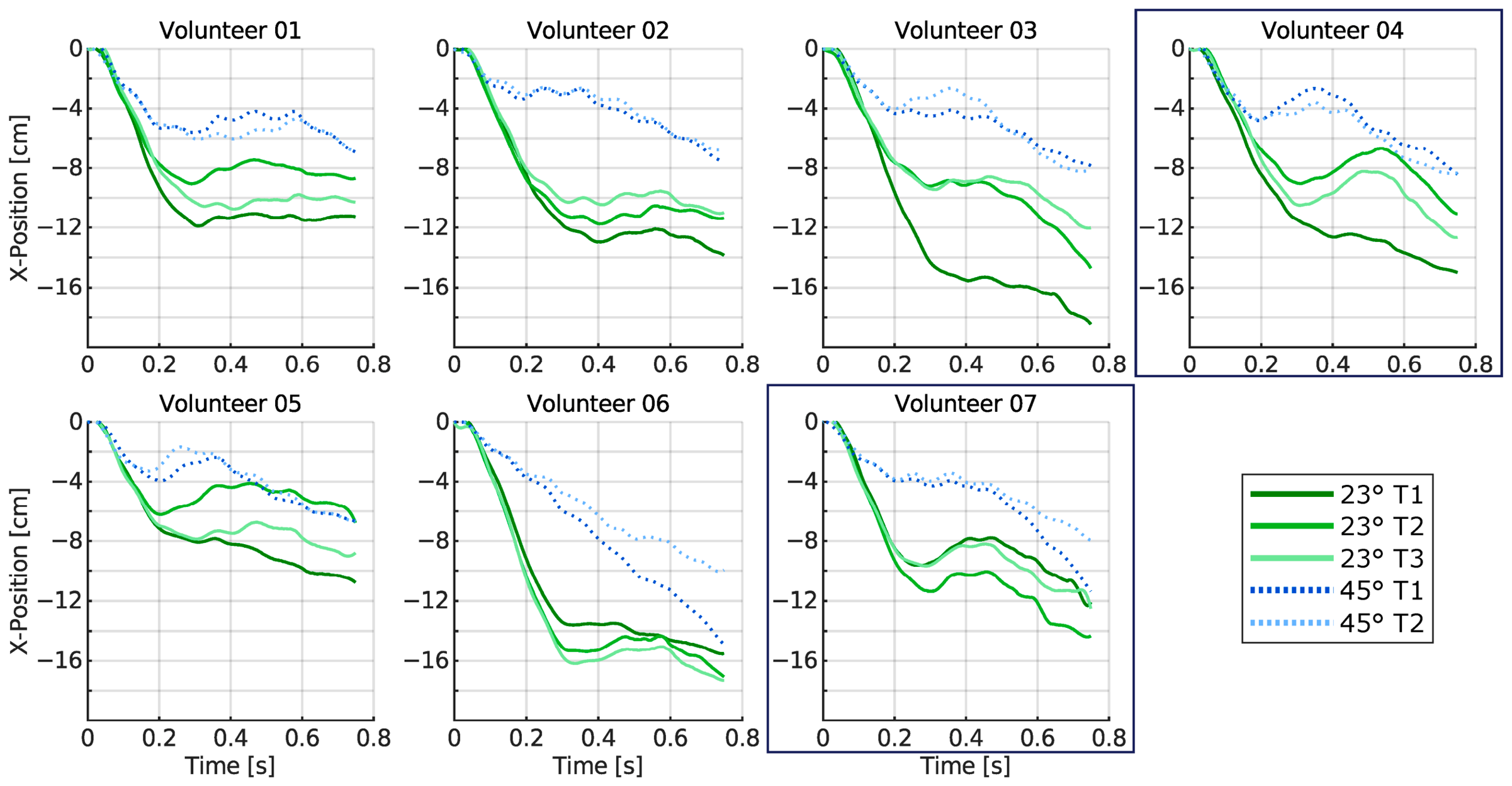
In the 23° configuration, the distance from the forehead to the steering wheel decreased. The largest reduction was observed during the first trial for Volunteers 1 through 5, especially for Volunteers 3, 4, and 5. Volunteer 5 showed the smallest forward movement (see Figure 5). Volunteers 6 and 7 both showed comparable frontal head movement across the three trials. The initial deviation within either the 23° or the 45° configuration becomes apparent before 0.2 s.
Figure 5.
Change in distance of the frontal head (FH) to the steering wheel in the x-direction (volunteers matching the 5th female percentile are indicated with boxes).
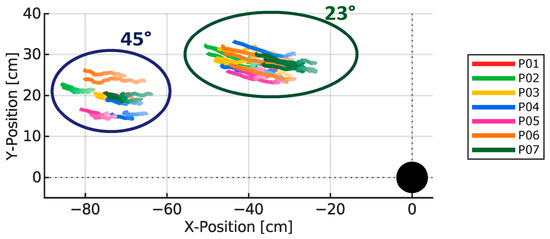
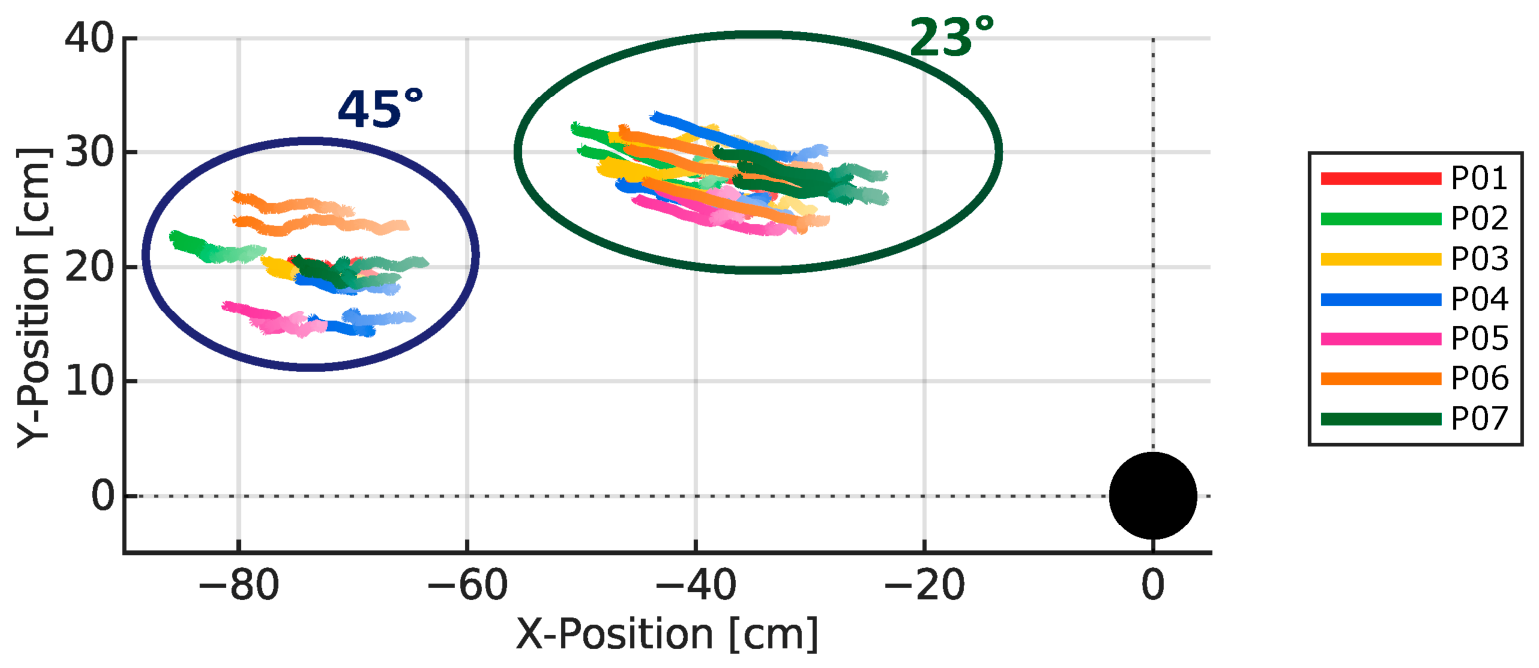
In the reclined trials, there was no clear difference between the two trials for Volunteers 1–5. Volunteer 5 showed the smallest difference from the upright configuration. However, Volunteers 6 and 7 again showed distinct differences. In the first trial, the absolute forward excursion toward the steering matched that of the upright trials. Additionally, Volunteer 6 showed no plateau, indicating consistent forward movement of the head. The absolute distance to the steering wheel after 0.75 s ranged from 31.9 cm (Volunteer 7, trial 1) to 47.2 cm (Volunteer 2, trial 3) in the upright position and from 64.2 cm (Volunteer 7, trial 1) to 81.0 cm (Volunteer 2, trial 2) in the reclined trials. The values of all volunteers can be found in Appendix A, Table A5. Figure 6 shows the trajectories in the x- and y-directions for the upright and reclined conditions for all trials of all volunteers. The time is additionally indicated by the color (the degree of color fading correlates directly with the elapsed time). The center of the steering wheel is represented as a black circle.
Figure 6.
Movement of the head (EAM-marker) in the x and y-directions in the upright (green, 23°) and reclined (blue, 45°) positions for the examined 0.75 s. The time is additionally indicated by the degree of color fading, which correlates directly with the elapsed time. The center of the steering wheel is represented as a black circle.
3.2. Head Forward Excursion Relative to the Sled
In the 23° configuration, the maximum forward excursion of the head (EAM Marker, x-direction) within the first 0.75 s occurred for most of the volunteers during their first trial, except for Volunteers 6 and 7, who had the highest values in the third and second trial, respectively. Absolute excursions across trials ranged from 6.1 cm (Volunteer 5, trial 2) to 16.0 cm (Volunteer 3, trial 1), with a median excursion of 11.1 cm. The maximum difference across the three trials for a single volunteer was 4.5 cm (Volunteer 5), whereas the minimum change was 1.1 cm (Volunteer 2) (median at 2.2 cm). All values are displayed in Table 3.
Table 3.
Maximum forward excursion of the EAM marker in the x-direction within the first 0.75 s.
The same pattern holds for the trials conducted in the 45° configuration, with all volunteers except Volunteers 1 and 3 showing slightly greater forward head movement in the first trial within the examined 0.75 s. However, the differences between the two trials were smaller than those observed in the 23° configuration for all volunteers except Volunteer 6. Absolute values across the trials ranged from 6.6 cm (Volunteer 5) to 11.9 cm (Volunteer 6), with a median excursion of 7.9 cm. Additionally, Volunteer 6 showed the largest difference between the first and second trial with 3.7 cm, while Volunteer 3 showed no difference. The median difference in intraindividual forward head displacements was 0.8 cm. When considering head movement in the y-direction, the head moved considerably less in both backrest configurations compared to movement in the x-direction. Across all trials, absolute excursions ranged from 0.6 cm (Volunteer 7, 23° trial 3) to 2.4 cm (Volunteer 6, 23° trial 3). All x–y-trajectories are provided in Appendix A, Figure A1.
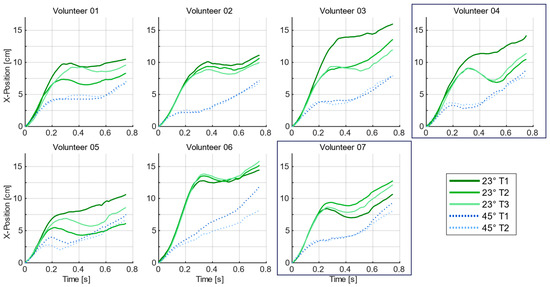
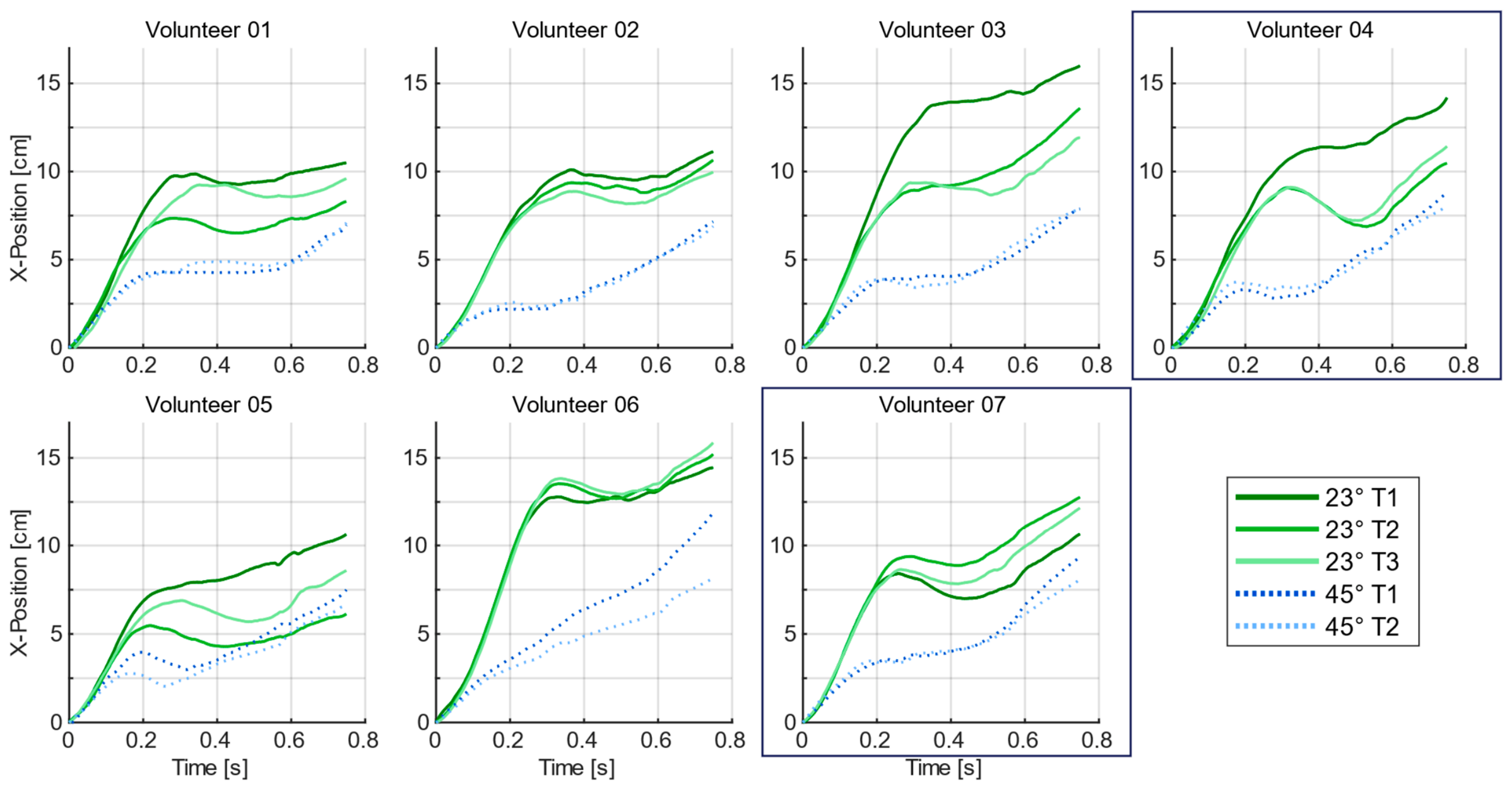
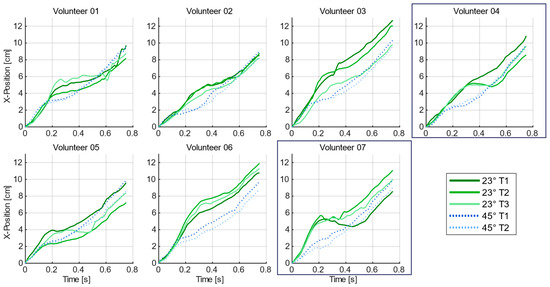
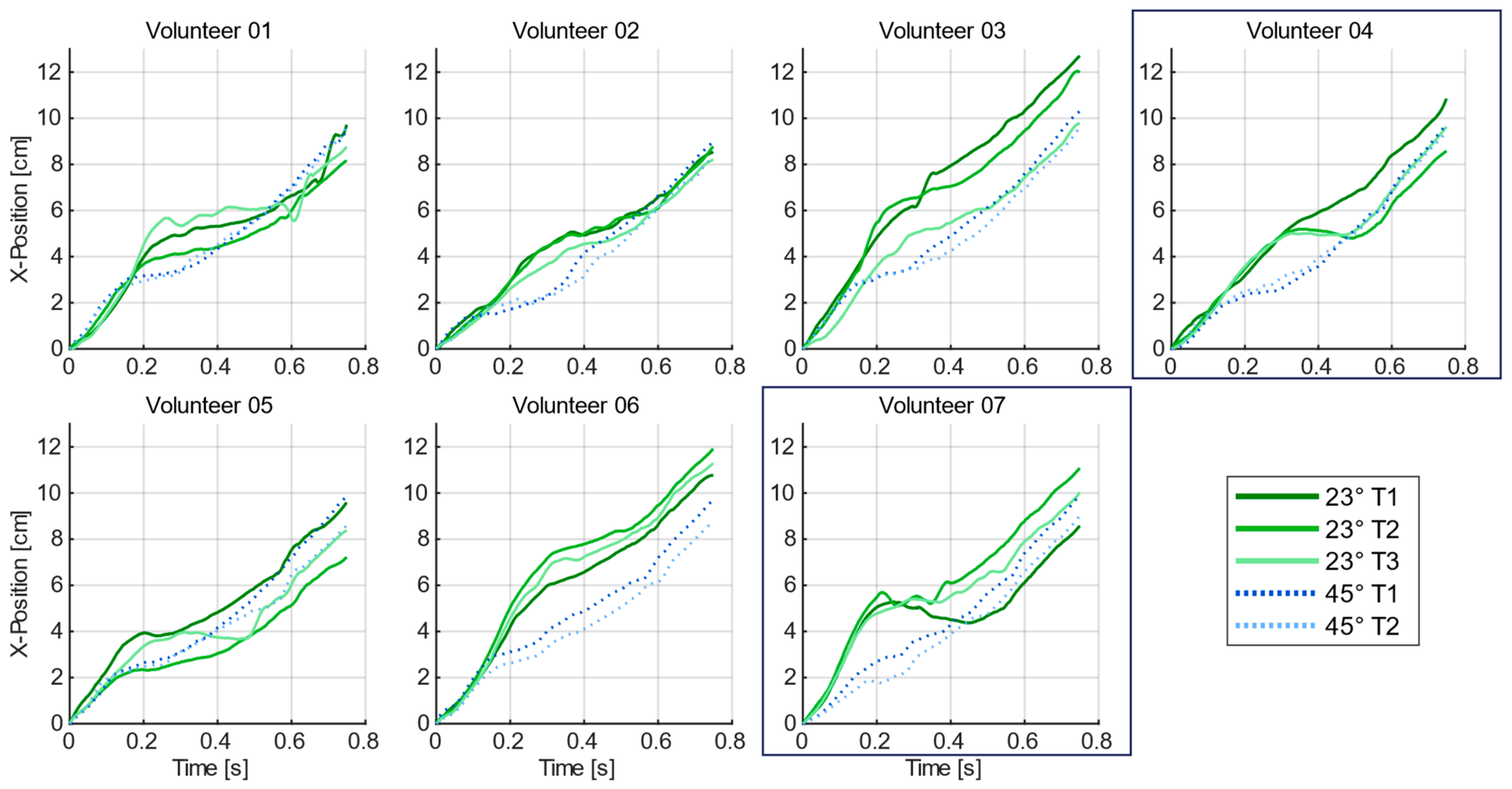
Figure 7 illustrates the forward displacement of the EAM marker along the x-axis over time, with trajectories for the 23° configuration shown in green and for the 45° configuration in blue. Generally, all subjects exhibited a similar pattern of forward head movement across nearly all trials in both configurations. The movement began with an initial forward motion, and then slowed, reaching a plateau or local minimum. However, the extent of the initial forward head displacement varied among subjects and trials. Following the local minimum, forward movement was ‘released’ once again, leading to another linear increase. Visual inspection indicates that the initial deviation between trials for each subject began within the first 0.2 s. Volunteers 1 and 5 showed the earliest deviations in their individual trials, with differences in their trajectories becoming noticeable around 0.1 s.
Figure 7.
Trajectories of the EAM marker in the x-direction over time (volunteers matching the 5th female percentile are indicated with boxes).
In the upright seating position, three out of seven first trials differed from the two subsequent trials, showing a longer initial forward movement (Volunteers 3, 4, and 5). Almost all trajectories in the 23° configuration showed a local minimum (17 out of 21 trials). Within these trials, the first maximum was reached between 0.22 (Volunteer 4, trial 2) and 0.38 s (Volunteer 2, trial 3), with a maximum forward excursion between 5.5 cm (Volunteer 5, trial 2) and 13.8 cm (Volunteer 6, trial 3). Across the three trials for each volunteer, the height of the first local maximum varied the most for Volunteer 1 (2.5 cm). The greatest difference in the timing of the local maximum across a single volunteer’s trials was 0.09 s for Volunteer 5. The subsequent minimum differed by up to 2.8 cm (Volunteer 1) and was reached within a maximum of 0.09 s (Volunteer 6). In addition, the exact values for all participants are provided in Appendix A, Table A1 and Table A2. The values of the subsequent minimum are summarized in Appendix A, Table A3 and Table A4.
In the reclined position, the plateau with the local minimum was less pronounced or absent. In this configuration, the initial forward movement stopped already at around 2 to 4 cm and lasted up to 0.2 s. The two reclined trials only differed for Volunteers 5 and 6. For all other participants, the trajectories nearly overlapped. Only Volunteer 5 achieved a total forward head displacement in the 45° configuration, which roughly corresponds to the difference measured in the upright position. For all other subjects, the values for the 45° configuration remained below those measured in the 23° configuration.
3.3. Upper Body Forward Excursion Relative to the Sled
The maximum forward excursion of the upper body within the examined time window was found either in the 23° configuration for Volunteers 1, 3, 4, 6, and 7, or in the 45° configuration for Volunteers 2 and 5. All maximum values are displayed in Table 4. The seatbelt did not lock, thereby allowing unobstructed anterior movement of the upper body.
Table 4.
Maximum forward excursion of the upper body (Manubrium) in the x-direction within the first 0.75 s.
In the 23° configuration, the differences across trials ranged from 7.2 cm (Volunteer 5, 23° trial 2) to 12.7 cm (Volunteer 3, 23° trial 1), with a median excursion of 9.6. Forward movement in the reclined position showed lower differences. The values ranged from 8.2 cm (Volunteer 2, 45° trial 2) to 10.3 cm (Volunteer 3, 45° trial 1). The median in the reclined configuration was also 9.6 cm. For the individual volunteers, the maximum differences across the three trials at backrest angles of 23° and 45° were 2.9 cm (Volunteer 3) and 1.2 cm (Volunteer 5), respectively. The minimum difference was 0.6 cm at 23° (Volunteer 2), whereas Volunteer 1 showed no difference between the two 45° trials.
Figure 8 illustrates the forward displacement of the sternum along the x-axis over time. The upright configuration trials did not differ notably from the reclined trials. Only the final positions in Volunteer 6 showed less forward lean from the 45° starting position. Furthermore, especially the trials with a backrest angle of 23° showed a deceleration or a brief stop in forward motion from around 0.2 s onward. This is comparable to the forward movement of the head, though less pronounced (Figure 7 and Figure 8). In the y-direction, the M marker trajectories showed less movement in both configurations. Across trials, absolute excursions ranged from 0.2 cm (Volunteer 7, 23° trial 3) to 2.3 cm (Volunteer 1, 23° trial 3). All x–y-trajectories are provided in Appendix A, Figure A2.
Figure 8.
Trajectories of the upper body in the x-direction over time (volunteers matching the 5th female percentile are indicated with boxes).
4. Discussion
None of the female participants reached for the steering wheel in any trial, either in the upright or the subsequent reclined position. Unlike many previous studies, the focus in this experiment was not on targeted takeover maneuvers or reaction times [12,13,14,15], but solely on the influence of an existing steering wheel during a deliberate braking pulse. Without the pressure of a required vehicle takeover, no grasping of the steering-wheel was observed among the participants studied. However, stronger braking pulses could potentially trigger different kinematic and muscular responses [6,24,37]. In the context of targeted grasping movements to the steering wheel, female participants showed a significantly faster initial lifting of their hands than men [12].
4.1. Upright Position with Backrest Angle of 23°
Deviations in head forward movement were observed when comparing trial 1 with trials 2 and 3 in the upright configuration among some volunteers. These deviations were noted for participants 3, 4, and 5, who showed a larger initial forward movement that was not completely stopped but merely slowed down. The initial forward movement was particularly pronounced in the first trial for these volunteers, and the response was subsequently adjusted in the following trials. Slight differences were observed among some participants between the initial and subsequent trials. However, contrary to initial assumptions, the head forward excursion during the first trial was not smaller than the excursion of the two subsequent trials. In fact, the forward movement was more pronounced initially, indicating that overall habituation to the pulse, rather than the steering wheel, likely influenced adaptation across trials.
The second and third trial showed movement patterns similar to those observed in the majority of trials across all participants. Since all volunteers had several years of driving experience, it can be assumed that this positioning was familiar to them and that they had experienced this movement more or less frequently, making it a familiar situation rather than a completely new one. The female participants with the greatest deviations on the first trial belonged to both the 5th and 50th percentiles and had different driving experience and practice (ranging from 4 to 21 years and trips from 3 times a month to 50 km weekly). No direct relationship between driving practice and initial reaction in the first trial can be assumed based on this. The comfort level was also rated as relatively high by the three participants (9/10, 9/10, and 7/10, respectively), suggesting that comfort level was unlikely to have had a direct influence on the observed deviations.
In the upright position, the biggest differences in the forward movement of the head were observed on an interindividual basis. When comparing individual trials conducted by a single volunteer, deviations in forward head movement and final position after 0.75 s were less pronounced. The maximum displacement in the x-direction varied by up to 10 cm among participants, while the maximum difference between trials for a single volunteer was only 4.5 cm. This difference was much more distinct in head movement than in upper-body movement, with an overall difference in maximum excursion of the manubrium up to 5.5 cm and a maximum individual difference of 2.9 cm. Therefore, the intra-individual differences (possibly due to habituation) are smaller than the interindividual differences observed across all trials for all participants.
The range of forward movement of the head measured in this study is within or slightly below the values reported by Huber et al. [8] and Reed et al. [2]. These studies were conducted in a vehicle on a test track and also included female participants, but they were not explicitly analyzed separately by sex. In a direct comparison between male and female participants, Carlsson and Davidsson [24] showed that comparable braking maneuvers and similar seating heights led to different kinematic reactions. The total forward head displacement was greater in female participants, and they also remained in this position longer. The maximum forward head excursion in our study was lower than the reported range of 9.1 to 21.2 cm for male volunteers using the same setup and pulse without a steering wheel [28]. However, according to Carlsson and Davidsson [24], higher values would be expected for females. The absolute head forward movement observed in our study was lower than that reported by González-García et al. [28], who tested men without a steering wheel in the same setup. Whether the reduced forward displacement of the head observed in our experiments is due to sex and anthropometric characteristics or to the presence of the steering wheel remains to be confirmed in further studies.
The differentiation of the forward movement of the head occurred in all subjects within the first 0.1 to 0.2 s. Since no earlier deviations occurred, it can be assumed that the participants started each trial relaxed or with a consistent level of muscle activation. Other studies also showed that up to 0.2 s is considered realistic for reactive muscular intervention to become visible in the resulting movement without specific pre-activation of the muscles [38]. Most trials showed a similar pattern, especially when observing the movement in the x-direction over time. Following the initial forward movement, there was a deceleration or stopping of the head, sometimes even a slight retraction toward the headrest, before the forward movement was released again. Comparing the individual movements of the participants, it becomes apparent that either the second and third trials were similar (Volunteer 2 and 6), or that the first and second trials showed the greatest differences, with the third trial falling in between. This indicates that all participants found their own way of dealing with the pulse presented here, likely regardless of the steering wheel’s presence.
The characteristics of the first peak, before the head movement slowed down, indicate that the largest differences occurred between individuals, while differences within individuals were less marked. Across all trials, a difference of 8.3 cm (and 0.16 s) was observed in the height of the first peak within the first 0.75 s, whereas in the three trials of individual participants, it was only about 2.8 cm (and 0.08 s).
4.2. Reclined Position with Backrest Angle of 45°
In the subsequent reclined position, generally smaller deviations were observed between the trials, both on an individual and interindividual basis. These trials were intended to allow a more accurate assessment of kinematic responses, as some adaptation was likely to have already occurred at the initial position. Since this position was less familiar from everyday driving experience, the initial upright position trials served as habituation trials [32]. In the context of autonomous driving, a reclined position is quite plausible [39,40,41]. Absolute forward movement of the head was below the values measured in the 23° configuration, except for Volunteer 5. For this volunteer, the forward excursion in the x-direction matched those values at the 23° configuration. However, this was not due to a more pronounced forward movement than in other volunteers, but rather to limited forward excursion during the 23° trials. The reduced head forward excursion in the 45° configuration matches the findings of González-García et al. [28] for male volunteers using the same experimental setup. However, Tran et al. [27] and Reed et al. [2] found an increase in the maximum forward head excursion in the reclined postures.
A difference between inter- and intraindividual assessments of forward movement was also observed in this configuration. The maximum forward movement of the head varied by 5.3 cm across all experiments, whereas in an individual-based comparison, the maximum variation was 3.7 cm. Only Volunteer 6 exhibited noticeable differences between the two trials, becoming apparent after about 0.2 s. In both trials, the head moved consistently forward, but this was much more pronounced in the first trial, resulting in a greater forward shift. No other participant displayed such differences in movement or final position. As only seven volunteers were examined in this pilot study, these differences might still be due to chance. The distance between the head and the steering wheel (measured at the vertical center of the steering wheel) was consistently greater at 45° than at 23° across all experiments (Appendix A, Table A5). This was not only due to a larger initial distance at the start of the experiment but also to a generally reduced forward displacement of the head during the experiments. Consistent with the previous observations, interindividual variability exceeded individual differences.
4.3. Upper Body Movement & Influence of Anthropometric Measures
The movement of the upper body showed comparatively low variability, both between configurations and on interindividual and individual levels. The individual trajectories at both backrest angles were usually very close to each other. A difference in maximum forward displacement at 0.75 s was observed only for Volunteer 6, with a smaller forward displacement at 45°. A clear slowing in the forward movement of the upper body occurred sometimes, but was less pronounced than in the head kinematics. The trajectories further indicated a deceleration response, particularly in the upright trials. In contrast to the head movement, this did not result in differences in the final position after 0.75 s between the two configurations. Similar to head movement, interindividual differences exceeded individual differences, albeit to a lesser degree. During upright trials, the interindividual variation in forward movement of the upper body was 5.5 cm, whereas the maximum individual variation was 2.9 cm. When the backrest was reclined, all experiments varied by 2.1 cm, with a maximum individual difference of 1.2 cm.
A clear influence of the two anthropometric measurements, specifically the two participants in the 5th percentile, could not be identified. Only the steering wheel adjustment was rated differently and less realistically by both compared to the other participants in the 50th percentile. To accurately simulate realistic scenarios, future adjustments to the experimental setup should be made, provided they do not significantly affect the comparability of the trials. In general, comfort was slightly higher on the trials at a backrest angle of 23°, with a median of 8/10, compared to 7.5/10 at 45°. Additionally, the 45° configuration ratings did not differ by participants in the 5th percentile, with subjective comfort ratings of 9/10 and 3–3.5/10, while participants in the 50th percentile rated it at least 7/10. One possible reason for the low comfort rating of Volunteer 7 (5th percentile) is the shape of the seat used, which caused the small test subjects’ heads not to rest optimally on the headrest but rather against the backrest, tending to lead to cervical spine extension. However, this had no influence on the rating of the other female volunteer of the 5th percentile, while the second lowest ranking of comfort in the reclined position was given by Volunteer 5 (corresponding to the 50th percentile) with a normal sitting height.
5. Outlook
This exploratory study observed no grasping reaction to the steering wheel under the given braking pulse and positioning conditions for representatives of the 5th and 50th percentiles of female drivers. Future investigations should also consider additional anthropometric measures, such as the 95th percentile male, who might be more likely to interact with surrounding structures. The individual reactive movement strategies of the participants should be examined by electromyographic activity in future analyses. Furthermore, a systematic comparison of experimental conditions with and without a steering wheel, including larger sample sizes, could be conducted to better understand the impact of space limitations on pre-braking behavior.
Author Contributions
Conceptualization, L.S., M.G.-G., J.W., S.P. and S.S.; methodology, L.S., M.G.-G., J.W., S.P. and S.S.; formal analysis, L.S.; investigation, L.S.; data curation, L.S.; writing—original draft preparation, L.S.; writing—review and editing, S.S.; visualization, L.S.; supervision, S.P. and S.S. All authors have read and agreed to the published version of the manuscript.
Funding
This research received no external funding.
Institutional Review Board Statement
The study was conducted in accordance with the Declaration of Helsinki, and approved by the Ethics Committee of the Medical Faculty of the University of Munich LMU, Munich, Bavaria, Germany (number of approval: 20-530, 15 September 2020).
Informed Consent Statement
Informed consent was obtained from all subjects involved in the study.
Data Availability Statement
The data presented in this study are available on reasonable request from the corresponding author.
Acknowledgments
The sled system was partially funded by Stifterverband/Volkswagen AG Wolfsburg.
Conflicts of Interest
Authors María González-García and Jens Weber were employed by the company Volkswagen AG. The remaining authors declare that the research was conducted in the absence of any commercial or financial relationships that could be construed as a potential conflict of interest.
Abbreviations
The following abbreviations are used in this manuscript:
| EAM | External Acoustic Meatus |
| FH | Frontal head |
| fps | Frames per second |
| M | Manubrium |
| T | Trial |
| V | Volunteer |
Appendix A
Figure A1.
Movement of the head (EAM-marker) in the x and y-directions in cm (volunteers matching the 5th female percentile are indicated with boxes).
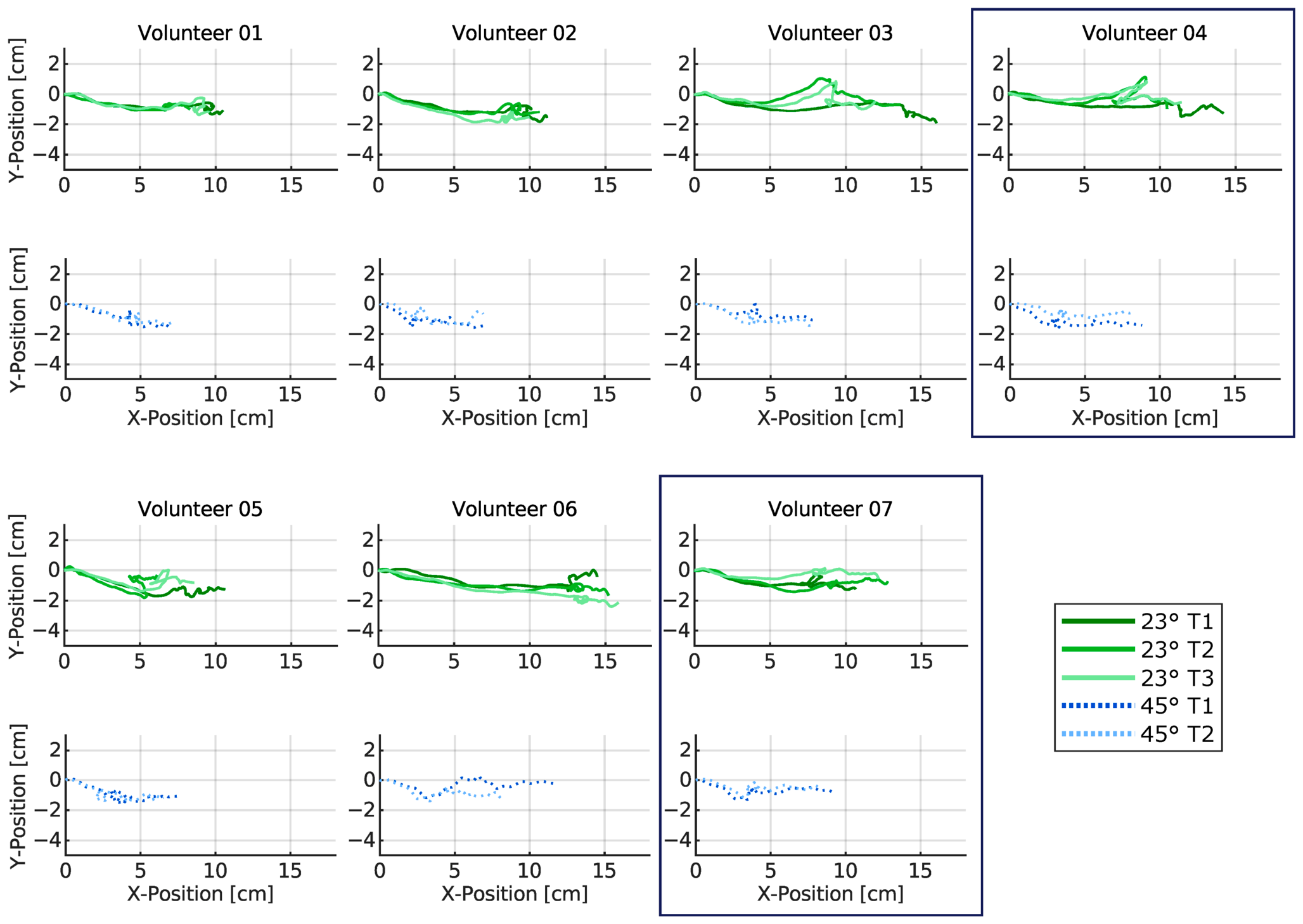
Table A1.
Height of the first local maximum (if present) in cm.
Table A2.
Point in time when the first local maximum (if present) is reached in seconds.
Figure A2.
Movement of the upper body (sternum, M-marker) in the x and y-directions in cm (volunteers matching the 5th female percentile are indicated with boxes).
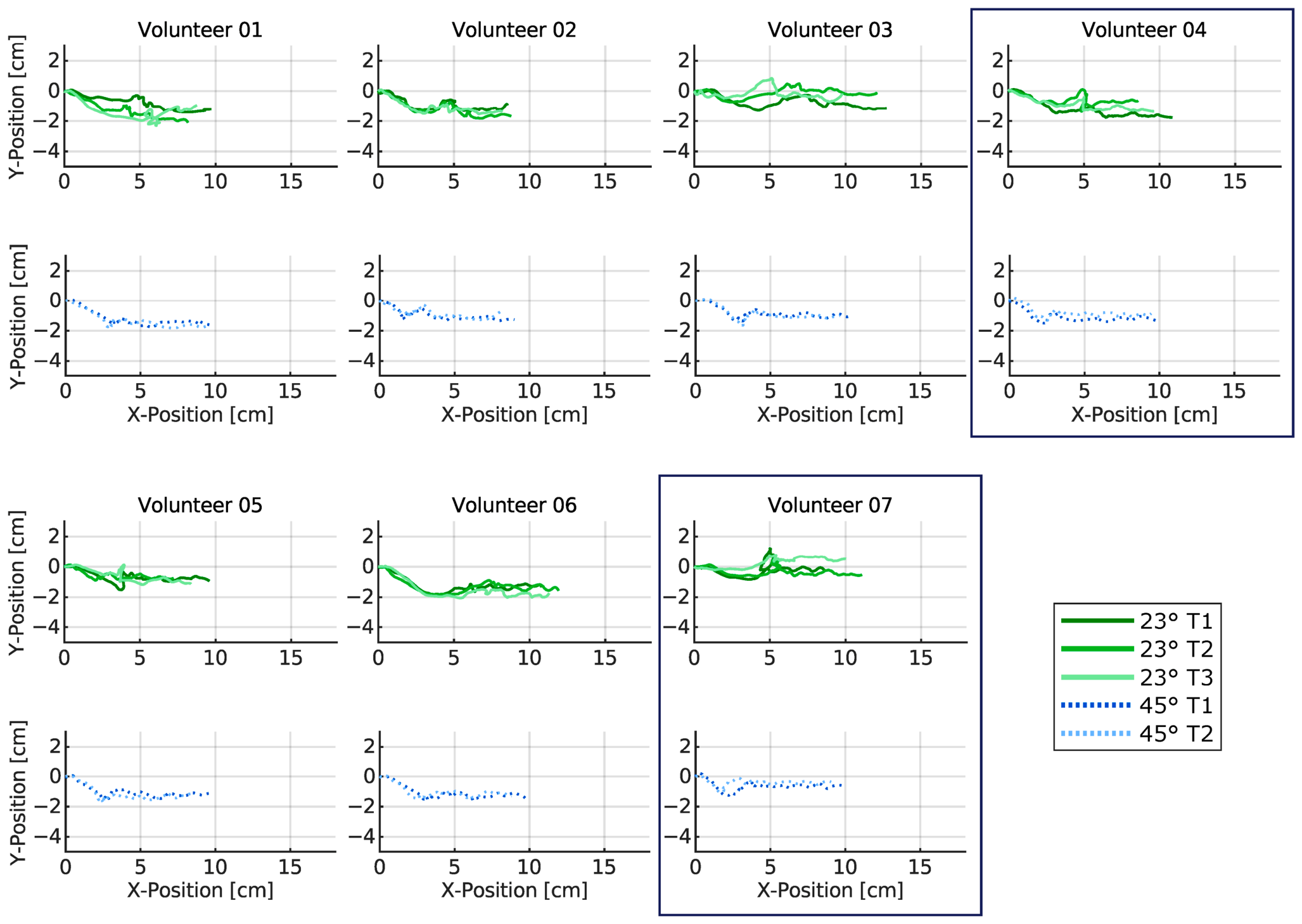
Table A3.
Height of the first local minimum (if present) in cm.
Table A4.
Point in time when the first local minimum (if present) is reached in seconds.
Table A5.
Absolute distance of the frontal head to the steering wheel after 0.75 s.
References
- Rathod, A.B.; Vyavahare, R.T. A comprehensive review of the evolution, methods, and emerging directions of automotive ergonomics in human vehicle systems. Discov. Veh. 2026, 2, 15. [Google Scholar] [CrossRef] [Scilit]
- Reed, M.P.; Ebert, S.M.; Jones, M.H.; Park, B.D. Occupant Dynamics During Crash Avoidance Maneuvers; Paper No. DOT HS 812 997; National Highway Traffic Safety Administration: Washington, DC, USA, 2021.
- Zhao, M.; Bellet, T.; Richard, B.; Giralt, A.; Beurier, G.; Wang, X. Effects of non-driving related postures on takeover performance during conditionally automated driving. Accid. Anal. Prev. 2024, 208, 107793. [Google Scholar] [CrossRef] [Scilit]
- Gershon, P.; Seaman, S.; Mehler, B.; Reimer, B.; Coughlin, J. Driver behavior and the use of automation in real-world driving. Accid. Anal. Prev. 2021, 158, 106217. [Google Scholar] [CrossRef] [Scilit]
- Maggi, D.; Romano, R.; Carsten, O. Transitions Between Highly Automated and Longitudinally Assisted Driving: The Role of the Initiator in the Fight for Authority. Hum. Factors 2022, 64, 601–612. [Google Scholar] [CrossRef] [Scilit]
- Osth, J.; Olafsdóttir, J.M.; Davidsson, J.; Brolin, K. Driver kinematic and muscle responses in braking events with standard and reversible pre-tensioned restraints: Validation data for human models. Stapp Car Crash J. 2013, 57, 1–41. [Google Scholar] [CrossRef] [Scilit]
- González-García, M.; Peldschus, S.; Weber, J.; Persohn, S.; Sandoz, B. Influence of the surrounding environment on the response of seated midsize male volunteers subjected to lateral sled accelerations. J. Biomech. 2024, 177, 112382. [Google Scholar] [CrossRef] [Scilit]
- Huber, P.; Kirschbichler, S.; Prüggler, A.; Steidl, T. Passenger kinematics in braking, lane change and oblique driving maneuvers. In Proceedings of the 2015 International Research Council on the Biomechanics of Injury, IRCOBI 2015, Lyon, France, 9–11 September 2015; IRC-15-89 2015. pp. 783–802. [Google Scholar]
- Kirschbichler, S.; Klein, C.; Breitfuss, D.; Steidl, T.; Pucher, J.; Krajnc, A.; Iacono, L. Passenger Kinematics in Reclined Sitting Position in Braking and Steering Manoeuvres. In Proceedings of the 2023 International Research Council on the Biomechanics of Injury, IRCOBI 2023, Cambridge, UK, 13–15 September 2023; IRC-23-96 2023. pp. 768–784. [Google Scholar]
- Jung, M.-C.; Mo, S.-M. Correlation between Muscular Activity and Vehicle Motion during Double Lane Change Driving. Sensors 2024, 24, 5982. [Google Scholar] [CrossRef] [Scilit]
- Victor, T.W.; Tivesten, E.; Gustavsson, P.; Johansson, J.; Sangberg, F.; Ljung Aust, M. Automation Expectation Mismatch: Incorrect Prediction Despite Eyes on Threat and Hands on Wheel. Hum. Factors 2018, 60, 1095–1116. [Google Scholar] [CrossRef] [Scilit]
- Griffith, M.; Akkem, R.; Maheshwari, J.; Seacrist, T.; Arbogast, K.B.; Graci, V. The effect of a startle-based warning, age, sex, and secondary task on takeover actions in critical autonomous driving scenarios. Front. Bioeng. Biotechnol. 2023, 11, 1147606. [Google Scholar] [CrossRef] [Scilit]
- Shangguan, Z.; Liu, Y.; Song, L.; Li, T.; Tapus, A. Using a Pneumatic Tactile Steering Wheel to Enhance the Multi-Modal Takeover Request in Smart Vehicle. In Social Robotics, 16th International Conference, ICSR + BioMed 2024, Singapore, 16–18 August 2024; Springer: Singapore, 2025; pp. 122–132. [Google Scholar]
- Graci, V.; Griffith, M.; Maheshwari, J.; Akkem, R.; Austin, M.; Seacrist, T.; Arbogast, K.B. The Effect of An Acoustic Startling Warning on Take-Over Reaction Time and Trunk Kinematics for Drivers in Autonomous Driving Scenarios. In Proceedings of the 63rd Stapp Car Crash Conference, San Antonio, TX, USA, 11 November 2019; SAE Technical Paper; The Stapp Association: Ann Arbor, MI, USA, 2020. [Google Scholar]
- Loeb, H.; Belwadi, A.; Maheshwari, J.; Shaikh, S. Age and gender differences in emergency takeover from automated to manual driving on simulator. Traffic Inj. Prev. 2019, 20, S163–S165. [Google Scholar] [CrossRef] [Scilit]
- Weaver, B.W.; DeLucia, P.R. A Systematic Review and Meta-Analysis of Takeover Performance During Conditionally Automated Driving. Hum. Factors 2022, 64, 1227–1260. [Google Scholar] [CrossRef] [Scilit]
- Paulus, M.C.; Wiesel, B.B.; Bierman, L.W.; Galetti, T.C.; Nagda, S.S.; Fitzpatrick, K.F.; Nagda, S.H. Electromyography analysis of rotator cuff activation while driving. JSES Int. 2026, 10, 101411. [Google Scholar] [CrossRef] [Scilit]
- Lee, H.-M.; Yang, C.-Y.; Huang, W.-N.W.; Wu, S.-K.; You, J.-Y.; Li, P.-C.; Wu, H.-C.; Chen, H.-Y. Movement pattern and upper extremity muscle activation during fast and slow continuous steering movement. Hum. Mov. Sci. 2023, 87, 103049. [Google Scholar] [CrossRef] [Scilit]
- Watanabe, K.; Yoshida, T. Effect of arm position on spatial distribution of upper trapezius muscle activity during simulated car driving. Int. J. Occup. Saf. Ergon. 2022, 28, 1766–1772. [Google Scholar] [CrossRef] [Scilit]
- Fice, J.B.; Mang, D.W.H.; Ólafsdóttir, J.M.; Brolin, K.; Cripton, P.A.; Blouin, J.-S.; Siegmund, G.P. Neck Muscle and Head/Neck Kinematic Responses While Bracing Against the Steering Wheel During Front and Rear Impacts. Ann. BioMed Eng. 2021, 49, 1069–1082. [Google Scholar] [CrossRef] [Scilit]
- Izadi, V.; Ghasemi, A.H. Quantifying the performance of an adaptive haptic shared control paradigm for steering a ground-vehicle. Transp. Eng. 2022, 10, 100141. [Google Scholar] [CrossRef] [Scilit]
- Eksioglu, M.; Kızılaslan, K. Steering-wheel grip force characteristics of drivers as a function of gender, speed, and road condition. Int. J. Ind. Ergon. 2008, 38, 354–361. [Google Scholar] [CrossRef] [Scilit]
- Comolli, F.; Gobbi, M.; Mastinu, G. Study on the Driver/Steering Wheel Interaction in Emergency Situations. Appl. Sci. 2020, 10, 7055. [Google Scholar] [CrossRef] [Scilit]
- Carlsson, S.; Davidsson, J. Volunteer occupant kinematics during driver initiated and autonomous braking when driving in real traffic environments. In Proceedings of the 2011 International Research Council on the Biomechanics of Injury, IRCOBI 2011, Krakow, Poland, 14–16 September 2011; IRC-11-43 2011. pp. 125–136. [Google Scholar]
- Devane, K.; Johnson, D.; Gayzik, F.S. Validation of a simplified human body model in relaxed and braced conditions in low-speed frontal sled tests. Traffic Inj. Prev. 2019, 20, 832–837. [Google Scholar] [CrossRef] [Scilit]
- Beeman, S.M.; Kemper, A.R.; Madigan, M.L.; Duma, S.M. Effects of bracing on human kinematics in low-speed frontal sled tests. Ann. BioMed Eng. 2011, 39, 2998–3010. [Google Scholar] [CrossRef] [Scilit]
- Tran, T.D.; Holtz, J.; Müller, G.; Müller, S. Validation of MADYMO human body model in braking maneuver with highly reclined seatback. Int. J. Crashworthiness 2022, 27, 1743–1752. [Google Scholar] [CrossRef] [Scilit]
- González-García, M.; Siebler, L.; Muehlbauer, J.; Schick, S.; Peldschus, S.; Weber, J. Kinematic response of seated male volunteers in various reclined postures on a sled subjected to a braking pulse. Accid. Anal. Prev. 2023, 193, 107293. [Google Scholar] [CrossRef] [Scilit]
- Richardson, R.; Donlon, J.-P.; Jayathirtha, M.; Forman, J.L.; Shaw, G.; Gepner, B.; Kerrigan, J.R.; Östling, M.; Mroz, K.; Pipkorn, B. Kinematic and Injury Response of Reclined PMHS in Frontal Impacts. Stapp Car Crash J. 2020, 64, 83–153. [Google Scholar] [CrossRef] [Scilit]
- Umale, S.; Khandelwal, P.; Humm, J.; Pintar, F.; Yoganandan, N. Comparison of small female occupant model responses with experimental data in a reclined posture. Traffic Inj. Prev. 2022, 23, S211–S213. [Google Scholar] [CrossRef] [Scilit]
- Zaback, M.; Reiter, E.R.; Adkin, A.L.; Carpenter, M.G. Initial experience of balance assessment introduces ‘first trial’ effects on emotional state and postural control. Gait Posture 2021, 88, 116–121. [Google Scholar] [CrossRef] [Scilit]
- Rankin, C.H.; Abrams, T.; Barry, R.J.; Bhatnagar, S.; Clayton, D.F.; Colombo, J.; Coppola, G.; Geyer, M.A.; Glanzman, D.L.; Marsland, S.; et al. Habituation revisited: An updated and revised description of the behavioral characteristics of habituation. Neurobiol. Learn. Mem. 2009, 92, 135–138. [Google Scholar] [CrossRef] [Scilit]
- Shadish, W.R.; Cook, T.D.; Campbell, D.T. Experimental and Quasi-experimental Designs for Generalized Causal Inference, [Nachdr.]; Houghton Mifflin: Boston, MA, USA, 2002. [Google Scholar]
- ISO 7250-1:2017; Basic human body measurements for technological design—Part 1: Body measurement definitions and landmarks. International Organization for Standardization: Geneva, Switzerland, 2017.
- Makris, M.; Muthumani, A.; Herrera, M.; Wang, D.; Johansson, M.; Osvalder, A.-L. Drivers’ Overall Comfort Experiences of Reclined Positions in a Passenger Car with an Automated Driving Function. Appl. Ergon. 2025, 126, 104503. [Google Scholar] [CrossRef] [Scilit]
- Lopez-Valdes, F.J.; Jimenez-Octavio, J.; Vives, C.; Alvarez, J.; Asensio-Gil, J.M.; Valdano, M.; Rodriguez-Morcillo, C.; Östling, M.; Lebarbé, M.; Masuda, M.; et al. The Impact Response of Four PMHS to Frontal Impacts in Reclined Positions. In Proceedings of the 2024 International Research Council on the Biomechanics of Injury, IRCOBI 2024, Stockholm, Sweden, 11–13 September 2024. IRC-24-34 2024. [Google Scholar]
- Gstrein, G.; Leo, C.; Erlinger, N.; Kofler, D.; Jauernig, A.; Klug, C. Occupant response during autonomous braking manoeuvres in novel seating positions. In Proceedings of the 2025 International Research Council on the Biomechanics of Injury, IRCOBI 2025, Vilnius, Lithuania, 10–12 September 2025. IRC-25-92 2025. [Google Scholar]
- Shokouhyan, S.M.; Blandeau, M.; Wallard, L.; Barbier, F.; Khalaf, K. Time-delay estimation in biomechanical stability: A scoping review. Front. Hum. Neurosci. 2024, 18, 1329269. [Google Scholar] [CrossRef] [Scilit]
- Yang, Y.; Klinkner, J.N.; Bengler, K. How Will the Driver Sit in an Automated Vehicle?—The Qualitative and Quantitative Descriptions of Non-Driving Postures (NDPs) When Non-Driving-Related-Tasks (NDRTs) Are Conducted. In Proceedings of the 20th Congress of the International Ergonomics Association (IEA 2018), Florence, Italy, 26–30 August 2018; Bagnara, S., Ed.; Springer: Cham, Switzerland, 2019; pp. 409–420. [Google Scholar]
- Hirz, M.; Rossbacher, P. Integrated Approach Supporting Virtual Conception of Passenger Ergonomics in Automated Driving Cars. In Proceedings of the AHFE 2018 International Conference on Human Factors in Transportation, Orlando, FL, USA, 21–25 July 2018; Stanton, N., Ed.; Springer: Cham, Switzerland, 2019; pp. 434–444. [Google Scholar]
- Jorlöv, S.; Bohman, K.; Larsson, A. Seating Positions and Activities in Highly Automated Cars—A Qualitative Study of Future Automated Driving Scenarios. In Proceedings of the 2017 International Research Council on the Biomechanics of Injury, IRCOBI 2017, Antwerp, Belgium, 13–15 September 2017; IRC-17-11 2017. pp. 13–22. [Google Scholar]

Disclaimer/Publisher’s Note: The statements, opinions and data contained in all publications are solely those of the individual author(s) and contributor(s) and not of MDPI and/or the editor(s). MDPI and/or the editor(s) disclaim responsibility for any injury to people or property resulting from any ideas, methods, instructions or products referred to in the content. |
© 2026 by the authors. Licensee MDPI, Basel, Switzerland. This article is an open access article distributed under the terms and conditions of the Creative Commons Attribution (CC BY) license.