


Abstract
The high levels of greenhouse gas emissions from energy-intensive industries have created an urgent need for decarbonization. As major sources of pollution, industries are increasingly being forced to reconsider the fuels they use in their processes. Interest in hydrogen combustion, particularly in high-temperature applications, has grown due to its physical properties and the absence of carbon dioxide emissions. Despite its potential, hydrogen combustion presents technical challenges, such as flame stability, burner adjustment requirements, control of nitrogen oxides (NOx) emissions and material compatibility. This review examines the use of hydrogen as a fuel in industrial furnaces along three complementary axes. First, it analyzes combustion fundamentals, blending limits and mitigation strategies, including oxy-fuel and MILD combustion, and assesses their deployment maturity across the steel, cement, glass, ceramics, and refining and chemicals sectors, together with economic and regulatory constraints. Second, it reviews advances in Computational Fluid Dynamics (CFD) modeling of hydrogen flames, addressing turbulence-chemistry interaction, reaction kinetics, radiative heat transfer, NOx formation and model validation. Third, it surveys camera-based diagnostics combined with Artificial Intelligence and computer vision for flame monitoring and combustion optimization. By synthesizing recent literature, the review identifies the principal knowledge gaps, notably standardized CFD validation datasets and robust monitoring under industrial conditions, providing a critical reference for researchers and industry.
1. Introduction
High-temperature industrial processes, such as iron and steelmaking, cement, glass, ceramics, refining, and chemicals, account for between a quarter and a third of global greenhouse gas (GHG) emissions and rely heavily on coal, coke, and natural gas to deliver process heat above 1000 °C [1,2,3]. As the European Union tightens emission limits under the European Green Deal, the “Fit for 55” package and the recent Clean Industry Pact, the industry is facing increasing regulatory and market pressure to decarbonize without losing competitiveness [2,4]. Direct electrification is technically viable for only part of this demand, as the requirements for radiative heat transfer, atmospheric chemistry and product quality in glass tanks, rotary kilns, steel reheating furnaces and ethylene crackers cannot always be met solely by electric resistance, plasma or induction heating [5,6,7].
In this context, hydrogen has become a strategic energy carrier capable of bridging the gap between industrial demand for high temperatures and climate targets [4,7,8]. Compared to fossil fuels, hydrogen offers three main advantages: zero direct CO2 emissions when burned with air or oxygen [9], a high energy content of approximately 120 MJ/kg [10], and the possibility of being produced from water and renewable electricity via electrolysis, decoupling industrial heat from fossil fuel supply chains [11]. Historically, hydrogen has been used as a chemical feedstock in ammonia synthesis, methanol production and the hydrotreatment of crude oil [12], where global consumption currently exceeds 100 Mt per year [12]. However, recent advances in electrolyzer manufacturing, storage technologies, and burner design have expanded its potential as an alternative fuel [13,14].
The feasibility of replacing fossil fuels with hydrogen is currently being investigated across sectors where reducing emissions is difficult [15]. In the steel industry, direct reduction of iron with hydrogen (H2-DRI), followed by electric arc melting, is being scaled up to demonstration and commercial levels and is considered the most viable route to producing primary steel with near-zero emissions [7,16,17,18]. In the cement and lime sector, mixtures of hydrogen and natural gas are being tested as substitutes for coal and petroleum coke in rotary kilns, although the impact on clinker mineralogy and CO2 emissions from limestone calcination still needs to be addressed through carbon capture [6]. In the glass and ceramics sector, combustion using oxygen and hydrogen has been demonstrated at pilot scale in float and container glass furnaces [19,20]. In the refining and chemicals sector, the replacement of gray hydrogen with green hydrogen and the partial replacement of fuel gas with hydrogen in process heaters represent the greatest opportunity for decarbonization in the short term [8,21].
Figure 1 summarizes the current deployment status of hydrogen across the four industrial sectors mentioned in this review.
Figure 1.
Hydrogen deployment status across the four hard-to-abate industrial sectors. Sources: [1,6,16,17,19,20,21].
Despite this progress, hydrogen combustion poses significant engineering challenges. The flame speed of hydrogen is approximately six to eight times higher than that of methane, its minimum ignition energy is approximately sixteen times lower, and its adiabatic flame temperature is about 150 °C higher under stoichiometric air combustion conditions [22,23]. These properties increase the risk of flame flashback in premixed burners and alter heat transfer to the load via radiation and convection. They also promote thermal NOx formation, unless mitigation strategies such as lean premixed combustion, exhaust gas recirculation, staged combustion, oxy-fuel combustion, or moderate or intense low-oxygen dilution (MILD) combustion [24,25,26,27] are employed. Furthermore, hydrogen induces embrittlement in conventional steel pipes and reacts with refractory linings, requiring the qualification of materials throughout the entire value chain [28,29,30]. Its low volumetric energy density, three times lower than that of methane, necessitates the construction of oversized storage and transport infrastructure and complicates blending strategies in existing natural gas networks [29,31,32].
Several reviews have addressed specific aspects of this transition, but none cover it comprehensively from an industrial furnace perspective. On the supply and infrastructure side, Bhuiyan and Siddique [11] surveyed production, storage and transport challenges, while Martin et al. [29] examined the implications of converting natural gas networks. At the burner level, Levinsky [23] analyzed the constraints imposed by legacy infrastructure on fuel switching, and Zhu et al. [1] projected sector-wide emissions reductions of up to 32% for US industry by 2050. More specialized contributions have appeared on MILD and oxy-fuel combustion of hydrogen-enriched fuels [22,27], CFD modeling of hydrogen flames [33,34], and flame monitoring using machine learning [35,36]. However, these works address isolated dimensions of the problem. No existing review integrates combustion fundamentals, CFD modeling, and optical diagnostics within the operational context of high-temperature industrial furnaces, nor does it connect these technical aspects to the safety, regulatory, and economic constraints that govern the transition in energy-intensive sectors.
Given these challenges, blending hydrogen with natural gas has emerged as a near-term transitional strategy that allows partial decarbonization while operating within existing infrastructure constraints [37]. However, the combustion behavior of hydrogen-natural gas mixtures changes non-linearly with hydrogen fraction, with implications for burner stability, NOx emissions and heat transfer that are sector-specific and not yet fully characterized for industrial furnaces [14,38].
1.1. Motivation and Contribution of This Review
Three converging observations motivate this work: Firstly, the volume of experimental and modeling studies on hydrogen combustion has grown considerably since 2019, but the results are scattered across combustion engineering, materials science, process control and automation. Secondly, industrial pilot projects such as HYDESS, TWINGHY, HyInHeat, GreenHeatEU and the Glass Futures hydrogen demonstrator are generating data that requires a unifying interpretative framework [19,20]. Thirdly, the convergence of CFD with data-driven monitoring, particularly through computer vision and deep learning, is opening a new paradigm for the design optimization and real-time control of hydrogen-fueled systems, but its specific application to industrial furnaces remains fragmented [38,39].
This review contributes to: (i) reconciling the fundamentals of hydrogen combustion, including its physicochemical properties and combustion regimes, with the specific constraints of energy-intensive industrial sectors; (ii) reviewing the combustion regimes and burner strategies relevant to hydrogen and hydrogen, natural gas firing, with attention to their implications for flame stability and NOx formation; (iii) integrating CFD modeling approaches—including reaction mechanisms, turbulence, turbulence-chemistry interaction, heat transfer, and pollutant formation prediction—with their experimental validation requirements; and (iv) examining optical diagnostic and vision-based monitoring strategies for hydrogen combustion, paying particular attention to deep learning architectures used in flame analysis.
1.2. Structure of the Article
The article is structured as follows. Section 2 describes the methodology used to identify, select and classify the literature. Section 3 reviews the fundamentals of hydrogen as a combustion fuel, common to all its industrial uses, covering physicochemical properties, combustion behavior, hydrogen and natural gas blends, and combustion strategies. Section 4 examines the use of hydrogen as a fuel across the main energy-intensive industrial sectors, including sector-specific deployment, materials and infrastructure constraints, and the main technical challenges. Section 5 analyses CFD approaches to hydrogen combustion, covering reaction mechanisms, turbulence models, turbulence-chemistry interaction, heat transfer and pollutant formation. Section 6 examines hydrogen combustion monitoring, with emphasis on optical diagnostics and image-based methods using computer vision, machine learning and deep learning. The main conclusions, open challenges and recommendations are presented in Section 7.
Figure 2 provides a visual overview of the review structure, showing the three research axes around which the article is organized and the main conclusions and main challenges.
Figure 2.
Conceptual structure of the comprehensive review.
2. Methodology
This paper was prepared as a structured narrative review whose methodology was inspired by selected PRISMA 2020 principles of transparency and reproducibility, adapted to the objectives of an engineering review article rather than applied as a formal systematic review or meta-analysis protocol. Accordingly, the review provides explicit research axes, databases consulted, reproducible search strings and qualitative inclusion criteria, but it does not claim to follow a complete PRISMA screening workflow with a formal flow diagram of identified, screened, excluded and included records [40]. Consistent with the PRISMA 2020 framework, the review defines explicit research questions, reproducible search strings (Appendix A, Table A1), predefined inclusion and exclusion criteria, and a transparent classification scheme. We note, however, that this work is deliberately a structured narrative (qualitative) review and not a meta-analysis: its aim is to synthesize heterogeneous engineering evidence across three research axes rather than to statistically pool comparable quantitative outcomes. The methodology was designed to identify, compare and synthesize scientific studies and relevant documentation directly related to hydrogen combustion in industrial contexts, articulated around three complementary research axes that structure the modern study of industrial combustion: (i) experimental analysis of hydrogen and hydrogen-enriched combustion in burners and furnaces, (ii) CFD modeling of hydrogen flames, and (iii) image-based diagnostics and machine learning techniques for hydrogen combustion monitoring. Section 4, Section 5 and Section 6 of this review correspond to these three axes.
2.1. Literature Sources
The literature research was conducted across different databases such as Scopus, Web of Science, ScienceDirect and Google Scholar, complemented by selected technical reports from the International Energy Agency, the European Commission, IRENA and recognized industrial associations. Beyond peer-reviewed sources, the review also incorporates selected outputs from publicly funded projects on hydrogen combustion and technical contributions from industrial associations and equipment manufacturers, even when not peer-reviewed or not fully accessible in open form. These sources are explicitly identified as such in the text and are used to complement, not to replace, the peer-reviewed evidence, particularly where they provide otherwise unavailable operational data from industrial demonstration trials.
2.2. Literature Selection Process
The research was structured around the three research axes of the review, with three thematic queries executed in Scopus and adapted to the syntax of the other three databases for the qualitative review. Each query was restricted to peer-reviewed research articles and review articles published between 2019 and 2025. The first query additionally restricted the subject areas to Engineering, Energy and Chemical Engineering. The full Scopus query strings are reported in Appendix A, Table A1. The main emphasis was placed on the 2019 to 2025 period, although earlier seminal works on combustion theory, MILD and oxy-fuel technology, chemical kinetics and combustion diagnostics were retained when of high relevance.
Figure 3 illustrates the evolution of scientific output along the three research axes over the 2019 to 2025 period, based on Scopus indexing. The Scopus searches used for the bibliometric figures were executed on 18 June 2026. Therefore, the 2025 values should be interpreted as a Scopus indexing snapshot at that date, since records for a given publication year may continue to be indexed after the end of the calendar year. The publication counts reported in the figures should therefore be interpreted as a scoping indicator of research activity rather than as the outcome of a formal PRISMA systematic selection process. The qualitative synthesis was based on the relevance of the selected literature to the three research axes of the review. The publication counts were obtained by executing the three thematic queries reported in Table A1, one per research axis. We emphasize that the publication figures are intended solely to provide a transparent, reproducible overview of research activity and thematic emphasis across the three axes, and are not presented as formal bibliometric analysis or as evidence supporting any technical conclusion. Because they rely on a single database and on queries based on keywords, these counts are subject to indexing and terminology limitations; they should therefore be interpreted as indicative trends rather than exhaustive measures. To limit selection bias, the qualitative synthesis itself draws on four databases (Scopus, Web of Science, ScienceDirect and Google Scholar) and retains seminal pre-2019 works where relevant. Scopus was chosen as the single source for this bibliometric characterization because it offers the most comprehensive coverage of peer-reviewed literature in the relevant engineering and energy subject areas, and because relying on a single database avoids the substantial double counting that would result from aggregating records across multiple indexes. The qualitative review, in contrast, draws on all four databases.
Figure 3.
Annual publications by research theme indexed in Scopus (2019–2025).
Studies were prioritized when they met at least one of the following criteria: (i) they analyzed pure hydrogen or hydrogen-enriched combustion under industrially relevant conditions, including burner geometry, thermal load and atmosphere; (ii) they discussed burner, furnace or process implications for high-temperature industrial heat; (iii) they presented CFD modeling of hydrogen or hydrogen-methane flames for industrial applications; or (iv) they addressed combustion monitoring, optical diagnostics, computer vision or machine learning based flame assessment specifically applied to hydrogen or hydrogen-enriched combustion.
2.3. Classification of Literature
Following the selection process, the selected studies were organized into four thematic groups: (i) fundamental combustion properties, (ii) industrial applications, (iii) CFD modeling, and (iv) combustion monitoring, flame imaging and machine learning. Cross-cutting issues related to safety, materials and economics were retained as a transversal category. This classification allowed the review to maintain a process-oriented perspective while preserving a clear link to decarbonization outcomes.
3. Hydrogen Combustion: Fundamentals, Properties and Combustion Regimes
3.1. Physical and Chemical Properties of Hydrogen
Hydrogen is the lightest element, with a molecular mass of 2.016 g/mol and a density of approximately 0.0899 kg/m3 under standard conditions, about one-eighth that of methane and one-fourteenth that of air [41,42]. Its lower heating value (LHV) is 119.96 MJ/kg, the highest of any common fuel on a mass basis, but only 10.8 MJ/Nm3 on a volumetric basis, approximately one-third that of methane [10,42]. This asymmetry between gravimetric and volumetric energy density is the fundamental reason why hydrogen storage and transport pose distinct infrastructure challenges compared to natural gas.
From a transport perspective, hydrogen has thermal and mass diffusivities in air significantly higher than those of methane, with a Lewis number below unity under lean conditions [41,43]. This differential diffusivity enhances local flame curvature effects and contributes to the intrinsic instability of lean hydrogen flames, a behavior that is particularly relevant in the near-extinction regime associated with excess-air operation in industrial burners [43,44]. The viscosity of hydrogen at ambient conditions is approximately 8.8 × 10⁻⁶ Pa·s, around 20% lower than that of methane (11 × 10−6 Pa·s), which affects jet mixing characteristics and burner aerodynamics at equivalent volumetric flow rates [42].
Table 1 summarizes the key physical and thermochemical properties of hydrogen compared to methane and natural gas under standard reference conditions.
Table 1.
Key physical and thermochemical properties of hydrogen, methane and natural gas under standard reference conditions (0 °C, 101.325 kPa unless otherwise stated). a Natural gas values are indicative ranges reflecting typical European grid composition (85–92 vol. % CH4). Sources: [10,22,41,42,44,45].
3.2. Hydrogen Combustion Properties: Flame Speed, Adiabatic Temperature and Comparison to Conventional Fuels
3.2.1. Flammability Limits and Ignition
Hydrogen exhibits an exceptionally wide flammability range, from 4% to 75% by volume in air, compared with 5–15% for methane [42,44]. Its minimum ignition energy is approximately 0.02 mJ under stoichiometric conditions, nearly sixteen times lower than that of methane, corresponding to more than one order of magnitude [22,42]. The autoignition temperature of hydrogen in air is approximately 500–577 °C, comparable to that of methane (540–597 °C), so spontaneous ignition under typical industrial conditions is not a primary concern; however, the low ignition energy means that electrostatic discharges, hot surfaces or mechanical sparks represent credible ignition sources that must be addressed in burner and furnace design [28,44].
3.2.2. Laminar Flame Speed
The laminar burning velocity of hydrogen under stoichiometric conditions in air at 25 °C and 1 atm is approximately 2.4–3.0 m/s, between six and eight times higher than the corresponding value for methane (~0.37–0.40 m/s) [42,43,45]. The maximum laminar burning velocity of hydrogen occurs on the fuel-rich side, at an equivalence ratio of approximately 1.7–1.8, reaching values up to 3.5 m/s, whereas methane peaks very close to stoichiometric [43,45]. This asymmetric dependence on equivalence ratio has direct implications for burner stability: operation under lean conditions, as required for NOx control, places the hydrogen flame in a region of steeply declining burning velocity, narrowing the margin between stable combustion and blow-off [19,45]. The high sensitivity of laminar flame speed to temperature means that air preheating, routinely used in regenerative industrial furnaces to recover flue gas enthalpy, substantially increases the risk of flashback in premixed hydrogen burners [23,44].
3.2.3. Adiabatic Flame Temperature
The adiabatic flame temperature of hydrogen burning in air under stoichiometric conditions is approximately 2107 °C, about 150 °C higher than that of methane under stoichiometric air combustion conditions, based on the representative values reported in Table 1 [42,45]. In pure oxygen, the adiabatic flame temperature can reach approximately 2807 °C [41]. This elevated flame temperature directly drives thermal NOx formation through the Zeldovich mechanism, as the rate of N2 dissociation is exponentially sensitive to temperature above 1527 °C [26,46]. Under lean premixed conditions and at low residence times, the N2O-intermediate and NNH pathways become relatively more significant than under conventional diffusion-flame conditions, a distinction that is important for selecting reaction mechanisms in CFD modeling [44,46].
3.2.4. Radiative Properties and Heat Transfer Implications
The complete absence of carbon in hydrogen combustion eliminates soot and CO2 formation, fundamentally altering the radiative characteristics of the combustion products. Soot is the dominant broadband radiative emitter in conventional hydrocarbon flames, and its absence in hydrogen flames produces a substantially lower flame luminosity in the visible spectrum [47,48]. The flue gases from hydrogen-air combustion consist predominantly of N2 and H2O, with the latter being a selective infrared emitter concentrated in bands at 1.4, 1.9 and 2.7 µm [47]. While H2O emits more intensely than CO2 in some near-infrared bands, the total emissive power of a hydrogen flame is generally lower than that of an equivalent hydrocarbon flame under the same thermal load, because the absence of gray-body soot radiation is not fully compensated by the selective gas-phase emission of H2O [48,49]. This reduction in radiative heat transfer to the furnace load has been quantified in several experimental studies and must be accounted for in both burner design and CFD modeling of hydrogen-fired furnaces, as it implies that thermal equivalence at constant fuel power does not guarantee equivalent heat flux profiles to the product. In high-temperature industries such as glass manufacturing, altered heat flux distributions may generate local temperature gradients that affect melting homogeneity, fining efficiency, and glass surface quality. Although the literature consistently identifies this risk, quantitative datasets directly correlating hydrogen firing with defect rates remain scarce, highlighting a critical research gap for industrial deployment [47,48,49].
3.3. Hydrogen and Natural Gas Blends
Blending hydrogen with natural gas is the most widely discussed near-term strategy for decarbonizing existing combustion systems, because it allows partial CO2 reduction without requiring the complete replacement of burners, pipelines or control infrastructure [37,50]. The combustion properties of hydrogen-methane mixtures vary non-linearly with the hydrogen volumetric fraction, and this non-linearity has important practical consequences for industrial furnace operation. Therefore, the blending limits, NOx trends and flame-stability behavior reported in the literature should not be interpreted as universal thresholds, since they depend strongly on burner geometry, equivalence ratio, operating pressure, fuel composition, air preheating, dilution strategy and furnace configuration.
3.3.1. Effect on Flame Speed and Stability
The onset of flame instability is not defined by a single hydrogen fraction but depends on the burner configuration. The laminar burning velocity of CH4/H2 blends increases non-linearly with hydrogen content, with the rate of increase accelerating above approximately 40–50% H2 by volume [45,51]. For blends up to 20–30% H2, the increase in flame speed is modest, and most existing industrial burners can accommodate the change with limited control adjustments [37,50]. Beyond 40% H2, flame stabilization becomes a critical design parameter: the risk of flashback in premixed configurations increases substantially, whilst in non-premixed configurations the flame shortens and shifts closer to the burner tip, increasing thermal loading on refractory materials [23,44,51].
3.3.2. Effect on NOx Emissions
The relationship between hydrogen blending ratio and NOx emissions is strongly dependent on burner geometry, equivalence ratio and operating temperature, making generalization across furnace types unreliable [14,38]. A meta-analysis of NOx emissions from gas burners reported that, for a 5% hydrogen blend, the change in NOx relative to pure natural gas ranged from −12 to +39% across fourteen studies, with an average increase of approximately 8% [50], reflecting the dominant influence of local flame temperature and residence time over fuel composition per se. At higher blending ratios, Cozzi and Coghe demonstrated that in non-premixed swirl flames, when the total volumetric fuel flow rate was held constant, both CO and NOx increased progressively up to 80% H2 content, an effect attributed to reduced thermal input and residence time at constant volumetric flow rather than to hydrogen chemistry itself [52]. Conversely, Mao et al. showed that targeted nozzle modifications in a non-premixed industrial burner can reduce NOx by 42.8% when firing hydrogen-enriched methane by shortening the residence time at peak temperature while maintaining temperature uniformity within an 8% deviation [26].
3.3.3. Effect on Heat Transfer
As the hydrogen fraction increases, the progressive reduction in soot and CO2 concentration shifts the balance from broadband gray-body radiation to selective H2O emission, altering the spatial distribution of radiative heat flux within the furnace [47,48]. This effect becomes significant above approximately 30–40% H2 by volume and must be incorporated into furnace thermal models to accurately predict product heating trajectories [49,51]. In high-temperature furnaces operating with significant air preheat, the increase in adiabatic flame temperature with hydrogen content partially offsets the reduction in flame emissivity, but the net effect on the load heat flux is geometry-dependent and cannot be assumed without case-specific modeling or measurement [38,49].
3.4. Hydrogen Combustion Strategies
The combustion strategy, defined by the state of mixing between fuel and oxidant before they enter the reaction zone and by the dilution, oxidant composition and temperature of the resulting mixture, governs flame stability, peak temperature, residence time and pollutant formation. Five strategies are particularly relevant for industrial hydrogen combustion.
- Premixed: Fuel and oxidant are mixed upstream of the burner. The reaction front propagates into a homogeneous reactive mixture at a velocity governed by the laminar flame speed. Premixed operation enables compact flames and tight control of the equivalence ratio for NOx mitigation, but the high laminar flame speed and low ignition energy of hydrogen narrow the margin against flashback and burner tip overheating, particularly under the air-preheat conditions typical of regenerative industrial furnaces [53].
- Non-premixed or diffusion: Fuel and oxidant are injected separately, and mixing occurs in the reaction zone, which intrinsically eliminates flashback risk. The flame is governed by the scalar dissipation rate rather than by laminar flame speed. The locally stoichiometric conditions at the reaction layer maximize peak temperature and, consequently, thermal NOx formation. This is the dominant configuration in high-temperature industrial burners (steel reheating, glass and cement) precisely because flashback is unacceptable in those applications.
- Partially premixed: Fuel is mixed with part of the oxidant upstream of the burner, while the remaining oxidant is introduced separately in the combustion chamber. This configuration combines the NOx-control benefits of premixed operation with a reduced flashback risk, at the cost of more complex burner aerodynamics. Many industrial burners labeled as low-NOx, including most ultra-low NOx burners and staged designs, operate in this regime [54].
- Moderate or Intense Low-oxygen Dilution (MILD) or flameless: Exhaust gases are intensely recirculated within the furnace, preheating the reactants above their autoignition temperature while reducing the oxygen concentration below ~5% volume. Under these conditions, combustion occurs in a distributed volumetric mode rather than along a thin flame front. The temperature field becomes more uniform and peak temperatures are reduced. Thermal NOx can be reduced to single-digit ppm levels even at full firing rate. The absence of a discrete flame mitigates the flashback concern characteristic of hydrogen premixed operation [55]. From a deployment standpoint, MILD combustion is not simply a burner swap: the regime relies on sufficiently high momentum injection to entrain and recirculate flue gases internally, together with reactant preheating above the autoignition temperature. These conditions depend strongly on the furnace geometry and enclosure, so achieving unconditional MILD operation with hydrogen, which requires a higher critical recirculation ratio than methane, may not be attainable in every existing unit. In practice, partial retrofitting is feasible where high-velocity or regenerative burners can be integrated into furnaces of adequate aspect ratio, and commercial flameless regenerative burners already accommodate fuels which contain hydrogen. However, furnaces whose geometry cannot sustain the required recirculation would need substantial redesign rather than a simple burner replacement.
- Oxy-combustion and oxygen-enriched combustion: Air is replaced, fully or partially, by oxygen, eliminating or decreasing nitrogen ballast. For pure hydrogen, this yields an essentially H2O-only exhaust, while for hydrogen-natural gas blends a CO2-and H2O-rich stream suitable for capture is obtained. Flame temperatures rise substantially, up to approximately 2807 °C for stoichiometric H2-O2, but the absence of N2 in pure oxy-fuel operation suppresses the thermal NOx pathway altogether. This regime is widely used in glass, ceramics and steel processing, where very high product temperatures are required, and is the basis of the hydrogen oxy-fuel demonstrations recently reported for float and container glass furnaces (e.g., H2GLASS project [56]).
All these regimes for hydrogen and hydrogen-natural gas blends have been studied experimentally and computationally in the literature. Figure 4 shows the results from a targeted Scopus search on these regimes. Literature on premixed combustion is dominant, followed by non-premixed combustion. The scientific interest in partially premixed combustion has increased in the last year. Literature on flameless combustion and oxycombustion remains sparse compared to premixed and non-premixed combustion, likely due to the lower Technology Readiness Level (TRL) of these approaches.
Figure 4.
Annual hydrogen and hydrogen-methane blends combustion publications for different combustion strategies in Scopus (2019–2025).
4. Industrial Applications of Combustion of Hydrogen and Hydrogen-Methane Blends
The deployment of hydrogen as a combustion fuel in industrial furnaces is at different stages of maturity across sectors, ranging from early-stage pilot testing to demonstration at commercial scale. Steel, cement, glass, ceramic, and refining and chemicals industries are considered in this review. Figure 5 shows the results of a Scopus search on hydrogen combustion for these industries. The number of publications has been increasing steadily in recent years. Most publications are related to the steel industry, reflecting their higher decarbonization pressure and technological maturity. The rest of the industries show a lower, similar number of publications to each other.
Figure 5.
Annual hydrogen and hydrogen-methane blends combustion publications for different industries in Scopus (2019–2025).
The following overview synthesizes current experience across the main energy-intensive sectors.
4.1. Steel Industry
The steel industry represents the most advanced deployment of hydrogen in industrial thermal processing. In the direct reduction of iron (H2-DRI) route, hydrogen serves primarily as a chemical reductant rather than a combustion fuel, reacting with iron ore in a shaft furnace at temperatures of 800–1000 °C to produce direct reduced iron (DRI) for subsequent electric arc furnace (EAF) melting [8,16,57]. Flagship projects, including HYBRIT in Sweden, H2 Green Steel, and Salzgitter SALCOS, have demonstrated this route at pilot and pre-commercial scales, and several facilities are progressing towards full commercial operation [16,17,57]. In reheating furnaces, where steel slabs are brought to rolling temperature (1150–1250 °C), hydrogen combustion is being tested as a direct fuel substitute. The main challenges are the altered flame radiation profile, the risk of surface oxidation by elevated H2O partial pressures in the furnace atmosphere, and the need to maintain temperature uniformity within tight metallurgical tolerances [47,58]. The HYDESS [59] and HyInHeat projects within the European Union are generating operational data on these furnaces with hydrogen fractions ranging from 20% to 100% [60].
4.2. Cement Industry
Rotary kilns for cement clinker production are among the most demanding combustion environments for hydrogen substitution. The kiln flame must deliver intense radiative heat transfer to the clinker bed at temperatures exceeding 1450 °C, and the flame shape, length and emissivity directly influence clinker mineralogy by affecting the material’s temperature-time profile [5,61]. Hydrogen flames, being shorter, hotter and less luminous than coal or petcoke flames, alter this profile in ways that affect the alite/belite ratio and potentially the clinker’s burnability [61,62]. Industrial trials at Hanson’s Ribblesdale plant in the United Kingdom demonstrated that hydrogen-biofuel blends can produce clinker that meets compositional and strength requirements, with CFD pre-analysis predicting a larger, hotter flame envelope and a higher temperature near the burner tip under hydrogen firing [61]. Critically, CO2 emissions from limestone calcination, which account for approximately 60–65% of total cement process emissions, are not affected by fuel switching and require carbon capture regardless of the combustion fuel employed [5,63].
4.3. Glass Industry
The glass industry is particularly sensitive to combustion atmosphere, as the furnace atmosphere directly influences glass color, redox state of multivalent ions and the rate of volatilization of batch components such as sulphates and nitrates [64,65]. Oxy-hydrogen combustion has been demonstrated at pilot scale in float glass and container glass furnaces, including the Glass Futures demonstrator in St. Helens, United Kingdom, and the TWINGHY project [19,20]. The elimination of atmospheric nitrogen in oxy-fuel combustion resolves the NOx problem but introduces high H2O concentrations in the furnace atmosphere, which affect glass surface quality by increasing hydroxyl incorporation and modifying convective heat transfer patterns [64,65]. Air-hydrogen combustion in glass tanks has seen limited industrial deployment due to high NOx emissions and altered radiative heat transfer, and it remains an active area of research to overcome this issue [65]. Furthermore, the reduced flame luminosity and modified radiative heat transfer associated with hydrogen combustion may alter furnace thermal homogeneity, potentially increasing the risk of defects associated with non-uniform melting and temperature gradients, although published industrial quantifications of these effects remain limited.
4.4. Ceramic Industry
In tunnel and periodic kilns for technical ceramics and sanitaryware, hydrogen substitution is constrained by the atmospheric sensitivity of the fired products and the difficulty of achieving a uniform temperature distribution with a shorter, hotter flame [6]. The lime industry, which operates rotary kilns at 900–1100 °C to calcine limestone to lime, is considered a more accessible entry point for hydrogen blending because the process is less sensitive to flame radiation profiles than cement or glass production, and product coloration is not a concern [5,6].
4.5. Refining and Chemicals Industry
Process heaters in petroleum refining, which fire the feedstock streams for crude distillation, hydrocracking and catalytic reforming, represent a near-term opportunity for hydrogen substitution, as many refineries already receive hydrogen as a by-product or co-product of their operations [1,21]. The replacement of refinery fuel gas with hydrogen-enriched streams requires attention to flame stability in multi-fuel burners, NOx compliance, and the effect of elevated H2O content in flue gases on heat exchanger fouling [1,21]. In ethylene crackers and steam methane reformers, where the process chemistry is tightly coupled to the furnace heat flux profile, the altered radiation characteristics of hydrogen flames represent a more significant engineering constraint [5,7].
4.6. Natural Gas Infrastructure Suitability for Hydrogen Blending
From the perspective of existing natural gas infrastructure, blends up to approximately 20% H2 by volume are generally considered compatible with standard burners, meters and pipelines without modification, based on Wobbe index criteria and material compatibility assessments [37,50]. At higher fractions, burner redesign, valve adjustment and material qualification become necessary, particularly for components subject to hydrogen embrittlement and permeation [28,31]. Detailed material-qualification requirements for hydrogen service are established in dedicated standards, including ISO 11114-4 [66], ASME B31.12 [67] and ISO/TR 15916 [68]. Several European pilot projects, including HyDeploy in the United Kingdom and the H2-MIX project in Germany, have demonstrated the operational feasibility of blending at the distribution network level, while acknowledging that industrial end-use applications impose more stringent constraints than domestic appliances due to higher operating pressures and temperatures [69,70].
4.7. Economic and Regulatory Considerations
Although the technical feasibility of hydrogen combustion has been demonstrated across several sectors, the main constraint to its industrial adoption is economic rather than technical. The switch to hydrogen as a fuel increases operating costs, as the cost of hydrogen per unit of energy, once supplied, currently far exceeds that of natural gas [71]. Reported production costs range from 0.75 to 2.08 USD/kg for conventional ‘gray’ hydrogen produced by steam reforming of methane without mitigation measures [72], and from 4.99 to 12.18 USD/kg for electrolytic green hydrogen in Europe [73]. In the case of green hydrogen, the levelized cost is determined mainly by the price of electricity and the electrolyzer capacity factor, making it highly location dependent.
By contrast, the capital cost of the combustion equipment is comparatively modest, since the principal capital burdens lie in material qualification (Section 4.6), storage and delivery infrastructure, and safety systems rather than in the burner itself. This cost gap is expected to narrow as carbon prices rise under the EU Emissions Trading System and the Clean Industry Pact [74], but a full techno-economic assessment is site-specific and beyond the scope of this review.
4.8. Technical Challenges and Limitations
Across all sectors, a consistent pattern emerges: hydrogen combustion has been demonstrated at pilot or semi-industrial scales, but systematic experimental datasets that simultaneously characterize heat transfer, emissions, and product quality across a range of hydrogen fractions and excess air ratios remain sparse. Most published studies focus on a single output variable, typically NOx or temperature, and do not provide the coupled heat-flux and combustion-monitoring data needed to validate CFD models or to develop real-time control strategies. This gap is particularly pronounced for furnaces in the 50–500 kW thermal range, which are representative of pilot-scale industrial equipment but are underrepresented in the literature relative to both laboratory-scale burners below 20 kW and full-scale industrial installations above 5 MW.
The adoption of hydrogen as a combustion fuel in industrial furnaces is constrained by a set of interrelated technical challenges that span burner design, process integration, emissions control and system monitoring. This section synthesizes the main limitations identified in the literature, distinguishing between challenges inherent to the physics of hydrogen combustion and those arising from interactions between hydrogen and existing furnace infrastructure.
Flashback, the upstream propagation of the flame into the burner mixing zone or fuel supply line, is the most safety-critical challenge specific to premixed hydrogen burners. The high laminar flame speed of hydrogen, combined with its low minimum ignition energy and wide flammability range, means that the margin between the flow velocity required for stable flame anchoring and the velocity at which flashback occurs is substantially narrower than for methane [23,44]. This margin is further reduced by air preheat, which is standard practice in regenerative industrial furnaces, and by the low-pressure-drop conditions that are typical of large industrial burner arrays [23,75]. Non-premixed (diffusion) burner configurations avoid flashback by design but introduce trade-offs in NOx formation, since the locally stoichiometric conditions at the flame front maximize thermal NOx production [26,46]. Partially premixed and staged combustion designs represent engineering compromises that are actively being developed for industrial hydrogen applications [26,44,75].
Thermal NOx formation is the dominant emissions challenge for hydrogen combustion in air. The absence of fuel-bound nitrogen and prompt NO formation pathways that are characteristic of hydrocarbon fuels means that, in principle, hydrogen combustion should produce lower NOx than coal or heavy fuel oil under the same temperature conditions. In practice, however, the higher adiabatic flame temperature of hydrogen leads to substantially higher thermal NOx than that of natural gas under comparable excess-air conditions, particularly in conventional diffusion flames [26,46,76]. Several mitigation strategies have been demonstrated at laboratory and pilot scale: lean premixed combustion reduces peak flame temperature at the cost of increased flashback risk; exhaust gas recirculation (EGR) dilutes the oxidant stream and lowers flame temperature; staged combustion separates the fuel and air injection to avoid locally stoichiometric zones; and MILD combustion, achieved by operating with highly preheated and diluted reactants above autoignition temperature, has been shown to achieve ultra-low NOx with hydrogen fuels when properly implemented [24,25,26,46]. The challenge for industrial furnaces is that these strategies are geometry-specific, and their effectiveness is sensitive to the precise flow field, which varies across furnace types and cannot be reliably predicted without validated CFD models [33,38,77]. Consequently, hydrogen blending limits and NOx mitigation strategies must be evaluated case by case, rather than transferred directly from one burner or furnace configuration to another.
The substitution of hydrocarbon fuels with hydrogen modifies the spectral and total emissive power of the flame and combustion gases, with consequences for the heat flux distribution to the furnace load [47,48,49]. In furnaces where product quality is controlled by the temporal temperature profile, such as glass tanks, steel reheating furnaces and ceramic kilns, these changes cannot be compensated solely by adjusting fuel power: the spatial redistribution of heat flux may require burner repositioning, flame geometry redesign or active control of the equivalence ratio profile along the furnace length [48,58,64]. Current engineering tools for predicting these effects, including zone models and full CFD simulations, require spectral radiative property data for H2O-N2 mixtures at high temperature that are not yet validated with the same confidence as the corresponding data for CO2-containing combustion products [47,49].
Hydrogen induces embrittlement in ferritic and martensitic steels through the adsorption and diffusion of atomic hydrogen into the metal lattice, reducing ductility and fracture toughness and promoting subcritical crack growth [28,29,30]. The susceptibility to embrittlement increases with hydrogen partial pressure, temperature cycling and the presence of stress concentrations, all of which are present in industrial burners and piping systems [28,30]. Austenitic stainless steels offer better resistance but are not immune, particularly at elevated temperatures and pressures [29]. Refractory materials in furnace linings may be affected by high H2O partial pressures in hydrogen-fired atmospheres, which can cause corrosion of silica-containing refractories through hydroxyl volatilization and accelerate sintering of alumina-based materials [30,77]. The qualification of materials throughout the entire fuel supply and combustion system value chain is a prerequisite for the safe industrial deployment of hydrogen and is an area where standardized testing protocols and regulatory frameworks are still being developed at European and international levels [28,29,77].
Conventional combustion monitoring in industrial furnaces relies on thermocouples, suction pyrometers and extractive gas analyzers, supplemented in some installations by optical probes for flame detection [35,78]. These instruments were designed and calibrated for hydrocarbon fuels and present limitations when applied to hydrogen flames: the near-invisible nature of hydrogen-air flames in the visible spectrum makes conventional camera-based flame detection unreliable, while the absence of CO2 invalidates some infrared-based sensors [35,48,78]. UV-based detection of OH* chemiluminescence, a marker of the reaction zone in both hydrocarbon and hydrogen flames, provides a more robust diagnostic for hydrogen-rich combustion and has been validated in several laboratory studies [36,78,79]. The integration of RGB and UV camera systems with machine learning algorithms for real-time flame characterization is an emerging approach that is discussed in detail in Section 5. The challenge for industrial deployment is the development of monitoring systems that can operate reliably under the harsh thermal and mechanical conditions of high-temperature furnaces while providing the spatial and temporal resolution required for model-based control of NOx and heat flux [35,36,79].
4.9. Research Gaps
Three gaps emerge consistently from the literature reviewed in this section. First, experimental datasets that simultaneously characterize heat transfer, NOx emissions and flame structure across a range of hydrogen fractions and excess-air ratios in a single furnace geometry are rare, limiting the cross-validation of CFD models. Second, the transition from laboratory flame studies to pilot-scale furnace experiments has been made in relatively few studies, and the scaling behavior of NOx mitigation strategies from burner to furnace level is not well established. Third, integrated monitoring systems combining UV and visible optical diagnostics with real-time data processing have not been systematically evaluated in industrial hydrogen-fired furnaces, leaving a gap between the diagnostic capabilities demonstrated in research settings and the monitoring tools available to plant operators.
4.10. Cross-Sector Comparison of Hydrogen Combustion Deployment
The feasibility of hydrogen combustion differs markedly across the industrial sectors reviewed above. In steelmaking, hydrogen deployment is comparatively advanced when associated with direct reduction routes and reheating applications, where demonstration and commercial initiatives are already being developed. However, implementation remains constrained by material compatibility, hydrogen embrittlement, refractory degradation, burner adaptation and the availability of low-carbon hydrogen supply [7,16,17,18,28,29,30,53]. In this sector, hydrogen therefore represents one of the most technically credible decarbonization routes, but its deployment requires coordinated changes in fuel supply, furnace operation and materials qualification.
In cement and lime production, hydrogen can reduce pollutant emissions and may be integrated into rotary kiln firing systems, but it cannot eliminate the process CO2 released during limestone calcination. Therefore, its decarbonization value is structurally limited unless combined with carbon capture or other process mitigation strategies [6,61,62,63]. The main implementation barriers are associated with kiln atmosphere, flame shape, heat-transfer distribution, clinker quality and the fact that combustion-related emissions represent only part of the total carbon footprint.
Glass and ceramics occupy an intermediate position in terms of deployment maturity. Pilot and demonstration activities have shown that hydrogen and hydrogen-enriched combustion can be technically feasible, particularly when combined with oxy-fuel operation [19,20,56,64,65]. Nevertheless, these sectors are especially sensitive to temperature uniformity, radiative heat transfer and atmosphere composition. The lower luminosity of hydrogen flames and the modified contribution of water vapor radiation can alter the heat flux profile inside the furnace, potentially affecting melting homogeneity, fining, surface quality and defect formation [23,49,51]. Consequently, the main barrier in glass and ceramics is not only whether hydrogen can be burned safely, but whether equivalent product quality can be maintained under modified thermal boundary conditions.
Refining and chemical industries offer a comparatively near-term opportunity because hydrogen is already produced, handled or consumed in many sites, and partial substitution of fuel gas in process heaters may require fewer radical changes than in sectors where hydrogen infrastructure is absent [8,21]. However, implementation remains constrained by fuel logistics, leakage control, safety management, burner compatibility, NOx formation and the non-linear behavior of hydrogen-natural gas blends [23,29,37,38,50]. In these applications, retrofit complexity may be lower than in steel, cement or glass, but operational risk management and infrastructure compatibility remain decisive.
Overall, this comparison shows that hydrogen combustion should not be interpreted as a uniform decarbonization solution for all high-temperature industries. Its implementation readiness depends on combinations of fuel availability, retrofit complexity, operational barriers, safety requirements, commercialization status and tolerance to changes in heat transfer profiles. The dominant limiting factor shifts from materials and process-route transformation in steel, to process chemistry in cement, to product-quality control in glass and ceramics, and to fuel logistics and safety management in refining and chemicals. This explains why future deployment pathways must be assessed sector by sector rather than generalized across all energy-intensive industries.
5. Computational Models of H2 Combustion in Industrial Furnaces
Computational Fluid Dynamics (CFD) constitutes a key tool for design and assessment of the performance of combustion systems. CFD simulation results can provide detailed information on flame structure, temperature distribution, pollutant formation, heat transfer, and other relevant phenomena that are complex to measure experimentally.
The wide range of physical and chemical combustion phenomena across multiple spatial and temporal scales is not computationally practical to be resolved directly in industrial engineering simulations. Closure models are required to represent phenomena such as turbulence, turbulence-chemistry interaction, radiative heat transfer, transport processes, and pollutant formation. Closure models derived for hydrocarbon fuels are oftentimes based on assumptions that do not apply to hydrogen flames, due to characteristics such as high diffusivity, low Le, high flame speed, and thermo-diffusive instability. Hence, most recent scientific literature on hydrogen combustion CFD modeling has focused on evaluating the applicability of existing models to such fuel, as well as on reviewing assumptions and modifying models to achieve this applicability.
In this chapter, we present key insights from recent scientific literature on derivation and validation of reaction mechanisms and CFD closure models for combustion of hydrogen and hydrogen-methane blends in industrial furnaces. The applicability, characteristics and limitations for each of the models are highlighted, and research trends and gaps are identified.
5.1. Reaction Mechanisms
The development of reaction mechanisms adequate for the required accuracy and available computational resources is critical for the industrial use of CFD for hydrogen combustion studies. In recent years, several authors have worked on deriving and validating such mechanisms, both for hydrogen and hydrogen-methane combustion.
For natural gas combustion, the GRI-Mech 3.0 is the industry standard [80]. Other reaction mechanisms, such as USC mech 2.0, San Diego mech, and Aramco mech 1.3 (C3 version), are also widely used. These reaction mechanisms have been evaluated for chemical kinetics of hydrogen-methane blends, using lab-scale spherical flame experimental results, and CHEMKIN PRO as software [81]. The Aramco mech 1.3 shows the best performance in predicting laminar burning velocity for most conditions, followed by GRI-Mech 3.0 (except for high pressure). The USC Mech 2.0 works better for hydrogen blends with low hydrogen content, while the San Diego Mech works better for high hydrogen content. None of these mechanisms can predict hydrogen-rich or pure hydrogen combustion at elevated pressures. To cover for this deficiency, several detailed, skeletal, reduced, and global mechanisms have been derived and assessed in recent years for mixtures up to 100% hydrogen, with satisfactory results on accuracy and computational cost [82,83].
A 10-step mechanism is recommended to capture all qualitative features of pure hydrogen combustion systems [84]. Single-step mechanisms capable of obtaining reasonably accurate predictions of laminar flame speed, auto-ignition time and adiabatic flame temperature have been developed in recent years [85]. Work has also been done on the use of machine learning for derivation of kinetic mechanisms for hydrogen combustion [86]. Via this technique, the error in the prediction of delay times and laminar flame speeds is decreased by ~25%. The use of machine learning for deriving kinetic mechanisms shows great potential for further improvement of hydrogen combustion models.
5.2. Turbulence Models
The dominant turbulence models used for research and industrial CFD in recent years are Reynolds-Averaged Navier–Stokes (RANS), its unsteady version (URANS), Large-Eddy Simulation (LES), and Detached Eddy Simulation (DES).
The rate of publication of scientific papers using turbulence models for hydrogen and hydrogen-methane combustion studies has been growing in recent years. From a Scopus search on the use of turbulence models in recent years (Figure 6), the use of LES is predominant in hydrogen combustion studies. Publications using RANS and URANS are also common. The use of DES is marginal.
Figure 6.
Annual CFD hydrogen combustion publications by turbulence model in Scopus (2019–2025).
RANS is the standard for simulation of combustion in industrial systems, due to its reasonable computational cost. RANS methods solve for time-averaged flow, eliminating the impact that fluctuations have on the reaction and on the flow. This limitation plays a relevant role for hydrogen combustion. Diffusion effects are an example of this. Preferential and differential diffusion depend on local, instantaneous strain and curvature of the flame front, which are not resolved on RANS. Hence, they are generally included via corrections. Thermo-diffusive instability (i.e., the flame front generating small-scale wrinkling due to low Le effects) is inherently a fluctuation phenomenon, not directly represented in RANS simulation results. Additionally, transient phenomena such as ignition delay, flashback, and local extinction and reignition cannot be predicted using RANS. Further, regarding flame heat transfer, Turbulence-Radiation Interaction cannot be captured by RANS simulations due to its dependence on local flame structure and wrinkling, leading to underprediction of radiative heat transfer. This is extremely relevant for the use of CFD for industrial furnace design and performance assessment, as generally heat transfer is one of the Key Performance Indicators of the system. All these limitations make RANS use limited to applications in which the assessment of system-level quantities, such as total heat release or average temperature, is sufficient. Even for such applications, adequate corrections and closure models shall be applied to account for the global impact of the phenomena mentioned above. Relevant operating conditions such as local wall heat flux, flame stability margins, or pollutant formation cannot be predicted reliably by RANS.
RANS k–ε with a steady diffusion flamelet model has been used to characterize steady combustion performance of non-premixed turbulent hydrogen-methane blends in non-ferrous melting furnaces for casting [87]. The RNG k-epsilon and standard k-epsilon approaches have been compared in terms of accuracy with respect to experimental data, concluding that the RNG model is superior to the standard one [88]. URANS has been used in the literature to simulate industrial furnaces in which large-scale transient behavior of hydrogen flames influences flame stabilization and heat transfer. The k–ω Shear Stress Transport (SST) URANS method has been used for hydrogen-air diffusion flames, obtaining accurate predictions on axial velocity and mixture fraction profiles [89]. Scale-Adaptive Simulation (SAS) provides the most accurate temperature distribution predictions in URANS simulations when compared to realizable k–ε, k–ω SST, and Reynolds Stress Models (RSM) [90].
As previously indicated, LES is the dominant turbulence model in recent scientific literature. LES resolves large turbulent scales directly and models the small sub-grid ones. LES is increasingly used for industrial combustion simulations, due to its high accuracy compared to RANS. However, its computational cost (1–2 orders of magnitude higher than RANS) remains prohibitive for many applications. As discussed above, for studies in which transient phenomena are targeted (e.g., flashback prediction, flame stability margins, thermo-diffusive flame front breakup) or affect the predicted results (e.g., local wall heat flux), RANS generally cannot be used. Hence, LES becomes the chosen alternative if allowable by computational resources, domain size, and geometry complexity.
The accuracy of LES models for hydrogen combustion prediction has been widely assessed in the literature [91,92,93,94]. Improvement of existing LES models for hydrogen combustion applications has also been pursued by authors (e.g., novel explicit spatial filtering for turbulent premixed hydrogen-air combustion [91]). Novel approaches to improve the prediction of phenomena such as thermo-diffusion, differential diffusion, and preferential diffusion (e.g., for studies in micromix combustors [92], lean premixed low swirl lifted flames [93]) have been developed.
LES is increasingly used in hydrogen industrial furnace applications for detailed studies of flame dynamics (e.g., lean premixed low swirl lifted flames [91]), burner design (e.g., micromix combustors [92]), lifted hydrogen-nitrogen vitiated coflow jet flames [94], flame stability studies (e.g., ignition delay in non-premixed auto-igniting hydrogen flames [95]), and diffusion phenomena (e.g., differential diffusion impact on hydrogen-methane oxycombustion diffusion flames [96]). Under the scope of EU-funded projects, LESs for hydrogen combustion are being performed in the HyInHeat Project [60]. LES simulations accurately predict flame stability and diffusion phenomena in hydrogen flames.
The use of DES methods is much less extended in combustion studies than RANS and LES. DES was originally developed for high-Re external aerodynamics, to capture large-scale vortex shedding while reducing boundary layer treatment cost. The application of this approach to combustion is limited, as the RANS/LES interface is grid-dependent, which can create ambiguities in the local application of TCI closures. There are recent studies using DES for high-speed [97] and supersonic [98] hydrogen combustion, but no studies with application of DES to industrial furnaces have been identified.
5.3. Chemical Source Term Closure Models—Turbulence-Chemistry Interaction (TCI)
The dominant chemical source term closure models used for research and industrial CFD in recent years are the Eddy Break-Up (EBU) model, the Eddy Dissipation Model (EDM), the Eddy Dissipation Concept (EDC) model, the Flamelet-Generated Manifold (FGM) closure, the Turbulent Flame Closure (TFC) model, and the Transported Probability Density Function (TPDF) closure. The selection of the most appropriate closure model for turbulence-chemistry interaction depends on the combustion regime, the desired output quantities and the required balance between computational cost and predictive accuracy.
Figure 7 shows the results of a Scopus search on the use of TCI models for hydrogen combustion in scientific literature in recent years. There is a clear dominance of the use of flamelet methods, followed by PDF/TPDF closures. The use of EDM and EDC has been lower, although in the last year it has gained traction.
Figure 7.
Annual CFD hydrogen combustion publications by TCI model in Scopus (2019–2025).
For hydrogen combustion, EBU has mainly been used for simulation of large-scale hydrogen deflagration experiments in the literature [99], with little application for industrial furnaces. Similarly to the EBU model, authors have used EDM for premixed hydrogen deflagration modeling. The combination of EDM and TFC models to adequately characterize the mean reaction rate can take advantage of the capabilities of both models [100].
EDC is the industry standard for non-premixed combustion simulations, especially for jet diffusion flames in which mixing controls the reaction rate. This model applies finite-rate Arrhenius kinetics to the turbulent structures of each cell, using two empirical constants related to the reacting fraction and residence time, which are dependent on the local turbulence field. EDC has lower computational cost than FGM and PDF, making it a suitable solution for industrial furnace applications. Further, ignition delay and NOx reaction kinetics are captured by this model. However, the use of EDC requires recalibration of the constants for combustion of hydrogen and hydrogen-methane blends. The EDC model constants have been recalibrated for specific combustion applications of hydrogen and hydrogen-methane blends, such as flameless combustion [101].
FGM is widely used for turbulent premixed flames, as it captures flame stretch and preferential diffusion effects by parameterizing the flamelet manifold using a reaction progress variable. Extended manifolds use the mixture fraction as a second control variable for parameterization of partially premixed and diffusion flames. This method provides detailed chemistry results at reasonable computational cost, as the chemical reactions are tabulated rather than solved for every timestep. The FGM closure has been extensively used in recent years in combination with LES to model a wide variety of hydrogen combustion cases: micromix combustors [92], lean premixed hydrogen-air low swirl lifted flames [93], turbulent lifted hydrogen-nitrogen vitiated coflow jet flames [94], non-premixed auto-igniting hydrogen flames [95], laminar premixed flames [102], turbulent hydrogen-air premixed flames [103], partially premixed hydrogen-air flames [104], and ultra-lean premixed hydrogen-air flames [105]. Authors highlight the accuracy of the results obtained with this methodology in relation to DNS and experimental campaigns. FGM assumes a 1D flamelet structure, which does not always hold when phenomena such as thermo-diffusive instability or strong local extinction, typical of hydrogen flames, appear. This approach can account for flame stability and diffusion aspects via corrections for non-unity Le, preferential diffusion, flame stretch, and thermo-diffusive effects.
The PDF/TPDF model does not make an assumption on the combustion mode, as the mean reaction rate is closed through a composition statistical distribution. This model is frequently chosen for simulation of partially premixed flames. The model has also been extensively used for diffusion flames. This model has been used in the literature for hydrogen and hydrogen-methane combustion applications such as industrial melting furnaces for secondary aluminum production [106] and micromix combustion for boiler burners [107], and non-industrial applications such as hydrogen combustion in gas turbine engines [108] and rocket engines [109]. The computational cost of PDF/TPDF methods is generally prohibitive for simulation of industrial systems, as the full composition PDF needs to be solved for the entire system. The combination of RANS and TPDF methods is proposed as an accurate, lower-cost alternative to LES and DNS for modeling non-premixed turbulent hydrogen-methane flames [110]. However, this approach is limited by the incapability of RANS to capture unsteady local fluctuations, which drive diffusion phenomena, ignition and extinction.
5.4. Diffusion Phenomena Models
Differential diffusion, preferential diffusion, Soret diffusion, and thermodiffusive instability are highly relevant characteristics of hydrogen combustion. These effects are derived from the non-unity Le characteristic of hydrogen, which substantially impacts its diffusion. These phenomena significantly impact flame structure and stability.
The inclusion of these diffusion effects for hydrogen combustion is a relevant focus of recent scientific literature on CFD modeling, with 110 publications in recent years according to Scopus (Table A1). All these phenomena have had similar scientific relevance in recent years, as seen in Figure 8.
Figure 8.
Annual CFD hydrogen combustion publications by diffusion phenomena in Scopus (2019–2025).
Hydrogen-specific transport phenomena have been studied in the literature for specific configurations, such as micromix combustors [92], lean premixed low swirl lifted flames [93], non-premixed auto-igniting turbulent hydrogen flames [95], and hydrogen-methane oxy-combustion diffusion flames [96].
As previously discussed, these phenomena cannot be directly captured by RANS, as they are dependent on unsteady local flame curvature and strain. Further, the mixture-averaging of diffusion coefficients does not allow for capturing these phenomena either. Capturing these phenomena requires empirical corrections applied during post-processing of the mean field solution, multicomponent diffusion models, and/or the use of LES/DNS.
5.5. Heat Transfer Models
Predictive heat transfer modeling is a critical capability for comparative industrial furnace studies considering changes in fuel. Due to their different heat release characteristics, methane and hydrogen flames will lead to different temperature distributions within the furnace. Conductive, convective and radiative heat transfer need to be re-evaluated, ensuring that the underlying assumptions are valid for the study cases. These heat transfer mechanisms can be comparatively quantified using CFD simulations.
According to a targeted Scopus search (Table A1), since 2019, >50 publications related to CFD modeling of heat transfer in hydrogen-fired furnaces have been found. A total of 27 publications related to radiation and 14 related to convection have been identified.
Overall, authors conclude that convective heat transfer is increased for hydrogen combustion compared to methane. Over 5% peak flame temperature increase, and higher temperature uniformity is obtained by blending methane with hydrogen up to 2% in volume in industrial furnaces [111]. Hydrogen combustion can obtain up to 13% faster convective heat transfer rates of samples in industrial furnaces compared to natural gas combustion, according to simulations [112]. For Electric Arc Furnaces with hydrogen-methane non-premixed impinging flames, flame temperature and convective heat transfer increase with hydrogen blending percentage [113].
For accurate radiative heat transfer prediction, gas radiative properties need to be adequately characterized. The weighted-sum-of-gray-gases (WSGG) approach is generally used for determining the absorption coefficient of the gas mixture. This approach has been recently recalibrated for gas compositions corresponding to reactants and products of combustion of hydrogen and hydrogen-methane blends [114,115]. However, comprehensive validation of this model using industrial-scale simulation remains a gap. Its accuracy has only been assessed for a given range of pressures and blend ratios, not for the full range of system sizes and operating conditions.
Including radiation in CFD combustion studies is generally required for achieving accuracy in the prediction of flame temperature and structure. During model validation, authors found that relative error in temperature prediction decreased by 5% when radiation is considered [116].
In turbulent high-temperature flames, heat transfer by radiation interacts with turbulence, affecting flame characteristics. This phenomenon is referred to as Turbulence-Radiation Interaction (TRI). RANS CFD models generally do not account for TRI, as this phenomenon is dependent on instantaneous temperature, species, and radiation intensity fluctuations. Generally, RANS models underestimate radiative heat transfer [117], as mean variable fields do not account for this effect. TRI can increase radiative heat transfer from the flames to the walls or loads by 40%, also affecting CO and NOx formation predictions [117,118], as both are sensitive to local instantaneous temperature.
5.6. NOx Formation Modeling
There have been extensive efforts in recent years to develop accurate models and quantify NOx emissions of hydrogen and hydrogen-natural gas blends combustion in the scientific literature. Since 2019, there have been >200 scientific publications related to NOx formation modeling in hydrogen and hydrogen-natural gas blends combustion, according to a targeted Scopus search (Table A1).
Most NOx emissions by hydrogen combustion are generated via the thermal pathway, due to the high local temperatures. The NNH and N2O mechanisms are also relevant, especially at regimes with low local temperatures, such as flameless combustion. The fuel-bound and prompt pathways are not present, as they appear due to hydrocarbon fuel composition.
The thermal pathway is generally the focus of CFD simulations for prediction of NOx emissions during combustion of hydrogen and hydrogen-methane blends, except for flameless combustion. This modeling is implemented via correlation of RANS temperature maps to empirical NOx formation models [119] or transport equations [92]. The postprocessing approach generally underestimates NOx formation, as instantaneous local temperature fluctuations and TRI are not considered, which significantly affect this formation.
Several CFD studies for diffusion combustion of hydrogen-natural gas blends for industrial furnaces (ceramic [111], heat treatment of aluminum ingots [119], and other applications [120]) reported NO formation increases of 35–150% for blends between 20 and 60% of hydrogen in volume. Certain combustor concepts, such as micromix [92] and flameless [121] combustors, are reported to present a significant reduction in NOx emissions compared to existing diffusion combustors, due to their lower local peak temperatures. However, as discussed, other NOx pathways, such as NNH and N2O mechanisms, shall be considered to evaluate this reduction in formation.
5.7. Flame Stability Modeling
Flame stability phenomena in hydrogen combustion via CFD simulations have been widely covered by scientific literature in recent years. As seen in Figure 9, in recent years, around 50 publications per topic have been released regarding relevant flame stability phenomena: flashback, ignition delay or autoignition, and quenching or local extinction.
Figure 9.
Annual CFD hydrogen combustion publications related to flame stability phenomena in Scopus (2019–2025).
Relevant efforts have been invested in recent years towards achieving models with predictive flashback capabilities for hydrogen combustion. Flashback prediction requires sufficient mesh resolution for resolving boundary layer and vortex core dynamics, as these phenomena dominate flashback mechanisms. Hence, the recent literature has generally been focused on model development and validation using reference flames, due to the extremely high computational cost of models capable of predicting flashback for industrial-scale furnaces. Flashback prediction studies have been performed on simplified cases such as premixed turbulent swirling combustors with central air injection using LES and flamelet models [122], premixed hydrogen-methane-air laminar flames using finite rate chemistry [123], laminar lean premixed hydrogen-air jet flames [124], and premixed hydrogen-air flames confined in burner ducts [125]. Hydrogen combustion flashback has also been studied recently in industrial use cases using CFD, such as for premixed hydrogen-air combustion in gas condensing boilers [126], although industrial-scale studies remain scarce.
Ignition delay and autoignition affect stability and propagation of the flame. These phenomena have been studied in the literature using CFD. They depend on local mixture composition and temperature history. Ignition delay and self-ignition for diffusion hydrogen flames have been predicted accurately in the literature using LES-FGM [95], as this approach captures the temperature history through the storage of the transported progress variable. For hydrogen-methane flames, using a RANS k-ε with modified EDC approach, it is concluded that increasing hydrogen blending percentage, increasing oxygen content in air, and using MILD combustion reduce ignition delay time when compared to methane-air flames [127].
Flame quenching and local extinction are highly relevant phenomena related to flame stability. They occur when local strain rate or heat loss exceeds the limit that the local flame reaction rate can sustain. The different diffusivity and flame speed of hydrogen compared to other hydrocarbons make quenching limits not directly possible to extrapolate. Quenching limits of hydrogen diffusion flames have recently been characterized for laminar, simplified configurations [128]. However, these limits shall be characterized further at turbulent, industrial-scale conditions. Numerical studies on quenching of laminar premixed hydrogen-methane flames have been performed and validated in the recent literature [129].
5.8. Verification, Validation, and Uncertainty Quantification
Predictive reliability remains one of the principal challenges in hydrogen combustion modeling. Hence, verification, validation quality and Uncertainty Quantification (UQ) play a key role in assessing the suitability of different methods.
Mesh convergence studies are standard practice for CFD simulations. Specific characteristics of hydrogen combustion, such as low laminar flame thickness, local phenomena such as thermo-diffusive instabilities, and boundary layer flashback, create special emphasis on the need for local refinements (e.g., close to the flame front and to walls). The method by Roache [130], based on the use of a Grid Convergence Index, is the standard used in industry to this end. However, the application of this method is not generalized in the hydrogen combustion literature.
Both experiments and DNS have been used in the recent literature to validate hydrogen and hydrogen-methane combustion CFD models.
For experimental hydrogen combustion model validation, in recent years, canonical flames such as lean premixed low swirl lifted flame [93] and vitiated coflow jet flame [94] have been used. However, hydrogen combustion benchmarking remains limited compared to hydrocarbon combustion. For hydrocarbon combustion, benchmarks such as Sandia and DLR flames have been built up over more than three decades of work, via communication and agreement between research groups. Hence, turbulence and TCI models for natural gas combustion have been extensively calibrated and cross-validated using a systematic database of flames. Since 2023, the TNF workshop [131] has developed its own hydrogen-specific dataset initiative, based on a set of EU projects funded under the Clean Aviation Program (HYLON, AHEAD, NTNU). This dataset shall be further standardized, developed, and used for cross-validation to become a benchmarking standard for CFD validation.
DNS is generally used as a representative baseline for comparison of combustion simulations using turbulence (e.g., RANS, LES) and reaction (e.g., flamelet, EDC) models of combustion. Its extremely high computational cost, especially at high Reynolds numbers (such as in industrial furnaces), makes this approach infeasible for engineering applications, being restricted to research or validation processes within small, well-defined domains. In the recent literature on hydrogen combustion, DNS has been used to obtain a better physical understanding of complex models and difficult-to-measure phenomena, such as turbulence models (e.g., evaluation of novel spatial filtering for LES in turbulent premixed hydrogen-air combustion [91]), diffusive phenomena (e.g., preferential diffusion and thermo-diffusive instability in lean hydrogen flames [105]), turbulence-chemistry interaction (e.g., effect of turbulence on reaction rates in swirling hydrogen-air premixed flames [132]), and flame stretch (e.g., effect of pressure on flame structure in lean premixed hydrogen-syngas spherical flames [133]).
Literature on validation of CFD models at semi-industrial and industrial scales is scarce. Authors have performed model validation using natural gas combustion in semi-industrial furnaces, to then use the validated models to assess CFD modeling approaches for hydrogen combustion. An example of this is the work by Daurer et al. [134], who performed several turbulence and TCI model assessments for hydrogen oxyfuel combustion in a semi-industrial furnace (180 kW), after validation considering experimental results from natural gas combustion. The applicability range of this validation should be assessed carefully to ensure that the results are reliable.
UQ helps assess the accuracy of CFD results and identify where the focus should be allocated to improve it. For combustion of hydrogen and hydrogen blends, authors have worked towards UQ of ignition delay times and NOx emissions using novel methods such as Bayesian analysis integrated with Artificial Neural Networks [135], and non-intrusive polynomial chaos expansion based on the point collocation method with the Markov Chain Monte Carlo method [136].
5.9. Trends and Research Gaps on CFD Models for Hydrogen and Hydrogen-Methane Blends Combustion
As previously reported, there is a growing interest in CFD for hydrogen combustion in the scientific literature. This is justified by recent industrial decarbonization efforts and by the increase in model and computational capabilities. However, there are some research gaps in phenomena modeling that should be covered in future research.
The derivation of low-cost, high-accuracy kinetic mechanisms for hydrogen and hydrogen-methane combustion remains a relevant topic for research. The use of machine learning for optimization of reaction mechanisms is a promising approach to achieve the accuracy and computational cost required by the application. For industrial CFD applications, novel single-step reaction mechanisms with increased accuracy can significantly increase the fidelity of results, while keeping computational cost reasonable. For hydrogen-methane blends, reaction mechanisms valid for wide ranges of blends should be derived. This will ensure high fidelity and reasonable computational cost of CFD studies on hydrogen blending for industrial furnaces.
Overall, LES-FGM models are the most widely used in the recent literature. These models have shown promising accuracy in reference flames. Nevertheless, their computational cost remains excessive for most studies on industrial furnaces, as they require a computational mesh size that is not feasible to simulate within industrial furnace design timelines. Accurate models with lower computational cost, improvements in numerical solving methods, and the use of high-performance computing should be developed to transfer the small-scale CFD modeling capabilities to the industrial framework. An alternative to these highly detailed CFD models is surrogate models, which have been developed and assessed in recent years for hydrogen combustion [137,138,139]. Methods based on Flamelet Manifold Neural Networks have achieved relative errors below 2% while reducing computational time by a factor of 4 compared to FGM tables [140].
Most hydrogen CFD studies in the literature are focused on the detailed modeling and individual evaluation of turbulence, chemistry, turbulence-chemistry interaction, or heat transfer models. To keep computational cost reasonable, simplifications are made on the rest of the models, which limit the overall accuracy of the complete model. Coupled modeling and assessment of all these phenomena is yet to be adequately covered in the literature.
Diffusion and flame stability phenomena are highly relevant in turbulent hydrogen flames modeling. Most CFD models for existing fuels rely on assumptions that do not apply to hydrogen combustion. While DNS can predict these phenomena, LES and RANS models need explicit accounting for them. Future research should incorporate these effects into CFD models, so that they can be used for detailed burner and furnace design.
While CFD models predict global flame temperature well for hydrogen combustion, local wall heat flux is not yet predicted accurately by most models. While recalibration of WSGG radiation models has been performed for combustion of hydrogen and hydrogen-methane blends, comprehensive validation of these adapted models shall be performed for broader operating temperature and pressure ranges. Further work on convective and radiative heat transfer predictive capabilities on CFD models of hydrogen and hydrogen-methane flames is required to use these models for predicting heat transfer industrial loads. This development is key for the use of CFD as a support design tool for retrofitting industrial furnaces with the use of hydrogen.
6. Hydrogen Combustion Monitoring Using Computer Vision and Artificial Intelligence
Camera-based combustion monitoring has become an important tool in hydrogen combustion research because it provides spatially distributed, time-resolved and non-intrusive information which is difficult to obtain from other measurement probes alone [141,142,143]. This capability is particularly relevant for hydrogen flames, whose weak visible luminosity, high diffusivity, fast propagation and sensitivity to thermo-diffusive effects complicate the interpretation of conventional local measurements [144,145,146]. Figure 10 presents the temporal trend in scientific publications on hydrogen combustion focused on flame monitoring, highlighting the growing research interest in optical diagnostics and artificial intelligence-based approaches between 2019 and 2025.
Figure 10.
Annual hydrogen combustion publications related to flame monitoring based on optical features and artificial intelligence (2019–2025).
In experimental systems, such as pilot furnaces [147], dual fuel engines [142] and burners of gas turbines [148], imaging enables the simultaneous observation of flame stabilization, global morphology, heat release patterns and flow interactions.
In multi-element [149], micromix multi-nozzle array [150] and scramjet combustors [151], high-speed optical measurements are especially valuable because flame topology, flamelet interaction, and instability growth can evolve over short time scales and across strongly three-dimensional flow fields.
Pure hydrogen flames emit much weaker broadband visible radiation than sooting hydrocarbon flames, so visible imaging must be interpreted with careful attention to sensor sensitivity, exposure, background radiation, and spectral selection [141,144]. However, visible imaging remains useful when hydrogen is blended with methane, ammonia, carbon monoxide, or natural gas because the resulting flame morphology can still reveal changes in propagation and stability [152], stretch sensitivity [153], and fuel–air mixing [154].
Beyond the visible spectrum, OH* chemiluminescence is widely used as an optical marker of the reaction zone and heat-release dynamics, although its intensity depends on local chemistry, pressure, temperature, mixture composition, optical collection, and line-of-sight integration [143,155,156]. On the other hand, OH Planar Laser Induced Fluorescence (OH-PLIF) provides a more spatially localized description of the reaction layer than passive chemiluminescence because it interrogates a laser sheet rather than collecting path-integrated spontaneous emission [151,157,158,159]. Particle Image Velocimetry (PIV) extends flame imaging from morphology to flow-field quantification by linking flame-front deformation, vortex dynamics, recirculation, and local strain to measured velocity fields [160,161]. The combined use of OH-PLIF, OH* chemiluminescence, and PIV implies multimodal measurements that connect reaction-zone topology, heat-release dynamics, and flow structure within a single experimental framework [150].
Infrared imaging complements visible and ultraviolet diagnostics by revealing hot regions, wall interaction and thermal evolution that may not be apparent from the weak hydrogen flame luminosity alone [142,162]. Moreover, multispectral imaging can also be used for hydrogen combustion diagnostics, as visible luminosity [144], radical emission [142], and thermal radiation [163] provide complementary information about the flame state. Other techniques, like Schlieren [145,152] and shadowgraph imaging [164], are particularly suitable for weakly luminous hydrogen flames because they visualize density-gradient fields without relying on radiative flame emission.
Regarding the equipment configuration, the required camera frame rate must be matched to the characteristic time scale of the phenomenon, since ignition and flame acceleration [155], thermoacoustic response and vortex–flame interaction [149], and supersonic combustion [151] may occur at millisecond scales.
Digital image processing converts raw optical recordings into reproducible observables through background correction, normalization, filtering, segmentation, contour extraction, and feature calculation [158,165,166,167]. Geometric descriptors such as projected area, flame length, centroid position, lift-off height, perimeter, curvature, and eccentricity provide compact indicators of flame stabilization, spreading, wrinkling, and dynamic response [149,150,168]. In spherical hydrogen–air flames, image-based reconstruction of cellular structures is essential because thermo-diffusive instabilities can increase flame surface area, accelerate burning, and modify the apparent propagation rate [145,165,168].
Time-resolved flame contours allow the extraction of propagation velocity, growth rate, oscillation frequency, and phase relationships with acoustic or pressure signals, which are key quantities for studying combustion instability [149,151,155]. Three-dimensional reconstruction methods address the limitations of single-view projections by recovering volumetric flame structure or emission fields from multi-view images and tomographic algorithms [156,169,170].
Visual information can also be used to infer combustion variables that are not directly measured by the camera, provided that sufficient prior data, calibration, physical modeling, or statistical learning methods are available [162,171,172]. Classical optical inference relies on known relationships between radiation and physical variables. For example, two-color pyrometry estimates temperature from radiation intensities measured at two spectral bands, assuming an appropriate emissivity model and optical calibration [162]. Chemiluminescence imaging can be used as an indicator of heat-release distribution, although the relationship between radical emission and heat release is not universal and must be interpreted with care [155,171,172]. Similarly, OH-PLIF provides information about reaction-zone structure but not directly about heat release, species concentration, or temperature unless additional calibration and correction procedures are applied [143,158,159,173]. These examples illustrate an important point: camera images are rich in information, but the measured intensity is not automatically equal to the desired combustion variable. A physically meaningful interpretation requires understanding the optical signal, the chemistry of the emitting or fluorescing species, the camera response, and the experimental geometry.
Machine learning has emerged as a powerful alternative for extracting latent information from flame images and for modeling nonlinear relationships between visual signatures and combustion variables. Machine learning is a branch of artificial intelligence that learns input-output relationships from data rather than relying exclusively on explicit analytical models. In combustion diagnostics, the inputs may include raw images, processed contours, intensity maps, spectral bands, temporal sequences, acoustic signals, pressure traces, or multimodal combinations of several sensors [165,168,171,172,174,175,176]. The outputs may include fuel-blend proportion, combustion regime, stability class, flame surface area, NOx concentration, temperature-related indicators, reconstructed flame fields, or future flame evolution [165,168,171,172,174,175,176]. The appeal of machine learning lies in its capacity to handle high-dimensional data and nonlinear dependencies that are difficult to represent with simple correlations. Hydrogen combustion is a particularly suitable field for these methods because flame structure depends on coupled chemical, transport, acoustic, and turbulent processes. However, this same complexity also makes validation essential: a model trained under one burner geometry, camera exposure, fuel composition, or pressure condition may not generalize to another configuration.
Recent studies illustrate the rapid expansion of image-based and multimodal machine learning in hydrogen combustion. Classification models have been developed for premixed flames with different hydrogen-natural gas proportions using image and audio data [174]. In such cases, the model does not merely detect whether a flame is present; it attempts to identify fuel-composition classes or combustion regimes from observable signatures. This is relevant for industrial monitoring because changes in hydrogen blending can modify flame speed, stability, acoustics, and emissions. Other works have used deep learning to analyze cellular structures in spherical premixed hydrogen-air flames, where automatic extraction of flame-front features can support quantitative descriptions of instability development [165,168]. In lean direct injection systems, flame imaging combined with statistical and machine learning models has been used to predict NOx emissions from hydrogen and hydrogen/natural gas blends [171]. This is scientifically important because NOx is not directly visible in ordinary flame images, but image features may contain indirect information about reaction intensity, hot zones, and operating conditions that influence thermal NOx formation. In scramjet combustors, neural networks have been applied to predict flame development and reconstruct flame fields from multi-source information, addressing highly transient and compressible combustion environments [169,175,176]. These works show that imaging is no longer limited to post-experiment visualization; it can become part of predictive monitoring, control, and digital-twin frameworks.
Despite these advances, several limitations must be considered. First, image-based models can be sensitive to camera settings, lens aperture, exposure time, optical filters, viewing angle, background illumination, and sensor saturation. A machine learning model may therefore learn experimental artifacts rather than physical combustion features if the dataset is not carefully designed. Second, flame images often provide projected information, so line-of-sight integration can hide three-dimensional effects. Third, training datasets may be unbalanced or too narrow, causing poor extrapolation outside the tested operating range. It is therefore important to emphasize that machine learning cannot, by itself, reconstruct three-dimensional flame information that is physically absent from a single line-of-sight projection: when the training data are limited to 2D views, the model can only infer 3D structure indirectly through statistical correlations learned from configurations where volumetric ground truth was available. Reliable compensation thus requires that the training set itself incorporates volumetric information—obtained from multi-view imaging, tomographic reconstruction, or high-fidelity simulations (e.g., DNS/LES)—so that the network learns physically consistent projection-to-volume relationships rather than dataset-specific artifacts. Consequently, the robustness of any image-based model is bounded by the diversity and dimensionality of its training data, reinforcing the need for physics-informed learning, uncertainty quantification, and cross-configuration validation. Fourth, many high-performing deep learning models are difficult to interpret, which limits their usefulness for scientific explanation. For this reason, future progress should combine data-driven methods with physical constraints, uncertainty quantification, interpretable features, calibration standards, and cross-validation across different burners and operating conditions. Hybrid approaches are especially promising: image processing can extract physically meaningful variables, machine learning can model nonlinear relationships, and optical diagnostics can provide independent validation data. In this context, the state of the art is moving from qualitative flame observation toward calibrated, multispectral, high-speed, three-dimensional, and data-driven optical diagnostics capable of supporting combustion characterization, emission prediction, instability analysis, and real-time control of hydrogen combustion systems.
7. Conclusions, Main Challenges and Recommendations
This paper reviewed the state-of-the-art of hydrogen combustion in industrial furnaces from three complementary perspectives: its fundamental combustion properties and industrial deployment, its computational modeling through CFD, and its monitoring through computer vision and artificial intelligence. The study of this subject covers multiple levels, ranging from the physicochemical characterization of hydrogen flames and their behavior under different combustion regimes, through the specific constraints of sectors such as steelmaking, cement, glass, ceramics and refining, to the modelling and diagnostic tools required to design and operate hydrogen-fired systems. The three research axes examined here are strongly interdependent yet remain largely disconnected in the literature. Future research should prioritize this integration.
The main conclusions and recommendations are summarized below.
Hydrogen as an Industrial Fuel
- The combustion properties of hydrogen differ substantially from those of natural gas. Its laminar flame speed is approximately six to eight times higher than that of methane, its minimum ignition energy is approximately sixteen times lower, and its adiabatic flame temperature is about 150 °C higher under stoichiometric air combustion conditions. These differences drive the two main technical barriers: flashback in premixed configurations and increased thermal NOx emissions. These barriers cannot be addressed by linear scaling of existing natural gas burners.
- Deployment maturity depends largely on the sector. The steel industry has tested hydrogen as fuel for reheating processes. Glass, cement and ceramics remain at pilot or demonstration scale. Industrial implementation of hydrogen as fuel for industrial thermal processing remains constrained by the modified flame heat profile and its impact on product quality.
- Hydrogen and natural gas blends provide a transitional pathway, but their combustion behavior changes non-linearly with hydrogen fraction. Blends up to approximately 20% by volume are generally compatible with existing infrastructure, whereas higher fractions require burner redesign, material qualification and specific NOx mitigation strategies.
- Materials compatibility, in particular hydrogen embrittlement of ferritic and martensitic steels and refractory corrosion under high H2O partial pressure, remains a prerequisite for safe deployment and requires standardized qualification protocols that are still under development at European and international level.
- Economic rather than technical viability is the primary barrier to industrial adoption. The delivered cost of hydrogen per unit of energy currently exceeds that of natural gas by a large factor, dominated by the electricity price and the electrolyzer capacity factor, whereas the capital cost of the combustion equipment itself is comparatively modest. Fuel switching becomes competitive only above carbon-price levels well beyond current EU allowance prices, so deployment will depend on the joint evolution of hydrogen cost, carbon pricing and targeted support instruments rather than on combustion performance alone.
CFD modeling of hydrogen combustion
- Closure models developed for hydrocarbon fuels frequently rest on assumptions that do not hold for hydrogen. The review of these assumptions and subsequent model adaptation brings LES and RANS predictions closer to DNS and experimental results. This is essential for using CFD as a tool for industrial furnace design. However, closure model calibration requires adequate benchmarking and validation, which is not yet widely available. This remains a research gap for future work.
- LES-FGM is currently the most widely used and best-validated approach. Its computational cost remains prohibitive for industrial-scale domains at high Reynolds numbers. Reduced-cost models, improved numerical solvers and high-performance computing are required to transfer small-scale modeling capability to industrial design timelines. The use of surrogate models and Flamelet Manifold Neural Networks is a promising research direction to fulfill this need.
- Radiative heat transfer models, such as WSGGM, were originally fitted for hydrocarbon combustion species. When considering water vapor as the main product, as for hydrogen combustion, these models should be recalibrated for several pressure ranges and blend ratios. Further, comprehensive validation against industrial furnace data should be performed to ensure the accuracy of radiative heat transfer calculations for hydrogen combustion. This is a key step for the applicability of CFD for heat transfer modeling in industrial furnaces with hydrogen combustion.
- Coupled modeling of turbulence, TCI, diffusion phenomena, flame stability, and heat transfer to industrial loads should be tackled in future research.
- For model benchmarking and validation, comprehensive, standardized datasets on hydrogen combustion shall be developed, based on canonical flames, lab-scale and semi-industrial scale combustion setups. The recent TNF initiative should continue its work and expand to additional research groups to become a standard benchmark for hydrogen combustion model cross-validation and calibration.
- CFD simulation of hydrogen and hydrogen-methane combustion in full industrial furnaces remains a key research direction that requires further work.
Combustion monitoring through computer vision and AI
- Camera-based monitoring provides spatially distributed, time-resolved, non-intrusive measurements. This information is particularly valuable for hydrogen flames, whose weak visible luminosity and sensitivity to thermo-diffusive effects complicate conventional local measurements. UV detection of OH* chemiluminescence has proven a robust diagnostic where visible imaging fails.
- Machine learning and deep learning architectures have shown high accuracy in flame classification, regime identification and anomaly detection under controlled conditions, but their specific application to hydrogen combustion remains an emerging and fragmented field, as reflected by the comparatively small body of literature identified in this review.
- The main barrier to industrial deployment is the scarcity of open, curated, multi-modal datasets specific to hydrogen combustion under representative furnace conditions, together with the limited validation of these systems in the harsh thermal and optical environment of real furnaces.
- Because research gaps are identified across the industrial-application, CFD-modeling and combustion-monitoring sections, Table 2 consolidates the main barriers discussed in this review and links each of them to a recommended research action. This synthesis is intended to support future experimental campaigns, model-development efforts and research calls focused on industrial hydrogen combustion.
Table 2.
Consolidated research gaps and recommended research actions for hydrogen combustion in industrial furnaces.
Cross-cutting challenges and recommendations
Based on this review, we identify four priorities for future work:
- Coupled experimental campaigns that simultaneously characterize heat flux, emissions and flame structure across hydrogen fractions in single furnace geometries.
- Reduced-cost, fully coupled CFD models with validated hydrogen-specific transport and radiation submodels, applicable to industrial-scale furnaces.
- Open multi-modal datasets and physics-informed learning architectures for hydrogen flame monitoring.
- Integrated studies involving experimental, computational, and monitoring activities on hydrogen flames, with interrelated conclusions and validation of the approaches.
Author Contributions
Conceptualization, F.T.-L., J.A., P.G.-G., P.C. and A.G.; methodology, F.T.-L., J.A., P.G.-G., P.C. and A.G.; investigation, F.T.-L., J.A., P.G.-G. and P.C.; writing—original draft preparation, F.T.-L., J.A., P.G.-G. and P.C.; writing—review and editing, F.T.-L., J.A., P.G.-G., P.C. and A.G. All authors have read and agreed to the published version of the manuscript.
Funding
This work has received funding from the European Union’s Horizon Europe Research and Innovation Program under the StreamSTEP project (Grant Agreement ID: 101178351).
Institutional Review Board Statement
Not applicable.
Informed Consent Statement
Not applicable.
Data Availability Statement
No new data were created or analyzed in this study. Data sharing is not applicable to this article.
Acknowledgments
During the preparation of this manuscript, the authors used ChatGPT-5.5 and Claude Opus 4.7 for the purposes of enhancing text clarity and conciseness. The authors have reviewed and edited the output and take full responsibility for the content of this publication.
Conflicts of Interest
The authors declare no conflicts of interest.
Abbreviations
The following abbreviations are used in this manuscript:
| AI | Artificial intelligence |
| CFD | Computational Fluid Dynamics |
| DES | Detached Eddy Simulation |
| DNS | Direct Numerical Simulation |
| DO | Discrete Ordinates |
| DRI | Direct Reduction of Iron |
| EAF | Electric Arc Furnace |
| EBU | Eddy Break-Up |
| EDC | Eddy Dissipation Concept |
| EDM | Eddy Dissipation Model |
| EGR | Exhaust Gas Recirculation |
| EU | European Union |
| FGM | Flamelet-Generated Manifold |
| GHG | GreenHouse Gas |
| LES | Large Eddy Simulation |
| LHV | Lower Heating Value |
| MILD | Moderate-or-Intense Low-oxygen Dilution |
| OH-PLIF | OH Planar Laser Induced Fluorescence |
| Probability Density Function | |
| PIV | Particle Image Velocimetry |
| RANS | Reynolds-Averaged Navier–Stokes |
| RGB | Red Green Blue |
| RSM | Reynolds Stress Model |
| SAS | Scale-Adaptive Simulation |
| SST | Shear Stress Transport |
| TCI | Turbulence-Combustion Interaction |
| TPDF | Transported Probability Density Function |
| TRI | Turbulence-Radiation Interaction |
| TRL | Technology Readiness Level |
| UQ | Uncertainty Quantification |
| URANS | Unsteady Reynolds-Averaged Navier–Stokes |
| UV | UltraViolet |
| WSGGM | Weighted Sum of Gray Gases |
Appendix A. Query Strings Used to Identify Relevant Literature in Scopus
Subject area restrictions were applied to the industrial deployment and sector-specific queries to focus the search on energy-intensive industrial applications, whereas CFD-related queries were intentionally kept broader because relevant methodological studies on turbulence, radiation, diffusion, NOx formation, heat transfer and flame stability may also be indexed under Physics, Applied Mathematics, Computer Science or Multidisciplinary categories.
Table A1.
Search queries executed in Scopus for each of the three research themes addressed in this review.
References
- Zhu, Y.; Keoleian, G.A.; Cooper, D.R. The role of hydrogen in decarbonizing U.S. industry: A review. Renew. Sustain. Energy Rev. 2025, 215, 115392. [Google Scholar] [CrossRef] [Scilit]
- Nagaj, R.; Gajdzik, B.; Wolniak, R.; Grebski, W.W. The Impact of Deep Decarbonization Policy on the Level of Greenhouse Gas Emissions in the European Union. Energies 2024, 17, 1245. [Google Scholar] [CrossRef] [Scilit]
- Rissman, J.; Bataille, C.; Masanet, E.; Aden, N.; Morrow, W.R., III; Zhou, N.; Elliott, N.; Dell, R.; Heeren, N.; Huckestein, B.; et al. Technologies and policies to decarbonize global industry: Review and assessment of mitigation drivers through 2070. Appl. Energy 2020, 266, 114848. [Google Scholar] [CrossRef] [Scilit]
- European Commission, Clean Industrial Deal. Communication from the Commission to the European Parliament, the European Council, the Council, the European Economic and Social Committee and the Committee of the Regions (COM(2025) 85 Final); European Commission: Brussels, Belgium, 2025; Available online: https://eur-lex.europa.eu/legal-content/EN/TXT/?uri=CELEX:52025DC0085 (accessed on 13 April 2026).
- Ademollo, A.; Mati, A.; Pagliai, M.; Carcasci, C. Exploring the role of hydrogen in decarbonizing energy-intensive industries: A techno-economic analysis of a solid oxide fuel cell cogeneration system. J. Clean. Prod. 2024, 469, 143254. [Google Scholar] [CrossRef] [Scilit]
- Rehfeldt, M.; Worrel, E.; Eichhammer, W.; Fleiter, T. A review of the emission reduction potential of fuel switch towards biomass and electricity in European basic materials industry until 2030. Renew. Sustain. Energy Rev. 2020, 120, 109672. [Google Scholar] [CrossRef] [Scilit]
- Rehfeldt, M.; Bußmann, S.; Fleiter, T. Direct Electrification of Industrial Process Heat: An Assessment of Technologies, Potentials and Future Prospects for the EU; Fraunhofer Institute for Systems and Innovation Research ISI on behalf of Agora Industry: Berlin, Germany, 2024; Available online: https://www.agora-industry.org/publications/direct-electrification-of-industrial-process-heat (accessed on 28 March 2026).
- Jeswani, H.K.; Zapata-Boada, S.; Spallina, V.; Azapagic, A. Towards net-zero in steel production: Process simulation and environmental impacts of carbon capture, storage and utilisation of blast furnace gas. Carbon Capture Sci. Technol. 2025, 15, 100387. [Google Scholar] [CrossRef] [Scilit]
- Suwaileh, W.; Bicer, Y.; Al Hail, S.; Farooq, S.; Mohamad Yunus, R.; Rosman, N.N.; Karajagi, I. Exploring hydrogen fuel as a sustainable solution for zero-emission aviation: Production, storage, and engine adaptation challenges. Int. J. Hydrogen Energy 2025, 121, 304–325. [Google Scholar] [CrossRef] [Scilit]
- Abbasian Hamedani, E.; Alenabi, S.A.; Talebi, S. Hydrogen as an energy source: A review of production technologies and challenges of fuel cell vehicles. Energy Rep. 2024, 12, 3778–3793. [Google Scholar] [CrossRef] [Scilit]
- Bhuiyan, M.M.H.; Siddique, Z. Hydrogen as an alternative fuel: A comprehensive review of challenges and opportunities in production, storage, and transportation. Int. J. Hydrogen Energy 2025, 102, 1026–1044. [Google Scholar] [CrossRef] [Scilit]
- International Energy Agency. Global Hydrogen Review 2024; IEA: Paris, France, 2024; Available online: https://www.iea.org/reports/global-hydrogen-review-2024 (accessed on 10 March 2026).
- Selvam, C.; Devarajan, Y.; Raja, T.; Vickram, S. Advancements in water electrolysis technologies and enhanced storage solutions for green hydrogen using renewable energy sources. Appl. Energy 2025, 390, 125849. [Google Scholar] [CrossRef] [Scilit]
- Kim, Y.B.; Sohn, C.B.; Jeong, Y.S. Development of a low-NOx hydrogen combustion burner with an oblong flame port and orthogonal fuel-air injection. Appl. Therm. Eng. 2025, 279, 127714. [Google Scholar] [CrossRef] [Scilit]
- Gado, M.G. Green Hydrogen: A key energy carrier replacing fossil fuels across multiple sectors. Renew. Sustain. Energy Rev. 2026, 230, 116683. [Google Scholar] [CrossRef] [Scilit]
- Wang, L.; Wang, G.; Li, S. Energy and exergy analyses of hydrogen direct reduction iron by the fluidized bed. Int. J. Hydrogen Energy 2024, 80, 779–787. [Google Scholar] [CrossRef] [Scilit]
- Spreitzer, D.; Schenk, J. Reduction of Iron Oxides with Hydrogen—A Review. Steel Res. Int. 2019, 90, 1900108. [Google Scholar] [CrossRef] [Scilit]
- Caillat, S.; Mohanna, H.; Le, M.D.; Molcan, P.; Sedmak, P. New generation burner for 0 to 100% hydrogen flexibility in reheating furnaces. In Proceedings of the 14th European Conference on Industrial Furnaces and Boilers (INFUB-14), Albufeira, Portugal, 2–5 April 2024. [Google Scholar]
- Glass Futures. Hydrogen Innovation Initiative—Pilot Trials in Glass and Ceramics Furnaces; Technical Report; Glass Futures: St. Helens, UK, 2024; Available online: https://hydrogeninnovation.co.uk/our-partners/glass-futures/ (accessed on 18 April 2026).
- Mami Khaiyat, N.; Nieuwhof, R.; van Goethem, M.W.M.; Mokhov, A.V.; Sepman, A.V.; Levinsky, H.B. Assessment of natural gas/hydrogen blends as an alternative fuel for industrial heat treatment furnaces. Int. J. Hydrogen Energy 2021, 46, 28848–28863. [Google Scholar] [CrossRef] [Scilit]
- Zhen, Z.; Li, B.; Ou, X.; Zhou, S. How hydrogen can decarbonize the chemical industry in China: A review based on the EIC–TER industrial assessment framework. Int. J. Hydrogen Energy 2024, 66, 451–467. [Google Scholar] [CrossRef] [Scilit]
- Verhelst, S.; Wallner, T. Hydrogen-fueled internal combustion engines. Prog. Energy Combust. Sci. 2009, 35, 490–527. [Google Scholar] [CrossRef] [Scilit]
- Levinsky, H. Why can’t we just burn hydrogen? Challenges when changing fuels in an existing infrastructure. Prog. Energy Combust. Sci. 2021, 84, 100907. [Google Scholar] [CrossRef] [Scilit]
- Cellek, M.S.; Pinarbasi, A. Investigations on performance and emission characteristics of an industrial low swirl burner while burning natural gas, methane, hydrogen-enriched natural gas and hydrogen as fuels. Int. J. Hydrogen Energy 2018, 43, 1194–1207. [Google Scholar] [CrossRef] [Scilit]
- Ferrarotti, M.; Bertolino, A.; Amaduzzi, R.; Parente, A. On the influence of kinetic uncertainties on the accuracy of numerical modeling of an industrial flameless furnace fired with NH3/H2 blends: A numerical and experimental study. Front. Energy Res. 2020, 8, 597655. [Google Scholar] [CrossRef] [Scilit]
- Mao, Y.; Lee, T.; Park, J.; Lee, J. Mitigating NOx emissions in hydrogen-fueled industrial burners through residence time control. Case Stud. Therm. Eng. 2025, 73, 106523. [Google Scholar] [CrossRef] [Scilit]
- Cavaliere, A.; de Joannon, M. Mild combustion. Prog. Energy Combust. Sci. 2004, 30, 329–366. [Google Scholar] [CrossRef] [Scilit]
- Röthig, M.; Hoschke, J.; Tapia, C.; Venezuela, J.; Atrens, A. A review of gas phase inhibition of gaseous hydrogen embrittlement in pipeline steels. Int. J. Hydrogen Energy 2024, 60, 1239–1265. [Google Scholar] [CrossRef] [Scilit]
- Martin, P.; Ocko, I.B.; Esquivel-Elizondo, S.; Kupers, R.; Cebon, D.; Bauen, A.; Hamburg, S.P. A review of challenges with using the natural gas system for hydrogen. Energy Sci. Eng. 2024, 12, 3796–3826. [Google Scholar] [CrossRef] [Scilit]
- Tillmann, T.; Telle, R.; Gonzalez-Julian, J. Towards H2 implementation in the iron- and steelmaking industry: State of the art, requirements, and challenges for refractory materials. J. Eur. Ceram. Soc. 2024, 44, 2787–2796. [Google Scholar] [CrossRef] [Scilit]
- Yusaf, T.; Laimon, M.; Alrefae, W.; Kadirgama, K.; Dhahad, H.A.; Ramasamy, D.; Kamarulzaman, M.K.; Yousif, B. Hydrogen Energy Demand Growth Prediction and Assessment (2021–2050) Using a System Thinking and System Dynamics Approach. Appl. Sci. 2022, 12, 781. [Google Scholar] [CrossRef] [Scilit]
- Penev, M.; Zuboy, J.; Hunter, C. Economic analysis of a high-pressure urban pipeline concept (HyLine) for delivering hydrogen to retail fueling stations. Transp. Res. Part D Transp. Environ. 2019, 77, 92–105. [Google Scholar] [CrossRef] [Scilit]
- Mira, D.; Pérez-Sánchez, E.J.; Borrell, R.; Cajas, J.; Lehmkuhl, O.; Vázquez, M. HPC-enabling technologies for high-fidelity combustion simulations. Proc. Combust. Inst. 2023, 39, 5091–5125. [Google Scholar] [CrossRef] [Scilit]
- Pitsch, H. Large-Eddy Simulation of Turbulent Combustion. Annu. Rev. Fluid Mech. 2006, 38, 453–482. [Google Scholar] [CrossRef] [Scilit]
- Abdurakipov, S.S.; Gobyzov, O.A.; Tokarev, M.P.; Dulin, V.M. Combustion Regime Monitoring by Flame Imaging and Machine Learning. Optoelectron. Instrument. Proc. 2018, 54, 513–519. [Google Scholar] [CrossRef] [Scilit]
- Abdurakipov, S.; Butakov, E. Application of computer vision and deep learning for flame monitoring and combustion anomaly detection. J. Phys. Conf. Ser. 2019, 1421, 012005. [Google Scholar] [CrossRef] [Scilit]
- Franco, A.; Rocca, M. Industrial Decarbonization through Blended Combustion of Natural Gas and Hydrogen. Hydrogen 2024, 5, 519–539. [Google Scholar] [CrossRef] [Scilit]
- Salci, O.; Öztuna, S. Modeling of hydrogen blending natural gas combustion characteristics and emission analyses in industrial burners. Int. J. Hydrogen Energy 2025, 144, 782–797. [Google Scholar] [CrossRef] [Scilit]
- Compais, P.; Arroyo, J.; Castán-Lascorz, M.A.; Barrio, J.; Gil, A. Detection of slight variations in combustion conditions with machine learning and computer vision. Eng. Appl. Artif. Intell. 2023, 126, 106772. [Google Scholar] [CrossRef] [Scilit]
- Page, M.J.; McKenzie, J.E.; Bossuyt, P.M.; Boutron, I.; Hoffmann, T.C.; Mulrow, C.D.; Shamseer, L.; Tetzlaff, J.M.; Akl, E.A.; Brennan, S.E.; et al. The PRISMA 2020 statement: An updated guideline for reporting systematic reviews. BMJ 2021, 372, n71. [Google Scholar] [CrossRef] [Scilit] [PubMed]
- Levikhin, A.A.; Boryaev, A.A. Physical properties and thermodynamic characteristics of hydrogen. Heliyon 2024, 10, e36414. [Google Scholar] [CrossRef] [Scilit] [PubMed]
- Molnarne, M.; Schroeder, V. Hazardoys properties of hydrogen and hydrogen containing fuel gases. Process Saf. Environ. Prot. 2019, 130, 1–5. [Google Scholar] [CrossRef] [Scilit]
- Law, C.K. Combustion Physics; Cambridge University Press: Cambridge, UK, 2006. [Google Scholar]
- Goldmann, A.; Dinkelacker, F. Approximation of laminar flame characteristics on premixed ammonia/hydrogen/nitrogen/air mixtures at elevated temperatures and pressures. Fuel 2018, 224, 366–378. [Google Scholar] [CrossRef] [Scilit]
- Burke, M.P.; Chaos, M.; Ju, Y.; Dryer, F.L. Comprehensive H2/O2 kinetic model for high-pressure combustion. Int. J. Chem. Kinet. 2012, 44, 444–474. [Google Scholar] [CrossRef] [Scilit]
- Zeldovich, Y.B.; Sadovnikov, P.Y.; Frank-Kamenetskii, D.A. Oxidation of Nitrogen in Combustion; Academy of Sciences of USSR: Moscow, Russia, 1947. [Google Scholar]
- Hutny, W.P.; Lee, G.K. Improved radiative heat transfer from hydrogen flames. Int. J. Hydrogen Energy 1991, 16, 47–53. [Google Scholar] [CrossRef] [Scilit]
- Ehlmé, E.; Gunnarsson, A.; Andersson, K.; Normann, F. Heat transfer conditions in hydrogen-fired rotary kilns for iron ore processing. Ind. Eng. Chem. Res. 2023, 62, 37. [Google Scholar] [CrossRef] [Scilit]
- Kangwanpongpan, T.; Franca, F.H.R.; Corrêa da Silva, R.; Schneider, P.S.; Krautz, H.J. New correlations for the weighted-sum-of-gray-gases model in oxy-fuel conditions based on HITEMP 2010 database. Int. J. Heat Mass Transf. 2012, 55, 25–26. [Google Scholar] [CrossRef] [Scilit]
- Gee, A.J.; Proud, D.B.; Smith, N.; Chinnici, A.; Medwell, P.R. Hydrogen addition to a commercial self-aspirating burner and assessment of a practical burner modification strategy to improve performance. Int. J. Hydrogen Energy 2024, 49, 59–76. [Google Scholar] [CrossRef] [Scilit]
- Hu, E.; Huang, Z.; He, J.; Miao, H. Experimental and numerical study on laminar burning velocities and flame instabilities of hydrogen–air mixtures at elevated pressures and temperatures. Int. J. Hydrogen Energy 2009, 34, 8741–8755. [Google Scholar] [CrossRef] [Scilit]
- Cozzi, F.; Coghe, A. Behavior of hydrogen-enriched non-premixed swirled natural gas flames. Int. J. Hydrogen Energy 2006, 31, 669–677. [Google Scholar] [CrossRef] [Scilit]
- Restrepo, A.; Karam, J.; Rodriguez, C.; Ferrer, J.; Amell, A.A. Combustion Behavior of Hydrogen-Enriched Natural Gas in a Self-Regenerative Furnace: Numerical and Experimental Analysis (Part I). Results Eng. 2026, 29, 109592. [Google Scholar] [CrossRef] [Scilit]
- Schmidt, N.; Müller, M.; Preuster, P.; Zigan, L.; Wasserscheid, P.; Will, S. Development and Characterization of a Low-NOx Partially Premixed Hydrogen Burner Using Numerical Simulation and Flame Diagnostics. Int. J. Hydrogen Energy 2023, 48, 15709–15721. [Google Scholar] [CrossRef] [Scilit]
- Mi, J.; Li, P.; Wang, F.; Cheong, K.P.; Wang, G. Review on MILD Combustion of Gaseous Fuel: Its Definition, Ignition, Evolution, and Emissions. Energy Fuels 2021, 35, 7572–7607. [Google Scholar] [CrossRef] [Scilit]
- Karchniwy, E.; Saanum, I.; Bugge, M.; Ditaranto, M. Deliverable D2.2: Fundamental Characteristics of Hydrogen Combustion for the Process Industry. Horizon Europe Project H2GLASS. Available online: https://ec.europa.eu/research/participants/documents/downloadPublic?documentIds=080166e50eb3ecb1&appId=PPGMS (accessed on 1 June 2026).
- Fischedick, M.; Marzinkowski, J.; Winzer, P.; Weigel, M. Techno-economic evaluation of innovative steel production technologies. J. Clean. Prod. 2014, 84, 563–580. [Google Scholar] [CrossRef] [Scilit]
- Wünning, J.A.; Wünning, J.G. Flameless oxidation to reduce thermal NO-formation. Prog. Energy Combust. Sci. 1997, 23, 81–84. [Google Scholar] [CrossRef] [Scilit]
- HYDESS Project Consortium. Hydrogen for the Decarbonisation of Sheffield Steel (HYDESS): Final Report. 2024. Available online: https://assets.publishing.service.gov.uk/media/6913275c1fcc92b3f349635b/HYDESS-project-hydrogen-for-the-decarbonisation-of-Sheffield-steel.pdf (accessed on 20 March 2026).
- HyInHeat Project Consortium. HyInHeat Project Technical Reports. European Commission Horizon Europe, 2023–2026. Available online: https://hyinheat.eu (accessed on 20 March 2026).
- Adu-Amankwah, A.; Douglas, B.; Arkless, L.; Cardinal, N.; Zajac, M. Mixed hydrogen and biofuels cement clinker: Characterisation, microstructure, and performance. Cem. Concr. Compos. 2025, 155, 105814. [Google Scholar] [CrossRef] [Scilit]
- Williams, F.; Yang, A.; Nhuchhen, D.R. Decarbonisation pathways of the cement production process via hydrogen and oxycombustion. Energy Convers. Manag. 2024, 300, 117931. [Google Scholar] [CrossRef] [Scilit]
- Fennell, P.S.; Davis, S.J.; Mohammed, A. Decarbonizing cement production. Joule 2021, 5, 1305–1311. [Google Scholar] [CrossRef] [Scilit]
- Daurer, G.; Schwarz, S.; Demuth, M.; Gaber, C.; Hochenauer, C. On the use of hydrogen in oxy-fuel glass melting furnaces: An extensive numerical study of the fuel switching effects based on cupled CFD simulations. Fuel 2025, 382, 133576. [Google Scholar] [CrossRef] [Scilit]
- Tiozzo, S.; Pinter, L.; Ceola, S.; Sanchetti, S. Deliverable D2.1: Impact of H2 Combustion Atmosphere on Melt and Refractories. Horizon Europe Project H2GLASS. Available online: https://ec.europa.eu/research/participants/documents/downloadPublic?documentIds=080166e5284e00a9&appId=PPGMS (accessed on 20 March 2026).
- ISO 11114-4:2017; Transportable Gas Cylinders. Compatibility of Cylinder and Valve Materials with Gas Contents. Part 4: Test Methods for Selecting Steels Resistant to Hydrogen Embrittlement. International Organization for Standardization (ISO): Geneva, Switzerland, 2017.
- ASME B31.12-2019; Hydrogen Piping and Pipelines. American Society of Mechanical Engineers (ASME): New York, NY, USA, 2019.
- ISO/TR 15916:2015; Basic Considerations for the Safety of Hydrogen Systems. International Organization for Standardization (ISO): Geneva, Switzerland, 2015.
- Isaac, T. HyDeploy: The UK’s First Hydrogen Blending Deployment Project. Clean Energy 2019, 3, 114–125. [Google Scholar] [CrossRef] [Scilit]
- H2-MIX Project Consortium. H2-MiX: Pilotprojekt zur Wasserstoffbeimischung. 2023. Available online: https://www.h2-mix.de/ (accessed on 20 March 2026).
- Ribeiro, C.; Delmonte, B.; Sliepen, J.; Maas, S. Techno-Economic Analysis on Implementing Hydrogen in a Combined Heat and Power Plant in Luxembourg to Reduce Carbon Emissions. Sustainability 2025, 17, 3369. [Google Scholar] [CrossRef] [Scilit]
- Behera, U.S.; Purohit, B.K.; Byun, H.-S. A Comprehensive Review of Fossil-Based Hydrogen Production: Technological Integrations, Environmental Sustainability, and Economic Viability. Int. J. Hydrogen Energy 2025, 140, 627–652. [Google Scholar] [CrossRef] [Scilit]
- Clean Hydrogen Observatory. Cost of Hydrogen Production. Available online: https://observatory.clean-hydrogen.europa.eu/index.php/hydrogen-landscape/production-trade-and-cost/cost-hydrogen-production (accessed on 27 July 2026).
- Sultani, D.; Osorio, S.; Günther, C.; Pahle, M.; Sievert, K.; Schmidt, T.S.; Steffen, B.; Edenhofer, O. How the EU Can Utilize Its Carbon Market to Scale up Carbon Dioxide Removal. Joule 2026, 10, 102395. [Google Scholar] [CrossRef] [Scilit]
- Wicksall, D.M.; Agrawal, A.K.; Schefer, R.W.; Keller, J.O. The interaction of flame and flow field in a lean premixed swirl-stabilized combustor operated on H2/CH4/air. Proc. Combust. Inst. 2005, 30, 2875–2883. [Google Scholar] [CrossRef] [Scilit]
- Glarborrg, P.; Miller, J.A.; Ruscic, B.; Klippenstein, S.J. Modeling nitrogen chemistry in combustion. Prog. Energy Combust. Sci. 2018, 67, 31–68. [Google Scholar] [CrossRef] [Scilit]
- San Marchi, C.; Somerday, B.P. Technical Reference for Hydrogen Compatibility of Materials; Sandia National Laboratories Report SAND2012-7321; Sandia: Albuquerque, NM, USA, 2012. [Google Scholar]
- Ballester, J.; García-Armingol, T. Diagnostic techniques for the monitoring and control of practical flames. Prog. Energy Combust. Sci. 2010, 36, 375–411. [Google Scholar] [CrossRef] [Scilit]
- Aldén, M.; Bood, J.; Li, Z.; Richter, M. Visualization and understanding of combustion processes using spatially and temporally resolved laser diagnostic techniques. Proc. Combust. Inst. 2011, 33, 69–97. [Google Scholar] [CrossRef] [Scilit]
- Gas Research Institute. The Combustion Laboratory at the University of California, Berkeley. GRI-Mech 3.0 2026. Available online: http://combustion.berkeley.edu/gri-mech/version30/text30.html (accessed on 7 August 2026).
- Ji, C.; Wang, D.; Yang, J.; Wang, S. A comprehensive study of light hydrocarbon mechanisms performance in predicting methane/hydrogen/air laminar burning velocities. Int. J. Hydrogen Energy 2017, 42, 17260–17274. [Google Scholar] [CrossRef] [Scilit]
- Wang, Y.; Han, H.S.; Sohn, C.H. A Comparative Study of Chemical-Kinetic Mechanisms for Combustion of Methane/Hydrogen/Air Mixtures. Int. J. Aeronaut. Space Sci. 2024, 25, 519–539. [Google Scholar] [CrossRef] [Scilit]
- Xu, S.; Tian, Z.; Liu, H. Development of a Skeletal Mechanism with NOx Chemistry for CH4/H2 Combustion over a Wide Range of Hydrogen-Blending Ratios. Energy Fuels 2024, 38, 19758–19777. [Google Scholar] [CrossRef] [Scilit]
- Turányi, T. Reaction Kinetics of Hydrogen Combustion. In Hydrogen for Future Thermal Engines; Springer: Cham, Switzerland, 2023; pp. 65–92. [Google Scholar] [CrossRef] [Scilit]
- Millan-Merino, A.; Boivin, P. A new single-step mechanism for hydrogen combustion. Combust. Flame 2024, 268, 113641. [Google Scholar] [CrossRef] [Scilit]
- Cao, S.; Zhang, H.; Liu, H. Optimization of kinetic mechanism for hydrogen combustion based on machine learning. Front. Chem. Sci. Eng. 2024, 18, 136. [Google Scholar] [CrossRef] [Scilit]
- Jung, L.; Mages, A.; Sauer, A. Numerical Investigation and Simulation of Hydrogen Blending into Natural Gas Combustion. Energies 2024, 17, 3819. [Google Scholar] [CrossRef] [Scilit]
- Bouziane, A.; Alami, A.; Zaitri, M.; Bouchame, B. Investigation of Swirl Stabilized CH4 Air Flame with Varied Hydrogen Content by using Computational Fluid Dynamics (CFD) to Study the Temperature Field and Flame Shape. Eng. Technol. Appl. Sci. Res. 2021, 11, 6943–6948. [Google Scholar] [CrossRef] [Scilit]
- Boukhelef, M.; Senouci, M.; Alliche, M.; Merouane, H.; Bounif, A. Predictive URANS/PDF Modeling of Unsteady-State Phenomena in Turbulent Hydrogen–Air Flames. Fluids 2025, 10, 258. [Google Scholar] [CrossRef] [Scilit]
- Esmaeili, M. Impact of Turbulence, Combustion, and Radiation Models on RANS-Based Simulation of Methane–Hydrogen Diffusion Flames. Arab. J. Sci. Eng. 2025, 50, 18877–18890. [Google Scholar] [CrossRef] [Scilit]
- Beroudiaux, A.; Domingo, P.; Vervisch, L. Explicitly Filtered Detailed-Chemistry Modeling of Hydrogen–Air Premixed Combustion in LES. Combust. Flame 2026, 290, 115079. [Google Scholar] [CrossRef] [Scilit]
- Chen, X.; Wang, H.; Wang, X.; Wang, N.; Liu, X. Study on Effects of Mixing Characteristics on the Hydrogen-Containing Micro-Mixing Combustion Using a Modified LES-FGM Model. Int. J. Hydrogen Energy 2024, 95, 1022–1037. [Google Scholar] [CrossRef] [Scilit]
- Kai, R.; Tokuoka, T.; Nagao, J.; Pillai, A.L.; Kurose, R. LES Flamelet Modeling of Hydrogen Combustion Considering Preferential Diffusion Effect. Int. J. Hydrogen Energy 2023, 48, 11086–11101. [Google Scholar] [CrossRef] [Scilit]
- Benim, A.C.; Pfeiffelmann, B.; Ocłoń, P.; Taler, J. Computational Investigation of a Lifted Hydrogen Flame with LES and FGM. Energy 2019, 173, 1172–1181. [Google Scholar] [CrossRef] [Scilit]
- Ballatore, A.; Quan Reyes, D.; Bao, H.; van Oijen, J.A. LES-FGM Modelling of Non-Premixed Auto-Igniting Turbulent Hydrogen Flames Including Preferential Diffusion. Combust. Flame 2025, 279, 114270. [Google Scholar] [CrossRef] [Scilit]
- Zuo, R.; Wang, L.; Wang, X. Differential Diffusion Effect on Near-Field Characteristics of Hydrogen-Enriched Oxy-Methane Flames. Int. J. Hydrogen Energy 2025, 144, 445–457. [Google Scholar] [CrossRef] [Scilit]
- Bakhne, S.; Troshin, A.; Sabelnikov, V.; Vlasenko, V. Improved Delayed Detached Eddy Simulation of Combustion of Hydrogen Jets in a High-Speed Confined Hot Air Cross Flow. Energies 2023, 16, 1736. [Google Scholar] [CrossRef] [Scilit]
- Pelletier, G.; Ferrier, M.; Vincent-Randonnier, A.; Scherrer, D.; Mura, A. Delayed Detached-Eddy Simulations of Rough-Wall Turbulent Reactive Flows in a Supersonic Combustor. J. Propuls. Power 2024, 40, 469–484. [Google Scholar] [CrossRef] [Scilit]
- Holler, T.; Komen, E.M.J.; Kljenak, I. The Role of CFD Combustion Modelling in Hydrogen Safety Management—VIII: Use of Eddy Break-Up Combustion Models for Simulation of Large-Scale Hydrogen Deflagration Experiments. Nucl. Eng. Des. 2022, 388, 111627. [Google Scholar] [CrossRef] [Scilit]
- Halouane, Y.; Dehbi, A. CFD Simulations of Premixed Hydrogen Combustion Using the Eddy Dissipation and the Turbulent Flame Closure Models. Int. J. Hydrogen Energy 2017, 42, 21990–22004. [Google Scholar] [CrossRef] [Scilit]
- Azarinia, A.; Mahdavy-Moghaddam, H. Comprehensive numerical study of molecular diffusion effects and Eddy Dissipation Concept model in MILD combustion. Int. J. Hydrogen Energy 2021, 45, 9252–9265. [Google Scholar] [CrossRef] [Scilit]
- Mukundakumar, N.; Efimov, D.; Beishuizen, N.; van Oijen, J. A New Preferential Diffusion Model Applied to FGM Simulations of Hydrogen Flames. Combust. Theory Model. 2021, 25, 1245–1267. [Google Scholar] [CrossRef] [Scilit]
- Kinuta, K.; Kai, R.; Yada, K.; Kurose, R. FGM Modeling Considering Preferential Diffusion, Flame Stretch, and Non-Adiabatic Effects for Hydrogen-Air Premixed Flame Wall Flashback. Combust. Flame 2024, 269, 113718. [Google Scholar] [CrossRef] [Scilit]
- Pérez-Sánchez, E.J.; Fortes, E.M.; Mira, D. Assessment of the Flamelet Generated Manifold Method with Preferential Diffusion Modeling for Partially Premixed Hydrogen Flames. Combust. Flame 2025, 277, 114141. [Google Scholar] [CrossRef] [Scilit]
- Schepers, S.N.J.; van Oijen, J.A. FGM Modeling of Thermo-Diffusive Unstable Lean Premixed Hydrogen–Air Flames. Combust. Flame 2025, 280, 114332. [Google Scholar] [CrossRef] [Scilit]
- Michaelis, C.; Koslowski, E.; Giese, A.; Schwarz, C.; Hackert-Oschätzchen, M. Assessment of Natural Gas-Hydrogen Fuel Blends for Industrial Melting Furnaces in Secondary Aluminium Production. Mater. Sci. Forum 2026, 1188, 11–20. [Google Scholar] [CrossRef] [Scilit]
- Lopez-Ruiz, G.; Alava, I.; Blanco, J.M. Study on the Feasibility of the Micromix Combustion Principle in Low NOx H2 Burners for Domestic and Industrial Boilers: A Numerical Approach. Energy 2021, 236, 121456. [Google Scholar] [CrossRef] [Scilit]
- Wang, X.; Zhou, H.; Berger, L.; Pitsch, H.; Ren, Z. Transported Probability Density Function Investigation on Turbulent Premixed Hydrogen Flames with Thermodiffusive Instability. AIAA J. 2025, 63, 3445–3460. [Google Scholar] [CrossRef] [Scilit]
- Wang, Y.; Wang, F.; Lei, S.; Jin, J.; Wei, D.; Feng, F.; Liao, P. Dual-Modification Transported Probability Density Function Framework for Hydrogen Combustion Simulation: Resolving Differential Diffusion Effects. Phys. Fluids 2025, 37, 045165. [Google Scholar] [CrossRef] [Scilit]
- Hafid, M.; Hebbir, N.; Lacroix, M.; Joly, P. Simulating of Non-Premixed Turbulent Combustion Using a Presumed Probability Density Function Method. Heat Mass Transf. 2022, 59, 81–93. [Google Scholar] [CrossRef] [Scilit]
- Bayramoğlu, K.; Yılmaz, S.; Bayramoğlu, T.; Özarslan, A.; Kılıç, B.; Akbay, A. CFD-Based Evaluation of Hydrogen–Methane Blends on Temperature Uniformity and Emission Control in Ceramic Furnaces. Int. J. Hydrogen Energy 2026, 203, 153176. [Google Scholar] [CrossRef] [Scilit]
- Kislinger, C.; Daurer, G.; Schwarz, S.; Demuth, M.; Gaber, C.; Hochenauer, C. CFD Study of Hydrogen Combustion Effects on the Heat-up Characteristics of Steel Samples Using a Low-Swirl Burner: A Comparative Analysis with Methane. Appl. Therm. Eng. 2025, 261, 125105. [Google Scholar] [CrossRef] [Scilit]
- Liu, J.; Rigola, J.; Schillaci, E.; Pandey, G.; Brooks, G.; Naser, J.; Liang, D. Numerical Investigation of Hydrogen Blending on the Impinging Flame Structure in Non-Premixed CH4/H2/Air Combustion for Scrap Metal Heating. J. Phys. Conf. Ser. 2025, 3050, 012012. [Google Scholar] [CrossRef] [Scilit]
- Bordbar, H.; Fraga, G.C.; Hostikka, S. An Extended Weighted-Sum-of-Gray-Gases Model to Account for All CO2-H2O Molar Fraction Ratios in Thermal Radiation. Int. Commun. Heat Mass Transf. 2020, 110, 104400. [Google Scholar] [CrossRef] [Scilit]
- Xu, J.; Chen, R.; Meng, H. WSGG Models for Radiative Heat Transfer Calculations in Hydrogen and Hydrogen-Mixture Flames at Various Pressures. Int. J. Hydrogen Energy 2021, 46, 31452–31466. [Google Scholar] [CrossRef] [Scilit]
- Mages, A.; Sauer, A. Comparison of the Temperature, Radiation, and Heat Flux Distribution of a Hydrogen and a Methane Flame in a Crucible Furnace Using Numerical Simulation. Hydrogen 2024, 5, 459–473. [Google Scholar] [CrossRef] [Scilit]
- Krishnamoorthy, G.; Rahman, M.A. Assessing the Role of Turbulence-Radiation Interactions in Hydrogen-Enriched Oxy-Methane Flames. Int. J. Hydrogen Energy 2018, 43, 5722–5736. [Google Scholar] [CrossRef] [Scilit]
- Yang, X.; He, Z.; Dong, S.; Tan, H. Prediction of Turbulence Radiation Interactions of CH4H2/Air Turbulent Flames at Atmospheric and Elevated Pressures. Int. J. Hydrogen Energy 2018, 43, 15537–15550. [Google Scholar] [CrossRef] [Scilit]
- Swaminathan, S.; Spijker, C.; Raonic, Z.; Koller, M.; Kofler, I.; Raupenstrauch, H. Numerical Study of an Industrial Burner to Optimise NOx Emissions and to Evaluate the Feasibility of Hydrogen-Enriched Fuel. Int. J. Hydrogen Energy 2024, 49, 1210–1220. [Google Scholar] [CrossRef] [Scilit]
- Lan, Y.; Wang, Z.; Xu, J.; Yi, W. The Impact of Hydrogen on Flame Characteristics and Pollutant Emissions in Natural Gas Industrial Combustion Systems. Energies 2024, 17, 4959. [Google Scholar] [CrossRef] [Scilit]
- Iavarone, S.; Parente, A. Nox formation in MILD combustion: Potential and limitations of existing approaches in CFD. Front. Mech. Eng. 2020, 6, 13. [Google Scholar] [CrossRef] [Scilit]
- Mira, D.; Lehmkuhl, O.; Both, A.; Stathopoulos, P.; Tanneberger, T.; Reichel, T.G.; Paschereit, C.O.; Vázquez, M.; Houzeaux, G. Numerical Characterization of a Premixed Hydrogen Flame Under Conditions Close to Flashback. Flow Turbul. Combust. 2020, 104, 479–507. [Google Scholar] [CrossRef] [Scilit]
- Kıymaz, T.B.; Böncü, E.; Güleryüz, D.; Karaca, M.; Yılmaz, B.; Allouis, C.; Gökalp, İ. Numerical Investigations on Flashback Dynamics of Premixed Methane-Hydrogen-Air Laminar Flames. Int. J. Hydrogen Energy 2022, 47, 25022–25033. [Google Scholar] [CrossRef] [Scilit]
- Ali, S.M.; Bastiaans, R. Insights into the Flame Flashback Mechanism of Ultra-Lean Hydrogen-Air Jet Flames. Fuel 2026, 420, 138972. [Google Scholar] [CrossRef] [Scilit]
- Björnsson, Ó.H.; Klein, S.A.; Tober, J. Boundary Layer Flashback Model for Hydrogen Flames in Confined Geometries Including the Effect of Adverse Pressure Gradient. J. Eng. Gas Turbines Power 2021, 143, 061003. [Google Scholar] [CrossRef] [Scilit]
- Jäger, M.; Hriberšek, M.; Samec, N.; Guo, Y.; Wang, X.; Kokalj, F. The Numerical Analysis of Flame Stability in Case of Premixed Hydrogen-Air Combustion. Appl. Therm. Eng. 2025, 273, 126535. [Google Scholar] [CrossRef] [Scilit]
- Fordoei, E.E.; Mazaheri, K.; Mohammadpour, A. Effects of Hydrogen Addition to Methane on the Thermal and Ignition Delay Characteristics of Fuel-Air, Oxygen-Enriched and Oxy-Fuel MILD Combustion. Int. J. Hydrogen Energy 2021, 46, 34002–34017. [Google Scholar] [CrossRef] [Scilit]
- Li, X.; Xie, S.; Zhang, J.; Zhao, D.; Wang, X. Experimental and Numerical Study on the Quenching Limits and Mechanism of Small-Scale H2 Diffusion Flames. Int. J. Hydrogen Energy 2020, 45, 34281–34291. [Google Scholar] [CrossRef] [Scilit]
- Kıymaz, T.B.; Beishuizen, N.; van Oijen, J. Numerical Analysis of Quenching Distance in Laminar Premixed Hydrogen and Methane Flames. Fuel 2025, 396, 135111. [Google Scholar] [CrossRef] [Scilit]
- Roache, P.J. Perspective: A Method for Uniform Reporting of Grid Refinement Studies. J. Fluids Eng. 1994, 116, 405–413. [Google Scholar] [CrossRef] [Scilit]
- TNF Workshop. International Workshop on Measurement and Computation of Turbulent Flames. TNF Workshop 2026. Available online: https://tnfworkshop.org/ (accessed on 7 August 2026).
- Minamoto, Y.; Aoki, K.; Tanahashi, M.; Swaminathan, N. DNS of Swirling Hydrogen–Air Premixed Flames. Int. J. Hydrogen Energy 2015, 40, 13604–13620. [Google Scholar] [CrossRef] [Scilit]
- Ranga Dinesh, K.K.J.; Shalaby, H.; Luo, K.H.; van Oijen, J.A.; Thévenin, D. Effects of Pressure on Cellular Flame Structure of High Hydrogen Content Lean Premixed Syngas Spherical Flames: A DNS Study. Int. J. Hydrogen Energy 2016, 41, 21516–21531. [Google Scholar] [CrossRef] [Scilit]
- Daurer, G.; Schwarz, S.; Demuth, M.; Gaber, C.; Hochenauer, C. Evaluation of numerical modeling and combustion characteristics of hydrogen oxy-fuel combustion in a semi-industrial furnace. Fuel 2024, 369, 131690. [Google Scholar] [CrossRef] [Scilit]
- Wang, G.; Wang, F.; Jones, M.; Nadiri, S. Bayesian analysis of combustion kinetic models for ammonia-hydrogen fuel blends using artificial neural networks. EPJ Web Conf. 2025, 323, 05002. [Google Scholar] [CrossRef] [Scilit]
- Yousefian, S.; Bourque, G.; Monaghan, R. Bayesian inference and uncertainty quantification for hydrogen-enriched and lean-premixed combustion systems. Int. J. Hydrogen Energy 2021, 46, 23927–23942. [Google Scholar] [CrossRef] [Scilit]
- Zhang, L.; Chu, X.; Ding, S.; Zhou, M.; Ni, C.; Wang, X. Surrogate Modeling of Hydrogen-Enriched Combustion Using Autoencoder-Based Dimensionality Reduction. Processes 2025, 13, 1093. [Google Scholar] [CrossRef] [Scilit]
- Wang, X.; Chang, Y.; Li, Y.; Yang, V.; Su, Y. Surrogate-based modeling for emulation of supercritical injector flow and combustion. Proc. Combust. Inst. 2021, 38, 6393–6401. [Google Scholar] [CrossRef] [Scilit]
- Ding, S.; Ni, C.; Chu, X.; Lu, O.; Wang, X. Reduced-order modeling via convolutional autoencoder for emulating combustion of hydrogen/methane fuel blends. Combust. Flame 2025, 274, 113981. [Google Scholar] [CrossRef] [Scilit]
- Chi, C.; Xu, X.; Thévenin, D. Efficient premixed turbulent combustion simulations using Flamelet Manifold Neural Networks: A priori and a posteriori assessment. Combust. Flame 2022, 245, 112325. [Google Scholar] [CrossRef] [Scilit]
- Schefer, R.W.; Kulatilaka, W.D.; Patterson, B.D.; Settersten, T.B. Visible emission of hydrogen flames. Combust. Flame 2009, 156, 1234–1241. [Google Scholar] [CrossRef] [Scilit]
- De Robbio, R.; Mancaruso, E. Hydrogen combustion analysis via infrared and visible optical diagnostics combined with CFD in a dual fuel engine at low load. Int. J. Hydrogen Energy 2024, 81, 418–435. [Google Scholar] [CrossRef] [Scilit]
- Aleiferis, P.G.; Rosati, M.F. Flame chemiluminescence and OH LIF imaging in a hydrogen-fuelled spark-ignition engine. Int. J. Hydrogen Energy 2012, 37, 1797–1812. [Google Scholar] [CrossRef] [Scilit]
- Schefer, R.W.; Houf, W.G.; Bourne, B.; Colton, J. Spatial and radiative properties of an open-flame hydrogen plume. Int. J. Hydrogen Energy 2006, 31, 1332–1340. [Google Scholar] [CrossRef] [Scilit]
- Bauwens, C.R.L.; Bergthorson, J.M.; Dorofeev, S.B. Experimental investigation of spherical-flame acceleration in lean hydrogen-air mixtures. Int. J. Hydrogen Energy 2017, 42, 7691–7697. [Google Scholar] [CrossRef] [Scilit]
- Fortes, E.M.; Pérez-Sánchez, E.J.; Both, A.; Grenga, T.; Mira, D. Analysis of thermodiffusive instabilities in hydrogen/air premixed flames using a tabulated flamelet model. Int. J. Hydrogen Energy 2025, 137, 247–259. [Google Scholar] [CrossRef] [Scilit]
- Arroyo, J.; Tovar-Lasheras, F.; Gil, A. Experimental study on the combustion of methane-hydrogen mixtures in a pilot-scale furnace. Energy Convers. Manag. 2026, 356, 121350. [Google Scholar] [CrossRef] [Scilit]
- Cheng, R.K.; Littlejohn, D. Laboratory Study of Premixed H2-Air and H2–N2-Air Flames in a Low-Swirl Injector for Ultralow Emissions Gas Turbines. J. Eng. Gas Turbines Power 2008, 130, 031503. [Google Scholar] [CrossRef] [Scilit]
- Kang, H.; Kim, K.T. Combustion dynamics of multi-element lean-premixed hydrogen-air flame ensemble. Combust. Flame 2021, 233, 111585. [Google Scholar] [CrossRef] [Scilit]
- Cao, Z.; Luo, Y.; Yang, C.; Peng, J.; Zhu, T.; Shao, W.; Yuan, X.; Chen, D.; Xing, C.; Qiu, P.; et al. Flame interaction and flow characteristic analysis of hydrogen-rich micromix multi-nozzle array using simultaneous high-speed OH-PLIF/Chemiluminescence and PIV techniques. Int. J. Hydrogen Energy 2025, 128, 208–220. [Google Scholar] [CrossRef] [Scilit]
- Peng, J.; Cao, Z.; Yu, X.; Yang, S.; Yu, Y.; Ren, H.; Zhang, S.; Chang, G.; Chen, S.; Zhao, Y.; et al. Continuous 500-Hz OH-PLIF Measurements in a Hydrogen-Fueled Scramjet Combustor. Front. Phys. 2020, 8, 101. [Google Scholar] [CrossRef] [Scilit]
- Hu, X.; Luo, C.; Chen, X.; Liu, Q.; Su, M. Study on flame propagation and inherent instability of hydrogen/ammonia/air mixture. Fuel 2024, 357, 129848. [Google Scholar] [CrossRef] [Scilit]
- Okafor, E.C.; Hayakawa, A.; Nagano, Y.; Kitagawa, T. Effects of hydrogen concentration of premixed laminar flames of hydrogen-methane-air. Int. J. Hydrogen Energy 2014, 39, 2409–2417. [Google Scholar] [CrossRef] [Scilit]
- Dong, C.; Zhou, Q.; Zhao, Q.; Zhang, Y.; Xu, T.; Hui, S. Experimental study on the laminar flame speed of hydrogen/carbon monoxide/air mixtures. Fuel 2009, 88, 1858–1863. [Google Scholar] [CrossRef] [Scilit]
- Franke, F.; Bothien, M.; Sattelmayer, T. Flame transfer function measurements of hydrogen-enriched reheat flames. Combust. Flame 2025, 273, 113949. [Google Scholar] [CrossRef] [Scilit]
- Zhou, Y.; Xu, C.; Zhang, L.; Liu, W. Investigation of the three-dimensional structure of low-swirl methane-hydrogen flames with multiple UV cameras-based OH* chemiluminescence tomography. Int. J. Hydrogen Energy 2024, 68, 788–797. [Google Scholar] [CrossRef] [Scilit]
- Li, Q.; Yan, B.; Sun, M.; Tian, Y.; Wan, M.; Wang, Z.; Yang, X.; Tang, T.; Zhu, J. Spatiotemporal visualization of instantaneous flame structure in a hydrogen-fueled axisymmetric supersonic combustor. Phys. Fluids 2024, 36, 125150. [Google Scholar] [CrossRef] [Scilit]
- Qiu, P.; Lü, C.; Zhang, L.; Xing, C.; Cao, Z.; Liu, L.; Peng, J.; Yu, X. Extraction of turbulent flame structures and dynamic modes with corrected OH-PLIF images for a hydrogen micromix burner. Sustain. Energy Fuels 2024, 8, 3865–3876. [Google Scholar] [CrossRef] [Scilit]
- Gu, W.; Liu, X.; Wang, Z.; Zheng, H. Applications of PLIF in fundamental research on turbulent combustion of hydrogen and hydrogen hybrid fuels: A brief review. Int. J. Hydrogen Energy 2024, 78, 1240–1274. [Google Scholar] [CrossRef] [Scilit]
- Di Sarli, V.; Di Benedetto, A.; Long, E.J.; Hargrave, G.K. Time-Resolved Particle Image Velocimetry of dynamic interactions between hydrogen-enriched methane/air premixed flames and toroidal vortex structures. Int. J. Hydrogen Energy 2012, 37, 16201–16213. [Google Scholar] [CrossRef] [Scilit]
- Dong, Y.; Vavelopoulos, C.M.; Spedding, G.R.; Egolfopoulos, F.N. Measurement of laminar flame speeds through digital particle image velocimetry: Mixtures of methane and ethane with hydrogen, oxygen, nitrogen, and helium. Proc. Combust. Inst. 2002, 29, 1419–1426. [Google Scholar] [CrossRef] [Scilit]
- Cheng, Y.F.; Yao, Y.L.; Wang, Z.H.; Zhang, B.B.; Xia, Y.; Liu, R.; Shu, C.M. An improved two-colour pyrometer based method for measuring dynamic temperature mapping of hydrogen-air combustion. Int. J. Hydrogen Energy 2021, 46, 34463–34468. [Google Scholar] [CrossRef] [Scilit]
- Panda, P.P.; Hecht, E.S. Ignition and flame characteristics of cryogenic hydrogen releases. Int. J. Hydrogen Energy 2017, 42, 775–785. [Google Scholar] [CrossRef] [Scilit]
- Kobayashi, H.; Muto, D.; Daimon, Y.; Umemura, Y.; Takesaki, Y.; Maru, Y.; Yagishita, T.; Nonaka, S.; Miyanabe, K. Experimental study on cryo-compressed hydrogen ignition and flame. Int. J. Hydrogen Energy 2020, 45, 5098–5109. [Google Scholar] [CrossRef] [Scilit]
- Zhang, G.; Xu, H.; Wu, D.; Yang, J.; Morsy, M.E.; Jangi, M.; Cracknell, R.; Kim, W. Deep learning-driven analysis for cellular structure characteristics of spherical premixed hydrogen-air flames. Int. J. Hydrogen Energy 2024, 68, 63–73. [Google Scholar] [CrossRef] [Scilit]
- Halter, F.; Chauveau, C.; Gökalp, I. Characterization of the effects of hydrogen addition in premixed methane/air flames. Int. J. Hydrogen Energy 2007, 32, 2585–2592. [Google Scholar] [CrossRef] [Scilit]
- Oztarlik, G.; Selle, L.; Poinsot, T.; Schuler, T. Suppression of instabilities of swirled premixed flames with minimal secondary hydrogen injection. Combust. Flame 2020, 214, 266–276. [Google Scholar] [CrossRef] [Scilit]
- Zhang, G.; Xu, H.; Wu, D.; Yang, J.; Morsy, M.E.; Jangi, M.; Cracknell, R. Quantitative three-dimensional reconstruction of cellular flame area for spherical hydrogen-air flames. Fuel 2024, 375, 132504. [Google Scholar] [CrossRef] [Scilit]
- Guo, M.; Chen, H.; Tian, Y.; Zhang, Y.; Tong, S.; Zhong, F.; Le, J.; Zhang, H. Flame reconstruction of hydrogen fueled-scramjet combustor based on multi-source information fusion. Int. J. Hydrogen Energy 2023, 48, 31350–31365. [Google Scholar] [CrossRef] [Scilit]
- Grauer, S.J.; Mohri, K.; Yu, T.; Liu, H.; Cai, W. Volumetric emission tomography for combustion processes. Prog. Energy Combust. Sci. 2023, 94, 101024. [Google Scholar] [CrossRef] [Scilit]
- Escudero, I.G.; McDonell, V. Predictive Modeling of NOx Emissions from Lean Direct Injection of Hydrogen and Hydrogen/Natural Gas Blends Using Flame Imaging and Machine Learning. Int. J. Turbomach. Propuls. Power 2024, 9, 33. [Google Scholar] [CrossRef] [Scilit]
- Mazzotta, L.; Zhu, X.; Davies, J.; Sato, D.; Borello, D.; Mashruk, S.; Guiberti, T.F.; Valera-Medina, A. Assessing the potential of a chemiluminescence and machine learning-based method for the sensing of premixed ammonia–hydrogen–air turbulent flames. Int. J. Hydrogen Energy 2025, 100, 945–954. [Google Scholar] [CrossRef] [Scilit]
- Xu, H.; Meng, H.; Zhu, Z.; Zheng, B.; Chen, J.; Ren, Y. In-situ laser diagnostics of turbulent premixed H2/airflame structure and stability based on OH-PLIF and spontaneous Raman spectroscopy. Int. J. Hydrogen Energy 2026, 198, 152723. [Google Scholar] [CrossRef] [Scilit]
- Narvaez, P.; Lopez, A.; Karam, J.E.; Restrepo, A.; Amell, A.A. Development and evaluation of machine learning models for premixed flame classification in different hydrogen-natural gas proportions using images and audio. Results Eng. 2025, 27, 106003. [Google Scholar] [CrossRef] [Scilit]
- Deng, J.; Guo, M.; Chen, E.; Tian, Y.; Chen, C.; Zhang, H. Evolution prediction of flame structure in a hydrogen-fueled scramjet combustor based on lightweight deformable convolutional residual neural network. Eng. Appl. Artif. Intell. 2024, 138, 109435. [Google Scholar] [CrossRef] [Scilit]
- Chen, E.; Guo, M.; Tian, Y.; Zhang, Y.; Chen, H.; Le, J.; Zhong, F.; Zhang, H. Flame development prediction of supersonic combustion flow based on lightweight cascaded convolutional neural network. Phys. Fluids 2023, 35, 025134. [Google Scholar] [CrossRef] [Scilit]
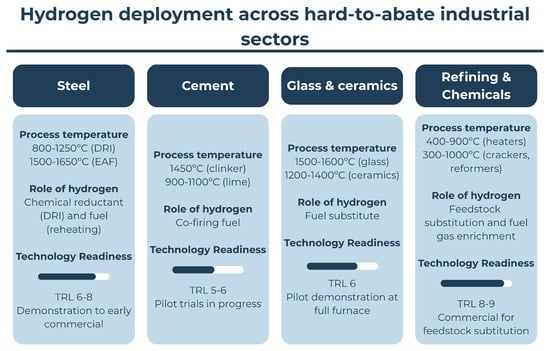
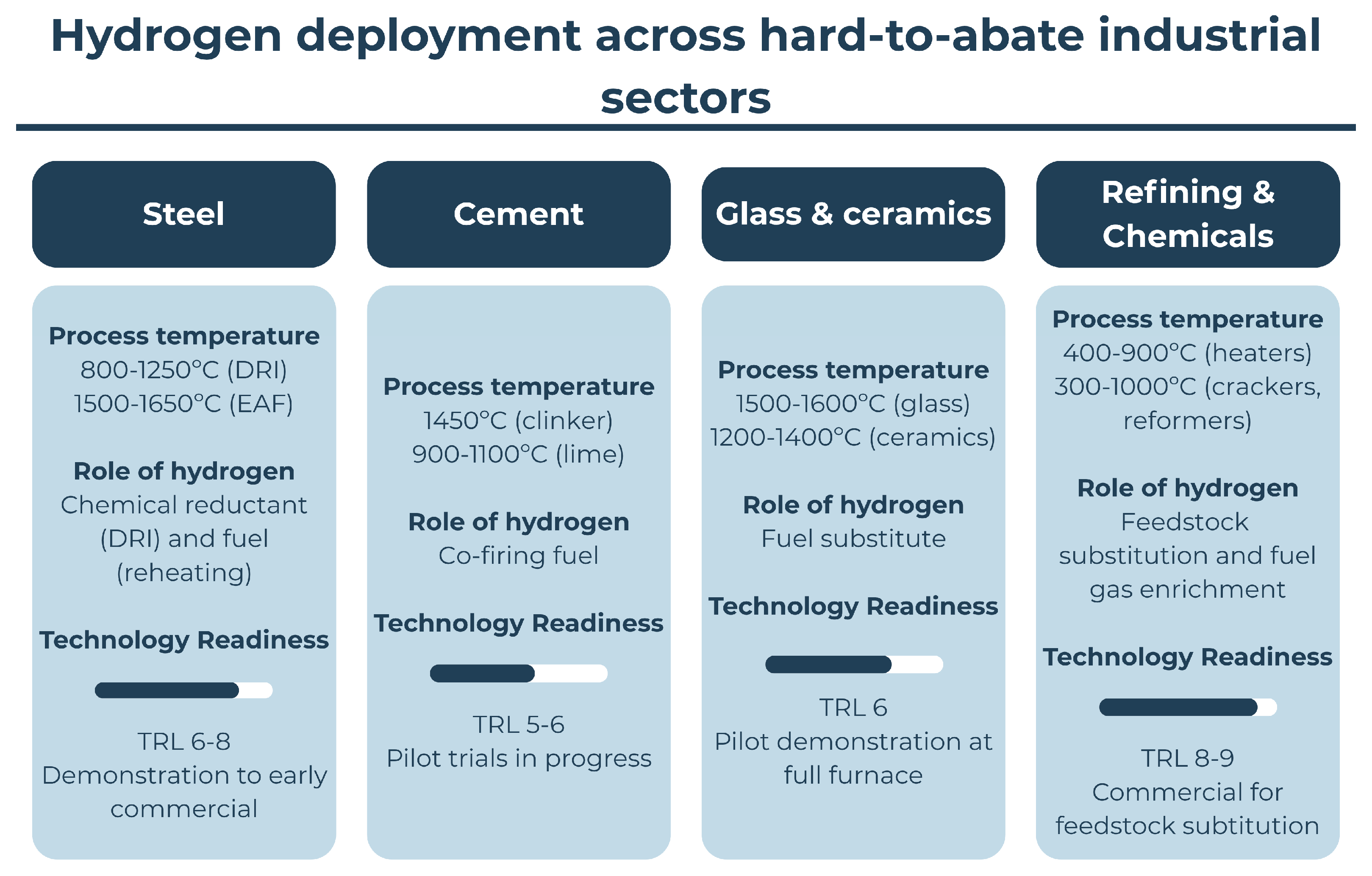
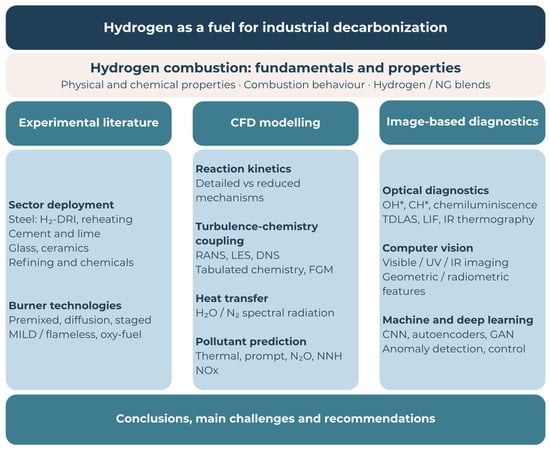
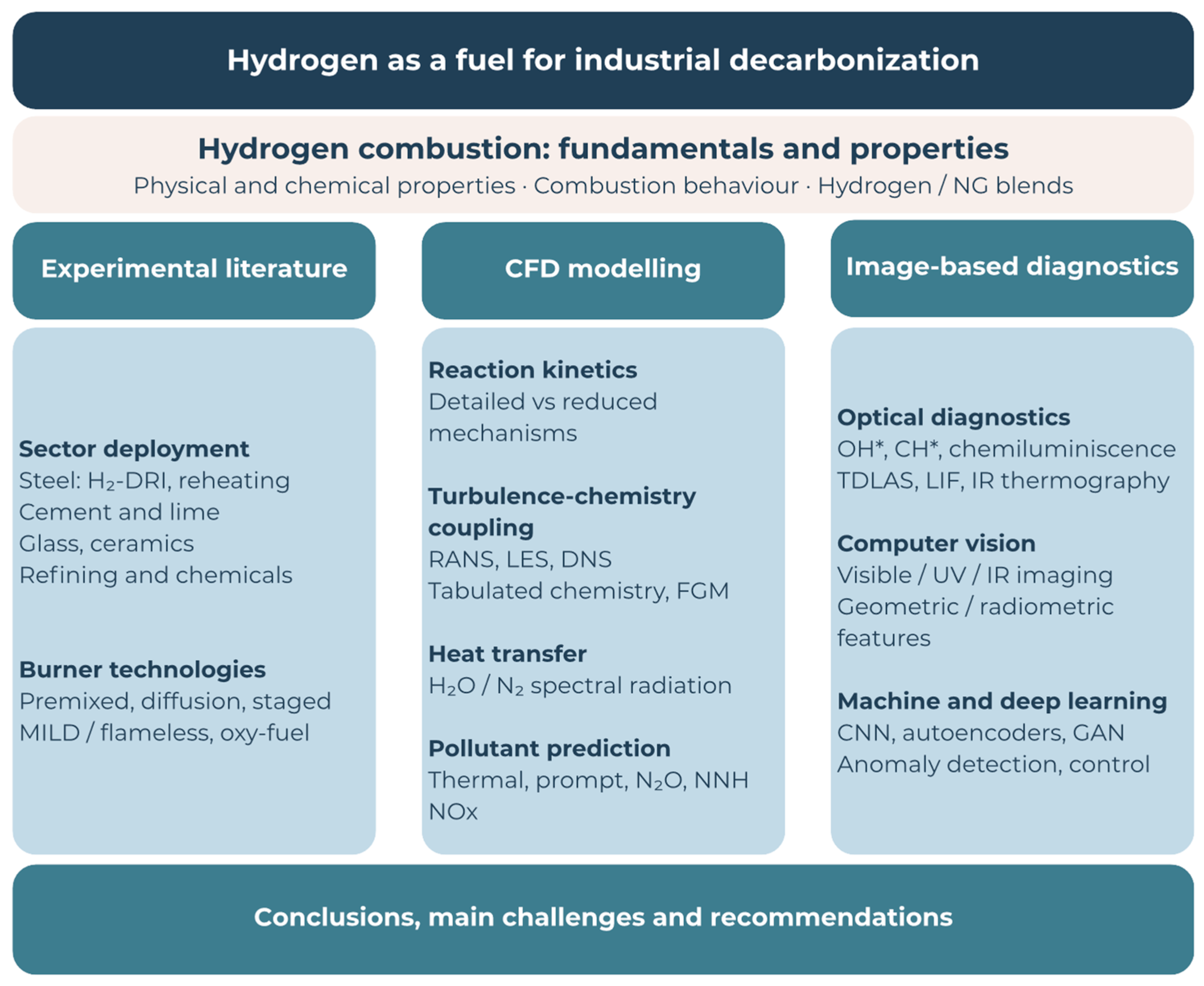
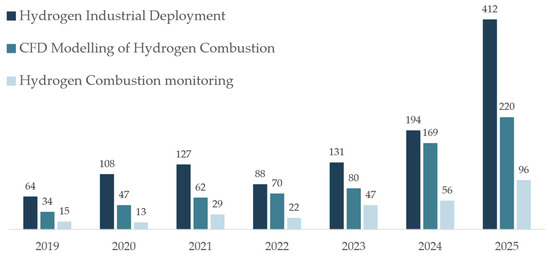
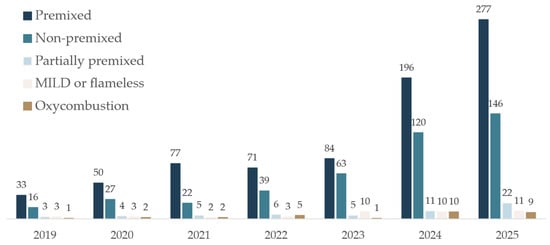
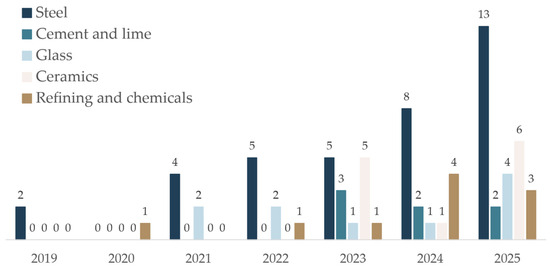
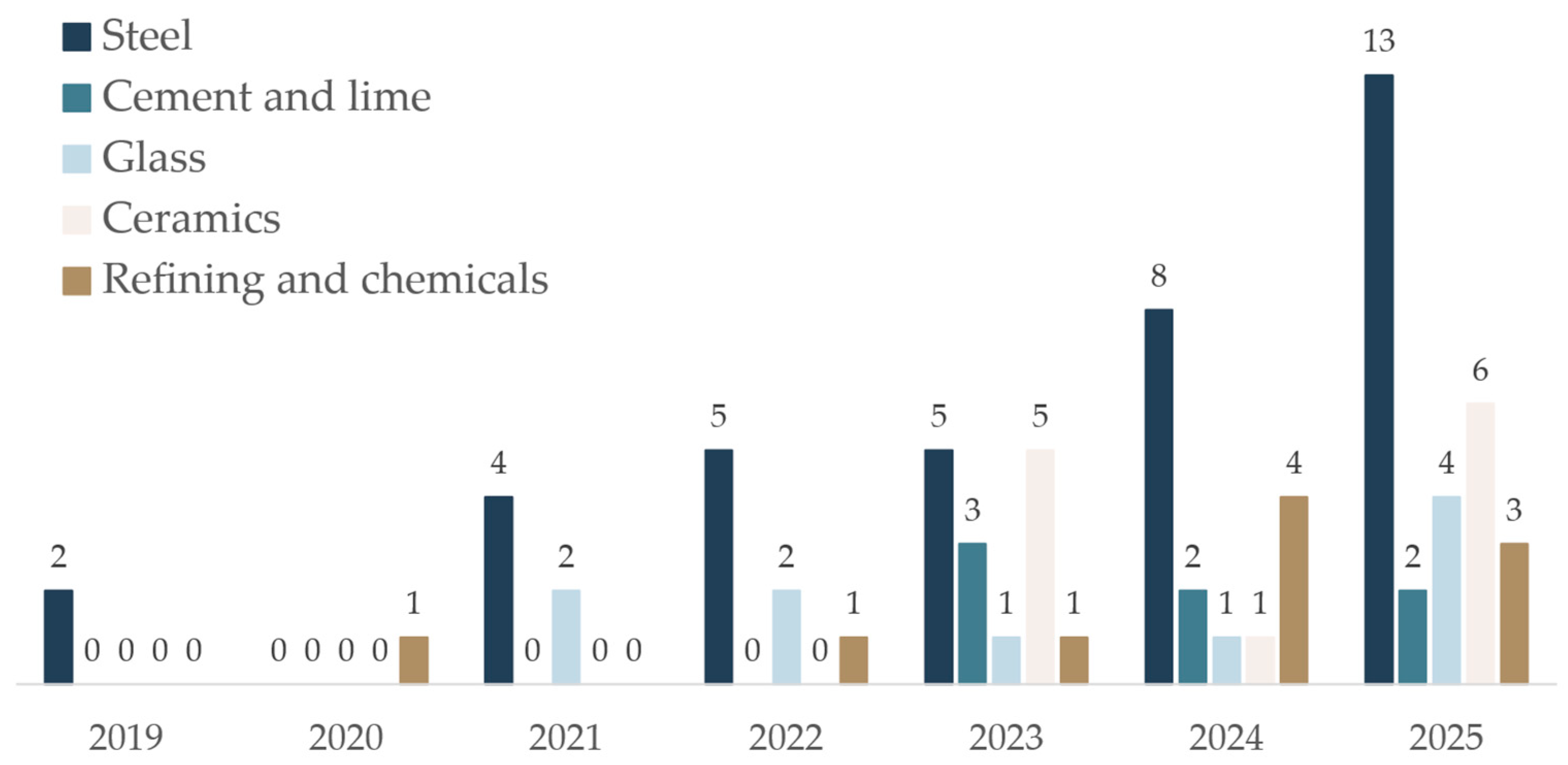
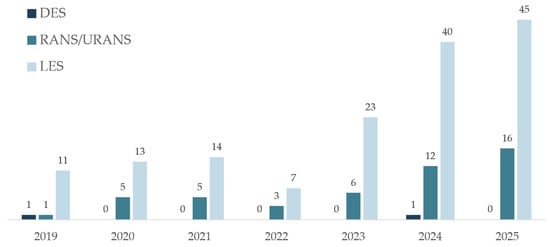
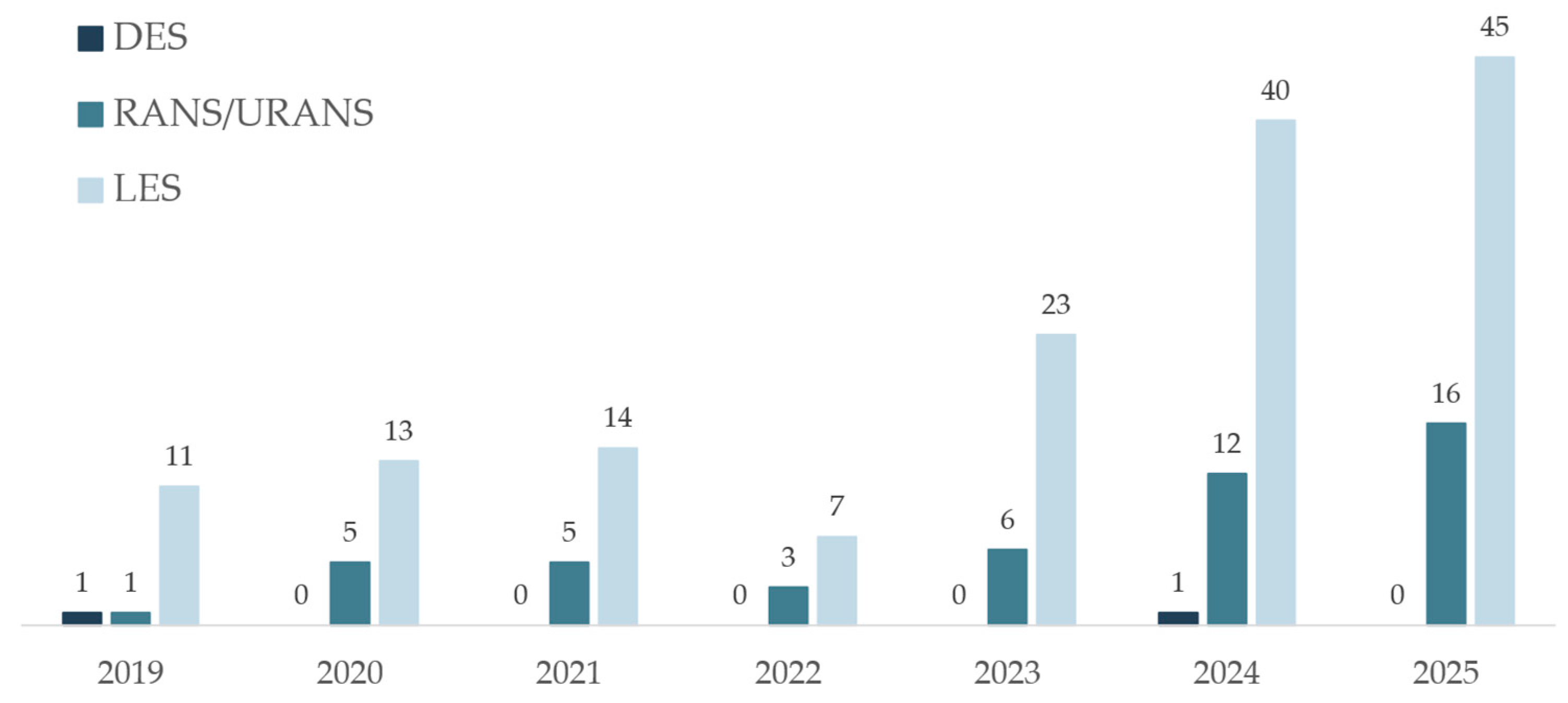
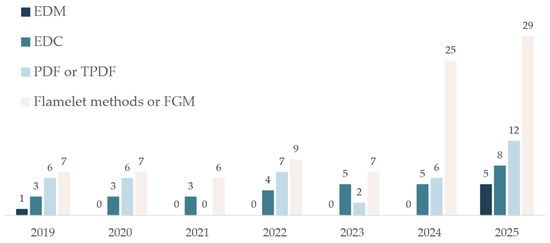
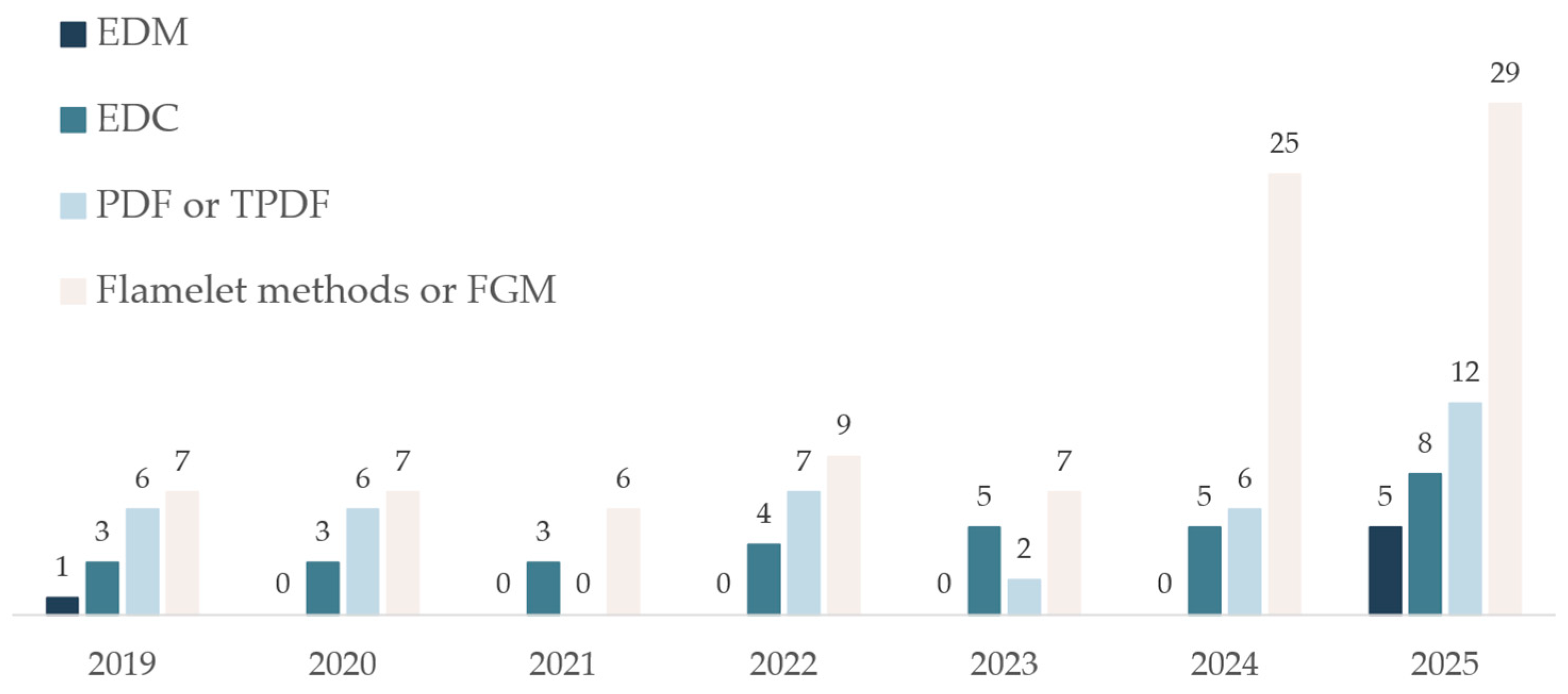
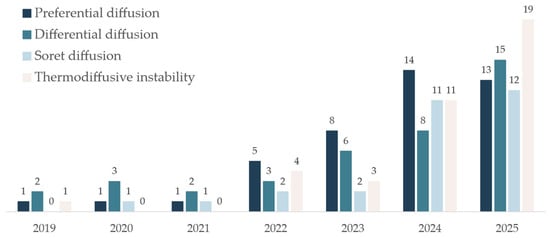
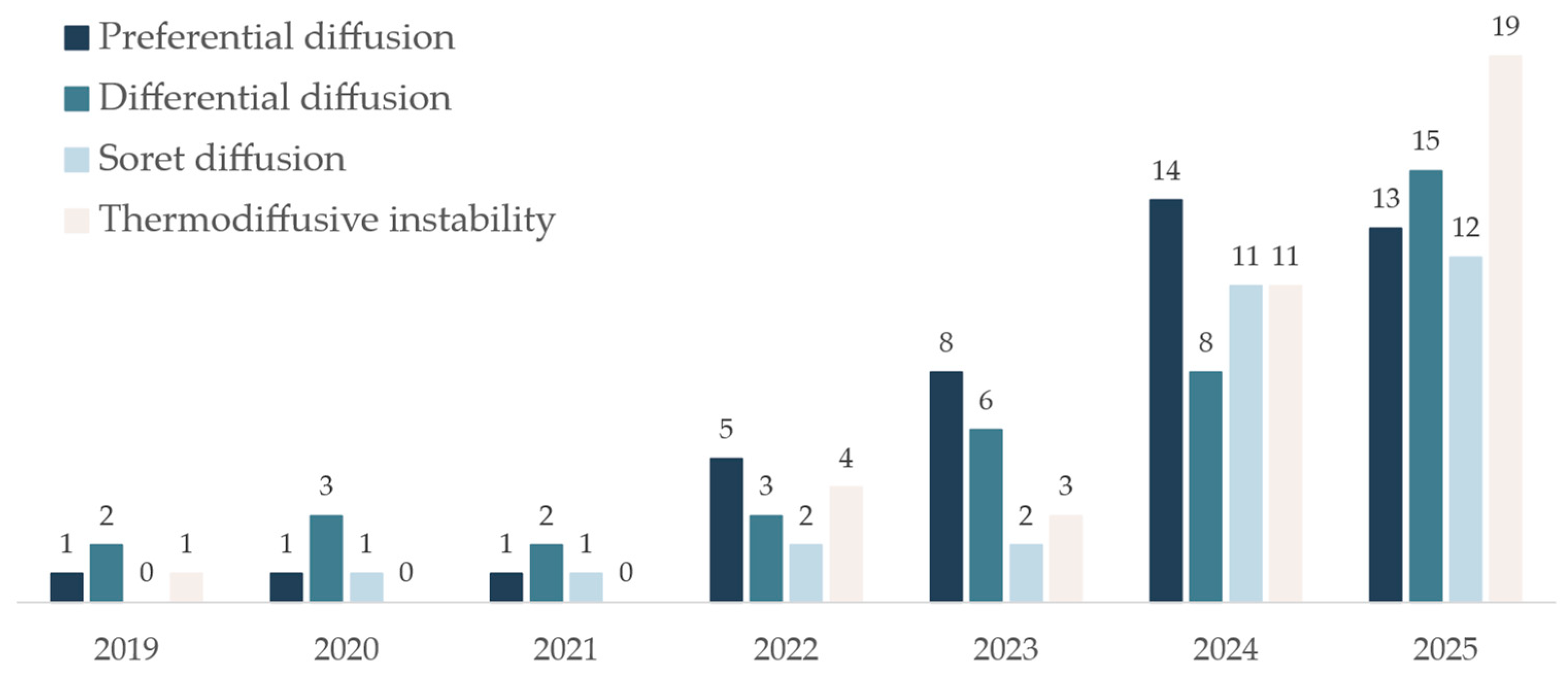
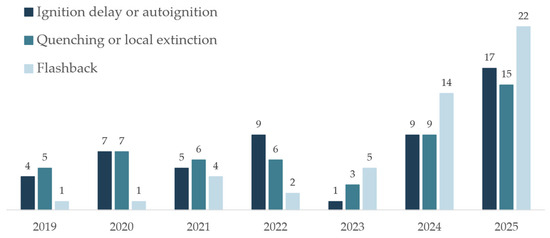
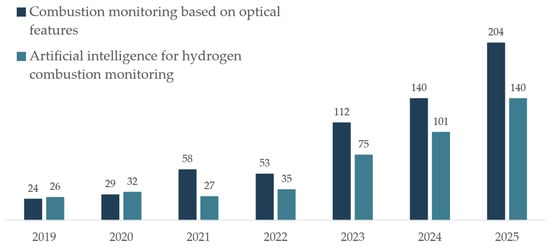

Disclaimer/Publisher’s Note: The statements, opinions and data contained in all publications are solely those of the individual author(s) and contributor(s) and not of MDPI and/or the editor(s). MDPI and/or the editor(s) disclaim responsibility for any injury to people or property resulting from any ideas, methods, instructions or products referred to in the content. |
© 2026 by the authors. Licensee MDPI, Basel, Switzerland. This article is an open access article distributed under the terms and conditions of the Creative Commons Attribution (CC BY) license.