


Abstract
Airport pavement damage is mostly caused by the cumulative effect of subgrade settlement, but existing calculations for subgrade cumulative settlement seldom consider the dynamic variation characteristics of the degree of compaction of subgrade soil under repeated loading. Accordingly, based on the proposed modified bounding-surface model for silt, numerical simulations of runway cumulative settlement under cyclic impact aircraft loading are performed. The study first reveals the quantitative influences of pavement structural parameters on runway cumulative settlement under conventional layered compaction of subgrade. Then, under different structural parameters, the differences in runway settlement between overall and layered compaction of subgrade are compared quantitatively. The following conclusions are drawn: First, as pavement parameters increase, the influence of parameters of the surface layer and the thickness of the base course increases greatly, whereas the influence of the elastic modulus of the base course decreases. Second, the maximum increments of cumulative settlement and its change rate induced by the layered compaction form are 63% and 88%, respectively. As the thickness of the surface layer exceeds 0.36 m, the influence of compaction form can be neglected. Therefore, appropriate ranges of pavement parameters can effectively decrease the effect of compaction form. Third, as the thicknesses of the surface layer and the base course are less than 0.31 m and 0.28 m, respectively, and the elastic modulus of the base course is greater than 1.6 GPa, the sensitivity of settlement to changes in pavement parameters is less affected by different compaction forms, and the influence of the compaction form can be ignored in optimization of the elastic modulus of the surface layer.
1. Introduction
Pavement damage occurs frequently during airport operation in northern China. Local silt is commonly used in subgrade filling during construction of northern airports, and the degree of compaction significantly affects the settlement characteristics of silt subgrade [1,2,3]. Additionally, cumulative settlement behaviors of subgrade vary under different pavement structural parameters, thus further affecting the supporting effect of subgrade on pavement structures. Both factors change the stress state of pavement structures and lead to pavement damage eventually [4,5,6]. To decrease pavement damage induced by the cumulative effect of subgrade settlement under cyclic dynamic aircraft loading, it is essential to conduct research on compaction control and structural design optimization of the runway.
For the influence of compaction conditions on soil settlement, laboratory tests and numerical simulation methods are mainly adopted in existing studies. Some studies have investigated the influence of the degree of compaction on cumulative deformation of soil by dynamic triaxial tests, and an empirical formula for calculating cumulative settlement of soil under different degrees of compaction is proposed [7,8,9]. Empirical formulas are used under simplification of actual conditions, which has limited applicability. Model tests are also adopted to study cumulative deformation characteristics of the subgrade [10,11,12,13,14]. An appropriate similarity ratio for experimental material needs to be selected in model tests, and the test results are affected by boundary effects, which result in poor operability. Therefore, the numerical simulation method is widely used in most current studies. Feng [15] conducted numerical simulation research on settlement characteristics of granite residual soil under different compaction conditions, and obtained suitable compaction parameters and compaction technologies. Mei et al. [16] established a subgrade numerical model and analyzed settlement of the subgrade filled with construction residue under different compaction levels and vehicle loading conditions. Lu et al. [17] studied the effect of loading numbers and the degree of compaction on long-term deformation characteristics of the subgrade using a numerical simulation method. Liu and Xiao [18] explored evolution characteristics of cumulative deformation of silt subgrade under different degrees of compaction of subgrade and vehicle loading using laboratory element tests and numerical simulation methods. The above research does not address the dynamic variation in the degree of compaction of subgrade during the development period of cumulative settlement, which leads to insufficient accuracy of research conclusions and can not be promoted and applied. Moreover, little attention is paid to the influence of pavement structural parameters.
For the influence of pavement structural parameters, research mainly focuses on mechanical and bearing characteristics of pavement under different structural parameters via numerical simulation methods [19,20,21,22,23]. For instance, Minkwan and Erol [24] chose elastic modulus and interlayer contact relations as influencing factors, and the evolution characteristics of dynamic stress in flexible pavement were analyzed under aircraft loading. Gu et al. [25] and Luo et al. [4] studied the mechanical behavior of pavement with different structural parameters. Although the above research is closely related to actual runway engineering, little attention is paid to the cumulatively increasing effect of subgrade settlement, which is the essential inducement of pavement damage. Meanwhile, coupled numerical simulations between pavement structure and subgrade with cumulative settlement are still insufficient.
In this study, based on the proposed modified bounding surface model, the runway numerical model is established under aircraft impact loading, and the quantitative effect of pavement structural parameters and subgrade compaction methods on cumulative settlement of silt subgrade was investigated by numerical simulation methods. The settlement evolution of silt subgrade under different influencing factors was studied to provide a basis for subgrade compaction control and runway structural design.
2. Form of Aircraft Impact Loading and Numerical Model of Actual Runway
2.1. Impact Loading Type
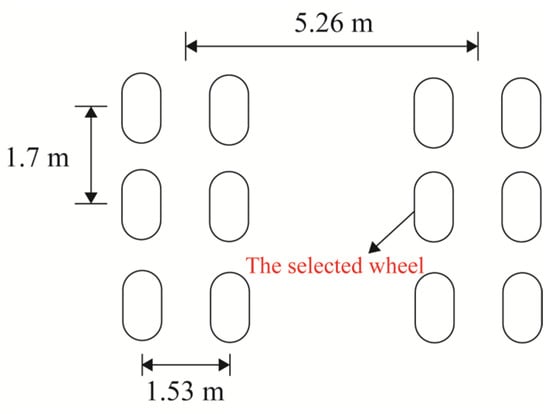
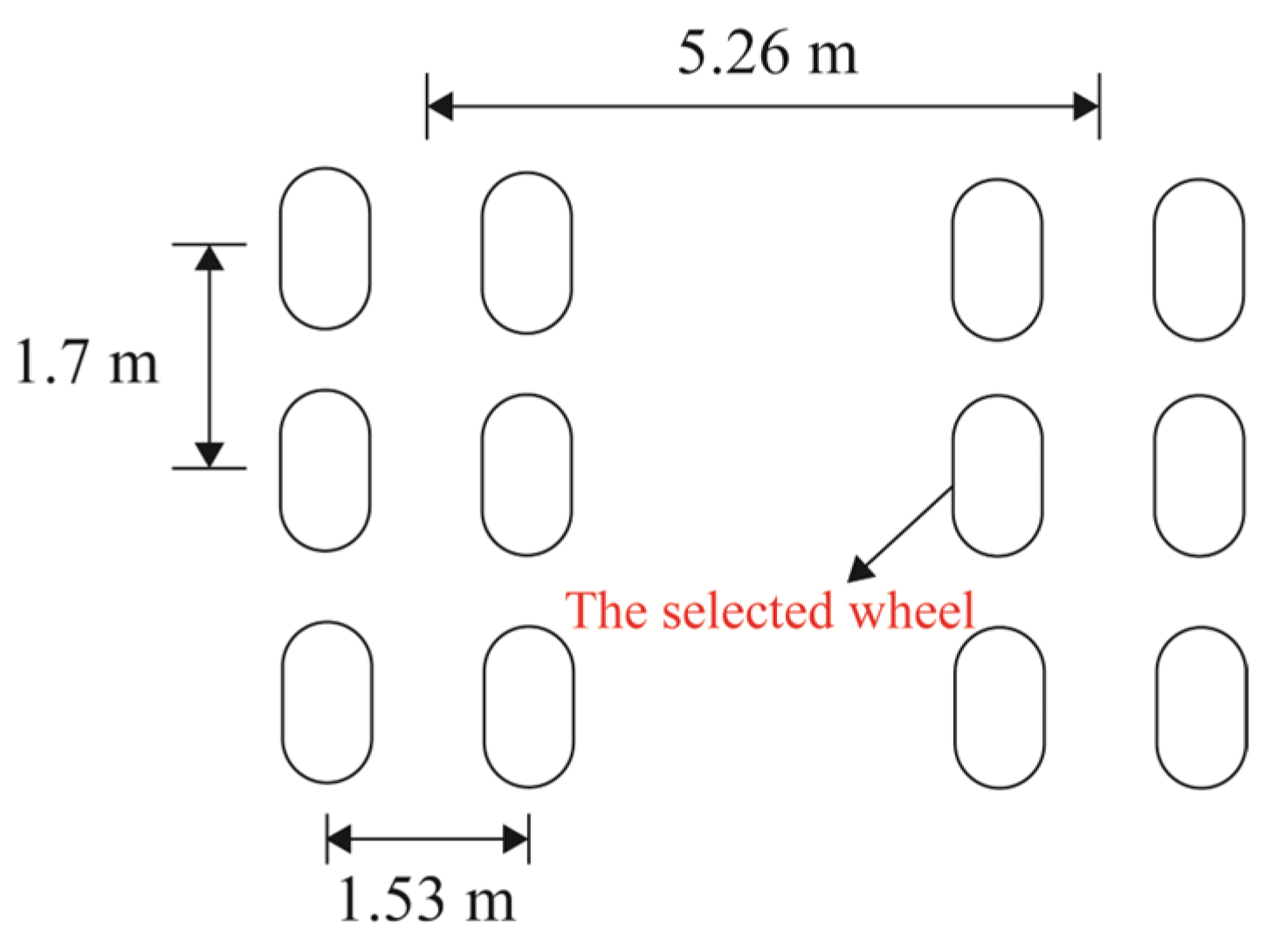
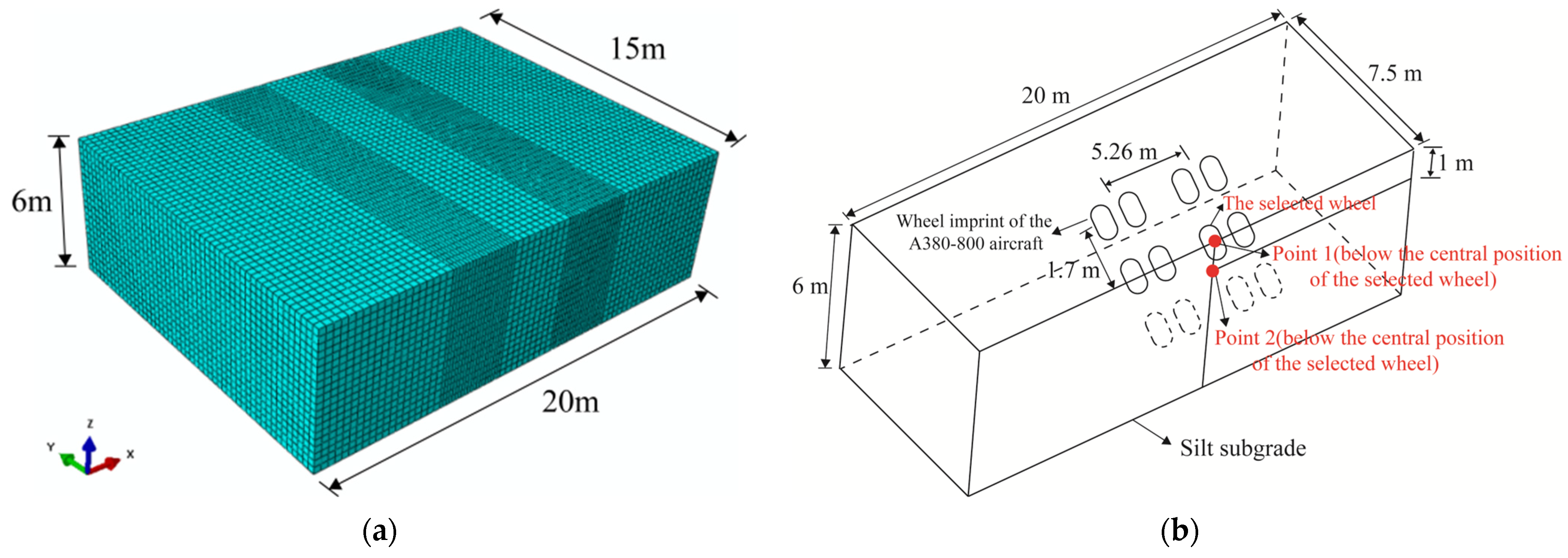
The A380-800 aircraft, currently the aircraft type with the maximum loading capacity, is selected as a research object. The loading migration effect is neglected during the aircraft landing process. The configuration of the main landing gear of the A380-800 aircraft and the selected wheel are shown in Figure 1. The settlement measuring points in silt subgrade are set below the selected wheel shown in Figure 1.
Figure 1.
The main landing gear configurations of A380-800 aircraft.
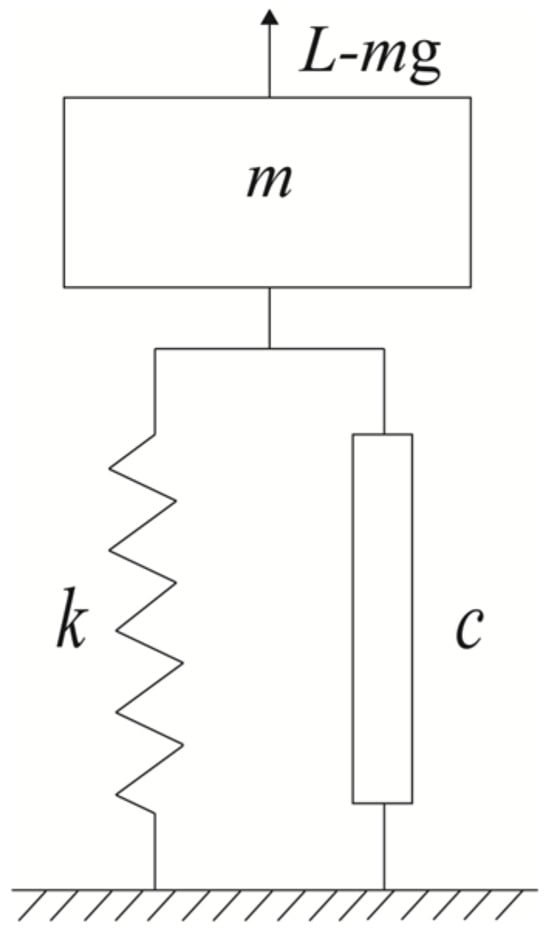
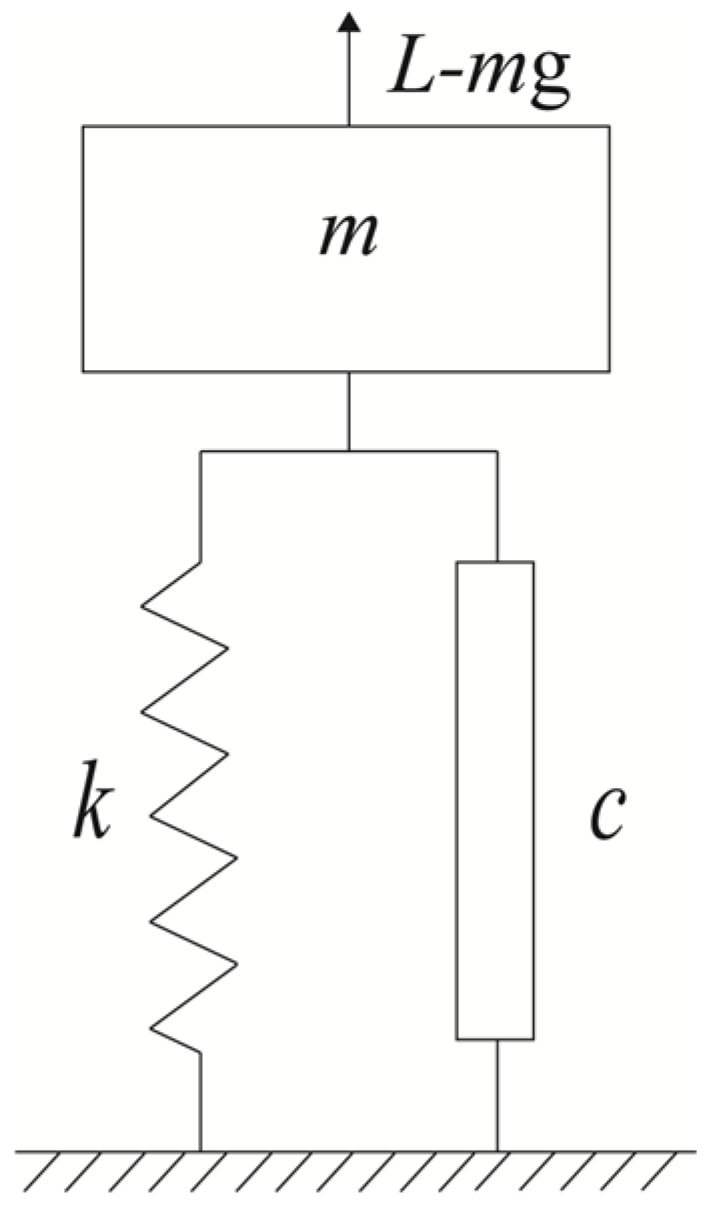
During the single landing period, a half-sine wave is adapted as the loading form. By introducing a single-degree-of-freedom vibration system of the aircraft main landing gear [26], the impact loading during the aircraft landing period is calculated. A schematic diagram of the single-degree-of-freedom vibration system is shown in Figure 2. Before aircraft landing, the lift force (L) counterbalances the gravity (mg), and the movement of the centroid is neglected.
Figure 2.
Single-degree-of-freedom vibration system during aircraft landing.
The vibration equation for the aircraft is expressed as follows:
where m is aircraft mass distributed to a single main landing gear; c and k are the damping coefficient and stiffness coefficient of the main landing gear suspension [27,28], respectively; z denotes vertical displacement; and and represent the velocity and acceleration, respectively.
, , , and the expression for vertical displacement are obtained as follows:
where is the initial vertical velocity; is the moving distance of the aircraft centroid, which is taken as 0; the vertical velocity remains constant during the aircraft landing period [29]. By differentiating twice on Equation (2), the acceleration is obtained as follows:
and the calculation formula for single-wheel impact loading is as follows:
where n and are the number of wheels and the tire contact area of the single main landing gear, respectively. For the A380-800 aircraft, the tire contact length and contact area are 0.58 m and 0.176 m2, respectively. Aircraft landing load can be expressed by the form of the half-sine wave [30]:
where , T denotes the period of cyclic loading during aircraft landing. G and q represent the main landing gear wheel load and tire pressure, respectively. denotes the horizontal velocity. Based on the simplified calculation method for aircraft tire pressure, aircraft loading and tire dimensions specified in codes [31], combined with the above formulas, the single-wheel impact loading of the A380-800 aircraft is as follows:
The half-sine wave is applied to simplify the impact loading of the A380-800 aircraft during the landing period. The impact coefficient is defined as the ratio of the peak impact loading to single tire pressure under different landing speeds. The magnitude of the impact loading is not the research focus, and the impact coefficient is taken as 1.1. Based on the above formula, the loading cycle of the A380-800 aircraft during the landing period is taken as 0.1 s.
2.2. Introduction of the Numerical Model
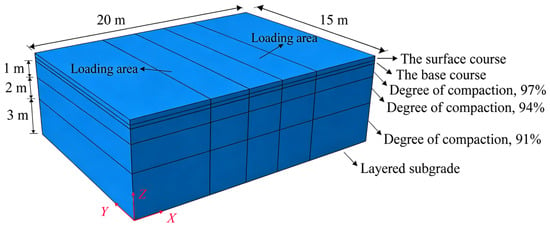
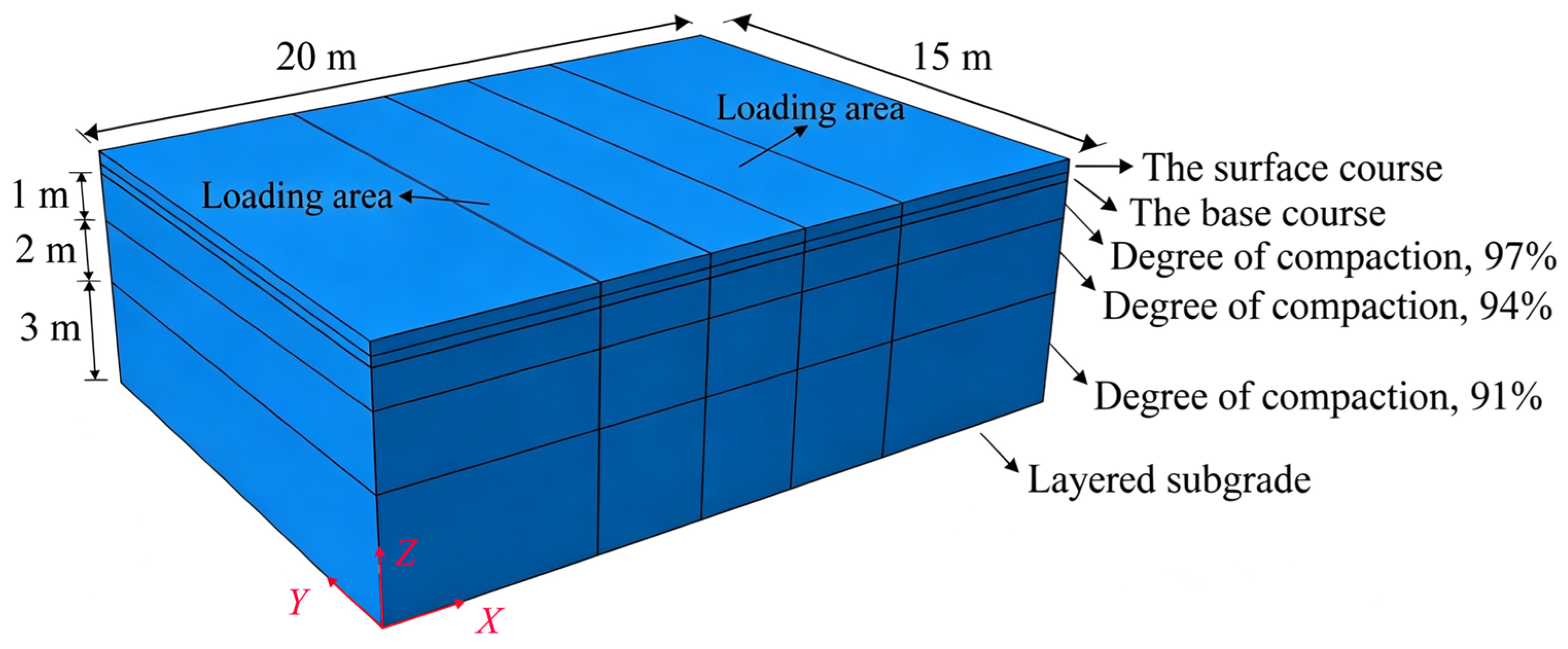
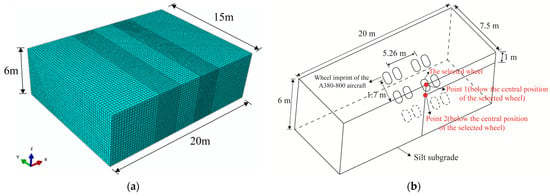
The airport runway consists of pavement structure and silt subgrade, and the pavement structure includes the surface layer and the base course. The length and width of the runway numerical model are 20 m and 15 m, respectively. With a subgrade depth of 6 m, a three-dimensional fluid–solid coupling numerical model of the runway is established, as shown in Figure 3. The C3D8P element is used in the numerical model, and mesh refinement is performed around the main landing gear. The meshing of the actual pavement is presented in Figure 4a, where the Z-axis represents the depth direction. Horizontal displacement is constrained on lateral sides of the model, and both horizontal and vertical displacements are constrained at the base of the model. A surface-to-surface contact form is adopted between pavement layers, while a tie contact form is applied between the bottom of the base course and the surface of the silt subgrade. The loading from the two main landing gears of the A380-800 aircraft is set at the middle position of the runway. Variations in contact position between aircraft and pavement with different aircraft landing times are neglected. As shown in Figure 4b, point 1 is set on subgrade surface, below the central position of the selected wheel shown in Figure 1, and point 2 is set at the depth of 1 m beneath measuring point 1, according to the main landing gear.
Figure 3.
Numerical model of the airport runway.
Figure 4.
Meshing of the numerical model and layout of measuring points. (a) Meshing of the numerical model. (b) The layout of measuring points.
3. Numerical Simulation Conditions and Runway Material Parameters
The maximum dry density and optimum water content of the silt are 1.87 g/cm3 and 13.1%, respectively, and the specific gravity of the silt is 2.67. With the overall compaction form of the subgrade, the degree of compaction of the silt at different subgrade depths is uniformly 94%. Under layered compaction form of the subgrade, as the subgrade depth ranges from 0 m to 1 m, 1 m to 3 m, and 3 m to 6 m below the subgrade surface, the degrees of compaction of the corresponding silt layers are 97%, 94% and 91%, respectively. The A380-800 aircraft is selected, and the soil constitutive model is the modified bounding surface model [32]. The maximum water holding capacity of the silt is achieved and applied in numerical simulation. Based on experiment data in reference [32], the corresponding mechanical parameters of the silt with modified bounding surface model are presented in Table 1. Based on references [4,31], considering various compaction methods used in actual subgrade construction and the variation ranges of pavement structural design parameters, the numerical simulation conditions and the values of parameters are listed in Table 2.
Table 1.
Mechanical parameters of the silt under different degree of compaction.
Table 2.
The numerical simulation conditions.
4. Influence of Pavement Structural Parameters on Cumulative Settlement of the Silt Subgrade
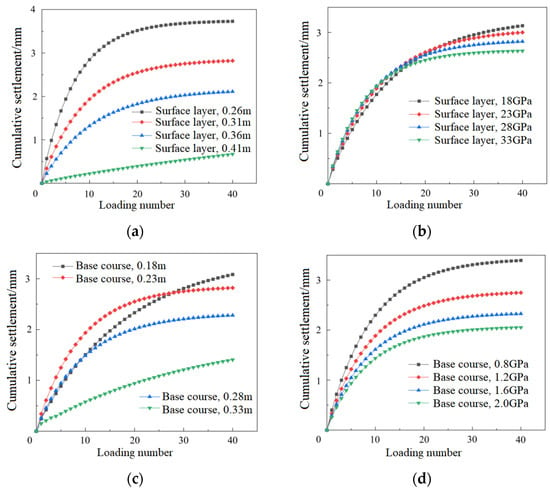
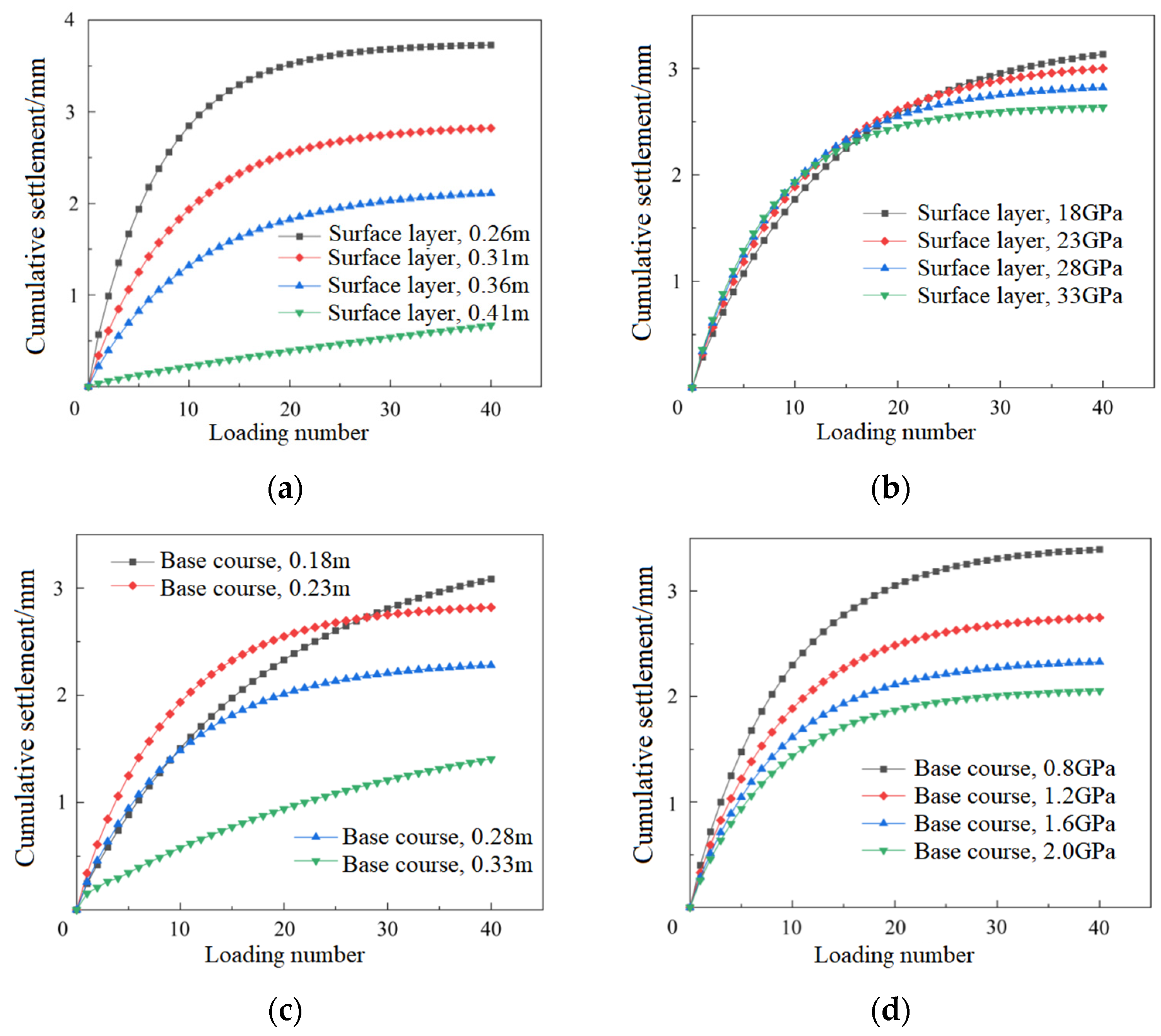
Under the layered compaction form of the silt subgrade, the cumulative settlement curve of the silt at point 1 is shown in Figure 5. It shows that the cumulative settlement presents an exponential increasing trend as loading cycles increase, and the increment gradually decreases. From Figure 5a, the final cumulative settlement after loading decreases gradually as the thickness of the surface layer increases, and the decrements are 25.7%, 23.6% and 69%, respectively. As the thickness of the surface layer is less than 0.36 m, the influence remains basically unchanged. From Figure 5b, the final cumulative settlement after loading decreases gradually as the elastic modulus of the surface layer increases, and the decrements are 4.8%, 5% and 8.8%, respectively. As the elastic modulus of the surface layer is less than 28 GPa, the influence remains basically unchanged. As the stress diffusion effect in subgrade is enhanced with the increase in structural parameters of the surface layer, the stress influence range in silt subgrade is expanded. So, the influence of the thickness and the elastic modulus of the surface layer increases progressively [4,33].
Figure 5.
Evolution curves of cumulative settlement of measuring point 1 at the subgrade surface. (a) Difference in thickness of the surface layer; (b) Differences in elastic modulus of the surface layer; (c) Differences in thickness of the base course; (d) Differences in elastic modulus of the base course.
From Figure 5c, as the thickness of the base course increases, the final cumulative settlement after loading gradually decreases, and the reductions are 11%, 18% and 38%, respectively. As the increase in thickness of the base course enhances the stress diffusion effect in subgrade, the influence of the thickness of the base course increases gradually. From Figure 5d, the final cumulative settlement after loading decreases as the elastic modulus of the base course increases, and the reductions in the final cumulative settlement are 19%, 12.7% and 12.5%, respectively. As the elastic modulus of the base course is more than 1.2 GPa, its influence remains unchanged. As the stress distribution at pavement structures becomes more uniform, the influence of the elastic modulus of the base course gradually decreases [4,33]. Under different pavement structural parameters, the final cumulative settlement differs obviously, and the rate of increase in the cumulative settlement also shows significant differences under the same loading cycles.
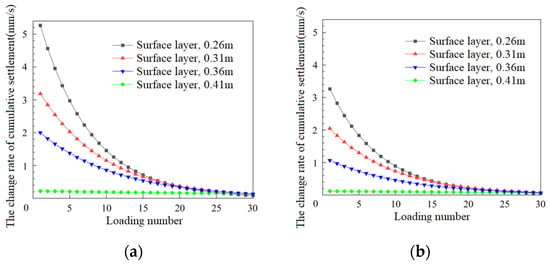
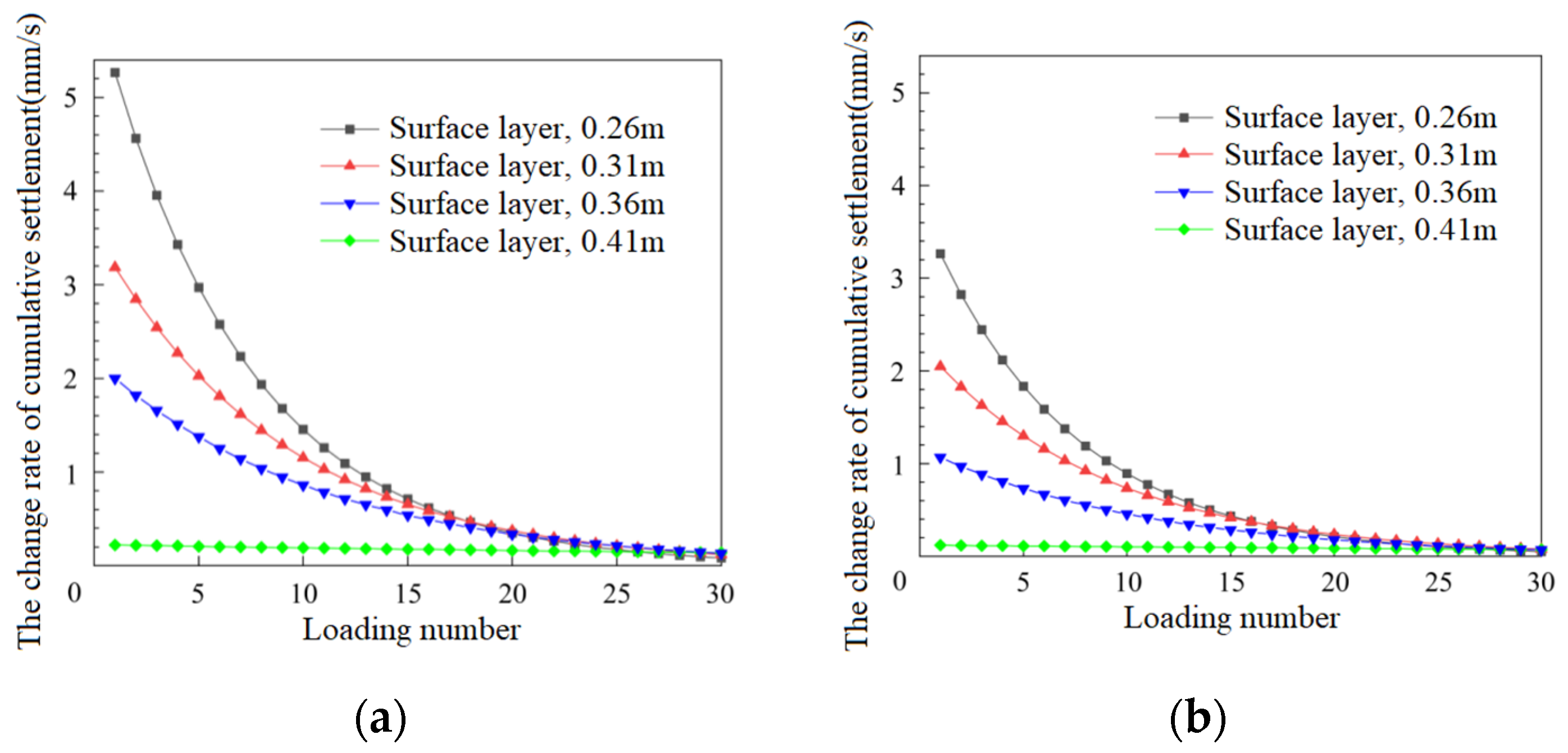
Under different thicknesses of the surface layer, the variation curves of the change rate of the cumulative settlement at different subgrade depths are shown in Figure 6. From Figure 6, as loading cycle increases, the change rate presents an exponentially decreasing trend, and the reduction gradually decreases. As the thickness of the surface layer increases, the rate of change decreases gradually. During the first loading period, the reductions in the rate of change of point 1 are 39%, 38% and 90%, and those of point 2 are 39%, 48% and 91%. The influence of the thickness of the surface layer increases gradually. During the first loading period, as the thickness of the surface layer increases, the change rates at the subgrade depth of 1 m are approximately 63%, 63%, 53% and 50% of that at the subgrade surface. The enhanced stress diffusion effect leads to an increase in stress influence range [4,33]. So, the larger the thickness of the surface layer is, the greater the difference in the rate of change between different depths is. As the thickness of the surface layer is less than 0.31 m, the difference in the rate of change between different depths remains basically unchanged.
Figure 6.
Evolution curves of the rate of change in cumulative settlement under different thicknesses of the surface layer. (a) Point 1 at the subgrade surface; (b) Point 2 at the subgrade depth of 1 m.
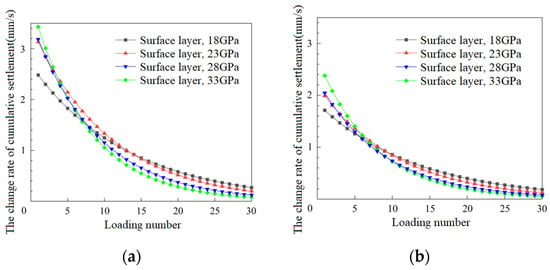
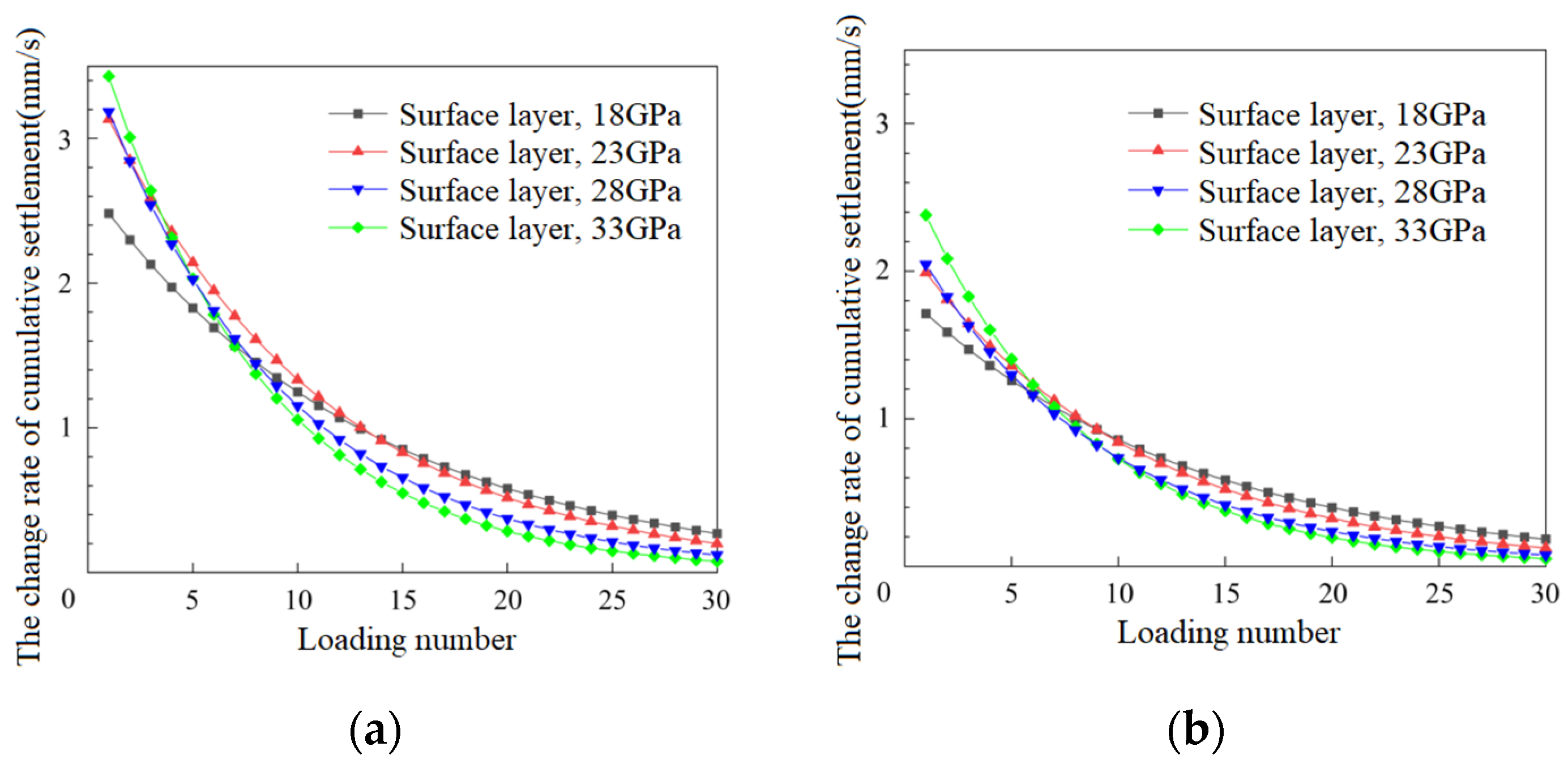
Under different elastic moduli of the surface layer, the variation curves of the rate of change in cumulative settlement at different depths are as shown in Figure 7. From Figure 7, as the loading cycle increases, the rate of change in cumulative settlement shows an exponential decreasing trend, and the reduction gradually decreases. As the elastic modulus of the surface layer increases, the change rate gradually increases during the first loading period and gradually decreases after six loading cycles. During first loading period, as the elastic modulus of the surface layer increases, the increments of the change rate at the subgrade surface are 27%, 2% and 7%, while those at the subgrade depth of 1 m are 18%, 1% and 19%. When the elastic modulus of the surface layer ranges from 23 GPa to 28 GPa, the elastic modulus of the surface layer does not affect the change rate of the silt subgrade. During the first loading period, as the elastic modulus of the surface layer increases, the change rates at the subgrade depth of 1 m are 69%, 63%, 63% and 70% of that at the subgrade surface. As the enhanced stress diffusion effect leads to the increase in stress influence range, the stress distribution at pavement structures becomes more uniform [4,33]. So, the difference in the change rate between different subgrade depths increases first and then decreases. When the elastic modulus of the surface layer ranges from 23 GPa to 28 GPa, the difference in the change rate between different depths remains basically unchanged.
Figure 7.
Evolution curves of the rate of change in cumulative settlement under different elastic moduli of the surface layer. (a) Point 1 at the subgrade surface; (b) Point 2 at the subgrade depth of 1 m.
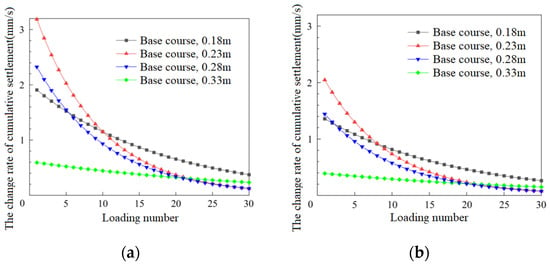
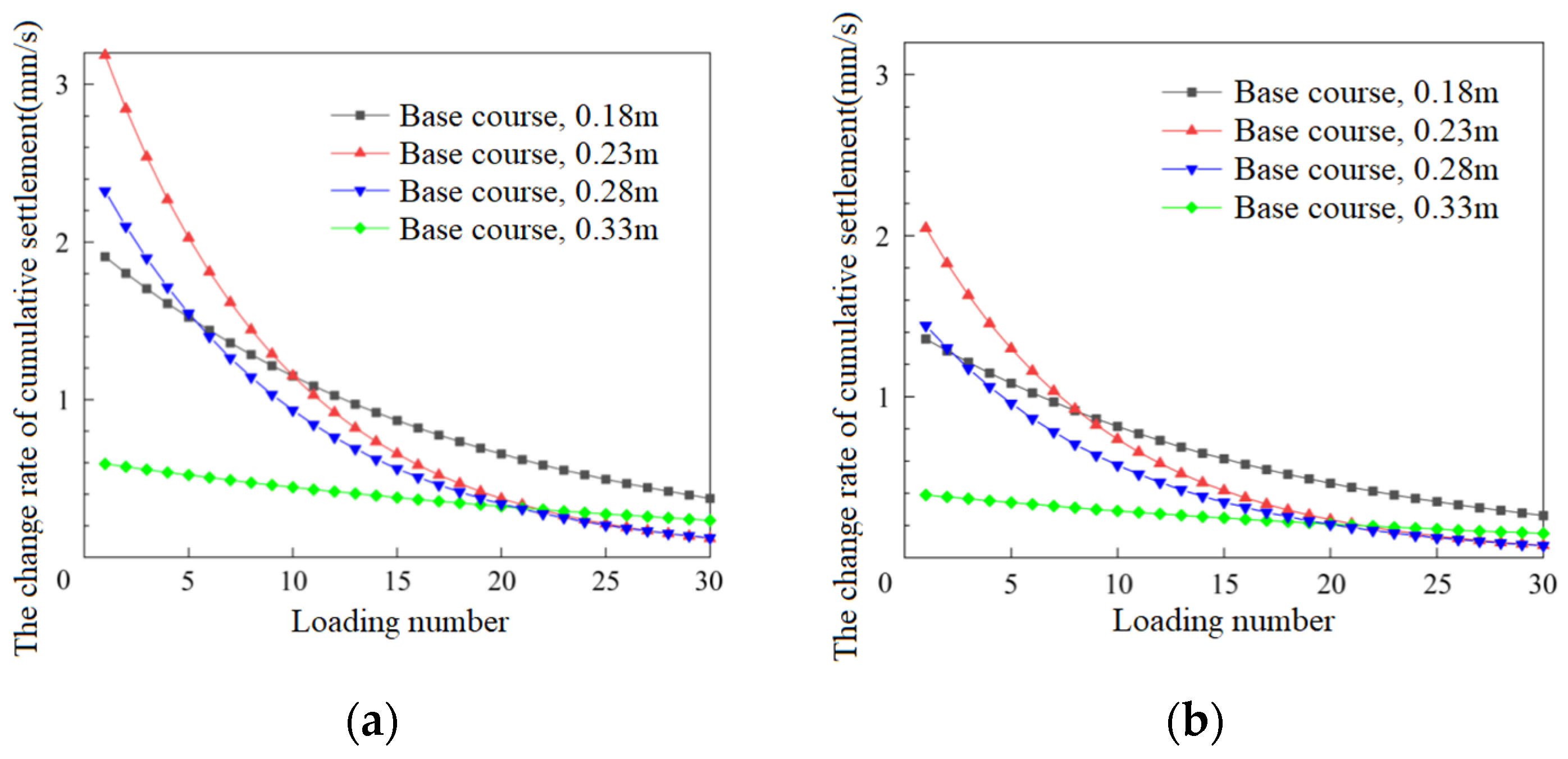
Under different thicknesses of the base course, the variation curves of the rate of change in cumulative settlement at different depths are shown in Figure 8. From Figure 8, as the loading cycle increases, the rate of change in cumulative settlement shows an exponentially decreasing trend, and the reduction gradually decreases. During the first loading period, as the thickness of the base course increases, the rate of change increases first and then decreases, and gradually decreases after 10 loading cycles. During the first loading period, as the thickness of the base course increases, the variations in the rate of change at the subgrade surface are 68%, 27% and 74%, while those at the subgrade depth of 1 m are 46%, 29% and 72%. The influence of the thickness of the base course decreases first and then increases. As the depth increases, the influence of the thickness of the base course decreases. As the thickness of the base course increases, the rates of change at the subgrade depth of 1 m are approximately 73%, 63%, 61% and 67% of that at the subgrade surface. As the enhanced stress diffusion effect leads to an increase in the stress influence range, the stress distribution at pavement structures becomes more uniform [4,33]. So, the difference in the rate of change at different subgrade depths increases first and then decreases. When the thickness of the base course ranges from 0.23 m to 0.28 m, the difference remains basically unchanged.
Figure 8.
Evolution curves of the rate of change in cumulative settlement under different thicknesses of the base course. (a) Point 1 at the subgrade surface; (b) Point 2 at the subgrade depth of 1 m.
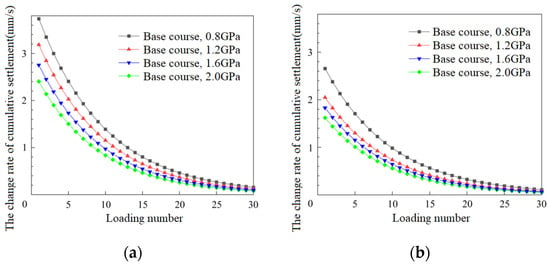
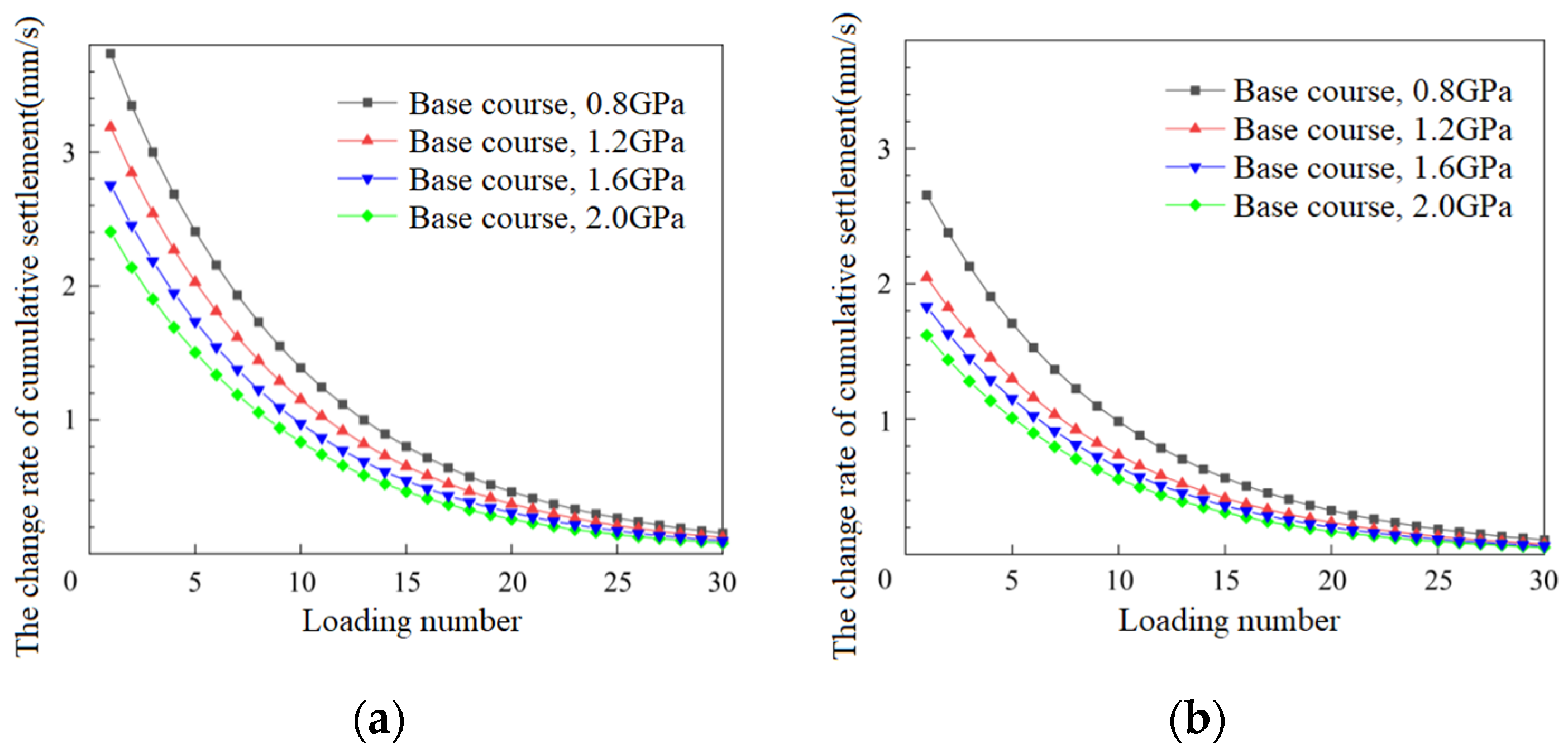
Under different elastic moduli of the base course, the variation curves of the rate of change in cumulative settlement at different depths are shown in Figure 9. From Figure 9, as the loading cycle increases, the rate of change in cumulative settlement shows an exponentially decreasing trend, and the reduction gradually decreases. During the first loading period, as the elastic modulus of the base course increases, the reductions in the rate of change at the subgrade surface are 15%, 14% and 13%, while those at the subgrade depth of 1 m are 24%, 10% and 12%. As the elastic modulus of the base course increases, the influence decreases. And, as the depth increases, the influence increases. During the first loading period, as the thickness of the base course increases, the rate of change in the subgrade depth of 1 m is approximately 71%, 63%, 66% and 67% of that at the subgrade surface. As the stress distribution area at the bottom of the base course increases, the stress influence range increases. Then, the stress distribution at pavement structures becomes more uniform [4,33]. So, the difference in the rate of change at different subgrade depths increases first and then decreases. As the elastic modulus of the base course is more than 1.6 GPa, the difference remains basically unchanged.
Figure 9.
Evolution curves of the rate of change in cumulative settlement under different elastic moduli of the base course. (a) Point 1 at the subgrade surface; (b) Point 2 at the subgrade depth of 1 m.
5. Influence of Subgrade Compaction Form on Cumulative Settlement of the Silt Subgrade
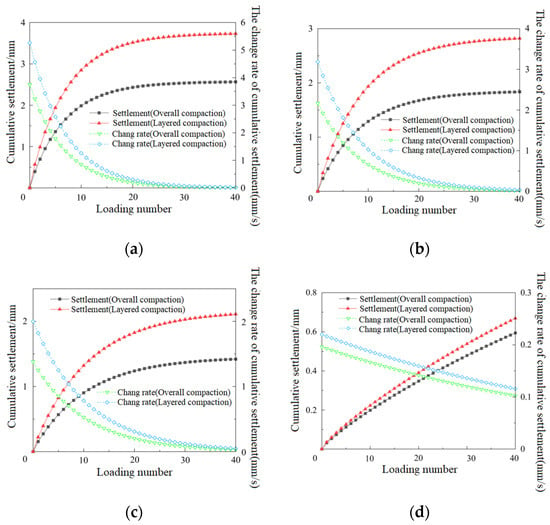
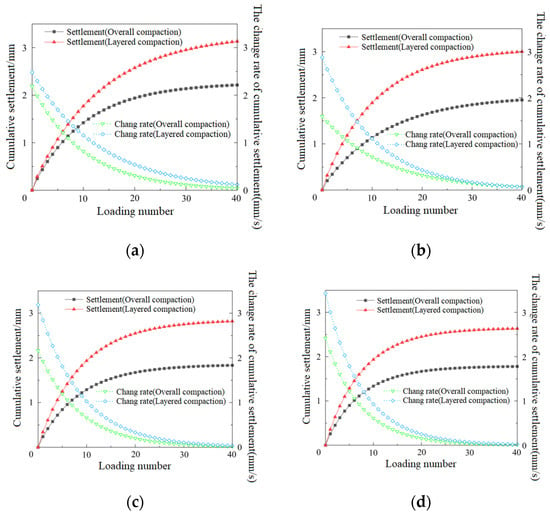
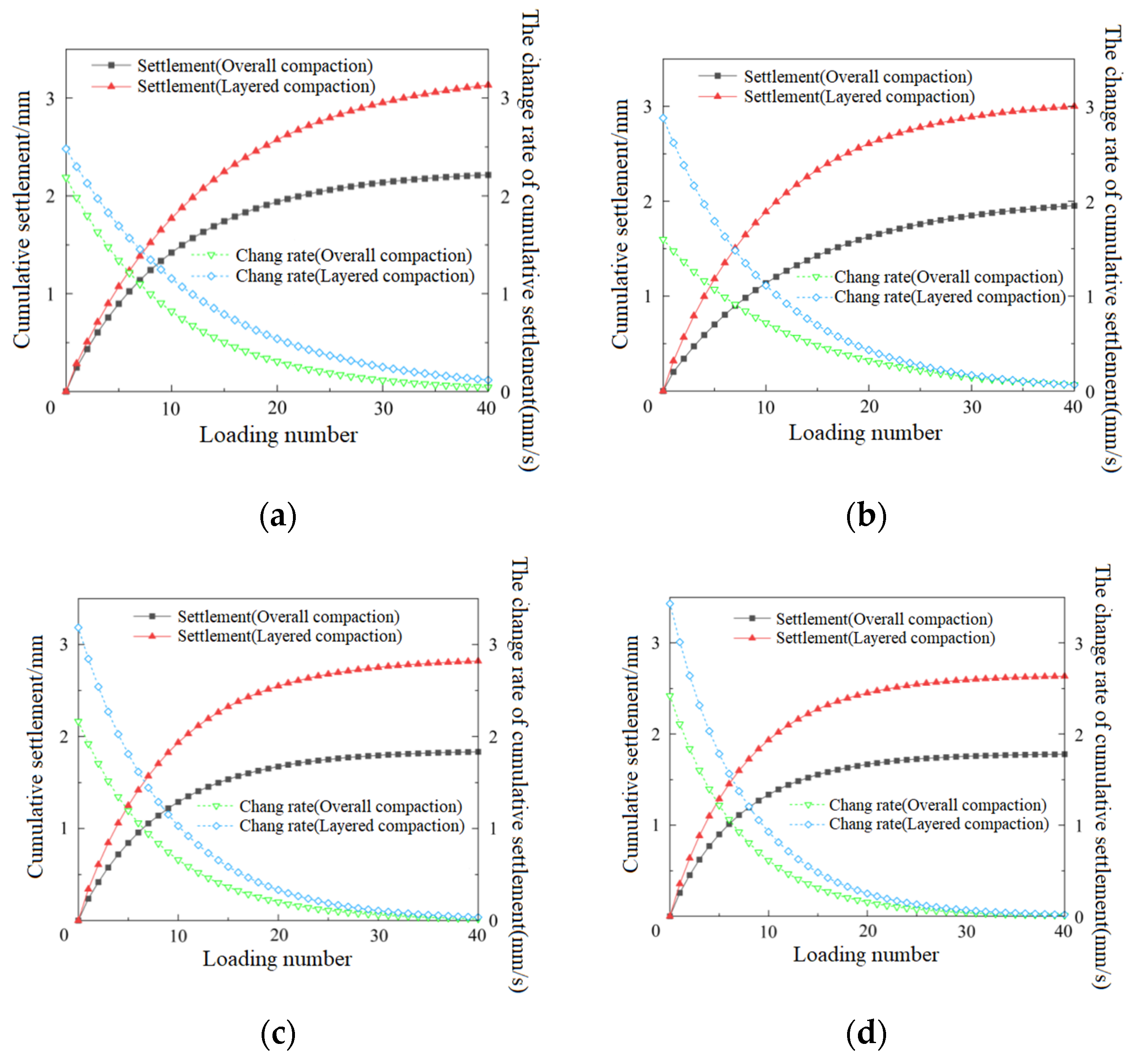
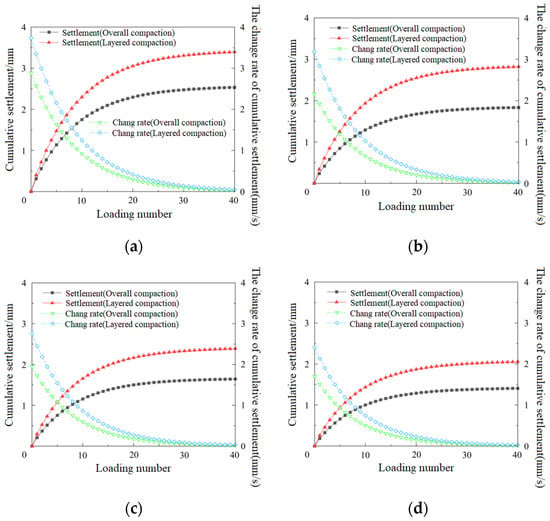
Under different pavement structural parameters, the influences of subgrade compaction form on cumulative settlement of the silt subgrade at point 1 are shown in Figure 10, Figure 11, Figure 12 and Figure 13. Due to the large depth of influence of the aircraft loading in the subgrade, the degree of compaction at lower subgrade is relatively low with layered compaction method, which results in larger settlement [32]. From Figure 10, compared with the overall compaction form, the layered compaction form of the subgrade leads to the increment of cumulative settlement and its change rate. During the first loading period, as the thickness of the surface layer increases, compared with the overall compaction form, the increments of the change rate of cumulative settlement induced by the layered compaction form are 41%, 52%, 43% and 16%. The increments of cumulative settlement induced by the layered compaction form after loading are 48%, 56%, 56% and 6%. As the thickness of the surface layer increases, the influence of the layered compaction form on cumulative settlement increases slowly and then decreases rapidly. The entire runway constitutes a bearing system composed of stiff upper strata and soft lower strata. As aircraft loading spreads from the surface layer to the silt subgrade, the stress spreading effect increases significantly as the thickness of the surface layer increases. Then, the stress influence range in the silt subgrade is expanded, so the insufficient bearing capacity of the lower subgrade induced by layered compaction intensifies. As the thickness of the surface layer exceeds the critical value, the stress distribution at pavement structures becomes more uniform, so the influence diminishes [4,33]. As the thickness of the surface layer is more than 0.36 m, the layered compaction form does not affect cumulative settlement. Under different thicknesses of the surface layer, the largest increments of cumulative settlement and its change rate induced by subgrade layered compaction form are 56% and 52%, respectively.
Figure 10.
The influence of the compaction form on cumulative settlement of the silt subgrade under different thicknesses of the surface layer. (a) Thickness of the surface layer, 0.26 m; (b) Thickness of the surface layer, 0.31 m; (c) Thickness of the surface layer, 0.36 m; (d) Thickness of the surface layer, 0.41 m.
Figure 11.
The influence of compaction form on cumulative settlement of the silt subgrade under different elastic moduli of the surface layer. (a) Elastic modulus of the surface layer, 18 GPa; (b) Elastic modulus of the surface layer, 23 GPa; (c) Elastic modulus of the surface layer, 28 GPa; (d) Elastic modulus of the surface layer, 33 GPa.
Figure 12.
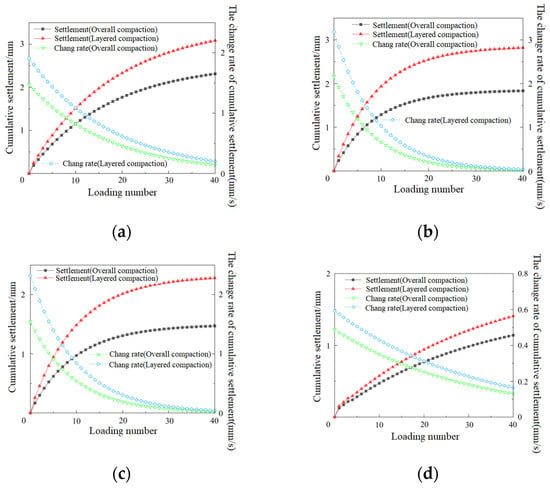
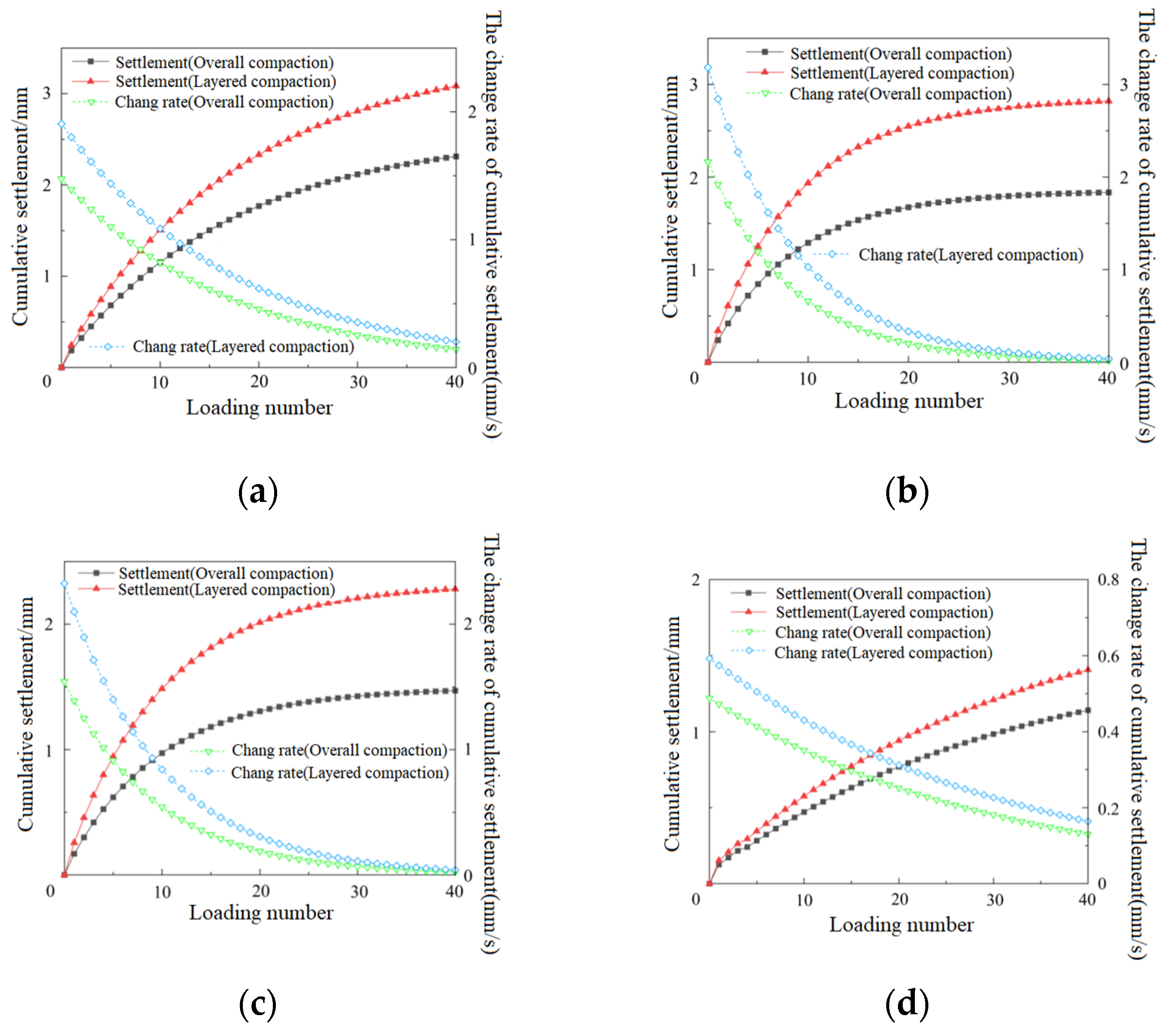
The influence of the compaction form on cumulative settlement of the silt subgrade under different thicknesses of the base course. (a) Thickness of the base course, 0.18 m; (b) Thickness of the base course, 0.23 m; (c) Thickness of the base course, 0.28 m; (d) Thickness of the base course, 0.33 m.
Figure 13.
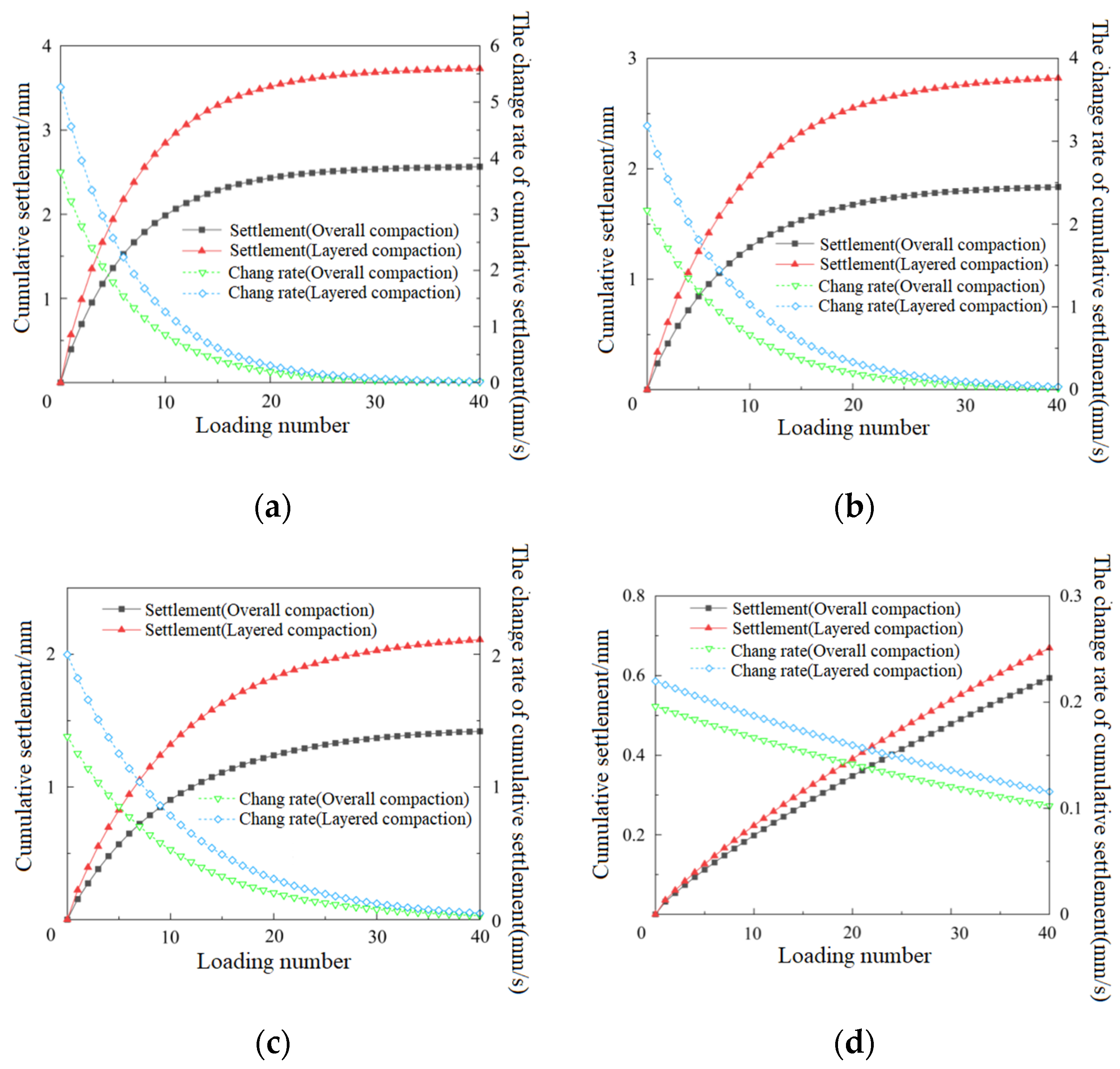
The influence of the compaction form on cumulative settlement of the silt subgrade under different elastic moduli of the base course. (a) Elastic modulus of the base course, 0.8 GPa; (b) Elastic modulus of the base course, 1.2 GPa; (c) Elastic modulus of the base course, 1.6 GPa; (d) Elastic modulus of the base course, 2.0 GPa.
From Figure 11, during the first loading period, as the elastic modulus of the surface layer increases, compared with the overall compaction form, the increments of the change rate induced by the layered compaction form are 14%, 78%, 52% and 46%. The corresponding increments of cumulative settlement after loading are 38%, 54%, 56% and 51%. The influence of the layered compaction form increases first and then decreases, as the elastic modulus of the surface layer increases. Compared with the thickness of the surface layer, during the increasing period of the elastic modulus of the surface layer, the influencing mechanism of the layered compaction form on subgrade settlement remains essentially consistent. As the elastic modulus of the surface layer is more than 28 GPa, the influence of the layered compaction form remains basically unchanged. Under different elastic moduli of the surface layer, the largest increments of cumulative settlement and its change rate induced by the layered compaction form are 56% and 78%, respectively.
From Figure 12, during the first loading period, as the thickness of the base course increases, compared with the overall compaction form, the increments of the rate of change induced by the layered compaction form are 28%, 52%, 65% and 25%. The corresponding increments of cumulative settlement after loading are 33%, 56%, 63% and 17%. The influence of the layered compaction form increases first and then decreases, as the thickness of the base course increases. As the stress spreading effect in the base course increases significantly, the stress influence range in the silt subgrade is expanded. As the thickness of the base course exceeds the critical value, the stress distribution at pavement structures becomes more uniform. So, the insufficient bearing capacity of the lower subgrade induced by the layered compaction form diminishes [4,33]. As the thickness of the base course is more than 0.28 m, the increment of the thickness of the base course can effectively reduce the influence of the layered compaction form. Under different thicknesses of the base course, the largest increments of cumulative settlement and its rate of change induced by the layered compaction form are 63% and 65%, respectively.
From Figure 13, during the first loading period, as the elastic modulus of the base course increases, compared with the overall compaction form, the increments of the rate of change induced by the layered compaction form are 29%, 52%, 88% and 41%. The corresponding increments of cumulative settlement after loading are 36%, 56%, 50% and 46%. The influence of the layered compaction form increases first and then decreases, as the elastic modulus of the base course increases. As the stress distribution at the bottom of the base course changes from a horseshoe shape to a saddle shape, the stress distribution area at the bottom of the base course increases. Then, the stress influence range in the silt increases. As the stiffness of the base course exceeds the critical value, the stress distribution at pavement structures becomes more uniform, and the insufficient bearing capacity of the lower subgrade induced by the layered compaction form diminishes [4,33]. As the elastic modulus of the base course is more than 1.6 GPa, the influence of the layered compaction form on cumulative settlement remains basically unchanged. Under different elastic moduli of the base course, the largest increments of cumulative settlement and its rate of change induced by the layered compaction form are 56% and 88%, respectively.
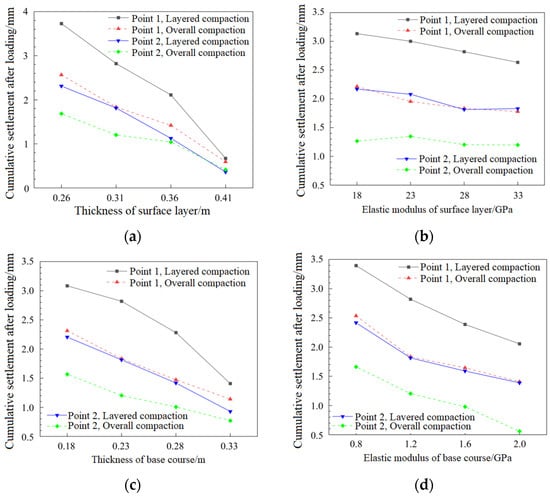
Under different subgrade compaction forms, the evolution characteristics of the final cumulative settlement at different subgrade depths induced by change in pavement parameters are shown in Figure 14. From Figure 14a, under the layered compaction form, the variation in cumulative settlement induced by change in the thickness of the surface layer is more when compared with the overall compaction form. At different subgrade depths, the difference in variation of cumulative settlement induced by the thickness of the surface layer is relatively significant. As the layered compaction form is adopted, the influence of the thickness of the surface layer is significant. As the thickness of the surface layer is less than 0.31 m, under different compaction forms of the subgrade, the variation of cumulative settlement induced by change in the thickness of the surface layer stays unchanged. From Figure 14b, the variation in cumulative settlement induced by change in the elastic modulus of the surface layer is basically consistent at different subgrade depths and is little affected by the compaction form of the subgrade.
Figure 14.
The influence of pavement parameters on cumulative settlement of the silt subgrade under different compaction forms of the subgrade. (a) Different thicknesses of surface layer; (b) Different elastic moduli of surface layer; (c) Different thicknesses of base course; (d) Different elastic moduli of base course.
From Figure 14c, the influence characteristics of the thickness of the surface layer and the base course are basically consistent. As the thickness of the base course is less than 0.28 m, the variation in cumulative settlement induced by change in the thickness of the base course is less affected by the compaction method of the subgrade. As the subgrade depth increases, the influence of the compaction form of the subgrade on the variation in cumulative settlement induced by change in the thickness of the base course decreases. From Figure 14d, as the elastic modulus of the base course increases, the variations in cumulative settlement induced by change in the elastic modulus of the base course gradually tend to be similar under different compaction forms of subgrade. Meanwhile, as the elastic modulus of the base course is more than 1.6 GPa, the variation in cumulative settlement induced by the elastic modulus of the base course is not affected by the compaction form of the subgrade.
6. Conclusions
Based on the proposed modified bounding surface model, numerical simulation methods were applied to analyze the coupling influence of the subgrade compaction form and pavement structural parameters on cumulative settlement of the silt subgrade induced by aircraft impact loading. The main conclusions are as follows:
- (1)
- During the loading period, cumulative settlement of the silt shows an exponential increasing trend, while its rate of change shows an exponential decreasing trend. As the structural parameters of the surface layer and the thickness of the base course increase, the sensitivity of cumulative settlement to changes in structural parameters of the surface layer increases. As the elastic modulus of the base course increases, the sensitivity of cumulative settlement to changes in elastic modulus of the base course decreases. Compared with the stiffness of pavement structures, suitable thicknesses of the pavement layers contribute more to the reduction in subgrade settlement.
- (2)
- At different subgrade depths, as the thickness of the surface layer and the elastic modulus of the base course increase, the rate of change in cumulative settlement tends to be divergent. As the elastic modulus of the surface layer and the thickness of the base course increase, the rate of change in cumulative settlement tends to be consistent. Under different structural parameters of pavement layers, the largest difference among these rates of change in cumulative settlement is nearly 50%.
- (3)
- Compared with the overall compaction form, the largest increments of cumulative settlement and its rate of change induced by the layered compaction form are 63% and 88%, respectively. As the elastic modulus of the surface layer and the base course exceeds 28 GPa and 1.6 GPa, respectively, the influence of the layered compaction form cannot be reduced by optimization of pavement parameters. As the thickness of the surface layer is more than 0.36 m, the influence of compaction form can be neglected. Compared with other pavement parameters, the increase in the thickness of the base course can effectively reduce the influence of compaction form, particularly when the thickness of the base course is more than 0.28 m.
- (4)
- Compared with the overall compaction form, the cumulative settlement is more sensitive to change in pavement structural parameters under the layered compaction form. As the thickness of the surface layer and the base course are less than 0.31 m and 0.28 m, respectively, and the elastic modulus of the base course is more than 1.6 GPa, compaction form can not affect the sensitivity of cumulative settlement to the change in pavement parameters. The influence of compaction form can be ignored in the optimization of the elastic modulus of the surface layer.
- (5)
- The study is limited to overall wetting in the silt subgrade, while local wetting in the silt subgrade induced by rainfall infiltration and the “pot-cover effect” is not considered. The influence of factors such as distribution patterns and degree of local wetting in the silt subgrade on deformation behaviors of runway pavement will be investigated in further research.
Author Contributions
Conceptualization, Q.L.; Methodology, Q.L. and Y.P.; Software, Q.L., Y.Z. and F.Z.; Validation, Q.L., Y.Z., F.Z. and H.C.; Formal analysis, Q.L. and Y.P.; Investigation, Q.L.; Resources, Q.L. and Y.P.; Data curation, Q.L. and Y.Z.; Writing—original draft, Q.L.; Writing—review and editing, Q.L., H.C. and Y.P.; Supervision, Y.P.; Funding acquisition, Q.L. and Y.P. All authors have read and agreed to the published version of the manuscript.
Funding
This research was funded by the Scientific Research Foundation for Doctor at Jiangxi Flight University (Grant No. kyc0928, Grantor: Qiqi Luo) and the Natural Science Foundation of Fujian (Grant No. 2025J01874, Grantor: Yiheng Pan).
Institutional Review Board Statement
Not applicable.
Informed Consent Statement
Not applicable.
Data Availability Statement
The original data are presented in the article. Further reasonable inquiries can be directed to the corresponding author.
Conflicts of Interest
The authors declare no conflicts of interest.
References
- Zhang, Q.L.; Yang, X.; Wu, C.P.; Qiao, L.; Deng, N.F.; Wu, H.H.; Liu, R.; Guo, W.; Qing, W.M. Assessment of compaction quality of highway subgrade via roller-integrated positive maximum velocity detection technique. Int. J. Pavement Eng. 2024, 25, 2342405. [Google Scholar] [CrossRef] [Scilit]
- Ye, X.Y.; Zhang, S.; Lei, Y.; Jiang, Y.; Chen, Y.; Chen, M.H. Dynamic and static compaction methods deriving different strain evolutions under cyclic loading for silt and its microscopic interpretation. Transp. Geotech. 2024, 49, 101378. [Google Scholar] [CrossRef] [Scilit]
- Li, X.M.; Liang, Z.K.; Ren, K.B.; Yin, S.; Sun, Y.Z. Effect of static and dynamic methods of compaction on mechanical properties of silt. Int. J. Geomech. 2023, 23, 8350. [Google Scholar] [CrossRef] [Scilit]
- Luo, Q.Q.; Ye, X.Y.; Li, Q.; Zhang, S.; Yu, Q.; Ma, X.Y. Experimental and numerical study on response characteristics of airport pavement subjected to wetting in silt subgrade. KSCE J. Civ. Eng. 2023, 27, 551–566. [Google Scholar] [CrossRef] [Scilit]
- Dong, Q.; Wang, J.H.; Zhang, X.M.; Wang, H.; Zhao, J.N. Dynamic response analysis of airport pavements during aircraft taxiing for evaluating pavement bearing capacity. J. Zhejiang Univ.-Sci. A 2021, 22, 736–750. [Google Scholar] [CrossRef] [Scilit]
- Chen, L.B.; Yan, E.H.; Xu, J.; Ma, T.; Zeng, J.C.; Gong, Y. Research on design indicators for graded crushed stone mixture based on vibration molding method. Adv. Mater. Sci. Eng. 2020, 2020, 5179563. [Google Scholar] [CrossRef] [Scilit]
- Ma, Z.T.; Lu, K.Y.; Song, D.F.; Liu, W.H.; Wang, Y.P.; Li, S.H. Study on compaction characteristics and compaction process of an unsaturated silt based on PFC3D. Appl. Sci. 2023, 13, 5547. [Google Scholar] [CrossRef] [Scilit]
- Zhang, J.H.; Peng, J.H.; Zhang, A.S.; Li, J. Prediction of permanent deformation for subgrade soils under traffic loading in Southern China. Int. J. Pavement Eng. 2020, 23, 673–682. [Google Scholar] [CrossRef] [Scilit]
- Du, Z.B.; Zhang, Z.; Wang, L.; Zhang, J.W.; Li, Y.H. Effect of moisture content on the permanent strain of Yellow River alluvial silt under long-term cyclic loading. Sustainability 2023, 15, 13155. [Google Scholar] [CrossRef] [Scilit]
- Xu, F.; Dong, J.L.; Zhang, Q.S.; Leng, W.M.; Li, Y.F.; Yang, Q.; Wu, Q.C. Experimental study on deformation characteristics of new prestressed subgrade under static and dynamic loads. Constr. Build. Mater. 2024, 447, 138123. [Google Scholar] [CrossRef] [Scilit]
- Zhang, C.L.; Jiang, G.L.; Buzzi, O.; Su, L.J. Full-scale model testing on the dynamic behaviour of weathered red mudstone subgrade under railway cyclic loading. Soils Found. 2019, 59, 296–315. [Google Scholar] [CrossRef] [Scilit]
- Chu, X.X.; Dawson, A.; Thom, N.; Chen, H.; Qin, L. Permanent deformation characteristics of unsaturated subgrade soils under cyclic loading. Case Stud. Constr. Mater. 2024, 20, e03099. [Google Scholar] [CrossRef] [Scilit]
- Li, C.C.; Zhang, C.; Weng, H.; Qin, Y.D.; Shang, H.Y.; Zhang, J.H. Study on permanent deformation properties of construction waste soil under traffic loading. Front. Mater. 2025, 12, 1621109. [Google Scholar] [CrossRef] [Scilit]
- Guan, L.X.; Tong, L.H.; Xu, C.J.; Ding, H.B. Experimental and theoretical study on the cumulative settlement of subgrade under train loading. Int. J. Geomech. 2025, 25, 04025092. [Google Scholar] [CrossRef] [Scilit]
- Feng, X.M. Research on the Dynamic Response and Long-Term Stability Evaluation Method of Unsaturated Granite Residual Soil Roadbed. Ph.D. Thesis, Central South University, Changsha, China, 2024. (In Chinese) [Google Scholar]
- Mei, Y.; Lu, H.P.; Wang, X.Y.; Zhou, B.Y.; Liu, Z.Y.; Wang, L. Study on the application and deformation characteristics of construction waste recycled materials in highway subgrade engineering. Buildings 2025, 15, 835. [Google Scholar] [CrossRef] [Scilit]
- Lu, Z.; Fang, R.; Chen, L.H.; She, J.B.; Xian, S.H. Long-term deformation of highway subgrade under coupling effect of traffic load and drying-wetting cycles. Int. J. Geomech. 2020, 20, 04019168. [Google Scholar] [CrossRef] [Scilit]
- Liu, J.K.; Xiao, J.H. Experimental study on the stability of railroad silt subgrade with increasing train speed. J. Geotech. Geoenvironmental Eng. 2010, 136, 833–841. [Google Scholar] [CrossRef] [Scilit]
- Jiang, S.Q.; Wang, Y.; Wang, X.H.; Liu, Z.X.; Liu, Q.Q.; Li, C.; Li, P. Numerical analysis on the structure design of precast cement concrete pavement slabs. Coatings 2022, 12, 1051. [Google Scholar] [CrossRef] [Scilit]
- Zhang, C.; Lei, Y. Parameter optimization of graded macadam transitional layer for inverted asphalt pavement based on the mechanical response and strength standard. Adv. Mater. Sci. Eng. 2021, 2021, 9945372. [Google Scholar] [CrossRef] [Scilit]
- Assogba, O.C.; Tan, Y.Q.; Zhou, X.Y.; Zhang, C.; Anato, J.N. Numerical investigation of the mechanical response of semi-rigid base asphalt pavement under traffic load and nonlinear temperature gradient effect. Constr. Build. Mater. 2020, 235, 117406. [Google Scholar] [CrossRef] [Scilit]
- Zhang, J.; Bao, L.L. Determination of asphalt mixture’s viscoelastic constitutive parameters for pavement response analysis using dynamic modulus transformation. Constr. Build. Mater. 2022, 315, 125729. [Google Scholar] [CrossRef] [Scilit]
- Jiang, X.J.; Huang, W.; Luo, S.; Kong, W.Y.; Du, K.J. Multi-objective optimization of epoxy asphalt concrete orthotropic steel bridge deck systems with response surface methodology. Int. J. Pavement Res. Technol. 2025, 24, 1–17. [Google Scholar] [CrossRef] [Scilit]
- Minkwan, K.; Erol, T. Validation of a three-dimensional finite element model using airfield pavement multiple wheel load responses. Road Mater. Pavement Des. 2010, 11, 387–408. [Google Scholar] [CrossRef] [Scilit]
- Gu, W.J.; Tian, Y.; Zhang, X.Y. Mechanical response and structure optimization of nanomodified asphalt pavement. Adv. Civ. Eng. 2021, 2021, 6286704. [Google Scholar] [CrossRef] [Scilit]
- Stolz, A.; Tang, J.H.; Fischer, S.G.; Fischer, K. A rheological model analog for assessing the resilience of socio-technical systems across sectors. Environ. Syst. Decis. 2024, 44, 922–945. [Google Scholar] [CrossRef] [Scilit]
- Li, Y.H. Research of Runway Vibration Response by Considering the Aircraft-Pavement Interactions. Master’s Thesis, Civil Aviation University of China, Tianjin, China, 2024. (In Chinese) [Google Scholar]
- Ali, S.; Fawzia, S.; Thambiratnam, D.; Liu, X.M.; Remennikov, A.M. Performance of protective concrete runway pavement under aircraft impact loading. Struct. Infrastruct. Eng. 2020, 16, 1698–1710. [Google Scholar] [CrossRef] [Scilit]
- Yadav, D.K.; Shukla, S.K. Analytical model for deflection of the runway pavement at touchdown point caused by an aircraft during landing. Int. J. Geomech. 2012, 12, 113–118. [Google Scholar] [CrossRef] [Scilit]
- Sun, L.; Duan, Y.F. Dynamic response of top-down cracked asphalt concrete pavement under a half-sinusoidal impact load. Acta Mech. 2013, 224, 1865–1877. [Google Scholar] [CrossRef] [Scilit]
- MH/T5004-2010; Specifications for Airport Cement Concrete Pavement Design. China Civil Aviation Publishing House: Beijing, China, 2010. (In Chinese)
- Luo, Q.Q.; Kou, J.Y.; Yi, W.N.; Liu, Y.B.; Ma, X.Y.; Zhang, Y.C.; Ye, X.Y. Numerical investigation on deformation of the water-rich silt subsoil under different compaction conditions. Electronics 2024, 13, 520. [Google Scholar] [CrossRef] [Scilit]
- Luo, Q.Q.; Zhang, S.; Li, Q.; Ye, X.Y.; Zhang, X.S.; Yu, Q. Influence of wetting on the stress response of silt subgrade under aircraft loading. Adv. Eng. Sci. 2023, 55, 87–99. (In Chinese) [Google Scholar]

Disclaimer/Publisher’s Note: The statements, opinions and data contained in all publications are solely those of the individual author(s) and contributor(s) and not of MDPI and/or the editor(s). MDPI and/or the editor(s) disclaim responsibility for any injury to people or property resulting from any ideas, methods, instructions or products referred to in the content. |
© 2026 by the authors. Licensee MDPI, Basel, Switzerland. This article is an open access article distributed under the terms and conditions of the Creative Commons Attribution (CC BY) license.