


Abstract
The increasing adoption of exhaust gas cleaning systems (EGCSs) in the maritime industry has raised concerns regarding the management of sludge residues generated during wet scrubber operation. Conventional onboard sludge handling methods primarily rely on temporary storage and onshore disposal, resulting in increased storage requirements, disposal costs, and environmental burdens. Although vacuum drying has emerged as a promising approach for onboard sludge volume reduction, limited studies have addressed the integrated risk-informed design, reliability evaluation, and operational validation of onboard vacuum drying systems under marine operating conditions. This study proposes a risk-informed systems engineering framework for the design, reliability evaluation, and validation of an onboard vacuum drying system (VDS) for EGCS sludge treatment. The framework establishes a closed-loop process in which functional analysis and hazard identification inform quantitative reliability assessment and structural verification, which in turn drive design refinement and are subsequently confirmed through hardware-in-the-loop (HIL) validation and experimental testing. The results demonstrated stable vacuum operation at the designated pressure of 3 Torr for more than 30 min, with a minimum chamber pressure of 0.08 Torr. Structural assessment confirmed that the calculated stresses remained well below the allowable limits of ASME Section VIII Division 1, while modal analysis indicated acceptable dynamic stability. FMECA-based design refinement reduced the Risk Priority Number (RPN) values of major components by 50–67%, with an average reduction of 53.3%. HIL-based validation and experimental testing further verified the effectiveness of the control architecture and the operational feasibility of the system. The study demonstrates how a risk-informed systems engineering framework can systematically integrate structural verification, quantitative reliability improvement, and operational validation for onboard environmental treatment systems. The proposed framework provides a practical and transferable methodology for enhancing the safety, reliability, and operational feasibility of marine systems operating under complex onboard conditions.
1. Introduction
The tightening of sulfur oxide (SOx) emission regulations under IMO MARPOL Annex VI has accelerated the adoption of exhaust gas cleaning systems (EGCS) in the maritime industry [1]. Wet scrubber systems have become one of the most widely applied technologies for achieving compliance with sulfur emission limits while allowing the continued use of conventional marine fuels [2,3,4,5,6]. However, increasing use of wet scrubbers has simultaneously introduced new environmental and operational challenges associated with washwater and sludge residue management [6,7,8].
Scrubber sludge typically contains high moisture content and hazardous contaminants, resulting in increased storage requirements, disposal costs, and environmental concerns during onboard operation [6,7,9]. Conventional sludge treatment methods have been extensively studied for land-based applications. Filtration and centrifugation techniques have been effective for solid–liquid separation but leave residual moisture that still requires further treatment [9,10]. Thermal drying methods can achieve higher dryness; however, they generally operate under atmospheric conditions and may generate secondary emissions of volatile compounds [11,12]. These approaches are difficult to apply directly in the confined and safety-critical environment of a ship.
Such approaches may generate secondary pollution due to volatile gas emissions and are difficult to directly apply in marine environments characterized by limited space, dynamic operating conditions, and strict safety requirements [6,7].
In particular, onboard sludge volume reduction is becoming increasingly important due to limited storage capacity, rising disposal costs, and tightening environmental regulations associated with sludge transportation and onshore treatment [13,14,15].
Compared with conventional onboard approaches such as temporary storage with onshore disposal, centrifugation, or atmospheric thermal drying, vacuum drying enables moisture removal at relatively low temperatures under closed conditions, thereby reducing secondary emissions and storage volume. However, it requires reliable vacuum sealing and involves higher system complexity.
Vacuum drying has recently attracted attention as an alternative sludge treatment technology because it enables moisture evaporation at relatively low temperatures under reduced pressure conditions while minimizing contact with ambient air [11,12,16,17,18,19,20]. Despite these advantages, existing studies on vacuum drying systems have mainly focused on laboratory-scale or land-based processes [11,12,18,20]. Research addressing integrated risk-based design, reliability evaluation, and HIL-based operational validation of onboard vacuum drying systems remains limited.
Furthermore, onboard vacuum drying systems operate under coupled thermal, structural, and vacuum loading conditions and involve multiple potential hazards, including vacuum leakage, overheating, pressure instability, condensation failure, and sensor malfunction. Therefore, systematic integration of risk assessment and reliability engineering into the design process is essential to ensure operational safety and system robustness [21,22,23,24,25,26,27,28,29].
Accordingly, this study proposes an integrated systems engineering-based framework for the risk-based design and reliability evaluation of an onboard vacuum drying system (VDS) for EGCS sludge treatment. The proposed framework combines functional analysis, HAZID, structural stability assessment, FMECA, and HIL-based validation to establish a closed-loop engineering framework linking risk assessment, design refinement, reliability improvement, and experimental validation.
Unlike previous studies focusing primarily on thermal performance or laboratory-scale drying studies, the present study integrates systems engineering-based functional analysis, structural verification, quantitative reliability assessment, and HIL-based operational validation into a unified risk-informed engineering framework for onboard EGCS sludge treatment. The proposed framework further enables systematic integration of hazard identification, reliability assessment, structural verification, and experimental validation for onboard environmental treatment systems.
2. Research Gap and Objectives
Previous studies on sludge treatment technologies have primarily focused on thermal drying performance, dewatering efficiency, and energy consumption reduction [9,10,11,12]. Although vacuum drying technologies have demonstrated advantages in low-temperature evaporation and environmental protection, most existing studies have been limited to land-based industrial applications [12,16,17,18,19,20,30,31].
Furthermore, existing research on EGCS sludge management has largely concentrated on storage, transportation, and disposal strategies rather than active onboard treatment technologies [6,8,13,14,15]. Studies integrating systems engineering methodologies, risk-based design approaches, and reliability-oriented validation frameworks for onboard sludge treatment systems remain scarce in the existing literature [21,22,23,24,25,26,27,28,29].
In addition, previous works rarely addressed the integration of functional requirement analysis, hazard identification, structural integrity assessment, quantitative reliability evaluation, and real-time control validation within a unified engineering framework [21,22,23,24,25,26,27,28,29,32,33]. This limitation reduces the practical applicability of existing approaches for marine environmental systems operating under complex multi-physics conditions.
To address these research gaps, this study aims to:
- To develop a systems engineering-based framework integrating FFBD, RAS, HAZID, structural integrity assessment using Finite Element Analysis (FEA), and FMECA for onboard vacuum drying systems;
- To establish a closed-loop risk-informed engineering framework linking hazard assessment and design refinement;
- To quantitatively evaluate reliability improvement through FMECA-based RPN reduction;
- To validate operational feasibility using HIL simulation and prototype-based experimental testing.
3. Systems Engineering-Based Risk Evaluation Framework
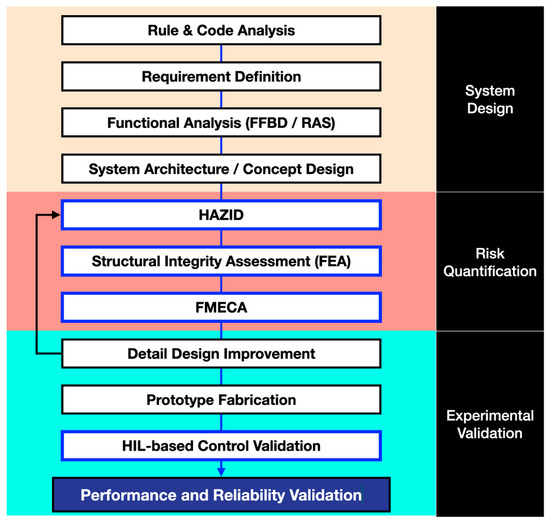
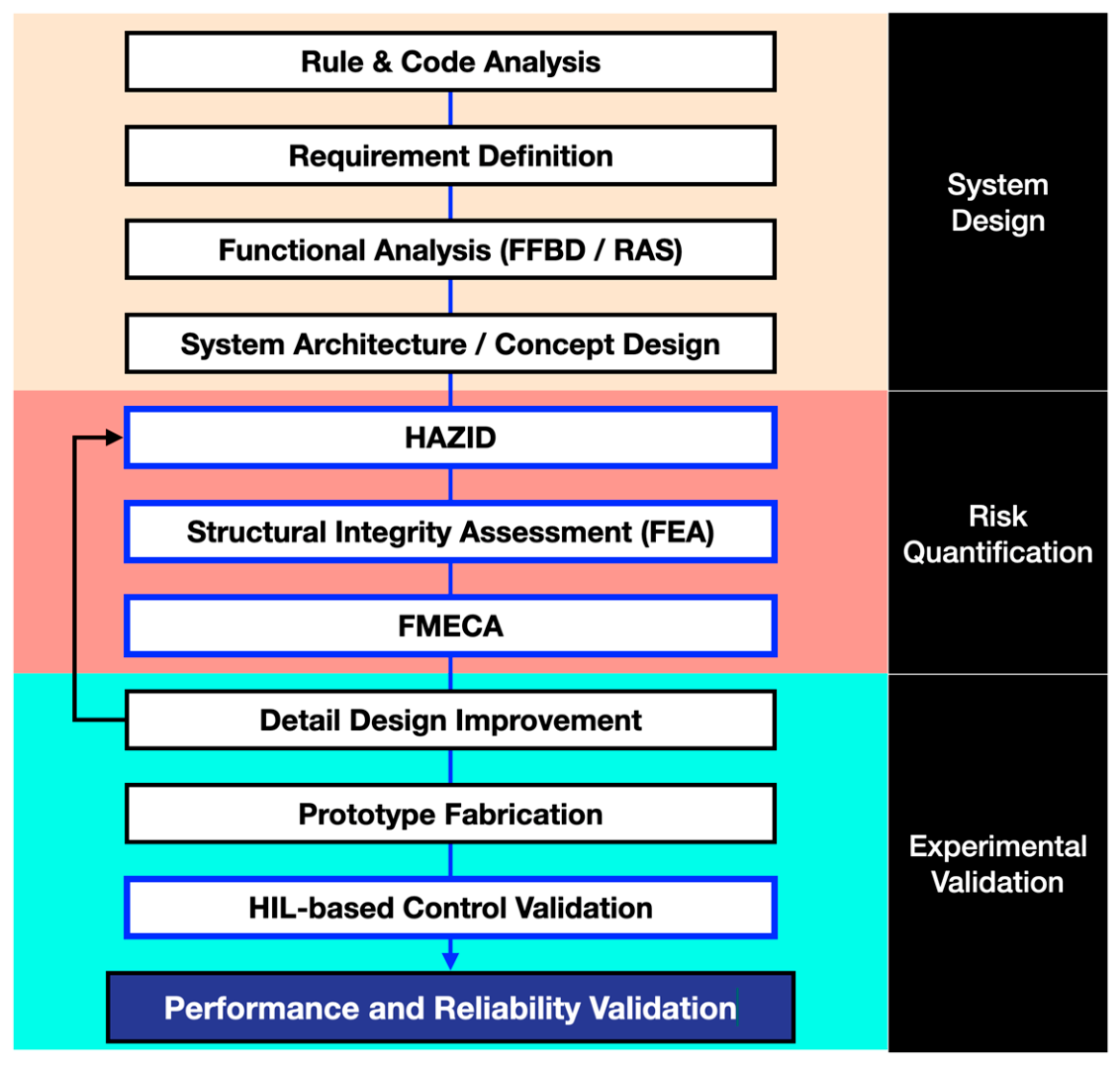
As illustrated in Figure 1, an integrated systems engineering-based framework was developed to systematically link functional analysis, hazard identification, structural integrity assessment, reliability evaluation, design refinement, and experimental validation processes for the proposed onboard vacuum drying system (VDS). The framework was established to provide a closed-loop engineering process linking risk quantification, design refinement, reliability improvement, and operational validation throughout system development [21,22,24,29].
Figure 1.
Overall research framework integrating systems engineering, risk quantification, structural integrity assessment, reliability evaluation, and experimental validation of the onboard vacuum drying system (VDS) for EGCS sludge treatment.
The proposed framework consists of sequential and interconnected engineering stages as follows:
- Requirement analysis and regulatory review;
- Functional analysis using Functional Flow Block Diagrams (FFBDs) and Requirement Allocation Sheets (RAS);
- System architecture and conceptual design;
- Hazard identification (HAZID);
- Structural integrity assessment using finite element analysis (FEA);
- Failure modes, effects, and criticality analysis (FMECA);
- Design refinement and reliability improvement;
- HIL-based control validation and experimental verification.
The selection of the integrated methods was driven by the multi-physics and safety-critical nature of onboard vacuum drying systems, which operate under coupled thermal, structural, and vacuum conditions. Conventional sequential design approaches are limited in systematically linking hazard identification with quantitative reliability improvement and real-time operational validation.
In the proposed framework, the results of each stage are directly transferred to the subsequent stage to form a closed-loop risk feedback mechanism. The major operational hazards identified through HAZID (e.g., vacuum leakage, moisture intrusion into the vacuum pump, overheating, and sensor malfunction) were used as primary inputs for defining failure modes and effects in the FMECA. High-RPN failure modes from the FMECA were then prioritized for design refinement. This led to concrete engineering measures such as reinforced sealing, optimized cold-trap configuration, redundant sensing, and enhanced thermal interlock logic. These design improvements were subsequently verified through HIL-based validation scenarios that deliberately reproduced the critical abnormal conditions identified in the HAZID and FMECA analyses.
Unlike conventional systems engineering processes, which typically apply risk assessment tools in a sequential and largely one-directional manner, the proposed framework establishes a continuous risk feedback loop. In this mechanism, the outputs of hazard identification and quantitative reliability analysis are actively fed back into the design process. High-RPN failure modes directly determine the priority and content of design refinements. The modified design is then verified under the same abnormal conditions originally identified in the risk analyses. This continuous risk-to-design-to-validation loop constitutes the core methodological novelty of the framework. It enables quantitative reliability improvement (demonstrated by an average RPN reduction of 53.3%) to be systematically linked with structural verification and real-time control validation within a single engineering process.
The initial stages of the framework focus on systems engineering activities, including requirement definition, functional analysis, and system architecture development. Subsequently, hazard identification and risk evaluation are performed through HAZID, structural integrity assessment, and FMECA to identify potential hazards, evaluate structural robustness, and prioritize critical failure modes.
The results obtained from the risk quantification stage are directly reflected in the design refinement process. Corrective design measures and reliability improvement actions are implemented based on identified hazards and high-risk failure modes. The improved design is then verified through prototype fabrication, HIL-based control validation, and performance testing.
Unlike conventional linear engineering processes, the proposed framework establishes a closed-loop interaction between risk assessment and design refinement. This enables iterative reliability enhancement and systematic verification of operational safety throughout the development process. Furthermore, the framework provides a systematic mechanism for linking risk assessment results with design refinement and validation activities throughout the system development lifecycle.
4. Functional Analysis and System Architecture
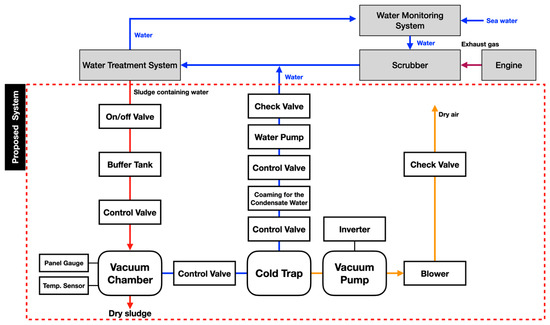
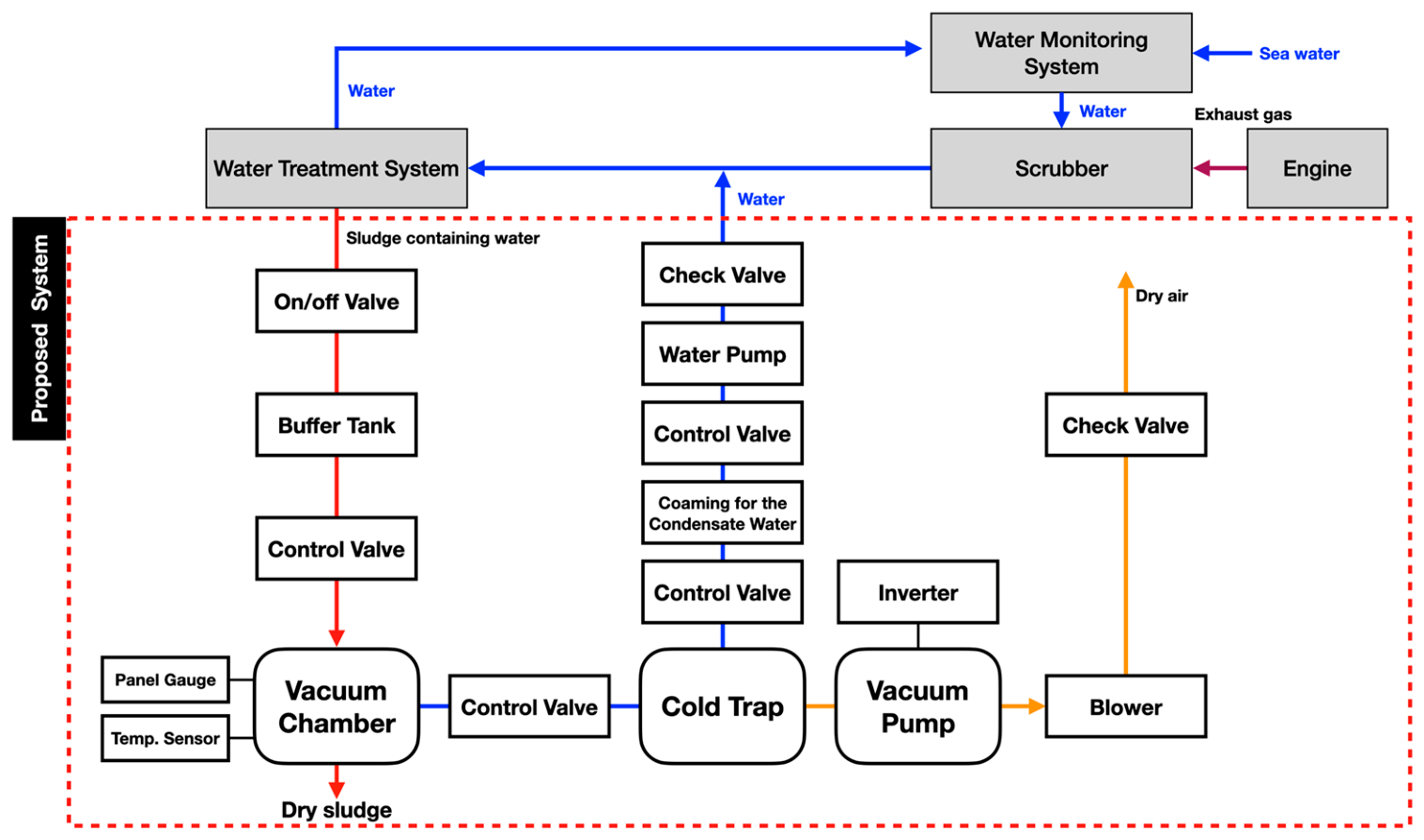
Figure 2 illustrates the conceptual configuration of the proposed onboard vacuum drying system developed for EGCS sludge treatment. The recovered condensate is recirculated through the water treatment system, enabling a closed process that minimizes secondary emissions and environmental discharge. This configuration was designed to minimize secondary air pollution while enabling stable low-temperature drying under vacuum operating conditions.
Figure 2.
Conceptual configuration of the closed-loop onboard vacuum drying system for EGCS sludge treatment (Blue arrows indicate water recovery lines returning to the water treatment system; red lines represent sludge-containing water flows within the proposed system; orange arrows indicate the final treated dry air discharge to the atmosphere. The red dotted box denotes the proposed vacuum drying system).
Based on the conceptual architecture, functional analysis was conducted to define the operational sequence, subsystem interactions, and control relationships of the proposed vacuum drying system.
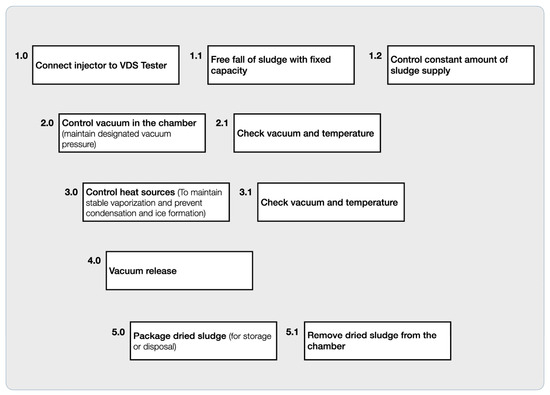
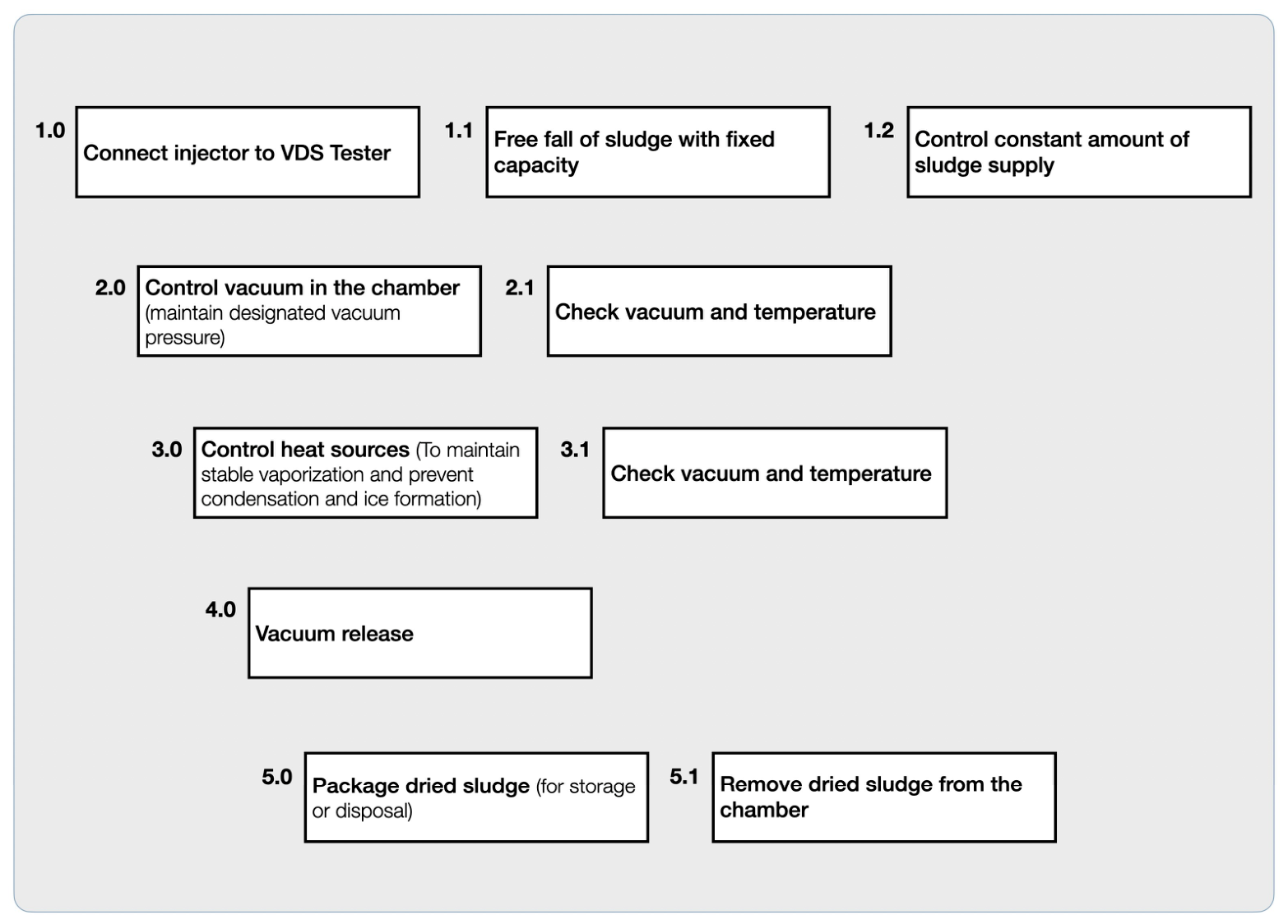
As illustrated in Figure 3, a Functional Flow Block Diagram (FFBD) was developed to represent the logical operational sequence and subsystem interactions of the proposed vacuum drying system [21,29]. The FFBD defines the logical sequence of system functions, beginning with sludge feeding and progressing through vacuum generation, thermal drying, process monitoring, vacuum release, and final dry sludge handling.
Figure 3.
Functional Flow Block Diagram (FFBD) representing the operational sequence and subsystem interactions of the proposed onboard vacuum drying system.
The functional architecture enabled clear identification of operational dependencies and subsystem interfaces associated with the vacuum drying process [21,29,34].
To establish requirement traceability between operational functions and physical components, a Requirement Allocation Sheet (RAS) was developed, as summarized in Table 1 [21,29]. The RAS allocated major functional requirements to key subsystems including the vacuum chamber, vacuum pump, cold trap, heating unit, sensors, and integrated control system. This allocation process ensured traceability between functional requirements, physical components, and verification activities throughout system development.
Table 1.
Requirement Allocation Summary for Major Functional Subsystems of the Proposed Vacuum Drying System.
The RAS-based functional allocation enabled verification of subsystem responsibilities and operational interactions, thereby providing the engineering basis for subsequent HAZID and FMECA analyses.
Based on the FFBD and RAS results, the overall system architecture was further refined using a System Block Diagram (SBD) approach. The SBD provides a physical representation of subsystem interfaces and process interactions within the proposed vacuum drying system.
The SBD established clear subsystem boundaries and interface definitions, which served as the architectural basis for subsequent hazard identification, structural assessment, and reliability evaluation activities.
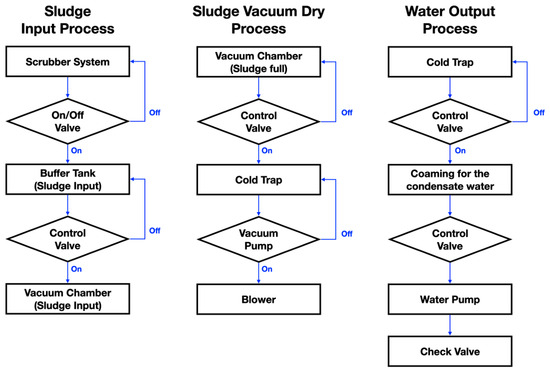
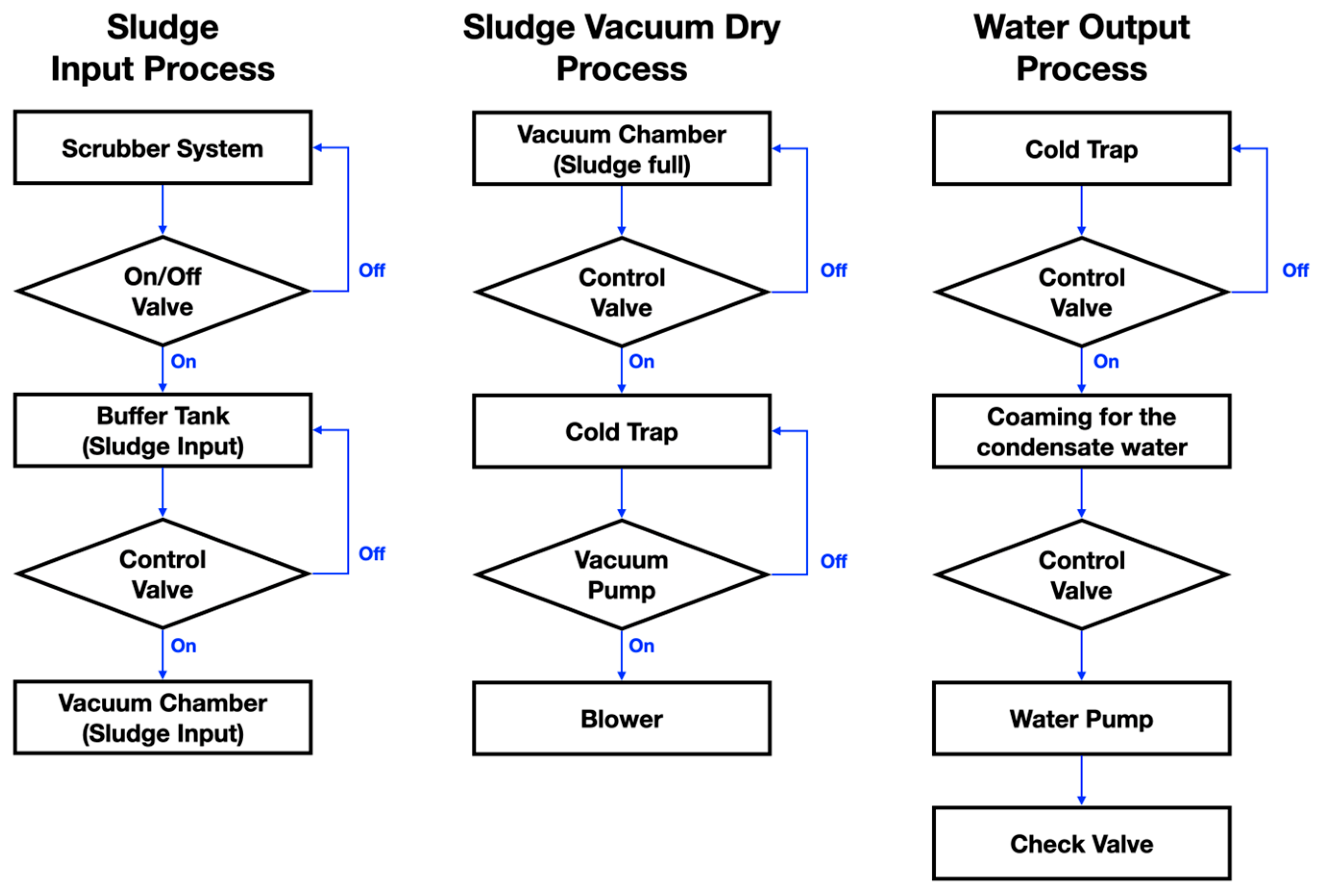
As shown in Figure 4, the architecture is organized into three major process subsystems: sludge input, vacuum drying, and condensate recovery, which are coordinated through an integrated control system to ensure stable and safe operation.
Figure 4.
System Block Diagram (SBD) of the proposed onboard vacuum drying system illustrating the sludge input, vacuum drying, and condensate recovery subsystems and their functional interfaces.
These subsystems are interconnected through valves, pumps, and control devices to maintain stable vacuum drying operation while preventing unintended fluid backflow and vacuum leakage.
The SBD complements the FFBD by illustrating physical component relationships, subsystem interfaces, and process boundaries, thereby providing the architectural basis for subsequent hazard identification, structural integrity assessment, and reliability evaluation activities.
5. Hazard Identification and Reliability Evaluation
5.1. Hazard Identification (HAZID)
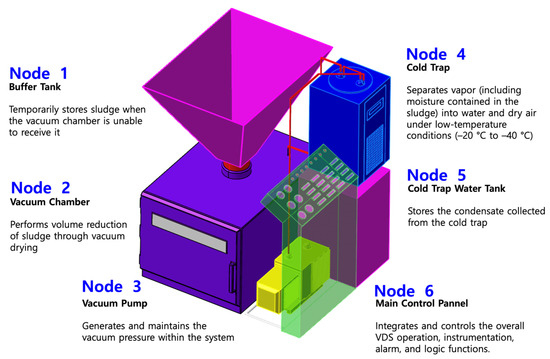
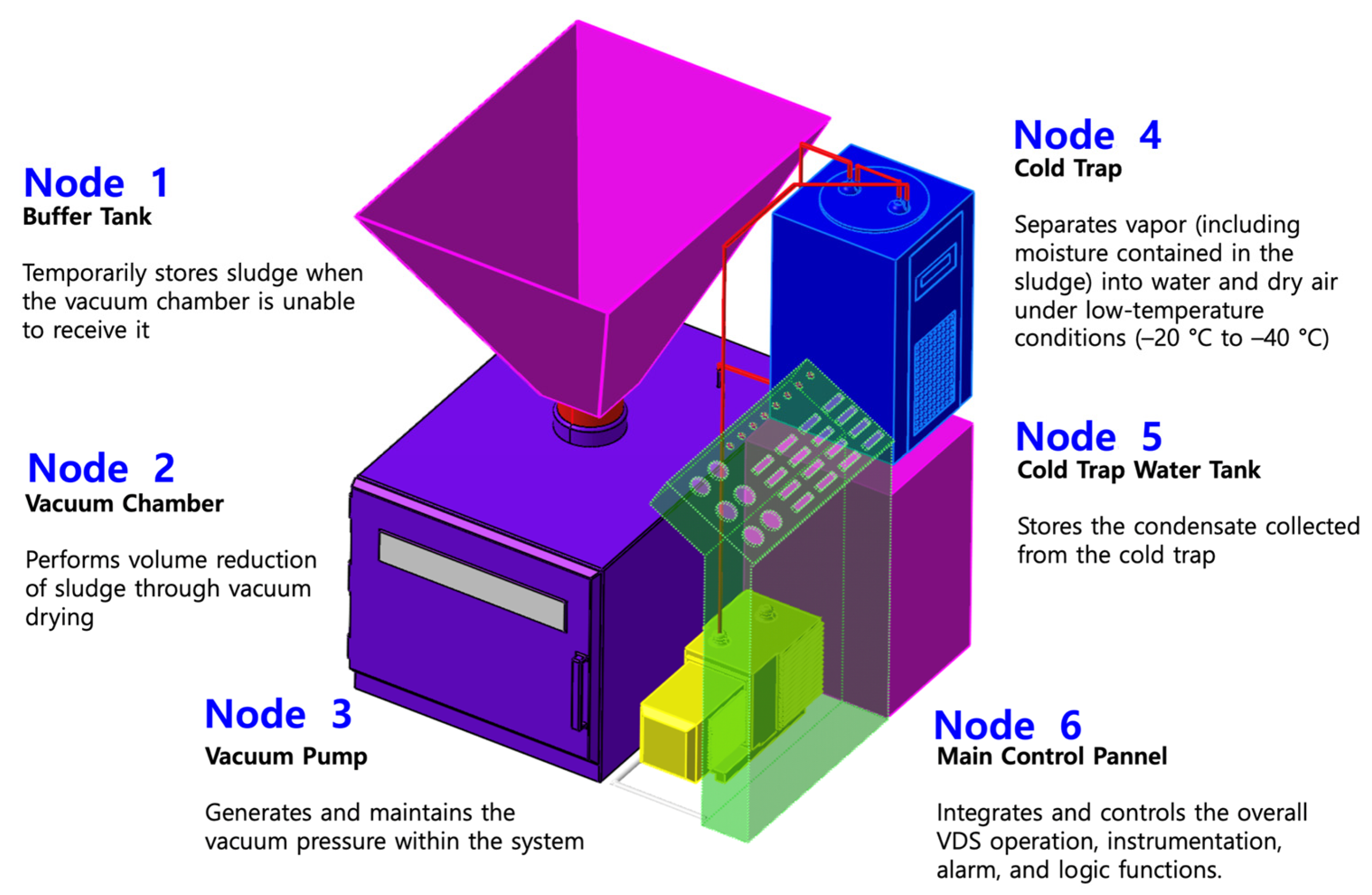
HAZID was conducted to systematically identify potential operational hazards associated with the proposed onboard vacuum drying system under marine operating conditions. The analysis was performed by a multidisciplinary team consisting of experts in naval architecture, mechanical engineering, process safety, and control systems. The primary information sources included the system architecture and functional descriptions developed in Section 4, the operational sequence defined by the FFBD, relevant marine industry guidelines, and engineering judgment based on prior experience with vacuum and thermal systems. The system was divided into six functional nodes (buffer tank, vacuum chamber, vacuum pump, cold trap, cold trap water tank, and main control panel) to facilitate structured hazard identification. For each node, potential hazards, causes, consequences, and existing safeguards were examined. The evaluation focused on deviations related to vacuum integrity, temperature control, moisture management, fluid handling, and control system performance. The identified hazards and corresponding mitigation strategies are summarized in Table 2.
Table 2.
Summary of Major HAZID Results and Associated Mitigation Strategies for the Proposed Vacuum Drying System.
HAZID was conducted to qualitatively identify operational hazards associated with the proposed onboard vacuum drying system under marine operating conditions [28,35]. For the HAZID analysis, the proposed vacuum drying system was divided into six functional nodes, including the buffer tank, vacuum chamber, vacuum pump, cold trap, cold trap water tank, and main control panel, as shown in Figure 5. As illustrated in Figure 5, the HAZID process considered environmental hazards, facility and process hazards, human safety hazards, and interaction hazards associated with surrounding shipboard systems.
Figure 5.
HAZID node configuration and subsystem boundaries of the proposed onboard vacuum drying system.
Major operational hazards and associated mitigation strategies identified through the HAZID process are summarized in Table 2. The analysis identified vacuum leakage, overheating, moisture intrusion into the vacuum pump, unstable pressure control, sludge overflow, and fire or electrical hazards as major operational risks associated with the proposed system.
To quantify the overall reliability improvement, the average RPN reduction was calculated using the five representative critical components selected for design refinement, as summarized in the third table of Section 5.2, as follows:
Heater: (16 − 8)/16 = 50.0%
Cooling Reservoir: (18 − 6)/18 = 66.7%
Pirani Gauge: (8 − 4)/8 = 50.0%
Vacuum Needle Valve: (8 − 4)/8 = 50.0%
Freon Cooling Unit: (8 − 4)/8 = 50.0%
Average RPN reduction = (50.0 + 66.7 + 50.0 + 50.0 + 50.0)/5 = 53.3%.
Among these, vacuum pressure instability and moisture intrusion were identified as critical hazards significantly affecting system reliability and drying performance. Based on the identified hazards, mitigation strategies including interlock systems, alarm functions, redundant sensing, moisture protection systems, and fail-safe shutdown logic were incorporated into the system design.
The major hazards identified through the HAZID process, including vacuum leakage, moisture intrusion, overheating, and control system malfunction, were subsequently used as inputs for the FMECA-based reliability evaluation.
5.2. FMECA-Based Reliability Evaluation
FMECA was conducted to quantitatively evaluate the failure criticality of major system components including the vacuum chamber, vacuum pump, cold trap, heating unit, pressure and temperature sensors, and valves and piping systems [23,26,36].
The Severity (S), Occurrence (O), and Detection (D) ratings used in the FMECA were determined through consensus among the multidisciplinary team. The rating scales were established with reference to standard guidelines (including IEC 60812 [23] and MIL-STD-1629A [36]) and tailored to the specific characteristics of the onboard vacuum drying system. Severity was assessed based on the potential impact on system safety, vacuum integrity, and operational continuity. Occurrence was evaluated considering the expected frequency of the failure mode under marine operating conditions. Detection was rated according to the likelihood that the existing monitoring and control systems would identify the failure before significant consequences occurred.
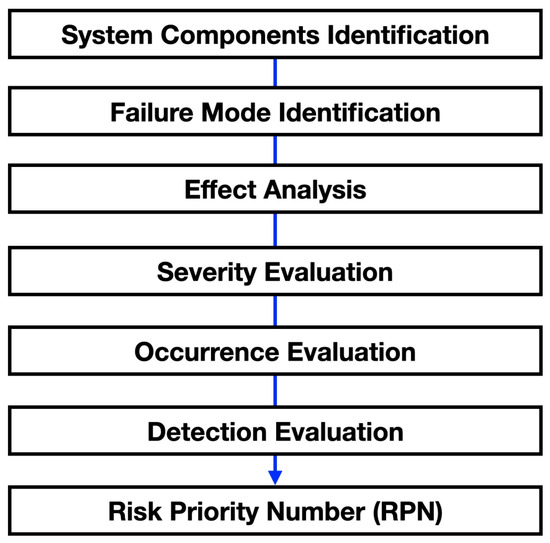
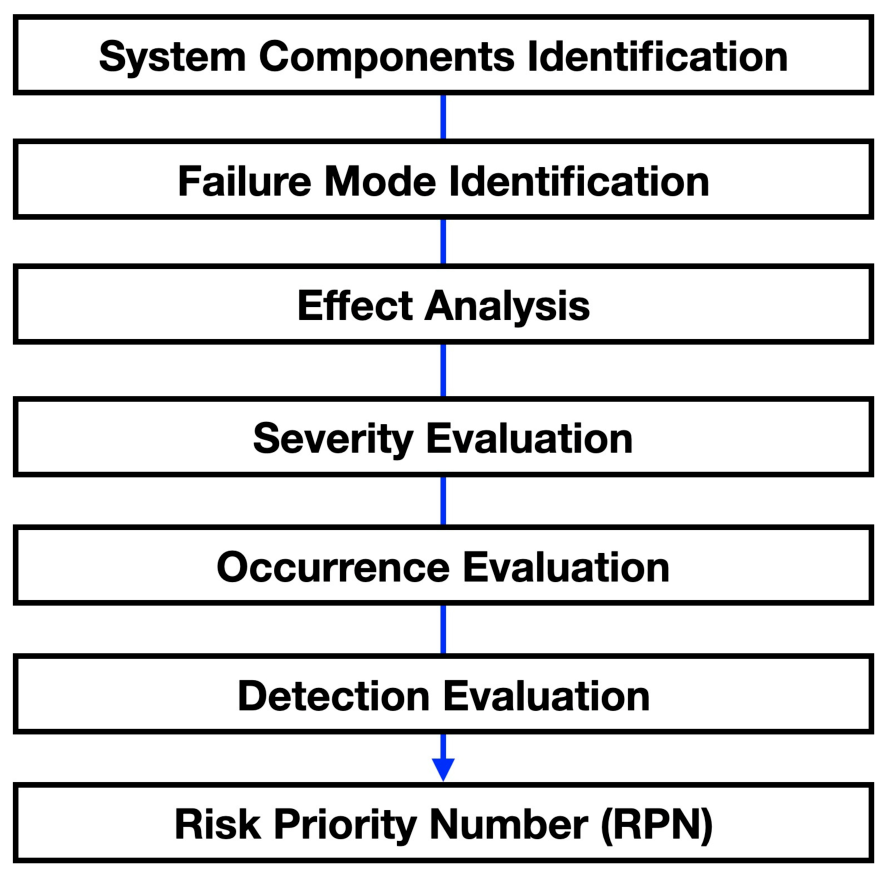
As illustrated in Figure 6, the FMECA procedure consisted of system component identification, failure mode analysis, effect evaluation, and criticality assessment based on severity, occurrence, and detection ratings [23,36]. The calculated Risk Priority Numbers (RPNs) were subsequently utilized to prioritize engineering mitigation and reliability improvement strategies. The FMECA procedure shown in Figure 6 was applied to all major subsystems identified during the HAZID process.
Figure 6.
FMECA procedure flow for failure mode identification, criticality evaluation, and Risk Priority Number (RPN) assessment of the proposed onboard vacuum drying system.
Risk Priority Numbers (RPNs) were calculated based on severity, occurrence, and detection ratings. The analysis identified vacuum sealing failure, temperature instability, moisture intrusion into the vacuum pump, and cooling system degradation as major high-risk failure modes affecting operational reliability and drying stability.
Detailed FMECA results for representative components are summarized in Table 3. The analysis enabled systematic identification of component-level failure modes, associated causes, operational consequences, and corresponding mitigation measures.
Table 3.
Representative Failure Modes, Effects, and Criticality Analysis (FMECA) results for major components of the proposed onboard vacuum drying system.
Based on the FMECA results, critical components were categorized according to their RPN values to support risk prioritization and engineering decision-making. The RPN classification criteria were established based on relative ranking of component criticality within the proposed system and were used to prioritize engineering mitigation efforts, as summarized in Table 4.
Table 4.
Classification of critical system components based on Risk Priority Number (RPN) ranges and recommended mitigation actions.
Based on the critical failure modes identified in the FMECA, several engineering modifications were implemented. These included reinforcement of vacuum sealing structures, optimization of the cold-trap configuration, enhancement of sensor redundancy, improvement of thermal control logic, establishment of periodic calibration protocols, and addition of fail-safe interlock functions.
To evaluate the effectiveness of these measures, a comparative RPN assessment was conducted before and after the design refinements. The results are summarized in Table 5.
Table 5.
Comparison of Risk Priority Number (RPN) values before and after implementation of design refinement measures for major critical components.
After implementation of the improvements, the RPN values of the major components were reduced by 50–67%. The average reduction was 53.3%. These results indicate a clear improvement in the reliability and operational robustness of the system.
Following the implementation of the proposed improvements, the RPN values of major components were reduced by approximately 50–67%, with an average reduction of 53.3%, demonstrating significant reliability enhancement and operational robustness of the proposed system.
6. Structural Verification and HIL-Based Validation
Based on the hazard identification and FMECA results presented in Chapter 5, structural verification and HIL-based operational validation were conducted to assess whether the proposed risk mitigation measures and design refinements provide adequate structural safety, dynamic stability, and operational reliability under vacuum operating conditions.
The integrated verification process was intended to evaluate the applicability and engineering feasibility of the proposed system under realistic vacuum operating and marine environmental conditions.
6.1. Structural Integrity Verification
Structural integrity assessment was conducted to evaluate the mechanical stability of the proposed onboard vacuum drying system under vacuum operating conditions. The structural analysis considered external atmospheric pressure loading applied to the vacuum chamber and supporting structures under fixed boundary conditions [32,37,38,39,40].
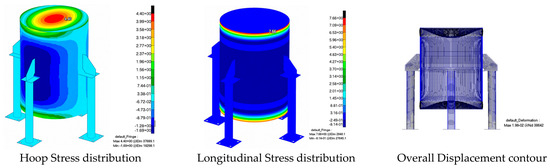
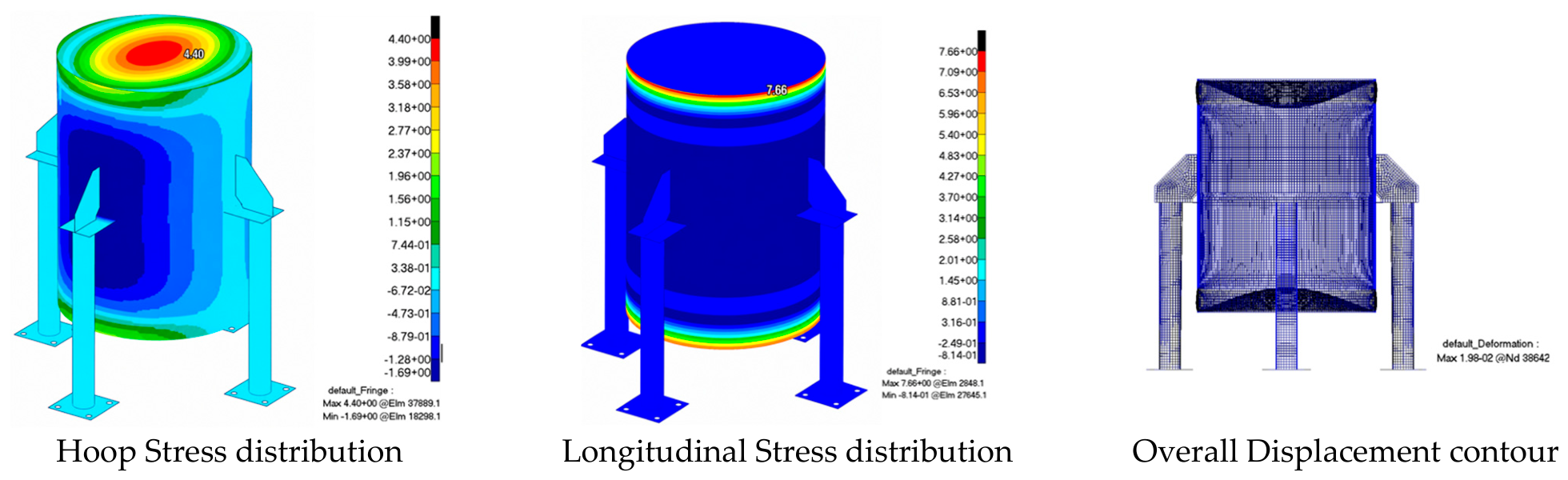
As illustrated in Figure 7, the maximum hoop stress and axial stress were evaluated as 4.40 MPa and 7.66 MPa, respectively, while the maximum structural displacement was approximately 0.02 mm.
Figure 7.
Structural integrity verification results of the proposed onboard vacuum drying system under vacuum operating conditions, including hoop stress distribution, axial stress distribution, and overall displacement contour.
The maximum equivalent stress remained significantly below the allowable stress limit of 138 MPa specified by ASME Section VIII Division 1 [32], confirming adequate structural safety margins under the designated vacuum operating conditions.
The analysis results confirmed that the proposed vacuum drying system maintained sufficient structural integrity and deformation stability under the designated vacuum operating conditions.
6.2. Modal Analysis and Resonance Assessment
The static structural analysis presented in Section 6.1 confirmed that the vacuum chamber and its supporting structures possess adequate strength and stiffness under the design vacuum load, with maximum stresses remaining far below the allowable limits and displacements remaining negligible. Based on this confirmation of structural integrity and sufficient stiffness, modal analysis was subsequently performed to evaluate the dynamic characteristics of the system. Modal analysis is necessary because the onboard vacuum drying system is intended for continuous operation with a vacuum pump that generates periodic excitation. In addition, the system will be exposed to ship-induced vibrations under actual marine conditions. Therefore, it is essential to assess whether any natural frequencies of the structure lie close to the operational excitation frequencies, which could potentially lead to resonance and long-term fatigue or performance degradation. The modal analysis thus complements the static integrity assessment by addressing the dynamic stability required for reliable long-term operation.
Modal analysis was additionally conducted to evaluate the dynamic stability and potential resonance characteristics of the proposed onboard vacuum drying system [37,39].
The natural frequencies and corresponding mode shapes were calculated to assess potential resonance interactions with the operational excitation frequencies generated by the vacuum pump.
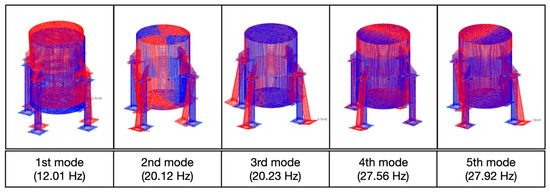
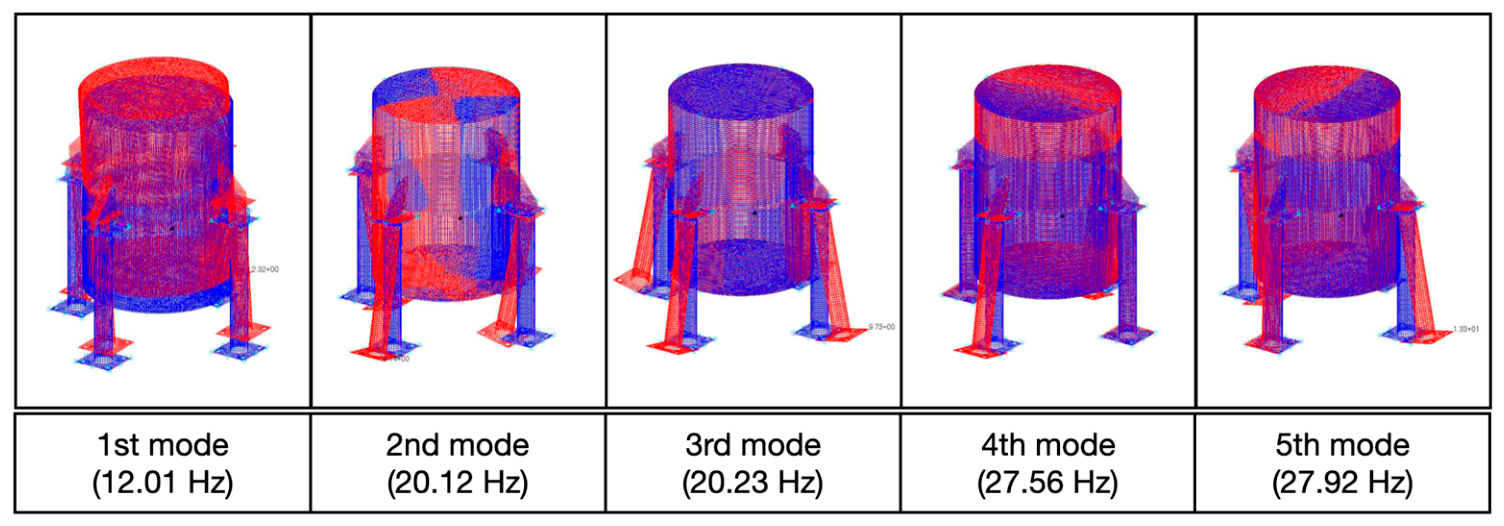
As illustrated in Figure 8, the first to fifth natural frequencies were identified as 12.01 Hz, 20.12 Hz, 20.23 Hz, 27.56 Hz, and 27.92 Hz, respectively.
Figure 8.
Modal analysis and resonance assessment results of the proposed onboard vacuum drying system, including mode shapes, natural frequencies, and modal independence and resonance proximity evaluation.
Several natural frequencies were found to be close to the operational excitation frequency range of the vacuum pump, indicating theoretical resonance proximity. However, the actual dynamic response is expected to be mitigated by structural damping, vibration isolation characteristics, and indirect excitation transfer mechanisms.
The Modal Assurance Criterion (MAC) values between adjacent modes remained below 0.2, indicating low modal correlation and sufficient modal independence between neighboring vibration modes.
Nevertheless, additional experimental modal testing and vibration measurements under actual operating conditions are recommended to further validate the resonance-related dynamic behavior of the integrated system.
6.3. Prototype Development and HIL-Based Operational Validation
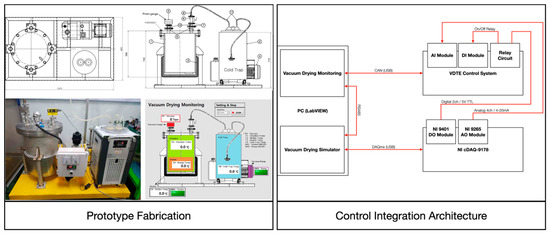
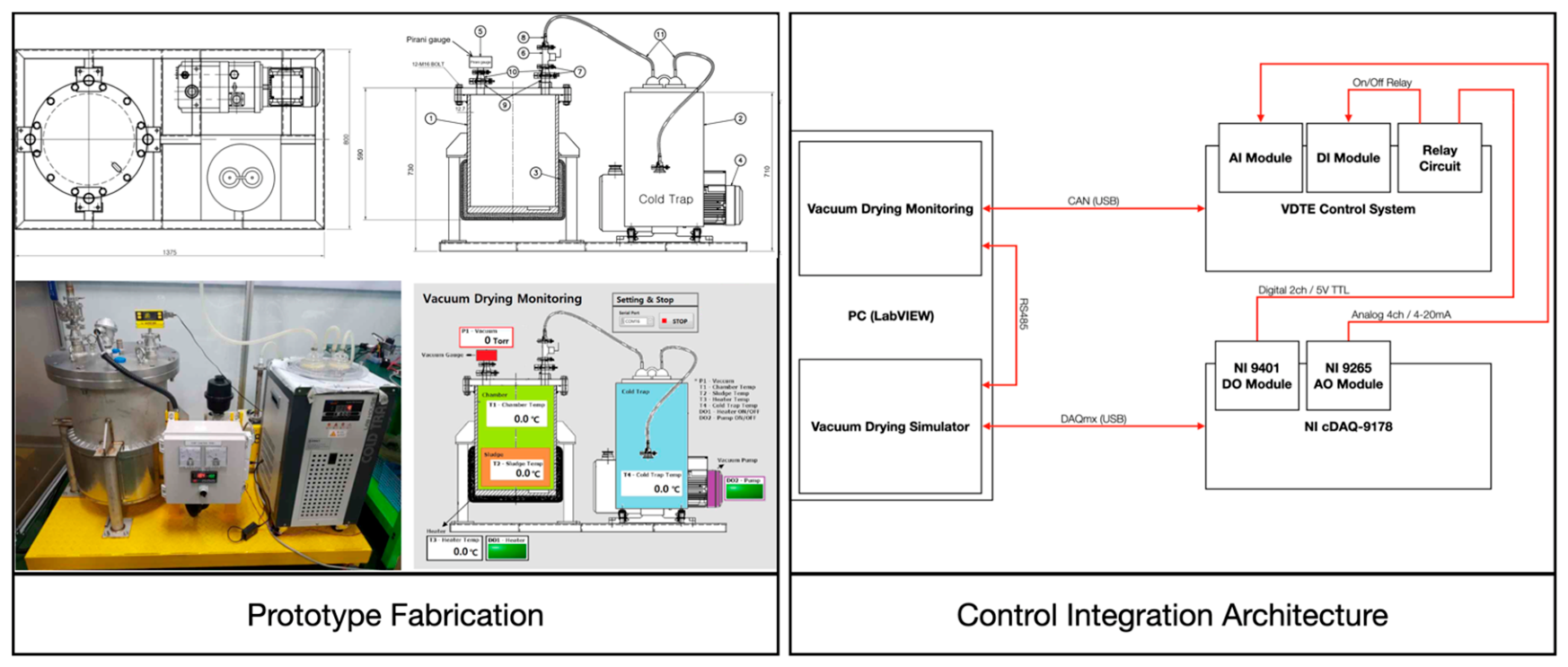
To validate the real-time operational feasibility of the proposed onboard vacuum drying system, an integrated prototype and HIL-based control platform were developed using LabVIEW and DAQ-based sensor interfaces [33,41,42].
As illustrated in Figure 9, the developed prototype consisted of a vacuum chamber, cold trap, vacuum pump, and integrated control modules configured for closed-loop vacuum drying operation. The implemented architecture enabled real-time sensor acquisition, actuator control, and operational status monitoring through LabVIEW-based supervisory control and NI cDAQ modules.
Figure 9.
Prototype development and HIL-based operational validation platform of the proposed onboard vacuum drying system.
The integrated prototype environment provided the engineering basis for subsequent HIL-based operational validation and abnormal condition testing.
The HIL framework was developed to verify whether the control logic and safety functions derived from the HAZID and FMECA analyses could appropriately respond to abnormal operating conditions without requiring hazardous physical testing.
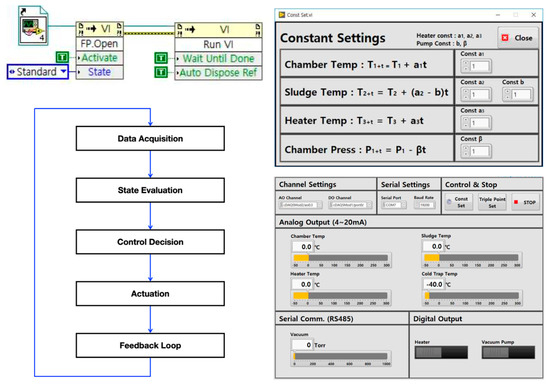
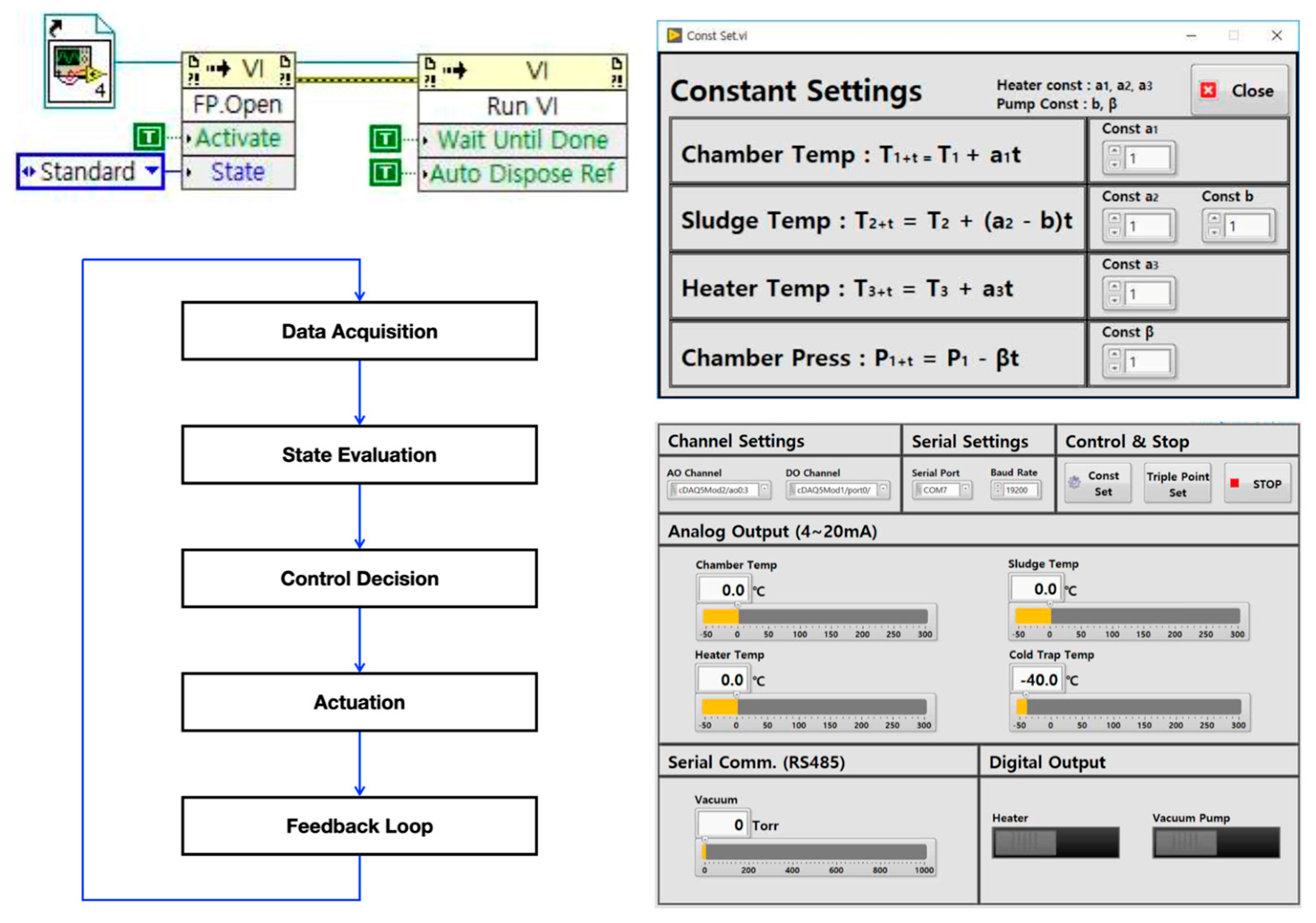
As presented in Figure 10, the HIL validation framework consisted of data acquisition, state evaluation, control decision, actuation, and feedback monitoring processes operating in a closed-loop configuration.
Figure 10.
HIL-based control validation framework and closed-loop operational verification process for the proposed onboard vacuum drying system.
The developed validation scenarios included overheating, overpressure, sensor failure, and vacuum loss conditions to verify system stability and emergency response logic under abnormal operating environments.
The validation results confirmed that the mitigation measures and safety functions identified through the HAZID and FMECA processes operated as intended under both normal and abnormal operating conditions (see Table 6).
Table 6.
HIL-based operational validation scenarios and verification results for abnormal operating conditions of the proposed onboard vacuum drying system.
The HIL-based validation results demonstrated stable vacuum maintenance at approximately 3 Torr for more than 30 min under continuous operating conditions.
The experimental results additionally confirmed stable heater control, sensor signal acquisition, vacuum pump operation, alarm activation, and fail-safe shutdown performance during both normal and abnormal operating conditions.
Collectively, the structural integrity assessment, modal analysis, prototype verification, and HIL-based operational validation demonstrated that the proposed closed-loop vacuum drying system satisfies the required structural safety, dynamic stability, and operational reliability criteria. These results provide engineering evidence supporting the practical applicability of the proposed system for onboard EGCS sludge treatment.
7. Experimental Performance Validation
Experimental performance tests were conducted to evaluate the vacuum generation capability and moisture reduction performance of the proposed onboard vacuum drying system under representative operating conditions [12,16,17,18,20].
The experimental validation aimed to verify vacuum generation capability, operational stability, and moisture reduction performance under integrated system operating conditions.
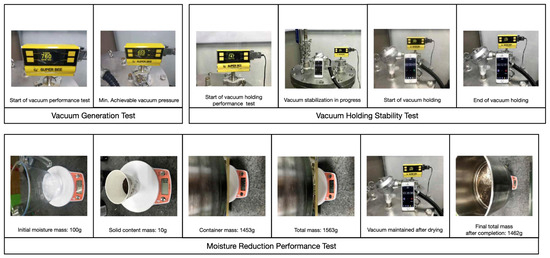
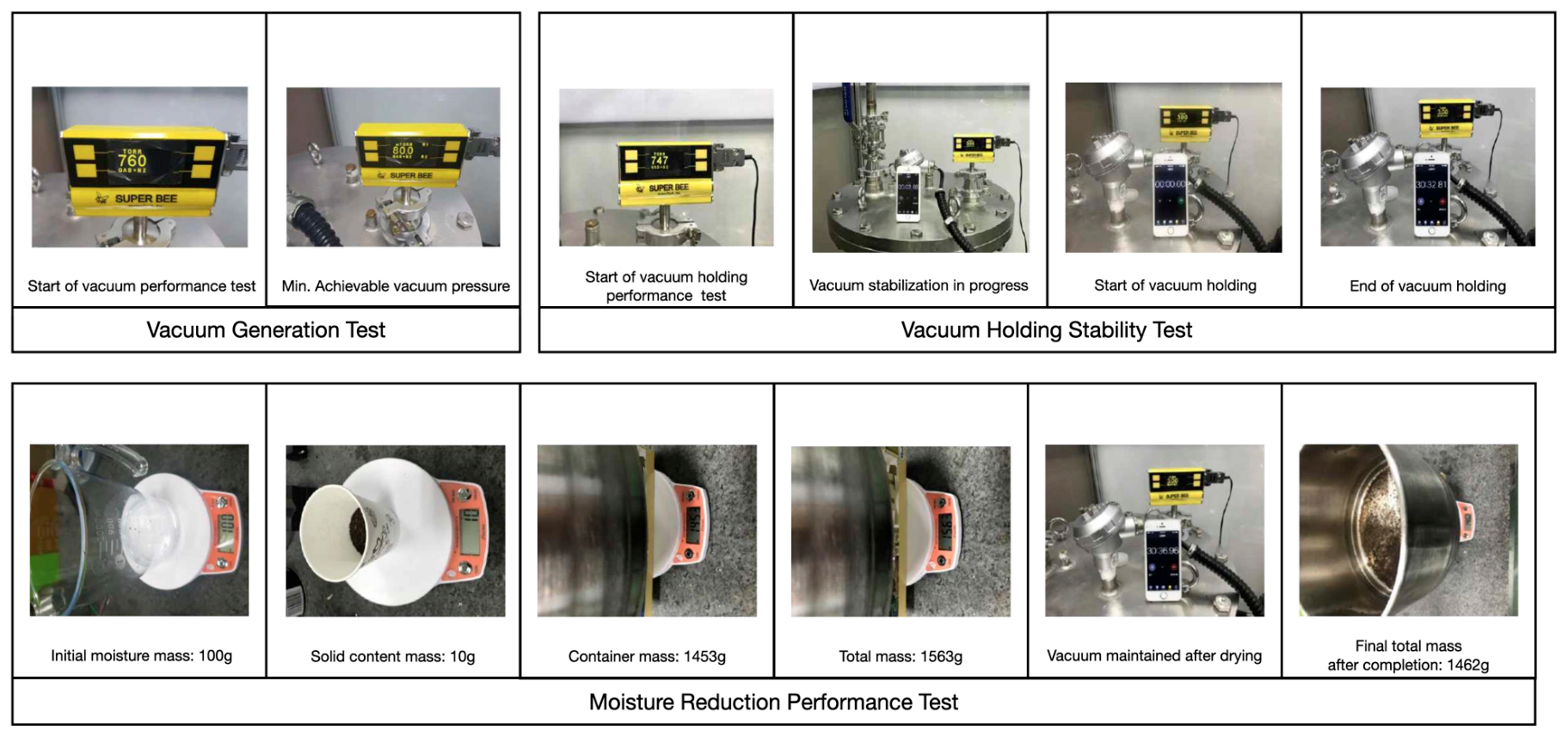
As illustrated in Figure 11, the proposed system successfully achieved vacuum generation from atmospheric pressure (approximately 747 Torr) to a minimum pressure of approximately 0.08 Torr. During drying operation, the chamber pressure was maintained at the designated operating vacuum level of approximately 3 Torr to ensure stable process conditions [18,30,31].
Figure 11.
Experimental validation process and moisture reduction performance test of the proposed onboard vacuum drying system under vacuum operating conditions.
The vacuum holding test demonstrated stable maintenance of the designated vacuum level for more than 30 min without significant pressure fluctuation.
The quantitative experimental results for sludge drying performance and moisture reduction under vacuum operating conditions are summarized in Table 7.
Table 7.
Experimental results of vacuum performance and moisture reduction for the proposed onboard vacuum drying system.
The moisture reduction performance was evaluated using a prepared specimen consisting of 10 g of solid content and 100 g of added water. The specimen was placed in a container with a mass of 1453 g, resulting in a total initial mass of 1563 g. After the vacuum drying process, the final total mass was measured as 1462 g. The moisture reduction rate was calculated based on the mass of the added water, as follows:
The result of approximately 100% reported in this study corresponds to the calculated value of 101% within the experimental uncertainty of the weighing system. The vacuum generation and holding tests also confirmed a minimum chamber pressure of 0.080 Torr and stable maintenance of 3.0 Torr for 30 min. These experimental results are based on official performance tests conducted by accredited testing institutes.
Moisture reduction performance tests were additionally conducted using representative sludge samples under controlled vacuum drying conditions [12,16,17,20].
The experimental results indicated that the initial total mass decreased from 1563 g to 1462 g after the drying process. The measured mass reduction was approximately 100 g, which was consistent with the nominal moisture content assigned to the sludge specimen prior to testing.
Given that the sludge sample represented only a small fraction of the total measured mass, including the container system, the moisture removal efficiency was interpreted as approximately 100% within the range of experimental uncertainty.
The overall drying process was completed within approximately 0.5 h, demonstrating effective moisture reduction capability and stable operational performance of the proposed system.
The overall drying process was completed within approximately 0.5 h, demonstrating effective moisture reduction capability and stable operational performance of the proposed system. Together with the vacuum generation and holding performance results, these findings confirm that the proposed closed-loop vacuum drying system can achieve stable vacuum operation and effective moisture reduction under representative operating conditions, thereby supporting its practical applicability for onboard EGCS sludge treatment.
8. Conclusions
This study proposed a risk-informed systems engineering framework for the design, reliability evaluation, and operational validation of an onboard vacuum drying system (VDS) for EGCS sludge treatment. The framework integrates functional analysis, hazard identification (HAZID), structural integrity assessment using finite element analysis (FEA), failure modes, effects, and criticality analysis (FMECA), design refinement, hardware-in-the-loop (HIL) validation, and experimental testing into a unified engineering process.
Structural integrity assessment confirmed that the maximum stresses under vacuum operating conditions remained well below the allowable limits specified by ASME Section VIII Division 1. Modal analysis further indicated acceptable dynamic stability, although theoretical resonance proximity with the vacuum pump excitation frequency was identified. The FMECA-based reliability evaluation identified critical failure modes associated with vacuum leakage, cooling degradation, temperature instability, and control system malfunction. Through subsequent design refinement, the Risk Priority Numbers (RPNs) of major components were reduced by 50–67%, with an average reduction of 53.3%. HIL-based validation and prototype testing confirmed that the implemented safety functions and control logic operated as intended under both normal and abnormal conditions. Experimental performance tests demonstrated stable vacuum generation to a minimum pressure of 0.08 Torr, maintenance of the designated operating pressure of 3 Torr for more than 30 min, and effective moisture reduction of the sludge specimen.
The primary contribution of this study lies in the methodological structure of the proposed framework rather than in the individual application of established techniques. Unlike conventional systems engineering processes, which typically apply risk assessment tools in a sequential and largely one-directional manner, the present framework establishes a closed-loop risk feedback mechanism. In this mechanism, hazards identified through HAZID are transferred as primary inputs to the FMECA, and the resulting high-RPN failure modes directly determine the priority and content of design refinements. These risk-driven design modifications—such as sealing reinforcement, cold-trap optimization, sensor redundancy, and thermal interlock logic—are then verified through HIL scenarios that deliberately reproduce the same abnormal conditions identified in the preceding risk analyses. This continuous linkage among risk quantification, design optimization, and operational validation constitutes the core novelty of the framework.
The major contributions of this study can be summarized as follows:
- Development of a closed-loop risk-informed engineering framework that systematically links hazard identification, quantitative reliability assessment, structural verification, and operational validation for onboard vacuum drying systems;
- Demonstration of risk-driven design optimization, resulting in an average RPN reduction of 53.3% for major critical components;
- Structural and dynamic integrity assessment of the vacuum chamber under representative operating conditions;
- HIL-based verification of safety and control functions under abnormal operating scenarios; and
- Experimental confirmation of vacuum generation capability and moisture reduction performance.
The proposed framework provides a practical engineering template for the development of similar onboard environmental treatment systems operating under multi-physics marine conditions. Nevertheless, the present validation was conducted on a laboratory-scale prototype. Future work should therefore include long-term onboard testing under realistic ship motion and vibration environments, experimental modal validation under actual excitation conditions, and the integration of digital-twin-based condition monitoring for enhanced operational reliability.
Author Contributions
Conceptualization, J.-I.B., Y.I.P. and Y.-T.S.; methodology, J.-I.B. and J.-H.K.; validation, Y.I.P. and Y.-T.S.; formal analysis, J.-I.B.; investigation, Y.-T.S. and J.-H.K.; writing—original draft preparation, J.-I.B.; writing—review and editing, Y.I.P. and J.-H.K.; visualization, Y.I.P.; supervision, Y.I.P.; project administration, Y.I.P.; funding acquisition, J.-H.K. All authors have read and agreed to the published version of the manuscript.
Funding
This research was conducted as part of the Shipbuilding and Offshore Industry Technology Development Program funded by the Ministry of Trade, Industry and Energy and the Korea Planning & Evaluation Institute of Industrial Technology (Project No.: RS-2024-00508455).
Institutional Review Board Statement
Not applicable.
Informed Consent Statement
Not applicable.
Data Availability Statement
The data presented in this study are available on request from the corresponding author.
Conflicts of Interest
The authors declare no conflicts of interest.
Abbreviations
The following abbreviations are used in this manuscript:
| ASME | American Society of Mechanical Engineers |
| CBM | Condition Based Maintenance |
| DAQ | Data Acquisition |
| ECA | Emission Control Area |
| EGCS | Failure Modes, Effects, and Criticality Analysis |
| FEA | Finite Element Analysis |
| FFBD | Functional Flow Block Diagram |
| FMECA | Failure Modes, Effects, and Criticality Analysis |
| FTA | Fault Tree Analysis |
| HAZID | Hazard Identification |
| HIL | Hardware-in-the-Loop |
| IEC | International Electrotechnical Commission |
| IMO | International Maritime Organization |
| ISO | International Organization for Standardization |
| MAC | Modal Assurance Criterion |
| NOx | Nitrogen Oxides |
| RAS | Requirement Allocation Sheet |
| RPN | Risk Priority Number |
| SBD | System Block Diagram |
| SOx | Sulfur Oxides |
| VDS | Vacuum Drying System |
| WTS | Water Treatment System |
References
- International Maritime Organization. MARPOL Annex VI: Regulations for the Prevention of Air Pollution from Ships; International Maritime Organization: London, UK, 2020. [Google Scholar]
- Srivastava, R.K.; Jozewicz, W. Flue gas desulfurization: The state of the art. J. Air Waste Manag. Assoc. 2001, 51, 1676–1688. [Google Scholar] [CrossRef] [Scilit] [PubMed]
- Xing, G.; Wang, W.; Zhao, S.; Zhang, S.; Gao, J. Application of Ca-based adsorbents in fixed-bed dry flue gas desulfurization (FGD): A critical review. Environ. Sci. Pollut. Res. 2023, 30, 76471–76490. [Google Scholar] [CrossRef] [Scilit] [PubMed]
- Yang, Z.; Zhang, D.; Wang, J.; Wang, Y. Selection of techniques for reducing shipping NOx and SOx emissions. Transp. Res. Part D Transp. Environ. 2012, 17, 478–486. [Google Scholar] [CrossRef] [Scilit]
- Brynolf, S.; Magnusson, M.; Fridell, E.; Andersson, K. Compliance options for the IMO 2015 ECA regulations: An evaluation from a lifecycle perspective. Transp. Res. Part D Transp. Environ. 2014, 28, 30–41. [Google Scholar] [CrossRef] [Scilit]
- Endres, S.; Maes, F.; Hopkins, F.; Houghton, K.; Mårtensson, E.M.; Oeffner, J.; Quack, B.; Singh, P.; Turner, D. A new perspective at the ship-air-sea interface: The environmental impacts of exhaust gas scrubber discharge. Front. Mar. Sci. 2018, 5, 139. [Google Scholar] [CrossRef] [Scilit]
- Teuchies, J.; Cox, T.J.S.; Van Itterbeeck, K.; Meysman, F.J.R.; Blust, R. The impact of scrubber discharge on the water quality in estuaries and ports. Environ. Sci. Eur. 2020, 32, 103. [Google Scholar] [CrossRef] [Scilit]
- Ytreberg, E.; Hassellöv, I.M.; Nylund, A.T.; Ziko, M.; Schøyen, M.; Jutterström, S. Effects of scrubber washwater discharge on microplankton in the Baltic Sea. Mar. Pollut. Bull. 2019, 145, 316–324. [Google Scholar] [CrossRef] [Scilit] [PubMed]
- Fytili, D.; Zabaniotou, A. Utilization of sewage sludge in EU application of old and new methods—A review. Renew. Sustain. Energy Rev. 2008, 12, 116–140. [Google Scholar] [CrossRef] [Scilit]
- Appels, L.; Baeyens, J.; Degrève, J.; Dewil, R. Principles and potential of the anaerobic digestion of waste-activated sludge. Prog. Energy Combust. Sci. 2008, 34, 755–781. [Google Scholar] [CrossRef] [Scilit]
- Silva, C.M.; Langrish, T.A.G. Hydrothermal and thermal drying of sewage sludge: Energy efficiency and environmental impacts. Water Res. 2012, 46, 4783–4794. [Google Scholar] [CrossRef] [Scilit] [PubMed]
- Rao, B.; Wang, G.; Xu, P. Recent advances in sludge dewatering and drying technology. Dry. Technol. 2022, 40, 3049–3063. [Google Scholar] [CrossRef] [Scilit]
- International Maritime Organization. MEPC.340(77): 2021 Guidelines for Exhaust Gas Cleaning Systems (EGCS); International Maritime Organization: London, UK, 2021. [Google Scholar]
- International Maritime Organization. MEPC.259(68): 2015 Guidelines for Exhaust Gas Cleaning Systems (EGCS); International Maritime Organization: London, UK, 2015. [Google Scholar]
- International Maritime Organization. MEPC.1/Circ.900: Guidance Regarding the Delivery of EGCS Residues to Port Reception Facilities; International Maritime Organization: London, UK, 2022. [Google Scholar]
- Mujumdar, A.S. Handbook of Industrial Drying, 4th ed.; CRC Press: Boca Raton, FL, USA, 2014. [Google Scholar]
- Kudra, T.; Mujumdar, A.S. Advanced Drying Technologies; CRC Press: Boca Raton, FL, USA, 2009. [Google Scholar]
- Zhang, H.; Su, L.; Lv, T.; Dong, K. Coupling heat pump and vacuum drying technology for urban sludge processing. Energy Procedia 2019, 158, 1804–1810. [Google Scholar] [CrossRef] [Scilit]
- Wang, Y.; Li, S.; Yuan, G.; Chen, G.; Zhang, S.; Wu, X. Release characteristics and control of hydrogen sulfide during thermal drying of municipal wastewater sludge. J. Mater. Cycles Waste Manag. 2018, 20, 946–954. [Google Scholar] [CrossRef] [Scilit]
- Hsu, T.; Chiou, J.-S. Vacuum drying for ultrafine alumina powders. Dry. Technol. 2011, 29, 566–572. [Google Scholar] [CrossRef] [Scilit]
- Blanchard, B.S.; Fabrycky, W.J. Systems Engineering and Analysis, 5th ed.; Pearson: London, UK, 2011. [Google Scholar]
- Ebeling, C.E. An Introduction to Reliability and Maintainability Engineering; McGraw-Hill: Columbus, OH, USA, 1997. [Google Scholar]
- IEC 60812; Failure Modes and Effects Analysis (FMEA and FMECA). International Electrotechnical Commission: Geneva, Switzerland, 2018.
- Modarres, M.; Kaminskiy, M.; Krivtsov, V. Reliability Engineering and Risk Analysis; CRC Press: Boca Raton, FL, USA, 2016. [Google Scholar]
- Kaplan, S.; Garrick, B.J. On the quantitative definition of risk. Risk Anal. 1981, 1, 11–27. [Google Scholar] [CrossRef] [Scilit]
- Stamatis, D.H. Failure Mode and Effect Analysis: FMEA from Theory to Execution; ASQ: Milwaukee, WI, USA, 2003. [Google Scholar]
- Bae, J.I.; Park, Y.I.; Park, J.W. Quantitative reliability evaluation for cryogenic impact test equipment. Appl. Sci. 2025, 15, 11280. [Google Scholar] [CrossRef] [Scilit]
- Center for Chemical Process Safety. Guidelines for Hazard Evaluation Procedures; AIChE: New York, NY, USA, 2008. [Google Scholar]
- International Council on Systems Engineering. Systems Engineering Handbook; Wiley: Hoboken, NJ, USA, 2015. [Google Scholar]
- Macdonald, R.; Middlewood, P. Development and characterisation of a vacuum flash evaporator for concentrating a heat sensitive aqueous peptide stream. Desalination 2008, 218, 238–247. [Google Scholar] [CrossRef] [Scilit]
- Buana, I.; Kosasih, E.A.; Kılıç, M.; Zikri, A.; Satmoko, A.; Fauzi, M.B. Enhancing evaporation in vacuum freeze drying: Optimizing airflow in horizontally-connected chambers. Case Stud. Therm. Eng. 2025, 75, 106930. [Google Scholar] [CrossRef] [Scilit]
- American Society of Mechanical Engineers. Boiler and Pressure Vessel Code, Section VIII, Division 1: Rules for Construction of Pressure Vessels (UG-28 External Pressure Design); American Society of Mechanical Engineers: New York, NY, USA, 2023. [Google Scholar]
- Isermann, R.; Schaffnit, J.; Sinsel, S. Hardware-in-the-loop simulation for the design and testing of engine-control systems. Control Eng. Pract. 1999, 7, 643–653. [Google Scholar] [CrossRef] [Scilit]
- ISO 12100:2010; Safety of Machinery—Risk Assessment and Risk Reduction. International Organization for Standardization: Geneva, Switzerland, 2010.
- MIL-STD-1629A; Procedures for Performing a Failure Mode, Effects and Criticality Analysis (FMECA). U.S. Department of Defense: Washington, DC, USA, 1980.
- IEC 61882; Hazard and Operability Studies (HAZOP). International Electrotechnical Commission: Geneva, Switzerland, 2016.
- Timoshenko, S.; Gere, J.M. Theory of Elastic Stability, 2nd ed.; McGraw-Hill: Columbus, OH, USA, 1961. [Google Scholar]
- Solangi, E.; Albarody, T.M.B.; Al-Challabi, S.; Khan, J.A.; Ali, S. Design and failure analysis of a vacuum pressure vessel for aerospace applications using finite element analysis (FEA). Eng. Technol. Appl. Sci. Res. 2024, 14, 17888–17893. [Google Scholar] [CrossRef] [Scilit]
- Guan, W.; Zhu, Y.; Wang, W.; Wang, F.; Zhang, J.; Wu, Y.; Zheng, Z. Experimental and numerical buckling analysis of carbon fiber composite cylindrical shells under external pressure. Ocean Eng. 2023, 275, 114134. [Google Scholar] [CrossRef] [Scilit]
- Wang, W.; Cai, G.; Zhou, J. Large-scale vacuum vessel design and finite element analysis. Chin. J. Aeronaut. 2012, 25, 189–197. [Google Scholar] [CrossRef] [Scilit]
- Qin, J.S. Survey on data-driven industrial process monitoring and diagnosis. Annu. Rev. Control 2012, 36, 220–234. [Google Scholar] [CrossRef] [Scilit]
- Venkatasubramanian, V.; Rengaswamy, R.; Yin, K.; Kavuri, S.N. A review of process fault detection and diagnosis: Part I. Quantitative model-based methods. Comput. Chem. Eng. 2003, 27, 293–311. [Google Scholar] [CrossRef] [Scilit]

Disclaimer/Publisher’s Note: The statements, opinions and data contained in all publications are solely those of the individual author(s) and contributor(s) and not of MDPI and/or the editor(s). MDPI and/or the editor(s) disclaim responsibility for any injury to people or property resulting from any ideas, methods, instructions or products referred to in the content. |
© 2026 by the authors. Licensee MDPI, Basel, Switzerland. This article is an open access article distributed under the terms and conditions of the Creative Commons Attribution (CC BY) license.