


Abstract
We propose matchgate benchmarking for a Rydberg atom processor. Matchgate benchmarking characterizes a continuously parametrized family of two-qubit gates generated by the XY interaction, and it is both scalable and resistant to state preparation and measurement errors. On the Rydberg platform, the native dipole–dipole interaction between two Rydberg states realizes this XY interaction. We show that the interaction maps to quadratic Majorana operators and therefore generates matchgates, and we describe how the full generalized matchgate set can be realized using the native interaction, single-qubit rotations, and a microwave-driven bit-flip between the two Rydberg states. We implement the protocol in numerical simulations with realistic noise and confirm that it recovers the gate fidelity while remaining resistant to the latter. Our results establish matchgate benchmarking as a practical tool for characterizing Rydberg processors that use the native XY interaction.
1. Introduction
Neutral atoms trapped in optical tweezer arrays have become a promising platform for quantum simulation and quantum computation [1,2,3,4,5]. Individual atoms can be arranged in one-, two-, and three-dimensional geometries with single-site control [6,7,8], and strong interactions are mediated by excitation to Rydberg states [9,10,11]. These capabilities have enabled the study of quantum magnetism [12,13,14,15], the preparation of large entangled states [16,17], and the implementation of quantum optimization [18,19,20] and error-correction protocols [5,21,22,23]. As the number of atoms and the depth of the applied operations continue to grow, accurate characterization of the underlying quantum operations becomes increasingly important [24,25,26].
Randomized benchmarking (RB) is the standard tool for characterizing the quality of quantum gates [27,28,29,30,31]. In the conventional approach, random sequences of Clifford gates of increasing length are applied, and the average error per gate is extracted from the decay of a survival probability. Because the result is obtained from a decay rate rather than from individual measurements, RB is resistant to state preparation and measurement (SPAM) errors, and it has been applied successfully across superconducting, trapped-ion, and semiconductor platforms.
Standard Clifford RB has two features that limit its use in some settings. First, it characterizes only discrete gate sets, whereas many near-term applications rely on continuously parametrized gates. Second, it reports a single averaged error that mixes the contributions of different gate types. To address these limitations, matchgate benchmarking was recently proposed [32,33]. Matchgates form a continuous family of two-qubit gates generated by XY, XX, or YY spin interactions. They are efficiently simulable on a classical computer through their connection to non-interacting fermions, which makes the protocol scalable. Matchgate benchmarking addresses both of these limitations. It characterizes a continuously parametrized gate family directly rather than a discrete set. Instead of a single averaged error, it resolves the noise into separate decay rates, called Majorana fidelities, while retaining the scalability and SPAM resistance of standard RB.
The Rydberg platform provides a native realization of the matchgate generators. A spin-1/2 can be encoded in two dipole-coupled Rydberg states. The resonant dipole–dipole interaction then takes the form of an XY exchange coupling, and a microwave field drives the transitions between the two states [34], similar to the superconducting circuits demonstrated previously [35]. This XY interaction has been widely used for the quantum simulation of spin transport and quantum magnetism [36,37,38,39,40,41]. It has also been proposed as a continuously parametrized two-qubit gate, with recent work realizing native iSWAP and exchange gates on neutral-atom processors at high fidelity [42]. The XY interaction is exactly the interaction that generates matchgates. The Rydberg platform is therefore a natural setting for matchgate benchmarking. To our knowledge, however, this has not yet been considered for Rydberg systems.
In this paper, we develop matchgate benchmarking for a Rydberg atom processor. We first show how the Rydberg XY interaction maps to quadratic Majorana operators and thus generates matchgates. We then describe how the full generalized matchgate set can be realized on a Rydberg platform using the native XY interaction, single-qubit Z rotations, and a microwave-driven bit-flip between the two Rydberg states. We implement the benchmarking protocol in numerical simulations that include realistic dephasing, spontaneous emission, and SPAM errors based on experimental parameters, and we confirm that the protocol extracts the Majorana fidelities while remaining resistant to SPAM. Finally, we discuss how the long-range tail of the dipolar interaction, which lies outside the matchgate group, can be addressed as the system is scaled to more qubits.
This paper is organized as follows. Section 2 reviews the Rydberg XY Hamiltonian and its mapping to matchgates through the Majorana representation. Section 3 presents the matchgate benchmarking protocol and describes its realization on a Rydberg processor. Section 4 reports numerical simulations of the protocol under a realistic noise model. Section 5 discusses the long-range tail of the dipolar interaction and its implications for scaling, and Section 6 concludes the paper.
2. Background
2.1. Rydberg XY Hamiltonian
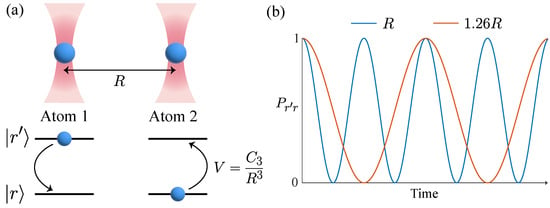
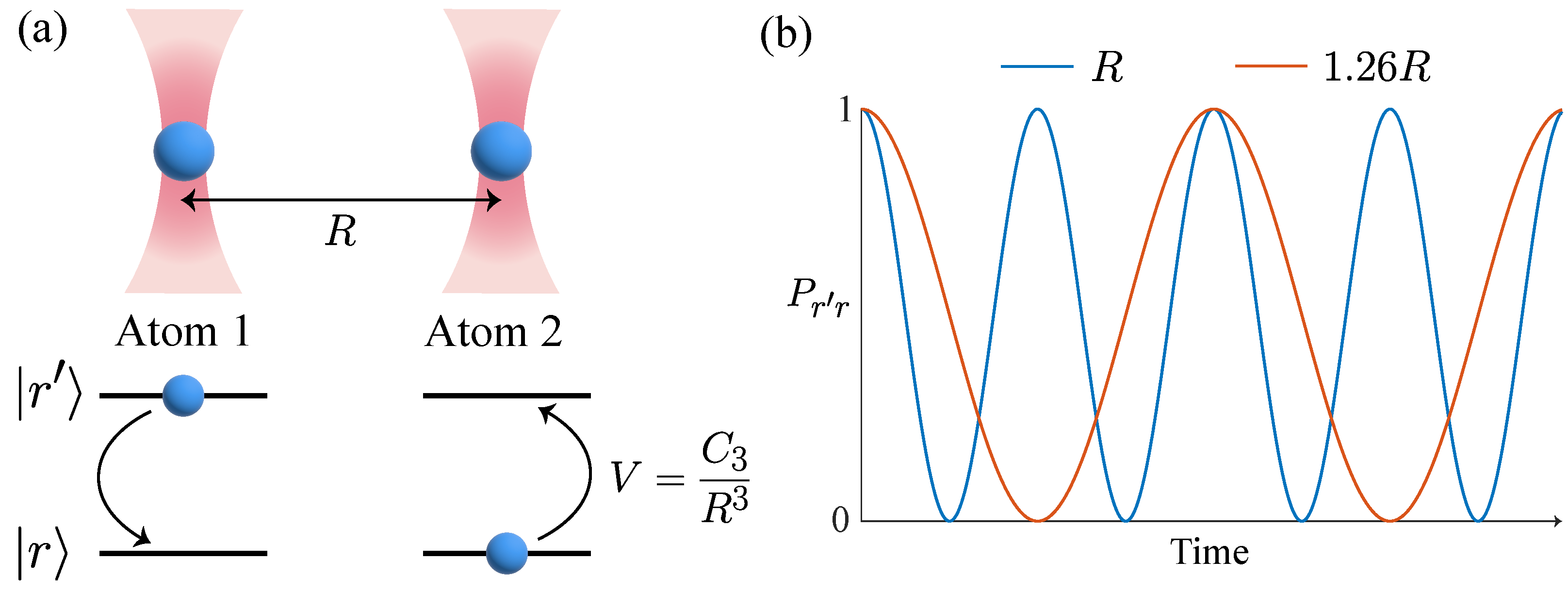
Figure 1 illustrates the XY interaction between two Rydberg atoms. Each atom encodes a spin-1/2 in two dipole-coupled Rydberg states, and . When two atoms are separated by a distance R, the resonant dipole–dipole interaction exchanges these states between the atoms. This exchange is the flip-flop process shown in Figure 1b, and its strength is , where is the dipolar coefficient.
Figure 1.
Rydberg XY interaction. (a) Two atoms held in optical tweezers and separated by a distance R encode a spin-1/2 in two dipole-coupled Rydberg states and . The resonant dipole–dipole interaction exchanges the two states between the atoms, with strength . (b) Flip-flop dynamics of a single excitation, showing the probability of remaining in the initial configuration as a function of time, for distances R and . The factor of 1.26 in distance halves the coupling and doubles the period.
We consider a one-dimensional chain of such atoms. The Hamiltonian governing the nearest-neighbor XY interaction is
where are the raising and lowering operators on the atom i, and is the coupling between the atoms i and . The operator moves an excitation from atom to atom i, so the Hamiltonian conserves the total number of excitations. In terms of the Pauli operators, the same Hamiltonian reads as
which is the form that gives the interaction its name.
The XY interaction generates a continuously parametrized two-qubit gate. The evolution of the Hamiltonian for a time t produces the unitary , and the rotation angle is set by the interaction time. This gate is the basic building block of the benchmarking protocol, and we show in the following that it belongs to the matchgate group.
2.2. Matchgates and the Majorana Representation
To connect the XY interaction to matchgates, we map the spin operators to fermions through the Jordan–Wigner transformation. This transformation expresses each spin operator in terms of fermionic creation and annihilation operators,
where the string operator enforces the fermionic anticommutation relations. Applying this transformation to the nearest-neighbor term removes the string operator, and the XY Hamiltonian becomes a simple hopping of free fermions,
The fermionic form is most useful when written in terms of Majorana operators. We define two Majorana operators per site,
which are Hermitian and satisfy . In this representation, the XY Hamiltonian takes the quadratic form
in which every term is a product of exactly two Majorana operators. A Hamiltonian of this kind is called quadratic, and the unitaries it generates are matchgates.
The defining property of a matchgate is its action on the Majorana operators. A matchgate unitary U transforms the Majorana operators among themselves,
where R is the rotation in and n is the number of atoms. This is the same physics as the Hamiltonian evolution described above, written from the point of view of how the operators rotate. Because a matchgate is fully specified by the matrix R, rather than by the full unitary, matchgate circuits can be simulated efficiently on a classical computer. This efficiency is what makes the benchmarking protocol scalable.
The matchgates generated by the XY interaction form the group , which corresponds to the rotations . The benchmarking protocol requires the larger generalized matchgate group , obtained by adding a bit-flip on the last atom. This bit-flip corresponds to a reflection, so that realizes the entire orthogonal group . We describe the physical implementation of in Section 3.
3. Matchgate Benchmarking on a Rydberg Processor
3.1. Matchgate Benchmarking Protocol
The matchgate benchmarking protocol estimates the quality of generalized matchgate circuits in a way that is scalable in the number of atoms and resistant to SPAM errors. Its output is a set of decay parameters , called Majorana fidelities, one for each value of . Each characterizes the noise acting in the subspace spanned by the products of the k Majorana operators.
The protocol consists of many rounds with varying parameters. Each round uses a fixed value of k and a fixed sequence length m, and proceeds as follows:
- (i)
- Prepare the initial state. The all-zero state is prepared for even k, and the all-plus state for odd k.
- (ii)
- Apply a sequence of m generalized matchgate unitaries , each chosen uniformly at random from the generalized matchgate group .
- (iii)
- Measure all atoms. The measurement is on the computational basis (Z) for even k and on the Hadamard basis (X) for odd k.
- (iv)
- Repeat steps (i)–(iii) many times to estimate the probabilities of the measurement outcomes .
- (v)
- Compute the correlation function , where is the combined rotation. The correlation function is defined aswhere is the ideal initial state, is the measurement operator for the outcome x, and is the projector onto the subspace spanned by the products of the k Majorana operators. The constant normalizes so that the average is equal to one for a noiseless circuit. The correlation function uses the ideal unitary without noise , while the probabilities in step (iv) come from the noisy experiment. This separation isolates the noise from the decay parameters. Both and are efficiently evaluated using the classical simulability of the matchgates.
- (vi)
- Calculate the empirical averagewhere K is the number of random sequences at the length of the sequence m, and are the measured frequencies for the i-th sequence.
- (vii)
- Repeat steps (i)–(vi) for several sequence lengths m, and fit the result to a single exponential decay,The decay rate gives the Majorana fidelity , while the prefactor absorbs the SPAM errors. Because is extracted from the decay rate rather than the absolute values, the protocol is resistant to SPAM.
Repeating the procedure for all yields the full set of Majorana fidelities. The average gate fidelity of a random generalized matchgate then follows from
The role of the two SPAM settings deserves a comment. The initial state and measurement basis are chosen so that the prefactor is nonzero. For even k with Z-basis SPAM, and for odd k with X-basis SPAM, the prefactor is large and the fit is well conditioned. The opposite choices give a vanishing prefactor and no signal, which is why the two settings are used for different values of k.
3.2. Realization on a Rydberg Processor
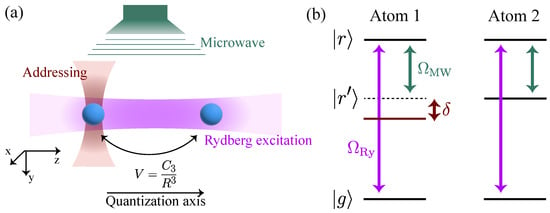
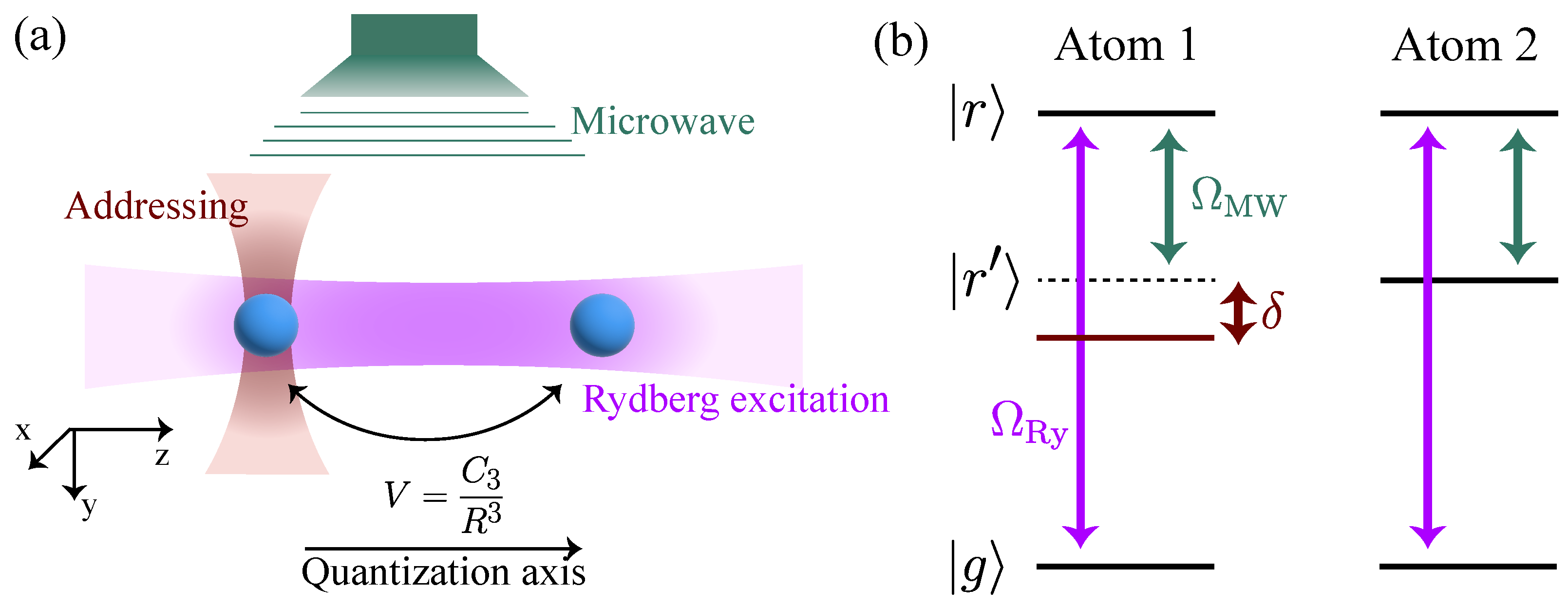
Figure 2 illustrates the implementation of the generalized matchgate set on a Rydberg processor. The qubit is encoded in two Rydberg states, and . As an example, for 87Rb atoms, and can be mapped to and , respectively [36]. Two atoms are excited from the ground state (, for example) by a global laser at Rabi frequency , and the two Rydberg states are coupled by a global microwave field at Rabi frequency . A separate addressing beam applies a local AC Stark shift to a single atom. The generalized matchgate set is built from three operations performed with these tools.
Figure 2.
Implementation of the generalized matchgate set on a Rydberg processor. (a) Two atoms are excited to Rydberg states by a global excitation beam and interact through the dipole–dipole coupling . A global microwave field drives transitions between the two Rydberg states, and an addressing beam applies a local AC Stark shift to atom 1. (b) Energy levels of the two atoms. The qubit is encoded in the two Rydberg states and , which are coupled by the microwave field at Rabi frequency . The ground state is connected to by the excitation laser at Rabi frequency , and is used for state preparation and readout. The addressing beam introduces a relative detuning between and on atom 1, which takes its microwave transition off resonance and allows the bit-flip to act on a single atom.
The XY interaction is the native dipole–dipole coupling. When both atoms are in the Rydberg manifold, the resonant interaction exchanges the two states between the atoms. Letting this interaction evolve for a time t realizes the XY gate, with the rotation angle set by the interaction time. No additional driving is required, since the interaction is always present once the atoms are excited. The single-qubit Z rotation is applied through the AC Stark shift of the addressing beam. Shifting the energy of a Rydberg state on one atom accumulates a relative phase between and , which is a rotation about the Z axis. The rotation angle is set by the strength and duration of the shift.
The bit-flip on the last atom is realized by the microwave field. A global microwave -pulse drives the transition on every atom at once. To restrict the flip to a single atom, the addressing beam introduces a relative detuning between and on the other atoms, taking their microwave transition off resonance. The detuned atoms are then unaffected by the pulse, and the flip acts only on the addressed atom. This scheme extends directly to a chain of n atoms: the same global -pulse is applied, while the addressing beam detunes the atoms that should not flip, so that the transition remains resonant only on the target atom. Applying distinct light shifts to selected atoms in this way is standard on the dipolar Rydberg platform, where a spatial light modulator generates the addressing pattern and holographic techniques place independently tunable beams on chosen sites [40]. This is the operation that lifts the matchgates to the generalized matchgate group.
One condition must be met for the bit-flip to be clean. The dipole–dipole interaction remains active during the microwave pulse, so the microwave Rabi frequency must be large compared to the interaction strength, , for the flip and the exchange to separate. This ratio is an experimental design parameter. It can be increased by choosing Rydberg states with a larger transition dipole moment, so a clean separation is reached once exceeds V by a sufficient factor.
Finally, the protocol requires preparing the all-plus state for odd k and measuring in the X basis. Both follow from the same microwave field applied as a -pulse. A global -pulse rotates into for state preparation, and the same pulse before readout rotates the X basis onto the Z basis. The measurement itself is the standard state-selective readout, in which the population of is detected through de-excitation to the ground state .
The benchmarking protocol draws each generalized matchgate uniformly at random, which we now connect to the three operations above. A generalized matchgate is fully specified by its orthogonal matrix , and a random element is obtained by sampling R from the Haar measure on by standard methods [32]. Following Ref. [32], the sampled R is compiled by decomposing it into a sequence of Givens rotations, each acting on a pair of adjacent Majorana modes. Each Givens rotation is implemented by the native nearest-neighbor XY evolution together with single-qubit Z rotations, and the reflection that distinguishes from the proper rotations is provided by the bit-flip . A general element requires of order Givens rotations, which parallelize into a circuit of depth , and the nearest-neighbor structure of the decomposition matches the connectivity of the 1D chain without additional swap operations. In our numerical simulation the same Haar-random elements are generated directly by exponentiating a random quadratic Majorana Hamiltonian, which produces the identical rotation R without reference to a particular gate decomposition. The Givens decomposition itself is exact, so compilation introduces no separate error; the only imperfection is the noise carried by the native gates that realize each rotation, which is exactly the noise characterized by the Majorana fidelities.
4. Numerical Simulation and Feasibility
4.1. Noise Model and Error Budget
We simulate the benchmarking protocol for two atoms under a realistic noise model. The model includes three error channels that are dominant on the Rydberg platform: thermal dephasing, spontaneous emission, and SPAM errors. The parameters of each channel are chosen to match the experimental conditions of a Rydberg chain.
Thermal dephasing arises from the thermal motion of the atoms, which randomizes the dipole–dipole interaction and the accumulated phase. We model it as a phase-damping channel with a rate per gate. This value is set by the thermal position spread of the atoms, together with other quasi-static dephasing sources. Using the example states of Section 3.2, for which [36], a coupling corresponds to a separation . In the harmonic approximation, an atom at temperature T in a tweezer of waist and depth has a position spread , which for , , and gives . The separation then fluctuates by , and since the coupling fluctuates by , giving a coherent phase error of order per gate. Combined with other quasi-static sources such as laser phase noise and magnetic-field fluctuations, this motivates the conservative value . This is the dominant error in the simulation, consistent with the dephasing-limited coherence reported for Rydberg XY spin chains [36].
Spontaneous emission arises from the finite lifetime of the Rydberg states. We model it as an amplitude-damping channel with rate per gate. This rate is derived from the ratio of the gate time to the Rydberg lifetime. The gate time is set by the interaction strength , and for a coupling of MHz and a lifetime of order 100 μs [43], the resulting per-gate error is of the order of a few times . SPAM errors arise from imperfect state preparation and readout. We model them as a preparation error with probability and a measurement error with probability , following the experimental analysis of Rydberg state preparation and readout [43]. These values are larger than the gate errors, which is typical of the Rydberg platform, where readout relies on de-excitation and state-selective detection.
The correlation function is computed from the ideal, noiseless evolution, while the measurement probabilities come from the noisy evolution. This separation, described in Section 3, is what makes Majorana fidelities insensitive to SPAM. In terms of the extracted fidelities, thermal dephasing is the leading phase-accumulating channel and dominates the decay of for , while spontaneous emission contributes less; the SPAM errors accumulate no phase during the evolution and are absorbed into the prefactors rather than the decay rates.
4.2. Benchmarking Results
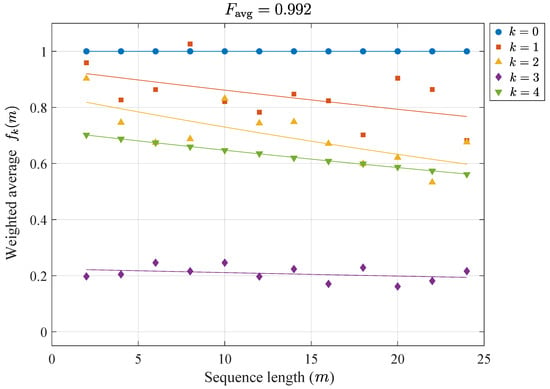
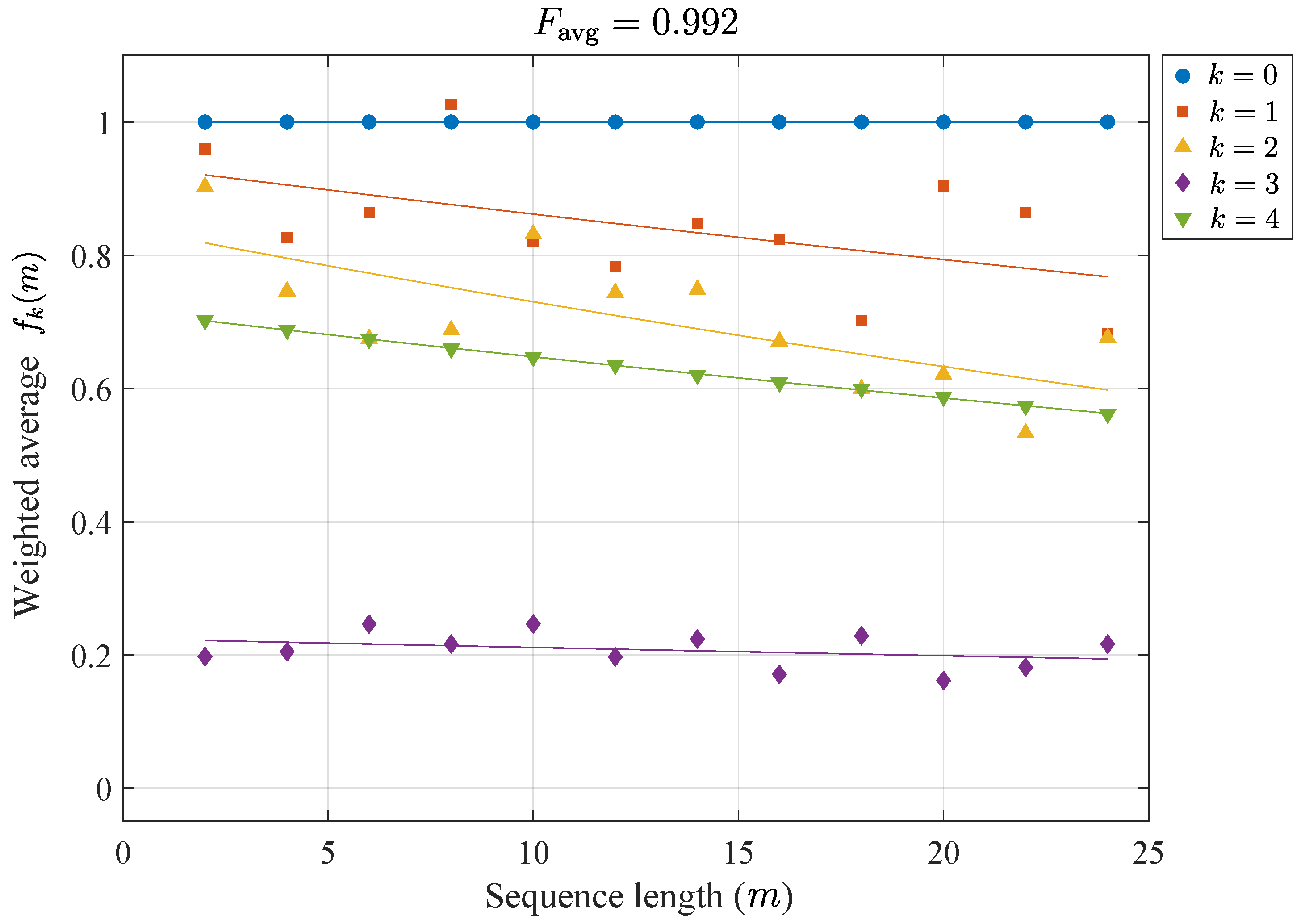
Figure 3 shows the result of the simulation for two atoms. We used random sequences in each of the sequence lengths . The empirical average is plotted against m for each , and each curve is fit to a single exponential to extract the Majorana fidelity . The curve for stays flat at one, so that . This is expected because the subspace corresponds to the identity and is not affected by any trace-preserving noise. The remaining curves decay, and their decay rates give the Majorana fidelities for the higher subspaces. We obtain , , , , and .
Figure 3.
Matchgate benchmarking of a two-atom Rydberg processor, simulated with realistic noise. Each marker is the empirical average for , plotted against the sequence length m, and the solid lines are single-exponential fits . The decay rate of each curve gives the Majorana fidelity . The simulation includes thermal dephasing, spontaneous emission, and state preparation and measurement (SPAM) errors based on experimental parameters. The curve for stays flat at one, confirming that is preserved. The SPAM errors lower the prefactors but leave the decay rates unchanged, which is the expected SPAM resistance of the protocol. The average gate fidelity extracted from the Majorana fidelities is .
The simulation confirms the SPAM resistance of the protocol. The SPAM errors lower the prefactors , which is visible as the offset of the curves below one at short sequence lengths. However, the decay rates are unchanged. Because the average gate fidelity depends only on the decay rates and not on the prefactors, the SPAM errors do not bias the result.
The average gate fidelity follows from the Majorana fidelities through Equation (11). For the noise model used here, we obtain . This value is consistent with the per-gate error of the simulated channels, and confirms that the protocol recovers the gate fidelity under realistic Rydberg noise.
4.3. Experimental Feasibility
The simulation above establishes the performance of the protocol under the dominant error channels. A full experimental realization must additionally contend with several platform-specific error sources, which we now discuss to assess the feasibility of the protocol. We do not include these in the simulation; instead, we summarize their typical magnitudes on the dipolar XY platform and the conditions under which they remain subdominant [38,40].
Microwave Rabi-frequency drift, from fluctuations of the microwave and addressing-beam intensities, produces over- and under-rotation of the single-qubit gates. The light shifts that set these rotations have been calibrated to a dispersion of about 1% on this platform [40], comparable to the dephasing modeled above. Off-resonant microwave crosstalk arises because the -pulse that implements is off-resonant on the atoms that should not flip, detuned only by the Stark shift , so the residual rotation scales as and is suppressed in the regime ; the condition that keeps the flip clean therefore also controls this crosstalk. In a chain of n atoms, the same pulse addresses all off-target atoms at once, and since each is detuned by , the residual rotation per atom does not grow with the length of the chain. Addressing-beam leakage onto neighboring atoms is set by the ratio of the beam waist, of order [40], to the interatomic spacing , and is negligible at this separation. AC Stark phase errors from the addressing beam are deterministic Z rotations that are calibrated out by design, leaving only a residual set by the light-shift inhomogeneity, again at the percent level [40]. Finally, atom loss from the finite Rydberg lifetime, background-gas collisions, and the ponderomotive force of the addressing beam has been measured at the percent-per-operation level on this platform [38,40]; because a lost atom is heralded by its absence at readout, these events can be removed by post-selection.
Some of these sources are already partly represented in the simulation: the Rabi and Stark drifts contribute to the quasi-static dephasing folded into , and atom loss overlaps with the spontaneous-emission channel . Achieving the average gate fidelity reported above therefore requires these coherent errors to be held at the percent-per-gate level, consistent with the values quoted above for the current platform.
The statistical cost of the protocol also scales favorably with the number of atoms. The number of random sequences K is set by the variance of the estimator , which in the noise-free limit is bounded by [32]. Reaching a target statistical uncertainty therefore requires sequences, with no exponential growth in the number of atoms, so a target precision of or is reached at a polynomial cost. The finite shot count per sequence contributes through the same factor without additional n-dependence. Estimating the full set of Majorana fidelities requires repeating this over the subspaces and the chosen sequence lengths, with each matchgate realized at depth , so the total experimental time also grows polynomially in n. Both correlation functions and outcome probabilities are efficiently evaluated using the classical simulability of match gates [32], so classical post-processing does not become a bottleneck. In the two-atom simulation reported here we used random sequences per length and sequence lengths , matching the original two-qubit demonstration [32]; the outcome probabilities were evaluated exactly, so that the extracted fidelities reflect the protocol itself rather than finite-shot noise.
5. Discussion
Scaling this protocol to more qubits requires taking into account the long-range interaction between distant atoms, since the dipolar coupling decays as a power law and does not vanish beyond the nearest neighbors. As a concrete example, consider a three-atom linear chain with the XY Hamiltonian,
where with the nearest-neighbor interatomic distance R and the last term is the next-nearest-neighbor coupling. Under the Jordan–Wigner transformation, the nearest-neighbor terms map to quadratic Majorana operators and remain inside the matchgate group. However, the next-nearest-neighbor term picks up the occupation operator of the central atom, which raises it to the fourth order in the Majorana operators, given by
This term is non-quadratic, so the Hamiltonian no longer lies within the matchgate group and is therefore not efficiently simulable for a large-scale system.
The strength of this term is set by the next-nearest-neighbor coupling, which is a factor of smaller than the nearest-neighbor coupling in Equation (12). Over a gate time , it therefore accumulates a coherent phase of order , corresponding to a fractional deviation from ideal matchgate behavior of order for an equally spaced three-atom chain. This sets the scale of the error introduced by the beyond-nearest-neighbor tail for the first atom beyond the pair, and it decreases rapidly for more distant atoms because of the decay.
It describes a hopping between the outer atoms that depends on whether the central atom is occupied, which makes the fermionic system effectively interacting. We note that this term has no effect in the single-excitation regime of conventional spin-transport, and appears only when several excitations are present, as in matchgate benchmarking. The long-range tail therefore need not be viewed only as a source of infidelity. Instead, it suggests a route toward using matchgate benchmarking as a diagnostic of interaction-induced many-body physics on Rydberg hardware, such as the density-assisted hopping and incommensurate spectra behind the collapse-and-revival dynamics observed in few-atom chains [44].
Such coherent XY dynamics have already been observed on the dipolar Rydberg platform, for example in the spin-exchange spectra measured through quench dynamics [41]. Our formalism offers a complementary way to analyze these experiments. The Majorana fidelities obey a set of relations whenever the evolution is purely nearest-neighbor and thus described by free fermions. A measured departure from these relations is then a direct, SPAM-resistant signature of the beyond-nearest-neighbor terms that make the fermions interact. This turns the long-range tail from a limitation into a probe of the interaction-induced physics unique to the Rydberg XY platform.
Realizing this diagnostic requires extending the protocol from the two-atom demonstration presented here to chains of three or more atoms, where the beyond-nearest-neighbor terms first become active. This is a natural next step, and it suggests a route toward using matchgate benchmarking not only to characterize gate quality but also to probe many-body physics.
6. Conclusions
In summary, we have proposed matchgate benchmarking for a Rydberg atom processor. The native XY interaction between two dipole-coupled Rydberg states maps to quadratic Majorana operators, so that the interaction generates matchgates. We described how the full generalized matchgate set can be realized on the platform using the native XY interaction, single-qubit Z rotations from an addressing beam, and a microwave-driven bit-flip between the two Rydberg states. We then implemented the protocol in numerical simulations with realistic noise, including thermal dephasing, spontaneous emission, and SPAM errors, and confirmed that it recovers the Majorana fidelities and the average gate fidelity while remaining resistant to SPAM. We emphasize that the present work establishes the feasibility and SPAM resistance of the protocol for a two-atom system. The numerical demonstration and the extracted average gate fidelity apply to this two-qubit setting, and scaling the protocol to longer chains, where the beyond-nearest-neighbor terms become active, is left as a natural next step for future work. These results establish matchgate benchmarking as a practical tool for characterizing Rydberg processors that use the native XY interaction.
Funding
This research was supported by the National Research Foundation of Korea (NRF) under Grant No. RS-2024-00337653, funded by the Korea government (MSIT).
Institutional Review Board Statement
Not applicable.
Informed Consent Statement
Not applicable.
Data Availability Statement
The original contributions presented in this study are included in the article. Further inquiries can be directed to the corresponding author.
Conflicts of Interest
The author declares no conflicts of interest.
Abbreviations
The following abbreviations are used in this manuscript:
| RB | Randomized benchmarking |
| SPAM | State preparation and measurement |
References
- Morgado, M.; Whitlock, S. Quantum simulation and computing with Rydberg-interacting qubits. AVS Quantum Sci. 2021, 3, 023501. [Google Scholar] [CrossRef] [Scilit]
- Browaeys, A.; Lahaye, T. Many-body physics with individually controlled Rydberg atoms. Nat. Phys. 2020, 16, 132–142. [Google Scholar] [CrossRef] [Scilit]
- Saffman, M. Quantum computing with atomic qubits and Rydberg interactions: Progress and challenges. J. Phys. B At. Mol. Opt. Phys. 2016, 49, 202001. [Google Scholar] [CrossRef] [Scilit]
- Bluvstein, D.; Evered, S.J.; Geim, A.A.; Li, S.H.; Zhou, H.; Manovitz, T.; Ebadi, S.; Cain, M.; Kalinowski, M.; Hangleiter, D.; et al. Logical quantum processor based on reconfigurable atom arrays. Nature 2024, 626, 58–65. [Google Scholar] [PubMed]
- Bluvstein, D.; Geim, A.A.; Li, S.H.; Evered, S.J.; Bonilla Ataides, J.P.; Baranes, G.; Gu, A.; Manovitz, T.; Xu, M.; Kalinowski, M.; et al. A fault-tolerant neutral-atom architecture for universal quantum computation. Nature 2026, 649, 39–46. [Google Scholar] [PubMed]
- Endres, M.; Bernien, H.; Keesling, A.; Levine, H.; Anschuetz, E.R.; Krajenbrink, A.; Senko, C.; Vuletić, V.; Greiner, M.; Lukin, M.D. Atom-by-atom assembly of defect-free one-dimensional cold atom arrays. Science 2016, 354, 1024–1027. [Google Scholar] [CrossRef] [Scilit] [PubMed]
- Barredo, D.; de Léséleuc, S.; Lienhard, V.; Lahaye, T.; Browaeys, A. An atom-by-atom assembler of defect-free arbitrary two-dimensional atomic arrays. Science 2016, 354, 1021. [Google Scholar] [CrossRef] [Scilit] [PubMed]
- Barredo, D.; Lienhard, V.; de Léséleuc, S.; Lahaye, T.; Browaeys, A. Synthetic three-dimensional atomic structures assembled atom by atom. Nature 2018, 561, 79–82. [Google Scholar] [CrossRef] [Scilit] [PubMed]
- Saffman, M.; Walker, T.G.; Mølmer, K. Quantum information with Rydberg atoms. Rev. Mod. Phys. 2010, 82, 2313–2363. [Google Scholar] [CrossRef] [Scilit]
- Urban, E.; Johnson, T.A.; Henage, T.; Isenhower, L.; Yavuz, D.D.; Walker, T.G.; Saffman, M. Observation of Rydberg blockade between two atoms. Nat. Phys. 2009, 5, 110–114. [Google Scholar] [CrossRef] [Scilit]
- Gaëtan, A.; Miroshnychenko, Y.; Wilk, T.; Chotia, A.; Viteau, M.; Comparat, D.; Pillet, P.; Browaeys, A.; Grangier, P. Observation of collective excitation of two individual atoms in the Rydberg blockade regime. Nat. Phys. 2009, 5, 115–118. [Google Scholar] [CrossRef] [Scilit]
- Ebadi, S.; Wang, T.T.; Levine, H.; Keesling, A.; Semeghini, G.; Omran, A.; Bluvstein, D.; Samajdar, R.; Pichler, H.; Wei Ho, W.; et al. Quantum phases of matter on a 256-atom programmable quantum simulator. Nature 2021, 595, 227–232. [Google Scholar] [CrossRef] [Scilit] [PubMed]
- Qiao, M.; Emperauger, G.; Chen, C.; Homeier, L.; Hollerith, S.; Bornet, G.; Martin, R.; Gély, B.; Klein, L.; Barredo, D.; et al. Realization of a doped quantum antiferromagnet in a Rydberg tweezer array. Nature 2025, 644, 889–895. [Google Scholar] [CrossRef] [Scilit] [PubMed]
- Scholl, P.; Schuler, M.; Williams, H.J.; Eberharter, A.A.; Barredo, D.; Schymik, K.-N.; Lienhard, V.; Henry, L.-P.; Lang, T.C.; Lahaye, T.; et al. Quantum simulation of 2D antiferromagnets with hundreds of Rydberg atoms. Nature 2021, 595, 233–238. [Google Scholar] [CrossRef] [Scilit] [PubMed]
- Kim, M. Data-Driven Quantum Simulation of Artificial Quantum Materials with Rydberg Atoms. Materials 2026, 19, 1758. [Google Scholar] [CrossRef] [Scilit] [PubMed]
- Omran, A.; Levine, H.; Keesling, A.; Semeghini, G.; Wang, T.T.; Ebadi, S.; Bernien, H.; Zibrov, A.S.; Pichler, H.; Scholl, P.; et al. Generation and manipulation of Schrödinger cat states in Rydberg atom arrays. Science 2019, 365, 570–574. [Google Scholar] [CrossRef] [Scilit] [PubMed]
- Shaw, A.L.; Chen, Z.; Choi, J.; Mark, D.K.; Scholl, P.; Finkelstein, R.; Elben, A.; Choi, S.; Endres, M. Benchmarking highly entangled states on a 60-atom analogue quantum simulator. Nature 2024, 628, 71–77. [Google Scholar] [CrossRef] [Scilit] [PubMed]
- Ebadi, S.; Keesling, A.; Cain, M.; Wang, T.T.; Levine, H.; Bluvstein, D.; Semeghini, G.; Omran, A.; Liu, J.-G.; Samajdar, R.; et al. Quantum optimization of maximum independent set using Rydberg atom arrays. Science 2022, 376, 1209–1215. [Google Scholar] [CrossRef] [Scilit] [PubMed]
- Nguyen, M.-T.; Liu, J.-G.; Wurtz, J.; Lukin, M.D.; Wang, S.-T.; Pichler, H. Quantum Optimization with Arbitrary Connectivity Using Rydberg Atom Arrays. PRX Quantum 2023, 4, 010316. [Google Scholar] [CrossRef] [Scilit]
- Bombieri, L.; Zeng, Z.; Tricarico, R.; Lin, R.; Notarnicola, S.; Cain, M.; Lukin, M.D.; Pichler, H. Quantum Adiabatic Optimization with Rydberg Arrays: Localization Phenomena and Encoding Strategies. PRX Quantum 2025, 6, 020306. [Google Scholar] [CrossRef] [Scilit]
- Chung, W.C.; Cole, D.C.; Gokhale, P.; Jones, E.B.; Kuper, K.W.; Mason, D.; Omole, V.; Radnaev, A.G.; Rines, R.; Teo, M.H.; et al. Fault-tolerant operation and materials science with neutral atom logical qubits. Npj Quantum Inf. 2025, 11, 193. [Google Scholar] [CrossRef] [Scilit]
- Zhang, B.; Liu, G.; Bornet, G.; Horvath, S.P.; Peng, P.; Ma, S.; Huang, S.; Puri, S.; Thompson, J.D. Logical qubits with erasure conversion using metastable neutral atoms. Nat. Phys. 2026, 22, 910–916. [Google Scholar] [CrossRef] [Scilit]
- Perrin, H.; Jandura, S.; Pupillo, G. Quantum Error Correction resilient against Atom Loss. Quantum 2025, 9, 1884. [Google Scholar] [CrossRef] [Scilit]
- Graham, T.M.; Song, Y.; Scott, J.; Poole, C.; Phuttitarn, L.; Jooya, K.; Eichler, P.; Jiang, X.; Marra, A.; Grinkemeyer, B.; et al. Multi-qubit entanglement and algorithms on a neutral-atom quantum computer. Nature 2022, 604, 457–462. [Google Scholar] [CrossRef] [Scilit] [PubMed]
- Manetsch, H.J.; Nomura, G.; Bataille, E.; Lv, X.; Leung, K.H.; Endres, M. A tweezer array with 6100 highly coherent atomic qubits. Nature 2025, 647, 60–67. [Google Scholar] [CrossRef] [Scilit] [PubMed]
- Chiu, N.-C.; Trapp, E.C.; Guo, J.; Abobeih, M.H.; Stewart, L.M.; Hollerith, S.; Stroganov, P.L.; Kalinowski, M.; Geim, A.A.; Evered, S.J.; et al. Continuous operation of a coherent 3000-qubit system. Nature 2025, 646, 1075–1080. [Google Scholar] [CrossRef] [Scilit] [PubMed]
- Knill, E.; Leibfried, D.; Reichle, R.; Britton, J.; Blakestad, R.B.; Jost, J.D.; Langer, C.; Ozeri, R.; Seidelin, S.; Wineland, D.J. Randomized benchmarking of quantum gates. Phys. Rev. A 2008, 77, 012307. [Google Scholar] [CrossRef] [Scilit]
- Xia, T.; Lichtman, M.; Maller, K.; Carr, A.W.; Piotrowicz, M.J.; Isenhower, L.; Saffman, M. Randomized Benchmarking of Single-Qubit Gates in a 2D Array of Neutral-Atom Qubits. Phys. Rev. Lett. 2015, 114, 100503. [Google Scholar] [CrossRef] [Scilit] [PubMed]
- Nikolov, B.; Diamond-Hitchcock, E.; Bass, J.; Spong, N.L.R.; Pritchard, J.D. Randomized Benchmarking Using Nondestructive Readout in a Two-Dimensional Atom Array. Phys. Rev. Lett. 2023, 131, 030602. [Google Scholar] [CrossRef] [Scilit] [PubMed]
- Evered, S.J.; Bluvstein, D.; Kalinowski, M.; Ebadi, S.; Manovitz, T.; Zhou, H.; Li, S.H.; Geim, A.A.; Wang, T.T.; Maskara, N.; et al. High-fidelity parallel entangling gates on a neutral-atom quantum computer. Nature 2023, 622, 268–272. [Google Scholar] [CrossRef] [Scilit] [PubMed]
- Hashim, A.; Nguyen, L.B.; Goss, N.; Marinelli, B.; Naik, R.K.; Christolini, T.; Hines, J.; Marcoux, J.P.; Kim, Y.; Gokhale, P.; et al. Practical Introduction to Benchmarking and Characterization of Quantum Computers. PRX Quantum 2025, 6, 030202. [Google Scholar] [CrossRef] [Scilit]
- Helsen, J.; Nezami, S.; Reagor, M.; Walter, M. Matchgate benchmarking: Scalable benchmarking of a continuous family of many-qubit gates. Quantum 2022, 6, 657. [Google Scholar] [CrossRef] [Scilit]
- Claes, J.; Rieffel, E.; Wang, Z. Character Randomized Benchmarking for Non-Multiplicity-Free Groups with Applications to Subspace, Leakage, and Matchgate Randomized Benchmarking. PRX Quantum 2021, 2, 010351. [Google Scholar] [CrossRef] [Scilit]
- Browaeys, A.; Barredo, D.; Lahaye, T. Experimental investigations of dipole–dipole interactions between a few Rydberg atoms. J. Phys. B At. Mol. Opt. Phys. 2016, 49, 152001. [Google Scholar] [CrossRef] [Scilit]
- de Sá Neto, O.P.; de Oliveira, M.C.; Caldeira, A.O. Generation of superposition states and charge-qubit relaxation probing in a circuit. J. Phys. B At. Mol. Opt. Phys. 2011, 44, 135503. [Google Scholar] [CrossRef] [Scilit]
- Barredo, D.; Labuhn, H.; Ravets, S.; Lahaye, T.; Browaeys, A.; Adams, C.S. Coherent Excitation Transfer in a Spin Chain of Three Rydberg Atoms. Phys. Rev. Lett. 2015, 114, 113002. [Google Scholar] [CrossRef] [Scilit] [PubMed]
- de Léséleuc, S.; Barredo, D.; Lienhard, V.; Browaeys, A.; Lahaye, T. Optical Control of the Resonant Dipole-Dipole Interaction between Rydberg Atoms. Phys. Rev. Lett. 2017, 119, 053202. [Google Scholar] [CrossRef] [Scilit] [PubMed]
- Chen, C.; Bornet, G.; Bintz, M.; Emperauger, G.; Leclerc, L.; Liu, V.S.; Scholl, P.; Barredo, D.; Hauschild, J.; Chatterjee, S.; et al. Continuous symmetry breaking in a two-dimensional Rydberg array. Nature 2023, 616, 691–695. [Google Scholar] [CrossRef] [Scilit] [PubMed]
- Bornet, G.; Emperauger, G.; Chen, C.; Ye, B.; Block, M.; Bintz, M.; Boyd, J.A.; Barredo, D.; Comparin, T.; Mezzacapo, F.; et al. Scalable spin squeezing in a dipolar Rydberg atom array. Nature 2023, 621, 728–733. [Google Scholar] [CrossRef] [Scilit] [PubMed]
- Bornet, G.; Emperauger, G.; Chen, C.; Machado, F.; Chern, S.; Leclerc, L.; Gély, B.; Chew, Y.I.; Barredo, D.; Lahaye, T.; et al. Enhancing a Many-Body Dipolar Rydberg Tweezer Array with Arbitrary Local Controls. Phys. Rev. Lett. 2024, 132, 263601. [Google Scholar] [CrossRef] [Scilit] [PubMed]
- Chen, C.; Emperauger, G.; Bornet, G.; Caleca, F.; Gély, B.; Bintz, M.; Chatterjee, S.; Liu, V.; Barredo, D.; Yao, N.Y.; et al. Spectroscopy of elementary excitations from quench dynamics in a dipolar XY Rydberg simulator. Science 2025, 389, 483–487. [Google Scholar] [CrossRef] [Scilit] [PubMed]
- Ildefonso, P.; Byun, A.; Konovalov, A.; Kazemi, J.; Schuler, M.; Lechner, W. Expanding the Neutral Atom Gate Set: Native iSWAP and Exchange Gates from Dipolar Rydberg Interactions. arXiv 2025, arXiv:2512.05037v2. [Google Scholar]
- de Léséleuc, S.; Barredo, D.; Lienhard, V.; Browaeys, A.; Lahaye, T. Analysis of imperfections in the coherent optical excitation of single atoms to Rydberg states. Phys. Rev. A 2018, 97, 053803. [Google Scholar] [CrossRef] [Scilit]
- Chen, C.; Capizzi, L.; Marché, A.; Bornet, G.; Emperauger, G.; Lahaye, T.; Browaeys, A.; Fagotti, M.; Mazza, L. Observing weakly broken conservation laws in a dipolar Rydberg quantum spin chain. arXiv 2026, arXiv:2602.02251. [Google Scholar]
Disclaimer/Publisher’s Note: The statements, opinions and data contained in all publications are solely those of the individual author(s) and contributor(s) and not of MDPI and/or the editor(s). MDPI and/or the editor(s) disclaim responsibility for any injury to people or property resulting from any ideas, methods, instructions or products referred to in the content. |
© 2026 by the author. Licensee MDPI, Basel, Switzerland. This article is an open access article distributed under the terms and conditions of the Creative Commons Attribution (CC BY) license.