


Abstract
To address the difficulty of roof control in longwall paste backfill mining and to better capture the backfill’s ‘sequential bearing’ effect, this study proposes an elastic foundation beam model. Based on the Gaohe Coal Mine, the “coal-support-backfill” model incorporates the time-varying characteristics of paste materials. Analytical solutions for roof deflection and bending moment were derived to reveal the spatiotemporal evolutionary laws of key parameters on roof stability. Results show the filling rate is the most sensitive factor controlling ultimate roof subsidence, directly determining the roof’s actual suspended span and breaking risk. The final-set strength limits long-term deformation but exhibits a marginal diminishing effect. Conversely, early strength dominates the initial subsidence rate, preventing excessive early deformation. Additionally, increasing the filling step distance significantly increases overall subsidence, whereas support resistance improves the initial bending moment distribution. Ultimately, surrounding rock control in paste backfill stopes is a dynamic coupling of “spatial support synergy” and “temporal strength matching” providing a theoretical basis for optimizing mining safety, economy, and efficiency, which ultimately fosters sustainable green mining practices.
1. Introduction
Driven by the in-depth promotion of the “Dual Carbon” goals and the normalization of green mine construction, the coal industry is undergoing a critical transition from traditional high-energy-consumption models toward safety, efficiency, green, and intelligent directions [1,2,3]. Although the longwall caving method long-adopted in China has ensured resource supply, it has also triggered overlying strata instability and severe surface subsidence, causing persistent damage to ecological security [4,5]. Statistics indicate that mining-induced subsidence and the accumulation of coal gangue hills have led to complex pollution of the atmosphere, soil, and water resources, resulting in intensified pressure on ecological restoration [6,7,8]. To address this, the “Green Mining” concept pioneered by Academician Qian Minggao established a systematic framework for the synergy between resource utilization and environmental protection [9,10]. Against this backdrop, paste backfill mining technology has emerged as a vital technical path for scientific mining due to its significant advantages in solid waste disposal and subsidence control [11,12,13].
Extensive research has been conducted by domestic and international scholars regarding roof control in paste backfill stopes. In terms of mechanical model construction, the application of elastic foundation beam theory predominates. Chang et al. [14] and Song et al. [15] leveraged this theory to reveal the interaction mechanism of the “coal body-support-backfill” system. Liu et al. [16] proposed a continuous curved beam model, defining the critical control effect of the filling rate on roof deformation morphology. Zhen et al. [17] established a mechanical model for continuous surface beams to analyze the primary controlling factors of surface subsidence. Furthermore, Jia et al. [18] and Liu et al. [19] utilized elastic foundation beam models to analyze the control laws of filling step distance and backfill strength on the roof.
To build a comprehensive understanding of these operations within our research continuum, our prior studies systematically investigated the macroscopic overlying strata movement and mine-pressure weakening laws during thick coal paste backfilling, establishing the critical conditions for roof stability through discrete-element simulations and field measurements [20]. Building upon this, we further optimized key operational parameters—such as the filling step distance, final cured strength, and backfilling ratio—based on the time-dependent strength growth of the paste to ensure strict surface protection [21].
However, while these preceding works successfully provided macroscopic, numerical, and empirical guidance for the E1302 working face, as a cementitious material with strong time-dependency, the mechanical properties of paste backfill grow dynamically with curing time, which is crucial for early-stage roof control [22,23,24]. Regarding the early-age strength properties, Zhang et al. [25] investigated the development of filling paste and its flow characteristics, Kremieniewski [26] demonstrated that the resulting cement sheath is significantly influenced by cementitious agents, and Zhou et al. [27] analyzed the stability and strength improvement of unclassified tailing paste. Furthermore, to capture the time-dependent behavior mathematically, Lu and Fall [28] modeled wave propagation in an evolutive porous material, while Gao et al. [29] and Cheng et al. [30] proposed nonlinear constitutive models and creep hardening-damage mechanisms considering curing time. Despite these advancements, existing roof control theories mostly simplify the backfill as an elastic foundation with constant stiffness [31,32,33]. The dynamic matching relationship between the strength growth rate of the backfill and the roof subsidence rate in both time and space is generally neglected. This leads to an insufficient consideration of the “sequential bearing” effect in current analytical models, making it difficult to theoretically guide the continuous spatiotemporal interaction between the roof strata and the dynamically hardening backfill [34,35].
Aiming at the above theoretical bottlenecks, this paper takes the E1302 longwall paste backfill working face of Gaohe Coal Mine as the engineering background to construct a “coal-support-backfill” coupled bearing mechanical model considering the time-varying strength characteristics of the backfill. It systematically reveals the spatiotemporal evolutionary laws of key mining and filling parameters on roof stability. The main contributions of this paper are:
- (1)
- Construction of a spatiotemporally coupled roof control mechanical model: The roof is simplified as a multi-span continuous beam supported by an elastic foundation consisting of the coal body, hydraulic supports, and the dynamically hardening backfill. The analytical solutions for global deflection and bending moment were derived and obtained, facilitating a quantitative evaluation of the dynamic effect of the backfill’s “sequential bearing”.
- (2)
- Quantitative revelation of the evolutionary mechanisms of multi-parameter roof control: The differentiated contributions of the filling rate, filling step distance, and staged backfill strength to roof deformation control were systematically defined. This provides a quantitative basis and theoretical guidance for achieving a comprehensive optimization of “safety, economy, and efficiency” in backfill stopes.
2. Materials and Engineering Background
2.1. Engineering Geology
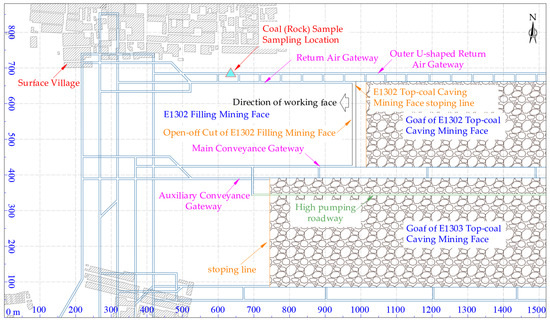
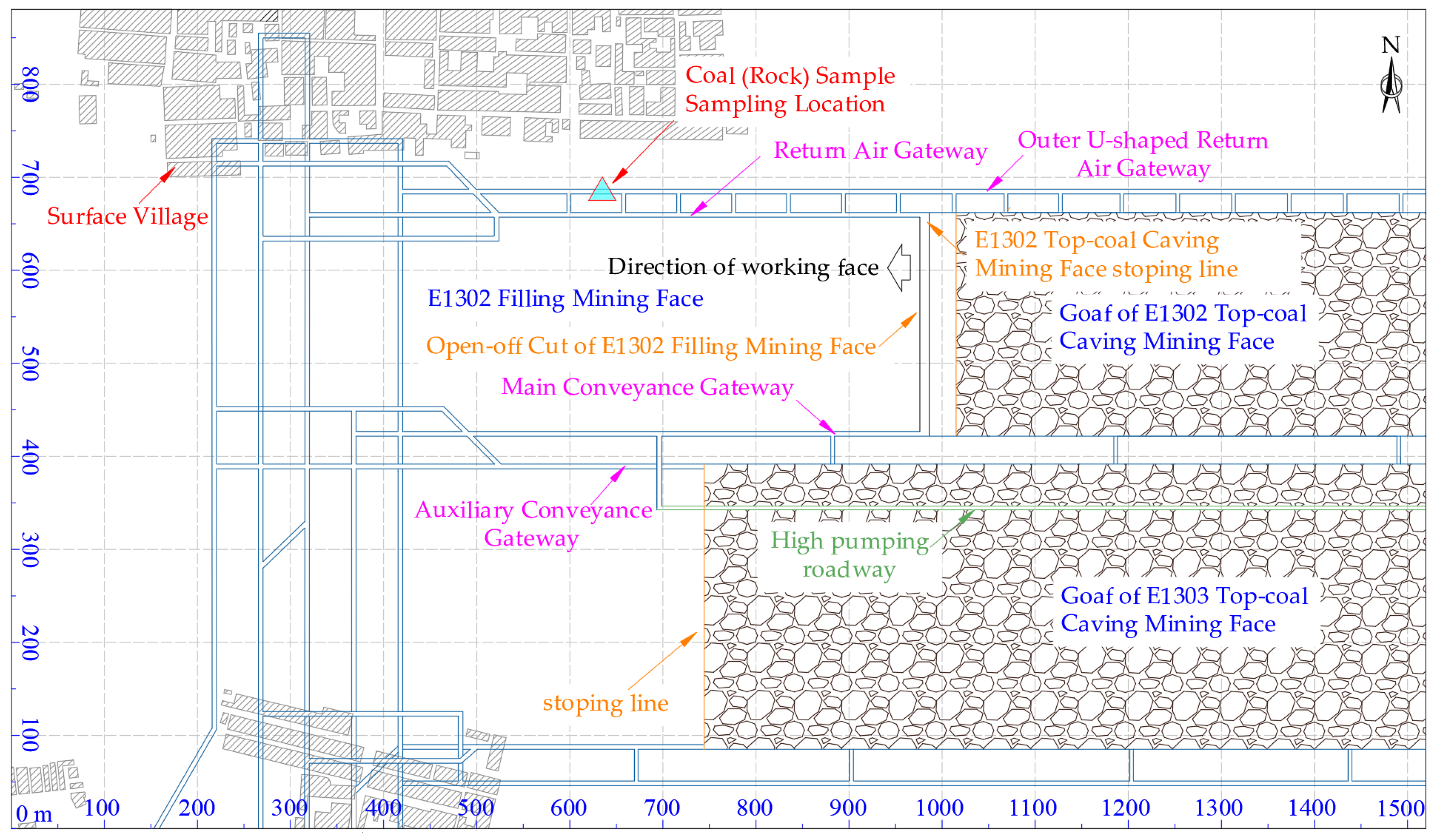
The research is based on the E1302 longwall paste backfill working face in the Gaohe Coal Mine. The Gaohe Coal Mine, located in the Lu’an mining area, has an approved production capacity of 7.5 million t/a, with a total of 372 million tons of coal trapped under buildings, railways, and water bodies. As shown in Figure 1, when the E1302 top-coal caving working face advanced to 600 m from the main roadway, a surface village was located 170 m ahead of the working face. To liberate the coal trapped under the village, the E1302 longwall paste backfill working face was arranged to the west of the E1302 top-coal caving working face. The northern side of this working face is the mine boundary, the southern side is the goaf of the E1303 top-coal caving working face, and the eastern side is the goaf of the E1302 top-coal caving working face.
Figure 1.
Layout of the E1302 paste backfill working face.
The working face primarily mines the No. 3 coal seam, which has an average thickness of 6.38 m, an average burial depth of 408 m, and an average dip angle of 8°. A slicing backfill mining technology is employed, where the 3.5 m thick upper slice is mined first, followed by the 2.88 m thick lower slice. The stringent requirements for subsidence control dictated by the surface village urgently demand an accurate analytical understanding of the evolutionary laws of roof deformation.
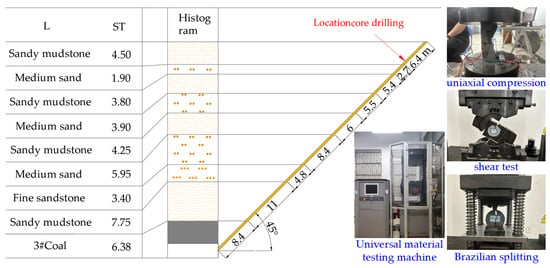
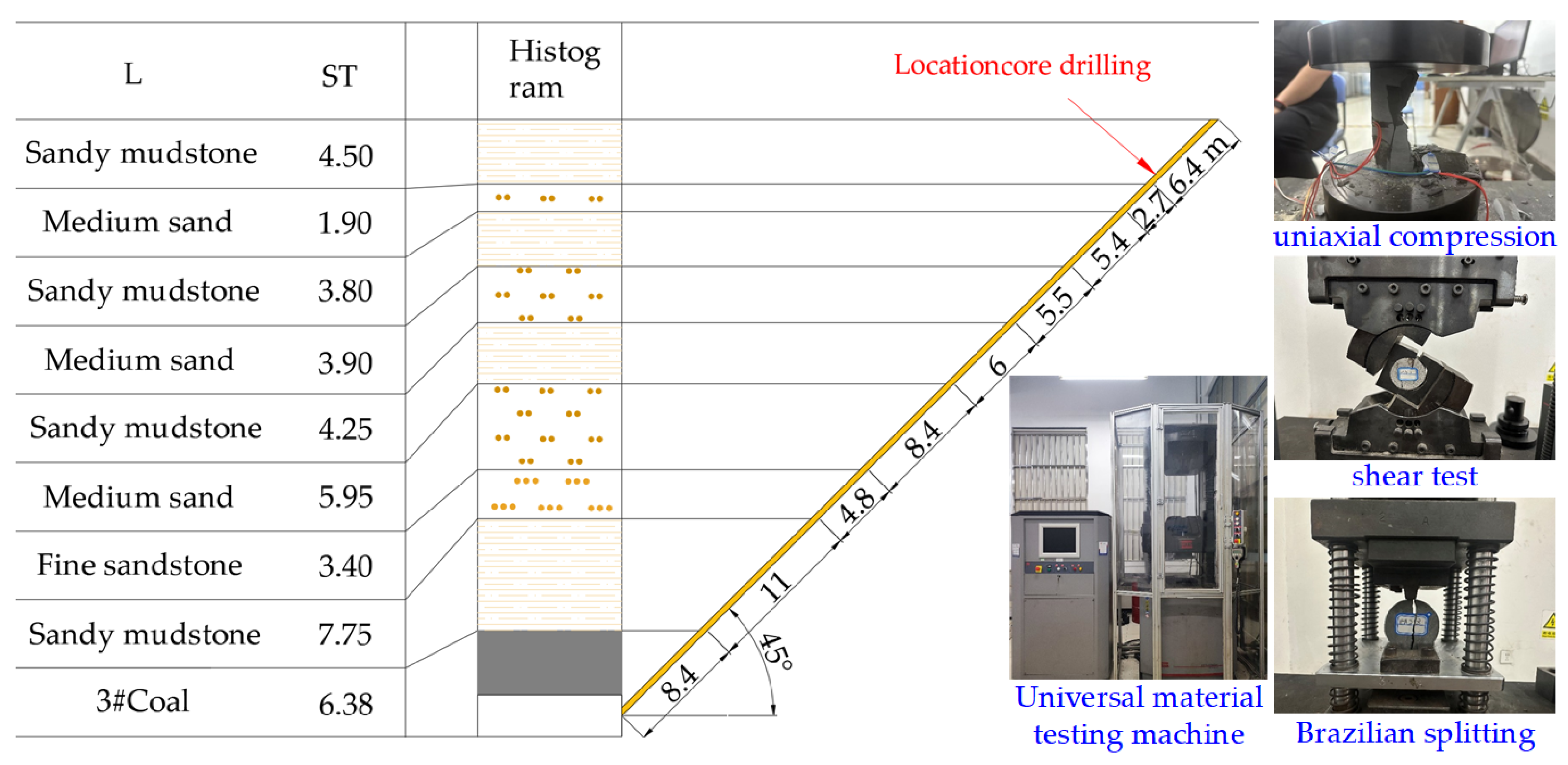
To analyze the structure of the overlying strata, as shown in Figure 2, a coring borehole was drilled into the roof at a 45° angle to the vertical direction in the outer U-shaped return air gateway of the E1302 working face. According to the core characteristics, the immediate roof of the working face is a 7.75 m thick sandy mudstone, and the main roof consists of a 3.40 m thick fine sandstone and a 5.95 m thick medium sandstone. Furthermore, the upward 20 m consists of interbedded sandy mudstone and medium sandstone. Based on the extracted cores, rock mechanics tests were conducted in the laboratory. Considering the pronounced anisotropy typical of sedimentary coal-bearing rock masses, the loading direction significantly influences the macroscopic mechanical properties. To ensure the experimental data accurately represent the vertical load-bearing characteristics of the horizontal roof strata, the extracted 45° angled cores were specifically processed during sample preparation. Standard cylindrical specimens () were sub-cored and meticulously machined from the main cores to guarantee that their axial loading direction was strictly perpendicular to the original bedding planes. This sample preparation procedure effectively eliminated the anisotropic effects introduced by the drilling tilt, thereby providing robust and reliable mechanical parameters for the subsequent modeling phase.
Figure 2.
Structure of roof strata and rock mechanics tests in the working face.
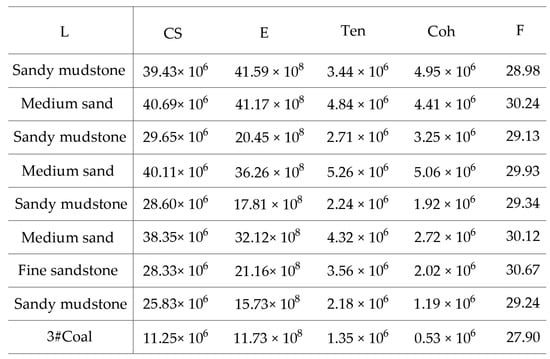
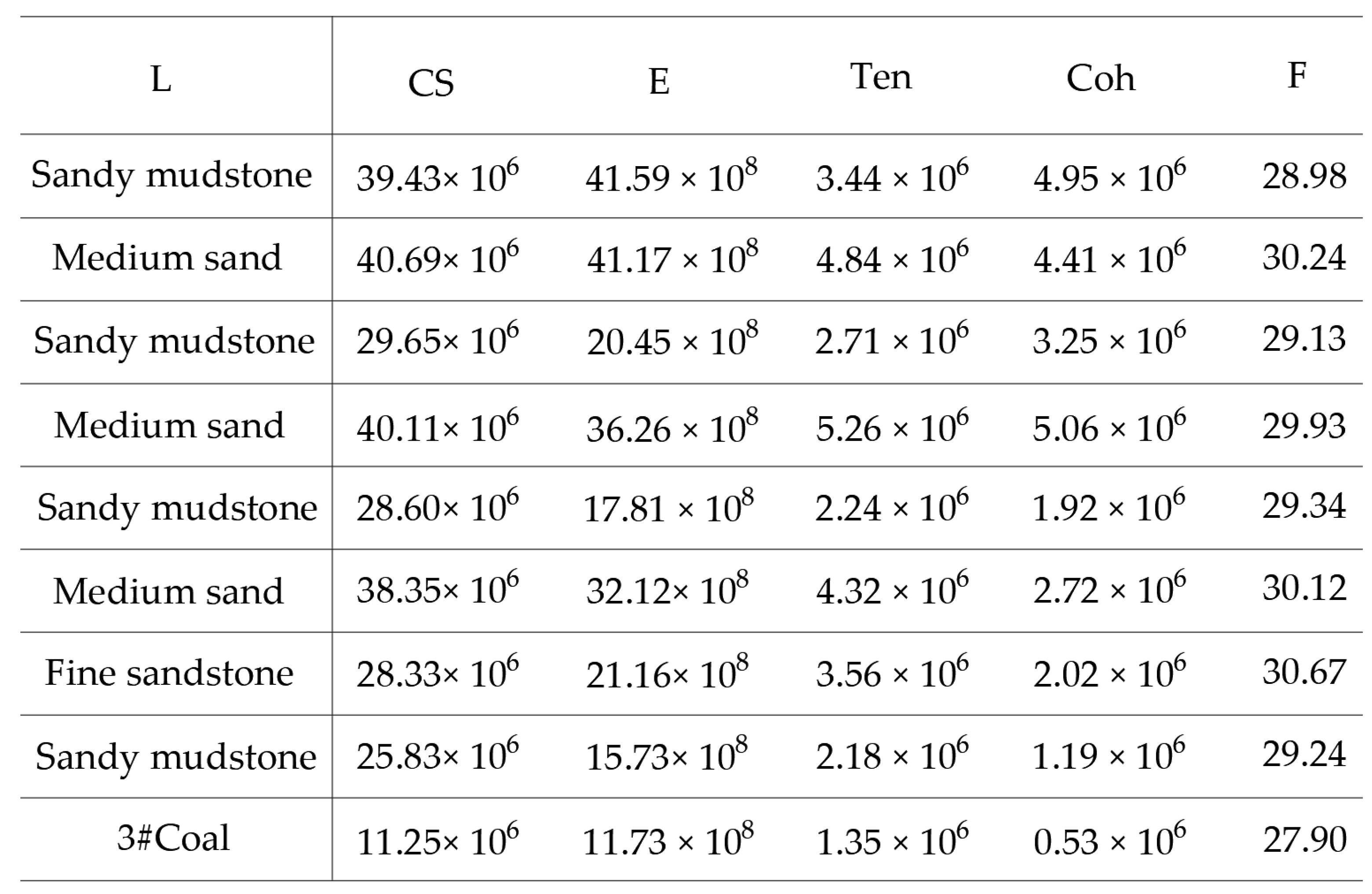
The test results are shown in Figure 3. The obtained rock strata parameters provide data support for determining parameters such as the bending stiffness of the rock beam and the foundation coefficient of the coal body in the subsequent mechanical model.
Figure 3.
Rock mechanics parameters.
2.2. Time-Varying Strength of Paste Material
Paste backfill materials are primarily composed of coal gangue, fly ash, cement, and water, and their mechanical properties exhibit significant time-varying characteristics that increase with curing age. Based on the on-site material proportioning of the Gaohe Coal Mine, this study prepared a paste material with a final-set strength greater than the 4 MPa level. The specific mixture consisted of 1.165 kg of coal gangue, 0.17 kg of fly ash, and 0.17 kg of Grade 325 Portland cement, yielding a mass concentration of 80%. Laboratory mechanical tests were subsequently conducted to quantitatively analyze its time-varying laws.
Three sets of experiments were designed to measure the uniaxial compressive strength of the paste material at curing ages of 1 d, 3 d, 7 d, and 28 d, respectively. Based on the test results, the strength evolution curve of the paste material over the 28-day period was fitted, as shown in Figure 4.
Figure 4.
Time-varying strength characteristics of the 4 MPa grade paste material.
The functional model of its uniaxial compressive strength varying with curing age can be expressed as:
where is the uniaxial compressive strength of the paste (MPa), and t is the curing age of the paste material (d).
Considering that the paste is subjected to a complex three-dimensional stress state after being injected into the goaf, its actual bearing capacity is significantly affected by the lateral confining pressure. According to the classic Mohr–Coulomb failure criterion, the triaxial compressive strength of the paste can be determined as:
where is the triaxial compressive strength of the paste (MPa); is the confining pressure (MPa); and k is the confinement reinforcement factor, which is related to the internal friction angle of the material by . Based on previous experimental studies on similar cemented paste backfills, the internal friction angle typically ranges from 35° to 40°. Taking a representative value of yields a confinement factor of .
Furthermore, the in situ stress ratio () in underground coal mines frequently differs from unity. For analytical simplification, assuming a quasi-hydrostatic stress field () at the average burial depth of 408 m yields a confining pressure of approximately 10.2 MPa. It should be noted that fluctuations in (e.g., typically ranging from 0.8 to 1.2 in shallow-to-medium depth coal measures) would alter the absolute confinement level. However, this assumed baseline provides a representative and robust framework for evaluating the time-varying bearing capacity of the backfill. By introducing the curing age variable, the dynamically time-varying triaxial compressive strength of the paste material can ultimately be expressed as:
This time-varying strength model provides data support for the foundation reaction force in the “unfinal-set backfill support zone” defined in Section 3.
3. Synergetic Roof Control Mechanical Model Considering Time-Varying Characteristics of Backfill
The coupled bearing structure of the longwall paste backfill working face is the core determining the filling efficiency and roof control effect. This structure constitutes a multi-body coupled static system consisting of the “coal body-support-backfill-roof”. By simplifying the roof rock beam into a continuous beam supported by the coal body, supports, and backfill, this section constructs an elastic foundation beam mechanical model for the roof control of the “coal body-support-backfill”. It systematically analyzes the influence laws of key parameters, such as the filling step distance, support resistance, early strength and late strength of the backfill, and filling rate, on the distribution of roof deflection and bending moment.
3.1. Physical Model and Basic Assumptions
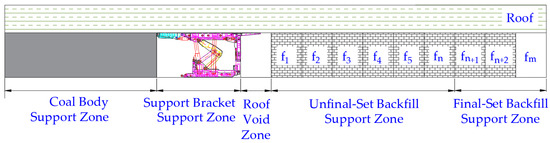
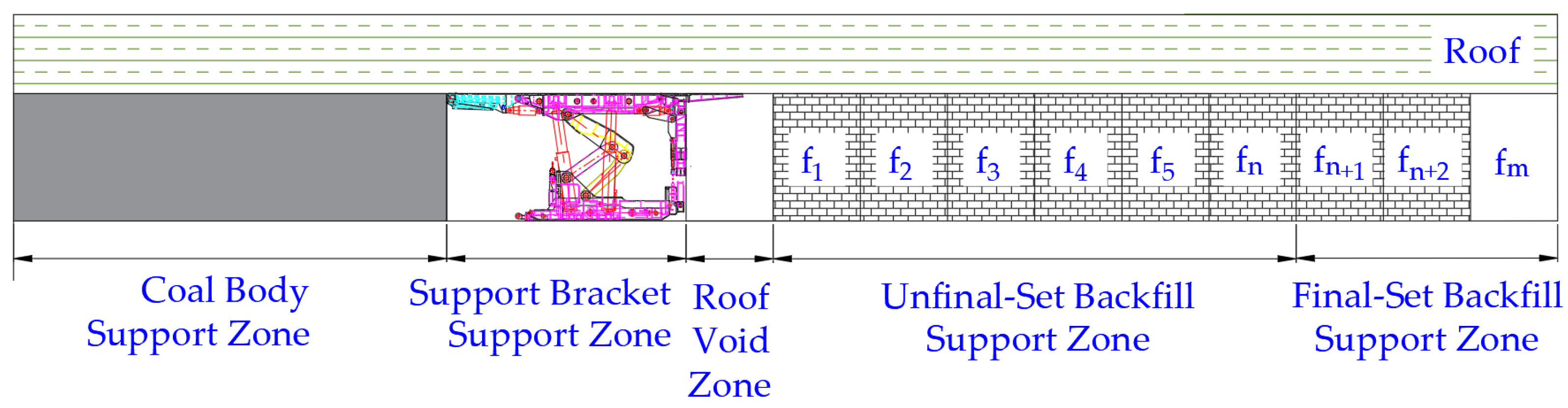
The roof stability of the longwall paste backfill working face depends on the dynamic equilibrium of the “coal body-support-backfill” system. Based on the physical process of the paste material transforming from a slurry to a solid hardened body, this paper regards the roof rock beam as a semi-infinite beam supported on an elastic foundation, and divides it into five mechanical control zones along the advancing direction, as shown in Figure 5:
Figure 5.
Physical model of the “coal body-support-backfill” synergetic bearing.
- (1)
- Coal body elastic support zone: The coal body that is unaffected by mining or remains in an elastic bearing state.
- (2)
- Support bracket support zone: This zone provides active support resistance through hydraulic supports and is the core area for controlling the primary bed separation of the roof.
- (3)
- Roof void zone: The briefly exposed area during the filling cycle, which corresponds to the filling step distance.
- (4)
- Time-varying strength bearing zone (Unfinal-set backfill support zone): As the paste strength increases over time, this zone spatially exhibits non-uniform stiffness support along with the advancement of the working face.
- (5)
- Stable backfill bearing zone (Final-set backfill support zone): The backfill reaches its design strength and enters a stable supporting stage.
Basic Assumptions:
- (1)
- The roof rock beam conforms to the Euler-Bernoulli beam theory.
- (2)
- The foundation support follows the Winkler assumption, i.e., the foundation reaction force is directly proportional to the deflection at a given point.
- (3)
- The horizontal shear force between the backfill and the roof is ignored, and only their vertical interaction is considered.
3.2. Derivation of Deflection Equation Under Winkler Foundation
Based on the Winkler foundation theory, the governing equation for deflection in each zone follows the basic form:
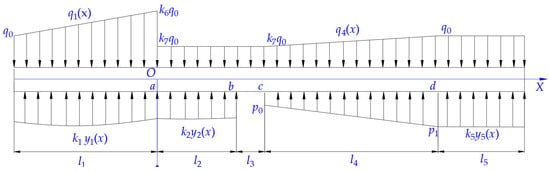
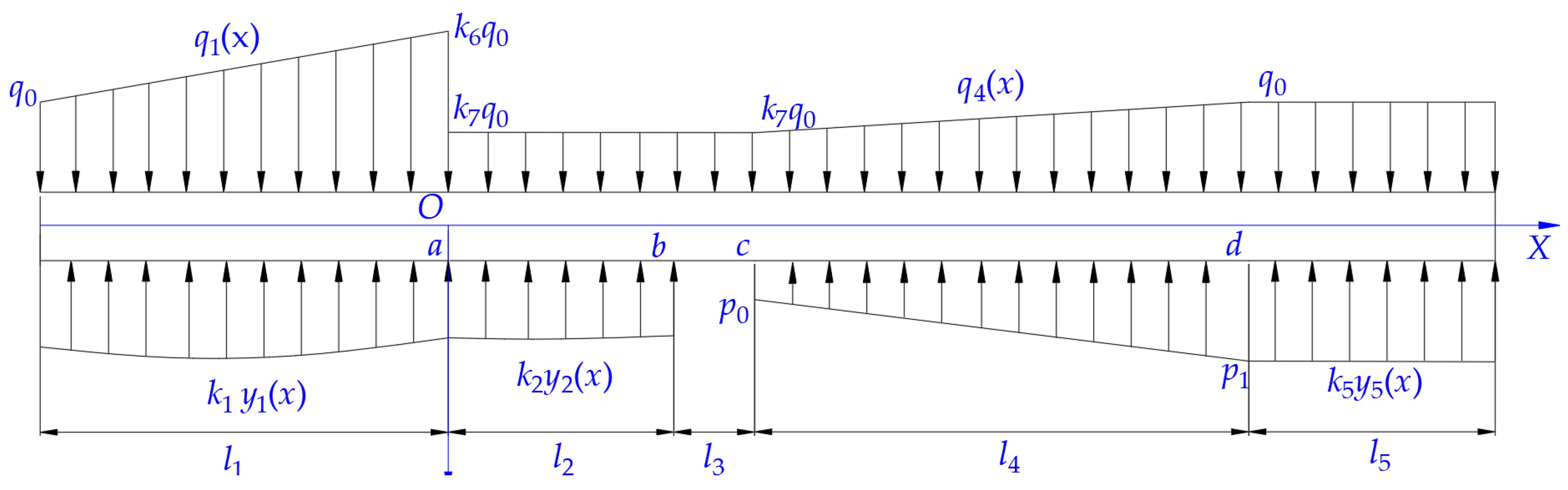
Based on the elastic foundation rock beam theory, as illustrated in Figure 6, with the coal wall of the working face set as the coordinate origin, the direction behind the working face defined as the positive axis, and the direction ahead defined as the negative axis, the synergetic roof control mechanical model for the longwall paste backfill working face is established. Along the x-direction, the roof rock beam is sequentially divided into the coal body support zone (), the support bracket support zone (), the roof void zone (), the unfinal-set backfill support zone (), and the final-set backfill support zone (). The roof strata deflection at any arbitrary point is denoted as , the load applied to the roof rock beam is denoted as , and the reaction force generated by the coal body, supports, roof void zone, and backfill is represented by . Additionally, the roof-contact gap is introduced within the backfill support zone.
Figure 6.
Mechanical model for the “coal body-support-backfill” synergetic roof control.
The coal body support zone, the support bracket support zone, and the final-set backfill support zone are all simplified as elastic foundations, with elastic foundation coefficients of , , and , respectively.
The roof in the coal body support zone is subjected to a linear load . The minimum load intensity applied to the front coal wall is the in situ rock stress , and the maximum load intensity is . The loads applied to the support bracket support zone and the roof void zone are assumed to be uniformly distributed loads with a load intensity of . The unfinal-set backfill support zone is subjected to a linear load, where the minimum load intensity applied to the early-set backfill is , and the maximum load intensity applied to the final-set backfill is .
Based on the mechanical model, the differential equations for the deflection of the roof beam are established.
(1) In the coal body support zone, the support bracket support zone, the roof void zone, and the final-set backfill support zone, the foundation coefficients can be regarded as constants, which are , , 0, and , respectively. Their general solutions are determined by the characteristic roots .
Specifically, in the coal body support zone (), the load above the front coal wall gradually attenuates to the in-situ rock stress as the distance from the coal wall increases:
(2) In the unfinal-set backfill support zone (), the differential equation for the deflection of the roof beam is:
Considering that the paste stiffness in the unfinal-set backfill support zone exhibits a non-uniform characteristic of hardening with spatial advancement, directly solving the fourth-order ordinary differential equation with variable coefficients is mathematically complex and makes it difficult to obtain an intuitive elementary function solution. Therefore, this study adopts a simplified processing strategy based on the “Equivalent Support Reaction” when constructing the analytical model for this region. According to the time-varying law of the paste’s mechanical properties obtained in Section 2, the load-bearing capacity curve, which hardens over time, is applied to the bottom of the rock beam as the equivalent foundation reaction load . As the working face advances at a uniform velocity v, the age of the backfill at the spatial position x can be expressed as . Consequently, the equivalent foundation reaction in this zone, coupled with the spatiotemporal hardening model, is expressed as:
The load applied above the backfill gradually increases to the in situ rock stress as the backfill reaches its final-set state:
By solving and rearranging the above equations, the deflection of the roof beam in each zone is obtained as follows:
According to classical mechanics of materials and the Euler–Bernoulli beam theory, the mathematical relationship between the bending moment and the deflection of the roof rock beam in each zone is given by:
Accordingly, the bending moment of the roof beam in each zone is obtained as:
3.3. Boundary & Continuity Conditions
To solve the above system of piecewise differential equations, based on the principle of beam deformation continuity, the deflection, rotation angle, bending moment, and shear force of the beam are all continuous at the interfaces of each zone (, , , and ). The relationships among them are given by:
Simultaneously, the boundary conditions at infinity are introduced: when , approaches a finite value, and when , approaches a finite value. Given that the model involves a total of 20 undetermined constants across the 5 zones and includes nonlinear load terms, this study utilizes the symbolic computation software Maple to construct and solve a system of linear equations. Consequently, the global roof subsidence curves and bending moment distribution laws are obtained.
4. Results and Parametric Analysis
Building upon the elastic foundation beam mechanical model established above, this section conducts a parametric analysis on key parameters such as the filling step distance and backfill strength. This aims to quantitatively study their influence laws on the distribution of roof deflection and bending moment, thereby revealing the control mechanisms of the mining-backfill coupled system.
4.1. Calculation Results of a Typical Engineering Case
Using the E1302 paste backfill working face of the Gaohe Coal Mine as the research background, based on the analysis of the overlying strata structure and rock mechanics tests in Section 1, the elastic modulus E of the roof rock strata is taken as 1.6 GPa, and the moment of inertia is , with . According to the composite beam theory, the immediate roof of the coal seam is subjected to a stress of 1.42 MPa, so the stress reduction coefficient is 0.14. The elastic modulus of the coal is 1.2 GPa, so the elastic foundation coefficient of the coal body support zone is taken as N·m−3. The elastic modulus of the final-set backfill is 0.28 GPa, so the foundation coefficient is taken as N·m−3, and the elastic foundation coefficient of the support is taken as N·m−3. The length of the support bracket support zone is 6.4 m, so . The length of the roof void zone is taken as the filling step distance of 2.4 m, so . The length of the unfinal-set backfill support zone is determined by the curing time of the backfill, and 14 filling step distances are taken, 33.6 m, so .
By substituting the above parameters into the system of mechanical model equations, the coefficient solutions for this set of equations are obtained as follows:
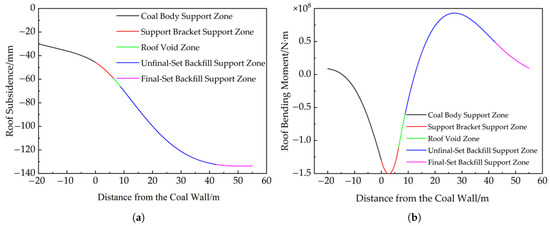
As shown in Figure 7, the roof deformation and force data across different support zones exhibit significant stage-like characteristics. In the coal body support zone, subjected to the advanced abutment pressure, the roof subsidence reaches its maximum value of 46 mm at the coal wall; after entering the support bracket support zone (0–6.4 m), under the active support of the hydraulic supports, the roof deflection increases to 59 mm. Within the relatively short roof void zone (6.4–8.8 m), due to the loss of support, the deflection rapidly rises to 67 mm. Subsequently, upon entering the unfinal-set backfill support zone (8.8–42.4 m), the roof deflection continuously increases from 67 mm to 132 mm; until it enters the final-set backfill support zone (42.4–55 m), the roof deflection ultimately stabilizes at approximately 132 mm, and this subsidence is consistent with the on-site measured results.
Figure 7.
Roof subsidence and bending moment curves: (a) Subsidence curve; (b) Bending moment curve.
Meanwhile, the bending moment data indicate that the maximum negative bending moment occurs in the support bracket support zone, with an extreme value of N·m; conversely, the maximum positive bending moment is distributed in the middle of the unfinal-set backfill support zone, reaching N·m, and as the roof beam extends towards the final-set backfill zone, the positive bending moment value exhibits a gradually decreasing trend.
4.2. Sensitivity Analysis
Building upon the aforementioned case analysis, to further reveal the evolutionary laws of roof stability, a controlled variable analysis was conducted on key parameters across different support zones. The research scheme sequentially analyzed the impact of variations in the following parameters on roof subsidence and bending moment distribution: the foundation coefficient of the support (60–140 MPa, with a gradient of 20 MPa), filling step distance (0.8–4.0 m, with a gradient of 0.8 m), support reaction force of the initial-set backfill (0.6–1.4 MPa, with a gradient of 0.2 MPa), elastic modulus of the final-set backfill (0.18–0.38 GPa, with a gradient of 0.05 GPa), and filling rate (90–98%, with a gradient of 2%).
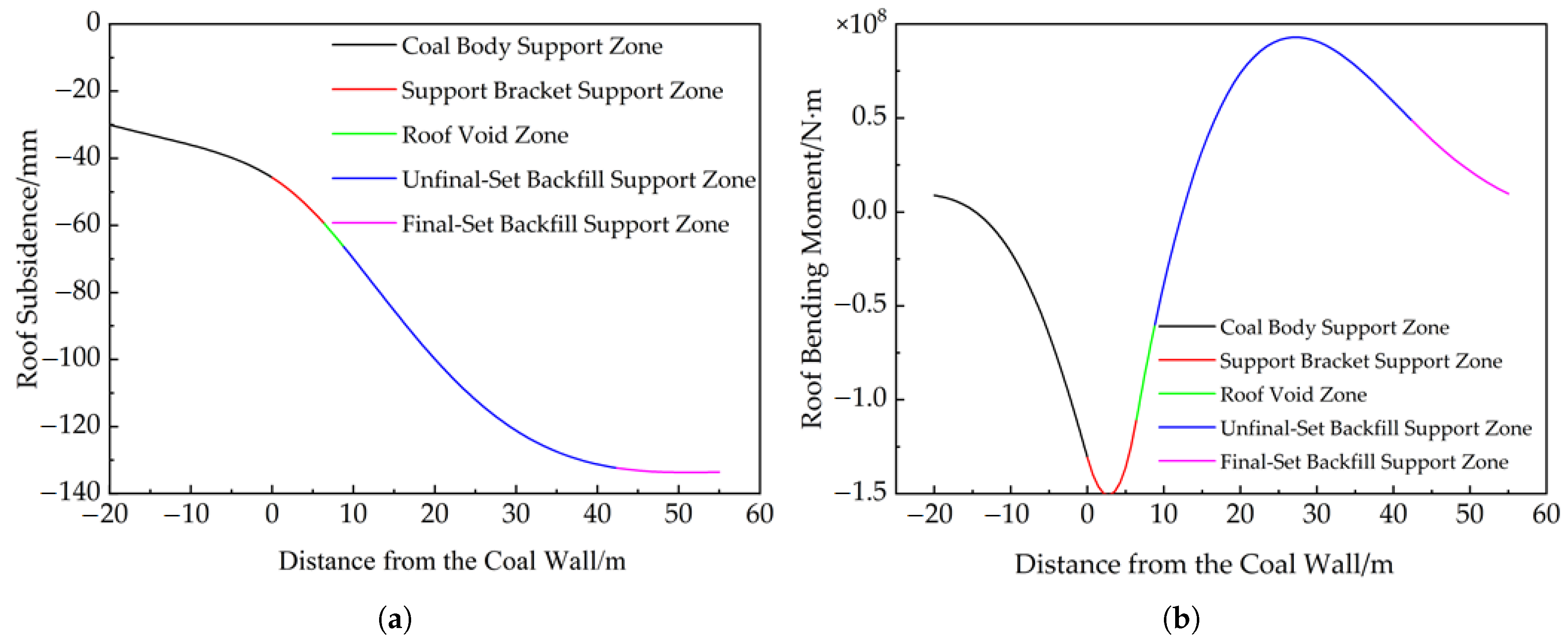
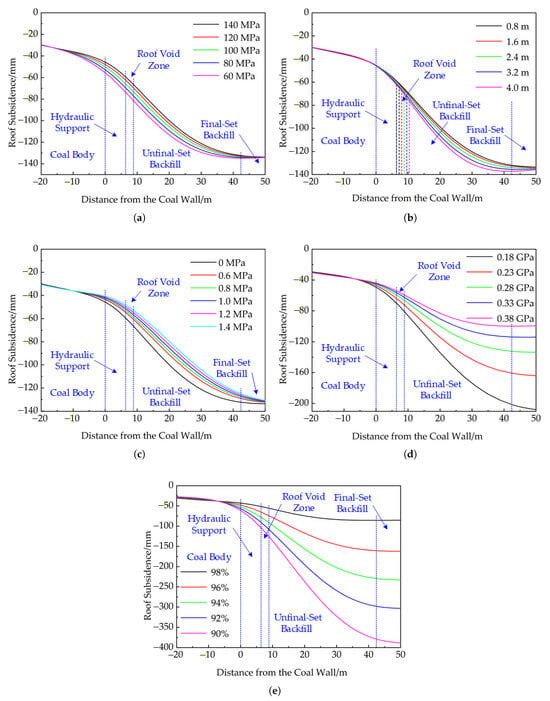
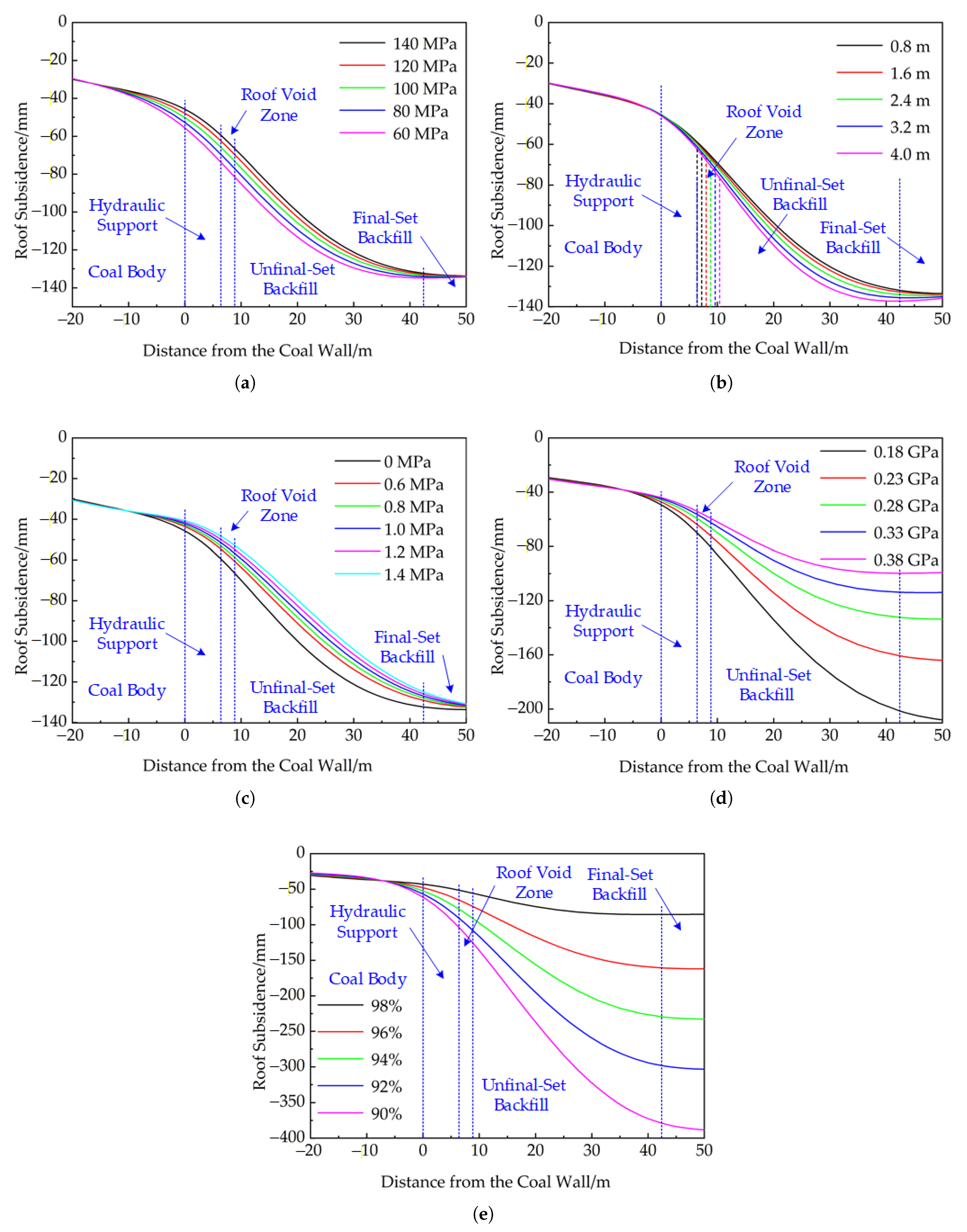
As illustrated in Figure 8, the impact results of the five key roof control parameters on the roof subsidence curves under different gradients are presented. Within the established parameter ranges, the control exerted by each variable on roof deformation exhibits significant differential characteristics. Notably, an increase in the filling rate is the most sensitive factor in controlling roof subsidence, and its value demonstrates a strong linear negative correlation with the ultimate roof subsidence amount. As the filling step distance gradually expands from 0.8 m to 4.0 m, the overall subsidence amplitude of the roof increases significantly. Regarding the performance of the backfill, an increase in the final-set elastic modulus effectively reduces the long-term deformation of the roof; however, the spacing between the gradient curves gradually narrows, indicating a pronounced marginal diminishing effect. Conversely, the increase in the initial-set support reaction force primarily manifests its curve changes during the backfill strength growth stage, significantly inhibiting the early roof subsidence rate within this interval.
Figure 8.
Roof subsidence curves under different roof control parameters: (a) Foundation coefficient of the support; (b) Filling step distance; (c) Initial-set strength of the backfill; (d) Final-set strength of the backfill; (e) Filling rate.
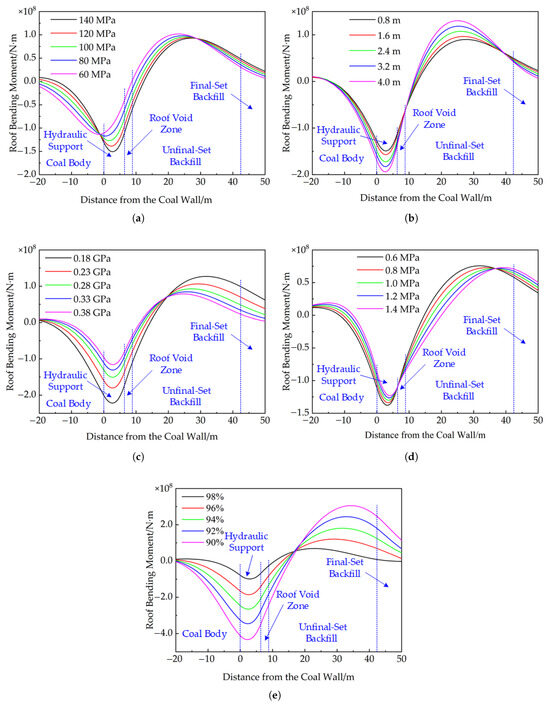
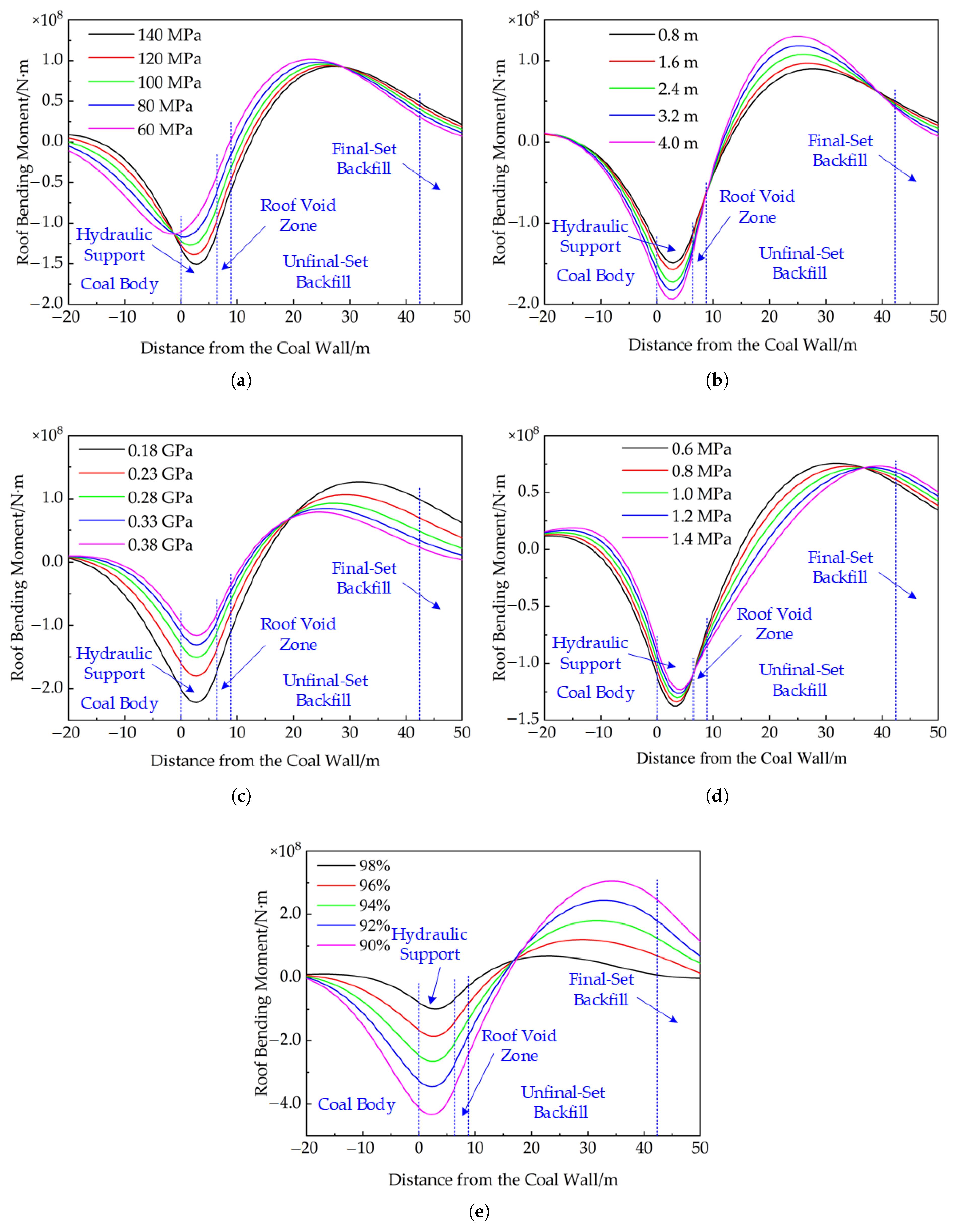
As illustrated in Figure 9, the distribution laws of the roof bending moment under the corresponding parameter gradients are presented. The consistent curve morphologies indicate that, regardless of how the parameter variables are adjusted, the maximum negative bending moment of the roof consistently occurs in the support bracket support zone, while the maximum positive bending moment is invariably distributed in the middle of the unfinal-set backfill zone.
Figure 9.
Roof bending moment curves under different roof control parameters: (a) Foundation coefficient of the support; (b) Filling step distance; (c) Initial-set strength of the backfill; (d) Final-set strength of the backfill; (e) Filling rate.
From the evolutionary trend of the extreme bending moment values, as the foundation coefficient of the support increases from 60 MPa to 140 MPa, the filling step distance decreases, and the backfill strength gradually improves, the peak values of the maximum positive bending moment of the roof all exhibit a downward trend to varying degrees. This effectively reduces the tensile stress level at the lower edge of the roof. Among these factors, the filling rate demonstrates the most pronounced control effect on the bending moment.
5. Discussion
Based on the analysis of the typical engineering case of the paste backfill working face in the Gaohe Coal Mine, the subsidence evolution and bending moment distribution laws of the roof reveal the dynamic mechanical control mechanisms of the paste backfill on the surrounding rock during its setting and curing process. Distinct from traditional caving mining methods, roof control in paste backfill mining is essentially a spatiotemporal coupled process of “spatial support coordination” and “temporal strength matching.”
5.1. Spatiotemporal Synergetic Roof Control Mechanism of “Coal Body-Support-Backfill”
In the unfinal-set backfill zone, as the paste hydration reaction proceeds, the support strength of the backfill gradually increases, and the growth rate of roof subsidence significantly slows down accordingly. This fully demonstrates the dynamic inhibitory effect of the backfill curing process on roof deformation. When the backfill fully cures and enters the final-set zone, the formed high-strength rigid structure effectively cuts off further roof subsidence.
Analyzing from a mechanical mechanism perspective, the roof under this mining condition can be simplified as a multi-span continuous beam structure. The negative bending moment generated at the support positions (the coal wall and support bracket support zone) subjects the upper part of the roof beam to tension, while the positive bending moment in the mid-span region (the unfinal-set backfill section) subjects the lower part of the roof beam to tension. This stress distribution characteristic issues an important engineering warning: during the transition stage behind the support roof control zone and before the final-set backfill becomes fully load-bearing, the continuous tension at the bottom of the roof beam is the core mechanical factor driving roof subsidence. If the accumulated maximum positive bending moment in this zone exceeds the ultimate bending bearing capacity of the roof strata, there poses an engineering risk of inducing microscopic fracture propagation or even macroscopic fracture of the roof.
5.2. Sensitivity of Roof Control Parameters
Based on the comprehensive parametric analysis results, the control mechanisms of various roof control parameters on roof stability exhibit significant sensitivity differences:
- (1)
- Backfill quality parameters: The filling rate is the most sensitive factor controlling the ultimate roof subsidence, exhibiting an approximately strong linear negative correlation with roof deflection. The filling rate directly determines the actual exposed span and breaking risk of the roof rock beam, making it the core of on-site construction quality control.
- (2)
- Material mechanical parameters: The backfill strength exhibits stage-like characteristics in roof control. The early strength primarily dominates the early roof subsidence rate during the backfill strength growth stage, which is crucial for preventing excessive initial deformation of the roof behind the supports. Conversely, the final-set strength is vital for limiting the long-term absolute deformation of the roof. Notably, the control effect of the final-set strength displays a pronounced marginal diminishing effect, which provides a solid theoretical basis for designing economical and reasonable backfill proportions and strength grading in mines.
- (3)
- Spatial support parameters: The reasonable planning of the filling step distance and the matching of support resistance play an irreplaceable role in improving the roof bending moment distribution and avoiding local stress concentration.
5.3. Validation of the Simplified Analytical Model
When constructing the analytical equation for the unfinal-set backfill support zone (Zone 4), this study adopted a simplified model based on the Equivalent Support Reaction to obtain an intuitive closed-form analytical solution suitable for engineering application. To verify the mechanical rigor and computational accuracy of this equivalent simplified model, a rigorous Winkler model with variable stiffness coefficients is constructed in this section for comparative validation.
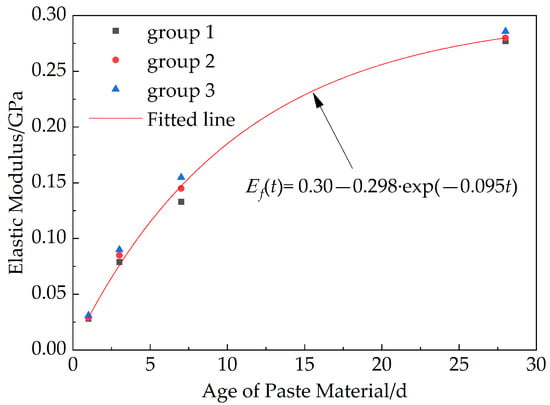
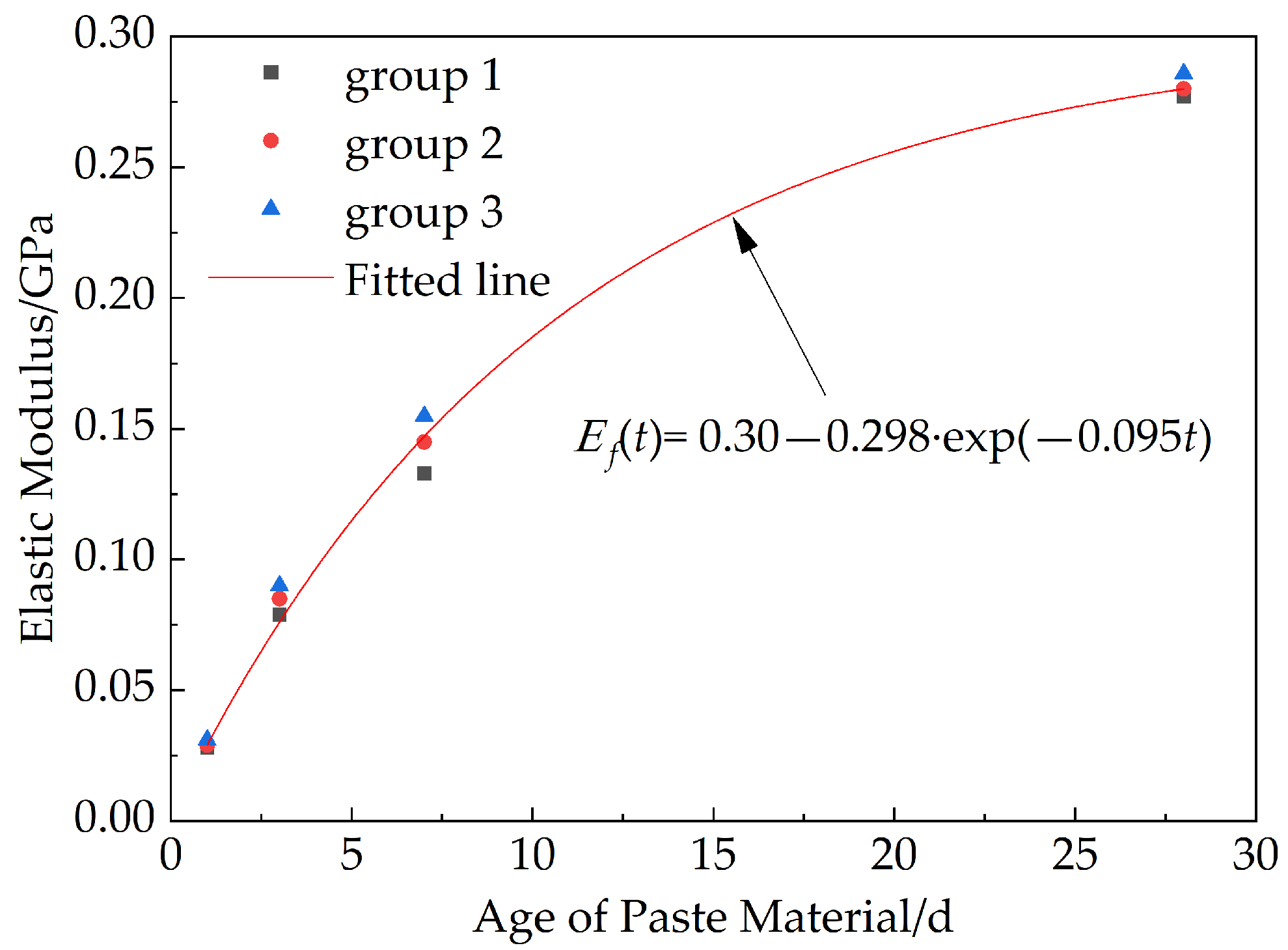
Based on the laboratory mechanical tests, the paste backfill exhibits distinct time-dependent growth characteristics over the curing ages of 1, 3, 7, and 28 days. The detailed mechanical property data of the three sample groups are listed in Table 1.
Table 1.
Mechanical properties of paste backfill materials at different curing ages.
The experimental data in Table 1 indicate that the elastic modulus increases significantly, from approximately 0.028 GPa at 1 day to 0.286 GPa at 28 days. Through nonlinear curve fitting, the dynamic elastic modulus (in GPa) can be mathematically expressedas:
To convert this material property into the foundation coefficient required for the Winkler model, the structural equivalent stiffness method is applied. Assuming the backfill with a known and finite thickness is a one-dimensional linear elastic body under uniaxial compression, Hooke’s law gives the strain as , where is the stress, is the deformation, and h is the thickness of the paste backfill. Therefore, the foundation coefficient k is derived as:
Given that the thickness of the paste backfill for the upper slicing is m, the time-varying foundation coefficient can be obtained as:
As the working face advances at a uniform velocity v, the curing time at spatial position x is . By defining the spatiotemporal conversion coefficient and the fitting constants and , the dynamic foundation coefficient is expressed as a function of the spatial position x: . Introducing this variable stiffness into the governing equation of the roof yields a fourth-order ordinary differential equation with variable coefficients:
Mathematically, this variable-coefficient equation cannot be directly solved to obtain a closed-form elementary function. By applying a Taylor series expansion to at and employing the Cauchy product and recurrence relations to construct a high-order Power Series Method, the strict explicit sixth-order analytical expression for the roof deflection is derived as follows:
Substituting the actual parameters of the E1302 working face (setting the working face advance speed m/d) into this rigorous variable-coefficient series model, the high-precision solution is obtained by solving the 16th-order global boundary continuity equations simultaneously. The calculated maximum roof subsidence at the boundary of the unfinal-set zone is 135.2 mm. In contrast, the calculation result of the equivalent simplified analytical model adopted in Section 4 is 132.0 mm, yielding an extremely small relative error of only 2.36%.
6. Conclusions
Aiming at the difficult problem of roof control in longwall paste backfill mining faces, and taking the E1302 working face of the Gaohe Coal Mine as the engineering background, this study comprehensively adopted a method combining theoretical analysis and parametric calculation to systematically reveal the mechanical transmission path and control laws of the “coal body-support-backfill” synergetic bearing system. The main research conclusions are as follows:
- (1)
- An analytical model for roof control considering the time-varying characteristics of the backfill was constructed. The roof was simplified as a multi-span continuous beam with the coal body, hydraulic supports, and dynamically hardening backfill as the elastic foundation, and the analytical solutions for global deflection and bending moment were derived. This model provides a structured approach to incorporate the ‘sequential bearing’ effect of the backfill, achieving a spatiotemporal quantitative description of the roof deformation and internal force distribution in the backfill stope.
- (2)
- The differential control mechanisms of key mining and backfilling parameters on roof stability were revealed. The filling rate is the most sensitive factor determining the ultimate roof subsidence, exhibiting a strong linear negative correlation with roof deflection and directly controlling the actual span and breaking risk of the roof rock beam. The final-set strength of the backfill has a significant marginal diminishing effect on long-term deformation control, while the early strength dominates the roof subsidence rate in the early stage of backfilling. An increase in the filling step distance will significantly increase the overall roof subsidence, whereas the support resistance plays a core role in improving the initial bending moment distribution of the roof during the initial backfilling stage.
- (3)
- The “spatiotemporal synergetic” essence of roof control in paste backfill mining was clarified. The research indicates that the control of surrounding rock in paste backfill stopes is essentially a dynamic coupled process of “spatial support synergy” and “temporal strength matching.” In engineering practice, it is necessary to comprehensively consider the interactive effects of multiple parameters, such as the filling step distance, strength grading, and filling rate, in the spatiotemporal dimension. Taking this as the basis for roof design will not only achieve a comprehensive ptimization of ’stability-economy-efficiency’ in the stope, but also drive the sustainable development of green mining by balancing efficient resource recovery with rigorous environmental protection.
Author Contributions
Conceptualization, Z.L. and G.S.; methodology, Z.L.; validation, Y.Y., Y.Z. (Yu Zhang) and S.S.; formal analysis, Z.L., Y.Z. (Yu Zhang) and S.S.; investigation, Y.Z. (Yidong Zhang) and W.Y.; resources, Y.Y.; data curation, Y.Z.(Yu Zhang) and W.Y.; writing—original draft preparation, Z.L.; writing—review and editing, Z.L., Y.Y., G.S., Y.Z. (Yidong Zhang), W.Y., Y.Z.(Yu Zhang) and S.S.; visualization, Z.L.; supervision, G.S.; project administration, G.S.; funding acquisition, Z.L. All authors have read and agreed to the published version of the manuscript.
Funding
This research is supported by the Postgraduate Research & Practice Innovation Program of Jiangsu Province (Grant No. KYCX25_2921).
Institutional Review Board Statement
Not applicable.
Informed Consent Statement
Not applicable.
Data Availability Statement
The datasets used and/or analysed during the current study available from the corresponding author on reasonable request.
Acknowledgments
The authors would like to thank the engineering technicians in Gaohe Coal Mine for their enthusiastic assistance and suggestions.
Conflicts of Interest
Author Yiping Yuan was employed by the company Guizhou Panjiang Refined Coal Co., Ltd. Author Guangyuan Song was employed by the company Shanxi Cumt Backfill Technology Ltd. The remaining authors declare that the research was conducted in the absence of any commercial or financial relationships that could be construed as a potential conflict of interest.
References
- Hou, M.F.; Li, L.M.; Yang, Y.X.; Wang, W.J.; Zhao, L.A. Practical achievements and energy revolution countermeasures of new energy security strategy in China. Nat. Gas Ind. 2025, 45, 150–161. [Google Scholar] [CrossRef]
- Liu, X.R.; Sun, S.C.; Cheng, P.X.; Yue, X.W.; Sun, C.L. Paths and key measures for constructing a new energy system in China. Nat. Gas Ind. 2025, 45, 162–169. [Google Scholar] [CrossRef]
- Wang, S.M.; Liu, L.; Zhu, M.B.; Shen, Y.J.; Shi, Q.M.; Sun, Q.; Fang, Z.Y.; Ruan, S.S.; He, W.; Yang, P.; et al. New way for green and low-carbon development of coal industry under the target of “dual-carbon”. J. China Coal Soc. 2024, 49, 152–171. [Google Scholar] [CrossRef]
- Wang, J.C.; Xu, J.L.; Yang, S.L.; Wang, Z.H. Development of strata movement and its control in underground mining: In memory of 40 years of Voussoir Beam Theory proposed by Academician Minggao Qian. Coal Sci. Technol. 2023, 51, 80–94. [Google Scholar] [CrossRef]
- Guo, W.B.; Yang, W.Q.; Wu, D.T. Current status and progress of subsidence control technology in China coal mines. J. Min. Strat. Control Eng. 2024, 6, 5–20. [Google Scholar] [CrossRef]
- Cui, X.R.; Huo, X.P.; Zhou, B.J.; Hu, Y.Y.; Yang, Y.Q.; Yang, F.L.; Di, Z.C. Spatial Distribution Characteristics and Graded Utilization Path of Coal Gangue in China. Environ. Sci. 2025, 46, 2281–2291. [Google Scholar] [CrossRef] [Scilit] [PubMed]
- Zhang, J.X.; Zhou, N.; Liu, H.F.; Xie, Y.C.; Sun, Z.H.; Ouyang, S.Y. Research progress and prospect of underground utilization of coal-based solid waste functional materials. Coal Sci. Technol. 2025, 53, 1–28. [Google Scholar] [CrossRef]
- Wang, Y.T. Status and prospect of harmless disposal and resource comprehensive utilization of solid waste of coal gangue. Coal Geol. Explor. 2022, 50, 54–66. [Google Scholar] [CrossRef]
- Miao, X.X.; Qian, M.G. Research on Green Mining of Coal Resources in China: Current Status and Future Prospects. J. Min. Saf. Eng. 2009, 26, 1–14. [Google Scholar] [CrossRef]
- Qian, M.G. On sustainable coal mining in China. J. China Coal Soc. 2010, 35, 529–534. [Google Scholar] [CrossRef]
- Miao, X.X.; Ju, F.; Huang, Y.L.; Guo, G.L. New development and prospect of backfilling mining theory and technology. J. China Univ. Min. Technol. 2015, 44, 391–399+429. [Google Scholar] [CrossRef]
- Zhang, J.X.; Zhang, Q.; Zhou, N.; Li, M.; Huang, P.; Li, B.Y. Research progress and prospect of coal based solid waste backfilling mining technology. J. China Coal Soc. 2022, 47, 4167–4181. [Google Scholar] [CrossRef]
- Liu, L.; Xia, L.; Wang, S.M.; Fang, Z.Y.; Zhu, M.B.; He, W.; Hao, Y.H. Key technologies for preparation and multi scene utilization of multi-source solidwaste based carbon fixation mining materials. J. China Coal Soc. 2025, 50, 1203–1222. [Google Scholar] [CrossRef]
- Chang, Q.L.; Gao, L.; Fan, J.G.; Zhang, B.; Sun, C.; Hu, P. Collaborative load-bearing mechanism between the filling body and the surrounding rock in multi-layer mining of thick coal seams in deep mines. J. Min. Saf. Eng. 2025, 42, 510–520. [Google Scholar] [CrossRef]
- Song, G.Y.; Du, K.; Hu, L. Study of the overlying strata movement law for paste-filling longwall fully mechanized in Gaohe coal mine. Appl. Sci. 2023, 13, 8017. [Google Scholar] [CrossRef] [Scilit]
- Liu, J.G.; Zhao, J.W.; Li, M.M.; Zuo, J.P. Continuous curved beam formation and strata control theory in coal backfill mining. J. China Coal Soc. 2016, 41, 383–391. [Google Scholar] [CrossRef]
- Zheng, Q.S.; Wang, C.F.; Pang, L.F. Overburden and surface subsidence with slicing paste filling mining in thick coal seams. Front. Earth Sci. 2023, 10, 1027816. [Google Scholar] [CrossRef] [Scilit]
- Jia, L.G.; Zhang, H.X.; Liu, P.L. The control impact of filling pace on surface movement and deformation characteristics. J. China Univ. Min. Technol. 2022, 51, 642–650. [Google Scholar] [CrossRef]
- Liu, J.X.; Guo, W.J.; Zhang, X.G. Study on Mechanics Model and Stress Evolution Law of Filling Stope. Front. Manuf. Des. Sci. II 2012, 121–126, 428–432. [Google Scholar] [CrossRef] [Scilit]
- Ma, Q.; Zhang, Y.; Zheng, Y.; Li, Z.; Song, G.; Hu, L. Overlying Strata Movement and Mine-Pressure Weakening Law of High-Efficiency Longwall Paste Backfilling of Thick Coal. Sustainability 2022, 14, 15356. [Google Scholar] [CrossRef] [Scilit]
- Zhang, Y.; Song, G.; Zhang, Y.; Li, Z.; Sun, S.; Yan, W. Key Parameter Optimization for Longwall Paste Backfill Based on Time-Dependent Backfill Strength. Appl. Sci. 2026, 16, 3849. [Google Scholar] [CrossRef] [Scilit]
- Wang, R.F.; Liu, L.; Cui, H. Assessing ground stability of a vertical backfilled stope considering creep behaviors of surrounding rocks. J. Rock Mech. Geotech. Eng. 2025, 17, 187–199. [Google Scholar] [CrossRef] [Scilit]
- Yang, B.G.; Zheng, Z.J.; Wang, X.L. Time-Dependent Rheological Properties of Cemented Aeolian Sand-Fly Ash Backfill Vary with Particles Size and Plasticizer. Materials 2023, 16, 5295. [Google Scholar] [CrossRef] [Scilit] [PubMed]
- Wang, R.F.; Zhu, Y.J.; Cui, H. Time-dependent ground stability of inclined backfilled stope characterized by creep behavior. Int. J. Miner. Metall. Mater. 2026, 33, 479–491. [Google Scholar] [CrossRef] [Scilit]
- Zhang, F.; Liu, J.X.; Gong, B. Development of Coal Mine Filling Paste with Certain Early Strength and Its Flow Characteristics. Geofluids 2021, 2021, 6699426. [Google Scholar] [CrossRef] [Scilit]
- Kremieniewski, M. Recipe of Lightweight Slurry with High Early Strength of the Resultant Cement Sheath. Energies 2020, 13, 1583. [Google Scholar] [CrossRef] [Scilit]
- Zhou, Q.; Liu, J.H.; Wang, H.J. Early-age strength property improvement and stability analysis of unclassified tailing paste backfill materials. Int. J. Miner. Metall. Mater. 2020, 27, 1191–1202. [Google Scholar] [CrossRef] [Scilit]
- Lu, G.D.; Fall, M. Modelling blast wave propagation in a subsurface geotechnical structure made of an evolutive porous material. Mech. Mater. 2017, 108, 21–39. [Google Scholar] [CrossRef] [Scilit]
- Gao, R.; Zhou, K.; Yang, C. Damage mechanism of composite cemented backfill based on complex defects influence. Mater. Werkst. 2017, 48, 893–904. [Google Scholar] [CrossRef] [Scilit]
- Cheng, A.P.; Fu, Z.X.; Liu, L.S.; Dai, S.Y.; Huang, S.B.; Ye, Z.Y. Creep hardening-damage characteristics and nonlinear constitutive model of cemented backfill. J. Min. Saf. Eng. 2022, 39, 449–457. [Google Scholar] [CrossRef]
- Wu, P.F.; Zhao, J.H.; Jin, J.X. Similar simulation of overburden movement characteristics under paste filling mining conditions. Sci. Rep. 2023, 13, 12550. [Google Scholar] [CrossRef] [Scilit] [PubMed]
- Li, C.; Chen, D.H.; Yang, K. Filling parameters and process optimization of mining-filling synergistic coal-based solid waste paste in Renjiazhuang mine. Front. Mater. 2023, 10, 1234145. [Google Scholar] [CrossRef] [Scilit]
- Chang, Q.L.; Yao, X.J.; Sun, Y.T. Analysis on Water Inrush Prevention Mechanism of Paste-Filled Floor above Confined Water. Processes 2022, 10, 274. [Google Scholar] [CrossRef] [Scilit]
- Yang, S.F.; Cheng, Z.R.; Tian, Y.; Wang, P.F.; Zhang, J.G.; Zhang, X.J.; Wang, C. Roof deformation patterns and key influencing factors in fully mechanized mining faces with paste filling. Coal Eng. 2025, 57, 1–9. [Google Scholar] [CrossRef]
- Li, C.P.; Yan, B.H.; Wang, S.Y.; Hou, H.Z.; Chen, G.Z. Variability behavior of yield stress for untime-velocity double factors classified tailings pasted under measurement. Chin. J. Eng. 2020, 42, 1308–1317. [Google Scholar] [CrossRef]

Disclaimer/Publisher’s Note: The statements, opinions and data contained in all publications are solely those of the individual author(s) and contributor(s) and not of MDPI and/or the editor(s). MDPI and/or the editor(s) disclaim responsibility for any injury to people or property resulting from any ideas, methods, instructions or products referred to in the content. |
© 2026 by the authors. Licensee MDPI, Basel, Switzerland. This article is an open access article distributed under the terms and conditions of the Creative Commons Attribution (CC BY) license.