


Abstract
Sonar object detection is constrained by scarce instance-level annotations, high acquisition costs, and long-tailed category distributions in real underwater environments. To address these limitations, this paper proposes a generative data augmentation framework based on the Stable Diffusion Model (SDM) for synthesizing sonar images together with target bounding boxes. The framework first fine-tunes SDM with an instance-level slice cropping strategy to strengthen the alignment between text prompts and local acoustic target structures. It then introduces a cross-modal sparse localization module (CMSL), which uses denoising features and text priors to infer 2D bounding boxes for generated samples. Synthetic long-tail samples are mixed with real URPC2022 data under a fixed-ratio saturation compensation strategy and evaluated through UTD-SCnet fine-tuning. The results show that instance-level cropping provides the best generation quality among the tested strategies (FID = 31.42, DR = 0.815, CCSCR = 0.075), and that a 60% synthetic-data injection ratio yields the best detection performance. These findings indicate that diffusion-based augmentation can provide a practical, semi-automated supplement for long-tail sonar detection, while excessive synthetic data may introduce domain-shift effects.
1. Introduction
Reliable perception is a prerequisite for autonomous underwater operations such as mineral exploration, submarine pipeline inspection, and marine defense. As autonomous underwater vehicles (AUVs), bionic robotic fish [1,2], and remotely operated vehicles (ROVs) are increasingly deployed in complex seabed environments, they require sensing systems that remain robust under low visibility, turbidity, and long-range propagation constraints [3].
Optical imaging is strongly limited underwater because electromagnetic waves suffer from absorption and scattering attenuation [4]. Acoustic sensing therefore remains a primary solution for medium- and long-range underwater perception [5,6], and related active sensing systems face similar localization constraints in other propagation-limited domains [7]. Sonar systems are widely used for target identification, terrain mapping, and autonomous collision avoidance [8]. However, sonar images are not direct analogues of optical images. They are formed by projecting a three-dimensional acoustic scattering field onto a two-dimensional plane, and they usually contain speckle noise, multipath reverberation [9], boundary degradation [10], highlight-shadow structures, and grazing-angle-dependent acoustic shadows [11]. Under such sparse and noisy conditions, extracting target responses is closely related to weak-signal detection in heavily corrupted measurements [12]. These characteristics reduce spatial resolution and increase inter-class similarity, making detector outputs vulnerable to class confusion and false alarms [13].
These imaging characteristics are compounded by data scarcity. Deep detectors require diverse and accurately annotated training samples [14], but real sonar data collection depends on costly field trials, dedicated platforms, and expert interpretation of acoustic images. Instance-level annotation is therefore difficult to scale. Moreover, underwater target categories often follow a long-tailed distribution [15]: common objects dominate training data, whereas rare but operationally important targets remain underrepresented. Conventional augmentation methods, such as affine transformation, noise injection, and mosaic stitching, can increase the number of samples but cannot create new target appearances with coherent seabed reverberation and acoustic-shadow topology.
Generative models provide a possible way to expand rare sonar categories, but object detection imposes an additional requirement: generated images must be accompanied by reliable bounding boxes. Standard diffusion models mainly produce image tensors, leaving instance-level localization to manual annotation or a separate detector. This separation weakens the automation of the augmentation pipeline and limits its usefulness for long-tail detection. To address this gap, this paper develops an SDM-based sonar augmentation framework that couples image synthesis with cross-modal sparse localization, and then studies how synthetic samples should be mixed with real data to improve detector training without introducing excessive domain shift.
The main contributions of this paper are summarized as follows.
- We introduce an instance-level slice cropping (ILSC) strategy for SDM fine-tuning. By converting multi-target sonar images into single-target tiles, ILSC strengthens text-visual alignment and achieves the best generation metrics among the tested strategies (FID = 31.42, DR = 0.815, CCSCR = 0.075).
- We design a cross-modal sparse localization module (CMSL) that aligns multi-scale SDM denoising features with text priors and predicts 2D bounding boxes for generated sonar targets. This module links diffusion-based sample generation with detector-ready annotation.
- We evaluate a fixed-ratio saturation compensation strategy for injecting synthetic long-tail samples into real training data. The best result is obtained at a 60% injection ratio, where mAP50:95 improves from 0.588 to 0.600; larger ratios reduce performance, indicating a domain-shift boundary for synthetic sonar data.
Related Research
The robustness of deep learning generalization depends on the size of the training set and the richness of the feature manifold distribution [16]. In vertical fields such as underwater sonar detection, physical data acquisition costs are high, and the frequency of target categories generally follows an unbalanced long-tail distribution. Traditional image data augmentation cannot synthesize new physical poses and complex background interference from a deep semantic perspective. To overcome this bottleneck, research has begun to shift towards the data augmentation paradigm of generative artificial intelligence (GAI), using the method of fitting the implicit data distribution of the physical world to obtain new high-quality samples. In early research on generative visual models, generative adversarial networks (GANs) were widely used. To overcome the data barrier of underwater acoustics, some researchers have tried to introduce such optical image visual models. These approaches leverage generative adversarial networks (GANs) [17] to synthesize realistic target textures. However, the essential difference between light waves and mechanical waves in the physical scattering mechanism makes it easy for optical pre-trained weights to exhibit negative transfer in low signal-to-noise ratio sonar environments [18]. However, in recent years, architectures such as StyleGAN and CycleGAN have shown corresponding feature representation capabilities in cross-domain style mapping and high-frequency texture generation [19]. Some studies have used unsupervised cycle consistency mechanisms to transform 3D simulation renderings into sonar images with underwater acoustic textures [20]. However, as application scenarios expand to multi-target overlap and complex bottom environments, it is difficult for the generator and discriminator to find an ideal Nash equilibrium during parameter optimization. The model is prone to mode collapse, which will repeatedly generate the same feature pattern sample. Due to the lack of sample diversity, it cannot meet the requirements for augmenting long-tailed data [21].
Variational autoencoders (VAEs) based on Bayesian inference are often used in feature reconstruction research. VAEs add probabilistic prior constraints to the latent space, which has certain mathematical interpretability and training convergence stability [22]. Due to the influence of the variational evidence lower bound (ELBO) reconstruction error optimization, the two-dimensional images decoded by it often appear smooth and blurry. For tasks that rely on local edge contours and acoustic shadow geometry to complete target detection, the disappearance of high-frequency acoustic textures will interfere with the receptive field alignment of the feature extraction network [23].
Denoising Diffusion Probabilistic Models (DDPM) and their evolutionary architecture provide a new path for generative visual data. The diffusion model simulates Markov noise addition and inverse denoising chains in a high-dimensional latent space, which avoids the pattern collapse problem to a certain extent [24] and improves the physical fidelity and semantic richness of the synthesized samples [25]. Previous studies have introduced text prompt constraints to drive the diffusion model to synthesize augmented data of specific rare categories. Although the diffusion architecture performs well in pixel-level image rendering, there are still corresponding engineering limitations when it is applied to the automated augmentation link of object detection. At present, the inference end of the general diffusion model mainly outputs RGB or grayscale tensors, lacking automatic resolution of the geometric coordinates of multiple entities in the synthesized image [26]. In dense prediction tasks that rely on the localization of two-dimensional target bounding boxes, especially for small underwater targets where specific networks like MarineYOLO [27] have been optimized to handle visual scale variations, the long-tail samples generated by the conventional diffusion model still require manual secondary annotation of coordinates. The physical separation between feature generation and coordinate resolution affects the closed-loop automation of data augmentation and reduces the engineering efficiency of generative data augmentation. Therefore, while maintaining the physical rendering capability of the diffusion model, constructing a decoding path that synchronously aligns textual semantic instructions, visual high-dimensional features, and physical spatial coordinates to achieve joint generation of image synthesis and instance-level target bounding boxes is a key problem to be solved in the field of long-tail data perception.
Recently, diffusion models have demonstrated superior generative capabilities in the sonar domain, overcoming the mode collapse issues inherent in GANs. Yang utilized FLUX with Low-Rank Adaptation (LoRA) to synthesize side-scan sonar images under limited data constraints [28]. Other frameworks, such as Synth-SONAR [29], introduced dual-stage diffusion combined with style injection to enhance structural diversity. Furthermore, self-training and classifier-guided diffusion paradigms have been proposed to align the generative process with downstream detection objectives [30,31], the differences between these methods are shown in Table 1.
Table 1.
Comparison of Recent Diffusion-Based Sonar Augmentation Methods.
Despite these advancements, existing diffusion-based sonar augmentations face two critical bottlenecks. First, LoRA-adapted and dual-stage models often struggle to preserve the physical non-Gaussian speckle characteristics of real acoustic reverberations, treating them as generic image noise. Second, detector-guided self-training frameworks inherently couple the generation quality with the reliability of the teacher detector, leading to severe error propagation in long-tail categories.
To address these gaps, our proposed framework introduces the Independent Latent Speckle Control (ILSC) module and the Cross-Modal Spatial Learning (CMSL) decoder. Unlike foundation models that rely on rigid fine-tuning, ILSC explicitly disentangles acoustic noise representations from structural features. Concurrently, our CMSL provides an independent cross-modal coordinate generation mechanism, breaking the dependency loop prevalent in recent detector-guided self-training methods and ensuring unbiased generation for rare classes.
2. Materials and Methods
2.1. Diffusion Model Theory
Diffusion model is a new type of generative model that has emerged rapidly since 2020. It generates high-quality and highly diverse images by progressively adding noise and progressively removing noise. Diffusion model has made breakthrough progress in various fields such as image generation, image inpainting and data augmentation. In the field of object detection, the main use of diffusion model is to synthesize high-quality training data and solve problems such as small sample object detection and data imbalance. Denoising Diffusion Probabilistic Models (DDPM) provide a strict mathematical framework for high-fidelity image synthesis by defining an explicit probability transition Markov chain [32]. Its underlying topology is composed of two processes: forward physical noise addition and inverse parameterized denoising [33].
2.1.1. Forward Diffusion Process
The forward process aims to progressively transform the real sonar image distribution into standard Gaussian noise. By gradually injecting variance-controlled Gaussian noise into the data over T discrete time steps, the conditional probability transfer function at step t is defined as:
where is the variance hyperparameter that increases with time step. Based on the superposition property of Gaussian distribution, the noisy image at any time step t can be directly obtained by sampling from the initial clean image :
In the formula, , and . When and , approaches an isotropic standard Gaussian distribution .
2.1.2. Reverse Denoising Process
The essence of image generation is to start from pure noise and gradually denoise to recover a sample that satisfies the true sonar distribution. The true inverse distribution is difficult to analyze directly; therefore, a neural network (usually U-Net) with parameters is introduced to approximate this Gaussian distribution.
In practical optimization, Ho et al. proved that instead of directly predicting the mean , it is better to let the network predict the noise added during the forward process. Therefore, the training objective of the diffusion model can be simplified to minimizing the mean square error (MSE) between the predicted noise and the actual noise:
In order to generate a target of a specific sonar category and carry the bounding box of the target, a conditional guidance mechanism must be introduced. Let the external guidance condition be y, which is usually the text Prompt describing the sonar scene. LDM injects the semantic features of the text modality into the spatial dimension of visual generation through the cross-attention mechanism [24]. The text condition y is mapped to the serialized representation by a pre-trained language model (such as CLIP Text Encoder), where L is the number of text tokens. At the same time, let the visual spatial features of U-Net in a certain intermediate layer be flattened into [34], where represents the number of spatial pixel grids. The matrix operation of cross-attention is defined as follows:
The query matrix Q originates from spatial visual features, while the key matrix K and value matrix V both originate from textual semantic features, which are obtained by projecting the learnable weight matrix.
In the above derivation, the cross-attention weight matrix has extremely important geometric value. Each column of this matrix quantifies the response intensity of a specific text Token (such as the target category) to each spatial pixel location N in the latent space of the image [34]. This cross-modal spontaneous alignment proves that the diffusion model implicitly establishes a mapping topology from semantic concepts to pixel-level two-dimensional coordinates during the iterative denoising process.
2.2. Acoustic Speckle and Gaussian Latent Diffusion
A critical physical characteristic of authentic sonar imagery is the presence of non-Gaussian, multiplicative speckle noise and reverberation. While the forward diffusion process assumes an additive Gaussian noise distribution, this assumption is strictly confined to the compressed latent space rather than the physical pixel space [35]. Attention-guided artifact suppression has demonstrated the ability to selectively preserve informative responses in heavily contaminated observations, providing a useful methodological reference for feature enhancement under sonar speckle and reverberation interference [36].
In our framework, the bridging mechanism relies on the domain-adaptive fine-tuning of the Variational Autoencoder (VAE). The VAE decoder functions as a highly non-linear mapping function that transforms the Gaussian-perturbed latent representations back into the complex acoustic pixel domain. During the domain-adaptation phase on real sonar datasets, the decoder implicitly learns the inverse mapping of the physical acoustic scattering model. Consequently, it effectively translates the decoded Gaussian features into the characteristic non-Gaussian (e.g., Rayleigh or K-distributed) multiplicative speckle patterns observed in actual underwater environments, thereby preserving the physical fidelity of the generated sonar images.
2.3. Generative Sonar Data Augmentation Methods
The feature fitting ability of deep learning models largely relies on data-driven approaches [37]. In real underwater exploration missions, there are significant statistical differences in the probability of different target categories. Taking the URPC dataset as an example, the number of samples for spheres and cubes is relatively large, while the number of instances of high-value and complex targets such as shipwrecks, aircraft wrecks, and ROVs is relatively insufficient. This typical long-tail distribution phenomenon limits the generalization ability of detection models for tail-end categories. Traditional data augmentation methods (pixel-level noise addition, mosaic stitching, affine transformation) perform geometric resampling in the original semantic space, failing to synthesize entirely new poses and rare category samples against complex seabed backgrounds from a semantic perspective. While Generative Adversarial Networks (GANs) possess some image synthesis capabilities, achieving an ideal equilibrium during adversarial training poses a risk of mode collapse, and their ability to stably reproduce the multipath interference and speckle textures unique to underwater acoustic propagation needs further improvement.
This paper designs a Cross-Modal Sparse Localization Module (CMSL) outside the Stable Diffusion Model (SDM). This mechanism simultaneously outputs two-dimensional target bounding boxes by aligning latent visual features and textual prior sparse queries while generating long-tailed target images, providing a highly automated data augmentation approach to address the long-tailed distribution problem of sonar datasets.
2.3.1. SDM Fine-Tuning for Underwater Acoustic Physics
The image generation capability of the native Stable Diffusion Model (SDM) mainly relies on the pre-training prior information obtained from long-term training on a large number of optical images on land (such as LAION-5B) [34]. However, the gray-scale mapping pattern, the projection geometry of acoustic shadows, and the statistical distribution of background reverberation in underwater sonar imaging have significant cross-domain differences with conventional optical images. If the native SDM is used directly to perform the generation task, the optical texture will be easily imposed on the sonar data, resulting in distorted images that do not conform to objective physical laws. Therefore, it is necessary to use the real sonar dataset URPC2022 to perform domain adaptive fine-tuning on the SDM. Such domain adaptation methodologies are widely established in transfer learning research [38] to bridge representation gaps between different semantic environments.
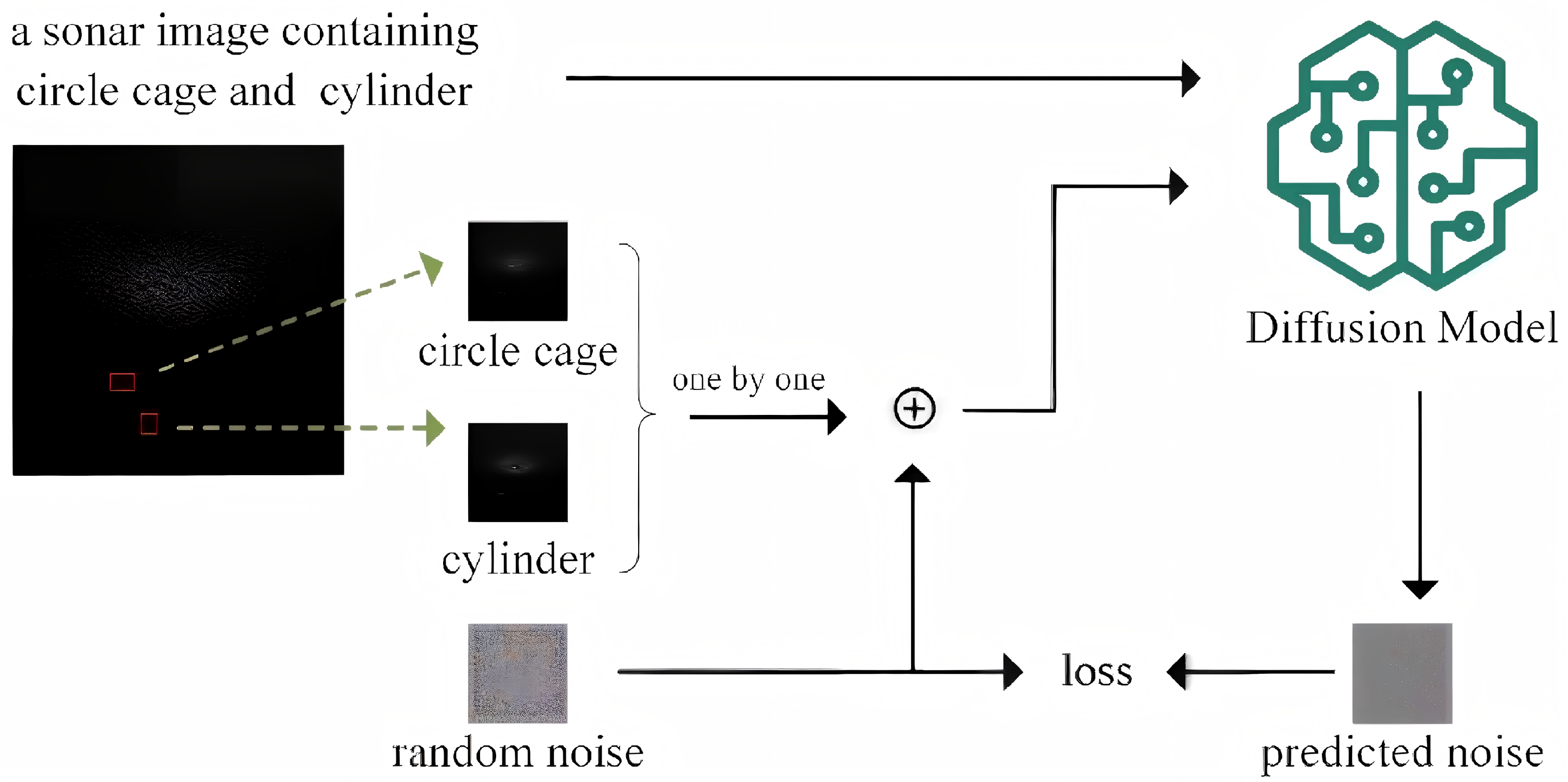
As shown in Figure 1, the fine-tuning stage first extracts the target category within the patch from the annotation file corresponding to the sonar image, and then constructs fixed-structured prompt embeddings. For example, a prompt template is constructed: “A sonar image containing a ROV and a Tyre”. This prompt is transformed into a semantic vector by the CLIP text encoder, serving as a conditional constraint for guiding the diffusion process. The core operating principle of SDM is to perform Markov denoising stepwise in a low-dimensional latent manifold space. Assuming the initial latent variable of the real sonar patch after mapping by the variational autoencoder (VAE) is , Gaussian noise , is injected at time step , resulting in noisy latent variables . To enable SDM to grasp the underwater acoustic scattering law and avoid destroying the general representation ability learned by the pre-trained model, this paper fixes the weights of the VAE and CLIP encoders, and only updates the parameters of the core denoising network U-Net (denoted as ). The optimization objective of its fine-tuning stage aims to minimize the Euclidean distance of the residual noise:
By optimizing , SDM can internalize the distribution pattern of speckle noise in complex seabed environments to a certain extent in the latent space. Thus, it can synthesize sonar images with specific tail target categories and high physical fidelity based on the guidance of conditional semantic vector during the inference generation stage.
Figure 1.
SDM fine-tuning method.
When performing field-adaptive fine-tuning of a Stable Diffusion Model (SDM) using real sonar datasets, selecting appropriate visual input samples is crucial to determining the quality of the generated images [39]. Sonar images generally have high global resolution, but due to limitations in underwater acoustic detection range and physical scattering laws, most effective target instance pixels occupy a small proportion of the entire image, and edge features are relatively scattered. Advanced edge detection and feature enhancement schemes [40] are typically required to highlight critical object contours in such degraded representations. Directly inputting unprocessed high-resolution images for fine-tuning can lead to the U-Net network losing local feature details of small targets during deep downsampling due to an excessively large receptive field. This causes the network to allocate more gradients to a large area of the echo-free seabed background. Therefore, some processing of the sonar images is necessary before fine-tuning the entire model.
2.3.2. Cropping Strategy
To mitigate the problem of target details being easily obscured by cluttered seabed backgrounds during the generation of full sonar images, and to explore the optimal feature guidance method for SDM in underwater acoustic fields, this paper proposes two local patching strategies to focus the network’s attention on the core acoustic region containing the target, instead of feeding the entire large image into the model during fine-tuning.
Image-level Denoising Cropping (ILDC) focuses on preserving the spatial and physical topological relationships between multiple targets in the original sonar image to the greatest extent possible. For original sonar images containing one or more targets, this paper uses simple grayscale thresholding or morphological algorithms [41] to calculate the minimum bounding connected region that can encompass all known targets. Then, large areas of black background without bright echoes at the image edges are directly cropped. During cropping, relatively complete regions containing multiple targets are preserved, forming small training patches. This spatially constrained cropping method allows the model to implicitly learn the co-occurrence distances and orientational relationships between different seabed targets (such as shipwrecks and cylinders), ensuring the rationality of the physical relationships between targets during the generation stage.
The Instance-level Slice Cropping (ILSC) strategy focuses on maximizing the pure semantic alignment between textual instructions and single visual features. As shown in Figure 1, while removing unwanted background noise to the greatest extent possible, if multiple targets exist in the original image, each target is independently sliced based on its physical coordinates labeled in the dataset. To prevent the loss of acoustic shadow features, when slicing the target bounding box coordinates, some pixels are adaptively extended outward to preserve the local background reverberation and accompanying shadow information around the target. After processing with this strategy, an original multi-target image is divided into multiple instance slices, each containing only one main object.
2.3.3. Dense Feature Extraction
To synchronize the output of synthetic sonar images and target bounding boxes, this section investigates how to use intermediate features generated during the denoising inference process using a stable diffusion model (SDM). Unlike conventional detection algorithms that rely on generating well-formed RGB pixel-level images to extract features, this paper attempts to directly obtain a high-dimensional visual feature stream with strong spatial semantic alignment properties from within the U-Net of SDM, using it as a prior for target localization.
The U-Net architecture for SDM denoising mainly consists of a downsampling encoder, an intermediate bottleneck layer, and an upsampling decoder. In the final stage of image generation denoising (i.e., when the time step is small), Gaussian noise in the latent variables has been largely removed (e.g., when time step ). At this point, the U-Net decoder module typically contains rich and clear semantic distribution and spatial topological information. This paper selects to extract activation feature maps from three different resolution levels of the U-Net decoder at a specific time step . These three levels correspond to shallow texture details, mid-level target contours, and deep global semantics, respectively, and the extracted feature maps are denoted as , , and . This multi-scale truncation strategy can preserve the local boundary features of small targets while also taking into account the global context awareness of complex seabed backgrounds, providing a foundation for subsequent feature aggregation.
Since the feature maps extracted from different levels of the decoder differ in spatial resolution, this paper first uses bilinear interpolation to uniformly upsample them to the same spatial resolution dimension to achieve effective fusion of multi-scale information. Fusing visual features from multiple layers or views has been widely recognized as a critical strategy to enhance semantic representation [42]. Then, the aligned multi-scale features are concatenated along the channel dimension. To further reduce the redundancy of channel information caused by multi-level concatenation, a convolutional block with SiLU activation is introduced to perform channel dimensionality reduction and nonlinear mapping on the concatenated features, drawing inspiration from tensor dispersion schemes that optimize multi-view feature embeddings for compact dimensionality reduction [1], ultimately aggregating them into a unified dense visual feature stream . This aggregated feature stream largely preserves the spatial activation response mapping relationship between each physical pixel position in the generated image and specific target concepts (such as cube, ball, etc.). The construction of this dense feature stream provides a reliable high-dimensional information input for subsequent cross-modal feature modulation and two-dimensional coordinate regression.
2.3.4. Cross-Modal Sparse Localization
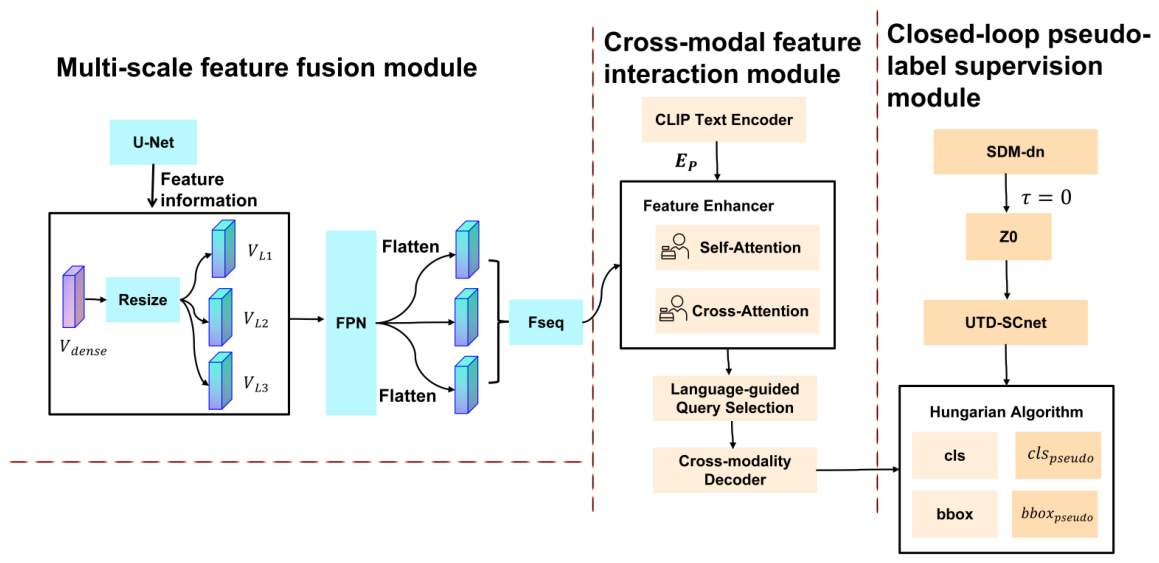
In order to achieve the synchronous output of synthetic two-dimensional sonar images and target bounding boxes, this paper designs an independent cross-modal sparse localization module (CMSL) in addition to the denoising link of the stable diffusion model (SDM). CMSL abandons the traditional dense prediction paradigm widely used in conventional CNN-based detection and dense feature extraction pipelines [43], and draws on the sparse query architecture based on Transformer and the language-guided query and decoding mechanism in modern open set object detection [44] (such as DINO, Grounding DINO, etc.). It can directly extract spatial physical priors from the denoising end of SDM and transform them into accurate coordinate regression results. This mechanism shares a similar conceptual foundation with deep learning-based spatial coordinate estimation and wireless localization algorithms [45].
The core processing flow of CMSL can be broken down into three key stages: multi-scale feature fusion serialization, cross-modal decoding, and closed-loop supervised training. Before performing cross-modal localization, the system needs to map discrete natural language prompts into continuous, dense vectors that are differentiable by the network. This paper uses a CLIP (Contrastive Language-Image Pre-training) text encoder to perform text feature projection. First, the Byte-Pair Encoding (BPE) algorithm is used to segment the prompt string into a fixed-length sequence of lexical units (Tokens), which are then truncated or padded to a standard length . Subsequently, the sequence is fed into the Transformer text encoder. Since CLIP has mapped vision and language to the same feature manifold space through massive image-text pairs during the pre-training stage, its output text embedding vector not only contains the literal semantics of the category but also implies the visual guidance prior of that category in the physical world. The final output prompt feature vector is denoted as (where is the feature dimension), which will serve as a key guiding signal for subsequent attention modulation.
In the initial feature extraction stage, the U-Net decoder of SDM outputs and fuses dense visual features containing global context information at a specific time step (), as well as three multi-scale feature maps , , and corresponding to shallow texture, mid-level contour and deep semantics, respectively.
To fully utilize the high-dimensional semantic aggregation information contained in to guide the low-level features, this paper first downsamples or upsamples to the same spatial resolution as , , and respectively through bilinear interpolation resizing. Then, it injects this information into the corresponding multi-scale features through element-wise addition and convolution mapping, forming primary fusion features:
The multi-scale feature layers obtained after the above fusion are fed into the Feature Pyramid Network (FPN) for cross-scale information interaction and semantic alignment. After processing through the top-down feature transfer and lateral connection structure of the FPN, a deep, semantically strong multi-scale feature layer is output. Since the subsequent Transformer architecture module depends on the one-dimensional sequence input, this paper flattens the three feature maps in the spatial dimension for dimensionality reduction and concatenates them in the sequence dimension to finally obtain a complete one-dimensional visual feature sequence . This multi-scale feature alignment strategy aligns with tensor learning models developed for multi-view visual representation and fusion [46].
The visual sequence , along with the CLIP-encoded text cue word vector , is input into the Feature Enhancer. Within the Feature Enhancer, visual features and text priors are alternately processed using multi-head self-attention and cross-attention to achieve deep cross-modal feature adjustment. Applying structured attention mechanisms in deep vision models [47] allows the network to dynamically assign weight coefficients to highly interactive image-text alignments.
Since the structure of CMSL is independent of the conventional generation chain of SDM, its decoder must rely on reasonable and strong supervision signals to converge correctly. This paper constructs a self-training closed-loop supervision method based on high-precision priors. As shown in Figure 2, when the Markov denoising process of SDM reaches the final time step , the network generates a clear sonar image . This synthesized image is directly input into the pre-trained UTD-SCnet for inference [48]. Given that UTD-SCnet has a strong decoupling capability for feature redundancy and sound-shadow interference of sonar images, this paper adopts a self-training paradigm, using the output of the model as pseudo-real labels, denoted as classification pseudo-label and target bounding box pseudo-label , respectively [49]. This self-supervised alignment framework effectively filters and updates labels, addressing the core challenges of uncertainty and representativeness typically studied in semi-supervised active learning systems [50]. For the prediction set output by CMSL and the uncertain number of pseudo-label sets, this paper introduces the Hungarian Algorithm to perform bipartite graph optimal allocation matching to find the permutation combination with the lowest prediction cost. Since the number of real target instances (M) contained in a sonar image is usually much smaller than the network’s preset query count (N), a background category () is introduced to fill and align the pseudo-label set. The expanded truth set is denoted as . The set elements are represented as , where is the target physical category and are the normalized bounding box coordinates. This allocation process aims to search for specific permutations () to minimize the global matching cost. The corresponding optimization function is expressed as follows:
Figure 2.
CMSL Structure Diagram.
In the above equation, defines the pairwise matching cost between the pseudo-label and its corresponding prediction. After obtaining the optimal allocation permutation through algorithmic calculation, the network establishes a strict discrete sample alignment relationship between the prediction box and the pseudo-label, and avoids invalid gradient propagation of the background prediction box in coordinate regression. After matching is completed, the joint loss between the CMSL network output and the pseudo-label is calculated. Referring to existing sparse detector designs, this loss function consists of the focal classification loss (Focal Loss) to handle the imbalance between positive and negative samples, and the L1 distance loss and generalized intersection-union (GIOU) loss (GIOU Loss) for coordinate regression.
where represents the hyperparameter weights balancing the gradients of each task. When training the CMSL module to achieve automated annotation capabilities, to avoid disrupting the prior distribution of the sonar physical field learned by the diffusion model and to prevent catastrophic forgetting by the detector, this paper strictly freezes the learning state of the network parameters: freezing all parameters of the SDM variational autoencoder (VAE), the core denoising U-Net, and the CLIP text encoder. Simultaneously, all weights of the UTD-SCnet pseudo-label generator are completely frozen. The entire training process only calculates the joint loss , and the gradient is backpropagated to the FPN, feature enhancer, language-guided query selection module, and cross-modal decoder within CMSL, making their weights learnable. Through the above freezing and closed-loop supervised training strategy, the CMSL module efficiently masters the decoding capability from SDM latent feature mapping to specific sonar target physical coordinates and physical categories without interfering with image generation quality, thus establishing an engineering link for the simultaneous operation of generative data augmentation and automated annotation.
3. Results
To ensure the full reproducibility of the proposed approach, all experiments were conducted on a unified hardware platform equipped with dual NVIDIA RTX 4090 GPUs, 128 GB of RAM, and an Intel Core i9 processor. During the generative data augmentation phase, Stable Diffusion Model version 1.5 (SDM v1.5) was adopted as the foundational architecture. The fine-tuning hyperparameters were configured as follows: a base learning rate of , a batch size of 16, and a total of 50,000 training iterations. To guarantee statistical objectivity and eliminate bias during feature extraction and model evaluation, all processes involving random initialization (e.g., dataset shuffling, network weight initialization) were constrained by a fixed random seed (seed = 42).
3.1. Comparison of Fine-Tuning Strategies
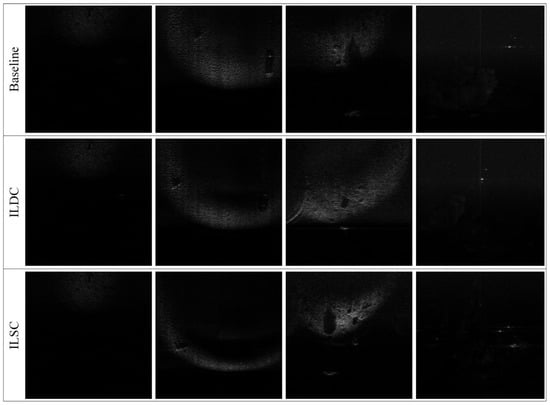
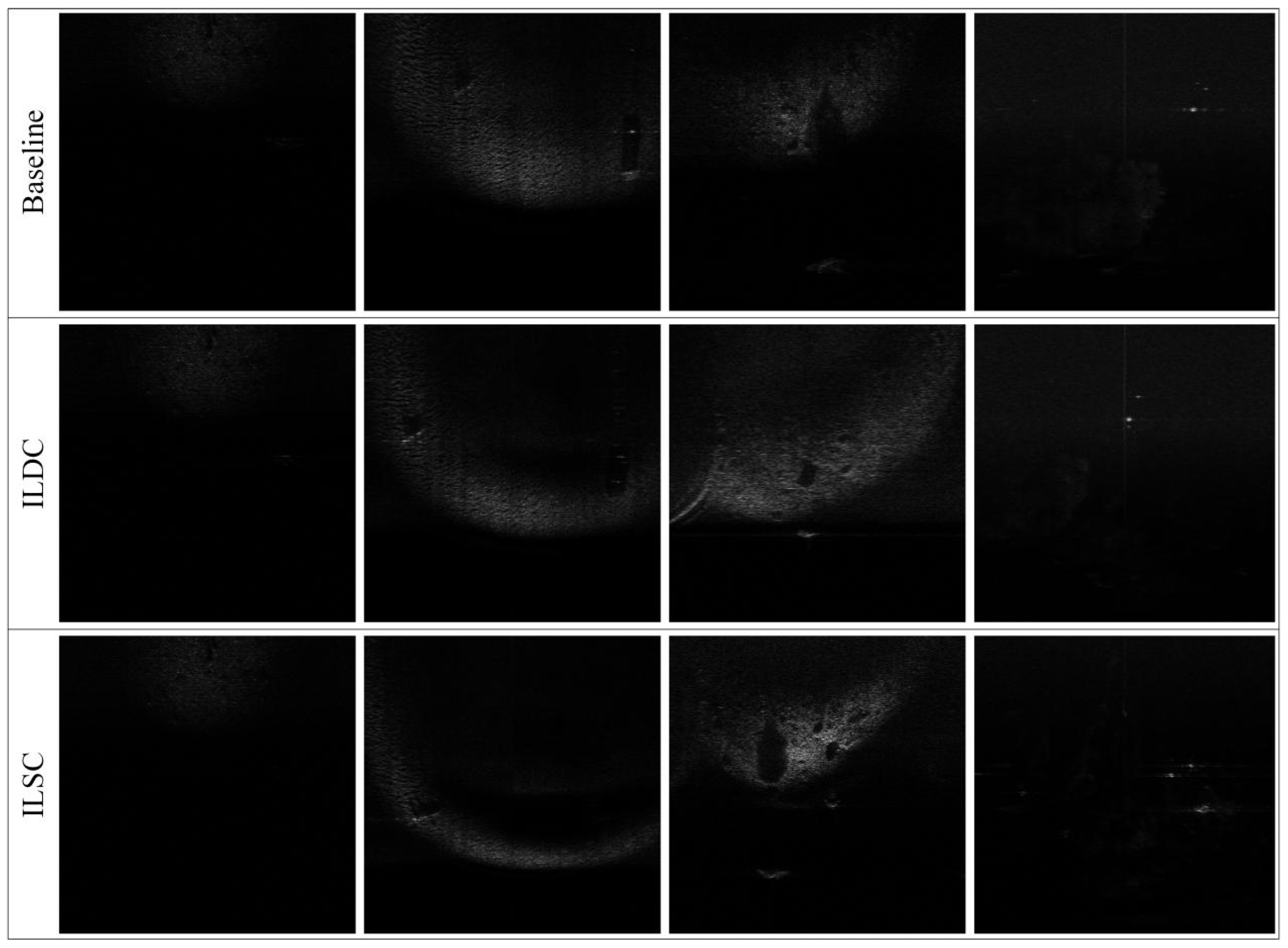
To quantitatively evaluate the specific impact of the two cropping strategies on the SDM fine-tuning effect, this paper designs a comparative experiment on generation quality and semantic alignment. The same fine-tuning hyperparameter configuration is maintained throughout the experiment, including key parameters such as learning rate, batch size, number of iterations, and random number seed, to ensure fairness in the comparison between different strategies. Three control schemes are set up: SDM is fine-tuned using datasets processed by direct full-image fine-tuning (Baseline), image-level denoising cropping, and instance-level slice cropping. Finally, the three fine-tuned models are executed on sonar image generation tasks of specified categories, generating the same number of synthetic samples for subsequent subjective visual analysis and objective metric evaluation. To visually demonstrate the differences in image generation among the three control groups, randomly selected generated images are shown in Figure 3.
Figure 3.
Sonar images generated by three fine-tuning methods.
To accurately measure the true quality of the generated images, this paper introduces objective quantitative metrics for evaluation. For evaluation metrics, this paper uses the classic Fréchet Inception Distance (FID) in image generation to measure the overall acoustic texture realism of the synthesized images. The lower the FID value, the closer the distribution of the generated samples is to the distribution of real sonar images, and the higher the generation quality. The experiments also use the pre-trained detector recall (DR) to measure whether the generated images can be effectively recognized. 1000 test images with a certain category are synthesized using each group of finely tuned SDMs, and these images are then input into the pre-trained UTD-SCnet. The statistical model can obtain the corresponding bounding box prediction recall. To evaluate the reliability of the generated images in terms of semantic consistency with the target category, this paper introduces the Cross-Class Semantic Confusion Rate (CCSCR) as a supplementary evaluation metric. The calculation of CCSCR is defined as follows: the generated image set is first evaluated by a pre-trained baseline detector. If the predicted bounding box category () contradicts the textual prompt category () used during generation, it is recorded as a semantic confusion event. The CCSCR is formulated as the ratio of confused samples () to the total number of generated samples ():
A lower CCSCR value indicates higher semantic adherence without inter-class ambiguity. The lower the CCSCR, the higher the semantic adherence of the diffusion model to the textual conditions, and the more closely the generated target category matches the guidance of the textual conditions. The experimental results are shown in Table 2.
Table 2.
Quantitative comparison of the effects of different truncation fine-tuning strategies on SDM generation quality.
The experiment compares the impact of three fine-tuning input strategies on the quality of stable diffusion model (SDM) generation. When using the original whole image for fine-tuning (Baseline), the FID is as high as 44.21, the DR is only 0.652, and the CCSCR is 0.113, indicating that directly inputting a high-resolution global image can easily lead to the loss of target details. After switching to image-level denoising cropping (ILDC), the FID dropped to 38.65 and the DR increased to 0.714, but the CCSCR increased to 0.168, indicating that the coexistence of multiple targets will cause category semantic confusion. In contrast, instance-level slicing cropping (ILSC) achieved the best results: FID further dropped to 31.42, DR reached 0.815, and CCSCR was as low as 0.075. From the subjective visual comparison of the generated images, all three strategies can produce sonar images with target highlights, acoustic shadows, and seafloor reverberation, but the image generated by instance-level slice cropping is significantly more outstanding in target edge clarity and texture fidelity. Based on the quantitative and qualitative results, instance-level slice cropping is the most suitable SDM fine-tuning input strategy for this task.
3.2. Results of Constant Ratio Saturation Compensation Ablation Experiment
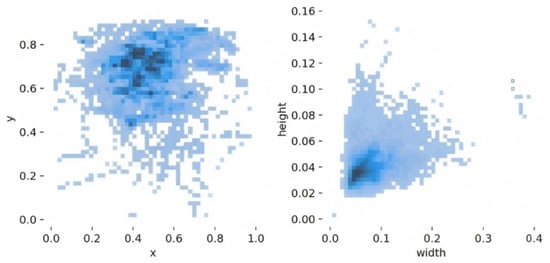
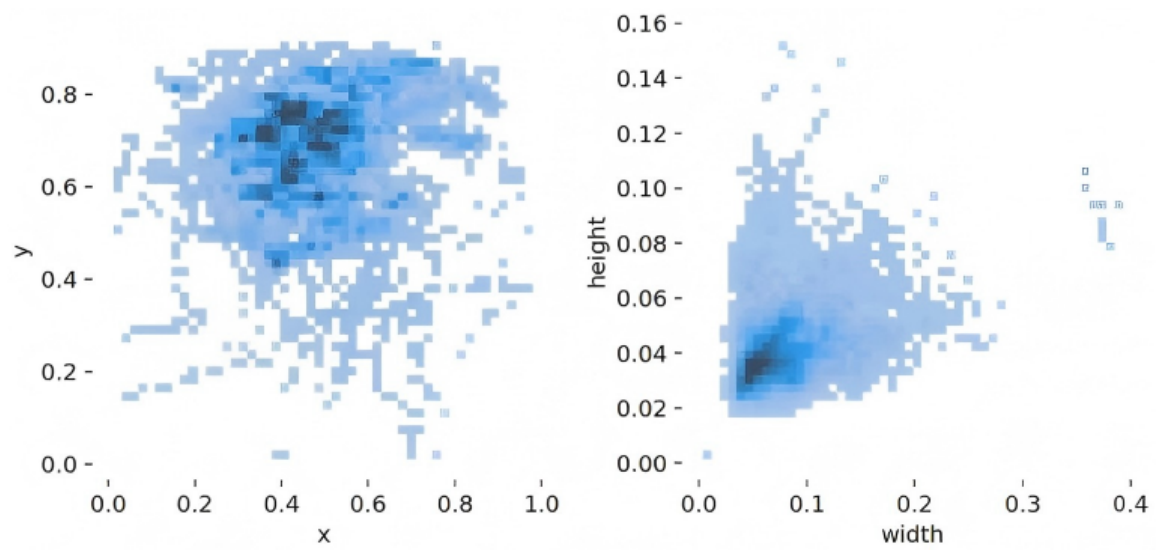
To alleviate the feature scarcity problem of long-tail categories in real datasets, this paper adopts a fixed-ratio saturation compensation data mixing strategy. Addressing extreme class imbalance and data scarcity traditionally involves selective sampling methods or optimized classification boundary designs such as active-learning-guided optimization [51] to build robustness in sparse-instance regimes. Statistical analysis of the distribution of real target instances in the URPC2022 training set, which comprises a total of 10 marine categories, shows that the number of instances in the ‘Ball’ and ‘Cube’ head classes is over 2000. This paper sets a safe threshold for the number of instances , explicitly defining the remaining 8 categories (Cylinder, Human body, Square cage, Circle cage, Tyre, Metal bucket, Plane, and ROV) as long-tail classes due to their severe data scarcity. Based on the previously established SDM and CMSL modules, sonar image generation and target bounding box generation are performed simultaneously exclusively for these eight long-tail categories. Based on the previously established SDM and CMSL modules, sonar image generation and target bounding box generation are performed simultaneously for the input guidance words of the eight long-tail categories. To form a relatively balanced gradient response for rare targets in the network feature space, this section uniformly expands these eight long-tail categories with a certain proportion of high-quality synthetic instances, with the expansion ratio ranging from approximately 10% to 100%. Figure 4 shows the trend of the number of long-tail categories in the mixed dataset gradually increasing proportionally, while alleviating the problem of class imbalance. Furthermore, as shown in the center location map in the lower left corner of the figure, the bounding boxes of instances in the mixed dataset are mainly concentrated in the upper-middle part of the sonar image. The target size distribution map in the lower right corner indicates that the sonar images in contain small to medium-sized targets, while large targets and their corresponding bounding boxes are relatively few.
Figure 4.
Mixed datasets , the left image shows the distribution of the target center point, and the right image shows the distribution of the target size.
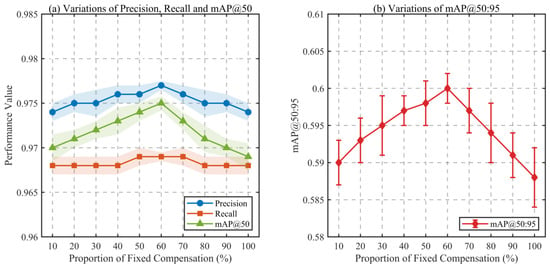
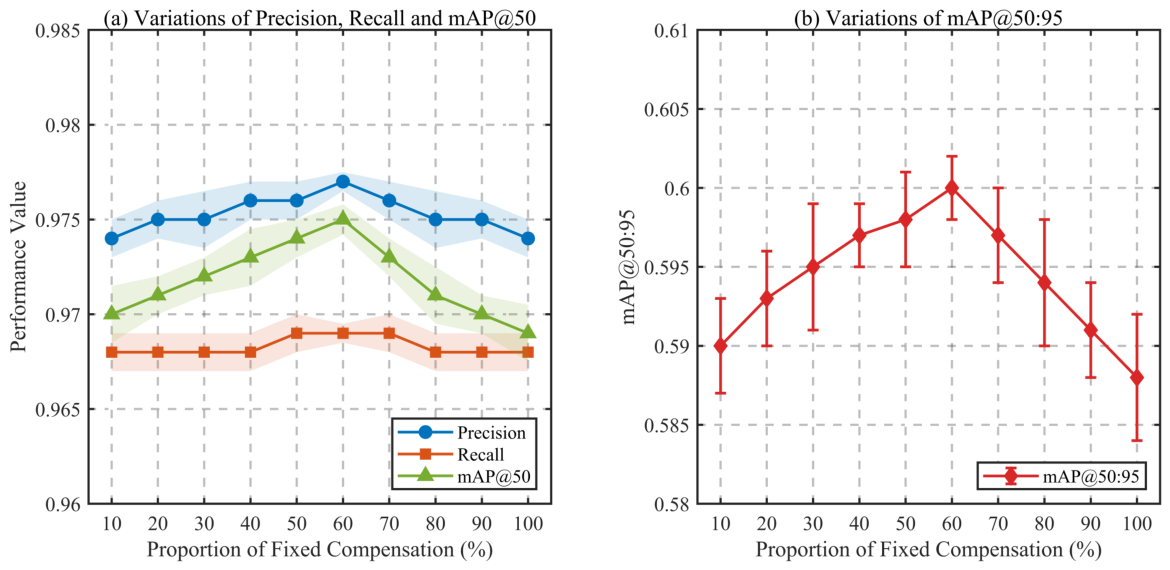
To explore the optimal injection ratio of generative synthetic data, this paper incrementally adds long-tail category synthetic samples (from 10% to 100%) to the URPC2022 real training set in 10% increments. After fine-tuning the UTD-SCnet model on the mixed dataset, inference is performed on the real validation set, and four metrics are recorded: precision, recall, mAP50, and mAP50:95 (the results are shown in Figure 5a,b). To rigorously account for normal training variability and ensure statistical reproducibility, all experiments in this section were independently repeated across five runs using different random seeds. The mean and standard deviation of the results are shown in the shaded error bands and error bars in Figure 5. The experimental data clearly reveal the non-monotonic saturation effect of generated data augmentation: as the fixed compensation ratio gradually increases from 10%, all performance metrics of the model (Precision, Recall, mAP@50, and the more stringent mAP@50:95) exhibit a highly consistent inverted U-shaped trend of first increasing and then decreasing. Specifically, when the compensation ratio reached 60%, the high-quality generated samples most effectively filled the feature space gaps of the eight long-tail categories, resulting in peak values of 0.977, 0.969, and 0.975 for Precision, Recall, and mAP@50, respectively. The global mAP@50:95 also robustly improved from a baseline of 0.588 to a maximum mean of 0.600. The extremely narrow standard deviation distribution in the graph (e.g., the standard deviation of mAP@50:95 at 60% of the points is around ±0.003) statistically irrefutably proves that this 1.2% performance gain is real and significant, completely exceeding the scope of random error. However, when the injection ratio exceeds 60% and continues to increase, the distribution shift between the generated domain and the real domain begins to dominate, causing the network to overfit to non-real features. As a result, all detection metrics continue to decline. This fully demonstrates that 60% is an ideal saturation critical point, which achieves the optimal physical and semantic balance between maximizing the mitigation of long-tail data scarcity and preventing synthetic noise interference.
Figure 5.
Results of constant ratio compensation ablation experiment.
3.3. Category-Level Detection Results Under Optimal Mixing Ratio
A mixed dataset was constructed using the optimal compensation ratio of 60%. UTD-SCnet was fine-tuned, and detection accuracy was evaluated class-by-class on the real validation set. The results are shown in Table 3. In terms of global performance, the model’s mAP (50:95) improved from the baseline of 0.588 to 0.600, an increase of 1.2%. For tail categories, all rare targets showed significant gains: Cylinder’s mAP improved from 0.541 to 0.565, RoV accuracy jumped 3.3% to 0.585, and Square cage and Tyre also improved by 2.2% and 1.9% respectively (to 0.575 and 0.597). Meanwhile, the head category showed slight fluctuations: Cube’s mAP (50:95) decreased slightly from 0.612 to 0.610, and Ball’s mAP decreased slightly from 0.600 to 0.598. This result indicates that generative data augmentation significantly improves the performance of the long-tail categories while achieving a reasonable rebalancing of the feature distribution at the cost of minimal accuracy loss in the head categories.
Table 3.
UTD-SCnet Validation Results Based on Fine-tuning vs. Baseline.
4. Discussion
4.1. Physical Mechanism Analysis of Fine-Tuning Strategy Differences
Experimental results show that Instance-Level Slice Cropping (ILSC) outperforms other strategies on all quantitative metrics. Its advantages lie in the fact that after splitting a multi-object image into single-object tiles, a one-to-one pure semantic mapping can be established between text prompts (such as “a sonar image containing a ROV”) and visual latent variables, avoiding the aliasing of cross-attention weights on the spatial grid when multiple objects coexist (as evidenced by the increase in CCSCR to 0.168 in the ILDC strategy). Simultaneously, slice cropping preserves local background and shadow information around the object, enabling SDM to effectively learn the sound-shadow topology, thus significantly improving DR recall. In contrast, full-image fine-tuning suffers from the loss of small object details due to deep downsampling, resulting in the highest FID and the lowest DR; while ILDC, although removing invalid background, suffers from increased class confusion due to the tight coupling of multiple objects, which is detrimental to the accuracy of conditional control.
4.2. Non-Monotonic Effect and Optimal Boundary of Data Injection Ratio
The fixed-ratio compensation experiment revealed a non-monotonic pattern of initial increase followed by decrease: in the 0–60% range, synthetic samples effectively filled the feature space gaps of the tail categories, shifting the model’s decision boundary towards rarer categories and mitigating underfitting caused by long-tail distributions, thus continuously improving various indicators. However, when the injection ratio exceeded 60%, the distribution shift between the generated and real domains (Domain Gap) began to dominate the negative impact: the high-frequency artifacts and texture biases inherent in the diffusion model gradually masked the physical scattering patterns of real sonar images, causing the network to overfit to non-realistic features and impairing generalization performance. This phenomenon was particularly significant at 100%, indicating that data augmentation has a saturation critical point and is not necessarily better the more it is, validating the rationality of the fixed-ratio compensation strategy in this study.
4.3. Feature Distribution Redistribution and Head–Tail Tradeoff
Table 3 shows that while the accuracy of tail categories improved, the accuracy of head categories (Cube, Ball) slightly decreased. This is not model degradation, but rather a redistribution of accuracy during the feature distribution equalization process. In the baseline model, the sample advantage of head categories makes them dominate gradient descent, compressing the decision space of tail categories. After introducing long-tail synthetic samples, the detector shifts some attention weights to rare targets, resulting in a reasonable shift in the decision boundary. The model achieves a significant performance leap of 2~3% in tail categories with a tiny accuracy loss of less than 0.4% in head categories, realizing a more balanced and robust generalization equilibrium from a global perspective. This demonstrates the effectiveness and engineering feasibility of generative data augmentation in mitigating class imbalance.
4.4. Error Accumulation and Freezing Strategies in Closed-Loop Supervision
In this study, the CMSL module uses pseudo-labels generated by UTD-SCnet for self-training. This iterative loop of self-training and online correction aligns with the dynamic feedback mechanisms developed for autonomous online learning systems [52], which refine predictive models progressively via feedback interfaces. To avoid amplifying pseudo-label errors, we adopted a dual freezing strategy (freezing the SDM core network and UTD-SCnet weights, updating only the internal parameters of CMSL) and strictly controlled the injection ratio (≤60%). Experimental results show that this strategy effectively suppresses the error accumulation effect, because even if some synthetic samples are labeled with bias, their number accounts for a limited proportion of the total training set (within 60%), and the performance on the real validation set continues to improve without catastrophic forgetting or sudden performance drops, confirming the robustness of the closed-loop supervision design.
4.5. Discussion on Pseudo-Label Robustness in CMSL
It is important to note that the CMSL decoder is fundamentally robust against potential pseudo-label noise generated by the frozen detector, particularly for rare classes. Unlike direct knowledge distillation that forces a model to strictly mimic a teacher’s output, CMSL operates as a cross-modal alignment mechanism. The generation of spatial coordinates is simultaneously conditioned on rich visual features and explicit text prompts. This bi-directional semantic constraint acts as an implicit regularizer: the model preferentially learns the highly consistent structural alignments shared across the dataset, rather than overfitting to isolated erroneous bounding boxes produced by the detector. Consequently, the cross-modal attention mechanism inherently filters out independent detection noise, ensuring that the generated coordinates remain faithful to the textual descriptions even for long-tail categories.
5. Future Work
While this study provides a highly automated augmentation pipeline for long-tail detection, it is subject to certain limitations. Due to the extreme scarcity of publicly available sonar datasets featuring both instance-level bounding box annotations and prominent long-tail distributions, the current framework was exclusively evaluated on the URPC2022 benchmark. The generalizability of the optimal 60% injection ratio across different acoustic domains (e.g., varying sonar frequencies and equipment types) remains to be fully explored. Future work will focus on collecting diverse sonar datasets, addressing cross-domain adaptation for diffusion models, and further closing the domain gap between synthesized and real acoustic textures [53].
6. Conclusions
This study investigated diffusion-based data augmentation for long-tail sonar object detection, with a focus on whether generated samples can be made directly usable for detector training. The results show that instance-level slice cropping is more suitable than full-image or image-level cropping for SDM fine-tuning, because it reduces category ambiguity and preserves local acoustic structures around individual targets. The proposed CMSL module further connects image generation with bounding-box prediction, reducing the dependence on manual annotation for synthetic samples.
The data-mixing experiments indicate that synthetic sonar samples are useful only within a controlled range. A 60% injection ratio provides the best validation performance in this study, whereas larger ratios reduce detection accuracy, suggesting that domain shift from generated data can offset the benefits of long-tail compensation. Therefore, the main implication of this work is not that more generated data is always better, but that generative augmentation should be paired with localization supervision and ratio control. Future work should further validate the framework across additional sonar datasets, improve the reliability of pseudo-label supervision, and reduce the domain gap between real and generated acoustic textures. It is important to emphasize that the effectiveness of the proposed generative augmentation approach, including the optimal 60% injection boundary, has been demonstrated under the specific experimental conditions considered in this study (i.e., the URPC2022 dataset and the UTD-SCnet architecture). These findings should not be interpreted as universally applicable to all underwater sensing paradigms without domain-specific tuning.
Author Contributions
S.C.: Responsible for research concept design, methodology construction, algorithm implementation (software), experimental verification, formal analysis, data processing, draft writing, and chart visualization; a key contributor to the core work of the paper. R.Z. (corresponding author): Responsible for overall research framework design, research guidance and supervision, project management, funding acquisition, and participated in the review and revision of the final draft. Z.Z.: Assisted with algorithm implementation and experimental verification and participated in some data preprocessing and paper revision. K.W.: Participated in software code debugging and model optimization and assisted in experimental execution and result verification. P.L.: Participated in experimental verification and result analysis and assisted in the literature review and paper revision. All authors have read and agreed to the published version of the manuscript.
Funding
This work was partially supported by the National Natural Science Foundation of China under Grant 62362026; in part by the Key Project of Hainan Province under Grant ZDYF2023GXJS158; in part by Hainan Provincial Natural Science Foundation of China under grant 626MS0092 and 626QN0556.
Institutional Review Board Statement
Not applicable.
Informed Consent Statement
Not applicable.
Data Availability Statement
The original contributions presented in this study are included in the article. The raw data supporting the conclusions of this article will be made available by the authors on request.
Conflicts of Interest
The authors declare no conflicts of interest. The funders had no role in the design of the study; in the collection, analyses, or interpretation of data; in the writing of the manuscript; or in the decision to publish the results.
References
- Yang, S.; Ren, X.; Zha, B.; Bao, Q.; Feng, B.; Xu, Z. EFSRNet: Multi-scale exposure normalization and dual-branch aggregation for overexposed face super-resolution. Knowl.-Based Syst. 2026, 339, 115578. [Google Scholar] [CrossRef] [Scilit]
- Zhang, C. Simulation analysis of bionic robot fish based on MFC materials. Math. Probl. Eng. 2019, 2019, 2720873. [Google Scholar] [CrossRef] [Scilit]
- Wu, X.; Dong, J.; Bao, W.; Zou, B.; Wang, L.; Wang, H. Augmented intelligence of things for emergency vehicle secure trajectory prediction and task offloading. IEEE Internet Things J. 2024, 11, 36030–36043. [Google Scholar] [CrossRef] [Scilit]
- Akkaynak, D.; Treibitz, T. Sea-thru: A method for removing water from underwater images. In Proceedings of the IEEE/CVF Conference on Computer Vision and Pattern Recognition, Long Beach, CA, USA, 15–20 June 2019; pp. 1682–1691. [Google Scholar]
- Liu, F.; Wang, L.; Zhang, T.; Cao, J.; Wu, X. An intelligent recognition method for narcotic and psychotropic drugs in complex scenes based on multi-stage image enhancement and optimized YOLOv8. Alex. Eng. J. 2026, 147, 144–170. [Google Scholar] [CrossRef] [Scilit]
- Zhu, R.; Li, W.; Boukerche, A.; Yang, Q. Energy-aware DRL-based dual-perception fountain codes for resource-constrained UASNs. IEEE Trans. Sustain. Comput. 2026, 11, 111–122. [Google Scholar] [CrossRef] [Scilit]
- Fang, Y.; Zhu, S.; Liao, B.; Li, X.; Liao, G. Target localization with bistatic MIMO and FDA-MIMO dual-mode radar. IEEE Trans. Aerosp. Electron. Syst. 2023, 60, 952–964. [Google Scholar]
- Valdenegro-Toro, M. Object recognition in forward-looking sonar images with convolutional neural networks. In Proceedings of the OCEANS 2016 MTS/IEEE Monterey, Monterey, CA, USA, 19–23 September 2016; pp. 1–6. [Google Scholar]
- Huang, Y.; Li, W.; Yuan, F. Speckle noise reduction in sonar image based on adaptive redundant dictionary. J. Mar. Sci. Eng. 2020, 8, 761. [Google Scholar] [CrossRef] [Scilit]
- Tian, C.; Chen, Y. Image segmentation and denoising algorithm based on partial differential equations. IEEE Sens. J. 2019, 20, 11935–11942. [Google Scholar] [CrossRef] [Scilit]
- Hurtós, N.; Petillot, Y.; Salvi, J. Fourier-based registrations for two-dimensional forward-looking sonar image mosaicing. In Proceedings of the 2012 IEEE/RSJ International Conference on Intelligent Robots and Systems, Vilamoura-Algarve, Portugal, 7–12 October 2012; pp. 5298–5305. [Google Scholar]
- Wang, H. A Novel Detection Method for Weak Harmonic Signal with Chaotic Noise. Trait. Signal 2020, 37, 485–491. [Google Scholar] [CrossRef] [Scilit]
- Myers, V.; Williams, D.P. Adaptive multiview target classification in synthetic aperture sonar images using a partially observable Markov decision process. IEEE J. Ocean. Eng. 2011, 37, 45–55. [Google Scholar] [CrossRef] [Scilit]
- Neupane, D.; Seok, J. A review on deep learning-based approaches for automatic sonar target recognition. Electronics 2020, 9, 1972. [Google Scholar] [CrossRef] [Scilit]
- Jiao, W.; Zhang, J. Sonar images classification while facing long-tail and few-shot. IEEE Trans. Geosci. Remote Sens. 2022, 60, 4210420. [Google Scholar] [CrossRef] [Scilit]
- Ma, Y.; Yang, Q.; Zhu, R.; Li, Y.; Wahab, M.M.A. Underwater Image Enhancement via Dual-Path Frequency-Domain Fusion Network. IEEE Trans. Circuits Syst. Video Technol. 2026; Early access. [CrossRef] [Scilit]
- Zhang, C.; Guo, Z.; Li, C. Unsupervised anomaly detection for gearboxes based on the deep convolutional support generative adversarial network. Sci. Rep. 2025, 15, 20977. [Google Scholar] [CrossRef] [Scilit] [PubMed]
- Wang, N.; Jin, W.; Bi, H.; Xu, C.; Gao, J. A survey on deep learning for few-shot PolSAR image classification. Remote Sens. 2024, 16, 4632. [Google Scholar] [CrossRef] [Scilit]
- Huang, J.; Huang, Z.; Xie, C.; Zhang, Y.; Ostachowicz, W.; Cao, M. Unsupervised deep learning framework for damage identification under ambient excitations: Trait of damage localization and demonstrative applications. Mech. Syst. Signal Process. 2026, 250, 114123. [Google Scholar] [CrossRef] [Scilit]
- Luo, J. Sonar image augmentation for underwater bridge piers via cyclic GANS. Adv. Comput. Eng. Technol. Res. 2024, 1, 373–380. [Google Scholar] [CrossRef] [Scilit]
- Jiang, L.; Fang, H.; Shang, X.; Zhang, Z. Hierarchical clustering weighted Gaussian process regression low-fidelity model and application in airfoil drag coefficients prediction. IEEE Trans. Aerosp. Electron. Syst. 2026, 62, 9070–9081. [Google Scholar] [CrossRef] [Scilit]
- Kingma, D.P.; Welling, M. Auto-encoding variational bayes. arXiv 2013, arXiv:1312.6114. [Google Scholar]
- Liu, Y.; Liu, Z.; Li, S.; Yu, Z.; Guo, Y.; Liu, Q.; Wang, G. Cloud-VAE: Variational autoencoder with concepts embedded. Pattern Recognit. 2023, 140, 109530. [Google Scholar] [CrossRef] [Scilit]
- Rombach, R.; Blattmann, A.; Lorenz, D.; Esser, P.; Ommer, B. High-resolution image synthesis with latent diffusion models. In Proceedings of the IEEE/CVF Conference on Computer Vision and Pattern Recognition, New Orleans, LA, USA, 18–24 June 2022; pp. 10684–10695. [Google Scholar]
- Zhu, R.; Sheng, L.; Wu, K.; Boukerche, A.; Long, L.; Yang, Q. Toward Efficient Underwater Visual Perception through Image Enhancement, Compression, and Understanding. ACM Comput. Surv. 2026, 58, 205. [Google Scholar] [CrossRef] [Scilit]
- Chen, T.; Li, L.; Saxena, S.; Hinton, G.; Fleet, D.J. A generalist framework for panoptic segmentation of images and videos. In Proceedings of the IEEE/CVF International Conference on Computer Vision, Paris, France, 1–6 October 2023; pp. 909–919. [Google Scholar]
- Liu, L.; Chu, C.; Chen, C.; Huang, S. MarineYOLO: Innovative deep learning method for small target detection in underwater environments. Alex. Eng. J. 2024, 104, 423–433. [Google Scholar] [CrossRef] [Scilit]
- Yang, Y.; Zhang, T. Diffusion-Model-Based Data Augmentation for Target Detection in Side-Scan Sonar Images. Remote Sens. 2026, 18, 2193. [Google Scholar] [CrossRef] [Scilit]
- Natarajan, P.; Basha, K.; Nambiar, A. Synth-SONAR: Sonar image synthesis with enhanced diversity and realism via dual diffusion models and GPT prompting. arXiv 2024, arXiv:2410.08612. [Google Scholar]
- Ma, Z.; Meng, W.; Tang, C.; Jiang, L. Hierarchical segmentation-guided diffusion framework for high-fidelity sonar image generation. Multimed. Syst. 2026, 32, 259. [Google Scholar] [CrossRef] [Scilit]
- Xi, J.; Ye, X.; Guo, S.; Li, C.; Huang, H. Sonar images generation method based on improved stable diffusion combined with ControlNet model. Multimed. Syst. 2026, 32, 301. [Google Scholar] [CrossRef] [Scilit]
- Ho, J.; Jain, A.; Abbeel, P. Denoising diffusion probabilistic models. Adv. Neural Inf. Process. Syst. 2020, 33, 6840–6851. [Google Scholar]
- Sgroi, S.; Palma, G.M.; Paternostro, M. Reinforcement learning approach to nonequilibrium quantum thermodynamics. Phys. Rev. Lett. 2021, 126, 020601. [Google Scholar] [CrossRef] [Scilit] [PubMed]
- Tang, R.; Liu, L.; Pandey, A.; Jiang, Z.; Yang, G.; Kumar, K.; Stenetorp, P.; Lin, J.; Türe, F. What the daam: Interpreting stable diffusion using cross attention. In Proceedings of the 61st Annual Meeting of the Association for Computational Linguistics, Toronto, Canada, 9–14 July 2023; Association for Computational Linguistics: Stroudsburg, PA, USA, 2023; Volume 1: Long Papers, pp. 5644–5659. [Google Scholar]
- Chu, Y.; Zhou, L.; Luo, G.; Kang, K.; Dong, S.; Han, Z.; Wu, L.; Meng, X.; Yang, C.; Guo, X.; et al. HorusEye: A self-supervised foundation model for generalizable X-ray tomography restoration. Nat. Comput. Sci. 2026, 6, 372–387. [Google Scholar] [CrossRef] [Scilit] [PubMed]
- Jiang, R.; Tong, S.; Wu, J.; Hu, H.; Zhang, R.; Wang, H.; Zhao, Y.; Zhu, W.; Li, S.; Zhang, X. A novel EEG artifact removal algorithm based on an advanced attention mechanism. Sci. Rep. 2025, 15, 19419. [Google Scholar] [CrossRef] [Scilit] [PubMed]
- Girshick, R.; Donahue, J.; Darrell, T.; Malik, J. Rich feature hierarchies for accurate object detection and semantic segmentation. In Proceedings of the IEEE Conference on Computer Vision and Pattern Recognition, Columbus, OH, USA, 23–28 June 2014; pp. 580–587. [Google Scholar]
- Liu, X.; Yang, R.; Chen, Q.; Deng, B.; Jin, M.; Wang, F.; He, Y. Deblur of infrared thermal images of in-service wind turbine blade based on rotational motion flow. Measurement 2026, 287, 122462. [Google Scholar] [CrossRef] [Scilit]
- Zhang, L.; Rao, A.; Agrawala, M. Adding conditional control to text-to-image diffusion models. In Proceedings of the IEEE/CVF International Conference on Computer Vision, Paris, France, 1–6 October 2023; pp. 3836–3847. [Google Scholar]
- Wang, X.; Zhao, P.; Yue, S.; Gu, Y. An improved cross algorithm edge detection method and its application in coal gangue identification. Int. J. Coal Prep. Util. 2026, 46, 835–847. [Google Scholar]
- Yao, Y.; Xia, C.; Li, J.; Li, Q. Head CT image convolution feature segmentation and morphological filtering for densely matching points of IoTs. IEEE Access 2020, 8, 12521–12532. [Google Scholar] [CrossRef] [Scilit]
- Shang, X.; Fang, H.; Lu, L.; Zhang, Z.; Ma, P. Partial Gradient-enhanced Multi-output Sparse Polynomial Chaos Expansion Method for Model Representation. Reliab. Eng. Syst. Saf. 2025, 270, 112132. [Google Scholar]
- Kang, M.; Liang, Y.; Zhao, B.; Liu, J.; Wang, X.; Wu, C.; Li, Q.; Zhang, J.; Tian, W. Machine learning-based detection technology for electron beam and laser processing. Opt. Laser Technol. 2026, 201, 115292. [Google Scholar] [CrossRef] [Scilit]
- Fan, J.; Yu, G.A.; Zhao, M.; Zong, H. Addressing multi-scale temporal variability: Deep integration and application of the CNN and transformer model in monthly streamflow prediction. Expert Syst. Appl. 2025, 292, 128658. [Google Scholar] [CrossRef] [Scilit]
- Yao, S.; Li, Z.; Guan, R.; Xia, M.; Hu, F.; Cao, K.; Xu, S.; Zhu, X.; Liu, R.W.; Ding, W. GIF-Calib: Geometry-Intensity Fusion for 4D Radar-Camera Calibration in Autonomous Driving Vehicles. Inf. Fusion 2026, 136, 104510. [Google Scholar] [CrossRef] [Scilit]
- Yu, L.; Zhang, D.; Liu, N.; Zhou, W. A multi-view fusion method via tensor learning and gradient descent for image features. IEEE Access 2021, 9, 79389–79399. [Google Scholar] [CrossRef] [Scilit]
- Chen, Y.; Deng, Z.; Wang, L.; Wang, H.; Wu, X. A bilayer feature fusion framework for pan-cancer survival prediction based on multihead attention and adaptive differential privacy: Model development and validation study. JMIR Med. Inform. 2026, 14, e83743. [Google Scholar] [CrossRef] [Scilit] [PubMed]
- Zhang, Z.; Ding, Z.; Tang, Z.; Wu, K.; Sheng, L.; Huang, X. UTD-SCnet: Underwater Target Detection in Sonar Image based on Spatial and Channel Attention Net. In Proceedings of the 2025 International Joint Conference on Neural Networks (IJCNN), Rome, Italy, 30 June–5 July 2025; pp. 1–8. [Google Scholar]
- Wei, C.; Guo, C.; Yan, W. Forest fire risk forecast method with pseudo label based on semi-supervised learning. In Proceedings of the 2021 3rd International Conference on Machine Learning, Big Data and Business Intelligence (MLBDBI), Taiyuan, China, 3–5 December 2021; pp. 36–39. [Google Scholar]
- Li, H.; Li, Y.; Li, P.; Zhang, G.; Wang, W.; Xu, K. Exploring Uncertainty and Representativeness for Deep Active Learning. J. Circuits Syst. Comput. 2025, 34, 2550207. [Google Scholar] [CrossRef] [Scilit]
- Dong, S. Multi class SVM algorithm with active learning for network traffic classification. Expert Syst. Appl. 2021, 176, 114885. [Google Scholar] [CrossRef] [Scilit]
- Wu, X.; Wang, H.; Zhang, Y.; Zou, B.; Hong, H. A tutorial-generating method for autonomous online learning. IEEE Trans. Learn. Technol. 2024, 17, 1532–1541. [Google Scholar] [CrossRef] [Scilit]
- Wu, X.; Zhang, Y.; Shi, M.; Li, P.; Li, R.; Xiong, N.N. An adaptive federated learning scheme with differential privacy preserving. Future Gener. Comput. Syst. 2022, 127, 362–372. [Google Scholar] [CrossRef] [Scilit]

Disclaimer/Publisher’s Note: The statements, opinions and data contained in all publications are solely those of the individual author(s) and contributor(s) and not of MDPI and/or the editor(s). MDPI and/or the editor(s) disclaim responsibility for any injury to people or property resulting from any ideas, methods, instructions or products referred to in the content. |
© 2026 by the authors. Licensee MDPI, Basel, Switzerland. This article is an open access article distributed under the terms and conditions of the Creative Commons Attribution (CC BY) license.