


Abstract
This study investigates the interrelationships between soil organic matter (SOM) quality characteristics and key mercury species in two sites in Czech Republic under historical Hg contamination. SOM properties derived from DRIFT spectral analysis including the aromaticity index (iAR), potential wettability index (PWI), decomposability index (DI), and organic matter quality index (OMQ) along with additional SOM quantity and quality indicators were evaluated against several key Hg fractions (Total Hg (HgT), potentially mobilizable Hg (HgPM), potentially mobilizable Hg ions (Hg2+), methylmercury (MeHg), and water-soluble Hg (HgWS)). Neural network analysis revealed that type of horizon (organic or mineral) as well as SOM quality characteristics play an important role in Hg mobility and methylation processes. The results show the difference in relevant SOM quality properties that affect Hg mobility and methylation that can also be opposite based on the soil horizon type for the same soil, potentially forcing different pathways for the mobilization and methylation, and indicating that the state of transformation of organic matter and its quality characteristics along with the environmental conditions are some of the key attributes influencing mobility and methylation processes of Hg in the soil.
1. Introduction
Mercury (Hg) is a highly toxic and persistent environmental pollutant that can be released from both natural processes and anthropogenic activities such as coal combustion and mining. Topsoil (0–20 cm) is the largest Hg reservoir with 1088 ± 379 Gg of Hg stored [1]. Topsoil represents the largest Hg pool due to the amount of organic matter it contains and mercury’s affinity to functional groups commonly found in soil organic matter (thiol, carboxyl, phenolic), the strength of the covalent bond they make as well as the exposure to the atmosphere, the medium that accumulates the most Hg emissions. These groups can donate electron pairs to Hg2+, creating stable Hg–organic complexes that reduce Hg mobility and bioavailability [2,3].
Soil organic matter (SOM) is a fundamental component of forest soils as it regulates key ecosystem processes. It improves soil structure and water retention, enhances nutrient cycling, and supplies essential elements such as nitrogen and phosphorus for plant growth, thereby supporting long-term forest productivity and soil fertility [4,5]. In forest ecosystems, SOM derived from litter and root inputs acts as both source and reservoir of nutrients and carbon, influences soil physical and chemical properties, and fosters diverse biological activity essential for decomposition and biogeochemical cycles [6]. Soil organic matter is a system of progressively decomposing organic compounds [7]. Soil organic matter has three main fractions, fresh undecomposed residues, decomposing and partially decomposed materials, and a highly decomposed and stable product, humus [8].
Soil organic matter quality (not just the amount) is a key determinant of soil functional capacity because its chemical composition and degree of humification influence nutrient retention, stability, and ecosystem services. Well-humified fractions such as humic acids and humins are more stable and enhance soil structure, water-holding capacity, cation exchange capacity, and long-term carbon sequestration, whereas more labile components cycle nutrients more quickly but are less persistent in the soil [9].
Recent research demonstrates that SOM is a primary regulator of mercury (Hg) behavior in soils, acting both as a sorbent and as a driver of Hg speciation. Organic matter exhibits a strong affinity for Hg(II), forming stable organo–Hg complexes that enhance Hg retention in the solid phase and reduce its short-term mobility, although inorganic soil components may also contribute to sorption in low-OM systems [10]. Beyond adsorption, OM significantly influences Hg speciation because the chemical binding of Hg to humic substances and other organic ligands controls its reactivity, solubility, and transport potential [11].
The interactions of Hg and organic matter can be interpreted as both positive and negative, as Hg is being immobilized, but left to be biomagnified in the terrestrial webs [12] as well as for microbial methylation of Hg, which is the main pathway for Hg methylation in the environment [13]. Microbial activity and Hg methylation rates were the highest in locations with more organic content in estuarine sediment [14]. Multiple authors [12,15,16] proved that the redox active organic matter promotes the Hg methylation. Several studies [17,18] described the interaction with reduced S groups like thiol—which binds inorganic Hg strongly—and that inorganic Hg has a highest affinity towards these functional groups. Aggregate size of organic matter also affects the complexation of organic matter with Hg as fine decomposed organic matter is capable of binding more Hg [19], and that it also leaves soil Hg prone to mobilization through erosion processes. Of utmost importance are complexation reactions with functional groups of natural organic matter, indirectly determining concentrations of bioavailable, inorganic Hg species [18]. The character of organic matter may influence the Hg species in different ways. Soils rich in humic substances have significantly higher total Hg content [20]. Humic acids (HAs) tend to bind inorganic Hg2+ ion and immobilize it, while when inorganic Hg2+ ion binds to fluvic acids it tends to enhance mercury’s mobility [21]. Although the interrelationship of SOM and Hg is widely mentioned from the perspective of the content of organic matter, the influence of the characteristics of SOM on Hg and vice versa is yet to be explored.
The aim of the study is to show a relevance of SOM quality characteristics for Hg methylation and mobility in the soil based on the type of the environment (organic or mineral horizon) in the first 20 cm of the forest soil.
2. Method
2.1. Study Area
Two areas burdened with historic mercury pollution have been chosen for this study. Horní Luby used to be a cinnabar mine that started in the Middle Ages and was operational all the way to the 19th century. Libčice was a gold mine at the beginning of the 20th century where the amalgamation process has taken place. Both locations have been explored and described in multiple studies [22,23,24,25].
2.2. Sampling
For both localities, sampling was done up to the depth of 20 cm. The sampling points were established in the vicinity of the presumed sources of pollution or a place of expected accumulation of Hg. The description of each sampling point may be found in Table 1 along with the description of the soil profile at the sampling point. The soil horizons were determined after the opening of the profiles per FAO 2006 methodology [26], and the samples were collected per horizon in disturbed form. At each sampling point, two profiles were opened 1.5 m apart sized 15 × 30 × 20 cm. From each profile two subsamples were taken (north and south end of the profile) giving four replicates for each sampling point.
Table 1.
Description of soil horizons at sampling sites.
Within Libčice SP 1 and 3, the sampling depth was altered to 10 cm as the points were close to the ruins of the buildings used for the gold amalgamation process, filled with skeletal material and shallow due to the closenes of the road.
2.3. Sample Preperation
Samples were split into two parts processed in different manners. For the determination of physico-chemical properties of the soil, the samples were air dried at room temperature for two weeks, crushed, sieved (2 mm), homogenized and stored at room temperature (24 °C). For the determination of Hg and Hg species, the samples were transported in the freezer at −20 °C, freeze dried and stored at −40 °C until analysis.
2.4. Analytical Methods
2.4.1. Soil Characteristics
Total nitrogen (TN) and total sulphur (TS) were quantified by using a CHNS Vario MACRO cube analyzer (Elementar Analysensysteme GmbH, Frankfurt, Germany). About 25 mg of the sample was burned in a catalytic furnace, and subsequently, S and N were determined, where a thermal conductivity detector was applied for the elements’ determination.
2.4.2. Mercury Content and Speciation
To determine total Hg (HgT) content in soils, an AMA-254 single-purpose atomic absorption spectrometer was used (LECO model, Altec, Chotěboř, Czech Republic). This method of direct measurement from the sample was already described [27].
For determination of a potentially mobilizable Hg fraction (HgPM) that consists of total immediately available and exchangeable bound fractions, a potentially mobilizable Hg ion (Hg2+) that consists of potentially available and exchangeable bound Hg2+ fraction, and methyl Hg (MeHg)-validated extraction procedure [28] was used with some minor modifications. The analysis was performed on HPLC-ICP-MS. The results for total Hg and potentially mobilizable Hg fractions have already been published [25] and reused as results for this publication. Thus, the methods are described only briefly.
The water-soluble fraction of mercury (Hg) was extracted from the soil samples following the recommendations by Reis et al. (2014) [29], with minor modifications. Briefly, an aliquot of soil was accurately weighed (±0.001 g) into a 15-mL polypropylene (PP) tube and mixed with Milli-Q water (resistivity ≥ 18.2 MΩ cm) at a soil-to-water ratio of 1:25 (m/v). The suspensions were shaken end-over-end on a rotary mixer at 30 rpm for 24 h. After extraction, the tubes were centrifuged at 2700× g for 10 min, and the supernatants were filtered through cellulose filter paper (particle retention > 3 µm).
For Hg determination, an aliquot of the filtrate was eight-fold diluted with a solution containing 0.05% (m/v) L-cysteine and 1% (m/v) HNO3 in 0.25% (v/v) HCl, in order to preserve Hg in solution and minimize memory effects. Elemental quantification was then performed by inductively coupled plasma mass spectrometry (ICP-MS), as reported earlier.
2.4.3. Soil Organic Matter Characteristics
Oxidizable carbon content (Cox) was determined by modified Tyurin’s method [30]. Total organic matter (TOM) was calculated from Cox by multiplying it with a Van Bemmelen factor (1.724) [31] and represents SOM or rather the total sum of the organic compounds present in the soil.
The quality of humus was assessed using the absorbance ratio of a sodium pyrophosphate (Na4P2O7) soil extract measured at 400 nm and 600 nm (E4/E6) [32].
Regarding Diffuse Reflectance Infrared Fourier Transform Spectroscopy (DRIFT), the results were obtained through direct measurement [33]. Samples were grounded to analytical fineness (>63 µm) to measure the infrared spectra. Infrared spectra were measured using the diffuse reflection technique and instrument Nicolet iS10 (Thermo Fisher Scientific Inc., Waltham, MA, USA). The spectral range was 4000–400 cm–1. The gold mirror was used as a background reference. The 64 scans with a resolution of 4 cm–1 and spectra conversion to Kubelka–Munk units were applied. OMNIC 9.2.41 software (Thermo Fisher Scientific Inc., USA) was used for spectra analysis. Well-definable bands of soil components’ functional groups were determined in the spectra and their reflectance converted to Kubelka–Munk units was measured.
Based on this measurement four indices were defined. The description of the indexes and the formulas for their calculation may be found below:
Potential wettability index (PWI):
where
PWI–represents the hydrophobicity of the organic matter. The higher the value, organic matter is more hydrophobic.
BB2923—bend at 2923 cm−1 measured from the local baseline. Aliphatic CH stretching.
BB2851—bend at 2851 cm−1 measured from the local baseline. Aliphatic CH stretching.
B1639—bend at 1639 cm−1. Amide II of primary amides, aromatic C=C, C=O (quinones), carboxylates.
B1722—bend at 1722 cm−1. C=O stretching in carboxylic group.
Organic matter quality index (OMQ)—based on this index, the relative proportion of aliphatic, aromatic, or C=O-containing groups of SOM was evaluated.
where
B2923—Bend at 2923 cm−1. Aliphatic CH stretching.
OMQ—represents the aromaticity and the level of complexion/maturity of the organic matter. The ratio of aromatic bend at 1639 cm−1 and aliphatic bend at 2923 cm−1. The higher the value, organic matter is more complex.
Decomposability index (DI):
where
B1519—bend at 1519 cm−1. Aromatic C=C stretching (skeletal vibration), amide II.
DI—the ratio of easy and hard to decompose aromatic compounds. The higher the index, the organic matter is more prone to decomposition.
Aromaticity Index (iAR):
iAR—the ratio of aliphatic to total carbon structures. The lesser the value, the more aromatic the character of organic matter is.
The table with the results from all the measurements has been made available in Supplementary S1.
The calculation of the properties of SOM from DRIFT spectra was done per the established methodology [34].
2.5. Data Analysis
For the purpose of data analysis and due to the heterogenicity between the sampling points and the sites in the findings of horizons (Table 1), the samples were separated into two distinguished groups. For each site a group of organic and mineral horizons was formed. For the group of organic horizons, OFH horizons were presented, while A, B, and Bg make the group of mineral horizons. Each horizon as well as its biological replication collected in the field was considered as an individual finding within the group and no correction of the results based on the depth was applied, giving the total of four datasets to analyze, Horní Luby organic horizons (HLorg), Horní Luby mineral horizons (HLmin), Libčice organic horizons (Lorg), and Libčice mineral horizons (Lmin).
In an effort to capture niche processes, each subsample was considered as an individual result and no pulling of the results was done per individual sampling point as the observed variables, especially total Hg, showing a large variability.
Due to the number of observed variables and complex interactions between them, a monotonic neural network model based on Spearman correlation was applied. This method was chosen as it allows the interpretation from two perspectives, a position of a variable (node) in the observed system as well as the significance and the strength of correlation, which allowed the researchers to observe an isolated system of SOM and Hg interactions. Observing only the relevant correlations on the level of r = 0.05 allowed to showcase the number of variables that affect one node. Supplementary S2 shows the p values of all the correlations among the variables and their significance level.
The analysis was done in R 4.5.1. The analysis was performed using packages igraph, Hmisc, and RColorBrewer.
Prior to the analysis, the dataset was normalized by using Min–Max normalization. The Min–Max normalization observes the dataset from the perspective of percentages of maximal value and puts the dataset in the array between 0 and 1, 1 being the maximal value and 0 being the minimal one. The formula for Min–Max normalization might be found below:
where
Xn—normalized value;
X—original value;
Xmin—minimal value in the dataset;
Xmax—maximal value in the dataset.
All the normalized datasets were bootstrapped to the number of 100 observations to secure enough of the sample pool for data testing. The original datasets contain the following number of observations:
HLorg—6;
HLmin—19;
Lorg—12;
Lmin—20.
3. Results and Discussion
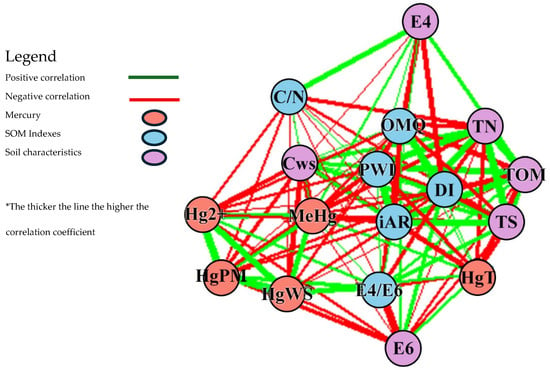
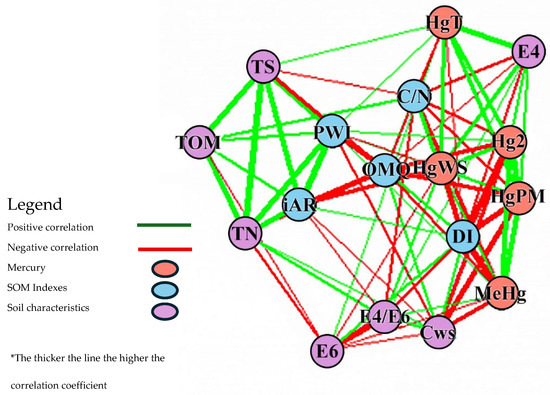
Figure 1.
Neural Network—Horní Luby Organic Horizons. HgT—total Hg; HgPM—potentially mobilizable Hg; Hg2+—potentially mobilizable Hg ion; HgWS—water soluble Hg; MeHg—methyl Hg; C/N—ratio of organic C to nitrogen; E4—E4 fraction; E6—E6 fraction; iAR—aromaticity index obtained through DRIFT; PWI—wettability index obtained through DRIFT; DI—decomposability index obtained through DRIFT; OMQ—organic matter quality index obtained through DRIFT; TOM—total organic matter; TS—total sulphur; TN—total nitrogen; Cws—water soluble C.
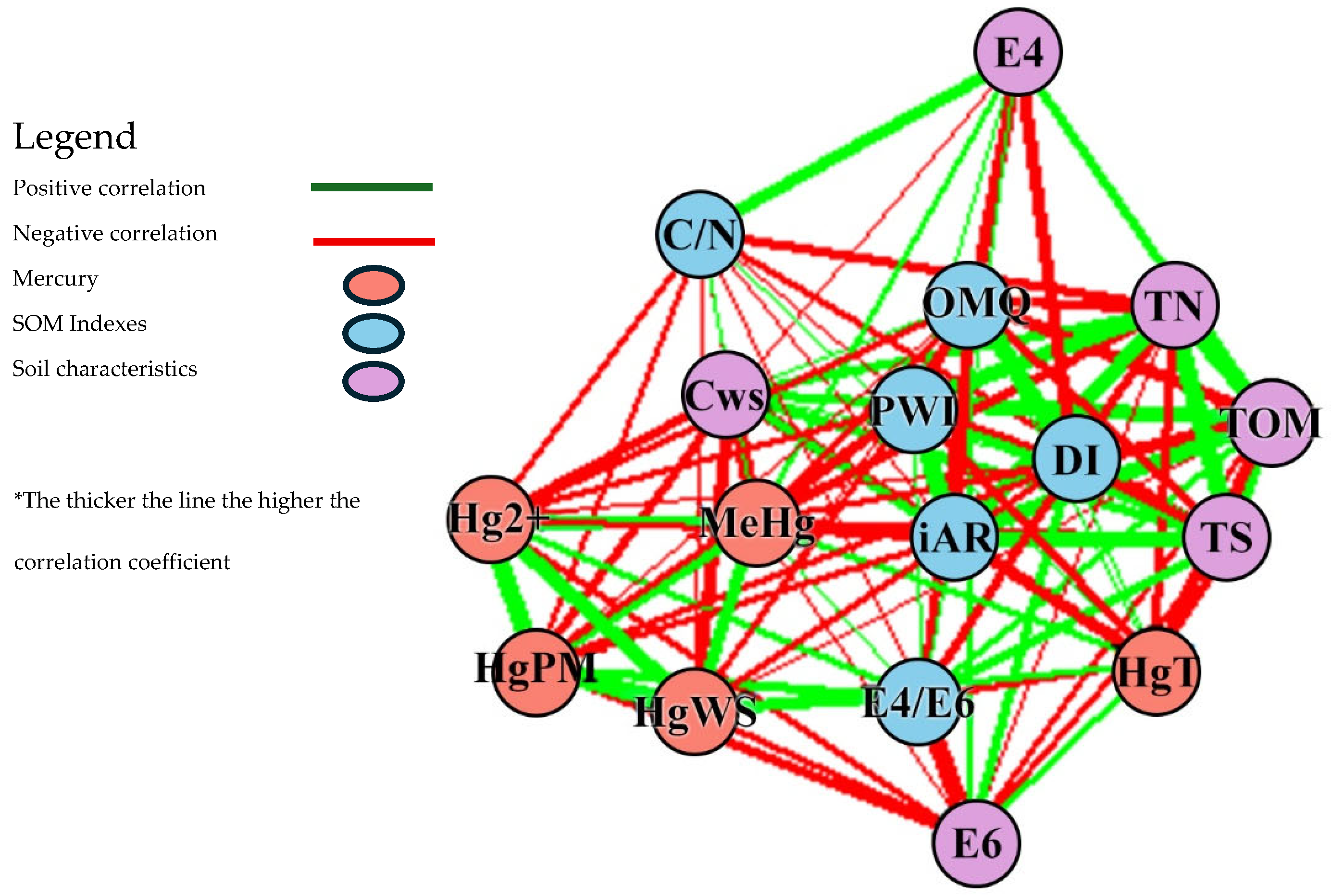
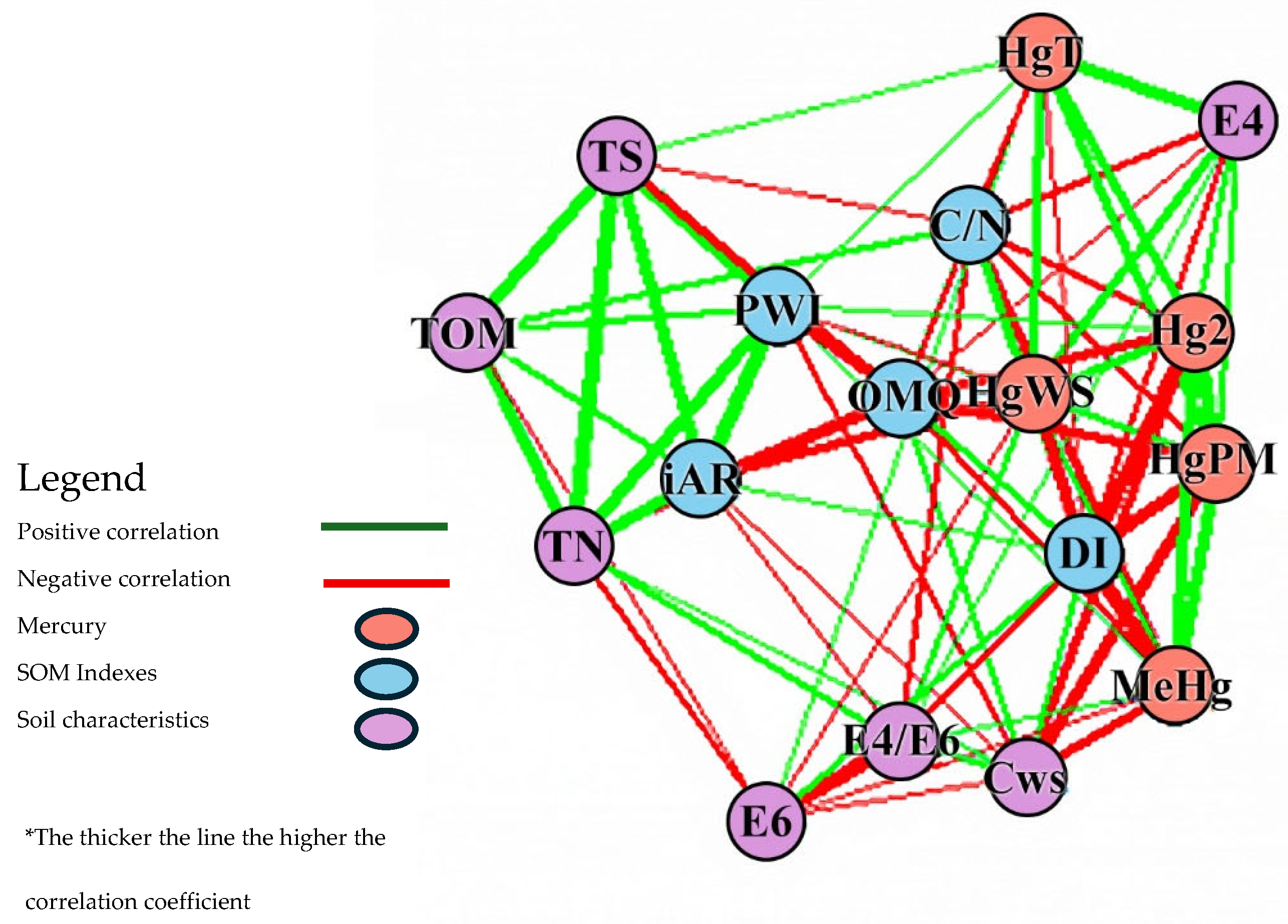
Figure 2.
Neural Network—Horní Luby Mineral Horizons. HgT—total Hg; HgPM—potentially mobilizable Hg; Hg2+—potentially mobilizable Hg ion; HgWS—water soluable Hg; MeHg—methyl Hg; C/N—ratio of organic C to nitrogen; E4—E4 fraction; E6—E6 fraction; iAR—aromaticity index obtained through DRIFT; PWI—wettability index obtained through DRIFT; DI—decomposability index obtained through DRIFT; OMQ—organic matter quality index obtained through DRIFT; TOM—total organic matter; TS—total sulphur; TN—total nitrogen; Cws—water soluble C.
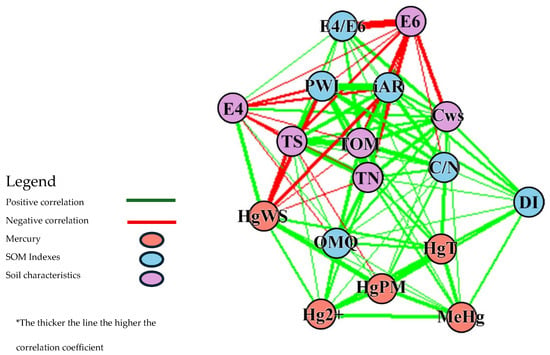
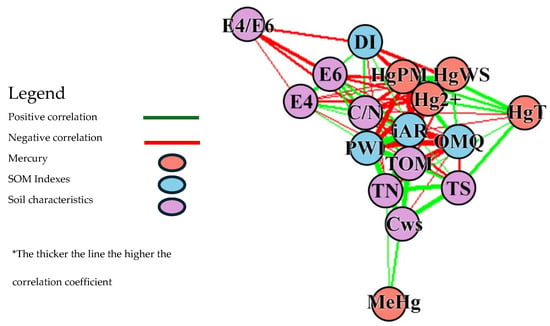
Figure 3.
Neural Network—Libčice Organic Horizons. HgT—total Hg; HgPM—potentially mobilizable Hg; Hg2+—potentially mobilizable Hg ion; HgWS—water soluable Hg; MeHg—methyl Hg; C/N—ratio of organic C to nitrogen; E4—E4 fraction; E6—E6 fraction; iAR—aromaticity index obtained through DRIFT; PWI—wettability index obtained through DRIFT; DI—decomposability index obtained through DRIFT; OMQ—organic matter quality index obtained through DRIFT; TOM—total organic matter; TS—total sulphur; TN—total nitrogen; Cws—water soluble C.
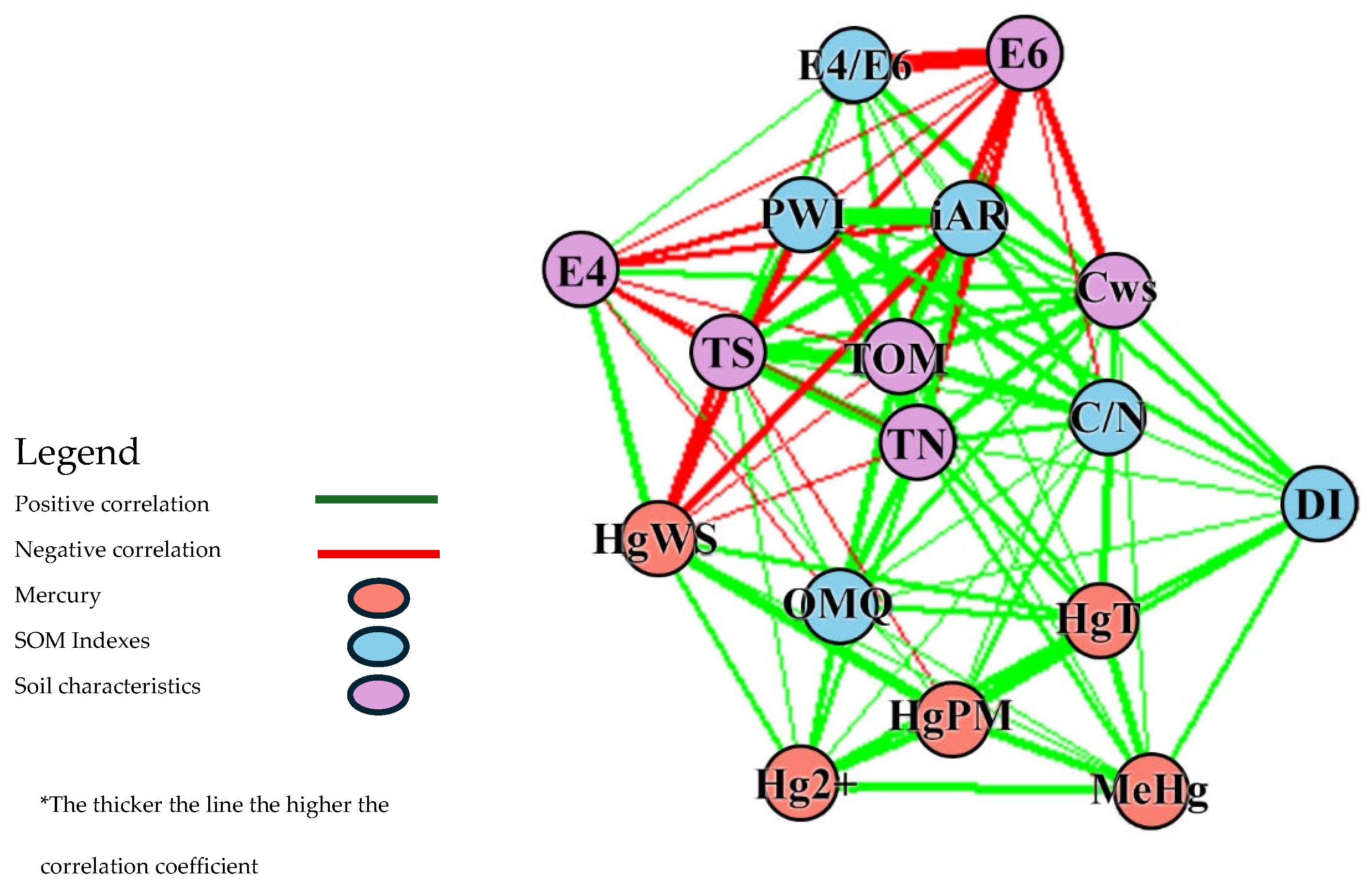
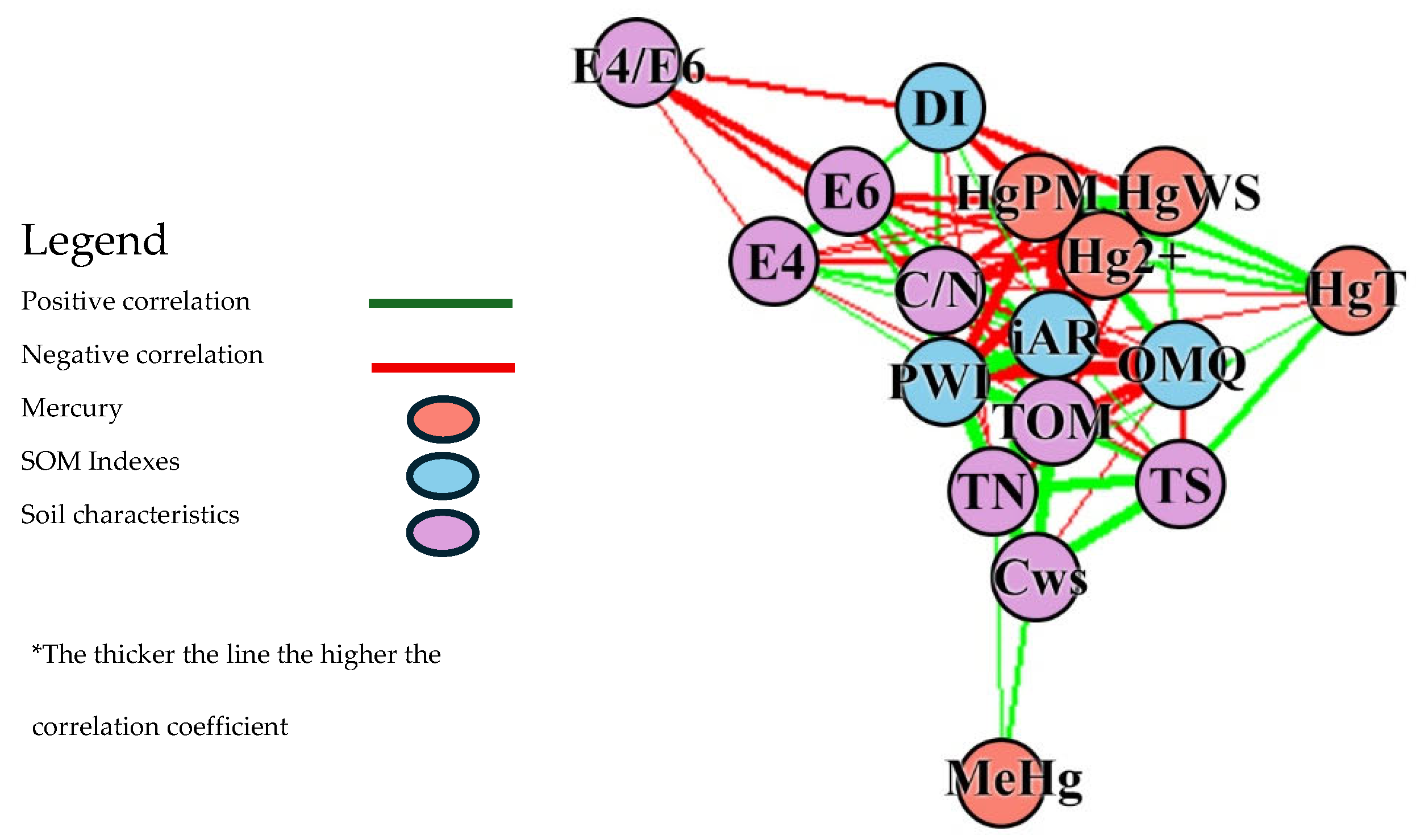
Figure 4.
Neural Network—Libčice Mineral Horizons. HgT—total Hg; HgPM—potentially mobilizable Hg; Hg2+—potentially mobilizable Hg ion; HgWS—water soluable Hg; MeHg—methyl Hg; C/N—ratio of organic C to nitrogen; E4—E4 fraction; E6—E6 fraction; iAR—aromaticity index obtained through DRIFT; PWI—wettability index obtained through DRIFT; DI—decomposability index obtained through DRIFT; OMQ—organic matter quality index obtained through DRIFT; TOM—total organic matter; TS—total sulphur; TN—total nitrogen; Cws—water soluble C.
As it may be observed in Figure 1, PWI, iAR, DI, and OMQ make the central cluster and most of interactions go through them. The position of this cluster along with the number of the interactions with the surrounding nodes show the importance of these characteristics in the observed system. Antagonism between PWI and iAR VS DI and OMQ is observable due to the nature of their correlations, and it has been described in studies [35]. Being that TOM positively correlates with PWI and iAR and negatively with OMQ and DI, the nature of the organic matter in this horizon is aliphatic and hydrophobic while its decomposition leads to increase of OMQ and DI. When sampling, it has been observed by the researchers that SOM in these horizons has mainly retained its primary characteristics and it is widely recognized that the characteristics of the primary organic matter depend on its source [35]. All observed Hg species, except HgT, negatively corelate with the nodes of the central cluster. These results indicate importance of PWI, iAR, DI, and OMQ for the Hg binding and retention in organic horizons. These results suggest that aromatic and hydrophobic organic matter play a role in Hg retention. Instead, more transformed, aliphatic, and hydrophilic organic matter appears to be essential for effective mercury binding in these horizons. This interpretation is consistent with the earlier findings [36], where it was emphasized the importance of humic acids (HAs) in the immobilization and retention of mercury.
Hg species except HgT cluster together along with Cws and show codependencies. Hg species positively interact with one another indicating that they belong to the same cycle, which was well described by O’Connor et al. (2019) [37] together with the processes relevant for the Hg cycling. Negative correlations of mobilizable Hg fractions with Cws may be due to the leaching. A similar thing was found in the study conducted in Slovenia [38] where leaching of Hg was related to the release of particulate organic matter and dissolved organic matter. Total Hg negatively correlates with total organic matter, which shows a positive correlation with Cws further reinforcing these findings. Most relevant correlations of HgT are with PWI and iAR. It was previously reported that Hg in the O horizon was linked to lipid-like, aromatic-derived, protein-derived, lignin-like, and ester/alcohol functional groups [39]. Our results confirm these findings as iAR correlates negatively with Hg, while the OMQ and C/N ratio shows a positive relationship. This suggests that aromatic and stable compounds play a key role in Hg retention in these horizons. Studies found that the secondary transformation of organic matter in soil and drained peatlands has a significant impact on total Hg content [20,40].
Strong positive interactions among the liable Hg species and MeHg indicates that they are a part of the same cycle. Similar results were shown in another study [41] where methylation was connected to the presence of a labile and more reactive Hg2+ fraction. Another study demonstrated the importance of organic amendment quality on the mobility and methylation of Hg in the soil in ex cinnabar mining sites along with the connection of the more mobile Hg species and Hg methylation [42].
The positive correlation of HgWS with E4/E6 shows that the lighter organic matter binds Hg in Hg2+ form and the negative correlation with E6 shows that more mature and heavier SOM turns Hg into less mobile forms. Based on interactions it may be concluded that in the case of Horní Luby organic horizons, higher-molecular-weight organic matter was predominantly aliphatic and hydrophobic, and hydrophobicity shows negative correlations with Hg2+ and HgT. In contrast, aliphaticity appeared to contribute to stronger Hg retention, as indicated by the negative correlations between iAR and all Hg species. These findings suggest that hydrophilic, aliphatic, and more transformed soil organic matter fractions are more effective in capturing and retaining Hg in both weakly and strongly bound forms. The findings from a mangrove forest ecosystem in Brasil [43] show that the natural heterogenicity of C compounds, relevant to species’ domain, provide different scenarios for Hg retention and that the tannin and lignin compounds are responsible for the Hg retention in mangrove ecosystems, while a leaching study performed on a litter material showed a dependency of Hg leaching on the aromaticity of dissolved organic matter [44].
HgWS positively interacts with E4/E6 (p = 0.502), and all other Hg species. Negative correlations are with Cws (p = −0.682), C/N (p = −0.313), TOM (p = −0.2281), TN (−0.176), TS (p= −0.139), E4 (p = −0.131), E6 (p = −0.475), TOM (p > 0.2), Cws (p > 0.6), and all the indexes. From these results it could be speculated that the heavier, primary organic matter binds Hg in both soluble and insoluble forms and that the solubility of that matter determines the mobility, accessibility, and fate of Hg in these horizons. A study performed in the soil after a fire showed that the content of Hg increases in more humified organic horizons and indicated that not just complexation, but the character of humic substances is relevant for Hg retention [39].
MeHg is the only Hg species besides Hg that interacts with Total Hg. Hg methylation in these horizons is dependent on the level of Hg as some previous studies show [45]. Additionally, MeHg shows positive correlations with C/N (p = 0.231), E4 (p = 0.339), E4/E6 (p = 0.211) and negative ones with Cws (p = −0.907), iAR (p = −0.638), DI (p = −0.343), OMQ (p = −0.343), PWI (p = −0.638) TN (p = −0.499), and E6 (p = −0.260). These observations suggest that more mature, hydrophobic, aliphatic, decomposable, heavier, and N-rich SOM inhibits the methylation. Moreover, the results indicate that mercury is getting methylated in the presence of primary light and stable organic matter, implying that the nature of the chemical bond has something to do with the Hg methylation and not the decomposition processes. Another study could not relate Hg methylation with the decomposition processes and greenhouse gas (GHG) emissions [46]. These findings indicate a possibility of photochemical methylation which is related to aquatic ecosystems. For these processes, the key environmental factors are the presence of the UV light and the nature of the dissolved organic matter as well as many other factors as this process is not fully understood [45]. For the photomethylation to occur, Hg2+ needs to be complexed with methyl donors, such as acetic acid, tert-butyl, alcohols, etc. [47]. Although this type of methylation has been observed only in water bodies and not in soil, these results indicate a similar pattern in the top layers of soil with enough presence of light. Observations made by researchers during sampling support these findings, as the sparse composition and shallow depth of the OFH horizons in this forest allow light penetration, creating favorable conditions for photochemical methylation. The correlation with E4 fraction also contributes to these findings as well as findings from another study [48] where it was reported that the higher wettability (hydrophilicity) of soil organic matter decreases the level of microbial transformation. A possibility of lignin to absorb the UV light, which was demonstrated in other research [49], along with a strong positive correlation of MeHg with potentially mobilizable Hg2+, strengthens that statement. As the light is also responsible for reduction of Hg2+ to Hg0 and evaporation of Hg from the soil, the key for this process seems to be in the bond between primary organic matter and the Hg2+, which is to be of sufficient strength to prevent transformation and not to allow evaporation, and it stands somewhere in the potentially mobilizable range. The results also indicate the importance of the E4 fraction in this process. As these findings are only speculative, further analysis of these phenomena in similar or laboratory conditions that encompass described factors is needed.
Figure 2 shows the interactions of indexes, mercury species, and some soil properties for mineral horizons of Horní Luby.
As shown in Figure 3, the neural network for the same soil and the different types of horizons form differently. In the mineral horizons, the main characteristics of the observed system are TOM, TN, TS, PWI, iAR, Cws, and C/N, where TOM and TN are the immediate center. Soil organic matter characteristics and the indexes show positive correlations among themselves with the exception of E4 and E6, which negatively interact with the rest of the indexes and SOM characteristics. These results characterize SOM as hydrophobic, aliphatic, and with relatively low molecular weight. The composition is consistent with a predominance of low-molecular-weight humic and fulvic substances, with fulvic acids dominating over humic acids, as supported by the work from another study [50] where it was shown that the E4/E6 ratio for forest soil is 4.81 ± 0.11 and another [51] that showed the SOM with E4/E6 between five and eight indicate early stages of SOM maturity. The median value of the E4/E6 ratio in the observed soils is 6.69, indicating early stages of SOM transformation.
Hg species group together and from a cluster with OMQ. Total Hg and potentially mobilizable fractions of Hg show positive correlations with OMQ, but not HgWS. The dependency of Hg on oxygen-containing functional groups of humic acids have been proven [52], as they act as the primary binding sites for Hg binding, which is relevant to these results because they indicate that oxygen-containing ffunctional groups of humic acids bind Hg in potentially mobilizable forms. All the Hg species except the immediately available (HgWS) and HgPM (one negative correlation with TS) positively interact with the organic matter and its properties, which is a big difference compared to the organic horizons of the same soil where the majority of the interactions with the organic matter properties were negative. Previous studies show that hydrophobic organic matter, particularly high molecular-weight and aromatic-rich fractions (like humic substances), have a high affinity for binding Hg2+ ions, but also make it available for microbial transformation to more toxic forms like MeHg [13]. Potentially mobilizable Hg shows a negative correlation with TS (p = 0.27), which is well expected as the site was a cinnabar mine.
Hg2+ shows different interactions than HgPM, showing that HgPM does not depend on Hg2+ as much as in organic horizons. In soils, Hg2+ may be methylated or reduced to volatile Hg0 which is eventually re-emitted back into the atmosphere [53]. The same study [53] reported that several soil processes are responsible for Hg reduction, including direct and indirect photochemical reduction, microbially mediated enzymatic reduction, and nonphotochemical abiotic reduction by minerals and natural organic matter. Positive correlations of Hg2+ with TN (p = 0.412), TS (p = 0.252), C/N (p = 0.306), and TOM (p = 0.372) show that stable organic compounds as well as nitrogen and sulphur are contributing to the presence of Hg2+ in a potentially mobilizable form in these soils.
Water soluble Hg is the closest Hg species to the center of the network and the most interactive Hg node in the observed system. With the exception of other Hg species, HgWS shows only one positive correlation, with E4 (p = 0.517). A study from 2005 reported that cinnabar (HgS) may actually be soluble in water that contains certain dissolved organic matter substances (e.g., fulvic acids), or in the presence of thiol ligands, or, if there is an excess of sulfide ions present [54]. Negative correlations with TS (p = −0.577), TOM (p = −0.264), TN (p = −0.264), PWI (p = −0.536), and iAR (p = −0.547) indicate that HgWS influences microbial community as shown in a study that was conducted in Hg-polluted paddy soils [55] as well as the influencing decomposition processes through the effect on the microbial community, as shown in a different study [56] that was performed on topsoil (top 10 cm) in laboratory conditions.
Unlike in the organic horizons of these soils, MeHg is positioned at the edge of the system, suggesting that the relevance of MeHg in the observed system in mineral horizons is lower compared to organic horizons. MeHg interacts positively with Cws (p = 0.256), TOM (p = 0.221), TN (p = 0.328), DI (p = 0.375), and OMQ (p = 0.258). The correlations with Cws, DI, and TN suggest that the production of MeHg in these horizons is related to the degradation of organic matter and the microbial processes. Multiple studies show no effect between greenhouse gas (GHG) emissions and Hg methylation [46,56]. A study done in China [56] suggests that the presence of MeHg enhances the temperature sensitivity (Q10) of SOM degradation due to changes in microbial survival strategies. Another study indicates that mobile Hg compounds, such as Hg-fluvic and Hg-humic complexes are the most susceptible to methylation [57]. These results point out that the organic matter and its mineralization have more to do with mobilizing the Hg, while the processes of humification have to do more with methylation of Hg. Further research should be conducted on this topic to specifically investigate these processes with attention to the variability of the stoichiometry of the Hg–C relationship [58].
As illustrated in Figure 4, the center of the observed system for Libčice organic horizons is made out of OMQ, HgWS, C/N, Hg2+, HgPM, and DI, with HgWS and OMQ being the center of the central cluster, although they do not interact with each other. The presence of three potentially mobilizable and mobile Hg species in the central cluster show their significance for the observed system.
Total organic matter does not interact with any of the Hg species, indicating that the quantity of organic matter does not play a role in Hg fate in these horizons. Through its interactions we can define organic matter in these horizons as aliphatic, hydrophobic, rich in S and N, and primary per the researcher’s observations. A study found that forest litter has a limited capacity to retain Hg and that lower carbon turnover reduces Hg loss through biogeochemical cycling [55]. Given that these horizons have a median C/N ratio of 10.92, the site likely experiences a high rate of organic matter turnover. This could be due to the source of organic matter and its characteristics as previously discussed [36]. Through the positive correlations of HgT with E4 (p = 0.645), TS (p = 0.308), E6 (p = 0.221), PWI (0.216), and negative ones with C/N (p = −0.404), OMQ (p = −0.331), and DI (p = 0.25), it can be suggested that the primary organic matter of this origin does not have a capacity to interact with measured species of Hg, while transformed, stable, and less complexed compounds do as it was already indicated for the organic horizons of Horní Luby through the results and the literature [13,36,39].
Potentially mobilizable Hg and potentially mobilizable Hg2+ show the same pattern of interactions as other nodes with different strengths of interactions, showing that a significant part of potentially mobilizable Hg in these horizons is in Hg2+ form (15.08% on median level). Hydrophobic organic matter seems to be able to retain Hg in these forms, while OMQ and DI have a negative impact on the occurrence of these forms of Hg in Libčice organic horizons. OMQ and DI have also a negative correlation with HgT, indicating that compounds with these characteristics are unable to retain Hg and are contributing to its loss.
Water-soluble Hg is the most important and most interactive Hg node for the system. Except for the other Hg species, it shows two positive correlations, with E4 (p = 0.5569) and E4/E6 (p = 0.451), while it negatively interacts with C/N (p = −0.237), E6 (p = −0.317), PWI (p = −0.312), DI (p = −0.673), and iAR (p = −0.516), confirming the findings described in relation to HgT. The influence of hydrophobic DOM on the availability of Hg to the microorganisms was already shown in this study in the section for organic horizons of Horní Luby.
MeHg positively interacts with all Hg species, except HgT, showing that Hg is being methylated from weekly bound pools and that the strength of the binding of Hg to organic matter is an important factor for the Hg methylation. Similar conclusions were observed in another study where it was proved that the quality of organic amendments can promote methylation processes [42]. MeHg shows negative correlations with C/N, indicating that the characteristics of primary organic matter in this site suppress methylation, unlike in Horní Luby where more stable organic structures promote methylation.
The nodes in the central cluster for Libčice organic horizons are TOM, iAR, OMQ, PWI, C/N, TN, and TOM, with TOM and iAR in the immediate center. This clustering is very similar to the clustering of Horní Luby mineral horizons with a tighter pattern. Potentially mobilizable Hg, Hg2+, and HgWS are clustering together and are the most influential Hg nodes in the system. All three potentially mobilizable and mobile Hg species show the same pattern of interactions with other observed variables with different correlation coefficients, indicating that the same processes are affecting the mobility of Hg. The correlations show that C/N, TOM, E4, E6, PWI, DI, and iAR negatively correlate with HgPM, Hg2+, and HgWS, while OMQ is the only TOM characteristic that positively relates to these Hg fractions. A study described that the amount and type organic matter content in soil can significantly affect soil Hg solubility, mobility, and toxicity [52]. Another study done on usage of activated carbon materials for remediations of Hg-polluted sites found that there are possible implications that might lead to the usage of such materials for remediation as they can contribute to mobilization and methylization of Hg and recommend the binding site-specific analysis of the material before its application to avoid potential implications [57]. A high affinity of Hg2+ for fulvic acids was reported, which may act as immobilizing agents for Hg under described conditions [59].
HgT is negatively affected by C/N (p = −0.226) and iAR (p = −0.211), and positively by TN (p = 0.226) and TS (p = 0.509), showing that the aromatic and less stable organic compounds have the ability to retain Hg. More decomposed organic matter (lower C/N ratio) tends to bind more to Hg, especially in fine soil aggregates, while these results supplement the findings that the level of transformation of organic matter is also a relevant factor [37].
Being that MeHg was detected in only four out of twenty samples, it is understood that MeHg is positioned as the furthest node from the network. MeHg in Horní Luby mineral horizons exhibits weak positive correlations with TOM (p = 0.201), TN (p = 0.233), and Cws (p = 0.38), relating the occurrence of MeHg to the presence of less complex water-soluble organic matter. A study done in China [59,60] shows that the presence of fluvic and humic acids promotes methylation.
4. Conclusions
The processes relevant for the mercury mobility and methylation are affected by the state of transformation of organic matter and its quality characteristics. The quality characteristics such as aromaticity, hydrophobicity, decomposability, and quality of soil organic matter that contribute to the Hg immobilization and retention can lead to mobilization and methylation in the different types of horizons in the same soil.
The results also indicate a possibility of photochemical methylation in the organic horizon, a phenomenon only related to aquatic ecosystems so far.
Supplementary Materials
The following supporting information can be downloaded at https://www.mdpi.com/article/10.3390/app16157451/s1, Supplementary S1: MeasuredValues and Supplementary S2: CorrelationMatrices.
Author Contributions
Study conceptualization—L.S. and J.S.; sample collection, measurement of the soil properties—L.S. and J.S.; measurement of total Hg—T.N.; DRIFT measurement—L.S. and S.T.; measurement of Hg species—L.P. (Lukáš Praus) and L.S.; statistical analysis and data visualization—L.S.; writing—L.S.; review—J.S., L.P. (Lenka Pavlů), S.T., M.K. and P.T. All authors have read and agreed to the published version of the manuscript.
Funding
The authors thank for financial support the European Regional Development Fund—Project No. CZ.02.1.01/0.0/0.0/16_019/0000845. The long-term research programme at the Institute of Geology of the Czech Academy of Sciences was supported by the institutional project RVO67985831.
Institutional Review Board Statement
Not applicable.
Informed Consent Statement
Not applicable.
Data Availability Statement
The datasets used and/or analyzed during the current study are available in Supplementary Materials and from the corresponding author on reasonable request.
Conflicts of Interest
Authors declare no competing interests.
References
- Wang, X.; Yuan, W.; Lin, C.; Zhang, L.; Zhang, H.; Feng, X. Climate and vegetation as primary drivers for global mercury storage in surface soil. Environ. Sci. Technol. 2019, 53, 10665–10675. [Google Scholar] [CrossRef] [Scilit] [PubMed]
- Gustin, M.S.; Kolker, A.; Gårdfeldt, K. Transport and fate of mercury in the environment. Appl. Geochem. 2008, 23, 343–344. [Google Scholar] [CrossRef] [Scilit]
- Obrist, D.; Johnson, D.W.; Lindberg, S.E.; Luo, Y.; Hararuk, O.; Bracho, R.; Battles, J.J.; Dail, D.B.; Edmonds, R.L.; Monson, R.K.; et al. Mercury distribution across 14 U.S. forests. Part I: Spatial patterns of concentrations in biomass, litter, and soils. Environ. Sci. Technol. 2011, 45, 3974–3981. [Google Scholar] [CrossRef] [Scilit] [PubMed]
- Sanchez, F.G. Soil Organic Matter and Soil Productivity: Searching for the Missing Link. In The Productivity and Sustainability of Southern Forest Ecosystems in a Changing Environment; Ecological Studies; Mickler, R.A., Fox, S., Eds.; Springer: New York, NY, USA, 1998; Volume 128. [Google Scholar] [CrossRef] [Scilit]
- Grigal, D.F.; Vance, E.D. Influence of soil organic matter on forest productivity. N. Z. J. For. Sci. 2000, 30, 169–205. Available online: https://www.scionresearch.com/__data/assets/pdf_file/0017/17144/NZJFS301-and-22000_169_205GRIGAL.pdf (accessed on 2 February 2026).
- Laganière, J.; Augusto, L.; Hatten, J.A.; Spielvogel, S. Editorial: Vegetation Effects on Soil Organic Matter in Forested Ecosystems. Front. For. Glob. Change 2022, 4, 828701. [Google Scholar] [CrossRef] [Scilit]
- Lehmann, J.; Kleber, M. The contentious nature of soil organic matter. Nature 2015, 528, 60–68. [Google Scholar] [CrossRef] [Scilit] [PubMed]
- Osman, K. Organic Matter of Forest Soils. In Forest Soils; Springer: Cham, Switzerland, 2013. [Google Scholar] [CrossRef] [Scilit]
- Sedlář, O.; Balík, J.; Černý, J.; Suran, P.; Kulhánek, M.; Bihun, T. Soil Organic Matter Quality and Carbon Sequestration Potential Affected by Straw Return in 11-Year On-Farm Trials in the Czech Republic. Agronomy 2025, 15, 1277. [Google Scholar] [CrossRef] [Scilit]
- McLagan, D.S.; Esser, C.; Schwab, L.; Wiederhold, J.G.; Richard, J.-H.; Biester, H. Organic matters, but inorganic matters too: Column examination of elevated mercury sorption on low organic matter aquifer material using concentrations and stable isotope ratios. SOIL 2024, 10, 77–92. [Google Scholar] [CrossRef] [Scilit]
- Abdelhafiz, M.A.; Liu, J.; Jiang, T.; Pu, Q.; Aslam, M.W.; Zhang, K.; Meng, B.; Feng, X. DOM influences Hg methylation in paddy soils across a Hg contamination gradient. Environ. Pollut. 2023, 322, 121237. [Google Scholar] [CrossRef] [Scilit] [PubMed]
- Monteiro, L.; Vieira, L.; Bernardi, J.; Recktenvald, M.; Da Costa Nery, A.; Fernandes, I.; De Miranda, V.; Da Rocha, D.; De Almeida, R.; Bastos, W. Mercury distribution, bioaccumulation, and biomagnification in riparian ecosystems from a Neotropical savanna floodplain, Araguaia River, Central Brazil. Environ. Res. 2024, 252, 118906. [Google Scholar] [CrossRef] [Scilit] [PubMed]
- Peng, X.; Yang, Y.; Yang; Li, S.; Song, L. Recent advance of microbial mercury methylation in the environment. Appl. Microbiol. Biotechnol. 2024, 108, 235. [Google Scholar] [CrossRef] [Scilit] [PubMed]
- Schartup, A.T.; Mason, R.P.; Balcom, P.H.; Hollweg, T.A.; Chen, C.Y. Methylmercury production in estuarine sediments: Role of organic matter. Environ. Sci. Technol. 2013, 47, 695–700. [Google Scholar] [CrossRef] [Scilit] [PubMed]
- Huang, Y.; Huang, Y.; R Reinfelder, J.; Zhong, H.; Fang, L.; Liu, C.; Li, F. Phenol-Quinone Redox Couples of Natural Organic Matter Promote Mercury Methylation in Paddy Soil. Environ. Sci. Technol. 2025, 59, 1179–1188. [Google Scholar] [CrossRef] [Scilit] [PubMed]
- He, M.; Tian, L.; Braaten, H.; Wu, Q.; Luo, J.; Cai, L.; Meng, J.; Lin, Y. Mercury–Organic Matter Interactions in Soils and Sediments: Angel or Devil? Bull. Environ. Contam. Toxicol. 2019, 102, 621–627. [Google Scholar] [CrossRef] [Scilit] [PubMed]
- Wenwen, Z.; Yuan, X.; Zhang, Z.; Xuehui, Z.; Haitao, W. Accelerated Hg loss and increased methylmercury covary with soil organic matter mineralization and dissolved organic matter humification under warming conditions in permafrost marsh, Northeast China. Environ. Res. 2023, 234, 116593. [Google Scholar] [CrossRef] [Scilit] [PubMed]
- Skyllberg, U.; Bloom, P.; Qian, J.; Lin, C.; Bleam, W. Complexation of mercury(II) in soil organic matter: EXAFS evidence for linear two-coordination with reduced sulfur groups. Environ. Sci. Technol. 2006, 40, 4174–4180. [Google Scholar] [CrossRef] [Scilit] [PubMed]
- Méndez-López, M.; Eimil-Fraga, C.; Alonso-Vega, F.; Rodríguez-Soalleiro, R.; Álvarez-Rodríguez, E.; Arias-Estévez, M.; Nóvoa-Muñoz, J.C. Variation of Hg concentration and accumulation in the soil of maritime pine plantations along a coast-inland transect in SW Europe. Environ. Res. 2023, 231, 116155. [Google Scholar] [CrossRef] [Scilit] [PubMed]
- Becher, M.; Kobierski, M.; Pakuła, K.; Jaremko, D. Distribution of Mercury in Drained Peatlands as the Effect of Secondary Transformation of Soil Organic Matter. Agriculture 2023, 13, 995. [Google Scholar] [CrossRef] [Scilit]
- Varshal, G.; Buachidze, N.; Velyukhanova, T.; Chkhetia, D. The Role of Organic Matter in Mercury Cycle; Springer: Berlin/Heidelberg, Germany, 1996; pp. 403–414. [Google Scholar] [CrossRef] [Scilit]
- Velebil, D. Cinnabar mining in Horní Luby neach Cheb, Czech Republic. Bull. Mineral.-Petrol. Oddel. Nar. Muz. V Praze 2009, 17, 39–61. (In Czech) [Google Scholar]
- Umlaufová, M.; Száková, J.; Najmanová, J.; Sysalová, J.; Tlustoš, P. The soil-plant transfer of risk elements within the area of an abandoned gold mine in Libčice, Czech Republic. J. Environ. Sci. Health Part A 2018, 53, 1267–1276. [Google Scholar] [CrossRef] [Scilit] [PubMed]
- Száková, J.; Stefanović, L.; Robledo Mahón, T.; Khaustov, A.; Cieslarová, A.; Tejnecký, V.; Sysalová, J.; Tlustoš, P. Risk elements in soils affected by long-term gold and mercury (Hg) mining related to soil microbial activity. Chem. Ecol. 2025, 41, 694–709. [Google Scholar] [CrossRef] [Scilit]
- Stefanović, L.; Száková, J.; Praus, L. Mercury (Hg) Mobility and Methylation Based on Hg Origin in Some Forest Soils in Czech Republic. Water Air Soil Pollut. 2025, 236, 963. [Google Scholar] [CrossRef] [Scilit]
- Food and Agriculture Organization of the United Nations. Guidelines for Soil Description, 4th ed.; FAO: Rome, Italy, 2006; Available online: https://www.fao.org/4/a0541e/a0541e.pdf (accessed on 2 February 2026).
- Száková, J.; Kolihová, D.; Miholová, D.; Mader, P. Single-purpose atomic absorption spectrometer AMA-254 for mercury determination and its performance in analysis of agricultural and environmental materials. Chem. Pap. 2004, 58, 311–315. [Google Scholar]
- Han, Y.; Kingston, H.M.; Boylan, H.M.; Rahman, G.M.; Shah, S.; Richter, R.C.; Link, D.D.; Bhandari, S. Speciation of mercury in soil and sediment by selective solvent and acid extraction. Anal. Bioanal. Chem. 2003, 375, 428–436. [Google Scholar] [CrossRef] [Scilit] [PubMed]
- Reis, A.T.; Lopes, C.B.; Davidson, C.M.; Duarte, A.C.; Pereira, E. Extraction of mercury water-soluble fraction from soils: An optimization study. Geoderma 2014, 213, 255–260. [Google Scholar] [CrossRef] [Scilit]
- Pospíšil, F. Fractionation of humus substances of several soil types in Czechoslovakia. Rostl. Vyrob. 1964, 10, 567–580. [Google Scholar]
- Allison, L.E. Organic carbon. In Methods of Soil Analysis. Part 2: Chemical and Microbiological Properties; Black, C.A., Ed.; American Society of Agronomy: Madison, WI, USA, 1965; pp. 1367–1378. [Google Scholar] [CrossRef] [Scilit]
- Sparks, D.L. Methods of Soil Analysis. Part 3—Chemical Methods; Madison, SSSA Book Series: 5; Soil Science Society of America, Inc.; American Society of Agronomy Inc: Madison, WI, USA, 1996. [Google Scholar]
- Pavlů, L.; Balík, J.; Procházková, S.; Galušková, I.; Borůvka, L. How to measure soil quality? A case study conducted on cropland in the Czech Republic. Soil Water Res. 2024, 19, 229–243. [Google Scholar] [CrossRef] [Scilit]
- Thai, S.; Pavlů, L.; Tejnecký, V. Temporal changes in soil chemical compositions in acidified mountain forest soils of Czech Republic. Eur. J. For. Res. 2023, 142, 883–897. [Google Scholar] [CrossRef] [Scilit]
- Apori, S.O.; Giltrap, M.; Dunne, J.; Tian, F. Soil organic matter components and characteristics of forest soil in spruce and sycamore plantations in the temperate region. Discov. Agric. 2024, 2, 18. [Google Scholar] [CrossRef] [Scilit]
- Šípková, A.; Száková, J.; Hanč, A. Mobility of mercury in soil as affected by soil physicochemical properties. J. Soils Sediments 2016, 16, 2234–2241. [Google Scholar] [CrossRef] [Scilit]
- O’Connor, D.; Hou, D.; Ok, Y.; Mulder, J.; Duan, L.; Wu, Q.; Wang, S.; Tack, F.; Rinklebe, J. Mercury speciation, transformation, and transportation in soils, atmospheric flux, and implications for risk management: A critical review. Environ. Int. 2019, 126, 747–761. [Google Scholar] [CrossRef] [Scilit] [PubMed]
- Teršič, T.; Biester, H.; Gosar, M. Leaching of mercury from soils at extremely contaminated historical roasting sites (Idrija area, Slovenia). Geoderma 2014, 226–227, 213–222. [Google Scholar] [CrossRef] [Scilit]
- Méndez-López, M.; Jiménez-Morillo, N.; Fonseca, F.; De Figueiredo, T.; Parente-Sendín, A.; Alonso-Vega, F.; Arias-Estévez, M.; Nóvoa-Muñoz, J. Mercury mobilization in shrubland after a prescribed fire in NE Portugal: Insight on soil organic matter composition and different aggregate size. Sci. Total Environ. 2023, 904, 167532. [Google Scholar] [CrossRef] [Scilit] [PubMed]
- Ma, H.; Cheng, H.; Guo, F.; Zhang, L.; Tang, S.; Yang, Z.; Peng, M. Distribution of mercury in foliage, litter and soil profiles in forests of the Qinling Mountains, China. Environ. Res. 2022, 211, 113017. [Google Scholar] [CrossRef] [Scilit] [PubMed]
- Ndu, U.; Christensen, G.A.; Rivera, N.A.; Gionfriddo, C.M.; Deshusses, M.A.; Elias, D.A.; Hsu-Kim, H. Quantification of mercury bioavailability for methylation using diffusive gradient in thin-film samplers. Environ. Sci. Technol. 2018, 52, 8521–8529. [Google Scholar] [CrossRef] [Scilit] [PubMed]
- Eckley, C.S.; Luxton, T.P.; Stanfield, B.; Baldwin, A.; Holloway, J.A.; McKernan, J.; Johnson, M.G. Effect of organic matter concentration and characteristics on mercury mobilization and methylmercury production at an abandoned mine site. Environ. Pollut. 2020, 271, 116369. [Google Scholar] [CrossRef] [Scilit] [PubMed]
- Silva, G.H.M.C.; Araújo, P.R.M.; Vieira, C.B.; Araujo, J.K.S.; de Souza Júnior, V.S.; dos Santos, J.C.B.; Schmidt, M.P.; Ying, S.C.; Biondi, C.M. The role of soil organic matter quality and mineralogy controlling the highest mercury concentration of the Brazilian mangroves. Sci. Total Environ. 2025, 975, 179274. [Google Scholar] [CrossRef] [Scilit] [PubMed]
- Sun, T.; Branfireun, B. Plant mercury accumulation and litter input to a Northern Sedge-dominated Peatland. Biogeosciences 2023, 20, 2971–2984. [Google Scholar] [CrossRef] [Scilit]
- Munthe, J.; Lyvén, B.; Parkman, H.; Lee, Y.-H.; Iverfeldt, A.; Halardsson, C.; Verta, M.; Porvari, P. Mobility and Methylation of Mercury in Forest Soils Development of an In-Situ Stable Isotope Tracer Technique and Initial Results. Water Air Soil Pollut. Focus 2001, 1, 385–393. [Google Scholar] [CrossRef] [Scilit]
- Zhang, S.; Xia, M.; Pan, Z.; Wang, J.; Yin, Y.; Lv, J.; Hu, L.; Shi, J.; Jiang, T.; Wang, D. Soil organic matter degradation and methylmercury dynamics in Hg-contaminated soils: Relationships and driving factors. J. Environ. Manag. 2024, 356, 120432. [Google Scholar] [CrossRef] [Scilit] [PubMed]
- Luo, H.; Cheng, Q.; Pan, X. Photochemical behaviors of mercury (Hg) species in aquatic systems: A systematic review on reaction process, mechanism, and influencing factor. Sci. Total Environ. 2020, 720, 137540. [Google Scholar] [CrossRef] [Scilit] [PubMed]
- Obeng, A.; Dunne, J.; Giltrap, M.; Tian, F. Soil organic matter carbon chemistry signatures, hydrophobicity and humification index following land use change in temperate peat soils. Heliyon 2023, 9, e19347. [Google Scholar] [CrossRef] [Scilit] [PubMed]
- Mishra, P.K.; Wimmer, R. Aerosol assisted self-assembly as a route to synthesize solid and hollow spherical lignin colloids and its utilization in layer by layer deposition. Ultrason. Sonochemistry 2017, 35, 45–50. [Google Scholar] [CrossRef] [Scilit] [PubMed]
- Kale, S.P.; Bhakare, B.D.; Thakare, R.S.; Patil, V.S.; Durgude, A.G. E4/E6 ratio and total acidity of soil humic and fulvic acids from different land use patterns. Int. J. Agric. Food Sci. 2022, 4, 13–16. Available online: https://www.agriculturaljournals.com/archives/2022/vol4issue2/PartA/4-2-28-132.pdf (accessed on 2 February 2026). [CrossRef] [Scilit]
- Chang, Y.-T.; Lee, C.-H.; Hsieh, C.-Y.; Chen, T.-C.; Jien, S.-H. Using Fluorescence Spectroscopy to Assess Compost Maturity Degree during Composting. Agronomy 2023, 13, 1870. [Google Scholar] [CrossRef] [Scilit]
- Chai, X.; Liu, G.; Zhao, X.; Hao, Y.; Zhao, Y. Complexion between mercury and humic substances from different landfill stabilization processes and its implication for the environment. J. Hazard. Mater. 2012, 209–210, 59–66. [Google Scholar] [CrossRef] [Scilit] [PubMed]
- Jiskra, M.; Wiederhold, J.G.; Skyllberg, U.; Kronberg, R.-M.; Hajdas, I.; Kretzschmar, R. Mercury deposition and re-emission pathways in boreal forest soils investigated with Hg isotope signatures. Environ. Sci. Technol. 2015, 49, 7188–7196. [Google Scholar] [CrossRef] [Scilit] [PubMed]
- Jacobson, A.R.; Martínez, C.E.; Spagnuolo, M.; McBride, M.B.; Baveye, P. Reduction of silver solubility by humic acid and thiol ligands during acanthite (β-Ag2S) dissolution. Environ. Pollut. 2005, 135, 1–9. [Google Scholar] [CrossRef] [Scilit] [PubMed]
- Hu, H.; Li, M.; Wang, G.; Drosos, M.; Li, Z.; Hu, Z.; Xi, B. Water-Soluble Mercury Induced by Organic Amendments Affected Microbial Community Assemblage in Mercury-Polluted Paddy Soil. Chemosphere 2019, 236, 124405. [Google Scholar] [CrossRef] [Scilit] [PubMed]
- Zhang, S.; Zhu, S.; Tian, S.; Wang, J.; Yin, Y.; Lv, J.; Wang, Y.; Jiang, T.; Tang, Z.; Wang, D. Effects and Mechanisms of Warming on the Relationship between Soil Organic Matter Degradation and Methylmercury Production in Hg-Contaminated Soil. Geoderma 2025, 458, 117326. [Google Scholar] [CrossRef] [Scilit]
- Schwartz, G.E.; Sanders, J.P.; McBurney, A.M.; Brown, S.S.; Ghosh, U.; Gilmour, C.C. Impact of dissolved organic matter on mercury and methylmercury sorption to activated carbon in soils: Implications for remediation. Environ. Sci. Process. Impacts 2019, 21, 485–496. [Google Scholar] [CrossRef] [Scilit] [PubMed]
- Grigal, D.F. Mercury Sequestration in Forests and Peatlands. J. Environ. Qual. 2003, 32, 393–405. [Google Scholar] [CrossRef] [Scilit] [PubMed]
- Zhang, J.; Dai, J.; Wang, R.; Li, F.; Wang, W. Adsorption and desorption of divalent mercury (Hg2+) on humic acids and fulvic acids extracted from typical soils in China. Colloids Surf. A Physicochem. Eng. Asp. 2009, 335, 194–201. [Google Scholar] [CrossRef] [Scilit]
- Ran, S.; He, T.; Zhou, X.; Yin, D. Effects of fulvic acid and humic acid from different sources on Hg methylation in soil and accumulation in rice. J. Environ. Sci. 2022, 119, 93–105. [Google Scholar] [CrossRef] [Scilit] [PubMed]

Disclaimer/Publisher’s Note: The statements, opinions and data contained in all publications are solely those of the individual author(s) and contributor(s) and not of MDPI and/or the editor(s). MDPI and/or the editor(s) disclaim responsibility for any injury to people or property resulting from any ideas, methods, instructions or products referred to in the content. |
© 2026 by the authors. Licensee MDPI, Basel, Switzerland. This article is an open access article distributed under the terms and conditions of the Creative Commons Attribution (CC BY) license.