


Abstract
Virtual hand clicking is a common interaction task within the peripersonal space of virtual environments (VEs). Based on the hand–eye coordination mechanism, this study adopts click offset, reaction time, movement time, consumed endurance, and subjective evaluation scales as indicators to investigate the spatial morphology of virtual hand clicking interfaces. Experiment 1 analyzed the impacts of spatial depth, upper limb length, and spatial region on interaction performance to define 3D interface geometry. Experiment 2 further explored the 3D interface’s spatial reference center and depth based on upper limb length proportions. Integrated experimental results reveal that the relatively favorable 3D interface for static single-handed clicking tasks adopts a field-curved spherical layout, with its spatial reference center positioned at the midpoint of the user’s right shoulder. The recommended interaction depth ranges from 0.618 to 0.764 times the user’s upper limb length (or a fixed value of 400 mm for general designs).
1. Introduction
Virtual environments (VEs), including virtual reality, augmented reality, and mixed reality, provide users with an immersive interactive experience [1,2], similar to operations in the real world. With the appearance of wearable, consumer-oriented head-mounted display (HMD) technology, virtual reality is widely used in social, entertainment, education, and healthcare applications [3].
In VEs, users can interact with computers using various natural interactive methods [4], such as somatosensory interaction, gesture interaction, voice interaction, etc. Human–computer interaction in VEs captures human behavior information through computer vision technology and voice interaction technology, including speech and hand or body movements, which are used as interactive input signals, while the output is displayed in the three-dimensional (3D) space around the user, providing the user with a broader vision [5,6]. This natural interaction mode is closer to the mode of people’s interaction in the real world. People have learned many skills to manipulate 3D objects and move in 3D space in their daily life, and can understand 3D spatial relationships [7]. The input–output characteristics of VEs can give full play to these inherent human skills and make the virtual reality human–computer interaction more natural and easier to understand.
Interactive output devices in VEs mainly include visual display devices, auditory output devices, and force/tactile output devices. In VEs, continuous input can be realized through the handle of the built-in sensor, camera depth, gesture sensor, 3D camera, etc. [8]. Common interaction techniques include virtual hand, Go-Go, and ray-casting [9,10]. Among them, virtual hand interaction technology is often used for close-distance interactions. Virtual hand interaction technology constructs the virtual avatar of the user’s hand in VE, and the user’s hand controls the position/direction of the virtual hand through the tracker to realize the interaction with the virtual object. The Go-Go and ray-casting interaction is a spatial mapping interaction outside the accessible domain.
As a natural interaction mode consistent with human primitive communication characteristics, virtual hand interaction technology does not cause interference in the auditory channel [11]. In the peripersonal space, the virtual hand directly pointing to click is a commonly used interaction method in virtual reality, which is easy to understand and operate. It can realize the unification of the display and controller. The study shows that the human–computer interaction performance is reduced by the separation of motion space and visual space during the interaction process, and when the visual space and motion space of virtual hand interaction are closely superimposed or coupled, the human–computer interaction performance reaches the best result [12,13,14,15]. Therefore, the direct contact interaction represented by the virtual hand interaction is better than the cross-interoperability [16,17] outside the accessible domain in movement time and click accuracy aspects [16]. Despite these proven advantages, current research still exhibits obvious limitations: most existing studies merely conduct cross-paradigm performance comparisons, one-dimensional visual optimization, or qualitative spatial analysis of VR interfaces. Moreover, prevailing interface design guidelines adopt unified fixed parameters and ignore individual anthropometric differences among users, lacking systematic empirical investigations into relatively favorable spatial depth settings, reference center positions, and morphological boundaries for near-field virtual hand clicking interfaces. Virtual hand interaction in VEs provides 3D operational freedom, which increases the complexity of user tasks and expands the design space for interactive interfaces. To improve the availability of the virtual hand interaction, especially on the contact clicking task, we should also consider the design of the virtual hand interaction interface [18]. The spatial form of the 3D interface is the bearing framework of the virtual hand interaction interface design. The spatial form of the 3D interface has an influence on the interactive efficiency and subjective comfort of 3D interaction among users in VEs.
The interface morphology design in VEs should not only consider the characteristics of virtual hand technology but also pay attention to the rules of hand movement and eye perception. In VEs, the visual field combines the monocular vision of the two eyes with the complete visual field, presenting a symmetrical view. However, there are handedness effects in people’s daily behavioral activities, and users exhibit dominant-hand differences. User movements are constrained by upper-limb kinematic chains, and there is a comfortable interactive space belt. People with different upper extremities differ in interactive range and comfortable distance. Therefore, different from the layout design of a two-dimensional interface, the design of a three-dimensional interface should not only consider the visual performance but also the motor performance.
Object selection is one of the basic tasks in the 3D user interface [19] and the most common initial task for user interaction in VEs. Operational tasks typically depend on selection tasks. Finger clicking is the most common object selection interaction mode in the peripersonal space, which has the advantages of natural intuition and low physical requirements in the interaction process [20]. Therefore, this study selects index-finger clicking within head-mounted virtual reality displays as its research focus. Research on the basis of virtual hand clicking performance investigates the influencing factors of virtual hand clicking interaction performance, determines the interface spatial form design parameters, and provides a reference for the design of three-dimensional interface spatial forms.
Targeting the aforementioned research gaps, this study proposes distinct methodological and conceptual innovations compared with previous VR interaction research. Methodologically, different from traditional single-index evaluation and fixed-parameter verification schemes, this study constructs a multi-dimensional evaluation system integrating objective kinematic performance and subjective comfort and fatigue perception, and adopts Latin square randomization and multi-stage fatigue/learning effect control paradigms to ensure the robustness of experimental data. Conceptually, this study breaks through the single visual-oriented interface design perspective of previous studies, takes hand–eye coordination and upper limb kinematic characteristics as the core theoretical basis, systematically explores the spatial morphological distribution rules of virtual hand clicking interfaces, and innovatively proposes dual design strategies of universal fixed spatial depth and individualized upper-limb proportional depth. This work supplements the human-centered spatial morphology design theory for 3D virtual hand interfaces and provides quantifiable and adaptable design references for practical VR interface layout optimization.
2. Related Works
2.1. Hand–Eye Features of the Virtual Hand Clicking Interaction in VEs
VEs deliver highly immersive visual experiences, enabling users to perform virtual hand clicking operations via digital avatars. The virtual hand interaction of users in VEs is very close to its interaction in the real world. The display and control of virtual hand interaction are spatially coupled, which is not only influenced by the visual characteristics of human beings in HMDs but also by the movement characteristics of human arms.
Human visual features in VEs contain features of the visual field surface and depth features. The large vision provided by VE equipment can better simulate the natural visual field [21] and can provide a better sense of immersion, presence, enjoyment, and embodied cognition [22]. In the virtual environment, human binocular vision fuses two monocular views into a single symmetric visual field. Studies on human attention bias suggest that people tend to show faster responses to the left target [23].
In VEs, the user can judge the relative distance of the object from themself by using depth cues, including image cues, eye movement cues, binocular cues [24], and motion-related cues [25]. Binocular disparity can be provided as a depth cue in HMDs, while the convergence and deregulation of the eyeball are more likely to cause gaze movement fatigue in HMDs [26,27].
The characteristics of arm stretching movements in VEs have received extensive attention [28,29,30]. The results show that the kinematics of arm-directed movements in both real and virtual environments are similar [31]. The joint range of motion and the arm movement chain restrict the range of user interaction, and the activity area of the human hand is mostly controlled in a comfortable and convenient range. From a biomechanical perspective, more distant interactions would require more muscle strength, so the most comfortable interaction is with the arm close to the body [32,33]. It is also noted that target selection is more efficient and precise when the hand is lower in VEs [32,34]. In VEs, target selection performed better [32], which is consistent with the dominant hand in life. Thus, the hand interaction exhibits spatial skewness. In addition, users vary in their maximum comfortable arm reach.
In general, the visual field of human eyes has spatial symmetry, and arm movement has spatial skewness. The spatial morphology design of the 3D interface in VEs needs to consider the movement characteristics of the hand and eye simultaneously.
2.2. Spatial Form of Virtual Hand Clicking Interaction in VEs
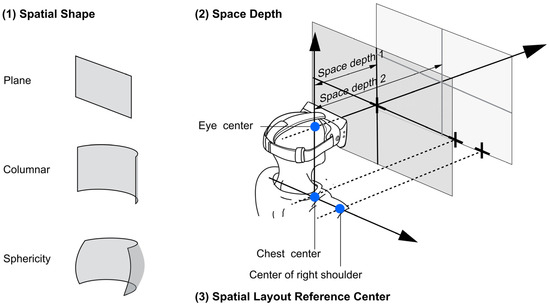
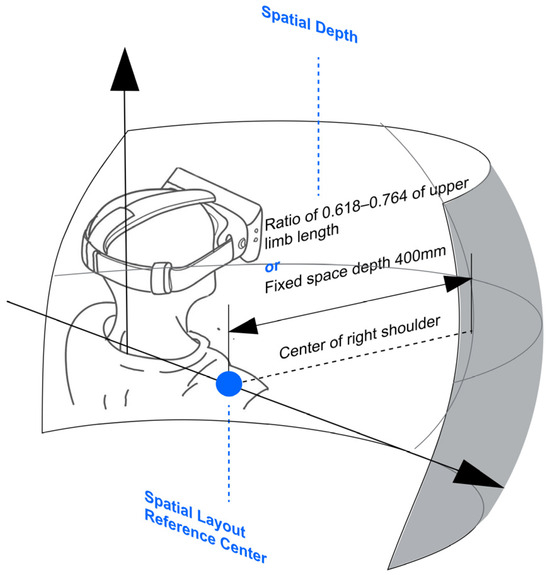
The hand–eye movement features of virtual hand interaction in VEs jointly affect the efficiency of virtual hand clicking interaction. Binocular visual field space and hand movements form the interactive basis and constraints of VEs. Combined with previous studies and considering the characteristics of hand–eye coordination, the design parameters of the spatial form of the virtual hand clicking interactive interface in VEs include (1) spatial shape, (2) spatial depth, and (3) spatial layout reference center (Figure 1).
Figure 1.
Design parameters of 3D interface spatial morphology.
The 3D interface geometry in VEs is divided according to the geometry, which can be divided into plane, cylindrical, spherical, and other shapes. At present, the most widely used in VEs is plane or cylindrical. The qualitative analysis shows that in the three mainstream categories of plane, cylindrical, and spherical, spherical interface geometries, especially hemispherical layouts, are preferred by participants [35,36].
Spatial depth, namely, the distance of the interacting object in the virtual space relative to the user. According to the hand movement constraint, the longest distance used for the virtual hand interaction is 1 m [37]. Additionally, Hoffman [27] presented one base viewing distance (39 cm or 2.5 D). The performance study of the interaction spatial depth in VEs included two settings: the fixed spatial depth and the user’s upper limb length proportion [38]. Previous studies showed that the comfort distance of the clicking task in the virtual environment is between 0.618 and 0.854 in the proportion of upper limb length [33,39].
The spatial layout reference center describes the spatial alignment location of the interaction interface, including the user center reference frame and the world fixed reference frame. To determine the placement of the interaction interface, the research literature uses the spatial layout reference center as a study factor. Currently, a spatial interface centered on the user’s head is widely used, but its interaction process often requires the movement of the entire arm movement chain and thus rapidly produces fatigue over time [39].
The reference center of the spatial layout can also be expressed as the interface focus in the study of curved surface interfaces. We show that the interaction error is significantly reduced when the interface focus is shifted from the center to the right shoulder, while the interaction time does not change significantly [38]. However, the right shoulder focus interface also causes some windows on the left to be too close to interact with. The comprehensive comparison between the hand-adaptive user interface and the traditional eye-centered user interface shows that the hand-adaptive user interface has higher interaction efficiency and lower physical consumption and perceived task difficulty [32]. Therefore, the spatial layout of the interface with the eye as the reference center is not necessarily the suitable solution. The preferred reference center of the spatial interface has not reached a consensus, and the location of the reference center still needs to be explored.
2.3. Performance Evaluation of Virtual Hand Clicking Interactions in VEs
Virtual hand clicking interaction is natural and easy to learn. Users can use the experience in the real world to interact with the computer naturally in VEs. However, studies have shown that during virtual reality interaction, the lack of arm support, repeated and continuous arm movements, or prolonged static posture can lead to severe shoulder discomfort, fatigue, and arm heaviness [40], and static muscle load can also lead to a decrease in click accuracy [41]. The virtual hand clicking interaction interface carries the display and control function, and the clicking performance can be comprehensively evaluated from the aspects of interaction performance, interaction subjective evaluation, and interaction fatigue.
Index of interaction performance, mainly including interaction task speed and interaction task accuracy [42]. The interaction task speed can be divided into reaction time and movement time in the information processing timing. In the virtual hand clicking interaction, the former is mainly related to eye visual features, while the latter is related to hand motor features. However, the moderate selection accuracy of the virtual hand clicking task, usually measured by the click offset, is the result of hand–eye cooperative movement. Users’ subjective feelings of interaction are a comprehensive evaluation of interaction, which can be quantified by ease of use and comfort dimensions. Ease of use is related to the complexity of the cognitive load of the technology, comfort, and the subjective perception of interactive fatigue from the user’s perspective.
Considering the interaction characteristics between user comfort and the virtual environment, the arm fatigue effect is also one of the indicators to investigate an excellent interaction interface. The methods of assessing arm fatigue are divided into subjective evaluation and objective indicators. Subjective evaluation qualitatively evaluates fatigue through the subjective questionnaire. Common scales include the Borg-RPE and CR10 scales. The subjective evaluation method is suitable for macro evaluation of fatigue accumulation over a period of time, insensitive to small differences, and easily confused with the health, comfort, and mental state of the subjects. Objective indicators quantitatively measure fatigue through external measurements, including heart rate, oxygen content, EMG, electromyography, muscle swelling, muscle oxygenation, blood flow, and blood pressure, and even intra-arterial lactate and potassium levels. Objective indicator methods require the wearing of specialized equipment (e.g., EMG, NIR equipment, dynamometer, or exoskeleton), which can disrupt the task and limit the interactive performance of users in the air interaction system, so they have limited practical value in assessing aerial interactions. Hincapié-Ramos [40], based on the biomechanical structure of the upper arm, defined the consumed endurance (CE) as the time (%) of the arm movement and the calculated endurance time (E) to maintain the state. The CE index adopts noncontact measurement by camera depth, which has no interference with the subjects and can be used to simulate objective fatigue measurement. Higher consumption endurance values indicate higher arm fatigue.
In this study, reaction time, movement time, click offset, endurance of arm consumption, and subjective evaluation scale included ease of use and comfort.
According to the analysis of the hand–eye features, spatial morphology, and performance evaluation of virtual hand clicking interaction in VEs, there have been some qualitative references for the spatial morphology of a three-dimensional interface combined by hand and eye. On the basis of the existing research, this paper considered the spatial symmetry of the eye, the skewness of the hand, and the multidimensional evaluation index to determine the spatial morphology of the three-dimensional interface suitable for the virtual hand clicking interaction.
3. Methods
Drawing on the eye–hand coordination principle, we measured click offset, reaction time, movement time, CE, and subjective ratings to evaluate the spatial morphology of virtual hand clicking interfaces. Experiment 1 established the relationship between each performance index and the target spatial distribution through the clicking operation in different regions and depth space in the field of view, and explored the possible 3D spatial morphology of virtual hand clicking interaction. In Experiment 2, the spatial morphology of different virtual hand clicking interactive interfaces was used to determine the spatial morphology parameters of virtual hand clicking interaction performance and a comfortable virtual environment.
3.1. Experiment 1
To explore the spatial morphology of virtual hand clicking interaction, it is necessary to study the changes in each performance index with the spatial distribution to speculate on the possible spatial morphology. Experiment 1 is a virtual hand clicking experiment in virtual reality, setting the click target with different location distributions in the accessible domain space to test the human clicking performance. The data of click offset, reaction time, movement time, and subjective comfort distance under each spatial distribution were collected, and the influence and trend of spatial depth or upper limb length and spatial area on the interactive performance of virtual hand clicking were analyzed, serving as the experimental basis for the design parameters of the 3D interface.
3.1.1. Experimental Design
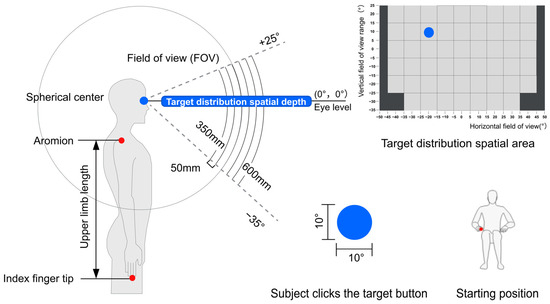
In combination with the display ability of HMD equipment, the hand and eye physiology of humans and pretest results [43], the click target is eliminated within the range of 90° (since the VR glasses are equipped with sponge support, the actual FOV is slightly less than the maximum FOV of the device) to 110°, and the vertical view appears in the range of −35° to 25°, and the depth value is within 350–600 mm.
The target position presented in the experiment has the following three independent variables: horizontal field of vision: −40°, −30°, −20°, −10°, 0°, 10°, 20°, 30°, 40°, and 9 spatial horizontal points; vertical field: −30°, −20°, −10°, 0°, 10°, 20°, 6 spatial vertical points; and spatial depth: 350 mm, 400 mm, 450 mm, 500 mm, 550 mm, 600 mm. As shown in Figure 2, the click positions at the left and right corners of the visual field surface are further divided into 9 target distribution areas after the 52 visual field spatial positions are removed due to operational difficulties.
Figure 2.
Design of experimental variables across nine spatial regions at six spatial depths.
To ensure that the target of the same size is seen in each test, the size of the target in the experiment is presented from the point of view, and its diameter is 5°, which is much larger than the minimum size required for clicking interaction [41], which can ensure each quick, successful click.
The click offset of the target, reaction time of the subject to start the movement, movement time of the arm to the target, and subjective evaluation data were collected. The experimental data analysis is based on 6 spatial depths and 9 spatial regions.
To avoid interference from the length of the upper limb factor on the clicking interaction performance at different spatial depths, a pilot study was performed before the formal experiment. In the pilot study, the participants were divided into four groups according to their upper limb length, namely, (1) less than 650 mm, (2) 650–700 mm, (3) 700–750 mm, and (4) more than 750 mm. The length of the upper limb is the distance between the shoulder joint and the index finger when the upper limb naturally droops. Two subjects were selected for each group to measure the clicking performance of subjects at 6 spatial depths and 52 positional points, with the same experimental flow as the formal experiment. The pilot study upper limb length factor and clicking performance data of each depth, reaction time (F(3, 2417) = 35.980, p < 0.001, ), movement time (F(3, 2417) = 60.604, p < 0.001, ), and click offset (F(3, 2417) = 18.170, p < 0.001, ) had significant interactions. Therefore, in the formal experiment, the upper limb length was used as the control variable, and volunteers from the 650–750 mm upper limb length group were selected to participate in the formal experiment.
3.1.2. Participants and Equipment
A total of 16 right-handed volunteers (right-hand dominance), including 5 males and 11 females, were recruited for this experiment. The participants ranged in age from 21 to 26 years, with a mean age of 23.60 years (SD = 1.28). Their upper limb lengths varied between 650 mm and 750 mm, yielding an average upper limb length of 702.1 mm (SD = 2.07). All participants possessed normal or corrected-to-normal visual acuity and were free of any upper limb motor impairments. The sample size of 16 was determined with reference to prior human–computer interaction ergonomics research, which provides adequate statistical power for repeated-measures ANOVA to detect main and interactive effects of spatial variables.
Verbal informed consent was obtained from all participants prior to the experiment (see Supplementary Materials File S1). Prior to participation, every volunteer was fully informed of the experimental procedures, minor risks of arm fatigue, data confidentiality policies, and their unconditional right to withdraw from the study at any time without penalty.
The experiment was performed on a workstation computer (Windows 10, 16 GB memory, 4.2 GHz Intel 64-core processor) as a virtual reality host and a 28-inch display on a 0.8 m-high desk. We used an HTC Vive Pro HMD with a binocular resolution of 2880 × 1600 pixels and a 90 Hz refresh rate. The subjects wore the VR headset display for the experimental operation, and the main test monitored the experimental process through the desktop display. A Leap Motion controller was mounted on the VR headset to track hand and finger poses throughout the frontal interaction zone.
3.1.3. Experimental Process
The formal experiment of each subject included 312 trials, which were divided into 6 experimental modules at different depths, and the trials in each module were balanced on a Latin square basis. Between the two modules, an adequate forced rest was set up. The purpose of the above operation was to ensure that each participant was not affected by cumulative arm fatigue later in the experiment. The total duration for each participant lasted approximately 30 min. Before the start of the formal experiment, the participants were introduced to the purpose and task requirements of the experiment and signed the informed consent form. First, the participants were required to click a 3D button in the debugging space at a distance that was comfortable for both observation and clicking. During the process, the participant could try repeatedly, and we recorded the distance between the button and their head. This session was used to record the subjective comfort interaction distance of participants with different upper limb lengths. Participants were then asked to perform the same magnitude of exercise, observing that they achieved stable interaction performance.
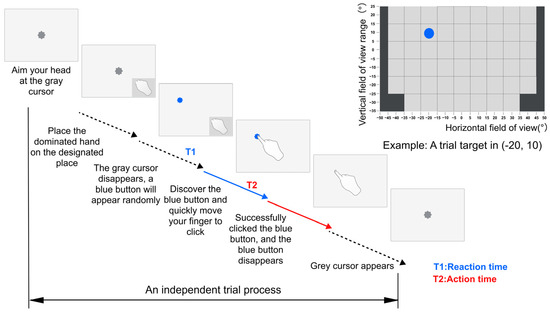
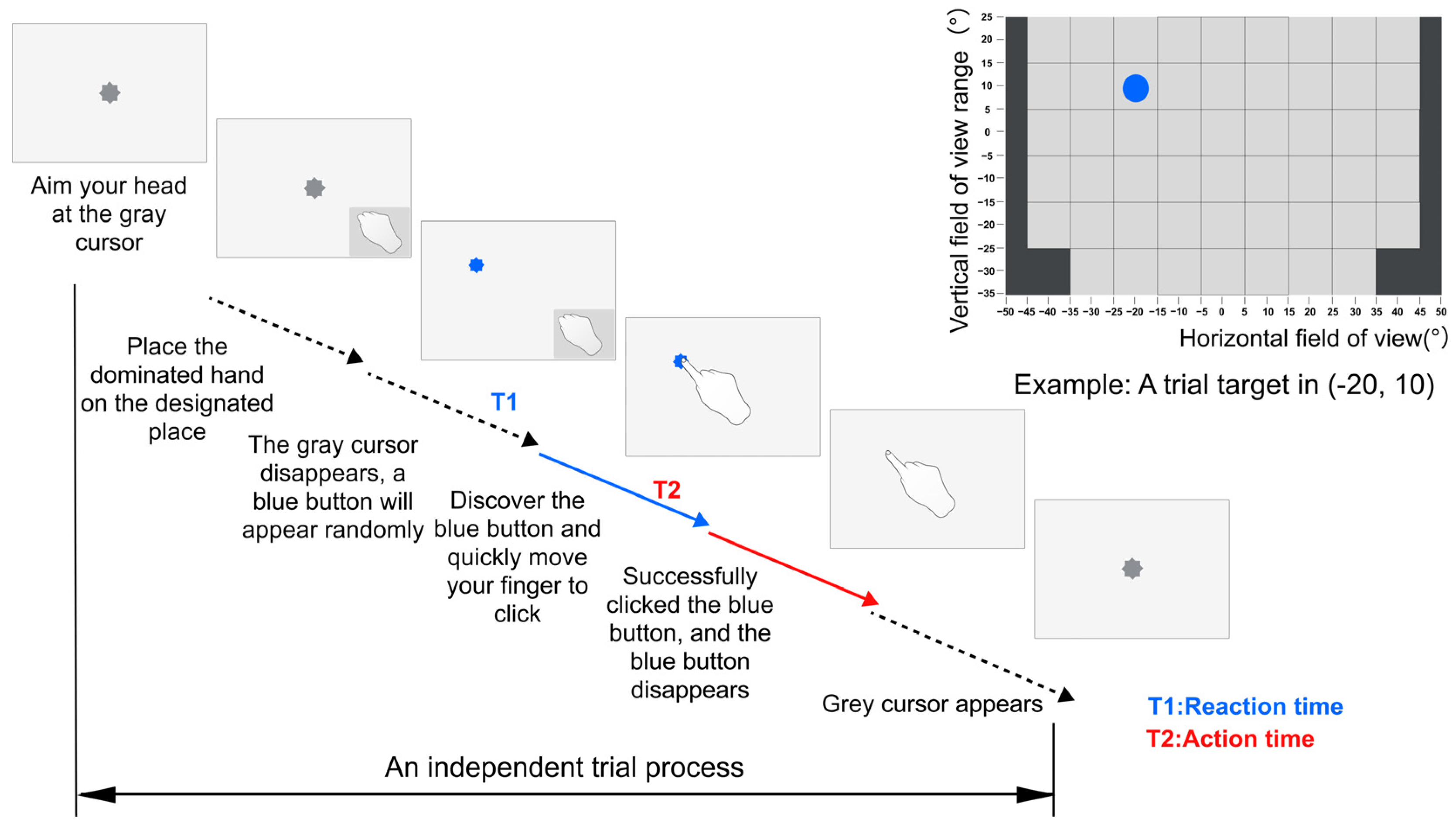
In the experiment, the participants were in a sitting position, and the head was kept fixed. To ensure the consistency of the head position and hand position for each test, in an independent test of the formal experiment, a gray cursor in a fixed position was presented in the 3D scene realized by the Unity3D engine (Version: Unity 2021 LTS). The participants needed to move the angle of their head, with their hand on the seat armrest, to put the gray cursor in front of them. When the two conditions of the head returned, and the detection range without a virtual hand is met simultaneously, the blue round button will appear randomly in 312 different positions in the space, the gray cursor will disappear, and each position only appears once. The participant is required to quickly click the blue button, and the blue button disappears if the click is successful. The next test is entered 2 s apart. The experimental process is shown in Figure 3.
Figure 3.
Experimental procedure.
At the end of the experiment, a volunteer was invited to participate in the testing of 633 spatial positions in the horizontal and vertical visual fields. Participants were required to maintain an arm-pointing position in the specified spatial position for 10 s, and the arm position of each spatial position was recorded multiple times, requiring participants to keep the arm position as consistent as possible. The recording was repeated four times in the same spatial position and averaged after excluding outliers by three standard deviations.
3.1.4. Results
The experiment counted the click offset, reaction time, and movement time. The click offset is defined as the distance between the actual click point and the center of each appearing target position, and the variance of its offset describes the click accuracy of the virtual hand click on each spatial position. Offsets were measured in perspective (°) to exclude distance offset differences due to depth problems. The reaction time refers to the time when the eye searches to confirm the target, calculated as the time difference between the moment of the target and the moment when the participant starts the arm movement, measured in seconds (s). Movement time refers to the time difference between the start of the movement moment of the arm and the clicking of the blue target button moment when completing a clicking action, measured in seconds (s). The data analysis results are presented as follows:
In experimental data processing, the outliers of the samples were first eliminated using the three standard deviation method to exclude individual outcome bias due to the device response delay. The intersubject effect test showed that spatial depth had a significant effect on the click offset (F(5, 4893) = 712.460, p < 0.001, ), reaction time (F(5, 4893) = 407.099, p < 0.001, ) and movement time (F(5, 4893) = 39.063, p < 0.001, ). Among them, click offset is most affected by spatial depth, followed by movement time and reaction time.
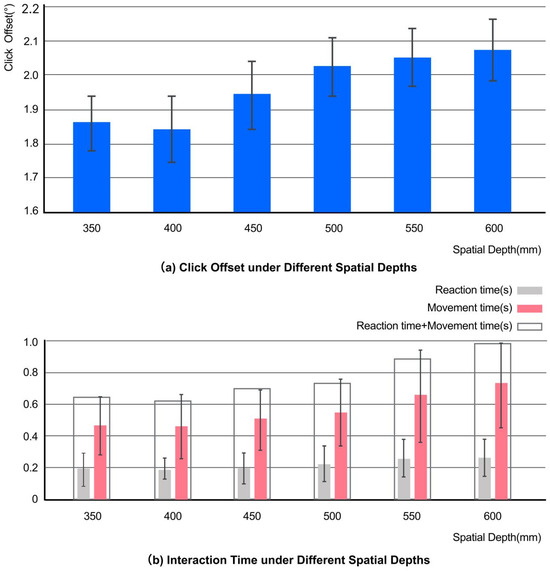
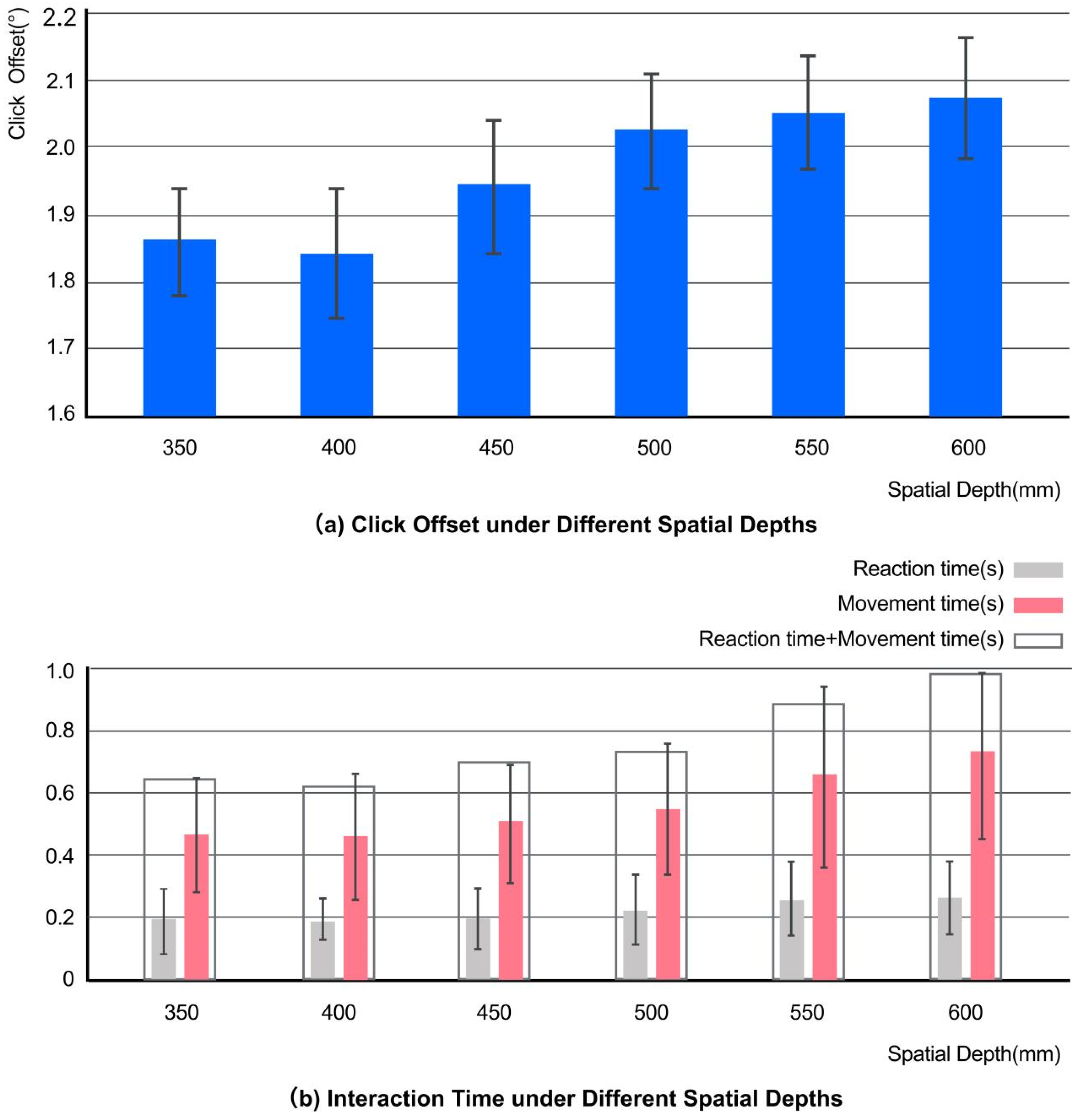
As shown in Figure 4a, the click offset has obvious advantages at spatial depths of 350 mm, 400 mm, and 450 mm. The click offset reached its minimum at 400 mm, indicating relatively superior clicking accuracy under this fixed depth condition. when the spatial depth is 400 mm. Considering the coherence of the interaction action, it can be seen from the distribution of clicking time (reaction time + movement time) that the interaction time between 350 mm and 400 mm spatial depth range is significantly better than other spatial depths, among which the spatial depth of 400 mm is comparatively favorable, as shown in Figure 4b.
Figure 4.
Bar charts of click offset, movement time, and reaction time at 6 spatial depths (350–600 mm).
Before the formal experiment began, participants were asked to adjust their subjective comfortable interaction distance. The experimental results found that the subjective comfort interaction distance of the participants was 417.17 ± 26.17 mm, concentrated in the depth range of 350–450 mm, and showed a positive correlation with the length of the upper limb (r2 = 0.642).
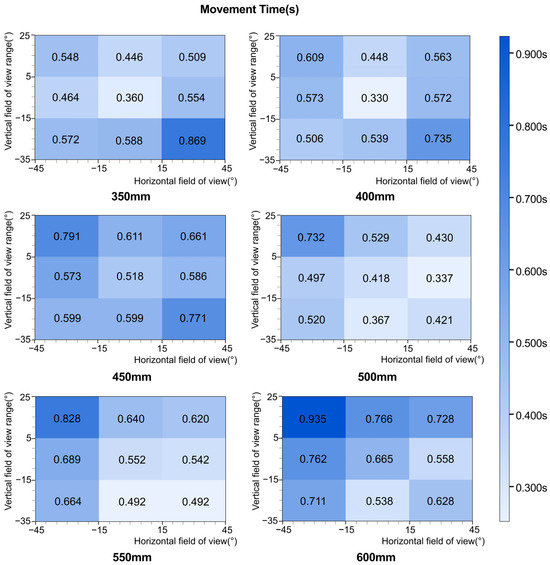
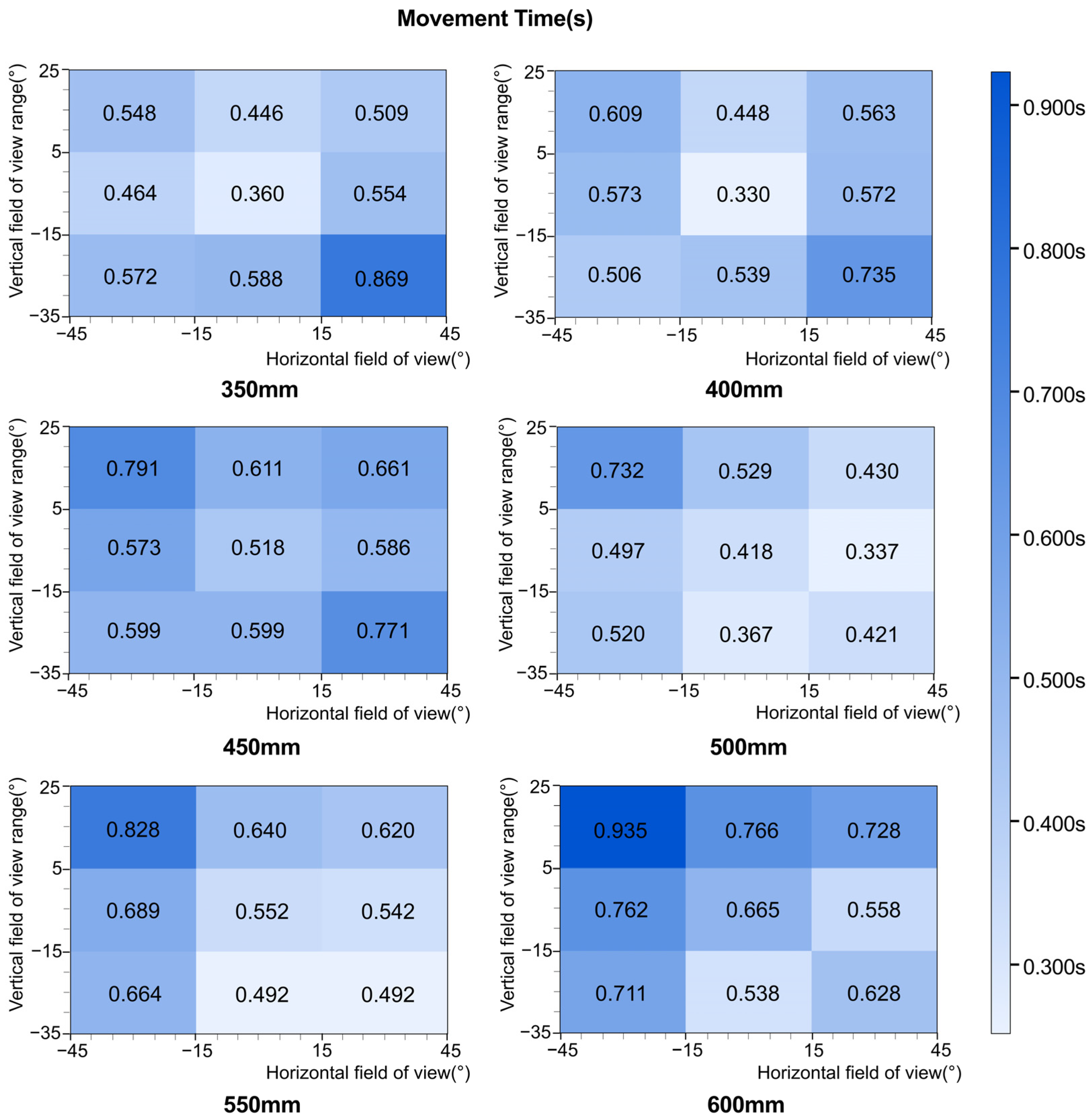
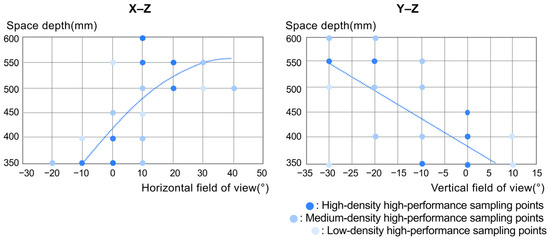
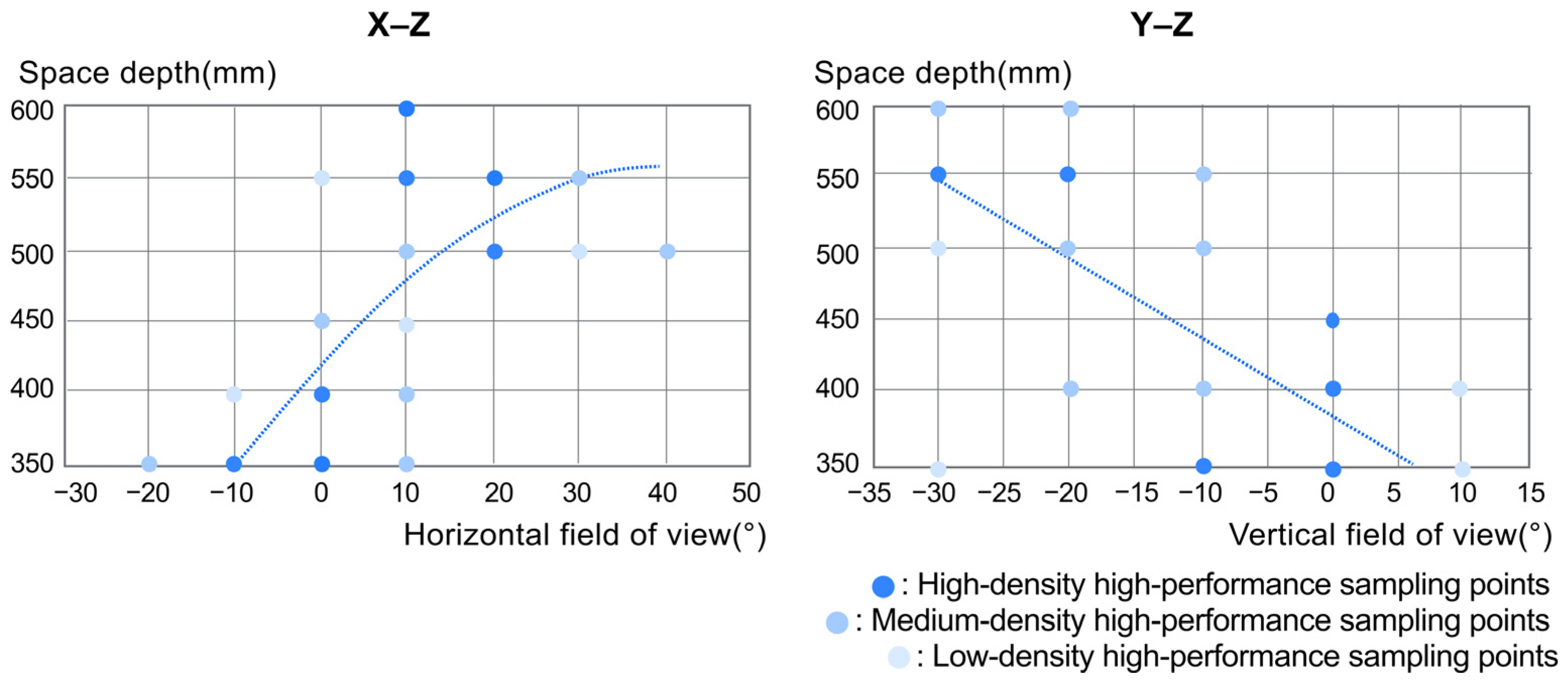
The experimental results analyze the relationship between the performance indicators and the nine target clicking space regions. The intersubject effect test showed that the spatial area had a significant effect on the movement time (F(8, 4893) = 24.852, p < 0.001, ). At the same time, the intersection of the spatial area and the spatial depth of the target distribution had a significant effect on the movement time (F(40, 4893) = 4.521, p < 0.001, ). Therefore, the movement time of the mean distribution of spatial regions at different spatial depths is shown in Figure 5. As shown in Figure 5, the dominant region with the lower movement time shifts downwards from the starting center to the right as the depth increases. Furthermore, the distribution map of 52 spatial position points with less movement time is in the x–z and y–z dimensions (x-axis is the horizontal visual field direction, y-axis is the vertical visual field direction, and z-axis is the spatial depth direction) (Figure 6), in which the darker the color of the coordinate points, the greater the density of the spatial position points with better performance. The curve fitting found that the regional distribution with better performance showed a sphere-like shape, and the sphere was significantly shifted to the right.
Figure 5.
Mean movement time (s) for targets distributed across nine spatial regions at varying spatial depths.
Figure 6.
Spatial distribution of points with low movement time in X–Z and Y–Z planes.
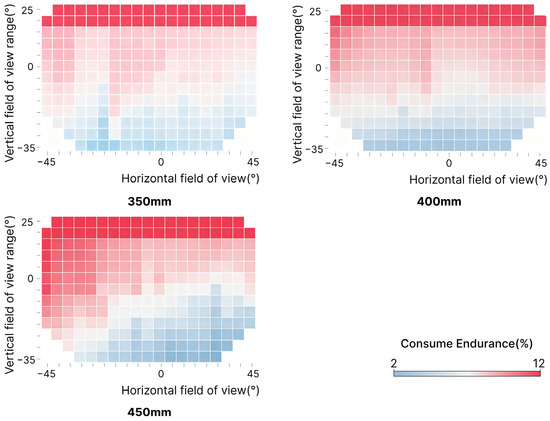
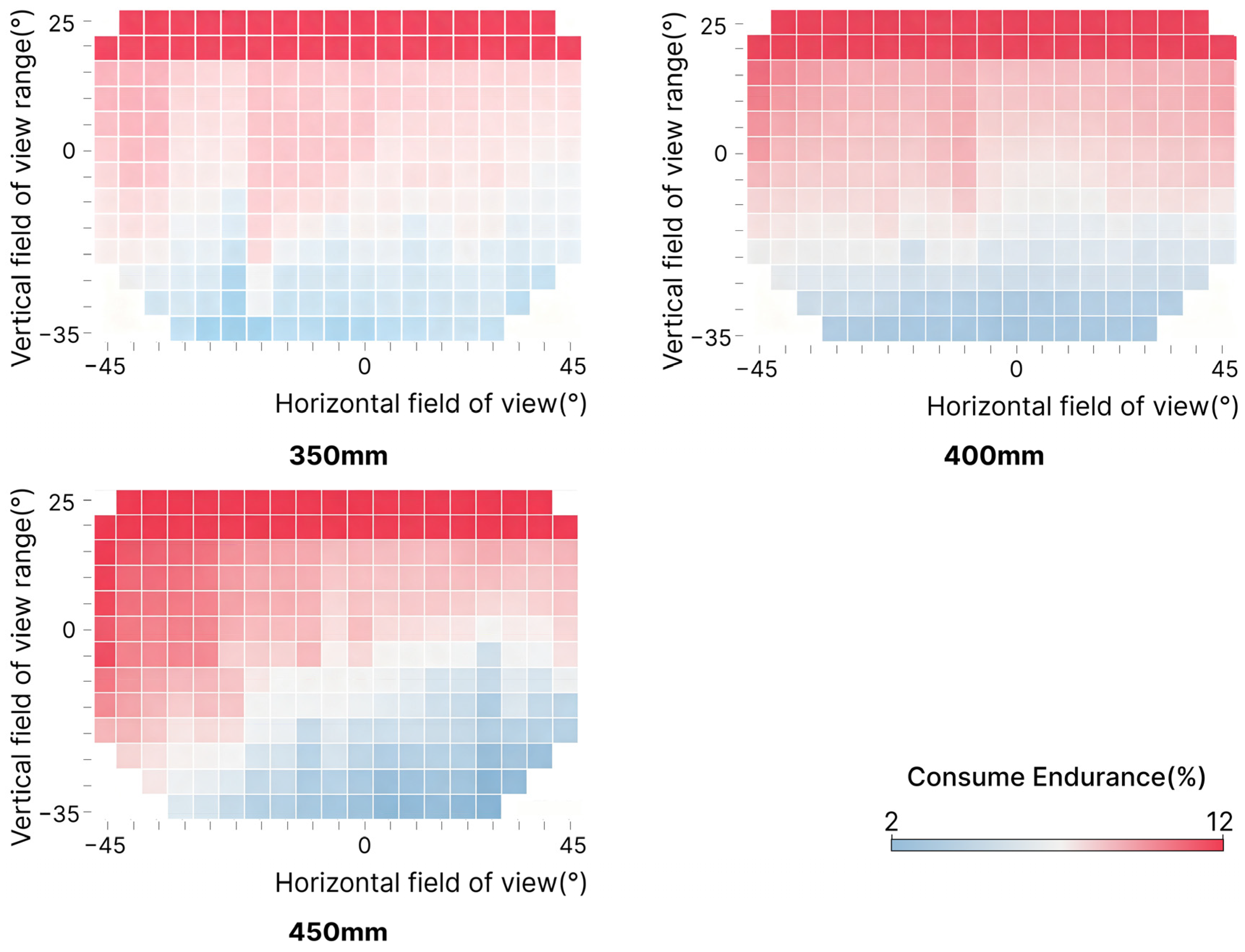
The consumption of endurance describes the degree of arm fatigue caused by aerial interaction, as proposed by Hincapie-Ramos et al. (2014) [40], based on accepted endurance studies and obtained by calculating the biomechanics of the upper arm. Higher consumption endurance values indicate higher arm fatigue. At the end of the experiment, a volunteer was invited to participate in the recording of the spatial location index of endurance at spatial depths of 350 mm, 400 mm, and 450 mm, with better performance. The results are shown in Figure 7. At a depth of 350 mm, the lower area of the center consumes less endurance. Regions consuming less endurance were shifted to the right with increasing spatial depth. At 450 mm spatial depth, the lower right area consumes low endurance, significantly better than the upper left area.
Figure 7.
Heatmaps of consumed endurance distribution at three spatial depths (350–450 mm).
3.1.5. Conclusions
Through the arm click offset, reaction time, and movement time index, the spatial area and spatial depth that may affect the user’s clicking behaviors were analyzed. The results showed consistent performance among multiple subjects. For spatial depth, participants with 650–750 mm upper limb length had the preferred task performance in the range of 350–450 mm depth, and the subjective evaluation results were consistent with the objective index measures.
According to the results of the effect test, the intersection of spatial region and spatial depth has a significant effect on the movement time. This shows that the distribution of performance in the field of view at different depths is different, so the space with the preferable clicking interaction is not a plane of equal depth. In the spatial area, with the increase in spatial depth, the area with less movement time shows a lower right deviation trend. By exploring the distribution of the performance of movement time in space, it is found that the area with better movement time performance in space presents a spherical shape with the reference center offset to the lower right in the field of vision. This result should be related to the fact that all experimental participants were right-handed, so the distribution of efficient interaction regions was affected by the handedness effect. The consumption endurance has an obvious spatial area distribution law: the consumption endurance of the upper space is greater than that of the lower area, and the consumption endurance of the non-lower hand side is greater than that of the lower hand side. The results show that the regional distribution of low fatigue interactions shows a trend towards the lower side with increasing spatial depth.
Considering the skewness of the better performance area of the consumption endurance and interaction time index, the reference center of the user’s efficient interaction space zone will be further explored. At the same time, as seen from the pre-experiment, the length of the upper limb has a significant effect on the interaction performance of clicking. Therefore, an experiment is necessary to further explore the depth of the click target space based on the long ratio of the upper limb between the interaction performance and subjective comfort.
3.2. Experiment 2
In the previous experiment, it is known that clicking performance is significantly affected by spatial depth and spatial area, and there is a spatial band with efficient virtual hand clicking interaction in 3D space, which is a spherical-like shape. Moreover, the curvature of the sphere may be in a certain ratio to the length of the upper limb, and the spherical spatial reference center has a bias of approaching the hands. To further explore the spatial form of the virtual hand clicking interaction, Experiment 2 was designed. In Experiment 2, different spatial layout reference centers and spatial depths were taken as independent variables, click offsets, movement time, and subjective evaluation were taken as indicators, and the interactive space layout of virtual hand clicking was comprehensively analyzed by task performance and subjective comfort.
3.2.1. Experimental Design
There are two purposes of Experiment 2. One is to study the reference center parameters of the spatial layout for the suitable task performance results of the interface, and the other is to study the spatial depth design parameters with excellent task performance and subjective comfort. The experimental content was the same as in Experiment 1, and the spatial click position and starting position were the same. Experiments recorded click offset, movement time, and participants’ subjective preferences.
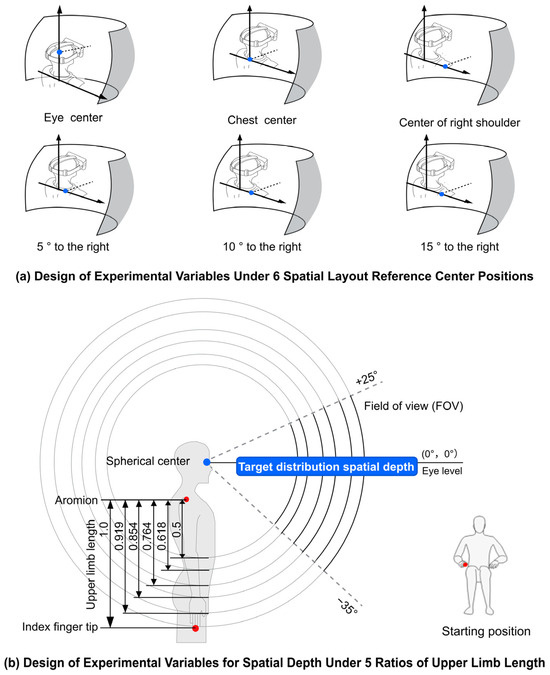
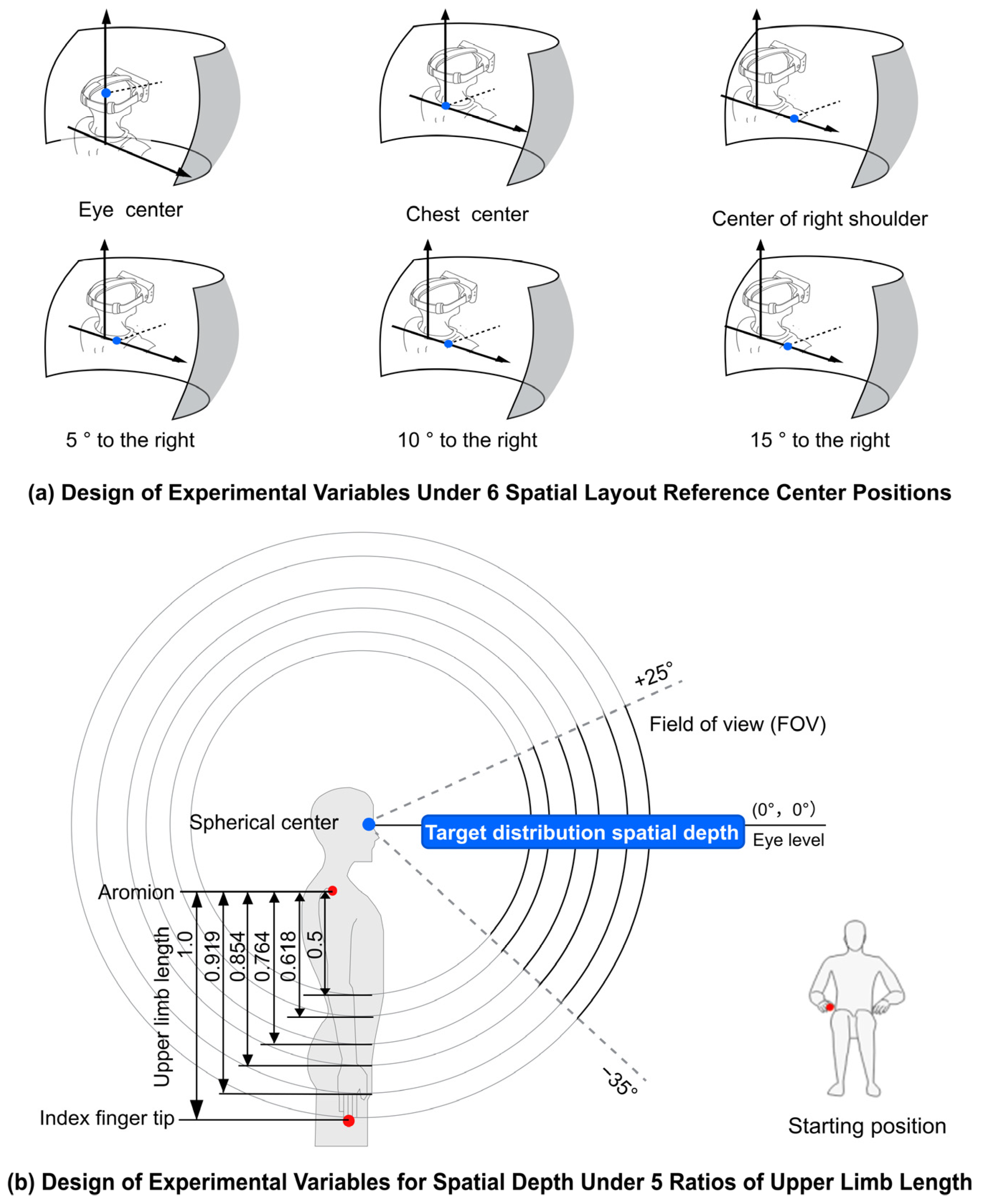
The experiment contained two tasks. In task 1, the independent variable is the reference center position of the spatial layout, and the spatial depth is set to 400 mm. According to previous studies, three reference center locations of the eye, chest, and right shoulder center were selected, and right-side 5°, 10°, and 15° angles were selected in the setting of this study. Therefore, eye center (0, 0), chest center (0, −15), right of chest 5° (5, −15), right of the chest 10° (10, −15), right of the chest 15° (15, −15), and right shoulder center (20, −15) were designed as variables, as shown in Figure 8a. The independent variable of task 2 was spatial depth, taking 0.5, 0.618, 0.764, 0.854, and 0.919 proportions of the length of the participants’ upper limb as a variable (Figure 8b). In the surfaces of both tasks, the experimental stimuli were presented at 52 spatial positions within the same visual field as Experiment 1.
Figure 8.
Experimental variable design in Experiment 2.
3.2.2. Participants, Equipment, and Process
Twenty-nine volunteers aged between 22 and 26 years (11 men and 18 women, age M = 23.94, SD = 1.36) were recruited for the experiment. All participants had normal or corrected-to-normal vision without any physical impairment. All participants were right-handed. All participants received information about the study and signed a consent document prior to participation.
The experimental equipment was the same as in Experiment 1. The experimental procedure was the same as in Experiment 1. The experimental stimuli presentation was processed in a random order during each task. The total duration for each participant lasted approximately 30 min.
After completing the experimental task, the subjective questionnaires of five spatial depths and six spatial layout reference centers required them to score the 7-point Likert scale of their clicking experience from the perspective of comfort level and fatigue.
3.2.3. Results
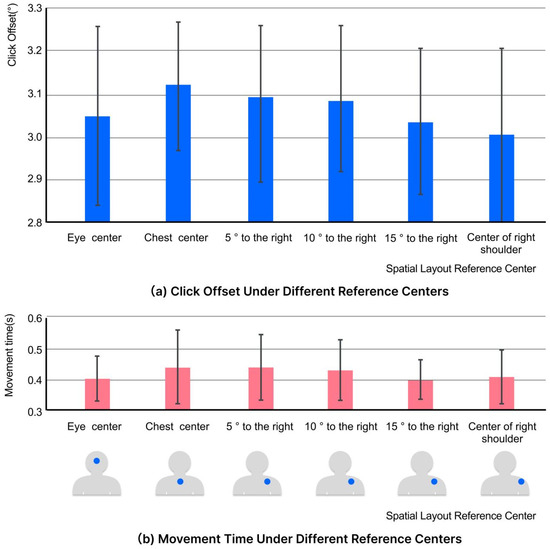
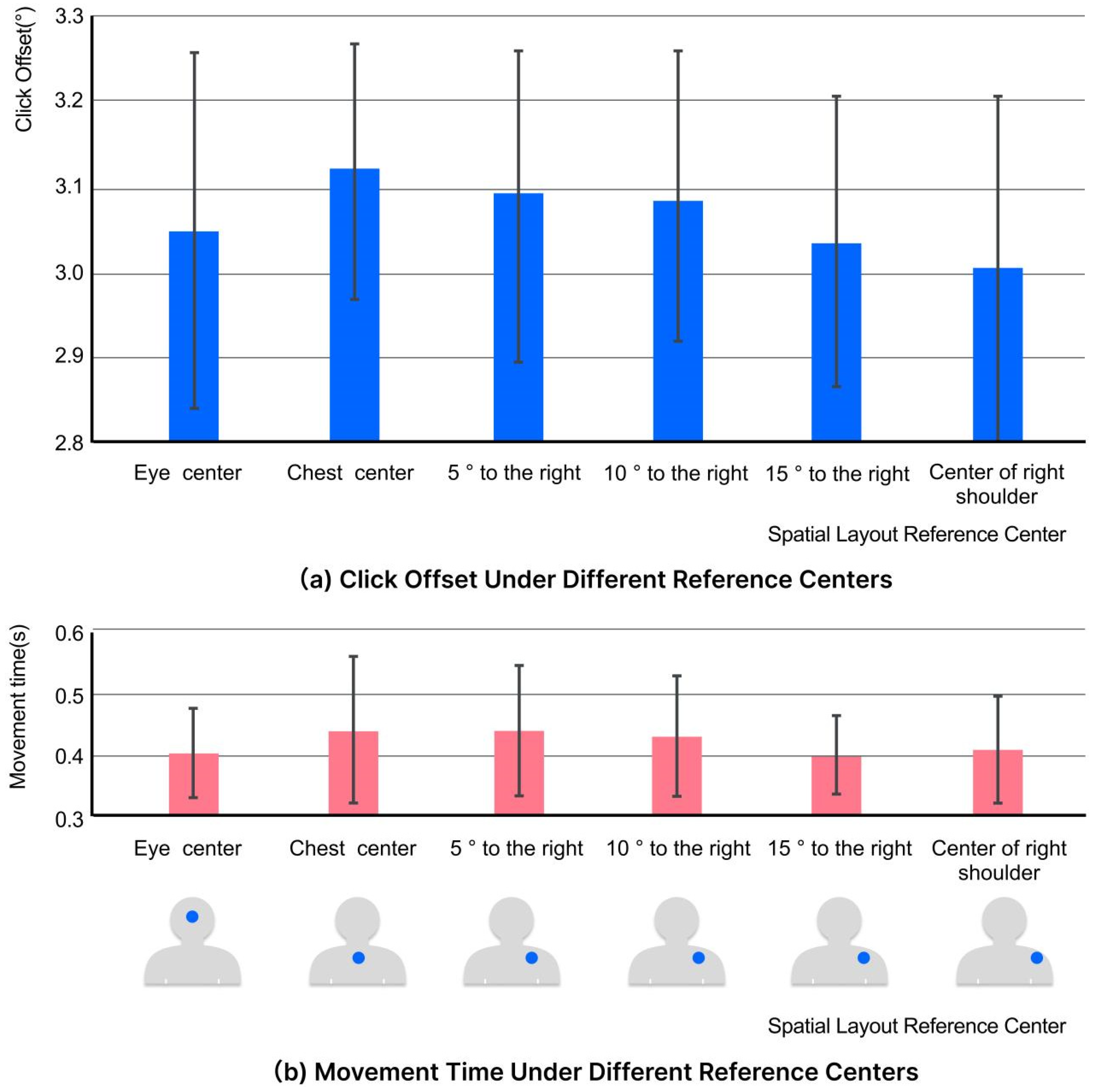
As in Experiment 1, Experiment 2 also used the three standard deviation method to eliminate the outliers of the sample to exclude the result bias caused by the device response delay. The results show that the click offset is significantly affected by the spatial layout reference (F(5, 8574) = 11.001, p < 0.01, ). Figure 9a shows the standard deviation of the six spatial layout references. Among them, the click offset deviation of the right shoulder center is the smallest, and the center of the chest has the largest click offset. The movement time was also significantly affected by the spatial layout of the reference center (F(5, 8574) = 34.440, p < 0.01, ), as shown in Figure 9b, which is the standard deviation of the six reference center positions of the spatial layout. Among them, the movement time of the center of both eyes, the right side of the center of the chest, and the center of the right shoulder is short, and the movement time of the chest center is the longest.
Figure 9.
Bar charts of click offset and movement time for six spatial layout reference centers.
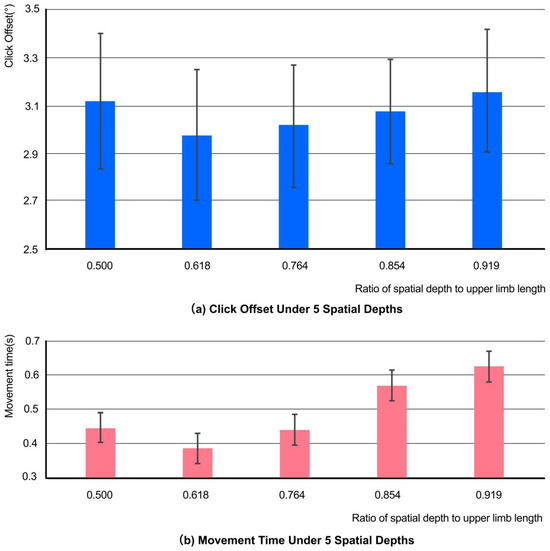
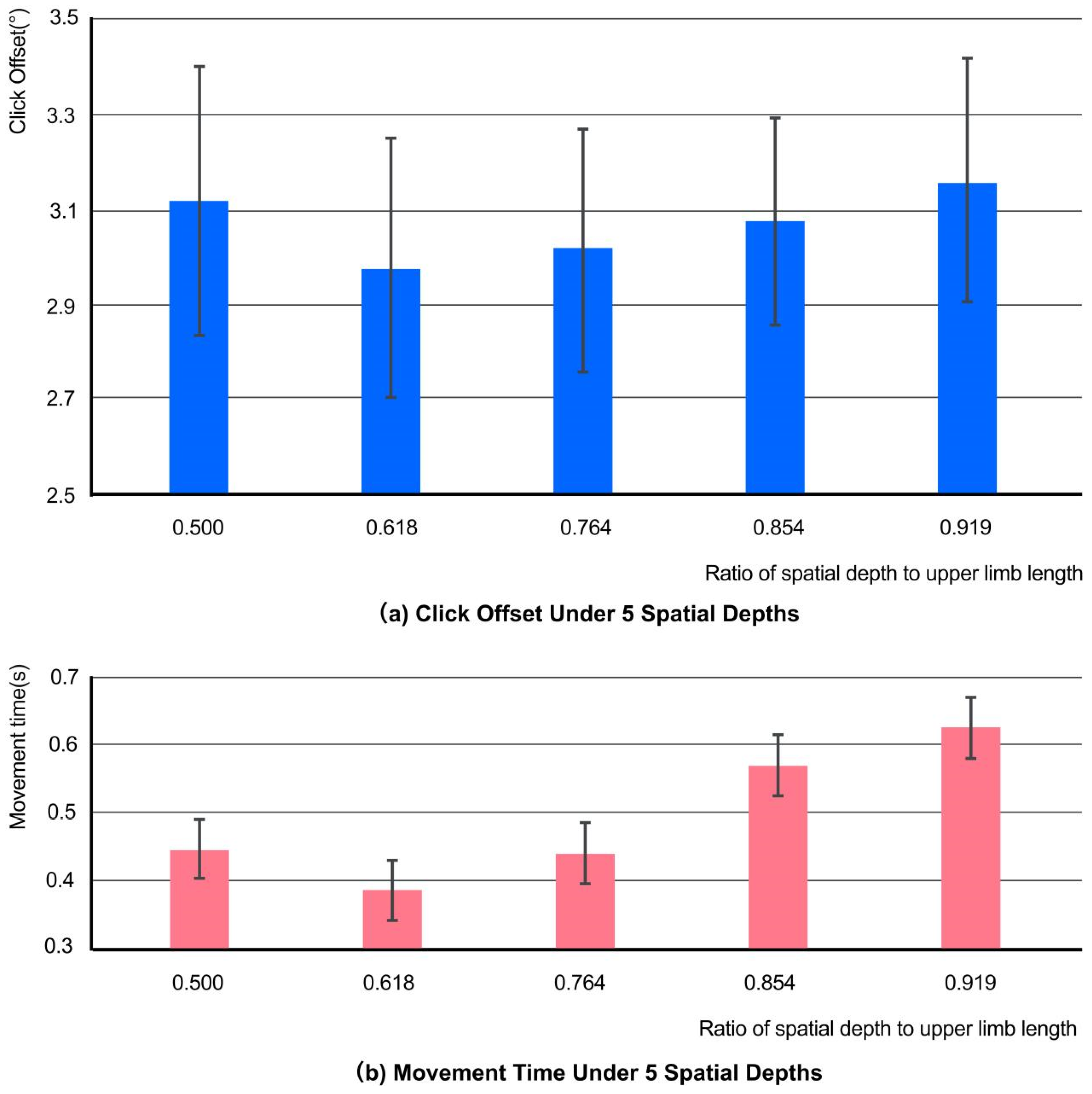
In task 2, ANOVA found that click offset was significantly affected by the proportion of spatial depth to the upper limb (F(4, 7067) = 14.282, p < 0.01, ). As shown in Figure 10a, the standard deviation of the click offset for a total of five spatial depths of 0.5 to 0.919 is proportional to the upper limb length. Among them, the click offset is the smallest at 0.764, followed by 0.618 and 0.854, and 0.5 and 0.919. Movement time was also significantly affected by the proportion of spatial depth to the upper limb (F(4, 7067) = 65.239, p < 0.01, ). As shown in Figure 10b, the standard deviation for a total of five spatial depths of 0.5 to 0.919 is proportional to the upper limb length. Among them, the movement time under 0.618 is the shortest, followed by 0.764 and 0.5, and 0.854 and 0.919.
Figure 10.
Bar charts of click offset and movement time for five upper-limb depth ratios.
Table 1 and Table 2 show the subjective preference normalized mean scores of experimental subjects performing the clicking manipulation across two tasks. Subjective preference contains three indicators, all of which are high scores corresponding to positive effects, as shown in Table 1 and Table 2. The higher the comfort score, the more natural and comfortable; the higher the fatigue score, the lower the fatigue; the higher the comprehensive satisfaction, the higher the overall satisfaction. For the subjective evaluation of the six spatial layout reference centers, it can be seen from Table 1 that for the spatial layout reference center, the right shoulder center has the most suitable subjective interaction comfort and the lowest fatigue, followed by the binocular center and the chest center, which are the worst performers. In terms of comprehensive satisfaction, the right shoulder center is suitable, and the chest center is the worst.
Table 1.
Normalized subjective mean scores for six spatial reference center layouts.
Table 2.
Normalized subjective mean scores for five upper-limb depth ratios.
For the subjective evaluation of the spatial depth of the five upper limb proportions, Table 2 shows the appropriate degree that the subjective interaction comfort in the arm accessibility domain is represented by a 0.618 to 0.854 ratio. The smaller the long proportion of the upper limb, the lower the interaction depth, and the fatigue increased with the gradual extension of the arms. On the comprehensive satisfaction level, the upper limb long ratio of 0.618 was relatively superior.
3.2.4. Conclusions
Combined with the one-way ANOVA results of Task 1, layouts referenced to the binocular or right-shoulder center exhibited better click offset and movement time, while the chest-centered layout performed the worst. The right-shoulder reference reduced pointing difficulty for far-left and far-right targets, and subjective preference scores favored this layout significantly.
One-way ANOVA was also used for Task 2 to analyze the effect of spatial depth-to-upper-limb proportion. Comprehensive metrics, including movement time, click offset, and subjective comfort, showed that the mid-range arm-reachable zone (0.618 and 0.764 ratios) achieved the appropriate performance, with shorter movement time, higher pointing accuracy, and greater subjective comfort than other proportions.
4. Discussion
Based on the hand–eye behavior characteristics, using multidimensional performance indicators as the evaluation and test method, this study designed ergonomics experiments to explore the design parameters related to the spatial morphology of the virtual hand clicking interaction 3D interface. The experiment was to explore the virtual environment in the user sitting state, spatial depth, and space area for virtual hand clicking, interactive click offset, movement time, reaction time, and CE; the comprehensive considerations found in the field of 3D space in the efficient interaction space and the space with a spherical shape have a trend of bias. Experiment 2 further explores the spatial reference center of the 3D interface and the spatial depth based on the long proportion of the upper limb.
For the spatial depth of the contact virtual hand clicking 3D interface, different from the viewing distance in previous studies, the viewing distance of the virtual hand clicking interaction interface is also the interaction distance of the virtual hand, which is affected by the hand–eye coordination mechanism. In the experimental measurement index, reaction time is mainly related to eye movement, movement time is mainly related to hand movement, and click accuracy is mainly related to hand–eye coordination. In Experiment 1, it was found that spatial depth had a significant impact on click offset, reaction time, and movement time performance, and it had the most significant effect on click accuracy. For participants with 650–750 mm upper limb length, reaction time performance was better at 350–450 mm spatial depth, click offset and movement time were better at 350 mm and 400 mm, and best at 400 mm, consistent with [38]. The reason for this result is that the reaction time is affected by the viewing distance, and when the target appears in a distant spatial position, the subjects need more target detection time [23]. The movement time is mainly affected by the arm movement chain. It is obvious that when the target appears in a close spatial position, the arm movement chain required by the participant to complete the clicking task is shorter, and the movement time is also shorter. The click offset performance is a comprehensive index to measure the clicking interaction performance, which is influenced by the joint coordination of the hand and eye, and the target spatial depth has the greatest influence on it. Therefore, it can be preliminarily judged that the interaction spatial depth distance of approximately 400 mm can be used as a universal virtual hand interaction space distance to provide a reference for the design. Different from the previous use of single indicators to study the spatial depth of the 3D interface in a virtual environment, the experiment used multiple indicators to measure the spatial depth with better performance and found that the relatively superior spatial depth of the 3D interface is affected by the joint action of the hand and eye, and it explored the possible influence mechanism of the hand and eye.
Considering the influence of spatial depth and spatial area on interaction performance and subjective comfort, the interface geometry is determined to be a sphere with a certain curvature within the field of view. The interaction between spatial region and spatial depth exerted a significant effect on movement time. Spatial distribution heatmaps of movement time reveal that central positions exhibit shorter movement durations at near depths, delivering relatively favorable task performance. With the increase in spatial depth, the areas with better performance tend to shift towards the right and below. Movement performance may be limited by the arm physiology of the right-hand user, and the arm movement chain must be highly folded when the right-handed user clicks on the present target in the lower right area during close interaction. As spatial depth increases, the arm folding amplitude of the target in the lower right region is relatively relieved, while the upper left region target requires greater effort to reach.
Combining the spatial distribution of appropriate operating points at all depth levels, the high-efficiency interaction space for virtual hand pointing within the user’s field of view presents a roughly spherical shape shifted toward the lower right. It should be noted that the participants recruited in this experiment were right-handed, while no left-handed control group was included, which directly limits the generalizability of the research conclusions. The observed regularities, including the overall rightward shift in the preferable interaction region and the growing operational advantage of the lower-right area as spatial depth increases, are derived from the kinematic characteristics of the right-handed arm and cannot be directly applied to left-handed users. Furthermore, only single-handed unilateral pointing tasks were adopted in the experiment without bilateral bimanual interaction tests. Therefore, the preferable spatial parameters and reference layouts obtained herein are only applicable to single-handed unilateral operations and cannot directly guide compound interaction tasks such as synchronous bimanual grasping and bilateral coordinated manipulation. Future work will recruit balanced groups of left- and right-handed participants for comparative analysis and introduce bimanual interaction tasks to supplement interface design references for users with different handedness and diverse operation modes.
Experiment 2 further explored the interaction performance of spatial depth based on the long proportion of the upper limbs, added subjective evaluation indicators, and found that the comprehensive performance of spatial depth between 0.618 and 0.764 was better. Through the comparison with previous studies [33,39] and the verification of interaction performance and subjective evaluation, it can be considered that the proportional depth between 0.618 and 0.764 based on the long proportion of the user’s upper limb is good in the design. We studied two possible factors of fixed spatial depth and individual upper limb length under the same conditions and gathered that there are two design strategies for the curvature of the virtual hand clicking interface in VEs, setting the fixed spatial depth of 400 mm for a universal virtual hand clicking interface, with the display depth between 0.618 and 0.764.
Regarding the spatial reference center, the right-side operational advantage observed in Experiment 1 confirms that handedness substantially affects virtual hand interaction performance. Traditional 3D interfaces typically adopt eye-centered layouts for visual presentation, whereas interactive VR interfaces require ergonomic optimization for manipulation tasks. The present results indicated that binocular-centered and right-shoulder-centered layouts outperformed chest-centered layouts. The binocular-centered layout benefits visual concentration and supports efficient top-down eye-driven interaction, which is suitable for pure display-oriented VR scenarios. In contrast, the right-shoulder-centered layout shortens the effective arm motion chain, reduces asymmetric operational fatigue for lateral targets, and delivers higher subjective comfort, making it more applicable for control-intensive VR tasks. In practical design, the reference center should be selected according to functional requirements: eye-centered layouts for visual presentation and right-shoulder-centered layouts for interactive manipulation.
Several limitations of this study should be noted to clarify the applicable boundary of the conclusions. First, all experiments were conducted under static seated conditions with fixed torso and shoulder postures, restricting limb movement to forearm and wrist rotation only. Realistic VR scenarios include standing, walking, turning, and dynamic torso displacement, which significantly alter arm reachable ranges, eye–hand distances, and comfortable motion boundaries. Consequently, the preferred fixed depth, proportional range, and spherical curvature identified in this study cannot be directly generalized to dynamic interactive environments. In addition, only simple repetitive single-point clicking tasks were tested. Complex operations such as target tracking, dragging, multi-selection, and 3D rotation were not included, restricting the applicability of the findings to high-load coupled interaction tasks.
Second, the generalizability is constrained by sample and hardware limitations. The participant pool covered a narrow age and upper-limb range, excluding adolescents, older adults, and users with physical limitations. Although the sample size satisfied ANOVA statistical standards, individual physiological differences were not systematically analyzed. Furthermore, all data were collected using a single VR device, whose inherent visual distortion, tracking latency, and fixed field of view may have biased the suitable spatial parameters. The conclusions thus cannot be directly applied to VR devices with different hardware specifications. Third, this study only adopted virtual hand physical clicking paradigms and did not include classical remote interaction methods such as ray-casting and Go-Go interaction.
At the same time, a large number of studies on physical surface displays have found that there are some trade-offs in the performance advantages of graphical user interfaces presented in surface ways. For example, studies have found that high curvature on desktop displays increases the psychological, physiological, and temporal requirements for the task and produces visual distortion regardless of the display size [44]. Some studies have also noted that, in terms of visual performance, curved displays improve the user experience [45]. However, this does not necessarily mean that the higher the curvature of the display, the better the user experience. There may be a point of diminishing returns where higher curvature no longer improves the user experience [46].
In conclusion, the findings of this study are strictly applicable to static seated, right-handed users, using a single VR device for discrete single-point virtual hand clicking interactions. The proposed design parameters are not generalizable to left-handed users, dynamic postures, diverse VR hardware, or complex interactive tasks. Future studies will expand stratified participant recruitment, adopt multiple device platforms, and incorporate dynamic and complex interaction paradigms to further improve the universality of 3D virtual hand interface design theories.
5. Conclusions
In this study, we explore the changes in click accuracy, time performance, subjective evaluation, and fatigue distribution with different spatial locations to determine the spatial pattern of the virtual hand clicking interactive interface. The results show that a hemispherical interface configuration, combined with either a fixed spatial depth of 400 mm or an individualized depth ranging from 0.618 to 0.764 of the user’s upper limb length, and a right-shoulder-centered spatial layout, can achieve favorable interaction performance and reduce operational fatigue under the tested conditions (Figure 11).
Figure 11.
Proposed spatial morphology design parameters for 3D interfaces.
This work provides conditional spatial design references for virtual hand interface ergonomics. Nevertheless, the findings are limited to static single-point interaction scenarios, a narrow right-handed sample population, and a single VR device, without generalizing to dynamic postures, complex interactive tasks, diverse user groups, or other VR hardware and remote interaction paradigms. Future work will recruit participants with varied handedness and physical characteristics, adopt multi-posture dynamic experimental paradigms and complex manipulation tasks, and validate the design parameters across multiple devices and interaction modes to improve the universality of three-dimensional virtual hand interface design theories.
Supplementary Materials
The following supporting information can be downloaded at https://www.mdpi.com/article/10.3390/app16147252/s1.
Author Contributions
Conceptualization, D.Z. and Z.Z.; methodology, Z.Z.; software, Z.Z.; validation, D.Z.; formal analysis, D.Z.; investigation, D.Z.; resources, D.Z.; data curation, D.Z.; writing—original draft preparation, Z.Z.; writing—review and editing, Z.Z.; visualization, D.Z.; supervision, D.Z.; project administration, Z.Z. All authors have read and agreed to the published version of the manuscript.
Funding
This research received no external funding.
Institutional Review Board Statement
Ethical review and approval were waived for this study due to REASON: This study complies with Article 32, Item (2) of the 2023 national joint Ethical Review Measures for Life Science and Medical Research Involving Humans. It is a low-risk, non-commercial virtual reality behavioral experiment. Only anonymized age and gender data were collected, and no biological samples or personally identifiable information were acquired from participants.
Informed Consent Statement
Patient consent was waived. Ethical review exemption was granted pursuant to Article 32, Item (2) of the 2023 Joint National Measures for the Ethical Review of Human Life Science and Medical Research. This low-risk, non-commercial VR behavioral experiment only collected anonymized age and gender data; no biological samples or personally identifiable information were acquired.
Data Availability Statement
Data available on request due to partial privacy restrictions.
Conflicts of Interest
The authors declare no conflicts of interest.
References
- Giglioli, I.A.C.; Pravettoni, G.; Martín, D.L.S.; Parra, E.; Raya, M.A. A novel integrating virtual reality approach for the assessment of the attachment behavioral system. Front. Psychol. 2017, 8, 959. [Google Scholar] [CrossRef] [Scilit] [PubMed]
- Marín-Morales, J.; Torrecilla-Moreno, C.; Guixeres-Provinciale, J.; Llinares-Millán, C. Methodological bases for a new platform for the measurement of human behavior in virtual environments. Dyna 2017, 92, 34–38. [Google Scholar] [CrossRef] [Scilit] [PubMed]
- Al Zayer, M.; Adhanom, I.B.; MacNeilage, P.; Folmer, E. The effect of field-of-view restriction on sex bias in VR sickness and spatial navigation performance. In Proceedings of the 2019 CHI Conference on Human Factors in Computing Systems, Glasgow, UK, 4–9 May 2019. [Google Scholar] [CrossRef] [Scilit]
- Murthy, L.R.D. Multimodal interaction for real and virtual environments. In Proceedings of the IUI ’20 Companion: Companion Proceedings of the 25th International Conference on Intelligent User Interfaces, Cagliari, Italy, 17–20 March 2020. [Google Scholar] [CrossRef] [Scilit]
- Mackinlay, J.; Card, S.K.; Robertson, G.G. A Semantic Analysis of the Design Space of Input Devices. Hum.-Comput. Interact. 1990, 5, 145–190. [Google Scholar] [CrossRef] [Scilit]
- Rizzuto, M.A.; Sonne, M.W.L.; Vignais, N.; Keir, P.J. Evaluation of a virtual reality head mounted display as a tool for posture assessment in digital human modelling software. Appl. Ergon. 2019, 79, 1–8. [Google Scholar] [CrossRef] [Scilit] [PubMed]
- Zhang, F.; Dai, G.; Peng, X. A survey on human-computer interaction in virtual reality. Sci. Sin. Informationis 2016, 46, 1711–1736. [Google Scholar] [CrossRef] [Scilit]
- Lin, C.P.; Wang, C.Y.; Chen, H.R.; Chu, W.C.; Chen, M.Y. RealSense directional interaction. In Proceedings of the MM ’13: Proceedings of the 21st ACM international conference on Multimedia, Barcelona Spain, 21–25 October 2013. [Google Scholar] [CrossRef] [Scilit]
- Caggianese, G.; Gallo, L.; Neroni, P. Evaluation of spatial interaction for virtual heritage. Future Gener. Comput. Syst. 2018, 81, 516–527. [Google Scholar] [CrossRef] [Scilit]
- Gabbard, J.L. A Taxonomy of Usability Characteristics in Virtual Environments. Master’s Thesis, Virginia Polytechnic Institute and State University, Blacksburg, VA, USA, 1997. [Google Scholar]
- Sidenmark, L.; Lundström, A. Gaze behaviour during virtual hand interaction. In Proceedings of the ETRA ’19: Proceedings of the 11th ACM Symposium on Eye Tracking Research & Applications, Denver, CO, USA, 25–28 June 2019. [Google Scholar] [CrossRef] [Scilit]
- MacKenzie, C.L.; Marteniuk, R.G.; Dugas, C. Three-dimensional Movement Trajectories in Fitts’ task. Q. J. Exp. Psychol. A 1987, 39, 629–647. [Google Scholar] [CrossRef] [Scilit]
- Thomson, J.A. Is continuous visual monitoring necessary in visually guided locomotion? J. Exp. Psychol. 1983, 9, 427–443. [Google Scholar] [CrossRef] [PubMed]
- Wang, Y.; Mackenzie, C.L. Effects of orientation disparity between haptic and graphic displays. In Proceedings of the Human-computer Interaction, INTERACT ’99: IFIP TC.13 International, Edinburgh, UK, 30 August–3 September 1999. [Google Scholar]
- Willemsen, P.; Gooch, A.A.; Thompson, W.B. Effects of Stereo Viewing Conditions on Distance Perception in Virtual Environments. Presence 2008, 17, 91–101. [Google Scholar] [CrossRef] [Scilit]
- Livingston, M.A.; Swan, J.E.; Gabbard, J.L.; Hollerer, T.H.; Hix, D.; Julier, S.J.; Baillot, Y.; Brown, D. Resolving multiple occluded layers in AR. In Proceedings of the Second IEEE and ACM International Symposium on Mixed and Augmented Reality, Tokyo, Japan, 10 October 2003. [Google Scholar] [CrossRef] [Scilit]
- Mine, M.R.; Brooks, F.P.; Sequin, C.H. Moving objects in virtual space. In Proceedings of the SIGGRAPH ’97: Proceedings of the 24th Annual Conference on Computer Graphics and Interactive Techniques, Los Angeles, CA, USA, 3–8 August 1997. [Google Scholar] [CrossRef] [Scilit]
- Tao, D.; Yuan, J.; Liu, S.; Qu, X. Effects of button design characteristics on performance and perceptions of touchscreen use. Int. J. Ind. Ergon. 2018, 64, 59–68. [Google Scholar] [CrossRef] [Scilit]
- Ni, T.; Bowman, D.A.; Chen, J. Increased Display Size and Resolution Improve Task Performance in Information-Rich Virtual Environments. In Proceedings of the Graphics Interface 2006, Quebec, QC, Canada, 7–9 June 2006; pp. 139–146. Available online: https://graphicsinterface.org/proceedings/gi2006/gi2006-18/ (accessed on 15 July 2026).
- Norman, D.A. Natural user interfaces are not natural. Interactions 2010, 17, 59–68. [Google Scholar] [CrossRef] [Scilit]
- Patterson, R.; Winterbottom, M.D.; Pierce, B.J. Perceptual issues of HMDs. Hum. Factors 2006, 48, 555–573. [Google Scholar] [CrossRef] [Scilit] [PubMed]
- Lin, J.J.W.; Duh, H.B.L.; Parker, D.E.; Abi-Rached, H.; Furness, T.A. FOV effects on presence and simulator sickness. In Proceedings of the IEEE Virtual Reality 2002, Orlando, FL, USA, 24–28 March 2002. [Google Scholar] [CrossRef] [Scilit]
- Jang, W.; Shin, J.-H.; Kim, M.; Kim, K. Human field of regard and attention bias. Comput. Methods Programs Biomed. 2016, 135, 115–123. [Google Scholar] [CrossRef] [Scilit] [PubMed]
- Ping, J.; Weng, D.; Liu, Y.; Wang, Y. Depth cues in virtual shuffleboard. J. Soc. Inf. Disp. 2020, 28, 164–176. [Google Scholar] [CrossRef] [Scilit]
- Cipiloglu, Z.; Bulbul, A.; Capin, T. Depth perception enhancement framework. In Proceedings of the APGV ’10: Proceedings of the 7th Symposium on Applied Perception in Graphics and Visualization, Los Angeles, CA, USA, 23–24 July 2010. [Google Scholar] [CrossRef] [Scilit]
- Cutting, J.E. How the eye measures reality and virtual reality. Behav. Res. Methods 1997, 29, 27–36. [Google Scholar] [CrossRef] [Scilit]
- Hoffman, D.M.; Girshick, A.R.; Akeley, K.; Banks, M.S. Vergence-accommodation conflict causes visual fatigue. J. Vis. 2008, 8, 33. [Google Scholar] [CrossRef] [Scilit] [PubMed]
- Bingham, G.; Coats, R.; Mon-Williams. Natural prehension without haptic feedback. Neuropsychologia 2007, 45, 288–294. [Google Scholar] [CrossRef] [Scilit] [PubMed]
- Cuijpers, R.H.; Brenner, E.; Smeets, J. Consistent haptic feedback for virtual reaching. Hum. Mov. Sci. 2008, 27, 857–872. [Google Scholar] [CrossRef] [Scilit] [PubMed]
- Hibbard, P.B.; Bradshaw, M.F. Reaching and binocular disparity. Exp. Brain Res. 2003, 148, 196–201. [Google Scholar] [CrossRef] [Scilit] [PubMed]
- Saffer, D. Designing Gestural Interfaces; O’Reilly: Sebastopol, CA, USA, 2008. [Google Scholar]
- Lou, X.; Li, X.A.; Hansen, P.; Du, P. Hand-adaptive VR interface. Virtual Real. 2021, 25, 367–382. [Google Scholar] [CrossRef] [Scilit]
- Lubos, P.; Bruder, G.; Ariza, O.; Steinicke, F. Kinesphere spatial interaction. In Proceedings of the SUI ’16: Proceedings of the 2016 Symposium on Spatial User Interaction, Tokyo, Japan, 15–16 October 2016. [Google Scholar] [CrossRef] [Scilit]
- Ren, G.; O’Neill, E. Freehand 3D selection. Comput. Graph. 2013, 37, 101–120. [Google Scholar] [CrossRef] [Scilit]
- Liu, J.; Prouzeau, A.; Ens, B.; Dwyer, T. Immersive small multiples visualization. In Proceedings of the 2020 IEEE Conference on Virtual Reality and 3D User Interfaces (VR), Atlanta, GA, USA, 22–26 March 2020. [Google Scholar] [CrossRef] [Scilit]
- Satriadi, K.A.; Ens, B.; Cordeil, M.; Czauderna, T.; Jenny, B. Maps Around Me: 3D multi-view maps in immersive space. Proc. ACM Hum.-Comput. Interact. 2020, 4, 1–20. [Google Scholar] [CrossRef] [Scilit]
- Blais, B.R. Visual ergonomics of office displays. Chem. Health Saf. 1999, 6, 31–38. [Google Scholar] [CrossRef] [Scilit]
- Ens, B.; Finnegan, R.; Irani, P. Personal cockpit HMD spatial interface. In Proceedings of the CHI ’14: Proceedings of the SIGCHI Conference on Human Factors in Computing Systems, Toronto, ON, Canada, 26 April–1 May 2014. [Google Scholar] [CrossRef] [Scilit]
- Katzakis, N.; Chen, L.; Ariza, O.; Teather, R.J.; Steinicke, F. Evaluation of 3D Pointing Accuracy in the Fovea and Periphery in Immersive Head-Mounted Display Environments. IEEE Trans. Vis. Comput. Graph. 2019, 27, 1929–1936. [Google Scholar] [CrossRef] [Scilit] [PubMed]
- Hincapié-Ramos, J.D.; Guo, X.; Moghadasian, P.; Irani, P. Consumed endurance metric for mid-air interaction. In Proceedings of the CHI ’14: Proceedings of the SIGCHI Conference on Human Factors in Computing Systems, Roma, Italy, 6–10 July 2014. [Google Scholar] [CrossRef] [Scilit]
- Zhou, X.; Guo, Y.; Jia, L.; Jin, Y.; Li, H.; Xue, C. Virtual hand button size ergonomics. Multimed. Tools Appl. 2023, 82, 15903–15918. [Google Scholar] [CrossRef] [Scilit]
- Bowman, D.A.; Hodges, L.F. Interaction Techniques for Immersive Virtual Environments. J. Vis. Lang. Comput. 1999, 10, 37–53. [Google Scholar] [CrossRef] [Scilit]
- Freivalds, A. Biomechanics of the Upper Limbs, 2nd ed.; CRC Press: Boca Raton, FL, USA, 2011. [Google Scholar] [CrossRef] [Scilit]
- Pölönen, M.; Häkkinen, J.; Jansson, D.; Salmimaa, M.; Kimmel, J. Flexible Displays: Cognitive Performance Studies. SID Symp. Dig. Tech. Pap. 2008, 39, 1320–1323. [Google Scholar] [CrossRef] [Scilit]
- Na, N.; Jeong, K.A.; Suk, H.-J. User experience of curved screens. Hum. Vis. Electron. Imaging 2015, 9394. [Google Scholar] [CrossRef] [Scilit]
- Choi, K.; Bae, H.; Ju, S.-W.; Suk, H.-J. Visual search on curved displays. SID Dig. 2015, 46, 798–801. [Google Scholar] [CrossRef] [Scilit]

Disclaimer/Publisher’s Note: The statements, opinions and data contained in all publications are solely those of the individual author(s) and contributor(s) and not of MDPI and/or the editor(s). MDPI and/or the editor(s) disclaim responsibility for any injury to people or property resulting from any ideas, methods, instructions or products referred to in the content. |
© 2026 by the authors. Licensee MDPI, Basel, Switzerland. This article is an open access article distributed under the terms and conditions of the Creative Commons Attribution (CC BY) license.