Article

Integrated Experimental and Core-Scale Modeling Study of Hybrid Low-Salinity Surfactant EOR in Tight Carbonates

Department of Chemical and Petroleum Engineering, University of Calgary, Calgary, AB T2N 1N4, Canada
*
Author to whom correspondence should be addressed.
Appl. Sci. 2026, 16(14), 7253; https://doi.org/10.3390/app16147253
Submission received: 10 June 2026 / Revised: 11 July 2026 / Accepted: 13 July 2026 / Published: 20 July 2026
(This article belongs to the Special Issue Surfactant Technologies and Applications)

Featured Application

This work provides an integrated experimental and numerical workflow for screening hybrid low-salinity surfactant formulations in tight carbonate reservoirs. The approach links laboratory-measured IFT, zeta potential, and contact angle to coreflood recovery, pressure behavior, and effective rock–fluid functions used in reservoir simulation, enabling the evaluation of both surfactant-driven IFT reduction and low-salinity-induced wettability alteration.

Abstract

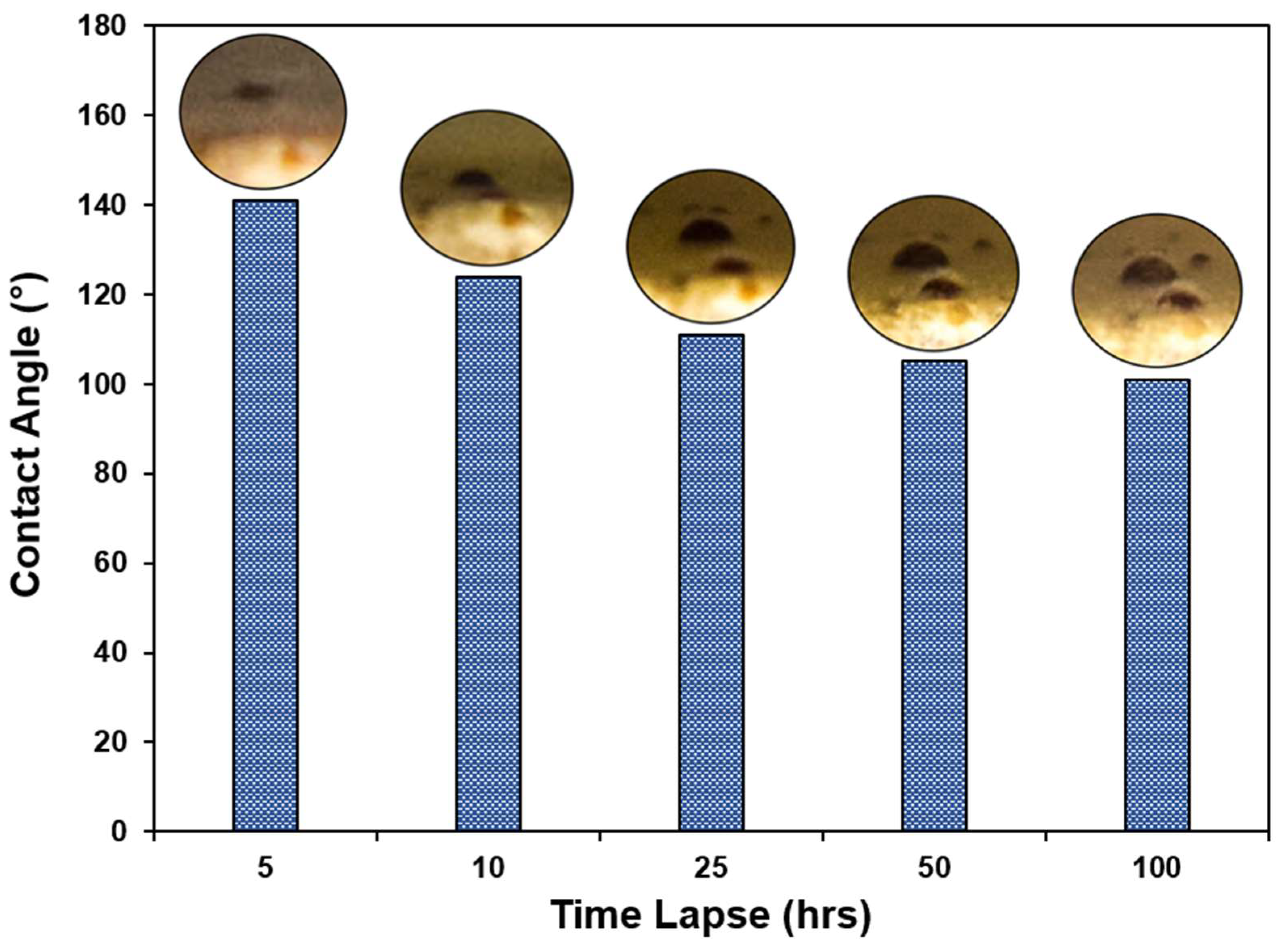
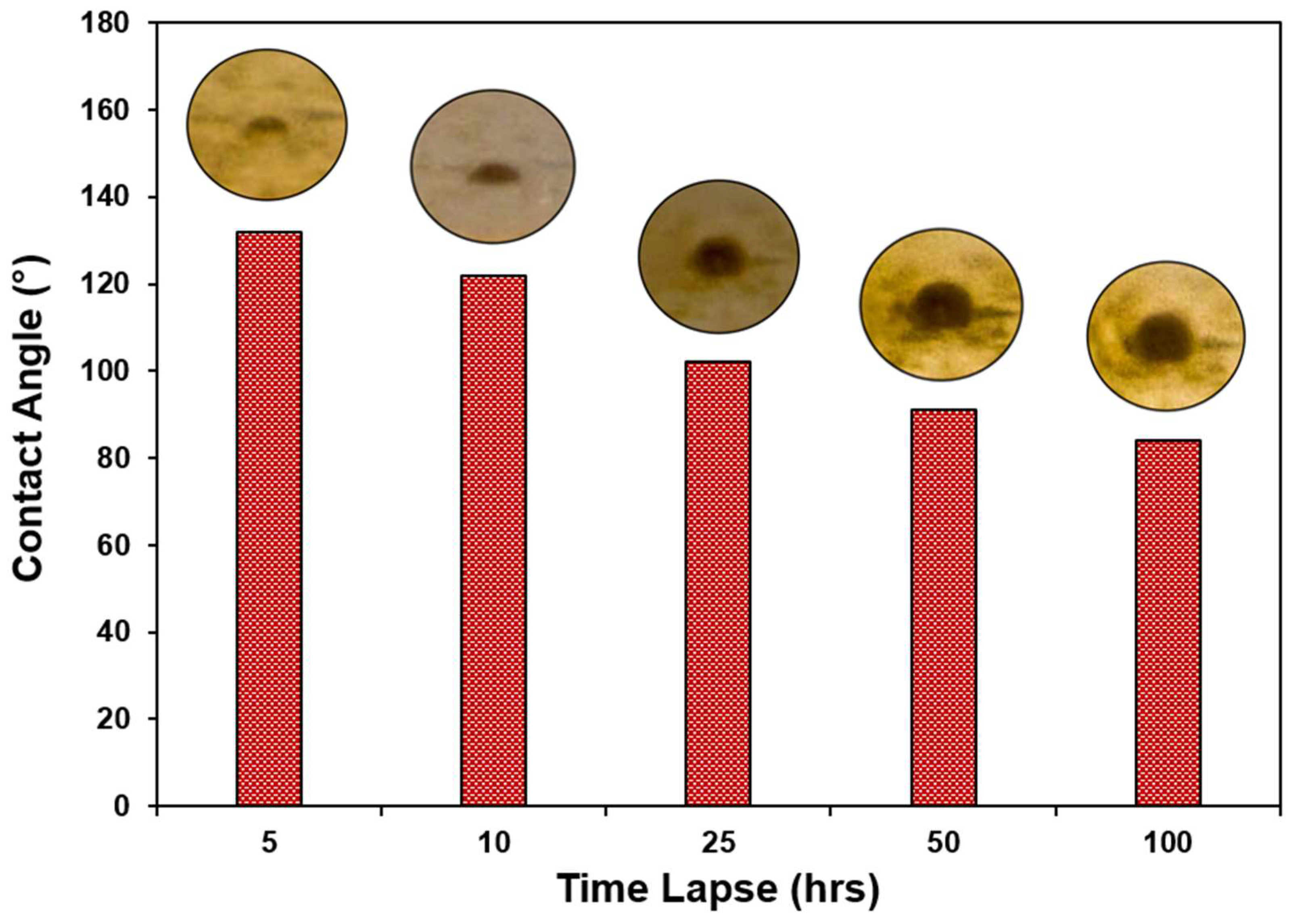
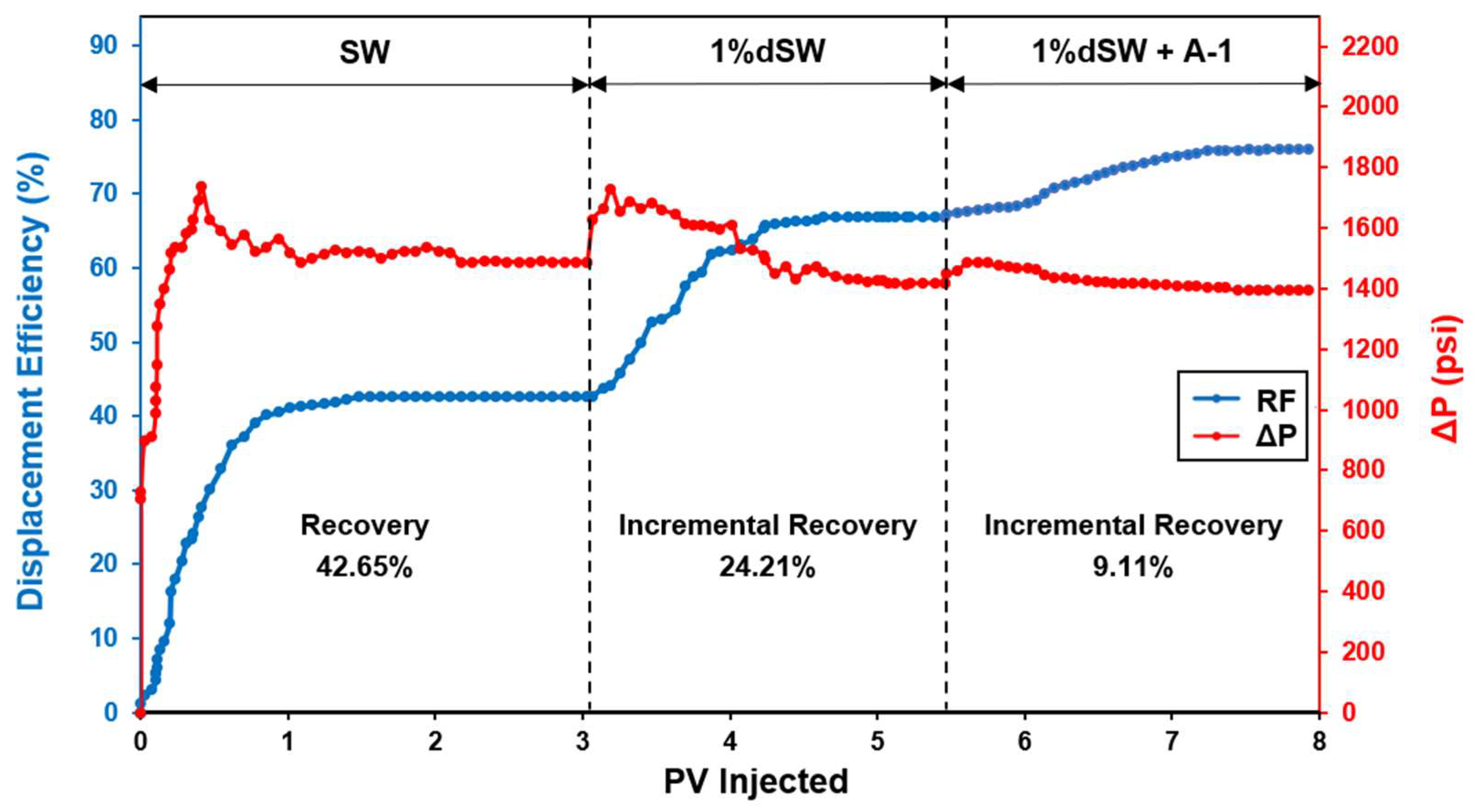
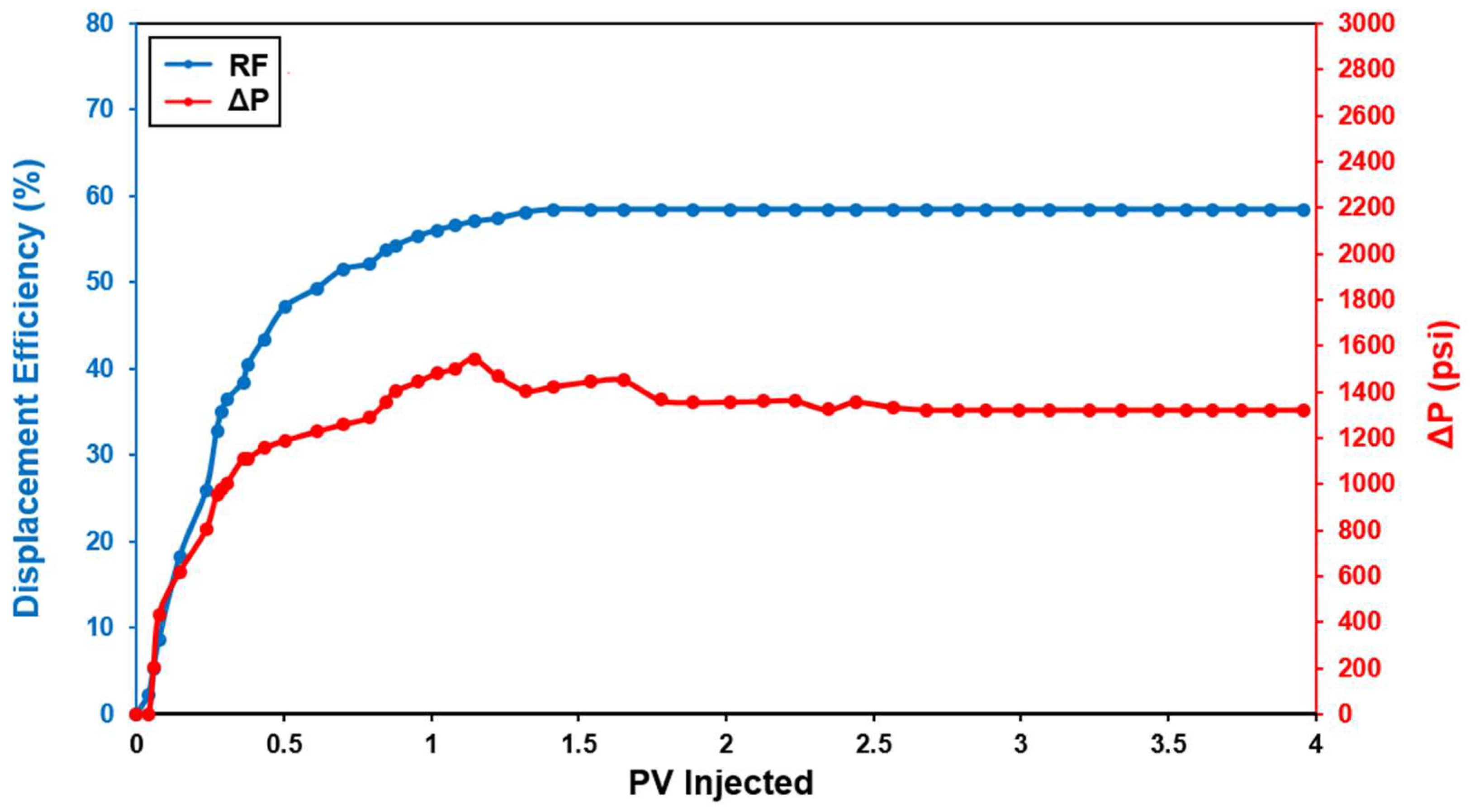
Water-based enhanced oil recovery (EOR) techniques continue to attract interest because of their technical practicality and economic feasibility. Hybrid low-salinity surfactant flooding is a promising EOR strategy for carbonate reservoirs; however, the coupled effects of low-salinity brine, surfactant addition, wettability alteration, electrostatic modification, and capillary pressure reduction remain difficult to isolate. This study investigates hybrid low-salinity surfactant flooding in restored tight carbonate cores using integrated experimental measurements and core-scale numerical modeling. The experimental workflow included oil–water interfacial tension (IFT), zeta potential, contact angle measurements using a custom-designed HPHT imbibition cell, and reservoir-condition HPHT coreflooding under sequential and standalone injection schemes. The sequential flood evaluated the transition from seawater (SW) to 1%diluted seawater (1%dSW) and then to 1%dSW+A-1 surfactant, while standalone floods assessed the direct displacement performance of 1%dSW and 1%dSW+A-1. Dilution from SW to 1%dSW increased IFT from approximately 10.2 to 14.9 mN/m, indicating that the recovery improvement during 1%dSW injection was not caused by IFT reduction. Instead, zeta potential and contact angle results indicated progressive electrostatic modification and wettability alteration toward a less oil-wet state. The contact angle decreased from approximately 123° for SW to 101° for 1%dSW and further to 84° after A-1 addition. In contrast, 1%dSW+A-1 reduced IFT sharply to approximately 0.178 mN/m at 0.2 wt%, lowering the estimated capillary pressure magnitude and weakening capillary trapping. Sequential coreflooding showed that SW recovered 42.65% OOIP, followed by an additional 24.21% OOIP from 1%dSW and 9.11% OOIP from 1%dSW+A-1. Standalone 1%dSW and 1%dSW+A-1 recovered approximately 58.44% and 65.82% OOIP, respectively. Core-scale models reproduced the main recovery and pressure drop trends using zeta potential-guided relative permeability and capillary pressure functions supported by surface complexation modeling concepts. Overall, 1%dSW+A-1 improved oil displacement through a synergistic mechanism in which low-salinity brine stabilized the water film and altered wettability, while A-1 surfactant reduced IFT and weakened capillary trapping. The integrated experimental and modeling workflow provides a mechanistic basis for evaluating hybrid low-salinity surfactant flooding and for linking laboratory-measured interfacial properties to effective core-scale rock–fluid functions.

1. Introduction

Carbonate reservoirs contain a major fraction of the world’s hydrocarbon resources, yet they remain among the most challenging reservoir systems for efficient oil recovery. Their poor recovery performance is commonly associated with strong geological heterogeneity, complex pore architecture, broad pore-size distribution, natural fractures, high surface reactivity, and unfavorable wettability [1,2]. These challenges become more severe in tight carbonate reservoirs, where low matrix permeability, small pore throats, and poor pore connectivity intensify capillary trapping and increase the pressure required to mobilize residual oil [3]. Carbonate reservoirs are particularly challenging for chemical enhanced oil recovery (EOR) because they combine low permeability, high salinity/hardness, high temperature, strong mineral reactivity, and oil-wet or mixed-wet conditions. Under these conditions, conventional waterflooding often leaves a large fraction of oil trapped by capillary forces and oil–rock adhesion, making the design of recovery methods dependent on the modification of crude oil–brine–rock (COBR) interactions rather than pressure support alone [4].
Wettability is one of the most important properties controlling oil displacement in carbonate reservoirs because it governs phase distribution, capillary pressure, relative permeability, residual oil saturation, spontaneous imbibition, and microscopic displacement efficiency. Wettability alteration mechanism in sandstone and carbonate reservoirs is not considered a single process, but rather the macroscopic outcome of several chemical and physical interactions occurring at the oil–brine–rock interface [5,6]. In carbonate systems, initially water-wet mineral surfaces can become oil-wet or mixed-wet after prolonged exposure to crude oil because polar components such as carboxylic acids, resins, asphaltenes, and other surface-active organic molecules adsorb onto calcite or dolomite surfaces. Al-Khafaji et al. [7] showed through quartz crystal microbalance measurements that oil adsorption and desorption depend strongly on both crude-oil chemistry and mineral type, and that high-acidity crude oils may desorb less efficiently from calcite surfaces than from silica surfaces. This is important because it indicates that carbonate wettability alteration is controlled not only by brine chemistry, but also by the type and concentration of polar oil components initially adsorbed on the mineral surface.
Low-salinity waterflooding (LSWF), smart waterflooding, engineered waterflooding, and ion-tuned waterflooding have been widely investigated as practical and relatively low-cost EOR methods for improving recovery from carbonate reservoirs. Although these terms are often used interchangeably, they do not necessarily describe the same process. LSWF generally refers to injection water with reduced salinity relative to formation brine or seawater, whereas smart water and ion-engineered waterflooding emphasize the optimization of specific ion concentrations, especially potential-determining ions (PDIs) such as Ca2+, Mg2+, and SO42−. This distinction is critical in carbonates because recovery improvement may depend less on total salinity and more on ion-specific interactions at the oil–brine and rock–brine interfaces [8,9]. Therefore, LSWF in carbonates should not be interpreted as a simple dilution process; it is better understood as a coupled salinity-, ion-, pH-, time-, and wettability-dependent process.
Despite extensive research, there is still no universal agreement on the dominant mechanism responsible for improved oil recovery during carbonate LSWF. Proposed mechanisms include wettability alteration, electrical double layer expansion, surface charge modification, multicomponent ion exchange, mineral dissolution and precipitation, pH variation, fines migration, osmotic pressure, oil–brine interfacial viscoelasticity, microdispersion formation, emulsification, and disjoining pressure modification [10,11,12]. Khamaneh and Mahani [13] emphasized that LSWF is a cooperative process in which solid–fluid and fluid–fluid mechanisms can act simultaneously but with different characteristic time scales. They also showed that oil recovery, wettability alteration, IFT, droplet coalescence, and interfacial elasticity may each exhibit nonmonotonic behavior with salinity, meaning that the optimum salinity for maximum oil recovery may not be the same as the optimum salinity for each individual mechanism. This finding is particularly important for interpreting experimental results in which low-salinity brine improves recovery even when it does not reduce IFT.
Wettability alteration remains the most widely accepted explanation for the low-salinity effect in carbonates, but it must be treated critically. Wettability can be described as a compound physicochemical property controlled by surface ionization, local pH, ionic strength, ion composition, and surface roughness [14]. Megens et al. [15] showed that carbonate surfaces exposed to crude oil and brine should not be viewed as clean calcite surfaces; rather, they can develop complex organic–inorganic interfacial layers that respond dynamically to changes in brine composition. This has important implications for laboratory interpretation. Contact angle measurements on mineral plates are useful for screening wettability trends, but they do not fully represent wettability in restored carbonate cores, where surface roughness, pore-scale curvature, mineral heterogeneity, crude-oil adsorption, aging history, and confined water films all influence the effective wetting state. The interpretation of the contact angle itself is also subject to uncertainty. Alnoush et al. [16] demonstrated that calcite surface roughness and measurement location can significantly affect contact angle results, and that subtle brine-composition effects may be difficult to distinguish when surface heterogeneity is high. This does not invalidate contact angle measurements; rather, it means they should be interpreted as directional evidence of wettability alteration rather than absolute representations of pore-scale wettability. Therefore, a robust assessment of wettability alteration should combine contact angle with additional measurements such as zeta potential, IFT, recovery response, pressure behavior, and numerical-history-matching.
Potential-determining ions play a central role during LSWF, especially in carbonates, but their effects are not universal. Sulfate, calcium, and magnesium are commonly identified as key ions because they can participate in surface complexation, specific adsorption, multicomponent ion exchange, and ion-bridging reactions. The classical smart water mechanism suggests that SO42− adsorbs onto positively charged carbonate surface sites, weakens oil–rock adhesion, and facilitates the release of adsorbed polar oil components, while Ca2+ and Mg2+ participate in additional surface reactions that modify wettability [17,18]. However, recent studies show that the role of each ion depends on the specific oil–brine–rock system. Maghsoudlou and Moghadasi [19] evaluated optimum-salinity brines and surfactant interactions with crude oil and carbonate rock and found that the relative importance of SO42−, Mg2+, and Ca2+ differs between surfactant-free and surfactant-containing systems. In their surfactant-free solutions, ion effects followed the order SO42− > Mg2+ > Ca2+, while in surfactant-containing systems, ionic-pair interactions and microemulsion formation significantly influenced recovery. This reinforces that ion-specific chemistry must be evaluated at both the rock–fluid and fluid–fluid interfaces.
Electrical double layer (EDL) expansion and electrostatic modification provide an important framework for explaining low-salinity-induced wettability alteration. EDL is formed when ions in the brine rearrange near a charged oil–brine or rock–brine interface to balance the surface charge. It consists of a compact Stern layer and a diffuse layer, across which the electrical potential decreases toward the bulk solution. Under high-salinity conditions, the high ionic strength compresses the electrical double layer near the carbonate–brine interface and screens electrostatic interactions over short distances. This can favor a thin or unstable water film between oil and the carbonate surface, allowing stronger oil–rock adhesion. When salinity is reduced, the ionic strength decreases, the diffuse layer expands, and electrostatic interactions can extend over a larger distance. If the rock–brine and oil–brine interfaces become more mutually repulsive, the intervening water film can become more stable, reducing direct oil–rock contact and shifting the system toward a less oil-wet condition [20,21]. Zhang et al. [22] developed an electrical double-layer free-energy framework and argued that EDL compression can be more influential than IFT in low-salinity wettability alteration, especially when the electrostatic states of both the oil–brine and rock–brine interfaces are considered. Zeta potential is particularly useful for probing this electrostatic modification because it provides an electrokinetic indicator of surface charge changes near the slipping plane [11,23]. Zarean et al. [24] investigated calcite and dolomite particles over a wide range of salinity, pH, and brine composition, and showed that decreasing salinity or adding sulfate can shift zeta potential toward more negative values. They also showed that the zeta potential response depends on both salinity and pH, and that calcite and dolomite can exhibit different optimum dilution ranges for producing the most negative surface potentials. These results support the use of zeta potential as a diagnostic tool for evaluating low-salinity effects in carbonate systems. However, zeta potential should not be treated as a direct measurement of wettability or recovery. It reflects the electrokinetic condition of the interface, whereas wettability and recovery are governed by the combined effects of electrostatics, surface roughness, mineralogy, oil composition, brine chemistry, saturation history, and pore-scale connectivity.
The electrostatic modification induced by low-salinity and ion-tuned brines can be further interpreted through the stability of the thin aqueous film separating oil from the carbonate surface. According to film-stability theory, when the oil–brine and rock–brine interfaces approach each other, the separation distance between them controls the interaction energy of the oil–brine–rock system and, consequently, the stability of the intervening water film. This interaction is commonly described by the disjoining pressure, which represents the change in Gibbs free energy per unit area with respect to the separation distance. A high positive disjoining pressure creates an energy barrier that prevents the oil–brine and rock–brine interfaces from collapsing toward each other, thereby stabilizing and thickening the water film. This condition favors oil detachment from the rock surface and promotes a less oil-wet or more water-wet state. In contrast, a low or negative disjoining pressure indicates a dominant attractive interaction between the two interfaces, leading to water film thinning or rupture. Under this condition, polar crude-oil components can directly contact and adsorb onto the carbonate surface, promoting stronger oil–rock adhesion and shifting the system toward oil-wetness [25,26]. Within the extended Derjaguin–Landau–Verwey–Overbeek (DLVO)/disjoining pressure framework, the total disjoining pressure acting across the water film is commonly represented as the sum of three intermolecular surface force contributions: London–van der Waals forces, electrostatic double-layer forces, and structural or hydration forces. The sum of these surface forces defines the total disjoining pressure of the water film layer, with each component having a different relative contribution at short and long separation distances. Structural or hydration forces are dominant at very short distances near molecular contact, typically less than approximately 1 nm, whereas electrostatic double-layer forces can extend over longer distances, up to tens of nanometers and, depending on ionic strength, approaching approximately 100 nm. The total disjoining pressure can be expressed as
δ = V δ + D δ + S δ
where Π is the total disjoining pressure of the oil–brine–rock system, ΠV is the London–van der Waals contribution, ΠD is the electrostatic double layer contribution, and ΠS is the structural or hydration force contribution. The separation distance δ   represents the water film thickness between the oil–brine and rock–brine interfaces [26].
Van der Waals forces are present over nearly all separation distances and may be attractive or repulsive depending on the Hamaker constant. For most oil–water–carbonate systems, the van der Waals contribution is commonly attractive because of the dielectric and optical properties of the oil, water, and carbonate phases. This attractive contribution tends to pull the oil–brine and rock–brine interfaces toward each other and thin the water film. Structural or hydration forces are short-range forces associated with the ordering of water molecules and hydrated ions near the mineral surface, and they can resist complete film collapse at very small separations. The electrostatic double layer contribution is longer-ranged and depends strongly on the surface potentials of the oil–brine and rock–brine interfaces, brine ionic strength, and electrical double layer thickness. When the two interfaces have similar effective charge signs, electrostatic interaction becomes repulsive, producing a positive contribution to the disjoining pressure and stabilizing the water film. When the two interfaces have opposite effective charge signs, the electrostatic contribution becomes attractive, causing the water film to thin and allowing polar oil components to contact the carbonate surface [21,23].
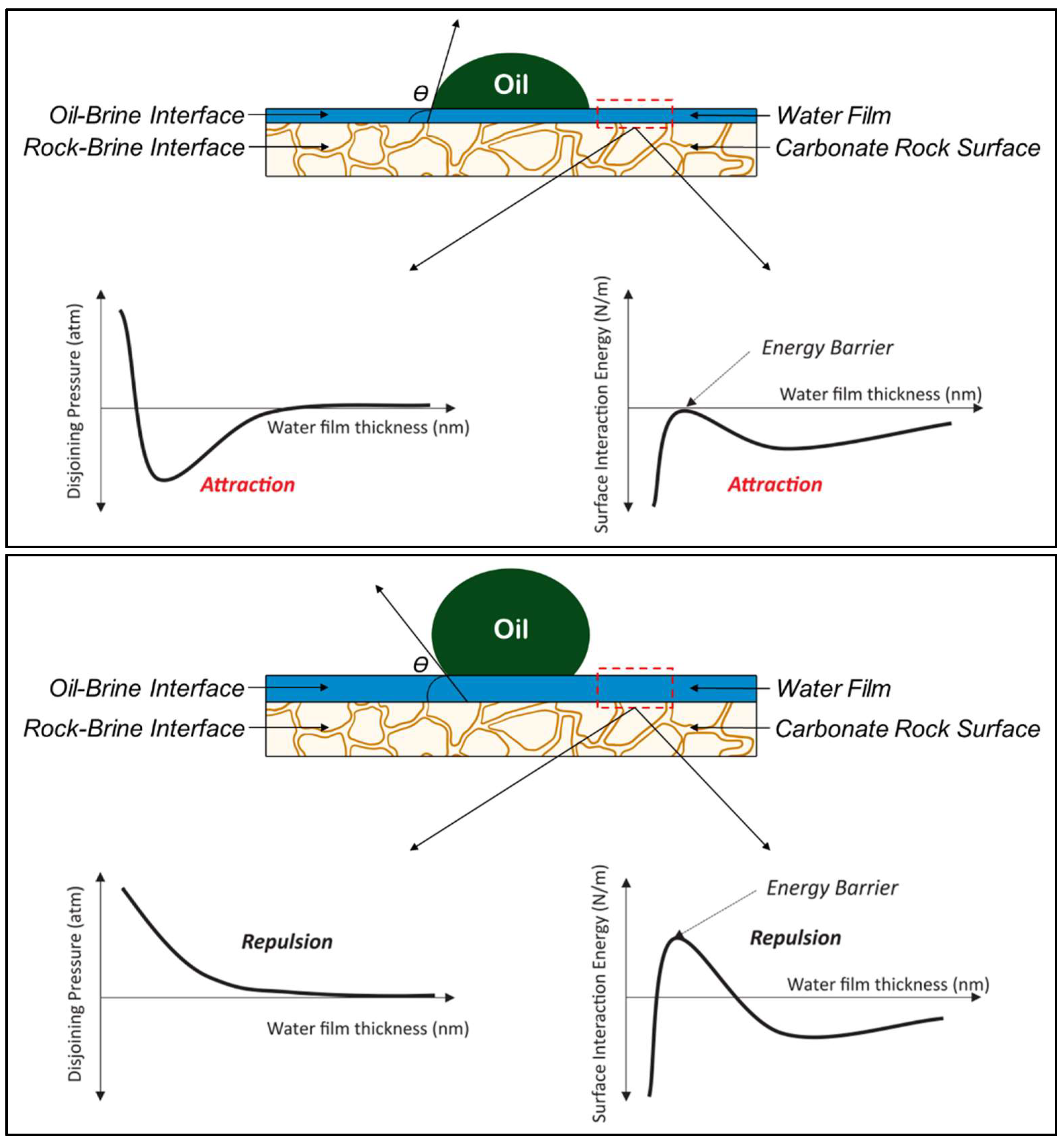
A schematic representation of the disjoining pressure isotherm and surface interaction energy profile for oil-wet and water-wet oil–brine–rock systems is shown in Figure 1. In the oil-wet state, attractive interactions dominate between the oil–brine and rock–brine interfaces, resulting in a thin and unstable water film. Under this condition, the disjoining pressure profile contains an attractive region and the interaction energy curve shows a relatively weak energy barrier, allowing the oil phase to remain attached to the rock surface. In contrast, in the water-wet state, repulsive interactions dominate between the two interfaces. The corresponding disjoining pressure profile is positive over the relevant separation distance, and the surface interaction energy curve exhibits a higher energy barrier. This barrier prevents the collapse of the water film and reduces direct oil–rock contact, thereby promoting oil detachment and improved water wetness. Therefore, low-salinity and ion-tuned brines can promote wettability alteration not only by changing bulk salinity, but by modifying the surface potentials of the interacting interfaces, increasing the stability of the water film, and reducing the tendency of oil to remain attached to the carbonate surface [23,26]. This framework provides a mechanistic basis for linking zeta potential changes, electrical double layer expansion, disjoining pressure modification, and the experimentally observed transition from oil-wet toward mixed-wet or water-wet carbonate conditions.
Surface complexation modeling (SCM) provides a mechanistic framework for linking brine chemistry to surface charge and zeta potential. In SCM, carbonate surfaces are represented by reactive surface sites whose charge evolves with pH, ionic strength, and aqueous composition. This approach is especially relevant for carbonate LSWF because Ca2+, Mg2+, SO42−, H+, OH, HCO3, and CO32− can all contribute to surface speciation [27]. Hosseini et al. [28] developed a triple-layer SCM for the oil–brine interface and showed that sulfate interactions with carboxylic and amine functional groups significantly affect surface potential, while also emphasizing that surface site density may vary with pH and brine composition. Lara Orozco et al. [29] used reduced SCM concepts to analyze wettability alteration by sulfate and glycine in carbonate reservoirs and noted that the complexity of full SCM reaction sets and uncertainty in equilibrium constants can create many degrees of freedom when matching coreflood and imbibition experiments. This is a key limitation: SCM can strengthen mechanistic interpretation, but it must be constrained by independent experimental measurements such as zeta potential, contact angle, pH, and effluent-ion profiles.
Fluid–fluid interactions are equally important and should not be ignored. The oil–brine interface contains polar crude-oil components whose distribution, site density, and interfacial organization can change with salinity and ion composition [30]. Seif et al. [31] used molecular dynamics simulations to show that the interfacial site density of acidic oil molecules depends nonlinearly on both acid concentration and brine salinity, challenging simplified oil–brine interfacial models that assume constant site density. Gonçalves et al. [32] showed that sulfate can reduce oil–brine IFT more effectively than other tested anions and promote viscoelastic interfacial films. Horeh et al. [33] similarly highlighted the role of water-soluble amphiphilic compounds from crude oil in controlling IFT and interfacial behavior. These studies demonstrate that low-salinity effects may involve not only mineral surface charge and wettability alteration, but also oil–brine interfacial chemistry, interfacial elasticity, and polar oil-component redistribution. The role of IFT in LSWF is therefore complex. Some studies report IFT reduction with decreasing salinity, while others report negligible change or even an increase in IFT after dilution. Khamaneh and Mahani [13] showed that IFT, wettability alteration, droplet coalescence, interfacial elasticity, and recovery can each have different optimum salinities, which means that recovery improvement should not automatically be attributed to IFT reduction. This distinction is central to the present study because the measured IFT increased from SW to 1%dSW, while oil recovery improved during 1%dSW injection. Therefore, the low-salinity response observed here is more reasonably attributed to electrostatic modification, water-film stabilization, and wettability alteration rather than to a favorable fluid–fluid IFT reduction.
Hybrid low-salinity surfactant flooding has emerged as a promising strategy to overcome the limitations of low-salinity water alone. In this process, the low-salinity brine can modify the carbonate–brine–oil electrostatic state and shift wettability toward a less oil-wet condition, while the surfactant can reduce IFT, lower capillary pressure, improve oil mobilization, and further modify interfacial properties [34,35]. Several experimental studies have shown that hybrid low-salinity surfactant flooding has promising outcomes for EOR application in carbonate reservoirs [36,37,38]. Marquez et al. [39] reviewed carbonate LSWF and hybrid methods and concluded that integrating surfactants with low-salinity water can provide additional recovery benefits, but the outcome depends strongly on surfactant type, brine composition, adsorption, salinity tolerance, and reservoir conditions. Lim et al. [40] similarly emphasized that low-salinity water, surfactants, and nanoparticles can act synergistically through wettability alteration, IFT reduction, emulsification, and mobility improvement, but they also warned that fines migration, nanoparticle agglomeration, surfactant adsorption, and chemical cost remain major limitations. Moradi et al. [41] evaluated different injection formulations and showed that combining LSW with surfactant produced higher oil recovery than low-salinity brine alone. Their results also indicated that increasing the surfactant concentration in the low-salinity solution up to an optimum value reduced both IFT and contact angle, confirming that the hybrid system can simultaneously improve fluid–fluid and rock–fluid interactions. Alameri et al. [42] further emphasized that surfactant addition to low-salinity water can be an effective approach for overcoming the poor recovery typically associated with high-salinity, oil-wet carbonate reservoirs. Collectively, these studies support the concept that hybrid LSWF/surfactant flooding can provide a synergistic improvement by combining low-salinity-induced wettability alteration with surfactant-driven IFT reduction and enhanced residual-oil mobilization.
The implementation of surfactant-based EOR processes in carbonate reservoirs is particularly challenging because carbonate surfaces often promote high adsorption and chemical retention, especially for anionic surfactants on positively charged mineral surfaces [43,44]. Somoza et al. [45] noted that surfactant flooding in carbonates is limited by heterogeneity, oil-wet/mixed-wet conditions, high temperature, high salinity, divalent-ion precipitation, and surfactant retention. Tafur et al. [46] showed that optimized surfactant/ionic-liquid blends can reduce IFT to very low values and produce additional recovery from carbonate rocks, but they also emphasized the need to evaluate phase behavior, stability, adsorption, and injection optimization. Khurshid et al. [47] developed a geochemical SCM-based approach for surfactant adsorption in carbonates and showed that salinity reduction and sulfate spiking can reduce surfactant adsorption by increasing electrostatic repulsion between surfactant species and the rock surface. These findings are directly relevant to hybrid low-salinity surfactant flooding because the brine composition may influence not only wettability and IFT, but also surfactant retention and propagation.
Surfactant class and formulation strongly influence the dominant recovery mechanism. Cationic surfactants can strongly alter carbonate wettability but may adsorb significantly; anionic surfactants can achieve strong IFT reduction but may precipitate or adsorb in high-hardness carbonate brines; nonionic surfactants can offer better salinity tolerance in some cases but may show temperature-dependent limitations; and amphoteric or zwitterionic surfactants may provide improved stability under harsh conditions [43,48,49]. Godoy et al. [50] showed that surfactant adsorption on mineral surfaces can involve more complex behavior than classical two-step adsorption models, including micelle-induced desorption, and that SCM-derived EDL properties can help explain adsorption trends. Quintella et al. [51] demonstrated that low-salinity formulations containing cationic, anionic, and nonionic surfactants can produce synergistic recovery improvements when the balance between micellar and nonmicellar species is optimized. These studies highlight that a hybrid formulation should not be judged by IFT alone; wettability alteration, adsorption loss, compatibility, critical micelle concentration (CMC) behavior, and phase behavior must be evaluated together.
The connection between surfactant action and capillary pressure is particularly important in tight reservoirs. According to the Young–Laplace relationship, capillary pressure depends on IFT, contact angle, and pore radius. Therefore, in small pore throats, even moderate IFT and wettability changes can strongly influence the pressure barrier required for oil mobilization [52]. Ladan and Schechter [53] emphasized that surfactants improve recovery by reducing IFT and altering wettability, which together reduce capillary pressure and can change the direction and magnitude of capillary forces during imbibition. Wang et al. [54] showed that surfactant-assisted spontaneous imbibition in tight cores improves recovery through IFT reduction, emulsification, and improved oil mobility, and that surfactant type, concentration, and temperature strongly affect performance. Zhang et al. [55] further showed that in low-permeability reservoirs, gravity can dominate early imbibition while capillary forces continue to produce oil from smaller pores at later times. These findings support the need to evaluate hybrid low-salinity surfactant flooding in tight carbonates through both recovery and pressure response, because capillary resistance remains central even when IFT is reduced.
Pore-scale studies have further demonstrated that low-salinity and surfactant processes are highly dependent on pore geometry, pore connectivity, and injection history. Ahmadi-Falavarjani et al. [56] showed that in mixed-wet systems, corner flow can transport low-salinity water ahead of the main displacement front, alter the local flow regime, and even create new trapping mechanisms depending on wettability-alteration kinetics. Keumarsi et al. [57] showed that microporosity can strongly influence LSWF performance under dynamic wettability alteration, especially in heterogeneous pore networks representative of tight rocks. AlZahrani et al. [58] used high-resolution micro-CT imaging of surfactant flooding in a heterogeneous carbonate and found that surfactant initially displaced oil from medium and large pores, while the smallest pores remained difficult to access. Mirchi et al. [59] directly imaged low-salinity surfactant flooding in oil-wet carbonates and found that low-salinity surfactant injection accelerated wettability reversal toward neutral-wet conditions and promoted brine invasion into smaller pores and pore corners. These pore-scale results are important because they show that improved recovery is not only a function of bulk IFT or average contact angle, but also of whether the injected chemistry can access and modify the pore regions where oil remains trapped.
Sequential and standalone injection strategies should also be distinguished. In sequential floods, the response of each injected fluid depends on the saturation distribution, oil connectivity, wetting state, and pressure history established by previous stages. Farhadzadeh et al. [60] showed through pore-scale reactive transport modeling that injection sequence, pore connectivity, and brine chemistry can strongly affect pore-filling sequence and sweep efficiency. Malakoutikhah et al. [61] also showed that initial water saturation and wettability heterogeneity can either improve or reduce the effectiveness of LSWF depending on the spatial distribution of wetting states. Therefore, a hybrid formulation injected after SW and 1%dSW should not be expected to behave identically to the same formulation injected directly into a restored oil-aged core. This distinction is important in the present study because the sequential coreflood evaluates incremental oil recovery after prior brine exposure, whereas the standalone floods evaluate the direct displacement capability of 1%dSW and 1%dSW+A-1.
Numerical modeling of low-salinity and hybrid surfactant flooding remains challenging because the controlling mechanisms occur at molecular, pore, and core scales, while reservoir simulators represent flow using Darcy-scale constitutive functions. Most commercial simulators cannot directly compute oil recovery from zeta potential, surface complexation reactions, or contact angle. Therefore, wettability alteration is commonly represented by modifying relative permeability, residual oil saturation, and capillary pressure functions as a function of salinity, ion concentration, exposure time, or an interpolation factor. Jalilian et al. [62] compared geochemical mechanisms and interpolation-factor selection in low-salinity waterflooding modeling and showed that both mechanism choice and interpolation factor can significantly affect model accuracy. This is a critical issue because history-matching can become non-unique if relative permeability and capillary pressure are adjusted without independent experimental constraints. The treatment of capillary pressure and relative permeability in coreflood interpretation is also nontrivial. Huang and Honarpour [63] showed that capillary end effects can influence endpoint relative permeability and final saturation calculations in coreflood experiments. Andersen and Zhou [64] further demonstrated that steady-state relative permeability experiments can be strongly affected by capillary end effects unless flow rates and capillary numbers are sufficient to minimize them. These studies are important because pressure drop, recovery, relative permeability, and capillary pressure cannot be interpreted independently in tight cores. In low-permeability carbonates, high-pressure drops may reflect not only viscosity and permeability, but also capillary resistance, phase mobility, saturation redistribution, and wettability-dependent flow functions.
Therefore, the existing literature reveals several important gaps. First, many carbonate LSWF studies evaluate recovery, contact angle, zeta potential, or IFT separately, but fewer integrate these measurements with pressure behavior and numerical history-matching in one consistent workflow. Recent studies have emphasized the importance of combining electrokinetic measurements, wettability indicators, interfacial properties, and displacement behavior, but full integration with core-scale history-matching remains limited [13,24,39]. Second, many hybrid surfactant studies emphasize IFT reduction without sufficiently separating the low-salinity electrostatic/wettability contribution from the surfactant capillary-desaturation contribution, even though recent pore-scale and coreflood studies show that low-salinity surfactant flooding involves coupled wettability alteration, IFT reduction, pore-scale redistribution, and injection-history effects [58,59]. Third, many modeling studies reproduce recovery by tuning relative permeability and capillary pressure, but the direction and magnitude of these changes are often weakly constrained by independent electrokinetic and wettability measurements. This limitation is particularly important because surface complexation and wettability alteration models contain uncertain reaction parameters and interpolation choices that can strongly affect the simulated recovery response [29,47,62]. Finally, in tight carbonate systems, the link between screening tests and coreflood performance remains uncertain because high capillary resistance, small pore throats, microporosity, and restricted pore accessibility can dominate displacement even when interfacial properties are favorable [4,53,54].
The present study addresses these gaps by integrating experimental screening, electrokinetic measurements, wettability evaluation, coreflooding, and core-scale numerical modeling for hybrid low-salinity surfactant flooding in restored tight carbonate cores. The comprehensive experimental work includes IFT measurements, zeta potential analysis, contact angle measurements, and coreflooding under both sequential and standalone injection schemes. The sequential coreflood evaluates the progressive transition from SW to 1%dSW and then to 1%dSW+A-1 within the same restored composite core, whereas the standalone corefloods assess the direct displacement performance of 1%dSW and 1%dSW+A-1 in separately restored cores. The numerical component is employed to reproduce the oil recovery and differential pressure behavior through a zeta potential-guided rock–fluid parameterization supported by SCM concepts. The objectives of this study are therefore to (1) evaluate the effect of seawater dilution and A-1 surfactant addition on IFT, zeta potential, and contact angle in a carbonate–brine–oil system; (2) quantify the recovery and differential pressure response of SW, 1%dSW, and 1%dSW+A-1 under sequential and standalone coreflooding conditions; (3) develop a core-scale model capable of reproducing the experimental recovery and pressure behavior using zeta potential-guided relative permeability and capillary pressure functions; and (4) critically interpret the coupled roles of electrostatic modification, water-film stabilization, wettability alteration, IFT reduction, capillary pressure reduction, and phase mobility evolution.


2. Materials

2.1. Rock Samples

The rock samples employed in this study were collected from a carbonate reservoir. Based on the X-ray diffraction (XRD) analysis reported in our previous work [65], the rock is composed predominantly of calcite, with trace amounts of quartz and dolomite.

2.2. Fluid Samples

The properties of the crude oil used in this study are presented in Table 1, while the SARA (Saturates, Aromatics, Resins, and Asphaltenes) analysis is summarized in Table 2. The ion composition of the seawater was determined by ion chromatography, and the results are reported in Table 3. The same table also includes the ionic concentrations, total dissolved solids (TDS), and ionic strength of the diluted brines used in this work. All diluted seawater brines (dSW) were prepared by sequential dilution of seawater using ultrapure deionized water. The anionic surfactant used in this study (Aspiro S 2850) was supplied by BASF Chemical Company (Houston, TX, USA). All chemicals were used as received without further purification. The surfactant solutions were previously verified to be compatible with the selected brines and thermally stable at all tested concentrations after 60 days of aging at 86 °C. The main properties of the surfactant are summarized in Table 4.

3. Experimental Section

3.1. Interfacial Tension Tests

The interfacial tension (IFT) between the crude oil and the investigated brine/surfactant solutions was measured using a KRÜSS spinning drop tensiometer (KRÜSS GmbH, Hamburg, Germany), as shown in Figure 2. In the spinning-drop technique, a drop of the less dense phase is rotated inside the denser surrounding fluid, and the drop shape at equilibrium is used to determine the oil–water interfacial tension [66]. Since accurate density contrast is required for this method, the densities of the crude oil and each brine/surfactant solution were measured beforehand and used as input parameters for the IFT calculations. The measurements were performed according to the instrument’s standard operating procedure, which involved careful preparation of the oil and aqueous samples, loading of the capillary tube, temperature stabilization, and calibration of the apparatus prior to data acquisition. The IFT was first measured for seawater and the diluted seawater brines without surfactant in order to establish the baseline interfacial behavior of the oil–brine system. Subsequently, additional measurements were conducted at different surfactant concentrations to evaluate the ability of the selected surfactant to reduce the oil–water IFT and to support the selection of the surfactant concentration used in the subsequent wettability and coreflooding experiments. All measurements were carried out at 86 °C, which corresponds to the reservoir temperature of the candidate reservoir.

3.2. Zeta Potentiometric Study

Zeta potential measurements were carried out to investigate the electrokinetic response of the carbonate/brine and carbonate/brine/surfactant systems and to evaluate the effect of salinity reduction and surfactant addition on the interfacial electrical behavior of the rock surface. In the context of this study, zeta potential was used as an electrokinetic indicator of the rock–fluid interfacial state and as a supporting parameter for interpreting wettability alteration. The measurements were performed using a SurPASS 3 electrokinetic analyzer (Anton Paar GmbH, Graz, Styria, Austria), shown in Figure 3. The instrument determines the zeta potential (ζ) using the classical streaming potential and streaming current techniques. In these methods, an electrolyte is forced to flow through the channel formed between two solid surfaces, generating an electrokinetic response due to the movement of the diffuse layer adjacent to the charged rock surface. The measured pressure-driven electrical response is then used to calculate the zeta potential of the solid surface in contact with the tested solution. A detailed description of the measurement principle, apparatus configuration, and experimental procedure is available in our previous work [67].
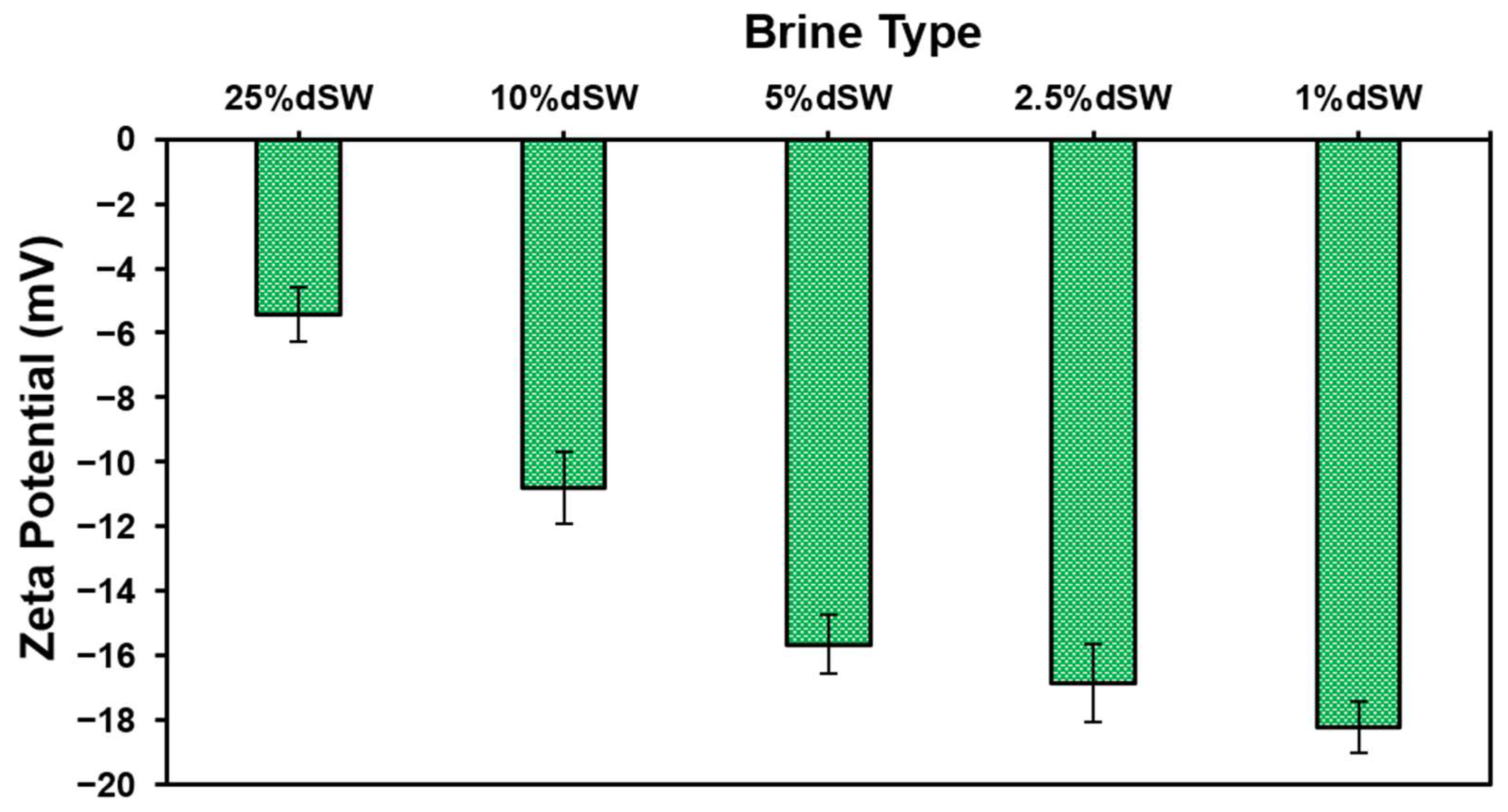
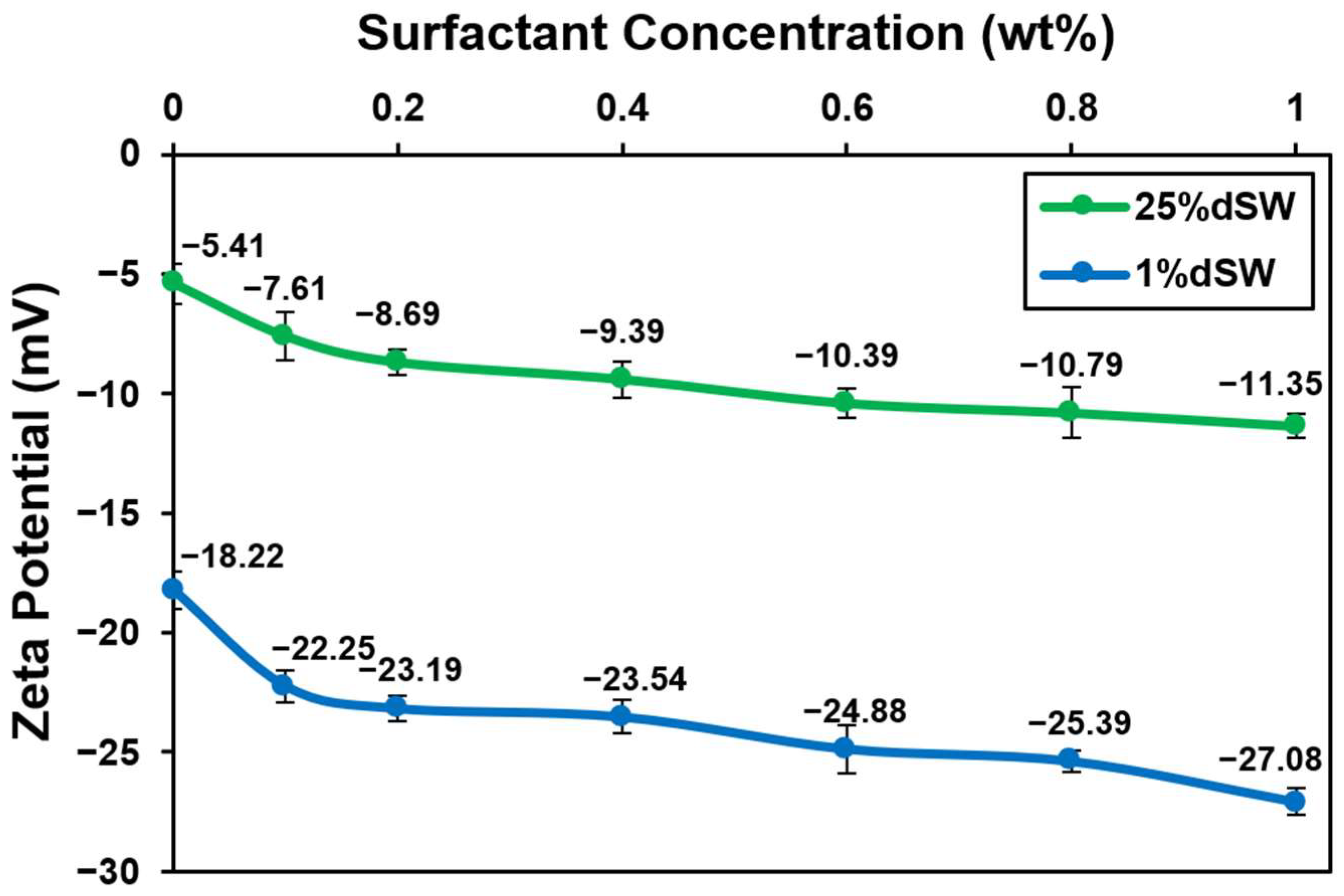
Because of the measurement limitation of the utilized electrokinetic analyzer, only brines with ionic strengths below 0.1 mol/L could be tested. Accordingly, the brine systems selected for the zeta potential study were restricted to those within this measurable range. This constraint was taken into account when designing the salinity sequence used in the electrokinetic analysis. Therefore, 25%dSW was used as the higher-salinity comparison brine in the zeta potential experiments instead of SW. The rock samples used for the measurements were prepared from horizontally drilled one-inch carbonate core plugs. Thin slices, a few millimeters thick, were cut from the plugs and then polished to obtain smooth and flat surfaces suitable for mounting in the measurement cell. This preparation was necessary to ensure stable surface contact and reliable electrokinetic measurements. These prepared slices were subsequently exposed to the tested brines and surfactant solutions for zeta potential determination. The zeta potential measurements were used in this study as part of the formulation-screening process. Since the subsequent HPHT contact angle and coreflooding experiments were more time- and resource-intensive and could only be performed for a limited number of candidate formulations, the surfactant concentration for those later experiments was selected based on the IFT and zeta potential screening results.

3.3. Contact Angle Measurements

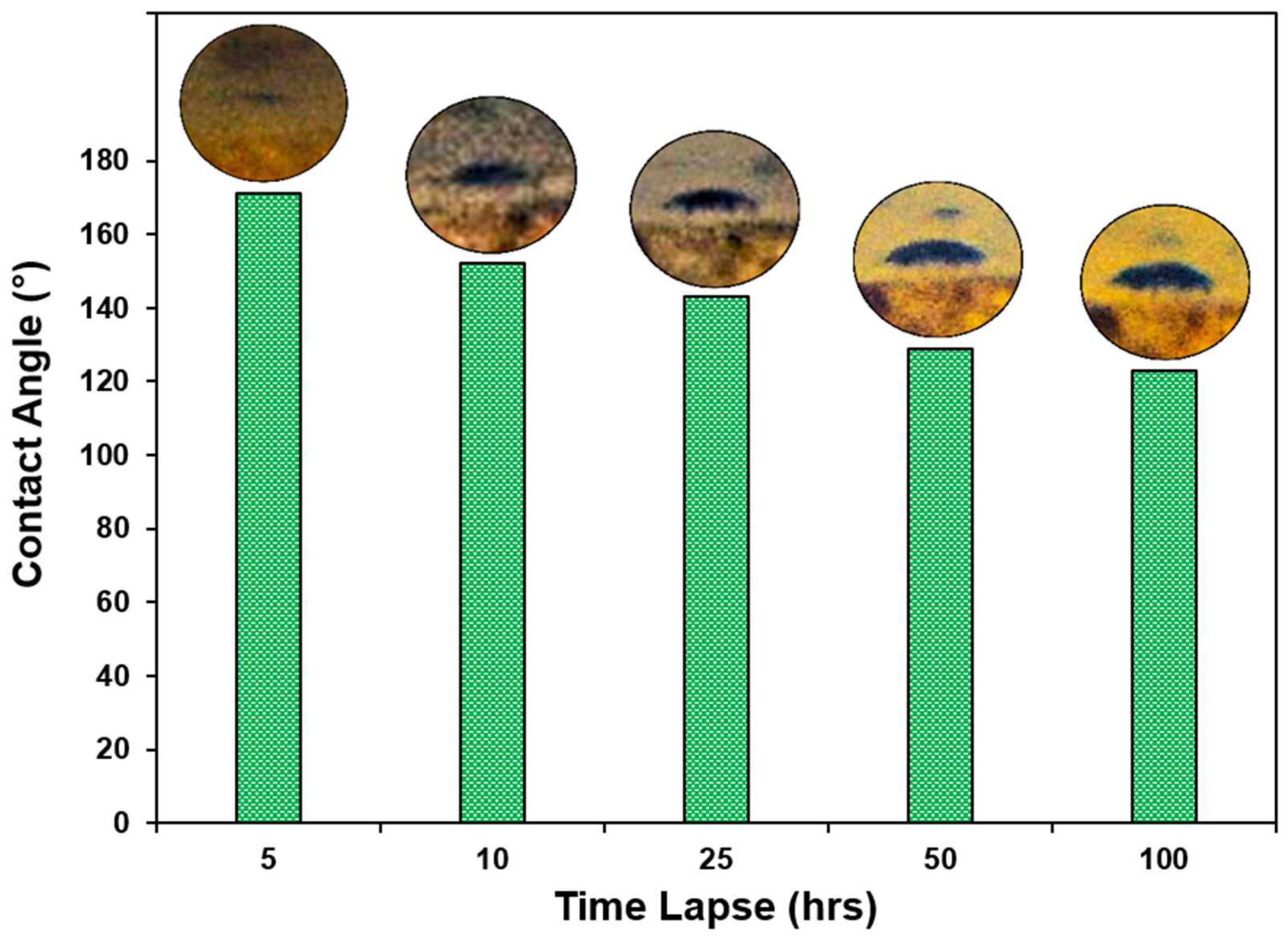
The contact angle measurements were conducted during spontaneous imbibition experiments using a specially fabricated high-pressure high-temperature (HPHT) cell designed to monitor wettability alteration of carbonate rock surfaces under reservoir-representative conditions, as shown in Figure 4. The experiments were performed at 3500 psi and 86 °C. A detailed description of the HPHT cell and its operating procedure is provided in our previous work [68]. For each test, the rock samples were first saturated with crude oil and then mounted in the sample holder inside the HPHT cell. After sample placement, the cell was filled with the selected brine or brine/surfactant solution and brought to the target pressure and temperature conditions. During spontaneous imbibition, images were captured at regular time intervals to monitor the evolution of oil droplets on the rock surface. These time-lapse images were then used to measure the contact angle as a function of imbibition time and, consequently, to assess the extent of wettability alteration induced by the tested aqueous phase. The contact angle measurements were continued throughout the imbibition process until the oil droplets on the sample surface were no longer visible or until no further significant change in the shape of the droplets was observed. In this way, the contact angle evolution reflects the progressive interaction between the carbonate surface, the crude oil, and the injected aqueous phase under HPHT conditions. To evaluate the effect of brine dilution and surfactant addition on wettability alteration, three spontaneous imbibition tests were conducted using SW, 1%dSW, and 1%dSW+A-1. The diluted brine and the surfactant concentration used in these tests were selected based on the preceding IFT and zeta potential screening results. The measured contact angle data were used to compare the wettability-altering capability of SW, 1%dSW, and 1%dSW+A-1. In particular, the comparison between 1%dSW and 1%dSW+A-1 was intended to quantify the additional benefit of surfactant addition beyond the effect of low-salinity brine alone, while the SW case served as the higher-salinity reference condition.
The uncertainty associated with the HPHT image-based contact-angle measurements was estimated to be approximately ±5–7°. This uncertainty mainly arises from baseline selection on the carbonate surface, droplet-edge identification, optical distortion through the HPHT cell window, lighting/reflection effects, and local surface roughness. Therefore, the reported contact angles are interpreted as comparative wettability indicators among SW, 1%dSW, and 1%dSW+A-1. The observed contact angle reduction from SW to 1%dSW and then to 1%dSW+A-1 was larger than the estimated measurement uncertainty, supporting the interpretation of progressive wettability alteration toward a less oil-wet condition.

3.4. Coreflooding Experiments

Coreflooding experiments were conducted using the setup shown in Figure 5 in order to evaluate the displacement behavior of SW, 1%dSW, and the hybrid low-salinity-surfactant system (1%dSW+A-1) in carbonate rock under reservoir-representative conditions. A composite core measuring 12’’ in length and 1’’ in diameter was assembled from a series of smaller carbonate core plugs, each ranging from 1’’ to 3’’ in length. The composite design was adopted to provide a representative core length for the displacement experiments while preserving the properties of the available reservoir rock material. The assembled composite core was placed inside a Viton sleeve and loaded into the core holder. A confining pressure of 2500 psi was then applied to ensure proper sealing and to simulate overburden confinement during flooding.
Prior to saturation, the composite core was held under vacuum for three days to remove trapped air and ensure complete saturation in the subsequent fluid imbibition step. After vacuuming, the porosity of the composite core was determined by imbibition of formation water from a graduated burette placed at a slightly higher elevation, allowing the pore volume to be estimated from the volume of imbibed fluid. The permeability reported in this study was measured using seawater as the single-phase flowing fluid. The same seawater was also used to saturate the cleaned carbonate cores before oil injection and was treated as the initial aqueous phase in the experimental workflow. Seawater was selected instead of fresh or distilled water because exposing carbonate samples to an unrealistic low-ionic-strength fluid during permeability measurement could induce mineral dissolution, fines migration, or premature wettability alteration before the restoration and flooding experiments. Therefore, using seawater provided a chemically consistent permeability measurement under the same brine environment used during core preparation and initialization. The measurement was conducted after core cleaning, drying, vacuum saturation with seawater, and stabilization of single-phase brine flow through the core. Permeability was calculated using Darcy’s law from the measured pressure drops at different imposed flow rates, together with the brine viscosity, core length, and cross-sectional area. The resulting value is reported as the single-phase seawater permeability of the core and was used as the representative absolute permeability for coreflood interpretation and numerical model initialization. The estimated uncertainty in the single-phase seawater permeability measurements was approximately ±8–10%, corresponding to about ±0.004 mD for C-1 and C-2 and ±0.003 mD for C-3.
After characterization, the core was saturated with crude oil to establish the initial oil saturation and irreducible water saturation conditions representative of the reservoir. The properties of the composite cores are summarized in Table 5. Although the three cores were not identical, their permeability values ranged from 0.032 to 0.047 mD, corresponding to a maximum-to-minimum ratio of approximately 1.47, while porosity and pore volume varied by less than approximately 6%. Therefore, the samples were considered reasonably comparable within the same tight-carbonate petrophysical range; however, the remaining heterogeneity was accounted for by using core-specific petrophysical properties in the numerical model and by interpreting the fitted rock–fluid functions as effective core-specific functions.
The coreflooding setup was equipped with a data acquisition system for continuous monitoring and recording of system pressure, differential pressure, and effluent weight throughout the experiments. All floods were conducted at 86 °C, corresponding to the reservoir temperature of the target carbonate reservoir. The recovered fluids were collected at regular time intervals for the determination of oil production and displacement efficiency.

3.4.1. Sequential Coreflood Sequential Coreflooding Experiment

The main coreflooding experiment consisted of a sequential injection scheme in which SW, 1%dSW, and 1%dSW+A-1 were injected consecutively into the same composite core sample at a constant injection rate of 1.2 mL/h. In this design, each injected fluid was continued until no further significant oil recovery was observed, after which the flood was switched to the next fluid. This sequential approach was selected to evaluate the incremental recovery associated with changing the injected chemistry from the baseline SW condition to low-salinity flooding and then to hybrid low-salinity-surfactant flooding within the same core, thereby minimizing the influence of core-to-core heterogeneity. During the sequential flood, the produced fluids were collected at specified time intervals, and the displacement efficiency and differential pressure were calculated and plotted as a function of pore volume injected (PVI). This procedure allowed the incremental contribution of each flooding stage to be quantified directly and enabled a clear assessment of the progressive effect of salinity reduction and surfactant addition on oil recovery.

3.4.2. Standalone Corefloods Standalone Coreflooding Experiments

In addition to the sequential coreflooding experiment, standalone coreflooding tests were conducted for 1%dSW and 1%dSW+A-1 in order to evaluate their isolated displacement behavior outside the sequential flooding framework. In these experiments, the same general core preparation, saturation procedure, operating pressure, temperature, and injection rate used in the sequential flood were maintained. Each standalone test was performed by continuously injecting a single fluid through the oil-saturated composite core at a constant flow rate of 1.2 mL/h, while displacement efficiency and differential pressure were recorded as a function of PVI. The standalone floods were designed to establish the intrinsic recovery performance of the selected low-salinity and hybrid low-salinity-surfactant formulations and to provide an independent basis for comparison with the corresponding stages observed in the combined sequential flood. In this way, the isolated effect of 1%dSW and the additional contribution of 1%dSW+A-1 system could be evaluated more directly. A separate standalone SW flood was not conducted. Instead, the SW stage of the sequential coreflood was used as the baseline displacement condition in this study.
Overall, the coreflooding methodology adopted in this study allowed both stage-wise incremental recovery assessment in the sequential flood and individual fluid performance evaluation in the standalone floods, providing a comprehensive experimental basis for the subsequent interpretation and modeling work.

4. Modeling Section

4.1. Modeling Objective and Conceptual Basis

A laboratory-scale numerical model was developed in CMG-GEM to reproduce the experimental coreflooding behavior of the carbonate composite core under SW, 1%dSW, and 1%dSW+A-1 injection. The principal objective of the model was to provide a physically consistent interpretation of the observed recovery and pressure-drop behavior in terms of electrostatic state, wettability alteration, and relative-permeability evolution. Accordingly, the modeling approach was built primarily around a zeta potential-guided wettability framework, supported by carbonate surface complexation concepts, rather than around a purely empirical fitting of recovery data.
The central hypothesis of the modeling work was that the progression from SW to 1%dSW and then to 1%dSW+A-1 corresponds to a progressive shift in the electrostatic condition of the rock–brine interface. This shift modifies wettability and ultimately alters the relative-permeability behavior of the oil–water system. In this framework, zeta potential was used as the principal electrokinetic indicator of the interfacial state. More negative zeta potential values were interpreted as representing a more favorable condition for wettability alteration toward a less oil-wet or more water-wet state, which may be reflected in lower residual oil saturation and more favorable water-phase flow behavior. Thus, the numerical model was not formulated as a simple transport model with fixed rock–fluid properties. Instead, it was constructed as a zeta potential-guided wettability model, in which the stage-wise rock–fluid functions were calibrated to remain consistent with the experimentally observed trends in zeta potential, contact angle, and IFT.

4.2. Core-Scale Model Geometry and Numerical Discretization

A one-dimensional Cartesian grid system consisting of 100 × 1 × 1 grid blocks was used to represent the laboratory coreflooding experiments, as shown in Figure 6. This discretization was selected to capture the dominant axial displacement behavior in the core while maintaining sufficient spatial resolution to follow the movement of the aqueous fronts and the stage-wise changes in rock–fluid properties during the sequential flooding process. The grid was constructed to represent the core used in the experiments, which had a total length of 12 in. and a diameter of 1 in. Since the primary displacement direction in the experiments was along the core axis, a 1D representation was considered sufficient for describing the main transport, recovery, and pressure-drop behavior at the laboratory scale. The porosity, pore volume, and absolute permeability used in the model were assigned from the experimentally measured core properties. The model temperature was fixed at 86 °C, consistent with the experimental conditions. The injection schedule was imposed to replicate the experimental sequence of SW, 1%dSW, and 1%dSW+A-1 injection, and the same framework was then applied to the standalone 1%dSW and 1%dSW+A-1 floods. The inlet boundary was modeled as a constant-rate injection boundary using the same injection rate applied during the coreflood experiments. The injected fluid composition was changed according to the experimental injection schedule for the sequential flood, while the standalone flood cases were assigned the corresponding injected fluid from the beginning of the simulation. The outlet boundary was represented using the experimental production/backpressure condition, and the lateral boundaries were treated as no-flow boundaries. The model was initialized using the measured core properties, initial water and oil saturations, reservoir temperature, and experimental pressure conditions. The simulated pressure drop was calculated as the pressure difference between the inlet and outlet grid blocks and compared with the measured differential pressure from the coreflood experiments.
The model solves component mass conservation coupled with multiphase Darcy flow and geochemical reaction terms. In generalized form, the conservation equation for the component i , is
t ϕ α S α ρ α x i , α + α ρ α x i , α u α = q i + r i
where ϕ is porosity, S α is phase saturation, ρ α is phase density, x i , α is a component fraction in phase α , u α is Darcy velocity, q i is the source/sink term, and r i is the reaction term. Phase flow is described by Darcy’s law:
u α = k k r , α μ α p α ρ α g z
where k is absolute permeability, k r , α is relative permeability, μ α is viscosity, and p α   is phase pressure.

4.3. Geochemical System and Carbonate Rock Representation

The aqueous geochemical system was defined to represent the principal ionic species associated with seawater and its diluted variants. The model included the main ions relevant to the flooding system, such as Na+, Ca2+, Mg2+, SO42−, HCO3, Cl, H+, and OH, together with the key aqueous complexes required to represent carbonate–brine equilibria. Rock mineralogy was represented primarily by calcite and dolomite, consistent with the mineral composition of the carbonate samples. This geochemical description was necessary because the electrostatic behavior of the carbonate surface depends not only on bulk salinity but also on ionic speciation, pH, and the interaction between aqueous ions and surface sites. Mahani et al. [69] emphasized that the electrokinetics of carbonate–brine systems are strongly controlled by salinity, brine composition, pH, rock type, and mineralogy, rather than by salinity alone. The model was therefore formulated so that the rock–brine electrostatic state evolved dynamically with changes in brine composition during flooding.

4.4. Surface Complexation Modeling and Electrostatic Formulation

The electrostatic effects were modeled using surface complexation modeling (SCM). In this framework, sorption of ions on the rock surface depends on both chemical and electrostatic contributions. The combination of aqueous chemical reactions and surface complexation reactions is used to satisfy surface charge balance according to the Gouy–Chapman double-layer theory and the Stern–Grahame assumptions [70,71]. This implementation is particularly relevant for carbonate systems subjected to waterflooding under changing salinity and pH conditions. In the present model, the SCM framework included the relevant surface complexation species, master surface sites, surface complexation area, and surface reactions to represent the carbonate rock surface. The surface complexation reactions were defined so that the evolution of the rock surface charge could be calculated dynamically as a function of the surrounding brine chemistry [72].
The intrinsic stability constants represent the chemical affinity of the surface complexation reactions included in the carbonate/brine SCM framework. For a standard surface reaction with unit stoichiometric coefficients,
> W + X > Y + Z
The intrinsic stability constant can be expressed as
K i n t = a > Y a Z a > W a X
where a denotes the activity of the corresponding surface or aqueous species. For reactions with non-unit stoichiometric coefficients, the activity terms are raised to the corresponding stoichiometric powers. The apparent equilibrium constant for a surface complexation reaction can be expressed as
K a p p = K i n t e x p Δ z F ψ 0 R T
where Kint is the intrinsic equilibrium constant, Δ z is the change in charge across the reaction, F is the Faraday constant (96,485 C/mol), R is the universal gas constant (8.314 J mol−1 K−1), T is the temperature in Kelvin, and ψ 0 is the surface potential. This expression highlights the fact that the surface reaction equilibrium is controlled by both intrinsic chemical affinity and the electrostatic work required to move ions between the surface and the bulk solution [73]. The ionic strength of the aqueous phase was calculated as
I = 1 2 i = 1 n m i z i 2
where I is the ionic strength, m i is the molality of aqueous species i , and z i is its charge. Ionic strength is important in the present model because it controls the thickness of the diffuse double layer and therefore affects the relationship between surface potential and zeta potential. The surface charge density is expressed as
σ s = F i z i Γ i
where σ s is the surface charge density (C/m2), z i is the charge number of surface species i , and Γ i   is the corresponding surface concentration. In the Gouy–Chapman representation, this surface charge is related to the diffuse-layer electrostatic state through
σ s = 8000 ε ε 0 R T I s i n h F ψ 0 2 R T
where ε is the dielectric constant of water, ε 0 is the permittivity of free space (8.854 × 10⁻¹² C2 J−1 m−1), and I is the ionic strength [25,74]. This relation provides the link between aqueous composition and interfacial electrostatic potential and therefore makes the model directly responsive to salinity and pH changes during flooding.
The surface complexation reaction set used in the present model was adapted from the carbonate surface complexation framework reported by Awolayo et al. [26]. In that work, the carbonate/brine SCM was developed using the two primary hydrated carbonate surface sites, > C O 3 H and > C a O H , and the stability constants were constrained using zeta potential and single-phase flow through data involving the potential-determining ions Ca2+, Mg2+, and SO42−. The optimized SCM constants were reported at different temperatures and were shown to reproduce the temperature-dependent interaction of potential-determining ions with carbonate surfaces.
In the present work, the carbonate/brine SCM concept was adopted as the electrostatic basis for the zeta potential-guided wettability model. The reported temperature-dependent stability constants were adapted to the experimental temperature of 86 °C and implemented as a single fixed SCM reaction set for all flooding stages. Therefore, the SCM constants were not independently tuned for SW, 1%dSW, and 1%dSW+A-1. Instead, the experimentally measured or estimated zeta potential values were used as the primary electrostatic constraints controlling the interpolation between wettability-dependent relative-permeability states.
The reactions listed in Table 6 represent the main carbonate/brine surface complexation processes included in the electrostatic framework. SCX-4 and SCX-5 describe protonation/deprotonation of the primary carbonate surface sites and therefore control the pH-dependent surface charge. SCX-1 and SCX-2 represent the interaction of Ca2+ and Mg2+ with carbonate surface sites, while SCX-3 represents sulfate interaction with calcium-bearing surface sites. These reactions are particularly relevant to carbonate low-salinity waterflooding because Ca2+, Mg2+, and SO42− are commonly treated as potential-determining ions that influence the surface charge and electrostatic condition of the rock–brine interface. Thus, the SCM reaction set provides the electrostatic basis of the model, while the zeta potential reference states define the interpolation path between wettability-dependent relative permeability functions.

4.5. Surface Potential, Slipping Plane, and Zeta Potential

A distinction must be made between surface potential and zeta potential. The surface potential ψ 0 is the electrical potential at the mineral surface, whereas the zeta potential ζ is the potential at the slipping plane. The zeta potential is calculated from the surface potential using the slipping plane relation [25]:
ζ = 4 k B T e t a n h e ψ 0 4 k B T e κ Δ
where k B is Boltzmann’s constant (1.380649 × 10⁻²³ J/K), e is the elementary charge (1.602176634 × 10⁻¹⁹ C), κ 1 is the Debye length, and Δ is the slipping plane relative position. The Debye length is given by
κ 1 = ε ε 0 k B T 2000 N A e 2 I
where N A is Avogadro’s number (6.02214076 × 10²³ mol−1) and I is the ionic strength. This formulation explicitly shows how zeta potential depends on both the interfacial electrostatic state and the ionic strength of the brine.
In the present model, zeta potential was used as the principal electrokinetic interpolation variable because it is experimentally measurable and directly associated with wettability behavior in the laboratory. Therefore, the evolution of rock–fluid behavior was interpreted using a zeta potential-based interpolation framework.

4.6. Zeta Potential Reference States

The electrostatic trend used in the modeling workflow was constrained by the experimentally measured zeta potential data for the brines that were within the measurable ionic-strength range of the electrokinetic analyzer. The zeta potential of full-strength SW could not be measured directly because of the instrument limitation, as only brines with ionic strength below approximately 0.1 mol/L could be analyzed reliably. Therefore, the SW zeta potential value used in the model was estimated using the interpolation approach reported by Singh et al. [67]. The study showed that the zeta potential of carbonate surfaces becomes progressively less negative with increasing brine ionic strength and approaches a small negative limiting value at high salinity rather than zero. Based on this trend, the zeta potential of SW was approximated as −2 mV in the present modeling study.
Accordingly, the SW condition was treated as an estimated electrostatic reference state, whereas the 1%dSW and 1%dSW+A-1 conditions were constrained directly by measured zeta potential values. This approach allowed the full flooding sequence to be interpreted within one consistent electrostatic framework, even though the SW value itself could not be measured directly. The model was built around three zeta potential reference states, each corresponding to one injected fluid chemistry:
  • SW reference state;
  • 1%dSW reference state;
  • 1%dSW+A-1 reference state.
These reference states were interpreted as representing progressively more favorable wettability conditions from SW to 1%dSW and then to the hybrid low-salinity surfactant system. Therefore, the role of the zeta potential approach was to establish a physically meaningful ranking of wettability states and to guide the interpolation between relative-permeability functions, rather than to compute oil recovery directly from zeta potential.

4.7. Zeta Potential-Guided Rock–Fluid Parameterization

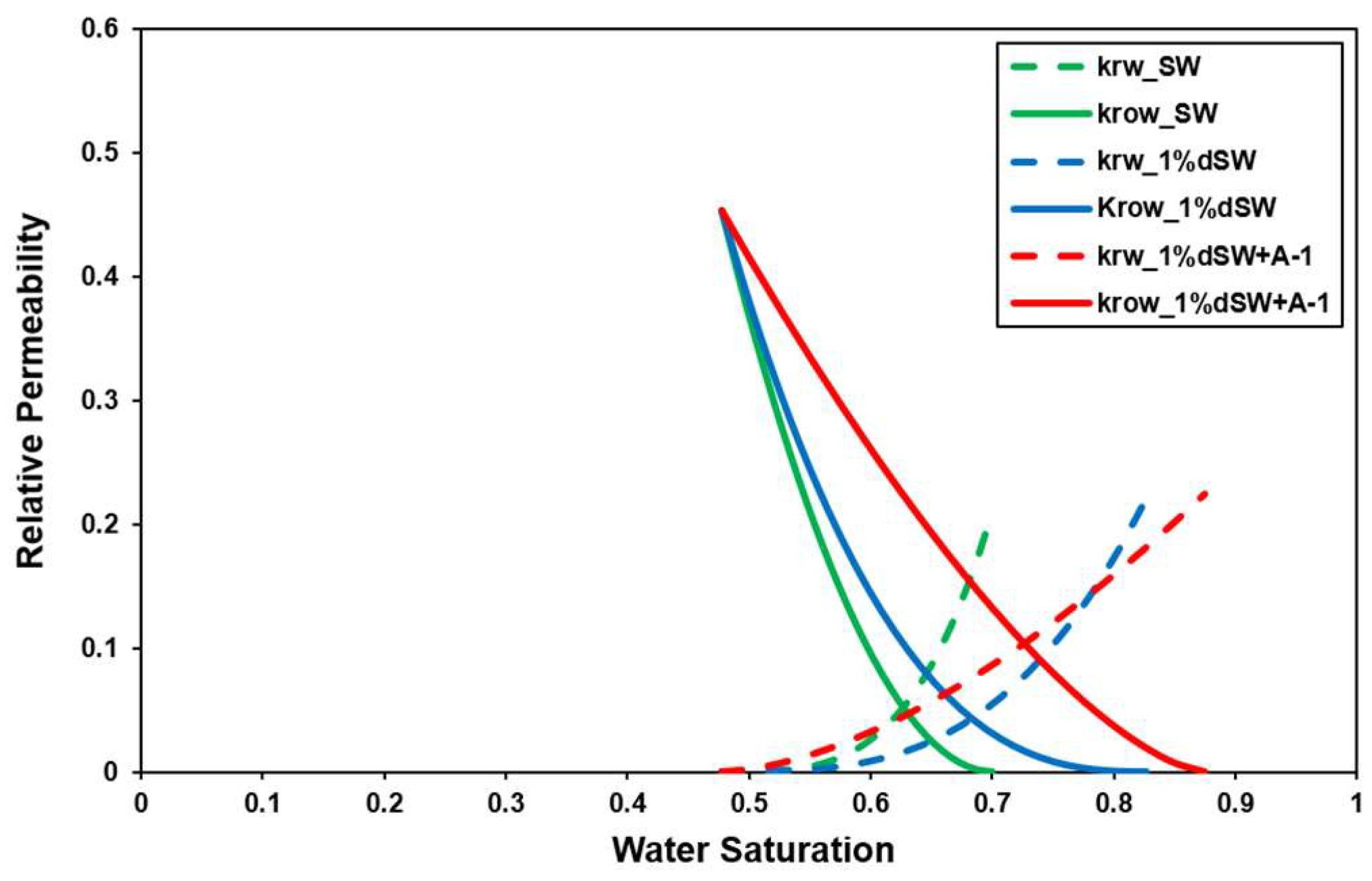
The central modeling assumption was that each electrostatic state corresponds to a distinct wettability-dependent rock–fluid condition. Accordingly, the relative permeability behavior was parameterized in terms of stage-specific or state-specific rock–fluid functions. In the Brooks–Corey model [75], the water- and oil-phase relative permeabilities are expressed as
  k r w = k r w S w S w i 1 S o r w S w i n w
k r o w = k r o w 1 S w S o r w 1 S o r w S w i n o
where S w is the water saturation, S w i is the irreducible water saturation, S o r w is the residual oil saturation to waterflooding, k r w is the endpoint water relative permeability, k r o w is the endpoint oil relative permeability, n w is Corey’s exponent for water, n o is Corey’s exponent for oil.
In the present work, Corey’s exponents were not treated as arbitrary fitting variables. Instead, they were adjusted so that the final rock–fluid functions remained physically consistent with the experimentally observed progression of electrostatic and wettability states. In general, a transition toward a more negative zeta potential state was expected to correspond to lower residual oil saturation, improved water-phase conductivity, and less favorable oil continuity at a given saturation.
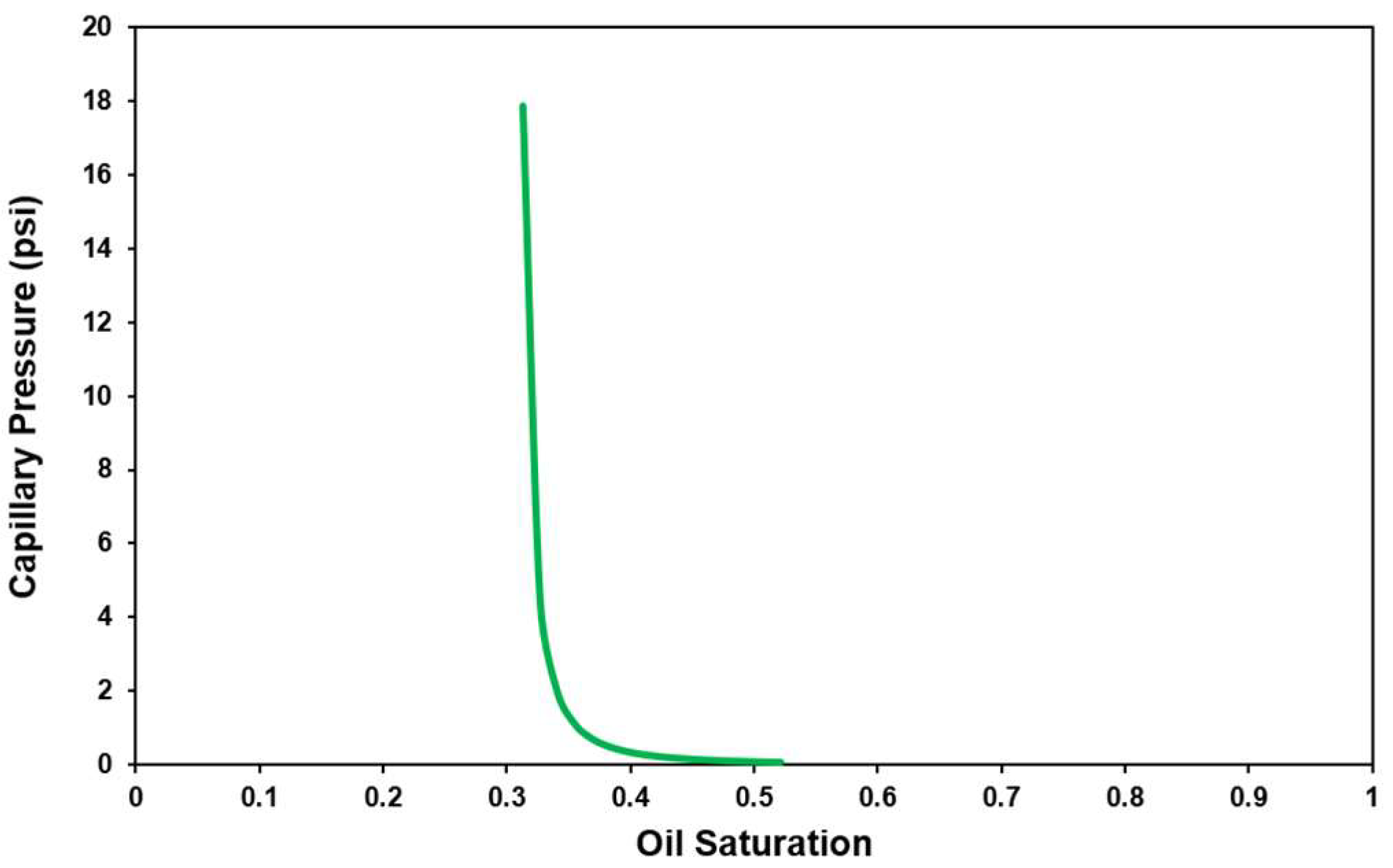
Capillary pressure was incorporated in the same rock–fluid parameterization because the measured contact angle and IFT data indicated a clear change in capillary-force conditions among SW, 1%dSW, and 1%dSW+A-1. The inclusion of capillary pressure was also relevant because the studied carbonate samples showed nanometer-scale mesoporous features based on low-pressure adsorption (LPA) measurements. The average BJH adsorption pore width obtained from the three LPA measurements was 18.05 nm, corresponding to an apparent effective pore radius of 9.03 nm. This radius was used as the characteristic length scale for estimating the capillary pressure magnitude.
The capillary pressure was represented using a Skjæveland-type formulation [76], which is suitable for oil-wet and mixed-wet imbibition conditions. This type of formulation was selected because it can represent the shift in capillary pressure associated with wettability alteration and has been used previously in coreflood modeling to define initial and final imbibition capillary pressure curves. For the initial oil-wet SW condition, the capillary pressure was expressed as
P c , S W = c o S o S o r w 1 S o r w a o
where P c , S W   is the capillary pressure for the SW reference state, c o   is the oil-side capillary pressure coefficient, S o   is the oil saturation, S o r w   is the residual oil saturation to waterflooding, and a o   is the oil-side capillary pressure exponent.
For the altered mixed-wet 1%dSW and the hybrid 1%dSW+A-1 conditions, the capillary pressure was expressed as
P c = c w S w S w i 1 S w i a w + c o S o S o r w 1 S o r w a o
where c w   and c o   are the water-side and oil-side capillary pressure coefficients, respectively, and a w   and a o   are the corresponding capillary pressure exponents. This formulation allows the capillary pressure curve to shift as wettability changes from the initial oil-wet condition toward a less oil-wet or mixed-wet condition. The characteristic capillary pressure was constrained using the Young–Laplace relationship:
P e = 2 σ c o s θ r e f f
where P e   is the characteristic capillary pressure, σ is the oil–water interfacial tension, θ is the measured contact angle, and r e f f   is the apparent effective pore radius obtained from LPA measurements. The contact angles used in this study were the values measured experimentally for SW, 1%dSW and 1%dSW+A-1.
It is important to emphasize that the zeta potential was not used to directly calculate k r w , k r o w , or P c . Rather, zeta potential was used as an electrostatic interpolation variable to guide the transition between wettability-dependent relative permeability and capillary pressure states.

4.8. History-Matching Strategy for Sequential and Standalone Floods

The sequential coreflood was used as the primary calibration case because it incorporates the baseline SW response, the incremental low-salinity effect, and the additional hybrid low-salinity surfactant response within the same core. This minimizes the uncertainty associated with core-to-core variability and provides the most informative dataset for calibrating the electrostatic/wettability framework. The history-matching was performed in a staged manner:
  • Stage 1: the SW flood was matched first to establish the baseline recovery and pressure response and to define the least altered rock–fluid state.
  • Stage 2: the 1%dSW stage was then matched to capture the incremental recovery and pressure behavior associated with the low-salinity electrostatic shift.
  • Stage 3: the 1%dSW+A-1 stage was finally matched to reproduce the delayed and progressive additional recovery associated with the hybrid formulation.
After the sequential flood was history-matched, the calibrated zeta potential-based framework was further evaluated against the standalone 1%dSW and standalone 1%dSW+A-1 corefloods. These standalone simulations were used as validation cases because they isolate the response of each chemistry outside the fluid-switching history of the sequential flood. This distinction is important. The sequential flood represents a dynamic electrostatic and wettability trajectory, whereas the standalone floods represent approximately stable chemistry-specific states. Therefore, if the same conceptual framework can reproduce both the sequential and standalone behavior, it supports the robustness of the zeta potential-guided rock–fluid formulation.

5. Experimental Results

5.1. Interfacial Tension Test

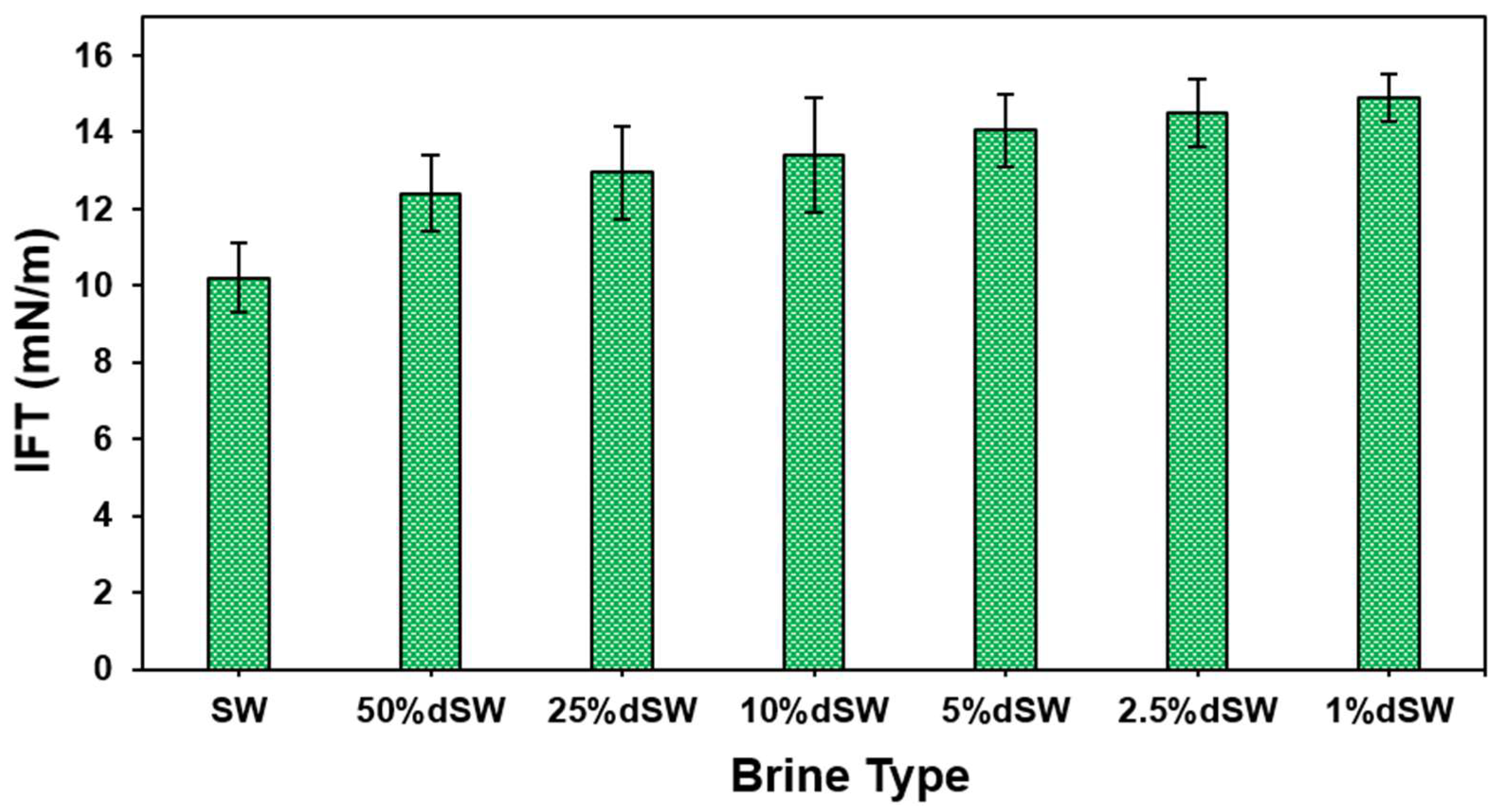
The IFT behavior between crude oil and surfactant-free brines was first evaluated to establish the baseline fluid–fluid interaction before introducing the surfactant. As shown in Figure 7, dilution of seawater resulted in a progressive increase in oil–water IFT. The measured IFT increased from approximately 10.2 mN/m for SW to 12.3 mN/m for 50%dSW, 12.9 mN/m for 25%dSW, 13.3 mN/m for 10%dSW, 14.0 mN/m for 5%dSW, 14.5 mN/m for 2.5%dSW, and 14.9 mN/m for 1%dSW. This trend indicates that reducing the brine salinity did not improve the fluid–fluid displacement condition by lowering IFT. Instead, the lowest-salinity brine showed the highest IFT among the surfactant-free brines.
This observation differs from some earlier reports in which oil–water IFT was found to increase with increasing brine salinity [77,78]. However, the relationship between salinity and crude oil–brine IFT is not universal and depends strongly on crude oil polarity, brine composition, ionic strength, and the dynamic organization of polar components at the oil–water interface. Similar behavior to the present results was reported by Rostami et al. [79], who observed that IFT decreased with increasing salinity up to a certain salinity level, after which the trend changed. Farhadi et al. [80] explained this type of salinity-dependent IFT behavior using the drift-diffusion concept. According to this interpretation, aqueous ions can generate electrostatic attraction that drives polar crude oil molecules toward the oil–water interface, while the concentration gradient of these interfacially active species creates an opposing diffusion effect. The balance between ion-driven drift and concentration-driven diffusion governs the dynamic accumulation of polar components at the interface and therefore controls the measured IFT response.
Accordingly, the increase in IFT with seawater dilution observed in this study indicates that dilution alone does not provide an IFT-reduction mechanism for the investigated crude oil–brine system. Therefore, the incremental oil recovery obtained during 1%dSW injection should not be attributed to lower oil–water IFT. This interpretation is consistent with our previous Hele-Shaw visualization study [81], where the rock phase was absent, and the analysis focused mainly on oil–brine displacement behavior. In that study, dilution of SW to 1%dSW resulted in lower areal sweep efficiency, supporting the conclusion that reduced ionic strength did not improve displacement through fluid–fluid interactions alone. Instead, the improved recovery observed during 1%dSW coreflooding in the present work is more reasonably associated with rock–fluid mechanisms, including electrostatic modification of the carbonate–brine interface, stabilization of the intervening water film, and wettability alteration toward a less oil-wet condition. This result also provides a clear motivation for adding A-1 surfactant to the low-salinity brine, since the surfactant is required to reduce IFT while the diluted brine provides the electrostatic and wettability alteration component of the hybrid process.
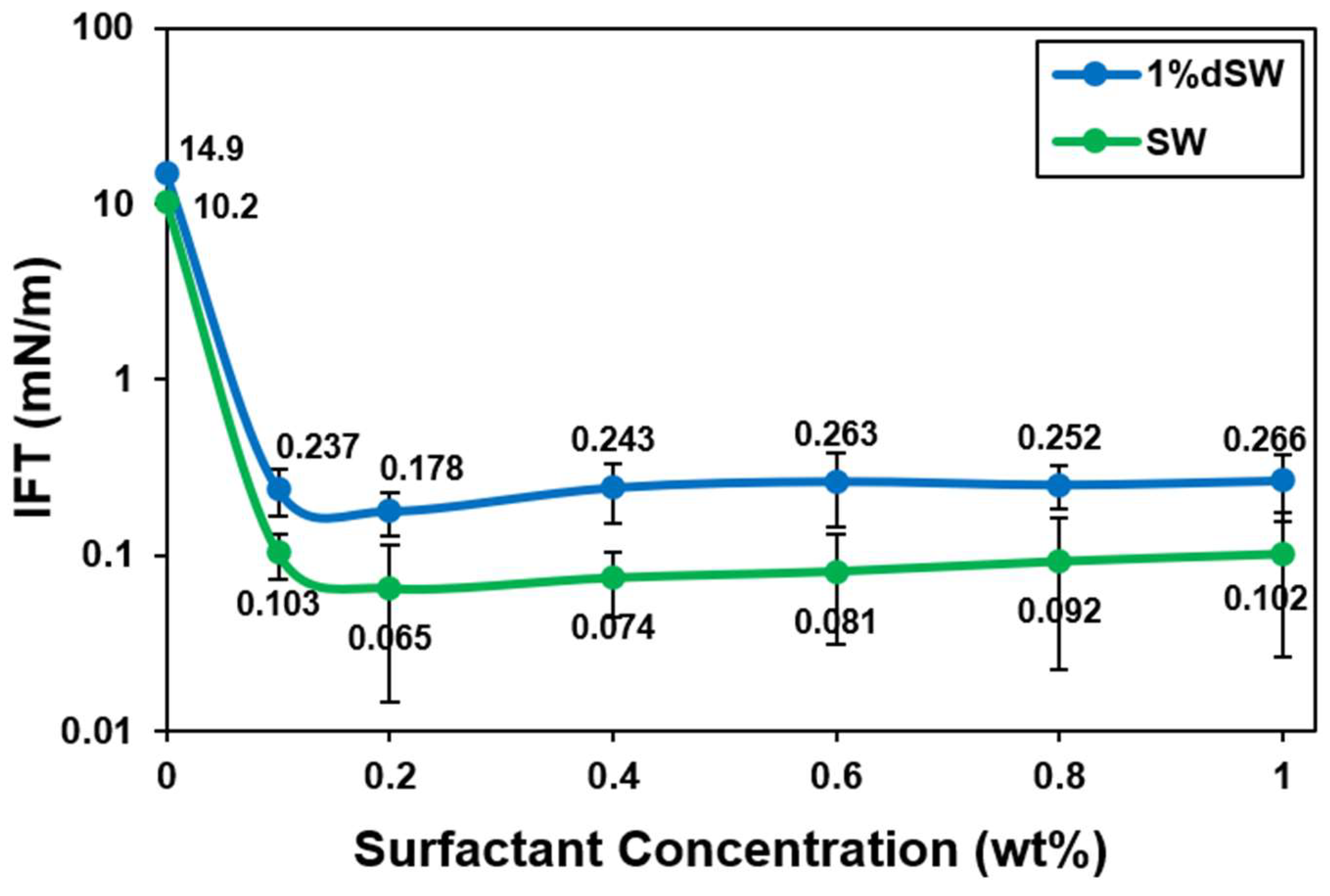
Figure 8 presents the effect of A-1 surfactant concentration on the oil–water IFT using SW and 1%dSW as carrier brines. The surfactant was evaluated over a concentration range of 0.1–1.0 wt% to identify the concentration that provides the most effective IFT reduction under the experimental temperature of 86 °C. A sharp reduction in IFT was observed immediately after adding A-1 to both brines. For the 1%dSW system, the IFT decreased from 14.9 mN/m in the surfactant-free brine to 0.237 mN/m at 0.1 wt% A-1. The minimum IFT was obtained at 0.2 wt%, where the IFT reached approximately 0.178 mN/m. Beyond this concentration, the IFT increased slightly and remained within a narrow range, reaching 0.243, 0.263, 0.252, and 0.266 mN/m at 0.4, 0.6, 0.8, and 1.0 wt%, respectively. A similar trend was observed when A-1 was added to SW, although the IFT values were consistently lower than those measured with 1%dSW. The IFT decreased from 10.2 mN/m for surfactant-free SW to 0.103 mN/m at 0.1 wt% A-1 and then reached a minimum value of approximately 0.065 mN/m at 0.2 wt%. At higher concentrations, the IFT increased slightly to 0.074, 0.081, 0.092, and 0.102 mN/m at 0.4, 0.6, 0.8, and 1.0 wt%, respectively. Therefore, 0.2 wt% A-1 was identified as the optimum concentration for IFT reduction in both SW and 1%dSW.
The sharp decrease in IFT at low surfactant concentration can be attributed to the adsorption of surfactant molecules at the oil–water interface. As the bulk surfactant concentration increases, more surfactant molecules migrate to the interface and replace part of the high-energy oil–water contact, resulting in a substantial decrease in IFT. This trend is consistent with surfactant adsorption behavior reported in the literature, where IFT generally decreases with increasing surfactant concentration until the interface becomes saturated or the system approaches the CMC. Beyond this point, additional surfactant molecules preferentially remain in the bulk phase or form micellar/aggregated structures, and further IFT reduction becomes limited [82,83]. The slight increase in IFT above 0.2 wt% should not necessarily be interpreted as experimental inconsistency. Instead, it may reflect changes in interfacial packing, surfactant self-assembly, or phase behavior after the optimum interfacial arrangement has been reached. In surfactant/oil/brine systems, the minimum IFT often occurs at an optimum formulation rather than simply at the highest surfactant concentration. The optimum formulation is controlled by the balance among surfactant structure, oil composition, salinity, temperature, and brine ions; moving away from this optimum can increase IFT even when more surfactant is present [84,85].
The lower IFT values obtained for SW+A-1 compared with 1%dSW+A-1 suggest that the higher ionic strength of SW provided more favorable interfacial conditions for A-1 adsorption and packing at the oil–water interface. For ionic surfactants, brine salinity can screen electrostatic repulsion between charged head groups and improve interfacial packing, which can reduce IFT. Salinity and brine ion composition are therefore important variables in surfactant formulation, and several studies have shown that changing salinity or the type of dissolved ions can significantly alter surfactant IFT performance [86,87,88]. Although SW+A-1 produced lower IFT than 1%dSW+A-1, the selection of 1%dSW+A-1 for the subsequent experiments was based on the overall hybrid low-salinity surfactant flooding objective rather than IFT reduction alone. IFT screening alone can be misleading for hybrid low-salinity surfactant flooding. A formulation with the lowest IFT may not necessarily provide the best displacement performance if it does not also promote favorable wettability alteration, electrostatic modification, compatibility, adsorption behavior, and injectivity in tight carbonate rocks.
The 1%dSW+A-1 formulation combines the electrostatic and wettability-alteration benefits of low-salinity water with the IFT reduction provided by A-1 surfactant. This is important because the surfactant-free 1%dSW brine showed the highest IFT among the tested brines; therefore, adding A-1 was necessary to reduce capillary trapping while maintaining the low-salinity environment required for wettability alteration. The use of 0.2 wt% A-1 as a lower surfactant concentration is recommended to satisfy both technical and economic selection criteria, as increasing the surfactant concentration beyond 0.2 wt% did not provide additional IFT reduction. Generally, Figure 8 demonstrates that A-1 is highly effective in reducing oil–water IFT in both SW and 1%dSW. The reduction from 14.9 to 0.178 mN/m in 1%dSW+A-1 corresponds to an approximately 98.8% decrease in IFT, while the reduction from 10.2 to 0.065 mN/m in SW+A-1 corresponds to an approximately 99.4% decrease. These results confirm that the selected surfactant can significantly weaken capillary forces, supporting its use in the hybrid low-salinity surfactant formulation for subsequent contact angle, zeta potential, coreflooding, and modeling investigations.

5.2. Zeta Potentiometric Analysis

The zeta potential of the carbonate–brine interface was measured to evaluate the electrostatic response of the rock surface to brine dilution and surfactant addition. Because the utilized electrokinetic analyzer is limited to brines with ionic strength below approximately 0.1 mol/L, full-strength SW could not be measured directly. Therefore, 25%dSW was used as the higher-salinity comparison brine in the zeta potential measurements, while lower-salinity brines were used to examine the effect of progressive dilution. Figure 9 shows the zeta potential of the carbonate surface in different diluted brines. The zeta potential became progressively more negative as the brine salinity decreased. The measured value changed from approximately −5.41 mV for 25%dSW to −10.79 mV for 10%dSW, −15.56 mV for 5%dSW, −16.80 mV for 2.5%dSW, and −18.22 mV for 1%dSW. This trend indicates that seawater dilution shifted the carbonate–brine interface toward a more negatively charged electrostatic condition. This behavior is consistent with the electrokinetic response commonly reported for carbonate–brine systems during low-salinity waterflooding. Dilution reduces the ionic strength of the aqueous phase, weakens charge screening, expands the electrical double layer, and modifies the relative abundance of potential-determining ions and surface complexes at the carbonate surface. Previous studies have shown that low-salinity brines can make carbonate–brine and oil–brine interfaces more negatively charged, and that this surface charge alteration is closely linked to wettability modification in carbonate rocks [89,90].
The more negative zeta potential obtained at lower salinity is important because it supports the interpretation that 1%dSW can alter the rock–fluid interaction even though it did not reduce IFT. As discussed in the IFT section, dilution of SW increased the oil–water IFT from 10.2 mN/m to 14.9 mN/m. Therefore, the potential benefit of 1%dSW should not be attributed to IFT reduction. Instead, the zeta potential results suggest that the low-salinity effect is more likely associated with electrostatic and rock–fluid mechanisms, including expansion of the electrical double layer, increased repulsive interaction between oil–brine and rock–brine interfaces, stabilization of the water film, and progressive wettability alteration toward a less oil-wet state. These mechanisms are consistent with interpretations based on DLVO/disjoining pressure concepts and low-salinity wettability alteration studies in carbonate systems [91,92].
Figure 10 also presents the effect of A-1 surfactant concentration on the zeta potential of the carbonate surface using 25%dSW and 1%dSW as carrier brines. In both brines, the addition of A-1 shifted the zeta potential toward more negative values. For the 25%dSW system, the zeta potential changed from −5.41 mV without surfactant to −7.61 mV at 0.1 wt%, −8.69 mV at 0.2 wt%, −9.39 mV at 0.4 wt%, −10.39 mV at 0.6 wt%, −10.79 mV at 0.8 wt%, and −11.35 mV at 1.0 wt%. This indicates that surfactant addition modified the carbonate surface charge even at the higher-salinity condition represented by 25%dSW. A stronger negative shift was observed when A-1 was added to 1%dSW. The zeta potential changed from −18.22 mV for surfactant-free 1%dSW to −22.25 mV at 0.1 wt%, −23.19 mV at 0.2 wt%, −23.54 mV at 0.4 wt%, −24.88 mV at 0.6 wt%, −25.39 mV at 0.8 wt%, and −27.08 mV at 1.0 wt%. The higher magnitude of negative zeta potential in 1%dSW+A-1 compared with 25%dSW+A-1 demonstrates the combined role of low ionic strength and surfactant adsorption in modifying the electrostatic condition of the carbonate–brine interface. The increasingly negative zeta potential with surfactant concentration can be attributed to the interaction of surfactant molecules with the carbonate surface. For anionic surfactants, adsorption or association of negatively charged head groups near the rock–brine interface can shift the surface charge toward more negative values. The extent of this shift depends on salinity, divalent cations, surfactant type, and mineral surface chemistry. Previous studies on carbonate systems have shown that surfactants can modify the surface charge of carbonate rocks and oil droplets, and that the type of surfactant and aqueous ion composition strongly influence zeta potential behavior [93,94].
Although the zeta potential continued to become more negative as the A-1 concentration increased beyond 0.2 wt%, this did not coincide with further IFT reduction. As shown in the IFT results, the minimum IFT for 1%dSW+A-1 was obtained at 0.2 wt%, after which the IFT increased slightly or stabilized. Therefore, the optimum surfactant concentration was not selected based on the maximum zeta potential magnitude alone. Instead, 0.2 wt% of A-1 was selected because it provided the best combined response: a major IFT reduction from 14.9 to 0.178 mN/m and a substantial negative shift in zeta potential from −18.22 to −23.19 mV. Therefore, this concentration provided a balanced formulation that could reduce capillary forces while also enhancing the electrostatic conditions favorable for wettability alteration. The comparison between the brine-only and surfactant-containing systems highlights the complementary roles of low salinity and surfactant addition. Low-salinity brine primarily modified the carbonate–brine electrostatic state, whereas the surfactant provided strong IFT reduction and further shifted the zeta potential to more negative values. This supports the main design concept of the hybrid low-salinity surfactant formulation: 1%dSW provides an electrostatic- and wettability-alteration environment, while A-1 reduces IFT and contributes additional interfacial modification. Overall, the zeta potential results provide direct electrokinetic evidence supporting the proposed wettability alteration pathway. The progression from 25%dSW to 1%dSW shifted the carbonate surface toward a more negative electrostatic state, while the addition of A-1 further enhanced this negative charge. These results were therefore used to define the zeta potential reference states in the numerical model, where SW represented the estimated baseline electrostatic state, 1%dSW represented the low-salinity altered state, and 1%dSW+A-1 represented the hybrid low-salinity surfactant altered state.

5.3. Spontaneous Imbibition Test

Contact angle measurements were conducted during the spontaneous imbibition tests to evaluate the time-dependent wettability alteration of the restored carbonate samples under HPHT conditions. The measurements were performed for SW, 1%dSW, and 1%dSW+A-1, and the images captured during the test were used to monitor the change in oil droplet shape on the carbonate surface as a function of exposure time. Since contact angle is a direct indicator of rock–fluid affinity, a decrease in contact angle was interpreted as a shift toward a less oil-wet or more water-wet condition. This interpretation is consistent with the general use of contact angle as a wettability indicator in carbonate low-salinity and surfactant EOR studies, where wettability alteration is commonly considered one of the dominant mechanisms controlling incremental oil recovery [95,96]. Figure 11 shows the contact angle evolution of the SW system. The contact angle decreased gradually from approximately 170° after 5 h to around 151° after 10 h, 143° after 25 h, 129° after 50 h, and finally 123° after 100 h. Although the contact angle decreased with time, the final value remained greater than 90°, indicating that the rock surface still retained an oil-wet tendency under SW exposure. This behavior is consistent with the expected response of restored carbonate rocks, where adsorption of polar crude oil components can generate oil-wet or mixed-wet surface conditions. The gradual decrease in contact angle suggests that SW caused limited wettability modification during imbibition, but it was not sufficient to fully shift the system toward a water-wet state. Therefore, the SW case was treated as the baseline restored rock–fluid condition in the coreflooding and modeling workflow.
Figure 12 presents the contact angle response for the 1%dSW system. Compared with SW, the 1%dSW brine produced a stronger and faster reduction in contact angle. The measured contact angle decreased from approximately 141° after 5 h to 124° after 10 h, 110° after 25 h, 105° after 50 h, and finally 101° after 100 h. The final contact angle was close to the neutral-wet/intermediate-wet range, showing that dilution of SW significantly altered the rock–fluid interaction. This result supports the zeta potential observations, where dilution shifted the carbonate–brine interface toward a more negative electrostatic condition. In carbonate systems, low-salinity brines can alter surface charge through changes in ionic strength, pH, and PDIs such as Ca2+, Mg2+, and SO42−; these changes can weaken oil–rock adhesion and promote water-film stability [97,98]. The 1%dSW contact angle result is particularly important because the IFT results showed that 1%dSW had the highest IFT among the surfactant-free brines. Therefore, the improved performance expected from 1%dSW cannot be explained by IFT reduction. Instead, the contact angle and zeta potential trends indicate that the low-salinity effect is mainly associated with rock–fluid mechanisms, including electrostatic alteration, expansion of the electrical double layer, increased disjoining pressure, and wettability alteration toward a less oil-wet state. This interpretation is consistent with previous studies showing that low-salinity waterflooding in carbonates is primarily governed by wettability alteration rather than a universal reduction in oil–water IFT [92,95,99].
Figure 13 shows the contact angle evolution for the hybrid 1%dSW+A-1 system. This formulation produced the strongest wettability alteration among the tested fluids. The contact angle decreased from approximately 131° after 5 h to 122° after 10 h, 102° after 25 h, 90° after 50 h, and finally 84° after 100 h. The final contact angle below 90° indicates that the carbonate surface shifted toward a weakly water-wet condition after exposure to the hybrid low-salinity surfactant solution. This behavior confirms that the addition of A-1 surfactant enhanced the wettability alteration capability of 1%dSW. The stronger wettability alteration observed for 1%dSW+A-1 can be explained by the combined effect of low salinity and surfactant addition. The low-salinity brine modifies the electrostatic environment at the carbonate–brine interface, while the surfactant can adsorb or associate at oil–brine and rock–brine interfaces, reduce oil–rock adhesion, and promote detachment or deformation of the oil droplet. In addition, the IFT results showed that 0.2 wt% A-1 reduced the IFT of 1%dSW from 14.9 mN/m to 0.178 mN/m, which substantially weakens capillary trapping and facilitates oil mobilization. Previous studies on surfactant-assisted EOR in carbonates have similarly reported that surfactants improve oil recovery through both IFT reduction and wettability alteration, with the relative contribution depending on surfactant type, salinity, temperature, and rock–fluid chemistry [100,101,102].

The time-dependent decrease in contact angle in all three systems also indicates that wettability alteration was not instantaneous. Instead, the alteration progressed gradually during exposure, suggesting that the process is controlled by interfacial reorganization, ion exchange/surface complexation, and redistribution of polar oil components and surfactant molecules at the rock–brine–oil interface. This time dependence is important for interpreting the coreflooding results, particularly the delayed incremental recovery observed during the 1%dSW+A-1 stage. The surfactant may rapidly reduce IFT, but the macroscopic mobilization of trapped oil still depends on the time required for the injected formulation to contact the pore surfaces, alter the interfacial conditions, and reconnect or mobilize previously trapped oil. Overall, the contact angle measurements confirm the progressive wettability alteration pathway proposed in this study. The SW case remained oil-wet after 100 h, with a final contact angle of approximately 123°. The 1%dSW case shifted the system toward an intermediate-wet condition, with a final contact angle of approximately 101°. The hybrid 1%dSW+A-1 formulation produced the strongest alteration, reducing the contact angle to approximately 84° and shifting the surface toward a weakly water-wet state. These results are consistent with the zeta potential measurements and provide independent experimental support for the zeta potential-guided modeling framework, where SW, 1%dSW, and 1%dSW+A-1 were treated as progressively altered rock–fluid states.

5.4. Coreflooding Experiments

5.4.1. Sequential CorefloodSequential Coreflooding Experiment

In this experiment, a sequential coreflooding scheme was designed to evaluate the incremental oil recovery obtained by progressively modifying the injected chemistry from SW to 1%dSW and 1%dSW+A-1 into the restored carbonate composite core, as shown in Figure 14. The displacement efficiency and differential pressure profiles show three distinct displacement stages, corresponding to the baseline SW flood, the low-salinity brine flood, and the hybrid low-salinity surfactant flood. This sequential design was selected to represent the intended field implementation pathway, where the reservoir rock–fluid system is first exposed to a high-salinity/SW-like condition and is then contacted by diluted seawater and subsequently by the hybrid low-salinity surfactant formulation.
During the first stage, SW was injected for approximately 3 PV. The displacement efficiency increased rapidly during the early period of injection and then gradually approached a plateau at approximately 42.65% OOIP. The rapid initial oil production reflects the displacement of mobile oil during primary water injection into the restored oil-saturated composite core. After approximately 1 PV, the recovery trend became nearly stable, indicating that most of the mobile oil accessible under the SW rock–fluid condition had been displaced. The remaining oil was likely retained by capillary trapping, unfavorable wettability, and limited connectivity of the oil phase in the tight carbonate pore system. This interpretation is consistent with carbonate waterflooding studies showing that oil-wet or mixed-wet carbonate rocks commonly exhibit limited waterflood recovery because the injected water does not efficiently detach oil from carbonate surfaces or mobilize capillary-trapped oil [95,103]. The pressure-drop profile during the SW stage increased sharply at the beginning of injection and then stabilized within a relatively high range. This behavior is expected in a tight carbonate composite core, where low absolute permeability, two-phase flow resistance, and capillary/end effects can generate high differential pressure during water injection. The early pressure increase is also consistent with the formation of an oil bank and the development of two-phase flow resistance as water invades the oil-saturated pore network. Once a more stable displacement front was established, the pressure drop fluctuated around a quasi-stable level, while the displacement efficiency approached its plateau.
After the SW stage reached a stable recovery trend, the injection fluid was switched to 1%dSW. The low-salinity stage produced a substantial additional recovery of approximately 24.21% OOIP, increasing the cumulative displacement efficiency from 42.65% to approximately 66.86% OOIP. This significant incremental recovery confirms that the diluted brine altered the rock–fluid system beyond the displacement achieved by SW. Because the IFT results showed that dilution increased the oil–water IFT from 10.2 mN/m for SW to 14.9 mN/m for 1%dSW, the additional recovery during 1%dSW injection cannot be attributed to IFT reduction. Instead, the response is more consistent with low-salinity-induced wettability alteration and electrostatic modification of the carbonate–brine–oil system. Low-salinity waterflooding in carbonates is widely linked to changes in surface charge, PDIs interactions, electrical double layer behavior, water-film stability, and wettability alteration, rather than a universal IFT-reduction mechanism [90,104]. The pressure response during the transition from SW to 1%dSW also supports the occurrence of a fluid-rock interaction rather than simple piston-like displacement. A pressure increase was observed immediately after switching to 1%dSW, followed by a gradual pressure decline as the recovery continued to increase. The initial increase may be related to salinity shock, mobilization and redistribution of trapped oil, changes in relative permeability, or temporary blockage associated with altered pore-scale flow paths. As the low-salinity brine propagated through the core, the pressure drop decreased while oil recovery increased, suggesting that the system progressively shifted toward a more favorable displacement condition. This agrees with the zeta potential and contact angle results, where 1%dSW shifted the carbonate surface toward a more negative electrostatic state and reduced the contact angle toward an intermediate-wet condition.
The third stage involved injection of 1%dSW+A-1. This hybrid formulation resulted in an additional 9.11% OOIP incremental recovery, increasing the final displacement efficiency to approximately 75.97% OOIP. Compared with the 1%dSW stage, the incremental recovery during the surfactant stage was smaller, but it is significant because it was obtained after the SW and low-salinity stages had already recovered a large fraction of the movable oil. This indicates that A-1 was able to mobilize part of the oil that remained trapped after low-salinity flooding. The observed recovery improvement is consistent with the combined role of surfactant-induced IFT reduction and further wettability/interfacial alteration. Surfactant EOR in carbonates commonly improves recovery by reducing oil–water IFT, weakening capillary trapping, and shifting oil-wet or mixed-wet carbonate surfaces toward more favorable wetting conditions [105,106]. The displacement efficiency during the 1%dSW+A-1 stage did not increase immediately at the same rate as the pressure response. Instead, the recovery increased gradually and then showed a more pronounced increase after approximately 0.6 PV of hybrid formulation injection. This delayed response can be explained by the time required for the surfactant solution to propagate through the pore network, contact the trapped oil and rock surfaces, and establish an effective interfacial condition. Although IFT reduction at the oil–water interface can occur rapidly at the fluid-contact scale, macroscopic oil mobilization in a tight carbonate core requires sufficient pore-scale contact, redistribution of phases, and reconnection of trapped oil ganglia. Similar delayed mobilization behavior has been discussed in surfactant and hybrid low-salinity surfactant flooding studies, where recovery depends not only on equilibrium IFT but also on surfactant transport, adsorption, phase behavior, and wettability alteration [107,108,109]. The pressure drop profile during the 1%dSW+A-1 stage showed a small transient increase after switching fluids, followed by a gradual decline toward a lower and more stable pressure level. This behavior is consistent with the combined effects of surfactant transport, interfacial rearrangement, and improved oil mobility. The initial pressure response may reflect surfactant adsorption, changes in pore-scale occupancy, or mobilization of residual oil, whereas the subsequent pressure reduction suggests improved displacement efficiency and reduced capillary resistance. This interpretation is supported by the IFT measurements, where 0.2 wt% A-1 reduced the IFT of 1%dSW from 14.9 mN/m to 0.178 mN/m, and by the contact angle measurements, where the final contact angle decreased to approximately 84°, indicating a shift toward weakly water-wet conditions.
In summary, the sequential coreflood confirms the complementary roles of SW, 1%dSW, and 1%dSW+A-1. The SW stage established the baseline restored-core displacement behavior and recovered 42.65% OOIP. The 1%dSW stage provided the largest incremental improvement, recovering an additional 24.21% OOIP, mainly through low-salinity-induced electrostatic and wettability alteration. The hybrid 1%dSW+A-1 stage recovered a further 9.11% OOIP, mainly through the combined effect of strong IFT reduction, additional wettability alteration, and mobilization of oil remaining after the low-salinity stage. These results are consistent with experimental screening results from IFT, zeta potential, and contact angle measurements and provide the experimental basis for the zeta potential-guided rock–fluid interpolation framework used in the Section 4.

5.4.2. Standalone CorefloodsStandalone Coreflooding Experiments

The standalone 1%dSW coreflood was conducted to evaluate the oil recovery performance of low-salinity brine injection in the restored carbonate core and to provide a reference case for comparison with the sequential flooding experiment. Figure 15 presents the displacement efficiency and differential pressure profiles obtained during standalone 1%dSW injection at 86 °C. Unlike the sequential coreflood, where 1%dSW was injected after the SW baseline stage, this experiment isolated the direct displacement performance of diluted brine when injected into a restored oil-saturated carbonate core without prior SW flooding. The displacement efficiency increased rapidly during the early stage of injection, reaching approximately 47.12% OOIP within the first 0.5 PV. This early response represents the production of connected and relatively mobile oil during the initial development of the water displacement front. The recovery then continued to increase more gradually and reached approximately 58.44% OOIP after around 1.5 PV. Beyond this point, the recovery profile became nearly stable, and additional injection up to 4 PV resulted in no additional increase in displacement efficiency. This plateau indicates that most of the oil accessible under the 1%dSW displacement condition had been produced, while the remaining oil was likely retained by capillary trapping, pore-scale heterogeneity, and limited oil-phase connectivity in the tight carbonate pore network.
The recovery obtained during standalone 1%dSW injection is significant because the IFT results showed that 1%dSW did not reduce the oil–water IFT. In fact, 1%dSW had the highest IFT among the surfactant-free brines, reaching approximately 14.9 mN/m. Therefore, the improved displacement performance of 1%dSW cannot be attributed to IFT reduction. Instead, it is more consistent with rock–fluid mechanisms associated with low-salinity waterflooding, including electrostatic alteration of the carbonate–brine interface, PDIs interactions, water-film stabilization, and wettability alteration toward a less oil-wet condition. These mechanisms are widely discussed in carbonate low-salinity waterflooding studies, where wettability alteration is generally considered one of the dominant contributors to incremental oil recovery [110,111]. This interpretation is also supported by the zeta potential and contact angle measurements. The zeta potential results showed that 1%dSW shifted the carbonate surface toward a more negative electrostatic state, while the contact angle measurements showed that 1%dSW reduced the contact angle to approximately 101° after 100 h of exposure. These results indicate that 1%dSW moved the rock–fluid system from an initially oil-wet condition toward an intermediate-wet state. Previous studies have similarly linked changes in carbonate surface charge, zeta potential, and spontaneous imbibition behavior to wettability alteration during exposure to diluted brines [112,113].
The differential pressure profile provides additional insight into the displacement process. At the beginning of injection, the pressure drop increased rapidly as 1%dSW entered the restored oil-saturated core and established two-phase flow. The pressure drop then increased more gradually and reached a maximum of approximately 1500–1550 psi around 1.1–1.2 PV, which coincided with the period of active oil recovery. This pressure buildup can be attributed to the combined effects of low permeability, oil-bank development, saturation redistribution, two-phase relative permeability, and capillary resistance in the tight carbonate core. After the maximum pressure, the differential pressure gradually declined and stabilized at approximately 1320 psi during the later stage of injection. This pressure decline suggests that the flow system became more stable after the main oil-production period and that a more continuous water-flow path had developed through the core. The gradual reduction in pressure drop may also reflect improved water-phase conductivity as 1%dSW altered the rock–fluid interface and shifted the system toward a less oil-wet state. However, the stabilized pressure drop remained relatively high, confirming that the composite core retained strong flow resistance due to its tight pore structure and two-phase flow limitations. Overall, the standalone 1%dSW experiment confirms that diluted seawater can improve oil displacement from the restored carbonate core even without surfactant addition. Since the IFT of 1%dSW was higher than that of SW, the recovery response is more reasonably explained by low-salinity-induced electrostatic and wettability alteration rather than by fluid–fluid IFT reduction. This standalone result provides an important experimental reference for evaluating the additional contribution of A-1 surfactant in the standalone 1%dSW+A-1 coreflood and for comparing isolated fluid performance against the sequential coreflood displacement pathway.
Figure 16 presents the standalone 1%dSW+A-1 coreflooding experiment conducted on a restored carbonate core at 86 °C. This experiment was designed to evaluate the direct displacement performance of the hybrid low-salinity surfactant formulation when injected into an oil-saturated restored core without a preceding SW or 1%dSW stage. Therefore, compared with the sequential coreflood, this standalone test isolates the combined effect of low salinity and A-1 surfactant on oil recovery and pressure behavior. The displacement efficiency increased sharply during the early stage of injection, reaching approximately 55–57% OOIP within the first 0.4–0.5 PV. This rapid initial recovery indicates that the hybrid formulation was able to mobilize a large fraction of connected oil shortly after injection started. The recovery then increased more gradually, reaching approximately 60–61% OOIP around 1.0 PV. After this point, the recovery continued to improve slowly and reached a stabilized displacement efficiency of approximately 65.21% OOIP after around 2.7 PV. Additional injection up to 4 PV resulted in only minor further recovery to reach 65.82% OOIP, suggesting that the accessible movable oil had largely been produced and that the remaining oil was likely trapped in less connected pore regions or retained by local capillary and wettability-controlled constraints.
Compared with the standalone 1%dSW flood, which recovered approximately 58.44% OOIP, the standalone 1%dSW+A-1 flood achieved a higher final displacement efficiency. This improvement confirms the additional contribution of A-1 surfactant when added to the low-salinity brine. The result is consistent with the earlier IFT measurements, where 0.2 wt% A-1 reduced the IFT of 1%dSW from 14.9 mN/m to approximately 0.178 mN/m. Such a large reduction in IFT weakens capillary trapping and can improve the mobilization of oil that would otherwise remain disconnected or trapped in small pore spaces. Medina et al. [101] studied surfactant performance in oil-wet carbonates and concluded that wettability alteration contributes strongly to early-stage oil production, while IFT reduction becomes particularly important in later recovery by unlocking trapped oil in the pore matrix. This interpretation is directly relevant to the gradual recovery improvement observed in the later stage of the standalone 1%dSW+A-1 flood. The recovery behavior also agrees with the contact angle and zeta potential results. The contact angle of the carbonate surface decreased to approximately 84° after exposure to 1%dSW+A-1, indicating a shift from oil-wet/intermediate-wet behavior toward a weakly water-wet condition. At the same time, the zeta potential shifted from −18.22 mV for 1%dSW to −23.19 mV after adding 0.2 wt% A-1, indicating a more negative carbonate–brine interfacial condition. This combined response suggests that A-1 not only reduced IFT but also contributed to modifying the rock–fluid electrostatic and wettability state. Shi et al. [114] reported that surfactants can alter oil-wet carbonate surfaces toward neutral or weakly water-wet conditions and emphasized that surfactant performance in carbonates is controlled by both IFT reduction and wettability alteration.
The differential pressure profile provides additional insight into the displacement mechanism. During the early stage of injection, the pressure drop increased rapidly as the hybrid formulation entered the oil-saturated core and established two-phase flow. The pressure drop reached a maximum of approximately 1850–1900 psi around 0.6–0.8 PV, which corresponded to the rapid oil-production period. Similarly to the 1%dSW case, this early pressure buildup can be attributed to the development of an oil bank, saturation redistribution, and high two-phase flow resistance in the tight carbonate core. The pressure response may also reflect surfactant transport and interaction with the rock–oil–brine system, including surfactant adsorption at interfaces and transient mobilization of trapped oil. The differential pressure afterwards decreased gradually and stabilized at approximately 1550–1600 psi during the later stage of injection. This reduction in pressure drop while recovery continued to increase suggests that the hybrid formulation progressively improved the displacement condition. The lower IFT reduced the capillary resistance opposing oil mobilization, while the shift toward a less oil-wet condition likely improved water-phase connectivity and reduced the resistance associated with oil attachment to the carbonate surface. Shakeel et al. [115] investigated low-salinity water/surfactant flooding design and reported that incremental recovery in hybrid low-salinity surfactant systems can be attributed to the combined effects of wettability alteration by low-salinity water and IFT reduction by surfactant addition. The pressure profile remained relatively high even after stabilization, which is expected for a tight carbonate composite core. Although A-1 surfactant significantly reduced IFT, the total core-scale pressure drop is still controlled by low absolute permeability, two-phase relative permeability, pore-scale heterogeneity, and the restricted connectivity of the pore network. Therefore, the pressure reduction after the peak should not be interpreted as a complete removal of flow resistance; rather, it indicates that the hybrid formulation improved the displacement condition relative to the initial two-phase flow period. Aghdam et al. [116] showed in surfactant-assisted low-salinity flooding that surfactants can improve recovery through changes in interparticle forces, wettability, and IFT, but that the pressure/permeability response depends strongly on the surfactant type and rock–fluid interactions.
The standalone 1%dSW+A-1 result also helps clarify the role of surfactant addition relative to low-salinity brine alone. The standalone 1%dSW flood showed that diluted seawater can improve oil recovery despite increasing the oil–water IFT, indicating that the recovery response is mainly associated with low-salinity-induced electrostatic alteration and wettability modification rather than IFT reduction. In contrast, the 1%dSW+A-1 flood combines this low-salinity effect with strong IFT reduction and additional interfacial modification. This explains the higher final displacement efficiency obtained during the hybrid flood compared with the standalone 1%dSW flood. Souayeh et al. [105] studied low-salinity surfactant systems in oil-wet carbonate rocks and showed that surfactant class and formulation strongly influence wettability alteration and oil recovery; their results also demonstrated that combining low-salinity water with selected surfactants can improve oil recovery compared with single-component formulations. In the present study, the standalone 1%dSW+A-1 flood increased the final displacement efficiency by approximately 7.38% OOIP relative to the standalone 1%dSW flood. Although this comparison should be interpreted with caution because the two standalone experiments were conducted on different restored composite cores, the result supports the effectiveness of the hybrid formulation as a direct injection fluid in tight carbonate systems. The improvement is consistent with the screening results, where 1%dSW created a more favorable electrostatic and wettability environment, while A-1 substantially reduced IFT and further shifted the carbonate surface toward a less oil-wet condition. This standalone result also provides an important comparison point for the sequential coreflood, where 1%dSW+A-1 was injected after SW and 1%dSW and recovered additional oil that remained after the preceding displacement stages.

6. Modeling Results

6.1. Sequential CorefloodCore-Scale Modeling of the Sequential Coreflooding Experiment

The experimental and simulated displacement efficiency and differential pressure profiles for the sequential SW → 1%dSW → 1%dSW+A-1 coreflood are presented in Figure 17. The model reproduced the overall recovery trend and pressure drop response across the three injection stages, indicating that the zeta potential-guided rock–fluid parameterization was able to capture the main displacement behavior observed experimentally. In this model, zeta potential was not used as a direct calculation variable for oil recovery. Instead, it was used as an electrostatic indicator of the evolving carbonate–brine surface state and as an interpolation variable between wettability-dependent relative permeability and capillary pressure functions. This approach is consistent with the growing use of electrokinetic and surface complexation concepts to interpret low-salinity waterflooding in carbonates. Mahani et al. [117] investigated the low-salinity effect in carbonate systems and emphasized that brine composition and reduced salinity can improve oil recovery, although the governing mechanisms are strongly dependent on rock–brine–oil interactions. Their work highlighted the importance of interfacial electrostatics and surface charge alteration as a possible explanation for wettability modification in carbonates. Similarly, Boampong et al. [112] introduced a zeta potential-based model that links low-salinity oil recovery to wettability through the electrostatic interaction between rock–brine and oil–brine interfaces. Their model assumed that the balance of electrostatic forces at these interfaces controls the stability of the water film and, therefore, the wetting condition.
During the SW stage, the model captured the rapid early increase in displacement efficiency followed by stabilization of oil recovery at approximately 42–43% OOIP. This stage represents the baseline restored rock–fluid condition before exposure to diluted brine or surfactant. The agreement between the experimental and simulated SW recovery plateau indicates that the initial SW relative permeability and capillary pressure functions provided a reasonable representation of the restored oil-wet to mixed-wet carbonate core. The model also reproduced the main pressure drop behavior during the SW stage, including the sharp initial increase and subsequent stabilization. The experimental pressure profile showed small fluctuations during this period, while the simulated curve was smoother, which is expected because the one-dimensional model represents the composite core as an effective continuum and does not explicitly resolve pore-scale heterogeneity, intermittent oil mobilization, or local capillary trapping. After switching the injected fluid from SW to 1%dSW, the model reproduced the additional recovery observed during the low-salinity stage. The simulated displacement efficiency increased from the SW plateau toward the experimental 1%dSW recovery level, capturing the main incremental recovery associated with low-salinity injection. This response supports the interpretation that the 1%dSW stage required a different rock–fluid state than the SW stage. In the model, this transition was represented through zeta potential-guided interpolation between the SW and 1%dSW rock–fluid functions. This is physically consistent with the experimental zeta potential and contact angle measurements, where 1%dSW shifted the carbonate surface toward a more negative electrostatic state and moved the system toward an intermediate-wet condition.
The pressure drop response during the transition to 1%dSW was also reasonably reproduced. Both the experiment and model showed a pressure increase shortly after the brine switch, followed by a gradual decline as the 1%dSW stage progressed. This pressure behavior suggests that the low-salinity front did not behave as a purely conservative salinity front. Instead, the injected brine modified the effective flow properties of the rock–fluid system through changes in wettability-sensitive relative permeability and capillary pressure. This interpretation is supported by previous geochemical modeling studies where changes in injected brine chemistry disturb aqueous and mineral equilibrium reactions, causing the simulator to move reactions forward or backward to re-establish equilibrium [118,119]. Egbe et al. [120] also discussed geochemical modeling approaches in carbonate low-salinity waterflooding and noted that models based on divalent cation exchange and geochemical alteration have been used to history-match carbonate coreflood experiments and interpret recovery improvement through the combined influence of surface charge alteration and mineral reactions. The SCM component in the present model provided the electrostatic basis for this interpretation. Surface complexation modeling allows the surface charge of carbonate minerals to respond to brine composition, pH, ionic strength, and potential-determining ions. Tetteh et al. [121] showed that SCMs based on diffuse double layer theory can be used to predict zeta potential in crude oil–brine–rock systems, while Boampong et al. [122] later developed a calibrated carbonate–oil–brine SCM that allowed charge distribution and potential calculation within the Stern layer. In the present work, the SCM reaction set was not independently tuned for every flooding stage. Instead, it was used to support a single electrostatic framework, while the measured or estimated zeta potential states constrained the interpolation between the SW, 1%dSW, and 1%dSW+A-1 rock–fluid functions.
During the final 1%dSW+A-1 stage, the model captured the additional incremental recovery obtained after surfactant addition. The experimental recovery increased gradually after the hybrid formulation was introduced and eventually approached a final displacement efficiency of approximately 76% OOIP. The simulated response reproduced this delayed recovery trend and the final recovery level, indicating that the hybrid rock–fluid state provided a reasonable effective representation of the combined effects of low salinity and A-1 surfactant. This result is consistent with the experimental screening data, where A-1 surfactant strongly reduced IFT and further shifted both zeta potential and contact angle toward more favorable conditions for oil mobilization. The pressure drop match during the 1%dSW+A-1 stage also followed the experimental trend. A small pressure response occurred after switching to the hybrid formulation, followed by a gradual decrease toward the end of the experiment. This behavior is consistent with reduced capillary resistance and improved oil mobilization after surfactant addition. In the model, the 1%dSW+A-1 state was represented by altered relative permeability and a substantially reduced capillary pressure magnitude, consistent with the measured low IFT of the hybrid formulation. This treatment is aligned with low-salinity modeling studies in which relative permeability and capillary pressure are modified or interpolated to represent wettability alteration. Derkani et al. [90] reviewed carbonate low-salinity waterflooding mechanisms and noted that relative permeability and capillary pressure interpolation have been used to represent wettability alteration effects in simulation studies. Overall, the sequential history-match demonstrates that a single fixed set of rock–fluid functions is insufficient to represent the full SW → 1%dSW → 1%dSW+A-1 displacement pathway. The experimental behavior required stage-specific rock–fluid functions that reflect the progressive electrostatic and wettability alteration observed in the laboratory measurements. The agreement between the experimental and simulated recovery and pressure drop profiles supports the use of zeta potential as an interpolation variable linking the measured electrokinetic response to the evolution of relative permeability and capillary pressure. Minor deviations between experiment and model are expected because the model represents the composite core using an effective one-dimensional description and does not explicitly resolve local heterogeneity, pore-scale trapping, capillary end effects, or transient surfactant adsorption at the pore scale.

6.2. Standalone CorefloodsCore-Scale Modeling of the Standalone Coreflooding Experiments

The experimental and simulated displacement efficiency and differential pressure profiles for the standalone 1%dSW and 1%dSW+A-1 corefloods are presented in Figure 18 and Figure 19, respectively. These simulations were conducted to evaluate whether the zeta potential-guided rock–fluid parameterization could reproduce the isolated displacement response of each formulation when injected directly into restored oil-saturated carbonate cores. Unlike the sequential model, where the rock–fluid state evolves from SW to 1%dSW and then to 1%dSW+A-1, the standalone simulations provide a more direct assessment of the effective low-salinity and hybrid low-salinity surfactant reference states.
For the standalone 1%dSW flood, the model reproduced the main displacement efficiency trend, including the rapid early oil production and the final recovery plateau. Experimentally, the displacement efficiency increased sharply during the first pore volume and stabilized at approximately 58.44% OOIP. The model captured this overall recovery level and the gradual approach to the plateau, indicating that the 1%dSW rock–fluid functions provided a reasonable and effective description of the low-salinity altered state. This is consistent with the experimental zeta potential and contact angle measurements, which showed that 1%dSW shifted the carbonate surface toward a more negative electrostatic condition and moved the system toward an intermediate-wet state. The pressure-drop match for the standalone 1%dSW case also captured the main experimental behavior. The experimental pressure drop increased during the early displacement period, reached a maximum of approximately 1500–1550 psi, and then gradually declined toward a stabilized value of about 1320 psi. The simulated pressure profile reproduced the initial buildup and subsequent pressure decline, although it remained smoother than the experimental data. The pressure decline after the maximum supports the interpretation that 1%dSW progressively improved the effective flow condition through wettability-sensitive changes in relative permeability and capillary pressure, rather than acting only as a simple injected brine with fixed rock–fluid properties. Reviews of low-salinity modeling have similarly noted that wettability alteration is commonly represented in simulations by shifting or interpolating relative permeability and capillary pressure curves as the rock–fluid state evolves [123].
For the standalone 1%dSW+A-1 flood, the model also reproduced the main recovery behavior. Experimentally, the hybrid formulation produced a rapid early increase in displacement efficiency, followed by a slower increase toward a final recovery of approximately 65.82% OOIP. The simulated curve followed the same overall trend and matched the final recovery reasonably well. The higher recovery compared with the standalone 1%dSW case supports the additional contribution of A-1 surfactant. In the model, this was represented through the hybrid rock–fluid state, which combined altered relative permeability with a substantially reduced capillary pressure magnitude. This treatment is consistent with the experimental screening results, where 1%dSW+A-1 showed strong IFT reduction, a more negative zeta potential response, and a lower final contact angle than 1%dSW alone. The pressure response for the standalone 1%dSW+A-1 case was also reasonably captured. The experimental pressure drop increased rapidly during early injection, reached a maximum during the active oil-displacement period, and then declined toward a stabilized pressure level. The model reproduced the early pressure buildup and the later decline, although some mismatch occurred during the early transient period. This deviation is reasonable because surfactant flooding introduces additional pore-scale processes that are difficult to capture in a simplified 1D effective model, including surfactant transport, adsorption, local IFT gradients, and transient mobilization of trapped oil [124,125]. In the present model, these effects were represented through an effective hybrid rock–fluid state rather than through an explicit surfactant adsorption and phase-behavior model. Therefore, the match should be interpreted as an effective core-scale representation of the combined low-salinity and surfactant mechanisms.
The stronger recovery response of the 1%dSW+A-1 model compared with the 1%dSW model is consistent with the mechanistic interpretation established from the experimental screening results. The 1%dSW formulation primarily modifies the electrostatic and wettability state of the carbonate–brine–oil system, while the addition of A-1 surfactant introduces a strong IFT reduction mechanism and further modifies the interfacial condition. Surface complexation and electrokinetic models provide a useful basis for this interpretation because they link brine composition, ionic strength, pH, and potential-determining ion interactions to the surface charge of carbonate minerals. Tetteh et al. [121] showed that surface complexation models based on diffuse double layer theory can be used to predict zeta potential in crude oil–brine–rock systems, while Takeya et al. [126] proposed a triple-layer surface complexation model to describe mineral–brine interface behavior and verify zeta potential trends. In summary, the standalone history matches support the robustness of the zeta potential-guided modeling framework. The model reproduced the main recovery and pressure drop trends for both the isolated 1%dSW and 1%dSW+A-1 floods, indicating that the calibrated low-salinity and hybrid reference states are not only applicable to the sequential flood but also capable of representing standalone displacement behavior. The remaining deviations are mainly associated with the simplified one-dimensional representation of a heterogeneous tight carbonate composite core and the use of effective rock–fluid functions rather than explicit pore-scale, geochemical-transport, or surfactant-transport descriptions.

6.3. History-Matched Rock–Fluid Functions

The history-matched relative permeability curves used in the core-scale simulations are presented in Figure 20 and Figure 21. These curves represent the effective rock–fluid functions required to reproduce the experimental displacement efficiency and differential pressure profiles for the sequential and standalone corefloods. It is important to emphasize that these functions should not be interpreted as independently measured steady-state relative permeability curves. Rather, they are history-matched effective functions constrained by the experimental recovery response, differential pressure behavior, zeta potential, contact angle, IFT measurements, and the estimated capillary pressure trends.
Figure 20 shows the history-matched relative permeability curves for the standalone 1%dSW and 1%dSW+A-1 floods. The hybrid 1%dSW+A-1 case shows a wider mobile saturation interval and lower residual oil saturation compared with the standalone 1%dSW case. The residual oil saturation decreased from approximately 0.253 for standalone 1%dSW to approximately 0.201 for standalone 1%dSW+A-1. This reduction is consistent with the higher final displacement efficiency obtained during the hybrid flood. The endpoint water relative permeability also increased from approximately 0.248 for 1%dSW to approximately 0.291 for 1%dSW+A-1, indicating improved water-phase conductivity after surfactant addition. Similarly, the endpoint oil relative permeability was higher in the hybrid case, suggesting that oil remained more mobile over a broader saturation range before reaching the residual oil condition. The standalone relative permeability trends are consistent with the experimental screening results. The 1%dSW formulation primarily altered the carbonate–brine electrostatic state and shifted the system toward an intermediate-wet condition, as shown by the zeta potential and contact angle measurements. In contrast, the 1%dSW+A-1 formulation combined the low-salinity effect with strong IFT reduction and additional interfacial modification. Therefore, the hybrid case required a lower residual oil saturation and more favorable relative permeability functions to reproduce the higher recovery observed experimentally. This behavior is consistent with low-salinity surfactant flooding mechanisms reported in the literature, where surfactant addition can reduce capillary trapping, improve oil mobility, and alter the rock–fluid system toward a less oil-wet condition [90,127,128].
Figure 21 shows the history-matched relative permeability curves for the sequential SW, 1%dSW, and 1%dSW+A-1 stages. The curves show a progressive shift in rock–fluid behavior from the SW reference state to the low-salinity and hybrid low-salinity surfactant states. The SW stage exhibited the highest residual oil saturation, approximately 0.299, which is consistent with the lower recovery obtained during the baseline SW flood. After switching to 1%dSW, the residual oil saturation decreased to approximately 0.173, indicating that low-salinity injection mobilized oil that remained trapped after SW injection. With subsequent injection of 1%dSW+A-1, the residual oil saturation decreased further to approximately 0.126, consistent with the additional recovery obtained during the hybrid stage. The progressive reduction in residual oil saturation from SW to 1%dSW and then to 1%dSW+A-1 provides a direct modeling representation of the experimentally observed wettability alteration pathway. The contact angle decreased from 123° for SW to 101° for 1%dSW and then to 84° for 1%dSW+A-1, while the zeta potential became more negative with dilution and surfactant addition. These experimental trends support the shift from an initially oil-wet to mixed-wet restored carbonate state toward a less oil-wet and eventually weakly water-wet condition. In the model, this transition was represented by shifting the relative permeability curves toward lower residual oil saturation and improved phase mobility.
The oil relative permeability curves also show that oil mobility persists over a broader saturation range after low-salinity and hybrid surfactant treatment. This is particularly evident in the 1%dSW and 1%dSW+A-1 sequential states, where the oil relative permeability extends to higher water saturation compared with the SW state. This trend is physically consistent with reduced oil trapping and improved displacement after wettability alteration. The water relative permeability curves also shift with the electrostatic state, reflecting changes in the effective water-flow capacity as the rock–fluid system moves toward a less oil-wet condition. In low-salinity and surfactant EOR simulation studies, such changes are commonly represented by modifying or interpolating relative permeability functions as the wetting condition changes [123]. The comparison between the sequential and standalone curves also highlights the importance of saturation history and core-to-core variability. The standalone 1%dSW and 1%dSW+A-1 floods were conducted on separately restored composite cores and therefore required case-specific effective relative permeability functions. In contrast, the sequential flood represents a continuous transition within the same restored composite core, where the rock–fluid state evolves from SW to 1%dSW and then to 1%dSW+A-1. Therefore, the relative permeability curves were interpreted as effective history-matched functions for each experimental condition rather than universal rock–fluid properties.
The history-matched relative permeability and estimated capillary pressure parameters used in the core-scale simulations are summarized in Table 7. These parameters were tuned to represent the effective rock–fluid properties required to reproduce experimental displacement efficiency and differential pressure profiles for the sequential and standalone corefloods. Corey exponents generally reflect the change in displacement behavior. In the sequential model, n w   decreased from 3.50 for SW to 3.10 for 1%dSW and then to 1.65 for 1%dSW+A-1. A lower water Corey exponent in the hybrid case indicates a less restrictive increase in water relative permeability with saturation, which is consistent with improved water-phase flow under a less oil-wet condition. The oil Corey exponent also decreased in the hybrid state, indicating a smoother oil relative permeability decline and improved oil mobility over the active saturation interval. A similar trend was observed in the standalone models, where the 1%dSW+A-1 case required lower Corey exponents than the 1%dSW case.
The estimated capillary pressure curves are shown in Figure 22, Figure 23 and Figure 24 for SW, 1%dSW, and 1%dSW+A-1 reference states, respectively. The SW capillary pressure curve was represented using the initial oil-wet Skjæveland form and plotted against oil saturation. This curve shows a high capillary pressure magnitude as oil saturation approaches the residual oil endpoint, reflecting the stronger capillary trapping expected under the initial SW reference condition. The 1%dSW capillary pressure curve was represented using the mixed-wet Skjæveland form and plotted against water saturation. This curve crosses zero, which reflects the transition from oil-wet to mixed-wet capillary behavior after low-salinity alteration. The 1%dSW+A-1 curve has the same mixed-wet form but shows a much smaller capillary pressure magnitude because the surfactant reduced the IFT substantially. The difference in capillary pressure magnitude among the three states is consistent with the Young–Laplace relationship, where capillary pressure is proportional to IFT and contact angle and inversely proportional to pore radius. The brine-only cases retained larger capillary pressure magnitudes because their IFT values remained relatively high. In contrast, the 1%dSW+A-1 formulation reduced IFT to approximately 0.178 mN/m, which resulted in a nearly negligible capillary pressure magnitude compared with SW and 1%dSW. This explains why the surfactant stage was represented by altered relative permeability and a substantially reduced capillary pressure contribution.
In summary, the history-matched rock–fluid functions are consistent with the experimental recovery, IFT, zeta potential, and contact angle results. The SW state required the least favorable rock–fluid functions and the highest residual oil saturation. The 1%dSW state required lower residual oil saturation and altered relative permeability behavior, consistent with low-salinity-induced electrostatic and wettability alteration. The 1%dSW+A-1 state required the most favorable rock–fluid functions and the smallest capillary pressure magnitude, consistent with the combined effect of wettability alteration and strong surfactant-induced IFT reduction. These trends support the use of zeta potential as an interpolation variable linking experimentally observed electrokinetic changes to the evolution of relative permeability and capillary pressure in the numerical model.

7. Discussion

7.1. Integrated Interpretation of the Experimental and Modeling Results

The experimental and numerical modeling results show that oil recovery enhancement in this tight carbonate system was controlled by coupled rock–fluid and fluid–fluid mechanisms rather than by a single dominant process. The response of SW, 1%dSW, and 1%dSW+A-1 followed a consistent progression: SW represented the restored baseline oil-wet to mixed-wet condition, 1%dSW shifted the system toward an altered mixed-wet state, and 1%dSW+A-1 provided the most favorable displacement condition by combining low-salinity-induced electrostatic alteration with strong surfactant-induced IFT reduction. This interpretation is supported by the agreement among the IFT, zeta potential, contact angle, coreflooding, and modeling results. Dilution of SW to 1%dSW increased the oil–water IFT from 10.2 to 14.9 mN/m, indicating that low-salinity recovery improvement was not caused by IFT reduction. However, the same dilution shifted the carbonate surface zeta potential to more negative values and reduced the contact angle from 123° to 101°, indicating a transition toward less oil-wet behavior. This explains why 1%dSW produced substantial recovery improvement despite having a higher IFT than SW. The addition of A-1 surfactant then reduced IFT sharply to 0.178 mN/m, further decreased the contact angle to 84°, and shifted the zeta potential to a more negative value. Therefore, the hybrid formulation improved recovery through both wettability alteration and reduced capillary trapping.
The modeling results reinforce this interpretation. A fixed set of rock–fluid functions could not represent the entire SW → 1%dSW → 1%dSW+A-1 displacement pathway. Instead, the recovery and pressure-drop profiles required progressive changes in relative permeability and capillary pressure, guided by the experimentally measured electrokinetic and wettability trends. The history-matched parameters showed a systematic decrease in residual oil saturation from SW to 1%dSW and then to 1%dSW+A-1. This reduction is consistent with the experimentally observed improvement in displacement efficiency and supports the use of zeta potential as an interpolation variable for wettability-sensitive rock–fluid functions.

7.2. Low-Salinity Effect: Electrostatic Alteration Rather than IFT Reduction

A key finding of this study is that 1%dSW improved oil recovery even though it increased the oil–water IFT. This point is important because it prevents over-attributing the low-salinity response to a fluid–fluid mechanism. The standalone 1%dSW flood recovered 58.44% OOIP, and the 1%dSW stage in the sequential flood recovered an additional 24.21% OOIP after SW. Since the IFT of 1%dSW was higher than that of SW, the recovery improvement is more reasonably attributed to alteration of the carbonate–brine–oil interfacial condition. The zeta potential results provide the strongest evidence for this interpretation. The carbonate surface became progressively more negative with dilution, reaching approximately −18.22 mV for 1%dSW. This more negative electrostatic state suggests weaker oil–rock attraction and a more stable water film at the carbonate surface. Similar interpretations have been proposed by Mahani et al. [117], who showed that low-salinity response in carbonate systems can be linked to surface charge alteration rather than mineral dissolution alone. More recent work by Feldmann et al. [113] also showed that carbonate materials exhibit rock-specific zeta potential responses to formation water, seawater, and diluted seawater, and that surface charge changes can be linked to wettability alteration and spontaneous imbibition recovery. The contact angle results support this electrostatic interpretation. The reduction from 123° under SW to 101° under 1%dSW indicates that dilution moved the system from a more oil-wet state toward an intermediate-wet condition. This is consistent with carbonate low-salinity studies that identify PDIs, particularly Ca2+, Mg2+, and SO42−, as important contributors to surface charge modification and wettability alteration. However, the present results also show that the mechanism should not be reduced to bulk salinity alone. The behavior depends on the combined effect of ionic strength, carbonate mineral surface chemistry, crude oil polarity, and the initial restored wetting state. Therefore, the role of 1%dSW in this work is best described as electrostatic and wettability modification rather than IFT reduction. The diluted brine changed the rock–fluid condition sufficiently to mobilize oil that remained trapped after SW injection, but it did not provide the low-IFT condition needed to strongly reduce capillary trapping. This limitation explains why the addition of surfactant was necessary to achieve the highest recovery.

7.3. Hybrid Low-Salinity Surfactant Effect: Synergy and Limitations

The 1%dSW+A-1 formulation produced the most favorable overall response because it combined the electrostatic benefit of low salinity with the fluid–fluid benefit of surfactant-induced IFT reduction. The IFT decreased from 14.9 mN/m for 1%dSW to 0.178 mN/m at 0.2 wt% 1%dSW+A-1. Since capillary pressure is proportional to IFT, this reduction strongly decreased the estimated capillary pressure magnitude. The capillary pressure curve for 1%dSW+A-1 was therefore nearly flat compared with the brine-only cases, indicating substantially weaker capillary trapping. The contact angle and zeta potential results show that A-1 surfactant did not act only as an IFT reducer. The final contact angle decreased to 84°, and the zeta potential became more negative than the 1%dSW case. This indicates additional interfacial modification at the rock–brine and/or oil–brine interfaces. The sequential coreflood supports this combined mechanism. The surfactant stage recovered an additional 9.11% OOIP after the SW and 1%dSW stages had already recovered a large portion of the movable oil. This incremental recovery should not be interpreted as small or secondary. Since the hybrid formulation was injected after substantial prior oil production, it targeted a more difficult residual oil fraction. The standalone comparison also supports the surfactant contribution: 1%dSW+A-1 recovered approximately 65.82% OOIP compared with 58.44% OOIP for standalone 1%dSW. However, this comparison must be interpreted carefully because the standalone floods were conducted on different restored composite cores. The recovery difference is consistent with the surfactant mechanism, but it is not a pure fluid-only comparison because core heterogeneity and restoration variability may also contribute.
A critical point is that very low IFT is not universally beneficial in the same way under all recovery modes and permeability conditions. Surfactants with strong emulsification capacity can improve sweep efficiency by increasing flow resistance, partially blocking preferential flow paths, and diverting the injected fluid toward less-swept regions. However, excessive emulsification may become detrimental in ultra-low-permeability media because retained oil droplets or emulsion droplets can restrict pore throat flow, increase pressure drop, and reduce effective displacement efficiency [129]. Therefore, surfactant performance should not be interpreted from equilibrium IFT alone, particularly in tight porous media where pore throat accessibility and emulsion transport can strongly influence injectivity and recovery. The role of IFT reduction also depends on the displacement mode. In spontaneous imbibition, very low IFT can reduce the capillary driving force for water uptake into the matrix, even though it may also reduce oil trapping. In contrast, under pressure-driven forced displacement, low IFT mainly helps reduce capillary trapping, lower the mobilization threshold, and improve residual oil displacement [130]. In the present corefloods, flow was imposed by injection pressure; therefore, the sharp IFT reduction caused by A-1 surfactant is interpreted primarily as a mechanism for weakening capillary trapping rather than as the sole driving force for oil recovery. This distinction is important when transferring conclusions from imbibition-cell experiments to pressure-driven corefloods and, ultimately, to field-scale injection processes.

7.4. Critical Interpretation of the History-Matched Rock–Fluid Functions

The history-matched relative permeability and capillary pressure functions should be interpreted as effective constitutive functions that translate the experimentally observed interfacial changes into a core-scale flow response. They are not independent measurements of intrinsic rock–fluid properties. This distinction is important because relative permeability and capillary pressure are not unique fitting functions; several combinations of endpoint relative permeability, Corey exponents, residual oil saturation, and capillary pressure coefficients can reproduce similar recovery profiles, especially when only cumulative oil recovery and pressure drop are available. Therefore, the value of the fitted functions in this study is not that they provide a unique description of the pore-scale displacement, but that their trends are consistent with independent experimental indicators: zeta potential, contact angle, IFT, pressure drop behavior, and final oil recovery.
The fitted Corey exponents provide additional insight, but they should also be interpreted carefully. The decrease in nw and no for the hybrid 1%dSW+A-1 case suggests that the two-phase flow functions became less restrictive after surfactant addition. In practical terms, lower Corey exponents allow phase mobilities to develop more gradually and over a wider saturation interval. This is consistent with the experimental evidence that A-1 surfactant reduced IFT, lowered the contact angle, and shifted the zeta potential to a more negative value. Nevertheless, Corey exponents are empirical curve-shape parameters, and they do not directly identify one pore-scale mechanism. A lower nw may indicate improved water connectivity, reduced oil adhesion, lower capillary trapping, or a combination of these effects. Therefore, the exponents should be discussed as effective indicators of altered flow behavior rather than as direct mechanistic measurements.
The standalone and sequential relative permeability curves should also not be expected to collapse onto identical functions, even when the same injected fluid is used. Although both the sequential and standalone 1%dSW cases represent low-salinity brine injection, they differ in saturation history and were conducted on different restored composite cores. The sequential case represents 1%dSW injection after prior SW flooding, whereas the standalone case represents direct 1%dSW injection into a restored oil-saturated core. These differences can alter the effective saturation distribution, oil connectivity, pore-scale occupancy, and phase-mobility pathway. Therefore, the differences between the sequential and standalone fitted functions do not contradict the modeling framework; rather, they reflect the known sensitivity of relative permeability to saturation history, wettability state, pore structure, and displacement sequence. This point is particularly important for wettability-altering fluids because the saturation functions are not necessarily static as the rock surface is exposed to a new brine or surfactant chemistry. Recent modeling studies have shown that assuming fixed relative permeability during wettability alteration can be inadequate. Kassa et al. [131] modeled relative permeability under dynamic wettability transition and showed that pore-scale wettability changes can modify the Darcy-scale relative permeability–saturation relationship. Hosseinzadehsadati et al. [132] further demonstrated that hysteresis and saturation history can significantly affect modified-salinity waterflood predictions, particularly when oil is mobilized and subsequently re-trapped during wettability alteration. Similarly, Chang and Pope [133] developed a mechanistic surfactant wettability alteration model in which relative permeability and capillary pressure are interpolated between oil-wet and water-wet states using a wettability scaling factor linked to the evolving surface condition. Their framework accounts for surfactant–soap interactions, mixed micelle formation, adsorption, salinity, and pH, reinforcing the need to connect wettability alteration to effective rock–fluid functions rather than treating them as purely empirical fitting parameters. Accordingly, the standalone and sequential functions used in the present work should be interpreted as history-dependent effective functions rather than universal fluid-specific curves.
The estimated capillary pressure curves provide a complementary but more uncertain component of the rock–fluid description. Their inclusion is justified because the experimental system showed clear changes in both IFT and contact angle, and both variables directly influence capillary pressure. The SW curve represents the initial oil-wet reference state, the 1%dSW curve represents an altered mixed-wet condition, and the 1%dSW+A-1 curve represents a hybrid state with very low capillary pressure magnitude due to strong IFT reduction. This ordering is physically reasonable and consistent with the measured contact angle sequence. However, because direct (Pc)—(Sw) measurements were not performed, the capillary pressure curves should be treated as physically constrained estimates rather than independently validated functions. The very small capillary pressure magnitude in the 1%dSW+A-1 case is one of the most important outcomes of the rock–fluid model. It indicates that the surfactant stage should not be interpreted only as a further wettability shift. The hybrid formulation also changes the force balance by strongly reducing IFT. Therefore, the additional oil recovery during 1%dSW+A-1 injection likely results from two simultaneous effects: lower oil–rock adhesion due to wettability alteration and weaker capillary trapping due to reduced IFT. This distinction matters because low-salinity water and surfactant do not improve recovery through identical mechanisms. Low salinity primarily modifies the electrostatic and wetting state, while surfactant addition adds a strong capillary desaturation component.
An additional uncertainty in the present interpretation is that the history match contains inherent parametric non-uniqueness. Residual oil saturation, endpoint relative permeabilities, Corey exponents, and capillary-pressure coefficients can compensate for each other during history matching, particularly when the main matching targets are cumulative oil recovery and differential pressure. For example, residual oil saturation primarily controls the final recovery, whereas water relative permeability and capillary pressure magnitude strongly influence the pressure response at the imposed injection rate. Therefore, matching recovery alone would not be sufficient to uniquely constrain the rock–fluid functions. In this study, this uncertainty was reduced by matching both recovery and differential pressure and by requiring the fitted functions to remain consistent with independent experimental indicators, including IFT, contact angle, and zeta potential. Accordingly, the fitted functions should be interpreted as physically constrained effective functions for the tested core-scale system rather than as unique intrinsic rock–fluid properties. This interpretation is consistent with previous studies showing that wettability alteration, saturation history, capillary pressure, and relative permeability hysteresis can strongly influence the effective saturation functions used in core-scale simulations [134,135,136].
The agreement between the fitted rock–fluid functions and the experimental trends therefore supports the proposed mechanism, while recognizing that the fitted parameters are not mathematically unique. The strength of the workflow is that the direction of rock–fluid alteration was constrained by independent measurements rather than by recovery matching alone. Within this interpretation, the model supports the conclusion that low-salinity brine primarily modifies the electrostatic and wetting state of the carbonate–brine–oil system, whereas A-1 surfactant addition introduces a stronger capillary-desaturation mechanism through substantial IFT reduction.

7.5. Electrostatic Modification, Water-Film Stabilization, and SCM-Based Interpretation

One of the most important mechanisms identified in this study is the electrostatic modification of the carbonate–brine–oil system during the transition from SW to 1%dSW and then to 1%dSW+A-1. This mechanism is central to the interpretation of the results because the recovery improvement obtained during 1%dSW injection cannot be explained by IFT reduction. The IFT increased from 10.2 mN/m for SW to 14.9 mN/m for 1%dSW; therefore, the additional recovery during low-salinity injection must be associated primarily with rock–fluid interactions rather than a favorable change in fluid–fluid tension. The conceptual pore-scale mechanism is illustrated in Figure 25, where dilution expands the electrical double layer, stabilizes the water film, reduces oil–rock adhesion, and promotes mobilization of trapped oil. Under SW injection, the high ionic strength compresses the electrical double layer at the carbonate–brine interface. This compressed EDL screens electrostatic interactions and promotes a thin, unstable aqueous film between the oil and the carbonate surface. In this condition, polar crude oil components can remain strongly associated with positively charged carbonate surface sites, leading to stronger oil–rock adhesion and a more oil-wet displacement condition [137]. This interpretation is consistent with the high contact angle measured for SW, approximately 123°, the estimated near-neutral zeta potential of approximately −2 mV, and the higher effective residual oil saturation required in the SW model.
When SW was diluted to 1%dSW, the ionic strength decreased, and the electrical double layer expanded. The zeta potential shifted to a more negative value of approximately −18.2 mV, indicating a clear change in the electrostatic state of the carbonate–brine interface. As shown schematically in Figure 25, this expanded EDL increases the effective separation between oil and the carbonate surface and supports the formation of a thicker and more stable water film. The stabilization of this water film reduces direct oil–rock contact, weakens oil adhesion to the carbonate surface, and facilitates wettability alteration toward a less oil-wet state [138,139]. This explains why the contact angle decreased to approximately 101° and why the 1%dSW flood improved recovery despite having a higher IFT than SW. This interpretation is consistent with DLVO and disjoining pressure concepts. In an oil-wet carbonate system, oil adhesion is favored when attractive interactions dominate, and the water film separating oil from the mineral surface is unstable or collapsed. Low-salinity brine can shift the force balance by reducing electrostatic screening, expanding the diffuse layer, and increasing repulsive interactions between the rock–brine and oil–brine interfaces. This does not necessarily mean that the water film becomes uniformly charged; rather, the ionic atmosphere becomes less compressed, and the interfacial electrostatic condition becomes more favorable for maintaining a stable aqueous film [140,141]. Therefore, the observed low-salinity response should be interpreted as a water-film stabilization and wettability-alteration process rather than as an IFT-driven process.
Potential-determining ions also contribute to this electrostatic modification. In carbonate systems, Ca2+, Mg2+, and SO42− can participate in surface complexation, ion exchange, and specific adsorption reactions. These ions do not simply change the bulk salinity; they modify the distribution of charged surface species on carbonate minerals. Sulfate can interact with positively charged carbonate surface sites and reduce the affinity of the surface for negatively charged acidic oil components, while Ca2+ and Mg2+ can compete in surface reactions and modify oil–brine–rock interactions. Therefore, the low-salinity effect observed here should be interpreted as a chemistry-specific electrostatic alteration process, not merely as a dilution effect [142,143,144]. The addition of A-1 surfactant to 1%dSW further modified the interfacial condition. The hybrid formulation produced a more negative zeta potential, approximately −23.2 mV, and reduced the contact angle further to approximately 84°. At the same time, A-1 reduced the IFT sharply to approximately 0.178 mN/m. As illustrated in Figure 25, the surfactant stage therefore combines two complementary effects: the low-salinity brine stabilizes the water film and reduces oil–rock adhesion, while the surfactant reduces IFT and weakens capillary trapping. This combined mechanism explains why the 1%dSW+A-1 case showed the most favorable displacement behavior, the lowest effective residual oil saturation, and the highest recovery.
Surface complexation modeling provides the geochemical basis for this interpretation. SCM represents the carbonate surface using reactive surface sites and calculates how the distribution of charged surface species changes with pH, ionic strength, and ion composition. In this framework, the surface charge is not fixed; it evolves as the brine chemistry changes. This is particularly relevant for low-salinity waterflooding because the injected brine changes the concentrations of potential-determining ions and modifies the electrostatic state of the carbonate surface. Therefore, the use of SCM supports the idea that wettability alteration is not imposed arbitrarily in the model but is linked to brine-dependent surface chemistry [145,146]. It is also important to emphasize that zeta potential is not a direct measurement of wettability. Zeta potential reflects the electrical potential at the slipping plane, whereas wettability reflects the balance of forces controlling fluid affinity to the solid surface [69,147]. A more negative zeta potential does not automatically guarantee higher oil recovery in every carbonate system. Wettability also depends on mineral heterogeneity, surface roughness, crude oil polarity, brine pH, surfactant adsorption, and saturation history. Therefore, zeta potential should be interpreted as an electrostatic indicator rather than a standalone predictor of recovery. The strength of the present results is that zeta potential, contact angle, coreflood recovery, pressure behavior, and the fitted rock–fluid functions all follow the same directional trend. The electrostatic interpretation also explains why zeta potential is a suitable interpolation variable in the numerical model. The simulator does not directly observe wettability alteration at the pore scale. Instead, wettability alteration appears through changes in residual oil saturation, relative permeability, and capillary pressure. By using zeta potential as the interpolation variable, the model links a measurable electrokinetic response to the evolution of rock–fluid functions. This reduces the arbitrariness of the history-match because the direction of parameter change is constrained by independent experimental measurements. In this sense, zeta potential serves as a bridge between surface chemistry and Darcy-scale flow behavior.

7.6. Sequential Versus Standalone Interpretation

The sequential and standalone corefloods provide complementary but not identical information. The sequential flood is the most representative of the intended implementation pathway because the same restored core was exposed progressively to SW, 1%dSW, and 1%dSW+A-1. This minimizes core-to-core variability and directly demonstrates incremental recovery after each fluid switch. It also better represents a reservoir that has already experienced high-salinity formation water or seawater exposure before low-salinity or hybrid injection.
The standalone floods isolate the direct displacement performance of 1%dSW and 1%dSW+A-1 when injected into separately restored oil-saturated cores. These experiments are useful diagnostic tests because they evaluate each fluid without the preceding saturation and wettability history imposed by earlier injection stages. However, they should not be interpreted as perfectly equivalent to the corresponding stages in the sequential flood. Differences in core properties, saturation history, restoration conditions, and initial oil connectivity can influence recovery and pressure response [148,149]. For this reason, the standalone cases were history matched using case-specific effective relative permeability functions, whereas the capillary pressure interpretation was kept fluid-state-based and constrained by IFT and contact angle measurements. The agreement between the sequential and standalone trends strengthens the mechanistic interpretation. In both experimental designs, 1%dSW improved recovery mainly through rock–fluid alteration, while 1%dSW+A-1 provided the most favorable displacement condition through the combined effects of wettability alteration and IFT reduction. Therefore, the consistency between the two designs supports the robustness of the hybrid low-salinity surfactant concept at the core scale. Nevertheless, exact quantitative comparisons between sequential and standalone recovery factors should be made carefully because they are influenced by core heterogeneity, saturation history, and restoration variability.
From an implementation perspective, the sequential experiment provides the more relevant laboratory analog because field deployment would likely occur after prior exposure to formation water, seawater, or conventional waterflooding. However, laboratory sequential recovery alone is not sufficient to establish field readiness. Field application also requires evaluation of chemical stability, surfactant retention, injectivity, brine compatibility, produced-fluid handling, and economic feasibility. These additional requirements are discussed in the following subsection.

7.7. Field Applicability and Implementation Limitations

Although the laboratory results demonstrate the potential of 1%dSW+A-1 for improving oil displacement in restored tight carbonate cores, the formulation should not yet be considered field-ready without additional stability, transport, injectivity, and economic evaluation. Field implementation of surfactant-assisted EOR depends not only on IFT reduction and wettability alteration, but also on surfactant stability at reservoir temperature, tolerance to salinity and divalent ions, adsorption/retention on carbonate rock surfaces, injectivity in low-permeability media, produced-fluid handling, and chemical cost. These factors are particularly important in tight carbonates because small pore throats and strong mineral surface interactions can amplify retention, pressure buildup, and chemical loss [150]. Surfactant retention is one of the most important scale-up limitations. Adsorption, precipitation, phase trapping, and oil–water partitioning can reduce the effective surfactant concentration reaching the oil bank, delay surfactant propagation, and increase the required chemical slug size. Therefore, a formulation that produces favorable IFT in bulk-fluid tests may still become technically or economically unattractive if adsorption or phase loss is high. Previous surfactant-EOR studies have emphasized that adsorption measurements are required to evaluate both technical and economic feasibility, especially in carbonate systems where mineral surface chemistry, salinity, temperature, and surfactant molecular structure strongly affect surfactant loss [151,152].
Accordingly, the present results should be interpreted as a core-scale mechanistic screening of the hybrid low-salinity surfactant concept rather than a direct field-deployment validation. Future work should include long-term thermal aging at 86 °C, salinity and hardness tolerance tests, static and dynamic adsorption measurements, effluent surfactant concentration analysis, concentration-dependent IFT evaluation, surfactant transport modeling, and field-scale economic assessment. These additional studies are required to determine whether the incremental recovery observed at the core scale can be translated into a technically robust and economically justified field application.

8. Conclusions

This study investigated the performance and mechanisms of hybrid low-salinity surfactant flooding in tight restored carbonate cores through integrated experimental measurements and core-scale numerical modeling. The work combined IFT, zeta potential, contact angle, sequential and standalone coreflooding experiments, and history-matched numerical modeling to evaluate the transition from SW to 1%dSW and then to 1%dSW+A-1. The following conclusions summarize the key outcomes of this study:
  • Dilution of seawater from SW to 1%dSW did not reduce oil–water IFT. Instead, the IFT increased from approximately 10.2 mN/m for SW to 14.9 mN/m for 1%dSW. Therefore, the improved recovery observed during 1%dSW injection cannot be explained by IFT reduction. The low-salinity response is more reasonably attributed to electrostatic modification of the carbonate–brine–oil system, water-film stabilization, and wettability alteration toward a less oil-wet condition.
  • The zeta potential and contact angle results provided consistent evidence of progressive wettability alteration. The carbonate surface became more negatively charged as salinity decreased, and the contact angle decreased from approximately 123° for SW to 101° for 1%dSW. This indicates that 1%dSW shifted the restored carbonate surface from a more oil-wet condition toward an altered mixed-wet state. The addition of A-1 surfactant further reduced the contact angle to approximately 84° and shifted the zeta potential to a more negative value, indicating additional interfacial modification by the hybrid formulation.
  • The A-1 surfactant introduced a strong fluid–fluid mechanism that was absent in the 1%dSW case. Adding A-1 to 1%dSW reduced IFT sharply to approximately 0.178 mN/m at 0.2 wt%, which substantially reduced the estimated capillary pressure magnitude. Therefore, the hybrid 1%dSW+A-1 formulation combined two complementary mechanisms: low-salinity-induced electrostatic/wettability alteration and surfactant-induced IFT/capillary pressure reduction.
  • The sequential coreflood confirmed the progressive recovery benefit of the SW → 1%dSW → 1%dSW+A-1 injection pathway. SW recovered 42.65% OOIP, while the subsequent 1%dSW injection provided an additional 24.21% OOIP. The final 1%dSW+A-1 stage recovered an additional 9.11% OOIP, demonstrating that the hybrid formulation was able to mobilize oil that remained after both SW and low-salinity brine injection.
  • The standalone corefloods confirmed the independent displacement capability of the low-salinity and hybrid formulations. Standalone 1%dSW recovered approximately 58.44% OOIP, while standalone 1%dSW+A-1 recovered approximately 65.82% OOIP.
  • The history-matched numerical models reproduced the main recovery and pressure-drop trends for both sequential and standalone floods. A single fixed set of rock–fluid functions was not sufficient to represent the full displacement pathway. Instead, the model required fluid-state-dependent relative permeability and capillary pressure functions consistent with the experimentally observed electrostatic, wettability, and interfacial trends.
  • The zeta potential-guided SCM-based modeling framework provided a physically meaningful link between brine chemistry, electrostatic alteration, wettability-dependent rock–fluid functions, and core-scale displacement behavior. Zeta potential was not used to directly calculate recovery, relative permeability, or capillary pressure. Rather, it was used as an electrokinetic indicator to guide the interpolation between wettability-dependent rock–fluid states. This reduced the arbitrariness of the history-match and helped connect laboratory-measured interfacial properties to macroscopic recovery and pressure behavior.
  • The results demonstrate that 1%dSW+A-1 is an effective hybrid low-salinity surfactant formulation for improving oil displacement in restored tight carbonate cores. The improved performance is attributed to a synergistic mechanism in which diluted brine modifies the carbonate–brine–oil electrostatic state and stabilizes the water film, while A-1 surfactant reduces IFT and weakens capillary trapping. The integrated experimental and modeling workflow developed in this study provides a mechanistic basis for evaluating hybrid low-salinity surfactant flooding by distinguishing the contribution of surfactant addition to fluid–fluid interactions from its influence on rock–fluid properties. This approach improves the interpretation of how surfactant addition to LSW modifies displacement behavior under restored-core conditions that more closely represent reservoir wettability and saturation history.

Author Contributions

Conceptualization, A.F.B. and H.K.S.; methodology, A.F.B.; software, A.F.B.; validation, A.F.B., S.H.F., A.H.J. and H.K.S.; formal analysis, A.F.B.; investigation, A.F.B.; resources, H.K.S.; data curation, A.F.B.; writing—original draft preparation, A.F.B.; writing—review and editing, A.F.B., S.H.F., A.H.J. and H.K.S.; visualization, A.F.B.; supervision, H.K.S.; project administration, H.K.S.; funding acquisition, H.K.S. All authors have read and agreed to the published version of the manuscript.

Funding

The authors greatly appreciate the funding received through a Discovery Grant from the Natural Sciences and Engineering Research Council of Canada (NSERC) “RGPIN/04841-2019”. The first author, who is an Alberta Innovates scholar, acknowledges the financial assistance from Alberta Innovates administered through the University of Calgary, and the SPECEF General Scholarship granted by the Society of Petroleum Engineers Canadian Educational Foundation (SPECEF).

Data Availability Statement

The original contributions presented in this study are included in the article. Further inquiries can be directed to the corresponding author.

Acknowledgments

The authors would like to acknowledge the Oil and Natural Gas Corporation Limited (ONGCL) for providing some rock and fluid samples used in this study. The authors also thank BASF for providing the surfactant samples used in this study.

Conflicts of Interest

The authors declare no conflicts of interest.

References

  1. Tajikmansori, A.; Dehaghani, A.H.S.; Haghighi, M. Improving Chemical Composition of Smart Water by Investigating Performance of Active Cations for Injection in Carbonate Reservoirs: A Mechanistic Study. J. Mol. Liq. 2022, 348, 118043. [Google Scholar] [CrossRef]
  2. Norouzpour, M.; Azdarpour, A.; Nabipour, M.; Santos, R.M.; Manshad, A.K.; Iglauer, S.; Akhondzadeh, H.; Keshavarz, A. Red Beet Plant as a Novel Source of Natural Surfactant Combined with ‘Smart Water’ for EOR Purposes in Carbonate Reservoirs. J. Mol. Liq. 2023, 370, 121051. [Google Scholar] [CrossRef]
  3. Al-Ghamdi, A.; Chen, B.; Behmanesh, H.; Qanbari, F.; Aguilera, R. An Improved Triple-Porosity Model for Evaluation of Naturally Fractured Reservoirs. SPE Reserv. Eval. Eng. 2011, 14, 397–404. [Google Scholar] [CrossRef]
  4. Sharifi, A.; Miri, R.; Riazi, M. A Holistic Review of Harsh Conditions Resistant Surfactants for Enhanced Oil Recovery in Dense Carbonate Reservoir. Fuel 2023, 353, 129109. [Google Scholar] [CrossRef]
  5. Belhaj, A.F.; Elraies, K.A.; Shuhili, J.A.; Mahmood, S.M.; Tewari, R.D. Surfactant Adsorption Evaluation in the Presence of Crude Oil at High Reservoir Temperature Condition. In Proceedings of the Offshore Technology Conference, Virtual, 2–6 November 2020. [Google Scholar]
  6. Noruzi, Y.; Sharifi, M.; Fahimpour, J.; Sabet, M.; Akbari, M.; Hosseini, S. The State-of-the-Art of Wettability Alteration in Sandstones and Carbonates: A Mechanistic Review. Fuel 2024, 356, 129570. [Google Scholar] [CrossRef]
  7. Al-Khafaji, A.; Neville, A.; Wilson, M.; Wen, D. Effect of Low Salinity on the Oil Desorption Efficiency from Calcite and Silica Surfaces. Energy Fuels 2017, 31, 11892–11901. [Google Scholar] [CrossRef]
  8. Olayiwola, S.O.; Dejam, M. A Comprehensive Review on Interaction of Nanoparticles with Low Salinity Water and Surfactant for Enhanced Oil Recovery in Sandstone and Carbonate Reservoirs. Fuel 2019, 241, 1045–1057. [Google Scholar] [CrossRef]
  9. Fakir, S.H.; Belhaj, A.F.; Singh, N.; Sarma, H.K. Beneficial Advantages of Nanoparticle-Enhanced Surfactant-Assisted Low Salinity Waterflooding Process. In Proceedings of the SPE Western Regional Meeting, Anchorage, AK, USA, 22–25 May 2023. [Google Scholar]
  10. Katende, A.; Sagala, F. A Critical Review of Low Salinity Water Flooding: Mechanism, Laboratory and Field Application. J. Mol. Liq. 2019, 278, 627–649. [Google Scholar] [CrossRef]
  11. Tetteh, J.T.; Brady, P.V.; Ghahfarokhi, R.B. Review of Low Salinity Waterflooding in Carbonate Rocks: Mechanisms, Investigation Techniques, and Future Directions. Adv. Colloid Interface Sci. 2020, 284, 102253. [Google Scholar] [CrossRef] [PubMed]
  12. Sarma, H.K.; Awolayo, A.N.; Olayiwola, S.O.; Fakir, S.H.; Belhaj, A.F. Injectivity, Potential Wettability Alteration, and Mineral Dissolution in Low-Salinity Waterflood Applications: The Role of Salinity, Surfactants, Polymers, Nanomaterials, and Mineral Dissolution. Processes 2025, 13, 2636. [Google Scholar] [CrossRef]

  13. Khamaneh, M.K.; Mahani, H. Pore-Scale Insights into the Nonmonotonic Effect of Injection Water Salinity on Wettability and Oil Recovery in Low-Salinity Waterflooding. Energy Fuels 2023, 37, 14764–14777. [Google Scholar] [CrossRef]
  14. Rodriguez, P.B.; Shaffer, D.L. Wettability Alteration and Enhanced Oil Recovery in Carbonate Porous Media by Tuning Waterflood Chemistry. Energy Fuels 2024, 38, 3586–3597. [Google Scholar] [CrossRef]
  15. Megens, F.; Alghamdi, A.O.; Stetten, A.Z.; Alotaibi, M.B.; Ayirala, S.C.; Yousef, A.A.; Siretanu, I.; Mugele, F. Microscopic Characterization of Mineral Dissolution and Precipitation at Variable Salinity for Improved Oil Recovery in Carbonate Reservoirs. Energy Fuels 2024, 38, 6723–6737. [Google Scholar] [CrossRef]
  16. Alnoush, W.; Sayed, A.; Solling, T.I.; Alyafei, N. Impact of Calcite Surface Roughness in Wettability Assessment: Interferometry and Atomic Force Microscopy Analysis. J. Pet. Sci. Eng. 2021, 203, 108679. [Google Scholar] [CrossRef]
  17. Rezvani, M.; Lashkarbolooki, M. Activation of Carbonated Brine with Surfactants and Sulfate Anion for Enhanced Oil Recovery Processes. Fuel 2022, 329, 125352. [Google Scholar] [CrossRef]
  18. Belhaj, A.F.; Fakir, S.H.; Javadi, A.H.; Sarma, H.K. Improving the Performance of Smart Waterflooding Through Surfactant-Assisted Process for a Carbonate Oil Reservoir. In Proceedings of the SPE Western Regional Meeting, Palo Alto, CA, USA, 16–18 April 2024. [Google Scholar]
  19. Maghsoudlou, M.; Moghadasi, J. Optimum Salinity Brine and Surfactant Interaction with Crude Oil and Carbonated Rock at Fluid–Fluid and Rock-Fluid Interfaces: Evaluating Ion-Specific Effects on the System. Can. J. Chem. Eng. 2025, 103, 3183–3207. [Google Scholar] [CrossRef]
  20. Mahani, H.; Berg, S.; Ilic, D.; Bartels, W.; Joekar-Niasar, V. Kinetics of Low-Salinity-Flooding Effect. SPE J. 2015, 20, 8–20. [Google Scholar] [CrossRef]
  21. Awolayo, A.N.; Sarma, H.K.; Nghiem, L.X. Brine-Dependent Recovery Processes in Carbonate and Sandstone Petroleum Reservoirs: Review of Laboratory-Field Studies, Interfacial Mechanisms and Modeling Attempts. Energies 2018, 11, 3020. [Google Scholar] [CrossRef]
  22. Zhang, S.; Tan, D.; Zhu, H.; Shi, B.; Iglauer, S. Wettability of Rocks: Insights From an Electrical Double Layer Framework. J. Geophys. Res. Solid Earth 2026, 131, e2025JB033401. [Google Scholar] [CrossRef]
  23. Hirasaki, G.J. Wettability: Fundamentals and Surface Forces. SPE Form. Eval. 1991, 6, 217–226. [Google Scholar] [CrossRef]
  24. Zarean, M.; Parsaei, R.; Kalantariasl, A. A Comprehensive Experimental and Simulation Study of Zeta Potential at Carbonate-Brine Interface for Calcite and Dolomite Particles. J. Mol. Liq. 2024, 400, 124462. [Google Scholar] [CrossRef]
  25. Israelachvili, J. Intermolecular and Surface Forces, 3rd ed.; Academic Press: Amsterdam, The Netherlands, 2011. [Google Scholar]
  26. Awolayo, A.N.; Sarma, H.K.; Nghiem, L.X. Modeling the Characteristic Thermodynamic Interplay between Potential Determining Ions during Brine-Dependent Recovery Process in Carbonate Rocks. Fuel 2018, 224, 701–717. [Google Scholar] [CrossRef]
  27. Alvarez, A.C.; Bruining, J.; Marchesin, D. Modeling Low Saline Carbonated Water Flooding Including Surface Complexes. Comput. Geosci. 2024, 28, 373–393. [Google Scholar] [CrossRef]
  28. Hosseini, A.; Almasiyan, P.; Mahani, H. A Triple-Layer Based Surface Complexation Model for Oil-Brine Interface in Low-Salinity Waterflooding: Effect of Sulphate Interaction with Carboxylic and Basic Groups, pH and Temperature. J. Mol. Liq. 2024, 402, 124730. [Google Scholar] [CrossRef]
  29. Lara Orozco, R.A.; Okuno, R.; Lake, L.W. Analytical Solutions for the Injection of Wettability Modifiers in Carbonate Reservoirs Based on a Reduced Surface Complexation Model. Geoenergy Sci. Eng. 2023, 227, 211825. [Google Scholar] [CrossRef]
  30. Balavi, A.; Salari, A.; Ayatollahi, S.; Mahani, H. Asphaltene Deposition during Low-Salinity Waterflooding: Effects of Aging, Brine Salinity, and Injection Rate. Energy Fuels 2025, 39, 11636–11649. [Google Scholar] [CrossRef]
  31. Seif, A.; Mahani, H.; Ayatollahi, S.; Pour Khiabani, N. Salinity-Dependent Interfacial Site Density of Oil Acidic Molecules with Application to Low-Salinity Waterflooding. J. Mol. Liq. 2025, 429, 127528. [Google Scholar] [CrossRef]
  32. Gonçalves, M.M.S.; Santos, D.; Serpa, F.S.; Franceschi, E.; Dariva, C.; Borges, G.R. Investigation of Interfacial Properties for Brine/Oil Systems Containing Sulfate, Carbonate, and Nitrate Anions. Energy Fuels 2025, 39, 1052–1059. [Google Scholar] [CrossRef]
  33. Horeh, M.B.; Hassani, K.; Rostami, B.; Ghorbanizadeh, S. Synergistic Effect of Salt Ions and Water-Soluble Amphiphilic Compounds of Acidic Crude Oil on Surface and Interfacial Tension. Can. J. Chem. Eng. 2022, 100, 156–169. [Google Scholar] [CrossRef]
  34. Pourafshary, P.; Moradpour, N. Hybrid EOR Methods Utilizing Low-Salinity Water. In Enhanced Oil Recovery Processes—New Technologies; IntechOpen: London, UK, 2019. [Google Scholar]
  35. Belhaj, A.F.; Elraies, K.A.; Mahmood, S.M.; Tewari, R.D.; Elryes, A.A. A Comprehensive Surfactant Performance Assessment in Harsh Malaysian Reservoir Conditions. In Proceedings of the Offshore Technology Conference Asia, Kuala Lumpur, Malaysia, 2–6 November 2020. [Google Scholar]
  36. Ahmadi, S.; Hosseini, M.; Tangestani, E.; Ebrahim, S.; Mohammad, M. Wettability Alteration and Oil Recovery by Spontaneous Imbibition of Smart Water and Surfactants into Carbonates. Pet. Sci. 2020, 17, 712–721. [Google Scholar] [CrossRef]
  37. Dabiri, A.; Honarvar, B. Synergic Impacts of Two Non-Ionic Natural Surfactants and Low Salinity Water on Interfacial Tension Reduction, Wettability Alteration and Oil Recovery: Experimental Study on Oil Wet Carbonate Core Samples. Nat. Resour. Res. 2020, 29, 4003–4016. [Google Scholar] [CrossRef]
  38. Hosseini, S.; Sabet, M.; Zeinolabedini Hezave, A.; Ayoub, M.A.; Elraies, K.A. Effect of Combination of Cationic Surfactant and Salts on Wettability Alteration of Carbonate Rock. Energy Sources Part A Recovery Util. Environ. Eff. 2024, 46, 9692–9708. [Google Scholar] [CrossRef]
  39. Marquez, R.; Ding, H.; Barrios, N.; Vera, R.E.; Salager, J.L.; Al-Shalabi, E.W.; Mettu, S. Recent Advances in Enhanced Oil Recovery with Low-Salinity Waterflooding and Its Hybrid Methods in Carbonate Reservoirs. Energy Fuels 2025, 39, 8769–8799. [Google Scholar] [CrossRef]
  40. Sze Lim, S.S.; Elochukwu, H.; Nandong, J.; Bennour, Z.; Hamid, M.A. A Review on the Mechanisms of Low Salinity Water/Surfactant/Nanoparticles and the Potential Synergistic Application for c-EOR. Pet. Res. 2023, 8, 324–337. [Google Scholar] [CrossRef]
  41. Moradi, S.; Akbar, A.; Bachari, Z.; Mahmoodi, H. Combination of a New Natural Surfactant and Smart Water Injection for Enhanced Oil Recovery in Carbonate Rock: Synergic Impacts of Active Ions and Natural Surfactant Concentration. J. Pet. Sci. Eng. 2019, 176, 1–10. [Google Scholar] [CrossRef]
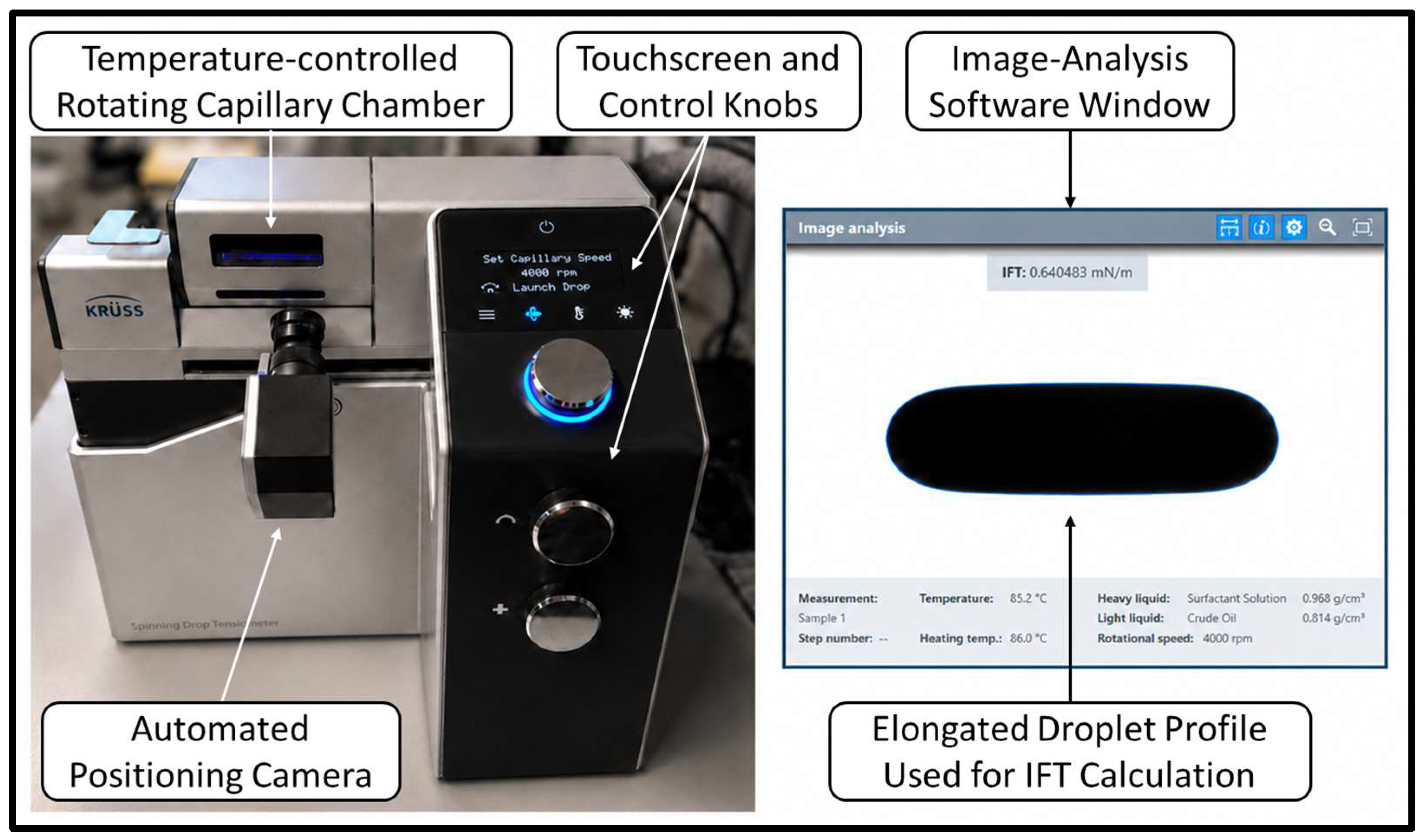
  42. Alameri, W.; Teklu, T.; Graves, R.; Kazemi, H.; AlSumaiti, A. Low-Salinity Water-Alternate-Surfactant in Low-Permeability Carbonate Reservoirs. In Proceedings of the 18th European Symposium on Improved Oil Recovery, Dresden, Germany, 14–16 April 2015. [Google Scholar]
  43. Hussien, O.; Elraies, K.; Almansour, A.; Husin, H.; Belhaj, A.; Ern, L. Experimental Study on the Use of Surfactant as a Fracking Fluid Additive for Improving Shale Gas Productivity. J. Pet. Sci. Eng. 2019, 183, 106426. [Google Scholar] [CrossRef]
  44. Belhaj, A.F.; Elraies, K.A.; Sarma, H.K.; Shuhili, J.A.; Mahmood, S.M.; Alnarabiji, M.S. Surfactant Partitioning and Adsorption in Chemical EOR: The Neglected Phenomenon in Porous Media. In Proceedings of the SPE/IATMI Asia Pacific Oil & Gas Conference and Exhibition, Virtual, 12–14 October 2021. [Google Scholar]
  45. Somoza, A.; Rodríguez-Cabo, B.; Barrio, I.; García-Mayoral, M.F.; Soto, A. Experimental Evaluation of Blends Containing Lineal Alkylbenzene Sulfonates for Surfactant Flooding in Carbonate Reservoirs. SPE Reserv. Eval. Eng. 2023, 26, 1309–1322. [Google Scholar] [CrossRef]
  46. Tafur, N.; Somoza, A.; Muñuzuri, A.P.; Rodríguez-Cabo, B.; Barrio, I.; Panadero, A.; García-Mayoral, M.F.; Soto, A. Assessment of a Surface-Active Ionic Liquid Formulation for EOR Applications: Experimental and Simulation Studies. Geoenergy Sci. Eng. 2023, 224, 211619. [Google Scholar] [CrossRef]
  47. Khurshid, I.; Addad, Y.; Afgan, I. Characterization of Surfactant Adsorption Profile in Carbonates Under Severe Reservoir Conditions With Geochemical Modeling Approach. J. Energy Resour. Technol. 2024, 146, 063001. [Google Scholar] [CrossRef]
  48. Dordzie, G.; Dejam, M. Enhanced Oil Recovery from Fractured Carbonate Reservoirs Using Nanoparticles with Low Salinity Water and Surfactant: A Review on Experimental and Simulation Studies. Adv. Colloid Interface Sci. 2021, 293, 102449. [Google Scholar] [CrossRef] [PubMed]
  49. Laben, A.B.; Al-Kayiem, H.H.; Alameen, M.A.; Khan, J.A.; Belhaj, A.F.; Elraies, K.A. Experimental Study on the Performance of Emulsions Produced during ASP Flooding. J. Pet. Explor. Prod. Technol. 2022, 12, 1797–1809. [Google Scholar] [CrossRef]
  50. Godoy, P.A.; Maqueira, L.; Pérez-Gramatges, A. Mechanistic Modeling of Zwitterionic Surfactant Adsorption on Mineral Surfaces: A Three-Step Isotherm with Micelle-Induced Desorption. Langmuir 2025, 41, 23726–23736. [Google Scholar] [CrossRef] [PubMed]
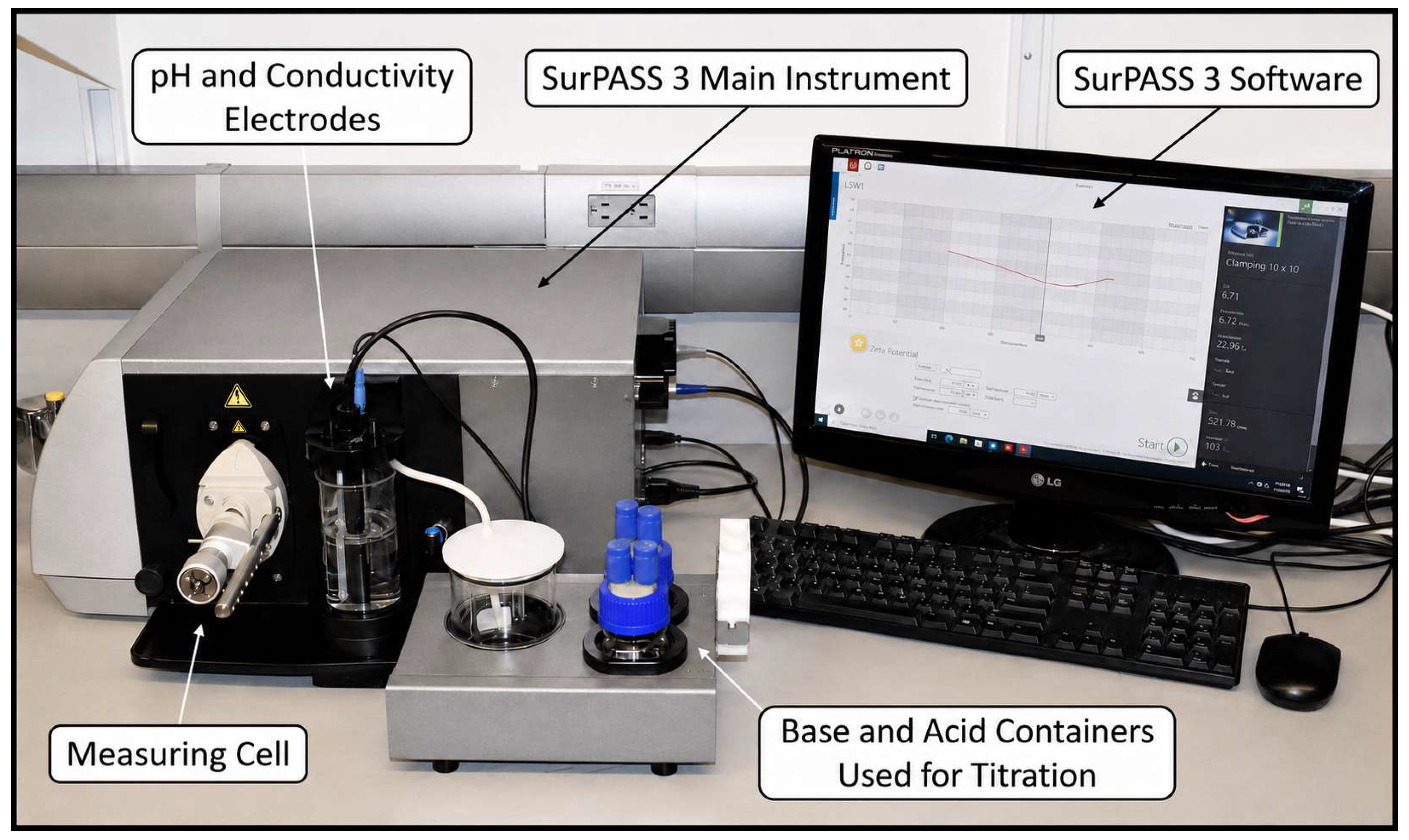
  51. Quintella, C.M.; Rodrigues, P.D.; Hanna, S.A.; Nicoleti, J.L.; Carvalho, E.B.; Medeiros, A.C.G.D.; Ramos-De-Souza, E.; Santos, E.S.D.; Vasconcelos, A.C.; Moura, J.D.D.; et al. Sustainable Enhanced Oil Recovery Fluid Based on Synergic Effects of Cationic, Anionic, and Nonionic Surfactants in Low Salinity: SLS; QA; and SDBS. ACS Omega 2025, 10, 8408–8419. [Google Scholar] [CrossRef] [PubMed]
  52. Bind, S.; Singh, J.K.; Sharma, H. Effect of Brine Composition on the Surface Energy of Calcite and Adhesion of Oil: Implications for the Wettability of Limestone Rocks. J. Mol. Liq. 2025, 437, 128606. [Google Scholar] [CrossRef]
  53. Ladan, E.B.; Schechter, D.S. Nonionic Surfactant Blends for Enhanced Oil Recovery in High-Temperature Eagle Ford Reservoir. SPE J. 2024, 29, 1605–1622. [Google Scholar] [CrossRef]
  54. Wang, F.; Hua, H.; Wang, L. Surfactant-Enhanced Assisted Spontaneous Imbibition for Enhancing Oil Recovery in Tight Oil Reservoirs: Experimental Investigation of Surfactant Types, Concentrations, and Temperature Impact. Energies 2024, 17, 1794. [Google Scholar] [CrossRef]
  55. Zhang, J.; Wang, S.; Wang, X.; Huang, B.; Zuo, M.; Chen, H. The Influence Mechanism and the Contribution of Capillary Force and Gravity to Recovery in Spontaneous Imbibition in Low Permeability Reservoirs. J. Dispers. Sci. Technol. 2024, 45, 720–730. [Google Scholar] [CrossRef]
  56. Ahmadi-Falavarjani, A.; Mahani, H.; Ayatollahi, S. Pore-Scale Simulation of Low-Salinity Waterflooding in Mixed-Wet Systems: Effect of Corner Flow, Surface Heterogeneity and Kinetics of Wettability Alteration. Sci. Rep. 2024, 14, 6563. [Google Scholar] [CrossRef] [PubMed]
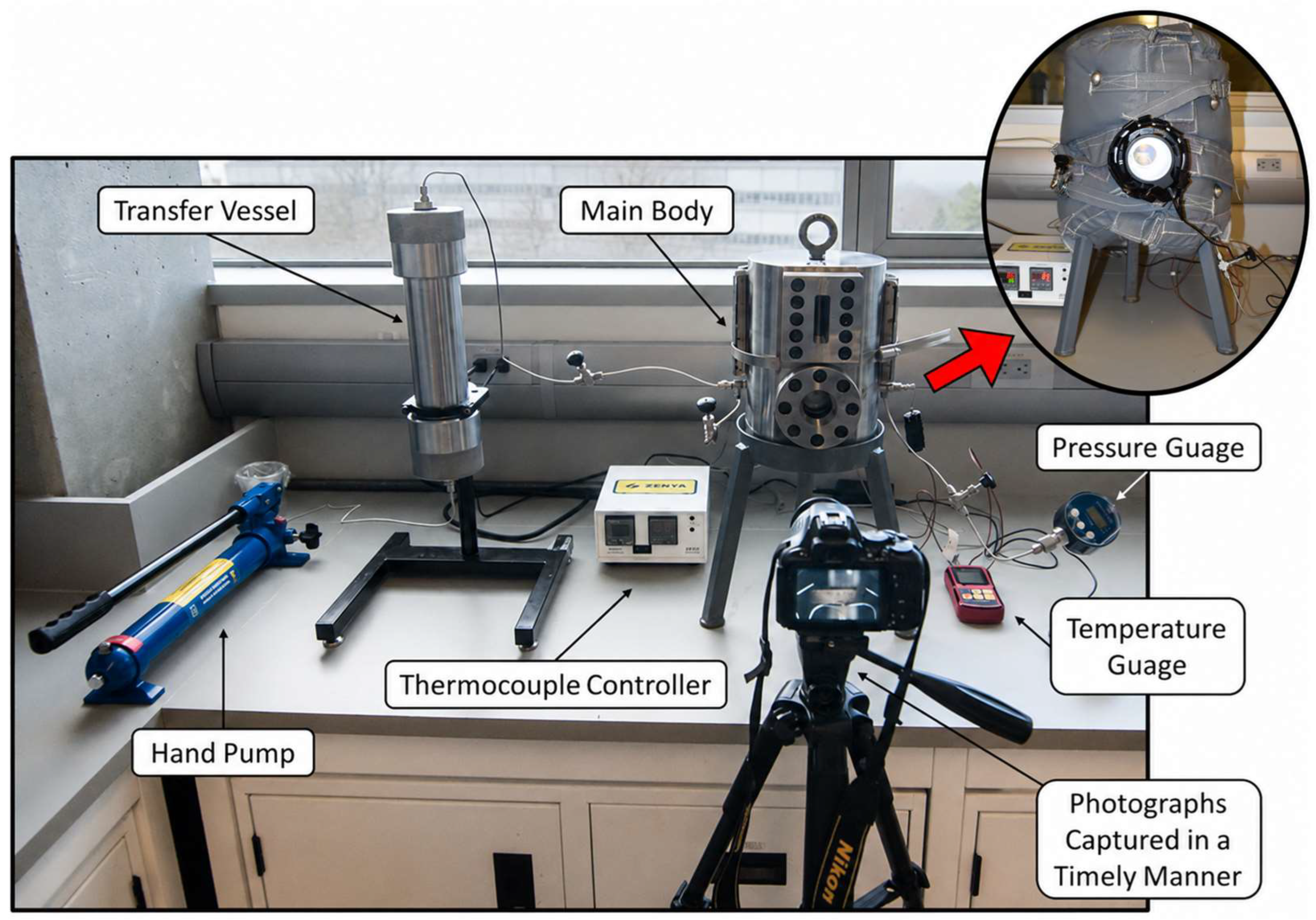
  57. Keumarsi, M.M.; Mollaei, R.; Fatemi, M. Microfluidics Simulations of the Importance of Micro Porosity on the Dynamic Wettability Alteration of the Porous Media: Effects of Wettability Alteration Scenario, Mixed-Wettability, Flow Rate and Oil Viscosity. Geoenergy Sci. Eng. 2025, 254, 214034. [Google Scholar] [CrossRef]
  58. AlZahrani, H.M.; Bijeljic, B.; Foroughi, S.; Blunt, M.J. Pore-Scale Imaging and Analysis of Secondary Surfactant Flooding in a Heterogeneous Carbonate Rock. Geoenergy Sci. Eng. 2025, 248, 213728. [Google Scholar] [CrossRef]
  59. Mirchi, V.; Piri, M.; Goual, L. In Situ Wettability and Pore/Fluid Occupancies during Low-Salinity Surfactant Flooding in Oil-Wet Carbonates. Energy Fuels 2026, 40, 2514–2529. [Google Scholar] [CrossRef]
  60. Farhadzadeh, M.; Bonto, M.; Nick, H.M. Pore-Scale Modeling of Heterogeneous Carbonate Rock Subjected to Modified Salinity Waterflooding. Energy Fuels 2024, 38, 6821–6833. [Google Scholar] [CrossRef]
  61. Malakoutikhah, M.; Siavashi, J.; Fahimpour, J.; Sharifi, M. Pore-Scale Investigation of Low-Salinity Water Flooding in a Heterogeneous-Wet Porous Medium. Heliyon 2024, 10, e33303. [Google Scholar] [CrossRef] [PubMed]
  62. Jalilian, M.; Mahdavi, S.; Pourafshary, P.; You, Z.; Mohammadi, A.H. Assessing the Impact of Geochemical Mechanism and Interpolation Factor Selection on the Precision of Low-Salinity Waterflooding Modelling: A Comparative Study. Geosyst. Eng. 2024, 27, 304–318. [Google Scholar] [CrossRef]
  63. Huang, D.D.; Honarpour, M.M. Capillary End Effects in Coreflood Calculations. J. Pet. Sci. Eng. 1998, 19, 103–117. [Google Scholar] [CrossRef]
  64. Andersen, P.; Zhou, Y. Steady State Relative Permeability Experiments with Capillary End Effects: Analytical Solutions Including Derivation of the Intercept Method. J. Pet. Sci. Eng. 2020, 192, 107249. [Google Scholar] [CrossRef]
  65. Gopani, P.H.; Singh, N.; Sarma, H.K.; Mattey, P.; Srivastava, V.R. Role of Monovalent and Divalent Ions in Low-Salinity Water Flood in Carbonate Reservoirs: An Integrated Analysis through Zeta Potentiometric and Simulation Studies. Energies 2021, 14, 729. [Google Scholar] [CrossRef]
  66. Viades-Trejo, J.; Gracia-Fadrique, J. Spinning Drop Method. From Young-Laplace to Vonnegut. Colloids Surf. A Physicochem. Eng. Asp. 2007, 302, 549–552. [Google Scholar] [CrossRef]
  67. Singh, N.; Gopani, P.H.; Sarma, H.K.; Mattey, P.; Negi, D.S.; Srivastava, V.R.; Luxbacher, T. Charging Behaviour at the Carbonate Rock-Water Interface in Low-Salinity Waterflooding: Estimation of Zeta Potential in High-Salinity Brines. Can. J. Chem. Eng. 2022, 100, 1226–1234. [Google Scholar] [CrossRef]
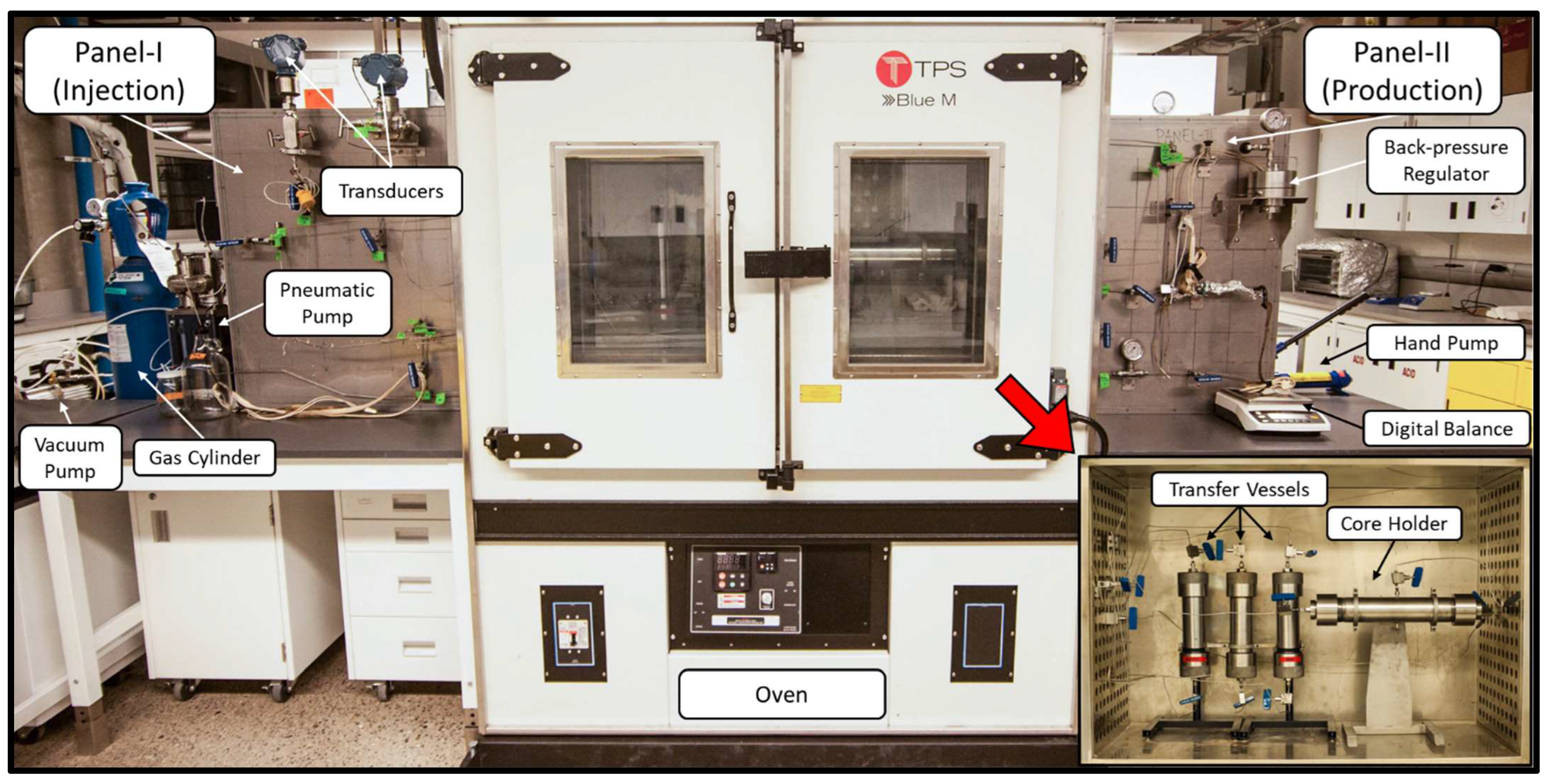
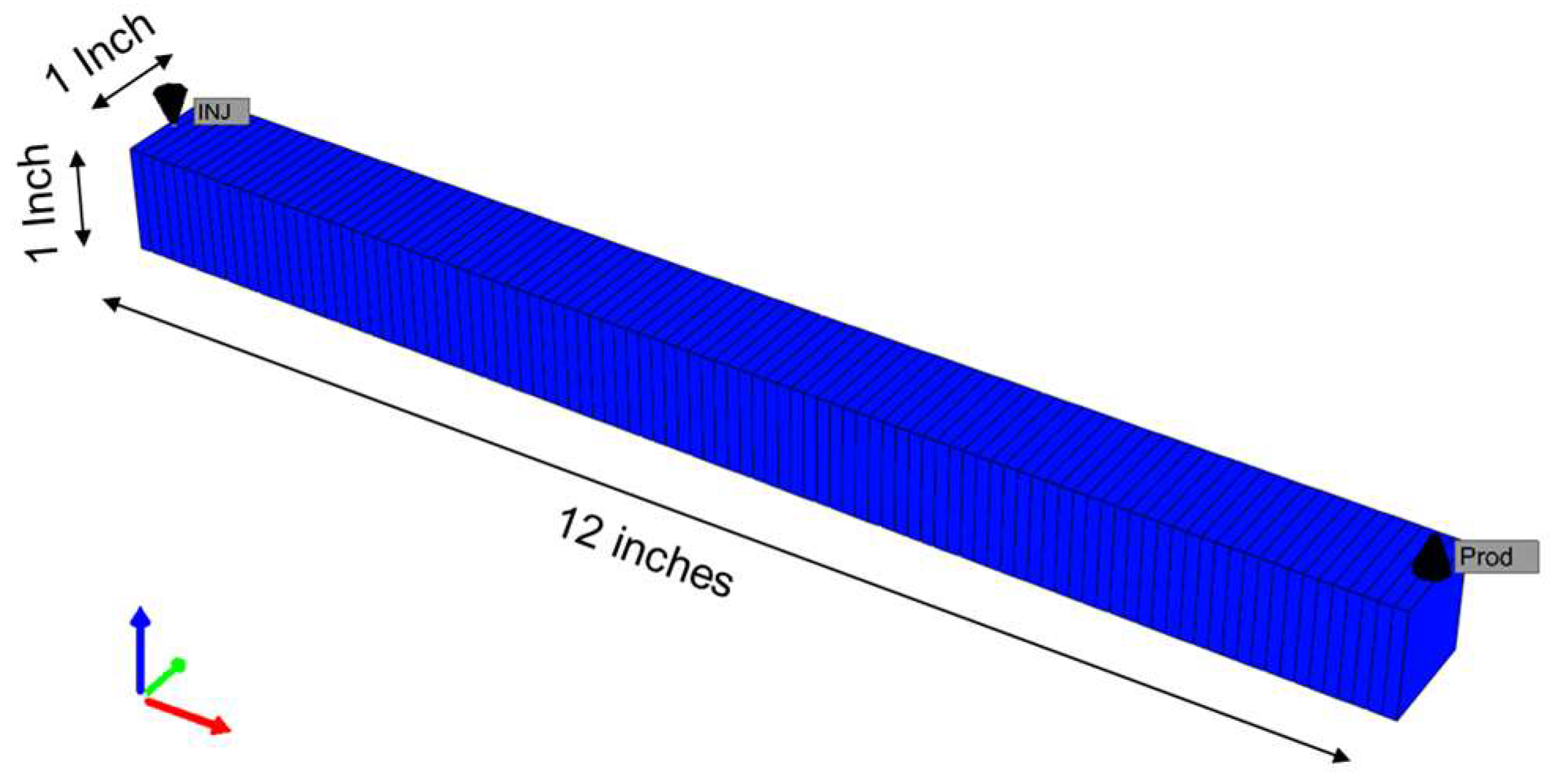
  68. Sarma, H.K.; Singh, N.; Belhaj, A.F.; Jain, A.K.; Gopal, G.; Srivastava, V.R. A Lab-to-Field Approach and Evaluation of Low-Salinity Waterflooding Process for High-Temperature High-Pressure Carbonate Reservoirs. In Proceedings of the SPE Asia Pacific Oil & Gas Conference and Exhibition, Adelaide, Australia, 17–19 October 2022. [Google Scholar]
  69. Mahani, H.; Keya, A.L.; Berg, S.; Nasralla, R.; Global, S.; International, S. Electrokinetics of Carbonate/Brine Interface in Low-Salinity Waterflooding: Effect of Brine Salinity, Composition, Rock Type, and pH on Z-Potential and a Surface-Complexation Model. SPE J. 2017, 22, 53–68. [Google Scholar] [CrossRef]
  70. Appelo, C.A.J.; Postma, D. Geochemistry, Groundwater and Pollution, 2nd ed.; CRC Press: New York, NY, USA, 2010. [Google Scholar]
  71. Alroudhan, A.; Vinogradov, J.; Jackson, M.D. Zeta Potential of Intact Natural Limestone: Impact of Potential-Determining Ions Ca, Mg and SO4. Colloids Surf. A Physicochem. Eng. Asp. 2016, 493, 83–98. [Google Scholar] [CrossRef]
  72. CMG. GEM User Guide; Computer Modeling Group: Calgary, AB, Canada, 2022. [Google Scholar]
  73. Khurshid, I.; Al-shalabi, E.W. New Insights into Modeling Disjoining Pressure and Wettability Alteration by Engineered Water: Surface Complexation Based Rock Composition Study. J. Pet. Sci. Eng. 2022, 208, 109584. [Google Scholar] [CrossRef]
  74. Parkhurst, D.L.; Appelo, C.A.J. User’s Guide to PHREEQC, 2nd ed.; Water-Resources Investigations Report; U.S. Geological Survey: Denver, CO, USA, 1999. [Google Scholar]
  75. Brooks, R.H.; Corey, A.T. Hydraulic Properties of Porous Media; Hydrology Papers; Colorado State University: Fort Collins, CO, USA, 1964. [Google Scholar]
  76. Skjæveland, S.M.; Siqveland, L.M.; Kjosavik, A.; Hammervold Thomas, W.L.; Virnovsky, G.A. Capillary Pressure Correlation for Mixed-Wet Reservoirs. SPE Reserv. Eval. Eng. 2000, 3, 60–67. [Google Scholar] [CrossRef]
  77. Al-Attar, H.H.; Mahmoud, M.Y.; Zekri, A.Y.; Almehaideb, R.; Ghannam, M. Low-Salinity Flooding in a Selected Carbonate Reservoir: Experimental Approach. J. Pet. Explor. Prod. 2013, 3, 139–149. [Google Scholar] [CrossRef]
  78. Okasha, T.M.; Al-Shiwaish, A.-J.A. Effect of Brine Salinity on Interfacial Tension in Arab-D Carbonate Reservoir, Saudi Arabia. In Proceedings of the SPE Middle East Oil & Gas Show and Conference, Manama, Bahrain, 15–18 March 2009. [Google Scholar]
  79. Rostami, P.; Mehrabana, M.F.; Sharifi, M.; Dejam, M.; Ayatollahi, S. Effect of Water Salinity on Oil/Brine Interfacial Behaviour during Low Salinity Waterflooding: A Mechanistic Study. Petroleum 2019, 5, 367–374. [Google Scholar] [CrossRef]
  80. Farhadi, H.; Ayatollahi, S.; Fatemi, M. The Effect of Brine Salinity and Oil Components on Dynamic IFT Behavior of Oil-Brine during Low Salinity Water Flooding: Diffusion Coefficient, EDL Establishment Time, and IFT Reduction Rate. J. Pet. Sci. Eng. 2021, 196, 107862. [Google Scholar] [CrossRef]
  81. Belhaj, A.F.; Fakir, S.H.; Singh, N.; Sarma, H.K. Extensive Experimental Study of Low-Salinity Waterflooding Using Hele-Shaw Cell: A Focus on Gravity and Mobility Ratio Effects. In Proceedings of the SPE Canadian Energy Technology Conference and Exhibition, Calgary, AB, Canada, 15–16 March 2023. [Google Scholar]
  82. Bergfreund, J.; Siegenthaler, S.; Lutz-bueno, V.; Bertsch, P.; Fischer, P. Surfactant Adsorption to Different Fluid Interfaces. Langmuir 2021, 37, 6722–6727. [Google Scholar] [CrossRef] [PubMed]
  83. Groenendijk, D.J.; van Wunnik, J.N.M. Surfactant Adsorption and Ion Exchange on Calcite Surfaces. Energy Fuels 2021, 35, 8763–8772. [Google Scholar] [CrossRef]
  84. Nowrouzi, I.; Mohammadi, A.H.; Manshad, A.K. Characterization and Evaluation of a Natural Surfactant Extracted from Soapwort Plant for Alkali-Surfactant-Polymer (ASP) Slug Injection into Sandstone Oil Reservoirs. J. Mol. Liq. 2020, 318, 114369. [Google Scholar] [CrossRef]
  85. Massarweh, O.; Abushaikha, A.S. Application of Surfactants in Enhancing Oil Recovery from Tight Carbonates: Physicochemical Properties and Core Flooding Experiments. Geoenergy Sci. Eng. 2023, 221, 211400. [Google Scholar] [CrossRef]
  86. Akhlaghi, N.; Riahi, S.; Parvaneh, R. Interfacial Tension Behavior of a Nonionic Surfactant in Oil/Water System; Salinity, pH, Temperature, and Ionic Strength Effects. J. Pet. Sci. Eng. 2021, 198, 108177. [Google Scholar] [CrossRef]
  87. Liu, J.; Liu, S.; Zhong, L.; Wang, P.; Gao, P.; Guo, Q. Ultra-Low Interfacial Tension Anionic/Cationic Surfactants System with Excellent Emulsification Ability for Enhanced Oil Recovery. J. Mol. Liq. 2023, 382, 121989. [Google Scholar] [CrossRef]
  88. Lin, Y.; Tang, W.; Xiao, P.; Ma, J.; Han, X.; Xu, X.; Luo, J.; Zhao, S. Synergistic Effect of Salt and Anionic Surfactants on Interfacial Tension Reduction: Insights from Molecular Dynamics Simulations. Langmuir 2023, 39, 12392–12401. [Google Scholar] [CrossRef] [PubMed]
  89. Jackson, M.D.; Al-Mahrouqi, D.; Vinogradov, J. Zeta Potential in Oil-Water-Carbonate Systems and Its Impact on Oil Recovery during Controlled Salinity Water-Flooding. Sci. Rep. 2016, 6, 37363. [Google Scholar] [CrossRef] [PubMed]
  90. Derkani, M.H.; Fletcher, A.J.; Abdallah, W.; Sauerer, B.; Anderson, J.; Zhang, Z.J. Low Salinity Waterflooding in Carbonate Reservoirs: Review of Interfacial Mechanisms. Colloids Interfaces 2018, 2, 20. [Google Scholar] [CrossRef]
  91. Ding, H.; Rahman, S. Experimental and Theoretical Study of Wettability Alteration during Low Salinity Water Flooding-an State of the Art Review. Colloids Surf. A Physicochem. Eng. Asp. 2017, 520, 622–639. [Google Scholar] [CrossRef]
  92. Al-bayati, A.; Karunarathne, C.I.; Al Jehani, A.S.; Al-yaseri, A.Z.; Keshavarz, A.; Iglauer, S. Wettability Alteration during Low-Salinity Water Flooding. Energy Fuels 2022, 36, 871–879. [Google Scholar] [CrossRef]
  93. Hou, J.; Han, M.; Wang, J. Manipulation of Surface Charges of Oil Droplets and Carbonate Rocks to Improve Oil Recovery. Sci. Rep. 2021, 11, 14518. [Google Scholar] [CrossRef] [PubMed]
  94. Ma, K.; Cui, L.; Dong, Y.; Wang, T.; Da, C.; Hirasaki, G.J.; Biswal, S.L. Adsorption of Cationic and Anionic Surfactants on Natural and Synthetic Carbonate Materials. J. Colloid Interface Sci. 2013, 408, 164–172. [Google Scholar] [CrossRef] [PubMed]
  95. Sagbana, P.I.; Sarkodie, K.; Nkrumah, W.A. A Critical Review of Carbonate Reservoir Wettability Modification during Low Salinity Waterflooding. Petroleum 2023, 9, 317–330. [Google Scholar] [CrossRef]
  96. Nande, S.B.; Patwardhan, S.D. A Review on Low Salinity Waterflooding in Carbonates: Challenges and Future Perspective. J. Pet. Explor. Prod. Technol. 2022, 12, 1037–1055. [Google Scholar] [CrossRef]
  97. Javadi, A.H.; Belhaj, A.F.; Fakir, S.H.; Sarma, H.K. Experimental Investigation of Surfactant-Assisted Low-Salinity Brine Flooding in Oil-Wet Carbonate Reservoirs for Enhanced Oil Recovery. Processes 2026, 14, 1054. [Google Scholar] [CrossRef]
  98. Ayirala, S.C.; Al-yousef, A.A.; Li, Z.; Xu, Z. Water Ion Interactions at Crude-Oil/Water Interface and Their Implications for Smart Waterflooding in Carbonates. SPE J. 2018, 23, 1817–1832. [Google Scholar] [CrossRef]
  99. Kar, T.; Cho, H.; Firoozabadi, A. Assessment of Low Salinity Waterflooding in Carbonate Cores: Interfacial Viscoelasticity and Tuning Process Efficiency by Use of Non-Ionic Surfactant. J. Colloid Interface Sci. 2022, 607, 125–133. [Google Scholar] [CrossRef] [PubMed]
  100. Hirasaki, G.; Zhang, D.L. Surface Chemistry of Oil Recovery From Fractured, Oil-Wet, Carbonate Formations. SPE J. 2004, 9, 151–162. [Google Scholar] [CrossRef]
  101. Medina, J.A.; Obasi, E.C.; Elshehabi, T.; Saraji, S. Geoenergy Science and Engineering Wettability Alternation and Interface Tension Modification for Enhanced Oil Recovery in Oil-Wet Carbonates: A Comparative Study of Different Surfactants. Geoenergy Sci. Eng. 2023, 225, 211637. [Google Scholar] [CrossRef]
  102. Bajgirani, S.S.N.; Dehaghani, A.H.S. Experimental Investigation of Wettability Alteration, IFT Reduction, and Injection Schemes during Surfactant/Smart Water Flooding for EOR Application. Sci. Rep. 2023, 13, 11362. [Google Scholar] [CrossRef] [PubMed]
  103. Ayirala, S.C.; Boqmi, A.; Alghamdi, A.; Also, A. Dilute Surfactants for Wettability Alteration and Enhanced Oil Recovery in Carbonates. J. Mol. Liq. 2019, 285, 707–715. [Google Scholar] [CrossRef]
  104. Bhicajee, P.; Romero-zer, L. Effect of Different Low Salinity Flooding Schemes and the Addition of Alkali on the Performance of Low-Salinity Waterflooding during the Recovery of Heavy Oil from Unconsolidated Sandstone. Fuel 2021, 289, 119981. [Google Scholar] [CrossRef]
  105. Souayeh, M.; Al-Maamari, R.S.; Karimi, M.; Aoudia, M. Wettability Alteration and Oil Recovery by Surfactant Assisted Low Salinity Water in Carbonate Rock: The Impact of Nonionic/Anionic Surfactants. J. Pet. Sci. Eng. 2021, 197, 108108. [Google Scholar] [CrossRef]
  106. Sami, B.; Azdarpour, A.; Honarvar, B.; Nabipour, M.; Keshavarz, A. Application of a Novel Natural Surfactant Extracted from Avena Sativa for Enhanced Oil Recovery during Low Salinity Water Flooding: Synergism of Natural Surfactant with Different Salts. J. Mol. Liq. 2022, 362, 119693. [Google Scholar] [CrossRef]
  107. Zhang, Z.; Azad, M.S.; Trivedi, J.J. IFT or Wettability Alteration: What Is More Important for Oil Recovery in Oil-Wet Formation? Fuel 2021, 291, 119986. [Google Scholar] [CrossRef]
  108. Bennetzen, M.V.; Mogensen, K.; Frank, S.; Centre, T. Dilute Surfactant Flooding Studies in a Low-Permeability Oil-Wet Middle East Carbonate. In Proceedings of the International Petroleum Technology Conference, Doha, Qatar, 20–22 January 2014. [Google Scholar]
  109. Belhaj, A.F.; Shuhli, J.A.B.; Elraies, K.A.; Mahmood, S.M.; Maulianda, B.; Alnarabiji, M.S. Partitioning Behaviour of Novel Surfactant Mixture for High Reservoir Temperature and High Salinity Conditions. Energy 2020, 198, 117319. [Google Scholar] [CrossRef]
  110. Nowrouzi, I.; Manshad, A.K.; Mohammadi, A.H. Effects of Ions and Dissolved Carbon Dioxide in Brine on Wettability Alteration, Contact Angle and Oil Production in Smart Water and Carbonated Smart Water Injection Processes in Carbonate Oil Reservoirs. Fuel 2019, 235, 1039–1051. [Google Scholar] [CrossRef]
  111. Sarma, H.K.; Singh, N.; Belhaj, A.F.; Jain, A.K.; Gopal, G.; Srivastava, V.R. A Review and Evaluation of Laboratory-to-Field Approach for Low-Salinity Waterflooding Process for Carbonate Reservoirs. Arab. J. Sci. Eng. 2023, 48, 15747–15767. [Google Scholar] [CrossRef]
  112. Boampong, L.O.; Rafati, R.; Haddad, A.S. Analysis of Wettability Alteration in Low Salinity Water Flooding Using a Zeta Potential-Based Model. Capillarity 2023, 7, 32–40. [Google Scholar] [CrossRef]
  113. Feldmann, F.; Al-Shalabi, E.W.; Hiorth, A. Surface Charge Change in Carbonates during Low-salinity Imbibition. Sci. Rep. 2024, 14, 13018. [Google Scholar] [CrossRef] [PubMed]
  114. Shi, Y.; Miller, C.; Mohanty, K. Surfactant-Aided Low-Salinity Waterflooding for Low-Temperature Carbonate Reservoirs. SPE J. 2021, 26, 2214–2230. [Google Scholar] [CrossRef]
  115. Shakeel, M.; Samanova, A.; Pourafshary, P.; Hashmet, M.R. Optimization of Low Salinity Water/Surfactant Flooding Design for Oil-Wet Carbonate Reservoirs by Introducing a Negative Salinity Gradient. Energies 2022, 15, 9400. [Google Scholar] [CrossRef]
  116. Aghdam, S.K.; Kazemi, A.; Ahmadi, M. Studying the Effect of Surfactant Assisted Low-Salinity Water Flooding on Clay-Rich Sandstones. Petroleum 2024, 10, 306–318. [Google Scholar] [CrossRef]
  117. Mahani, H.; Keya, A.L.; Berg, S.; Bartels, W.B.; Nasralla, R.; Rossen, W.R. Insights into the Mechanism of Wettability Alteration by Low-Salinity Flooding (LSF) in Carbonates. Energy Fuels 2015, 29, 1352–1367. [Google Scholar] [CrossRef]
  118. Jin, M.; Ribeiro, A.; Mackay, E.; Guimaraes, L.; Bagudu, U. Geochemical Modelling of Formation Damage Risk during CO2 Injection in Saline Aquifers. J. Nat. Gas. Sci. Eng. 2016, 35, 703–719. [Google Scholar] [CrossRef]
  119. Maalim, A.A.; Ben Mahmud, H.; Seyyedi, M. Assessing Roles of Geochemical Reactions on CO2 Plume, Injectivity and Residual Trapping. Energy Geosci. 2021, 2, 327–336. [Google Scholar] [CrossRef]
  120. Egbe, D.I.O.; Ghahfarokhi, A.J.; Amar, M.N.; Torsæter, O. Application of Low-Salinity Waterflooding in Carbonate Cores: A Geochemical Modeling Study. Nat. Resour. Res. 2021, 30, 519–542. [Google Scholar] [CrossRef]
  121. Tetteh, J.T.; Pham, A.; Peltier, E.; Hutchison, J.M.; Ghahfarokhi, R.B. Predicting the Electrokinetic Properties on an Outcrop and Reservoir Composite Carbonate Surfaces in Modified Salinity Brines Using Extended Surface Complexation Models. Fuel 2022, 309, 122078. [Google Scholar] [CrossRef] [PubMed]
  122. Boampong, L.O.; Rafati, R.; Haddad, A.S. A Calibrated Surface Complexation Model for Carbonate-Oil-Brine Interactions Coupled with Reservoir Simulation—Application to Controlled Salinity Water Flooding. J. Pet. Sci. Eng. 2022, 208, 109314. [Google Scholar] [CrossRef]
  123. Karimova, M.; Kashiri, R.; Pourafshary, P.; Hazlett, R. A Review of Wettability Alteration by Spontaneous Imbibition Using Low-Salinity Water in Naturally Fractured Reservoirs. Energies 2023, 16, 2373. [Google Scholar] [CrossRef]
  124. Belhaj, A.F.; Elraies, K.A.; Shuhili, J.A.; Mahmood, S.M.; Tewari, R.D.; Alnarabiji, M.S. Static Adsorption Evaluation for Anionic-Nonionic Surfactant Mixture on Sandstone in the Presence of Crude Oil at High Reservoir Temperature Condition. SPE Reserv. Eval. Eng. 2022, 25, 261–272. [Google Scholar] [CrossRef]
  125. Ramatou, I.I.; Li, Y.; Wang, W.; Cao, J.; Liu, Z. Investigation on Pore-Scale Mechanisms of Microemulsion-Driven Residual Oil in Surfactant Flooding Systems. Chem. Eng. Sci. 2026, 324, 123299. [Google Scholar] [CrossRef]
  126. Takeya, M.; Ubaidah, A.; Shimokawara, M.; Okano, H.; Nawa, T.; Elakneswaran, Y. Crude Oil/Brine/Rock Interface in Low Salinity Waterflooding: Experiments, Triple-Layer Surface Complexation Model, and DLVO Theory. J. Pet. Sci. Eng. 2020, 188, 106913. [Google Scholar] [CrossRef]
  127. Meng, Q.; Liu, H.; Wang, J. A Critical Review on Fundamental Mechanisms of Spontaneous Imbibition and the Impact of Boundary Condition, Fluid Viscosity and Wettability. Adv. Geo-Energy Res. 2017, 1, 1–17. [Google Scholar] [CrossRef]
  128. Belhaj, A.F.; Fakir, S.H.; Javadi, A.H.; Sarma, H.K. Bridging Laboratory Insights to Field Applications: Advancing Geochemical Modelling of Hybrid Low-Salinity Surfactant Flooding in Carbonates. In Proceedings of the SPE Annual Technical Conference and Exhibition, Houston, TX, USA, 20–22 October 2025. [Google Scholar]
  129. Zou, J.; Yuan, Y.; Li, S.; Tan, X.; Zhao, R.; Yuan, C.; Yue, X. Effect of Emulsification on Oil Displacement Performance of Ultra-Low Interfacial Tension Surfactants under Different Permeability Conditions. Fuel 2027, 427, 140031. [Google Scholar] [CrossRef]
  130. Belhaj, A.F.; Singh, N.; Sarma, H.K. Understanding the Interactions at Rock-Water and Oil-Water Interfaces during Controlled-Salinity Water Flooding. In Proceedings of the Offshore Technology Conference Asia, Kuala Lumpur, Malaysia, 22–25 March 2022. [Google Scholar]
  131. Kassa, A.M.; Gasda, S.E.; Kumar, K.; Radu, F.A. Modeling of Relative Permeabilities Including Dynamic Wettability Transition Zones. J. Pet. Sci. Eng. 2021, 203, 108556. [Google Scholar] [CrossRef]
  132. Hosseinzadehsadati, S.; Eftekhari, A.A.; Nick, H.M. Role of Relative Permeability Hysteresis in Modified Salinity Water Flooding. Fuel 2022, 321, 124085. [Google Scholar] [CrossRef]
  133. Chang, L.Y.; Pope, G.A. A New Surfactant Wettability Alteration Model for Reservoir Simulators. J. Surfactants Deterg. 2023, 26, 437–451. [Google Scholar] [CrossRef]
  134. Adila, A.S.; Al-Shalabi, E.W.; Alameri, W. Geochemical Investigation of Hybrid Surfactant and Low Salinity/Engineered Water Injections in Carbonates: A Numerical Study. J. Pet. Sci. Eng. 2022, 208, 109367. [Google Scholar] [CrossRef]
  135. Mehranjani, M.A.; Khodapanah, E. Investigating the Impact of Relative Permeability Characteristics and Pressure Management on Oil Recovery during Low-Salinity Water Injection. Results Eng. 2026, 29, 108863. [Google Scholar] [CrossRef]
  136. Khosravi, R.; Simjoo, M.; Chahardowli, M. Low Salinity Water Flooding: Estimating Relative Permeability and Capillary Pressure Using Coupling of Particle Swarm Optimization and Machine Learning Technique. Sci. Rep. 2024, 14, 13213. [Google Scholar] [CrossRef] [PubMed]
  137. Pourakaberian, A.; Mahani, H.; Niasar, V. The Impact of the Electrical Behavior of Oil-Brine-Rock Interfaces on the Ionic Transport Rate in a Thin Film, Hydrodynamic Pressure, and Low Salinity Waterflooding Effect. Colloids Surf. A Physicochem. Eng. Asp. 2021, 620, 126543. [Google Scholar] [CrossRef]
  138. Adegbite, J.O.; Al-shalabi, E.W.; Ghosh, B. Geochemical Modeling of Engineered Water Injection Effect on Oil Recovery from Carbonate Cores. J. Pet. Sci. Eng. 2018, 170, 696–711. [Google Scholar] [CrossRef]
  139. Pouryousefy, E.; Xie, Q.; Saeedi, A. Effect of Multi-Component Ions Exchange on Low Salinity EOR: Coupled Geochemical Simulation Study. Petroleum 2016, 2, 215–224. [Google Scholar] [CrossRef]
  140. Sanaei, A.; Tavassoli, S.; Sepehrnoori, K. Investigation of Modified Water Chemistry for Improved Oil Recovery: Application of DLVO Theory and Surface Complexation Model. Colloids Surf. A Physicochem. Eng. Asp. 2019, 574, 131–145. [Google Scholar] [CrossRef]
  141. Li, R.; Mohanty, K.K.; Kang, Q.; Chen, Y.; Wu, Y.; Zhao, Z. Pore-Scale Modeling of Wettability Alteration Induced by Low Salinity Water in Carbonates. Langmuir 2025, 41, 31343–31358. [Google Scholar] [CrossRef] [PubMed]
  142. Liu, F.; Wang, M. Review of Low Salinity Waterflooding Mechanisms: Wettability Alteration and Its Impact on Oil Recovery. Fuel 2020, 267, 117112. [Google Scholar] [CrossRef]
  143. Song, J.; Wang, Q.; Shaik, I.; Puerto, M.; Bikkina, P.; Aichele, C.; Biswal, S.L.; Hirasaki, G.J. Effect of Salinity, Mg2+ and SO42− on ‘‘Smart Water”-Induced Carbonate Wettability Alteration in a Model Oil System. J. Colloid Interface Sci. 2020, 563, 145–155. [Google Scholar] [CrossRef] [PubMed]
  144. Belhaj, A.; Singh, N.; Sarma, H. Critical Assessment of the Hybrid Impact of Surfactants on Modified Salinity Water Flooding. In Proceedings of the SPE Canadian Energy Technology Conference, Calgary, AB, Canada, 16–17 March 2022. [Google Scholar]
  145. Tagavifar, M.; Jang, S.H.; Sharma, H.; Wang, D.; Chang, L.Y.; Mohanty, K.; Pope, G.A. Effect of pH on Adsorption of Anionic Surfactants on Limestone: Experimental Study and Surface Complexation Modeling. Colloids Surf. A Physicochem. Eng. Asp. 2018, 538, 549–558. [Google Scholar] [CrossRef]
  146. Bordeaux-Rego, F.; Mehrabi, M.; Sanaei, A.; Sepehrnoori, K. Improvements on Modelling Wettability Alteration by Engineered Water Injection: Surface Complexation at the Oil/Brine/Rock Contact. Fuel 2021, 284, 118991. [Google Scholar] [CrossRef]
  147. Saeed, M.; Jadhawar, P.; Ayirala, S.C.; Abhishek, R.; Zhou, Y. Modelling the Effects of Reservoir Parameters and Rock Mineralogy on Wettability during Low Salinity Waterflooding in Sandstone Reservoirs. J. Pet. Sci. Eng. 2022, 215, 110676. [Google Scholar] [CrossRef]
  148. Ali, R.; Gong, Y.; Alizadeh, A.H.; Piri, M. The Effect of Wettability on Waterflood Remaining Oil Saturation and Endpoint Relative Permeabilities in Carbonate and Sandstone Rocks; Springer: Dordrecht, The Netherlands, 2026; Volume 153. [Google Scholar]
  149. Chaabi, O.; Al Kobaisi, M.; Haroun, M. Quantifying the Low Salinity Waterflooding Effect. Energies 2021, 14, 1979. [Google Scholar] [CrossRef]
  150. He, Y.; Liu, Y.; Zhang, B.; Li, J.; Fan, P.; Chai, R.; Xue, L. Low-Salinity Water Flooding in Middle East Offshore Carbonate Reservoirs: Adaptation to Reservoir Characteristics and Dynamic Recovery Mechanisms. Phys. Fluids 2025, 37, 076605. [Google Scholar] [CrossRef]
  151. Belhaj, A.F.; Elraies, K.A.; Alnarabiji, M.S.; Abdul Kareem, F.A.; Shuhli, J.A.; Mahmood, S.M.; Belhaj, H. Experimental Investigation, Binary Modelling and Artificial Neural Network Prediction of Surfactant Adsorption for Enhanced Oil Recovery Application. Chem. Eng. J. 2021, 406, 127081. [Google Scholar] [CrossRef] [PubMed]
  152. Nieto-Alvarez, D.A.; Luna-Rojero, E.E.; Marín-Leon, A.; Cerón-Camacho, R.; Nieto-Rivero, C.J.T.; Zamudio-Rivera, L.S. Static Adsorption and Mathematical Model Applied in EOR Using a Supramolecular Surfactant. J. Pet. Sci. Eng. 2021, 198, 108200. [Google Scholar] [CrossRef]
Figure 1. Schematic representation of oil–brine–rock interactions under different wettability conditions. In the oil-wet state (top figure), attractive interaction between the oil–brine and rock–brine interfaces leads to a thin and unstable water film, low disjoining pressure, and easier oil–rock contact. In the water-wet state (bottom figure), repulsive interaction between the interfaces creates a higher energy barrier, stabilizes the water film, and reduces direct oil–rock adhesion. Adapted from Awolayo et al. [26].
Applsci 16 07253 g001
Figure 2. KRÜSS spinning drop tensiometer used for measuring the interfacial tension between crude oil and the tested brine/surfactant solutions at 86 °C.
Applsci 16 07253 g002
Figure 3. Anton Paar SurPASS3 Zeta Potential Analyzer used for zeta potential measurements of the carbonate rock surface in contact with the tested brine and surfactant solutions.
Applsci 16 07253 g003
Figure 4. HPHT cell specially designed for time-dependent visualization of wettability alteration in rock samples during spontaneous imbibition experiments. The principal components include the transfer vessel, HPHT main body, hand pump, thermocouple controller, pressure and temperature gauges, and camera used for time-lapse image acquisition. The red arrow identifies the main body of the HPHT cell, which is presented at a larger scale in the enlarged view, including its insulated exterior and optical viewing window.
Applsci 16 07253 g004
Figure 5. Coreflooding setup used to conduct displacement experiments on composite carbonate cores under HPHT conditions. Panel I represents the injection section and includes the gas cylinder, vacuum pump, pneumatic pump, and pressure transducers. Panel II represents the production section and includes the back-pressure regulator, hand pump, and digital balance used for effluent collection and measurement. The transfer vessels and core holder were housed inside the temperature-controlled oven. The red arrow indicates the location of the internal coreflooding assembly, which is shown separately in the enlarged view.
Applsci 16 07253 g005
Figure 6. 1D simulation model for coreflooding experiments.
Applsci 16 07253 g006
Figure 7. Interfacial tension between crude oil and brines of different salinities at 86 °C in the absence of surfactant.
Applsci 16 07253 g007
Figure 8. Interfacial tension between crude oil and surfactant solutions prepared in SW and 1%dSW as a function of A-1 concentration at 86 °C.
Applsci 16 07253 g008
Figure 9. Zeta potential measurements of diluted seawater brines in the absence of surfactant.
Applsci 16 07253 g009
Figure 10. Zeta potential measurements of 25%dSW+A-1 and 1%dSW+A-1 as a function of surfactant concentration.
Applsci 16 07253 g010
Figure 11. Time-dependent contact angle measurements obtained during spontaneous imbibition under HPHT conditions using SW.
Applsci 16 07253 g011
Figure 12. Time-dependent contact angle measurements obtained during spontaneous imbibition under HPHT conditions using 1%dSW.
Applsci 16 07253 g012
Figure 13. Time-dependent contact angle measurements obtained during spontaneous imbibition under HPHT conditions using 1%dSW+A-1.
Applsci 16 07253 g013
Figure 14. Combined plot of displacement efficiency and differential pressure during sequential SW, 1%dSW, and 1%dSW+A-1 coreflooding experiments.
Applsci 16 07253 g014
Figure 15. Displacement efficiency and differential pressure profiles during standalone 1%dSW coreflooding experiments.
Applsci 16 07253 g015
Figure 16. Displacement efficiency and differential pressure profiles during standalone 1%dSW+A-1 coreflooding experiments.
Applsci 16 07253 g016
Figure 17. Experimental and simulated displacement efficiency and differential pressure profiles for the sequential SW → 1%dSW → 1%dSW+A-1.
Applsci 16 07253 g017
Figure 18. Experimental and simulated displacement efficiency and differential pressure profiles for the standalone 1%dSW coreflood.
Applsci 16 07253 g018
Figure 19. Experimental and simulated displacement efficiency and differential pressure profiles for standalone 1%dSW+A-1 coreflood.
Applsci 16 07253 g019
Figure 20. History-matched relative permeability curves for the standalone coreflood simulations.
Applsci 16 07253 g020
Figure 21. History-matched relative permeability curves for the sequential coreflood simulation.
Applsci 16 07253 g021
Figure 22. Initial oil-wet capillary pressure curve for the SW reference state.
Applsci 16 07253 g022
Figure 23. Altered mixed-wet capillary pressure curve for the 1%dSW reference state.
Applsci 16 07253 g023
Figure 24. Hybrid low-salinity surfactant capillary pressure curve for the 1%dSW+A-1 reference state.
Applsci 16 07253 g024
Figure 25. Conceptual pore-scale schematic of electrostatic modification and water-film stabilization during SW, 1%dSW, and 1%dSW+A-1 flooding in carbonate rock. Under SW conditions, high ionic strength compresses the electrical double layer and promotes a thin, unstable water film, resulting in stronger oil–rock adhesion and capillary trapping. Dilution to 1%dSW expands the electrical double layer, stabilizes the water film, and reduces oil–rock adhesion. The 1%dSW+A-1 formulation combines this low-salinity electrostatic effect with surfactant-induced IFT reduction, resulting in the weakest capillary trapping and most favorable oil mobilization condition.
Applsci 16 07253 g025
Table 1. Properties of crude oil.
ParameterValue
Specific Gravity at 15 °C0.85
API Gravity at 15 °C36°
Pour Point33 °C
Wax Appearance Temperature55 °C
Wax Content (wt%)20%
Acid Number (mg KOH)~0.2
Viscosity at 40 °C4–8 cP
Table 2. SARA analysis of the crude oil sample.
ComponentsValue (wt%)
Saturates66%
Aromatics27%
Resins4.8%
Asphaltenes2.4%
Resin/Asphaltene Ratio2.0
Table 3. Ionic concentrations, TDS, and ionic strength of seawater and diluted brines.
Brine TypeNa+ (mg/L)Cl (mg/L)HCO3 (mg/L)Sr2+ (mg/L)Mg2+ (mg/L)Ca2+ (mg/L)SO42− (mg/L)Total Dissolved Solids (mg/L)Ionic Strength (mol/L)
SW11,63820,913857502651101119836,0220.65793
50%dSW581910,457428.525132.5550.559918,0110.32897
25%dSW2909.55228.2214.212.566.2275.2299.59005.50.16448
10%dSW1163.82091.385.7526.5110.1119.83602.20.06579
5%dSW581.901045.642.82.513.255.159.91801.10.03290
2.5%dSW290.9522.821.41.26.627.529.9900.60.01645
1%dSW116.4209.18.60.52.61111.9360.20.00658
Table 4. Main properties of the used surfactant.
NameSurfactant IDProviderMain ComponentsActive Content (%)Density (g/cc) at 20 °CpHChemical Stability
Aspiro S 2850A-1BASFAnionic alkyl polyglucoside carboxylate29.41.11–1.145.5–6.5Stable
Table 5. Measured properties of the composite core samples used in the sequential and standalone coreflooding experiments.
Core IDFlood TypeInjected Fluid (s)Core Dimensions (D × L) (cm)PV (cm3)ϕ (%)kabs (mD)Swi (%)
C-1SequentialSW → 1%dSW → 1%dSW+A-12.54 × 30.5429.80419.260.04747.8
C-2Standalone1%dSW2.54 × 30.6129.19118.820.04539.2
C-3Standalone1%dSW+A-12.54 × 30.4628.13618.230.03241.3
Table 6. Surface complexation reactions with intrinsic stability constants at the rock–brine interface.
Reaction SymbolSurface Complexation ReactionsIntrinsic Stability Constant (Log Kint)
20 °C70 °C100 °C130 °CTemperature-Corrected Model at 86 °C
SCX-1>CO3Ca+ + H+  >CO3H + Ca2+1.251.351.502.001.42
SCX-2>CO3Mg+ + H+  >CO3H + Mg2+1.501.301.251.201.26
SCX-3>CaSO4 + H2O >CaOH2+ + SO42−−1.25−1.60−1.75−2.30−1.69
SCX-4>CO3H >CO3 + H+−5.10−5.80−5.85−6.00−5.83
SCX-5>CaOH + H+  >CaOH2+11.6010.009.759.509.85
Table 7. Tuned relative permeability and capillary pressure parameters used for history matching.
Model CaseFluid State k r w k r o w nwnoCw (psi)Co (psi)awao
SequentialSW0.2110.4533.51.950.007042.0
Sequential1%dSW0.2210.4533.12.650.01602−0.006382.02.0
Sequential1%dSW+A-10.2250.4531.651.50.0001353−0.00004822.02.0
Standalone1%dSW0.2480.4793.402.750.04581−0.004702.02.0
Standalone1%dSW+A-10.2910.5321.851.750.0001014−0.00005472.02.0
Disclaimer/Publisher’s Note: The statements, opinions and data contained in all publications are solely those of the individual author(s) and contributor(s) and not of MDPI and/or the editor(s). MDPI and/or the editor(s) disclaim responsibility for any injury to people or property resulting from any ideas, methods, instructions or products referred to in the content.